DIAGRAMS FOR 1973 0914
Class
Friday, September 14th, 1973
Verbatim, unedited transcriptCLASS at Wisdom's Goldenrod, Hector, NY
with Anthony Damiani (AD)
September 14, 1973
JUNG; EPISTEMOLOGY
TOPIC: Jung
SUBJECT: Epistemology
SUBSUBJECTS: Objective Psyche, Kant, Categories of Understanding, Four stages of ego development, Perception, Apperception, Four Psychological Functions, Sensation, Givenness
CONTENTS:
Indeterminate Being and Samsara
Reading Whitmont, The Symbolic Quest, on objective psyche
Reading Shastri, Critique of Indian Realism, on Kant
Jung heavily influenced by Kant
Categories of understanding
Judgment
Defining mythological consciousness
Reviewing Whitmont's four stages of ego development
Participation mystique
Takes a long time to get into the body
You relate to your own fantasy material in mythological stage
Possibility of individuation arises in mythological stage
Science operates at mythological stage
Symbol as transcendent function
Four evolutionary stages recapitulated in childhood
Perception and Apperception
Four psychological functions
Sensation
Sensation is the only form of knowledge which is external
Sensation splits the subject from the object/world-image
If functioning of senses stops, externally given world stops
No givenness without perceptual data
First step in Hatha Yoga: detach consciousness from senses
BOOKS READ FROM OR REFERENCED:
Edward C. Whitmont, The Symbolic Quest: Basic Concepts of Analytical Psychology
Michael Fordham, "On the Origins of the Ego in Childhood"
Dharmendra Nath Shastri, Critique of Indian Realism
C.G. Jung, CW 6, Psychological Types
C.G. Jung, CW 8, The Structure and Dynamics of the Psyche
Paul Brunton, The Quest of the Overself
Paul Brunton, The Hidden Teaching Beyond Yoga
D.T. Suzuki, The Field of Zen
DIAGRAMS appended to this transcript:
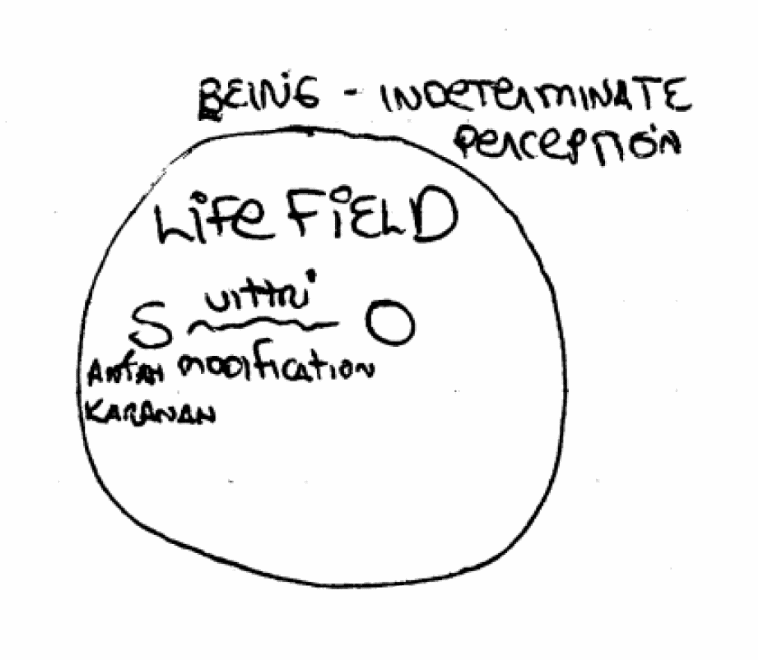
FIGURE 1973 0914-1-AB. Life Field.
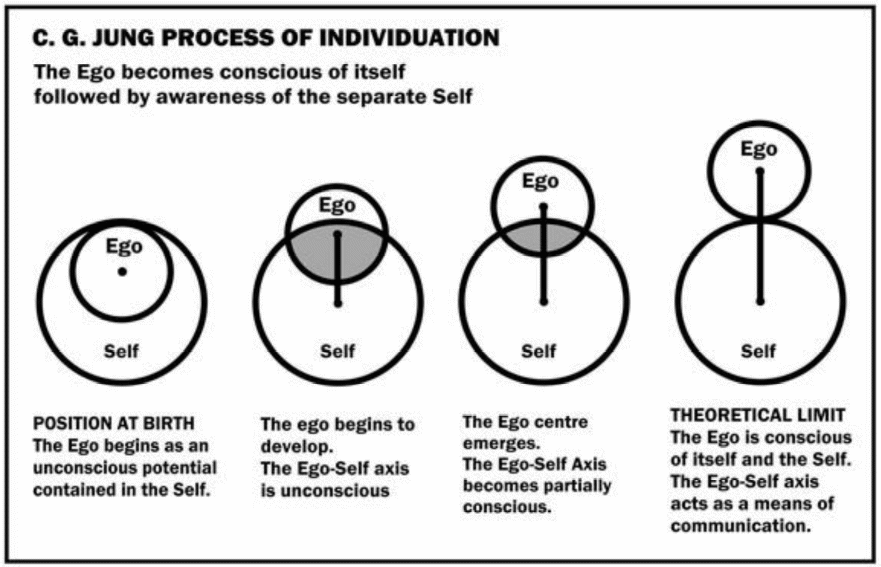
FIGURE 1973 0914-2. C.G. Jung Process of Individuation.
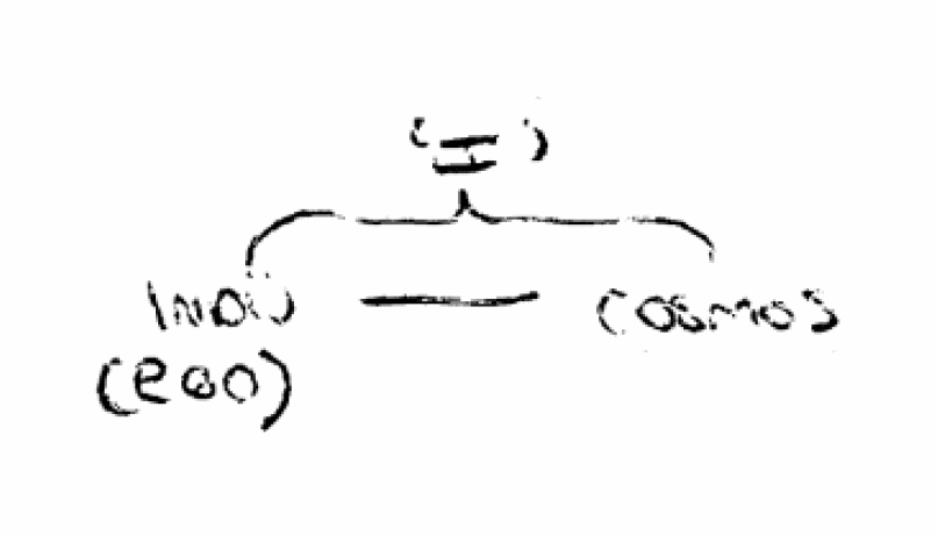
FIGURE 1973 0914-3-AB. Witness-I encompasses Ego and Cosmos.
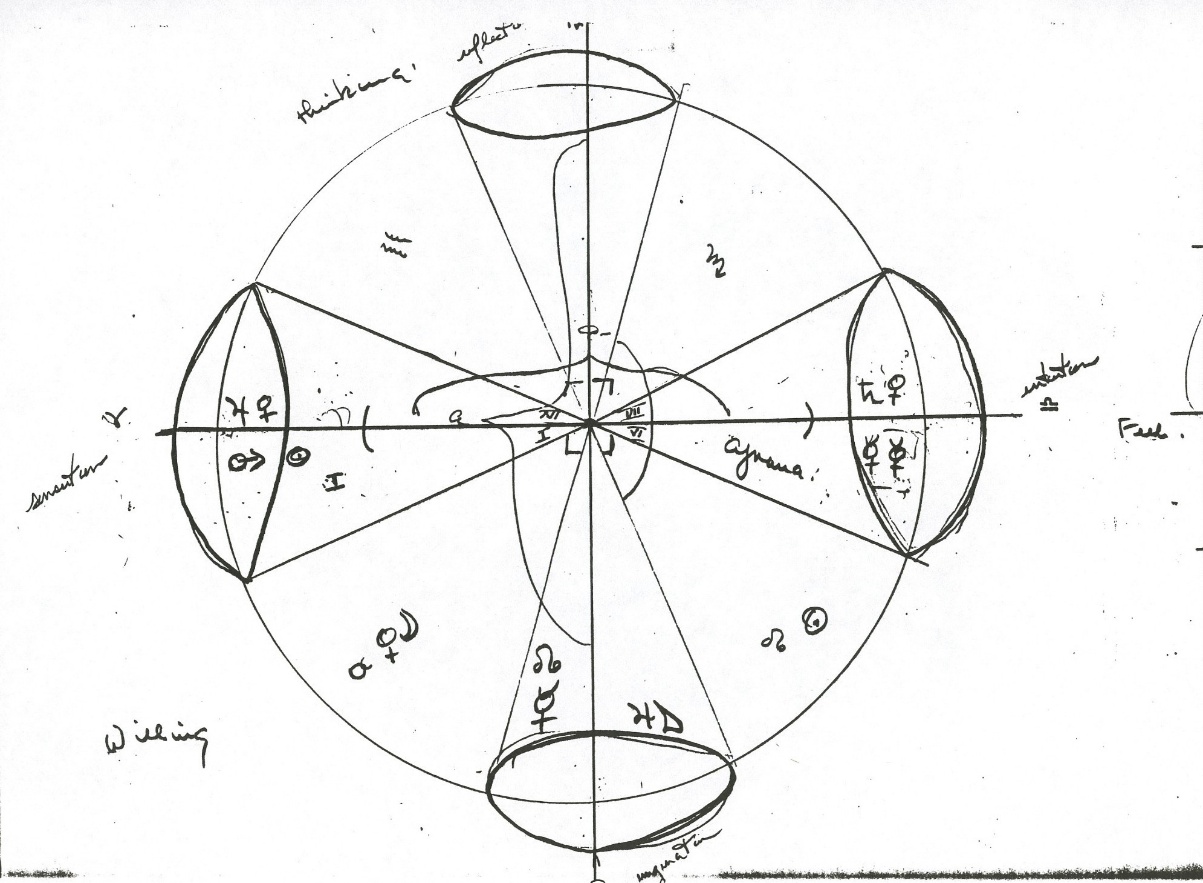
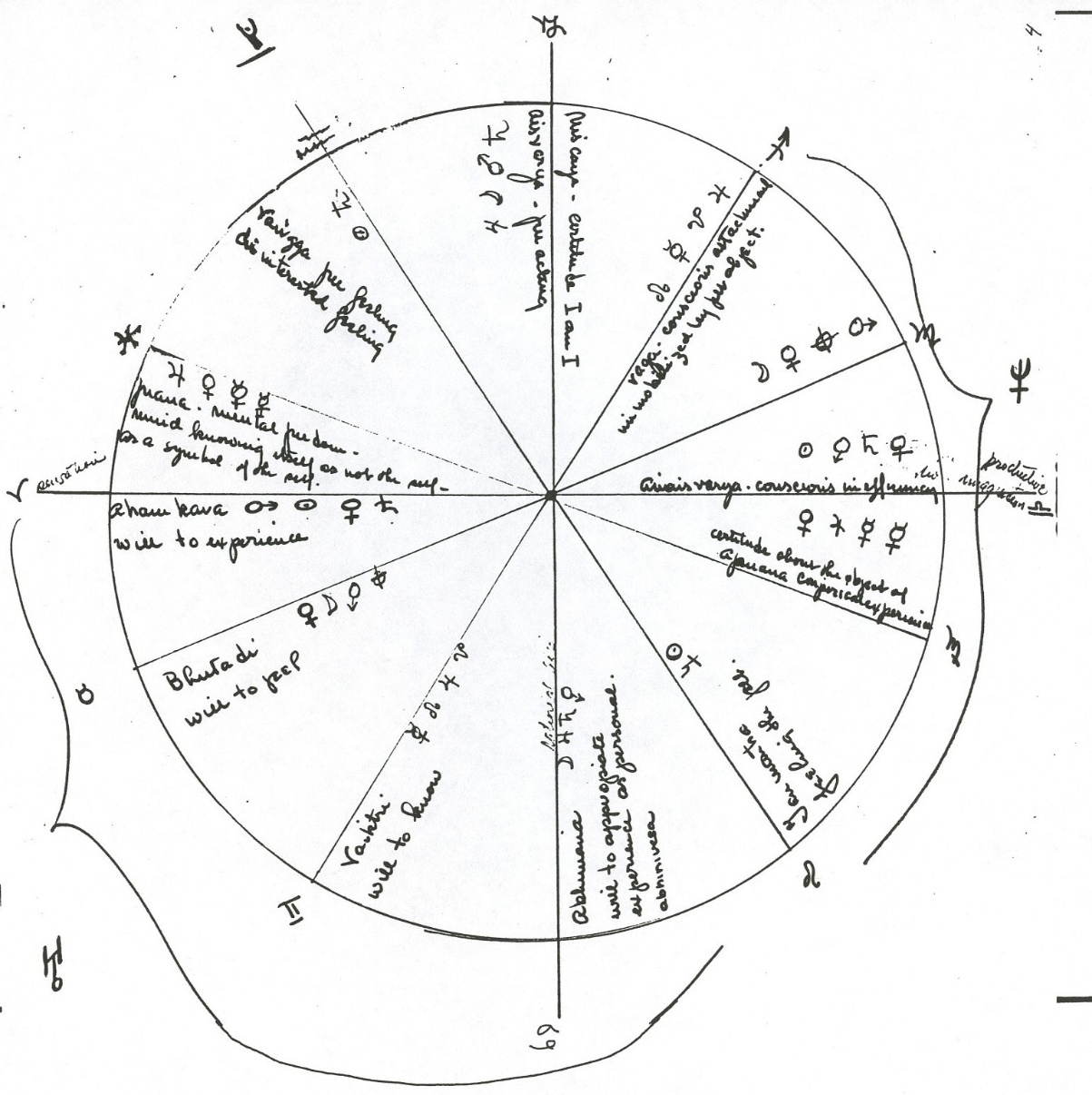
FIGURE AD_G_011. Four Psychological Functions and Thinking Feeling Willing mapped onto Twelvefold Chart; with rulerships and exaltations for houses 12-7.
FIGURE AD_G_013. Four Psychological Functions, Samkhya Terms, and Uranus Neptune Pluto mapped onto Twelvefold Chart.
These diagrams are not from this class but are used as stand-ins to help follow along. Other diagrams also referred to are not with this transcript version. [Transcriber note: [diagram] means the speaker is referencing a diagram as he or she is speaking. If someone is drawing or writing, with audible sounds of chalk on a blackboard, I indicate this by [drawing] or [writing].]
TRANSCRIBED Verbatim by IT (V12a) in 2023 from Audio Files using V11a as a basis. This V12a version has had two more passes with various listening errors corrected; has been reformatted to current standards; has expanded Book List and Subsubjects; has Table of Contents; has five diagrams appended and references within transcript to these diagrams; has new notes within the transcript. In 2025, IT updates audio file markers to match new REP audio. Archival verbatim transcript – V12a.
AUDIO FILES: 1973 0914a, 1973 0914b. [Note 1: "Tape" and "Side" refer to original audio cassette tapes that were later digitized into .MP3 Audio Files. Note 2: In 2025, REP Studio cuts dead air from file b.]
1973 09/14 at Wisdom's Goldenrod
Jung; Epistemology
[Audio File 1973 0914a Begins]
AD: --acquaintance, psychologically speaking, with these terms, you know, familiarizes you with what the others will do. And it is a problem, you know? I mean, it would be interesting if you found out how you operate, whether in terms of thinking or feeling. Now I'm trying to sell you anything. [student assents] Anything is better than dream psychology, I want to get out of that! (AD laughing, bit of laughter)
S: Well--
S (faint): Yeah.
S (faint): Same with me.
S (faint): Uh-hm, same here.
S (faint): [couple words inaudible] everything we've continued.
S (very faint): Uh-hm.
AD: Well-- Ok.
S (very faint): Yeah.
[16 second pause]
AD: At any rate, we could go back to what we did a week or two ago.
S (faint): Right.
[9½ second pause while drawing]
AD: And-- Now this is Sam and Sara's Coffee Shop. But, they give them fancy names. [22½ second pause while drawing] And in here we could put everything, right?
S: Putting in everything.
AD: Yeah. What would you put in Sam and Sara's Coffee Shop?
S: (Put mind) and matter.
AD: [writing] Mind and matter.
S: (very faint): Mind and matter.
S (very faint): Uh-hm.
S (faint): [couple words inaudible]
S (simultaneously): Subtle and gross.
[short pause while AD draws]
AD: Um-- Hm? [drawing/writing] You're not-- you're not dramatic enough for me.
S (very faint): [couple words inaudible]
S: All over them.
S (faint): [couple words inaudible]
AD (simultaneously): Why?
S: Space and time.
S (faint): Space and time, yeah.
AD: [writing] Space and time.
S: Anything knowable.
AD: Don't get philosophic, Richard. (laughter)
S (faint): Name and form?
S (very faint): Change, yeah.
AD: [writing] Change.
S (very faint): Creation. Creation.
AD: [writing] Creation.
S (very faint): Becoming?
AD: Becoming.
S (faint): Imaginary [one word inaudible]
AD: Hm?
S: Imaginary [one word inaudible] (some laughter)
AD: Well, yeah.
S (simultaneously): It's under life and death [couple words inaudible]
AD (simultaneously): That's under life and death. Then at the bottom we could put-- see we could even put Nirvana.
S (faint): Right, but [few words inaudible]
AD: [writing] But with life conditions attending, you know.
S (very faint): Causal ones.
AD: Yeah like on-- when you're on the way out, you see, you're still living out the prava buddha, praba karma.
S (simultaneously, faint): Prarabdha karma?
AD: Yeah.
S (faint): Is what you'd call it, uh-hm.
AD: Nirvan-- [student assents] [writing] Life continues. Alright, that's Sam and Sara's Coffee Shop.
S: It's got a little menu.
S (simultaneously): [one/two words inaudible]
AD: Huh? (laughter)
S (very faint): That's good to know.
AD: What did you say?
S: It's a menu.
S (simultaneously): I said that's the menu.
AD: That's the menu, yeah. (more laughter)
[13½ second pause while AD draws/writes; faint background student talking, laughter]
AD: Ok. This is Sam and Sara's Coffee Shop. Reminds me of a Martian who has borrowed some bagels from-- and then told the owner, he says, "You know, this would go good with lox."
S (very faint): Uh-hm.
S (faint): Uh-hm.
[few seconds of faint background student talking]
S (faint): Martians like this joke. (bit of laughter)
AD: It's a Martian joke.
S (very faint): Yeah.
S (very faint): Yeah.
S (faint): Because--
S (simultaneously, faint): [one word inaudible] That was a joke.
S (simultaneously, very faint): [couple words inaudible]
[Note: See FIGURE 1973 0914-1-AB for the following.]
AD: Alright, so we could pick up the problem of s-- of the types by starting out with epistemology. He says over here this is indeterminate being [diagram], the objective psyche, and inside where Sam and Sara's Coffee Shop takes place, you have objects and things, you know. You don't see indeterminate being, you see Sam and Sara's Coffee Shop. Indeterminate being is something that the Buddhists are going to be very negative about.
S (very faint): I thought [few words inaudible]
AD: Sorry?
S (faint): I thought we-- what the (dream) analogy (would be is) entirely (this object).
S: I don't think [few words inaudible] (bit of laughter)
AD: Tell me, tell me, the unconscious is within and the external world is without. Where are you?
S: [couple words inaudible]
S (faint): (That too/That's true).
S: Well I guess [few words inaudible]
VM: You tell them, you tell them, let them have a little logic [one/two words inaudible] (bit of laughter)
AD: They're both objective, aren't they? The unconscious [S simultaneously, faint: I'd like to know--] and the external world, they're both-- they're both objective. Alright, huh? Well where does that put you?
S (very faint): I don't know where it puts me.
S (very faint): Go ahead, go ahead.
S (very faint): I never solved the mystery.
AD: Let's see-- We did a little work with [S, very faint: Whitmont.] Whitmont on the objective psyche. [11 second pause] Anyway, some of the references he has here is like it's the image-producing stratum.
[Transcriber note: I am using The Symbolic Quest: Basic Concepts of Analytical Psychology by Edward C. Whitmont, G.P. Putnam's Sons for the C.G. Jung Foundation for Analytical Psychology, New York, NY, 1969.]
Edward C. Whitmont [The Symbolic Quest, "The Objective Psyche," p. 42, AD reading]: "This image-producing stratum, this objective psyche, [AD reads: This objective psyche is the image-producing stratum] is also manifested in emotions [AD adds: and drives] and drive impulses. The correspondence between images and emotion or action patterns… All of these psychic energy expressions have been classified as libido--a term used by Freud to include only sexual drive. We prefer to regard libido simply as all the diverse expressions of psychic energy in any of its manifestations or, to borrow a concept from modern physics, its"field" activities. A field is an energy pattern or configuration that becomes perceptible to the experienced observer only through the patternings [AD reads: patterns] [of] directly observable elements susceptible to its influence."
AD: He gives an e-- the example of a magnetic field.
Edward C. Whitmont [The Symbolic Quest, "The Objective Psyche," p. 42, AD reading]: "…[AD: it's] invisible per se, [AD: and the] iron filings will arrange themselves in a specific pattern which [thereby] makes the field effect visible. What Jung calls the objective psyche may then be likened to an encompassing energy stratum from which arise varying field activities discernible to the experienced observer through the patternings [AD reads: patterning] of image, emotion and drive configurations [AD reads: configuration]. These [AD reads: This] psychic field expressions [AD reads: expression] Jung has called complexes and archetypes of the objective psyche. They are typical energy configurations which are activated by situations and problems, both outer and inner, by people, emotional conflicts, [maturational] needs, etc. They impress their force-patterns upon the totality of happenings within their scope. The objective psyche exists independently of our subjective volition and intent. It operates independently of the ego, but can be experienced and comprehended to a limited extent by the ego. That which, lacking understanding, we would view as merely chaotic imaginations, urges and impulses, can disclose meaning when we are capable of interpreting its image manifestations symbolically."
[short pause]
AD: How about that paragraph? Come through? I mean, we're repeating now, alright? So we got this energy-field or this life-field, and, unless you have, so to speak, [drawing] what we refer to as the antahkarana or mind, alright, there's no possibility of that, you know, manifesting itself in-- in perceptual form. Ok? If you could imagine like, this magnet throws out lines of force, these lines of force are invisible, alright. You correlate, for instance, Brahman, or the objective psyche, throws out these things, but they're not things to us yet, they're still, so to speak, in this invisible realm. And, then he gives you a little mind to play with, alright. Now, you have a mind, these invisible things start appearing, alright. Now the fancy terminology that's used by the epistemologist is something like this, alright, that the categories of the understanding, so to speak, select the material, alright, and determine how these invisible nodal points [drawing] are going to be interpreted in your imagination, alright?
VM: The invisible nodal points are not the categories of understanding [AD simultaneously: No.] or the categories of thought?
AD: The categories like space, time, modality, quality, quantity.
VM: I see, but that would've--
AD: Those would be the categories of understanding. If you want to understand anything, you have to do so [VM simultaneously, faint: Right, ok, sure.] at a certain time, a certain place, a certain way, ok. Now, if-- if you have a-- a mindless consciousness, you know, [drawing] [S: A fantasy.] if you make it mindless, you have disembodied consciousness and yous-- you're back where you started, alright, in this uroboric condition where nothing exists. So we give you a little mind, ok, we give you a little mind and now things start appearing out of this invisible life-field, or he calls it objective. And these nodal points, whatever they may be, whatever these objects, and they are basically undefinable, whatever these objects may be-- According to one school of epistemology, they claim that in order to apprehend this object out here, the mind, so to speak, must work through the categories, that is, time, space, alright, and it selects and determines this material for you. So the categories, like time, space, and the understanding would be a priori, alright, and then the senses can perceive the object. That would mean that the object that's perceived follows after the-- the understanding or the categories arrange the material for you. Alright, this is a very complicated way-- I mean this is a relatively easy way-- I'll read the complicated way the epistemologists put it. And you better be ready because Richard won't kid around, I mean he's really getting caught up with the Buddhist point of view. So those of you who want to stick up for the Vedantists really have to understand Jung. He-- for instance, he says here that--
[Transcriber note: I am using Critique of Indian Realism by Dharmendra Nath Shastri, Agra University, Agra, 1964.]
Dharmendra Nath Shastri [Critique of Indian Realism, p. 2, AD reading]: "Kant holds that the formless sense-data…"
AD: Alright, sense-data that's formless-- In other words, whatever the object may be out here [diagram], which is formless, alright.
Dharmendra Nath Shastri [Critique of Indian Realism, p. 2, AD reading]: "…are received a posteriori through the senses to which forms are given a priori by the intellect."
AD: Alright, I just told you that.
Dharmendra Nath Shastri [Critique of Indian Realism, p. 2, AD reading]: "These forms are of two kinds. In the first instance, the data supplied by the sense [AD reads: senses] are presented in the form of Space and Time. Space and Time are not, according to Kant, objective realities, but are only the subjective ways in which we cognize realities [AD reads: reality]."
AD: And get acquainted with Kant because Jung sits on him. You'll see very often when he makes certain remarks how Kantian they are.
Dharmendra Nath Shastri [Critique of Indian Realism, p. 2, AD reading]: "We a…"
AD: Yeah?
S (faint): Or as he-- he says in one of the Letters somewhere that he uses Kant as sort of like his-- his basis.
AD: Why don't you tell them? Go ahead, go ahead.
S: No, he says in one of-- in the-- the Letters, in one of the Letters he says that he-- he uses Kant as sort of-- as-- as sort of the basis, as a basis for-- for a lot of things, I forget exactly which one is it.
AD: Yeah. We'll get a chance, we'll try reading that letter because he certainly was a great student of Kant, and that's why I'm putting you, you know, through a little trouble now because you'll see that, you know, no one develops in a vacuum. His historical background sometimes lights up a lot of [one word inaudible] passages. Alright, so--
Dharmendra Nath Shastri [Critique of Indian Realism, p. 2, AD reading]: "Kant holds that the formless sense-data are received a posteriori [AD: That means after.] through the senses to which [AD adds: the] forms are given a priori [AD reads: given before] by the intellect. [AD: Alright?] These forms are of two kinds. In the first instance, the data supplied by the sense [AD reads: senses] are presented in the form [AD reads: forms] of Space and Time. Space and Time are not, according to Kant, objective realities…"
AD: That is, there's no such thing out there as space or time that you can--
Dharmendra Nath Shastri [Critique of Indian Realism, p. 2, AD reading]: "…but are only the subjective ways in which we cognize realities [AD reads: reality]. Realities in themselves are non-spatial [and] non-temporal."
AD: This sounds almost like the Buddhist Logicians, you know?
Dharmendra Nath Shastri [Critique of Indian Realism, p. 2, AD reading]: "The other kind of subjective forms are the categories of [AD adds: the] understanding, which are classified under four heads [AD reads: under the heads of]--quantity, quality, relation [and] modality. We are here concerned, however, only with the broad fact that, according to Kant, the objects of our experience receive their form from the intellect, [i.e.], they conform to our thought. There does exist an external reality, but it is transcendent."
AD: That is, we could never know what it is.
Dharmendra Nath Shastri [Critique of Indian Realism, p. 2, AD reading]: "The world of our experience does not exist externally in the form in which it appears to us."
AD: So the object you see does not appear, I mean, is not the way it appears to you.
Dharmendra Nath Shastri [Critique of Indian Realism, p. 2, AD reading]: "It is the result of the working of our thought on the material supplied from the external source, the transcendent external reality. Kant [thus] stands midway between the naïve realist who holds that the external world exists exactly in the form in which it appears to us…"
AD: I object to the use of the word "naïve".
Dharmendra Nath Shastri [Critique of Indian Realism, p. 2, AD reading]: "…and the idealist who holds that it is nothing but an external projection of our ideas."
AD: You think you follow that-- that paragraph now? Don't be bashful, I mean, they're difficult.
S (simultaneously, very faint): [few words inaudible]
AD: Well, that's presumptuous. Like I have the truth, therefore everybody else, a realist who actually believes when he sees a chair, he sees a chair, to call him naïve, you're claiming that you know what the truth is, it's not a chair. He's a realist, that's good enough.
S: Could you reread the very first sentence once again, Tony?
AD: Yeah.
Dharmendra Nath Shastri [Critique of Indian Realism, p. 2, AD reading]: "Kant hold that the formless sense-data are received a posteriori [AD: After.] through the senses to which forms are given a priori [AD: Before.] by the intellect."
AD: Yeah, of course, [S simultaneously, very faint: And, I didn't--] that's what-- that's what I was trying to explain to you, Drea.
S: I thought I understood it until I-- yeah.
AD (simultaneously): Yeah, what I was trying to say is-- In other words, this is the objective psyche and within it there's these objects [diagram]. [drawing] We don't know what these objects are, ok. Now let's say the mind wants to grasp this object, see? Now we don't know, we'll call it an "x", [S, very faint: Yeah.] alright, and it must distinguish it from another object, let's say, over here [diagram]. So that means it has to select this object, provide it with a certain space and time, in other words, separate it from this here [diagram]. Separation immediately means, you know, localizing it, alright, and then present it either before or after another thought. So the-- the intellect, so to speak, has these subjective categories, they're like claws, and they apprehend whatever this object is.
S (faint): Uh-hm.
AD: Ok? And then, in here [diagram] you got the eyes and the nose, alright, and the mouth, then something appears to you in your imagination, you say, "Ah, it's that thing out there." But in between you had the space-time forms of the understanding. If you were to wipe out the space-time forms, and if you were to wipe out, so to speak, the senses, there would be nothing for you to perceive, right? Now, if you-- if you put the senses here, [drawing] you say, "There, I see." But, in order to see something out there, you have to select this and make it different from that. Ok?
S (faint): Yes. Almost like [one/two words inaudible]
AD (simultaneously): Well he's reversing it. He's saying before you can see something, these things have to be classified, isolated, and presented in a certain time and a certain space. Because if everything appeared to you all at once you wouldn't see anything. So the objects have to be isolated and presented in a sequential or serial order.
S: Ok, I've got a couple questions.
AD: Go ahead.
S: The way you have the objective psyche drawn, it's not clear to me whether that also includes elements that arise-- Say I have a feeling of subjectivity that arise from the unconscious and has to be dealt with and given a certain form in the understanding but internally.
AD: Yeah, basically.
S (simultaneously, faint): Of course.
S: Ok, (does) that include them? Ok, also--
AD: In other words, if you had an image, let's say some emotional drive was welling up from within you, it would appear, let's say as a drive, some kind of emotion, some kind of feeling, and it would present itself, it would have to do so serially. First one, then another, then a third, alright.
S: Right, and taking on successively clarified kind of forms, yeah.
AD (simultaneously): The difference here of course is that you cannot locate thoughts in space.
S: Ok. And also, it seems that from what you said, in order to perceive the objects as we perceive them, somehow in our understanding the forms are there and the object he says is a formless sense datum which is [AD simultaneously: Yeah.] processed through the form which our understanding contains a priori, it's a given. Where-- I don't know where those forms are, the-- or isn't that-- is it now having to do with them. I don't--
AD (simultaneously): Try again, Andrea.
S: These forms in our understanding are what process the formless sense-data so that we can relate to--
AD (simultaneously): Apprehend them.
S: Right. And I'm getting confused about what's meant by understanding because it seems as if understanding is being a process and at the same time being the understanding. And it's kind of like a conscious kind of understanding or an unconscious kind of understanding or-- I'm not-- I'm not-- What would you-- what would you do with that?
AD (simultaneously): Alright, if-- if you want, if you want, then we could make this division which Kant does himself, although it's not in here. The categories of the understanding, let's say, will be space, time, modality, quantity, quality, and all that, alright. Then when you perceive an object, you judge it. The judging of the object is different from the categories that present that object to you. So he calls the categories one thing, the categories of the understanding one thing, and judgment a second thing.
S: Ok.
AD: "I see this chair." That's a judgment, besides it being a perception, an apperception.
S: In what way is it a judgment different from the apperception?
AD: Well because it's an affirmation of an objective reality. You have something there in time and space. As soon as you say what it is, you make a judgment. "What" [one inaudible student word simultaneous with AD] always deals with an essence. [S: Hm.] In other words, "what" tells you what this thing is. When you say "what" you say, well, what defines the object for me, that's its essence. A square is defined in a certain way, a circle's defined in a certain way--that's its essence. Alright. Now you don't see an essence per se until it's manifested or objectified in your understanding. Well, now we're getting off the point. The point we're trying to make here, Andrea, is that when the categories, so to speak, try to apprehend something, in order for the mind to have an experience of any object, it has to isolate this object from that object. Look at it this way. Go the reverse. If you imagine imm-- an immediate consciousness, everything is immediate to this consciousness, alright, a hundred miles or a million miles are the same, immediate, [student assents, faint] then there could be no experience.
S: Yeah well nothing leaves off, everything's continuous.
AD: There wouldn't be any-- there wouldn't be every thing, there wouldn't be anything. If there was an immediate consciousness, if black, blue, and yellow was presented to you simultaneously, as a million miles or a hundred miles, ok, and that's immediate consciousness, alright, then there will be no distinctions between one thing and another, there would be no experience as you know it. Ok? So he says in order for us to have an experience-- Now, you're originally, even according to the Jungians, you're originally this entire uroboric condition, alright, this objective psyche, alright, and as long as you are the infinite, then there's no experience for you. Ok? So we got to make you finite. And we give you a little mind over here [diagram], we turn you into a finite being, alright. Now you got this little stupid mind, see, [S, faint: Ok.] and everything that you apprehend you have to grasp in terms of time, at a certain time, in a certain place, in a certain way. And then you start investigating, "Well now what is it that I did grasp?" and now you have to go into details. But we don't want to run that far ahead yet. My purpose here is to show that in a sense Jung takes his position somewhat similarly. He postulates an undifferentiated objective psyche, alright, which contains the totality of all possible experience. Now what this object is that's out there, he says, there's a few things that determine it. And, he-- he goes through this spiel, actually expounding Kant but in a Jungian way so, that's what I want to get into, his-- his way of doing it.
S: Well Tony, are you on--
AD (simultaneously): Go on.
S: Are the categories of the understanding subjective?
AD: Yeah, he refers to them as subjective. From the Vedantist point of view, they belong to the mind, but not in the sense like a bunch of keys or your pocketbook, you know. They're intrinsic to the mind's functioning and they're not other than that mind's functioning. He speaks of them as though they're like a pocketbook, you could--
S (very faint): Uh-hm.
S: Are the categories of the understanding then like functions of the internal organ?
AD: You can't [S simultaneously: Right.] use that word 'internal organ' with Kant. But, you're right.
S (simultaneously): I'm-- well [AD simultaneously: Yeah, you're right, yeah.] the reason that I was talking about the inner organ--
AD (simultaneously): You're right, I just am-- I can do it. (bit of laughter)
S: You're not a Kantian.
S: You're a cross.
AD: You're right.
S (simultaneously): (I wasn't here.)
S (very faint): (Yeah.)
S (simultaneously): Uh-hm.
S: [couple words inaudible]
AD: Alright, then we made the remark, to continue, we pointed out that there was four stages, and we could quickly recapitulate them. We spoke about four stages, [drawing/writing] and the four stages-- You'd have to tell 'em because I don't believe this stuff anyway. (bit of laughter) One was unitary consciousness, I think, right? The second was deintegration. And the third was magical. And the fourth is where we're at, right? Mythological. No, no, mythological here--
VM: No, I understand mythological, that can be science as mythology [AD simultaneously: Yeah.] or being on the Quest is a certain mythology.
S (simultaneously): Yeah.
AD: Sure.
VM: Yes, but sometimes I slip back into the other [few words inaudible]
AD (simultaneously): No, in that case, in that case we would be-- be misunderstanding. The word 'mythology' is much more meaningful because myth-- mythology has an extension and a range that includes the rational consciousness, the conceptual consciousness. As a matter of fact, one myth could tell you a thousand things, one concept tells you one thing, you know. In other words, a myth has a-- um-- a root meaning. Like we see this in astrology. When you put a planet on a certain degree of an archetype, that's a root meaning, it could mean many many things, depending upon the apperceiving consciousness. Alright? So the word 'mythology' is much more exact. To use conceptual consciousness which is a subdivision within mythology-- The Hindus, the Hindus think much more highly of-- [aside: Thank you.] they think much more highly of mythological consciousness because it includes the others, it includes aesthetic consciousness, conceptual consciousness, rational. [Note: See FIGURE 1973 0914-2 for the following.] Alright, so we pointed out [drawing] that in the first-- in the first stage, in the unitary stage we had no problem, right? You're divine, there you are, [drawing] in there, ok. And the example that one of the-- one of the-- is like this is the Self and this is the ego, nice inside that Self, protected [diagram]. I want you to keep this in mind because you will s-- You can see in this diagram very easily that the substratum of the Self, alright, is the substratum of the ego.
VM: That's sort of like it-- that'll be-- I think it was John who was talking about that being analogous to the sleep state and the ego there is somewhat in seed form, is that--
S (very faint): No that's (bigger).
AD: Uh-hm. [student assents, faint] Ok? [student assents] And in that unitary stage is very nice, everybody enjoys that.
S: Did you mean to say that the-- the substratum of the Self is the substratum of the ego or that the Self is the substratum of the ego?
AD: This Self here [diagram], ok-- In other words, this thing which is going to evolve into a subject and an object, alright, [student assents] has for its ground or its substratum the Self. So in some sense, if you listen very carefully you-- I don't mean to me. If you listen very carefully you can see that there's a prescience in the ego that's unbelievable. In other words, the possibility of foreknowledge or anything of that nature is posited. The other diagram we have was the [drawing] Witness-I is up here, ok, and the ego is in here and the object is in here [FIGURE 1973 0914-3-AB].
S: Uh-hm.
AD: But if this is the presupposition of all possible experience, then that means that these two are grounded in the "I", ok? That's what we're doing here but a little differently. [drawing] Alright, then the second stage was the deintegration stage, deintegration-- [to student] I don't know, why don't you find out what he says about them. There's a kind of breaking up, you know. [to student] It's towards the end.
S (very faint): It's in here [couple words inaudible]
S (faint): I'm surprised you don't know.
AD: [to himself, looking for quote] Ego…separation from the unitary reality. Alright, so here again we have the Self, [drawing] and now this ego is starting to break away from it [diagram], alright. Now you can see, a child over here would feel almost its divinity. That's why I call you people often Buddha-heads. (bit of laughter)
S: [few words inaudible]
AD: Buddha-head (too).
S (simultaneously): I call them (different) [one word inaudible]
S: But I emit no light.
AD: But they emit no light, right. Alright. Over here you're a real Buddha-head and (some laughter) you say, "Ma, I want my milk" and she comes running to you, "Don't cry baby," she feeds you and you feel like a divinity. There's no separation between you, you know, that's the Umwelt. Everything is one in this stage. Then about six months, when you're about six months, your father comes over and gives you a slap because you've been crying, you know. (laughter, AD laughs) First [S simultaneously: You mean--] separation from the Self. (laughter) Alright? Read a couple of passages from "Deintegration".
S: Ok.
Edward C. Whitmont [The Symbolic Quest, "Ego Development and the Phases of Life," p. 269, VM reading]: "Deintegration [on the contrary] is conceived as a spontaneous property of the self behind ego formation. Expressing it anthropomorphically one could say that it springs from a desire of the self to become conscious, to form an ego by dividing itself up." [Michael Fordham, "On the Origins of the Ego in Childhood," p. 93]
"Out of the aboriginal wholeness and unity there now develops the various emotional and perceptual reactions and archetypal trends, and last but not least the ego capacity for identity, consciousness and willing."
AD: Now I'd like to insert here a little remark because they're going to do this to the Vedantists, you know? How come this deintegration takes place? How come there's this separation?
S (very faint): [couple words inaudible]
S (very faint): [couple words inaudible]
S (very faint): [couple words inaudible]
AD (simultaneously): Huh? The same thing, like they're going to ask-- You-- you know, in the Vedanta, you have only Brahman. And then you [VM simultaneously: (Well how) (couple words inaudible)] ask them, well where did Avidya come from? [VM simultaneously: Yeah, same question.] And you can't answer it. Samkhya, the same thing. You have Prakriti and Purusha. Where's Brahman fit in? Ok? Alright, Jungians too have that problem, we're not going to exclude them. They got their fair share of problems. How this separation takes place, why it takes place, we don't know. But evidently the Self decided that it needs some kind of realization or conscious realization so it starts creating this little ego, alright, that's deintegration. Now the third stage-- Try to remember here, too, by the way, you can see in these two stages the relationship between the mother and child is absolutely overwhelming. [drawing] Because this axis, this axis between the ego and the Self [diagram], the child projects that Self onto its mother and the kind of relationship it's established with that mother is going to be all-determining. Just stop and consider, you see that. Yes, Andy--
AH (very faint): In what sense are you talking about the ego in the unitary condition? I don't understand how [couple words inaudible]
AD (simultaneously): In what sense what?
AH (faint): And in what sense are we talking about ego at the first step, the unitary condition? How can that-- how can we even [one word inaudible]
AD (simultaneously): You really can't. You really can't. You posit it, you know, just like we say-- like Jung points out, he says that consciousness appears from the unconscious. At first it's like a little island, it juts up out-- out of the sea, alright, and there's this ocean all around. And if you inquire, "Well how come, you know-- what are you talking about, an ego?" You can't really answer those questions, that's why he says they're metaphysical questions, they cannot be answered. Like if you ask the Vedantist, "When did this ignorance begin?" you know. They say it's beginningless, there's no answer to it. So that-- that means the train can go on, we don't have to stop there. [short pause] Go ahead.
AP (faint): Was this the experiencer [few words inaudible]
AD (simultaneously): Well, all you have to do is re-- all you have to do is recall-- Perhaps one way of trying to see that is if you try to recall the first few instances when self-consciousness came into being. Can you remember? Was there any particular time where you felt that the ego was precipitated or crystallized out of a sort of uroboric condition? Like I remember when I was about two years old, you know. I was in a carriage, drinking a bottle, like all little good children do. And my father had rubber cement, you know, in a can, and I took it and spilt it out, you know. (laughter) And as I spilt it out, there was a stove and I saw the flames shoot up, alright. And I said, "The world is on fire!" (AD laughs, laughter) Alright. But I remember that instance very clearly, see, it was like consciousness was precipitated right then and there, and there was a separation from that condition of non-differentiation, alright. Evidently, pain, anxiety, suffering, really-- really does that to us very quickly. But where-- whereas if you're in a pleasurable comfortable condition you go on till you're about 15. (laughter) Some cases 20. I know one case, 40. Alright? [student assents, faint] The-- the reverse process, like if-- if you think of the Liebestod, you know, when Tristan is dying or Isolde is dying, alright, how the enjoyment of being swallowed up, the experiencing of one's own death, that would be the reverse, like in-- [drawing] instead of the ego being out here like it comes back inside [diagram], alright. Those are all archetypal-- archetypal motives. In almost all art you'll find that.
AP (faint): That's why the reflected image of-- the reflected image that is also [one/two words inaudible]
AD: Tell me what you mean, the reflected image, Anna. I need more. I told you, I failed telepathy.
AP (faint): The first reflection of these-- of the-- and it [few words inaudible]
AD: Alright. Anybody knows what she was just saying to me? Come on Anna, speak.
AP (simultaneously): Well when we do the three circles, the middle circle [diagram]-- [Note: See Astronoesis, diagram on p. 166.]
AD: Yeah but I'm not talking about the three circles now. [AP simultaneously: Ok.] Right now the three circles are right here--there's only one circle [FIGURE 1973 0914-1-AB]. This-- this would be the first circle [diagram], this would be the top circle, alright, there would be no [drawing] differentiation here. Alright? Everything is in this circle [diagram] right now. I'm trying to give you the easiest diagram. Now the first circle, so to speak, is indeterminate. There's nothing that's distinguishable from anything else, alright. And this would be the condition that they call the unitary field. The second circle would be the deintegration field, denigration, where there's a separation that takes place, an object and a subject-- I'm sorry, a subject starts appearing. In other words, [drawing] ignorance creates its own little monster, a mind. (bit of laughter)
AP (faint): I know. This is-- when PB just said it is [few words inaudible]
AD: No, don't go to that, [AP simultaneously, very faint: No?] don't go to that. You see, you're starting at the top, you're starting at the top. [one/two inaudible AP words simultaneous with AD] That's an entirely different thing and we'll get to that, but that's an-- a different thing.
S (faint): There's good quotes in the "Nature of the Psyche" Anna [AD simultaneously: Go ahead.] [few words inaudible]
S (simultaneously, faint): (Uh-hm.)
C.G. Jung [CW 8, The Structure and Dynamics of the Psyche, "On the Nature of the Psyche," p. 189, paragraph 387, S reading]: "[Here, as] on the infantile level, consciousness is not a unity, being as yet uncentred by a firmly-knit ego-complex, and just flickering into life here and there wherever outer or inner events, instincts, and affects happen to call it awake."
AD: You remember that? Your early childhood was like that, right? You can't-- you can't recall your early childhood except little pieces, you know. [student assents] You know, that's kind of-- the ego was gradually coming into being. Now these islands of consciousness, so to speak, and I'm using Jung's terminology, this would never be my terminology, alright, these islands of consciousness, alright, they start grouping and finally there's a whole bunch of them and they become one big island and now you start saying "I" when you're about three years old. Alright, then the third stage was the magical consciousness. Would you read some selections from that?
VM: Well there's a lot.
AD: Well just pick out some of the things that I've checked or underlined, don't-- Magical consciousness, of course, corresponds very easily to the dream level of consciousness where anything could be anything else, where the l-- in a sense, the laws of causality get suspended, you know. Like in-- in the physical world you could jump off a building and get killed, but in a dream world you could jump off a building and keep flying, and even be enjoying it, (keep the horses) suspended. It's a different kind of consciousness operating. I'm trying to make this simple, you know. Because when we work backward it's going to be very difficult. Go ahead, please read.
Edward C. Whitmont [The Symbolic Quest, "Ego Development and the Phases of Life," p. 271, VM reading]: "The laws under which beginning consciousness engages in its encounter with the still encompassing unitary reality are not what we call rational. The operation of this magical dimension of the unconscious can be observed also in some aspects of primitive psychology. … [VM: Another place here--] This dimension of functioning makes itself felt directly and overwhelmingly without differentiation among or separation of image, emotion and action pattern. Any part of an event evokes the whole [(pars pro toto)] and any part can substitute for any other. Images"are" affects and compel action. This constitutes what we are accustomed to calling suggestibility. To an extreme degree it characterizes the psychology of the child and the primitive."
VM: And some American Brahmans.
S (faint): (There as well), there too. (laughter)
AD: Yeah, that's like when you return back, when you try to get into the heart-consciousness, that's your first experience, that magical dimension. And-- yeah, PB speaks about it in the chapter on the Heart, so read it for yourself. [Note: See Paul Brunton, The Quest of the Overself, Ch. 13, "The Mystery of the Heart".] Alright, so that was the third, and here you can see, in terms of primitive psychology, you can see a complete subservience to the object. The attachment to the object is overwhelming, the projections are so-- so strong that he actually has to go through ritual to divorce himself or separate himself from the object.
S (very faint): I don't see--
S: Yeah.
S (faint): (Uh-hm.)
S (faint): Participation mystique?
S: Yeah.
AD: Yeah.
S: [one/two words inaudible]
AD: Maybe-- maybe you could find a couple of interesting paragraphs on participation mystique, you can get a feeling for it.
S: I can give an example of that.
AD: Go ahead. Go ahead. Because unless you understand participation mystique, you won't understand a great deal of the compulsiveness of your behavior in terms of your early relationships, your early childhood, things like that. Or, for instance, when an archetape-- an archetype starts functioning through you, you won't understand it unless you understand the nature of that magical dimension 'cause the-- the archetype functioning through you has to employ that magical dimension of consciousness.
[short pause]
S (faint): Do you think an example of this magical dimension is a certain idea, let's say, has-- has a compelling-- compelling power and it works and works and works and then all of a sudden you look at it one-- at one time and-- where something happens and all of a sudden it's not (clear/there)?
AD/S(?) (faint): Yeah, speak up.
AD: Tell them. Turn around. I don't think anyone heard you.
S (faint): My question is whether a certain idea has-- ha-- could be spoken of as having this magical dimension since it has this power and it compels you, (I) can pursue it, keep working over and over it, thinking about it, associating it in terms of, you know [one/two words inaudible] and then all of a sudden it seems at some time or, you know, somehow, that that feeling just isn't there or feasible. I mean, I thought that that might be an example.
S (simultaneously, faint): Yeah but you're not [few words inaudible]
S (very faint): Uh-hm.
AD: Um-- Yeah, that would be an example of participation mystique, (you know/yeah), but, it's not as clear as I would like.
S (very faint): Uh-hm.
S: [few words inaudible] isn't there a sort of necessary importance given to the body? I-- I mean it seems that there has to be a very close relation to the bodily self. Maybe (if you) [couple words inaudible] a wrong way of speaking of it. It's not like your ideas are separate from-- you know, from the very living organism.
AD (simultaneously): Well, did you ever read about some of the initiation rites that they have for adolescents?
S (very faint): No.
AD: Does that sound like they're concerned about the body?
S: Yes, in a very-- it's very important so-- Right? The-- what they [one word inaudible] through the body or [one word inaudible]
S (simultaneously): Crystal, I think in the magical state they haven't gotten into the body yet and it's not until the mythical-- mythological state that you really get that body-consciousness. [S simultaneously: Not (one word inaudible) they're not--] The magical state [student assents, faint] corresponds to the subtle level of consciousness and the expedients used into (manipulate) [couple words inaudible] consciousness into becoming more aware of the body. Like in a dream state you can jump off cliffs and you-- (you do) nothing because you're flying. They don't have a real sense of being into their body with physical gross consciousness.
S (faint): Well I'm thinking though, think of the child's relation to his body or a primitive, it's very different from ours, like there's no-- there is no separation, there's no "I" separate from a body. A child, you know, his body and he are one. His world is almost just another part of his body, it's just another-- (but it plays) really important part.
AD: I don't know if they're one. I think a child has difficulty recognizing his body.
S (faint): Did you ever see a child playing with his toes like it's some other object?
S: Yeah, I mean--
S (simultaneously, faint): They recognize it or it's almost like an autonomous-- he moves a bunch of toes? I mean they don't even realize that they're moving their toes and it took them a while to-- to understand that. In the sense that they are one with their body it's prior [few words inaudible]
AD: See that's the whole notion over here, how we're gradually getting into the body. Takes a long time to get into it. Because perhaps in this stage here, [drawing] you know, we ab-- absolutely refuse to acknowledge that this was a body. Over here [diagram] we're-- we've been told about it somewhat, you know, little by little we're-- someone reminds us we have a body. Then over here [diagram] we're beginning to feel it a little bit, you know, through initiation perhaps. Then finally in the fourth stage, you know, where this cramp of consciousness comes into operation, a person feels absolutely alienated from the world, closed up in himself, now body-consciousness starts assuming some importance. And, you look, half the people in the store here are not in their body yet.
S: [couple words inaudible] (laughter)
AD: We've read-- we read something about participation mystique, for instance, when we were speaking here, in paragraph 507, "General Aspects of Dream Psychology." You-- if you remember--
C.G. Jung [CW 8, The Structure and Dynamics of the Psyche, "General Aspects of Dream Psychology," p. 265, paragraph 507, AD reading]: "Unless we are possessed of an unusual degree of self-awareness we shall never see through our projections but must always [AD reads: always must] succumb to them, because the mind in its natural state presupposes the existence of such projections."
AD: Now in its natural state, that means that the mind is simply swarming with all these projections, and when you're a child you project onto your brothers, your sisters, your mother, your father, and relatives, all these sorts of archetypes and there is no you there, there's only, you might say, a general hospital temperature, you know. (laughter) No?
S (very faint): I don't (feel--)
AD: You don't feel as soon as you go back to your parents' house you've gone into a hospital, the temperature? You take out the barometer and start looking? You don't feel that?
S (faint): I don't feel. (bit of laughter)
AD: You got Mars in Libra, that's right. (some laughter) How about you?
S (simultaneously): So do I [couple/three words inaudible]
AD: You don't let it--
S (simultaneously, faint): You mean, swimming in warm soup?
AD: Yeah, yeah, sure! (laughter) Sure, you know what-- (AD laughing) [S simultaneously, faint: Yeah.] you know what I'm talking about. Yeah. And so you say, "Let me out before I suffocate."
S (faint): I see.
S (very faint): He's doesn't know what he's saying.
AD: Yeah. (bit of laughter) Alright, because what does that mean? You're going back to that childhood consciousness where there's these-- there's these tremendous projections going on. And, if you've assumed or if you acquired any self-awareness, you just can't play that role anymore. And many of us would like to continue, you know, but fate, necessity decided otherwise; you know, come over and says, "Grow up." (some laughter)
(Side 1 of original cassette tape digitized as 1973 0914a Ends; Side 2 Begins)
C.G. Jung [CW 8, The Structure and Dynamics of the Psyche, "General Aspects of Dream Psychology," p. 265, paragraph 507, AD reading]: "So long as all goes well, he is totally unaware of the [AD reads: their] compulsive [AD adds: nature]…"
AD: But let things be a little uncomfortable, alright.
C.G. Jung [CW 8, The Structure and Dynamics of the Psyche, "General Aspects of Dream Psychology," p. 265, paragraph 507, AD reading]: "So long as all goes well, he is totally unaware of the [AD reads: its] compulsive, i.e.,"magical" or "mystical," character of these relationships [AD reads: relations]."
AD: And you can taste that, you can taste that. As you said, it's like going into soup. But like, if we think-- if you have a brother or sister and you see them there's something-- Well, it might be sweet, it might be sour, in your case sweet, in mine sour. But you see your brother and your sister and like a childhood nostalgia comes up, alright. That's part of that magical realm. That person hasn't been differentiated from your consciousness yet. You're not an individual, isolated and differentiated and distinct from him. You right away jump into the soup, the two of you. And usually most people, that's what they do, jump into the soup--"Hey you remember when we did such and such? Did this, did that," ok? And you stir the soup. (some laughter) Turn the heat up.
S (faint): Yeah.
S (very faint): [couple words inaudible]
S (faint): Right.
AD: So he says--
C.G. Jung [CW 8, The Structure and Dynamics of the Psyche, "General Aspects of Dream Psychology," p. 265, paragraph 507, AD reading]: "So long as all goes well, he is totally unaware of the compulsive, [i.e.],"magical" or "mystical," [AD adds: participation mystique] character of these relationships."
AD: This is even more subtle than you think. Because in terms of people it's nice, but when it's in terms of your own thinking, you can hardly see it anymore. And boy, if you think there isn't that sort of participation mystique with your thinking, you've got a lot of learning coming up. Everyone thinks that it's his thought, therefore it is the thought. (some laughter) Participation mystique. He hasn't distinguished, separated himself, from his thinking. And that's the first-- one of the first chapters in the Quest is "I am not my intellect. I am not that which I perceive." And so people go right on reading. Alright.
C.G. Jung [CW 8, The Structure and Dynamics of the Psyche, "General Aspects of Dream Psychology," p. 265, paragraph 507, AD reading]: "So long as all goes well, he is totally unaware… But if a paranoid disturbance sets in, then these unconscious relationships turn into so many compulsive ties, decked out, as a rule, with the same unconscious material that formed the content of these projections during the normal state. So long as the libido can use these projections as agreeable and convenient bridges to the world, they will alleviate life in a positive way."
AD: Alright, so as long as your projections are working for you, everything is fine. Let your husband say an unkind word, "The soup was lousy" and boom! (some laughter)
C.G. Jung [CW 8, The Structure and Dynamics of the Psyche, "General Aspects of Dream Psychology," p. 265, paragraph 507, AD reading]: "[But] as soon as the libido wants to (AD laughing) strike out on another path, and for this purpose begins running back along the previous bridges of projection, they will work as the greatest hindrance it is possible to imagine, for they effectively prevent any real detachment from the former object."
AD: You getting a taste, a little bit, of what that mag-- that magical dimension of consciousness is? And you can see why childhood is so overwhelmingly important. And you never go to a child six years old and say "You're neurotic." You go to his mother and look at her and she's the one you got to figure out. Because he's only an appendage, a psychic appendage to her functioning. There's other quotations there in participation mystique, I advise you to study that very carefully.
S (very faint): Psychotherapy.
S (faint): [couple words inaudible]
AD (simultaneously): Psychotherapy has (really) [few words inaudible]
S: I mean Tony, don't we say that children are born with a certain predisposition, with certain kinds of emotional insecurities that, you know-- I mean otherwise why would astrology be of any use to us?
AD: Well we will-- we will-- we will have-- She said that a child is-- does have a sort of inborn attitude, you know, which will come out and manifest itself, alright. But remember, that manifestation could take a positive or a negative road. We all have a mother archetype. I could have a mother that's a witchy kind, you know, bitchy and all that. So I have a negative mother archetype to deal with. That's one possibility, the other possibility, of course, she could remain a positive mother figure. But the oth-- the other point to remember is that there is a coincidence between the karma, the inborn disposition of the person, and the actual circumstances that are going to make for the manifestation of that inborn disposition. Ok? So there will be a coincidence here. You can't really separate these things except linguistically. The subject and the object can't be separated, you can't take the object, put it over there and the subject over there. You have a stick it's got two ends, and you can't, you know, do anything about that. Every subject has its environment. And that environment is as much part of the subject as the subject is part of the environment. Yeah--
S (faint): So you're saying that the predisposition is open-ended basically, it's a-- it's a sort of skeletal formation and the stuff that grows out of that will it be dependent upon the environment [one/two words inaudible]
AD: Yeah.
S (faint): You would say it was like an open-ended thing [one/two words inaudible]
AD (simultaneously): Yeah, the basic inborn attitude cannot be altered, you know. They call that the core of the complex. The shell could vary somewhat, alright. Everyone has a mother archetype, you know. One could have a mother-complex that's negative, another one could have one that's positive. But even if you took just the positive archetype, there could be variations within that, ok. So, there again, you know, you look at someone who's got Venus in the fourth house, you say, "Boy, he had a happy childhood." You look at someone who's got Mars down there, "What were you complaining about?" you know. And one way or another it will manifest. Alright, that's participation mystique. That gets us to the-- out of the third level and now we go into the fourth level where we think we belong.
S (faint): Is the preoccupation with thought in the magical dimension, is that--
AD: The what?
S (faint): The preoccupation with thought.
AD: What preoccupation? What thought?
S: When--
AD: Did you ever see a child have thoughts?
S (faint): What we call responses maybe? Is that what you call subjectivity?
S (faint): (Uh-hm.)
AD: I don't know what you mean.
S (faint): Well, see I was just--
AD (simultaneously): Who is calling what subjectivity? [9¾ second pause] Alright, let's read the fourth. You got to put these words in context for me, I can't answer that.
Edward C. Whitmont [The Symbolic Quest, "Ego Development and the Phases of Life," p. 275, VM reading]: "Gradually the preoccupation shifts from the body level to fantasy in more general images and then in concepts, and there develops an awareness that the images or concepts are not necessarily quite identical with the objects they purportedly represent. … The developing ego emancipates itself from the magical threats of the devouring, dissolving all-oneness by means of fantasy activity [VM adds: or] (non-directive thinking, in Jung's terminology)."
VM (faint): Well, they're not here, consciousness and so forth.
S (very faint): Uh-huh.
AD: Yeah, would you repeat that?
VM: The last part?
AD: Yeah. Mythological functioning.
VM: Read the whole thing I just read or-- [AD, faint: Yeah.] Alright.
AD: Yeah, just repeat.
Edward C. Whitmont [The Symbolic Quest, "Ego Development and the Phases of Life," p. 275, VM reading]: "Gradually the preoccupation shifts from the body level to fantasy in more general images and then in concepts, and there develops an awareness that the images or concepts are not necessarily quite identical with the objects they purportedly represent. This development can be regarded as the beginning of the mythological mode of experiencing [VM reads: experience], which gradually replaces the purely magical one. The developing ego emancipates itself from the magical threats of the devouring, dissolving all-oneness by means of fantasy activity [VM adds: or] (non-directive thinking, in Jung's terminology)."
AD: So how about that now, that fourth?
S (faint): That's a dissolution of the-- like a spiritual seeker.
AD: Somewhat, yeah, somewhat, [S, very faint: That's it.] yeah. Let's take an example, a child is growing up, you know, six or seven years old child, you know, or maybe even older. And, he might tell his mother like, "I don't want to see you die," you know? And, you wonder, what makes a child say that? Now of course, simple projection on his part. The mother is dying in him, the participation, the mystic participation that the mother is the overwhelming goddess that provides all his needs. That is dying in him. Ok? So that he's becoming related to fantasy material now.
VM: Well, another example perhaps of this, "The developing ego emanates itself from the ma-- emancipates itself from the magical threats of the devouring," so on, so on, "by fantasy activity" would be the typical sorts of hero fantasies that kids come up with as they're going through adolescence and so on.
AD: Yeah, that would be part of it. I told you my experience, I was a young child, six years old, I used to run to the station to greet my mother. And, then one day I did-- I did that and I ran and I was waiting for her and then when she came down the stairs I saw she was a middle-aged, tired woman. Like the magical qualities just dropped off, I lost my mother, alright. Now there was a real person I had to deal with and not this, you know, fictitious, magical mother that could do everything and anything for me. That's a kind of dying out of that stage and into the mythological consciousness. Now you're present-- you're presented with your own fantasy material, alright. In a sense, you can see that the mother could be devouring because if she's-- if you're so completely dependent on her, alright, you're in a posi-- a precarious position, alright. But as soon as there's this break, and you realize that she's not all-consuming, that she isn't the uroboros, you know, herself, alright, she doesn't swallow you up, there's a separation. Now there's-- you might say that this stage comes into operation, alright.
S (faint): You're really low on chalk.
AD: Alright, we're low on chalk. So you'll have to be satisfied with less diagrams. (bit of laughter) [drawing] Alright, now, there's this kind of condition [diagram]. Alright? Complete separation. No longer in that situation. Now, now the possibility arises of you becoming an individual, alright. Now you could start seeing, so to speak, a separation from the child or the puer archetype, [S simultaneously, very faint: (From your) fantasy.] then the student archetype, alright, then let's say the-- the ejection of the anima or, for most people it would mean getting involved in the anima and living out the life there, and then when sufficient anima-projections are evolved then there's the mana-personality, you could see-- There's this kind of development coming out of these four different stages of consciousness and then the individual developing this way, so to speak, differentiating what's ins-- [drawing] what's going to operate through that person.
S (very faint): Vertical and horizontal.
AD: Yeah. This is like a vertical thing [diagram], [drawing] alright, these four stages of consciousness is like a vertical, alright. Then when you reach, let's say, the level where you start developing the mythological consciousness or-- [aside: Oh, thank you.] When you start reaching the mythological level, now the fantasy material comes in. And fantasy material, by the way, is nothing to trifle with. As far as Jung is concerned, it is the most important source of self-knowledge available to you. You just stop your fantasy life, just-- Most people don't believe that they're chock-full of fantasies. They go around, "Who me?" "Yes you!" Well--
S (simultaneously, very faint): They live them.
AD: Huh?
S (very faint): They live them.
AD: They live them?
S (very faint): How can they talk, they have that experience.
AD: At any rate, over here the fantasy material starts operating and so this person live out-- Let's say if I was a heroic type of child I would say, "Oh, my poor mother, I better go out and be a hero and go to work," and all that. [S simultaneously, faint: Yeah (right).] But I wasn't, I was a bum, so-- (laughter)
S (faint): We all were.
S (faint): No.
AD (simultaneously): Alright, so there's this complete separation here now and the individual is separated-- [drawing] In other words, that fourth state of consciousness, mythological consciousness, and he's become an individual in his own right [diagram].
S (faint): That implies that conceptual thinking is already there?
AD: I'm sorry?
S (faint): Does the mythological level imply conceptual thinking?
AD (simultaneously): Yes, yes. You'd be surprised, what you call rational thinking may be quite mythological. Scientists have difficulty believing this.
VM: That's because they're caught in one particular mythology.
AD (simultaneously): They actually believe, you know-- Huh?
VM: That's because they're caught in a particular mythology and can't figure out.
AD (simultaneously): Oh sure. They actually have difficulty understanding that they-- they're operating with myths.
S: So conceptual thinking is sort of--
AD: Yeah sure.
S (simultaneously): --thinking that's based on myth?
AD: I think-- I think the more advanced scientists have realized that their thinking is really a-- is counters, symbols for reality, but has nothing to do with that reality. Alright, so we did pretty-- pretty good, we've gone through four kalpas of evolution.
S (faint): Yeah, ok.
S: Well, the work that we've done.
AD: Huh?
S: How do you-- what's-- how do you differentiate between say the projection involved in participation mystique and-- and just pure projective activity? What's the (difference)?
AD (simultaneously): Well you can't.
S (faint): What's the difference between a person--
AD: A projection, you can't tell, so to speak, you know. [student assents, faint] Fantasy material is more available. [students assent, very faint] Insofar that there's a projection going on, alright, a projection could only operate if you're unconscious. As soon as you become conscious of it, it's gone, it dissolves or it's withdrawn. [S, very faint: Ok.] But fantasy-- fantasy material, any artist, any novelist, any writer would tell you, you know, he depends on it. He keeps looking for it. As a matter of fact, some will go through extraordinary activity to bring it about, you know. They'll take a whole bunch of pencils and sit by the pencil sharpener and sharpen them, waiting for an idea to come.
S: The appearance of fantasy then is just a sign of going onto the fourth stage.
AD (simultaneously): Yeah. Yeah, and if you recall your early childhood, I think you'll see that that-- you went through a great deal of dream life while you were sitting in class and the teacher was talking, and they'd be come-- they'd be floating by. (some laughter)
S (very faint): What do you mean as a child?
AD: Huh?
S: What do you mean as a child? (laughter)
AD: Well, I got a very liberal definition of a child. (laughter)
S (amidst laughter, very faint): Exactly.
S (amidst laughter): (I'm yet) one.
S (faint): Children.
S: Tony, is it possible for those suggestions of the participation mystique to just take themselves, got a little bit loose, and remove themselves from fantasy life? For example, like when you become aware of your (fantasy material).
AD (simultaneously): Yeah, but I'd like to-- I'd like to stop you dead there, ok?
S (faint): Ok.
AD: That problem comes up when we discuss the dynamics of, you know, the-- the one on psychic energy, how the energy has to be shifted to the different levels, see. See I want to avoid that 'cause that's-- that's a problem all by himself but that is there. And it's quite-- For Jung, Jung makes the statement that the symbol is the chief mechanism by which energy gets transformed from one level to another, alright, and he-- he gives it a fancy name, he calls it the 'transcendent function', and right away you're scared and you don't want to have anything to do with it. But the symbol is basically a transcendent function which raises the level of energy. I think it's a much more penetrating analysis and understanding of what sublimation is. Sublimation, the way Freud used it, just never made any sense, because the amount of energy you would need to convert or sublimate which was [student assents, very faint] more than what you had to begin with. Alright, so now we're in the fourth stage. Now we acquired our mind here [diagram] and we got this indeterminate ob-- being, this objective psyche, alright. And all the time, while-- while there was these various levels, so to speak, of consciousness, if you could try to reduplicate in terms of, you know, phylogenetic and ontogenetic development. That is, if you go back to your childhood, you'll see a lot of these things are repeated in the child just the way they were repeated in the race, alright. So if you look at a child as he develops, you see him go through these four stages, alright, and you would see that there's a consciousness of objects gradually gets manifested. He becomes more and more aware until finally he reaches a level where there is an object there for him and this object he starts trying to define. We're still trying to define it.
S (very faint): [couple words inaudible]
AD: Alright up to here? This brings us up to date.
Severin D: Would that be that-- that the fantasies and the myths are attempts to define the object that I-- that I first am aware of but in a magical state you were identified with?
AD: Repeat, Severin.
Severin D: Isn't the-- The fantasies are attempts to define the object. The myths that we live through in a mythological state are attempts to define the object which you become aware of for the first time because in a magical state you were identified with them.
AD: Yes, providing you leave your term 'object' undefined.
S (very faint): What does he mean?
AD: Ok, so now we have-- now we have the fact of an objective universe which is indeterminate and we got a mind that's trying to apprehend it. And, in the same way, like in the Vedanta, or in any real philosophy, eventually you have two problems. You have the so-called ultimate reality and the appearance of that ultimate reality, or you reverse it, you have-- Either way you twist and turn, you always have this problem coming up in any of the traditional studies. It's inevitable, it's part of the stages of growth that a person has to go through to differentiate his personality. So philosophy or becoming a Quester is an archetype too, alright. In case you people get carried away, now you have reason to get back. Now-- Now the problem comes up. We have out here an objective indeterminate being [diagram]. We have here an apparatus, [drawing] cognitional, a knowing apparatus to try to apprehend what's out here [FIGURE 1973 0914-1-AB]. And, it may very well be that what's out there is transcendental to our knowing. But the fact remains that, while we do know, or, let's say, while we are in a state of unknowing which we call knowing, alright, we run across objects every now and then.
S (very faint): Yes we do. (bit of laughter)
AD: And Jung speaks about the four-- four ways that we could know this external transcendental object. He speaks of four ways which he refers to-- [drawing] And, these are right here. He refers to these four ways as different ways that we could apprehend the object out there. Four ways of knowing, which is almost an archetype, you see it in almost every culture, almost everywhere you go. Tom, would you bring me a cup of coffee back?
TM: Sure.
AD: Before we get into a little more detail, I'd like to-- I'd like to go over some of the definitions in the back of the book, Psychological Types. Probably the-- the tricky one is apperception. Ok? [student assents, very faint] I don't know where it is.
VM: It's under "A".
AD: Under "A"? (bit of laughter) [short pause] You sure?
VM: Yeah, I thought there was a little glossary in the back. Isn't that what you're talking about?
S (simultaneously, very faint): [couple words inaudible] in the back.
AD (simultaneously): Yeah. Apperception. Yeah [one word inaudible] would you read it out to them? Apperception.
S: Alright, apperception.
C.G. Jung [CW 6, Psychological Types, "Definitions," pp. 412-413, paragraph 683, VM reading]: "5. APPERCEPTION is a psychic process by which a new content is articulated with similar, already existing contents in such a way that it becomes understood, apprehended, or"clear." We distinguish active from passive apperception. The first is a process by which the subject, of his own accord and from his own motives, consciously apprehends a new content with attention and assimilates it to other contents already constellated; the second is a process by which a new content forces itself upon consciousness either from without (through the senses) or from within (from the unconscious) and, as it were, compels attention and enforces apprehension. In the first case the activity lies with the ego (q.v.); in the second, with the self-enforcing new content."
AD: Did you hear it back there?
S (very faint): The next part (doesn't make sense).
C.G. Jung [CW 6, Psychological Types, "Definitions," p. 413, paragraph 683, VM reading]: "In the first case [VM: In other words, the active apperception.] the activity lies with the ego; in the second case [VM: Passive apperception.] with the self-enforcing new content."
VM: As an example I guess of a passive apperception would be a very powerful dream image would be forced upon the-- the consciousness and apperception would be relating it to various other feelings or associated to it in one way or another, but it sort of wells up from within, from the unconscious, and you don't really direct your activity, it kind of forces itself on you.
AD (simultaneously): Yeah. I think we had this kind of-- What did I do with that eraser? [drawing] We had-- we had some sort of image like this. Now, we're still in this indeterminate sphere of being, ok, and we had this creature up here with his psyche [diagram], you know. Remember the definition of psyche?
S (very faint): [few words inaudible]
AD: And over here there was a rope [diagram]. No it was a snake. What was it?
S (very faint): [few words inaudible] the psyche.
VM (simultaneously): (Well), can't be the snake.
S: It was a rattlesnake.
AD: Rattlesnake, yeah. Remember that, the one we worked on? [Note: See WG Classes 1973 0713, 1973 0720, and 1973 0803.] And he goes-- that was-- he goes through the process of showing how you hear an auditory stimulus and, the same way like we defined in the Vedanta, one of the aspects of manas is oscillation. It doesn't know yet what-- what it is.
S (very faint): Right.
AD: Ok? And he also speaks of the mind functioning in this way. There's an auditory stimulus. You don't know what it is yet, ok. So that that would be, so to speak, the object is trying to gain entrance.
VM: Tony, may I ask a silly question?
AD (simultaneously): Go ahead.
VM: I never really experience the difference between just perception and apperception.
AD: Well that's what I'm trying to do.
VM (faint): Ok.
AD: That's why-- Sure, thi-- this is fundamental, otherwise-- otherwise the whole-- I don't think we would be able to put his four psychological functions in the perspective that I want to work with.
S (faint): Yeah that makes sense.
AD: Alright. Let's do this here. [drawing] There's indeterminate being, ok, this is the Witness-I [diagram]. And we speak about a subject here [diagram]. And this subject has this psyche and there's this object here [diagram], ok. Now, what are the conditions, what are the conditions that make possible this experience?
S: What are the conditions? The Witness-I is (a/the) presupposition for the whole thing.
AD: Remember we said over here that this here Self [diagram] will be the sub-- substratum or the condition or the ground upon which the subject-object relationship is going to be squatting in. The analysis is something like this. If you take a dream analogy, ok, you have a dream. Now in the dream, dream Charlie sees a dream snake. But in the dream it's not a dream snake and it's not dream Charlie, it's really Charlie, [aside: Thank you.] alright, and he sees a snake and he's ready to jump out of his dream. (bit of laughter) Alright? Now the dream, as we can see here [diagram], is sitting or it's sitting on the dreamer, the dreamer is having this dream. In other words, the whole thing is taking place, it's a content of the dreamer's consciousness, it's a content of his substance, it's a content of his being. It's not outside of it, ok? So all this is taking place within him. The same way, you, alright, you, I, alright, are here [diagram], alright, and here's the object out here but the superordinate precondition of any of that experience is this "I" out here [diagram]. So this "I" here, this "I" here, is like the unity, to re-- to use a Kantian term, the unity of apperception. Without this "I," there's no experience here [diagram], he's the precondition for experience here, ok?
Now, if-- if you try to-- or any-- those of you who have tried, you know, you study the Hidden Teaching, and you begin to realize that in the analysis of perception you're forced back and you realize, alright, if you study him carefully, that this is given [diagram]. The "I" gives the ego and its content, [drawing] and-- and the ima-- and the snake. It gives that, alright, that's perception. You don't create that tree, ok, it's given to you, just like the ego and the subjective apparatus and the cognitional apparatus is given. Ok? Now, now the possibility of apperception arises. Ok? Now, there's this object given, ok, alright, and it makes a certain auditory stimulus, arouses your attention, ok, and now you have to grasp that object, relate it to the contents in here [diagram], in terms of this framework, and say, "Ah, that's a snake." In other words, the possibility of perceiving this snake as an object in-- of your experience rests upon the fact that you could coordinate it with many other contents or the framework that you are operating.
VM (simultaneously): [few words inaudible] apperception?
S (very faint): Uh-hm.
AD: I'm speaking of apperception now.
S (faint): [couple words inaudible]
VM: So in some ways, in perception, there's almost like the raw sense-data as you're talking about it here and apperception--
AD (simultaneously): It's the given-- it's the original given datum.
VM: Right. It's like [couple words inaudible]
AD (simultaneously): It's like when PB says the image is first and your experience follows.
VM: My experience is the apperception of the image then.
AD: You call it apperception. You call it apperception, right? In other words, the datum is given, the original datum is given. Then you perceive it, it's no longer perception. [VM simultaneously: Right, it's like--] It's now apperception.
VM: It's like when you spoke before using the astrological cross [FIGURES AD_G_011, AD_G_013], that as soon as we start speaking about sensation [ascendant] you're really on the other side [AD simultaneously: Side.] of the stick [descendant], [AD: Uh-huh.] talking about-- what is the Buddhist term for that? [one/two words inaudible]
AD: Producti-- productive imagination.
VM (simultaneously): Productive imagination. As soon as you speak about sensation, you're really [one/two inaudible AD words simultaneous with VM] operating on productive imagination. [Note: See WG Class 1972 1215 for more discussion of this point.]
AD (simultaneously): Yeah. Go ahead.
S (faint): Tony, is the apperception the con-- is the apperception the conscious understanding or-- I'm thinking of the example you sometimes give of reading or an inspirational book [couple words inaudible] in Aurobindo and in-- in reading it you may not really understand what he's saying but it has somehow transformed your understanding without your [couple words inaudible]
AD (simultaneously): No that's-- that's something else, Charlie. (some laughter, AD laughs a bit) That's something else. You talk about a man like Aurobindo, PB, that's-- that's even beyond apperception and perception. What I'm trying to say is that, if you ever looked at an object that was unknown, it would take you a little while, I don't know, you know, exactly how much, before you can define that object because you would have to put that object into relationship with a system of coordinates and then you can define that object. That system of coordinates is, let's say, the a priori psychic bag that you're working with. That's apperception.
S: So perception would be like as soon as you-- you hear a noise, and perception would be like the noise that you hear and the apperception would be--
AD (simultaneously): No, the perception would be the givenness-- the givenness of Pat with her mind functionings, alright, and the object, and the whole indeterminate realm of experience, that would be perception.
S: And then you hear-- the fact that you hear a noise is apperception?
AD (simultaneously): Now [hits board] you hear the noise within that.
S (faint): Are you serious?
S: So the normal-- what we know as perception is really apperception.
AD: 99% of the time it's apperception you're talking about and not perception. [student assents, very faint] Almost all your activity is in terms-- In other words, the original datum for the possibility of experience that this-- the Self gives you, alright, that givenness is perception. The world is presented to you. An instant later you apperceive it.
S: So the hearing of an indistinct sound and then the association of that sound with all these images are two stages of apperception.
AD: Yeah, yeah, he mentions [student assents, very faint] one is active and one is passive. He separates them for the purposes of understanding, but actually as they function they function simultaneously or serially. Suppose we read the definition of apperception again, ok?
OG (very faint): What is this 0.1% you left over?
AD: I can't hear you!
OG (faint): What is this 0.1% you left over? I thought that 99.9% is the apperception.
AD: Never mind the 1%. (some laughter)
S: That was just--
AD: I'll explain it to you Sunday. (some laughter, student words)
VM: That's when you see it's a snake, not a rope.
C.G. Jung [CW 6, Psychological Types, "Definitions," p. 412, paragraph 683, VM reading]: "5. APPERCEPTION is a psychic…" (laughter)
S (amidst laughter, faint): How could we see it?
S: Well sometimes you do.
C.G. Jung [CW 6, Psychological Types, "Definitions," p. 412, paragraph 683, VM reading]: "5. APPERCEPTION is a psychic process by which a new content is articulated with similar, already existing contents in such a way that it becomes understood, apprehended, or"clear.""
VM: With quotation marks around it.
AD: Yeah because that clarity is subject to alteration.
VM: It sure is.
AD: You know, it's clear today and tomorrow it gets clearer and you ask yourself, "Well how come it was clear yesterday and today it's clearer?"
S: Or muddier.
AD: No, it's usually clearer. I say-- you always get better and better.
S (faint): Certainly at my house.
S (very faint): (If you listen) to me.
VM (faint): Particularly around my house. (some laughter)
C.G. Jung [CW 6, Psychological Types, "Definitions," pp. 412-413, paragraph 683, VM reading]: "We distinguish [VM reads: distinguished] active from passive apperception. The first is a process by which the subject, of his own accord and from his own motives, consciously apprehends a new content with attention and assimilates it to other contents already constellated; the second is a process by which a new content forces itself upon consciousness either from without (through the senses) or from within (from the unconscious) and, as it were, compels attention and enforces apprehension. In the first case the activity lies with the ego (q.v.); and in the second, with the self-enforcing new content."
MW (very faint): What's the difference between passive apperception and what we're calling perception?
AD: You have to say it louder, Michael, I didn't--
MW (faint): What's the difference between passive apperception and perception?
AD: Well perception would have to be the original datum. [MW, very faint: Well--] There cannot be no-- there cannot be no real perception, you know. The perception here that you have to consider, you know, is the original datum, ok, in other words, the givenness of the body and mind continuum and the objects, the so-called objects of the world, which do not get defined until apperception takes place. And this apperception can be, you know, active or passive.
MW (very faint): But I didn't-- I don't understand the objective in perception.
S (faint): That's only the part-- that's when (those) [one word inaudible] made you think rattlesnake because you're going to correlate with all the other images. You're not consciously saying, "Let's see, what does that remind me of?" and putting that all together, that happens in an instant, you know. As soon as you define it as "rattlesnake" that's passive apperception. But active apperception would be studying what is-- what a rattlesnake is, you know, and what scientists are doing.
S: (Is there) other question(s)?
AD: Uh-hm, talk about it a little more, go ahead.
AP (faint): Is he going to say that with ego this process, the apperception?
AD: I'm sorry, Anna.
AP (faint): Is he going to go with an ego-complex for apperception?
S (very faint): Yeah.
S: That's so true.
AP (simultaneously): Some sense of ego-complex.
S (very faint): Uh-hm, uh-hm.
AD: A pure perception, you know, a pure perception would be direct and immediate. Alright? The me-- This might help and-- It's almost like the purity, you know, before you fling all the mud on it, and the mud consisting of your, let's say, conceptualizations, your remarks, your reactions--YOURS capitalized.
AP (faint): So a child is-- a very pure child [one word inaudible]
AD (simultaneously): Yeah, his perceptions are usually quite fresh, I mean his apperceptions are quite fresh. There's a novelty, you know, there's something that you appreciate which later on as you get older you begin to lose. There-- there comes a staleness.
S: Like the lady of the morning glory.
AD: I don't know.
S: Or, you know, this girl who is--
AD: The lady of the morning glory?
S: The lady that said that--
VM/S(?) (simultaneously): No with the morning glory, Zen [one/two words inaudible]
S: "Oh morning glory, bucket taken…" [Note: See D.T. Suzuki, The Field of Zen, pp. 22-23.]
AD (simultaneously): Oh no, that's beyond that.
S: That's not perception?
AD: No, that's even beyond perception.
S (faint): Thank you.
AD: Let me read a little more from here. He says--
C.G. Jung [CW 8, The Structure and Dynamics of the Psyche, "The Structure of the Psyche," p. 140, paragraph 288, AD reading]: "Consciousness seems to stream into us from outside in the form of sense-perceptions. We see, hear, taste, and smell the world, and so are conscious of the world. Sense-perceptions tell us that something is. But they do not tell what it is. This is told us not by the process of perception but by the process of apperception…"
AD: In other words, unless you put it in that little niche that you're operating with, it's not going to be datum for you to experience, alright. Unless you give it a name and a form, it remains outside the domain of knowing. There's no knowing unless you give it a name and a form.
S (faint): That-- it's not how it sounded. The way you're talking about it, it seems like if you take the-- if you take the example of the rope, you know, I mean mistaking the rope for the snake--
AD: Mistaking the rope for a snake, yeah.
S (very faint): That--
AD: That would be a novelty for me. Go ahead.
S (simultaneously, faint): Where does the-- where does the-- when whoever mistakes the rope for the snake or-- every time-- I'm wondering how a mistaken image like that can arise if there's no perception that we have. In other words, where does the snake-- where does it--
AD: You have to speak louder.
S (very faint): Where does it get the material to call it-- to mistake it for a snake if there's no perception of a snake? It doesn't come through the-- it doesn't come through the-- it doesn't come through the, so to speak, psyche.
AD: It doesn't come through what?
S (very faint): It just seems-- it seems if it's-- if it's-- if there's no perception per se, alright, that if it doesn't come-- that it comes through the psyche. So I wonder on that basis like, you know, where does the-- where does the possibility of even a, you know, so-- so to speak, non-existent misapprehension take place, or misperception?
AD: I don't see why you say it doesn't come from the psyche.
S (very faint): [couple words inaudible]
AD: After all, the problem-- the problem of a superimposition of the illusory snake, it isn't so much the snake, it's the fact that you just see the snake where it isn't. [short pause] What's in question in that problem is-- in, you know, the avidya problem that the Vedantists work up is a question of locus, question of place. You see something but not where it's supposed to be. But anyway that-- that would be an interesting problem that we could pick up on a Sunday.
[short pause]
S: Tony, if apperception has to do with the subject-object relationship once they've already been split, why did you refer to the Witness-I as the unity of apperception?
AD: I didn't refer to it as the unity of apperception, I referred to it up here [diagram], you know, as the condition for the possibility of any experience.
[short pause]
S: Well, then I got confused. What-- what is the meaning of this phrase, "unity of apperception"?
AD: Well that's a Kantian phrase. He says that it you try to think of the "I", it come-- the only thing you come up with is an empty notion, see. In other words, he says it's not possible to get any knowledge of what this "I" is.
S: Uh-hm.
S (faint): The ego is (the) unity of apperception.
AD: No, no.
S: No, the "I".
S (simultaneously, faint): Uh-hm.
AD (simultaneously): Uh-uh. The "I". It's a transcendental ego that Ju-- Kant talks about. The reason why it comes up as an empty notion is because he insists upon trying to think it, and you cannot think the "I". If the "I" is a necessary precondition for experience, you certainly cannot think it. It's [student assents] like trying to jump over your own shoulders, it's out of the question. [student assents] And he calls it an empty notion but the Vedantists would say it's the only real notion you have. The only thing is you're making a mistake thinking that you could apprehend it like you apprehend an object in the field of experience. And that wouldn't be real knowledge, that would be avidya. But we'll get to that in a-- in a few minutes, we'll see a distinction here.
S: Ok.
AD: We'll finish some more on this apperception.
C.G. Jung [CW 8, The Structure and Dynamics of the Psyche, "The Structure of the Psyche," pp. 140-141, paragraph 288, AD reading]: "This is told us not by the process of perception but by the process of apperception, and this has a highly complex [AD adds: nature] structure. Not that sense-perception is anything simple; only, its complex nature is not so much psychic as physiological. The complexity of apperception, on the other hand, is psychic. We can detect in [it] the cooperation of a number of psychic processes. Supposing we hear a noise whose nature seems to us unknown. After a while it becomes clear to us that the peculiar noise must come from air-bubbles rising in the pipes of the central heating [AD reads: rising in the pipes of a central heating system]: we have recognized [AD repeats: recognized] the noise."
AD: [drawing] Ok? See it's-- it's always a reflective act, apperception.
C.G. Jung [CW 8, The Structure and Dynamics of the Psyche, "The Structure of the Psyche," p. 141, paragraph 288, AD reading]: "This recognition derives from a process which we call thinking. Thinking tell us what a thing is."
AD: And as soon as he uses that word "what", he is in philosophy, whether he likes to be or not.
S (faint): Yeah.
[10¼ second pause]
AD: How about up to here now, we clear?
S (very faint): Yeah.
AD: Yeah?
S: You mentioned that is it-- in the process of apperceiving something you-- you give it name and form. There's no name and form in perception? Got to be--
AD (simultaneously): No, no. Try to think without words.
S (faint): You can't.
AD: Imageless-- imageless thought is just out of the question unless you're a very advanced yogi.
S (faint): The mind (is/just) your perception [one/two words inaudible]
AD: You see, the assumption that they make, for instance, in the Vedanta is that you really don't know the object. It's quite a process, it's quite an ordeal to get to know that object. You got to get a lot of things out of the way, namely this big bag over here [diagram] that's always interfering with what's out there.
S: And then you'll know that object without form?
AD (simultaneously): Well maybe, it's a good beginning, it's a good beginning. You'll start out, you know, like we try to point out, and if you keep this in mind, we pointed out there's this vertical growth at-- [drawing] of different levels of consciousness, ok. Right? Alright, this is a vertical growth. Now, there has to take a differentiation process this way [diagram]. In other words, you have to be relieved gradually, one by one, of the various-- Let's put it this way: if you look at a chart and in the first house this person has six, seven planets, alright, you know he's got a problem. What's the problem? He's got to differentiate his personality, otherwise it's just one huge amorphous mass. And when he says "I think" he says, "Well wait a minute, maybe I don't think, maybe I feel. No, maybe I don't, maybe I don't know," you know, see? (bit of laughter) So that, well he has to go through that process of differentiation. This is what I'm talking about up here [diagram]. In other words, you assume that the person has now an ego structure. Now this ego structure has to get differentiated. He has to see what's in that, ok. And that's-- that's this horizontal development [diagram]. [short pause] Ok up to now? Yeah?
S (faint): Tony, sometimes when we speak of sensation and perception we speak of them as opposites but like what--
AD (simultaneously): Louder.
S: Sometimes the discussions of sensation and perception have treated them as almost being opposites, that a perception being a judgment on a-- on a sensation. But in this discussion we're really treating perception as we have treated sensation in the past, aren't we?
[short pause]
AD: Look at it this way. Sensation absolutely requires the functioning of a individual physiology, alright, and there you can see in terms of specifics. Perception requires, so to speak, the-- or involves universals.
S (very faint): I understand similarly.
AD: In other words, if you have knowledge of anything, it must be knowledge of a universal and a particular simultaneously presented to you.
S: So perception is already knowledge.
AD: That's what some people claim.
S: So then who has simple knowledge then, the sensation? Then there's perception. Then there's the automatic or unconscious [three words inaudible]
AD (simultaneously): Well, let's put it this way, could you have perception without sensation? Or would you want to equate them? [drawing]
S: No.
S (very faint): What'd you say?
AD: If at one end you have sensation [diagram], you speak of the other side as perception [diagram]. He speaks about it as intuition. Let's speak about it per-- as perception, ok. Do you want to make an equation with them? [student assents, very faint] This is very specific, unique, individual [diagram]. This is very universal and general [diagram]. When you say "I see a chair," "I see a table," "I see a round object," alright--
S (simultaneously, faint): So is that perception on the left or is that already an apperception? You're giving it a name and a form, aren't what we now-- isn't that what we're now calling apperception?
AD: What he calls-- what Jung calls apperception, yeah.
[short pause]
S: Then where between the raw data of sensation and the judgment of apperception, where between there does perception lie?
AD: Shall we try? [drawing] I think he had-- Look up here the four functions in Structure, there's a quote from there I wanted to read.
S: Ok. Wouldn't it in some sense precede sensation, you-- it contains-- or as you stated it before, it contains this-- Alright. I'll go [one/two words inaudible]
AD (simultaneously): No, you know, just-- You're on the right track, you're on the right track.
S: Ok.
AD: Yeah but-- Yeah?
S (faint): (What's/That's) the difference, but you said a minute ago sensation--
AD: Well look up in the Psychological Types, look under the four-- look up under the four types, alright. I want to-- I want you to get Jung's interpretation first, ok? [student assents] Yeah?
S (faint): And if we're going to require, Tony, this real [couple words inaudible] individual quality.
AD: Individual sense-apparatus, you know, like you got to have your eyes to see the chair that you're sitting on, yeah.
S (faint): And perception (requires) universals.
AD: Uh-hm.
S: Tony? Are we talking about Jung's sensation here?
AD: That's what we're going to do right now. I want to read Jung's quotation.
[Audio File 1973 0914a Ends]
[Audio File 1973 0914b Begins]
S (very faint): Keep it [one/two words inaudible]
S (faint): (It's too complicated.)
AD: You know, like the man who wears blue glasses or yellow glasses and the world is a pretty place.
S (very faint): [few words inaudible]
S (simultaneously): Once more?
S: (Excuse me?)
AD (simultaneously): My personal opinion here is that Jung hit on an archetype that was bigger than him.
S (very faint): Uh-hm.
S (very faint): Uh-hm.
S (faint): Wouldn't the whole side have to be operating from what's apperception?
S (very faint): What do you mean?
S (faint): I mean, wouldn't-- wouldn't that--
AD: Wait a minute, wait a minute. Huh? No piecemeal [student assents, faint] answers.
S (very faint): Yeah.
S (very faint): [few words inaudible]
S: Yeah.
AD: This is in the Structure, I think he's got something in the Structure, he--
S (very faint): [few words inaudible]
S: "Function," is that what you're looking for?
AD: Huh?
S: Functions, like psychological functions?
AD: Yeah, psychological functions, yeah.
S (faint): I could do it.
S: Yeah.
[short pause]
C.G. Jung [CW 6, Psychological Types, Definitions, pp. 436-437, paragraph 731, S reading]: "By [a] psychological function I mean a particular form of psychic activity that remains the same in principle under varying conditions. From the energic [S reads: energetic] standpoint a function is a manifestation of libido (q.v.), which likewise remains constant in principle, in much the same way as [a] physical force can be considered a specific form or manifestation of physical energy. I distinguish four basic functions in all, two rational and two irrational (qq.v.): thinking and feeling, sensation and intuition (qq.v.). I can give no a priori reason for selecting these four as basic functions, and can only point out that this conception has shaped itself out of many years' experience. I distinguish these functions from one another because they cannot be related or reduced to one another. The principle of thinking, for instance, is absolutely different from the principle of feeling, and so forth. I make a cardinal distinction between these functions and fantasies (q.v.), because fantasy is a characteristic form of activity that can manifest itself in all four functions. Volition or will (q.v.) seems to me an entirely secondary phenomenon, and so does attention."
S: Hm.
S (very faint): That's good.
S (very faint): That's good.
S (very faint): That's very good.
AD: Any more on that?
S: Just in this one section, trust me.
AD: Alright.
S (faint): Right.
S: You could look up each one probably.
AD: Yeah, let's-- That would be the easiest way. So we start out with sensation here, alright.
C.G. Jung [CW 6, Psychological Types, Definitions, pp. 461-462, paragraphs 792, 793, AD reading]: "I regard sensation as one of the basic psychological functions (q.v.)… Sensation is the psychological function that mediates the perception of a physical stimulus. It is, therefore, identical with perception. Sensation must be strictly distinguished from feeling (q.v.), since the latter [AD reads: feeling] is an entirely different process, although it may associate itself with sensation as"feeling-tone." Sensation is related not only to external stimuli but to inner ones, i.e., to changes in the internal organic process.
"Primarily, therefore, sensation is sense perception--perception mediated by the sense-organs and [AD adds: the]"body-senses" [(kinesthetic, vasomotor sensation, etc.)]. It is, on the one [AD reads: other] hand, an element of ideation, since it conveys to the mind the perceptual image of the external object; and on the other hand, it is an element of feeling, since through the perception of bodily changes it gives [AD adds: the] feeling the character of an affect (q.v.). Because sensation conveys bodily changes to consciousness, it is also [a] representative of physiological impulses. It is not identical with them, being merely a perceptive function."
AD: Suppose we stop right there.
S: You said it was--
Severin D: You said he-- when he tied it in with the thinking or feeling, what would he-- he's just bringing up the point that perception and apperception imply each other and are-- are both involved in the act at the same time?
AD: Well before you get that far, Severin, when he says--
C.G. Jung [CW 6, Psychological Types, Definitions, p. 461, paragraph 792, AD reading]: "Sensation is the psychological function that mediates the perception of a physical stimulus. It is, therefore, identical with perception."
AD: If we take-- [short pause while drawing] if we think of this as sensation [diagram], ok. [short pause] He's saying that in sensation, insofar that a person has given to him a certain sense-impulse, a sense affectation, there is implied in that elements that are ideational in character. You follow that? In other words, if I look at an object, just a blue object, alright, and I only perceive the blue object, sensation here would-- would have to be, let's say, in identity with that-- with that blue object. But he points out that insofar that I differentiate sensation from other than-- I mean insofar that I differentiate blue from other than blue, there's already an element in it of ideational quality. In other words, the category of sameness and difference is operating. Follow?
S (very faint): Yeah, but--
S (simultaneously): But don't you have to have that to have some kind of sensation?
S (very faint): No.
VM: Sensation is primary.
AD: Well, now, now this is the question that comes up then--what is sensation? Does it include an ideational element in it, in which case it's identical with perception, or is it different? If-- if I say that, I see this blue and it's not-- it's other than the other, in other words, this blue is different from non-blue, well I've-- I've included an element of ideation within it. If I included one element of ideation, where do I stop?
S (faint): You can only talk about this [one/two words inaudible]
AD: Because sameness and difference, or the principle of identity, being and non-being, all these categories start operating. Where do I draw the line?
S (very faint): Uh-hm.
S (faint): Yeah. I mean if you can sense it, you can sense ideas and the way he's using 'sensation' I could have-- I could sense, you know, I mean, you know, metaphysical understanding that one would talk about, you know, the sense about it. Is this what's he's trying to-- It's a very open-ended faculty, that's what--
S: I think.
AD: Go ahead Andrew, go ahead.
AH (simultaneously, faint): Is it identical-- is it identical in the sense that it's inaccessible to-- to us consciously in any other way but by identity with-- with perception? That occurrence (in contrary) there's as sensations. But, concept of sensation here is inaccessible to the conscious, to--
AD: The concept of sensation?
AH: We don't-- if you don't-- we don't experience sensation because it's instantly or simultaneously associated with ideation.
AD: Well, that's the whole problem, [student assents, faint] is it or isn't it?
VM: Yes, I mean, even in his definitions you see that he always has to appeal to the other functions to talk about it. It either works through feeling or thinking or intuition as he calls it. It-- it cannot be grasped by itself. It always has to be mediated through these other functions. It's primary, sure.
AD (simultaneously): Well then, then, isn't he doing what we said he was doing?
VM: Yes, he always has to jump up to that productive imagination, (right, yeah).
AD (simultaneously): He's getting at this end here [FIGURES AD_G_011, AD_G_013, ascendant], he's getting at this end here and looking at it from here [descendant].
VM: Indeed.
AD: [drawing] And, of course, if you put thinking up here [midheaven] and you put feeling up here [nadir], alright. You have to remember that, no matter what it is we know, it is a person that knows it. You got-- you got a unity to deal here with. It isn't that my thinking is here, out there, and my feeling is out there [diagram]. This is one person that knows, wills, feels, and thinks and all-- does all of these things, alright. Now, we want to differentiate or distinguish what these various aspects of our knowing are. Now if I say sensation includes ideational elements within me, alright, now, even according to minor rules in logic, the thing that I'm defining doesn't fit the definition.
S (faint): Right.
VM: He says they're distinct but you can't define them that way.
AD: You see what we're saying?
S (faint): But I thought-- I thought the way he defined it was that he said that sensation is the mediator. It's a conscious faculty, like I thought he's trying to say sensation is this faculty that mediates. [S simultaneously: Yes (one/two words inaudible)] So you don't have to call in other faculties. And that I should think I'd have to begin by trying to understand each one, you know, the conscious faculty in itself, what--
AD: You're referring to this sentence--
C.G. Jung [CW 6, Psychological Types, Definitions, p. 461, paragraph 792, AD reading]: "Sensation is the psychological function that mediates the perception of a physical stimulus."
S (faint): Yeah.
AD: Well, ok--
S (very faint): Yeah, it's alright.
S (very faint): [couple words inaudible]
AD: Does that mean anything?
S: Well, it's what your point was though, that somehow it does include the ideational aspect, it's meant to, that's what he's saying here.
S (faint): Can you define physical stimulus Tony, what-- (I mean), what [one word inaudible]
AD: Now you're catching on.
AH (very faint): [few words inaudible] the--
S (very faint): Yeah.
AH (very faint): [one/two words inaudible]
AD (simultaneously): Well who's a biology major here or physiology or who's an M.D.? Come on, tell us what sensation is.
[short pause]
LS: Energy quanta.
AD: Energy quanta, that's a good beginning! (bit of laughter)
S (faint): (I think I see) this is good.
VM: That's ok, it's good, it's energy quanta, but then as soon as you start talking about it you're not in sensation anymore.
AD: Go ahead.
Steve D (faint): [few words inaudible] you can't describe sensation in abstracted manner. You can't define it abstractly. Seeing as it's identical with every thing, it has to-- it could only be that thing at that time. Like, the example you gave before, since you sense blue, you can't really differentiate it from anything else, there isn't anything else. From the point of view of sensation all there is is blue. And immediately when you say, "This is blue opposed to something else," you're bringing in another function. Sensation itself as a pure abstract function wouldn't do that.
VM: Stevie, can-- may I ask, in your understanding of sensation as you're using it there, is there a subject?
Steve D: Not-- not the way I used it there.
VM: No, I don't think so, ok.
Steve D: Because you can't abstract it from the subject.
S: I agree with what he says but I just don't think that's how he's using (the word) 'sensation' [S simultaneously, very faint: Well-- no.] because even-- I think he's trying to speak to us as, when you-- if you have a sensation of blue, then that's how he's using it, a sensation of blue. What that means is that you've already-- you know, you have a sensation of blue, it's not red, it's not anything else.
Steve D (simultaneously): (Well/So) he's talking about a person that has other functions operating. And you don't just sense something without any other function operating.
S (very faint): (Uh-hm.)
[Note: See FIGURES AD_G_011, AD_G_013 for the following.]
AD: Do you think it's possible that he might be suggesting that sensation-- You know, we have-- we have these four kinds of knowledge, [drawing] so to speak, roughly, alright. Sensation here [ascendant], thinking [midheaven], feeling [nadir], what-- whatever. Do you think he's suggesting maybe that sensation, and this is, of course, the way we think of it in the chart, this end here [ascendant], ok, [drawing] alright-- Now sensation is at this end here [diagram], ok. We divide this into the thinking [diagram], this into the feeling [diagram], and this into the willing area [diagram], these-- alright. And by him leaving sensation open, in other words, that it contains within it perceptual or ideati-- ideational datum, what he may be suggesting is something like this, and let me try. The only form of knowledge which is external is sensation. We first have sensation of something, or any sensation, and any knowledge we have about that sensation is internal. In other words, thinking is internal, feeling is internal, ok?
S (very faint): Yeah.
VM/S(?): So do [few words inaudible]
Steve D (simultaneously, faint): (But is) the ideational content that he talks about in the sensations--
AD: I'm sorry?
Steve D (faint): The ideational content of a sensation would be part of the subject involved.
AD: Will be part of the subject? Or wouldn't you put it the other way around? Isn't the subject involved in that-- in that sensation?
S: Insofar as there's ideational material appropriated.
AD (simultaneously): Insofar that there's ideational or productive imagination material involved in that sensation. [S, very faint: Oh yeah, sure.] But then is that sensation now he's talking about or is that intelligible intuition?
S (very faint): I don't know.
AD: You know, intelligible intuition gives you an omnipotent knowledge. It's like you've got the vasana before it's exploded and becomes that manifested world. Now you got this vasana and you look at it and you say, "Ah, I see what Vic's doing, and I see, you know, what's going on in the four quarters of the universe." (some laughter) Now I'm taking him at his definition.
OG: Tony--
AD: Go ahead.
OG (faint): Let us think of an example. Suppose there is some liquid and a blind man is there. It appears the liquid is there but he does not know what it is. Then he takes a sip. Then he finds out it is milk. Then he sees it is white. He does not have any sensation of white before. But after he sips it, then he finds out it is milk and then he correlates it to white color.
AD: Yeah but he can't have a sensation of white.
OG: That's right but-- so that's why what he sees afterwards is not the same as sensation, that is by (his) thinking thoughts [few words inaudible] But he still sees something after he drinks. He still says that it is white because he sees that it is a-- it is milk.
AD: Yeah but I [student assents, very faint] think the distinction you're making here is really appropriate.
OG (faint): Yeah.
AD: He can't have the sensation of white, alright.
S (very faint): Yep. That's what I would say.
S: But he can imagine a sensation.
AD: That's not the same thing. I mean you could read all the books you want on what color is but if you're blind you don't know.
S (faint): Yeah.
S (faint): I could do [student assents, faint] [couple words inaudible]
S (very faint): [one word inaudible] Braille.
AD (simultaneously): Well, do Braille.
S (faint): Oh. (laughter)
AD: [aside: Thank you.] Isn't that so? In other words, suppose I know every scientific fact about the color, but I'm-- I'm blind, and I was blind since childhood. I don't know what color really is. Isn't that so? Alright. Let's go back to Om's-- Om's remark, alright. This blind man feels liquid, then drinks it and finds out (a/of) milk, alright. [student assents, faint] Now he has no sensation of the white milk but he had sensation, so to speak, of a liquid state of matter and he had a sensation, so to speak, the other sensation, alright. What is the distinction between sensation and, he uses the word 'thinking'?
S (faint): We are saying that the blind man had a sensation of liquid?
AD: Yeah, he touches it, he says, "Ah, that's liquid."
VM: That's not sensation.
S: That's not--
S (simultaneously): That's (not--) so that's sensation.
S (faint): Tony, that's not a sensation.
AD: When you put your finger in milk, it wouldn't be sensation?
S (faint): Not pure sensation.
S: Not pure sensation.
S (faint): [few words inaudible]
S (simultaneously): [couple words inaudible]
AD (simultaneously): Well what's pure sensation?
S: Nobody could tell you that.
S (simultaneously): [couple/three words inaudible]
S: But if it's pure sensation you can't talk about a touch sense or a sight sense or a hearing sense because then you got that distinction. I mean sensation then has no use for the senses. Is it--
VM (simultaneously): No, I think the way that Tony (went), well-- I mean 'cause I remember previous times when we've talked about this but, it seems like the only kind of viable definition that one can come up with and not run into all kinds of ambiguities in defining sensation in terms of the other function is to come to some definition of sensation as being sort of like a bare givenness, and to say more than that immediately puts you into one of the other three functions. So even when the guy puts his finger and he says, "Ah, liquid," he's long since left sensation per se. He's gone and associated with all kinds of other things, he uses thinking and so on, maybe he has emotional feelings about liquid that reminds him of his mother or something, I don't know. You know, but there's a lot that can go on between the bare givenness of himself as an entity and a-- so on. This--
S (simultaneously): But that's what we defined as perception.
VM: Yeah I know, sensation and perception [couple words inaudible]
AD (simultaneously): And that's why he-- that's-- he identifies it with perception. Sensation and perception for him are identical.
MB: But he also says that it's-- somehow that becomes the mediation point between perception and the observation of the physical world.
S: Sensation's the mediation point?
S: Where are you--
MB: With this point you could-- yeah, it's sort-- I mean it seems that the very-- not, you know (important) in the [few words inaudible]
S: Right, when he says they're identical but he still-- he still has sensation and perception as-- as separate concepts and separate functions on--
AD: It would seem strange that he uses two different words for what's supposed to be an identity.
AH (faint): But then it's also even stranger I think in kind of equal validity or-- or points of interest (to use a different) function. But somehow, as we're talking tonight, sensation seems to be primary to the other three or at least there appears [few words inaudible]
AD: Louder. Sensation seems to be--
AH (faint): We talk about the functions as being strictly equal [student assents, faint] qualitatively, you know like, one isn't more equal than the other.
VM: I don't know if he says equality, Andrew, he says one can't be reduced into the other. But I [AH assents, faint] agree that sensation does seem primordial though, doesn't it?
AH: But he divides the circle into four equal--
VM: Quadrants.
Severin D: More primordial [S simultaneously: That's true.] than thinking?
VM: I think that's the way-- well, the Buddhists would certainly say it's true.
S: Somehow, if we're talking about sensation from Jung's point of view anyway, a bit different than what we had before, don't you think?
S: What about-- what about somebody's who's blind and deaf and can't feel and somehow his whole cognitive apparatus disconnected [couple words inaudible] you know, so how can we label (something like that) finite?
S: Is that possible?
S: Yeah.
S: I don't know, it's a hypothetical case.
S: [three words inaudible]
AD: We got enough problems with-- (laughter)
VM: He wants to strip-- he wants to strip of all the organs there. (more laughter)
S (faint): [few words inaudible]
S (faint): [few words inaudible]
AD (simultaneously): Go ahead Louie, go ahead. Go ahead Lou.
LDS: Isn't the problem (more) is who the subject is? Like, for Jung, if we're talking about sensation, it's like there's a-- there's a ne-- necessity for an external object to a subject. But it seems the only difference between sensation and perception might be that for Jung the subject is the psyche or, let's say, is within the psyche, and that to have a perception of contents within the psyche is, so to speak, I mean in terms of-- it's like an internal act or internal experience, but sensation is always dependent upon an external factor, the subject, Jung's subject.
S: Isn't that internal experience apperception though, with the body?
LDS: No, let's say you're having a thought of any-- you know, of any sort and that they're internal for Jung. And that wouldn't necessarily be an apperception but just a perception of your own thought(s).
S: (For it.) Do they have an impact on you or--
LDS (faint): Yeah, let's say appearance stirs a thought that [couple words inaudible]
S: Can you say that sensation is the process and perception is the result?
AD: Well I didn't follow what Louie said. Louie, you want to try again?
LDS: Ok, it seems like the problem with defining sensation and perception or differentiating those is what we are calling the subject. Or--
AD (simultaneously): I don't follow you here.
LDS: Ok, for Jung-- for sensation, there seems to be a need or a necessity for an external object to have any kind of sensation. Before you speak of sensation, you've got to have something external to the subject [couple words inaudible]
AD (simultaneously): Well before I speak of an external object, don't I have to have a body?
LDS: Ok, or a body.
AD: That would be the first then.
LDS: It'd have to be external to the body there.
VM: Well he could have a sensation of internal pain though, can't you Lou?
S (faint): That's internal.
VM: Internal to the body.
S (very faint): Yeah.
S (faint): What are you talking--
LDS: Ok, not-- ok, not a-- not necessarily external to the body then.
AD: In other words, the first requisite would be that I have a body, in order to speak about sensation.
S (faint): The body-thought you mean.
AH: There has to be some kind of a subject.
LDS: Yeah, right away if you say I have to have a body, just in using the word "I" you've already separated.
AD: The "I" has identified with the body, alright Louie? Alright, now the "I" has identified with the body, now I can speak of sensation.
LDS: Yeah.
AD: Alright? Now what would that be?
BS (faint): Sense-perception.
AD: Huh?
BS (very faint): Sense-perception obviously would be [couple words inaudible] sensation wouldn't be known [few words inaudible] or that it would be external to the subject that knows it.
AD: I-- the last sentence--
BS (faint): Unless it's being perceived as external to the subject that knows it. [student assents, faint] And it seems to me you have two subjects we're speaking of, one would be more cosmic or the Witness-I, which would be like that sensation that is indefinable. Everyone-- everyone wants to turn that into (their own) definition. But for Jung once you have the individual subject that knows an object, the knowing of that object already presupposes its being given as a bare sensation to the subject that knows it.
AD: I don't know, if I put to-- together what you're saying is it something like this? That if you have a body you have the sensation and the perception simultaneous.
BS: Yeah, of the body or what-- or what's external to it.
S (very faint): Uh-hm.
S (very faint): Yeah.
[short pause]
AD: Go ahead, go ahead.
AH (simultaneously, faint): I would consider sensation as-- as a process and perception as a kind of result, like-- They're both functions but sensation is somehow a process, it's not-- ok, it's not as-- well it's not as-- it's not accessible, alright, because it-- because it-- it is the process that underlies perception. Would that help, to look at it that way?
OG: Right, but it's also going to be the other way around.
AD: Louder, Om.
OG: But it's also going to be the other way around, perception will be primary and sensation will be the process, that perception--
S: But you know, I think that--
AD: Well, what do you think?
S: Excuse me. So, in answer to Om, [AD: Oh.] it seems like we're changing levels, it doesn't come--
OG (simultaneously): Sensation comes later on, perception is Brahman, perception is [couple words inaudible] through thinking.
AH: I don't understand [S: Body.] right now.
S: Yeah, it seems to like-- I mean the whole discussion is if you see the sensation as a pure thing, maybe the subject has to be the cosmic "I", but it seems you have to remember that his-- it's in psychology, it's a psychological function. And so it seems that you'd have to have a body if we speak of it as being a sensation. It's a bodily-- it's a system of--
AD: But that could only arise, as Om says, after a perception.
S: But isn't that where we're speaking, or the-- Are we trying to include-- or are we trying to go above [few words inaudible]
AD (simultaneously): No, we're just trying to understand this. You know, just because they're written down in words here doesn't mean we understand it. [drawing] If we take this-- this indeterminate cosmic situation, alright, where there's nothing here [FIGURE 1973 0914-1-AB]. And philosophically, you remember Hidden Teaching, he says first comes the image and then comes our experience. [students assent, very faint] Now, the question is, which comes first? If it's a perception of the original datum, that means the total unified field with all the objects in it including the body, then perception would be first. And then you can have sensation because now you can identify with this body and have sensation through that body. I think this is what you were saying, Om.
OG (faint): Yeah.
S (very faint): But that's not the perception Jung is talking about, is it?
S (faint): That's why Jung gets in trouble, because he won't-- he won't step up to the philosophical level of thinking.
MB (faint): Well-- well then why does he make the distinction between perception and apperception? If you-- you (just) [couple words inaudible] that everything that's available to our information you're going to call it apperception, you never get in touch with the perception. And that's-- and it's mediated by the sensation and you-- you derive this information about the physical world [few words inaudible] apart but you don't.
S (faint): Is the apperception like a particular basis or isn't that a perception?
AD: I can't hear you.
MB: Yeah, the apperception would be the particular [one word inaudible] of this percept and through the four functions with-- I think maybe it's hard for us to understand the four functions because if they're so-- their energy [student assents] [couple/three words inaudible]
S (very faint): Yeah but-- but they're functions of--
AD: Well the-- Of course there'll be difficulty here because there's a lot of frustration you have to contend to and most people don't want to go through this. But it's only by explicating our difficulties and understanding this that we can bring it out into the open a little bit. Now we already have two very, you know, astute points of view. Without the perception, the sensation of the body cannot occur, you must first have the original datum.
AH (faint): Yeah but, from the point of view-- I think what Om is saying is from the point of view of philosophy, you know, you have two intuitions, one of the self and one of the not-self. And, the not-self is the given, but an intuition of the self isn't given. So the difference-- it's just that-- I think it's just, alright, kind of different words, really, because--
AD: No it's not, it's not.
AH (faint): Well then I'm--
AD: It's not playing with words. It may be for some, but this is not a playing for words if you can distinguish in your understanding what a sensation is and what perception is.
AH: Where would sensation-- where would sensation that-- within this timeless dualism of the "I" and the not-I? Like is that-- is that part of the intuition of the "I" that's not given, or-- or is that the-- the not-I that's [one word inaudible] part of the givenness? It's certainly not primal to both. That can only be Brahman.
S (faint): [couple words inaudible]
AD: I don't think I followed you, Randy, or-- Try again.
AH (simultaneously): Om suggests that from a philosophical point of view, the relationship's flipped around, and I-- The perception has to be first. Perception of what, what perception is he talking about? Perception--
AD: The whole manifold universe, which includes your body.
AH (faint): But we don't see it in that way. We have the-- we have the perceptual-- or the intuition of-- of sense data.
AD (simultaneously): Well when you-- look at it this way, Andrew. When you first wake up, what's the first-- first thing that dawns into consciousness?
AH: The first of our thoughts is "I". (bit of laughter)
AD: The first thing that comes into consciousness is what?
S (very faint): The body.
AH: The body. [S, very faint: Your body.] The world.
AD: I thought it would be the world and the body included.
S (faint): Uh-hm.
AH (simultaneously, very faint): All at once, yeah.
AD: Yeah, all at once. And then? Then you start saying, "I got to get up." (bit of laughter)
S: No.
AH (faint): But that doesn't really-- (I don't think), that doesn't go in the same thing, the intuition of self in a way, I mean [couple words inaudible]
AD (simultaneously): I'm sorry?
AH (faint): I'm talking about that vertical flip where-- where there's two intuitions, one of the self and one of the not-self.
AD: But that comes-- that comes after the givenness.
AH (faint): Then the intuition of an "I" is given?
AD: No, that comes after the givenness. There's no split that-- In other words, you say there's the "I" and the not-I, but in that first awakening there's no split there. That split appears in your feelings, certainly not in knowledge. The "I" isn't separate from that which it perceives in knowledge, it's only in feelings that this arises.
AH (faint): So (this) perception is first.
AD: I'm not saying, I'm not saying.
S (very faint): What kind of (perception)?
AD: I want you to go through the frustration for a while.
S (simultaneously, faint): What kind of perception could this be if-- if before I was born I perceived the world, ok, but somehow I recognized this world and I chose to be born in it, if the perception really came first before I identified with it; so somehow I must have known it. It must have been a perception of my whole life, this world, and everything I am involved in before I was actually involved in it.
AD: No-- I don't want to go-- I don't want to go into hypothetical situations right now, I want to pick the situation as we see it and as we apprehend it right now at the moment.
S (faint): But it seems though that's the way the word 'perception' is being used. If perception or a primary per--
(Side 1 of original 60 minute audio cassette tape digitized as 1973 0914b Ends; Side 2 Begins)
S (very faint): --you know?
AD: Yes!
S (faint): I perceive it.
S (faint): Still, what kind of a perception could I possibly have had before I was born?
S (very faint): [few words inaudible]
S (very faint): Uh-hm.
AD (simultaneously): Before you were born?
S (very faint): That's crazy.
S (faint): Before I got into the body. Before I came into this world.
AD: But let's not take a hypothetical example, let's take the example right now. You're sound asleep, alright, you're not in this world. You wake up. Let's-- let's take a-- an example right here and now. [S, faint: So then you want to (one word inaudible)] What's the original datum that's presented to you?
OG (faint): [few words inaudible] chair.
AD: Louder, Om.
OG (faint): I see a chair. There's a perception of chair [few words inaudible]
AD (simultaneously): Is that a perception or an apperception? If a primitive saw the chair, would he say "That's a chair"? He'd say, "What the hell is it!?"
OG (faint): But he'll see something, so that will--
AD: Yes, he'll see something.
OG (faint): That what he sees is perception.
S (faint): No.
S (faint): (Uh-hm.)
OG (simultaneously, faint): But his perception, his sensation is different than mine because my sensation goes through my eyes and all the physical stimuli, whereas his physical stimuli or his sensation is different. But the things you see [one/two words inaudible]
AD (simultaneously): You mean when you look at blue and he looks at blue, he sees orange and you see blue?
OG: Yes.
S (very faint): (Think you're wrong.)
AD: Alright. And I see pink elephants. (bit of laughter) Come on, Om! [short pause] You went through this whole laborious process of understanding epistemology, the Hidden Teaching, and now you can't distinguish one from the other.
OG: Well, what I'm trying to say that perception is universal and sensation begins in the ego life like, sensation of different people are different, but that perception is universal.
AD: Yeah, you're going back to your original position, sure, ok.
OG: But then the sensation begins in the ego life [one/two words inaudible] life.
S (faint): [few words inaudible] say one occupies an Indian philosopher for seven years [couple words inaudible] (laughter) But isn't-- isn't the difference between the Buddhist and the Veda-- the Vedantist point of view like which-- which is first? [student assents, faint] One has-- one has to start from a totally different perspective if you say sensation is first, and if you say perception is first [few words inaudible] I don't think there's much possibility to resolve it.
AD: I think there is.
S (very faint): It's a different interpretation. It's not [few words inaudible]
AD (simultaneously): There is. As a matter of fact, the assumption I work on is that this is God's world and it has a richness and a diversity and an uncompromising enden-- endness to it, you know, and I can go on discovering more and more as I go along. And so I assume that if this manifested-- or thi-- this appearance which is manifested as the world, alright, it is certainly not the working of my brain. And a good example will be, for instance, color. I don't see-- there's no color in the brain, yet I see color. What came first?
[short pause]
S: The given point of view that I seem to be taking, perception is primary and is the-- is the totally given world-image, and apperception is the experience of the world-image. It would seem that sensation has to be involved somehow in splitting of the subject from the object and relating it.
AD: Alright, alright. Now let's read this.
C.G. Jung [CW 6, Psychological Types, Definitions, pp. 461-462, paragraphs 792, 793, AD reading]: "I regard sensation as one of the basic psychological functions (q.v.)… Sensation is the psychological function that mediates the perception of a physical stimulus. It is, therefore, identical with perception. Sensation must be strictly distinguished from feeling (q.v.), since the latter is [AD reads: since that's a-- a lat-- that's] an entirely different process, [AD adds: and] although it may associate itself with sensation as [AD adds: a]"feeling-tone." Sensation is related not only to external stimuli but to inner ones, [i.e.], to changes in the internal organic process [AD reads: processes].
"[Primarily], therefore, sensation is sense perception--perception mediated by the sense-organs and [AD adds: the]"body-senses"…"
AD: Now you want to repeat what you just said?
S: The perception is the-- the givenness of the world-image wherein the-- the subject and object are all contained. And apperception is the experience by the subject of the object. And sensation is the splitting of the subject from the object through his individual apparatus.
AD: And also splitting it from that total-image.
S (simultaneously): The rest of the-- yeah. And then relating it to, for the purpose of apperceptional experience.
AD: Alright. Do you follow?
S: Yeah.
AD: Do you think it's unimportant, Andrew?
AH (faint): No, I don't think it's unimportant but I--
[Note: See FIGURES AD_G_011, AD_G_013 for the following.]
AD: As a matter of fact, this is so worthwhile that in astrology that's precisely how I work with it. Because this here [diagram] I got to have, that line I got to have in astrology, ok? [drawing] Then I have this line here [diagram] and this line here [diagram]. This here [descendant] I leave indeterminate. [student assents, faint] Because that kind of world that's out there [descendant] depends upon what you're operating with over here [ascendant]. And to me, the descendant is indeterminate. For one person a planet goes over there it means one thing, for another person it means something entirely different. They're living in two different worlds.
AH (very faint): That's [few words inaudible]
AD: These problems are very profound. I know Jung doesn't want to get involved in these things, but if a person studies the Hidden Teaching and he comes back and still can't isolate in here [diagram] what's going on, so to speak, then he really hasn't understood that book. He really has a lot of work ahead of him.
S (faint): Tony, I still don't understand though from what you've just said. Alright [couple words inaudible]
AD (simultaneously): Let me read a little more and then we'll have this whole thing repeated because it certainly is worth the effort.
C.G. Jung [CW 6, Psychological Types, Definitions, p. 463, paragraphs 795, 796, AD reading]:
"Sensation is strongly developed in children and primitives, since in both cases it predominates over thinking and feeling, though not necessarily over intuition (q.v.). I regard sensation as conscious, and intuition as unconscious, perception. For me sensation and intuition represent a pair of opposites, or two mutually compensating functions, like thinking and feeling. Thinking and feeling as independent functions are developed, both ontogenetically and phylogenetically, from sensation (and equally, of course, from intuition as the [AD reads: a] necessary counterpart of [AD reads: to] sensation). A person whose whole attitude (q.v.) is oriented by sensation belongs to the sensation type (q.v.).
"[AD adds: Now] Since sensation is an elementary phenomenon, it is given a priori, [AD: How about that, alright?] and, unlike thinking and feeling, is not subject to rational laws."
AD: Just like the-- the moment you're born is not subject to rational law.
C.G. Jung [CW 6, Psychological Types, Definitions, p. 463, paragraph 796, AD reading]: "I therefore call it an irrational (q.v.) function, although reason contrives to assimilate a great many sensations into a rational context [AD reads: concept]. Normal sensations are proportionate, i.e., they correspond approximately to the intensity of the physical stimulus. Pathological sensations are disproportionate, i.e., either abnormally weak or abnormally strong. In the former case they are inhibited, in the latter exaggerated. The inhibition is due to the predominance of another function; the exaggeration is the result of an abnormal fusion with another function, for instance with undifferentiated thinking or feeling. It ceases as soon as the function with which sensation is fused is differentiated in its own right."
AD: An example, like for instance, if you have a pain in your finger, you know, and it doesn't bother you, then you go-- you go to bed at night and now you start thinking, "Wow, it's infected, I'm going to die," alright. It's contaminated with undifferentiated thinking and the pain is multiplied a hundred times. But if you separate the thinking from the actual physical pain, it'll be normal. You say, "Oh, that hurts. Ok, I go to sleep." See? But if it's contaminated with thinking and you're an undifferentiated thinking type, then that pain gets magnified. That-- that's all he's saying there.
C.G. Jung [CW 6, Psychological Types, Definitions, p. 463, paragraph 796, AD reading]: "It ceases as soon as the function with which sensation is fused is differentiated in its own right. The psychology of [the] neuroses affords instructive examples of this, since we often find a strong sexualization [(Freud)] of other functions, i.e., their fusion with sexual sensations [AD adds: i.e. Freud]."
AD: Alright, we'll try going through this again? (You know), this is a problem that, like I-- like we mentioned, the Hindus and the Buddhists were battling this thing for, you know, 600 years, and we hope to continue that battle at the Center. [drawing] You remember, you remember when we spoke about the four Platonic functions of knowing and we spoke about-- I-- I don't remember the-- [drawing]
S (very faint): Uh-hm [one/two words inaudible]
AD: But-- [drawing] he had, so to speak, four-- four ways of knowing. One of them was universal laws, [drawing] relatively universal or cogitation, then the next one was sense be-- sense belief, and then over here was opinion or fantasy [diagram], alright. And so I took this sensation here [diagram] [S, very faint: And moved it.] and I put it on this side here [diagram]. Remember? [students assent, faint] You think I was being dirty?
S (faint): The trouble was there were two different ways that we've talked about those four functions, one where the sensation was-- [AD: Wait.] was this--
AD: Let me finish. So I put sensation out here [diagram], ok, and now [drawing] these inner states of knowledge [diagram]-- All knowledge is a state of inwardness. I mean, whatever you know about anything is an in-- inner state, it's a psychical state, ok. But sensation per se, alright, so to speak, presents you with the entire-- with the entire manifested universe, or what you call your universe, your undefinable universe of experience. So this one is outward [diagram], so to speak, and all the others are states of the inner being. Now if this one is outward, that means that it contains, so to speak, what?
S (very faint): [couple words inaudible]
S: It contains the plurality of meanings that can be found in all the other three states, I mean in a kind of potential form, but nonetheless they're there.
AD: Alright, so if we put it over here [drawing] for instance in the chart, you see why we refer to this as willing willing, or willing-- or the desire to experience [FIGURE AD_G_013, first house]? [short pause] I know, a lot of you people think I'm ta-- I teach astrology. I never did it-- did so, only in a pre-- preeminent-- preliminary way.
S: Tony, you put sensation out there in the seventh house, and you speak of it as the only outward way of knowing. Are you at the same time assuming the other end of the line too? I can never understand that, [S, faint: Ok.] [one word inaudible] unless you, I mean-- [S, very faint: (Yeah.)] isn't it the intuiti-- isn't it through the intuition that the world is given, that's the outward-- I mean, what's outward in-- in the sensation part? Isn't it the intuition part that's outward?
AD: Well, just now I recently told her, I said, in both cases knowledge is objective. When you have knowledge for instance or some understanding from the so-called unconscious, alright, that's objective. When you have knowledge of the external world, that too is objective, ok. Now, how can we reconcile these two things? Otherwise we'll end up with a dichotomy here that, you know, we'd never be able to bring together. Wouldn't all this have to be internal to knowledge, whether it's an unconscious, objectively given fact or an externally objective given fact, wouldn't it all be internal to knowledge?
S (faint): Uh-hm.
S (simultaneously): Internal to it [S, very faint: Right.] in some way.
AD (simultaneously): Internal to knowledge.
S: Well is this knowledge, this fixed knowledge [couple/few words inaudible]
AD (simultaneously): Well suppose I call this here-- [drawing] Ok? Or, use the other word that you all know. [couple words inaudible]
S (faint): Well it certainly doesn't (have any of) the drama.
AD: Huh?
S (very faint): [few words inaudible]
S (faint): No.
AD: What?
S (very faint): [few words inaudible]
AD (simultaneously): Wouldn't-- would that be all internal to the mind [diagram]?
S (very faint): Certainly.
S: Uh-hm.
AD: I mean even when-- even when the Hindu says that the o-- the mind goes out to the object, it still has to be the mind that's giving you this knowledge, there's knowledge of nothing else. When you put your hand in a fire, you don't experience the fire, you experience pain. Pain is not fire.
S (very faint): [couple words inaudible]
S: Just can't figure out why the sensation though-- I think, yeah, I'll go along with that, this is all inside. But the sensation though, that's inside too. I mean--
AD: Sensation is inside what?
S: Because the sensation comes through the sense-organs.
AD: Yeah.
S (simultaneously): It's the knowledge after it's been-- it's the intuition of whatever's outside after it's been filtered through.
AD: Wait a minute, knowledge of the senses, in other words, the functioning of the senses. Go on.
S: Yeah, 'cause we have these receivers that-- that bring in whatever is outside, and [one/two words inaudible] these five ways it's all divided [AD simultaneously: Uh-hm.] up and then it becomes sense-knowledge there. So it seems like that, you know-- it seems the sensation part is to be included internally because it's-- it's through which this-- the-- I can't ever figure that out, why sensation should be outside. If you got a-- I could see if you said intuition, there's a real object there and you don't know--
AD (simultaneously): I don't-- I don't know what you mean "outside".
S: [couple words inaudible] [one/two inaudible student words] out-- external first, I'm trying to go along with what you were saying, that--
AD: Well, let me use the word, instead of 'external', let me use the word 'manifest'. Sensation always deals, so to speak, with manifestation. In other words, sensation is manifested knowledge. Without sensation the object doesn't exist. But that's only like I cut half off. State your problem again and see if you can see it.
S: Well, I think it's the part you're cutting off (because/and) I'm looking at it just the other way, that-- that it would be the intuition that would be what really manifests because the intuition is what's really manifest and then we would bring it in [couple/three words inaudible]
AD (simultaneously): Did you say intuition or perception?
S: Well it seems like it's the other end of that line, well-- I don't-- When you say sensation--
AD: I mean actually I think-- I think what you're trying to say is something like this, both apperception and perception seem to be fused here into some sort of homogenous unity. Now, when we're trying to separate and think out the problem, alright, it seems that if I-- if I start speaking about perception, sensation comes up and if I speak about sensation, perception comes up.
S (very faint): Yeah [couple/three words inaudible]
AD (simultaneously): Now, Jung's way of dealing with it is saying sensation has inherent in it certain perceptual elements which are basically ideational, alright. Now if you turn around and look up the function of perception, I think he's going to refer you-- Why don't we do that, look up sensation. I think he'll refer you to perception.
S: Yeah, but I [couple words inaudible] what you mean when you always say that, you also-- you put sensation out there [diagram] and that implies those four. And that isn't--
AD: Sensation outside these four [diagram]?
S (faint): No, over there Tony where it's not [one word inaudible]
AD: Oh, over here [diagram].
S: What is that separation there?
AD: Well, try this here. Suppose-- suppose I prevent you from smelling, tasting, seeing, hearing, ok, and anything else that operates through the senses.
S (faint): Uh-hm.
AD: Now what will happen?
S (faint): Nothing happen(s). (some laughter)
S (faint): It gets modified.
AD: Huh?
S: No you can't.
S (simultaneously, faint): It gets modified.
S (faint): Yeah it does [few words inaudible]
VM (simultaneously): You see, you were talking about physical senses that are-- like, you know when we talk about Samkhya that the-- the sense-organs are the karma-- karma indriyas, is that what they're called, they're sort of the entrances of knowledge and in some sense and-- and the physical--
S (simultaneously): The jnana indriyas.
S (very faint): The jnana indriyas.
S: [few words inaudible]
VM (simultaneously): Well whatever those guys are. The physical eye, for example, is only a-- a gross manifestation of that subtle principle. [student assents, faint] Now I-- Tony wants you to cut out the subtle principle, then what have you got? 'Cause to have fantasy you have a visual image maybe and so on but that's usually [student assents] a subtle form of principle of seeing.
S (faint): If you cut all those out, I might know what's there. Just a bare givenness? [student assents, very faint] Or-- or is that-- is that what you--
AD: Well, just try for a moment. If you cut out, if you cut out all the sense-functionings-- functions, can there be any manifestation?
S: (Even) if you shut down the mind, is it?
S (simultaneously): Yes, really. I would say yes.
AD (simultaneously): Tell me, tell me more.
S: That bare-- there'd still be a bare givenness.
S (faint): Matter.
AH (faint): There'd be a voice of the "I".
S: The mind, the mind would still be there, the feltness of it.
S (simultaneously): And what would it be?
S: Nothing, but it still took place.
AD: You'd say there'd be a bare givenness of the mind.
S (faint): Uh-hm.
S: I think.
S: Uh-hm.
S (very faint): [few words inaudible]
AD: And how would this mind apprehend or grasp itself, or how would it know it?
S: Memory.
S (faint): Uh-hm, memory.
S (faint): Memory.
AD: Memory?
S (very faint): [few words inaudible]
S (faint): [few words inaudible]
AD: What do you think?
S (very faint): [inaudible] memory content.
VM: Yeah but aren't you appealing to past sense-experience in order to define the mind in this sense?
S (very faint): Sensations we are conscious of (believing).
S: I got the [couple words inaudible]
S: We do.
S: No, I think that's bringing in another viewpoint. The one--
AD (simultaneously): Well, do you think so, [few inaudible student words simultaneous with AD] you think sensation is a content of memory?
S (very faint): (Yeah.)
S: Uh-uh.
S (faint): Or a content of (soul) [few words inaudible] a content.
S: But that's speaking of apperception now I think.
S: Yeah but--
S: Uh-hm.
S (faint): Well let's leave out [S simultaneously: You can't.] [one word inaudible] of memory.
S: Then what do you mean by memory?
S (simultaneously, very faint): Uh-hm.
S (faint): Right.
S (faint): I don't know what I mean.
S: [one/two words inaudible]
S (simultaneously): Whatever you're left with when you've taken away all the sensations that are possible, whatever you're left with, hasn't got any distinction from that self-identity. I mean it's incon-- inconceivable to me that whatever you've got left you could describe in any kind of a way or come to terms with-- come to terms with it as other in any kind of a way. It just seems that--
S (simultaneously, faint): Well, I-- For me when you said that when you take away all the sense function and then you-- you want to speak about the subtle principle--
VM: Well, I understood Tony as taking those away too.
S (faint): Yeah, ok well-- But I'm just trying to-- rather I'm just trying to [couple words inaudible] talking about sensation and perception that what remains is that sensation hasn't been considered [few words inaudible] and then that sensation is about to appropriate it.
AD (simultaneously): Let's-- let me [S simultaneously, faint: (But it's interesting.) This couldn't be a sensation.] try again, let me try this way. If we take away sensation, is there any manifested external universe?
S (faint): No.
S: [one/two words inaudible]
S (faint): There's no external you would say when let's say you're dreaming.
AD: That still would be based on sensations, wouldn't it?
S: Well, the [one word inaudible]
AD: Wouldn't the dream images be a memory of sensations?
S (very faint): Uh-hm.
VM/S(?) (very faint): The vocabulary is built up--
AD (simultaneously): I mean you-- Huh?
VM: The vocabulary is built up from sense-experience for [couple inaudible student words simultaneous with VM] dream images.
AD: Let me start off with-- I think he even starts off that our-- our knowledge is built up on this original datum of a perceptible world and then we acquire experience of that perceptual world and these become images in our psyche and then they're projected out onto the object again and there's the reciprocal relationship always going on?
S (very faint): [few words inaudible]
AD: Huh?
S (faint): (Nothing/Something) is [few words inaudible] I mean you can't just-- I mean that's like by saying you're a tabula rasa [few words inaudible] having an experience unless you have perception of [couple words inaudible] and then you could have [one/two words inaudible] in order to apprehend this sense function but that's not going to really help us if [few words inaudible]
AD (simultaneously): Well I don't think that's a tabula rasa. All I'm doing here is making the assumption that the perceptual world, the datum, the original datum, is logically, in order of principles, first.
S (faint): Yeah, I would agree with that part.
AD: Well that's all I said. Go ahead.
S: I think it is, like if you take away all the sensation, like according to what Jenny said that the sensation-- the sensation is the point at which you have the perception divided into the subject and object reality, particularly the sensation, the subject and the object would disappear and then you will just have a perception.
S: Or sleep.
S: I don't think the [student assents] subject would disappear. I think the-- the "I" is there every morning.
S (simultaneously): The subject and object and the world-- I'm using-- I mean that [one/two words inaudible] [one/two inaudible student words simultaneous with S] That would really mean that the subject-object that we have in the world would just both disappear, the ego would disappear.
S: Which is why we-- why do I identify with the body with this--
S: Yeah.
S (faint): Right.
MW (faint): Why wouldn't that-- why (would/wouldn't) anything have like subtle world (as a schema), I mean [couple words inaudible]
AD: Louder.
MW (faint): I don't understand why if you take away sensation, why aren't you still presented with the subtle world.
AD: Well, the presentation of the subtle world is a memory of a past perceptual world.
MW (faint): But memory is not sensation. And so when you have (memory/memories)--
AD (simultaneously): No, you're missing-- and you're missing the point here. The-- I'm just trying to establish a principle that if we wipe away the senses functioning, manifestation, external objectivity, is wiped away with it.
MW (faint): We agree that external objectivity or something [one word inaudible] internal is [one word inaudible]
VM: But Michael, [few inaudible student words simultaneous with VM] the point is that if you're going to dream, it's going to be some sort of composite of past sensual experience, right, so that you have to appeal to the senses in order to kind of give you the vocabulary for the dream.
MW: But I don't see how that's an objection, I mean, we're not saying that--
S: Well you can even say that the-- the sensation is happening within the dream body of these dream objects.
MW (faint): No. I remember when we had the discussion at the Center about sensation, perception, there was one point we made, that this-- you don't have a sensation in a dream body, you have a sensation in a gross physical body, and-- [S simultaneously: Yeah, but you know, dream can have any--] and in the dream there were perceptions but not sensation(s). Now--
S (faint): But you also have a lot of (apperception). So that's going to get left over [couple words inaudible] anything about, and that's where most of the activity in the dream is taking place.
S: Uh-hm.
MW (very faint): I mean even so, I mean--
VM: Michael, we're trying to use a-- sort of a-- an argument based on logical priorities, not history. You're saying, ok, take me today, stop all my sense functioning, you know, subtle as well, [student assents, faint] [MW simultaneously: Yeah, that's what I--] you say, I still can have an inner life, very rich and so on. But--
MW: Yeah, ok, that's what I was wondering [few words inaudible]
VM (simultaneously): But I don't think we can take that, that's not the argument the way we're using it.
MW (simultaneously): You want to say if there had never been sensation [couple words inaudible]
VM: Well, I (put that).
AD (simultaneously): Yeah, you see, you're missing the principle, Michael.
MW: (I mean--) I didn't realize that--
AD: No, this is-- this is just something in terms of principle. For instance, when we were speaking about projection, he says--
C.G. Jung [CW 8, The Structure and Dynamics of the Psyche, "General Aspects of Dream Psychology," p. 274, paragraph 521, AD reading]: "When the projection corresponds [AD reads: They correspond] to a quality actually present in the object, the projected content is nevertheless present in the subject too, where it forms a part of the object-imago [AD reads: object-image]. The object-imago [AD reads: object-image] itself is a psychological entity that is distinct from the actual perception of the object; it is an image existing independently of, [and] yet based on, all perception…"
AD: Alright?
S (faint): Yeah.
MW: Alright, yeah. Uh-hm.
AD: You see the-- you see the principle we're making? Even, for instance, when PB speaks about the fact that if you want to conjure up something in your imagination, in your fancy, it'll always be based on some previous imagery in your mind. No one is going to come up with a form that's entirely new, but would be-- be based on previous principles. Again, I'm trying to get back to this point. If sensation has to do with the externalization of a vasana, if we want to use a Hindu term, alright, the manifestation, so to speak, ok, and we wipe away all senses, can we speak of any objectively externally given world upon which, so to speak, our ideas are based?
S (very faint): Uh-hm.
S (very faint): Well--
S: What about this bare givenness of the tanmatras then, how they speak of it? I mean doesn't he speak of the universe that's in-- that lies reified by--
AD: Try to-- try to represent to yourself bare givenness. [couple/three faint inaudible student words] And you will see that you will automatically have, so to speak, some sort-- it's based on some sort of sense experience. What is the sense experience? Well for instance the body is given to you. There's a givenness that the body image has for you, ok? This givenness is part of that sense-experienced world. Just like when you arise, you know, you awake, and the body is given with that wakeful consciousness. That's an experience in the perceptual world or (in) the world of sensation. You want to keep on trying?
S (faint): Isn't the "I" [couple words inaudible]
S (simultaneously): [couple words inaudible] it would seem like this experience like when we (follow--)
AD: What's the difference between the "I" and-- the "I" up there [diagram] and the whole substratum of the perceptually given datum?
S (very faint): None.
[11¾ second pause]
AD: How about that, Crystal, am I making any sense? You see, you speak of givenness, but if you-- if you understand, all your understanding, so to speak, needs the givenness of the sense-manifold for you to have some-- something to relate to. On the other hand, the understanding, alright, by itself without the sense-manifold is meaningless too. Either way you're caught. So when Jung speaks about sensation and perception is identical, you begin to see what he's talking about. Go ahead.
VM (simultaneously): On the other hand though, [AD simultaneously: Hopefully.] Tony, I-- I somehow want to sympathize with what Crystal's talking about. I grant you that whenever you try to think of bare givenness you're forced immediately into some sort of recapitulation of some sort of sense experience, I mean you say, "Ah, pure light" or something like that, you know, so I can appreciate that. On the other hand, it seems like the principle of pure consciousness or awareness or something should be present independent of any content, independent of any sense-functioning and so on.
AD (simultaneously): Yeah but what's your point here, what's your point here, what's your point?
VM: That in a sense one can be stripped of all these functions and still there is some, I don't want to say experience but--
AD (simultaneously): But there wouldn't be any givenness either.
VM: No, but there's no entity either but there's something going on there. (VM laughing) You know what I mean?
AD: Yeah because--
S (simultaneously, faint): (Yeah), something's going (to--)
AD: Yeah because what we're working out over here is when Jung speaks about the [drawing] unconscious and the conscious and he speaks about the ego as a center of consciousness, alright--
VM: But I'm not talking about an ego [one word inaudible]
AD (simultaneously): No, no, I just want to point out, that this ego which is a given center of consciousness is not a center of consciousness. What's given here is another form of ignorance, this is a larger form [diagram]. [VM: Yeah.] So his consciousnesses would-- his consciousness or his ego is within avidya, and that givenness is [bangs on board] included and part of that avidya. You can't, so to speak, get away from this, no matter where-- which way you twist and turn. In Jung's terminology. As soon as you say givenness, it's going to fall back on some sort of perceptual data that you're operating with. For instance, you have a taste of an orange in your mouth. That's given to you, ok. There's a givenness there operating. It comes from the presented se-- perceptual world. That givenness-- In other words, any manifestation has implicit in it objectification. And you want to call it givenness. Alright, you change terminology, I'm still going to speak to the same idea. [short pause] Well you-- we did a lot of excavation tonight, we did enough.
S (faint): Quite a laborious (task).
S: [couple words inaudible]
AD (simultaneously): Hm?
S (faint): Yeah.
VM/S(?): The whole poem is perfect.
S (faint): But, you know, you're saying if I'm-- if I'm meditating and I know that these senses are all five senses, [S, very faint: But then if you continue--] that's why--
AD: Yeah, then you would have-- then you would have an experience which, believe me, will not be of this world. (bit of laughter)
S (faint): But [few words inaudible]
S (very faint): Better (than this world).
AD (simultaneously): That's exactly the point, sure. That's what-- that's what Hatha Yoga's first step is, the detachment of consciousness from the sense function. [S, faint: What is it?] And there is no experience in the world that's comparable to that!
S (faint): What do they mean though when they speak of this experience of these tanmatras, what do this mean?
S (very faint): I don't know but--
S (very faint): [few words inaudible]
S (simultaneously): [few words inaudible]
AD: No, there-- there of course you're speaking about what Samkhya refers to, the stuff of citta.
[Audio File 1973 0914b Ends]
1973 09/14 V12a: CLASS: Jung; Epistemology. Copyright 2023 Wisdom's Goldenrod p. iii