APPENDIX: AB CLASS NOTES FOR 1974 0317
[Alan Notes 1974 0317 Begin]
3/17/74 Soul
Platonist -- Soul (psyche) is a middle essence. Soul connects Intellect/Nous (unchanging, eternal) with Nature/Physis (changing, becoming).
As a middle essence it is neither Nous or Physis -- to understand life is to understand psyche. Soul must be grasped through itself and not through either of the other two.
Intellect -- its content is the intelligible, which it knows and is not separate from. Its knowledge is single, unific, eternal.
Soul is moving image of that intelligible -- actualizing it through movement in time. The intellect's intelligible is the perfection of the soul.
Intelligible vs. Intellect -- Being vs. Knowing. Neither has a higher value. Is World-Idea prior and World-Mind within it or vice versa?
Only one intellect (it is its own content) -- impartible -- to us is known as intellect and intelligible.
Proclus -- intelligible is first as paradigm (World-Idea) -- not like purusha.
Intellect is already determined. Above it is the One, which is indeterminate.
World-Mind is a total intellect.
Overself is a partial intellect.
Dionysius -- Bacchus -- Intellect of the world (the animal) -- "divided up" into partial intellects.
No gaps in Platonism: top of soul is bottom of intellect -- within soul is an intellect (potential intellect) -- outside soul is pure intellect (active intellect; changeless in act, always is).
What we normally term intellect is the potential intellect -- lying within the soul -- not always in act, but temporal -- comes and goes.
World is a body -- has a soul (World-Soul, Virgin Mary) with an intellect within it (Logos - Aristotle).
Logos is dianoetic (thinking) energy (seminal ideas) -- process of manifesting or thinking out a world.
Ordinary person:
Rational soul -- related to intellect above (corresponds to Logos in world, aligns you with Logos).
Irrational soul -- related to body below.
Soul is a mixture -- is a something -- one thing -- to think we need images (which come from the body).
Discipline -- putting the irrational soul under the rational soul (self-imposed or through suffering).
Irrational soul is a body within soul -- is moved -- emotion.
Rational soul is image of intelligible within soul -- moves itself -- self-motive.
Dianoetic energy always structured by fantasy -- always has images, but to a greater or lesser degree.
Intellect = fire (dianoetic energy)
Body = earth
Rational soul = air
Irrational soul = water
Soul moves -- the principle of motion -- "top of soul" moves in a smooth homogeneous circle around intelligible -- "bottom of soul" goes up and down irregularly -- in and out of incarnation.
Seven levels between these two circles -- seven bands in soul, seven planets.
Motion of Logos (Saturn) → time (Saturn as Chronos) -- one with time, born together.
How could the Logos come out of the World-Soul? Mystery of incarnation.
Reflection of intellect and intelligible -- (which is first -- where Plotinus and Proclus differ) one level below.
World-Soul is a whole soul -- ours are partial.
Its thinking -- Dharmakaya -- Logos, produces world.
Logos contemplates the intelligible and in that contemplation manifests particulars.
Soul verges towards body (sees intelligible through senses) or intellect (is "reasonable" -- through understanding).
Compulsion experienced by the ego is the soul's free will. Yesterday's free will is today's compulsion.
Beneath soul is "real matter" but all we know is sensible.
It is more a tendency or direction of the soul and not a thing.
Intelligibles (Ideas) are invisible and known sensibly.
The soul will always experience although the entity below may not know it.
Hindus
Jivatman -- unborn -- Overself.
"Psychic being" -- purusha -- grows, extracts essence (rasa) from experience and grows. The entity behind psyche, life, and matter which uses them -- Jung's self.
Plotinus
Soul:
1. Definitions
2. Characteristics
3. Relationships
= Overself -- as functioning -- different from Overself as metaphysical -- but not in Being.
Definition:
A center -- principle for manifestation but not in manifestation -- a source, not a place.

[FIGURE 1974 0317-1-AB. Point and Circle as One, Intellect, Soul. Facsimile scan from AB class notes.]
Point = One -- undefined -- no dimension -- a doorway between manifest and unmanifest -- defines the known
Circle = Intellect
Movement = Soul
Radius = "connects" Soul to One -- more dense towards the center.
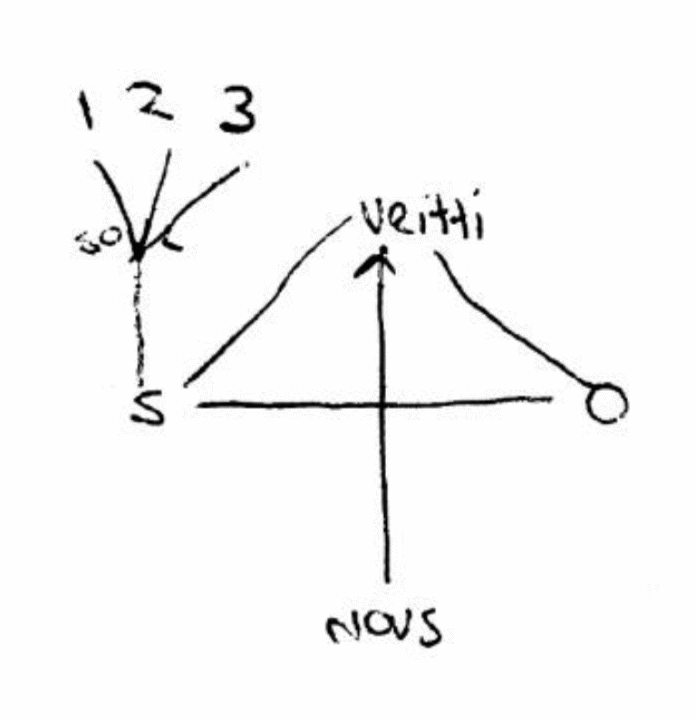
[FIGURE 1974 0317-2-AB. Nous, Soul, and Four Ways of Knowing. S = Subject; O = Object. Facsimile scan from AB class notes.]
1, 2, 3 -- three ways of knowing of soul -- sensation, thinking, reason -- laws that are manifesting a universe.
What about Nous -- lights up vritti and soul. Overself -- eternal, undifferentiated, continuous.
Thought appears, contains subject, object, and world. Subject knows in four ways. Three are motions in soul, fourth is not. PB talks of Nous in terms of 1, 2, 3.
Plato's reason -- how the intelligibles operate and function -- not our reason (like Jung uses it).
Life Divine -- "The Double Soul in Man". [Note: Sri Aurobindo, The Life Divine.]
Reason knows the seed-thoughts -- the moving images of the world-image -- and not the intelligible (World-Idea) itself.
Jung's archetypes -- forms in soul (seed-thoughts, spermatic reasons) reflections (second circle) of Ideas in first circle.
Plato -- top circle.
Aristotle -- bottom two.
Jung's reason -- by convention.
PB's reason -- reflection of seminal ideas within experience.
Aurobindo -- divine soul, immortal soul.
[Alan Notes 1974 0317 End]
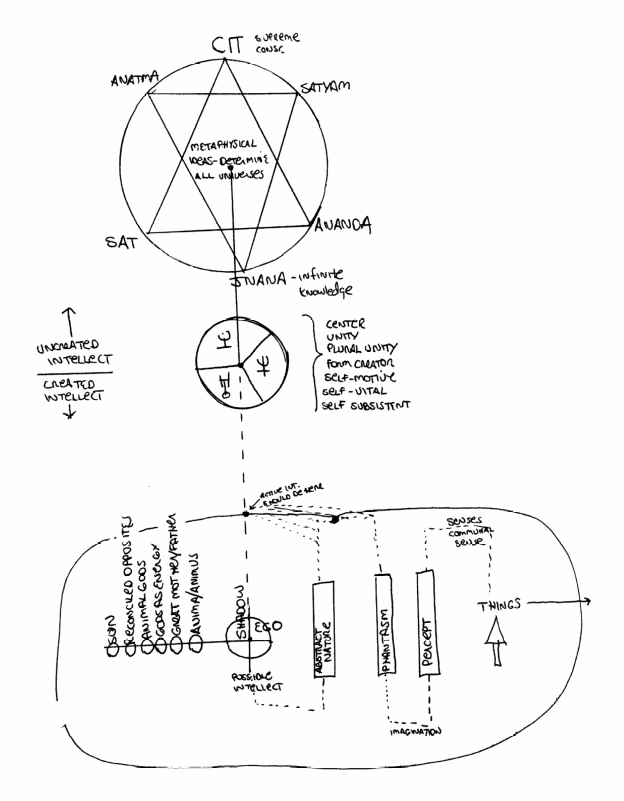
DIAGRAM FOR 1974 0317
Class
Sunday, March 17th, 1974
Verbatim, unedited transcriptCLASS at Wisdom's Goldenrod, Hector, NY
with Anthony Damiani (AD)
March 17, 1974
SOUL
with Appendix: AB Class Notes 1974 0317.
TOPIC: Soul
SUBSUBJECTS: Nous, Overself, Reason, Plato, PB, Vedanta, Aurobindo
CONTENTS:
AB class notes:
Soul as middle essence connecting Nous and Nature
Soul as moving image of Nous
Intellect and Intelligible, Being and Knowing
Intellect determinate, One indeterminate
Overself as partial intellect
Active and Potential Intellects
Logos
Rational and irrational soul
Dianoetic energy
Soul as principle of motion
World-Soul and Dharmakaya
Free will and compulsion
Soul and matter
Jivatman and psychic being
Soul in Plotinus
Verbatim transcript:
Intellect as summit of soul
One, Intellect, Soul represented by circle with point in center
Nous, Soul, and four ways of knowing
Overself as metaphysical principle, its consciousness undifferentiated
Overself as functional
Reason in Plato and Jung
Seminal reason-principles
PB's definition of reason
Reading Sri Aurobindo, The Life Divine, on the double soul in man
BOOKS / MAGAZINES READ FROM OR REFERENCED:
Plotinus, The Enneads (MacKenna translation, 4th ed.)
Paul Brunton, The Wisdom of the Overself
Paul Brunton, The Hidden Teaching Beyond Yoga
C.G. Jung, CW 6, Psychological Types
Vyasa, Bhagavad Gita
Sri Aurobindo, The Life Divine
Shrine of Wisdom, eds., Plotinus Outline
PLOTINUS QUOTES READ OR REFERENCED: IV.4.16
DIAGRAMS appended to this transcript:
FIGURE 1974 0317-1-AB. Point and Circle as One, Intellect, Soul.
FIGURE 1974 0317-2-AB. Nous, Soul, and Four Ways of Knowing.
FIGURE 1974 0317-3-AB. Three Circles Diagram: Divine Intellect, Soul, Psyche.
[Transcriber note: [diagram] means the speaker is referencing a diagram as he or she is speaking. If someone is drawing or writing, with audible sounds of chalk on a blackboard, I indicate this by [drawing] or [writing].]
NOTES:
- AB class notes have been appended because they contain diagrams referred to and also because we are missing the first audio file for this class. They thus help round out the class. Retyped from Alan Notes 3 1973 to 1975 psyche and soul.PDF. All spelling, capitalization, and punctuation corrected, all abbreviations and astrological glyphs spelled out in AB class notes.
TRANSCRIBED Verbatim by IT 2019. In 2023, IT updates prefatory matter, footer, and audio file name, alters V code, Topic, and Subsubjects to make more accurate, removes Subject, removes subheads and grey highlights (not a V14), completes TOC and Book List, adds Plotinus quotes section, fixes errors/typos, adds new notes within transcript, appends AB class notes with diagrams along with another diagram and references within transcript to these diagrams. Archival verbatim transcript – V12a.
AUDIO FILES: 1974 0317b. [Note 1: "Tape" and "Side" refer to original audio cassette tapes that were later digitized into .MP3 Audio Files. Note 2: We are missing the first audio file for this class.]
1974 03/17 at Wisdom's Goldenrod
Soul
[Audio File 1974 0317b Begins]
AD: You got a problem here.
S (very faint): Definitely.
AS (faint): From one point of view, I mean from the Nous point of view this undifferentiated consciousness that he's describing there in that chapter of the Overself [Note: Paul Brunton, The Wisdom of the Overself, "The Immortal Overself".] [three/few words inaudible] that in no-- that should in no way be a part of the soul. And that would have to be exempt from the soul totally [student assents, faint] within the Platonic tradition.
[student assents, very faint]
S: Yeah but A--
AS (simultaneously): That'd be what--
RG: But in Plotinus, let's say the summit of the soul is the Intellect. He doesn't make that gap, [RP simultaneously: Yeah well I--] and he doesn't make the fine-- the firm, the-- he doesn't make a firm distinction.
RP: No, I said there were no gaps. You're quite right, the summit of the soul is the Intellect.
RG: Ok so-- I mean, to say that the soul--
RP: Or the soul is the functioning of the Intellect. Except for one thing. [RG simultaneously: But I--] As Intellect it doesn't function.
RG: Right, so to consider the soul as this-- Intellect as the summit of the soul, you're considering-- I would-- I would tend to agree with you, you're considering the soul as Intellect, as not moving. And then you wouldn't call it soul according to your definition.
RP (simultaneously): Then you wouldn't call it soul. Soul is the a-- is the motion of Intellect, alright, except when it's moving it ain't Intellect.
AH (faint): Then don't-- don't call it soul [couple words inaudible]
RP: That's why you have a word called 'soul', we need it, if you (detect) spirit and ma-- and matter. Why do you need soul?
S (very faint): Yeah.
RG: Yeah this-- you know, it does-- you know that-- you know that example Plotinus gives of a point and the circle? [Note: See Plotinus, IV.4.16, seventh paragraph.]
AD: I think.
RG: The point-- the point--
AD: Oh Dave, lower the heat. Mark, would you lower the heat please?
S (very faint): (Hm?/Uh-hm.)
S (very faint): He's kind of pressed right now.
AD: Go ahead.
RG: The point is the One and the circle would be the Intellectual-Principle. And when the Intellectual-Principle is in motion, that motion is the soul [FIGURE 1974 0317-1-AB]. Now that-- it doesn't seem to be disagreeing with what Richard's saying that the motion he does call psyche, the soul. Now would we consider the Overself--
AD: Let's try this, let's try this again Avery, ok? We go over this again?
AS: Yeah.
S (very faint): Go ahead, go ahead.
[Note: See FIGURE 1974 0317-2-AB for the following.]
AD: [drawing] You have these four levels of understanding [diagram]. Ok? Now, these four levels of understanding, who they apply to, four different people?
AS (faint): No, they apply to the soul.
AD: They apply to the soul?
AS (faint): To the one-- to that-- to the four-- four functions of the one [one/two words inaudible]
AD (simultaneously): The four ways that the soul knows, let's say.
AS (faint): Ok.
AD: Alright? The four ways the soul knows. Now, the soul, let's say, [drawing] is out here [diagram], just for an example, the soul is out here and it knows by sensation; it knows by thinking; it knows by reason. [student assents, very faint] How about the fourth?
RP: What is the fourth? I mean what do you mean?
S (faint): Yeah.
AD (simultaneously): How would it know-- what kind of knowing is involved here [diagram]?
RP: What i-- what i-- what's the name of the fourth?
S (very faint): Huh?
S: Nous.
AD: Isn't that Nous?
RP: That's not a gnostic function. It's not on the chart. Go back [AD simultaneously: Huh?] (thirty-four/three, four) years.
S: Because if that's true--
AD (simultaneously): No, I'm sorry--
RP: It's not a gnostic function except if you mean that In-- it could-- Intellective capacity, which is not real Nous but only the copy of the Nous within the psyche. If he knows that way he's not soul.
[student assents, very faint]
AS (faint): Oh well but, suppose we talk about God if you--
S (simultaneously): But that's where the summit of the soul is the Intellect.
AS: Suppose we talk about when the soul is lifted up as it were.
RP: That's right. And out of itself.
AS (faint): Out of its-- the contemplation of the Nous.
RP (simultaneously): Right so [S simultaneously, very faint: It's no longer soul.] s-- Nous is not a psychic function.
AS (faint): Well but-- I mean they don't-- they do speak of it as still somehow being the summit. I mean that would be [couple/three words inaudible]
RP (simultaneously): No, it's an Intellectual pro-jection, and it means you pro-ject yourself out of yourself. It's not a psychic function, the soul's gone.
S: If you withdraw into the heart center into a point, that would be--
AD (simultaneously): No, no, no, no, no, wrong track. I'm not gonna agree [S simultaneously, faint: Tony?] with Richard now. This is the nice thing about having two of us here, you see. You can take [S simultaneously, faint: Expose both sides.] sides, alright, and play your side through.
RP: The hi-- the highest psychic-- the highest gnostic faculty of the soul is what Plato calls dialectic, by which the soul tries to pull itself back into the Intellect by lifting itself up backwards in the Ultimate, passing from conclusions to hypotheses and then from that kind of conclusion to get to finally an unhypothetical position. That is a motion. Dialectic is a motion and it's not Nous. It's guided by Nous. It's the most-- it's the-- it's the notion-- it's the motion of the soul that's most Nous-like.
LS: In what way is it guided by Nous?
RP: It-- In what way?
LS/S(?): Yeah.
RP: In what way is the soul--
LS (simultaneously): What do you mean by guided by Nous?
AD (aside): Would you please? I'm going to need it now.
RP: There's a truth in-- because there's a truth in the Intellect and a truth in the soul and the truth in the soul is a reflection. I only have to use this word: reflection, participation, inherence.
LS (simultaneously): In what way does that reflection or participation or whatever take place unless the Intellect has a natural contiguity with the soul to begin with, unless there is Intellect in soul?
RP: No, summit.
LS: The summit, even so, what connection does the summit have with the rest?
AD (faint): It's the grace of the Intellect.
RP (simultaneously): Top.
LS: That's there's a-- where's the relation?
RP: In the place where they change.
LS: No, I mean, just go back to the way you said it in the first place, [RP: Yeah.] the soul is motion, alright--
RP (simultaneously): But-- but the dialectic itself (is/does) not reach the Nous yet. When it does, it stops doing the dialectic, it goes--
LS (simultaneously): So if there weren't any connection between the dialectic and Nous there wouldn't be any way it could reach it in the first place. Unless Intellect is immanent in soul, in all its motion, [RP simultaneously: Oh sure.] unless it's the rest behind that motion--
RP: Oh, the One is immanent in everything.
LS (simultaneously): Then how-- then how [AD simultaneously, faint in background: Well, Avery--] is it possible that there could be [one word inaudible] with the soul at all?
RP (simultaneously, aside): Oh I (put it/thought it was) here. So we could always remember where it was. I'm sorry. (student assents, AD laughs, some laughter)
S (faint): Yeah, yeah.
AD: Please continue, please.
RP: Go ahead now.
LS: I mean how it is possible there could be any meaning in our life at all unless Intellect were the substance of that life? In it completely, completely involved in it, not separate from it in any possible way.
RP (simultaneously): When you say the soul, you don't mean you don't also have Intellect. You just have Intellect in a particular form, the moving form. And by-- the lower doesn't--
LS (simultaneously): No, I have Intellect in a particular form, it's still Intellect.
RP (simultaneously): Oh no, but then it's not In-- no, it's not still In-- you might as well say it's still One and there's nothing more to say.
LS: What do you mean, a [S simultaneously: Yeah.] glass of water isn't water?
S (very faint): No.
RP: You might as well--
LS: Cup of water isn't water?
RP: As soon as you make the distinction, you (when) mu-- you must-- you must restrict yourself to the level defined by the distinction.
LS: Oh no, then-- no, definitely not.
RP: Or else there's no soul to talk about.
LS: Definitely not, a cup of water is water.
AD: It's getting hot.
S: Yeah. (some laughter)
RP: It's all one too. Then why speak?
LS (simultaneously): You gotta a lake-- a lake is water, you know. It's all ocean and always water.
RP (simultaneously): Well, let's go all the way to the top. (There's/Is) all the One ineffable principle, why ask who does it? (bit of laughter) No, why speak? It's all one. And no matter what you say I'll say it's the pa-- it's still the One. But as soon as we--
LS (simultaneously): Even when it's the many it's still the One.
RP: Right, it's still the One.
LS: Right.
RP: But when you begin to speak about it as a jar, it helps in no way to say it's also the One. You must define it and work with it on the level as jar.
LS: If-- you know, if I speak of a jar as something that's not an object of consciousness then you're correct.
RP: No, even-- then even I could still speak of a jar as a psychic object.
LS: But if you speak of it-- of anything in such a way that consciousness is not understood as immanent in it, then you're correct, that's not the Overself. But it seems if-- as long as you're speaking of consciousness or Intellect as immanent in it, then you've never sp-- taken it away from the Overself so how can you say it's different from it?
[student assents, very faint]
RP: You're never outside the Intellect, you couldn't possibly be, that's your authentic Being.
LS (simultaneously): (No/Well), I don't see your point.
S: Uh-hm.
RP (simultaneously): But [one/two words inaudible] Your Being is your Intellect, that's the Being. I agree, you're never outside the Being. Except when you restrict to a certain level of discourse, it must remain there.
AD: Let's see if we could clarify what Richard is saying now, ok? This is eclectic, you know somebody's gonna say, "You're a Libran, you mix everything in and the hell with what comes out." (AD laughs, some laughter) But it's not really so. I think the comparison will help us a great deal. Richard was saying something like this. In knowing, whether you think of the first, second, or third kinds of knowing, and we can speak of this as sensation, alright, we can speak of this as, what, thinking, belief, this is reason [diagram], ok. [student assents] Alright, in all these three types of knowing we're speaking about-- there's four that we know of but there's three that he spoke of and just mentioned of as motions in the soul, ok. Now let's go to the Vedanta, the Vedanta says only through the vritti, so to speak, or only through thinking, is a subject and an object revealed. And depending upon which way our attention is turned, that's what we'll think about. So when you think about yourself you're thinking about let's say the subject, when you're thinking about the object then of course you're concerned here [AD indicates on diagram]. But, we're going to forget this part now and we're going to concentrate on this here [diagram]. The subject, alright, or the soul, has these four ways of knowing. These four ways of knowing correspond to sensation, thinking, dianoia, reason, etc, alright? And he says that they're just motions in the soul. And then-- well what about Nous? Nous.
S (faint): It's still present there.
S (faint): Yeah.
RP: But what about Brahman?
S (faint): Ok.
AD: Alright, now, if the Nous is here [diagram] which lights up, insofar that the Nous is making available or lighting up the vritti, [drawing] and this vritti, this world-thought or this thought, contains this individual subject or this individual soul [RP: No, only (in here).] functioning in--
RP: The Nous not only lights up, it contains the paradigm of what gets played out, it contains the Intelligible.
AD (simultaneously): No, no, no, no, no, no, you're rushing.
RP (simultaneously): (Putting them--)
AD: Yeah [one/two inaudible student words simultaneous with AD] but you're rushing! [student assents, faint] Sure, I could say Brahman is going to manifest or [student assents] operate through--
RP (simultaneously): Well by saying Nous it's not just the light-- I don't [couple words inaudible] one ineffable principle. It's not just the lighting up. It's also the pattern upon which the motion is played out.
AD: Yeah.
S (faint): Ok, play.
AD (simultaneously): The Intellect and the Intelligence, [RP: Right.] yeah. But I'm going to concentrate on one aspect. Otherwise, we're going to get lost. This let's say is the Nous [diagram], alright. The thought appears. This thought which appears contains the subject and the object or the world. Ok? Now insofar that it-- it appears and contains the subject and the object, this subject now is what we're talking about. We speak about this subject which knows in these four different ways but we have to-- you can only understand of three because these three are motions in the soul, the fourth is not a motion in the soul. Alright. This here [diagram], let's say, would correspond to the Overself now.
RP (faint): Ok, good.
AD: Alright? Let's say this is the Overself. This has an undifferentiated continuous eternal existence as an Intellect, partial Intellect. Alright, now, when PB says, when PB says that we can only conceive of this-- we can't conceive of this consciousness, you know, because it's beyond us, but when he's talking to us about it he's talking to us about it from this realm within here [diagram]. Let's go back, let's read that sentence now.
S (faint): The one with the consciousness?
AD: Yeah I-- I don't remember.
RP: And mention the chapter it's in.
AD: Hm?
S: Yeah, it's in the one about the Overself.
RP (simultaneously): Mention the chapter it's in.
[Transcriber note: I am using The Wisdom of the Overself by Paul Brunton, Rider and Company, London, 1943.]
PB [The Wisdom of the Overself, "The Immortal Overself," p. 117, S reading]: "Now the Overself's original consciousness is a single and undifferentiated one. This means that its only awareness is of existence [but] not of personal existence. It is conscious yet not self-conscious in space and time. But such a consciousness is in a certain sense equivalent to having no consciousness at all."
AD: Ok. Alright, so there we see that the Overself is like a universal principle. It's actually a metaphysical principle. You can't divide it up, you can't break it up. That will be-- if we had these four together we would say here [diagram]. That would be the Nous, that would be the Overself. But you can make this here part of this thing here [AD indicates on diagram].
S (faint): We have to point to the [half/one word inaudible] The Nous can't be the-- or the Overself can't be the fourth one [student assents, very faint] [one word inaudible] 'cause you said that-- and as like another way of-- I don't know.
AD: [drawing] Down here [diagram].
RG (simultaneously): One, two, three, where is the fourth? (bit of laughter)
AD: Down here [diagram]. (bit of laughter)
S (faint): [couple/three words inaudible]
AD: Ok? Now, he wants to bring in the other notion about the Intelligible being contained in the Intellect. He's in a rush, you know, Richard's always rushing.
S (very faint): Yeah.
S: But you already have that in--
RP (simultaneously): (Well I'm) always rushing. They have it, you have in that the Intelligible is the triangle, [Note: A reference to one of the triangles in top circle of FIGURE 1974 0317-3-AB.] which gets played [student assents] out and is the threefold [one word inaudible] play-- [AD simultaneously: Yeah.] thrice greatest--
AS: But-- but I-- but I want to sort of-- (my reflection) still [one/two words inaudible] of neither of those [one word inaudible] but to see that from within those three things, those three powers of the soul, even-- even within there you-- there's some recognition that this Intellect is active, I mean we can make this thinking, we can-- like in PB's [one word inaudible] we can think about the possibility of there being this Intellect lighting up the three and then, I mean-- yeah.
AD (simultaneously): Oh sure, there's no-- that's no problem what he's saying. [AS simultaneously: But yet--] Just imagine this here soul, alright, like a global mass of air, alright, and the light here just penetrates, goes right [AS simultaneously: But yet at the same--] through it. Any activity in this soul, any motion in this soul is going to be lit up by the-- this Intellect [diagram], and he's going to say "I have sensations, I have thinking, I have reasoning going on."
AS (simultaneously): But-- but yet at the same time we also conceive of the possibility of going beyond those three to this fourth position [couple words inaudible]
AD (simultaneously): You're on the wrong track.
S (very faint): Yeah.
S: Ok.
RG: So, not-- not only does the Overself light up those three but it-- like he said before, the Overself functioning is the soul.
AD: Well, the point that Richard was trying to make was that as soon as the Overself-- as soon as you speak of the functioning of the Overself, now you have to bring in a naming which will differentiate it from the Overself as the metaphysical principle.
RG: But not in-- not in Being though.
RP: I said not in Being.
RG: Right.
RP: The authentic Being is the Intellect.
RG: And the Being of the soul is the Intellect.
RP: Right, but you know, except it has a middle essence. It somehow is and somehow isn't.
AS: Oh but-- it says he has to set up a--
PB [The Wisdom of the Overself, "The Immortal Overself," p. 118, AS reading]: "…to limit a part of itself to less than what it really is, [to] contract away part of its own infinitude and freedom."
AD: Now of course he's trying to accommodate you.
[students assent, very faint]
AS/S(?) (very faint): Right, he's trying to accommodate us.
[Note: See FIGURE 1974 0317-3-AB for the following.]
AD: Now this may very well me-- be what the-- what the Vedanta means when they speak about universal manifestation as being false. In other words, if we take the-- let's consider this line as the tot-- the functioning of the Overself [vertical line coming from the center of the top circle], you know, all its possibilities are played out [drawing] and they're all contained in this one line, alright? And then when we get to the middis-- middle circle [diagram], this here has to be played out, alright, in time and space. Over here [top circle] it's an integral whole, unified, a mass of sentiency. [drawing] But down here in this middle circle [diagram] this will have to be played out in terms of eons, time. But when we speak about it now we're not speaking no more of the Overself as a metaphysical-- as a metaphysical principle. We're speaking-- For instance he says that, over here, I changed the wording a little--
[Transcriber note: I am unable to find the exact quote AD is paraphrasing, needs to be checked.]
PB [The Wisdom of the Overself, AD paraphrasing]: "It is a focusing point for manifestation."
AD: It is the principle of manifestation but it is never in manifestation. How could the totality, alright, get involved in here in some segment of time and space? How could the greater be involved in-- in the lesser, the-- [drawing]
[short pause]
S (very faint): That's true.
AD: Go ahead, come on.
S (very faint): I can't.
AD: You're not gonna get this unless you generate some sort of enthusiasm, even if you gotta drink coffee.
S (very faint): Tea.
AD: Or tea. Tea'll do it. [students assent, very faint] [aside, very faint] Be careful.
S (faint): But I have something else I wasn't quite sure, I wanted to get a little bit. When we spoke about four ways of knowing, is there not then a fourth way of knowing above the third which you call dianoia or what you called reasoning? Is there not then a way, another way of knowing that doesn't automatically return (just to) pure Overself? Well I think-- I don't--
AD (simultaneously): Well, I think, I think you have underestimated the-- the height that this terminology here that they employ. Reason over here is a-- a con-- conception that's so sublime that we just spoke about its bearing Friday, in the sense that when we spoke about reason or these universal principles that are concerned with manifestation and how manifestation proceeds, and to the extent that we participate and our reason is guided by that reason, the reason of Savrit-- Savitri, ok, participates in that reason, this is what Plato's referring to as having knowledge of the real, the real insofar that these reason-principles are universal. This is not something, believe me, that you jump up to and that you're acquainted with. When we speak about reason, and here again your studies in Jung may be very very truthful. You go and look up the definition of reason according to Jung and that's what you call reason and that's all that you know of reason. It's a sociological (contact/content).
RG: That's all you know of reason?
AD: Yeah, what else do you know of reason? Anybody got Psychological Types around here? Maybe we want to read his definition of reason so that you distinguish between what Plato refers to as reason and what we know of as reason?
RG: Well what he speaks about as reason is rational.
RP: Who? Jung?
RG (simultaneously): Jung, particularly.
MB: Well, that's how he defines the rational [one word inaudible]
RG: But it's not necessarily in accord with--
S (faint): [one/two words inaudible]
AD (simultaneously): Well, again, I'm going to bring in his definition of reason, alright, and I'm willing to bet you dollar to doughnuts that's your definition of reason. That's what you think reason is.
S: Tony, can you talk--
AD: The reason here that you're speaking about, alright, is almost like the belly of Savitri, the laws that are manifesting this universe. Into the-- to the extent, to the extent that you participate in that reasoning with your reasoning, then you're being guided by this indwelling spirit that we spoke about Friday, [student assents, faint] alright. If you think you are at that level, [RG simultaneously: No, no, I--] I'll listen.
RG: No, the--
AD (simultaneously): I'll listen.
RG: The reasoning that PB talks about in the Hidden Teaching, and that [S simultaneously: Different point.] isn't-- that isn't that reasoning, the reason of Savitri, and it isn't that reason that Jung's talking about. Really?
RP: Yeah, it's a refinement of Jung.
RG: But wouldn't that reflect our reason?
AD: Listen to this here.
C.G. Jung [CW 6, Psychological Types, pp. 458-459, paragraph 786, AD reading]: "Most objective values--and reason itself--are firmly established complexes of ideas handed down through the ages. Countless generations have laboured at their organization with the same necessity with which the living organism reacts to the average, constantly recurring [AD reads: reoccurring] environmental conditions, confronting them with corresponding functional complexes, as the eye, for instance, perfectly corresponds to the nature of light. One might, therefore, speak of a pre-existent, metaphysical, universal"Reason" were it not that the adapted reaction of the living organism to average environmental influences [AD reads: influence] is the necessary condition of its existence--a thought already expressed by Schopenhauer. Human reason, accordingly, is nothing other than the expression [AD reads: expressions] of man's adaptability to average occurrences, which have gradually become deposited in firmly established complexes of ideas that constitute our objective values. Thus the laws of reason are the laws that designate and govern the average, "correct," adapted attitude (q.v.). Everything is "rational" that accords with these laws, everything that contravenes them is "irrational" (q.v.)."
[short pause]
AD: Isn't that the reason you know? I think-- I think Plato, when he speaks about reason here, alright, he's speaking about how the Intelligibles function, how they operate, how they underlie manifestation. I don't think you and I are acquainted with that. What would you say Richard?
RP: Yeah, that's right. I mean that's pretty different. Now Richard--
AD (simultaneously): Alright. Now it is possible from the point of view that we've been speaking of that this soul, this subject here [FIGURE 1974 0317-2-AB], can function through sensation, through thinking, and through reason, the contemplation of the Intelligibles.
[student assents, very faint]
S (very faint): What?
AD: Huh?
RP: I was thinking the seminal ideas.
AD: Say it again.
RP (simultaneously): They wouldn't-- they wouldn't-- it's not the contemplation of the Intelligibles, it's the concept of the seminal ideas, the reflection of the Intelligibles within the World-Soul. See that kind of--
AD(?) (simultaneously): (Richard--)
RP: Yeah but reason would be you would know the "why" of everything, the karana-citta and it contains the-- the reason-principles. [S simultaneously: Then how do you know--] That's not the Intelligible.
S (faint): How do you-- what [one/two words inaudible]
RP (simultaneously): Intelligibles can't be contemplated by the soul, only the Witness.
S (faint): How (would you) know of these Intelligibles?
AD: You-- excuse me, would you please? Would you repeat that Richard?
RP: Yeah, the rational soul knows the seminal ideas which are in the World-Soul. You, you know-- If you could operate at the rational level you'd know the "why" of everything in manifestation, that's not the Intelligible. It's only the moving image of the Intelligible.
AD: I see, ok, I see what you're talking, yeah.
RP (simultaneously): Right, they're the seed-thoughts but not [AD simultaneously: I see. Ok.] the Intelligible, not the World-Idea with a capital "I". Go ahead.
S (faint): I just don't understand how you-- what is this contemplation that the soul has?
RP: Which one?
S: [couple words inaudible]
RP: Well it's not, I'm saying, it's a knowledge of-- a transitive knowledge of the seminal ideas. It's what they call the spermatic reasons, the God-forces distributes them about Nature.
S (faint): But you know there's always (in a) [one word inaudible] [S simultaneously, faint: That's the--] it's always in a-- in an object form but not-- you don't know them by being them or [one word inaudible]
RP (simultaneously): Oh yeah, no, no, no, they-- if you were to know them they would determine your soul. You'd be-- it would be quite an exalted experience, some-- I mean it would be that soul would be determined by them rather than knowing it. It would be a form of like this yogic experience.
AS (faint): Or like Jung's archetypes [couple words inaudible]
RP: Yeah.
S (faint): (I/Well) see, I didn't know you [couple words inaudible] 'cause I assumed that, well reason is like when you do this operation of reasoning it's always in a state of subject and object, and that's not a good [three/few words inaudible]
AD (simultaneously): What you-- what most of you people call reasoning is what I'm trying to bring out over here, is down at the bottom circle in here, within these four functions [FIGURE 1974 0317-3-AB, cross in little circle in bottom circle], within the ego-complex, most of your reasoning is really some kind of self-justification.
S (faint): Yeah. That's my phrase that it's opinion.
AD: Huh?
S (very faint): They call it opinion too.
AD: Opinion? Ok. But what we're talking about is up in this circle here [middle circle], alright, [student assents, very faint] and if [drawing] we say that the ideas are in the cit, alright, which is expressed by its opposition, then these ideas which get reflected in here-- in other words, the forms that are in the soul [middle circle] are reflections of the ideas that are here [top circle]. And that's why I didn't want to speak about the three circles all at once.
S (very faint): Yeah.
RP: And in the middle circle they're called the spermatic reasons or the seed-thought.
AD: I think Taylor would then translate this as being thinking monadically [top circle], this thinking essentially [middle circle], and this would be thinking in terms of imagery [bottom circle].
S (very faint): (Ok.)
S (faint): Yeah.
S: Hm.
AD: So you want to go on with the soul? It would be the most difficult of all things you've studied. Because this is going to have references all the time to this [diagram] and all the time to this [diagram] and it's going to be awfully difficult.
S: Yes.
S (faint): (But) you can--
RP: It's always the middle one.
S (faint): It's [one/two words inaudible] it's [one/two words inaudible]
S (faint): No.
RG: Well the reason that PB talks about in the Hidden Teaching as like the thinking power that he has to (observe) to understand (the/these)--
AD: You remember the definition he gives of reason? He speaks of it in very broad terms. He speaks of it as an intelligence which is manifested from the-- the most meager beginnings to its most exalted states, excuse me, like scientific thought and philosophic reasoning. He speaks of it in that kind of a broad way.
S: Yeah.
RP: Yeah reason (like for Kant).
S (faint): But do--
RP: (You put) reason, you put like the daemon, the demon. It's the-- your higher part of your soul which would be established from that rational soul is sometimes called rea-- you know, your angel. Now a man like Aristotle was in contact with it and he could sit down and write all those books on sciences which say the "why" of everything, because he had direct contact with his daemon. That's why people say Daemonical Aristotle. Now Plato's called the Divine Plato. He had contact with his Intellect.
AD: In other words, he was in the third circle [top circle] and this is what Plato (is/was) concerned about and he says "Aristotle, you're good at this here [diagram], go ahead out and tell them all about this here."
S: Yeah.
AD: Because Aristotle, to use rigid expression, truncated that three circles, took off the head [top circle] and worked down here, these two circles [middle and bottom circles], which is like, we said, these two would have to coincide. You find the definition there?
RG (simultaneously): Yeah.
[Transcriber note: I am using The Hidden Teaching Beyond Yoga by Paul Brunton, E.P. Dutton & Co., Inc., New York, New Revised Edition, 1969.]
PB [The Hidden Teaching Beyond Yoga, p. 195, RG reading]: "Reason is the faculty of correct thinking, which seeks truth and which ensures that its activity shall start with all the observed facts of [RG adds: the] actual experience. The logician whose premises are faulty may nevertheless think correctly and yet arrive at wrong conclusions. Reason avoids this mistake."
[tape break]
RG: So that seems to be a different reasoning than--
C.G. Jung [CW 6, Psychological Types, p. 458, paragraph 786, AD reading]: "Most objective values--[and] reason itself--are firmly established complexes of ideas handed down through the ages. Countless generations have laboured at their organization…"
AD: Read that.
PB [The Hidden Teaching Beyond Yoga, p. 195, RG reading]: "Reason is the faculty of correct thinking, which seeks truth and which ensures that its activity shall start with all the observed facts of actual experience."
S (faint): Uh-hm.
RP: Jung's reason is not-- is just like convention.
RG: Right, right.
RP (simultaneously): All humankind [student assents] gets together and says that arsenic is poisonous.
RG: Right.
RP: So it's rational not to eat arsenic.
S (faint): Right.
RG: Now this reasoning doesn't seem to be the reasoning of the seminal reasoning and it doesn't seem to be Jung's reasoning. Seems to be a reflection of the seminal reason in the activity of the thinking function.
S: Richard?
AD: Do we know of another kind?
RG: Well-- I don't. Certainly not(--/.)
S (simultaneously, faint): [couple words inaudible]
AD: Then for us that definition, for 99% of us, that's what reasoning is.
RG: Which?
AD: The one that Jung gave us. Look, you have to exclude Richard, me, you, you have to exclude these people.
RP (faint): Good enough (to/they) say. (RP laughs)
AD: No, I don't mean this to pat you on the back. I'm not-- the Advaita is certainly not-- there's plenty of it around but that's what we call Neo-Vedantism, you know, "Everything is one." Then they go back to the bar and keep drinking.
RG (simultaneously, faint): Right.
S: But Tony, the way you s--
S (simultaneously): [couple/three words inaudible]
AD: Hm? What would you say?
RG (faint): Yeah, I--
AD: If reason is so accessible to us, you know, then the Advaita should be a very common under-- commonly understood thing. How long did it take you to begin to realize that the Anima Mundi was something functioning in you? Didn't I have to fight all that you call your reason?
RG: Well that-- I wouldn't call it reason.
AD: Now you won't call it reason! (RG laughs, laughter) A big help. (RG laughs, more laughter) But for three years I was trying to convince you of that, or we were trying to get convinced about that. That's the whole point, sure. This is what we call reason. Most philosophers use this.
S: (That's true.)
[short pause]
EC (faint): In-- in the development of the lower circle that Jung talked about the three functions that are developed as the-- and turn into the one. Is that (what) you might see that kind of reason, would that be the one?
RP: Can't hear you.
EC (faint): Jung. Remember when he--
S (faint): Of course.
EC (faint): The three functions that have to develop and once they develop they turn into the fourth function. The three turn into the fourth function for Jung [one word inaudible] Is that-- would that be that-- would that be a prior [one word inaudible]
RP: I could see that because that would be the question of bringing in the higher soul and would make that-- and a manifestation of the higher soul, in other words your angel. [student assents] If this is actually ever done.
AD: Well we don't have much time but I thought maybe I would conclude with a reading from Aurobindo where this whole thing is said in modern terminology. And-- I'll read it 'cause there-- I've cut them out along the way, I don't want to read the whole chapter. And you will see this very adequate description that Aurobindo gives. He's going to speak about, so to speak, these two souls, one the Divine, and the other the immortal, alright. You'll come across this conception over and over again in the Bhagavad Gita, in the Hindu writings in general. One he refers to as a psychic being. In his terminology the psychic being would be the soul, not the Atma, not the jivatman or-- And, he tries to show how there has to be this super-conscious which, let's say, goes into matter, rises from matter into life, then from life into mind, and how the experiences of these-- these three-- these-- this triple factors finally evolves in the person a soul. You say, "Evolves a soul?" Yeah, it evolves a soul, through these experiences a soul grows, ok. And then the soul, once it starts manifesting and operating through you or through the person, then that soul becomes capable of developing the reason so that it could start aiming for the highest, alright. These are going to be extracts, they're-- the continuity may--
(Side 1 of original 60 minute audio cassette tape digitized as 1974 0317b Ends; Side 2 Begins)
[Transcriber: I am using The Life Divine by Sri Aurobindo, The Sri Aurobindo Library, Inc., New York, NY, 1949, 1951.]
Sri Aurobindo [The Life Divine, p. 204, AD reading]: "It follows that in this [AD reads: the] surface or desire-soul…"
AD: And he gives it a really appropriate name because that's what it is, a desire-soul.
Sri Aurobindo [The Life Divine, p. 204, AD reading]: "…there is no true soul-life, but a psychic deformation and [AD adds: a] wrong reception… [AD: Um--] [short pause] … At the same time [AD: if this person looked through and found his soul] he would find his own true soul and through it his self…"
AD: First the soul he has to find and then the self.
Sri Aurobindo [The Life Divine, p. 204, AD reading]: "…because the true soul [AD repeats: the true soul] is [AD emphasis] his self's delegate and his self and the self of the world are one. But this he cannot do because of the egoistic ignorance in the mind of thought, the heart of emotion, the sense which responds to the touch of things not by a courageous and whole-hearted embrace of the world, but by a flux of reachings and shrinkings, cautious approaches or eager rushes and sullen or discontented or panic or angry recoils [AD: from the experiences of life]…"
AD: He goes on.
Sri Aurobindo [The Life Divine, p. 205, AD reading]: "[For, as] we now know by psychological observation and experiment that the subliminal mind receives and remembers all those touches of things which the surface mind ignores, [so also] we shall find that the subliminal soul responds to the [rasa, or] essence in experience…"
AD: And try to remember what we studied about essence, ok, because we're speaking the same thing.
Sri Aurobindo [The Life Divine, p. 205, AD reading]: "…we shall find that the subliminal soul responds to the [rasa, or] essence in experience, of these things which the surface desire-soul rejects by distaste and refusal or ignores by neutral unacceptance. Self-knowledge is impossible unless we go behind our surface existence, which is a mere result of selective outer experiences, an imperfect sounding-board or a hasty, incompetent [and] fragmentary translation of a little out of the much that we are… For between these three things our existence moves and finds in them [AD reads: them in] its totality. The superconscient [AD reads: superconscious] in us is one with the self and [AD adds: the] soul of the world and is not governed by any phenomenal diversity; it possesses therefore the truth of things and the delight of things in their plenitude. The subconscient [AD misreads: superconscious], so called, in [AD reads: is] that luminous head of itself which we call the subliminal, [AD adds: and it] is, on the contrary, not a true possessor but an instrument of experience; it is not practically one with the soul and self of the world, but it is open to it through its world-experience."
AD: You have to think of the big citta [middle circle]. In other words he's saying that behind this surface soul that you operate with there's this huge soul that you really are taking in what this little ego, you know, very often refuses to accept or rejects. There's a story about one mystic not far away from here who towards the end of life went into terrible pain and they wanted to deprive him of that pain through anesthetics, you know, and medicine. He says, "No, this is my pain." And it's very hard for us to understand that attitude but the man was quite a soulful man. He felt that that pain would purify many of the things that that ego-ridden, you know, the way the ego overcome any-- and overwhelmed by habit, and he says "No, this is the one thing that's going to cure my ego, what do you want to take it away for?" And so he suffered something awful for a long time. At any rate--
Sri Aurobindo [The Life Divine, p. 207, AD reading]: "The true soul secret [AD reads: secret soul] in us--subliminal, [AD adds: as] we have said, but the word is misleading, for this presence is not situated below the threshold of [AD adds: the] waking mind, but rather burns in the temple of the inmost heart behind the thick screen of an [AD reads: the] ignorant mind, life and body, not subliminal but behind the veil,--this [veiled] psychic entity is the flame of the Godhead always alight within us, inextinguishable even by that [AD reads: the] dense unconsciousness… [AD: It goes on.] It is a flame born out of the Divine and, luminous inhabitant of the Ignorance, grows in it till it is able to turn it towards the Knowledge. It is the concealed Witness and Control, the hidden Guide, the Daemon of Socrates, the inner light or inner voice of the mystic. It is that which endures and is imperishable in us from birth to birth, untouched by death… Not the unborn Self or Atman, for the Self even in presiding over the existence of the individual is [aware] always of its universality and transcendence, it is yet its deputy in the [AD emphasis] forms of Nature…"
AD: Alright? You follow what he's saying here? It's not the Atma, it's something between us and the Atma. It's the psychic being or the soul which presides over the forms that Nature, so to speak, has contrived for our growth.
Sri Aurobindo [The Life Divine, p. 207, AD reading]: "…the individ…"
AD: I'm sorry.
Sri Aurobindo [The Life Divine, p. 207, AD reading]: "Not the unborn Self [or Atman], for the Self even in presiding over the existence of the individual is aware always of its universality and transcendence, it is yet its deputy in the forms of Nature, the individual soul, [caitya purusa], supporting mind, life and body, standing behind the mental, the vital, [AD adds: and] the [subtle-]physical being in us and watching and profiting by their development and experience."
AD: Now you remember, Jung pointed out, he says the self seeks to realize itself and it does so through your experience. So when you got something to cry about, cry for two. (laughter)
Sri Aurobindo [The Life Divine, p. 208, AD reading]: "The [AD reads: This] psychic being [AD adds: or this soul] can at first exercise only a concealed and partial and indirect action through the mind, the life and the body, since it is these parts of Nature that have to be developed as its instruments of self-expression, and it is long confined by their evolution. Missioned to lead man in the Ignorance towards the light of the Divine Consciousness, it takes the essence of all experience in the [AD adds: world or in] Ignorance [AD: his term] to form a nucleus of soul-growth in [the] nature… … It is the psychic personality in us [AD: the soul in us] that flowers as the saint, the sage, the seer; when it reaches its full strength, it turns the being towards the Knowledge of [AD adds: the] Self and the Divine…"
AD: Do you hear this? Now this man has written three thousand or two thousand years later than Plato, the whole Platonic tradition. Listen to what he just said.
Sri Aurobindo [The Life Divine, p. 208, AD reading]: "It is the psychic personality [AD reads: soul] in us that flowers as the saint, the sage, the seer; when it reaches its full strength, it turns the being towards the Knowledge of [AD adds: the] Self and the Divine, towards the supreme Truth, the supreme Good…"
AD: I told you, Sahaja is a very rare thing. We know one man who has that. We've heard of others but it's rare. Don't let nobody kid you that you can find them like swarms of flies on the West coast. (some laughter)
Sri Aurobindo [The Life Divine, pp. 208-209, AD reading]: "It is then [AD: he goes on, he says] the [AD reads: this] outer [desire-]soul, [AD: this desire-soul] the pseudo-psychic entity, that reigns and we mistake its misinterpretations of psychic [AD reads: soul] suggestion [AD reads: suggestions] and aspirations, its ideas and ideals, [AD reads: ideals and ideas] its desires and yearnings for true soul-stuff and [AD adds: the] wealth of spiritual experience. If the secret psychic Person [AD reads: secret soul] can come forward into [AD reads: in] the front and, replacing the desire-soul, govern overtly and entirely and not only partially and from behind the veil this outer nature of mind, life and body, then these can be cast into soul images of what is true, right and beautiful [and] in the end the whole nature can be turned towards the real aim of life, the supreme victory, the ascent into spiritual existence [AD reads: experience]."
AD: I don't want to go on, those of you who have The Life Divine could read it. It's called "The Double Soul in Man," the chapter is "The Double Soul in Man". And here again, ok-- like I said, Richard is coming from the West, the whole Platonic tradition thrown at me, and I've got to find corresponding things in-- from the East. And certainly Aurobindo's one of the finest scholar-mystics India has produced in this century. Here's [AD hits book] one example. We got PB like he's in between, alright, he's speaking in Western language what the Easterners are saying. And we should be able to understand. We should be able to grasp more and more what this meaning of the soul is, which was certainly a preoccupation with Jung. To him anything else was a waste of time too. Alright? Now, we spent a couple years down in this bottom circle [diagram], alright.
RG (faint): Yeah, right. (laughter)
AD: And maybe now it's about time we start because this [middle circle] is what we're all interested in, this is why we meditate, this is what we want to get to. I think you did enough tonight, huh? Richard'll give the class next Sunday. I'll probably be back Sunday night but--
RP (faint): Plato or--
AD: Yeah, but, Richard'll give the class. Those of you who get a chance, I'll ask one of the boys here to xerox this here, it's an outline. There's one or two errors by the way. I look up the quotations and they weren't ones-- (AD laughs) they weren't--
S (simultaneously): Oh, I noticed that too.
AD: Yeah.
S: But that's [S simultaneously: Yeah.] the Shrine of Wisdom one that--
AD (simultaneously): Alright, I'll go through it myself and pick out, there's better quotations than these here.
RP (faint): Um-- but you're doing [one/two words inaudible]
AD: Yeah.
RP: Tuesday-- Tuesday night we're having the class on the Wisdom and Myra's supposed to quiz me on the chapter "The Meaning of Mentalism" next Tuesday. So there won't be a Tuesday night class, Tony.
S (faint): I'm surprised he wasn't there.
S (faint): Yeah.
AD: Oh good. That's fine. That'll give me another week.
S (faint): Uh-hm.
S: We'll put a list up for this xeroxing on (it/this).
AD: Oh no, just make-- just see how many wants (it) and just make them up, it'll take her--
S: I'll take two.
S (simultaneously): How many want?
AD: How many want a copy? This is the-- an outline of Plotinus. It's-- it's better than nothing.
S: Yeah.
[couple seconds of background student talking]
AD: It's from the Shrine of Wisdom. Richard, you'll get one, don't worry. [few seconds of background student talking] Remember, Plotinus too is one of those very rare individuals who had for four times experienced this state, the actual state of God and so-- I-- I've always preferred him to Proclus. (AD laughs, laughter) Proclus is too massive.
S (very faint): Proclus is great.
S (faint): But you have to study him [couple/few words inaudible]
AD (simultaneously): Oh yeah, he's great, Proclus is great, all you do is (lead/read) the time. (AD laughs, laughter) [student assents, very faint] That's the--
RP (very faint): Well, I'm glad it's (all--/old.)
[students assent, very faint]
[background student talking until the end]
[Audio File 1974 0317b Ends]
1974 03/17 V12a: CLASS: Soul. Copyright 2023 Wisdom's Goldenrod p. iv