APPENDIX: AB CLASS NOTES FOR 1974 0825b
[Alan Notes 1974 0825 Begin] [Note: AB class notes show this class as being held on 8/24/74, but I am using 8/25/74 because Audio Files, Events Master, and Blue Book all show it as 8/25/74.]
8/25/74
P.B. Talk -- Larry and Nanci [Note: Lawrence Hoetzlein and Nanci Rose-Ritter, students at WG. See WG Talk 1974 0825a for a transcript of part of this talk. The transcript is incomplete because the available audio recording contains only a portion of the original talk. For additional material from this talk, see PB Visits 1 (Goldenrod Interviews) at https://www.pbarchives.org/archive/document/writing/94 ‒ use the text searchable PDF and search for "Nanci Rose-Ritter" to locate the relevant excerpts and notes that formed the basis of their talk.]
Soap -- Mysore, Marseille (no lard)
Vinegar good in bath.
Ramana #616 [Note: Talks with Sri Ramana Maharshi, Talk 616.]
Quotes Jung -- Intro. -- The Planets and Human Behavior, Jeff Mayo
KCB -- Introspection, Psychic Fact, Editor's intro. xxii [Note: K.C. Bhattacharyya, Studies in Philosophy, Vol. 2, pp. xxi-xxii, "Theory of Introspection".]
Jung -- no Archimedian standpoint in psyche -- Structure and Dynamics [Note: C.G. Jung, CW 8, The Structure and Dynamics of the Psyche.]
Sherrington -- Man on His Nature [Note: Sir Charles Sherrington, Man on His Nature.]
KCB -- relatedness of subject to object is non-perceptual -- i.e. intellectual abstraction.
Sherrington -- act of perception is outside energy scheme. [Note: See Sir Charles Sherrington, Man on His Nature, Chapter X, "Earth's Alchemy".]
A subjective consciousness eliminates the possibility of real perception.
Our approach is from the first point of view → Guenon quotes on heart. [Note: Rene Guenon, Man and His Becoming According to the Vedanta. JC notes indicate: p. 43.]
Sense organs → out -- avenues of knowledge into world
Sense organs ← in -- avenues of knowledge into body
→← both ways --
Body is a field -- impulses of light and vasanas (Thought) shoot out to limits of cosmos and are reflected back.
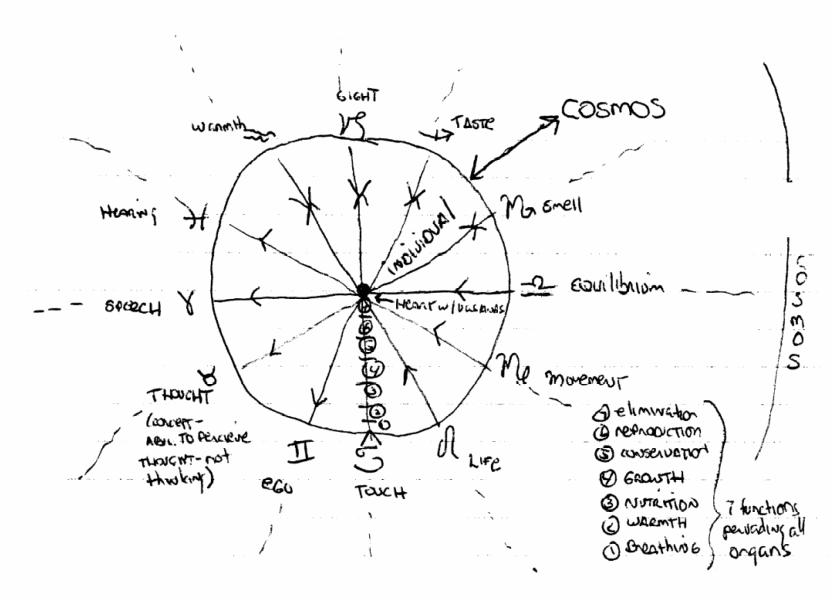
[FIGURE 1974 0825b-1-AB. Body Scheme. Abil. = Ability; W/ = With. Facsimile scan from AB class notes.]
Images arise through body. Psyche = storehouse of images.
 = body scheme -- ego-mind complex.
Ego -- sensation of someone's ego
Signs = senses
Life -- feeling of life within you
Sense of movement is internal -- arrow in
Equilibrium is internal
Perception of thought takes you out into world. Taurus perceives (embodied) structures of thought.
Taste -- tells you something about how the thing tastes and also your internal condition
#2 = Aquarius warmth -- makes you independent of environment
Vasana (thought) explodes through body and becomes universe.
Taurus = samskaras -- levels within thought
Heart = center
Brain = perimeter -- reflects back
Cerebellum is made of matter from the Sun.
1) what goes out ≠ 2) what comes in
1) = aptitude for receiving an image
2) an image from common sensorium
Guenon -- Man and His Becoming -- taijasa [Note: Rene Guenon, Man and His Becoming According to the Vedanta. JC notes indicate: pp. 96-97.]
Reality of Psyche -- Brain - neurons [Note: Elizabeth K. Osterman, "The Tendency Toward Patterning and Order in Matter and in the Psyche" in The Reality of the Psyche: The Proceedings of the Third International Congress for Analytical Psychology, Joseph B. Wheelwright, ed.]
Wisdom -- senses as limiting and defining conditions [Note: Paul Brunton, The Wisdom of the Overself.]
[Note: Following sentence corrected to accord with transcript.]
Metaphysically, cosmologically subtle organs and vasanas are determinate and little ones [vasanas that flow through organism] are indeterminate.
Heart center -- resides:
1) vital being -- ether, from physical point of view
2) psychic -- 'living soul', from psychic point of view
3) Atman -- Atman, from metaphysical point of view
Determinate vasana -- entity which has dream.
Indeterminate vasana goes through that cognitive structure and → dream.
What goes through is not a picture, the effect is a picture.
[Alan Notes 1974 0825 End]
Class
Sunday, August 25th, 1974
Verbatim, unedited transcriptClick the series name to view more
CLASS at Wisdom's Goldenrod, Hector, NY
with Anthony Damiani (AD)
August 25b, 1974
EPISTEMOLOGY; REFLECTIVE CONSCIOUSNESS
with Appendix: AB Class Notes 1974 0825.
TOPIC: Epistemology
SUBJECT: Reflective Consciousness
SUBSUBJECTS: Cosmology, Primal Image, Body Scheme, Vasanas and Heart, Image
CONTENTS:
Body scheme: diagram explanation, clarifying student questions/confusions
Vasana arising in heart blows up into universe, includes subject-object
Reading/discussing Ramana, Talks with Sri Ramana Maharshi, on projection of vasanas from Heart to brain and their interaction with light of Self
Cerebellum made up of matter from sun; sun shining transforms brain
Senses as entrances and exits
Heart = ethereal man; subtle forces that operate through brain come from heart
Reflected consciousness vs. pure consciousness; movie projector analogy
Reading Guenon, Man and His Becoming According to the Vedanta, on manas, taijasa
Reading Elizabeth K. Osterman, "The Tendency Toward Patterning and Order in Matter and in the Psyche," on brain, neurons
Manas resides in nadis, tied up with nervous system; forces of cosmos streaming through body transform it
Senses as limiting and defining conditions; subtle senses
Determinate and indeterminate vasanas
Three levels of heart
Body as source of imagery; vasana not a picture prior to its operation through body/mind
Body is residue of millions of years of experience
We think in terms of images: how is this possible?
Perception leaves traces, not images, in brain
Appendix: AB class notes
BOOKS READ FROM OR REFERENCED:
Sri Venkataramiah (Swami Ramanananda Saraswati), Recorder, Talks with Sri Ramana Maharshi
Jeff Mayo, The Planets and Human Behavior
K.C. Bhattacharyya, Studies in Philosophy, Vol. 2
C.G. Jung, CW 8, The Structure and Dynamics of the Psyche
Sir Charles Sherrington, Man on His Nature
Rene Guenon, Man and His Becoming According to the Vedanta
Elizabeth K. Osterman, "The Tendency Toward Patterning and Order in Matter and in the Psyche" in The Reality of the Psyche: The Proceedings of the Third International Congress for Analytical Psychology, Joseph B. Wheelwright, ed.
Paul Brunton, The Wisdom of the Overself
DIAGRAM appended to this transcript:
- FIGURE 1974 0825b-1-AB. Body Scheme.
[Transcriber note: [diagram] means the speaker is referencing a diagram as he or she is speaking. If someone is drawing or writing, with audible sounds of chalk on a blackboard, I indicate this by [drawing] or [writing].]
NOTES:
The August 25, 1974 class had two parts: a PB visit talk by Larry and Nanci (1974 0825a), followed by this discussion of epistemology and reflective consciousness.
We are missing audio for both parts of this class, including the beginning and end of the talk and the opening portion of the epistemology discussion.
AB class notes show this class as being held on 8/24/74, but I am using 8/25/74 because Audio Files, Events Master, and Blue Book all show it as 8/25/74.
AB class notes have been appended because they contain a diagram referenced by AD throughout the class and partially fill in gaps for the missing audio. All spelling, capitalization, and punctuation corrected, all abbreviations spelled out in AB class notes.
For readability's sake, the following substitutions/edits made in Verbatim Transcript: cuz = because; gonna = going to; yeah = yes.
TRANSCRIBED Verbatim by IT 2016 (V11a), reformatted by jf 2017. This is V12a (2023) and has: updated prefatory matter, audio file name, and footer; TOC completed; new formatting to accord with new conventions; AB class notes and diagram appended (with reference within the transcript to the diagram); typos/errors within transcript fixed. Archival verbatim transcript – V12a.
AUDIO FILE: 1974 0825b. [Note 1: "Tape" and "Side" refer to original audio cassette tapes that were later digitized into .MP3 Audio Files. Note 2: This file was originally very faint and hard to hear. In 2024, REP Studio improves the sound quality, though still hard to hear in places.]
1974 08/25b at Wisdom's Goldenrod
Epistemology; Reflective Consciousness
[Audio File 1974 0825b Begins]
AD: --storehouse of images, one image is-- you know, images coming one upon the other. Somehow, somehow though we have the feeling that these images do not present us with reality, that we can't get beyond them. You know, like you look outside at the world and there's [one/two words inaudible] sense-impressions surrounding us and if we look within, there's all kinds of impulses, desires, recollections, dreams. So that we're blocked inwardly, we're blocked outwardly, and we seem to straddle in between, we can't-- can't seem to go much further. Many of us feel that beyond that sense-impression there must be something more real than this play going on and the same inwardly. Now, I was wondering if it was possible for us to try to face what Ramana was saying with a diagram like this. Now we-- we have to keep in mind, this is the body scheme [diagram], ok, the body scheme we said has to include the minutia of-- of cosmology as well as physiology. [Note: See FIGURE 1974 0825b-1-AB, Body Scheme, appended to this transcript for the following.] We have to imagine going out to the limits, in other words, time-space limits for the individual. This-- this would be his definition of "I". Cosmos and the individual has to be defined as [couple words inaudible] (and certainly) related to one another. We came to the conclusion that we can't speak of one without the other. You can't separate them, no one could separate the world-- Alright, so let's try, if we, you know, just play around, see if we could kind of amplify what Ramana said.
S: Tony, could you just [few words inaudible]
AD: I can review it.
S (simultaneously): Well that's body.
AD: Well these are the basic seven functions [diagram], you know. Breathing, warmth, nutrition, growth, conservation, reproduction, elimination, these are your seven. They pervade all the organs, ok. And then you have speech, thought [diagram]. Now this is a concept [diagram], in other words, the ability to perceive thought. This is not thinking. So, most people, like they can-- Remember when Jung spoke about the way the Hindus think, he says, "They don't think, they perceive thought." That's what he's referring to, the perception, the actual perception. Ego [diagram], you have a sense of someone else's ego, an entity out there besides yourself. For instance, Ramana would make a remark like this, if you're willing to-- He says--
[Transcriber note: I am using Talks with Sri Ramana Maharshi, recorded by Swami Ramanananda Saraswati, Sri Ramanasramam, Tiruvannamalai, 2006.]
Ramana Maharshi, Swami Ramanananda [Talks with Sri Ramana Maharshi, Talk 618, p. 601, AD reading]: "The intellect is useful thus far, it helps you to analyse yourself, [and] no further. It must then be merged into the ego, [AD: Ok.] and the source of the ego must [AD adds: then] be sought [AD adds: for]. If that be done the ego disappears. Remain as that source and then the ego does not arise."
AD: Alright so, the ego as an entity, someone else's entity, like I know you have an ego and you know I have an ego and we all could easily go outside, you know, "That egotist" and what not [couple words inaudible] alright. Touch [diagram] is a-- an organ of sense, alright. Life [diagram] in the sense that the feltness that life has, you have a feeling of life within yourself. There's an apprehension of that sense of life. Movement [diagram] basically comes from within you. In other words, without even knowing or looking at your arm, you're moving it, you know you're moving it, you have a sense of movement. Your sense of movement is going to certainly play a big role, you know, just like the other senses are. It's very possible that everything that we speak about as movement they would-- may be extension of these psychic processes, you know, physiological processes(,) is going to be reflected. The same with equilibrium [diagram], you know, you all have that inner ear, you know. Some people have trouble with the equilibrium if their [three words inaudible] Smell, taste, sight, warmth, hearing, speech [diagram]. And the equation is with these signs [diagram]. I'm not going to dispute Steiner's version right now. I'm not going to, you know, [S: Tony?] [one/two words inaudible] present him. Yes?
LR (simultaneously): Could you-- could you-- because I didn't-- do you want to explain some of the arrows [diagram]?
S: That would be good.
AD (simultaneously): Well--
LR: The way the arrows are all pointed.
AD (simultaneously): Yes, for instance, the sense of movement is an internal movement. In other words, when you're moving around, it's a-- you have a sense-- a sense-organ that informs you that you're moving. Ok, the same way with equilibrium. You know inwardly when you're losing your balance.
LR: What about what you're calling "thought" here, why is that an external balloon, I mean why is that just the external sense?
AD: Over here [diagram]?
LR: Yes.
AD: When I perceive thought?
S: Uh-hm.
AD: Well doesn't that take me outwardly, doesn't that take me into the external world?
LR: Ok, what do you mean by "perceive thought"?
AD: Well when you're talking to me, don't I perceive what you're saying?
S: [few words inaudible]
AD: Don't make it mystical.
LR: What's (the difference)?
AD: Well, we're doing it all along.
LR: But also wouldn't that-- I mean why couldn't that be both?
AD: That's-- I'm not talking about thinking now, the activity of thinking, I'm talking about--
LR: Perception of out-- of other--
AD (simultaneously): Yes, a perception of another, ano--
S (simultaneously): That thought [couple/three words inaudible] structures this thought which you perceive there.
AD: Louder please.
S: That (thought) happening structures this thought which you perceive there.
AD (simultaneously): That are perceived. So it's an embodiment, ok? And the same with speech here [diagram], ok. And you can see with speech how much we learn, you know, it's almost impossible to get going without speech.
S: What about hearing?
AD: Go ahead.
S: Well hearing's going out there [few words inaudible]
AD: Close your eyes. [AD drops chalk] What happened? (laughter)
S: You ruined the thought.
AD: Alright? Alright, these are just organ-- We may throw this whole thing out and, you know, say this guy is a lot of baloney but, if it's a diagram to help us get into what Ramana is saying let's use it, what's the difference, it's only a picture. [few words inaudible] or you don't like this picture, find another one. These of course you're all familiar with. Without the functioning of these things, you know [one words inaudible] reproduction, conservation, growth, nutrition, warmth-- You'll see-- you'll see later on we-- for those who are interested in astrology we'll make the tie in but for now let's leave that alone.
LR: So then how do you explain the ones that go both ways, as opposed to the ones that only go one way?
[students assent, very faint]
AD: Well how about something-- something [LR assents] like smell or sight, ok?
LR: Ok.
AD: When you take something in your mouth-- here you want to taste this?
S: Yes.
AD: Doesn't it tell you about both conditions, external and internal, at the same time? It tells you something about the way the chalk tastes and tells you [student assents] something about your taste buds. [few seconds of very faint background student talking, bit of laughter] Or, for instance, did you ever have a bad night out, like we had last night, right? (laughter) Next morning you still taste the coffee. Tells you-- informs you about an internal condition. Or those who drink a lot of alcohol still smell it.
[students assent, very faint]
S: Tony, what's those [few words inaudible] that you have over there (but I just wanted to share) [few words inaudible]
S: [one/two words inaudible]
AD: Yes. You see, warmth in a sense, uh-- [short pause] Like you're independent of the environment, you know, your body maintains its own heat regardless of what your environmental conditions may be. And also sometimes like when you get a brain disease, you know, like you think too hard and you feel an inflammation, you get hot and [one/two words inaudible] Later on we'll find out, I mean some of these things perhaps like warmth, you know, fluid, water, things like that, are organisms. They are not, you know, the way the Westerners think that the organism is just the physical part, there may be much more like, you get into a little detail about the spinal column, you know, and every time you breath in and out, and that liquid in there is going up and down with that breathing, that's a liquid and that's an organism. It's going to inform you. But, let's-- let's try to imagine now, we have a vasana, alright, and the vasana pops, ok, let's say it explodes, and as it explodes it's got to shoot through this whole body organism, alright. Now this vasana is-- or thought, let's say this thought, alright, as it explodes and becomes a universe, alright, has to go through the body, does something to the body. [short pause] The same way externally. [drawing] You have a Sun out here, let's say the Sun's out here and shining on you, you know. [student assents] The rays are coming down. And that's going to do something to the body. Now these are all physiological processes one way or another, I mean the-- [S simultaneously: Oh yes.] let's say the stimuli that the Sun has, you know, you know, reaches down and kind of hits you, you know, the Sun rays hit you. A lot of people like to sit in the Sun and get transformed. That's-- that's another way, you know, you don't have to do anything really. [students assent, faint] Yes, PB's a Sun-worshipper. I'm a Moon-worshipper.
S: [couple/three words inaudible]
AD: What do you think Richard, I mean, you see maybe something else you want to suggest here? I know it makes demands on your imagination, maybe we ought to ask the artists if they see anything here. Quite a few.
[short pause]
LR: I-- my problem is that I don't see why all of them aren't-- all these arrows that you have here, why they're not all going both directions, why they all can't act as-- as mediums for the outside and the inside and then back.
AD: Do you feel my life?
[short pause]
S: [couple words inaudible]
AD: Come on. Does your sense of life, alright, does it inform you about my life?
LR: I can see the possibility of that.
AD: Well show me.
S: Uh-hm. (laughter)
S: Yes.
S: [three words inaudible]
LR (simultaneously): I mean I can see the possibility for anything you perceive or understand or sense (to be both).
AD (simultaneously): Suppose I lay down here like a corpse right in front of you. Now how would you know that I am a corpse? (laughter) You would see no movement, right, no breathing, no activity, huh?
RP: [few words inaudible] right, which is the whole point, you'd see no movement.
AD: You see what you do?
LR: No, wait a minute, let me just change my question and then you can [few words inaudible] It seems to me that anything that you perceive or sense that comes say from-- that brings you into some contact with the objective world or the world other than you also can bring you the contact with your inner world. Anything. That it would-- it would always go both ways or else you couldn't-- you couldn't really understand it. I mean, how could I--
AD (simultaneously): Yes, well that sounds nice theoretically. [LR simultaneously: No, no, I'm not talk--] I just asked you, I just asked you a question Linda. [LR simultaneously: I didn't (couple words inaudible)] I don't want you to-- I don't want you to bounce. I want you to tell me, how do you feel through your sense or apprehension of life, how do you feel my life? If you can't feel my life then it's not an organ that operates externally from your body. It's a-- it's an organ that operates internal, it-- you have a felt-- a feeling that the life is within you. But you don't have a feeling that that life you that you experience in yourself is also one in me. That you can only come to through inference or perception. You see me moving, you say, "Oh, he will be something like me. His eyes blink, something like me. He talks, something like me." But that sense of life is not-- is not yours.
LR: Are you talking about what's given before inference or anything?
AD: Hm?
S: Yes.
LR: You're talking about what's given before any kind of thought.
S: [few words inaudible]
LR (simultaneously): And you say I might come and--
S: [few words inaudible]
RP (simultaneously): And then you give life. [three words inaudible]
LR: What [one/two words inaudible]
AD (simultaneously): [couple words inaudible]
RP (simultaneously with LR): You see an emotion and you infer, "Oh emotion, and therefore life," like "smoke, therefore fire."
S: But that's [LR simultaneously: Ok.] not how we (know).
S (simultaneously): No, uh-uh.
AD: Huh?
S (simultaneously): There are some people that do a show of vitality and that's so [few inaudible student words simultaneous with S] [couple/three words inaudible]
RP: Yes, but you feel your own [S simultaneously: There's something--] vita-- but you [S simultaneously: Yes.] feel your own vitality.
S: [few words inaudible] [S simultaneously: Yes, and then it concurs between (three/few words inaudible)] that's something that comes at me, you know.
AD: What [couple inaudible student words simultaneous with AD] is that, a 100 volt-- volts that come charging at you?
S: Well, [S simultaneously: Something.] no, but the-- the experience of [three words inaudible]
AD (simultaneously): I thought psychologically by now you would be aware that this would be nothing but a projection on your part.
RP: But you still, the vitality itself is your own, [couple inaudible student words simultaneous with RP] but if you taste an apple, it's the apple.
LR: But Bhattacharyya's denying it from what he's (saying).
AD: Well wa-- whoa, whoa, whoa, whoa, whoa, whoa, li-- over here, stick to this point! Life, movement, equilibrium. Could you, for instance, decide for me whether I feel balanced or not? Now never mind what PB-- don't quote him. (laughter) Now I feel perfectly balanced. (laughter) Ok? Can you describe for me-- See that's an internal organ, that's an internal sense.
LR: Finish the sentence, I don't know what you're trying to say.
AD (simultaneously): But what I'm trying to tell you, for instance, equilibrium, alright, which is established somewhat in the middle ear, ok, determines for me the sense of balance that I have. Now some people that organ is destroyed and they have to be guided.
LR: No, I can't decide for you.
AD: Alright, so then it's an internal sense. It informs you about the body, your body.
LR/S(?): [few words inaudible]
AD: Well, why don't you go through the circle [diagram] yourself, go ahead. It's not really that difficult, most of these organs of sense really deliver knowledge that you're quite capable of handling [couple/few words inaudible] (bit of laughter)
LR: No, what about this one of Taurus, what about this one [student assents] called "thought"?
AD: "Thought". Go ahead Taurus.
RG: But Linda, you-- you're objecting to the fact that we don't-- you say you want to see the arrow in Taurus go both ways, right?
LR (simultaneously): No, no, no, no, no, I'm just-- I don't understand this-- Richard, what this--
RG (simultaneously): But the thought that's given in Taurus is the thought of the inner world and the outer world [one/two words inaudible] presentation whatsoever.
LR: Right.
RG: The thought that he's talking about there is the given presentation of any content, is an inner content or an outer content. To distinguish them [few words inaudible] between an internal content or an external content.
LR (simultaneously): Well-- well then why does he have North and South?
RG: It is always given as that. It-- it's presented. And the fact that it's presented is other than subject.
LR: What's presented?
RG: Whatever it is, [student assents] any content, if it's an inner psychic fact or it's a-- or it's a sense object.
LR: You're talking about perception.
RG: Yes.
RP: Yes like, when you-- when you-- when you're-- when you're thinking something, (all night) you're thinking and there's mental activity going on, you don't feel that you're knowing your self. Whereas when you fall down, you feel you fall down.
S: No, I think it's in Taurus that you do feel [one inaudible student word simultaneous with S] like yourself, the thinking is [one word inaudible] yourself, that's why [RP simultaneously: No.] it's given a section in Bhattacharyya.
RP (simultaneously): [few words inaudible] I'm probably not telling you I'm thinking, I'm too busy thinking. (some laughter)
S: No. (S laughing)
S: That's the point.
AD (very faint): (Yes/No).
S: Ok.
LR: I don't-- I understand what you're saying, like thinking--
RP: You know when you fall-- you know when you fall down or you go to get your balance, you have very much immediate [one word inaudible] that you're doing it and it's your-- you who lost his balance. And you're knowing something about yourself, you feel you know it and you feel that-- that it's-- (you continue), that you're off-balance or that you're alive. Life is directly related to the-- the (self there/subject). But when you're thinking, those thoughts aren't me. You don't feel that-- you don't-- it's not your feeling while you're thinking that you're knowing yourself. You're thinking, you're outside of yourself, in fact you're distracted, reading the newspaper, getting away from yourself. You go looking [one word inaudible] effectively you're taken outside of yourself. [short pause] If you're thinking, you fall down in a hole, you know, it's very--
S (very faint): I know (but--/yes.)
LR: We're talking about [RP/S(?) simultaneously: (You have--)] internal and external to the body, I mean, [RP simultaneously: Full body contact.] but not much more than that.
LS: I'm not that-- I'm not sure that's the way Steiner's using that. I-- I seem-- I seem to remember that he explained it and he uses the term 'thought' and 'ego' and 'senses' but he wasn't speaking of sensing one's own thought or sensing one's own ego but those have to be [student assents] backed by faculties [few words inaudible] But he's speaking of sense-- the sense of self in some more objective way, your sense of an ego or sensing one's-- someone else's ego.
RP: Yes, but I--
LS (simultaneously): So, that one's own thought and one's own ego would be apprehended by faculties from up higher.
RP: Well what I'm saying-- Yes, the sense of soul, you're reading the newspaper (or) you're sensing another person. But sensing thought it seems to exist outside of our self. And that's what I meant with her.
LR: Oh yes, sensing the thought structures that are involved in the-- in the newspaper (in a sense) [few words inaudible]
RP (simultaneously): Right, that-- that would've been in there, and the guy [couple words inaudible] reading the newspaper falls in the hole.
S: [couple/few words inaudible]
RG (simultaneously): But the point is that that thought also is received in the [one word inaudible] condition in a distinctly unique and living whole, [student assents] that that's also presented as going out, not as a reflective act in Taurus.
S: Yes.
S: That's so.
AD: I didn't follow you.
RG: The center in there isn't in terms of the body, it's not that you have the-- the thought is given as external to the body other than you and then there's a contrasting internal thought that's given as a psychic (you/view) let's say. Both of them are given as thought.
AD: Well let me-- let me see if I could [few inaudible student words simultaneous with AD] bring it-- make it a little simpler to try to understand, Richard, because I think we're getting off the point. I used to refer to this as samskaras [diagram] also. Ok? And, from what I understand, we derive our concepts basically from memory, alright. So that means that basically a person's ability to perceive a concept is something inherent in him from some sort of previous experience. This is an actual perception. Now I know it's a little different than when you say "I taste salami" and "I perceive a thought", you-- you know, there seems to be a big difference, there actually is not. The perception of a thought is concrete, otherwise everything between us would have gone, you know, off a long time ago. Now, I don't want to get lost in this here. All I want to do is try to fill up every space there with some organ (revealing). I could for instance take this here [diagram] and show you that there's levels within it. Ok? But, all I want to do is fill up these-- on every one of these lines have a sense-organ.
Now imagine this is the field of the body and mind complex, ego-complex, ok, and the vasanas come out of here [diagram]. The body is the field, the mind and body is the field, alright, the vasanas come out of here and he says they'll blow up in the twinkling of a-- of an eye and they produce a universe for you. Now, what hap-- what happens when this goes through the body, so to speak, alright, when this vasana, alright-- In other words, you're given a television and the picture at the same time, you're given the body with the vasanas at the same time. From the heart center the vasanas start popping, alright, and you have a world presented, and in that world, your body is in that world. Now there's going to be the experience of the-- of the body and there's going to be the experience of the world, let's put a tree out here [diagram]. Ok?
Now what we have to do is try to understand that the vasanas are all-inclusive, that is, that they take in-- they take in the tree out here, the objects out here, and they take the object here [diagram], because the body and mind is also your environment, much more immediate, true, than the tree but it's still your environment. Now, you try with your imagination, because I don't think it's possible for us to really-- except maybe if we repeat what we read from Ramana. Would you please? We try to imagine these vasanas or we can imagine the mind, you know, transforming itself, or the way they say the-- the psychosis, the vritti, one after the other, but with a rapidity which is inconceivable, as far as we're concerned. And consequently because the mind's transformations are always presenting us with a thought, alright, this thought would have to include the body, what's internal, in the sense of our consciousness of what's external. This all has to be included within this one thought, alright, but multiplied endlessly. Now these-- these vasanas are associated with the light. Now this is the part that is going to--
Ramana Maharshi, Swami Ramanananda [Talks with Sri Ramana Maharshi, Talk 616, p. 597, RP reading]: "When a vasana is released and it comes into play, it is associated with the light of the Self. [It] passes from the heart to the brain and on its [RP reads: the] way it grows more and more until it holds the field all alone and all the other vasanas are thus kept in abeyance for the time being. When the thought is reflected in the brain it appears as an image on a screen. The person is then said to have a clear perception of things."
AD: Alright, right there, you get a feeling of what he's saying? Instead of 'vasana' use the word 'thought', you'll feel more comfortable. Yes--
S: I never understand when you say experience thought, is that equatable with very extreme thought [one/two words inaudible]
RP: Perimeter. I would say the perimeter, with his heart at the center. Circumference is a big circle. That's the screen.
S: Yes, the perimeter, but that wouldn't be-- well, I would see it as intelligible at that point.
AD: Well, tell us how you would see it Willie, go ahead.
S: Well, in my experience, I guess I found if you look at [couple words inaudible] you might see a little [couple words inaudible] kind of coming in.
AD: Fine, keep going.
S: [one/two words inaudible] in other words [one/two inaudible student words] in my experience [few words inaudible]
AD: Alright, there is that side, alright. [student assents] You know, we keep in mind here that the senses are the entrances and the exits of knowledge, keep-- alright?
S: Yes.
AD: Work with one. Alright, let's say that here's the Sun shining down on you. And by the way, that Sun shining down on you is going to transform your brain. It's a very old doctrine, an old teaching, that the cerebellum, the top of the brain, is made up of matter from the Sun. Ok? It'll ha-- it hits that brain, let's say, alright. Sun shines, goes, let's say, through the eye and goes into the brain-- you-- and, you know, from the physiology we know, alright, it's like the eye is almost an extension of the brain-- goes into the brain and down the spinal column and the nerves. Go on, Willie.
S: Ok, you know, I would imagine that what Ramana is saying-- that you could look at the brain the other way [few words inaudible]
AD: Go ahead, yes, try that, try that.
S (simultaneously): [couple words inaudible] coming out [few words inaudible] focus point [few words inaudible]
AD: Well on the one hand, you have the vasana going, shooting out through the eye, ok, [student assents] let's say all the orifices in the body, all the openings, it shoots out and presents the body and the world simultaneously, ok, on one hand. On the other hand we have sense-impressions coming into the body. Now, that would mean that the cosmos is molding this creature just in the same way this creature is interfering with the perception of the cosmos.
S: Yes, well--
AD: In other words, here-- here what we're-- we have to keep in mind is, we have a perception here that has to include both, the cosmos and the individual and their interaction. And it's going to be difficult because when-- when we think of the senses as entrances, we can understand that, you know, you see a color brown coming into you, alright. [student assents] But we can't conceive of it going out there. And yet, you know that if you close your eyes nothing can come in and nothing can go out. But you can see inwardly, alright. Close your eyes and you see the darkness.
S: Yes, well, and it's really [one/two words inaudible] what exactly is meant by seeing. The only way that I can conceptualize it [inaudible]
AD: Go ahead [one word inaudible] yes.
S: [couple words inaudible]
RP: What goes out is not the same as what comes in.
AD: Yes, go ahead.
RP: What comes out-- what goes out is a-- is a-- is a [half word inaudible] an aptitude for receiving a certain kind of image. What comes in is the image reflected sensorially [couple words inaudible] history of mankind and things like that. Sometimes you have the aptitude but you missed the image and you could-- you could look, you know, you want to project, you want to project, you want that experience, you want that experience, but you're not given the image of it. You're looking everywhere to project that aptitude outward, that readiness [couple words inaudible] ability to have a certain kind of experience. (All/What) I want to do is [one/two words inaudible] but the world doesn't provide me with the [one word inaudible] So what happens is you're lonely [few words inaudible]
S: Ok.
S: I'd like to ask a further question about the heart and the brain [few words inaudible] As the vasana(s) flows out, they're probably not speaking about-- about [couple/three words inaudible] physical brain. But what's really important and that's fair to talk about, is there also a spiritual brain process?
AD: I don't think I understand you.
S: Well, you talk about the vasanas flowing [couple/few words inaudible] That's not the physical process. But--
AD: No, we speak first, so to speak, I started off by saying that we-- the point of view we take here of the heart is not the organ, the muscles, alright, but it's the ethereal man, alright. It's still not the Atma, still not the Atma, but it's the ethereal man within which let's say the totality of this man-- man's life is, let's say, there in seed form. When it goes into the heart, it's in a dream condition. When it goes to the brain, it's wakeful consciousness. Now we pointed out that if you cut out a part of the brain, remember, then there's a reorganization, years later, let's say, the brain grows back and the function returns, or it's transferred to another part of the brain, so we assume that the forces in the brain that, you know, operate through the brain, are not basically physical. They're mental. They're subtle forces. Alright? So that these subtle forces that we're talking about you have to locate in the heart. Alright? Now--
S: But there is the brain itself, no matter how we look at vasana trying to flow-- vasana flowing-- flowing from the heart. Like, I don't know if he talked about like the sequential (just/this) like chronology in terms of this process going on. It seems to me that I'm seeing [one word inaudible] a real distinction between the brain in a physical form and the heart which is outside, at least existence here in this world and [one word inaudible]
AD: Well, [S simultaneously: Tony--] in some of our previous discussions, and especially from the quotation from Aurobindo, he made the point, and so does Ramana and PB by the way, that this heart center that they're speaking about is not in the physical organ but behind it. It is the psychic being behind that physical organ. It isn't that you can cut out the heart, so to speak, you know, and get-- get to that subtle being. It's not going to be like that. But they're going to be poured into the heart. That's where you have the dream level of consciousness.
S: But haven't you made a [couple words inaudible] off a brain, but he's talking-- the brain that he speaks about there is the organ of [one word inaudible] thinking, not the physical brain? You'd have to locate it that way [AD simultaneously: I'm--] [few words inaudible] a kind of [few words inaudible] behind the head, and it's that subtle state?
AD: Yes, but I-- can-- can I put that off for one minute?
S: So that seems to be the question that keeps coming up.
AD: Well the question, the whole question that we-- that we're working on is the notion of, what is reflection? This is what we're working on. And until we understand what re-- you know, reflection is, we won't be able to string together what's going on. Now he practically says what reflection is, the vasanas are associated with this light and there(--) these vasanas, so to speak, limit this light and reflect this light, and this is the only state of consciousness we know, this reflected consciousness. We don't know consciousness per se. That's why I want to wait till we get to the brain because there's the whole notion of knownness, reflection, and it's got to-- it's got to come out in the open.
S: [few words inaudible] [student assents] would then happen before [couple words inaudible]
AD: It's the what?
S: The mechanics of that process [few words inaudible]
AD: Well, I'll grant you that because we're dealing now with a sort of occult physiology, you know, [student assents] and we're going to have to make the imaginative leap. And if you're not sympathetic to the idea, it's just-- it's out of the question, or if your anima decides that, you know, it doesn't like [one word inaudible] pictures, it wants to draw it's own pictures, fine, go right ahead, I don't care.
S: Tony?
AD: Uh-hm?
S (simultaneously): I [few words inaudible]
AD: He said.
S: That's true.
S: But um-- and then (he/you) said (life is reflection). I don't understand.
AD: Would you read (this/his) quote again?
S: [noise or one/two words inaudible]
Ramana Maharshi, Swami Ramanananda [Talks with Sri Ramana Maharshi, Talk 616, p. 597, RP reading]: "When a vasana is released and it comes into play, it is associated with the light of the Self."
RP: The Self is reflected (in those) vasanas, vasanas [few words inaudible]
S: Yes, uh-hm.
S: Yes, uh-hm.
AD: Well look, look at (something), [S simultaneously: It's (one word inaudible)] you-- look. The definition, the meaning, is the last thing you're going to come to. In between that and the definition or the meaning there's going to be a lot of sweat. Now, I know the word [student assents] "how" is-- [S: Well--] is intriguing. Let's try. Go ahead Richard, you brought up the problem.
(Side 1 of original cassette tape digitized as 1974 0825b Ends; Side 2 Begins, very poor sound quality, many student comments inaudible)
AD: In that case you have to keep the imagery and the power that brings that imagery into play together. You can't separate them like the Buddhists, say the energy is one thing, that's ultimate reality, kinetic, instantaneous and all that, and there's productive imagination and maya. [student assents] And somehow they come together.
S: [few words inaudible]
AD: Well according to this version, they start out that well-- they start out together.
S: Yes [few words inaudible]
AD: And then--
S: [few words inaudible]
AD: Stays together.
S: [couple words inaudible]
AD: Go ahead Richard, don't you have any more ideas?
RG: [inaudible]
AD: Did you ever, for instance, did you ever, for instance, look at a-- or let's say a remarkable [one word inaudible] and there's a little water involved, and did you ever imagine that that water was like as wide as the ocean? And how long did it take you to imagine that?
S: [inaudible]
RP: Go to the movie(s)!
AD: Well, that's too common.
RP: Well in a movie you're-- why do you pay me 2 dollars and 50 cents [one word inaudible] you're paying now? (You think (one word inaudible) has a different life?) You want to become involved in the story. How do you become involved [couple words inaudible]
AD (simultaneously): But this [RP simultaneously: Oh yes, yes.] flickering light [couple words inaudible] light is associated with vasanas, aren't they? In other words, when this light [S simultaneously: But they (couple words inaudible)] gets projected on the screen, [student assents] alright, that's what you're paying for, right?
RP: Seriously.
AD: You don't pay for the light.
S: (No, you don't.) (laughter, student words)
AD: You pay for-- you pay for the content that's projected on the screen.
S: You pay for the story.
AD: Yes, you pay for the story, the vasana. Alright, so, if we withdraw these vasanas, like we do in the-- in a camera, ok, they would be little tiny film, but when we look at them, there they are, you know, as big as life.
RP: And in the little tiny film they're not as large.
AD: They're not as large, yes.
RP: I wouldn't be into the film if they were but [couple words inaudible] (bit of laughter)
S: Well what's this-- what--
RP (simultaneously): [couple words inaudible] (some laughter)
AD: Well what's this projector like?
S: [couple words inaudible] project.
AD: Alright, how about that, how about that, Lillian?
[few seconds of highly inaudible student talking]
AD: Wait a minute, wait a minute, the artist over here, Gill-- Wha-- what's-- what's that projector like? Anybody here that's an artist knows what the projector is like? Do you want me to go (on/out) and play a Beethoven Symphony? [short pause] Alright, let me take your mind off the projector. From this fellow who often confuses [couple/three words inaudible] [few inaudible student words] Man and His Becoming According to the Vedanta, Guenon. In the second state, which they call taijasa or the luminous, remember we read something like this.
[Transcriber note: I am using Man and His Becoming According to the Vedanta by Rene Guenon, Luzac & Co., London, 1945.]
Rene Guenon [Man and His Becoming According to the Vedanta, p. 96, AD reading]: "[In this state the outward faculties], whilst existing all the time potentially…"
AD: In other words, when we're dying, alright, the mind takes back all these sense-organs, all the, (you know--)
Rene Guenon [Man and His Becoming According to the Vedanta, p. 96, AD reading]: "…[AD adds: they] are reabsorbed into the inward sense (manas), which is at the same time their common source, their support and their immediate end, and which resides in the luminous arteries (nadis) of the subtle form, [AD rereads:"…and which resides in the luminous arteries (nadis) of the subtle form] where it is distributed without any division of its nature in the manner of a diffused heat. This igneous [AD reads: fiery] element, in itself, considered in its essential properties, is indeed at one and the same time light and heat…"
AD: [one/two words inaudible]
S: [couple/few words inaudible]
AD: Perfect.
S: [one or more words inaudible]
Rene Guenon [Man and His Becoming According to the Vedanta, pp. 96-97, RP reading]: "…and, as the very name Taijasa applied to the subtle state indicates, these two aspects, suitably transposed (since there is no longer any question here of sensible qualities) must be found in that state also. As we have already had occasion to remark elsewhere, everything belonging to the subtle state is very closely connected with the nature of life itself, which is inseparable from heat; [and] it may be… As for the luminosity to which we have just alluded, it should be regarded as the reflection and diffraction of the intelligible Light in the extra-sensible modalities of formal manifestation… Furthermore, the subtle form itself [(sukshma-sharira or linga-sharira)] in which Taijasa dwells is likened to a fiery vehicle…"
AD: Alright, so he's saying there that the mind goes back into the subtle-- subtle state. But, if you remember, again, from another (view) you had [one word inaudible] and matter and the psyche, the nervous system and memory, he said something like this.
[Transcriber note: I am using Elizabeth K. Osterman, "The Tendency Toward Patterning and Order in Matter and in the Psyche" in The Reality of the Psyche: The Proceedings of the Third International Congress for Analytical Psychology, Joseph B. Wheelwright, ed., New York: G.P. Putnam's Sons, 1968.]
Elizabeth K. Osterman ["Patterning in Matter and Psyche," The Reality of the Psyche: The Proceedings of the Third International Congress for Analytical Psychology, p. 21, AD reading]: "The [AD reads: That] great knot of nervous tissue, the brain, is the main [AD adds: coordinator] coordinating center. Unlike other body cells, neurons do not divide. They are laid down in the original ground plan and provide a basis for continuity of the individual's life experience. The average human brain contains an estimated ten billion neurons…"
AD: [one word inaudible] blah, blah, blah. Remember that quotation? Then, what they're saying here is that these neurons, nerve-ganglia, ok-- So from the brain, spinal column, down into the nerve system, you have this manas as an upadhi, an upadhi, you know when the-- like for instance in very deep meditation without a brain [few words inaudible] without a brain. So it has to be tied back into this nervous system. So the nervous system is the home of these nadis and nerves. Now he gave us the physical counterpart, Guenon is speaking about the mental part, you know, the more subtle part. So we have something like this. [few words inaudible] some sort of-- some sort of energy comes into the brain, alright, and goes down into the spinal column, spreads itself all over the nervous system. So that the cosmos is-- in some way the forces of the cosmos are streaming into the body, alright, and in that very process is creating, metamorphosizing [one word inaudible] you over, building the body, destroying it, whatever, his way. This we can see in a rough way. How about that Richard? It's not too occult, is it?
S: Not at all.
AD: Not really. So that, when they speak about this in the Upanishads really they-- it's by experience when they pointed out the mind and said Atma resides in the nervous system. Go ahead.
AP: Yes. I'm wondering, Tony, the vasana is reflected in the brain and that reflection is [few words inaudible]
AD: I'm sorry [few words inaudible] What was reflected in the brain?
AP: When the vasana was reflected in the brain [inaudible]
AD (simultaneously): It's these processes that go out through the brain and through these orifices.
AP: Yes but how is this [one word inaudible] [AD(?): Uh-hm.] like [couple words inaudible] and then--
AD: But again, you already [one word inaudible] (the senses).
S: Yes.
S: [few words inaudible]
LR (simultaneously): Can you say that the senses provide the particularity of that, of those forms?
AD: The senses--
LR: The senses will-- the senses provide the particularity of that which is actually being exploded? Because they have no particularity, there's no-- there's no for--
AD: Isn't that what PB said?
LR(?): [few words inaudible]
AD: Oh, yes, let's see if you can find the quotation of PB when he points out that the senses only canalize consciousness as it goes out through sense. Remember that passage?
LR: I don't know where it is.
AD: Anybody remember it?
S: [few words inaudible]
LR: Or even if you get that far and you see that the senses provide this particularity or this form which we perceive then as-- as images, it still doesn't explain [couple inaudible student words simultaneous with LR] how those particularities, how those forms are constructed or [couple words inaudible] you know, I mean it just pinpoints a place for them. And it's-- it's not really too hard to see that the senses are what provide the particularity of that-- that that light have-- doesn't have. But to understand how those images are constructed or of what they're constructed is a more--
S: He found the text.
AD: Yes, you found it?
[S reading, PB] [inaudible]
AD: So we're back where we started.
[9¼ seconds of inaudible student talking]
AD: Well, they would have to [few inaudible student words simultaneous with AD] start from the subtle realm and go through the physical and-- Yes, go ahead.
S: [few words inaudible] Like it seems that what he's saying there though is that really like [few words inaudible] blown up [few words inaudible] Really it's not being blown up like the image of (a tuxedo) or--
S: I know [one/two words inaudible]
S (simultaneously): [few words inaudible]
LR: Well, so what do you mean--
S: He lives in it-- you're living in a [one word inaudible]
S: Yes, that's what I was going to say.
S: Yes but you limit [one/two words inaudible]
S: Well what do you mean by manifest?
S (possibly same S as above): What do you mean by [few words inaudible]
[students assent, very faint]
AD: I don't know about that word [one word inaudible]
RG/S(?): [inaudible]
AD: Try again.
RG/S(?): [few words inaudible] there's a subtle sense-organ manifests the whole sensible [inaudible] that could operate [few words inaudible]
AD: You say that there's a subtle sense-organ.
RG/S(?): Yes, that particularizes the world-image for us [inaudible] the world. And then there are other senses which seem to be embedded in the-- in the [inaudible] because you're relating [one word inaudible] to the world.
[17 seconds of inaudible student talking]
AD: [few words inaudible] I-- I'm sorry, Richard.
RG/S(?): Ok.
LR: Ok, let me-- can I just do [one word inaudible] my question [few words inaudible]
AD(?): It's up to you.
LR: Even if you see, even if you get to the point of understanding that the senses provide the particularity of an image, that even if you-- when you talk about the entrance and exits-- exits of knowledge, the exit is in no way formulated and that there-- somehow the sense-- sensory vehicles would provide the particularity of the image and differentiate it from what-- what goes out, still, you've only provided the place, the locus of that. You haven't-- you haven't explained of what those images are made or how they derive that particular form. You've only placed them in here.
AD: Well, if we can place them that would be a good beginning.
LR: Yes but does that--
S (simultaneously): You mean the senses are not [few words inaudible] Yes.
LR: You haven't explained anything about the substance or the-- the nature of those images, I mean [few inaudible student words simultaneous with LR] [couple words inaudible] you haven't-- you haven't explained how or of what those images are particularized. We-- you-- you could see that it's the formulation which is provided by the senses but why a particular formula-- formulation and not another, you know, you haven't even explained that, it's like--
AD (simultaneously): Well what we want to first do is the locus, try to locate where these [S simultaneously: Ok.] images are. Now, we've been told that the body is the source of this imagery and we plan to be much more specific. And if, for instance, the Sun has been beating down on our eyes, alright, and it has a certain effect on us-- we-- we're trying to see, how is it that we see the Sun the way we do see it, what sort of physiological processes are involved. We say that there's a physiology involved, there's some sort of manipulation of nerves going on, but we still don't understand where does this image arise from because when-- A few times we spoke about this and we quoted some people, these images just pop up, alright, and we have the difficulty of trying to understand where they came from.
LS: Tony, Tony, this word 'vasana' is just bugging me, alright [couple words inaudible]
AD (simultaneously): Use the word 'thought', use the word 'thought'.
LS (simultaneously): No [couple words inaudible] because you love-- just love thought, you've always used thought. So, we seem to be speaking of-- of these vasanas coming up and interacting with a structure that's already there, structure's [three words inaudible] (which/with) somehow same form as vasanas or they blow them up and amplify them in some way and then canalize them [few words inaudible] Now apparently the way we're speaking of them, these subtle organs are something apart from the vasanas. They're not vasanas but they're something else. They receive [couple words inaudible] there's vasanas and something else, and they're organs. These aren't the fleshly organs that we're speaking about because then we [inaudible] But there's some other kind of organs there and I don't grasp what it is these organs are that the vasanas are being played off of.
AD: Well, in a dream state for instance, alright, you see dream images. There is no physical light and yet you see a dream image, you smell a dream cake. Now what kind of organs are being used there? They're subtle organs.
S: [couple words inaudible]
AD: Wouldn't they be--
LS (simultaneously): Oh I don't doubt that there are subtle organs, but are they vasanas? Are they different from the vasanas?
AD: Are the organs, the subtle organs, different from the va-- is that what you're asking?
LS: Yes.
AD: Well it-- it would seem that from a metaphysical point of view you could say for instance that the-- the whole structure of the human being is a determinate vasana.
LS: Yes I know, [AD: Ok?] but I'm just not seeing [couple/few words inaudible] cosmologically [one/two words inaudible]
AD (simultaneously): Alright, cosmologically, a human being, so to speak, the form, the structure, the substance of a human being, is a vasana. But it's a determined vasana, whereas--
LS (simultaneously): [one/two words inaudible] indeterminate vasana.
AD: --indeterminate vasanas flow through.
LS: Now the ones you're speaking of popping up, those are the indeterminate vasanas.
AD (simultaneously): Indeterminate, yes.
LS: They're not to be confused with the subtle organs which are determinate.
AD: Yes.
LS: Ok, that's all I was asking.
AD: Alright, so, that's another little step.
S: [few words inaudible]
LS (simultaneously): Well the whole center itself is [few words inaudible] was determined.
[15¼ seconds of inaudible student talking]
AD: The determinate vasanas, you're saying, and the indeterminate vasanas both come from the heart center. Now you're speaking about the heart center in a metaphysical sense.
S: Yes [one/two words inaudible]
AD: I just made very clear, you've got to keep these distinctions in mind. There's the heart center where the-- the vital being resides, there's the heart center where the psychic being resides, there's a heart center where Atma resides. We're speaking from the point of view of the first one, where the psychic being, so to speak, pours into this (body). From the point of view of (Brahman/Brahma), from the point of view of the heart center as Atma, alright, the entirety of the manifested universe is contained within it. We don't want to talk about that because that's not going to help us, you know, go step by step and try to understand how these images arise because of certain, let's say, brought about in-- brought into being by certain physiological processes and the reflection that takes place when these physiological processes seem to be completely presented with an image. This is what we're aiming at. Because you have to remember that you inhabit the body, this is where the images come from. No body, you will not have that imaged world out there. You've got to start in here. And when you go to sleep you see that happen--everything gets pulled down, goes right down into the heart and then you don't know what happened anymore. And if we cut off your head, you might still have dream consciousness going on. We don't want to resort to such drastic means. (laughter)
RP: [few words inaudible]
AD: It might be worth it. (AD laughs)
S: [couple words inaudible]
AD: Go ahead.
AS: [inaudible] this idea [inaudible] or this idea [inaudible] this idea uses these colors to give itself a form [inaudible] and this idea comes-- comes up through-- uses the (subjective/projective) organism, it's just not available [couple words inaudible] the idea sort of provides the structure for this color to fill it in. And from then, only after this-- only after this idea, this enormous idea has structured these colors in a certain way can there actually be a taking in of that whole thing which is given to the reflective consciousness. Only after that vasana definitely has gone through the [couple words inaudible] and taken on these colors, let's say [couple words inaudible] those are like the exits. Then entrances would be where this-- where this formed-- formed color gets the image to the mind and reflects it back [few words inaudible]
AD: Yes you could do [couple words inaudible] where do these come from?
S: Maybe we--
AD: Yes, go ahead.
S: It just seems to me [couple words inaudible] where do these images come from, and they don't really come from any place. They're not there (projecting) the psychic energy of consciousness. [couple words inaudible] transform through something, through the reflective structure [inaudible] it's through-- through those. Out of that process that (you were seeking through) comes what we then perceive as an image or we experience as an image. And that image, that doesn't exist in a-- in a place like it was there before I experience it.
AD (simultaneously): Well I stand corrected, I stand corrected. The images do not, so to speak, have a place they come from.
S: [one/two words inaudible] a process or--
AD: So, instead of saying "where", the origin. (Is/Does) that [one word inaudible]
S: [inaudible] that effect somehow can go back and-- and restructure the field that was produced from it and that my experience is continually transformed, like it isn't the same or-- but somehow the production of these images in one moment of what I experience as time then somehow goes back and restructures that field so that the next time [couple words inaudible] repeats you will have a slightly different experience.
[14½ second pause]
AD: Alright. A little bit. Go ahead Jenny.
S: [inaudible]
AD: The what?
S: [inaudible]
AD: Well, metaphorically.
S: [inaudible]
AD: I said metaphorically.
[short pause]
S: [inaudible]
AD: Let's say you had a dream, alright. Now, we presuppose in the dream that there's a center of consciousness that's going to experience the dream. So that would be like the determinate vasana, ok, that-- we have to assume that structure, alright. And then through that structure we say that the thought, as it goes through that structure, transforms itself into the dream symbolism or the dream imagery. But it has to go through that, let's say, cognitive apparatus.
S: [few words inaudible]
AD: Yes, dream subject [one/two words inaudible] But the whole point here is as it goes through that, alright, goes through that center of consciousness, it sees pictures. But what went through was not a picture!
[student assents, faint]
S: [inaudible]
AD: Well, tell me what you mean. I would say yes, sure. Sure, we say that the body let's say is the residue of millions and millions of years of experiencing the world, the universe, and that that experience, so to speak, is structuralized and becomes-- In other words, the cosmos is building that body and as it builds that body, alright, these images are recorded and when we say "images" we mean images in the-- All these processes become the body, alright, and then-- and then, for instance, we think about something, and this is, like for instance-- Whenever we think, and this is where-- Well when we feel something it's almost like unaccomplished thinking, you know. When we will something we hardly know what it is we're willing. But in thinking we're at home. There we can see the (life/light) [few words inaudible] We're right in the middle of this activity and we're thinking something out, ok? Now, when we're thinking, alright, it seems-- it seems that there's an enormous amount of consciousness around, involved, and that you have to think in terms of images all the time, whether they're abstract or pictorial. And it seems that somehow this thinking brings them out. [short pause] And I'm still-- I still don't understand how it does that. Now, over here-- we have a few ideas here. Go ahead.
[36¾ seconds of inaudible student talking]
AD: Well, metaphorically like when we say where do the images come from, you think that they'd come from a certain place [few words inaudible] our thinking because the idea has to be inside the image. [student assents] All we know and all we can experience are images, one after the other. So if I ask you where an image comes from, you-- you'd be absolutely correct saying, "From another image. What are you asking me?" [student assents, very faint] Go ahead.
[43 seconds of inaudible student talking]
AD: Go ahead Avery [one/two words inaudible]
AS: [few words inaudible] and I-- very much what I said, you know, where this-- Like the particular image that we see is somehow [few words inaudible] vasana all there [one/two words inaudible] whether it's really distinct from the organism or that the vasanas are coming from the heart [inaudible] coming up through this apparatus and manifesting. As it comes up through the apparatus of a-- of a human being, talking about this particular-- a very particular image and a very particular [few words inaudible] and it comes up-- the same vasana comes up through a-- a-- through another animal [few words inaudible] and this animal let's say, or another human being, a different-- a different sensibly-- a different sensible image. But you got to explain the vasana [few words inaudible]
AD (simultaneously): Well, let me see if I understand what you're saying. Like a vasana that flows through a creature, like (an ant/a man) or a dog, a human being, they all perceive the Sun, some property or another.
AS: Right.
AD: Right, ok.
AS: They all perceive [few words inaudible] and I would call that, if you look back, that [one word inaudible] talk about as their (Sun), which we can distinguish [one/two words inaudible] But then we still talk about images [inaudible] Now (do) these partic-- particular image reside in that vasana, in-- in that-- in that formless vasana that comes through all these different things, or do-- or does it [few words inaudible]
AD: Well, it seems we're back where we started. If this vasana goes through the dog and he sees a certain kind of imagery that's different from the vasana that the human being sees, evidently even though the vasana may be the same for both of us, and we-- we perceive two different kinds of images, then it must be due to the organization of the body. We're back where we started.
[25¼ seconds of inaudible student talking]
AD: Try again.
S: [inaudible]
AD: But, if I'm looking at the Sun, alright, and I trace the physiological process of perception, alright, something enters into my eye, goes into the retina, and then is distributed in the brain by the optic nerve in the form of a thousand electrical discharge, alright, it's discharged, discharges itself in the brain, this is no image. But look at the traces that are being left in the brain, but not of an image. Go ahead.
RP: Problem is [inaudible] That's always left behind. You're never going to get [few words inaudible] After you (look up) the image [couple words inaudible] or talk about leaving behind image itself. It can't last [few words inaudible] [student assents] Exactly what that-- that image as it were, bodi-- bodily image [couple words inaudible] thought, the most externalizing thought. And thought reflects upon itself always [one word inaudible]
AD: So [one/two words inaudible] is some sort of residue machine.
RP: That's (the/your) residue.
[Audio File 1974 0825b Ends]
1974 08/25b V12a: CLASS: Epistemology; Reflective Consciousness. Copyright 2023 Wisdom's Goldenrod p. iii