APPENDIX: AB AND JC CLASS NOTES FOR 1974 0901
[Alan Notes 1974 0901 Begin]
9/1/74
Hidden Teaching -- images produce experience, pp. 302-3 [Note: Paul Brunton, The Hidden Teaching Beyond Yoga, 1941, E.P. Dutton. Page number varies with edition.]
Isis Unveiled, Vol. 1 -- psychometry or the soul of things -- pp. 182-3, 184 [Note: H.P. Blavatsky, Isis Unveiled, Vol. 1.]
Search in Secret India -- pp. 205-211, 215 [Note: Paul Brunton, A Search in Secret India.]
Steiner -- Macrocosm and Microcosm -- Ch. 8, p. 132 ff. [Note: Rudolf Steiner, Macrocosm and Microcosm.]
Images produce experience -- senses as exits.
Whole bottom circle = image, experience is within it. [Note: Reference to FIGURE AD_G_012 in AD Mandalas; also in Astronoesis, p. 166.]
Isis = images embedded in ether -- astral light, World-Soul.
Ether = Jung's absolute knowledge.
Source of image?
Nature of image?
Search in Secret India -- "inner world" -- world of images [p. 215]
When Jungians speak of consciousness, it = reflective consciousness, or it is not experience.
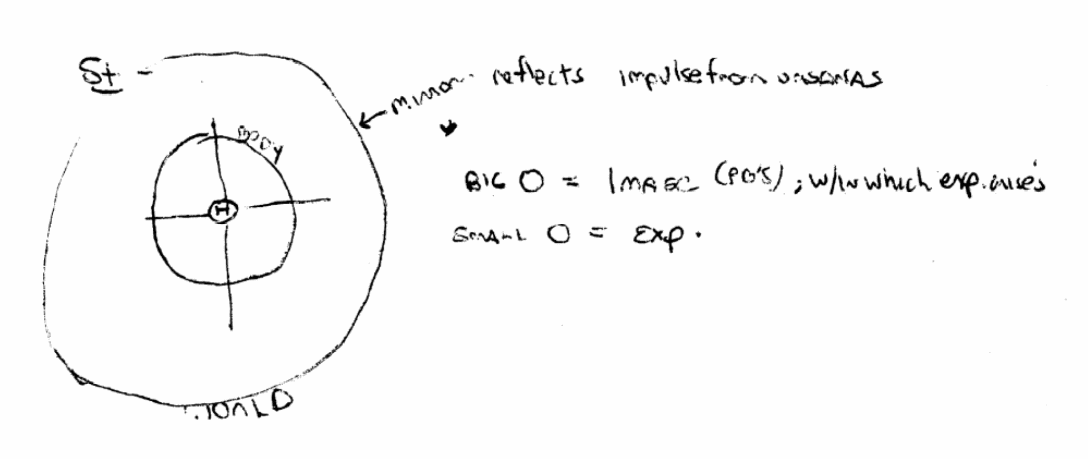
[FIGURE 1974 0901-1-AB. Primal Image and Experience. H = Heart; St = Steiner; w/in = within; Exp. = experience. Facsimile scan from AB class notes.]
[Note: One or more references cut off of scan, most likely a reference to Talks with Ramana and Upanishads, see JC notes below.]
Myth of Meaning -- pp. 138-9 [Note: Aniela Jaffe, The Myth of Meaning in the Work of C.G. Jung.]
World-image is not introspectable. We are blocked by our reflective apparatus with its images.
That part of the original image which is held back and does not go into you is what you experience (the perceptual world that is not introspectable) -- what goes in creates new organs.
What we experience is an abstraction and all the rest is left out.
The body is what individualizes the universal manifestation.
No reflective consciousness without upadhi.
Steiner was phenomenological and misunderstood Kant, who was epistemological.
PB -- World-Mind in our individual minds -- Anima Mundi in each of us -- ego and world are inseparable. [Note: Paul Brunton, The Wisdom of the Overself.]
Psychology is reverse -- projections that go out must be held in to see things as they are.
Cosmology -- blending of individual and world-thought = omniscience.
Image and instinct is analogous to ideation and karma.
If you have thought, you have perception. Perception is based on thought, not reverse (except psychologically).
[Alan Notes 1974 0901 End]
[JC Notes 1974 0901 Begin]
9/1/74
Hidden Teaching pp. 302-303 (The situation of . . . iconoclastic and clear truth.)
The image comes from the mind and includes the body and the object.
The world is presented and then I see the brown on the log.
RG: The existence of it and the perception of it happen at the same time.
LDS: The senses as entrances of knowledge is from the point of view of after the manifestation of subject and object.
[diagram currently unavailable]
All our experience is in terms of images.
Isis Unveiled -- Blavatsky pp. 182-3, 184 (Psychometry - Prof. Buchanan) -- "Ether is a medium plus the invisible order of things, so that when the motions of the visible universe are transferred into Ether and stored in the invisible." (p. 188, quote not exact) Jung speaks of absolute knowledge where there is acausal orderedness where the absoluteness of all things are ordered. "From ether comes all things and to it all will return - the images of all things are indelibly impressed on it. It is the storehouse of all the remains of visible forms and ideas."
India -- PB pp. 209-11 -- the book of life contains everyone's chart. If we try and interpret a chart we have to use apperceptive processes.
In a vision some of the conscious attitude still remains which permits the modification of contents.
p. 215 -- "inner world" -- world of images
The World-Mind is the receptacle or ground in which the karmic forces are embedded. They are the ground of our thinking and operating, i.e., they are our karma.
All we experience and all that our experience consist of are reflected states of consciousness Jung often leaves out the word 'reflected'. It's reflected or it's not experience, or you're a Sage. Jung -- experience consist in reflected images of processes in the brain.
Every thought that the mind has, the mind transforms itself into that thought, and the thought is presented in a perceptual form.
12 senses which are organs to apprehend knowledge. The vasanas shoot out of heart to brain and on the screen where the individual world is played out.
[diagram currently unavailable] [PB's big image and within it experience arises. See FIGURE 1974 0901-1-AB above.]
[in reference to diagram, the following two statements]
Taurus is the perception of thought and not thinking.
Each sense is an opening of some kind to grasp the knowledge of the world or of our body and mind.
Color isn't in the brain, how do we account for the image of blue.
Steiner, Microcosm and Macrocosm, Ch. 8, p. 134 ff. ("The part of the elementary world held back comes into our consciousness as a reflection or mirror image as the object…")
Causal world is the intellect. The entirety of manifestation is a field of force or "life field". Those forces stream into is. The light of the sun makes a wound in the physical being. The sunlight which is a vehicle of the divine consciousness actually creates the organ of eyesight so that it can be seen. The principle in its functioning creates the organ necessary for its own revelation -- Jung.
[diagram currently unavailable] [cosmic memory -- tendencies or forces in World-Mind which determine the thinking to the blueprint -- the intellectual laws that will govern the manifestation of the universe]
"What doesn't stream into us but is held back is the sum total of our sense impressions." The signs of the zodiac are creative, formative forces. They develop the various sense functions.
The elementary forces (elementals) build up our senses. The spiritual forces (astral?) form the nerves. The world of reason penetrates further and forms the brain or spine.
In Samkhya from each of the elements comes a certain sense.
The image (PB) cannot be introspected into. You can't get any knowledge of what that World-Image really is, what blocks you is your reflective consciousness, the world of images which is a falsification of reality. We don't live in the real world but in the world of images.
We don't know what that Sun is but only know that Sun through our eyesight which is an organ that has been created by the Sun.
The basic functioning of the animal (the instincts that guide it through its life) is dependent on the body it's using for that body is a model and a scale for its instincts. We get to understand the instincts through the body. We get to understand the nature of the being through the body he works through. Jung -- Psyche consists of reflected images of process in the brain.
The part of the original image which is not permitted to go through becomes your image of experience and the rest flows through you and builds further organs.
The vasanas blow up from the heart, become this world and are reflected back into the organism. The world we see is maya -- reconstruction of the world every moment in time.
You don't see all colors or hear all sounds, many go right through you. The body is a reflecting apparatus. The forces that are held back make up the perceptual world that you can't introspect into. The world you perceive is nothing but a world that's reflected in images that are held back and the others stream through.
You don't know the image PB's talking about, nor does anyone else and the revelation of what that image is might be bewildering. The only thing we do have acquaintance with are the images we perceive as our reality. This perceived world is an abstraction, the rest is all left out. What kind of world do you see? It's one that is really conjured up.
The signs are the liberated gods. The moon is the coordinator of the tissue of powers that are symbolically represented in the body.
The only thing you know about the body is the same thing that you know about the world.
When I dream and conjure up an object, what is the stuff that underlies the perceived figure -- the force of consciousness itself.
The universe that's created is all consciousness stuff.
Upanishads -- Aurobindo p. 17 -- all you live in is images which is the only world you know. [Note: Sri Aurobindo, The Upanishads: Texts, Translations, and Commentaries.]
Talks with Ramana, p. 577 -- the ether holds the images of the universe which arise one after the other and you're going through it. [Note: Sri Venkataramiah (Swami Ramanananda Saraswati), Recorder, Talks with Sri Ramana Maharshi, page number varies with edition.] You're [learning] and you say "I'm thinking"; from another viewpoint you're not doing anything of the sort but are being put through the paces. Asmita reinterprets this differently. The vasana or thought can't be introspected into; we can only introspect into our images of what that thought is.
We may have 50 senses and thus learn about the thought in 50 different ways. But what is presented is an abstraction of what that is, a piece here and a piece there which we put together and say "Ah, that's the world" but the world may be nothing like the thought that's projected out there. Other creatures see differently because of different reflections in his brain.
The body individualizes the universal manifestation
The analysis of perception is based on the thought to PB which is used the way Ramana uses vasana. When we analyze our perceived world we realize that it was a thought to begin with. We may not know what that thought is but it has to be based on that thought. You have a thought when you're dreaming which translates itself into a whole scenario. The very nature of the images which have accumulated through millions of years in the building up of this physical organism has been through the entrances and exits. The image we have is something very subjective.
The Myth of Meaning -- Jaffe pp. 138-139 -- you have to have upadhi of some kind or you can't have a reflecting consciousness.
Each sign is a principle which working together creates the ideal man. They interrelate in a functioning way to make possible the physical body of man. We can never introspect directly into the thought but only into perceived contents and as he does this the apperceptive know-how gets built up. This apperceptive organ is the ego. The intellect is useful to analyze yourself. It must be merged into the ego and [with?] the ego in its source. First I have to find an 'I' before I can transcend it. We are in the process of acquiring an 'I'. Experience builds up the ego. Jung pointed out we don't very often come across an ego. We have many I's which all want to do different things.
Planets have a body, soul, and causal (intellect or liberated gods in Plato). The world of Archetypes in Steiner is the inerratic sphere.
Macrocosm and Microcosm -- Steiner -- pp. 134-138, 143-144. The nerves referred to on 135 are the subtle nerves which are formed from the sidereal aspect of the planets (astral component).
The more subtle the forces are, the more easily they penetrate into the being. To learn to reflect the archetypal world we study Advaita or Jung but you must develop some symbol to reflect this out where you can deal with it.
PB says that perception must pass through senses, nerves, and brain.
From Steiner's viewpoint you have to identify yourself with the body and the ego immersed in the world of images. Jung says in the psychic world all we know is images. If you take an epistemological stand you won't see what Steiner is doing. Steiner misunderstand Kant for Kant is speaking from Witness (Self) standpoint and for it all this is phenomena, the mind is phenomena. Steiner kept thinking he was located in the ego.
The senses are exits in the sense that the thought goes out through you. The point (Bindu - Overself atom) is the conjunction of manifest and unmanifest. A thought in the center ripples across like light and comes back. We catch the return only unless we meditate and are able to hold the vasanas from flowing and then our consciousness goes into Heart and we have a dream consciousness. Every vasana that ripples through transforms the whole circle (universe of experience) at one and the same time.
Cosmic memory corresponds to tendencies in World-Mind. The tendencies are incorporated by thinking which is peculiar to the individual reflecting apparatus that takes it in. There is no item in World-Mind which corresponds to what you see in your world of images. You couldn't possibly live in that real world, it would burn you up. The ego has to live in images, it cannot live in the real world. If your ego really penetrates into your feelings, you'll feel like you're in a furnace. Jung -- until a person has gone through the furnace of his passions he doesn't know what I'm talking about. Until the ego can get out of images and into the real world all he'll know are his abstractions from it which are incorporated by his senses.
PB says it's we that actualize the images. "World-Ideas are forces lying latent in the World-Mind and inseparable from World-Mind. They constitute a self actuating system. Each impression is simultaneously actualized by the mere fact of it being thought of in space-time pictures. It is (its existence) then the so-called material object. The World-Mind's recollected idea can't be separated from the thing. The idea appears at once as a thing." "Were there not this element present in our individual minds" -- anima mundi is incarnated in each and every individual and not just in Christ. A partial truth is worse than a falsehood. A falsehood you can handle a partial truth you can't. The scientists only give us part of the story on the brain.
The projections that go out (in psychology) have to be held in so that you can see the world better.
Wisdom -- "Serpent's Path" -- p. 246 + -- This exercise is the summation of the doctrine, the teaching, the practice. [Note: Page number varies with edition.]
[diagram] [must take all contents out of consciousness -- no reflection whatsoever (you're way beyond sense impressions). The only possible content is images, [fantasies].]
When there is a blending of the individual and the world -- omniscience.
Aspects of Indian Thought -- Kaviraj (Pratibha) -- "When yogins succeed in realizing the self as subject by trance experiences, the objective phenomena, infinite as they are, and their knowledge become simultaneously present in the cosmic consciousness. The self-consciousness which is all consciousness in the light of which all things are simultaneously and in all their aspects revealed. This is the highest mystic acquisition next only to self-realization." The next step before self-realization is omniscience. If your consciousness and the object (World-Thought) are blent into a unity. [Note: Mahamahopadhyaya Gopinath Kaviraj, Aspects of Indian Thought.]
Ignorance is a stepping stone for you to grow spiritually. Experience is valid until sublated. Some Neo-Vedantists say it's all ignorance but that's nonsense for you have to have some of the details of this ignorance before you can transcend it.
This thought which comes to us as a perception and in the analysis of perception we realize that the sense only apprehend only part of the thought. The apprehension of this thought as a perception is what PB means by Maya as a psychological reconstruction of the world every instant in time.
You can't separate the instinct from its meaning. Could it mean anything to speak about an instinct if there wasn't any meaning to it? Enlarge this conception. The image is a representation or pictorialization of the instinct. What we grasp of the meaning of the instinct is limited by the framework we're operating with. Buddhists separate perception (productive imagination) from the kinetic reality (thought). There is never that thought without its embodiment perceptually. He who has an intelligible intuition has all knowledge. They point out that productive imagination imposes its images on the thought and we experience the world. Actually the world is there but we only abstract part of it, which is an entirely different story. We don't separate karma and its ideation. If you do, you'll never get them back together again. The thought has the image. The images that flow into your mind are not haphazard. All the pictures are already arranged and are going to flow into your consciousness in a certain way and you say "I'm a great thinker" -- and forget the guy who's taking care of us.
It is we who think thought comes from perception but metaphysically it's the other way around. Ideation means thought processes, the vasanas (Wisdom, p. 31). A vasana out of space and time? (cosmic memory or tendencies in World-Mind).
When you become omniscient you're alone; there may be millions of beings inside but you're alone. Plotinus -- "the flight of the alone to the Alone". [Note: Plotinus, VI.9.11.]
You first must wipe the mind of all reflections so the original unity is restored (the world you can't introspect into). When the individual is restored to the unity that existence implies to begin with it's no longer your consciousness, it's the world's consciousness. PB spoke of being at the edge of the world. When PB speaks of thought he's referring to vritti which contains subject, object, and relations. The world thought can only be "reflected" totally in consciousness and would be an identity of consciousness and content. This is what they mean when they say consciousness generates knowing. This is the pure experience or [Samvit].
Jung's knowledge was always reflected and this is why he never made it.
Can you think of light being destroyed?
The body is like a depository or garbage can. The really great sages, their bodies burnt up.
Senses are for the purpose of apprehending knowledge within and external to the body.
[JC Notes 1974 0901 End]
Class
Sunday, September 1st, 1974
Verbatim, unedited transcriptClick the series name to view more
CLASS at Wisdom's Goldenrod, Hector, NY
with Anthony Damiani (AD)
September 1, 1974
EPISTEMOLOGY; REFLECTIVE CONSCIOUSNESS
with Appendix: AB and JC Class Notes 1974 0901.
TOPIC: Epistemology
SUBJECT: Reflective Consciousness
SUBSUBJECTS: Cosmology, Mentalism, Senses as Entrances and Exits, Primal Image, Vasanas and Heart, Steiner, Serpent's Path
CONTENTS:
Aurobindo: we are not conscious of external objects, only perceptions in our brains
Reading/discussing Ramana, Talks with Sri Ramana Maharshi, on projection of vasanas (thoughts) from the Heart
Explanation of how thoughts (vasanas) are reflected in the brain as images
Perception based on thought (vasana), not vice versa
Reading/discussing Aniela Jaffe, The Myth of Meaning in the Work of C.G. Jung; Jung's experience in East Africa and the cosmic meaning of reflective consciousness
Evolutionary build-up of body makes possible operation of reflective consciousness
Have to acquire an "I" before you can transcend it
Reading/discussing Steiner, Macrocosm and Microcosm, on three worlds and evolutionary build-up of body
Using symbolic mental pictures to hold back the World of Archetypal Images (inerratic); formation of spiritual sense-organs (chakras)
Steiner phenomenological, misunderstood Kant (epistemological)
Bindu; bringing consciousness into heart through meditation
Cosmic memory = tendencies in World-Mind; ego can only exist in world of images
PB: can't separate World-Mind's idea from re-created thing
Anima Mundi incarnated in every individual; inseparability of ego and world
Partial truth worse than falsehood; scientists give partial truth about brain
Reading/discussing PB, The Wisdom of the Overself, on Serpent's Path exercise
Reading Kaviraj, Aspects of Indian Thought, on pratibha
Serpent's Path leads to blending of individual thinker and world-thought = omniscience
Role of ignorance in spiritual growth; maya as psychological reconstruction of world
Instinct and meaning
Buddhist Logicians separate thought and perception, we don't; thought already includes the ordered flow of perceptions
Evolution of human perception; historical changes in color perception; the potential for future perceptual abilities
Development of reflecting apparatus; Earth as nurse-maid
Physical light as a vehicle of Divine Consciousness
When you become omniscient you're alone; "flight of the alone to the Alone"; Samvit
Jung didn't reach stage of omniscience; his knowledge was always reflected
Sun as substance of universe; indestructibility of light
Body is depository; bodies of certain great Sages burnt up
Reference to PB's encounters with a Hindu astrologer
Appendix: AB and JC class notes
BOOKS READ FROM OR REFERENCED:
Paul Brunton, The Hidden Teaching Beyond Yoga
H.P. Blavatsky, Isis Unveiled, Vol. 1
Paul Brunton, A Search in Secret India
Satprem, Sri Aurobindo: or, The Adventure of Consciousness
Sri Aurobindo (tr., comm.), The Upanishads-II, Kena and Other Upanishads
Sri Aurobindo, The Upanishads: Texts, Translations, and Commentaries
Sri Venkataramiah (Swami Ramanananda Saraswati), Recorder, Talks with Sri Ramana Maharshi
Aniela Jaffe, The Myth of Meaning in the Work of C.G. Jung
Rudolf Steiner, Macrocosm and Microcosm
Paul Brunton, The Quest of the Overself
The Imaginal Reality (author?)
Paul Brunton, The Wisdom of the Overself
Mahamahopadhyaya Gopinath Kaviraj, Aspects of Indian Thought
Th. Stcherbatsky, Buddhist Logic, Volume 1
Plotinus, The Enneads (MacKenna translation, 4th ed.)
PLOTINUS QUOTES READ OR REFERENCED: VI.9.11
DIAGRAM appended to this transcript:
- FIGURE 1974 0901-1-AB. Primal Image and Experience.
Other diagrams also referred to are not with this transcript version. [Transcriber note: [diagram] means the speaker is referencing a diagram as he or she is speaking. If someone is drawing or writing, with audible sounds of chalk on a blackboard, I indicate this by [drawing] or [writing].]
NOTES:
AB and JC class notes have been appended because they contain diagrams that AD refers to in the class and also because we are missing one or more audio files for the first part of the class. They thus help round out the class. All spelling, capitalization, and punctuation corrected, all abbreviations spelled out in AB and JC class notes.
For readability's sake, the following substitutions/edits made in Verbatim Transcript: cuz = because; gonna = going to; gotta = got to; yeah = yes.
TRANSCRIBED Verbatim by IT 2016 (V11a). This is V12a (2023) and has: updated prefatory matter, audio file name, and footer; new formatting to accord with new conventions; TOC completed; Book List corrected and completed; Plotinus quotes section added; AB and JC class notes and diagram appended with reference within transcript to the diagram; typos/errors within transcript fixed. In 2025, IT updates audio file markers, removes time markers to match new REP audio. Archival verbatim transcript – V12a.
AUDIO FILE: 1974 0901b. [Note 1: "Tape" and "Side" refer to original audio cassette tapes that were later digitized into .MP3 Audio Files. Note 2: We only have an audio file for the last part of the class, we are missing the rest. This file is very faint and hard to hear. In 2024, REP Studio tries to improve the sound quality.]
1974 09/01 at Wisdom's Goldenrod
Epistemology; Reflective Consciousness
[Audio File 1974 0901b Begins]
S: [inaudible]
RG: But those 12 sense organs there.
[students inaudible]
AD/S(?): Well that would be the other two.
[students inaudible]
S: But somehow [few words inaudible] too. But it's the [S simultaneously: We're already--] phenomenological model that [couple/three words inaudible]
[students inaudible]
RG: No, nobody ever said that it was phenomenological, wasn't physical. The phenomenological is whatever is phenomenal.
S: Right, but you're conceiving of it as a physical model [few words inaudible]
[students inaudible]
LR: (Larry), what's the split you're talking about?
S: [few words inaudible]
LR: Wait, which split?
S: We're just [couple words inaudible] outside, what (Anthony's) calling the body.
LR: But isn't everything we're [one/two inaudible student words simultaneous with LR] talking about sort of taking place after everything we talked about last week, which we've be-- (laughter)
S: [few words inaudible]
LR: I mean I-- the only-- the way I understood this was that this is what happens after the heart center is magnified and the whole life is already thrown out and then this is what happens on its way back in. That everything we're saying that happens that Ramana is saying about the li-- the (Self/self) being contained and all the life, you know, complete and full and getting reflected out and then the question was, well how do we get anything back and-- and in what way and in what form do you perceive that-- that life. And this is all I thought the next step of that perception.
S: Right [few words inaudible]
[students inaudible]
S: Tony, why did you say it that it's only the forces (that break through)?
[students inaudible]
AD: Go ahead. I'll keep quiet as long as is necessary.
[students inaudible]
AD: Huh?
S: (Let me ask you) this.
AD: I says I'll keep quiet as long as is necessary. This is the question. I'll-- I'll quote Aurobindo. I'm sure you won't believe anyone else, but Aurobindo you might consider, you figure he's got a lot of experience. Most of you have read The Adventure of Consciousness so now you-- you know what it's all about. (some laughter) But, Aurobindo makes this remark.
[Transcriber note: I am using The Upanishads-II, Kena and Other Upanishads by Sri Aurobindo, Sri Aurobindo Ashram, Pondicherry, 2006.]
Sri Aurobindo [The Upanishads-II, Kena and Other Upanishads, pp. 366-367, AD reading]: "Philosophy has done well to point out that consciousness is in its essence purely subjective. We are not conscious of external objects; we are only conscious of certain perceptions and impressions in our brains which by the separate or concurrent operation of our senses we are able to externalize into name and form; and in the very nature of things and to the end of Time we cannot be conscious of anything except these impressions & perceptions."
AD: And that's all he's trying to tell us but I-- I'm not trying to do anything else. I'm not going to go into the details of these stellar forces. Alright? Shall we start again on that?
S: [few words inaudible]
AD: Ok? We start again? Yes, go ahead John.
JL: Ok so, from-- from that quote then, seems-- it seems that all of our experience is the perspective from the subjective point of view. And yet-- yet we are made to believe that-- that our senses perceive something, you know, that's the world outside of us. We're made to believe that-- that it's from the channels of knowledge of the world outside of us.
AD: Yes, ok.
JL: Now if the experience itself is an internal one, let us say a subjective one, in that what is (viewing/doing)-- what is experienced as, you know-- or supposedly outside of us, is a name and a form, you might say our imagination of it, our image of that particular form. Then, these senses themselves are [one word inaudible] different aspects of the image [student assents] that we-- that we perceive.
AD: Very good so far, very good.
JL: And in a sense like a fragment-- (fragmentization) of possible-- of-- of this world image that is-- that is known, but is experienced as a separate function, whether it's in-- whether it's in the visual [couple words inaudible] or auditory or any-- any number of those 12 functions that we [couple/three words inaudible]
AD: So he is saying in a sense, Aurobindo, he is saying that all you live in is images. That's all you ever live in. You don't know any other world but this world of images. That's his way of saying, the same way Jung says it, you name them, they all say the same thing, alright. Now, all I'm asking you is let's try to work on what is this-- what does this mean, "All I see is images"? I always thought it was the real world, if I go over and hit this fellow he's going to hit me back. If I go through the window I'm going to cut my head. Now what is this images that they're talking about? And there was one way of bringing it up was this way. We could read from Ramana but that's, I mean-- that man just takes seven giants-- seven giant steps and he's out of the universe. (laughter) Yes, that's all that man does, you know, he takes giant steps, he reminds me of the Vishnu stride. Three strides and he was out of the universe. You remember that story? [short pause] But, just for the sake of repetition--
[Transcriber note: I am using Talks with Sri Ramana Maharshi, recorded by Swami Ramanananda Saraswati, Sri Ramanasramam, Tiruvannamalai, 2006.]
Ramana Maharshi, Swami Ramanananda [Talks with Sri Ramana Maharshi, Talk 616, p. 596, AD reading]: ""When the vasanas [AD: or thoughts] are projected from the Heart…"'
AD: And thoughts are not to be confused with perception. The analysis of a perception leads you to something different than the analysis of thought.
Ramana Maharshi, Swami Ramanananda [Talks with Sri Ramana Maharshi, Talk 616, p. 596, AD reading]: ""When the vasanas [AD: or thoughts] are projected from the Heart they are associated with the Light [AD rereads:"…they are associated with the Light] of the Self [AD: And that's capitalized.] and the person is said to think.""
AD: Let me emphasize that--""And the person is said to think.""
Ramana Maharshi, Swami Ramanananda [Talks with Sri Ramana Maharshi, Talk 616, pp. 596-597, AD reading]: ""The vasan…""
AD: It's just like when we were reading about this-- the ether, from the ether [one word inaudible] there's all images, alright. And so there's this image of this universe, one right after another. And you're going through this. Now imagine this image being shot out, you know, and you're going through high school, college, Ph.D., alright. And all the time you're learning you say "I'm thinking," alright. Another point of view might be that you're not doing anything of the sort but you're being put through the paces. But, you know, asmita does reinterpret things slightly differently. Alright so--
Ramana Maharshi, Swami Ramanananda [Talks with Sri Ramana Maharshi, Talk 616, pp. 596-597, AD reading]: ""The vasanas [AD reads: thoughts] which lie embedded in an atomic condition grow in size in their passage from the heart to the brain. The brain is the screen on which the images of the vasanas [AD reads: thoughts] are thrown and it is also the place of their functional distribution. The brain is the seat of the mind, and the mind works through it."
"So then this is what happens. When a vasana is released and [it] comes into play…"
AD: Say a thought is released and comes into play. And we don't know what that thought is, you know, like we said before we perceive that thought, alright, that thought can't be introspected into. We can only, so to speak, introspect into our images of what that thought is.
Ramana Maharshi, Swami Ramanananda [Talks with Sri Ramana Maharshi, Talk 616, p. 597, AD reading]: "When a vasana is released and [it] comes into play, it is associated with the light of the Self. It passes from the heart to the brain and on its way it grows more and more until it holds the field all alone [and all the vasanas are thus kept in abeyance for the time being] [AD paraphrases: and then of course other vasanas in their turn]. When the thought is reflected in the brain…"
AD: Now this is-- this is the point. The thought is reflected in the brain. This was a thought [diagram], right? It gets reflected in the brain, it goes right through it, right? The brain is over here [one/two words inaudible] [Note: See FIGURE 1974 0901-1-AB, Primal Image and Experience, appended to this transcript.]
Ramana Maharshi, Swami Ramanananda [Talks with Sri Ramana Maharshi, Talk 616, p. 597, AD reading]: "It passes from the heart to the brain and on its way it grows more and more… When the thought is reflected in the brain it appears as an image on a screen."
AD: Now isn't that the same as Aurobindo?
S: [few words inaudible]
Ramana Maharshi, Swami Ramanananda [Talks with Sri Ramana Maharshi, Talk 616, p. 597, AD reading]: "The person is then said [AD reads: And then the person is said] to have a clear perception of things."
AD: This is very tricky.
S: [few words inaudible]
AD: Is he saying the same thing? What do you think? Now, we have-- we've got four very learned men here.
JL: Tony, that's like a train through the mountain [inaudible]
AD (simultaneously): I don't-- I don't follow that. [short pause] I want to leave that-- I want to leave that the way it is, undefinable. Again, like when this vasana explodes, alright, then this thought is perceived, but this (reception/perception) of this thought has been reflected in the brain, goes through this process in the organs that we operate through. Then that filters through and becomes an image. It's not [AD tapping on board with chalk] that thought!
S: Well yes [few words inaudible]
AD: Well, now what we're concerned about was simply to try to understand in a rational way that if what is perceived is not the thought, then it goes through this process of all the sense organs. Let's assume that it's so, alright? We don't have to say five, let's give ourselves fifty senses, he can learn about this thought in fifty different ways. What is presented is going to be an abstraction of what that thought is. A piece here, a piece there, which we put together and say, "Ah, that's the world for me." But that world may be nothing like the one, the thought that's projected out there. Because certainly if we consider a creature made up differently, he will not perceive reflected in his brain what we see. So we have to understand the nature of this reflection that we're dealing with. Go ahead.
S: So is that thought [inaudible] that first thought [few words inaudible]
AD: Let me ask you, let me ask you quickly. I'm going to be dictatorial because I have very little time left now. What person [few words inaudible]
S: [inaudible] I don't know where--
AD: Are you trying to find out-- in other words, if this thought, if this thought which is a vasana, we spoke about it as being thought, the unperceived world, the really unperceived world, alright, as this flows through us, through the senses into our brain, then this get individualized. Or is it indi-- is it individualized before? Is that what you're wondering? And I want to know why you want to know that.
[24½ seconds of inaudible student talking]
AD: I'm going to ask from now on when class is over so that every question is going to be to the point, alright [few words inaudible]
S: This process which comes into my brain every moment [few words inaudible]
AD: But how could it be?
S: [couple words inaudible]
AD: How could it be? I mean if we both listen to an orchestra, like PB says, and you close your ears up, alright, you don't hear it no more.
S: Right.
AD: Well then what is it that individualizes this universal manifestation that's taking place for you? It has to be the body, doesn't it?
S: Well wouldn't you say it has to be prior to this body and these sense organs, can't they [few words inaudible]
AD: I'm lost, try again.
S: This body itself is the only individualizing-- is the only individualizing function [three words inaudible]
AD: Try to explain it to me again.
S: When these vasanas raise up from the heart, isn't it already a [few words inaudible]
AD: Alright, let's say it is. So? So?
S: At least you could qualify it for an individual, you could qualify it as you.
AD: Well if it-- if [S simultaneously: Yes, uh-hm.] the vasana goes through your brain and goes-- [S: No.] goes through my brain--
S: Right. That's the point of differentiation, when it goes through the brain. Because this brain structures it according to--
S: (Vasana/Uh-hm).
S: Vasana(s).
S: And those vasanas are what?
S: Well--
S: Because everyone has the same vasanas.
S: As that big vasana, yes. Or else (we could) never perceive a common world, that's so true.
AD: Well, can we try again now? Are we getting-- are we beginning to get some sort of notion of when, for instance, PB said that "Our analysis of experience shows that perception is based on thought and not vice versa." Remember that, somewhere in the Wisdom, remember? Now does-- does it make any sense over here? In other words, as we analyze the image which comes into us, alright, the analysis of this perception is based on the thought. But he's using the term "thought" here they way, for instance, Ramana uses it as a vasana. So that when we analyze our perceived world, we begin to realize that it was a thought to begin with. We may not know what that thought is but it has to be based on that thought. Just like for instance you have a thought when you're dreaming and that thought translates itself into a whole scenario, dialogue, characters, critics and authors and audience. That thought does translate itself that way. Well, over here we have this thought which is blown out and then comes back to us through all these senses. Now do you-- The point here is to try to see that the very nature of the images we have accumulated for millions and millions of years in the building up of this physical organism has been through these entrances and exits. And that this image that we have, alright, is something that's very subjective. There was a quotation here from Jung, Jaffe's version of Jung, um-- [24¾ second pause] I-- well read the paragraph, I don't want to [one/two words inaudible] Read-- read right down into the next paragraph.
S: Where?
AD: Ok, right in the middle of this paragraph.
[Transcriber note: I am using The Myth of Meaning in the Work of C.G. Jung by Aniela Jaffe, Daimon Verlag, Second Daimon Edition, Zürich, 1986.]
Aniela Jaffe [The Myth of Meaning in the Work of C.G. Jung, Chapter 13, p. 138, RG reading]: "Man's consciousness is also a spiritual function. It lifts him out of the animal kingdom, even though from another point of view he can be regarded as a differentiated animal driven by instinct. Generally Jung used"consciousness" and "reflecting consciousness" as equivalent concepts, occasionally substituting "mind", and "man" as the vehicle of mind. The cognising and reflecting consciousness exercises a creative activity…"
AD: Now the reflecting consciousness, again I-- we must emphasize, you would have to bring in the notion of a upadhi of some kind or you cannot have a reflecting consciousness. Go ahead.
Aniela Jaffe [The Myth of Meaning in the Work of C.G. Jung, Chapter 13, pp. 138-139, RG reading]: "…super-imposing on the existence of the outer and inner world the fact that they are known. In this way it endows them with reality:"the world becomes the phenomenal world", and as though in a "second cosmogony" man confirms his existence for the Creator.
"When, from a low hill in the Athi plains of East Africa, Jung gazed into the wide savannah and watched the vast herds of gazelle, antelope, [gnu], zebra and warthog in the soundless stillness, he had as it were a primeval experience of the creative function of consciousness."
AD: Go on, read the next paragraph.
Aniela Jaffe [The Myth of Meaning in the Work of C.G. Jung, Chapter 13, p. 139, RG reading]: "Thirty years later he recapitulated it in his memoirs:"Grazing, heads nodding, the herds moved forward like slow rivers. There was scarcely any sound save the melancholy cry of a bird of prey. This was the stillness of the eternal beginning, the world as it had always been, in the state of non-being; for until then no one had been present to know that it was this world… There the cosmic meaning of consciousness became overwhelmingly clear to me…""
AD: The cosmic meaning of reflective consciousness. There's no cosmic meaning to consciousness. There's no meaning to consciousness. Impossible! Go on.
Aniela Jaffe [The Myth of Meaning in the Work of C.G. Jung, Chapter 13, p. 139, RG reading]: ""Man is indispensable for the completion of creation; he himself is the second creator of the world, who alone has given to the world its objective existence--without which, unheard, unseen, silently eating, giving birth, dying, heads nodding through hundreds of millions of years, it would have gone on in the profoundest night of non-being down to its unknown end. Human consciousness created objective existence and meaning, and man found his indispensable place in the great process of being.""
AD: Alright, let's try a quick (review of the situation). If you think of every one of the signs as some sort of principle which, working together, ok, is going to create this man, this universal archetype or this Idea of Man. All this, all these principles are going to interrelate in a func-- in a functioning way to make possible the body, the physical body of man, which is not something to underestimate. This very physical body of man, like we pointed out, in an animal we can see that the body of a beaver, for instance, already determined the instinct of building dams. Alright. In the same way, Jung tries to point out, Steiner in his way, he's going to say, try to point out, that this very body, the way it is built, all the principles that are involved, the way they're correlated with one another, the functions that ari-- come out of (that), eventually is going to be for the purpose of that reflecting consciousness can reflect back the second cosmogony which it's being built up for. This is not a process that's concluded. Like we saw in the case of Mrs. Denton you hold a-- or hold up [one/two words inaudible] he begins to see things there that you and I would never see in a million years. [Note: See H.P. Blavatsky, Isis Unveiled, Vol. 1, pp. 182-184.] You know [one word inaudible] the year 2000 [few words inaudible] [students assent] But, here the point, the point that we're trying to see is there is this process going on that's building up the physical body of man and because-- because the way-- the way this body is built that it is in the very nature of things that he could never get this thought directly, he could never directly introspect into this thought, but only into the reflected or perceived content. And as he does that, this organ, this apperceptive know-how, gets built up, this organ gets built up. What is this organ?
S: [few words inaudible]
AD: Ego. [short pause] Again, I'll quote from Ramana. He says here--
Ramana Maharshi, Swami Ramanananda [Talks with Sri Ramana Maharshi, Talk 618, p. 601, AD reading]: "The intellect is useful thus far, it helps you to analyse yourself, and no further. It must then be merged into the ego, and the source of the ego must be sought. If that be done the ego disappears. Remain as that source and then the ego does not arise."
AD: Now, if I understand this gentleman right, he's saying I first have to find an "I" before I can talk about transcending it. Something like that? Now, in order for me to find an "I" I have to have one. But maybe I'm in the process of acquiring one. Huh? What?
S: [couple words inaudible]
AD: The bodily functions? Yes. But the functions are really organized in a certain way to give you certain experience, right? So it's really experience that's going to build up that ego. And you know, like Jung points out, well, you don't very often come across an ego. Yes.
S: [couple words inaudible]
AD: Yes, don't you think that?
S: [few words inaudible]
AD: Oh, you think that's all he's [one word inaudible] You ask yourself, "I want to do something" and then a minute later something else and you says, "No, I want to do that." And a minute later a third "I" arises, says, "No, I want to do this." Now which one is your real "I"?
S: [few words inaudible]
AD (simultaneously): All of them, right?
S: [couple words inaudible]
AD: Hm?
S: [few words inaudible] (laughter)
AD: I didn't hear her remark. Let me hear you.
S (simultaneously): (None of the above.) None of the above [few words inaudible] (AD laughs heartily, laughter)
AD: Alright let's-- let's go over this little bit by Steiner. This is from a book of his called Macrocosm and Microcosm.
S: What page?
AD: It's in chapter eight, I'm-- I'm being selective so just chapter eight then, ok? Just a little bit more. You have to keep in mind, when we spoke in astrology, we spoke about-- we spoke about the al-- alchemical notion(s), salt, sulfur and mercury. And these would represent the three aspects. We could divide it even more but in other words like there would be the body aspect or the so-called physical gross [one word inaudible] aspect to the planet. Then there would be the soul aspect of the planet. And then there would be causal intellect of the planet. Causal intellect of the planet is usually referred to in Platonic theology as the liberated gods but-- The only reason I'm referring you to this is because he's going to speak about the World of Reason, the World of Spirit, and that's what he's referring to, but this is his terminology and we just have to live with it.
S: [few words inaudible]
AD: Yes. And the-- the world of archetypes would be the inerratic spheres.
[Transcriber note: I am using Macrocosm and Microcosm by Rudolf Steiner, Rudolf Steiner Press, London, 1985.]
Rudolf Steiner [Macrocosm and Microcosm, Lecture Eight, AD reading]: "The part of the Elementary World…"
AD: And try to keep in mind the way he used the word 'elements'. Remember we spoke about, spent some time on the elements and like we pointed out that the elements are concerned with the building up of vegetation all over the world, ok. The world has like a green carpet all around it.
Rudolf Steiner [Macrocosm and Microcosm, Lecture Eight, AD reading]: "The part of the Elementary World that is held back comes into our consciousness as a mirror-image, a reflection… The elements of fire, air, water, and earth…stream through the eye [AD reads: eyes] with the exception of what we actually see. Sense-perception arises through the fact that our eye holds back part of the light from the Elementary World, our ear holds back part of the sound [AD: and especially with your other organs]… …
"That is to say, the eye is not formed by what is reflected, but by what comes to us with the light -- and that is part of the Elementary World. [Moreover] something [also] streams in from the World of Spirit, [AD: Again,"…something streams in from the World of Spirit] indeed from all the worlds…"
AD: And they're all operating simultaneously, you know. The arrangement of the chronological sequence is something which we won't get involved in, but--
Rudolf Steiner [Macrocosm and Microcosm, Lecture Eight, AD reading]: "[Moreover] something [also] streams in from the World of Spirit, indeed from all the worlds of which we have [AD adds: once] spoken. Accordingly [AD reads: And] we may say: At this particular point certain forces are held back by the eye, and also by the other senses; what does not stream into us, what is held back, is the sum-total of our sense-impressions. Thus it is what we do not let through that we see or hear; but what we do let through is what has formed the physical organism of the eye, for [AD reads: as an] example. We hold back certain forces and allow certain others to pass through -- these latter being forces of the Elementary World. If we look at the eyeball in a mirror, then too we see only what it does not let through. Thus in the Elementary World there are forces which have formed our sense of sight and also our other senses. As sense-beings we are formed out of the Elementary World [AD reads: World of Elements]; the world we see when we are able to look into the Elementary World is the world which builds up our senses."
AD: And, we spoke about the world of elements and the various inhabitants of the world of those elements which are involved in building up of the world as we know it, and we spoke about salamanders, sylphs, ok. Yes like a sylph will be attached to a bird, whereas a gnome would be attached to a [one word inaudible] but--
Rudolf Steiner [Macrocosm and Microcosm, Lecture Eight, AD reading]: "At the inner"wall" of our organ of sight there is a kind of second mirror, [AD: a wall that holds back] for there, from a further world, other forces flow in -- with the exception of those that are reflected. There the elemental [AD reads: elementary] forces themselves are held back and reflected; they cease to function and it is only the forces of the World of Spirit that stream through and are not reflected."
AD: So if we take the eyeball, for instance, certain forces go as far back let's say as the back of the eyeball where they have their retina. But then you're going to have the optic nerve that's going to flow and then you're going to have the brain, ok.
Rudolf Steiner [Macrocosm and Microcosm, Lecture Eight, AD reading]: "Just as the eye has its optic nerve, so has the ear its aural nerves from the forces streaming in from the World of Spirit. From there stream the forces of Beings who are the builders of the [AD adds: world, the] whole nervous system."
AD: Now, here again, the nervous system that we're speaking about, remember we spoke, like Guenon points out that the mind, when it retracts like in sleep, where these would be subtle nerve centers. These nerve centers is where the mind retracts. We point out that these-- this would have to be a sort of taijasic quality or what the Hindus call taijasa, and this is a fiery element we've spoken about. This would have to come from sidereal forces of the planets we're talking about, not from the physical planet, but the sidereal force(s). In other words, the-- the soul, the astral, the soul in this-- the astral component of man-- of man are formed from elements or we could say the soul of the planet and not the physical-- not the physical planet.
S: Yes.
Rudolf Steiner [Macrocosm and Microcosm, Lecture Eight, AD reading]: "From there stream the forces of Beings who are the builders of the whole nervous system. Our nerves are ordered according to the laws of the planetary world outside, for the planetary world is the outer expression of spiritual realities and spiritual worlds.
"If it is the case that the World of Spirit works at the forming of our nervous system, it follows that underlying our nervous system there must be a certain law and order corresponding to that of the solar system. Our nervous system must be an inner solar system, for it is organised from the Heaven World."
AD: I'm skipping.
Rudolf Steiner [Macrocosm and Microcosm, Lecture Eight, AD reading]: "We come now to the third part of the [AD reads: our] reflection. Our nervous system is built up by [AD reads: of] the World of Spirit. At the point where the nerves pass either into the brain or into the spine, again a reflection takes place [AD reads: again a sort of holding back takes place]. At this point the stream from the World of Spirit is held back in the nervous system and what we have come to know in the World of Reason penetrates through [AD adds: that]."
AD: In other words, it seems that the more subtle the forces are the more easily they penetrate into the being whereas the more grosser these forces are, like the elementary forces, they're gross in comparison to the forces of the World of Reason. Alright, so--
Rudolf Steiner [Macrocosm and Microcosm, Lecture Eight, AD reading]: "The forces [AD reads: force] of [the] Hierarchies work through at this point and the World of Reason builds up for us the brain and spinal cord that lie [AD reads: lies] behind the nerves. In our brain itself and its elongation, [AD adds: the spinal column] the spinal cord, we have the product of all the activity originating ultimately in the World of Reason. Anyone who is able to survey the World of Spirit [clairvoyantly] can find exact images of the great cosmic prototypes even in the smallest reflections in the cerebral nervous system and the spinal nervous system."
AD: And here you can see the correlation with Jung is too obvious. Jung speaks about the two main systems in the human being, one is the cerebral spinal system and the other is the sympathetic nervous system. And here's where the archetypes really get to work on you.
Rudolf Steiner [Macrocosm and Microcosm, Lecture Eight, AD reading]: "But the World of Archetypes, or Archetypal Images, streams [AD reads: stream] right through us without our being able to hold it back."
AD: And then the problem arises for us well, what can we do to hold back this world of Archetypal Images? And, by holding them back, it is possible to start reflecting on them. Well you can do it a lot of ways. You can study Jung's psychology, you could study the Advaita. But you're going to have to build up some symbol that's going to start reflecting this out where you can deal with it, alright. If a force, if it goes through you, then it's over with.
Rudolf Steiner [Macrocosm and Microcosm, Lecture Eight, AD reading]: "What does man know of the Elementary World? As much as is mirrored for him by the senses: light, sounds, and so forth. What does man know of the World of Spirit? Just what his nerves reflect for him. The Laws of Nature as they are usually called are nothing else than [a] shadowy image, a faint reflection, of the World of Spirit. And what man takes to be his inner spiritual life, his reason, is a weak reflection of the outer World of Reason; what is usually called intellect, intelligence, is a faint, [AD adds: very faint] shadowy reflection of the World of Reason. …
"It is only possible for us to have physical sense-organs -- eyes, for example -- by admitting the Elementary World into ourselves and then holding it back. We can only have a nervous system by admitting the World of Spirit into ourselves and then holding it [AD reads: that] back; we can only have a brain and reasoning faculty by admitting into ourselves the World of Reason and then holding it [AD reads: that] back; thereby the brain is formed. If higher organs are to be formed, it must be possible for us to hold back a still higher world. We must be able to send something towards it, as in our brain we send that which holds back the World of Reason. Thus man must do something if he wishes to develop in the true way. He must derive forces from a higher world if in the true sense he wishes to develop to a higher stage. He must do something to hold back [the forces of the World of Archetypal Images] [AD reads: these-- this archetypal force]."
[16 second pause]
AD: He makes this remark in this book, I thought might bear repetition.
Rudolf Steiner [Macrocosm and Microcosm, Lecture Eight, AD reading]: "When cosmic truths…"
AD: And this is why I refer to Doctrine.
Rudolf Steiner [Macrocosm and Microcosm, Lecture Eight, AD reading]: "When cosmic truths are compressed into symbolical sentences we have there a force by means of which we can mould the substance of our soul. By working thus upon himself man consciously builds up that which the external world has otherwise accomplished in him without his aid, forming his brain out of the World of Reason, his nervous system out of the World of Spirit, his sense-organs out of the Elementary World. He himself builds organs higher than the brain, organs which are not outwardly visible to normal consciousness because they lie in a realm beyond the physical. Just as the eyes have been formed out of the Elementary World, the nerves out of the World of [AD adds: the] Spirit, the brain out of the World of Reason…"
AD: "Spirit" here is not right, it's the astral world, you know, what we were speaking about before. Because to-- to us, those who are acquainted with "spirit" in Western terminology, I think it will be misleading. So think of astral when he says "spirit".
Rudolf Steiner [Macrocosm and Microcosm, Lecture Eight, AD reading]: "Just as the eyes have been formed out of the Elementary World, the nerves out of the World of Spirit, the brain out of the World of Reason, so out of the World of Archetypal Images higher spiritual organs are formed and moulded, organs which gradually enable us to penetrate into the higher world and to look into it. These organs simply represent a development and continuation of the-- the activity carried out at a lower stage. These higher organs of perception appear in the shape of spiritual flower-forms budding forth from man and are…"
AD: Usually called 'lotus-flowers', you know, the chakras.
[short pause]
Rudolf Steiner [Macrocosm and Microcosm, Lecture Eight, AD reading]: "These spiritual sense-organs…"
AD: And he calls them sense-organs, I guess he hasn't-- there's no language adequate for it.
Rudolf Steiner [Macrocosm and Microcosm, Lecture Eight, AD reading]: "…can be cultivated by the patient and vigorous practice of immersing oneself in symbolic mental pictures which are not pictures of anything in the external world and which in this respect differ from the mental pictures of ordinary consciousness in that they do not mirror anything external but work in the soul and produce forces which can hold back the World of [AD adds: the] Archetypal Images just as the eyes, nerves and brain hold back the other worlds that are around us."
AD: And-- and by the way, for instance like PB points out that a perception, you know, has to travel through the senses, through the nerves, and then into the brain. And he's also giving-- you know, indicating in this very loose way that this process is involved in perception of the world.
[short pause]
S: Are you working tonight Tony?
AD: No. Can't you tell yet? [short pause] Alright (there's/this)--
S: What'd you say to him?
S: [couple words inaudible]
AD: Several times, but-- Perhaps from now on when we start speaking about reflective consciousness you'll-- you'll have a-- Yes--
AP: [few words inaudible]
AD: I'm sorry?
AP: Tony [few words inaudible] which is that the senses are first entrances and then (exits)?
AD: Yes. I'm handling it [AP simultaneously: Then you--] now. That's why I said now from Steiner's point of view, it's like you've got to locate yourself or identify yourself with the body. And, you've got to identify yourself in the position that here's this ego, you know, what you call your "I", immersed in this world of images, because this is the only world you know; in the psychic world, like Jung would say. All we know of anything is the images that are given to us, alright, he calls it the psyche, uh-- That's the stand you have to take. If you change that stand, if you start talking from here [diagram], then you're in epistemology and you cannot follow what this man is doing. You can easily see, if you understand what he's saying, that he misunderstands Kant, because Kant is talking from here [diagram]. For the Self, alright, for the Self, all this is phenomena, the mind is phenomena, this is where Kant is talking from. But Steiner kept thinking that he was (located in/locating it) here [AD indicates on diagram]. But we won't go into that now.
AP: (Tony? So I mean that's part of the view that) [inaudible]
[Note: See FIGURE 1974 0901-1-AB, Primal Image and Experience, appended to this transcript for the following. Overself-atom corresponds to H (Heart) in diagram.]
AD: They are entrance-- they-- they are exits in the sense that the thought goes out through you. In other words-- maybe, maybe another analogy, Anna, might help. If we take this here [diagram], point here, alright. Now a point, you-- you remember studying about a point, no dimension(s), like a [couple words inaudible] between manifestation and the unmanifest. You think about the properties of a point and you see why the Hindus think so much about that, ok. Look up under Hinduism, then you'll see why it's so important to them. But that would correspond to what, his terminology that PB writes down in The Quest and, you know, the Overself-atom [few words inaudible] That point there represents the unmanifest is on the other side and the manifest is on this side. If you think of this point here, and you think of the circle around it, alright, as simultaneous, because we can't-- we can't think that fast. But a thought here [diagram]-- you know, let's say it ripples a thought, like light, and then comes back again, alright. But we catch this part [diagram], we don't catch this part here [diagram] unless we engage in tremendous meditation and are able to hold back the vasanas from flowing, hold them back, and then our consciousness goes into the heart and gets a kind of dream consciousness. There, of course, you can see that consciousness would have to be different than when it comes to the brain. But if you do that, if you try to imagine that every-- every vasana that ripples through transforms this whole circle at one and the same time, alright, so that (as/it has) the thought or the pulsation, which, you know, they speak about as [few words inaudible] If you can imagine this here as the Overself-atom [diagram] and you can imagine this [diagram] as the world of experience for that body and this is it, every pulsation here is [one word inaudible] (correspondingly) the entire-- the inde-- indefinable, universal experience for that-- for that person [one/two words inaudible] There is no other way that I can think of right now of trying to present this. Yes, Avery.
AS: Is this indicating everything that we did last week [one/two words inaudible] Ok, when-- we have a partially-- a partially structured body in the sense it's some kind of receiver. And insofar as this develops certain characteristics it's capable of receiving a certain amount of the world which is projected outwards and is now received back into the individual both as experience and as continual restructuring and rebuilding of this body. You know, when they say that, you know-- It seems like from this point of view, the point at which we become aware of anything-- ok, now I'm talking about when Steiner spoke about the part of the image, the part of the sense-image that doesn't come through, the part that's reflected off, that's blocked by the senses, it seems like from this point of view that's the point at which we become aware of our sense world is when that-- when the world comes back and hits this receiving instrument at, you know, wherever it hits it [couple words inaudible] the eyes or internally or whatever. Now what is it that we're actually becoming aware of when he says it's-- there's reflection? I mean-- I mean we've said many times very clearly that whatever we-- it's sort of wrong like to say that there's an object out there and there's our idea or image of it. I mean one can [couple words inaudible] kind of a wrong-- a wrong way of looking at the world. The image that we have of the world is somehow very much connected with the real object. But what is that image that's reflected in that sense-organ let's say? What is it that gets blocked off?
AD: Well, let's try approaching from another angle, I-- we don't have time to read from The Imaginal Reality, there's an article that presented the universe as a (light/life) force but, let's go back to the notion of a magnet. And, if we think of a magnet with all these forces that surround it, alright, just like out here [diagram], we thought of cosmic memory, alright, it would correspond to these forces in the mind, these tendencies in the World-Mind. When these tendencies in the World-Mind are incorporated by the thinking that goes on within here [diagram], alright, it would be peculiar to the individual reflecting apparatus that takes it in. There is no standard, there is-- there is no item out there that would correspond to what-- what you perceive in your world of images. As a matter of fact you couldn't possibly live in that real world. It would burn you up to a cinder. So, for instance, the-- the ego has to live in images, it cannot live in the real world. Occasionally sometimes you get an experience, (what you were) speaking about before, that you live in your feelings. And if your ego really penetrates into your feelings, you'll feel like you're in a furnace. When Jung was saying not-- "Until a person's gone through the furnace of his psyche, he doesn't know what I'm talking about," that's what he was referring to. When that ego has immersed itself into the feelings, ok, then he knows what that world is. When that ego can get out of these images and get to here [diagram], then he knows what that real world is. But in the meantime, all he's going to know of that world is these abstractions from it which are incorporated by his sense-organs.
S: So we can never [couple words inaudible]
AD: That's why I refuse to accept his question. The question is not askable if you ask(--/.) For instance, PB makes the remark and says, "It is we that actualize them."
[student(s) assenting]
AS: Yes. Suppose that you were to-- you were to think of the analogy of [one word inaudible] First of all, if you think of like there's magnetic fields surrounding the body and the body actually is something like iron filings, it gets structured in a certain way. And we never actually perceive the magnetic field but only these iron filings which are reflected (by them).
AD (simultaneously): (This is) the body, yes.
AS: This is the body. And in fact it's not--
AD (simultaneously): And the sensible world.
[student assents]
AS: It's not even that these (perceive it). Like he's trying to think of these senses as things but actually these senses are like his lo-- it seems almost like they're pliable-- a pliable medium, almost like when they talk about the mind taking the form of the object, these senses take the form of the object and that's what we know is (these/his) senses taking the form of the object.
S: Yes.
AD: That's why it's so tricky. Over and over again we keep slipping into that. After all, you know, we are dealing with kind of profound questions and they're not exactly something that we're going to grasp. But, for instance, when PB says--
[Transcriber note: I am using The Wisdom of the Overself by Paul Brunton, Rider and Company, London, 1943.]
PB [The Wisdom of the Overself, "The Birth of the Universe," p. 43, AD reading]: "For we must think of the [AD: world,"…we must think of the] world-ideas as forces [AD: as forces] lying latent [AD: within the world] within the World-Mind and inseparable from it [AD: from the World-Mind]. And because they are inherent in its nature they constitute a self-actuating system. Every [AD reads: Each] such impression is simultaneously actualized by the mere fact of its being thought of in space-time [AD: pictures or] terms: it is [AD: And he has that is italicized, and that means (it's/its) (existence/existent). "…it is] then the so-called material object. It is impossible to separate the World-Mind's recollected idea from the re-created thing: the idea appears at once as a thing…"
AD: Or again, let me show you another passage in this chapter which I'm sure we [one/two words inaudible]
(Side 1 of original cassette tape digitized as 1974 0901b Ends; Side 2 Begins)
AD: We read it and we pass it by, but what do you think of this sentence?
PB [The Wisdom of the Overself, "The Birth of the Universe," p. 41, AD reading]: "Were there not this element of World-Mind present in our own individual minds…"
AD: What do you think of that? Does it sound familiar? Like the Anima Mundi is in-- incarnated in each and every individual and not just in Christ? But each and every individual man incarnates the Anima Mundi.
AS: That body we have really isn't separate from that-- from that whole experience [couple words inaudible]
AD: Now you understand why, for instance, Aurobindo refuses to consider the ego separate from the world and the world separate from the ego: there is no such creature! You cannot find a world without an ego and you cannot find an ego without its world. But that's not the last turn. There's a turn beyond which is transcendent, which would be the Atma, but we're not talking about that, we're-- we're in here [AD indicates on diagram], in cosmology.
AS: So this also helps to explain why, even though this point of view is very similar to that materialistic view of, you know, like sense-impressions impinging on the brain and so on, going through the senses, going up to the brain and so on, actually though it's-- there's something very subtle which is different about this in that there isn't this duality of the man inside and the world outside.
AD: No, there isn't. It's only-- it's only an analogy, it's only a picture to help us. Once we get the picture then we can kick the ladder out. And always remember this: a partial truth is worse than a falsehood. Because a falsehood you could handle, a partial truth you can't deal with. So sure, they have a partial truth, we know the brain is somehow involved but they only give us part of a story and we think it's the whole story. From then on we're in trouble.
AP: Tony?
AD: Yes?
AP: [inaudible]
AD: Yes, yes. Very much so.
AP: When you said [one/two words inaudible] like really is just like the other way (around).
AD: It's the other way around, but remember what I told you, psychology you always invert. In other words, if you speak about-- if you speak about cosmology, we're thinking of the world as a process and you in it. But as soon as you speak about psychology then you have to change the standpoints, alright, and the projections that go out have to be held in so that you can see the world better. So you have to reverse the process.
LR/S(?): But Tony--
AD: Always stand psychology on its head and you're on the correct track as far as understanding metaphysics. This is not to take away from psychology.
LR: So when these people like Ramana speak about a total knowledge then, are they speaking about the fullest development of these sense-organs or the-- or the-- or the place where they're no longer at all necessary, and so everything's just flowing through in that way?
AD: Alright, let me--
LR: Go ahead.
S: [few words inaudible]
AD (simultaneously): Do you-- do you want to spend ten minutes on a point which I think is-- we left it hanging? Alright. You remember the exercise we were doing? The Serpent's Path, ok. I'm going to try to answer your question, don't think I'm off for tonight. Soon as I could find it. I mentioned to you that this exercise is the summation of the doctrine, teaching, the practice, ok. It is absolutely unbelievable what he put into publication. And I'm going to try to get right to the point.
PB [The Wisdom of the Overself, "The Yoga of the Discerning Mind," p. 246, AD reading]: "The aim is self-reflectively to isolate Mind--that which enables him to think--from the images and thoughts which stream forth continuously from it, to achieve a state of understanding consciousness where there is no object of consciousness. And, owing to the inconceivable quickness with which the world-thought vibrates as successive sense-images…"
AD: Remember what (we/you) were saying? The world-thought, [one/two inaudible student words simultaneous with AD] but it vibrates in us as successive sense-images. Let me repeat.
PB [The Wisdom of the Overself, "The Yoga of the Discerning Mind," p. 246, AD reading]: "And, owing to the inconceivable quickness with which the world-thought vibrates as successive sense-images, this cannot be accomplished in a merely intellectual way. It cannot be done without some kind of yoga, but when his thoughts are directed to search with determination and understanding for their own"stuff" they enter upon a form of yoga which is quicker in yielding results than almost all other forms. Consciousness…"
AD: Now, just listen to it.
PB [The Wisdom of the Overself, "The Yoga of the Discerning Mind," p. 246, AD reading]: "Consciousness is to be caught between two alternate ideas and thus cleared of all thoughts and kept attentively alert and wakefully alive to its own character at the same time."
AD: Now, let's try putting this on a board. I got just a very tiny piece so I won't keep you long. (some laughter, student words) [drawing] This is really one of the most cleverly disguised. It's just unbelievable the way he disguised (his/this) whole teaching. We have the subject here, we have the object here, and you have a relationship that establishes (the experience) of the individual [diagram]. And we spoke of this as vritti, a thought, or, in the Hindu parlance, a [one/two words inaudible] This world-thought flashes one after another. You could see [couple words inaudible] So he says, now we're working here, the subject end, he says now you take all content out of consciousness, you got to have a consciousness that is absolutely like a vacuum of mind.
S: But in terms of what you were doing before, when you say the [one/two words inaudible] mind's was (also), that means no reflections are going on in that-- in his consciousness.
AD: No reflection whatsoever. As a matter of fact he makes the remark in that exercise, he says you're way beyond any physical sensation [couple words inaudible]
S: There's no reflective (consciousness)?
AD (simultaneously): The only possible-- the only possible content that could come up will be images, right? Images as fantasies, ok, but you're beyond that. Now-- now that consciousness is void, there's nothing in it. He says and now there will be experienced-- You remember he points out the object is what seems external to thought, consciousness is what seems internal to thought. But if you empty consciousness of all content, there will be a blending of the so-called individual and the world. [student assents] Now, if there is a blending of the individual and the world, what kind of state is that?
S: It's just--
AD: Well what kind of state is this, isn't it omniscience?
LR: It's not an abstraction anymore, there's no [one word inaudible]
S: There's no filtration (any more).
AD: Huh?
S: No filtration [few words inaudible]
S (simultaneously): What is it then?
S: (What is it?)
AD: What do you think omniscience means?
S: [couple words inaudible]
AD: I mean what does the word mean?
S: It means everything.
S: I don't agree.
S: Not at all.
S: I don't know [one word inaudible]
[few inaudible student words]
AD: Alright, I think-- I think some of you read this essay in here. I know Lenny did, Richard did. [13¾ second pause] Of course, it's wiser not to speak of this or mention it because there's a certain inability on our part to believe it. Uh-- [10½ second pause] Alright, let me reread--
[Transcriber note: I am using Aspects of Indian Thought by Mahamahopadhyaya Gopinath Kaviraj, The University of Burdwan, Burdwan, 1966.]
Mahamahopadhyaya Gopinath Kaviraj [Aspects of Indian Thought, "The Doctrine of Pratibha in Indian Philosophy," p. 11, AD reading]: "The question is [rather] perplexing, [but] it becomes very much simplified if we remember that [the] one here referred to is a composite unity--[AD adds: and] a unity holding… [AD: Let me--] The asmita is the essence of citta and is the empirical subject. The Yogabhasya remarks that when the Yogin succeeds in realising himself as subject by means of grahitrsamapatti [AD reads: by means of a certain type of trance exercise], the objective phenomena, infinite as they are, and their knowledge becomes simultaneously present to his cosmic consciousness… The Self-consciousness, which is All-consciousness, is [AD reads: or] Pratibha in the light of which all things are simultaneously [(akraman)] and in all their aspects [(sarvathavisayam)] revealed. It constitutes the highest mystic acquisition of the Yogin, next only to [his] self-realisation."
AD: In other words, the step before self-realization is omniscience. [AD shuts book] What is he saying here?
S: [few words inaudible]
AD: In other words, if your consciousness and this object which is the world-thought are blent into a unity, and this is exactly terminology he uses--
PB [The Wisdom of the Overself, "The Yoga of the Discerning Mind," p. 246, AD reading]: "The world-thought and its individual thinker have now blent and become one. So in that exalted state..."
AD: You have to remember he's British, he's very reserved. (laughter)
PB [The Wisdom of the Overself, "The Yoga of the Discerning Mind," p. 246, AD reading]: "[So] in that exalted state..."
AD: The Hindus have a flowery imagination [one/two words inaudible]
PB [The Wisdom of the Overself, "The Yoga of the Discerning Mind," p. 246, AD reading]: "So [AD adds: that] in that exalted state the duality between experiencing man and an experienced world suddenly vanishes. There is then only a single existence in consciousness. Thus in the end, in a grave calm [and] revelatory quietude of all his being, the contemplation becomes so intense that all thoughts will merge smoothly in their primary principle…"
AD: See what that exercise leads to? Well, it's time to--
LR: Tony? When they say-- so when they-- when they speak of maya as being ignorance and yet Divi-- Divine, they're speaking of those two parts.
AD: Well generally--
LR (simultaneously): You're-- on the one hand your perception is abstraction and so it's not a full perception, it's ignorant, but on the other hand you need that part flowing through to develop into the whole.
AD (simultaneously): To develop [couple/three words inaudible] yes. And that's why ignorance is a necessary-- In other words you even-- when they speak of ignorance, you know, they say whatever experience you have in the world is valid for you until it's sublated. So that that ignorance is like a stepping stone for you to grow spiritually, alright. It's not something to deny. So when many of the Neo-Vedantists say it's all ignorance, they're talking nonsense because you got to have some sort of knowledge of the details before you can transcend this so-called ignorance. But do try, do try to keep in mind then, you begin to get the feeling that this thought which comes to us as a perception, and the analysis of perception reveals that it's only these senses which apprehend part of this thought, and that the ap-- apprehension of this thought as a perception is what PB means and what they all mean when they speak of maya as the psychological re-construction of the world as it is (received). So, we didn't get far but, I'm tired anyway. (AD laughs bit, students assent) Yes, go ahead Anna.
AP: [few words inaudible] Is that what he means they're together, the ideation and the world are together? [few words inaudible]
AD: Go ahead, you got to write the book, go ahead. Practice.
AP: But if the ideation is the part-- the ideation plus the (force/thought), or the-- the (force/thought), then--
AD (simultaneously): Well, look at it this way Anna, could you separate the instinct from its meaning? Could it mean anything to speak about an instinct that there wasn't a meaning to it, regardless of what level that instinct operates with? Enlarge this conception.
AP: Yes, fine, but [student assents] the image--
AD (simultaneously): Yes, no?
S: Uh-hm.
AP (simultaneously): --the image is what the instinct is not [couple words inaudible] complementary.
AD: They are complementary. The image is a representation or a pictorialization of the instinct. But you have to remember, that what we grasp by the meaning of the instinct is limited by the very, you know, framework we're operating with. Imagine someone like Mrs. Denton, you know. Well you say well she has, let's say, a certain ability to function a certain way, alright, she sees certain things. She sees much more than you, so evidently you haven't arrived at the limits of what the instinct means. Like for instance, we were pointing out, Richard can't hear a dog whistle. (laughter) Now maybe with future evolution he'll be able to hear the very highs and the very lows, [S simultaneously: (Are/So) you--] and in-between. The in-between is [few words inaudible] (some laughter)
S: Uh-hm.
S: Ok.
AD: They're always together. If you separate them, you-- if you-- if-- Like, what the Buddhists do is they say this is perception [diagram], and this is the thought [diagram] they call that kinetic reality, that energy. Well there's never that thought without so to speak its embodiment perceptually. What this is without-- you know, before we introspect into it, we can't know, and that's what they mean when they say that he who has an intelligible intuition has all knowledge. You-- you remember the passage? In Buddhist Logic they have a paragraph where the-- In other words, the Logicians spit-- split in half, on the one side, kinetic reality, the real, on the other side, productive imagination, alright. And they s-- and they point out that the productive imagination imposes its images on these-- on this thought. Ok? And then we experience a world. But what we're saying here is, there's the world there, we only abstract part of it, which is an entirely different story! We don't, we don't-- in other words, we don't separate the ideation and the imagery because if you separate them you're never going to be able to put them back together again. Humpty Dumpty. This thought has that image.
S: Oh it has--
AD: It has that image. In other words, the images that flow into your mind are not haphazard. But we just read that. You remember when we were speaking about Blavatsky saying "Well what makes you think that this is your thinking?" All these images, all these pictures are already arranged and they're going to flow into your consciousness into a ce-- in a certain style, certain way. And then you're going to say, "Boy, ain't I a great thinker." And forget the guy who's taking care of us.
S: Hm.
AP: So it's not-- by "ideation" he doesn't mean [few words inaudible].
AD: By "ideation" he means basically thought.
AP: Yes he-- it's a more--
AD: If-- if we go back to that sentence, you remember where it was? You have to remember PB really-- that brevity is-- will drive you out of your mind. This is really a book written in the Hindu style of aphoristic writing. Don't make the mistake of ignoring that, you know? Because what he puts into his sentences takes you a long time.
PB [The Wisdom of the Overself, "The Birth of the Universe," p. 31, AD reading]: "The rise, abiding and dissolution of karma [AD: or power] is indeed a twin-function to that of its ideation."
AD: And he's saying you can't separate them. If you have thought, you've got to have perception. And perception is based on thought, not thought on perception. It is we who think that thought-- that out-- You know, for us thought does come from perception. But that's not true metaphysically. Again, you see, psychologically you have to invert it.
AP: Tony, by ideation they mean-- he doesn't mean the forms we see.
AD: No, no. By thought [AP simultaneously: It's a (one/two words inaudible)] he means-- by ideation he means the thought process, the thought process, the vasanas. Now, what is a thought, or what is a vasana, when it's out of space-time?
S: [one word inaudible]
AP: I thought that that's [few words inaudible]
AD (simultaneously): It's again trying to understand-- it's trying to understand, what is this cosmic memory? What are these tendencies in the World-Mind? No, you can't work that way and-- and remain in the world of thought. As long as you're in the world of thought you can't operate with that, you have to operate with sunglasses. [short pause] I think we did enough, huh?
[short pause]
LR: I was just reading about the-- a time when [few inaudible AD words in background simultaneous with LR] they couldn't perceive blue, Tony.
AD: Huh?
LR: I was just reading about some time in history--
S: Thank you.
AD: Thank you.
LR: --when the perception of blue happened, that there was no color blue.
[students getting up to leave and talking in background, AD continues to talk with some students, some AD and student comments inaudible due to background talking and poor sound quality]
AD: Oh yes, you go in certain areas in Peru they see colors that you say "Where?" [student assents] Drug makers, drug (leaders), certain types of painting. You take a look at ancient Greek art and the colors [couple/three words inaudible] (the painting is floating--)
LR: But those are the people they said didn't see blue, they [AD simultaneously: Yes.] described the sea was amber-coloured, red and-- and they've used-- they circumvented everything they could but there was no blue. That must have been a [few words inaudible]
AD: Well, look the whole point here-- here is of course you have to remember that the human being is constantly being evolved. That more and more, you know, is being brought to bear.
LR: It's the first time I understood the evolution-- what it meant when they say someday man will see this and that and it won't just be an-- you know, a inferred [AD: Yes.] thing anymore and how--
AD: Yes, it'll be an actual seeing, be an actual-- A lot of trouble this (book).
S: [couple words inaudible] the vasanas [couple words inaudible]
AD: [one/two words inaudible] (burned) up through the passage. I must be getting senile. I got to find it.
[short pause]
VM: If you want my resistance (that--) it would seem like an inversion [few words inaudible]
AD: No, it's not an inversion, like I said you got to see it from the angle.
VM (simultaneously): It's-- no I said it seems like an inversion, like inversion of [couple words/few inaudible] will not exist, like you're actually working to see that.
AD: Well that's why it's based on antipathy and sympathy, or like and dislike. But the-- the cre-- the human creature is a creature of willing. [couple words inaudible] the willing that we're going through just having this organism.
[31¾ seconds of student talking inaudible]
AD: This whole conception-- yes, this whole conception of reflection [inaudible] Reflection, you know, you're sort of like [few words inaudible] reflected. You're speaking about a human being and you want to [one/two words inaudible] and you want to try to [few words inaudible] Got a half a dozen other quotes that I would like to use [few words inaudible] here but first I got to-- It's a question of trying to present a variety of ways of seeing this and then when-- yes. There's going to be [few words inaudible] And that's true, but what I'm talking about--
S: That's exactly what you're talking about, you're [couple/three words inaudible]
AD (simultaneously): (Yes/Right).
AS: Then developing a higher organ [few words inaudible]
S (simultaneously): That's the whole problem that you have-- you have [one/two words inaudible] different knowledge.
AD: Yes, it means you develop a reflecting apparatus where you could [couple words inaudible] and see the falsity of the world. But without the development of [couple/few words inaudible] your sensible reflecting apparatus [few words inaudible] It's almost [couple words inaudible] like-- you know, they speak of the Earth as the nurse-maid of the world [few words inaudible] are taking care. If you remember reading in a Search in India for instance, that fellow that PB, the astrologer that he spoke to [few words inaudible] I forgot, (what do you call them)? [couple words inaudible] The soul isn't-- the soul [few words inaudible] you know, couple of [few words inaudible] soul [few words inaudible]
VM: You know, even a-- from the point of view of physical light Tony, this idea makes so much more sense out of [few words inaudible] than omniscience.
AD (simultaneously): But physical light-- physical light is the most astounding (thing) because all things, physical light is really the vehicle of a Divine Consciousness. If the physical light could create and sustain and be the substance of all this universe-- I mean even in the chart we can see the Sun as the principle of individuation in the chart.
VM: But I was thinking on-- even on a simpler level, like the notion that, like we were talking about yesterday, (on a) fact that the Sun, most of its radiant energy and then what we call the physical [few words inaudible] And that is why our eyes evolved to see that-- this wavelength, green. But, let me know-- just like what Steiner is saying there, those waves that pass right through you are not your sense-perceptions.
AD: They can't (go).
VM: Well hopefully-- well let's say with time maybe you develop (just) to see wider range of the spectrum. And also like the example too (when he's) talking about a mirror, when you look in a mirror or you look very closely in somebody else's eyes, you see your own reflection. Well in fact, just what is reflected is the sense-content.
AD: Yes, [possibly a student: uh-hm].
VM: That's true, but also the whole idea makes so much more sense why you can't introspect into the entire image because it's like saying I'm going to see the entire spectrum become invisible.
AD: Very good. Can't be done. So we can't even conceive of this knowledge.
VM(?): Taking out the mirror.
AD: Ok?
S: Yes.
AD: Unless, like PB said, you know, you reach that stage of pra-- prabhava, aloneness. And this is aloneness. When you become all this you are alone. There may be millions of beings inside but you are alone. That's all this is [diagram] and this is also what Plotinus meant when he said "the flight of the alone to the Alone." [Note: Plotinus, VI.9.11.]
S: You know [couple/few words inaudible] where you wipe your mind completely free or you strip consciousness, there's no reflection at all. Isn't that also the same as having [one word inaudible] of?
S: No.
AD: No, you first [S simultaneously: No.] have to wipe your mind clear of all reflections and until your original unity is restored, that s-- that world-- that world that you cannot introspect into gets restored, then, after the original un-- after the unity gets restored-- In other words, when (the image of the world) can get restored to the unity that existence implies to begin with, then the possibility of that whole world getting reflected, because it's no longer your consciousness. It's the world's-- it's the world's consciousness. Remember when he spoke about when he stood at the edge of the world, he felt that there was like a brink of this great discovery, this great secret? I even show you [few words inaudible] sticking his-- poking his head out?
VM/S(?) (simultaneously): Yes, right [couple words inaudible]
S: And that's kind of where [few words inaudible] if you trace it backwards is only a part of this total image [few words inaudible] Let's say we extrapolate that, we could see then so that everything's reflected back and there wasn't anything left over. In other words, there wasn't any subject left over, there wasn't any [one/two words inaudible] the subjective organs which perceive and yet there was this total reflection. Then all that would be in that total reflection was a subject in the world, there wouldn't be anybody else outside of it perceiving.
AD: There would be that original thought, right?
S: That's-- that's what I meant when I was asking--
AD: When PB speaks of thought, he's speaking about it as a vritti which contains the subject, object, and the relationships between them. So that all would be included in that thought. But that thought, if that thought was reflected, where would it be reflected?
S: I don't remember.
S: Would you [one/two words inaudible] anymore?
AD: If this thought here [diagram], over here--
VM: Which thought?
AD: Over here [diagram].
VM (simultaneously): Oh you're talking about the entire thought.
AD: Yes, this thought here [diagram], where would it be reflected?
VM (simultaneously): (Is it) reflected?
AB/S(?) (simultaneously): (I mean) there's nothing left to reflect anymore, so you [VM simultaneously: No, no.] can't say that it's reflected.
AD: Then what would that mean?
VM (simultaneously): The only the reflection would be [few words inaudible] that's right.
AD: Yes, that's the only time [S simultaneously: Ok.] you have a reflection, but over here, over here [diagram] for instance, alright, let's say you succeed in the original identity with the thought, ok. Now, this thought here, if it's reflected, and I'm only using the word literally because it can't be reflected, where would it be reflected?
S: Well you cheat because you can't talk about reflection.
S: [few words inaudible]
AD (simultaneously): So then what would it be?
S: Like that unity, yes.
AD: It would be an identity of consciousness with the content. That's what they mean when they say consciousness generates knowledge, or generates thought. For us it's not possible because that experience(s) excludes all the upadhis, and that's the pure experience, Samvit, that they speak about in India.
[couple/three inaudible student words]
S: Reflection always implies a (mediator--)
AD: Always.
S: --outside of (whate--)
AD: That's why Jung never made it. Jung never made it. As far as he got, he didn't make it.
S: [couple words inaudible]
AD: You read [few words inaudible]
LR(?): Why didn't Jung make it?
AD: It was reflection to the very end. It was only the reflected knowledge. He didn't reach the stage of omniscience. Did you ever read this (Lenny)? See that's [couple inaudible student words simultaneous with AD] from-- that-- Yes, well, that's an attack from the physical point of view in terms of the substance of the solar universe is nothing but the radiation of matter, I mean the radiation of the Sun. And we can't, we can't--
VM (simultaneously): No, we buy that in physics.
AD: You buy that in physics, yes. So if the Sun, if the Sun is basically what you're made of, alright, when you die then what happens to all this light?
VM: Sunlight to sunlight [few words inaudible]
S: Or just the outside. (laughter)
AD: And-- can you think of sunlight-- can you think of light being destroyed?
VM: No Tony.
AD: So then what (happens/happened)? You think eventually the universe would return to light? You know in the Greek term (they simply) [couple words inaudible] of the Gods.
S: (Oh/So) it'd be like [one/two words inaudible]
AD: [three words inaudible] one for the sensible universe, second the Intellectual Cosmos, the-- the soul (in the Intellectual) Cosmos.
S: [few words inaudible]
AD: Uh-hm.
S: [few words inaudible]
AD: Oh, it's like a depository. But--
S: [couple words inaudible]
S: [one word inaudible] that's right.
AD: It's like a depository, you know, like a garbage can.
S: [one/two words inaudible]
AD: As a matter of fact, the really great Sages, maybe you heard stories about the way their body burns up [one word inaudible] (burn) up in flames. [sounds like students assent] [few words inaudible]
S: [few words inaudible]
AD: You see why that Hindu astrologer that PB got into touch with went around spending his fortune on books? (AD laughing)
VM: Human-- human book, is that what his wife called him? (AD laughing)
S: I'm not going to read the book.
AD: You never read the (sentences) in here? The first essay he goes through [one word inaudible] Excuse me.
VM: [couple words inaudible]
S: Yes.
[Audio File 1974 0901b Ends]
1974 09/01 V12a: CLASS: Epistemology; Reflective Consciousness. Copyright 2023 Wisdom's Goldenrod p. iv