DIAGRAMS FOR 1974 0908
Class
Sunday, September 8th, 1974
Verbatim, unedited transcriptClick the series name to view more
CLASS at Wisdom's Goldenrod, Hector, NY
with Anthony Damiani (AD)
September 8, 1974
EPISTEMOLOGY; REFLECTIVE CONSCIOUSNESS
TOPIC: Epistemology
SUBJECT: Reflective Consciousness
SUBSUBJECTS: Cosmology, Steiner, Jung, Samkhya (Tanmatras), Sacrifice
CONTENTS:
Attempting to get into notion of reflection
Reading/discussing Steiner, Macrocosm and Microcosm, on three worlds and evolutionary build-up of body; creating a reflecting apparatus to apprehend higher worlds
Reading/discussing Jung, "Psychological Factors Determining Human Behavior," on psychization; imposition of astral on etheric
Brain's structure determines its function but no innate ideas
Psychoid splits into event and meaning
Three Circles Diagram; don't confuse frameworks
AD using synthetic approach; comparison of PB and Steiner
Rereading Steiner, Macrocosm and Microcosm, on World of Spirit, World of Reason
Astral world; Steiner's four levels; ego tries to organize desires/astral
Prototype of any desire already in astral world
Reading/discussing Steiner, Macrocosm and Microcosm, on holding back forces to create consciousness; comparison with plant consciousness
If you don't control the passions, possibility of reflection destroyed; animal has no ego
Using symbolic mental pictures to hold back the World of Archetypal Images; formation of spiritual sense-organs (chakras)
Samkhya; quantitative and qualitative aspects of perception; arithmetic and geometry; event and meaning
Reading/discussing Woodroffe, The World as Power: Power as Mind, on tanmatras; explanation using the example of a sheet of paper
Comparison with Steiner; example of universal redness vs. particular red objects
Five kinds: sound, touch, color, taste, and smell; each a family or class name, not a particular; example of Om
Steiner: no particularity in concept, only in percept
Yogic perception, clairvoyance; difference between concept and idea
Process of learning and understanding; inner being (intellectual agent) assimilates experience, presents you with abilities; Gods sacrifice their being for our development
PB: space-time form provided by individual, material provided by World-Mind
Importance of body and sense-organs in particularizing the universal
Rereading/discussing Woodroffe, The World as Power: Power as Mind, on tanmatras; discussion of color as a tanmatra; complexity of the notion of form
Is there a distinction between object in itself and universal form?
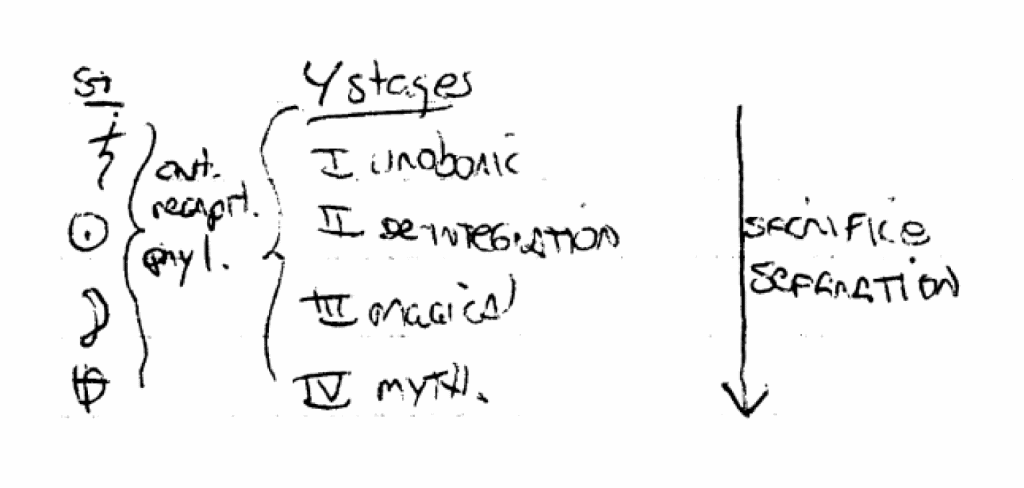
Can correlate Steiner's evolutionary stages with four stages of reflective consciousness
Reading Aniela Jaffe, The Myth of Meaning in the Work of C.G. Jung, on second cosmogony, miracle of reflecting consciousness, meaning
Reading/discussing J. F. Staal, Advaita and Neoplatonism, on sacrifice as constituting being and world
Sacrifice and stages of consciousness
Reading K.C. Bhattacharyya, "Studies in Samkhya Philosophy," on reflection
BOOKS READ FROM OR REFERENCED:
Rudolf Steiner, Macrocosm and Microcosm
C.G. Jung, CW 8, The Structure and Dynamics of the Psyche
Sir John Woodroffe, The World as Power: Power as Mind
H.P. Blavatsky, Isis Unveiled, Vol. 1
Paul Brunton, The Wisdom of the Overself
Aniela Jaffe, The Myth of Meaning in the Work of C.G. Jung
Mahamahopadhyaya Gopinath Kaviraj, Aspects of Indian Thought
J. F. Staal, Advaita and Neoplatonism, A Critical Study in Comparative Philosophy
Krishnachandra Bhattacharyya, Studies in Philosophy, Vol. 1, "Studies in Samkhya Philosophy"
DIAGRAMS appended to this transcript:
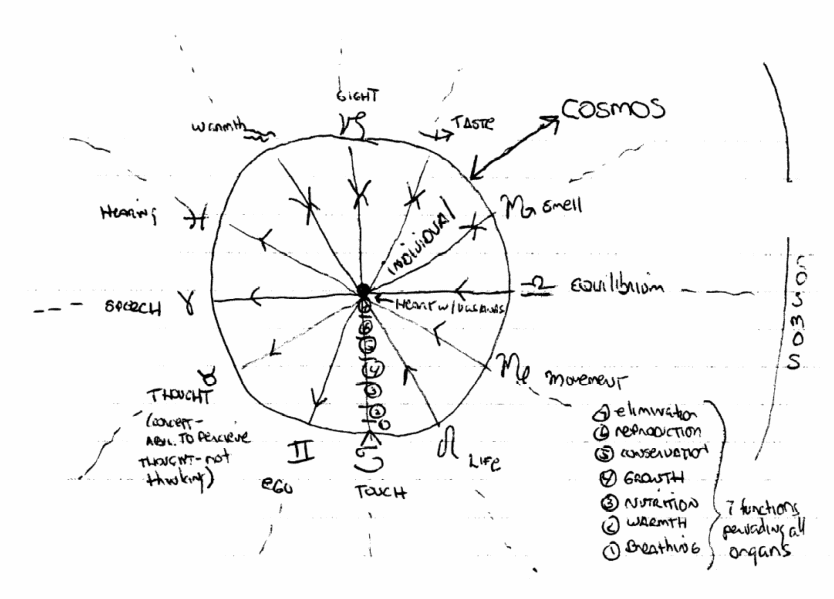
FIGURE 1974 0908-1-AB. Body Scheme.
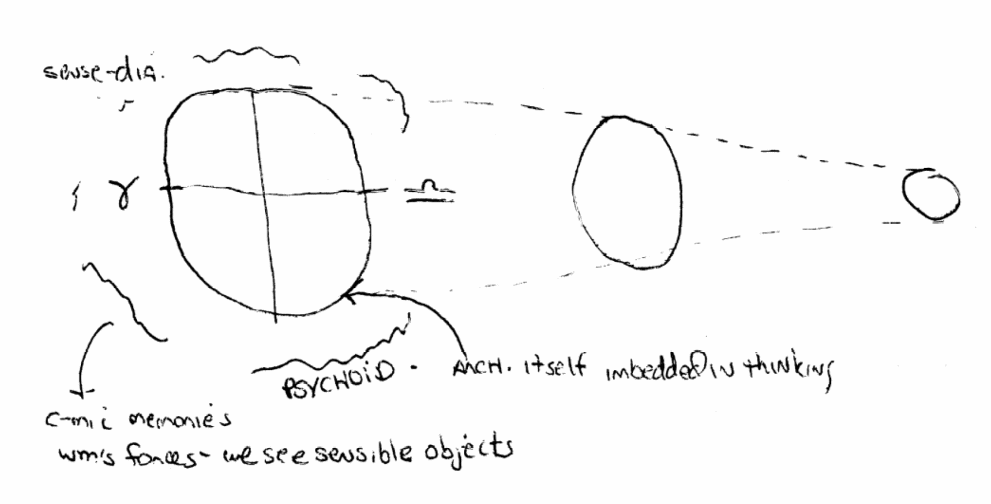
FIGURE 1974 0908-2-AB. Three Circles Diagram with Psychoid and Archetypes.
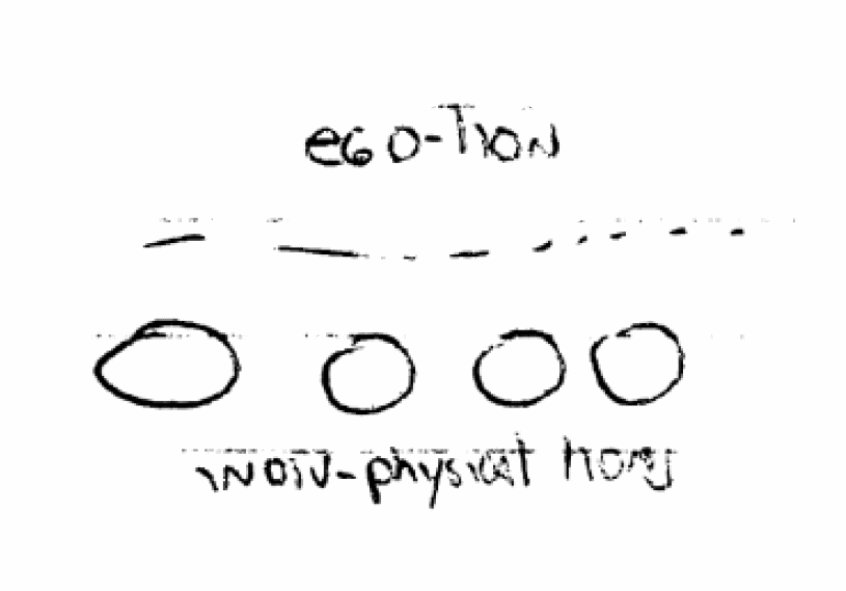
FIGURE 1974 0908-3-AB. Universal and Particular Lion.
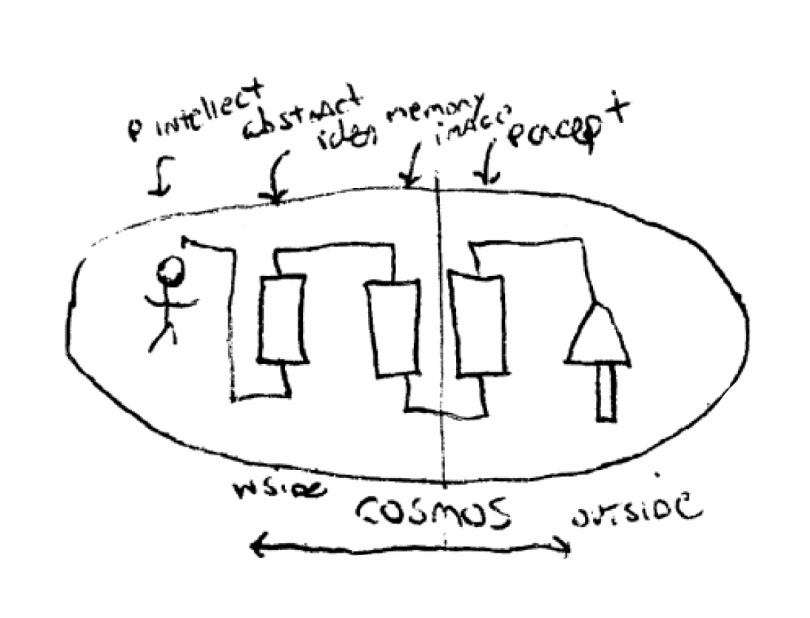
FIGURE 1974 0908-4-AB. Senses as Entrances.
FIGURE 1974 0908-5-AB. Steiner's Evolutionary Stages correlated with Four Stages of Reflective Consciousness.
Other diagrams also referred to are not with this transcript version. [Transcriber note: [diagram] means the speaker is referencing a diagram as he or she is speaking. If someone is drawing or writing, with audible sounds of chalk on a blackboard, I indicate this by [drawing] or [writing].]
NOTE: For readability's sake, the following substitutions/edits made in Verbatim Transcript: cuz = because; gonna = going to; gotta = got to; yeah = yes.
TRANSCRIBED Verbatim by IT 2016 (V11a), reformatted by jf 2017. This is V12a (2023) and has: updated prefatory matter, audio file name, and footer; changed Subject and Subsubjects; TOC completed; five diagrams appended from AB class notes and references within transcript to these diagrams; typos/errors within transcript fixed; new formatting to accord with new conventions. Archival verbatim transcript – V12a.
AUDIO FILES: 1974 0908a, 1974 0908b. [Note 1: "Tape" and "Side" refer to original audio cassette tapes that were later digitized into .MP3 Audio Files. Note 2: These files were originally faint and hard to hear. In 2024, REP Studio improves the sound quality, though still hard to hear in places.]
1974 09/08 at Wisdom's Goldenrod
Epistemology; Reflective Consciousness
[Audio File 1974 0908a Begins]
[few seconds of background student chatting]
AD: I'm not very strong tonight so you-- you people are going to have to help me. And in fact I got very little memory from last week.
S: Ok.
[short pause, drawing sounds]
AD: We were trying to-- we were trying to get into the notion of reflection.
S: Ok.
[short pause]
AD: And, we used Steiner I think, yes, we used Steiner, I think. [sounds like an aside to a student who's drawing] Equilibrium would go at the top [diagram]. [Note: See FIGURE 1974 0908-1-AB, Body Scheme, appended to this transcript.] We use(d) Steiner. And, we imagine that-- we imagine this person having all these sense-organs, sense-organs we said were for the purposes of apprehending knowledge within the body and external to the body. We try to conceive of a moment-- [11¾ second pause] We try to conceive of this situation where the va-- pulsation of the thoughts or vasanas-- [16½ second pause] Yes, yes, yes. [14 second pause with drawing sounds] We're trying to get like an inside look into what the meaning of reflection is. We had the description given to us by Jung where the psyche consisted of reflected processes, of processes in the brain; that essentially these images which reflect these processes are all that we know. Then we quoted from Steiner-- [aside] you think I have copy of that?-- which we will reread--
S: Everyday so nice and close.
S: Uh-hm.
[short pause]
AD: --so that we can continue. And please don't close your mind, this is only one approach. [29¼ second pause] Read this paragraph up top.
S: Ok.
AD: And this.
[short pause]
[Transcriber note: I am using Macrocosm and Microcosm by Rudolf Steiner, Rudolf Steiner Press, London, 1985.]
Rudolf Steiner [Macrocosm and Microcosm, Lecture Six, RG reading]: "If you take in the right sense the saying that"the eye is formed by the light, for the light," you will be able to say to yourselves that there must be something in the light that admittedly we do not see with our eyes but that has developed the eyes out of an organism which at first had no eyes. Behind the light there is something hidden. Let us say here: The eye-forming power is contained in every ray of sunlight. From this we can realize that everything round about us contains the forces which have created us. Just as our eyes are created by something within the light, all our organs have been formed by something that underlies everything we see in the world outside as external surfaces only."
[student assents, very faint]
S: [one/two words inaudible] as-- as external surfaces?
Rudolf Steiner [Macrocosm and Microcosm, Lecture Six, RG reading]: "Just as our eyes are created by something within the light, all our organs have been formed by something that underlies everything we see in the world outside as external surfaces only."
S: Once again.
Rudolf Steiner [Macrocosm and Microcosm, Lecture Six, RG reading]: "Just as our eyes are created by something within the light, all our organs have been formed by something that underlies everything we see in the world outside as external surfaces only."
AD: Well, maybe we could draw some sort of a diagram like this, [drawing] just imagine, so to speak, surrounding-- surrounding us are these cosmic memories, these memories in the World-Mind which have been referred to as forces. But we don't see the forces, right, we never see the forces, we-- we always see some sensible object there, but never such a thing as a force. [Note: See FIGURE 1974 0908-2-AB, Three Circles Diagram with Psychoid and Archetypes, appended to this transcript.] [26 second pause while flipping pages] [to student] Let's read some more, what's underlined in that chapter. Just at random, just to refresh what we did last week. You don't have to read it first, you could read the first part to all of us.
S: Yes.
AD: Uh-hm.
RG: Want me to read?
Rudolf Steiner [Macrocosm and Microcosm, Lecture Eight, RG reading]: "…it is obvious that during the hours of sleep the Ego must certainly not be sought within the boundaries of the skin but that it has poured into the worlds of which we have spoken: the Elementary World, the World of Spirit, the World of Reason, and also into the still higher world we are to consider today--the World of the spiritual Archetypes of all things."
[17 second pause]
AD: [couple words inaudible]
Rudolf Steiner [Macrocosm and Microcosm, Lecture Eight, RG reading]: "The part of the Elementary World that is held back comes into our consciousness as a mirror-image, a reflection, and this reflection is the blue colour. The elements of fire, air, water, and earth (spiritually conceived as belonging to the Elementary World) stream through the eye with the exception of what we actually see. Sense-perception arises through the fact that our eye holds back part of the light from the Elementary World, our ear holds back part of the sound, our other organs hold back part of the fire or warmth; what is not held back, streams into us."
[9 second pause]
AD: Ok, continue.
Rudolf Steiner [Macrocosm and Microcosm, Lecture Eight, RG reading]: "We can now supplement what was said in the previous lectures, that the"eye is formed by the light for the light."
"That is to say, the eye is not formed by what is reflected, but by what comes to us with the light -- and that is part of the Elementary World. Moreover something also streams in from the World of Spirit, indeed from all the worlds of which we have spoken."
AD: The World of Spirit here refers to astral world, sidereal world.
Rudolf Steiner [Macrocosm and Microcosm, Lecture Eight, RG reading]: "Accordingly [AD/S(?) simultaneously: (Yes/Yes).] we may say: At this particular point certain forces are held back by the eye, and also by the other senses; what does not stream into us, what is held back, is the sum-total of our sense-impressions. Thus it is what we do not let through that we see or hear; but what we do let through is what has formed the physical organism of the eye, for example. We hold back certain forces and allow certain others to pass through -- these latter being forces of the Elementary World. If we look at the eyeball in a mirror, then too we see only what it does not let through. Thus in the Elementary World there are forces which have formed our sense of sight and also our other senses. As sense-beings we are formed out of the Elementary World; the world we see when we are able to look into the Elementary World is the world which builds up our senses.
"At the inner"wall" of our organ of sight there is a kind of second mirror, for there, from a further world, other forces flow in -- with the exception of those that are reflected. There the elemental forces themselves are held back and reflected; they cease to function and it is only the forces of the World of Spirit that stream through and are not reflected. These are the forces that form, for example, the optic nerve."
AD: That again is the astral world, the astral world forms the nervous system. Alright.
Rudolf Steiner [Macrocosm and Microcosm, Lecture Eight, RG reading]: "Just as the eye has its optic nerve, so has the ear its aural nerves from the forces streaming in from the World of Spirit. From there stream the forces of Beings who are the builders of the whole nervous system. Our nerves are ordered according to the laws of the planetary world outside, for the planetary world is the outer expression of spiritual realities and spiritual worlds.
"If it is the case that the World of Spirit works at the forming of our nervous system, it follows that underlying our nervous system there must be a certain law and order corresponding to that of the solar system. Our nervous system must be an inner solar system, for it is organised from the Heaven World. … [9 second pause]
"We come now to the third part of the reflection. Our nervous system is built up by the World of Spirit. At the point where the nerves pass either into the brain or into the spine, again a reflection takes place. At this point the stream from the World of Spirit is held back in the nervous system and what we have come to know in the World of Reason penetrates through. The forces of the Hierarchies work through at this point and the World of Reason builds up for us the brain and spinal cord that lie behind the nerves. In our brain itself and its elongation, the spinal cord, we have the product of all the activity originating ultimately in the World of Reason. Anyone who is able to survey the World of Spirit clairvoyantly can find exact images of the great cosmic prototypes even in the smallest reflections in the cerebral nervous system and the spinal nervous system. But the World of Archetypes, or Archetypal Images, streams right through us without our being able to hold it back."
[13¼ second pause]
AD: You took this paragraph (three).
S: (Oh no.)
AD: Do it again.
Rudolf Steiner [Macrocosm and Microcosm, Lecture Eight, RG reading]: "It is only possible for us to have physical sense-organs -- eyes, for example -- by admitting the Elementary World into ourselves and then holding it back. We can only have a nervous system by admitting the World of Spirit into ourselves and then holding it back; we can only have a brain and reasoning faculty by admitting [RG adds: it] into ourselves the World of Reason and then holding it back; thereby the brain is formed. If higher organs are to be formed, it must be possible for us to hold back a still higher world. We must be able to send something towards it, as in our brain we send that which holds back the World of Reason. Thus man must do something if he wishes to develop in the true way. He must derive forces from a higher world if in the true sense he wishes to develop to a higher stage. He must do something to hold back the forces of the World of Archetypal Images which would otherwise simply pass through him. He must himself create a reflecting apparatus for that purpose. … What man normally perceives and knows is the external physical world. If he desires to attain higher knowledge he must do something to create for himself higher organs. He must bring a world that is higher than the World of Reason to a halt within himself, and this he does by developing a new kind of activity which can confront the World of Archetypal Images and, to begin with, hold it back. He engenders the new activity by learning to undergo inner experiences which do not occur in everyday life."
AD: And that's about where we got last week, right?
S: Yes.
AD: It was(--) John. I don't know what some of the questions were that they-- (it reaches) another time. Was there questions on that? No. Go ahead.
JL: I'm really not clear about what he means by holding it back. You could see the light [student assents] and I don't need any holding back. (Process he's speaking) where [one word inaudible] is something and Jung speaks about it [few words inaudible] every morning imagination and [few words inaudible] Or perhaps the-- the thinking where one gets to the meaning of something and retains it within-- within the mind itself?
[short pause]
AD: Yes. Does anyone have any-- do you have that quote on psychization?
S: Uh-hm. Uh-hm.
S: Go ahead.
JC: Should we read through this?
AD: Yes, can you--
JC: This is from Structure and Dynamics, paragraph 234.
C.G. Jung [CW 8, The Structure and Dynamics of the Psyche, "Psychological Factors Determining Human Behaviour," p. 115, paragraph 234, JC reading]: "But if we look upon the appearance of the psyche as a relatively recent event in evolutionary history, [AD: Louder Jeff.] and assume that the psychic function is a phenomenon [JC adds: and] accompanying a nervous system which in some way or other has become centralized, then it would be difficult to believe that the instincts were originally psychic in nature. And since the connection of the psyche with the brain is a more probable conjecture than the psychic nature of life in general, I regard the characteristic compulsiveness of instinct as an ectopsychic factor. None the less, it is psychologically important because it leads to the formation of structures or patterns which may be regarded as determinants of human behaviour. Under these circumstances the immediate determining factor is not the ectopsychic instinct but the structure resulting from the interaction of instinct and the psychic situation of the moment. The determining factor would thus be a modified instinct. The change undergone by the instinct is as significant as the difference between the colour we see and the objective wave-length producing it. Instinct as an ectopsychic factor would play the role of a stimulus merely, while instinct as a psychic phenomenon would be an assimilation of this stimulus to a pre-existent psychic pattern."
JC: Let me read that again.
C.G. Jung [CW 8, The Structure and Dynamics of the Psyche, "Psychological Factors Determining Human Behaviour," p. 115, paragraph 234, JC reading]: "Instinct as an ectopsychic factor would play the role of a stimulus merely, while instinct as a psychic phenomenon would be an assimilation of this stimulus to a pre-existent pattern. A name is needed for this process. I should term it psychization. Thus, what we call instinct offhand would be a datum already psychized, but of ectopsychic origin."
S: What's ectopsychic [one word inaudible]
S: Outside the psyche.
S (simultaneously): [one/two words inaudible]
S: All he means?
RG: (You bet.)
S: Got to think this through.
S: (Well don't ask.)
AD: Well what do you think he said there, Jeff?
JC: Well, in lower forms of life, like in plants for instance, until you have instincts-- Well, ok, let-- let me-- let me back up. Like in an animal, there's instincts functioning--
AD: Well, you started off the right way, in a lower form of life like a plant--
JC: Right.
AD: Ok, where there's no psychization--
JC: Yes, there's no psychization so--
AD (simultaneously): So the plant just grows [JC simultaneously: Yes.] and grows and grows, ok.
JC (simultaneously): There's stimulus-- there's stimulus and reaction, there's nothi-- no interference.
AD: Alright, then we [JC simultaneously: But--] spoke about the imposition of the astral which has to kill the etheric to some extent, ok?
JC (simultaneously): Yes.
AD: Go ahead.
JC: Ok.
S: Really?
JC: Now, the-- the instincts, for instance, in an animal and more especially in man, they have to come under some sort of control or guidance and the way this is done is that the activity of the instincts is not allowed merely to go into its immediate response but is transferred into the psyche and that is in terms of images. And, in man, with the ego, we relate into these images with-- (like/if) the instinct is taken up into the psyche and interrelated with the-- the past or pre-existent pattern of images that already exist and then this original instinctual stimulus is-- is through this process carried over to some sort of response but it may not be the original sponse or the-- let's say the more biological response that might happen in an animal, but through the interaction of the ego this energy may be carried over into other kinds of responses, like artistic or whatever.
VM: Ok, in terms then like of what Steiner is saying here, would that be then like the astral or [one word inaudible] organism reflected just before the [one word inaudible] psyche let's say? I mean wouldn't [JC simultaneously: Well--] it stream through you and work through [JC simultaneously: Right.] you and work you over in a sense, you-- you reflect them off of the psyche, which is the higher [few words inaudible]
JC: Right, they're-- like the World of Reason I think for him gets translated into our thinking function. And-- and that's something that we-- we do in terms of images and a plant doesn't think it through it. It can't-- it can't reflect these forces.
AD: Yes.
JC: They just stream right through.
VM: [few words inaudible] (with these three), talk about three [one word inaudible] image, ok. Are those images (that you're) describing somehow formed by that component of the ether which is let through, not reflected?
AD: I'm sorry Victor, repeat.
VM: You don't see-- Jung refers to two different images here. (Now) those images are going to be formed by that more subtle component of the elementary forces which actively penetrated all the way into the brain and structured those pre-existent images in the brain and so on to react on the grosser form of the Elementary World?
AD: [couple/three words inaudible]
S: Tony?
[short pause]
AD: You have to hit me again.
VM: He said that the instinctual forces are-- that they don't really come from pre-existing psychic patterns. Ok? In other words, when let's say the sexual instinct comes through you don't approach it any old way but with a-- a certain pre-existent imagery comes up and you feel like [one/two words inaudible] Ok? Now, are those images that-- that you use-- that you're using to deal with the instinctual forces, are they previously formed by that even subtler component of the elementary forces which passes through the man and structures the brain?
AD: I don't follow there, well, I'm lost there.
[student assents, very faint]
VM: Well, I understood like they were-- the grossest level of the Elementary World is reflected in the eye and goes to form the eye, physical eye. The subtler, let's say, distillation of light goes to form the optic nerve. A yet subtler distillation of light goes to--
AD: It's not a distillation.
VM: Well, 'distillation' can be a bad word.
AD (simultaneously): They're different-- they're different spheres.
VM: Different spheres, it's really not a distillation.
AD (simultaneously): Because one is the Elementary World, the other was the Astral World, alright, like two different, yes.
VM: But, I mean they're really all interpenetrating spheres.
AD: Yes, ok.
VM: Now, the subtlest level, or he spoke of the three levels, goes to form images in the brain, like the archetypal patterns in the brain. Is that correct?
AD (simultaneously): I don't know, did he say that? Is that what he said?
VM: I don't know, maybe-- maybe I misunderstood it. Where do these archetypal images get formed (or were they) or aren't they formed by elementary forces?
AD: The brain is formed by elementary forces but I [student assents] don't remember anything about the images being formed by those forces.
AB: Well the archetypal images to him are like his highest level.
S: What'd he say?
S: Um-hm. Yes.
AD: Huh?
VM: Archetypal images, but he said nothing about their origin or--
AD (simultaneously): No.
S (simultaneously): Or anything like that.
AD: He's just speaking about the actual physical brain being formed by these forces.
[short pause]
S: What are we saying exactly?
[students assent, faint]
JC: Does he say the forces form the brain or (it's a) reflection is what we experience consciously as thinking?
S: Uh-hm, yes.
AD: Well, let's read it again. I-- I thought he just said the formation of the physical brain. Can you find those passages?
[short pause]
S (possibly part of background): Yes.
Rudolf Steiner [Macrocosm and Microcosm, Lecture Eight, RG reading]: "…the World of Reason builds up for us the brain and spinal cord that lie behind the nerves. In our brain itself and its elongation, the spinal cord, we have the product of all the activity originating ultimately in the World of Reason. Anyone who is able to survey the World of Spirit [clairvoyantly] can find exact images of the great cosmic prototypes even in the smallest reflections in the cerebral [nervous system] and [the] spinal nervous system."
AD: Yes, let's-- let's go over that, yes.
VM (simultaneously): What does that mean, I mean what does that mean? I thought that those archetypal images were structured right along with the brain.
RG: But then the next sentence says--
S: Wait, read that again.
Rudolf Steiner [Macrocosm and Microcosm, Lecture Eight, RG reading (simultaneously with S above)]: "But the World of Archetypes, or Archetypal Images, streams right through us without our being able to hold it back."
VM: And that means you're pushed around by the archetypal figures [couple words inaudible]
S: [one word inaudible]
RG: But-- yes.
S: Read [S simultaneously: Well--] the first sentences.
S (simultaneously): How different is the World of [few inaudible student words simultaneous with S and RG] Archetypes and the World of Reason?
RG: Very different.
S: That's what--
S: [three/few words inaudible]
AD: See, I thought we were on very concrete ground by pointing and dealing with the physical human body and the construction or formation of the physical body.
[student assents, very faint]
VM: Right, but doesn't Jung himself say that the archetypes are structured into the brain? And Steiner seems to say that too [few words inaudible]
AD (simultaneously): The archetypes are structured--
VM: In the brain. And I can't remember the exact place where Jung said but I-- he--
S: Yes, there's a collective unconscious is embedded in the brain. [VM simultaneously: Ok, what does that mean?] But it doesn't form the brain.
VM: Well I didn't say it formed the brain, somehow-- his point of view is somehow-- somehow the very structure of the brain--
AD: The very structure [one/two inaudible VM words simultaneous with AD] of the brain is going to determine how it's going to function.
VM: Yes.
AD: But under no conditions, and even Jung makes a point of this, consider that this in any way implies innate ideas. You have to be very careful here, otherwise you're going to say that with the brain you get certain ideas. It's only the way the brain can operate, this is the way it functions, this is mode of being.
S: Right.
VM: But I think I'm trying to [one word inaudible] but obviously it goes-- just go with the images in the brain, is there some sort of imposition of these ideas into the structure of the brain [one/two words inaudible]
AD (simultaneously): There's this imposition, that insofar that the human being or the being has a certain mode of being in the world, this mode of being is determined by the fact that he has a certain particular brain and not another kind, so he's going to operate in this particular fashion. [VM: I agree.] Now what is going to flow through that brain, again, takes us to another level. [student assents, very faint] That's why I've been sticking, you know, as much as possible to the physical till we understand or try to get a feeling of what this man is talking about. We're in cosmology. Go ahead.
SD: I think maybe what Vic's trying to say is that just like the way our eyes are structured they allow for certain individual (play, sense of) interpretation, but that we see the same object because we're dealing with a similar eye, we're going to see basically a similar image of it. And that perhaps because our brains were also formed--
AD: I don't think that's what Vic was saying. But I think that's how I answered him. I may be thick but I-- I'm not out there.
VM: Let me hold off the brain and better understand [couple words inaudible]
AD (simultaneously): And Severin? [couple inaudible student words] I mean, that's exactly my answer. It's a mode of being. This-- this physical brain is a certain mode of being and if he operates he's going to operate in this particular way. He's going to operate in a human selective way, alright. But they-- we're not talking about any images that are arising from this.
SD: Well, not that the psyche--
AD (simultaneously): The same way that the eye can only see certain things, but we're not saying what it's going to see. Nor are these images in the eye.
SD: No, but the range of allowable images is sort of [one/two words inaudible]
AD (simultaneously): But you're still saying the same thing, you'll be-- it's a determinate kind of functioning. Well this is what Steiner is interested in building up. Because if you try to keep in mind the remark we made, that the body, so to speak, is going to give us an indication of the instincts that are functioning in a certain animal and we have to study that body to get an idea of the instincts that are going to manifest. In the same way, but in a much more amplified way, you get an idea of the kind of functioning that man can perform if we begin to get an idea of all the organs of senses that operate and the instincts, you know, that he's going to play with, including the brain. And we're going to see the possibility of o-- you know, experience which is-- by definition excludes the entire animal world and anything which belongs to that world.
LR: So when he says the World of Archetypal Images streams right through us, it's not really-- the word 'image' there was misleading. I mean it's more like a force, it's not anything that's already-- it's not a kind of image that we'd ever know about because it's not anything we hold back, it's already-- it's just-- it's more like a force, a formative kind of force, right? [one/two words inaudible] image, I mean--
[Note: See FIGURE 1974 0908-2-AB, Three Circles Diagram with Psychoid and Archetypes, appended to this transcript for the following.]
AD (simultaneously): Yes, if we go to this example here and we imagine these here [drawing] as forces [diagram] that are lying outside, you know? And we can see that the psychoid part of the archetype would be located here [diagram], what he calls the psychoid, whereas the actual archetype would have to be arranged with the thinking of self almost [diagram], it would embedded in the thinking. This is a-- this is outside the psychic altogether [diagram]. Only when a certain-- a certain piece of knowledge is apprehended can we speak of the archetype manifesting on the one hand as the physical thing and on the other hand as the meaning that that physical thing has so that you have that sort of a situation, [LR simultaneously: So you can't even--] meaning related to event.
LR: But you couldn't even-- I mean it's almost-- even just to call it something, when he says the World of Archetypal Image flows through us, it's already mis--
AD (simultaneously): But he uses the word 'archetype'.
RG: Just like Jung when he says 'primordial image'.
LR: It--
AD: As soon as he uses the word 'archetypal image' that excludes the-- any--
LR (simultaneously): Any definition, any form that--
AD (simultaneously): Yes, you know, you get a pie crust and you fill it in with apples? You can't put no apples in this word, right?
LR (simultaneously): So it's like an energy, I mean, [AD simultaneously: Uh-huh.] it's more appropriate to think of it as this energy, from this energy [one word inaudible]
AD: Well you can't say 'energy' because you can't also, when you say 'energy', so to speak, separate it from so-- some sort of-- some sort of shape that the energy must take, it can't be just formless energy. And PB makes the point you cannot separate power or karma from its ideation, alright. And you have to try to keep that in mind, that's why I think this man is saying 'archetypal image'.
LR: But so then what kind of form is it?
S: [couple/three words inaudible]
AD (simultaneously): Well, maybe we'll get to it, let's be patient.
S (simultaneously): Can you just read those last two sentences again [AD simultaneously: Yes.] [few words inaudible]
S (in far background): Ok.
S (in far background): Very good.
S: I think those last two, about archetypal images.
AD: You know, we're dealing with a very complicated situation because here, if we-- if we consider this like the three circles, you know, [drawing] one, two, and three [diagram], you can see we're inside that bottom circle [diagram], alright, and we're dealing in terms of a cosmology that depends on the principles here [diagram] and here [diagram]. When we talk about Jung then we would have to let's say make an addition here and imagine the archetypes flowing into the consciousness [diagram]. If you speak about epistemology, you'll have to get out here somewhere [diagram] and see-- Try to keep your frameworks in mind. [9 second pause] Well, remember the passage on Hiranyagarbha consciousness? Oh, I got it Kurt. There's one-- (wait--) 130, 140, [S simultaneously: Opposite.] where is that? Let's see now if you could understand this here. [25 second pause] Alright, we read this here some time ago. [short pause] And I'm going to-- this is from a point of view coming in from Samkhya, (get rid of it).
S: What'd he say? (laughter)
AD: You see I-- I'm trying to, I'm trying to synthetically approach this here, I'm not taking any one particular way, I'm not taking the-- the epistemological road like PB or the cosmological road like Steiner or the psychological road like Jung does but like I want to move on a broad front and take them all as we go along and try to get you to see how many different aspects of this same subject that you can see from and each one valid. And this way when you see the shadow boxing going on among the various writers, you don't have to get into it. You could try to understand each point of view and walk away and get the feeling, "Well, I've seen that point of view." You remember the (joke about me being a father). Well, I was the judge, alright, that was me. I've got to see the point of view and the correctness and the applicability of that point of view, I-- I can't work in fashion and say, "Well, who's wrong and who's right?" Can't work that way. Well, it's not meant to be so the hell with it. (laughter, student words)
Let's read this passage (then). Can we get just the-- it's just a little picture that I want you to get the way Steiner works, alright. And, I don't expect all the details to come out but just a kind of picture. Here you are [diagram], [Note: See FIGURE 1974 0908-1-AB, Body Scheme, appended to this transcript.] so to speak, and you could imagine yourself as this entity which has got, oh, twelve different organs of sense, internal, external, ok; and that there's this pulsation (with beats/which keeps) going on out here [diagram], alright, which transforms itself into this cosmos, thought after thought, ok? That would be, let's say, from PB's point of view. This thought or this vasana transforms itself into the manifested world and one thought after another comes into being and he disappears and the next-- another thought takes its place. That would be PB's point of view, but Steiner is talking from within this cosmic manifestation [diagram]. He's not talking from here [diagram], alright. And it may sound like there's a contradiction. Now, from the Samkhya point of view-- this-- this will probably add to confusion. But before we go on to the Samkhya, is there anything here in Steiner?
VM: Would-- would you just read those last two sentences for me, it's too hard to [one word inaudible]
AD: No. Sure, he can do it, I got a reader today.
S: [one/two words inaudible]
RG: I'll read the whole paragraph.
Rudolf Steiner [Macrocosm and Microcosm, Lecture Eight, RG reading]: "Our nervous system is built up by the World of Spirit. At the point where the nerves pass either into the brain or into the spine, again a reflection takes place. At this point the stream from the World of Spirit is held back in the nervous system and what we have come to know in the World of Reason penetrates through. The forces of the Hierarchies work through at this point and the World of Reason builds up for us the brain and spinal cord that lie behind the nerves. In our brain itself and its elongation, the spinal cord, we have the product of all the activity originating ultimately in the World of Reason. Anyone who is able to survey the World of Spirit clairvoyantly can find exact images of the great cosmic prototypes even in the smallest reflections in the cerebral nervous system and the spinal nervous system."
S: And he sees those [one/two words inaudible]
Rudolf Steiner [Macrocosm and Microcosm, Lecture Eight, RG reading]: "Anyone who is able to survey the World of Spirit [clairvoyantly] can find exact images of the great cosmic prototypes even in the smallest reflections in the cerebral nervous system and the spinal nervous system."
AD: Well, remember, the spirit here is the astral world. Don't get confused with, you know, the Western conception of spirit.
LS: What does that mean Tony, the astral world?
AD: Well, think of all the desires that you have, passions, compulsions, alright, the movement of the life force in you, the direction that it takes. That would be close to the astral-- the notion of the astral world, alright. And in the astral world, like he would give an--
LS (simultaneously): Is this like a Mars function?
[10 second pause]
AD: In a way yes and in a way no, but then again we'd have to have (entire) conversation about that. [12 second pause] We speak, for instance, of the matter of the body, we speak of the life of the body, and then we speak about the desires that the entity has, you know, all kinds of desires, ok. And then we speak about the conflict within the various desires and it seems as though the ego steps into this and now tries to organize and control these desires. So that, from the Steiner point of view there's these four classifications: the physical body, the etheric, the astral, and then the ego that steps in and tries to bring some sort of order in this chaos.
LS: Is that part of-- is that [few words inaudible] you've said that before, will that be called the lower manomaya?
AD: Yes, that would be lower, yes. The Theosophists would refer to it as the kama manas, the desire mind, ok? And s-- the ego's going to step into this here mess and try to straighten it out. Let's read a little bit more, ok--
S: I mean I told you that but I couldn't understand [couple/few words inaudible] really that was being said in that last--
AD: I'm sorry Crystal?
S: I didn't understand at all what was being said in that last sentence about [few inaudible student words simultaneous with S] the ego being described as so detached it (tried) to set apart (in/within) this nervous [one/two word inaudible] I didn't-- I didn't get it.
AD: Well the least desire that you may have already has, so to speak, an image of itself in the higher realm, in the so-called astral body. It doesn't-- You could formulate that desire to yourself with any-- you know, in terms of any picture, in terms of any word grouping or concept. But the prototype of that desire will be in the astral world. It's the world of the instinctual drive, desires, passions, impulses, alright, which rage in a person, you know, and the ego is going to have to come there and start doing something about it. Usually it doesn't, it enjoys them for a while until it begins to find out that it could really take over. I'll read a little bit more so that we get some more of a taste for the way-- Yes--
S: Yes.
S: Tony, would you explain how (perhaps) the archetypes get in through, what organ that brings in? Is that like [one/two words inaudible]
AD (simultaneously): Well, I'll read some more, I'll read some more about the archetypes.
[students assent in background, very faint]
Rudolf Steiner [Macrocosm and Microcosm, Lecture Eight, AD reading]: "In what way are we…"
AD: Is this where you left off?
S: Right.
S: Anthony--
AD: Right here.
Rudolf Steiner [Macrocosm and Microcosm, Lecture Eight, AD reading]: "In what way are we able in ordinary life to be conscious of anything? By being able to hold it back. We become aware of a part of the Elementary World by holding it back. We are a product of the Elementary World in our sense-organs and in becoming aware of the activity and [AD adds: the] functioning of our senses we become aware of the Elementary World. We are a product of the World of Spirit and become aware of that world -- [AD: World-- the astral world.] but only in reflection -- when we become aware of the world connected with our nerves. What does man know of the Elementary World? As much as is mirrored for him by the senses: light, sounds, and so forth. What does man know of [AD reads: about] the World of Spirit [AD reads: astral world]? Just what his nerves reflect for him. The Laws of Nature as they are usually called are nothing else than a shadowy image, a faint reflection, of the World [of Spirit] [AD reads: the astral world]. And what man takes to be his inner spiritual life, his reason, is a weak reflection of the outer World of Reason…"
AD: If-- I might remind you here of Jung's definition of the rational, and you'll see that there's a very close correspondence.
S: Tony? Is the World of Reason in the astral [couple words inaudible]
AD (simultaneously): No, it's above that, [student assents] it's above that. [few inaudible student words simultaneous with AD] In other words, the astral world, if anything, would correspond to what Plato would call the irrational soul, alright. The world above that, the World of Reason, we would have to correspond to what we call the ego. [couple inaudible student words] But Richard isn't here so I can't get no confirmation of that. We'll-- we'll ask him.
Rudolf Steiner [Macrocosm and Microcosm, Lecture Eight, AD reading]: "…is a [AD reads: its] weak reflection of [AD reads: in] the outer World of Reason; what is usually called intellect, intelligence, is a faint, [AD adds: very faint] shadowy reflection of the World of Reason. …
"It is only possible for us to have physical sense-organs -- eyes, for example -- by admitting the Elementary World into ourselves and then holding it back. We can only have a nervous system by admitting the World of Spirit into ourselves and then holding it back; we can only have a brain and reasoning faculty by admitting into ourselves the World of Reason and then holding it back; thereby the brain is formed. If higher organs are to be formed, it must be possible for us to hold back a still higher world. We must be able to send something towards it, as in our brain we send that which holds back the World of Reason. Thus man must do something if he wishes to develop in the [AD reads: a] true way. He must derive forces from a higher world if in the true sense he wishes to develop to a higher stage. He must do something to hold back the forces of the World of [AD adds: the] Archetypal Images which would otherwise simply pass through him. He must himself create a reflecting apparatus for that purpose. The method of Spiritual Science…"
AD: Alright, we'll leave that out.
Rudolf Steiner [Macrocosm and Microcosm, Lecture Eight, AD reading]: "Consciousness arises, not through the exercise of activity but because an impression is reflected inwardly, and this, man -- but not the plant -- is able to do. Thus in a certain respect man has [reached] a higher stage of development than the plant [AD emphasizes rest of sentence] but at the cost of the possibility of erring. The plant is not liable to error, neither has it a higher and a lower nature. It has no impulses or appetites that degrade it. We may well be impressed by the chastity of the plant in contrast to the impulses, desires and passions of man."
[9¼ second pause]
AD: Yes?
OG: What does he mean by [couple words inaudible]
AD: Well, we just read a quotation from Jung. That didn't help you?
OG: No.
AD: No?
OG: (Maybe something) reflecting something(./?)
AD: What else are you holding back? (bit of laughter) [AD sighs, possibly says: Alright]. (bit of laughter)
S: The biggest one.
AD: Didn't you have to hold back, let's say, not that you are that type of person, (laughter) but if you-- if you were-- if you were like me you'd have to hold back your rage, wouldn't you? (bit of laughter) [short pause] And if you held back your rage, then what (happens/happened)? You'd have to contend with all the images that come up, "Ooh, I like to punch him right in the nose, blah, blah, blah [one word inaudible]" So you've taken part of this energy that was about to go out, alright, and you stopped it. You hold it-- you held it back.
[student(s) assenting, very faint]
S: (Reflection/Reflect).
S: Yes.
AD: We spoke about this once before, I thought it was understood-- understood that the-- the astral to a certain extent has to lay the law down to the etheric. In the plants, for instance, if the plants are allowed to grow, you know, I mean if you don't go around manicure them, it become profuse jungle. So you go around and you manicure them and you snip them off and you keep them in their place. In a man, alright, he's got these passions. Something's got to restrain them. And in that very act of restraining them, that whole reflection comes up into the surface. We're going to have to talk more about reflection, I just want to bring out a few points about it. Now that was the point, for instance, that Jung was trying to make. A certain psychization takes place as soon as you do that. Whereas if you fulfill that instinctual craving to hit me right back, alright, that possibility of reflection has been destroyed. Go ahead.
OG: But wouldn't that [couple words inaudible] to reflection?
AD: Well, it'll build up into reflection if you're not too anxious, just wait. Yes, go ahead.
JC: (I mean) animal would reflect the elemental world, it has (sense of it this) way, but it's not till you get the-- till you hit the point where you have an organ of reflection for the higher realm that you can actually see what we're calling reflection and translating that energy into a (symbolific--)
AD (simultaneously): Yes, the animal has no ego.
JC: Right. [one word inaudible]
AD (simultaneously): And the-- like for instance the example that Steiner gives, something like this, the-- the animal world has no ego. And if you [drawing] can imagine like, imagine, ok, there's four creatures, four lions, four dogs, I don't care, four horses, ok. And up here is the hand of the man [diagram], ok. [Note: See FIGURE 1974 0908-3-AB, Universal and Particular Lion, appended to this transcript.] Now imagine my fingers going down like this and you only see the four fingers. You know that it belongs to a hand, ok. And in the same way he tries to point out that the-- the animal as such doesn't have an ego, the ego is up in Devachan or the-- a plane above--
(Side 1 of original cassette tape digitized as 1974 0908a Ends; Side 2 Begins)
AD: [one/two words inaudible] available to all of us. [11 second pause] Come on, I'm only trying to build a reflecting apparatus in you. [short pause] Alright, so when you study astrology, alright, and you know that there's a certain arrangement of the events that are going to take place, the events and the meaning that those events may have for you are going to have to be synchronized, brought together, alright? That's the World of Reason, ok? We'll get into that in a few minutes.
SD: Ok. When you (speak) about the holding it back, you gave the example-- this example of an instinct [couple words inaudible] but in holding it back is the [one word inaudible] Is that like identifying with it when you don't hold it back and then when we hold it back there's some kind of reflection in some form, whether a particular symbol or each psychologically [couple words inaudible]
AD: Yes Severin, sure.
SD: Ok.
[student assents, very faint]
AP: But you don't-- why would you say the psyche does [one word inaudible]
AD: I--
AP: The psyche, where does the psyche start? [student assents] Is (it/in) the beginning of the child's life and in its young stage? You know, it's (even more) [one word inaudible]
[short pause]
AD: Oh, it's m-- [S simultaneously: This is the last (couple/three words inaudible)] it's m-- it's very different for Steiner, very different, because for Steiner the-- the imagery that you work with is a compilation made in a previous existence, in other words, in the-- in the life before birth. Let's leave that out now.
AP: So I guess you were just saying in the reflection scheme of the body whether the psyche was-- that psyche could take an idea [one/two words inaudible] it's somehow in the nervous system, uh, and then comes to the brain.
[short pause]
AD: I don't understand Anna. Where does it start, where does the psychization start? He doesn't-- he never uses the word 'psychization'. [AP simultaneously: Well but--] So tell me what you mean.
AP: Where-- where does--
[11½ second pause]
AD: Do you want to wait a little while? I think he'll answer it himself, wait a little while.
[student assents, very faint]
[19½ second pause]
AD: On--
Rudolf Steiner [Macrocosm and Microcosm, Lecture Eight, AD reading]: "Just as a physical sense-organ exists in order to bring to our consciousness the world around us, so [do] the spiritual sense-organs exist in order to bring to our consciousness the world which cannot be seen with normal physical eyes. [AD, paraphrasing: These are, of course, the so-called lotus flowers or the chakras. He's-- he goes on and he says--]
"… …these spiritual sense-organs can be cultivated by the patient and vigorous practice of immersing oneself in symbolic [AD reads: symbolical] mental pictures which are not pictures of anything in the external world and which in this respect differ from the mental pictures of ordinary consciousness in that they do not mirror anything external but work in the soul and produce [AD adds: the] forces which can hold back the World of Archetypal Images just as [AD adds: the] eyes, nerves and brain hold back the other worlds that are around us."
AD: And this for instance we see in our attempts at philosophy where we try to hold back the archetypal image, the World of Archetypal Images, by the attempt to create this buffer zone, you know, and just stop 'em dead within it. Philosophy basically does try to do it; that is, the philosophy we study.
S: What kind of symbolical images is he speaking-- I mean what kind--
AD (simultaneously): Like for instance, when you have difficulty in understanding a certain point, aren't you doing exactly that, creating symbolical pictures in your mind, abstract ideas, of which there is no corresponding in the external world? And isn't that a ver-- the very tool that'll help you, so to speak, to stem this flow of forces and try to keep it out there and say, "Now what does he mean that thought manifests an object?" I mean nobody outside will give you a dime for that sentence. (laughter) Although, you know-- (more laughter) And yet I'll be willing to give that as a koan to people. [11¾ second pause]
I think for now we ought to stop with Steiner and try to come now from two other angles, from-- from the notion that Jung has produced and from the notion (of) Samkhya. Ok? Now the Samkhya-- the reason why I want to bring in the Samkhya version is because we're going to have to deal with the quantitative and the qualitative notion of this entity that through these organs of sense takes in on the one hand a certain quality of the object, and on the other hand because of the number of sense-perceptions that come in to the (ob--) you have the quantitative aspect of it. You see what I'm speaking about? The same way like arithmetic and geometry, you know, on the one hand they-- there may be a higher reconciliation of arithmetic and geometry on a higher plane, we don't know, but on this level we work, arithmetic deals with integers and each one, so to speak, is discrete from another one. And, at the same time when we deal with geometry you're dealing with a spatial symbolism where you have a space continuum, alright.
Well-- now, in comparison, the same way that you perceive a-- a world, the corporeal world, every object that you perceive has qualitative parts to it. Also there is number of perception. In other words, you keep looking at this object over and over again so there is a quantitative aspect to that perception. So you have these two, the qualitative and the quantitative have to be considered because this later on will be expanded to try to bring in the notion of how meaning could come into operation and let's say be the-- be there when an event happens externally and there's a meaning that corresponds internally to that external happening. So, I'm going to bring in Samkhya to kind of complicate things. But at the same time I think there'll be something worthwhile. Would you read that sentence? We read this before, once. You know my way, you go around the [one word inaudible] (wheel) three, four times.
S: Yes.
RG: Uh-hm.
S (simultaneously): Tony, can I ask a question please?
AD: Yes, go ahead.
S: Are you-- are you speaking of this like quantitative way like [one word inaudible] seeing the different qualities of the object, so to speak, like the quantitative way is to-- like the number of ways that we could-- in other words, the-- the limitations that we have [couple words inaudible] seeing those qualities, I mean, apprehending those qualities, are they [couple words inaudible]
AD: Yes, number of ways.
S: In other words, it's really-- it's a kind of limitation.
AD: Well, for instance, you could say at the end of the day, "Well I had 8,472 perceptions." (some laughter, student words) Or I come around and I say, "I saw you six times already," you know? What I saw is another thing, (uh-huh/alright)? Go ahead, let's start.
S: Yes.
[Transcriber note: I am using The World as Power: Power as Mind by Sir John Woodroffe, Ganesh & Co., Madras, 1922.]
Sir John Woodroffe [The World as Power: Power as Mind, p. 63, RG reading]: "In order to understand what a Tanmatra is we may take this sheet of paper."
AD: You heard of a Tanmatra, right, [student assents] Samkhya was speaking about?
[students assent, very faint]
Sir John Woodroffe [The World as Power: Power as Mind, pp. 63-64, RG reading]: "'What is it?' It is a particular form [(rupa)] seen by the eye, a particular cause of sensation as touch [(sparsha)] and has a particular odour [(gandha)] and so forth. Subjectively, the paper=this particular form, touch and odour. But what is it objectively or in itself? Scepticism says it is unknown and unknowable."
AD: That's a good way out, right?
Sir John Woodroffe [The World as Power: Power as Mind, p. 64, RG reading]: "Agnosticism says the thing in itself is an X which is unknown."
AD: That's another good way out. And then after you can go to the movies. (laughter, students assent)
Sir John Woodroffe [The World as Power: Power as Mind, p. 64-65, RG reading]: "Realism says the thing in itself resembles the paper as known or perceived. To what extent does it resemble? Scientific realism says that the resemblance holds only as regards what are called primary qualities. Hindu Realism in all the three standards does not restrict the resemblance to the so-called primary qualities alone, i.e., the paper in itself has real form, real odour, real touch and so forth. But has the paper in itself a particular form and so forth which a subject may perceive in it? Different subjects may have different perceptions of the paper. The same object may be perceived differently under different circumstances. A Scientist by his apparatus may perceive in his way, what the ordinary man does not. A Yogi may have still another perception and so on. All these different perceptions of one and the same thing cannot be real. Hence it is said that the real form and so forth of the paper in itself are such as are perceived by a Standard Subject possessing an Absolute Eye [and so forth]. This standard or ideal subject is that aspect of Consciousness which is called Hiranyagarbha…"
AD: And that's still, you know, we're still in the dark. (bit of laughter) Go on (after this).
Sir John Woodroffe [The World as Power: Power as Mind, p. 65, RG reading (simultaneously with AD above)]: "…a plane which Yogis may reach. They see both the Tanmatras and the combination of Tanmatras which when they become sensible [or Bhuta] constitute the gross bodies of all particular beings. These are then seen perfectly, that is without any defect [(Dosha)] which is due to the action of inherited tendency [RG adds: or] (Sangskara) of any kind. For it is to be remembered that man's mind is never tabula rasa but a complex of impressions and therefore tendencies produced by previous actions [(karma)]. The ordinary man's perception of the paper is of the paper in itself perceived subject to the limitations of the defects [(dosha)] in him.
"Examining this paper of perception [RG reads: perception of paper] we find (1) that it is…"
AD (simultaneously): Alright, from here on now let's think. Go ahead. Examine the paper--
Sir John Woodroffe [The World as Power: Power as Mind, p. 65, RG reading]: "Examining this paper of perception [RG reads: perception of paper] we find (1) that it is gross [(Sthula)] in the sense that it is patent…"
S: Go over that. Help me [one/two words inaudible]
Sir John Woodroffe [The World as Power: Power as Mind, pp. 65-66, RG reading]: "…(2) that it is particular giving us mere sense particulars; (3) that it is a complexus [RG reads: complex] of form, odour and so forth, i.e., heterogenous; and (4) that it is variable according to the circumstances and instruments of perception."
AD: Alright, let's go over that again, one, two, three, four.
Sir John Woodroffe [The World as Power: Power as Mind, pp. 65-66, RG reading]: "…it is gross [(Sthula)] in the sense that it is patent [RG reads: manifest]; (2) [that] it is particular giving us [mere] sense particulars; (3) [that] it is a complexus [RG reads: complex] of form, odour, and so forth [RG reads: and etc.], [(i.e.)], heterogenous…"
AD: That is, it's a combination of different sensible qualities.
Sir John Woodroffe [The World as Power: Power as Mind, p. 66, RG reading]: "…and [(4)] that it is variable according to the circumstances and instruments of perception."
AD: [possibly student: Right], ok. Now let's move on to the next point.
Sir John Woodroffe [The World as Power: Power as Mind, p. 66, RG reading]: "A man's actual sense-datum possesses these four characteristics."
AD: Would you agree with that? [student assents, very faint] You're looking at this piece-- piece of paper.
S: I don't see it.
AD: Huh?
S (very faint): [couple/few words inaudible]
AD: Ok? Right, let's move on.
Sir John Woodroffe [The World as Power: Power as Mind, p. 66, RG reading]: "Upon an analysis, however, with a view to discover the elements which underlie this sense-datum, it becomes clear that the elements to be real, i.e., to be real elements of the paper in itself, must present the following characteristics: [(1)] they must not be gross but subtle…"
AD: Wait a minute, [drawing] well, must be subtle.
RG: Right.
AD: This paper's got to be subtle?
S: Yes, [S: Right.] the elements of the paper.
AD: Huh? The elements of the paper? Yes, go ahead. And--
Sir John Woodroffe [The World as Power: Power as Mind, p. 66, RG reading]: "…(2) they must not be particular but generic or universal. [short pause] Thus, if we take a particular form and colour such as whiteness of this paper, the very elements which make up this whiteness ought not to be particular. The particularity must arise out of the particular grouping [(Sangyoga)] of the elements. Particularity may also be due to the specialty of the instruments of a given subject's sense activity. If the elements themselves be particular, then they are not elements and they are not, as the Patanjala Yoga Shastra [RG reads: the Yoga Sutra] says, Avisheshas [RG: or undifferentiated]."
AD: Let's go over that passage. Let's see if we can understand it. Remember before we were speaking about Steiner, he says you see an object, a blue object, everything streams in but the blue. Now let's imagine that this object, this blue object-- [drawing] orange object, everything but the orange, alright, the roundness, all these qualities that we know about this orange, ok, are going to be a complex, so to speak, of generic qualities that are united in a heterogenous fashion together to producing-- to give you this particular object, ok? And then what he's doing, he's taking this particular object, this blue or-- this orange-- this red orange, and he's s-- he's saying something like this, if I follow him. He says there has to be a quality of orange which is generic, it's universal. There has to be the m-- matter of the orange which is subtle, in no way this one's going to be patent to us. What was the third?
RG: That's it.
S: Yes.
RG: Those are the two qualities that must happen for the paper to be perceived in itself.
S: Uh-hm.
S: (No/Well) I think there's four, aren't--
AD (simultaneously): That's it? Well do-- [S simultaneously: (There--)] doesn't there have to be--
RG (simultaneously): No, the four are to the particular perception of the paper.
TS (simultaneously): Dickie, you want to go over it again [one/two words inaudible]
S (simultaneously): [three/few words inaudible]
RG: Alright, [TS simultaneously: Why (one/two words inaudible)] yes, ok. Yes--
Sir John Woodroffe [The World as Power: Power as Mind, p. 66, RG reading]: "[(3)] They must not…"
AD: Alright, go ahead.
RG (simultaneously): Alright.
Sir John Woodroffe [The World as Power: Power as Mind, pp. 66-67, RG reading]: "[(3)] They must not be complex; they must be simple…"
AD (simultaneously): Well, what is not complex, what must not be complex?
RG: The elem-- the--
S: Combination of elements.
RG: The elements.
S: The qualities.
AD: The combination of elements must not be complex?
RG: The elements must not [S simultaneously: The elements, right.] be complex, not the combination, [AD simultaneously: Alright.] the combination are complex.
S: That's right.
AD: Alright.
RG (simultaneously): That's what gives the particularity of the perception.
AD: Yes, so the odor of the paper, for instance, or the taste or the touch must be a simple.
RG: Yes.
AD: Uh-huh. Ok.
Sir John Woodroffe [The World as Power: Power as Mind, pp. 66-67, RG reading]: "[(3)] They must not be complex; they must be simple or homogenous in quality: otherwise, they are not elements."
AD: Would you reread that last sentence?
Sir John Woodroffe [The World as Power: Power as Mind, pp. 66-67, RG reading]: "[(3)] They must not be complex; they must be simple or homogenous in quality: otherwise, they are not elements."
AD: You follow here?
S: [inaudible]
S: (Totally.)
AD: Don't you have a thinking hat?
S: [couple words inaudible]
AD: Hm, no? Alright.
S: No I don't follow you.
AD: Alright, Dave is-- I assume you're speaking for a few others, ok. But let him finish and then we'll try to discuss this. Finish the paragraph.
Sir John Woodroffe [The World as Power: Power as Mind, p. 67, RG reading]: "Thus each distinct species of colour must in itself be conceived as homogenous in quality.133"
AD: For instance--
RG: And he has a note.
Sir John Woodroffe [The World as Power: Power as Mind, p. 67, footnote 133, RG reading]: "133 Thus"apple green" must always be of the same shade and the same shade throughout whereas the particular "apple greens" vary."
Sir John Woodroffe [The World as Power: Power as Mind, p. 67, RG reading]: "(4) They must not be variable, [i.e.], they must be such as exist for a standard or ideal subject. It is these generic, simple, subtle and standard or ideal elements of our particular, complex, gross and variable sense-data which are the Tanmatras… Simplicity and subtlety, however, do not necessarily suggest that those elements are atomic. Being the elements of sense-data, they are necessarily of five kinds--sound, touch…"
AD: [few words inaudible]
[27½ seconds of mostly inaudible student conversation on this point; a few words audible here and there but not enough to warrant transcribing]
AD: Maybe you'd be able to understand that if we work this out.
RP (simultaneously): [few words inaudible]
AD: You'll understand why this is not the point of view of-- the atomic point of view. Let's go over this passage now. Now you've got to base a little bit of what you understood of Steiner to get into this here. You want to break for coffee or Scotch or something? (laughter) I'm the sick one, sit down, will ya? Larry, don't run away from it! When the hell are you people going to stand up to your shadow? I'll tell a joke and you can-- you can all go for coffee, come on.
S: (Do it.)
[few seconds of mostly inaudible background student talking]
AD: Everybody's quiet, huh? Let's try-- let's try working this out.
S: Tony?
AD: Yes.
S: [few words inaudible] a way Steiner-- Steiner is talking about elementary qualities called fire, earth, air, and water. Yet the way they're speaking of there, there would seem to be (areas) that were more particular. I don't understand how they're like that, in other words, you could still have the generic (imprint) itself and (appearing-appearing/generic-generic) whiteness of that particular thing (here/there).
AD: Alright, let's try, shall we?
S: Yes.
AD: If we took an object, ok-- Now this is not coming from PB's point of view, so don't confuse them, we're coming from another point of view, which I don't find to disagree with PB's point of view. This is another way of approach. If for instance, if for instance I wanted to say, "Well here's a red thing." Now, when I say 'red' to you, that's a universal, alright. And yet what I'm speaking about is a very particular [AD tapping on something] red which is on his book. Now what he's saying there is, he says the-- the gross red that I see is one thing. The red that they're speaking about, the Tanmatras, better term, 'universal', is not one that I see. It's in no way particularized. It is only-- Like in this chapter here when-- when Steiner says, the red is held back, alright, from-- on the book, and all the other qualities stream through. They're saying something like this. Here's this universal redness. What do we mean when we say universal redness? Well, if we try to think of an object before it gets defined, and what defines it is, let's say, our perception, if we try to think of the object before it gets defined, all we can say is it's like some sort of cosmic force out here [FIGURE 1974 0908-2-AB, cosmic memories], and this has-- If-- instead of using the word 'universal' suppose we use the word 'formless'. It's a formless red, it doesn't have any particular form. And as soon as we-- we perceive this object, the perception of the object means that that red that we perceive is held back and everything else streams in, therefore that red that we're looking at is what has been individualized by our sense-organs. In other words, that red remains out there and is held out there by the mind and perceived whereas the universal red cannot be perceived.
S: Yes I think that's true that the universal red (could/couldn't) be a (principle) [one/two words inaudible]
AD (simultaneously): So if we take an object and it has, let's say, five universal qualities, ok, taste, touch, sound, alright? Now we can't perceive universal qualities. In order for us to perceive an object, each one of these universal qualities has to be combined in a certain way. This-- this blue object here, this blue table, which is made of a certain substance, has a certain odor, has a certain taste, alright, we only see a part of it, so to speak, and all the rest we don't see, we only permit into our being or into perception that which we hold back. Well all these qualities that we hold back is the object that we perceive.
S: Ok, I un-- I understand that.
S: Right, um--
S: Yes, I think you're right.
[student assents, very faint]
AD: Go on.
S: Yes, what I don't understand is how from that standpoint the qualities (they're saying/are the same) can be sense particular.
RG(?): Like--
S: (They're varied with you.)
RG(?): Like--
AD (simultaneously): Can you quote the passage?
RG: Yes, like he would say--
S: Or when he says the apple green is a generic apple green or--
RG: He explains that in the next sentence.
S (simultaneously): [one/two words inaudible] universal paper or paper itself, you know.
AD: Alright Dave.
S (simultaneously): Reread it.
Sir John Woodroffe [The World as Power: Power as Mind, pp. 67-68, RG reading]: "Being the elements of sense-data, they are necessarily of five kinds--sound, touch, form and colour, taste and smell… But each is a family or class name. Thus, the sound universal or Shabda Tanmatra means an hierarchy of generic sounds beginning with the summum genus or 'Om' down to the infima species…"
RG: All the partic-- all the-- he goes in-- Ka, Ga.
Sir John Woodroffe [The World as Power: Power as Mind, p. 68, RG reading]: "It excludes, however, the mere particulars, such as the sound Ka and other sounds as actually spoken by this man or that."
RG: So I think you're right, there is, I mean--
S (very faint): [couple/few words inaudible]
RG: Or--
AD: You're going-- you're going to have to try to-- Go ahead, struggle, because this is worthwhile.
S (simultaneously): Ok, I don't understand (passage in Jung) where sort of [few words inaudible] but there's sort of no way to talk about this.
AD: Alright, let's go back to this-- to this notion here, alright. Here's the-- here's the ego, lion [diagram], ok. [Note: See FIGURE 1974 0908-3-AB, Universal and Particular Lion, appended to this transcript.] [drawing] And here's all the individual lions, alright [diagram]. Now what we apprehend, what we perceive is, so to speak, individual [student assents] lions. [one/two inaudible student words] We can't grasp, you can't grasp the ego of a lion here. Why? Because it's in the realm of the universal. But every manifestation of it, so to speak, as an individual, in other words, as a sense particular. Go ahead.
S: Yes. Could I go back to Steiner for a second?
AD: Sure.
S: Ok, well Steiner says that if you hold back certain portions of that universe-- it's not how he [few words inaudible] and you could perceive different qualities.
AD: Yes.
S: Ok, and what-- what--
S: Well, I didn't understand it because you said that it came through to transform this consciousness and this organ.
AD (simultaneously): Well that's [S simultaneously: Exactly.] in the building up or the making up of the physical organism.
S (simultaneously): [one/two words inaudible] process there.
AD: Yes. In other words, there he's speaking about the process of manifestation, the way the human body, so to speak, is built up through the eons of time. And through these various forces, so to speak, the various objects and creatures in the world, their physical or their upadhis are built up with these forces, alright, and then they operate through them.
S: But in a sense that they, let's say-- well the nature of the organ--
AD: The nature of the--
S: Nature of the organ itself gathers the--
AD: I don't follow you (yet/here).
S (simultaneously): (Please/Dave) continue.
AD: Please, continue.
S: Yes, uh-- ok, is the organ made of [one word inaudible] that organ?
S: Yes.
S: No, I wanted to (include) that organ.
S: Yes, is-- is the organ--
AD: Is the, for instance, the organ of sight made of light.
S: Yes.
AD: Well, let me ask you this. If you were to burn something to ashes, what wou-- what would be released?
S: (What?)
AD: Yes, what would that be?
S: (Light.)
AD: Light, wouldn't it? When you burn a thing to ashes, what's released?
S: [one/two words inaudible] isn't it?
S (simultaneously): Well, people say that [three/few words inaudible]
AD: I mean, I'm just trying to oblige you with an analogy.
S: Yes.
AD: But what the substance of the entity is, I mean, that would be, you know, a further inquiry into the details of substance that will help you out really. Right now we're trying to get into this notion of the way the operations of these sense-organs, the way they take these universals and particularize them and make them, so to speak, specific sensible entities that we can deal with, and at the same time to see that they have a reality which is independent of our perceiving them, although you could never know unless you did perceive them. So our knowledge of them make-- you know, makes us aware of them but our knowledge doesn't create them. So we begin to get a more-- more and more of a confirmation of the realistic position of the Hindus.
S: Yes, but can you speak of a-- of a Tanmatric paper in itself?
S: [few words inaudible]
AD: You can speak of the element of whatever the substance, let's say, of an object is, its Tanmatra(s). You can't speak of paper as Tanmatra, because paper is already a specific--
S: It's already [one/two words inaudible]
AD: Yes, a particularized object of perception.
S: To speak of any quality would (probably get into) that paper--
AD: As a-- yes, that quality you can speak of as a Tanmatra or the universal.
S (simultaneously): So not (being) specific then.
AD: Huh?
S: Not any specific [few words inaudible]
AD: You can speak of whiteness, for instance, as a universal, alright. There's a dozen things here that are white. You can speak of a universal whiteness, that's a generic quality. When you perceive it then it is particularized, it is a subject, so to speak-- it is an object of knowledge for a specific subject. And that's exactly what, for instance, Steiner meant when he s-- when he spoke about perception inevitably entails subjectivization, because without the body, without the sense-organs, there is no possibility of having the experience of a-- of an object. And the very experiencing of an object brings in the whole notion, or at least (kind of/trying to) define his position when he says there is of the object, if I could-- if I could recall the way he put it, something to the effect that, there is no particularity in the concept but only in the perception that takes place of that object. In other words, the notion triangle has no particularity. [couple inaudible student words simultaneous with AD] But when we perceive it, then we've particularized it, alright, and we've brought it, so to speak, into the realm of our experience.
S: I see. In the process of [couple words inaudible] like yogic perception, let's say you (go/don't) [one word inaudible]
AD (simultaneously): Well let's take an example of yogic perception. Now suppose you have a sort of clairvoyant vision, alright. And you were operating down here [diagram] and you looked at these four lions, or five, alright, you were looking at these lions. But you became aware of the group-- the soul of the lion in that realm [diagram]. I mean it would have to be in a-- in the realm above the sensible. Now you could see in a sense-- [aside] One minute, uh-- You could see in a sense the way your physical organs have held back this ego, ego, the idea lion, ok, has held that back because you can't see that. But if you develop clairvoyant perception then you would see the idea of lion as it's embodied in all these creatures. The holding back of the idea, of course, is because of the way, you know, our organs are constituted and the lack of the development to see in that realm.
[student assents, very faint]
S: But that would be very different from the idea of lion, you know, that-- at the level [few words inaudible]
AD: Yes, that would be a concept.
S: Right.
AD: The notion 'lion' that you have, alright, comes from the memory of the lion which builds up the concept 'lion'. But the idea here [diagram] is something entirely different. In other words, you're not going to-- when you see the-- let's say in this realm [diagram] you see the idea of lion, you're not going to see it, so to speak, with big bushy hair or, you know, anything like that.
S: No, I'd see it like in solar(--/.)
S: Yes.
AD: You'll see it basically as certain tendencies which could take on the form of whatever your mind goes (in to do). If you-- if there's any thought in your mind, so to speak, that could be embodied in terms of a lion, it will immediately manifest itself in that world. That's why one has to go through a very rigorous training to get this kind of clairvoyant perception. Remember when we spoke about Mrs. Denton, she would touch something and all kinds of images would just float up in her mind and she'd know about this(--/.)[Note: See H.P. Blavatsky, Isis Unveiled, Vol. 1, pp. 182-184.] Well, the point that I think Blavatsky was trying to make there was, in one case, if you're under the expert advice of, you know, of a mesmerizer or what they call a hypnotist, alright, then he would control the flow-- you would be able to control the flow of images because he would be supervising but generally [couple words inaudible] enter into that world it could be a very frightening kind of experience, because see, everything facing them is still their own thoughts about-- Alright. Let's reread this passage. Is it making any more sense to you?
TS: I wanted to ask (more/one) question(s) [possibly one/two words inaudible]
AD: Go ahead now.
TS: It's coming out that you would say there are five types of Tanmatras but you'd say there are five definite universals. So rather like say the type of Tanmatra would be the principle of color, that within that type would be as many particular colors as the principle [one/two words inaudible] so the particular colors would be (concrete).
AD: Yes, you have to think of the-- you have to think of these as universal and then a breakdown of the universal into generals, you know? So if you-- just like for instance, when you think of a music, alright, you think-- an example here with music, you got an octave scale, you got a pentagon scale, you got a 22-tone scale, alright? But the principle, so to speak, of the way the frequencies are arranged remains the same. So you could make a list of various kinds of scales, each one, so to speak, being a general in itself and within that you could subsume a whole thing. In the same way many of the so-called-- they have only five sense qualities listed but I'll be willing-- I'll be willing to bet that we can take this example that Steiner worked with, you know, where he shows these twelve organs, twelve senses, that they could be derived, three, four, and five senses could be derived from one of those Tanmatras.
TS: I mean they don't say anywhere that that's all there are, they just say that's all we-- we deduce from our experience.
AD: Uh-huh. But that's not quite so, is it?
TS: (That their experience--)
AD (simultaneously): From my experience I deduce much more than five sense qualities. And that's why very often textbooks have to be taken with a grain of salt. It's the same experience others have had, when they study these texts, they find out that these people studied other texts and those studied other texts and you never get to someone who's really broken down what this yogic perception amounts to. Now he asked me, there's an example of yogic perception. [TS assents] When that man begins to see, so to speak, the idea that's embodied in the lion and experiences-- even if he experiences a form, an idea of the lion in his mind and knows that to be distinct from that entity here which is coming after us. Or when, for instance, Steiner spoke about a flower, a plant, alright. The idea reveals itself in a supersensible fashion. I'm sorry. The supersensible idea reveals itself through the sensible manifested qualities, alright, and then sometimes every now and then you get an idea of what that plant is, that flower, ok, and without getting an idea of what that plant or flower is you're not going to go-- know what its qualities are and what it could be used for let's say in homeopathy or flower essence treatment or whatever strange ideas, you know, the Questers come up with. (some laughter) But there has to be that correlation. Otherwise you're not going to know what good is this plant for, and why is it that only certain conjunctions, you know, this plant could be more poisonous than at other times. See, the world-- the world that Steiner presents you, I mean the interrelationships inside the cosmos that Steiner presents you with could be staggering; but they're there. So it's only a man who can actually see that that really could move a-- move ahead.
LR: Tony? Can I ask about the-- the part of this which I think the Tanmatra also, which is what-- what is the formula for. It seems like it first takes the form of one-- or, it first flows into or separates into one of these-- one of the senses, but within a sense it works to-- actually it creates these very particular modes to apprehend a world. It's not like it's just creating hearing or creating smell but it-- but-- Here's the example I thought of last week and it-- if it's wrong then--
AD: Go ahead, I'll listen.
LR: Ok. Well, say you hear a piece of music or a piece of music is being played. And the-- and the way it hit me was like when I first heard a lot of Edvard Grieg [three/few words inaudible] And it was very obvious that I couldn't hear anything. I mean it just sounded so weird and so-- nothing-- it just felt like nothing was-- just very chaotic sound. And then you just-- and then you seem to hear them and hear them and hear them and-- and I could almost see that something was being made to apprehend it that wasn't there before, I mean-- You hear a piece of music and at first you might not get anything from it and it really seems like after a certain amount of repetition or reception, suddenly, all of a sudden one day you hear the music. And it's almost-- it's almost as if something in-- inside is being created [AD simultaneously: Well that--] to-- for them to apprehend it.
AD (simultaneously): That's always true, that's always true. Do you remember when you first started tying your shoes?
LR: No. (laughter)
AD: And for a long time you had the most difficult problem with it? Alexander, I watch him every morning. (some laughter) But some day all of a sudden he's going to tie his shoes and not going to be able to think about it, he's just going to do it without thinking about it. And in the same way a lot of experiences we have in life, you know, there's this huge inner being who takes advantage of everything that's delivered to him and he-- you give him the experience and then he delivers you a nice finished product, like a-- maybe, you know, an ability to do something. So--
LR (simultaneously): But-- but that-- but that-- isn't that what he's talking about as the forma-- as it-- as everything at first just streaming through you and you're not having any idea or it-- you know, it might just be very chaotic or it might not even be noticed. I mean that would be this-- that would be the streaming through. And it's only through actually building up, I mean these energies are actually building that--
AD (simultaneously): Well, here's something-- now here's something you have to keep in mind. I've been speaking of Steiner and the way he speaks in a kind of loose fashion because actually he speaks in a much more guarded sense and he tries to show that this-- there's been this evolution and this growth of man from a very primitive time which he calls the Saturn incarnation where only the quality of warmth was in operation, to our present, and there's been this continuous development and manifestation of man more concretely as time goes along, you know. So that there's this chronological or sequential development that takes place and man is developing more faculties, more ability to-- greater ability to understand what his world is all about. So, if-- if you try to keep in mind that there isn't chaos there, it's only a chaos to your understanding.
LR: Yes, yes, but what makes-- what makes suddenly that ability? I mean what makes somebody who-- who just hears this music and finds nothing all of a sudden--
AD (simultaneously): Well, it's the same-- again, we're back to the same thing, what makes you do it, you know, like you're typing, you learn to type, you [LR simultaneously: But isn't it--] try very hard.
LR: But isn't it the repetition like that--
AD (simultaneously): No, it's not the repetition. That's the whole point. Something happens that transforms these things into an ability.
LR (simultaneously): Ok. So what-- so isn't it-- I'm saying the repetition isn't the cause, I'm not saying that's the cause of the active-- the final learning but I'm saying it's the-- it's the streaming in over and over which is really creating the mode of-- the mode to understand. And that-- and that that's what's streaming in, that's what you can't really see and then--
AD (simultaneously): But, if you-- if you try to understand what I'm saying and not persist in a Taurean-- Listen. What you [LR simultaneously: I'm not.] say is true. But there's a point here that I'm trying to get across, that these forces that are streaming in, evidently there must be some sort of Beings that are doing something with it so that we can evolve. And when we talk about Jung we're going to start talking about-- or not Jung, someone else. You're going to see that this discovering of ourselves means that the Gods are willing to sacrifice their being for our development. Why don't we get right into that now, ok? See if this might help you understand a little bit. [short pause] Well, no, I don't want to jump yet. Let's reread that paragraph.
LS/S(?): Tony, I think she was trying to describe from the point of view of Libra (and) its alternative side, not that we can [one word inaudible] to the way the [few words inaudible] Libra would have-- would o-- operate that way, to try and give unity form (to that).
[short pause]
AD: Go ahead, I'm listening.
RG (simultaneously): I mean, I understood-- I don't-- you mean like a-- I understand what he was saying about the streaming in very differently, like in the example with the lion. When that archetypal image of lion streams through, it's not that there's chaos, it--
LR (simultaneously): No, no, no, I--
RG: No, but it's that the lion-- that archetypal image actually creates the l-- the lion that's perceived. And it--
LR (simultaneously): If it's held back.
RG: No. The streaming through actually creates the physical-- the phy-- the--
S: The order, yes.
LR: It creates the ability to perceive.
RG: But it also creates the lion in our experience. So when [three/few inaudible student words simultaneous with RG] you hold it back you can have access to the archetypal image.
LR: Right, and so--
RG (simultaneously): But it's not chaos.
LR: No, chaos is my very subjective way of saying what I don't feel when something's standing [one/two words inaudible] Ok, forget the chaos, I don't care. My point was that sud-- you know, you go through, you don't understand, you don't understand, and it really seems like there's seeds growing in you that are cr-- that are creating a m-- a mode to understand. I mean, they're actually working on you.
AD: Well yes, yes, that's good, that's very true.
LR (simultaneously): And it is like (Gods/God's) working on you, I mean, and then suddenly you start understanding that's what you--
AD (simultaneously): Only don't say "God", say "your soul".
LR: Ok. And suddenly that which is just-- you know, you say something's going over your head, that's what you mean, it's not-- not able to reach you.
AD: Well, what you're [RG simultaneously: Yes.] talking about was that thing (we/he) spoke about once before. [aside] Is it alright to erase all this? Do you remember in our diagram when we had-- [LR: Yes.] had arranged, this was the object [diagram], ok, [chalk on board sounds] and then there was a perception which you call the thing [diagram]. And then there was the memory image of the thing [diagram]. And then, from the memory image there was abstracted the idea that was embodied in it by the intellectual agent, alright, and this became the idea that you worked with or the concept [diagram]. [Note: See FIGURE 1974 0908-4-AB, Senses as Entrances, appended to this transcript.] Alright, now that thing that you say for instance is taking advantage of this experience and building it up into some sort of faculty, that's what they-- the medievals would call the intellectual agent. And from your experience of the world, and the consequent memorization of this experience, produces concepts [LR assents] and these concepts are then manipulated by-- by the soul, so to speak, to give you a greater cognizance to understand what that world's about.
LR (simultaneously): Ok, so I--
S: Ok [one word inaudible] Read.
AD: Let's reread that, huh?
RG: Yes.
AP: Could I ask about-- about the body there? We called the [one/two words inaudible] It's not the-- the body's experience.
AD: It's not the body--
AP (simultaneously): It's not [S simultaneously: Did she say experience?] the body's experience I think to see that it's your body, it seem like--
AD (simultaneously): It-- also that, also that.
AP: And--
AD: Well, don't you like the body?
S: Yes. (student chuckles)
AP: Well yes, but it is-- but I don't [couple/few words inaudible]
AD: What you're s-- what you're [AP simultaneously: But my own body is a body that I can see--] trying to say is that there are aspects of the body that you don't see. Yes.
AP (simultaneously): --that I-- it's the main body that is [few words inaudible] the time as just the body.
AD: Well, that's what we spoke about last week, I think Lenny and I, when we were speaking, we pointed out that the body represents the aggregation of these forces or the-- these forces, so to speak, tied up in a certain way, just like the golden wheel represents the sum of certain concepts which added together give us this particular object.
AP: As the part of the eye that we experience and know is only the part that we hold back in our spectrum of the eye, and when we see the eye that [few words inaudible]
AD: Uh-hm.
AP: But it is still-- I [S simultaneously: Well--] don't think you [one/two words inaudible] with that-- on the particularity if--
S: It differentiates it.
[student(s) assenting, very faint]
AD: What is it in the body that--
AP: What is it that gives particularity that the body reflects? [few words inaudible]
S (simultaneously): (No.)
AD: But that's what we've been talking about all along.
AP: Well I didn't understand.
S (simultaneously, in background): I didn't say anything.
AD: That's exactly what we've been talking about Anna. In other words, this has been a sort of amplification of the paragraph where he says--
[Transcriber note: I am using The Wisdom of the Overself by Paul Brunton, Rider and Company, London, 1943.]
PB [The Wisdom of the Overself, "The Birth of the Universe," p. 38, AD reading]: "[Thus] we build up our own space-time image of [AD adds: the] environment from this [AD reads: the] subconsciously supplied seed-like thought-form."
AD: And this is what I want you to follow.
PB [The Wisdom of the Overself, "The Birth of the Universe," pp. 38-39, AD reading]: "The space-time form which moulds the perception is contributed by the individual mind whereas the material which assumes that form is contributed by the World-Mind. The individual's own mind subconsciously anticipates how his experience shall come…[AD: Ok?] whilst [AD reads: while] the World-Mind provides what he shall experience."
AD: So, without that body, you're going to be in a lot of difficulty. It's like this body here takes these forces here [FIGURE 1974 0908-2-AB, cosmic memories], alright? [student assents, very faint] And insofar that a conjunction of the individual [AD indicating on diagram] and these forces produce a thought for him, a perceived object, alright, then that-- that particularize. This [diagram] remains formless. Imagine formless red. You can't. Alright? But when you see a red table, you've given form to that red. Your thinking, so to speak, has particularized that formless or that universal red and presented to you as a perceived object which means that now it's particularized. And without the body, without the cognition apparatus, you can't do that.
AP: Yes but how--
AD: Doesn't that individualize it for you? When you hear a Beethoven Symphony, right, and I hear it, you get your set and I get my set.
S: Yes.
AP: How-- [three/few words inaudible] these forces and we said the organ-- the organ reflects them in this-- like a particular object in his (body). But when-- when the body reflects it, (it/just) seems like the body (your--/you're.)
S: No, that's fantastic.
AD: I'm sorry, where?
AP: (Just/It) seems like the body (is) particular, then it seems that a particular body's not-- it's just a particular image and it doesn't give him proof the different bodies-- that the proof that each part (that/of) the body doesn't [couple/three words inaudible] that is not perceived is not (particular) [few words inaudible]
AD: Yes. I don't follow you. Right here, I don't follow you.
AP: That the different parts of the body-- if we took the part of the body we can see and perceive called "yours". But that is only the part that we can hold back in our making of the body this way.
S: Right.
[short pause]
AP: What the body does after it reflects those forces come to a particular [one word inaudible]
[student assents]
RG: But that can be subtle and particular.
AP: If you say [three/few words inaudible]
AD (simultaneously): Well would you explain the question for me, I missed it.
RG: She said-- I mean, how cou-- how can a particular body--
AD (simultaneously, aside): Jeff [few words inaudible]
RG: How could a particular body be manifest--
[Audio File 1974 0908a Ends]
[Audio File 1974 0908b Begins]
S: But, she knows.
AD: I don't understand your question, I got to have it again.
[few seconds of very faint inaudible student talking]
AD: I don't know (either).
RG (simultaneously): What's the particularity of the sense-organ that manifests this-- the body, physical body?
[few seconds of very faint inaudible student talking]
S: And that bothers you, and maybe [few words inaudible] through the gross vehicle [three/few words inaudible] but the real access (for him), body does in subtle [one/two words inaudible]
AD: Well, no.
AP (simultaneously): No, no. I think he thinks it's [one/two words inaudible] understand what-- what it is that, you know, is this(--/.) Like there's something there which holds it inside the body, forces it inside the body. Because if it's similar then it has to come from there. [RG simultaneously: Right. The only--] And, it doesn't really explain these-- these forces that we [one word inaudible] that have gone to the brain, these (senses/centers) within the brain hold straight the ego, well--
AD: But I don't see why that's an objection, when you say that these forces particularize the body, what's the objection? That's precisely the point. [RG simultaneously: The others are what?] The same forces that particularize the body, make it available, are the same forces that are making the object available.
RG: But what organ is it that particularizes? If it's not-- it can't be the sense--
AD: But here we pointed out that it would be an accumulation of sense-organs, not one sense-organ. [student assents] You don't become of the body-- aware of the body through the sight alone. But simultaneously attending it is the o-- the functioning of the other organs.
S: I thought they were going to say [few words inaudible] the ego, about the ego, and the ego can only have certain--
AD: Well, suppose we think of someone that's-- doesn't have an ego working there. He has no body, he's not aware of a body? Yes, [couple inaudible AP words simultaneous with AD] suppose you think of a-- think of a multiple personality or schizoid. The whole point why we spoke about the way each organ has to reflect certain images and that the ego would be considered a composite of all this functioning, alright. In other words, you can take the ego out, these things are going to go on functioning.
[student assents, very faint]
AP: Yes but it's-- (there/where) is an ego [possibly one word inaudible] the body [couple words inaudible]
AD: But that's exactly what the function of the sense-organs is, particularity!
RC: But, if you said that--
AD: Can you think-- can you perceive anything through a sense-organ without particularizing it at the same time?
AP/S(?): You got to.
AD: I'm sorry?
AP: [few words inaudible]
AD: (Well) think about it Anna, think about it. I mean maybe I don't see your point of view. It's really that type of thing.
AP/S(?) (simultaneously): No I see it, yes, unless--
AD: Well look, these-- this is-- in other words, this is very tricky because-- the whole thing here is tricky because, like I said it's like trying to grab an eel and he's always slipping out, you think you grab one thing and the other thing goes away. And I'm not finished because I wanted to bring in that as the sense-organs are functioning, the psychology of the person is operating, you know. Then the epistemology, of course, we'll study from PB [couple/three words inaudible] I told you, the only way is the long way but it's only way if you want to know. (some laughter, student words) Read the-- read that over again. Let's go over this again carefully.
Sir John Woodroffe [The World as Power: Power as Mind, p. 66, RG reading]: "Upon an analysis, however, with a view to discover the elements which underlie this sense-datum, it becomes clear that the elements to be real, i.e., to be real elements of the paper in itself, must present the following characteristics: (1) they must not be gross but subtle…"
AD: Now what would-- what would that mean? This here, right, I can touch it, right? Gross.
S: Well it can't be that.
AD: It can't be that? Alright, next one.
Sir John Woodroffe [The World as Power: Power as Mind, p. 66, RG reading]: "…(2) they must not be particular but generic or universal."
AD: Now for instance-- Give me a for instance.
RG: Right, I mean the whiteness-- whiteness itself.
AD: Whiteness itself.
RG: Because any perception of white you have is limited by the functioning of your sense-organs which [AD simultaneously: Uh-hm.] are themselves particular.
AD (simultaneously): So in other words I can't perceive a universal whiteness? I don't know that.
RG(?): Well maybe you can.
AD: Alright.
S: Uh-hm.
S: Yes. (bit of laughter)
RG: I thought I was done.
AS: (It's/That's) not what he's driving at.
S: Well what do you think he's (driving at)?
RG: No, [couple/three inaudible student words simultaneous with RG] I don't think that's what he's saying, you see, you don't perceive a-- the combination.
AD (simultaneously): Read-- start from the beginning, start from the beginning. [couple/three inaudible student words simultaneous with AD] That's why you people have to learn to meditate, I don't care what Atmananda says. You just have to learn to meditate because that's the only way you're going to learn to concentrate. Read it again. Unless, unless I like arrange with a business [one/two words inaudible] that for every moment of concentration you get ten bucks. (bit of laughter) [S: Ok.] I bet you won't stop concentrating. (bit of laughter) Go ahead, read again.
Sir John Woodroffe [The World as Power: Power as Mind, pp. 65-66, RG reading]: "Examining this paper of perception [RG reads: perception of paper] we find (1) that it is gross [(Sthula)] in the sense that it is patent [RG reads: manifest]; (2) that it is particular giving us mere sense particulars; (3) that it is a complexus [RG reads: complex] of form, odour and so forth, [i.e.], heterogenous; and (4) that it is variable according to the circumstances and instruments of perception."
AD: Ok? Do we follow that? Alright, read it.
Sir John Woodroffe [The World as Power: Power as Mind, pp. 66-67, RG reading]: "A man's actual sense-datum possesses these four characteristics. Upon an analysis, however, with a view to discover the elements which underlie this sense-datum, it becomes clear that the elements to be real…must present the following characteristics: (1) they must not be gross but subtle (Sukshma); (2) they must not be particular but generic or universal. Thus, if we take a particular form and colour such as whiteness of this paper, the very elements which make up this whiteness ought not to be particular. The particularity must arise out of the particular grouping [(Sangyoga)] of the elements. Particularity may also be due to the specialty of the instruments of a given subject's sense activity. If the elements themselves be particular, then they are not elements and they are not…Avisheshas [RG reads: undifferentiated]. [S: I see.] [S: (Alright.) Go ahead.] (3) They must not be complex; they must be simple or homogenous in quality: otherwise, they are not elements."
AD: Re-- repeat.
Sir John Woodroffe [The World as Power: Power as Mind, pp. 66-67, RG reading]: "[(3)] They must not be complex; they must be simple or homogenous in quality…"
S: (That seems like--)
RG: Well, the white has a space [couple inaudible student words simultaneous with RG] attached to it.
S: [couple/three words inaudible]
S: It's (specific).
RG (simultaneously): Right.
AD: Yes, for instance, if you were to think of white up here [diagram], alright, there's no space there. If-- if you were to think of a-- any color, any quality, you can't put it in space and time.
S: Yes right, uh-hm.
AD (simultaneously): (Ok.) Ok?
S: [couple words inaudible]
RG: And the white that you see depends on a particular functioning of your eye and the-- and the light and the-- and--
AD (simultaneously): When you look at white here [diagram], see-- see when you look at white here you have to use your eyes, number one, you're using an instrument. Number two, it's delimited, alright? Then number three, it's combined with other qualities like touch, ok, (maybe it's a hot--)
RG (simultaneously): And your perception of that white depends on the light in the room. If it was dark, you would perceive a different color.
S: I thought [couple words inaudible] be further analyzable.
AD: I'm sorry?
S: I thought [one/two words inaudible] (they're) not further analyzable.
AD (simultaneously): Not further analyzable, yes, that's exactly (it/right). But this can be analyzed.
S: We do. That's why we analyze (them too).
AD: This also will give you a feeling of what they've spoken about as the essences of a thing.
S: Yes [one/two words inaudible, possibly different student]
AD: Yes, go ahead Tim.
TS: And I think that (this/these) [few words inaudible] five vrittis or whatever number, but [couple/few words inaudible] general whiteness to [three/few words inaudible] is not further analyzable, then general whiteness and general redness are both further analyzable [RG simultaneously: Into color.] [three words inaudible] color.
S (simultaneously): Color, right.
RG: Right.
TS: So there [RG simultaneously: They are--] may be already be--
AD: And you can't stop with color either, by the way.
RG: But according [couple inaudible TS words simultaneous with RG] to him there are Tanmatras.
AD: Hm?
S: (Of) color?
RG: No, whiteness and the redness are Tan--
TS: [few words inaudible]
AD (simultaneously, sounds like an aside): Maybe he should(--/.)
TS (simultaneously): --it's more than--
S: The vrittis?
TS: --the way we've talked (about them).
AD: Yes, you-- you will [RG simultaneously: That's right.] see that the notion of form is a very complex idea, that you just cannot define the notion of form by sensible qualities, it's out of the question.
TS: But then whiteness, general whiteness would not be a Tanmatra.
AD: No, it would not.
RG: According to him it is though.
S: No, it would not.
TS: Well he-- he uses that as an analogy.
RG: I don't think so.
Sir John Woodroffe [The World as Power: Power as Mind, p. 67, RG reading]: "Being the elements of sense-data, they are necessarily of five kinds--sound, touch, [form and] colour, taste and smell… But each is a family or class name. Thus, the sound universal or Shabda Tanmatra means an [RG reads: a] hierarchy of generic sounds beginning with [the summum genus or] 'Om' down to the [RG: other]…"
AD (simultaneously): Alright, l-- alright, let's push that aside. Let's go on with the analogy-- (the feedback).
S: (These are kind of slow, seemed like) I'm really following [couple words inaudible] hierarchy of color(s), (higher form).
S: [couple words inaudible]
S: Hm.
RG: Yes, that's why [couple words inaudible]
AD (simultaneously): I must-- I must ask you to continue. I want this point driven home, alright, the details we'll work out, don't worry.
[student assents, very faint]
Sir John Woodroffe [The World as Power: Power as Mind, p. 67, RG reading]: "(4) They must not be variable, [i.e.], they must be such as exist for a standard or ideal subject."
[short pause]
AD: Go ahead.
Sir John Woodroffe [The World as Power: Power as Mind, p. 67, RG reading]: "It is these generic, simple, subtle and standard or ideal elements of our particular, complex, gross and variable sense-data which are the Tanmatras which again are the material causes of gross, sensible matter [or the Bhutas]."
[short pause]
AD: Ok? Now how about that? You got a--
AS: I'm-- I'm having problems with the way [couple words inaudible] Is he making the-- does he make the distinction between object in itself [couple words inaudible] what we mean by object in itself, if I imagine like lines of force, lines that [few words inaudible] Does he make distinction between that and what we might talk of as a universal form? Like this is just one thing-- Ok, let me-- let me just take a-- One example is, everybody can see a pole. We all have a sensible represent-- representation of the pole. Probably still we'll take the personal qualities, taste, form and so on. Now, since everybody sees a pole and you're firmly convinced that this is a pole, it really is a pole which is not a sensible pole in any way that we know of. [few words inaudible] composed of these (eight) simple elements, force-fields. Now these things are com-- I take a view, I take the view that this pole, whatever this pole is in itself, is composed of these simple elements, these subtle, generic, and so on, otherwise not everybody could participate. [student assents, very faint] Ok. However, there's a slight problem, ok, and that is that this pole is particular, let me just-- in a-- in a strange sense but even if I take away my particular [one word inaudible]
AD (simultaneously): Alright, let's try this way, don't go any further.
S: Don't.
AD: Let's say this is a vasana, ok. There's one for you, [drawing] alright, pole. Alright? The vasana for me, right? Pole over here [diagram], ok?
S: That's for both of you.
S: Ok.
AD: Alright, you could-- you could go again like that, you know? Alright?
AS: Anybody who has the proper organs can perceive pole.
AD: Yes.
S: [couple/few words inaudible]
AS (simultaneously): (Question is, is it) the pole.
AD: And over here [diagram] though, we [AS simultaneously: And over there--] can't even say "one pole", all we could say is "pole".
S: Right.
AD: The essence of whatever made this thing to-- this object to be what it is.
AS: Now, what makes that the pole, does it make every pole pole also?
AD: For anyone who could see that.
AS (simultaneously): [couple/three words inaudible] Ok, I-- that's a great place. [S: Ok.] Let's take lion then, suppose it's a lion. The pole I think-- That makes whate-- that makes anybody capable of seeing a lion right here, suppose it's a lion. But is that the same essence as every lion? Because this is quite different, if you see what I mean. [couple words inaudible]
AD: I don't see. [S simultaneously: What difference (couple/three words inaudible)] Well, what?
AS: Maybe there's no difference at all.
RG: What's the difference?
AD: No I-- keep going with it. [AS simultaneously: Ok (couple words inaudible)] I don't see, that's all. What do you think, I'm omniscient? I know I put up signs but don't take them (literal/literally).
S: [one/two words inaudible]
AD: Go ahead, go over it.
AS: Ok. We'll see a lion right here, right? And anybody who is capable or has the proper organs of perception can see a lion.
AD: Can see that lion.
AS: Can see that lion.
AD: Yes.
AS: And that lion, what it is-- what that lion is is not these gross qualities but is made up of subtle elements. That's (the/a) center, that dot you've got in the (middle there).
AD (simultaneously): Well isn't the lion-- isn't the lion the one you see there?
AS: Oh yes, in a sense there's no difference between the real-- the lion and what I see, ok, you've already [one word inaudible] there is no difference. You can't separate the lion in itself from the lion that I see. Everybody sees a lion, right?
AD: Let's go back to the pole. The lion throws me off.
AS (simultaneously): The pole [couple words inaudible] pole. Everybody can see the pole, we can all see a pole, ok, but it is that [one/two words inaudible]
AD: That means that-- that means that in the perception of each and every individual here we share a world in common; [student assents] which means that it comes from one common root.
AS: Right, but at the same times it's particularized.
AD: It's particularized how? [AS simultaneously: Oh, by the body.] By the body that a fellow works with.
AS: Right, because we each got to go through our own sense-organs.
AD: Yes.
AS: Ok, now then-- then there's a real pole which we speak of [couple/three words inaudible]
AD (simultaneously): If there's a real body, there's a real pole.
AS: Right, now [couple/three words inaudible]
[28 seconds of mostly inaudible student talking; a few words audible here and there but not enough to warrant transcribing]
AD: Well then what-- what was the point? Go ahead.
AS: [few words inaudible] Now maybe I'm jumping out of the realm of cosmology here, ok, but it seems from another example, we talk about a generic-- a generic i-- some kind of generic idea of pole. Now this still is a different-- to me-- my [one word inaudible] let me ask a question. (some laughter) Is there really a different-- is this pole really different from that pole?
RG(?): No.
[few seconds of inaudible student talking]
RG: No! Not really.
S (simultaneously): You do get beyond [few words inaudible] (sees) the pole.
AS: Well somebody's talking about a real a pole! If you-- if they-- yes, but they get beyond that [few words inaudible]
AD (simultaneously): Well, well, alright, alright, alright, wait, wait, wait, A-- wait Avery, wait, wait. Let's-- let's stop right now, ok? I want to go into the next point which may help answer your question. Yes [one word inaudible].
S: I wanted to ask about that drawing that you have [one/two words inaudible] (some laughter) You know, the one that you just erased.
AD: Yes.
S: Yes, but where you had (the other/together)--
AD: Yes, I had the four--
S: For the four, how come you drew them all the same? Why didn't you make them all different [couple words inaudible]
[couple students at once, few words inaudible]
AD (simultaneously): What do you mean, like, you wanted-- you wanted a pole here and over here you wanted something else?
S: No a pole, but I wouldn't had all (this stuff).
S: If you want. (bit of laughter, student words)
AD: Alright, so suppose we alter that, you know, we call this [S: Yes.] prime one, this prime two, [S simultaneously: Well--] prime three [diagram]. Insofar that they don't share the same space and time they're not going to be the same, alright?
S: No, I understand that, in the middle point it's like yes, that's got to be--
AD: Over here [diagram]?
S: Yes right, that half, but over there [diagram], why--
S: [couple words inaudible]
AD: No, they're similar.
S: They're similar but they're [couple words inaudible]
AD (simultaneously): Similar, yes, they're not-- they're not the same, they're similar. Alright, now, I want to try to answer your question but I want to come at it from a different way because this is-- this is going to be difficult. We're going to--
S (simultaneously): [few words inaudible]
[Note: See FIGURE 1974 0908-5-AB, Steiner's Evolutionary Stages correlated with Four Stages of Reflective Consciousness, appended to this transcript for the following.]
AD: It's difficult, yes. We're going to try (and/in) speaking about [drawing] the four stages which maybe now will start making more sense. Jungian terminology here. Uh--
S: Ok.
[short pause; AD drawing]
S: [few words inaudible]
AD: Yes.
S: Yes, uh-hm.
AD (simultaneously): There were four stages there, mythological, [S: Magic.] magical, and the-- [short pause while drawing] These were four different stages. My interpretations of it are a little different but I'll make my [one word inaudible] as we go along. Uh-- [9 second pause] When we spoke about the unitary state of consciousness-- In other words, instead of-- You know, the way Steiner starts out by saying, for instance, there was this first stage, Saturn's first stage, and (there was this conflict), it will be the stage of that of inertia. But, instead of doing it in that order we're going to do it all within one, alright, first stage of consciousness that the Jungians speak about is unitary stage or the uroboric stage where there is no distinction between the subject and object. And then the second stage was the breaking up of that. And that breaking up of that, that breaking up, so to speak, from the stage of the unitary consciousness to the stage of denigration, and a further break up from that to the [one/two words inaudible] I like to read you a quote or two. Then I think we'll start getting some insight, some real insight into the meaning of reflection, without which-- [short pause] Here, I've got a big [one/two words inaudible] you remember this quotation we read?
S: [one/two words inaudible]
[student assents, very faint]
[Transcriber note: I am using The Myth of Meaning in the Work of C.G. Jung by Aniela Jaffe, Daimon Verlag, Second Daimon Edition, Zürich, 1986.]
Aniela Jaffe [The Myth of Meaning in the Work of C.G. Jung, Chapter 13, pp. 138-140, AD reading]: "The cognising and reflecting consciousness exercises a creative activity, super-imposing on the existence of the outer and inner world the fact that they are known. In this way it [AD emphasis] endows them with reality:"the world becomes the phenomenal world", [and] as though in a "second cosmogony" man confirms its existence for the Creator. …
"Man has an indispensable place in the spiritual world too, with its age-long processes of transformation. His consciousness [AD: And, reflective consciousness.] plays a creative part in the evolution and differentiation of [AD adds: the] archetypal God-images. We might say that he accomplishes the miracle of a second theogony. … Jung even speaks of the"miracle of reflecting consciousness" in which the whole evolutionary trend of nature culminates. …
"Jung's myth of meaning is the myth of consciousness. The metaphysical task…"
AD: When he, for instance, speaks of a reflecting consciousness, the-- the miracle of a reflecting consciousness, I just want to remind you when this author speaks [one word inaudible] about pratibha which was (the) omniscient stage(,) literally is a flash of knowledge. He says--
[Transcriber note: I am using Aspects of Indian Thought by Mahamahopadhyaya Gopinath Kaviraj, The University of Burdwan, Burdwan, 1966.]
Mahamahopadhyaya Gopinath Kaviraj [Aspects of Indian Thought, "The Doctrine of Pratibha in Indian Philosophy," p. 1, AD reading]: "It might be called the supersensuous and suprarational apperception, grasping truth directly, and would, therefore, seem to have the same value, both as a faculty and as an act in Indian philosophy…"
AD: But, he goes on [short pause] and makes one other remark here which I just wanted to remind you of. [9½ second pause] [three/few words inaudible] [12 second pause] I can't find it but he speaks about this taking place all in the reflective consciousness which was a stage that was prior to self-realization. Alright so, to go back to Jaffe's version of the way Jung [one/two words inaudible]
[short pause]
Aniela Jaffe [The Myth of Meaning in the Work of C.G. Jung, Chapter 13, p. 140, AD reading]: "Jung's myth of meaning is the myth of consciousness [AD: reflective consciousness]. The metaphysical task of man resides in [AD reads: as] the continual expansion of [AD adds: this reflective] consciousness at large, and his destiny as an individual in the creation of individual self-awareness. It is [AD adds: this] consciousness [AD: this reflective consciousness] that gives the world a meaning."Without the reflecting consciousness of man [AD: This is Jung.] the world is a gigantic meaningless machine, for as far as we know man is the only creature that can discover 'meaning',"…"
AD: And he wrote this to Erich Neumann [couple/three words inaudible] before he passed away. Again--
Aniela Jaffe [The Myth of Meaning in the Work of C.G. Jung, Chapter 13, p. 143, AD reading]: "Jung saw [AD adds: the] meaning in the reciprocal relationship between man's deepening self-awareness and an [AD reads: the] unfolding of the God-image (metaphorically formulated as (AD reads: or)"God's consciousness of himself")…"
AD: And in part a letter reads like this.
Aniela Jaffe [The Myth of Meaning in the Work of C.G. Jung, Chapter 13, p. 143, AD reading]: ""Since a creation without the reflecting consciousness of man has no discernable meaning, the hypothesis of a latent meaning endows man with cosmogonic significance, a true raison d'etre.""
AD: Reason for being. [short pause] He gives-- he gives-- he goes on, speaks about the [three/few words inaudible] so much meaning [couple/three words inaudible] till you read the newspaper. But the one I like the most was Franz Kafka, I don't know if you remember. This is a story about a man who wanted to gain--
Aniela Jaffe [The Myth of Meaning in the Work of C.G. Jung, Chapter 13, p. 147, AD reading]: "…"admittance to the Law". [AD adds: So] For days and years he sits at the side of the [AD reads: a] half-open "door of the Law", waiting for the powerful door-keeper to let him enter. He wastes [AD reads: wasted] his whole life senselessly waiting in monotonous despair. Finally his eyes grow dim and the world darkens around him. "But in the darkness he can now perceive a radiance that streams immortally from the door of the Law." The dying man asks the door-keeper why in all these years no one but him has come seeking admittance, since everyone strives to attain the Law. Whereupon the door-keeper bellows in his ear: "No one but you could gain admittance through this door, since this door was intended only for you. I am now going to shut it."" (laughter, student words)
AD: You remember Kafka's [one word inaudible] And of course there's other writers like that [three/few words inaudible] you know. At any rate, it is true that there's certain amount of despair in [one word inaudible] to understand the nature of [three/few words inaudible] get into what is the reflective consciousness. Alright, now this-- this part here is where I-- I hope to try to bring in some kind of, you know-- Jung goes on and [few words inaudible]
Aniela Jaffe [The Myth of Meaning in the Work of C.G. Jung, Chapter 13, p. 150, AD reading]: "Yet, given a view of the world that includes the unconscious, this statement too must be complemented by its opposite: the hypothesis of a meaning subsisting in itself and independent of man."
AD: He speaks about some sort of [one word inaudible] we spoke about, and he says that--
Aniela Jaffe [The Myth of Meaning in the Work of C.G. Jung, Chapter 13, pp. 150-151, AD reading]: "All such phenomena are characterised by the fact that an inner psychic image [(dream, vision, precognition)] [AD: (Dreams) (couple words inaudible)] mirrors a future or distant external event inaccessible to the organs of sense. Both the inner experience and the outer event are connected with one another not causally but by the equivalence of their content, by the element of meaning."
AD: Alright, with that I'm going to pick up now a way of approaching this problem [few words inaudible] I'm going to quote from a book called Neoplatonism and Advaita.
[22¼ second pause]
[Transcriber note: I am using Advaita and Neoplatonism, A Critical Study in Comparative Philosophy by J. F. Staal, University of Madras, Madras, 1961.]
J. F. Staal [Advaita and Neoplatonism, A Critical Study in Comparative Philosophy, pp. 64-65, AD reading]: "[Therefore] we have to see how sacrifice existed in the beginning and how only later 'human beings' and 'world' came to exist. If a kind of meditative reflection can lead us away from the modern phenomena and lead us towards sacrifice as a unique phenomenon, we may be in a position to understand how only sacrifice created a world which was the predecessor of what we [AD emphasis] now call [AD adds: a] world. We have to imagine sacrifice as the act…"
AD: Now, to the Hindus sacrifice is karma. The word 'karma' (as the secular--)
J. F. Staal [Advaita and Neoplatonism, A Critical Study in Comparative Philosophy, p. 65, AD reading]: "We have to imagine sacrifice as the act, physical as well as spiritual, which organized and ordered an entirely unknown and unintelligible chaos into a world and made man himself man. Sacrifice is one of the possible steps by which man reached consciousness of a world as the basis of a world view and of himself as a being. Through the sacrificial act the world and man came into being as conscious and intelligible beings; [i.e.], sacrifice provided being with what was previously inaccessible. This does not mean that sacrifice created man and the world as entities in themselves, but that it made them exist for human consciousness (and created human consciousness), and made them accessible or gave them intelligibility."
AD: Now you have to imagine this unitary state where there's, let's say, a state of undifferentiation, ok. And that there's going to be a separating out from that original uroboric unity into a stage of denigration where there's a separation into a subject and object. Then we're going to have to try to realize that the ob-- the subject which is created now through a magical consciousness further differentiates itself from the world and its content, alright, through further sacrifice. So he goes on and says--
J. F. Staal [Advaita and Neoplatonism, A Critical Study in Comparative Philosophy, p. 65, AD reading]: "He who creates intelligibility makes being accessible, because that which is intelligible, must be."
AD: Alright, I'll go over this. And you'll see it's the reverse-- the reverse of what Steiner [three/few words inaudible]
J. F. Staal [Advaita and Neoplatonism, A Critical Study in Comparative Philosophy, p. 65, AD reading]: "He who creates intelligibility makes being accessible, because that which is intelligible, must be."
AD: (To/We) go on. For instance, M--
J. F. Staal [Advaita and Neoplatonism, A Critical Study in Comparative Philosophy, p. 66, AD reading]: "Heidegger on methodological grounds…"
[short pause]
J. F. Staal [Advaita and Neoplatonism, A Critical Study in Comparative Philosophy, p. 66, AD reading]: "We do not in the beginning know what being is, as there is at first only the opaque, chaotic and unintelligible structure of the various kinds of 'existants' [(Seiendes)], of which our own being is one."
AD: Right Linda?
J. F. Staal [Advaita and Neoplatonism, A Critical Study in Comparative Philosophy, p. 66, AD reading]: "We [AD reads: You] have to presuppose that our [Seiendes], Dasein, [AD: Our mode of being in the world (one word inaudible)] [has as a mode of its being], 'discovering-being' [AD reads: our discovering of being] [(Entdeckendsein)]; because of this it is able to discover being. Being, on the other hand, [(including Dasein itself)] must be principally open, accessible, intelligible--nay, [AD adds: it must] constitute intelligibility itself which our being projects upon the 'existants'."
AD: This (very--/varies.)
J. F. Staal [Advaita and Neoplatonism, A Critical Study in Comparative Philosophy, p. 67, AD reading]: "The Vedic sacrifice can now be interpreted as one of the modes of human being which constitutes being. This [AD adds: is a-- an] ontological interpretation…"
AD: In other words, what he's saying is the sacrifice is going to draw us away from the chaotic unity and start making us discover ourselves in the world and the world. This is what he's saying, this is what sacrifice is doing. And, for instance, if you take a very plain ordinary example, if you take-- if you undertake a certain sacrifice, let's say you're-- you undertake to keep quiet, silent, for one year, you might discover things that are unbelievable because you force out into the open aspects of being which before did not exist for you.
S: Is that the same analogy to say that you introvert the libido and you make [one/two words inaudible]
AD: Well wait. He's going to-- he's going to bring in Jung right now. [couple/few inaudible student words simultaneous with AD] [one/two words inaudible]
S: Sacrifice (you do not) [one word inaudible] you don't identify as [few words inaudible]
AD: Yes.
[short pause]
J. F. Staal [Advaita and Neoplatonism, A Critical Study in Comparative Philosophy, p. 67, AD reading]: "The transformation or concentration which is effectuated through sacrifice, is not as a transformation from one being into another but the constitution of being itself. Previously nothing existed but the [AD reads: this] undifferentiated and chaotic, unknown and unconscious, supposed unity of the existants. [AD: All these (one/two words inaudible)] The sacrifice brought the light of consciousness, in accordance with the well known psychological interpretation of many light mythologies…"
AD: (This was) [one/two words inaudible] of Neumann, Jung, you know.
J. F. Staal [Advaita and Neoplatonism, A Critical Study in Comparative Philosophy, p. 67, AD reading]: "Human being realised in the sacrificial act one of its possibilities and discovered therefore apart from other being also its own being. Because of this it must have become impressed with its own power and strength. Accordingly, a deeper interpretation has to be given to [AD adds: the] other phenomena connected with the sacrifice. It is not meaningful to hold the view that sacrifice connects previous known beings with each other; on the contrary, it [AD reads: sacrifice] gives being and makes accessible what previously was entirely hidden. [AD: We go on.] This differentiation breaks through a chaotic unity, which is supposed to have previously existed only at the time of the differentiation itself."
(Side 1 of original cassette tape digitized as 1974 0908b Ends; Side 2 Begins)
J. F. Staal [Advaita and Neoplatonism, A Critical Study in Comparative Philosophy, p. 67, AD reading]: "…discoveries [AD reads: discover], caused man to desire to be connected or united with the newly discovered reality. The nidanas and [AD reads: These] identifications do not connect previously known beings with each other, but discover aspects of being and try at the same time to appease the conflict of differentiation by positing connections and identifications. This explains the unifying tendency found in all ancient and archaic civilisations."
[9 second pause]
S: Well, Tony, what's the point of (this) [AD simultaneously: Wouldn't--] [few words inaudible] [short pause] I mean I don't know what's going on (with this) passage.
AD: That's exactly the point, so they could sweat it out.
J. F. Staal [Advaita and Neoplatonism, A Critical Study in Comparative Philosophy, p. 68, AD reading]: "When in the beginning, for example, the cow is identified with [AD adds: the] breath, the 'power'-interpretation fails to give any explanation: we do not possess power over breath, and try to obtain power over a cow, or the reverse. Although this interpretation remains sometimes valid, another activity of human being is at work here: first being is discovered, i.e., the cow is understood as being a cow and breath as being breath; next, the awe and perhaps fear resulting from this discovery is somewhat tempered by the bold identification of cow and breath. This fear is not something 'modern', but it existed whenever being came into being or where [AD reads: whenever] consciousness arose, as for instance in the Brhadaranyakopanisad: [AD: In quotation] 'The Atman existed alone, in the beginning, in the form of a purusa. Looking round himself, he saw nothing but himself. Then he said: 'I am'!…. He feared thereupon; therefore he who is alone fears'. Only the fact that we have gone beyond identifications and have accepted discriminations more fully, i.e., recognized as being the meagre connections which exist between breath and cow, accounts for the fact that [AD adds: what] we style the previous mode of being of human being 'magical'."
AD: Now I don't want to go on any more because you don't have too much time. Let's see if we can pick up a little bit of what's going on here in this very strange quotation. By the way, he's going to base his whole interpretation of the Vedanta on [couple/three words inaudible] (We'll review) [one/two words inaudible] The book is called the Advaita and Neoplatonism. Makes comparison between the two schools. He's a student of Mahadevan especially.
OG: [few words inaudible]
AD: C-o-w, cow, yes. [student assents, very faint] But it doesn't matter what the c-- whether it's a cow or anything else.
S: No, it doesn't.
AD: You asked an interesting question, what was the meaning of sacrifice.
S: Yes.
S (possibly part of background): Go ahead.
AD: Does anyone have any suggestions or any-- any hint at what's going on here, or get a feeling for any of these things?
LS: [few words inaudible]
AD: Say that again Lenny.
LS: Meditate [few words inaudible]
AD: (Yes.) Go on Lenny, go on.
LS: Ok. [inaudible]
S: [three/few words inaudible]
LS: I'm not talking about meditating with confusion [couple words inaudible] and--
S: Yes but [one word inaudible] kind of like make that sacrifice (true) and that this sort of chaos of the day you just make order out of that [few words inaudible]
AD: Well, over here in this first stage of deni-- of unitary consciousness, I mean if I were to ask you, well what is it that's united here, you know, what-- what would you think would be united here (Len)? Go ahead.
S: But would you say that [inaudible] holding back that identification(,) not in a vacuum?
AD: Yes. Yes that's-- that's something like it, like for instance for Fordham the-- the unitary state of consciousness is where the self is in its wholeness, it hasn't fragmented itself, you know, it hasn't given itself over to an ego and actualized itself in the experience of an ego. So in this unitary state of consciousness you can say that the-- the self and all its possibilities are contained in a synthetic manner integrally and all that. Something like that. And then there had to be a separation that takes place. And this separation, so to speak, is the painful part where there has be-- some sacrifice has to be made. And I think in one of PB's remarks he makes the point that this was a-- a supreme law that binds the highest intelligence or the intelligence of a gnat. [13¾ second pause] Yes.
S: [few words inaudible]
AD: Horrible, yes, you know, we've kicked it around enough times.
S: Uh-hm, I know.
S: [couple/three words inaudible]
[students assent, laughter]
S: [inaudible]
AD: Go on. Go ahead.
AB: (Well), you start in this unitary state, there isn't anyone there to sacrifice anything, because the sacrifice is what's going to be building up this person who sacrifices. The sacrifice (brings) the "you" that is going to sacrifice more [few words inaudible] So it seems like when he says [few words inaudible] knowing. Maybe that's not the way a dog sees.
S: But a dog (doesn't--)
AD: (Yes we tried), have you seen any? I-- [S: You mean--] I'm a union worker, I got to stop now. (bit of laughter)
S: [couple/three words inaudible]
AD: Alright.
S: If I sacrifice [few words inaudible]
S: [couple words inaudible]
AD: Go ahead. Any ideas?
S: Yes I--
AD (simultaneously): Well go-- go ahead.
JL: I think reflection is very-- very related to holding back the archetype(s), archetypal form(s). I [one word inaudible] Let's say in the formation of a habit, once we do things over and over again and not learn anything then. But, if one attains this particular meaning of what's going on, you're going to do it in a very specific way. There is a process of-- of building up a-- a really [couple words inaudible] Doesn't the-- [short pause] the act of holding back imply a very specific orientation in the same way that a sacrifice implies a specific orientation? You have certain goals (retained) and certain substance retained [possibly one word inaudible] the--
AD: Yes, definitely.
JL: And that by the elimination of all the superficial and you might say the unnecessary aspects one arrives at a-- at a certain mode of (posturing) of the-- of the understanding. And through the sacrifice of these [one/two words inaudible] that civilization (got formed)?
AD: Yes, it's almost like forcing the intelligible aspect or what Jung referred to as the-- the basal aspect of the instinct out into its meaningful aspect.
S: [few words inaudible]
AD: Hm?
S: He's saying that that's a unity (you've got there).
AD: Yes, pictorialization, objectification. I'm too tired to go on so I have to-- I have to go to work anyway so-- But, I'm going to try to continue, I really have a massive amount of information on [few words inaudible] It started by (Steiner), you know? Again, let me remind you, I'm not going to take the approach of PB, Aurobindo, Steiner. There is no one man that appeals to me right now. I never would work like that so you're going to have to endure-- endure agony in trying to get to understand all these systems (and the relations that occurs from that) [few words inaudible] (some laughter) Do you follow the Samkhya notion now, you get a better idea what's going on? [students assent, very faint] Now, if you take Bhattacharyya for instance and you open to the chapter on reflection, did you ever try that chapter? Now is the time to try.
S: Which one?
RC: Isn't that [couple words inaudible]
AD: Yes, now is the time to [couple words inaudible]
S (simultaneously): [few words inaudible]
AD: "Pain as Evil"? No, (going to--) "Reflection as a Spiritual Function".
[Transcriber note: I am using Studies in Philosophy, Vol. 1, by Krishnachandra Bhattacharyya, "Studies in Samkhya Philosophy," Progressive Publishers, Calcutta, 1956.]
K.C. Bhattacharyya ["Studies in Samkhya Philosophy," "Reflection as Spiritual Function," stanza 17, AD reading]: "17. Reflection is at all stages a freeing process, the mind freeing itself from the body or from itself as a subtle body of the self. The process is spiritual in the sense that it is as much conative [AD reads: connotative] as intellectual…"
AD: Alright, we-- what we're going to have to try to see is when we really understand reflection, then we're going to try to [one word inaudible] back, so to speak, into reflection. In other words, it is only in reflection where it's possible to-- to make that-- the thoughts that emerge to slide back into their primary principle, it is only in that state of reflection. Every-- No other (place). Well, for those of you who have the book read the second chapter, (read it). [16¾ second pause] Well, remember they refer to it as miraculous.
[short pause]
K.C. Bhattacharyya ["Studies in Samkhya Philosophy," "Reflection as Spiritual Function," stanza 23, AD reading]: "…Samkhya takes it to spring from life and to be continuous with the life-process."
AD: That would correspond to Jung's notion.
K.C. Bhattacharyya ["Studies in Samkhya Philosophy," "Reflection as Spiritual Function," stanza 23, AD reading]: "Reflection is not only no ascetic effort but is nothing foreign to experience, being itself an experience (of the vanishing of experience). To reflect is not only to abstain consciously from willing, to feel the lapse of willing but to feel the lapse of feeling also. Reflective feeling is not a self-abolishing feeling to Vedanta as [it is] to [AD adds: the] Samkhya but only a feeling of the blindness or given-ness of feeling [(bhoga)] being abolished through the lapse of willing. … To both, reflection and [the] freedom from pain that it…"
AD: Well, just read it for yourself and you'll find that it will be much more meaningful [three/few words inaudible] it's the whole notion of reflection, which is the highest category I think [couple/few words inaudible] but he goes beyond that. We-- we did enough.
[Audio File 1974 0908b Ends]
1974 09/08 V12a: CLASS: Epistemology; Reflective Consciousness. Copyright 2023 Wisdom's Goldenrod p. iv