DIAGRAMS FOR 1974 0915
Class
Sunday, September 15th, 1974
Verbatim, unedited transcriptClick the series name to view more
CLASS at Wisdom's Goldenrod, Hector, NY
with Anthony Damiani (AD)
September 15, 1974
EPISTEMOLOGY; REFLECTIVE CONSCIOUSNESS
TOPIC: Epistemology
SUBJECT: Reflective Consciousness
SUBSUBJECTS: Jung, Steiner, Cosmology, Sheaths, Absolute Knowledge, Vijnanamaya, Evolution, Upanishads, Cosmic Consciousness, Primal Image, Witness-I
CONTENTS:
Saksena quote on three theories of reflection in Advaita Vedanta
Reading Jung, "Synchronicity: An Acausal Connecting Principle," on absolute knowledge, synchronicity
Reading Aurobindo, The Synthesis of Yoga, on vijnanamaya
Reading von Franz, Psyche and Matter, on synchronicity, unus mundus
Four stages of reflective consciousness; sacrifice
Can't introspect into absolute knowledge
Reading/discussing PB, The Hidden Teaching Beyond Yoga, on gaining insight into real structure of universe, double standpoint
Apperception based on personality structure, interferes with understanding of reality; achieving utmost purity of reflection
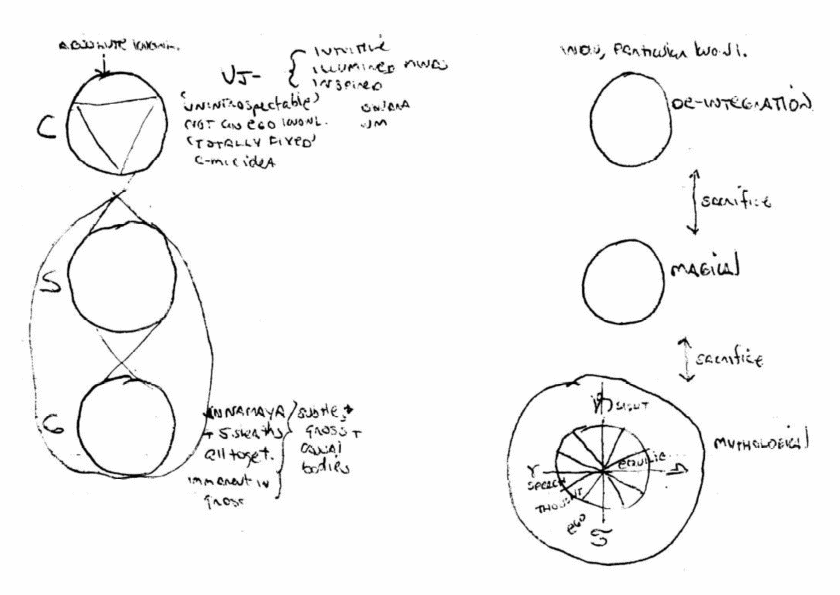
Reviewing diagram correlating causal, subtle, and gross realms/sheaths with three stages of reflective consciousness; all five sheaths immanent in gross body
Vijnanamaya contains the whole plan of your evolution; broken up at lower level into sequence of lives
Reading/discussing Aurobindo, The Upanishads, on Ishvara and "golden egg" metaphor
Subjective/objective aspects of Ishvara; seed-state of things
Reading/discussing Ramana, Talks with Sri Ramana Maharshi, on projection of vasanas from Heart to brain
Stages of development: 1) primitive identity 2) rational "I"/ego 3) release from ego
Correlation between event and meaning
Samkhya scheme
Reading Steiner, Macrocosm and Microcosm, on three worlds and evolutionary build-up of body
Reading Jung, Psychological Types, definition of rational; reason as deposit of mankind's experiences
Evolutionary history of cosmos/entity embedded in brain; laws of manifestation eventually show up as our reasoning
Is there one vasana for all?
Sensible qualities held back by brain and twelve sense-organs is your perceived world
Cosmic consciousness experience varies with individuals, won't see a huge world "out there"
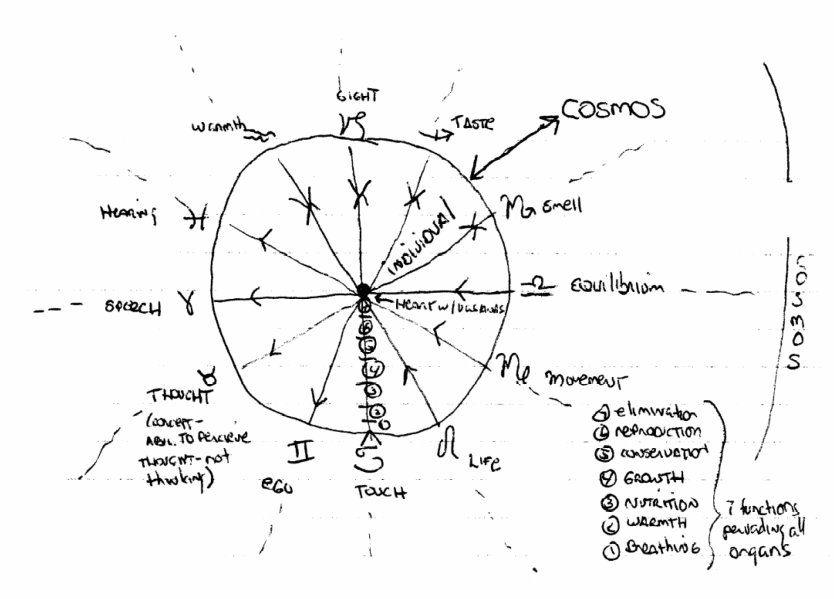
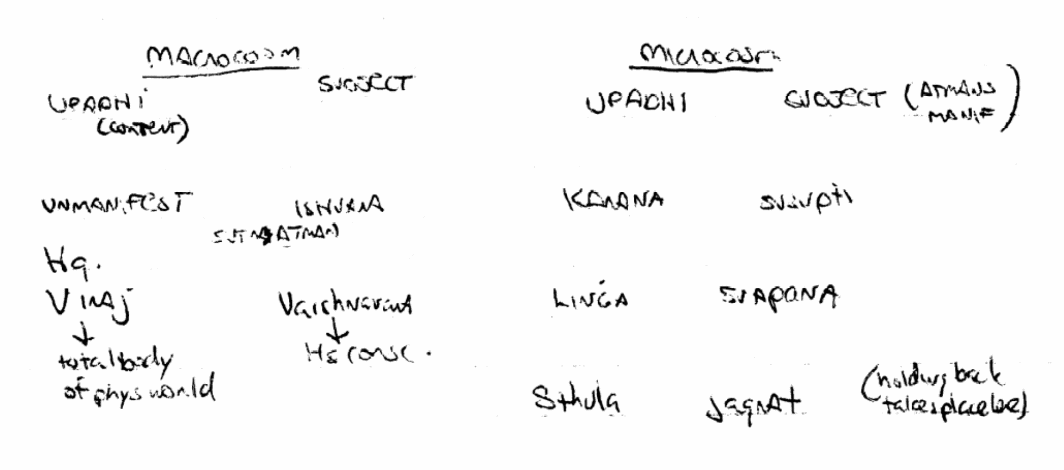
Review of macrocosm and microcosm diagram
Perceived brain vs. brain as manifestor of perceived world; can one step out of the psyche?
Reading/discussing Aniela Jaffe, The Myth of Meaning in the Work of C.G. Jung; Jung's experience of the cosmic meaning of reflective consciousness as an experience of cosmic consciousness
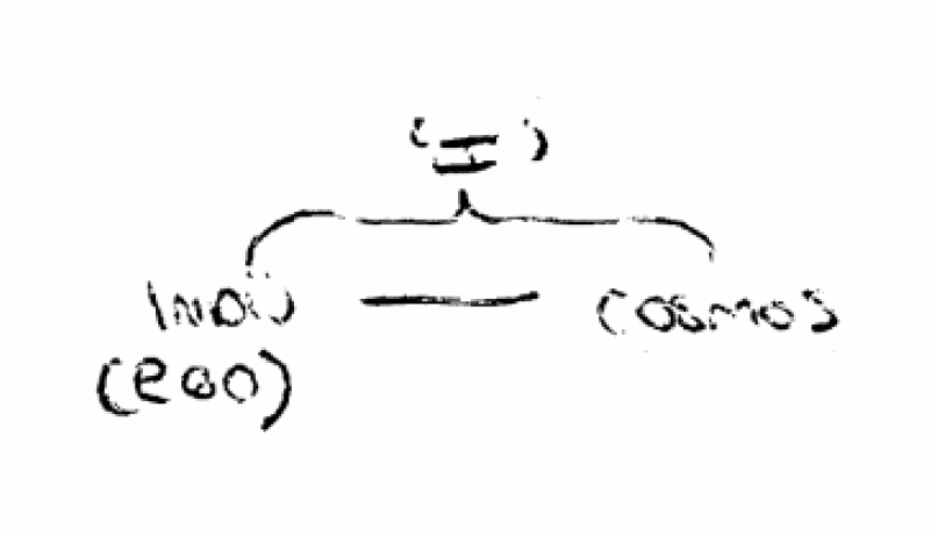
I-thought encompasses ego and cosmos
Jung's cosmic experience was a realization that it's all psyche, not a stepping out of psyche
Quotes from Jung, PB demonstrating World-Mind, Anima Mundi, collective unconscious etc. is within you
Expectations vs. reality of cosmic consciousness
Realization that everything has always been ideal
Jung: all you experience is immediacy of psyche; importance of staying within this framework for experience of consciousness as cosmic to take place
BOOKS READ FROM OR REFERENCED:
S. K. Saksena, Nature of Consciousness in Hindu Philosophy
C.G. Jung, CW 8, The Structure and Dynamics of the Psyche, "Synchronicity: An Acausal Connecting Principle"
Sri Aurobindo, The Synthesis of Yoga
Marie-Louise von Franz, Psyche and Matter
Edward Whitmont, The Symbolic Quest: Basic Concepts of Analytical Psychology
Paul Brunton, The Hidden Teaching Beyond Yoga
Sri Aurobindo (tr., comm.), The Upanishads-II, Kena and Other Upanishads
Sri Aurobindo, The Philosophy of the Upanishads
Sri Venkataramiah (Swami Ramanananda Saraswati), Recorder, Talks with Sri Ramana Maharshi
Marie-Louise von Franz and James Hillman, Lectures on Jung's Typology
H.P. Blavatsky, Isis Unveiled, Vol. 1
Rudolf Steiner, Macrocosm and Microcosm
C.G. Jung, CW 6, Psychological Types
Paul Brunton, The Wisdom of the Overself
William Bucke, Cosmic Consciousness: A Study in the Evolution of the Human Mind
Mahamahopadhyaya Gopinath Kaviraj, Aspects of Indian Thought
C.G. Jung, CW 11, Psychology and Religion
Aniela Jaffe, The Myth of Meaning in the Work of C.G. Jung
DIAGRAMS appended to this transcript:
FIGURE 1974 0915-1-AB. Causal, Subtle, and Gross Realms/Sheaths correlated with Three Stages of Reflective Consciousness.
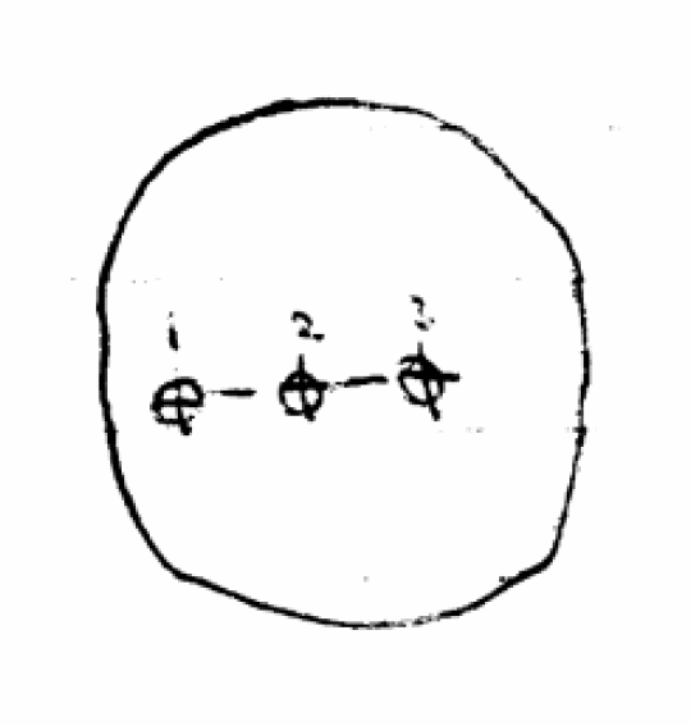
FIGURE 1974 0915-2-AB. Sequence of Lives.
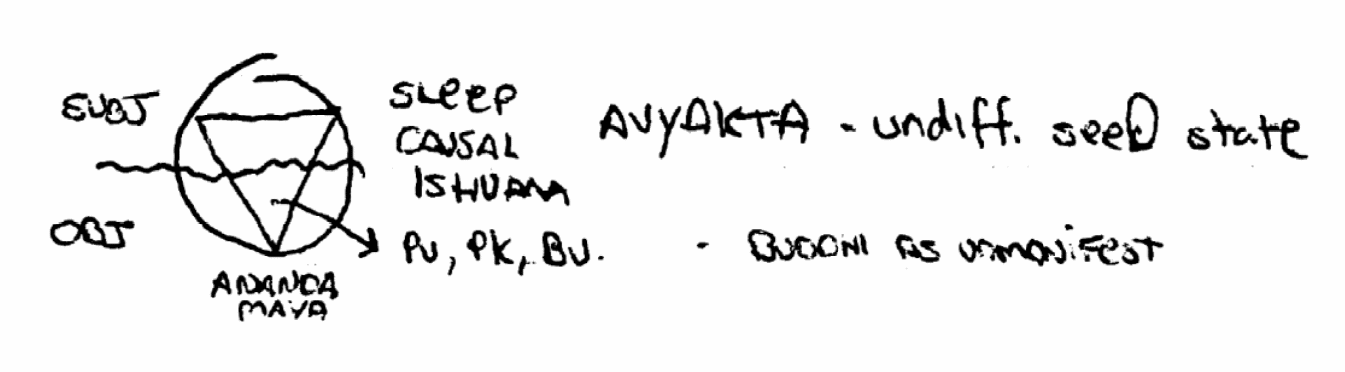
FIGURE 1974 0915-3-AB. Subjective and Objective Aspects of Ishvara.
FIGURE 1974 0915-4-AB. Body Scheme.
FIGURE 1974 0915-5-AB. Macrocosm and Microcosm.
FIGURE 1974 0915-6-AB. Witness-I encompasses Ego and Cosmos.
Other diagrams also referred to are not with this transcript version. [Transcriber note: [diagram] means the speaker is referencing a diagram as he or she is speaking. If someone is drawing or writing, with audible sounds of chalk on a blackboard, I indicate this by [drawing] or [writing].]
NOTES:
- For readability's sake, the following substitutions/edits made in Verbatim Transcript: cuz = because; gonna = going to; gotta = got to; yeah = yes.
TRANSCRIBED Verbatim by IT (V12a) in 2023 from Audio Files using V11a as a basis. This V12a version combines two previously separate WG Classes, 1974 0915 and 1974 1222 (on discovery that they were all one class), has had two more passes with various listening errors corrected, has been reformatted to current standards, has updated, corrected and expanded prefatory matter based on new conventions and new information, has TOC completed, has six diagrams appended from AB class notes and references within transcript to these diagrams; also, Subject has been changed to Reflection to more accurately reflect what the class is about and because it is part of a series on Reflection. Archival verbatim transcript – V12a.
AUDIO FILES: 1974 0915a, 1974 0915b (formerly 1974 1222a). [Note 1: "Tape" and "Side" refer to the original audio cassette tapes that were digitized to create the .MP3 files. Note 2: Both audio files were originally faint and hard to hear. In 2024, REP Studio improves the sound quality.]
| NEW FILE NAME | OLD FILE NAME |
| 1974 0915a | 1974 0915a |
| 1974 0915b | 1974 1222a |
1974 09/15 at Wisdom's Goldenrod
Epistemology; Reflective Consciousness
[Audio File 1974 0915a Begins]
AD: (--working). The problem that we do Friday night in class was for the (Advaita/Advaitist). And in the Advaita that's very crucial problem. So, I feel justified in going ahead and try to do it in any way I can, any way that can present us with pictures of what we're trying to understand.
S (faint): Something you've got to do.
AD: And I don't mean to steal anyone's thunder but in the book on the Nature of Consciousness in Hindu Philosophy we have among the chapters statement of that problem. And I thought I would present you with the three problems, the three different versions of this problem, just present it to you [one/two words inaudible] you know, that the information [couple words inaudible] If there was I wouldn't give it to you. But he-- he presents-- he presents it quite tersely and to the point here. You could use it as a springboard for (soul). [student assents, faint] And, you come across this problem in Samkhya. So, it starts off something like this.
[Transcriber note: I am using Nature of Consciousness in Hindu Philosophy by S. K. Saksena, Motilal Banarsidass, Delhi, 1971.]
S. K. Saksena [Nature of Consciousness in Hindu Philosophy, pp. 166-167, AD reading]: "If consciousness alone exists, how does it then, split itself or create its own antithesis in the form of unconsciousness, for no experience is possible without the duality of the [AD reads: a] subject and the object or without a unity of conscious entity with the unconscious. The Advaitic answer to the [AD reads: that] question is, that in reality there is no experience and that the appearance of it is due to [the] one or the other of the following causes:—
"[The Advaitic Theories of Relation:]
(1) [AD reads: In the first is] The reflection theory [or] the 'Bimba-Prati-bimba-Vada' [AD adds: theory]. [AD: Alright, the reflection theory.]
(2) [AD reads: The second theory is] The limitation theory [or the 'Avaccheda-Vada']. [AD: I think we better stick to the English here.]
(3) [AD reads: And the third is] The Mayavada, [AD rereads: The Mayavada] or the non-discrimination theory, according to which, pure consciousness without actually either reflecting or limiting itself mis-believes itself to be unconscious because of a non-awareness of its true nature."
S (very faint): Yes.
AD: And these are the three conditions in the reflection, theory of reflection.
S: Tony?
AD: We decided to talk about reflection and try to get acquainted with the problem. Let's see, we tackled it through Steiner and we tackled part of it through Jung. [short pause] But I thought-- I thought today we'd try a contrast. [students assent, very faint] The contrast I had in mind was to start with the notion of absolute knowledge and-- On the one hand we have the knowledge of the sensible particulars and on the other hand you-- you have the knowledge, the absolute knowledge that [one word inaudible] or the totally fixed knowledge, the absolute knowledge [few words inaudible] And we'll have these two to kind of, you know, produce some form of conflict for me. [10¾ second pause] Is that ok?
[50 second pause]
S (very faint): What did you say? What did you just say?
AD (faint): No, no. [short pause] By the way I'm not give-- give a lecture today. Not from my nasty mood.
S: You got Mars on the North Node.
AD: I got Mars on the North Node, haven't I?
S (faint): Mars [three words inaudible]
[few seconds of inaudible student talking]
AD: Jesuit.
S (faint): Tony, (were you just going to call that physiology)?
AD: Yes. [couple inaudible student words simultaneous with AD] 31, 489.
S (faint): I'm thirsty though.
[short pause]
S (faint): That's good.
[18½ second pause]
S (faint): I would (call) that [one word inaudible]
AD/S(?) (faint): Go ahead.
S (faint): Sorry.
AD: See-- see I was selecting this quotation--
[14¾ second pause]
C.G. Jung [CW 8, The Structure and Dynamics of the Psyche, "Synchronicity: An Acausal Connecting Principle," pp. 493-494, paragraph 931, AD reading]: "Agrippa is thus suggesting [AD reads: Agrippa suggests] that there is an inborn"knowledge" or "perception" in living organisms, an idea which recurs [in our own day in Hans Driesch]. Whether we like it or not, we find ourselves in this embarrassing position as soon as we begin seriously to reflect on the teleological processes in biology or to investigate the compensatory function of the unconscious, not to speak of trying to explain the phenomenon of synchronicity. Final causes, twist them how we will, postulate a foreknowledge of some kind. It is certainly not a knowledge that could be connected with the ego, and hence not a conscious knowledge as we know it, but rather a self-subsistent "unconscious" knowledge which I would prefer to call "absolute knowledge." It is not cognition but, as Leibniz so excellently calls it, a "perceiving" which consists--or to be more cautious, seems to consist--of images, of subjectless "simulacra." [AD: Ok, and] These postulated images are presumably the same as my archetypes, which can be shown to be formal factors in spontaneous fantasy products. Expressed in modern language, the microcosm which contains "the images of all creation" would be the collective unconscious."
S (faint): Uh-hm.
[short pause, flipping of pages]
AD: Or, he has a chapter here on the To-- Taoistic view, which is typical of Chinese thinking.
C.G. Jung [CW 8, The Structure and Dynamics of the Psyche, "Synchronicity: An Acausal Connecting Principle," pp. 489-490, paragraph 924, AD reading]: "It is, whenever possible, a thinking in terms of the whole [AD reads: of a whole, of a whole, of the whole]… This peculiarity can be seen in ordinary conversation with the Chinese: what seems to us a perfectly straightforward, precise question about some detail evokes from the Chinese thinker an unexpectedly elaborate answer, as though one had [AD reads: has] asked him for a blade of grass and got a whole meadow in return. With us details are important for their own sakes; for the Oriental mind they always complete a total picture. In this totality, as in primitive or in our own medieval, pre-scientific psychology [(still very much alive!)], are included things which seem to be connected with one another only"by chance," by a coincidence whose meaningfulness appears altogether arbitrary. … [short pause] The universal principle [AD: And these are random quotes. "The universal principle] is found even in the smallest particle, which therefore corresponds to the whole."
[short pause]
AD: Perhaps we could try to conceive of this synchronicity that Jung is speaking about or this absolute knowledge. Now let me-- let me bring in another quote which is very good. Footnote at the last-- the end of the chapter, he has--
C.G. Jung [CW 8, The Structure and Dynamics of the Psyche, "Synchronicity: An Acausal Connecting Principle," p. 518, footnote 17, AD reading]: "17 Continuous creation is to be thought of not only as a series of successive acts of creation, but also as the eternal presence of the one creative act, in the sense that God"was always the Father and always generated the Son"…or that he is the "eternal Creator of minds"… God is contained in his own creation, "nor does he stand in need of his own works…" [AD: Now he's quoting Augustine.] What happens successively in time is simultaneous in the mind of God: "An immutable order binds mutable things into a pattern, and in this order things which are not simultaneous in time exist simultaneously outside time"…"
AD: So, a little bit of what he's saying here would be something like this, if we took a very practical example. The mantic device that we're acquainted with is astrology, you know, with certain aspects in the chart, and very intuitive astrologers sometimes could pretty well pin-- pin down exactly what's going to happen. And then let's say-- let's say that this does come to pass, that's something that's brought about or these aspects then show something that comes to pass and it does come to pass, and then we have the problem of trying to understand how could it be that a certain inner meaning would correspond to certain outer events. You're going to have to bring them together. And, of course for Jung that's the problem of synchronicity that-- that that problem can only be [one word inaudible] if you could kind of pick up and say knowledge is absolute. I'd like to bring in from another point of view Aurobindo's conception of vijnanamaya but I don't remember where it was. Any of you remember? [short pause] Let me see, I think it was in here. Book that I didn't bring today.
S (very faint): Uh-hm.
S (faint): Yes.
S (faint): (Yep.)
S (very faint): At least you brought--
[53¾ second pause while AD looks for quote]
S (faint): (Begin.)
AD: Vijnanamaya or the reference that-- the English equivalent that he uses, the supermind or conscious mind. [11¼ second pause] Ok. (Bob?/Start.)
[Transcriber note: I am using The Synthesis of Yoga by Sri Aurobindo, Sri Aurobindo Ashram, Pondicherry, 1999.]
Sri Aurobindo [The Synthesis of Yoga, "The Nature of the Supermind," p. 785, AD reading]: "It is here necessary in a matter so remote from the ordinary lines of our thought and experience to state first what is the universal gnosis or divine supermind…"
AD (faint): Somebody read (for me).
S (faint): Well--
S (very faint): Ok.
S (faint): [couple words inaudible]
S (faint): Not bad.
S (very faint): (No.)
[short pause, door closes]
S: Ok.
Sri Aurobindo [The Synthesis of Yoga, "The Nature of the Supermind," pp. 785-786, S reading]: "It is here necessary in a matter so remote from the ordinary lines of our thought and experience to state first what is the universal gnosis or divine supermind, how it is represented in the actual movement of the universe and what are its relations to the present psychology of the human being. It will then be evident that though the supermind is suprarational to our intelligence and its workings occult to our apprehension, it is nothing irrationally mystic, but rather its existence and emergence is a logical necessity of the nature of existence, always provided we grant that not matter or mind alone but spirit is the fundamental reality and everywhere a universal presence. All things are a manifestation of the infinite spirit out of its own being, out of its own consciousness and by the self-realising, self-determining, self-fulfilling power of that consciousness. The Infinite, we may say, organises by the power of its self-knowledge the law of its own manifestation of being in the universe, not only the material universe present to our senses, but whatever lies behind it on whatever planes of existence. All is organised by it not under any inconscient compulsion…"
AD: You want to repeat that sentence?
Sri Aurobindo [The Synthesis of Yoga, "The Nature of the Supermind," p. 786, S reading]: "All is organised by it not under any inconscient [S: or unconscious] compulsion, not according to a mental fantasy or caprice, but in its own infinite spiritual freedom according to the self-truth of its being, its infinite potentialities and its will of self-creation out of those potentialities, and the law of this self-truth is the necessity that compels created things to act and evolve each according to its own nature. The Intelligence -- to give it an inadequate name -- the Logos that thus organises its own manifestation is evidently something infinitely greater, more extended in knowledge, [S adds: and] compelling in self-power, large [S reads: larger] both in the delight of its self-existence and the delight of its active being and work than the mental intelligence which is to us the highest realised degree and expression of consciousness. It is to this intelligence infinite in itself but freely organising and self-determiningly organic in its self-creation and its works that we may give for our present purpose the name of the divine supermind or [S reads: and] gnosis."
[11¼ second pause]
S (very faint): Ok.
AD (faint): Is there any other quote there (on/in) the [one/two words inaudible]
S (faint): Oh.
AD (faint): Yes.
S (very faint): You want that paragraph on [three/few words inaudible]
AD: Yes, (quantum).
S (very faint): Yes.
S (very faint): Yes.
S: Should I just read the underlinings or--
AD: Uh-hm.
S: Ok--
Sri Aurobindo [The Synthesis of Yoga, "The Nature of the Supermind," p. 786, S reading]: "The fundamental nature of this supermind is that all its knowledge is originally a knowledge by identity and oneness and even when it makes numberless apparent divisions and discriminating modifications in itself, still all the knowledge that operates in its workings, even in these divisions, is founded upon and sustained and lit and guided by this perfect knowledge by identity and oneness."
AD: Could you reread that?
Sri Aurobindo [The Synthesis of Yoga, "The Nature of the Supermind," p. 786, S reading]: "The fundamental nature of this supermind is that all its knowledge is originally a knowledge by identity and oneness and even when it makes numberless apparent divisions and discriminating modification in itself, still all the knowledge that operates in its workings, even in these divisions, is founded upon and sustained and lit and guided by this perfect knowledge by identity and oneness."
AD: Ok. Here's something from Louise, you know, von [one word inaudible]
[Transcriber note: I am using Psyche and Matter by Marie-Louise von Franz, Shambhala Publications, Inc., Boston, 1992.]
Marie-Louise von Franz [Psyche and Matter, "Symbols of the Unus Mundus", AD reading]: "When he created the concept of synchronicity, Jung laid a foundation which might lead us to see the complementary realms of psyche and matter as one reality. [For] in each synchronistic event it is the same meaning which manifests in the psyche and also in the arrangement of outer events that occur simultaneously. [Also], a priori knowledge of facts which could not be known at that moment often becomes manifest. Jung has called this"absolute knowledge." The latter [AD reads: It] consists of something like an "immediate existence" of images or "a 'perceiving' which consists of…of subjectless 'simulacra.'" Synchronistic events thus seem to point toward a unitary [AD reads: unitarian] aspect of existence which transcends our conscious grasp and which Jung has called the unus mundus. In the natural philosophy of the Middle Ages this word served to denote a transcendental oneness of the world which was personified in [the] Sapienta Dei ("Through which God knows Himself") or as the Soul of Christ, [AD adds: or] Mary, or pre-existing Logos [(Word)]. It was the model [(exemplar)] or potential archetypus mundus or the sum of all typi or primordiales causae [AD reads: types or primordial causes] dwelling in God's mind before He created the universe according to their pattern. … …Jung discovered that the synchronistic phenomena provide empirical evidence for the existence of such a unus mundus. He then added the most important statement that the mandala is the psychological equivalent and synchronicity the parapsychological equivalent of the unus mundus.
"Since this oneness of all existence transcends our conscious comprehension, it is expressed--as always in such cases--by many symbols."
AD: And so we have all kinds of the devices, in cybernetics, you know--
Marie-Louise von Franz [Psyche and Matter, "Symbols of the Unus Mundus", AD reading]: "…by which people hoped to contact the [AD reads: this] absolute knowledge. The best-known symbol [AD reads: One of the best symbols] of this kind is the [astrological] horoscope."
[16¼ second pause]
[Note: See FIGURE 1974 0915-1-AB, Causal, Subtle, and Gross Realms/Sheaths correlated with Three Stages of Reflective Consciousness, appended to this transcript for the following.]
AD: Alright, I think we've then kind of presented the problem here or we've presented [one/two words inaudible] Over here we are-- we're dealing with a knowledge that is absolute in a sense [diagram], and over here we're dealing with a knowledge that is very particular, very concrete, very specific meanings [diagram] [one/two words inaudible] [S, very faint: Yes.] Um--
S (very faint): Uh-hm.
S (very faint): Yes.
S (faint): Exactly.
AD: I'll answer (Tim's) question, let me try. (bit of laughter, student words) You remember the-- some of the terms. [9¼ second pause while drawing/writing] Well, you remember. Speech for Aries, Taurus thought, and Gemini ego-perception [diagram]. These were considered as various sense-organs that contributed knowledge, alright. We started last week-- we ended up by speaking about the Whitmont book and scattered in many of the writings of Jung-- Jung, he speaks about various stages-- various stages of consciousness. And, Whitmont started out by speaking about the unitary-- [short pause while drawing/writing] unitary state, deintegration, alright, then mythological. And, we spoke about the quotation which we heard again. We spoke about that certain stages or certain rituals, sacrifices, meditations have to be brought in to separate this [diagram] from this [diagram]. In other words, you could imagine this something like this [diagram], ok, and the circle within that [diagram] and this [diagram] has to be separated and then we could imagine something like that [diagram] and then as the separation takes place these are all-- you have to imagine them completely separated to understand-- to get it through psychologically what we're talking about. So these four states that Whitmont speaks about, the first was a unitary state, which I rejected. I didn't want to go into question about it then.
S (very faint): But you made it [one word inaudible]
AD: Perhaps if you pick it up now and see if you can understand that [couple words inaudible]
JL (aside to AD): Should I bring it down?
AD: Yes, please.
S (faint): Wait, Tony, how could-- how is one able to separate out (of) the other one if-- if there's an underlying knowledge and they eventually separate? I mean, that was the (hope) that-- that what's happening on both sides would be the same, and so it doesn't seem like this [one word inaudible] or the individual and the world or-- or two individuals could be-- be other than somewhat distinguished by [one/two words inaudible] within-- within a larger knowledge. You never-- I don't really see like how psychic--
AD (simultaneously): I don't either. But we'll try, we'll see. [student assents, very faint] I don't understand that.
S (very faint): This is fun.
S (very faint): [few words inaudible]
S (very faint): Uh-hm.
[11¼ second pause]
AD: But see, when we-- when we were speaking about this framework here, alright-- in this-- we were getting at the notion of reflection. Now I want to work at the opposite end where if everything is in a state of oneness where perception is a standard, so to speak, and all knowledge is tied to some form or leads up to that formless(--/.) And we pointed out that introspection into that knowledge is out of the question. In other words, if you speak about an absolute knowledge, it's not a knowledge that belongs to any ego and we can't even conceive of it as an ego knowledge of any kind, that-- that was the point that Jung tried to-- tried to make. This absolute knowledge is not knowledge that belongs to any ego. We spoke of it variously sometimes as the totally fixed knowledge or-- We don't understand what this means but in one place PB referred to the fact that the cosmic Idea is an Idea that the World-Mind (holds/impose) in an all-time fixity and that consequently there is-- there is a knowledge of this universe which contains and which would have to be absolutely true. I don't remember where in the Wisdom but he does make a remark something to this effect, he says you can have knowledge according to your personal image or he says your knowledge could be based upon the completeness or the totality of knowledge in the universal (slide). Anyone remember that passage from the Hidden Teaching? Kevin, would you get the copy of the Hidden Teaching in the back? It's in the top shelf I think. If we can establish from three or four sources relatively speaking a kind of absolute knowledge, a fixed knowledge, a-- [short pause] then it might help us understand or at least try to-- [student assents, faint] we'll be faced with the problem, you know, well, if I had a different knowledge it could give information. [short pause] No, not this copy.
S (very faint): [few words inaudible]
S (faint): Well I put that over [couple words inaudible]
AD: Isn't there a copy up there?
S (faint): [few words inaudible]
S (faint): [few words inaudible]
AD (simultaneously): In the-- in the back room there isn't a copy?
S (very faint): Not here.
AD: Top shelf, the red-bound copy?
S (very faint): [few words inaudible]
AD: (Do/Don't) you think they found it?
S (very faint): [few words inaudible]
S (very faint): Yes.
[9½ second pause]
AD: No? Well see if you could find it, it's usually the path on the philosophy of Truth. [10½ second pause with faint background student talking] What's that noise?
S: It's ok.
S (very faint): Yes right.
S (very faint): He found it.
AD: It's alright, he's got a copy here. [14¼ second pause with faint background talking, AD possibly involved] Alright. [11¾ second pause with faint background student talking] The reason I asked for this copy is because I had it cut out already, I didn't have to search for it.
S (very faint): But see--
AD: And "The Hidden Philosophy"-- in "The Hidden Philosophy of India," page 101, chapter says--
[Transcriber note: I am using The Hidden Teaching Beyond Yoga by Paul Brunton, E. P. Dutton & Co., Inc., New York, 1969 printing.]
PB [The Hidden Teaching Beyond Yoga, "The Hidden Philosophy of India," p. 101, AD reading]: "The ultimate purpose of the Indian esotericism was to lead men to detect the essential meaning of human life, to help them gain insight into [AD emphasis] the real structure of the universe…"
AD: The real structure of the universe. Real structure of the universe, that would mean even beyond and independent of the laws of apperception. Huh? Yes? Agree, disagree?
VM (very faint): (I would agree.)
AD: Alright.
S (very faint): [couple words inaudible] see all of the world.
S (very faint): Yes [one/two words inaudible]
S (very faint): Yes.
S (very faint): [couple/three words inaudible]
AD: Someone said something?
S: Yes, why-- why necessarily beyond the laws of apperception [three/few words inaudible]
AD: Well, what did we find out about apperception?
S (faint): It must be limited. It's a limited a point of view.
AD: Yes, it's a limited point of view, it's based on the structure of the personality, right?
S: It also structures universals [couple words inaudible]
AD: Well, is the structure of my personality the same as yours? Where's your Saturn?
S: It's not where yours is. (bit of laughter)
AD: Good! Where's your Sun?
S (faint): It's at 10 Leo.
AD: So in other words, every time we speak, even though we communicate and we may even get ideas across to one another, it will always mean something a little bit different for me than it does for you. Because my thinking is based fundamentally on the laws of apperception. Now that would not-- it would-- it would, so to speak, preclude the possibility of getting to the universe as it really is in itself.
S: That's true perception too, isn't it?
[students assent, very faint]
S (faint): Except that the only way I could get to those laws is through my particular [one/two words inaudible] my particular view.
AD: Yes, basically through the laws that govern apperception for you.
S (very faint): Yes.
AD: Ok. Now the Vedantists claim that it's possible to go beyond that. In other words, the mirror that you-- let's say the contents in your mind are reflected in may be slightly convex, mine may be a little more so, and someone else's even more so. So that through the laws of apperception or through thinking, in other words, reflected or directed thinking, in either case is going to be highly determining what that real structure of the universe is. So, he makes this point by saying--
PB [The Hidden Teaching Beyond Yoga, "The Hidden Philosophy of India," p. 101, AD reading]: "…to help them gain insight into the real structure of the universe and to point out the grand sun of absolute truth shining on the horizon of [AD emphasis] all existence."
AD: Not my existence or yours, but all existence. So that had to take it beyond the laws of apperception although from the point of view of thinking they would be absolutely fundamental for each and every individual. Then again in the-- [short pause] There's a few references here, I'm trying to pick out the important ones. On page 229, in "The Revelation of Relativity", he says--
PB [The Hidden Teaching Beyond Yoga, "The Revelation of Relativity," p. 229, AD reading]: "This vicious round of relativity has no outlet unless science has recourse to the help of the philosophic view. Two separate standpoints thus arise and bifurcate our view of nature. There can only be one ultimate truth and one final standpoint whose character will be both unalterable and invulnerable. The philosopher seeks to discover them and is satisfied with nothing less. The concept of the world which arises out of the utmost pure reflection is different from that which arises out of the first sensual impression. We must distinguish sharply between them. For the first is perfect while the second is premature. The first standpoint is that of the universe itself, the second is that of man: the first sees from the viewpoint of the whole universe and not merely from that of [the] knowledge of any particular man, hence it is absolute and true, whereas the second sees only anthropocentrically, hence always relatively."
AD: So, if I gather something like this, if I follow the point he's making here, is that when-- when we operate in our thinking, the very laws that govern the structure of our personality, our ego and all that, these laws, in other words, include themselves into our perception and into our understanding, they cannot but help do so. So consequent-- consequently any time the ego intrudes itself upon the train of thinking it always brings about some disturbance, you know, some alteration. Whereas if you reach that utmost purity of reflection, then [one/two words inaudible] (some laughter) It seemed like going to jump tonight(./?) If we reach that point where-- In other words, what we're saying here-- I'm sorry. What we're saying here is something like this, is that the structure of the personality is basically the personal equation that interferes in our understanding of reality. Ok? And the second, in other words, if one could see-- if he could see how he fits in into that totally fixed knowledge, if he could see how he fits into it, alright, then you can speak of this as the utmost purity of reflection because then he sees his place in that vision and how he sees that vision. That make any sense to you? In other words, he can make allowances for that personality structure which ordinarily cannot be done in order to communicate what he has found out.
So, there's no problem there if you can get a sort of indication that there is this totally fixed knowledge. What this totally fixed knowledge or this omniscience is like you have no idea. You try to gain something of it by working with some of these mantic devices. [16½ second pause with faint background talking, AD possibly involved] This is keeping the problem open that's never been closed actually, I think that-- [42 second pause] So we have an idea, you know, that there's an absolute fixed knowledge. We'll tackle this from here [diagram] first. [Note: See FIGURE 1974 0915-1-AB, Causal, Subtle, and Gross Realms/Sheaths correlated with Three Stages of Reflective Consciousness, appended to this transcript for the following.] There's an absolute fixed knowledge, alright, and we refer to that as the causal realm. Up here, [writing] vijnanamaya [diagram]. Is that how you spell it, vijnanamaya? Then we put down, so to speak, in the case of the mind, the intuitive, illumined, inspired [diagram], or-- I forget what he says. Then we spoke of mind down here [diagram]. And, a principle be-- below that was pranomaya [diagram]. And below that--
S (very faint): How do you spell it?
AD: What was he calling it? Pranomaya and--
S (simultaneously, very faint): Annomaya, vijnanamaya, (manomaya/pranomaya).
AD: Hm?
S (very faint): Annomaya, vijnanamaya, manomaya.
AD: Annomaya? Yes. That would be the physical body, wouldn't it?
S (very faint): Yes.
AD: So, if we put the annomaya here, the physical body here [diagram], over here where you live, ok, you'd have to put these five [couple inaudible student words simultaneous with AD] sheaths. Right?
S: You mean the (bottom)?
AD (simultaneously): There's two bodies, the subtle body--
S (simultaneously, faint): [three/few words inaudible] Right in (the annomaya/vijnanamaya)?
AD (faint): What's that?
S (faint): Right in (the annomaya/vijnanamaya)?
AD: Well, sure, right around that, yes, yes.
S (faint): [one word inaudible]
AD: Why, can you exclude the vijnanamaya from the operation?
S (faint): Not really.
AD: Could you exclude manomaya, pranomaya? Right down here [diagram], right? So here's your five principles right down here. Or the way they're referred to in Vedantic literature, subtle body and the gross body is between this. No, three (stages), I'm sorry, I left out the causal body.
S (faint): [few words inaudible] But that's the (ananda).
AD: Anandamaya would be up here [diagram].
S (faint): Yes.
AD: Alright, so this is-- in Vedantic parlance, this [diagram] would be that which contains the absolute knowledge. And we spoke of this as having a knowledge, a complete knowledge, all organized-- that knowledge is totally organized there, [student assents, faint] and all the necessary means for the execution of every detail of that knowledge is here, ok. And over here there is this identity and this oneness of this knowledge, there is no ego that knows anything over here. Ok? Vijnanamaya? How about that, you recall what we spoke about before? [student assents, faint] You've got to give me some comments because I got to see how I'm-- where I'm coming from, if this is making any sense. This is mostly repetition.
S: Tony, when you say vijnanamaya is operative at the gross-- the physical level, in what sense is-- is that so if at the level of vijnanamaya there's no ego, there's no-- there's no sort of personal vehicle operating, then how is it possible to take that level of being and--
AD (simultaneously): I-- I shouldn't have said that, I should've left it up there. (bit of laughter)
S: Well he [possibly one/two words inaudible]
AD: When you say, Andrea, "I know this tree is green," isn't there an aspect of knowledge which has to be included in that totality? In other words, aren't you participating in that total knowledge when you say I know 2+2 is 4. [short pause] [student assents] What you want to do is say, "I know everything," right? That's what you would like to see as vijnanamaya. But insofar that you say, "I know this," you're expressing an axiom certainty that exists-- certitude that exists up here [diagram], but you're stating it down here [diagram] [S: Well--] in a very incomplete form. In other words you're using intelligence reflectively.
Every one of the principles that we deal with in the Vedanta, from ananda down, have to be down here in this entity that we call "you"--the physical or the corporeal, the life sheath, right, and the astral sheath or what they call the lower mind, the higher mind, that all has to be in this person down here. Now it's very possible that for instance you deal with a certain person where all these aspects up to here [diagram] are excluded, you know, and just a little part of the mind is operating. So he's down here, ok, he's not an idiot. An idiot you would have to exclude the manas. But anything above, so to speak, anyone that has normal adaptation and uses his mind, you can say, well, he certainly has a physical body. He has a vital body, a life body. He has desires, compulsions, passions and all that so he knows-- has some sort of lower mind or astral body, alright? And he has some thinking ability. So there's four principles right there. We don't talk about the other principles, the higher mind, the vijnanamaya and the anandamaya, because there-- they don't seem to be operative in this person. But yet we know that as principles they have to be-- they're implicit in that person.
S: I'm sure they (hear) this part about an unconscious (higher/prior) certainty. Ok. [few words inaudible]
AD (simultaneously): Yes, because he participates. When he says "I know 2+2 is 4" he's participating in that total knowledge, alright, so he can see that that vijnanamaya has to operate down into this really gross realm [diagram]. Alright. But the point I'm trying to get at is, that when we spoke of vijnanamaya, alright, we made this kind of division, the vi-- the ananda was down here [diagram] and then vijnanamaya we put between these two circles [diagram], and so we'll end up with something like this, ok. We'll have to take this here like Plato did, you know, he takes two circles and you could fold them together and they coincide [diagram]. So up here we would have-- we would have, so to speak, the subtle domain [diagram] and over here the gross domain [diagram]. But we can't separate that. When I speak about myself, here's the gross, the subtle, everything is here [diagram], ok. So we take these two circles and we're going to make them coincide, we're going to fold them together. And this top circle we'll leave alone [diagram]. Now let me see if-- if it brings about any kind of a picture. [short pause] [drawing] Up here in this circle [diagram], like we said, vijnanamaya has a complete picture of everything that's going to be. And over here the two circles we're going to imagine as one circle [diagram], you're going to call this the world. And in the world, you're going to, so to speak, go through certain experiences which would take you right down to Sagehood, alright. You start out as an-- an amoeba--this is just, you know, thought--and you end up as a Sage, ok? An amoeba to a Sage.
S (very faint): (Not too shabby.) (bit of laughter)
AD: Now, this vijnanamaya, we're just talking, right, this is like the comic book, there's nothing-- (bit of laughter) This vijnanamaya has this whole plan, alright, and your growth, your evolution, and your ultimate self-realization, from beginning to end. It has this plan in a total integral synthetic fashion. Fine. That means that you're going to have to consider this vijnanamaya, if we consider it down here [diagram], you're going to have to break it up, break up this wholeness, this integrality, and we're going to try to have to conceive this, so to speak, in sections of time, huge sections of time as it evolves through this whole Manvantara which-- which is why I could tell you down to the last detail how many years you'll take. So that, just for the sake of talking you can say this would be the first life, the second, the third and fourth, fifth life, ok, going down. [Note: See FIGURE 1974 0915-2-AB, Sequence of Lives, appended to this transcript.] Every detail in each and every life is going to be taken care of. Many of the-- many of the experiences are going to-- they're sort of foreknown, you know, and, I know it sounds ex-- sounds kind of deterministic but-- relax. (some laughter)
S (faint): Tony actually the next word you just spoke of as the meaning or the [few words inaudible] Is he-- is he speaking of that-- that whole [few words inaudible]
AD: Well, wait a minute Crystal, I'm coming to that. [short pause] Do we have the Talks anywhere? Would you get me a copy? I'd like to re-- reread that section we read.
[student assents, very faint]
[13¾ second pause]
AD: So, this is basically a repeat. The text we used at that time was The Upanishads by Aurobindo. And-- [10 second pause] And the reason I'm reviewing this here is because I'm going to try to make the sharpest contrast with the psychological approach which would be o-- be its opposite. [15½ second pause] That would be from 701 in my book, I'll read yours. Look at the (people). [short pause] And just to review this section here about-- from Aurobindo.
[Transcriber note: I am using The Upanishads-II, Kena and Other Upanishads by Sri Aurobindo, Sri Aurobindo Ashram, Pondicherry, 2004.]
Sri Aurobindo [The Upanishads-II, Kena and Other Upanishads, p. 397, AD reading]: "[For the rest], we are driven to the use of metaphors, and since metaphors must be used, one will do as well as another, for none can be entirely applicable. Let us then image [AD reads: imagine] Avyakta [AD reads: the Unmanifest] as an egg, the golden egg of the Puranas…"
[Note: See FIGURE 1974 0915-3-AB, Subjective and Objective Aspects of Ishvara, appended to this transcript for the following.]
AD: Remember we divided this up? [drawing] This would be the objective ideation [diagram] and that would be the subjective [diagram]. This is referred to as Ishvara in its purity [diagram] and this would be the objective ideation [diagram], that which is going to become the universe and this is the golden germ.
Sri Aurobindo [The Upanishads-II, Kena and Other Upanishads, p. 397, AD reading]: "…the golden egg of the Puranas, full of the waters of undifferentiated existence and divided into two halves, the upper or luminous half filled with the upper waters of subjective ideation, the lower [or tenebrous] half with the lower waters of objective ideation. In the upper half Purusha is concealed as the final cause of things; it is there that is formed the idea of undifferentiated, eternal, infinite, universal Spirit. In the lower half he is concealed as Prakriti, the material cause of things; it is there that is formed the idea of undifferentiated, eternal, infinite, universal matter, with the implications [AD adds: of] Time, Space, [and] Causality involved in its infinity."
AD: And, over here we pointed out this [diagram] was like a Janus face, one side facing itself and the other side facing the universe or the way PB put it, the World-Mind contemplating its own essence, that would be the subjective, the World-Mind contemplating the world, that would be the objective. Go ahead.
JG: There would be-- so that starts right from here.
AD: What's that?
JG: According to Vedantists, the unity starts right from here, from the purusha and prakriti level(s).
AD: Yes.
JG: [few words inaudible]
AD: Yes, the causal realm. These three things [diagram] refer to a bindu--maya. Uh--
[short pause]
Sri Aurobindo [The Upanishads-II, Kena and Other Upanishads, p. 398, AD reading]: "In the lower half, [AD: of that top circle] if we may use a daring metaphor, [AD reads: we have the use of a daring metaphor] Parabrahman forgets Himself. He is subjectively in the [AD reads: a] state corresponding to utter sleep or trance from which when a man awakes he can only realize that he…"
(Side 1 of original cassette tape digitized as 1974 0915a Ends; Side 2 Begins)
Sri Aurobindo [The Upanishads-II, Kena and Other Upanishads, p. 398, AD reading]: "…blissful existence, but the consciousness is not a part of his realisation. This concealment of Consciousness is a characteristic of the seed-state of things and [it] is what is meant by saying that when Parabrahman enters into matter as Prakriti, He forgets Himself."
[Note: See FIGURE 1974 0915-1-AB, Causal, Subtle, and Gross Realms/Sheaths correlated with Three Stages of Reflective Consciousness, appended to this transcript for the following.]
AD: So the second half of the circle, alright, which then we wiped out this top part and we just start with this bottom half [diagram] and we made that the-- we refer to that as the causal [diagram], this the subtle [diagram] and then manifests the gross [diagram]. So that all of universal manifestation, so to speak, would be the bottom half of the top circle and the three lower circles [diagram]. And over here refer [drawing] to things in a seed state [diagram]. Now, you know, seeds have a tendency to become what they're seeds of. So, a potato tends to become a potato. I think. (some laughter) And, we're dealing with things there in a differenti-- in an undifferentiated seeded state and they're going to evolve and become part of this cosmos. That in brief was what we once-- once did. And I would refer you to the Philosophy of the Upanishads by Aurobindo, especially that first section you could read and really try to master. So, in this state here, in this state here, the causal state [diagram], which is going to execute the Idea, in other words, it's going to employ the Form, the Ideas are going to be manifested over here [diagram]. And this is of course one of the big decisions that every metaphysician sooner or later has to face. Is Plato talking about the Ideas, so to speak, in here [diagram] or is he speaking about the Ideas in here [diagram]. [few words inaudible] enlightened. But, if this is an absolute knowledge [diagram], in other words, this is Ishvara or the World-Mind insofar as it's identified with the contents of the world or fused with the world contents, then on the one hand we have Ishvara the absolute consciousness and on the other hand we have the world content of which it knows all, it knows all those world contents. So that we have-- you have this problem here then to-- to sort out in detail. Ramana in his very simple way says (then--/that.)
[9¾ second pause]
[Transcriber note: I am using Talks with Sri Ramana Maharshi, recorded by Swami Ramanananda Saraswati, Sri Ramanasramam, Tiruvannamalai, 2006.]
Ramana Maharshi, Swami Ramanananda Saraswati [Talks with Sri Ramana Maharshi, Talk 616, p. 596, AD reading]: ""When the vasanas are projected from the Heart they are associated with the Light of the Self and the person is said to think."" (bit of laughter)
AD: I'd like to repeat this, because we all like to think of ourselves as great thinkers. And, maybe we are, I don't know, but--
Ramana Maharshi, Swami Ramanananda Saraswati [Talks with Sri Ramana Maharshi, Talk 616, p. 596, AD reading]: ""When the vasanas [AD: when thoughts] are projected from the Heart…""
AD: And of course they become this whole gross material world that you understand.
Ramana Maharshi, Swami Ramanananda Saraswati [Talks with Sri Ramana Maharshi, Talk 616, p. 596, AD reading]: ""…they are associated with the Light of the Self…""
AD: Now these thoughts have to be associated with the Light of the Self.
Ramana Maharshi, Swami Ramanananda Saraswati [Talks with Sri Ramana Maharshi, Talk 616, p. 596, AD reading]: ""…and [AD adds: then] the person is said to think.""
AD: They say now he's a thinker. In other words, he's-- he's experiencing these vasanas, and the way we did it was to imagine that here's this center, the heart center, and every thought that the person gets, so to speak, like light goes out to the limits of the universe and then comes back to him in the form of sense-knowledge. [Note: See FIGURE 1974 0915-4-AB, Body Scheme, appended to this transcript.] [student assents, very faint] [short pause] So that, when he says-- when he says something, "and the person is said to think," you can see how phony the whole set-up was. And in here we are being put through the paces, actually guided in every step of the way, alright, and then-- You know, you go to school and you learn certain-- certain things, let's say you sweat over [one/two words inaudible] the sweating that you did to learn how, but the ability to write remains with you. In other words, the soul converted it into some sort of faculty or some ability that you can start thinking less. So that you can see that all that effort hasn't gone to waste, now you could write, you don't have to sweat about it, just like when I was asking Om if he still had to think about [couple words inaudible] and he just does it automatically. So, that's part of, (some laughter) so to speak--
Yes, the whole point here was to make a person realize that after a while, when Ramana said "and the person is said to think," one begins to have a kind of feeling, "Well, you know, I got this idea in my mind about there being a consciousness that was world-wide and includes everything within it," and, you know, you go look at the chart and you see some big aspect. You say, "Well, it's a coincidence." But after a while when it happens [student assents] enough times, you begin to get a feeling as though these thoughts are just shoved into your mind, and you're receptive and you take them in, you even masticate them. Anyway, he goes on, he says--
Ramana Maharshi, Swami Ramanananda Saraswati [Talks with Sri Ramana Maharshi, Talk 616, pp. 596-597, AD reading]: ""The vasanas which lie embedded in an atomic condition grow in size in their passage from the heart to the brain. The brain is the screen on which the images of the vasanas are thrown and it is also the place of their functional distribution. The brain is the seat of the mind, and the mind works through it.""
AD: So we came to the conclusion that in the heart the vasanas are there in a subtle form and in the brain they're there in a much more physical form. And Jung pointed out that the brain was saturated by the unconscious, that is, like a sponge in water, and that considering the structure of the brain this was the kind of archetypes that were going to get activated and if you cut out a little part of the brain then other parts of the brain take over that function, so we realized that the actual archetypes were not in the physical brain but in the subtle vasanas or the heart so we had to go back further and get a feeling for that. Then he goes on.
Ramana Maharshi, Swami Ramanananda Saraswati [Talks with Sri Ramana Maharshi, Talk 616, p. 597, AD reading]: "So then this is what happens. When a vasana is released [and] it comes into play, it is associated with the light of the Self. It passes from the heart to the brain and on its way it grows more and more until it holds the field all alone and all the [AD adds: other] vasanas…"
AD: All-- all the other thoughts are kept aw-- away. Naturally this happens in the process of [couple/three words inaudible] you know, one thought following upon another [few words inaudible]
Ramana Maharshi, Swami Ramanananda Saraswati [Talks with Sri Ramana Maharshi, Talk 616, p. 597, AD reading]: "When the thought is reflected in the brain…"
AD: And that's where we stopped, alright. "When the thought is reflected in the brain" because here was a crucial point. We (have/had) to try to understand what he meant by "reflected in the brain".
Ramana Maharshi, Swami Ramanananda Saraswati [Talks with Sri Ramana Maharshi, Talk 616, p. 597, AD reading]: "The brain is a screen on which the images [AD reads: image]…"
AD: Oh, (ok/I'm sorry).
Ramana Maharshi, Swami Ramanananda Saraswati [Talks with Sri Ramana Maharshi, Talk 616, p. 597, AD reading]: "When the thought is reflected in the brain it appears as an image on a screen. The person is then said to have a clear perception of things."
AD: And he goes on. There was one other part that I wanted to-- [11¼ second pause] I don't want to reread the whole thing but-- (Again), let me-- I don't remember.
S: Tony, and then--
[10¼ second pause]
AD: Yes, this was the next quotation which I didn't emphasize but now I will try, now I will try. In a continuing discussion, ok, Ramana answers the question, he says--
Ramana Maharshi, Swami Ramanananda Saraswati [Talks with Sri Ramana Maharshi, Talk 618, p. 601, AD reading]: "The intellect is useful thus far, it helps you to analyse yourself, and no further. It must then be merged into the ego, and the source of the ego must be sought. If that be done the ego disappears. Remain as that source and then the ego does not arise."
AD: So we have a kind of sequence here, if I understand-- if I understand this right. Like you have this series of thoughts, and we can say that every center of consciousness, every creature has thoughts, alright, but at a certain level these thoughts start becoming reflective, you start becoming aware that you know that you know. Remember the way Jung put it, he says between "I know" and that "I know that I know" he says there's a paradox if not a downright contradiction here. So, if I follow the sequence right, Ramana's saying something like this, we develop from that kind of primitive identity with the functioning of our psyche to a point where certain self-reflection accrues. Then we begin to reflect on who we are, and in that process of reflection we start becoming a person or a human, you actually in that process become human. And the intellect will help you to understand that. But once that is understood, then the functioning of the int-- intellect is dropped and one searches the source of the ego. Now, you see, there's a kind of sequence. One has to develop his rational "I", his ego, his real, alright, and then he can start searching for release from that ego.
So, we have a kind of arrangement where we spoke about the physical body, the (chthonic) body, then the astral body. If you want to use a different terminology you can think of for instance Pla-- Platonists, they refer to this as the irrational soul, the astral body. And then the next stage, the nes-- next stage which has been referred to as manas or the level where the ego, in Steiner's terminology, ego comes into operation here [AD indicates on diagram]. And, if we-- if we let go of these anthropomorphic terms and [writing] put over here the rational soul [diagram], ok, then the discovery of one's ego, so to speak, is like a discovery into the rationality of the universal laws that govern this whole manifestation that we-- In other words, any kind of consciousness that you speak about now is self-consciousness, there is no other kind. And that's self-consciousness and that's the (irrational) consciousness. So Ramana was saying something to the effect, well, then when you finally find this "I" or this ego, ok-- I think the-- what he's hinting at there is that you reach a level of rational development where you could refer to yourself, the-- you know, a much more proper sense than the way we are now where you say, "Well I want this and I want that and I," you know. Then I ask you who's this "I" that wants so many things you can't-- you can't really say that, well you're really an ego or an individual, because you're swayed and moved by so many desires that you really seriously doubt that there is any [one/two words inaudible] you know [one/two words inaudible] [S, faint: Can I--]
Then we made another point, and this was in one of the previous lectures, I hate to burden you with recollection like this but in one of the lectures that we had, when we were speaking about the feeling type in Franz Louise explanation of the function, you pointed out that-- (some laughter) Huh?
S (faint): Marie-Louise von Franz?
AD: Yes, whatever it is. (bit of laughter) Go ahead.
S (faint): Was that the book dealing with typology?
AD: Yes, the-- [student assents, faint] the one called Typology. [Note: Lectures on Jung's Typology by Marie-Louise von Franz and James Hillman.] There she points out that when the undifferentiated function comes up into the open, remember she gave the story about the way the lion comes up and eats up all the other functions and then there's only the lion left.
S (very faint): There's just a lion left?
AD: Huh? Go ahead.
S (faint): Hm.
AD: Do you remember the-- those of you who were-- remem-- remember studying the problem? Well, that's a stage that approaches the ego, in other words, when the three functions, one of which is differentiated and the other two of which are auxiliary, and you have the undeveloped function, it's waiting to come up and then when it comes up, alright, it's like you're turned inside out. That's the only way I can really use it. And that function eats all the other ones. In other words, it becomes dominant. Well this is-- this was the crucial point, that in that process what happens is that the ego comes up into the open. No longer is one driven by the conflict between let's say reasoning, thinking, or intuition and sensation, but each function has its value and he uses it as a tool and when he's finished with it he puts it down. An ego comes into operation, comes into being. Now, it doesn't come into being overnight. I mean, at that instant it just doesn't pop up like Jack and the beanstalk. (bit of laughter) Alright now, at that point the ego comes into operation, the person begins to become a master, so to speak, in his own life, in his own life, right, start telling himself what to do and he can do it, alright, it starts becoming an amazing thing, you know, that you actually can tell, you know, yourself to do something and you follow through. (laughter)
S: It really does sound like a fairytale. (laughter)
AD: It's a nice fairytale.
S (very faint): It's amazing.
S (faint): Tony, is this-- is this the same stage of development that Jung speaks of as the [one word inaudible] going to (find/fight) truth? [one/two words inaudible]
AD: That was Aurobindo, when he speaks about--
S (simultaneously, faint): Oh I'm so sorry, I picked the wrong--
AD: Yes, ok. But a-- a being that is spiritually orientated. So-- Can we get on a little bit more? You see, all this is repetition that you have to try to-- You know the nice thing? I'll tell you. Now I got, (bit of laughter) I got a-- In the future I look forward to the time when I could tell you, and I will tell you, everything I taught you you've got to destroy, forget, wipe out, and you have to reconstruct this all for yourself. And then I'll have a little party for myself. (laughter, student words) Eventually it comes to that but, you know--
Alright so-- To continue what we were saying and what-- We were pointing out that this vijnanamaya in which the totally completed knowledge, the entire development, the evolution and unfoldment of that creature from the beginning and his return to the Source of Being, is all integrally contained in a kind of unitary fashion in the vijnanamaya, ok. So, our problem becomes something like this. Working down, working down, then that means that the vijnanamaya, so to speak, can be split up [drawing] let's say into so many karma units, each one let's say representing a certain life to be lived out. [Note: See FIGURE 1974 0915-2-AB, Sequence of Lives, appended to this transcript.] Ok? And this life here, let's say the first one, A, would have to be of a seri-- or a certain series-- it's like, you know the way that they speak about astrology, it's like a programmed, highly organized system of destiny, you're put into the slot, you go through certain experiences, you come out, you come back, go through another slot, ok. Alright? [student assents, very faint] And then when you add them all up it should be something like you've gone through the entirety of evolution.
But the point that I'm trying to get at would be something like this, then there is, so to speak, there have to-- it seems that there would have to be some sort of correlation between the events that happen in the external world and the meaning that happens in the inter-- inner world so that-- and these two have to be correlated. [student assents, very faint] Hm?
LR (very faint): (It'd be nice to share a dream.) (laughter, student words)
AD: Well you-- you are of little faith. (laughter) Would you get the Isis of-- Isis Unveiled or, how do you say, Isis [short "i"] or Isis [long "i"]?
LR (very faint): I say Isis [long "i"].
AD: Mary Unveiled, Linda(--/.) (laughter) [8¼ seconds of laughter and inaudible student talking] It's a one volume book, I think I marked out some of the passages, if we could find them. But we spoke about this, remember we got an example, Mrs. Denton. [Note: See H.P. Blavatsky, Isis Unveiled, Vol. 1, pp. 182-184.] This woman would hold something in her hand and these images would arise in her mind and she would be able to tell you everything about this object, things that, you know, to us are inconceivable. Well this is only a further extension on a subtle plane of the physical, let's say, clairvoyance, you know. You can see physical things, alright, but science says there's more than the physical, there's a subtle to that, you know, so if you look at let's say a plant after a while or a person you could see he has certain subtle aspects of his being, the more subtle body. And if I look at you very closely I can see these murky red columns of fire shooting up and down. (bit of laughter) In your case, brown and black.
S (faint): Yes, I (knew/know) that. (laughter)
AD: Anyway, this is-- this is-- [S: What happened?] this is what Steiner said. [short pause with laughter, background student talking] So, that there-- there seems to be some sort of arrangement, a correlation here. We get pictures of certain things and a meaning accompanies that, ok? Now in Samkhya they had a slightly-- a little slightly different version than this here. And we have some Samkhya experts here. (bit of laughter) And, I think they started off with [writing] buddhi, something like this, and then ahamkara, alright. And then this was split [diagram], right? You-- you remember the details on this where on the one side--
TS (faint): Manas was the [few words inaudible]
AD: Manas over here [diagram].
TS (faint): The sense-organs.
AD: Sense-organs [diagram].
TS (faint): That's still in the gross level [couple/few words inaudible]
AD: Huh? And over here the gross elements [diagram]?
TS (faint): That's a subtle one. Tanmatra's here.
AD: Tanmatra [diagram]? Alright, instead of using that kind of fancy terminology, suppose over here [diagram] I get the image of a tree. Over here [diagram] there would have to be a psychic equivalent of that, wouldn't there?
TS (faint): No, it could be that-- there will be the place in it but there also would be organs (in/of) particular.
AD: But how about the meanings? Where would that-- where would I find that?
S (very faint): Don't know.
AD: Wouldn't I find that here, in manas [AD indicates on diagram]?
TS/S(?) (faint): But wouldn't that be in buddhi?
AD: How would you get to buddhi?
S (very faint): Manas.
AD: Through manas, right? [student assents] And this tree here [diagram], the name-- the-- would-- would come from there [diagram].
S (faint): That's right.
AD: So that we have this-- this thing is like a whole [diagram], alright, but it's going to divide itself up into a physical and a psychic counterpart [diagram]. And on the one side you have the-- let's say the mental counterpart and maybe the physical counterpart, alright, and meaning ties them together and you say "I experience a world" and now you go home and you're happy. "I know what that thing meant," you know, from a source of disturbance you know you have to run. You see what I'm trying to get at? Over here you have to have the physical [diagram], over here the psychic [diagram], and here [diagram] there's an indication that there's a unity that's beyond this relationship, and so it forces you back upward. So, in a sense Samkhya is trying to break out of the same thing. Now Samkhya of course would point out that all the objects here [diagram] are going to unfold and is going to be basically (an inferior) product from above [diagram], alright. Remember what that theory is?
TS (faint): This explanation of-- according to Jung. Ok. According to the [one word inaudible] at first you have the elements and then what come out of [few words inaudible] is the-- the (decline) [few words inaudible]
AD: Well, how could we say that simply? Like if you put akasha here [diagram], ok, then this would be the principle as we spoke about it where the-- the sequence, the ordering and the unfoldment of the sequence of objects and ideas will be, so to speak, determined and manifested through the psychic counterpart of the physical object(s). In other words, akasha represented that-- that principle where all the elements that are going to become manifest as this universe work in ordered sequence. So you have the same indication there. Again, it's just simply another way of trying to bring in the point that from this point of view, metaphysical point of view, it seems that all of this has been largely determined. The development that takes place in our life, the events, the situations, the persons that we meet, to a large extent seem to be highly determined and mantic devices are used to try to get an indication of what the meaning is that's being [one word inaudible] alright. Now, when we start from down here [FIGURE 1974 0915-1-AB, bottom left circle], when we start from down here, the gross world, and over here we considered a person, so to speak, you know, the horoscope of the person, we took this horoscope, alright, and, again to review briefly we showed that these twelve sense-organs [FIGURE 1974 0915-1-AB, bottom right circle] or organs of sense which are used to apprehend the world, the inner and the outer world, look within and without, we pointed out that the images that are produced, let's say this-- this blue that was produced and which you saw through the eyesight, this blue came into being because of a holding back, ok. [one/two words inaudible] we'll just repeat that one paragraph that reviews it. [16½ second pause] No, would you read the next one?
[Transcriber note: I am using Macrocosm and Microcosm by Rudolf Steiner, Rudolf Steiner Press, London, 1985.]
Rudolph Steiner [Macrocosm and Microcosm, Lecture Eight, S reading]: "It is only possible for us to have physical sense-organs -- eyes, for example -- by admitting the Elementary World into ourselves and then holding it back. We can only have a nervous system by admitting the World of Spirit into ourselves and then holding it back…"
AD: And as I said, that's the astral world.
Rudolph Steiner [Macrocosm and Microcosm, Lecture Eight, S reading]: "…we can only have a brain and reasoning faculty by admitting into ourselves the World of Reason and then holding it back; thereby the brain is formed. If higher organs are to be formed, it must be possible for us to hold back a still higher world. We must be able to send something towards it, as in our brain we send that which holds back the World of Reason."
AD: Alright, let's stop there. Let's see, the first thing, you hold back the world-- the elemental world, fire, earth, air, and water, and you develop the sense-organs. The next thing you hold back the astral world and you develop the nervous system. The next thing you hold back the world of reason and you develop the brain. Now, let's stop right there, ok, with the brain. [short pause] If you remember, before we were reading in Ramana, he pointed out that the thought is reflected in the brain. And Mr. Steiner here is saying I think that the brain holds back the world of reason and then you have an image of the world. Now, why don't we try to see if we could put this together. [short pause] (Don't you think) that that could happen [couple/three words inaudible]
AD/S(?) (faint): [couple words inaudible]
S (faint): Do you think Tony that that--
AD: All I have to do is ask for a question and I get a pause that refreshes. (some laughter)
S (faint): You think that that would suggest that the brain structure would be according to the [one word inaudible] if the world of reason has to be streaming and being-- be held back and that the [one word inaudible] projector goes back, and then the reasoning forms the brain? Or does that mean that that-- that whole structure of the brain--
AD: Talk to them.
S: Well--
AD: Go ahead.
S: Like I'm wondering--
[short pause]
AD: Yes, that's very good, go ahead.
S: If-- seems Steiner says that reason comes into us and that-- and has to be held back, and that through this holding back of the reason the brain is formed, that the structure of the brain would reflect the reason and that the-- our ability to reason would also come from that brain structure.
RG/S(?): Yes.
AD: Then what do you think he means by reason here or what is-- what could be a possible conception?
S (faint): Well one of the possible conceptions of reason might be the-- that totality of laws that govern our universe or our universe of thought, if we don't want to limit it to-- you know, to the, you know [couple words inaudible]
AD (simultaneously): Now let me-- let me try to add to what you're saying. Here's the definition of the rational from Jung.
C.G. Jung [CW 6, Psychological Types, Definitions, p. 458, paragraph 785, AD reading]: "[44. RATIONAL.] The rational is the reasonable, that which accords with reason."
AD: Well, he still doesn't know.
C.G. Jung [CW 6, Psychological Types, Definitions, p. 458, paragraph 785, AD reading]: "I conceive reason as an attitude [(q.v.)] whose principle it is to conform thought, feeling, and action to objective values. Objective values are established by the everyday experience of external facts on the one hand, and of [AD adds: the] inner, psychological facts on the other. Such experiences, however, could not represent objective"values" if they were "valued" as such by the subject, for that would already amount to an act of reason."
S (very faint): What does that mean?
C.G. Jung [CW 6, Psychological Types, Definitions, p. 458, paragraph 785, AD reading]: "Objective values are established by the everyday experience of external facts on the one hand, and of inner, psychological facts on the other [AD adds: hand]. Such experiences, however, could not represent objective"values" if they were "valued" as such by the subject, for that would already amount to an act of reason. The rational attitude which permits us to declare objective values as valid at all is not the work of the individual subject, but the product of human history."
AD: To go on a little more, it's not very long but is really a delight to--
C.G. Jung [CW 6, Psychological Types, Definitions, pp. 458-459, paragraph 786, AD reading]: "Most objective values--and reason itself--are firmly established complexes of ideas handed down through the ages. Countless generations have laboured at their organization with the same necessity with which the living organism reacts to the average, constantly recurring environmental conditions, confronting them with corresponding functional complexes, as the eye, for instance, perfectly corresponds to the nature of light. One might, therefore, speak of a pre-existent, metaphysical, universal"Reason" were it not that the adapted reaction of the living organism to average environmental influences is the necessary condition of its existence--a thought already expressed by Schopenhauer. Human reason, accordingly, is nothing other than the expression of man's adaptability to average occurrences, which have gradually become deposited in firmly established complexes of ideas that constitute our objective values. Thus the laws of reason are the laws that designate and govern the average, "correct," adapted attitude [(q.v.)]. Everything is "rational" that accords with these laws, everything that contravenes them is "irrational" [(q.v.)].
"Thinking and feeling [(qq.v.)] are rational functions in so far as they are decisively influenced by reflection. They function most perfectly when they are in the fullest possible accord with the laws of reason. The irrational functions, sensation and intuition [(qq.v.)], are those whose aim is pure perception; for, as far as possible, they are forced to dispense with the rational ([AD adds: that is, that] which presupposes the exclusion of everything that is outside reason) in order to attain the most complete perception of the general flux of events."
AD: That's a good springboard, we can handle this, and at the same time you've got--
BS (faint): [one/two words inaudible] Tony [couple words inaudible] last week, you really see that they're considering the brain (here). By seeing the laws of reason itself but now they're a depository of (all you're/what we're) saying [three words inaudible]
AD: Now if-- to continue with what you're saying a little bit more, if we say that these reasons or what we call our reasoning is a depository of all of mankind's experience--
BS: Well are [S simultaneously: Well--] we saying that-- that (once/one)--
AD (simultaneously): Wait, wait, let me fini-- let me finish.
EMK (faint): Wait a minute.
S (possibly part of background): David--
AD: In other words, if we conceive of this individual going through a whole developmental process, ok, [drawing] from here all the way through [FIGURE 1974 0915-2-AB], ok, and in each case he gets a brain, a brain let's say which corresponds more and more to the general laws that govern the manifestation of this cosmos. Ok? So then this cosmos, as this creature develops within the cosmos, in other words, as the individual and his cosmos come into being, go out of being, alright, as that individual comes into being, goes out of being, takes with him, so to speak, the experiences and then when he's reborn the brain-- appropriate brain or body is assigned to him or he's-- he inhabits that, and there's this constant process uh-- So what happens is something like this. Embedded in the brain is the-- is like the history of this cosmos as far as this entity has gone. And so, if we look at a person we say well, you know, we try to get a sort of clue, not-- you know, this is not meant to evaluate anyone or to criticize or judge anyone, but you look at a person and you'll say, "He has a very highly developed sen-- moral sense, a very highly developed artistic and intellectual sense," and you get the feeling that the person's matured inwardly, that he's got a mature soul. You look at ano-- another person and you say, well, that's not so with him, and he's going through that process, you know, where-- So that what we're saying to the effect is that this mature soul certainly seems to have had much more experiences than the one that's not as mature and so of course that cuts out any ground for you to feel superior, you know. You simply had more experiences than he had and they're beginning to pile up and they're beginning to show as his reasoning ability. Something like that you think Steiner said? I don't want to put words in your mouth.
S (very faint): Yes you do. (some laughter)
[few seconds of laughter, faint background student talking]
AD: Wait, let me finish with this. Yes, go ahead.
S (faint): I think that--
AD: Well you said that the brain was the repository, [BS: Yes.] right, of the reason. But this reason, so to speak, can only come from universal manifestation. I mean the reason is what makes this universal manifestation possible, it guides it, develops it, you remember the way he speaks about, all the laws that go into the manifestation-- to make this manifestation to be what it is are certainly going to in some way or another be deposited in our intelligence, our working intelligence.
BS (faint): Right, so we have sort of-- we each sort of have [few words inaudible] conform to the world at large at present or according to the brain.
AD: Yes, so that he's getting out of that subjectivity. Little by little he's getting out of that subjectivity. He-- he acquires gradually a more objective consciousness, a consciousness that puts him in his place, so to speak. This, again, is not for devaluation, alright.
S (faint): Tony?
AD: Wait, Andrew, yes?
AH (very faint): Tony, if this brain is let's say a possibility of having, you know, let's say [few words inaudible] (If you) look at-- you look at that from the point of view of the mind, you'll find yourself experiencing [one/two words inaudible] the vasana. It's hard for me to understand what aspects would be proper, point to the possibility to experience any particular [one word inaudible] objective consciousness or [one word inaudible] (that's integrated) by the perceiver or the vasanas (or) the entity [one word inaudible] But where does the individual fit in here, right? If we talk about our individual-- the reflection (which concerns) the brain structure, it seems (to be/we) [couple/three words inaudible] And it seems that the other side of the question is--
AD: Well if you saw it let me see it too, I didn't see it yet. Would you repeat it, you know, make it short.
S (faint): Right.
AH (very faint): On the one hand we got the brain consisting of-- we got the brain completely [few words inaudible] alright, some (nebulous--)
AD: Yes, in other words, not only the brain but the entirety of the body that you have is the result of your past. Ok? It's all summed up there.
S (very faint): Uh-hm.
AH (very faint): My past. I think--
AD: And what-- [S, very faint: Andrew, (do you--)] what do we mean when we say your past?
AH (very faint): Certainly not [inaudible]
AD: Which would be what?
AH (very faint): Well, psychological language the unconscious, ok.
AD: But more than psychological language is involved here. [AH, very faint: The only--] That there's a-- another kind of reference he made and that was to the fact that when we speak of the individual we must speak of the cosmos, his cosmos, at the same time.
AH (very faint): Well I suggested that.
AD: Alright. And even in-- [short pause] let's see, in "The Birth of the Individuals," for instance, PB even makes the remark but, again like his usual-- [16¾ second pause with faint background student talking] Here, listen to this now.
[Transcriber note: I am using The Wisdom of the Overself by Paul Brunton, North Atlantic Books, Berkeley, California, new edition 2015; original 1943, Rider & Co., London.]
PB [The Wisdom of the Overself, "The Birth of the Universe," p. 44, AD reading]: "The individual and the world rise together at the same moment out of the past, which trails behind both. Its karmas…"
AD: Now "its karmas" means both, right? His world and the individual.
PB [The Wisdom of the Overself, "The Birth of the Universe," p. 44, AD reading]: "Its karmas are associated with those of the [AD emphasis] universal existence…"
AD: So we got three terms here, right? We got the individual, we got his cosmos, and then the transcendent. Well that's above, the Atma(s) for instance, his Overself, alright? So we have this individual and his world and they both evolve together. You can't have an individual, like we pointed out, without a world, his cosmos. You can't have a cosmos without it appearing in some individual.
AH (very faint): [few words inaudible] and in that individual-- how does that individual relate to the vasanas in his heart?
S (very faint): Yes.
AD: How does that individual relate to the vasanas? The individual is related to the vasanas in the sense it's like again, to quote from PB, he points out that in order for the individual to experience a world as his experience, the vasanas have to come from within him, from within his heart. The vasanas have to be his vasanas. So that means that on the one hand they participate in the universal manifestation but they're his copy of that universal manifestation and "his copy" means that the personal idiosyncrasies or the history that has been associated with the development of this individual and his cosmos will persist in that universal existence.
BS (faint): That would be the [AD simultaneously: But--] permanent, don't you think?
S: That would form the thing, wouldn't it?
AD: I'm sorry?
BS (faint): Would that be the permanent aspect of it that develops the individual? The individual's interpretation of these vasanas, would that be the function of [one word inaudible]
AD (simultaneously): I don't follow you, the individual's interpretation. Well, go slow.
BS (faint): Well if vasanas or archetypes are [couple/three words inaudible] [S, very faint: Ok.] everyone shares them.
AD: I don't follow you.
SD: Tony, I think what he's trying to say is that if-- does the-- does the vasana take on a peculiar tone for me as opposed to somebody else in the heart or is it in the brain that it becomes this personal-- Is that what you're trying to say Bert? Whe-- is it already individual in the heart or does it become individual in the brain?
BS (simultaneously, faint): They say [couple words inaudible] Is it already modified as the individual vasana as it goes through the heart or is that-- or does it become--
AD: Are you asking this here, are you asking is there one vasana for all of us? In other words, the vasana make--
BS (simultaneously, faint): In the heart, yes.
AD: Huh?
BS (very faint): Yes.
AD: Well, let's change the wording. Instead of using the word "vasana" let's say thought. Is my thought your thought?
[short pause]
BS (very faint): (I'll pass.)
S: Yes.
AD: Alright, so that's why in a sense when we speak about it, one of the pictures we painted was like for instance if you take the vasana here [FIGURE 1974 0915-4-AB, center], let's say it's blown up [drawing] and becomes this world for you, alright. Then, what you want to do is take this same vasana, ok, and let's say this becomes blown up for another person up here and we could do the same here [diagram], ok. So le-- let's say this one vasana is appearing in three different-- three different worlds, ok. Is that what you're trying to do?
BS/S(?) (very faint): Something like that.
BS (faint): In other words, (if we said) the world would be a--
S (very faint): But you're saying the same--
BS (faint): A reflection in the brain. Well the brain is a formation.
AD: Well we pointed out that the vasanas have to come from a subtle center up to the heart center and then to the brain, right? In the heart they exist in a dream conscious condition, and in the brain they become wakeful, you know, the perceived world. But, that still won't answer your question and I think the way to answer your question here is to take-- to go back to the exercise that we spoke about. Meditation on the Serpent's Path?
S (very faint): Tony? I think [couple words inaudible]
AD (simultaneously): One minute, one minute.
S (very faint): Yes Crystal.
[1 minute 5¾ second pause]
AD: And in that seventh, you know, he says--
PB [The Wisdom of the Overself, "The Yoga of the Discerning Mind," p. 364, AD reading]: "The aim is self-reflectively to isolate Mind--that which enables him to think--from the images and thoughts which stream forth continuously from it, to achieve a state of understanding consciousness where there is no object of consciousness."
AD: And here's the answer I think to your question.
PB [The Wisdom of the Overself, "The Yoga of the Discerning Mind," p. 364, AD reading]: "And, owing to the inconceivable quickness with which the world-thought vibrates [AD rereads: the world-thought vibrates] as successive sense-images, this cannot be accomplished in a merely intellectual way."
AD: How-- how would-- how would you work at that?
S (very faint, possibly part of background): Yes, go ahead.
[short pause]
AD: You want to try (it)?
AH (very faint): That does bring up another question.
AD: Well don't give me another question, let's-- alright? [couple inaudible AH words simultaneous with AD] I'm on a mono-diet. (bit of laughter)
AH (very faint): [few words inaudible] would be the brain as part of it.
AD (faint): (Yes.) Good.
AH (very faint): In that sense the brain is not really the bridge that [few words inaudible] Then on top of that the individual seeking [one/two words inaudible] also(--/.)
AD: Well, look, on the one hand you have the cosmic Idea in the World-Mind, and on the other hand you have the representation of that cosmic Idea in your mind and in your brain, ok? Now are-- do these coincide?
[short pause with faint background student talking]
AH (very faint): There are, but there are.
AD: Isn't that exactly the point, that you must be fed, so to speak, the idea of the world that is peculiar to you, it can't be for me. Because if you and I both let's say hit into a situation or an event where let's say it's identical for both of us physically, yet my interpretation of that event is different than yours, shows we're already living in two different worlds. What-- in other words, the original cosmic Idea, the original Idea of the cosmos as it is let's say in the World-Mind, alright, is one thing. Our representa-- that representation of that in us, in time and space, is going to be very peculiar to the individual having it.
BS (faint): I was also making [couple words inaudible] in relation.
AD: You can't!
S (faint): Yes.
BS (very faint): But you [few words inaudible]
AD (faint): Go ahead Avery.
AS: But Tony even-- even within that individual vasana of ours, there's still-- but even that our whole cosmos, there's still much of that that we don't take in. [AD simultaneously: Of course, yes.] Even within that whole thing there's only one little part of that that we can actually take in which is really our present brain structure. And all these-- when Steiner talks about all these forces streaming in from the cosmos, these are the forces within our own indi-- it seems within our own individual vasana. I mean these are-- these are just the--
AD (simultaneously): You mean your own cosmos.
AS: Within our own cosmos, so they're going to be [one/two words inaudible] and the brain is just one tiny little part of that.
AD: Ok. But then, then the importance of the body and the brain and, you know, we're kind of picking on the brain because (it's sort of religion). (laughter) If-- if we want we can consider, so to speak, this cosmos reflecting back into and through the brain itself in a way. So the whole purpose here is to-- is to kind of emphasize this-- this ultimate value that the reflective consciousness is for us. Here look, let's [student assents] take-- let's take a very particular example, let's try this way. Here's this entity who sees, let's say, an object, this object here. We pointed out, or Steiner pointed out to us, that the object-- that object which is perceptible to us, the parts that are perceptible, in other words, blue object, is a combination of various or many sensible qualities all together into this one object. And he pointed out that the color, for instance, is held back, the blue is held back and you see the blue. A certain warmth is held back and we feel that warmth, alright. Every one of these organs-- let's say this produces thought [diagram] and we perceive the thought. So that this object would be a combination of all these sensible qualities. All these sensible qualities added together are what is held back and perceived as an object. Now, can we conceive of the brain, so to speak-- let's say the brain is in here [diagram]. Everything that the brain hold backs then has to appear to us as the image. [short pause] (Well--) I can't show (it).
S (very faint): Well, what's that?
S (very faint): [few words inaudible]
AD: You see the red?
S (very faint): (I missed it.)
AD: Or better still, if for instance I do this, [AD hits board with chalk] you hear the sound? Close your eyes, where does sound come from? It comes from here, right?
S (very faint): [couple words inaudible]
AD: Well, that's perception.
S (very faint): [one word inaudible]
AD: Yes, that's perception.
S (very faint): Ok, (perfect).
AD: [AD hits board with chalk] That's perception. You perceive the sound.
S (very faint): Yes.
AD: You see the color. That's a perception. You perceive the white.
S (very faint): [few words inaudible]
AD: Well, it's a mixture but I'm speaking here more with the emphasis on perception, the sensible quality. The judgment, "This is chalk," that would be apperception. But if it was possible for you to just look at the quality, the sensible qualities of this object without forming a conclusion as to what it is, that would be perception. [student assents, faint] So, what I'm trying to get at is something like this. Then all the-- all the sensible qualities that are held back by this combination of brain and the twelve sense-organs, etc, all these sensible qualities that are held back is the world that you perceive.
[Audio File 1974 0915a Ends]
[Audio File 1974 0915b (formerly 1974 1222a) Begins]
S (very faint): (That's what) [couple words inaudible]
AD: Yes, but I also pointed out that it was the ideal course which our knowledge [one word inaudible]
S: And what we call perception in the immediate sense of perceiving like visually-- visually and so on is like the degree (with) which we import that idea.
AD: (Towards/--port) that idea. So in other words, if it was possible for us to have a consciousness of the entirety of the world, the cosmic vision of the world, I hope you don't think you're going to see like a circus out there. You know, if for instance--
S (very faint): Yes well [few words inaudible] (bit of laughter)
AD: For instance, you read through something like Cosmic Consciousness of Bucke [Note: William Bucke, Cosmic Consciousness: A Study in the Evolution of the Human Mind.] and he has, I would say roughly twenty, thirty different experiences of people who've experienced cosmic consciousness. It varies very significantly, alright. He has the Buddha in there, I don't take it too seriously. (bit of laughter) He has Jacob Böhme, you know, some of the poets like Shelley, people like that, you know. And, the interesting thing is that in each and every experience of the Anima Mundi or the world of visions, it will vary. One person would experience it as a huge conflagration taking place inside of him, right, it-- you can study and you'll say well where's the rest of the world, you know, all-- this guy only has a huge fire raging inside of him and then he opens his eyes expecting to see the fire out there, it wasn't out there. You see what I'm trying to get at? In other words, what you are intellectually trying to conceive of as that world-vision is not going to be what you're thinking. That vision is not going to be like you think it is.
S (very faint): Oh yes.
S: In the sense that the imagery that comes up with that vision is almost like secondary?
AD: Well look, again. If we take-- if we take this-- just this one item here, the blue color that you perceive here. Now the organs of sense, the eyesight determines the color for you. In other words, you can only take in a certain frequency, you can't really take in other frequencies. But suppose all the frequencies, so to speak, were held back, what would appear out there?
S: Describe it to me.
AD: You can't, can you? Well, what do you say Vic? I mean we have a certain range of frequencies within which our eyesight operates. Above that we see nothing, below that we see nothing, ok? But suppose the organs of sense were not to be built that way but they could take in the entirety of the range of vibrations. What-- [few inaudible RC words simultaneous with AD] what will you see? You can't tell, right?
RC (faint): Then there wouldn't be any body.
VM: I don't know. Well--
S: The way I'm thinking [S simultaneously: Or more (thinking).] of it is what's held back is known, what streams through the physical body, that's [S: Orange.] the perceiving body (so to speak) held back.
AD: If everything is held back-- go on.
S: If everything's held back then there's no perceiving outside.
AD: Tell me a little more. What do you mean there's no perceiving outside?
S: That (would be) perceiver [few words inaudible]
S: Uh--
S (faint): That's (true).
AD: Alright Vic, you? Go ahead.
VM: I mean that's the remaining [couple words inaudible] it can't be the total perception, (conceptually) you'd say with a capital 'P' unless that you were blindfolded let's say. That total perception as present could never be introspected into because you're only aware of parts of it, like the part is trying to grasp the whole. But the entire thing is (in my--) like an efficient organ of reflection or develops as the entire thing is--
AD: Reflected.
VM: Well you can't speak of reflected because the entire thing is reflected, there is no more [AD simultaneously: Alright.] reflecting apparatus.
AD: Let me try it this way. Could I have that-- that diagram now, Tim?
OG: What he's saying, that perception is always of the concept.
VM: Can't hear you Om.
OG: Perception's always of the concept, if there's no concept there's no perception. Because everything is [few words inaudible] perceptions.
S (faint): No.
[few seconds of background student talking and laughter followed by short pause while AD draws/writes]
[Note: See FIGURE 1974 0915-5-AB, Macrocosm and Microcosm, appended to this transcript for the following.]
AD: Let's see, an upadhi [diagram]. You remember what that means, the upadhi. The sheath?
S (faint): Uh-hm.
AD: Ok. Over here you have the unmanifest [diagram]. [drawing] We had this diagram once before. Then over here we had Hiranyagarbha [diagram].
S: Well you must have the (akashic/cosmic) body that's implicit in all of it.
AD: One minute, one minute. (laughter) Alright? Then over here we put alongside of this (ours) [diagram].
[short pause while AD draws]
[students assent, very faint]
AD: Wait, I got it [one word inaudible] No.
S: No it goes--
AD: Goes down.
AS: Goes down.
S (faint): Is it all the way?
AD: Hiranyagarbha, I don't know how to spell it. And over here we have Crystal's friend Vaishvanara [diagram].
S (very faint): (Do/Can) we get a (cookie)? (bit of laughter)
AD: Ok? Over here we have the vehicle or the sheath or the body [diagram] and over here [diagram] we have let's say the subject [diagram]. Now, this would be the total body of the world [diagram], the physical let's say dimensions of our universe, the co-- the consciousness that corresponds with it would be Vaishvanara, or also referred to as Narayana. Did I say it right, Om?
OG (very faint): Very good.
AD: Good. (some laughter) Then here's-- here's the consciousness we spoke about, for instance Hiranyagarbha consciousness [diagram], remember last week we were speaking about Hiranyagarbha? The Lord of the Universe, that is, the subtle realm. Corresponding to it-- I'm sorry, I got (deformed).
S: [few words inaudible]
AD (simultaneously): You got it? [short pause while AD draws/writes] Alright, let's start from the top, Ishvara. We'll put the state of sleep here [diagram], alright. Corresponding to that in, you know, I mean in us would be-- sleep would correspond to the state of the unmanifest which is the content of Ishvara here, ok. The dream consciousness or the ideal, the realm of the ideal corresponding-- corresponding to that total, the ideal structure, alright, the sutra-atman [diagram]. Now, you know what that means, sutra-atman, by the way?
S: Thread-soul.
AD: Yes, tell us more.
S: Well, I just took Sanskrit, I didn't take [one word inaudible]
AD: Well try, go ahead, come on, the etymology will give away the meaning there--sutra [S, faint: Yes.] atma.
OG (faint): The one that holds together all the experience.
S: Yes I'll bet.
AD: Louder Om.
OG: The one that holds together all the experiences?
AD: So this is the totality of all the souls, alright, which is referred to as Hiranyagarbha [diagram]. Ok? Viraj, the physical dimensions of the universe-- in other words, this universe has these three aspects, the physical, the subtle, and the causal [diagram]. And corresponding to it there would be a consciousness appropriate to it so that the Vaishvanara and the consciousness of Vaishvanara would include, so to speak, the totally fixed knowledge of the, let's say the physical aspects of the universe. This would be the ideal [diagram] and this would be the causal or the unmanifest [diagram]. And, above that, of course is Samvit [diagram] or the pure experience, the Supreme Identity. There's no-- all this is subsumed [diagram]. But we won't worry about that now.
S (faint): Ok.
S (very faint): Uh-hm.
S: But-- right.
S (very faint): That big (diagram--)
AD: One minute. Let me put on the microcosm now. Samvit is pure. Samvit consciousness, pure consciousness. Transcends all the worlds. "All the worlds" means the three (seasons), the gross, the subtle, and causal. The Vedantists refer to that as the three (seasons).
S (simultaneously, very faint): Yes, there's two kinds of (quantities).
AD: Huh?
S (very faint): There's two kinds of (quantities).
AD: There is?
S (very faint): Uh-hm.
AD: You want to-- you want to try? Go ahead, tell us about it. In this diagram look three times at Samvit to get to here [diagram].
S (faint): I accept.
S (faint): I (examine it).
S: (Uh-hm/Go ahead). (bit of laughter)
AS(?): [few words inaudible]
S (faint): Yes.
AD/S(?) (faint): [few words inaudible]
S (faint): No. (bit of laughter)
S (faint): I didn't-- I didn't follow you.
AD (simultaneously): I want you to think when you make a remark, you know, I want you to think. [drawing/writing] I never studied Sanskrit. I studied Vedanta.
S (simultaneously, faint): No [couple words inaudible] there's an article in the-- (laughter) there's an article in the book Aspects of Indian Thought that was just based on defining-- [Note: See Mahamahopadhyaya Gopinath Kaviraj, Aspects of Indian Thought.]
AD: You remember I own these books?
S (faint): Huh? (laughter)
[laughter, background student talking, AD drawing, 23½ seconds]
AD: I think-- (hand me the) [one/two words inaudible] This was-- Atma needs manifestation [diagram]. [short pause while drawing] And this is the vehicle that it's using [diagram]. Let's see now. From where we've been coming, we've been coming, so to speak, from here [diagram], right? That's where we've been speaking from. In other words, the holding back, the holding back of these forces, let's say holding back the World of Reason which the brain does reveals to us a physical world and corresponding to that brain. [short pause] Anybody remember the-- Yes.
RG: I have a question. When you-- when you speak of this-- this perceived world being revealed through the brain, what is the-- when you say "brain", the brain that we use-- that we know is already a perceived image so you won't-- when they say "brain" it must be-- well we leave out a whole realm of what we call "brain" and just think of it as-- as the [one word inaudible] which we have of the brain because that's already perceived. It isn't-- how could that be the source of-- of our perception?
S: Don't they do it as the (manas) and the-- and the (descending brain)?
AD: I-- I don't follow you yet.
RG: When you say-- like when they say the brain is the point at which the world manifests or the vehicle through which the world manifests, the brain we know, the perceived brain that's in the head is already perception, it's already part of the world. But being a part of the world, how--
AD: No.
S (faint): Tony?
AD: Again, let's try. You say that the brain that's perceived is part of that world that's perceived. The way I think we express it, right, (is we have said) what we perceive are images, not the world.
S (very faint): (That's true.)
RG: Right. But when we say-- alright, (so/but) he-- alright. So we perceive an image of the brain that-- that we call "brain", we don't distinguish the real brain from-- I mean the brain as-- as manifestor of the world from the image of the brain that we have, which is the only one we have any familiarity with.
AD: I know you're saying something if we can grasp it so-- Anyone could help? [S simultaneously: Alright.] Say it differently? Yes, go ahead.
S (simultaneously): Are you trying to say that the brain as the reflective apparatus or what we thought of objects (as an ego) in my head would be these convolutions.
RG (simultaneously): Right. Right, right, because all these-- this thing in our head is convolutions, we call it all convolutions of stuff already through-- through an organ of sight that we look at it with, which is-- which is already part of the perceived world. So that would-- you know, when we say "brain" is that which manifests the world it seems to be something different than that, [S: Oh but--] or [S simultaneously: So--] more than that, I mean all the--
S (faint): Wouldn't it be a combination of, you know, different forces from physical sense--
S: But all, you know, having to do--
AD (simultaneously): Well, (having--) wait, let me-- let me get the question first, I've got to understand your question and also getting-- (I have it on) too fast. Formulation of it, yes.
RG: You said once you could say it is the brain which sort of is crucial point at-- at which [couple words inaudible]
AD (simultaneously): In other words, let's try this way, alright. This is just to try this here, ok? I cannot step out of thought and therefore whatever I know has to be in thought. [short pause] In other words, there's no-- there's no ac-- or Archimedean lever where I could step out of the psyche to take a look at the psyche.
RG (faint): Right.
AD: Isn't that what you're saying? Then no matter which way I twist and turn, alright, I'm always in the images.
RG: Right. I guess-- and it just seems to me there should be a different word for that which we would call the source of perception and that which we call the perceived brain, there should be some other word to distinguish because I always get confused. Would that be the brain?
AD (simultaneously): Well, why not-- why not straighten out your confusion instead of inventing another word?
RG: Fine, I'd love it.
AD: Ok. Go ahead.
AB: But the statement, let's say what Ramana said, that we read, that seems to be made from outside of the standpoint of images even though it can only be conveyed to us through these images. So I think what Dickie's saying is that whatever is known outside of that standpoint can't be the same limited thing that we know within that standpoint which is what we're calling the-- the brain.
AD: Or, if I can quote here--
C.G. Jung [CW 11, Psychology and Religion, "Psychology and Religion," pp. 49-50, paragraph 87, AD reading]: "…since the psyche is indistinguishable from its manifestations. The psyche is the object of psychology, and--fatally enough--also its subject. There is no getting away from this fact."
AD/S(?): Is that what you meaning?
RG: Something like that but when--
AD: Alright. Let me repeat this.
C.G. Jung [CW 11, Psychology and Religion, "Psychology and Religion," pp. 49-50, paragraph 87, AD reading]: "…the psyche is indistinguishable from its manifestations. The psyche is the object of psychology, and--fatally enough--also its subject. There is no getting away from this fact."
AD: Is that sort of more or less the--
RG: Yes, I mean, yes, what we--
AD (simultaneously): Well you know, I think you have some truth there.
RG: When we say psych-- I mean, at least when we try to understand psyche we really see some unconscious part that remains unknown. We sort of allow for the inaccessibility of certain parts of the psyche. But when we say-- at least when I say "brain", I normally think of it as this thing in my head that-- that, if you could just-- you know, if-- what you see is what it is, it's-- you know, it isn't distinguished from an-- from a unknown aspect of itself, it's just what we usually refer to it as, is a-- is a sensible perception.
S: Yes but, it's the functioning or-- it's the functioning part of you, I mean just as the senses essentially is part of you and through-- through the brain [one word inaudible] the vasanas from the heart also again through the senses are going to make possible your experience. So it is-- it is a functioning part even though part of it or from another viewpoint you can look at it, you can study it scientifically.
AD: Could I reread something from Jung?
S (faint): (I have a) [one word inaudible]
BS: But Dickie, are you referring to the physical brain as an object of perception?
RG: The brain that we see. I mean the brain that you-- the brain that's known, the thing in the head.
AD: Why don't you handle the problem the way--
BS (simultaneously): What do you mean you see? I don't understand what you're--
AD: Try to handle the problem the way I presented it to you. Use the word "thought" or "psyche". And this way you see what Richard is trying to express, the way-- in a way that we are in the psyche and we're always dealing with the psyche and anything that we know about reality-- about the psyche-- look at the way Jung says it.
C.G. Jung [CW 11, Psychology and Religion, "Psychotherapists or the Clergy," p. 345, paragraph 533, AD reading]: "We thus come to those ultimate questions: Where does consciousness come from? What is the psyche? At this point all science ends." (some laughter)
AD: (Richard) asked me something but I'm just trying to make you formulate it easy because if you say "psyche" and "brain" you seem to think that there's two different kinds of realities you deal with, but as soon as you say "thought" you had enough experience now to know that no matter what you're talking about it's thought, ok. And if someone says, "Well, I can step outside of thought," you'll ask him "Into what, the Void?" Go ahead.
VM: Dickie I-- let me see if I follow what you were talking about with the brain. See, the brain that we were talking about or that-- that you could see me dissecting and so on, that's a brain that is known phenomenal object, ok. The brain that is responsible for the amplification or projection of images is the principle of brain.
RG: Right, it doesn't seem to fit in a-- in a sensible (object), it doesn't fit.
VM (simultaneously, faint): Right, so there's [one/two words inaudible] [student assents] so really there's two levels that you're talking about, or let's say that the difficulty you have in understanding that on one hand brain to have come from-- is really knowledge, you have some combination [JG simultaneously, in background: Do it, Avery.] of sensible [couple inaudible AD words] as exits of knowledge as opposed to the phenomenological thing [RG, faint: Right.] where the senses are entrances of knowledge.
S (very faint): Right.
RG: Same thing with the senses as exits, the brain is already [VM simultaneously: Right, the prior.] not the product of these se-- of the sense-organ [three/few words inaudible]
VM (faint): I hope, senses as--
RG: Of the senses as-- as the exits.
VM (faint): Ok, yes.
RG: Then the brain is already a product of the sense-organ that manifested it.
VM (faint): And the other way around sounds like the brain's like the [few words inaudible] It seems like it's almost speaking phenomenologically but the brain is already there. (What about then) where it pass through it let's say the entire organ [couple/three words inaudible] or, you know, holds back if it's a content of a-- generates a content of the brain [couple words inaudible]
AS: But-- but Di-- Dickie, if you talk about two different brains, I mean, a-- we-- if-- and we've alr-- we've already said that everything that we know about the world is through these images. Now that would include the brain itself. So, I mean, if you're going to talk about the brain being two different brains, the brain itself and these images--
RG (simultaneously): Oh no, no, I'm [VM simultaneously, faint: No.] not talking about two different brains, I'm just talking about one brain that we-- that I live in when I think of it as-- as always tem-- as only a perceived sensible image, is it can't be just that.
AS: Yes but-- but you take anything, you take the Sun, I mean what do you know about the Sun? It's only-- it's only an image of it. And what that-- the real function of that Sun is is only represented to you.
VM: But it's different with the brain because the [AS simultaneously: No, I don't--] brain is part of the mechanism that reveals the image as well from another broader view.
AS: But that's the-- what bra-- but I-- I don't-- I don't really see. The Sun's light also, you know, makes-- helps you see the world, I mean in some sense reveals it and yet it--
VM: My eyes are closed, I still have the world without the Sun [few words inaudible] away. I feel [few words inaudible]
AD: We're back-- we're back to that question which we started out with at the very beginning when we quoted from Aurobindo, when he says--
Sri Aurobindo [The Upanishads-II, Kena and Other Upanishads, pp. 366-367, AD reading]: "Philosophy has done well to point out that consciousness is in its essence purely subjective. We are not conscious of external objects; we are only conscious of certain perceptions and impressions [AD emphasis] in our brains which by the separate or concurrent operation of our senses we are able to externalize into name and form; and in the very nature of things and to the end of Time we cannot be conscious of anything except these impressions & perceptions. The fact is indubitable, though Materialism and Idealism explain it in diametrically opposite directions."
AD: I would prefer to keep these problems related-- related, alright? Because I think if we state it in those general terms as "psyche" or "thought", we can see that there is no leap that we can take that would deliver us out of that. Let's-- let's for instance refer to the experience that Jung had, ok. [S, very faint: Ok.] He says--
[Transcriber note: I am using The Myth of Meaning in the Work of C.G. Jung by Aniela Jaffe, Daimon Verlag, Second Daimon Edition, Zürich, 1986.]
Aniela Jaffe [The Myth of Meaning in the Work of C.G. Jung, "Meaning as the Myth of Consciousness," pp. 138-139, AD reading]: "When, from a low hill in the [Athi] plains of East Africa, Jung gazed into the wide savannah and watched the vast herds of gazelle, antelope, [gnu], zebra and warthog in the soundless stillness, he had as it were a primeval experience of the creative function of consciousness. Thirty years later he recapitulated it in his memoirs:"Grazing, heads nodding, the herds moved forward like slow rivers. There was scarcely any sound save the melancholy cry of a [AD reads: the] bird of prey. This was the stillness of the eternal beginning, the world as it [had] always been, in the state of non-being; for until then no one had been present to know that it was this world…There the cosmic meaning of consciousness [AD rereads: There the cosmic meaning of consciousness became-- the cosmic meaning of consciousness] became overwhelmingly clear to me…Man is indispensable for the completion of creation; he himself is the second creator of the world, who alone has given to the world its objective existence--without which, unheard, unseen, silently eating, giving birth, dying, heads nodding through hundreds of millions of years, it would have gone on in the profoundest night of non-being down to its unknown end. Human consciousness created objective existence and meaning, and man found his indispensable place in the great process of being.""
[short pause]
S (faint): Uh-hm.
S (faint): But how-- but how do you-- how do you get from Aurobindo to Jung?
AD: How do you know that I got anywhere?
S: Well it doesn't seem [couple words inaudible] brain. The brain changes because it's always like [couple words inaudible]
AD: Well I don't see what the difference [few inaudible student words simultaneous with AD] is because over here Aurobindo says--
Sri Aurobindo [The Upanishads-II, Kena and Other Upanishads, pp. 366-367, AD reading]: "…we are only conscious of certain perceptions and impressions in our brains which by the separate or concurrent operation of our senses we are able to externalize into name and form; and in the very nature of things and to the end of Time we cannot be conscious of anything except these impressions & perceptions."
AD: Now, you may think that they're saying something different, I had been noticing that they're really saying something similar but, there's something that we can't see in what they saw. We can't! Now you can go out to that plain in East Africa and look, ok? (bit of laughter) Or, like when you made your remark to her "Did you ever hear the rain?" Cosmic-- this cosmic consciousness. Do you think it's like you're going to get up on top of this snow-capped cloud, you know, like where the great creator with the white beard is, and you look down on creation and you say, "Ah, there it is."
S (very faint): Yes. That's right.
S (very faint): That's alright.
AD: What do you think, Richard?
RG: I think--
AD: Let me put you further (in). It's going to require a little prodding. [short pause] May I refer once to you? After a meditation you came and told me, "You know, I heard the rain for the first time." I mean when you say cosmic vision, do you think that the whole universe has to be in your vision there, that you're going to see from one-- one end of the universe to the other end and it's all going to be right there? It might be so for Vaishvanara, you know. But for us how would it be? I mean what was there in this vision that Jung speaks about that brought home to him the meaning of cosmic consciousness? He says here, he says, go ahead--
Aniela Jaffe [The Myth of Meaning in the Work of C.G. Jung, "Meaning as the Myth of Consciousness," p. 139, AD reading, quoting Jung]: ""There the cosmic meaning of consciousness became overwhelmingly clear to me…""
AD: Now he was looking at these animals, he was looking at the scene, his senses were operating.
S (very faint): [one/two words inaudible] still respond to it, if you can respond to it.
AD: Yes, well then, go on a little more.
S (very faint): You don't have a choice.
S (very faint): Somehow he lost (consciousness through this) process and he tried to come (to grip) the totality of that-- the totally fixed knowledge, there has to be knowledge [couple/three words inaudible] somehow brought into relation basically the second manifestation through-- well what Jung calls consciousness and we would call reflective consciousness, or these images that are (seated) in the brain [one/two words inaudible] tied to this [couple/few words inaudible] But he's (absolutely like), you know, we have been tied to the absolute knowledge [one word inaudible] reveal or let's say make-- make the [one word inaudible] that we know(,) that's a problem.
AD: Try in one sentence. I'm sorry, I wasn't--
S (very faint): Ok, reflective consciousness is the mediating factor between absolute knowledge and objective manifestation [couple words inaudible]
AD: Reflective consciousness--
S (faint): Is the mediating or functioning factor between absolute knowledge, objective manifestation.
TS (faint): How about [couple/three words inaudible] reflective kinds of thinking is the media through which [S, very faint: That's what I said, reflective consciousness.] absolute knowledge becomes the objective manifestation.
S (faint): Say again?
TS (faint): Reflective consciousness is the media through which the ab-- [couple words inaudible] the absolute knowledge becomes objective manifestation.
S (very faint): [few words inaudible]
S (faint): You can't even establish the (medium--)
AD: I don't know if it will be absolute knowledge. I certainly would say the world.
TS: The-- the way [S simultaneously, faint: The unconscious (one word inaudible)] Jung talks about it, the-- [AD simultaneously: Hey look--] [one/two words inaudible] or the archetype.
AS (simultaneously, faint): Jung-- Jung talks about [few words inaudible]
AD (simultaneously): Let's look at this paragraph from PB.
PB [The Wisdom of the Overself, "The Birth of the Universe," p. 49, AD reading]: "The so-called material world is simply what seems external to thoughts. Consciousness is simply what seems internal to thoughts. But the material world is really the form which consciousness takes when it projects itself through the five senses and holds its ideas as something other than itself."
AD: Now--
S (very faint, possibly part of background): [few words inaudible]
S: That's very well, I think it must be(--/.) (bit of laughter)
S (faint): What do you think it must be?
AD: Now, back again.
Aniela Jaffe [The Myth of Meaning in the Work of C.G. Jung, "Meaning as the Myth of Consciousness," p. 139, AD reading]: "Thirty years later he recapitulated [AD: this thing, alright]…"…This was the stillness of the eternal beginning, the world as it had [AD reads: has] always been…""
AD: Well, that would be, so to speak, without the internal consciousness.
S (very faint): I would say [couple words inaudible] internal consciousness.
S (simultaneously, very faint): Louder.
S (faint): Can he? Isn't he?
AD: Are you asking or telling?
S (very faint): If it's maya.
S: Tony?
Aniela Jaffe [The Myth of Meaning in the Work of C.G. Jung, "Meaning as the Myth of Consciousness," p. 138, AD reading]: "When, from a low hill in the [Athi] plains of East Africa, Jung…"
AD: --goes into the savannah and sees this scene, alright. Now he recapitulates.
Aniela Jaffe [The Myth of Meaning in the Work of C.G. Jung, "Meaning as the Myth of Consciousness," p. 139, AD reading, quoting Jung]: ""Grazing, heads nodding, the herds moved forward like slow rivers. There was scarcely any sound save the melancholy cry of a bird of prey. This was the stillness of the eternal beginning, the world as it had always been, in the state of non-being; for until then no one had been present to know that it was this world…There the cosmic meaning of consciousness became overwhelmingly clear to me…Man is indispensable for the completion of creation; he himself is the second creator of the world, who alone has given to the world its objective existence…""
AD: Imagine wiping out-- Let me try this way, if you wipe out your internal consciousness, wouldn't it be that world that he was speaking about, these herds moving, (flying) along, the river bending on its way, this eternal stillness, no one would know that creation was in being.
S (faint): It doesn't hold back to where it was conscious or--
AD: But well-- [S: But--] Would it or would it not? Yes, go ahead, Tim.
TS (faint): You say that without that internal consciousness that that thought-- that consciousness which is internal to thought, the thought [one word inaudible] which was external to--
AD (simultaneously): Which is internal to-- yes.
TS (faint): Without that type of-- that internal thought, that first object which is-- (are/or) external to it could not arise. I think it was just Jung.
AD: Well, I wouldn't say they couldn't arise, but would they be known?
S (very faint): Yes.
TS: Well they-- they would-- they would--
AD (simultaneously): And if it's not known, can we speak of a-- the existence of a universe?
TS (faint): They're not-- it wouldn't create the thought but it wouldn't be [few words inaudible]
AD (simultaneously): It wouldn't create the thing, whatever it is, alright.
TS (very faint): But it-- it manifests the-- it would give rise to the experience.
AD: Well then can't you see the cosmic import of consciousness as a reflective principle?
VM (faint): Tony, that--
TS (faint): Without the reflective consciousness this whole--
AD: What world could you talk about!?
S (very faint): Tony but this is--
AD: Ok, individual, right.
S (very faint): Both, I mean they'd both be in(--/.)
OG (faint): Tony on Friday they already in this.
AD: I can't hear you. (AD laughing, some laughter)
OG (faint): On Friday they were in here already.
S (very faint): We're talking about a different thing.
AD: I don't think so at all, Om. Not at all.
OG (simultaneously, faint): It was the same I was talking--
AD: I know what you said Friday.
OG (faint): Yes [few words inaudible] but there would be an-- there would be an--
AD (simultaneously): What experience!?
OG (faint): The personal reflective consciousness that's being [few words inaudible]
AD (simultaneously): No, no, no, no, no, no, wait a minute. Before you continue, what did you say Friday? Let's start with an exact quotation of what you said Friday.
OG: (Friday) I talked about that consciousness [one/two words inaudible]
AD (simultaneously): Revealing the object, right, we were speaking about consciousness revealing the object. [OG assents, very faint] Go on. And what did you say?
OG: That this--
(Side 1 of original cassette tape digitized as 1974 0915b (formerly 1974 1222a) Ends; Side 2 Begins)
AD: --says. The object is-- in other words, consciousness manifested the object but it itself was not manifest.
OG (faint): My point of view--
AD: No, no, I'm not interested in what you think. I'm interested in you quote me, you quoted me as-- in this (context). Now I want you to come out with what you said Friday.
OG (very faint): What I wanted to say, what I was trying to say was reflection of the field of that consciousness [few words inaudible] And every time I see--
AD: Again I'm going to ask you to go back to what you said. I cannot work [couple words inaudible] I can only work with the words that you said.
S (faint): Uh-hm.
S (very faint): [few words inaudible]
AD (simultaneously): Because this is exactly the point. What we're doing now is exactly the point that you misinterpreted Friday.
S (very faint): [inaudible]
S (very faint): [few words inaudible]
S: Right. (But) that's [couple inaudible student words simultaneous with S] (why/what) I say it's a different kind of consciousness that--
AD: And?
S (very faint): Well, no, I'm taking an independent (leaning) point of view.
S (faint): Uh-hm.
AD (faint): Well at which part--
S: No, what do you mean?
S: Om, could I ask you something? Tony, I don't think there would be an object, there's not even an object or a universe without-- without being aware of it.
AD: But that's the whole point that Jung is pointing out here.
S: Yes, there's no universe independent of human consciousness of it.
AD (simultaneously): Let's-- let's slowly go over this.
S (very faint): [few words inaudible]
AD (simultaneously): Alright. ""Ga-- Grazing…"" Maybe this picture will help, you know? And this is all due to your question, you see why it's important to ask me?
Aniela Jaffe [The Myth of Meaning in the Work of C.G. Jung, "Meaning as the Myth of Consciousness," p. 139, AD reading, quoting Jung]: ""Grazing, heads nodding, the herds moved forward like slow rivers. There was scarcely any sound save the melancholy cry of a bird of prey. This was the stillness of the eternal beginning…""
AD: There was no reflective consciousness, he's trying to describe a state where there's no reflective consciousness. No one knows the existence of a world in being. Ok?
Aniela Jaffe [The Myth of Meaning in the Work of C.G. Jung, "Meaning as the Myth of Consciousness," p. 139, AD reading, quoting Jung]: ""…for until then no one had been present to know that it was this world…There the cosmic meaning of consciousness became overwhelmingly clear to me…Man [AD emphasis] is indispensable for the completion of creation…""
S: In-- in the end of the universe it is the object--
AD (simultaneously): No!!
RG (faint): No, no.
S (simultaneously): --man's awareness of it.
AD: Let's listen to what he's saying!!
Aniela Jaffe [The Myth of Meaning in the Work of C.G. Jung, "Meaning as the Myth of Consciousness," p. 139, AD reading, quoting Jung]: ""This [AD reads: There] was the stillness of the [eternal] beginning, the world as it had always been, in the state of non-being; for until then no one had been present to [AD emphasis] know that it was this world…There the cosmic meaning [of consciousness] became [AD reads: becomes] [overwhelmingly] clear [to me]…Man is indispensable for the [AD emphasis] completion of creation…""
AD: Go ahead, John.
JL (very faint): [inaudible] in our brains, our minds [one/two words inaudible] If-- if one looks at Jung's statement about [couple words inaudible] there's still [few words inaudible]
AD: Once more.
JL (very faint): [few words inaudible]
AD: Well we're not sure of it John, I know just where you're going. [student assents, very faint] And I know just what your objection is and I'm trying to tell you that that's not the point. [JL simultaneously: Maybe I'm (one word inaudible)] You think-- as soon as you stated, as soon as you stated that these two people were talking opposite one another I know what your objection is going to be.
JL: Oh I don't mean opposite, I mean complementary [few words inaudible]
AD: Go ahead. We'll listen.
JL (faint): Because it seems-- it seems that what Jung is implying is that there is-- there is this independent subsistence of this universe that supposedly has [one word inaudible] being permanent when it's not perceived.
AD: In other words, in other words John, this (form--) You've got a little (support in him), go ahead. Alright, go ahead, continue, I'll find the chalk. Would you put a spell on me, would you? (laughter, student words) He didn't find nothing. (laughter) Alright John, please? [Note: See FIGURE 1974 0915-1-AB, Causal, Subtle, and Gross Realms/Sheaths correlated with Three Stages of Reflective Consciousness, appended to this transcript for the following.] If we go back to that circle, that bottom circle that we had the [drawing] creature here [diagram], ok. And he sees an object here, ok, the greens, the brown, the colors, the smell, the odor, the hardness, all these sensible qualities, alright. And this here [diagram], let's say, includes that [diagram] because a perception would have to include, so to speak, both, the subject that perceives and the object that's being perceived. Then what we could see Jung saying is something like this here. Alright, this here [diagram] is created, this thing exists. But nobody knows about it because it's not reflected in anyone's consciousness. So then therefore this principle here [diagram], reflective consciousness, is (helping you). And we all participate in it and at the same time don't recognize that we are creative in our own way because we give that meaning, we give that existence in the sense that it's knowable now, whereas before it was in darkness. So he says to him, then the significance of cosmic consciousness as a principle dawned on him. Now of course, intellectually now you may become aware of it but the way it dawned on him of course is a little different. Go ahead, uh--
S (very faint): [inaudible]
AD: I'll buy that, yes.
S (very faint): [couple words inaudible]
AD: He knew that he knew, [S: Oh yes.] and so he recognized the import of reflective consciousness as a cosmic principle.
S (very faint): In the quote [inaudible]
AD: Ok, because in order for there to be reflection there has to be a light that shines on that apparatus, or the brain so to speak is lit up by that principle. Go ahead, John.
JL (faint): Well maybe-- maybe I wanted to tie it one step further. If one is practicing-- well, what Linda was trying to say is that the world-- the world-image is never outside of-- outside of the particular-- the perception of it. That this experience that Jung had would bring it into the context of (the/an) upadhi consciousness and that the individual consciousness was not just individual now.
[short pause with very faint background talking]
AD: But I think basically what-- what should dawn on you was what-- that this was an experience of cosmic consciousness for Jung. Now, it would be at this third level here [diagram]. [Note: See FIGURE 1974 0915-5-AB, Macrocosm and Microcosm, appended to this transcript.] It would be at the level where you have the vision of the let's say-- that aspect of the universe, the physical aspect of the universe, and the cosmic dimensions that are involved in that state. Now, the next-- the next step up, whether here in the microcosm or the macrocosm is completely different kind of let's say cosmic [one/two words inaudible] But we-- but what we have to do is go back to here [diagram] and stay there for a while and we begin to see that Aurobindo for instance would call this an experience of cosmic consciousness. Now, there's no possible way except perhaps through imagery that Jung could try to import that feeling of a cosmic experience. Because to you, you would say "Well look, I'm looking at the darn thing, what are you talking about, cosmic import of consciousness? I don't see any big thing." So there has to be something individual-- in the individual that prepares him for, so to speak, either way, either kind. (Possibly longer) so-- It's quite different than the subjective experience that you have of it. The experience that you have of the [one word inaudible] (all of the) time is subjective [one/two words inaudible] In that particular instance that Jung is speaking about it was no longer subjective. That asmita was out. That subjectivity was out. Go ahead.
AP (very faint): [couple words inaudible]
AD: Go ahead.
AP (faint): I have a question that-- that-- where-- where in Ramana, the quote from Ramana you could say the I-thought arises in the-- it's "the first of our thoughts is I"? Where in this schema, would you say in the heart [few words inaudible] or where is the conjunction in what they want to call the ego?
AD: Start again, Anna.
AP: Well in this scheme where does he say the I-thought is the source of the ego, "first of our thoughts is I"?
AD (simultaneously): Well, in this experience that we're speaking about, that we just quoted from Jung?
AP: No, no, in the scheme of--
AD: Well let's use this one that we just worked on, this [AP simultaneously, very faint: Yes.] one-- this experience of Jung. Where would you put the "I" there?
S (very faint): (I don't know.)
AD: That's the whole point.
S (very faint): Yes.
S (very faint): [few words inaudible]
[Note: See FIGURE 1974 0915-6-AB, Witness-I encompasses Ego and Cosmos, appended to this transcript for the following.]
AD: Isn't there a recognition [drawing] instead of being an individual and a cosmos, [AP, very faint: Yes.] isn't this the "I" he's speaking about [diagram]?
AP: Yes, it's-- [short pause] But then is-- but (he's taken) the "I" as you speak about it, (and) [AD simultaneously: If--] isn't that "I" [couple words inaudible] too?
AD (simultaneously): The first of our thoughts, the first of our thoughts. What would the first of our thoughts be?
S (very faint): I?
AP: Well then how--
AD (simultaneously): Well what is this "I", what is this "I"? Isn't it me too, the individual and his cosmos?
AP: Yes.
AD: Well then isn't this [diagram] the first of our thoughts? But it immediately associates itself with the body [AP simultaneously, very faint: With the body, yes.] and then with the world. [AP: But you're going--] And the triangle is now completed.
AP: So-- so the body is what you call the ego and the "I" is the (human) soul but which soul actually (caught) between reflective--
AD: This is what the "I" is, little bit of that experience. The "I" and the cosmos that came into existence with that "I" is simultaneously apprehended-- apprehended as nothing but an extension of itself. That would be the first thought "I".
AP: So-- but then that is a-- but as PB says that the first of our thoughts is "I", and isn't that part of the "I", it's not the knowing reflective [one word inaudible]
AD (simultaneously): You are returning-- you don't want to be conscious!
AP (very faint): No?
AD: But we tried to show that even from a rational point of procedure, if you say "I" you cannot leave out the world. So then why do you insist on saying "This is I" [diagram]? Could you imagine this that you call "I" separated from the world? You can't even imagine it. Well then it's only a fantasy on your part when you say "This is I" [diagram].
S (very faint): Yes.
AD: So, all the Vedantist is trying to do, right, he says, "Look," and this point we made again Friday, he says "We've got to convince you and reverse the procedure, you think the world is real and you're unreal. Now we got to reverse things around, we're going to show that the world is unreal and that you're real." So they go through this elaborate process of proving the falsity of the world. Then the "I" has to shine out, the "I" has (been revealed). Go ahead.
VM (very faint): Tony, the other day when we talked about [few words inaudible] I mean they're both primal [few words inaudible] Or [AD simultaneously: Well-- well--] let's say, (Anthony), when you said primal [few words inaudible]
AD (simultaneously): Yes, wouldn't it by necessity have to be because after all what's developing, and (you've heard about/let's just say you had) various theories about it when I said you develop with your world and when you reach a certain level of development (which restricts) you to that world and that world, so to speak, is significant for you but right now it's doing everything for you. Remember we had the picture of the Earth nurture you on the [one word inaudible] you know, and that the Earth is your nurse, alright. Then after a while comes a point where you start walking and you grow up and you go to work and you start doing stuff, you're mature. In other words, you always have to think of the soul and its prakriti or the "I" and its world. That's two-- two aspects of-- of this one being. And if the emphasis is put on the "I" then you're in trouble. If it's put on the world you're in trouble. Now, to get back to the question Richard asked that I thought was meaningful, because that's the gist of the whole matter. How do you step out of this, you know, psychic principle? [short pause] If the-- if the psyche is indistinguishable from its manifestation(s), how do you step out? Or was it a stepping out? Or was it a dawning and a realization that this was so!? [short pause] In other words, how do you escape this (within) vasana? I never did. [S, very faint: Yes.] Huh? By being [one word inaudible] vasana, or we'll see. I don't know, the simpler things are said the more complicated they become. (AD laughs a bit)
VM (faint): Tony, it's just that [one word inaudible] that vasanas come up to-- from the heart center and amplified by the brain and so on, isn't that a-- isn't that a (shifting) that (is in) some sense from a level that's not psychic? In other words, you can't-- you can't come to that by a logical kind of ego or any kind of psychic process about it, (at least) my understanding of psyche. It requires a sort of penetration into the object, whether psychological or a psychic realm, and then to bring that knowledge back into the psychic realm to formulate the whole thing in words and so on. In other words, I'm trying--
AD (simultaneously): But, in other words what you saying is something like this: "Now Tony, what you're saying is not exactly the way I understand this transcendence of psyche. The transcendence of psyche would mean that I would step up into the vijnanamaya and I'd be able to look down on it," the vijnanamaya being let's say above the mental level, ok? And what I had said was something like the reverse of that. [VM, faint: Yes.] I had said that the only way you know, so to speak, of a cosmic experience of, you know, this here, is to realize that it's all psyche.
S (very faint): [couple words inaudible] Psyche?
S (very faint): No.
AD: Well, let me ask you this way: have you realized the nature of thought? Well then of course the vision is not possible because that's exactly what we're saying. This man realized, so to speak, the nature of his psyche. He didn't transcend it, he didn't-- he didn't, so to speak-- the vision of the world wasn't obliterated and there was nothing but a void and he says "Now look at that, I transcended all of universal manifestation." (laughter) But he was right in it!
VM (very faint): Ok. Yes I think so [inaudible]
AD: But that's what the Zen master meant: how do you escape from yourself?
S (faint): Yes.
AD: (By) being there (in front of).
VM (very faint): [couple words inaudible]
AD: But you don't believe that! (laughter)
S (amidst laughter, faint): I do. (laughter)
AD: But this is the same kind of realization (once you see it).
VM (faint): But I always want to get out and you're putting me back in.
AD (faint): Well, yes, now Aurobindo would point out this is one level of that, ok, and there's a level that transcends that. In other words, one has to transcend or [one word inaudible] (willing to become) the ego, alright, you become the cosmos. Then one has to go even beyond the cosmos. [couple words inaudible] calls it the Atma.
VM (faint): Can I go back to that though, you may not [inaudible] so on [one word inaudible] about the brain. Where did that knowledge come from? What level of consciousness, what level of reality does that knowledge come from? It sounds like revealed knowledge, scriptural knowledge, etc. But it doesn't sound like something Jung would [one/two words inaudible]
VM/S(?) (faint): [couple words inaudible] about that.
AD/S(?) (faint): Oh boy.
AD: Well, I'm afraid you're wrong about that but-- Let's open to "Synchronicity" and you'll see whether he believes (if that's true).
S (very faint): Maybe I don't know.
AD (very faint): By the way, (I think) [few words inaudible]
[few seconds of inaudible student talking]
AD: Again and again Jung would point out that this is the Anima Mundi, the force which guides and governs the world and its manifestation. Here he's speaking about it in that (term). But when he speaks about-- when he speaks about absolute knowledge-- What page is it on?
S (faint): What page is it on?
C.G. Jung [CW 8, The Structure and Dynamics of the Psyche, "Synchronicity: An Acausal Connecting Principle," footnote 17, p. 518, AD reading]: "17 Continuous creation is to be thought of not only as a series of successive acts of creation, but also as the eternal presence of the one creative act…"
AD (faint): So there he's saying like we pointed out once in metaphysical thinking one has to-- not only can you speak of time, temporality, but also simultaneity, the metaphysical aspect of that, or eternity and time have to [couple words inaudible] coincide. But for him, I don't think there is (that). [11¾ second pause] Let's listen to something that I think [couple words inaudible]
C.G. Jung [CW 8, The Structure and Dynamics of the Psyche, "Synchronicity: An Acausal Connecting Principle," p. 485, paragraph 916, AD reading]: "…we must conclude that besides the connection between cause and effect there is another factor in nature which expresses itself in the arrangement of events and appears to us as meaning. Although meaning is an anthropomorphic interpretation it nevertheless forms the indispensable criterion of synchronicity. What that factor which appears to us as"meaning" may be in itself we have no possibility of knowing. As an hypothesis, however, it is not quite so impossible as may appear at first sight."
AD: Let me skip over. He says, for instance--
C.G. Jung [CW 8, The Structure and Dynamics of the Psyche, "Synchronicity: An Acausal Connecting Principle," pp. 485-486, paragraph 916, AD reading]: "Only in astrology, alchemy, and the mantic procedures do we find no differences of principle between our attitude and the Chinese. That is why alchemy developed along parallel lines in East and West…"
AD (mostly very faint): [few words inaudible] [13 second pause with very faint background student talking] Here, for instance--
C.G. Jung [CW 8, The Structure and Dynamics of the Psyche, "Synchronicity: An Acausal Connecting Principle," p. 491, paragraph 927, AD reading]: "The view that all things are arranged according to God's will is one that leaves little room for causality. Just as in a living body the different parts work in harmony and are meaningfully adjusted to one another, so events in the world stand in a meaningful relationship which cannot be derived from any immanent causality. The reason for this is that in either case the behaviour of the parts depends on a central control which is supraordinate to them."
AD: Again, these are all examples of the principle. This is the passage which I put off reading but I'll quote now.
C.G. Jung [CW 8, The Structure and Dynamics of the Psyche, "Synchronicity: An Acausal Connecting Principle," p. 492, paragraph 930, AD reading]: "The idea that the inner and the outer man together form the whole, the [AD reads a Greek word as: whole] of Hippocrates, a microcosm or smallest part wherein the"great principle" is undividedly present, also characterizes the thought of Agrippa [von Nettesheim]."
AD: And he quotes "All things are full of gods." [short pause] Oh, found it, here, read this one--
C.G. Jung [CW 8, The Structure and Dynamics of the Psyche, "Synchronicity: An Acausal Connecting Principle," pp. 493-494, paragraph 931, AD reading]: "It is not cognition but, as Leibniz so excellently calls it, a"perceiving" which consists--or to be more cautious, seems to consist--of images, of subjectless "simulacra" [AD reads: or being cautious, consists of the image without a subject]. These postulated images are presumably the same as my archetypes, which can be shown to be formal factors in [AD adds: the] spontaneous fantasy products. Expressed in modern language, [AD: Now he's going to--] the microcosm which contains "the images of all creation" would be the collective unconscious."
AD: We could turn to the Wisdom. If I can find the passage here. Again, PB speaks about it in here, he says, "There is the World-Mind in…" "Birth of the Universe". [11½ second pause while looking for quote] Anyone remember where the quotation where PB has the [couple words inaudible] that this World-Mind is in you. In other words, the Christ wasn't born once with a certain specific individual human being but is born in, you know, (every human being).
S (very faint): [few words inaudible]
AD (faint): Oh this, the World-Mind-- (which one)?
S (very faint): (Uh-hm.)
PB [The Wisdom of the Overself, "The Birth of the Universe," p. 53, AD reading]: "Thus the experience of the world really becomes each individual's own, quite independent of although quite similar to the experience of other individuals."
AD: Here it is. "Birth of the Universe" (in) paragraph six, he says--
PB [The Wisdom of the Overself, "The Birth of the Universe," p. 55, AD reading]: "Were there not this element of World-Mind present in our own individual minds, we could not respond to its stimulus and perceive the things lying about in space and moving about in time [at all]. It is this kinship which makes possible our awareness of the external world. [AD adds: And] Without the constructive activity of the individual, the world could not take the form under which we know it."
AD: Alright, so you're beginning to get a kind of picture here of what all these people are saying more or less, here there's a totality of the World-Mind or Jung's collective unconscious or whatever, Anima Mundi, for each and every individual, alright. It'll manifest according to the degree let's say of the in-- individual's development. So much of it will manifest. An ignorant person doesn't know that the World-Mind is in him, the Sage knows, there is no other difference between them. So that one comes up with the conclusion therefore that the basis of his being is the World-Mind in the sense that it's guiding (him/here). And so that we have to go through this ascending scale of various mystical developments, philosophic developments to come out [inaudible] of Ishvara. This is-- this is the position that the Vedanta takes, ok, you can reach that Supreme Identity, alright. In all our perambulations we've been trying to bring about this notion about the development of the reflective consciousness in the person, the revelation of the World of Reason in that reflective consciousness and the growth that must follow upon that reflection. As a matter of fact Jung even postulates it as an instinct (that/like) [couple/three words inaudible] sexuality and all that. But imagine this man including as an instinct, reflection? Doesn't belong to you, it belong to (man). [short pause] Alright then, if we get back to Richard's question. I don't know, maybe those bagels are helping you, Richard.
S: Just the hole.
AD (faint): It's not an an-- just the hole, yes. (laughter) Perhaps it's not an answer the way you expected the answer to come, you know. Because very often we have all kinds of fantasies about what consciousness means. And that's why I suggested that if you read some reports, like mysticism around the world in Bucke's Cosmic Consciousness, just cursory, so to speak, and leave out the [inaudible] But at times (it was very meaningful). But the point is, that each one of these people who had an experience, it seems (that) in a way that was unimpressive, alright, whereas you would say well, you know, my expectation of cosmic consciousness is like the whole panoramic view of this is laid out there in front of me and in one view I see it all.
VM (very faint): Right, right, yes.
AD: That may not be cosmic consciousness. That may be a mythological consciousness. (laughter)
VM (faint): Whatever it is but [couple words inaudible] speaking last week.
AD: Then another-- another problem we had, what this totally fixed knowledge is, what this cosmic Idea in the Mind of God is like [few words inaudible] that too is a (mystical fact). But this one we can approach. And one of the ways of approaching it is to begin to see how this individual as-- as he develops, so to speak, and is gaining this view of the world, this world of maya that is being given, he begins to see, so to speak, also reality. Because he didn't construct it, it was constructed for him. In other words, the body that he inhabits or incarnates in and the object that he perceives, all these things are being manufactured for him to gain his experience. So then he starts experiencing the world. And then when he starts penetrating through the empirical dimensions of the world and he starts getting to the ideals eventually, ok, now he begins to realize it's always been ideal to begin with. It's always been nothing but thought. But not until then, not until he has this experience, or something similar to it.
VM (faint): Let-- let me see if I can-- if I can try and distinguish reflection [few words inaudible]
S: (Thank you.) (bit of laughter)
S: Maybe he is, I don't know. (S laughs a bit)
VM (faint): He is asking, at least what I find-- at least what I thought [one/two words inaudible] am I asking the (business/difference) between seed-thoughts which go to the brain. Normally when you talk about it [few words inaudible] and the other as the organ which manifests the world. That's all we're even saying now, those two things are really non-different.
AD: They are non-different. After all, if I say I have a thought of the brain, or if I say I see the brain, I can think of that brain, you haven't said anything different. Aren't we speaking about thought all the time? That's why I said, use a term like "psyche", at least this way you formulate the problem in a very conscious way. Jung says all that you experience is the immediacy of the psyche and nothing else. You postulate the existence of matter. You postulate the existence of a chair. But all you experience is the psyche. So stay there because that's a nice closed framework, alright. Now you say in the psyche all I can experience is the brain and the world that accompanies that brain or the brain accompanied by the world or the world accompanied by the brain. That's where I want you to stay! Because that fusion can only take place there, that experience of the consciousness as cosmic can only take place there. You can't get at it, so to speak, outside of that. You can't step out of it.
S (faint): Yes but [few words inaudible] If you-- if you said all [couple/three words inaudible] I don't see how you could say that about what you're calling-- That-- like if I was in a blue-- if I was in all blue and no other color, I wouldn't know [one/two words inaudible]
AD (simultaneously): No, no, that's not fair, that's not an analogy. When I say that everything is the psyche I didn't say that everything is made of blue. In other words, I didn't present you with a substance which is homogenous. But if I say that all my dreams come from thought, alright, that would be a better analogy, because I'm still leaving everything in the mental realm. But if I say my dream came from the cocktail I had, ok, now I got something to work with.
S (very faint): (Not necessarily?)
AD: In other words, the origin of a dream is not a thought but something physical, whether [few words inaudible] To say that the psyche is all blue, is one homogenous substance, is to fail to see that thought presents you with a variety of experience [few words inaudible]
[short pause]
S (very faint): Tony, you partly answered Richard's question about the brain and it seems you-- by saying you take [few words inaudible] Do you think that the main [one word inaudible] like between psyche-- distinction is that brain is closer to us than the actual thinking and [one/two words inaudible] that we distinguish?
AD (very faint): Yes, you have to.
S (very faint): And that to talk about as purely of the psyche, through the psyche [couple/three words inaudible] I mean do you think the-- do you think that Jung uses the psyche in a sense of gross empirical organs of [inaudible] And that the-- the psychoid is [inaudible]
S (very faint): Yes, but the totality (of the) [one word inaudible]
S: That's what I'm--
S (simultaneously, faint): Well, one of the most-- [few words inaudible] that distinction.
S (very faint): Right, this whole subtle distinction [one/two words inaudible]
AD (very faint): Yes, uh-hm.
S (very faint): I mean reflection is-- is the psyche more [few words inaudible]
AD (faint): I thought by the use of that word all that would be knocked out.
[students assent, very faint]
S (simultaneously, faint): I forgot that diagram.
S (very faint): What do you mean?
S (faint): Well neither is this--
AD: The use of a word like "psyche" or "thought" wipes out all that.
S (faint): Well, but you started out by saying is that perception--
AD (simultaneously, faint): Yes, I can unify your concept.
S (very faint): Yes but you said perception is immediate, and if you put it that way it sounded like the psyche might be like a separate thing, like somehow implied, you know-- reflected in our-- in our ability (to go after that). So perception was being called reality. But-- so the other thing that--
AD (simultaneously, very faint): I-- I don't believe that.
S (very faint): When he started out with the-- it's just perception is percep--
[Audio File 1974 0915b (formerly 1974 1222a) Ends. We have no more audio files for this class.]
1974 09/15 V12a: CLASS: Epistemology; Reflective Consciousness. Copyright 2023 Wisdom's Goldenrod p. v