DIAGRAMS FOR 1974 0929a
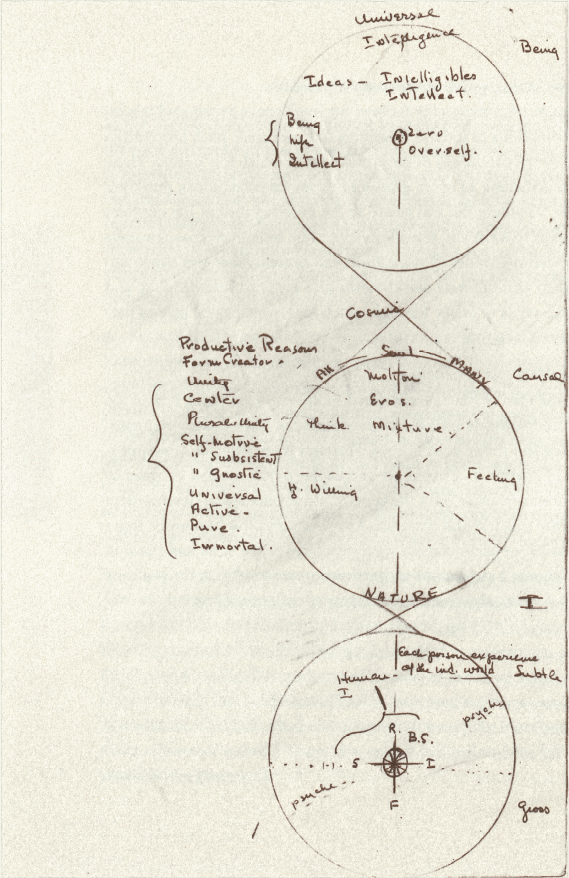
[FIGURE AD_G_012. Three Circles Diagram: Divine Intellect, Soul, Psyche. Bottom Circle: S F I R = Sensation Feeling Intuition Reflection; B.S. = Body Scheme; Ind. = Individual; Human I = Human Intellect. Facsimile scan of hand-drawn diagram by Anthony Damiani from Astronoesis, p. 166.]
Class
Sunday, September 29th, 1974
Student notes of a class/seminarWISDOM'S GOLDENROD, ALAN BERKOWITZ AND JEFF COX CLASS NOTES
(TYPED)
SEPTEMBER 29a, 1974
EPISTEMOLOGY; MENTALISM
TOPIC: Epistemology
SUBJECT: Mentalism
SUBSUBJECTS: Duality, Sense-Perception, World-Image, Illusion and Reality, Realism vs. Idealism, Plato's Cave, Projection, Dream Analogy, Belief, Consciousness
CONTENTS:
AD Epistemology Lecture (Paper) 1 (AB/JC class notes combined)
1) Primitive dualism of experience
2) We only know states of our own consciousness
3) Forgetting the mediated character of knowledge; naïve realist assumption
4) Unknown reality impinges on our senses; no known object until living being interprets
5) Substituting image for unknown reality
6) My image determined by thing/event in world of reality
7) No dualism between real world and my image of it
8) Dream analogy
9) Illusion: mistaking image for reality; image only relatively real
10) No progress on philosophic problems within image; our intellect bound to image
AB notes following paper:
Plato's parable of cave
Self-revealing nature of consciousness; consciousness as our real being
Realism vs. Idealism
Philosophy begins after image separated from real thing
Inner and outer image: difference in intensity only
World-Mind provides stimulus, individual mind provides actualization
No presentation without belief
The basis of our world in projection; dissolving projections to approach reality
Experience takes place within your consciousness; no contents, no "your"
JC notes following paper:
Jung's example of primitive
Plato's allegory of the cave; double circle
Nature of consciousness; diaphanous nature
PB: consciousness seems internal to thought, object seems external
Bhattacharyya's concept of psychic fact: modes of relatedness to subject
Self-reveals itself in every thought
Concentrate on consciousness/knowing
Jung example: projection and belief in independence
Realist equates image with reality
Potentiality of ideas
Liberation, continuing evolution
Dreamer's thinking split into sensible and intelligible; difference in intensity
Consciousness more real than image
Felt body; transformation into perception of space
Bhattacharyya: presentation as embodied belief; libido as belief
Force of belief in illusion
World-Mind provides stimulus, individual mind provides actualization
Difference between dream and vision
Vritti (world) contains subject-object, reveals/manifests consciousness
Enlarging consciousness of ignorance
Bindu
Necessity of belief in presentation; withdrawal of projections and approaching impersonality
Body is an image in consciousness
Nous is the real
BOOKS READ FROM OR REFERENCED:
J.J. van der Leeuw, The Conquest of Illusion
Immanuel Kant, Critique of Pure Reason
C.G. Jung, CW 8, The Structure and Dynamics of the Psyche, "General Aspects of Dream Psychology"
C.G. Jung, CW 13, Alchemical Studies, "The Spirit Mercurius"
Thomas Taylor (tr.), The Republic: A Dialogue Concerning Justice (Vol. 1), in The Works of Plato, viz. His Fifty-Five Dialogues, and Twelve Epistles
Paul Brunton, The Wisdom of the Overself
Krishnachandra Bhattacharyya, Studies in Philosophy, Vol. 2, "The Subject as Freedom"
Dharmendra Nath Shastri, Critique of Indian Realism: A Study of the Conflict Between the Nyaya-Vaisesika and the Buddhist Dignaga School
Edward C. Whitmont, The Symbolic Quest: Basic Concepts of Analytical Psychology
DIAGRAMS appended to these notes:
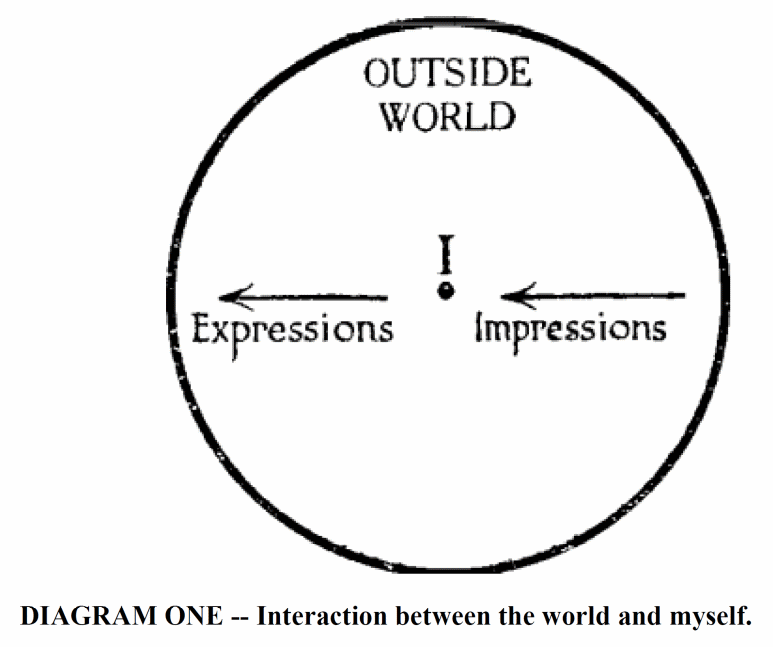
FIGURE 1974 0929a-1. Interaction Between the World and Myself.
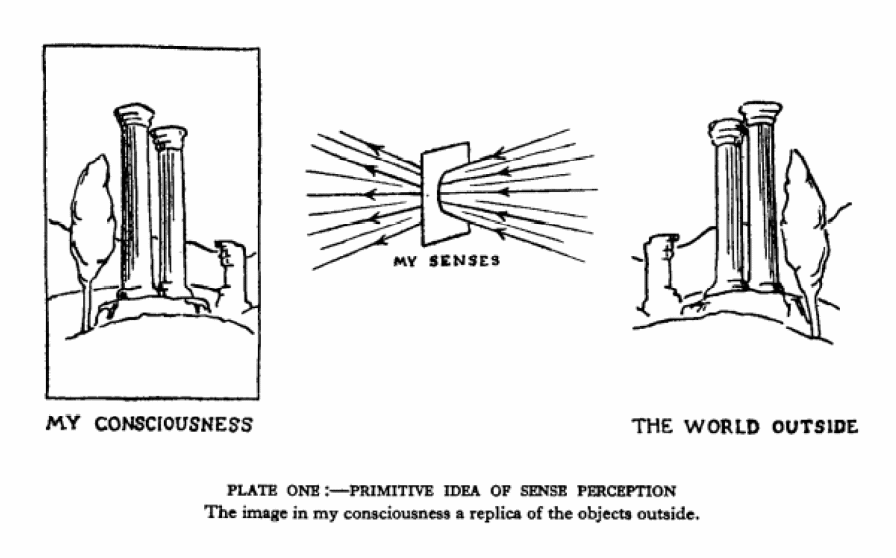
FIGURE 1974 0929a-2. Primitive Idea of Sense Perception.
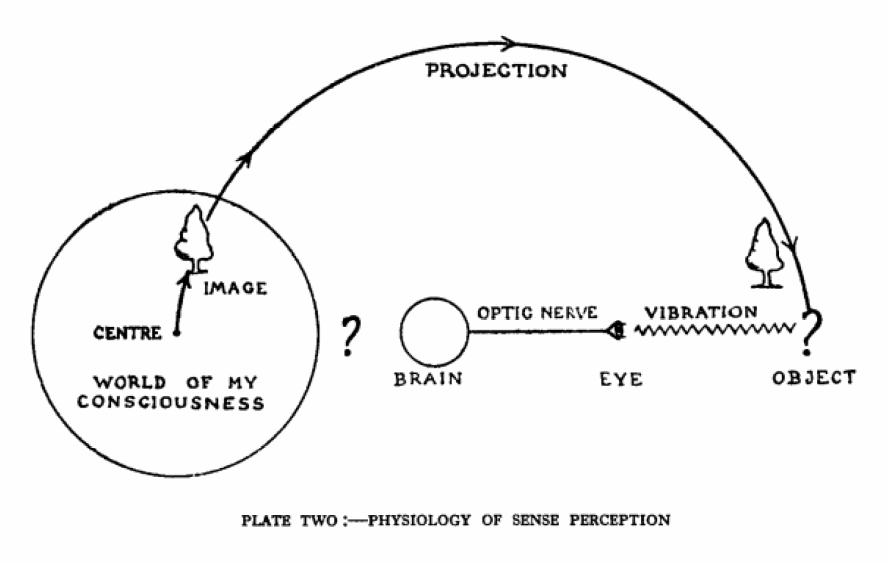
FIGURE 1974 0929a-3. Physiology of Sense Perception.
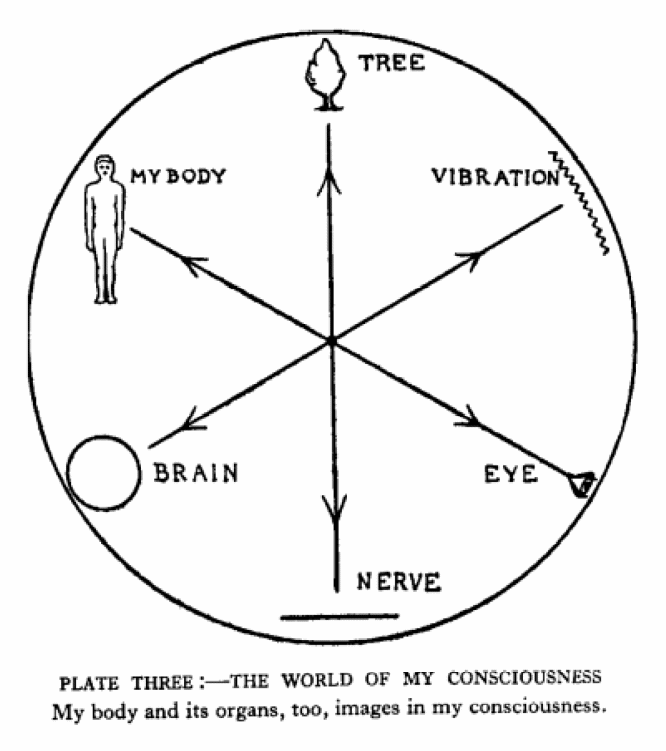
FIGURE 1974 0929a-4. The World of My Consciousness.
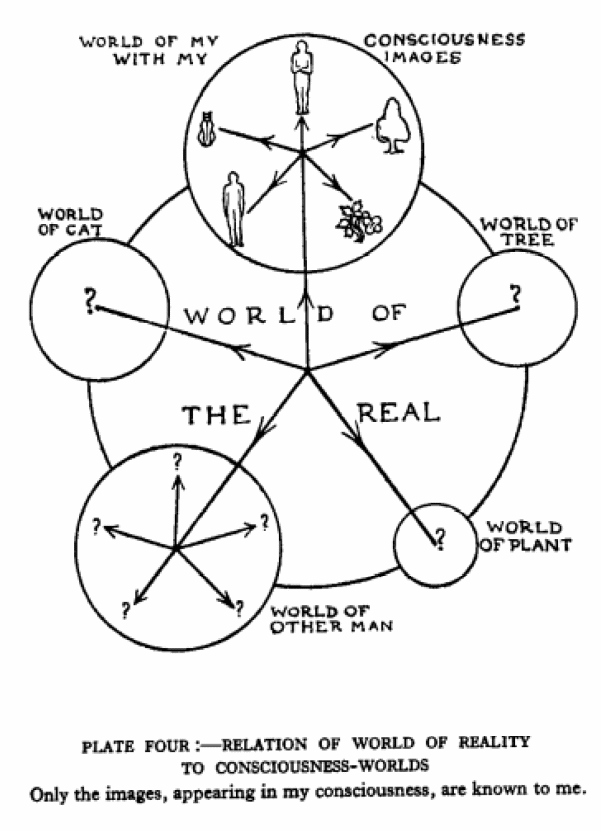
FIGURE 1974 0929a-5. Relation of World of Reality to Consciousness-Worlds.
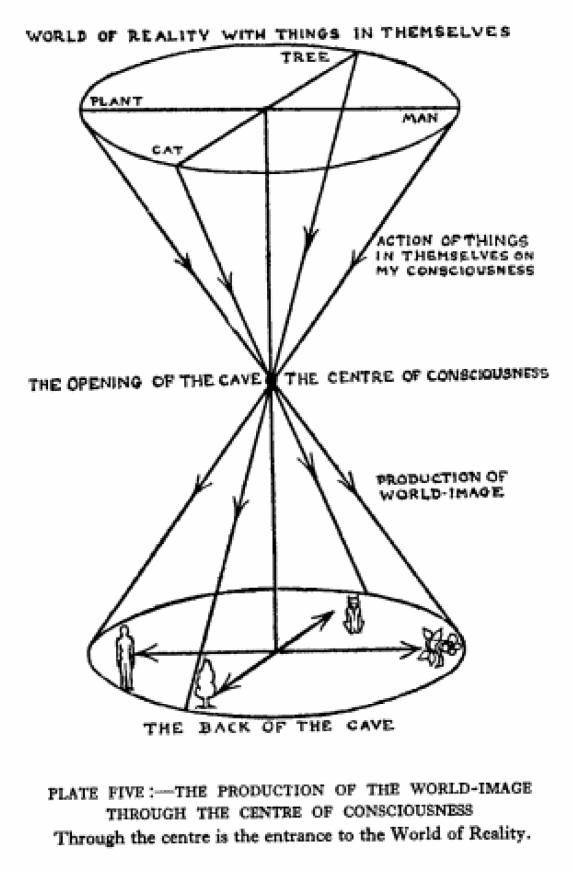
FIGURE 1974 0929a-6. The Production of the World-Image Through the Centre of Consciousness.
FIGURE AD_G_012. Three Circles Diagram: Divine Intellect, Soul, Psyche.
Other diagrams also referred to not with this version.
AD PAPER read in class:
- Abridgment of J.J. van der Leeuw's Conquest of Illusion, Chap. 2 and first paragraph of Chap. 3. Retyped as 1974 0929b V09BN. Epistemology - Mentalism.
TYPED AND REFORMATTED by IT 2024
NOTES:
RETYPED STUDENT NOTES (hence V08). From Alan Notes 3 1973 TO 1975 psyche and soul.PDF and Jeff Cox Notes.
This is 1974 09/29a, Epistemology; Mentalism Class, and the first entry associated with this date. 1974 09/29b = Epistemology; Mentalism Book Notes.
This is the first of five classes in the 1974 "Epistemology Review" series. See also WG Classes (and related papers) 1974 1006(a, b), 1013(a, b), 1020(a, b), and 1027(a, b).
Tony = Anthony Damiani (AD).
All spelling, capitalization, and punctuation corrected, abbreviations spelled out.
1974 09/29a at Wisdom's Goldenrod
Epistemology; Mentalism
[Alan Notes 1974 0929 Begin]
9/29/74 Epistemology Review - 1
Paper 1
Primitive dualism of our experience -- objects outside and inner world of consciousness -- unreflective, and basic to all our experience and thinking. Absolutely fundamental. [Note: See FIGURE 1974 0929a-1, Interaction Between the World and Myself, appended to these notes.]
All I really know are the inner states. Objects exist only by virtue of my awareness of it. All we really know is a state of consciousness which corresponds in some way to the object. The inner world is known directly, everything else is derived through it. All we have is consciousness of images. That consciousness is the intermediary between us and the objects.
We forget the mediated character of our knowledge and assume that the image produced in our consciousness by the tree that is equals the real tree. The two are not identical. No one can call his world the world. Naïve realist assumes that the image in my consciousness is an exact duplicate of the object. All our thinking is based on this unconscious assumption.
Insofar as the senses do interpret the world, they do so faithfully. The objects we see around us are exactly as we are aware of them (according to realist). [Note: See FIGURE 1974 0929a-2, Primitive Idea of Sense Perception, appended to these notes.]
There is no green tree until a living being interprets -- until we reach the conscious stage. Some unknown reality which reacts on our senses produces the awareness of green tree in our consciousness, but there is nothing to show that this unknown reality in any way looks like a green tree. It may be a point, containing certain properties in it which, reacting on human consciousness, produce the same properties each time (bindu).
We substitute the image produced in our consciousness for the unknown reality without and make believe that we are perceiving what is really only an image produced in our consciousness. We think that we are perceiving as an objective reality that which we are projecting as an image in our consciousness. We clothe the unknown with the image produced in our consciousness. [Note: See FIGURE 1974 0929a-3, Physiology of Sense Perception, appended to these notes.]
All we know of the things in themselves are the images produced by them in our consciousness (include the eye, nerves, brain, body, etc.). [Note: See FIGURE 1974 0929a-4, The World of My Consciousness, appended to these notes.] The relation of an image to an unknown reality is the same for all. They all belong to the world of unknown reality without which produces in our consciousness that image which we call the world, but which is only our world image. [Note: See FIGURE 1974 0929a-5, Relation of World of Reality to Consciousness-Worlds, appended these notes.] My image is determined in principle by that reality of "things in themselves". (You see a green, not purple tree.) Every phenomenon in my world image is intimately and continually connected with a very real thing or event in the world of reality, and the fact that I may cease to produce that image of reality in no way affects that reality. [Note: See FIGURE 1974 0929a-6, The Production of the World-Image Through the Centre of Consciousness, appended to these notes.]
Our perception is determined. There is a world of the real which, through my consciousness, produces the different images of it. Each creature knows only its own world image produced in its consciousness. The image is the event as we see it, but not as it is. [Note: See FIGURES 1974 0929a-5, Relation of World of Reality to Consciousness-Worlds, and 1974 0929a-6, The Production of the World-Image Through the Centre of Consciousness, appended to these notes.]
There is not a dualism between the real world and my image of it. Only one event takes place -- the event in the real world.
Illusion lies in the fact that I take my image to be the thing-in-itself and escalate it into an independent reality -- independent of my consciousness of it.
My image is only relatively real -- real for me. There is a world of reality which is one -- we divide it to talk about it.
If you work from within this image -- with the fundamental dualistic assumption -- you cannot progress or answer philosophic questions. We are slaves to that world image which is our own creation. Our intellect is bound to that image.
[Note: Paper 1 ends here.]
Parable of the Cave -- [Note: See Thomas Taylor (tr.), The Republic: A Dialogue Concerning Justice, Book VII, in Volume 1 of The Works of Plato, viz. His Fifty-Five Dialogues, and Twelve Epistles.]
The image is in your consciousness. What is consciousness? It is what you are. There is no interval between you and it. Without consciousness we cannot speak of anything.
Psychic is the modes of relatedness of the presentation to the undefined object.
The self reveals itself in every thought. The consciousness that reveals the image is self-revealing. It is your real being -- it has clear, unclouded vision.
Realism -- world of objects exist independent of us; world of objects exist in the form that we see them.
Idealism -- world of objects does not exist independent of us.
Realist equates image of tree with real tree. [Note: See FIGURE 1974 0929a-2, Primitive Idea of Sense Perception, appended to these notes.]
You inner world (of images) coincides with, but does not equal the real world.
Philosophy begins after you separate the image from the real thing.
The image that appears external (tree) and my thought about it only differ in intensity -- not in essence. They are both thought -- mental. I and not-I (inner and outer images) are inseparable.
We are forced to experience an object by the World-Mind's stimulus. But the actualization of that object belongs to us as individuals.
Presentation implies belief. Without belief it would not appear.
The basis of your world is the relationship that projection sets up. Break that projection and you get closer to the world as it is.
You have to project the image to experience it. But you must realize -- like upon waking from a dream you see the dream was within you -- that it all takes place within your consciousness. When you wipe out all contents from that consciousness you also wipe out the yours.
[Alan Notes 1974 0929 End]
[JC Notes 1974 0929 Begin]
9/29/74 Epistemology Review - Tony
There's two worlds, outside and inside, and somehow we straddle both of them.
[Note: Paper 1 begins here.]
We will start with the primitive dualism suggested by our un-reflective prejudice.
On the one hand we have the external world of objects, events, persons, etc. On the other is the world within, the world of consciousness, which we associate with our vital throb, our livingness, ourselves.
You assume it so readily that every now and then you have to stop and pause and ask if you have such an inner world. Nightmares remind you. These two worlds are a bifurcation of a transcending unity but we don't know that.
This is the fundamental structure of our daily life -- a duality which we never doubt, the outer and inner. The worst part of it is that it enters into every thought we have and every question we ask presupposes it without our ever being conscious of it.
The universe seems bifurcated, the world of consciousness within (observation); the world of appearances (perception) without. [Note: See FIGURE 1974 0929a-1, Interaction Between the World and Myself, appended to these notes.]
With regard to the former there can be no doubt -- the fact that we are (I think implies I am). Metaphysics reverses it and says I am, therefore I can think.
Ordinarily all I know is an ever unceasing, weaving, ever flowing modification of my inner life, of my very being or state of consciousness and I know nothing but these states of consciousness. Nothing, neither an idea or an object exists for me unless I am first aware of it.
It is difficult to realize this simple fact that when we say we know a thing (sense object or idea) all that we really do know is a state of consciousness corresponding in some way to the object or the idea. We live, move and have our being in this inner world of our consciousness and it is the only world we know directly. All else we know through it. All our knowledge except that of our own consciousness is derived knowledge. We experience an awareness in our consciousness and then derive the existence of something that has produced the awareness.
Our relation to the appearance side of our universe is very different from our relation to the consciousness side of it. We know the latter directly, it is the very nature of our inner being…the external world we know indirectly.
We can't doubt that we are aware of things and experiencing modifications of consciousness. But we must carefully scrutinize our conclusions about the objective world which produces the perceptions in our consciousness about which we have no doubt. We have to be careful in saying that what we see is what caused the modifications in our consciousness.
For most of us, we are perfectly at ease about the universe even though it is a derived knowledge (not as immediate as your own conscious state). This is where philosophy begins. You must be able to distinguish derived knowledge (knowledge inferred from your states of consciousness and your states of consciousness; you can't go on - except to become a good materialist). You must focus on your inner life. All we have is a consciousness of images -- this is immediate, direct. The ground we stand on is more real to us than the consciousness within (the consciousness that we have of the thing). Yet we only know that ground in and through our consciousness. If you wipe our your consciousness you wipe out the world with it. We forget all about our consciousness as intermediary between ourselves and the object and look upon our awareness in our consciousness as identical with the object itself. The tree which we see is but the image produced in our consciousness by the tree which is and the two are not identical.
From the standpoint of reality no one has a right to call his world the world -- it is his world and nothing more, his selective interpretation of reality.
This is the ordinary conception used by the unreflective majority. To these people the image in my consciousness is a duplicate of the object outside. If we had different senses it would be obvious that the worlds would be different.
Again, we may have to fall back (materialists usually do) and say that our senses, in so far as they interpret the world, they interpret it faithfully. The objects we see around us are exactly as we are aware of them. [Note: See FIGURE 1974 0929a-2, Primitive Idea of Sense Perception, appended to these notes.]
But even a superficial study of physiology of sense perception will break this down. (Physiology can't account for color.) [Note: See FIGURE 1974 0929a-3, Physiology of Sense Perception, appended to these notes.]
There is no green tree until the living creature interprets it (i.e. until we reach the conscious stage).
There is no doubt that some unknown reality which re-acts on our senses and somehow produces in our consciousness the awareness of the green tree and will produce it each time it reacts on our consciousness. But there is nothing to show that this unknown reality in any way looks like a green tree. For all we know it may be a point (bindu) having within itself certain properties which reacting on human consciousness produce the same reactions (effect) over and over.
We, however, substitute the image produced in our consciousness for the unknown reality without and make believe that we are perceiving as an objective reality that which we are projecting as an image in the world of our consciousness.
We clothe the unknown with the image produced in our consciousness.
(The dream idea in manifest dream content -- former is an idea, spaceless; the latter requires extension, it has sensible qualities. What color is the idea?)
It is clear that all we know of the realities without or things in themselves are the images produced by them in the world of our consciousness. Include with that the eye, nerve, brain, etc. The relation of image to an unknown reality is the same for all. [Note: See FIGURES 1974 0929a-4, The World of My Consciousness, and 1974 0929a-5, Relation of World of Reality to Consciousness-Worlds, appended these notes.]
They one and all belong to the world of unknown reality without (objective psyche) which produces in our consciousness that image which we call the world…but which is only our world image. Our physical body as we know it is also an image produced in my consciousness by an unknown reality. What I take to be an objective world is only the world image produced in my consciousness.
This world image produced in my consciousness is determined in its character by the nature of the things in themselves; it is my interpretation of them, partial, imperfect, but not containing anything which is not determined in principle or essence by the thing itself. The production of your world image is highly determined (your tree is green and not purple). Every phenomena in my world image is ultimately and continually connected with a very real thing (Kant's things-in-themselves) or event in the world of reality and the fact that I might cease to produce a world image in my consciousness doesn't affect for a moment the real world. [Note: See FIGURE 1974 0929a-6, The Production of the World-Image Through the Centre of Consciousness, appended to these notes.]
There is a world of the real which through my consciousness produces the different images in it.
In the parable of the cave the people are up against a wall and can't turn their heads around and they have to look forward. All they see is shadows flickering out there and these shadows for them is the real thing.
In each person's consciousness a world image is produced by the action of things in themselves in that particular consciousness.
Each creature knows only its own world image. [Note: See FIGURE 1974 0929a-5, Relation of World of Reality to Consciousness-Worlds, appended to these notes.]
When therefore an event takes place in this world of reality there is produced in this consciousness of each creature an image which is the event as we see it. The dichotomy of me and my world is now transformed to my world and the archetypes of that world.
Do not misunderstand this -- only one event takes place and that is the event as it is in the real world -- not your interpretation of it. But my knowledge of the event, the way it presents itself in my world image, is my interpretation of the real event and that is only relatively real--real for me--not real in itself.
My version of this event is broken up (factored out) in the rhythms of time and space and a bunch of qualities. I externalize or project the event in itself -- and that externalized image becomes for me the event itself. [11] Illusion doesn't reside in the event or the thing itself -- nor even in my interpretation of it which is true enough for me, but in the fact that I take the interpretation to be the thing in itself exalting (escalating) it to an independent reality (i.e. exists in itself as it appears) (also depriving it of infinity). The real world (anima mundi) is necessarily the same for all beings -- the interpretations differ. [Note: See FIGURE 1974 0929a-5, Relation of World of Reality to Consciousness-Worlds, appended to these notes.]
Dream analogy: You have an idea and go to dream which is the idea. If you compare the idea with the manifest dream the idea has no sensible qualities, it has the form of time (thoughts follow each other) but no space. The idea contains all the scenes integrally. The idea has a will of its own, is dynamic. The idea = the thing itself. The manifest dream in terms of content is utterly unlike the seed idea. Tony wants to split the situation in two. You must realize the difference between your world of consciousness and that of which you're conscious of.
In our diagram it should be clear how through our consciousness all things are as it were turned inside out (it is the nature of our psychology to do that) -- no, cut up -- [Note: See FIGURE 1974 0929a-6, The Production of the World-Image Through the Centre of Consciousness, appended to these notes.] instead of being aware that they act on us from within we look upon the image we have produced and wonder how it influences us from without. It has become a fatal habit.
The world is real (empirically). There is nothing unreal about a chair, tree, i.e. the physical world in itself are one and are as real as I am myself am. What I usually call the table, etc., is the image produced in my consciousness by the object as it exists in the world of the real and these images are only relatively real -- (for me). When I look upon this image as an outside reality and identify it with the thing in itself that illusion enters. Then in contemplating my image I believe myself to be handling the thing itself, the illusion is neither in the thing itself, nor the image produced in my consciousness of the thing but in my conception of the image in my consciousness as the thing in itself, as an object existing independent of my consciousness.
There is a world of reality (we may divide it into levels). It is essentially one world -- the only one. The levels exist as distinctions in our understanding -- the real world in itself doesn't have any distinctions. The shadow play is all we know but we identify it as the Real and look upon it as reality independent of our consciousness and standing outside us, that is the great illusion.
The tree in the Real World is not 100 feet high, not green, etc. All these qualities are my interpretation of the pole itself. In the real world it may be just a point (bindu) but there is that within it which, each time it reacts upon me, produces in my world image a certain group, permutation, combination of these qualities. My particular constitution as a human being causes me to produce just this type of image. The same tree in itself produces a different image in other creatures. [Note: See FIGURE 1974 0929a-5, Relation of World of Reality to Consciousness-Worlds, appended to these notes.]
The fundamental illusion which considers my world image as an independent reality -- my image of the tree as if it were the tree itself, and with it time and space and qualities to be independent realities existing there outside of me. Having objectivated and separated from my consciousness that which is a part of it (creates big and impossible problems). The beginning of philosophy must be a clear understanding and even experience of the relation of the I and its world image and to the world of the real. [Note: Van der Leeuw has "That is why the beginning of philosophy must be a clear understanding and even experience of the relation of our world-image to ourselves and to the world of the Real."]
No philosophic problem can be approached from within the world image (from the fundamental dualism).
We and our intellects are bound to our own world image; slaves of our own creation. We forged the chains that bind us (through various psychological qualities - attachment). Our true being in the world of the real functioning with clear vision (there, what we really are functions without error and it knows what it's doing and it's doing it). On the other hand this externalization in our own world image, our intellect is bound to the grand illusion.
We must realize that our physical body too is also an image produced in my consciousness by an unknown reality.
[Note: Paper 1 ends here.]
Tony's Notes not read in class: The Jungian example of a primitive who heard the tree speak to him -- vestiges of archaic identity or participation mystique -- the example would the differentiation and isolation of the ego compiled from the mother -- use [11]. [Note: See C.G. Jung, CW 13, Alchemical Studies, "The Spirit Mercurius".] What he was formerly identified with (in Nature) and his separation therefrom [diagram currently unavailable] and now he thinks the tree is external to his knowledge and eventually he will differentiate himself from all thoughts and even the mind.
The Republic of Plato, Book 7, Vol. 1 - The Cave - Plato too used the double circle which can be folded over. [Note: See Thomas Taylor (tr.), The Republic: A Dialogue Concerning Justice, Book VII, in Volume 1 of The Works of Plato, viz. His Fifty-Five Dialogues, and Twelve Epistles.]
Whatever we want to become aware of must first go through my consciousness which has to be first supposed, a ripple goes through it and an image is there and now I perceive an objective reality (but it is in my consciousness). What is consciousness? It is diaphanous, you see it but you look right through it. In pain one knows consciousness in the most intimate way for it's almost a denial of the self. There is no interval between you and consciousness You identify the image of the tree in your consciousness with the tree. You say they are the same (naïve realist). Without consciousness there is no image. Consciousness is the vital, throbbing essence you call yourself. You can't see it, you can't grasp it. If we grant the materialists the fact that consciousness is an epiphenomena still he could only know it through that epiphenomena. Whatever he knows of the real world has to be an image in his consciousness, his world image.
PB -- Consciousness is what seems internal to thought (in mind of God) and the object seems external to thought. [Note: See Paul Brunton, The Wisdom of the Overself, "The Birth of the Universe," p. 38, Rider 1943 edition.]
[diagram currently unavailable]
What Bhattacharyya means by psychic is the relationship that the presentation has to the undefined object. The modes of relatedness to the subject is what he calls the psychic. [See Krishnachandra Bhattacharyya, Studies in Philosophy, Vol. 2, "The Subject as Freedom," Ch. 2, "Psychic Fact".]
[diagram currently unavailable]
You have to take the thought of which I am part of. You take this part of me which we call the subject, see it as a nucleation of this thought and within that nucleation is the pure consciousness which is going to manifest me (my ego complex and everything I'm going to work with). The self reveals itself in every thought.
You have to empty consciousness of all content and it has to become pure consciousness. By concentrating on consciousness you become aware of the inner being.
In the dream, dream Joe appears and has an experience with a dream object and we say all this is taking place within thought. The dream Joe too has an inner life and she says I'm experiencing this bear chasing me. Without dream Joe having in some way a feeling that she is that consciousness there could be no experience in that dream; you wipe out that whole outer world immediately as soon as you wipe out that inner consciousness. Consciousness is the most intimate part of us and in that consciousness an image of the world is produced which is not the world but our interpretation of it.
Consciousness is like a point (has no parts) and there is a ripple in this point and an image appears. Every time there is some sort of pulsation the imagery is changing in consciousness. Consciousness seems to have immersed itself into that imagery. You can dissect the contents from the consciousness to purify it. Consciousness is not an act. You have to get back to a point before the image of the body appears. Once that image of the body appears or any image, the identification with that image is there. You shouldn't focus attention on the object but on the knowing and you can't know knowing but that's the way to get to it.
In essay on dream psychology Jung gives a perfect example of how you project something and then believe it to be independent of yourself. [Note: See C.G. Jung, CW 8, The Structure and Dynamics of the Psyche, "General Aspects of Dream Psychology".]
Critique of Indian Realism, Shastri, p. 39. The realist equates the image of the tree in his consciousness with the real tree. [Note: See Dharmendra Nath Shastri, Critique of Indian Realism: A Study of the Conflict Between the Nyaya-Vaisesika and the Buddhist Dignaga School.]
The idea that becomes the dream could have many scenarios built around it. An idea always has the potentiality to execute what is intrinsic to its integral knowledge.
When you get to that one world you'll have all the time you need to explore it. Reaching here you're liberated -- some continue evolving etc. The Absolute isn't a skeptical logician.
The materialist says that the tree that is in your consciousness is the tree.
The one dreamer's thinking seems divided into a sensible manifestation of a tree and a manifestation of intelligibility or meaning or thinking. The difference is in the degree of intensity and not in the awareness per se. The I and the Not-I are split not in knowledge but in feelings.
My consciousness of the tree is more really me than whatever tree I talk about. My consciousness is the real in comparison to the world image. Asmita -- "it's my consciousness" -- when that's wiped out it's just consciousness When you say 'my' you have a content.
Feeling the body; an internal perception of the body as felt and the feltness of this internal perception will later on provide her with the feeling of space, it has to be body-based. The internal perception of the internal feltness of my body later on becomes transformed into my perception of space.
Consciousness is not objective. The object represents to you the consciousness objectified.
Bhattacharyya -- "Psychic fact is essentially presentation as embodied belief."
Tim: The presentation is the whole lower circle. [Note: See FIGURE AD_G_012, Three Circles Diagram: Divine Intellect, Soul, Psyche, appended to these notes.] and the facthood is the natural outcome of the belief in its reality.
Symbolic Quest -- Whitmont pp. 41, 42 [Note: Edward C. Whitmont, The Symbolic Quest: Basic Concepts of Analytical Psychology.]
Tim: Libido is that belief.
Tony: When we say the world is an illusion you see with what force you have to go on embodying belief in this illusion.
In the world image we start extracting the schematization behind it, the rules, the form, we derive concepts. The belief in the object (which is a presentation of the real 'object'). The presentation embodies my belief. The presentation is in the bottom circle and there only; it is the image in my consciousness. We are forced to experience the object through the stimulus of the World-Mind. But the actualization of that object belongs to as individuals. If there is presentation there is belief in it otherwise it will not appear.
In a dream if you become conscious that it's a dream, then it's a vision and not a dream. The conscious attitude can function now. It can't be filtered through the conscious attitude without altering it and therefore wouldn't be a dream in the pure sense of what a dream is.
The thoughts in God's mind (not as totally fixed but in becoming) each though (staccato-like) would be the whole world (a vritti). This vritti contains the subject and the object. This thought in God's mind reveals or manifests the consciousness. Just like your thoughts are manifested in and by consciousness and reveals itself in that even though it can't be grasped in an objective way. God manifests himself in this thought which is the universe for us and we are in that universe as a subject. Within that structure of thought which we call our personality also is consciousness manifesting itself, otherwise there would be no way out of universal manifestation and the supreme identity. The individual has seeping through it the consciousness which the Thought manifests. The Vedantists cut out all this malarkey and point that right within you is this pure principle of consciousness.
PB speaks about the possibility of enlarging our consciousness of our ignorance. Who else but God could do this? Not you and I.
The bindu is that in which the unmanifest reveals itself -- a center of consciousness. It does unfold itself in a scenario. That would be considering the Overself from the viewpoint of bliss.
When you start thinking of the shadows as the reality is when you get in trouble. That chart is your chart, your world of consciousness and the things that are happening are happening to you.
If there's a presentation it by necessity embodies our whole psychology and must be believed. You can't have a presentation without a projection (belief). The withdrawal of all your projections will produce a void. The world changes as you withdraw the archetypes and it gradually becomes more void, i.e., you're approaching impersonality. The projection into a presented object embodies not only your belief but also your world. The basis of your world is the relation that that projection sets up. When the projection dissolves the relation dissolves and you get closer to the world as it is and not as you imagine it to be. You have to believe in the dream otherwise you won't see any.
The body is an image in consciousness (which must be there first).
The Nous is the real.
[JC Notes 1974 0929 End]
1974 09/29a V08: NOTES: Epistemology; Mentalism. Copyright 2024 Wisdom's Goldenrod p. v