DIAGRAMS FOR 1974 0929b
Paper
Sunday, September 29th, 1974
Summary of a published workAbridgment of J.J. van der Leeuw's Conquest of Illusion, Chap. 2
by Anthony J. Damiani
Book Notes V09BN
3-LETTER CODE: EPI
TOPIC: Epistemology
SUBJECT: Mentalism
SUBSUBJECTS: Duality, Sense-Perception, World-Image, Illusion and Reality
ORIGINAL LOCATION & FILE NAME (of PDF used for typing): EPI lectures by Anthony P 15p.PDF (pp. 1-4)
CONTENTS:
Starting with dualism
We only know states of our own consciousness
So-called object is the image produced in our consciousness by the Thing-In-Itself
No one-to-one correspondence between Thing-In-Itself and image in our consciousness
Every phenomena in my world-image is intimately connected with a thing/event in the world of reality
Each creature knows only its own world-image
My knowledge of a thing/event in the real world is only relatively real
Illusion is taking the relative image to be the Thing-In-Itself; this has become a habit
Philosophy starts with a clear understanding and experience of the relation of our world-image to ourselves and to the world of the Real
No philosophic problem can be approached from within the world-image
BOOK QUOTED FROM:
- J.J. van der Leeuw, The Conquest of Illusion
DIAGRAMS appended to this paper:
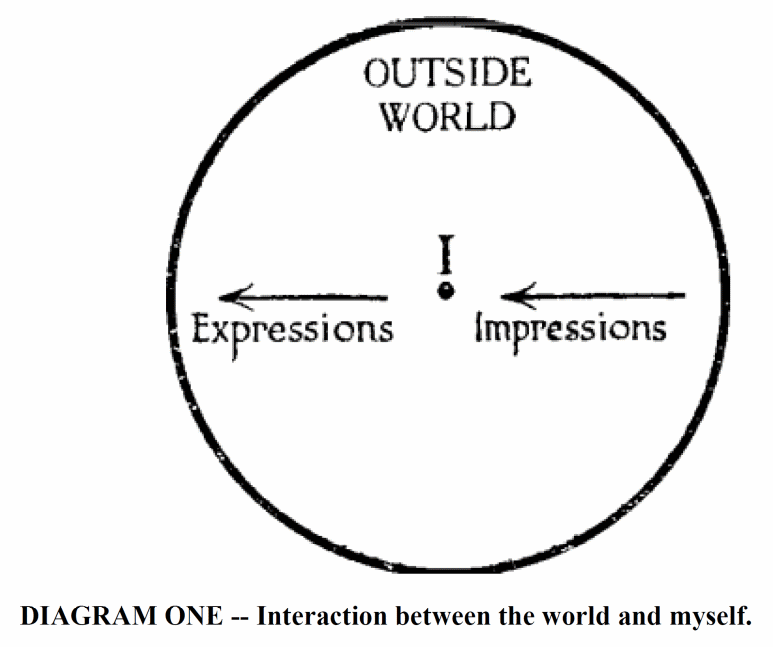
FIGURE 1974 0929b-1. Interaction Between the World and Myself.
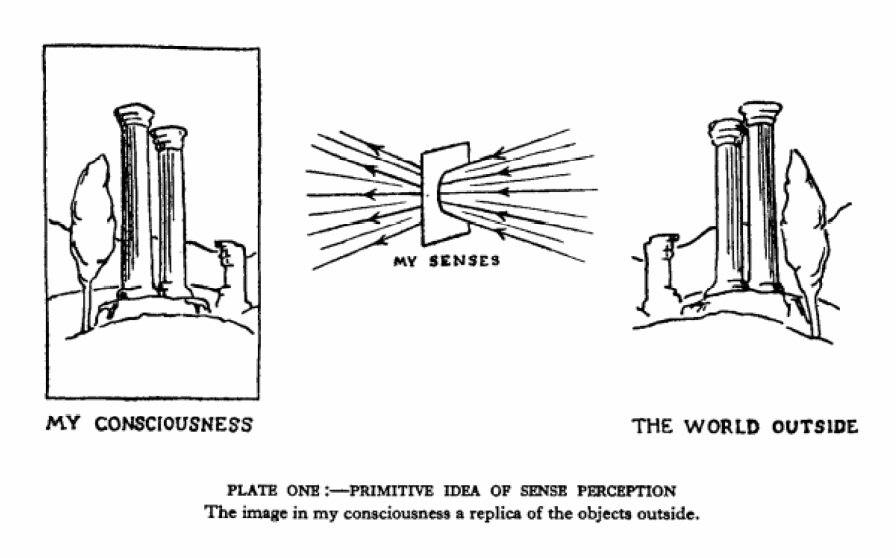
FIGURE 1974 0929b-2. Primitive Idea of Sense Perception.
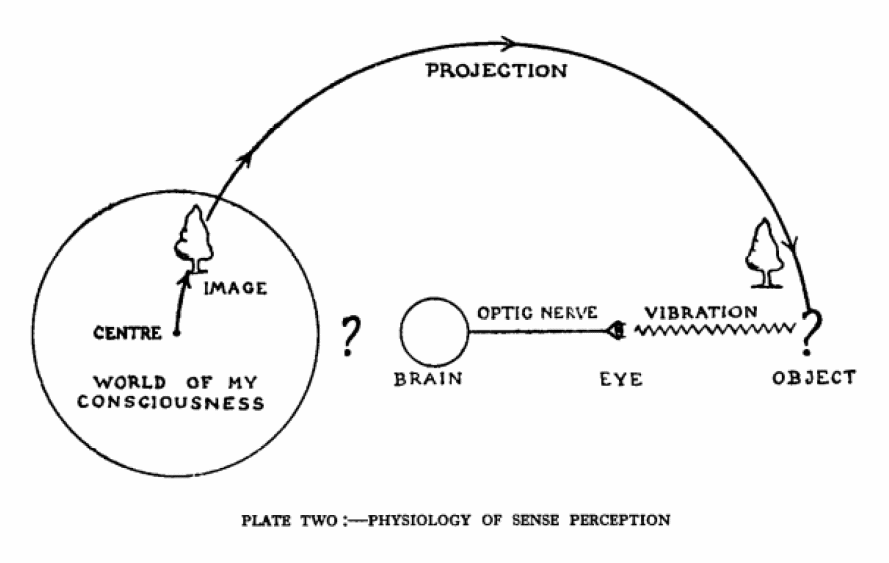
FIGURE 1974 0929b-3. Physiology of Sense Perception.
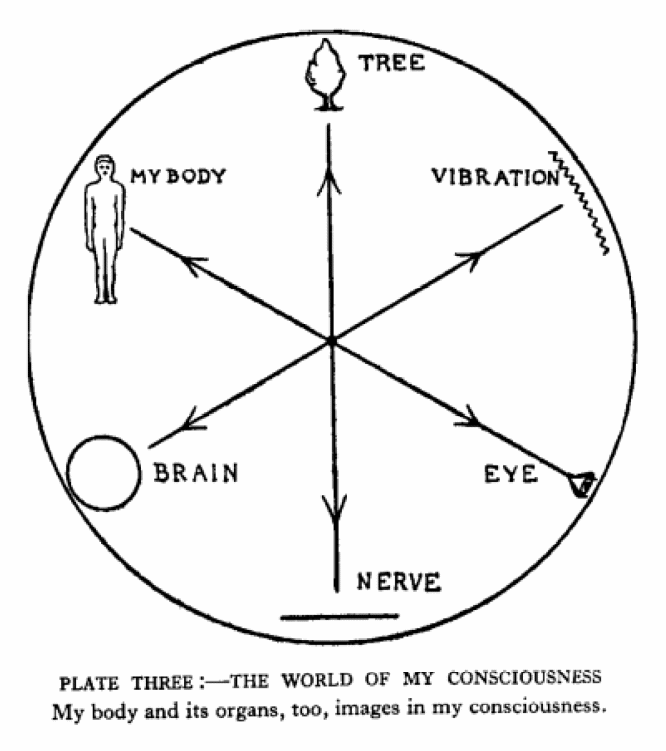
FIGURE 1974 0929b-4. The World of My Consciousness.
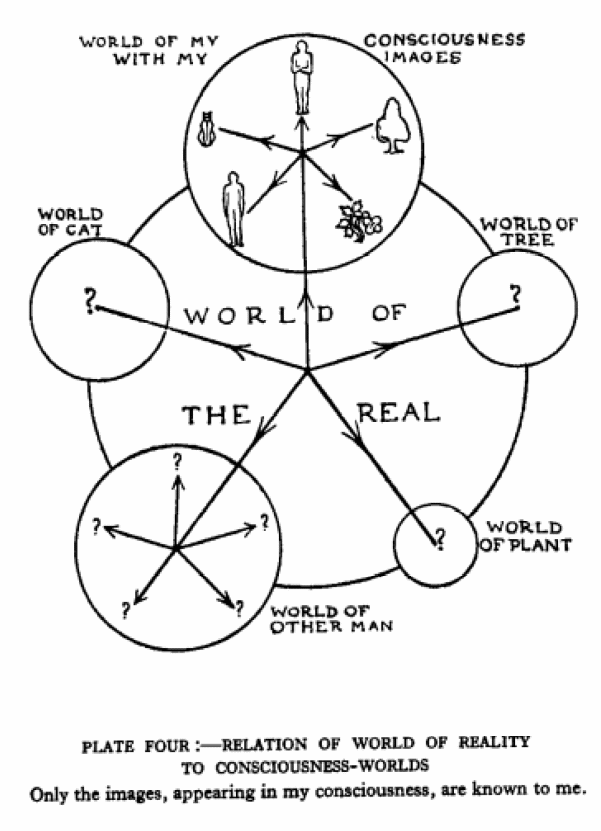
FIGURE 1974 0929b-5. Relation of World of Reality to Consciousness-Worlds.
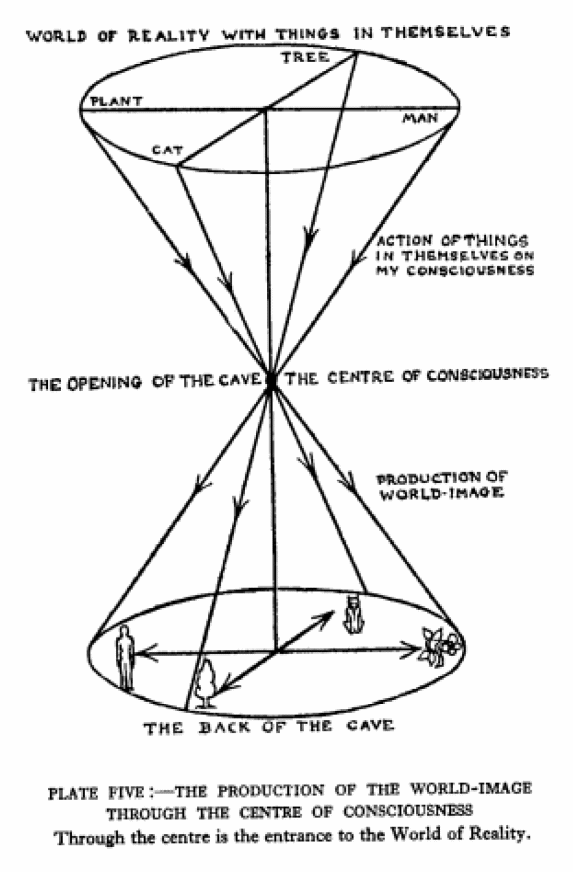
FIGURE 1974 0929b-6. The Production of the World-Image Through the Centre of Consciousness.
AD HANDWRITING: Typewriter typed, no AD edits
COMPLETENESS: Full Paper, abridgment of a chapter from a book
PUBLISHABILITY: No, already published
ALTERNATE VERSIONS: WG Class 1974 0929a (combined AB and JC notes)
DATE ASSOCIATED WITH THIS PAPER: 1974 0929
RETYPED, REFORMATTED, AND PROOFREAD by IT 2024
NOTES:
RETYPED BOOK NOTES presented in class (V09BN).
This is 1974 09/29b, Epistemology; Mentalism Book Notes, and the second entry associated with this date. 1974 09/29a = Epistemology; Mentalism Class.
This is an abridgment of most of Chapter 2 and the first paragraph of Chapter 3 of Conquest of Illusion by J.J. van der Leeuw.
These Book Notes are read and discussed in WG Class 1974 0929a, the first of five classes in the 1974 "Epistemology Review" series. See also WG Classes (and related papers) 1974 1006(a, b), 1013(a, b), 1020(a, b), and 1027(a, b).
All spelling and other errors have been corrected. Words in [square brackets] are insertions by IT from the book.
ABRIDGMENT OF J.J. VAN DER LEEUW'S CONQUEST OF ILLUSION, CHAP. 2
[File EPI lectures by Anthony P 15p.PDF (pp. 1-4) Begins]
EPISTEMOLOGY LECTURES: Lecture One
We will start with the primitive dualism suggested by our unreflective prejudice. [Note: See FIGURE 1974 0929b-1, Interaction Between the World and Myself, appended to this paper.]
On the one hand we have an external world of objects, events, persons, etc. And then another--within--a world of consciousness which we associate with our life, ourselves.
This is the fundamental structure of our daily life--a duality which we never doubt. The outer and inner. It enters into every thought we think, and every question we ask presupposes it without our ever being conscious of it.
So let us consider these two--this bifurcated universe of our experience. The vital, throbbing world of consciousness within, the world of appearances (perception) without, and see how we come to know them.
With regards to the former there can be no doubt… the fact that we are ('I think' implies 'I am').
Ordinarily all I know is an ever unceasing, weaving, everflowing modification of my inner life, of my very being or state of consciousness, and I know nothing but these states of consciousness. Nothing, idea or object, exists for me unless I am aware of it.
It is difficult to realize this simple fact that when we say we know a thing whether as sense perception or idea, all that we really do know is a state of consciousness corresponding in some way to the object or idea. We live, move and have our being in the world of consciousness and it is the only world we know directly. All else we know through it. All our knowledge except that of our own consciousness is derived knowledge. We experience an awareness in our consciousness and thence derive the existence of something that has produced the awareness.
Our relation to the appearance side of our universe is very different from our relation to the conscious side of it. The last we know directly, it is our very being… the other indirectly.
We can't doubt that we are aware of things and are experiencing modifications of consciousness but we must carefully scrutinize our conclusions about the objective world which produces the perceptions in our consciousness. These latter are indubitable.
We feel perfectly at ease about the universe even though it is a derived knowledge… and somewhat uncertain as to the world of consciousness within. The ground we stand on is more real to us than the consciousness within. Yet we only know that ground in and through our own consciousness. We forget all about our consciousness as intermediary between ourselves and the object and look upon our awareness in our consciousness as identical with the object itself. The tree which we see is but the image produced in our consciousness by the tree which is, and that the two are by no means identical.
From the standpoint of reality, no one has a right to call his world the world -- it is his world and nothing more, his selective interpretation of reality.
Again, we may fall back and say that our senses, in so far as they do interpret the world, they interpret faithfully. The objects we see around us are exactly as we are aware of them. [Note: See FIGURE 1974 0929b-2, Primitive Idea of Sense Perception, appended to this paper.]
But even a superficial study of physiology and sense perception will break this down. [Note: See FIGURE 1974 0929b-3, Physiology of Sense Perception, appended to this paper.]
There is no green tree until the living creature interprets it. For there is no green tree until we reach the conscious stage.
There is no doubt that some unknown reality which reacts on our senses and somehow produces in our consciousness the awareness of the green tree and will produce it each time it reacts on our consciousness. But there is nothing to show that this unknown reality in any way looks like a green tree. For all we know it may be a point (bindu) having within itself certain properties which reacting on human consciousness produce the same effects.
We, however, substitute the image produced in our consciousness for the unknown reality without and make believe that we are perceiving the self-same green tree which is the image produced in our consciousness.
We think we are perceiving the self-same green tree which is the image produced in our consciousness, that is to say, we think we are perceiving as an objective reality that which we are projecting as an image in the world of our consciousness. [Note: See FIGURE 1974 0929b-3, Physiology of Sense Perception, appended to this paper.]
We clothe the unknown with the image produced in our consciousness. It is clear that all we know of the realties without or things in themselves are the images produced by them in the world of our consciousness. Include with the things in themselves the eye, retina, nerve, brain, etc. The relation of image to an unknown reality is the same for all. [Note: See FIGURES 1974 0929b-4, The World of My Consciousness, and 1974 0929b-5, Relation of World of Reality to Consciousness-Worlds, appended this paper.]
They one and all belong to the world of unknown reality without (objective psyche) which produces in our consciousness that image which we call the world… but which is only our world image.
What I take to be an objective world is only the world image produced in my consciousness.
The world image produced in my consciousness is determined in its character by the nature of the things in themselves, it is my interpretation of them, partial and imperfect, but not containing anything which is not determined in principle or essence by the thing in itself. Every phenomena in my world image is intimately and continually connected with a very real thing or event in the world of reality, and the fact that I might cease to produce a world image in my consciousness doesn't affect for a moment the real world. [Note: See FIGURE 1974 0929b-6, The Production of the World-Image Through the Centre of Consciousness, appended to this paper.]
There is a world of the real which through and in my consciousness produces the different images in it. In each person's consciousness a world image is produced by the action of things in themselves in that particular (ahamkara) consciousness.
Each creature knows only its own world image. [Note: See FIGURES 1974 0929b-5, Relation of World of Reality to Consciousness-Worlds, and 1974 0929b-6, The Production of the World-Image Through the Centre of Consciousness, appended to this paper.]
When therefore an event takes place in this world of reality there is produced in the consciousness of each creature an image which is the event as we see it.
Do not misunderstand this. Only one event takes place and that it the event as it is in the real world. But my knowledge of the event, the way it presents itself in my world image, is my interpretation of the real event and that is only relatively real--real for me--not real in itself.
My version of this event is broken up (factored out) into the rhythms of time and space and a bunch of qualities. I externalize or project the event in itself -- and that externalized image becomes for me the event itself. Illusion doesn't reside in the event or thing itself -- nor even in my interpretation of it which is true enough for me, but in the fact that I take the latter to be the thing in itself and exalting it to an independent reality (and also depriving it of infinity). The real world (anima mundi) is necessarily the same for all beings -- the interpretations differ. [Note: See FIGURE 1974 0929b-5, Relation of World of Reality to Consciousness-Worlds, appended to this paper.]
In our diagram it should be clear how through our consciousness all things are as it were turned inside out--cut up. [Note: See FIGURE 1974 0929b-6, The Production of the World-Image Through the Centre of Consciousness, appended to this paper.] Instead of being aware that they act on us from within we look upon the image we have produced and wonder how it influences us from without. It has become a fatal habit.
The world is real (empirically). There is nothing unreal about a chair, table, tree or stone, i.e, the physical world. In itself, the chair, stone, etc, are one and all as real as I am myself. What I usually call table, etc. is the image produced in my consciousness by the object as it exists in the world of the real, and these images are only relatively real (for me). When I look upon this image as an outside reality and identify it with the thing in itself, that illusion enters. Then in contemplating my image I believe myself to be handling the thing itself. The illusion is neither in the thing itself, nor in the image produced in my consciousness of the thing, but in my conception of the image in my consciousness as the thing in itself, as an object existing independent of my consciousness.
There is a world of Reality (we may divide it into levels). It is essentially one world, the only one. The shadow play is all we know but we identify it [as] the Real and look upon it as a reality independent of our consciousness and standing outside us. That is the great illusion.
The pole in the real world is not 100 feet high, not green, etc. All these qualities are my interpretation of the pole itself. In the real world it may be just a point but there is that within it which, each time it reacts upon me, produces in my world image a certain group of qualities, sounds, etc. My particular constitution as a human being conditions, forms, causes me to produce just this type of image. The same tree in itself produces a different image in other creatures. [Note: See FIGURE 1974 0929b-5, Relation of World of Reality to Consciousness-Worlds, appended to this paper.]
[Because of] the fundamental illusion which considers my world image as an independent reality [I come to look upon] my image of the tree as if it were the tree itself, and with it [I assume] time and space and qualities to be independent realities existing there outside me. Having objectivated and separated from my consciousness that which is a part of it, I create big problems. The beginning of philosophy must be a clear understanding and even experience of the relation of the I and its world image and to the world of the real. [Note: Van der Leeuw has "That is why the beginning of philosophy must be a clear understanding and even experience of the relation of our world-image to ourselves and to the world of the Real."]
No philosophic problem can be approached from within the world image.
We and our intellects are bound to our own world image, slaves of our own creation. Our true being in the world of the real functioning with clear vision and, on the other hand, this externalization in our own world image, bound to the grand illusion.
[File EPI lectures by Anthony P 15p.PDF (pp. 1-4) Ends]
1974 09/29b V09BN: BOOK NOTES: Epistemology; Mentalism. Copyright 2024 Wisdom's Goldenrod p. iii