Class
Sunday, October 13th, 1974
Student notes of a class/seminarWISDOM'S GOLDENROD, ALAN BERKOWITZ AND JEFF COX CLASS NOTES
(TYPED)
OCTOBER 13a, 1974
EPISTEMOLOGY; PERCEPTION AND EXISTENCE
TOPIC: Epistemology
SUBJECT: Perception and Existence
SUBSUBJECTS: Realism vs. Idealism, Srishti-Drishti vs. Drishti-Srishti, Avidya, Maya, Superimposition, Projection
CONTENTS:
AB class notes
AD Paper 3A: the Realist vs. Vedantist debate (Malkani)
1) The Realist position: knowledge is of the real, which exists prior to and independent of knowledge
2) The Vedantist reply: nothing can be known apart from its "knownness"; independence belongs to the perceiving activity, not the object
3) Knowing creates the appearance of prior existence, otherness, and reality — appearance is created, existence is not
4) Creation happens only through perception
5) Cancellation shows all perception illusory; relativity of every viewpoint
The four elements of knowledge: the real, the subject, the mind's functioning, the object
AD Paper 3B: Srishti-Drishti vs. Drishti-Srishti (C. Bhattacharya)
1) Brigand-in-the-bush example: no pre-existent object as precondition of knowledge
2) Causality as mythology arising from the myth of the independent object
All you know is yourself (your soul) — why this is not solipsism
Knowledge as the soul's organ for self-discovery
Avidya as progressive self-realization
The cone-plane diagram: mistaking one cross-section for reality
Libido, projection, and suffering (Jung, CW 8); "locked in the four walls of thought"
The snake as vritti; Brunton on knowing only our mental reactions (Hidden Teaching)
JC class notes
AD Paper 3A: the Realist's successive arguments
1) Round 1: Prior existence — the Vedantist shows existence is only ever simultaneous with knowing
2) Round 2: "Knowledge reveals the self-existent" — dismissed as begging the question
3) Round 3: Knowledge as accepting (not making) an object — countered by the mediated nature of perception (sense-perception diagram)
4) The subtle creativity of sense knowledge: implanting otherness, independence, and reality into the object
5) What knowledge does: makes the object known, enlightens the subject, imports the character of prior existence
6) Drishti-Srishti: "I perceive, therefore the world exists"; Srishti-Drishti: "The world exists, therefore I perceive"
7) Creation happens only through perception
8) Cancellation shows all perception illusory; relativity of every viewpoint
Dream analogy for projection; illusion of otherness; Samkhya's "two ends of a stick"
The four elements of knowledge; universals vs. the thing itself
AD Paper 3B: the S.D.–D.S. debate in detail
1) S.D.'s common-sense claim: the object is independent of the knowing act
2) D.S.'s reply: object and act neither differ nor precede one another
3) S.D.'s fallback: the transcendental knower grounding the world — "everything in the mind of God"
4) D.S. replies to the realist objections: no evidence for unperceived objects; cognition needs no external object (the dream contains subject, object, and relation within one thought)
5) S.D.'s objections from identity, persistence, and the sense organs; D.S.'s charge of circularity
6) The unknown object as the Absolute concealed by maya; avidya wipes itself out
7) The two doctrines as expressions of the Advaita fundamental: three grades of reality (S.D.) vs. two (D.S.)
8) PB's position: world-forces actualized by us — ultimately all is knowledge
The third view (Ajati): no creation at all — Ramana's "what world?"
Knowledge as the soul's organ for self-discovery; why you shouldn't "feel poorer" if the object is within you
Withdrawal of libido: why introversion frightens us; living in both worlds (PB)
The self-canceling snake: if the illusory object can't exist, neither can the function that created it (Atmananda, Atma Nirvritti)
BOOKS / ARTICLES READ FROM OR REFERENCED:
G.R. Malkani, "Examination of the Main Realistic Argument" (in Philosophical Quarterly 24, 1952)
Chandrodaya Bhattacharya, "The Theories of Drishti-Srishti and Srishti-Drishti" (in Philosophical Quarterly 26, 1953)
C.G. Jung, CW 8, The Structure and Dynamics of the Psyche
Paul Brunton, The Hidden Teaching Beyond Yoga
Paul Brunton, The Wisdom of the Overself
J.J. van der Leeuw, The Conquest of Illusion
Atmananda (Krishna Menon), Atma Nirvritti
DIAGRAMS embedded in these notes:
FIGURE 1974 1013-1-AB. Cone-Plane Intersection (Ellipse).
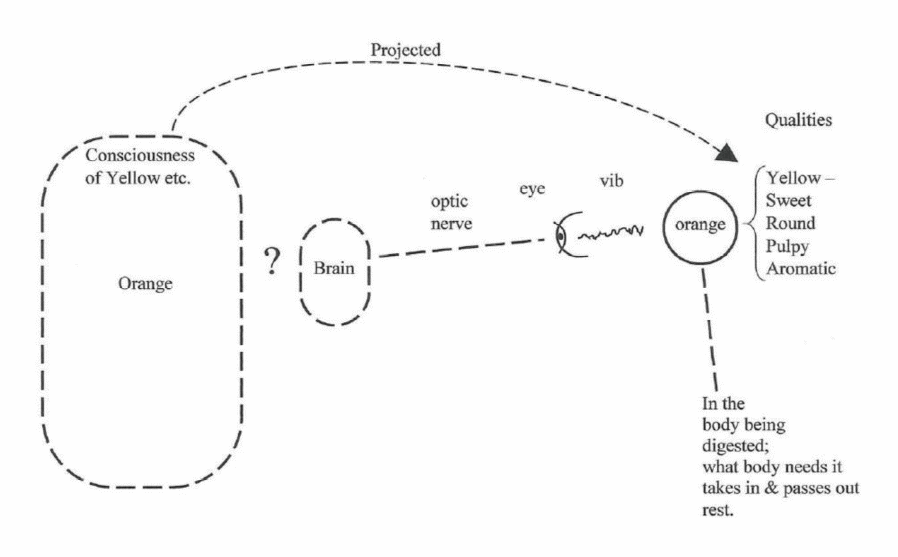
FIGURE AD Supp 111-digital. Physiology of Sense Perception.
FIGURE AD Supp 113-digital. Nama Rupa (Name & Form) with Sensible Qualities.
AD PAPERS read in class:
Abridgment of G.R. Malkani's "Examination of the Main Realistic Argument." Retyped, with the Bhattacharya abridgment, as 1974 1013b V09BN. Epistemology - Perception and Existence. A handwritten version by AD also appears in AD Supplementary Material, pp. 108-121.
Abridgment of Chandrodaya Bhattacharya's "The Theories of Drishti-Srishti and Srishti-Drishti." Retyped, with the Malkani abridgment, as 1974 1013b V09BN. Epistemology - Perception and Existence. A handwritten version by AD also appears in AD Supplementary Material, pp. 122-132.
TYPED AND REFORMATTED by IT 2026
NOTES:
RETYPED STUDENT NOTES (hence V08). From Alan Notes 3 1973 TO 1975 psyche and soul.PDF and Jeff Cox Notes.
This is 1974 10/13a, Epistemology; Perception and Existence Class, and the first entry associated with this date. 1974 10/13b = Epistemology; Perception and Existence Book Notes.
This is the third of five classes in the 1974 "Epistemology Review" series. See also WG Classes (and related papers) 1974 0929(a, b), 1006(a, b), 1020(a, b), and 1027(a, b).
Tony = Anthony Damiani (AD).
All spelling, capitalization, punctuation, and similar errors corrected, some numbers and all abbreviations spelled out.
1974 10/13a at Wisdom's Goldenrod
Epistemology; Perception and Existence
[Alan Notes 1974 1013 Begin]
10/13 Epistemology Review – 3
Paper III A
Realist: Knowledge is of the real, [and] the real is what exists prior to and independent of the knowledge of it. Knowledge is true when it is determined by the real.
Vedantist: What evidence proves the independence of the object? Nothing can exist prior to knowledge because everything is known in, or simultaneously with, knowledge. We can't speak of a thing apart from its knownness. Knownness is its essential nature. Knowledge by nature cannot provide for the unknownness of a thing. An unknown thing exists, and therefore is known in some way. Object is known simultaneous with our perception of it, and not before.
The act of knowing reveals the object and produces in it the character of prior existence. The independence does not belong to the object, but to the perceiving activity itself.
To know is to create in the object the appearance of its prior unknownness, and with it otherness and reality. In the projection of the object these qualities are created. But these qualities are not outside of our consciousness. In the process of projection he becomes a knower and creates the dualism which is necessary for perception. What is not independent appears so through our very perception of it.
Two theories:
I perceive, therefore the world exists.
The world exists, therefore I perceive.
Existence is not created, appearance is created. The world does not exist in knowledge, it appears in it. What is created is the appearance of reality — the real is never created.
Creation takes place through perception. Perception (to Vedanta) is by nature illusory.
If one piece of knowledge was ever cancelled, that would constitute proof for the independent reality of the world. All knowledge would be true.
But we find it otherwise. Perceptual knowledge cannot make this claim. All perception is illusory.
Within the perceptual whole, any single point of view can only be relative and partial, and therefore not the truth.
The otherness is just as much a part of the projection as the thing.
First we must accept the fact that all we know is the world-image in our consciousness, and nothing else. Then we can try to find out what is determining that image.
All there is, is knowledge. Nothing exists for us outside of that knowledge. Within it, we know it is determined, but not how.
[Note: Paper III A ends here.]
Four elements of knowledge.
1) the real - the that
2) the subject
3) the functioning of the mind
4) the object
What we call knowledge is an organized system of concepts related in a certain way, and which is abstracted from the concrete whole. I know 2–4, which are qualities abstracted from, and determined somehow by #1.
Paper III B
Srishti-Drishti (S.D.) & Drishti-Srishti (D.S.)
The realist (S.D.) is looking for a real thing that is the cause of his knowledge, and the idealist (D.S.) points out that no such thing exists — example, brigand in bush — there is no brigand or real thing, only my fear. The illusory object has no real existence, and yet it is fulfilled in knowledge. Therefore there is no pre-existent object or precondition of knowledge. Knowing creates its own objects and the conditions under which they are known, simultaneously.
The brigand that I see right now is illusory. Brigand may exist "somewhere" in reality, but not this brigand.
Realist says — all preconditions of knowledge must be fulfilled for me to see the snake. Vedantist says "What snake?"
Causality is a mythology arising from the myth of an independent object.
Pp. 15-16 — within one thought are contained distinctions. An external object is not necessary to explain cognition.
[Note: Paper III B ends here.]
All that you know is yourself — your soul. This is not solipsism — solipsism says that what you know is created by the ego (not the soul).
Knowledge is an organ of the soul discovering itself. It doesn't have to go beyond itself because it is the reality, and that reality is within us. If the thing is not independent of you, it must be within you. Our misidentification and misinterpretation of our experience is what is illusory.
Avidya is a progressive realization of who and what you are. The manifestation that you are aware of is limited by what you call your knowledge.
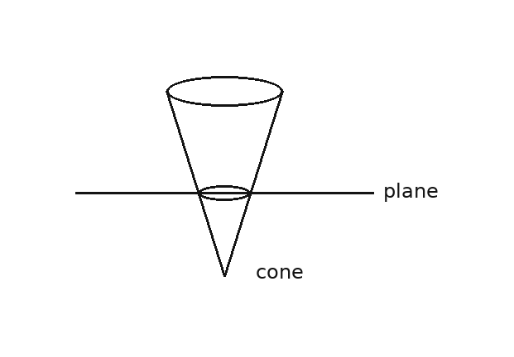
Situated on a plane, I am only aware of a circle as the cone intersects it, and I take that circle to be reality.
This knowledge is constantly expanding as an organ of the soul. Through avidya you are brought to a realization of what and who you are. Transformation of libido is painful because we are unwilling. We look out instead of in.
Life is suffering — most important message of East.
(Jung — § 507, Structure and Dynamics — libido flows out over projections, flows back) [Note: C.G. Jung, CW 8, The Structure and Dynamics of the Psyche.]
You are in jail — locked in by the four walls of your thought.
The snake is the vritti. Illusion shows us the unreal nature of what we call reality. The Absolute reveals —
"'The point which must be grasped is that we never know the panoramic external world in itself. We see that world only through the immovable spectacles of the sense-reports which we receive. We cannot bring it under direct observation. What we directly observe is our mental reactions — ourselves. Without ever being conscious of this certain and simple truth we live day and night in no other world than that whose form is figured for us through what is termed sensation.' (Paul Brunton, The Hidden Teaching Beyond Yoga (New York: E. P. Dutton, 1969), pp. 257-258) And if we don't recognize that first, all other questions are speculation. There is no other world we live in."
[Alan Notes 1974 1013 End]
[JC Notes 1974 1013 Begin]
Tony's Paper #3[A]
The main arguments of the Realist (better represented in West): There is an object external to our knowledge of it. (The other view says you can't go outside your knowledge or your thought — there is nothing which corresponds.) Knowledge is of the real and the real is what exists prior to and independent of the knowledge of it. Knowledge is true when it is determined by the real (objective).
The Vedantist asks — what is the evidence for the independence of the object? The realist speaks of the prior existence of the object and what will that be? — some sort of knowledge! The realist says the chair is other than my knowing the chair, therefore the chair is an entity in its own right. The Vedantist says all you have shown is that the existence of the object is simultaneous with my knowing of the object and not that the object exists independent of my knowing. The realist: How about the independence of the object — it is a some thing in the knowledge relationship? Vedantist: The knownness of the thing is an essential part of the existence of the thing so far as evidence from knowledge is concerned…how can any knowledge provide for the unknownness of a thing, which is what is meant by its independence, and how could it prove its existence when it was not known? You can't speak of a thing unless you speak about the knownness of the thing. You can't prove that the thing is unknown but still is. Show me the object that is independent of my knowledge. If the object is unknown then how do you know about it?
Realist tries again: Knowledge itself is the evidence because it is knowledge and knowledge reveals the self-existence, that which is independently real. Vedantist — this is begging the question. This is the very conception we are trying to justify (that it exists independent of that knowledge). Does knowledge reveal the self-existent? What knowledge does this? Is perception other than your state of consciousness? Then how does it reveal the object independent of your state of consciousness?
Realist again: An object is related to a subject in many ways: you can conceive it, will it, feel it. Knowledge is one such function (like willing and feeling). When we know, we accept an object, we do not make it or imagine it. It follows that the object must be there. This is the deliverance of a specific kind of activity we call knowledge. Your knowledge, like willing, delivers a certain content. We merely establish contact and it is revealed in our consciousness. There is more to the object known — it is in itself.
Vedantists: Let's take a sense awareness which is supposed to deliver to us this independent object. Logically even the vaguest kind of perception is mediated (the object doesn't go directly into your consciousness but has to travel this indirect route). [Note: AD Supp references FIGURE AD Supp 111-digital here.] There is no direct contact with the thing as it is which is literally not given in knowledge. That alone is given which is put there by the mind either imagined or conceived. I give to myself the things I'm supposed to perceive. It is not quite evident that we exactly know (the thing as it is). It constructs through the mental forms the things it knows…and apprehends that, and not the real thing.
Diagrams out of context of lecture:
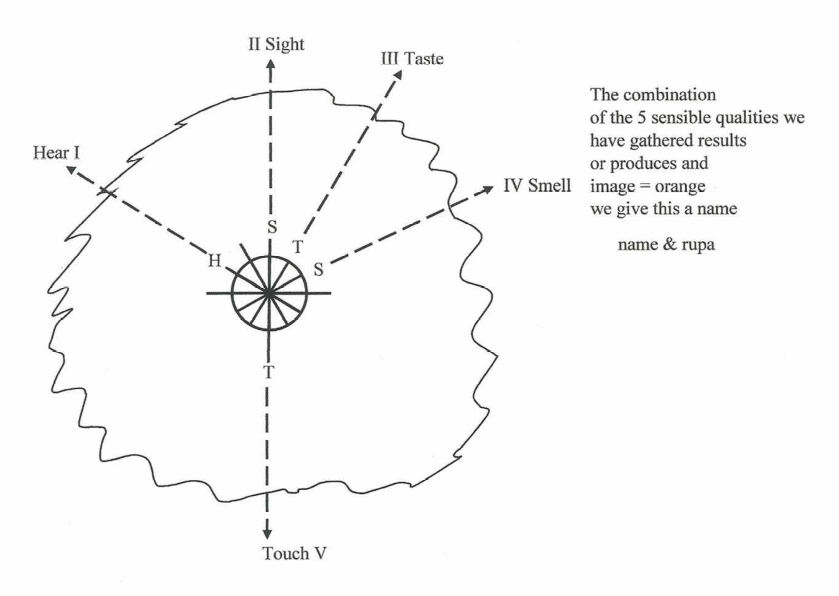
It will be said (by the Realist) — "There is only one kind of knowledge we all possess, and if that is not knowledge the term should have no meaning in our experience. If I sensibly perceive something then for that reason alone the thing in question is or exists."
Vedantist: We have given up one form of the creativity of sensible knowledge, i.e., imagination and conceptualization, for another more subtle and difficult to grasp when we create an image (sensible object) by holding back and then naming what we hold back. This is an obvious and simple kind of creativity, [Note: AD Supp references FIGURE AD Supp 113-digital here.] but what we have to deal with in answering the Realists is something much more subtle. In the creation of the object through the functioning of our sense organs something is implanted in the object which is created which is other than the sensibly perceived qualities: the illusion of otherness, independence, and the reality of the thing.
What has knowledge done?
1) Made the object known to a subject (geometrical illusions).
2) The subject is knowing, i.e., enlightened.
3) Imports into it a new meaning; it goes beyond simple presentation to me….but produces in the object the character of prior existence.
How else can the reality of the object emerge and without this emergence would reality have been revealed? So this independent existence or existence as unknown becomes available to us. No amount of the analysis of sensible knowledge will reveal this trait. It is no part of the object as such (the otherness, independence, objectivity, externality). It belongs exclusively to our perceiving and knowing activity as such. The quality of unknown existence does not belong to what is perceived which can only be as it is perceived — but can be traced back to our perception of it. To know is to create in the object the appearance of prior unknownness, and with it otherness and reality. Do we then really know? It is one thing to say that the thing is independent and therefore we perceive it — this is an uncritical assertion. It is another to say we perceive it and therefore it is independent.
What are the implications? It is our sensible knowledge that has created the appearance of independence, otherness, etc. Has it not created an illusion for us? What is not independent appears so through our very perception of it.
In the process of projecting out the image (FIGURE AD Supp 111-digital) these qualities are created (otherness, object as independent), but it is not outside of our consciousness. (Dream — a person dreams about something within him and he projects it — in the process of projecting the item that's within him he becomes a knowing subject. Insofar as he becomes a knowing subject, he becomes enlightened, he's knowing now. Insofar that he's knowing, he's knowing an object that is other than himself. To know the object he has to externalize it, give it an independent existence not actually but implied in the projection, and then he starts speaking about the object being real and other than him.)
Two theories:
1. (Drishti-Srishti) — I perceive and therefore the world exists.
2. (Srishti-Drishti) — The world exists and therefore I perceive it.
The world mystery can be solved in this way. There is no self-evident or certifying reason for saying that in knowledge the world exists. It appears to exist! Existence is never created; appearance is created. If anything is created it is this appearance of reality. The real is never created. And so there is only one way in which anything can be said to have been created: perception. The Lord has created it in perceiving it. We too perceive a world. Do we not thereby create the world?
If no piece of knowledge was ever cancelled, that would constitute evidence for the independence and reality of the world. All knowledge would be true: for the very reason that it is knowledge. But we find it otherwise, it can be declared and seen as false. No perceptual knowledge can make this claim. If a doubt arises one must give it its full value. If an object perceived turns out to be illusory, anything else perceived is equally illusory. In Vedanta anything that is perceived is for that reason alone illusory. (Examples in science show the illusoriness.) The relativity of every point of view that you take shows that all perception gets vitiated. Which point of view is correct? That of the scientist? Another creature? You are surrounded on all sides by your thought[s] which are the only things you know, anything else is clearly and purely inference — you imagine it.
[Note: Paper 3A ends here.]
When you project an object you imagine that it is other, independent of me, and it exists in its own right. The dream clearly reveals that all that appears in the dream is a projection from within the person as though it was other than the person, but it is not. Also projected is the notion that it is independent and other and that it has a reality of its own. It's pure imagination to say that behind the tree is an object. You can't give any evidence except more knowledge, more thoughts. In the very knowing, perception of an object — involved in the mechanism is the feeling of otherness. The feeling of your self-existence is other — how else could you be made aware of it if it wasn't made objective? Knowledge is of such a nature that from moment to moment its contents are constantly being changed, every instant in time a new world appears — this is the only thing you have a right to claim as "I know." Anything else is in your imagination. (The unconscious is a working hypothesis to Jung — it's just postulating that there are more thoughts coming.)
What is illusory about sense knowledge? — Its otherness, independence, and reality. The great illusion is the independence of the object outside of your world of consciousness. In Samkhya, the subjective functioning of the senses and the object it perceives are not separated but are two ends of a stick. Insofar as I'm identified with the body, then what is presented to the sense organs and the combinations of the presentations as an image is presented; it isn't the sense organs and this that is presented to my consciousness. Is it the eye that you see or what the eye sees? What is presented to the eyes is other than what is presented to these senses (follows from the identity with the body). You have the presented sense quality as different, other, and independent of the functioning of this entity. Now I have to show that the object is within his conscious world. As soon as I do that then I have to include the senses and the awareness of the sense datum as a unity — they are both presented in knowledge.
There are four things in knowledge: 1) the that, the being, real; 2) subject; 3) functioning of the mind; 4) the object. Knowledge is an organized system of concepts that can be related. The ultimate being I can't know in itself but only of it in terms of universals. I organize a system of abstract concepts that have to be reintegrated into that being. All knowledge is an organized system of judgments, feelings, and beliefs about the reality we are speaking of. When I speak it has to be in terms of universal concepts which are not the thing. The white that I speak about is not the white that's in the painting.
[Tony's Paper #3B]
Theory of Drishti-Srishti (D.S.) maintains that the existence of the world is its knowledge and Srishti-Drishti (S.D.) maintains that it has an existence which is different from and independent of its knowledge. Now the meaning of knowledge here is in terms of finite cognitive acts…that is to say that the things of the world are independent of the mental acts by which they are known — the other is contrary. Common sense supports the first one [S.D.] — the chair I'm seeing now existed before I saw it and will exist after the seeing of it. It is outside…while the act of seeing it is inside my mind. The object therefore must be different from and independent of the knowing act. But matter or object is an appearance and it must not precede or succeed the consciousness to which it appears [D.S.]. [Side note: Illusions show you where the mind is.] S.D. counters this (the fundamental tenet of Advaita) by saying that the object (existence independent of perception) still is not independent of the eternal and transcendental knowledge which is the ground of the world and which reveals it as long as it exists. (They sneak in an all-knower, a world-knower that knows everything which exists.) This view puts everything in the mind of God and we don't have to worry about it. Really speaking it is the same eternal intelligence which knows the table sometimes transcendentally and sometimes empirically — through your mind (with S.D. you feel comfortable, D.S. takes the ground out from under your feet) with modes, although the modes are different from each other, yet both of them are modes of knowing.
The D.S. maintains that the table which I am seeing now is not different from my thought or act of seeing it. It neither precedes or succeeds the act, nor do the act and the object differ from each other.
But is not the perception of the table and the table different from its perception? (Realists) D.S. points out there is no evidence for existence of an object in an unperceived state. To say one is inner and the other outer is not valid for this distinction is already implied in outer and inner.
It would not be proper to think that the act of seeing the table knows also the distinction between act and the table [S.D.]. For in knowing this distinction the act must also know itself — this seems impossible. An act of cognition is transitive and must be directed to an object other than itself. (Knowledge of the act is no finite and particular act). The specific and determinate character of cognition must be due to its object. Otherwise how is one cognitive act different from another?
D.S. answers: a piece of knowledge must have some object which is different from it. Is it being said that unless there be some object to a cognitive act it is incapable of originating at all?
Now a cognition comes into being as soon as all its preconditions are fulfilled (valid means of knowledge are fulfilled) and the object of a cognitive act is not found to precede the act invariably. It is admitted that the apparent object of an illusory piece of knowledge is not a precondition of that knowledge. (The illusory snake does not pre-exist.) The cause of the object may be just a mythology just like its otherness, etc. The scientist won't deal with the material right in front of him but falls back on the mythological notion of what causes this. PB says the actualization of the thing as an image in our consciousness belongs to us. Now we can go on further and postulate that there are these world forces which stimulate us to actualize this image in our consciousness. PB goes on to say that these world forces are too ideas so they get sublimated under that. So all comes under knowledge. Also it is possible that an act of cognition is self-different from itself in order to maintain its distinction from other acts or the knowledge of the object can be supposed to have a qualitative distinction which falls wholly within its own nature and is not relative to and derived from objects. Thus the world can be regarded as nothing but a series of cognitive acts forming the mental history of the subject. (Within one thought you have distinctions so you don't need an object — in a dream you have a subject, object, and a relationship — this is all one thought and the distinctions are all within this one thought; you don't have to go outside the dream and bring in the bear.) Mind divides itself into subject-object and relationship and then you take part of it and say that's other than me. For a primitive whose ego is still one with Nature you see that all he knows is the contents of his own soul, but he wasn't separated from them. If the ego when separating doesn't push itself away from that then it can't grow. When you say you're having knowledge of a thing — you're having knowledge of yourself. (It's not solipsism which is where you think it's your ego that creates the world and not when it's the soul or I.)
S.D. says then there is nothing in the world that persists and judgments of identity would be invalid.
D.S. says but these judgments are no more valid than those in dreams etc. In a dream you make claims to identity. (The identity of the object is based on the objectivity of the object independent of that flow of thoughts. Example: In order for me to say "I am I" I would have to postulate the existence of that identity independent of all thinking. But that's not intelligible for all you have is this flow of modifications of states of consciousness.)
S.D. — Since the sense organs need the physical snake which must be prior to and simultaneous to knowing, thence the object of knowledge must be different from its knowledge whatever may be the case of an apparent object of illusion.
D.S. — This is a circular argument. The validity of a cognitive act is sought to be determined by the presence of sense activity; while the presence of the latter is sought to be determined by the validity of the act. The object which is believed to exist even when it remains unknown (wipe away all the attributes of an object and you'll see you're dealing with the Absolute) must be considered to be the Absolute itself, for the word 'unknown' in this connection means concealed by ignorance, and it is the Absolute alone that can be concealed by ignorance. Things originate only after maya has done its work of concealing the true nature of the Absolute…i.e., they are illusory, being products of maya. Therefore there is no sense in saying that they are concealed by ignorance. For illusory objects can never remain unknown; as long as they exist, they must appear to some consciousness. Since the esse (existence) of maya itself is its perception, which is the Absolute, it follows that the existence of objects which are the products of this ignorance is their perception. In the triple division of maya, sense organs and their functioning in regard to chairs are all illusory and should be understood on the analogy of dream experience. Their being, too, just like the being of dream objects, depends on their knowledge.
[Note: Per EPI lectures PDF and AD Supp, the following paragraph is not part of this paper.]
An illusory snake has no relationship to the rope. There can be a relationship only between two real things. In the perception of an illusory snake you see a contradiction in the subjective functioning. In the perception of an illusory snake you recognize there is no snake and you transfer the halo of reality which once characterized the snake to the subjective functioning. There is no snake so what you perceive is the illusory functioning that's going on. This is an inherent contradiction and therefore can't be. The illusion is transferred from the snake to the functioning of the senses. Then the senses are illusory and self-contradictory and cannot exist. Avidya is not the cause of anything. By showing that perception is misperception it wipes itself out in the process and that there never was anything but the Absolute. Proving avidya would be another form of avidya.
Paper cont. — These two doctrines are different expressions of the Advaita fundamental. Both maintain that this world is not absolutely real but only apparently so and that the only reality that there is, is Mind, Brahman, etc., which is absolutely simple and unitary in nature. Now S.D. holds that within this sphere there is a legitimate distinction between what is empirically false and/or true, what persist in time, what is momentary, what is mental, what is extra mental. In contrast, D.S. maintains that such distinction within apparent reality is not ontologically legitimate and significant, that appearance and illusion are identical, nothing persists in time, everything is mental, entire world of experience is a series of successive and momentary mental states. D.S. is simpler — it accepts only two grades of reality, but that may make it seem that the complexity of human experience is not given its due as for instance the distinction between empirical and illusory. S.D. has three grades of reality: transcendental, empirical, and the illusory (geometrical illusions, etc.). D.S. transforms everything into knowledge and then dissolves all that knowledge into a form of avidya or ignorance and leaves you with the Absolute.
PB also mentions these three positions: he speaks about the necessity that the cosmic idea is translated by our functioning for ourselves into an apparent reality. We actualize the "forces" in the World-Mind and this actualization which belongs to us produces our perceived world — the perception is given in consciousness or knowledge and is mental. The world force forces us to actualize and see this apparent reality. These "forces" in the World-Mind or the master ideas prior to those perceptions are also mental — so that in the final analysis and ultimately all is knowledge.
[Note: Paper 3B ends here.]
To S.D. the present experiences are real until sublated by more experience. This distinction between the reality I believe to exist today which doesn't exist tomorrow is a distinction which the S.D. people say is valid. We have to rise to greater truth. D.S. says all these distinctions of relative truth are ultimately all illusions. If we consider the functioning of the senses (including mind (manas) as sense) — all that it presents you with gets cancelled. The imagery is altered with every pulsation of the senses. It (the imagery) is the result of the functioning of the sense organs. The image it produces has no reality away from that functioning. You can only take the brown from the tree abstractly. When I speak about something happening in your chart, that is abstract knowledge, what is happening to you is the knowledge. When I start reflecting or talking about it, that's not the knowledge, for you're not speaking about the being but the thoughts of the being.
The third Vedanta view (Ajati) — no creation — what are you talking about? When Ramana was asked about the world he said, what world?
If our knowledge is a manifestation of our own consciousness, then this knowledge is an organ of the soul for the discovery of itself. It can discover itself through this knowledge and in discovering itself it never has to go beyond itself. Whatever the soul reveals to itself is real. The reality is within you and not outside of you. It is true for you as long as you assert it. When you negate it, it is for something bigger. As the soul gets to know itself, it gets wider. What is illusion? — that this thing is real in its own right, that it is independent, other. Why should you feel poorer if the object is within you? As you realize there is more to you to the limits of the universe, you shouldn't feel poorer for it. Avidya is a progressive realization of who and what you are. If you think of avidya in the negative sense as purely illusory, therefore it has no existence, you're taking a position conceptually that you're the Absolute. You can take the conceptual position but you can't put the filling in the pie. You can see the relative illusoriness of the dream but the purpose of the dream was to bring you to the awakening of who and what you really are (is that negative?). Any vision that it is through introversion that we find reality is frightening. We get offended when we realize that we are attached to illusions.
We see a world — what appears to us is what it is insofar as it appears to us and no more. We insist on attaching to that, that it is other, independent. Now the truth and reality is not in the soul but in the thing. This "this" is not real, it has no existence. Life has to keep telling us that this is not where the truth is.
Avidya: you're aware of manifestation but what you're aware of is limited by what you call your knowledge. This knowledge as an organ of the soul is constantly expanding. Through avidya a person is brought to realize who and what he is. To take the libido out of the world and bring it back into oneself is excruciating — no one willingly does this, life has to teach him. Life is suffering. As long as the libido has the usual projections, [it will] run out into the world. But let some sort of paranoid complex set up where the energy is withdrawn and the world is de-evaluated. As long as there is the constant extroversion, we feel that everything is fine. PB tries to teach us to live in both worlds.
Once you see how you're locked into the four walls of thought, you realize that you can make the thoughts bigger to take in more and more.
What is negative is the retraction of the flow of libido from the external world to oneself. Many in meditation experience the withdrawal of libido and get scared. It feels like the cosmos is pouring into you.
The illusory snake is the vritti. When we deal with illusion we begin to see the illusory nature of what we call our reality — it cancels itself out. In Advaita the Absolute could reveal to you true or false, it is indifferent, it just reveals the vritti. If you can find that thought (vritti) is illusory, you would lapse back into the Absolute? Mind produces thoughts and if you see that thought can cancel itself out then all you have is Mind.
Hidden Teaching — "What we directly observe is our mental reaction to the world, i.e., ourselves. We live day and night in that world whose form is figured for us through sensation." (Paul Brunton, The Hidden Teaching Beyond Yoga (New York: E. P. Dutton, 1969), pp. 257-258)
The subjective functioning, subjective sense organs, are creating objects. There's this illusory snake and then you realize that there is no snake. But if that snake doesn't exist, how could that function create a non-existent thing? Then the function doesn't exist either. You never saw a snake and you never will. How can something self-contradictory be? (Atmananda (Krishna Menon), Atma Nirvritti, p. 13)
[JC Notes 1974 1013 End]
1974 10/13a V08: NOTES: Epistemology; Perception and Existence. Copyright 2026 Wisdom's Goldenrod p. v