Class
Sunday, October 27th, 1974
Student notes of a class/seminarWISDOM'S GOLDENROD, ALAN BERKOWITZ AND JEFF COX CLASS NOTES
(TYPED)
OCTOBER 27a, 1974
EPISTEMOLOGY; KNOWLEDGE AND REALITY
TOPIC: Epistemology
SUBJECT: Knowledge and Reality
SUBSUBJECTS: I and Not-I, World-Image, Superimposition, Maya, Projection, The Given, Knowledge and Imagination, Drishti-Srishti and Srishti-Drishti, Four Factors in Knowledge, Avidya, Thought (Vritti) and Nous, The What and the That, Knowing and Being, Self and Experience
CONTENTS:
AB class notes
The sensibly intuited world; the "given" I
Transposition of the inner world in the act of perception
Realist start point; world-image and the illusion of projection
Ajnana as misperception
Witness-I projects the universe
Knowing and imagination
Drishti-Srishti, Srishti-Drishti, and Ajati
Knowledge as appearance of the real
The four factors in knowledge
Thought as epistemological, not psychological
World-Mind with its content as Nous
The "that" and the "what"
Knowing is not being; knowledge as intellectual construction
Knowledge = Being
Avidya; the psychic and the psychoid
PB: we actualize the forces in the World-Mind
Sensation and judgment
Self and experience; substance and attribute
The I is first; superimposition of the world
JC class notes
I. The I and the not-I; the call for viveka
Non-sensible intuition of the I; simultaneous presentation of I and not-I
Two worlds: the inner direct, the outer derived
Superimposition
Transposition of the inner world in the act of perception
Two powers of Maya
The Grand Illusion; no philosophic problem can be approached from within the world-image
II. The not-I: the given, the real, the objective, the external
AD paper — abridgment of P.J. Chaudhury's "Science and Epistemology"
Thought and the transcendental background (S.K. Chattopadhyaya)
Primitive idea of sense perception
III. Realist and idealist; summary of Malkani's "Examination of the Main Realistic Argument"
Jung on projection; the epistemological subject
AD paper — "Knowledge and Imagination"
Knowledge as universal and individual; imagination ordered by knowledge
IV. Knowledge as appearance of the real in reflective consciousness
V. Srishti-Drishti and Drishti-Srishti theories; Ajati
AD paper — "The Four Factors Involved in Knowledge"
Thought as dream; the division into subject and object
Avidya and the world-thought; Nous
AD paper, continued — knowledge as of reality, never reality itself
The content of knowledge as abstraction from the concrete whole
Reality as transcendent in its existent aspect and immanent in ourselves
AD paper — "Vedantic Epistemology and Logic"
AD paper — "Knowledge as Appearance of the Real" (abridgment of an unidentified article)
Knowledge as intellectual construction; knowing is not being
The "what" and the "that"; essence and existence
VI. Knowledge coincides with Being
PB: we actualize the forces in the World-Mind; more grades of reality in the S.D. theory
Sensation and judgment
The two intuitions: the Self and experience
AD paper — "The Relation of Content to Consciousness" (reworking of K.C. Bhattacharyya's "The Subject as Freedom")
Experience floating in the intuition of the Self; substance and attribute
AD rejects Jung on the archetypes; mutual superimposition of I and not-I
Knowledge is first (table)
The Serpent's Path exercise; the individual and his world blended into one existence
Jung's African experience: knowledge still within the dualistic frame
Atmananda: the seeing of the form is none other than the seeing
Sinha's levels of knowledge; omniscience; the psychic as the manas level
Existence grasped only through essence; the realists' confusion
Totally fixed knowledge; appearance as fragments of the cosmic idea
Knowing qualities is not knowing the essence; the thatness and the whatness
Thought as a metaphysical organ of knowledge; the seven planes
Experience as prior to discursive thought; the Witness-I
Mind organizes experience by space, time, and causality — then is said to be subject to them
Our world as one synthetic whole; causality as a temporary standpoint
BOOKS / ARTICLES READ FROM OR REFERENCED:
C.G. Jung, CW 8, The Structure and Dynamics of the Psyche, "General Aspects of Dream Psychology"
P.J. Chaudhury, "Science and Epistemology," in Reflections on Science, Philosophy and Art
S.K. Chattopadhyaya, "The Object and Sensibility" (in Philosophical Quarterly 24, 1952)
J.J. van der Leeuw, The Conquest of Illusion
G.R. Malkani, "Examination of the Main Realistic Argument" (in Philosophical Quarterly 24, 1952)
Chandrodaya Bhattacharya, "The Theories of Drishti-Srishti and Srishti-Drishti" (in Philosophical Quarterly 26, 1953)
Paul Brunton, The Hidden Teaching Beyond Yoga
A.C. Mukerji, "Suggestions for an Idealistic Theory of Knowledge," in Contemporary Indian Philosophy by S. Radhakrishnan (1952)
Krishnachandra Bhattacharyya, Studies in Philosophy, Vol. 2, "The Subject as Freedom"
Paul Brunton, The Wisdom of the Overself
C.G. Jung, Aniela Jaffe (ed.), Memories, Dreams, Reflections
Debabrata Sinha, The Idealist Standpoint: A Study in the Vedantic Metaphysic of Experience
Vyasa, Bhagavad Gita
DIAGRAMS embedded in these notes:
FIGURE 1974 1027a-1-AB. Primitive Idea of Sense Perception.
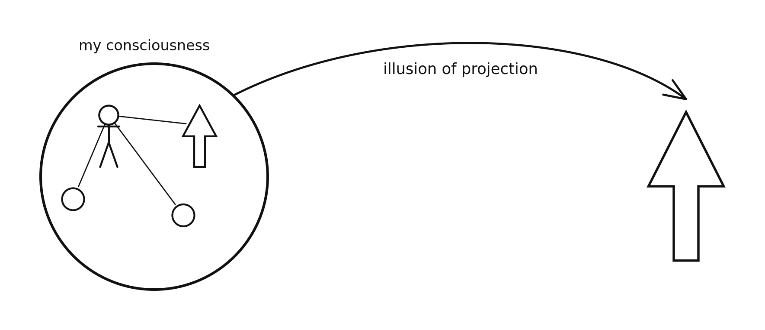
FIGURE 1974 1027a-2-AB. Illusion of Projection.
FIGURE 1974 1027a-3. Primitive Idea of Sense Perception.
AD PAPERS read or referenced in class:
Abridgment of G.R. Malkani's "Examination of the Main Realistic Argument." Retyped, with the C. Bhattacharya abridgment, as 1974 1013b V09BN. Epistemology - Perception and Existence. A handwritten version by AD also appears in AD Supplementary Material, pp. 108-121.
Abridgment of Chandrodaya Bhattacharya's "The Theories of Drishti-Srishti and Srishti-Drishti." Retyped, with the Malkani abridgment, as 1974 1013b V09BN. Epistemology - Perception and Existence. A handwritten version by AD also appears in AD Supplementary Material, pp. 122-132.
Abridgment of some passages from P.J. Chaudhury's "Science and Epistemology." A handwritten version by AD covering the same material in different wording appears in AD Supplementary Material, p. 142.
Untitled paper on knowledge and imagination, titled "Knowledge and Imagination" by IT.
"The Four Factors Involved in Knowledge."
Untitled paper on Vedantic epistemology and logic, titled "Vedantic Epistemology and Logic" by IT and MW. A handwritten version by AD appears in AD Supplementary Material, pp. 133-134.
Abridgment of an article not yet identified, possibly by A.C. Mukerji, titled "Knowledge as Appearance of the Real" by IT. Retyped as 1974 1027b V09BN. Epistemology - Knowledge and Reality, from EPI lectures by Anthony P 15p.PDF, pp. 9-10. Does not appear in AD Supplementary Material.
Abridgment of A.C. Mukerji's "Suggestions for an Idealistic Theory of Knowledge." Not read in class; its closing sentence corresponds to a sentence in the class notes. Handwritten version in AD Supplementary Material, pp. 155-160.
Untitled reworking of K.C. Bhattacharyya's "Subject as Freedom," titled "The Relation of Content to Consciousness" by IT and MW. A handwritten version by AD appears in AD Supplementary Material, pp. 140-141.
TYPED AND REFORMATTED by IT 2026
NOTES:
RETYPED STUDENT NOTES (hence V08). From Alan Notes 3 1973 TO 1975 psyche and soul.PDF and Jeff Cox Notes.
This is 1974 10/27a, Epistemology; Knowledge and Reality Class, and the first entry associated with this date. 1974 10/27b = Epistemology; Knowledge and Reality Book Notes.
This is the last of five classes in the 1974 "Epistemology Review" series. See also WG Classes (and related papers) 1974 0929(a, b), 1006(a, b), 1013(a, b), and 1020(a, b).
Tony = Anthony Damiani (AD).
All spelling, capitalization, punctuation, and similar errors have been silently corrected; some numbers and all abbreviations spelled out.
1974 10/27a at Wisdom's Goldenrod
Epistemology; Knowledge and Reality
[Alan Notes 1974 1027 Begin]
10/27 Epistemology Review – 5
Structure and Dynamics, projection – § 507 [Note: C.G. Jung, CW 8, The Structure and Dynamics of the Psyche.]
Big Outline: [Note: The outline referred to is the numbered outline, I-VI, in the JC notes below.]
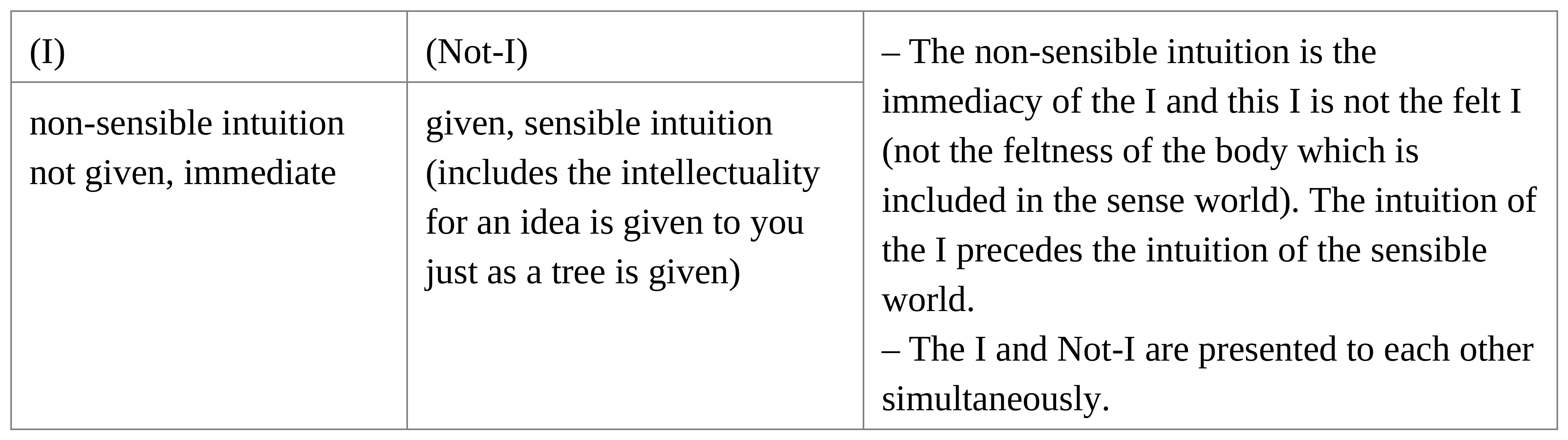
1-1 Sensibly intuited world includes feelings, ideas, body, ego, etc. "Given" I is not a feeling.
In the act of perception (knowing) you transpose the whole inner world outwardly.
Column 2 is the realist start point. [Note: Refers to the table under "I. The I and the Not-I" at the beginning of the JC notes below; column 2 is the Not-I (the given, sensible intuition).]
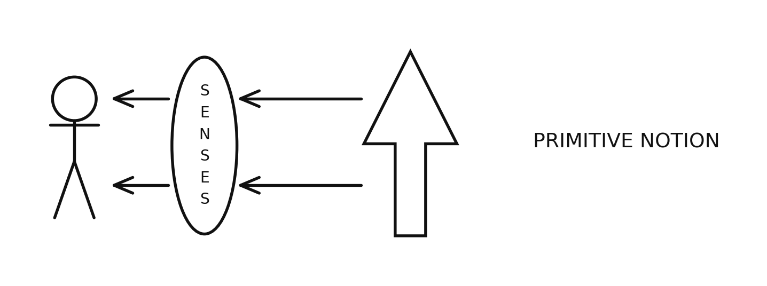
World-image is in consciousness – not my consciousness – the "my" is within the world-image.
Column 3 – Vedantic or idealistic reply to column 2. [Note: Column 3 of the same table.]
Ajnana is the misperception of reality. What really is, is God, but because of our misperception there is a world.
The same thing we do psychologically, we will do epistemologically the opposite.
Epistemologically the Witness-I projects the universe.
Knowing and imagination are distinct. (Imagination is distinct within knowledge, not from it.) Our imagination is structured by reason, which is why we can arrive at correct "imaginative" theories about reality.
At a high level of development, imagination is held and structured by knowledge.
(Example of 100 unnumbered volumes – through thinking (imagination) I come up with the correct order, which is a real fact.)
S.D. [Srishti-Drishti] and D.S. [Drishti-Srishti]
1) D.S. – pure idealism — is the world besides the knowledge we have of it? — no
2) S.D. — is the world besides the knowledge we have of it? — yes
3) Ajati (Ramana) – What world? – There is no creation to talk about.
↓ (before D.S. + S.D.)
The knowledge we have is not real knowledge, but the appearance of the real, not the real – it tells us something about the real, but is not equal to it.
Four factors in knowledge –
① reality
② subject, knowing, and object (contents – ideas, meaning)
② is a division within thought.
thought = image which is first – thought is epistemological, not psychological. Dream thought contains and presents whole dream.
You do not produce knowledge, but there are distinctions made within knowledge, or the thought. Thought is all-inclusive.
The senses are not what produce knowledge – example: sleepwalking, seeing without eyes.
Experience is that thought, restricted to your capacity.
World-Mind with its content (Thought) = Greeks' Nous
Knowledge is an incomplete revelation of reality relative to the subject. Experience is that reality, not our ideas about it.
That – what is it that is known? can't answer – the real ①.
What – what is the content of knowing? – answerable – the appearance ②.
Ultimately even the cosmic idea in the Mind of God is an appearance of the real. ② = qualities, abstracted contents.
① is transcendental in regard to ②.
① is not a thing-in-itself. ① is not beyond knowledge.
Knowing ≠ Being. Knowledge is an intellectual construction from experience which affirms, but is ≠ reality.
(All things are in me, but I am not in them.) There is not an ontic continuity between the World-Mind's content and the content of my mind. Person is ≠ to his attributes.
The above is meant to precede "all that is, is knowledge" (V) [S.D. and D.S. theories, per JC notes]
Then: Knowledge = Being (VI)
The psyche, or psychic, is the realm of the appearances.
Non-psychic (psychoid) is the real.
All that we have been calling knowledge is what Vedanta calls ignorance because it is relative. All we know is Avidya.
PB:
① we actualize the knowledge of the world
② forces in the World-Mind "force" us to actualize the world – idea in World-Mind prior to us is also mental.
An illusion or projection is an objectification of your mental processes and takes place where you see it.
S.D. takes point of view that perception is there when I'm not.
D.S. (PB) — forces in World-Mind are there, but I must actualize it.
Both reduce to thought.
Read paper #3 on D.S. + S.D. [Note: Paper #3B, the abridgment of Chandrodaya Bhattacharya's "The Theories of Drishti-Srishti and Srishti-Drishti." See WG Class 1974 1013a and WG Paper 1974 1013b.]
All sensation is accompanied by judgment. Otherwise you would have an experience of the indeterminate.
S.D. tries to escape the simultaneous presentation of one thing.
The only "thing" that exists when it is unknown is the Absolute.
Self and Experience — experience floats in the Self like an ice cube in water. Experience is of the real, but is maya as not of the ultimately real.
Self = substance
Experience = attribute
Either way, you have the ultimate reality.
The I is first – most important point, with which the whole analysis begins.
All that there is, is you. But if you have wrong ideas about what you are, you stop your growth.
First is the I. Superimposed on it is the world.
[Alan Notes 1974 1027 End]
[JC Notes 1974 1027 Begin]
I. The I and the Not-I (the confusion here calls for viveka)
1. Two worlds:
Inner – is direct
Outer – is indirect, derived knowledge or appearance of knowledge
2. Whatever comes to us must be filtered through our own consciousness.
3. We look upon the image in our consciousness as identical with the thing in itself (the notion of superimposition).
– We lend the thing in the world a reality which really belongs to us.
4. Some unknown (absolute) reality reacts on our senses (and seems to determine the contents for us).
– We left this undefined because it is the Absolute Knowledge
5. Projecting this image in the world of our consciousness and then claim we perceive an object.
– In Jung ("Dream Psychology," CW 8) – inherent in the very act of perception you translate or transpose the entire image of the world; the act of knowing creates a subject-object relation; the subject gets enlightened by knowledge of the object. [Note: See C.G. Jung, CW 8, The Structure and Dynamics of the Psyche, "General Aspects of Dream Psychology."]
In Vedanta, the two powers of Maya are usually spoken of as:
a) veiling (rope is covered) of reality
b) projecting (snake imposed), creating
This works psychologically, epistemologically, metaphysically.
6. Even the inner feeling we have of the body is but a form of sense perception; and all else that we know of its shape, qualities, etc., is also part of that image.
7. There is a world of the real which through my consciousness produces images in it, and therefore each creature knows only his own consciousness, the images which are within his own consciousness.
8. World is real.
9. Grand Illusion – abstracting the appearance of knowledge in our consciousness, isolating, exalting it, valuating it as something other than the appearance in our consciousness. The great illusion is to think that once you perceive an object and then walk away from it that the object will persist. We give it an independent reality and say that it exists prior to our knowing of it. These are constructions of thought after we experience.
10. We began to grasp this truth: the relation the image has to myself (in my consciousness of the world, my image of the world) and the relation of that image to the so-called real world.
11. There is nothing external or outside us.
12. If we try to understand philosophy through an intellect that has been nurtured on the dualistic scheme, it will lead to problems that no mastermind can solve (they are pseudo problems and can't be solved). No problem can be approached from within the world-image.
II. Not-I or the externally perceived world consisting of the given, real, objective, external – try to define these terms.
Given – when most of the realists or empiricists refer to the given they say that it's not constructed, is independent and indifferent to the subject.
Real – to be objective and independent of a subject.
[Note: The following paragraph is an abridgment of some passages from P.J. Chaudhury's "Science and Epistemology," found in Reflections on Science, Philosophy and Art, Calcutta: Progressive Publishers, 1966. A handwritten version by AD covering the same material in different wording appears in AD Supplementary Material, p. 142.]
Science starts with perception and identifies the perceptual contents with the external object and is taken as a fact. Error will be weeded out eventually. This is unreflective. Science says it is forced upon us and given so that the perceptual is ultimate. As it is, it is in some sense real as we have it, know it, or assert it. We believe in it and take it to be real and can't do otherwise. They say reality is not mental, for it transcends our experience.
1. There is a reality which is the cause of my perception.
2. The percept more or less corresponds to or pictures the cause.
3. Other men perceive the same way I do.
4. The presuppositions which express my knowledge of reality have a universal meaning for all.
[Note: The following paragraph draws on some passages from S.K. Chattopadhyaya's "The Object and Sensibility" (in Philosophical Quarterly 24, 1952), pp. 225-232.]
Tim adds – Thought so far as thought refers to an act of thinking, thought is something and not a pure nothing. Its being felt as something is its generic character; its differentiation is its relatedness to some act of knowing. We distinguish object known from our knowing of it, and we are led to believe it was something before we know it and will remain. The givenness of the known content presupposes a transcendental background but tells us nothing concerning this ungiven background. This is the realists' position.
In the first lecture we used this diagram.
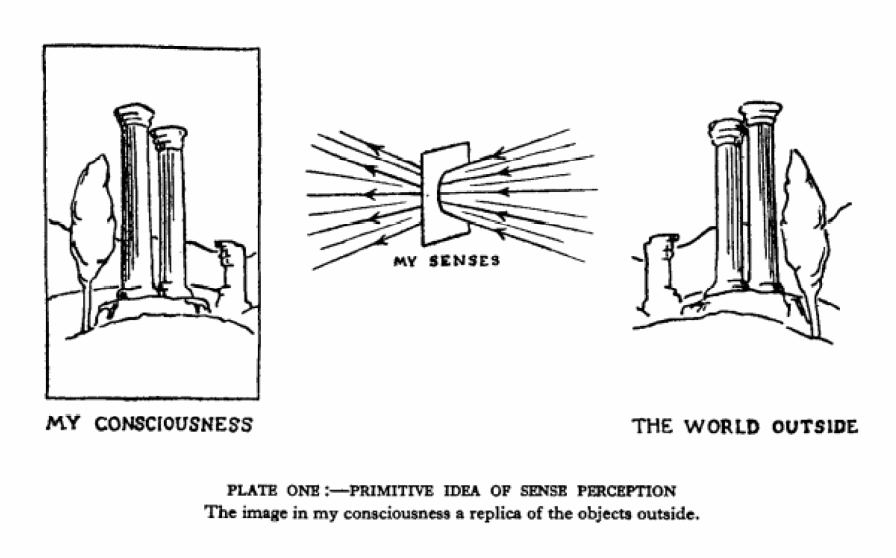
All the objects are given in consciousness, we don't know how. The realist says the real tree is really outside. He says your perception of it is what accounts for knowledge. Knowledge comes into being by a relationship or compresence of various factors.
In 3 [Note: May refer to plate III in J.J. van der Leeuw, The Conquest of Illusion, or to section three of P.J. Chaudhury, "Science and Epistemology," p. 42 ff.] you begin to realize that everything we know must come through knowledge (thought). So what is the given, real, the external object?
III. More discussion between the realist and the idealist.
[Note: The following is a summary of G.R. Malkani's "Examination of the Main Realistic Argument" (in Philosophical Quarterly 24, 1952). Two abridgments by AD are extant: a handwritten one in AD Supplementary Material, pp. 108-121, and the version retyped as WG Paper 1974 1013b and read in WG Class 1974 1013a.]
The given other is independent, external, real – realist. (FIGURE 1974 1027a-3)
Vedantist – All that knowledge can prove is the simultaneous existence of the object. The knownness is an essential part of its existence. How can knowledge provide for the unknownness of a thing? If you say a thing exists independent of my knowing – prove it! What you speak of you must know, otherwise how could you prove its existence? Does knowledge reveal the self-existence of a thing? What knowledge does this? All perception is mediated, there is no direct contact – so we could never know the object directly that the Realists claim prior and independent. What is grasped is the form given by the mind, i.e., knowledge. Knowing makes the object known to the subject which gets enlightened. It imports meaning into this perceived content which no amount of analysis reveals. What was not there as part of object as such – otherness, externality, independence, a prioriness. What is working here is the notion of ajnana or ignorance, which is a misperception of the real (ultimate reality). What we perceive is God but we see a world.
[Note: Malkani summary ends here.]
Jung – "General Aspects of Dream Psychology" – CW 8 [The Structure and Dynamics of the Psyche], § 507, 509 (this is psychological), 516, 521
What we do psychologically we will do in a reverse order epistemologically.
The epistemological subject (the I) projects (or manifests) the universe for us – time, space, and causality become the projected contents and if we could trace back the perception we'd see they're not entities in themselves.
Jung is saying this: A little child is born and raised in a family atmosphere and projects on the family, all the members of the family, a kind of identity. (When you go home many years later you can still feel these things tugging away at you. You're identified with them.) You actually imagine that there is something there. When you project you make those contents external, independent, and yet it came within you. In dream you attribute the cause of the dream to something outside yourself – which is not so. The function of knowing (the mechanism of perceiving) these things are thrown out on the object perceived and you say it's external. The realist has to become a psychologist and see that in perception the things he attributes to the object are his own psychology.
Vedanta requires first renunciation (giving up all objects including the body).
When we study epistemology we come across facts which our psychology will not buy. How can the object be something in knowledge? He expresses his attachment, the mystic identity. Reason starts conflicting with the data and observing the conflict with psychology.
[Note: AD reads his own paper below, untitled in the notes and titled "Knowledge and Imagination" by the IT. The point at which it ends is not marked; it may include all three paragraphs that follow.]
Tony's paper – The artist has a certain coherence and order in producing a work of art. A student of philosophy [has] a hundred questions which he can arrange and order to provide him with a symbolical or conceptual knowledge map of the way towards reality. In spite of the dependence of knowledge on the imagination and the imagination on knowledge, they remain distinct. Knowledge is always at one and the same time universal and individual and therefore any account which leaves out or deemphasizes either ends by denying the possibility of knowledge altogether. The imagination is ordered or structured by knowledge and it isn't that one just imagines purely and simply because then he would never come out with a solution. When reason produces sufficient data to make a person sit and take notice of the way his psychology is interfering, he has a conflict and one or the other will have the final say. There is a right and wrong order to our conceptualization, and when it is properly ordered it can no longer be pushed around by the imagination but the imagination is held and controlled by the knowledge.
Experience of the world gradually corrects the imagination – the gods get withdrawn and are now inside you. Knowledge is structured, imagination isn't. Laws which you don't see structure the crystal, like the laws which structure your imagination (the archetypes a person works with determine the nature of the fantasies he will live out). Everything we know, we know through imagination, but that doesn't make imagination knowledge; it's a picture of it, an image. The images contain the principles of reason. You look at a barn and abstract from the imagination the basic schemata.
When you see an illusory snake you see how you create a reality for yourself by projecting the snake and give it an independent existence and also think it to be real.
IV. Knowledge an appearance of the "real" in reflective consciousness – which as an organ of thought gets transformed while transmuting pr [sic; person?] experiencing. Knowledge tells us something of the real but is not the real.
V. S.D. [Srishti-Drishti] and D.S. [Drishti-Srishti] Theories
D.S. – the existence of the world is its knowledge.
S.D. – it has existence which is different from and independent of its knowledge.
Is there a world besides the knowledge we have of it? S.D. says yes and D.S. says no, and when one transcends that knowledge they transcend the world.
(There is a third school – Ajati – which holds that there is no creation; Ramana was in this class.)
The fundamental tenet of Advaita: the world depends for its existence on the Absolute which is the nature of knowledge. Therefore every Advaitist must support the D.S. thesis. However, that which is in view here is knowledge as finite mental acts of cognition – tables, chairs.
[Note: AD reads a further paper below. The paper is interrupted by discussion and resumes at "Continued from Tony's paper above." The point at which the first part breaks off is not marked; it appears to comprise the two paragraphs that follow.]
Before V. should be: Tony's paper – The four factors involved in knowledge:
1. That Reality which is known – the thatness which can't be spoken of except as a whatness (essence).
2. Subject or mind that knows; knower.
3. Knowing which consists of (mental) processes or states (modifications of the mind), ideas in psychical sense. The psychosis or transformation of mind into objects qualities [sic].
4. Contents of knowledge – consisting of logical ideas or the meaning of ideas (psychological) – reflection on the meaning of such.
These last three are a division within thought for Vedanta. Knowledge is not produced but must be taken for granted and you can't know knowing. The image comes first (p. 303, PB in Hidden Teaching) and our experience comes from that image. [Note: Paul Brunton, The Hidden Teaching Beyond Yoga (New York: E.P. Dutton, 1969).] You have the perceptually given world or thought and within this is a division into subject and object. Thought is basically epistemological and not psychological. The dream (or thought) is presented and contains all – this perception is divided up into dream subject, object, and mind. Now the subject says I produced the knowledge of the table, but Vedanta says first came the thought (dream) which you divide (you imagine that because you have eyes you see the table). If the thing is utterly distinct from the subject, how could he get to know it? In a dream do you think you see with your eyes? We have been hypnotized into thinking that senses produce knowledge.
Avidya – your knowledge within the thought is restricted by the way you function and [what] you're expected to do is widen your comprehension of the thought you live in, to distinguish more of the contents within it and not less. In the presentation of a thought when given – you don't grasp all of it but just a part. Because of our limitations (avidya) the world-thought can't be fully appreciated for what it is. Experience is the thought restricted to your capacity. This thought provides us with the space-time consciousness (PB) and is the world in which we are included. The boundaries of the cosmos are defined by the world-thought. In the same way our boundaries are defined by the psychological structures of thinking we have. If we restructure that thinking we can widen our horizon and approach more what the content of that thought is. The thought which provides us with the space-time consciousness is the Nous (World-Mind with its content). This thought is epistemological thought.
In the dream there's an appearance of knowledge in the dream subject's mind. The knowledge that builds up in his reflections matures him till he awakes. Reflective knowledge may awaken us to what we really are.
[Note: The paper begun above resumes here.]
Continued from Tony's paper above – All these are real (four factors) – reality taken in the most comprehensive extent. To say that the third is phenomena and that is all we know and not reality is to forget the self-transcendence that is a necessary characteristic of knowledge.
Knowledge is apprehension of reality and consists of judgments, opinions, assertions, etc., about reality and claims to be a revelation of the latter (reality) relative to the subject that knows in a fragmentary and developing way. It is incomplete and cannot be a substitute for reality itself. It is of reality and can never be reality itself.
Distinction between knowledge which is a system, etc…and reality which is being itself is ultimate (you have this ultimate distinction between reality and knowledge). This knowledge which is relative to the subject. The content of knowledge is an abstraction from the concrete whole which is reality. The content loses its integral place in the whole and [illegible] form from context. It therefore loses its uniqueness and actualization in reality and becomes something general. (You see certain aspects in a chart which mean something in our knowledge. But this is not knowledge of the real, not reality. The reality is that person who is going to go through that experience and have the experience. My understanding and my conceptualization of that experience is an appearance in my knowledge which is not real. By studying the chart you tear it out of context from actualization and then call it knowledge, but you can see that it's not knowledge but an appearance of knowledge.) (What we understand of reality is the way in which it appears to us. We know reality but subject to the limitation due to the nature of ourselves and objective conditions. Thought and being are not divorced from each other. Reality is not ready-made, immutable and perfect. Our knowing and ourselves have a place in reality. Reality, while it is transcendental in its existent aspect, is also immanent in ourselves and mind seeks to know the nature of the real, which includes and transcends it. – Not Read In Class) [Note: The paper ends here.]
[Note: The following was not read in class. A handwritten version by AD appears in AD Supplementary Material, pp. 133-134, under the editors' title "Vedantic Epistemology and Logic."]
Not read in class – Epistemology distinct from metaphysics or theory of knowledge distinct from conception of being.
1) Theory of Knowledge is a theory of empiric cognition.
Whatever is, is consciousness.
Hegel's dictum is completely accepted [one word illegible] thinks the (logical) becoming. For Shankara Being is an ever accomplished fact and not a process. Intuition is not only a faculty of the soul but the transcendental truth.
Shankara's Logic has two forms:
a) empirical
b) transcendental, when the latter arises the empiric consciousness assumes an ideal character. That which appears so long as real now appears as ideal. This transcendental intuition modifies the logic of realistic consciousness by higher logic. The organon of super-consciousness.
[Note: AD reads a further paper below, titled "Knowledge as Appearance of the Real" by IT, retyped as 1974 1027b V09BN. Epistemology - Knowledge and Reality, from EPI lectures by Anthony P 15p.PDF, pp. 9-10. It does not appear in AD Supplementary Material. The article abridged has not been identified.]
Tony's paper – Realists are convinced that reality is not mental and that it transcends experience but do not grasp the fundamental point which is that it is the same reality that reveals itself as content of knowledge to an apprehending mind. And this content is relative not only to the subject that knows but also to reality that is known – both inherent in knowledge
Essence is of existence, and to know existence is to know it in terms of its essence. To seek to understand existence apart from essence is to seek to know existence which is the existence of nothing in particular and further the attempt to know existence apart from essence is to reduce existence apart from essence to some sort of quality or essence.
Ideas or ideational contents of knowledge taken by themselves without reference to reality they are involved in – in judgments, cannot be taken as knowledge of reality. Some regard them as appearances, but they posit an absolute in non-relational terms transcending experience and unrelated to the appearance.
If they mean that reality appears to us in terms of a system which embodies our knowledge of the real world, ok. But if they condemn it as mere appearance – as if it could be anything else…because of its relational character as if it could be knowledge without involving relations. They judge knowledge by a standard of reality. They forget the reference to reality that knowledge essentially involves but confuse being and knowing. To understand the Absolute one should oneself become the Absolute – knowing identical with being, truth with reality. The criterion of knowledge becomes reality itself…so that even a complete system of knowledge is not completely true – whatever is known is phenomena.
A confusion between reality or being and truth – which is characteristic of reality – knowledge is responsible for condemning it as mere appearance. To know is not to be the thing known. Knowledge is an intellectual construction of the nature of reality, embodied in a system and in accordance with laws of reason. Laws of thought are self-evident and we have to assume the real is rational, otherwise knowledge is impossible. The principle of coherence is the regulating principle of knowledge which orders facts in accordance with logic. There is no finality in human knowledge, as reality which is infinite goes on revealing itself.
Thought or consciousness is the instrument for constructing knowledge. What is revealed in knowledge is not the revelation of thought itself, but what thought reveals about reality. To identify the dialectical process of thought with the being of reality itself is to identify the means with the end.
Read – It is contended that we cannot know reality in itself. But what is meant by the nature of reality in itself? (This applies up to the highest school of Vedanta.) The essence is what the mind apprehends. Reality has a nature…it is not empty being, for being which is nothing in particular is nothing. What the nature is can be apprehended only by a mind that seeks to know it. To speak of the nature or the qualities of reality as they are in themselves apart from mind is to divest reality of all the qualities that may be known and still ask for qualities.
The confusion between reality and phenomena…the "what" in the question what is known may mean what is it that is known or what are the contents of knowledge in terms of which the "it" is known. We ask what is it that is known – that refers to the thatness and that could never be known as qualities, any sort of objective ideality. All we can ask – what is the content of knowledge? This we can deliver (universal meanings). (There is a totally fixed knowledge of the universe which is the cosmic idea in the mind of God, but even this is ultimately an appearance of that reality called Mind.)
Such abstracted contents are designated as a quality, universal or essence which mind understand as revealing the nature of reality in a particular context…and not to be taken as real. It is an appearance of the real. Knowledge consists of such appearances. They are the what detached from the that, the latter being transcendental in regard to the knowledge of it. But the "that" is not on that account a thing in itself. Because knowledge consists of what…it is not consistent or legitimate to hold that the "that" is beyond knowledge. Knowing is not being. Knowledge is an intellectual construction of the nature of reality by a subject in accordance with reason and out of data furnished by experience and affirmed of reality. Therefore reality which is in its existential aspect transcends knowledge as known (always keep in mind the growing and fragmentary aspect of this knowledge).
[Note: The paper ends here.]
If the knowledge was identical with that of which it appears, that would be like when Krishna says that although without him this world cannot be, he in no way is involved in the world. You can't say there is an ontological continuity between the ultimate being (World-Mind) and the appearances of knowledge which take place in your mind which is fragmentary. Eventually you try to go beyond the whatness of knowledge and try to get to the thatness.
The D.S. theory is that there's only knowledge and then that this knowledge is fundamentally an appearance of the real. You realize that all you know are appearances in knowledge which build up and structure your reflective consciousness which reaches the point where self-reflection (reflection on knowledge) begins. What reality does this have? You can't say it is the real but only an appearance of the real; it's not real in itself.
VI. Knowledge coincides with Being. Now we're speaking of knowledge whereas before we have been speaking of avidya. [Note: The next sentence appears in slightly different form as the closing sentence of AD's abridgment of A.C. Mukerji's "Suggestions for an Idealistic Theory of Knowledge," AD Supplementary Material, pp. 155-160.] The ideational structure of the universe – the next step beyond this – when I say "I think" or "I am consciousness," that's not an ideality, for there's more there than idea. "I exist" is beyond ideation completely. Knowledge is the appearance of that existence but it is not that existence.
The huge cosmic principle (reflective consciousness) which each one has an individual version of is a reflecting apparatus of all the essential idealities that are being manifest. At this stage you realize you are an entity in your own right and now you can go ahead. What we have been calling knowledge is to Vedanta ignorance because it's a relative knowledge and not a knowledge of the Real. In real knowledge the being is identical with itself.
Being is the stuff of all things; sustaining the appearance of diversity, action, etc. It cannot be a universal essence – for as an idea, all things and itself would be only a variety of idea. Things do not have Being, rather things (name and form) are superimposed on Being. Reality essentially unrelated and in itself.
Back to V. PB remarks that it's we who actualize the knowledge of the world insofar that our perception of it manifests it. We recognize that there are certain forces in the World-Mind which oblige us to actualize the world in our perception. It's possible that the S.D. may be referring to those forces as extra-mental but PB says they are not, that even though the idea in the World-Mind is prior to our actualization of it, it is still mental; so in the final analysis it is all mental. The S.D. theory allows for more grades of reality.
S.D. is saying when the object is no longer perceived someone else will perceive it, it will still be there. PB says it's not the perception that will be there but the forces that make you perceive it. You're the one that has to actualize it. When we speak of forces in the World-Mind we are still speaking of an unknown.
When PB says the universe (World-Mind) is a self-governing (self-actuating) system, you could think of these as Ideas in the Mind of God (Plato's Ideas).
A pure sensation is absolutely indeterminate and you're unable to grasp it. But as soon as you say red, now you're dealing with a general meaning and now you can say you saw red. If you try to perceive red without the thought of red it is not possible. All sensation is accompanied by judgment. You can't have one without the other – if you could, you would have the experience of the indeterminate. You can have a vague experience but that's not the indeterminate.
There are two intuitions you deal with: the I which is immediate and can't be grasped in any objective way whatsoever and the I which is meant, which is an objective ideality. The I which is completely unknown in any objective manner yet manifests itself through the identification with body and mind and reveals itself through them. There's the unknown I and that which is being revealed about the Absolute as attributes. To Advaita these are the two ultimates: the Self and experience. Experience is an attribute and is experienced as real at the time you're having it. When it's gone it's no longer real. When given to you, you thought it was real.
[Note: A handwritten version of the following paragraph appears in AD Supplementary Material, pp. 140-141, under the editors' title "The Relation of Content to Consciousness."]
Tony's reworking of Bhattacharyya – "Subject as Freedom" – To be real something must be believed in and must be asserted and comes to distinguish itself from that which asserts. It assumes the form of the given, objectively. The halo of reality continually characterizes the asserted, given, objective only so long as the belief in it does not cease. This is the manifesting, the revealing. This phenomenal form underlies all experiences and their contents, the general that underlies the particular judgments and beliefs. And empirically the content is independent of, even indifferent to, that particular experience that reveals it. But this, its independence or indifference, does not make it real. It is in being asserted or believed that it acquires that characteristic. The characteristic of being real is adjectival to it because it derives it by floating in the self-manifest or self-revealing. With the self-revealing it is self-substantial as a character; reality is the self-revealing consciousness, the substratum of all phenomenal existence and content. The self-revealing consciousness is the reality and in its self-expression it becomes a consciousness asserting itself, and a content asserted. This content which is asserted is ideal, it is the simple unity of both. Phenomenal reality can be found as not necessitated by the being of Reality but as merely seeming, the "as-if" existing. And the "as-if" is eternally an is not in a transcendental sense, but it is eternally the same "as-if" in the same transcendental sense. Reality is everywhere and always substantially or adjectivally.
Experience floats in the non-sensible intuition of the Self. As long as any content is floating in consciousness we believe in it, we assert its reality, it's characterized by reality. But then it doesn't exist anymore. That which is gone we no longer believe in, the new we accept as reality and we believe in that; our experience is constantly of the real and it's never been of anything else and we call this maya – because it's not the ultimately real.
The inner is direct and immediate, you cannot doubt that. You can doubt all the images in your consciousness but not that you are. As these contents manifest in your consciousness you believe in them. The substance is the Self, experience the attribute. So never can you be without that ultimate reality, whether it's manifesting itself adjectivally or substantially.
The whole purpose of meditation is to drive you into your own consciousness, to realize that that's always there, but it can't be realized in any objective way. If we have wrong ideas about what we are, we immediately stop our growth.
One of the greatest catastrophes in American psychology – that they are going to evolve a system in psychology – for no two psychologies are alike.
Tony rejects Jung when he says real person is the archetypes structuring him, no! – they are idealities and therefore objective, the Self is beyond that too. The immediacy of the I is presented in a non-sensible intuited way. Then there's the intuition of the world (or the things given in your consciousness). The consciousness of the world is superimposed on the I. There is a superimposition of the I on the contents in consciousness and the contents of consciousness are superimposed on the I. The mutual superimposition leads to an inability to discriminate and say which is the I and which is the not-I. The I is not any content whatsoever.
[Note: The material below is given in the notes as three columns of terms and is set here as a table. Whether it was drawn as a diagram in class, or accompanied one, is not clear; the original notes are not available.]
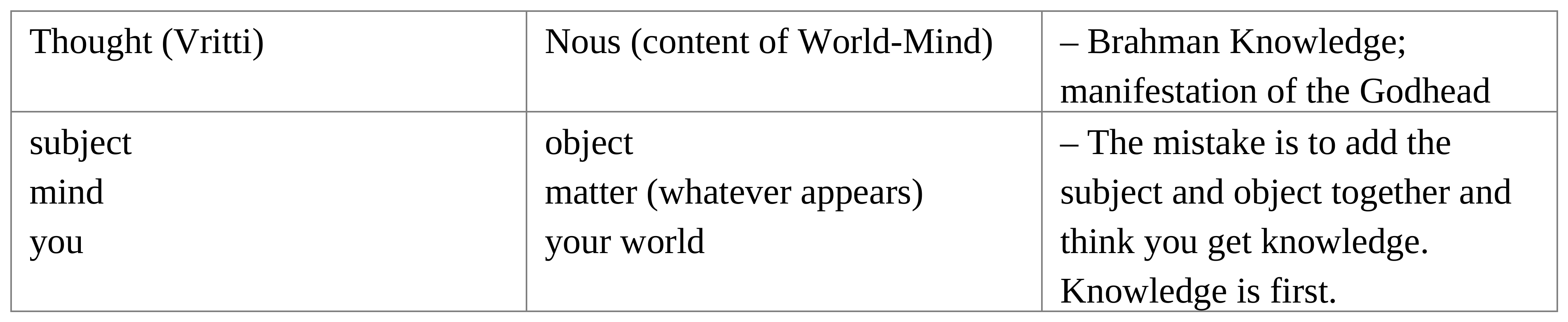
The Thoughts are offsprings [sic] of the mind and are contaminated, infected with consciousness. In Serpent's Path – wipe your mind of all images and then you're left with just pure consciousness with no imagery. At that moment the individual and his world are blended into a single existence. Then all becomes one knowledge, one thought which floats in Mind. This Thought is beyond reflective consciousness.
Wisdom, p. 246 [Note: Paul Brunton, The Wisdom of the Overself (London: Rider, 1943).] – When we say self and experience we have an ultimate dualism, but when that experience blends totally and perfectly with the self you no longer have any experience. You have one piece of knowledge and pure consciousness, one is attribute and one is the substance. The attribute is none other than the substance, a manifestation of it. If you wipe away the manifestation then you see that all you're ever dealing with is that pure substance. When [sic; Then] the individual and his world blend and become one solid block of knowledge. This knowledge is nothing but a manifestation of pure consciousness. Once you're in the solid block of knowledge, there is no more dualism.
Jung's experience of the psychic nature (in Africa) of knowledge – he was still in the dualistic frame of knowledge, but in the above description dualism is absent. [Note: See C.G. Jung, Memories, Dreams, Reflections, ed. Aniela Jaffe, trans. Richard and Clara Winston (London: Collins and Routledge & Kegan Paul, 1963), pp. 240-241.]
Atmananda says the seeing of the form is none other than the seeing – this is the stage where dualism is absent. This is more than mentalism (reality is not an idea). Ideas are these things manifesting in your consciousness as knowledge, this is an appearance, an objective ideality, and not reality
Vic – Sinha's third level of knowledge is the third level of knowledge [sic]. [Note: See Debabrata Sinha, The Idealist Standpoint: A Study in the Vedantic Metaphysic of Experience (Santiniketan: Centre of Advanced Study in Philosophy, Visva-Bharati, 1965).] Jung's experience is the second level of knowledge.
The level where knowledge is a solid block is the stage of omniscience.
The psychic nature of knowledge (which Jung speaks of) is the manas level. Steiner goes a little above that when he speaks of the substantiality of the angels which manifests as the being that we operate with.
There's an ultimate distinction that we have to speak of – pure existence can't be grasped except as that existence manifests itself through some essence. Then we can speak of the thing having an existence which is independent of it. The realists are constantly speaking of this but they have these things confused. To try to experience existence directly is to reduce it to an essence (or quality) which it is not.
If we can imagine the totally fixed knowledge of the universe (World-Mind contains the cosmic idea) – as we travel through it we get bits and pieces of that. What we have are appearances of that totally fixed knowledge, which are not other than it but at the same time don't really tell us what it is, we have fragments. This ultimate knowledge is still not identical with reality because reality transcends it. The Being is greater than anything that's manifested within Him. Krishna says ¾ of me are outside and ¼ in manifestation. This knowledge too is an appearance and not ultimately real as the being.
If I say I know you because I know qualities about you – I don't really know you, I nowhere got near to your essence, what you really are (not the thatness but only the whatness). When you say "know," you are speaking of universal meanings and you'll never get to the thing
There are seven planes of existence. Thought as an organ of soul is a metaphysical organ of knowledge. It can constantly expand and widen to become adequate for the object dealt with (even in the intelligible realm – thought not in the form that we deal with now).
Experience is not understanding which is discursive. Experiencing is not discursive, it is only in discursive thinking that that experience becomes split up. But the original experience is of a whole scene and is not divided until the intellect comes into operation. Experience is primary and then you can talk of the divisions you want to make of the image of conscious objects in your world. Objects are in the image in your consciousness. The experience of these objects and the consciousness of them can only be spoken of when you think of the intellect as something other than that. The empirical subject is not the subject. The manifestation of mind and matter is not the generic subject-object. Experience is not other than the Witness-I, not different from one another. When experience is objective you no longer have the Witness, which doesn't experience in that way. The Witness is that experience which is [sic; it?] experiences. The subject psychologically is not the subject.
It's us that attribute an ordered sequence to the World-Mind's thought. Totally fixed knowledge or Brahman manifests as the manas (mind). So what is totally fixed there is given to us one piece at a time. Mind uses space-time and causality to organize experience and then we turn around and say the Mind itself is subject to them.
Wisdom [of the Overself], p. 39, first paragraph – This section is in "Birth of Individuals" and if we take it to be ultimate we will think that space, time, causality are also because of the succession of thoughts moments. In the chapter on World-Mind, our world is one synthetic whole and we don't have the problem of one thought following another; the empirical ego gets obliterated. To explain what is happening PB must do it in terms of the empirical consciousness that must understand through the concept "causality." It's a temporary and tentative standpoint from the viewpoint of helping us understand through distinctive [sic; discursive] knowledge. It has no more meaning than that. Advaita takes your ignorance of the world and shows it to you as an ignorance.
[JC Notes 1974 1027 End]
1974 10/27a V08: NOTES: Epistemology; Knowledge and Reality. Copyright 2026 Wisdom's Goldenrod p. vi