DIAGRAMS FOR 1976 0927
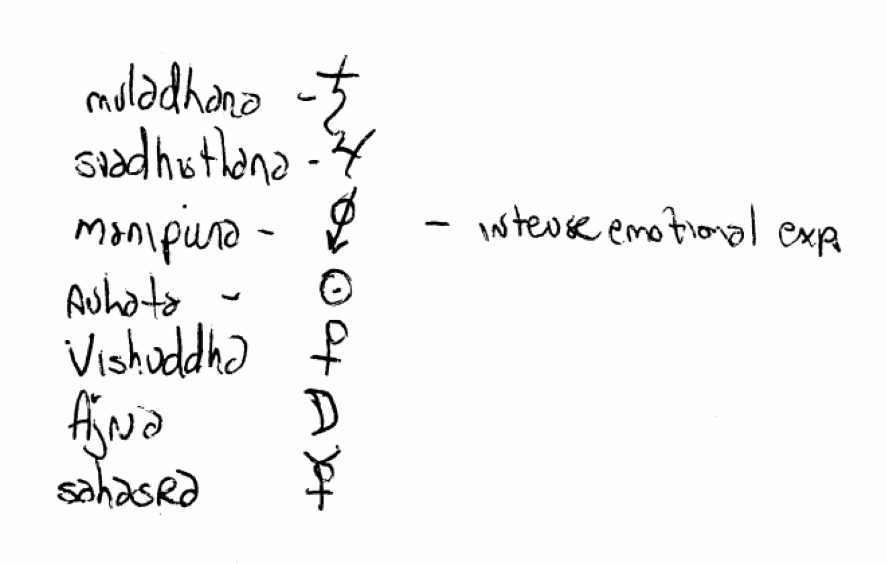
Seminar
Monday, September 27th, 1976
Edited transcriptSEMINAR at Wisdom's Goldenrod, Hector, NY
with Anthony Damiani (AD)
September 27, 1976
METAPHYSICAL CHART; HOUSES 5-12
TOPIC: Metaphysical Chart
SUBJECT: Houses 5-12
SUBSUBJECTS: "Twelve Signs of the Zodiac" (T. Subba Row)
CONTENTS:
Reading/discussing T. Subba Row, "The Twelve Signs of the Zodiac," signs 5-12
5th house (Leo): five Dhyani Buddhas and Jivatma
Jivatma as essence of man and universe
Each Buddha presides over a specific skandha; transformation from individual to universal to prajna aspects; Avalokitesvara as the synthesizer of the five Buddhas
Elements have potential existence in Leo, become distinct in next three signs; union into single entity leads to destruction of phenomenal universe; separation has contrary effect, leads to material existence
Separation of Virgo and Scorpio by interposing Libra
6th house (Virgo): six forces of Nature; buddhi; universal plan; universal consciousness
7th house (Libra): reason-principles (36 tattvas) made explicit; manas
8th house (Scorpio): astral world, subjective conception of the universe; not maya yet, as no subjective knowing
36 tattvas interposed between maya and Jivatma to expand primitive germ into universe
7th house like a barrel with 36 holes superimposed on infinite light; tattvas as negating universals, allowing manifestation
Idea of Man composed of senses, manas, elements, etc. in 7th house; Gods devise the Idea of Man and his constitution
Satya, Tapar, and Janar lokas in 7th house
Definitions and descriptions of buddhi (6th house); example of bird in a tree; non-distinction and non-creation in universal consciousness
Dreamy state (8th house) induced by tattvas; subtle universe (Hamsa) comes into existence; knowledge in motion
Reading from Blavatsky, The Secret Doctrine, on the six forces/shaktis
Appearance of powers in a subtle way before they become articulate; inference is based on clairvoyance
Shiva as static consciousness, Shakti as dynamic power (in first quadrant); represented in second quadrant as Atma (5th house/subject) and buddhi (6th house/object); translated psychologically as man and his anima
Six forces in control of Anima Mundi, determine its activities; background of sidereal/astral forces (in 8th house); buddhi as light, as Mercury
8th house: as celestial virgin; as Dragon; process of images constantly forming but never concretizing
Where is maya in this scheme?
Astral world characteristics and getting stuck there
Paracelsus on elementary body and sidereal body; death and dissolution of the bodies; can get stuck in kama loka if desire nature too strong; prototype of body in 8th house
Chart can be viewed metaphysically, ontologically, cosmologically, psychologically
Quotes from Blavatsky, The Secret Doctrine, on the Astral Light
9th house (Sagittarius): 9 Prajapatis who assist the Demiurge
Prajapatis arrange psychical essences/skandhas of beings according to karma and needed lessons; follow prototype from 8th house
9th house shows a priori attitudes, the selectivity/attachments you operate with; equivalent to Jung's introverted sensation
Sagittarius points to transformation of individual essences to universal; real meaning of philosophy as this transformation, not just intellectual
10th house (Capricorn): shape of the material universe in the mind of the Demiurge; based on Platonic solids (occult laws of manifestation)
Nothing further created, just effects of prior causes; contains the full blueprint; perception according to the being's unique cognitive apparatus
11th house (Aquarius): 14 lokas
7 levels of earth consciousness; characteristics and sequential unfolding of each level; exertion of reflective consciousness to its highest point
Relationship between lokas, planets and chakras explored; mapping the 7 planets to the 7 chakras; each planet/chakra can be at a different level of development
Rising of kundalini through chakras and its effects; anahata (heart) chakra as crucial turning point; chakras and psychological projections onto the world
12th house (Pisces): 5 elements, with the universal solvent (water) most important
Quintuplication (panchikarana) of the elements through the senses to produce objects; standard subject (Hiranyagarbha) can perceive tanmatras directly
Externally perceived world as effect of all prior causes; life itself both dissolves and retains these effects as traces; living through experiences as the real solvent, no intellectual answer
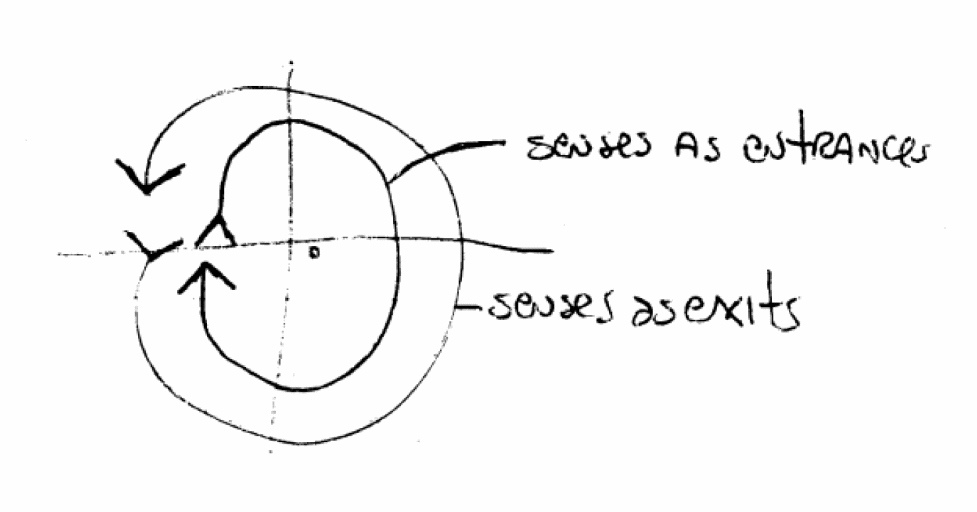
Q & A: maya, senses as entrances and exits, Dhyani Buddhas, 11th house functioning, tanmatras and bhutas
BOOKS / ARTICLES READ FROM OR REFERENCED:
T. Subba Row, A Collection of Esoteric Writings, "The Twelve Signs of the Zodiac"
Plotinus, The Enneads (MacKenna translation, 4th ed.)
Lama Anagarika Govinda, Foundations of Tibetan Mysticism
Benoytosh Bhattacharyya, An Introduction to Buddhist Esotericism
W. Y. Evans-Wentz, The Tibetan Book of the Dead
Paul Brunton, The Wisdom of the Overself
Paul Brunton, The Hidden Teaching Beyond Yoga
Krishnachandra Bhattacharyya, Studies in Philosophy, Vol. 2, "The Subject as Freedom"; "The Concept of Philosophy"
H.P. Blavatsky, The Secret Doctrine, Volume 1
H.P. Blavatsky, Isis Unveiled, two volumes
Sir John Woodroffe, The Garland of Letters
Sir John Woodroffe, The World as Power: Power as Mind
S. Radhakrishnan (ed.), History of Philosophy, Eastern and Western, Vol. 1, "Sakta Philosophy" (by Gopi Nath Kaviraj)
Manly P. Hall, The Philosophy of Astrology
Franz Hartmann, The Life of Philippus Theophrastus Bombast of Hohenheim, known by the name Paracelsus
Plutarch, Plutarch on the Face Which Appears on the Orb of the Moon
Mary Esther Harding, "The Reality of the Psyche," in The Reality of the Psyche: The Proceedings of the Third International Congress for Analytical Psychology, Joseph B. Wheelwright, ed.
C.G. Jung, "Psychological Commentary on Kundalini Yoga (from the Notes of Mary Foote)" in Spring 1975, 1976: An Annual of Archetypal Psychology and Jungian Thought, James Hillman (editor); also published as The Psychology of Kundalini Yoga
T. A. Gopinatha Rao, Elements of Hindu Iconography, two volumes
PLOTINUS QUOTES READ OR REFERENCED: III.8, IV.1.1, IV.3.12, IV.4.13, IV.8.8
DIAGRAMS appended to this transcript:
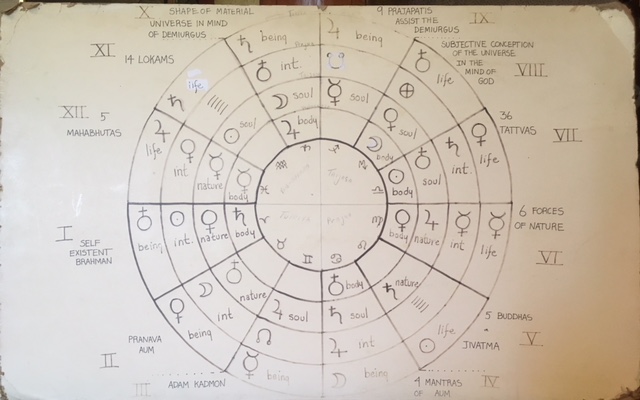
FIGURE IMG_2202-Posterboard Metaphysical Chart.
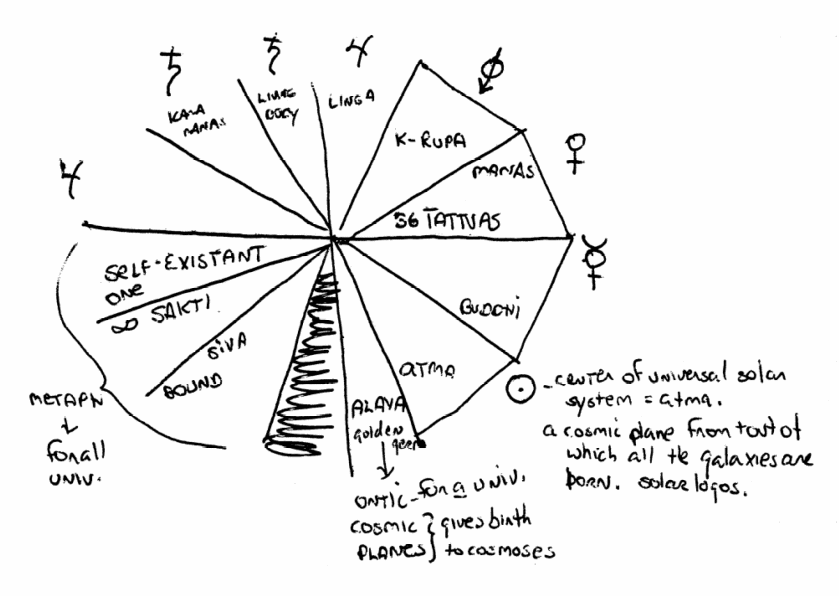
FIGURE 1976 0927-2-AB. Metaphysical Chart.
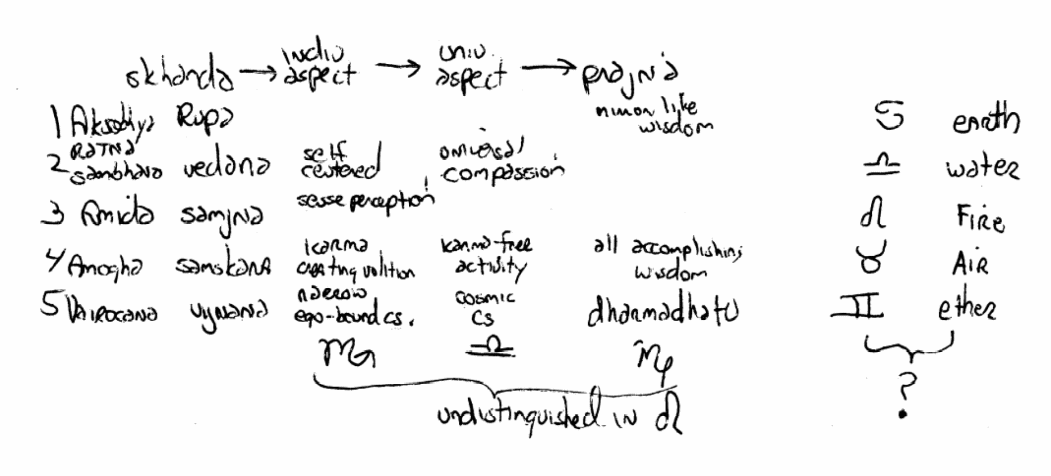
FIGURE 1976 0927-3-AB. Table correlating Dhyani Buddhas, Skandhas, Individual and Universal Aspects, and Wisdoms.
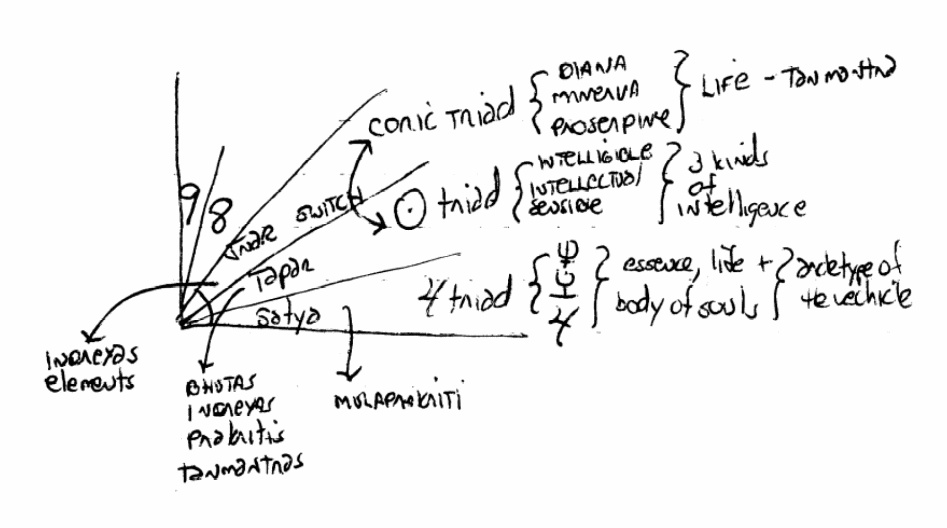
FIGURE 1976 0927-4-AB. Third Quadrant, with Three Triads in the Seventh House.
FIGURE 1976 0927-5-AB. Seven Chakras correlated with Seven Planets.
FIGURE 1976 0927-6-AB. Senses as Entrances and Exits.
Other diagrams also referred to are not with this transcript version.
RETYPED by IT prior to 2018; REFORMATTED by JF 2018, by IT 2023
NOTES:
REDONE RETYPED PARTIAL TRANSCRIPT (hence V10.1). From 1976 0927 ASN metaphysical chart TS Row-55p.PDF. THERE ARE NO AUDIO CASSETTE TAPES EXTANT.
This is a redo of the previous version which was done in 2018. This version (2023) has: updated prefatory matter and footer; Topic, Subject, and Subsubjects altered to make more accurate; Book List and TOC completed; Plotinus quotes section added; new notes in transcript; six diagrams appended and references within transcript to these diagrams; new formatting to accord with new conventions.
Tony is Anthony Damiani (AD).
____ = inaudible.
The page number references for T. Subba Row, "The Twelve Signs of the Zodiac," apply to whatever edition of the book was used for this class and are not the same in all editions.
Spelling and other obvious errors corrected throughout but left mostly as originally typed. Underlining replaced with italics. Quotes made to conform to published version where possible.
Excerpts from this transcript appear in Astronoesis in "The Fifth Idea".
1976 09/27 SEMINAR at Wisdom's Goldenrod
Metaphysical Chart; Houses 5-12
[9/27/76 – METAPHYSICAL CHART (Houses 5-12) = original transcript title]
[Scan File 1976 0927 ASN metaphysical chart TS Row-55p.PDF Begins]
The following is a case of the institutionalizing of "error under the supervised guidance of the Gods"* September 27, 1976, approximately 7:30 pm to midnight.
Reading from T. Subba Row, Esoteric Writings, "The Twelve Signs of the Zodiac". We are working our way through houses 5-12. Alan reads the meanings of the signs Pisces through Leo, pages 19 back to 9.
[Note: See FIGURES IMG_2202-Posterboard Metaphysical Chart and 1976 0927-2-AB, Metaphysical Chart, appended to this transcript for the following. The Metaphysical Chart is referred to throughout the entirety of the class.]
Tony: Well let's stop now. We've worked quite a bit on the first 4 signs. We're going to try and swing back and forth from 5-12, and 12 to 5. Okay, back and forth. So the simplest way of looking at 5, Leo?...(see p. 9) It is intended to represent the 5 Buddhas or the 5 Brahmas. Tony reads: "The Jivatma is correctly placed in the fifth sign…or the son's house according to the rules of Hindu Astrology. The [Tony reads: So this] sign in question represents Jivatma--the son of Paramatma as it were." … Let's read the footnote down at the bottom: "The Jivatma in the Microcosm (man) is the same spiritual essence which animates the Macrocosm (universe), the differentiation, or specific difference between the two Jivatmas…" (Tony asks here: What's a Jivatma?)
Alan: Macrocosmic and Microcosmic.
Tony: What do you think Avery?
Avery: That's what it sounded like…
Tony: This boy is not going to give anything away, you know that.
Kristal: What does that mean?
Tony: Well here's the sentence Kristal: "The Jivatma in the Microcosm (man) is the same spiritual essence which animates the Macrocosm (universe), the differentiation, or specific difference between the two Jivatmas presenting itself but in the two states or conditions of one and the same and Force." Yeah, go ahead.
Alan: Like, maybe…In Plotinus you would say that the Soul of the Cosmos and individual soul had the same essence, which would be the All Soul. Or we could say that the Solar Logos and the individual Jivatma come from the same source.
Tony: So most likely you'd say the individual man, his essence and let's say the essence of the Solar Cosmos we live in is the Jiva, the Jivatma. Or if you wanted to expand it, the entirety of the universe, the spiritual essence of the entire universe (Jivatma) and the essence of the individual man is one and the same. This is what he is saying on that footnote. Now, it's only a footnote: "Hence 'this son of Paramatma' is an eternal correlation of the Father-Cause. Purusha manifesting himself as Brahma of 'the golden egg' and becoming Viradja--the universe. We are 'all born of Aditi from the water'…and 'Being was born from not-being'…" Let's see if we can get a little bit of a clue about the 5 Buddhas. (Tony refers to the chart of the 5 Buddhas) [Note: See FIGURE 1976 0927-3-AB, Table correlating Dhyani Buddhas, Skandhas, Individual and Universal Aspects, and Wisdoms, appended to this transcript for the following. See also Astronoesis, Fig. 65.] Now they have the term here of the 5 Buddhas or he says 5 Brahmas. Now those 5 for instance in this quotation from Tibetan Mysticism…let's see, they worked out a system something like this (Tony draws a sketch of the chart on the board). Let's work with one. Now we are going to take these 5 Buddhas or these 5 Dhyani Buddhas the way that they refer to it. They are all in the 5th house and there is an arrangement where we have something like this. And each one deals with certain specific--alright this one deals with the form, physical form, material form (AKSOBHYA) (The chart is divided into 4 columns or 4 aspects to each god. The first column is labeled Skandhas or elements. The second one: aspect of Individual existence.) Over here (3rd column) this has to be transformed into a Universal Aspect and then this (4th column) would be equivalent to Prajna. We'll try to clear up what this means now. Now we have we said 5 gods here. Later on we'll see that this one will come from Cancer, I suspect, and the next one will come from-- they'll come from the different signs, 5 different signs. So if we take this one here (Aksobhya) and think of this here as the Intellect of a God. And he is in charge so to speak of the material form which we spoke about in the 4th house: name and form, nama rupa. Not only in terms of any individual but the entire universe as universe. So that I would have an individual rupa, the earth would have an individual rupa, the cosmos we live in would have an individual rupa. Anything that has any kind of existence would have to have so to speak some sort of individual rupa or corporeal form but in the 4th house if you remember we spoke of this as in a germinal condition. When we speak about nama rupa in the 4th house, we are not speaking of the actual physical body of the entity, but the germ or the prototype or the idea of the physical body to manifest in the 4th quadrant. So that would be the element that this, let's say god, is in charge of. Alright now, along side of it is the principle of individual corporeality. So this form is an aspect of the individual corporeality. This here has to be transformed--I'll read the sentence here. "…the universal body, in which forms of all things are potentially present and are recognized, according to their true nature, as exponents of the Great Void…" [Note: See Lama Anagarika Govinda, Foundations of Tibetan Mysticism, p. 108.] So that whether you think of a cosmos or an individual entity, that body so to speak, like for an individual…one recognizes that the body is an exponent, a microcosm. In other words it's a combination of the cosmic tattvas to accommodate this individual as he begins to understand how his body represents a universe for him…through this body he will become aware of the universe, so that gets universalized. You remember like for instance in Bhattacharyya he pointed out that the entire system, the body represents the entire system of nature for each individual consciousness. Remember that? Okay, so that is what has to happen. One begins to view his body as an organization of cosmic tattvas. This organization of cosmic tattvas is not for his personal use alone but also represents the principles that are governing the universe. And then it becomes, so to speak, they put here: when it reaches the Prajna aspect it becomes mirror-like Wisdom. They do this with 5 of them: Aksobhya, Ratnasambhava, Amitabha, Amoghasiddhi, Vairocana. See if you can follow this because this will be pretty interesting, it will help us understand the 9th house when we come to it. These 5 here each represent the unity or the intellect of a god. Each one of these gods, so to speak, is in charge of a certain element. Now we pointed out, he's in charge of this element: rupa, corporeal form. Ratnasambhava is in charge of vedana or feeling. In the beginning, as an aspect of individual existence of course, this is self-centered feeling. But when that gets universalized, then it becomes universal compassion. Notice, it has to go through this order. You're not going to find out anything about universal compassion until you've had enough feeling for your own self-centeredness that it can be transferred to something better. But you must start out so to speak being concerned with your own individual existence. Before you can have compassion for others, you are first going to get some for yourself. So, it has this kind of translation going on. Then they say the ultimate result in terms of Prajna, is Wisdom of equality, it sees that all beings are essentially identical…Alright Amitabha, for instance: s-a-m-j-n-a. What does this translate as, y'know? Tim? Conception? Alright and the individual aspect of it would be sense perception, intellectual discrimination. The universal aspect of it, they put this way: transcendental faculties of inner vision, spiritual discernment, Buddha of Infinite Light. Now notice the progression that is being forced upon us. They start us off with feeling for ourselves and given enough time, lives, and experience it gets transformed into universal compassion for all other beings. Then this very universal compassion one recognizes as an aspect of Prajna. So they're putting us through the mill for something. Yeah, go ahead.
Alan: It's almost like when T.S. Row speaks of the axis between Taurus and Scorpio and he says there's a transformation from one direction to the other or back. It seems like the direction that this is going is that we're being transformed in the direction of the prior sign.
Tony: Well, you got a hint there. Something very important later on will probably come up and we'll probably see it. There's one kind of motion in the chart which indicates the individualization is taking place, the descent. The other motion in the chart shows an ascent. The person is now instead of evolving, is involving, he's turning back on himself and going back to his principles. This probably is shown in the chart in terms of precession of the equinox. In other words if we read the chart this way, the soul is going back to its source. The other way, he's leaving his source. We'll get to that…Let's take another one over here. This way we'll have them all covered. (The god Amoghasiddhi.) Over here they have samskaras, okay. They put samskaras under (the column) elements. Now if you notice these are going to be the 5 heaps. The aspect of individual existence is ego bound or karma creating volition. Then along side of that, the universal aspect is karma free activity based on Compassion, Realizer of the Aim. And then the Prajna aspect of that is Tara, or the All-Accomplishing Wisdom. So we see what's happening, with all the 5 heaps, each god in charge of a certain element. And each element has to be transformed from its lowest to its highest aspect. And these 5 gods we located here, the 5 Buddhas. The next one for instance: Vairocana. He's in charge of vijnana, that's individual consciousness, y'know in the Buddhist chart? Okay? (Under Individual existence) Narrow ego-bound individual consciousness will be along side of it. And then over here the Universal aspect of that would be cosmic consciousness. And then the prajna aspect would be what they call Dharmadhatu or Wisdom…So we begin to see a kind of transformation process is meant to be indicated by these Gods, each one--By the way there is a very beautiful painting, if anyone knows it, it's called the Five Celestials. When I went to Washington I almost got locked up. I kept looking at it for two days. The guards (sounded like he said Gods and everyone laughed at the paradox) started getting suspicious. It's a small painting, about so big and they have the 5 Buddhas. It's a classic. One of you might know it. Dave might know it, Sid. Of course the synthesizer of these 5 is Avalokitesvara, in other words that would be the unmanifest logos and these would be emanating from him.
Alan: When he said the jivatma of the individual and the world are identical in essence, it seems that maybe if you make this transformation from the individual aspect to the universal then you're realizing that identity in terms of their vehicles.
Tony: (slowly repeating what Alan said) You are realizing the identity of…(stopping to let Alan clarify his statement).
Alan: …the Jivatma and the universal soul in terms of their vehicles. Like my soul would use me as a vehicle and let's say I would have some sort of individual self-centeredness. Well if I would transform that into universal compassion then I would be identifying myself with the vehicle of the universe, the cosmic.
Tony: Oh…..yeah. But you would still retain the individual aspect, y'know, of your vehicle even though you have now recognized its identity with the universe.
Tony read from Introduction to Buddhist Esotericism. The quote here that might be interesting: "Sometimes deities are described as equal to all Tathagatas, and by Tathagatas they mean the five Dhyani Buddhas. The implication of this is that the deities are an embodiment of the five Skandhas, over each of which one Dhyani Buddhi presides…" [Note: See Benoytosh Bhattacharyya, An Introduction to Buddhist Esotericism, p. 110.] And these are the examples for instance, okay? Of course, they are described as the progenitors of the 5 families. In other words, you shouldn't think of this here as one god but like a host or a hierarchy. (Very long silence)…Now there won't be much difference actually when we get into more detail. I think you'll be able to correlate them probably with the Greek, with the Samkhya version…"The Earth-Element of the Third Day, producing the chief solid constituents of the human form, and of all physical forms, gives rise to the passion of Egoism, and the aggregate is Touch; and these, when divinely transmuted, become the Wisdom of Equality, personified as Ratna-Sambhava… The Fire-Element of the Fourth Day, producing the animal-heat of embodied human and animal beings, gives rise to the passion of Attachment, or Lust, and the Aggregate of Feelings. Herein transmutation gives birth to the All-Discriminating Wisdom, which enables the devotee to know each thing separately, yet all things as one; personified in the Dhyani Buddha Amitabha, 'He of Boundless Light', the Illuminator… The Element of Air, of the Fifth Day, produces the breath of life. Its quality, or passions, in man is Envy, or Jealousy. Its aggregate is Volition [Tony adds: or will]. The transmutation is into the All-Performing Wisdom, which gives perseverance and unerring action in things spiritual, personified in Amogha-Siddhi… …the last Element, Ether, which produces the mind, or Knower, and the desire-body of the dwellers in the Intermediate State…" [Note: See W. Y. Evans-Wentz, The Tibetan Book of the Dead, p. 16.] Okay? So you get a feeling that every one of these Gods who rules a certain element is in charge of taking charge of your experience and ultimately using that experience by universalizing it and turning you, against your own will, most of the time, into a universal being. So when we've had enough lives let's say as a mother and we've learned to love children, then, there comes a time when that love for a child can't be restricted anymore to just your child. It becomes all children that you begin to feel that for. They constantly work underground in this way transmuting all our soul experience into a kind of universal. That's why, I try to point out, it is always wise to remember that Easterners, especially the Hindus, always start out from a cosmic point of view. They do not start out with the individual. You can't understand anything if you start from an individual point of view. There is no possibility of ever reaching any understanding. But if you start out and realize that your individual is an aspect of the universal here, which is an aspect of that universal, okay? then you work down this way and you begin to get a feeling how we sort of pollute y'know our own heritage constantly in everyday living. So it's a very useful chart if you get a chance and just want to ah…But this just gives us a hint of these 5 Dhyan Buddhis, [Note: Dhyani Buddhas is the correct term.] in here, y'know…Would you go back and read that section five, the Leo sign.
Alan reads: "This word contains a world of occult meaning within itself… Two of its synonymous terms [Alan reads: synonyms]…shows that the sign is intended to represent the five Brahmas…[Alan adds: or] the five Buddhas. The second synonym shows it to be Narayana, the Jivatma or Pratyagatma. (…I look upon Jivatma as identical with Paramatma in its real essence when stripped of its fictitious attributes created by Ajnana or Avidya--ignorance.) The Jivatma is correctly placed in the fifth sign counting from Mesha [Alan reads: Aries], as the fifth sign is…the son's house according to…Hindu Astrology. The sign in question represents Jivatma--the son of Paramatma as it were."
Tony: Also, son as in a lot of the religious literature, y'know: father, son, Holy Ghost. Like son represents the universe, the child of the father.
Alan continues reading: "(…it represents the real Christ, the anointed pure spirit…) …unless the nature of this sign is fully comprehended it will be impossible to understand the real order of the next three signs and their full significance. The elements or entities that have merely a potential existence in this sign become distinct, separate entities in the next three signs."
Tony: What is he saying there? He says over here (Leo) they're altogether undistinguishable, in germinal condition. Is that what he says? And in the next three signs they're going to be distinguished out? Repeat that. Huh(?)
Tim: I think those 3 levels are the Prajna level, the universal level, and the individual level will be distinguished out. Then he says that the prajna level will be kept in Virgo.
Tony: In other words what you are doing is: what sign?
Tim: Virgo (Tony writes on board or points to it)…Libra and Scorpio.
Tony: He says they are going to be distinguished out…Never mind your note taking (he says looking at Alan) read it.
Alan reads: "The elements or entities that have merely a potential existence in this sign become distinct, separate entities in the next three signs. Their union into a single entity leads to the destruction of the phenomenal universe, and the recognition of pure spirit…"
Tony: Alright, let's reread that sentence.
Alan: "Their union into a single entity leads to the destruction of the phenomenal universe…"
Tony: In other words, if I go this way then the universe here gets destroyed? Is that what they're saying Avery? Huh?
Avery: Yeah. Well, it gets dissolved back--
Tony: If I go this way the universe will come into manifestation. If I go this way the phenomenal universe gets destroyed. Well, we wanna keep that motion in mind, y'know. Now which way do the planets go? I forgot. They go around this way? When you read the planets, right? Transits, progressions?
Tim: Planets and transits go that way.
Tony: And when they go retrograde? Well, retrograde will be part of the motion of the direct. Does anything go the opposite way?
Tim: The precession goes the opposite way.
Tony: The precession goes the opposite way?
Jeff: The daily movements.
Tom: The sun through the houses goes that way. The ascendant is sunrise, then noon is the midheaven, then sunset is the descendant.
Tony: And the precession of the equinox goes this way. But the movement of all the planets goes that way. Well it's just a suggestion. We'll keep it in mind….Will you reread that sentence?
Alan rereads: "The elements [or entities] that have [merely] a potential existence in this sign become distinct, separate entities in the next three signs. Their union into a single entity leads to the destruction of the phenomenal universe, and the recognition of pure spirit, and their separation has the contrary effect. It leads to material, earth-bound existence and brings into view the picture gallery of Avidya…or Maya…"
Tony: Okay, so now we understand that at least in a general way. Do we?
Johanna: Not quite. One question I have…
Tony: Well that's legitimate. You can ask questions.
Johanna: Are we speaking in principle?
Tony: Well tell me more. What do you mean by that?
Johanna: When you speak of transforming from the second column into the other, from the ego bound to the universal, there could be two ways of looking at it. Psychological or non-principally and principally. Now if the same is applied what Jeff read about that backward motion, what does it mean when they become one entity? Are the principles collecting into one principle?
Tony: Does he say they BECOME one entity? You have to reread that then (he says without waiting for an answer)
Alan rereads (see above): "The elements or entities….and their separation has the contrary effect…"
Tony: Now what is he saying there Johanna?
Johanna: (silence)
Tony: Over here the 5 Buddhas so to speak are all together right?
Johanna: They're a single entity?
Tony: Y'know like my hand, okay? And then when I do this I got 5 fingers now. Over here I got just a fist. Now I have five fingers. Over here it's like a fist. But then the 5 y'know: 1, 2….now don't misunderstand, I'm not trying to imitate Rockefeller… (laughter)
Johanna: So the 5 Buddhas are considered a single entity. That's what he's saying.
Tony: In other words each one of these Buddhas would represent an element or a principle or a tattva. So the word Buddha, Brahma, tattva should no longer be something that scares you. You should be able to see whether these people are speaking in a Buddhist terminology and are waving Buddhist banners and across the street the Hindus are waving Hindu banners and calling them Prajapatis: and somewhere else they're waving…(Tony is stifling a laugh)…It doesn't matter, they're talking about this in a similar way. Over here we have the 5 Buddhas so to speak in an undifferentiated, unspecified germinal condition. Whether these get separated out as this, this, and this, then you are going to have the manifestation or the unfolding, the unrolling of a universe. It's going to come out. Just like when, you remember in Samkhya they speak about from Buddhi comes Ahamkara, from Ahamkara comes manas….okay?
Johanna: Mmhmm. You said something before too, that the synthesizer of that of these 5 Buddhas is Avalokitesvara.
Tony: Yeah. That would be the primordial logos.
Johanna: Would that be behind the whole five?
Tony: Yeah. That would be behind all 5 Buddhas. He's like the priest of all 5 Buddhas. Okay let's reread this sentence and go right on to the next one.
Alan rereads: "The elements or entities that have merely a potential existence in this sign… … If the real orthography of the name by which the sign in question is indicated is properly understood it will readily be seen that the next three signs are not what they ought to be. …Virgo and…Scorpio should form one single sign, and Tula [Alan reads: Libra] must follow…it if it is at all necessary to have a separate sign of the name [Alan reads: to have Libra]. But a separation between Kanya [Alan reads: Virgo] and Vrschika [Alan reads: Scorpio] was effected by interposing Tula [Alan reads: Libra] between the two. The object of this separation will be understood on examining the meaning of the three signs."
Alan: (Speaking very low as if to himself) He mentions that in Scorpio…why it has to be stuck in between.
Tony: Alright now why don't you go and get that quote right out where he mentions the reason for separating these in Scorpio.
Alan read quote (p. 13). He's talking about Scorpio as the ideal state of the universe previous to its coming into material existence. "The expansion of the [Bija or] primitive germ into the universe is only possible when the thirty-six 'Tattvas' are interposed between the Maya and Jivatma. The dreamy state is induced through the instrumentality of these 'Tattvas'. It is the existence of these…"
END OF SIDE A, TAPE #1.
TAPE #1, SIDE B.
Tony: Don't be bashful (he says gently)…Go ahead, Tim.
Tim: When he says here in 5: "Their union into a single entity leads to the destruction of the phenomenal universe," is that the union of the Dhyan Buddhas into Avalokitesvara? Or the union of these various elements into the 5 Dhyan Buddhis?.…
Tony: (something about the sentence)
Tim: He says their union into a single entity leads to the destruction of the phenomenal universe. Now, does that mean the union of these 3 elements, the universal, prajna, and individual, back into the synthetic unity of these 5 Dhyan Buddhas or is it the union of those Dhyan Buddhas into Avalokitesvara? In other words, doesn't Pralaya go all the way back into the 4th house?
Tony: Well, tell me. What do you think?
Tim: I think it goes back into the 4th house.
Tony: …Those 5 Dhyan Buddhas for instance would represent 5 different aspects or 5 different skandhas, right? And if we use the simplest psychological terminology…ah…how would this be? (see chart) This would be the physical, corporeal (rupa), feeling (vedana), conception (samjna), habituation (samskaras), consciousness (vijnana). So, these 4 psychological heaps, to use the terminology, plus rupa (ah…gee thanks (someone just gave Tony coffee)) What would we have to do in order to transcend that?
Tim: It would seem that there it would just be a-- the recognition of the Atma.
Tony: In other words if we wanted to achieve Moksa or Liberation, okay? We would have to take like the Buddhists recommend, this Bodhisattva path, y'know, realizing that everything is empty. But if we reach that kind of a level, wouldn't we have so to speak, gone beyond this?...I mean for a person to start reciting the Diamond Sutra and taking it to heart, I mean, he really can't believe in this anymore. Y'know, self-centeredness. This he might believe in: Universal compassion, a feeling for compassion for everyone, y'know. But this here he would have difficulty believing in. He would have difficulty saying: I believe myself to be a self-centered individual who exists in, by and for himself. He would have to have transcended that, right? So he moves over into here… So once a person has a feeling for universal compassion, alright, or recognizes the universal body… In other words, he recognizes these as all cosmic tattvas which ultimately come from these Wisdom principles, then he's moved over to here, okay? Now, the Sage hasn't given up the physical body and all the (psycho/psychical) essences he works through. He transcends them but he hasn't destroyed them. So then what happened? Avery? (Avery: mumble.) What we're trying to answer is the question that you asked in terms of: Do you have to reach Avalokitesvara, in other words…
Tim: No (he said firmly but quietly)
Avery: It seems to me that you might even…I was thinking of those as like the quadrants, like the principles of individual consciousness might go in the 4th quadrant, then these universal principles would go like in the 3rd quadrant and when you would reach the level of the 2nd quadrant, there, then essentially you would be beyond, ah-- as soon as you got beyond the notion of the 36 tattvas, you would already be at some level of some kind of unity which would go beyond those four…
Tony: Alright, so then if one does reach this level here, the 5th, where he achieves, ah, y'know, some sort of identity with the Atma, okay…the next step would be, y'know, Avalokitesvara, or we said, um…it's like where your choice comes up: Are you going to transfer all of your experience to the Logos or are you going to merge in the causal body of the Logos, or are you going to be a vehicle for the Logos, or are you going to go on evolving vehicles….So, we won't try to answer that. The point that we do want to make is that if a person is going back and reintegrating or reassimilating this here and then reaches this point here, the phenomenal universe gets wiped out. That's the point I think--
Tim: So you're saying that the relation of 5 to 4, there no reference whatsoever to the phenomenal universal, either affirmative or negative.
Tony: And this isn't definite either because in the next race, y'know, we'd have to put 6 Buddhas here, and in the 7th root race we'd have to put 7 Buddhas here. And then we could apply this, like he said, either to an individual man, or to an individual planet like earth or to an individual solar system because that too is an entity and its spiritual essence would be the same as the essence of a human being or of a man.
Avery: Could you say that, like the relation there, 5 going back to 4 would be like the relation…When he said that the essence of the universe and the essence of the individual jivatman were the same, that essence of both of those would be in the 4th. Would that be like what you call Paramatma? (the Supreme Self)
Tony: Well, (speaking slowly, clearly, and emphatically) as a good Advaitist he would say you go all the way up to the first.
Avery: Yeah, I know what he would say. But in a sense you could say that the essence of the soul is in the 4th. If you considered all Solar Logos…(trails off)
Tony: (speaking quietly and repeating what he just said) I think T.S. Row would go all the way up to the first. As an Advaitist, they wouldn't stop anything short of that. (long pause) Alright, then let's go back Alan and reread and see if we can understand why he wants, ah…
Alan: Libra in between?
Tony: He wants to put Libra here, he says he can't understand this here. So in the section of Scorpio he explains why. And then we have to go back to ah…
Alan: He speaks of Scorpio as "the ideal state of the universe previous to its coming into material existence. The expansion of the [Bija or] primitive germ into the universe is only possible when the thirty-six 'Tattvas' are interposed between the Maya and the Jivatma."
Tony: What's that mean?
Alan: Well, Scorpio, the Sanskrit name here (Vrschika) correlates with Vishnu and that literally means that which is expanded as the universe. (pause)
Tony: Go on, don't stop. (he says gently)
Alan: So, prior to Libra, the universe, let's say in the 5th house, would be in some sort of causal seed form where everything was undifferentiated or was all contained as a unity. To get all these aspects of the universe differentiated you have to put some sort of principle in between which would separate everything out. And that would happen in Libra.
Tony: In Virgo isn't there a separation there? I'm asking, I mean (he gently repeats) I'm just asking…What does Virgo stand for?
Tim: The 6 forces.
Tony: The 6 holy forces? Alright, another way of looking at it would be like Buddhi? Universal or Consciousness?
Kristal: (it was not clear to me on tape what she said, something about the unity of the Astral Light.)
Tony: I can't hear you.
Kristal: He said the unity of those 6 forces was the Astral Light.
Tony: Well, let's try to understand what that means.
Kristal: Is that Buddhi?
Alan: According to the old version you only have one sign: which is Virgo-Scorpio and it's only when you stick Libra in between them that you get this expansion.
Tony: Let me pose the question: What does the 6th house mean? Generally.
Tim: Work (he says under his breath).
Tony: Huh? (someone repeated clearly: w-o-r-k. Tony smiled) We referred to it a few times…Buddhi (he states simply, answering his own question.)
Tim: The 6 creative forces. It's like those wisdom functions, those prajna differentiations of the Dhyan Buddhas.
Tony: How about a definition of Buddhi? Do we have one around here? In Buddhi, for instance, we have just presentation without any I? It's some sort of public knowledge? I mean you go to a certified accountant and he can give you, y'know, the low down on what actually exists and what doesn't exist. What else would Buddhi mean? (pause)
Avery: It seems like the whole cosmic ordering of the whole rest of the universe would come from there.
Tony: And that would be universal, right?
Avery: Yeah. The universal plan…(Tony speaks over Avery as Avery sort of trails off)
Tony: The whole universal plan. There's a pure presentation of the entire totally fixed knowledge. There is no cutting it up into pieces. So the 5th house would have the Atma, the 6th house would be Buddhi, the 7th house is manas and what we have to see is that you have a universal consciousness in the 6th and in the 7th it's got to be broken down. If it's not broken down, there's no possibility of a world or Maya coming into operation. Go ahead Avery.
Avery: He uses a very funny phrase. He says that you have to interpose the 36 tattvas between the jivatma and maya. I think that's what he says.
Tim: Yeah.
Tony: Okay.
Avery: Whatdya think that means? (he asks perplexedly)
Tim: Both of those happen to be tattvas, right?
Avery: Yeah.
Tim: What I thought that meant was that in Buddhi in the 6th house is this presentation of the whole of maya but there's no causality. It is the introduction of the 36 tattvas which introduces the idea of cause, makes that a causal vision and from there the rest can unfold out of it. In other word, in the 6th house, is like an acausal appearance. (long pause)
Jeff: I thought he was referring to Scorpio as Maya, there on anyway.
Tony: Reread it. Reread it.
Alan: "The expansion of the [Bija or] primitive germ into the universe…"
Tony: Alright, you've got a primitive germ and you've got the universe up here and in between you've got to have some sort of mechanism that takes this germ and expands it and blows it up so that it becomes a universe here. In between you've got to have some transforming mechanism. Just like for instance, what do they call it? A voltage, ah…(someone says a transformer)…like a transformer, okay, now to answer your question, reread this please. To answer your question.
Alan: "The expansion of the [Bija or] primitive germ into the universe is only possible when the 36 tattvas are interposed between the Maya and Jivatma."
Tony: Now you're (looking at Jeff) assuming Maya is Scorpio. He doesn't say that. He just says between--(Jeff interrupts, protecting himself, says)
Jeff: No, I'm suggesting it.
Tony: Yeah, yeah (trying not to laugh) but these people aren't going to give you anything. They're going to actually mislead you.
Avery: Scorpio is what results from that interposition, then it's possible to have this expansion of the universe once you have the interposing.
Tony: Yeah. And you know from previous studies that the 8th house represents the Astral world. That's not Maya yet.
Jeff: Isn't the universe becoming subjective in that house?
Tony: Yeah but it's not Maya yet because there is no subjective knowing of that. (pause) If you look at your chart, there IS NO BHAVA function in that house. Is that right?
Jeff: Well, yes…then there's no exaltation there (he says haltingly).
Tony: No, go ahead Jeff, be as disagreeable as you can because if we don't find out now we'll never find out…Alright, Avery, go ahead.
Avery: I think…this could really be off the wall, but another way we talked about the 36 tattvas or reason principles or something…pause…it seems to me what he's talking about now about expanding the seed into the universe…I think he seems to be talking about our, the experience of a world. Subject-Object experience. And seems to be saying what is necessary first is to, if you think of Maya as like that mirror we were talking about and the Jivatman would represent like the witness of that, y'know, what is going to be the experiencer of that. Then you need to interpose these forms which are actually going to get projected on to that mirror and that's what is going to be the presupposition. It's like if you just have the Jivatma, the supposed witness of this experience…(Tony interrupts Avery at this point. Avery continues but Tony talks over him. The rest of Avery's statement from what I could distinguish on the tape:…and this mirror, there would be no experience.) Now, going back to where Tony cuts off Avery:
Tony: (speaking over Avery) That would be universal consciousness and there would be nothing to witness. Yes. So, in between, IN BETWEEN (he repeats louder and then Avery stops talking) he's got to interpose this here. Right?
Avery: Yeah. Oh, I know another one like the image of the movie projector. You got the movie projector and you got the screen. Something like that, I don't know. You gotta have the film coming by with all the broken up forms in it.
Tony: Let's use this analogy. Let's take a seed, okay? Inherent in the very structure of that seed are the tattva principles because this seed will grow up and be an oak and this seed will grow up and be poison ivy. Now, inherent in the very seed itself there must be some principle, some organization of the way that substance is going to manifest. Alright, now in a sense one could see why the Libra could easily be conceived as intrinsic to the universal consciousness. In other words, the plan for this seed to become this oak, the basic structure of that seed and I think that this is something that biologists have realized, ah, it's that it isn't the matter here that is the problem but the way this energy which is going to manifest gets organized and structuralized to become this rather than something else. In other words, on the one hand, we can conceive of an absolutely indeterminate matter. Let's use this analogy, alright? An absolutely indeterminate matter, it can become anything. But what it becomes will be dependent upon the organization and the structuring that's inherent in that matter. That will be equivalent to the tattvas?
Avery: Were you saying that they're produced by the 6th house forces? Or let's say they come out of those 6th house forces.
Tony: Well, they are intrinsic to it. But the point here I am making is: (paraphrased) Let's have 2 seeds both structured differently. What comes out of each seed would be different. The force that goes through the seed is organized or structuralized by the very plan of each entity.
Avery: What you're saying is essentially that Buddhi is the same for both. You have Buddhi, universal consciousness, y'know, or this universal plan which would be the same and it would only be the organization of these tattvas which would differentiate…
Tony: Only? Only? You sound like Richard.
Avery: Well, ah…not only, but…What I mean as opposed to ah…There wouldn't be that differentiation without those tattvas.
Tony: But that's the difference between everything underneath, and everything on top.
Avery: That line…
Tony: Yeah. That ONLY is a very big one. The whole universe is hinged on that ONLY. (pause) Are you getting a feeling for what we are talking about now? Alright, reread it. (Alan rereads the quote: "The expansion…the Maya and Jivatma") Okay, let's say, and accommodate you, okay Jeff? We'll accommodate you. Let's say anything beyond this point is Maya, okay? Now, this whole thing cannot appear except that these 36 tattvic principles inherent, so to speak, in Buddhi, alright, start the process of separation. I think it was you who told me about the Intellectual Archetypal structure of Libra? Remember? The remark you made about it? No. Okay. Never mind.
Jeff: We called the 7th house the eternal thought and it sounded like, well, it is that differentiated in terms of ideation but yet it's like the whole plan is there. You have the Book of Life and the whole book is right there organized page by page the way it's going to unfold but insofar as it's not in the process of unfolding, you as this entity are still rather cosmic in a sense. You're not living it out page by page…
Tony: Yeah, another way of putting it is when we try to show that the entirety of the world of ideas of Plato, alright?...ah, represented a principle which the only way that manifestation could take place is by superimposing on them. Remember the example: there's a light. It lights everything in the room. Now you take a barrel and you make 36 holes in it and you put it over the light, okay, and through these 36 holes the light comes out. You have restricted the infinity which is over here in the 5th, Atma, okay? to manifest in this particular way and no other way. In other words, the light cannot go through the barrel but must go through the holes in the barrel. Those 36 principles would represent the basic organization and structure of the universe. So what are you doing? In a sense, these reason principles ARE NEGATING the universality over here and over here because these are both universals. This, Buddhi, is universal consciousness. This is the universal subject, and in order to speak about an individual soul or an individual monad you have to speak of 1, 2, and 3. In other words: manas, buddhi, and atma. This is the immortal and divine individual. You take away manas and you've got a pure universal now. You don't have an entity, an individual. Okay, then, what we are saying then is that the 36 tattvas which are inherent in Buddhi, over here the 36 principles are made very explicit. [Note: See FIGURE 1976 0927-4-AB, Third Quadrant, with Three Triads in the Seventh House, appended to this transcript for the following.] One time we took the 7th house and made a division. The division that we made in the 7th house was that it was broken up. Whether we used the Greek or the Hindu version, the 7th house was the BIG PLACE. In the seventh house we made a division something like this: We divided it up into either the 3 Jupiters, the 3 Suns, or…I'm sorry, the 3 vivific goddesses or the mothers. The other interpretation we had: the Hindu, was over here was the realm of, the kingdom of…what was it? I forgot. I got the paper with me (looks for paper and can't find it…) You wrote it up Jeff, you remember?
Jeff: They overlap Tony. There were senses and elements…
Tony: Yeah, over here the idea of man is to be found. What is man composed of? The senses, manas, the elements, prakriti, tanmatras. Everything is in here and each one has a specific job to do so to speak whether we go to the Greek or Hindu version. The gods over here devise the idea of man and they say that man will have to be constituted of so many tattvas, so many senses, so much matter. Then over here they insert a consciousness which is uncreatable. The manas, the senses, the imagery that has to accompany those senses. All this if you remember took place in the 7th house. But that's exactly what the 36 tattvas are. In other words we're going to take…these (this?) here is like the barrel that we spoke about and it's going to be superimposed upon this BIG LIGHT, y'know, universal light, sublate him and we chop you down to size, You're too big that way. You're going to become a little knower. We had something like that going on.
Jeff: The way I saw it was like the Gods here, they…like say the Gods of the senses, well all our sense activity is just a…we call participation but it's just the activity of these Gods that differentiated through many, ah, lower realms of course. But it's just like we're experiencing um, their embodiment. In the 8th house we put the ah, the astral world and we said that it's the, really where astrology began. It seems there you have the motion of the planets as the unfoldment of what these reason principles represent.
Tony: (Handing Jeff a paper: summary of information on the Heavenly Gods from the Puranas) I don't know, I never reread it. Would you like to read some extracts from that? That's the Hindu interpretation, okay?
Jeff: You want me to get right to the 7th house (he says matter-of-factly).
Tony: Yeah.
Jeff: Okay. Brahma loka is the region of manas: Janar loka, Tapar loka, and Satya loka.
Tony: Alright. So then we have: Satya, Tapar, and Janar (he writes on the board). These are the 3 lokas in the 7th house. They're equivalent to Heaven.
Jeff: It says-- (Tony cuts in)
Tony: Now if you're a very good yogi and you are really interested in helping, y'know, co-operating with the cosmic forces, then when you die you go over here and you become an apprentice. You help them, y'know, get things ready for manifestation. But of course if you're really smart you say: You're not going to trick me there…(things are very quiet…) So these are the 3 lokas. You see the confusion later on.
Lisa: Later on? (she says quietly, looking over to Alan who is sitting nearby)
Jeff: Um, does the-- (Tony cuts him off when he heard what Lisa said. Tony looks hard at her speaks loudly)
Tony: If you don't understand, please ask! Don't wait for later on, now! You don't understand, ask (he says a little less loudly). Are you afraid? (Lisa shakes her head: yes. Tony kneels down in front of her and asks:) That are you afraid of? You think I'll bite? I got no teeth, huh, SEE. (laughter) All my aggressiveness is gone. I might kiss you. (more laughter) Go on, you got a question Lisa? Ask it. (Lisa sits frozen looking at him directly and feeling slightly embarrassed) Don't be afraid (he repeats gently). Honey, believe me, we're all ignorant in these matters. Gee, if there is anything we should memorize is what Eckhart said: We're all beginners among beginners….I remember somebody wrote to PB for an interview. PB said: "Well, you're welcome to come without any false expectations but you must remember I am only a humble student in these matters…" Tony continues Where the hell do we get off y'know pruning our feathers…So if you got questions, y'know, ask them…I go crazy looking for questions (he says smiling and looking over the whole class, now). You got 'em and you don't want to ask them!...Go ahead Helen.
Helen: I missed the 6th house.
Tony: Huh?
Helen: I missed the 6th house (she repeats a little less softly)
Tony: The 6th house, what about it?
Helen: I missed it.
Tony: Well there the only way we can really handle it is see if you can find some definitions of Buddhi because--
Alan finds something.
Tony: Alright read it to them.
Alan: As a transformation of prakriti there first issues the cosmic Buddhi. This is the stage where energy previously undifferentiated assumes a definite direction and posture towards a defined line of evolution.
Tony: Okay, you remember the Bhattacharyya definition? What was it? I don't remember ah, Dickie's, ah…what he put in the 6th house. You remember? In "The Concept of Philosophy"?
Jeff: It was like ah…I don't remember the terse expression but it's like the subject in the process of creating an object but at the same time knowing it wasn't an object yet.
Tony: Yeah, yeah something like that…(shuffling of papers looking for Dickie's 6th house…) Y'know like the example PB gives in the Wisdom where he says a musician has an idea for a piece, the music that he is going to compose. But this idea is not articulate, it's not defined, it's not specified or differentiated. But there's the presentment of that idea. It's in that sense that Buddhi is like this universal consciousness where everything is contained within it but there isn't a distinction or differentiation of one thing from another in this consciousness. Over here that starts taking place. One thing gets distinguished from another. One thing gets separated from another.
Helen: I thought that's what the 6th house was, where everything gets (the rest not clear on tape).
Jeff: Here, I think this is it. "The absolute intuitable self is only understood if the non-being of distinction is understood. The non-being of distinction is finally understood in the awareness of subjective illusion which is the explicit awareness creating a distinction that is no fact at all." [Note: See Krishnachandra Bhattacharyya, Studies in Philosophy, Vol. 2, "The Subject as Freedom," p. 18.] It's like in an illusion you recognize that the illusion cannot be outside you but at the same time is not totally identified with you. So it's not a fact in that sense, nothing real, objective. It's like you are creating things that are unreal but in the sense of self-subsistent…
Tony: Let's take a very clear example. You are looking at a tree with foliage, okay. Now all of a sudden you distinguish a bird, a bird that was always there. You didn't create anything. Now, is the act of distinguishing the bird and separating it from the tree an act of creation? No. So here you have so to speak the presentation of the entire object with all the necessary features which so to speak are not distinguished one from another. When you start distinguishing, in other words, when reflective consciousness becomes operative and you distinguish one thing from the other, you haven't created anything and yet the distinguishing cannot be said to be false. Sixth house, universal consciousness, where everything is contained but nothing is yet distinguished one from the other. This non-distinction is what he says you have to recognize about universal consciousness or Buddhi. So the entire world is presented to it in a sort of alogical, featureless unity. And it is your reflective consciousness that started distinguishing parts within it. And yet you haven't created nothing but that very act of distinguishing is making Maya operative.
Helen: In the 5th house there's no unity, in the 6th house there is already a unity but it is not together and in the 7th house it gets to be split up…
Tony: More and more and then you'll see in the 8th more, 9th, until you come to the 10th where it is finally articulated very sharply. You can't walk into a tree. You get hit. You get knocked down. That's what he has been trying to tell us. That's what is going to go on until we get to the actual externally perceived world and Maya. Go ahead Kristal.
Kristal: What are the 6 forces?
Tony: Well wait I'll get to that in a minute, okay? In other words what we are doing is this: at T. Subba Row's suggestion we are going from here to here to understand this. And then we'll have to go to the 6 forces.
Johanna: I have another question. You said, if I remember right, the 5 Buddhas are not really different from the 36 tattvas.
Tony: I didn't say that (long silence)…You better watch out. You work for Mr. G__ __? Don't put words in my mouth.
Johanna: No, no…I meant that I had heard that.
Tony: Let's go over this again then. All we want to do is understand this 12th house. Look at what we got to go through. We at least have the goal set. We gotta hit the 12th house tonight. You don't go home till we get to the 12th house, I'm telling you now. You girls can tell your husbands that I'm keeping you up late. Read!
Alan rereads same quote: "The expansion of the [Bija or] primitive germ into the universe is only possible when the thirty-six 'Tattvas' are interposed between the Maya and Jivatma. (Tony: ) The dreamy state is induced through the instrumentality of these 'Tattvas'."
Tim: The subtle subject in Hiranyagarbha is the first reflection of Buddhi in the 36 tattvas.
Tony: Ah, you mean that knowledge is now in motion.
Tim: In motion?
Tony: Over here knowledge is absolute stillness (5th h.) and over here it's in motion. That's the reverse from the way we understand. We think of this as a kind of deadbeat, y'know. Over here it gets more intense, and over here more intense but actually it is the reverse. This here is the utter stillness of knowledge. The first introduction of motion is this here (8th). Once knowledge moves you have the dreamy state. For instance if you think of a state of very deep sleep where there is a profound stillness and then let's say an idea moves, you have the dream consciousness. Well you could say the dream consciousness was more real than the sleep consciousness…I could say you are thoroughly mistaken. Knowledge absolutely quiescent is referred to as Sahaja. There's no movement in the knowledge at all. If there's a movement of knowledge, or thought, or ideas, you have reflective consciousness or the dreamy world. Now if that intensifies, you have wakeful consciousness. Let's go over that again. (Alan rereads)
Alan: "The expansion of the [Bija or] primitive germ into the universe is only possible when the thirty-six 'Tattvas' are interposed between the Maya and Jivatma. The dreamy state is induced through the instrumentality of these 'Tattvas'. It is the existence of these Tattvas that brings [Alan adds: the subtle world] Hamsa into existence. The elimination of these Tattvas marks the beginning of the synthesis towards Pranava and Brahman and converts Hamsa [Alan reads: converts the subtle universe] into Soham [Alan adds: I Am]."
Tony: Okay, what he is saying there is if you eliminate the notion of knowledge, the activity of thought, you must relapse into the I AM consciousness which I just equated with sleep, deep sleep. But if there is any activity of thought then you are in the subtle consciousness. So if you go one way you go towards the elimination of the phenomenal world and Maya, if you go the other way you bring it into operation. Go ahead.
Alan continues to read picking up where he left off: "As it is intended to represent the different stages of creation from Brahman downwards to the material universe, the three signs, Kanya, Tula and Vrschika, [Alan reads: Virgo, Libra and Scorpio] are placed in the order in which they now stand as three separate signs." (silence)
Tony: So now we have to go back and we have to try to understand the nature of the 6 forces. …At any rate, if you remember in the corrected chart….ah, which way does it go…that's the Life of the universe. There we call it Nature, the Greeks call it Nature. So if you think of the first, y'know, you think of the Mars like we have it over here, the Being or the one Being, the Sun is the Intellect, Venus as the Life of the universe and the universe will be Saturn. Of course this is the subtle sphere, this is not the real universe over here. So what we are going to investigate or try to get a clue into is what are these forces of Nature and he has ah, there's a description somewhat…You may have a personal idea of what the 6th means or what Buddhi means. You have to be careful not to…
Alan: She just quotes from T. Subba Row. (Tony: Yeah, she quotes from him.) (Alan reads about the 6 forces from The Secret Doctrine, Volume I, Blavatsky) "It may be interesting…to remind the reader of what Mr. Subba Row said of the Forces… Kanya (the sixth sign of the Zodiac, or Virgo) [Alan reads: Virgo the sixth sign] means a Virgin, and represents Sakti or Mahamaya. …indicates [Alan reads: indicating] that there are six primary forces in Nature (synthesized by the Seventh)… … (1) Parasakti. Literally the great or Supreme Force or power. It means and includes the powers of light and heat. (2) Jnanasakti. . . . The power of intellect, of real Wisdom or Knowledge. It has two aspects… (3) Itchasakti--the power of the Will. Its most ordinary manifestation is the generation of certain nerve currents which set in motion such muscles as are required for the accomplishment of the desired object. (4) Kriyasakti. The mysterious power of thought which enables it to produce external, perceptible, phenomenal results by its own inherent energy. The ancients held that any idea will manifest itself externally if one's attention is deeply concentrated upon it. … (Tony: (first part inaudible…Be positive and eventually you become successful.)) A Yogi generally perform his wonders by means of Itchasakti and Kriyasakti. (5) Kundalini Sakti. The power or Force which moves in a [Alan adds: serpentine or] curved path. It is the Universal life-Principle manifesting everywhere in nature. This force includes the two great forces of attraction and repulsion. Electricity and magnetism are but manifestations of it. This is the power [Alan adds: or force] which brings about that 'continuous adjustment of internal relations to external relations' which is the essence of life…and that 'continuous adjustment of external relations to internal relations' which is the basis of transmigration of souls… (6) Mantrika-Sakti. The force or power of letters, speech or music." [Note: See H.P. Blavatsky, The Secret Doctrine, Vol. 1, Theosophical University Press, Pasadena, CA, 1977, facsimile of original edition, pp. 292-293.]
Tony: Okay, those are the 6 forces of nature, the 6 holy forces of nature. And all together they are referred to as Maha-Maya…And you say: What in the world does that got to do with Buddhi?
Alan: She goes on to say here that "the six names of the Six Forces mentioned are those of the six Hierarchies of Dhyan Chohans" (okay)…That would seem that maybe these are somehow the powers of those, ah, well, no…there are only 5 actually…
Tony: You are on the right track. It's part of the way they blind you. You could say 5 Buddhas and be correct. If you say 7 Buddhas and you can't point out to a person having 7 senses. But first there is always the appearance of these powers in a subtle way before they become articulate. In other words the next root race let's say will start articulating the principle of manas, y'know, the permeability of matter which would be the development of the etheric principle. So you could state it there but you could not state it here because there is no corresponding sense to that. Nobody has that sense where he sees through matter but the possibility of clairvoyance is obvious and becoming more and more so whether you like it or not. And (in a hushed tone of voice) don't say this to Richard, but after all what do you think inference is based on? Clairvoyance. Well, what do you think? In other words what is at the very last is the development of these more subtle forces. In so far that inference is the end result, y'know, it's in the 4th quadrant. One could see that they must have subtle predecessors or subtle antecedents. Until a certain time when a man has developed those powers on the physical plane well enough and understands them well enough, the more subtle forces don't come into operation. And besides they would only cripple them. A psychic is one of the most misfortunate persons you can meet. First of all, he thinks he knows everything and second, he doesn't know anything. The most deluded persons are people who have developed clairvoyance without their reason. They are almost like catastrophes. And a very strange thing will be that they will be right 9 out of 10 times and it's the 10th time that will kill them. Let's go back to the point that we're making: What in the world does this have to do with Buddhi? You wanna take a stab at it? Yeah, what's that got to do with Buddhi?
Avery: You mean the 6 forces?
Tony: Yeah.
Avery: I mean it's funny because he'll talk about Buddhi as being like this fixed knowledge, this quiescent knowledge and forces always give you the notion of some kind of power to manifest something. It's strange that they are together but on the other hand it IS the ordering of the universe, it DOES have this inherent power to unfold itself.
Tony: That's the 6th, Virgo (sound of drawing on the board). And the 5th: Purusha. Purusha would be like the equivalent to Shiva, the 6th to Sakti…
Avery: Oh I see, there's another one…maybe…
Tony: Well if you see why don't you tell them what you see!
END OF TAPE #1.
TAPE #2 (side 1)
Tony: The Shiva Principle and the Shakti principle. Every Shiva must have a Shakti, right? Every man must have his woman.
Avery: The Shiva would be relative to pure Consciousness without any content and I guess the Shakti would be this um…the power…well, the content, yeah the ah…
Tony: A man works from his anima, doesn't he? (silence) Or am I getting too personal (he says laughing). In other words if the 5th house represents the Purusha, the 6th house must be the Prakriti, the organization of all the possibilities which we would call the Soul. In other words you have the Self (?) and the way the Hindus always speak about their Gods, there's 2 aspects: the male aspect and the female aspect. The female aspect represents the field of the Soul's activities. So that the 5th house would represent the Shiva principle, the 6th house would represent that field of activity in which the Shiva principle operates through. So the 6th house would be the totality of all these activities or the field of activity for the Shiva Principle. The Shiva Principle if you know usually is stationary, static. The Shakti Principle is dynamic. So, in terms of human psychology when you speak about a man's anima, you're speaking about the work aspect of the man.
Avery: It's like the 6th is the effect of that…that power aspect. Effect in the sense of the way we used, um, in the Greeks. Y'know you have the 3rd, the 3rd thing is always the effect of the previous two.
Tony: Previous two, yeah.
Avery: It's almost like…
Tony: Yeah you're right, I see now what you wanna use but (talking over Avery) Where's the 36 tattvas (asking someone privately).
Avery: (Continuing as Tony looks for the 36 tattvas) It's almost like you are saying bound and infinity and then mixed.
Tony: And mixed. Mmmmhmm (meaning yeah).
Avery: Except there the mixed is differentiated and the mixed in the 4th house is not differentiated.
Tony: Here. Let's refresh our mind. You remember Richard gave a lecture on…it was just a, to start the ball rolling. And he spoke about Parasamvit, Shiva, Shakti, and Mahesvara, okay. Now analogously, that's all in the first quadrant, right? Parasamvit, that's in the first quadrant. Shiva and Shakti would represent the 2 principles. Now in the second quadrant you are gonna have a representation of that. Atma is going to have this field of operation. Atma would be let's say the equivalent of the consciousness of the entire galaxy. The galaxy represents the embodiment of this Atma. Now everything in that galaxy is going to be so to speak ultimately traceable to this Atmic consciousness. This Atmic consciousness is going to know anything and everything that's going on. If there's any place that life could manifest it will manifest through that vehicle as life. So this is going to be an analogy of what principles were spoken of when we were speaking about the Shakti doctrine. Will you just read some extracts from Parasamvit, Shiva, Shakti (sound of cups crashing as Tony asks question.)
Tim: (from Parasamvit) "The Supreme experience called Parasamvit is not a mere abstract objectless knowing [(Jnana)]. It is the coalescence into one undivided unity of the"I" and the "This," that is, of Shiva and the supreme unmanifested Shakti. … It is…" [Note: See Sir John Woodroffe, The Garland of Letters, Madras: Ganesh & Co., London: Luzac & Co., 1922, p. 90.] (Tony interrupts)
Tony: You remember the Tibetan sculpture where they had___and___ Like the man and the female, um…in ah, well ah…in a certain position where they are like unified. You have to remember that the Easterners use….if you study embryology and cosmology it's the same thing. All your embryology is based on cosmology and vice versa. You can't understand one without the other. And those principles are in us. A man's embraced by the woman he loves, there is no feeling of otherness. That's Parasamvit. I'm forced to use these kinds of illustrations because, but I think they are meaningful. Ever love anything intensely you know that there is absolute unity…Then Hate has to come in and divide things up y'know. Hey, let's break this up…
Tim: "The experience is spaceless, timeless, full, all-knowing, almighty." [Note: Woodroffe, Garland of Letters, p. 91.] "It is infinite light called prakasa with an unstinted freedom of action called vimarsa or svatantrya. … Samvit is like a clean mirror within which the universe shines as an image reflected in a transparent medium. As the image isn't distinct from the mirror the universe is inseparable from samvit." [Note: See S. Radhakrishnan (ed.), History of Philosophy, Eastern and Western, Vol. 1, "Sakta Philosophy" (by Gopi Nath Kaviraj), pp. 404, 405.]
Tony: Okay the next one. Shiva. The first one is the unity. The universe and the consciousness that holds it is one. Now, it is always like that, it will always be like that. It will never be any different than that. But for us it's not like that so we're going to devise all kinds of philosophies to explain why it broke up. By the way for instance the Greeks have a word which represents fear, no Eros. (Someone said: Phobos) Alright fear. That breaks up that lovely union between Shiva and Shakti. And you see that works psychologically too. If two people are too much in love with one another then sooner or later hate comes in and separates them so that you start becoming individuals.
Tim: "The former [Tim reads: Shiva] is the illuminating [(Prakasha)], knowing aspect… … The function of Shakti is to negate… She who is Consciousness negates Herself, that is, deprives experience of the element of objectivity which is Itself as Para Shakti." [Note: Woodroffe, Garland of Letters, pp. 90, 92.]
Tony: Okay so now we go back to the analogy: You remember the Barrel? Around this light, alright. So this barrel is like Shakti. She limits. She absolutely negates universal consciousness…Think of your relations with a woman? (he says beginning to laugh) Oh I'm nasty tonight, ain't I? (laughing in the background)…(under his breath) No parasamvit here… (Talking normally now) You getting a feeling for that Samvit, Parasamvit, Shiva, Shakti? You have the same thing now with Atma and Buddhi. Buddhi would represent so to speak the universe, the whole total universe. The objective side in comparison to Atma which would be the Shiva principle, alright? The subjective consciousness. But these two are universal. They cannot be distinguished and they only do so in a very peculiar way. The same way that they do it there. They speak about Shiva, Shakti. Shakti is the nature or the life of the universe, the entirety of the universe. And Shiva is the Consciousness that knows that. If they are joined together there they're spoken of as Parasamvit or the principle of unity which of course which the Greeks go through a great deal of exposition to try to make clear…Okay, if we get back to your question Helen, do you see the distinction or the difference between the 5th and the 6th now? Can you see the 5th like representing the Shiva principle and this is the Shakti principle. This is the field of activity for this here, alright? But always they paint a woman in the Hindu pictures, and a man does basically work out of his feeling nature. If a man doesn't have a feeling nature, you don't go to work. What the hell for? Calm down Avery. (Tony says laughing) What do you think?
Avery: I'm just feeling.
Tony: In other words it's the anima that spins forth this web of illusion and entangles you in it and then you are out there working like a donkey. (laughter) That applies to a woman too. We all have to work out of our feeling nature. Very often, you watch an artist who gets absolutely possessed by her feeling nature…I mean in one way she deludes you and in another way she evolves you…Alright, anyway, we get back to this here now. Those are the 6 forces. Now we're going to see that each one of these forces is going to be so to speak, isolated, let's say govern a certain element in the chart, a certain sign in the chart.
Kristal: (can't discern question, too softly spoken)
Tony: You have given Buddhi a psychological interpretation. Whereas the Buddhi we are speaking about here, the totality of all the forces that make the universe to be what it is. This is a very impersonal view. There's no I that can come in there and say this is my Buddhi. There is no I. You must leave out all the little I's. So if you think of the totality of knowledge that all the little I's have and then subtract the little I's and you have just the total knowledge left then you have the principle of Buddhi. It's only when the 7th house comes in that you start individualizing this Buddhi and one starts speaking about "my" knowledge. The point here is to try to subtract the psychological connotations of the term Buddhi may have and you start getting closer to the meaning of this sixth house, Buddhi, the 6 virginal forces…Go on.
Avery: It may be a funny way to look at it but when you think of these forces that are in a sense potential in the 6th and they only get actualized let's say in the 7th and so on as you go above the horizon. But force doesn't necessarily mean motion or activity. The activity only comes when the forces begin to get played out in the 7th and so on and in the rest of the houses.
Tony: So then we say something like this if I follow up what Avery is saying. If we think of the entirety of the manifested universe that we live in, okay. And we say that there is a certain order to that universe, as a substratum of that universe, and then we go beneath that order and try to find what determines that order, then we are getting close to what they are speaking about as universal consciousness. Universal consciousness of Atma. Are you getting a feeling of that now?
Kristal: Yeah. Somehow I'm trying to see how they all fit in…Like the 6th one seems so odd to be there, ah, the powers…
Tony: Will you stop jumping please? You don't mind that I act like a tyrant. Don't jump…In the 6th house we have to grab them all together. Over here we may deal with all of them in here and work out the various levels. Don't jump. You know I don't like intuitions…I despise it, I hate it. If you get a good intuition, it'll put you to work for ten years, so don't look for them. Okay let's go back and reread what he says about Virgo now.
Alan: "Kanya [Alan reads: Virgo] means a virgin and represents Shakti or Mahamaya. …[Alan adds: it] indicates that there are six primary forces in nature. … The six forces are in their unity represented by the Astral Light."
Tony: Ahhhh…the 6 forces are represented in their unity by the Astral Light. All of a sudden he threw us into the 8th house.
Alan: (footnote) "Even the very name of Kanya (Virgin) shows how all the ancient esoteric systems agreed in all their fundamental doctrines. The Kabalists and the hermetic philosophers call the Astral Light the 'heavenly or celestial Virgin'. The Astral Light in its unity is the seventh, hence the seven principles diffused in every unity or the six and one--two triangles and a crown."
Tony: Alright, if we follow something of what he is saying here, he is saying these here forces do not directly manifest the externally perceived world that we mortals see. But these forces seem to be involved, as they seem to be the substratum or the background of the astral forces. In other words we don't get to these here directly. If we start from here and work down, this is what we hit, this is what they call the Astral world, the influence of the stars. Sidereal forces? In other words let me try this way. I get up tomorrow morning, Mars went into Capricorn. I'm very energetic, I'm looking to do things. Alright, what I want to do is find out what this means: Mars in Capricorn. I start working my way back and I start realizing that the felt body is activated by certain forces which are coming from the stars and are determining for me the activities of the day. But then I say: Why stop there? Why should we stop with the sidereal forces? I want to know what is it that organizes these sidereal forces in other words what is it that organizes the Soul of the Universe to activate the universe the way that it does? I have to come here. So the 6 virginal forces are in control of the Anima Mundi. They are determining so to speak the Anima Mundi's activities. It's peculiar the tricks he's pulling on us, this fella.
Pat: Aren't those forces in unity in the 6th house?
Tony: Well they can always be looked at in unity or in separation and both of them would be operative. In other words you have to remember like, I don't know if you're familiar with the Greek notion. You have a monad, let's say the Intellect. On the one hand the Intellect has a unity of its own but on the other hand the Intellect has many coordinate participants within it. So at one and the same it's a unity and at the same time it also includes a hundred million other people who participate in its Intellect. So you can speak about it either way.
Pat: What I'm asking is, it says that the 6 forces represented in their unity are represented in their unity in the Astral Light.
Tony: Yeah. In other words, again, if we go back to what is the basis or the presupposition of this physically manifested universe, you don't go to the Buddhi. That's the point we're trying to make. What you go to is the forces that underlie the actual universe that we are dealing with. So what would that mean? That would mean going back to the magnetism, light, heat, and all these things. But those are things already in manifestation.
Pat: That's how they are represented in the 8th house.
Tony: You know who might be good for quotes on that? Paracelsus. You see they call this the celestial virgin. They call this the dragon. They got all kinds of names for it. This is a very treacherous region. Anyone who goes into the astral region can really go through a psychosis, y'know.
Tim: Buddhi means light. Literally.
Tony: Literally. Mercury of course in Sanskrit is Buddhi and Mercury of all the planets has more light than any of the planets…
Alan: They call Mahat the shining one.
Johanna: Tony, I have to ask one question. Which way are we traveling? Are we traveling from-- (Tony enthusiastically interrupts)
Tony: Oh no. We got both directions. We're traveling in both directions. You have to move back and forth. I mean, I know it's a one way street for us, but…
Alan: Why way Tony?
Kristal: Tony, the 8th house, one time on the Bhattacharyya chart we described it as a process of becoming energy, he used the word: pictorial images. That it was like, it was already a motion, a motion towards the differentiation, towards the images.
Tony: Yeah. So if you remember the quote from Bhattacharyya and you will see how exactly how it fits in there. Don't you people take notes? I take notes. The exact quotation from Bhattacharyya's "Concept of Philosophy" and you will see that the 8th house refers to the images which are forming but are never formed. That's exactly what the astral world is like.
Kristal: That's not the unity of the astral light.
Tony: I have to disagree with you. That is exactly the unity of the astral world because if that unity isn't there, there will be no images formed of a universe. In other words, we could possibly let's say, let's say we regress and become atavistic and the world that appears before us will always be in a process of being formed and would never be very actual. So in a more primitive state, in a previous race for instance, when a man saw and a man then wasn't like he is now, the images would constantly be forming but nothing would ever be concretized and actualized and like standing still. But we've moved over into this area, y'know since then we've become more complicated individuals but this is the presupposition of the images that are so to speak objectified when we perceive a world. So that has to have a unity because those are images always being formed and they rely for their background all these operating in unison. In other words can you conceive of the manifestation of a world if I take that out? Or if I take this out? You can't. Impossible. It's like taking out part of the total picture of the world which includes sound, if I take this out, there would be no sound in that world. Images would appear, a certain amount of conceptual knowledge, okay, but there would be no sound. So those six forces have to operate in unison to give us what we call the celestial virgin. And this is going to be the basis of this whole quadrant here. You will understand what I am saying when I say that Bhattacharyya is good for this reason. Now very often the man is so primordial that he is describing the actual archetypal structure of man. Of course I don't consider that original. But this is not to denigrate what he is saying. Don't misunderstand. You know I respect the man, I even introduced him, I have kept a copy in spite of the ah…okay? I respect the man but try to understand what I am saying. If the man is truthful he will be mirroring the actual structure of the universe. And if there is interference coming that will be from his personality. So I always respect a man who really comes down and sees his nature as it is. Not as he would like it, not as it should be, but as it is. This is what the Zen people are talking about. LOOK INTO YOUR NATURE. What the hell are you looking out there for? See into your own nature. When you see into your own nature then you have to see these things going on. Because that is your nature…….Who else speaks of these sidereal forces as the constituent elements in the Soul of man?
Avery: I think that Hall book on Astrology. [Note: Manly P. Hall, The Philosophy of Astrology.]
Tony: Oh yes. That book too is good. Yeah.
Avery: I thought that one where he says that the elements are the vehicles of the forces which emanate from the stars and are transformed by the planets.
Tony: So you see how big that is? This whole notion of the 8th house? I don't think you are going to understand what T. Subba Row means when he says the subjective conception of the universe unless you will begin to get an idea of what they mean when they speak about the celestial virgin.
Avery reads from: Bhattacharyya: The Subject as Freedom. Chapter on the image (Ch. VI), first paragraph. [Note: See Krishnachandra Bhattacharyya, Studies in Philosophy, Vol. 2, "The Subject as Freedom," p. 69.]
"The object here appears indefinite and the imaging or forming that is started by the conscious want of the image is the process of defining it. … The undissociated idea of the previous stage is the complete form that as much appears to be seen as the incomplete forming. The disassociated idea does imply the imaging process and the conscious want of the image. (Tony says here that disassociated means indefinite) The want is here only partial but there may be idea of something in the object that cannot be defined or concreted into image at all." (Avery says here: that's going back into Libra)
Tony: You know how important this passage is? Because if you don't understand this then you'll…I mean I could understand when a couple people took exception to what I was saying when I was speaking about the divided line. But first, Plato points out, you must have image. Then the second level was the object of which the image appeared. In other words Plato was saying: for every object there must be an image. You will have no object, no image. No image, no object. That is simply out of the question to think that way. So Plato was saying every object no matter what it is: tree, animal….must have its image. Now you see why? The universe first has to be conceived subjectively before they can speak about it as objectively. You will not understand the divided line unless you keep that in mind when I talk about it. Now if we say that every object has an image, okay, then what we're going back to is something like this. This process of imaging is going on in there, in this area here (8). And then of course it gets articulated and externally perceived. You do not, in spite of what the subjective idealists say, manufacture those images. You may retain them in our own consciousness….Some more on the sidereal universe. The fun begins in the 9th house. In the 9th house you start talking about yourself.
Myra: Before you said Libra was interposed between Jivatma and Maya and I didn't know what Maya meant in that…
Tony: Well I told them that I would buy temporarily anything from the 8th house on as Maya but you're going to see that for us Maya is really over here…
Myra: But I thought when we read the section on the 6th house and the six forces that Mahamaya was the 6 forces.
Tony: Mahamaya represents the unity of the 6 forces, yes, and?
Myra: But that's not the Maya that he is talking about when he talks about Libra being interposed?
Tony: Well let me put it this way: When they say Mahamaya they are saying something like this. There's going to be a picture of the universe and it's going to take a great Maya to do it. Now we all have little Mayas. But this is the great Maya, he is going to create the picture of the universe, the whole universe that we see, this imagery which is projected forth is the operation of this Mahamaya. We can say Maya is over here. Remember he says these are the 36 principles born of Avidya. Now this is where they start and this would seem to be, well you have images forming there. And in a way, Jeff might be right because if you ever enter into the astral world there's one characteristic, one attribute that is notorious and that is that images are unrelentlessly pursuing you. You go in there and that's all you see is images. And they melt in front of your eyes. They change states constantly. Nothing endures. It is something like when you go to sleep at night and let's say you're angry and a tiger appears, it's only your own thought but transformed as a tiger. And that process is always going on in this realm. So you could say Maya begins here but I want to speak about that Maya when I see that Sun rise and I know it isn't rising. So I want to speak about it in the externally perceived world. I want to pin down the meaning and later on you can apply it all the way up to here. In other words you will be able to say anything above the subjective is Maya. You can say that.
Myra: I think we even used to use Maya in a much larger sense as being the relativity that enters in after the first house or after…
Tony: Oh sure. Definitely. But you know, that's an interesting argument and we will try to get into that Sunday. When we start speaking about the divided line, we are going to bring up the two theories, you remember: SD and DS? [Note: Hindu epistemological theories Shristi-Drishti and Drishti-Shristi.] Is the universe outside or is it within knowledge? And you'll see this is so fundamental in a sense of understanding the whole notion of Maya.
Alan: That's what they call Zen sickness, when you get stuck in the Astral? Han Shan had that experience….
Tony: Ah, that's one of the things that happens. That Zen sickness is like they fix your cognition. It's like the subtle cognition is operating there and the external cognition operating here. It's like in the cognitional apparatus, there's a physical aspect to it, a subtle aspect, and the causal. The subtle aspect is operating in the astral world, the gross aspect is operating here. It's like you have an opening into the astral world and all these images just flow out. Make sure you don't get it cause then I have to hit you over the head with a two by four….(Some joking going on, couldn't make it out)
Jeff: Here's something on the sidereal…from Paracelsus.
Tony: Yeah. Go ahead.
Jeff: "[Mortal] man is a spirit, and has two bodies that are intimately connected together, an elementary and a sidereal body." [Note: Franz Hartmann, The Life of Philippus Theophrastus Bombast of Hohenheim, known by the name Paracelsus, p. 83.]
Tony: Alright, so the elementary body is the body composed of the elements and the sidereal body would be composed of the influence from the stars.
Jeff: It says: "When man dies, his elementary body returns to the elements of the Earth; the Earth absorbs the whole of his three lower principles, and nothing remains of the form of the body. The more material parts of the sidereal body undergo a similar decomposition. This body is formed of the astral elements…" [Note: Hartmann, Paracelsus, p. 83.]
Tony: That's where you die in moon or what they call Kama Loka. In other words you gotta die twice. You always thought just once (he says laughing). And then you find out you had to go through it twice…You die here and then they take you to Kama Loka and you gotta die there again.
Jeff continues: "This body is formed out of the astral elements, and is not dependent on physical substances. It is subject to planetary influences, and as the elementary body is dissolved into the elements from which it has been taken, likewise the astral form will in due time dissolve into the sidereal elements to which its substance belongs." [Note: Hartmann, Paracelsus, p. 83.]
Tony: Now let's see if we understand what he saying here. It's easy enough to understand that elementary parts of the body return to the elements of the earth. (fire, air, fire(?), water) But there's another part of us which is like the desire nature, okay? That doesn't die….That has to be KILLED. (laughter) You probably notice you could be dead tired, you go to sleep and here you have an erotic dream. And you say: What the hell, I'm not that tired, he's still alive. Okay, that part doesn't die here, that's a composite made up of the influences of the stars. But that too is a substance and that too has to be dismembered. And that takes place in what they call the Kama Loka. So you can begin to see in the sidereal soul, so to speak, which is composed of the influences of these planets, there's a substance, more subtle than the physical body but still a substance and it has to perish. You have to be disjuncted from it. There's a very beautiful essay by Plutarch on that, do you remember? On the Face of the Moon? On the Orb of the Face of the Moon. [Note: Plutarch, Plutarch on the Face Which Appears on the Orb of the Moon.] Look it up. I can't remember. But he too gives a very accurate description: You die here and then you have to go there and you die again. And who is it, Persephone is the great goddess who helps disentangle you from that so that after that you go through the higher realms where you get a real rest.
Pat: Is that where people get stuck?
Tony: You can get stuck there if the desire nature is very strong, very powerful, you can be there for a long time. It would be what the__ __ call purgatory…Just think about it, when I die the first thing I'm going to be looking for is a cup of coffee…(starting to laugh) There I am in Kama Loka: WHERE'S MY COFFEE???? (laughing) Alright, so they bring you a cup of coffee, then I find out I got no body. What do I do now? WOW! The pain, the agony (there's so much laughing now in the class that I can barely distinguish what Tony is saying and he's talking very loudly). Here they give me coffee and I can't drink it and if I do drink it there's no effect. So Persephone is going to come around and say now look you must remember you no longer have the body and you are going to have to become detached from your desires. And boy, does that hurt…Okay, are we getting a feeling of the sidereal subjectivity of that 8th house?
Kristal: In the 8th house, is there the idea, there…is that what you were trying to say before? Is the idea there in some kind of form which is going to become…
Tony: The idea is becoming pictorialized there, an image is being created for it.
Kristal: But it's like um…I don't quite understand what, I mean it's the idea, the reason idea that we speak of for every manifested…object--
Tony: Keep trying Kristal, keep trying.
Kristal: I mean like there is the universal force and it's trying to find an image and finally it comes down and it finds a material body…
Tony: Well, there the image is going to become the body. In other words, the images we are speaking about here are the prototype of the body that you are going to get. It isn't the image like the reflex image in your mind or the images you see in the astral world. The images that we are talking about now in this chart, alright, is the actual prototype, the actual plan, the design of the particular body that you are going to work with. In other words when we are speaking about images here now, they are not in any way images in a mirror, they are objects that are going to appear in the universe and their appearance in the universe is what we are going to call the image.
Kristal: I thought the 7th house was, well the ideas as objective reality, the universals…I'm not quite sure if it fits in with the 36 tattvas because I thought of the tattvas as what organizes all those ideas.
Tony: Well the ideas and the tattvas are the same thing. The tattvas are the ideas. Look, these are all tattvas. Now you can see when you speak about a man you're going to speak about the jnana indreyas, the kama indreyas, the manas, the ahamkara…those are the ideas but they are combined in a certain way to produce what we call this eternal idea of man, this object, alright? This here is going to produce the subjective image, in other words there is going to be an image in the mind of Vishnu, remember when we spoke about the copy or the imitative beings that come into being? That's what we're talking about. And their appearance takes place in Vishnu's Soul. This image in the astral world is the way these forces are combined with the ideal object or the eternal object to produce this image which is going to be a prototype of the actual Kristal that appears in this manifested universe.
Kristal: They are not quite yet imitative, I mean they're in between that. They're not imitative beings.
Tony: They're not quite yet. It's always forming.
Kristal: But they're distinguished?
Tony: One from another? Sure… (very long pause) For instance, let me read this little quote from Demos: "Plato gives an elaborate division of images. He starts with the more general conception of production and divides it from two points of view in respect of authorship and product. A) We have production of Divine technique and human technique. Human art issues in the houses pictures in the light. Divine art into the realm of natural objects. B) (I'm not reading the whole thing) There are two kinds of products: the original and the idols. God creates not only the objects but images which also attend these…(Where are you? Asks Tony as he looks at the place where Kristal had been sitting. He laughs as he sees her from the back of the room smoking. I'm sorry…) Divinely made idols compromise in the first place dream images and in the second place images of our waking life such as shadows and reflections in the water. Human beings make not only houses but also pictures of houses which are a sort of man made dream for those who are awake." So you get the feeling for what we are talking about here? Over here is going to be made your image and on this image will be based, this here will be based on this image and then you will appear over here in this realm. Remember your image here will include the objective and subjective sides of your nature. So over here will be no subjective knowing of this here, the 8th house…Plato was a master mind. The advantage we have is that Plato speaks to us in our language, in a Western language, and we can understand what he is saying. But the Easterners are always going to have the problem: Do we know precisely what they're trying to say? And the difficulty on top of that is the tremendous problem of translation--which is REALLY a problem. Okay let's go over that one section now Alan.
(see p. 13 T.S. Row for exact quote)
Alan: "It is stated by ancient philosophers that the sun when located in this Rasi or division [Alan reads: in this sign] is called by the name of Vishnu. … This sign is intended to represent [Alan reads: This sign represents] Vishnu. Vishnu literally means that which is expanded--expanded as Vishwa or universe. Properly speaking, Vishwa itself [Alan reads: the universe] is Vishnu. … I have already intimated that Vishnu represents the Swapnavastha or the dream state. The sign in question properly signifies the universe in thought or the universe in the divine conception. It is properly placed as the sign opposite to Rishabha or Pranava. Analysis from Pranava downwards leads to the Universe of Thought, and synthesis from the latter upwards leads to Pranava (Aum). We have now arrived at the ideal state of the universe previous to its coming into material existence. The expansion of the [Bija or] primitive germ into the universe is only possible when the thirty-six 'Tattvas' are interposed between the Maya and Jivatma. The dreamy state is induced through the instrumentality of these 'Tattvas'. It is the existence of these Tattvas that brings Hamsa [Alan reads: brings the subtle universe] into existence [Alan mistakenly reads: into the I am]. As it is intended to represent the different stages of creation from Brahman downwards to the material universe, the three signs, Kanya, Tula and Vrschika [Alan reads: Virgo, Libra, and Scorpio], are placed in the order in which they now stand as three separate signs."
Tony: Okay, got a little bit of a picture now of what we are doing? (long silence) Well, what do you say Alan? You think you got an idea of what we are doing? Getting a little bit of a picture of this chart? How much it encompasses.
Alan: One question I had when I was reading over this article…the way we're going through the signs now, in a way it seems somewhat cosmological or ontological because where ah…describing the process of unfoldment of the universe, y'know we've also referred to this as a Metaphysical chart because these would have to be somehow involved in every universe, these same principles.
Tony: Yeah. Yeah, we could so to speak use a scale or a ruler and this chart could become the chart of an individual and it could become a chart of a solar system and it could become a chart of a universe. And depending on what level we want to operate with we have to interpret the chart accordingly. But one could see that the similarity between the same way that there must be a body to the universe, the same way there must be a body that you and I have and that is our universe and whether we quote Buddha when he says in this body there are six feet, there's to be found the Truth, the way out of Truth or the way out of the world and all that. In the same way Bhattacharyya, PB and all these people point out that the body represents for us the entirety of nature. We know no nature except through our body. And that's pivotal. If you don't keep that in mind….In other words when we say microcosm and macrocosm what we are speaking about is an analogy between the forces that constitute a universe or a human being. You are not speaking about an analogy of how I look and how the universe looks. And I want you to always keep in mind when we say image, we're not thinking of a picture. When I speak about the image of the Soul, we are speaking about the way the functions or the entirety of these planets are organized and produce a certain entity that functionally is the product of these planets. Not imaginally. I mean how does the Overself look? Would that be a good representation? …… Don't be stu--
(END OF SIDE 1, TAPE #2)
Tony is reading quote from the Secret Doctrine on the Astral Light [Note: The following quotes are from H.P. Blavatsky, Isis Unveiled, not from The Secret Doctrine.]: "…it is the medium for stellar influences, magnetic and spiritual. Double magnetism is the influx of astral light. It is Androgyne, its dual forces account for life and death. It is equal to Akasa. Akasa, the source of life, the reservoir of all energy, the propeller of every change of matter. It is the source of power sought in magical performance and equals occult electricity…"
Akasa or Astral light: The various forms under which the forces of matter naturally dependent that they are convertible into one another and possess the equivalence of power in their action.
Tony: Another one: "The Astral Light (and this is important Tony says) is the generator and the destroyer of all forms." (Tony: which we call images) Again: "It is not at all through the sun that we are indebted for light and heat. Light is creation sui generis. (Tony: you can't make light) And it is this independent, material agent, which produces heat by friction on account of its enormous and incessant velocity."
Tony: So when you rub a flint stone and you get a spark, they say that's coming from this Astral, it's not coming from the stone. It's an entirely different way of understanding.
Alan: Tony, what are you reading from?
Tony: I don't know, who wrote this? This is The Secret Doctrine [sic; Isis Unveiled] …somebody wrote this (shuffling of papers). They're quotes from various pages. That was 272…So, okay? You are beginning to get a little feeling about the 8th house and the difficulty of working with that 8th house. Well, eventually one begins to see that here, alright? is where the Buddhic intelligence or the universal consciousness is manipulating these forces based on these principles, okay? to produce what is going to become the objective universe. Every form that is found here is going to be ultimately presupposed with this as its basis. So you go back to the meaning of Scorpio according to T. Subba Row and he refers to it as the universe as a subjective conception. The 9th one is a little harder but in some ways easier. Read the ninth. Sagittarius.
Alan reads: "When represented in numbers, the name is equivalent to nine, and the division in question is the ninth division counting from Mesha [Alan reads: Aries]. The sign, therefore, clearly indicates the nine Brahmas--the nine Prajapatis who assisted the Demiurgus in constructing the material universe." (p. 14, T.S. Row)
Tony: Nine Prajapatis? What's the Hindu equivalent of Prajapatis?
Alan: (speaking softly) Isn't that a Hindu term, Prajapatis?
Tony: Prajapatis the equivalent Hindu term for the Buddhist term: Buddhas, 5 Buddhas, 5 Dhyan Buddhas. So you have nine Buddhas, or 9 Prajapatis assisting the Demiurgus and fabricating the intentional or material universe. Now, why nine?...9 of course is the number of completion, you know that…Read the footnote…Oh, its not necessary.
Alan: (talking to himself sort of) I don't see a footnote here.
Tony: Let's eliminate four of them and let's say you got 5 Prajapatis up there assisting the Demiurgus, okay? (looks to the board where he had the 5 Dhyan Buddhas written…) The 5 Praja-- oh, I erased it off. Hmmm.
Alan: I was just going to make a conjecture about when we were going from Leo to Scorpio or from Virgo to Scorpio we had to bring in the tattvas to expand the germinal form. Now in Scorpio what we have is not the universe as we know it yet, it's in the subtle state, so again you need some other sort of activity or power to bring it down another step. And maybe that would be what the function of the Prajapatis--
Tony: Well that would certainly be one. But if you remember the diagram we had here, alright? The 5 Buddhas [FIGURE 1976 0927-3-AB], okay. One dealt with samskara, another with vijnana and each one of these Buddhas-- in other words, one Buddha's in charge of one element, the 5 Buddhas are in charge of the 5 heaps. So these five Buddhas assist the Demiurgus or the fabricator of the universe in fabricating you, your essences. In other words, what we are saying here is one Buddha comes along and says well this fellow here has a kind of attachment to let's say perception. Okay, we'll put Mercury up in his ninth house. And another Buddha comes along and says well, he's got an attachment to his feelings…we'll put Venus up there too, okay? This is an exaggeration because all that could take place without the planets being in there. The planets don't have to be in the 9th house, the rulership is what's determining how those samskaras are going to be--in other words these five samskaras have to be combined in a certain way and this combination is what we are going to call the (psycho/psychical) essence of our chart. And it is going to be equivalent to what Jung calls introverted sensation. Go ahead.
Alan: Then ah, let's say the Prajapatis decide to give someone, y'know, whatever we said--
Tony: They must go by Karma.
Alan: And that would be like be related to what we said, the image, the soul image in the 8th: In other words, they would fabricate the entity according to that plan in which is in the 8th house.
Tony: Yes, yes. That is what they have to go by. In other words they take the image, we pointed out that there are two kinds of images, one the human being makes, like I paint a picture or paint a picture of that, okay? Then there is the Divine Being and he paints a picture and I jump up. (sounds of jumping and someone laughing) There's a little difference between these two pictures. So what we are saying is that this picture here that is made, the Prajapatis go accordingly to this image which is the prototype or the model of the being that is going to appear here. And he has got to go by what these 5 Dhyan Buddhas say. Now one of the Buddhas come along and says: Look, this fellow really lacks compassion. He has got no feeling for anybody else. GOOD, WE'LL FIX HIM. Okay? So, come the next life and you have experiences then you are going to develop compassion for others, how? They'll probably hang you at the gallows or something…You ever go for 5 minutes and watch somebody get hanged? You see right away. You begin to have compassion for yourself, the universe and anything else that is around. So sometimes we are deliberately put through certain experiences to learn a certain lesson. The soul is what learns these lessons. The ego can't learn any lessons, the ego doesn't even exist…You're not worried about that, right? But the soul has to learn it. That's why sometimes I flare up, y'know I get mad when they talk about the subject of experience. WHO'S THE SUBJECT, YA CLUCK! THE SOUL'S THE SUBJECT. That's like telling me that the dream Tony is the subject of the dream. ABSURDITY! HOW COULD YOU BE SO STUPID! YOUR SOUL IS WHAT ULTIMATELY EXPERIENCES THE EXPERIENCES YOU ARE GOING THROUGH! NOT YOUR BODY! YOUR BODY IS AN EXPERIENCE FOR THE SOUL TOO! You see what we're saying? So then these Prajapatis get together and they say well let's see, we got to help the Demiurgus create the (psycho/psychical) essence of this entity. And we've got to work according to the laws of Karma, they can't y'know, violate that. No one, not even a Saint, violates Karma. Okay? So this person has a particular lesson he needs, put the planet here, give you that experience there, so they combine all these 5 heaps, okay? And then in the 9th house you see what your peculiar a priori attitudes or suppositions are.
Carol: What did you say? It wasn't necessary what was placed in the 9th house as what the rulers of--
Tony: You want me to tell you, right? I won't
Carol: I thought that that was--
Tony: In other words by looking at the 9th house, okay, it's not enough. You have to know enough about what the rulerships of the houses mean to find out what the content of the house (9th) is. Yuh. We'll leave that aside now but we'll get to that someday. The Hindus are masters at that, the Rulerships.
Avery: Is the result of this operation let's say is the material universe in the tenth house. Can you speak of it that way? The result of the activities of these Prajapatis…Would that result in the ah--
Tony: Yeah. Yeah. The shape of the material universe.
Avery: I was wondering when they talk about the quintuplication of the elements in Vedanta. Do you think that they are talking about that 9th house as the quintuplication, the combining of these subtle elements that form the final resulted gross elements? I couldn't understand what they meant by quintuplication. Y'know, you take part of this element and that element, y'know a quarter of this one and, mix them together and get the gross elements…
Tony is looking for something. No it's not here, he says. We'll try reading that…
Pat: Did you say that the image was in the 9th house or in the 8th house?
Tony: The prototypal images, the subjective image, in other words the idea in terms of imagery that the Divine Being or Vishnu has of you. And then according to that image that Vishnu has of you alright? In the 9th house the (psycho/psychical) essences are arranged or created accordingly. In other words they go by that plan, that model, okay? Then that is, so to speak, the basis of the physical organism that's going to appear in the next quadrant. (LONG PAUSE) You can see how fascinating the ninth house is. You can almost get an idea about what the a priori assumptions and attitudes--You know the experiences you have in life are basically selective experiences. You select out of a mass of material that comes your way certain experiences and ignore others. And that already gives you an indication of so to speak of where your attachments lie, what preferences you have, what your attitude is in life. And this isn't something you can manipulate. It manipulates you. You can't say: I have an attitude. That's a misunderstanding. YOU ARE THAT ATTITUDE. You see the distinction I am trying to make? And very often you look at a person's 9th house and you get a pretty good idea of the way he's operating, why he has to operate the way he does. He can't help it. He has to do that. But there again the difficulty would be that even assuming that you have certain planets there and there is a clear indication, you don't know what level he may be operating at. Y'know you look at one person and he has got Saturn there and he's a CLUCK and you look at another and he's a genius. So you have to watch that. Don't assume that we understand what those things mean. Very often you see like you got a square to something in the ninth or a sextile, a trine, and you see that accordingly you are getting help or you are getting obstacles, y'know, in working with those attitudes. But I think you'll see that very clearly after a while…And there is for instance where when Jung speaks about the four functions, introverted and extroverted sensation, introverted and extroverted intuition, alright? If we put over here extroverted intuition, okay? then over here you must put introverted sensation. But that exactly is what introverted sensation is. One senses, now I'm using the word senses in a very strange way. Let's say last week you went to a Chinese Mandarin Restaurant and you had the most delicious meal you ever had, Chinese cooking, it was really a treat. And then a week later you think about it and you can almost taste it. And you sense it almost. It's an imaginary sensation but it's still sensed. In the same way one has a sort of sensing of the actual (psycho/psychical) essences that constitute his feelings.
Avery: I'm going to try that…it's something we were doing yesterday when we were talking about perception, y'know he talks about one way to describe perception is the mind goes out to the object and so on but in internal perception they talk about the witness actually, the um, the antahkarana is what's actually witnessed. It's like the states of antahkarana are witnessed without the mind going out. That would be that internal perception of the constitution of that antahkarana.
Tony: Yeah. Alright, except here Jung would insist and emphasize that this is introverted sensation. It's a sensing of one's own being in an inward way.
Avery: Yeah and they call it perception. They do include it under the pramana perception….At least the way we were doing it.
Tony: You get a feeling of what I am talking about here? I mean…C'MON. (Some faint question in the background) Tony answers: What is the most direct method of knowledge you have into yourself? Would it be inference?
Kristal: Intuition.
Tony: What's that. Tell me what Intuition is…(long pause) You tell me what intuition is and I'll tell you what sensation is.
Kristal: Well….a knowing without a…
Tony: Perception, if you use Jung's terminology of perception, part of the unconscious. Could you apply that to yourself? Could you say that you have an unconscious perception of yourself? And you'll see why the term introverted sensation is more apt and more adequate.
Kristal: I don't quite follow that.
Tony: Intuition means that you have a perception by the unconscious. That's his definition of intuition, okay? Now, sensation is not unconscious. In other words when I sense my higher attitude, there's nothing unconscious. It's very clear knowledge.
Kristal: You can't say I know my attitude, you are the attitude…
Tony: And you know the attitude because you ARE that attitude and that knowing comes through senses. This is what Jung would say, okay? I'm inclined to agree with that. Like you have a sensing, y'know, let's say something is going on in your stomach and you sense something moving around inside, okay? You don't have a perception of it. Because perception is like a much more articulate knowledge, y'know. You'll have the sensing is like through the sympathetic nervous system rather than through the cerebral spinal nervous system.
Kristal: It's an indistinct perception…
Tony: Yeah. It's indistinct. And yet it is not indeterminate because indeterminate would mean identity with the Supreme Being so indistinct perception or sensation. Whereas when you say perception it's corrupted there. So, one SENSES his inner being, an actual taste of it you can say. You can almost get a taste of yourself. And by the way you can see by the very definition of the ninth house, you have no exaltation, which again means that this can only be reflected in your consciousness. A sensing itself in a way it's direct, okay? Unless you have to get through; it's like in order for you to understand introverted sensation you must wipe out the reflective consciousness. It's not something that you distinguish….Did you ever taste wine? After you taste it, you distinguish, ah…it's different than the other wine, or it's sweeter or sourer. But the taste in itself doesn't have the notion sweet or sour…Suppose I wiped the senses and just left the sense of touch and then touched you, you would have a sense knowledge of touch, right? But you would not be able to make any judgment about it. That's introverted sensation. There is the sense of touch but you can't say I touched you or someone else touched you, no judgment can be made. So introverted sensation is like this kind of knowledge. It excludes judgmental references. Your judgmental references come when the reflective consciousness starts operating…You say, ahhh, Tony I gotta feeling…It requires a little bit of acuity, Kristal, if you want to follow this here. But I think you'll see that Jung is pretty accurate in his description of the sensation type. These people almost have a functioning with the senses that…the only way reality comes through them is through that sensing. Ever meet people like that? I used to meet a lot of them down [at] the docks. (laughter) You can see their clubby hands, they had actually to grasp something in order for them to feel that they had had it.
Myra: When you think of the professions that are related to the 9th house like Law and Teaching it seems to make a lot of sense because they can reconstruct in a very detailed way something like what really actually happened at the time.
Tony: Yeah, but I think Sagittarius means something much more important than that.
Myra: I hope so.
Tony: Because Sagittarius here I think shows you…I think that this is the beauty of Sagittarius, this is an opinion. It's like these (psycho/psychical) essences that we operate with in which we sense to be ourselves are transformed by these Gods into their higher equivalents….. Now let's say you got Saturn out there okay? And there is this constant preoccupation with your ego complex and then gradually these Gods help you to understand that this has to be transformed into Universal Compassion and not just self-centeredness. That's Sagittarius, that arrow pointing up to these universal qualities…That's why I think it means higher philosophy. Cause I certainly would place philosophy in here (3rd house). I wouldn't place it in the ninth house. I mean from a conscious point of view that's where I would put it. Or, even better, the 7th house. Why the 9th house? Why? Because we're talking about the actual transformation of the (psycho/psychical) essences that constitute a person's attitudes into a higher octave, a higher range. So even though a person may be born with a certain ego complex, let's say Saturn in the ninth house, a very strong ego complex, okay? You're attached to it. And gradually this whole self-centeredness becomes a preoccupation. You never talk philosophy. You talk about yourself all the time…if you got Saturn in the ninth house. Ah, those of you that have, now don't get offended, okay? Because this is what leads you into a kind of trying to see through that. This preoccupation with the ego can after a while you can see it's pathology and then you start wanting to move away from it. And Sagittarius is what helps you pick yourself up with your own bootstraps. But this very self-centeredness has to be transformed, that's the meaning of Sagittarius. The object pointing up, always. So you see what philosophy here is? It's the actual reconstitution or re-evaluation, the transcendence of the (psycho/psychical) essences that constitute you. So this is not verbal philosophy, this has got nothing to do with verbal, it's an actual reorganization of the (psycho/psychical) essences that constitute the personality. So when a person has that problem with Saturn in the ninth house and is attached, bound to his ego, they may very well be, before this life is over he will jump (come?) back, expand that feeling for himself, for everyone. That's a real transformation of the being. That to me is Philosophy. What we are doing here is just verbalizing about that. Okay, 9th house (he says with a sigh…) When we gonna get to the externally perceived world? You wanna read the meaning of Capricorn? (someone asked something but couldn't hear) Tony answers: Well there's nine, okay? Ah, tell me, what would be the tattvas? Let me try this way: These tattvas here, where would you locate them? 1, 2, 3, 4, 5, 6, 7, 8, 9. Where would you locate these 9 tattvas?
Tim: (softly) In the 7th.
Tony: Huh? Where? What quadrant?
Tim: First quadrant.
Tony: First quadrant? How about the: 1, 2, 3, 4….well, becomes a little difficult here. But if I could break this down into 9 tattvas you would place them in the next quadrant. Right? And then the subtle aspects of the senses so to speak in the 3rd quadrant and then the actual physical or corporeal senses in the 4th quadrant. All I'm trying to say is something like this: First of all you are going to be concerned with what constitutes a (psycho/psychical) essence. But then the other problem is going to come up and that is the face or the appearance of the material universe. If you read Capricorn you'll see that there's going to be…ah, I don't want to get into this. He brought this up. But the um, the Platonic solids are not, in other words when Plato was speaking about the Platonic solids, he wasn't speaking about the Platonic solids, he was speaking about the occult law that governs the manifestation of certain appearances. In other words, the energy involved in the manifestation of a certain appearance…and you're going to have to bring in…I don't want to do it right now because that's going to involve much more deeply than I'm prepared for…But, you see what I'm saying? It's not only the subjective side that we're thinking about in the 9th house but there also has to be the basis of the objective side of the universe.
Tim: I was wondering if the__ ____were speaking of the pranas, the two kinds of pranas.
Tony: All those would be to be so to speak the image of the 8th house or Scorpio would give the model of how those pranas are going to be arranged in coordination with all the various powers of nature. And the 9th house the Gods actually work on putting them together to provide the substratum of the actual appearance of the individual in the tenth. And also the 10th house for instance, they refer to the 10th house as something which is NOT SOMETHING NEW. In other words they say, creation ends in here (the 9th house). What appears in the 10th is nothing new. It is not a new creation, it's not something that hasn't been. The 9th is completion, the 10th is the return to the One. So that the 10th is going to be the shape of the material universe in the mind of the Demiurgus. You are going to see that there is nothing further to be done. Now, this is going to be the entire externally perceived world. For us it's going to be right here. The tenth house is very occult. You have to take time out and start working on the quintuplication of the elements. And the geometry of these things is….I don't think I'm capable yet. That's more of a mathematician's work.
Avery: When you say that like in Plotinus when he talks about NATURE, y'know in the big sense of producing the world or says that the last contemplation of Nature is like the ah, it doesn't produce anything anymore, but it's the last thing contemplated. [Note: Plotinus, III.8, IV.4.13.] Would that be like the tenth house?
Tony: Yeah. In other words the seminal, productive, physical reasons are here and where it appears, so to speak, is going to be the effect. So when they say that the creation ends here, they simply mean that this quadrant is nothing but the effects of the 3 prior. In other words the effect is not different than the cause. And if all these are causes and this is the effect and this can't be different from that. So that will have to be so to speak nothing but the causes manifested. So there's nothing new in the tenth house, he perceives the universe one way, another creature would perceive it a different way. A man would perceive it differently than a frog and a frog than a dog and an angel and a demon. Each one will perceive it their own way. BUT, everything has already been made. All that is necessary for an entity to perceive a world has already been given to him. And what he perceives is going to be the operation of his peculiar cognitional apparatus. So an ant will perceive a world in one way, a human being will perceive it in another way. But all the causes necessary for the perception have already been granted. Don't make the mistake of a lot of people who think that an ant is simply a human being that hasn't come into existence. An ant perceives a world and his perception of the world will give him all the experience and more than he can ever handle. Don't make the mistake of thinking…y'know the way they do: "Well a dog…7 years is equivalent to one human life or one human year, therefore if a dog is 7 years he's equivalent to a 49 year old being." This is malarkey. (laughter) I don't know where the hell they come up…Well, y'know this is productive of the quantitative type of thinking that goes on in the Western world. How the hell could you make such a kind of equation. I can't. SOMETIMES ONE MINUTE OF MY LIFE IS EQUIVALENT TO TEN YEARS, WHAT THE HELL HOW CAN I TALK ABOUT A DOG! So keep that in mind. An ant over here can experience a universe of his own which is utterly incomprehensible to us. And it is the absurdity of Western culture if they want to reduce everything to a quantitative level. And so this poor dog who lived one year, already he's passed 7 years, and when he is 7 years old, he's already 49, and the following year he'll get Social Security. (laughter) That's where the quantitative stops, as soon as they talk about giving them money. (more laughter) Let's move on to the next Loka. I'm going to leave that 10th, okay? And try to pull in backwards. The 11th was very easy. (pause) The 11th was one of the easiest ones although um…would you read the 11th?
Alan reads from p. 17: "When represented by numbers, the word is equivalent to fourteen. …the division in question is intended to represent…the fourteen lokas…" (long pause, sound of Tony drawing on the board, voices buzzing)
Tony: Well, you can see that in the Hebrew y'know, every letter represented a certain number and you couldn't possibly spell out a word without spelling out a certain number…Okay (pointing to the board) 1, 2, 3, 4, 5, 6, 7 okay--these are the levels of Prithivi consciousness. [Note: Parthiva consciousness is the correct term.] I don't remember them. You'll have to inform me. (Satya, Tapar, Janar, Manar, Svar, Bhuvar, Bhur) Let me remind you. This is the 7 levels of Prithivi consciousness. [Note: For more on this, see WG Class 1974 0315.] Do not think that Satya here means Satya that's going to be for instance over here. In other words, we have 7 different principles, each principle has 7 levels or subdivisions within. Okay, what were the planets we put over here. Do you remember? (Lisa hands him a chart)
Tony: Ahhh, you take notes. Huh? Hey, I oughta keep this.
Lisa: You can have it.
Tony: You can take my notes, he says laughing. Here, look, everything is calligraphy with this girl. So, the ah (looks close at the chart, can't read it very well) What is this? This is Jupiter? Why don't you read it to me (handing it back to Lisa).
Tony: Jupiter, Mercury….
Lisa: Venus, Saturn--
Tony: Saturn? Is that what you said?
Lisa: Yes, is that right?
Tony: I think so (laughter) go ahead.
Lisa: Sun, Moon, and Mars. (Tony repeats as he writes on the board)
Avery: Tony I thought that was the one, I thought that was the ordering where the Sun goes in the middle. Because that--
Tony: Well, look, let's do this way okay? [Note: See FIGURE 1976 0927-5-AB, Seven Chakras correlated with Seven Planets, appended to this transcript for the following.] Give me the order of the Chakras. Muladhara? That's Saturn, right?
Tim: Muladhara. Jupiter: Svadhisthana; Manipura: Mars; then Anahata: be the Sun; Vishuddha: Venus I think; Ajna: the Moon? Sahasrara: Mercury? (Tony repeats what Tim says and writes it on board)
Tony: And these are the 2 that were disputed but we'll…This is a problem for instance when, we're trying to understand, in other words let's conceive of…now we're trying to understand Kundalini, right? There's 7 chakras and they operate in a very peculiar way. The lowest one, this Muladhara or the Saturn chakra. Now it is going to be hard to understand because when you reach this level you were going to be operating let's say at the Manipura of the Muladhara or the Janar of the Muladhara chakra. See what I'm saying? Turn to the 7 levels of Prithivi consciousness. This is a confusion that even the Jungians go through but Harding didn't make that point in the article. That's why, I tell you, the 11th house very often is fortunate. Okay, get the 7 levels of Prithivi and we'll see if we can clear this up…Just to get to the externally perceived world, is it worth all this?
Alan reads from: First level of Prithivi consciousness. "In our ordinary condition of consciousness, the outer world is completely objective and stable and independent of it. It lies 'over there' in the outer space entirely external…" [Note: Woodroffe, Garland of Letters, p. 275.]
Tony: Okay? The notion of externality is really predominant.
Alan reads: "This state of consciousness is indicated by the first [Vyahrti] 'Bhuh.'" [Note: Woodroffe, Garland of Letters, p. 275.]
Tony: This level here. Muladhara. You really can't describe that state because you are in that state, you ARE that state. And you remember the example I gave you about when I worked on the docks you see certain types of people that have a certain type of temperament. No rational persuasion is ever gonna change them. They are what they are. The world's out there…I mean these are the people that will take a contract out on you and dump you. Because YOU are something external. YOU'RE AN OBJECT. If you think these people aren't real, boy, you better go out into the world and take a good look. When you are dealing with politicians and people in power, you are dealing with this here. That world for them is external out there and for them it means exploiting it. Aggressive, wow…Okay, this is the first level of the Muladhara (chakra). The second level, please…?
Alan reads: "…[Alan adds: is the level] of consciousness in which the subjectivity of the self first asserts itself, and the objective world loses its absolute and independent character and appears as dependent upon, influenced and modified by the subjective factor… [In such cases] though the subjective element is recognized, it is not ideal in the sense that it has its root wholly in itself, but it is objectively actual in the sense that it has its existence at least mainly in the external. The seer, seeing, and seen, are localized in the outer space." [Note: Woodroffe, Garland of Letters, p. 276.]
Tony: Let me read from Esther Harding. [Note: See M. Esther Harding, "The Reality of the Psyche," in The Reality of the Psyche: The Proceedings of the Third International Congress for Analytical Psychology, Joseph B. Wheelwright, ed, pp. 8-9.] The first two chakras, okay? "So long as Kundalini is in one of the lower chakras the energy of the objective psyche is experienced only in its projections. In the first chakra [Tony adds: Muladhara] it expresses itself in the free flow of life, the stream of events that carry one along so that one lives quite blindly in the moment without regard to consequences or consideration for others." In Manipura, the next one, okay? That's wrong (he says reading to himself…) Well, let's see. "In manipura, the abdominal center, the energy of the psyche is manifested in intensity--passion of all sorts, love, anger, hate, enthusiasm. One is possessed by emotionality…one feels intensely alive. And indeed it is as if one were inspired by a god. The objective psyche is manifesting itself in intensity." … (long pause) That's not quite right, he says to himself again.
Jeff: The first two were included under the first description.
Tony: The first two? The first two would be, this here is Bhur, right? Muladhara. The second is…
Tim: Svadhisthana.
Tony: Yeah, that would be Jupiter. Now Manipura is Mars.
Randy? I have the SPRING article on that.
Tony: Okay, okay.
Randy: (from SPRING, 1975. Article: Psychological Commentary on Kundalini Yoga, p. 10) "So in crossing from muladhara to svadhisthana, the power that has nourished you hitherto shows now an entirely different quality: what is [Randy reads: has been] the elephant on the surface of the world is [Randy reads: becomes] the leviathan in the depths." [Note: See C.G. Jung, "Psychological Commentary on Kundalini Yoga (from the Notes of Mary Foote)" in Spring 1975, 1976: An Annual of Archetypal Psychology and Jungian Thought, James Hillman (editor); also published as The Psychology of Kundalini Yoga.]
Tony: The elephant is Muladhara. He supports the whole world, okay? Now the second step, the Bhuvar is Leviathan. Then you sink into the unconscious.
Randy continues reading: "…the power that forces you into consciousness and that sustains you in your conscious world proves to be the worst enemy when you come to the next center. For there you are really going out of this world, and everything that makes you cling to it is your worst enemy." Would you say that Jung describes psychologically the integration?
Tony: That's like the descent into Hell. Go ahead.
Randy reads: "The greatest blessing in this world is the greatest curse in the unconscious. So the makara is just the reverse: the water elephant, the whale dragon that devours you, is the thing that has nourished and supported you hitherto--just as the benevolent mother that brought you up becomes in later life a devouring mother that swallows you again."
Tony: Okay that would be Jupiter. Second level. Okay, 3rd.
Randy: "In manipura the ram is the symbolic animal, and the ram is the sacred animal of Agni, the god of fire. … …[Randy: It is] the fiery planet of passions, impulsiveness, rashness, violence, and so on."
Tony: And when it raises there, when the Kundalini goes there, you live intentionally, I mean very intensely an emotional life that is unbelievable. These are the 3 lower chakras, okay? If you ever arouse the kundalini and it sticks in one of these ( he claps his hands twice) then you got to go through a lot of problems, a lot of pain. Okay. Hold on, hold on. Would you read the 3 levels of Prithivi consciousness, this whole thing, has 7 subdivisions. In other words, instead of calling this Prithivi consciousness I could call this the Muladhara chakra and the 7 subdivisions of the Muladhara chakra. Like when I say, if there is an animal soul or manas, manas would have so to speak a Sthula aspect, it would have an Atma aspect, it would have all 7 aspects. In the same way, in this realm here, the Prithivi consciousness has 7 divisions within it. This would correspond like to the Atma of the Muladhara consciousness. This would be like the Buddhi, and this would be like the manas, okay? Do you see what I'm saying? Alright, so then this Prithivi consciousness is divided into 7 different subdivisions and each one represents so to speak a division within like one consciousness, Prithivi consciousness or earth consciousness. When you reach this level here, it is the result of the utmost exertion of your reflective consciousness. Read 1, 2, and 3. See if you can just pick out my underlinings.
Alan reads Woodroffe: "In our ordinary condition of consciousness, the outer world is completely objective and stable and independent of it. It lies 'over there' in the outer space entirely external to us, having apparently its existence in itself and of itself. … [Alan adds: In the second case] [Thus] the objective world is not really independent as we first thought, and the form it presents to us is due to the action of some objective force acting upon the subjectively sensuous character of the beings who perceive it. … The second condition [of consciousness] [Alan adds: is the first] in which the subjectivity of the self first asserts itself, and the objective world loses its absolute and independent character and appears as dependent upon, influenced and modified by the subjective factor…" [Note: Woodroffe, Garland of Letters, pp. 275, 276.]
Tony: In other words, like you think the world is always out there and then it dawns on you: Well, wait a minute, if my senses don't work the way they do, the world wouldn't appear the way it does…So you are bringing in something subjective, you are beginning to question the complete objectivity and externality of the world. That's the second level, okay? Third level.
Alan reads: "[Alan adds: In the third] We [then] ask, what lies behind the senses… We then perceive that the senses do not apprehend objects unless attention, [in the form of Manas] is bestowed upon them. … We learn then that behind the Senses there is some Self which directs its attention to a particular object, and so perceives it by the medium of the senses." [Note: Woodroffe, Garland of Letters, pp. 276, 277.]
Tony: And boy, this is the emotions. This is why they are there. They really want to block this off. And very often you'll see that a person before that intelligence comes into operation he'll go through bla-aachhh… (laughter) That's the only way I can describe it (he says laughing and repeating: blachh.) Now he starts picking on you for anything and everything, whether you are a Guru, or his wife, or his father or anything. That's the emotionality coming up. And until that gets out of the way, that intelligence really doesn't get a chance to work.
Lisa: Could you read that one again, the one we just read?
Alan reads it entirely this time: "[Alan adds: At this stage] We then ask, what lies behind the senses… We then perceive that the senses do not apprehend objects unless attention, in the form of Manas, is bestowed upon them. … We learn then that behind the Senses there is some Self which directs its attention to a particular object, and so perceives it by the medium of the senses. There is thus no sense-perception without the co-operation of the attention of the Self. Therefore the world…is dependent both upon the senses and attentive mind of the self which is behind them. The attainment and habit of this thought is the third ascending stage of the Parthiva consciousness." [Note: Woodroffe, Garland of Letters, pp. 276-277.]
Tony: Now the 4th stage. "[So it is] not until the Kundalini crosses the diaphragm and comes into the chest region containing the heart and lungs that feeling for the object as such and recognition of the spirit become possible. Then for the first time one gains an objective viewpoint and the reality of the psyche, as apart from the projections of its dynamic quality to an outer object, begins to dawn on the consciousness of the individual." [Note: Harding, "The Reality of the Psyche," p. 9.]
END OF TAPE #2
TAPE #3, side 1
Tony reads: "(Going on, reads Tony) In the anahata [Tony reads: chest chakra], or chest [Tony reads: heart] chakra, not only is there a light but it is there that one first becomes aware of the inner presence of the person, a center of consciousness separate from the ego. This recognition of the psychogenic factor is merely the first recognition of the purusa. One who has succeeded in taking the step across the diaphragm from the emotionality of manipura to the objectivity of the heart region, it's fundamentally changed by it, you cannot go back to a lower state of consciousness without courting disaster. The new consciousness requires a rebirth of the personality." [Note: Harding, "The Reality of the Psyche," p. 9.] Would you read the 4th Prithivi level?
Alan reads: "We have thus attained a knowledge of the self. We next reflect upon its nature. … [But] reflection has [now] shown that not only is it unconditioned by the senses, but actually conditions them, giving them effective operation through its power of attention. [Alan adds: In the fourth] The self [then] appears uncontrolled by the physical body, self-luminous and overlapping the bounds of the physical senses." [Note: Woodroffe, Garland of Letters, p. 277.]
Tony: Alright, that's enough. Let's move on to the 5th. Unless Randy you want to add from what you are reading. This is a condensation of that article…
Randy: (Reading from SPRING 1975, bottom of p. 4) "For instance, take a patient in analysis who has reached the stage of manipura, where he is an absolute prey to his emotions and passions. I say: 'But you really ought to be a bit reasonable. Can't you see that you are causing no end of trouble to your relations?' And it makes no impression whatever. But then these arguments begin to touch him, to have a meaning; one knows that the threshold of the diaphragm is crossed--he has reached anahata. You see, values, convictions, general ideas are psychical facts that are nowhere to be met with in natural science. One cannot catch them with a butterfly net, nor can one find them under microscopes. They become visible only in anahata."
Tony: So it's very interesting, a lot of times people go to see PB and they come back and there's a different chakra I gotta deal with. (he laughs) Before it's one level, now he comes back and it's another level, it gets all confusing (still laughing)…Let's read the 5th. But still, still of course it's an advantage. If there is a display of emotionality and an intensity of the emotions, then they get played out and thrown out and the next step comes up. But you know yourself that we are all trying to, y'know this birth that Eckhart speaks about in the heart. You know when that happens, you know now that you've crossed the border. It may take twenty years to find out what it fully means but once that happens you can't turn back. You can't say I won't be a Quester, it's over for you. The retreat's cut off. The bridges are burned, you can't go back no more. If you do…(sigh) I heard of that fella (laughing) Mukerjee, Mukerjee, yeah. He committed suicide. He tried to go back, no more. Now you have to surrender yourself, the Higher Power has taken over…Let's read the next level. WELL, WE DON'T HAVE TO READ ALL THESE LEVELS! Read the last thing I underlined where he points out that this is an exertion of the reflective consciousness at the utmost so that you don't think, y'know, or any of us that have delusions because we reach this level of reflective consciousness, that we are Sages. THAT IS A CATASTROPHE when you start thinking that. Will you read that?
Alan reading Woodroffe: "Up to this we have only dealt with the subdivisions of the Parthiva or earth consciousness, that is, experience as beings in the Parthiva state elaborated by reflection to its highest point. By such reflection we reach the standpoint from which the whole universe is viewed as lying in a seed [(Bija)] form, ideally and potentially within its cause which is nothing but the Self." [Note: Woodroffe, Garland of Letters, p. 280.]
Tony: So you now begin to see that this highest level of Prithivi consciousness, okay?, reflective consciousness, a man let's say goes through these stages. He reflects upon what happened to him: the intense emotionality and all these things. And he understand and he moves on to the next. This could all take place in a few years, it doesn't have to be y'know, strung out over a series of lives. Very often it'll happen to a person who goes to see PB or meditates here, y'know, within a very short time he's recapitulated his previous subjectivity. In other words where you left off in your last life, usually, you come back and you start in and you might, y'know, go off the wrong end and__ ___ but very often when you meditate after a couple months, a month, or a year or something, you are immediately recapitulated back to your previous subjectivity and now you can continue from where you left off. So, don't have any closed ideas, it is very hard to understand y'know the peculiar destiny of an individual. That's only something_______.
Alan: It seems what he's saying, that ah, when you reach the top level you get a glimpse either of the 10th or the 8th I'm not sure which one. He says you see the whole universe as viewed in its seed form.
Tony: Well, what do you think? After all, I mean 5, 6, 7 years I've been pushing, kicking, screaming, yelling, calling you names…What do you think? You think now that there is that inner conviction about what these things are that you've been studying? A couple people here already had a glimpse of the Atma only they don't know it…ALRIGHT, then these would be the 7 subdivisions of one Prithivi consciousness. So, if we establish this here now, we can see that the kind of world that a person perceives is going to be dependent upon where he is operating from. In other words, this objective universe, alright? Let's use Jung's terminology. The object that you see is loaded with projections. These projections are leveled off here, they're stilled. So for instance, if you are operating from here, Manipura, and a woman walks by…I don't have to tell you, you become a fiend, okay? But, if you are operating from another level here, you say: Oh, woman: procreation, sex for children. That's all it is. It isn't loaded with all these projections, y'know you imagine yourself in Tahiti somewhere under a palm, y'know, the whole thing just to have a child?...All the projections are gone. That whole load is off…I think he says that in here somewhere much more adequately than I can. …Tony reads: "Even at this level the true objectivity of the psyche is not fully recognized. It is not until the Kundalini has pierced the next chakra, the one symbolizing the ether, that psychic reality can be recognized as equal to and indeed as superior to the material world. There the elephant which in the first chakra, the Muladhara, represented the absolute reality of the world, appears again." Jung says about this: "[So] here we encounter the full power, the [insurmountable] sacred strength of the animal as it was in muladhara [Tony reads: elephant as it was in the first chakra]. That is, we meet there all the power which led us into life, into this conscious reality. But here [Tony: in the heart chakra] it is not supporting [muladhara], this [Tony reads: the] earth. It is supporting those things which we assume to be the most airy, the most unreal, and the most volatile, namely, human thoughts. It is as if the elephant were now making realities out of concepts." You see what he is saying? So now if you are operating from this chakra, what is more real for you is a concept and not the object or the counterpart of the concept. So over here you have the elephant. The elephant reappears over here in the Heart chakra, okay? But now suddenly the elephant's supporting the whole, y'know earth, y'know cube because the Muladhara chakra is a cube. But he reappears over here and he is holding up not the earth as a cube but volatile for thinking, concept, okay? Now what's real for you is the psyche. Not the bricks and stones that built the building, but the psyche. So you start saying: Now, wait a minute, you tell me don't waste my time trying to explain the Hidden Teaching to someone. Yes sir! That's exactly what I'm telling you.
Jeff: Is it that level, is that where the Hidden Teaching becomes more available?
Tony: Yup. Now what takes precedence is thinking, thought, concept. Even that is not real. Because you move ahead. Well, anyway, to continue…: "The power of the elephant is lent to psychic realities, which our reason would like to consider as mere abstractions. But the power of the elephant is never lent to products of the mere intellect because they are never convincing; they always need physical evidence. … For instance, you know that it is impossible in physical fact ever to make a concept of God, because it is not a physical concept. It has nothing to do with [an experience in] space and time [Tony reads: time and space]. … But if you have the psychical experience, if the psychical fact forces itself upon you, then you understand it, and you can then make a concept out of it." Now a person who hasn't had this experience, he can talk about God and I know he doesn't know, he doesn't mean anything of what he is saying. But once this, let's call it the non-ego psyche imposes itself upon you, then you know the reality of the psyche. Now there is no two ways about it. It doesn't matter whether you believe in mentalism or not. I mean verbally, you operate accordingly…I'm trying to get to the projection of the content of the world as dependent upon the kind of chakra we're operating with. He doesn't go into it here. It's not in here but I think it should be obvious now, you can see that depending upon what level or what chakras are operating you are going to project certain contents which will approximate those tattvas and that will be the reality you will experience. So, naturally, depending upon what chakras you are operating from, combination of chakras, this is the external reality that you are going to perceive. In other words, these projections_______is what you are going to perceive and you are going to call that your externally perceived world, your real world.
Lisa: Tony, what do you mean by: "depending on what chakras we're working from"? There's more than one?
Tony: There's 7 of them.
Lisa: I mean are most of us like working from, um, similar levels?
Tony: You have to look at your chart, honey, y'know like if you got one planet that's beautifully aspected, showered and rulership…that chakra, you know where that's coming from. And what is difficult for us to understand is that the combination of the 7 planets which represents our functioning, y'know, that they could be at different levels. Y'know, we always think of the 7 planets, well there's a uniform level, they are all operating at the same level. No sir. Because the whole purpose in working with this thing was to show you that that wasn't so. You remember? You would have one planet in rulership, another one in exaltation, another one in detriment. That shows you that they are all at different levels. So different parts of your soul, although your soul is a unity, and an organized one at that, and one yet there are the different parts that are operating at different levels. So you can see that a person who is very brilliant in one way, but he is stupid in the other way. And very often that's the problem he has got to work on. He has got to work on raising that level. Alright, so, that's a question that can only be answered by the individuality of the person's chart. This is where I refer to as the Logos of the chart. These are the intellectual background, the chakras that the soul is trying to…in other words while projecting certain images, certain experiences are gone through and a certain assimilation of what those experiences mean results, okay? But this is the important point in terms of the chart. Then that means that the 12th house will be dependent upon where you are sitting here. The external world that you perceive will depend on where you are coming from. So then this becomes the externally perceived world. The 12th house. Alright, let's read the 12th. You follow this? It's not really complex. It's very simple. It's quite obvious. Sunday maybe we should try to make a more technical study. You know everybody has planets going through the 11th house, even if natally you have nothing there. There's planets going through there. Or your rulerships are making aspects, 11th house rulerships. Don't formulate now, I know what a lot of you people are-- (in a whining voice) I GOT NOTHIN IN THE 11TH HOUSE! NYAAA, NYAA…stop whining, y'know…Yeah, you're nowhere, you don't exist…Please try to understand it in this (principial/principle) way and then after a while I think you'll understand the peculiarities that are going on in your chart. It doesn't mean nothing you don't have a planet there. You got a rulership to the 11th house, that's enough. That's the one that's going to do it. Everybody has rulerships, and everyone has an 11th house. You can't isolate these planets, you can't separate them. They are always functioning in unison.
Kristal: When you say that you consider that house fortunate…
Tony: Yeah, fortunate house. Think of it. I mean the ordinary mundane meaning of the house: hopes, wishes, desires, ah, refinement of the personality, okay, the level of understanding, so usually the ruler of that house, okay? is pretty important in your chart. And what planets are aspecting that ruler and how they are aspected, that's very important. And that planet could be hit by a higher aspect from Uranus going on. So do not formulate a theory as to why you did not get a shock…yet. Most of you already have and if you haven't had it now, you've had it in the past. Don't count. Don't read the chart that way. Alright so now let's go to the 12th house…The 11th house, you got questions now? Now this is a rough outline, y'know the details are startling…details that could be worked out but I'm afraid to even start working them out because the wrong answer could be detrimental and harmful (a little more, but couldn't hear). Okay, let's go. Twelfth.
Alan reads: (see p.17, T.S. Row for exact quote) "This word again is represented by five when written in numbers and is evidently intended to convey the idea of…the five elements. The sign also suggests that water, not the ordinary water, but the universal solvent of the ancient alchemists, is the most important amongst the said elements."
Tony: And then he shuts up, huh? There's a period and he says that's enough for you guys. Here Avery, is where I think quintuplication really is applicable. Actually, I'll try to express my opinion. Could you repeat that sentence again Alan? (Alan rereads the first sentence above) So you have these 5 universal elements and through the process of cognition or the sensory or the intellectual, let's say sensory. In so far that you have 5 senses and these universal elements operate through those 5 senses, then the quintuplication automatically is assumed. Okay Avery? (No word from Avery…) Let me try this way. Let me think a moment. Let's use the dream analogy because that's the only vantage point we have. You have a dream and in the dream there is an appearance of a rose. The rose has a smell, okay that's one tattva, the rose has color, alright: sight. You can touch the rose, okay? Let's say that these 5 attributes of the rose or these 5 sensory qualities of a rose are available to us in a dream. Now, in order for a rose to appear as a rose and subdivided with these 5 sensory qualities, it's like these universal must go through the individual cognitional apparatus and be either multiplied or divided so that there is the production of a rose taking place.
Avery: You are saying there's a definite_ _ _ _called tattva.
Tony: Yeah, go on. Can you work out the analogy? (long silence) Look, the smell of the rose in the dream can only take place if I have a sense organ, alright? This going through the sense organ, I think that the universal notion of smell gets particularized in my experiences. Again, universal RED for instance can't exist. I can't see universal red. But only as it goes through, so to speak, my eyes and gets formulated or restricted or negated. Instead of being universal it becomes just this red leaf, okay? I do this to each one of the tattvas. The tattvas are universal qualities and I've got to do it to each one of these tattvas by unity of my sense organs in order to produce an externally perceived object. Go ahead, you can come up with an analogy. I've been talking long enough.
Alan: To understand this it seems I have to change my understanding of the tenth house. If we're going to put quintuplication in the 12th.
Tony: No, no you don't have to because we didn't work out the tenth house. There's another kind of manifestation that takes place in the tenth house. But it is not an externally perceived one. In the tenth house, there is nothing externally perceived. You remember the tenth house as the shape of the material universe in the mind of the Demiurgus which means all that you can know there is the intentionality of the greater Mind. And that intentionality is going to be based on what they call the Platonic solids. Let's forget the tenth house for now because we really have to go back, y'know go through the 12th and then we can go back to the tenth. Try to see if you could figure out an analogy, a kind of way of making a picture to show how the quintuplication takes place. How about in that book there: in Woodroffe. You remember when he speaks about the tattvas? This piece of paper, this piece of paper. That was a good analogy. Anybody weak? You can back off, y'know, and go to sleep. (muffled laughing)…I think that was in the Samkhya? (Alan: Power as Mind.) [Note: See also WG Class 1974 0908.] Yeah, because this is worthwhile and then we'll have people get a feeling of what the 12th house is and the externally perceived world. After that, those of you who love Bhattacharyya can see that HE IS NOT SAYING ANYTHING THAT IS NOT KNOWN. In other words what I'm saying, honey, is that there is no originality in this world. If you ever say "my idea" you misunderstood all of philosophy…You got it (he asks Alan). Let me hear it.
Alan reads: "…the Tanmatras which are five in number…[Alan adds: are] objective motions and forces which gives rise to the five sensations of hearing, touch, sight, taste, and smell. … The mingling of these Tanmatras which…are super-sensible, and their combinations when so mingled go up to make up gross sensible matter or Bhuta by the accretion of Mass [or Tamas]. …
"In order to understand what a Tanmatra is we may take this sheet of paper. 'What is it?' It is a particular form [(rupa)] seen by the eye, a particular cause of sensation as touch [(sparsha)] and has a particular odour [(gandha)] and so forth. Subjectively, the paper=this particular form, touch and odour. But what is it objectively or in itself? … Realism says the thing in itself resembles the paper as known or perceived. … Hindu realism…does not restrict the resemblance to the so-called primary qualities alone, i.e., the paper in itself has real form, real odour, real touch and so forth. But has the paper in itself a particular form and so forth which a subject may perceive in it? Different subjects may have different perceptions of the paper. … All these different perceptions of one and the same thing cannot be real. Hence it is said that the real form and so forth of the paper in itself are such as are perceived by a Standard Subject possessing an Absolute Eye and so forth." [Note: See Sir John Woodroffe, The World as Power: Power as Mind, pp. 63-65.]
Tony: In other words as you move closer to the Nous, you begin to know what the object is. A standard subject? What's a standard subject?
Alan continues reading: "This standard or ideal subject is that aspect of Consciousness which is called Hiranyagarbha, [a plane which Yogis may reach]. They [Alan reads: Yogis which reach this place] see both the Tanmatras and the combination of Tanmatras which when they become sensible or Bhuta constitute the gross bodies of all particular beings."
Tony: Avery, you see how this notion of quintuplication may be understood? Ignoring the mathematical formula involved, okay? We see that the sensible object is the universal blowing through the sensory apparatus of the individual and the very organization of the sensory apparatus already so to speak multiplies or quintuplicates the object. The object as it is in itself is multiplied by let's say in 5 different ways, 5 different appearances of it, whether smell, taste, touch, or any of them. This is the more primordial meaning of quintuplication. The formula is quite secondary.
Alan: We've been talking about these two directions of, y'know, reading the chart and it seems here he's giving us both directions in Pisces.
Tony: Yeah.
Alan: Because the universal solvent would seem to be--
Tony: Oh no, no. Then Woodroffe in the next chapter, the Atma chapter, he tells of the reverse process.
Alan: I just thought that maybe the universal solvent is like the quintuplication--
Tony: The universal solvent is Life…What resolves the quintuplication of the elements? Isn't it the living of them?
Avery: Tony are you saying that the quintuplication of the elements is the assimilation of let's say the cosmic order which is in the tenth to the individual's own vehicle let's say. It's the assimilation--
Tony: Grasping the intentionality in the Demiurgic mind and translating it by the sensory apparatus that the individual operates with.
Avery: That would be like the senses as entrances of this knowledge, gets assimilated into the actual individual vehicle.
Tony: Yuh. That's what I call the quintuplication. Now, that's a projection, right? That's a projection and that projection gets qualified by the individual samskaras that you operate with. So if you are operating let's say at the Manipura level, not only do you have to perceive a sensible object, let's say a tree, as a tree, but for one person operating let's say at a certain level of a chakra, that tree is getting ready to attack him and he backs away because he is projecting onto that tree not only his sensible qualities but psychological qualities, and so if it is a red maple y'know, like it's going to attack him and he starts backing away. That's a projection. The tree isn't attacking him.
Avery: But would you say that the tree as tree, I mean devoid of all psychological projections, would that put you into the tenth house? I mean if you could take away all associations--
Tony: No, you have to go beyond that. To get to the tenth house you really have to get to the forces that are manifesting that sensible object.
Avery: So that too would be the quintuplication, even if you got rid of your psychology you would still have the quintuplication--
Tony: Yuh. As a matter of fact you can see how Jung's psychology is superimposed on epistemology.
Avery: In fact, maybe you could say, remember when we talked about, Plotinus said the, not the bare matter, but like the quantized matter.
Tony: That's it! The quantification of these here tattvas. Okay, we got to the 12th house! Good! It's not 12 o'clock yet! Wow! Hey, we did it (he says starting to laugh).
Tim: I have a problem with that formula I wanted to try. You have the formula from the book, the way it says it, it says: Each of the several elements must be divided into two equal parts. One of these two parts should be further split into 4 equal parts. Now (the/to) one half of each element should be added one quarter of each of the other four half elements. Four is the formation of one gross element.
Basically what I am thinking is this: Each element has both a subtle and a gross state. But the gross state, in the gross state, the gross element is not pure in itself but always comes associated with each of the other four elements. (Tony: Yes.) So that you don't have, like in a gross object don't have just, you can't know a gross object with just one sense (Tony: Impossible, impossible) so that it takes all 5 senses whereas in the subtle realm, since each quality has an objective nature of its own, it could be experienced as though it were an object.
Tony: But then you are speaking of becoming a standard subject that could experience it.
Tim: Yeah, yeah. That would be Hiranyagarbha consciousness.
Tony: You see now the beautiful thing that shows up over here is in a sense how this externally perceived world which is the 12th house alright, you can see why they refer to this as the ah…mundane astrology (snapping his fingers)…prisons, institutions, jail, tollbooths…what else? Secrete enemies, what else? Long sicknesses, effects. I used to think basically, effects, okay? So we can see that the externally perceived world is the result of all the previous causes and what finally what we experience is the effects of all these causes and…I think what you have to try to understand now is, he may be bringing in the alchemical notion of the alkahest which would be equivalent to what the alchemists speak of as water y'know the second tattva. In other words everything gets, that's one, the more metaphysical meaning of the dissolution of the elements in the universal solvent would be that life itself which is constituted basically by motion is what dissolves these effects. So in other words it would come to something like this: if you can't solve a lot of your problems in life because there is no solution to them except living them and that seeking a conceptual solution will get you nowhere. Very often you can see very clearly that you must go through the experiences, living out this meaning because there is no answer. So 12th house is very, very significant. You think of the Venus rulership there and Jupiter here, over here Jupiter is Being and over here Saturn is Being but over here you've got Life and Life. And that's the universal alkahest. It is in life that the solution to many of our problems get so to speak, worked out. Alright, now, suppose you love someone very dearly and they pass on, alright? There's no solution to it! What do you think? There's an answer? There's no answer! You go through that pain and that's one of the lessons we have to learn. Now, well, for questions for a few minutes. Think of it. See if you got questions.
Myra: Tony, this isn't really a question but…I read somewhere that in the natural world, in a book of the world, the only significant thing that I found was on the Earth, on the surface of the Earth, not (rest inaudible…something about water and earth the only two natural…)
Tony: Yeah, but the meaning of water here is very strange, very mysterious. Maybe before Avery goes away he can tell us……In the water itself the traces of all life are to be found but the water that we are speaking of now is not the water that is quintuplicated. The water that we are speaking of now is this universal tanmatric Tattva and every experience of life which takes place, in other words the effects of the externally perceived world which would mean everything that we go through in terms of life. The traces of this experience is retained by the water principle in human beings. Now this water principle like can be symbolically seen when you think of water, you think of sea water, everything comes out of the sea. What do they mean? Well what they are saying is the basic germinal prototypes of life are hidden in the water. The alchemist would say: Not that water, though. The water that we're talking about here is the cosmic tattva water. When what we call our real water, when that's gone, evaporated, this cosmic tattva, water, alright? retains everything that was after it, in other words the earth principle would be the last, then the water, then fire, then air. Let's have that order, okay? So when the earth gets dissolved in the water, then all the traces, then all the specific individualities that get dissolved in the water, those specific individualities are retained by the water principle. Now when the evolution of the universe takes place again and the principles start operating, y'know air, fire, water, and then from the water all these specific individualities that are contained germinally start evolving now as individual specific entities or objects in earth. Now in that sense it's the universal alkahest. And the alchemists claim that they actually found it and they knew of its existence. Now, I'm just reporting what some of the great alchemists have said, whether it's Helmont, Paracelsus, um…Thomas Vaughn has a beautiful description of it. PB made the remark that these people haven't heard of very secret knowledge and they don't pass it on, they don't give it out.
Myra: (can't hear most of the question, something like, near the end: You once talked about the Venus as the opposite from the 12th)
Tony: Again, Mercury in the 12th here, the first two what? Body (Alan: And also Nature)…So the Mercury of the alchemists is not the element Mercury but what the element Mercury symbolizes which is Mercury as Nature. In other words this externally perceived world which has these 4 constituents: Life, Intellect, Nature, Body. That is what Mercury represents. Of course you understand that tonight you had a big dose of occultism. I had to fall back on that because Philosophy is useless here, academic Philosophy. And this way of speaking about Epistemology whether it's in the Vedanta or whether it's in Kant, it just bores me. It's so meaningless, so____ academic. I defy you to show me the meaning of inference unless you can admit sooner or later clairvoyance…And the same with comparison. As a principle of comparison or analogy I defy you to substantiate the meaning of analogy unless you ultimately are bringing in the fact that you have a knowledge which is really total and comprehensible. But, let's not get into this. I depend on it. Even if you don't know it. (silence)…And they give it fancy names, y'know like the Rosicrucians call it etheric vision. Everybody has got their own name for it, but it comes down to what we have been talking about. Red, let me ask you point blank, now you have no acquaintance with this, do you have questions, do you see something of what I am saying or is it just, um, a fairytale.
Red: Well, it's, um… Whether the notes I have I understand, ah, for me to sit down and put this whole thing together, I'd have to study it more than I have.
Tony: Well you see the order at least in what we have been doing, working--
Red: I have a question about the order that goes back. When you were using the analogy of the 36 tattvas and the light going through the 36 tattvas, and you said that this was inherent in the buddha--
Tony: In Buddhi.
Red. Yeah. Ah, then I thought I heard somebody else say that these were interposed between that and--
Tony: And Maya.
Red: Right.
Tony: In other words, one could notice that what we are really saying is something like this. The entirety of the apparent world is a very organized, Mafia sort of kind of operation. It doesn't take place randomly or haphazardly, and when they say of Maya they speak about it in that way. You have to understand that they are speaking about a universal intelligence. The real meaning of the term Maya is measure. So everything in the universe gets measured out. It just doesn't happen haphazardly. And that's a very misleading interpretation of the word Maya, when they use the word illusion. Because after all if it is illusion, it's the Divine that is conjuring up this illusion. And then you begin to get a glimpse of the platform on which the Vedantists are coming from. You see what I mean? You can see that they are staying up there on top of that mountain and they will not come down, they will not budge. There's only one reality, that's God. Ultimately. There can't be any other. Everything else is Maya, an illusion. But you have to remember that it is an illusion that God has made. And then of course they'll even show that even that's not possible. Well, what I was more interested in was laying down a groundwork and then we can understand that when we put planets in a certain sign you can see a certain distinction and differentiation taking place. In other words, people who have, ah, let's say in the 7th house or in Libra or the rulership of the Libra, you could watch it working, you could see this fella is really getting the reason principles, trying to understand what underlies manifestation, he may be an engineer, he may not be a philosopher. But as an engineer he is getting acquainted with something very important. Reason principles that are governing manifestation and he's got to build a bridge and that bridge has to correspond to these reason principles. He just can't build it any way he wants. So his intellect is learning to conform to the reality of the world, the underlying principles that are called that world. And then remember like PB pointed out in the "Birth of the Universe"? These ideas are an expression of the Self and as such they are everlasting and the term was the Self itself, or the World Mind. [Note: See Paul Brunton, The Wisdom of the Overself, p. 27, Rider 1943 edition.] So, like the scope of this here little by little begins to dawn on a person.
Red: I have another question. In the quantification, is, ah-- let's see if I can put this together. The forms in the Soul that have to be quantified in order, quantized, in order to appear as images, are those considered as entrances through the senses or exits through the senses?
Tony: The forms as they materialize and become the perceived object, alright? There the senses would act so to speak as exits. In other words what we are saying is that if we go this way, if we go backward this way, it's like we begin to recognize (trails off…) If we start from here going this way we could say that the forms are within and are going to be projected externally. So that the senses will become the exits. If we go this way then the reverse has to be conceived. [Note: See FIGURE 1976 0927-6-AB, Senses as Entrances and Exits, appended to this transcript.] I would imagine that even that can't be held too solidly. However I would leave it like that for now. And this way you would have, you would have the possibility of saying something like this, that there are certain aspects of a person which are for instance getting deeper into evolution, deeper into manifestation and certain other aspects at the same time could be going out. Because both have to exist at the same time in one individual's life. One person may have to learn certain lessons but other lessons he has already learned and he could so to speak get free of them and he doesn't have to be concerned about them anymore. And after a while you begin to get a feeling, well you know, it's not like an equal development, all phases of us. But some parts are behind, some parts are ahead. And our chart is made up accordingly y'know to try and bring those parts that are too far behind up ahead, and those parts that are ahead, they could wait a little while until the rest of us carries (?) cause ultimately the basic thing we have to work for is balance. All the different parts of the personality have to be brought into balance. I think this is one of the most beautiful descriptions, schematas of Metaphysics, Epistemology, Ontology that the mind of man has conceived. You have to watch these people because they really try to trick you. Over here it's Buddhas, over here it's Prajapatis, alright? But then if you read some of the notes or you go through the Secret Doctrine or you read the sacred Buddhist texts, the sacred Hindu texts, Prajapatis are the same as Dhyan Buddhis. What's the difference? And they even equate them. They call them for instance Dikumaras. The Hindu term is Kumaras, alright? The Dhyan Buddhis. The same functions, the same kind of entitative being. Go ahead Randy.
Randy: In that Hindu Iconography book, ah--
Tony: Which reading again, I'd like to get a set. The Elements of Hindu Iconography by Rao is really a treasure house of these things. [Note: T. A. Gopinatha Rao, Elements of Hindu Iconography, two volumes.] I had, Tim borrowed a copy and I managed to read a part of it. I was so amazed. There was more metaphysics in there than art. I think art was just a pendant, they hang it--we have to get a set of them.
Randy: They make a distinction between the Dhyan Buddhis, they don't descend into manifestation they don't (trails off…)
Tony: That's the unity of the Dhyan Buddhis.
Randy: Then they say that the Buddhi has a Shakti. That the combination of the Buddha and his Shakti produces the Spiritual Sun which is actively active in manifestation.
Tony: Yeah, the principle here is like the same as in the Greeks. The unity of the God never descends into manifestation. And what he does is create, so to speak, an Intellectual God and he's concerned. That's why in terms of the chart, the Gods up here, alright? They never descend into manifestation. The Gods from here on do. Go over here you would have the Be-ness or the One, okay? The Gods here would correspond to the Intellectual Gods and they are the principles for manifestation. But the unity of the Gods, alright? Over here you have body, subtle, Intellectual, the unity (End of side 1, tape #3)
TAPE #3, side 2
You don't see the unity of a planet but you see its Being, its Life, its Intellect, its Soul, its Nature, and its Body. But you never see its unity. You cannot. It doesn't descend. It's the same thing like when Plotinus speaks about the Soul, he says it descends but part of it always remains in the Intelligible world. [Note: Plotinus, IV.1.1, IV.3.12, IV.8.8.] And he gives the example of the center of a circle. The center always stays, and the radius goes to the circumference. But that center never moves. [Note: Plotinus, IV.1.1.] Proclus and most of the Platonists say no, all of it descends. Now the tradition in India, in Buddhism, in Vedanta is that the Soul never completely descends. That part always remains in the Intelligible world.
Randy: Now that specific part you speak of is, which does not descend, would you place that in the 5th house or is that prior?
Tony: No, it's prior to it. It's prior. In other words, we are saying that this is Atma, alright? This has descended in the sense that this is the principle of all manifestation. From our point of view, it's universal and cannot be conceived as descending. But if you think of it in this way, that without it, there cannot be no manifestation, then you see in a sense it has to descend. But there is no descending of it, really, y'know. Because Atma and Buddhi always remain Universal. It's the peculiarity of our way of speaking that makes it seems as though it comes down. Look, this is an analogy, a picture: There's a universal Consciousness and the entire galaxy is its body. Now on this Earth a certain earthly organism is formed and then the life appears in this organism. Would you say that this Universal life has descended? It don't make sense. That's the kind of language we have to struggle with.
Randy: I was just trying to place the concept of Dhyan Buddhi, whether, um, I was having a hard time thinking of beyond the causal. You (?) assume that the concept could be kept at the causal level and not beyond but apparently--
Tony: No, apparently that's not true because even the Platonists made that very clear. And that's why I like the analogy of the Platonists, y'know because it's in our language. One. Being. Okay? Or Causal Being, okay? Subtle Being, Gross Being. Alright? One, Intellect, Soul, Body. And with that kind of language you can work. You say Dhyan Buddhi and you think: Gee, well he's up in heaven forever contemplating, he's never going to come down and help us. And as soon as you say Causal Intellect, Causal Being, you know it. This is the guy who makes the existential possibilities available to us. That's the struggle with language we have to put up with. A real struggle. That's why it is better to grasp the ideas and then worry about formulating them in words.
Tony: What time is it? Five to 12? Oh, alright, midnight, witching hour.
Jeff: Wait a minute, five minutes. Ah…
Tony: Hurry up or I'll turn into a pumpkin. (Jeff is laughing) You believe in the Great Pumpkin? (Everyone laughs)
Jeff: He___shows up every year. Um, the 12th house, I'm still not clear about the um…the Mahabhutas. Let me give you a little bit of my confusion, maybe you can help me…It seems like what you were saying is that--
Tony: He wants to give me his confusion and he wants me to help him (he starts to laugh).
Jeff: Yeah. You are____ I mean you are a Virgo, right? (He tries to continue but laughs instead)
Tony: Jeannie doesn't believe I'm a Virgo. What the hell kind of Virgo are you?
Jeff: Good grief (he says under his breath). The tenth house serves as the basis for what is externally perceived. And that is what I think you are referring to as the 12th. The actual, what is given to the senses comes from the 10th, the way it appears, the way the senses are transformed as sense objects is in the 12th and then you're saying in the 11th is the psychological counterpart in terms of the kind of--
Tony: The psychological (psycho/psychical), is the word. (Psycho/Psychical) essence.
Jeff: It determines the kinds of projections that the world will carry--
Tony: Yeah.
Jeff: For you.
Tony: Okay. In other words if you are operating from a Manipura chakra level. Let's say there is a very pronounced Mars in your chart. But he will never see an impersonal world, you always see it loaded with emotionality. There's no such thing as a neutral point, y'know. There's no entity or object that's neutral. Even you know pieces of furniture in your house. One is going to attack you and the other is ugly and you want to throw it out.
Jeff: Oh, okay. I think I see it. Then the senses in a way, I mean of course, everyone says senses are different in terms of fitness or what they can manifest of the object but in the 11th it's like the entity that is experiencing that world the particular combination of the planets, the level they are working on in terms of subjective structure operating within that sense field.
Tony: Well like if you make the chart, remember the 7-fold chart with 7 souls and let's say these represented the psychological or gnostic faculties, okay? This is Mercury, this is Venus, or Moon, I don't care. Jupiter and Mars, okay? This represented the psychological functions. Now let's take the Mercury, okay? Let's say you got 5 squares, okay? Seven oppositions. (laughing)…You see what I am talking about? Now the projection that takes place, imagine y'know, a projection from the Soul and you are going to see a tremendous distortion of sensory and rational, the judgmental taking operating. Let's ignore this here, let's say for instance that Manipura over here is operating. You are really living in the Manipura chakra and then the world becomes loaded with emotionality. It is almost like you can't walk through the world without feeling this burden of emotions always hanging over you. And objects you see are never seen except under that or with those emotional projections. Very heavy, very laden. Well, you've met people who are a bundle of emotions. Y'know, to speak to them about contemplating is absurd. So if you look at the 7-fold nature of the Soul, y'know, and you can see now this is what they call the natal Daemon. This is like your school, your house, you live here. The pure consciousness, alright? is the ultimate perceiver of all the activities that are going on in here. And it is not to be identified. In other words, this is the first soul, this is the second. This would correspond to the Witness, and this would correspond to the Overself.
Jeff: You talked about the structure of the Witness-I in the 11th house. The level that that Soul is operating.
Tony: Yeah, if the Witness-I so to speak is operating through this here, okay? a certain part of distortion, in other words Karma is operative and is correcting this because you misperceived the world, and wanted to misperceive the world, and you kept on misperceiving the world, now you got a crippled Mercury. You are going to go on, so to speak, misperceiving the world but the others are going to gang up on that and try to correct it. Assuming that the Higher Self is looking out for your welfare and trying to correct. But I think the point you have to try and understand is that this is the 11th house.
Jeff: This structure, I don't think would really be like the Witness-I considered as presiding over the whole series of incarnations…is it? But it's the vehicle that is um--
Tony: Well you would get one in every incarnation, right? Okay that which presides over all of them would be the Witness-I or the Manas principle. And even in terms of the chart, in terms of the chart this would be the immortal entity. Atma, Buddhi, and Manas. This here creates the immortal entity. And then prior to that, so to speak, would be the lower quaternity which is subject to dissolution at death all the time.
Jeff: Isn't that lower quaternity what this is referring to?
Tony: I'm sorry?
Jeff: That lower quaternity isn't--?
Tony: No, no. You gonna leave out the top? That you can't do. You cannot leave that out even if that is only a representation, a sectional representation of a completed thing. When you die this goes, okay and you say this remains.
Jeff: Well that's what I'm wondering in terms of the 11th house and if you're learning certain lessons in one life it seems like that when that life's done those lessons are done.
Tony: Well, could you ignore this part, could you leave this out? And speak about a 7-fold soul? That has to be included. In other words, you can't leave out the Atma Consciousness which is coextensive or coincides with the galaxy. Let's put it in this very physical way, okay? And no matter how many times you come and go that always is going to be up there. This is what constantly changes except that the person of the lower manas begins to understand that it becomes part of the quaternity. So this so to speak goes up and the rest of this goes down or is cremated, buried, dissolved.
Jeff: It seems to me that that is what's happening in the 11th house, is that this process of refining the lower vehicle, let's say the ego consciousness, to the point where that Saturn becomes now____.
Tony: Yeah. Oh yeah. Yes, you can put it that way. But you can't leave out the top three. You can say that the lower vehicles are becoming refined so that more of that can shine through, but you can't leave those three out….(speaking very softly) I think you've done enough tonight? Yes? No? (silence) You're not talking? At 12 o'clock I turn into the Great Pumpkin. (Someone says it's 12 o'clock) It's 12 o'clock? (Someone says: 5 minutes ago) Well, gotta wait till I finish my cheese…and then I'll become a pumpkin. I'll become a mouse. I think we've done enough tonight. It's only a review. Yeah, it's a review, that's all this was.
Tim: (speaking very softly and the sound of people leaving and this the first part of the question I can't hear)…If you take a rulership, exaltation, detriment and fall, you might say that those were the upper chakras or else those lokas--
Tony: Don't ask me. Work it out for yourself if you are interested. ANY QUESTIONS??? (laughing) This brings together everything you've been studying.
Tim: (again can't hear beginning)…Mercury, rulership is para shakti, jnana shakti: Mercury, exaltation: iccha shakti, kriya shakti. Juipter is kundalini shakti. And the Venus is the mantrika shakti.
Tony: Go over that again? (Tim goes over it) Some possibilities there….(long silence) I couldn't say…(trails off) Well, what do you say Red? Okay? If you ever mix this up with astrology, you can see what you are doing to me. You'll find out like I have that most people who talk about astrology really have no interest except in themselves. They're not interested in astrology. (very long silence)
Jeff: Are you still dealing with tanmatras in the 10th house?
Tony: The organization of the tanmatras. The 8th is the ethers y'know and in the 7th you find the tanmatras. Over here so to speak certain tanmatras allow to a certain individual certain senses and all that but it's over here the cohesive and the intentionality of the Demiurgic fabricator holds all these things all together…You remember the quote they just read from Woodroffe when you speak about the universal quality before it becomes quintuplicated. He's the fella who has them all. In the standard subject or the ultimate perceiver, okay, universal qualities are universals to him.
Jeff: In one of the Yoga texts I was reading, it gave an example of tanmatras as related to bhutas. In the analogy, the bhutas would be like the various colors and the tanmatras would be like the white light. But if you could reach the tanmatra you would get a total knowledge of what that object might be in past, present, and future appearances. Like you might grasp a series of possible colors that would appear in a certain way I guess.
Tony: Yeah but I don't think it would have a specific number of omniscient (?) knowledge (sound of dish falling, Tony continues after the sound stops) of all the details. You would have the knowledge of the universals that underlie the details but the particular, in other words the contingency (?) of details or sensible objects is something you are not going to do away with. You can know all the universal principles and still the contingent details of the sensible world you may be unable to understand…(Tony yells from the back of the room something about going home…All of you, go home.)
[Scan File 1976 0927 ASN metaphysical chart TS Row-55p.PDF Ends]
1976 09/27 V10.1: SEMINAR: Metaphysical Chart; Houses 5-12. Copyright 2023 Wisdom's Goldenrod p. v