APPENDIX: AB CLASS NOTES FOR 1977 0903
[Alan Notes 0903 1977 Begin]
9/3/77
Satprakashananda, p. 102 (perception) -- Doctrine of Vritti. [Note: Swami Satprakashananda, Methods of Knowledge, Perceptual, Non-perceptual, and Transcendental according to Advaita Vedanta.]
1) Mind (buddhi, ahamkara, manas, citta, and pranas) in conjunction with organ (indriyas) reaches and conjoins with object. 3 elements: mind, senses, and object. 'Reaching out' is pranomaya or astral.
2) Mental mode removes veil hiding object from subject. In 1, conjunction is with intelligible aspect of object. In 2, object is specified according to particular senses.
3) Consciousness underlying object (substratum consciousness -- gives validity to Body monad) is manifested through vritti and illumines object.
4) Vritti associates object-consciousness with subject-consciousness.
5) Subject perceives object.
3 aspects of consciousness and also antahkarana:
In body = percipient - pramata.
In vritti = perceptive - pramana.
Coinciding with object = percept - pramiti.
Object perceived = underlying consciousness appearing as such -- antahkarana must contain concepts ('receipts') corresponding to object to perceive that aspect of it.
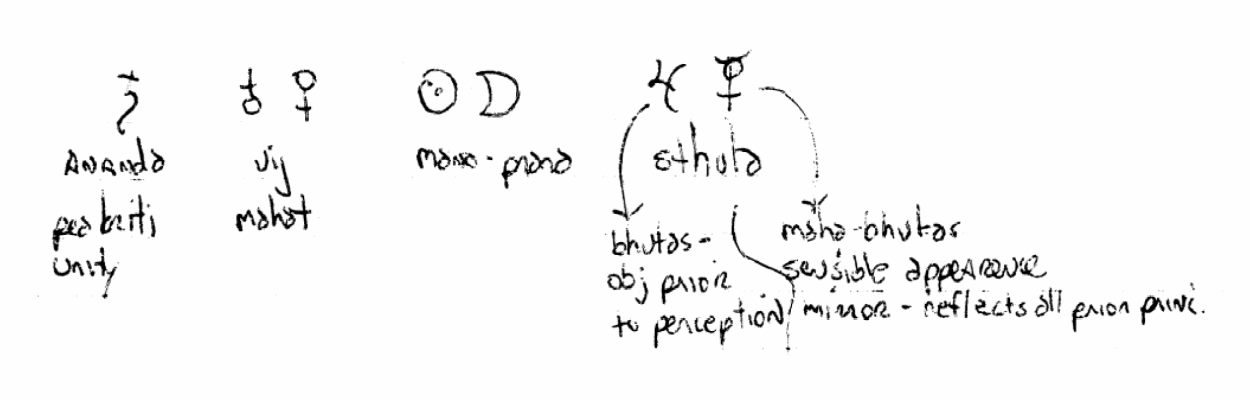
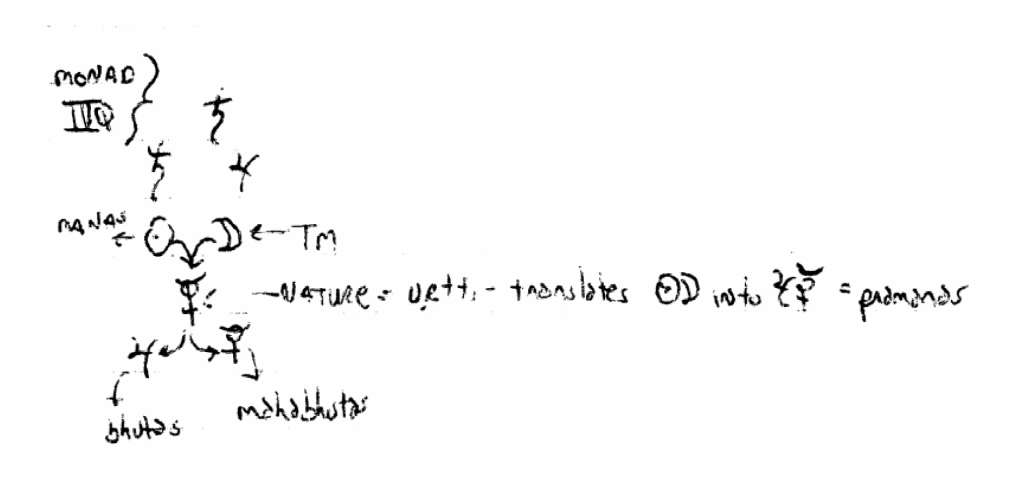
[FIGURE 1977 0903-2-AB. Monad of Fourth Quadrant. IV Q = Fourth Quadrant; TM = Tanmatras. Facsimile scan from AB class notes.]
Monad of Fourth Quadrant -- individual viewpoint -- 7-fold -- Atma.
Body monad -- cosmic viewpoint (koshas) -- Paramatma. [Note: In this class, the term 'Body monad' is generally reserved for fourth quadrant dignities or what AB terms 'Monad of Fourth Quadrant' and 'Body unity' is equivalent to Body ring, or what AB here calls 'Body monad'.]
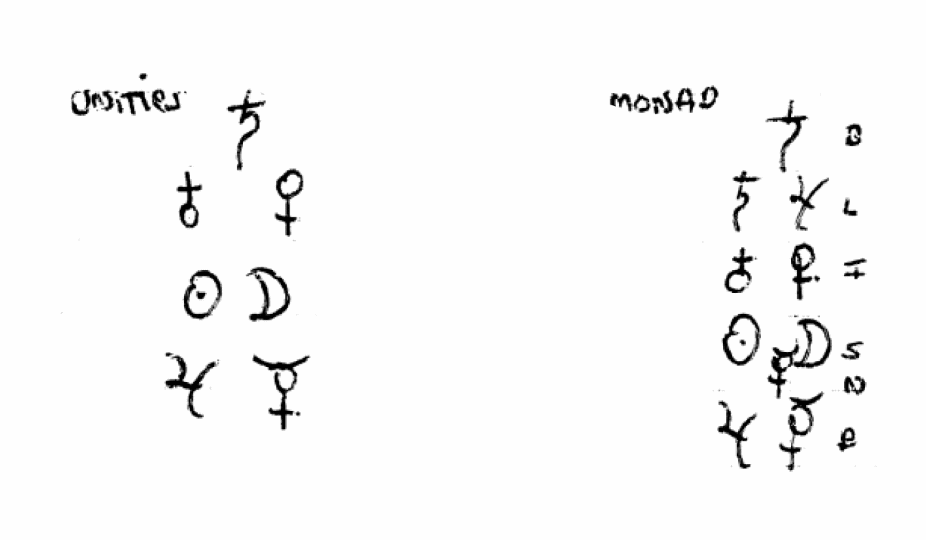
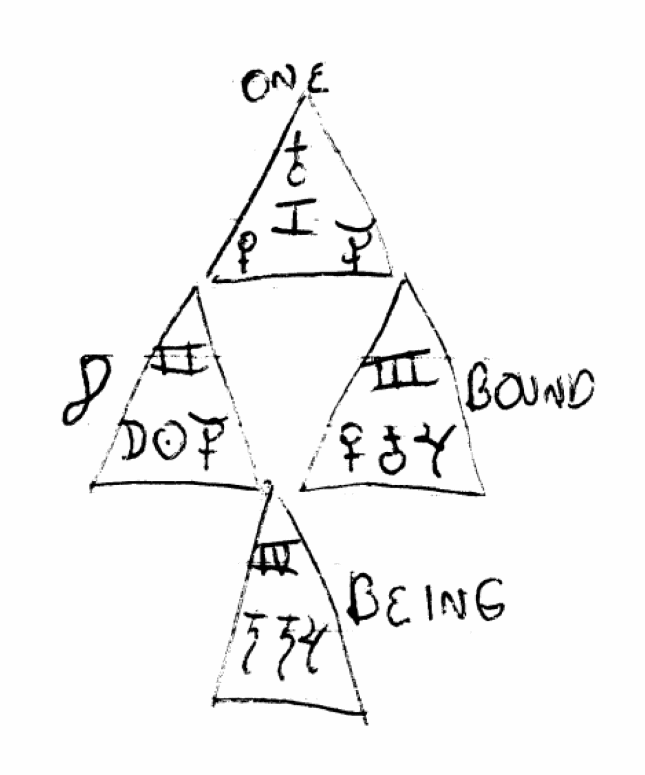
[FIGURE 1977 0903-4-AB. One, Infinite, Bound, Being, and Rulerships. Facsimile scan from AB class notes.]
[Alan Notes 0903 1977 End]
DIAGRAMS FOR 1977 0903
Class
Saturday, September 3rd, 1977
Verbatim, unedited transcriptCLASS at Wisdom's Goldenrod, Hector, NY
with Anthony Damiani (AD)
September 3, 1977
HINDUISM; EPISTEMOLOGY
with Appendix: Alan Notes 1977 0903.
TOPIC: Hinduism
SUBJECT: Epistemology
SUBSUBJECTS: Vritti, Pramanas, Vedanta, Samkhya, Koshas, Unity-Monad Relation
CONTENTS:
Mapping five koshas onto Body ring
Mapping Samkhya scheme onto fourth quadrant dignities
Moon in Capricorn as tanmatra; Sun in Aquarius as manas
Jupiter in Capricorn as bhutas; arrangement of bhutas constitutes body
Body Mercury in Pisces as mahabhutas, sensible appearance
Nature Mercury in Pisces as Nature
Soul (Sun Moon) as source of forms used by Nature (Mercury)
Nature Mercury analogous to vritti, translates Sun Moon (soul) into Jupiter Mercury (body)
Nature Mercury as pramanas
Body Mercury as mirror, reflects all prior principles
Fourth quadrant as universe; contains subject and object series
Body ring: cosmic viewpoint, koshas, Paramatma
Fourth quadrant: individual viewpoint, sevenfold, Atma
Comparing unities and monads (quadrants); example using Soul unity and Soul monad (third quadrant); virtual/potential vs. actual existence
Nature of participation; example of bodily organs as functional images of planetary gods
We learn from images; how does image lead to essence?
Third quadrant as Anima Mundi; discussion of how our soul participates in Soul monad (third quadrant dignities)
Integration of quadrants: inserting third into fourth, etc.; analogy of water viewed from different perspectives
Correspondence between monads and unities; real participation vs. reflected participation
First three dignities in first house inconceivable; Saturn and what follows conceivable
One Infinite Bound reflected in One Being, which becomes four quadrants
Space as Body of God; chaos as residue left behind; reordering of chaos by reason
Appendix: AB class notes
Satprakashananda, Methods of Knowledge: five steps of perception, doctrine of vritti
Three aspects of consciousness and antahkarana; antahkarana must contain concepts corresponding to object to perceive it
Body monad (unity) as cosmic viewpoint, monad of fourth quadrant as individual viewpoint
Diagram of One, Infinite, Bound, Being, and Rulerships
BOOKS READ FROM OR REFERENCED:
Swami Satprakashananda, Methods of Knowledge, Perceptual, Non-perceptual, and Transcendental according to Advaita Vedanta
Plotinus, The Enneads (MacKenna translation, 4th ed.)
Marie-Louise von Franz, Number and Time: Reflections Leading Toward a Unification of Depth Psychology and Physics
DIAGRAMS appended to this transcript:
FIGURE 1977 0903-1-AB. Body Unity.
FIGURE 1977 0903-2-AB. Monad of Fourth Quadrant.
FIGURE 1977 0903-3-AB. Body Unity and Monad of Fourth Quadrant.
FIGURE 1977 0903-4-AB. One, Infinite, Bound, Being, and Rulerships.
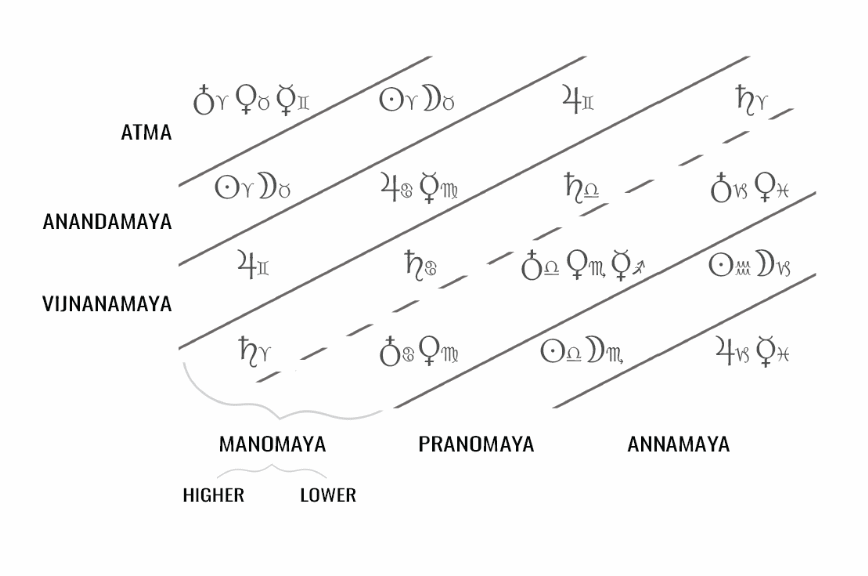
FIGURE 1977 0903-5-AB. 3 x 3 Diagonal Chart of Atma and Koshas Mapped onto Metaphysical Chart.
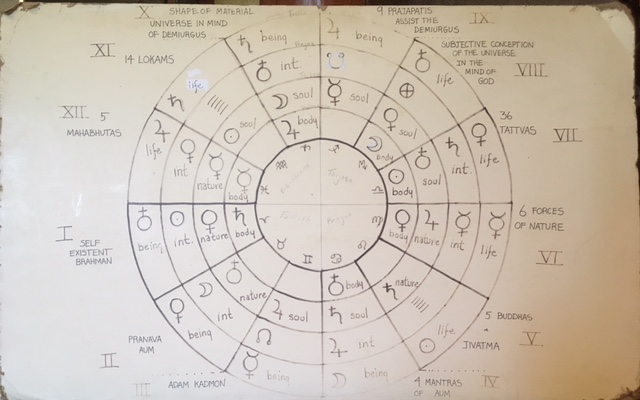
FIGURE IMG 2202-Posterboard Metaphysical Chart.
[Transcriber note: [diagram] means the speaker is referencing a diagram as he or she is speaking. If someone is drawing or writing, with audible sounds of chalk on a blackboard, I indicate this by [drawing] or [writing].]
NOTES:
AB class notes have been appended because they contain diagrams that AD refers to in the class and also because the audio is incomplete. They thus help round out the class. All spelling, capitalization, punctuation, and references corrected, abbreviations spelled out in AB class notes.
Diagram references have been filled in as best as transcriber can determine without actually seeing what's being pointed to, some unknown or unclear, left for reader to figure out.
TRANSCRIBED Verbatim by IT 2022. In 2024, IT completes TOC, corrects errors/notes within transcript. In 2025, IT updates prefatory matter and audio file markers to match new REP audio. Archival verbatim transcript – V12a.
AUDIO FILES: 1977 0903a (formerly 1978 0322b). [Note 1: "Tape" and "Side" refer to original audio cassette tapes that were later digitized into .MP3 Audio Files. Note 2: We only have an audio file for the middle part of the class, we are missing the rest. Originally part of Audio File 1978 0322b; in 2024, REP Studio fixes.]
1977 09/03 at Wisdom's Goldenrod
Hinduism; Epistemology
[Audio File 1977 0903a (formerly 1978 0322b) Begins]
AD: Is there a way of correlating these two here [diagram]? Can we do that, can we try? I-- there's no guarantee that it'll work but, we can give it a try.
RP: Ok so what you got so far, you have-- you have the manas in the--
AD: Yeah, we tentatively put manas, pranomaya, the etheric, [RP simultaneously: No I mean in the other--] the sthula [FIGURE 1977 0903-1-AB], alright, and we could forget the etheric for now and the prana and just label all of this manomaya, ok, and see if we can get a feeling of the Samkhya system. No. [Note: See FIGURE 1977 0903-2-AB for the following discussion.] They got ahamkara and then over here they got manas, alright. And then on the opposite side tanmatra. Now, does tanmatra work, so to speak, does manas take o-- is-- is tanmatra the substance or the stuff that mind works with to produce the world that it wants to look at? [RG assents, faint] And therefore would this be, let's say, the substance side and-- Now we're going to see how meaningless our terminology. This would the subject side [Manas, Sun in Aquarius] and that would be the object side [Tanmatra, Moon in Capricorn]. But, now like we suspicious that this is no more subject than this is.
RG: Alright. [one word inaudible] in the picture.
AD (simultaneously): But from a-- from the point of view of, you know, common realism, we would call this the objective side [Tanmatra, Moon in Capricorn] and this the subjective side [Manas, Sun in Aquarius]. Certainly it's (easier/easy) to identify with your own manas than with someone else's. (AD laughs a bit) [students assent, faint] So what do you think?
RG (faint): Yeah it's (good). I would-- yeah.
RP/S(?) (very faint): What would you do?
AD: Manas? With what? [9¾ second pause] We know that for instance this [drawing] goes into the constitution of body, ok. [short pause while drawing] So then, this would be Jupiter in Capricorn [diagram]?
S (very faint): Uh-hm.
RG (faint): Uh-hm.
VM: Which one is that, bhutas you're saying or--
AD: Yeah.
VM: Bhutas are Jupiter in Capricorn?
RP (simultaneously, faint): Oh I see the bhutas are lower.
AD: Yeah, in other words, bhutas which constitute the body, alright, and body is symbolically represented in this system by Jupiter in Capricorn, [RG assents, faint] alright. So, if we looked at that. Over here we have Body [diagram], ok? Jupiter. Now, whether we think of an individual body or the cosmic body, it is constituted by bhutas. So then we would say, alright. Perhaps that would-- um-- [student assents, faint] Go ahead.
S (very faint): Oh go ahead.
DB: Which-- which body? Is it--
AD: Body. Any body.
DB: Any body?
AD: Any body.
DB (simultaneously): The--
AD: The whole cosmic body or the individual body.
DB: Would this be in reference to the anno, the annomaya kosha? Or, does it go higher than that?
S (faint): Comes with it.
AD: I don't follow you. Is this cons-- is what constituted of the--
DB (simultaneously): Well, you're saying the Jupiter in Capricorn constituted constituents of body.
S (faint): Right.
AD: No, this constitutes body. The arrangement of the bo-- bhutas constitutes body.
[short pause]
RP: Yeah.
DB: Well, [RP, faint: You're right.] but if-- if that-- Then why would you put the-- the bhutas-- I mean why-- why wouldn't they be included in the-- in the Saturn [diagram] then?
RG: Yeah. Well--
VM: Which Saturn?
RG (simultaneously): 'Cause it fits the manifest body. [student assents] Not the causal body.
MB (faint): The gross physical.
RG: Manifest body.
AD: Ok?
DB: So it's-- it's the annomaya kosha that-- that the-- the bhutas [AD, faint: Yeah.] constitute.
RG (simultaneously): Yeah, right.
DB: Ok. But still--
AD (simultaneously): This is not Body, what you see, this is Body plus.
RP: Yeah.
DB: Yeah, well the-- the annomaya--
RG (simultaneously): The Samkhya wouldn't even consider that as being constituted by bhutas.
DB: Which?
RG: The visible body.
AD: I-- I didn't like that reference, 'that'. (laughter) Didn't you heard him, he called me a that? (laughter) Be more specific. (laughter)
RG: I'm in enough trouble. (RG laughing)
AD (faint): Yeah.
RG: There's a visible body.
AD (simultaneously): Yeah, they wouldn't say that the bhutas are-- are identified, yeah.
RG (simultaneously): They wouldn't say the bhutas are that visible body.
AD: Ok.
RG: They're the former-- the prior principles of it but not the actual principles.
AD: That's what I-- that's what I mean when I say the bhutas constitute body. But, not sensible body, [RG simultaneously: Right.] because that would be another addition to body.
S (simultaneously): (Maybe.)
AD: Alright then, how about tanmatras? I mean can you see anything here that relates to tanmatra?
MB: Wait, [S simultaneously, faint: Well--] Tony, why is Jupiter in Capricorn the bhutas? I mean wouldn't that ordinarily be Mercury in Pisces, the bhutas?
AD: No, Mercury in Pisces would be the Mahabhutas [diagram]. [student assents] The sensible appearance of an entity.
RG: Right.
RP: Right. Ok, that's it. Are you using the bhutas here as like the object that's-- before it's seen.
RG: Uh-hm.
AD: Ok, yeah.
RP (simultaneously): In the Mind of the Demiurgus.
RG: Right.
RP: Whatever it is, whether causal or what and that's the bhutas. The tanmatras is like the form of the vritti which will reveal some intelligible aspects or sensibility. [RG assents, faint] Intelligible or sensible aspect of the object.
S: Yeah.
AD: Ok, I think you got the tail. Ok, get the horns.
S (faint): The horns.
RP (very faint): [few words inaudible]
AD (simultaneously): Yeah, I think so. Alright, that's like when Guenon speaks about the tanmatras as the intelligible essences. Let's see if we can pull some more out of this here.
RP (simultaneously): It's got to be that way if you're going to point to the scheme.
AD: It would seem then, if we followed up according to this here, the intelligible essences would be the soul, or the Moon in Capricorn. I mean, [student assents, faint] let's tentatively, [drawing] Moon in Capricorn, intelligible essence [diagram].
RP (simultaneously): (Well) you got to keep it-- no, you-- if you do that--
RG (simultaneously): Would you (do/put) that in the third quadrant [diagram]?
RP: You really gotta keep it on the fourth-- on the Body monad. That that's [couple words inaudible]
RG (simultaneously): Where are you going to put it in the Body monad? Either in the Moon in Scorpio or Sun in Libra.
RP: Because the mind-- the mind goes out and carries the tanmatras with them, so to speak. Taurus-- tanmatra shapes the vritti, and it grasps the bhutas. Now, this-- well-- what do you-- form, you know, you-- I forget the way he had it in the scheme. The vritti, the object aspect of the vritti has got to be something bodily. I mean it's got to be in the Body monad somewhere. After all you do see perceptible bodies.
RG: But those aren't tanmatras [one/two words inaudible]
RP (simultaneously): No but we're shoving it in.
RG: No we're not.
AD: Well, I--
RP: I would.
AD: If we take this here as the Body monad, you know, the big one, the fourth quadrant, alright, and we said that thi-- over here [drawing] we put the bhutas [diagram], ok, they [RG assents] constitute the bodies.
RG (simultaneously): Now-- now you're in Pisces.
AD: I'm sorry?
RG: Now you're in Pisces.
RP (simultaneously): Ok, alright then.
TS: No that's Capricorn.
AD: No, this [RG simultaneously: That's Capricorn.] would be Capricorn [diagram]. This will be Pisces [diagram]. Over here we would have to put the Mahabhutas [diagram], right? [drawing]
RG: No they're both Pisces, aren't they?
S (faint): Uh-hm.
AD: No, gee.
RG (simultaneously): Well, Capricorn.
RP (simultaneously): They're fall.
RP/S(?): There are (two falls, yeah).
RG (simultaneously): Alright, two falls, (yeah/right).
S (simultaneously): You guys are both correct.
AD: Alright, and then this-- this one here is Nature [Mercury Nature], [drawing/writing] and these-- these two up here are Soul [Moon in Capricorn, Sun in Aquarius].
S (faint): Yeah.
AD: Ok.
S (simultaneously): (Ok.)
RG (simultaneously): That yeah. There I would [couple/three words inaudible]
AD (simultaneously): So the forms, the forms would have to be in here [diagram].
RG: I would put them in the ninth [diagram].
RP (simultaneously): Yeah and that would knock away the distinction.
[short pause]
AD: Alright then, the Sun [in Aquarius] and the Moon [in Capricorn] now.
RP: But what are the houses, Sun's--
RG: Eleven [one word inaudible] ten.
AD (simultaneously): The Sun, eleven [diagram], this is ten [diagram].
TS: Well, would they go with the veil of ignorance, the Sun in Aquarius might be like that veil of ignorance which the act of perception penetrates to. The Moon in Capricorn would have to do with the coincident forms of the object, the subject--
S (faint): You see it now?
AD (simultaneously): Try again, I--
RP (simultaneously): No I don't see it.
AD: Turn your words.
TS: Um-- Well, probably just say it again that, in the whole scheme if-- if the Jupiter in Capricorn is the-- is the actual object constituted by the bhutas, and that you're trying to put the whole process of perception down in the Body monad I was wondering--
AD: Oh, no, I wasn't trying to put the whole process [RP simultaneously: I--] of perception. What I was trying to do was try to understand like what it-- what do these two represent. Like if we say this is tanmatra [Moon in Capricorn] and this is manas [Sun in Aquarius], alright, and that this is Nature [Mercury Nature], actual Nature that we speak of. You remember when Plotinus speaks about Nature, all the reason-principles are in Nature, alright. And these are the physical-reason principles which [aside: Thank you.] Nature, so to speak, pla-- implants in a body, and then this entity comes into being. So, the forms with which Nature works with would come from above Nature. And what would that be in Plotinus? That will be in the Soul, wouldn't it? These forms are--
TS: Yeah.
S: Yeah.
AD (simultaneously): Yeah, go ahead.
RP (simultaneously): I'd keep the Sun-- the Sun there as the consciousness, you know-- put this--
(Side 1 of original cassette tape digitized as 1977 0903a (formerly 1978 0322b) Ends; Side 2 Begins)
RG (very faint): (Don't know.)
AD: No.
JG (very faint): Move it.
AD: So this would be like the manas for you.
RG: No, that would be the tanmatra.
AD: Tanmatra?
RG: The Sun would be the manas [diagram].
AD (simultaneously): Which is the substance of manas?
RG: Substance [S simultaneously: Yeah.] of manas and of the-- of what-- of the bhutas.
RP: Ok, now, the Vedanta would say according to the Moon that-- as I said would be the-- the form that goes out of the manas. You can call it tanmatra but the manas is just the totality of those forms.
RG: Yeah.
RP: Has nothing extra.
RG: For sure.
RP: Yeah, alright then, yeah. Ok.
AD: And then the Sun would be? I--
RG (simultaneously): The Sun would be--
AD: I just want this repeated, I--
RG (simultaneously): Would be the manas.
AD: The Sun would be the manas?
RG: Yeah. And the manas works on those seven levels [someone drawing] that we always discuss.
AD (simultaneously): And this tanmatra or the totality of all the forms which symbolically represents the substance of that.
RG: Yeah. Uh-hm.
S: Uh-hm.
AD: And, uh, Richard, you say that this would be the communicating medium.
RG: Well, the other way to look-- I mean in the-- in the Samkhya diagram there has to be a-- a third term that links the sattva and the tamas of-- that flows from ahamkara, there's another line coming down from ahamkara that has to be the motion of relating the subject and the object there, or the vritti, vritti.
RP: Do they have something there?
RG: Well--
RP: (Or) they have directly going back to ahamkara.
RG: Yeah. It's (the rather) form of the ahamkara. But they speak of it as providing a link between the senses and the objects.
[short pause]
AD: Well, Richard are you suggesting then that this Mercury here as Nature [diagram] is like the knowledge of Nature, that what Plotinus referred to as Nature's knowledge-- In other words, she-- from above, alright, from the principles above, she contains these forms and the substance, and she takes these reason-principles, you know, if they're combined a certain way well in the Logos, inserted into a body which is constituted by the bhutas, and [three inaudible RP words simultaneous with AD] then this entity emerges or comes out of it. So this would be analogous [RP assents, faint] to vritti because like it translates these two [Moon in Capricorn, Sun in Aquarius] into these two [Jupiter in Capricorn, Mercury in Pisces].
RP: Yeah. Yeah.
VM: I thought you were saying--
RP (simultaneously): (I'm going to) say it another way. I would see that the-- the Mercury as actually this-- the pramanas, the six ways of knowing. And that is Nature.
S (very faint): Uh-hm, right.
AD: Yeah, yeah. So then it could work this way down [diagram] and it could work this way across this way too [diagram].
RP: Yeah. 'Cause (it has) stuff that goes around.
AD (simultaneously): Alright. Then where would we put this in this scheme here? [Note: See FIGURE 1977 0903-5-AB. Transcriber thinks this is the diagram being referred to.] We said that this was Aquarius [diagram] and this was Capricorn [diagram], ok. [drawing] This one would be Pisces [diagram], this would be [S, faint: Capricorn.] Capricorn [diagram] and this would be Pisces [diagram].
RG (faint): Goes [one/two words inaudible]
AD (simultaneously): Alright, so then we would [RG assents] put it down in this row here [diagram].
RG: Well-- Or do you have to go up the sides?
AD: Well, yeah, we can go up the side. But what I'm trying-- what I'm aiming at now is, can we keep everything down here [diagram]?
RG: I don't see how you could have the same scheme, I mean what are you talk-- (it depends--)
AD (simultaneously): In other words, this Sun and Moon, the Sun and Moon here of Aquarius and Capricorn, is reflected in here [Mercury Body].
RP: Ok, now the only trouble, if by doing that, then you get-- you had an extra Mercury in the scheme, you know? [someone drawing] In the one we just did on the board behind you, there's that extra Mercury, Nature, or the pramanas, the one-- that board [FIGURE 1977 0903-2-AB].
AD (simultaneously): Yeah.
RP: Ok, which doesn't seem to be there. But now you can only say, well, [VM simultaneously: I'm going to start from behind you.] they-- you might-- you want to say (there's) two Mercuries get collapsed. And they say that the-- you know, the way they define perception is that the pramana vri-- the part of the vritti that's called the pramana and the part of the vritti that's called the object are-- are the same. And that defines the mode of knowledge called perception.
AD: Repeat that.
RP: They-- of all the six pramanas, the one called perception is the one in which the vrit-- the part of the vritti known as pramana or way of knowing, the one link, and the part of the vritti that stands in the object are the same, you know, unlike me(,) that's called immediate knowledge.
AD: Yeah.
RP: That means when you run through this unity here, knowledge has to be only taken completely immediately, even if it is inference, or anything like that. But from the point of view of Saturn [in Aries] being the subject, as it were, you know, there's a lot-- bottom line [Body ring/Fall planets], everything has to be taken as immediate knowledge.
AD: From the point of view of Saturn.
RP: No, if you're going to do this bottom line business.
AD: Yeah.
RP: Two Mercuries coalesce because you don't have a third Mercury. You don't have second Mercury. Which would mean that the knowledge in this-- that means this is an immediate knowledge. Even if it occurs to us as the mediated knowledge.
AD: Yeah.
RP: Because this is a knowledge of who?
AD: I agree a hundred and ten percent with you for that-- for that reason, I don't know if you remember when I read that quotation from Jung and he was utterly confused about Mercury.
RP: Well (I don't remember).
AD (simultaneously): For that reason. Do you remember the quotation from Number and Time where he was confused about the buddhi or the Mercury or the intelligence which, so to speak, is so immediate that you can't-- you can't have three of them.
S: The one in the what now, three--
AD: Yeah.
MW: Yeah.
TS (faint): [few words inaudible]
RG: Yeah, right.
AD: He didn't know which one it was.
RP: So, when you have it this way you only have one. In the fourth quadrant you have all the ways of knowing, you know, because there you're like-- no. This way you--
AD (simultaneously): Even, even dia-- don't, even diagrammatically it's perfect because if this is the mirror [Mercury Body], everything has to be reflected in here.
RP: But [three words inaudible] do is (like) they're saying the unity of the monad. I mean that's-- that's the unity because, you know, the only kind-- Isn't that right? Aren't [S simultaneously: No.] you using that term that way, that the [one word inaudible] the [couple words inaudible]
AD (simultaneously): Yeah. That's the way I've-- Because, yeah, I-- well, we use the word that way, this is the unity, [RP, faint: Right.] and there can't be anything outside of that unity.
RP: But when we want to see exactly how it works as far as we're concerned we went down and we did on the board behind you, the column, the fourth quadrant [FIGURE 1977 0903-2-AB], and we-- we were capable of putting more details in. I mean that extra Mercury [Nature].
[short pause]
AD: Well, let's try putting that statement you just made, alright. Let's-- No, no, I can't. Think of that statement as the relationship between this one [diagram] and this one [diagram].
RG: Uh-hm.
RP (simultaneously): Well it's gotta-- see, ultimately, everything is perception. Right? I mean-- I mean all-- the only way of knowing is perception, which is a kind of identity. But we who e-- we go into this-- but given our particular constitution, we take only some of that perception and call it perception, because we work with sense-organs and so on. We take another part-- we take another aspect of perception and we call that inference or-- what are the other ones they use, you know--
AD: Yeah, comparison.
RP: Hypothetical and so on like that.
AD (simultaneously): Hyp-- non-existence.
RP: Right. But that's-- the-- that whole business just comes because of the way we're trying to do this. We're-- you know, how we fit into that knowledge.
[short pause]
VM: Can I try to amplify that, Richard? Remember when I asked a question before about spatial metaphor and so on? It seems that after the mind has descended let's say from vijnana and there is the positing of an embodied subject, and then all the preferences come in and so forth, that's when you speak about other pramanas than perception. And that seems [RP, faint: Right.] to be when you jump up to the fourth-- the fourth quadrant and you speak of the subject series. That's a subject with [RP simultaneously, faint: Oh. That's right.] peculiarities, the subject with real samskaras. Ok, that's the fourth quadrant subject series whereas the-- this is more like vijnana [diagram] in the sense that there's this pure abstract mind without any traces in it if you like, without any contents and so forth. And then as soon as this is energized and a-- and a-- a particular subject is constellated, then you must jump up to the fourth quadrant and subject series to analyze in detail the various means of knowing, the ways of knowing and so on and so forth.
S (faint): That sounds very (good).
VM: Let's do that again.
S (very faint): (Go ahead.)
AD: Could we try-- if we cou-- if we go a little further now. Could we [VM simultaneously: Perfect.] try aligning [couple inaudible student words simultaneous with AD] the two of them on a board here? Let's take the koshas and the tattvas.
VM: Koshas--
AD: Would you please? I could use her.
AS: Yeah.
AD: Let's try. Erase that board, ok? And see if we could align on one side the koshas and on the other side the tattvas the way we've been speaking about them. [short pause] You see, this is what we're aiming at, alright, uh-- The bottom, the-- the Body monad, the fourth quadrant [FIGURE 1977 0903-2-AB], well that's our universe, alright. [VM assents] And we're in that universe and we're part of that universe, ok? And all our knowledge-- In other words, if that universe is considered as a unity, it would preclude any knowledge of it, we'd have to insert everything inside. We can't be like outside looking into it. We're in it. We're part of it. So what I'm saying is something like this, the Body or the fourth quadrant, the quadrant of existence, is where we got to put everything. We have to put the subject and the object series. Because in this universe is where the subject and the object series are.
RG: Wait a minute, I'm sorry, could you say that again?
RP (simultaneously): Wait but that-- (like) there's no--
VM: No, of course not.
RP (simultaneously): You wouldn't speak of kosha(s). Because-- I mean because the koshas (are much too in a personal) way. And that's what Vic was bringing out. The bottom line, the Body unit-- unity of the Body [FIGURE 1977 0903-1-AB], it's from that impersonal point of view one can speak of the koshas 'cause they're-- they're all-- they're not individual those koshas, they're koshas of the Atman, of the Over-- Supreme Self. And you have-- you have to fall back on that sevenfold scheme rather than any five or four (and to know) each other, talk about the-- the fourth quadrant, the Body monad [FIGURE 1977 0903-2-AB].
AD: Again.
RP: Yeah, ok. We-- we have-- you have the unity, the-- the body unit, the thing on the bottom line, the bottom line [FIGURE 1977 0903-1-AB]. Now there you speak about koshas, right, or tattvas, and that's very appropriate. I mean it's very impersonal, no subjectivity involved. The koshas are always referred to the Atma(n). They're never referred to an individual. [VM assents] Ok? Now, if you're going towards [one word inaudible] on the other blackboard where you had the full fourth quadrant with all the aspects [FIGURE 1977 0903-2-AB], koshas are inappropriate there. You have to use a sevenfold scheme with all the individuality that brings in, all the corrupt, you know-- the-- [S simultaneously: All the subjective--] ephemerality, [AD simultaneously: Yeah.] subjectivity.
AD: Alright then, are you saying this here.
[AD drawing/writing]
RP (very faint): (Yeah.) Part of (Fortune).
VM: That's the Body unity, alright.
S (very faint): Blasphemy.
[short pause while AD draws/writes]
AD: Catch me if I'm wrong. Yeah.
RP: One thing's wrong in the third line was a Mercury.
S (very faint): Uh-huh.
S (very faint): Right.
AD: Uh--
VM/S(?) (faint): (From what?)
[Note: See FIGURE 1977 0903-2-AB for the following.]
AD: From that here? Saturn, Saturn, Jupiter.
VM (faint): (Not.)
S (faint): So far so good.
AD: Then Mars, Venus [diagram]. Then--
RP (simultaneously): Well then Mercury comes down. I'm sorry, Sun, Moon, Mercury (next).
AD: Sun, Moon [diagram]--
RP (simultaneously): And then that Mercury in the middle.
AD (simultaneously): [writing] (That) Mercury [diagram]. And then the last two would be--
RP: Mercury Jupiter.
AD: Mercury and Jupiter [diagram].
[AD drawing]
RP: The middle Venus is a Mercury.
VM: Yeah between the Sun and the Moon that's a Mercury.
AD: Yeah. [student assents, faint] Ok. Now you're saying this is where the koshas--
RP: No.
VM (simultaneously): No, no, to the left is koshas [FIGURE 1977 0903-1-AB].
AD (very faint): I'm [one/two words inaudible]
VM: Sorry.
AD: That's the only way I know! (AD laughing) [writing] Koshas.
RP: Right.
AD: And over here [diagram]?
RP: Well now it could correspond to like principles in the Theosophical sense. So you really have seven lines. The Mercury is dropped down one. The Mercury is the Nature [diagram]. You have one, two, three-- You should have seven.
AD: Uh--
VM: That's the sevenfold soul.
RP: Yeah. [couple words inaudible]
VM (simultaneously): The way we used to talk about that, right?
AD: Alright but--
AS (simultaneously): Down.
AD: See--
VM (simultaneously): That's where the-- the lower quadrant drops off at death and so on. Isn't that--
AD: Oh no, I wanted-- I want to tell people.
RP: So-- well you had--
VM (simultaneously): I thought we were saying the same thing but--
[short pause]
AD: In other words, down here [diagram] you want--
RP (simultaneously): That was established already, we went-- we went over that one.
AD (simultaneously): Alright. And by koshas we mean anandamaya, vijnanamaya, manomaya, ok.
VM (simultaneously): Right, right.
RP: So it seems to me what happened-- happened in the-- in the-- in this quadrant is something corresponding to a sevenfold more complete, you know, scheme of things.
S: Which--
[10 second pause]
[Note: See FIGURE 1977 0903-3-AB, Monad, for the following.]
RP: Don't you have them all, Being, Life, Intellect, Soul, Nature, Body?
RG: Uh-hm.
VM: Yeah.
RG: Yeah.
AD: I'm sorry?
VM: In that quadrant you should have Being, Intellect--
S (simultaneously): Yeah you should have Being, Intellect [one or more words inaudible]
RP (simultaneously): Being, Life, Intellect, Soul, and Body.
AD (simultaneously): Yeah. Yeah this would be Being [Saturn in Capricorn], [writing] alright. Both of these are Life [Saturn in Aquarius, Jupiter in Pisces]. This would be Intellect [Mars in Capricorn, Venus in Pisces].
RP: The Mercury (has gotten) dropped off.
AD: This would be Nature [Mercury Nature in Pisces], this would be Soul [Moon in Capricorn, Sun in Aquarius], and this would be Body [Jupiter in Capricorn, Mercury in Pisces]. [RP, faint: Yeah.] Ok? So we can say this Being [diagram], this cosmic Being, ok. And this here [FIGURE 1977 0903-3-AB, Unities], what could we say about this?
RP: Well I would say that we thought it was anandamaya. There--
AD: No I mean the whole thing. What could--
RP: That's super-Atman, that's-- those are the koshas of--
VM: Paramatma.
RP: Par-- yeah, Purusha-Atman.
[short pause]
AD: Ok, and now we want to relate them?
RP: Yeah, sure. (RG laughs a bit) Well we seem to be relating them by slant-- by-- by a-- by a-- by a particular relation. [short pause] [Note: See FIGURE 1977 0903-3-AB for the following.] One Saturn becomes three. Look-- look at how it goes line by line. Just, you know, as if you're crude, which we all are. One Saturn becomes a triple thing there. Saturn Saturn Jupiter [diagram]. The Venus and the Mars stay alone [diagram]. A Mercury intervenes between the Sun and the Moon [diagram]. [short pause] I mean I can't put words but look-- just looked at symbolically.
[Note: See FIGURE IMG 2202-Posterboard Metaphysical Chart appended to this transcript for the following.]
AD: Well I mean here's-- here's a way of looking at it that perhaps might be a little easier, I have to erase this just for a minute, ok? Like if we say the monad of Soul [third quadrant dignities], we come up with the Jupiter, Saturn, ok, um-- [short pause while drawing/writing] Let's see if this helps us any. And then, if this is the-- the unity [diagram], [Note: Not clear if reference is to Jupiter in Gemini or Soul dignities in Soul ring.] let's ca-- this is the unity, alright, let's use that word, [VM simultaneously: Well--] this is the unity. But now if we speak about the monad of Soul, [drawing/writing] we get this kind of arrangement, if I remember. Nothing here [diagram] and--
TS (faint): Saturn. (Uh-hm.)
AD: Well, I'll take a look. Jupiter, Mars, Venus, Tail, and Saturn [rulerships and exaltations in third quadrant], ok. [drawing/writing] And then [RG, faint: Sun and Moon.] Venus, Mars, Mercury [detriments in third quadrant]. Is that right? [students assent, faint] And then the Sun and Moon [falls in third quadrant]. [student assents, faint] (Alright.) Now, this is just to make a comparison, ok? Now, if we say that this is-- this is the Soul of Adam Kadmon [Jupiter in Gemini, third house], ok? The Soul of Universal Man. Any of that terminology we want to use, ok. Like this is virtual. But this is actually in existence [diagram]. [Note: Not clear if "in existence" refers only to Jupiter in Sagittarius or whole third quadrant.] This is in existence, [drawing/writing] ok. This is virtual or potential. Some kind of idea that would express the notion of that which is prior to existence or that which is the principle of existence. Alright? Here over here is the unity of the Soul. [Note: Not clear if reference is to Jupiter in Gemini or Soul dignities in Soul ring.] Over here we could say-- and this is a virtual Idea, alright, whereas this is the actual existence of that entity.
JC: So, are you saying you'd put the koshas on the-- the monad side, and--
AD: No, no, I'm not saying anything, I-- all I'm trying to do is try to get this feeling, on the one hand unities, which are eternal, immutable prototype--
JC (simultaneously): Could you speak of koshas there in the unity?
AD (simultaneously): Huh?
JC: Could you [RP simultaneously: No.] speak of koshas in the unity?
RG (simultaneously): (In order to do you're) speaking of Body.
RP: Yeah, Body you would.
RG: But he's using these as the Soul, so you wouldn't speak of koshas.
AD: Yeah because if we look at this here like this would be-- Jupiter here [in Gemini] would be like part of the Intelligible, part of the One. So, if we looked at this here as the Idea of Universal Man we would say, well this would represent its Unity [diagram], this would represent the Intellect [diagram], and this would represent the Soul of it [diagram] and this would represent the Body [diagram]. And you say, well there's no Nature in Soul. Well the whole thing is the Nature of Soul.
RG: Does it go--
AD (simultaneously): Now, now-- Wait, one minute. Now this [Jupiter in Gemini] has no kind of manifestation. This the way it is here is not in manifestation. What's in manifestation is this here, the third quadrant [diagram]. This existence participates in that, or let's say derives its existence or it's a reflection of this here [diagram]. So, this is what now I'm trying to get at. Now, if this here represents the existence of the Soul or the whole third quadrant, ok, what would be like the relation between these two? Well, there again we have the same problem. And, what we're trying to-- what we're trying to do here is try to figure out this here [diagram] [Note: Not clear if reference is to Jupiter in Gemini or Soul dignities in Soul ring.] in itself would be a simple substance, the way the Greeks refer to it as a simple substance. Homogenous, no differentiation in it, alright. This here [diagram] would seem to be differentiated, it would seem to have aspects. Like I can say this is the Being of the Soul [Jupiter in Sagittarius], [chalk on board sounds] if I could use that term, this is the Being of the Soul. Just like when I speak of the fourth quadrant, I can say this is the Being of the Body monad [Saturn in Capricorn], the existence of the Body monad. I-- I don't know if I'm [RP: Yeah.] making sense yet.
RP: Yeah. Of course, we-- I mean, but the big problem is the relation between the unity and the [one word inaudible] of unity. I mean [three/few words inaudible]
AD: Yeah. Well that's always a mysterious thing, the whole nature of predication, participation is-- But-- You remember the example we worked with once, we said something like this. Let's imagine the seven mundane planets, you know, creating and fabricating the sense essence. And the supermundane planets creating or fabricating the psychical essence that has to be conjoined with it, alright. So we think of the mundane Gods and supermundane Gods fabricating this being. And we say that for instance well, in the planet, in one of the planets which symbolically, let's say the kidneys represents Venus, alright, the heart represents the Sun. So that what we get is a functional image created by the planetary system of a being, alright. And each planet would seem to impart to each of those functions something of its own Intellect or [student assents, faint] something of its own understanding. Do you follow what I'm [student assents, faint] trying to get at? Alright, so if each planet imparts to every one of the functional systems that's incorporated as an entity its own understanding, it imparts it to it. But our language changes it around and says we participate in it. Now what happens to this psychic essence for instance when your kidneys cease to function or your heart ceases to function?
RP/S(?) (very faint): [couple/three words inaudible]
AD: What would say-- I mean the normal terminology would seem to be well then it goes back to that psychic principle. First of all, it never left it because it's-- it participates in that cosmic functioning, so it never left it. And when a person dies it's not that it goes away or anything, it's just part of that whole cosmic functioning. So there's neither coming nor going really.
RP: Yeah but, how can you really do any di-- how can you do any different than a doctrine of maya or just that this is an appearance of? I mean, you say functional image, you can use any terms you want, but you never really grasp it, I mean-- It's true, it's right there. I mean the problem is right there.
AD: Well I-- I'm not denying that, I know that ultimately that these are intermediaries and that the immutable Intelligence, you know, that full-- you know, that totally incomprehensible Intelligence is ultimately behind all of these. But, that-- that would present me with the same thing like the Buddhists do when they say form is emptiness and [RP simultaneously: I know.] emptiness is form, and I say, what happened in between?
RP: But, (don't you).
AD (simultaneously): I want to know!
RP: You say all this stuff about functional images and, you know, to-- to direct the mind to see the psychic essence operating in the function. But as soon as you do, there's no need to speak of function. You know, it's like it's a funny thing. The mind was directed there but if it immediately grasps the-- I don't know, physiological system as an expression of-- of the psychic essence-- But it immediately grasps the essence as soon as it's been directed and told where to go, and then it can't account how it could have ever been helped to use the funny terms 'functional image' after it no longer needs it.
AD: I-- I don't know if I followed you but-- If I reformulate it this way. Catch me or correct me. It's-- it's like you're saying once the mind understands the fabrication of these functional images or beings, once it understands that then it's released from that. It's no longer that.
RP: It doesn't ever see an image again. It's the essence. And it can't understand-- I can't understand how that image ever led me-- led me to the essence once I grasp the essence. How could something, if (it--) if-- It's like writing on the blackboard. Sure I read too.
AD: I know what you're saying, yes, that's the whole point.
RP (simultaneously): I read books and there's words on the page and I can't understand-- [AD simultaneously: That's the whole point, that's why I've been--] can't understand-- (can't understand it) when I'm reading the book! It's only ink!
AD (simultaneously): But that's why I'm doing this astrology!
RP (simultaneously): It's only ink and paper! Crazy.
AD: That's why I'm doing this astrology!
RP: Yeah.
AD: That's exactly the point, that's-- that's one of the crowning things about this here.
RP: It works! But I-- it can't. It shouldn't. It's got--
AD: Well, you remember Proclus made the remark, he says that we really do learn from images. But he didn't go on and say why or how or that--
RP (simultaneously, laughing): It seem-- it always seems so impossible, you know?
AD: Did you-- did you understand what's going on there?
VM (simultaneously): Yeah, sure.
RP/S(?): Yeah.
RG (faint): Yeah.
S (faint): [three/few words inaudible]
RP: [couple words inaudible]
[short pause]
AD: Well I don't know, I'm going to just walk around a bit, maybe something will come out. I wish I had my boot now. (bit of laughter) I'm used to that six foot, you know?
VM: Mark it off in chalk. (bit of laughter)
S: But Tony, Wednesday we came out with the-- you related those (to--/two) to each series and you came out with a bunch of aspects. Like in the Body monad the Moon is-- the Moon in Capricorn, the Sun in Aquarius is a trine and a sextile to the other Body monad of the Sun in Libra and the Moon in Scorpio [diagram], and then in the next level the-- the-- the Venus Mercury is opposite [diagram]. You know, we had all the aspects worked out. The monad is related to the unity by a series of aspects.
AD: By a series of aspects?
S: But-- yeah, by a pro-- you know-- They all [couple words inaudible]
AD (simultaneously): Are you speaking about when he tried to--
S (simultaneously, faint): ('Cause) he did that (for me).
AD: You remember what she's referring to?
AS: Yes [student assents, faint] but I-- but you won't understand the aspects, I think. You won't-- I don't think you'll understand the aspects unless you first understand your rela-- the relation between the planets. [RG simultaneously: The unity and (one word inaudible)] But that was the idea. The-- the idea was to--
AD (simultaneously): Yeah that's the problem I'm working with.
AS: Was to get to the aspects through understanding the relation between the monad and the unity.
S (simultaneously): Oh, oh, oh, oh I see.
AS: If we understood the relation of monad and unity then we can understand aspects which we haven't even hit yet.
AD: Well, look, can we try this here then. We're working on this here. If we took this [AS simultaneously: That was--] here, this Soul [diagram], [student assents] this monad here, ok, and uh--
AS: It was trining.
AD: Well, quickly, this is what, in what sign? Soul monad, this would be Aquarius [diagram].
S (simultaneously, very faint): That was second quadrant.
AS (faint): No.
RG (faint): No.
AD: And this-- Is that right?
RG: Well you're in-- [TS simultaneously: Scorpio.] you're in the monad? No that-- no that's [AS simultaneously: That's Capricorn.] Scorpio and Libra [Body/Fall planets in third quadrant].
TS (simultaneously): Scorpio, Libra.
AD: This would be Libra [diagram]?
TS (simultaneously): That was the twelfth.
S: Third house (right now).
RG (simultaneously): Moon in Scorpio, Sun in Libra.
AD (simultaneously): Oh yeah, third quadrant. This is Scorpio.
RG: Right. No, no, no, no. Moon in Scorpio, Sun in Libra.
AD: Moon in Scorpio, the Sun in Libra. [short pause while writing] This here--
RG: Venus in Scorpio, Mercury in Sagittarius, Mars in Libra [Detriment planets in third quadrant].
AD: [writing] Sagittarius, [one inaudible student word] this Libra, Libra, this--
RG: Scorpio. Scorpio.
AD: Scorpio. [RP simultaneously, faint: (Pretty good.)] [writing] And this Sagittarius, ok? Now, we notice over here we have Being, Life, Intellect, Soul, and this Body [diagram], ok? One, two, three, four, five levels, over here four levels [Rulership Exaltation Detriment Fall in third quadrant].
RG: Well, you have--
AD: This seems to emphas-- like this [diagram] [Note: Not clear if reference is to Jupiter in Gemini or Soul dignities in Soul ring.] is rooted in the first quadrant which gives us a kind of unity, alright, this is sort of immutable. This seems to be the third quadrant [diagram] where souls participate in this here. We'll-- we'll see if this-- if this thinking works out. So that, like if this is the cosmic soul, let's say-- let's imagine this is the Anima Mundi [diagram], [Note: Transcriber thinks reference is to whole third quadrant.] then my soul, which is also constituted of these here would have to participate in that soul. Would that be fea-- I mean is that feasible? Alright, let's check this off. My body would participate in what? Well, I don't think it will participate in this here [Sun in Libra, Moon in Scorpio]. What do you think? I would think that my body participates in [S: The Body monad.] Jupiter [in Capricorn] in-- and [student assents, faint] Mercury [in Pisces].
RP: Because you mean the-- you mean the apparent body is the (tattva).
AD (simultaneously): Yeah, the apparent body. So that won't, alright. How about Intellect, Saturn in Libra? [short pause] [students assents, very faint] I'm inclined to say yeah, I would participate in that. Ok. Being, Life-- No. Yeah, this is Being [Jupiter in Sagittarius] [drawing] and this is Life [Venus in Libra, Mars in Scorpio].
RP: Wait a minute, I'm the one who's typing it. You think my intellect (penetrates) that. But when you say my intellect--
AD (simultaneously): Well it's not mine.
RP: No, wait, I think it is yours. When you say my intellect participates in that you mean not the real intellect but the intellect as reflected [VM assents] in manas. And that's why you're saying it participates in that.
AD: Ok.
RP: I mean if you really meant Intellect then it doesn't-- that's not where it's really--
AD: Over that, go over that.
RP: The Saturn in Libra represents-- represents for an individual the Intellect as reflected in manas. It's higher, or, you know-- [S: Right.] So that's why you say all my intellect, yeah that would be derived from-- my intellectual [one word inaudible] and that would be derived from Saturn in Libra. But it's not the real Intellect, the Intellect as in soul.
AD: You follow what he said now?
RP: [few words inaudible] (my idea), Intellect here.
AD: Yes, no, I--
MW (faint): I don't follow (you).
RG: Yeah, but why-- why don't we use the same discussion about the participation of body in the Sun or Moon?
RP (simultaneously): But the body is very visible and apparent. We don't have any trouble with-- you don't make-- If you made the mistake and-- and thought of your more of a-- I don't know, imagined, imago body, you know-- I mean-- I mean, imaged bo-- you know what I mean, you know? Not the real body but the one-- the one in the fantasy, let's say, then you might say it's that body. Even in the ideal. Yeah the ideal body, right, like a pink-- like what do you call it? Like you see a statue. You go see a statue, like a Greek-- a Greek statue. And like it's physical alright, but what you're seeing when you look at it is a perfection of body. And then I would say in that case it's that body in the third quadrant that you're looking at.
AD: Any-- it's the same-- you could follow through with what he said before about Saturn. When he speaks about the Saturn which is reflected in consciousness we call that reflective consciousness, reflective understanding. And, like I've often made the remark, that's not real reason-principles, but what is reflected in manas. [student assents] Whereas you are the reason-principles. Now that gets reflected in your consciousness. Ok? Well, a better analogy perhaps would be the way Jung spoke of it when he speaks about fantasy. The fantasies are based on the actual brain structure that you inherit. This actual brain structure gets reflected in your fantasies. Now, the brain, so to speak, is in a sense more actual as a reason-principle than the reflection in the manas. So that you are the reason-principles. You are not the reflection of the reason-principles.
RP: Yeah Michael. Your case there is an example of the mi-- of-- of the soul in the Body monad, the fantasy as a secretion of the brain cells.
S (faint): Right.
AD: Alright then, the next one I think also we participate in. [chalk on board sounds] Life [diagram]. So, I think when you think about Venus in Libra, Mars in Scorpio, alright, I think you do participate in that Life. If we look at the-- if we say well we got Life also in the next quadrant, the fourth quadrant, Aquarius [Saturn in Aquarius as Life], alright, Jupiter [in Pisces], Life. Yeah but, there you can see I think it's a different way. It's par-- it participates in a different kind of Life. Over here it's the eighth house Life [Mars in Scorpio]. Eighth house was what? The universe subjectively conceived. So it's almost like the primordial feelings that you are. [short pause] Come on, you got Mars in Scorpio.
S (faint): Severin. (some laughter)
AD: Come on, tell us about Mars in Scorpio, he can't, he's got-- he's got an opposition to it.
RG/S(?): Right.
S (very faint): [few words inaudible]
AD: It's certainly a subjective-- a subjectively felt quality which can't-- can't be reflectively enunciated. That's the Mars in Scorpio. Aren't you going to complain? Huh?
S: And he can't say but--
RP (simultaneously): Demonstrate, demonstrate. (bit of laughter)
S (very faint): Yeah, (right).
AD: Protest?
S (simultaneously): [couple words inaudible] than not.
AD: Yeah.
RG/S(?): Michael.
AD: But I suspect this from the point of view that the Pars Fortuna in Scorpio [diagram] has-- it's-- it's like on the same line of the Intellectual monad because the Pars Fortuna was considered to be in Scorpio exalted because what actually happens is a real transformative-- a transformation, the qualitatively felt subjectivity is transformed. And that would be considered the highest regard that, you know--
RP: Good luck.
AD: Good luck, yeah.
RP (simultaneously, faint): Yeah, Part of Fortune.
AD: Yeah because if-- if all your living eventually-- eve-- eventuates in this utter transformation and realization of life as the ultimate value, I mean, even if that's only a goal let's say that you're working towards, that's still quite an e-- a meaning for the exaltation. To get back to that, I would say that we parta-- we participate in this [diagram]. I would say we participate in Venus in Libra [diagram], I won't even argue about that. If it's beautiful, even when it's very sad, like for instance I'm listening to music, it's very sad. But it's beautiful, I can't shut the thing off! (bit of laughter) I-- Now, how about Jupiter in Sagittarius? Where is our doctor? What's Jupiter in Sagittarius like?
S: I got a cold right now. (bit of laughter)
AD: You got any idea? It's the-- it's the one time I could tell a person life is your teacher and feel absolutely assured that I'm saying the right thing. And I don't mean that life comes over with a ruler and starts saying now this is lesson one, this is lesson two. I'm not talking like that. I'm talking about that what teaches you is the actual existential living. That's the teacher. Alright so, we all participate in that. So that means we have-- we have to try to see this merging into that whole quadrant except for this one [diagram]. Unless you understand it the way Richard tried to explain. This is the ideal background on which the physical is going to be evolved out of, or let's say-- like you have an idea in your mind and you created stone image of the idea in your mind. Well that will never correspond but it must have that ideal to work on.
RG: What about all your discussions about the Sun in Libra be-- being so preoccupied with the body? How does that fit it?
RP/S(?): Would do you mean?
AD: Well, let me try this way, this-- Try to help me, ok? We say that the bhutas is what constitutes body. But the-- these bhutas have an arrangement. What is that arrangement based on?
S (very faint): I don't know.
RG: Just asking.
AD: The ideal type or prototype of Man I would say. The way the tattvas are embodied. That will be the ideal. I mean there we can see Man is a virtual-- let's say the virtual image of what the actual physical man is going to be like.
RG: Yeah. Go on.
AD: What do you mean go on? What do you think I am, a talking machine? (bit of laughter)
RG: No, an explaining machine. I don't-- I don't-- I don't follow why you cut it-- why-- why you say well, we all participate in these other planets and what about-- You know, and then you point out examples of people with Mars in Scorpio and Venus in Libra but they're-- I mean I don't see why the Sun in Libra doesn't partake of this.
AD (simultaneously): But it does, in the same way that we understand that we participate-- this gets reflected in our manas, in the same way that we understand the Mars in Scorpio but only through the medium of our conceptualization which is always interfering with what it's telling us directly. I mean, I do not need any words to tell me what Mars in Scorpio is. And I would say this much, if you use words, you're off the point. It's direct. Sub-- subtract life from this whole stuff, if it's-- if that was feasible or possible, and then we would say it has a certain quality. Then insert it back in and that quality of life or its standing in a certain hierarchy, alright, would color this whole thing. [short pause] I don't know. [student assents, faint] Just my way of trying to explain it. And this is-- this-- this I think was explained pretty adequately by Richard. If you think of this as ideal [Saturn in Libra], the same way as this is ideal to the-- This is not directly manas, alright. The manas only grasps Saturn in this indirect way through its reflection in our conceptualization processes and we say we're reasoning. But this can be grasped directly in the sense like when-- let's say you're supposed to be at a certain place because the World-Mind wants you there, and you're there. Whether you have reasons for being there or not. [student assents, faint] That would be the direct reason-principles just operating and working themselves out. Then we would say that that-- that felt-- that li-- that life which is, you know, being worked out in this existential situation in relationship to other things which in their totality is reason, we would say that it has a certain quality. And that quality, so to speak, alright, is again a kind of actual existence, in act.
Anyway, going down, we can take this whole third quadrant [diagram], third quadrant, not the Soul, this one [diagram], this whole third quadrant, and insert it into the fourth quadrant. And then we're going to have to do the same with the second, insert it into the third. "Insert it" is probably the wrong way. It's just like when we say for instance I'm talking about a glass of water. I drink this glass of water, alright, it satisfies my thirst. Then a chemist looks at this glass of water and he analyzes it into elements and chemicals, alright. Then a physicist looks at it and he analyzes it into all these various powers and forces acting and interacting, alright. And if they're more evolved or more specific kinds of studies they're taken by a different, alright? But, it is still that glass of water. Now, this is the way we're working. We're going to work one into two, and one and two into three, and one, two, and three into four. [short pause] I-- It's the same principle like for instance when we say, there's the zodiac. There's the unity of the zodiac, ok? We think of it as a unity. And then we say, what's that doing? And the only thing I could say is that, the same way Proclus spoke about, the One in Beings, the One after Being. Alright. The One after Being, that-- that zodiac represents the One after Being, not in the Intelligible World but in the sensible world. And that very One is going to be reduplicated in the creatures that that zodiac is, so to speak, bringing about, fabricating. So we have to bring the One down all the way into these creatures. You see what I'm aiming at now? Alright. Then, if this here, if we-- if we participate in this and we par-- Let's try to see how we participate in this one [diagram], ok?
[AD drawing]
MB (faint): Tony, can I ask you something?
AD: Sure.
MB: With each-- every time you compare let's say the Soul monad to the Soul unity, or another monad to its unity, here (in) the planets, there's always going to be one level on which they correspond, like just the Soul. Soul Soul corresponds-- the same planets in the monad as a unity, right? It's the same Mars Venus Mercury that you have in the third quadrant in both of them.
AD: In both what?
RP: Yeah.
MB: In both the unity [RG simultaneously: Right.] that we don't participate.
AD: Oh, in these two [AD indicates on diagram].
MB: And the monad that we do participate. I don't know [RG simultaneously: Yeah.] what it means but-- but that if we--
RG (simultaneously): Because the Soul, every-- 'cause the Soul of the monad is [MB simultaneously: Is the sa-- right.] the Soul-- same Soul of the unity.
MB (simultaneously): Soul Soul, and the same with Body Body, [RG assents] it'll be the same Body in each one, like-- well, we just did Intellect.
RP (simultaneously): That's why Myra. When he says he put a space in the Mercury (Moon) Venus and so on over there, that's a real participation. And when he-- the other one is (about an) ideal or reflected, you know, you participate in it, right, and it's an image, but it's not the thing.
[short pause]
S: Right.
MB: Which one's similar?
RP: When-- taking the line that is the same in both.
MB: Right.
RP: And talking about in the monad where you say you participate in it.
MB: Right.
RP: That's a real participation.
MB: Right.
RP: And now we talked about the Saturn in Libra, we said well it's something reflected, it's not quite the real thing, it's close. Or that the Moon was Libra-- the Sun in Libra which is the Body is only the ideal prefiguration and so on, but when we talk about the other line, the Soul line, yeah that's real. Rather than-- rather than a reflection of something above or a prefiguration of something below. There it's really operating and it's real. You really make contact with a real thing. Soul is Soul.
[short pause]
AD: It's-- Perhaps as an addendum to that, you remember when we were reading in Thomas Taylor where he spoke about this primal Triad which is inconceivable to you in intelligence? Alright? And if we think of these three mo-- unities, you know, the-- what is it, the Mars in Aries and the Sun in Aries, alright, and the Venus in Aries, that's-- that's like inconceivable to us. The one that we seem to be able to deal with is the Saturn in Aries [diagram]. That's like the Body of God, space is the Body of God, and from there down, we can seem to be able to handle or deal with it. But the-- like if you try to say well, what are the inner side, what's the inner side of space like, well that would take you to those three simple substances up here [diagram]. And they-- These accordingly I would regard as real-- real, you know, these are really real, whereas this here [diagram] is like something which participates in that reality and maybe this is becoming real and more real. [short pause] But go ahead Richard, you try. [RP, faint: Ok.] I know that it's--
RP (faint): [couple/few words inaudible]
AD: We have to go back to that discussion when we were speaking about the way the immensity of this-- this whole adventure, alright. And anything coming from there, from here you have Infinity and Bound. [Note: See FIGURE 1977 0903-4-AB for the following. See also FIGURE IMG 2202-Posterboard Metaphysical Chart. Infinity and Bound is houses 2 and 3.] [students assent, faint] Alright, and then over here you had the One Being [House 4]. And we said these [One Infinity Bound, houses 1, 2, 3] are like reflected in the One Being, alright, and now this One Being becomes these quadrants, [Note: Four quadrants of the metaphysical chart.] alright, and they're going to all participate in this-- in these ultimate principles.
S: See I follow-- I think I follow generally what you're saying there, it's like you never contact the-- the upper chart [diagram], I-- with this-- Maybe you (could/can) conceive it up there I-- because--
AD (simultaneously): As it's reflected in that--
S: And you see it reflected through the Saturn. And yet that Saturn-- the Body in the first quadrant, it's actually the summit of the Body Monad.
AD: Yeah, this Saturn here [in Aries] [S simultaneously, faint: The Body monad.] is the-- is the summit of the Body monad. And if we say that this is space for instance, let's call this space, alright, and all the worlds that existed in this space which came and went, ok, they would leave a certain residue. When they went they would leave a [drawing] certain residue in space. Ok? [student assents] And let's call this residue which they leave behind chaos. And then when a world is going to be reconstructed this matter, or this chaos, alright, is reordered by reason, and a world is constructed. And then again, it's gone and this chaos remains. It's almost like saying imagine the universe going into pralaya, all manifestation disappears and all that there is left is space. And, homogenous with that space is the residue or the activity of that manifestation.
S: So that's explaining the arisal of that background.
AD: The arisal of--
S (faint): That one on top, [AD simultaneously: Yeah, yeah.] the-- (and) definition.
AD: Yeah. In other words, this [Saturn in Aries] to me would be equivalent to something like the matter which is homogenous with space. If you want to call it a living congerie of vol--
[Audio File 1977 0903a (formerly 1978 0322b) Ends. We are missing all other audio files for this class.]
1977 09/03 V12a: CLASS: Hinduism; Epistemology. Copyright 2025 Wisdom's Goldenrod p. iv