DIAGRAM FOR 1977 0929
Class
Thursday, September 29th, 1977
Verbatim, unedited transcriptClick the series name to view more
CLASS at Wisdom's Goldenrod, Hector, NY
with Anthony Damiani (AD)
September 29, 1977
BUDDHISM; EPISTEMOLOGY
TOPIC: Buddhism
SUBJECT: Epistemology
SUBSUBJECTS: Guenther ("The Concept of Mind in Buddhist Tantrism"), Symbolic Functioning
CONTENTS:
Reading/discussing Guenther, "The Concept of Mind in Buddhist Tantrism"
Distinguishing sense-field, outstanding sensum, and object
In Buddhist epistemology, the object is the sensum, there is no prakritic entity behind it
External reference is brought in through feeling and expectation; this is like going from 2-dimensions to 3-dimensions
Reducing emotion to a minimum is like going from 3-dimensions to 2-dimensions (Ramana with the tiger)
The unity and functioning of consciousness projects out from itself its own meaningful world of experience, produces the subject-object relation
Individual as selective attitudinal responses to a given environment; no attitude, no individual; attitude has him; inner grasping always going on; you are yourself your own worst enemy
No duality obtains in instantaneous moment-to-moment experience; this is pure sensation; we are Enlightened from the beginning, every instant in time
Using dream to illustrate appearance, samskaras, and symbolism
If recognized as a dream, there is emptiness; samsaric wheel won't turn even as images come up; this is unoriginatedness and peace; maya is unoriginated
To recognize the unoriginatedness of every moment is to cut the tree at the roots
Samskaras
Pure sensation vs. dualistic experience
If flow of samskara is cut off, then there is pure sensation
Latencies in the subconscious want to constantly actualize themselves and become your conscious state; these vasanas are constantly mixed with/superimposed upon your perception
Symbolific activity: highest level is individual mind converting intelligible vasana into experienced world; lowest level is dream symbolism; many levels in between–art, clairvoyance, thinking, etc.
Mind produces world for you and you make that world meaningful through your own activity
The very nature of mind and its activity is to try to understand the content of whatever it's perceiving; mind believes in what it's doing
Even at mystical level where mind is producing universal experience, this is still symbolific activity and will ultimately prevent liberation
Mind is empty, like space, not a substantial thing or an entity; lower manas of Shiva as mental space or emptiness
You are a functional unity, not a substantial one; there is no solid unchanging ego-center that has thoughts; that "someone" having thoughts is included as part of the thought; no place to stand to claim ego
BOOKS READ FROM OR REFERENCED:
Herbert V. Guenther, Tibetan Buddhism in Western Perspective, "The Concept of Mind in Buddhist Tantrism"
Mircea Eliade, Yoga: Immortality and Freedom
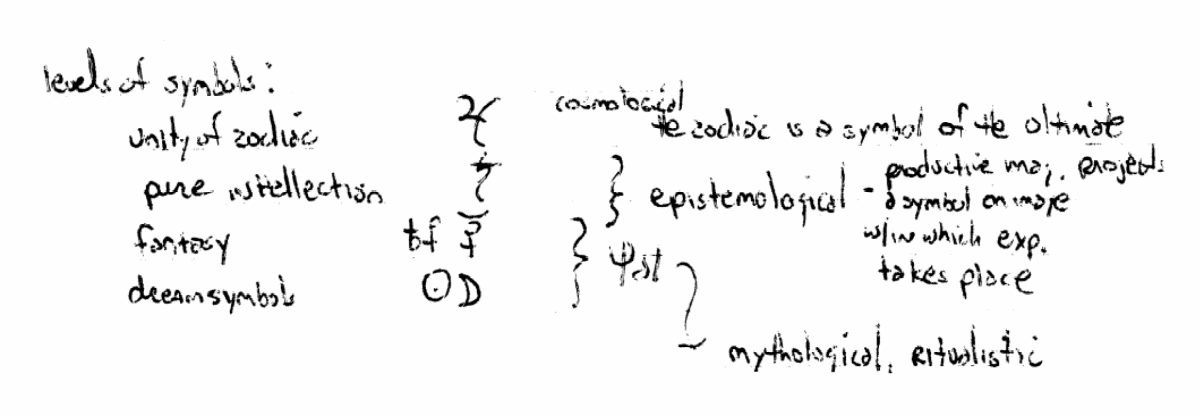
DIAGRAM appended to this transcript:
- FIGURE 1977 0929-1-AB. Four Levels of Symbol correlated with Soul Monad.
Other diagrams referred to are not with this transcript version. [Transcriber note: [diagram] means the speaker is referencing a diagram as he or she is speaking. If someone is drawing or writing, with audible sounds of chalk on a blackboard, I indicate this by [drawing] or [writing].]
NOTE: For readability's sake, the following substitutions/edits made in Verbatim Transcript: cuz = because; gonna = going to; gotta = got to; yeah = yes.
TRANSCRIBED Verbatim by IT prior to 2017, reformatted by jf 2017. In 2023, IT updates prefatory matter, footer, and audio file name, fixes errors/typos, adds one diagram and reference within transcript to this diagram, reformats to accord with new conventions. Archival verbatim transcript – V12a.
AUDIO FILES: 1977 0929a, 1977 0929b. [Note: "Tape" and "Side" refer to original audio cassette tapes that were later digitized into .MP3 Audio Files.]
1977 09/29 at Wisdom's Goldenrod
Buddhism; Epistemology
[Audio File 1977 0929a Begins]
AD: --pivotal, very pivotal in concealed concept of Buddhism. And although Mr. Guenther is not aware, it's also the same problem that comes up in all the other traditions. [short pause] So, we're going to have to try to understand this very carefully. I guess this is the same one as--
S: [couple words inaudible]
[student assents, very faint]
AD: We leave that alone [one/two words inaudible]
PD: Explain what you mean by another alternative.
AD: I don't know what it is.
S: (Oh/A) simple excuse.
AD: Yes.
S: Here you go.
S: Yes.
[15 second pause with background student talking]
AD: You'll start with that section 1 again, on page 266, I'm sorry, 265. Just quickly we'll review. "To sum up…"
S (faint): Yes.
[30 second pause with shuffling about, background student talking]
[Transcriber note: I am using Tibetan Buddhism in Western Perspective by Herbert V. Guenther, Dharma Publishing, Emeryville, 1977.]
Herbert V. Guenther [Tibetan Buddhism in Western Perspective, "The Concept of Mind in Buddhist Tantrism," pp. 41-42, AD reading]: "To sum up: Like a material thing and its changing states, mind [(sems)] under certain conditions assumes a certain state and returns to its 'natural' state as soon as the conditions that brought about the change [or deviation] from the natural state, are no more. By dividing up the history of a mind into successive adjoined slices, it is found to have certain determinable characteristics which belong to all the slices and which are termed 'sentient being' [(sems-can) and] it is further found to have even the more determinate or primary characteristics of 'having a state which is memory and association' [(dran-pa)]. That is to say, mind having assumed a certain determinable status of, say, a human being, and retaining this status throughout its history of a human mind, has completely determinate occurrences of these determinable characteristics, viz., memory and association. [AD adds: Now] This analogy of mind with a material thing has important consequences. Just as there are many things in our world…so there are also many minds, each individual being a certain 'mind'. But not only does such a conception of mind account for the differences that exist between individuals or individual minds, it also allows for the variety of mental operations, because every event of memory and association may be a different determinable event of the determinable characteristic 'human being', without ever failing to be a state of this mind under consideration. [Moreover], it allows [AD read: follows] for the variety of all life."
AD: Alright, going on to the second paragraph. And this is like-- from here on I consider this worthwhile understanding.
Herbert V. Guenther [Tibetan Buddhism in Western Perspective, "The Concept of Mind in Buddhist Tantrism," pp. 42-43, AD reading]: "When a thing changes from one state into another its primary characteristics, a definite color or a definite shape, may be different, but since these states are states of the thing, we say that the thing has changed. [AD adds: And] At the same time we tacitly assume the thing to persist through its changes, and so we seek for causes producing changes. There are three causes which produce changes of what is termed mind. They are appearance [(snang-ba)], traces and dispositions [AD adds: or samskaras] [(bag-chags)], and symbolism in the widest sense of the word [(brda)]… [short pause]
"'Appearance' [(snang-ba)] is a term which, when left unspecified, is apt to mislead us into the assumption that it refers to a three-term relation of appearance which stood at the beginning of modern science and subsequent philosophy. … [AD: Alright.] [AD adds: Now] Since the Buddhist conception of appearance does not presuppose a doctrine of absolute space as the [AD reads: a] common matrix of all objective constituents of perceptual situations, a three-term relation theory is not implied by 'appearance'. Nor is 'appearance' equivalent with illusion…"
[student assents, very faint]
AD: Now the three-term relationship is the one that most of us are familiar with--an object, a subject, and a relationship. And he's going to go into this now.
Herbert V. Guenther [Tibetan Buddhism in Western Perspective, "The Concept of Mind in Buddhist Tantrism," p. 43, AD reading]: "The Buddhist conception of appearance begins with an analysis of perceptual situations which contain a sense-field with an outstanding sensum [(yul)]. This is apprehended [('dzin)] by entering into a certain specific relation with feeling and expectation [(zhen)]."
AD: Now this is what I want to discuss.
Herbert V. Guenther [Tibetan Buddhism in Western Perspective, "The Concept of Mind in Buddhist Tantrism," p. 43, AD reading]: "The Buddhist conception of appearance begins with an analysis of [AD adds: the] perceptual situations which contain a sense-field with an outstanding sensum [(yul)]."
AD: Would someone explain that? Or someone try to get into?
[11 second pause]
AH: Well the-- I think one implication is that there's a-- there's two-- there's two things, a sense-field and a sensum, and not necessarily a relationship between them as a third-- as a third content. [short pause] Like he-- he's going to set this idea against the previous paragraph with the three-term relation.
S: Yes.
AD: Sense-field--what does that mean? Yes--
LS: So you have a field of cognition in the senses. [student assents] An outstanding sensum [AD drawing] is what's in the sense, what appears in that field.
AD: Alright. Can we say this is a sense-field, just for an example? And let's say we got the blue-- [drawing] blue sky, ok, we have mountains, clouds, ok, and you're in here somewhere. Alright. Sensa-- sense-field. There's five senses so there would be five varieties of senses or sense-fields, and let's say this would have to do with color [diagram], ok. [student assents, very faint] Sense-field. It's a field-- So you would have to take the five senses, imagine them as formless, you know, formless in the sense that-- Like the blue of the sky, that's where the blue of the sky is, that's a sense datum right? You look at the green of the trees which are up on a mountainside, that's part of the sense-field, isn't it. You look at, [drawing] let's say something, a star up here, ok, that's part of the sense-field. It-- it's a very technical word, 'sense-field'. And the sensum would be like-- like what, what would sensum be, who's the gra-- gram-- grammarian here? Sensum, yes.
DB: No, I'm not a grammarian but it seems to be within that sense-field what is specified as just being the object of consciousness, being where all this moves. That would be like a sense-field and many different objects in it would passively be right now say the blackboard.
[short pause]
AD: Why call it a 'sensum'? Why not call it 'object'? Why they insisting on this word 'sensum'?
DB: Well, because-- well, it was-- it was seen that it was essentially the condition of-- the specificity of the-- within the sense-field prior to its being called an object. [students assent, very faint] It's that which will become an object. And if-- the-- the next sentence--
PD: But it's just the object [S: No.] of cognition.
DB: No, it's not the object of cognition.
PD: Discrete color blue, for instance, alright, or gray or whatever, speaking in terms of sight.
RC: I would think that in all we've talked about the sense-field with the outstanding sensum would be the physical body.
AD: The physical?
RC: My physical body. That would be the outstanding sensum that he's talking about.
PD (simultaneously): The physical body [student assents] is a form that's conceived by conceptual thought, that's not a sense-data, that's not sensed. It's got to be described in terms of sense qualities which is in the sense-field.
S: I still think it's just that blue thing.
AD: Go ahead Tom, [student assents] sure, go ahead, go ahead.
TM (simultaneously): Yes, I wa-- I want to interpret it a little differently, I want to say, well if the sense-field is like a-- I'd keep it and call it like maybe-- but not the realm of-- something like a realm of experienceable or like say point-instants, but it would be-- it would be some sort of entirety. I-- I guess that doesn't explain it very well. But the sensum, the reason they call it 'sensum' instead of an 'object' is 'cause an object assumes that there's some-- something behind it, and that's what-- or there's some permanent thing there. The sensum is-- is just this strictly what is cognized beyond the field. The sense-field would be the realm that that-- that-- that cognition is taken from and the reason it would be 'sensum' and not 'object' is 'cause object doesn't-- you assume that there's something valid behind it, whereas-- where-- whereas I would think the approach is more like a stick with one end approach, it's an approach of-- of there really being-- or of even not being something behind the cognition, that the concept-- that-- that the stream of cognition tends to infer something behind the stream of cognition that's there.
AD (simultaneously): You would have a three-- a three-fold appearance then, you know, [TM assents] alright, and you want to avoid that.
TM: Yes.
AD: So what you're saying is like you have sentient being, sense-field, sensum. So they kept it all within that-- the realm of the senses, the sense-psychology.
TM: Yes.
AD: (Does that tie together?)
TM: (Um), yes.
AD: (Alright/Ok). Go ahead Andrew.
AH (simultaneously): Notion of this sensum, is that any way equated with a-- with a (permanent) sort of thing, emerge out of-- out of this discussion, the sensation, like we talk about the pure sensation?
AD: Well, that may, but the point that we're trying to make here is that they're keeping all this within the area of the relationship between senses, sensum, sense-field, and they're not-- they're not going to say that behind the sensum there's some sort of prakritic entity. [AH: Right.] They want to avoid that. So if we want, like let's try just for a moment, in one of the analogies we use where-- Try to think of man as he existed a long long time ago, alright, we go back into the primeval mist. And at that time for man, who was not alienated from Nature, like he didn't feel that "Here's me and there's the world," but like he was part of Nature. So if he had to scratch his toe or if there was a volcanic eruption, it was all part of this one sense-field. There wasn't the distinction yet, the "I", the ego, claiming, "This is my body and that eruption in the mountain is something other than my body," there wasn't that distinction. I-- this is a fairytale but maybe it'll drive the point home. So there was this sort of continuum of experience, alright, and there wasn't this division within that experience, "I" and not-I. That didn't come about ok. Let's say that that gradually comes about. Little by little a person is-- let's say gets alienated from Nature and begins to feel an "I" which is different from that natural world he finds himself in.
Alright now, if we take that as a background and we try to imagine the Buddhists are approaching experience from this very direct way. They're not going to postulate the existence of any entities behind the appearance or behind the sense-field, alright, and they're going to say simply that we're going to take this sense-field, the sensum, the sense-field, and the sentient being, and make these divisions within-- It's like a flat di-- dimensionless background. As soon as you say three-fold relation, subject-object relationship, right away you bring in the three-- the three dimensions, you know. But this here makes you get a feeling of everything getting inserted back into this dimensionless, two-- two-dimension flat appearance of an object.
S: But how are you defining sensum?
AD: Well, let's keep trying.
Herbert V. Guenther [Tibetan Buddhism in Western Perspective, "The Concept of Mind in Buddhist Tantrism," p. 43, AD reading]: "The [Buddhist] conception of appearance begins with an analysis of perceptual situations…"
AD: So within perceptual-- within a perception, you're going to have a sense-field with an outstanding sensum. [short pause] Alright? So if we say that-- [drawing] this would be the sentient being [diagram], this entirety would be the se-- sense-field [diagram], [AD or student: ok], because everything here is in terms of the five senses, ok. Then the sensum? It would have to-- it would have to relate like to a particular, so-called particular object, let's say he's kicking a stone, alright, like every one of these would be a particular sense object. But we have to leave out the word 'object' and say 'particular sensum'. This is the [drawing] blue which is not the same as the green, ok.
EMK: You want the dictionary definition?
AD: Yes.
EMK: (It is) "an immediate, unanalyzable, private object of sensation."
AD: Ok, but you see they brought in the object, whereas for them, for-- for them the object is the sensum. That's the object, there is no object except the sensum. Read it again.
EMK: Well I (tell you), under 'sensum' they have 'sense-da-- sense-datum'.
AD: Sense-data?
EMK: And then I looked up 'sense-datum' and it says, "an immediate, unanalyzable, private object of sensation."
[short pause]
AD: Yes, ok, I think that's (beginning). Go ahead.
AH: It's awfully hard for me to see how this is within sensation, [student assents] in the sensum how there could be discrete possibilities [one/two words inaudible]
AD: They didn't separate it, they're discrete, they're not separated. The blue of the sky is not the same like the green mountain. This is all the sense-field, the blue of the sky, the green of the mountain. But this is one sensum, this is another sensum. [short pause] This whole thing is a sense-field [diagram]. Within the sense-field you have various sense-data or sensum. This mountain is green, ok, this sky is blue, ok. And let's say the tree-- the stone that you kick is hard, ok. These are all private sense-data given to an individual. He's kicking the rock. Now he's looking at the sky and kicks the rock. So there's the private sense-data, alright, of kicking the stone, which in this case would be hard, impenetrable. The blue sky and the green tree, and let's say he smells musk at the same time from a tree. Now these are all private sense-data. None of them are separated, so to speak, in the sense that they're like two stars, one stands here and one stays here, but they're all part of the sense-field. Do you see what I'm trying to get at? Go ahead, speak.
RG (simultaneously): You do-- seems the reason they don't call it 'object' is because there's no external reference there.
AD: Yes, exactly, there's no external reference.
RG: Then that-- you can still refer to a discrete se-- sense-- sense content and not speak of it as an external object.
AD: Object. Yes, the next sentence they say is what brings in the object, alright.
Herbert V. Guenther [Tibetan Buddhism in Western Perspective, "The Concept of Mind in Buddhist Tantrism," p. 43, AD reading]: "This is apprehended…"
AD: The "this" here referring to what? Alright, to the sense-field and the sensum, the whole perceptual situation.
Herbert V. Guenther [Tibetan Buddhism in Western Perspective, "The Concept of Mind in Buddhist Tantrism," p. 43, AD reading]: "This is apprehended [('dzin)] by entering into a certain specific relation with feeling and expectation [(zhen)]."
AD: Alright, as-- Yes--
DB: Well, that's what I have a question about. Is the "this" the sense-field and the sensum? Is the-- is the apprehension only of the sensum or is it of the sense-field?
AD: But-- well, they're all together.
DB: Well, it would seem that the-- [short pause] I mean, it would-- it would seem that what would be apprehended would be the-- the sensum and that-- that the sense-field wouldn't necessarily be apprehended [couple/three words inaudible]
AD (simultaneously): Well let's try following it this way. He says--
Herbert V. Guenther [Tibetan Buddhism in Western Perspective, "The Concept of Mind in Buddhist Tantrism," p. 43, AD reading]: "The apprehension together with feeling-emotions and expectations gives the situation the specific external reference…"
AD: And now we work back, ok? Now what is he saying here? In the image we made for ourselves prior, let's imagine ourself like a-- an animal, a dog, or some other creature which is not human, ok, and let's say his-- the world he lives in is in two dimensions, he has no feeling of depth, ok. It's like a flat surface with a creature roaming around in it. Now, the point I'm trying to make as-- with this example is like, at the moment that there is feeling and expectation, the way they pointed out here, this gives the-- the whole sense-field, this establishes it as something external. Ah let's see, think of another analogy.
LDS: Tony?
AD: Yes.
LDS: But more than externalizing the sense-field, I think it would be more specific to say that "externalizes the senses".
AD: No, no, no. It's the expectation and the feeling that refers to something which brings in that other dimension.
LDS: Yes, I don't think I disagree with you but I'll-- I'm saying that it's not as if feeling and expectation thrust out or externalize the whole sense-field for me but-- but particular data or-- well the way they speak of the word 'outstanding sensum,' because I'm not in relation with the whole sense-field. [AD simultaneously: No.] I don't feel as though I am. I'm only in relation with those things that have a meaning for me or a value.
AD (simultaneously): Yes, something you select or something-- yes.
LDS (simultaneously): Yes, selective things.
AD: Ok. But the point that I'm trying to get at is that what gives that-- what makes that two-dimensional field become three-dimensional now is that that selective response is to a specific object with feeling and expectation. It is here, the feeling and expectation, that suddenly gives this two-dimensional picture three-dimensions.
S: Uh-hm.
AH: And the third dimension is the-- the emergence of-- of a personal perspective, an "I".
AD: No, no, no. No, [AH simultaneously: That's what--] you want to leave that out. All we want to right now, the-- just-- all-- zero in on just one point at a time, alright. What we want to try to grasp now is how this feeling-expectation, because it refers to one sense-datum, produces, conjures up, this feeling of externality. This is what I want you to try to catch now. Just stop for a minute and see if you can come up with an analogy and I'll know if you got it. But go ahead.
LDS: I-- this isn't probably a very good one but, if you're in a situation, let's say amo-- amidst many objects that you're not familiar with, ok, and like you're kind of in a lost state, there's no real concern or attention, or no real firm feeling of relationship with those things until you're-- until you wander around with your eyes and then all of a sudden you catch something that you associate a past experience with or a more-- All of a sudden it jumps out.
AD (simultaneously): Alright, let's make it dramatic, let's make it dramatic. You're walking in familiar surroundings, ok? Let's say you're walking down path there, ok, everything is very familiar, very prosaic, and it's almost like you're going to get merged back into part of the scenery, ok? And then out of the woods or out of a tree suddenly appears this monstrous animal, ok? [student assents] Immediately the very feltness of the emotionality, zoom! Or it's like an accordion spread open. Now there's an immediate externality reference. Boom!, that thing. It's like what was two-dimensional becomes three, in that instant. We have to emphasize and try to make this notion that they're getting in-- into.
Herbert V. Guenther [Tibetan Buddhism in Western Perspective, "The Concept of Mind in Buddhist Tantrism," p. 43, AD reading]: "This is apprehended…"
AD: What is "this"? The sense-field, the sensum, all that, the sentient being.
Herbert V. Guenther [Tibetan Buddhism in Western Perspective, "The Concept of Mind in Buddhist Tantrism," p. 43, AD reading]: "This is apprehended [('dzin)] by entering into a certain specific relation with feeling and expectation [(zhen)]."
AD: This is the point I'm trying to get at. In other words, the point we're trying to get at is the overwhelming importance of emotion, how it conjures up your world of experience for you, especially the world of experience in terms of externality. You get mad, you get mad about something, and that very madness about something or anger about something and-- produces this distance. It's anger that, you know, is very indicative of, what can we say, separateness? [students assent, faint] I mean, that's one of the reasons why anger is such a cardinal sin, if you want to use the word 'sin', because it-- it shows that the person is wedded to the notion of "he is a separate individual".
[student assents, faint]
EMK: Would it be an example to say that in early childhood when the ego is just starting to become separate, that most of us can remember islands or pockets of where we remember specific themes.
AD (simultaneously): Yes.
EMK: And that generally the first [one word inaudible] is either intensely pleasurable or intensely painful--
AD (simultaneously): Yes, exactly. Yes.
EMK (simultaneously): --in relation, like a [couple words inaudible]
AD (simultaneously): Yes, if the child, if the child for instance in some way recapitulates the history of the race, or let's say mankind's development, you know, his early years where like he is so identified with the environment, and by environment we're including everything--the dog, the room, the psyche of the parents. I mean it's really hard and difficult for us to estimate the influence(,) early childhood, you know, what the psyche of the parents is but it's-- it's a tangible thing, I mean it just-- it's just part of you. Now, when the person let's say starts retracting, pulling in, part of that come-- gets incorporated and becomes his ego structure. Alright. In that process there are moments when, for instance, there is very intense pleasure or pain or fright or something like that. That gets crystallized very-- very distinctly and it almost stands out like a star in your mind, you know, whenever you think about it. [S: Yes] That would be a-- But here we-- what we really have to get into is this notion, "with feeling and expectation," and he did not of course sufficiently emphasize that. Because a person who has reduced emotion to an absolute minimum, alright, the world becomes more and more like a very placid surface of a lake. Everything is more like a picture than the reality. Let that process get reversed and of course then it assumes more and more depth, dimensionality and all-- all that. [student assents] So, saying--
Herbert V. Guenther [Tibetan Buddhism in Western Perspective, "The Concept of Mind in Buddhist Tantrism," p. 43, AD reading]: "The apprehension together with [AD adds: the] feeling-emotions and expectations gives the situation the specific external reference…"
AD: So we're beginning to see how the functioning of consciousness, or the functioning of mind in this case, is actually producing that world that we experience and then we're going to, you know, more or less say it's there. It's not there, we're putting it there. [student assents] The very unity and functioning of consciousness which projects out from itself this meaningful world of experience is-- is its own doing.
Herbert V. Guenther [Tibetan Buddhism in Western Perspective, "The Concept of Mind in Buddhist Tantrism," p. 43, AD reading]: "…all of which is the perception of an external object and termed 'appearance' [(snang-ba)]. It is a complex phenomenon of mental activity and in the widest sense of the word it expresses the ordinary dual mode of cognition involving [AD reads: which involves] a perceiving subject which owns the specific perceptual situation [(yul-can)] and the perceptual situation with its sense-field and sensum therein [(yul)]."
AD: Ok, you see what he's saying now? Because of this, because of this, now you have the subject-object relationship. Do you follow this?
[short pause]
AH: The fact that there's a perceiving subject that emerges in your experiment is a-- is another issue that we have to deal with I think.
AD: No, the point that I'm thinking that he's really-- yes, the point that we're emphasizing is now, because of this feeling-expectation which produced this three-dimensional picture or this subject-object relationship, now the ordinary way of speaking, that the world is an appearance, now this comes into operation. So what he's been trying to do is give us the situation as it exists before we get caught up in the appearances and call those appearances real, whereas he's trying to show us how we're doing it ourself and then, because of the activity or projection of consciousness, there's the three-fold relationship which arises. Go ahead.
S: I'm having some trouble with the idea of expectation in the sense that it seems to imply a sort of time-- some kind of reality to the time interval and I-- And from what we've been saying, it seems like it's more-- it's more something like say when the bear jumps out of-- you know, when the animal comes out of the tree or something and it's not-- [student assents] I don't know in what sense that's an expectation, it seems somehow it's something that just happens in the same way. It's not a, you know-- Expectation-- expectation in my mind is-- somehow is, you know, bringing out-- is bringing in something that, you--- you know, it's like throwing something into the situation whereas the thing coming out of the tree seems to be part of the situation that's going to force it to become three-dimensional (for you) [three/few words inaudible] And I don't-- I don't know if we did that. In other words, in other words, if I-- if I-- if I take it from the point of view of expectation, it's already just a-- that already seems to be three-dimensional. [short pause] But I don't know.
AD: No, again, I would have to refer to the previous remarks made where I pointed out that the feeling and the expectation is what produces the three-dimensional field or the deepening of that field and the consequence emerges of a subject-object relationship, because if a person, let's say, doesn't have that selective attitudinal response built into him, then if a bear does jump out of the tree, he will not-- he will not create that. Even though the object may be real, let's say that the pear-- bear does jump out of the tree, a person who's-- a person who is, let's say, in the situation of-- well, think of the example where Ramana was sitting in a cave and the tiger walks in, and walks out. [student assents, very faint] [S: (He's stuck.)] Now, if there was an attitude of expectation, there would've been a response on the part of this man. There-- there was none. So the situation or the sense-field remains what it is. In other words, there isn't the emergence of duality because there isn't that built in expectation which you get projected outwardly and create the interval between him and the object that he's perceiving. [student assents]
The word here is precise--'expectation,' 'selectivity,' 'inner attitude'. I-- I think we spoke about-- about it two Sundays ago where we pointed out that without attitude, there is no individual. It is the attitude that's all-determining because this is what-- what, so to speak, points out and pins down what an individual is. What is an individual? Selected responses to the given environment. Now these selected responses are built in. You can't say "I have this attitude." It's the other way around. The attitude has him. It's built in, it's absolutely constitutes part of his being. This grasping isn't something that you could take off when you get home, put in your closet. You live with it day and night. So feeling and expectation, or perhaps even better than the word 'feeling,' 'emotionality,' which there really involves corporeality. Emotionality and expectation or attitudinal response immediately produces the three-fold appearance. [short pause] I don't know if this would help you. But it's almost like he's giving this very subtle psychological analysis of what preceded the empirical distinction between the subject and object, which is illusory to begin with from the point of view of the Buddhist. That's what-- that's all he's doing.
S: It just seems that somehow there's something that-- that something is needed in the situation to trigger that, to trigger that thought, and all--
AD (simultaneously): I'm sorry, louder.
S: Ok, it seems that-- it seems that it's a-- you know, say-- say you're walking along, apparently nothing is even bothering you, you know, you're not cogitating about anything, you're just, you know, moving. Or you say absent-minded so far and--
AD (simultaneously): I can't hear you.
S: Just say that you're walking along and that uh-- and, you know, maybe you're being absent-minded or something like that, so it's the same-- it's [one word inaudible]
AD (simultaneously): Yes, so let's say you're absent-minded, there's no selective response. So let's say there's something walking in front of you that ordinarily will make you jump out of your skin. Sure. But in this case here what we're trying to do is understand very precisely that attitudinal responses, selectivity of response, the inner grasping that is always going on. It's like you've got a pair of claws out ready for anything that comes and as soon as it does you grasp it. [student assents, very faint] Think of grasping, that's another good synonym for this feeling and this expectation. If you look at it real carefully you can see that you bring-- you are yourself your own worst enemy. You're looking for what's coming to you. [students assent] You're looking for it. You actually are making it possible. "Oh, I didn't do nothing. She just appeared." That's not so. You were actively engaged in bringing about this possible-- this possible meaning. Right, that's all of us, that's how we're built. [S, very faint: (That's true.)] Just look at your 9th house and you'll see what I'm talking about in very specific terms.
[short pause]
Herbert V. Guenther [Tibetan Buddhism in Western Perspective, "The Concept of Mind in Buddhist Tantrism," pp. 43-44, AD reading]: "Being constructive activity, symbolific in creating the symbols of subject and object as its end-phase or product, appearance is a deviation from mind in its 'natural' state or, to put it more precisely, since the 'natural' state is also an occurrence, [appearance is] a relinquishing of pure sensation [(rang-rig)]."
AD: That [couple words inaudible] (existing/existent).
S: Yes, (but--)
[16 second pause]
S: What--
AD: Look, let's read it like this for greater precision.
Herbert V. Guenther [Tibetan Buddhism in Western Perspective, "The Concept of Mind in Buddhist Tantrism," pp. 43-44, AD reading]: "Being constructive activity, symbolific in creating the symbols of subject and object as its end-phase or product, appearance is a deviation from mind [AD: Period]…a relinquishing of pure sensation [(rang-rig)]."
AD: You see-- we'll discuss that till we are making sense. In other words, if we mi-- if we think of the mind in its natural quiescent state, alright, always at peace with itself, and then there's this constructive activity going on which we just spoke about. This is a mental activity that we just spoke about, feeling and expectation, alright, projecting-- I mean producing this tension which finally evolved into a subject-object appearance. It is natural for the mind to be quiet even when this activity is taking place, ok. So if we-- if we (just keep/repeat) that in mind.
Herbert V. Guenther [Tibetan Buddhism in Western Perspective, "The Concept of Mind in Buddhist Tantrism," pp. 43-44, AD reading]: "Being constructive activity, symbolific in creating the symbols of subject and object as its end-phase or product, appearance is a deviation from mind…a relinquishing of pure sensation [(rang-rig)]."
AD: Would you-- would you buy that?
S (very faint): [three words inaudible]
S: (Yes.)
AH: Mind (seems a--) the mind (which seems) the most creative force of all in the sense that it's this symbolific activity creates the world.
AD: Yes, ok. Go over it.
AH: Uh-- That-- [S: Wait a minute.] I don't know if there's anything else to say about it, is there?
AD: Well, the next [S simultaneously: It's difficult.] point is that that very activity, alright, like disturbs the peace of the mind. It gives up or relinquishes the pure sensation which is-- which is a non-dual state. Look at what-- first of all, look at this very strange thing. This constructive activity is symbolic. And what are the symbols it creates? Subject and object. He's calling those symbols. [9 second pause] Alright. Let's read this quotation and see if we can understand.
Herbert V. Guenther [Tibetan Buddhism in Western Perspective, "The Concept of Mind in Buddhist Tantrism," p. 44, AD reading]: ""[Although] as far as instantaneous experience is concerned there does not obtain any duality…""
AD: That is, every instant that we spoke about before, this consciousness produces or reveals or creates the so-called appearance. In that situation of instant-to-instant there is no duality.
S (very faint): Yes.
AD: Ok?
Herbert V. Guenther [Tibetan Buddhism in Western Perspective, "The Concept of Mind in Buddhist Tantrism," p. 44, AD reading]: ""…by not recognizing it as such [AD reads: by not recognizing that], there is no emergence of pure sensation.""
AD: We have to make this very very familiar. If we say that from instant-to-instant there is a constant and uninterrupted stream of s-- staccato-like flashes of consciousness, ok, and in that-- in that instant there is no subject and object, there is only the purity of sensation there, alright, in that state, of course, we can say that we're in the non-dual state. But because we fail to recognize that, what we do recognize is the second stage where we have all kinds of symbols.
Herbert V. Guenther [Tibetan Buddhism in Western Perspective, "The Concept of Mind in Buddhist Tantrism," p. 44, AD reading]: ""Due to this failure a first instant is born as a sense-field [(yul)], and a subsequent one as apprehension and feeling-expectation [('dzin-zhen)]. [students assent] The perception of an external object is the rising of [AD adds: the] constructive mental activity [(rtog-pa)] or 'appearance' [(snang-ba)]. But by cognizing whatever arises as what it is, there is Sūnyatā [AD reads: emptiness], perception being pure and leaving no trace because of the non-origination of apprehension and feeling-expectation. While these two topics, appearance and Sūnyatā [AD reads: emptiness], on the side of appearance seem to be different from each other, on the side of immediate experience [(so-so-rang-rig)] they are not different, hence the primary characteristic (of mind) is the non-duality of appearance and Sūnyatā [AD adds: or emptiness].""
AD: Alright let's-- What we did prior to this-- reading this quotation, that's what we did, we were trying to explain to our own understanding, and he was trying to explain to us, what this paragraph is that we just read. [student assents] Ok? That's what we were doing. And that's where I think we left off last week. Before we go on, do you want to ask any questions? This is a very terse summary of Buddhist epistemology.
AH: So this-- this one term, "by not recognizing", that seems to be the crux of-- of the issue.
Herbert V. Guenther [Tibetan Buddhism in Western Perspective, "The Concept of Mind in Buddhist Tantrism," p. 44, AD reading]: ""…by not recognizing it as such [AD reads: by not recognizing pure sensation]…""
AD: Yes.
AH: I find it very-- you know, but by not recognizing the nature of this experience as the-- by not recognizing the instantaneousness of experience, you're not just-- there is no emergence of pure sensation.
AD: Yes, by not recognizing non-duality you're landed right in--
AH: (Limo.)
[student assents, very faint]
AD: And so, the point of course they try to make here is that even though the lamps are lit, you go around as though you're blind. Always, every instant, without interruption, alright, there's this constant stream of flashes of light within you, but you don't notice that. What you do notice is this whole development that takes place after your failure to recognize this and we spoke about that as first the sense-- sense-field, sensum, the sentient being, alright, then the feeling-expectation, the feelings and expectation which produces a specific reference to a sensum that-- and that reference creates the externality, the notion that it's outside you, and now you're caught up in this whole windmill. And like Don Quixote, you start fighting, alright. Never-- you're always fighting the symptom, never-- never the cause. [student assents] We think that if we only could understand this one more symbol, this one more linguistic signification, we will ultimately secure our liberation. What they're saying: never. This goes on forever. The only way is to recognize that at the very origin, at the very beginning, every instant in time, you are Enlightened. Once you forget that and you slip into the-- the space of reasoning, it's all over. So that was about where we got to. Yes, Randy--
RC: About the-- the feeling and expectation part. When he talked before in the article about how the characteristics of the mind as, you know-- the main one we talked about was to assume its-- to reassume its state of quiescence.
AD: Its natural position, its natural status.
RC: Yes. The other characteristic that he talked about was the-- the tendency to assume a certain form when it's provoked. Even though he didn't use the word, it seemed he implied that something other than itself, that the mind was provoked into a different form. Do they talk about the sense-field as one content and the arisal of feeling and expectation as another content? Do they-- do they say that both of those come from some provocation outside the mind, that the mind assumes a certain form? Or do they say that feeling and expectation is the form that the mind assumes?
AD: Well, go right up to the top where he says--
Herbert V. Guenther [Tibetan Buddhism in Western Perspective, "The Concept of Mind in Buddhist Tantrism," p. 42, AD reading]: "There are three causes which produce changes of what is termed mind. They are appearance [(snang-ba)], traces and dispositions [AD reads: samskaras] [(bag-chags)], and symbolism in the widest sense of the word [(brda)]…"
AD: These are the three causes that he's going to deal with. And he's going to analyze appearance and that's what we've been working on, alright. And the appearance, like if you remember, he first points out that there's this appearance. Then within that appearance, because of the traces and dispositions or the feeling and the expectation-- I call this the attitudinal response which is built in, ok. Because of that, ok, there is this re-- reference to an external sense object. And then the whole symbolific process begins. That's what he's going to do, he's going to continue analyzing this pa-- passage here. Yes go ahead.
PD (simultaneously): I have a question. Where he says--
Herbert V. Guenther [Tibetan Buddhism in Western Perspective, "The Concept of Mind in Buddhist Tantrism," p. 44, PD reading]: ""But by cognizing whatever arises as what it is, there is Sūnyatā, perception being pure and leaving no trace because of [the] non-origination of apprehension and feeling-expectation.""
PD: He speak here within-- once this appearance has arisen, by understanding or perceiving within the appearance it'll, oh let's say, weigh out or go (way) back to the ground. Like you try to assimilate appearance back to Sūnyatā there or back to the reality of mind?
AD: Oh no, if you attempt that you get caught up in symbolific activity.
PD: Then what's-- what's he saying, what's he speaking of there [one word inaudible]
Herbert V. Guenther [Tibetan Buddhism in Western Perspective, "The Concept of Mind in Buddhist Tantrism," p. 44, AD reading]: ""But by cognizing whatever arises as what it is…""
AD: In other words, if you recognize what arises as maya, it's over. Now we're not speaking about conceptual recognition.
PD: Right.
AD: Ok.
PD: Go ahead.
AD: Perhaps, perhaps if we draw out some (sequels/sequence).
PD (simultaneously): It's these samskaras and [AD: Huh?] the feeling-expectations--
(Side 1 of original cassette tape digitized as 1977 0929a Ends; Side 2 Begins)
Herbert V. Guenther [Tibetan Buddhism in Western Perspective, "The Concept of Mind in Buddhist Tantrism," p. 44, AD reading]: ""…Sūnyatā [AD reads: emptiness], perception being pure and leaving no trace because of the non-origination of apprehension and feeling-expectation. While these two topics, appearance and Sūnyatā [AD reads: emptiness], on the [AD adds: one] side of appearance seem [AD reads: seems] to be different from each other, on the side of immediate experience [(so-so-rang-rig)] they are not different, hence the primary characteristic (of mind) is the non-duality of appearance and Sūnyatā.""
AD: Let's try this here for the analogy and see if you could bring in your-- Let's take the dream because in a dream you have a-- an almost exact duplication of this. [student assents] In the dream you're going to have the appearance, alright, you're going to have the feeling-expectation, or-- Let's try this here. There are "appearance, traces and disposition, and symbolism in the widest sense of the word" and the dream will embody this very beautifully, and almost precisely. Dream, alright, the appearance of the dream takes place. The traces and symbolism that-- I'm sorry, the traces or disposition is exactly-- would exactly correspond to the feeling and expectation part, ok, and the-- the symbolific activity that's going on in the dream would correspond to what he calls symbolism here in the widest sense. Now the dream very beautifully has these three. There's-- there arises in your consciousness this imaged world, this dream world, ok? Now except for traces and disposition, alright, except for-- in other words, like, when you have a dream let's say it is your desire which brought about that dream, ok. Now, because of that, because your desiring brought about that dream-- In other words what I'm saying is that wish converts it into something external. You have a desire, alright, which is internal. And then in the dream, this-- there's-- let's say there's a beautiful bedroom scene, ok? But that won't matter unless the samskaras are operative, your feeling-expectation, then it assumes that dimensionality that we spoke about.
PD: Ok.
AD: Ok. And then, then we could say, then we could say, because of that, symbolific activity will take place. These three are going to be required. In the dream which isn't let's say basically orientated erotically, let's say a dream where a certain symbol arises, ok? Now, first the dream, which is equivalent to the appearance, second the feeling-expectation, you know, the wonder, the amazement, "What is it?" this and that, alright. That would be the samskaras. And then the actual attempt to understand the symbolism-- Let's say it's a horse running in a field with the Sun behind its ears and then he realizes the sort of cosmic symbolism. You see how the whole thing is now samsara?
PD: Right, yes.
AD: Because that horse that you're looking, the symbolism, alright, that symbolific activity, that's a production of consciousness. Consciousness actually projects-- that functioning projects all this out there and now, because of the projection out there, you think it is out there because of feeling-expectation. These three are always together. Now he says here--
Herbert V. Guenther [Tibetan Buddhism in Western Perspective, "The Concept of Mind in Buddhist Tantrism," p. 44, AD reading]: ""[But] by cognizing whatever arises as what it is, there is Sūnyatā [AD reads: emptiness]…""
AD: If you recognize whatever arises (as/is) empty at the moment it arises, it's over. It won't get a chance to get started. That whole wheel won't turn. It's like if you're in a dream, alright, and you recognize it as a dream, it's over, even if the images keep coming up. [student assents] You're going to remain at peace. [S, faint: Ok.] Because images will keep coming up.
MW: So it's-- the point he's talking up here is, it's not that the appearance ceases but the feeling and expectation which ceases so that the-- the-- the precipitation of a sense of subjectivity doesn't arise.
AD: Doesn't arise, yes.
MW: But the images still, I mean, the world--
AD (simultaneously): They will keep on coming, they will go on.
MW: That whole appearance is still going on.
AD (faint): Sure.
AH: But the definition of appearance is before this is recognized so, I don't know if it was strictly--
MW: Before which is recognized?
AH: Before sense-- before the recognition [student assents] is attempted. I don't know if it would be possible to talk about, because doesn't appearance depend upon [few words inaudible]
AD (simultaneously): Look, suppose you see an illusion there, a mirage, alright, right in front of you, a little lake with an oasis and trees. It won't bother you, you'll walk right through it.
AH: Is it still appropriate to talk of it as an appearance?
AD: Yes, that's an appearance.
RC: It does seem though that [AH simultaneously: But notice--] (that was) [student assents] very technical in the use of the word 'appearance'. It seems like you're being very very technical with the way you're using the word 'appearance'.
VM: Yes, I thought so.
RC: That like the same-- the same thing that you would call Sūnyatā without the co-presence of feeling-expectation(s) and the symbolism, symbolific activity [possibly one word inaudible]
AD (simultaneously): (Aren't--) so if you eliminate the symbolific activity, if you eliminate the samskara, the expectation-feelings, what have you got? Just an appearance.
RC (simultaneously): Well, they call it Sūnyatā rather than appearance.
AD: Yes. Ok, now let's stick to that point just the way you expressed it. [RC assents, faint] You eliminated the second and third and you have just an appearance. [RC: Well--] Now the point is to see what he's saying here, to understand its unoriginatedness.
[students assent]
S (very faint, possibly part of background): [few words inaudible]
RC: But then I--
AD (simultaneously): If there's feeling and expectation and if there is symbolific activity, you will not recognize its unoriginatedness.
S: Ok.
RC: I can listen to you, but to follow you I think I've got to let go of what he's saying here.
AD: Then listen to me. (bit of laughter, student words) I told you, it's always easier to write a book, nobody's going to answer you back.
S: (That's the truth.)
AD: So what did you follow? So if we take-- if we take out all conceptuali-- all conceptualizing, and we remove the expectations, the feeling, the emotionality, the selective attintudin-- attitudinal responses, [S, very faint: Ok.] now the appearance is still there, ok, but [RC: Yes.] the difference here is now that you recognize its unoriginatedness.
RC (faint): Unoriginatedness.
S (faint): Yes.
RC: I can-- what I see right here is emptiness because I just took everything out of it.
AD: Exactly, you took everything [student assents] out of it.
RC: But if it's still there--
AD: You took everything out of it.
S (very faint): [couple words inaudible]
RC: Took everything out.
AD (faint): Yes.
S (faint): Right.
AD: And you begin to see why it's empty. You invested it with, you might say, that tremendous content, that burden that you carry, you throw into this object, ok, and then you say, "Look at how meaningful it is." But if you take all that out, the thing is empty. Didn't you ever say, "I can't live without this woman"? Five years later you walk up-- you walk past the street you don't even say hello.
S: Uh-hm.
AD: Come on! (bit of laughter) Don't you live most of the time like that? Don't you invest the objects with this tremendous value?
RC: Yes, I keep trying to find out if it's (an improvement), you know.
AD: No, that's the wrong way! (laughter, student talking) What they're trying to do is de-evaluate that whole-- that whole process you put yourselves through. It's like, sometimes when a person loves someone very very much and let's say the person dies, the whole world gets de-evaluated, it's worthless! Now, it's unoriginated. Maya is unoriginated. Sure, there's scenes going on. The guy just turned in and became a-- a Trappist monk or something, he doesn't care anymore. The whole thing is being emptied, de-evaluated. Emptiness isn't-- isn't like, you know, the space inside of a box, that's not emptiness. Because you might think there's something in there that-- that (will be) out and just boom! (laughter) But go ahead.
S: [couple/three words inaudible]
Herbert V. Guenther [Tibetan Buddhism in Western Perspective, "The Concept of Mind in Buddhist Tantrism," p. 44, AD reading]: "Here it is [AD reads: It's] important to note that while we have no difficulty in recognizing 'appearance' as an occurrence, a change of a thing, [it] is more difficult to recognize persistence in a state as an occurrence. [AD: I'm sorry, I read that wrong."…it's more difficult to recognize persistence in a state as an occurrence.] But this is what the Buddhist texts make clear. By terming mind 'instantaneous' [(skad-cig-ma)] it is pointed out that there is no logical justification for distinguishing between two cases of mind having a certain state such as [AD adds: is] designated 'sentient being' or being in a certain state such as is termed 'Buddha'. Both states have primary characteristics: 'sentient being', 'ignorance' on the one side and 'Buddha', 'knowledge' on the other. Apart from the fact that there is no logical justification for assuming the two cases to be absolutely different, any differentiation [(differentiating evaluation)] would destroy the unity of 'mind'. Hence Saraha declares:
Although the manner of pointing out a Buddha or a sentient being
may be different,
They [(i.e., sentient being and Buddha)] are born together,
as are knowledge and ignorance."
AD: And let's discuss this point now.
S (very faint): Ok.
S (possibly part of background): (Better.)
[short pause]
PD: That kind of refers to that part of the previous paragraph which you didn't want to read before.
Herbert V. Guenther [Tibetan Buddhism in Western Perspective, "The Concept of Mind in Buddhist Tantrism," pp. 43-44, PD reading]: "…appearance is a deviation from mind in its 'natural' state or, to put it more precisely, since the 'natural' state is also an occurrence…"
S (whisper, possibly part of background): Yes.
PD: They are denying the validity to any state of mind, whether it's at peace, you know, calm, or whether it's active in creating the--
AD: Symbolific, yes.
PD (simultaneously): --symbolific activity. Either one of them is a-- is just a state of the mind.
AD: Exactly. That-- that was easy enough but I didn't even think it was worth considering. Let's hit this number five now. "The next point to note…" Would you read Paul?
Herbert V. Guenther [Tibetan Buddhism in Western Perspective, "The Concept of Mind in Buddhist Tantrism," p. 45, PD reading]: "The next point to note is that 'appearance' is tied up with feeling-expectations. They are causally dependent on 'traces' left by past experiences [(bag-chags)] which are mentioned as the second condition favoring a change of mind. However, if the apprehension of the sensum [(yul)] fails to excite these traces which cause specific modifications in the general mass of feeling and thereby evoke the specific external reference, then we have a case of pure sensation [(rang-rig)], as is clearly stated:"Unchanging, without an external reference, free from a specific feeling-tone, of the nature of (unchanging) bliss." These traces are not experiences themselves, either conscious or unconscious, nor are they themselves mental events or processes, but are just certain qualities of the mental events of a total state of mind. Since [PD adds: the] Buddhist philosophers scorn the idea of a Pure Ego, there is no stuff to be the matrix of traces in the literal sense of the word. The relation between our ordinary conscious experiences and the qualities of them may simply be termed 'mental relation and qualities'. Every experience modifies the relation and qualities by being imposed on the content and structure of each successive state. Thus there are 'traces' as regards relations [('dzin-pa'i bag-chags)] and 'traces' as regards qualities [(nyon-mongs-pa'i bag-chags)]."
[14¾ second pause]
AD: Do you want to try working on this? Do you see how drastic their method is. I mean you don't go through an indeterminable analysis sitting in a couch for the next forty, fifty years to get cured. These people take the ax and hit the tree right at the roots, they're going to cut down the tree by the roots. They're not going to waste their time with understanding what the symbolism is in your dream. They wouldn't waste their time, alright. Of course, there are people that need that kind of help, I'm not denying that but, the point here is to see how heroic the whole gesture is, to go right to the root of the matter and pluck it out, even if it means bleeding.
[student assents]
Herbert V. Guenther [Tibetan Buddhism in Western Perspective, "The Concept of Mind in Buddhist Tantrism," p. 45, AD reading]: "…'appearance' is tied up with feeling-expectations."
AD: Well we spoke about that.
Herbert V. Guenther [Tibetan Buddhism in Western Perspective, "The Concept of Mind in Buddhist Tantrism," p. 45, AD reading]: "They are causally dependent on 'traces'…"
AD: What's the "they" refer to there?
LS: Experience.
AD: Uh-huh.
Herbert V. Guenther [Tibetan Buddhism in Western Perspective, "The Concept of Mind in Buddhist Tantrism," p. 45, AD reading]: "…dependent on 'traces'…"
AD: In other words, your past activity, whatever the past is. You see, this is the one transcendental in their explanation all the time. You know what I mean "transcendental"? It's like you can't get to it. [S: Karma.] If you go back there and you say "Well, I'll go back to when I did that," well then there'll be something prior to that and there'll be something prior-- In other words, avidya is beginningless. There's no beginning to this process. Because they don't have this notion that you came into existence at a certain time. They don't have that. So they start off-- You remember in the nidana chain, if we looked at it from a causal point of view, which this gentleman doesn't want you to do, if you remember in the first of the series in the nidana was avidya, and that triggered off the whole thing. You have to be ignorant of who you are to get caught up in all this nonsense. Alright.
Herbert V. Guenther [Tibetan Buddhism in Western Perspective, "The Concept of Mind in Buddhist Tantrism," p. 45, AD reading]: "They are causally dependent on 'traces' left by past experiences…"
AD: Jung would say something like this: consciousness, you know, the activity of consciousness, when it sinks, when you forget about it, it becomes unconscious, but there it is. Given suitable condition and circumstances they'll recall, you know, be right-- brought right up. A marvelous example is Marcel Proust, right, with that huge book he wrote based on all these feelings or the traces and associations. He smelled something so he writes a novel 1400 words long, (some laughter) I mean [student assents] 1400 pages long. [student assents, very faint] Or-- Think of, for instance, anything that-- You see a friend, let's say, that you didn't see in fifteen years or twenty years, you suddenly-- like a childhood friend, ok. And you see him and in that instant all that past is brought up. It's an association, a trace from the past, ok. Well, this is samskara, ok?
RC: I think that Buddhists don't give their kids coloring books.
AD: Huh?
RC: I bet Buddhists don't give their kids coloring books.
AD: They don't? (bit of laughter)
RC: Well, it just seemed like, if you're really a Buddhist, if somebody gives you a coloring book you'd eat the crayon. (laughter)
S: Yes.
RC: (Because in the Buddhist--)
AD: Ah, come on, that's personal.
[few seconds of background student talking, laughter]
MW: Paul, do you have a coloring book? (laughter)
Herbert V. Guenther [Tibetan Buddhism in Western Perspective, "The Concept of Mind in Buddhist Tantrism," p. 45, AD reading]: "However, if the apprehension of the sensum [(yul)] fails to excite these traces which cause specific modifications in the general mass of feeling and thereby evoke the specific external reference, then we have a case of pure sensation [(rang-rig)], as is clearly stated…"
AD: Let's say that-- let's say that this gorgeous, absolutely divine anima figure that I worshipped when I was eighteen years old, ok, crosses my path, ok. And there is no revocation, no recall, there's no association, no memory coming back. That would be a case of pure sensation.
S: Yes.
RC: That's what I meant by eating crayons (there). (laughter, student words)
AD (amidst laughter): Alright [three/few words inaudible] I mean, we're talking about a beautiful anima and you're talking about crayons. (some laughter, students assent) Again, let's-- what-- let's try to see.
Herbert V. Guenther [Tibetan Buddhism in Western Perspective, "The Concept of Mind in Buddhist Tantrism," p. 45, AD reading]: "However, if the apprehension of the sensum (yul) [AD reads: If it] fails to excite these [AD reads: those] traces which cause specific modifications in the general mass of feeling and thereby evoke the specific external reference, then we have a case of pure sensation…"
[short pause]
[student assents]
AD: Alright, you try to tell me in your words. Give me an analogy, a picture.
AH: I don't understand the example you just used in the sense that, if you don't recognize who she is--
AD: No, the [few inaudible student words simultaneous with AD] point here [PD: That-- yes.] is that the apperceptive background, your memory, your thoughts, your symbols, all the affection you had, all these things, if there isn't any movement at all, if they don't get brought up, if they don't get recalled, then you had an-- you had an experience of sensation. Just-- Look, [AH simultaneously: But if I--] use the example, very specific. [one/two inaudible student words] Today, you love someone very very much, intensely, ok, all that, and there's this extreme feeling, she's out there, you're here, and there's this relationship, three-fold, three-dimensional. Ten years later, this very same person doesn't even make-- make you take a second look. There's no recall, no sensations from the past, no memories, no scents, you remember her perfume, any of that. All of that is gone. No images come up to remind you of any association in the past.
AH: Any associations--
AD: Think of it for a minute! She would say, "What the hell, are you a block of wood!?"
S: Easy. (laughter)
AD: (Come on.) From one point of view it would sound like you were inhuman.
AH: Some of the samskaras are personal and have to do with-- with our own individual experience and there are--
AD (simultaneously): Those are the ones we're talking about.
AH: And there are others that are collective.
[student assents]
AD (simultaneously): No, those are the ones we're talking about. There will be no response.
AH: On a personal--
AD: On a personal basis nothing would flow from the unconscious. There'd be no movement in that. That's the way you have to look at it, in this very personal way.
S: In that--
PD (simultaneously): Personal subjectivity is dead in the perception, it's [AD or student assents] not there.
AD: It's not here, it's dead.
S (faint): It's not here anymore.
S (faint): Yes.
[Transcriber note: I am using Yoga: Immortality and Freedom by Mircea Eliade, Bollingen Series LVI, Princeton University Press, Princeton and Oxford, Ninth Printing, 1990.]
Mircea Eliade [Yoga: Immortality and Freedom, p. 45, AD reading]: "Long before psychoanalysis, Yoga showed the importance of the role played by the subconscious. Indeed, [AD adds: the subconscious] it is [in] the dynamism that characterizes the unconscious that Yoga sees [AD adds: as] the most serious obstacle that the yogin [AD reads: yogi] has to overcome. This is because the latencies--[AD: What is latent in your unconscious, alright, potential."This is because the latencies--]as if a strange impulse drove them to self extinction--[AD adds: they] want to emerge into the light, want, by actualizing themselves, to become [AD emphasis] states of consciousness. The resistance that the subconscious opposes to every act of renunciation and asceticism, to every act that could result in the emancipation of the Self, is, as it were, the token of the fear that the subconscious feels at the mere idea that the [AD reads: this] mass of as yet unmanifested latencies could fail of their destiny, could be destroyed before having time to manifest and actualize themselves. This thirst for actualization on the part of the vasanas is nevertheless interpenetrated by the thirst for [AD adds: the] extinction, for "repose," that occurs at all levels of the cosmos."
AD: What is he saying there? In other words, this desire, let's say, in the past all my relationship with a woman, ok, is still there latent, ok. This woman comes by and they want to actualize themselves. They actually want to come out and become that conscious state that you have. They actually want to do that. If you think not, try. And you see that that's why they consider that the greatest obstacle to freedom.
RC: (I believe it) but I have trouble with though is that when-- they seem to-- when those things do come up and actuate themselves, that it's-- during that to speak of a duration, that it doesn't seem to be that you (can't/can) sense-- sense the separateness and externality that-- like when your ego is much more stable, and that-- when the ego's stable and there's nothing going on and you think you got something external, separate--
AD (simultaneously): That's absolute delusion. (laughter, student assents) Now it's absolute, because you are that state of consciousness.
RC: When it-- when it comes up, yes.
AD: You are that state and in that state you will not recognize these truths.
[short pause]
AH: And that dread that these tendencies will not ever see the light of day can be experienced consciously and is like the fear that one could--
AD: Oh no, no. The desire to-- that these tendencies have to manifest-- If you say like, "Tomorrow, I'm going to stop doing such and such a thing," tonight they'll be in a state of panic. (laughter, student assents) I don't have to explain these things, you know. We all know this. This is the way they are. That unconsciousness is-- it's like a life of its own, it's seething with life. Every second, every instant [AD snaps fingers] of your consciousness is in-- they're included in it and they are that consciousness that you're experiencing. So many of us very seldom see the world which is out there except as it-- we see it as our vasanas superimpose themselves on it. By the way, if you want to, I always recommend this here because it's a very well done-- "The Doctrine of Yoga", the introduction to the Immortality and Freedom by Eliade, it's a very well written thing on-- This is a fundamental concept in Eastern teaching, samskaras. It's fundamental. You don't understand that, you will never understand what these people are talking about. [short pause] Over here he says--
Herbert V. Guenther [Tibetan Buddhism in Western Perspective, "The Concept of Mind in Buddhist Tantrism," p. 45, AD reading]: "These traces…"
AD: Or these-- let's call them vasanas, samskaras, so that we know what he's talking about.
Herbert V. Guenther [Tibetan Buddhism in Western Perspective, "The Concept of Mind in Buddhist Tantrism," p. 45, AD reading]: "These [traces] are not experiences [AD adds: in] themselves, either conscious or unconscious, nor are they themselves mental events or processes, but are just certain qualities of the mental events of a total state of mind."
AD: So if you take a certain person, alright, these vasanas will be part of his total mind and they-- they're just ur-- they're just waiting for a chance to come up, become that state of consciousness. And in that very moment that they become a state of consciousness, they feel released, alright, but then they dissolve. But now there's a tendency to want to repeat. So on it goes.
AH: There's no judgment, from this point of view, as to whether they're like desirable vasanas or undesirable ones.
AD: Doesn't matter.
AH: Qualitatively they're all the same.
AD: Doesn't matter, no. So they have this tremendous dynamism, so to speak, to, you know, repeat themselves endlessly. Because you do something tomorrow, you like it, and then there's-- it goes back into your unconscious as something pleasurable and you want to repeat it again, and so this process has a momentum of its own. And there's no end to it, no end. Alright, we can-- we got the gist of that one. Let's move on to the next paragraph.
Herbert V. Guenther [Tibetan Buddhism in Western Perspective, "The Concept of Mind in Buddhist Tantrism," p. 45, AD reading]: "The third condition is 'symbolic expressiveness' [(brda)]."
AD: And this of course is-- this is one of the big things that we've been working on, trying to get a-- an insight into the nature of symbolific consciousness. Will someone read the whole paragraph there? Come on, cheer up.
Herbert V. Guenther [Tibetan Buddhism in Western Perspective, "The Concept of Mind in Buddhist Tantrism," pp. 45-46, LS reading]: "The third condition is 'symbolic expressiveness' [(brda)]. It is of three types: expression by body or overt activity [(lus-kyi-brda)], expression by speech or language [(ngag-gi brda)], and the formulative activity of the covert level, the inner forum of thoughts and images, mind [(yid-kyi brda)]. This term [brda] [LS: I guess what he's translating"symbol".] has not so much the meaning of 'sign' indicating anything in our actual surrounding, but that of 'symbol' representing things and ideas; it takes the place of things that we have perceived in the past or that we can merely imagine by memories and creative phantasies or that might be in future experience. At whatever level of expressive life it may be found…"
LS: I don't know how to pronounce it. Brda.
S (faint): Brda.
PD: Yes, symbolic expressiveness.
LS: Symbolic expressiveness, ok.
Herbert V. Guenther [Tibetan Buddhism in Western Perspective, "The Concept of Mind in Buddhist Tantrism," p. 46, LS reading]: "…is frought with connotations, denotations, or other meanings. We act, we speak, we think--and all this is symbolific activity of that which we are wont to call 'mind', and all this appeals as much to the intellect as to feeling [LS reads: feelings] and emotions. But mind itself is a symbol, and a symbol invites us to a quest for meaning and quest for meaning is philosophy. While for all practical purposes we may divide and classify symbolific activity into bodily gesture, vocal expression, and thought, the quest for meaning leads us to the symbols of 'appearance' [(snang-ba'i brda)], of 'Sūnyatā' [(stong-pa'i brda)], and of 'unoriginatedness' [(skya-ba-med-pa'i brda)]. As a matter of fact,"The whole of reality is subsumed under Appearance, Sūnyatā, and Unoriginatedness."
"Every move we make, every word we speak, and every thought we harbor, is expressive formulatedness and falls under the symbol of 'appearance'. Appearance, however, as has been shown above, is activity of mind or more precisely, a state of mind, but as a state of mind appearance cannot be separated from mind. This is expressed in a formula that 'appearance and mind are indivisible' [(snang-sems-dbyer-med)]."
S: Yes.
S: (Yes, yes), so to speak.
AD: (I think mostly)(--/.) [25 second pause] Well we notice here that symbolic expressiveness has an enormous range, from the very highest to the very lowe-- lowest. And, from one point of view, you could do something that's-- [Note: See FIGURE 1977 0929-1-AB for the following. This diagram is not from this class but is used as a stand-in to help follow along.] Let me establish a hierarchy, ok, because I started doing this and [student(s) assenting] got interrupted. But, at the highest level, we imagine-- we take something like this here. The finite mind, the individual mind, grasps the intelligible vasana or the intelligible world and manifests or produces a world of experience for you, alright. We spoke about that, ok. Now this is symbolific activity at the highest level. In other words, mind per se, this the Buddhists won't accept but I'm just trying to make a picture right now, [drawing] mind per se, alright, will take-- will take this intelligible world, God's thought, and produce your universe of experience [diagram]. This is a symbol at the highest level. The world, alright, is like a symbol. And then at the lowest level, all the way down here [diagram], let's imagine you have a dream and in a dream a symbol appears, alright, let's say you see some sort of object which is very symbolic and then you wake up and you try to think of what that could mean. So you have a symbol like within your dream consciousness all the way down here [diagram], ok, and you have the entirety of the universe of experience, your universe of experience, as a symbol up here [diagram]. In between you're going to have many levels [drawing] of symbolic meaning, many, ok.
So for instance let's say a person is clairaudient or clairvoyant, and he's just sitting down and all of a sudden he gets a symbol, something comes into his consciousness, ok. He would be like in a half-awake and half-asleep state, ok. A symbol would be produced at this level, ok. Let's say at a little higher level a person is fully awake, alright, and he's drawing or-- or creating a work of art, a painting or something, and he makes a symbol, ok. He doesn't know everything that it means, and generally it would be out of the question, but still he produces a painting and that painting is like a puzzle to him, you know, what it means, ok. So at all these levels there's always a symbolific activity going on, and you might say like [drawing] one is within the other [diagram]. But this is the big one, alright, over here [diagram]. Because, in a sense, the mind produces a world for you and then you make that world meaningful through the activity of your own consciousness. You invest it with meaning. So, what we're trying to do here is get an ex-- get-- get some sort of idea of the vast-- oh-- the vast and almost comprehensive range that symbol applies to.
You know, somebody will go out and he's got a flat on his tire and he's trying to figure out symbolically what it means, you know. (laughter, student words) Another one will get up in the morning, he has an image in his mind and that's a symbol and he's trying to figure out what it means, and-- These are all just pictures. And you can think of a man who's seriously thinking about the world and life and he's trying to figure out, "What does it mean?" alright. These are all levels of symbolism. They're always active, always active, I mean you're always doing that. That's the very nature of the mind and its mental activity is to unders-- try to understand the content of whatever it's perceiving. Alright, that's symbolific activity. Just think of an area or try to think of an area where it's not operating. Yes, Andrew.
AH: The notion of connotative or denotative means like a symbol has to have connotative associations in order to stand for something else. In terms of the hierarchy of symbol, the lower ones relate to the one above it in terms of a connotative association and also there'd be some sort of denotative value above it, you know, where the denotative value is stripped of all associative meaning. But like it-- it doesn't seem that the way they're talking about symbol here, it's even possible to have that kind of discussion, that there'd be a denotative or a connotative association, (like--)
AD (simultaneously): Well, they really weren't-- that terminology wasn't exactly (new here) because the point here is that symbolism in this widest range of application contains explicit-- implicit meanings, connotative, denotative, I mean, the very-- It's like using a sy-- it's like using a synonym for the term 'symbol,' when you say connotative and denotative.
AH: Well what would be the denotative reference for the world symbol?
AD: Andrew, tell me more.
AH: The-- the big symbol on top [diagram].
AD: Yes.
AH: Like if-- if it's a symbol, if I'm going to use that word in the typical sense of the word, it has a denotative reference. In other words, there's something behind that symbol.
AD: That's what you would think. You look at the-- you look at the astro-- astrological symbolism, ok, and inherent in it you are inclined to say that it means something, [student assents] alright. Alright. In other words, if I take the entirety of astronomical phenomena and call that a symbol of transcendent realities, ok, I am still in the realm of symbolism.
AH: No I don't think that's the way they're using--
AD: Oh yes. That's what symbolism means. From the highest to the lowest. There is no range, there is no area of human experience where it is not operative.
AH: But points toward a denotative reference.
AD: Denotative, connotative, doesn't matter. Just think of any activity that you could possibly engage in which is not symbolific. You take a man like Jung, he went down and he's building a stone house, ok. He's got to have a real solid structure. You ever notice people with Saturn in rulerships have to do that? What are they trying to do, show us how secure their ego is? They got to have it in stone? How often you look at your chart and you look at what you're doing and you say, "Gee, it's just a symbol of what these things mean." That's still symbolism. Or you get up from a dream and you say, "Well what did that mean? Oh, I know now. She meant something." Think of any range, a-- any dimension you want, and you'll see that there's symbolific activity, which is a mental activity, always going on. I taught someone to s-- to do a certain exercise and he starts explaining to me, "Well what does it mean?" That's symbolific activity. You can't stop it.
[student assents, faint]
AH: In the same way that you weren't able to make qualitative judgments about the samskaras, I'm reluctant to make qualitative associations with the various levels of symbol.
AD: I don't follow you Andrew.
AH: Like a little while ago, we-- we said it's-- it's not-- it's not appropriate to make the distinctions as to one-- one samskara being better than another qualitatively, or above another.
AD: Oh well, no, I was speaking in an absolute sense.
AH: But, when you--
AD (simultaneously): You try to-- you try to employ the samskaras that are beneficial to your development first before you try to get rid of all of them. [AH simultaneously: Oh you're not--] You're not going to get rid of all of them.
AH: But in an absolute sense there's a qualitative uniformity.
[student assents]
AD: In a qualit-- in an absolute sense, vasanas are vasanas. Good or bad, they will all block your liberation.
AH: Well I guess I'm asking you about that perspective towards the use of the word 'symbolism'.
AD: You could do that with symbolism too. Symbolific activity at any level, even at the level where the mind is producing universal experience for you, even at that level, it will block you-- it'll block you-- block liberation. Even the mystic can't help that, he has a mystical experience and he's got to interpret it right away. That's symbolific activity. It's like the mind believes in what it's doing. [few seconds of background conversation between AD and a student about an unrelated matter] "But the mind itself is a symbol…" Read from there on, ok? "But the mind itself is a symbol…"
[AD leaves]
Herbert V. Guenther [Tibetan Buddhism in Western Perspective, "The Concept of Mind in Buddhist Tantrism," p. 46, LDS reading]: "But [LDS adds: the] mind itself is a symbol, and a symbol invites us to a quest for meaning and [LDS adds: a] quest for meaning is philosophy. While for all practical purposes we may divide and classify symbolific activity into bodily gesture, vocal expression, and thought, the quest for meaning leads us to the symbols of 'appearance' [(snang-ba'i brda)], of 'Sūnyatā' [(stong-pa'i brda)], and of 'unoriginatedness' [(skya-ba-med-pa'i brda)]. As a matter of fact,"The whole of reality is subsumed under Appearance, Sūnyatā, and Unoriginatedness."
"Every move we make, every word we speak, and every thought we harbor, is expressive formulatedness and falls under the symbol of 'appearance'. Appearance, however, as has been shown above, is activity of mind or more precisely, a state of mind, but as a state of mind appearance cannot be separated from mind. This is expressed in a [LDS reads: the] formula that 'appearance and mind are indivisible' [(snang-sems-dbyer-med)]."
[1 minute 2¾ second pause with faint background student talking]
S: Keep-- keep reading Lou.
LDS: Well--
Herbert V. Guenther [Tibetan Buddhism in Western Perspective, "The Concept of Mind in Buddhist Tantrism," pp. 46-47, LDS reading]: "This leads us back to the initial premise of the causal characteristic of mind:"The root of all and everything is mind." Taken at its face value this assertion seems to point to some sort of mentalism which may be termed 'subjective mentalism' or even 'solipsistic mentalism' on account of such statements as the following ones: "The whole of reality is one's own mind" or "Apart from one's own mind there does not exist any other entity." But certainly, even if it should be conceded that it is mind which gives us knowledge of reality, it is still a tremendous leap to the conclusion that mind is the true and only reality. And as the statement stands, it is easy to see that the problem of the whole of reality being mind is a pseudo-problem. Hence it has to be rejected, as it was rejected by the Tantrics and [LDS adds: the] Mādhyamikas. Mentalism is as little an answer to man's perennial problem as is realism. The rejection of mentalism is contained in the words that "Mind is no mind at all," or as Saraha expressed it:
He who understands that from the very beginning there has been
no mind,
Realizes the Mind of all Buddhas in all three times."
S (very faint): Yes, but (mentalism is not--)
DB/S(?): There's some [one word inaudible] would probably disagree with this passage [one/two words inaudible] (laughter)
S (amidst laughter): This passage--
S (faint): (Let's read the next one.)
PD: Just (do/read) the next one though, I think he clarifies, I don't really know.
Herbert V. Guenther [Tibetan Buddhism in Western Perspective, "The Concept of Mind in Buddhist Tantrism," pp. 47-48, LDS reading]: "Hence it is impossible to point out the 'root' of all and everything:"Since mind is not found as an entity, there is also no root to be shown," and more comprehensively: "Since the foundation of sentient being is without roots, the foundation of Buddha-knowledge is equally without roots. This rootlessness is the root of enlightenment." Or, it is said that "Mind, in the absence of conditions, is without memory and association and is śūnya." [LDS: Now--]
"To understand what is meant by śūnya or mind and Sūnyatā, it is necessary to refer to the great division within Reality between that which exists and that which does not exist. Much attention has been given to 'existence' within the history of philosophy and it has been described to the effect that whatever exists appears to be actually and literally in time and that it can occur in a proposition only as the logical subject. In this sense, any state of mind, or since a state of mind is an occurrence, any mental event, is certainly the kind of entity which can be the logical subject of a proposition and since it appears to have a temporal position, it may legitimately be said to be existent. This description of existence tallies with the first part of the following statement:
The mental event (memory and association) or existence, and this mind or non-existence--because in [LDS: Wait a minute. "The mental event (memory and association) or existence, and this mind or non existence-- because in] the absence of conditions there is no memory and association-- both dissolve in that which is unoriginated."
LDS: Well, I think we're getting--
MW: Too far.
LDS: Yes, yes.
S (faint): (Uh-hm.)
[Audio File 1977 0929a Ends]
[Audio File 1977 0929b Begins]
DB: --the ordinary position of solipsism is a long way within appearance and they're talking about mind not as functioning in that respect.
PD: No, they're speaking-- the Buddhists here are speaking of mind, small 'm,' [student assents] that's subject to the conditions of sentient being, memory, and association. That's very personalistic, individualistic.
S: Well, I don't think it's what he's discussing here though. Sometimes-- the way-- there's a difference (between it), the way Guenther discusses it he leaves everything within the realm of sensation. He later-- he'll rejects-- later in that quote he'll just totally reject any kind of ontology at all. So, for us, I mean, since we have read them anyways, it's easier to make some-- sometimes when we read the Buddhist te-- texts and if you jump you start interpreting it more [student assents] metaphysically than he's doing.
S (very faint): Yes.
S: Go ahead.
[AD is back]
AD/S(?) (faint, possibly part of background): You see I'm talking (to him)?
S (very faint, possibly part of background): Right.
S: Go ahead.
AD: Are we continuing?
S: Yes, what was--
AD (simultaneously): Could you summarize briefly what you sa-- said?
S: We were trying to.
AD: (Meanwhile) "mind itself is a symbol, a symbol invites us to a quest for meaning," all the way down to the end, this is his best [student assents] formula, "appearance and mind are indivisible". Go ahead, just tell me what you said.
LDS: Well, David just brought up the point that later on, I shouldn't speak again but, we wondered about what he means by mind because he rejects it-- he claims the Buddhists reject any kind of mentalism as an explanation of experience or any kind of solipsistic mentalism. And Paul brought up the point that that's because they had-- he had just shown or tried to show that mind is no kind of entity, it is no existent in the Buddhist sense of the term so they couldn't-- by that very definition it couldn't be a cause of anything. [students assent, faint] But that's actually beyond that paragraph you were just speaking of.
AD: Well, of course, they do believe in mind but in this very strange way, I mean the quote here, "He who understands that from the very beginning there has been no mind, Realizes the Mind of all the Buddhas in all the three times." So that it's very obvious what he's trying to tell, any attempt at definition of mind is refuted immediately. And most-- what he's referring to here as mentalism is usually a kind of, or a species of subjective idealism of some kind where a person thinks that he, the personal "he", is actually projecting and evolving the universe, his mind is doing that, but there is no such "his". In other words, mind is not individual entity of any kind, it's not something that could be grasped, all that. If we recognize this then of course we have no problem in understanding what they mean by mind. You cannot formulate a concept, "the mind". It's not possible. Yet they do refer to it in the next paragraph. They speak of this as the root of all and everything.
Herbert V. Guenther [Tibetan Buddhism in Western Perspective, "The Concept of Mind in Buddhist Tantrism," p. 47, AD reading]: "…"Since mind is not found as an entity, there is also no root to be shown," and more comprehensively: "Since the foundation of [AD: adds: beings] sentient beings is without roots, the foundation of Buddha-knowledge is equally without roots. This rootlessness is the root of enlightenment." Or, it is said that "Mind, in the absence of conditions, is without memory and association…""
AD: Here, perhaps, if we use a synonym for mind. The only symbol that I think we can use would be like space. Think of space, ok. And there we would see the total inadequacy of any attempt at de-- definition. You can't turn it into any sort of a thing, any sort of a substance, any sort of an entity. Alright? Go right in-- into the next paragraph and you begin to see him going into detail.
Herbert V. Guenther [Tibetan Buddhism in Western Perspective, "The Concept of Mind in Buddhist Tantrism," pp. 47-48, AD reading]: "To understand what is meant by [AD adds: emptiness, Sūnyatā] śūnya or mind and Sūnyatā, [AD: You see what he's doing?] it is necessary to refer to the great division within Reality between that which exists and that which does not exist."
AD: Again--
Herbert V. Guenther [Tibetan Buddhism in Western Perspective, "The Concept of Mind in Buddhist Tantrism," pp. 47-48, AD reading]: "To understand what is meant by śūnya or mind and Sūnyatā, it is necessary to refer to the great division within Reality…"
[short pause]
AD: So you see what he's equating mind with?
S (faint, possibly part of background): Yes.
S (faint, possibly part of background): Ok.
AD: Emptiness.
S (very faint): Yes.
AD: And just to annoy you, when I refer to the lower manas of the Shiva, you know, in the chart, that's what I'm talking about. [S: That--] The whole of the universe, universal manifestation, takes place within it, alright, but we can't get that "it" and define it. That's why the only symbol that is helpful here is if you think of space within which universal manifestation takes place. That's about the only symbol that we could hold on to that might provoke us into some sort of profound state of contemplation. I'm speaking about what universal manifestation takes place in. What you see is not space. That's part of the corporeal world. And it's really a very-- very difficult concept. Alright, let's try anyway.
Herbert V. Guenther [Tibetan Buddhism in Western Perspective, "The Concept of Mind in Buddhist Tantrism," pp. 47-48, AD reading]: "To understand what is meant by śūnya [AD reads: emptiness] or mind [and Sūnyatā], it is necessary to refer to the great division within Reality between that which exists and that which does not exist. Much attention has been given to 'existence' within the history of philosophy and it has been described to the effect that whatever exists appears to be actually and literally in time and that it can occur in a proposition only as the logical subject. In this sense, any state of mind, or since a state of mind is an occurrence, any mental event, is certainly the kind of entity which can be the logical subject of a proposition and since it appears to have a temporal position, it may legitimately be said to be existent. This description of existence tallies with the first part of the following statement:
The mental event (memory and association) or existence, [and this mind] or [AD reads: and] non-existence--because in the absence of conditions there is no memory and association--both dissolve in that which is unoriginated."
AD: He equates here synonymous mind or non-existence.
Herbert V. Guenther [Tibetan Buddhism in Western Perspective, "The Concept of Mind in Buddhist Tantrism," p. 48, AD reading]: ""The mental event (memory and association) or existence, and this mind or non-existence--because in the absence of conditions there is no memory and association--both dissolve in that which is unoriginated."
"[AD adds: Now] This statement introduces a new concept 'that which is unoriginated' [(skye-ba-med-pa)] in addition to 'mental event' which is said to be something existent [(dngos-po)] and 'mind' which is declared to be non-existent [(dngos-po-med)]."
AD: So he's going to take these three and analyze them. First, A, mental event or existence. B, mind, or non-existence. And C, that which is unoriginated.
Herbert V. Guenther [Tibetan Buddhism in Western Perspective, "The Concept of Mind in Buddhist Tantrism," pp. 48-49, AD reading]: "[AD adds: Now] For the present we shall be concerned with the existence and non-existence of mental events and mind respectively. It is commonly held that every state of mind is [AD adds: a] part of the history of some mind which endures for some time, [and] has other earlier and later states which are held together by some relation characteristic of the [AD reads: that] sort of phenomenon which we are accustomed to call 'mental'. The peculiar fact about the series of successive mental events is that it appears as a unity of center and not as a mere unity of system. It is the nature of this center that is the crucial problem. [Even] in Buddhism it has found different explanations. There is complete agreement between the various schools of Buddhist thought only in so far as [AD reads: There is only in so far complete agreement between the various schools of Buddhist thought that] the supposition of this center being a Pure Ego is ruled out. [AD: We'll leave out the--] …the Tantrics and [AD adds: the] Madhyamikas maintained [AD reads: maintain] that the variety of mental states and events is directly interrelated in certain characteristic ways and that there is no particular center whether this be a Pure Ego or [a] Central Event. In [AD reads: On] this view 'mind' is an abstract, a fact about certain mental events and their interrelation. Mind, not being a particular which alone can be said to be existent…is therefore non-existent… [student assents] However, the fact that we can think about that which does not exist has tempted many philosophers into holding that there are different 'modes of being', so that in the present case, states of mind exist or have being in one sense, and mind has being in another sense, for which the word 'subsist' is sometimes used."
AD: Alright, let's stop right there. [student assents, faint] Now what is he saying? He's saying something which is really very simple. He says if I ask you for mind, you can't point it out to me, there's no such thing. What you can point out to me is one thought after another. Now, what you're doing is saying something like this: that underlying all your thoughts there's a mind to which these thoughts are related. Ok? So that if you say that there is a mind which has all these thoughts, now, you think you are this mind having these thoughts. But, in Buddhism, they do not accept that. There is no mind that has these thoughts. There's only this uninterrupted series of thoughts. There is no ego that has thoughts. Ok?
[short pause]
AH: The apparent-- the apparent presence of a continuing ego is created within--
AD: There is no ego, there's only-- there is only continuing thoughts, one after the other. There's no ego.
S: But thinks there is.
AD: Yes, we're not getting into that. Now he's going [couple inaudible student words simultaneous with AD] to go into unoriginatedness but we're not-- The point here is to understand this ver-- very crucial point in Buddhism. They will not admit the existence of any kind of substantial entity or soul. Any kind. Now, if we say that the whole manifested universe is like-- you remember the way Dignaga was pointing out, one instant after another, there's this projection of a universe, a staccato-like movement, alright. Where will there be, in all this, room for an ego as some sort of entity which persists and endures? [short pause] And yet, look at how we are bound by that notion that we are an ego. [S: Yes.] Just stop and think of how a habit of thought, a persisting ignorance, is now, you know, your chief value, your only value. How would you answer them, if you s-- I mean if you disagree, how would you answer that?
DB: The-- the question that occurred to me is, if we accept the idea that there is no underlying substantial entity, then is the fact that we operate with the assumption that there is the effect of the mental events themselves? I mean, the mental activity that goes on within us postulates [couple words inaudible]
AD (simultaneously): No, that's wrongly put, "the mental activity that goes on within us."
DB: Ok. The mental activity that--
AD: Goes on.
DB (simultaneously): --proceeds presents itself as being centered or as being the expression of a specific entity.
PD: Habit of thought.
AD: A-- a mental event points out that there's a snake there. No? But there isn't, there's a rope.
DB: Right.
AD: I don't see what your point is.
DB: Well, no, I-- my on-- my only point was that following their analysis I can accept the idea that-- that you can't find a substantial entity [one/two words inaudible] per se.
AD: Let's go to the film, ok, there's the film on the screen, ok, and there's like sixteen shots, you know, going out every second, you know, one after the other. And imagine one of the characters in the film saying, "I am, I exist," you know, and while he's saying that, 136 (bit of laughter) different fi-- stills have been shooting out. (bit of laughter)
DB: Right.
S: So you would say--
DB: Well that's-- that was my point, I mean that you can only find-- that the nature of that-- no, not nature-- you can only find the implication of that I-amness sort of riding on top of these mental events, you know, but that their-- their continuity is [students assent, faint] expressed in terms of specific individual energies.
AD: No, they would simply call that the stream of individual appearances, [drawing/writing] so-called stream of individual appearances. [student assents, faint] And he says here, for instance, if we take the analogy where there's this man in the film saying "I am, I-- I persist, I endure," you know, and while he's saying that a couple of hundred stills have gone by, you know, in the same way, they say, regard yourself. As you're saying that you are, in that very instant you're already someone else, because every instant in-- every instant there's this uninterrupted flow of stills which is producing a different universe, and the entire priority of this instant, alright, is part of the cause that makes the next instant, and that plus that which was prior makes the next instant. It's like a big snowball. They-- they will not permit the-- you know, this notion that there's any such thing as an "I". And he goes on and he says--
Herbert V. Guenther [Tibetan Buddhism in Western Perspective, "The Concept of Mind in Buddhist Tantrism," p. 49, AD reading]: "…the fact that we can think about that which does not exist…"
AD: In other words, I can think about an ego even if it doesn't exist. It doesn't exist. But I think about it.
Herbert V. Guenther [Tibetan Buddhism in Western Perspective, "The Concept of Mind in Buddhist Tantrism," p. 49, AD reading]: "…has tempted many philosophers into holding that there are different 'modes of being', so that in the present case, states of mind exist or have being in one sense, and mind has being in another sense, for which the word 'subsist' is sometimes used. Actually this is nothing but a reintroduction of ontological considerations and only serves to confuse the issue…"
AD: This is what he would say. He says the introduction of any sort of subsi-- self-subsistent entity is to reintroduce the whole notion of ontology and metaphysics and we're not going to permit that. Yes--
RC: They're firm on the position of a plurality of instants? They're-- they firmly do take the position of a plurality of instants, a plurality of mental events?
AD: Oh, it's definite.
RC: What do they call that place that they stand to compare one with another and call it "different" in expressing it?
AD: I don't follow you. Because we're taking the two most important categories. To them there's only two real logical categories, sameness and difference, similarity and non-similarity. [students assent, very faint] Those are the only two categories that they work with. [RC: Yes they--] And if you tell them, "Well where do you stand?" they'll tell you, "You don't need no abiding place, you don't have to stand on anything." [RC: Within--] The man in the film's talking about, let's say, some sort of experience. Where's he standing? Every instant [RC: Do they say--] it's being changed.
RC: Do they say that that discrimination is also then is a mental event? They say that that discrimination is also--
AD (simultaneously): Oh yes, that's included within [RC simultaneously: Is another (event).] productive imagination. They're going to make sure that there is no place you could put your head down. They're going to deprive you of every crutch, any chair, any bed, any pillow, any ground to walk on. They have one object and they're going to try to get rid of this notion that you have an ego.
S (very faint): Yes.
RC: When they do take that position though, of the discrimination itself being a mental event, then everything they say about plurality of instants is also imaginative.
AD: No. What is imaginative, if you remember when Lenny was speaking about the discussion of subtle time in the position of the latitude of the planets, what we superimpose on that is, so to speak, the gross time. But actually there is such a di-- see, there is these instants that are in the man-- re-- inte-- integral in the manifestation of a universe. That's why I made you read that first before we read these, ok? [students assent] Because that's what they're basing themselves on. There's no place in this universe where you could step, so to speak, and step in the same river twice, no place.
RC: And that's--
AD: And they give you the instance of planets, the world, everything.
RC: And that's what they-- they mean when they talk about, within the definition of any one of that is the non-existence of all of those.
AD: I don't know what you mean.
RC: Well, I'm trying to see how they can make that discrimination without running into a logical problem between one of that and another of that, to claim they have no fixed place to stand to compare the two. The only place that I've seen them talk about it--
AD: Yes, but what your presupposition is that in order for me to make a distinction between one thing and another, I have to be above both of them and standing or firm, being firm.
RC: Well, I wouldn't stick to the word 'place' or 'standing' [AD simultaneously: Locus.] or anything like that. [student assents, faint] Yes, locus.
AD: That's what your-- They would not buy that [RC simultaneously: I know they wouldn't.] at all, they would not accept that. [RC: No they wouldn't but--] Because the distinctions are part of that very imagina-- imaginative process going on. It's within that realm. You're not making a distinction outside of it. It's-- it's like you're not outside the dream saying there's changes going on inside the dream. You're in the dream and you're saying that "This is different from the next scene."
S (very faint): Yes. Right.
RC (simultaneously): But then [few words inaudible]
AD (simultaneously): And that very moment when you're saying "this" is also changing.
RC: Definitely. What I started with though is asking that, if you say that, then how can you positively affirm that there is plurality of instants? I mean it seems like, if you take that stance then you can't affirm anything. You can't affirm plurality either.
AD: I don't see why.
MW: Yes.
EMK: Would it be analogous to the example that they-- that they use in-- when they're talking about relativity, about the man on the train who sees the train next to him moving faster because it's moving at a different speed you say that it's moving, but yet you can't say that he's standing still because he too may be moving in relation to another object?
RC: Yes.
S (faint): Uh-hm, yes.
EMK: So, he can never-- at the one time affirm [student assents, very faint] that there's this movement because he can-- he's experiencing it, but that doesn't mean that he-- that he's not moving also.
DB: Yes but that's (true).
RC: Yes but if-- all I'm saying is if one side of the coin is called "imaginatively produced" then-- then why not the other? It sounds like one [one word inaudible]
AD: What I think he's trying to say and-- would be something like this. Because of a pervasive relativism, you know, in their entire conceptual framework, that you can't say anything with absolute-- [MW simultaneously: There's no truth.] They would agree with that 100 percent. That's exactly what they would be-- they would say they're trying to tell you. Ok?
RC: It-- it seems like any "place" where you stand to (get to that truth)--
AD (simultaneously): That's part-- that's part of their methodological scrutiny, to deprive you of that. You see, as soon as you have a place you can stand, you're going to have an ego.
RC: Yes.
AD: And if we understand modern science, that's also the situation, right? But no one will accept it and no one will buy.
PD: But isn't that what we were talking about before when he says--
Herbert V. Guenther [Tibetan Buddhism in Western Perspective, "The Concept of Mind in Buddhist Tantrism," p. 47, PD reading]: "…"Since the foundation of sentient beings is without roots, the foundation of [Buddha]-knowledge is equally without roots.""
AD: Yes, this is what I call absolutely pervasive relativism.
Herbert V. Guenther [Tibetan Buddhism in Western Perspective, "The Concept of Mind in Buddhist Tantrism," p. 47, PD reading]: ""This [PD reads: The] rootlessness is the root of enlightenment.""
AD: In other words, if you can accept your insecurity, you'll be secure.
S: Uh-hm.
S: Hm.
Herbert V. Guenther [Tibetan Buddhism in Western Perspective, "The Concept of Mind in Buddhist Tantrism," p. 49, AD reading]: "Actually this is nothing but a reintroduction…"
AD: I wanted to leave that out for now. Yes because that-- [student(s) assenting, faint] Yes--
S: There's a sentence up above (too). It says--
Herbert V. Guenther [Tibetan Buddhism in Western Perspective, "The Concept of Mind in Buddhist Tantrism," p. 48, S reading]: "The peculiar fact about the series of successive mental events [S reads: states] is that it appears as a unity of center and not as a mere unity of system."
[short pause]
S: Uh-hm.
S: I don't understand where they (can/get)-- Maybe-- maybe I'm restating Randy's problem, but I don't understand where they can say that from. How do they-- I mean how do (they/you) know that? [short pause] I mean it's--
S: (Uh-hm.)
[short pause]
AD: Let's see-- It was-- it was brought up a little while ago that if there is a series of mental events or thoughts, the question that is brought up is that these thoughts are referring to someone who's having them. And the Buddhists would say that the someone who's having them is included as part of the thought and that it isn't something axial in which these thoughts revolve around. Ok? This was said just prior. Let me repeat this. There are a series of thoughts and a person will ask, "Well who's having them?" The Buddhists would deny that. They would say there's no one having the thoughts, they are thoughts and thoughts and more thoughts and that they aren't revolving around a certain center. So, if you say that thoughts have an axial center around which they are evolving or revolving, they would say no. That center that you think around which they're revolving is a misunderstanding of experience. That is included in the thought and part of those thoughts which are, you know, following one after another. But more important here I think is that-- the-- I'll try-- is that whatever unity there is here, it's not in relation to an ego but a unity is here in terms of relation to a function. There's a functional unity, alright, and not the unity of a perceiving subject. Now what's the difference between those two terms, 'functional unity' and a c-- a ce-- a unity which revolves around a center, what would be the difference? When you say a functional unity, for instance--
S: It would be like a series of events that go together.
AD: Go on.
S: As opposed to-- you could think of substance which is behind them, a series of, not evolving [one word inaudible]
AD (simultaneously): But give me an example of [student assents] something that functions.
EMK: You call a river a functional unity of events but there's no river as a-- as an entity.
AD: As an entity. In other words, there isn't one piece of water which is always the river but there's a constant stream, ok, [student assents] and constant replenishment of different particles of water. So the Buddhists would say, you can't step into that river twice, because it's not the same river. [student assents] Wait, let me finish, alright. That's a functional unity. What's a substantial unity, I'm sorry, that's a substantial unity too in the sense that we say, if it's the same water that's always revolving, coming back, you know, so you could say you step in the same water. But they say no, it's never the same water, it's always different, so there's a unity of function, there's no unity of substance, it's not the same water you're stepping in, but there is the same river. [student assents, very faint] Ok? Does that make sense?
S: Uh-hm.
AH: So they say a functional unity would not be constructed in relation to this article. It's not necessarily a constructive unity where the notion of a unity of center would deal with the principle of construction, creation. I mean you can't say the river, in its functional unity, is a constructive thing.
MW: Excuse me, Tony, do you have to work tonight?
AD: Yes, what time is it?
MW: About 9:30.
AD: 9:30.
MW (simultaneously): 9:32.
S: Tony? That was Ella May. She's going to be [couple words inaudible] you're going to have to call and [couple words inaudible] back.
AD: I'm going to what?
S: (To/So) let them call you [one/two words inaudible]
S: (Yes/Twenty to) ten.
MW: Twenty to ten?
S (faint): Twenty to ten.
AD: Ok.
S: Yes.
S (very faint): Ok.
S (very faint): (Uh-hm.)
PD: Well a functional unity always leads towards purposeful action.
AH: But not necessarily constructive action. If-- if you mean constructive action is like a building upon some base--
PD: Towards an accomplishment of some end or means.
AH: Presupposing that center that [three/few words inaudible]
AD (simultaneously): When you take the nidana chain and you interrelate chronologically or let's say successively and simultaneously the twelve links in the chain, you would have a functional unity but you have no one there, there's no center to it. So functional unity and substantial unity are two things that we're going to have to work out the next time, ok. They would consider you a functional unity, a unity of various powers, they will use the word 'powers,' a unity of various events, but--
S (faint, possibly part of background): I don't know if it was (excessive).
S: (But could you--)
PD: It's beginning to [one word inaudible]
S: But when you--
S (very faint, possibly part of background): Yes, yes.
[few seconds of background chatting as students get up to leave]
[Audio File 1977 0929b Ends]
1977 09/29 V12a: CLASS: Buddhism; Epistemology. Copyright 2023 Wisdom's Goldenrod p. iii