DIAGRAMS FOR 1977 1006
Class
Thursday, October 6th, 1977
Verbatim, unedited transcriptCLASS at Wisdom's Goldenrod, Hector, NY
with Anthony Damiani (AD)
October 6, 1977
EPISTEMOLOGY; SYMBOLIC FUNCTIONING
TOPIC: Epistemology
SUBJECT: Symbolic Functioning
SUBSUBJECTS: Buddhism (Zen, Huang Po), Jung, Imagination, Reflective Consciousness
CONTENTS:
Reading from John Blofeld (tr.), The Zen Teachings of Huang Po, on halting concept-formation
Warning about danger of eliminating thoughts without proper understanding; mention of psychotic risks in Zen practice with koans
Reading from Joseph Campbell, The Masks of God: Primitive Mythology; example of sea turtle behavior; innate releasing mechanism (IRM); example of chicks responding to hawk shapes
No self-consciousness interference in animals; reflecting apparatus interferes with instinctual operation in humans
Reading/discussing J.C. Chatterji, Kashmir Shaivaism, on three mental operations involved in process of perception
Mind uses its own contents to construct experience of an object; example of dream; material used in waking is the psycho-essences which constitute personality
Huang-Po: you are not strong enough to stop operation of lower manas
No manas functioning in individual animal, presides over species
Reading/discussing Aniela Jaffe, The Myth of Meaning in the Work of C.G. Jung, on meaning of reflective consciousness
Jung: reflective consciousness is necessary for meaning and individuation; Zen: reflective consciousness is a trap
Self-reflection as an instinct; equated with symbolic functioning
Reading Jung, "General Aspects of Dream Psychology," on projection and object-images; examples from literature
Participation mystique; attachment to object really an attachment to mind's own contents; build-up of storehouse of images starts with attachment to objects
Mind's symbolific activity interferes with pure experience of Overself; highest type of knowledge conforms to reality
Nama and rupa already implicit in experience
Dream analogy: Witness-I correlated with dreamer, lower manas correlated with dream character/dream; dream is symbolic to the dreamer/Witness-I, but is real experience to the dream character/ego
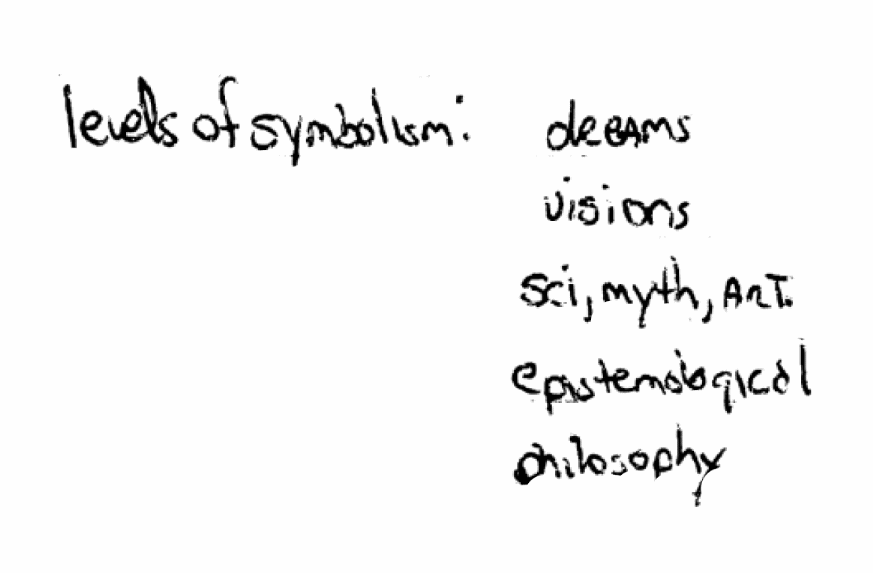
Levels of symbolism from epistemological to dream
What is the medium of reflection?
Reading/discussing Aniela Jaffe, The Myth of Meaning in the Work of C.G. Jung, on reflective consciousness as spiritual function
First have to develop reflective consciousness/ego (Jung) before you can get rid of it (Huang-Po); become aware of 'enlightened' and 'unenlightened' in reflective consciousness
Imagination as medium of reflection
Reading from Stcherbatsky, Buddhist Logic, Volume 1, on function of productive imagination/understanding
Reflective consciousness included in functioning of productive imagination
Both animals and humans live in imagined world but humans have greater capacity for self-reflection in that world
To get rid of reflective consciousness prematurely is to invite disaster/psychosis; many Zen people don't understand this
What would the world/being be like if you stopped the functioning of imagination?
Space that we experience is part of sensible world, not to be equated with Plato's receptacle
Shift in the level of being will be pictorially represented
Future exploration of symbolic functioning using astrological charts and dreams; recommendations for further reading
BOOKS READ FROM OR REFERENCED:
Huang-po Hsi-yun, John Blofeld (tr.), The Zen Teachings of Huang Po: On the Transmission of Mind
Herbert Guenther, Tibetan Buddhism in Western Perspective, "The Concept of Mind in Buddhist Tantrism"
Joseph Campbell, The Masks of God: Primitive Mythology
Pali Cannon
J.C. Chatterji, Kashmir Shaivaism
Aniela Jaffe, The Myth of Meaning in the Work of C.G. Jung
C.G. Jung, CW 8, The Structure and Dynamics of the Psyche, "General Aspects of Dream Psychology"
Oscar Wilde, The Picture of Dorian Gray
Walter Scott, Ivanhoe
Charlotte Brontë, Jane Eyre
Plotinus, The Enneads (MacKenna translation, 4th ed.)
F. Th. Stcherbatsky, Buddhist Logic, Vol. 1
G.R.S. Mead, The Doctrine of the Subtle Body in Western Tradition
Plato, Timaeus
C.G. Jung, CW 5, Symbols of Transformation, "The Transformation of Libido"
Herbert Silberer, Problems of Mysticism and Its Symbolism
Ernst Cassirer, The Philosophy of Symbolic Forms (3 vols.)
Mircea Eliade, Yoga: Immortality and Freedom
PLOTINUS QUOTES READ OR REFERENCED: IV.3.30
DIAGRAMS appended to this transcript:
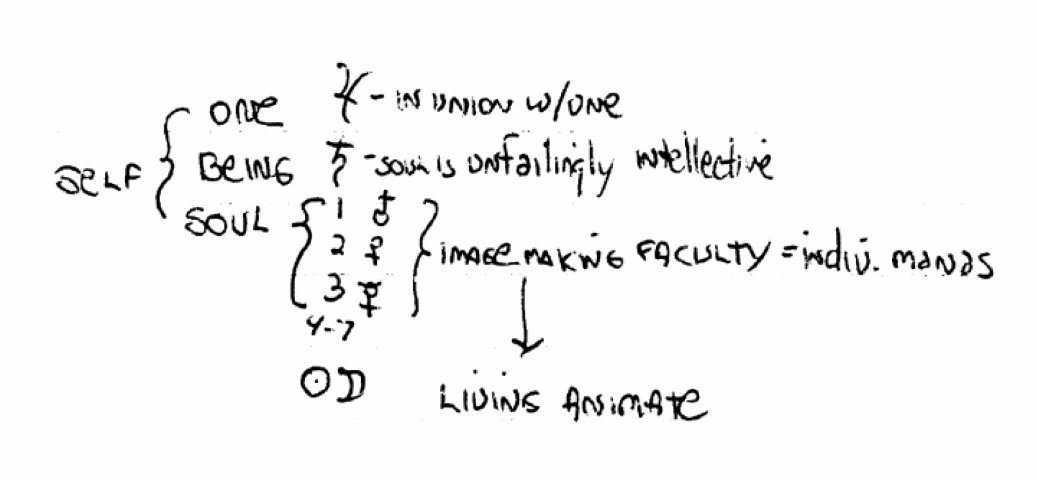
FIGURE 1977 1006-1-AB. Self and Animate correlated with Soul Monad.
FIGURE 1977 1006-2-AB. Levels of Symbolism.
Other diagrams referred to are not with this transcript version. [Transcriber note: [diagram] means the speaker is referencing a diagram as he or she is speaking. If someone is drawing or writing, with audible sounds of chalk on a blackboard, I indicate this by [drawing] or [writing].]
NOTE: For readability's sake, the following substitutions/edits made in Verbatim Transcript: cuz = because; gonna = going to; yeah = yes.
TRANSCRIBED Verbatim by IT prior to 2017, reformatted by jf 2017. In 2023, IT updates prefatory matter, footer, and audio file name, adds TOC, completes Book List, adds Plotinus quotes section, fixes errors/typos, adds new notes within transcript, adds two diagrams and references within transcript to these diagrams, reformats to accord with new conventions. Archival verbatim transcript – V12a.
AUDIO FILES: 1977 1006a, 1977 1006b. [Note: "Tape" and "Side" refer to original audio cassette tapes that were later digitized into .MP3 Audio Files.]
1977 10/06 at Wisdom's Goldenrod
Epistemology; Symbolic Functioning
[Audio File 1977 1006a Begins]
AD: All that to me is a lot of poppycock, a subtracting of the academic world, (makes you think I'm) concerned with a surface. [short pause] But if we want to get some idea the-- the difficulties we're faced with, I'm going to read a few quotes from The Universal Mind Doctrine of Huang Po to give you an idea of the difficulty that we're faced with. Now, mention those of you who want to could read it on your own, and most of you know this section.
[Transcriber note: I am using The Zen Teachings of Huang Po: On the Transmission of Mind, translated by John Blofeld, Grove Weidenfeld, New York, 1958.]
John Blofeld (tr.) [The Zen Teachings of Huang Po, Part 1, stanza 29, pp. 54-55, AD reading]: "29. Regarding this Zen Doctrine of ours, since it was first transmitted, it has never taught that men should seek for learning or form concepts. 'Studying the Way' is just a figure of speech. It is [AD reads: It's] a method of arousing people's interest in the early stages of their development. In fact, the Way is not something which can be studied. Study leads to the retention of concepts and so the Way is entirely misunderstood."
[15¾ second pause]
AD: Then going further into it, he goes--
John Blofeld (tr.) [The Zen Teachings of Huang Po, Part 1, stanza 35, p. 63, AD reading]: "35. If you would spend all your time--walking, standing, sitting or lying down--learning to halt the concept-forming activities of your own mind, you could be sure of ultimately attaining the goal. Since your strength is insufficient, you might not be able to transcend samsara by a single leap; but, after five or ten years, you would surely have made a good beginning and be able to make further progress spontaneously. It is [AD reads: It's] because you are not that sort of man that you feel obliged to employ your mind 'studying dhyana' and 'studying the Way'. What has [AD reads: What's] all that got to do with Buddhism? So it is said that all the Tathagata [AD reads: Buddhas] taught was just to convert people; it was like pretending yellow leaves are real gold just to stop the flow of a child's tears; it must by no means be regarded as though it were ultimate truth. [AD adds: And] If you take it for truth, you are no member of our sect; and what bearing can it have on your original substance?"
[short pause]
AD: Again, there's another passage I want to read. [short pause] The question asked the Master was--
John Blofeld (tr.) [The Zen Teachings of Huang Po, Part 1, stanza 32, p. 59, AD reading]: "32. Q: Illusion can hide from us our own mind, but up to now you have not taught us how to get rid of illusion. [AD: And the Master answered--]
"A: The arising and the elimination of illusion [AD reads: The arisal of illusion, the elimination of illusion] are both illusory."
AD: Go over this. "The arising of illusion and the elimination of illusion are both illusory."
John Blofeld (tr.) [The Zen Teachings of Huang Po, Part 1, stanza 32, pp. 59-60, AD reading]: "Illusion is not something rooted in Reality; it exists because of your dualistic thinking. If you will only cease to indulge in opposed concepts such as 'ordinary' and 'Enlightened', illusion will cease of itself. And then if you still want to destroy it wherever it may be, you will find that there is not a hairsbreadth left of anything on which to lay hold. This is the meaning of: 'I will let go with both hands, for then I shall certainly discover the Buddha in my Mind.' [AD: End of quote.]
"Q: If there is nothing on which to lay hold, how is the Dharma to be transmitted?
"A: It is a transmission of Mind with Mind.
"Q: If Mind is used for transmission, why do you say that Mind too does not exist?
"A: Obtaining no Dharma whatever is called Mind transmission. The understanding of this Mind implies no Mind and no Dharma.
"Q: If there is no Mind and no Dharma, what is meant by transmission?
"A: You hear people speak of Mind transmission and then you talk of something to be received."So Bodhidharma said:
The nature of the Mind when understood,
No human speech can compass or disclose.
Enlightenment is naught to be attained,
And he that gains it does not say he knows.
"[AD adds: And] If I were to make this clear to you, [AD adds: (Tsung-Po)] I doubt if you could stand up to it."
AD: That shows you the kind of difficulty that we're faced with which is to understand what he is saying in a context or in a perspective that has to be-- it has to be proper because if a person attempted to just eliminate all the thoughts from his mind, a person attempted to eliminate all concepts without understanding what he is doing, he can go through a real psychotic deficit. And-- and it's very common, it's common knowledge that in Zen, many of the people who undertake koans soon go psychotic. And-- So, we'll try to understand this, ok? [student assents, very faint] Now in the passage we were reading here, he speaks about the three that we have to deal with. [Note: See Herbert Guenther, Tibetan Buddhism in Western Perspective, "The Concept of Mind in Buddhist Tantrism," p. 42, last paragraph. See also WG Class 1977 0929.] One was appearance, the other was samskara, and the third was symbolic functioning. Now, we'll deal-- we'll deal with the symbolic function because of its tremendous implications. They're so vast that for the ordinary person there is no escape from that functioning. That is, no matter who the person is, unless it's a Sage, is subject to the-- to that functioning. We'll take a very simple example to start with, ok. Um-- [17¾ second pause] And this has to do with the phenomena of the laying and the hatching of turtle eggs, the sea turtle.
[Transcriber note: I am using The Masks of God: Primitive Mythology by Joseph Campbell, London: Secker & Warburg, 1960.]
Joseph Campbell [The Masks of God: Primitive Mythology, p. 30, AD reading]: "The female leaves the water [and] crawls to a point on the beach safely above the tide line, [where] she digs a hole, deposits hundreds of eggs, covers the nest, and turns back to the sea. After eighteen days a multitude of tiny turtles come flipping up through the sand and, like a field of sprinters at the crack of the gun, [AD adds: they] make for the heavily crashing waves as fast as they can, while [AD adds: the] gulls drop screaming from overhead to pick them off.
"No more [AD reads: Now this is a kind of] vivid representation [AD adds: that] could be desired of [AD reads: as far as] spontaneity and the quest for the not-yet-seen. There is [AD reads: There's] no question here of learning, [AD: For the turtles, that is, for a little tiny turtle.] [AD adds: there's no] trial-and-error; [AD: They're not going to learn from trial and error.] nor are the tiny things afraid of the great waves. They know that they must hurry, [know] how to do it, and know precisely where they are going. And finally, when they enter the sea, they know immediately both how to swim and that swim they must."
AD: You've heard this, right? [student assents, faint] You're familiar with it. They-- what do they call it, IRM?
S (very faint): Yes.
S: (Huh.)
Joseph Campbell [The Masks of God: Primitive Mythology, pp. 30-31, AD reading]: "Students of animal behavior have coined the term"innate releasing mechanism" [(IRM)] [one/two inaudible student words] to designate the inherited structure in the nervous system that enables an animal to respond thus to a circumstance [AD adds: that he] never experienced before, and the factor triggering the [AD reads: this] response they term [AD reads: may be termed] a "sign stimulus" or "releaser". It is [AD reads: It's] obvious that the living entity [AD: That is, the-- in this case, the little turtles that are just born.] responding to such a sign cannot be said to be [the] individual, since the individual has had no previous knowledge of the object to which it [AD reads: he] is reacting. The recognizing and responding subject is, rather, some sort of [AD adds: can you say] trans- or super-individual, inhabiting and moving the living creature. Let us [AD reads: Let's] not speculate…"
AD: We will say, we will say that-- (He/We) will take another example.
Joseph Campbell [The Masks of God: Primitive Mythology, p. 31, AD reading]: "Chicks, with their eggshells still adhering to their tails dart for cover when a hawk flies overhead, but not when the bird is a gull or [AD adds: a] duck, [AD adds: or a] heron [or pigeon]. [AD: Ok?] [AD adds: And] Furthermore, if the [AD reads: a] wooden model of a hawk is drawn over their coop on a wire, they react as though it were alive…"
AD: Of course that means they would run for cover. Here's a very precise and exact image where you can see what happens, right? An image, and immediately what's released is a kind of mechanism of-- let's say a mechanism which guides and controls their life. So automatically with the-- with the image being released, a certain kind of-- a certain flowing out of behavior operates automatically. There's no time here, the little turtle can't say, "Now let me see, is that a gull up there?" Because it would be over, alright. Immediately, [AD snaps fingers] right then and there, he has to respond to that mechanism, to the image which releases a certain kind of reaction in him. Ok, you don't think this happens with you? You got another guess coming. Because this is exactly-- This is going to be blown up.
What we're going to try and do now is blow this up and see if in the case of the animal, in the case of what we call his instinctual behavior, it's automatic, alright, and it just operates without any interference. There's no self-consciousness there that interferes with the operation. In other words, he doesn't start planning, "Now let me see, is that a gull or a hawk or what is it?", you know, because by that time, whatever it is will have swallowed them up. He-- no self-consciousness is in operation here. Now, in the case of human beings that self-consciousness is operating and it's interfering with that instinctual reaction. For better or for worse we don't know but, we'll assume it's for the better. So, we-- we have to try to understand, in the case of the-- in the case of the animal, there isn't any sort of self-reflective consciousness which interferes with the release mechanism or the image, and the pattern of behavior that follows. Now hold that in your mind, let's move on to the next point. [short pause]
It's almost like we're saying something like this. If we think of-- if we think of the animal without a self-consciousness, it's like it doesn't get stopped, the flow-- the image flows, and he's part of that image, he's included in that image. He behaves in a certain way in the sense that there isn't any reflecting apparatus in which that image gets reflected and then he thinks about it but let's say that there is no reflecting apparatus, it just operates simultaneously, ok. [students assent] But, in the case of a human being, he has a reflecting apparatus, and all these images get reflected into that reflecting apparatus so that there's like a pause, a momentary pause, and it gets reflected in that consciousness and then of course there's the problem for the human being.
Now, what I'm interested here in is in-- not in Buddhism and not in any "ism", Vedanta, or anything. What I'm interested here is in seeing if we could make that very clear to us(--) ourselves. [12½ second pause] I'm going to read a few quotations from a work which we're familiar with on Shaivism. And he's going to try to discuss, he's going to try to discuss-- he's going to try to discuss the notion of self-consciousness, but they call it ahamkara in Vedanta (and/in) Buddhism, I mean-- Even in Buddhism. As a matter of fact, there's a very interesting quote. And one of the Pali Cannons, a text, Buddha remarked that somebody fell all apart because there was no ahamkara holding him together. So that the constituent parts of his personality were not supported by the I-maker. But, you got to try to get a feeling of this I-maker. He speaks first about-- the first operation is that of the senses, called sensation. We'll ignore it, we just go through-- There's-- they're his way of pre-- presenting this which I think will help you-- Alright.
[Transcriber note: I am using Kashmir Shaivaism by J.C. Chatterji, State University of New York Press, Albany, 1986.]
J.C. Chatterji [Kashmir Shaivaism, pp. 54-55, AD reading]: "…'Attention'--which [operation] may be considered as practically one with that of the senses, inasmuch as the latter [AD reads: the senses] can never work without it, and which therefore need not [AD reads: doesn't need to] be separately noted here for our present purpose [AD reads: for our purposes]…there is another [AD reads: there is this] operation, which as it were builds up, or rather carves, the image of the object to be perceived and thought of, out of the whole blocks of sensations which are, at the time, pressing upon the experiencing subject from all sides. [AD adds: Now] This operation consists in 'desiring' [i.e.] seeking for and 'selecting' a certain group, to the exclusion of others, out of the confused and confusing heap, with a view to or with the intention of, making a particular image or a particular object of consciousness with this specially marked out group. Thus, for instance, [as] I am perceiving my [AD reads: a] cow, I am [AD reads: I'm] having, crowding upon me, a whole host of other sensations as well--those affecting me as the surrounding scenery, the blue of the sky, the green of the meadow, the singing of birds and so on. These are all being left out and only those affecting me as the cow are being sought [AD adds: out] and singled out and built into the image of the [AD reads: a] cow.
"[AD adds: Now] This 'desiring for,' this seeking and singling out a certain special group from among a whole crowd of sensations with the intention of building up, with the selected group, the image of an object…this is an operation which is quite other than and different from the first operation of mere sensation. [It is] the second operation in the process leading to the [AD reads: a] perception of my cow so as to be able to think and speak of it. It is what may be called [AD reads: It's what I may call] the 'Image-making' or Imaginative Operation--the operation, in this instance [AD reads: sense], of imaging [AD reads: imagining] forth the [AD reads: a] cow with the ingredients of a particular group of sensations 'desired for' i.e. [AD adds: that's] sought out and selected out of a [AD reads: from a] whole mass of them."
AD: So here we have to imagine that I'm seeking, I desire to see a cow or perceive a cow, and the sensations are one with the cow and the attention is working with these sensations but now there's an activity which is selecting from all those sensations that which is going to help him to see a cow. The ma-- the manas is selective.
J.C. Chatterji [Kashmir Shaivaism, p. 55, AD reading]: "It is [AD reads: It's] an operation of image-making from another point of view also--I mean [AD adds: from] the standpoint of [modern Western] Psychology. For, according to the findings [of that Psychology], the process of sensation consists in receiving by the senses not a completed picture extended in space, as, for instance, the colour or colours of our cow, like so many patches stretched out in space, but like so many points of that colour or those colours. The senses give us what is technically called a manifold--the manifold of [the] sense."
AD: Alright, something is given to the senses, a manifold, a many-thing, alright. But, out of this manifold it's going to select just some, in order to make this image for itself of a cow.
J.C. Chatterji [Kashmir Shaivaism, pp. 56-57, AD reading]: "Now, in order that these colour-points may be made into a whole--a whole patch or patches of colours--assuming a particular shape and form, namely, that of a particular cow, there must be a second operation in the psychical process by which, these 'points of sensation,' [AD adds: that is] the manifold of [the] sense, are [AD adds: brought together] gathered together and made into such a whole of a particular shape and form--in other words, into a picture or image.
"However that may be, the image-making constituting the second operation in the psychical process would not alone enable me to speak or think of the object of my present perception as a cow. For what I am actually perceiving, [i.e.,] the actually given of the sense, is no more than a mere colour-form…which is stretched out in space assuming a particular shape either moving or stationary. [AD adds: Now] To transform this mere picture, which is hardly better than one on canvas, or [than] that of a cinematograph [show], it must be endowed with various other properties as well, solidity, life and so on [AD reads: etc, ok?]. Now these properties the sense now in operation, [viz.,] that of sight, is not perceiving when it is revealing to me the cow's presence as a patch of colour or colours stretched out in space. They are supplied [AD rereads:"They are supplied] from somewhere else, namely, from the memory of my personal experience of the past, stored up in myself as a particular individual or person, i.e., out of myself. There is absolutely no other source but myself from which they can be supplied. Nor can the elements supplied be anything else but a part of my own personal self as built up by and with [AD adds: the] elements supplied out of experiences I have had as a particular person born and brought up in a particular situation [or situations]. That is to say, before my mere colour-form, [AD: The form of the color, you know, the cow, its form and color. "That is, before my mere colour-form] carved out of the [AD reads: this] block of mere sensations, can be transformed into the live object I am thinking of as my cow, it has to be endowed with something of myself. [AD: Now I want you to pay very close attention and see what he's speaking of.]
"Not only this. It has to be assimilated [to] and identified with what is in myself as a particular person. [For] how can I think or speak of the present object as 'cow' unless I realise it as something similar to such an experience of my own in the past--an experience which is now part of myself? Again, how can this assimilation and identification be possible unless and until the new experience be taken up into myself--brought into the midst of what is me and mine? Thus not only must the mere image be endowed with a part of myself, before it can be perceived and thought of as my cow, but the image itself will also have to be brought into me--into my own self. That is to say, to use the somewhat dry language of philosophy [AD reads: to use the philosophic language], it has to be referred to what is already me and mine.
"It is this endowing of the sensation-image with part of myself and assimilating it to what is already in me, which constitutes the third operation in the psychical process giving me the perception of my [AD reads: a] cow."
AD: Let's stop now. Let's see what-- if we can understand what he's saying. We know that the picture that science has given us has-- has certain-- you know, when the senses are entrances for knowledge, we're speaking in a very specific way, right? Let's say light is reflected from an object into my eye or-- (make) contact with any of the senses, we know that these refer to these here as points of sensation. Now in themselves they don't tell you anything, right? They tell you nothing. Because, all you have to do is carry on an experiment, an experiment of eliminating some of the points of sensation and you won't tell-- be able to tell what the object is. What we're saying here is, when we were speaking about the senses, the way they grasp the manifold, whatever is available, and then these points of sensations are gathered up by the mind, they're selected, and you come up with a certain image.
But this image is not a living image. It's an image, right, but it's not alive yet. You have to bring to that image something that's within you. In other words, from within yourself, you contribute certain elements, for instance, the notion of life, let's say the cow is standing still, alright. Something you project out there into that image, you interpenetrate and fuse with that image, ok. The notion of three-dimension will operate simultaneously with that of course. The point that we're getting here, which is a difficult one but very worthwhile, that the material in-- you need in order to create this image of an object for yourself, you will supply from within yourself. There's no place else you can get it from.
Well, if that's so, like for instance, if you take-- you take an example in a dream where let's say someone touches you, alright, and st-- stimulates-- there's a somatic stimulation of the body. Now what happens? Well, we understand something like this, that the mind will take those sensations, alright, which is just a body stimulation, and then imagine that you're standing at the guillotine in 1789 and you're about to be hung, you know, and all the guy did was touch your neck, you know. But from images within your own mind, you start supplying everything necessary to have this scene, alright. There you are, marching up the scaffold or whatever, you know, the guillotine we said, right, marching up and there's the guill-- But all these images, where did they come from? All this fellow did was touch your neck. They must come from within you, right? Where else could they come from? I mean no one is outside with a movie picture telling you, "Open your eyes, you can see it." It's all coming from within your own psyche, all these images are coming up. And you're supplying them with a certain order, a sequence. You see what we're saying? Alright, he's trying to make the same thing about-- in regard to the objects that we perceive in the world, alright.
Now, if we think of the example of the dream, the example of the dream, where a somatic bodily influence is transformed by the mind into a series or a sequence of images which, let's say, run for a few minutes where you go through a whole experience of getting-- being on trial, brought to-- determined guilty and brought to the guillotine and your head clocked off, and of course then you wake up. Alright, you can't-- the dream can't continue. The point here is to see that the mind is this-- the functioning of the mind, the very nature of the mind's functioning is to present you with this entire scenario. And, if you could see the mind doing it in dream, the next attempt is to try to see the mind doing it in your daily life, because it's one and the same mind doing both. And here, symbolic activity or symbolific consciousness begins to reveal itself as the most pervasive kind of activity that is going on without interruption every moment of the day. It is not possible for that to stop unless you either sleep, faint, go into samadhi, any of that stuff, ok, otherwise it will function.
Now, the material, the material of the ordinary everyday life is going to be a little different because, when we say-- when we say, well, what constitutes this personality? And we decided that the arrangement of certain psycho-essences which we say exist when we look at a chart, these-- the-- these essences or psycho-essences which, in a chart, show the structure of the personality, this will be-- this will be the-- the s-- not the-- not the-- this would be the substratum of the personality's functioning. In other words, this will be the material precisely this way--this will be the very structure of that functioning. The way you function is determined by the structure of the psycho-essence that constitutes your personality and that once-- and that of course (is/if) the very nature of the mind is to function this way, to project what's within outward, what constitutes your psycho-essence or your being will be portrayed or projected outwardly constantly. So that, at whatever level you want to consider symbolific activity, you will find that it is absolutely pervasive. There is no point where it is not operating, except, like we said, in those instances or so on, ok?
Now, if we go back to the quote that we had before of Huang-Po, and he says, well of course because our strength is insufficient, we cannot stop this concept-forming activity of mind. If we were really strong, of course, we could, you know. If you were really strong and you say, "I will not permit the lower mind to go on with this discriminating activity," alright. If you were strong enough, you could do that. Also, if you're not strong enough, it'll blow your head right off because it will just build up a tremendous amount of pressure within. That's why you have to go to the monastery (to be) [one/two words inaudible] At any rate, since we're not, we'll have to compromise a little bit and try to slow down this functioning, this functioning of the lower manas which is always producing this imagined show. The reason I'm going this way rather than appearances first, alright, disregarding them-- I'm going to disregard his way, I'm going to do it this way. Now-- [12½ second pause]
Now this is so important for any of us, whether we're psychologists, astrologers, I mean-- For questers, it is extremely important, much more so than even for astrologers or psychologists or for doctors because there's a certain amount of objective validity in what a doctor does, he needs an appendix out, he has to get it out and that's it, period, ok. But it's much more difficult if you go to someone for help and in terms of psychology and he does not understand how his own structure is projecting and functioning because then he'll project it onto the problem. So most analysts, if they don't go through some sort of controlled analysis and don't know their own hang-ups, they'll just-- they'll-- they'll just plaster them on their patients and assume that their problem is the patient's problem.
Alright, now, we're starting to get this sort of a notion. In the term-- in terms of the primitive animal where there is no manas in the animal, ok-- In the case of the chick or the turtle, there's no manas principle there. Or we could say it presides over it as a species but not over it as an individual. So that in the case of animals, where they do not have a reflective platform, you know-- You know what I mean by that? It's like there's no stage on which the functioning of manas takes place. There isn't a stage on which they could stand and see that functioning as other than themselves. Try it another way. In the case of the turtle or the chick, there was no interval between his response and the situation. In other words, nothing came in-between the situation and what he should do.
In the case of a human being where there's manas or self-consciousness of any kind, alright, then there's a space between the situation and, let's say, what he's ultimately going to do. In between those two there's a platform and he reflects on what he's going to do. It's like a little stage where he rehearses his activity, his-- his plans, you know, he's going to think it out, plan it out, and then do it. The animal doesn't have that problem. Ok? You go to a dog and you try to hit it, he runs away, he doesn't say, "Well let me see what to-- why should he hit me?" Yes. "Because you're smart." "Ok." And the turtle doesn't stop and look around and say, "Now let me get my bearings--which way is the water?" (laughter, student words) There's no-- no interval between his activity and the response to the situation as a whole. In human beings there is, and that's due to this fact that he's got this reflective platform or stage within his own consciousness where he reflects on the image in front of him. [short pause]
This is-- this is so important because, if you remember when you were studying Jung, Jung made that discovery that-- [short pause] he made that discovery when he was in the wilds of Africa and he referred to it as a second cosmogony. Remember that? I think we read it together. And he pointed out that he was standing there watching the herds and they-- and then all of a sudden he recognized that this reflective consciousness, this reflective consciousness, was a second cosmogony within which the totality of God's creation was reflected. Let me read you the way he put it, because I thought it was ve-- very appropriate.
[short pause]
[Transcriber note: I am using The Myth of Meaning in the Work of C.G. Jung by Aniela Jaffe, Daimon Verlag, Second Daimon Edition, Zürich, 1986.]
Aniela Jaffe [The Myth of Meaning in the Work of C.G. Jung, Chapter 13, AD reading]: "Jung saw meaning in the reciprocal relationship between man's deepening self-awareness and an unfolding of the God-image…"
AD: Let me go on. He's writing to his friend, Neumann.
Aniela Jaffe [The Myth of Meaning in the Work of C.G. Jung, Chapter 13, AD reading]: "…"Dear Friend…Since a creation without the reflecting consciousness of man has no discernible meaning…""
AD: We follow this?
S (faint): Keep going.
AD: Yes.
Aniela Jaffe [The Myth of Meaning in the Work of C.G. Jung, Chapter 13, AD reading]: ""Since [a] creation without the [AD reads: a] reflecting consciousness of man has no discernible meaning…""
AD: In other words, if there was-- if there is creation, manifestation, God creates the world, ok, but this doesn't get reflected in anyone's consciousness, then what possible meaning could that have? Well this is what he's saying, he says there's no discernible meaning in a creation unless that creation is reflected in man's consciousness.
Aniela Jaffe [The Myth of Meaning in the Work of C.G. Jung, Chapter 13, AD reading]: ""…the hypothesis of a latent meaning [AD: That is, the possibility that there is some meaning, alright.] endows man with cosmogonic [AD reads: with a sort of cosmic] significance, a true raison d'être [AD reads: a reason for being].""
AD: In other words, if you have this reflective consciousness, alright, and creation is reflected in that consciousness, now there's the possibility of some meaning arising within it.
Aniela Jaffe [The Myth of Meaning in the Work of C.G. Jung, Chapter 13, AD reading]: ""If on the other hand the latent meaning is ascribed to the Creator as a conscious plan of creation, [AD adds: then] the question arises: [AD: Now listen to this, this is worthwhile.] Why should the creator stage-manage this whole world phenomenon since he already knows what he can reflect himself in [AD reads: reflect in himself], and why should he reflect himself at all since he is already conscious of himself? [AD: In other words] Why should he create alongside [AD reads: along] his own omniscience [AD: alright] a second, inferior consciousness -- millions of dreary little mirrors when [AD reads: which] he knows in advance just what the image they reflect will [AD reads: would] look like?""
AD: Now why would God or the Creator do something like that? In other words, why was He building up this reflective consciousness in you if He knows that what's going to be reflected in that consciousness is the creation? What's the sense in that? He already knows what creation is. Why build a platform, millions of little platforms in which His creation gets reflected? Yes, you got an answer?
DB: Well, I mean--
AD (simultaneously): Ok.
S: Yes.
AD: Go ahead.
DB: Could you say that, that discernible meaning, that the reflection, that it is produced by this reflection would also be included within that as part of His creation?
AD: Meaning would be included in that. In what, in reflective consciousness?
DB: Yes, I mean, you have-- you have the-- this creation. And then you have this reflection in this consciousness of a man, and out of that, discernible meaning of varying levels is brought forth.
AD: Well, that's what Jung is saying, why would He-- why would He do that unless he had some-- un-- unless there was some possibility of meaning arising in the reflective consciousness of an individual. You remember the story in Buddhism when the Empress asked Fa-tsang, she says, "Could you explain to me this notion about the interpenetration and interfusion of everything and everything else?" And so he says, "Sure," and he takes a room and he fills it up with all mirrors, alright, all tiny little mirrors, all over the room. And then in the center, he lights up a little candle with a Buddha and you see the Buddha reflected in every (mirror)-- in every mirror, right? Now what's the sense in that? This is what Jung is saying. What's the sense in the universe being reflected in our consciousness unless there's some purpose or some reason for that? And he believes that the reason, or what he calls raison d'être, or reason for this, is that there is some meaning inherent in our reflective consciousness.
AH: Tony--
S: (Can we)(--/?)
S: [few words inaudible]
AH: Within the reflection, I mean it's like-- [student assents] [three/few words inaudible] I remember in a discussion we had a couple (weeks) ago, there's no-- there's no indeterminate via media between the Creator in these terms. Like, the notion of meaning would be from the point of view of reflection.
S (possibly part of background): Thank you.
AD: Yes. In the case of the little turtle that's running to the beach, there's no meaning for him, alright, because there's no reflective consciousness and so he's instinctively acting without any sort of self-consciousness and he's just acting. Isn't that so? But if you were a turtle you would say, "Why the hell should I always run away from this seagull?" (some laughter) Just a little reflective consciousness and you'll turn around and probably argue with the seagull. (some laughter)
S: And ask why.
AH: To ask why-- why did the Creator do this is like sort of, you know, like loading your question.
AD: Well--
S (faint): Alright.
AD: What we're trying to get to-- sorry-- What I'm trying to get to over here is something which is going to be a very obnoxious contrast, because now what I'm going to tell you is something like this. The very first quotation I read you from Huang-po, he said "Stop that." If you allow for the concepts to arise in your mind, then you will live in a dualistic world and you'll operate like a dualistic being and you'll start chasing phantasms. In other words, this reflective consciousness which Jung suspects as providing the medium in which meaning can unfold is also going to be the big trap in which you get caught, alright. [short pause] In other words, if we discuss this for a minute, we should. [short pause]
If we discuss this for a moment, ok? This conscious, this reflective consciousness, and let's say an object or a world gets reflected in that consciousness, and then from the reflected image in your consciousness you start, let's say, a process of surmising the meaning, trying to find out what it might mean to you. Now in the beginning, it would be very difficult. If we go back to a stage where man was not a reflective or as reflective as he is today, let's say, that he lived much closer to his instincts, alright, where there a minimum of reflection going on, then that man would be dominated and guided by, you know, the necessities of the-- of their existence. [11¾ second pause]
The point, of course, that we're trying to get here is that reflection is like a stage and in reflection which, if you remember in Jung that was one of the instincts, self-reflection is an instinct, there's hardly any man that doesn't have it to some degree however insignificant it is, but he will have it to some degree. This reflective instinct is something which occurs almost, you know, unavoidably, there's practically no way out of it. And in the process of reflection, concepts arise, meaning arise, and this starts influencing, you know, the behavior, the kind of life you're going to live. A person walks by and let's say he looks like a hippie, you know. You know, unshaven, dirty, and I-- he passes by in front of me and immediately a remark is, you know, forthcoming, "Oh the pig, oh," or the opposite, "Oh, he's a good guy." But the point is there that (student assents, bit of laughter) you could [couple inaudible student words simultaneous with AD] see there's a process going on and it-- it's hardly ca-- you can-- you can't stop it, it's going on all the time. This is symbolic activity. And what you're projecting is what constitutes you as a person and not what the object is per se. I'm really sorry that-- Oh dickens I'll go-- I'll go into it in more depth. Why should I run away? (bit of laughter)
[short pause while looking for book]
S: Did you want--
AD: No, I was looking for-- for Structure and Dynamics.
S: Oh.
S (faint): I have it Anthony.
AD: You got a copy? Now, when we were reading about ahamkara, you know, in this book, what you recognize is that when the mind, so to speak, is paying attention to the sense manifold and trying to create or make an actual image of the object for you, what you have to understand is that the material that you use to make this object comes from within you. Consequently it is part of you.
(Side 1 of original cassette tape digitized as 1977 1006a Ends; Side 2 Begins)
C.G. Jung [CW 8, The Structure and Dynamics of the Psyche, "General Aspects of Dream Psychology," pp. 264-265, paragraph 507, AD reading]: "[A person whom I perceive mainly through my projections is an imago] or, alternatively, a carrier of imagos [AD reads: images] or symbols. All the contents of our unconscious are constantly being projected into our surroundings, and it is only by recognizing certain properties of the objects as projections or imagos [AD reads: images] that we are able to distinguish them from the real properties of the objects. But if we are not aware that a property of the object is a projection, we cannot do anything else but be naïvely convinced that it really does belong to the object. [AD adds: Now] All human relationships swarm with these projections; anyone who cannot see this in his personal life need only have his attention drawn to the psychology of the press in wartime [AD reads: needs only to draw-- be drawn to this]. [AD: You know, in war time psychology of this here. Alright, let me ignore that. Going on.] … Unless we are possessed of an unusual degree of self-awareness we shall never see through our projections but must always succumb to them, because the mind [AD: Now listen to this."Because the mind] in its natural state presupposes the existence of such projections. It is the natural and given thing for unconscious contents to be projected."
AD: He speaks about participation mystique. Um--
[12¼ second pause, flipping of pages]
S (very faint): No (copies/copy)?
AD: [couple words inaudible] copies?
[1 min 15¾ second pause, flipping of pages]
S (faint): [three/few words inaudible] so why don't you go into.
[14¾ second pause, flipping of pages]
AD: I have to start at the beginning, just looked in that book. And, I'm looking for a passage where he very precisely, he doesn't paraphrase-- paraphrasing, where he speaks about an image in the sense that, let's say I have a friend or some beloved or otherwise, and let's say that the person passes on. Now, the person passes on but the image remains in the unconscious. And this image which remains in the unconscious has a life of its own and continues in the unconscious. It is here where we begin, if we can look into this very carefully, we can see that our unconscious, so to speak, would be as-- would be like a-- a storehouse of images which will be projected out whenever a situation and a certain meaning calls for a particular kind of image. Um--
[27¼ second pause, flipping of pages]
S (faint, possibly part of background): No problem.
RC: He still talks on 274 about the [one/two words inaudible] object has an objective correspondence.
AD: Where?
RC: 274.
AD: Alright. [9½ second pause] Yes.
C.G. Jung [CW 8, The Structure and Dynamics of the Psyche, "General Aspects of Dream Psychology," p. 274, paragraph 521, AD reading]: "When the projection corresponds to a quality actually present in the object, the projected content is nevertheless present in the subject too, where it forms a part of the object-imago [AD reads: image of the object]. The object-imago [AD reads: image of the object] itself is a psychological entity that is distinct from the actual perception of the object; it is an image existing independently of, and yet based on, all perception, and the relative autonomy of this image remains unconscious so long as it coincides with the actual behaviour of the object. The autonomy of the imago [AD reads: image] is therefore not recognized by the conscious mind and is unconsciously projected on the object--in other words, it is contaminated with the autonomy of the object. This naturally endows the object with a compelling reality in relation to the subject and gives it an exaggerated value. This value springs from the projection of the imago [AD reads: an image] on the object, from its a priori identity with it, with the result that the outer object becomes at the same time an inner one. In this way, the outer object can exert, via [AD reads: by] the unconscious, a direct psychic influence on the subject, since, by virtue of its identity with the imago [AD reads: image], it has so to speak a direct hand in the psychic mechanism of the subject. Consequently the object can gain"magical" power over the subject. Excellent examples of this can be found among primitives, who treat their children or any other objects with "souls" exactly as they treat their own psyches. They dare not do anything to them for fear of offending the soul of the child or object."
AD: Now, continuing.
C.G. Jung [CW 8, The Structure and Dynamics of the Psyche, "General Aspects of Dream Psychology," p. 274, paragraph 522, AD reading]: "I have [just] said that the autonomy of the imago [AD reads: image] remains unconscious because it is identified with that of the object."
AD: You take a-- could we take an example of that? [short pause] Anyone who could think of an example?
C.G. Jung [CW 8, The Structure and Dynamics of the Psyche, "General Aspects of Dream Psychology," pp. 274-275, paragraph 522, AD reading]: "The death of the object would, accordingly, be bound to produce remarkable psychological effects, since the object does not disappear completely but goes on existing in intangible form. This is indeed the case. The unconscious imago [AD reads: image], which no longer has an object to correspond to it, becomes a ghost and now [AD reads: now and] exerts influences on the subject which cannot be distinguished in principle from psychic phenomena. The subject's unconscious projections, which canalized unconscious contents into the imago [AD reads: image] and identified it with the object, outlive the actual loss of the object and play [AD reads: plays] an important part in the life [AD reads: lives] of primitives…"
AD: Could we think of an example? [S: Yes.] Well a very famous novel would illustrate this beautifully.
S: [one word inaudible]
AD: Hm?
S: What's that?
AD: One of the novels where this man had a painting of a woman and-- Maybe a picture or--
S: Oh Laura.
S (simultaneously): Laura.
S (simultaneously): Oh Laura.
AD: Huh?
S: Laura.
S: Laura.
AD: Obviously I found some (some laughter) great [one word inaudible] because I [one word inaudible] referring to.
S: Right. (laughter)
S: Oh you mean the (wasting of water).
LS (simultaneously): Statue of a woman.
AD: Huh?
LS: The statue of a woman's got it.
AD: No, it's a very famous novel, come on.
S: Dorian Gray.
S: Oh, Dorian Gray, yes.
S: [couple words inaudible]
AD (simultaneously): Dorian Gray? That would be a possible but the one I had was easier, ok? (some laughter)
S: (Can I do it?)
AD: Huh? [S: Can I--] A woman writer, woman author. What's her name? About this woman he loved and he lived up in the Scot-- Scotland-- [Note: Walter Scott, Ivanhoe, with Rebecca as a character.]
S (simultaneously): (Who), Rebecca?
S: Jane Eyre.
AD (simultaneously): [one/two words inaudible]
S: She [couple words inaudible] for that.
AD (simultaneously): Rebecca. Yes, [S simultaneously: Rebecca.] Rebecca, isn't that a perfect example, where this woman passed on and her image completely dominated his psyche. I think it was Rebecca.
S: Yes.
S: That's the one. [student assents] So good.
S: Oh.
[student assents, faint]
S: [couple words inaudible]
AD (simultaneously): Now look, look, let's think of this here. [S: Who wrote that?] You're in love with a beauti-- Huh?
S: Who wrote that?
AD: Jane Eyre?
S (simultaneously): (Dame du Maurier.)
S: Brontë was Jane Eyre.
AD: Brontë, Brontë, yes.
S: Rebecca--
S (simultaneously): Rebecca was--
S: Washington Irving. [Note: Walter Scott and Washington Irving were contemporaries.]
S: They probably don't need it.
AD: Yes, that's the one [student assents] where it-- yes. Let's-- let's make it real for ourselves. You're in love with a woman, alright? A tremendous love affair, nothing like it in the world. This woman passes on, alright? Now that image of the woman is still within your unconscious. That didn't pass on. That goes on living. It's part of your unconscious. Let any situation similar to it come up and immediately that gets projected. Now imagine the magical quality that's going to have in relationship to that person that you're going to be with if this image gets projected onto her. Now it doesn't have to be the actual nose to nose, point to point, alright, but there could be, let's say, a projection of the-- let's say the associations, the felt associations of such a relationship that get projected, and this immediately assumes a magical kind of relationship with this woman. Anytime that happens it's obvious that you have an archetype functioning here, but, if you push that aside for a minute, if you can imagine that every image in your unconscious psyche is loaded and burdened with these kinds of associations, then you begin to see the tremendous difficulty of trying to see an object the way it is. Because if the object is constituted by part of your very being-- In other words, when you want to create an object you have to supply the material from within the contents of your own conscious.
S: You know, if you go to a town where you don't know anybody and there's no chance that you'll see anybody that you know, (you--) I've noticed that it happens to me anyway. I'll see someone and think it's someone I know and then you realize it couldn't be. Like it's-- like I'll think it's Michael or I'll think it's David or something like that, because that's what I see there because there's almost a hunger to see something that you recognize.
AD: Ok, then if you see that, do you also see the next thing, the very-- what you might call participation mystique, in other words, this absolute and overwhelming attachment we have for object. You have to try to see that now, right now. [short pause] I think Richard spoke about when he went to India, and in India if someone had a refrigerator it was right in the middle of the room. (laughter, student words) Have you seen story-- (laughter) You've seen stories of primitive people or so-called primitive societies where if you show them an object, you remember like, I remember when I was a child I was fascinated, I (wanted/went) to see Trader Horn. Of course you wouldn't remember that. But there was a-- a picture of a white hunter who was in Africa and when he had to deal with the natives he would give them little trinkets and, you know, he (bought/brought) their confidence right away, the tremendous attachment we have for objects. This is participation mystique. If something happens to someone in your family you would feel as though it almost happened to you. Participation mystique is total identity with all the objects which, let's say, are your environment and become your environment. Why? Because in projecting, in other words in order-- In the mind manifesting this manifold world for you, alright, in the very making of this world, your mind is doing that but it does it by supplying the necessary ingredients for that image from within itself. So naturally you're attached to it. It's yourself you're attached to but in this very strange way.
CS: Anthony? This may be way way off but-- yes but why does it have to be a object that we see, like why couldn't it be something like the Overself? It's different-- you can't visualize that but that that can become a part of our experience. [student assents, very faint] But a--
AD: Yes, but even if you had a vision of the Overself, the mind's interpretive symbolific activity at that very instant that you have the vision would supply it with an interpretation, so that one and the same time you have a vision of the Overself and mixed in with that would be an interpretation that your mind is giving you. And then you'd have to go to some expert to take them apart and see which is authentic and which you contributed. Because if the Overself or pure Spirit has none of these qualities, alright, then you could see like the difficulty you would be in.
Imagine what-- Just imagine, and this possibility has prevailed and happened, where a person in meditation or extreme inward introversion has a glimpse of the Overself. But then that Overself is revealed to him, let's say, as Jesus, ok. Now, to him, Christianity is the ultimate truth. Yes this is the example from PB, (where if/whereas) someone is contemplating or is a Buddhist, that very same happening, alright, will be presented to him in the image of the Buddha, alright, and for him Buddhism would be the ultimate. Now, each one will have his own interpretation of one and the same experience or let's say one and the same Overself, and it would show you immediately that as soon as you took the-- take, let's say, to propagandizing of being a Christian and converting every other person you saw into Christianity and the Buddhist we would-- would be doing likewise--
I'm not saying that we could stop this. All I am saying is, if you stop and you notice very carefully, you could see that you do it. You've projected a content of your unconscious mind or your psyche onto a certain experience which is beyond the range of anything the psyche could understand, and then interpret it in terms of your psyche, ok, and now you go around burning anyone who's not a Christian. But you see, to begin with, the attachment for the contents of your own consciousness, to the image of the object. And that's the whole problem we're getting to. The problem that we're getting to is that this is constantly occurring, uninterruptedly, and every moment of our life, whether we speak about the images that reveal themselves in a dream, in a vision, in wakeful life, any of that.
If it is the mind that is presenting you with the experienced world-- In other words, let's say experience is the first product of the mind, in-- included in that experience are all the ingredients that the mind itself put into it. So you won't find something in that experience which the mind did not put into it. And if you analyze the experience sufficiently thoroughly, then you will begin to start taking it apart and you'll begin to recognize all these contents came from within you. Now of course in the question of the Overself that would not have come from within you. But nonetheless, you will be presented with the problem of distinguishing what was the authentic part of the experience from the interpretive and imagined part.
So then Jung goes along working this problem, trying to-- trying to bring us to this awareness of the attachment we have for the image of the object. In the first case we can think of the object that I actually see, let's say I'm looking at that plant, ok, that's-- that-- that's an object and that object, so to speak, presents, is presented-- Whatever the matter of the presentation is, let's say, the senses grasp them and then the mind selects certain sensations and contribute to the making of that image, now I see that object. But, at the same time, whether I-- I'm aware of it or not, included and implicit in that externalization of the functioning of my consciousness is the contents of my psyche. And if I have this attachment to the contents of my psyche, boom, I'm going to have an attachment for the object, ok?
But it starts, it starts the other way around really. At the primitive stage where a man, so to speak, is not-- let's say, where he doesn't have a rich storehouse of images, alright, at that stage, alright, he has to go first through the experience of identifying with the object and feeling-- not only an identification but an attachment to the object is very important here. Now let's say he's very attached to the object and then the object disappeared for some reason or another. Now this object of which he had made an image for himself is stored in his unconscious and becomes part of his inner being. Given what he calls all images eventually can come from prior perception, given that fact, then you can see that what we're building up is like this huge storehouse of images and whenever the soul or the mind wants to know something about an object, alright, it pulls-- the mind-- the soul pulls out from itself all the ingredients necessary to make that object and present it to itself. Ok? That is symbolific activity. That goes on from the lowest level to the highest level uninterruptedly and constantly interfering with our perception of reality or the world the way the world is and not the way we wish it to be. So Buddha called knowledge, the highest type of knowledge, the knowledge that conforms to reality, whatever that may be. Go ahead.
RC: Is that the level at which the selection takes place?
AD: Louder, I (can/can't) hear.
RC: You're saying the soul reaches into its [one word inaudible] that are in it and puts it out to make the object for itself. Is that the level at which the-- the selection in the sense-field is made?
AD: Is that the--
RC: --level at which the selection in the sense-field--
AD: What do you mean the level?
RC: We've talked about the sense-manifold, out of the sense-manifold certain components are selected and others are ignored.
AD: Yes.
RC: The soul makes that selection.
S: No.
S: (Uh-hm.)
AD (simultaneously): In other words, the common sensorium selects from within itself all the images that would help or let's say would describe and portray what that object is. Now you can see, if there is a poverty of imagery in the person's soul, that there would be a-- a lack of precision in portraying the attributes, the inner being of that object to itself. So what the soul experiences is actually a mode of its own being. It knows the object, but as a mode of itself. This is all symbolic functioning.
RC: But somehow the soul contacts the object on a level that's prior to its images. And then--
AD: The soul contacts the object--
RC: Well, yes, there's a-- there's a contact made between the soul and an object to which the soul responds with an image. But that first contact it's not-- it is not within the identity of it.
S (faint): Yes, uh-hm.
AD: Yes.
MW: That's that point in the background, right?
AD: Well, we won't get into that. That's at the level of pure intellection.
RC: So when-- when we did that quote from Plotinus where he talks about knowledge is not complete until it has been made perception, like it's traversed the whole soul-- [Note: See Plotinus, IV.3.30.]
S (faint): Yes.
AD: Yes--
RC: This-- this is that-- that last step of the soul's knowledge then is that reproduction of the [one word inaudible]
AD (simultaneously): Yes, but Plotinus didn't say it's not complete. It doesn't have to descend all the ways down to the level of the couplement or the conjoint of body and soul. Knowledge could be knowledge regardless of that. In other words, at the level of pure intellection, there's no need for images. But at the level where we're at, there is need for an imaged world, otherwise you won't have any experience. Experience won't be possible.
RC: Ok but, we've assumed that as far as the sense-manifold we talk about that an activity of the soul. Now, whe-- whenever we (come on it but) putting anything above the sense image and that's no longer an activity in the soul after that?
AD: What do you mean? I--
RC: Apparently the soul projects an imaged world for you--
AD: Yes.
RC: --before I give it any verbal names like 'cold' and 'joy' and 'love' and those kind of (things).
AD (simultaneously): Oh no. That's included too.
RC: Because it's those words.
AD: Names are included. Implicit in the imaged world that you presented, that you presented yourself with or the mind presents you with, is already included its intelligible meaning, so there's names already in it. In other words, let's say there's six or seven objects on the floor, alright, and I don't know how to count, alright. A person would say, "Well I'm learning to count because I learn to distinguish one object from another," ok. But already implicit in the presentation of the seven objects there's seven numbers, or the unit, seven units. So it seems, it seems as though it's not there but I've already put it in there. In other words, if the mind takes from within itself, alright, its content, puts it out there, and you keep wondering, "How did the numbers get in there?" You put them in there! The same way like for instance let's say-- This is a criticism by David Hume. He says that we know of time or sequence because when you play five notes on a flute, alright, one follows after the other and you know that you have a sequence. But you put them in there. You could have played all five notes simultaneously, alright, like on a piano. But you didn't, you put one after the other, which shows that implicit in the production or the functioning of consciousness is already what you describe later on explicitly as number. So what I'm trying to say is that nama and rupa are already implicit in the experience presented to you.
RC: No. What you talked about as activity of the discriminating mind that you would have to eventually stop, is that an activity of response to the sensum (or is that) the activity that produces the sensum? (You got--) which level is it?
AD: I'm sorry [one/two words inaudible] try again.
RC: The discriminating mind which Huang-po, that Huang-po quote, if you had intention to stop it, now that discriminating mind, is that something that arises in response to the presentation of the sense-field, sense-image, or is that what comes from the senses?
AD: Well, I don't see why you're saying either/or. Why not both?
RC: I'm trying to see how it [couple words inaudible]
AD: Well, take the analogy. In the analogy of dream, think of the person who's having the dream as equivalent to a Witness-I. And think of the dream that is produced with the dream character as the lower manas. Now, when the person pr-- produces the dream, alright, all the constituents of the dream which later on the dream character will analyze as fragments or aspects of the dream, on the one hand the mind that produces the dream everything gets presented in an integral way and there the experience would be one of interfusion, interpenetration, nothing is separated from any-- anything else although each thing is what it is. But then when the lower mind gets to work on that, it takes this apart, takes that apart, separates this from that, puts this before and that after. So that the activity of the lower mind is that discriminating activity of pulling out a concept here, there, alright, and trying to understand what that means which is all presented to it by the person who's having the dream. In a similar way, analogously, the Witness-I or the individual mind constructs this world of experience for you, presents you with it and you're in it. And now the empirical consciousness within it pulls out what is implicit in that production of the Witness-I.
RC: So you would say that both the Witness itself and the reflection of that Witness' like-- Both the Witness-I itself and the-- the ego inside which draws out those things, both are the activity of discriminating mind?
AD: No. Both?
MW: Are both-- are both modes of symbolic activity, and I think he's asking [couple words inaudible]
AD (simultaneously): Well, yes, they-- they're modes of symbolic activity but now you have to see that there's [couple inaudible MW words] different levels here. The world that's presented to you, the experience that's presented to you, is something which the individual mind or soul creates, alright. Now, that's a kind of symbolism, isn't it. Because we don't know what this intelligible world is or this intelligible vasana is. But the mind somehow out of that transforms itself into the experienced world. So that's a kind of symbolic functioning. In other words what we're saying is, that at the highest level of epistemology when we're trying to understand what the ingredients or the factors are that are involved in the production of experience, at that highest level, alright, we can say that that's symbol, symbolific activity. Yes.
RC/S(?): Yes.
RC: Could you say that-- that whatever the content that the purified ego, the ego and its [one word inaudible] relationship, whatever the content is, all that content would be symbolic representation of what's originally presented to the soul embodied as world, that the ego [one word inaudible]
AD (simultaneously): Wait a minute, I'm lost.
RC: That, just in psychological distinction between ego and its field, that the field or everything that's in it that has the reason-principles inherent (in) already [one word inaudible]
AD: In other words, the experienced world?
RC: Right.
AD: Yes.
RC: If that whole field is a symbol made by the Witness--
AD: By the individual mind, [RC: Right.] finite, yes--
RC: --of what is presented to it--
AD: Yes, you could say that.
RC: Ok, and then that the ego is the symbol that the Witness makes of itself in the experience.
AD: The ego is this-- yes, repeat that.
RC: It seems that the Witness symbolizes what's presented to it and it also symbolizes itself.
AD: Oh we could say, Randy, you could say that the activity of the individual manas principle, alright, or the finite mind of each and every individual or soul, insofar that intelligizes the vasana and produces an experienced world, from the point of view-- from one point of view one could say that that's symbolic, ok, symbolic activity or the symbolific activity of the Witness-I. But if we come down into the realm of the ego level, that is not symbolic, for the ego that is its real experience.
RC: Right.
AD: Now when it tries to understand that, so to speak, then it can see or perhaps gain an insight into the fact that all its experience in a way is a symbol of meaning for it, and it tries to deal with it in that way. In the same way like, when the person, the empirical ego, has a dream, alright, then the dream for that person who's having it is symbolic but for the dream character who's having the experience that's not symbolic. So you have these degrees of ascending symbolism . And the point that we (tried/try) to bring out, and this is just a repetition of course, we made this point--
[shuffling noises in background]
S (in background): Please go ahead.
[Note: See FIGURES 1977 1006-1-AB, 1977 1006-2-AB for the following.]
AD: [sounds like an aside: Go ahead.] We made this point where we said we have symbolism at the highest level and at the lowest level and at the highest level it would be to the activity that goes on and we called it epistemological [writing/drawing] activity or s-- symbolific activity, alright. [Note: Correlated with Mars Venus Mercury in FIGURE 1977 1006-1-AB.] That is where the individual mind grasp what the Buddhist here call the pure sensation and convert it into the experienced world, ok. [Note: Correlated with Sun Moon in FIGURE 1977 1006-1-AB.] Now within that experienced world there will be many layers of symbolism all the way down to where a person is having a dream and the dream is interpreted symbolically, ok. Over here you could have vision, over here you could have myth, art, religion, science [diagram]. They're all forms of myth. Like science could be a symbolific activity of the rational intellect, ok. It's the way the intellect is portraying to itself its own understanding, but that-- that would be symbolic. Alright, so you have this whole arrangement and what we're trying to do is understand that whether we're speaking here [diagram]--
And, at the highest level for instance would be in this point where he says, "Although as far as instantaneous experience is concerned there does not obtain any duality…" (Herbert Guenther, "The Concept of Mind in Buddhist Tantrism," p. 44) At-- at the-- at the point where the human soul or the intellection of the human soul is taking place, alright, there you have non-duality. [Note: Correlated with Saturn in FIGURE 1977 1006-1-AB.] At that level is non-dual, there's no subject-object, there's no symbolific activity. It is by not recognizing that activity or that pure intellection, that "there is no emergence of pure sensation." Because you fail to recognize pure intellection in your soul, alright, then begins the dualistic world. So he goes on, "Due to this failure, a first instant is born as a sense-field and a subsequent one as an apprehension and feeling-expectation." Alright. [student assents, faint] So-- but this is a simplification. This is a downright simplification to the point where it becomes absurd. Just because a person, for instance, doesn't recognize pure intellection, alright, this doesn't come into vision right away but there's a whole process that this goes through. Alright, let's stop for a minute. Any more questions?
MW: So, would we say that what Jung was describing is this birth of a kind of [one/two words inaudible] that the world--
AD: The birth of--
MW: The birth of a consciousness where the world means something, that--
AD: The birth of reflective consciousness.
MW: Right. That-- that has presupposed this epistemological symbolism, it-- it presupposes that there's some sense experience, the image has been produced.
AD: Yes.
MW: Ok, so that the animal is in that-- in that world also, that the-- There must be some kind of productive intelligence that's producing an image for that animal, but there's no reflective consciousness for the animal but for the person, let's say, you know, there's the lower mind that-- that can reflect that something of that image that's been presented entire [one/two words inaudible]
AD (simultaneously): Well if we tried to understand the origin of the subtle part of man you would have a great deal of difficulty, and so we have to make pictures for ourselves. And remember the picture we started off with, if we think of this turtle, alright, who immediately runs to sea when he's born, and he pointed out there was no interval between the situation and (his/its) behavior, no break in it, alright, he-- it was like two ends of the same stick. In the case of man, it would seem that somehow that image of the world gets reflected in his consciousness. Now, what do we mean by "reflected in the consciousness" or reflected in what? [S: Ok.] Yes, alright, any--
DB (simultaneously): Well, it-- it seems to me that you have to speak of, if you're going to speak of a reflection it would have to be a combination of the sense image plus some other factors, the sense of "I" perhaps. Say the animal has the awareness of the-- the creation and sense-experience and it reacts without any gaps, it just moves with the instincts (that take place) [few words inaudible] But with man that isn't the case. There's-- there's a-- an interval or an area wherein that situation is reflected. But it's reflected in terms of what one's own perception of oneself is at the-- at the given moment. I mean it seems like there's a-- there's a-- You have to speak of something else accompanying this reflection.
AD: Well, if I wanted to reflect an object, what would I need?
DB: Well--
AD: I'd need [DB simultaneously: You'd need--] a mirror, I'd need some sort of object, a smooth surface, a polished surface, a mirror, and then I could have a reflection, ok. [student assents, faint] What would man need in order for the image of the world-- in-- in order for him to reflect that image of the world which he's presented with?
DB: Well, could you say a qualitatively separate center of consciousness?
AD: A what?
DB: Qualitatively separate center of consciousness as [AD simultaneously: I don't know--] opposed to an-- to an animal.
AD: I don't know what you mean.
DB: Well, if-- [short pause] if like this-- the reflection takes place in the manas principle which the animal isn't operating [one/two words inaudible]
AD (simultaneously): But we said that manas simply selects from the manifold of sensation [DB assents] and groups them together to make an image.
DB: Right. But that-- that would have to happen to him in terms of "I", of self-consciousness. I mean because you-- you said-- you always-- you get varying degrees of reflection. You know, if you get a man who thinks he's a biologist and a man who thinks he's a-- a painter or something and put them in the same woods, it'll be reflected in their consciousness as one, the woods in terms of his biological [one word inaudible]
AD (simultaneously): But what do you mean reflected? That's what I'm trying to get at.
DB: Well, I mean, I-- it-- they're not-- [AD/S(?): Alright.] they're not walking through there based on-- alright. If two men are taking a walk in the woods and they're not looking for something to eat, you know, they're not just going out there and trying to find their supper, [AD: Right (Dave).] so their instincts aren't moving, but that the experience that they have is going to be discriminated and brought into themselves in a specific manner. And it's that specific manner in which their experience is-- is related that-- that would constitute the reflection. You'd say, "Well what went on this afternoon in the woods?" And you('d) get the story from the biologist and then you get the story from the painter and it would be quite-- they were able to, you could say, either absorb from-- from the object of their activity or what they projected from themselves onto this object of activity that would constitute their reflective awareness of it.
AD: You still haven't told me, what is the medium?
DB: But--
MW: Where is it?
DB: Where?
MW: Where is it reflected?
DB: Well, that's a very interesting question. (laughter, student assents) Because you can't say that it is just in-- you can't say that it is just from the object itself, you see, because it is there and it's not. I mean, you could say, well, it occurs in the mind, but, I mean, is that specific enough? I mean--
AD: But this is such a difficult problem that I could show you the way this person ties herself up in it.
Aniela Jaffe [The Myth of Meaning in the Work of C.G. Jung, Chapter 13, AD reading]: "Man possesses a consciousness that not only perceives and reacts to what it experiences [AD reads: perceives], but is aware of perceiving and understands what it is experiencing. It has the faculty of reflexion and insight, and, through its recognition of the outer and inner world, of self-extension and self-transformation. Man's consciousness is also a spiritual function. It lifts him out of the animal kingdom, even though from another point of view he can be regarded as a differentiated animal driven by instinct."
AD: Alright? Now, notice-- notice what they have to do here to continue with their discussion.
Aniela Jaffe [The Myth of Meaning in the Work of C.G. Jung, Chapter 13, AD reading]: "[Generally] Jung used"consciousness" and "reflecting consciousness" as equivalent concepts, occasionally substituting "mind", and "man" as the vehicle of mind. The cognising [AD: Excuse me, "The cognising] and reflecting consciousness exercises a creative activity, superimposing on the existence of the outer and inner world the fact that they are known. In this way it endows them with reality:"the world becomes the phenomenal world"… … [AD: Again--]
"Man has an indispensable place in the spiritual world too, with its age-long processes of transformation. His consciousness, as we have seen, plays a creative part in the evolution and differentiation of [AD adds: the] archetypal God-images. We might say that he accomplishes the miracle of a second theogony. As co-creator of outer and inner reality he and his consciousness have a"cosmic responsibility". Jung even speaks of the "miracle of reflecting consciousness" in which the whole [AD adds: of] evolutionary trend of nature culminates."
AD: Now you see what he's saying here? That the entire evolutionary trend of Nature, that all her travail, all her work, all her effort, is to bring you to this level of reflecting consciousness. Now of course, you remember from the very beginning, Huang-po went through an extreme where he says, "That has to be all wiped out."
PD: Then you won't have any [couple/three words inaudible]
AD: But, what he didn't and what he doesn't say is that it takes eons of development before you can be brought up to that point of realizing that. In other words, Jung's preoccupation is with the unfoldment of the reflective consciousness in an individual because it will be through that reflective consciousness where the individual meaning of his life will become apparent to him and then the process of individuation can start. In other words he can go on to whatever he has to go on to, liberation, whatever you want to call it. But until that's done, he can't do it. He will be driven by Nature. He'll be an insect, an animal--eat, sleep, procreate, get up in the morning and do the same thing. It is only with the intrusion of that reflective consciousness that this whole vicious natural cycle gets broken up into. So you see what we're saying? We're saying that this reflective consciousness had to be developed so that you can learn and understand that there's no sense in putting a head on top of the one you already have. But you first have to get one. (some laughter) This is-- this the whole point Jung is making. When we develop that reflective consciousness and we're absolutely assured of its functioning, then we can become unconscious of it, not before.
RC: Isn't Jung almost saying you don't have one head until you have two?
AD: I'm sorry?
RC: Wouldn't Jung be inclined to say you don't even have one head until you have two heads?
AD (simultaneously): Yes, yes of course. Yes. But we're-- There's an ultimate process of simplification going on and so we're-- it's almost like we have to invent my-- mysteries first before we reduce ourselves to this ultimate simplicity but that ultimate simplicity is the most difficult of all things.
[11¾ second pause]
PD: But, Huang-po's approach is to take that reflective consciousness [AD: Go ahead.] and turn it against itself, [student assents] use it as a wedge in the process of thought itself.
AD: At a certain point, yes. At a certain point. In other words, the Sage doesn't come, let's say, to a person who's just come out of idiocy and he's developing some sort of ego, tells him to do away with it. In other words, the Sage would tell him, I suspect, ok, would-- would tell him to develop a strong ego, which means bringing in reflective consciousness. And then when it gets perfected and brought up to a certain pitch-- In other words, it's within that reflective consciousness that the individual myth becomes clear to him. And then, of course, he can transcend it. But it is in that reflective consciousness that you become aware of enlightened and unenlightened.
[Audio File 1977 1006a Ends]
[Audio File 1977 1006b Begins]
AH: You see, I believe that-- I believe that it's real.
AD: Yes, what is this in, this phantasm or this reproduction?
AH: [one/two words inaudible] embodied, that's all.
S: Yes.
AD: I'm not asking you that. What is it in?
AH: It's not-- it-- it is not, so how could it be in anything?
AD: What do you mean it's not? (laughter)
S: Yes. (Hm?)
S: (This is.)
AH: Would you accept lower manas, I mean, is that what--
AD: Well what would it be in? If you close your eyes and you-- and you see an image, [couple inaudible student words] where is it? It's in your imagination, obviously! [student assents] The most obvious thing in the world!
AH: But what's the meaning for the imagination?
AD: Huh?
AH: Where does the imagination reside as a general-- as a general function? I mean this is your-- the whole function of imagination, not just individual sections.
PD: Just saying it's in the imagination isn't saying much at this point. (bit of laughter)
S: Yes.
AD: Go on.
MW: But (won't/what) we mean to say it's reflected in the brain [few words inaudible]
S: Yes, I think PB said-- I may be wrong, I may be misquoting him, but I think he said that it's the blood rushing through the brain that produces images.
PD: Does blood stop rushing at night when you sleep?
S: Yes.
AD: No, the point that I'm trying to get here is these images are in your imagination. That's all I'm trying to get to.
MB: But Tony, that's kind of tautological.
AD: Huh?
MB: That's sort of tautological. The images are where the images are. (Sounds like that) before, the images (are). (laughter)
AD/S(?): Yes. (more laughter)
AD: So then are you saying something like this, I don't think it's so tautological, are you saying something like this, the image is carved out of the imagination.
MB: But now are you-- are you saying that the imagination is something other than the images in which they reside? Or is it a function of producing those images?
AD (simultaneously): Well, wouldn't [MB simultaneously: Or (one word inaudible)] image and imagination be a differentiation within the same genera, within the same sort of plastic medium?
MB: So you have a plastic medium from which you carve out images and [S, faint: (Cut--)] reflect the form.
AD: Yes look, here's a [few inaudible MB words simultaneous with AD] sandbox, ok, and I draw in the sand a triangle. Now tell me, what is that triangle made out of?
S (faint): (I can't.)
MB: Can't lift it up.
S: [one/two words inaudible]
AD: Yes, but what is it made out of? I can't separate it from the sandbox, alright, in the same way that the imaged world is in the imagination but that doesn't mean I could lift it out of the imagination and sep-- separate the imagination.
S: Uh-hm.
AD: Go ahead.
DB: Could-- You say that the image is in the imagination. Could you take that and go one step further in this that-- and say that any image that is experienced would be experienced in either my imagination or someone else's imagination, that is, it has specific reference to them, that it's not any image but is one that is appropriate more to their specific imagination to experienced product.
AD: Yes, you can say that. Why not?
DB: Because it seems that that-- the nature of what that--
AD: [to PD] I can't see. Look up production, productive imagination. If you know it in your book look it up in your book. [to DB] Go ahead.
DB: Well, it just seems that the nature of what that mind, the mind that those images occur within is going to determine the-- the strength and the nature and the value and the longevity of the images.
AD: Oh, that's all irrelevant. What-- the thing that's relevant right now to our discussion is to-- is to try to show you how we're caught up in the imagination, our experiences are in the imagination, the notion of meaning is imagin-- in the imagination, that all these concepts that we're dealing with are in the imagination. In other words, I've got to try to get you first grounded in the feeling of what imagination is and then we'll worry about the production and the genesis of concepts and images. But right now this is what we're-- we're really, you know, zeroing in on. Because what the Buddhists are going to come up with is say that there is only two kinds of knowledge, direct knowledge and indirect knowledge. Indirect knowledge is imaginary knowledge; direct knowledge is the contact that the senses have with the point-instants. Now, at the exact moment of a contact of the mind, you know, when it directly confronts or contacts those point-instants, then you have real knowledge. At that instant and that instant only, ok? The next moment, there's a production in the imagination. Now, what I'm trying to get you to see is that this whole-- this whole thing here [diagram], alright, is based in (and) of the imagination. All this activity is all in the imagination. In the case-- in the case where we spoke about the animal where he instinctively reacts to a certain situation, there's no imagination, it just does what the situation calls for. But in the case of a man where he, let's say something happens, there's an interval where he reflects, and that's what I'm trying to get to, that interval between, so to speak, the reality that is, ok, and the next instant where he immerses himself in a pseudo-reality.
MW: (Aren't--) I have to ask, Tony, the same thing I asked before but I keep getting confused. Well, now we say this reality that is and then there's that interval and then it's the imagination. That reality that we're saying is al-- is from a higher point of view also an image. It's the--
AD (simultaneously): That reality--
MW: That reality is-- is a sense image, that sense-field is already from the finite--
AD: Start again, Michael.
MW: When we-- when we talk-- we're talking about the interval that's created in man's consciousness, ok, between the reality that is and then there's that interval between that reality and his actions, ok, his response.
AD: Yes.
MW: Now, that reality that we're speaking of is the sense-field.
AD: Yes.
MW: And that sense-field is from the point of view of the finite mind also a symbolic act. That-- I mean that sense-field is generated through the finite mind's imaginative activity--
AD: Yes, ok.
MW (simultaneously): --whereas what we're talking about is the imaginative activity of the--
AD (simultaneously): Which follows after [MW simultaneously: Right.] that momentary contact, yes.
MW: Ok. I just keep-- get those two confused when we're-- when-- because I want to understand which one we're talking about.
AH: I don't understand what you mean when you talk about the sense-field being the other reality. (Is that--)
AD (simultaneously): Well it's not the other reality. The sense-field is part of the productive imagination prior to the moment when the mind contacts an object, alright. Prior to that, ok.
PD/S(?): Go ahead. Ok.
AD (simultaneously): That (will/would) be-- that would be sensation. [to PD] You find it?
[27¼ second pause, flipping of pages]
PD: I don't know if this is what you want.
[Transcriber note: I am using Buddhist Logic, Volume 1, by F. Th. Stcherbatsky, Dover Publications, Inc., New York, 1962.]
F. Th. Stcherbatsky [Buddhist Logic, Volume 1, p. 209, PD reading]: "The understanding is characterized as the active, spontaneous part of cognition. Its business is to construct a manifold of the empirical world out of that poor pure reality which is presented [it] by the medium of mere receptive sensibility [PD reads: by the medium of mere-- of the receptive sensibility]. It begins to give form to this material. The ultimate reality, the thing as it is in itself, is characterized as an external point-instant. But, strictly speaking, even that cannot be said, because in the first moment it is a simple sensation which is internal and nothing more. But as soon as the understanding is awaked [PD reads: awakened], it at once dichotomizes this simple sensation in an internal something and its source. It is differentiated into subject and object… This is the first mind-construction, a kind of"transcendental apperception", a feature owing to which every further cognition is accompanied by the [PD reads: a] consciousness of an Ego."
AD: Yes, that's exactly it.
MW: What was the last sentence?
F. Th. Stcherbatsky [Buddhist Logic, Volume 1, pp. 209, 211, PD reading]: "This is the first mind-construction, a kind of"transcendental apperception", a feature owing to which every further cognition is accompanied by the consciousness of an Ego. … [9 second pause, flipping of pages] [p. 211] Empirical perception is that act of cognition which signalizes the presence of an object in the ken and is followed by the construction of an image of that object and by an act of identification of the image with the sensation. Such identification is made in a perceptual judgment of the pattern…"
AD: Alright now if we take-- if we go back to the analogy we used. [aside] By the way (dig) your idea on (Kant). If we go back to the analogy we used and somebody touched your neck, ok, and-- An analogy now, ok? In that instant there is the contact, alright, and the bodily stimulation. The next instant your mind takes that stimulation and by means of the imagination produces the dream. So on the one side you have the product of this imagination. On the other side you have the bodily or somatic contact. Now, you could see, on the one hand, this here contact here, alright, in no way, in no way you could ever say is going to become this scenario because it could become something else, someone, let's say, is choking you to death, you know. You see what I'm getting at? So on the one side you have the pure sensation, the contact with that ultimately real. On the other side you have the production or the working of the imagination. Now, at that point and within that productive imagination, alright, is the platform of your world of meaning.
S (faint): (Which one?)
PD: Where is that again?
RC(?) (faint): [couple words inaudible] (laughter)
AD: In the very-- (more laughter)
S: He just wanted to let everybody talk.
AD (simultaneously): In the instant, in the instant that the mind, alright, takes over that sensation and transforms it into this-- or-- the dream world, right there and then you have reflective consciousness. You can't have it prior, because there's no subject and object relationship in that contact, that is prior to that contact, ok. Prior to the contact, alright-- In other words, until I make that contact the mind has nothing to work on. Once I make that contact, the mind takes that stimulation, alright, and evolves a subject and object relationship out of it, [student assents] produces, so to speak, this imagined-- imaginary world of experience. Within that imaginary world of experience, your reflective consciousness is operative.
S: But--
AD: Go ahead.
S: Tony, is it-- is-- is-- the-- is it prior to contact with this object? Ok. But is pure sensation up through the point of contact or is pure sensation up to the point of contact with an object?
AD: Pure sensation is prior to the productive activity of the imagination.
S: Yes, I-- ok. But from just listening to you saying that, is pure sensation up to the point of contact and then after that when there's contact--
AD (simultaneously): Is it-- I'm sorry.
S: Ok. Is pure sensation up to the point of contact--
PD: It is the contact.
S (simultaneously): --but then-- wait-- but then-- Yes, ok. But then when it contacts, once it becomes contact with an object you're already in the world of imagination.
AD: You're already in the world of imagination.
S: But the contact is pure sensation.
AD (simultaneously): Yes. Now we have [S simultaneously: Ok, yes.] to locate, we have to locate reflective consciousness within that realm.
AH: Within the realm of imagination.
S: Within the realm of-- exactly.
AD (simultaneously): Yes. In other words, if we took the example, there's a window, absolutely clean. The light shines through, you don't see the window. But you got-- if you put a streak of dirt, you know, a line, now you see the window. In other words, we have to have the pure consciousness and the relative consciousness simultaneous. In the same way, we have to have the-- the pure consciousness or what he calls pure sensation, and the relative or-- consciousness or the pro-- the activity of the productive imagination, simultaneous. It's within the relative consciousness or the productive imagination which is being lit up by this pure light or this pure sensation where we have reflective consciousness.
S: It would seem that that would be at the moment that you spatialize the--
AD: At the moment what?
S: That you spatialize the sensation.
AD: I can't hear you.
S: At the moment that you spatialize it and say it-- or that you (would--)
AD (simultaneously): Well I-- I don't know why you're taking the ti-- the form of space and making that the prior form.
S: They're prior to this, prior to [few words inaudible]
AD (simultaneously): Yes, prior to everything else, I wouldn't do that because all the categories have to be implicit in that one contact. Go ahead.
MW: Tony, but we-- we haven't-- the point that's not clear to me, shown exactly what-- what is it that, let's say, is-- is established within that relative consciousness in the finite mind's imagin-- imaginative world that distinguishes it from an animal's imaginative world. I mean--
AH (simultaneously): Animals don't have an imaginative world.
MW: No, it has to, it--
AH: Of course not.
MW: It doesn't live in the intelligible world, it lives in a sense world.
AH (simultaneously): It lives in the indivisible [S simultaneously: (It's in) Sahaja.] realm of pure sensation. It's in Sahaja.
MW/S(?): Well--
MW: I think--
AD: Well, what Michael is saying is that the animal lives in the empirical world just like you do. So that it-- the ground of its empirical world has to be some kind of imagination. The Hindus use the term citta. And every creature, alright, has citta, I mean otherwise you couldn't possibly have any experience, there couldn't be any productive-- production of an experienced world going on for him. What we have to try to keep in mind here of course is this notion that that imagination which is constructing the world of experience and within which we're going to live, alright, is (a/an) activity of his own-- of his own mind, and he's living within that activity. Just like when the person has a dream, he takes that sensation which occurs and the activity of the mind constructs a dream for him and he's inside the dream experiencing that activity of the mind itself. Yes. Now you want to get more specific.
MW: Yes, I thought that was [one/two words inaudible]
AD (simultaneously): Yes, you want to get further [student assents] but we first make broad sweeps (with them).
MW: Ok, so in the (pertinent--) The first point we've established is that, if you're going to speak about reflective consciousness, which is what distinguishes a man from an animal, you have to start by saying it can't be outside of the imaginative activity which is-- which is found in an animal and in a man. Ok, that's as far as we've gotten. But at some point we have to go farther and differentiate [one/two words inaudible]
AD (simultaneously): Oh yes, now we have to go in a little [MW simultaneously: What is it within--] further because both the man and animal, so to speak, are experiencing the production of their own citta, their own mind or imagination. But, in the case of the animal, where there's an absolute minimal self-reflection, if any, alright-- I'm inclined to say that every entity has some self-reflection . In the case-- in the case of man, it reaches an optimal-- In other words what I'm saying is what Jung said, alright, the whole purpose of Nature is to evolve its creatures so that they reach a level of self-reflection. Now, naturally, if you're an advanced mystic and you have to go beyond the sa-- the stage of self-reflection, you can throw it out. But not until you reach that stage can you throw it out, to throw it out prematurely would be to invite disaster. In other words, for a person to get rid of his antahkarana before he has developed this absolute self-consciousness and self-reflective ability would be to-- it will be psychol-- psychosis. That's why many Zen people who don't understand these things are talking absolute gibberish.
PD: When the Zen monk would take a koan and become possessed by that koan, that would be like throwing out the whole garbage can of the imaginative functioning. All (he's going)--
AD (simultaneously): Well that's-- that's what he's doing.
PD: Right.
AD: That's what he's trying to do.
PD (simultaneously): And that is just like what Jung's speaking when he's saying a man's got to confront the "unconscious", quote. He's got to confront the-- the power, the intensity of that same imaginative function.
AD/S(?): Yes.
AD: Now of course, there's limits, as the case shows, that Jung does not understand the higher steps involved, alright, whereas we read two or three of the Masters where they ask for an obliteration even of reflective consciousness in order to get that. In another work that we were reading, remember, I think it was The Subtle Body in the-- remember by Mead, that book called The Subtle Body, [MW: Right.] where they try to point out that as you thin out the imagination, as it gets more etherealized and you push aside all the images that were-- are within it, you approach closer and closer to the intelligible world. [Note: G.R.S. Mead, The Doctrine of the Subtle Body in Western Tradition.] And eventually one has to push even-- even that as what, you know, this most fundamental thing, the imagination or the mind. What is the world like-- Let me put it to you this way. What would the world be like, what would you be like, or what would being be like, if you threw out, wholesale, bodily, the entire functioning of the imagination? You wouldn't be able to let go with both hands, would you?
PD: No.
AD: You'd be holding on with both hands. (laughter) Because most people will feel that they're falling into a bottomless pit, a void, absolute void, alright. So we hold on to this functioning of the imagination, and we're secured in the knowledge that we'll go on having experiences and that'll keep us safe, you know, from this (unknown).
PD: But every now and then it starts to strangle me.
AD: Yes, it turns on you, sure.
S: It's a quarter of 10.
AD (simultaneously): It can turn on you.
S: 9:30.
AD: 9:30?
S: Yes.
AD: Gee, we didn't even get started on this thing.
S: Tony?
S: Yes.
AD: Yes, go ahead.
S: Ok, but is-- what [one word inaudible] to me was that, say--
AD: You have to speak louder.
S: [possibly another student: Ok.] Is-- is that [one word inaudible] to me what the-- this notion of space arises with the imagined world [few words inaudible]
AD (simultaneously): Yes, yes. That's why I was trying to point out to a couple of you people in one of the discussions, including Richard and Vic, I was very specific about that. You do not come into contact with space. The interval between this pole and I is not space. That's part of the corporeal world. [student assents] In other words, that's part of my imagination so don't tell me that that's the space I'm looking for because Plato was not-- was not that naive.
S: No but that's so--
AD (simultaneously): In other words, when Plato put the [S simultaneously: Yes, that's the (higher space), yes.] entire uni-- He put the entirety of universal manifestation in the receptacle, alright, and then in a spurious way called it space, but not the space that you can see, that's got nothing to do with it, alright, because the space that we see-- [Note: See Plato, Timaeus.] Think of a dream, ok? In a dream, for instance, you're looking at the sky, alright, and you see a nice blue sky, you say, "Ah, that's space." But there-- there's no space. That's your imagination, the functioning of your imagination. Where are you going to find room for space in that? And that dream will coincide exactly with the space necessary for it as its presupposition. In other words, your mind will be as big or as small or as thin or as wide as the dream calls for and not one iota different. So, if you need a hundred million yoyans for your dream to manifest, you'll have it. If you need one yard, you'll have that. It isn't that you have a manifestation of one yard and then the left is left empty and you can say, "Ah, there's the space behind it." You can't do that. So that the space that we experience is not space, it is part of the corporeal product-- produced world. It's part of the sensible world. Sorry, I got to end this now but, look, if-- There's one chapter in-- if you have Volume 5 of--
S: Symbols of Transformation.
AD: Yes, "The Transformation of the Libido", [Note: See C.G. Jung, CW 5, Symbols of Transformation.] I want to go through that and just pull out because, what we want to try to understand, what we're working at is something like this. We're going to try to get an idea of the images or the storehouse of images that we have within our own psyche, and when there's going to be a shift or a change in the level of being that a person is operating with, it will be pictorially imagined. In other words, images will appear in your consciousness, in dream or the actual life, which will point out that there's a shift in the level of your being taking place. Ok? So we have to try to get into and understand the genesis and the production of the images that occur in the imagination. And tha-- that's about the only chapter that I know of. The other one was part 2 of a book by [Herbert] Silberer called Problems of Mysticism and [Its] Symbolism. The one on Cassirer I'm going to work on, we'll keep working on this in Sunday so I won't do that now.
[student assents, very faint]
MW: Tony, I don't know if it (would/will) be helpful that-- I've been working the Volume 2 on Mythical Thought of Cassirer [Note: Ernst Cassirer, The Philosophy of Symbolic Forms, Vol. 2: Mythical Thought.] and to me it's really been helpful because it-- it gives you like that-- in one sense it's like an intermediary step between this world that an animal like would live in and then the, say, very objective kind of consciousness that-- that man, Western man is working with now. The mythical consciousness is-- you've got this sliding scale where the-- the first kind of separation you're building up of a-- of a subjectivity has taken place and you can see how the different aspects of-- of myth show at what stage the-- the notion of a subjectivity is reached. So that you--
AD: Yes, I know that Michael.
MW: I don't know if that would be helpful for anyone else.
AD (simultaneously): Yes, also I was hoping that maybe we could kick this around. You have a couple-- a few people here interested in astrology, that perhaps what we could do is kick this around, we could, on one level, alright, take a person's chart and show that what constitutes his personality in terms of the planets and the-- the degrees especially, how these degrees actually constitute his personality and are projected into his reflective consciousness, how they order his imagination, alright. And then another example we could do at a lower scale is where we can take a dream a person has and show how that dream is put together, alright, by certain elements within his own imagination and how the-- the actual aspects that are working on a person could-- You can almost see them pulling out the necessary images to create a certain dream with a certain significance and a certain meaning that he must experience. So we could almost see that.
I'd like to try to do that so that, in other words, what we would be doing is trying to get an idea of symbols, the activity of the symbolic imagination [drawing] over here. Rather than call it the symbolical functioning of consciousness, you can see now that that's wrong. Consciousness doesn't function. What is it, a thing? You kick it around like a football? What they mean here is the functioning of the imagination. And this, I'm sorry to say, Jung, Cassirer, and all the others, always make this mistake. This would correspond, even if you thought of it at this level, this would correspond to the functioning of his essence or his being [diagram]. So it-- it's quite a different story.
Anyway, to get back to this here. We could try to take an example, actual example, maybe someone here will provide us with a dream, ok, and we can work-- show how the dream is conjured up, actually, actually produced from the images within himse-- his own consciousness, and then also he could try to take here, for instance, how a certain activity that a person is going through actually symbolizes what constitutes his essence, is actually being portrayed in the activity that he's going through. So we could try to get definite and clear examples of symbolic functioning. Not until we-- And we're only scratching the surface. Not until you see that-- I have to disregard Guenther, you know, not until you see that do you know what these three things mean. And we haven't worked on this here [diagram] and this here [diagram] I don't even want to touch yet. You know, there's a certain naïveté about people when they write books. You got to watch, you got to be very careful with them. They write books…and they write books…and they write books [this last refrain said in a gruff whisper, like telling a ghost story to children]. (laughter, student words) I-- I picked out some quotations from that, don't (leave) so soon, ok?
S: [one/two words inaudible] book.
AD: Yes, that was the other thing I wanted you to read.
[student assents, very faint]
S: Eliade.
S (simultaneously): [couple/few words inaudible]
AD: Eliade, Yoga, [S, faint: Oh ok.] the notion of vasanas, because that will be-- that will be needed over here [diagram]. [Note: See Mircea Eliade, Yoga: Immortality and Freedom, pp. 41-46.] [student assents, faint] Jung's archetypes, that will be over here [diagram]. All those things would be in here [diagram], ok. And then we're going to see that this notion of unoriginatedness is not the simple thing that Mr. Guenther makes it to be. Believe me, this will drive anyone who's got any ounce of brain up a wall. And to call it unoriginated doesn't help. To say it had no birth, no beginning, doesn't help. [S, faint: Oh yes.] It's a copout.
S (faint, possibly part of background): Maybe [three/few words inaudible]
S: Excuse me.
RC: Before people [one/two words inaudible]
S (simultaneously): Before people leave, yes.
RC: Yes, I'm trying to get some idea how many people to cook for this weekend and I had a list here. If you could sign if you're going to be here either Saturday or Sunday so we could get some idea what kind--
S: There's something else, please don't-- don't leave yet. Is there anybody-- is there-- are there still people here that can't come if we had the Buddhist class on Wednesday night?
S: When are you going to do that one?
S: I'm just asking now if there are peop--
S: No, I mean, [(simultaneously) S: Wednesday? S: Yes.] when-- but when is the next change?
PD: Why are you making a change?
MW: Because Tony doesn't work.
S: Yes, because Tony's [MW simultaneously: Because he's (couple/three words inaudible)] got to do a class tomorrow night too and it would give him a night between the Buddhist class and the Greek class so they didn't have to prepare both of them ahead of time.
PD(?): Did he request it?
AD (possibly part of background): [three words inaudible]
S: He mentioned it to someone, yes. I don't think he requested it. I think he just wanted us to see if there were people that couldn't come.
[Note: The following exchange between AD and PD is not part of the discussion above, going on in background.]
AD (simultaneously): Hey, (I've been) working out that problem in your class(./?)
PD (simultaneously with S): Who's that?
AD: Uh, the formation of symbols?
S: [couple words inaudible]
[Audio File 1977 1006b Ends]
1977 10/06 V12a: CLASS: Epistemology; Symbolic Functioning. Copyright 2023 Wisdom's Goldenrod p. iv