DIAGRAM FOR 1977 1012
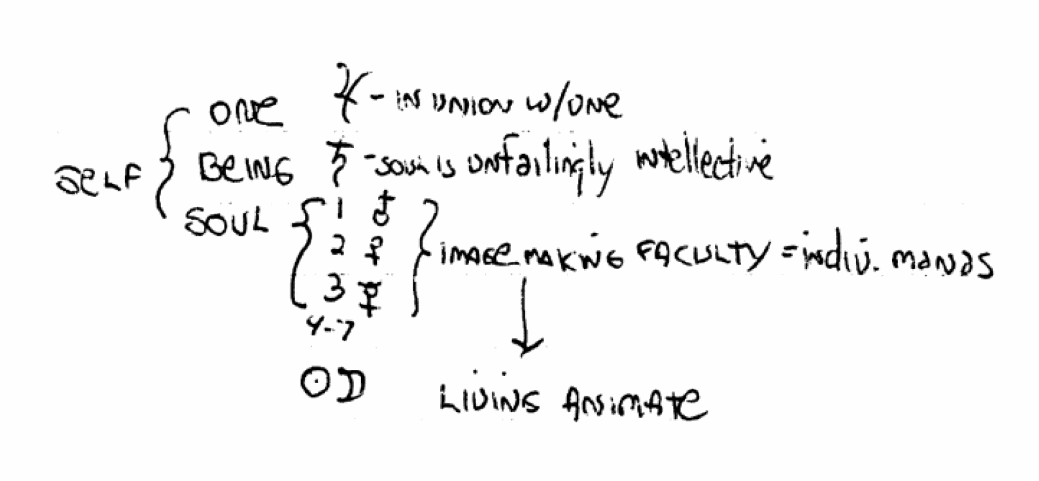
Class
Wednesday, October 12th, 1977
Verbatim, unedited transcriptCLASS at Wisdom's Goldenrod, Hector, NY
with Anthony Damiani (AD)
October 12, 1977
EPISTEMOLOGY; SYMBOLIC FUNCTIONING
TOPIC: Epistemology
SUBJECT: Symbolic Functioning
SUBSUBJECTS: Buddhism, Paul Dahlke on Ego as Combustion Process, Guenther ("The Concept of Mind in Buddhist Tantrism"), Projection, Superimposition, Jung, Reflective Consciousness
CONTENTS:
Superimposition (adhyasa) equated with projection
Mind as storehouse of images resulting from all prior perception; includes mankind's prior evolution in dream state
Mystical identity underlying perception; example of childhood; perception as an act of owning; super-value given to images through mystical identity
Images (vasanas) as core of multiple meanings, associations, feelings that can adapt and transform; amoeba analogy; images as our immediate experience
Mind as taijasa: plastic, malleable, translucent, etc.
Dual aspect of mind: 1) content aspect: images, vasanas; 2) substance/energetic aspect: taijasa quality giving mind its volatile mobility; two aspects of one phenomenon
Desire as driving force behind projection; differentiates one Soul from another; impels mind outward to repeat/reduplicate prior experiences
Mind as both process (symbolic function) and end-product (primordial image); cyclic nature of the process
Substantial side of mind can also be thought of as momentary; our desires are well organized, not random; samskaras and vasanas as equivalent terms; purification of mind results in more accurate and vivid presentation of object
Two standpoints: 1) higher manas/Witness-I; 2) lower manas/empirical; AD's explanation from standpoint of lower manas
Extensive reading from Dahlke's Buddhism and Science
All processes as samskara (compounded, conditioned); in-force (karma) as individual to each being; "I" as combustion process; in-force becoming perceptible to sense as consciousness
Detailed exploration of combustion metaphor; living as process, not entity; heir of deeds, not of mother and father; karmic uniqueness and unique attunement; student Q & A
To Vedic Sages, karma is substance, not process
Reading from F. Th. Stcherbatsky's Buddhist Logic, Vol. 1; characteristics of ultimate reality as point-instants
Relationship between point-instants and mental images: television analogy; mind making pictures of what senses grasp
Levels of symbolism; science, art, religion, myth constructing symbolic interpretation of primordial image on reflective level
Reading from Jaspers' General Psychopathology on reflective consciousness
Reflection alters direct experience; human psychic life vs. animal experience
Self-reflection as essential human quality; process of clarification through separation of subject and object; means to release from unconscious bondage; what transforms mere happening into meaningful experience; different from knowledge - makes itself the object and changes itself
Manas' defects/samskaras included in its production (primordial image), accounting for differences in views
Jung's experience of reflective consciousness as "second cosmogony"; reflective consciousness as stage for: individual meaning-making; freeing oneself from unconscious contents; defining one's individuality
Development of Western man through exhaustion of mind's meaning rather than denial
Quote from Chatterji on the function of buddhi; higher intelligence which organizes experience/imagery in a meaningful way
Story of Brother Lawrence and the barren tree as example of symbolic understanding
Individual in-force as totality of Nature's powers over which you try to exercise control
Is Jung's approach of building up reflective consciousness contrary to Buddhist practice?; no, it's a stage from which to guide biotic forces; at advanced level you can transcend
Productive imagination/symbolic functioning only mentioned but not explained by Stcherbatsky, Guenther
Superimposition as mind creating experience while denying access to reality; possibility of perceiving Intelligible World without intermediary of manas; Soul is ever intent on intellection
Reading from Jaffe's The Myth of Meaning in the Work of C.G. Jung; Jung's myth of meaning is the myth of reflective consciousness
Buddhist not-self doctrine as purgative technique; less egotism means less attachment to primordial images; importance of developing strong rational "I" before seeking freedom from it
Descent of Nous becoming individual; cosmic evolution altering vehicles, making possible direct perception of Truth; past doctrinal formulations not adequate for today
Need for transformation of one's vehicles to understand certain concepts; example of Armstrong
Natal chart as expression of unique psycho-essence; as individual karma corporealized
Criticism of Buddhist understanding of substance
Parallel developments in Eastern and Western philosophy show Truth is one; individual interferes in the very process of his own universalization
Necessity and difficulty of accessing pre-conceptual symbolic consciousness to understand Upanishads
Jung's ability to work with symbolic consciousness; had Jupiter in eighth house, mouthpiece for the unconscious
BOOKS READ FROM OR REFERENCED:
Herbert V. Guenther, Tibetan Buddhism in Western Perspective, "The Concept of Mind in Buddhist Tantrism"
C.G. Jung, CW 5, Symbols of Transformation
C.G. Jung, CW 8, The Structure and Dynamics of the Psyche
C.G. Jung, CW 11, Psychology and Religion, Psychological Commentary on "The Tibetan Book of the Dead"; also in The Tibetan Book of the Dead: Or, The After-Death Experiences on the Bardo Plane, W. Y. Evans-Wentz (Ed.), A. Govinda (Intro.), Sir John Woodroffe (Foreword)
Monier Williams, Sanskrit Dictionary
Paul Brunton, The Hidden Teaching Beyond Yoga
Mircea Eliade, Yoga: Immortality and Freedom
Rig-Veda, Nasadiya Sukta (Hymn of Creation)
Paul Dahlke, Buddhism and Science
Buddha, Pali Canon, Adittapariyaya Sutta (Fire Sermon Discourse)
Julius Evola, The Doctrine of Awakening
Paul Brunton, The Wisdom of the Overself
F. Th. Stcherbatsky, Buddhist Logic, Vol. 1
Karl Jaspers, General Psychopathology
J.C. Chatterji, Kashmir Shaivaism
Aniela Jaffe, The Myth of Meaning in the Work of C.G. Jung
Taittiriya Upanishad
Plotinus, The Enneads (MacKenna translation, 4th ed.)
PLOTINUS QUOTES READ OR REFERENCED: VI.7
DIAGRAM appended to this transcript:
- FIGURE 1977 1012-1-AB. Self and Animate correlated with Soul Monad.
Other diagrams referred to are not with this transcript version. [Transcriber note: [diagram] means the speaker is referencing a diagram as he or she is speaking. If someone is drawing or writing, with audible sounds of chalk on a blackboard, I indicate this by [drawing] or [writing].]
AD PAPER read in class:
- AD reads a few paragraphs from a paper he wrote on the mind's symbolic functioning.
NOTE: For readability's sake, the following substitutions/edits made in Verbatim Transcript: cuz = because; gonna = going to; gotta = got to; yeah = yes.
TRANSCRIBED Verbatim by IT prior to 2017, reformatted by jf 2017. In 2023, IT updates prefatory matter, footer, and audio file name, completes TOC and Book List, alters Subsubjects to make more accurate, adds Plotinus quotes section, fixes errors/typos, adds new notes within transcript, adds one diagram and references within transcript to this diagram, reformats to accord with new conventions. Archival verbatim transcript with AD Paper – V12ap.
AUDIO FILES: 1977 1012a, 1977 1012b, 1977 1012c. [Note: "Tape" and "Side" refer to original audio cassette tapes that were later digitized into .MP3 Audio Files.]
1977 10/12 at Wisdom's Goldenrod
Epistemology; Symbolic Functioning
[Audio File 1977 1012a Begins]
AD/S(?): Well if--
EMK: --and in some system of philosophy.
S (very faint): Yes, uh-hm [couple words inaudible]
S: Yes.
S (very faint): Uh-hm.
S (faint): [three/few words inaudible]
VM: Yes. Oh no.
[17 second pause]
S: Well?
[49 second pause]
AD: I assume most of you read the article so that I could just concentrate on the important points and then-- [short pause] We stopped at page 266. We've been going over them.
[Transcriber note: I am using Tibetan Buddhism in Western Perspective by Herbert V. Guenther, Dharma Publishing, Emeryville, 1977.]
Herbert V. Guenther [Tibetan Buddhism in Western Perspective, "The Concept of Mind in Buddhist Tantrism," p. 42, AD reading]: "There are three causes which produce changes of what is termed mind. They are appearance…traces and dispositions…and symbolism in the widest sense of the word…"
[short pause]
AD: And we're concentrating on the symbolism because in the widest sense of the word, it's the functioning of consciousness. [short pause] And-- and we tried to point out I think in brief that-- We will have to work with that one first, the symbolism or the symbolific activity of consciousness because that's-- that's where we stand.
[14 second pause]
RW: Ok.
AD: Red, you don't have what we've studied, you don't have it. [short pause] Well this is just to review quickly and briefly what we've been doing. In a-- in a-- in a way, we've been discussing what the Vedantists called superimposition. That is, we superimpose on reality and we attribute to it something which isn't there. So the usual terminology is adhyasa or a-- avidya, superimposition. And-- [15¼ second pause] We're trying to get into a little bit what the mechanism is of this symbolical functioning, how it is, so to speak, projected outwardly and the projection-- the mechanism here we have to try to get a glimpse at is the notion of projection and what is it that's projection-- projected. You have to do this in very explicit-- we have to make a picture for ourself. Only the picture (know how to say).
So, we started with the notion of prior perception. Remember, we pointed out that the storehouse of images that we have is the result of all prior perception. And, if you want, you could bring in the notion that PB makes, he says in a former way, in a former time, mankind evolved in a dream state. And there of course you could see that the amount of symbolific activity there, the symbols are innumerable, you know, there's no-- So that too would be part of this storage of images. And, if we take that into account, if we take that our former evolution was like in a dream state of consciousness, if we take into account the separation as man descended and got more and more into the body, and there was an alienation in the sense that he got separated from the world. But even during that time there was images that were constantly being recorded. And if we keep that in mind and when we use the term 'all perception' then we'll have an idea that we've really got our hands full.
Now, here-- the next point we've made is we had to show that there was a mystic identity that prevailed in that situation, that is, with the "all perception". And here unity is going to have to be the necessary clue or perhaps an example from childhood. If you go back to your early childhood when your mind was evolving or developing, manifesting, coming out, and, you remember, the notion we spoke about-- Freud, for instance, at one time referred to it as oceanic consciousness. Steiner in his way points out that a little child has not distinguished between himself and (his/its) environment, and that the process of distinguishing himself from the environment is a gradual one, he doesn't withdraw completely all his projections but in his early childhood, the environment, that's the home he lives in, the parents, their psyche, don't forget that, their psyche, all these things are part of the child's psyche and there's a kind of unison and an identity with it. So that, when he incorporates these images into his own being, alright, they have a very peculiar fascination. They almost hypnotize you. Just go back in years, go back to perhaps when you go visit your folks if they still live in the same place and see what kind of strong associations the area has for you.
Well, but, the point that we're making here is that in this section of the young child that it is this mystical identity with his environment, with his parents, with everything around him. This gives us a clue as to the-- the attachment that we're going to have later on to these images. And, unconsciously also there's the recognition, if you look at this very carefully, is that you own your perception. Perception is an act of owning. If you perceive, you're owning what you perceive. So perception is an act of owning. And naturally, when a person goes back and revisits his earlier childhood days, the imagery and the associations always have tremendous, you know, determination over [student assents, faint] (what/well) his behavior. To the extent where you could almost say that you'd consider those images one's self-identity, oneself. [short pause]
This mystical identity with the images or the objects of your environment, of course, I must emphasize this, gives those images a super value. I mean it's just unfathomable to us that are matured now not to realize that-- the strength they have. You ever watch a child when he's playing and he's all caught up in the imagination, how vivid and alive everything is for him? Once-- [student assents, faint] Yes. So, this object of course is loaded with this aura of luminosity and it governs and determines the activity of, let's say, a child, but you could see this applicable let's say to a tribe, to a family, I mean, a tribe or let's say living in a certain area would have that about the area you're in. A group of people, same, there's this participation in this very mystical way with common bonding.
[Transcriber note: The following quote seems to be a brief summary of paragraphs 521, 522 from The Structure and Dynamics of the Psyche (CW 8) by C.G. Jung. AD is reading from a paper he wrote, which I have no access to. Quote needs to be checked.]
AD [Paper, AD reading]: "The subjective image of the object, consequently, when it is finally separated from the object, is loaded with the independence and plurality of significations that the object was invested with originally. It now, the object, that is, the image of the object, owns the psyche or the subject's psyche."
AD: It has a free hand. And of course, it's like the core, this image, it's the core of innumerable qualities, associations, and meanings and feelings, you name it, and it's the core of all that, ok. [student assents] You know the analogy I was thinking of? An amoeba. You ever watch an amoeba when-- Well I did when I was-- I was so fascinated. When you looked it could become anything. If it needs feet, it puts out feet. If it needs a mouth, any part of it becomes a mouth. You ever study amoeba? I thought they were ideal. (laughter, student words) They could do anything! They could develop wings, I imagine, if they found that they needed them. Anyway, think of the amoeba, alright, in relationship to an image. It can become almost anything, an amoeba or an image. The core of-- or the nucleus of meaning which an image has is something like an amoeba--it can become anything. Given-- given the artistry and the skill of a superior intelligence, it can take images and practically make a world for you. So, it can become almost anything, it can describe, reveal, signify, suggest in innumerable ways meaning for us.
And then the next point we made, and this starts becoming a little (technical), that these very images, and terminology we referred to in some of the other texts is 'samskaras,' 'dispositions,' 'vasanas,' 'tendency,' is constituted the very content of our mind, the mind or the psyche, which is an immediate experience and everything else is going to be pure inference. In other words, this is what we're going to have immediate experience of, these images, ok. [student assents, very faint] [10½ second pause] And then the next step, we were going to try to understand something about the mechanism involved, you know, the mechanism of projections involved in it. [short pause] Because whether we take the position of the Buddhist, you know, who speak about point-instants, and then bring in the notion of productive imagination, or whether we take the position of the Vedantist who say that we superimpose on the object, or the mind superimposes on reality qualities which are within, doesn't matter. They're both going to have this to contend with, that every time we try to grasp-- the mind tries to grasp an object-- and all this fancy terminology we talk about superimposition and avidya, it's nice to get down to some psychological fact. This is what's going to come up is these images in the storeroom consciousness. Remember when we took-- we took-- in the store we took a cube, you know, and put it on top of the piece of white paper and we looked at it and we actually saw that cube get up, walk around, make a (change/chain), spin around, then come-- Do you remember that?
S: Uh-hm.
S: (Uh-uh.)
AD: You remember that, don't you? I mean you actually saw your mind doing something right then and there. You could actually witness your mind taking that thing, making it stand up, turn around, and you know that that's not happening. Now you can see that there's a kind of magic involved, (it's/as if) a real mechanism that projects its contents, alright, and then what you're going to have to witness is what the mind has created for you, and it doesn't care whether you agree or disagree. And the difficulty is that every time we try to understand what the nature of the mind is, what happens? We have more images. So how can you grasp the nature of the mind if every time you make the attempt you get more images? They're always there, that's what you're grasping, more images. So you can't get to the nature of the mind directly. What you get to is these images in the mind. So anyway, we says we'll try to get some insight into the nature of projection. We mentioned that what constitutes the content of mind are these images.
Now, we have this fancy terminology and various systems where they speak of the substance of the mind as bhutadi. And you know, that leaves like a big hole in my head, (bit of laughter) or a big empty spot in my stomach. And I keep trying to pull it up. And it don't work. Because I got to have it in my own language in the way I could understand and it ain't so (weird) too. Some call it bhu-- bhutadi, but I don't care what names we give it. Let's see if we can understand what we're talking about, that the contents, the vibratory activity which drops off into the unconscious and becomes the motion of the mind, I don't care what we call it, but this is what the content of mind is going to be, and every time we try to inquire into what the mind is, what we have are these images to work with. So that's out of the question. And then the other point (we/he) made, we looked up in Jung and in his work on the transformation of the libido, he speaks about taijasa and he looks up the meaning of taijasa. You see, now even a great man looks up words in the dictionary. I mean, do you notice that? They do that. And some of the meanings he came up with from the Monier Williams Sanskrit dictionary was that taijasa was a [AD paraphrasing from C.G. Jung, CW 5, p. 165, paragraph 237; not reading the list in order] fiery and bright, sharp, ardor, heat, light, strength, energy, vital force, passion, spiritual and magical power. The last word's 'semen'. So, these were the descriptive terms he applied to tejas which, as we just said, is an aspect of mind. And naturally with that kind of description of tejas, it becomes immediately available to your understanding that this mind is plastic and it's malleable, translucent, faster than light, ok, and absolutely pervasive. When the Vedantists say that it's not infinite, that doesn't mean it's not pervasive enough to be infinite as far as you're concerned. You've got to keep that in mind. It may not be infinite because only Brahman is infinite. And here again is this unfathomable terminology that they work with. If that-- if that mind points out to me a star out there which is an incalculable distance, well it's infinite enough for me. Ok.
So, going on, that means that, on the one hand we have mind and we considered its content. Doesn't he even take the liberty of saying its substance are the images(?/.) And on the other hand, we also realize that this mind which-- we're using this tejas, it was fiery, hot, all these other qualities, passionate, and has this tren-- tremendous motility to become anything anywhere and-- Now if we take these two qualities, take these two qualities, and imagine them or homogenize them in your understanding--now what do you got? Think of them as one, instead of two different qualities, you know, because if you think of it as two, you begin to think there are two separate things, but if you think of it as one which has these two qualities--on the one hand, the substance of its being-- I don't like to use that word because that upsets Mr. Guenther. Substance of the being of mind are these images. And on the other hand, the substance of mind is this ardor, heat, light, transparency, sharp, cutting. Now, if you homogenize these two conceptions, you see what you got on your hand? [short pause] No.
LS: So this fiery substance manifesting these images.
AD: All the time, yes. For those of you who are still in bondage to the tremendous power inherent in the tejas aspect of mind, all you have to do is experience a tremendous desire and not fulfill it. And you'll see the heat and the fire and the steam and the smoke. Because otherwise you people think I'm talking about some sort of imaginary object. I'm talking about your mind. So, if we take these two notions and try to combine them-- combine them, we come up with this notion of mind, you know, which is absolutely plastic, malleable. It can be converted and transform itself into anything, alright. Now, when they say, when they say a vritti is the transformation of the mind, a mode of the mind, now you know what the hell they're talking about, don't you!? If you don't, then start asking questions now. Yes--
TS: Is that-- then when they speak of the vritti there, would you say that the modification of these images that's due to the, say, combination of these two aspects of the mind, the inherent images which constitute it and the projective quality, taijasa, modifies [one/two words inaudible] or create a-- a new form of that-- those (inherent/inhering) images because that's what the vritti--
AD: Yes. Any disturbance of that-- of that psyche will immediately reveal itself as, you know, a reconstruction or recombination of images that are part of the storehouse, ok. Immediately, I mean, because it operates with a-- a rapidity which is (unknown to us). And that's why we can't say, like for instance when we think of the operation of the mind, you know, when we say "Well you do this and then that and then…" In other words, what I'm trying to say is when the Eastern philosophies talk about the manas aspect, the ahamkara, the buddhi, ok, the activity of mind is so rapid that what to us seems to be of one shot, you know, a simultaneous operation, if you can slow down the activity of mind then you can see these operations and you'd see that they would not be simultaneous, but that they one follow upon the other. So that, one might put it this way, that it seems-- You remember like the Emperor Julian was capable of dictating six letters and writing to someone, talking to someone else, and you say well his mind was doing all this simultaneously. No, his mind moved so fast that it was capable of handling each point as it came up. Just like when you take a wheel, it's only one point touching the ground at that time. But his mind operated that fast, it was capable of tremendous concentration, holding many things together at one time. But it wasn't-- the mind by nature operates with that one point at a time. [short pause]
So that, if we take this analogy and we think of the-- the content of the images in the mind, and we think of the substance of the mind as this taijasa quality, ok, it's like if you were to think of water, ok, and waves, alright, where you have this aspect of-- two aspects of one thing, alright, but we s-- we're going to speak about-- if we speak about the waves, we're going to speak of them as separate from the water and if we speak of the water we're not going to think about the waves. This is the way, of course, common language, which is basically dualistic, has to work, it has no choice. But that doesn't mean I can't understand that, I can't include those presuppositions of language in my understanding. Now, what is important to understand here, because the mechanism of projection is what we're trying to get into, is what is it that drives the mind, alright, so to speak, outward? I mean you say the mind goes out and gets projected onto something. What does that? What is the impulsion to do that? One word.
S: Desire.
AD: Desire. [student assents, very faint] That's enough, alright, the whole mechanism goes into operation. So even in terms of the chart, you know, when you look at that Mars in Libra and we call that kama rupa, now you know what's pushing your mind around. The nature of desire is such to differentiate one Soul from another. And that very nature of course is also what impelled or compels the mind to project outwardly to repeat the experiences it previously at one time enjoyed. So, we can say that desire is what-- one of the-- the desires of the mind impel it outwardly to reduplicate prior experience by grasping or making contact with these objects. Now-- now we have together-- now we have these factors involved in projection.
[Transcriber note: AD is reading from a paper he wrote, which I have no access to. Quotes need to be checked.]
AD [Paper, AD reading]: "The volatile mobility and pervasiveness of the mind is tejas, its matter, the matter containing the residues of all prior activity called vasanas, images, etc, [AD: Ok.] and the tendency of desiring mind to repeat and re-experience, which requires that it seeks outwardly. Mind can be seen to be process or symbolic function resulting in mind as end-product of its activity (and/in) its effect, the primordial image."
AD: In other words, this very activity of the mind is what is going to be known as the primordial image or what PB spoke about, you remember, the image is first, now experience follows from it. [Note: Paul Brunton, The Hidden Teaching Beyond Yoga, p. 303, 1969 E.P. Dutton edition.] Now, the Buddhists want to call that symbolific activity, Cassirer wants to call it symbolical mode of functioning, the Vedantists want to call it superimposition. I'll tell you the truth--I'm so fed up with Orchard Street, I don't want to go there and buy anything from anybody. (some laughter)
S: Right.
PD: What's the difference between the tai-- taijasa and the vasanas? Both of those are [couple words inaudible]
AD: Alright. Let me finish this and I can throw it away, I'm going to throw this away.
AD [Paper, AD reading]: "The process is cyclic. From the primordial image within which our body is located the process is repeated…"
AD: Because there I look at the object, so to speak, I desire it and I go out with it. So it's a sort of cyclic process. It's not a one shot thing, it's not a linear progress. And we spoke about this very often, the mind going out through the eye, for instance.
AD [Paper, AD reading]: "…the mind actively seeking and desiring objects, grasping them one at a time. And from within itself it provides for every attribute and signification that the object is capable of possessing. And within these limits, the mind produces our sensible world."
AD: You got a picture now of what I've been trying to say? One calls it symbolic functioning, another one calls it superimposition.
S (possibly part of background): [couple words inaudible]
AD: Alright, now, ask questions 'cause I won't move on until you ask questions. The next part is going to be a little more difficult.
PD: Tony, by the (notion/motion) of taijasa [few words inaudible] what's the difference between that and the vasanas that are the-- manifesting as or through the images?
AD: Well that's why I specifically used the word, the 'vasanas,' 'images,' ok, whatever you want to call the residue-- residue of your prior activity.
PD: Call those vasanas, right?
AD: Yes, the residue is--
PD: Right, ok.
AD: Yes, those are vasanas. [PD: Alright.] They are equivalent to the content of mind. Now--
PD: But Eliade also speaks of them as the mobility, the [AD simultaneously: Uh-uh, uh-uh, uh-uh.] tendency to manifest, the-- the power. [Note: See Mircea Eliade, Yoga: Immortality and Freedom, pp. 41-46.]
AD (simultaneously): He did not provide us-- he did not provide us with some sort of substance within which these reside.
PD: Why do we have to posit a substance?
AD: Even if it's not an underlying substratum, even if it's a momentary substratum, even if you want to call it a stream of individuality. Look, what the Buddhists do is something like this, there's no underlying mind which these vasanas drop in, like you take nails and drop them in a jar. Ok, there's no such underlying substratum. What they claim is that they're one after another, there's a stream of them. It doesn't matter to me. I don't care how you look at it. You see what I'm saying?
PD: Yes.
AD: Ok.
PD: What's the differences then-- I mean I don't see why-- That concept of taijasa wasn't necessary for the explanation you presented. Vasanas and the imagination, wouldn't that result-- These are the only necessary concepts now.
AD (simultaneously): I'm sorry?
PD: Vasanas and imagination were the only necessary concepts.
AD (simultaneously): Yes! That's exactly what imagination is!! Now you're catching on.
[short pause]
PD: Imagination--
AD (simultaneously): I'm glad you did.
PD: You-- so you're saying imagination is something other than images.
AD: Well, we could think of the imagination or we can think of imaging. And we could think of it as without a substratum or as a continuity of vasanas shooting off without any need for a substratum. But we do need these two aspects to work with. On the one hand, the volatility, pervasiveness, the mo-- motion of the mind, and on the other hand, we need the content. You can say it's all one. I don't care. I'm going to speak as though they're two because I'm going to have to describe each one differently.
PD: No, I see the necessity for two concepts in [couple words inaudible]
AD (simultaneously): Ok, that's all. You do not have to accept the notion of a substance, there's no need to. In other words, I don't have to imagine that every time I have a thought and it sinks into my-- into the unconscious, like there's a big pot, you know, and the thought sinks into the pot, and later on when I need that thought I pull it out again. You don't have to imagine it that way. You can imagine that it's just this activity, this constant stream of activity of the mind and the moment before determines the moment after and the moment after is de-- determines the next, so that you have a stream, not a pot, you know, to put it in. In other words you don't have to use the su-- the notion of substance. I don't care. Ok?
AH: Would it help to think of notion of substance as a kind of prime cause?
[student(s) assenting, very faint]
AD: No. Don't get into the notion of substance because the Buddhists don't know what the hell they're talking about. The notion of substance is one of the most difficult of all notions to grasp. It's not available because you read the word. Yes--
S: They do start--
AD: You wouldn't try to-- Look, I'm coming to you also as a Platonist. That notion of substance is one of the hardest ones to grasp. And don't-- don't think that you understand it, forget about it! [AH/S(?): Well--] Let's stick with the Buddhist version.
AH: Just in terms of our discussion tonight, this notion of (being). What's the word? I forgot the word.
S: Teja.
AH: Tejas?
AD (simultaneously): Taijasa, yes.
AH: Is that like a cau-- is that the cause of these guys? I can't help but think of that as the cause.
AD: No. [AH simultaneously: Like (one/two words inaudible)] The Buddhist-- in the Buddhist fixture of signi-- si-- significations there wouldn't be such a thing as cause. Cause will be everything that is prior, everything that is prior, the totality of all preceding events. [AH simultaneously: Then what would--] That would be cause.
AH: It's a motive force?
PD: Yes, but it seems to be--
AD: No, you can-- you can think of it more as a biotic force.
S: Ok.
S (very faint): What's that word?
AD: Biotic.
S: Yes, I follow you.
AD: Can't [S simultaneously: I lost you.] you say that instead of biological force? Biotic. Right. I don't know. (laughter) I never learned English. You could think of it as a biotic force, no? [short pause, faint background student words] Somebody use(d) the word 'vitalistic'. Others use the term 'life'. But, you know what I'm talking about? Like did you ever spend a night alone where your desires were consuming you, it's a biotic force that's eating you up? Whether it's for food, woman, whiskey, you name it, there it is.
S: But Tony, would you distinguish then between the notion of tejas and the notion-- the notion of desire?
AD: Yes because desire is a little different, desire-- After, I think we'll be able to see, again, here the Buddhists may disagree, but desire is very well calculated. The desires you have are pretty well organized even though you may not know about it. [couple inaudible student words simultaneous with AD] They're desi-- they're organized by a higher level of understanding than we can deal with. You don't have any desires, you have certain desires, and they're pretty well calculated.
S: But you would say that--
AD (simultaneously): If you ask yourself, "Why do I have this desire?", you're in trouble. They're not indiscriminate, you know. And you can see very often they're precursors to a higher understanding but we don't know this when we first have them.
S: Well if-- part of that then would be more of a notion of undifferentiated energy. In other words, it's not in any particular direction but the desires are like this congregation.
AD: Yes. So that-- so that we could imagine to ourselves something to the effect that the desire is going to govern what the mind is-- sets out to seek, alright. And, given that the mi-- the desires are governing your mind, then what the mind sets out to seek is already predetermined. It will select this rather than that. There could be a hundred beautiful girls, I pick on this one, why? Because there's something that's going to correspond in her that I'm in need of. So desires are very calculated.
S: Are-- are they part of that mind?
AD: Yes, they're part of that mind, sure. They're part-- they're part, so to speak, at the lower stage they're desires, at the higher stage they're will. But that's the way we get to develop our will, first through the lower desire nature.
AH: Tony, I'm really having trouble understanding something (of) this tejas. Like [one/two words inaudible] is not the same as desire nor is it the same as vasanas. I-- I don't know how to-- I don't know how to tie that all together without positing some sort of primal cause, some kind of primal force. It's like a medium in which all this other activity takes place. [short pause] Can it be thought of as like a-- a matrix-- matrix of energies?
AD: Ok, you could think of it like that. But I'm going to try to get into that question more completely in a few minutes. I have to give slight review and that's not the question we want to get now. And I got a beautiful chapter from a very fine writer, a Buddhist writer at the turn of the 20th century, Paul Dahlke. He wrote an exceptional bit of stuff on Buddhism and this one it might be very-- sit through and we read a chapter and I think you'll be able to understand that. But that's-- that's a pivotal point in Buddhism that's really beautifully done by him. So, just hold your question, I'll try to answer that one in a minute. But for now, I'd like to try-- I like-- What I really want is for you to try to see this whole operation of the mind, you know, how it goes out, grasps an object, provides the necessary images.
Now you remember we said that these images are capable of being ordered in any possible number of ways to bring out the significance of an object. You know what I mean? Because if we said that each image has, so to speak, this indefinite plurality of meanings, alright, significations, feelings, you know, all kinds of association. Now let's say that-- let's say I'm your Soul, ok, and I want to make a dream, I want to convey a message to you. Ok? And so I have to use the material that's in your mind. And there-- there's no words there yet, you know, in the-- as the content. What is there are all these prior vasanas. So, there's such a wealth of material there that, you know, I can easily combine them and produce a beautiful play in your mind, a dream, and deliver through those symbols whatever it wants to tell you. And, the beautiful thing about that is, it won't be like a concept. Because a concept is dead, it's a corpse. But there, it's loaded with all these profound significances and feeling. Imagine, think of something that happened to you when you were a little child. It still had that tremendous numinosity about it, it still could move you. So it takes an image, let's say, when you were one year old, it takes another one when you were two years old, or you remember the first day you went to school, anything like that, takes them and creates a-- And the dream is loaded with feeling, not only symbolical image but tremendous feelings are-- it's all there. Go ahead.
AH: Last week we had the distinction between pure sensation and symbol imagination. Does-- does any part of the-- does any part of this activity take place in the realm of sensation or is it all in the imagination?
AD (simultaneously): No all this is, as the Buddhists would say, in the realm of the productive imagination.
AH: Tejas is also?
AD: Well we were describing-- what we were describing was, let's say, what-- You know like, this productive imagination-- The sensation on the one hand is pure and on the other hand you have the productive imagination. On one hand you have pure sensibility and on the other hand you have the understanding. Alright well, we're on this side of the fence. In other words, we're on the side inside the imagination and anything that we experience must be in terms of the images that the imagination provides. And that's what we're talking about. We're not on the other side yet. Anymore? Go ahead.
RC: Are you using samskara and vasana as synonyms?
AD: Uh-hm. Yes, samskara, tendencies, vasanas, dispositions, all of this is all one-- [AD claps] You remember, like I told you, you go to Orchard Street and they have these push carts and one guy says, "Buy my vasanas, a nickel each." And the other one goes over, the same thing, "Buy my dispositions, they're a dime." You see, the word is bigger, sounds fancy. (laughter) All the same, all the same. That's why sometimes there's an advantage to using language that's impersonal. All prior activity drops a residue of its functioning or leaves behind traces of itself, and you knock out all Sanskrit terminology, Buddhist, prakritic and everything else. What we are interested in the ideas, I am not interested in nationalism of any kind, coming from East, West, South or North.
RC: Is there a distinction to be found between them later, just not now? Is there a distinction to be drawn between them later and just not now or is the--
AD: They will make a distinction. Yes, they'll make a distinction, I won't. Like vasanas are immediately available, you know, this activity going on right now is very immediate whereas the samskara is a long drawn-out thing. So that, for instance, when I use the term 'samskaras' in astrology, you know, like when we say that all the prior activity of this universe will be deposited as samskaras in the Mind, you know, the Universal Mind. Well those samskaras are equivalent to God-Heads. I mean, so you call them samskaras. You see how stupid it would be to get caught up in a word instead of a meaning? Because here I'm using the word 'samskara,' ok, but I mean the same thing in principle. It's a certain kind of residue from functioning. If you do a certain act and you repeat that act, there's a kind of tendency to want to repeat it. So they call it samskara, they call it vasana, and then they differentiate, well this is more immediate, the vasanas are operative, you know, you just did something today or yesterday. Samskaras are drawn out. Well for me maybe yesterday is more drawn out than your hundred years. C'mon. Let's stick to the meanings. Ok?
RC: At one time, I mean, we've talked about them as being--
AD: Can't hear you Randy.
RC: At one time we've talked about them as being quite a bit different and on having--
AD: I never did. That was Om. (some laughter)
RC: (There was a) time that distinction Jung makes between contents that have once been conscious and contents which have never been conscious.
AD: No. No relationship. Why are you bringing that in now? Some [RC simultaneously: Well--] contents will never be conscious, period, ever!
RC: Yes. Well I was bringing it in because I was wondering if (that/the)--
AD: How could you call them samskaras?
RC: Well, that's what I wondering. I was wondering if samskaras would be-- would actually be on the side of sensation rather than in the imagination.
AD: Randy, don't look for problems. We'll have enough. No, just that samskara was a prior activity. Otherwise it cannot be called a samskara, cannot be called a disposition or a tendency.
MW: Tony, I--
AD: Go on.
MW: I was following you up until the very end when you started speaking about a (different) process and I just sort of missed where did you come from.
AD: Well, you read of this in the Eliade chapter where the vasanas have this tendency or desire to repeat a prior experience.
MW: Oh, is that all you--
AD: Yes. [student assents, faint] And then-- and then the very nature of the activity is such that it leaves a residue so that it reinforces itself and wants to be done again. And so it's cyclic, you know, in that sense, ok? But do you have some kind of feeling for what we spoke about now as the mind? You see, words like 'mind,' you know, are so impersonal and they've been bandied so much about that everybody has his own interpretation whereas now if you can try to get a feeling for what this is rather than a concept I think it'll beco-- come much more alive. You had an experience of taijasa, right, you see it's fiery nature. Remember? Very often, like for instance in any kundalini activity or exercise or experience, what you experience is not per se the illumination but the way it clothes itself in the subtle matter of the mind. You don't have a direct contact with an illumination. You're not-- at least we're not ready for something like that. But what it does is enclose itself into this fiery form, in the-- in the form of taijasa and reveals itself as a light within. So very often, a person will feel that there's a sort of fire in him. Well if there was anything of like a real fire, of course, it would be out of the question. But he would feel or see this fire burning up inside of (him). That's taijasa. The most common one is the intensity of desire that can be experienced especially when you're young, you know, you're twenty and you got a real active kama rupa. And you can experience a fiery mind, you can actually see it now. I don't mean to be vulgar, don't misunderstand, I'm just trying to find an example somewhere, especially when an-- when an archetype is activated. One could see its products right in front of his own eyes. Alright. [short pause] Any other questions?
KD: Yes.
AD: Yes? Go ahead.
KD: When you were talking about the amoeba, and something about a nucleus that could become anything, were you referring to taijasa or the-- or the vasana?
AD: No, I was [KD simultaneously: (Were you referring-- ok.)] referring there to the-- the images which drop into the consci-- into the unconscious, if I can use Jung's terminology. And these images, ok, when they drop into the unconscious-- Think of something that you experienced, for instance, when you were a child, two or three years old, alright. It has the-- it has a multidimensional or multivalent kind of value. To you, later on, that image or that experience which dropped into your unconscious is like a core, alright, around which a lot of other values group themselves. All kinds of associations, feelings, significations, half-concepts, one-third concepts, ok. Now, that's like a core, ok, that's like a nucleus. And what I was trying to do is give you an analogy. Think of an amoeba. An amoeba could become anything. Any function it wants, it can become that function. In the same way, the core of a vasana or an image can become to mean anything you want it to mean in a dream.
KD: Ok [one/two words inaudible]
AD (simultaneously): In that sense, it's like an amoeba, he can become this, that, or the other thing--whatever feeling or meaning or signification you want to give it. Put it in a certain context, and it becomes that.
KD: (Yes, and it's important to see the) emotionality attached to the image.
AD (simultaneously): Yes, that's [KD simultaneously: In other words, it's--] attached to the image.
KD: Ok, but-- so it's not-- it doesn't carry [one/two words inaudible] particular meaning, it's going to be identification attached to that.
AD (simultaneously): Yes, the identification with a plurality of associated feelings, you know, emotionality, bodily-based corporeality, all those things, ok. And you can see that there's-- this is unlimited. So when you drop, let's say, when something drops into the unconscious in that way, and I hate to use that word because you think I'm dropping nails in a pail or something, but when that activity is forgotten, let's say, and becomes part of your mind, alright, it can be brought up given the con-- proper conditions and manifest in a way that's appropriate for that moment. It doesn't have to say, "Well, let's see, this is what that meant ten years ago." But for this moment, it can take that material and apply it for this moment. So that, when a person has a dream, there's an actual portrayal of the psychic situation there and then for the moment. Not about how his mind was ten years ago or twenty years from now, but the way the mind is right now. It paints itself in those images, in those feelings, in those colors, in those significations.
KD (simultaneously): Is that what brings that out? Is that-- isn't that emotionality?
AD: No, no--
KD (simultaneously): I mean if it brings this--
AD: No, what-- whatever the triggering mechanism is I didn't discuss. Well, what-- what we were discussing is that when it comes out, it's loaded with all that feeling. So, if let's say-- let's say I see a pretty little girl, I'm five years old and she's four, you know, and I see her twenty years later. Well, that image is like brought out and shot up and all those strange feelings and memories and associations are projected onto her. That's all I was trying to describe in that particular instance. So it's like an amoeba, and--
(Side 1 of original cassette tape digitized as 1977 1012a Ends; Side 2 Begins)
MW: See?
S: Louder.
AD (simultaneously): Now tell me what you mean by self-image.
MW: Is this act of the mind finding something similar-- something in itself similar to what is in the object prior to the act-- to the act of the production of the images? Maybe my question doesn't make much sense.
AD (simultaneously): Oh yes, I see what you're saying. Yes, of course.
MW: I mean, it sounded to me as if there was like a [one word inaudible]
AD (simultaneously): Yes, it would have to be, wouldn't it? It can't go there, it can't go to the prakritic entity, the unknown "x," with a set of determinated-- determinate qualities and say "This is what it is" because then you'll never know what that object [MW assents] is. So that that's part of the reason why we try to keep our mind clear of all prejudisms, because if you're-- if you send the mind out already loaded with what the object is you're never going to find out what the object is. And the first thing(s) I have to do is tear out all these grooves that the mind makes for itself as to what its experience is going to be about. So if you could operate that way and momentarily suspend the buddhi function of the mind, momentarily, because that's all it can be for, so that the mind could grasp the object and provide the object with the most-- the closest parallelisms, the closest correlations, and this would give you a kind of understanding of the qualities that object has. It doesn't give you the object.
Because remember, when you eat food, you digest it, you destroy it. But in knowledge you don't have that situation. In knowledge the mind goes out, it's got to tell you about that object and not destroy the object. If it destroyed the object then there's nothing to know, right? If the mind ate it up, says "Ah, that's it. Now, I'll tell you what it's about." Tell me about what? So the mind has to provide you with a set of attributes, qualities, distinctions, its essences, in other words, its operating nature will tell you, "This is what it's like." So that the conjunction that takes place when an en-- when an entity knows an object, the conjunction that takes place is with the form of his mind. This could be quite an illuminating thing, I mean don't underrate it. [short pause]
So, also, a great deal of activity, a great deal of-- and a great deal of study [couple words inaudible] when you study Yoga, they try to make this tejas more and more refined, you know, more and more translucent, so that the object could actually shine right through. But that-- that's another story. That's what we speak about when we say, for instance, if you meditate, you constantly go on meditating, you know, week in, week out, year in, year out, gradually the impurities in the mind begin to settle down, ok, so that the mind gets freer and freer. That's what they call shuddhi [AD pronounces: shuddha] yoga and all that.
But, we can see that in a very normal way, if a person operates with a minimum amount of prejudisms he usually sees what's there much better than the person who already has certain grooves in his mind as to what's there. So, we would have to say yes, the mind, in a prior act, reaching out, pervading the object, encircling it, enveloping it, alright, then it could, so to speak, from within its own resources, pull out the qualities necessary to say, "This is what it is." So when you're looking at the blue sky, alright, these sensible qualities, blue. That's the mind! And where you see it. That's the object, all around you. Don't put the mind in the head because you're in an awful lot of trouble you do that. You have to put the blue sky in your head.
MW: Now when you say that the image is first, that--
AD: This is the image we're talking about.
MW: That the image is produced af-- after this contact of the mind [AD simultaneously: With the--] with the object.
AD: Yes. Now this, of course, you can see--
PD: What (leaves) that contact with the object at that point?
AD: Well, we don't have to say contact, we could say "energize". There's no way of describing it.
PD: If the mind is the blue sky, where is this object?
S (faint): [one word inaudible]
AD: The mind is not the blue sky because the sky can get black too.
PD: Well the mind will get black too.
AD (simultaneously): Yes.
PD: So [S simultaneously: Right.] where is this object outside the mind?
AD: It isn't outside the mind.
PD: So there's no act of mind going forth.
AD (simultaneously): Yes, this is exactly what the Buddhists would say. [MW simultaneously: Yes, but you don't know anything.] There is nothing external to the mind so why worry about any external object? Now it depends upon you, sir, Mr. Buddhist.
PD: I'm just asking.
AD: If you're asking [students assent] from the point of view of the lower manas, that is a blue sky and it's out there. If you're saying this from the point of view of manas, then you are that blue sky.
PD: Explain without using those words.
AD/S(?): (Well--)
S: Yes.
AD: Alright. If I try to explain experience in terms of my empirical standing here and now, I cannot take the position of a Witness-I. I cannot take the position of the World-Mind and say this is the ultimate perceiver and I'm going to explain experience in terms of the ultimate perceiver, because this is what the Buddhists do. I don't do that. In other words, for an ordinary person who's identified with his body, then you have to explain to him in terms of his framework what the ultimate perceiver is in him.
PD: And you cannot say his mind is that blue sky.
AD (simultaneously): Yes, exactly. Exactly. Because he doesn't buy that. He'll say, "What are you talking about? That's not my mind, this is my mind. What are you trying to do with me?"
PD: Yes [couple words inaudible]
AD: Yes. This is the point that I'm bringing out regarding all traditions. Each one, in his very, you know, nefarious and surreptitious way, has certain presuppositions which he don't want nobody to know and explains what's going on. And what we're doing, we're going around everybody's backdoor and pulling them out.
S: Good.
AD: I don't care who they are. That's exactly the point. So, when the Vedantist, for instance, take the point of view of explaining their epistemology, they ha-- look at what they got to go through. They got to accept the ordinary empirical world of the ordinary individual. When that person transcends it, when he begins to understand that the world is nothing but a manifestation of his consciousness, then they take the next point of view, in other words, they go from a realistic epistemological to an idealistic. So they have two standpoints. You see how smart they are? But the Buddhist, he says, "Well, let's eliminate the bottom, there's only the-- this point of view." You know, like in Nagarjuna. There's only the point of view of emptiness. Come on, cut it out, will you?
PD/S(?): No, they have two points of view.
AD: Well why did they kick Dignaga out?
PD: They [few words inaudible]
AD (simultaneously): No. No, they're just tolerant-- they're just tolerant of the empirical point of view, they're just tolerant.
PD: No, they said the empirical point of view is still the empirical, whereas Dignaga brought in an idealistic epistemology.
AD (simultaneously): Aren't you-- Yes, but aren't you affirming when I said the empirical point of view is the thing to-- isn't that exactly--
PD (simultaneously): That's just what Nagarjuna said.
AD: Exactly.
PD: Ok.
AD: Yes.
PD: I mean [couple inaudible student words simultaneous with PD] I don't want to throw--
AD: No, no, that's exactly [S simultaneously: I don't either.] the point I (mean). I hope you don't think he was condoning it.
PD: He kept the two points of view and two points [one word inaudible]
AD (simultaneously): Alright, we'll get to Nagarjuna, we'll satisfy that in a (little bit).
PD (simultaneously): Well, I mean--
[short pause]
AD: Yes, they're all so tolerant of the empirical point of view but the most difficult thing of all, Paul, is to explain things from the empirical level. That's the hard task. The others have a picnic. I mean I can get up and start speaking from the point of view of the World-Mind and relieve myself of all this baloney. I mean, why am I doing this is because I want to operate from the empirical point of view where you're standing. You got to understand this in a very precise way, that there's an entity out there and that from within yourself, from your own viscera, your own gut, you're pulling out (these/the) images, the qualities, the associations, and projecting them onto that object and say, "Look, now I think I know what that object is." But you also have to understand that what you know is part of your own self, and that there would be no experience possible for anyone unless he experiences himself out there as that thing. This is plain empirical talk. You got it? I mean that's one of the reasons I respect Jung. He says, "I got to start where I am!"
Now, I want to bring in another moin-- man, who-- (laughter) He's a Buddhist, you know, and you should read some of the criticism of the Vedanta. I got to laugh, you know. [short pause] I'm thinking of this fellow, who was it, Lama Govinda [AD pronounces: Govindana], yes. In one of his books, he takes one of the greatest hymns in the Rig Veda, one of the greatest, you know the one on the Divinity? [Note: See Rig-Veda, Nasadiya Sukta (Hymn of Creation).] No? And he reduces that to a pastoral song of a couple of bards and shepherds who are tending their sheep. I-- it's so hard to believe that a person who's supposedly spiritual be so blinded by his own parochial naïveté. [short pause] A question which even the Platonists say they-- the Platonists point out, there's no hope of ever reaching this kind of knowledge. Of course not, because it's not knowledge. So the Hymn ends off the same way--"Perhaps he knows, perhaps he doesn't." They're trying to tell you that in the-- in the-- in the One there is no need for Intellection. Anyway, this is a book called Buddhism and Science by Paul Dahlke. I'm going to use a whole chapter (and) I'm going to try to ram it down your throat. Now if you forget what we've done, then this is a waste. But if you keep in mind what we've done so far, I think you might find-- you might find this one of the most illuminating write-ups.
S: What is his last name?
S: D-a-h-l--
AD (simultaneously): Spelled D-a-h-l-k-e. You know, about the turn of the century you (had to--) a few Buddhists, very fine writers, and he's one of them. They did a great deal to make it accessible, popularize it. And, I-- like I said, I would have no objection to these people if they stopped being so provincial. I mean for-- for you or I to do this who are not writers and not philosophers, you know, I can see it. But for someone who is a philosopher to do it, I just get-- You know, in old China they used to have a custom. Let's say-- You're walking down the street, alright, and you're a Buddhist, and along comes someone that you slightly know and you greet each other, you say hello. Now I'm a Buddhist and I start asking him about his religion. Now he's not a Buddhist, he's a Confucian or a Taoist or anything. And I would ask him about his religion and what he thinks about it and what his thoughts are. It's like they completely out with the ego. Instead of the ego getting in there and say, "Look, this is what you should believe, blah, blah, blah." No, "Tell me about your version, I want to understand your point of view." [RC: Ok.] They had a very beautiful custom, no? Imagine giving that to the Jehovah Witnesses. (laughter, student words) Now it's a technique I want you to use, you can go out and find out what people think, this one and that one.
S: Alright. (S chuckling)
[student assents, faint]
[13¾ second pause]
AD: You want to keep in mind now what we've done. Also what we were speaking about in the-- in Buddhism when we were reading about point-instants, you know, that they'll call that efficiency, reality, (they're just called--)
[Transcriber note: I am using Buddhism and Science by Paul Dahlke, Macmillan and Co., Limited, London, 1913.]
Paul Dahlke [Buddhism and Science, pp. 40-42, AD reading]: "This is his teaching:― [AD: says Paul Dahlke.]
"All that is, all processes whatsoever, whether they be re-actual or whether they be actual [AD reads: whether they be actual or re-actual], all is Sankhara. [AD: Disposition, tendency, vasana.] This is the epistemological key-word of Buddhism. Its meaning is, All is of a compounded, of a conditioned nature. The Buddha concurs with modern science in so far as it rejects an uncompounded, an unconditioned, a unity in itself, a soul-substance, or whatever else one chooses [AD reads: whatever one may choose] to style it. …
"One can only speak of an actual view of the world where the actual world is concerned. I comprehend it when I discern the adequate causes of the actual processes, that is, the forces actively at work in them.
"Now the word Sankhara signifies not only"the compounded," "the conditioned," but also "the compounding," "the conditioning"… …
"All living beings [AD: he goes on] exist by reason of forces. Accordingly the Buddha here agrees with faith, inasmuch as he recognizes the presence in living beings of what is imperceptible to sense; for a force can never be perceptible to sense. …
"Every living being is here in virtue of individual force peculiar to him alone. This force hereby in quite a literal sense becomes an in-force, an en-ergy. [AD adds: And] The Buddha teaches the existence of [AD adds: the] actual energies, [AD: Ok? In contradiction to any postulated out there.] [in contradistinction to faith's universal force].
"This in-force peculiar to every living being, and thereby unique, is called by the Buddha [the] Kamma [AD pronounces: Karma] [(Sanskrit, Karma) of such a living being].
"Kamma [AD reads: And it] means nothing but"the working". [AD: It means nothing but work.] Kamma is that in virtue of which a living being manifests activity after its own unique fashion—in its own unique way reacts upon the external world; it is that which makes a living being to be an individuality, a personality."
VM: Excuse me Tony, is that kamma or--
AD: Kamma.
VM (simultaneously): K-- k-a-m-a?
AD (simultaneously): The-- the Pali is k-a-m-m-a, the Hindu is k-a-r-m-a, so I'll probably be running back and forth.
Paul Dahlke [Buddhism and Science, p. 42, AD reading]: "I am a thing unique, a personality in virtue of my in-force…"
AD: Better-- since my pronunciation isn't-- [writing] In-force.
Paul Dahlke [Buddhism and Science, p. 42, AD reading]: "I am a thing unique, a personality in virtue of my in-force, of my Kamma.
"The distinction between that in-force and a universal force is this:―
"The latter [AD reads: The universal self, the universal force] is something existing of itself, a something existing of its own authority, [i.e.,] a creation of faith; whilst [AD reads: while, in contrast] an in-force has being solely in dependence upon its material, [AD: Now-- I mean an analogy.] only with the help of the material worked up by it. [As]"heat," [AD adds: and] "light," [AD: for instance] "electricity," [and so forth,] are words of no meaning in the absence of a material in which to manifest themselves…"
AD: No material, you can't have heat, light, anything like that. It's got to have a material to manifest. Ok. Now he's saying the same way, this in-force, you can't imagine it in itself but only as it works up its material. And here he says then--
Paul Dahlke [Buddhism and Science, pp. 42-43, AD reading]: "This material of Kamma [AD reads: Karma] is by the Buddha called the Kandhas [AD: or the Skandhas].
"They are five in number, [these namely]:—
"Corporeality, Sensation, Perception, Discrimination, and Consciousness. [AD: The five heaps.]
"The word Kandha may be variously translated as group, aggregation, coagulation, formation.
"The Kandhas do not represent parts, pieces of the I-process, but phases, forms of development, something like the [AD reads: a] shape, colour and odour in a flower. An actual process, a proceeding of the nature of combustion [or alimentation], never can have any parts. It is only in connection with dead products like a table, [AD adds: or] a chair, [and so forth], that one can speak of such; as also where one intentionally conceives of things after this fashion with a definite end in view. From the purely anatomical standpoint, the eye, the brain, the lungs, the liver, and so forth in a corpse, are parts of the body. Truly speaking, in the living person they are forms of development, since all have come forth from one common root. One must keep firm hold of this if one makes claim to think in terms of actuality [AD paraphrases: One must now hold on very firmly, that you must think in actual terms]."
AD: No-- any kind of hypothetical postulation, you're in trouble. The Buddha is going to try to describe all of this in terms of actuality. Things happening right here, now and in front of me, and I'm doing it. Now, he-- he contrasts the word 'material' in contradistinc-- distinction to 'matter'.
Paul Dahlke [Buddhism and Science, p. 43, AD reading]: ""Material," in contradistinction to matter, is [AD reads: There's] that which is specially worked up by [an] energy. "Matter in itself" [AD: of course is just meaningless, nobody knows what you're talking about]… … Actuality [AD: Now listen to this very carefully, "Actuality] has no"substance," no "matter," but only material, [i.e.] matter worked up by energies; it has no "force," but only energies, [i.e.] forces apparelled, substantialized, so to speak. Actuality always and everywhere is only the unity of opposites—a process."
AD: So like if you think of a-- if you think of a dream, you have a desire, alright, a thought, a desire, and it manifests itself as this ongoing dream. But there is no material there. There's only this force which is revealing itself or manifesting itself as this dream. And it-- it doesn't stop, it's a continuous-- it's a-- it has continuity, ok?
[short pause]
Paul Dahlke [Buddhism and Science, pp. 43-44, AD reading]: "Now the manner in which I represent myself corporeally, receive sensations, acquire perceptions, exercise discriminations, become conscious of things, is one [AD adds: which is] peculiar to me and to me alone, a thing unique. This means:—
"In every motion, corporeal as mental, physical as psychical, I am the form of Kamma [AD reads: Karma] itself.
"This fact, that every living being is wholly and entirely the embodiment of his Kamma [AD reads: Karma], is expressed by the Buddha in the word ["anatta,"] not-self. All beings are"anatta," [AD: not-self] [but] this does not in any way mean, as science would fain make out, that they are all of a purely re-actual nature. It only means that they do not conceal within them a "force in itself," a "constant [in itself]"…"
AD: Because like we said, if this thought, this desire-thought, which is manifesting itself, there's no substantial entity which is there, so to speak, pushing out a dream. But it is the dream itself, it's the manifestation of that desire-thought but in this way of process, of becoming.
Paul Dahlke [Buddhism and Science, pp. 44-45, AD reading]: "It only means that they do not conceal within them a"force in itself," a "constant in itself," but are out and out processes of combustion, [of] alimentation, [AD: You know what that is, right? Eating.] such as cannot conceal any "constant in itself," since at every moment of their existence they represent a fresh biological value, and hence hold nothing that could possibly justify the notion of an I-identity, a genuine self. [AD: Then he has a beautiful quote from the Buddha.]
""The [AD reads: This] body, O monks, is 'anatta' [AD reads: is the not-self]. If the body were the self [(atta)], then this corporeal frame could not go to decay, and in this corporeal frame, this wish of mine would [AD reads: could] find fulfillment: [AD adds: But] 'Let my corporeal part be thus! Let not my corporeal part be so!' But, O monks, because the corporeal is anatta [AD reads: not-self], therefore does the corporeal go to decay, and the wish, 'Let my corporeal part be thus! [Let not my corporeal part be so!]' does not find fulfillment." [AD: Alright.] …
"The Buddha conceives of the entire actual world, [i.e.] the world of self-sustaining processes as an infinitely large number of combustion processes. Every being burns in virtue of a purely individual in-force, Kamma [AD reads: Karma]."
AD: I'm going to connect this, I'm going to tie this up with what we're doing in terms of symbolical functioning. But, try to grasp what you can out of this.
S: Tony, if each being and each individual is defined by wanting or-- that in-force itself is not seen to be compound?
AD: The in-force?
S: Yes.
AD: You cannot see it, it's not perceptible to the senses.
S: See what I'm asking is, the notion of anatta or not-self, he says, the-- the notion means that there's no substantial entity behind an individual existence, and yet we speak of an in-force behind the individual. So I'm wondering if-- how you do this.
AD (simultaneously): Well, in the same way of the analogy with the dream. Can't you take this desire-thought and say it's the in-force of the dream which is manifesting?
S (very faint): You could that, yes.
AD: Alright. So now, if you say that, you have no constant. You haven't got a transcendent.
S: It's not an entity, is that what you mean?
AD (simultaneously): It's not an entity, yes, exactly. It's no-thing by itself but it is that very becoming process. That's the in-force of that whole process which is manifesting. Now he's going to do this in terms of biotic force, in terms of biology, vitality, psychology, everything. He's going to show that it's this peculiar in-force, which is very peculiar to each and every individual, and he's going to call it his self. He's going to tear that down.
KD(?): [three/few words inaudible]
S (simultaneously): Ok, wasn't-- [student assents, faint] He's also calling like the notion of actuality, like when he's speaking--
AD: Yes, that's a real, actual process.
S: And that that relates to all of our conscious life and to our [one/two words inaudible]
AD (simultaneously): It will be our conscious life, it is what we call conscious life.
S (simultaneously): Conscious life, that's right.
AD: Yes. Very drastic. I'm-- I'm sorry Johanna.
JG: I don't know about that word in-force. I have no feeling for it.
AD: Well you have to use an analogy because it's not something you can perceive. We tend to hypostatize everything that we think of and so we have to try to-- It's the same thing like when I was trying to explain mind, you know. As soon as I speak of mind, we automatically think of it as some sort of thing rather than a process. And what he's trying to do here is the same thing, he's trying to speak of what you call this body, this organization of all these various functions, you speak about it as an "I", he's going to speak about it simply as the working of all these forces. Well these forces, because they're very peculiar to you, alright, he's going to call it in-force for you. And that's in-force for it. He has no general concept "force". The Buddha doesn't say that there's some transcendent force which is manifesting itself through all these individual forces. No. The Buddha's saying that each actual entity is nothing but these forces. He is these forces.
S: (In him?)
AD: Well, leave the word 'in' out. (bit of laughter)
JG: (Well/Yes), and that's what I would like to do.
AD: Leave it out!
Paul Dahlke [Buddhism and Science, p. 45, AD reading]: ""All things, O monks, is a burning. And why, O monks, is all a burning? The eye [AD reads: eyes], O monks, is a burning. Visual consciousness…is a burning. Visual contact…is a burning. That which arises in virtue of visual contact, be it [a] pleasant, be it an unpleasant sensation, be it [a] neither pleasant nor unpleasant sensation, is a burning.""
AD: This is a famous Sermon of Fire, the world's on fire, the Buddha. [Note: See Pali Canon, Adittapariyaya Sutta
Paul Dahlke [Buddhism and Science, p. 45, AD reading]: "The Buddha says,"Everything burns," meaning that every process exists in virtue of a single in-force [AD reads: force], [AD adds: which is] peculiar to itself."
AD: Could you read a little bit Alan? I got it all marked up.
AD/S(?): (Pays to be face--)
AD: This is of course drastic and if you really understand it you'll probably feel-- you'll go, "But I don't want to go."
S (faint): Ok.
Paul Dahlke [Buddhism and Science, p. 46, AB reading]: "And [now] as a consequence there follows this question:—
""If through and through, without residue, I am a force of Kamma, where is to be found the position from which I can comprehend myself as such?" For every position, without exception, of sheer necessity must itself again be a form of Kamma.
"Kamma, the in-force, is that which gives to the process concerned, to the living being, foothold, coherence, [AB adds: and] continuity.
"As such it presents itself to me the individual immediately as consciousness. In consciousness I comprehend myself as [a] something existing in virtue of an in-force, inasmuch as consciousness on one hand is that which gives continuity to the I-process; on the other hand, however, at every moment presents a fresh biological, Kammic value, even as cannot be otherwise in any combustion process.
"Be it well noted, however, Consciousness is not the Kamma. That would give us Kamma as an identity. But Kamma in the course of its self-acting development becomes consciousness."
AD: Do you want to repeat that for me?
Paul Dahlke [Buddhism and Science, p. 46, AB reading]: "Be it well noted, however, Consciousness is not the Kamma. That would give us Kamma as an identity. But Kamma in the course of its self-acting development becomes consciousness."
AD: Suppose we stop just for a minute and try to explain that to ourselves. Go ahead.
S: If you-- you could think of that [S: Yes.] [AD, very faint: Go ahead, go ahead.] compilation of karma using the consciousness--is that what you spoke of earlier as the tejas?
AD: Don't make your connections yet. Wait till you get more. [short pause] Repeat this. Repeat it.
Paul Dahlke [Buddhism and Science, p. 46, AB reading]: "…Consciousness is not the Kamma."
AD: It's not karma, consciousness is not karma, yes.
Paul Dahlke [Buddhism and Science, p. 46, AB reading]: "That would give us Kamma as an identity."
AD: In other words, if karma was consciousness then you'd have something to point to and say, "Ah, there I am." Ok? No, that's not-- that's not what he wants to speak about, go on.
Paul Dahlke [Buddhism and Science, p. 46, AB reading]: "But Kamma in the course of its self-acting development becomes consciousness."
AD: Alright, let's fall back on the analogy, alright. This desire-thought, alright, manifests itself as a dream which is a process, a going-on process. And in each scene, scene after scene, alright, which is getting actualized in this sensible way includes within itself the consciousness necessary in order to understand that corporealization which is taking place. This is a process. There's no entity here. Now look, these people are speaking with tremendous precision, you got to follow it. Ok.
MW: He actually uses the film, and the guy in the film [few words inaudible]
AD (simultaneously): Exactly. It follows immaculately from their presuppositions. If the world is a series of point-instants one after the other, there's no place you can stop and say, "Wait a minute, this is me." It's just like Heraclitus says, "You cannot step in the same river twice." Or Eckhart's "Every hello is a goodbye." This is uninterrupted mo-- motion. Read it again.
Paul Dahlke [Buddhism and Science, p. 46, AB reading]: "…Consciousness is not the Kamma. That would give us Kamma as an identity. But Kamma in the course of its self-acting development becomes consciousness."
AD: Think of this force as it develops and actualizes itself, alright, includes kla-- consciousness as one of its, let's say, actualizations.
S: Yes.
S: By "consciousness" here are we to understand how?
AD: Just how you understand it empirically.
S: Empirical consciousness.
AD: Exactly.
S: Lower mind.
AD: Exactly.
S: Gross physical mind.
AD: No metaphysics here, they threw them all out. They threw ontology, metaphysics, everything out the window. These people are desperate, [student assents] see. [three/few inaudible student words] They're very desperate. They know, they got it right here, you know, like it's a big cross--"Tomorrow I die. I got no time to waste. What can I do? Hurry up!" That's-- Think of this as the way they're operating, ok? No matter how pleasant the-- the experience, to them it's painful. [students assent, faint] Well sometimes it, you know, it sounds like pathology. [student assents] You're enjoying a beautiful work of art and they say, "What are you wasting your time for, why aren't you seeking salvation!?" (AD laughs, bit of laughter)
VM: Yes.
AD: Go ahead, go to the next one. Go on, go on.
Paul Dahlke [Buddhism and Science, pp. 46-47, AB reading]: "[But] Kamma in the course of its self-acting development becomes consciousness. Consciousness is the ultimate value [(Grenzwert)], in which at every moment of its existence the form of the energy and the energy itself merge and mingle, and consequently that which gives to the I-process not only conceptual, but [also] actual continuity. … The Buddha teaches that the actual processes have being in virtue of an in-force, [i.e.] an imperceptible to sense; but this imperceptible to sense is so, not"in itself," as a transcendent in itself, but in the course of its automatic development, for the individual becomes perceptible to sense as consciousness."
AD: Now try explaining this, see if you can explain this, this is really quite a beautiful point. He speaks about this in-force which gets actualized and becomes conscious. Alright, that was where we left off. Now the next interesting point he's making is something like this, he says this in-force is not perceptible, you can't see it, ok. It isn't something you (can/can't) see, you-- you can't see the forces that are actualizing your metabolism, your heartbeat and all these things, all these functions, alright. But, the result of their functioning is such as to produce sensibility and you know that you are those processes, [slight pause] combustive processes. Let's reread it and see if I caught it.
Paul Dahlke [Buddhism and Science, pp. 46-47, AB reading]: "Consciousness is the ultimate value [(Grenzwert)], in which at every moment of its existence the form of the energy and the energy itself merge and mingle, and consequently that which gives to the I-process not only conceptual, but [also] actual continuity. … The Buddha teaches that the actual processes have being in virtue of an in-force, i.e. an imperceptible to sense; but this imperceptible to sense is so, not"in itself," as a transcendent in itself, but in the course of its automatic development, for the individual becomes perceptible to sense as consciousness."
PD: That doesn't make sense. I know I--
AD: Well discuss it a little bit, sure. Look, sometime-- sometimes the words aren't exactly right. I mean we all can't pai-- paint masterpieces but we can try to pull out the ideas [few words inaudible] [S: Could you read--] Read the last two sentences before.
Paul Dahlke [Buddhism and Science, pp. 46-47, AB reading]: "The Buddha teaches that the actual processes have being in virtue of an in-force, i.e. [AB reads: in other words, as] an imperceptible to sense; but this imperceptible to sense is so, not"in itself," as a transcendent in itself…"
AD: In other words, this in-force in not something which is a transcendent above or beyond the actual functioning processes which are what we call this "I", alright. Go on.
Paul Dahlke [Buddhism and Science, p. 47, AB reading]: "…but in the course of its automatic development…"
PD: What's automatic development?
AB: These in-forces are automatic.
AD (simultaneously): The in-force.
PD: But then it is something outside the process.
AD: No, no, this is karma. There's no force in karma.
PD (simultaneously): There's nothing developing.
AD: Huh?
PD: Then how can you speak of it developing?
AD: Alright, watch, watch. You'll see how. He'll explain that. And he does a better job than I'll do so, let him do it.
Paul Dahlke [Buddhism and Science, p. 47, AB reading]: "…is so, not"in itself," [AB reads: is not so "in itself"] as a transcendent [in itself], but in the course of its automatic development, for the individual becomes perceptible to sense as consciousness."
AD: I don't know, let me get the notes and try to--
[student assents, faint]
[short pause]
Paul Dahlke [Buddhism and Science, p. 47, AD reading]: "It is in this sense that we are to understand the matter when the Buddha, having specified consciousness as one of the five Khandas [AD reads: groups], thus making it a form of Kamma [AD reads: Karma], upon another occasion says, [AD: he says]"It is [Cetana] (thinking) that I call Kamma." In a Burmese school I once listened to the following questions and answers [AD reads: question and answer]: Teacher, "What is Kamma [AD reads: Karma]?" Pupil, "Cetana." [AD: Thinking.] Teacher, "What is Cetana?" Pupil, "Kamma" [AD reads: Karma]."
AD: Now you see we're getting to the gist of what we're talking about because you're going to see how our thinking is a manifestation of this energy or this karma and that how and what you think and how you direct that thinking, alright, it's like you're going to say something about how that tejas, that mind, is going to operate. Let it operate according to its own nature and you're in for trouble. Bring control over it and you'll start directing it. Let me repeat.
Paul Dahlke [Buddhism and Science, p. 47, AD reading]: "In this sense [AD adds: it] is to be understood the frequently recurring formula:"In dependence upon individuality (nāma-rūpa) arises consciousness [(viññãna)]; in dependence upon consciousness arises individuality."
"For [AD adds: Karma or] in-force, in contradistinction to a transcendent universal force, [AD: See they don't want to talk about those things. They're not interested.] is something that only exists in dependence upon its material. … [AD: Now, here's an example or an analogy.]
"In a flame each moment of its existence represents a specific degree of heat which, as such, is the power to set up a succeeding moment of ignition. This power is actualized wherever and for as long as inflammable matter, fuel, is present. The inflammable matter, so to say, is the liberating provocation that causes this power, this potential energy which the flame every moment represents in virtue of its heat to enter into life, and shows it the way into living energy."
AD: Just like a flame consuming itself, maintaining the degree of fire necessary for the next succeeding moment to be caught up and being transformed or actualized as the flame. See what we're getting at here? That he's keeping all these processes right in front of your nose, they are actualizations of processes which are right there for you to observe. You don't have to bring in a transcendent force, karma, universal karma, down. You are that karma. Going on.
Paul Dahlke [Buddhism and Science, pp. 47-49, AD reading]: "[But] with this conversion into living energy, [i.e.] with the fact that a new ignition moment is called into life, a new degree of heat, a new value in potential energy also is produced, which, as the succeeding ignition moment, anew passes over into living energy, thus forming a repetition of the whole proceeding. It is a process which may be briefly designated as self-charging. The self-discharging [AD reads: self-charging], the act of the passage of potential into living energy, is simultaneously the charging anew with potential energy. Precisely in this consists the nature of the self-active. The self-active is that which possesses the faculty, the power to sustain itself; and this self-sustaining, when analyzed, exhibits itself in the form of self-charging. If potential energy has passed over into living energy, there is here no need of an accession of foreign energy to fashion a new store of potential energy. This new store is implied in the discharge itself. Energy, actual energy, is not something that must receive an impetus from without in order to come into activity, it is activity, action itself, and proves itself such by itself; and all that is necessary is to comprehend, to comprise it in this its characteristic quality. … Actuality is action out of itself; it is [the] self-active."
AD: Now, you're getting a little bit of a picture, what he's trying to do?
S: Sort of.
PD: Well the Buddhist Logicians speak of point-instants as actuality, existence, sufficiency, causation. Those are all different descriptions of the momentary unique--
AD: Yes but you see, we're working at it from the end of productive imagination, in other words, we're looking at it from-- we're looking at the images which behind will be these point-instants, but we can't see the point-instants. What we have to deal with is the images in our mind. These images in our mind is the actual production of this energy which is constantly transforming itself, this mind actually working, all the time, every instant in time, producing and renewing itself. Go ahead [one word inaudible]
S: Well, it seems that what he's done is he's concerned himself with the-- the two together, the simultaneity of the-- of the heat and the sensation of the productive imagination in the sense that in-- conceptually he distinguishes this energy, this in-force, from the material that it's constantly molding but--
AD (simultaneously): Yes, he says only conceptually.
S: Only conceptually. Actual-- in actuality--
AD (simultaneously): You can't-- you can't-- you can't get to karma abstractly.
S: Yes.
Paul Dahlke [Buddhism and Science, pp. 49-50, AD reading]: "At every moment of its existence the I-process represents a specific value in potential energy which there where the external world enters with its"liberating" provocations, ever and again passes over into living energy as volitional movement. Every discharge in the form of a volitional movement is a charging afresh with potential energy. It is a self-sustaining proceeding in the fullest sense of words. The volitional movements are the ever repeated new foothold which the I fashions for itself, the ever repeated "sustenance" wherewith it provides itself afresh."
AD: It almost reminds me of a praying mantis. [couple/three inaudible student words] When they get hungry they eat part of themselves so they rejuvenate and refurnish themselves. [students assent, faint] Even when they get beheaded, the last act they formulate is copulation. You see the independence of this biological force, this biotic entity, which in Evola's words is a real frightening glimpse if you ever took a look at it. Remember he makes a remark, he says, "You think you're living life but it's the other way around, life is living through you and using you every step of the way." [Note: See Julius Evola, The Doctrine of Awakening, p. 69, 1951 edition.] Maybe we ought to bring that Evola book down and read that passage. But he says, if you ever get this perception it's like standing at the edge of an abyss. And really, to realize this is to gain a real foothold. In other words, when you realize--you're not living. You don't know what the word means. Life is living itself through you, this biotic force. And he says, because of a providential illusion, it's necessary to your development to deprive of this insight. To see it prematurely would be a, you know, of course a psychotic interval.
Paul Dahlke [Buddhism and Science, pp. 50-51, AD reading]: "The all important point about this conception is that one should clearly see that Kamma [AD reads: Karma] does not, like a cord of some sort of solid material, thread itself through the I-process, as would be bound to be the case with an I-force, whether dubbed [AD reads: if you called it] soul, or life-force, or whatever else; but that in every volitional movement [AD reads: moment] [AD: That means willing, alright."…that in every volitional moment] it ever and again springs up anew out of the material to which it itself, in the first place, ever and again lends the power to this end. The material has to be Kammatized [AD: I never-- But, you can see what he's saying, he's saying karma getting corporealized.] so as to be able to give Kamma [AD reads: Karma] the opportunity to spring up anew. … [AD: Alright.]
"[AD adds: Thus] This the reply, the reaction peculiar to itself of the I-process to the external world, a reply, a reaction that takes the form of volitional movements, this is Kamma [AD reads: Karma], the action of this I-process. … Its activity constitutes its entire being, and this activity in full entirety is disclosed in consciousness to the individual himself, [AD emphasizes rest of sentence] and to him only. And nothing more is needed than to comprehend actuality simply as that which it is.
"This insight into the I as a pure combustion process places the whole problem of existence upon an entirely new foundation.
"In a combustion process [AD: Think of a combustion, the flame, alright?"In a combustion process] every moment of its existence is a setting-up-of-life just as much as an entering-into-life. The I-process in all its activities, whether of the corporeal or [of] the mental variety, is a constant growing up of life itself, an arising, a perpetual refashioning, setting up anew, inasmuch as the energy perpetually works up, assimilates fresh material. Here is no I that experiences; no I that thinks, speaks, [AD adds: or] does. I do not have all this as my functions, but this doing, speaking, thinking—this itself I am."
AD: See how they reversing everything? [student assents, faint] Again--
Paul Dahlke [Buddhism and Science, pp. 51-52, AD reading]: "Here is no I that experiences; no I that thinks, speaks, does. I do not have all this as my functions, but this doing, speaking, thinking— this itself I am. In all this I ever and again am being built anew, just as in the assimilating of the nourishment of which I partake, I ever and again am built anew,—it is all the one same process of combustion, differing only in the surrounding circumstances and antecedent conditions. …
"[AD adds: In every one of its process] In every one of its activities, at every moment of its existence, the I-process is not something that possesses arising as a function, but it is the arising itself, as a flame is the arising itself."
AD: At every instant a flame is arising. It isn't that it's there all the time. Every instant it's arising. He's saying, so is this energy that you call "I". It's the result of all these combustion process going on and the arising of those combustion processes is what you call "I". But you no sooner say it, alright, and-- You could actually put it this way, that the in-- the duration of a person's life, alright, is the length of a thought. It's as brief as a thought. No more. (Go ahead.)
S: I don't want to talk.
AD: You don't want to talk, of course, nobody wants to.
S: That's almost like Descartes.
AD: Huh?
S: It's almost like Descartes, "I think, therefore I am."
AD: They would call the thinking a process, a combustion process. What you-- what he calls an "I am" they would call that another combustion process. In other words, if you took-- take the totality of all the functions that the body operates with and all the mental functions that the mind operates with, these are all combustion processes. They're-- they never for an instant stop. And each instant while this process is going on, there's a renewal of that person who call himself an entity. So that actually you only live the life or the length of a thought. And then the next thought. You aren't (ev--)
[Audio File 1977 1012a Ends]
[Audio File 1977 1012b Begins]
Paul Dahlke [Buddhism and Science, p. 53, AD reading]: "The Buddha on his part teaches that every being [AD repeats: every being] is adequate cause to itself. As a flame maintains itself by its own heat, so every I-process maintains itself by its [AD adds: own] volitional movements."
AD: You see why the Zen people tell you to live non-volitionally. They cut all of this right off. Soon as you-- as soon as you get into non-volitional living, all this goes out the door.
[short pause, very faint background student talking]
S: What is non-volitional conduct? (laughter)
S: Which door? (more laughter)
S: I mean how would you get up in the morning? (laughter) I'm serious! (more laughter)
AD: Spoken like a true Virgo, huh?
S: No, I'm serious. How could one live without the will? [S simultaneously: That isn't working (one word inaudible)] I can see-- well I cannot--
AD (simultaneously): That's why we're not living.
MW (possibly part of background whispering): What?
AD: You've heard of Tao, follow the Tao, do what's right in front of your nose to do, don't interfere with the psychic processes, you're only going to mess it up anyway. Everything is being taken care of. You heard of that. Water seeks the lowliest places. It doesn't try to jump up and reach a higher elevation. Well we'll discuss that some other time. (laughter)
[short pause]
Paul Dahlke [Buddhism and Science, pp. 54-55, AD reading]: "As the igniting spark catches, breaks in, and, taking the kindling wood and the oxygen of the atmosphere which, but for its advent, would have lain beside one another for long enough without any reaction, fuses them together into the individuality,"flame," so does the individual energy joining up with the material of procreation, fuse ovum- and sperm-cell together into a new personality.
"This"in-breaking" energy that joins up with the raw material of procreation,—this is the Kamma [AD reads: Karma] of some other existence which has been unable any longer to maintain its form against the pressure of the external world, an occurrence which we usually denominate "death" [AD reads: and which you usually call "death"]. The Kamma [AD reads: Karma] of the disintegrating existence—so the Buddha teaches—at the moment of death passes over into a new abode, plants itself, breaks in here in [AD adds: a] new inflammable material, kindles a new I-process, fashions a new I-sayer. And as the igniting spark becomes the flame by developing itself, growing, unfolding along with the material of which it has taken hold, so does Kamma [AD reads: Karma] become the new form of existence by developing itself, growing, unfolding along with the material of which it has taken hold. In other words, I am the form of my Kamma [AD reads: Karma]. I am my Kamma [AD reads: Karma] corporealised.
"This Kamma [AD reads: Karma] series it is which constitutes the actual genealogical tree of a living being. As the genealogical tree of a fire does not lead in the direction of the forest or the coal-mine whence its material was derived, but back to the flame from out of which the kindling spark took hold, so the genealogical tree of living beings does not run back in the direction of progenitors [AD: Father and mother.] [S: Yes.] but in the direction of the Kamma [AD reads: your Karma], the direction of a disintegrating existence. [AD: And then, of course, the Buddha. He says you are--]"Heirs of deeds," therefore, the Buddha calls living beings, not [AD adds: the] heirs of mother and father; and, "springing from the womb of Kamma [AD reads: Karma] [(kammayonī)].""
AD: Notice that? He says what you are is the heir of your prior deeds. You are not the heir of your mother and father. It may hurt a little bit, huh, (bit of laughter) Johanna? Each and every one of us, alright, is the heir of the deeds we have done prior to this activity and what follows, you know, we will be the heirs of the consequences of what we do. But we're going to try to link this up in this very way that we've been working with symbolical functioning of consciousness so that there won't be any loophole for you to get out of.
[9¼ second pause]
Paul Dahlke [Buddhism and Science, p. 56, AD reading]: "At every moment of my existence I am the final member of a beginningless series of"I-sayers." [AD: The sayers of "I," you know, "I am".] …
"Individual beginninglessness is the key-word, the guiding clue to the Buddha-thought [AD reads: to the thought of the Buddha]."
AD: In a way it's a very liberating doctrine when you begin to see that your destiny is in your hands. But, we haven't brought that in yet.
Paul Dahlke [Buddhism and Science, p. 60, AD reading]: "Kamma [AD reads: Karma] is that which gives continuity to the I-process [AD reads: I-processes]. As such it presents itself to me the individual immediately as consciousness. Consciousness, rightly comprehended [AD reads: understood], tells me that the I-process gives to itself its own coherence; which means that it is self-acting [AD reads: self-actuating]…"
AD: You don't find this a liberating thing? They're actually putting the controls in your hand. It's what you think and how you think which will determine what your-- the consequence is going to be. It's in your hand. You don't like it because then that doesn't permit you to go on being negative or go on doing things that you know you shouldn't do. Of course! Obviously, nobody likes that! I want to be able to do the things I want to do and not pay any consequences. It's very obvious why you don't like-- nobody likes this doctrine. And we won't go into their more esoteric aspects of the transition from one life to another.
[10 second pause]
Paul Dahlke [Buddhism and Science, pp. 66-67, AD reading]: "Now all actual happenings come to pass in virtue of peculiar attunements—in the language of chemistry, specific affinities. A body, a process, acts upon another because in virtue of its peculiar attunement it can and must act on that other. But where an entire universe is something existing in a perpetual status nascens [AD reads: state of becoming], there is, strictly speaking, no such thing as a being attuned, but only an each-after-other self-attuning, taking place anew with each moment. The entire actual happenings of a world from this point of view become something that does not have laws, but is law itself; a thought as sublime as it is terrible. The significance of Buddhism for a morality is completely dominated by it. …
"Now Kamma [AD reads: Karma], as individual in-force, is a something unique. It is itself and nothing else besides, [AD adds: and] as it manifests itself in me the [AD reads: in me as an] individual; for my consciousness tells me that I am [a] something unique, that I am myself and nothing else besides.
"As a something unique, it must also be uniquely attuned to its new location. There will be one single location which, out of the endless host of world-events, will correspond to the Kamma [AD reads: Karma] of the disintegrating existence, [will answer to it]. We all eat out of the one dish—every one eater for himself."
S: Tony, I think--
S (faint, possibly part of background): What's this?
AD: I think that now we could try to summarize. He says--
Paul Dahlke [Buddhism and Science, p. 70, AD reading]: "I sum up…
"The Buddha teaches: —
"All actual processes are combustion processes.
"They burn in virtue of [AD adds: a] purely individual in-forces [AD reads: in-force] (Kammas) [AD reads: Karma].
"As such they are self-sustaining processes.
"As such they are beginningless.
"They have sustained themselves from beginninglessness down to the present by [AD: willing, my willing] volitional activities [AD reads: activity].
"With the Kamma [AD reads: Karma]-teaching the significance of Buddhism for a world-conception is given [in all its amplitude].
"To possess a world-conception means to comprehend the play of world-events.
"To comprehend means to comprehend adequate causes.
"Adequate causes must be forces.
"Forces of necessity must be something imperceptible to sense.
"[AD adds: And] As such they must lie beyond the reach of all comprehension.
"An exception to this is constituted by one single process—the I, the individual himself; inasmuch as the in-force, in virtue of which I have my being, becomes perceptible to sense in consciousness."
AD: And I-- [MW simultaneously: (I didn't--)] I ought to stop here.
MW: I didn't get that last few sentences, when he said the "I" is an exception.
AD: That is the one place where you see it operate.
MW: Isn't that the one-- Like all these forces [couple words inaudible]
AD (simultaneously): Yes, you cannot see the in-forces or the karma that is my peculiar karma which, so to speak, is unfolding and manifesting the totality and biological processes which constitutes my body, ok. But I could see that. I can't see it in you but I can see it going on in me. Now, in a general way, do you-- do you get a feeling of what he was talking about? It doesn't-- doesn't have to be in detail, but you get a feeling of what he's talking about?
[student assents, very faint]
[one or two students, few very faint words inaudible in far background]
AD: Huh? [student assents, very faint] No, no, yes [one/two words inaudible] [couple very faint inaudible student words simultaneous with AD] yes? Go ahead, discuss it for a couple of minutes, let me see what you got out of it. Come on.
S: Ok.
TM: Oh ok. Uh, no I just have a question. You mentioned how-- how this doctrine now throws more of a responsibility on you and, you know, how-- how it is because of karma, because-- because you could produce the cause which-- with wh-- you know, with which you'll-- which you'll I guess-- well not-- well the-- you can produce the link in the chain to whatever that will bring to fruition the very effects, is-- is the reasoning. I just wondered if, is-- within the context of Buddhism, I mean it do-- I mean, the whole flavor of it is very volitional affair but I just-- I mean in terms of the way they formulate their doctrine, what is it that-- what is it that-- that-- that allows for this transformation? In other words, why can't, you know-- is why-- why can't it, ok, is it not the doctrine of irresponsibility? In other words, well, I'm just a sum total of my-- of my previous effects and you-- and, you know, I'm the sum total of the previous causes which is this set of effects and this set of effects will be cause for the next one. What is it-- what is it that enters in that-- that-- that pain that allows for that?
S: Exactly.
S: Nobody wants pain.
AD (simultaneously): You know, I'm-- I'm surprised at the obviousness of the answer. Because that's the one thing they do not say is illusory, pain. Even the Vedantists, they'll reduce everything in the universe to illusion but not pain. (some laughter) Everybody's afraid of that. Including the Buddhist.
S: Yes.
PD: Including Buddhist.
[short pause]
AD: Come on, talk about it for a few minutes, let me see what you got out of it, let me see how it stuck.
[short pause]
TS: What-- if you take the dream situation, they have certain-- a thought unfolds itself as a dream, and now that-- here you're speaking of it not as something prior as an unconscious complex but rather as a thought which is the-- the energy is the way that dream is unfolding, ok, intrinsic to the dream. (Now you--)
AD (simultaneously): Yes, in other words, that thought, that desire-thought, alright-- I use the word 'desire' specifically because that has a certain amount of energy, you know.
TS: Yes.
AD: And as it uncoils or unsprings or, you know, stretches out, alright, it is that dream.
TS: Right, ok, well--
AD: It isn't that you can say here's the desire-thought and there's the dream and this here is standing up and, you know, like behind stage telling it what to do.
TS: Yes, it's not an organizing, ordering thing, but it is--
AD: It is [S simultaneously: Is the energy of this.] the actual dream sequence.
TS (simultaneously): Yes. So that would be what he's speaking of--
S (faint, possibly part of background): Is that that [one word inaudible] reflecting?
S (faint, possibly part of background): Uh-hm.
TS: That would be something the way he's speaking about it as this in-force, and that this--
AD: Yes.
TS: --this energy, ok, now as a dream is-- Even though it never had a beginning you always-- always start somewhere in the middle and that this process of-- of this uncoiling which seems to be arising. But that arising is what he's calling like the dream, part of this-- the subject who is seeing this dream, who's experiencing this dream, that-- that would be the-- the "I" which is associated with the-- this-- this force.
AD: Yes, and if this-- if this "I" refers to itself as a sum total or sequence of these points, you know, or scenes, one after the other, and realizes this is an ongoing process, alright, and if he really understands that, he will disown that. How could you say that that's me? You wouldn't want that to-- to be you, would you? Of course, today we live in a situation where people say that's all we are. [short pause] But do you get the feeling, the experiencing that he's trying to get you to actually get the taste in your mouth that you are this actualizing process going on from instant to instant? That never is there a relapse from that. That the totality of all these biological functions, conceptual functions, mental functions-- And they reduce it to the five heaps, ok. That's all. I mean they try to simplify it for us.
TS: Another question. We spoke about how this "I" as-- as this arising quality of the karma reinforces the karmic-- this karmic force, and that's why I didn't follow, I don't follow how is it that there's-- that this rein--
AD: Did you notice that when I have one cup of coffee it reinforces the vasanas for the second cup? (bit of laughter)
TS: Yes, that-- [AD simultaneously: (Ok.)] but it seems-- I don't understand--
AD: And if we engage in either physical acts with this emphasis and this loaded emotionality on our corporeality, that this is "I", I'll get stronger and stronger, it doesn't get weaker. Gets stronger. Repetition here, of course, is very very important.
S: Ok.
PD: Any act you engage in--imaginative fantasy, indolence in getting up in the morning, they're all habitual acts that are what are constituting your being.
AD: Yes. [students assent] And you have to see that these habitual acts as the embodiment of this in-force.
[student assents]
S (simultaneously): I'm [one word inaudible] but--
AS: And visa versa, right, I mean that's that cyclical nature. When the in-force manifests and it's this-- the tendency manifests, and as it manifests it cre-- it ac-- it almost seems to engender a further activity.
AD: Of itself.
AS (simultaneously): When you say-- Of it-- of itself.
AD (simultaneously): Of itself.
AS: When you say that it en-- it engenders further activity--
AD (simultaneously): Yes, of itself.
AS (simultaneously): --it manifests more--
AD: It perpetuates itself.
AS (simultaneously): [one/two words inaudible] thought [one word inaudible] I mean--
AD: So this [student assents] flame will keep burning as long as there's fuel.
S: Yes, (uh-hm).
TS (simultaneously): I could see how those-- that forces are-- is calling forth this self-reinforcement and that ongoing process, but I don't see how there's a-- an increase or decrease in this-- in this "I" consciousness which is-- it seems to be inevitably related to that unfolding process. And I could see how as soon you--
AD (simultaneously): You can't see how there could be an intensification of this notion of an "I" in the process? Is that what you're saying?
TS: No, no [TS and another student at once, few words inaudible]
AS (simultaneously): (There's that thing.) [student assents] Could you say that the manifestation--
TS (simultaneously): [one/two words inaudible] the "I" [couple words inaudible] earlier.
[couple students at once, few words inaudible]
AS (simultaneously): But the "I" is some-- somewhat of a-- the totality of the-- the manifested effects of this-- of this force. And the mo-- the more these effects get manifested over and over again, this [one word inaudible]
AD (simultaneously): No, if you use the word 'manifestation' in this way, it's a little risky. [MW simultaneously: Yes (couple words inaudible)] It's almost like saying the force and the manifestation are two sides of the same thing. You can't see the force side. The manifes-- the sensible side we see.
AS: You don't see the force side at all except as-- I thought he was saying, as mani--
AD (simultaneously): As this material.
AS: As-- yes, yes. Now--
PD: Do away with the force. To explain it, do away with the force.
MW: Couldn't you say the force is the feeling of the subjectivity?
AS (simultaneously): Except as the-- as the-- as the-- as its product.
AD: You do away with the force, you do away with karma.
PD: But karma is that process. Don't separate that from the process.
AD (simultaneously): Yes, yes. [AS simultaneously: No, no-- no.] Karma-- karma corporealized.
AS: And I'm distinguishing--
PD (simultaneously): But you're sneaking in a something manifesting.
AD: It's not a thing.
PD: Karma is that very process.
AD: Yes.
PD: Then karma isn't karma-izing. Karma is karma-izing.
S: Yes.
AS: [couple words inaudible]
AD (simultaneously): Yes, that's what he's saying. (laughter) That's what he's (thinking/saying).
PD (simultaneously): Well he keep wanting to say there's a karma manifesting in this material.
AD: Well, I [S simultaneously: (That's) right.] tried to point that out, that we have to think of manifestation here as this process, it's not other than this process. [student assents] It isn't that it's a substratum for the process, but is the process. Go ahead.
DB: The-- the different grades of the intensity of "I" in terms of what is responsible for that would be like desire, when-- when it really (comes with--) is really the feeling knowing itself as being hungry and there's a heightened awareness of itself because of that desire for it, after it [one word inaudible] and all the rest, that that intensity kind of goes away.
S (very faint): I don't understand.
AD: I don't understand your point.
DB: Well, let's see, I thought that this problem was that how could there be different intensities that the I-process and-- and it just seems to me that-- that that would give an indication of-- of like a difference from the dream, almost like, well, when you're hungry there's this flame that's burning at a much hi-- higher temperature than after the desire is satisfied. [few words inaudible] until the next time. But it's in those-- in the-- in the moment it's actualized-- [S: We don't know.] in that period of time when the desire is strongest, that the "I" itself is the most strongest.
AH: I would say it's just the opposite. Like, if you're really really hungry, the "I" isn't functioning, it-- that is hunger. And after you've eaten, there's a sense of well-being, can say "I'm satisfied." There isn't a sense of "I" intensified.
[10¾ second pause]
AD: Go on Jeannie.
S: Is that alright?
AS (simultaneously): It's like-- it's like the point that all this [couple words inaudible] You don't really even have to say [couple words inaudible] There is a distinction that he made. I agree it's not one between, let's say, unmanifest and manifest. But [student assents] that-- Well, ok, he had that line for example, the-- [17½ second pause] He said the "Consciousness is not the Karma. But the Karma in the course of its ac-- of its self-acti-- of it self-active-- acting development becomes consciousness."
AD: Alright, what was the example we used of that?
S (very faint): (I had) a dream.
AS: I thought we used this-- like a dream analogy. Ok. [couple words inaudible]
AD (simultaneously): In the dream analogy, when we have a desire-thought, we pointed out that this desire-thought corporealizes itself. And what do we mean by that? That it becomes the actual dream sequence. In that actual dream sequence there is the consciousness of a sensible dream. So that the karma is the consciousness and the sensible qualities in process. And what you call-- and what you'd like to refer to as yourself, alright, "This is me," you know, because by that you mean "I am conscious," that is the result of karma corporealizing itself.
AS: Now could we say that the corporealization of that is inherent, let's say, the illusory fixation of that, and like it's-- it's really--
AD: No, no, no. [student assents, very faint] No. Understand this point here now because if you do it's-- Here, let me give you an example. This is, again, we have to use psychological examples, we have only these to work with. If, for instance, I project outwardly onto a woman the anima, alright, inwardly I have a consciousness of that anima. The projection outward, in other words, out there, and the consciousness inward of that out there, alright, [student assents] both of these are the result of this karmic process and is this karmic process.
AS: Ok, but it's an a-- but-- (Uh-hm/I guess).
AD (simultaneously): Do you follow what I said?
S: Yes.
AD: Do you follow what I said? Now remember, these people are speaking about empirical consciousness. They're not saying, you know, consciousness is an ultimate principle because for these people consciousness is moment-by-moment.
AS: Right. But [one/two words inaudible] I don't--
AD (simultaneously): There's no-- there's no identity in consciousness.
AS (simultaneously): But I don't know that as a process.
PD (simultaneously): Those experiences or the processes that are going on are creating, in that experience, [student assents] a sense of consciousness continuously.
AS (simultaneously): That-- Well that's the-- But my [few words inaudible]
PD: They're creating a sense of a consciousness experiencing the woman or the desired object.
AD: Yes, but what-- the point, the point emphasizing here, the point that is being emphasized is that the corporealization which karma has includes in that very corporealization what you call your consciousness of an "I am".
PD: What's being corporealized?
AD: Karma.
PD: What's karma?
AD: Well you-- the (ade--)
AS(?): That's--
S: Call it thought. (laughter)
PD: I cannot accept that. You're making it a hypostatic principle appearing--
AD (simultaneously): A force! A power!
AH: Is there a receptacle for it other than the [one word inaudible]
AD (simultaneously): No, no, no, no, no receptacles here, no receptacles here. It's a power, [S: Just that--] just like [one word inaudible]
PD (simultaneously): What possesses that power?
AD: Here, take the example for instance when you eat food, and the food gets digested, and it's distributed, and it's assimilated and becomes part of the body. You can't tell me that this isn't a force or a power working.
PD: Granted, but that's power of the--
AD (simultaneously): Well that's all I'm talking about!
PD (simultaneously): --the power of that image.
AD (intensely): That's all I'm talking about is this power, this force. He speaks about this force as an in-force.
PD: But I-- what I'm arguing is that that power is a power that created, or companied, or bound to the image. [student assents] It's not [AD simultaneously: No, no, you see that's-- that's--] something different from the experienced process.
AD (simultaneously): I want to leave that out. I want to leave out this notion of imagery just for a few minutes longer and then I'm-- I want to combine these two ideas that we've been working with. It's this-- it's this position where we're, you know, like hanging on by our thumbs because I don't want to bring it in. It's going to be the imagination that's going to hypostatize this in-force and speak [student assent] of it as a thing.
S: Yes.
AS: And in fact, isn't it that which hypostatizes it as the-- as your consciousness and the content. [AD simultaneously: Well yes.] So I'm saying that your-- that it's not conscious imagery (but con--)
AD (simultaneously): But-- but the whole point was here to see this-- to see this magnificent explanation of the empirical consciousness as a something which is never-- never continuous but is constantly being re-created instant by instant. This is-- this is the way of working at it. In other words, they're-- they are eliminating this notion, you know, you say "I am this conscious entity." Well what are you talking about? This conscious entity is a corporealization of this in-force which is the total-- the activity of the to-- the total activity of all these functions. That's why I use(d) the example, when I project an anima, alright, at the same instant, on the one hand there's something external, what's internal is my consciousness of it. Or look at the way PB put it. Remember the way he put it?
AS: The world is what seems external to thought, consciousness is what seems internal. [Note: See Paul Brunton, The Wisdom of the Overself, "The Birth of the Universe," p. 38, Rider 1943 edition.]
AD: You say it louder because the other way they can't hear a word you're saying.
AS: The-- the world is what seems external to thought, consciousness--
AD: The object is what seems external to thought--
AS: And consciousness is what seems--
AD (simultaneously): And consciousness is what seems internal to thought.
PD: Where's the power? I'm really-- I cannot [S simultaneously: Oh yes.] accept that.
S: [couple/few words inaudible]
AS (simultaneously): They say the-- that the world is just a form that consciousness takes when it projects itself through the five senses, but--
AD: Don't hypostasize power or karma [PD/S(?) simultaneously: But--] because then you-- you misunderstand it. I'm not doing it. I-- if you want to speak about-- if you want to speak about an on-going process, that's alright, it doesn't bother me. Because that's what we're speaking about, on-going processes, there's never any underlying substratum of these on-bou-- on-going processes.
PD: Sure does sound like eternal karma [one/two words inaudible]
AD: No sir! No sir. (AD laughs, bit of laughter) You want to read into it, you think that you're going to read into [one/two words inaudible]
PD (simultaneously): Well I don't--
S: [couple words inaudible]
AD (simultaneously): No, no, I-- As a matter of fact, that is exactly [couple inaudible student words simultaneous with AD] what karma is. If you substantialize karma, you're going to go smack into the Rig Vedic theology. Because that's the way the Vedic Sages and seers understood karma, as a substance. They didn't understand it as a process because they wouldn't know what you're talking about. Karma is substance to these people. "Oh, I know that." Yes, go ahead now.
S: Tony, what is it in that image, in that combustion, that recreates itself and produces new karma? If that karma [AD simultaneously: No, no.] becomes consciousness-- Ok, then there's something in that it doesn't have to be fixed and that's all over. What is that continues, what is it that breeds new karma? What is it--
AD (simultaneously): Well, you see you're trying to do what he's accusing me of doing. They would say, [PD simultaneously: I'm saying-- I'm saying that there's--] "No, there isn't some-- there isn't [student assents] something that's doing that. That is what is going on, that is the doing!" There isn't something that's doing.
S: No, you said it becomes it though, it becomes it, there's no identity.
AD: But that was-- that was only [S simultaneously: It's not--] for purposes of analogy. [S: It's not in--] "It" here, karma, "it becomes it" does not mean that the "it" is a substratum, is a thing.
[students assent, very faint]
S: Well, ok then-- then--
AD (simultaneously): Allow me, allow me, you know--
S (simultaneously): Ok, then this "it" which is not in the end, it--
AD (simultaneously): (There's/This) mistake(s), there's grammatical error.
S: Ok, then this "it" which is not-- which is not anything, it en-- it ends, and there's a-- like a-- a combustion which produces our kamma, where there's no-- there's no continuity or continuum with a preceding entity or karma, whatever. Well then what--
AD (simultaneously): No, it follows upon the preceding, but it's [student assents] not in identity with the preceding. [student assents] You have continuity here, not identity. [one/two inaudible student words simultaneous with AD] In other words, from the point of view [S simultaneously: It's not.] of the Buddhist there is continuousness [S: Oh.] but there isn't any identity.
S: Well then-- ok, but then that's-- it's over. It-- yes, it's over [few words inaudible]
AD (simultaneously): It's over the moment it arises [S simultaneously: Yes, I know.] and causes the next instant.
S: But that-- then what-- that's the problem, how does it-- what do you mean causes the next instant? [few words inaudible]
AD (simultaneously): The totality of all the preceding events or the totality or a combination of all preceding causes, alright, gives rise to this one. This here will give rise to the next one. This [S simultaneously: How, how? (few words inaudible)] is exactly what they mean by causality--"This being, that appears." They do not attempt to connect it. There is no attempt here to connect, "This is a cause of that." That's not the way they say it. They say, "This being, that is."
AH: And the "how" would be reducing-- you'd be looking for some sort of primal cause, like--
S: Inert?
S: See, to me it's very lifeless, it's totally sti-- [S, very faint: No problem.] still, it's like [student assents] you'll get a shot of the-- of the image, ok, image-essence, and there's nothing in there that's alive, it could breathe, it could continue that [few words inaudible]
AD (simultaneously): So let's go back-- let's go back to Dignaga's definition of reality.
[Transcriber note: I am using Buddhist Logic, Volume 1, by F. Th. Stcherbatsky, Dover Publications, Inc., New York, 1962.]
F. Th. Stcherbatsky [Buddhist Logic, Vol. 1, p. 181, AD reading]: "[It may be not amiss to repeat] [AD reads: Let's express] here all the expressions with the help of which the unexpressible reality has nevertheless been expressed. It is--
"1) the pure object…"
S (simultaneously): [couple words inaudible] (bit of laughter)
AD: Huh?
S: Go ahead.
F. Th. Stcherbatsky [Buddhist Logic, Vol. 1, pp. 181-183, AD reading]: "…the object cognized by the senses in a pure sensation, that is to say, in a sensation which is purely passive, which is different in kind from the spontaneity of the intellect;
"2) [AD: These are summaries.] every such object is"unique" in all the three worlds, it is absolutely separate, [i.e.], unconnected in whatsoever a way with all the other objects of the universe;
"3) it is therefore an exception to the rule that every object is partly similar and partly dissimilar to other objects, it is absolutely dissimilar, only dissimilar, to whatsoever objects;
"4) [AD: These are the point-instants.] it has no extension in space [and] no duration in time; although an indefinite sensation produced by an unknown object can be localized in time and space, but this localization is already the work of the understanding [AD: Let's call it the imagination.] which locates the object in a constructed space and [in an imagined] time;
"5) it is the point-instant of reality, it has no parts between which the relation of preceding and succeeding would obtain, [AD: This is answering your question.] it is infinitesimal time, the differential in the running existence of a thing;
"6) it is indivisible, it has no parts, it is the ultimate simple;
"7) it is pure existence;
"8) it is pure reality;
"9) it is the"own essence" of the thing as it strictly in itself;
"10) it is the particular in the sense of the extreme concrete and particular;
"11) it is the efficient, it is pure efficiency, nothing but efficiency;
"12) it stimulates the understanding and the reason to construct images and ideas;
"13) [AD misreads: 12] it is non-empirical, i.e., transcendental; [AD: and]
"14) it is unutterable."
AD: Now, we have to take the analogy because, as they point out, it's impossible to speak about these things except analogously. Remember we took the example of a television, and there's an input into the picture tube, and these are just electrical impulses. And there's so many, I don't know how many, let's say 400 along the line. The way these explosions take place and then we see an image on the television screen. Ok? Now, let's take the impulses that go into the-- into the picture tube as these point-instants. Ok? And then the image that appears outside, you know, looking at the tube, will be the work of the productive imagination. Now we bifurcated in our understanding, just in our understanding. On the one hand, you have the pu-- the world which is given to the senses. And on the other hand, you have the mind which makes a picture of what that is. What they're saying is that the images in the mind is-- does not correspond to the reality of what the senses grasp. Ok?
Now, in this explanation that we've been working with, everything was done in terms of imagery, right? I mean, the only way we can understand is we have to use pictures of the mind. As I said before, when we started out, we said that, wha-- what the hell is this notion about the symbolific activity of consciousness? So we went into some detail and we tried to point out that the mind is a storehouse of all these images, all these pictures. It's got everything it needs. Ok? And remember, this is a living treasure house. It's not-- it's not like a cellar where you bury piles. This is a living, you know-- Anything you pull out of there is going to be like a living entity. It isn't that you pull out a thought that you had twenty years ago when you were a child getting spanked and reacting and you pull it out and say, "Oh, let me see, I'll put that in there," (because that'd be a) [one word inaudible] It's a living part of you, ok. And when that gets projected out as an image, it creates the living world for you. So that world that you experience is your living mind! It's your mind, the living mind, it's not-- it's not a-- a painting on a canvas! Let me finish. Ok.
So then what he is trying to speak about, this in-force, we can't get to because it will be like these point-instants. We can't. There's no possible way. So what we do is we splatter over those point-in-- instants those images. And every time we speak we have to speak about it in terms of these images, because all that the mind can understand and experience is-- are images within itself. It can't understand what point instants are. Just like, if I keep looking at that picture tube and there's explosions and my mind doesn't create images, I don't understand what's going on. You know, like you ever see [drawing] that old-fashioned thing, you'd have so many points, ok, you don't see nothing. And then they connect them in a certain way and you see an object.
LS: Like a Rorschach test.
AD: No, the-- [students assent, faint] no, I-- this was like the point-instants. The Rorschach test is a picture.
S: Yes.
LS: But you have to create the picture with your productive imagination.
AD (simultaneously): Uh-uh, uh-uh. No. No, what you throw into the picture is a signification. You don't make a picture out of it. It's already a picture. I'm speaking about here, these are just points, ok, just points. There's no picture there. But, if you connect certain points an image appears. [S, faint: Ok.] Now, the image that appears and the point that underlies it which are connected with the line, alright, are two different things. PB makes a remark something like this. He says-- I forgot. (laughter) [EMK simultaneously: Tony isn't (one/two words inaudible)] "The twin-function…karma…" You remember?
S (simultaneously, faint): Yes.
S: Yes.
AD: Who remembers?
S (simultaneously): [few words inaudible] [S simultaneously: Ideation is…] ideation.
S: "The rise, abiding, and dissolution of karma is the twin function of its ideation"? [Note: See Paul Brunton, The Wisdom of the Overself, "The Birth of the Universe," p. 31, Rider 1943 edition.]
AD: Ok. Remember that? "The rise, the abiding, the dissolution…"
S: Oh boy.
AD: Yes. "The rise, the abiding, the dissolution of karma is twin function to that of ideation." If you have ideation, alright, then this power is there somewhere.
PD: No ideation, no power?
AD: No. Because they'll-- their-- the source is the same. Alright now, could we-- taking this here as I-- as we were trying to say, could we-- could we try to see now, well, you know, tentatively, some sort of connection between this mind, alright, which he said was a storehouse of images and all this activity, and, so to speak, this mind getting energized by some sa-- some sort of force. And as it gets energized, alright, then it has to make a picture of what it thinks that is which is energizing it. [student assents, faint] We could take an example. You're sleeping and I come over and poke you, ok. Your mind takes that stimulus, body-- bodily stimulation, and converts it into a dream, says "Ah, that's what's happening!!" Alright, and you're in a guillotine, you're getting hanged, you remember, and all I did was to go, "Hey," you know, I want to wake you up, alright. But right away your mind takes it, translates it, and makes a hu-- big thing out of it. You got a big production now, Act 1, Scene 2, Act 3, Scene 10, you know, and the whole thing takes about five minutes and you get up and you say, [S: That's odd.] "What was that all about?" [student assents] Yes.
AB: It's like saying that this force represents itself to itself without there ever being two things.
AD: Yes, that could be a way of putting it, yes. But you see the difficult problem we have, because every time we talk-- We speak about force, alright, right away we substantialize it, we hypostasize it--"It's a thing." It is not in our nature to accept the becoming or the process of the world, the world as process. Not our nature. You notice for instance that, you remember the example we gave, you think-- you look back, you saw a little girl when you were five years old, and fifteen years old when you think of this girl she's still the same like when you were five years old. The mind hypostatizes. That girl is now, like we said, fat, ugly, psychotic, schizoid or something, you know, (laughter) [couple/few words inaudible] those words, but you still see her (like/as) she was five years old. You see what I mean, the mind hypostatizes. It fixes, it creates fixtures. [students assent] Alright, and then it has to work with these fixtures and you try to bend them, they don't bend. The image don't change. Alright, this is what the mind has to work with, and these point-instants, let's say, or these-- this energizing of the mind takes place, the manas principle, alright. And it's a process, it's an ongoing process. And the net result of the activity of that ongoing process where the mind energizes and pictorializes for itself what's happening to it-- Mind, the concept "mind" here, is the product of the process, but not something other than the process. May I borrow that [one/two words inaudible] that book for a moment? The one I just threw at you.
S: Yes.
[32½ second pause]
AD: Let's see if they sit. [one word inaudible] let me see.
S: I know.
[58 second pause]
AD: Can you turn to, yes, 266, where he says, "Thus there are 'traces' as regards…" I'm sorry, what-- 266, (mine is 54).
S (very faint): I don't have it.
AD: In the breakdown of the three ultimate terms that he's--
Herbert V. Guenther [Tibetan Buddhism in Western Perspective, "The Concept of Mind in Buddhist Tantrism," p. 42, AD reading]: "There are three causes which produce changes of what is termed mind. They are appearance…traces and dispositions…and symbolism in the widest sense of the word…"
AD: Now, I would say like, for instance, symbolism in the widest sense of the word, in the widest--we began to see that the manas, alright, or what we spoke about as the manas, we begin to see this as the organ, alright, or a function which in the very act of functioning is producing this imagined world for us. And that in the widest sense of the term this is such a comprehensive meaning that when I started last week to do something like this: I said we can think of it, at the highest level, you can think of the manas [drawing] or the symbolific activity which is going on [FIGURE 1977 1012-1-AB, Mars Venus Mercury]. This is the highest because this is going to produce the primordial image from which our experience is going to be derived, this produces the primordial image, ok? [Note: Primordial image at level of tenth house per student comment at the bottom of p. 48. Not clear to transcriber where AD places following two levels.] Then the second level, the second level, for instance, we can take over here [diagram]. Let's take, for instance, philosoph-- let's take science, [writing] alright, philosophy--I don't mean anything by this arrangement, I mean there's no hierarchy, ok--art, religion, myth. And then the third level we could take, let's say, dream or visions, ok?
Now we could see that at one level, alright, this is like one level, this is another level [diagram]. We could see that if we take the totality of all the various sciences, physics, chemistry, biology, ok, and ask them to come up, you know, with a philosophy, with some sort of understanding of what this is [AD indicates on diagram; primordial image], you'll see that, so to speak, that there-- there's a functioning of consciousness which is very peculiar to them and which will not be applicable, let's say, to a mythical consciousness. Like to a mythical consciousness, alright, space isn't space. This space is very different from that space. Why? Well, that's closer to the North and that's closer to the South. Therefore, this space is quite different from that space. To science they would be indifferent because the laws of gravity work here and they work there. So they would come up with a unified picture, let's say, the sciences as unified would come up with a symbolic interpretation of what, you know, their studies led them to believe this [diagram] would be. And so would, let's say, art. Art would come up with its own structure of what the world is. Religion would have its interpretation, alright. These are all various levels within this one primordial, alright?
Now, the next point. Insofar that we're speaking-- Over here, you see, there is no, let's say, dualistic or reflective consciousness, because here the-- the subject and the object are embedded in that primordial image [tenth house]. But over here, ok, this level here now for instance, ok, there is a reflective consciousness [diagram]. A person is aware of the fact that he knows that he knows. So that means that somehow, alright, there's a sort of duality or division, up to this point [diagram], ok, [student assents, faint] because-- Let me, just for a moment, quote to you from-- He's not a Buddhist but he's-- he's trying-- he's trying to make a point clearly which I think is worthwhile. The point that we're trying to get is a (go--)
(Side 1 of original cassette tape digitized as 1977 1012b Ends; Side 2 Begins)
[Transcriber note: I am using General Psychopathology by Karl Jaspers, University of Chicago Press, Chicago, 1963.]
Karl Jaspers [General Psychopathology, p. 131, AD reading]: "…universal dialectic of opposition and transformation.
"For this reason, there is no longer any such thing as unmediated psychic life. Thinking and volition [AD reads: willing] beget reflection and with the reflective process begins the indirect alteration of all direct experience. Once, however, direct experience ceases to be the sole determining factor…"
AD: Like for instance, an animal, alright, he's driven by his instincts. There's no interference in the instinctual processes, alright. He's hungry, he searches for food, he doesn't stop, thinking "Should I go to Orchard Street?" (bit of laughter) Ok? Direct-- dir-- direct and immediate experience, no interference by reflection, ok.
Karl Jaspers [General Psychopathology, pp. 131-132, AD reading]: "Once, however, direct experience ceases to be the sole determining factor, we not only find expansion, a general unfolding, and new dimension of experience, but also interferences of an entirely new character. For instance, to take the simplest [AD reads: The simplest, for instance], [AD adds: the] basic immediacies, the instincts, not only can they be assisted by reflective purpose [AD reads: purposes], but they can be thoroughly confused and obliterated by it. [student assents] …
"Human psychic life can no longer be an immediate experience such as that of the animals or idiots. Should it become a purely elementary process, we should have to consider it disturbed; equally so if it were nothing but pure reflection.
"The fact that immediate phenomena we experience do not remain immediate but are constantly being transformed by reflection does not obliterate for most of us their immediate character, as indeed we have tried to describe it [in all its great variety. But] the fact of alteration remains a basic one and while we investigate phenomena we should keep our eye [AD reads: eyes] carefully on the [possible] changes wrought by reflection. … [AD:"Norm--" I'm sorry.]
"Normal, everyday psychic life is always in some way rooted in reflection. In this it contrasts with psychotic, elementary experience. … What is elementary and immediate cannot be influenced by psychological means [AD reads: reflection]…"
AD: So in other words, to a dog, there is no interference of his instinctual processes because there's no reflective processes and he just does what his instincts tell him to do. Now let's say we could introduce into the dog the mind, the reflection. Now, there could be an interference. He might even get neurotic, "Which treat should I go to," you know? (some laughter) Start thinking about it.
S: Because he's a dog, a mutt.
AD: Alright, going on a little bit more.
S: Well, alright.
AD: Now--
Karl Jaspers [General Psychopathology, pp. 347-348, AD reading]: "Self-reflection is an inseparable element in the understandable human psyche. It was therefore already implied in the connections [we] discussed… Self-reflection may be halted at the start: action in the world and knowledge of things may then be largely unconscious, and carried out without any self-reflection. But it is only the stirrings and possibility of self-reflection that makes psychic activity human. [AD: Here's-- here's just a quick itemization.] … Reflection means growing illumination, which comes about from the separation of what is related.
"The clarification of psychic life begins with a separation of subject and object [(Self and Object)]. The things we feel, experience, and strive for, grow clear to us as ideas or images. We can only expect illumination when there is an object, a form, something thinkable, in short when there is some objectivisation. Separation gives rise to further [AD reads: more] reflection: I turn back again on myself [AD adds: and] by directing reflection upon myself [(self-reflection);] I reflect on each content, each image and symbol to which as mere objects I have been bound in the first place without [any] full awareness… [AD: Grazie.] … Lastly, I reflect on the division into subject and object as it takes place within the whole, that is, by a philosophical transcendence, I make myself aware of what this division means to me in terms of [a] manifestation [of Being].
"[AD adds: Now] Each act of reflection throws light on something which up to then had been unconscious and obscure and with this comes release; release from the obscure bondage of the undifferentiated, from the given thus-ness of the self [(Sosein)], from the power of uncritically accepted [AD reads: accepting] symbols and from the absolute reality of the objective world."
AD: Now this is what self-reflection does. That-- that happens right here, right? I mean as you become more self-reflective, you start freeing yourself from the bondage to these images of objects. This is what Jung says, "Without this there's no growth, you can't grow." So, if you have a teacher who keeps expecting you to bow down, alright-- You've gone to some of the ashrams, "Salaam, Salaam," and that's all they do all day. There's no effort at self-reflection. You see you must have had some halfway decent karma because we're not kidding around. These things are going to bring up problems for you. Of course you can go to a bhakti [one/couple words inaudible] and sit down there and worship all day long and be in a lot of trouble, because as soon as that's over it's still there waiting to come out. [S: Good.] To the-- in other words what we're saying is something like this, these images are within you. They're heavily laden, they got all kinds of significations and all kinds of-- they're laden, they're burdened, you know, it's like big laundry bag full of dirty linen.
S: Yes.
S: And who's laundry?
AD: It's a (worthless) kind of laundry, it's the universal laundry. (some laughter)
S: [few words inaudible]
AS (simultaneously): Then it's a full laundry.
AD (simultaneously): (I'd like to pull), I--
S: Yes.
AD: Like you're bound to them, alright. Now, it's only when you can get it out and look at it and say, "Ah, this is not it," ok, then you start getting some kind of release from this. Like Jung pointed out, what is incom-- un-- what is unconscious in you, you're compelled to live it out. Only by becoming conscious of it can you release yourself from it. And by becoming conscious, don't use the word 'conscious' like in the Vedanta. This is reflective consciousness, [student assents, faint] all the time. Any time we read here 'consciousness,' use the term 'reflective'.
Karl Jaspers [General Psychopathology, pp. 348-349, AD reading]: "Each release 'from something' begs the question 'release for what?'. When I grasp an object, I win freedom from an obscure bondage to the undifferentiated. It is a relief that at last I know what up to then I have only felt. … [student assents] [AD: Going on.] Out of the given thus-ness of the self, as I might conceive it if I turn myself into an object, I emerge freed by self-reflection for the task of becoming myself. Instead of a determined finality, I gain potentiality. Instead of bondage to symbols I gain through knowledge [AD emphasis] of them the freedom to transform them. Imprisoned as I am in the supposed absoluteness of existing objects, my awareness of existence as mere appearance enables me to transcend them into objectless Being itself… … [student assents] [AD: Ok.]
"In psychological terms…[AD: he says with-- we might call this] the extinction of the unconscious…after all is said and done… … [AD: A little more.]
"If we give the term 'mere happening' to whatever occurs to us without our being aware of its significance, and keep the term 'experience' for what is felt to be [a] significant happening, self-reflection then becomes an indispensable element in experience, since there is no awareness of significance without self-reflection.
"Yet self-reflection is something essentially different from knowledge. 'To know that one knows' is not the same thing as knowledge itself. Knowledge requires an object which will continue to exist and be available. But self-reflection is that kind of knowing which makes itself the object and changes itself at the same time. It never reaches, therefore, the [quiet] stability of a knowledge of something which continues to be as it is, that something 'which I am' but remains with us as a continually prodding spur.
"To change our metaphor, self-reflection acts like a ferment, whereby something merely given is turned into something accepted, mere happening into history, and the sequence of a life into a biography. If we are to understand self-reflection, it means we must try to grasp its nature in its structure."
AD: Yes?
VM: Tony, this is so different from what the Buddhists were trying to do, is seems that he--
AD: No, no, no, no, no, no. Don't mix it [S simultaneously: Forget them.] up with the Buddhists.
VM: Ok, you're [one word inaudible] then--
AD: I'm building a bridge, [VM: --180 degrees.] I'm building a bridge. [VM: Ok..] Building a bridge. [S, faint: Alright.] Go ahead.
S: [couple/three words inaudible]
MB: Well, I have a couple of questions.
S (simultaneously): [few words inaudible]
AD: I'm not working tonight so whenever you want to go home just look under the [one word inaudible]
MB: Think-- I'm-- I really want to understand some-- [S: Yes.] and-- (bit of laughter) When you have that diagram on the board, and you speak of the image in which arises reflective consciousness. Now, does that image correspond in any way with the images in the samskaras that we're talking about or is that on a different level?
S (simultaneously, faint): Yes.
AD: Does the image--
MB: (Just) the image. The image [AS(?) simultaneously: What's that?] that produces our experience in which our reflective consciousness arises.
AD (faint): Well, so tell me.
MB: That image corresponds just what we're talking about, images and samskaras, or are the--
AD: Well, that image [one/two inaudible student words simultaneous with AD] would contain the samskaras.
MB: Contain?
AD: Yes. [MB: Yes.] In other words, the [S simultaneously, faint: Yes it (is/would).] functioning of the manas as a principle to produce the primordial image would contain prior experience in it, which means prior vasanas in it [MB: No, that's not--] and this would alter a little bit, this will alter a little bit, you know, the-- the intelligible world. In other words, what accounts for the difference the way I perceive the universe and the way you perceive it is the intrusion of the psychological or the idiosyncratic elements is what's in our make-up.
MB: Is that image-- is that image, then, is like a-- is like a construct of those samskaras then?
AD: No, that image-- In other words, again, the manas principle intelligizes the vasa-- the intelligible world, ok.
MB: Yes.
AD: But, because of certain defects in the manas, when it intelligizes, alright, it includes that in the produced world.
S: The defects, it includes the defects.
AD (simultaneously): Yes, it includes the defects.
S: That statement--
VM: Where is the primordial image in that picture you just drew?
AD: That's the primordial image.
MB: Which is the primordial image?
S: In the 10th [diagram].
AD: The very functioning of the manas includes within it the samskaras, which when it produces that primordial image (is/it) contained in it.
VM: So you're saying the primordial image is personal and the--
AD (simultaneously): Yes, that's in the Soul. The individual mind-- In other words, your individual mind and my individual mind have certain peculiarities.
VM: Yes, I agree, but--
MB: So is that primordial image an image for--
VM (simultaneously): It's not universal.
MB: --for an individual, it's not-- you're not talking here about the primordial image that's in the [S simultaneously: No.] world that everyone would experience.
AD (simultaneously): No, no.
VM (simultaneously): No, no.
MB: Then why don't you put [couple words inaudible]
AD (simultaneously): There is no such thing!
AS: It's only image as the manas has already transformed it.
MB (simultaneously): So then you got already a-- is that-- (in there), not isn't that, but in that already the reflective consciousness of a thought or reflective--
AD (simultaneously): No, that's no [AS simultaneously: No.] reflection, [MB: Because it--] that's no reflection. That blue sky is the blue sky is your mind and that's not a reflected image. You're doing the same thing Richard is trying to accuse me of, [MB: Ok, but--] double imagery.
MB: Ok, but, is-- No, I'm not doing it, I want to know if-- what it is, like there is, I mean [couple words inaudible]
AD (simultaneously): That is the world of your experience.
MB: But that is not [one/two words inaudible]
AD (simultaneously): Look, let me put it to you this way Myra, let's say that the totality of all the experience you have in this life gets distilled, alright, after a person dies, and becomes part of his mind, alright? That samskara or that distillation of prior experience goes into the arrangement or is included into that manas and becomes part of the functioning of that manas when it again starts intelligizing.
MB: Ok, now, that-- that image then, that it-- does that correspond in any way to the point-instant?
AD: The image correspond?
MB: Or is that a construct--
AD: We might say-- you might put it this way. When the mind energizes, that energizing is the point-instant.
MB: This energizing--
AD: Yes, the energizing-- Alright, let's say that the mind is pulsating, ok. [MB: Yes.] That pulsation is the point-instant. There's no point that, you know, there isn't somebody going there with a needle to the mind puncturing it. But think of it like energizing.
MB: Well could-- can I ask you--
AD: Yes.
MB (simultaneously): Can I keep going because I'm--
AD: Yes, go ahead.
MB (simultaneously): This is above me. When-- when last week we discussed Jung's notion of a second cosmogony--
AD: [taps on board] Right now what we're talking about.
MB: The reflective consciousness--
AD (simultaneously): Yes, within the reflective consciousness--
MB: It's not--
AD: --where these meanings are arising is where the second cosmog-- cosmogony takes place.
MB: Ok, now is that second cosmogony a re-arisal of the image within the reflective consciousness or is it an arisal [three/few words inaudible]
AD (simultaneously): It's real for the reflective consciousness.
MB: --of the reflective consciousness?
AD (simultaneously): Huh?
MB: Is it-- is it that re-arisal of meaning for a reflective consciousness, or is it the awareness that there is a re-arisal of meaning for the reflective consciousness?
AD: I don't understand "re-arisal".
MW: Where is there meaning, the reflective--
MB: In other words--
MW (simultaneously): Was there meaning prior to that reflective consciousness?
MB: No, I'm saying, in other words, in Jung's chapter on [few words inaudible] [AD simultaneously: Yes.] and all that, he became aware of the fact that there is a reflective consciousness and an individual participation.
AD: Alright.
MB: In other words, his own participation constructive of his experience. Is that an awareness-- The experience that happened to him, was that an awareness of the re-- of the fact that reflective consciousness is, or was it an awareness of-- or is the second cosmogony just that reflective awareness?
AD: Well, in this case he pointed out both. [student assents] For him it was both because he saw the meaning and significance of reflective consciousness, alright. [MB assents] And of course, it was defining himself. In other words, he was going through the-- that-- the defining process of, so to speak, crystallizing out, you know, an understanding what his work was all about.
S: Yes.
MB: But, ok, so would you say then that he--
AD (simultaneously): But tell me what you mean now, if I can ask you a question. What did he see when he saw this reflective consciousness as significant, what did he see?
[short pause]
S: [one/two words inaudible]
MB: To me it seems like almost a mystical experience [student assents] that happened.
AD: Yes. But ignoring that aspect of it, ignoring that aspect, and just taking it from the point of view of an empirical lady, you know, has work in the world to do, what would you say was the importance or how-- What would you say he saw at that moment? [MB simultaneously: (The ascendant.)] Because, look, you remember, you remember what we read in Buddhism last week when I read Huang-Po and he says, "Look, [MB: Yes.] the arising of consciousness-- the arising of illusion, the elimination of illusion, and illusion itself, these are all illusory."
MB: Ok, it sounds--
AD (simultaneously): Now--
MB: Yes.
AD: That sound like he wiped out Jung with one stroke.
MB: However, it's not that easy, I mean it's-- In other words, when-- when Kathleen was asking that question about the [one word inaudible] why is it that Buddhism seems so cold and calculating that they need to wipe out--
AD (simultaneously): Oh no, it's the reverse. [MB simultaneously: It isn't that--] Buddhism is very devotional.
MB: But it's not expressed-- that's the point of view. When you read-- when you read the sermons of the Buddha, it doesn't sound that way, it sounded cold and, [student assents] you know.
AD: Yes but [student assents] what would you say, did you-- did you get the feeling that like Jung saw that the reflective consciousness was a stage on which the individual gets projected into that consciousness and realizes the meaning of his own individuality, because it's going to vary with different individuals.
MB: Yes.
AD: But if it-- if it-- if it doesn't have that screen on which that meaning could get projected, then, ok, then it could wipe it out and say "Now I know what I have to do," it doesn't need the reflective conscious.
MB: Yes.
AD: Alright. Because Jung much later on says that when you mature, you're ready to become decently unconscious.
MB: Beautiful.
EMK (simultaneously): Yes. But--
MB (simultaneously): It was like the reflective consciousness had a purpose, a meaning, a reason to come out.
AD: Because it was the stage on which you get reflected. If we said that you're constituted of these psycho-essences, these psycho-essences need a stage on which to get reflected, where meaning gets reflected. You begin to see the meaning of the symbolism that's reflected onto that stage. You begin to understand what constitutes you as a unique individual in comparison to someone else. Now, ok, now it's served its purpose, now you can go on to the stage of non-u-- you know, non-duality. [MB assents, faint] But you can't, to a white man, do what Huang-Po does. Not the white man. And I'm not trying to be racial here.
MB: The Western.
AD: Because the way of development of the white man is through the exhaustion of the meaning of mind and not by a denial of mind. You can't tell a white man, "Deny your mind, just submerge into Nirvana or Nirvi--" He won't buy it. But if he develops his mind, then he'll buy it. (some laughter)
S (faint): He shouldn't buy it (anywhere/anyway).
AD: No, you have to see. So then, we can see that on the stage of reflective consciousness, ok, when a philosopher, for instance, says, "This is what the meaning of the world is"-- Let's take a man like Plato, ok? True or false, it doesn't matter. What is-- what becomes clear is that Plato defined in his own reflective consciousness what the meaning of experience was to him. But he had to have that stage in which to do it. The same way the scientists. It don't-- it don't matter if they say they're only giving pointers. They are reflecting about what they're doing and they're coming up with a theory as to what it means. That's on the stage of reflective consciousness. That would be true of art, that would be true of religion, that would be true of myth, all of these here [diagram], are all being drummed out.
Now, we can see on the one level now-- I don't know if you've begun to grasp. On the one level, you have this higher functioning of manas which grasps the intelligence, polarizes it, and it becomes the primordial image within which your body is, alright, and within which you're going to get experience. Now, within the stage of reflective consciousness, you have many possibilities depending upon the kind of person you are, you know, what your individuality is and it gets played out on the screen of self-reflective consciousness. As you begin to know what your contents are, you start freeing yourself from them. And as you start freeing yourself from them, you begin to realize more and more what like this human being that's not bound by the images which are in his-- in his unconscious, when he's freed from them, he begins to recognize who and what he is. But if you're bound to those images in your unconscious you can't, because they determine your life. They tell you what to do and what not to do. You remember the example he gives. You take a beautiful woman, you love her, she dies, ok, but the image stays in your unconscious. Now it runs around like a ghost doing whatever it wants, ok. And so you're not free until you understand what that meaning was for you.
MW: Tony, we say that--
AD (simultaneously): Yes--
MW: Could you go as far--
AD: By the way, all philosophies go in here [diagram]. I mean, all understanding, whatever you understand, go into this reflective consciousness. So that, it doesn't matter to me, Buddhist, Vedantist, Taoist, doesn't matter. You want to talk to me, you're going to use this-- the stage. I call this the surface.
VM: Yes Tony, but don't--
AD: This is surface. Yes--
VM: When you make that statement, it sounds like you're coming from the way Jung spoke in The Tibetan Book of the Dead, Introduction to the Tibetan Book, [student assents] all-- all philosophies are coming out of archetypal psychology so what you're saying here is that all philosophy is the clearing out of symbolific consciousness within the primordial image.
AD (simultaneously): Yes, but the difference is this here, the difference is this here: that he ascribes these samskaras to human procreativity, [VM assents] whereas I ascribe them to the universal productivity. In other words-- in other words, these samskaras or the human race is the production of the mundane Gods or the planets or the world. They are the samskaras, not the samskaras that we formulate here. Because, if we go back to this book here, can I borrow that book Jane? No, that one. You see, this is-- this is the part that would be very interesting if I-- I didn't organize it yet for a presentation, but, if we said that we have all these images within our consciousness and that when the mind goes out, sees an object, alright, and portray(s) this object because of the images it had within, what we-- what we did not bring in yet was the activity of a higher aspect, that is, buddhi. [student assents] Now buddhi is the activity that organizes our experience according to a prior reference to what these objects were in a previous universe. But then that would mean that universal ideas are dominating what we call these objects. Look at the way he puts it here.
[AD flipping through pages]
S: There's one in your direction.
S: What is?
[Transcriber note: I am using Kashmir Shaivaism by J.C. Chatterji, State University of New York Press, Albany, 1986.]
J.C. Chatterji [Kashmir Shaivaism, pp. 66-67, AD reading]: "And as [AD adds: for] the Buddhi, being such a manifestation of the Sattva Guna, [AD adds: it] is a glorious vision of ideas, [(Dhī) i.e.] the memory of the 'All-this' at this stage, it is a state of pure knowledge or Intelligence in which the feeling is one of bliss no doubt… …
"Further, as this experience of [the] Buddhi is one in which there is only the notion of a mere existence--of only the fact that certain things or ideas are--without any thought of an 'I' on the part of the Experiencer or any movement of a passion, it is said to be an experience of Being only [(Sattā Mātra)]: a fact which may account for the name of its chief Affective Feature…"
AD: So, it's like saying something like this. It doesn't matter what you-- how you want to twist and turn. What he's saying could mean this here. I have to refer these experiences which the ahamkara, so to speak, provides to the buddhi, sends them up to the buddhi and says, "What is this?" And buddhi says, "This is what it is," you know, it makes a judgment. Now, if you say, "Well where does buddhi know?" you would have to say, "From the ideas." But where do these ideas come from? Well now you have to go back to all prior activity of the universe to find out where buddhi has the general ideas of the universe which is going to be. So these-- in a sense then what we're saying is that there is a higher intelligence which is organizing this mass of data, alright, in a certain meaningful way that finally it dawns on you what's going on. It's not haphazard at all. It-- So that this reflective consciousness, without it, alright, there can't be the organization of all this experience into a meaningful symbol of what your life is or might be or could be. In other words, the Soul wants to (able/I want) to reach the One, ok? But it has to organize all this material until finally you realize that you are a Self, and then you have to go out and seek it. Alright? Now you could think of it that way too, I mean--
You remember, you remember the story I told you, here was Brother Lawrence, he was walking with a-- a soldier, he had just finished soldiering or something. His life felt like it was devoid of meaning, he didn't want to-- you know, what the hell, the thing wa-- wasn't worth-- In other words, he reached a stage where the libido was blocked, there was no going forward. So he's walking down a hill, approaching a monastery. There's this huge tree but absolutely barren. In that [AD snaps fingers] one instant he knew he'd be-- he'd become a monk and became a monk. You see the symbolism? Like, he recognized his life was barren like that tree, it had lost all meaning, all these things were worthless for him. And there was this turning around, this new, you know, you might say introversion or turning about oneself. [AD snaps fingers] Boom! The monastery, the tree, the barrenness of the tree, this life he didn't want it to be barren, but there was the new for him and, of course I don't have to tell you more, then he set out, he went and became a monk, quite an extraordinary monk.
But you see how much-- how much like-- We would say, well that barren tree, we would have to take out all the symbols, all prior experience where the projection of aridity you have, sterility you-- barrenness, fruitlessness, all these terms, all the frustration, let's say, the disgust and nausea of this life, the way it lives in a pollution, all that was projected onto that barren tree, now [AD snaps fingers] all of a sudden he knew what he had to do. There's a profundity of living and [one word inaudible] in the symbol that no concept could ever give. I mean a symbol will turn you upside down, concept, here-- here's another one, that's all. I (don't) like this so I read another one. So, it took place on the stage of reflective consciousness, ok?
VM: Yes, but you would say that the-- Granted it took place on the stage of the reflective consciousness but somehow, some of those universal meanings that were being expressed through those symbols were really from the level of buddhi or [one/two words inaudible]
AD (simultaneously): Well, we could see that the organization of that symbolism is really the higher Soul. [S: Yes, but--] Alright? So now that we have-- so now that we have collected together in a sense these-- these factors, we can begin to see certain validity when Dignaga speaks about that. He says that what's real, the efficient, the existent, are these point-instants, and everything else is going to be a construction of our imagination. Go ahead.
AS: Well, this seems to make the notion of these point-instants (as being--) referring to that individual, just when they speak of the individual sensations, the functioning of the manas. (What/But) we're not-- the-- the Dahlke book, would you say that when he talks there about that in-force, he's talking about the functioning of the manas produce the-- this primordial image?
AD: Keep trying. Herbie--
S (faint): Check.
[short pause]
S: [three/few words inaudible]
AS (simultaneously): Well, what he says-- well, he said the in-force is what, say, defines the individual, this process, this [one/two words inaudible]
AD (simultaneously): Yes, which is unique to him.
AS: Which is his. [AD: Yes.] So that process must be the functioning of this manas, of this mana-- of his individual manas.
S (very faint, possibly part of background): Yes [one/two words inaudible]
AD: Is that manas, ok.
AS: To produce this primordial image.
AD (simultaneously): The manifestation of this primordial image.
AS: Yes, ok.
AD: Yes, but now, now listen, now look. By, you know-- If no Buddhists are around, now I want to (get the upper hand).
MW (simultaneously): I think they all left. (some laughter)
S: Yes they're gone.
S: (No.)
AD (simultaneously): Insofar this unique individual in-force, ok, if we think of this as the totality of all the powers of Nature, ok. In other words, this represents the totality of all of Nature's powers, alright, but in this very unique way that they're mine: I have to direct them, I have to control them, I have to steer them, so to speak, alright. If we think of the totality of all of Nature's powers incorporated and (a figure/figured) in this body, ok, then you could see that what you're always doing, insofar that you try and exercise control, is you're trying to exercise control over these natural powers. [student assents] Is that so?
AS: Ok, yes [couple words inaudible] you have control.
AD (simultaneously): Then if that's so, then if that-- if that's so, then you are interfering either beneficially or harmfully in those processes by what that reflective consciousness is operating with.
S: Would it be in here [diagram]?
AD: Huh?
S: Would it be in here [diagram]?
[Transcriber note: I am unable to find the source of the following quote, quote should be checked.]
[AD reading]: "In the ether body, [AD: for instance, ok] the system of the Lord of the Cosmos is integrated into the human being. The ether body is the bearer of our inner dynamics, which is partly influenced by the dynamics of the cosmos and partly by our own reflective inward consciousness. [AD: A combination of these two, ok.] Since these forces are derived from the world of stars, the (fourth) world of the surrounding cosmic spheres, we call this astral mind."
AD: Or astral forces, right? And we have a great deal to do about how we're going to direct them, what we're going to do with them, what kind of meaning is going to arise from all this. Now the Buddhists, for-- for very good reasons, want to leave out all that. He wants to leave it all out and just reduce it to this absolute unique individual particular. And he's got to work out his destiny. So let's not tie in the universe, he says, let's leave that out now.
AS: So you're saying this force, I mean I-- I mean that's the problem, this force obviously is not an individual force, I mean it's the-- it's the process (of) being tied to sensation.
AD (simultaneously): Yes, process-- process of the universe, [AS: Yes.] the whole universal-- [AS simultaneously: It's like--] That's why Buddha said, "The whole universe is on fire." It isn't that you are, so to speak, an oasis, and the rest of it's on fire, you're part of it.
AS (simultaneously): But isn't it partly also what Jung realized? That-- that-- that this pro-- there's a-- you know, there's this whole process of Nature was going on and that he had previously identified as the individual. [student assents] And he had taken that to be his individuality. I mean these processes are going on, you know, I move my hand, I-- you know, I work in the world, even my very thoughts that I have are really a process of Nature and I always take them to be myself, you know. Seeing this impersonal vision of the entire working out of Nature would mean that you're free from seeing those things as yourself.
AD: Yes, but wasn't the important point here was that he saw what the purpose of all that work that Nature was going [student assents, faint] through was to build up that reflective [AS assents] stage.
VM: Well, I want to come from the Buddhist point of view [AD simultaneously: Yes.] (and is) that, it seems to me that you're throwing gasoline on the fire, that you--
AD: Why not?
VM: --you-- We better take the Buddhist (frame) reality. By all this business of reflective consciousness and trying to penetrate to the meaning of symbolism and projecting this-- this entity that you're trying to posit as a self by these lower accretions, and build up a unified center and so on, all you're doing is, let's say, throwing gasoline on the fire, you're [AD simultaneously: No.] building up more and more of an encrustated or, let's say, a fixed ideas of the self when in fact if you believe what the Buddhists have said, you should be trying to divest this samsaric flame with-- of any continuity, of any individuality, by seeing it as this merely energetic process. It seems like in some ways there's a-- like at least in my understanding--
AD (simultaneously): I-- No, I don't think that I am.
VM (simultaneously): --(that/but) there are conflicts.
AD: I'm not-- I don't think I'm adding fuel to the fire. I think what I'm doing is trying to show you that within the stage of reflective consciousness is where the driver's seat is that drives or let's say guides these biotic forces into the path of either self-freedom or freedom from what we call our-- the not-self, ok, or deeper involvement in these forces.
S: [one/two words inaudible]
VM (simultaneously): And how can you make a better driver without at the same time, [AD simultaneously: By explaining to you--] let's say, crystallizing and unifying and strengthening this illusory notion of an individual?
AD: But I think that that-- that is a misunderstanding because even the Buddha pointed out, this person fell apart because he had no ahamkara to hold (it/him) together. Treated that very beautifully, very clear in one of his canonical sta-- statements, that the--
VM (simultaneously): I mean (my karma) [few words inaudible]
AD (simultaneously): --that the-- that the individual is a combination or an aggregate of these skandhas doesn't mean that he should preclude himself from understanding how they're motivated, how they work, and how he could drive them and all that. All I'm trying to say, Vic, is something like this. Once you understand what the stage or the purpose or the-- of the platform of reflective consciousness is, then you get to work at, so to speak-- well, if you're, let's say, an advanced person, of wiping clean the reflective consciousness of any entities, you know. In other words, nothing should be reflected in it. So that means becoming impersonal, ok. On the other hand, if you're not sufficiently evolved to do something like that, then you could at least guide your inner life in the development of the meanings necessary to bring you to that point. But, I would say that not to know this here is absurd. And then ultimately one realizes that the reflection in the mirror and the mirror are almost identical.
VM: But-- but at least my meager understanding of Buddhism seems to me that--
AD: Here look.
VM: (Ok/Go ahead).
F. Th. Stcherbatsky [Buddhist Logic, Vol. 1, pp. 185-188, AD reading]: "Ideality or thought-construction, being by its very definition something that can be expressed in a name, it is clear that reality, as pure reality, the contradictorily opposed thing to ideality, must be something that cannot be expressed in speech. A reality which is stripped off from every relation and every construction, which has neither any position in time and space nor any characterizing quality, cannot be expressed, because there is in it nothing to be expressed, except the fact that it has produced a quite indefinite sensation. If a patch of blue has produced a visual sensation, we must distinguish in this mental occurrence two radically different facts. In the first moment a sensation is produced, it is the real moment of a fresh cognition. We have cognized the blue, but we as yet do not [AD reads: but we do not as yet] know that it is the blue. The sense of vision which alone has produced this cognition is by itself uncapable [AD reads: incapable] of imparting to it any definiteness. It therefore commits, so to speak, all further work to its associate, the understanding, which operates upon the material supplied by the senses and constructs with the help of mnemic [AD reads: memorized] elements a conception. This conception alone is capable of being expressed in speech. The thing as it is in itself, its unshared essence, can never receive such a name, it is unexpressible [AD reads: inexpressible]. …
"[pg. 186] [AD adds: So] A further characteristic of ultimate reality, whose mark is causal efficiency, [also] refers to the element present in the ken. It consists in the fact that it produces a sensation followed by a vivid image, whereas only a vague image is produced in memory by the thought of an absent object… [AD: Going on, and this is-- I'll try to cut it right off."A present in…] … [pgs. 187-188] Reality does not consist of extended and perdurable bodies, but of point-instants picked up in momentary sensations and constituting a string of events. [AD adds: And] Our reason then by a process of synthesis, so to speak, computes these moments and produces an integrated image, which is nothing but an imagined mental computation. The Realist objects that a unity would never be produced in this way. He therefore maintains that the extended body exists really and is apprehended by the senses directly."
AD: You see what I'm trying to get at?
VM: Yes.
AD: In other words, we have these point-instants which are unutterable reality and then they-- let's say they're the efficient-- efficient moment that helps or creates or by association produces an image, and this image which is constructed by our understanding, this is where we come into operation. We can't do anything with the sensation but with the conception of the image, the understanding, the symbolific activity of what that image means, we've got something to say. Now what I'm saying is, the Buddhists, alright, are leaving out this process. I am not. I'm going to ask them what that process is. Because, if you read this here, and we read this once before, alright. [VM: Yes, the Guenther (one/two words inaudible)] When he says over here, when he says over here--
Herbert V. Guenther [Tibetan Buddhism in Western Perspective, "The Concept of Mind in Buddhist Tantrism," p. 46, AD reading]: "At whatever level of expressive life it may be found, brda [AD reads: symbolism] is fraught with connotations, denotations, or [AD reads: and] other meanings. We act, we speak, we think--and all this is symbolific activity of that which [we] are wont to call 'mind', and all this appeals as much to the intellect as to feeling [and emotions]. But mind itself is a symbol, and a [AD reads: the] symbol invites us to a quest for [AD reads: of] meaning and [AD adds: a] quest for meaning is philosophy."
AD: Alright. But if you read this thing through, he won't tell you what symbolific activity is. What he tells you, you could find in any dictionary. [student assents] Now what I'm saying is, I don't take this for granted. I'm go-- we have these other three that we got to-- these other two, when he speaks about the traces or dispositions or samskaras and the appearance, unoriginatedness, or what they call no-birth. Now, he gives us these three words, you know, and he goes on pouting about the ontologists who believe in Being and showing how wrong they are. This is what I mean when I say the man is willful. I mean you got enough work to do cut out instead of taking time out to criticize everybody else's lack of understanding. Let me see some of yours, mister. The translation of a text does not mean to me that you understand. So, all we're doing, and [couple words inaudible] you know me by now, this is my specifics. I've got to get into an understanding where I can use the utmost empirical imagery to put down what I insist. Now, I think I know-- even if I want to pat myself on the back, I think you got an idea of symbolific activity. What do you think? [short pause] I mean do you think it's some guy-- some fellow sitting down, writing a little book on the meaning of symbols? What is symbolific activity now?
VM: Your experience.
S: Yes.
[student assents, very faint]
AD: [couple words inaudible] [S simultaneously: Could you (one/two words inaudible)] It's a big thing. If all meaning is derived from it, connotation, denotation, meaning, well, why don't the hell you explain to me what symbolific activity is. If Cassirer wrote fifteen volumes trying to explain it, don't you give it to me in a sentence mister, I'm not interested. The same thing with appearance, non-originatedness. You know how long that's going to keep us going?
S: But Tony, I agree with you on Guenther but there's other Buddhist writers that do elucidate some of these things. Take Evola's book. These things are very [one word inaudible]
AD: Evola is an exception.
S: Well I know, but that's why I didn't bring up [couple/three words inaudible]
AD (simultaneously): Alright, then name another.
S (very faint): (Wang.)
S: I live with that, Stcherbatsky's pretty good. I mean, you make it sound as if no Buddhist writers have ever elucidated (anything more).
AD (simultaneously): Well what does it mean to you when they say "superimposition," what did it mean to you?
S: Well, the first time I heard it maybe it didn't mean very much.
AD: The second, the tenth, the twelfth, the fifteenth, what-- what did it mean to you, avidya, the superimposition of the unreal on the real, what did it mean?
S: Doesn't mean very much right now.
AD: Well, don't you get--
S (simultaneously): Yes I get some idea.
AD (simultaneously): --don't-- don't you get a feeling now that every time that you have a thought, alright, in other words, every time the mind is creating experience for you it is denying access to reality for you?
S (simultaneously): Yes, yes, sure.
AD: Its very functioning is depriving you of contact with it. You know what superimposition is now. You know it as well as can be known. And you will probably even get the experience where you will see the mind creating images for you in it-- in the process! If you-- if you-- all you have to do is be attentative now to your meditation and you'll see the mi-- the mind constructing it for you. How many times you have an experience and the mind at the same is interpreting and you're looking, you say "You're both full of baloney." It's no more-- it's no more this fantastic exotic terminology, you know, like when you go in a restaurant and they say something to you in French, you say "Now what the hell did I (want), I didn't--" They want [one/two words inaudible] alright. (laughter) I'm telling it to you in English!
S: No I'm sure we can thank [student assents] you for that, I don't mean-- I--
AD (simultaneously): No, no, I don't want no thanks, don't get that idea.
S: No, I didn't mean it personally.
AD (simultaneously): I got to do it because that's my make-up!
S: No, but when I was bringing up the point [student assents] before-- (bit of laughter)
S: That's my point.
AD (simultaneously): Even PB trying to war with me! (some laughter) "Why all this (eager)?" "That's the way I am."
S: Fair enough. (laughter)
AD: I mean he worried about me, see I'm worried about what the hell this means! (laughter)
S: What do you mean that he's worried about you too? (laughter)
S: It's fuzzy this year. (laughter, student words)
AD: Then, of course, we have the next problem, we got to bring-- bring in a lot of interrelated problems [student assents] which-- You have to remember a writer, whether it's Paul Dahlke, Stcherbatsky, or anyone else, simply does not have in his hands the totality-- Let me put it to you this way. I'm not a Buddhist, not a Vedantist, not a Platonist. I've studied all these doctrines. I'm a free and easy going guy, I'm [S: Yes.] (laughter) comfortable in taking the Buddhist position and explaining it in Vedantic terms, whether they like it or not. And that's the way I'm going to stay, that's my-- that's my attitude in life. I don't-- and I never cared for it because I remember when I was in college I went through Kant and I swore to myself that if ever I took un-- and undertook to study these people, I will put them down and pin them down to exactly what they're saying. PB does the same thing. Never mind this foreign exotic terminology which is so impressive but tells you nothing. [student assents, faint] This-- this to me is a much more precise way. And you might now understand like, sometimes if you're either meditating or in everyday ordinary experience, you might almost sometimes get to the object before your mind creates it for you symbolically. And you would understand because you know I've spoke about it, you've expressed it and now it's-- it has some meaning. Whereas before you might think you were going psychotic if that ever happened.
S: When you say "get to the object," you're talking about the vasana?
[Note: See FIGURE 1977 1012-1-AB for the following.]
AD: In other words, there's a perception of the intelligible without the intermediary of the manas. [short pause] The Soul, for instance, at a higher level, for instance, ok-- We said about from here [diagram], ok. We say that this here [diagram] intelligizes the-- [drawing] you know, the intelligible world gets imaginized by this here [Mars Venus Mercury]. Well, what is it that ima-- is getting imaginized? That's the intelligible world. So then there is a possibility of perceiving the intelligible world. Intellection at this level [Saturn in Cancer] is much-- [couple inaudible student words simultaneous with AD] a much more different thing than here [diagram]. All this [diagram] would be from-- subsumed under that [diagram], remember? [VM: Yes.] All this [diagram] will be subsumed under this intelligible intuition. So there is a mode of functioning which grasps the intelligible world, alright, independently of the sensible representation of that intelligible.
S: The Soul gets--
VM: In a sense, the [couple inaudible student words simultaneous with VM] Soul is ever intent on intellection, is that [AD simultaneously: Oh yes.] what is referred to?
AD: That's the Soul intellecting without any interruption, and the Proclus and Iamblichus, of course, says that can't be because it-- we-- you don't think all the time. And you could see that tells me where their experience and how far their experience went.
S: The Greek(s)?
AD: Yes.
VM: You're all serious.
AD: Yes, I'm serious. [aside: It's chocolate.] Because if they had the experience of Plotinus where they reach the One and then came out and descended down into the level of the Soul again, they would know that the Soul is forever intellectualizing except when it did that. And the intellectualization or the intellection that goes on at that level is quite different. That doesn't take away from their greatness, don't-- You know, like Proclus says the Divine Plotinus, the Divine Plato, the Daemonic Aristotle. I mean, they called each other names, they criticized each other, but always in that framework of brother to brother. Yes, and the same with the Buddhists, they very respectful of one another. Only with the Hindus they-- (AD laughs, some laughter) [student assents] And of course Hindus against the Buddhists. Go ahead.
AS: I don't want to relate this back but, when we were talking about those-- those three aspects, you know, the bhu-- the bhutadi, the tejas--
AD: Yes.
AS: --and the--
AD: (The aham/Uh-huh). [S simultaneously: Bhutadi.] I'm going to leave that for the-- Yes but if you got any ideas, I'll listen. I want to leave that [AS simultaneously: I--] for a seminar.
AS: Ok, I'll leave it. I just thought that the--
AD (simultaneously): Yes because there's a few things with the seminar that I've got to work out, maybe we can get to one, but--
AS: Ok, generally, though, I mean you-- relating those three would be equivalent to like functioning of this manas. It would be the three ways in which the manas [few words inaudible]
AD (simultaneously): Yes. I see the-- I see the manas-- I see the manas, so to speak, as having a substance, alright, having a certain activity and a certain effect. That's the way I see it. And it doesn't (care) to me whether you give it a substratum or not, I'm indifferent to it, I couldn't care less.
S: Ok.
AS: Are those roughly-- like you could view this as Soul monad, would you say that that's rough [couple words inaudible] [student assents] It just seems roughly on the level of that Mars Venus Mercury functioning.
AD: What is on that?
AS (simultaneously): We've equated-- roughly before we've equated this functioning of manas in terms [couple words inaudible]
AD (simultaneously): Well that what I want to work out. [AS simultaneously: Yes.] Yes, that's what I want to work out, I have my doubts about that.
AS: Right.
AD: By the way, I also found a passage in Plotinus which speaks about--
[Audio File 1977 1012b Ends]
[Audio File 1977 1012c Begins]
AD: --consciousness helps the individuation process and the way the-- the individuality, so to speak, forward-- forges a meaning for himself in that area. And it is a second cosmogony, really, in the sense that not only is it that the world gets reflected there and you know that you know, alright, but there you get the chance, like Jaspers pointed out, where you-- you could create meaning, a meaningful life for yourself. But you can't as long as you're in bondage to the contents of the unconscious and they're dictating and determining your life. But once you start freeing yourself from that and you become more and more potential, now you could start forging an individuality for yourself, and this is no minor thing. Although, of course, all the Traditionalists talk Jung down as though he's some sort of moron. But it's a very important point because, for most of us this is where we're at, and [VM simultaneously: That's right.] we have to understand on that level, on the reflective consciousness, what it is we're doing.
MW: Tony, would--
AD (simultaneously): Go ahead.
MW: Would you go as far as to say that the-- the Buddhist point of view and in the ability to-- to see the mind as this process presupposes the reflective consciousness?
AD: Yes, definitely.
MW (simultaneously): Yes.
S: Yes.
MW: That-- that sort of-- that sort of--
AD: Otherwise, what are they going to say, it's an elementary process, it's a direct psych-- physiological function? What are you talking about? I mean if Buddhism, if the canonical writings are to mean anything they presuppose your reflective consciousness. If you understand further that your reflective consciousness is constituted to operate and know and understand itself in a certain way, you can make allowances for that certain way. Because everyone's going to read the canonical writings according to his own understanding. If that wasn't so, you wouldn't have 487 sects. So, for Jung, he says-- she says here--
[Transcriber note: I am using The Myth of Meaning in the Work of C.G. Jung by Aniela Jaffe, Daimon Verlag, Second Daimon Edition, Zürich, 1986.]
Aniela Jaffe [The Myth of Meaning in the Work of C.G. Jung, Chapter 13, p. 140, AD reading]: "Jung's myth of meaning is the myth of consciousness. [AD: Reflective consciousness.] The metaphysical task of man resides in the continual expansion of consciousness [AD: Reflective consciousness.] at large, and his destiny as an individual in the creation of individual self-awareness. It is consciousness that gives the world a meaning. [AD adds: And]"Without the reflecting consciousness of man the world is a gigantic meaningless machine, for as far as we know man is the only creature that can discover 'meaning'…"
AD: Now of course that--
S: Tony, you know--
VM: You know, my feelings, or my preference, if you can say that, is with Jung and the notion of Soul like in the Greeks or Atma and so on. But there still seems to be some conflict with what the Buddhists are always trying to do with their not-self doctrine. Now, can I interpret that, at least in part, as just trying to disabuse me of any personalistic notion of the Soul?
AD: Sure.
VM: I mean is that really, let's say, it's the purgative value of Buddhism? [AD simultaneously: Yes.] To break down that substantive, personalistic entity that the notion of Soul--
AD (simultaneously): Yes, which is very important, very important. The reflective consciousness is much more available to an in-- an-- to an entity that has less [couple words inaudible] You know, less of egotism means that he's less attached to these primordial images which are functioning within and also his personal images. That's what more egotism means, you're attached, you're bonded, you're in bondage there. When you're free from them there's less of egotism.
[student assents, faint]
MW: Tony, if you will. (Should I go?) What I was trying to get to when I made that point about reflective consciousness being presupposed by the Buddhist critique is also that it seems that the reflective consciousness is what enables you to, as it were, go try-- to have the possibility of going beyond the functioning of the manas. We can realize that--
AD (simultaneously): Yes, when I make the next statement that reflective consciousness and absolute consciousness are identical.
[short pause]
S: Don't make that one tonight. (S laughing)
MW: Well, I said it was a possibility and he just-- (MW laughs a bit) I don't know if I've understood that. (laughter)
AD: Just think about it. The point I'm simply making here is-- [couple inaudible student words simultaneous with AD] the point I'm simply trying to make here is that these things have to be-- each has to be considered at the level that you're dealing with, and that the absolute notion that a lot of people operate with could be a fantastically harmful thing. As I pointed out, there are people who need to develop a strong rational "I". To speak to them about getting freedom and moksha and all that is to invite disaster. After he has a strong rational "I" then you can tell him about getting free from it.
MW: Well, let me ask you this then.
S: There's another one.
S (faint): Yes.
[short pause]
MW: This too important?
AD: That's alright. No problem. Alright, we're bringing together some things so we could take a rest now.
MW: Well, could you say this. Suppose you thought of the-- there's some entity which is-- Like we make the distinction between the-- this consciousness and the vehicle this consciousness is working through and getting experience through. Now, would it make any sense to say that the Buddhists are saying, "You're not all these vehicles. All these vehicles are in constant state of becoming and you can't confuse yourself with them." Now the reflective consciousness seems to be a reflection of that entity which is not to be identified with those vehicles, within the functioning of those vehicles. So it's like the-- the entity becoming aware that he's not those vehicles.
AD: Yes.
MW: That's what-- that's the function in reflective consciousness.
AD: Uh-huh. [student assents, faint] I said, that would be exactly the great point that Jung saw, that at one and the same time as a person has a stage on which to project, alright, the meaning of his individual life as an individual, alright, at the same time that-- that comes into operation too. [student assents] So there was these two significant aspects. It's too bad that Jung waited so late in life to start studying the Vedanta to have a handle on what he was trying to do. And that of course was part, you know, the price for individuality he had to pay. There's an awful price you pay when you just let one school dominate the thinking or one trend or one culture. That's an awful price. And the way I pointed out to you, like if you ever took to understand the history of philosophy, ok, you would see some very remarkable things because--
You remember when we were speaking about-- we were speaking about man like when he existed in this para-physical state where he was one with Nature and then this individuality started descending down and alienating him. And that process has been going on, ok. Now in the case of St. Thomas we pointed out that it was just about that time, alright, when the Intellect or the Nous was no longer considered as universal but as individual. So that for Thomas Aquinas the possibility of individual immortality existed for the simple reason that the Nous was descending and the Active Intellect, what they call Active Intellect is the Nous, was getting split up. On the one hand it was becoming part of his subjectivity or his understanding, and on the other hand was becoming the object. In other words, when something is unconscious is manifesting, it'll split up into a conscious and unconscious part. Ok? And you see that in your chart. All you have to do, I keep telling you, look at the polarity of the symbol(s) that you work with. Alright, when that was happening that means that there was a descent of the Nous, alright, and there was this feeling in Western man of the becoming that he was an individual in his own right. The first appearance took the-- took place I would say during the Roman times when legal jurisprudence started becoming operative and a legal entity was getting defined. But it really came down with a bang with, say, Thomas Aquinas, when he began to see that the Nous is not only universal and it-- it is also in-- individual.
Now, here's the danger, that something-- a tradition which may have been formulated a thousand years ago or two thousand years ago, and you think that that's it, you're dead wrong. Because as conditions have changed, and when I say conditions I mean the whole cosmos changes, the whole Earth evolution is changing, the unfoldment of the evolutionary planet itself is changing, what the hell makes you think that something that was written two thousand years ago is going to stand up to that? So that there is changing, there's more being brought down, a greater knowledge is being made available. Why stick to what Philo said 400 A.D.? [VM simultaneously: But what does--] There could be elaboration of that.
VM: What does that do to the notion of universal truth though, I mean I--
AD: We're getting to it!!
VM: You're saying that no symbol is adequate to carry it but there are universal truths. Is that another way of saying what you're saying?
AD (simultaneously): Well that-- that you have to reach-- What-- what I'm trying to say, Vic, is these things that are coming down are for the help-- for the purposes of helping you to see the truth for yourself, not through symbols. So they are concerned with the actual readjustment, location, the refurbishment of the vehicles. In other words, as that Nous is coming down into the individual manas, alright, it's making accessible to him the possibility that he could see the Truth. It's not that it alters the Truth as the Truth is--
VM: Good, that's all I'm asking.
AD (simultaneously): --but our understanding of it.
VM: Yes, yes.
AD: So you don't take these things as once and forever.
VM: Right, right.
AD: And this is one of the things I have to work with, you know, I've got to bring things down into the 20th century, I got to deal with them. [VM assents] Here, a very good example, if you remember when we were reading some of these people [AD claps or hits something for emphasis as he speaks rest of sentence] and they simply cannot accept and understand Plotinus when he says that the One has no intellection. They will not accept it. Now, what's the problem here? Is Plotinus wrong or is it that the person cannot rise to that level? And you'll see very obviously. You take a man like Armstrong, says, "Oh, Plotinus can't have it both ways." In other words, you can't have the One and no intellection, it can't have-- the One must have knowledge of Itself. "But Mr. Armstrong, that's your highest concept. That doesn't mean that that's the way it is." You see the Western prejudice that knowledge is the absolute, there's nothing beyond it. And Plotinus is saying, "You're dead wrong!"
Now you see what has to happen? To that person there has to be an actual intrusion on the part of higher powers transforming his vehicle, otherwise that concept cannot come into him. You see what I'm getting at? Alright, this is going on all the time, the-- there's changing conditions, greater truths are being-- and you see greater lies too, you know, it's all being poured in. But there is this change going on. There's no harm in trying to see it, when you see the truth and a person comes out with a better formulation or a more creative [VM assents] understanding, one should say "Yes, I could see that." We don't have to be such dogmatists and say, "It was said two thousand years ago and I don't want you to change a word of it." Well we did enough tonight on Buddhism. Was it Buddhism? (AD and VM laugh)
VM: Neo-Budd-- Neo-Buddhistic thought. (bit of laughter)
S: You picked on Buddhism [one/two words inaudible]
[short pause]
AD: How often, and you probably had this experience yourself, how often you'll read the same-- the same passage over and over again and you won't understand it?
VM: (Let's say) quite-- (some laughter) quite often the case.
S: A lot.
AD: No, I mean you understand it, alright, but then you go back to it a year or ten years later, you say, "Wow, there was the answer all [VM assents] the time." But why couldn't you see it then?
S: Like me.
S: Yes.
VM: That's like you go back and read PB and you say, "Boy, he learned a lot since the last time I read him." (bit of laughter, students assent)
MW: But Tony, was your point also that something that was formulated five hundred years ago may have-- may have been an accurate formulation for the psyche of the--
AD: Of that time!
MW: Of that time--
AD (simultaneously): But not adequate to the one of today. And perhaps not even sufficient. Perhaps even downright wrong now. I mean can you imagine if you were brought up on the 7-tone scale, ok, and-- Well, the story of the Chinaman, you know, he came to a concert in London and the orchestra was tuning up. After they finished he walked out, he thought that was the end of the concert. (laughter) I mean, the way you're habituated, ok, say "That's it." So he used the 5-tone scale, he hears-- he hears all this noise and that's the concert! (more laughter) Or imagine when you first heard Hindu music--you couldn't grasp the 22-tone scale. Alright (Dave), I think you're getting tired.
KD: Tony, wait, is that-- so that second-- so that second stage where that reflective consciousness is like the product of the-- like being and knowledge. The individuality is-- comes out or is defined in reflection.
AD (simultaneously): And projected onto that stage, sure.
KD: Is that-- you know, PB talked about this, he said that every attempt to grasp the Absolute like in philosophy or science is the-- only expresses your own point of view of it, only defines who you are, it expresses your individuality.
AD: Yes, you could-- you could say that in two ways. On the one hand, every attempt to conceive it is just another picture in the mind.
KD: And is he talking about that second you've got on the board?
AD (simultaneously): In the second, the second-- the second and the more deeper meaning to that will be that the attempt to define philosophically what your understanding of the universe is precipitates the psycho-essence that constitutes your being out into the reflective stage of consciousness.
VM(?): Oh.
KD: So both of those are included (in that).
AD (simultaneously): Oh yes, they're both included in it. They're--
KD: Now when you say project-- it projects your psycho-essence in your whole-- The attempt brings that out? What is it? Wouldn't it have [couple words inaudible]
AD (simultaneously): Yes, it defines you. Don't you notice that when you work you get defined?
KD: Yes, right, yes. (some laughter)
S (amidst laughter): Right.
S (faint): Yes.
S: [one word inaudible]
AD: Ok.
KD (simultaneously): Ok, but--
S (simultaneously with AD and KD): Ok, poor Helen of Troy.
KD (simultaneously): Yes. (bit of laughter)
AD: The best way to do it is [AS simultaneously: (one word inaudible) you're right (couple/three words inaudible)] simply take a look at any of the planets in your chart, you know? And look at it for a while, watch it very carefully, and you will see that if it's like in the bottom half, you know, you will see that the activity in life that is expressing that is simply activity. In other words, a certain life activity symbolically is expressing that. If you could look at it you'll see that very clearly. You say, "Ah, that's what constitutes my psycho-essence." You're getting defined in this activity of living, ok. On the other hand, if you have planets above the horizon, what you're doing is leaving a residue in your subjective being, alright, that is, you know, in the opposite point, and leaves it there or deposits traces of its activity and this becomes part of your psycho-being or, let's say, part of your psyche later on. You remember the great law that T. Subba Row enunciated? What is within gets projected out and what is without gets introverted within. [student assents] This is the way we develop. So you see, you live with a person for 25 years, you think you know them, then something happens, boom!, alright, what was in-- inside gets thrown out and they got to deal with that and you looking at that and you can't recognize it because that was in that person. And what was good about them or what you knew about them gets introjected, and that's disappeared. You say, "What happened to that person I knew?" Did you-- you ever meet people like that in your life? It's very common. Those-- those are real chains, those are real chains. But all you have to do is just look at your chart, watch one planet in particular, watch it ac-- acting.
KD: So you're saying that-- that whole chart is that reflective stage which gets--
AD (simultaneously): That's psycho-essence. That gets projected on-- into your reflective consciousness.
KD: And that is your reflective consciousness, that whole chart.
AD: No, I don't say that that is. Uh-uh. You're not reflective consciousness, you're better than that. Reflective consciousness, like we said, it's like a mirror in which [KD: (Cotton.)] the activity or knowing is taking place and you understand it because you can look back at it. But you're more than that. You are that essence, not just a projection or shadow of that essence onto the screen of reflective consciousness.
MW: Is that essence also beyond what we'd ca-- we'd call this mind, this taijasic substance or (life), whatever?
AD: No, that's [student assents] what that is, it's the taijasic substance, the way it's arranged to function in a certain way. Beyond that, you don't-- you don't have the mind. Now--
MW (simultaneously): See that's what-- well I always lose that with Buddhism, is this-- the id-- the idea that the-- the mind has some kind of definite characterization. You know--
S (simultaneously): (Yes), maybe they fall somewhere.
[short pause]
S (very faint, possibly part of background): I don't think so.
MW: Yes. I mean psychical essence sounds--
AD (simultaneously): Gee, after what we just said in reading from Paul Dahlke where he points out that every in-force is particular and unique, never to be repeated again?
MW: Yes.
AD: Isn't that the chart?
MW: Yes, that's what I would think.
AD: Can you-- can you imagine two identical charts? Sure, the Buddhists won't bring this in, I'll be obnoxious and I'll bring it in. [student assents] [short pause] Isn't that a perfect expression of a chart, this unique in-force which is me manifesting, the corporealization of my own karma? Could there be a better and more accurate portrayal of a person's chart?
MW: Well I guess the place I'm-- I'm confused is that when I-- when I think of psychical essence I see all these planets, definite arrangement, I have such a n-- The idea of--
AD: Well think of it this way. The intellectuality invested in the arrangement of the various planets and their aspects to each other and in the signs and houses that they are, alright, that ordering, that structuring, that's psycho-essence. That is also, in Plotinus' term, the logos.
MW: That-- to me it sounds-- that sounds like an entity, something the Buddhists would deny. I mean, it sounds-- it sounds like I'm falling off one side or the other, I'm not understanding your point of view. I mean-- [short pause] It sounds like there's a being there.
AD: That's a misunderstanding of what Plotinus is saying. There's no being in the sensible world.
MW: Are you saying that psychical essence is in the sensible world?
AD: The psycho-essences are by the very-- by their very nature processes, unfoldments in time, and the quality of the images that are projected have a quality of suchness and no more.
MW: But-- but it sounds like when you speak about logos, you're speaking about the--
AD (simultaneously): I said, the principle of intellectuality, the ordering principle. Does that sound like it's something fixed forever? If I order that this is the way the river is going to flow, does that sound that-- like a fixture?
MW: Well it sounds like it's fixed for a life. No?
S: Uh-hm.
S (faint): [couple words inaudible]
MW: I just always been confused about this.
AD: No, no, no, doesn't sound that-- that way at all.
VM: Tony, when you talk about the Soul as an intelligible, the intelligible Idea within the-- the World-Mind--
AD (simultaneously): Yes but-- yes, but now you're speaking about-- you're speaking about the Overself, you know that?
VM: Yes, of course.
AD: Yes.
VM: But, now that seems to be something that a sort of genuine dyed in the wool Buddhist would-- would get up-- quite up in arms about.
AD: Yes they would…so they call it Nirvana.
VM: Yes but I mean, it-- it's not just a subtle difference of words.
AD (simultaneously): What is the difference between the term 'Nirvana,' ok, and for instance, 'Identification' or 'Identity' or something like that? What will be the difference?
VM: Well I wouldn't say there'd be any difference, but the Overself isn't Supreme Identity as I understand it.
AD: Well, you got to reach the Supreme-- you got to reach the Overself [VM simultaneously: If there is any.] to be identified with-- Well, in-- in that terminology the Overself is equivalent to the Greek conception of Soul or Psyche.
VM: Yes, yes.
AD: And that is an-- that is an eternal-- that is an eternality in itself. In other words, we can say it's a-- an aspect of the World-Mind [VM simultaneously: Sure, sure.] or it's a Logos of the World-Mind. Now if you can think of that in any way as some sort of fixture, well, then you're a Buddhist. But when-- [VM simultaneously: But you can (one word inaudible)] when a person speaks to me about Being which is nowhere, and because it's nowhere it can be everywhere, I mean, if you can think of that as some sort of fixed entity then your powers of imagination are greater than mine. I said, the Buddhists are not fair and do not treat the problem of substance at all. They do not understand it because they're thinking of some sort of entity, some thing-in-itself. This would be a very-- this would be a denial of what substance is. Let me use the analogy of a mind. If we say that mind is some thing, then it can't become anything else because it is [VM simultaneously: Some--] some thing. [VM assents] But according to the very way we understand mind, alright, it can produce within itself all-- let's say, an entire-- an entire conglomeration of colors, one after another, let's use a simple exa-- it can become blue then yellow then green, ok, and we see it manifesting all these qualities. Now, if I say that there is a real and true substance underlying that color, your mind in other words, underlying that, what kind of thing is this?
VM: Clearly it's [three/few words inaudible]
AD (simultaneously): Yes, clearly, it's-- it's synonymous with non-existence. Now I'm using the Buddhist terminology. It's synonymous with non-existence. Just like when I speak about Saturn in Capricorn, which is the lower manas of Shiva consciousness, it's synonymous with non-existence. You can't grab that. It's not a thing, like a pole that you can put your arm around it. And if you read any of the Buddhist books, I have yet to come across a Buddhist book that was really, you know, on to this notion of substance and tried to understand it. And then criticize all you want. But how many books I read, they come up with these sterile-- yes, you know, like kindergarten stuff as what substance is. Where the hell they pick it up? I don't know. And do you believe that the Buddha-- Like in one of the canonical sayings, there were these five men, they were chasing for some woman in the forest, and they met the Buddha.
VM: I bet they're thirsty.
AD: So the Buddha says, (laughter) "It would be better for you to find your own self rather than chase for other selves." Ok, well what is he talking about there, a substance? They don't have the notion of individual substance, but notice what they come up with--the individual stream of existence.
VM: Yes, that always seems like--
AD: Ok?
VM: --slipping in some sort of individuality.
AD (simultaneously): Yes, or they come up with Hiranya-- no I'm sorry, alaya-vijnana, the matrix.
VM (simultaneously): The storehouse consciousness.
AD: Storehouse consciousness.
VM: Is that notion of--
AD: Now, the functioning of the-- like when we speak about the Gods in the 1st quadrant, their functioning-- the function-- there's no functioning there. In the 2nd quadrant [diagram], where they are the actual creators of the existential archetypes, there is no thing there, there's nothing there, in the sense of thinghood. In the same way, like when you say the mind manifests within itself or projects from within itself or crystallizes out blue, yellow, green, ok, there's no thing there behind the green, it is the green. So when we speak about substance, we say the universe is a manifestation of this s-- universal substance, ok, what we have to remember is, to use their terminology, there's no svabhava, there's no thing-in-itself. That would be the utmost ridicule of what the Vedantists are talking about. No, they're--
I was reading The Forms of Emptiness, you know, Emptiness and Form. What a puerile, sterile, imbecilic, idiotic, you know, criticism of Samkhya. I couldn't understa-- I couldn't believe that people of this intelligence would put up such a straw man and then go-- go about destroying it. [S: Uh-oh.] I told you, there-- there's always that danger with these people, always, because they become partisans. And if we are to be philosophers, that is the one thing we cannot permit. We cannot permit that because then we're in for trouble. In other words, your psychology is dictating to you what wisdom is. [short pause] Look-- look at it in this general way, if you look at a history of philosophy, you will see the-- and you'll see a stunning correspondence at the time of about the 8th century when the Nyaya Logicians and the Buddhists started arguing, alright, the same argument was taking place in scholasticism in Europe, and it continued for five, six hundred years, the same way like it did with the Buddhists and the Vedantists and the Logicians. Now you can see that this is a world wide spirit that's descending down into mankind and the individual mor-- mores, the individual psychology, the temperament of the race, you know, of races, one is different from another, all this manifests as his understanding. I mean that's enough to make you stop and say, "Wait a minute! Truth is one, look at what the hell we're doing to it!"
KD: You mean it became-- it localized, it re--
AD (simultaneously): It gets refracted, it gets refracted.
KD: And localized within an individual center of consciousness and we try to change it [one/two words inaudible]
AD (simultaneously): Or our racial consciousness.
KD: --so there's like an identity of what's universal with this--
AD: With that individual.
KD (simultaneously): --with an individual self.
S: [couple words inaudible]
AD (simultaneously): Now in the process of this universal trying to, let's say, universalize the individual, if that [couple inaudible KD words simultaneous with AD] individuality interferes in the very process of his own universalization.
KD: And reverses it.
AD: Yes.
KD: And--
AD: And tries to individualize the universal.
KD (simultaneously): Making it [three words inaudible] yes.
VM: Tony, can you say something like this, I'm not sure this language is appropriate but, the Buddhists are using, let's say, terms or ideas appropriate for the Body monad and trying to apply them let's say to the Soul monad or to-- or--
AD: Well, I'd put it the reverse, although I see what you're saying. They take the notion from the highest point of view and apply it to the Body monad. In other words, the point of view of Nirvana is like coming from the 1st quadrant [diagram]. [VM assents] This is empty, that's empty, or-- Well sure, all these things are empty because the Gods in their-- in their pure state are no-things. [student assents, very faint] You see what I'm trying to say? [student assents] Their functioning is what they call the energy or point-instants. In other words, the Intellectual Gods at the 2nd quadrant, the functioning of these Gods is their energy, this energy of these point-instants that he's calling the Reality. [short pause] You see, like Richard is struggling now with the archaic symbolism of the Upanishads, one or two of the Upanishads, which-- they really are difficult. You know why? You have to put your mind in an archaic condition of not conceptualizing but symbolizing. Do you remember some of the remarks they made from the Upanishad, the Taittiriya?
S: Right. They talked about [MW simultaneously: Oh.] the evolution of the element(s) from air, fire, water, earth, ether--
AD (simultaneously): No, no, I want the specific symbolic reference.
S: [couple words inaudible]
AS (simultaneously): Yes I'm-- I'm [few words inaudible] Like he goes something, so he says the head is the Yajur Veda and the left arm is the Sama Veda and the right arm and then the trunk and the tail. He goes right [AD simultaneously: Alright.] through that symbol with each one of the (sheaths).
AD (simultaneously): Yes, now to get-- to get to an understanding [student assents] of that you have to go to a prelogical understanding, before conceptualization arose. Because once thought started entering into mankind, the symbolic way of understanding these things is gone. So you have to put yourself into that archaic condition of understanding, for instance, that in those days a person did not see a right-- a big bright globe, but he actually saw the tra-- traverse-- traversing of a God. And now it remains in his mythological consciousness which can get projected out in terms of mythology. Like they would say, for instance, the sky, ok, and the earth. Now the sky would refer to the formless intellect, the earth would refer to the empirical intellect that must deal with particular things. Ok, and-- and you have to re-- you have to go back to that kind of imagining, that's very difficult for us. Because, since then, thought has come in. Conceptual thinking has actually, you know, incarnated into the individual, so that that symbolic mode of operating is gone. How many people can still get symbolic modes of operating, think about it.
[short pause]
S: It just sounded--
AD: Huh?
S: --psychotic.
AD: Yes. [aside] Thank you. But you know, you take a man like Jung who certainly was kind of at that and he was pretty good at it. And a person in his dream, let's say, a certain kind of animal would arise in his dream and he would know significance of that animal and precisely the illness that was being brought up to the surface. Because it represented a certain la-- layer of conscious functioning which, let's say, he might have understood and knew what it was bringing up to the surface. But, very few Jungs around.
VM: In a sense he's atavistic though, isn't he?
AD: Huh?
VM: I mean in a sense he's sort of atavistic.
AD: Oh sure. [VM: Because--] Well after all, when you deal with psychotics who actually, (some laughter) you know, have these symbols you got to understand what's [VM simultaneously: No, I'm not--] going on. Like he gives the example of this woman, you know, going like this, yes, [AD imitates woman] like trying to bore into herself. And then he began to realize that that used to be, you know, like the two sticks when you bore in, they create fire and-- [S simultaneously: That's (definitely a lot).] He had to go back to this whole notion of fire-making as indicating the necessity of repetitive acts in order [student assents] for something-- for the libido to get channelized and all that. I mean the man is fabulous.
VM: I'm not criticizing him, [AD simultaneously: No.] I'm just saying that-- [AD: Yes.] that that harkowing back to that symbolic level, in other words--
AD (simultaneously): Yes, look at what he had in the 8th house.
VM: --is really going--
AD: He had a big mouthpiece, [VM assents] didn't he, in the 8th house? I think Jupiter was in his 8th house. That's a mouthpiece for the unconscious.
S: (How come?)
AD: I was watching when Jupiter was in my 8th house. And boy, it is a mouthpiece. Just like the unconscious can come up and talk to you through there. Andrew has that. You see the way he works?
S: I got it too Tony.
AD: I know what you got. (bit of laughter) I didn't want to bring you up. But it's not [S simultaneously, probably part of background: You going to drink this to the end of it?] (on accident that) he became involved in analysis. And I told you, you have to learn to read those images to know what's going on with a person. His images, not yours.
AB: That means I have to get rid of mine.
AD: (Oh/No) you'll get rid of them. (RW laughs)
[1 minute 5¾ seconds of background chatting, students getting up to leave]
AD: By the way Avery, if you got a chance, read this here, and those of you who want to. [AS simultaneously: VI.7.] (I'm doing a) seminar. Huh?
AS: VI.7?
S: Weren't they decided already?
S: Where is the page?
AD: Yes, yes, I remember, yes.
[Audio File 1977 1012c Ends]
1977 10/12 V12ap: CLASS: Epistemology; Symbolic Functioning. Copyright 2023 Wisdom's Goldenrod p. iv