APPENDIX: The Metaphysical Chart as an Open-Ended Symbol: Diagramming The One vs. The Intellectual-Principle
as reply to a student's query by "the WG Archival Committee/AS"
regarding Anthony Damiani's [AD's] Metaphysical Chart Symbolism, especially in earlier classes
It's good to give people a view of the evolutionary nature or "suggestive inquiry" that often went on in classes. People who read these transcripts should know that Anthony's use of the Mandala is a very dynamic and fluid process, it is not a fixed system or a dogma. Anthony does not want to make the symbol fixed or systematized … yet he does assign meanings. It is a way of representing in image the formless principles of reality. It is also a way to juxtapose different perspectives on reality and terms used by different traditions to indicate similar features of the mystery of reality.
Clearly no symbol is apt to this Absolute, but "since we must speak of it there is a certain rough fitness in designating it as unity" (Plotinus, VI.9.5), the nearest we can conceive it. We cannot have it without falsifying it, yet you cannot speak of it at all if you do not use some symbol to point to it. And he (Plotinus) does endeavor here to reveal something of its nature. (AD paper--Astronoesis draft from 1982 04/09)
Now once we agree we can symbolize the Ultimate Reality, or One, to point to it, the symbol has to be open-ended.
Yes, over the years these symbols have shifted their meanings somewhat. As Anthony and the class went through material the mandala evolved along with that. The Mandala helped to make sense of difficult metaphysical teachings and the metaphysics helped to refine and amplify and sometimes change the details in the mandala. (For the evolution of Anthony's view of the mandala and Metaphysical Chart, we would need to go back even further than this 1977 class, to the Samkhya version and the Republic-based version, before the T.S. Row ("Twelve Signs of the Zodiac") and Plotinus version. We only add here, that yes, the notion of the Power of the One as expressed in Astronoesis was formulated later than the 1977 transcripts.)
But all that being said, remember Anthony says all of this is a symbol for the Real and that means it's open-ended -- they're going to be different ways that the symbol can be used. In a way I'm sorry that we made Astronoesis look like the finished product -- really it's a suggestive inquiry and I would like to make that clear at some point in some way. And you can see also, as Anthony said, every time he approaches the material it's fresh; he makes use of the symbols but he does not keep them fixed. And even talking with students: one student will come one way and he'll go the other way and then somebody else will go that way and he'll go the other way.
Yes, usually the 12 houses with rulers represent the Intellectual-Principle. Sometimes the 12 houses represent 12 views of reality but these 12 are views seen from the knowing principle. You cannot have any views from the ultimate absolute One itself. Now you could say that all the views that the Intellectual-Principle has are nothing other than views of the One of course but they are views of the One after the Intellectual-Principle has turned back and gotten successive impressions of the One.
Often Anthony refers to the "double view" of the One referring to the first house or quadrant juxtaposed with the whole circle. Certainly, sometimes One is symbolized as first house, sometimes as first quadrant. But sometimes as whole Circle … because after all, there is Really nothing else: and nowhere else to "go."
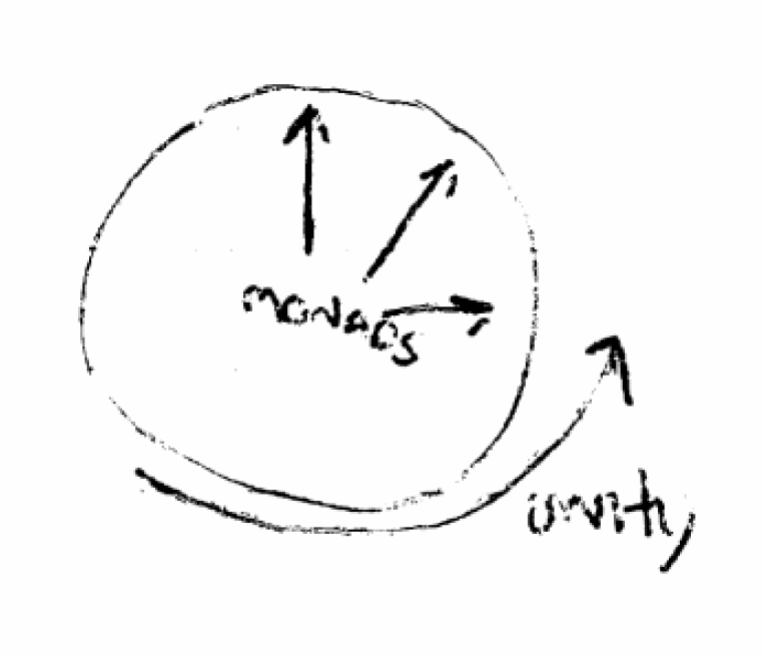
Later on near the end of his life Anthony said he would have liked to present the Intellectual-Principle first, as the whole twelvefold mandala. Because really the view is the view from the Intellectual-Principle. The One in itself by itself for itself cannot really be known. Unless we consider the Intellectual-Principle to be the entirety of what is knowable of reality. I like that word better -- reality. So the first quadrant is reality as transcendent. The whole fourfold is reality as emanated. And within that fourfold, one of the four represents the transcendent Reality.
But we should not expect that any class, seminar, view of One is a complete one (sic!) Anyone who reads any of these transcripts, or Astronoesis, and thinks it is "the finality" should read deeper.
So here it helps to remember: as Anthony himself says we have to leave metaphysics open.
AD: …it's the very nature of metaphysics to be coherent but never systematic. You can't systematize it. (class transcript on Plotinus: One & Intellectual-Principle, 1977 10/21)
AD: In other words, I have to leave metaphysics in a special-- in the first house I have to leave it open all the time, open-ended. Metaphysics by definition can't be closed, it can't be systematized. That's one of the frustrating things you probably all experience in this class. It is not a system. A system has a beginning, a middle, and an end, it is bounded, and you can learn anything that operates within that system and get thoroughly acquainted with it. With metaphysics you can't do that. And anyone who tells you otherwise -- go to the movie. (class transcript on Plotinus: The One, 1982 03/12a)
And finally, in this "suggestive inquiry" we can appreciate the value of the Mandala for seeing the double standpoint.
DIAGRAMS FOR 1977 1014
Class
Friday, October 14th, 1977
Verbatim, unedited transcriptCLASS at Wisdom's Goldenrod, Hector, NY
with Anthony Damiani (AD)
October 14, 1977
PLOTINUS: ONE & INTELLECTUAL-PRINCIPLE
with Appendix: "The Metaphysical Chart as an Open-Ended Symbol: Diagramming The One vs. The Intellectual-Principle" (AS contextual essay).
TOPIC: Plotinus
SUBJECT: One & Intellectual-Principle
SUBSUBJECTS: Metaphysical Chart, Two Intellections
CONTENTS:
Reading/discussing Plotinus, VI.7.40; examination of the passage distinguishing two types of intellection: 1) intellection that remains within its place of origin (completing power); 2) intellection inbound with Being (Being's author)
Initial student responses: question whether second intellection is outflow of the One; suggestion that two intellections within Nous itself; confusion about relationship between First and levels of intellection
AD's interpretation: first intellection refers to Intellectual Monad; second intellection refers to Being itself (rulerships)
First quadrant as symbolizing the One; student objection: question about relationship between parts and whole
Being is differentiated into twelve rulerships through contemplating the One (first quadrant)
Critique of Christian conception that "God gives you being"; rejecting any temporal beginning for divine principles
Intellectual Monad works according to Being's plan, which is the idea of a universe; may be different for each universe so Being must be indeterminate (Dyad)
Question about whether Infinite and Bound contemplating the One establish Being; Being not an outflow/emanation from the One but self-established/self-caused
Reading Plotinus, VI.7.37-38, on the impossibility of intellection in the One
Reading/critiquing passages from Deck on the One's super-knowledge; absolute undifferentiated stasis is no kind of knowledge
No symmetrical relationship between the first and succeeding quadrants
Saturn in Aries (receptacle) as presupposition of Saturn in Capricorn (shape of material universe); dream analogy; samskaras inherent in matter determine the kind of universe the Demiurge can build
Question about whether matter's resistance to form is because of its unity with the One
Question of why the Body aspect of Saturn is prior to its Being; Being aspect as full manifestation
Two approaches: substance (signs) and function (planets); need to work with both aspects
Reading/discussing Plotinus, VI.8.16, on the nature of the One; set aside as too difficult
Student suggestion that four rings in first quadrant are only from the standpoint of Being
Sun in Aries as Intellect of Solar Logos and of metaphysical chart; Intellect of Solar Logos in union with the Will of the One (Mars in Aries)
Levels of reality: 1) metaphysics (first quadrant); 2) ontology (fourth house); 3) cosmology (fifth house onward)
Back to VI.7.40; no intellection in the First; antinomian approach: living with contradictions rather than false resolutions
Central question: how Being gets differentiated from the One; Being's richness: full of diversity and content, unlike simple One
Light analogy: room in darkness, light reveals what was already there; musical analogy: one tone contains multiple overtones
Dream analogy: 1) unconscious complex: remains unchanged like the One; 2) mind's activity: creates images, revealing mind's contents
Reading Plotinus, V.3.11; Intellectual-Principle invests multiplicity in the simplex
Reading T. Taylor (tr. and comm.), Parmenides, on knowing the One negatively (negative theology)
Reading Plotinus, VI.7.34-35; soul must annul the Intellectual-Principle within itself to get to the One; Plotinian authority based on actual mystical experience of the One (4-6 times)
Student attempt to combine the threefold (ontological) and fourfold (metaphysical)
How first quadrant dignities determine rulerships in chart of Intellectual-Principle
Re-reading VI.7.40; Mars in Aries as Being's very author (second intellection); Sun in Aries completing potentiality of Mars in Aries (first intellection)
Rulerships as monads and unities
Circle of signs with no planets as metaphysical chart; circle of rulerships as indeterminate Dyad/Being
Student question about fourfold and sevenfold being rooted in the One
Reading Plotinus, VI.7.22, 24, 31 on the light from the One; discussion of how this light determines Being
Reading Plotinus, VI.7.32; Plotinus systematically wipes out every possible way of grasping the One
Reading Plotinus VI.7.36, 37; does the grandeur of the One lie in his Intellection or in himself?
Ontological gap between the One and Being; divided line
Descartes critique: "I think therefore I am" – ontology dependent on epistemology; reversal: Plotinian/Hindu "Because I am, I can think"; Being must be prior to thinking
Reading Plotinus, VI.7.38; highest Christian conception of God as "I AM that I AM"; Plotinus goes beyond this to a concept above Being itself
Reading Plotinus, V.1.7; question about the One's self-intention engendering Intellectual-Principle; maintaining the gap between One and Being; rejecting any temporal beginning for divine principles
Reading Plotinus, VI.7.41, on "Know yourself"; Self and couplement correlated with Soul monad
Appendix: "The Metaphysical Chart as an Open-Ended Symbol"
Explains the fluid nature of AD's use of the metaphysical chart; notes that AD's symbolism evolved over time; emphasizes that metaphysics must remain "open-ended" and not systematized
BOOKS READ FROM OR REFERENCED:
Plotinus, The Enneads (MacKenna/Page translation, 4th ed.)
Plotinus, Great Books of the Western World, Volume 17 (MacKenna/Page translation)
T. Subba Row, The Twelve Signs of the Zodiac (1977 pamphlet); also in Esoteric Writings, "The Twelve Signs of the Zodiac" [for his names for the twelve signs: Self-Existent Brahman, Pranava Aum, etc.]
T. Subba Row, Notes on the Bhagavad Gita [for discussion of fourfold]
J.M. Rist, Plotinus: The Road to Reality
John N. Deck, Nature, Contemplation, and the One: A Study in the Philosophy of Plotinus
Plato, Phaedo, Timaeus
Swami Nikhilananda, The Mandukyopanishad with Gaudapada's Karika and Sankara's Commentary
Thomas Taylor (tr. and comm.), The Parmenides: A Dialogue on the Gods (Vol. 3), in The Works of Plato, viz. His Fifty-Five Dialogues, and Twelve Epistles
Anthony Damiani, Astronoesis: Philosophy's Empirical Context; Astrology's Transcendental Ground (published 2000)
DIAGRAMS appended to this transcript:
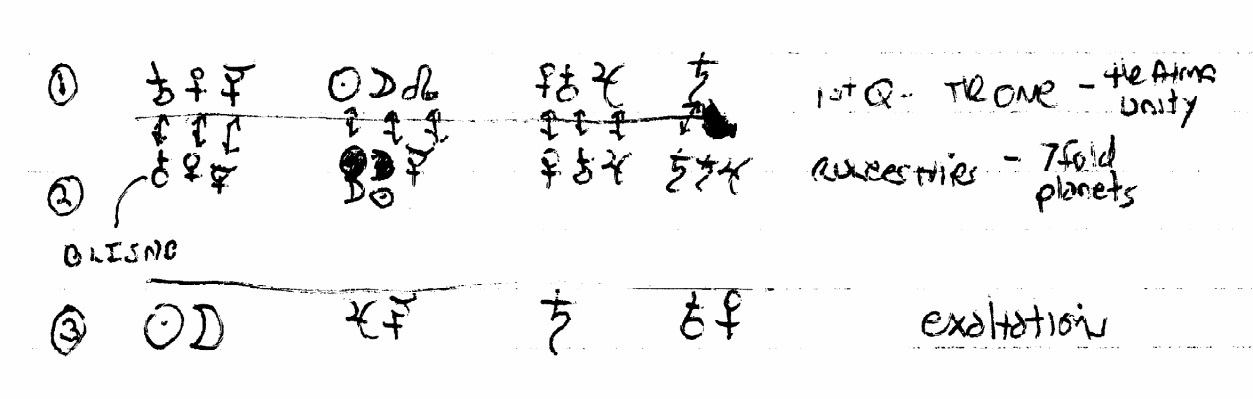
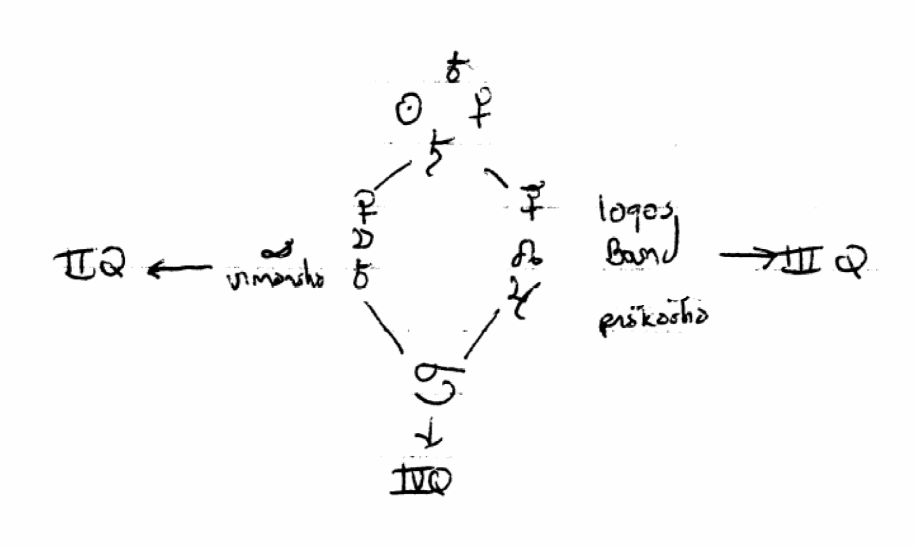
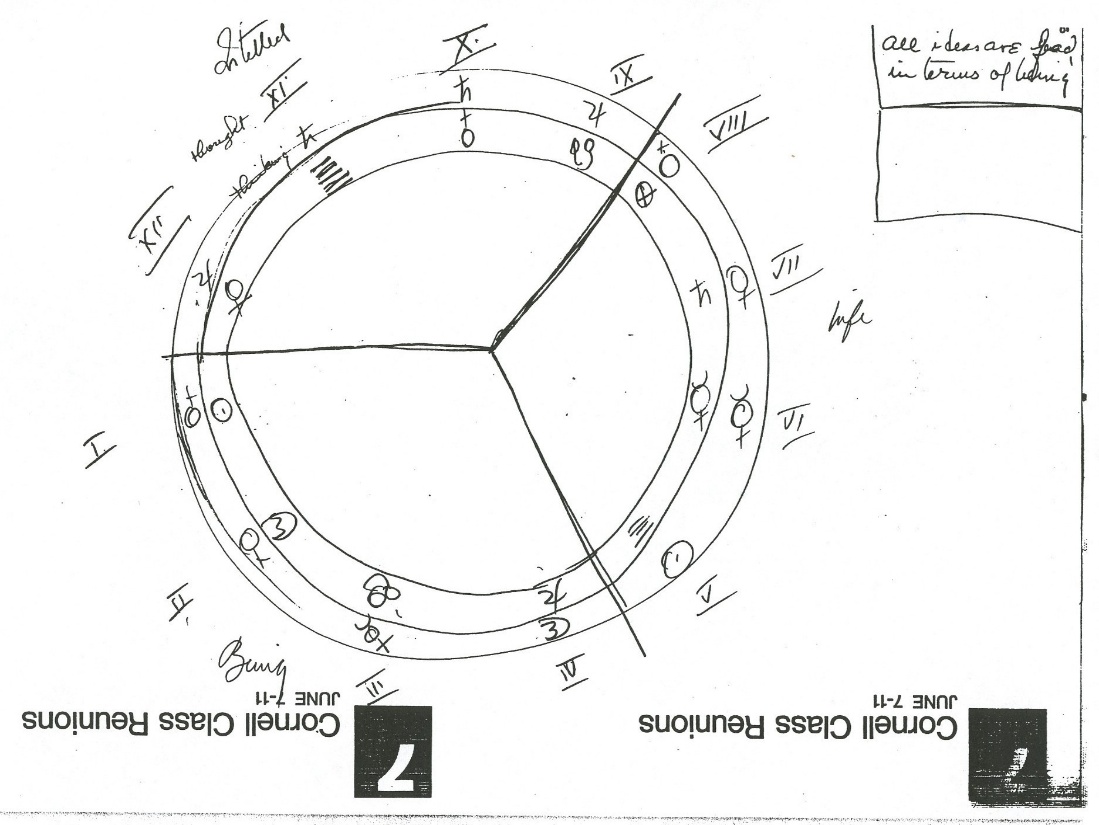
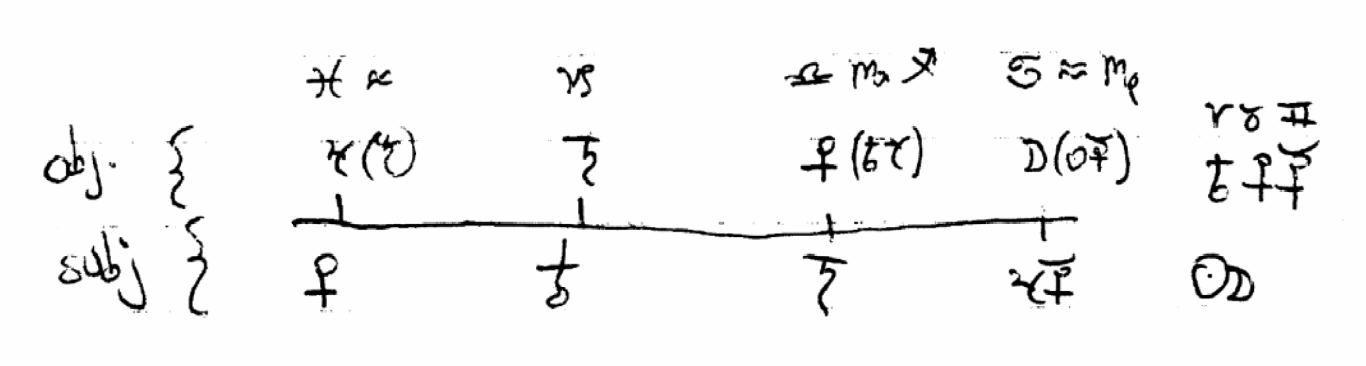
FIGURE 1977 1014-1-AB. One, Rulerships, and Exaltations.
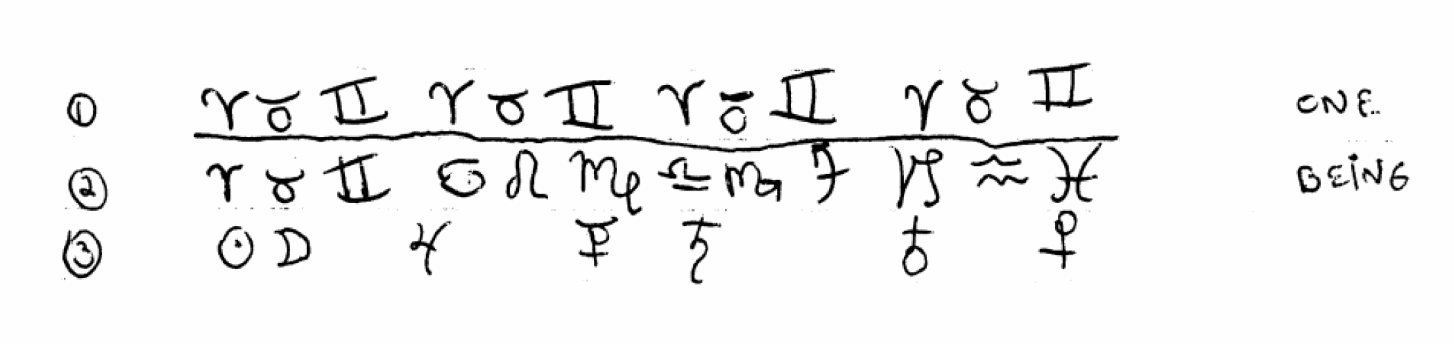
FIGURE 1977 1014-2-AB. One, Being, and Intellectual Monad.
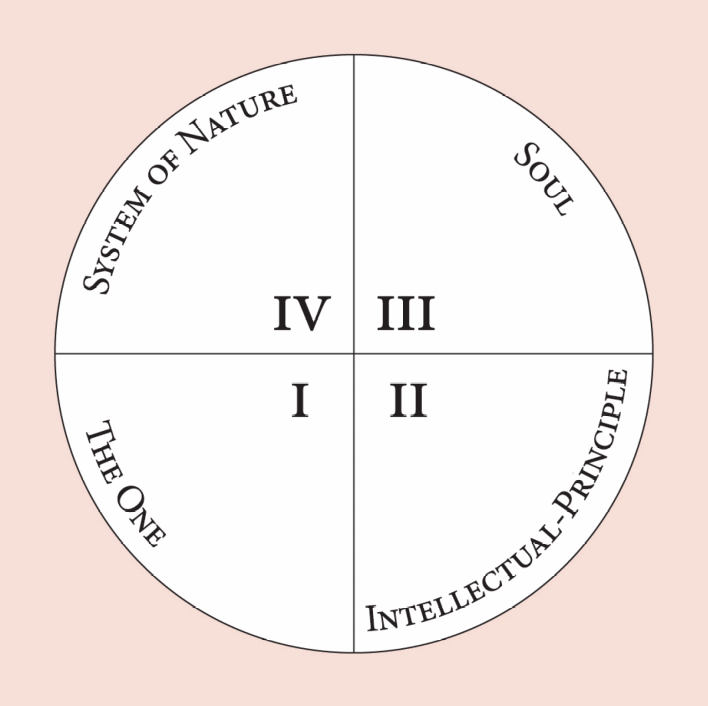
FIGURE 1977 1014-3. Fourfold Reality.
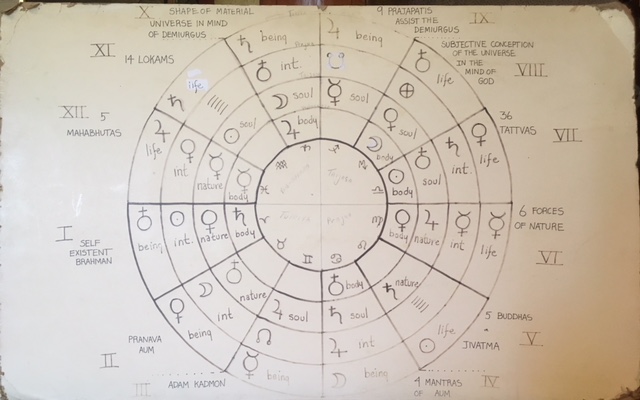
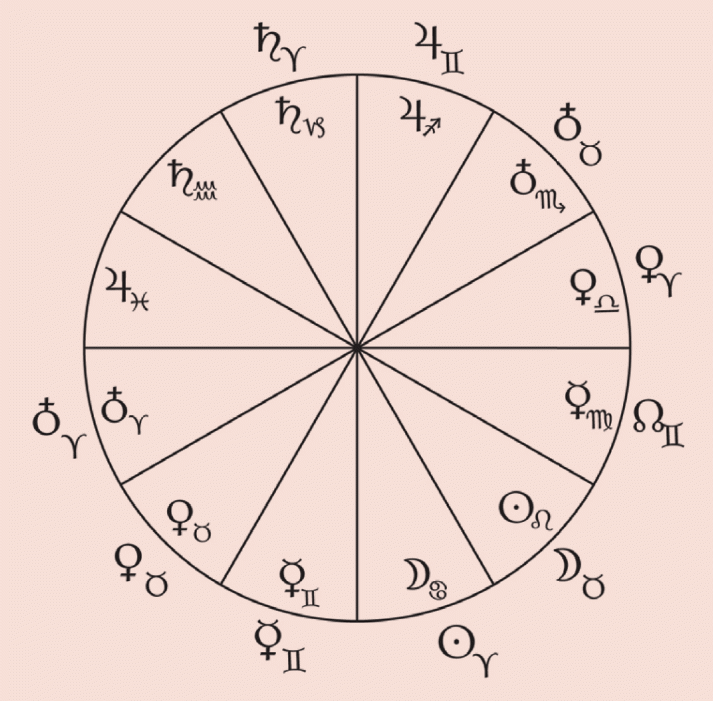
FIGURE IMG_2202-Posterboard Metaphysical Chart.
FIGURE 1977 1014-5-AB. First Quadrant Dignities and Cancer as Paradigm for Quadrants Two, Three, Four.
FIGURE AD_I_202 (top part). One as Triad.
FIGURE 1977 1014-7. Ten Unities and Twelve Rulerships.
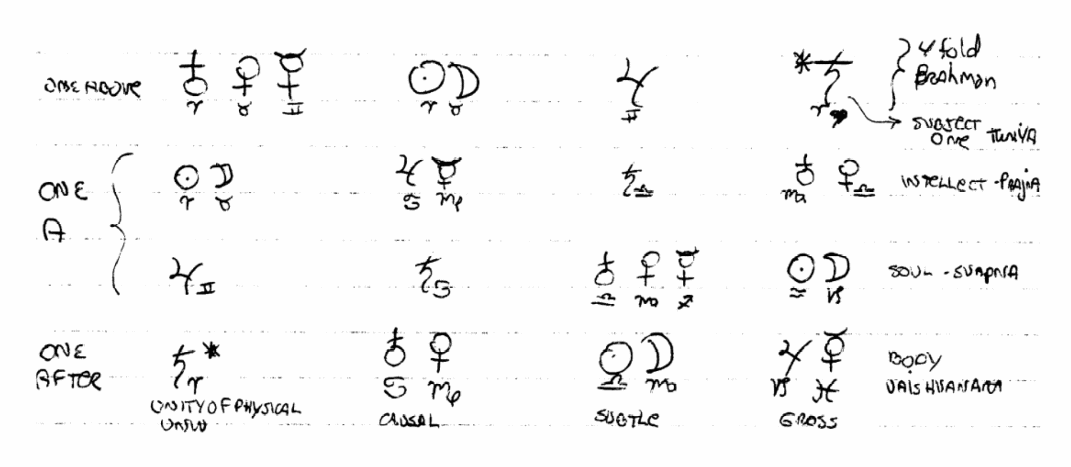
FIGURE 1977 1014-8-AB. One Above, As, and After Being.
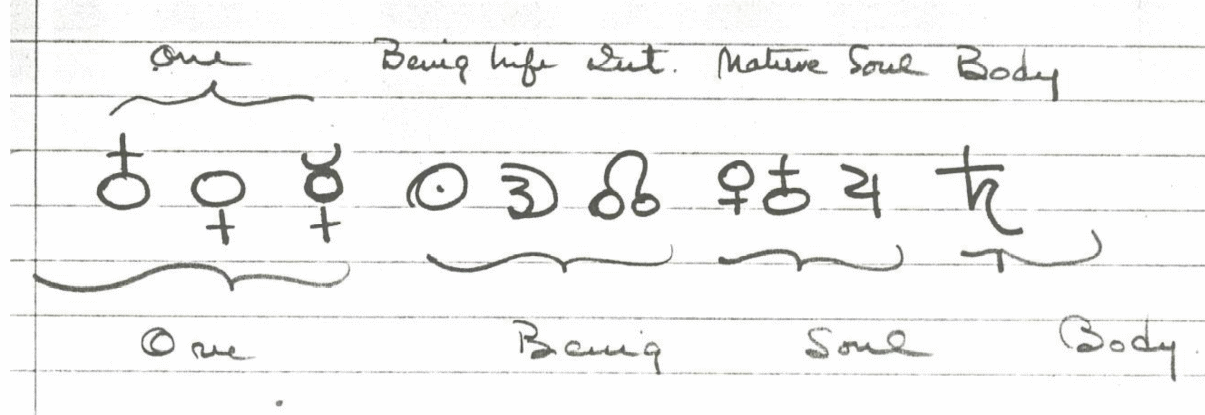
FIGURE AD_E_010. Intellectual-Principle as Being Life Intellect.
FIGURE 1977 1014-10-AB. Rulerships as Monads and Unities.
FIGURE 1977 1014-11-AB. Divided Line.
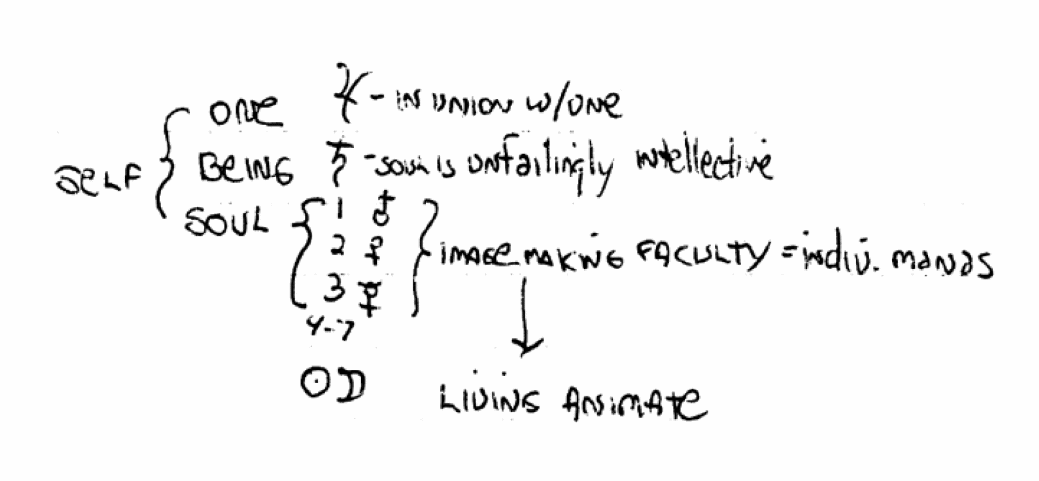
FIGURE 1977 1014-12-AB. Self and Animate correlated with Soul Monad.
Other diagrams also referred to are not with this transcript version. For more on Metaphysical Chart Diagrams, please see Astronoesis, "The One: Exposition" p. 21 ff. and "The Intellectual-Principle" p. 98 ff., as well as Endnotes 13, 14, 16, 17, and 21. [Transcriber note: [diagram] means the speaker is referencing a diagram as he or she is speaking. If someone is drawing or writing, with audible sounds of chalk on a blackboard, I indicate this by [drawing] or [writing].]
PLOTINUS QUOTES READ OR REFERENCED: V.1.7, V.3.11, V.4.2, VI.7.17, VI.7.22, VI.7.24, VI.7.31, VI.7.32, VI.7.34, VI.7.35, VI.7.36, VI.7.37, VI.7.38, VI.7.40, VI.7.41, VI.8.16, VI.9.5
NOTES: Please see appended contextual essay. WG Class 1977 1021 is a continuation of this class's discussion.
TRANSCRIBED Verbatim by IT 2021. In 2025, IT completes TOC, updates audio file markers to match new REP audio, expands Subsubjects, adds new notes within transcript, redoes diagram section (removes one diagram, adds seven diagrams, changes ordering), adds diagram references throughout transcript. Archival verbatim transcript – V12a.
AUDIO FILES: 1977 1014a, 1977 1014b, 1977 1014c. [Note 1: "Tape" and "Side" refer to original audio cassette tapes that were later digitized into .MP3 Audio Files. Note 2: Audio File 1977 1014c was originally recorded back to front, i.e., Side 2 followed by Side 1; REP Studio fixes in 2024. Note 3: In the audios it's obvious Anthony's "on fire."]
1977 10/14 at Wisdom's Goldenrod
Plotinus: One & Intellectual-Principle
[Audio File 1977 1014a Begins]
AD: [one word inaudible] Hui-Neng, that's-- (support) his grandmother by chopping firewood. [Note: According to the extant Hui-Neng biographical information, Hui-Neng, before his satori upon hearing the Diamond Sutra, supported his elderly mother by gathering, chopping, and selling firewood.] You wouldn't want that. You ever chop wood?
S (very faint): Three months of the year.
AD: You'll lose five pounds a day.
S (very faint): That's (right).
S: But look in--
AD: We'll turn immediately to the matter at hand.
RG: What-- which matter?
AD: I hope you have your pointed hats on.
MW: Seems polite.
RG: Uh-oh. (RG laughs)
S: You hope?
AD: In VI.7. We turn to "The Multiplicity-- Multiplicity of the Ideal Forms". [short pause] Now you recognized in some of the criticisms made by some people who comment on Plotinus that they could not grasp, they could not reach up to the concept of the One and rather than trying to reach up and understand it, they decided that Plotinus really didn't need three Hypostases, one would have been enough. And in that-- in that way we could have had Christianity all over again. But, Plotinus refused that standpoint. He rejected any-- any attempt to make of the One into a Nous or an Intellectual-Principle and (he) absolutely disregarded that. However, he makes-- he makes allowances here for us to try to understand something about the World-Mind, and the Unity which is above it. Now we're using, we're using the zodiac because that's a sensible representation of the paradigm, alright. So, we have to remember that this is a representation of that. [S: Yeah.] He starts out in tractate 40, he says--
Plotinus [VI.7.40, AD reading]: "40. That there can be no intellection in the First will be patent to those that have [had] such contact; but some further confirmation is desirable, if indeed words can carry the matter; we need overwhelming persuasion.
"It must be borne in mind that all intellection rises in some principle and takes cognizance of an object. But a distinction is to be made…"
AD: And here I would ask you to emphasize--
Plotinus [VI.7.40, AD reading]: "There is the intellection that remains within its place of origin; it has that source as substratum but becomes a sort of addition to it in that it is an activity of that source perfecting the potentiality there, not by producing anything but as being a completing power to the [AD reads: that] principle in which it inheres."
AD: Now the second point is the difficult one.
Plotinus [VI.7.40, AD reading]: "There is also the intellection inbound with Being--Being's very author--and this could not remain confined to the source since there it could produce nothing; it is a power to production; it produces therefore of its own motion and its act is Real Being [AD reads: Beings] and there it has its dwelling. In this mode the intellection is identical with Being; even in its self-intellection no distinction is made save the logical distinction of thinker and thought with, as we have often observed, the implication of plurality. [short pause]
"This is a first activity and the substance it produces is Essential Being; it is an image, but of an original so great that the very copy stands a reality. If instead of moving outward it remained with the First, it would be no more than some appurtenance of that First, not a self-standing existent."
AD: Now let's discuss this.
[20¾ second pause with some faint background student talking]
[Note: See FIGURES 1977 1014-1, 2-AB for the following.]
AS: Well on this one, when he says "This is a first activity…", and it said if instead of moving outward it remained with the First, he-- he almost seems to be speaking of-- And even though we say that there's no intellection in the One, it almost seems as if the second kind of intellection, the intellection inbound with Being, is somehow an outflow of the One. In other words, it's not-- it's not like the Intellect or Nous only but the exaltations below Being, below the rulerships, we call that Intellect [third line.] So it won't be-- like it's a-- [12¼ second pause] talking about the production back to the-- the production of the-- of the One, or the outflow of the-- out of the One. [10 second pause] I mean he says in other places that Intellect, for example, just being of that, you know. That could be a real-- Yeah.
AB: Is it possible to say there's-- there's two intellections in Nous--one is remaining in itself and one is going out from it? And then you wouldn't have to put it in the One. First would be that-- stands in the self or the self and the second would be going out from it like creating the universe.
AS: So what do you think he means "instead of moving outward it remained with the First," what do you think he refers to it there?
S (faint): Uh-hm.
S (very faint): I don't know.
S: I don't know.
AS (faint): Yeah.
S (very faint): (Read) it again.
Plotinus [VI.7.40, AS reading]: "…it would be no more than some appurtenance of that First…"
[24½ second pause]
S: (Would/Could) have been the operation, you know, what's at stake.
S: Hey Avery, can you use that word in English?
S (faint): Right, the appendage.
S (simultaneously, very faint): What does that mean?
AS: Yeah, I mean--
S: Appendage?
S: Still connected.
AS: Maybe we have to think of the One-Being, I mean-- [students assent] I'm not speaking [few words inaudible] or-- it must mean something like the One-Being where that [one/two inaudible student words simultaneous with AS] (goes), but the--
AD: Well would you call this [diagram] the One-Being? Or would you call this the One? [students assent] Well-- I mean if you [AS simultaneously: Don't--] made the chart, ok-- [drawing]
AS (very faint): So-- so that would be the One.
AD: That would be the One. So this is the One up here [top line], ok.
AS: So then that-- then-- then this-- then the First here would have to be that One, that unity of the whole zodiac.
AD: Where are you reading?
AS: Right-- where he says-- "This is…" the-- that little paragraph--
Plotinus [VI.7.40, AS reading]: "This is a first activity and the substance it produces is Essential Being…"
AD: Which is an image.
Plotinus [VI.7.40, AS reading]: "…it is an image, but of an original so great that the very copy stands [a] reality."
AS: They're talking about this-- whatever this activity is, this second kind of intellection inbound with Being, it-- it produces Real Being. It produces Being itself. And he's saying "instead of moving outward it remained with the First". So if this-- if whatever this activity is [someone drawing] it remained right with let's say the One, then there would be no-- there would be no-- no ex-- in other words, exis-- nothing standing outside of that One, there would be no Being.
[9 second pause while someone draws]
RG: But I would say the First there, Avery, could refer to the One-Being.
AS: No, the One, that's what [RG simultaneously: Yeah.] he's saying right here. He's talking about the production of the--
RG: Yeah.
[short pause]
AD: So he says here--
Plotinus [VI.7.40, AD reading]: "There is also the intellection inbound with Being--Being's very author…"
AD: This is the very author of Being.
Plotinus [VI.7.40, AD reading]: "…and this could not remain confined to the source since there it could produce nothing; it is a power to production; it produces therefore [of] its own motion and its act is Real Being and there is has its dwelling. In this mode the intellection is identical with Being; even in its self-intellection no distinction is made save the logical distinction of thinker and thought…"
AD: Yeah, yeah.
AS (simultaneously): But, could you say that well-- One way-- so one way of thinking of intellection, the earlier one, that it's the power of Being. But here you're saying that Being itself is like the Act. If you could speak that way it is the Act of the One from Itself. [short pause] If it's-- if it's-- if it's to produce Being-- if its Act is productive of Being, its-- its Act is the-- is the very being of Being. You (could) put it that way.
S (very faint): Saturn.
LR: Then why would it be the author of Being?
AS: Why would it be-- why would it be the author of Being? This Act, the One--
LR: Well what does it mean it's the author of Being?
AS: (He strives to), but it is Being. It could be.
S (very faint): Yeah.
LR: So are you saying it's the principle of Be-- it produces Being and also is Being?
AS: Well he says that the One overflows. So what-- what kind of thing is this-- what's this overflowing? Is it something other than Being? Is the overflowing of One something other than Being? Then we have something in between the One and Being. We have this overflow in between the One and Being.
LR: Well now what do you mean by Being?
AS (simultaneously): I'm just saying that that--
LR: Is it-- is Being the way you're speaking of it determined Being or indeterminate Being or-- You know, I just-- I've been [AS simultaneously: Yeah.] having a hard time the last few weeks trying to figure out what this-- what Being is, whether it's determined or indetermined or more like a potential or like a ground-plan for a world or--
AS: Let's say One-- the One-Being, the whole of the--
LR: The One-Being?
AS: Yeah and its own-- and then I would say it's only when you have the second kind of intellection that you would have a determinate, that's where you have determinate Being. Now that One-Being taken as looking back at the One, in that vision you have the determinate let's say looking at itself, then you would have the-- there would be a determination into the twelve, you know, really-- then you have the twelve rulerships [second line].
S (faint): But--
AS: But here you're talking almost as if-- almost as if Being is a-- a power of the One. Seems to be certain-- (it's just as he) trying to get at the notion of filling that gap between the One and Being. I don't know.
[12 second pause]
LR: What does he mean then-- what does he mean by the First in this sentence (there)?
AS: Where?
LR: The one that Tony said was easy. [S, faint: Well--] The next one is--
AS: "There is the intellection that remains within its place of origin"?
LR: Yeah.
AS: There he's talking about Be-- there he's talking about Being's intellection. Being has the power of intellection. It's that One-Being that's already been established.
LR: So that's a si--
AS (simultaneously): But--
Plotinus [VI.7.40, AS reading]: "…it has that source as substratum but becomes a sort of addition to it in that it is an activity of that source perfecting the potentiality there…"
S: Uh-hm.
RP: Well no (A), I-- Avery? I-- I think he was just putting his first foot up as-- as an inferior.
S: Do it.
RP: He's talking about the various kinds of intellection.
AS: Yeah.
LR: Yeah, that's what he said.
RP (simultaneously): The first one (easier describe--)
AS: That's inferior.
RP: I was going to say Al--
AS (simultaneously): I-- (yeah).
RP: Alan was talking about it, yeah, the inferior. And there was a second kind, the kind that the-- the Spirit is (incapable) of trans-- production, of kind of transmiss-- of-- of-- what's it like? It's-- it's an intellection that establishes the thinker rather than it-- rather than presupposing the thinker. [AS simultaneously: (Well) I--] The first one sort of presupposes a thinker.
AS: It establishes Being itself.
RP: Yeah right.
AS: Well I would say it's almost like that second kind is almost like translating let's say from the Sun in Aries [in top line] to the Sun in Leo [in second line]. You have the establishment of-- the actual establishment of the Being. [student assents] The other one is the Act of that Being.
RP: Passive, right.
AS (simultaneously): The first-- the first one he mentions is inferior [RP simultaneously: Is inferior, ok.] as being the Act of the already established Being.
RP: That was true.
AS: And the second one-- Yeah, that's just what I was trying to say, the second one would be like the establishment of that, let's say (the poten--) But maybe that's an analogy, I don't know. The going from the Sun in-- in Aries to the Sun in Leo we have the establishment of Being itself, say Being itself.
AD: Well suppose I throw this in just to disrupt breathing.
Plotinus [VI.7.40, AD reading]: "There is the intellection that remains within its place of origin; it has that source as substratum but becomes a sort of addition to it in that it is an activity of that source perfecting the potentiality there, not by producing anything but as being a completing power [AD rereads: a completing power] to the principle in which it inheres."
AD: So I would say that that first sentence I just read refers to the Intellectual Monad, the Sun in Aries [diagram]. I just want to, you know, [AS, faint: Yeah.] be annoying.
AS (faint): Ok. (bit of laughter)
AD: There-- then--
Plotinus [VI.7.40, AD reading]: "There is also the intellection inbound with Being--Being's very author…"
AD: Ok? Now Being's very author is this one here [Mars in Aries] to me, ok? [drawing] [AS simultaneously: That-- well--] This one here [AD taps on board]. Let's see--
AS (faint): Yeah.
Plotinus [VI.7.40, AD reading]: "…intellection inbound with Being--Being's very author--and this could not remain confined to the source since there it could produce nothing; it is a power to production [AD reads: produce]; it produces therefore of its own motion and its act is Real Being and there it has its dwelling. In this mode the intellection is identical with Being; even in its self-intellection no distinction is made save the logical [AD adds: one]…"
AD: And suppose I say that this-- this is what he-- this is the second one [second line]. This is inbound with Being.
AS: Ok, and what about the first-- and the first one?
AD: First one is this one [third line].
AS (faint): Is lower?
AD: This [third line] gives completion to this [second line], alright. But this [second line], so to speak, is the first Intellectual Act.
AS: Well you-- but [RG simultaneously: But--] that's not-- but-- well--
RG: But if it's the author of Being--
AD: If it's what?
RG: If it's-- if it's what he-- if it's the author of Being--
AS: [couple words inaudible]
AD (simultaneously): If what is the author of Being?
RG: This first intellection.
AD: Yeah.
RG: Then why do you-- why-- how would it be Being? It seems if it's the author of Being it would be prior in some sense to Being.
LR: But--
AD: Well tell me, what would be prior to this here [diagram]? It is the zodiacal circle without any division into four, ok. And without calling-- calling them rulerships or anything.
S (faint): (I can't) see.
[short pause, AD drawing]
S: It's the One.
S (faint): The One.
S: The One.
S: Completely-- I don't know.
RG: I don't know.
AS: Well, I--
S: Well, just the One without-- I think you're-- you know, [S, faint: The One.] I just don't know what it means.
RG (simultaneously): Well, but, this is what he's discussing here, that there's a principle in between. [AS/S(?) simultaneously: No, in between where?] The establishment of Being--
AD: In between what?
S (faint): No.
RG: In between the establishment of Being and the One.
AD (simultaneously): Look at this here. If this is-- if these are the ten universal principles which together constitute what we call the One [top line], alright, and we're not-- you can't say that. But this would be the One. It-- is this the One or is this Being?
S (faint): Yes that's Being.
RG: The One.
AS: No it's the One.
AD: This is the One.
RG (simultaneously): It's the One.
S (faint): One.
RG: Yeah, right.
S (simultaneously): It is the One.
AD: This one here, first quadrant [diagram].
S (simultaneously): First three houses.
RG: Yeah.
S: Oh, the first quadrant.
AD: That's the One!
RG: Yeah.
S: Sorry I (thought) [few words inaudible]
AD (simultaneously): And this one here would be Being [second line].
RG: Right.
AD: I got some extra houses, that's alright, [S simultaneously: But--] Dickie [RG simultaneously: Yeah.] always wanted an extra house. (bit of laughter)
S: I have a question and confusion already. I mean-- Only [S simultaneously, faint: You could clarify (it/though) with caffeine.] it's the same one I think every time-- every class that's-- (bit of laughter)
S (faint): Wonderful.
S: I mean first you asked this question, you had this plain zodiac and said this is Being. And then you take a little part of that and say "And this is the One." And that seems so backwards.
S (faint): (Just/Yeah) stick it to him.
S (very faint): (Oh boy.)
S: [couple words inaudible]
S: [one word inaudible] (bit of laughter)
AD: Go ahead.
S: It's the direction you're moving.
AS: No I'm not going to answer (her/it), I just [S simultaneously: I know I--] want to pour her her coffee. (laughter)
S (amidst laughter): [couple words inaudible]
AD (simultaneously): Well, you have to answer her, she's-- she's got a legitimate objection.
AS: Well, ok. Well--
S (simultaneously, faint): Just when you need--
S: The first thing you said was what is this-- you say there might be a principle that lays behind the-- all these signs, there might be some kind of a unity in which they all inhere.
AD: Yes.
S: And that's still-- that's a good question, and--
AD: Alright.
S: Yeah.
S: Uh-hm. (bit of laughter)
S: I was waiting for the answer. And then you drew this little part of it and said and there's the One.
S (faint): No.
S (very faint): Uh-uh.
S (faint): (No.)
S: I mean wouldn't-- if you're going to have those twelve represent Being, [someone drawing] and then-- then the One's going to have to be some-- underlying that whole circle.
S (very faint): Pardon?
S (very faint): (Definitely) [one word inaudible]
AS: Wait but I mean-- I guess following up that-- Jeanne, that first kind of intellection he's saying establishes that fourfold nature [FIGURE 1977 1014-3]. Could you say that? And the first-- that first-- not the first one, just that, what he's doing is the second one. The intellection inbound--
AD (simultaneously): Intellection inbound with Being.
AS: Yeah, would establish this fourfold nature of the whole chart, ok, out of the Unity, out of the One.
AD: Isn't that what I-- we did here?
AS: Yes. And that that's the only-- that was the only thing that top line-- the bottom.
AD: Yeah, isn't this the Self-Existent Brahman, Pranava Om, and Adam Kadmon, or-- [FIGURES IMG 2202-Posterboard Metaphysical Chart, first three houses, 1977 1014-1, 2-AB, top line]
AS: Just those three right now.
AD (simultaneously): Self-Existent, alright, and the two principles, Infinity and Bound, that flow from it.
AS: Yeah that's right, that's--
LR: How could--
AS: That's--
S (very faint): Yeah.
LR: (That) [one/two words inaudible] that's intellection which is the-- I-- this-- the inbound intellection, inbound with Being.
AD: Inbound with Being.
LR: Why would he speak of it then as producing nothing and only completing a potentiality, because I thought that [couple inaudible student words simultaneous with LR] intellection was the-- was a [AS simultaneously, faint: I know.] produc-- a produ-- what?
S: It (is not).
AS: It is the power [S simultaneously, faint: No.] to production.
RG: He says it is a power there, I mean--
LR: Oh well--
AD (simultaneously): That's--
MW (simultaneously): But the first-- the first intellection [S simultaneously, faint: Yes.] that he's describing is-- is the one that we're talking about as the second intellection.
AS: Yeah. That first [RG simultaneously: The lower order.] one which he says is-- well in-- as not really doing, going out, [RP: (That's right.)] is because everything's already there in Being and it's just-- it just brings out what's potential in Being.
LR: Wait a minute. Now I'm really confused. The first [AS simultaneously: Look--] one he describes which you're saying is the inferior one--
AS: Right.
LR: Could--
AS: It says--
Plotinus [VI.7.40, AS reading]: "…it is an activity of [that source] perfecting the potentiality…"
LR: Yes, that's it.
Plotinus [VI.7.40, AD reading]: "…[AS adds: but] not by producing anything but as being a completing power to the principle in which it inheres."
LR: Ok now you're [AS simultaneously: This--] saying that's Being's intellection.
AS: Yeah that's the Nous, that's the line starting all the way at One [third line].
LR (simultaneously): So how-- so that's what I'm speaking of. Now why [AS/S(?) simultaneously, faint: Yeah.] doesn't that produce anything?
AS: 'Cause already there in Being, it-- all it does there is just bring out [one/two inaudible student words simultaneous with AS] what's already inherent in that Being. It's all-- everything's all potential in Being, the whole universe is essentially there.
LR (simultaneously): But doesn't it produce what's below it?
AS: But produce, I mean, it's there, it makes it actual. And-- no, actual is wrong, is wrong but--
RP (simultaneously): It doesn't really produce. It may call it [couple words inaudible]
LR (simultaneously): I mean, it doesn't create.
AS: It doesn't create at all.
LR: It doesn't create but I thought it had to be productive [AS simultaneously: Manifests.] in that every Hypostasis had to produce an image of itself.
RP: Yeah, in that sense, but there's-- but it doesn't produce Real Being, that's the point. It transforms [AS simultaneously: Just manifests.] Real Being into--
AS: Yeah whereas the first one actually produces-- Yeah, from what he's saying, the-- the first one does produce Real Being, it's actually constituted-- That fourfold thing is-- is Be-- Real Being.
S: You mean by the first one the one that's second in the paragraph, right?
AS: Well, [S simultaneously: Yeah?] the higher one, I'll say [S simultaneously, faint: Superior.] higher, lower, the superior one.
S: Alright.
RP (simultaneously): Yeah, higher, lower [S simultaneously, faint: The superior one.] [one/two words inaudible] (bit of laughter)
AS: I guess he would say it's-- that that one really produces Being because there's no existence in the first quadrant. I mean you would-- you would have to exclude even e-- even-- even Being. It's One, it's above-- the One is above Being.
S: Avery, are you making this superior intellection an Act of the One?
RG/S(?): Well--
AS: I don't know.
S: It sounds that way.
S (faint): Yeah, it's like--
S: And that doesn't seem like you could get away with that if you read sort of towards the end of that page. You know the last paragraph [S: Uh-hm.] where he says--
Plotinus [VI.7.40, S reading]: "Anyone making the Good at once Thinker and Thought identifies it with Being and with the Intellection vested in Being so that it must stand as self-intellective [S reads: it must perform the act of intellection]…"
S: Well anyway, on and on it goes. So in other words you-- you've brought the One down to Being and as you-- you have soiled it in some sense. (Go ahead.)
AD (simultaneously): Well he starts out 40 by saying--
Plotinus [VI.7.40, AD reading]: "[That] there can be no intellection in the First will be patent to those that have had such contact…"
AD: Alright so, we-- we know that we're leaving the One out, there's no intellection in the First.
S (faint): Yeah.
AD: Then he says--
Plotinus [VI.7.40, AD reading]: "It must be borne in mind that all intellection rises in some principle and takes cognizance of an object. But a distinction is to be made…"
AD: So now he's going to make a distinction here, alright. In intellection there's going to be a distinction made between first and second intellection, I'm anticipating the next paragraph, alright. Then, the very beginning of that paragraph he speaks about intellection but he seems to be speaking about here of the lower intellection which completes, [student assents, faint] or which is a potentiality of Being. And I-- I say let's attribute that to the Intellectual Monad, Sun in Aries, Moon Taurus going down [third line], ok. The higher intellecti-- intellection then must be where, it must be found where?
RP: It's in Being.
AD: Ok. And how could we, you know, see that?
RG (simultaneously): No, but how could-- well, it's in Being and yet it's the author of Being.
RP: Yes I agree.
RG: And it's above Being.
RP: So the I-- the--
RG (simultaneously): Somehow it's both.
AD: I don't [RP simultaneously: I don't see it as above.] see it as above Being, I can see it as [RP/S(?): No.] the author of itself.
RG: But what does author mean there?
AD: Author of itself.
S: (Wouldn't--)
RG (simultaneously): I don't understand that.
RP: It's self-establishing.
AD (simultaneously): Would-- when you--
AS: Yeah.
AD: Self-establishing, self-begotten.
RG: Well--
RP: Because you might make the One the cause.
S: Well, right.
RG: No but he's speaking-- he's speaking dually, he's speaking of intellection and Being, he's not [RP simultaneously: I don't know.] speaking just of-- of Being's Act, he's speaking of the Act which-- which met-- which establishes Being, not of Being's Act. So he's-- he seems to be--
RP (simultaneously): He means Act is the Act which establishes Being. Being's Act is to be.
RG: But it doesn't seem he's speaking that way here. I mean other places he does but here he seems to be putting the intellection first.
S: But look Dickie--
AD: But look at the way he phrases it.
Plotinus [VI.7.40, AD reading]: "There is also the intellection inbound with Being…"
AS: And I thought--
RG (simultaneously): Uh-hm.
AD: Or bound up with Being.
AS: Right.
RG: Being's very author.
AD: Being's very author.
S (faint): Uh-hm.
S (faint): (What/Yes)?
AD: So that it seems that you have an intellection which is prior in a sense to the Intellectual Act, alright, and on the other hand you have the Intellectual Act which we say is-- [RG: Right.] seems to be an inferior intellection.
RG (simultaneously): Yeah. Now this Intellectual Act is prior to that second intellection. Is it coincident with Being, is it-- I mean, is it prior to Being?
[Note: See FIGURES IMG 2202-Posterboard Metaphysical Chart, 1977 1014-2-AB for the following; see also FIGURE 1977 1014-7.]
AD: Well, maybe-- maybe we can get a look at it if we try looking at this up here [top line], ok? Let's see if we can look at this up here. If we look at the One, alright, the top line where we have just the three signs, ok, [RG assents] Venus, Taurus, and Aries, uh--
RG: Gemini.
S (simultaneously, very faint): Aries, Taurus.
RG: Venus, Taurus-- (RG laughs a bit)
AD: [writing] Aries, Taurus, and Gemini, alright. And this is Self-Existent Brahman [Aries], and these are the two principles that flow from it, alright, or Self-Existent [Aries], Pranava Om [Taurus], and Adam Kadmon or the Soul of the-- or the Idea of the Universe [Gemini], ok. And this is repeated all the way, alright, Self-Existent [diagram], ok. Now, over here if we look at it [second line], there would be almost identity here [diagram], ok? Like we could say-- over here we could say this would be like Universal Good [Aries in second line], Universal Soul or Universal Life [Taurus in second line], Universal Mind [Gemini in second line], ok? In the One. Over here would be like the Self-Existent, ok, Pranava Om [diagram]. Now the next one over here you have Self-Existent [diagram]. What would this here be [diagram]?
RG: It would--
S (faint): Oh yeah.
AD: Well this is-- this we know to be the Tetragram [Cancer in second line], right?
RP: That's (absurd).
AD: And this one here [diagram]? Five Dhyan Buddhis [Note: Dhyani Buddhas] over here [Leo in second line]? But this one here [diagram] is what?
S (faint): Om.
AD: Om again, alright, and this one is the Idea of the Universe [diagram], and this one here, the Six Holy Forces [Virgo in second line].
S (simultaneously, faint): Six Holy Forces, yeah right.
AD: Now look at what I think is happening. This here [second line], alright, looking up at this here [top line] gets differentiated into these twelve rulerships. And as it gets differentiated into these twelve rulerships, also (immediately/immanently), alright, gets distinguished or differentiated. So that if, for instance, this was looking up at here, alright, where we have the Self-Existent, and this would be-- this would become the One-Being. You look up at here [diagram], for instance, Pranava Om, and this the Five Dhyan Buddhis, [RG assents] which, like T. Subba Row in one place remarked that they-- (they/we) are-- they are even prior to Vishnu, Brahma and Ishvara.
RG: So who-- what does the looking there?
S: Yeah is it the first quadrant or above--
RG (simultaneously): Or is it the ru-- is it the-- is it the--
AD: This [second line] would have to look up there [top line].
RG: What, what looks?
AD: Being would have to look up at the One.
S (very faint): Yeah.
RG: But that wasn't established yet.
AD: What wasn't established?
S (faint): Being.
RG: The Cancer, Leo, and Virgo [diagram]. It is established by a vision.
AD (simultaneously): That's when he gets established by looking at it. It gets-- In other words, in this way-- Here--
RG: If it doesn't exist yet, how could it look?
AD: Oh, I beg to disagree with that remark.
LR: Ooh.
AD: You're speaking about eternal Beings, when were they not?
RG: Well, logical-- in a logical sense.
AD: No sir, that's a Christian conception!
S (very faint): Right.
S (faint): Let it go. (laughter)
AD (intensely): That's a Christian conception. Everybody who's got-- Look, this was the criticism I made about that man, H.A. Armstrong [Note: A. H. Armstrong] who wants to do the same thing, he wants to find a time and a place [RG: But wait a minute.] where these principles did not exist.
RG: Don't-- wait, I mean--
RP (simultaneously, faint): Just because you can't dangle it [couple words inaudible]
RG: Come on.
AD: Look, look Richard, this [RG simultaneously, faint: Alright.] is the way I'm putting it to you, the Christians say God give you being and what do you do with it. A Platonist would never say that. God did not give you being, you have always been.
RG: Fine. (laughter) I'm glad! (RG laughs, laughter)
S (faint): Now you're going to [couple/three words inaudible] (laughter)
AD: Well certainly these entities here, whatever they are, and they are Gods, ok. Like for instance let's take a remark like this here. Ok, what does Taurus here consist of, Pranava Om. So, we make the remark, samskaras of a prior universe.
S: Right.
S: Right.
AD: Now, when you say samskaras of a prior universe, what are you saying?
RG: You said it, I didn't. (some laughter) I don't know.
AD: No I mean what would the implications be?
S: Eternal.
AD: It would have [RG simultaneously: That the universe is eternal.] to be, it would have [LR simultaneously: It's not.] to be Godheads.
S (faint): Oh sure.
AD: I mean don't think that they're vasanas that are coming up from your subconscious of what you ate last year for breakfast. (laughter) So samskaras of a prior universe mean that the entire activity of this universe, when a residue is left behind, that's a Godhead you're talking about. I'm using the word samskara because I don't have any other words. Alright, this is a Godhead [diagram], ok.
S: Of course.
AD: This here [S simultaneously, faint: Yeah, right.] differentiates itself simply by looking at its-- looking at its prior.
RG: I mean which look-- I don't understand when you say which looks at which.
AD: This here [second line], [RG simultaneously: What's that?] down here, this is Being. Being is eternal.
S: Are you talking about the whole--
AD: Yes, you can apply it to the whole thing. But Being is eternal. It looks up at the First, contemplates the First, and in so doing it gets differentiated. Now what would I mean by it gets differentiated? Its contents get organized, it says "Ah, this is what I'm constituted of, a certain amount of this I'm going to produce another universe with." Alright, because-- because this here [diagram] over here would be like if we took-- if we took the-- I'm sorry, this is wrong, isn't it, this is--
RP: Right. It's alright.
S: It's fine.
RP/S(?): It's fine.
AD: This is Venus-- this is Taurus, yeah I made a Mercury out of it.
RG: But, so, would you speak of that as a planetary relation? I mean--
AD (simultaneously): These are-- no sir, these are universal principles of knowledge.
RG: Right.
AD: Not planets. They're nowhere near planets over here, we don't get to planets till we get to the Falls [diagram].
LR: What is this Being?
AD: Huh?
LR: This-- is this what you call indeterminate Being?
BS/S(?) (faint): What?
LR: This is Being before Being?
S: No.
S (faint): Sit down.
S (faint): Oh no.
AD: Yes, you can call this indeterminate Being.
AS/S(?) (faint): I think you could call it Being.
AD: Why not?
LR (simultaneously): Well, what I mean Being before Being is there's--
AD: I'm sorry.
LR: What we know of Being-- anything we say of Being is determined Being. And-- and-- in the last couple of weeks, [someone drawing] it seems like Tony's [RP simultaneously: Yeah.] using this term Being [RP simultaneously: Right but (let's) (one/two words inaudible)] to repla-- wait Richard, [RP simultaneously, faint: Ok.] to replace what we used to call the indeterminate Dyad.
RP: But look-- [S simultaneously: Oh?] look at the line in there. There's a kind of intellection that's increased. And, you know, the first planets same as that. But that--
LR (simultaneously): What do you mean?
RP: That's the thing [one/two words inaudible] with indeterminate to the determinate Being, the kind of intellection that completes. It makes a thing-- sort of it organizes it, it puts it in a certain order and gives it content. It doesn't give it Being, it just completes it.
AD: Listen to what I'm saying now very carefully. Because this is a difficulty with most Westerners and Christians, alright. God is the author of your being. Now, almost all other traditions would not accept that. You are eternal. There isn't a beginning somewhere that you can find. So if you go back, even the Buddhists, as much as they try to be empirical, soon as they start off with the nidana chain, the first part is this transcendental, avidya. Oh, that's the origin of my illness, avidya. Well when did that start? Forget about it. Why? Because it's transcendental. They say beginningless? Well, how does that help me? That's transcendental, isn't it? So from one point of view what we're trying to say is, analogously, these entities, these Godheads, are forever, they're eternal Beings. Imagine when someone like T. Subba Row makes a remark that these Five Dhyan Buddhis are prior to Ishvara, Vishnu, and Brahma. Imagine the secrets surrounding these entities.
LR: I guess my confusion is when you speak of eternal Being(s), and we-- we progra-- we diagram them, we put them in a place in the chart which is beyond Be-- which-- which we've thought of as beyond Being. In other words, previously when we spoke of Being, it was in terms of the seed thoughts which were productive of this universe. And what you're speaking of now as Being seems to be even prior to the Being of this universe and I thought we used to call it beyond that-- beyond Being. What you're speaking of now as the eternal Beings is beyond--
AD: Beyond those seeds?
LR: Yes.
AD: Yes, of course.
LR: Ok, so this Being is not-- I mean, we never-- I never understood that as Being before, I understood it as the indeterminate Dyad.
AD: Well you can refer to it as the indeterminate Dyad because, like we try to point out in a previous class, ok, this-- this here, when we put-- when you put the Sun in Aries, alright, and the Moon, alright, now the second kind of intellection [third line] can only work on the formation of this here [second line]. In other words, once this has determined the universe, alright, this will produce according to that, [LR: Right.] alright. But in itself, alright, this could be like-- this could be crossed out, [LR simultaneously: And move everything--] alright, and we will have again the twelve rulerships ready for another round, [LR: Ok.] ok, and they could be the basis of another Idea of the universe. It would have to be based on what went prior but it will be a different Idea of the one that was prior so this [second line] really has to be indeterminate.
LR: Ok, so this [AD simultaneously: Ok.] is what he speaks of as the Dyad let's say.
AD: Yes, that's the indeterminate Dyad.
LR: Great.
S: Oh.
LR: Terrific.
AD: Because, here, look again. I just put down for instance one of the planets. Now up here [diagram] we can see that the planets will be in unison, in other words, this-- this Mars here, ok, in rulership in Aries [FIGURE 1977 1014-1-AB, top line; also FIGURE 1977 1014-7], is like the Atma. But once you come down here [second line], it's not the Atma no more, now it's the Buddhi or the Being of the Mars. So we would put-- in other words, if we ran the Mars down, we'd have to run from one to six [diagram]. [Note: Reference is to Being Life Intellect Soul Nature Body of Mars; see FIGURE IMG 2202-Posterboard Metaphysical Chart.] The seventh is over-- over here [top line]. Go ahead.
RG: Could you say this is how he--
AD (simultaneously): Notice how ferocious I look with a beard? (bit of laughter) Go ahead, Dickie. I can't-- I can't scare you, huh? (AD laughs) Go ahead.
RG: Could you say here that, I mean Taurus and Gemini look to Aries and establishes Being, that that-- that too?
AD (simultaneously): Which look to Aries?
RG: Taurus and Gemini look to Aries. And that's the Intellectual.
AD (simultaneously): I'm sorry, Taurus--
RG: Taurus and Gemini.
AD: Look to Aries?
RG: Contemplate Aries [RP simultaneously, faint: Oh--] and that--
AD: No!
RP (faint): Oh boy.
AD: No.
RG: Why not?
AD: Uh--
RG: I thought we spoke of that before as the indeterminate Dyad contemplating the One, establishing Being.
AD: [drawing] This would be-- this would be the Taurus and this would be the Gemini [diagram]. They're going to come from that.
RG: Yeah.
AD: So how could they be looking at it? Because-- You weren't here last week.
RG: But--
AD: This would be the Soul Monad or Bound [Gemini] and this would be the Infinite [Taurus].
RG: But even if they co-- why can't they look back to it? I mean they-- they-- they come from it but that they-- yet they, you know, envision it. They--
[Note: See FIGURE 1977 1014-5-AB for the following.]
AD: Alright. I'll try to put it where you can see it. [short pause while drawing] Ok? You can't, I don't have the room to work it. I have to do the same diagram. [16¼ second pause while drawing] If we put over here the Taurus group, ok, that would be Venus, Moon, Mars, and over here we put the Gemini group, we have Mercury, the Head, and Jupiter, ok. This here would be Logos or Bound [diagram]. This here would be Infinity or Power [diagram]. These two together produce Being.
RG: Right.
AD: Ok. Now how could this look back at that? If this is, so to speak, two aspects of trying to look at that already, in the sense that we say that Infinity-- In other words, like this would be Prakasha-- no, this would be Vimarsha [diagram] and this would be Prakasha [diagram].
RG: Ok. So say they don't look to it, but in some sense their relation is the author of Being. I mean their-- out of Infinity and Bound arise-- arise Being. And that's what you just said.
AD (simultaneously): Out of Infinity and Bound arise Being, go ahead.
RG: Right, now in some sense is that an intellection? [short pause] That that arisal of Being is the intellection of Bound and Infinity.
AD: Out of that intellection you mean the Infinite and the Bound?
RG: Right.
[short pause]
AD: Is the author of Being.
RG: Yeah.
AD: Ok. [drawing] [RG simultaneously: Ok.] Now what?
RG: I mean, can you speak of it as an Intellectual Act there? That that-- in the way he's speaking of it here. That that-- that primal intellection is the intellection that is Being's author.
[17½ second pause]
AD: No because in this conception-- [BS/S(?): It'd be--] and this is again an opinion, ok, in this conception where I have the chart spread out like this, one, two, three and four [diagram], ok, let me show you what I mean. If I-- if I draw the diagram this way, [drawing] then for Venus, alright, which is Infinite, I would have to put this arrangement. [10¾ second pause while drawing] Ok? And on this side here, on the side of Bound, I'd have to put the Soul quadrant which would be of course Jupiter, Mars, Venus, and Saturn, Tail [diagram], right? Then over here Mars, Sun-- so Mars, ok, Venus, Sun. Or something like that, if I remember, ok? The Soul quadrant, what was it, [RG simultaneously: Well--] is that right?
RG: Yeah, good enough.
AD (simultaneously): Two, four, five, six, seven, eight, nine, one's missing. Mercury's missing.
RG (simultaneously): Mercury in Sag.
S (simultaneously): Mercury you missed.
S: (Right/Yeah).
AD: Mercury's missing. [drawing/writing]
S: (We) forgot.
S: Yeah.
S: Well, [AD simultaneously: Ok.] anyway, I wouldn't know if you--
AD: And then over here I would draw down the fourth quadrant [diagram]. But, in this kind of a diagram, it's-- it's like the statement of total perfection. In other words, if we-- if we say that-- if we take the definition given by a prior writer, he speaks about total perfection as active and passive perfection. The combination of this-- these two give us total perfection or actuality, alright. This would be a sort of metaphysical statement that is final. I mean there's nothing you could do with something like this, it's a dead end. Because this here [diagram], so to speak, alright, this here would be equivalent to the infinity of series of universes that will come under the power of that second quadrant, you know the Sun, alright. This would be the infinity-- the infinitude of the soul [diagram], alright, which so to speak is related to-- in the sense that it limits this here [diagram]. For each universe there will be a certain World-Soul to accompany that universe. And this here would be the production [diagram]. But now this is like four, it's complete, you can't move it, you can't do anything. This is what this here arrangement means. So, in that kind of statement, I can't say that this [diagram] is the product of this [diagram]. Because it's just as much the product of that [diagram]. As a matter of fact it's not a product. So I try to avoid that because that's a real [drawing] dead end (to/for) me.
Over here, in this kind of arrangement [FIGURES 1977 1014-1, 2-AB], what we try to do over here is a little different, like-- We're dealing with the indeterminate Dyad, and what we're saying is something like this here. That the-- whatever the light is that comes from here [top line], the power-- imagine, [drawing] alright-- that very-- that very light, power or-- determines whatever the contents are of this [second line]-- It like helps them differentiate it among themselves. It's like, you know, when we say go to work and you'll find out how-- who you are and what you are because in that process you get defined. We don't have the Intellectual Act so that we can see, you know, in a perception what constitutes contents of our being except through manifestation. But over here, that is totally grasped that it's a differentiation, what the content of that Being is, it's distinguished out or crystallized out or precipitated out when this [second line] contemplates the One [top line]. Go ahead.
S (very faint): This will be--
AD: Go ahead.
S (very faint): Yeah right.
AS (faint): I think you answered-- you answered my question. You're saying that--
AD: I don't ever answer any questions, believe me.
S (faint): Go ahead.
AS: That the-- when he speaks about the higher kind of intellection, he's saying that-- that the Being is not the outflow of the One.
AD: Yes.
S (very faint): Uh-hm.
AS: That it's not.
AD: It's not an outflow.
AS: Ok. And so--
AD: Except in this way that we're speaking about it. Like I said, if you-- if you think of outflow in the sense that all the effects are within it, then ok, call it outflow, call-- call it emanation.
AS: All the effects are within--
AD: Within Being.
AS: Oh, within Being.
MW: Within Being?
AS: But she's saying here that-- It's the contemplation of that One, this Being's contemplation of the One that you're calling this highest contemplation.
AD: Yeah.
AS: And we're-- we're just-- we're like cutting off that whole-- the-- the notion of any kind of emanation in that sense. We're looking at Being here as eternal, and that its contemplation of the-- of the One establishes it and determines it. And, I don't know--
AD: Yeah, you see a couple of authors like Rist [Note: J.M. Rist, Plotinus: The Road to Reality; perhaps one of Rist's other books.] for instance is one who tries to show that the Infinite has knowledge of himself but this would be infinite knowledge. And again I would have to take exception to that.
AS: But-- but I don't see why you couldn't say that the knowledge-- well-- Not that the-- not that the first intellection is the One's knowledge of Being.
AD: First intellection is the know-- knowledge of Being?
AS (simultaneously): Not-- not that the highest kind of intellection-- I'm not trying to say that the highest kind of intellection is the One knowing something else. From its point of view there isn't anything else. But that Being's contemplation of the One-- [short pause] [one word inaudible] it's somehow-- in some way that Being derives from Unity, I mean it-- it [one word inaudible]
AD (simultaneously): You insist on--
AS: No [couple words inaudible]
AD: Yes. Yes, you insist.
AS: Yeah I--
AD: But let's read this here. "Those ascribing…" This is 37.
Plotinus [VI.7.37, AD reading]: "37. Those ascribing Intellection to the First have not supposed him to know the lesser, the emanant--though, indeed, some have thought it impossible that he should not know everything. But those denying his knowing of the lesser have still attributed self-knowing to him, because they find nothing nobler; we are to suppose that [so] he is the more august, as if Intellection were something nobler than his own manner of being, not something whose value derives from him.
"[But] we ask in what must his grandeur lie, in his Intellection or in himself."
AD: And this is a real stumbling block for Armstrong and all of us. Let me repeat.
(Side 1 of original cassette tape digitized as 1977 1014a Ends; Side 2 Begins)
Plotinus [VI.7.37, AD reading]: "[We may be] told that he must have Intellection because he is in Act, not a potentiality. Now if this means that he is an essence eternally intellective, he is represented as a duality--essence and Intellective Act--he ceases to be a simplex; an external has been added: it is just as the eyes are not the same as their sight though the two are inseparable. If on the other hand by this actualization it is meant that he is Act and Intellection, then as being Intellection he does not exercise it, just as movement is not itself in motion.
"But (we are reminded) do not we ourselves assert that the Beings There are essence and Act?
"The Beings, yes, but they are to us manifold and differentiated: the First we make a simplex; to us Intellection begins with the emanant in its seeking of its essence, of itself, of its author; bent inward for this vision and having a present thing to know, there is every reason why it should be a principle of Intellection; but that which, never coming into being, has no prior but is ever what it is, how could that have motive to Intellection?"
AD: Going on to 38.
Plotinus [VI.7.38, AD reading]: "38. And yet this 'He is' does not truly apply: the Supreme has no need of Being: even 'He is good' does not apply since it indicates Being: the 'is' should not suggest something predicated of another thing; it is to state identity. The word 'good' used of him is not a predicate asserting his possession of goodness; it conveys an identification. It is not that we think it exact to call him either good or The Good…"
AD: Ok?
Plotinus [VI.7.38, AD reading]: "But how admit a Principle…"
AD: Now concentrate just one moment.
Plotinus [VI.7.38, AD reading]: "[But] how admit a Principle void of self-knowledge, self-awareness; surely the First must be able to say 'I possess Being'?
"But he does not possess Being.
"Then, at least he must say 'I am good'?
"No: once more, that would [AD reads: there will] be an affirmation of Being."
AD: Can't we get it through our heads that this man is speaking about a concept which is higher than Being?
[short pause]
Plotinus [VI.7.38, AD reading]: "No: such self-awareness as good must inevitably carry the affirmation 'I am the Good': otherwise there would be merely the unattached conception of goodness with no recognition of identity; any such intellection would inevitably include the affirmation 'I am'."
AD: You want to go on?
S (faint): Not really.
AD: Yeah, go ahead. And we're going to stick with this antinomy in our-- and conflict in our thinking until we each resi-- and understand for ourselves.
S (very faint): Let's try and do that.
AD: All these com-- all these writers either take exception to Plotinus, say no, that can't be, the Intellectual-Principle is the highest, or they will reduce it some-- some sort of infinite knowledge. Now Guenon for instance does that, alright. Whereas we would end-- knowledge would end in Intelligible Being, Guenon says no, knowledge extends right up to the very end, it's part of-- it's-- it's the achieved and total perfection. Well that's an undue extension of knowledge. And it's a meaningless gesture. Because knowledge doesn't mean anything if unity by definition precludes knowledge of itself.
AS: Can I try to--
AD: Go ahead.
AS: Yeah. Any (status) that could ever be this Being, that doesn't-- that is not contemplating the One. I mean if the Being-- if-- if the essence of Being is eternal, then it seems that it's-- that only by-- that its contemplation of the One must also be eternal too. Like if that's-- could we say that?
AD: Yeah. Yes, we could say that.
AS: And so, this contemplation of the One in a sense is what-- is essential to its being.
AD: I'm sorry, repeat.
AS: Sure. Being-- Being's contemplation of the One is essential to its very Being.
AD (simultaneously): To its being, yeah.
AS (simultaneously): In fact, I would almost say that its-- its contemplation of the One is what-- and that's what gives rise to Being, not as giving rise to it but that it actually is [AD simultaneously: Is Being.] constitutive of-- that is Being, the fact that it looks at the One, the fact that it contemplates the One. You say its-- Being's contemplation of the One is its-- is Being. Said it better the first time.
AD: Yeah, you remember this quotation from Deck?
[Transcriber note: I am using Nature, Contemplation, and the One: A Study in the Philosophy of Plotinus by John N. Deck, Toronto: University of Toronto Press, 1967.]
John Deck [Nature, Contemplation, and the One, "The One," AD reading]: "In these lines the One is said to look at itself, and a little further on in the same passage the One is called an eternal super-knowledge…"
AD: I don't know what passages he's referring to but let's take it for what he says.
S: Let's read.
AD: "Now…" And this is a quotation.
John Deck [Nature, Contemplation, and the One, "The One", AD reading]: ""If, now, its…act [AD: That is, the One's act.]…""
AD: Alright, he's making the One do something.
John Deck [Nature, Contemplation, and the One, "The One," AD reading]: ""…does not become but is always, [AD rereads: does not become but is always] and is a kind of wakefulness which is not other than the one who is awake, being a wakefulness and an eternal super-knowledge…it will be in the way it is awake. The wakefulness is beyond being and Nous and intelligent life; the wakefulness is itself.""
AS: Ok, now that's not-- that's not Being's contemplation of the Intellect, of the One that he's speaking of.
AD: No. This is supposed to be the knowledge of the One, the One's knowledge. Now look-- look at what he had to do. He had to build up a duality in the knowledge of the One and then cancel it out-- cancel it out. Because if wakefulness, alright, the way he puts it here--
John Deck [Nature, Contemplation, and the One, "The One," AD reading]: ""The wakefulness is beyond being and Nous and intelligent life; the wakefulness is itself.""
AD: There is no duality. It's been cancelled out.
S (faint): Would you read?
S (faint): Uh-huh.
S (faint): [one/two words inaudible]
AD: So he has to build up this notion that there's a sort of separate act in the One--it know itself, alright--and then he points out that this knowing is a kind of wakefulness. But this wakefulness is itself. He cancels out the duality. Now they want to call that knowledge, go ahead. But at least I know what you're talking about.
AS: But I wasn't trying to speak of that, of, you know, whatever the One was in itself. But he does sometimes speak of an Ac-- not an Act of the One but an Act from the One. Now I don't-- whatever that means. That even-- I mean eventually he's just-- either even-- even Being's contemplation of the One is derived-- is derived from the One. Maybe it's an image of the One. Maybe that contemplation itself is an image of the One.
S (faint): But it could still function.
S (faint): Go ahead now.
S (faint): Go ahead.
AS: And that in that way that Act from the One or towards the One--
S (faint): Go ahead.
AS: --was analogous or was equivalent to what we mean by Being.
RC/S(?): Ok.
[short pause]
AD: Let's try this further passage.
John Deck [Nature, Contemplation, and the One, "The One," AD reading]: "These passages occur in contexts in which Plotinus is allowing himself a certain latitude in characterizing the One. But in V, 4, 2…"
AD: Would you look that up? V.4.2.
John Deck [Nature, Contemplation, and the One, "The One," AD reading]: "…with no apologies for speaking without rigour, he states unequivocally that the One has self-knowledge. After remarking that the Nous is multiple (as containing the multiplicity of the ideas and as being composed of the known and the knower), Plotinus goes on to say that the One is"not, so to speak, imperceptive, but everything of it is in it and with it [i.e., it is entirely self-contained]; it is entirely self-discerning; life is in it and all things are in it; and its self-knowledge is itself, a self-knowledge by a kind of synesthesis being in eternal stasis and in a knowledge otherwise than knowledge according to the Nous.""
AD: Now you make out what he's saying. Here you want (some)?
RC (faint): No I got it.
AD: You see them wriggle like worms to try to insist on making the One into a two.
AS: No I think-- I think he's coming from the sentence where he says the Intellectual-- "How can the Intellectual Object…"
Plotinus [V.4.2, AS reading]: "[But] how can the Intellectual-Principle be a product of the Intellectual Object? [AS: He says--]
"In this way: the intellectual object is self-gathered…and is not deficient as the seeing and knowing principle must be…it [AS reads: this intellectual object] is therefore no unconscious thing: all its content and accompaniment are its possessions; it is self-distinguishing throughout…it is, itself, that self-intellection which, stemming from an inner consciousness, takes place in eternal repose, that is to say, in a mode other than that of the Intellectual-Principle."
AD: Where you at?
S (faint): Yeah.
AS: V.4.2.
S (simultaneously): 4.2.
AD: Huh? [S simultaneously: 4--] What page is that?
AS: Page 401.
RG: 401.
AD (faint): Ok.
AS/S(?): 401, yeah.
S (faint): I think he's doing the last thing that we were talking about.
[9¼ second pause, faint background student talking, flipping of pages]
AD: And would you read me that, [S, faint: Uh-hm.] (read from here)?
AS: He says--
S (faint): [few words inaudible]
S: [couple/three words inaudible]
Plotinus [V.4.2, AS reading (simultaneous with S above)]: "…the intellectual object is self-gathered…"
AD: Yeah.
Plotinus [V.4.2, AS reading]: "…it is therefore no unconscious thing: all its content and accompaniment are its possessions; it is self-distinguishing throughout…it is, itself, that self-intellection which, stemming from an inner consciousness, takes place in eternal repose…"
AD: Yeah now, the point-- what is the point you're getting at?
AS: Well I think that's where he's coming from when he's talking-- when he's trying to say that the One has some kind of self-intellection or self-knowledge. But I think that what he's doing is saying that this intellectual object, he's equating that with the One.
S: The One?
RG: Avery, don't you think he's coming from the second to last paragraph there?
S: Yeah that's what I think.
RG/S(?) (simultaneously): Turn the page.
AB: When he speaks about the Divine remaining [RG simultaneously: Yeah.] in its own unchanging being but Intellectual--
AS: No but it--
RG: --Principle coming from it.
AS (simultaneously): But the point-- but the point was the thing about the self-knowledge, that its self-knowledge is itself a self-knowledge by a kind of synthesis. He's not talking about Be-- (says in) the Deck-- the Deck quote isn't-- his point, well I don't think, was the thing about the-- the (transcendence) being the potentiality of all but the thing of it-- Here, he says--
John Deck [Nature, Contemplation, and the One, "The One," AS reading]: "…the One…is entirely self-discerning; life is in it and all things are in it; [and] its self-knowledge is itself, a self-knowledge by a kind of synesthesis [AS reads: synthesis]…"
AD (simultaneously): Now, now I ask you again, what kind of knowledge is that? [AS, faint: Well--] I mean it's like trying to read something into Nirvikalpa samadhi and insist on calling it knowledge. What's the sense of using a word when the very meaning of the word, you know, is begging for a definition and as it approaches one it's dissolved and cancelled out? How could knowledge mean anything in Nirvikalpa samadhi for instance? What are you talking about? Tell me what you mean. So he makes that-- that attempt where he tries to show that that is its mode of being, and here again it's incorrect knowledge. But it's not-- an incorrect mode of describing it. But it's certainly not knowledge.
AS: Yeah I-- I agree. That wasn't my point.
AD (simultaneously): Ok, that's the point we're making. So we have to insist [AS: That wasn't my--] that Plotinus has the right to his point of view and he should be held responsible for it and not that we should try to turn it around. We're not going to make, let's say, Nirvikalpa samadhi into a kind of dualistic thing, where like the Infinite Mind, alright, has some knowledge of itself which is other than itself. If we say, if we say there's an undifferentiated-- absolute undifferentiated and homogenized stasis there, how could we call it knowledge?
AS: Ok now if you [RP simultaneously: All--] do speak of [S simultaneously, faint: Uh-hm.] knowledge, it's-- you speak of it first as the contemplation of Being, Being's contemplation.
AD: Ok, now--
AS: But-- in other words, (I--)
AD: Where does that apply?
AS: That applies to Being, that--
AD (simultaneously): That applies to Being so that--
AS (simultaneously): But that's not that-- but, it's not that it applies to Being, it is Being.
AD: It is Being, alright.
AS: I don't know.
AD: So then what would you do in a chart like this here [diagram]?
[short pause]
AS: I would put it with the Being right [one/two words inaudible]
AD (simultaneously): You'd put it over here [second line].
AS: Yeah, I'm not disagreeing with that.
AD: Alright so--
AS (simultaneously): May-- maybe my point is just crazy, I mean maybe it's--
AD: Well, we got [AS simultaneously: No, no. No.] no points here, don't worry, we're just trying to-- we're just trying to make these things clearer.
AS: Yeah I was going to say may-- maybe it's just-- What would he say?
S: Yeah.
AS: You don't speak of the One knowing itself, I-- I see that, I mean, beyond all knowledge. Now you do speak though that the nature of Being is its contemplation of-- of the One. Now, seems like you could-- [short pause] you could say that that's-- that contemplation is-- is the Act from the One. It's-- it's not that the One acts in itself but taken as something other, you could say that that contemplation--
AD: Is from the One [AS: Is from--] as to distinguish it of the One.
AS: Yeah it's not that it's the One's contemplating Act [AD assents] but--
LR: Well-- Yeah. Where else could it happen from if it doesn't happen from the One? And if it doesn't happen from the One then aren't you left with the duality (of it)? I'm not-- I don't understand the point [AS simultaneously, faint: We'll see.] you're trying to make Tony.
AS: No, ok, I see your point.
LR: Oh great.
AD (simultaneously): You don't see him pointing at the difference between "of" and "from"? The examples they [LR simultaneously: "From"--] have given over and over again? Fire, the heat of fire, is of the fire. But then there's another heat which gets projected from the fire. In the first case, the heat is intrinsic to the fire. In the second case, it's like (efforescence), thrown out.
LR: Ok?
AD: Alright?
LR: So?
AD: Now, what we're distinguishing here is, in the second case you can speak of knowledge, not in the first case. You cannot speak of the heat of the fire and the fire as something that knows the heat in the fire. Alright, that wouldn't be knowledge. Why ask me to stretch my brain? I can't endure it.
LR: What?
AD: When-- when you speak of knowledge, alright, if you ask me to say that it's a mode of wakefulness, a mode of consciousness itself, first of all I won't understand what mode is. Because mode again brings in the notion of differentiation. So if you say it's pure undifferentiated consciousness, you obliterated all distinctions, there's no world, there's only Nirvikalpa samadhi and to speak of knowledge I don't understand what you're talking about. There's no knowledge in that state. And again we would have to transpose analogically the being of this One, in other words, the concept of being we have at the lower level, and say that this pure undifferentiated consciousness is its mode of being. But that wouldn't be knowledge.
S: I really liked that quote about the--
LR (simultaneously): But were you trying to say before-- I'm sorry. Were you trying to say before that this-- that you're describing this indeterminate Being is not-- is not of or from the-- which--
AD (faint): No.
LR: What is (this/its) [one/two words inaudible]
AD (simultaneously): The indeterminate Being, so to speak, receives from the One.
LR: From.
AD: From.
LR: It's an emanation from the One?
AD: No, not even an emanation.
LR: Then why--
AD: Because if it's an emanation, and-- and you accept the translations that these people are giving you, then what they're saying is something like this, that the prior principle of the emanant, alright, the cause of the emanant is inherent in the principle above it. So like ahamkara has its cause in buddhi, alright, and manas has it in ahamkara. So therefore the cause of let's say manas is ahamkara. Therefore manas, alright, has its cause in ahamkara and you could relate them. If you do that then you would be doing something like this, Being comes from the One.
LR: Well, ok, what is it-- I mean how else are you going to put it except emanation?
AD: I'm going to live with it the way it is.
LR: Well, why does he say here--
Plotinus [V.4.2, LR reading]: "…the divine remains in its own unchanging being, but from its perfection and from the Act included in its nature there emanates the secondary or issuing Act which…attains to Real Being as second to that which stands above all Being."
AD (simultaneously): So that-- that explained it to you? Isn't it now a bigger puzzle?
LR: So I say why does he explain it that way? I mean-- How-- how-- how is one to understand this indeterminate Being as a secondary?
AD: In the sense of there's three Hypostases. It's the second principle.
LR: But-- I mean, he describes--
AD: Otherwise what you would be saying is let's reduce everything to the One and our problems are solved. And you'll have a nice Christian monotheism.
LR: He describes it as "the output of a mighty power", as--
AD: Sure, page 574, where he says--
LR: No right there he does.
Plotinus [VI.7.17, AD reading]: "If therefore there is a prior to actuality, that prior transcends Activity and so transcends Life. The Intellectual-Principle contains life, and the giver of this life is therefore a principle of greater good, of greater worth than Life; in gaining life the Intellectual-Principle had [AD: has] no need to look for it to any giver in possession of Life's variety.
"The Life was a vestige of that Primal, not a life lived by it; Life, then, as it looked towards That was undetermined; having looked it had determination though That had none. Life looks to unity and is determined by it, taking bound, limit, form. But this form is in the shaped, the shaper had none; the limit was not external as something drawn about a magnitude; the limit was that of the multiplicity of [the] Life There, limitless itself as radiated from its great Prior…"
[short pause]
AS: So--
S: Go ahead.
AD: Yes Avery. Go ahead Avery.
AS: Well, in this passage when-- (when) Life looks at the Unity, [short pause] or looks to the One, and that would be the-- that higher principle of intellection we were talking about in 34-- in 35? That would be the hi-- that would be the equivalent to Being looking at the One in a-- in the diagram on 40? [short pause] And when he says--
Plotinus [VI.7.17, AS reading]: "[As] what, [then] is its unity determined?
"As Intellectual-Principle: determined Life is Intellectual-Principle."
S (faint): Yes.
AS: "(As) the multiplicity of Intellectual-Principles" the multiplicity. So that would refer to the Nous, the-- that would refer to the-- the exaltations [diagram]?
[45¼ second pause]
[Note: See FIGURES 1977 1014-1, 2-AB for the following; see also FIGURE 1977 1014-7.]
AD: Why don't we try this here, maybe we could get something more graspable, more tangible. Why don't we try this just for a minute, ok? See if we can get something out of this here. [short pause while drawing] We spoke about these here ten-- these ten principles or these ten planets in the first quadrant [top line] as a synthesis of these here as a-- as a-- as the One, ok, so that we could try to relate to it, ok. And that's only the first quadrant. And when we make the first quadrant, [drawing] we usually do something like this, we call this the One, we call this the Intellect, this is Soul, and this is Body [FIGURE AD_I_202], ok. And, we say that this is prior to Being, which gives rise and is the cause of Being. That would be here [diagram], ok? And so it's something like this, we're doing something like this, we have ten principles in here. And, these ten principles, like over here it's [drawing] Mars, Venus, and Mercury [diagram], ok. Now, look at the strange thing that happens. If we think of the second line where we have the rulerships, these are identical [diagram]. Alright. [student assents, faint] These remain identical, they don't change in any way whatsoever. The-- these first three rulerships. So it's like a reflection of the Absolute in this primal Triad. So this be-- this could be called the Universal Good, Universal Soul, Universal Mind. Alright. In here, so to speak, is going to be-- [drawing] In here we're going to have to find all-- everything that comes later on and I didn't understand Linda when she said that she doesn't understand how all this is derived from this here [diagram] because we had made it very clear that this in comparison, the first quadrant, has no comparison to any of the other quadrants. Linda, you said it.
S: Crystal.
AS: No Crystal.
AD: Huh?
S: Crystal.
AS: I think Crystal.
AD: Crystal, I'm sorry. Oh, she left? And yous couldn't answer her. How is there any relationship to the One, alright, with any of these quadrants here?
AS: Now?
AD: Yeah, what's a-- I mean, where's the comparison, the analogy, the asymmetry? The symmetry, I'm sorry. [student assents, very faint] I mean this is absolutely unsymmetrical.
AS: But, I-- that's one of the problems I-- that I thought we were trying to understand.
AD: Well then why didn't you answer her?
AS: I mean that's-- that's what the problem-- that's what the problem is. I mean how-- how does-- On the one hand (it's) [one/two words inaudible]
AD (simultaneously): How all this is derived from here [diagram].
AS: But on the other hand there's no relation, how those two things could possibly be put together. (bit of laughter)
AD: No, the first question was-- her-- her-- her answer was that she couldn't understand how all this was derived from here [diagram]. And we had worked this out some time ago where we pointed out that this is the Supreme Principle [top line], alright. This will be like Turiya consciousness. And to ask, you know, is there a symmetry or relationship or some sign between Prajna and Turiya and between Turiya and Vaishvanara--I mean I-- I didn't think I had to go through all that again. So if we don't understand the-- the value, the importance, the-- the whole notion of the first quadrant then let's go back again, start all over. I didn't think it was necessary to do that since-- Crystal. Just stop and think for a minute, that which is prior to existence, which is the cause of Being and existence, how are you going to put it in, so to speak, any sort of-- What would be this-- the relationship let's say between infinity [drawing] and the individual? What are you, set up some sort of identity equation? That first quadrant, as I told you, is the basis of everything, I mean everything we're pulling out is coming from that. The-- here the ten planets, the ten universal principles of knowledge, applicable in a variety of ways that we can't even fathom. So this here [diagram] can come and go as many times as we need it. [drawing]
S (faint): That helped me when you said it's very-- it's really-- I mean each of those quadrants is the first quadrant again.
S: Uh-hm.
AD: I'm sorry?
S (very faint): [few words inaudible]
S: Yeah. I saw that especially when you-- when you had divided up there on the top row [diagram] and you said, and each of those quadrants is just the One again, Aries, Taurus, you know.
AD: Alright, so then all determination of the rulerships, or in other words first quadrant, second quadrant, third quadrant, fourth quadrant, they're all going to be determined by the first quadrant. So in other words like it's dividing twelve over ten, alright. How is that, is that simple enough? If you divide the twelve into ten you're going to get a universe with a Body, a Soul, and an Intellect. Let's-- let's get a little (logo), ok? Let's try. This here, Saturn in Aries [diagram]. That's Self-Existent Brahman? Ok? This here is in Capricorn now [diagram]. What would Saturn in Aries be for us when we speak of it? Don't we refer to it many times as a manas, a lower mind of Shiva consciousness? Ok. Then that would be this one here [diagram]. Now what would the Saturn in Capricorn be?
S (very faint): Well--
RP/S(?) (faint): (Infinite.)
AD: Shape of the Material Universe in the Mind-- in this Mind [diagram], right?
AS (faint): Be the Being of the Material Universe.
AD: The Being of the Material Universe. So that means the actual structure, shape of the material universe in the Demiurgus Mind. Ok? Now what would be the relationship between this here? Wouldn't you say that this here [Saturn in Aries] would be the presupposition of this here [Saturn in Capricorn]?
S: Saturn in Capricorn would be a determination of the Saturn in Aries.
AD (simultaneously): Of this here, yeah. And then this [diagram] could get blotted out, alright, one universe. Let's get another one. Put up another one, ok? You can keep doing this, but this will always be its prior supposition. In other words, space or the Mind of God is the Logos or the receptacle in which all manifestation is going to take place. Go ahead.
AS: I-- could I-- could I try this thing? Would you say that they're al-- let's (chase) this one, there always is the notion of the-- of a material universe, ok. And in that sense Being is eternal. If Being is the Saturn in Capricorn there, there always is a material universe but its determination, let's say, is changing. And that its-- and its determination is due to something in the nature of the material universe's contemplation or that Saturn in Capricorn's contemplation and not-- and in no way due to the infinity of the Saturn in Aries. In other words, the Saturn in Aries couldn't determine the Saturn in Capricorn 'cause the Saturn in Aries is the Infinite, you know. It would have to come from the side of this Saturn in Capricorn that there was some determination of that into one [S simultaneously, faint: Sure.] universe.
AD: Ok. So then the Saturn in Aries would be like the prototype or the archetypal, alright, notion that the Saturn in Capricorn has to work with. In-- in this sense. If this is-- if we think of this as the Demiurgus [diagram], alright, which determines or conceives of the universe in his Mind, alright, then if we consider the totality of these here [diagram], that would be the prin-- principle Saturn in Aries. In other words, the totality of all the Saturns in Capricorns would be equivalent to that Aries Saturn. Not that (they/they're)-- we could ever reach that sum. That's like n+1 to infinity.
S: Mm.
AS: So when he says that that's-- that's like that Demiurge, it can't grasp that infinity of the Saturn in Aries, and so it breaks-- it-- in its contemplation it just gets one-- one of those, one vision let's say, one entire universe.
AD: Alright now, [AS simultaneously, faint: But (not being) (one word inaudible) yeah.] let's keep working back a little bit more. So let's say that the Demiurge is going to mold the material of the universe into a certain shape, alright. But the material of the universe, alright, would be what?
AS (faint): The material of the universe?
S (very faint): Why not just the [one/two words inaudible]
S (very faint): Yeah.
S: Yeah.
S: Saturn in Leo.
PD: Saturn in Aries.
AD: That will be space.
S (very faint): Uh-hm.
S (very faint): That would be--
S: The form of the material universe would be implied from the Capricorn.
[short pause]
BS: Demiurgus keeps (trying, so these) eternal archetype(s).
AD: Well, alright, you want to make the Demiurgus eternal, we make him eternal, he has the re-- the entire reasoning in his Mind of what the universe is like and he's going to shape it according to that reason. And this is all going to take place in the mind-- the lower mind of Shiva. [student assents, very faint] Now, [AS/S(?): (Go ahead.] what-- I'm sorry? And what we were saying was something like this, that we had-- we had to reverse this now, what we were saying was that this [Saturn in Capricorn] by contemplating on this [Saturn in Aries] gets differentiated. This is what gets-- in the act of contemplating what's above it, this gets differentiated, alright. Now how could we put that? Saturn in Capricorn, looking at the Saturn in Aries, will get differentiated.
S (faint): Yeah.
AS: Or it gets o-- let's say one-- from-- one universe arises within it.
AD: Could we do this here, Saturn in Capricorn, that would be the Being of Saturn, ok; Saturn in Aquarius would be the Life of Saturn; Saturn in Libra would be its Intellect [FIGURE IMG_2202-Posterboard Metaphysical Chart].
AS: That would be the determination of the Saturn that it gets from looking at the Saturn in Aries.
AD (simultaneously): Yeah, how? That's what we're trying to get. Alright? Then we would have the Soul of-- Soul, Nature, and Body [diagram], ok. Now, these-- these six component parts and their unity, alright, would make it to seven. But these six component parts we would have to locate in the fourth quadrant and say that-- if we're speaking about the fourth quadrant as a universe, alright, this universe would have to participate in Being, Life, Intellect, Soul, Nature, Body, right? Wouldn't we say that? Oh look, they're getting tired.
MW (simultaneously): But I don't-- I didn't quite--
S: Go ahead.
MW (simultaneously): (Well), are you speaking about Saturn or the fourth quadrant? I mean-- If you're speaking about Saturn, the Body of Saturn is Saturn in Aries so, that can't be what you're speaking about because that was prior to this.
AD: Say it again right now?
MW: If you're speaking about Saturn getting differentiated through contemplation of the Saturn in Aries, it sounds funny because the Body of Saturn is Saturn in Aries.
S (faint): Yeah.
MW: See?
AD: Yeah.
MW: But, the way you started explaining it it was more that you were speaking about the fourth quadrant as if maybe that was a differentiation of the Saturn in Capricorn. But what the Body of that would be wouldn't be any particular planet-- you wouldn't designate it by any particular planet in a sign when you spoke about the Body of the-- of the material universe.
AD: Well, let's see, if we go back, Michael, we said something like this, that space is equivalent to the Body of the Supreme. And that space will be equivalent to speaking of it as his Mind. Now if we have manifestation it will have to take place in this Mind. Now what we want to try to see if we can connect the Saturn in Aries with the Saturn in Capricorn.
MW: Uh-hm.
[short pause]
AD: How can we do it?
S (faint): But, could-- could (you) refer Capricorn (to) the space? The Saturn in Capricorn (would lose--) it's already a different space. Then that would be maybe Saturn in Aries. Or no?
AD: The Saturn that in Capricorn would use a-- is a different space from [S simultaneously: Yeah, or the--] the lower mind of Shiva?
S: Yeah, because--
AD: Well I assume that if Saturn, alright, is going to manifest a universe, it's going to be exactly in the Mind of God. Like if you have a dream it's going to be in your mind. And the dream is going to have as a substratum or a receptacle for its location would be your mind. [students assent, faint] Ok, and then tomorrow when you get rid of that dream you have another dream, again, your mind is the receptacle or the location, and so a dream will manifest tomorrow, and the following day, alright, on and on. In a similar way, that Saturn in Aries would represent the receptacle in which all of universe manifestation, and here by universal we mean the infinite series of universes that are going to manifest. Now how does this [Saturn in Capricorn] get differentiated by looking at that [Saturn in Aries]? [S, faint: Yeah.] Well couldn't we say something like this then, that if the Saturn in Capricorn, alright, looks at the Saturn in Aries, then according to what constitutes the Saturn in Capricorn, then according to that and according to that only, can it say well this is the kind of universe I can build. It can't build any haphazard universe, it has to, so to speak, in the process of self-differentiating its own contents, it says now I could do this here in-- in this manas body of Shiva.
In other words, if we took a more-- Let's narrow it down. There is a persistent kind of matter in space which is homogenous with space. And whenever Capricorn or-- I mean Saturn in Capricorn is going to manifest or create a universe, it has to use that matter in that space over and over and over again. So then, that matter in a certain sense is going to determine what kind of universe Saturn could build, manifest. Not any kind but according to what's inherent in that-- those molecules of life or particles or whatever you want to call them.
S: Because if it matters-- that matter in Aries, in Saturn in Aries--
AD: Is what?
S: It's possible to manifest all-- all--
AD (simultaneously): Yeah, what is that-- what is that matter in Aries, we spoke about [student assents, faint] it before.
S (faint): Yeah.
S: Well--
AD: How about getting me a cup of coffee Dickie? Put you to work. Huh? What was that matter in Aries we spoke about?
S: The Self?
S (very faint): (Yeah.) (some laughter)
S (amidst laughter): Anthony (says it).
AD (simultaneously): You can't follow me, you've got to-- you've go to hold on to what I-- what I've spoken of before because if you forget it you won't follow me. We spoke about space as constituted of these aggregate of molecules of life. [student assents] Maybe-- maybe Red ought to give you that little speech PB gave on the Body Monad.
LR: Oh yeah, please do.
S (very faint): Or Randy.
S (very faint): Thank you Red.
S (faint): (Go ahead.)
LR (simultaneously): I'll regret it.
S: But do you see my [S simultaneously, faint: Go ahead.] question?
S: Not really.
AD (simultaneously): Do you see my answer!?
S: No.
RP/S(?) (faint): Yeah, go ahead.
AD (simultaneously): I'm not interested in your question. You see my answer, then I'll see your question! (laughter) If it's still around. (laughter) Let's look at it this way, we're not speaking about the space that's here that you see with your eyes because that's not space, ok. We're speaking about where universal manifestation takes place. It has a certain receptacle. We won't call it space now, ok? Now, universal manifestation will have to depend on some sort of matter that it gets built up on, alright. Then when this universe dissolves all this matter goes back into this pralaya condition, like it's almost homogenous with space. But inherent in that matter will be all the prior activity of that matter. So we can speak about atoms having samskaras, strange as it may sound. Because they have a definite pattern of behavior. Those samskaras, alright, are determining what kind of universe can this Saturn build because if I push them this way they won't go but they will go this way, I got to account for that. Ah, so we're beginning to see that the manas of Shiva or the lower mind is constituted of these molecules or life atoms, whatever we call them, matter, which are as homogenous with space and this space is the Body of the Lord and he's got to build a universe in that manas and he's got to depend on what the matter is that constitutes that manas. He can't build any uni-- any universe but according to this here [diagram]. Now, that means Saturn will have to contemplate what's inherent in that matter, alright, and then he could try to coincide or build a universe as closely as possible to that. [student assents, faint] Now this here is an overwhelming principle. Because if you think you got a big lower manas, very important, imagine the lower manas of Shiva! [students assent, faint] It must be totally comprehensive. Including even my, which is bigger than his. (bit of laughter)
S: And-- and that matter there, that's eternal. I mean that's-- that--
AD (simultaneously): Of course matter-- But don't think of it as a-- a matter like we spoke about once before, this here is equivalent-- equivalent to you might call them-- I spoke about these as life atoms, soul atoms, God atoms, ok. This is the eternal matter, there is no getting rid of it.
S: And it's unchanging. I mean, what I can't-- what I can't understand is, at once it's-- it's this matter for all-- all possible universes, and at the same time though it's the matter that holds certain samskaras in order to produce only a certain universe, which is what you seem to be saying right now.
AD (simultaneously): Yes because let's say that-- let's say that the activity that took place in one universe, alright, which upon dissolution of that universe there's a certain inherent activity, in other words, like your Overself will be equivalent to a life pattern which the totality of this activity, alright, is reducible to certain vasanas in the manas of Shiva. Now, you just can't build a universe any way you want, you've got to go by what you have. So this Shiva-- I'm sorry, this Saturn in Capricorn has to contemplate that principle to understand what kind of universe is possible. And Plato in a way points out that when the Demiurge went to create the universe, matter was (recalcitrant). Now I don't care what the academicians say, they're thinking of, you know, little bits of sticks and stones that you want to do with the Demiurge, let them think that. We're speaking about here of, let's say, souls, Gods, all atoms, alright, any of the way you want to look at it. But we have to conceive of those points through which we call it subjective laya centers, that that's what the Demiurge has to deal with. He's not going to deal with sticks and stones and say "Oh, this house won't go up straight, it's a little crooked. The bricks want to stand on the side." (bit of laughter)
S (faint): [couple/three words inaudible]
MW (simultaneously): Tony?
AD: I've heard of some stupid interpretations of Plato but boy, some of them, I mean it, they deserve-- they deserve a prize. (bit of laughter)
S: So does the [couple inaudible student words simultaneous with S] Demiurge, on this level where you're speaking, does it always create the same universe?
AD: No [S simultaneously, faint: No.] because this universe will be different from the one that was prior. It depends on what was prior. [student assents] It depends on what went before it. But that doesn't mean it will be the same universe [S simultaneously, faint: Ok.] because you're getting to the Nietzsche idea or Ouspensky that the universe eternally repeats itself. That's why they go crazy these people. (RP laughs)
RP: That's right [one/two words inaudible] Is the fact that the matter is recalcitrant and rigidity of matter is because the matter of the Demiurgus has to go up into One, you see(--/?)
AD: Louder, louder Richard.
RP: Is the fact--
LR (simultaneously): And slower too, Richard.
S (faint): Slower. (bit of laughter)
RP: Slower. And that's why I don't want to (tell her anything).
S: Yeah but-- (bit of laughter)
RP: And so how do you do it that way?
AD: No. (laughter)
RP: Is the fact that matter seems to be recalcitrant to the Demiurgic retention and has certain rigidity, it would flee from the forms that (attempts/intense)-- the Demiurgic attempts to impress on it, due to the fact that it is-- it is from the One at some point and it's from this first line [diagram] that, you know-- and sort of-- and it ha-- it essentially is just a kind of unity and does not wish to be drawn out of that unity and continually tries to go back to it? And that's why the world falls apart?
AD: That's a possibility, I never looked at that.
S: Yeah.
AD: It's a good possibility.
S: Why does he--
AD: And what he's saying is something like this, if we think of our soul, you know, as constituent parts of the Body of God, then naturally none of us will want to be drawn into manifestation because there we're in repose, we're in unity. Ok? And we have rest. But as soon as we got to get to work, as soon as the-- the Lord comes over and says "Hey, I want you out there (manifested/manifesting)," you know, [S, faint: Yeah.] you (say) coming down, getting-- getting out of that unity. I never looked at that, that's interesting.
S (faint): Yeah.
S (faint): You mean that soul that--
AD: But I think that Blavatsky suggested something like that, she speaks about a manas principle in us, [S: We need more (one word inaudible)] which is like condemned to go and reincarnate and get a certain amount of experience so that it could return to its source. And she seemed to remark somewhere, but I don't remember that, because this (immortal/mortal) principle in us, the Venus principle in us, the higher mind, somewhere along the line sin or something, so that they're forced back into incarnation. Evidently that problem of trying to, on the one hand, speak of the spindle of necessity, souls must incarnate, and on the other hand that this is bad for a soul to do, you know, [RP/S(?) assents] the loss of its wings, seems to be a problem that the Platonists never fully resolved although there seems to be solutions to both sides that are--
RP: But I think exactly that-- he brings up that-- in "The Problems of the Soul", I mean, exact problem in Plato in the Phaedo that-- one-- in the Phaedo it says [AD simultaneously: When the (couple words inaudible)] [half/one word inaudible] embodiment is a punishment and in Timaeus it says it's for the greater glory of God or something, you know. It's-- it's-- the universe-- (Demiurge) provided this beautiful thing and the best drop off in the world. Therefore it's a pleasure to be here right now. [couple/three words inaudible]
AD: Join us, too?
AS: Ok so, what he's saying is this--
AD: Why don't we take another one before we get off into another excursion. Let's take any one of them up here [diagram]. Because what we want to see is how this, alright, Being, gets differentiated by contemplating the One. That's what we want to see, alright, so that--
RP (simultaneously): Well then you're (in Intellectual).
AS/S(?) (faint): (Fine.)
RP: But at some point the people go off.
AD: Oh, alright, then let's talk more about that one.
RP (simultaneously): (Ok.) For example, the point that was brought up by I forget whom, [S, faint: Crystal.] you said-- they asked you this, (they say) well, the Saturn in Capricorn gets differentiated and you wrote down all these things including the last one which is the Body. And then you said, well, it started off with Saturn in Aries, Saturn Body Monad, what do you mean that it's only after the Saturn in Capricorn gets differentiated that matter would have Saturn in Aries as a-- as a kind of-- oh, it was Michael Wakoff's question, yeah.
AD: Yeah that's Michael's question.
MW: Yeah but [LR simultaneously: Yeah but I was though it was bothering you.] I'm so busy with this thing I can't hear anything. [Note: MW is putting a fresh tape into the tape recorder.]
AD: Alright, good. [S: Yeah.] That's a very good question, why don't you answer it.
RP/S(?): Who?
S: [one/two words inaudible]
AD (simultaneously): Anyone.
RP: Yeah.
S (faint): [few words inaudible]
S (simultaneously, faint): Uh-hm. (bit of laughter)
MW: I thought you asked the question but--
RP: Michael, why don't you answer it? (some laughter)
S (faint): He doesn't remember it.
MW: I'll have to replay the tape back to figure it out. No, what's going on?
AD (simultaneously): Let's try, let's try, ok? (bit of laughter)
S: Yeah, yeah, but what if you-- (bit of laughter)
AD: Well--
S: You don't know.
BS: This is not an answer but first of all, if Saturn in Capricorn is, so to speak, derived from Saturn Aries [couple/three words inaudible] then somehow Saturn Aries would have to be-- would have to contain the, what do you call it, kinetic memory of--
AD: Saturn Capricorn?
BS: Well yeah.
S: Uh-hm.
AD: Yeah, go ahead Bert.
BS (simultaneously): Saturn in Aries will--
[Audio File 1977 1014a Ends]
[Audio File 1977 1014b Begins]
AD: --of that Saturn which is building a manifested universe in Capricorn.
BS: Right, whichever universe it might be. Any universe.
AH (faint): Well--
AD: Michael? (laughter)
MW (laughing): I had-- I don't know-- (I'm up in) space.
AD (simultaneously, faint): Well, go ahead.
MW (laughing): I'm just glad five minutes--
AD (simultaneously): It's better you listen, at least you'll get it in your ears, it's not in the tape. (bit of laughter)
MW: I don't want these tapes.
S (simultaneously, faint): Uh-hm. (some laughter)
RG: How did you inherit this job? (more laughter)
AD (faint): Did you-- did you follow what Bert was saying?
MW: No, I didn't even hear it.
AD: He was saying something like this, if you think of Saturn in Aries, the kinetic memory, alright, where is contained the-- where everything-- all prior universes are contained like in a memory form, ok. So then this would be the matter, alright, and this is what we mean when we say Body.
MW: Uh-hm.
RP: But it still seems a problem in that the Saturn in Aries in this thing, you know, system of, like you know-- But see, that Body seems to be the Body of the Saturn from Capricorn which is the Being of it. So it would seem to be a subsidiary principle, although Saturn in Capricorn (or so) somehow derives its Being from the Saturn in Aries. I'm just trying to restate [RG simultaneously: Yeah. Well--] the problem so it looks-- it looked like a problem.
AD (simultaneously): But aren't you saying-- aren't you saying the same thing? Aren't you saying something like this, (well) it seems that what the meaning of Saturn in Capricorn is is like the full manifestation. You know? Like, if you think of-- take an individual and you speak of his body, alright. Well, there's nothing there unless you start superimposing qualities on it so that you have a certain type of body and certain qualities.
RP: Right.
AD: Alright. In the same way when you think of Saturn in Aries as the Body, you're thinking of the first-- the first matter, you're thinking of the prime-- well, like the Greeks when they speak about Body. Body isn't equivalent to prime matter.
RP: Right.
AD: Ok? So it is like the lowest principle, and upon that everything else is built up. Because we're going to have the same problem with Jupiter too. Jupiter in Gemini, alright, is like the unmanifested Soul. But Jupiter in Sagittarius is the Being of the Soul, the actual principle of Soul fully evolved, worked out.
S (faint): I (think--)
RP: So-- so the answer [couple words inaudible]
AD: I'm sorry?
RP: I-- I mean, we may have the same problems with Jupiter. But I still haven't understood the answer for Saturn-- for Saturn. I mean I'm just-- I want the whole--
AD (simultaneously): Go ahead, go ahead.
RG: You know, in some way it seems to me when you say-- when you speak of Saturn in Aries, you say it's the-- the lower manas of Shiva, whatever that means. But it seems that you're speaking of the Body of Aries, we're not speaking of it as the Body of Saturn. We're not speaking of the principle-- the planet's body, we're speaking of the sign's body there.
AD: Sign's body, yeah.
RG: Yeah, and then it doesn't become-- I mean, then it doesn't become a problem because it's the-- it's the most manifest aspect of the sign and you're speaking of the planet in relation to the sign in a peculiar way and not about the relation of the planet to its further manifestation.
RP: (Well/Oh) I think this wasn't a problem Wednesday.
RP: No I really-- [LR simultaneously, faint: No.] no I really do think that's the way to speak about it.
AD (simultaneously): (No) I think he had a point, go ahead, let's--
S: Yeah.
RP: Because, why relate one sign to another? Why is it exactly--
LR: But he always says it's the Body of the Self-Existent.
RG: It's the Body of the Self-Existent, it's not the Body of Saturn.
RP: Ok, but you know, still--
LR: But it is the Body of Saturn (too).
RP (simultaneously): But why in even like-- but you take other ones, you know, (even though it fell off--)
RG: It's the same thing.
RP: It's not quite, or it's only in this case or it's only in certain cases that the ruler of one happens to be above it the-- the exact place [S: Unfortunate.] in several certain cases, [RG simultaneously: Yeah.] now how about the other ones, you know, how are you going to-- why exactly are you relating it to one thing and not another?
RG: I would say let's--
RP (simultaneously): You're sticking in the planet, you're stick--
RG (simultaneously): I would say let's relate it to all the planets and see if it works that way.
BS/S(?): Well he can do (your) Aries [one word inaudible]
S: I-- I think this is--
RG: I'm not saying just to speak of it in that planet's case. Speak of it in all planets' case.
AD: Alright, go on, repeat your-- repeat your position.
RP: So, if it's not yet--
RG (simultaneously): I mean the Sun in Libra is a-- is a Body of-- of Libra. It's not the-- [RP simultaneously: Are you-- are you like--] the Body of the Sun.
RP: Like in this case, you're taking [S simultaneously, faint: (Uh-hm.)] the Saturn in Capricorn and you're only relating it to the Body aspect of Aries. Why that?
RG: No.
RP: But why--
RG: The question was, why is the Body aspect of Saturn prior to the Being aspect.
RP: Yeah.
RG: Alright, and I'm saying it's-- to think-- to think of the Body of the sign as Saturn later becomes the Being of the fourth quadrant, that's intelligible.
RP: Yeah, I see your thing, ok, that's why I don't (know what--)
RG: Ok, the--
RP: But it don't match up.
RG: Well take the Sun in Aries and the Sun in Leo, I mean the Intellect is prior to the Being. In the same sense, the Intellect of Aries becomes the Being of Being in Leo.
RP: Oh good, no, the Leo, the Sun in Leo according to this goes up to the Moon [in Taurus], ok.
MW: Uh-hm.
S: Well in the [one/two words inaudible]
RG (simultaneously): I mean also we speak of the Sun in Aries becoming the Sun in Leo.
AB: You would say that Saturn in Capricorn is the Being of Capricorn, not the Being of Saturn.
RG (simultaneously): Of Capricorn, not the Being of Saturn. It represents the Being of the-- the substance of the-- of the world in the Mind of the Demiurgus as Capricorn's Being, not as Saturn's Being. The Intellect in Aries manifests itself as the Being of Leo, where the Sun is there.
RC (faint): But, there's still places [one/two words inaudible] the problem in there.
AD: Wait, wait.
S: Yeah.
AD: One point at a time, go ahead.
RG: Well, take another. I mean, take Jupiter, that-- and the Soul of-- of Gemini, the Soul of the [AD simultaneously: Yeah, if we take--] Universal Man (there/then) becomes the Being in Sagittarius.
AD: [drawing] Yeah, if we take the Jupiter for instance, ok, here in the third house, Jupiter in Gemini [diagram], ok, and this refers to Adam Kadmon or the Soul or the Idea, the Idea of the Universe. But over here Jupiter in Sagittarius is in this rulership [diagram], [RG: Right.] alright. Now over here [diagram], the Idea of the Universe, and over here [diagram]?
RG: It be-- it's the act-- it's the-- it's the actual manifestness of that Idea that will become the form of the world. So it's [AD simultaneously: So then--] the Being of Sagittarius but it represents the-- the Soul of the Idea of the World.
AD: Alright, then what you're saying is like this planet [diagram] is the functioning to bring out whatever is necessary. It's like the working part of it.
RG: Right, that's its Soul aspect.
AD: So the Jupiter here, in terms of the Adam Kadmon, alright, or the [drawing] Mercury here or the Head here [FIGURE IMG_2202-Posterboard Metaphysical Chart, third house], any one of these planets here will have to do with something-- it's a principle of manifesting.
RG: Yeah.
AD: It's a principle of manifesta-- So it's a working part.
RG: Yeah.
S (very faint): (Uh-hm.)
AD: Go ahead Alan.
AB: I think, I think the way to reconcile the two things that Michael's question was about how the Saturn in Capricorn could be sevenfold and includes Saturn in Aries, is that what-- what Dickie's bringing up and that sevenfold Saturn in Capricorn is like referring to two charts. Like if you take the Saturn-- if you take the chart and you say that it's the Saturn in Capricorn is the Being of Saturn and Saturn in Aries is the Body of Saturn, then you're really talking about the whole-- whole chart is the fourth quadrant, is this manifested universe. And Saturn as a-- a principle or a functional aspect of this manifested universe is sevenfold. So when you say Saturn in Capricorn has seven principles and one of them is Saturn in Aries, it's not the same Saturn in Aries as what we just [RG simultaneously: That's right.] started out with.
RG: That's right.
AD: Ok, that's one answer, that's one answer.
AB (simultaneously): It's a reflection of it, it's a reflection of that.
AD (simultaneously): Yes, that's [RG simultaneously: Exactly.] one answer, definitely.
RG: Right.
[Note: See FIGURE IMG_2202-Posterboard Metaphysical Chart for the following.]
AD: Because we pointed out [drawing] that in-- in the tenth house, for instance, when we speak about the Saturn in Capricorn here, we have to remember that we have seven different kinds of matter that have to correspond to seven different kinds of subjective consciousness. So that if you work your way down you will have a matter which is, let's say, at the level of buddhi coming down to ahamkara to manas all in this fourth quadrant. So that the seven levels of Saturn's Being would have to be in there involved in this, ok. [student assents, very faint] Yes, that's one explanation but he's got another-- he's got another explanation. And he's saying that the Saturn here [in Capricorn] [drawing] or the Jupiter [in Capricorn] there, alright, is like the functioning aspect-- the functioning aspect of the meaning of the sign. The meaning of the sign, Self-Existent Brahman, alright, the way it is like that [diagram] doesn't-- it's-- it's a substantial static concept. Nothing can come of it. But as soon as you start doing this here, ok, now you got something that's got to happen. There's-- there's, so to speak, the-- the functioning aspect. Now this will have to do something about-- like the Mars in Aries has something to say about the Self-Existent Brahman, the Sun in Aries has something to say about that, the Venus is like the Nature of the Self-Existent, [RG: Right.] alright, and this would be like the Body. So here we have in diagram, alright, Universal Good we can say, or we can say its Self-Identity. This Mars represents that Self-Identity [diagram]. The Sun represents the Intellect of whatever this identity is [diagram], alright. Venus represents its Nature [diagram], Saturn is Body [diagram]. [RG: Right.] So that-- this is-- this is of course the beautiful thing that has been going on in all of the philosophy of history. They either take the point of view of substance or they take the point of view of function. The Buddhists will operate just with this here [diagram]. The Hindus will operate just with this here [diagram]. We have the hardship task, both of them.
AB: Well if you say-- if you say here that the Saturn is the Body of the Self-Existent, that's a higher level of this interpretation of the chart than saying that it's the Body of Saturn.
RG: Yes, exac-- I mean the other way it doesn't work [S simultaneously, faint: And yeah but--] in a metaphysical interpretation. [couple/three inaudible student words simultaneous with RG] It never-- never worked for me. I don't see how it could.
AD: Could-- could we say that this is the Body, of what?
S: The fourth quadrant?
AD: Yeah, what would that be the Body of? That can't be the Body of Saturn.
RG: No.
LR: No.
AD: Well, whose Body is it?
S (faint): Vaishvanara.
AD (simultaneously): In other words, if we say that the universe is the Body, whose Body?
RP/S(?) (faint): Vaishvanara.
AD: Yeah. Big Body. Vaishvanara is the Body of the Supreme Principle. The next part would be the Soul of that Supreme Principle. What brings out the meaning of that Supreme Principle, ok. So, like I said, [drawing] if we take-- if we take a monad, a human monad, alright, and we try to understand it, we would have to draw a blank circle and we'd divide it up into four and say well wait a minute. Over here we have the unity aspect of that monad, over here the intellectual aspect, over here the soul aspect, and over here the body aspect [diagram]. Now, these seven principles, ok, these seven principles, seven planets, that's all we're talking about, will manifest or draw out or unfold the content of whichever individual or entity we're speaking about. So the planets would represent the working aspect or the functioning aspect, ok, and the underlying meaning of the houses would represent the substance. Now the act of grasping them together is inconceivable. That would be samadhi, that would be the One, we can't get to that, forget about it. But we can see that someone has a planet in the first house, some sort of self-identity is being built up around that experience. Alright, that's a functioning aspect. Alright, look at the terminology, for instance, in Buddhism they call this avidya, alright. Now avidya is not a static concept, it's a-- it's a moving thing, you know. Beginningless, you keep going back and there's always a beginning more and more to ignorance. But you [drawing] say Self-Existent, you stop right there, you're dead. So we have these two aspects to speak about all the time and we're going to get hung up one or the other and here's where our psychology comes in and places an emphasis on one or the other, says no the static aspect is the important, no the other is important. So we have-- you have to deal with all of them.
RG: Right.
AB: Like in terms of where we started reading tonight, to speak of an intellection of the One or a functioning of that substance which is the One would be a big difference.
S: (In it--)
AD: I'm sorry.
AB: If you'd speak of that chart as substantial or functional and the planets are the functioning of the signs, that's-- we were just discussing, the only thing that could be a functioning of those first house could be called avidya.
AD: But isn't [RG simultaneously: (But) you can't--] that absurd? I mean how could yous call the functioning of the Gods ignorance?
AB: No but the fact that-- the fact that the One has no intellection. The One has no intellection. Anything that you could call its intellection would be ignorance, it wouldn't be a real intellection of the One.
AD: Well, it would be difficult for us because I told you, like this one [diagram] is really inconceivable. In the third house when you have the ten Sefiri [Note: Sefiroth], you remember they refer to these as unmanifested. So they're not even in operation yet. So when I make this division up here [diagram], you know, that's like a metaphor to help me understand-- I could just as well put an x up here instead of putting the twelve rulerships, I mean the ten planets, I could just as well put an x. And I'm simply trying by working out the meaning of that first quadrant if I can derive the eternal actuality or being of-- of the universe from it. And I'm-- I know I'm kidding myself, I get-- I got the information this is a Self-Existent, ok, this is Pranava Om, alright. I know I'm kidding myself. But still it's the most reasonable hypothesis I've come across because in mundane astrology the whole meaning of the first house is some sort of self-identity. The whole meaning of the second house is possession. Third and-- third house lower mind. I don't know why they call it lower mind. [short pause] Let-- let's-- let's huddle back to this [S: Do you want the--] "Multiplicity".
S: The quote where he--
S (simultaneously, very faint): [few words inaudible] of the One.
RC/S(?) (simultaneously with both S's above): That's the quote he says [couple/few words inaudible] principle.
AD: Yeah you have that? Yeah.
AB (simultaneously): Yeah that's on page 607. 609, 65.
RG: That's the--
[15 second pause, flipping of pages]
Plotinus [VI.8.16, AD reading]: "16. We maintain, and it is evident truth, that the Supreme is everywhere and yet nowhere; keeping this constantly in mind let us see how it bears on our present inquiry.
"If God is nowhere, then not anywhere has He 'happened to be'; as also everywhere, He is everywhere in entirety: at once, He is that everywhere and everywise: He is not in the everywhere but is the everywhere as well as the giver to the rest of things of their being in that everywhere. Holding the supreme place--or rather no holder but Himself the Supreme--all lies subject to Him; He has not 'happened' to them; but they, all, to Him--or rather they stand [there] before Him looking upon Him, not He upon them. He is borne, so to speak, to the inmost of Himself in love of that pure radiance which He is, He Himself being that which He loves. That is to say, as self-dwelling Act and in some sense Intellectual-Principle, the most to be loved, He has given Himself existence. Intellectual-Principle is the issue of Act: God therefore is issue of Act, but since no other has generated Him He is what He [AD adds: has] made Himself: He is not, therefore, 'as He happened to be' but as He acted Himself into being.
"Again; if He pre-eminently is because He holds firmly, so to speak, towards Himself, looking towards Himself, so that what we must call his being is this self-looking, He must again, since the word is inevitable, make Himself: thus, not 'as He happens to be' is He but as He Himself wills to be. Nor is this will a hazard, a something happening; the will adopting the Best is not a thing of chance.
"That his being is constituted by this self-originating self-tendance--at once Act and repose--becomes clear if we imagine the contrary; inclining towards something outside of Himself, He would destroy the identity of his being. This self-directed Act is therefore his peculiar being, one with Himself. Thus, He created Himself because his Act was inseparable from Himself. If then this Act never came to be but is eternal--a waking without an awakener, an eternal wakening and a supra-Intellection--He is as He waked Himself to be. This awakening is before being, before Intellectual-Principle, before rational life, though He is these; He is thus an Act before Intellectual-Principle and thought and life; these come from Him and no other; his being, then, is a self-presence, issuing from Himself. Thus not 'as He happened to be' is He but as He willed to be."
AD: Wow.
MW (faint): That's the Deck quote.
S (very faint): Yeah.
MW (faint): That's the Deck quote, on super-knowledge.
S: Yeah.
S: Yeah.
[29½ second pause]
AD: Well come on.
RC: So in-- in the light of that quote, it seems that we have to change everything we said about the first quote we read.
AD: Oh don't be so quick. (bit of laugher)
RC: I mean it seems that here he's talking about an intellection that resides in its place of origin. It's prior to the intellection that is Being.
AD: I'm sorry.
RC: It seems that here he's talking about an intellection that resides in its place of origin. It's prior to the intellection that is Being.
AD: I don't know what you said.
RC: The first quote that we read tonight.
AB: No, Randy, but I think this-- what we read-- the first quote we read where there's two intellections.
AD (simultaneously): Yeah, yeah.
AB: This is above them, this is-- [student assents] this is referring to the One, quote we just read. It's neither of those intellections which refer to Being or Being's relationship to the One.
LR: Yeah it seems like this is describing how everything you speak of lesser-- less than the One is-- is back somewh-- in some way contained within the One or Unity. We couldn't speak of anything there. One has to-- anything you could speak of, it would seem, would have to-- the One would have to encompass that too. And this seems to be speaking only of the One but from the point of view that the One includes all, is not-- it's-- the One is not a nothing, it's an everything. And so it seems like the intellection here would be intellection by which we can speak of any intellection. [couple words inaudible]
AD (simultaneously): (Do) you remember, you remember, I don't know, I-- you-- you people who've studied the Mandukya with Richard when he's trying-- when he's working through the Karikas and he's trying to give some description of the Turiya state? You remember that? And the kind of difficulties that were presented in that presentation? That's why I said, don't jump, don't be so quick, let's-- let's go over this slowly, I-- The right thing perhaps would be to put out the lights and memorize it and meditate on it.
Plotinus [VI.8.16, AD reading]: "If God is nowhere, then not anywhere has He 'happened to be'; as also everywhere…"
AD: I don't know what that means.
S (faint): Uh-hm.
RG: Yeah.
AD: You know, I mean before I s-- I answer this paragraph, I got to know what he's saying.
Plotinus [VI.8.16, AD reading]: "…He is everywhere in entirety: at once…"
AD: Now, what kind of intellection are we talking about here?
Plotinus [VI.8.16, AD reading]: "…He is that everywhere and everywise: He is not in the everywhere…"
AD: Just to make things worse.
Plotinus [VI.8.16, AD reading]: "…but [AD emphasizes following word] is the everywhere as well as the giver to the rest of things of their being in that everywhere."
AD: You gotta explain this to me.
RC: It seems like that's the particular aspect that we've talked about as the Saturn in Aries establishing the space in which all things are.
AD: Oh no. Oh this goes right up to the top of that-- what did you call that gizmo where you were willing to put your money?
S (faint): Yeah.
S (faint): Yeah.
MW: What?
AD: When we--
RG: What?
S (faint): Don't you remember that Dickie?
[Note: See FIGURE 1977 1014-8-AB for the following.]
AD: [drawing] When we had this kind of arrangement here where we were speaking about--
S: (Remember) Randy?
RG (in background): The what?
S (in background): I don't know, (when I) [couple words inaudible]
AD: [drawing] You remember, then Jupiter and Mercury. Then Mars, Venus and Mercury, and then Jupiter and Mercury down here [diagram]. And over here you had one series [diagram] and over here you have another series [diagram], ok. [Note: Reference to subject and object series as top and bottom lines, or fourth column and bottom line, depending on the time period.] You had the-- You remember this here?
MW: Yeah.
AD: Well, what level you think he's speaking at?
RG/S(?): I think--
[AD drawing]
RC (faint): Seems to be--
AD: [drawing] Look, just to refresh your mind a little bit, ok. I don't remember this. I think it was Sun, Moon, this was Jupiter, and this is Saturn [diagram], ok.[RG assents] Then we over here we have Sun, Moon, ok, Jupiter and Saturn [diagram], ok. The next line over here would be Saturn in fact and over here Mars Venus [diagram]. You're not going to understand this without this diagram. Jupiter here [diagram]. The next one was Saturn, Mars Venus Mercury [diagram]. Over here was Sun and Moon [diagram]. Ok? Then over here we had Saturn, alright, Mars Venus Sun Moon [diagram]. Ok? You remember this diagram? Now you tell me where this passage is referring to, Randy.
RC: Well, I definitely think he's speaking at the highest level but I think he's speaking about or with reference to that aspect that we normally speak of as Body. [one word inaudible] the highest [one word inaudible]
AD (simultaneously): Well let's see if that's so. In other words you think that he's-- you're speaking about here [diagram].
S (faint): Go ahead, Randy.
RC: Yeah.
Plotinus [VI.8.16, AD reading]: "He is borne, so to speak, to the inmost of Himself in love of that pure radiance which He is…"
AD: That's already all the way over to the corner [diagram]. I put it (there).
RG (simultaneously): Oh but read the first sentence again.
AD: Huh?
RG: Read the first sentence again.
Plotinus [VI.8.16, AD reading]: "If God is nowhere, then not anywhere has He 'happened to be'…"
AD: Give me my Plotinus, huh, this-- The words don't look right. (bit of laughter)
MW (faint): You know, this is I think at this point down here [possibly referring to diagram].
RG: Right, yeah.
MW (faint): [couple/three words inaudible]
RG: Right.
AB: How about V.8.16?
AD: Hm?
AB: V.8.16.
S: Is that quote (translated) [one word inaudible]
S (simultaneously, faint): VI.(8.16).
RG (simultaneously): No VI.8.16 [MW simultaneously: Yes.] (I believe).
S (simultaneously): Thank you.
AD (simultaneously): It was 8?
MW: The one about the super-knowledge?
RG: Yeah, that was a good quote, I like that one.
MW (simultaneously): Down at the bottom of the page there.
AD: VI.8?
S (very faint): Uh-hm.
AD: "We maintain, [and] it is evident truth…" Ok.
[Transcriber note: I am using Plotinus, Great Books of the Western World, Volume 17, Robert Maynard Hutchins, editor in chief, Chicago: Encyclopaedia Britannica, 1952.]
Plotinus (Great Books) [VI.8.16, AD reading]: "If God is nowhere, then not anywhere has He"happened to be"; as also everywhere, He is everywhere in entirety: at once, He is that everywhere and everywise: [RG: Ok.] He is not in the everywhere but is the everywhere as well as the giver to the rest of things of their being in that everywhere. Holding the supreme place--or rather no holder but Himself the Supreme--all lies subject to Him; they have not brought Him to be but happen, all, to Him--or rather they stand there before Him looking upon Him, not He upon them. He is borne, so to speak, to the inmost of Himself in love of that pure radiance which He is, He Himself being that which He loves. That is to say, as self-dwelling Act and Intellectual-Principle, the most to be loved, He has given Himself existence. Intellectual-Principle is the issue of Act: God therefore is issue of Act, but, since no other has generated Him, He is what He made Himself: He is not, therefore, "as He happened to be" but as He acted Himself into being.
"Again; if He pre-eminently is because He holds firmly, so to speak, towards Himself, looking towards Himself, so that what we must call his being is this self-looking, He must again, since the word is inevitable, make Himself: thus, not"as He happens to be" is He but as He Himself wills to be. Nor is this will a hazard, a something happening; the will adopting the Best is not a thing of chance."
AD: Yeah, go ahead.
AB: I think what he's possibly trying to suggest is that you can't hypostasize the One. And in whatever manner you speak of it, it can't be hypostasized. Like if you speak of it in terms of space then everything is in it but not it itself a space. Or if you speak of it as a love of pure radiance, then it isn't a kind of love, it is the unity of that love or that love itself.
BS: Well could I ask, is he speaking of the One there or is he--
AD (simultaneously): It's supposed to be of the One.
S: Yeah.
BS: God is synonymous with the One then?
S (very faint, possibly part of background): Thank you.
RG: [one/two words inaudible]
AD (simultaneously): No.
RG: Well--
AD: "God therefore is issue of Act", that would be the World-Mind.
S: Ok.
BS: Well, would the-- would the willing be the World-Mind's willing or would it be the One? You know, they refer to--
Plotinus (Great Books) [VI.8.16, AD reading]: "…a something happening; the will adopting the Best is not a thing of chance."
BS: Yeah.
AD: That would be an absolutely incorrect mode. I can't make sense of this.
MW: Is your-- is your translation-- translation different?
AD: No.
RG: No, he just read it.
Plotinus (Great Books) [VI.8.16, AD reading]: "That his [MW simultaneously: Oh.] being is constituted by this self-originating self-tendance--at once Act and repose…"
AD: I mean--
Plotinus (Great Books) [VI.8.16, AD reading]: "…at once Act and repose…"
AD: What do you make of that?
Plotinus (Great Books) [VI.8.16, AD reading]: "…becomes clear if we imagine the contrary; inclining towards something outside of Himself, He would destroy the identity of his being."
AD: And again this is not Being.
RP/S(?) (faint): [couple words inaudible]
RG: To--
AD: Yeah.
RG: But why does he use, in the top of the paragraph, he says--
Plotinus [VI.8.16, RG reading]: "If God is nowhere, then not anywhere has He 'happened to be'…"
RG: And then later he says "God is issue of the Act". I don't see why he says that in the beginning of the paragraph. If he means to speak of the will of the One.
[9 second pause]
S (faint): Couldn't that be a transla-- translated--
S (very faint): Uh-hm.
[17¼ second pause]
AD: Well, we can see that this is certainly nothing (that you) can understand with, you know, any-- any mode of knowledge.
Plotinus (Great Books) [VI.8.16, AD reading]: "…He is everywhere in entirety: at once…"
AD: I mean, no logical categories mean anything here anymore. [10 second pause] I think we'll have to put this paragraph off for a while.
[students assent]
MB: Tony, were you implying that the-- it wasn't translated right or--
MW: [few words inaudible] yeah.
AD (simultaneously): No, I'm implying that I can't understand it. What's wrong with that?
RG: Yeah.
S (faint): Yeah.
MB (faint): It is-- you know, it is hard to relate it to what went before even.
[short pause]
S (faint): Uh-hm.
[9½ second pause]
Plotinus (Great Books) [VI.8.16, AD reading]: "…He is thus an Act before Intellectual-Principle and consciousness and life; these come from Him and no other; his being, then, is a self-presence, issuing from Himself. Thus not"as He happened to be" is He but as He willed to be."
AD: And to speak of the One as having willed is again, you know, an outrage.
[19½ second pause with faint background student talking]
S: [few words inaudible] of the One all I need is the--
AD: Yeah. He's almost asking us to try to read the World-Mind.
MB: Tony, you know, this is-- this--
S (faint): Mind [one word inaudible]
MW (simultaneously): Uh-hm.
S (very faint): Go ahead.
MB (faint): This [S simultaneously: Uh-hm.] paragraph, [background student talking simultaneous with MB] when (a ma--) when it said [few words inaudible] that word before, and I called it-- that's just his analysis of the One where the One becomes the motion-- the Intellectual-Principle and infinity, think of it as [couple words inaudible] (principles). This paragraph seems to make the One sort of omnivorous as being all-- all [couple words inaudible] the subject and a predicate and a verb (in) a different--
AD: Yeah, it certainly sounds like the experience of Nirvikalpa, where nothing is left standing. There's no knowledge of anything, there's nothing that could be spoken of. I'm going to leave that paragraph behind me right now.
BS: Might that be-- well, you want to leave it.
AD: Yeah I want to back away from it, sure. I want to retreat and run.
BS: Just a side remark, might-- might it refer to the initial diagram you got up of the-- of the One and Being the first quadrant where you had the same sign on both lines [FIGURE 1977 1014-2-AB]?
AD: Where you have both, well--
BS: No, the other board. Where you have Being-- well, what appears to be identical to the One, you called it Real Being. It's the eternal principle. Aries Taurus and Gemini are of Being. You said that's Real Being. It is eternally [one word inaudible]
AD (simultaneously): And this would be Real Being [second line].
BS: Excuse me?
AD: This would be Real Being [diagram].
BS: Not the first quadrant?
AD: No, that's-- that above Being. This one's above Being [top line].
BS: Yes, uh-- The bottom half [diagram].
AD: The bottom-- This one here [diagram] is--
BS (simultaneously): In the first quadrant.
AD: Yeah?
BS: Isn't that Being that's identical with the One? Or--
AD: Over here it would be Being identical with the One [diagram].
BS: Yes.
AD: Yeah.
BS: Yet when you speak of it willing then you'd have to bring in all the other signs. Or at least (eternal) fourth quadrant. [short pause] But it's contained somehow within Being if you're going to make that distinction. If you're going to use qualities such as will and attribute it to the One it would have to be in the One as Being. So it would be contained as the first quadrant (Venus).
[9¾ second pause]
AD: Can anyone make out what Bert is saying, maybe he's got something.
RC: When you-- when you put that top line up and you arrange it four ways [diagram], when you-- when you put the three signs up four times, when you-- implicit in breaking it those four times are the planets. So if you break it four times you've got the planets to show up. Now if you got the planets you have them labeled as part [one word inaudible]
AD: No, I didn't look at it that way. I looked at it if you break it up four times you have the twelve rulerships, [BS: Yeah.] the twelve signs [second line]. I'm sorry.
BS: Yeah that-- that was the problem.
S (faint): Yeah.
[short pause]
RC: So then you're saying that the twelve signs and the ten planets arise together?
AD: Well this-- the twelve signs will be equivalent to the intelligible Objects where the Object and the Act, you know, is complete.
RC: Again please?
AD: This-- the rulerships refer to the completeness of the intelligible Object and the Act it performed. In other words, each sign already has totally completed and differentiated the Act that it's going to perform.
RC: But in that line the highest term is Being [diagram].
AD: In that line-- I don't know--
RC: In that second line, the Aries Being.
AD (simultaneously): Yeah, this is Being [diagram], yeah.
RC: The highest term in that line is Being.
AD: Yeah because we have this kind of a problem I think, if we looked at it this way, ok, if we do something like this, [drawing] we got a strange-- strange thing coming up. Alright, this is the first quadrant. Mars, Sun, Venus and Saturn [diagram], ok. Venus, Mercury [diagram], ok. And here Moon, Jupiter here, ok, and Mars here [FIGURE IMG_2202-Posterboard Metaphysical Chart]. Now look, looking at it this way, ok, 1, 2, 3, those three there [diagram].
RC: Yeah.
[Note: Not clear to transcriber what diagram or diagrams are being referred to in the following.]
AD: And then looking at it this way-- No, that's not-- No, it's over here [diagram] where we see it better. Over here we see-- we see the same-- It seems to be the same constituents, alright, of the One. In other words, if we think of this as the One, ok?
S (faint): Uh-huh.
AD: You want me to complete it? Here. [9 second pause while drawing] It seems to be almost the same, ok. I don't know if I-- if I should reverse it, well-- And over here Sun [diagram]. This would be what, the Intellectual-Principle, going down this way [diagram]?
S (very faint): Yeah.
MW: Uh-hm.
S: Soul and Body.
AD: Yeah, this would be-- well-- What did I do with that? [24 second pause] Could I have my notebook, Red [couple words inaudible] Gotta work this out.
MW: You want it to read [AD simultaneously: Huh?] as the rings one way and the quadrants the other?
AD: Again, Michael?
MW: You want it to read so that like across you get what we've called the-- well I don't remember which one we called, the ones that-- that correspond to the-- the unities, the rings. And going the other way you get the-- the four quadrants, the four-- the--
AD: Yeah, you know what I'm referring to. How did I do it, you remember?
[AD looking through some papers]
MW: No, usually that-- that diagram [couple words inaudible]
AD (simultaneously): Let's have a look.
RG: That's right.
MW: Yeah I thought we were correct right here.
AD (simultaneously): What I thought I wrote down but evidently I didn't.
RG: The diagram [one/two words inaudible] Being.
AD (simultaneously): (I refer to it) staying down there, it just don't stick.
AB: See we saw them-- this one two ways. Sometimes we say that the top line there [diagram] are the rulerships and it ends with Saturn in Capricorn. Sometimes we say that it's the top part of the first quadrant and [RG assents] it ends in Saturn in Aries.
S: Uh-hm.
AD: Top line--
AB: Of this diagram here [diagram]. Could either be the first quadrant or the rulerships. We've done it both [RG assents] ways. I mean, have it conform to this diagram we'd have to add the other line up top to make it the first quadrant.
S: The second quadrant.
S (faint): [three words inaudible] at the top.
S (very faint, possibly part of background): Yeah.
S (faint): Yeah, uh-hm.
[9½ second pause, AD continues to look through his papers]
RG: We've done that too.
AD: I didn't work it out.
RG: Put in the fifth.
AD: I'm sorry?
S (faint): Well yeah.
RG: I mean we're left-- we always work with.
[short pause]
AD: I-- I didn't work it out, I can't remember it. [14½ second pause] Alright, you have to-- I have to beg indulgence.
RC: Can I continue with the question then?
AD (simultaneously): Yeah, continue.
RC: If-- in the second line that you have here of the rulerships [FIGURE 1977 1014-2-AB], the highest term is Being. Now, it seems that at that level you're talking about a multiplicity of Being, Being is your highest term.
AD: Uh-huh.
RC: But in the line above it, somehow implied in that line above it are those four things, those four hypostases or the four principles or whatever they are [FIGURE AD_I_202].
AD: I don't know what you mean four line.
RC (simultaneously): That anything has to participate in in order to be. Ok, even these Beings. Even these Beings at the level of rulership have to have this fourfold nature that they participate in or they wouldn't be.
AD: I don't know what you mean fourfold.
RC: Subba Row's the four-- the four categories-- What-- what's the right word? When Subba Row says there are the four states of consciousness, the (third--) the-- the sthula, the [one word inaudible]
AD (simultaneously): Oh yeah, yeah. Ok, now I know what you're referring to. [T. Subba Row, Notes on the Bhagavad Gita]
RC: Alright.
S (very faint): Yeah.
RC: Even for these rulerships, even for these twelve rulerships, which are Being, [AD simultaneously, faint: Uh-huh.] the highest term is their Being, they (implied a/apply to) multiplicity, plurality of Being(s), which differs from its Unity, somehow prior to that, in the line on which you have Aries Taurus Gemini divided four times [top line], is implicit that fourfold thing that they have to participate.
S (possibly part of background): No thank you.
[short pause]
RC: Like-- When you said the division comes only with respect to the rulerships, like, you only say it-- you only break it up four times because you want to bring the rulerships out of it. It's like saying, if something's going to be it's got to participate these four things we're talking about, it has to have these four qualities in it. 'Cause somehow we-- we're going to talk about those four aspects or whatever in relation to the One. And so, here we get our four-- we get four rings or ten planets, either way you want to talk about it, both of which exist in the-- in that top line only in relation to the second line.
S (faint): Right. Is it--
[students assent, very faint]
S: And this Being comes before.
RC: Right.
S (faint): And--
S (faint): Uh-hm.
RC: Like, if we weren't going to talk about anything being, then you wouldn't have to talk about the One having four aspects to it. But if we're approaching it from Being, we're going to talk about Being as being real at all, then we have to find those four presuppositions somehow in the nature of the One.
[short pause]
AD: I didn't-- haven't followed you so you have to try again.
[Note: See FIGURE IMG_2202-Posterboard Metaphysical Chart for the following.]
RC (simultaneously): It's the same question I've been having for at least a year now I think, it keeps getting a little bit clearer for me. How do you get four rings in the first quadrant? How do you talk about rings in the-- in the first quadrant whenever you're talking about first quadrant as the One? It seems that because we're operating in terms of Being, and we presume that our Being is real, and we assume that Being must be rooted in the One somehow, we find these four fundamental presuppositions that we've taken now as axiomatic that any Being must participate in and so--
AD: I'll have to put that one in the same-- [drawing]
RG: Uh-hm, will it-- how can--
MW (simultaneously): It's like saying how can the Self-Existent have a Being, an Intellect, a Soul, and a Body.
S: (Well/No), Nature.
MW: (Well--)
AD (simultaneously): How can a [MW simultaneously: A Nature.] Self-Existent or--
MW: How can the Self-Existent have a Being, an Intellect, a Nature, and a Body. Similarly how can you say that of Pranava Om and-- or Adam Kadmon. Those three being in the first quadrant are still spoken of as having these four aspects to them. And Randy's saying well it seems that you can only say that they have four aspects if you're speaking about it from the point of view of [LR, faint: Yeah.] Being, or let's say the second quadrant. Well that-- that was what he was asking. Right?
S (faint): Yeah.
MW: What?
LR (faint): That's what he said last week.
MW: Questions keep coming up.
RC (faint): Yeah last week you said that it was axiomatic, it was-- we were going to have [couple words inaudible] it was a fourfold nature before.
MW (faint): Yeah.
RC: And so-- I'm trying to think in terms of that. Rather than questioning that it is fourfold, saying ok, given that it is fourfold, what's that telling me now? And, it seems that as soon as you do that, as soon as you make that-- put those four rings up there, put those ten planets up there, one thing that you definitely are talking about, the fact that you have a Sun in Aries up there that we talk about as an Intellect. Talk about an Intellect that never leaves the first quadrant.
AD: How what?
RC: We're talking about one of the things we've already talked about tonight which is that a-- an intellection that never leaves its point of origin.
AD: I don't understand that.
RC: We talked about the Sun in Aries as being a--
AD: As Being.
RC: Being the Intellect that established all of the smaller-- all the minutiae.
AD: The Sun in Aries--
AD/S(?) (faint): Yeah.
[AD drawing]
AD: Yeah.
RP/S(?) (faint): Well, yeah, and if you--
AD: Go on.
S (faint): Well we did this.
[AD drawing]
RC: If we talk about the Sun in Aries as Intellect, who--
AD (simultaneously): Yeah, whose Intellect?
RC: Intellect of the Self-Existent.
AD: Ok. [drawing] Who else?
RC: Intellect prior to the Infinite--
AD (simultaneously): Who else?
RC: Who else [couple words inaudible]
AD: Whose else?
MW: Intellect of the Solar Logos.
[AD drawing]
S (faint): Yeah.
RC: Would that be the Intellect of the Solar Logos?
AD: Well wouldn't the Intellect of the Solar Logos be in conjunction or union with the One?
RC: I would think the Solar Logos would be a thought of that Intellect.
AD: A thought? Of what?
RC: Of that Intellect in Aries.
AD: This here [diagram]?
RC: Right.
RG: (Think/Speak) about it.
S: Yeah.
BS: World-Idea.
[15½ second pause]
AD: What (do you think/are you thinking) about? Anybody else, no?
RG: Well, good question.
AD: Good question.
MW: Well, just-- I mean, we don't even-- we sometimes accord our own selves more-- more status than that of a thought of that Intellect. (RG laughs)
AD: Yeah, it's-- yeah, [one inaudible RG word simultaneous with AD] yeah (Michael/Mike). But, I mean, if-- if we refer to the Sun here as the Solar Logos, alright, what would its Intellect be doing? I mean, would it-- wouldn't its intellect be in conjunction with the One, wouldn't it be one of the unmanifested?
RC: With which one, with the fifth house one [diagram]?
AD (simultaneously): Look, the Solar Logos here, the highest spiritual entity that we can speak of, alright, where would it's Intellect get the information to, let's say, manifest a uni-- universe?
[short pause]
RC: I think once it's in manifestation-- I mean once it-- when it's in the fifth house--
AD (simultaneously): I mean wouldn't-- would-- Look, is it-- isn't it obvious, if this is the Self-Existent Brahman [diagram], this is the In--
(Side 1 of original cassette tape digitized as 1977 1014b Ends; Side 2 Begins)
RC: [one/two words inaudible] they're in the same relation of-- as a ray from one Sun, as a ray would appear to its Sun.
AD: I-- give me a different analogy, I don't follow that.
RC: A thought to its mind. A-- Like, what I would have said--
AD: The causal or the karana aspect of the Solar-- Solar Logos is a thought in Its Mind?
RC: No, no. The causal aspect of the Solar Logos.
AD: Yeah, which would be this here [Sun in Aries]. That's a thought in Its Mind? I don't know what you're talking about.
RC: Well, I was trying to do it the other way around. (MW laughs a bit) Not that the Sun--
AD: Well maybe you can but, [RC simultaneously: Not that the Sun in Aries--] I still don't know what you're talking about.
RC: Not that the Sun in Aries would be a thought in the Mind of the Sun in Leo, but that the Sun in Aries would-- would be the very substance which formed in a certain way would be the Sun in Leo.
S (very faint): No.
AD: Yeah, (well--)
RC: If everything--
AD (simultaneously): I don't understand that, the-- you better hit me. [RG: But Tony--] You know I got Pluto on Venus so you might as well come out with it.
RG: But in the same way we say, you know, I mean the Sun in the first quadrant, it's the--
AD (simultaneously): Or any Sun or any Solar Logos.
RG: Ok.
AD: The totality of all Solar Logoses [RG simultaneously: Ok. Good.] Intellect would be the Sun there. Go ahead.
RG: Ok, now that Intellect of all Solar Logoses, does that become or manifest as one Solar Logos in Leo?
AD: Oh no, over here you have n+1 Solar Logoses [fifth house/Leo].
RG: Yes, but what's the relation--
AD: Each-- each-- (the) [one word inaudible] Intellect of any or [S simultaneously: Oh but--] all Solar Logoses would have to be in conjunction with that first house, that Self-Existent.
RG (simultaneously): Right. That's the Sun in Aries, right?
AD: Yeah.
RG: Right. Yeah.
AD: How do you call it a thought of the Solar Logos?
RG (simultaneously): (Yeah but--) no, no, that's not what he's saying.
MW (simultaneously): No.
RG: That Sun is in conjunction with-- with first house. Out of that conjunction there arise many Solar Logoses, Logoi, Lo-- Logoi.
AD (simultaneously): No, no.
RG: No?
AD: No. No, not out of that conjunction arises many Sol-- What we're saying is that if you had over here [fifth house/Leo] not only one Sun but any number of Suns, ok, [RG: Yes.] their Intellect or the karana aspect of any one of these Solar Logos or the totality of all Solar Logos would have to-- would have to be placed over here [in Aries] as far as where they get the plan as to what to do. Their Intellect, alright, so to speak, their Intellect is in conjunction with the will of the One [Mars in Aries], if we can use that term. But the Solar Logos-- the Solar Logos is like the World-Mind. This is one World-Mind [diagram], here [diagram] you have many more.
RC: Ok, could you say that-- I mean saying when you say that, that those two Suns are [S, faint: Both the Solar Logos.] respectively-- that the Sun in Leo and the Sun in Aries would be respective-- respectively the outward gaze and the inward gaze of the World-Mind?
[short pause]
AD: Go ahead, more.
RC: No I mean would you?
AD: Well, I would put it differently, I would say that this here [diagram] would be what is going to get manifested, from here on is what gets manifested [diagram], and these seven here [diagram], [drawing] ok, will be the-- a manifestation of the Solar Logos. But the plan or where, so to speak, the will of what is getting carried out is coming from here [Sun in Aries].
RC: Ok, then could you say that it look-- the fifth-- the fifth looks to the first, and what it sees, what it-- the result of its looking at the first is that it creates what it sees, which is the fifth to the twelfth on down. It's like--
AD: This [diagram] looks at the Solar Logos?
RC: Like it would never see the first as an object. It [one/two words inaudible]
AD: It would never see this here [diagram] as an object?
RC (simultaneously): Right, the fifth looking to the first would never see--
AD (simultaneously): But wouldn't you say that the World-Mind's-- the World-Mind's karana aspect or this Solar Logos, the intellectual aspect of that, would be in conjunction with the Absolute? I mean that's the whole point!
S: Yeah.
AD: And then this would be, so to speak-- if this will be the Intellect of the Solar Logos [diagram], alright, then this is going to be principally too, it's doing the same thing, it's going to be, alright, in the same sense, it's going to be the Intellect of this whole metaphysical chart [diagram].
RC: Ok.
AD: But, this is not the time to bring that up. We're working on something else now. Because if-- [drawing] if you go on with the Sun as a rulership, ok, it has an exaltation, a detriment, and its fall [diagram], ok. And these would correspond exactly to what we're talking about as the four aspects that are being manifest, ok. That will be its Body, its Soul, its Intellect and-- and its Unity [diagram].
RC: Again, when you do that fourfold thing for the Sun, for a Sun, for a Solar Logos, is that Aries there, is it really the sign Aries or is it the-- what can you say, the-- [short pause] like not the whole of the Sun in Aries is included in it.
AD: I don't know what you mean. You think there could be a partial conjunction [RC simultaneously, faint: Ok. The (whole of the Soul--)] of the Intellect of the Solar Logos with-- with the Supreme Principle. [RC simultaneously: The whole of the Sun Aries.] You explain it to me because I don't know what you're talking about.
RC: Ok, the whole of the Sun in Aries is that--
AD: In other words, if we take the Solar Logos collectively as one principle, and then we say it has an Intellect, collectively all Solar Logos' Intellect are in conjunction with the Mars or the first house, alright. If-- here's another point, let me ask you this here. [short pause while drawing] We speak about this as metaphysical [diagram], right?
RC: Right.
AD: Ontology ends where?
MW: Any space?
AD: Yeah.
RC: I would say that that very quadrant is the projection--
AD: No, I'm asking you, where would ontology go to, how far would it go to?
RC: Well AB-- how far would AB [diagram] go?
AD (simultaneously): If-- if I ask you, ontology, where would you put it on this chart, where would it start?
RC: I guess ontology is implicit in--
AD (simultaneously): Fourth house? And then after the fourth house you'd have cosmology [diagram]?
RC: Ok.
AD: So that means that cosmology here or from the fifth house on [diagram] you can go all the way up to the-- up to there [diagram]? And all this realm here, from here here [diagram] would be like what the Solar Logos is manifesting. Not what this [diagram] is manifesting.
RC: Right.
AD: Now if we add the Sun, you know, plus one, any Sun we're speaking about. So cosmology would begin over here [diagram], on-- ontology over here [diagram], metaphysics here [diagram]. So this part is metaphysical, this part is ontological, this part is cosmological [diagram].
RC: Ok.
AD: So then every Sun, whether it's a system of one Sun to twenty Suns, they would have to send their Intellect to this point here [diagram] to get a plan of what they're supposed to do. That's not a ray from the Solar Logos. [RC simultaneously: Would they get--] That is the Intellect of the Solar Logos.
RC: Well, I guess what I'm asking is do they actually get the plan from there and do they get the creative power to do it with. [10¾ second pause] Or is that not a valid distinction?
AD: I can't answer it, I don't know. [10 second pause] Can we go back to Plotinus now?
S: Yeah.
RC: But, this really isn't connected to what we were talking about?
S: No.
AD: I don't think so.
RC: I mean we started off talking about two kinds of Intellect.
AD: No, what we're trying to-- what we've been talking about is try to understand whether this [diagram] is derived, is an outflow or flowing from, what we mean when we say that the Intellect is inbound in Being and what we mean when we say that Being has an Intellectual Act which completes it, that's what we're trying to understand. I don't see what this--
S (simultaneously): [three words inaudible] that?
AD: No, they're-- this is cosmology, this is metaphysics! [short pause] This is all rulerships [FIGURES 1977 1014-1, 2-AB, second line], this isn't one Sun we're talking about, these are all the-- Why do you think they call it indeterminate Dyad? [short pause] Look, over here we said Sun [fifth house/Leo], ok, but we said the totality of all Suns, all Solar Logoses, we think of it as a unified principle and we say that its Intellect is over here [Sun in Aries], alright.
RC: Ok.
AD: But this is cosmology, this is one-- one cosmos manifested [diagram]. Over here we're talking about all possible manifestations [second line/fourth house]. This is an indeterminate Dyad, all of it has to be received.
RC: Right. But isn't that-- I mean the very fact that you can say there's n+1 Suns there, doesn't that get-- say the same thing? I mean if you said there's only one Sun there then definitely you're talking about a cosmos.
AD: Yeah.
RC: But if it's n+1 as n goes to infinite number of Suns (there/here)?
AD (simultaneously, intensely): Well since when is cosmology equivalent to ontology?
[9¾ second pause]
RC: Isn't it determinate Being? I mean don't you have to have cosmology to have determinate Being?
AD: Yes but prior to cosmology you have to have ontology, you have to have a determined Being, Being determined. [9¼ second pause] Why don't we return to Plotinus, huh? Try working it this way, because if we can grapple with this here I think we can understand the other part much easier. [short pause] Now I-- I must go back to the other passage, I have to forget that passage, it's too involved, too difficult. I don't understand it. And I don't think Deck has understood it either, except that he wanted to make a certain point. Rist wants to make a certain point that he'll find in there that the Supreme or the One has infinite knowledge and again we're back to a dualistic position. If it's infinite knowledge how could it be infinite? You can't speak about knowledge anymore. So I-- I don't want to go that way. We worked up a body of terminology which has been consistent all the way up and I don't see why I should-- I-- I should renegade now and turn-- turn my nose up at it. We were on VI.40, right?
S: Uh-hm.
S: VI.8.40, yeah, uh-hm.
S (simultaneously, faint): (Actually--)
S (very faint): Study it by next week.
S (faint): Thousand and four.
S: Uh-hm.
S (very faint, possibly part of background): [three/few words inaudible]
PD (very faint, possibly part of background): He did say Andrew and Barbara.
S (very faint, possibly part of background): Oh.
S: Where-- where were we?
S (faint): VI.40.
S: Page 592.
AD (simultaneously): I'm sorry, VI.7, yeah. [S simultaneously, very faint: VI.8.40.] I got page 592.
[13½ second pause, flipping of pages, background student talking]
Plotinus [VI.7.40, AD reading]: "That all-transcending cannot have had an activity by which to produce this activity--acting before act existed--or have had thought in order to produce thinking…"
AD: So you see, as far as I'm concerned, Deck is-- he's quoting one part to approve of what he's saying but he won't-- he won't accept something like this. No I'd rather live with the conflict than resolve it in-- in a way that doesn't make sense.
MW: Right.
AD: I'm used to that, I could live with that.
[9¾ second pause]
Plotinus [VI.7.40, AD reading]: "…acting before act existed--or have had thought in order to produce thinking--applying thought before thought exists--all intellection, even of the Good, is beneath it.
"In sum, this intellection of the Good is impossible: I do not mean that it is impossible to have intellection of the Good--we may admit the possibility--but there can be no intellection by The Good itself…"
AD (intensely): Now how clearer do we want it!? Though we have a-- we have a stomachache, let's admit it.
Plotinus [VI.7.40, AD reading]: "…for this would be to include the inferior with the Good.
"If intellection is the lower, then it will be bound up with Being; if intellection is the higher, its object is lower. Intellection, then, does not exist in the Good…"
AD: Now how clearer do we want it? Anyone?
RC: Well intellection is-- isn't that to imply activity?
AD: Well so (then) imply then!
RC: I mean, it-- isn't it like relating thinking to a mind, you know, like you say the mind--
AD (simultaneously, intensely): Isn't that activity? [RC simultaneously, faint: (It's activity--)] When I think a thought isn't that activity of my mind?
RC: Yes.
AD: Well then why do you say Intellect doesn't imply activity!? I gotta have some coffee, this-- (laughter) There's no coffee!
S: Maybe you should have some quiet.
S: Uh-huh.
AD: Well, you're lucky, (you/we) could sleep at night, right, you can go to sleep, you don't have to worry about the One. (laughter)
S: What? What?
AB/S(?): (You) only have one reason why you sleep.
S (faint): Go to sleep?
RG: Yeah.
[couple second of background student talking]
AD (faint): It's not around.
S (faint): What?
[few seconds of background student talking]
RG: Great line.
S (faint): Oh yeah. (bit of laughter)
AD (faint): That's the greatest waste of time, and I can assure you. [short pause] Eating, floating and wasting all that time with the body.
S: Tony, do you worry about the One?
AD (intensely): You bet your life I worry about it. There isn't anything else I want to think about.
S (very faint): (Me neither.)
AD: Answered you? No. Go ahead Randy, let's keep this up. Come on.
RC: Well it seems to me as long as you call it Intellect, as long as you call it an activity of (the/a) Mind, you're talking in terms of-- from the fifth house on [one/two words inaudible]
AD (simultaneously): Never mind the house I'm talking about.
RC: Ok. It's on the--
AD (simultaneously): Is it activity?
RC: Yes.
AD: Ok.
RC (simultaneously): You can call it Intellect.
AD: (Its/It's) motion?
S: Not really.
S: I mean isn't he talk--
RC (simultaneously): Well we-- we have two ways to talk about this motion (in--)
AD: Alright, talk about it two ways!
RC: One is the motion that doesn't go out of itself. Like the heat in the fire. And the other is the motion that does go out.
AD: Uh-hm.
RC: Like the heat from the fire. If the fire didn't have heat in it it wouldn't be fire, I mean-- or whatever the quality is.
AD: We can't, we can't imagine the One because in the One there is no motion. I'm saying this even in the face of Blavatsky's statement who says the reverse. Not only he says it but I'll show you a couple of hundred other Sages who say it. There is no motion in the One.
RC: Right.
AD: Ok.
RC (simultaneously): I mean-- I'm don't-- I'm not disagreeing with that.
AD: Alright.
RC: I'm not saying yes, I know that. But I mean I'm-- [AD simultaneously: Alright.] I don't-- I don't experience it.
AD: So then he says over here--
Plotinus [VI.7.40, AD reading]: "…but there can be no intellection by The Good itself…"
AD: We go back to this here, alright. Is this [FIGURES 1977 1014-1, 2-AB, top line] intellecting and producing that [second line]?
RC (faint): No.
AD: Alright, then we have to work another way. [short pause] Because if we say that this, the One [top line], is producing, we say the One is doing something. The poor guy he's in the same boat like the Christians. [short pause] Christian God had to work for seven days. (MW laughs a bit)
MW: He should've started a union. (laughter) But if there was a union, there wouldn't [couple/three inaudible AD words simultaneous with MW] have been any production. (bit of laughter)
S (very faint): He didn't get it done (this way).
S (faint): Tony?
AD/S(?) (faint): He wouldn't get a lot done that way. (bit of laughter)
S: We're granting that (they're/you're) coming from-- One form we did the chart we put the first four houses as the One and you flip-- second four houses as the Nous or the Intellect [diagram]. Everything you're saying seems to me to fit into that paradigm and not-- Which is slightly different from what we're working from here. [student assents, very faint] Is it so?
RC: Well consciously coming from, (and--)
AD: I mean this whole-- this whole Ennead is just full of this here, alright. And then then takes-- Deck takes a paragraph that I can't understand, I'll bet you money he can't understand, (bit of laughter) and he makes it suit his purposes!
S (faint): Writes (a) [couple words inaudible]
RG/S(?) (faint): Calls it (a) [one word inaudible]
S: Yeah.
AD: Can you-- did you understand that paragraph that Deck quoted? I can't. But yet he makes it fit his thesis. Even the translation he uses is different. Let's-- let's read. (bit of laughter)
Plotinus [VI.7.40, AD reading]: "Anyone making the Good at once Thinker and Thought identifies it with Being and with the Intellection vested in being so that it must stand as self-intellective: at once it becomes necessary to find another principle, one superior to that Good: for either this act, this intellection, is a completing power of some such principle serving as its ground, or it points, by that duality, to a prior principle having intellection as a characteristic. It is because there is something before it that it has an object of intellection; even in its self-intellection it may be said to know its content by its vision of that prior.
"What has no prior and no external accompaniment could have no intellection, either of itself or of anything else. What could it aim at, what desire? To essay its power of knowing? But this would make the power something outside itself; there would be, I mean, the power it grasped and the power by which it grasped: if there is but the one power, what is there to grasp at?
AD: Now here's where we stay. We get a stomachache, we get indigestion, here's where we stay. The highest type of thinking is antinomian, it's conflict-- it's conflict. There's no two ways about it.
S (faint): That's true.
AD: So you're not going to put a square peg in a round hole. Let's go back, try. You were trying with this here. We said this here represents the first quadrant [top line]. First quadrant we said was the One-- the One, ok. And we're trying to see how in the world it's possible, maybe even get a glimpse, of how this here [second line] evolved from that [top line], how this gets differentiated out of that by looking at it. The light from that, so to speak, differentiates this here [second line].
MW: Does he have any analogy on a lower level that we can un--
AD: Could you find one? Bring it up.
MW (simultaneously): Well-- I mean the one that occurred to me was-- I mean not that I understand it on a lower level, it's just as mysterious there but, what I thought was an analogy was that when we try and understand how the mind receives something of the pure Intellection from-- from the Intelligible and transforms it into a world of-- of images or a world of multiplicity in-- spatial relations and all, and we're trying to figure out well, exactly what in the world-- what in this imaged world can you say comes from the Intelligible and what has been--
AD: Is that easier?
MW: Well, I'm not saying it--
AD (simultaneously): I mean what you're-- what you're saying is let's take this here, let's take the Intelligible, alright, and see how the soul's intellection turns that into the imagined object. That's easy?
MW: I'm not-- I don't-- but I want to--
AD (simultaneously): No we-- you-- let's get a practical example, he's a good practical man, ask him.
LR (faint): Well take a bet, anticipate him.
MW: I really was just-- I thought he just-- you just gave an example. I couldn't see it at all.
RG (faint): I don't know what the--
MW: It was about some-- it could be brought up indeed or summoned by experience (or something).
RG: Really?
AD: Couldn't we take the example, the simplest one we could think of. The room is dark. But everything is the way it is, ok. We-- we throw a light on it, everything gets distinguished.
BS: Yes, uh--
AD: Alright, let's work from that one, let's try another, let's see if we can get to another.
BS: Only practical ones?
AD: Yes. (laughter)
AB: How about the one with the water and the waves?
AD: Now how would you use it?
AB: Well-- (bit of laughter) When--
AD (simultaneously): What we're trying to do is see if there is some light, so to speak, that distinguishes a thing, differentiates it, the thing-in-itself.
AB: Well if you take-- if you take the point of view of the One from which there is no intellection then there is no differentiation. And that's like saying the point of view of water.
AD: But we're taking the point of view of Being. Now Being-- Being is rich in diversity. All kinds of fullness, contents, everything's in it.
S: Ok.
AB: That's like the light. When you turn the light on everything that [few words inaudible]
AD (simultaneously): I know but get me another analogy! (AD laughs, bit of laughter)
BS: A musical tone (or) string.
AD: Yeah.
BS: Contains a series of overtones within it. Yet, when you consider all the overtones in a-- in the string that would be one, ok, and you just hear the total string that's one. Yet it's possible to detect the separate overtones individually.
AD: Which constitute that note, that tone.
BS: Yeah, so the Intellect is right within the one string. Yet not in-- it's implicit but it's not explicitly manifest.
AD (simultaneously): Yeah that-- there's [couple inaudible BS words simultaneous with AD] something there, there's a little bit of a-- an analogy there, ok? You know Being is not simple, Being is diversified, complex, full of all content. Like if you think of the being of your mind, alright, there's so much to it it'll take you a couple of Manvantaras to exhaust it.
BS: Well yes, the combination of those overtones would determine the life principle probably (through another affect).
S (simultaneously): [one/two words inaudible] Quit while you're ahead Bert. (bit of laughter)
S (amidst laughter, faint): What was that?
S (laughing): What?
AB: How about the dream analogy?
AD (faint): Good, go ahead.
AB: Like if you take this unconscious complex and it's indeterminate. And the activity of the dreamer's mind differentiates it and you have a dream.
AD: Ok.
MW: You can't [AB simultaneously: Is that--] say it's a-- it differentiates the complex.
AB: Well, but you have so-- you have a dream now which has a separate (existence).
AD (simultaneously): Well, what (was the) [one word inaudible] doing to the complex? Revealing it, manifesting it [couple words inaudible]
MW (simultaneously): But that the con--
AD: Huh?
MW: Well maybe I misunderstand. I al-- I-- In this analogy then the-- the complex, it obviously can't stand for the One. Right? Because [S simultaneously, faint: Well--] the One doesn't get differentiated when Being gets differentiated.
AB: No but [couple inaudible student words simultaneous with AB] neither does the--
AD: No but--
AB (simultaneously): The complex still stays in the unconscious.
AD (simultaneously): That's-- that's just an analogy. If we have an unconscious complex it's intangible, invisible, we don't know nothing about it, alright. And the mind makes an image of it for itself, alright. And every attempt to grasp it it creates another image, more content is revealed. But what's being revealed? Is the complex being revealed as much as what the content(s) of the mind that's trying to grasp it is being? What's being revealed?
MW: Well, it seems that the mind's being revealed.
AD: You'd say that the contents of the mind are really being thrown up, alright, and you're-- you're beginning [MW simultaneously: Yeah.] to speak.
MW: In fact there's something--
AD (simultaneously): Well, isn't that very-- that dream (is going to) come from, I didn't know that that was a product of my mind, I didn't know I had it buried it in me.
MW: Yeah.
AD: And that complex remains as it is. Alright then, here's an analogy you can use. Well if we think of the unconscious complex as the One, it's not going to do anything. But the mind is going to make every attempt to understand what that complex is. And in the very act of understanding, it starts defining itself. It starts saying "Oh. More, more," and it brings out all the imagery, alright. Let's say it was possible to exhaust all the imagery. Then we say that the full-- the full contents or the treasure house, the storehouse of all those images are laid out for you to look at. There-- in other words, if mind would be the principle of Being and the dream would be the existence of the-- of the principle of Being-- In other words, when existence (has) fully manifest the content, then Being is fully exhausted. They would coincide. Ah, but now we're beginning to get an idea, a little feeling when Plotinus (says/said) you're not going to differentiate the One ever.
MW (faint): Yeah that's true.
S: Well, I mean the question arise I thought that the analogy was supposed to help us see how, you know. That it's the relation between all these conscious [couple words inaudible] and [S simultaneously, faint: There isn't any (conscious--)] they're staying in the unconscious. I mean, you're not telling me more really--
AD: But that's the point, that's the whole point, isn't it?
S (very faint): Uh-hm.
S (simultaneously, very faint): Yeah right.
MW: I mean you might have thought there was one.
AD: What gets differentiated is your mind, not that unconscious complex; what gets differentiated here is Being, not the One. [student assents, very faint] [couple inaudible student words simultaneous with AD] We're going to live with this and we're going to-- we're going to swallow this.
S: Yet in that-- in-- in the analogy we're speaking of, I mean it isn't unicorns that you're dealing with in--
AD: It doesn't matter what [S simultaneously, faint: Or whatever.] you throw up, doesn't matter.
S: It's the meaning, I mean, the images still get reduced to meaning somehow. (Something--)
AD (simultaneously): It's doesn't matter, meanings, images, symbols, sentences, constructs, abstractions. It doesn't matter, they're all contents of the mind, they're getting thrown out. Let's say that this is absolutely insoluble, you can't-- you can't solve the riddle of what that complex is so your mind just exhausts all its ingenuity. In doing so, it gets completely differentiated.
S: Uh-hm.
S: Then-- then you have an order.
AD: But it does not get to that complex, it does [S simultaneously, faint: No.] not grasp it, it can't say "I got you!"
S: No. Well let me try [one word inaudible] I guess I-- And in that manifesting though there's an apparent intellect at work.
AD: I'm sorry?
S: There's an apparent intellect at work and we know that in our analyses.
AD (intensely): But can't you see the point here I'm making is the hiatus between the mind trying to grasp the thing and the thing itself? The hiatus is tremendous, it's inconceivable! If you can't see the qualitative distinction that Plotinus is drawing on us, really hammering home, you can't get to it. Somebody was trying to imagine what PB was thinking and PB said "Don't speculate."
MW: (Uh-hm.)
AD: And this is what we keep doing, we keep trying to think that we're going to understand this here [top line]. And all we're understanding is this here [second line], just-- go ahead.
S: Yeah, it seems like from the-- from the point of view of Being-- Well you could never get to the One from the point of view of Being. But you would-- you would keep on in this-- in-- you know, interminable determination. But what-- what you would get to is this sort of like a spurious concept of the One would be reflected in Being in that as each content became determined it would appear to be a thing. Or it would-- it would be a thing, it would appear to have a unity. And that-- that would seem to be like (him) being the closest you'd get to the One.
AD: Yeah. Yeah you remember this here quotation?
Plotinus [V.3.11, AD reading]: "Thus the Intellectual-Principle, the act of knowing the Transcendent, is a manifold. It knows the Transcendent in very essence but, with all its effort to grasp that prior as a pure unity, it goes forth amassing successive impressions, so that, to it, the object becomes multiple: thus in its outgoing to its object it is not (fully realized) Intellectual-Principle; it is an eye that has not yet seen; in its return it is an eye possessed of the multiplicity which it has itself conferred: it sought something of which it found the vague presentment within itself; it returned with something else, the manifold quality with which it has of its own act invested the simplex."
AD: You hear that last phrase?
Plotinus [V.3.11, AD reading]: "…with which it has of its own act [AD emphasizes next word] invested the simplex.
"If it had not possessed a previous impression of the Transcendent it could never have grasped it, but this impression, originally of unity, becomes an impression of multiplicity; and the Intellectual-Principle in taking cognizance of that multiplicity knows the Transcendent and so is realized as an eye possessed of its vision [AD read: of it]."
AD: Now, let's see if we could clarify this. Let's expand this. When he says here--
Plotinus [V.3.11, AD reading]: "…with all its effort to grasp that [AD reads: the] prior as a pure unity, it goes forth amassing successive impressions…"
AD: I could also interpret that to mean that the Divine Intellect, every attempt it makes, one attempt it makes to grasp the unity, it produces manifold universes. And every such attempt will produce manifold uni-- universes. Now let's see if we can stick with that even if it hurts us. Armstrong can't live with it, I'm-- I'll mention a dozen others, Bailey and all these commentators, they can't live with it. They can't accept, boom!, a brick wall. Again, volume 3 I brought it, Parmenides.
S: Yeah.
S (very faint): Wait a minute.
AD: You remember that footnote on the negation of knowledge? You see I told you fellows, I'm lucky, I didn't go to college like you. Because after one year I was convinced it was a waste of time.
S (very faint): Yeah.
S: Uh-hm.
S: Are you tired?
RG: (Sure.)
AD: And every commentator I read on these people has the same Christian baloney thrown at me. You think they're atheists? Ha-ha. (some laughter) Like Jung says, they got a Christian soul and they don't know it. [short pause] I-- I-- just one minute, I'll find this quotation. We've read this before. We've read it together and now let's see if the impact is-- is there.
[11½ second pause, flipping of pages]
S (faint): Hard (to know) [few words inaudible]
AD: Do you know where it is Linda?
S: What's the quote?
AD: The one where he speaks about the Intellect is prior-- in-- in its attempt. This is the negative theology.
S (simultaneously, faint): (The) 111.
S: 111.
MW: 111, yeah, I think that sounds right.
AD: And he goes through this with such precision, he says don't think that negative theology is simply you say I don't know. After you reach the level of Buddhi or the level of Intellect, then you say I don't know. You don't say "I don't know" at this level.
S (faint): [couple/few words inaudible]
S: 113.
AD: 113? Well--
[flipping of pages]
S: Go ahead.
AD: Excuse me for being a fanatic tonight.
S (faint): 113.
S (very faint): Yeah.
S (faint): What page?
[Transcriber note: I am using Thomas Taylor (tr. and comm.), The Parmenides: A Dialogue on the Gods (Vol. 3), in The Works of Plato, viz. His Fifty-Five Dialogues, and Twelve Epistles, First Edition, London, 1804.]
Thomas Taylor (tr. and comm.) [The Parmenides, p. 115, AD reading]: "We reply, therefore, that intellect by its perceptions which are conjoined with forms, knows forms, and comprehends intelligibles, and this is a certain affirmative knowledge…"
AD: That is, knowledge which is based on Being, ok?
Thomas Taylor (tr. and comm.) [The Parmenides, p. 115, AD reading]: "…for that which is…"
AD: And this is the Intellect.
Thomas Taylor (tr. and comm.) [The Parmenides, p. 115, AD reading]: "…for that which is, approaches to that which is, and intellect is that which it understands through the intellectual perception of itself. But, by a unity above intellect, it is conjoined with the one, and through this union [AD adds: it]…"
AD: I'm sorry.
Thomas Taylor (tr. and comm.) [The Parmenides, p. 115, AD reading]: "…and through this union knows the one, by not being that which is being."
AD: Ok, hitting home?
LR: Tony, what page is this?
RG: 115.
AD: 115, I'm sorry.
Thomas Taylor (tr. and comm.) [The Parmenides, p. 115, AD reading]: "Hence, it knows the one negatively: for it possesses a twofold knowledge, one kind as intellect, the other as not [AD reads: non] intellect…"
AD: So what he is telling us here in very simple language, that even Buddhi and-- Well he does the same thing. Plotinus points out that you have to transcend even Intellectual-Principle to get to the One. Alright, do you-- do you know where that passage might have been? I think that was 33. [18½ second pause, flipping of pages] 34, I'm sorry.
Plotinus [VI.7.34, AD reading]: "Suppose the soul to have attained: the highest has come to her, or rather has revealed its presence…"
AD: I think we read this before.
Plotinus [VI.7.34, AD reading]: "…she has turned away from all about her and made herself apt, beautiful to the utmost…"
AD: Alright? Going on.
Plotinus [VI.7.34, AD reading]: "…she has seen that presence suddenly…a duality but a two in one; for, so long as the presence holds, all distinction fades [AD reads: distinctions fade]: it is as lover and beloved here, in a copy of that union, long [AD reads: longs] to blend; the soul has now no further awareness of being in body and will give herself no foreign name, not man, not living being, not being, not all [AD reads: not at all]; any observation of such things falls away; the soul has neither time nor taste for them; This she sought and This she has found and on This she looks and not upon herself; and who she is that looks she has not [AD adds: the] leisure to know."
AD: Now there's another quotation somewhere else where he-- where he points out that (you/she) even have to deny the Intellectual-Principle, World-Mind. Now true, he says be careful, don't get arrogant here. You know the Greeks are careful about that. Don't get carried away. The soul has to even transcend the Intellectual-Principle, deny the World-Mind. Not that you're going to get beyond the World-Mind without heaven helping you.
S: (Well--)
MW (simultaneously): Well I found where that is, if you want to--
AD: Yeah where is it?
MW: In 589, about the one, two, three, fourth paragraph.
Plotinus [VI.7.35, AD reading]: "No; reason unravelling gives process; Intellectual-Principle has unbroken knowledge and has, moreover, an Act unattended by knowing, a vision by another approach. In this seeing of the Supreme it becomes pregnant and at once knows what has come to be within it; its knowledge of its content is what is designated by its Intellection; its knowing of the Supreme is the virtue of that power within it by which, in a later (lower) stage, it is to become 'Intellective'."
AD: No that wasn't it.
MW: No the next one.
AS/S(?) (simultaneously): The next-- right.
MW: The next one.
Plotinus [VI.7.35, AD reading]: "As for soul, it attains that vision by--so to speak…"
AD: And listen to this.
Plotinus [VI.7.35, AD reading]: "…confounding and annulling the Intellectual-Principle within it…"
AD: So the soul-- alright, (for/so) every soul has the Intelligible World within it, alright, the entire Intelligible World. And to reach to the One you have to annul and deprive yourself of even that. Alright.
Plotinus [VI.7.35, AD reading]: "As for soul, it attains that vision by--so to speak--[AD reads: so to speak by] confounding and annulling the Intellectual-Principle within it; or rather that Principle immanent in soul sees first and thence the vision penetrates to soul and the two visions become [AD adds: as] one."
AD: This man knows what he's talking about. He's not going to pay attention to the commentators who want to tell him, look that's not the way it is. This man attained that vision four or six times, Blavatsky says six, others say four. I don't care how many times. He got there, ok. And in that getting there he had this vision. And he knows what the One is like and how it can be approached and how it can't be approached. And it was the result of a strenuous intellectual discipline. It wasn't that once in a while he picked up the book, he says "Oh, I got nothing to do today, I'll work over a problem. Oh wait, first let me have a cup of coffee." (bit of laughter) No, he's not at all like that. Here's a good picture of him I think. [short pause] I'm going to sit with that and I'm going to eat it. And I'm going to swallow it no matter how indigestible it is. He's saying something, I got to follow what he's saying, not what I think. So-- Yeah.
BS: It's just an idea to--
AD: Out-- out with it.
BS: Ok. You have the One, Aries Taurus and Gemini [FIGURE 1977 1014-2-AB]. You have it at the One and as Being. And you have--
AD (simultaneously): No, it's not the One as Being. It's the One above Being. In other words, [BS simultaneously, faint: No, no, no.] that's the first quadrant, this here is-- this whole thing is the first quadrant [top line], that's all.
BS: Yeah. No I'm just saying you have it--
AD: This is the One.
BS (simultaneously): You have three [one word inaudible] the three planets as the One and also under it as Being [FIGURE 1977 1014-1-AB, in top line].
AD: This is Being [second line], yes, yeah.
BS: Ok. Now possibly, now Aries Taurus Gemini represents the unity of the One. Ok, another way of representing that unity by the symbolism would be, you know, threefold chart of Being, Life, and Intellect [FIGURE AD_E_010].
AD: No. You mean the chart when we do this here [diagram]?
BS (faint): I think both, right.
[AD drawing]
BS/S(?): Yeah.
AD: No, that's above that.
BS: Yeah, yeah. I know that but-- Now if you take-- ok now you have three remaining quadrants. You have four all together. The One is unrepresentable, ok, it's unknown and a thrice unknown and all that. But, if somehow you would make a distinction and for the rulerships now [one word inaudible] as-- ok, now we're down on the bottom, Being, Life, and Intellect [diagram], then Aries might rule second quadrant--
AD: This you want to say is Being [diagram].
BS: (Where?)
AD: [drawing] Life [diagram].
BS: Intellect.
AD: Intellect [diagram].
BS: Ok? Now Being would rule the second quadrant. On the chart (left quadrant).
AD: Yeah but that's not so because that is actually read differently, isn't it? All these are Being(s). This is Being [Mars in Aries], this is Being [Venus in Taurus], this is Being [Mercury in Gemini].
BS: Ok, now on the top, Being Life and Intellect [diagram].
AD: Venus Taurus (in there)? Same thing.
BS: What?
AD: Being, Being, Being [diagram].
BS: But it would be the Being of the following quadrant. It would be the Being of the second quadrant, let's say the Life of the third quadrant.
AD (simultaneously): Let's do it this way. [BS, faint: (You--)] Let's say that this is Universal Goodness [Mars in Aries], ok?
BS: Ok.
AD: This will be Being. Let's [BS simultaneously: This is what?] say this is Universal Soul or Life [Venus in Taurus], alright. This would be Being. Let's say this is-- this is Universal Mind [Mercury in Gemini]. This would be Being.
BS: Ok. Now take the first one of Universal Good.
AD: Yeah.
BS (simultaneously): Place-- yeah, place that in the second quadrant right where you are on the top [diagram]. And that would be Aries ruling the second quadrant there.
AD: And that will be Being too.
BS: Yeah.
AD: And this whole-- this whole-- the whole first four.
BS: But you have the emphasis on Aries there, then you go to the third quadrant and you have an emphasis on Taurus [diagram].
AD: Yeah but look at what you're doing. Ok? You're going to be pointing just up this way [diagram].
BS: Putting-- Well I'm trying not to but--
AD: That's the second Act [third line]. That's the Intellectual Act after the twelve rulerships are declared. In other words what I'm saying is the Nous is a secondary Act of the Intelligibles' completed Act.
BS: I'm trying to combine the threefold and the fourfold together.
AD: You can't. The fourfold is metaphysical [top line], the threefold becomes ontological [second line].
BS: Yeah but it's ontological as soon as you speak of some kind of determined Being, or Being at all. Isn't it?
AD: No, this is ontological here, Being [second line].
BS: Yeah but the Being of the first quadrant [couple words inaudible]
AD (simultaneously): And you split this up in three, in three, ok, you have three fours [second line; also FIGURE AD_E_010].
[Note: See FIGURES 1977 1014-2-AB, 1977 1014-7 for the following.]
BS: So that would be the Being of the first quadrant as identical with the One. You don't differentiate it as soon as you [couple words inaudible] One [one/two words inaudible]
AD: In other words you say that over here is an identity [first quadrant].
BS (faint): Yeah.
AD: Alright.
BS (faint): A real identity. Ok. Now it gets differentiated in the Sun, second quadrant.
AD: Over here [diagram] it starts getting differentiated.
BS (simultaneously): Now determined Being begins there [diagram].
AD: Where?
BS: Second quadrant there.
AD: Over here [diagram]?
BS: (Yes.) Ok there, I'm trying to see if I could correlate. Now you're (pulling) out the Aries Taurus and Gemini above it [top line].
AD: Yeah but over here now, over here, and I think you're on the right track, over here the Sun [in Aries], over here the Moon [in Taurus]. In other words this here would be like the Divine Intellect [Sun in Aries], the to-- the total Intellect of all, let's say, Suns in Aries, which is going to determine all Being or the Tetragram, all Being [fourth house/Cancer].
BS: All the Suns in Leo.
AD (simultaneously): Yeah, yeah.
BS (faint): Sun in Leo, right.
AD: But what you're doing, what you're doing is exactly what I'm talking about. You're establishing the twelve rulerships.
S: Ok, yes.
S (faint): Uh-hm.
BS/S(?): [couple/three words inaudible]
AD: The twelve rulerships are the indeterminate Dyad. They are the completed Act of Being. The second one, the Nous, when we start saying Sun Moon in Taurus [third line], you know, now you got the second Act of the Intelligible Being. Let's reread that second.
BS (simultaneously, faint): [few words inaudible]
AD: Let's see if we got it.
BS: So you just established the first power, the second [couple words inaudible]
AD: You establish the rulerships, which [BS simultaneously: Yeah.] means that you establish Intelligible Act. [BS, faint: Ok.] In other words, not the first part of that paragraph, the second part of that paragraph. Would you read the second part?
BS (faint): Where are you again?
Plotinus [VI.7.40, AB reading]: "There is also the intellection inbound with Being--Being's very author--and this could not remain confined to the source since there it could produce nothing; it is a power to production; it produces therefore of its own motion and its act is Real Being and there it has its dwelling. In this mode the intellection is identical with Being; even in its self-intellection no distinction is made save the logical distinction of thinker and thought with, as we have often observed, the implication of plurality."
AD: In other words, again, Bert, if we could take-- go back to the very first diagram we put up. You put the circle. [short pause while drawing] Alright? Put the circle there [diagram]. [S, faint: Yeah.] And we said that out of these ten here [FIGURE 1977 1014-7]-- I'm sorry-- which can't even be seen-- I mean I'm only doing this for your edification.
BS: Now you're up into the planets?
AD: Because over here [diagram], even when they speak about for instance the ten Sefiri [Note: Sefiroth], they are unmanifested. Now the ten Sefiri means even the highest point, Keter, is unmanifested. So, I'm only putting this here for your edification and mine, as something to see. But if this is prior to Being, Existence itself, then there's no way that we can understand it or deal with it. Alright, so I'll draw it out, take it out. Alright? Now, that-- that one there establishes, [drawing] establishes these twelve rulerships [diagram], go around, ok. Twelve rulerships. Now you got the twelve rulerships. And you can't even put the planet here [diagram] because if you put the planet, let's say you put a planet here, Jupiter, ok, you would have to put the seven rulerships. I mean Jupiter as Atma, Jupiter as Being, Jupiter as Life, ok? You can't even do that yet. That's why this [rulerships] is referred to as indeterminate Being where the Intelligible Act is completed.
MW: Hm.
AD: And we're running short of chalk.
MW: How about over on that (one)?
S (very faint): But Linda.
AD/S(?) (very faint): Uh-hm.
S: Uh-hm.
AD: Uh-hm. [short pause] Once we put the twelve rulerships up, ok, alright, and you say we have the Intelligibles, now in the signs, alright, let's say if we took-- if we took the signs, the one that we've been working, Self-Existent Brahman, ok. Let's just think of Aries as Self-Existent Brahman. Now everything is total and completed within that (meaning). In other words, there's no planet there yet. As soon as I put a planet, ok, now I'm speaking about an Intelligible. Now this Intelligible will have included in it all necessary acts. The universe down to its finest detail. So over here [diagram] do you remember how we worked it? This would be the Atma-- If-- if we think of Mars, alright, in Aries or like homogenous with Aries that would be the-- the Atma of Mars [FIGURE 1977 1014-1-AB, in top line].
[Audio File 1977 1014b Ends]
[Audio File 1977 1014c Begins]
AD: --eternal with it. That's what they mean, the Intelligible in Act is accomplished. Now who works the meaning out of this here [Mars in Aries in second line]? [drawing] The Sun in Aries [in third line]. Because that-- that Sun in Aries or the Intellectual Monad is going to produce, alright, that Idea that the Mars has presented it with. This Intellectual Monad is going to produce. So that's why if you read the first part, turn to the first sentence. Turn to the first one. Read the first sentence of that paragraph.
Plotinus [VI.7.40, AB reading]: "There is the intellection that remains within its place of origin; it has that source as substratum but becomes a sort of addition to it in that it is an activity of that source…"
AD: Ok? You understand now?
LR: No. (bit of laughter)
AD: Oh no. (some laughter) You can't keep drinking coffee all night! (bit of laughter)
S: Sure we do.
AD: Read it again, would you? [LR, faint: Yeah.] Go ahead Dickie. You read it. Go ahead, you read it Dickie, see if you follow it, then I'm-- I know if you understand it others should. (laughter)
RG: I'm the mark of lowest intelligence. (RG laughing)
S: Yeah.
AD: Don't go away Randy!
RC (faint): No, I'm going to get some coffee.
RG/S(?): He's happy. You've confirmed we're on(--/.)
S: I don't know why I think that.
RG/S(?): (Well/What)--
AD: No, see if you--
AB: 598.
AD: See if you can grasp this now.
RG/S(?): In (terms/turn) Randy could--
MW: Can I just run back what you said? I'm not sure I--
AD: Ok, go ahead.
MW: Are you saying that-- when you speak of just this-- you could either speak of the signs, the twelve signs without speaking about a planet. Or you could speak about the planet there but you're speaking about in its aspect of com-- a complete undifferentiated unity, ok, so there's no-- there's no-- been no--
AD: I'm sorry. A planet there?
MW: Well it seemed that we--
AD: If you think of the sign as it is, [MW: Yes.] alright, in other words if you think-- if you think of the Self-Existent Brahman, alright, with Mars as rulership, then all the six component parts, so to speak, the content of the Self-Existent, alright, is totally and eternally a completed Act. The Mars as a super-essential Being knows precisely all of manifestation that it's going to be involved in, just like every other planet will do that. So this is a functioning aspect. This is an Act. But [MW assents] it's an eternal Act.
MW: Ok but, prior to that didn't we also say you could speak about the Mars as being a unity.
AD: A unity with it.
MW: Ok.
AD: Mars would be here [FIGURE 1977 1014-1-AB, in top line], you would be considering Atma Mars.
MW: Right. So, to me at this point I can't differentiate the Atma-- Mars in its aspect of-- its Atmic aspect from the sign of Aries.
AD: There is none!
MW: Ok.
AD: There is none there!
MW: And then now we speak-- that's at the level of what we'd call the indeterminate--
AD (simultaneously): Michael, that's exactly the point. At the level of the Atma of Mars and the Self-Existent, there is no differentiation, there is no way you can distinguish them. It is only at the-- the first lower level of Mars [in second line] that the distinguishing or the functioning aspect is operational.
MW: And then when we speak about Mars in Aries, we're speaking about it as Being.
AD: As Being. And if you [MW simultaneously: And (that/then) it includes--] notice we never start with the Mars as Atma, we always start with the Being of Mars.
MW: Yeah, that's what I wanted to [AD: Yeah.] straighten out.
AD: Ok. Go ahead, Dickie.
RG: Now, the way you just interpreted it was different than the way it's been interpreted all night.
AD: Oh no.
RG: No, I mean in the--
AD: No, I-- This-- Look, it's even in my-- in my [RG simultaneously: No.] book if you want to read my book.
RG: When you say there is the intellection that remains--
AD (simultaneously): That's like you people telling me five years later when I've been speaking about the One, you say "You know, you sound better, you seem to know what you're talking about." It doesn't occur to you that maybe you understand me better!
RG: Wait a minute. (student laughs) Look, I understand you worse if that's the case. (AD laughs a bit) There's the in-- there's the intellection that remains within its place of origin.
AD: Yeah.
RG: Now you're saying that's the-- that-- what were you saying, that it was the Sun's relation [AD simultaneously: Yeah that--] to Mars there.
AD: Yeah that would be the Sun, alright, in relationship to that Aries-- that whole of Aries.
RG: (Right/Yeah), so forth.
AD: Go ahead Dickie, really [one/two words inaudible]
RG: So I'm saying Randy, it's still inferior to the other intellection. It's still--
RC/S(?) (simultaneously): [three words inaudible]
AD: You don't think that makes sense this way?
RG: Yes, yeah.
AD: Alright, then read it to us.
RG: That--
Plotinus [VI.7.40, RG reading]: "There is the intellection that remains within its place of origin; it has that source as substratum but becomes a sort of addition to it in that it is an activity of that source perfecting the potentiality there, not by producing anything but as being a completing power to the principle in which it inheres."
MW: So that would be like the Sun in Aries.
AD: That would be the Sun in Aries. [MW simultaneously: In relationship--] I-- I refer to that as the Intellectual Monad [third line]. Sun in Aries, Moon in Taurus, alright? Alright, now the next [MW simultaneously: And that's completing--] intellection is very hard to grasp!
MW: Would you also say it's-- the way he's speaking, it's completing that-- that total Act of the Mars.
AD (simultaneously): In other words, the Sun in Aries is going to produce Soul according to the plan devised by the Mars!
MW: Ok.
AD: The Sun doesn't say I'm going to just manifest a universe any place I please, he's got to do it according to a certain superior will. You're not born any place either, you know, you're born in a certain place, certain time. You call it karma. You can call that karma, you can say the Intellectual Monad is living out the karma of the Intelligible Being, working at it.
LR: I--
AD: No, huh? You don't believe that it could.
LR: That what could?
AD: That the Sun is living out the karma and producing according to the Intelligible Mars.
LR: I don't see how (it could--)
AD (simultaneously): Did you ever watch a Sun Mars conjunction? Huh? On a regular mundane level. You ever watch one? Boy you'd be amazed at what comes out.
LR: I don't see how you can speak of Aries that way.
AD: I'm sorry?
LR: I don't see how you can speak of the One that way.
AD: Speak of the One? In what way?
LR: That there's some-- there's some activity there perfecting the potentiality there.
AD: Poten-- but-- Yeah, the Sun.
LR: What are you talking about?
AD: The Sun is perfecting the potentiality that the Mars has. In other words, the Sun is producing Soul.
LR: Are you speaking about the Absolute which-- but you're speaking about the One.
AD: No you're not speaking about the One.
MW (simultaneously): No, he's not.
AD: You're not speaking about the One.
LR: What are you speaking about again?
AD: Ask-- ask (him).
LR: What are you speaking about? Mars in Aries and Sun in Aries principle.
AD (simultaneously): You see what we got to go through? We're speaking about Being. We've been talking about nothing but Being and now you want to bring in the One.
LR: Well-- (bit of laughter) Sorry I thought the fir--
AD (simultaneously): You say I'm cockeyed.
LR: I'm sorry Tony, [BS simultaneously: (one/two words inaudible) one happy (one/two words inaudible)] I thought the first house had something to do with the One.
Plotinus [VI.7.40, AD reading]: "There is the intellection [MW simultaneously, in background: When you can't see the difference between the Aries and the Mars in Aries I'm (tired). (bit of laughter)] that remains within its place of origin; it has that source as substratum…"
AD: And look, I got real bad aspects so I'm-- I expect this, you know. Pluto is on my Venus. (bit of laughter) But if you understood that, you would see that what's being delivered is not going to get a second time.
LR: If I understood what, Pluto on your Venus?
AD (simultaneously): On Venus. Because I'm spilling it out now. [LR simultaneously: Yeah but you said it obliterates the manas.] Just like-- it's just like I'm dissecting manas.
LR: Yeah so, if it obliterates manas how could I understand it?
MW: By not being manas.
AD (simultaneously): Because it's manas that helps you not understand.
MW: That's why we [couple words inaudible]
AD (simultaneously): Well this is what we were reading, Linda. Would you please?
LR: I'm looking at it.
Plotinus [VI.7.40, RG reading]: "There is the intellection that remains within its place of origin; it has that source as substratum but becomes a sort of addition to it in that it is an activity of that source perfecting the potentiality there, not by producing anything but as being a completing power to the principle in which it inheres."
AD: Now don't you get the feeling of something like this. Think of the Intellectual Monad, alright. Here, do you want a diagram? How about this for a diagram, Linda? You take the rulerships, [drawing] ok. You take-- take the rulerships [second line]. [short pause while drawing] Now you go down the stream, ok, you got twelve rulerships because you got twelve signs. Now over here, over here we put the Mars [in Aries], ok, and the exaltation is the Sun [in Aries], ok. Go down this way, alright? And read it this way and you will see that this intellection that he's speaking about is that this [Sun in Aries] is drawing out the potentiality of this [Mars in Aries] and producing within-- and this is its substratum [Mars in Aries]. The substratum here is not the One.
Plotinus [VI.7.40, AD reading]: "There is the intellection that remains within its place of origin; it has that source as substratum but becomes a sort of addition to it in that it is an activity of that source perfecting the potentiality there, not by producing anything but as being a completing power…"
AD: Here's-- and underline "completing power".
Plotinus [VI.7.40, AD reading]: "…to the principle in which it inheres."
AD: That help you any? The second one is the lulu, that's the difficult one.
Plotinus [VI.7.40, AD reading]: "There is also [the] intellection inbound…"
AD: Bound up, bound in--
Plotinus [VI.7.40, AD reading]: "…with Being…"
AD: So that's going to be the intellection in Mars itself.
Plotinus [VI.7.40, AD reading]: "…and this could not remain confined to the source…"
AD: I'm sorry.
Plotinus [VI.7.40, AD reading]: "There is also the intellection inbound with Being--Being's very author…"
AD: Not the author of the One but Being's very author. So that means that the Act in Mars where you have the six component parts, the way those six component parts are envisaged by the principle Mars, what-- whatever you want to call it, alright, that's com-- that's a completed Act. All that the Sun is going to do is extrapolate that. Each Sun will be doing that.
Plotinus [VI.7.40, AD reading]: "…and this could not remain confined to the source…"
AD: Now here the source would be the One.
MW/S(?): Now why is that?
Plotinus [VI.7.40, AD reading (simultaneously with MW/S above)]: "…since there it could produce nothing; it is a power to production; it produces therefore of its own motion and its act is Real Being…"
AD: Alright. No? Alright. We'll go to some other-- Yes. I could use a little moral support.
S: I--
AD: That shut him up. (laughter, student words)
S (amidst laughter, faint): I mean, before I came here.
AS: No but, when he says the source, you-- I mean, you're reading that as the One, right?
AD: Yeah, I'm reading that as the One.
Plotinus [VI.7.40, AS reading]: "…this could not remain confined to the source…"
AS: Now-- Couldn't-- could you even s-- I mean couldn't you even say that it's in--
AD: I wouldn't disagree with you if you say it's Being too.
AS: Ok but (couldn't--)
AD (simultaneously): Because I can't distinguish at this level anymore.
AS (simultaneously): But he says in a few places that there is an image within-- Let me try this, there is an image within Being of the One. There is something which-- Even supposing we don't say that Being is an outflow of the One, there's an image within Being of the One.
AD (simultaneously): Yeah. In other words what we're saying is like, if we wanted to tr-- this terminology isn't exact but let's try. It's like the Sun in Aries has an image of what Mars wants it to do. So there is on one and the same time, there's this identity with Mars, because it contains the unity or the essence or the plan of the essence, alright, and at the same time it produces that. So the first one, the Mars with the completed image, that unity, you know, of the functioning aspect of Mars, alright, that, so to s-- Wow.
MW: Oh. You--
AD: That's all I needed. (laughter)
MW (faint): That's like [few words inaudible]
S (very faint): [couple words inaudible]
MW (faint): Too funny.
S (faint): Wasn't a [one/two words inaudible]
MW: (Who's) taking picture of (the) refrigerator.
AD (simultaneously): (But) no one did it for me.
S: Yeah.
MW: It is a bit weird to look behind to see the refrigerator stove. (MW laughing, bit of laughter)
S (very faint): [three/few words inaudible]
MW: Could I phrase what I think is Linda's question?
AD: Yeah, go ahead.
LR: My question? Go ahead.
AD: Linda hasn't got a question, she's--
MW: She's got a--
AS/S(?): Next to them.
MW: A dilemma.
AD (simultaneously): (Got) a mass. (MW laughs a bit) Amorphous mass. (RG laughs)
MW: See, I mean it's a question I'm sure we've all talked about before but-- (some laughter) We have-- we speak about Mars in Aries. Now, you can look at it as being part of the circle of the rulerships, ok. And you could also look at it as being one of what we've called the aspects of the Self-Existent. When we speak about Aries as being the Absolutely Transcendent, we speak about Mars in Aries as-- as the-- the-- the Turiya aspect of the Self-Existent.
[Note: See FIGURE 1977 1014-10-AB for the following.]
AD (simultaneously): Yes. And, we have to go back now, do you remember, to what we were doing the last week. We made this remark. [drawing] We said if we think of the rulerships and you start with the Mars, ok, and you go all the way around, alright-- Let's say you take the Mars over here [diagram], alright. Do you remember what we did? We said [MW simultaneously: Well--] if we look at it this way, if we go this way [diagram], ok, then these planets here are monads. But, if you go in this way [diagram], ok, then these are unities. This way [diagram] they're monads. They're imparticible monads because they are part of the circle of rulerships and therefore they are a completed Act of Being. And, if you go this way [diagram], then they become unities to everything that's within that. So, if we go-- like over here we-- we say that Venus over here is part of the circle [diagram], the unity, ok. Then when we go in [diagram], alright, in this-- in this way, then we say well now we don't have monads. From this point of view [diagram], they're unities. From [MW assents] this point of view [diagram] they're monads. They could be both one and the same time. At one and the same time, this here [diagram] is an Intelligible Act totally completed. From another point of view [diagram], it is expending itself or seems [LR simultaneously, faint: Temporary.] that this [diagram] would have to live out what that Act is.
MW: Right.
LR (simultaneously): So, there you'd be speak-- so (then/there)--
AD (simultaneously): There we have both Intellects again, don't we. We have intellection inbound and intellection as producing.
MW: But, there still seems to be a problem with the-- the first house in this-- in this chart because, um-- Look-- like say you take-- you put in the Sun and the Venus and the Saturn [FIGURE IMG_2202-Posterboard Metaphysical Chart]. That functioning aspect--
AD: This could be [drawing] Self-Existent [diagram]. Is that what you're trying to say?
MW: Yeah.
AD: And could be at the same time Universal Goodness [diagram]. Or Being. Is that what you're trying to say? You [MW simultaneously: Yeah that--] people can't look at a thing in two or three different ways and see that it's still the same thing? I'm not-- the-- the person I am, my wife says I'm her husband, my kid says I'm his father, my friends call me their friend sometimes. I'm not the same person?
MW (simultaneously): Well, Tony, but, if-- You can do that if you're not mixing, I don't know what you want to call it, levels, genera, something, I mean, if-- If you're going to take this one thing and say it's both One and Being, now you can't do that.
AD: No. I didn't say you could do that.
MW: But sometimes--
AD (simultaneously): All-- all our difficulty and the complexities in-- in the understanding of the Nous or Intellectual-Principle, not in terms of the One. There's no difficulty there, that's very simple.
MW: That's-- that's-- don't we say that Mars in Aries represents the Turiya aspect of the Self-Existent, which is the One. Right?
AD: Yeah.
MW: And it's also rep-- Mars in Aries can also represent--
AD (simultaneously): Now, now, of course you see what you're doing.
MW: Not yet, no.
AD (simultaneously, faint): Well--
MW: Or, I'm (defying/defining) myself. (MW laughs a bit)
S (faint): That's exactly what's happening.
MW: Um--
AD: Aren't you saying that this here [diagram], alright, is this here [diagram].
MW: The first quadrant [AD simultaneously: Yeah.] is--
AD: Aren't you equating them? [S, very faint: (No.)] Aren't you saying the rulerships are the same as the One?
MW: The rulerships are the same as the One.
AD (simultaneously): If you say-- if you think of-- if you think of this [FIGURE 1977 1014-1-AB, top line] as the same as the One, everything gets dissolved because if all the planets-- if you're considering all the planets in terms of Atma, then you have only the-- the One. Go ahead.
RG: And then you only have the signs really.
AD: Yes. That's why I refer [RG simultaneously: Well that's the problem.] to-- I refer to the signs, when they're just signs [RG simultaneously: Right.] without planets, that is the absolutely metaphys-- metaphys-- physical chart.
RG: Right.
AD: There is no way that anyone could grasp that.
RG: As soon as we bring in planets we're speaking of Being.
AD: Absolutely.
MW: But, what about-- I-- to me there's still the question of what we were calling the indeterminate, the-- the indeterminate Dyad.
AD: The rulerships.
MW: But they're the rulerships not yet in-- wait well-- I thought there was an Act--
AD: Being. We're talking about Being, aren't we. That's indeterminate. In can become any universe, any series of infinite universes. If it can't be indeterminate, then, it's like the Buddhists would say, if a thing can be then it could never be anything else. If it has any determination, [MW simultaneously: Oh, then it's stuck.] if it has any fixed being, then it's forever impossible for it to become anything else. So, we have to understand it in this fashion. You see the incoherence and the lack of coherence, the multiplicity of the relationship of all the-- I-- principles involved is always at the level of the Intellectual. Always there. That's where the complications of metaphysics are, not like Guenon suggests in understanding the One. There's no difficulty there. You just shut up! Go ahead, Irushka.
IF: That phrase, Being's uh-- Being's very author, is it possible to look at it if we have a principle of Mars in Aries.
AD: Of what?
IF: We have Mars in Aries where everything starts. So, within that Mars in Aries there is already principle as Being which will become a four Suns, which we have Leo--
AD: What do you mean Mars in Aries presupp-- presupposes Being?
IF: Well, because I think that when we say Mars in Aries and-- as the Self-Existent, then we have a principle of four and principle of seven. And the principle of Act as intellection and principle of Being as that which-- which is contemplated because it's a principle higher for each of the quadrants which we-- which we're having later on appearing in that-- in our chart.
AD: But I-- I didn't understand you.
IF: Well, if we will say that Being's very author, if Being is four Suns and the author is a principle of seven--
AD: Being's very author is what?
IF: Well, if we will try to-- like when we have a-- Mars in Aries and Sun in Aries. Right there what we talk as a conjunction. And if we look on the--
AD (simultaneously): No, I-- I didn't look at it that way [IF simultaneously: No?] necessarily. Alright, go ahead.
[short pause]
IF: Um-- He's constantly refers to the Act, and as-- and, in the same moment as the Being. And, the really Act is the author and the Being simultaneously.
AD: Yes, so that--
IF (simultaneously): But when--
AD: That would be the Mars in Aries, the Venus in Taurus, the Mercury in Gemini [diagram]. Yeah, go ahead.
IF: That's right, but I'm trying to-- to see how it comes from the very Self-Existent as we-- we s-- we just been talking about, um--
AD: How it comes from the Self-Existent.
IF (simultaneously): Of the principle of four and principle of seven. Because when we talk about principle of seven for each-- for any of the planet, we in a certain way talking about the idea of author, authorship. And yet when we have a idea of a Being, we have idea of a four within it. So that's why I thought about like we have four Suns. Um-- And we have, when we would talk about Mars, you know, we talk about, you know, six Marses and the unity of Mars, like seven principles. So those seven principles divided in a different-- in a different aspect, the quality, illustrate the authorship of on the one principle which is the Sun, yes. [short pause] I'm not going away anywhere from whatever you said.
AD (simultaneously): Well no, I'm just trying to understand you, I didn't follow you, Irushka, I--
IF: Um-- (laughter)
AD: That's alright, we'll all have a headache tonight, don't worry Irushka, (AD laughing) we'll all have one. (bit of laughter)
S (faint): Wait.
S (faint): Well don't worry about it.
S: Well--
AD: Well he's going to start eating now, there's a vasana. (laughter)
S (faint): It's a new one, he does it only for a week.
IF: Well, because I've been thinking about that-- that very 609, you know, that big quotations which you read and sa-- you know, and said that it's very hard to understand.
AD: Yeah, I wouldn't try it.
IF (simultaneously): Within-- Well I'm not trying to explain the quotation, I'm just trying to-- to just bring out whatever struck me as the illustration of what we've been talking the whole class, I'm not explaining the quotation. And the very fact that it-- it's a [one/two words inaudible] that He has give-- given Himself existence or He acted Himself into being. Yeah? That very fact of acting Himself into being and Being's very author is very similar in-- in-- in his idea of presenting the principles. And that's why I've seen, you know-- by following whatever he's been-- what you have been saying, it seems that he talks about the possibility of that fourfold entity to appear. And when we talk about fourfold entity we-- we talk about Sun which-- well, you know, four Suns which we have.
AD: Sun as a fourfold.
IF: Excuse me?
AD: Sun as the fourfold.
IF (simultaneously): That's right, and which goes in a different-- you know, which belongs to different places within the chart for us and then-- and-- and carries a different prin-- different principle(s). And then we're talking about the Act which-- which connects-- which belongs to all other planets which is always become a sevenfold, it just divides each of the planets which we talk into the qualitative differences which just illustrate that fourfold being in each of the quadrants. What I mean, let's put it this way. If we have a-- a Sun in Leo which is Being--
AD: No, the Sun in Leo is not Being. The Sun in Leo-- in Leo would be Life or Consciousness.
IF: Well when-- when we have-- talk about the four Suns we still-- we--
AD (simultaneously): Yeah, yeah.
IF: Life (is/was) Consciousness but when we can--
AD: Yeah now, the Sun in Aries, alright, is Being there. In other words, the Intellect of the Sun is Being. [IF simultaneously: Exactly. That's why I told you that (couple words inaudible)] But the rulership, the Sun in Leo, is Life or Consciousness as power to manifest a universe.
IF: That's right.
AD: Yeah, ok, now--
IF (simultaneously): I'm not-- That's why I started with that-- this-- with Mars and Mars and Sun in Aries, that we-- we have the-- the-- That very first Being-- Being's very author is right there as soon as we have a Self-Existent.
AD: Being's very author is right there--
IF: When we have the-- when we have Aries.
AD (simultaneously): The Self-Existent?
IF: Because if-- it immediately shows that a possibility of Act and possibility of Being right there. And that-- it just illustrated myself--
AD (simultaneously): I could do that with the second, I could do that with the third house, I could do that with the fourth, I could do that with the ninth and the tenth.
IF: That's right but don't we come from the Aries-- As soon as we got to the Aries, we got the idea of four Suns and Mars which going to be as seven principles. Where we ha-- got the idea of the authorship and we've got the idea of Being which is going to be repeated in each of the quadrants. And in each of the possible modes and the qualities. [short pause] You cannot-- you cannot take Venus in Taurus and make it into the four in-- you know, into the four. You can [AD simultaneously: No, Venus in-- Venus in--] talk-- you can talk about it as Being, but not of a--
AD (simultaneously): Ven-- No, Venus in Taurus, I don't know where they got that idea but Venus in Taurus is not one of those fourfold.
IF: That's right, that's what I'm saying, that every next principle which we talk as a-- as--
AD: There's-- there's two ways of looking at this. You have the seven planets as seven principles of universal manifestation [diagram], ok. That's one way of looking at it. And then you have planets like the Sun and the Moon which are at the same time only fourfold [diagram]. You have the fourfold entity, one, two [diagram], you have the seven principles of manifesting what that fourfold entity is [diagram]. And at one and the same time, one of those fourfold planets could be one of the sevenfold.
IF: Uh-hm.
AD: So I'm not going to try to derive this from the One. No-- there's no way I can understand it.
IF: But when you talk about the One which is-- which you have up, you know, on that-- on-- on the board which is over you--
AD: Yeah.
IF: You have there ten principles. Isn't it? You know, when you divide it [one word inaudible]
AD (simultaneously): Yes, there's seven planets.
IF: That seven planets.
AD: Yeah.
IF: But when you talk about those planets you never talk about them as the planets, you talk about them as the Ideas.
AD: Universal principles.
IF: As the universal principles.
AD: Uh-hm.
IF: So when I'm talking right now about Sun in Aries and Mars in Aries, I'm not talking about them as the planets which we later on trying to define as seven planets we have and-- and the [AD simultaneously: Ok.] principle, I'm talking only about the principial beginning of Being's very author. I'm just trying to really understand what-- what is said in that paragraph. And that's why I'm saying that the very idea of the possibility of a four and sevenfold is right there implicit, not because we later on have, we have more than-- than seven planets after. Then we just color it with all the signs and so on, but that's already fallen to multiplicity.
AD (simultaneously): Irushka, are you saying that at one and the same time in the first quadrant, that the Idea of Monad or the One or a Unity and also the possibility of the seven principles of manifestation which unfold.
IF (simultaneously): Of Act.
AD: Yeah, yeah. Ok, yeah.
IF (simultaneously): That's what I'm saying. No I'm--
AD: But there again that is in a super-essential condition.
IF: That's right. Never said that that-- that doesn't manifest.
AD (simultaneously): Ok. Yeah, good, yeah. But I'm still up against a brick wall. I haven't related them yet, I haven't brought them together, I can't. In-- in 22 for instance he uses the term light where he says-- you know, VI.22, VI.7.22.
Plotinus [VI.7.22, AD reading]: "22. That light known, then indeed we are stirred towards those Beings in longing and rejoicing over the radiance about them, just as earthly love is not for the material form but for the Beauty manifested upon it. Every one of those Beings exists for itself but becomes an object of desire by the colour cast upon it from The Good, source of those graces and of the love they evoke. The soul taking that outflow from the divine is stirred; seized with a Bacchic passion, goaded by these goads, it becomes Love. Before that, even Intellectual-Principle with all its loveliness did not stir the soul; for that beauty is dead until it take [AD reads: taketh] the light of The Good, and the soul lies supine, cold to all, unquickened even to Intellectual-Principle there before it."
MW: Hm.
S (faint): (Anthony it wasn't?)
AD (faint): Yeah.
S (faint): Uh-hm.
S (very faint): (Uh-hm.)
AD: Again, 24, the very first paragraph.
Plotinus [VI.7.24, AD reading]: "24. But ourselves--how does it touch us?
"We may recall what we have said of the nature of the light shining from it into [AD adds: the] Intellectual-Principle and so by participation into the soul."
[14¾ second pause]
AD: Again, 31.
Plotinus [VI.7.31, AD reading]: "31. But since the beauty and light in all come from That which is before all, it is Thence that Intellectual-Principle took the brilliance of the Intellectual Energy which flashed its nature into being; Thence Soul took power towards life, in virtue of that fuller life streaming into it."
MW: Where is that one Tony?
LR: 31.
MW: 31?
[short pause, flipping of pages]
BS: You translate that in the first house as Sun to Venus [diagram]?
AD: I'm sorry.
BS: Could you translate that sentence in the first house as like in relation of the Sun to Venus?
AD: I don't know which one you're talking about.
BS: Uh--
AD: Read it.
Plotinus [VI.7.31, BS reading]: "…Thence that Intellectual-Principle took the brilliance of the Intellectual Energy which flashed [its] nature [BS adds: Soul] into being; Thence Soul took power towards life…"
BS: Intellectual Energy which flashed nature into being. Would that principle, Nature there-- Well it doesn't matter but I'll ask.
AD (simultaneously): No, tell me, what paragraph? What-- what sentence, 31?
BS (simultaneously): What you just read, 31.
S (faint): Yeah.
Plotinus [VI.7.31, AD reading]: "…beauty and light in all come from That which is before all, [BS simultaneously: Yeah.] it is Thence [AD reads: from There] that [AD adds: the] Intellectual-Principle took the brilliance of the Intellectual Energy which flashed its nature into being…"
BS: Its nature is this?
Plotinus [VI.7.31, AD reading]: "…That which is before all, it is Thence that Intellectual-Principle took the brilliance of the Intellectual Energy which flashed its nature into being…"
BS: Oh, I have here which flashed nature or Soul into being. Ok.
[short pause]
AD: How about 32 and let's see again if we--
[short pause, flipping of pages]
Plotinus [VI.7.32, AD reading]: "32. Where, then? where exists the author of this beauty and life, the begetter of the veritable?
"You see the splendour over all the manifold Forms or Ideas…"
AD: And here Ideas and Forms like I said to you to me would be the unity of the planets, you know, the planets in the first-- first quadrant.
Plotinus [VI.7.32, AD reading]: "…well might we linger here: but amid all these things of beauty we cannot but ask whence they come [AD reads: came] and whence the beauty. This source can be none of the beautiful objects; were it so, it too would be a mere part. It can be no shape, no power, nor the total of powers and shapes that [AD adds: we] have had the becoming that has set them here; it must stand above all the powers, all the patterns. The origin of all this must be the formless--formless not as lacking shape but as the very source of even shape Intellectual."
MW: Hm.
AD: Going further on, about halfway in the next paragraph.
Plotinus [VI.7.32, AD reading]: "…the Supreme is great in the sense only that there can be nothing mightier, nothing to equal it, nothing with anything in common with it: how then could anything be equal to any part of its content? Its eternity and universal reach entail neither measure nor measurelessness; given either, how could it be the measure of things?"
AD: And methodically and one by one he wipes out every possible way of grasping the One. He does this systematically. If there's anything that is left, you know, standing, I'm sure he'd come back from the grave and knock it down.
Plotinus [VI.7.32, AD reading]: "Its eternity and universal reach entail neither measure nor measurelessness; given either, how could it be the measure of things?"
AD: Now Proclus, for him, the Unity was the measure of things. You say how could that be, what are you talking about!? How could the One be the measure of your unity? [short pause] Listen, why should I be in agony all alone at Waterloo, I want you people to join me. [Note: Waterloo = NYS Thruway tollbooth, where AD worked nights at the time of this class.]
S (very faint): Geez.
AD: I hope you have many a sleepless night. Well 33 we read. 34, I'm sorry. [flipping of pages] And 36.
Plotinus [VI.7.36 AD reading]: "We need not carry this matter further; we turn to a question already touched [AD adds: upon]…
"Knowing of The Good or contact with it is the all-important: this--we read--is the grand learning, the learning, we are to understand, not of looking towards it but attaining, first, some knowledge of it. We come to this [AD adds: by] learning by analogies, by abstractions, by our understanding of its subsequents, of all that is derived from The Good, by the upward steps [AD reads: step] towards it. Purification has The Good for goal; so the virtues, all right ordering, ascent within the Intellectual, settlement therein, banqueting upon the divine--by these methods one becomes, to self and to all else, at once seen and seer; identical with Being and Intellectual-Principle and the entire living all, we no longer see the Supreme as an external; we are near now, the next is That and it is close at hand, radiant above the Intellectual."
[flipping of pages]
AD: 37.
Plotinus [VI.7.37, AD reading]: "37. Those ascribing Intellection to the First have [AD emphasizes following word] not supposed him to know the lesser, the emanant--though, indeed, some have thought it impossible that he should not know everything."
AD: Can you imagine the Supreme Principle knowing everything? What a waste! (bit of laughter) Wow. (AD laughs, bit of laughter)
Plotinus [VI.7.37, AD reading]: "But we ask in what must his grandeur lie, in his Intellection or in himself."
AD: Now tell me, how would you answer that? Where does the grandeur of the One lies? In the fact that He thinks or that He is, and "is" here is only an analogical transposition. What would you say, Jeannie? You look quiet and comfortable, what would you say? Would you say that His thinking is-- means more to you than the fact that He is?
S: No. (laughter)
AD: I mean it's possible to love someone even if he doesn't think. (AD laughing, some laughter) What do you say Avery? Don't yous-- don't you [S simultaneously, faint: Don't know about that.] think that this is a real ontological hiatus? And with definitive purpose Plotinus is saying no continuity. You can't [drawing] take that divided line [FIGURE 1977 1014-11-AB] and reach-- by reach-- going to the end reach the One. As a matter of fact in the divided line that's precisely what we can't do. Right? We got Venus, we got Mars, we got Saturn, we got Jupiter Mercury [subject line], [AD hits board] and that's it. You can't jump over and get to the Sun [in Aries]. Well, look how simple.
Plotinus [VI.7.37, AD reading]: "But we ask in what must [AD reads: We must ask where does] his grandeur lie, in his Intellection or in himself."
S (very faint): Yeah.
BS/S(?) (very faint): Again.
MW/S(?) (faint): Yeah.
Plotinus [VI.7.37, AD reading]: "If in the Intellection, [AD: says Plotinus] he has no worth or the less worth; if in himself, he is perfect before the Intellection…"
AD: And he's not going to be perfected by Intellection.
MW: Yeah.
[short pause]
AD: We'll have a party at Waterloo two o'clock in the morning Sunday, ok? [S, faint: Yeah Dave.] We'll all come there and--
BS: Well, that's probably true that He can't be perfected by Intellection but isn't the first Intellective Act the self-knowing?
AD: So what? (bit of laughter)
BS: So He's not-- He's not going to be perfected by it but nor is He taking (a left).
AD (simultaneously): Let me ask you, let me [BS simultaneously: No I'm just saying is this--] put it-- let me put it to you this way.
BS: He's not taking a left, right?
AD (simultaneously): Let me put it to you this way, Bert, directly. What counts? Your being or your thinking?
BS: Well--
AD: I--
BS (simultaneously): Of course my being but that's [one/two words inaudible] my reflection.
AD (simultaneously, intensely): Wait a minute, wait a minute, here again, here at this level, Descartes says "I think therefore I am." [BS simultaneously: Yeah but Descartes'--] How do you like that?
BS: But Descartes' not on Plotinus' level. (laughter)
AD (intensely): No how do you like that, "I think therefore I am." How would you like for your being to be resultant upon your thinking?
BS: [three/few words inaudible] for.
AD: Huh? (laughter)
BS: It wouldn't be too good, right.
AD: It would be a catastrophe! (laughter)
BS (amidst laughter): Well that's not on your board. (laughter)
S (amidst laughter): Don't take that personally Bert. (more laughter)
AD: No, I'm just trying to show you the absurdity of a modern thinker like Descartes, "I think therefore I am." In other words, ontology depends upon epistemology. Because I can think I create myself. Wow! I better try that! (laughter)
S (faint): Doesn't work.
BS: But you see, I-- (laughter) I don't understand why he says that because I'm not equate-- I could be wrong but I'm not equating the intellection, [S, faint: Don't even--] let's say on the one-- as equivalent with the thinker.
AD (simultaneously): Yeah, and that-- that's the point I'm making Bert, that there's such a break, there's such a gap. And this gap is ontological. It's so huge, it's so tremendous that we can't cross over it. That's the whole point I'm driving home and I'm going to keep whipping. I wasted tonight, I couldn't have wasted better. If I tried, if I planned it, I couldn't wasted tonight better. [BS simultaneously: No (couple words inaudible)] If you can see that distinction--
BS: That thinking can't jump over this gap.
AD: Yeah.
BS: No (gap).
AD: No way!
BS: But, is that what he means by intellection, what was intellection.
AD (simultaneously): Yeah, yeah. Yeah intellection-- like God's thinking. Alright, now what's-- what's so, you know-- if he says here that even that can be denied in the face of He Himself.
BS: And see I thought the Sun in Aries was-- stood for intellection.
AD: No, no, forget that now, just forget that now.
BS: Ok.
Plotinus [VI.7.38, AD reading]: "38. And yet this 'He is' does not truly apply…"
AD: We can't even say that He is because that would be the Christian conception of Being, Being total, alright. I sh-- I made-- I made this out for you once. This is the highest Christian conception which is Being. [drawing] You don't think they excommunicated Eckhart without knowing why, do you? I did something like this, I-- I drew this up or this board. Alright? That which is, alright, and isness, and I listed all the accidents here [diagram]. This is the highest Act in Christianity. Everything must be unfolded or included in this concept. [MW assents] That was the highest. He's saying no. That's included in something even beyond it.
Plotinus [VI.7.38, AD reading]: "38. And yet this 'He is' does not [truly] apply…"
AD: You remember I told you like for instance in Christianity, what's the answer that God gave to Moses when he asked him "Who shall I say sent me?"
MW: Yeah.
AD: "I that AM." "I AM that I AM." This is the highest Christian conception and your whole Christian theology is based on this.
MW (faint): Hang on.
Plotinus [VI.7.38, AD reading]: "…'He is good'…"
AD: Now listen.
Plotinus [VI.7.38, AD reading]: "…does not apply since it indicates Being: the 'is' should not suggest something predicated of another thing; it is to state identity."
AD: So you can't say "He is good, he is marvelous, he's wonderful," you can't say any of those things. And you remember the way Proclus says in that Commentary, he says "We can't even say He is and the correct way would be to say He isn't." In other words, the Chinese would refer to this as Non-Being. Some of the Traditionalists would call this Beyond Being.
S (very faint): Yeah.
BS: I really don't understand that because--
AD: It's better to live with that than to understand it blindly.
MW: Yeah.
BS: Well-- Ok, may I try something?
AD (faint): Oh yeah.
BS: Descartes quote "I think therefore I am", I would say it's true but the "I am" is not limited by the thinking. But the fact that--
AD: No, no, ontologically the "I am" must be prior to thinking.
BS: Yes.
AD (intensely): Well then how could you say "I think and therefore I am?" How could you say that my thinking is the cause of my being?
BS: The quote-- is that the quote, "I think and therefore" or is it "I think, therefore I am."
AD (simultaneously): Yes, that's exact, "I think, therefore I am." That's exact!
S (very faint): [few words inaudible]
AD: From Descartes! (bit of laughter) I-- I caused my being by thinking. A Hindu would not [couple inaudible MW words simultaneous with AD] say that, he would say because I am, I can think.
BS: Yes. I [one word inaudible]
AD: Plotinus wouldn't say that, he'd say "Because I am I could think, not because I think therefore I am." That's really putting the horse in front of the cart, I mean the cart in front of the horse. (laughter)
S (simultaneously, amidst laughter): The cart (in/on) the horse.
BS/S(?) (faint): [one/two words inaudible] that.
AD (simultaneously): So Descartes' in front of the-- alright. (laughter)
S (amidst laughter): Putting Descartes in front.
S (amidst laughter): Wait.
BS: Ok, uh--
AD: Now look, now look, [BS simultaneously: Thinking establishes--] just think-- just think of this first.
BS: Thinking establishes isness (too).
AD (simultaneously): This man, this man dominated Western philosophy and culture for 250 years. You think you escaped it?
BS: No I know I did not. But, I mean, you know, let's try. (bit of laughter) Thinking of course is what you might say is a quality or an attribute of Being. A soul quality let's say. I'm not sure that's the way--
MW (simultaneously, in background): You're going to be in good shape [student assents, faint] tomorrow, and I can see that.
S (very faint, in background): Right.
BS: Now wouldn't you say that any-- an act like thinking--
(Side 1 of original cassette tape digitized as 1977 1014c Ends; Side 2 Begins)
AD: --aware of existence. Knowledge and existence merge, if you want to-- if you want to use that terminology. And besides, the awareness that you have of your self-existence [S simultaneously: Is--] is no kind of knowledge you could put your finger on.
BS: It's true, it is reflected.
AD: Yeah.
BS: Yeah, I realize that.
AD: No matter how you twist and turn you're going to find that you're-- you're-- you're hanging yourself. Go ahead.
S: Um-- I don't know if I can formulate this, it's going to be really screwed up but, when you say Self-Existence there, are you speaking in some loose sense perhaps or some sort of conjunction with the One? I mean this would be-- that Self-Existence would be prior to Being, or are you speaking of Self-Existence in an ontological sense, you know, that's an ontological Being.
AD: Well if I speak of Self-Existence in an ontological sense there you would have like a conjunction, alright, not a-- a su-- an absolutely synthesized and supreme identity.
S: Not.
AD: Not.
S: Not.
AD: In other words, you remember when we were speaking about that threefold and he says Being is Thought.
S: Yeah.
AD: And we pointed out that the highest level of Thought, alright, would coincide with Being or Being with Thought. But we can't go beyond that. Because beyond that Being and Thought would be precluded. In other words, [S: Yes.] the-- the One by definition would preclude any knowledge of Itself.
S: Yes but when you-- when you're saying like-- or for instance like you were saying to Michael about the Atma of the planet is in identity with the One or that-- or, you put it, [AD simultaneously: Yeah.] you know, A-- the Atma, [AD: Ok.] than that--
AD: You remember the way--
S (simultaneously): You know, you can consider just the sign. You-- in other words, you are-- you are actually sort of taking the point of view of the One or Nirvikalpa.
AD: Yeah it's like they're merged in the sign. Like Proclus would say that the unities of the Gods are in a super-essential and profound unity with the One. They're merged in it.
S: Ok. Not-- not that this is actually what Descartes meant, but in that sense doesn't-- It's when-- when Plotinus makes a statement like the One's self-vision. I'm sorry, I don't remember the exact quote, I could probably find it, the One-- the One's quest for self-vision creates an Intellectual-Principle. I can't really (remember it right now).
AD: The One's self-intention.
S: Is that what it is?
AD: Something like that, ok.
S (simultaneously): I think in my book it's self-vision. Anyway, isn't that [one/two words inaudible]
AD (simultaneously): I translated it self-intention.
S: Self-intention? Ok. Um [couple words inaudible]
AD (simultaneously): Because the word-- the word 'vision' makes a two out of it. Self-intention like cancels it out.
S: Ok well what is meant by that sort of intellection that is actually presupposing Being, you know.
AD: What is meant by the intellection presuppo--
S (simultaneously): That-- that is-- I-- that is-- that is not presupposed by Being but that intellection which is-- in other words, that intellection is seeming to-- to bring about ontology. Do you know what I mean?
AD: No, no not yet.
S: Not yet.
RC: What is that immediately prior to where Intellect and Being are distinguished.
AD: I'm sorry?
RC: What is that point immediately prior to where Intellect and Being are distinguished.
[short pause]
Plotinus [V.1.7, S reading]: "Simply by the fact that in its self-quest [S: The One.] it has vision: this very seeing [S emphasizes following word] is the Intellectual-Principle."
AD: No, I don't translate it like that.
S: Yeah, but what do you mean by self-intention.
AD (simultaneously): I don't know Greek, I don't know Greek but I'll tell you that's wrong. [S: Yeah.] It's not self-vision, it's self-intention.
S: But what do you mean by that?
AD: It's like the will turned in upon yourself, not something going out. Self-vision right away something's looking out. But self-intention or concentration within or a flowing within, self-intention.
S: So you mean-- oh ok, it's something that we couldn't understand at all but the closest we could come to understanding would be that-- that just it's own internal Act of being what it is, but that's-- but that's not (right).
AD (simultaneously): Yeah, and again we're using the word analogically [S simultaneously: Right, right.] because isness does not apply here.
S: How is that-- ok, how is that self-intention, how is that the Intellectual-Principle?
AD: How is--
S: Is-- is it-- isn't the Intellectual-Principle here Being?
AD: I don't follow you.
S: When-- the words 'Intellectual-Principle', don't they signify Being?
AD: Yes. Go on.
S: Isn't the self-intention that's being spoken here the self-intention of the One?
AD: Yes.
S: Not the One-Being.
AD: No, the One.
S: Ok.
AD: Tell me what page you're at.
S: 375. V.1.7.
[9 second pause, flipping of pages]
AD: Are you reading--
Plotinus [V.1.7, AD reading]: "The One has already a consciousness, as it were, within itself of this same potential[lity]…"
AD: Where are you reading?
S: No it's(--) 375.
AD: Yeah.
S: 7.
Plotinus [V.1.7, AD reading]: "7. We must be more explicit:
"The Intellectual-Principle [S simultaneously: Yeah.] stands as the image of The One…"
AD: Is that where you're at?
S: Right.
AD: Go on.
MW (simultaneously): Next paragraph.
S: Well, you want me to read from there down or to just--
AD: Well--
S: Right after that.
AD: Oh.
S: Go ahead.
MW: Next paragraph.
S (simultaneously): Something about the fact that--
Plotinus [V.1.7, AD reading (simultaneously with S above)]: "…there is a certain necessity that the first should have its offspring, carrying onward much of its quality, in other words that there be something in its likeness as the sun's [AD reads: sun] rays tell of the sun. Yet The One is not an Intellectual-Principle; how then does it engender an Intellectual-Principle?
"Simply by the fact that in its self-quest [AD reads: self-intention] it has vision: this very seeing is the Intellectual-Principle."
AD: Ok. Now your question?
S: Well, we seem to be making some very good points tonight about how there couldn't be no relation between the One, it-- or it can't be said that the One does engender--
AD: Being.
S: Being. Ok, and-- Well I was reading Being here as synonymous with the Intellectual-Principle.
AD: Ok, ok.
S: That's allowed. Ok but-- but here it's saying that it's in its-- its self-intention. The One's self-intention engenders in some sense the Intellectual-Principle. I can understand the point of view if it says that-- that there's no possible relation between the One, because, you know, how could you make any determination on the One? If (this) say Being, you have to have utter determination, everything's absolutely [AD simultaneously: Ok.] determined. So I could see how those two are--
AD: And that's why, that's why we're going to keep them apart. I'm not going to meld them.
S: Ok. Fine. What does this mean?
AD: Well I think, like I try to point out, first of all, a lot of people tonight felt uncomfortable because that's precisely what I wanted to do. Precisely. I wanted to bring the conflict right up to the surface of our consciousness. Antinomian conflict. Or dialectical opposition in one's own thinking processes will drive a man to u-- either frustration or complete satisfaction. But you're not going to get to it any other way. You're not going to say well, that's all it is. No sir. In other words, you're going to be driven up a wall.
S: Ok. But does this mean that also in-- in addition you have to consider in some sense, not only is there no possibility of reconciling these two but in some sense you can say that Being is engendered by the One?
AD: I-- I won't say it. Because in the very language that we have to deal with, engendering means producing.
S: Yes.
AD: Production. And if you think of these eternal Beings as being produced, you're dead wrong. Absolutely dead wrong because, you would have to say if they're created they were created, they have a beginning. If they have a beginning, then this is not the tradition I understand. This is Christian.
LR: But emanation doesn't s--
AD (simultaneously, intensely): This-- the-- God created this soul at a certain time, a certain place. You expect me to believe that of the Dhyan Buddhis or the Intelligible Gods?
S (faint): No.
AD (intensely): Alright. If this is an eternal Act, when did he create them, when did he engender them!?
S (faint): No time.
AD (intensely): No time. So then he didn't engender them.
S (faint): Ok.
AD (intensely): Are we going to let words bandy us about or are we going to try to face the conflict that's there? He tried in so many ways. At one and the same time he keeps saying this and then denying it, saying this and denying it again. There's no easy way out, there will not be. If we turn, just for the sake of it, 594, page 9-- 594, next to the last paragraph, ok?
[flipping of pages, background student talking]
S: VI.7.
AD: 594, uh--
RC: 41.
AD: VI.7, yeah. Listen to the way he says this and-- and I think you'll get something.
Plotinus [VI.7.41, AD reading]: "'Know yourself' is a precept for those who, being manifold, have the task of appraising themselves so as to become aware of the number and nature of their constituents, some or all of which they ignore as they ignore their very principle and their manner of being. The First, on the contrary, if it have content must exist in a way too great to have any knowledge, intellection, perception of it. To itself it is nothing; accepting nothing, self-sufficing, it is not even a good to itself: to others it is good for they have need of it; but it could not lack itself: it would be absurd to suppose The Good standing in need of goodness."
AD: Now you read a paragraph like that and if that doesn't kick you in your gut I don't know what will. Because he's saying, look you clown, you've got to know yourself before you know what I'm talking about. Now when we said like know yourself, he says the various parts and members of yourself. And we draw up a diagram and we try to understand what this soul is. Good, you got another cup of coffee? [Note: See FIGURE 1977 1014-12-AB for the following.] [drawing] Do you remember any-- We do this kind of thing. And we're just breaking into understanding what this is, you know, we have-- we have a little idea of what this is. We begin to understand this (as/is) the couplement [Sun in Aquarius, Moon in Capricorn]. You remember we speak about Venus [in Scorpio] is the Subjective-- Subjective Conception in the Divine Mind [FIGURE IMG_2202-Posterboard Metaphysical Chart]. Alright, if we translate that in the individual soul, then the Venus in Scorpio represents a fixed feltness, a subjectivity which will get split up and become our sense world. In other words, passing from here where there's pure intellection [Saturn in Cancer], the soul is in a constant eternal Act, over here in the causal realm of the soul, ok, where intellection is passed down and then this becomes our sense world [Sun in Aquarius, Moon in Capricorn]. And he says if you don't know these parts of your soul, the parts of yourself, what do you think the Delphic Oracle meant when it says "Know Thyself"? Like one of these kids was telling me, you know, know that you got a sex urge? Now look at it.
Plotinus [VI.7.41, AD reading]: "'Know yourself' is a precept for those who, being manifold, have the task of appraising themselves so as to become aware of the number and nature of their constituents…"
AD: Thanks Randy.
Plotinus [VI.7.41, AD reading]: "…some or all of which they ignore as they ignore their very principle and their manner of being."
AD: And one night, when we were discussing here with Richard and we were trying to get to a point, and we were pointing out that in the very act of knowledge where there is an identity between the subject and the object, in that very act, that moment, that one single instant, there is an absolute conjunction where you are that pure consciousness. Why don't you know it? Because the soul recoils, it's too frightened of that void, it's got nothing to hold onto.
S (faint): Tony, you want something to drink?
AD (simultaneously): Ah-- No, no thanks. I think we did enough. What time is it? People have to work tomorrow.
MW: Right, ten to 12.
AD (simultaneously): See you have to remind [S simultaneously: Five to 12.] me. What time is it? Huh?
MW: Ten to 12.
S: Five to 12.
AD (simultaneously): Oh heavens.
S: No it's only 11.
S (very faint): Oh yeah right. (bit of laughter)
LR: What time is it?
S: Ten to 12.
S (simultaneously, faint): It's (12) o'clock.
MW (simultaneously): 8:30. [S simultaneously, faint: 12.] Come on.
S (very faint): [couple words inaudible]
S (simultaneously, faint): No it's only 11:55.
AD: On certain days they got to get up tomorrow and I already feel guilty enough. (bit of laughter) I yell at them one breath and tell them get out there and do something the next. [short pause] Think we did enough? You're tired, aren't you?
S (very faint): Well--
S (very faint): Maybe. (bit of laughter)
S (very faint): Well-- (bit of laughter)
AD: Class over. He's had enough.
RC/S(?) (faint): What will he do?
AD: Avery I'm not picking on you, don't misunderstand, I just wanted to get this out and leave it out there and conflict. [few seconds of background student talking] They fall into the One, you-- if you-- I'll give you some of these books, I'll be bringing them back. But you read the various writers on him and you'll see they'll fall on one side or the other side. Nobody will stay-- let me stay here where the pain is.
[10½ seconds of background student and AD talking]
[Audio File 1977 1014c Ends. WG Class 1977 1021 continues the discussion.]
1977 10/14 V12a: Class: Plotinus: One & Intellectual-Principle. Copyright 2025 Wisdom's Goldenrod p. iv