DIAGRAMS FOR 1977 1021
Class
Friday, October 21st, 1977
Verbatim, unedited transcriptCLASS at Wisdom's Goldenrod, Hector, NY
with Anthony Damiani (AD)
October 21, 1977
PLOTINUS: ONE & INTELLECTUAL-PRINCIPLE
TOPIC: Plotinus
SUBJECT: One & Intellectual-Principle
SUBSUBJECTS: Metaphysical Chart, Two Intellections, Five Genera (Categories of Being), Soul
CONTENTS:
Proclus quote on Transcendent One; Self-Existent Brahman as the Transcendent; nothing flows from It (would contradict its transcendence)
Absolute antinomian conflict that must be accepted; experience, not intellect, is the only way to integrate this understanding
Oneness (One prior to Being) as ten planets in first quadrant; includes Infinite and Bound; Self-Existent Brahman as first house; Universal Being as twelve rulerships
Reading/discussing Plotinus, VI.7.17; Life looks toward unity and is determined through/by it; Saturn in Aquarius, Jupiter in Pisces determine primal Life in terms of universal manifestation
Reading/discussing Plotinus, VI.7.40; two modes of intellection: one confined to source (rulerships), one an addition as completing power (exaltations)
Linguistic limitations in understanding how Being comes from the One
Question of where to place the indeterminate Dyad in the scheme; Head as symbol of indeterminacy
Exploration of how the indeterminate looks to the One and gets determined; hiatus between the One and determination; dead end that intellect can't climb
Intellectual Monad as completing power engenders Universal Soul; can't systematize metaphysics
Determination of rulerships takes place in indeterminate Dyad; Gods in first quadrant as beyond Being; example of samskaras in second house as Godheads
Reading Plotinus, VI.2.13, on five genera
Reading Plotinus, VI.7.42, on classification of primaries, secondaries, and tertiaries
World-Mind as august but still a secondary; five genera inapplicable to first quadrant; need to arrange principles in proper succession to avoid confusion
Extended debate about whether the five genera apply to first or second intellection
Intellectual Monad looks to completed vision of the rulerships to produce; five genera only meaningful from Intellectual Monad down
Universe as symbolic manifestation of prior principles; all symbolism rooted in cosmology
Sun in Aries could refer to Intellect of our Sun (cosmology) or all Suns (metaphysics)
Quotes from Plotinus, V.1.10, and Brehier; three Hypostases are beyond our universe but reflected in it
Two universes, Intelligible and sensible; categories of Being meaningless in Intelligible universe; cannot apply categories to first Parmenides hypothesis
Question about what are the primaries
Brief introduction to next topic: the Self/Soul in Plotinus
Quote from Plotinus, VI.7.41; "Know yourself": percept for those who are manifold
Reading from Plotinus, I.1.1-2; need to investigate nature of Soul; Soul as ring vs. quadrant
Reading assignments for next class
BOOKS READ FROM OR REFERENCED:
Vyasa, Bhagavad Gita
Laurence Jay Rosán, The Philosophy of Proclus: The Final Phase of Ancient Thought
Proclus, Thomas Taylor (tr.), The Six Books of Proclus On The Theology of Plato
Plato, Parmenides
T. Subba Row, The Twelve Signs of the Zodiac (1977 pamphlet); also in Esoteric Writings, "The Twelve Signs of the Zodiac" [for Row's names for the twelve signs: Self-Existent Brahman, Pranava Aum, etc.]
Plotinus, The Enneads (MacKenna translation, 4th ed.)
Rene Guenon, The Multiple States of Being
Emile Brehier, The Philosophy of Plotinus
Thomas Taylor, "General Introduction to the Philosophy and Writings of Plato" (Vol. 1), in The Works of Plato, viz. His Fifty-Five Dialogues, and Twelve Epistles
Proclus, E.R. Dodds (tr.), The Elements of Theology
Gerard J.P. O'Daly, Plotinus' Philosophy of the Self
PLOTINUS QUOTES READ OR REFERENCED: I.1.1-4, IV.1.1, V.1.6, V.1.10, V.3.12, V.3.13-17, V.7, VI.2.8, VI.2.13, VI.2.15, VI.7.4, VI.7.7, VI.7.17, VI.7.40, VI.7.41, VI.7.42
DIAGRAMS appended to this transcript:
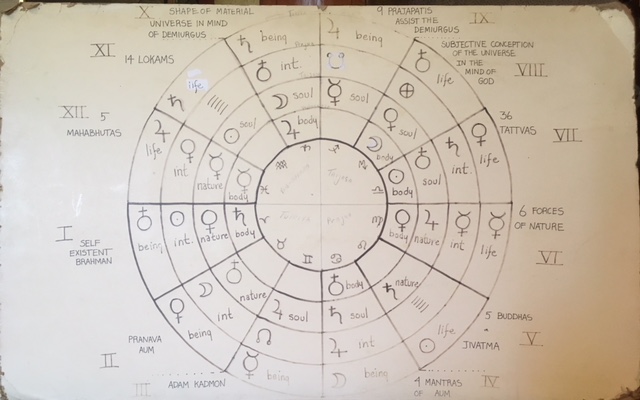
FIGURE IMG_2202-Posterboard Metaphysical Chart.
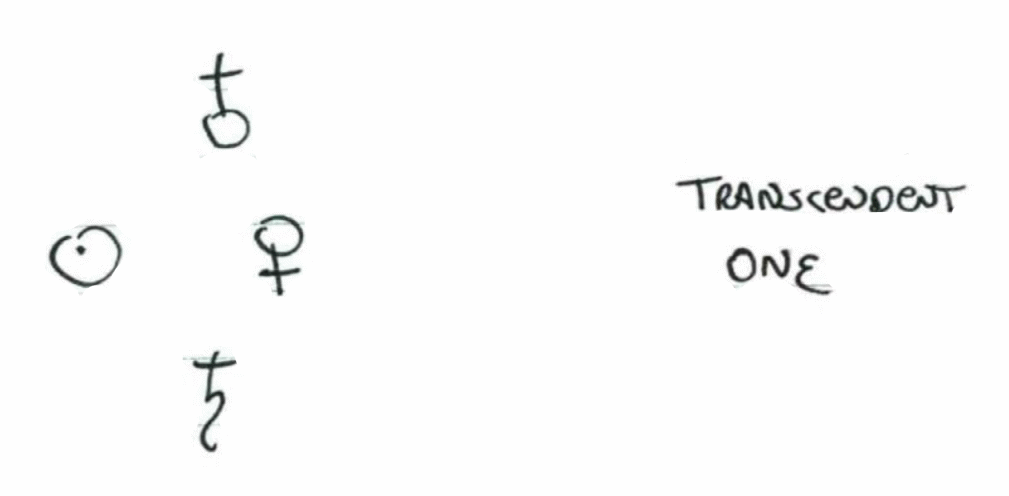
FIGURE 1977 1021-2-AB. Transcendent One.
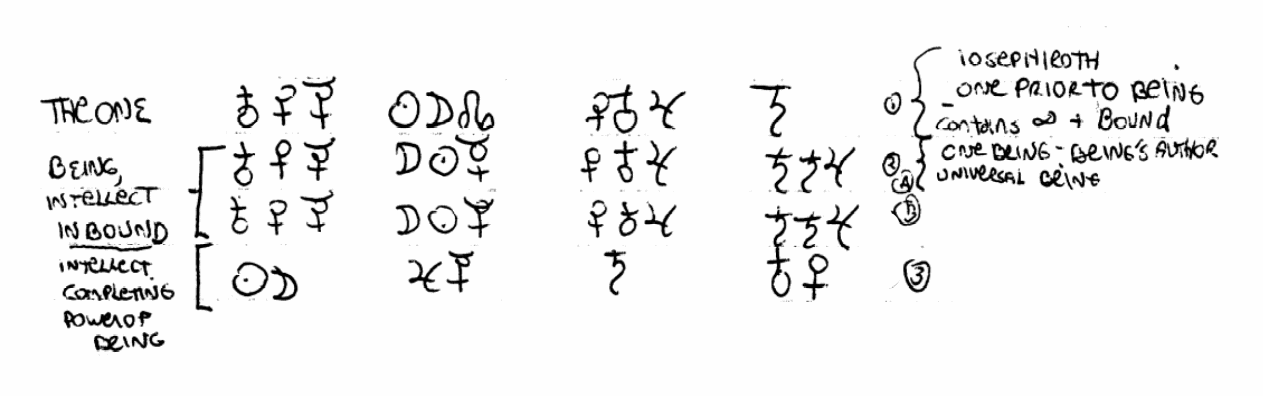
FIGURE 1977 1021-3-AB. One, Being, and Intellectual Monad.
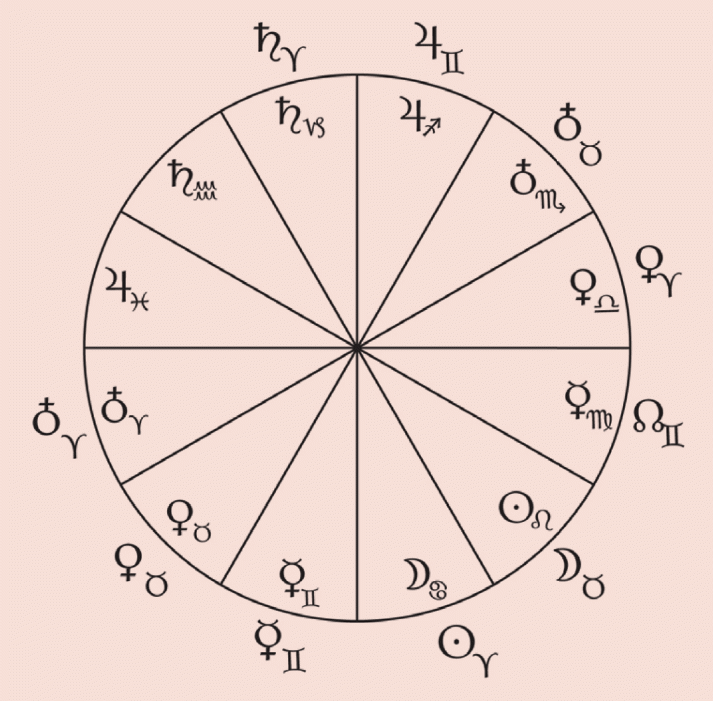
FIGURE 1977 1021-4. Ten Unities and Twelve Rulerships.
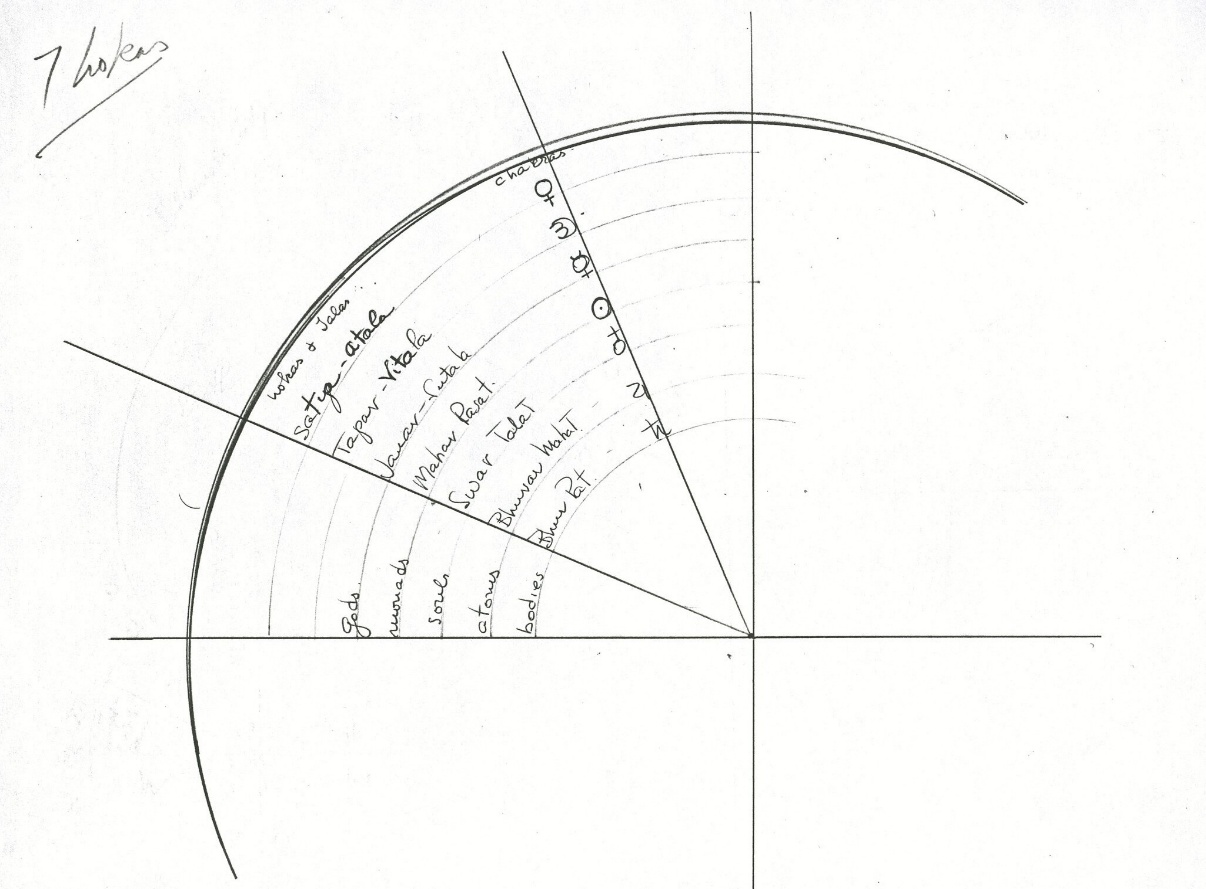
FIGURE AD_D_017. Seven Lokas and Talas, Chakras in Eleventh House; Gods, Monads, Souls, Atoms, Bodies in Twelfth House.
Other diagrams also referred to are not with this transcript version. [Transcriber note: [diagram] means the speaker is referencing a diagram as he or she is speaking. If someone is drawing or writing, with audible sounds of chalk on a blackboard, I indicate this by [drawing] or [writing].]
NOTE: Please see the transcript of 1977 1014 Plotinus: One & Intellectual-Principle for related discussion as well as its appended "Contextual Essay."
TRANSCRIBED Verbatim by IT 2021. In 2025, IT updates file name, prefatory matter, and audio file markers to match new REP audio, completes TOC, expands Subsubjects, Book List, and Plotinus quotes section, adds new notes within transcript, corrects errors/typos, adds two diagrams and removes one diagram, adds diagram references throughout transcript. Archival verbatim transcript – V12a.
AUDIO FILES: 1977 1021a, 1977 1021b. [Note 1: "Tape" and "Side" refer to original audio cassette tapes that were later digitized into .MP3 Audio Files. Note 2: In 2024, REP Studio separates off Monads and Unities/Koshas class fragment from file b.]
1977 10/21 at Wisdom's Goldenrod
Plotinus: One & Intellectual-Principle
[Audio File 1977 1021a Begins]
[few seconds of faint background student talking]
AD: Alright, we'll try to summarize. Try to summarize symbolically some of the stuff we worked through in Plotinus.
S: Yeah.
[10¾ second pause with faint background student talking]
AD: And if time permits, start on the notion of Soul, or the idea of the Self in Plotinus. [short pause] I hope you remember some of the quotes you provided [AS assents] us with.
S (faint): I have the book.
RC (very faint): Let's just do them right now.
AS (faint): [couple words inaudible]
S (very faint): Wait a minute.
[24¾ second pause, flipping of pages, shuffling about]
LR: Why is that-- well--
AD: Well wait till [couple words inaudible] talk about it in a minute. [24 second pause, paper noises] We've often spoken about the Transcendent One, the Absolute, the Self-Existent. All we refer to in many ways. We're going to read selections from the Gita that refers to the-- I think we even had a quote from Proclus which I've never been able to locate on the Transcendent One.
S (faint): What do you mean?
RG (laughing): Dave--
MW: I thought you located--
AS (simultaneously): I thought you located it.
MW: Thought we found it.
S: Uh-hm.
AD: You found it?
AS (simultaneously): Oh I see, yeah.
LR (very faint): Well that's good.
AD: It went something like this, that-- "That there is therefore a oneness which is prior to being, which gives rise to being and which is the cause of all being." [Note: Laurence Jay Rosán, The Philosophy of Proclus: The Final Phase of Ancient Thought, footnote 14, pp. 102-103. Rosán's own source is given as Proclus, The Platonic Theology, ed. with Latin translation by Aemilius Portus. Hamburg, 1618. Note from formatter: The Platonic Theology is translated by T. Taylor as The Six Books of Proclus On The Theology of Plato; cf. Book II.] Of course there's nothing to surprise us, we're aware of that. "But that which is prior to even this, and beyond even oneness itself", that would be like the whole first quadrant [FIGURES IMG_2202-Posterboard Metaphysical Chart, 1977 1021-3-AB, top line].
MW: You mean the oneness?
AD: Yeah. And "beyond even oneness itself, is without relationship to anything else and is Unpossessed and absolutely transcendent." I would call that that very top realm [FIGURE 1977 1021-2-AB]. It's probably the-- "That there is therefore a oneness which is prior to being, which gives rise to being and as the cause of all being." It doesn't surprise us, we again and again have tried to understand that. But, this is what is surprising and this is what is always difficult to reconcile ourselves with and which I refuse to allow any compromise with last week [Note: See WG Class 1977 1014.] when I insisted on this confrontation with this conflict and dichotomy in our thinking. An absolute antinomian conflict has to be accepted because there is no way that you can integrate this. There is no way. Except through the experience of this. And in fact we've had reports from many wise men that this seems true. [students assent, very faint] And if-- if like Plotinus somewhere mentions, if you (could/can) put aside (for) a moment the arrogance of the intellect, you might be able to actually [one/two words inaudible] But that's very difficult for us. It's difficult for anyone.
So anyway, he goes on, says, "But that which is prior to even this, and beyond even oneness itself, is without relationship to anything else and is Unpossessed and absolutely transcendent", that would be the meaning that I said I found to be in the Self-Existent Brahman. Self-Existent Brahman, the Transcendent, the Absolute, Mind-in-Itself, alright, the One, the first hypothesis of Parmenides, all this I apply to the first, that first quadrant [sic; first house, see below]. And I have remarked previously that you do not from that have something flow out, because then it wouldn't be Transcendent. Alright so, we could think of that as the first hypothesis in the Parmenides, you could think of that as the Absolute, you could think of that as the Transcendent. I notice in that rewrite that they put out, that reprint on the T. Subba Row, that the wording is different, he doesn't call that the Self-Existent Brahman, he calls that the Self-Existent Parabrahman, in the rewrite. I decided I'm going to.
[Note: See FIGURE 1977 1021-3-AB for the following, unless otherwise indicated.]
Alright, then the second-- second line [top line] would be the One, alright. Now if you notice we had the ten planets here [diagram], of the first quadrant. And here in these ten of course there's also included the-- the Infinite and the Bound [diagram] is included in here.
MB: Tony?
S (very faint): Yeah.
MB: I thought you just said, when we're speaking of the Transcendent, we're speaking of the One and that was the first quadrant.
AD: No.
MB: No. But--
LR (simultaneously): First house, he meant first house [FIGURE 1977 1021-2-AB].
MB (faint): First house, yeah.
AD (simultaneously): The oneness, the oneness is the whole first quadrant. Oneness is [MB simultaneously, faint: (Yes.)] the whole first quadrant. We refer to the first quadrant as the Unity, the One, the second quadrant as Intellect, third the Soul, fourth the Body, alright. But we have to leave in the chart, even though some people would rather not symbolize it at all but, we have to leave in the chart room-- room for this notion of the Self-Existent. Insofar that-- insofar that it happens(,) that Nirvikalpa is something that has been experienced by various people, and insofar that the Supreme Identity does exist, then we would have to place the Self-Existent Brahman in the first house [FIGURE IMG_2202-Posterboard Metaphysical Chart]. Because that experience is possible for human beings. And we must have it in the chart. There's no sense, you know, speaking about it as unreachable, undescribable, and it is only a symbol.
Alright so then, summarizing some of the things that Plotinus would say and I think symbolically it's all here now. We would see in this line here [top line], we would see what you might call the ten universal principles or metaphysical principles, universal knowledge. This is the first quadrant [AD indicates on diagram]. And it includes-- it includes the Infinite and the Bound. [short pause] Again, the Pythagoreans would point out that it's One and Ten, it's the One and it's the Decad. The second line, this one here [diagram], alright, where we came across these references where he says Being's very author, the One-Being or the unity of Being, Intellect is inbound with Being, the Act of the Intelligible eternally completed, completes. And, I thought it might be interesting if we bring in this very strange thing that occurs in the symbolism. I don't remember the quotation, do you, about the Life?
S (faint): Ok.
AS: Yeah.
S: Uh-hm.
[short pause, flipping of pages]
S (faint): The one where it's in Being, is that the (right) one?
AS: Oh in VI.7.
AD (very faint): I'm sorry.
LR: VI.7.4?
AD: VI.7 what?
[9 second pause, flipping of pages]
LR: Which quote Tony?
AD: Where Life-- Oh here it is. VI.7.17.
AS (faint): Oh yeah.
S (faint): Yeah.
S (faint): Uh-hm.
AD: (It/That) is extraordinary, I would say it's striking to look at this here and see the symbolism involved. It's-- it's actually revelatory if you could see it this way. He speaks in 17--
Plotinus [VI.7.17, AD reading]: "17. [But] how does [AD adds: the] Intellectual-Principle acquire its content, and how does it come to exist, if the content was not in the Filling Principle? It was not in the filled which before that moment was void of all content.
"Giving need not comport possessing; in this order we are to think of a giver as a greater and of a gift as a lower; this is the meaning of [AD adds: the] origin among real Beings. First there must be an actualized thing; its laters must be potentially their own priors; a first must transcend its derivatives; the giver transcends the given, as a superior. If therefore there is a prior to actuality, that prior transcends Activity and so transcends Life. The Intellectual-Principle contains life, and the giver of this life is therefore a principle of greater good, of greater worth than Life; in gaining life the Intellectual-Principle has no need to look for it to any giver in possession of Life's variety [AD reads: activity]."
AD: And now the next line is, well-- is very strange.
Plotinus [VI.7.17, AD reading]: "The Life was a vestige of that Primal, not a life lived by it; Life, then, as it looked towards That was undetermined; having looked it had determination [AD adds: through That] though That had none. Life looks to unity and is determined by it, taking bound, limit, form. But this form is in the shaped, the shaper had none; the limit was not external as something drawn about a magnitude; the limit was that of the multiplicity of the Life There, limitless itself as radiated from its great Prior; the Life itself was not that of some determined being, or it would be no more than the life of an individual. Yet it is defined; it must then have been defined as the Life of a unity including multiplicity; certainly too each item of the multiplicity is determined, determined as multiple by the multiplicity of Life but as a unity by the fact of [AD adds: the] limit."
AD: I-- I don't know if you notice but like in terms of our symbolism the-- these two [second line, Saturn in Aquarius, Jupiter in Pisces] [drawing] are exactly that. [short pause while drawing] Do you see what I'm saying? If you go around the circle, [S: Alright.] you go around the circle and you have Being, Being, Being, then Life, Life, Life, and then the Nous, alright, as-- Sagittarius as Being, Capricorn as Being, Aquarius as Life, Pisces as Life [FIGURE IMG_2202-Posterboard Metaphysical Chart, rulership ring]. Now, it would seem to-- it would seem to mean something like this, that the Intellect which is inbound with Being [second line], when that vestige of the primal Life, so to speak, flows or gets incorporated or however we want to say, gets precipitated in-- in this, then Life is determined in the universal-- in terms of universal manifestation.
LR/S(?): Could you repeat that please?
AD: You see in this here [top line] we don't-- we have those two missing, Saturn in Aquarius and Jupiter in Pisces, alright. And that is the Life that we speak of when we speak about universal manifestation. When you speak of universal manifestation or the Life in universal manifestation, you're speaking about eleven and twelve, aren't you, Aquarius and Pisces [diagram]. And in the twelfth house for instance, Pisces is referred to where the Mahabhutas get dissolved [FIGURE IMG_2202-Posterboard Metaphysical Chart]. And in the Universal Alkahest of the Alchemist(s) and I-- I mentioned to you once before that this Universal Alkahest is Life. I mean don't go looking for water in a jug. This is Life that dissolves the Mahabhutas. It doesn't occur, so to speak, in some sort of-- well, it is much more so than others, it is truly the alchemical dissolve-- dissolver. It is in Life and through the experiences of Life that the Mahabhutas get dissolved.
Alright so then, what we're saying is if we look at the first, alright, we see the ten principles of universal manifestation, so to speak, in a profound unity with the One of the first quadrant. And in this second line where we have Universal Being and these rulers go around the chart, right. They go right around the wheel [FIGURE 1977 1021-4]. These [top line] do not, these are all from the first quadrant. These [second line] go around the whole wheel. And we had to add Saturn and Jupiter. So that means that, where does that Life come from? Well it must be something, let's say, the way he refers to it here as that--
Plotinus [VI.7.17, AD reading]: "[The] Life was a vestige of that Primal, not a life lived by it; Life, then, as it looked towards That was undetermined; having looked it had determination though That had none."
AD: So that this here [second line] by looking at that Life within it gets determined. But, what do we mean when we say the Life within it gets determined? Well we know what this means. [drawing/writing] Over here we spoke about this here as the Seven Lokas or Fourteen Lokas [FIGURES AD_D_017, IMG_2202-Posterboard Metaphysical Chart, eleventh house], alright. As soon as you do that, you stratify-- you structuralize the Life. You've given it determination. [short pause] Now, I'm in-- I'm inclined-- at present I'm still trying to find all the pros and cons of whether to call this [diagram] indeterminate Being, you know, or the one below it [diagram], but, we'll discuss that in a minute. [Note: Transcriber thinks reference is to first and second lines.] If we turn now to the next one that--
LR: Well Tony, why do you have that twice? [second and third lines]
AD: Why do you have what twice?
S: The rulerships.
AD: The rulerships?
LR: Yes.
AD: Yeah, well, let's read the next quotation.
LR: You want 40?
S (very faint): Uh-hm.
AS (faint): And that's 222.
LR: 40? You wanted 40?
AD: Yeah, 40, 41.
S: Besides, that is-- yeah.
S (very faint, possibly part of background): Unfortunately he's going to take [one word inaudible]
LR: Huh?
S: That's the one--
LR: Except--
S (simultaneously, faint): [three words inaudible]
MB (very faint): Yeah, uh-hm.
AD: Alright, starting with 40 we could say--
Plotinus [VI.7.40, AD reading]: "40. That there can be no intellection in the First will be patent to those that have had such contact [AD reads: contacts]; but some further confirmation is desirable, if indeed words can carry the matter; we need overwhelming persuasion.
"It must be borne in mind that all intellection rises in some principle and takes cognizance of an object. But a distinction [AD adds: here] is to be made…"
AD: And this is what we struggled with last week. And we will reread the second part of that paragraph first.
Plotinus [VI.7.40, AD reading]: "There is [also the] intellection inbound with Being--Being's very author--and this could not remain confined to the source since there it could produce nothing; it is a power to production; it produces therefore of its own motion and its act is Real Being and there it has its dwelling. In this mode the intellection is identical with Being; even in its self-intellection no distinction is made save the logical distinction of thinker and thought with, as we have often observed, the implication of plurality."
[short pause]
AD: Ok?
S (very faint): Uh-hm.
AD: What do we-- what do we see there?
[15 second pause]
AS (faint): Well, the second could be the rulers just looking to the One. That must be the relation of the One to the Being [couple words inaudible] the Being of the rulership, that line there [second line] to the-- the entire [top line].
AD (simultaneously): This one here [second line] in relation to this here [top line]?
AS: Yeah, and then that looking (if--) determines itself as Being, that Act is its [one/two words inaudible]
MW: Can I ask a question about that quote?
AD: Sure.
MW: When it says, "This could not…" Did we read that sentence? Yeah.
Plotinus [VI.7.40, MW reading]: "…this could not remain confined to the source since there it could produce nothing…"
MW: Now, what is the source that they're referring to? I mean, if-- if you say it's the One, then-- then you're ascribing that something has come from the One, it sounds like, if you say arising from the source.
AD: Yes, again you're going back to the problem that we refuse to answer. There is no possible linguistic device capable of helping us to understand what we're saying when we say that Being comes from the One.
MW: But--
S (very faint): No.
AD: And you're going back and you're going to try the same thing.
MW: No, I'm sorry, I didn't mean to bring up the problem.
AD (simultaneously): No. I mean this is inevitable, this is how we are.
MW: But I just want to know whether-- when he says the source, he in fact is referring to the One or is he referring to something else.
AD: I would assume it would be the One.
MW: Ok. I mean I was-- wanted that cleared up.
AD: Because the One is the ultimate source of everything, we did agree to that. We did agree to the fact that it is the source, the author of all Being, that if we speak of, you know, God the Father, alright, God the Creator, God the Ultimate, that would be the One. But, when we try to explain ourselves the-- the means used, every-- every linguistic analysis, every device becomes utterly worthless. And I just refuse to accept these-- these terms. Because no sooner does he say it comes from the One and then he'll show you that that-- the whole-- that's [MW assents] a mirage, you know, nonsense. Comes from the One? What do you think, it's a tree and apples grow on it? You remember, we've been through all that, so we [MW simultaneously: Yes.] simply have to leave that aside until perhaps we might get some sort of-- Where he says here--
Plotinus [VI.7.40, AD reading]: "…there can be no intellection in the First will be patent to those that have had such contact…"
AD: And to try to fit our understanding to explain how the One operates or anything like that is bizarre. I mean, I won't say arrogant, I'll just say bizarre, queer, and arrogance.
LR/S(?): Yeah.
AD: But we'll get back to that many a times, I can assure you, before we willingly let go. So, then we said--
Plotinus [VI.7.40, AD reading]: "…the [AD reads: this] intellection [AD adds: is bound] inbound with Being--Being's very author--and this could not remain confined to the source since there it could produce nothing; it is a power to production; it produces therefore of its own motion and its act is Real Being and there it has its dwelling. In this mode the intellection is identical with Being…"
AD: Now listen to that very careful. The intellection is identical with Being in this mode.
Plotinus [VI.7.40, AD reading]: "…even in its self-intellection no distinction is made save the logical [AD adds: one ]…
"This is a first activity and the substance it produces is Essential Being; it is an image, but of an original so great that the very copy stands a reality. If instead of moving outward [AD reads: outwards] it remained [AD reads: remains] with the First, it would be no more than some appurtenance of that [AD reads: the] First, not a self-standing existent.
"As the earliest activity and earliest intellection it can be preceded by no act or intellection…"
AD: So then this [drawing] Being here that we're speaking about, alright, which is bound in with Intellect, he says of it--
Plotinus [VI.7.40, AD reading]: "As the [AD reads: An] earliest activity and earliest intellection it can be preceded by no act or intellection: if we pass beyond this being and this intellection we come not to more being and more intellection but to what overpasses both, to the wonderful which has neither, asking nothing of these products and standing its unaccompanied self."
AD: So then over here we have the feeling that this is that awesome, you know, grand, august Being which is author of its own Act. And there we get the feeling of the Intelligible as completed, eternally completed. Ok. Now, if we go back to that paragraph and read the second line it's--
Plotinus [VI.7.40, AD reading]: "There is the intellection that remains within its place of origin; it has that source as substratum but becomes a sort of addition to it in that it is an activity of that source perfecting the potentiality there, not by producing anything but as being a completing power to the principle in which it inheres."
AD: Ok.
LR: So that would be called Essential Being, what he calls Essential Being?
AD: Well no, I wanted to discuss this now.
LR: Ok.
AD: You think--
LR: Well, from what you read of the first description, it has an-- its Act-- it has an activity and that activity is what produces Essential Being.
AD: Ok.
LR: So, (I would--) maybe that Essential Being would be what he's referring to in that first description. It remains with its place of origin but, you know, it put-- it carries out pre-- the job of production, actual production would be carried out there, and it would get its-- it would get its know-how, it would get its information from that first intellection that was described. It would al-- it would be like the worker or the completing power of that first--
AD (simultaneously): Are you speaking about this sentence now, "There is also…" This intellection is--
Plotinus [VI.7.40, AD reading]: "…a sort of addition to it in that it is an activity of that source perfecting the potentiality there, not by producing anything but as [AD adds: by] being a completing power to the principle…"
LR (simultaneously): Right, completing power, and later where he says the activity of that first intellection produces Essential Being.
AD: Well, yeah, but I'm asking you what does this mean now and what would you refer to it, the first part of that paragraph.
LR: "There is the intellection that remain", that-- the beginning of that paragraph?
Plotinus [VI.7.40, AD reading]: "…but as being a completing power to the principle in which it inheres."
AD: (Wait/Well) what would you refer that to?
LR: Well the principle that it would inhere in would be that first intellection, [AD: Ok.] that indeterminate intellection which arises or is formed from the--
AD: And what about the power that completes its Act?
LR: Well, I-- again I'll just-- Its production would be the power which--
AD (simultaneously): Would you say that this here [bottom line]-- can you say that this here is that?
LR: Oh. Oh I don't know.
RG: Ok but what would be the Essential Being there?
AD: I'm sorry.
RG: What would be the--
AD: This here [second line] would be the Essential Being.
RG: 'Cause then what would be Being's author?
AD: This would be Being's author [second line].
RG: And the Essential Being?
AD: Yes. Aren't they one and the same?
RG: He seems to make a distinction.
AD: Well, show me.
LR: Yeah the-- the sentence--
RG: He says there the first activity and the substance it produces, it seems there's a production. That first intellection has an Act and the production of that Act is Essential Being.
LR: It's the [student assents] paragraph [MW assents] after that paragraph.
RG: Or, to say Being's very author.
AD: Yeah, [S simultaneously: These--] we're on the same paragraph, the second one?
RG: Well the first sentence of the next paragraph.
Plotinus [VI.7.40, RG reading]: "This is a first activity and the substance it produces is Essential Being…"
RG: So it seems he's saying there's an intellection which has an Act, and the production of that Act is Being.
AD: Yes, this here [second line]. (Ok/Go ahead).
RG (simultaneously): Right. But I don't see why you would say then that first intellection would be that too, then-- then it-- then it would be the same.
AD: Then the first intellection, what do you mean?
RG: There is the-- Being's author. Well this-- we don't have a symbol for it.
AD (simultaneously): This is Being's author [second line].
RG: But it's Be-- Well, it seems to me he's making a distinction between the first intellection and Being. That in between-- that above the Being Intellect inbound there should be a principle lower-- lower than the One which--
AD: I disagree with you.
RG: Well then what could-- what does it mean then?
AD: Let's-- If I understand you right you're saying that there's something in between Essential Being and the One?
RG: I [LR simultaneously: No.] don't know, I'm only asking what does he mean by it.
AD (simultaneously): No, I mean, that's what you're trying to say?
RG: No, I don't know, no, I'm not asserting that, I only would understand what he would mean here [AD simultaneously: Alright.] when he says--
Plotinus [VI.7.40, RG reading]: "This is a first activity and the substance it produces…"
RG: I mean-- If it was totally the same, why would he speak of production?
AS (faint): No he--
AD: Sure.
AS: Can I try an interpretation of that [one word inaudible]
AD (simultaneously): (Well) sure, sure.
AS: May-- maybe-- Say--
Plotinus [VI.7.40, AS reading]: "This is a first activity and the substance it produces is Essential Being…"
AS: Yeah I think he's trying to say that the substance, he's-- he's pointing at the substance and saying that it too is Essential Being. In other words, that first activity is also Essential Being. The both of them are Essential Being. Saying that that substance is Real Being doesn't deny that the activity too is Real Being. Yeah [S simultaneously: (Sure.)] and I think you could read it that way.
RG: Yeah, yeah, I mean--
AD: Well, you have to read it that way because they cannot be separated, the Intelligible cannot be separated from its Act. We have no choice here.
RG: Uh-hm.
AS (faint): He-- could I [one/two words inaudible]
AD: Go right ahead.
AS (simultaneously): (Sorry.) In-- it's back in V.3.12 of 394 where he-- he does-- I mean, it's the same thing but-- He says--
Plotinus [V.3.12, AS reading]: "…the One does not provide for the existence of an Intellectual-Principle which thereupon appears; that provision would be something [(an Hypostasis)] intervening between the One and the Intellectual-Principle its offspring. There could, in fact, be no such providing in The One, for it was never incomplete…"
S (faint): Yeah.
AD: You see, the difficulty here is that of course if you have the One and you have Being, and then you want to put something in between them you'll end with an infinite regress.
RG: Yeah, right.
AD: Alright?
RG (faint): Go ahead.
AD: And he's-- he's attempting here, I would say in this almost paradoxical but greatest statement I've seen of this matter, when he says that this intellection is inbound with Being and Being's very author. It's almost like there's an absolute refusal to separate these two, put one prior to the other, because then you'll have a whole infinite regress to work out.
Plotinus [VI.7.40, AD reading]: "…and this could not remain confined to the source…"
AD: I'm going again.
Plotinus [VI.7.40, AD reading]: "In this mode the intellection is identical with Being; even in its self-intellection no distinction is made save the logical [AD adds: one]…"
"[AD adds: So] This is a first activity and the substance it produces is Essential Being; it is an image, but of an original so great…"
AD: Now I'm inclined to call that [second line] the Essential Being, the author of Being itself. But now the second phase I'm working at is where he speaks about at the very beginning, he says--
Plotinus [VI.7.40, AD reading]: "…but becomes a sort of addition to it in that it is an activity…"
AD: He's speaking about a different kind of intellection. Because in the sentence just prior he says, now, we have to make some distinctions about intellection. And he says--
Plotinus [VI.7.40, AD reading]: "…that all [AD adds: the] intellection rises in some principle and takes cognizance of an object. But a distinction is to be made…"
AD: And he makes this distinction, alright.
Plotinus [VI.7.40, AD reading]: "There is the intellection that remains within its place of origin; [AD indicates on diagram] it has that source as [AD adds: a] substratum…"
AD: This would be its substratum [AD indicates on diagram].
Plotinus [VI.7.40, AD reading]: "…but becomes a sort of addition [AD: to this here (AD indicates on diagram)] to it in that it is an activity of that source…"
AD: This [AD indicates on diagram] is an activity of that source.
Plotinus [VI.7.40, AD reading]: "…perfecting the potentiality…"
AD: Which is here [AD indicates on diagram]. This here [bottom line] perfects the potentiality which is here [second line], ok.
Plotinus [VI.7.40, AD reading]: "…there, not by producing anything but as being a completing power…"
AD: It completes [AD indicates on diagram] what this has, so to speak, as an eternal Intelligible Act. So, the Intellectual Monad [bottom line], as we said, will be the completing Act and it's the power to complete, it's a-- can we say a faculty of that Authentic Being? And, if that would be so then this Intellectual Monad would be that secondary intellection; this [second line] which creates itself, self-begotten, would be the primary intellection, alright. Go on, sure.
RG: Now when he says the Intellectual-Principle, seems to me he means the first one. Most--
MW: You mean in general?
RG: Yeah in--
AD: In general, yes, that's the august sense in which he uses that term Intellectual-Principle.
RG: Now what term would he use for the second one?
AD: Involved in the production of World-Soul for instance.
RG: In World-- yeah.
AD: Yeah. When-- let's say that the World-Soul will-- has to be produced, alright. This [bottom line] would be involved in the production of World-Soul. Just like World-Soul will be in-- involved in sketching out a preliminary plan but the individual soul is within itself, alright, so that they follow up that sketch that the World-Soul provides. [Note: See Plotinus, VI.7.7, third para.] And then Soul, so to speak, would also in the same way be the Logos of body. In other words it inserts a Logos in a body so that this body becomes the actuali-- actualization of a reason-principle.
LR: So, you have the-- the line of rulerships twice [second and third lines]. Is that to show that--
AD: No I only-- I only have it twice to show--
LR: To show--
AD: Over here it's associated with this [top line], over here it's associated with that [bottom line].
LR: Oh.
AD: I-- the next [LR simultaneously: It's really--] question I would like to ask is which one would you call the indeterminate Dyad? Would you say that this is the indeterminate Dyad [top line]? [drawing] Where you don't have Life determined, where you have the Head [diagram]. In other words, there's no Life principle here [diagram], ok, and you have the Head.
S (faint): No Life principles?
AD: Or would you say that this [second line] is the indeterminate Dyad? You have no Head, alright. Now, from a logical point of view this [top line] seems to be the indeterminate Dyad because Life isn't there, the Act isn't determined, it's not completed, alright, and the Head represents exactly that. Once this [diagram] gets determined [AD hits board with chalk] you have no more Head. The Head's over, he's gone. It's a completely determination-- a complete determination of universal manifestation. Now which one would you choose for the indeterminate Dyad?
[short pause]
S (faint): Could you-- could you repeat again what the Head-- what the Head is in there?
AD: I thought that that told what the Head was.
S (faint): Can you repeat it?
AD: Insofar as there-- let's say we have not agreed on the plan, alright, on how to build this house. Ok? We still have a lot of pros and cons to discuss so we-- we put a big question mark. They put a Head there [AD taps board with chalk]. (bit of laughter)
S (very faint): (Seriously.)
LR/S(?) (faint): Right.
AD: Once it's agreed what the plan of the house should be, no more question mark. You move ahead, you start building a house. Over here [second line] you don't have a question mark.
S: So that indeterminacy in the Head--
AD (simultaneously): Is gone. And one sees over here [second line] that there's a stratification of Life insofar that Saturn there in Aquarius and Jupiter have determined the-- let's say the lokas and the talas, the subjective and the objective conscious centers. In other words, when-- when we take the eleventh house, alright, and we do this here to the eleventh house, [drawing] and-- Well, wait. There's one missing.
S (faint): Mercury's missing.
AD: He wants to add and I want to take away. Well, what can we do? [drawing] This is the eleventh house and we made-- we made this kind of arrangement here where we try to show that there are seven levels [FIGURE AD_D_017]. Because if this is our universe, alright, it's the universe, let's say the Body of the universe, we know that [drawing] there (has/had) to be seven levels to it, ok? In other words, there's the seven different kinds of matter or prakriti. Accompanying it there will be the seven different subjective consciousnesses that will work with each special kind of matter. So over here we call this muladhara [diagram], you remember? We went around something like this [diagram]. [short pause while drawing] Ok? So we had the seven levels here. Now once you do this here, once you have the lokas and talas, ok, over here, then it's not indeterminate no more. Go ahead.
AB: Um-- I remember when they speak of the indeterminate Dyad they say that in looking to the One it becomes determined. Now, if we were to say that the first line there [diagram] is the indeterminate Dyad, then the One that it looks to would have to-- would be the Transcendent and I don't [AD simultaneously: The--] know if I could accept that.
AD: Well that's what we have to try to, you know-- We could draw issue, you know, I mean we could draw sides, I'll take it this way and you take it the other way. But there's no clarity here. If we say this is the indeterminate Dyad [top line], alright, then what we could say is this does look to the Transcendent [FIGURE 1977 1021-2-AB]. And in the very act of contemplating the Transcendent, alright, it gets determined. But what gets determined is not this here [top line] but this one here [second line].
[short pause]
AB: In other words, it still remains indeterminate but it's the basis for a later determination. It's looking at the One.
AD: Now you're saying this [top line] remains indeterminate. But in the very act of contemplating the One the determination which arises within it becomes-- is this one [second line].
S (very faint): Right.
AD: So then [couple/three words inaudible] (laugh), wouldn't I?
[AD drawing or tapping on something]
AB: See, the One that could be looked at I wouldn't think was the Transcendent, I would think that was the-- the first line there [diagram].
[short pause]
RG: But on the other hand--
AD: Why would you want to look at the first line, wouldn't you want to contemplate the One itself [FIGURE 1977 1021-2-AB]?
AB: But I don't know-- well, I don't know what that means.
AD: The [AS simultaneously: Yeah but--] Transcendent, I mean-- I mean why--
AS: But that-- [AB/RG(?) simultaneously: Before we get (out--)] I thought the fact of-- But, it seems that though that gets back to that objection you had [one word inaudible] (with me) with last week. I thought you were doing that purposely.
AD (simultaneously): I'm not-- oh no sir, I would say that that's exactly amplifying that conflict.
AS: I know [AD simultaneously: It's--] it's amplifying the conflict but it seem-- it's--
AD: I--
AS: I mean--
MW: Avery's pointing it out.
AS (simultaneously): Because now-- now, if you-- if you say that, I mean, suppose we say that the indeterminate (Dyad--)
AD (simultaneously): Look, suppose I look at you, suppose you're an extraordinary creature, alright, (laughter) and I look at you, alright, you're on a pedestal and I look at you. And something when-- within me gets formulated, defined, clarified. [student assents, faint] Should I blame you?
S: You could.
AS: Ok but, suppose now in that analogy--
AD (simultaneously): Wait. Wait. (laughter)
MW: Say yes.
S (faint): See that-- (bit more laughter)
AS: No. (laughter)
AD: Saying when this [top line] is looking at the Transcendent One and a determinations or precipitation, clarification, definition of itself, or the whole-- the whole of itself takes place [AS simultaneously: That's that.] which becomes this here [second line], which is this here.
AS: Ok.
AD: We're not saying that this [second line] comes from that [FIGURE 1977 1021-2-AB]. We've cut the conflict nice [student assents] and open, in other words we have a big hiatus [drawing] here and I-- I'm not afraid to leave it.
AS: But--
AD: [drawing] Ok? (bit of laughter) Just like, you know, the signs on the street, dead end.
LR (faint): There's a circle. (some laughter)
S (faint): There's a circle
MW/S(?): Good.
S: Yeah. (some laughter)
AD: You're not going to climb that with the intellect, you're not going to hurdle that.
AS: Ok I'll-- [S, faint: Sure.] I don't know.
AD: So then this [diagram]-- this-- this gulf like remains, alright? The indeterminate--
AS: Ok.
AD: Ok?
AS: Now, in your analogy like say that that looks at-- ok. [student assents, faint] (Say/So) (that) that indeterminate-- and they say the indeterminate [top line] looks to the One and in that looking Being is determined. Now you have three things. You have-- you have that Absolute, the One, which it can never see, can never grasp. And every time it tries to grasp it, what happens is you get this whole-- get all the rulerships out [second line].
AD: Yeah. And we [AS simultaneously: We (couldn't) have--] could say that this would refer to a series, an infinite series of universal manifestations, or of one mani-- manifested universe.
AS: Well would-- could you say something like the Divine-- It always seemed like-- Plotinus would say well that's something like the Divine Mind itself looking to the Transcendent. And every time it does it with-- it-- in doing that, a whole Being, a whole-- (wholeness--)
AD (simultaneously): But that wouldn't be the Divine Mind except the way he specifically specifies it by speaking of it as the author of Being and Being's essential Act. And [S simultaneously, faint: Ok.] he refuses to chronologically place one prior to the other.
AS: Ok but now is it--
RG: Which would--
AS: If we speak of--
RG: Which would be Being's very author?
AD: This here [second line].
RG: But you just said before that Being's very author was the rulerships.
S (faint): Yeah.
AD: Yeah, this here [second line].
RG: Wait.
MW: Wait.
AD: This one here, not the One.
RG: Oh that one.
AD: Not the One, this one here [second line].
AS: This-- yeah.
AD: Alright, I better do this one. [AD hits board with chalk]
S (simultaneously): But that-- (bit of laughter)
AS: See 'cause which--
AD: You can't refer to this [top line] as Being because it's indeterminate. And the Greek conception of Being is always a very determinate kind of thing, I mean it's a-- [student assents] It's not a vague, unshaped, amorphous mass, for them that would be the very opposite of perfection.
AS: Now, would you say that that indeterminate has intellection? Would you call that intellection as looking to the One? It seems like you would say no 'cause, you know--
AD/S(?) (faint whisper): Right, yeah.
AS: I don't know what else to call it.
RG: Yeah right.
AS: But from what we were saying before, intellection only arises when you start speaking about those rulerships. It's inbound with Being, it's one with Being.
AD: Well, couldn't we say that the way he points out about this here [top line], that it's so very close, alright, that it's almost not different from the One. Let's see if I could remember.
S (faint): Yeah.
[35½ second pause, flipping of pages]
AD: Where he says for instance--
Plotinus [VI.7.40, AD reading]: "If instead of moving outward it remained with the First, it would be no more than some appurtenance of that First, not a self-standing existent.
"As the earliest activity and earliest intellection it can be preceded by no act or intellection…"
AD: Because, if we're thinking of that as the first quadrant it's almost inconceivable to regard it in-- with any form of intellection. [19½ second pause] Well, any further [LR simultaneously: Yeah. (couple words inaudible)] comments that (miss the point)?
LR: Where would you say-- I'm not quite-- I'm not quite sure how to phrase this but where would you say-- where would you put the origin of production, the idea of production, where would that arise from? When you say there's no emanation from the Transcendent and that's where the gap has to come. You can't say that that-- what you have marked as the One is an emanation from the Absolute. Now it seems like the activity of production from what you've been saying occurs in the bottom line [diagram] where that intellection is the completing power of this Essential Being. Is that where you would put--
AD: Well the production of what?
LR: Well--
AD: If you're speaking about the sensible universe, no.
LR: No what? What (where)?
AD: Even this completing act wouldn't be involved in the production of the sensible universe. [drawing] We would have to-- if I can take the two circles instead of upside-down, put them this way [diagram], ok. And, let's imagine that this here is the Nous [diagram], ok. Over here we would have the rulership [diagram] and over here the exaltation [diagram], alright, and this would be like looking [student assents] to the Intelligible World or the Intellectual World. This would be let's say the sensible world [diagram], ok. Now, the actual production or manifestation of the universe takes place after Soul [diagram].
LR: Ok, I wasn't speaking of that production.
AD: Well then what production are you speaking (on/of)? It would be-- if-- if we could use the word 'production' but with the reminder that for Intelligible and eternal Beings, an Act, alright, is not a-- a generating condition, I mean nothing is generated.
LR: Then what does it mean that for every Hypostasis there has to be an engendering--
AD: I told you-- I told you last week too that that word could trip you into all kinds of difficulties. Because--
(Side 1 of original cassette tape digitized as 1977 1021a Ends; Side 2 Begins)
AD: --engendering to mean that, ok.
LR: But it would s--
AD (simultaneously): Then there would be no outgoing effect.
LR: Ok, but it would seem that some of these things which we're speaking of have no interest in-- are not causes in the way Plotinus uses the word 'cause'. There's no image thrown off from it. And he seems to speak of some principles as having an image of-- in its very being a principle it engenders an image of itself. [Note: See Plotinus, V.1.6, second and third paras from end.] Was that clear at all, I mean--
AD: Not yet. You keep trying.
LR: What does it mean for that Intellectual Monad to be the completing power of Being?
AD: As I explained before, that would be-- the Intellectual Monad there produces or engenders Soul, Universal Soul.
LR: Ok, now prior to that--
AD: Yeah, prior to that.
LR: --could you speak of a production of anything?
AD: You can if you-- if you maintain and keep this reservation in mind, that up to this point we were speaking about the Intelligible Universe, the Causal Universe, which has a right to its existence per se.
LR: Yes.
S: Yeah.
AD: I mean, you could-- and there could be or not be a sensible universe, that--
LR: Ok so, so, in that Intellectual Monad, I mean, I-- I think of this phrase com-- the completing power of Being as implying-- In other words, in order for it to complete the power of Being, Soul has to be produced. There has to be a living out of that which is inherent in Essential Being. And I was thinking of this Intellectual Monad, this line you have at the bottom [diagram], as that principle responsible for the-- the outgrowing principles like Soul, the engendering of Soul in its own right.
AD: (So/Yes) you could think of it that way, sure.
LR: And that prior to that, in other words, in Essential Being, you don't speak about completing anything. Everything there would be complete on-- in different-- I mean undifferentiated in a sense.
AD: Well everything there would be complete, let's say it would be-- In other words, prior to the completing Act of the Intellectual Monad, we would speak of the Intelligible Act as eternally completed [LR simultaneously: Yes.] and it wouldn't be involved in production [LR, faint: Yes.] the way, let's say, the Intellectual Monad would be.
LR: Ok, that's what I was--
AD (simultaneously): Ok, sure. That would be a good way to phrase it. Fine. There will be no statement that we will make or can ever make that will be, what could we say, definitive, yeah? That's out of the question, it's the very nature of metaphysics to be coherent but never systema-- systema-- systematic. You can't systematize it. [S, very faint: (Why?)] But--
LR (simultaneously): Well see, what that would mean to me in-- it-- is that in order-- that-- that where you have the Intellectual Monad, it would seem perhaps that that's the limit or the--
AD: The limit of the Intelligible, (four).
LR (simultaneously): Yes, [AS simultaneously: Yep.] and-- and prior to that or pa-- beyond that you can't speak of intellection anymore. Because nothing-- because that's where production's origin is.
AD: Let's see, what you're trying to say is-- Let's reverse this order. Let's put the Sun [in Aries] out here, [drawing] ok, and Mars [in Aries] here, rulership [diagram], ok? And so that, this here [diagram] would represent the very limit of the Intelligible World. Beyond this point there'd be production of Soul which means Soul is eternally united to Body so the two of them would be out there [diagram], ok, out here, [AD indicates on diagram] so to speak, in the sensible. So that if you go this way [diagram], as far as this is concerned, you have an eternally and intelligibly completed Act. If you go this way [diagram], then you would get into the realm of the sensible world even if, you know, we recognize that the Soul is not sensible but will be attached to the sensible. Alright. I think that would be a good way to put it, sure. You will see-- I think you will see as you go along and make a definitive statement, you know, um-- Like if you read the Guenon book that we used Sunday, [Note: See Rene Guenon, The Multiple States of Being.] in the first three chapters where he speaks about a definition of metaphysics, and he uses this-- the notion of active and passive perception, the totality of which is the Supreme Principle. Well, the simplification is so vast that every detail, every important nuance, every shade of meaning just gets abolished in that way of stating it. Whereas what I would say Plotinus was trying to show was the tremendous variety of coherent ways of looking at this. Still not be outside of metaphysics, you're still metaphysical. Yeah.
S (very faint): Go on.
S (very faint): Yeah.
AD (faint): (Up.)
S (faint): Uh-hm.
AD (faint): (Up.)
AS: Could I bring in some like-- some of like PB's terminology? If-- if like we talk about [AD simultaneously: Yeah.] that Decad, the One there [top line]. Now that seems to-- that's like the Decad and that seems like we spoke about the World-Mind in itself, ok, like the principle of all World-Minds. Something like that, the indeterminate principle from which any World-Mind could arise. And that would be represented by those ten planets [diagram]. That would be like the notion of the Decad [AD: Ok.] in relation to the-- its-- its ground itself as it were, Mind-in-itself or the-- something completely in-- transcendent and which would have absolutely no relation to manifestation. Whereas you could think of this Decad or the indeterminate Dyad or-- I don't know, they seem to be more or less synonymous or the World-Mind in itself as having relations with every World-Mind let's say which follows, every determination of it. There does seem to be some relation between that and what follows, between this-- between the Decad or the indeterminate Dyad and Being. That that's the ground. That would be like the ground of every possible [one word inaudible]
AD (simultaneously): Yes but, in your analogy you would notice that the-- the relationship between the Decad and indeterminate Being is all within the first quadrant. It doesn't go beyond that.
AS (simultaneously): Well I-- I was equating--
AD: Huh?
AS: I was equating the De-- oh I see (what you--) Say the-- the-- the relation between the Decad and the--
AD (simultaneously): Yeah. Look at-- look at what I'm saying.
AS: Yeah.
AD: We speak about the indeterminate Dyad, alright, or this line here [top line] looking up-- the One looking [AS simultaneously: Right here?] up to the Transcendent [FIGURE 1977 1021-2-AB], [AS assents, faint] alright, and what-- gets determined within itself. Now, this determination within itself, all this is taking place within that first quadrant.
S (faint): Right.
AS: But the determination would have to be the-- all the rulerships, wouldn't it? (AD laughs a bit)
AD: That's an effect.
MW: Hm.
AS: (Oh/No) but-- Yeah.
AD: Now you're not speaking about the indeterminate Dyad.
AS: Right. But as soon as--
AD: But, but the-- let's say the determination of all the rulerships doesn't take place here [second line], it takes place within here [top line/first quadrant]. Otherwise the term indete-- indeterminate Dyad simply won't mean anything. In other words, the determination of the twelve rulerships as twelve rulerships, or twelve Gods or twelve hundred thousands Gods--
AS: Is predetermined in the [one/two words inaudible]
AD (simultaneously): That de-- that determination is taking place in here [top line/first quadrant], in the-- in the indeterminate Dyad.
AS: Ok, I think I would agree with that but we could look at that Decad as the-- you know, the-- these principles within the World-Mind itself or within the-- let's say within the first quadrant. And that all the twelve rulerships, the principles of those would be in the first quadrant.
AD: Ok.
AS: Ok and you would say that those principles are already distinguished as it were in that first-- in that Decad looking from-- to the One, within itself.
AD (simultaneously): Yeah, except that we would have to say pre-distinguished.
AS: Pre-distinguished.
AD: They're-- you know, they're pre-existential.
AS (simultaneously): Uh-hm. Ok but now--
AD: You remember the remark-- I mentioned this twice, now maybe the third time it might sink in. You remember we were speaking about the Five Dhyan Buddhis [Dhyani Buddhas] in the fifth house [FIGURE IMG_2202-Posterboard Metaphysical Chart]. Now think of each Buddhi, so to speak, as the very summit of that principle, whichever tattva you're speaking about, sight, hearing, ok? Now, T. Subba Row made the remark to this effect. He said that those Dhyan Buddhis are even prior to the Gods, and by Gods he was speaking of Brahma, Vishnu, and Ishvara. Now, that's the only way I can show you how, when we're speaking about this first quadrant we're speaking about super-essential divinities, alright. The-- in the Kabbalah they refer-- in the metaphysical chart they refer to the sense-- ten Sefiri [Sefiroth] in the third house. But you must underline this--ten unmanifested Sefiri. You see you must underline that part, unmanifested. So they're totally beyond any possibility of understanding. Because if we go to the second quadrant, we say we're dealing with existence there. The Intellectual-Principle there is the archetypal exis-- existence. The Chri-- for the Christians this is the ultimate Creator, ok. These people are speaking something which is prior to that. Prior to existence, prior to Being. Ok?
Another way of exaggerating, because that's what we have to do, we have to exaggerate the standpoint that we're trying to look into. I did something which perhaps you remember. We took the first quadrant. I think [drawing/writing] we did something like this. [Note: The following diagram is unavailable, use FIGURE IMG_2202-Posterboard Metaphysical Chart to follow along.] Alright, just imagine that here's this first quadrant [diagram], ok. And then we pointed out-- No. That ended with Saturn [in Aries], right? And then from Saturn we said came the Intellectual-Principle, ok? So we would have to start off with the Moon [in Cancer], alright, Sun [in Leo], Mercury [in Virgo], ok. Now just imagine the ten here [diagram], ok. And the result of the Intellectual, the Body of the Intellectual quadrant, number two, [student assents, faint] was Mars [in Cancer] and Venus [in Virgo] [diagram], ok. Now the conjunction of these two [diagram], alright, (can) produce what we call the third quadrant or Soul, with Jupiter [in Sagittarius], Mars [in Scorpio], Venus [in Libra], ok. And going down let's say you finish these ten, ok, so that you ended up with the Sun [in Libra] and the Moon [in Scorpio] here [diagram], ok? Now this here, the conjunction of these two [diagram], is going to produce the Body of the universe [fourth quadrant].
Now, if this here, at least we can understand this here [fourth quadrant], this is the universe, this is the world we live in. The universe we live in partakes in images, ok. Now, when we try to understand what was prior to it which is its substratum, (is/it's) difficult. When we try to understand the substratum of this here [third quadrant], alright, that's inconceivable. But what-- when we try to understand the substratum and the prior of Intellectual existence [second quadrant]? And that's what we mean when we try to understand in our clumsy way and very awkward way of that which is prior to Being, beyond Being, you know, the very oneness of which is something that we can't conceive of. Indicate, yes, talk about it, around and about but that's about all.
[students assent, very faint]
AS: Or, like sometimes when the-- is that what Proclus was trying to talk about when he spoke of the Bound and Infinity which was prior even to Being?
AD: Yes.
AS: Then he spoke-- spoke about that (being--/Being.)
AD: Yeah because like, if we take the second-- No let's take the second house, alright, where for instance we speak about Pranava Om [FIGURE IMG_2202-Posterboard Metaphysical Chart]. Alright and we say-- well, you know, what in the world could that mean? You have the Transcendent, the Absolute and the First [first house]. Coming from it you have two principles, one is Infinite [second house], one is Bound [third house], ok? The second one, the Infinity for instance, alright, Infinite Power, and we say that this is Pranava Om. Another way, another way is to say that these are samskaras of a-- the activity of a prior universe. Now think of these samskaras not as you would think of your samskaras but think of the totality of samskaras which are left behind after the activity of a universe is dissolved. These are Godheads. Now if you want to call them samskaras, and you keep in mind that these samskaras (of) the-- let's say the activity of this universe, the manifestation of this universe, leaves in the Mind of God certain samskaras, these are samskaras that are Godhead(s). And they are in this indissoluble unity which is that oneness of the first quadrant.
AS: Those Godheads are unoriginated, in [AD simultaneously: Unoriginated.] other words, you can't speak about [AD simultaneously, faint: Yeah.] them as produced. Now (that--)
AD (simultaneously): The only-- the only thing we could say if we say anything is they're self-begotten.
AS: Now, that conflict, the thing about, you know, the Christians say Being is produced, now, if you s-- if you s-- can I-- suppose you speak now about those Godheads as being the-- the priors or paradigms for thir-- the second quadrant, where we speak of Cancer let's say, ok, below-- like on this picture [AD simultaneously: Yeah.] here, the Moon here [diagram]. Now, can you speak about-- would you speak about that Moon now let's say in Cancer as being-- can you speak about that as an emanation of those prior principles, of those Gods? So those samskaras in the second house really represents their organization. [couple/three words inaudible] And those are eternal, the-- the eternal Gods in the whole thing.
AD: Yeah but a Cancer-- the Moon in Cancer, that would represent not the organization. [AS simultaneously: Being (one/two words inaudible) Being.] It would be the actual Being.
AS: Ok now, that's what I'm asking. Is that Being eternal too? In that sense of on-- I don't know, maybe that's not a proper-- proper question but, see, I-- somehow I got lost because with where the-- where you stop talking about causal-- where you stop talking about causality in itself that-- as productive, as substantive. Because, on-- on one hand we started s-- we start saying that well, you can't even speak of that One giving rise, you know, like considering these Godheads in the first quadrant. In one sense you can't even speak about those as in any way giving rise to anything further. There's-- there's no production in there. That was originally in it but from this-- from another point of view, [S, faint: One.] that Being does-- you can speak in some way about maybe just a logical arisal of Being in the second quadrant based upon those samskaras, all those Gods in the first-- in the first quadrant.
AD: I still don't follow the question and I--
AS (simultaneously): So, let me say that-- Can you say that-- can you say that the Being(s) [couple words inaudible] as represented by fourth house or-- or even say the rulerships, is in that sense is a production of the Godheads of the first quadrant. Can you speak about the Godheads in the first quadrant as producing?
AD (simultaneously): Yes, if-- if-- if you keep in [AS simultaneously: Be--] mind what you mean by production.
S (faint): Yeah.
S (very faint): Uh-hm.
AS: Yeah. (bit of laughter) Still don't know what you mean by production.
AD (simultaneously): I don't know how you use it. If you think of production as generation, the way you think of generation of the sensible world, I would say no. If you think of production as an eternally Intelligible Act I would say yes. It depends on how you're defining production.
AS: Can it-- so-- in other words, you (can't) speak about-- Does the word satkaryavadin apply to that?
AD: I don't know that word.
AS: Well that's the word-- does-- can you talk about, let's say, the substance of-- the substance of those Beings, second quadrant let's say, as actually coming from-- can you say that they get their substance from the first quadrant, from those Gods up there. Maybe that's not--
S (very faint): (Hm?)
[short pause]
AD: Their substance? Let's say that they organize that substance.
AS: Ok not that the first quadrant Gods ever become anything, that's what you're saying.
AD: Yeah.
AS (faint): Ok.
JC: In what sense then do you speak of them as samskaras? I don't see-- they're not really producing anything I think. And they're indeterminate. I mean I can see them as potentials in terms of what gets determined.
AD: Well the activity that takes place from the second quadrant on, (all/or) Being, will leave a certain residue. This residue which we refer to as the samskaras of that universe will be instrumental in determining how the next universe arises.
[short pause]
JC: And that knowledge would put it as retained in Pranava Om in the second house?
AD: Yeah.
S (faint): Ok.
S (very faint): Yeah.
AD: That's the-- that's like almost an attempt to understand how the power is prac-- is organized, and call it-- and then call it karma. [short pause] Alright then, we won't conclude, I mean we'll just say now, perhaps this might help organize something of your understanding, alright. A reference to it I think you'll find will be helpful. It won't be indescribably victorious but (bit of laughter) verify a lot of statements that he makes especially in terms of the Intellectual-Principle because he very often refers to the lower Intellectual-Principle. You'll think of this one here [diagram] and you'll be mistaken, this [diagram] is the one he's referring to.
S: Does the lower one, um-- does that speak of the primaries here as--
AD: Does that what?
S: Does that involve the primaries, as we've been reading here, or the primary genera or does that [couple/three words inaudible]
AD (simultaneously): Well why don't you read the passage and I-- I have very little memory.
S: Well, the sign is--
AD: And as a matter of fact I have no memory. Read the passage.
S: Well there's a lot of them, I don't have one in mind (yet).
AD (simultaneously): Well the one that you're specifically referring to, look it up.
AS (simultaneously): What did you say Crystal?
RG: The one referring to Being.
AD: The one that deals with the primaries, secondaries, and tertiaries.
S: Ok.
AD: And that they have to be put in their place.
AS: Yeah. (bit of laughter)
S: Um--
AD (faint, possibly part of background): Not interested [three/few words inaudible]
S: Well, here's-- this is-- my question was to contrast the primaries with the secondaries in terms of these two differentiations of the Intellect.
S: Where are you Crystal?
S: Well there's one-- I mean it's all through this chapter but on page 483 there's kind of a summary there. It's VI.2.13. [short pause, flipping of pages] Well, alright, this passage is-- I think I'd rather-- The discussion here is that quantity is not a primary, it starts out there.
Plotinus [VI.2.13, S reading]: "Quantity is not among the primaries, because these [S: The primaries.] are perpetually associated with Being. Motion is bound up with Actual Being (Being-in-Act), since it is its life; with Motion Stability too gained its [S simultaneously: Wait.] foothold in Reality…"
S: So on.
LR: VI?
Plotinus [VI.2.13, S reading]: "…with these are associated even more closely Difference and Identity, so that they also are seen in conjunction with Being. [S: And then he says--] But number…is a posterior."
S: So like he's making a distinction between the primaries and the secondaries. So, I just wondered is this a-- this Intellect that completes Being, is it still on the level of primaries or are we stepping down now a lot?
AD: I'm sorry, I didn't have that passage in mind that you're referring to.
S: Oh well, yeah. Well, that's what my question was though, just the distinction between the primaries and the secondaries.
MW: I think that's-- I don't think that's a fixed thing, primary and secondary, I mean, I--
S (simultaneously): He makes it real fixed though, there's a certain number that are-- that you can't--
MW: I think he-- You have to go to the actual context he's speaking of in seeing what he's referring to as primary and then what's secondary for--
S (simultaneously): No, he has-- I mean he has five that he calls primaries. He goes Quantity, Numbers--
MW (simultaneously): That's in a particular-- he's talking about particular things, talking about the categories of Being so he's talking about the primary genera.
S: That's what I'm asking about. I mean not-- don't those always hold? Aren't those always primary?
MW: But I think he uses the word pr-- I mean in other places he's just going to refer to Being as primary and Soul as a secondary. I mean--
S (simultaneously): Yeah but, when he talks about primary genera or secondaries, secondary genera, I thought that was a rather fixed [MW: Yeah that--] difference.
MW: Yeah I think that's right. But I don't see what it has to do with what we're talking about.
S (simultaneously): Well go ahead, you had something else in mind, I think that's what I was (talking/asking) about.
S: 595, first paragraph.
[9 second pause, flipping of pages]
AD: I think if you look at 642, you may get--
S (very faint): Oh yeah.
MW: Page 642?
RG/S(?) (simultaneously): What, what?
AD: No. It's page 595. Tractate VI.7.42. The last tractate.
LR (faint): Here he comes.
AD: Would you read that Alan?
S (very faint, possibly part of background): Yeah, (42).
Plotinus [VI.7.42, AB reading]: "Faced by the difficulty of placing these powers, you must in reason allocate to the secondaries what you count august: secondaries must not be foisted upon the First or tertiaries upon the secondaries. Secondaries are to be ranged under the First, tertiaries under the secondaries: this is giving everything its place, the later dependent on [AB reads: upon] their priors, circling about them, those priors free.
"This is included in that true saying, 'About the King of All, all has being and in view of Him all is': we are to understand from the attribution of all things to Him and from the words 'in view of Him' that He is their cause and they reach to Him as to something differing from them all and containing nothing that they contain: for they will be less than 'all' if anything of the later be in Him.
"Thus, Intellectual-Principle, finding place in the 'all', cannot have place in Him. Where we read that He is 'the cause of all beauty' we are clearly to understand that beauty depends upon the Forms, He being set above all that is beautiful here. The Forms are in that passage secondaries, their sequels being attached to them as dependent thirds: 'about the thirds', it is clear, their products are ranged--this world, dependent upon soul.
"Soul dependent upon Intellectual-Principle and Intellectual-Principle upon the Good, all is linked to the Supreme by intermediaries, some close, some nearing those of [the] closer attachment, while the order of sense stands remotest, dependent upon soul."
AD: Do you notice the general statement there he's making? And it's a-- it's-- it's a very broad statement but it's certainly, you know, a help in showing us how to classify and work with what he's doing. Um-- [short pause] Your remark you had made previously for instance would be-- this-- this first sentence would be to the point.
Plotinus [VI.7.42, AD reading]: "Faced by the difficulty of placing these powers, you must in reason allocate to the secondaries what you count august…"
AD: It's like saying look, the World-Mind is august, it's a-- a grandeur, inconceivable, it's beyond all reckoning. And still he says this is a secondary. [S, faint: Ok.] And it has to be kept in mind. Now according to this here, it seems that we have quite a few secondaries. These are-- these are secondaries [diagram], alright. Now-- Hm?
S: Yeah.
S: Go ahead.
AD: Go ahead.
RG: All of which though are constituted by the five genera of Being. Right?
[short pause]
AD: How could you say that the genera of Being constitute this here [top line]?
RG: Well not that, I mean in Being, not that.
AD: Oh.
RG: I mean that's a secondary in this passage.
AD: Yes it's a secondary and yet it would seem that the five genera would be absolutely inapplicable.
LR/S(?): Right.
AD: So, if we don't arrange, so to speak, and this is the point we're trying to make, if we don't arrange these principles in a certain order of succession so that we could relate to them in a certain scheme, you know, in our mind, we're going to confuse them. We're going to think for instance of the completing Intellectual Act as equivalent to the Intellect which is inbound with Being. And we're going to call this secondary [diagram] this secondary [diagram], alright, and fail to realize these distinctions that exist within the secondaries themselves.
S: Well then try.
S (faint): Yeah.
S: I would like to-- to try to draw out some details of that distinction, that's what I was asking. I mean I didn't--
AD: Well that's I think [S simultaneously: Yeah.] what we've been doing.
S: Well could I ask again?
AD: Sure, ask again.
S (simultaneously): Um-- From the distinction you made in that chapter the way he talks about the primary genera which are-- they're equivalent with Being, they're-- they're always unities. They act as causes to all the subsequent entities that look to them. And then-- and then there seems to be a level that includes things like Number and Quantity and-- or like Quantity and Quality where, you know, that unity is broken. There's more relation now to-- to sense-- sensibles. And then I'm trying to figure out if that bottom Intellect there [diagram] comprehends, you know, the se-- the secondary generas or is it still-- we're still just talking about unities that are equivalent to Being.
S: Right.
S: Or--
S (possibly same S as above): Is that s--
AD: Go on, could-- could you [RG simultaneously: Yeah.] elaborate what she was just saying?
RG (simultaneously): Yeah, I mean-- The question we discussed in this context the last time, when we speak of Being, Motion, Stability, Permanence and Rest, what-- to-- to what level do those five genera apply. And it seemed last time we spoke of them in reference to Being, Life and Intellect, that those five genera could be spoken of and related to-- to those three aspects of Being. And then the secondary genera would be starting with Soul maybe or lower than Intellect. I think that was the gist of the question. Right?
[14¾ second pause]
AS: Well, on this diagram, what you said Being, Life, and Intellect would first arise at that-- the level of the rulerships, right?
RG: The first Intellect. Now is that what he means when he speaks of the primary genera and he s-- [AS simultaneously: Yeah.] and we equated it with Intellect before, the stability aspect. Are we speaking of the first Intellect here, the Intellect inbound with Being, or of the second Intellect, the-- the exaltation? Seemed last time we would have spoken of it in context of the exaltation.
AS: And you're saying that the-- you don't-- you're questioning whether those categories apply to the rulership(s)?
RG: No I think they do but do they also apply to the exaltation. Do they-- do they apply to both. Do they apply to the Intelligible World as threefold.
AS: I would say they even apply to Soul too.
RG: The primary genera.
AS: Yeah.
AD: Well--
AS: I mean-- I mean I don't know what you mean by the [one word inaudible]
[AD drawing]
RG (simultaneously): Well what he mean--
AS: You mean the--
RG: Well, Be--
AS (simultaneously): Essence, Sameness, Difference.
RG: Yeah, Stability, Motion and Rest. And then where does the sec--
AS (simultaneously): Well I would think there'd be an i-- ami--an image of the (thing).
AD: [drawing/writing] Well, you have to help me, I don't understand.
S: Right.
AS (very faint): Neither do I.
[10 second pause while AD draws/writes]
AD (faint): Um--
AS: I don't-- why don't you say that they-- they apply to everything that has Being [AD drawing] at any time.
S: Ok. Good.
AS: I mean if they're the genera of Being--
RG (simultaneously): Well, I would agree but then why speak of secondary genera of Being?
AS: 'Cause within those there are further determinations.
RG: Yeah. So you wouldn't speak of it as in a stratification but-- Yeah, I mean certainly they go through everything.
AS: And, you know, you could look at it up to here [diagram] and say it has Essence, [RG simultaneously: Sure.] Sameness, Difference, [RG: Yeah.] Permanence and Motion. Show more. I don't--
[short pause while AD draws/writes]
AD: I think this was the arrangement we had, [writing] Permanent, right?
RG (faint): Right.
AD: [writing] Being, Motion or Life, ok, the--
AS (faint): Sameness and Difference.
AD: [writing] Sameness and Difference. So, this would be equivalent even to the Vedantic notion that you have only five predicables, Sat, Chit, Ananda, Nama, Rupa. Which gives you the same categories, alright, here [diagram]. [AS assents, very faint] So that, if we think of this as Permanent [diagram], alright--and that's not in the divided line, if you remember, ok--then we have Being-- we're dividing up Being. Now what Being would that refer to? Let's put it this way. What's being divided up and who's dividing it?
If we said that the Intellectual Monad is the completing power of Being, alright, but the other one, it wasn't a completing power, it was like inbound in Being and was the eternally In-- Intelligible. [drawing] So (like/that) something like this [diagram] would be considered eternally-- you know, the eternal Act of the Intelligible. It's totally complete. There's no need for it to produce, everything's already the way it should be. So then [drawing] these here [diagram] would certainly have to do with that production. Alright? Could we say that?
Well then where do the genera of Being apply, to which of the-- the primary, secondaries, and tertiaries? You can't apply it to this here [second line] because it don't mean anything there. In other words, this is like the unity of the World-Mind. So the genera don't mean anything here. Over here [bottom line], this here power, the Intellectual Monad as the power of completing and producing what's inherent in Being, alright, in the first Intellectual Being, alright, this here is what's producing and is going to produce what, it's going to produce Soul.
So he said, to the extent that we could line up, schematize these principles, to that extent we'll understand what relates to what. But you can't relate this here [diagram] for instance to the indeterminate Monad. Try it. See if you can get any production out of it and you'll see it won't. In other words, take the ten universal principles from the first quadrant, alright, and divide it by let's say the Intellectual Monad, or the Soul Monad. Now I suggest you try it because you'll see what a mess. Nothing comes out of it. There's no possible production. But if you apply it to this here [diagram] you'll see that what must be-- be produced is Soul. Go ahead.
RG: Well, one question I have, when he discusses the-- when we were in that discussion of the genera and he spoke of Difference and Identity, (he said/you say) Difference is necessary to think of-- to have a Thinker and Thought. And even in the level of Intellectual-Principle Plotinus distinguishes even on a lo-- you know, I mean even he says logically that the Intellect and the Object of intellection. So wouldn't the genera of Being have to apply there?
AD: Now look, we'll try again, Dickie, I think-- I think you're repeating it and maybe I'm wrong, maybe I'm not clear. If we call this here [diagram], alright, the Intelligibles here, in other words we say this is the [writing] subjective function, alright, and this is the objective [diagram]. Let's try it that way. Alright, so this will be the objective [diagram], ok. This would be the Intelligible eternally completed Act [diagram].
RG/S(?): Uh-hm.
AD: Now, we have to use some examples so if we think, yeah, the Mozart thing, you know, where Mozart had this total idea of this piece of music [AD snaps fingers] [RG assents] and in his-- Ok? Alright. Now, let's say that that's equivalent to the Intelligible Act completed. Within that Act, alright, we know that there would be the time, the dynamics, everything necessary for a sensible reproduction of that. But the way that is is perfect. There's no need, so to speak, [RG simultaneously: There's no--] for any production.
RG: I agree, there's no need for production but-- but what are the principles of that vision itself?
AD: I don't follow.
RG: Well, I don't see why one has to equate the genera of Being with production. I mean doesn't the vision-- that vision have principles that that vision adheres to?
AD: Doesn't that principle-- would you ask [one/two words inaudible]
RG: But doesn't the vision that you just spoke of have principles which the vision itself must adhere to, before it produces and unfolds itself in time.
S (very faint): What?
S (faint): Uh-hm.
S (very faint): Yes.
RG: I mean the vision was per--
AD: In other words what you're s-- I-- if I follow you this is what you're doing. In a similar way like in epistemology we claim-- Let's say you play five notes, ok. And this is what David Hume would do, he'd say, well if we analyze our empirical experience what we end up with is time, space, sequence, you know. He says now, you can see that these are only psychologically associated with one another, there's no such thing as time in itself, space in itself, ok? But someone would turn around and say something like this, he would say "Wait." And this is the point you're making. Insofar that we just played these five notes on a flute, alright, incorporated in that is this whole temporal sequential causal arrangement. In other words, the eternally intelligibly completed Act has these factors that constitute that Act as Act.
RG: But it's not the temporal factors that constitute it as Act.
AD: Ok.
RG: I'm not sa-- I'm not e--
AD: No, you're not saying that.
MW: He's--
AD: That's the point I'm trying to get to.
RG: Well I-- I don't think one has to imply that either.
AD: Well then what would you imply? And see if it's not a contradiction if you say it.
RG: Well at-- at once that there's a Thinker of the vision and-- and a-- and an Object of a-- or the Thought.
AD (simultaneously): That he is envisioning.
RG: Yeah.
AD: Well then would this be an eternally completed Act? If you give a priority to one over the other.
RG (simultaneously): (I--) no priority but a-- but a-- but a necessity for both--
AD (simultaneously): Well then what are the ingredients, what are the ingredients that go to cause, or to use your term, that cause or are constitutive of this vision? But then, aren't you thinking in terms of the external?
RG: Um-- No, I think Plotinus would support the idea that in the Intelligible you po-- you have to posit a-- an Intellectual and an Intelligi-- In-- Intelligible aspect.
AD: No, I'm not disagreeing with that, we're saying and we're speaking about what he referred to as primary intellection, intellection inbound with Being. That's what we're speaking about.
RG: Yeah.
AD: And your-- you remark I think is something to this effect, I might be wrong with it. That this intelligibly eternally completed Act is constituted by certain prior factors. I would--
RG (simultaneously): Not-- not prior. Certain [AD simultaneously: Alright.] inherent. To say-- to say Being is to say--
AD (simultaneously): Inherent? Ok, ok inherent. Ok, alright. Fine.
RG (simultaneously): To say Being is to say those factors.
AD: Ok.
AB: Well, then, what-- are those inherent factors the five categories of Being? Isn't that what (categories apply)?
RG (simultaneously): Yes that's what I would say, those-- [AD simultaneously: Do you remember--] that those inherent factors are the five categories of Being.
AD (simultaneously): You remember the-- I don't remember the quotation where he speaks about now does Zeus reason? Does it have to (start/stop) planning this universe? I don't know. Any of you remember that quotation, he's speaking about Zeus's reasoning. [Note: Plotinus, IV.4.10.]
AS/AB(?): Yeah.
AD: Because I think what Richard is doing here is he's carrying over the Intellective Act which is oper-- operative at a lower level into this realm.
S (very faint): Yeah.
S: Right.
AB: So then instead of only putting the categories in the bottom (line/one)--
MW (simultaneously): 294.
AD: Yeah, he'll end up with them in the top [diagram].
AB (simultaneously): Putting them in the middle [second line].
AD: Yeah.
AB: Well not the top. I don't think he's putting them--
AD (simultaneously): Well I mean this one here [second line].
AB: Yes. Is that valid?
AD (simultaneously): That's exactly what I'm saying he's doing. Now, [AB simultaneously: Ok.] we could discuss whether this is so or not. [MW: Avery?] In other words--
RG (simultaneously): Can I quote--
MW: Avery? 294.
RG (simultaneously): In VI.2.8 when Plotinus says--
Plotinus [VI.2.8, RG reading]: "8. We cannot indeed escape positing these three, Being, Motion, Stability, once it is the fact that the Intellect discerns them as separates [RG reads: separate]; and if it thinks of them at all, it posits them by that [very] thinking; if they are thought, they exist. Things whose existence is bound up with Matter have no being in the Intellect: these three prin[ciples]…"
AD (simultaneously): Yes I remember that. Now your point is here?
RG: Well--
Plotinus [VI.2.8, RG reading]: "…these three principles are, however, free of Matter; and in that which goes free of matter to be thought is to be."
AD (simultaneously): Well, again, wouldn't that be the Intellectual-Principle, this one here [diagram]? Isn't it-- isn't it exactly those five categories that take the eternally completed Act of the Intelligible and break it up into the Intellectual Act? That's what I'm saying. I-- I understand you. [short pause] Do you follow what I'm saying now and then just argue this question pro and con. Do you follow what I'm saying?
AB: Could you repeat it?
AD: What I am saying is when he's referring to the genera of Being here, what he's referring to is what this here principle [diagram] does. [student assents, faint] [AS(?) simultaneously: But he--] That's what I'm saying, alright, so that it's the secondary, it's not a primary, it's the secondary-- the secondary [drawing] Intellectual Act that, so to speak-- Like if I-- if I go back to the example of this piece by Mozart, now Mozart then had to get to work and, you know, with the intellect break down this totally and synthetic integral vision, ok, and say well, I gotta give it a certain time, certain dynamics, I have to put it in writing, ok. [student assents, faint] Wouldn't-- wouldn't he have to do that, Mozart, ok. Well, alright, now what I'm saying is think of Mozart as this secondary Intellectual-Principle which is through the application of the categories is going to take this integral synthetic ideal vision and break it down so that it can become-- it can be put in time. This is the first note, this is the last. You play it in this way, loud, soft, alright, all these dynamics will be included when he writes it down. That Act I'm saying is what this principle [AD indicates on diagram; bottom line] does. Now he's trying to say, well then what constitutes this vision, because there would have to be prior categories that constitute this vision. And then you will have an infinite regress, you'll keep going back and back and saying well what caused that vision and what--
RG (simultaneously): No. No, no.
AD: No?
RG: No, I don't see-- think you have to have an infinite-- infinite regress. What-- don't-- wouldn't you say there must be principles which provide for that-- for-- for that vision? What provides for the arisal of the vision?
AD: Well again you see you're speaking of arisal as though it was something in-- that occurred in time.
RG: No, no, (principially). I mean at one thing you have a-- you have much-- you have a Thinker. Right?
LR/S(?) (faint whisper, possibly part of background): I don't think so.
RG: There's still an eternal intellection.
[short pause]
BS: Yeah, it's self-productive, wouldn't you say Tony? That the vision that Mozart by example (would seem/was seen) to be like a self-productive one, a-- a synthesis of all-- in itself a synthesis of all the productive principles including the effect in time and space, for Mozart.
AD: Say-- say it again Bert.
BS: That vision would be a-- a self-- a self-productive one, in a sense that it would be a synthesis of all-- of all the productive forces including its result as effect right in that vision. Although the effect may not yet be known as manifest its result would be inevitable.
AD: I don't think I know what you're saying but--
S (faint): [one word inaudible]
AD: I don't know if he would consider that an answer to your question.
RG (simultaneously): So-- so I'm going to quote this one, VI.2.15.
Plotinus [VI.2.15, RG reading]: "The truth is not that Being first is and then takes Motion, first is and then acquires Stability: neither Stability nor Motion is a mere modification of Being. Similarly, Identity and Difference are not later additions: Being did not grow into plurality; its very unity was a plurality: but plurality implies difference, and unity-in-plurality involves Identity."
AD: And you insist on applying this to that--
RG: No, I want to know-- no, I want to know, what Being then is he talking about there? [short pause] I mean I'll accept if you say that's not the-- the Intelli-- you know, the Being, Intellect, (inbound) Being but what-- where is it? I mean what principle of Being is he talking about?
S (very faint): Yes.
[25¼ second pause]
AD: Would you read that again (for me)?
Plotinus [VI.2.15, RG reading]: "The truth is not that Being first is and then takes Motion, first is and then…"
AD: What page are you on?
RG: 485. Top of the page.
[short pause]
Plotinus [VI.2.15, RG reading]: "The truth is not that Being first is and then takes Motion, first is and then acquires Stability: neither Stability nor Motion is a mere modification of Being. Similarly, Identity and Difference are not later additions: Being did not grow into plurality; its very unity was a plurality: but plurality implies difference, and unity-in-plurality involves Identity.
"Substance (Real Being) requires no more than these four constituents…"
[30¾ second pause, flipping of pages]
AD (faint): Well, who can answer?
S (very faint): But--
AB: But, if you say for instance that the-- the World-Mind as the low--
[Audio File 1977 1021a Ends]
[Audio File 1977 1021b Begins]
AB: --that would mean. (Would there be) a certain God? And why not include the categories of Being among those Gods. It's not that they're separate.
AD: No because then the whole meaning, the whole meaning would be gone. In other words if we speak of the super-essential unities in terms of their unmanifest condition, alright, these are in a profoundly united state. To speak about the categories are applicable here, then we're in a-- in a-- we're in a different ballgame, the way I understand it. But let me see if I could state this a-- we have to keep restating Dickie's problem.
AB (faint): But isn't that what (we're) just saying?
S (faint): Yes.
AD: Because I think the basic difference between what Richard and I are saying could be stated this way, a very simple way, alright. We could-- we could state the difference in our situation this way, ok. This is one, ok. This is the position I take [diagram], and this is the position Dickie is taking [diagram]. [drawing] Can we try to follow that up? Of course the symbolism would get much more difficult now because, you know, we're on the ground floor. You know like if you try to see your own nose it's difficult. You could look at the other guy's nose very easily but your own nose is difficult. The more plain, the more simple the symbolism, the more difficult (you/we) understand it. What would be the difference when I make that remark? Like for instance over here [diagram].
RG: Right.
AD: Uh-- I could-- I could do something like this, ok. This would give you an idea. [short pause while drawing] And this here [diagram]. That's the difference I'm speaking about. Ok? You see over here the four [third line] and over here the three [bottom line]. [Note: AB notes indicate that the third line in FIGURE 1977 1021-3-AB is referring to the fourfold as the presupposition of all ontologies and the bottom line is referring to the threefold as where Being is determined and ontology is fixed.] Over here [third line], in other words, we have you might say an ontological consideration, alright, which is poised. In other words, with this here kind of arrangement, we have-- when we put up the four, ok, [drawing] we've got the presuppositions of every possible ontology included, [RG assents] alright. When we do-- when we do the other one, then, alright, that ontology is fixed. It isn't a question anymore of these here principles, one, two, three, and four [AD indicates on diagram], alright, as the presupposition of every ontology. But, it's like, this here [drawing] house [diagram] is fixed once we do this. Being is determined. [RG simultaneously: Ok, I see.] It is determined either a tripart or a quadratic way, three or four ways. Let me give you an idea. If we do this here for instance, ok, let's put rulerships, [drawing] just one or two [diagram], ok. Exaltations [diagram]. [9¾ second pause while drawing] Ok? Uh, what could we say over here, how could I put it, uh-- [11 second pause] Let me-- let me try this way, ok? This is Nous [bottom line]. [drawing] This is Nous, ok?
RG (faint): Right.
AD: This here [second line] is not Nous. This is the One. Being as the One. This is as Nous [bottom line]. The distinction here is something like this, if I could-- you would permit me. Over here [bottom line] a certain plan has been envisaged and it's being operated upon by the Intellectual or the exalted-- exalted planets. Over here [second line] the visi-- the vision is complete, doesn't need any completion. The-- whether the Intellectual Monad produces Soul doesn't matter. This [second line] is the causal universe which exists per se in its own right, independently of whether there's a sensible universe or not. So the Act is total, it's complete. Being and all the categories would have to be included within that.
RG: Within it.
AD: Within it as part of the vision. It isn't that they're brought in from somewhere outside because there is no outside. In other words, I'll try again this way. When I say vision, when I say vision, you know, that the-- this is the vision of the totally completed, that does not exclude the categories. It includes them.
RG: Yeah I-- I know, you're saying it includes them and I'm saying they're co-ex-- co-extensive with them.
AD: Yeah, that's where we disagree.
RG: I-- I don't see what Plotinus then means by Being here, I mean, what-- If you're saying then that when Plotinus speaks of these kinds of Beings that he's speaking of within the Intellect, within the lower Intellect and not within the first Intellect.
AD: Yeah. This would be the reference here [bottom line], ok. Whereas the reference here [second line] would be like-- We could say that this is a totally completed universal accomplished vision, alright, where all the categories of Being are included, are part of it, just like when we said Mozart had this vision of a piece of music. All the dynamics, the punctuation, the phrasing, everything is already in there. That's where, so to speak, if we speak about genera of the Nous, that's where it must come from. Because if we say the Intellectual Monad produces or is a completing Act, well, what will it look to to say well this universe or this Manvantara gets separated from this one and this one from that one. It has to look to the completed total vision that's over here [second line]. [RG simultaneously: Ok but that--] But if we put motion in here [diagram], if we put-- let's say if we put the categories in here, then we'll have the Nous. That's the way I look at it.
S (very faint): Ok.
RG: But--
S (very faint): (What's wrong) Dickie?
RG: Alright.
AD: The Nous is the completing power, the Intellectual Monad, that produces or let's say is the productive principle of this totally completed vision which we refer to as the Intelligibles, and the way he points out the Intelligibles are many, they're not-- it's not one Intelligible but many Intelligibles. He speaks about it as a complexity of Intelligibles. You know, the Hindus have thirty-three Gods, how many you want, thirty-three thousand, thirty-three millions, they'll oblige you.
RG: But if they are complex, then mustn't the Principle of Difference-- mustn't it partake of the Principle of Difference? And not the Principle of Difference [AD simultaneously: Yeah but you see the way-- the way--] be subsumed within-- within the thirty-three thousand Gods.
AD (simultaneously): Yeah you see, I'm-- I'm working from the other point, Richard. I'm working from the point of view like, let's say-- let's take the example of an individual mind, alright? Now in order for my mind to operate, in order for my mind to operate, we must conceive of the possibility of Sameness and Difference. We must conceive of the five categories in other words, ok? If we start out with the very first category, what was it?
RG: Being.
AD: To me it was Permanence.
RG (faint): Permanence, right.
AD: Alright? To me it was Permanence here, the Sun and Moon.
RG (simultaneously): Ok.
AD: So that-- so that if I can give you this lowdown incorrect mode of analogy. It's like my mind already contains within itself the permanent knowledge of its entire activity which then brings in the notion-- Let's say I think something, alright, there's activity. [RG: Right.] And what I think is some sort of being, let's say my own thought, ok, and that one thought is different from another. So that at the same time as I speak about my mind having these five categories, I also implicitly as a presupposition include the total vision of that operation. In other words, mind as static and then mind as operative, if I can use that terminology.
RG (simultaneously): Yeah, ok.
AD: Ok? And I think of the one where like mind as static, the total vision, as this one here [second line]. Mind as operative, I'm bringing into operation the categories as this one here [bottom line]. I find that it gives me mo co-- more coherence as I read it.
RG: Uh-huh.
AD: Ok? I'm-- I could still be wrong. That coherence isn't a test, you know, I mean it's no check that this is the right thing. But I found that coherence as I went along. In other words, I'm trying to do what he suggests we do--line up the primaries, the secondaries, and the tertiaries in a certain order. And then when he'll say the Intellectual-Principle, you say oh wait a minute, he's talking about the lower phase. You say the higher Intellectual-Principle inbound, he's talking of the higher phase. That's what I meant when I says metaphysics cannot be systematized. But it's coherent.
RG: See, but-- I mean I think-- I mean this way you're looking at these categories of Being more as cosmological categories than ontological ones.
AD: Well, we cannot transcend cosmology in our understanding. I can't. All our symbolism is based ultimately on cosmology. I refer to the universe as the ultimate symbolic manifestation of these principles which are beyond. So that the highest form of symbolism I can employ is cosmology.
RG: But yet we speak of Being and we try to define it.
AD: Yes, and do you remember where he makes (the/a) reference in-- I don't know last week or the week before, where there was that very important quote, he speaks about these three substances as beyond all the heavens? Do you remember that quote? Oh that-- that quote is fanta-- I mean underline it in red. Can you find it? Because again and again all the commentators seem to miss that. You know why they miss it? Because, it's-- it's just paradoxical, you can't understand what he's talking about.
[short pause]
MB: Tony?
AD: You found it?
MB: No, no, I didn't find it (yet).
AD (simultaneously): Well, what?
MB: I'm going to look again. I was-- I'm-- I'm coming back but I just would (ask of--) is when you speak of-- of-- of the unity of Being and-- and you have the third row there [diagram]. Can you speak of it as containing the Nous?
AD: Yes.
MB/S(?) (faint): Well can you go over it (again)?
AD: Sure. Because when you work out these things here [diagram], ok-- Like for instance if this here is the Self-Existent [FIGURE IMG_2202-Posterboard Metaphysical Chart, first house], ok, then this is the Intellect of the Self-Existent [Sun in Aries]. But this could also be the Intellect of our Solar Logos. [MB assents, very faint] There's-- there's no-- there's no conflict here. When we put up the chart and we say here's the Sun [diagram], ok, that's the Intellect of the Self-Existent, alright, the first, ok. And then we say but it's also the Intellect of the Solar Logos. There's no conflict. This is already contained in that.
MB (faint): Does it contain-- does the-- does-- does it contain it as Nous though [one word inaudible]
AD (simultaneously): As what?
MB (faint): Does it contain it as-- as Nous? I mean when we consider Nous, we're considering, let's say, (everything--)
AD: Look. Listen to me again. This [Sun in Aries] could be either the Intellect of the Solar Logos, [MB, faint: Yeah.] which means that it's only one Intellect and belongs only to the Sun, this Sun here [diagram], alright, let's call it our Sun, [drawing/writing] ok. Or, all Suns, the Intellect of all Suns could be the Intellect of the Self-Existent. The totality of the Intellect of all Suns, in other words, the karana aspect of every Solar Logos, the totality of these karana aspects is the Intellect of the Self-Existent. Or, the Intellect of the Self-Existent belongs to the Solar Logos. If I do it this way, if I say the totality of all the karanas of the Solar Logos, then I got [drawing] the Intellect of this Self-Existent. Ok? [MB: Well you--] That would be metaphysically. If I say this belongs to the Sun, I got cosmology. Because this [drawing] Intellect will only be concerned about manifesting the seven principles, in other words, four, five, six, seven, eight, nine, ten [diagram]. [short pause] It's as slippery as an eel.
MB (faint): Oh yeah. Can--
AD: But did you find that reference uh-- And would you read that reference to Richard. Because this is what I'm very strongly basing myself on.
RG: Where are you?
AB: (III.7 maybe.)
MB/S(?) (very faint): (42.)
RG: 379?
BS: Page 80.
AD: If--
BS: Heads up.
AD: As a preamble to that, you remember Richard we got this kind of arrangement where we put the One above [diagram], ok, then we put [drawing] Being here [diagram], then we put Soul here [diagram], ok, and then we put Body here [diagram], fourth one, ok. And all this rests on the fifth principle, formless, but we won't talk about right now. But, this is the amazing thing he makes, he makes this remark, alright. We live, let's say, in the universe which partakes in images. But all that we know, which is above this level, [drawing] one, two, and three [AD indicates on diagram], is a reflection in that level. Alright, read that.
Plotinus [V.1.10, AS reading]: "Now just as these three exist for the system of Nature, so, we must hold, they exist for ourselves. I am not speaking of the material order--all that is separable--but of what lies beyond the sense realm in the same way as the Primals are beyond all the heavens…"
AD: Now what would all the heavens refer to? I mean in Greek cosmology. Even the realm of the fixed stars, it would be beyond even that. So that these three substances [AD indicates on diagram], and they call them substances, alright, these three substances are beyond our universe. But they get reflected in our universe. [RG assents, faint] We had a beautiful exposition of that in Brehier. He tries to point out that if you don't keep this in mind, and he's the only one that I noticed who noticed that, the others haven't noticed that-- um-- [20¾ second pause, flipping of pages, background student words] (Ok, ok?) Alright, I can't find it, I'll look for it, but at least-- at least I think, Richard, we can see where our differences in interpretation are and we could accept them as-- as we see them.
[9½ second pause]
[Transcriber note: I am using The Philosophy of Plotinus by Emile Brehier, The University of Chicago Press, Chicago, 1958.]
Emile Brehier [The Philosophy of Plotinus, p. 62, Tony reading]: "It is [AD reads: It's] easy to understand the intentions of Plotinus in his transformation of animism [AD reads: of Plotinus in this matter]. [AD: He's talking.] For him the sole authentic reality is a spiritual order. If from a material reality we abstract both the spiritual order which is reflected in it and the law or reason which is expressed in it, there remains only non-being, matter, the place devoid of reality…"
AD: So for Plotinus, if you don't keep in mind this is what he's talking about and not this here [diagram], alright, you're in trouble. Because you will always be confusing. Like when he says, well the world isn't such a hot place to live in, you know, it's like-- it's like hell. But then at the same time he says, oh yes, you know, it's the best production that we can have under the circumstances. So people accuse him of being contradictory. Well just keep in mind the point of view he's speaking from. From the point of view that this is the best possible production that could be made, it's a wonderful creation, it's an amazing creation. From the point of view of someone who's descended down here, you got to be out of your mind to want to live here. (laughter)
RG: I don't understand what that-- (more laughter)
S (amidst laughter): I agree. (more laughter)
RG: I don't understand what that exposition had to do with the categories of Being where the-- I don't know why you did that. [14 second pause] I mean it seems the question centers around whether the categories of Being are existing in Being or in Intellect.
AD: Well, the point in this here, again, was to show you that when we're speaking about the categories of Being, it's like coming from below upward. So that, uh-- [short pause] It's like they're applicable and they're meaningful from this point of view [AD indicates on diagram; bottom line]. They're-- they're meaningless up here [second line], the categories of Being. They don't mean anything up here.
RG: So they're not ontological categories. They don't have a reality? I mean they don't have reality in Being you're saying. They don't mean anything (there/yet).
AD: No, I didn't say that.
RG: Well you said up here they're meaningless.
AD: Oh my God, you sound like a lawyer. (laughter)
MW/S(?): You're being cross-examined.
[10¼ second pause]
AD: Well-- [short pause] You-- it's-- it's an old story I guess, I-- I think we could put it this way. There are two universes we're speaking about. One is the Divine, the causal universe. There's an-- a-- a second universe we can speak about which we call the sensible universe. Now there's a variety of points of view of operating with these two. One way of looking at it is to say that they are really one: samsara and Nirvana, you know, and there's no distinction between them. Another way of looking at it is saying that the sensible world per sensible doesn't exist, there's only the Intelligible World. And of course the other point of view is obvious, that the sensible world is meaningful in its own right, which no one can accept because if we speak of the-- the one before is causal universe, then the sensible world has no existence in its own right, alright, that wouldn't make sense.
And, if we-- if we keep this division in our mind, alright, then perhaps we could answer your question. One, Being, Intellect inbound in Being. We have the Intelligible universe, totally completed Act. The Divine existing in, by, per se and for itself. Ok? In that case, to speak about the categories of Being wouldn't make any sense. Because, you could say well, the Intelligible realities or the Authentic Existence in the Intelligible World are separate from each other, alright-- I mean different from each other, the same with each-- themselves, alright, they have Being, Life, and Intellect. But, that wouldn't make any sense to us because Life there is not individualized. Intellect there is not intellectualized. If we say that the soul there is the whole of the Intelligible World, and each soul is the whole of the Intelligible World, what in the world would your categories of Being mean? So what I'm saying is, that these categories are meaningful from the Intellectual Monad down.
So when we start-- like for instance in the Parmenides when Plato s-- the first Par-- the first hypothesis is absolutely impregnable, you can't break into it. There's nowhere that you can use the categories of Being. Where do you start the use of the categories of Being? In the second. In the second. Why? Because in the second you have the Intellectual-Principle where the division has to take place, alright. Now, in the Platonic script, of course, there isn't this very fine distinction that Plotinus is drawing, where the Intellectual-Principle has these two ways of being looked at--one, inbound with Being, two, as a producing power or the completing Act of Being. And so that problem doesn't arrive in the second-- it doesn't arise in the second Parmenides hypothesis. But it certainly does with the fine distinctions Plotinus is drawing.
And one simply says well, I can-- I can imagine myself, so to speak, think of the categories as applicable, ok. In that case I can see this Being with these five categories. But one could also say at the same time, and I don't think the contradiction here disproves either, one could say that both are true because if-- we can say that the World-Mind is at one and also, so to speak, divide it into innumerable conscious centers. And for us to draw blades over it would be I think missing the point. You see what I'm trying to get at now? Plotinus of course doesn't want you buying a distinction, he goes into much more detail than Plato. And I was amused when Guenon referred to Plato as imaginative. If anything he's unimaginative, he absolutely restricts the amount of information he delivers. Yeah.
AB: I had a further question. In this quote where he was saying that we have to put everything in its proper order and we have the primaries and the secondaries. [AD, faint: Uh-huh.] I'm a little confused about when we speak of the One because we've spoken about three different "Ones" in earlier times. And uh-- I'm not sure what the primary would be, which is it, the One that the Intellectual-Principle looks to or that the Nous is dependent on. You could(--/.) I would think of that as being the top line there [diagram] of the first quadrant. That would be the primaries.
AD: Well look, couldn't we say that these are the primaries [diagram]--one, Self-Existent Brahman, that one. Wouldn't that be a primary?
AB: Well in what sense?
AD: Any sense. That is the primary.
MW (simultaneously): Alan, Alan, you don't have to ask about it.
AD: Ok? Couldn't I also say for instance that the whole first quadrant, that's a primary.
AB: Right.
AD: Ok.
AB: But, I'm thinking of when we read in the introdu-- "General Introduction" we were speaking of the One which has completely unindigent and the One which has a last vestige of indigence. [Note: See Thomas Taylor, "General Introduction to the Philosophy and Writings of Plato" (Vol. 1), in The Works of Plato, viz. His Fifty-Five Dialogues, and Twelve Epistles.] It would seem that when you speak of the primary as the Good upon which the Intellectual-Principle depends, that would mean it would have some-some trace of indigence, because you speak of it in reference to what follows. There-- that would be therefore the top line [diagram].
AD: Well if you want to say according to that discussion there would be only one primary, I wouldn't disagree. Right? If you want to say I want to get to the One that's absolutely unindigent, [AB: Uh-hm.] well then that would be the ultimate primary.
AB: Ok. But, on there-- on the other side you could say that, if you want to speak of the primaries as what the Nous depends upon, then you couldn't include that absolutely Transcendent One among them.
AD: Uh-huh. So then you use a second primary.
AB: Right. And then the whole top line would be what he calls the primaries.
AD: Yeah. Now this looseness, and I don't think it's looseness but a flexibility with these hypothetical-- I mean these Hypostases, gives us the ability to draw out the meaning of what he's talking about. Because you'll find as soon as you read commentaries everybody has his-- his interpretation, every commentator disagrees with every other commentator. And after a while you begin to get suspicious that, hey wait a minute, maybe they do not really have an understanding of what Plotinus is talking about. After a hundred years of scholarly research look at this nice note from Dodds. Now Dodds is quite a scholar. Probably the best translation of the Elements was done by him. [Note: Proclus, The Elements of Theology, E.R. Dodds (translator).] He's written some very fine articles which you're getting and keep getting. But here's a quotation. He says--
[Transcriber note: I am using Plotinus' Philosophy of the Self by Gerard J.P. O'Daly, New York, Barnes & Noble Books, 1973. In the quote below, O'Daly is quoting E.R. Dodds.]
Gerard J.P. O'Daly [Plotinus' Philosophy of the Self, pp. 4-5, AD reading]: ""…is not Plotinus the first to have clearly distinguished the concepts of soul…and ego…? For him the two terms [AD reads: The two terms for him] are not coextensive. Soul is a continuum extending from the summit of the individual psyche, whose activity is perpetual intellection, through the normal empirical self right down to the eidolon, [AD: Which is the image of the self.] the faint psychic trace in the organism; but the ego is a fluctuating spotlight of consciousness.""
AD: And in the next thing that we start, because we have to leave this be now for a while, where we study the concept of the Self, you'll see that Plotinus is-- is a mastermind in delineating the meaning of Self. The-- the work is fabulous because my acquaintance with all of Vedantic literature that I studied has never done anything as remarkable as this, (the way/where he) he traces it. Here. Here's an example, we turn right away to, what was it-- I think it was the-- what we were just reading, "The Multiplicity of Ideal Forms," yeah. And in the very last-- yeah, in the very last-- 41, where he's--
S: 594.
AD: I'm sorry, page 594 in the book. He says--
Plotinus [VI.7.41, AD reading]: "'Know yourself' is a precept for those who, being manifold, have the task of appraising themselves so as to become aware of the number and nature of their constituents, some or all of which they ignore as they ignore their very principle and their manner of being."
AD: Just one sentence. Would you reread it? Yeah, reread it. And you see the task he's laid out for us. Know yourself. Out loud now.
Plotinus [VI.7.41, AB reading]: "'Know yourself' is a precept for those who, being manifold, have the task of appraising themselves so as to become aware of the number and nature of their constituents, some or all of which they ignore as they ignore their very principle and their manner of being. The First, on the contrary, if it…"
AD (simultaneously): Alright, that's enough. You see the task he's laid out? So the Delphic Oracle which says "Man, know thyself," alright, and the amusing thing about Aristotle, he traced-- he traced a historical heritage, you know, he went around tracing down buildings. Figured that was one way to find the origin of "Know Thyself." (bit of laughter) But if we turn to the very beginning of the work, "The Animate and the Man", and you see the problem he starts working out, Porphyry (of course) thought he was doing us a great favor. He was going to start out with the very easy treatises, alright. And the very first one hits you on the head like, um-- [flipping of pages] He starts [S simultaneously: Page?] by-- go down about halfway.
S (simultaneously, faint): Say what?
Plotinus [I.1.1, AD reading]: "We have [AD adds: to], therefore, to examine discursive-reason and the ordinary mental action upon objects of sense, and inquire whether these have [the] one seat with the affections and experiences, or perhaps sometimes the one seat, sometimes another.
"[And] we must consider also our acts of Intellection, their mode and their seat.
"And this very examining principle, which investigates and decides in these matters, must be brought to light."
AD: Now, you can see the-- the very first statement I.1 (as/is) if it's already a bombshell.
Plotinus [I.1.1-2, AD reading]: "Firstly, what is the seat of [AD adds: sensation] Sense-Perception? This is the obvious beginning since the affections and experiences either are sensations of some kind or at least never occur apart from sensation.
"2. [AD adds: So] This first inquiry obliges us to consider at the outset the nature of the Soul--that is whether a distinction is to be made between Soul and Essential Soul (between an individual Soul and the Soul-Kind in itself) [AD reads: that is, between individual Soul and Soul-Kind]."
AD: Now you can see right away the work he's laying out. He has to-- we have to investigate what the nature of the Soul is, ok, go into the different constituent parts that make Soul to be what it is, examine each one in turn, you know, like, if-- if we want-- this may not be so but just for the sake of the talk or discussion in the class, the diagrams we come up [drawing] with was something like this, ok. [Note: See FIGURE IMG_2202-Posterboard Metaphysical Chart for the following.] We said that this is Soul [diagram], ok. This is a diagram of Soul. [short pause while drawing] And this [diagram] in Aquarius of course, and this [diagram] in Capricorn. So this would be Soul [diagram], right? This is Soul. This is Soul [diagram]. This is Soul [diagram]. This is Soul [diagram]. So we got Soul, ok, all of one kind. [Note: Reference is to Soul dignities in Soul ring.] We take the other-- take the other one, do we have Soul of one kind when we take this one here [diagram], the one in Sagittarius, ok, and we come up with this arrangement. [short pause while drawing] Again, don't forget your past samskaras. Uh-- [short pause while drawing] Now, over here we have Body [diagram], ok, over here Soul [diagram], over here Intellect [diagram], over here Life [diagram], and over here Being [diagram]. [Note: Reference is to Soul as third quadrant.] When he says Soul which one is he talking about? [short pause] Oh. Aren't you lucky, class is over. When he speaks about two phases of Soul, the higher and the lower, which one is he talking about?
MW: So, you think maybe we'll start that on Friday?
S: Right.
AD (simultaneously): Yes, next Friday we start with the concept of Soul or Self in Plotinus.
LR: Where should we start, Tony?
AD: Any place. (bit of laughter) By now you should have read the whole book. [short pause, faint background student talking] Let me see, maybe-- maybe this'll help. You've been working on it. [short pause, bit of laughter] Tractate 1-- the very first Ennead, the first tractate, yeah, I.1.1, 2, 3, 4, ok. Then the next tractate, 2, second-- I'm sorry, tractate V.3.13, 17.
LR: Wait a minute, [couple/few inaudible student words simultaneous with LR] V.3.13?
AD: Yeah V.3.13 through 17.
AB/S(?): This is on Soul?
AD: Yeah this is that-- You know where angels fear to tread, fools walk in? And that's what we're going to do. IV.1.1, VI.7.4. That'll be enough to get us going.
S (faint): Right.
MW (faint): If you find it.
AD: Hm?
S (very faint): He's already (left).
AD: I'm-- no, it's-- I'm [S simultaneously: No?] just following out the idea, I'm not-- there's no order here so I don't know what kind of-- I don't know what kind of device he uses. Oh there's one essay-- Would you look in the-- the one he speaks on, he speaks about the Archetype, "Is there an Archetype of the Individual", could you see which one that is? [Note: Plotinus, V.7, "Is there an Ideal Archetype of Particular Beings?"]
AB: (Yeah/Here), that's in here.
S (faint): That's-- that's four million seven.
S: V.7.
S (faint): Yes.
AD: It won't be much reading but it'll be scattered, let me put it to you that way. It'll be-- it'll be all over the book. And I don't want to use my book because it's all marked up and all prejudiced. So I'm using this book.
S: Hm.
S (very faint): Did you find (it)?
S (very faint): Nope, I (couldn't/didn't) find it.
MW (faint): They didn't find it?
AD: Did you see what tractate it was?
AS: V.7.
AD: V.7? Ok.
[short pause]
LR: Do you have to work tonight?
S (very faint): Avery--
AD (faint): Yeah.
LR (faint): You have to--
S (very faint): Yeah.
AD (very faint): Yeah, (tomorrow).
[Audio File 1977 1021b Ends]
1977 10/21 V12a: Class: Plotinus: One & Intellectual-Principle. Copyright 2025 Wisdom's Goldenrod p. iv