DIAGRAMS FOR 1978 0322
Class
Wednesday, March 22nd, 1978
Verbatim, unedited transcriptCLASS at Wisdom's Goldenrod, Hector, NY
with Anthony Damiani (AD)
March 22, 1978
BUDDHISM; YOGACARA
TOPIC: Buddhism
SUBJECT: Yogacara
SUBSUBJECTS: Jung, Mind, Light, Libido, Tejas, Greek Philosophy, Solar Logos, Gods, Epistemology, Astrology, Samkhya, Sambhogakaya, Tantra, Mantra, Five Dhyani Buddhas
CONTENTS:
Introduction to Yogacara study; AD expresses dislike for words as they can negate understanding; aims to expand concept of what mind is through multiple sources
Quote from Joseph Campbell, The Masks of God: Primitive Mythology; a modern who thinks it possible to write a history of the gods
First approach is through psychology; reading/discussing Jung, Symbols of Transformation, on psychic energy/libido
Sun as rational image of God/libido; mystic finds image of Sun in his heart
Nature of libido: creative and procreative force; possesses intuitive faculty; morally neutral; general term for all desire; analogous to energy in physics but on side of life
We know manifestations of psychic energy but not what it is in itself; comparison with Schopenhauer's Will
Development and transformation of libido: first manifests in nutritional zone (infants); develops through rhythmic movements; transforms through different phases
Libido confronted by obstacles regresses to rhythmic activities; rhythmic patterns not to be derived from sexuality
Numinous primordial images as source of spiritual power needed to overcome instincts
Fire symbolism
Tejas; equated with libido
Hero as symbol of libido
Human personality derived secondarily from functioning of archetypes
Emperor Julian's philosophic approach; reading/discussing Thomas Taylor (tr.), Two Orations of the Emperor Julian, on Sun and light
Sun as common father of all mankind; disseminates souls into earth
Light as incorporeal and divine form; as underlie of bodies; perfects sight and visible objects
Eye imitates the Sun
All gods in union but everything projected out through Sun
Sun as unifying medium between visible and intelligible gods; as transformer of intelligible into sensible
Student Q & A
Experience of undifferentiated light; source of differentiated mental contents and experiences; offers basis for Yogacara's claim that world is nothing but an externalization of your mind
Astrology, theology have become a farce; don't understand their own origins
Understanding nature of mind is crucial for epistemology; mind that goes out and grasps the object is tejas
Experienced world is in consciousness of Sun
Greek culture broke out of uroboric/dream consciousness; achievement of objective vaishvanara consciousness a great feat
Meditation with vaishvanara consciousness prevents visions from becoming dreams; open-ended (prajna) consciousness sees the ideas presenting themselves in visions
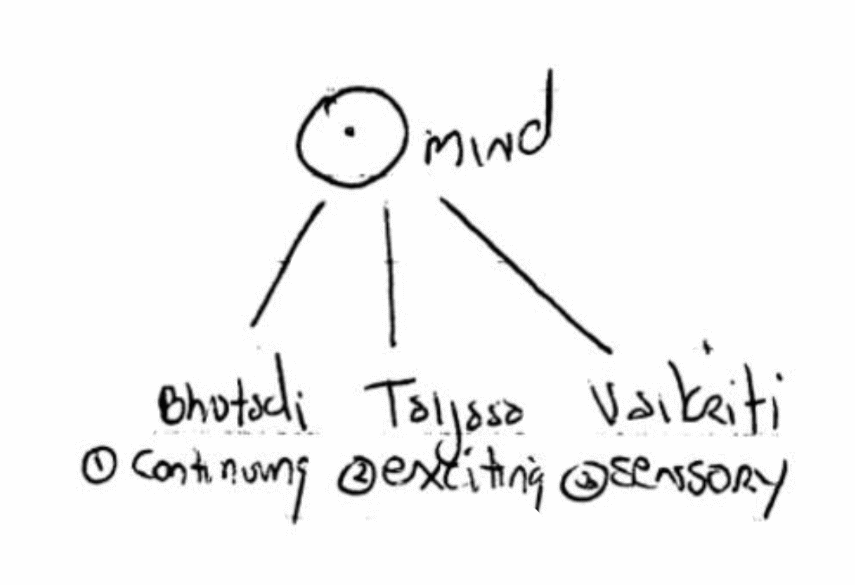
Three aspects of mind (ahamkara): vaikriti, bhutadi, taijasa; all three aspects operate simultaneously; dream example
Focus is on Sambhogakaya; key to understanding thangka painting
Critique of academic approach to understanding mind; importance of direct experience versus theoretical knowledge
For many, wiser and safer not to aim at Sambhogakaya experiences but to go the way of Vedanta or Zen
Vajrayana Buddhism a psycho-experimental approach
Reading B. Bhattacharyya, An Introduction to Buddhist Esotericism, on colors, mantras, and deities
Importance of cosmic colors associated with deities, mantras, directions; everything as condensation of cosmic colors
Mantras have same vibration as their presiding deities
No difference between Name and Form in cosmic sphere
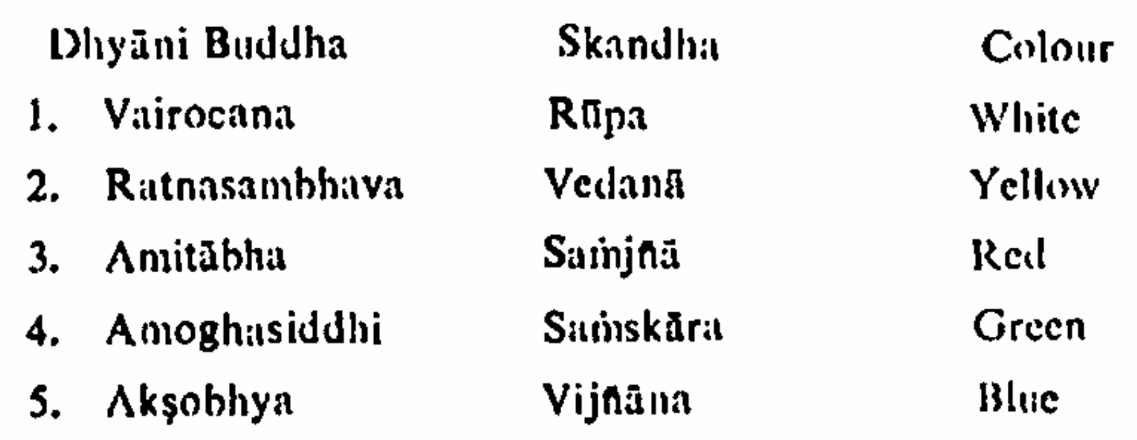
Bijamantras can be used to control five skandhas/elements
Four levels of mantra: gross, subtle, causal, void; movement from gross to subtle levels
BOOKS READ FROM OR REFERENCED:
C.G. Jung, CW 5, Symbols of Transformation
Joseph Campbell, The Hero with a Thousand Faces
Joseph Campbell, The Masks of God: Primitive Mythology
Plato, Parmenides, Symposium
Patanjali, Yoga-Sutras
Julian (Emperor of Rome), Thomas Taylor (tr.), Two Orations of the Emperor Julian; One to the Sovereign Sun, and the Other to the Mother of the Gods
George Santayana, Winds of Doctrine: Studies in Contemporary Opinion
Rudolf Otto, The Idea of the Holy
Krishnachandra Bhattacharyya, Studies in Philosophy, Vol. 1, "Studies in Samkhya Philosophy"
Herbert V. Guenther, Tibetan Buddhism in Western Perspective, "The Concept of Mind in Buddhist Tantrism"
Benoytosh Bhattacharyya, An Introduction to Buddhist Esotericism
Benoytosh Bhattacharyya, Gem Therapy
DIAGRAMS appended to this transcript:
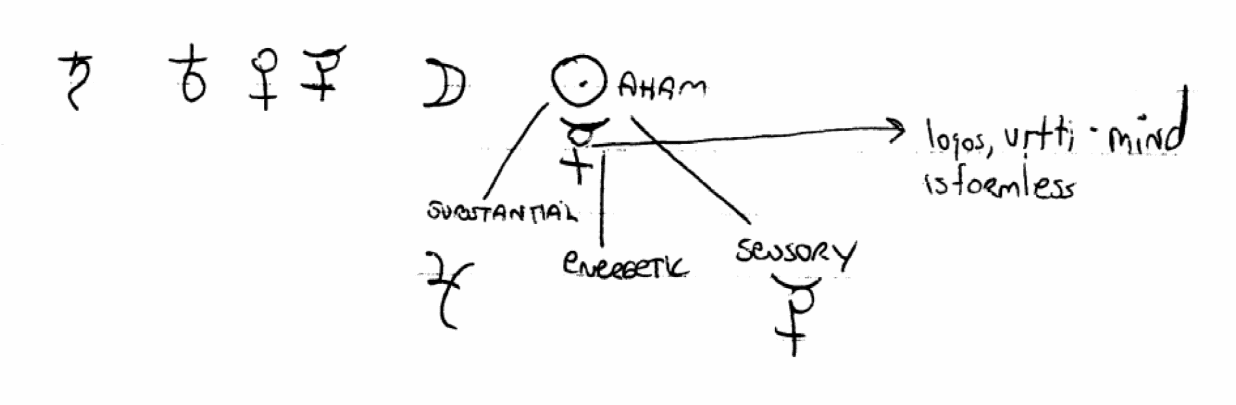
FIGURE 1978 0322-1-AB. Soul Monad, Logos, and Three Aspects of Ahamkara.
FIGURE 1978 0322-2-AB. Mind as Bhutadi, Taijasa, and Vaikriti.
FIGURE 1978 0322-3. Table correlating Dhyani Buddhas, Skandhas, and Colors.
Other diagrams also referred to are not with this transcript version. [Transcriber note: [diagram] means the speaker is referencing a diagram as he or she is speaking. If someone is drawing or writing, with audible sounds of chalk on a blackboard, I indicate this by [drawing] or [writing].]
TRANSCRIBED Verbatim by IT 2022. In 2024, IT completes TOC, adds one diagram and references within transcript to this diagram. In 2025, IT updates prefatory matter and audio file markers to match new REP audio. Archival verbatim transcript – V12a.
AUDIO FILES: 1978 0322a, 1978 0322b. [Note 1: "Tape" and "Side" refer to original audio cassette tapes that were later digitized into .MP3 Audio Files. Note 2: In 2024-25, REP Studio fixes all issues with audio files.]
1978 03/22 at Wisdom's Goldenrod
Buddhism; Yogacara
[Audio File 1978 0322a Begins]
AD: But, I'd spell 'esoteric' [chalk on board sounds as AD speaks] w-o-r-k. So that it won't be anything given to you unless you work to think. Now, the study of the Yogacara school is going to take some time. We have a few texts. Problem will only become available as we go along. This is also a very good book on the Yogacara, so I've been informed. Tremendous amount of information. Now if I-- I would like to proceed because I didn't want to do a certain amount of reading from various sources. Now, I've done this before but, I'm going to go further into it and expand it more. I have a particular dislike for words because they have a way of confusing and negating understanding. They-- they seem to be more involved in a rebuttal of understanding. So, I'm going to try to expand on the concept of what mind is. And for this I've had to go through a lot of sources and sort of connect a series of passages done by various writers, various thinkers, including some yogi. I'm going to start at the easiest level which I think for most of us here would be psychological. And I'm going to start by reviewing from Jung, Symbols of Transformation, the chapter on the nature of psychical energy or libido, and work my way gradually to an un-- an understanding or perhaps a glimpse that mind is light and what that implies, and, what's inherent in the notion of mind as light. [short pause] So, our readings will be varied. [short pause] Now, there is-- there is kind of, for instance, a very negative approach. Those of you who've read Joseph Campbell's Hero with, you know, a Thousand Faces and The Mask of God, he-- he has a strange statement in here I-- I thought that we start off with and immediately throw it into sharp relief what I'm trying to do. And he-- he makes the remark.
[Transcriber note: I am using The Masks of God: Primitive Mythology by Joseph Campbell, New York: The Viking Press, 1959, 1969.]
Joseph Campbell [The Masks of God: Primitive Mythology, pp. 4-5, AD reading]: "No one, as far as I know, has yet tried to compose into a single picture the new perspectives that have been opened in the fields of comparative symbolism, religion, mythology, [and] philosophy by the scholarship of recent years. [AD adds: And] The richly rewarded archaeological researches of the past few decades; astonishing clarifications, simplifications, and coordinations achieved by intensive studies in the spheres of philology, ethnology, philosophy…"
AD: Etc, ok. Now--
Joseph Campbell [The Masks of God: Primitive Mythology, p. 5, AD reading]: "…I attempt in the following pages the first sketch of a natural history of the gods and heroes, such as in its final form should include in its purview all divine beings -- as zoology includes all animals and botany all plants…"
AD: Alright, I just wanted to throw that out that, he's a modern. He has an intuition that there is a natural genesis of the gods, and that perhaps it would be possible to write a history of the gods, you know, try to show through the various disciplines that he mentions how this could be done. And my first remark would be first of all, that this has always been there for those who can perceive it. And secondly, his approach is through Jungian psychology and it'll come to a dead halt. But at any rate, there's the intuition, there's a man who suspects, you know, it's possible to get involved in and try to understand the genesis of the god, ok? And he takes it back to Parmenides, doesn't he? [student assents, faint] Parmenides concerned with the generation of the gods [three/few words inaudible] Well, with a very studied difficulty he manages to stay away from those people who had worked out these aspects.
Alright so, instead of, you know, being involved in the negative, let's see if we could work out for ourselves an understanding of what the meaning of mind is, because without an understanding of that I think most philosophies will go by the wayside. Everybody uses the term 'mind' in his own way. Everyone has his own name for it, ok? I have mine, and I'm going to try to do without it, ok. The easiest approach of course is psychological for most of us because there, first of all it's a science that grew up, you know, has been growing up in our generation, in our times, kind of awareness that you're part of the age in which this understanding is taking place. So, I'm going to be very specific because I'm going to try to later on eventually actually (move), show in terms of astrology gods that we're talking about. Alright. Like when we say Zeus, [S, very faint: Yeah.] (you know, a symbol). If you say, "Zeus is coming down on my Mars," now you-- it's a little close to home. In the introduction to the second section on the "Symbols of Libido", alright, he starts off by saying that--
C.G. Jung [CW 5, Symbols of Transformation, p. 121, paragraph 176, AD reading]: "The sun, as Renan [AD: An early French-- about nineteenth century.] has observed, is the only truly"rational'" image of God, [AD: The sun.] whether we adopt the standpoint of the primitive savage or of modern science."
AD: The both points of view are going to be involved.
C.G. Jung [CW 5, Symbols of Transformation, pp. 121-122, paragraph 176, AD reading]: "Therefore the sun is perfectly suited to represent the visible God of this world, [i.e.], the creative power [AD: also,"the creative power] of our own soul, which we call libido, and whose nature it is to bring forth the useful and the harmful, the good and the bad. That [AD reads: And] this comparison is not just a matter of words can be seen from the teachings of the mystics: when they descend into the depths of their own being…"
AD: And that's not into the depths, believe me. It's only if you're [one/two words inaudible] (ok).
S (very faint): Uh-hm. Right.
C.G. Jung [CW 5, Symbols of Transformation, p. 122, paragraph 176, AD reading]: "…when they descend into the depths of their own being they find"in their heart" the image of the sun..."
AD: You've heard the expression "midnight Sun".
C.G. Jung [CW 5, Symbols of Transformation, p. 122, paragraph 176, AD reading]: "…they find their own life-force which they call the"sun" for a legitimate and, I would say, a physical reason, because our source of energy and life actually is the sun. Our physiological life, regarded as an energy process, is entirely solar. [AD: Entirely solar.] The peculiar nature of this solar energy as inwardly perceived by the mystic is made clear in Indian mythology [AD reads: in many (one word inaudible) examples]."
AD: Perhaps-- he has one picture here of Bes, with Horus-eyes and there's a figure, you know, with outstretched wings and thousands of eyes all over his body (Jung, Fig. 11, p. 123), (ok). Or, uh-- [short pause] Then at any rate, when you see these many many eyes in any creature you can think of the Sun. He quotes from the Upanishad.
C.G. Jung [CW 5, Symbols of Transformation, p. 123, paragraph 177, AD reading, quoting Shvetashvatara Upanishad]: ""I know this mighty Person (purusha), who is like to the sun, transcendent over darkness. Those who know him truly pass beyond death; by no other road can they go. [AD rereads:"No other road can they go."]
"He is the face, the head, the neck of all, he dwells in the heart of all things, all-pervading, bountiful, omnipresent, kindly.""
AD: And, continuing, then Jung says--
C.G. Jung [CW 5, Symbols of Transformation, p. 123, paragraph 178, AD reading]: "The all-powerful God, who is"like to the sun," is in every one of us, and whoever knows him is immortal."
AD: Well, in a lot of the psychoanalytical literature they, you know, refer to Tom Thumbs, the Cabiri, and-- Most of these phallic symbols of course, they-- they do have a phallic aspect, but that's quite secondary. Jung says--
C.G. Jung [CW 5, Symbols of Transformation, p. 124, paragraph 180, AD reading]: "…they are personifications of creative forces, of which the phallus, too, is a symbol [AD repeats: symbol]. It represents the libido, or psychic energy in its creative aspect. [AD adds: And] The same is true of many other sexual images which are found not only in dreams and fantasies…"
AD: Alright, (we/you) don't need that. But this must be understood as a symbol and not as a sign. And if you don't take this approach then you're going to go into a reductive approach. And, he goes on and he says it's-- what's strange about the libido, alright, psychical energy, psychical essence, or any name you want to give it-- I'm not using the word 'mind' here. He says, what's strange about the libido is that it--
C.G. Jung [CW 5, Symbols of Transformation, p. 125, paragraph 182, AD reading]: "…is not only creative and procreative, but [AD adds: it] possesses an intuitive faculty, a strange power to"smell the right place"…"
AD: (Ok.) So don't complain about the magic.
C.G. Jung [CW 5, Symbols of Transformation, p. 125, paragraph 182, AD reading]: "…(which is why it is so easily personified)."
AD: And it has a purpose like these things usually do.
C.G. Jung [CW 5, Symbols of Transformation, p. 125, paragraph 182, AD reading]: "…[AD adds: and] like sexuality itself, [AD adds: it is] a favourite object of comparison. [AD adds: Referred to as] The"realm of the Mothers" [AD adds: it] has not a few connections with the womb [(fig. 12)], with the matrix, which frequently symbolizes the creative aspect of the unconscious. [AD adds: And] this libido is a force of nature, good and bad at once, or morally neutral."
AD: He goes into a long etymological approach to try to understand the meaning or the use of the word 'libido'. You could read this for yourself, alright. But he does end up by saying something like this.
C.G. Jung [CW 5, Symbols of Transformation, p. 130, paragraph 186, AD reading]: "The use of libido is so general that the phrase"libido est scire" merely means [AD reads: so general that it merely ends up by saying-- meaning something like this] 'I like,' 'it pleases me.'"
AD: So, we can say it's a general term for all desire. Right? That so far we be-- we're getting into-- And analogous approach would be like to think of libido like the same way we think of energy in physics. But, this is like on the side of life. Um-- [short pause] And again, here's something that we're going to need in trying to understand this concept, that is, his concept of libido, psychical energy, ok, or--
[short pause]
C.G. Jung [CW 5, Symbols of Transformation, pp. 136-137, paragraph 195, AD reading]: "This [AD reads: The] throwing of psychological perceptions into material reality is known in philosophy as"introjection." Through introjection one's world picture becomes subjectivized, and it is to this same process that the physical concept of force owes its existence. [AD adds: And] As Galileo aptly remarked, its origin is to be sought in the subjective perception of our own muscular power. Similarly, the concept of libido as desire or appetite is an interpretation of the process of psychic energy, which we experience precisely in the form of an appetite. We know as little about what underlies it as we know about what the psyche is per se."
AD: In the same way like for instance in physics when we speak about force, we come up with this concept of force because, you know, we're aware of our muscular-- we're aware of our muscular structures when we, let's say, have to use it and we begin to realize or we think that we understand the nature of force in the outer world. But the concept has arisen from within what you might call the condensation or the structuralizing of the body and the muscles and the way we function with that body. And then we project outwardly and say "Oh yes, I understand the forces. I experience it like when I," you know-- Alright? So there's this subjectivization that's taking place. He goes on, he says--
C.G. Jung [CW 5, Symbols of Transformation, p. 137, paragraphs 196, 197 AD reading]: "Having once made the bold conjecture that the libido which was originally employed in the production of ova and spermatozoa is now firmly organized in the function of nest-building, for instance, and can no longer be employed otherwise, we are compelled to regard every striving and every desire, including hunger and instinct however understood, as equally a phenomenon of energy.
"This view leads to a conception of libido [AD: Or psychical energy or whatever term you want to use.] which expands into a conception of intentionality in general."
AD: Expands into a conception of subjectivity. Subjective intention, you might say.
C.G. Jung [CW 5, Symbols of Transformation, p. 137, paragraph 197, AD reading]: "As the above quotation…"
AD: I'm sorry, I didn't read the quotation so we'll leave that out. So, we're--
C.G. Jung [CW 5, Symbols of Transformation, p. 137, paragraph 197, AD reading]: "…to understand it as an [AD reads: understand this] energy-value which is able to communicate itself to any field of activity whatsoever, be it [AD reads: whether you call it] power, hunger, hatred, sexuality, or religion… As Schopenhauer says [AD reads: And Schopenhauer put it this way, he says]:"The Will as a thing-in-itself…""
AD: And again, underline, you know, quote 'Will'. You don't know what it is, I don't either.
C.G. Jung [CW 5, Symbols of Transformation, p. 137, paragraph 197, AD reading, quoting Schopenhauer]: ""The Will as a thing-in-itself is quite different from its phenomenal manifestation, and entirely free from all forms of phenomenality [AD reads: phenomena], which it assumes only when it becomes manifest, and which therefore affect its objective only, and are foreign to the Will itself.""
AD: So you get the feeling that what Schopenhauer is talking about here is, the Will is one thing and what manifests, alright, is different from the Will. And so, what this underlying Will is which presents phenomenal manifestation is really unknown. So you have there, alright, similarly like to what Jung is speaking about. We know psychical energy in terms of for instance when you say you want something or you desire something or you like something. But what the underlie, what the psyche per se is, this psychical energy, we don't know. Alright? And we're going to come across this over and over and over and yet everybody will be speaking either about mind, about will, about psychical energy, psychical essence, reason-principles, productive principles. Well it's like around, about, under and over but never it. Well, we'll go on with this because I think this might help us. At any rate it'll illuminate our ignorance if nothing else and that-- that's something, you know? [S, faint: Yeah.] To know that you don't know? Yeah I think that's-- that's a big thing. You have to excuse me 'cause I'm trying to go-- go through this as fast as possible so I will not read connected passages. But if you follow the thought you'll see the idea is connected.
Now in the third chapter he speaks about the transformation of libido, or we could say the transformations of-- What would Patanjali say? In the very beginning of the first aphorism in Yoga he says yoga is concerned with the cessation of the mind's functioning. So what yoga is concerned with is stop thinking. Could we say instead of saying the mind's functioning, could we say the cessation of the psychical energy? Could we say the restriction, the (corking/caulking) of the psychic functioning? I think you could. So, in this next chapter on the transformation of libido, he speaks about for instance-- and I-- this is just to refresh all of (our--) He speaks about--
C.G. Jung [CW 5, Symbols of Transformation, p. 143, paragraph 206, AD reading]: "[We know that] in infants the libido first manifests itself exclusively in the nutritional zone, where, in the act of sucking, food is taken in with a rhythmic movement."
AD: Now mothers know this, fathers may not.
C.G. Jung [CW 5, Symbols of Transformation, p. 143, paragraph 206, AD reading]: "…where, in the act of sucking, food is taken in with a rhythmic movement [AD reads: motion]."
AD: This is very important, this notion of rhythm. Extremely so.
C.G. Jung [CW 5, Symbols of Transformation, pp. 143-144, paragraph 206, AD reading]: "At the same time there develops in the motor sphere [AD rereads:"At the same time there develops in the motor sphere] in general a [AD reads: a general] pleasurable rhythmic movement of the arms and [AD adds: the] legs (kicking, etc.) [AD reads: like kicking, alright]. [AD adds: And] With the growth of the individual and [AD adds: the] development of his organs the libido creates for itself new avenues of activity. The primary model of rhythmic movement, producing pleasure and satisfaction, is transferred to the zone of other functions, with sexuality as its ultimate goal. This is not to say that the rhythmic activity [AD emphasizes rest of sentence] derives from the act of nutrition."
AD: In other words, we can imagine the psychical energy, alright, first being involved in sucking because that's nutrition and without it we won't be around that long. And then moving on to further kinds of functional activity. Now, it is not to say because temporally comes, let's say (on) a later phase than nutrition, that it comes from nutrition, but that this psychical energy is going along, you know, activating itself in a nutritional realm, then going along, activating itself in let's say the se-- culminating in sexual activity. So he doesn't want you to think of it in any aetiological sense. It's not derived from that. Psychical energy is pursuing, seeking out its own goal, whatever that may be. Remember the way he speaks about it? It's very intuitive. Now you may think this is metaphorical but believe me, it isn't. It knows what it's after much more than you do. As a matter of fact you get victimized. I should say we get victimized, I got six boys. (laughter) Alright so, he says-- he goes on and he says--
C.G. Jung [CW 5, Symbols of Transformation, p. 144, paragraph 206, AD reading]: "This is not to say that the rhythmic activity derives from the act of nutrition. A considerable part of the energy supplied by nutrition for growth has to convert itself into sexual libido and other forms of activity. This transition does not take place suddenly at the time of puberty, as is commonly supposed, but only very gradually during the course of childhood. In this transitional period there are, so far as I am able to judge, two distinct phases: the phase of sucking, and the phase of rhythmic activity in general."
AD: And he goes on and he says--
C.G. Jung [CW 5, Symbols of Transformation, p. 144, paragraph 206, AD reading]: "The phase of rhythmic activity generally coincides with the development of [AD adds: the] mind and speech."
AD: Alright. So I'm not going to go into the aetiology and the whole psychological development of personality, but, I think the general trend if you watch this is that what he's going to try to do is trace this psychical energy as it finds various outlets or creates various outlets towards manifestation. But all the time we don't know what this psychical energy, libido--I almost said it--you know, is, ok? He goes into a very beautiful description of fire rituals which in primitive societies there's quite an intense preoccupation. And, I don't want to go into that because we have too much to do. At any rate, he says assuming that the libido is now forced back by some sort of obstacle, ok. Like for instance we want to get on the quest. That forces the libido backwards, and it's not (going to let him) do that--"Move back," alright. Or, real young boy who's confronted with going out into the world, you know, he'll back away, the libido backs away and says "I don't want to get into that," alright. Alright, he says, assuming some sort of obstacle arises--
C.G. Jung [CW 5, Symbols of Transformation, p. 154, paragraph 218, AD reading]: "…it does not necessarily [AD: This libido.] regress to earlier sexual modes of application, but rather to the [AD adds: to a sort of] rhythmic activities [AD reads: activity]…"
AD: Which was first displayed when we were infants, like kicking, you know, scratching, (keep poking), you know? You ever watch yourself when you're waiting for someone? You start engaging in all kinds of nervous activities. Almost patterns. They're almost like patterns, you know. And he expands on this considerably. Now, he says, even if these rhythmic activities-- now we're speaking about these rhythmic activities like the way your wife and, you know, kicking everything that you see around, ok. [S: Ok.] Or, you're in a restaurant and you're waiting for someone and-- and you start playing tic-tac-toe all over the tablecloth. (laughter) I've seen that, I-- I imagine everybody else did. (laughter)
S (very faint): [few words inaudible]
S (faint): I don't know.
AD: But there is this rhythmic activity. Rhythm here is extremely important because it's going to lead us into some very strange phenomena, very strange consequences. He says--
C.G. Jung [CW 5, Symbols of Transformation, p. 154, paragraph 219, AD reading]: "Even if these rhythmic activities give one the impression of a game, one is nevertheless impressed by the intentness [AD: The intentness.] and energy with which this alleged game is conducted. It is [AD reads: And it's] well known that such rites…"
AD: And that's how we must regard it. Now you don't think you're engaging in a rite, right? (bit of laughter) I mean you're bad tic-tac-toeing all over the tablecloth but you don't think that this is a rite. It is. It is. (It's) a subjective intensity going on. It becomes clearer. He says it's--
C.G. Jung [CW 5, Symbols of Transformation, p. 154, paragraph 219, AD reading]: "…performed with great seriousness and an uncommon display of energy, which is [in] marked contrast to the notorious laziness…"
AD: That we generally participate, you know. (some laughter) But, however, this is a case, he says--
C.G. Jung [CW 5, Symbols of Transformation, p. 154, paragraph 219, AD reading]: "This is in fact the case, for rhythm is a classic device for impressing certain ideas or activities on the mind, and what has to be impressed and firmly organized is the canalization of libido into a new form of activity."
AD: Now you're waiting for your boyfriend, right, and he don't show up and you're trying to figure out well, what's the next thing, you know? New form of activity. The intentness with which these things are carried on already can assure you that there's a tremendous amount of subjectivity involved. At any rate, without going into details, he goes on and he says--
C.G. Jung [CW 5, Symbols of Transformation, p. 155, paragraph 219, AD reading]: "Any kind of excitement, no matter in what phase of life, [AD: You know, any kind of intense excitement.] displays a tendency to rhythmic expression, perseveration [AD reads: perseverance, perseveration], and repetition, as can easily be seen from [the] repetition, assonance, and alliteration of complex-toned reaction-words in the association experiment [AD reads: in association experiments]. Rhythmic patterns therefore offer no ground for assuming that the function they affect originated in sexuality."
AD: Now if you remember he pointed out that this rhythmic activity appears simultaneously with the sucking phase and there it is. Child's kicking, alright. And he's not going to derive sexuality or rhythm one from the other. Again-- [10¾ second pause] Um-- [short pause] He goes on and he says--
C.G. Jung [CW 5, Symbols of Transformation, p. 157, paragraph 223, AD reading]: "Except when motivated by external necessity, the will to suppress or repress [the] natural instincts, or [rather] to overcome their predominance [(superbia)] and lack of co-ordination [(concupiscentia)], derives from a spiritual source; in other words, the determining factor is the numinous primordial images. [AD adds: And] These image, ideas, beliefs, or ideals operate through the specific energy of the individual, which he cannot always utilize at will for this [AD reads: his] purpose, but which seems rather to be drawn out of him by [the] images."
AD: Now, we're speaking about the one-- on the one hand the psychical energy which is, you know, manifesting itself in a score of activity. We say it underlies these activities, we may not know what these activities are, but we know that it is the driving power behind it. Now, again I'm going to re-- repeat this para-- short excerpt.
C.G. Jung [CW 5, Symbols of Transformation, p. 157, paragraph 223, AD reading]: "Except when motivated by external necessity, the will to suppress or repress the natural instincts, or rather to overcome their predominance [(superbia)] and lack of co-ordination [(concupiscentia)], derives from a spiritual source; [AD adds: or] in other words, the determining factor is the numinous primordial images. [AD adds: And] These image, ideas, beliefs, or ideals operate through the specific energy of the individual, which he cannot always utilize at will for this purpose, but which seems rather to be drawn out of him by [AD reads: from] the images."
AD: Well, if we could try to expand that a little bit, I think he would be saying something to the point that, whenever we're going to confront a certain instinct, alright, you won't have the power to confront it, organized or get coordinated with it unless from within the images which are within ourselves there could be derived some sort of meaning, some sort of drive or power. And without this numinosity that these images offer us, he can't do it. I think-- what do you think, you think he's saying that?
C.G. Jung [CW 5, Symbols of Transformation, p. 157, paragraph 223, AD reading]: "Except when motivated by external necessity, the will to suppress or repress [AD reads: the will to overcome] [the] natural instincts, or…lack of co-ordination…derives from a spiritual source; in other words, the determining factor is the numinous primordial images."
AD: So that actually to overcome some sort of instinctual behavior without the help of these numinous images, it's almost impossible to do. I think that's what he's saying. Yeah.
AH (faint): I don't understand that at all (frankly. What is the number?)
S: Uh-hm.
AD: Suppose like you say you have a certain ideal that you'd like to accomplish, you know? Or let's say that you want to behave in a certain way, you want to alter your behavior or any-- you want to live up to higher ideal. And then, let's say, the natural instincts like, you know, sexuality or lust for power or any of those things come right up and say "Like hell you are," you know? "You're not going to do that." Now, unless there's some sort of primordial image, let's say like you see an image of a Buddha, Adi Buddha, something which organize, you know, draws out from you the power, alright, to be able to deal with that. And he says unless these primordial images are there and you can draw on them the meaning that's in these images, you won't be able to do it. Ok? [S: (I could do.)] I mean this kind of exaggerate but more or less, that it's out of these images that we have to find the spiritual power to overwhelm or overcome what we, you know-- for that to put in its place, you know? After all, you know, we're operating with an animal body and sometimes it could be a pain in the neck. Sometimes more than that. But it has to be dealt with sooner or later. That's one of the, you know [one/two words inaudible] tasks.
At any rate, you can see now that on the one hand there's these kinds of images in the mind which have a certain numinosity, and that they have to be activated by a certain amount of energy in order for them now to put aside or put back, let's say, the kind of behavior or instinctual patterns that we feel are no longer, you know, something that we should live out. [short pause] (And we--) He has quite a few examples and I really would like to avoid them. And unless-- I think it would be easier for me to just give you simple examples and you'll only take complicated psychological ones.
So, he goes into the-- Now, in the next few pages in "The Transformation of the Libido" he goes into a very long-winded search into the meaning, the derivation, of fire, ok? And he shows how it has cropped up in so many civilizations, what a big ritual surrounds it, how important it is. And if anything symbolizes man as a superior being of course I would say fire is one, speech another, ok. Some would say the Leo and some might say Logos but, fire would be the important one. And a lot of rituals consider(ed) fire. And, do you remember like when you were child where you're fascinated when you'd see fire? Strike a match and-- If you think back to your childhood, your first encounter with fire. And there's something very magical about it. Anyway, he goes into the whole etymology of fire. And I think his purpose would reveal itself. He speaks about for instance Ezekiel's vision, you know, speak-- with Moses when he sees the burning bush. Over and over again, instances of fire. [short pause] He goes into some-- some of it in terms of the voodoo operation, how important it was in the building of the altar, you know, which was a sacrificial fire. Everything had to be done according to certain ritual, precisely, one mistake and the whole thing was--
Alright, let me get then to this point, we're speaking about psychical energy and its association with fire and all the possible implications that it had. Now, if like we inquired, as we've done in some other work, at some other instant we inquired into the nature of light, what light is, alright, and in the Platonists they go through this vigorous reasoning process of showing that light contains a symbolical representation of a-- a certain principle, over here we have the same thing but on a psychological level, he starts with the--
C.G. Jung [CW 5, Symbols of Transformation, p. 164, paragraph 237, AD reading]: "[AD adds: That] These images [AD adds: of fire, and--] point back to the sun-god Apollo…"
AD: Now he's using a Greek example. And in the Greek version of course Apollo is not only a sun-god.
S: What is it?
C.G. Jung [CW 5, Symbols of Transformation, pp. 164-165, paragraph 237, AD reading]: "…whose lyre marks him out as the divine musician. The fusion of sound, speech, light, and fire is expressed in an almost physiological way in the phenomenon of"colour-hearing," i.e., the perception of [the] tonal quality of colours and the chromatic quality of musical tones."
AD: You've heard of musicians who, when they hear sound they also see colors. You've heard of that, you know, like Scriabin. You hear and see color and sound. Or it seems like there's-- there might be some sort of identity, you know, prior to its conscious differenti-- differentiation, that all these things are really one but when they get thrown out they get differentiated. At any-- any rate he says--
C.G. Jung [CW 5, Symbols of Transformation, p. 165, paragraph 237, AD reading]: "This leads one to think that there must be a [AD reads: be some sort of] preconscious identity between them: the two phenomena have something in common despite [their] real differences."
AD: Now, color and sound do have something in common but they also have real difference.
C.G. Jung [CW 5, Symbols of Transformation, p. 165, paragraph 237, AD reading]: "It is probably no accident that the two most important discoveries which distinguish man from all other living beings, namely speech and the use of fire [AD reads: and he says of speech and fire], [AD adds: and consequently they] should have a common psychic background. Both are products of [psychic] energy, of [AD reads: or] libido [or mana]. In Sanskrit there is a term which expresses in all its nuances the preconscious situation…"
AD: Now hold onto that word, "the preconscious situation".
C.G. Jung [CW 5, Symbols of Transformation, p. 165, paragraph 237, AD reading]: "This is the word tejas [AD reads: And this word is tejas]…"
AD: And he gives the Sanskrit dictionary meaning which he got from Monier-Williams. [Note: Jung's footnote says Macdonell, Sanskrit Dictionary, p. 112.]
C.G. Jung [CW 5, Symbols of Transformation, p. 165, paragraph 237, AD reading]: "1. [AD adds: It means] Sharpness, cutting edge. 2. Fire, brightness, light, ardour, heat [AD reads: heat, ardour]. 3. [Healthy] appearance, beauty. 4. [The] fiery and colour-producing faculty of the human organism (located in the bile). 5. Strength, energy, vital force. 6. Passion. 7. Spiritual and magical power; influence, position, dignity. 8. Semen."
AD: You know that. [student assents, very faint] These are all definitions, you know, that he's pulling out from the meaning of tejas in Sanskrit.
S (very faint): Say those again please, (Tony).
AD: Repeat the--
S (very faint): Yeah and then the other one [couple words inaudible]
C.G. Jung [CW 5, Symbols of Transformation, p. 165, paragraph 237, AD reading]: "1. Sharpness, cutting edge. 2. Fire, brightness, light, ardour, heat. 3. Healthy appearance, beauty. 4. [The] fiery and colour-producing faculty of the human organism [AD adds: which is] (located in the bile). 5. Strength, energy, vital force. 6. Passion. 7. Spiritual and magical power; influence, position, dignity. [AD adds: And] 8. Semen."
AD: Tejas, alright.
C.G. Jung [CW 5, Symbols of Transformation, p. 165, paragraph 238, AD reading]: "Tejas, therefore, describes the psychological situation covered by the word"libido.""
AD: Let's see if we'll-- we'll begin to see the connection he's making. Tejas, libido, ok?
C.G. Jung [CW 5, Symbols of Transformation, p. 165, paragraph 238, AD reading]: "Tejas, [therefore], describes the psychological situation covered by the word"libido." It really denotes subjective intensity."
AD: Subjective intensity.
C.G. Jung [CW 5, Symbols of Transformation, p. 165, paragraph 238, AD reading]: "Anything potent, any content highly charged with energy, [therefore] has a wide range of symbolic meanings. This is obvious [AD reads: evident] enough in the case of language, which is capable of expressing practically anything. But it may not be out of place to say a few words about [the symbolism of] fire."
AD: I don't want to go into this. You do it yourself. And then of course he-- next page he speaks about Plato's Symposium where he has a discussion on Eros which is really quite beautiful. If you haven't read Symposium you're uneducated.
S (very faint): Banquet Symposium?
AD: Banquet. The Banquet, (yeah). On Love. He speaks about that as the fiery furnace, the tripod. All these things, alright. And another place Jung remarks that he who hasn't gone through his passion is like an (explosive) furnace. Doesn't feel cooked enough yet. (bit of laughter) Yeah. [short pause] Then he goes on, and-- I'm sorry I'm rushing. But you can-- all that I'm saying is within those chapters, and if you reread it it'll become much more meaningful. Like I said in the beginning of the class I like you to forgive me for approaching this problem of Yogacara Buddhism in my way. It is my way because it was my experience I'm going by. I am not going by any text. And, there's something in me that assures me when a person knows what he's talking about, and there's something in me when-- tells me very clearly and distinctly this man is writing somebody else's words, they're not his. It's not his experience, not yet, alright. So I-- I have to follow my (individual) experience. And it's possible that sometimes you might pick it up, like you very often do. So he says here--
C.G. Jung [CW 5, Symbols of Transformation, p. 171, paragraph 251, AD reading]: "The finest of all symbols of the libido is the human figure, conceived as a demon or [AD adds: a] hero. Here the symbolism leaves the objective material realm of astral and meteorological images and takes on human form, changing into a figure who passes from joy to sorrow…and, like the sun, now stands high at the zenith and now is plunged into [AD adds: the] darkest night, only to rise again in new splendour. Just as the sun, by its own motion and [in] accordance with its own inner law [AD reads: laws], climbs from morn [AD reads: morning] till noon, crosses the meridian and goes its downward way towards evening, leaving its radiance behind it, and finally plunges into [AD adds: an] all-enveloping night, so man sets his course by [AD adds: the] immutable laws and, his journey over, sinks into [AD adds: the] darkness, to rise again in his children and begin the cycle anew."
AD: And of course what he's talking about here is the birth of the solar hero, ok. In Hinduism generally the person who seeks liberation is referred to as vicara or hero. [Note: AD possibly thinking of the word 'vira'.] Now, he says, unless a person doesn't know how to handle his libido, the world is going to be a very empty place for him. And, it does take-- it takes a little effort and one begins to see that the direction of his libido is a really very important undertaking on his part. That may give us a hint as to what the task of the sun-god or-- the sun-god is like the prototype, the hero, that the human being follows. Not that he's human once he gets on the way. He says--
C.G. Jung [CW 5, Symbols of Transformation, p. 202, paragraphs 296, 297, AD reading]: "The sun comparison tells us over and over again that the dynamic of the gods is psychic energy. This is our immortality, the link through which man feels inextinguishably one with the continuity of all life. The life of the psyche is the life of mankind. [AD adds: And] Welling up from the depths of the unconscious, its springs gush forth from the root of the whole human race, [AD adds: and] since the individual is, biologically speaking, only a twig broken off from the mother and transplanted.
"[AD adds: So] This psychic life-force, the libido, symbolizes itself in the sun or personifies itself in figures of heroes with solar attributes. [AD adds: And] At the same time it expresses itself through phallic symbols."
AD: Ok. So, perhaps now we can understand for instance why the cock, you know, starts crowing in front of a lion the lion doesn't gobble him up, he's a solar-- solar animal, the lion just respects the solarity-- solar principle that's in him. And, here we're beginning to see this connection over and over again that he's trying to make between the Sun, alright, and the psychical energy which is in you. And, it has some interesting diagrams which I won't go into. Now, one other point here, and I'll close the book on this one. [13 second pause] And this is important because this one gets close to the subject we've been discussing in Buddhism, you know. But in Buddhism we're discussing the gods, and we're going to try to discuss-- discuss them in a way that they would be intimate, you know, to our own being. And when you start-- you start saying the Bitsu [Note: Butsu], Om Namu Amida Bitsu [Note: Butsu], and if you think it's some guy living out in another galaxy, he has no interest in you and you shouldn't be saying the mantram. And part of the reason I'm going through this is to-- for those of you who have a mantram, to bring home the meaning and a recognition that what you're talking about is within you. And also, incidentally, and I don't mind saying this, you know, kind of understanding of what astrology is, so [one word inaudible] so irreverent, that it really deserves to be thrown overboard, unless this is first understood. If this is not understood, if the implications of what these things are about are not understood, then astrology is as mundane as any kind of talking that goes on in the barroom Friday night at 2 A.M. He goes here, he goes on saying something like this.
C.G. Jung [CW 5, Symbols of Transformation, p. 255, paragraph 388, AD reading]: "…it is the hero or god [AD reads:"…it is the god, the hero or the god"] who rejuvenates himself."
AD: Sun, alright, we're talking about Sun.
C.G. Jung [CW 5, Symbols of Transformation, p. 255, paragraph 388, AD reading]: "These [AD reads: The] figures are generally expressed or characterized by libido-symbols [AD adds: like] (light, fire, sun, etc.)…"
AD: These are libido symbols, consciousness, alright, ok.
C.G. Jung [CW 5, Symbols of Transformation, p. 255, paragraph 388, AD reading]: "…so that it looks as if they represented [AD reads: represent] psychic energy. They are, in fact, [AD repeats: They are, in fact] personifications of [the] libido. Now it is [AD reads: it's] a fact amply confirmed by psychiatric experience that all parts of the psyche…"
AD: All parts of your mind. All parts of the psyche.
C.G. Jung [CW 5, Symbols of Transformation, p. 255, paragraph 388, AD reading]: "…possess a certain autonomy…"
AD: You know, independence, freedom.
C.G. Jung [CW 5, Symbols of Transformation, pp. 255-256, paragraph 388, AD reading]: "…exhibit a personal character, like the split-off products of hysteria and schizophrenia, [AD adds: and] mediumistic"spirits," figures seen in dreams, [etc]. Every split-off portion of libido, every complex, has or is a (fragmentary) personality. [short pause] At any rate, that is how it looks from the purely observational standpoint. But when we get into the matter more deeply, we find that they are really archetypal formations. There are no conclusive arguments against the hypothesis that these archetypal figures are endowed with personality at the outset and are not just secondary personalizations. In so far as the archetypes do not represent mere functional relationships, they manifest themselves [as daimones], as [AD reads: in] personal agencies. [AD: Or as personal agencies. (aside: Put them right there.)] In this form they are felt as actual experiences and are not "figments of the imagination," as rationalism would have us believe. Consequently, man derives his human personality only secondarily from what the myths call his descent from the gods and heroes; or, to put it in psychological terms, his consciousness of himself as a personality derives primarily from the influence of [AD adds: these] quasi-personal archetypes. [AD adds: And] Numerous mythological proofs could be advanced in support of this view."
S (very faint): Yeah, (uh-hm).
AD (faint): (Get up.)
S (very faint): Yeah.
AD: Get a feeling of what he's been working at? Yes.
SD: Is this stuff-- is he saying something like this, [AD simultaneously: Ok.] that we would-- when we see an archetype functioning there seems to be a type of personality that goes with it, and that an initial assumption might be that first there's our personality and then our personality invests this archetype with a personal functioning but he's saying that the reverse is true, that the personal functioning of the archetype--
(Side 1 of original cassette tape digitized as 1978 0322a Ends; Side 2 Begins)
SD: --is what creates our personality.
AD: You got that feeling?
S (very faint): Yeah.
AD: Yeah I think you're on the right track, Severin. I-- he didn't use the word Sambhogakaya from which all supposed individual entities are suspended. But you get the feeling that from the functioning of these archetypes our personality is suspended therefrom, alright, and that it's like we're a reflection of that psychical energy. Now, that was a relatively easy way to understand something about psychical energy. I think I should punish you a little bit and give you a difficult way. [students assent, bit of laughter] This is a philosophic way. And this is a way that comes from-- from ancient Greece. And it was written by an Emperor of Rome, Julian. You've heard of Julian, I suppose. He too was an initiate and (this) family-- in his family there was for generations they were at the service of the god really also known as Apollo. He was a priest of Apollo and he considered himself a follower of Apollo. Apollo by the way means "not many". And, Julian perhaps said a little too much, from what I heard. That he revealed too much about the Sun mystery prematurely and the protection that was afforded him was withdrawn and he was slain in battle, well almost, and then died short while after the battle. But he wrote a short series of essays and two of them have been printed and one is called the Oration of the Emperor Julian to the Sovereign Sun. I'm going to read from the Oration, I'm not going to read from the preface, which is blinding. And I'm only going to read some extracts and they're extremely difficult but I'm going to ask you to pay attention because here this man is attacking the problem in a way that Jung would call metaphysical, and therefore, you know, not susceptible to proof. Well, I won't argue with that point now. I've chosen these sections, they're very very subtle but they're so much to the point it's unbelievable. And I can see why that protection was withdrawn.
[Transcriber note: I am using Two Orations of the Emperor Julian; One to the Sovereign Sun, and the Other to the Mother of the Gods by Julian (Emperor of Rome), translated/annotated/introduced by Thomas Taylor, London: Edward Jeffrey, Pall Mall, 1793.]
Julian, Thomas Taylor (tr.) [Two Orations of the Emperor Julian, p. 7, AD reading]: "It is, indeed, my opinion, [AD: says the Emperor Julian] that the sun [(if we may credit the wise)] is the common father of all mankind; for as it is very properly said, man and the Sun generate man. But this deity [AD reads: god] [AD: The Sun.] disseminates…"
AD: You know what that means? Goes out, projects, produces.
Julian, Thomas Taylor (tr.) [Two Orations of the Emperor Julian, p. 7, AD reading]: "…disseminates souls into the earth…"
AD: Well, ok? The Earth, right, we'll leave it right here.
Julian, Thomas Taylor (tr.) [Two Orations of the Emperor Julian, pp. 7-8, AD reading]: "…not from himself alone, [AD: Not from the Sun alone.] but from other divinities [AD adds: other gods]; and these evince [AD reads: show] by their lives the end of their [AD reads: the] propagation."
AD: Now what he's saying here is, the lives that we live, insofar that they come to an end it shows that the functioning of the gods as they are, so to speak, all function through the Sun, alright, because prior to that they're all in a state of union, and the Sun produces these souls or projects them out into the Earth, that they represent the end of the line, so to speak. There is no further propagation beyond that point.
Julian, Thomas Taylor (tr.) [Two Orations of the Emperor Julian, p. 8, AD reading]: "And his destiny will…"
AD: Well, we'll leave out his personal problem. Now, we hear him say that, you know, the Sun is what produces or projects the souls on Earth. Now, what are the means, you know you'd say well, you know, that-- I mean this guy is kidding, you know. Sun's 93 million miles away, right? It takes eight minutes, by that time (bit of laughter) anything coming from the Sun will be-- I don't know. What would the scientists say? Anyway he says-- he says but wait a minute. This is how-- He doesn't say it but I'm saying it. He says this is how it's done, anyway this is a little bit of a feel. He says let's begin the contemplation about light.
Julian, Thomas Taylor (tr.) [Two Orations of the Emperor Julian, p. 16, AD reading]: "…is not light the incorporeal and divine form of that which is diaphanous in energy [AD reads: in nature-- in energy]?"
AD: You know, like it's transparent, you can't see through it.
Julian, Thomas Taylor (tr.) [Two Orations of the Emperor Julian, p. 16, AD reading]: "But whatever that which is diaphanous may be, which is subjected to all the elements, and is their proximate form…"
AD: I know this language is quaint and you'll probably pull your hair out, so you can listen when I finish the paragraph.
Julian, Thomas Taylor (tr.) [Two Orations of the Emperor Julian, p. 16, AD reading]: "…which is subjected to all the elements [AD reads: forms], and is their proximate form, it is certain that it is neither corporeal nor mixt, nor does it display any of the peculiar qualities of body."
AD: We're speaking about light. We're speaking about what we before called tejas. Ok?
Julian, Thomas Taylor (tr.) [Two Orations of the Emperor Julian, pp. 16-17, AD reading]: "Hence you cannot affirm that heat is one of its properties, nor its contrary cold; you can neither ascribe to it hardness nor [AD reads: or] softness, nor any other tangible difference; nor attribute taste [or] smell…[AD: etc]: for a nature of this kind, [AD: This diaphanous light."…a nature of this kind] which is called forth into energy by the interposition of light, is alone subject to the power of sight. But light is the form of a diaphanous essence, which resembles that common matter, the subject of bodies [AD reads: body]…"
AD: The subject of body. Boy, the accuracy is uncanny. Not even Samkhya gets this close.
Julian, Thomas Taylor (tr.) [Two Orations of the Emperor Julian, p. 17, AD reading]: "But light is the form of a diaphanous essence [AD reads: substance or essence], which resembles that common matter, the subject of bodies, through which it is every where diffused; and rays are the summit, and as it were, [AD adds: the] flower of light, which is an incorporeal nature. But [AD reads: Now] according to the opinion of the [AD reads: of some ancient] Phaenicians…"
AD: And, you know, at that time there were-- you had the culture of the Phoenicians and Persians and--
Julian, Thomas Taylor (tr.) [Two Orations of the Emperor Julian, pp. 17-18, AD reading]: "…the universally diffused splendor of light is the sincere energy of an intellect perfectly pure; and this doctrine will be found agreeable to reason, when we consider, that since light is incorporeal, its fountain cannot be body, but the sincere energy of intellect, illuminating in its proper habitation the middle region of the heavens: and from this exalted situation scattering its light, it fills all the celestial orbs with powerful vigor, and illuminates the universe with divine and incorruptible light."
AD: Ok, stop there. What did he say? Any idea now? I know this is a little more difficult.
IF (faint): Because [couple words inaudible] is coming there translated. Can you repeat that light is the form of--
AD: I'm sorry? Can I repeat which part?
IF: The light is the form of diaphanous essence which resembles--
AD: The common-- that common matter--
IF (faint): But can you please read from the "Light is…"
Julian, Thomas Taylor (tr.) [Two Orations of the Emperor Julian, p. 17, AD reading]: "But light is the [AD reads: that] form of a diaphanous essence…"
IF (faint): What is diaphanous essence?
AD: Transparent.
Julian, Thomas Taylor (tr.) [Two Orations of the Emperor Julian, p. 17, AD reading]: "…which resembles that common matter, the subject of bodies, through which it is every where diffused; and [AD adds: the] rays are the summit, and as it were, [AD adds: the] flower of light…"
AD: Now come on, just, you know, relax. What do you think he said there? It's really not so difficult. Here's the Sun out there shining brightly. I never see it, you should have more experience than I. (laughter) Shining brightly, producing all these rays everywhere, right? There isn't a spot in its solar system that its rays aren't shining forth. And he's saying that this light here, this diaphanous essence, alright, is the underlie of bodies. Now, any body that exists, any sensible body, we use the word 'body' and 'sensible' as two distinct things, alright. But here he's saying that this is even the underlie of body. (You--) you'll see the connection with these gods. I'm just trying to build up a background for you. [S simultaneously: See--] Go ahead.
S: You think he's saying something like the-- the forms would be contained within this tejas, it's not that like it's revealing a formed sort of matter. But that it actually is-- is informing the form.
AD: Like it's maintaining them.
S: Yeah, say within-- within the tejas or the light, that would be sort of functioning. That would be, you know, (unified/unifying) sort of stance from the point of view in-- [short pause] In our experience, for instance, I-- I don't know if you (could just) decipher Jung with this but in our experience it would seem to sort of get hypostasized and certainly (he/you) would say, you know, I am archetype or I have this trait.
S (very faint): (Sure.)
S (very faint): Yeah, yeah.
AD: Alright, could you add some more to that, anyone? Well, he does make the point that the source of this energy or this light, alright, because it is incorporeal, doesn't come from the sensible Sun. It comes from the Intellect of the Sun. So, when he's speaking about for instance the Sun in Aries [diagram], he's speaking about something so glorious and so divine that he can't even imagine what we're talking about in astrology. And this is the co-author of all being and that's another way of saying that without-- without it, no thing can possibly be. He's speaking about the Intellect, the Sun as the Intellect, and the light, so to speak, alright, his production. A little bit more, he goes on and says something like this.
Julian, Thomas Taylor (tr.) [Two Orations of the Emperor Julian, pp. 19-20, AD reading]: "[Hence, since] it confers vision on the perceiver, and visibility on the objects of perception, it perfects two natures in energy, sight and that which is visible; but perfections are form and essence; though perhaps an assertion of this kind is more subtle than is suited to our present purpose [AD reads: for our purpose]."
AD: So what he's saying here it perfects two kinds or two ends of the stick. On the one hand you have the perceiver and on the other hand you have the object which is being perceived, ok? Now, in epistemology we speak about the mind going forth grasping the object. So then this light is perfecting the images which are contained within the mind, all these forms that the mind operates with. The Sun or the Solar Intellect is perfecting the mind and at the same time, because it gives underlying sustenance or subsistence to bodies which depend on it, it is perfecting the objects. Let me re-- repeat this sentence. Follow this closely.
Julian, Thomas Taylor (tr.) [Two Orations of the Emperor Julian, pp. 19-20, AD reading]: "[Hence, since] it confers vision on the perceiver, and visibility on the objects of perception, it perfects [AD adds: these] two natures in energy, sight and that which is visible; but perfections are [AD adds: a] form and essence; though perhaps an…"
AD: Alright. Ok?
S (very faint): Yeah.
S (very faint): Go ahead.
SD: In-- in psychology, once these-- libido or psychic energy is underlying all the functioning of the mind, and when the physicist (an) object says that-- that all objects are forms of energy, are those two aspects of that light that you're talking about?
AD: Here in the quote I just--
SD (simultaneously, faint): Yeah.
AD: Yeah. Ok. And naturally for instance when we say that the eye is solar-like, it's the most solar-like of all the senses, it most closely resembled the Sun, alright, this is not to be taken metaphorical, it's literally so. So that the eye imitates the Sun. And when we say that it is a copy, you know, we mean a functional copy of that. Ok? We don't mean a-- a picture of it like a photograph. Now-- [possibly one word inaudible]
LC (faint): But Tony--
AD: Sure.
LC: You say the eye imitates the Sun, you mean the physical eye.
AD (simultaneously): The functioning, yeah.
LC (very faint): In the body.
AD: Yeah, because when you open your eye let's say to see an object, the mind or what they call citta must grasp the object. And in that moment that it grasps the object, grasping here is very peculiar because again people take these things to be metaphorical. Remember we-- in Vedanta and Samkhya they speak about the five karma indriyas, alright, and the five buddha indriyas. Alright, now, that means the five senses of knowledge and the five activities or five organs of functioning. So when I say the mind grasps the object, I'm being very very literal. You think this grasps? The mind does a better job. The mind grasps the intelligible vasanas. Now, if grasping was not one of the functions of the mind, one of the indriyas, it would not be able to grasp the intelligible vasanas let's say, or any other term you want to use, the prakritic entity. In the case, in the case of the Yogacara school, they're going to have a problem with these karma indriyas, you know, because there's nothing to grasp.
LC (faint): Listen, you started by saying the Sun is a ver-- a much used symbol. And, in the same way, you know, the eye is too, you know, in primitive societies a sort of symbol of the-- the Egyptian-- more evolved Egyptian societies, the eye is just all over the place. I--
AD: Yeah [LC simultaneously, faint: Makes more sense now, you know, that--] these-- the-- that's why-- Yeah, when you look at [LC simultaneously, faint: As a (reflection).] a great deal of ancient art-- you know, statues and you see that they have eyes all over them, you know. [LC, very faint: Yeah.] Or that they have a head full of eyes.
LC: Or just an eye, I mean a lot of people just like will wear an eye like on very old jewelry, like just an eye.
AD: Uh-hm, uh-hm. In-- in much of the thangka painting there's some Taras that have eyes everywhere, under their foot, in the palm of their hands, [student assents] on their head, alright. And the symbolism it would be absolutely monstrous and you say "What are they talking about?", you know? So what-- like we're zeroing in underground, we're-- we're getting to the foundation of what these people are talking about. Now of course in this image that I showed you some time ago, the Adi Buddha in Japan, the Dainichi Nyorai, this is a Sun Buddha. They know what they're talking about. In Esoteric Buddhism they know what they're talking about. This is Adi Buddha, the (son/Sun) or the-- the offspring of Prajnaparamita. Now, Prajnaparamita, let me ask you point blank, what does it mean to you? (possible aside: No, they ate.) And so the kind of terminology, the kind of word swinging that goes around after a while, even when you read the professionals-- Let me put it my way: it's amusing. It's amusing. You ever listen to little kids like, or the parrot when he says "differentiated and undifferentiated complex of intelligence" and you look at the parrot and you can't believe that he's so intelligent! (laughter) No, we're going to think for it, we're going to work for it and bring some sort of meaning into these words that when we say 'mind' it'll boggle us, what we've said, you know. Now, just a little much-- a little bit more. I wouldn't impose this on you except that its connection is so direct, and I haven't been able to find some of the Buddhist books, I-- I don't know where they are-- to get these quotes in Buddhism so I just find them anywhere, I don't care, they're the same thing, you know. Probably Julian was a Buddhist priest and reincarnated. (AD laughs, bit of laughter) Over here now--
Julian, Thomas Taylor (tr.) [Two Orations of the Emperor Julian, p. 32, AD reading]: "Are we to exclude these while we confer sovereignty on the sun?"
AD: He goes into a lengthy description. I don't think it's necessary for me to add-- impose this argument on you, but I would tell you briefly something like this. He says well look, there's a lot of gods involved in the production or the projection of human souls. Now, how-- how-- how do you account for this? He says well, we're not going to exclude them, alright. He says--
Julian, Thomas Taylor (tr.) [Two Orations of the Emperor Julian, p. 32, AD reading]: "…that in the secret recesses of their natures [AD: That is, all these gods.] they have a conjunction with each other; the sun, indeed, possessing the principality, [AD: alright] while the rest conspire into union and consent with his divinity."
AD: So like what he's saying is like all these gods all have a kind of agreement, you know, and hidden in the background they all work together. But the principal God is the Sun because he's going to do the work of projecting and manifesting. We in Buddhism will probably end up calling it Vairochana, we'll discuss that as we go along because there might be disagreements here, ok. So that when you say a mantram to Vairochana, or the Gayatri, you better recognize you're speaking to somebody real. Perhaps more real than you, although here I'm going to disagree with the Buddhists who say that these are, you know, projections of your mind. I would ask the question, what do you mean mind? And who's mind are you talking about? Well we won't get into the dialectic right now. Right now all I'm trying to say is, over here he says this very beautifully in this brief way, you know, where the Sun-- alright, if the Sun is the God and he projects the souls, what about all the other gods? How-- you know, how-- how do they get involved? He says they're all in union with each other and they got a sort of silent working agreement among themselves, ok, but everything gets projected out through the Sun. Ok? And he goes a little bit further. He sa-- he tries to give an explanation of the understanding of how the Sun, so to speak, is a medium in which all these gods interact. I could read you a little bit of the language but it's kind of archaic and you might get confused. Anyway.
Julian, Thomas Taylor (tr.) [Two Orations of the Emperor Julian, pp. 33-34, AD reading]: "What then are the natures which he connects, [AD: The Sun, ok.] and of which he is said to be the medium? We reply, that he [AD: That is, the Sun.] is the unifying medium of the apparent [AD: That is, the visible.] and mundane deities, and of the immaterial and [AD adds: the] intelligible gods…"
AD: On the one hand, alright, he combines let's say the visible planets that you see, their functioning, and on the other hand the higher aspects of these same planets which we call the soul, the intellect and the unity. He is the medium through which their operations go on. Well this becomes an overwhelming concept now when you're talking about the Sun. This is what he's saying.
S: Is-- is their functioning aspects of his functioning or are they conceived more independently than--
AD: Well they're conceived both ways, independently and otherwise but, the visible and mundane is conceived of as part of his functioning. But their supermundane is not. They-- there they're considered-- Like in Buddhism we will deal with the Dhyan Buddhis. Then we'll deal with the Bodhisattvas which are emanations, the effluxes of them. And then the Manjushri or the Buddhas in the Dha-- Nirmanakaya. Alright, so there will be these levels that we have to speak about. So we may be speaking about the Sun in Leo and go all the way down to the Sun [in Aquarius], you know, so to speak, in the Soul Monad [FIGURE 1978 0322-1-AB], the way I have it laid out. So there has to be this stepping down of these individual entities as gods. At any rate, I only brought this point up to show that later on when we start making a connection, when we start speaking about the Buddhist gods, alright, Vairochana, Ratnasambhava, you name them, ok, the Greeks have their names for him too. Now, I'm more acquainted with the Greek names than I am with the Buddhist names. Go ahead, uh--
S: Is this tying in with the idea of the laya (centers) or the subtle represent-- of poi-- a point where certain forces will converge to emerge onto another subjective plane?
AD: Yeah you could-- you could think of the Sun here as that point. Yeah. [short pause] And then he goes on and he says--
Julian, Thomas Taylor (tr.) [Two Orations of the Emperor Julian, p. 35, AD reading]: "There is, then, an intelligible one…"
AD: Alright, now he's speaking like we would be speaking of Adi Buddha or the Supreme Buddha or Vairochana Buddha, the one we just saw.
Julian, Thomas Taylor (tr.) [Two Orations of the Emperor Julian, p. 35, AD reading]: "…who comprehends the universality of [AD adds: all] things in one [AD reads: in himself]."
AD: And he goes into a long discussion of that.
Julian, Thomas Taylor (tr.) [Two Orations of the Emperor Julian, pp. 36-37, AD reading]: "[Hence] the royal sun so collects into one these two connecting essences, [AD: That is, the intelligible and the sensible.] one of which is perceived in intelligibles, but the other in sensibles, that he perfectly imitates the connecting power in intellectuals, of which he is the source."
AD: And here I would say you're talking about Sambhogakaya, right, because he's going to be that intermediary.
S: Would you read that again?
AD: As the principle-- in other words, he has to take from the Intelligible and project-- and produce the sensible. He is that transforming power. He is that power from which everything is-- that all things get suspended, alright, and we-- we have that experience when we looked at paintings, the thangka paintings or something. If they're not suspended from the Sambhogakaya level, alright, they're not really thangka paintings. [short pause]
I'm going to stop now, (alright). Those who worked with me on trying to understand the nature of the Sun know how extremely complicated (it is to grasp now). I'll stop now and listen to a few questions. Not too many but a couple, I'd like to see if, you know, anything transpired, (bit of laughter) or if there was a secret meeting. (laughter) What do you think (he was) saying? Quite often in the kind of symbolism I work with-- and those of you who are not in my-- you know, in what I've been doing with astrology, don't let it bother you, ok. [Note: See FIGURE 1978 0322-1-AB for the following.] But I have been doing [drawing] this kind of a thing, at the bottom-- at the end of the Soul Monad, ok, I've been doing this sort of a thing here, alright. And I've been speaking about this here, which is the bottom phase of the Soul Monad, alright, which is a producing, and from this here is going to get projected all souls and superimposed on body. And we spoke about this [Sun in Aquarius, eleventh house] as having seven levels of subjectivity, this being like the Logos principle [Nature Mercury in Pisces], ok, and it gets superimposed on body and we identify with this here [likely a reference to Body Mercury in Pisces]. And this light here into-- in Plotinus gets referred to as the Logos, principle of light in us, etc. But we can see that it's going to-- it's a projection from the Sun, the Sun is actually concreting and projecting it out. Alright, go ahead.
AH (faint): This question may be inappropriate now. How does the notion of prana fit into this scheme of libido?
AD: Well wouldn't you say that-- but you-- your understanding of prana is that basically it's motion. Wouldn't you say that basically it's life?
AH (faint): I think my understanding of it has been or is that somehow prana is more closely associated with what we've been talking about as the Sun [AD: Yes.] than as the libido.
AD: Yeah. So wouldn't you say that the psyche, so to speak, that all life comes from the psyche. And actually without the production of-- In other words, this is quite a common thing, like for instance there's a book by Santayana who wrote Winds of Doctrine, a few other books, and he tries to understand the nature of psyche, he begins in his-- It's very readable, you could read it, it's, you know, coming from a Westerner, you'd think he was a-- a reincarnated Buddhist or something but, he speaks about the way the psyche projects from within itself and organizes life in bodies so that eventually through the life in a body it could seek out the source of its own being. He goes through that very-- Aurobindo goes through that too where he shows how psyche which is the life principle organizes matter and then inserts itself in that matter and reveals itself through that matter. Sure, I mean, there's no disagreement there. Psychical energy or libido or the soul is the principle of life or prana. Definitely. Ok? Go ahead now.
LC (faint): I guess my question is really the same because you have said life or tejas. I mean you've just gone through--
AD: They're very closely associated, aren't they?
LC (simultaneously, faint): (Associated), and in terms I could see [AD: Ok.] how come--
AD: Um--
LC (faint): Like if light underlies everything that-- our whole world, then--
AD (simultaneously): But, I've been working towards that, I didn't want you to jump, you know, jump the gun on me. But it's like you're beginning to get a feeling, if I can get to the mind in its preconscious functioning, I would have the experience of this undifferentiated light or what these people are calling tejas. Let me give an exaggerated-- It's-- it's a vulgar thing but maybe some of you have noticed, at moments of extreme desire, whatever the circumstances, especially if one should've been like half asleep and half awake, there will be-- there will be a tremendous awareness of heat in the body. You ever had that experience? Have you ever had the experience of (numinosity/luminosity) in a dream? But wouldn't that all be tejas, wouldn't that be the mind, but like breaking through, differentiating itself. But before it completely did so, you-- you got a glimpse of the light where it comes from. So very often in mystical experience, if you stop all thought, all sensation, all processes of functioning and cognition--[AD claps hands once] undifferentiated light. And we call it psychical energy, we call it mind. We give it a lot of names. But look at the strange thing, that from that light comes all these products or contents.
Like if you could think of, you're in a state of preconscious identity with this light, alright, you're sleeping blissfully, unaware of anything, and it breaks out and becomes a dream. It has all kinds of symbolic significance, all kinds of interrelationships, alright. When you wake up and you say, "Wow. That dream was really something, no?" And-- and many of us have had the experience where the dream was really [one/two words inaudible] Where did this come from? Well if we say in a state of preconscious identity where this light was undifferentiated, ok, it must have come from there. Well then when it produced and projected itself out as, you know, a sequence of thoughts and scenes with a meaning that was something that was overwhelming, well then perhaps Jung was right when he says that this psychical energy or this libido has a nose, and it smells its way around and goes exactly to what it wants. In other words, it has an unbelievable intuitive faculty of getting to the point, or working towards that.
LC: I thought when-- when Jung talks about libido, he was talking about something individual but-- and that how you were (speaking about) cosmic.
AD: No, tejas is actually in Sanskrit individual.
LC (simultaneously, faint): And it is individual too.
AD (simultaneously): Yeah. And, I think the universal term for tejas is when you use a term like sutra-atma or Hiranyagarbha, that's universal, but I think. Alright, come on, tell me now. Are you getting some kind of picture of what's going on or--
AH: I remember a quote from a mystic, I don't remember which one. I think it was [one word inaudible] [student assents, very faint] First time one experiences light one is light. (I think) that was so.
AD: [few words inaudible]
S (very faint): [one/two words inaudible]
AD: Doesn't necessarily have to be, very often a person could experience light and not be that light.
AH (faint): Well that was my question.
AD: No. You (can/could) have the experience of light as an objective thing and not be that light. And very often that happens.
S (faint): Uh-hm.
AD: There was a book written by a German many years ago--what was his name--Rudolf Otto--called the-- The Idea of the Holy, alright, where he gives a description of many mystics who made an attempt, you know, to approach and got inward and they got to this light and it was one of, you know, overwhelming luminosity, and one filled with wonder and awe and sometimes even fear, one walks away from it. You know, it can be overwhelming. Alright so, we're beginning to suspect therefore something like this. We're beginning to suspect that this mind, before it gets differentiated and becomes our thoughts, alright, is this libido, psychical essence, this energy, this mind, all these terms that we've been using. And, if this is so, then there may be a very strong position for the Yogacara to say that everything comes out of your mind, that the whole world is nothing but an externalization of your own mental processes. I'm not going to go into the ontology now. Alright? I want to leave that alone. Right now all I want to say is it seems that we have some sort of solid ground on which to stand. So that we'll say well they're not that far, they know what they're talking about, they have the experience. And they certainly do, believe me, because they devised many techniques. [short pause] Ok. No questions? Go ahead.
MB (simultaneously): Tony? When you speak of the notion of the desires, or Jung speaks of it as being the form in which we know the libido, in other words, it may not be the libido itself.
AD: As it is [couple words inaudible]
MB (simultaneously): But we know it in-- in the form of the desires, could an analogy be like Mars could stand for the desires and that, so to speak, derives originally from the Sun? Like when you speak of the notion of the planets, the other gods differentiating or producing the soul--
AD: I-- you-- well, what you're trying to do is get to now find out who has what to say over what functioning is going on.
MB: Well that's an astrological analogy [couple words inaudible]
AD (simultaneously): Yeah. Well, you got your seven-league boots on again.
MB (faint): Ok.
S (very faint): Yeah. (bit of laughter)
AD: I mean you're anticipating, it's too advanced. (And I) never see that question. Go ahead uh-- I'm glad, you know, someone's--
AH (simultaneously): So, is it (two quotes)-- One of the first quotes was the notion of his primordial image that allows-- that allows one to not participate fully in the instinctive behavior. Right?
AD: Yeah, we were speaking about the image is going to be the source of energy which will reinforce our attempt to discipline ourselves spiritually or mentally, yeah.
AH: Well then, from the point of view of libido or psyche as we're speaking of it, both that primordial image and the attempts to understand it, it's like within that, right? Like, the primordial image is within this tejas?
AD: Go on. Go on Andrew, go ahead.
AH: Like, the whole-- the whole process in that example of-- of repression or suppression of instinctive behavior(s), and that-- and the image that allows that to happen, dissolves all within--
AD: Yes, it's within that primordial image. So, uh, I--
AH: It's within the primordial image or within the psyche?
S (faint): Yeah.
AD: The-- the primordial image and the attempt to, let's say, discipline oneself [AH simultaneously, faint: Is (my--)] is all within the libido, is that what you're saying?
AH: Is the primordial image and the psyche the same thing?
AD: No. No I would say the primordial image or any imagery is the product of the psyche or of the libido. Right, it's just like he said something like this, that your mind and its products or its manifestations, you-- We can't at our-- in our position distinguish between the mind and its manifestations. But we can make the assumption that there is something which is being manifested in these images. And some people will say it's one thing and other people will say it's another thing but betwe-- between the psyche as principle and its manifestations, one would have to grant that there seems to be some principle which underlies all manifestation. Now if you're included within that manifestation, alright, and you get the urge or the desire to start spiritual discipline on yourself, that too would have to be included within that primordial image. So then that you could think of it like we said before, either as tejas or as Hiranyagarbha. If you think of it as tejas, you're thinking about your individual participation in mind. If you're thinking of Hiranyagarbha, you're thinking of all of-- all of what's included within that. Alright? That's what I meant when I said tejas refers to the individual aspect of that and Hiranyagarbha to the universal aspect of it. Yeah, go ahead Severin, just go.
SD (simultaneously): There seems to be-- you're drawing a parallel between the tejas or libido on the one hand and what was referred to as that light or the power of the Sun in-- in the article, the Oration of Emperor Julian. But, one thing--
AD: Yeah go on, sure, go on.
SD (simultaneously): One thing that seems different, and I'm not sure whether that's just my misunderstanding, is that Jung refers to that tejas as being just like a natural-- a force of Nature which can be either good or harmful or neutral. And one-- you know, you referred to the idea that the point of yoga is to stop-- is to stop that tejas from functioning. But, I don't get a similar feeling about that light that the Emperor Julian wrote about, that that was something-- that seems to be a purely spiritual export.
AD: That seemed to be (virtual).
SD: Purely spiritual. It didn't seem to be just a blind force.
AD (simultaneously): Yeah, one was very philosophic and ontically orientated, we're speaking about the divinities, whether visible or invisible. And the other was concerned about what images appear in our mind, the kinds of desires we live with and have to operate with, what forces us. Yes, and you think that you see like a sort of juxtaposition or a contrast. One is very intellectual, philosophic, and the other is very psychological and deals with what we understand from images in our mind. That's precisely the kind of juxtaposition I wanted to make, and for that reason go on to say that-- that the mundane astrology has become a farce, a joke, secular, profane, vulgar, ok, because it doesn't understand its own origin. Exactly.
SD (simultaneously): In other words, if you just stop with the tejas and don't see its roots in that higher light, [AD: Uh-huh.] then-- then you're taking something which has been appropriated and personalized and brought to a lower level.
AD: Yes, and trun-- truncated, you know? Like you cut off its head, alright, the principle is not known and the carcass which is floating around you're calling astrology. Or you're calling theology. Both. I'm including both, both, because when a person speaks to me about theology and is not referring to something very specific, I-- I'm inclined to believe well, the extraordinary ignorance of which he wants to hold onto is something that, you know, he's going to have to deal with and I'm not going to try to straighten him out on that, I just walk away but, that is [AD speaks the following three words slowly] vulgarity, obscenity, evil. And I know I sound kind of severe but you think about it.
SD: So then the-- the dual nature of that tejas, its ability to manifest as both a positive or a negative force, would be correlated to the degree to which it's in line or not in line with that-- that light? In other words, as-- as abstracted from-- from that Intellectual light, as not in harmony with it, as just an operating force without that guidance, that would be when it's operating as a--
AD: Yes, because if one accepted that in principle then he would recognize that he has no bad aspects. That the gods cannot act inimically towards anyone.
S: Is that true what Severin was saying previously, that it's-- that it's abstracted from, or, you know, that it's-- it's a later production? Or both.
AD (simultaneously): I think it's--
S: Yeah?
AD: I think so. I think what he's trying to say is that what has happened in psychology is that we are speaking about-- all that Jung said, I accept, you know, and I find to be true. But, if it's cut off from its principle, which is what Jung insists upon doing, because he doesn't want to make any metaphysical assertions. After all he-- you know, the Proclus is not too far away. (some laughter)
RP/S(?) (faint): Go ahead.
AD: I could apply his own psychology on him, if you recall a dream he had about his father and his refusal to humble himself. It could certainly tell you something about Jung. And, the point that I-- we were getting here is that, if this concept that he's working with, Jung is working with, is cut off or truncated or decapitated, doesn't matter, if in-- if the contingent is deprived of its principle, then what you have is a corpse. [student assents, faint] Because the validity and the principle and what makes valid the points that he is speaking about, alright, in-- in what Jung is speaking about, is dependent upon these principles. Now, I like to go one step further just, you know, for your edification. And that is, without understanding this, your chances of understanding epistemology are nil. You can't understand epistemology. I don't care how many times you read PB. Or anyone else. Because if you don't understand that the nature of the mind is to have all this content, and that when it grasps an object intrinsic and inherent in that very functioning mind-- in other words, the mind that goes out and grasps these things is your subtle mind, tejas! And if you don't have that understanding then how are you ever going to make the connection? Because what you experience is a content within your own mind. And the very validity that the Yogacaras are working with, even if we grant that there is a prakritic entity, you know, the very validity that the Yogacara school is working with is deprived of that. Go ahead.
[Note: See FIGURE 1978 0322-1-AB for the following.]
S: Yeah what I was-- I was wondering I guess was-- maybe it's just kind of a technical point, this tejas, but before, what Severin was talking about there I was seeing it as sort of an individual version of that, or that undifferentiated (light/life), you know. What Jung was talking about I was taking to be like later, say below the [Nature] Mercury there, the tejas, and as being part of that Sun. Is that wrong or--
AD: Try again, I didn't follow you.
S: Ok I was saying like the tejas on your diagram here where you get the end of the Soul Monad (and you think--)
AD (simultaneously): Uh-huh.
S: It seemed the tejas-- Ok, and you call the Sun the undifferentiated light, as in--
AD: Yeah, it's like the Logos principle, [S: Right.] sure.
S: Ok. I was-- I thought that the tejas was part of that Sun.
AD: Exactly! Exactly, because if you-- if you remember, in our version of the chart-- excuse me those of you who can't follow but-- in our version of the chart, the very strange phenomena is that taijasa goes right through, ok. This is [student assents] the whole Soul Monad [diagram], alright.
S (simultaneously): Right.
AD: And so then you have this kind of a situation where actually your experienced world is in the consciousness of the Sun.
S (simultaneously): Ok. Now this is what I was wondering about. Now see, I was taking it as being like-- what Severin was just talking about or what you were saying Jung is talking about would be really occurring in a sense after that tejas, like it would be below the [Nature] Mercury there, between the Jupiter and [Body] Mercury [diagram]. But, do you know what I--
AD: Yeah, yeah, ok.
S: Ok, um-- I-- I think it's just the fact that-- fact that it's like the-- in a sense like the tejas is not really contaminated in a sense that it's not a later production, it's not abstracted from it, but that the--
AD: But that it is primary, yeah. Yeah. And that of course was one of the great feats of many of the great thinkers, whether Greek or Buddhist or Vedantic or any kind, is that if you-- if you think of this realm here [diagram] as a dream consciousness, you know? Like we all have this experience when we're very young of living in a uroboric consciousness, you know, and we feel very comfortable there. Of course most of us are familiar with that. Now one of the great insights-- You remember when we spoke about, oh go back a couple of thousand years, the Greeks, when there-- someone would see a lightning or scratch his toe or his head or get a cold, it was all natural phenomena, alright, he was caught in that tejas consciousness, alright. There wasn't the distinctiveness of (an) objective reality of an object. He was still in that womb consciousness which was like a dreamlike consciousness. Now one of the really great and marvelous things about Greek culture is they broke right out and they acquired an objective vaishvanara consciousness of an object, science got started. This is no minor thing, I don't care what any Traditionalist says. To acquire a vaishvanara consciousness, to get out of this dream that you're living, alright, is a real achievement. Now I'm not saying, I'm not saying that that's the end, I'm just saying it's an achievement, we-- from there we go on.
So like for instance let's say you acquire this objective consciousness, and most of you kids have studied science and learned to be very objective. You see an object, now you distinguish yourself from the object as much as possible, you study scientifically. Alright, you go through this process and you build up a strong vaishvanara consciousness, ok, a strong rational "I". Now let's say you're meditating, alright, and you have the advantage of that discipline and training and you also-- you know, from a scientific point of view you discipline yourself. Now you're meditating. And in this state of vaishvanara consciousness, this absolute objective consciousness, you get a vision. But this vision belongs to the realm of taijasa consciousness. One and the same time, you're in two realms. But if you don't have this strong support of vaishvanara, this alertness that, you know, consciousness requires, then you get swallowed up in it. Instead of being a dream it become-- I'm s-- instead of being a vision it becomes a dream. Alright. And then there's a third step further on which would mean that you're also seeking right through to the roots of it, which takes him to prajna, open-endedness, you know, where you begin to see the ideas that are presenting themselves in that fantasy or vision.
S: That would be the without an image.
AD: That would be?
S: Would that be without an image [couple words inaudible] the last [one word inaudible]
AD (simultaneously): No, the image could stay there.
S (faint): You would still have an image.
AD: It could stay there. The image could stay there and you could be open-ended, as a matter of fact, you recognize that all these objects are images, alright, come from the Void, and they return to the Void. And so that forces you to keep an open-ended attitude [S simultaneously, very faint: I see.] and operate with a kind of prajna consciousness. Don't think you know the object because you don't. It takes a tremendous effort, alright. But that brings us to the very interesting point that the Buddhists are speaking about. Ok? And that is that it is in this realm here [diagram] that we have to try to see how the gods are--or, let me put it this way--how we are the manifestation or a reflex or an emanation of these gods. Ok, give me a minute to catch my breath, ok? Now, why don't you ask your question. [couple/three words inaudible] you know, just make out that I'm not here. (bit of laughter, student words)
S (very faint): (What did he say?)
MW/S(?) (faint): I guess not.
S: That's ok. (laughter)
S (very faint): [few words inaudible]
AD: (Does it) mean you're going to come to a standstill?
S (faint): What-- how far does taijasa go, I mean, I-- what--
S (simultaneously, faint): That's good. (laughter)
S (faint): When you speak of libido, which you're speaking of-- [AD: I--] because I'm trying to understand as some kind of driving energy which he-- which is the-- (I don't know).
AD: Well-- When you speak of libido you're speaking about some kind of energy?
S (faint): Why these [one word inaudible] or whatever that-- (bit of laughter) you know, the-- oh.
[Audio File 1978 0322a Ends]
[Audio File 1978 0322b Begins]
S: --with taijasa and with Vairocana [one/two words inaudible] But, how about (if it) looks like a-- I-- I'm getting my (sensing of--) It doesn't go-- that's not coming from taijasa, I mean, say, well-- What realm-- (what) realm is taijasa. What other system can I-- can I [few words inaudible]
AD (simultaneously): Well, what we were getting to is something like this, the concept that we were working our way into was of this nature. If we think of the mind or we think of consciousness, alright-- not consciousness because consciousness isn't what we're talking about. We're talking about the mind, right, this is not consciousness, and-- and we have an awful difficulty because many of the books that get translated use the word 'mind' whereas they mean maybe perhaps self-revealing consciousness or something like that and we're going to really have to disentangle, you know? Like when Jung speaks about consciousness, it's never consciousness but consciousness as reflective. He doesn't even understand the concept of pure consciousness, he doesn't even want to talk about it, he says "I've got nothing to do with that," alright.
Now, if we speak about taijasa, we're speaking about the subtle mind. And we recognize that the nature of the subtle mind, so to speak, alright, has this kind of quality which we were referring to as sharp, biting, edge, you know. It's quick, tremendous motility is involved, alright, and we spoke about it as, so to speak, as being the guiding principle and organizing a body through which it will manifest or a functioning organ through which it will manifest. So then at one and the same time this taijasa seems to be this tremendous entity, alright, and at the same time the matter. In other words, when it congeals, it becomes the matter which we call the body or the manifestation of that thinking. When we speak about matter in the physical world we're speaking about energy that's congealed or bottled up. Like when you look at an object it's only like energy that stopped moving or slowed down so considerably that now it becomes static.
So in the conception of tejas, we have at one and the same time a kind of three fourth of-- of Kant, ok, and this is what we come across in all traditional teaching, especially in the East. [Note: See FIGURE 1978 0322-2-AB for the following discussion.] That from ahamkara, we got vaikriti, ok, one end, and these produces the sense-organs, all the indriyas. On the other hand, it is bhutadi or the standing stuff of your mind. Hold that-- hold onto that very carefully. On the one hand, it produces the organs, and on the other hand it is like when you feel that you are a certain entity and you can enjoy narcissistically-- well, if you excuse me, like a-- like a-- (laughter, AD laughs)
S (amidst laughter, very faint): I think we've had enough.
S (very faint): That's if you [one word inaudible]
AD: Like you're enjoying-- the mind is enjoying its own persisting and standing selfhood, perseveres as a-- an objective entity. That's tejas, but now, alright, in this congealed way. What was the term that they use for it? Bhutadi, alright. So mind is bhutadi, alright, self-standing, persisting and objective, alright. On the other hand mind is vaikriti, forming the sense-organs, alright. And the third, the important one, mind is taijasa, or ahamkara as taijasa. And that's like the connection between, it's (the/a) common underlying so, this concept of mind then has these three qualities, alright, and without an understanding of these three qualities, it is out of the question to understand how do I perceive an object. Because when you perceive an object, the object that you perceive, all the forms, attributes, and characteristics which are given to that object are supplied to it by your mind. [student assents, very faint] Ok? The more transparent your mind, the more precisely the formulation, until the mind itself is so clear, alright, that what is there gets presented, shines in its own light without any help from you. And that really (throw) the mind per se because mind is dead, there's nothing there working.
S (faint): That's right but if that's the-- taijasa doesn't have--
[short pause]
AD: In all this [couple inaudible student words simultaneous with AD] taijasa-- taijasa-- in all this taijasa has only been a vehicle.
S (very faint): Yeah ok.
AH: When you're speaking about the process like comes first or what is above or below but, like we speak-- each of these stages have to be happening simultaneously, is that so?
AD: Oh yes, definitely.
AH: So there's nothing that's first or nothing that follows, only--
AD: Yeah, from here [diagram], from here, you can think of it, so to speak, [drawing] as three stages which are simultaneous. This is vaikriti, this is bhutadi, and this would be taijasa itself or what they call taijasa [diagram]. Yeah? It's like when you have a dream, alright, now ins-- Remember, I'm using the analogy of the Sun, ok. And when the Sun produces a solar system, ok, I'm using that analogy. When you have a dream, alright, these three things are simultaneously operative. It isn't that you can come in as a cripple, one of them gone. You can't because, if there's a dream Andrew that is experiencing through his senses a dream object, that dream Andrew, number one, has to be a self-persisting entity in the dream and experience himself as an objective entity. In other words, the feeling of "I" but as embodied in the physical organ and you can call it "me". Alright? The second one would be the images that you're seeing there, alright, that would be the taijasa consciousness, which is supplying you with all those images. And the motility, so to speak, alright, the desire nature, alright. So, one could say that from this ahamkara or from this notion of what we're calling here ahamkara, mind, there will be these three stems simultaneously operating.
Now, you have to make this distinction in your understanding. There's a certain quality that that consciousness has, I should say that the mind has. When you're in a dream consciousness it's different than the quality of wakeful consciousness, it's more diffused, you know. It's not sharp and intense. I'm assuming we're normal, ok. [student assents, very faint] Alright. That has to be there. But on the other hand, the contents, the pictures and the images, I'm separating that, ok. I'm saying well you see images, dream images, ok. Now these dream images are not to be confused, let's say, with the-- the notion of taijasa or (there's/as) a kind of dream quality that you're operating with. And then the third one, the vaikriti, which of course we say would-- would produce the indriyas.
AH (faint): That last-- that last sentence about the dream images again, (Tony).
AD: Well, we're working off an individual analogy so that we can get to the cosmic analogy. In other words, the way I am as an individual microcosm, ok, then that is going to operate in a similar way the macrocosm. In other words, the Sun, ok. Now, on an-- on an individual level, when you have a dream, alright, there has to be these three factors involved--one, what we call the quality of consciousness which is different in intensity and pervasiveness and sharpness, alright, from wakeful consciousness. So, when you're having a vision and you're awake and you're looking at the vision, you recognize that the vision has this taijasa quality, a kind of fantasy kind of structure, you know? But you're awake, ok. Now, that quality, alright, is that taijasa consciousness, diffused, dreamlike, ok. Number two, you got a content which is different from the quality of consciousness per se, or the quality of the mind per se, alright. Now, you can't so to speak separate one from the other because if you took away the dream consciousness you'd be taking away the dream, aright. I'm asking you to, you know, do this in your mind. Think of the quality of consciousness, the contents of that quality, ok, and the knowing that's going on in that whole context. And this would be the three aspects of taijasa, alright, which is referred to in most of the traditional doctrines and the Buddhists are going to have to contend with it because the oldest school of philosophy in the whole central Asian tradition is Samkhya. Whether they agree or disagree, they're going to have to contend with it. Ok? That I think goes back about-- I think (that Mohenjodaro) was something like 2000 BC. Kapila Isva-- Isvarya-- Isvakrsna [Note: Isvarakrsna.] was the formulator of the doctrine about 100 AD [Note: Roughly 4th or 5th century CE.] but the doctrine existed long before him. And in many of the Buddhist sermons, you can see that they're arguing and discussing a point with the Samkhyans. Ok?
Alright, so we go back. We have to keep these three things in mind about tejas, alright--one, the terms of bhutadi, vaikriti, and taijasa. You have to think of the quality of the consciousness or the quality of the awareness, two, the contents of that awareness, three, the organs that that tejas produces in order to know and have the experience. In other words, there you have psychical ess-- senses but they're-- they're not physical, you know, it isn't that you see in a dream with the physical eyes. Right? You don't see with the physical eyes, you see with the psychical eye. And that's why in the Vedanta there can never be such a thing as extra-sensory perception. If there's perception you're using senses. Psychical or physical but you're using senses. Ok? Alright, so then we come to this conception of mind. Now you see how loaded it is? When you're talking about mind, you al-- already making-- it's like all the presuppositions that you're going to be pulling out when you try to understand these terms, alright, you're working with them whether you know it or not. Go ahead, Severin.
SD: Well Tony, when you put that up on the board there, did you make-- are you making a connection to the planets there? Like ahamkara is the Sun.
AD: Yeah.
SD: Which were the other three related [couple words inaudible] The other three--
AD (simultaneously): Another man with seven-league boots. I'm a centipede, you know? Remember the centipede, the toad asked him, he says how do manage to walk with a hundred feet? The centipede started thinking about it and he fell in a ditch and he's still there. (laughter) One step at a time, we'll get to it. I think we will.
S (faint): Tony, I didn't really understand what bhutadi--
AD: Bhutadi? Again, it's the mind narcissistically felt, or feeling itself.
S (faint): So it's really--
AD: That's-- that's from Bhattacharyya. [Note: See Krishnachandra Bhattacharyya, Studies in Philosophy, Vol. 1, "Studies in Samkhya Philosophy".]
S (faint): Ok, ok [couple/three words inaudible] so you don't know--
AD: You might almost say it's like self-masturbation. I-- I don't want to be vulgar but I do want to drive the point home. (laughter) It's the conceiver, you know, the conceit that here's this objectively persisting entity who has being in the world. And this is going to be very useful because when we bring in the Existentialists we're going to show them what they're talk of-- what they talk about as Being-in-the-world is what the Buddhists would say that's the one thing you don't want to be. I'm sorry.
S (faint): So that's-- that's what we identify with [couple/three words inaudible] That's what we [AD simultaneously: Sure.] identify with in that sense.
AD: Yeah.
S (faint): And if the images were taken away, you know, if you-- if the images were withdrawn, then that self-persisting--
AD: Well that will hold on for some time.
S (faint): Yeah, well that-- that [few words inaudible]
AD (simultaneously): Despite the images.
S (faint): I think like somehow that--
AD: That's a-- that's a very positive factor in our experience even when we're meditating because we can almost wipe away the contents, you know? And even to a point we can wipe away the functioning. And then we have to feel that there's something that's remaining persisting experiencing this.
S (faint): Yeah, that's the part I don't really--
AD (simultaneously): Yeah. Even that has to go after.
S (faint): So, if you-- if you (then pick) the Sun, then even-- that would really be what this whole [three words inaudible]
AD: I don't follow.
S (faint): Well I'm still trying to understand like, that's the point that would hold on to-- in meditation if you were like watching like the images disappear but you were still holding onto that. Is that the--
AD (simultaneously): Yeah well, the experience of disembodied consciousness won't arise until that goes. Because that is an-- an embodiment. You're embodied in that persistence of being--
S (simultaneously, faint): So it's not a Witness.
AD: No it's not a Witness, not a Witness.
S (simultaneously, faint): Does the Sun do that thing?
AD: I'm sorry?
S (faint): Does the Sun do the Witness consciousness or does it high-- it seems like you also have that high--
AD: Yeah that would be higher, the Witness, the Saksin, the pure consciousness is beyond that.
S (faint): So there even the Witness consciousness (would--)
AD: Well, you want the chart up? I only got ten minutes left. You have to wait.
S (simultaneously): Well there seems to be-- you know?
AD: You'll have to wait because that'll take us into two diverging ways, the Witness-I which is postulated by the Buddhists which goes up that diagonal right up to the top [diagram], or the Platonist way which goes across, you know, horizontally [diagram], to the head of the Soul or the principle of Soul. And there's going to be quite a fanfare over that. The Vedantists are going to insist and the Buddhists are going to insist. Although he made the remark, Sid made the remark last week that, or was it two weeks ago, when he said that, and in some of the Buddhist schools, the Dharmakaya is inserted into the principle of what we call the Saturn, the unity of the Soul, the Intellectual essence of the Soul. The Dharmakaya is inserted in that and that's what we're loo-- we-- we're referring to when we speak about the Dharmakaya. But my experience with most Buddhists is that-- and Vedantists, is that they go right up to the One, I mean, they-- they got an express elevator. (bit of laughter)
S (faint): So, can I just ask you a question?
AD: Sure.
S (faint): When you talk about the-- like the [couple words inaudible] in Nirvikalpa and not samadhi and not taking (the easy) way, the fact that you have to come back into the world of-- That's the part they're leaving out in that scheme? That--
AD: Oh, we're not talk-- we're nowhere near that area.
S (faint): Oh.
AD: We're nowhere near that area, ok. And the area that we're starting to cover or getting into is what they're going to call the Sambhogakaya, alright. It's like intermediate between the Dharmakaya and the Nirmanakaya, we're in between that area, ok. And that's where I would-- I would say now if we can zero in here, we'll start getting a feeling of what for instance thangka painting is, ok. Because thangka painting is based in understanding the level of that [one/two words inaudible] Sambhogakaya. I mean, it's actually suspended from there and it reveals the Sambhogakaya area and thangka painting's really-- Well, perhaps once or twice it encourages you to go on but then when-- when you go up to a certain point you see that all that it's meaning to say is right there, you don't have to go beyond, you know, look behind, like get behind the canvass to see if they got some hidden meaning behind it. It's revealed right in the very painting itself. And that's why we want to establish this kind of a background. So I-- my experience has been that, generally, comparison, juxtaposition, is very illuminating. Like when you bring in two opposite points of view you see what they're both saying because you know one or you might know the other and the two of them together even define much more clearly what's going on. Ok? So I'm working on that now.
But what we had to really work on was this understanding of what the notion of mind might be, alright. And, if-- I don't know if you were here at the beginning of the class when we approached the meaning of mind according to Tantricism, remember we read that article together? "The Meaning of Mind in Tantric Philosophy" by Guenther? [Note: See Herbert V. Guenther, Tibetan Buddhism in Western Perspective, "The Concept of Mind in Buddhist Tantrism". See also WG Classes 1977 0915, 1977 0922, 1977 0929, 1977 1006, 1977 1012.] And, I wanted you to see what the difference is in our thinking. I'm not saying agree with me or agree-- agree with Guenther. I'm just trying to say, see the differences that are operative. Because, what Guenther does, or what many of the writers do, is have-- There's a kind of magic in words, you know, that, by repeating them enough time you'll know what they mean, you know, Rumpelstiltskin, you know? [student assents, very faint] And, I've been totally disenchanted with that. Because, I can too repeat those words but they don't tell me what's going on, what's happening, ok. So, although academically, from an academic point of view it was all very proper what we did to start class off, alright, in Buddhism, to me it was like junk. (bit of laughter) What do I care like-- what do I care for that baloney? (bit of laughter) I'm talking about something that you're going to get hit in an overwhelming way if you hit any of this in experience.
Remember the experience that this man spoke about concentrating on the light and within this light this deity revealed himself. [Note: See Benoytosh Bhattacharyya, An Introduction to Buddhist Esotericism.] And so what we are trying to do is build up the sufficient background to understand what happened. And we're not going to know what happened, you know, if we come along with this academic philology and think that we're understanding. So the best way is to bring it real-- bring it home right where we are here and now. Now I'm not saying that you should go through these experiences and for many I think it's wiser not to hit that realm at all. Vedanta is a safer approach and much more direct and it goes right-- and so is Zen, you know, bull's-eyes kind of stuff. That is, they aim at the bull's-eye and everything else they consider an appearance. But, if you're going to use the mind, if you're going to under-- try to understand the mind, and if you're going to try to overcome the mind, we better get an idea of what a cosmic principle it is that you're dealing with rather than assume that it's a, you know-- some kind of a toy that you can push aside. [short pause]
Going back to this An Introduction to Buddhist Esotericism which is-- by the way it's not very esoteric-- um-- [10½ second pause] We-- we're going to like try to make a connection now between the gods that get revealed in our consciousness or in our mind, ok, revealed by our consciousness, by our mind, and we're going to have to try to make a connection of what these gods are, which, you know, in human consciousness get revealed as conflict, pain, pleasure, the opposites, totality of all pairs of opposites, and what we've been speaking about tejas. Now again, I'm going to state sometimes my disagreement. And I'm not stating it to pat myself on the back, I'm stating it for purposes of intellectual honesty. I want yous-- I want you to know, this is the Yogacara position, this is the way I understand it. Ok, so I-- that will be happening every now and then. Now sometimes I have found out that my position was correct and what was wrong was the way that the translator wrote these things. That his understanding of English and mine were two different Englisheses that were involved. (some laughter) So, take it with a little, you know, smile, but don't take it too seriously. In order to do so, in ten minutes we're going to have to try to do this. And, we're going to have to make some general remarks about tantra.
Now tantra or Vajrayana Buddhism is really like a psycho-experimental kind of speculation if we can use that terminology. These are people who are willing to experiment with the mind. They have many speculations, they have many ideas, but they're willing to experiment and that's very important. It's not like a dogma, it's not a fixed school. It's a school where you carry on experimentation. In some ways I consider it far superior to anything in the West where they already have dogmas, you know, Oedipus complexes that-- sterile dogmas, now they're enshrined, they're made-- put in stone and they're part of the creed of the working psychologist. But the tantrist doesn't work like that. First of all, the admittance of a tremendous variety and differences within minds are necessary, no? you know, to avoid that kind of dogmatism. But, there's a kind of aspect about these people I've always enjoyed and that was that they experiment. They're willing to try different exercise, see if this works, if that doesn't they'll try something else. And you have that largesse, you know, that comprehensive broad-mindedness which we need. But among some of their axioms, he includes in his preface to Buddhist Esotericism, and he says that--
[Transcriber note: I am using An Introduction to Buddhist Esotericism by Benoytosh Bhattacharyya, Varanasi, Chowkhamba Sanskrit Series Office, 1964, second edition.]
Benoytosh Bhattacharyya [An Introduction to Buddhist Esotericism, p. 5, AD reading]: "In the Tantras [AD: let me quote] [cosmic] colours play an [AD reads: a very] important part."
AD: Each one of these Buddhas, alright-- he's already-- By the way, don't erase this, just turn the board over when you need it. Each one of these colors is going to play an important part. [aside: (Get this.)]
Benoytosh Bhattacharyya [An Introduction to Buddhist Esotericism, p. 5, AD reading]: "Every deity [AD adds: every god] has an individual colour, every direction has a colour…"
AD: You don't? You think of direction, space or something, you know, abstract, no, not for these people. Every direction has a color, like in Hinduism I think they call the directions of space the (hands) of Shiva. Now, you can see that there's no such thing as abstract space, abstract qualities, they don't buy this stuff.
Benoytosh Bhattacharyya [An Introduction to Buddhist Esotericism, p. 5, AD reading]: "…every direction has a colour, every Mantra has a colour, every Bijamantra has a colour…"
AD: In other words-- a good example was one that I recently come across where PB gave this advice and boy it was remarkable for its exact-- exactness. But the student who received it was remarkable for his perversity. And-- (laughter) Hey, (I have to) [couple words inaudible] ignorance, you know, I mean, you can't. Anyway he says draw a circle and then put a point in. Center point. And I say "Wow." "Do it again, over and over again." Person says, "What does he think, I'm a child?" She was-- I'm sorry, I let on. Anyway, you don't know who it is. She was getting a Bijmantra, alright, to elicit-- elucidate, bring out the aspiration, the fire necessary so that she can get into the mantra. Alright. So every Bijmantra, every syllable, you know, germ syllable, has a colour--
Benoytosh Bhattacharyya [An Introduction to Buddhist Esotericism, p. 5, AD reading]: "…and in fact, everything tangible in the universe has a cosmic colour attached to it, thereby making it clear that all tangible objects are nothing but condensations of cosmic colours."
AD: Just like in Hinduism in Shabda Yoga, everything is a condensation of sound, over here everything is a condensation of color. So you're going to get confused but don't. You know, you got five of them. Each one could be a principle in itself, alright.
Benoytosh Bhattacharyya [An Introduction to Buddhist Esotericism, p. 5, AD reading]: "Now this is a scientific fact and [will have to be accepted] sooner or later."
AD: This man by the way had a school of healing, what (he/is) called gem therapy, he used to work with color(s). And he had a little book called Gem Therapy but I haven't-- I hadn't seen a copy. Anyway--
Benoytosh Bhattacharyya [An Introduction to Buddhist Esotericism, p. 5, AD reading]: "The Dhyani Buddhas were all associated with certain colours, and in the [Guhyasamaja] Tantra, [Chapter I], the origin of these Dhyani Buddhas is given at length, to which attention is required to be paid by every student of Buddhist esotericism. The Tantras were conversant with the powers of cosmic colours and employed them for multifarious purposes."
AD: Of course, you will have to understand that their point of view is that Sunyata is the substratum of the universe. The thing that kind of puzzles me is he says that--
Benoytosh Bhattacharyya [An Introduction to Buddhist Esotericism, p. 5, AD reading]: "The Tantrics intuitively knew that the world of matter in its ultimate state was nothing but rays and radiations…"
AD: Ok? That kind of threw me. Did it throw you? Sunyata is the substratum of the universe and then this Sunyata turns out to be rays and radiations. And it's a very [one/two words inaudible] (student laughs) You see what I mean by confronting these people and having to try to understand what they're talking about. If the Void is void, if it is-- if you-- it's devoid of every characteristic and attribute, you can't make this-- you can't make this statement.
Benoytosh Bhattacharyya [An Introduction to Buddhist Esotericism, p. 5, AD reading]: "The Tantrics of the Buddhist faith considered Sunya as the substratum of the Universe, limitless, omnipresent and omnipotent and the repository of infinite wisdom, infinite knowledge, [infinite] sound and infinite light."
AD: Ok.
Benoytosh Bhattacharyya [An Introduction to Buddhist Esotericism, p. 5, AD reading]: "The Tantrics intuitively knew that the world of matter in its ultimate state was nothing but rays and radiations, and this knowledge is reflected in their writings…"
AD: Alright, so-- We'll just keep that in mind.
Benoytosh Bhattacharyya [An Introduction to Buddhist Esotericism, p. 6, AD reading]: "The Mantras for deities have the same vibrations as their presiding deities, and the syllables have the power to attract the deities and make them visible to the mind's eye [AD reads: eyes]…"
AD: So when you start saying the mantram, alright, you could evoke them.
Benoytosh Bhattacharyya [An Introduction to Buddhist Esotericism, p. 6, AD reading]: "…and when Sadhana [AD reads: the spiritual practice, Sadhana] reaches its final point they can make the deity visible even to the naked eye. This is called [the] Realisation of the Deity…"
AD: Just like in Hinduism they call it the Ishta Devata. You get-- you're in conjunction or union with it.
Benoytosh Bhattacharyya [An Introduction to Buddhist Esotericism, pp. 6-7, AD reading]: "…[AD adds: and] when the deity is identified with the worshipper who derives all divine powers inherent in the deity realised. The worshipper and the deity become one by the process of identification. Mantras become powerful by constant meditation on the form of the letters of the Mantra and continuous repetition. When repeated, the Mantras release vibrations which reach [AD adds: the god] the deity, [AD: Wrathful or benevolent.] and when they become extremely powerful [AD: That is, these Bijmantras.] they are able to attract the deity towards the worshipper. In the cosmic sphere there is no difference between Name and Form, and whenever the Name is uttered the Form is hit. The Mantras with the name of the deity reach the deity of the invisible world no sooner it is uttered, and when repeatedly uttered, they are able to attract the deity in a visible form which is described in the numerous Sadhanas [AD reads: spiritual exercises]…"
AD: Now, over here the statement is made where he says--
Benoytosh Bhattacharyya [An Introduction to Buddhist Esotericism, p. 7, AD reading]: "In the cosmic sphere there is no difference between Name and Form…"
AD: So if you call on the name of a deity, ok, in that sphere there's no distinction between his name and his form. But in the sphere that we live, there is a distinction, alright, and this he hasn't made clear. And what is the distinction? Remember we-- we spoke about in epistemology. In order for you to have knowledge of anything, your mind has to grasp the object, provide it with the necessary con-- attributes, characteristics, and say this is what the object is like, ok? Now you could see in this epistemology, true or false, that on the one hand what's within your mind are the forms, ok. And on the other hand what's outside of your-- I'm sorry, the name, in-- in their terminology. What's inside your mind is all the names or all the characteristics, anything that makes that intelligible. But what's outside of that is the object or the form that-- Alright? So you have on the one hand the qualitative aspect of the object which is within your mind or provided to you by your mind, and on the other, you have the quantitative or the material side of the object. Now the point that he's making here, or he's trying to make, is that in the cosmic sphere, you don't have that distinction. It doesn't exist. In the realm of the gods, it isn't that they have to project-- put their mind out, grasp an object and say "Ah, that's what it is," ok. That doesn't work there. Name and form are identical. Alright. So when you're calling them, you have to keep this in the back of your mind. And, I-- I-- I know, for many people this has been a very strange experience, let's say they would say-- would repeat, you know, with feeling and veneration and devotion, let's say, Amida, you know, the mantram on Amida, and a light just, you know, like an ocean, a tidal wave comes in, alright. And, they can't understand it, they've been calling to Him all the time, alright. Of course, they expected someone to come walking in. But it wasn't like that. (some laughter) So--
Benoytosh Bhattacharyya [An Introduction to Buddhist Esotericism, p. 9, AD reading]: "In modern scientific language [AD adds: of course it's obvious that] the mind has the power to adjust itself to the same wave-length as that of the deity or anything, high or low. Low thoughts lower down the wave-length of the mind, while higher thoughts raise the level. Even Sunya [AD reads: And even Emptiness or Sunyata is], according…"
AD: Well-- Every time he mentions Sum-- Sunyata all my understanding goes out the window. Now--
Benoytosh Bhattacharyya [An Introduction to Buddhist Esotericism, p. 10, AD reading]: "…the Tantrics were acquainted with the fact that certain syllables…"
AD: You know, like Ram, Rim, alright. You'll come across those seed-syllables. Alright, they're germinal seed-syllables, they're called Bijamantra.
Benoytosh Bhattacharyya [An Introduction to Buddhist Esotericism, p. 10, AD reading]: "…have the same wave-length as those of the Five Skandhas…"
AD: Or we refer to them as the five cosmic principles, five cosmic tattvas.
Benoytosh Bhattacharyya [An Introduction to Buddhist Esotericism, p. 10, AD reading]: "…and that the utterance and [AD adds: the] repetition of the respective syllables gave [AD reads: give] rise to the same set [AD reads: sort] of vibrations as those of the Five Skandhas."
AD: Alright? So if you say Ram, alright, you'll be-- you'll be speaking about fire. And if you say it intensely enough, a fire might be produced. But at any rate, if you (had/have) complete control over the mantra, you control fire. You'll see, later on, much later on we're going to make comparison, we'll see the same thing in alchemy. You'll be amazed at the correspondences that these people are working with. And he goes on, he says--
Benoytosh Bhattacharyya [An Introduction to Buddhist Esotericism, p. 10, AD reading]: "The [AD reads: These] Five Skandhas, it may be remarked, are the counterparts of the Five Tanmatras [(subtle substances)] as formulated in the Sankhya System [of Philosophy]. The Five Tanmatras [are] enumerated in Sankhya as [AD reads: are] Form, Taste, Sound, Touch and Smell. Behind the Dhyani Buddhas the embodiment of the Five Skandhas or the Five Tanmatras are the five cosmic colours which by condensation give rise to the Five Dhyani Buddhas…"
AD: Here I disagree, dead, you know, I absolutely disagree with this. (And) no possible way of convincing me. At any rate, I haven't come across any of his reasoning. And then he-- he'll list these here, he lists these here so, it would be worthwhile to try to hold on to this in your mind because I'm not going to have a chart up all the time, and, later on when I speak about these. [Note: See FIGURE 1978 0322-3 for a facsimile scan of the diagram from B. Bhattacharyya, p. 10.] Alright so, we said that in the Tantra there's no distinction, the Tantra doesn't recognize a distinction between name and form. And, for them there's no difference between name and form, they're one and the same thing. So, consequently--
Benoytosh Bhattacharyya [An Introduction to Buddhist Esotericism, p. 11, AD reading]: "…even a syllable can represent effectively the [AD reads: these] Skandhas, and all the powers they possess, are contained in the relative syllable [AD reads: contained in what we call this relatively simple syllable]."
AD: Ok. And, he ca-- this is-- they're also known as Seed-Syllables.
Benoytosh Bhattacharyya [An Introduction to Buddhist Esotericism, p. 11, AD reading]: "…usually consisting [AD reads: and they usually consist] of one syllable, often nasalised with the addition…"
AD: With an addition which we'll go into later.
Benoytosh Bhattacharyya [An Introduction to Buddhist Esotericism, p. 11, AD reading]: "There are syllables for the ultimate cosmic principles such as Earth, Water, Fire, [and] Air. The seed LAM, for instance, stands for the Earth principle, VAM for [AD adds: the] water principle, RAM for [AD adds: the] fire principle [and] Yam for [AD adds: the] Air principle. This indicates that there is no difference between the syllable RAM and the element of Fire, and that by constant meditation and repetition of the syllable RAM the Fire principle can be brought under control…"
AD: And, you know, the example I just gave you was the fire principle that had to be brought under control in this person was aspiration. That's fire. And without that aspiration you're not going to get into your mantram, no matter how many times dutifully you say it. If like the person doesn't have that aspiration it has to be brought up, and this was the syllable and the whole Bija-seed that was given to the person to work with. So, he says that the Buddhist Tantrics found this out through experimentation. It isn't that they had a Bible and they read it. The found out by actually doing it, experimenting. And all the various mantras of the various deities, alright, they found out what these mantras were to evoke or bring out a deity. And he-- he repeats.
Benoytosh Bhattacharyya [An Introduction to Buddhist Esotericism, pp. 11-12, AD reading]: "…the Bijamantras are endowed with the same vibrations as those of the deity [AD reads: deities], and by employing the Mantras the corresponding deities can be attracted, visualised, and realised. …
"[AD adds: Now] The difference between the [AD reads: a] Mantra and the [AD reads: a] Bijamantra is like this. The Bija [AD: Or the seed-syllable.] represents the deity in a [AD: very] subtle form, while Mantra…"
AD: You know, when you say a lot of Om Bitsu, ok, alright, that's the gross form.
Benoytosh Bhattacharyya [An Introduction to Buddhist Esotericism, p. 12, AD reading]: "The syllable TAM, for instance… This Bija is required in the beginning of meditation, and the mind should concentrate on its [AD reads: the] Yellow rays spreading out to the firmament…"
AD: Imagine them going out to the end of, you know, space.
Benoytosh Bhattacharyya [An Introduction to Buddhist Esotericism, p. 12, AD reading]: "…and the mind should concentrate on its Yellow rays spreading out to the firmament and illuminating the numerous invisible worlds and there discover the form of Tara. The worshipper should also consider himself as Tara herself after merging his own identity in that of the goddess."
AD: Also, another point to keep in mind is different mantras relate to different aspects or powers of the same god. There's another point here that I'd like to conclude with. And that was that the evolution of the mantra or the seed-syllable is that it has four levels, alright, and one is a Sunya level we won't even talk about, have a reason to talk about. (bit of laughter) The other one is the Bija level, then the subtle level, and then the gross level. These are the four levels of a mantra. And you have to work back from the gross level to the subtle and then to the causal. So you start out by saying the mantra or-- may-- the mantra you start out by vocalizing, let's say, Om Bitsu, Om Bitsu, Om Bitsu. Then after a while it gets mental. Now it's losing its grossness, starts getting very mental. And it goes on, repeats itself. As a matter of fact, you think it's a-- you know, got a life of its own, ok. And then of course it becomes causal, that-- that's when the possibility of the perception or the-- I gotta go.
LR/S(?) (faint): Come on, Tony.
AD (simultaneously): Alright. (some laughter) Well I gotta go to-- you know, I'm like a pumpkin, if I don't get there in time I'll become a pumpkin. (bit of laughter) I'll finish up-- I only have another half hour, finish up, and then I go into some more abstractions, you know, so we'll-- we'll try to balance it with the practical and the abstract, ok. We're not going to stay only with Yogacara although we're going to be with it quite a while. But I-- I expect to go right-- well, you know, the Prasangikas and the Madhyamikas. But I think with this for a background, alright, it'll be more, it'll mean something. Ok.
[few seconds of faint background student talking as students get up to leave]
[Audio File 1978 0322b Ends]
1978 03/22 V12a: CLASS: Buddhism; Yogacara. Copyright 2022 Wisdom's Goldenrod p. iv