DIAGRAMS FOR 1978 0412b
Paper presented on multiple days
Wednesday, April 12th, 1978
Summary of a published work with commentary by Anthony DaminaniClick the series name to view more
The Four Aspects of Emotion: An Essay Based on James Hillman's Emotion
by Anthony J. Damiani
Paper V09N
3-LETTER CODE: BUD
TOPIC: Buddhism
SUBJECT: Emotion
SUBSUBJECTS: Hillman, Psychology, Symbolific Activity, Manas, Alaya-Vijnana, Vasanas, Energy, Logos Spermaticos, Skandhas, Dhyani Buddhas, Buddhist Stupa, Aristotle's Four Causes
ORIGINAL LOCATION & FILE NAME (of PDF used for typing): BUD Emotion C 15p.PDF (formerly BUD Emotion C 12p.PDF)
CONTENTS:
Need for comprehensive premises to avoid difficulties; existing frameworks mutually exclusive; goal is general theory of emotion that squares with most of the facts
Symbol as efficient cause of emotion; conscious and unconscious functioning produce symbol; both symbolific activity and instinctual image required
Manas principle grasps intelligible vasana symbolically; emotional behavior adapted to the imagined world
Entirety of imagined world is emotional; grasping of stream from alaya-vijnana by manas includes feltness of the habit-energy or memories of the individual stream
Alaya-vijnana both within and without; emotion not limited to one's body
Paradox of secondary psychic system as innermost and identical with outside nature
Apprehension of reality symbolically gives rise to conflict because emotion is resisted; witnessing emotions attentively avoids conflict
Symbolific activity includes presence of vasanas inherited with the body
Emotion's dependence on learned contexts; can be manipulated by control of conscious representations
Unconditioned aspect of symbol is part of genetic endowment
Capacity to behave and apprehend representations symbolically is given through a maturing process
Symbols change with stages of life; not living out emotions as symbols arise is carrying unlived life
Emotions not spontaneous, follow pattern of nidana unfolding through transits
Origin of emotion in the unconscious
Emotions can be produced by influencing partial systems but are only complete when apprehended symbolically by the psyche
Emotion exists because world apprehended and lived through a symbol; symbol as emotion in the aspect of exciting image
What is the material cause of emotion?
Various theories of matter; emotion reduced to nuclear dynamic units; emotion as conscious/psychic form of universal energy
Human body as interacting field of energy; field of body as stuff of emotion; more body, more emotion
Bodily processes primarily emotional; contribution of Freudian school
Energy of the body field ordered to maintain homeostatic balance
Emotion going on all the time everywhere
Emotion allows the psychological aspect of energy fields to come to the fore
Mediums, shamans, etc. as energy transformers
Nature has emotional aspect with which our own emotions continually interact; man and world inseparable; our emotional awareness undeveloped
Truth Goodness Beauty inseparable; realm of ethics and aesthetics on firm footing, not subjective
Soul (logos spermaticos) as formal cause of emotion; emotion as total pattern of soul/psyche
Psyche as formal ground organizing energy in the form of emotion; emotion as essence of life
Symbol activates emotion as the whole (psyche); emotion as psyche symbolized; symbol and form correspond; energy can only become emotion through psyche
Psyche acting as a whole can overwhelm conventional ego organization
Formal aspect of psyche contains energetic aspect
Goal and achievement of emotion: release of energy; homeostatic regulation; revelation of value/truth; matrix of the new/creative; integration of isolated functions, whole-making
Emotion rooted in motion or arrest of motion
Emotion works towards transformation of the whole
Emotion as organism's only full response to life's demand for change
Instinct vs. emotion; emotion opens instinct to education and raises it to involve the whole person
Emotion always achieves its purpose
Emotion is itself an improvement, independent of its consequences
Lack of emotional development yields emotional excess and blind, unadapted acting out rather than conscious living of emotion
Emotion is always to be valued more highly than the conscious system alone
BOOKS QUOTED FROM OR REFERENCED:
James Hillman, Emotion
Herbert V. Guenther, Tibetan Buddhism in Western Perspective, "The Concept of Mind in Buddhist Tantrism"
C.G. Jung, CW 8, The Structure and Dynamics of the Psyche, "On Psychic Energy"
D.T. Suzuki, The Gandavyuha Sutra
D.T. Suzuki, Essays in Zen Buddhism (Third Series)
Krishnachandra Bhattacharyya, Studies in Philosophy, Vol. 2, "The Concept of the Absolute and Its Alternative Forms"
Plotinus, The Enneads (MacKenna translation, 4^(th) ed.)
C.G. Jung, The Psychology of Kundalini Yoga
Sir John Woodroffe (Arthur Avalon), The Serpent Power
Marie-Louise von Franz (book not mentioned)
PLOTINUS QUOTES REFERENCED: VI.7.4
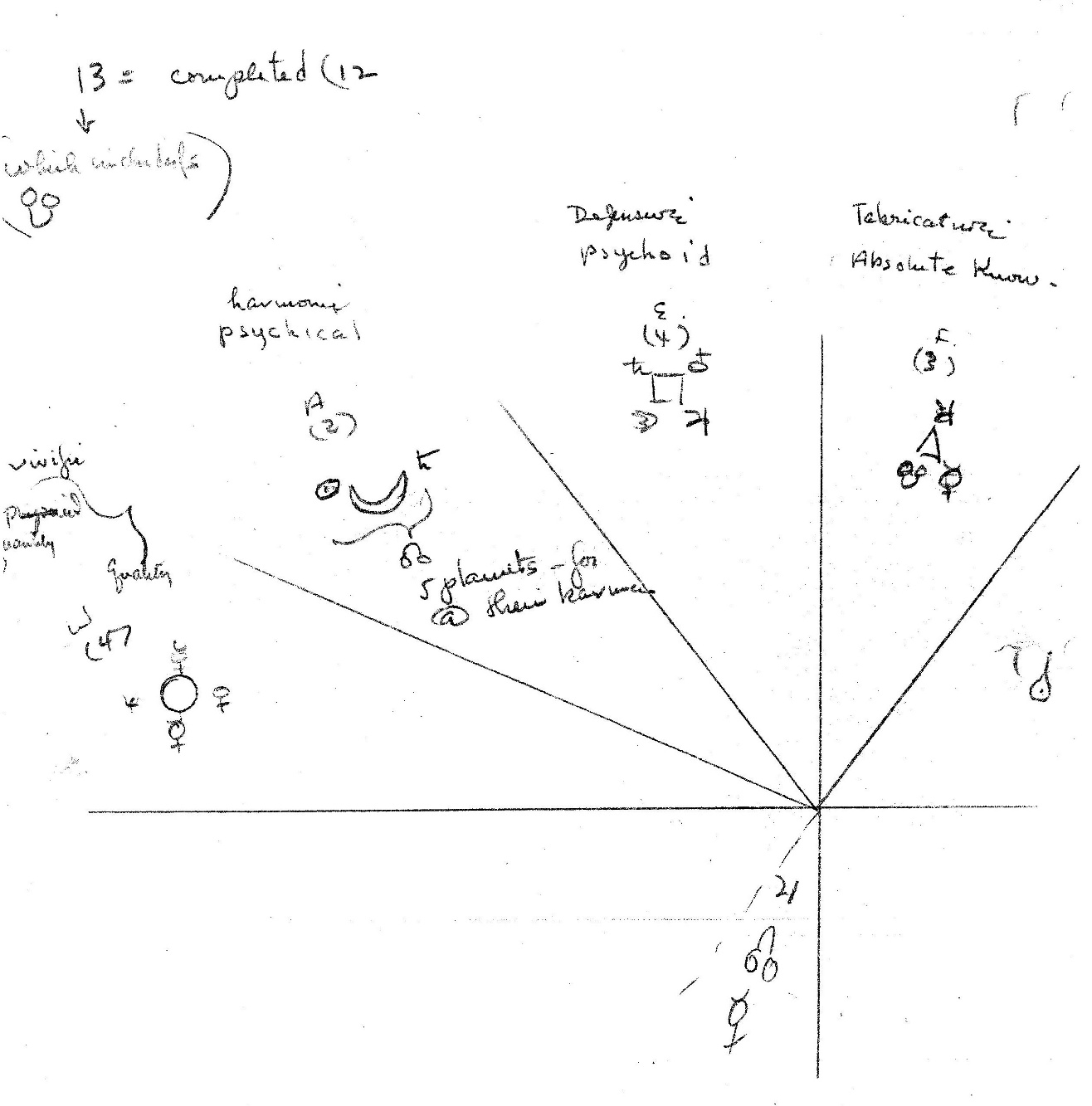
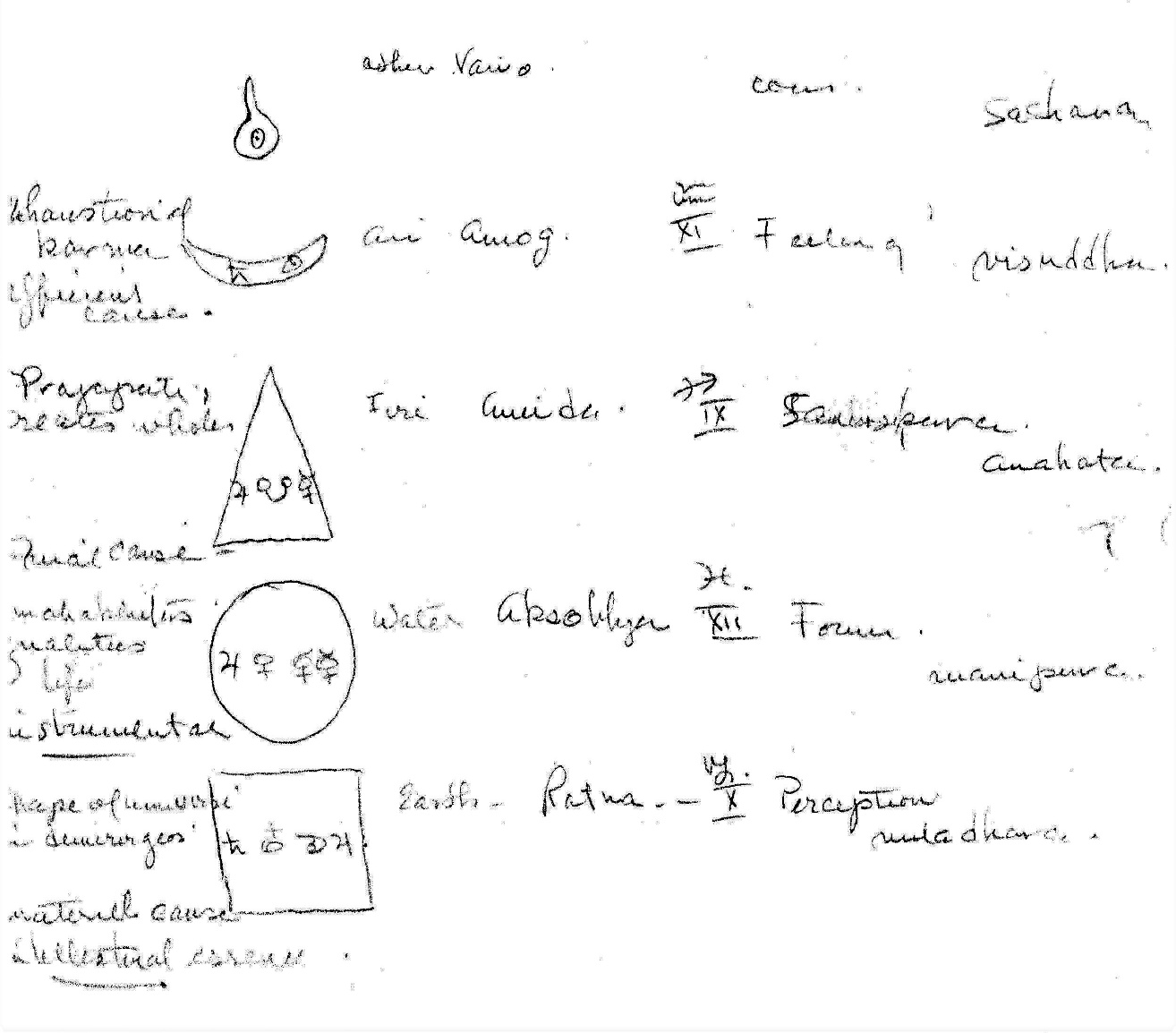
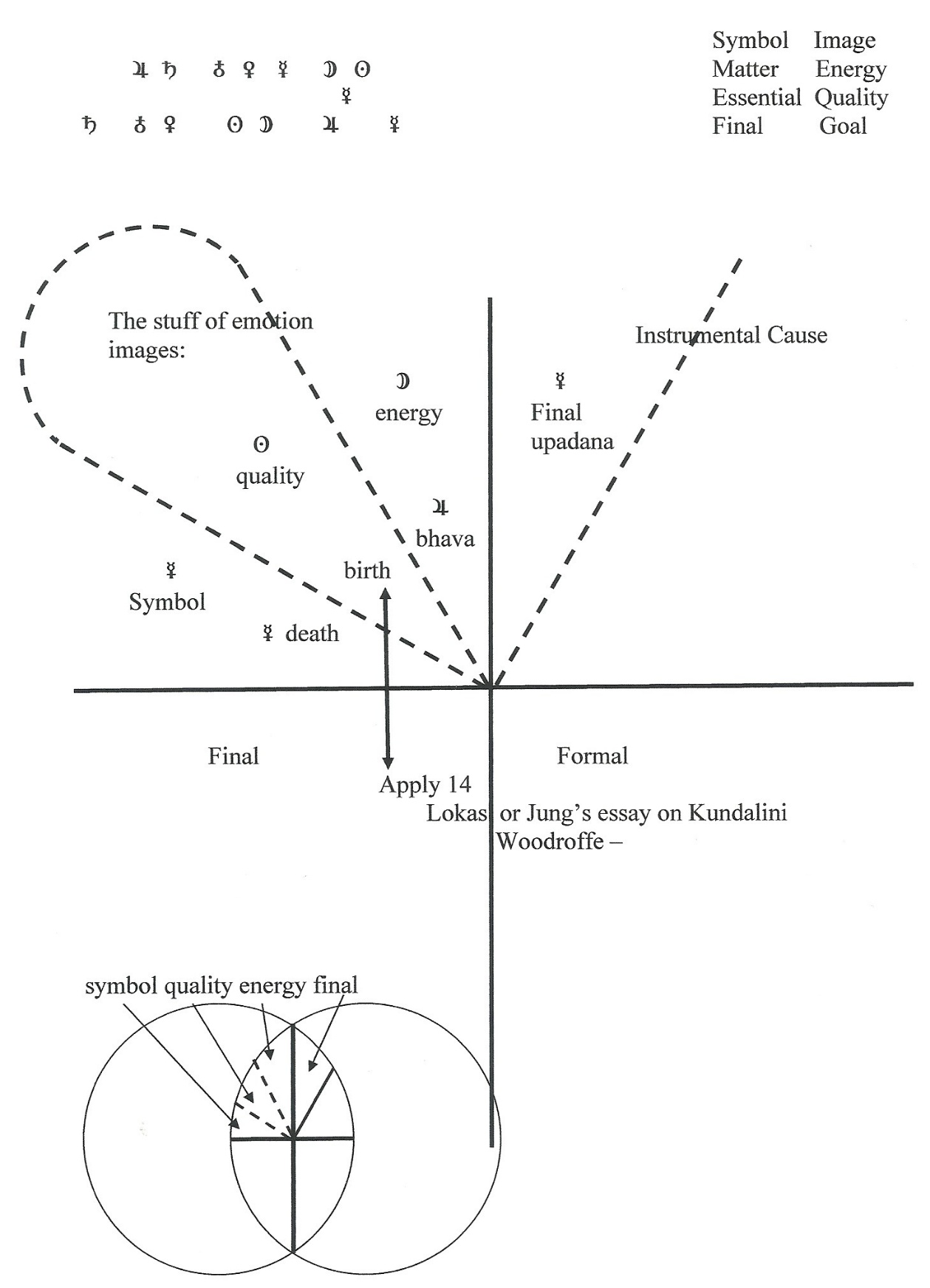
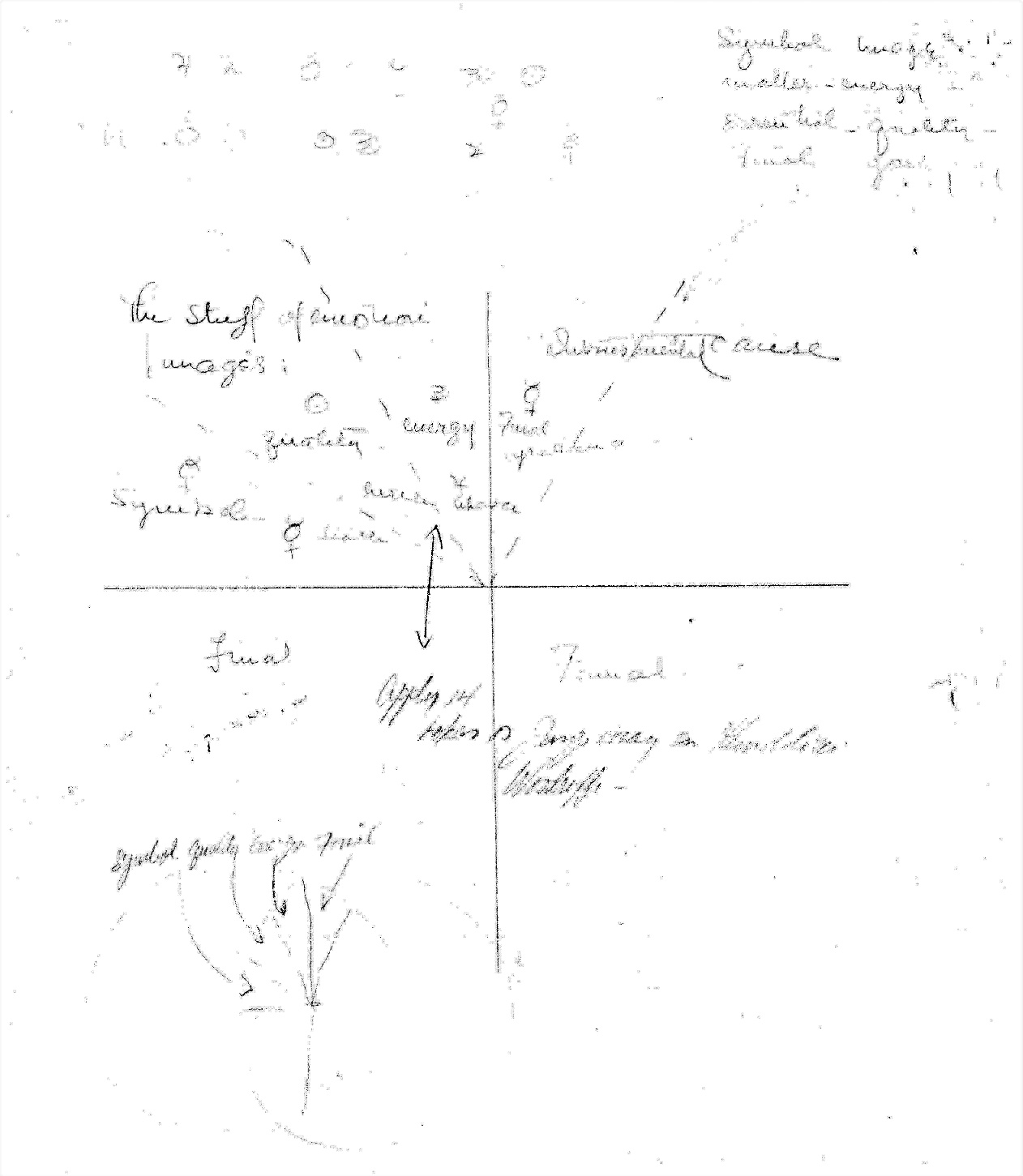
DIAGRAMS appended to this paper: There are three diagrams that AD hand-drew on the back of the last three pages of the paper. Each diagram listed has both a facsimile scan and a digital equivalent. All digital diagrams generated by NT.
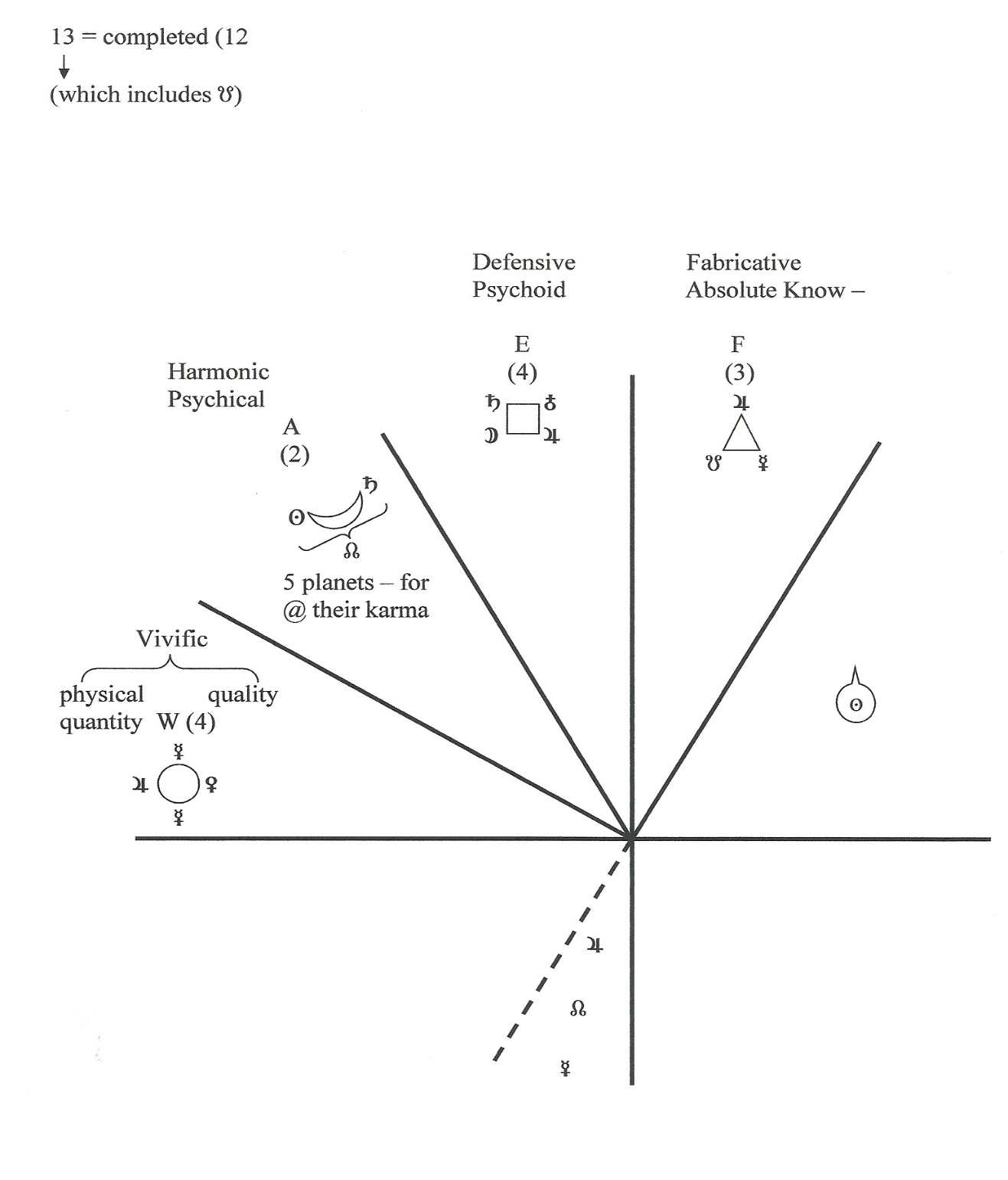
FIGURE 1978 0412b-1. Four Orders of the Mundane Gods Correlated with the Buddhist Stupa, Four Elements, and Psychological Terms in the Metaphysical Chart.
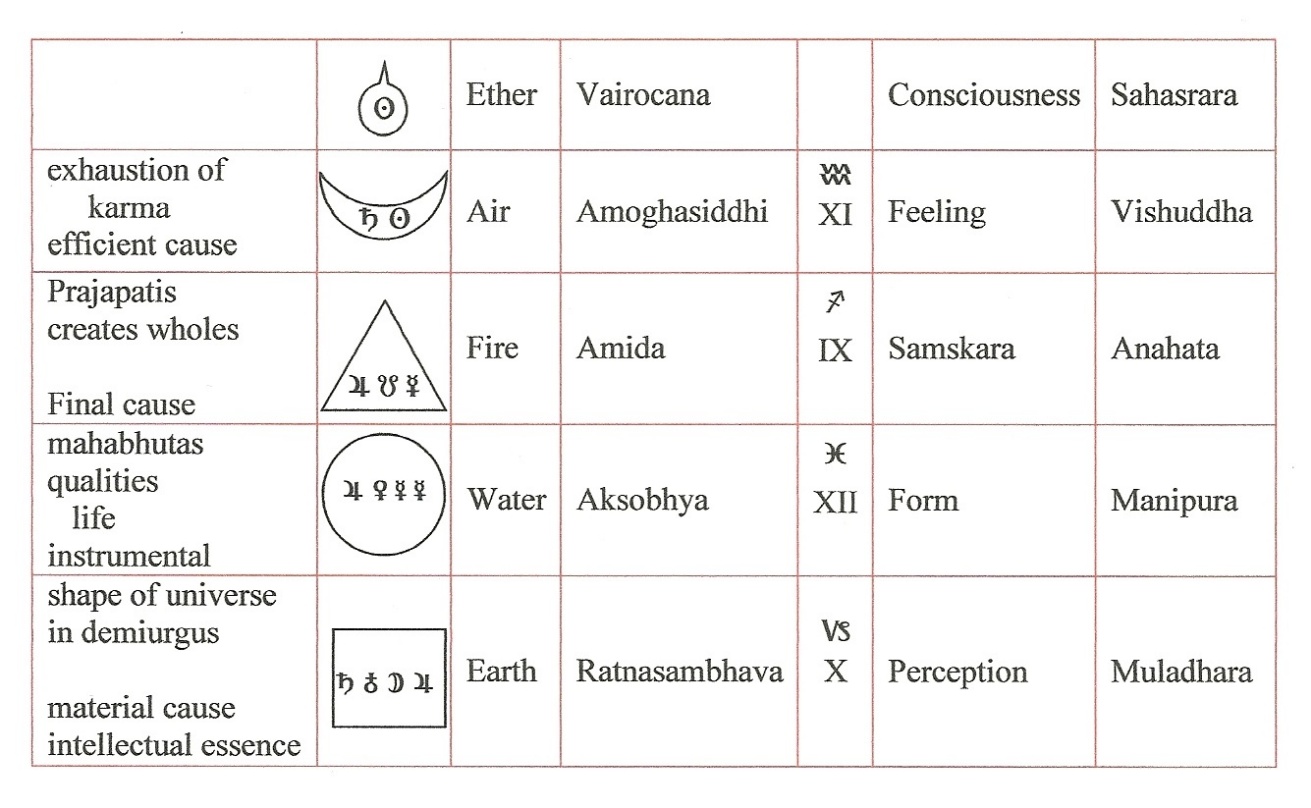
FIGURE 1978 0412b-2. Table Correlating Four Causes, Buddhist Stupa, Five Elements, Five Dhyani-Buddhas, Last Four Houses, Five Skandhas, and Five Chakras.
FIGURE 1978 0412b-3. Four Aspects of Emotion Correlated with Four Causes and Last Four Nidanas in the Metaphysical Chart.
AD HANDWRITING: Typewriter typed, extensive AD edits
COMPLETENESS: Full Paper
PUBLISHABILITY: Probably not, already mostly published
DATES ASSOCIATED WITH THIS PAPER: 1978 0412 0418 0426
RETYPED AND REFORMATTED by IT 2022
NOTES:
RETYPED AD PAPER presented in class (V09N). THERE ARE NO AUDIO CASSETTE TAPES EXTANT.
This is 1978 04/12b, The Four Aspects of Emotion Paper and the second entry associated with this date. 1978 04/12a = Buddhism; Emotion Class.
This paper is heavily based on, and quotes without attribution, the book Emotion by James Hillman.
There is a note in the upper right-hand corner of the scan in student handwriting that reads "? summer '78". Dated 1978 0412, 0418, 0426 per information in Blue Book Spreadsheet and AB class notes.
See also WG Classes 1978 0412a, 0418, and 0426 V08. Buddhism - Emotion (AB class notes) for more discussion and diagrams on this topic. These are the classes where this paper was read and discussed.
Note from JF: Not sure who typed original transcript/paper, possibly AB. It also appears it was typed on at least two different typewriters.
This retyped paper incorporates extensive handwritten AD edits. In a few instances one or two words or some punctuation has been added in brackets for clarity and continuity. To see AD's actual handwritten edits please refer to the Scan File.
Strikethrough= material crossed out in Scan File.All spelling errors have been corrected.
THE FOUR ASPECTS OF EMOTION: AN ESSAY BASED ON JAMES HILLMAN'S EMOTION
[File BUD Emotion C 15p.PDF (formerly BUD Emotion C 12p.PDF) Begins]
Buddhist Class Tape: On Emotion ? Summer '78 [date handwritten]
A comprehensive definition/description of emotion requires that we begin with initial premises that are sufficiently comprehensive to avoid unresolvable difficulties.
There are many isomorphic frameworks in which emotion has been defined. The terms "psychic," "organic," "physiological," "biochemical," etc., have all been used in schematic frameworks that are mutually exclusive: none of these various systems can be found to have one-to-one correspondences with the others. Even when we think we understand a definition within one of these contexts, we don't recognize when the same item is under discussion in another of these contexts. Each has a certain myopic vision when it thinks itself the only valid framework. Jung has pointed out the impossibility of grasping an idea from all sides.
Consequently, our attempt to define/describe emotion will involve us in a comprehensive, over-all general statement that may actually be too general to begin with. But at least it will prevent us from jumping on a horse and going in all directions at once.
Now emotion is not the totality of all these various frameworks and schemata that we learned about. We must be careful not to combine the whole variety of ideas (biochemical theory, élan vital, sociological and psychological set-ups) into some sort of Frankenstein. What we are looking for is a general theory of emotion that will square with most of the facts -- at least to the extent of our understanding. We want to keep together a few very important hypotheses to help us understand in a broad context -- and through hints and glimpses -- something of what emotion might be…& its more refined phase: feeling.
Let us begin by returning to "The Concept of Mind in Buddhist Tantrism" by Guenther.
His description of the Buddhist theory of what mind is itemized three necessary ingredients. One of them was symbolific activity. Here the symbol is treated as efficient cause of emotion. It is not simply the outer object which gives rise to emotion, but rather, it is the representation/symbolization/pictorialization* of the 'object' or situation that does so. [*in the very specific sense that was forced upon us in recognizing that manas + BI [buddhi-indriya] & K.I [karma-indriya] translated the stream into sensible qualities & consequently built the emotions into the primordial image] [AD writes in left margin: Appearance[,] Samskaras ]
That statement about the evocative, emotion-producing power of the symbolic activity was not enough. We should have brought forth that part of this activity (of symbol formation) is conscious, and part of it is "unconscious" functioning of the entire apparatus. These two together produce a symbol.
But this in itself is not sufficient to produce emotion. (Emotion can arise independent of the conscious representations.) In order for these representations to be effective (i.e., to arouse emotion), they have to be connected with some sort of instinctual image like I am the body. Consequently, our statement should be re-ordered to say something more; like this:
When the manas principle attempts to grasp what we could refer to as the intelligible vasanas or the stream of consciousness, it does so symbolically. The objective psychic situation is said to be "the realm of which emotion is a subjective repercussion." It is constituted of symbols which reveal themselves through emotions. Emotion is the grasping of the image given by the objective psyche (or, as we said, the stream of consciousness). Emotional behavior is adapted to this world.
Or we could express it this way: the field of symbols -- the entirety of the imagined world -- 'external' to the subject is emotional. When I say "external to the subject", I am referring to the flow or stream which flows from the alaya vijnana. Or more precisely the grasping of the stream by the 'powers' of the soul includes the feltness of the habit-energy or memories of this individual stream. Consequently the symbol is not something outside which arouses emotion inside. [This is] based on a faulty epistemology.
Outside[,] 'the world', emotions are apprehended or understood as symbolic qualities. Inside (inside the person, that is), the symbols are lived out as emotions. Consequently, one can easily see that emotions are not to be limited, i.e., put inside someone's body. The universal psyche ('alaya-vijnana') is both within and without. For situations to be symbolic, they must evoke not only the primary system of (complex's) mind consciousness, but even the secondary (body) one (variously referred to as unconscious, instinct, unconditioned genetic endowment, etc.).
There is yet another paradox: the secondary psychic system is not only innermost, but is identical with the "outside" which is nature itself. The manifestation of vasanas are our states of consciousness with an 'inside' & an 'outside'. It is experienced as innermost because it is experienced as value, as important. Consequently, it is necessary that the concept of emotions as being located only in the innermost and subjective realm be ignored. Emotional behaviour corresponds with the symbolic aspect of objective reality. [Note: On the left side of the paragraph are a few AD handwritten words that mostly got cut off in the xerox process.]
Apprehension of reality symbolically is what gives rise to conflict. But this conflict is not necessary to emotion. It may be the result of emotion. The conflicts between ego structures, bodily tendencies, etc., are due to the activation of both (the primary and the secondary) psychic systems. The whole person is activated by the symbol. The conflict which ensues is due to the appearance of emotion on the scene. 'Normal' (neurotic) reality and symbolic reality are experienced at the same instant. At one and the same moment, there is the habitual way of apprehending and behaving and an emotional one. The conflict arises because usually the habitual behavior is too rigid to admit its second aspect. Then there is conflict and disorder. [Note: On the left side of the paragraph AD writes a few words, the first couple got cut off in the xerox process, then: the Venus in Pisces (it's possible there are a few words here, if so they got cut off) the samskaras of the 'body'.]
We are in conflict with our environment because society generally does not recognize the symbol but favors the conventional. Consequently we are in conflict with ourselves because the emotion is resisted. If, however, the emotion is experienced (and by this is not meant that one lives it out concretely but, rather, witnesses it attentively), there is no conflict.
Again, conflict can become emotion. A clash of incompatibilities can become symbolized as a pair of contending opposites: the "archetypal image of duality," if we can so put it.
We also have a variety of hypotheses concerning "genetic endowment". These theories correspond with what we would call inheritance within the body monad of its own peculiar samskaras or vasanas. Here we must understand that the symbolific activity would include the presence of these vasanas (archetypes). [AD adds: get quote]
Emotion here depends on learning insofar as its arousal is always within a concrete context…even if not always by a concrete image. The context could be a social one, or a historical or economic one: but it is always a learned context. In this sense, emotion is a learned behavior: one aspect of the primordial image which arouses emotion has been learned. This aspect is subject to conditioning and is, in fact, a product of learning (assimilated thru (one word illegible)). Therefore, emotions can be manipulated by the control of conscious representations. This is, of course, well known, especially when a person has lost connection to the life of an instinctual nature. Just look at the Madison Avenue professional advertising & how the…
The other aspect of the symbol, that is, the instinctual behavior-pattern and its image -- the unconscious non-represented meaning which makes the conscious representation click -- is part of genetic endowment, too. Given with the constitution & is archetypal, forever-repeating behavior. There is an attempt being made here to view the world in a manner quite different than the way in which we understand it. Many have called this the "unconditioned basis of affective response". This aspect of the symbol gives learning its limits and is the ground of its possibility. In fact, it conditions conditioning.
On the other hand, it has not been concretely or experimentally established that specific images are constitutionally given. What is given is the capacity to behave and to apprehend representations (i.e. instincts and traits of our physical constitution) symbolically. Again by this we mean that manas's capacity to translate psychic sensation into perceptions. Furthermore, this capacity is not given all at once at birth, but comes through a maturing process and has various stages. It even has the capacity for changing qualitatively.
You might call these emotions appropriate to various stages in life. Different symbols are effected, of course, in correlation with these stages. From an educational point of view, of course, this means that we have to change our symbolic fixations.
Alteration of these symbols & the process involved, as the vasanas guide the evolution, alters the emotions. Each of the causes -- & this is instrumental & we're speaking about the primordial image -- is the emotion itself, in one aspect. The symbol as cause depends both on learning (as we said) and on the built-in symbolific capacity (this functional unity). It comes into action within a limited time-cycle.
Because we can do this, function this way, it can accompany instinct, & it can also be taken as independent of instinct. Perhaps it would provide a wider understanding to say that the capacity to understand and behave symbolically accompanies -- or is an aspect of -- all traits, whether narrowly instinctual or not. As such, emotion can be admitted to accompany any action or idea, provided that the action or the idea is experienced symbolically through having been given an unconscious meaning.
One has to learn that he should grow and live in accordance with the change of symbols that takes place in these various stages of life. One should recognize also the genetic unfolding that is taking place. We speak about the body as having certain samskaras: the order of their unfoldment, the time, the temporal sequence of cause has to be recognized.
Symbols of archetypal stages -- puberty, adolescence, early manhood, middle years, old age, etc. -- must be recognized. Not living out the emotions as these symbols arise is to carry a burden of unlived life. Consequently, symbol as presented here is credited with overwhelming significance inherent in the activity itself.
From the conventional point of view it seems that because emotion is so spontaneous, it belongs to the spirit. But actually this is not so if you recognize that it is spontaneous when viewed from the system of conventional habits with a world of conventional values and representations. But it is because it can be aroused independently of that that we conceive of it as spontaneous.
The unconditioned level (the archetypal degrees), however, which is symbolized by the representations of the manas is not spontaneous, in that it does have a certain pattern or organization . . . a certain regularity, repetition, definite meanings, and so forth. [It] actually follows the pattern of nidana or more precisely the unfolding of them through the transits.
This, then, forces us to recognize that there is both one system (the ego and its orientation to conventional reality) and another system which is affiliated with that. Now, true spontaneity would demand an uncaused emotion. But an examination of each such "uncaused emotion" will reveal a definite symbol as its efficient cause . . . always. Insofar as the unconditioned aspect of the symbol is not presented to consciousness, the origin of emotion can be said to "be unconscious", or to "indicate unconsciousness", or to "lie in the unconscious", etc. [AD writes in the left margin: quote from Franz]
Insofar as the symbol is coordinated -- and achieved on all levels, including all systems -- its corresponding representation would be the whole body. This is not to deny that partial systems (drugs, electric shock, intensities of sound, etc.) can initiate emotion. But one must ask, "Are these emotions (caused by influencing only partial systems) complete?" These things can produce emotion, but are they shared?
Emotions produced by shocks, etc., can only be considered complete emotions when the physical events are apprehended symbolically by the psyche, that is, when the physical events are represented by a symbolic image and receive a meaning beyond that of a conscious "sign". Again, emotions evoked by intensities of quantity -- whether in the physiological or psychological sector -- are due to the breaking down of primary system of conventional habits. There is a lowering of the threshold which allows the levels of symbolic functioning to come forward, interpreting these intensities symbolically. Now, since symbols are intensities they are felt subjectively as such, and they mobilize quantities of energy not usually at the disposal of the conventional habit. Under the influence of a symbol, there is an alteration of intensity in both the psychological and the physical spheres.
To wrap up this stage of our investigation, let us say this:
"Why is there emotion?" There is emotion because the world is apprehended and lived through a symbol. This symbol is a cause of emotion: a cause, and not all cause. It is a stimulus: where there is an emotion, there is a symbol. Or, as the cause is an aspect of the event itself, the symbol is thus the emotion itself in the aspect of an exciting image.
……………………….
What is the stuff of emotion? If we take the OED definition of "stuff", we get: "That of which something consists, or out of which it is developed."
Here, of course, what we are speaking of is what -- in common parlance -- would be called the "matter" of the thing. What's it made of? There are, of course, a variety of theories as to the meaning of matter. In terms of this context, we will have to briefly refer to it as an abstract principle, or, as some sort of chaos, or, some extended physical substance . . . some sort of "building-stuff". Aristotle used the word "hyle", wood, timber, Others refer to matter as something that is "inertial", a passive principle. There is, of course, the scientific notion that matter is a field of force, a field of particles, waves, quanta-in-motion: these are invisible but nonetheless objectively valid constructs which are known through behavior. For the scientist, then, the material stuff of emotion is consequently the play of invisible forces, and these forces can be within as physiological constructs (nerve cells, thalamus, hormones, etc.) or as psychological constructs (traits, dispositions, inheritance, complexes, instincts, etc.). Or, these constructs can be without, as constellations of the objective psyche. [AD writes in left margin: 'Buddhist concept of matter' quote!]
Emotion, in the scientific theory, is ultimately reduced to nuclear dynamic units.
Here we are speaking about the material cause, taken as energy. Of course this is abstract and cannot be known as it is in itself. But it is considered as the underlie, or the universal substratum of all existence. In this sense, of course, energy is not a real thing; an emotion consisting of such energy is also not real, so when someone speaks of a flow of energy I am justified in asking for specifics.
And in this context, emotion is reduced to quantitative formulae of direction and intensity. One can translate this stuff or matter of emotion -- the prime matter -- and say that emotion is the conscious or psychic form of this universal energy. When this prime matter is experienced from within it is both the matrix, the mother, the source of all creativity and a sort of disorder or chaos. For us, of course, emotion is the way that energy appears to consciousness. But in-and-for itself . . . it is imperceptible. [AD writes in left margin: Jung article there] [Note: Per AB notes 1978 0426, this is most likely a reference to "On Psychic Energy" in CW 8, The Structure and Dynamics of the Psyche.]
[This energy has to be conceived in two basic forms: love and anxiety, or, the positive and the negative aspects. When it is so perceived, we refer to it in the Scholastic sense of "materia secunda": it is formed, or comes-into-being.]
One can extend this concept of universal energy to bring in the 'ideas' as causative -- instantiation of the ideas thru soul & you can easily see why Plato had no need for Aristotle's hyle or any other matter.
As we said, we have different specifications of this energy: nervous, thermal, chemical, psychic, etc. Just as this nervous energy is known through certain specific chemical nervous processes, so emotional energy is known through specific emotional processes, and these are the specific gross demonstrations of the body and specific representations in consciousness. Without these contents, there is no emotion. From this point of view, of material causality, these demonstrations and representations are the emotions. If, for instance, one has an experience of sadness, there will be tears and sobs, black thoughts, etc. If we take all this away, where is the emotion? The demonstrations alone are not the emotions. The demonstrations and representations together are the stuff and the material of emotion, without which emotion can be said to exist only in a sort of potential way, but not concretely. Concrete and visible emotional energy is the extension of the human body, but this extension is not limited just to the enclosure of our skins. Rather, the human body is a situation, an interacting field of energy, and this energy is polarized or located in these discrete nuclei which we refer to as complexes, motives, needs, drives, traits, genes, organs, zones, etc.
What's important here is to see that the idea in this system of description is the same. Emotion is based upon some sort of dynamic nuclei of energy. They can be self-actuating or reflexive, conditioned or not, continuously active or working inversely [Note: There is a handwritten question mark to the left of 'inversely' in the left margin.], or quantum, inhibited or released or constellated. But all these explanations are through the material cause and depend upon the hypothesis of a network of the energetic units. Matter is a field of force, etc.
We can't know these abstract nuclei of energy except through the behavior of some substances and processes in the field of matter, so these quanta are known as emotional energy through behavior in the human field of matter: the body. The field of the body is the stuff of emotion and so emotion is an aspect of the field of the body. This means emotion is the body, concrete and visible, here and now. The body situation is the locus of emotions. It is the spatial demonstration of emotion. So we come to the idea that the more body in an event, the more emotion. And of course, we can extend it further and say that all life, physiological and social, is emotional, and where emotion is, there is life.
Here we could go even further and point out the emotional aspect of the body and the energetic processes which occur in this field are primarily emotion and only secondarily chemical or electrical. One's feeding and sleeping habits, his sexual and digestive and excretory functions are emotional and not just physiological, all of which is part of the great contribution of the Freudian school. Thus preoccupation with emotions is the royal road to get at these disturbed processes. It is the immediate way which consciousness can know from within the body as a field of energy.
Needless to say, the energy of this field is ordered, whether we speak of chemical processes or animal spirits. And the order of this energy is to maintain a homeostatic balance of the whole person in his situation. It is just this homeostasis which is the material cause, that which is acted upon and altered. And the field of the body persists in a homeostatic convention. It is ordered into specific attitudes, organic sets. It is lived as a first system [Note: one or more words missing, transcriber was not able to hear]. And again, this inert mass is carried by its own momentum resisting change and this inertia is the stuff of emotion.
One, of course, can easily recognize that emotion here would be considered a disorder and the more set the person, or the matter, the more dynamic the emotion. But to continue, we must keep clear the distinction between the abstract prime energy with its description of abstract invisibles (quanta, nuclei, archetypes) and energy as secondary matter, the concrete organization of energy in various sets (emotional, neural, chemical, physiological). The human body situation is the concrete organization of emotional energy, and in the first instance emotion as a psychological aspect of the universal substrate can be said to be going on all the time just as energy is always going on. This continuous activity is wider than its specific forms within the personal sphere of gross demonstrations and conscious representations. It is wider even than the human body situation, and the activity can be going on without going on in the field and both.
Because emotion is a psychological aspect of general energy, emotion is going on all the time everywhere. It is the potential aspect of all things.
The real world as apprehended through emotion is not some other occult world or hidden world. It is the same world consisting of the same energies as the physical world. But it is grasped in its emotional aspect. Individual things are fields of energy, the psychological aspect of which is emotion. This aspect is given through emotion primarily as importance, value, significance, etc. Furthermore, as things affect the psyche through emotion, the psyche affects things through emotion.
We can speculate that the strange or magical behavior of objects can be accounted for by the view that emotion is energy. Certain places are saturated by emotion. We think of a crime committed in a house, a crime especially vicious and cruel. What happens here is a transformation of energy from some physical event into psychological. Due to the emotion, the field changes from one that is predominantly physical, to one predominantly psychological. The field then no longer obeys the laws of physical energy only. The emotional aspect of energy comes to the fore, whereas before it was only potential, hidden. This psychological intensity transforms objects into symbols. Mediums, shamans, witch doctors, and even gurus, are energy transformers. Either by a gift or training, their emotional life is particularly non-subjective. They are thus open without personal involvement to the emotional aspects of the field which are occult to normals. And through them, energy is converted from the physical to psychological or vice-versa, always through the emotions, requiring emotional discipline and yielding great emotional exhaustion. Hence, too, periods of emotional crises in the life of an individual. At those certain periods of one's life (change of seasons, changes from childhood to puberty to manhood, etc.) even these critical times are concerned with energy transformation, the moments when archetypes constellate.
Emotion is a two-way bridge. The world of nature has an emotional aspect given along with its physical. Also our own emotions, whether we know it or not, are continually interacting with the world of nature. Consequently, every cut between the subject and object is arbitrary, done at the discretion of the neurotic patterns of an individual. Fundamentally, man and world are inseparable; the same basic energy constitutes man and the world. This, of course, is obvious on a physical level, but on a psychological level we experience the cut because we neglect our emotions and miss the emotional aspect of things. We have such primitive emotional awareness that the world about us is either dead or without value, or forcefully overcharged due to the primitivity of our emotions. We've left undeveloped the faculty of apprehending the world as emotional. [AD writes in the right margin: An interesting insertion[:] take Suzuki sutra on timeless world etc & show how the human functioning is a cut in this one world.] [Note: See D.T. Suzuki, The Gandavyuha Sutra and Essays in Zen Buddhism (Third Series).]
Even philosophy has said long ago that we cannot have Goodness and Truth without Beauty. This is not some sort of cliché; it has real, natural ground. If emotion is a psychological aspect of universal energy, the realms of ethics and aesthetics, such as we find in ancient Chinese philosophy, are on a very firm footing, perhaps more firm than we're willing to give credit for. They are not subjective. It's not an inanimate world that we're dealing with. [AD writes in the right margin: Bhattacharyya would express this triple absolute:] [Note: Krishnachandra Bhattacharyya, Studies in Philosophy, Vol. 2, "The Concept of the Absolute and Its Alternative Forms".]
Finally, if we consider energy the material cause of emotion, this same prime energy of the universe goes beyond all entanglements. Therefore, it must appear in some sort of form, even if this is the human body situation. This is the potential energy of the conventional set, which is converted during emotional behavior and known by work done, demonstrations of the body, and the representations of the mind.
[AD writes in the upper left margin of this paragraph 'Formal', in reference to formal cause of emotion.] Another way of considering emotion is through its qualitative side. We tend to identify it (emotion) as an essence with a specific quality. It is this quality which is held to be the distinguishing characteristic of emotion, quality differentiating and defining it from everything else. Emotion is the psychological form of energy. This means that we take the formal cause of emotion to be soul. The word soul if used in a non-technical sense would be wrong, but if we think of soul in the sense that Plotinus used the notion of the logos spermaticos, then we could say the formal cause of emotion is this logos spermaticos, or soul. [Note: See Plotinus, Enneads, VI.7.4] If we use Aristotle's soul -- body & mind would be the actuality of soul. [AD writes in the margin of the lower left side of this paragraph: Logos of the psyche]
Other psychological factors of our personality, such as knowing [Note: few hand-written words cut off in the xerox process] sensation, willing, etc., would also be considered as aspects of the logos, but for the present, what we're trying to get at is a very specific meaning when we say that the soul is the formal cause of emotion. Here, what is important is to recognize emotion as a total pattern of the soul, it is the soul behaving as a whole. Emotion generalizes a reaction. It does this because emotion is the soul as a complex whole, involving the gross body, physiology, facial expression in a social context.
[(Tape turned, something lost . . . ) . . . inheritance and personal experience in terms of my body here and now, and is a part of the world upon which I have intentions. It is this totality which differentiates emotion from partial psychological events. Thus, its essence is complex, as we said at the beginning.]
The existentialists would put it this way. The here and now, both within and without, both body and mind, are united in an emotion. Instead of this unity, contemporary psychologists too often see partial functions of the soul as separate islands, linked with elaborate constructions. But the soul, as we just defined the word, is the union of mental functions, social relations, physiological processes. It joins body, expression, and patterns of inheritance. It is the relation of subject and environment. All these partial functions are related to each other during emotion. This is because emotion is the total pattern of the psyche which includes all, the central quality which connects all. As one writer put it, "Emotion puts together elements of experience."
[diagram -- back] [Note: Not clear which of the three appended diagrams AD is referring to here. The three diagrams were hand-drawn by AD on the backs of the last three pages of the typewriter typed paper, but nothing on the back of the specific page that this phrase is found on.]
Therefore, whether we speak of emotion as a total pattern of the psyche, or as a central quality of the soul, we refer to the same model: emotion as the soul in its wholeness. Here we are speaking about the formal cause. The formal cause is the psyche observable in objective behavior and subjective experience. This aspect of emotion is the formal cause again in the fundamental sense of cause, that is, the ground of possibility. The psyche is the faculty, the very facility, by which behavior and experience are possible. Without psyche, there is neither experience or behavior. Energy or matter, alone, is an abstraction: it cannot be said to be experienced, nor can it be said to behave except in some particular form. It is the psyche which organizes energy in the form of emotion. It is the psyche which is the formal ground of human experience and behavior, and emotion as the energetic stuff of the psyche is a whole before it differentiates into partial functions. It is the primary state or activity of the Soul. Emotion is the essence of life: where emotion is, life is. It is the heat which distinguishes the living from the dead.
Taking the formal cause of emotion to be the psyche, the conclusions about efficient cause will be more intelligible. It was said that the symbol activates the whole person. Insofar as the soul is the whole embracing both conscious and unconscious, both subjective and objective levels, the symbol activates emotion as the whole: psyche. Emotion is the psychological response to the symbol. Therefore, symbolic realization transforms the whole personality. The primary language of the soul as a whole, the primary way the soul grasps reality, is as symbolic reality. An emotion is the psyche symbolized, like a rite or a ceremony. These two, symbol and form, correspond with each other, and an analysis of the forms of emotional behavior shows appropriate symbols. An encounter with a symbol corresponds to a specific quality in the pattern of emotional behavior, and this correspondence of symbol and form is more exact the less the emotion is colored by subjective consciousness. The more universal the symbol, of course, the more collective the behavior pattern.
So this formal cause does shed some light upon the content or the stuff or the material cause of energy, as energy. There appears, as a paradox, of course, that the emotion is an aspect of universal energy, and the statement that emotion is the energy located in the body situation. It is the psyche as a form of the body, (here I would use the word "mind" as more appropriate), which locates emotion in the relatively closed field of the body situation. Emotion is in the field only as qualities. It is going on everywhere, but only potentially. In actuality, it is only known as it comes into existence due to this soul or logos. Energy only can become emotion through the psyche. Not until the soul joins the world of objects does their emotional aspect come into being.
Taking emotion as the psyche as a whole, it becomes evident why emotion can become disordered, even dangerous. The soul's great unified force is too great sometimes for the partial systems of conventional set. The pattern of organization with which the ego is identified isn't large enough to withstand the psyche when it acts as a whole. Of course we should keep in mind that the psyche and emotion are not the same. Emotion is the energetic aspect of the psyche. Psyche has a formal aspect as well. This formal aspect isn't only intelligence or level of consciousness or self-control. The formal aspect of psyche is the container of the energetic aspect. It, too, is the psyche as a whole, but more from the point of view of formal organization.
We can describe the goal toward which emotion is working by saying that it is the release of energy, and attempts homeostatic regulation. And of course it connects us to the original stimulus, whatever it may have been. It qualifies all experience. It's important to keep in mind that it's expression and communication and revelations of value and truth for ourselves. In the end, it is ultimately the signification of life in terms of not-being. It achieves improvement; physical energy emerges into consciousness. It presents images and is the matrix of something new and very often creative. Very often it brings to the surface, or up to the level of consciousness, many of the functions which are isolated. Consequently, one can think of it as whole-making, or making wholes.
The fundamental and irreducible factor at the root of all emotion, attraction, repulsion, desire, aversion is, in short, motion or arrest of motion.
What we're getting to here is that something is implied in this notion that emotion is working toward a change, what we might call a transformation. What we mean here is not just a change in conscious representations, but a transformation of them in terms of symbolic reality, a correction of wrong views. [Note: Not clear exactly where AD intended to insert the next sentence, whether after the words 'symbolic reality' or after the words 'wrong views'. I do it this way as the way that makes most sense to me.--IT] The manas principle is forcing upon the empirical individual & this is the encounter which produces Emotion ie to grasp the world more adequately. When we say that emotion is a transformation of that energy, we speak of the quality of energy, not just a change in direction or intensity. A discussion of emotion as the activity of the psyche as a whole again leads one to take it as a transformation of that whole, rather than as a change of its partial functions. As transformation of the whole, it becomes evident why it involves all the changes in will, perception, values, etc. Transformation is a much wider concept and this is what we must now pay attention to.
These changes in our 'view' of reality as Buddha points out in his 8-fold noble path, in directions and intensity of energy, and in the soul's partial activities, are all aspects of the transformation going on. Emotion does achieve these transformations, even if one thinks of it only in terms of biological survival. Emotion is the adaptational syndrome, the organism's only full response to the demands for change 'life' presents us with. When the organism must be transformed -- if it is to survive, emotion appears. The transformation can go on in many sectors at once. Psychologically, this is a change in signification. [AD writes in left margin: (one/two words illegible) (looks like: charts)]
Here, one might remark that there is a difference between emotion and instinct. If one notices, habit - (karmic past) conserves, but emotion transforms. Instincts adapt in terms of the past, emotion in terms of the future. One can almost see emotion here as a primary activity of the psyche and instinct as a partial function. So emotion performs two functions when associated with instinct. First, through emotion instinct is open to education and transformation. Second, through emotion instinct is raised to involve the whole person. It is always emotion that decides these things.
Nothing more and nothing less is achieved than to take emotion in and for itself as always having achieved its purpose. It must therefore always be a successful transformation, and it is always good.
Another partial viewpoint about the achievement of emotion is that of improvement, as energetic transformation of the physical into the psychological (a physical (looks like: trance) become mental), as a creative transformation of the old into the new, as a mode of transformation (?) of the part into the whole. An emotion is an improvement which does not depend on its consequences. It may or may not build a work of art, or develop new images, or free energy. It is not these after-effects which makes emotion an improvement. Emotion is itself an improvement.
Emotion terminates in the subject's own body. Whether one likes this or not, the fact remains as psychosomatic symptoms (palmistry, physiognomy) demonstrate. Lack of emotional development yields emotional excess. Ego consciousness very often after struggling to suppress it, abdicates in its favor. Instead of living emotionally, there is only a blind acting out. This will never develop emotions since it is only unconscious, unadapted behavior. The two systems are not lived simultaneously. One has replaced the other. It is not a symbolic event because the conscious aspect is missing. Our main purpose here is to keep in mind that consciousness here is unable to accept emotion and live it. With this of course, there is a recognition of lack of emotional development. We do not face emotion in honesty, and live it consciously. Instead emotion hangs as a negative background. If there is anything novel in this synthesis, it is this: emotion is always to be valued more highly than the conscious system alone.
[File BUD Emotion C 15p.PDF (formerly BUD Emotion C 12p.PDF) Ends]
1978 04/12b (includes 0412, 0418, 0426) V09N: PAPER: Buddhism; Emotion. Copyright 2022 Wisdom's Goldenrod p. v