DIAGRAM FOR 1979 0207
Class
Wednesday, February 7th, 1979
Verbatim, unedited transcriptClick the series name to view more
CLASS at Wisdom's Goldenrod, Hector, NY
with Anthony Damiani (AD)
February 7, 1979
PB BOOKS; HIDDEN TEACHING (Chapter 5)
TOPIC: PB Books
SUBJECT: Hidden Teaching Beyond Yoga (Chapter 5)
SUBSUBJECTS: Philosophic Disciplines, Thinking, Meditation/Yoga, Overself, Short Path, Mentalism
CONTENTS:
HIDDEN COMPLEXES MUST BE REMOVED BEFORE TRUTH CAN BE RECEIVED
YEARNING FOR AND LOVING TRUTH FOR ITS OWN SAKE
TRUTH DEMANDS DEEP DEVOTION
ENDURING DETERMINATION TO PERSEVERE IN QUEST FOR TRUTH
INTENSE THINKING POWER AS A REQUIREMENT TO FIND TRUTH
DHYANA (CONCENTRATION) AND SAMADHI (CONTEMPLATION)
INNER DETACHMENT OR RENUNCIATION
SUFFERING, THE FLUX OF LIFE, AND THE NEED FOR DETACHMENT
CULTIVATE DETACHMENT DEEP WITHIN MOMENTS OF PASSION
REMEMBERING AND LOVING THE OVERSELF ON THE SHORT PATH (LETTER FROM PB)
SUMMARY OF HIDDEN TEACHING BEYOND YOGA (PAPER)
BOOKS READ FROM OR REFERENCED:
Paul Brunton, The Hidden Teaching Beyond Yoga
Marc Edmund Jones, The Essentials of Astrological Analysis
William James, The Varieties of Religious Experience
Plato, Alcibiades
C.G. Jung, CW 11, Psychology and Religion: West and East, "Foreword to Suzuki's Introduction to Zen Buddhism"
Bible, Proverbs
Patanjali, Yoga-Sutras
I.K. Taimni, The Science of Yoga
Franz Pfeiffer, Meister Eckhart, Volume 1, trans. C. de B. Evans
Plotinus, The Enneads (MacKenna translation, 4th ed.)
PLOTINUS QUOTES READ OR REFERENCED: I.3.5, IV.3.30
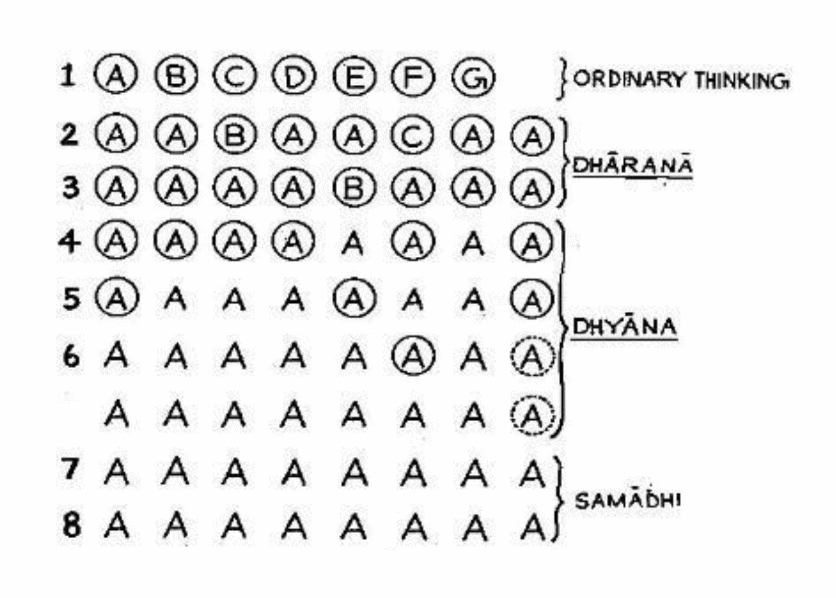
DIAGRAM appended to this transcript:
- FIGURE 1979 0207-1. Stages of Meditation.
This diagram is from I.K. Taimni, The Science of Yoga, p. 284. [Transcriber note: [diagram] means the speaker is referencing a diagram as he or she is speaking. If someone is drawing or writing, with audible sounds of chalk on a blackboard, I indicate this by [drawing] or [writing].]
PAPER READ IN CLASS: "Hidden Teaching Beyond Yoga Summary," author unknown. [Note from jf: Anthony assigned topics/chapters for class members to present for the Hidden Teaching series - so assume this is by someone in the class, possibly AS, who read it.]
NOTE: Letter from PB to AD read by AD in this class (but as of 2020 no copy of this letter in WG's collection).
TRANSCRIBED Verbatim by IT 2019; reformatted by JRM & JF 2019-2020, with TOC/Subheads by JRM. In 2023, IT updates prefatory matter, footer, and audio file name, completes Book List, adds Plotinus quotes section, adds new notes within transcript, fixes errors/typos, adds diagram and reference within transcript to this diagram. In 2024, MW alters Subheads to make more accurate. In 2025, IT updates audio file markers to match new REP audio. Archival verbatim transcript – V14.1a.
AUDIO FILES: 1979 0207a, 1979 0207b. [Note 1: "Tape" and "Side" refer to original audio cassette tapes that were later digitized into .MP3 Audio Files. Note 2: In 2025, REP studio cuts dead air from file a.]
1979 02/07 at Wisdom's Goldenrod
PB Books; Hidden Teaching Beyond Yoga (Chapter 5)
Archival verbatim transcript
[Audio File 1979 0207a Begins]
BS: You have to-- Nature herself has to release a person from certain aspects before they could take to any absolutes.
AD: So then-- in other words you're saying Herbie's paid his-- his debt, has paid his bill, and Nature grants him-- yeah.
BS: Ok.
AD (faint): Steve?
SS: Perhaps it's like Venus who imposes certain teachings for us.
AD: Well could you be more specific, uh--
SS: Well, one aspect of Venus I thought was that it took the various experiences and teachings for the soul to--
AD: Be put through various experiences, well-- And until you've gone through those experiences-- go on-- she won't permit you.
SS (simultaneously): Yeah. To go on.
AD: Go on, yeah. Yeah, I think Bert meant the same thing more or less, that certain obligations, whether we're aware of them or not, that Nature imposes, and it's only fair to say that till you pay her back she's not going to let you off so easily. Yeah the-- these things were recognized in most philosophic schools and if you remember some of the articles we read by Thomas Taylor where I think the point he was making is that if a person attempts to achieve liberation or work towards self-realization and hasn't paid the price, you know, hasn't paid off his obligations, that Nature or Venus, as you said, calls Mercury and tells him take out a scroll and he takes out this scroll which is a real, you know, itemized list of all the things you owe her. And, she don't let you off the hook that easy. But I-- I suppose Nature in that sense, yeah.
S (faint): Anthony?
HIDDEN COMPLEXES MUST BE REMOVED BEFORE TRUTH CAN BE RECEIVED
AD (simultaneously): (Uh--) [short pause] How about the next paragraph, next page--
[Transcriber note: I am using The Hidden Teaching Beyond Yoga by Paul Brunton, E. P. Dutton & Co., Inc., New York, 1969.]
PB [The Hidden Teaching Beyond Yoga, "The Philosophical Discipline," p. 112, AD reading]: "The knowledge that they find themselves in a similar position--for few persons like to be told that they are not competent to receive truth--is an additional reason why the tutors of the hidden philosophy kept it secret for so many centuries."
AD: But, you know my attitude about that. I mean I don't believe in free education, I believe people have to work for knowledge. And that if it's given out too easily, it'll only be abused. So, I also don't agree with Thomas Jefferson that we're born free. (bit of laughter, student words) We're born in bondage, the worst kind of-- worst kind of slavery imaginable. [short pause] I couldn't imagine anything worse.
[15 second pause]
PB [The Hidden Teaching Beyond Yoga, "The Philosophical Discipline," p. 112, AD reading]: "[For] philosophy seeks to put its students at the correct angle whence to view the pageant of cosmic existence as it really is, bereft of glamour and deception. [AD adds: And] This cannot be done until the intellect is well clarified and the strength of its hidden complexes vanishes. The task of re-ordering one's mind is likely to be a painful process. The work of clearing away the falsities and foolishnesses which beset it is likely to leave some emptiness behind."
[9 second pause]
AD: Um--
PB [The Hidden Teaching Beyond Yoga, "The Philosophical Discipline," p. 112, AD reading]: "This cannot be done until the intellect is well clarified and the strength of its hidden complexes vanishes. [short pause] [AD adds: And] The task of re-ordering one's mind is likely to be [a] painful [process]."
AD: And also in the same-- you know, with the same meaning--
PB [The Hidden Teaching Beyond Yoga, "The Philosophical Discipline," p. 112, AD reading]: "It is essential to find out what forces are acting in the mind and affect its reasoning and its outlook. Once the student unearths the real bases of his actions and attitudes he can philosophize freely and fearlessly, [but] not before. He must ruthlessly unmask by searching criticism his hidden motives, his unconscious desires, his darkly-covered bias. … [short pause] A most important department of preliminary activity is therefore to dig out these mental weeds and present them to the clear light of consciousness."
AD: Well, we could use some good examples here, right? (student laughs)
S (faint): Right.
AD: But-- you know, we went through some psychological studies and astrological understanding. And that was part of the reason why I went through these things, I-- I felt that it was necessary to understand a little psychology before we attempted philosophy. And, I don't know, we could very easily take an example. Most of you have been initiated into astrology, right, but none of you have made a study of it to really help you understand. So you have to take it-- you have to take-- take it from others what's going on. [short pause] Now, it is worthwhile-- it is worthwhile sometimes to go into your own chart. I will not do it. Don't come asking me. Unless it's a problem or something, I will not do it but, if you come from the point of view of psychology or you come from the point of view of astrology or philosophy, all these things will be helpful. When he says here that--
PB [The Hidden Teaching Beyond Yoga, "The Philosophical Discipline," p. 112, AD reading]: "A most important department of preliminary activity is [therefore] to dig out these mental weeds and present them…"
AD: Now I call this a mental weed if a person doesn't understand that this is happening to him. You take an example.
[Transcriber note: I am using The Essentials of Astrological Analysis by Marc Edmund Jones, Sabian Publishing Society, Stanwood, Washington, 1970.]
Marc Edmund Jones [The Essentials of Astrological Analysis, p. 122, AD reading]: "Jupiter and Saturn in a conjunction aspect indicate an ordering of life's fundamental motives through which the native often is thrown altogether [AD reads: is often altogether thrown] on his own resources."
AD: Another-- Well, this is just random, alright, just random. If you have this aspect and you don't understand that this is the way your (psycho/psychical) essences are functioning, you're really naïve.
Marc Edmund Jones [The Essentials of Astrological Analysis, p. 123, AD reading]: "Jupiter and Saturn not in [AD adds: a] major aspect indicates a lack of real ordering of life's fundamental motives. The configuration reveals a tendency to underrate the value of any genuine discipline of the character, and thus to permit too great a dominance of the personal life by intimates or associates of any or every sort. [AD adds: And] Since a majority of nativities fall in this category…"
AD: Well, need-- need I say more. (bit of laughter) Let's take one more example. This is all stuff you know, I don't have to explain it anymore. All you have to do is buckle down, sit down and say I'm going to figure out how I operate. For instance if you have the Sun and Moon in an opposition, this is good. (bit of laughter)
Marc Edmund Jones [The Essentials of Astrological Analysis, p. 116, AD reading]: "…indicate an [AD reads: indicates the] the ordering of the vitality in which an inherent overconscientiousness of self tends to defeat the native in everything he attempts." (bit of laughter)
AD: So you have this kind of an aspect, alright, and you say I want to sit down and study this philosophy book and you can. You say but, you know, this is the way I'm built. And you could overcome this. You don't have to submit to this kind of indignity. But you first have to understand and know that it's there. Otherwise you'll be blaming everything under the sun.
RG: Yeah but, (you know--) (laughter)
S (amidst laughter): Or how do (you--)
AD (simultaneously): How did you get (in here)? (laughter) Could we take an example, you take an example like Guenon and you read one of his books, he's got an eter-- he's got one of these Jupiter Saturn squares. And he's the eternal discontent. [S: Yeah.] He's forever moralizing and preaching to everyone under the sun. He can't write a decent paper, a decent book without looking down on everyone. But actually if you understand, it's his need to moralize that he's dealing with, not my need to absorb it. (laughter) Now this was one of the reasons why we did a little astrology. And you can get much more accurate by understanding the symbolism and seeing the aspects between them. So I don't want to go into this. I just wanted to illustrate a point that PB is making here.
PB [The Hidden Teaching Beyond Yoga, "The Philosophical Discipline," p. 112, AD reading]: "Once he becomes aware of the secret processes of his mind and the secret workings of his wishes…"
AD: Am I on the right page?
S: Definitely.
S: Yeah, [S: Yeah.] yeah, 112.
LR: Talking about mental weeds.
PB [The Hidden Teaching Beyond Yoga, "The Philosophical Discipline," pp. 112-113, AD reading]: "…he will discover [that] many false beliefs, many emotional distortions cling to it out of its [AD reads: his] long past… He will find that he carries a heavy burden of illusions and rationalizations which resist the entry of real knowledge. Only through such a thorough psychological understanding into what is going on behind the scenes of his conscious personal life can liberation come and prepare the way for further steps on the ultimate path. … He must see himself as he really is, exposing self to self. Such is the delicate psychological operation needed to detect for removal from the process of thought and action all those tendencies, complexes, hallucinations [and] rationalizations which prevent the entry of truth into the mind or drive it along wrong roads. … He has to analyse his emotions, examine the interaction of feeling and reason, perceive how he forms conceptions of ideas and things, and tackle the problem of unconscious motivations."
[9¾ second pause]
AD: Now of course you don't have to go to a psychoanalyst of the Jungian variety or Freudian or any variety. I really believe that most of you people can do it for yourself. There's only one problem. You're lazy! You think somebody's going to do it for you. Even if you pay 50 dollars an hour, he will not do it for you. You have to do it. Sooner or later you have to do it. [13 second pause] And he classes-- classifies all these as--
PB [The Hidden Teaching Beyond Yoga, "The Philosophical Discipline," p. 114, AD reading]: "…diseases of the mind and until they are cured they prevent a healthy working of those faculties which are called into play when we seek truth. For they determine the processes [AD reads: process] of thinking and action.
"Such is the self-revelation which awaits the student. It will not be pleasant… [AD summarizes as: And this revelation of course won't be pleasant.]"
AD: I think it is pleasant. It's very pleasant to find out where and why you're not functioning the way you should, when you want to get something done and you can't. I think it's a pleasant experience to find it out. [short pause] Some people have this strange idea because they moved near to the Center that they're-- they actually are near to the Center. They equate the physical moving of the Center, being close to the Center, to being, you know, close to the idea of what the Center's all about. That's strange.
[short pause]
PB [The Hidden Teaching Beyond Yoga, "The Philosophical Discipline," p. 114, AD reading]: "It is difficult to arrive at an accurate analysis by oneself and here the aid of an expert philosopher, [i.e.], a sage, is always useful when obtainable but such men are exceedingly rare. The competent philosopher sees what complexes are operative in a man after a little conversation [and] without the need of going through the lengthy and sometimes fantastic processes of psycho-analysis. [AD adds: And] Moreover he will see them much more clearly than the psycho-analysts [AD reads: analyst] because they will themselves suffer from a different set of complexes so long as they have not undergone the philosophic discipline!"
AD: And this applies to any analyst, alright, he is not free mentally, period. Do you follow what I said? An analyst is not free mentally. If he is he's a Sage. And since he's not a Sage he is not free. So he'll get rid of one complex for you and give you a few others, usually his own. (bit of laughter, student assents)
PB [The Hidden Teaching Beyond Yoga, "The Philosophical Discipline," p. 114, AD reading]: "[However] these pages should assist every earnest reader in self-examination to some degree, whilst [AD reads: while] the constant pursuit of the lofty ideal of truth will generally do much to cure complexes. No genuine teacher can effect the final self-overcoming for the student; he must bring it about by his own free choice and by his own firm effort; but the constructive criticism of such a teacher is usually illuminating whilst [AD reads: while] his personal presence is always inspiring."
AD: Well we know about the fact that these men do carry some weight. But-- [10 second pause] I don't want to emphasize again but again this point comes up--
PB [The Hidden Teaching Beyond Yoga, "The Philosophical Discipline," p. 114, AD reading]: "…the constant pursuit of the lofty ideal of truth will generally do much to cure complexes."
AD: I think some of us would have difficulty in believing that, right Kathleen?
KD: Uh-hm, right, (right). (some laughter)
AD: But one does have to persist, they do overcome complexes. And very often without the kind of treatment that the analysts recommend. But, through the very experiences that life will impose on us because we've decided to add a claim to that truth, the very experiences that we're put through is the very thing that's going to, so to speak, see us free of those complexes. So, I would recommend that from a point of view of therapy, if one does have ideals, real ideals-- And besides if you don't you're dead. I mean haven't you noticed that? No ideals you're dead. You eat, procreate, you go to sleep and you go to work and you keep doing that like a squirrel in a cage. If you have some ideals at least you got something to live for or die for.
PB [The Hidden Teaching Beyond Yoga, "The Philosophical Discipline," p. 115, AD reading]: "This [AD reads: So the] introspective dive into the depths of the aspirant's character and capacity is a venture which must be coolly and boldly made. It will inevitably meet with innate resistances, instinctive oppositions [and] emotional impediments…"
AD (with some intensity): And everything else that you can think of or count on, it will come there to stop you.
PB [The Hidden Teaching Beyond Yoga, "The Philosophical Discipline," p. 115, AD reading]: "[AD adds: And] These arise naturally out of [AD adds: the] inborn tendencies as well as environment, education or circumstances. They are mostly masked weaknesses or psychological repressions. Nevertheless as he becomes aware of them by calm self-criticism, he should find in their very presence--if he is philosophically-minded--a special incentive to correct them and secure right adjustment to life. … [13¼ second pause]
"To persuade people to challenge or change their [old] habits of thinking is immensely hard, [for] human nature is conservative at heart."
AD: And you can seen that, comes out clear, you know, when you were twenty how idealistic you were. When you're thirty you see the little paunch and the bourgeois ethics coming out. (some laughter) When you're forty you're a confirmed, you know, bourgeois. That's why I used to tell the kids, you're an idealist when you're twenty? Come back when you're forty and let me know, I'll listen to you then, not when you're twenty. But, naturally the vasanas and the tendencies which are appropriate at middle age come up to the surface. And you can see your whole past is written in (it), you can see what you were really like and what you've been like. [short pause] And you get up and do something about it. Yeah--
S: I have a question arising. Sometimes I've heard you say over the years, well, don't dwell on psychology, don't get stuck in it. I mean you've read a passage here that says by carrying your ideals that, you know, these complexes will-- will get taken care of. But then it also seemed to be saying like it's very conscious and purposeful search into your psychology. Is it just that at different times you need different approaches? I mean-- I mean it seems on the one hand I've heard you say well, don't really dwell on your psychology, you know, don't get too [AD simultaneously: Wrapped up in it, yeah.] obsessed with it, however on the other hand you're saying well you have to in order to get through it.
AD: Well, that's again a nice general statement, now could you remember this-- the context?
S: I guess that's the question you have to really see. (bit of laughter)
AD: I mean you probably came over with a dream or something and I told you go put it in the garbage can. (some laughter)
S: But I remembered you generally say not [couple/three words inaudible] thinking but-- but that there's a certain-- like your meditation--
AD (simultaneously): Yeah, you see at that time I was very naïve, I thought you people had come along with me while we were studying psychology, astrology. (laughter) But then-- then I (thought--) then I realized that, you know, people go back ten years later or eight years later and say, "You know I was reading the notes you were saying years ago? You know it was really something. Now I see what you're saying." Why didn't you see it then? Why'd you have to wait so long?
S (faint): (When) there's a problem.
AD: No, the primary-- the primary is always philosophy for me. I don't think that you have any doubt about that. Psychology and everything else was always a secondary, astrology, psychology and metaphysics. Philosophy is always primary. And I had to wait and elaborate and work and amplify to bring that goal to pass. Could you imagine what it'd have been like if I tried Plotinus eight years ago?
S: (Uh-hm.)
S (very faint): Oh boy.
S (very faint): [one/two words inaudible]
S (faint): No.
AD: No comment? (bit of laughter)
RG: I can imagine. (RG laughs a bit)
AD: Well--
S (faint): Imagine (what)?
AD: Alright so, we went through a lot of these things deliberately, I mean you could see that part of these-- this writing was influencing me, you know, get acquainted with the psychology of the person. So, I tried to follow through with some of these things but I find it, you know, kind of repulsive to go back to them constantly. Because the preoccupation with our ego is like a disease.
S (faint): But that's when he just (implied/applied).
AD (simultaneously): You know-- I mean we talk about it so much that what is, you know, non-existent becomes a reality.
S: Yes, that's the point.
AD: You ever hear a dog barking at his shadow and then five thousand other dogs bark and what was a shadow everyone thinks is real now, they're all looking for it. (some laughter) And that's what we do when we talk about too much psychology. A certain amount, a certain point, yes. But I could never say don't study any psychology, far from it. [12 second pause] How about the next page, we go down to the bottom paragraph--
PB [The Hidden Teaching Beyond Yoga, "The Philosophical Discipline," pp. 116-117, AD reading]: "Nor does this mean that we are required to possess the required characteristics to perfection; it means that we are to make an inner exertion to develop them to an extent sufficient to enable us to grasp the elementary and earlier principles of philosophy at least, and to keep the seven qualifications ever before us as personal ideals. [short pause] Thus the narrow chink of intellectual light may grow and grow until it becomes a broad beam, illuminating much that was formerly indistinct. A humble beginning may suffice to start with, for by the time we have mastered more of these principles we will have experienced the subtle charm and extraordinary fascination which lie [AD reads: lies] in the soul, deeply hidden behind philosophy's forbidding [AD read: forbidden] face. We shall then yield willingly to its demand upon us for further self-improvement in such qualifications…
"Most of us begin as sinners; we may only hope to end one day as sages. But there is an immense difference between the man who wallows contentedly in his sins and the man who lifts himself up dissatisfied and discontented after every occasion of sinning. The first is bogged and aimless whereas the second is not only moving but possesses right direction. For the pure joy of ennobling character, sharpening intelligence and gaining strength as we proceed is one of the uncounted profits of philosophy."
AD: And I think many of you looking back could take this kind of heartening, you know, encouraging that we probably all in some way or another experience-- in whatever small degree we've experienced this, we know now how inspiring these lines are. I like that part where he says there's a difference between the man who wallows contentedly in his sin and the man who gets dissatisfied after each sin. (AD laughs, bit of laughter)
[student assents, very faint]
[10¼ second pause]
PB [The Hidden Teaching Beyond Yoga, "The Philosophical Discipline," p. 117, AD reading]: "They lead to a balanced understanding of the whole of life, not for theoretical display but for effective and sensible action. It has [AD reads: It's] already been shown that the practical justification of religion is its advocacy of the good life; it shall later be shown that the practical justification of philosophy is its advocacy of the best life. Even if this study does nothing more, the practical and psychological aims it sets before us will have laid the firm mental and moral foundation for [AD reads: of] an exceptional personality, who is sure sooner or later [AD, aside: Oh thank you.] to be marked out for superiority in one sphere or another. It will become a safe guide to proper action and a satisfaction of the purest and most exalted feelings. [AD adds: And] We shall undergo a profound transformation for the better of attitude, outlook and habits. Thus those sacrificial hours…"
AD: And now you got something you can keep in mind. When you sit down and study you can call them your [S simultaneously: Ok.] sacrificial hours. (laughter) Alright, you take credit for it.
PB [The Hidden Teaching Beyond Yoga, "The Philosophical Discipline," p. 117, AD reading]: "…which are given to philosophic discipline or study are not given in vain. The deity [AD: And this is not literature."The deity] whom we thus worship well rewards its faithful devotees."
S (faint): Yeah.
AD: So tell me, what would-- what would you say about this introduction, how do you feel about it? You don't feel, I know. [short pause] No remarks? [S, faint: No.] Compliments? Criticisms?
LC/S(?) (simultaneously): Compliments, it's wonderful.
S (possibly part of background): (Judy--)
S (faint): (It's unbelievable.)
S (simultaneously): [one word inaudible] I think I did us both.
S (faint): Yeah.
LC (simultaneously): It's just-- it-- well, it's nice reading it, well it is, it's really-- it is wonderful but also reading it now and looking back six or seven years, you see that you really have-- even though you didn't say-- I didn't think so when I first read it seven years ago, the-- this process is very accurate.
S (faint): Oh yeah.
AD: Yeah, I think if you look back, you know, the years we've been together, there's been progress.
LC: Yeah.
AD: Don't look back one week, you know, (laughter) look back ten years, twenty years, and you see progress has been made. One [LC assents] week don't help! (AD laughs) [couple/three words inaudible] can't see it. But you look back and you see that yes, it's been working in that direction, we've been moving in that direction, and I think the goal that we had in mind was always in the back of our-- you know, our consciousness. Alright, the first discipline, "The Truth Above All". Now, it's really appropriate to make that first, isn't it. I think it was Blavatsky who put down at the heading of the Theosophical-- the motto for the Theosophical Society was "There's no religion higher than truth." And I think it was Plotinus who referred to philosophy as the most precious [S, faint: Part.] [one word inaudible] [Note: Plotinus, I.3.5, fourth para.] But, it-- it's quite appropriate to start out this way.
[25¾ second pause]
YEARNING FOR AND LOVING TRUTH FOR ITS OWN SAKE
PB [The Hidden Teaching Beyond Yoga, "The Philosophical Discipline," p. 118, AD reading]: "This yearning is a higher octave of the same deep-felt longing to get at the hidden heart of life which mystics call"the manifestation of Grace," only here it rises from compelling emotion to calm thought as it takes a more advanced form and demands ultimate truth rather than temporary satisfaction. Not many are born with such an attribute of loving truth for its own sake, for ordinarily the mind does not want to exert itself to find it. Those others who acquire it later in life usually do so out of the depths of agonized suffering, tragic loss or disappointment with religion or mysticism. It may also arise from personal contact with a genuine sage, when the outward demonstration of its benefits, especially in critical times, may become both plainly apparent and mentally attractive."
[13¼ second pause]
AD: And then he goes on--
PB [The Hidden Teaching Beyond Yoga, "The Philosophical Discipline," p. 118, AD reading]: "The desire for truth really means the desire to get rid of ignorance. [short pause] No truly thoughtful man can rest satisfied like a merely sensual animal but after initial wonder or doubt about the cosmic spectacle must at some time or other strive to tear aside the veil that hides life's meaning."
AD: Ok let's talk about it for a minute. Just a minute.
S (very faint in background): What does he want to talk about?
[short pause]
AD: (Well/Or) perhaps it's too personal, huh? I'm sure most of us here have had the infinite yearning and desire to try to understand something about the [one word inaudible] that we're all living out. [short pause] See in the first part where he speaks about--
PB [The Hidden Teaching Beyond Yoga, "The Philosophical Discipline," p. 118, AD reading]: "This yearning is a higher octave of the same deep-felt longing to get at the hidden heart of life…"
AD: And in the mystical experiences when people have experiences of the light or a variety of experiences, and they're-- they're too-- they're innumerable. I might suggest you read The Varieties of Religious Experience [Note: The Varieties of Religious Experience by William James, The Modern Library, Random House, Inc., New York, 1902.] to see how confusing it could all become. But, the-- the same desire to understand truth and to reach truth, it's that same desire that you have in mysticism when you want to experience, alright. And this is going back to the previous chapter. He speaks about mystics when they get the illumination, when they get light, and then a-- they may find it satisfying-- satisfying for a while, but then a kind of, I spoke of it as a dumb despair starts creeping in, you know. You have these experiences, they're beautiful. But they lack the understanding, alright, you don't know what they mean. And so you begin to start feeling this anguish-- anguish. At first it's subtle, but it can get very very painful.
And sometimes in spite of ourselves, you know, we have the experience and all kinds of indications, you know, are given to us to listen, to go study, to try to understand and this way get into a higher understanding. We refuse because we feel that our feelings are going to give us an answer, there's always the expectation, the next experience, the next one, the next one. And that can go on indeterminably, you know, it's-- So of course if someone's around, sooner or later he's going to blow that myth up in your face. But, if he's not around then you just go on with that. However, later on let's say that it is pointed out what's going on, later on the experience does arise but the fee-- it's not a feeling now, it's really a very settled conviction that you're going to understand no matter what the price. That's a good example right there, my (reward sign). And you begin to recognize the enormity of the task that you undertake. And of course, if you have that notion that you're going to solve it then of course it's enormous. It's unsolvable that way. But, if you begin to recognize that help will come to you, that some sort of guidance will come from within, then you're on the right track because that's exactly what will happen. You won't get to know it by itself. So, in this reference here--
PB [The Hidden Teaching Beyond Yoga, "The Philosophical Discipline," p. 118, AD reading]: "…"the manifestation of Grace," only here it rises from compelling emotion to calm thought as it takes a more advanced form and demands ultimate truth rather than temporary satisfaction."
AD: Well this is a kind of settled conviction, alright, so that if a person let's say has that conviction within him, that he will find the ultimate form of truth, that even though there are occasions when he-- let's say maybe he's ill or circumstances are against him, that he can't go on with his work, it won't stop him, I mean that belief is just in him, it's like an anchor, you know, he'll never give that up. He'll give up anything else but not that-- that firm conviction that he will reach that truth. I think the Buddhists refer to it as the thought of enlightenment. Now, that would be a good correlation. When the thought of enlightenment or the Buddha-thought enters into one, alright, then it's almost irreversible, he can't see turning around anymore.
And of course this part, "it may arise from personal contact with a genuine sage," this is quite accurate. That is the real miracle. That's the miracle. Often again and again I see this happening. People would come into contact with PB, [AD snaps fingers] six months later, six years later, doesn't matter, all of a sudden they're on the quest. And before that they were just diehard business men, well, you know-- And they just innocently came across him and had a contact with him. But, of course, if he-- if he does make the contact then you can rest assured something's there, otherwise he'll avoid them. So, this I ha-- I have personally seen and I think some of you have recogni-- recognized in these men. But that is really the miracle. That's a miracle that can't be explained, you know? You contact a Sage and before you know it, you're out seeking the truth. Before you were minding your own business making money, putting food in the larder, paying your rent, and that was enough. How about the next one--
PB [The Hidden Teaching Beyond Yoga, "The Philosophical Discipline," p. 118, AD reading]: "The desire for truth really means the desire to get rid of ignorance."
S: I don't know.
S: Yeah that-- that really struck me as I was reading it because I was just thinking maybe [few words inaudible] you know, first inspired me and it was this desire for truth and-- I don't know, as years went by (and my) idea of what truth was became more vague it was-- I primed what Kathleen-- I mean you don't really know that you're searching for truth, it's almost just a desire to get rid of the ego, that's--
AD: Yes, um--
S (simultaneously, faint): (Hey Christine--)
S: And we don't know what truth is anymore, (it's just that we) don't want to be ignorant.
AD (simultaneously): Yes but that-- Yeah you don't want the ignorance. That was exactly the point (bit of laughter) I think that those of you who've read Alcibiades of Plato, pseudo-Plato if I wanted to be correct with the academicians, morons-- (laughter) They got a Ph.D. in stupidity. (laughter) But, among all the Neo-Platonic schools the first text you had to read was the Alcibiades. Because, I don't know if you remember where Socrates takes Alcibiades to task and wants him to explain to Socrates, he wants him to explain why he thinks he should be the-- the emperor or the tyrant of all of Athens and Persia included. And so Alcibiades start listing all his qualifications, that he was vain, that he could play the flute. (AD laughs, laughter) You know the way Socrates draws it out, pulls it out one by one. But, the most difficult task of course, and Socrates did not succeed in-- was to try to make Alcibiades aware that he was ignorant. That of course is considered the worst disease. You're ignorant that you are ignorant. There's no cure for that. No. And the world still doesn't realize that. That-- that you are ignorant that you are-- you-- you're ignorant is really incurable. But there's the other kind when you're just ignorant, alright, and you know you're ignorant. Alright, now you could start doing something, you can try to get rid of that ignorance. But if you don't know that, oh boy. So anyway, if you have a little time and a-- a leisure and you like to relax, read Alcibiades, it's very [one word inaudible]
[short pause]
S: Anthony?
AD: Yeah.
S: This whole thing about yearning, you know, that yearning that comes, seems like that in a way is the first breakthrough from that ignorant of being ignorant. I mean it's always-- it's something that I don't quite understand like when we speak about someone coming in contact with a Sage, then he found out he's never even questioned any part of their life before, and that it seems like that-- I mean the only thing that happens is it cracks something.
AD: It's a what?
S: It like cracks something inside the person when-- and all of a sudden they're not content to live the life that they-- that they had, seems like that longing is-- I'm not sure what it is.
[short pause]
AD: Well, we could offer many explanations, I myself don't understand that, how a Sage could affect us that way. But it is a known fact. [student assents] It's not really abnormal, after all, I mean, the tears are an expression of our spiritual exile. Very often a person inwardly knows that he's separated from his true inner being, that there's a kind of alienation and exterior-- exteriorization of what he really is, that-- He can, you know, be aware of it without making too much of a fuss about it. Very often I suppose a Sage would know why he's doing it but I can't understand. They're very mysterious processes. [KD simultaneously: But even, even to (think) about it.] You know, if you think of a Sage in this way, if you think that-- if you think of the World-Mind, and only the World-Mind knows its needs from moment-to-moment, from instant-to-instant, only the Sage could work with that-- with that kind of a schedule. The rest of us, we just have to take it for granted till we know more. But he can sometimes put you in touch with your own higher Self [one/two words inaudible] and bring about tears, you know, of exile and one feels that he's not truly himself. It's too mysterious. I don't know.
S: But even when a person's not in contact with a Sage, it seems like that remembering is something essential but it's very inexplicable.
AD: Yearning is always essential, aspiration is very essential, sometimes even more so than erudition, to use and quote quite a few of these people. But why it should suddenly arise during one time and not another--
S (very faint): Yeah.
S (faint): Yeah, right.
S: And then it seems like there are times even when you're just going along your own path when all of a sudden--
AD: It'll break through.
S (simultaneously): --the intense longing isn't there and you can't bring it on. I mean you can-- you can get into mental anguish but the-- the more sincere yearning seems to come of its own.
AD: Yes. Yes, well that of course is something else, that's-- that-- The soul knows itself and sometimes one becomes aware of the soul. Very often in meditation one could have the experience of like a soft caressing breeze, and that would be the soul. Sometimes one has the experience of a kiss on the forehead. Very blissful, you know, and again that would be the soul but-- Why and when, I mean there's no rational understanding behind it. And so a person at times is very close to that when for an unknown reason he might just feel an-- you know, an in-- unexplainable yearning for something more than he knows of. Usually (they're/there)-- we ignore it, you know [one/two words inaudible] I'm speaking about the authentic experiences, not-- not the kind of experience where the world is de-evaluated momentarily because you've been hurt, you know, and you want to get back or you want to get even, [S simultaneously: But then--] you know, or something like that, you know. I'm speaking about-- it happens-- it could happen, well in a very bizarre circumstance. You remember, what was the example of-- who was it, the fellow who used to go in the kitchen?
MW: Ramana?
S (faint): (No/Yeah).
LR: Brother Lawrence.
AD: Brother Lawrence, you remember, walking down [student assents] and he saw this barren tree and all of a sudden his soul was overcome with nausea, he just resigned the whole worldly life, he went and become a monk and left-- spent the rest of his life as a monk. Why at that moment, why not another? I think most of us are familiar with that problem in meditation. Why the attention isn't at our disposal? Because attention is-- is a faculty of the soul. So you may be a very cautious driver and careful and you drive twenty years without an accident and the soul all of a sudden takes your attention elsewhere for one critical moment. [AD snaps fingers] And you having an experience of the Witness consciousness 'cause you get through it. (bit of laughter) I don't know, there's too many [one/two words inaudible]
S (faint): [couple/three words inaudible]
S: Right.
S (faint): Ok.
S (faint, possibly part of background): Yeah.
TRUTH DEMANDS DEEP DEVOTION
AD: I like also when he says--
PB [The Hidden Teaching Beyond Yoga, "The Philosophical Discipline," p. 119, AD reading]: "Wisdom must win a man as her ardent disciple, or not at all. He is best fitted for philosophy who is attracted to it by a burning passion for truth rather than an ascetic repugnance to the world. Truth demands a deep devotion before revealment."
AD: What do you think about that? Any remarks?
S: Is it possible to transform burning passions of an archetype? (laughter)
AD: You remind me of the quote from Eckhart, you know, "If you can't be a sinner, you can't be a saint." (laughter, student words) You remember this quotation from Jung in the Preface?
S: Go ahead.
AD: He says--
C.G. Jung [CW 11, Psychology and Religion, "Foreword to Suzuki's Introduction to Zen Buddhism," p. 547, paragraph 892, AD reading]: "The intellect has no interest in the nature of the perceiving subject…"
AD: That is when you meditate, your intellect doesn't care about you. It's, you know, more interested in what it's thinking about.
C.G. Jung [CW 11, Psychology and Religion, "Foreword to Suzuki's Introduction to Zen Buddhism," p. 547, paragraph 892, AD reading]: "…so far as the latter only thinks logically. The intellect is essentially concerned with elaborating the contents of consciousness and with methods of elaboration."
AD: And then he went on and he-- I think I read this few times.
C.G. Jung [CW 11, Psychology and Religion, "Foreword to Suzuki's Introduction to Zen Buddhism," p. 547, paragraph 892, AD reading]: "A rare philosophic passion is needed to compel the attempt to get beyond intellect and break through to a"knowledge of the knower." Such a passion is practically…"
(Side 1 of original cassette tape digitized as 1979 0207a Ends; Side 2 Begins)
AD: So, I don't think it's exa-- an exaggeration when he speaks about an ardent disciple. Very often you can feel that in some of the people here, when you speak to them you can see this ardent longing, this vitality just coming through them and wondering when they're going to burst into your face, you know. Of course that's vitality's right up to the surface, it's just waiting to leap out given an opportunity. And without that-- of course there's others who have this very euphoric kind of (life/light), you know. Nothing bothers them, because nothing can bother them, I mean, that's their nature. But somehow they got the suspicion that they're enjoying peace, alright. Ah, these people are deluded. I remember when I was bothered every minute of the day. (bit of laughter) And if I wasn't bothered, I would be bothered because I wasn't bothered. (laughter, student words)
PB [The Hidden Teaching Beyond Yoga, "The Philosophical Discipline," p. 119, AD reading]: "Very few want it so strongly. Most men and women may be interested in it as a hobby…"
AD: So--
PB [The Hidden Teaching Beyond Yoga, "The Philosophical Discipline," p. 119, AD reading]: "They are soon tested on this quest anyhow [AD reads: However, we're soon tested on this quest]. Those who are unconsciously insincere or whose motives are quite mediocre or whose aims are limited will let their love of lesser but more tangible things outweigh their love of [AD reads: for] intangible truth. [For] they will be brought to consider deeply and deliberately whether by time or by teacher not only if they want the highest truth but also if they want it irrespective of its unpleasantness or pleasantness."
S (faint): Yeah.
S: I had a question about that.
AD: Sure.
S: Um--
S (faint): Go ahead.
S: Is truth unpleasant? I was--
AD: At times it is. But if you're speaking about the ultimate truth, no.
S: Oh yeah.
AD: However, you know, in our progress towards it, you know, and as we develop, there are times when our next step is very devious. And yet it's the truth for us at that time. I'm not saying that this won't be sublated by further growth, further transformation. In the next step, we've all experienced, you know, it's painful. And sometimes it'd be, you know-- it'd be years before we can overcome it. So, if you think of truth in this sense, step-by-step, you know, a constant overcoming of your shortcomings, it is painful.
S (faint): Ok.
[9¾ second pause]
PB [The Hidden Teaching Beyond Yoga, "The Philosophical Discipline," p. 119, AD reading]: ""No pleasure is comparable to the standing upon the vantage-ground of truth." Whoever yearns to hear the veiled goddess's call and to follow her wherever she be found, whether in unfamiliar lands or in unfamiliar thoughts, becomes her beloved votary."
AD: You remember in the-- there's a very good section in the Bible, those of you who have the opportunity, read the Proverbs, read them right through. They're really extraordinarily beautiful. And, don't buy this baloney about Solomon having nine hundred wives. Just read the Proverbs, read them right through and you'll see that there's an example of people in love with wisdom or with truth. And they're very beautifully written. [short pause] So, that would be the first requisite, you know?
S (very faint): Ok.
AD: And, it is the very first because without a desire for it-- Of course sometimes you have to bring it out, you know, it's buried in you, you know, and you really have to struggle. Perhaps you have to go and experience something awful before you really see it there but-- It is very often, more often than not I would say, that it's the external circumstances that prevent you from seeing that it's been there all the time. And that external circumstances are really, well, considering the culture we're in, they really do their best to try to hide it from us.
S (faint): Ok.
AD: Generally the passion for individual growth and searching for one's own being is something that's born with a person. And, by the time he's three years old, four years, old, the culture has obliterated it. Alright, the next one I think is relatively easy to understand.
ENDURING DETERMINATION TO PERSEVERE IN QUEST FOR TRUTH
PB [The Hidden Teaching Beyond Yoga, "The Philosophical Discipline," pp. 119-120, AD reading]: "…the second qualification, [which] is an enduring determination to take up the quest of truth and persevere, come what may, until the goal is reached. … [short pause] This single factor of unabated endurance amid all the perplexity and darkness which envelope the aspirant, is most essential if he is not to tire in discouragement and forego the quest. It is essential because it gives him the propulsive force which he needs to drive him onwards through all [AD adds: the] difficulties, across all [AD adds: the] disadvantages and against all [AD adds: the] obstacles… [short pause] Even he who does feel the truth-yearning must guard it well for he is swimming against the stream of superficial present-day environments--a hard task but a manageable one because whoever is really in earnest receives an undaunted courage born of despair."
S (faint): Right.
AD: And so for many of us it's really worthwhile to touch despair once in a while to help us order our priorities. Even if it's a little scare, like you're about to cross the street and the guy swishes by. [AD snaps fingers] And there (it/I) could have been, you know. That's enough to make you recall what your priorities should be. So, the next paragraph of course he carries through, he tries to point out the up-- the highs and lows which are-- can't be helped, I mean when you get on the quest it's inevitable. You'll have moods of exaltation, then you'll have moods of despair. You'll feel the-- you'll feel that you're really schizoid, you know, up and down, up and down. But after a while you begin-- you become aware. (AD laughs a bit) You become aware, that's the ego, you know. It's not you, it's the ego. [14¾ second pause] And, he goes on, he says--
PB [The Hidden Teaching Beyond Yoga, "The Philosophical Discipline," p. 120, AD reading]: "He must know how to continue with studies that yield no immediate fruit and how to wait for the favoured moment of illumination. None of us is entirely our own master and all must await the proper time, the destined hour of higher comprehension and yet we must not slack in our work whilst [AD reads: while] waiting."
S: Uh-hm.
AD: Now, this really has to be understood. Especially by, you know, many people who feel that illumination is going to come suddenly, and therefore they could sit and wait for it. Now you remember the Buddha, the first student he met? When he heard the Buddha's sermon he says "Well, Buddhahood is inevitable for everyone then I'll just wait." (bit of laughter) And the Buddha turned around, said "The first heretic, already I got it." (AD laughing, some laughter) [S: Yeah.] You don't believe me, huh? Well I just made it up. (laughter) I don't remember reading it either. (laughter) But, that's the way I read books. (laughter) [9¼ second pause] So--
PB [The Hidden Teaching Beyond Yoga, "The Philosophical Discipline," p. 120, AD reading]: "He must [AD reads: We have to] know how to continue with studies that yield no immediate fruit and how to wait for the favoured moment of illumination."
AD: And it is-- this is really quite-- it really falls under destiny.
[short pause]
PB [The Hidden Teaching Beyond Yoga, "The Philosophical Discipline," p. 120, AD reading]: "…all must await the proper time, the destined hour of higher comprehension and yet we must not slack in our work whilst [AD reads: while we're] waiting."
AD: And quite-- Now this is a personal confession, can I take a moment out? I used to try to study quite hard and consistently and quite often. And I still feel guilty that I didn't do as much as I should have. So, let me tell you, do it while you can, do what you can when you can so that later on you won't have regrets, although I have no regrets now but-- (Could have) done better.
S (faint): What did he say?
S (faint): Oh yeah [one/two words inaudible]
S (simultaneously): Uh-oh. (laughter)
MW (faint): Just [couple/three words inaudible]
AD: Hm? [S simultaneously: Yeah.] What? Huh?
S (faint): The (other one/Evola).
AD: Oh because sometimes the yearning, the desire for knowledge is infinite, it just doesn't stop. And so it starts, you know, eating away at you. It's-- it's alright, I mean it's proper but it can become fanatical. [short pause] Alright, then he goes on, but--
PB [The Hidden Teaching Beyond Yoga, "The Philosophical Discipline," p. 120, AD reading]: "The glamour of philosophic achievement gives vivid colour to a historic name but beneath the story of success runs an unseen river of persistent and patient day-by-day toil. The revelation of truth must grow little by little within oneself as it draws the mind to a gradual transfiguration; albeit its final realization may occur with startling suddenness."
AD: Well, that part we won't discuss, alright, because the sudden realization is sudden, it's an explosion but-- Ignoring that part there's still that work that has to be done until that time. And so it does behoove us to go on working at trans-- transforming ourself. You see Kathleen where he says--
PB [The Hidden Teaching Beyond Yoga, "The Philosophical Discipline," p. 120, AD reading]: "…little by little within oneself as it draws the mind to a gradual transfiguration [AD reads: transformation]…"
KD: Uh-hm.
AD: See, it's a gradual transformation. So, you'll be defeated along the way many many times. That's a guarantee but, eventually you do win out if you go on persisting.
PB [The Hidden Teaching Beyond Yoga, "The Philosophical Discipline," p. 121, AD reading]: "We must fight our own weakness of purpose."
AD: And, that's-- that's obvious, I mean we often see a person, we see the-- what I call the renegade hypothesis come into operation, you know? (some laughter) You know, there's part of us that's a renegade, he's willing to run given the first opportunity, alright, and he does, and takes you with him. So he has to be fought to a standstill if not to a victory, but at least to a standstill.
PB [The Hidden Teaching Beyond Yoga, "The Philosophical Discipline," p. 121, AD reading]: "The real struggle in life is the struggle of man against himself. It is the one which fewest enter because it asks so much from him. Yet it is the only one which is really worth while."
AD: So enjoy your struggle. It's the only real worthwhile battle you will ever have. If you're not having a struggle with yourself and a battle, you might be a vegetable. You remember what we said about vegetables? They don't think, they don't feel, only-- only(--) I have to figure that one out.
S (very faint): Ok.
S (very faint): What? (student laughs)
PB [The Hidden Teaching Beyond Yoga, "The Philosophical Discipline," p. 121, AD reading]: "The determined mind achieves most. When the pressure valve on [AD reads: of] a steam boiler begins to rise, a greater volume of energy begins to come out of the engine. When the same wires which carried a feeble current of electricity suddenly begin to carry a high voltage, results improve as quickly. These things are parables [which man should heed].
"Finally philosophical [AD reads: philosophic] determination to ascertain what is truth refuses to confuse defeat with failure. From the first it draws the dividends of warning or wisdom, but the second it never acknowledges."
AD: You could make that a motto. As a matter of fact I would s-- I would recommend it very highly. No such thing as defeat or failure, no such thing. Only when you decide. When you say "I fail" then it's over, but not until then. So you don't have to say it. [S, faint: Yeah.] [short pause] Let's get into the next one that everyone is fond of, "Think!".
S: Uh-uh, uh-uh.
S (faint, possibly part of background): Yeah press it this time.
AD: Again, Kathleen--
INTENSE THINKING POWER AS A REQUIREMENT TO FIND TRUTH
PB [The Hidden Teaching Beyond Yoga, "The Philosophical Discipline," p. 121, AD reading]: "The third required characteristic…" (laughter)
AD: Well I'm just trying to answer your questions, [KD: Go ahead.] which couldn't be answered at that time, but now it can be.
KD: Yeah.
PB [The Hidden Teaching Beyond Yoga, "The Philosophical Discipline," p. 121, AD reading]: "The third required characteristic is thinking power…"
AD: And he does use the word 'power'. 'Power' is the word he's using here. And, it's very hard for us to believe that by sheer thinking that we can transform and change ourselves. And I guarantee you that you can. But, thinking has to be intense. It really has to get very intense. If it's not intense, it's useless. It's worse than useless. It's a waste of time. Let's read.
PB [The Hidden Teaching Beyond Yoga, "The Philosophical Discipline," p. 121, AD reading]: "The third required characteristic is thinking power, an intelligence sufficiently vigorous to weigh the relative importance of things or validity of statements correctly and not merely conventionally. Philosophy demands perspective. … Reasoning should be so independent that it produces a stubborn refusal to accept any opinion merely because everyone else holds it."
AD: That doesn't mean that you shouldn't on that grounds alone. (bit of laughter) Just because everyone believes it doesn't make it false! (laughter)
BS: No? (some laughter)
AS (amidst laughter): Sure.
S (amidst laughter): Uh-hm.
PB [The Hidden Teaching Beyond Yoga, "The Philosophical Discipline," pp. 121-122, AD reading]: "The herd sinks in the flood of [the] opinions and theories of others because it is held mentally by erroneous beliefs, seeming realities [and] misleading appearances, but the Thinker stands firm. The way out from this bondage is right reflection, deep analysis [and] constant enquiry--all combined in quest of truth. This study involves much new and not at all easy thinking; [AD adds: and] our generation may not assimilate much of it but the pioneer minds certainly can. An intense intelligence is required. We must think, we must act not for ourselves but for truth. Such cultivation of rational insight will facilitate the understanding of the philosophy."
[11¼ second pause]
AD: Let's discuss this a little bit now.
[38 second pause]
PB [The Hidden Teaching Beyond Yoga, "The Philosophical Discipline," pp. 121-122, AD reading]: "The way out from this bondage [AD: he says] is right reflection, deep analysis and constant enquiry--[AD: You notice the use of the word"constant".] all combined in [AD adds: the] quest of truth. … We must think, we must act not for ourselves but for truth. Such cultivation [AD: And notice the use of this word.] [of] rational insight will facilitate the understanding of [the] philosophy.
"Nor is this all the implication."
[short pause]
AD: "An intense intelligence", what would that mean?
S (faint): [couple words inaudible]
S: Why don't you tell us?
AD: Hm? (bit of laughter) Well, let's assume you're intelligence, alright, you are intelligence because the activity of life is within you. But intense? Yeah, it has to be a sustained effort, not just a momentary knock on the door. An intense occupation or a preoccupation. That means that the activity of your life is preoccupied with thinking [student assents] and sustaining that thinking over periods of time.
[10 second pause]
KD: But where is your thinking at a-- where is your attention? I don't understand where it should be focused on if you're supposed to have this intense intelligence and in the midst of very intense activity. What he seems to be talking about there is a standpoint outside of the flow of events which is--
AD (simultaneously): Outside the what?
KD: Outside the flow of events. It seems like he's talking about holding an alertness, holding a standpoint, a viewpoint away or outside of the flow of events and being alert to it. And I don't understand where the-- where would your attention be?
S (faint): (Yeah/Yes).
KD: Let's say to keep you from being sucked into the herd and sucked into the flow of exchange, oh no, but the flow of activity.
[short pause]
AD: Well I-- I understood him to mean that in philosophy what's going to be required is a very intense kind of thinking and a preoccupation with it. Preoccupation that let's say in thinking through certain problems that we're confounded with, you know, with our ignorance, so to speak, pervades-- pervades us quite thoroughly and that the preoccupation is that if a person could intensely think, you know-- Like, you remember the example he uses about an acetylene torch, you raise the temperature, you focus it on a piece of metal, steel, and it'll cut through the metal. In the same way, many of our personal problems, psychological problems and philosophic problems can be burned through, that ignorance can actually be burned through by the attention with which, you know, we're thinking our problem through and that we have behind it a certain intensity, a certain vitality which will help us break through. Not-- not that I am saying that it's force that will break us through but, the force is necessary to keep the attention pivoted on that point. It's just like when you take a hammer and a nail and you're hammering the nail, you look-- you look all the time because you know that you could break your thumb so you keep looking. There are exceptions, I know. (laughter) And it's like a constant hammering and you keep looking at what you're doing. In the same way when you're thinking, there's a constant attention at what you're thinking. And as soon as, as soon as any disturbance arises, some kind of murmuring, some kind of feeling, some kind of recourse to noise or something, as soon as that is operative, then you're losing your grip on the attention. The attention, I'm sorry, is losing its grip on the problem it's working out. And it shows also that you're still, you know, preoccupied with what's going on everywhere else except in your mind.
KD: But, do you have that all the time, right? I mean [AD simultaneously: Well, you--] it should be all the ti-- (PB) [couple/three words inaudible]
AD: Let's say that would be a goal. But certainly at the beginning it's not feasible or even possible or even desirable, [KD: But that changes.] because it brings about certain, you know, changes in the personality but if one constantly does that, you know, a little bit every day, [KD, faint: Right.] and meditation-- assuming that you're not using attachment as a form of meditation but if you're using them-- Let me give you an example here. Those of you who have this book here, it was a-- here's a good example of what I call rational cogitation, although it sounds very exotic, you know, when we read it from Patanjali's Yoga, alright. This is on page 281 for those of you who want to look it through and work it out for yourselves. And it's-- it's a very specific reference. Here's the aphorism.
DHYANA (CONCENTRATION) AND SAMADHI (CONTEMPLATION)
[Transcriber Note: I am using The Science of Yoga by I.K. Taimni, The Theosophical Publishing House, Madras, 1961.]
I.K. Taimni [The Science of Yoga, p. 281, AD reading]: "3. [The same] (contemplation) when there is consciousness only of the object of meditation and not of itself (the mind) [AD adds: then that] is Samadhi."
AD: Now, I think I could read this whole thing.
S (very faint): Yeah.
[short pause]
AD: We might as well, we might as well follow this problem through. Alan, would you read part of it? I'll try to put the illustration up.
S: What page?
S (faint): (Alan?)
S: 281.
AD: Just read some of the selections there.
AB (simultaneously, very faint): Ok, alright.
[12½ second pause while AD draws/writes; drawing/writing continues as AB reads]
I.K. Taimni [The Science of Yoga, p. 281, AB reading]: "When the state of Dhyana [AB reads: concentration] has been well established and the mind can hold the object of meditation without any distractions it is possible to know the object much more intimately than in ordinary thinking, but even then a direct knowledge of its very essence is not obtained and the reality hidden within the object seems to elude the Yogi [AB reads: practitioner]."
AB: He's using concentration here in a technical sense as the stage prior to contemplation or samadhi. That's dhyana.
I.K. Taimni [The Science of Yoga, pp. 281-282, AB reading]: "What is standing between him and the reality of the object which he wants to know? … The mind itself is preventing the realization of the very essence of the object of meditation. All the distractions have been completely eliminated and the consciousness is fully focused on the object of meditation. How does the mind interfere with the realization of the very essence of the object? By interposing consciousness of itself between the reality hidden behind the object and the consciousness of the Yogi [AB reads: practitioner]. It is this self-consciousness [AB reads: self or ego consciousness] or subjectivity, pure and simple, which serves as a veil to keep it separated from the object and to hide the reality he is seeking.
"To understand how consciousness of the mind of itself [AB reads: of the mind or ego] can become a bar to further progress, let us recall how this self-consciousness interferes with [AB adds: the] intellectual work of the highest order."
AB: And he gives the example of the musician or the inventor who as long as he's aware of himself doesn't solve the problem or become inspired.
I.K. Taimni [The Science of Yoga, p. 282, AB reading]: "Something similar though at a much higher level takes place when Dhyana [AB reads: concentration] passes into Samadhi [AB reads: contemplation] and the gate which leads into the world of realities opens. Patanjali calls this disappearance of the mind's awareness of itself as [Svarupa Sunyam iva.]"The mind's 'own-form' or essential nature disappears [AB reads: disappearing], [as it were].""
AB: And that's-- he says it's-- the technical is Svarupa Sunyam iva. And he says--
I.K. Taimni [The Science of Yoga, pp. 282-283, AB reading]: "What is Svarupa? Everything in manifestation has two forms. An external form expressing its superficial and non-essential nature which is [called] Rupa and an internal form which constitutes the [AB reads: its] very essence or…Svarupa. In the case of… Dhyana [AB reads: concentration] the Rupa [AB: or external form] is the [Pratyaya or the] object of meditation. … The Svarupa [AB reads: essential form] is the residual consciousness of its own action or role in the process of Dhyana [AB reads: concentration]… This consciousness steadily becomes weaker as Dharana [AB reads: concentration] passes into Dhyana [AB reads: contemplation]… But still, it is present, [AB reads: But is still present] even though in [AB adds: a] weak form, in all stage of Dhyana [AB reads: concentration] and it is only when it disappears completely that Dhyana passes into Samadhi [AB reads: and only disappears completely in contemplation]. … Svarupa Sunyam [AB reads: This] therefore means reducing the self-awareness or the subjective role of the mind to the utmost limit. … The Svarupa [AB reads: This essential form] only seems to disappear [AB adds: in contemplation] but does not in reality because when the Samadhi [AB reads: contemplation] comes to an end it manifests [AB adds: itself] again immediately. … …the apparent disappearance of the self-awareness means really dissolution of the subject-object relationship and their fusion in consciousness. With the disappearance of the mental Svarupa [AB reads: mental essence] a faculty higher than the intellect comes into play, and the perception of the reality hidden behind the object takes place through the instrumentality of this faculty which perceives by becoming one with the object of perception. The perceiver, the object of perception and perception become fused in one state."
AD: Consequently there's no room for any ego.
[short pause]
S (faint): Yeah.
AD: If the triple-- if the triple mode of perception is occurring, alright, and you achieve, so to speak, the state of samadhi or the state (of--) Don't let the word throw you off, a state of identity with the object or noetic identity. And in that state like from a three-dimensional, alright, it's collapsed into a two-dimensional, there's no room for the ego. Where you going to find it? If the subject is identical with the object, the mind is taken out. That's why I use the word 'ego', not 'self-consciousness' because you get stuck with that word you're in trouble. Here's an example of what he's talking about. This is ordinary thinking, Kathleen. [Note: See FIGURE 1979 0207-1, Stages of Meditation, appended to this transcript for the following. This diagram is from I.K. Taimni, The Science of Yoga, p. 284.]
KD: Yes.
AD: Ordinary thinking, alright? And this is the way it goes, A B C D Z Y Q R S T, ok? (bit of laughter) No rhyme, no order, no reason, and nothing meaningful about it except in your imagination, "Wow! C, I saw him yesterday. (laughter) What a beautiful suit of clothes he had on," you know, that-- and nothing meaningful here, ok? (bit of laughter, student assents) But let's say now you decide "Well I want to stop this nonsense. I'm not going to let my mind have any kind of thoughts it wants." So you start bringing some control over it. Now you have to start in a very, you know, so-called beginning. You start meditation. So you take a theme or you take a mantram, it doesn't matter. You take whatever your work is, a bija seed, a mantram, or you follow a certain technique, even the technique is also this [diagram]. And you start concentrating on it, alright? You start concentrating, you sit in meditation, and you focus your mind, the attention of your mind onto it, you get A [diagram], alright. Think of this, the circle around the A, so to speak, as it's enveloping your own ego, you know, you're doing it. Alright? And every now and then you break, alright, B comes out, then-- now and then B and C comes out, alright, there's interruptions in that, let's call it staccato-like continuity of thought, huh?
The next stage is a little deeper. Now you start holding onto A. Well, I made this too quick. Alright, you hold onto A. And you keep repeating the mantram, Om bitsu, Om bitsu, Om bitsu, it's like the mind as it changes it's melting or transforms, it changes into the bitsu. There's nothing else that it could become except the bitsu, alright. But every now and then there's an interruption in that continuity, alright. But every now and then there's a deepening awareness, the "I" is dropped, the "I" here I mean by that "I'm doing it," you know, the ego. Not self-consciousness, I don't like that word. But "I'm doing it," the ego. [student assents, faint] "Me, it's me that's doing this," ok. So every now and then that breaks off, alright, and a person really for a moment or two is totally identified with the mantram or the thought that he's concentrating on, ok?
Then comes a much deeper stage. And of course this word is a foreign word. But I would-- I would like to call this contemplation, real intense activity of thinking. (Pace), you know, Zen people are going to come out screaming at me. But their technique, I don't care what exercise they use, it's the same thing. The Hua T'ou, you're looking for the origin of a thought. The thought is just about to arise, you cut off its head. [AD hits board with chalk] It's the same thing! That's thinking to me!
KD: That's thinking. That's what you mean by that.
AD (simultaneously): That's thinking! Yeah, yeah, that's thinking.
KD: Ok.
AD: This is not thinking [diagram]. This [KD simultaneously: Right, yeah.] is what they say that this is conceptualization.
KD: Well--
AD: But this is not that kind of thinking at all, this [KD assents, faint] is real directed will and the mind is being directed to a certain goal and every time it tries to break away, you grab it, "Back there, back there," alright. Alright. So in this state here [diagram] there may be a momentary identification with the thought or the object that you have in your attention, and this circle around it which stands for the mineness is dropped. And there is an identity or the relationship pattern is broken and there's only the A, there only the thought that you're concentrating on. Only! That's all there is. This thought, this object stands in its own light and shines by itself.
KD: That's really beautiful, that's really far out. What is that then? (some laughter) I mean that is really something. [few words inaudible]
AD (simultaneously): Well he referred to this as the inner-- (bit of laughter) he refers to one as the outer form and one as the inner form.
KD: What is it though?
AD: We refer to it in epistemology, the outer form we refer to that as intentional being, alright. Now that-- you-- you're trying to get beyond that, you're trying to get into what this per-- entity is, this object, this thought. And so you have to penetrate beyond its outer form. And that means that you have to get to its inner form and that means that your thinking has to reach a state of concentration where there is, so to speak, nothing but this object. In other words, every thought you have is nothing but the mind transforming itself into this object. [KD, faint: Yeah.] So that after a while all that remains is this object. Now, that's a momentary situation. He gave the example of a musician, an inventor. When they're thinking very intensely and then they momentarily are, so to speak, aware of the object standing in its own light being itself and it is what it is. And you get an insight into that, the inner being of that object. The next moment it's broken. And, the next moment [drawing] would be like this, alright. It's like the ego-- If you watch a ship, that's the best example. Behind the ship there's the wake, closes in right around it, [student assents] alright. In the same way, this concentrated intensity of thought, once it's broken, behind it, alright, is the ego just waiting to catch it off, alright. [student assents, faint] And now you reinterpret everything according to the ego and not according to the way the object was in its own nature. [student assents] [S simultaneously: What--] So this is thinking, this is what I refer to as thinking. Everything else is a trying to think.
KD/S(?): Well what is-- what is that intentional being, what is that when the mind ceases, when there is no interference of the subjectivity, when there is a union between that consciousness and that object, when there is only that intentional being?
AD (simultaneously): There-- there isn't union. [student assents] It's that your mind is dropped, it's taken out.
KD: So what was one appears again as one or is-- What was apparently [AD simultaneously: And--] separated by the interference of the subjectivity of a pers-- of the-- that ego mind is no longer there, that interference is no longer there.
AD: That interference is not there.
KD (simultaneously): And that-- Right, and so now what-- what is it that's-- what is it that's there? You just called intentional being. I don't understand that.
AD (simultaneously): No, no, intentional being is the outer form.
KD: Yeah, I didn't follow that, what-- when you said the outer form, the inner form is intentional--
AD (simultaneously): Well, yeah, forget the word 'intentional being' but the outer form of the object is there. Like, if you say Om bitsu, Om bitsu, alright, that's the outer form. [KD: Yeah.] But if you experience the light of the Amida, alright, then you know its inner form, its inner being.
KD: And-- but that's not other than-- than your-- than-- than yourself 'cause there's no-- there's really no division. I mean, that's what-- isn't that--
S: What do you mean?
AD (simultaneously): No, I don't want to go that way because if I go that way, I will end up by swallowing up everything that I will understand about the objective universe. [KD: Alright.] And I won't be able to discuss knowledge with you. [KD: Ok.] If it's all within me, why bother?
S (faint): (Yeah.)
KD: Right. What is it that-- what is it that's not separated, that happens when that interference is taken away? What--
AD: Try again Kathy.
KD: Ok. Ok, when the subject and the theme and the object are connected, when there is no interference by the subjectivity, when that interference is removed, ok-- ok, something remains and the object is--
AD (simultaneously): Yes, the object remains.
KD: The object remains.
S: Uh-hm.
AD: Ok.
KD: And that's when there is this identification between the-- (just to hear) [couple words inaudible]
AD (simultaneously): No, no, there's no identification here, there's no-- Let's leave the identification out. The object is all that remains.
KD: Ok, yeah.
AD (simultaneously): Ok? The object stands in its own light. You have reached, so to speak, the inner core, the essence of that object. Now I'm not saying that there aren't depths or levels to that essence that you can go in deeper and deeper. But there is the essence of this object and now you're acquainted with that essence directly, because your mind isn't there. The moment your mind comes back, then it covers over, alright, clothes it verbally with concepts, alright, and that's what you bring back with you, a memory was here, experience clothed with verbal concepts. But [KD simultaneously: What--] the experience, the point that we're trying to make here is that it's through this very intense thinking, this intense attention upon the object, till finally the object's inner nature is revealed to you. Now it is this [AD hits diagram] kind of approach that I'm asking is applied when you study something about your self. If it's not this kind of approach then you're just wasting your time, you could go to any academic psychology book and-- and pout it out. But this kind-- this is what I call seeing. You remember we spoke about this a few times, when I told you try to see what's there. And so you open your eyes bigger.
S: Uh-huh.
S (simultaneously, faint): Yeah.
KD: It-- I mean this is the kind of approach then that he-- that PB was talking about that [AD simultaneously: Well this--] should be developed [AD simultaneously: Yes.] all the time every day [few words inaudible]
AD (simultaneously): Yes, but we must start a little at a [KD assents] time, you know? Now, you yourself see in some of the classes there's very intense concentration required where for an hour or two, that after two hours you actually feel dizzy, alright, or you feel tired, you feel exhausted because for two hours you've been trying to follow with your attention, focusing your energy and trying to follow through. So I take advantage of this to turn that into some sort of, you know, meditation where you can't sleep and the-- the li-- room is lit up.
S: Yeah. (bit of laughter)
AD: Anyway, try to keep this in mind now when I refer and I-- when I speak about thinking. The other stuff is not thinking.
KD/S(?) (faint): Yeah.
RG: When you refer to thinking there, let's say you're studying something, and-- and that last stage-- if there doesn't seem to be any thought process at all, there seems to be the revelation of the truth of what you're thinking about.
AD: Yes.
RG: Is that correct?
AD: Yes.
RG: But isn't there al-- couldn't there also be a stage in the middle between dhyana and samadhi where there's a continuous train of thought without the I-thought-- without the circle around the A but there's a continuous stream of thought?
S (faint): (Uh-hm.)
AD: Yeah, that would be like a stream of inspired intuition, you know? But that's-- that's a very advanced stage.
RG: But it's not yet the-- a samadhi.
AD: Oh no, that could be a samadhi. There's sixteen varieties of samadhi or more, you know. But essentially what they really mean by samadhi is that the-- the real trouble maker, the mineness, is not operative.
RG: So-- so there could be a stream of thought and yet that mineness not be there.
AD: Yeah. Yeah, you remember the example, who was it, the fellow who invented this-- oh we spoke about Archimedes I think where there was a continuous, you know, pondering and discursive functioning going on until he reached the solution, alright. And I would say that there was a point where the person was really unaware of himself. Actually he was unaware because he ran out in the stream-- out in the street without-- naked screaming "Eureka!" Now if there's an example, the man was unaware of himself! (laughter)
FW: Anthony? When the mind is dropped is there-- does the attention remain?
AD: Oh yes.
AD/S(?): Oh (you bet).
AD: That's the only time.
S: Could you clarify what you just said, you said "and this is what I want you to do when you work on yourself". Do you mean going back to what we said about the psychological self that you're working on?
AD (simultaneously): Well if you're going to do it, do it well. If you look at a chart and you want to understand what's going on, do it well. Try to get this kind of a grasp on what's going on with you.
S: Right, I mean (aren't/I'm)--
S: [couple words inaudible] then let's say-- you know, you notice something in your behavior that's causing conflict and it has to be worked on, you know that. When you take this particular problem and actually hold it in your stream, hold it there as long as you can then you're--
AD: Well, let me put that question off, alright, until the next-- [S: Oh.] the next one and I'll answer that directly, ok? Go ahead, yeah, Lisa.
S: Then could you say that intense attention is the same thing as intense thinking then because I always thought that thinking was something--
AD: Well no they're not the same, they're not the same.
S: [couple/three words inaudible]
AD (simultaneously): But you cannot carry on intense thinking without attention. Impossible.
S (simultaneously, faint): Right.
S: What's the difference between intense thinking and intense feeling?
AD: Well that's another story.
S (faint): Oh.
AD: That's another story.
S: They don't [one/two words inaudible]
AD: Usually very intense attention or-- I'm sorry, intense thinking, there's a minimum of emotion. As a matter of fact emotion becomes an obstacle. And, I suppose most people are aware when they really are trying to think something through they've got to be very quiet. By quiet I mean even emotionally you have to be quiet. We'll go over that paper, I rewrote it somewhat, on what we mean by emotions. I reme-- I don't know if you remember, the fourfold nature of emotions. But it's-- it has to be reduced, it has to be brought down to an absolute, let's say, minimum.
[short pause]
PB [The Hidden Teaching Beyond Yoga, "The Philosophical Discipline," p. 123, AD reading]: "The ordinary man is impatient of sustained reflection and is governed by immediate impressions; he jumps too [AD reads: so] quickly to conclusions, often basing them on superficial [and] misleading appearances. Thus he remains bound by ignorance. This weakness is a defect which can be overcome by discipline. Such a mind needs to deepen and sharpen its own character, and train itself into habits of travel beneath the surfaces. No mind which refuses to undergo such strengthening and training is capable of the undertaking involved in philosophy, the quest of what is. Sharpness of understanding is needed to take away all those things which are not true, all illusions, and to clear away confusions. …
"[AD adds: And] The ultimate ideal is a mind as keen as a Toledo sword-blade, that the…"
[Audio File 1979 0207a Ends]
[Audio File 1979 0207b Begins]
AD: [one word inaudible] So here in this notion of thinking, of course, and the reason and the necessity for it, I think we've covered some of the important insights. But, um-- [14¼ second pause] I'd like to try to answer Crystal's question but I want to wait till the [one/two words inaudible]
LR (faint, part of background): (Where'd PB go?)
[9½ second pause]
INNER DETACHMENT OR RENUNCIATION
AD: Well let me think for a minute. Inner detachment. Today we started off meditation with some notion of inner detachment, we read from Eckhart some very beautiful passages. And, I assume that you read the PB [one word inaudible] [student assents] So let me read some-- some of these things from Eckhart. [30¼ second pause] I got a few things marked out, would you read them?
AB: This is Tractate 9 called "Detachment".
[short pause]
[Transcriber note: I am using Meister Eckhart, Volume 1, by Franz Pfeiffer. Trans. C. De B. Evans. John M. Watkins, London, 1924.]
Franz Pfeiffer [Meister Eckhart, Tractate IX, "Detachment," pp. 341-342, AB reading]: "As our Lord said to Martha…He who would be serene and pure needs but one thing, detachment. [short pause]
"…St Paul, [who] said, 'Whatsoever things I do and have not [AB reads: not have] charity I am nothing.' But I extol detachment above any love. First, because at best love constrains me to love God. Now it is far better my constraining God to me than for me to be constrained to God. My eternal happiness depends on God and me becoming one; but God is apter to adapt himself to me and can easier communicate with me than I can communicate with God. Detachment forces God to come to me, and this is shown as follows. Everything is fain to be in its own natural state. But God's own natural state is unity and purity and these come from detachment. Hence God is bound to give himself to a heart detached. …
"[And] humility the masters laud beyond most other virtues. I rank detachment before any meekness and for the following reasons. Meekness can be without detachment, but complete detachment is impossible without humility. Perfect humility is a matter of self-naughting; but detachment so narrowly approximates to naught that no room remains for aught betwixt zero and absolute detachment. Wherefore [AB reads: Therefore] without humility is no complete detachment. … Another reason why I put detachment higher than humility is this: humility means abasing self before all creatures and in that same abasement one goes out of oneself to creatures. But detachment abideth in itself. Now no going out however excellent, but staying in is better still. … Perfect detachment is without regard, without either lowliness or loftiness to creatures: it has no mind to be below nor yet to be above; it is minded to be master of itself, loving none and hating none, having neither likeness nor unlikeness, neither this nor that, to any creature; the only thing it fain would be is same."
AD: Same, s-a-m-e.
S: Go ahead.
Franz Pfeiffer [Meister Eckhart, Tractate IX, "Detachment," pp. 342-343, AB reading]: "But to be either this or that it does not want at all. He who is this or that is aught but detachment is altogether naught. It leaves things unmolested. …
"I prize detachment more than mercy too, for mercy means naught else but a man's going forth of self by reason of his fellow-creatures' lack, whereby his heart is wrung. Detachment is exempt from this; it stays within itself permitting nothing to disturb it. In short, when I reflect on all the virtues I find not one so wholly free from fault, so unitive to God as is detachment.
"It was Avicenna the philosopher who said [AB reads: Avicenna said], 'The mind detached is of such nobility that what it sees is true, what it desires befalls and its behests must be obeyed.' …
"[Now] it must be remembered that in this immutable detachment God has stood for aye and does still stand. Know also, that when God created the heavens and the earth he might not have been making anything at all for all that it affected his detachment. Nay, I say more: prayers and good works wrought by a man in time affect no more the divine detachment than if no prayers nor virtuous works had come to pass in time; nor is God any kindlier disposed towards that wight than if his prayers and deeds had all been left undone. Further [AB reads: Furthermore] I declare, when the Son in his Godhead was pleased to be made man and was and suffered martyrdom, God's motionless detachment was no more disturbed than if he had never been made man."
AD: Alright, stop there.
S (faint): Yeah.
S (faint): Uh-hm.
AD: You get the feeling of detachment, [S, very faint: Yeah.] spiritual poverty? Spiritual poverty does not mean you give away your riches and you go out and you wear rags. Spiritual poverty is this detachment, this inner detachment from yourself. And you can see the scope that he applies it to. It's tremendous. It's also referred to as renunciation. As a matter of fact most of the Vedantic works say you only need to renounce. (AD laughs a bit)
S: Only?
AD (simultaneously): Only need to renounce. You know? Yes?
LC: I mean to me every time detachment comes up, I just can't even begin to fathom. I mean I can't even begin to fathom that that could-- the possibility of such a thing. It just seems so remote and so--
AD: Well that's a really worthwhile and very honest opinion. And if you have that, if you already have that understanding, the next one will come. The next one will come. But, it is that point of indifference that PB says we must have in order to pursue philosophy profitably. I-- He puts it this way--
PB [The Hidden Teaching Beyond Yoga, "The Philosophical Discipline," p. 123, AD reading]: "When the mind has thus been sharpened it will be better predisposed to unfold the fourth [AD reads: this] characteristic. … Whatever misfortune the turning wheel of destiny may bring to the forefront of the student's life he must cultivate a hidden indifference, and whatever enjoyment or desires rule the hour he should not be so strongly attached to them that he cannot let them quickly go if need be. [S: This-- what paragraph?] If he wants to secure a philosophic perspective he must stand on the ground of such indifference…"
AD: Yeah--
S: What does he mean when he uses the word 'hidden indifference'?
AD: Well, you don't have to display it. Person could be a-- I-- you're probably aware that there-- you've probably met people where there was a kind of reserve about them which, if you fathom, very often it is this kind of indifference. They go about doing whatever they have to do but there's a very profound indifference to whatever happens (because--)
S (simultaneously): He doesn't mean in a subtle way it's-- it should be hidden from when--
AD (simultaneously): No, no, it's quite subtle. It's quite subtle. [student assents, very faint] A hidden-- the hidden here I would say is it's not something that you wear on your sleeve and go around showing everyone how detached you are, you know, how detached, you see. It's not-- you can't, because the very nature of what it is would not permit that. And he says a philosophic perspective must, so to speak, be based on this. This has to be the cornerstone. [student assents, very faint] And he goes on and he says--
PB [The Hidden Teaching Beyond Yoga, "The Philosophical Discipline," pp. 123-124, AD reading]: "…because his attachments create mental favouritism [AD reads: favouritisms] and thus prevent his reaching a fair impartial attitude when weighing evidence, pursuing enquiries or delivering judgment. … For were he so attached to the ordinary experience of the world that it meant everything to him, there would not exist any cause for embarking on this philosophic quest."
AD: Now it's-- it's a very strange thing too when detachment arises, and it does arise and at times like I gave you an example where let's say a person goes through some sort of tragic situation where the world gets de-evaluated, like he's inwardly detached from it, he doesn't care anymore what happens, ok. If it's a true detachment, then a very amazing and sublime peace just comes, you know, quietly with it. But I mean first-- first the detachment.
S: But--
S: Tony, does the-- the yearning that we talked about before, is that exempt from this detachment?
AD: Does the--
S: The yearning that we talked about, the yearning for truth.
AD: The yearning for truth takes place in the outer man, not in the inner man. But if it isn't-- if it isn't there, then of course it's more difficult to ascertain whether he is in search of truth or not. But they are two different points to remember here. That when I say that you must aspire and yearn for truth, alright, that's the outer person I'm speaking to. But the inner soul is always detached from that. It's complicated, isn't it? Go ahead.
LC: This detachment that we're talking about, I mean you just described something that might happen but it doesn't last, I mean it doesn't-- doesn't--
AD (simultaneously): No, the detachment does last.
LC: The detachment stays and you go through a life (without that).
AD (simultaneously): Yes I-- I pointed out this one here because it's so-- it's not real detachment. Well when a person for instance goes through some kind of pain, [LC: I mean I know what you mean.] there's temporary detachment [LC simultaneously: Yeah.] and then the ego reasserts itself and gradually all your old attachments come back, alright. [LC: Right.] And before you know it you're right back in the diving suit and you're living out your normal attachments. [S, faint: Ok.] So, I just brought that in but true detachment, it's there, alright. You may have to dig a little bit. You get experiences of it when you're very sick for instance or if you pass over to the other side and come back. Most people that have had that experience have already become detached. There's a change in their personality, you'll notice it. [KD simultaneously: Tony?] Because they know, they know. Now I'm not using the word 'know' as belief, I'm using it as know, they know nothing here is theirs. So there's nothing to be attached to. And if it's a real experience, and one that they suffered through, they will not be able to resume their attachments. Oh they'll go about doing what they have to do. So that's very difficult. But we can cultivate it, we can cultivate it.
[short pause]
SUFFERING, THE FLUX OF LIFE, AND THE NEED FOR DETACHMENT
PB [The Hidden Teaching Beyond Yoga, "The Philosophical Discipline," p. 124, AD reading]: "An intelligence which is not stupefied by social convention, personal status, inordinate ambition [AD: etc, etc (bit of laughter)]…cannot help discerning that life upon this rotating globe is a changing flux of both favourable and unfavourable events from which none are exempt. And if this same intelligence is sufficiently sharp it will also perceive that everything, including itself, is perishable, everything is evanescent."
AD: Alright, this is the big truth that the Buddha insisted. And, you can see that from the point of view of the Buddha until you really know what suffering is, you're not ready for the path. Because if you know what suffering is, you'll take to the path automatically, you won't have to be pushed into it, you won't have to be guided, no one will have to tell you. You'll automatically open your eyes and say "Ahh! I want to get on the path right away. (laughter) Now!" Yeah.
S (very faint): Oh God.
PB [The Hidden Teaching Beyond Yoga, "The Philosophical Discipline," p. 124, AD reading]: "But not only does he need his intelligence to see all this but he also needs his courage to admit it. If he can travel so far--and few can--he is then prepared to take up the attitude advocated here--a certain stoic detachment from the fluctuations of individual fate and an ascetic equanimity towards pleasure."
AD: Well, of course you remember most of this in the Hindu books, in the Hindu Vedanta books where they insist on practicing discrimination between what is eternal and what is non-eternal and not to get attached to the non-eternal. If you must get attached, let it be to the eternal [one/two words inaudible]
PB [The Hidden Teaching Beyond Yoga, "The Philosophical Discipline," pp. 124-125, AD reading]: "There are other minds, however, which may not be so sharp as to see the need of such an attitude and yet they will arrive at it all the same, as the outcome of certain experiences through which they have passed. In them it arises out of great suffering, bitter loss, sudden shock, unsuccessful striving [or] profound danger [AD reads: profound frustration-- I mean danger]."
AD: Well frustration too. Many people do go the way of frustration.
PB [The Hidden Teaching Beyond Yoga, "The Philosophical Discipline," p. 125, AD reading]: "[AD adds: And] Such persons are often quite rich in earthly experience. When they are bored with paying court to the casual and leaving the fundamental far behind… … Thus intense suffering injects some indifference towards life into [AD adds: the] human blood."
AD: Yeah. Well maybe there's-- Here's a very beautiful quote from-- [short pause, flipping of pages] [faint] Oh, that's (not the one) from beforehand.
[short pause]
Franz Pfeiffer [Meister Eckhart, Tractate IX, "Detachment," pp. 347-348, AB reading]: "The swiftest steed [AD reads: horse] to bear you to your goal is suffering; none shall ever taste eternal bliss but those who stand with Christ in depths of bitterness. Nothing is more gall-bitter than suffering, nothing so honey-sweet as to have suffered. The most sure foundation for this perfection is humility; for he whose nature here creeps in deepest depths shall soar in spirit to highest height [AD reads: to heights] of Deity; for joy brings sorrow… [AD: Alright.] …
"Keep [AD reads: Know] thyself detached from all mankind; keep thyself devoid of all incoming images; emancipate thyself from everything which entails addition, attachment or encumbrance, and address thy mind at all times to a saving contemplation wherein thou bearest God fixed within thy heart as the object from which its eyes do never waver; any other discipline, fasts, vigils, prayers, or whatever it may be, subordinate to this as to its end, using thereof no more than shall answer for this purpose, so shalt thou win the goal of all perfections."
AD: Now of course he's kind of severe, Eckhart, right. And he didn't have time for nonsense. Again let me remind you, I said this before and I'll say it again, do not look for any ascetic or, you know, self-imposed disciplines. Life will bring you your share. Don't go out looking for them. [9 second pause] So--
PB [The Hidden Teaching Beyond Yoga, "The Philosophical Discipline," p. 125, AD reading]: "It would be easy for the nature of such a quality to be misunderstood by those who have never felt it or have never seen it in action or having seen it manifested theoretically take [AD reads: taken] it to be what it is not. It does not imply ascetic running away from human life nor turning away from personal activity nor even estrangement from common enjoyments, but something quite different."
AD: And I remember a quote from Eckhart where he says you could be in the highest ecstasy, and if your neighbor is in pain and you don't step down from your ecstasy there's something wrong with your ecstasy. Because, again, you're incapable of detachment from your ecstasy. [S: Yeah.] Therefore, you're attached. We're speaking about the ultimate path, remember that, the ultimate truth.
PB [The Hidden Teaching Beyond Yoga, "The Philosophical Discipline," p. 125, AD reading]: "A mere temporary disgust due to passing affliction will not suffice. (bit of laughter) Something profounder is needed--a veritable casting-off of invisible chains. Indeed he who possesses it may outwardly partake of all the same routine existence of family obligations [AD reads: obligation], work and pleasure [AD reads: pleasures] as others but deep down in his heart he will evaluate it at its true worth as [being] transitory and unabiding."
S (faint, possibly part of background): Yeah.
[short pause, flipping of pages]
CULTIVATE DETACHMENT DEEP WITHIN MOMENTS OF PASSION
AD: Now the next-- the paragraph here I really enjoy.
PB [The Hidden Teaching Beyond Yoga, "The Philosophical Discipline," pp. 126-127, AD reading]: "If there is no room here for a facile optimism about life neither is there place for gloomy pessimism. The goal is too grand for that. [AD adds: And] The ordinary person may mask his bitter disappointment or secret suffering behind a polite smile or a pungent cynicism, but the philosopher needs no such mask, and even if he has a deeply serious purpose in life, he knows that he can be serious without being solemn. He may still like to laugh. He will always hope that the time will never come when he shall be unable to laugh at himself. But should such an unfortunate mishap befall him, [AD adds: and] if he is a true philosopher he will ask his friends [but] one favour:--[To] wrap him up neatly in a winding-shroud, and bear him away quickly to the nearest crematorium! (laughter) For he would rather not afflict the world with one who thinks so highly of self that he has forgotten that his present birth is but one out of millions… And if in his search after truth by the power of strict reasoning he slay all the poetry of his soul, neglect and lose all the fine nuances of feeling which come to him through [the] arts and Nature, he is undone. If it brings him to the point where a forest becomes a collection of so many thousand trees and nothing more, nothing of mellow peace and classic beauty, he is undone. If he cannot linger for a few minutes [AD reads: moments] every evening to pause amid his business and watch the play of lovely colours [as the sun dies], he is also [AD reads: he's] undone. The zest for accurate measurement by the logical mind need not displace the appreciation of charm and atmosphere by the sensitive heart [AD reads: hearts]; there is [AD reads: there's] plenty of room [in life] for both."
AD: Most people don't read this.
PB [The Hidden Teaching Beyond Yoga, "The Philosophical Discipline," p. 127, AD reading]: "Thus it is both possible and preferable that the philosophic insight which produces detachment should rest alongside [of] the full growth of human culture and human activity. Not the loss of passion or a maimed zest for life is desirable so much as the cultivation of profound detachment deep within those moments of passion or zest."
AD: So in Nirvana you're not asked to eliminate your passions, you're simply asked to ennoble them, which is a big difference. Alright and now we'll move on.
BS (simultaneously): It's not very--
AD: Sure.
BS (simultaneously): [couple/three words inaudible]
AD: Let's hear some more comments.
BS: That whole part I read over and over again, (bit of laughter) and it's-- I just can't focus in on it.
S: Why not?
BS: That-- It's poetical and I-- and I believe it but I'm trying to find a philosophical premise for it.
AD: For what?
BS: For it.
LR: For what?
BS: Well, the statements that are made.
LR: Which ones I mean Bert?
BS: (You know/Yeah), if you can't laugh at yourself get wrapped up and [couple words inaudible] (laughter)
S: I'm laughing so what you going to say?
S (simultaneously): You all have that threat. (laughter)
BS: Well you don't know, you see. (laughter) Or the [S simultaneously: (few words inaudible) I agree.] other way, you know. [S simultaneously: Go ahead.] I'm the only one asking these questions. (laughter)
AD: Good.
LR: I agree Bert, it's (all/not) very funny. (bit of laughter)
AD: Well, I think Bert that your life points out that you could have a very serious purpose and yet you could be very entertaining at the same time. (laughter) And I don't see that as a conflict. You're the one who sees a conflict there all the time. (bit of laughter)
S (very faint): How can you [one/two words inaudible]
S (faint): (I would've) [couple words inaudible] the second time.
S (faint): Let him jump.
BS: Well that's not really the point of the question. I realize that one doesn't have to see a conflict, it's in-- But that's no answer, is it, that one doesn't see a conflict.
AD: Oh that's my answer, that's-- that's not your answer. (AD laughs a bit)
BS: Yeah, ok, but is that-- would that be an answer? That would be like the other comments you made about-- I'm not equating the two in stature but the other comment you made about many people-- it's worse to be ignorant and not know you're ignorant than to be ignorant and know you're ignorant, you know, I mean [couple words inaudible] I'm getting too serious but-- You still can't give me a philosophical premise except that there's no conflict?
AD: Well, I think [S simultaneously: No.] he answers that here in this paragraph, where he says--
PB [The Hidden Teaching Beyond Yoga, "The Philosophical Discipline," p. 127, AD reading]: "…it is [AD reads: it's] [both] possible and preferable [AD emphasis] that [the] philosophic insight which produces detachment, should rest alongside [of] the full growth of human culture and human activity."
AD: I would say it's even necessary and that for the full growth of the soul to take place through its experiences that it doesn't become that solemn, you know, or pessimist. As a matter of fact, if you notice most of the people who-- you know, like the Buddhists who believe in the wor-- life is suffering are the most smiling people in the world. (bit of laughter) Have you noticed that? I'm speaking of prior to this, you know, political conflagration but I remember looking at the Burmese, they're always smiling, the Tibetans are always smiling. Would you say that's true, uh--
S: Oh yeah, never met a frown.
AD: Yeah. Because after all, they rest in the, what could we say, in the security of insecurity.
S (faint): Yeah.
S (simultaneously): Tony--
AD: Since they're not looking for security anymore, they know there is no such thing, (student laughs) they've accepted insecurity, now they can go out and be happy. (student laughs, student words) Yeah don't-- isn't that acceptable?
S: Oh.
BS: Yeah.
AD: Alright.
LR: What about the last sentence, I find that one hard to [AD simultaneously: Which one?] chew-- swallow.
AD: Oh.
LR: The last sentence in that section.
S: Do it.
PB [The Hidden Teaching Beyond Yoga, "The Philosophical Discipline," p. 127, AD reading]: "Not the loss of passion or a maimed zest for life is desirable so much as the cultivation of profound detachment…"
PB [The Hidden Teaching Beyond Yoga, "The Philosophical Discipline," p. 127, LR reading]: "…deep within those moments of passion…"
S: [couple words inaudible]
[short pause]
AD: You find that difficult?
S (very faint): Yeah.
AD: Well, try to conceive of it this way. Think of the most intense burning moment of passion, alright, possible, and then in that moment like inwardly you should feel detached from that.
LR: Yeah but then you don't feel passionate anymore.
AD: Ohh. (AD laughs, laughter) How much more you feel it! (AD laughing, laughter)
LR: Well, I don't know. I'll drop the question. (LR laughs, laughter)
BS: That's a strange conflict. (laughter)
AD: Like, [LR simultaneously: I mean I'll believe you if you want me to.] I remember years ago you used to tell me pause for a moment before you commit it. So I pause(d) for a moment then committed it! (AD claps hands, laughter) Pausing wasn't meant to stop me! (laughter) But it took me some time to see that, you know. Then why am I stopping? Then after I stopped I went right ahead and blundered right in. (bit of laughter)
LR: You don't see any-- you really I guess don't. You don't see any conflict in terms of that.
AD (simultaneously): Not at all. As a matter of fact if you looked inwardly within the deepest recesses of the most passionate moment there's always something in you looking at it and discerning it very indifferently.
LR: Yes. Yes, but then the whole man isn't de-- I mean--
AD (simultaneously): So he just wants you to be aware of that and then go on with your fun. (bit of laughter) It won't last very long after.
LR: The fun?
AD: Yeah. (laughter)
LR (amidst laughter): Well that's what I meant.
AD: Basically that's what it'll do, it's like-- it like destroys it from within.
LR: Yeah, that's why I see a conflict. (bit of laughter) I mean I know that--
AD (simultaneously): I thought it was-- I thought it was just right.
LR: I just-- I-- You say as soon as you feel the inner detachment then, you know--
AD (simultaneously): It's necessary for our sanity, you know, it's absolute necessary.
LR: Which?
AD: That inward reserve, that inner detachment. [LR simultaneously: I believe that.] Otherwise you-- you go overboard. You'd lose all control.
LR (simultaneously): But I've never seen a man truly detached and passionate at the same time, I mean to me that's a-- I really don't understand that, I don't believe it. I mean he could put on a good show, I've seen you do that. (laughter)
AD: Put on a good show?
LR: Yeah. You know, a show of being passionately wrapped up.
S (faint): [one/two words inaudible]
AD: I am passionately wrapped up. (AD laughs) If I didn't have it I wouldn't be able to put on the show! (laughter) Well, try to-- try to notice it. Well we'll take an example where there won't be much danger, alright. Listen to music very intensely and every now and then you'll be aware of something in you that is detached from your--
LR: But that's not what I'm denying. I know that.
AD: Uh-huh.
LR: But--
AD: Well did it interfere with (you/it)?
LR (simultaneously): The pa-- you don't feel the passion until [AD simultaneously: Well--] that detachment goes away. You-- you don't think so either, you think you feel them both at the same time.
AD: Well it depends, like for some people one will be in a foreground, the other in a background, then it's reversed, alright.
LR (simultaneously): Yeah, well--
AD: Yes, I can see why you would see it as a conflict but I think they're quite complementary.
LR: Ok. I'll keep that in mind.
S: Anthony?
AD: Yes, please.
S: Can it be that the passion, that kind of passion comes somehow from the awareness of the detachment, like your experience of the detachment?
AD: Oh no, passion doesn't come from detachment. Passion is the very vitality, very nature of vitality. It's an energy working itself out in the creation of forms. Detachment is quite different. Whether there was forms or none, whether there was a universe or none, detachment would remain what it is.
S: And you-- and yet you're not detached from the passionate experience.
AD: I'm sorry?
S: You're not actually detached from the passionate-- well, I guess you are detached from it.
AD: I can't-- I can't follow you.
S: Passionate-- the experience that produces the passion, it's-- it just still seems like a conflict to me between the-- The detachment seems to imply that there's-- whatever is causing that passion, you're detached from it.
AD: Well let's read the sa-- sentence, he says here--
PB [The Hidden Teaching Beyond Yoga, "The Philosophical Discipline," p. 127, AD reading]: "Not the loss of passion…is desirable so much as the cultivation of [profound] detachment deep within those moments…"
S: Um--
AD: So that if a person is passionate or involved in such a situation, he should try to cultivate just a-- a momentary pause that refreshes without you drinking Coca-Cola. (laughter) Just pause for a minute. And then go on with it. But if you want to cultivate detachment you have to do it at these very intense moments. And as a matter of fact one of the exercises in the Quest for instance, you're listening to music and you're completely caught up in it and wrapped, and he tells you cut if off right then. And perhaps you'll experience something even far greater than that. [BS: But wouldn't--] But, you have to try it.
S (very faint): [couple/three words inaudible] about that.
BS: If I could get a little theoretical, wouldn't that be a-- a detachment in the midst of passion, wouldn't that be the detachment from the content of the passion? Like what's cut off would be the content and then the passion itself not necessarily cut off, if I could confuse the two of them or try to separate the two.
AD: Try again Bert, I'm--
BS: And we-- when we think of a passion, we think of a passion for something, we don't think of passion in itself. Zest for life seems to be-- or the zest he speaks of now-- yeah-- the zest for life is desirable. Now the zest in itself or the passion for life in some sense is-- is devoid of it-- of its immediate content, you know.
AD: It's devoid, devoid of its immediate--
BS: Yeah, immediate content, the immediate content of an experience, the ex-- the subs-- the substance of the experience could be life itself but the immediate experience is filled with a certain content, I mean everyone's life is filled with content, [student assents, faint] this and that. And if you're attached to the content of the experience, it would necessarily cut off the zest for life itself by making it rigid, you know, then you'd want over and over again in the same form, that immediate form. That's what's coming to me now, I don't (know).
AD: Well suppose I change the word, instead of saying detachment, suppose I use the word 'impersonal observation'. [short pause] Alright, so you're an impersonal perceiver. Consciousness is very impersonal, it's the one thing in you that's impersonal, always is. It just lights up the dark and the-- and the bright, but it itself is neither one nor the other. So to become aware of that doesn't necessarily mean that you're cutting off life or any of its contents.
BS: 'Cause the way you just put it took it higher than the way I was thinking of it.
S (faint): Uh-hm.
AD: Well, I would say that that would be proper to think of detachment as a true impersonalization. And you all have, whether you admit it to yourself or not, there's that consciousness in you which is an absolute impersonal observer. Whether you like it or not, it's there. Yeah, go ahead.
S: The detachment you're describing is almost-- almost like a filter that eliminates certain experiences or you don't allow yourself to participate in certain experiences because they're not helpful. [S, faint: That's true.] You don't merge with them. It's like if I had a filter.
AD: Well if you're saying that eventually an impersonal observation of whatever moments you're going though a zest-- zestful moments, that a very impersonal observation eventually leads to a kind of filtering out of what you will permit yourself and what you won't permit yourself, yes, I would say eventually it does lead to that, but not-- not immediately, and for the purpose we're discussing now, I'm just trying to point out that every activity, every moment of experience it's always there. And perhaps, perhaps in our most passionate moments or moments where we are most full of zest is where we become aware of it. You know, like the saying in Dante that there is no times as miserable as when we-- in our mo-- when we're miserable, alright, and we think of our happier times, alright, then we really become miserable. So in a similar way (bit of laughter) it's like it's because of the very excess of the moment of passion that the other factor is brought up, rises up automatically as a compensation for this complete identification with what's going on. But it's-- it's always there. Isn't it true that our happiest moments we cry? And really cold ice burns us? You know, that there is that swing from the opposites from one to the other? Go ahead, yeah.
AB: It seems that the word 'passion' can be interpreted in a number of ways. And I-- like you could speak of passion as an egocentric kind of desire like lust or greed and it would seem that that isn't what he's talking about. But say you're listening to a piece of music and you feel kind of exhilaration, that would be the passion that he's referring to here. Is that clear?
LR (simultaneously): I don't know.
S (faint): I don't understand.
AD: Well I think of it in a general sense of tremendous vitality, you know?
AB: Think-- whether or not--
AD: Yeah, it doesn't matter too much, I mean, what the experience may be.
S: Excuse me. Can-- are you telling me the difference between what you mean by that impersonal pur-- thing that steps aside when you're in passion in the throes [couple/three words inaudible]
AD (simultaneously): It doesn't step aside. It's always there. It doesn't step aside.
S: No, it's not that it steps aside, um-- I'm-- at times when-- at times when I'm really crying or having a fit of some sort, I feel that at the same time I'm watching it and that I don't feel that I'm experiencing the fit. [S, faint: Yeah.] Is that-- is that diff-- different than the circles that you put around the letter [diagram]? When-- when you feel that-- when you say that you feel that impersonal feeling at the same time you're experiencing that anguish or that joy, when you become conscious of that impersonal presence, isn't-- is that different than that presence that interferes at times-- [AD: Where?] that puts the circles around those letters?
AD: That mineness, that feeling that this is my experience. Because the (mind/mine) gets objectified.
S: No, so you're saying the two are related or they're not [one/two words inaudible]
AD (simultaneously): No, I'm saying at that moment because, because of that, let's say you're crying and you're intensely identified with the sadness or whatever is going on, alright, at that-- at that moment when one becomes aware, so to speak, of that situation, it's momentary but it's there. In other words it's like an impersonal observation of what's taking place. [student assents, very faint] And the ego is this-- as much a content of that perception as what the ego's experiencing. It's that moment, alright, that we're referring to as impersonal consciousness. [short pause] That part of us is always detached from what's going on. Because it-- it's certainly obvious we couldn't say it's impersonal if it was attached to anything. [short pause] Well experiment with it, experiment with it. Go ahead, Richard.
S: It seems that the attempt to cultivate this detachment often arouses the resistance of the renegade or vital nature. And I'm just wondering what the most efficacious attitude would be to take when that resistance is roused and the-- and the emotions keep saying "I want to experience-- I want to get the full meaning of this experience" and they try to gain your mental assent to "Oh yes, I'll-- I'll go live it out." I don't think it makes sense to just suppress it with a violent effort of the will. And yet there has to be some means of combating that-- that compulsive drive to-- to experience for experience's sake.
AD: Well Richard I got lost now-- with the question, alright. I follow what you're saying but I got lost with your question.
S: Yeah. I'm just wondering how-- how best to combat that extremely compulsive emotional drive that says, "Don't be detached. Just live it out."
AD: Oh well, I would say that would have to refer to the particular individual experience that we're talking about. You can't make a thumb of rule or general-- (bit of laughter) Because I would something's happening or doubt(,) like your spirituality. (bit of laughter)
S: Yeah but it seems like, I think-- there are various sources like and (you/he) quoted a lot of them but I'll just say in my own experience when I try to apply this inner detachment, I just increase the renegade strength, it's almost like I'm challenging him when he says, "Oh you want to get detached, alright, I'll go to war with you." And--
AD: Yes, I can see what you're saying, again I would have to find a particular instance that you're referring to but in general I would say the same answer I gave her. You have to have an insight into the very nature of this-- the psychic structure that you're operating with. You're not going to get released just by saying I will not to do it.
S: Yeah.
AD: The most compulsive thing about the way we're constituted is that if we don't understand the nature of our ignorance it compels us to fulfill it. And it's very important to understand what that ignorance is so that we could dis-- dispel it, you know, in our understanding without physically having to go through with it. Ignorance has tremendous compulsive (force). And by ignorance of course we're referring to the fact that these past activities having been done so often, you know, they have inherent in them this power to repeat themselves. So when we think of a habit, (drinking) coffee, smoke, or whatever the habit, and we can see, take away-- if it's possible to conceive, imagine that this coffee's taken away, that it doesn't exist. Now the very nature of the habit is established and you will see that this power that habit contains will force you to start looking for some s-- some sort of satisfaction, alright, until you understand what it is that's compelling you to do it. Otherwise it bi-- it's a kind of blind urge seeking fulfillment. It's only by turning around, looking back and trying to understand what is the nature of that, alright. And, that should lead us into the very next thing I wanted to discuss momentarily. And that was the-- well, that was in this next book here.
[23 second pause, shuffling of papers]
AD: Go ahead (Chip). That-- that's not this one so-- Again, it's closely related to what Crystal asked before.
[18¼ second pause]
(Side 1 of original cassette tape digitized as 1979 0207b Ends; Side 2 Begins)
REMEMBERING AND LOVING THE OVERSELF ON THE SHORT PATH (LETTER FROM PB)
AD: That is, I wanted to use one or two examples and show very practical examples of how we're compelled to operate or unfold certain complexes and live them out because of our-- of our unwillingness to directly confront and attack them through our conscious understanding, alright. So if you could hold out I don't think we could do it-- we'll get to it tonight. But first of all I wanted, since it's so late, I didn't realize it was so late, first of all I wanted to read and-- from a few-- This is one of the most recent letters I received from PB. I want to read a selection from it. I read it a few years prior. But, this is for some people who say that the Overself is a bore.
S: A bore?
AD: A bore.
S: Yeah.
[11½ second pause with faint background student talking]
AD: He's describing here something about the Short Path, alright.
[Transcriber note: I have no access to this letter, transcription needs to be checked.]
PB [Letter to AD, AD reading]: "The Long Path can be overdone, we can become too serious about it. You have to keep common sense."
AD: Well, let me skip this here. Um--
[short pause]
PB [Letter to AD, AD reading]: "You may not see it but you are attending to the ego the whole time. [AD: This is while you're on the Long Path.] You are working on the ego with the ego. You get wrapped up in the ego, forget the whole goal, the whole purpose of this quest. It is the Overself. You turn around 180 degrees to the Overself. What is it like? Your mind dwells on that. The Overself being the very reverse and opposite of the little self is very wonderful. We all know what the ego is like but very few know the Overself. You begin the work through getting glimpses. The glimpses begin to come because you are now thinking of the Overself. In other words, you begin to love it. We begin by getting glimpses. Quite little ones at first but they will get more frequent and deeper. They show you some of the wonder of the Overself, give you a foretaste, reveal now some of the benefits of the quest. What is this thing, this no-thing that nobody can see or get hold of, this mysterious Overself which is connecting us with God and with Truth?"
AD: (Go ahead./Ok?) [15½ second pause] Alright--
PB [Letter to AD, AD reading]: "You keep working on yourself on the Short Path, you keep identifying with the Overself [AD: he has here]. At odd moments during the day, even if it is only for two minutes or one minute, practice remembrance. The more you remember the Overself, the less you can remember the ego."
AD: That's why I don't like to emphasize psychology.
PB [Letter to AD, AD reading]: "The more you remember the Overself, the less you can remember of the ego. By this constant practice by itself it-- When it begins to jump into your mind by itself without effort, you know you're succeeding. For certain kinds of people, ordinary simple people, they have been given mantras simply to help this practice of constant remembering. It can be one word, it can be a whole long sentence, anything that brings you back to the thought of the Overself. And then in the end comes the silence mantram, the mantram has to finish-- mantram has to finish it-- it finally becomes silent, (stops/starts) moving and then with the silence comes the stillness, Being, as if you are fascinated by a wonderful gem that you see, it holds you spellbound. Now you must keep still, don't do anything, don't move, don't think, just be. There are some exercises that perhaps are not suited for everybody but if you have a friend or a guru to which you can describe your experiences, a glimpse… [AD: Etc, ok.] These exercises may lead to exalted states. People begin to feel the growth of feeling, highly uplifted, close to God and God begins to speak to them. God makes them feel that they are now going to be enlightened and with the enlightenment they are going to become great teachers. Now they had better consult their teacher because the ego is beginning to come in. Their nearness to God swells the ego, they think God is favoring them and that they have finally become enlightened. But the ego is back. It's waiting for an opportunity to creep in the back door. … [short pause, paper noises] There is nothing to be…"
AD/S(?) (faint): (Well I understand.)
[15½ second pause, paper noises]
PB [Letter to AD, AD reading]: "There is nothing to be done, nothing to be attained, so don't do anything, don't try, don't practice, let everything be, let it be. This is a very subtle exercise, how to let be. But it can also be very beneficent in the sense that you abandon the quest. You don't try, the Divine is always there. If you can grasp what I mean by letting it be and [one/two words inaudible] no practicing anything, you will actually be opening yourself for Grace to take over. If you do this subtle exercise correctly, you got yourself ready for Grace and the Grace takes over. Let go, let the Grace come in and do it all. The ego is not able to come in and say"do this, I do that," and that calls for tremendous humility. The As-If builds you up. The Let-Be reduces you to nothing, two opposites. When you're done Let-Be, there is nothing more to do. It takes you to the end of the path. You will know what God is, why we are here and that you will know what Peace is. He doesn't try to understand, he is at Peace. He doesn't look forward to the Truth anymore. What was given out so far about the Short Path was not complete. By putting all of this together you will get the complete picture. Of course, here there is no question of a Path."
AD: But, to get to the point that we emphasized before, he speaks about this marvelous Overself whose light in which you're always living, and I'm quite sure that PB-- PB has had a lot of experience with the Overself and never once did he mention being bored with it. I'm referring to last week's conversation where some clown spoke about the boredom of living with the Overself. I didn't want to bring myself in personally and call him a clown but I will now because I have someone to back me up, ok. But I'm sure others who have had the experience of the Overself would not go around with such a ridiculous claim. And it shows the lack of philosophic discernment these people have operated with. I don't have to tell you that because these were the very people that we could hold up as examples of people who refused to engage in abstract thinking. Remember who I'm referring to? Yes. I would like to stop for five minutes and have Avery go to a very fine summary. And I'd like him to read it because in about two weeks we're going to get into the discussion of cognition. Avery are you around? Would you read that paper to us? If you like the paper we'll have it typed and xeroxed. But it's only-- it's a short two pages and it's a very concise statement of the argument that takes place in the Hidden Teaching. Alright? Now read it out loud please. Loud, you know, like-- (laughter) like we can all hear you?
S: Thank you [one word inaudible]
[short pause]
SUMMARY OF HIDDEN TEACHING BEYOND YOGA (PAPER)
AS: This-- so the outline is of 9 through 12, not 8, just chapters 9, 10, 11, and 12. And--
AD: Go on.
AS: This is a series of questions too actually.
[Transcriber note: Paper, "Hidden Teaching Summary", author unknown. I do not have access to this summary, transcription should be checked. Note from jf: Anthony assigned topics/chapters for class members to present for the Hidden Teaching series - so assume this is by someone in the class, possibly AS.]
[HTBY Summary, AS reading]: "The mystery: what is the relation between the things of our experience, the senses, and the mind? How do we come to know anything? The scientific explanation shows that all that reaches our eyes from the object is a world of light. And from there only impulses travel to the brain."Question: At what point in the process then do we actually know? We are actually aware of the object only when the mind takes up these impulses. The world we know is figured for us by these sensations, the immediate effects of the object on the mind. These individual mental responses must be welded together into our experience. The mind blends them together with memories and associations into a unified image, a process of which we are normally unaware. All we know of the object then is this image or thought creatively constructed by the mind and not a copy. "We think the world into existence." "Question: How can the mind which is in the body know these external things? The world seems external to the body but both are objects to the mind. The mind is neither external nor internal. How can the mind project this world-image as if external? Illusions show that the mind does have this amazing power to project images into space and time. This is not merely abnormal but shows up the modes through which the mind presents all of our experience. Time is the flow of sensations or motion of the mind. Space is the relation of objects, including the body, set out by the mind. These two are the modes of the mind's very functioning to produce the world-image. The images must conform to these modes and thus the mind anticipates the very form of all its possible experiences of the external world. These images themselves produce our experience. So the objects are in space and time, which in turn are the mind's activities. The mind is therefore right there at the object. Thus, the perception of the seeming external world is none other than a perception of the self itself."
AS: It's about through 10.
[HTBY Summary, AS reading]: "Now question: When we now ask about the relation of this world of the mind, that is, thoughts, to the original object we started with, we must now realize that we never know a non-thought to compare our thoughts to but we can only compare two thoughts. Any thing is a known thing and we cannot strip our awareness of it from the thing. No object can exist for us apart from mind. Its being is being known.
"So what then is the real order in which we come to be aware of the object(s)? The order that has been described from light to brain to awareness leaves a gap when we come to awareness. We cannot explain the fact of consciousness, which is primary, by any physical causality. Therefore the"consciousness must arise before anything else, even before the whole sensory process operates." The mind's awareness is the first and only thing we know. There is no gap if we realize that mind is both awareness and that of which it is aware. What then of the physiological description? The whole description of light to brain may remain what it always was, a description of a process of thoughts. It presupposes the body-object relation which itself is a thought in the mind. The mind is right there with the object in every step of the process and every step in the process is a thought, the light, the senses, and the brain.
"Question: What then do we come to know, what of the object(s)? The perceived object thus is the object. The percept manufactured by the mind is the object itself. PB says instead of separating percept from object, we ought to separate the awareness of the perception from the percept. Both the internal thought and the external thing, including the body, are alike contents to awareness. Thus we have converted objects to ideas through examining how we know, and later we will convert ideas back again as he (said/says).
"In what way then does this world still exist? The illusion is so powerful that even after analyzing the experience, it still persists. We cannot deny that the object exists but it can be said now not to be real. It appears. It is not ultimate but is an apprehension of reality. This applies to the world-image that we know as a whole as well as the particular objects.
"What then is the role of body and senses in this experience? [AD, very faint: Go on, go on.] The special thought-forms of the senses, sense instruments and body then are the means by which the"material world" is shared in by us, and these provide the conditions for the arisal of the finite ego-consciousness. Our perceptions are incessant reconstructions of what is within mind, "the unique fact of all existence". This reconstruction, including the body, is in and by the mind.
"But a final objection, that we don't create the world. The world which makes up our experience, though mental, must not therefore be taken to originate in our finite individual mind. We merely participate in the idea present to us and in the universal mind which sustains it."
[short pause]
AD: Now with a couple of corrections I think that outline will see you through those last five chapters. And if you could just concisely, briefly hold the argument in your mind as you're going through the chapters so that you don't, you know-- you don't lose sight of what the argument is that's going on, I think it'll be helpful. So if you want it won't be more than two pages, we could type it up and-- Show of hands, yes, no?
Many students at once: Yes.
AD: Oh yeah. Alright then, we'll-- we'll go over it so that it's correct, then there won't be-- And next week if I remember, I wanted to bring in another point that Kathleen and Richard have raised. And, that was this here and that-- especially those of you who have Plotinus, if you want, look up IV.3.30, alright. The-- the whole purpose in the-- one of the most important purposes and reasons for intense thinking is that, if-- if we take the lead that Plotinus gives us when he speaks about the reasoning part of the soul dips into that indivisible or the summit of the soul and takes it out, so to speak, and reasons about it, amplifies it, makes it, so to speak, into an object, and then through the use of the imagination or spreads it out on a-- in-- into the realm of the imagination. Now, reasoning will reverse that whole process. If you very intensely think about an object let's say that appears in the imagination, buried in that object is this immaterial knowledge. And you've got to reason your way back to that immaterial knowledge through the figures that appear in your imagination.
So it's like-- you know like you want to make a drawing, alright. So you have what they call trace paper, you know, and you trace the object and you do it enough times and then after a while you can do it without tracing the object. So in the beginning it's like this process of reasoning back to the summit of your soul. In the summit of the soul the entirety of a person's, you know, world is contained in this indivisible way. But the reasoning part of the soul takes it out and throws it, alright. Now, insofar that the reasoning soul projected it out and manifested-- in other words it would be the ideas that he just spoke about and how we participate in them. If we could reason our way back from the imagined world, be-- get an insight into what underlies this figured image in our mind, then we have to trace our source back to the summit or the indivisible part of the soul. Boom! [AD hits board with chalk] If you can do that, you'll be surprised what reasoning could do. So, I'm sorry to keep you so late. I hope we didn't get more snow, you might have to use a sled. (bit of laughter) How is it outside?
S: Stopped, [S: Cold.] it stopped.
AD: Oh it stopped? Good.
S: Anthony?
AD: I'm sorry I didn't finish, I'll have to continue and finish it next week.
[Audio File 1979 0207b Ends]
1979 02/07 V14.1a: CLASS: PB Books; Hidden Teaching (Chapter 5). Copyright 2023 Wisdom's Goldenrod p. iii