DIAGRAMS FOR 1979 0209
Class held on multiple days
Friday, February 9th, 1979
Verbatim, unedited transcriptMultiday Class Held in Columbus, Ohio
with Anthony Damiani (AD)
February 9-10-11, 1979
Metaphysical Chart
TOPIC: Metaphysical Chart
SUBSUBJECTS: Idea of the Good (Triad), Twofold Zeus, Matter, Parmenides, Soul, Idea of Man, Five (Seven) Dhyani Buddhas, Three Intellects, Fourth Quadrant Vesica, Four Intellects, "Six Doubts Concerning the Nature of Ideas"
CONTENTS:
1979 02/09 (day 1)
Triad/Idea of the Good; Henad and Monad diagrams
Distinguishing ring and quadrant views of Soul, Intellectual-Principle
Intellectual-Principle as objective (rulerships) and subjective (exaltations)
Plato, Republic: Idea of Good imparts objects of knowledge and power to know
Explanation of seventh house Idea (36 Tattvas) and its dignities
Explanation of second and third house Ideas (Infinity and Bound) and their dignities
Venus in Aries as Abiding, Mars in Taurus as Proceeding, Jupiter in Gemini as Returning
Twofold nature of Jupiter/Demiurge and related diagrams; how Jupiter swallows Phanes
Fourfold cosmos (houses 9-12) and its source (houses 3-6)
Vesica of houses 10-12
Reading/diagramming Plotinus IV.1.1; Fifth House Idea; Sun/Saturn relation in Leo and Aquarius; Paramatma and Jivatma; five empties in Leo and Aquarius
Jung's definition of Self as totality of psychic processes equated with house 11; Plotinus' definition of Self as Soul in Nous equated with house 5
Five Dhyani Buddhas, five Bodhisattvas, and five skandhas
Trans-Saturnians: Uranus rules inerratic/tenth house, Neptune rules planetary/eleventh house, Pluto rules sublunary/twelfth house
Reading Plotinus VI.7.17; the Intellectual-Principle looking to the One receives Life, its primal Power
1979 02/10 (day 2)
Reading Plotinus II.4.1-5, on Matter
Prakriti/Space as locus within which universe appears; dream analogy
Reading Deck, Nature, Contemplation, and the One, on Plotinus' notion of Matter
Is prakriti to be equated with Saturn in Aries, the Body of the One?
Continuing to read Deck on Plotinus' notion of Matter
Reading Zimmer, Woodroffe, Burckhardt, Satprakashananda, etc. on prakriti, prime matter, gunas; these authors sneak intelligible notions into their description of unintelligible matter
Space/Body of God has no attributes, is completely undetermined
Reading Plotinus II.4.5-6, on Matter
Anything that exists is a composite of Form and Matter
Matter makes it possible for difference to exist
Continuing to read Deck on Plotinus' notion of Matter, veritable tree vs. sensible tree
Example of unconscious complex, subconscious mind, dream image
Eleventh house vesica as four intellects
Energy of Demiurgic Intellect as prakriti/gunas
Matter as mass of melted feeling
Reading Plotinus II.4.5, on Intelligible Matter
Infinite Life (Sun in Leo) as Intelligible Matter
Empties in Leo differentiate Infinite Life (Sun in Leo) into individual lives (Saturn in Leo)
Saturn, not Jupiter, as Demiurgic Intellect; Saturn/Prakriti as underlie of whole fourth quadrant
Soul has four gnostic faculties, can only comprehend in a fourfold way
Matter has no attributes, all attributes projected by Soul
Reading Plotinus IV.1.1; a part of Soul remains in Intellectual-Principle; Proclus and Iamblichus disagree, say Soul descends completely
Matter never becomes anything, otherwise can't be reused
Sheaths given by cosmos for purpose of experience; our soul has its origin in Intellectual-Principle
Your soul is not God, though temporary union can be experienced; union with the One
Plotinus was a mastermind
Three Intellects: Divine, Cosmic, Human
Reading Parmenides, Thomas Taylor translation, footnote 1, p. 42
Very brief reading/discussion of AD Commentary on Thomas Taylor footnote 1, p. 42
Reading Plotinus III.6.7, on Matter
Reading Porphyry, "Sententiae: Auxiliaries to the Perception of Intelligible Natures," on Matter
Alchemists involved in getting to and manipulating Prime Matter; had secret knowledge we can't conceive
Reading/discussing Plotinus III.6.9, 10, 13, 14, on Matter
Matter as non-being: the secret is sheer indeterminacy; our bastard "understanding" of the notion of space is the closest we can come
The screen is unaffected; interaction is always and only amongst the ideas themselves
Reading/discussing AD Commentary on Thomas Taylor footnote 1, p. 42
Ideas are the immovable causes of all things
Plato's eight hypotheses can be applied to anything that is truly a "one"
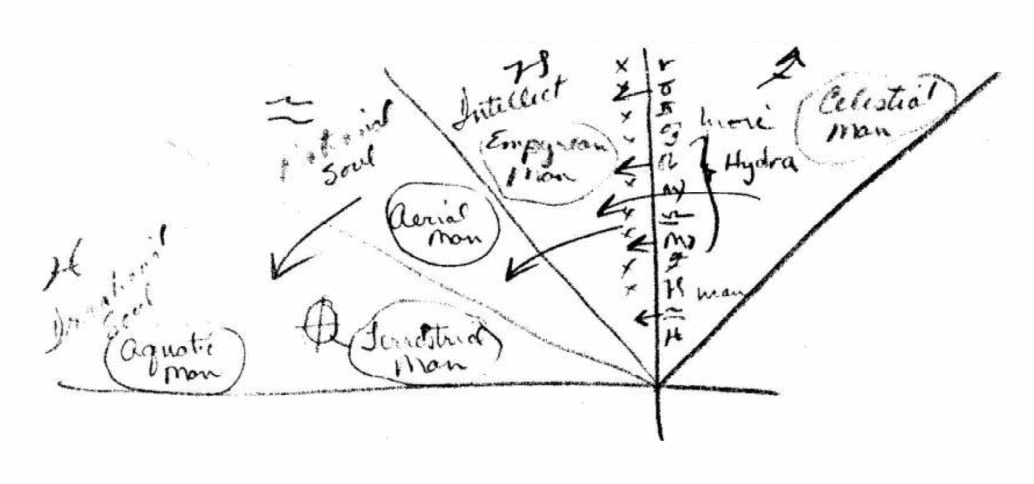
Descent of the Idea of Man through six levels, culminating in terrestrial man
Divided Line: soul's gnostic functions correlated with appropriate vehicles
Triad and Monads diagram; your experience is nothing but the activity of the monads translating the Ideas of God; all things are full of Gods
Man is most particular of all beings
Reading/discussing AD Commentary on Thomas Taylor's "Introduction to the Parmenides of Plato"
AD disagrees with Thomas Taylor and Proclus; this is not a doctrine of monadology but a doctrine of Ideas; AD's focus is on Phanes
Reading Parmenides, Thomas Taylor translation, footnote 1, p. 54
Reading/discussing AD Commentary on Thomas Taylor footnote 1, p. 54
Plato analyzes the forms (Ideas) rather than the matter; images in a mirror cannot be explained by analysis of the mirror
Christian conception of matter: indeterminate matter becomes determinate idea; this is opposite of the Platonic conception
Brief Q & A on various topics: Timaeus, extension, Platonism, natural religion, Scholastic/Aristotelian notion of matter, Christianity, Proclus/Saint-Germaine, Raymond Lilly, alchemy
AD story of the ring
1979 02/11 (day 3)
Reading Deck, Nature, Contemplation, and the One, on Matter "touching" the Idea directly
Reading Plotinus VI.5.8, on Matter's participation in the Ideas
Reading/discussing Parmenides, Thomas Taylor translation, footnote, p. 73, "Six Doubts Concerning the Nature of Ideas"
Each one of the 12 Ideas can become a philosophy of the Absolute
Soul has knowledge of the Intelligibles through the images; reminiscence
Perceptual world in Pisces prefigured in Aquarius in the form of number
Plato was headed towards arithmetization of the Ideas; AD hopes to work towards the same goal
Two principles of soul: soul in Nous (5th house) and soul in cosmos (11th house); John 1:4
More discussion of last three doubts
Rereading/discussing Plotinus VI.5.8
The Idea is universally pervasive
Ideas abide in themselves; Intelligibles involved in the fabrication of an entity make possible the communication of the Idea
Review of twofold nature of Jupiter/Demiurge to show necessity of the intermediation of Soul in the fabrication of the world
Prajapatis (dignities of fourth quadrant) assist the Demiurge in his fabrication
Sephiroth in third and ninth house
Kabbalistic trees
Prajapatis and Henads
Vesica with 144 degrees; always read a degree together with its opposite; AD Saturn at 6 Libra example
Jupiter's sceptre is 24 measures; Rhea in eighth house as fountain of souls
Reading Plotinus V.5.1, on sense-knowledge
Prakritic entity; dream analogy
Process of perception explained using fourth quadrant vesica; 11th house soul translates prakritic entity (in 10th house) into sensible object (in 12th house)
Object in 10th house has real ontic existence, what Plotinus calls the true-being tree (object)
Buddhist view: prakritic object directly/indeterminately known, sensible object indirectly/determinately known
Reading/discussing Plotinus IV.3.30, Guthrie translation; passage explained using fourth quadrant vesica
Matter is not an Idea
Saturn in Aries as Demiurgic Intellect, Jupiter in Gemini as Demiurgic Soul
Reading/discussing K.C. Bhattacharyya, "Studies in Vedantism," stanza 42
Vedantic explanation is no explanation but dogma; if the Gods are illusory, why is it that they are forever?
AD doesn't submit to one school; the different schools correct each other
Ramakrishna: something of your individuality remains in Divine Union
AD Mercury at 17 Virgo, Kozminsky
Importance of humanizing/personalizing the archetype
Primeval wisdom belongs to the race of men, not to any one nation, school, etc.
Brief Q & A on current events; AD doesn't care for politics, tries to avoid the news; focus on tending your own garden
Reading/discussing King James Bible, John, 1:1-6, on the Word of God
Reading/discussing Plotinus III.5.10, on Love
Sages have purified their vehicles; Blavatsky: Shankaracharya used the purified vehicles of the Buddha to incarnate
Bodhisattvas, importance of love and kindness, PB anecdotes, cosmic soul's love for the world
Reading/discussing Plotinus III.6.17, VI.4.1, 8, 12, 13, on magnitude, extension
Extension is the only clue into the nature of Matter; Magnitude is an Ideal in the Intelligible World
Guenon: Matter as pure potency
Separating words from associations acquired through conditioning
Reading C.G. Jung, "The Tavistock Lectures," on the Self, the world as our picture
Reading/discussing Plotinus V.1.4, VI.2.8, on five genera
Plato's Theaetetus: Being is also dynamic
Functioning of 11th house vesica and nidana chain; your perception is pervaded by ignorance, egoism, emotion, etc.
Buddhism aims at breaking up this neurotic pattern of perceiving and making you open-ended; the study of philosophy also does this
AD recommends reading Wei Wu Wei, All Else is Bondage; especially good for people with multiple rulerships
BOOKS READ FROM OR REFERENCED:
Proclus, Thomas Taylor (tr.), The Six Books of Proclus, the Platonic Successor, on the Theology of Plato, 2 vols.
Thomas Taylor (tr.), The Republic (Vol. 1), The Timaeus (Vol. 2), The Parmenides (Vol. 3), in The Works of Plato, viz. His Fifty-Five Dialogues, and Twelve Epistles
G.R.S. Mead, Orpheus
Plotinus, The Enneads (MacKenna translation, 4th ed.)
Plotinos, Kenneth Sylvan Guthrie (tr.), Complete Works, Vol. II
Bible, John (1:1-6), Matthew (16:24), Proverbs 8, 2 Timothy (3:2)
Benoytosh Bhattacharyya, An Introduction to Buddhist Esotericism
Paul Brunton, The Wisdom of the Overself
Sir John Woodroffe, The World as Power
John N. Deck, Nature, Contemplation, and the One: A Study in the Philosophy of Plotinus
P.V. Pistorius, Plotinus and Neoplatonism: An Introductory Study
Vyasa, Bhagavad Gita
Heinrich Zimmer, Philosophies of India
Sir John Woodroffe, The Serpent Power
Titus Burckhardt, Alchemy, Science of the Cosmos, Science of the Soul
Swami Satprakashananda, Methods of Knowledge According to Advaita Vedanta
D.T. Suzuki, Essays in Zen Buddhism, Third Series
Kathleen Raine, George Mills (eds.), Thomas Taylor, the Platonist: Selected Writings
Sri Venkataramiah (Swami Ramanananda Saraswati), Recorder, Talks with Sri Ramana Maharshi
Frithjof Schuon, Language of the Self
Franz Pfeiffer, Meister Eckhart, Volume 1, trans. C. De B. Evans
Porphyry, Thomas Taylor (tr.), "Sententiae: Auxiliaries to the Perception of Intelligible Natures," in Select Works of Porphyry; also in Shrine of Wisdom, Nos. 45-47
Mary Anne Atwood, A Suggestive Inquiry into the Hermetic Mystery
Surendranath Dasgupta, Philosophical Essays, "Yoga Theory of the Relation of Mind and Body"
G.R.S. Mead, The Doctrine of the Subtle Body in Western Tradition
Guenther Wachsmuth, The Etheric Formative Forces in Cosmos, Earth and Man: A Path of Investigating Into the World of the Living
Immanuel Kant, Critique of Pure Reason
Francis MacDonald Cornford, Plato's Cosmology: The Timaeus of Plato
John Dillon, The Middle Platonists
Proclus, Thomas Taylor (tr.), The Commentaries of Proclus on the Timaeus of Plato, in Five Books, Vol. 2
C.G. Jung, CW 11, Psychology and Religion: West and East, "Foreword to Suzuki's Introduction to Zen Buddhism"
Thomas Taylor (tr.), The Mystical Initiations; or, Hymns of Orpheus
T. Subba Row, Five Years of Theosophy, "The Twelve Signs of the Zodiac"
Leo Schaya, The Universal Meaning of the Kabbalah
Marc Edmund Jones, The Astrology of Concepts
Marc Edmund Jones, The Sabian Symbols in Astrology
Alan Leo, Esoteric Astrology
Krishnachandra Bhattacharyya, Studies in Philosophy, Vol. 1, "Studies in Vedantism"
Paul Brunton, The Hidden Teaching Beyond Yoga
Isidore Kozminsky, Zodiacal Symbology and Its Planetary Power
H.P. Blavatsky, Collected Writings, Vol. XIV, "The Mystery of Buddha"
Plato, Banquet (Symposium), Theaetetus
Rene Guenon, The Reign of Quantity and the Signs of the Times
Marcel Proust, Swann's Way
C.G. Jung, CW 18, The Symbolic Life, "The Tavistock Lectures"
Leonardo Taran, Parmenides: A Text with Translation, Commentary, and Critical Essays
Francis MacDonald Cornford, Plato's Theory of Knowledge
Herbert Guenther, Tibetan Buddhism in Western Perspective
Herbert Guenther, Tantric View of Life
Wei Wu Wei, All Else is Bondage: Non-Volitional Living
PLOTINUS QUOTES READ OR REFERENCED: I.1.7, II.4.1-6, II.4.10, III.4.6, III.5.10, III.6.7, III.6.9, III.6.10, III.6.13, III.6.14, III.6.17, IV.1.1, IV.3.30, IV.4.9, V.1.4, V.1.10, V.3.11, V.5.1, VI.2.8, VI.4.1, VI.4.4, VI.4.8, VI.4.12-13, VI.5.8, VI.7.17
DIAGRAMS appended to this transcript:
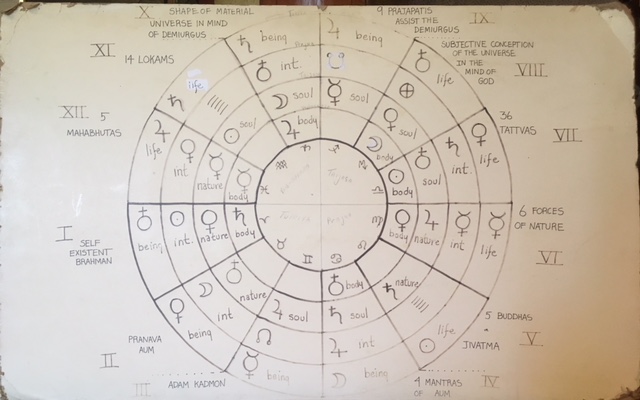
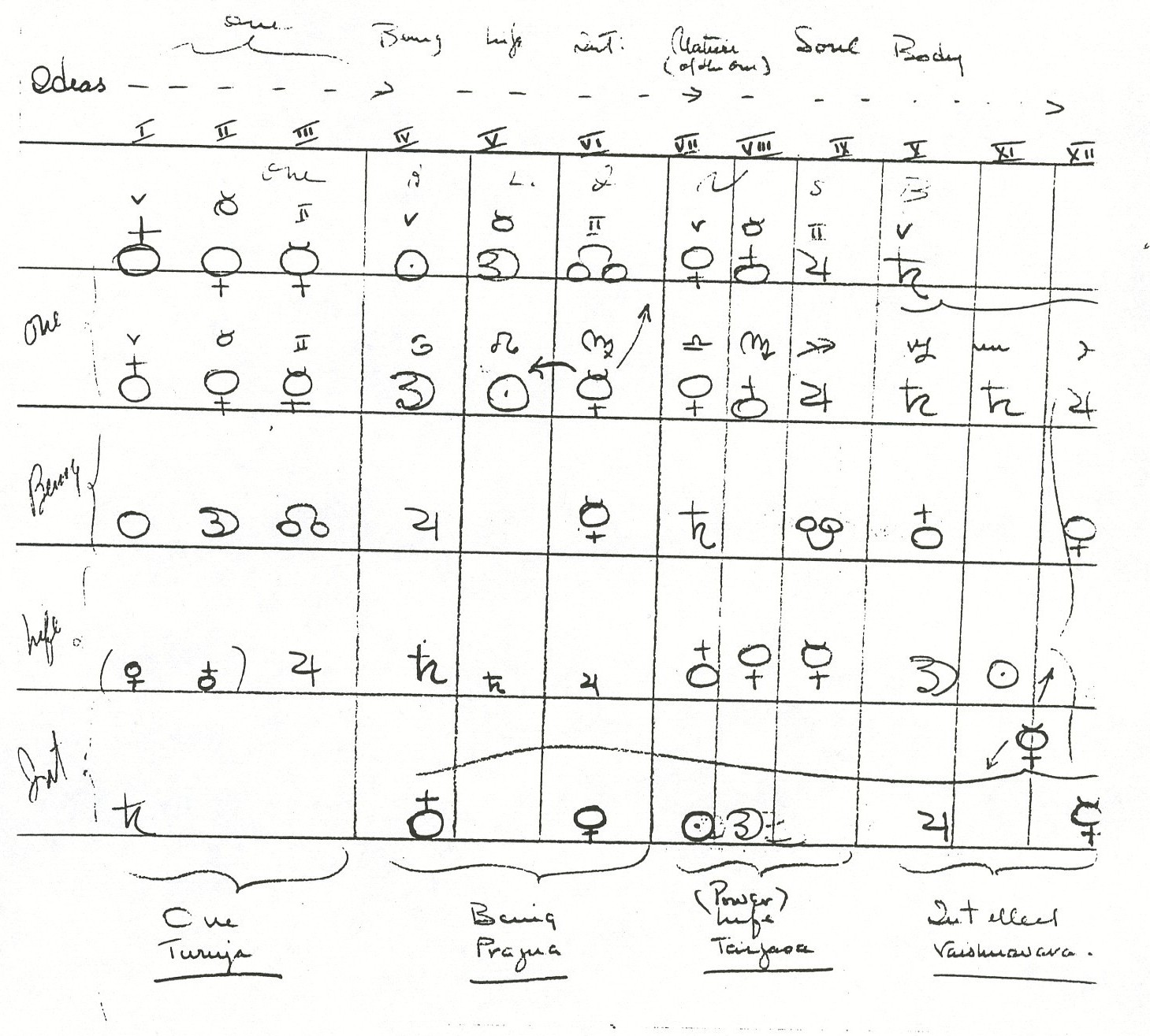
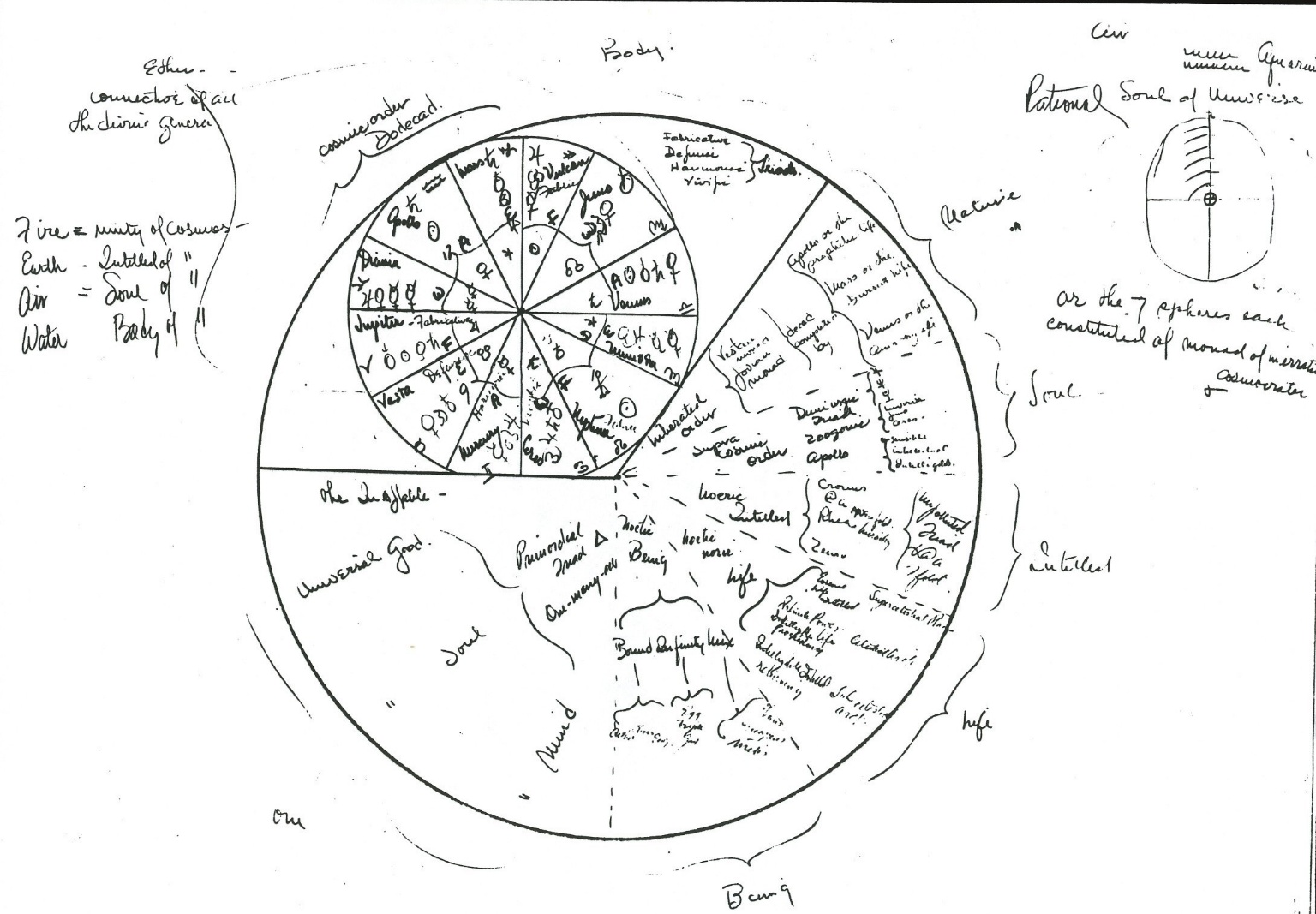
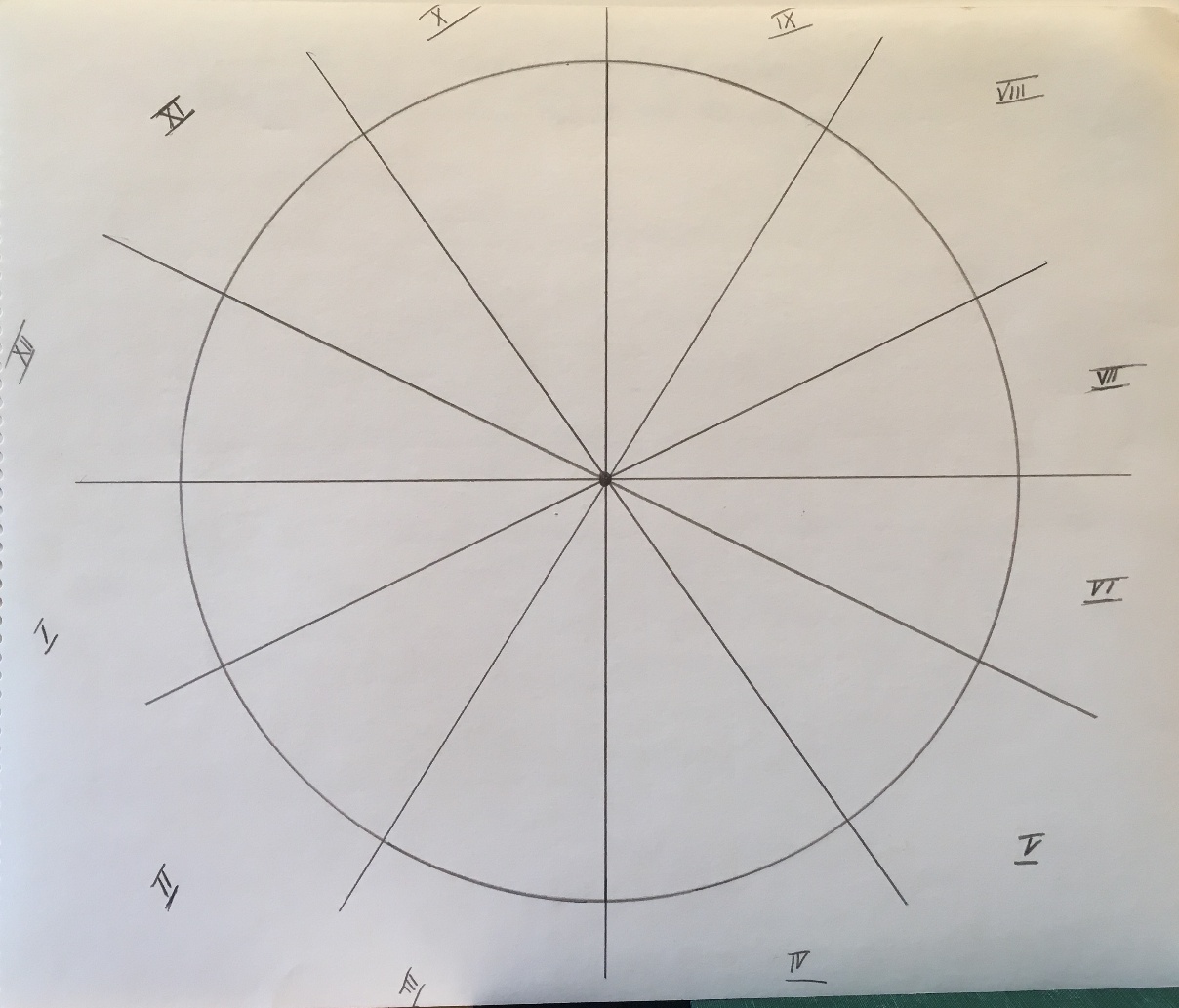
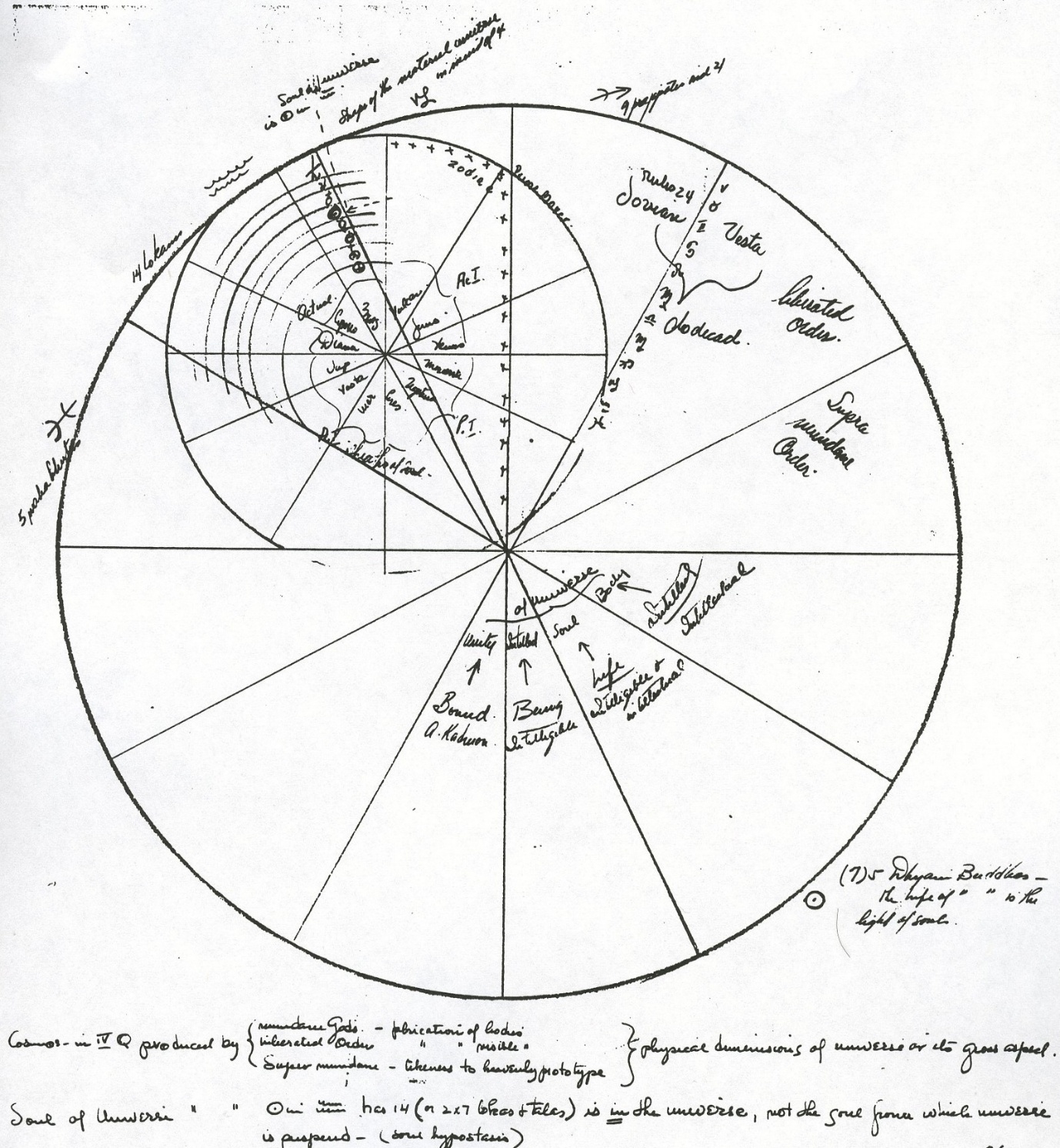
FIGURE IMG 2202-Posterboard Metaphysical Chart.
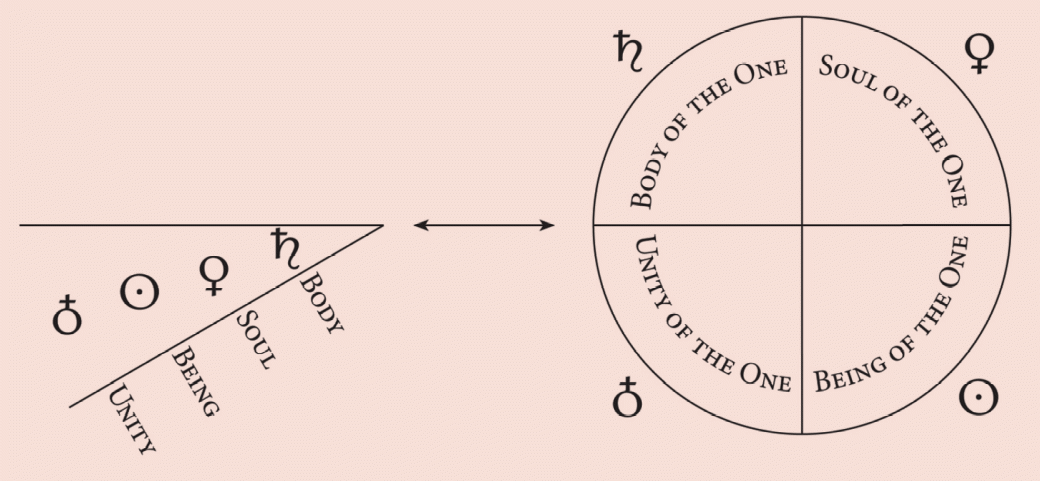
FIGURE 1979 0209-2. Fourfold Nature of the One.
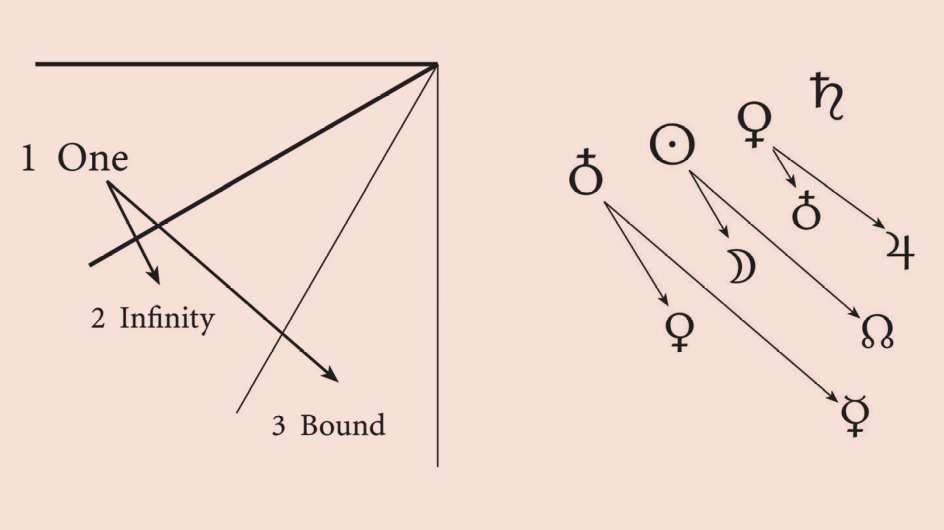
FIGURE 1979 0209-3. One, Infinity, Bound.
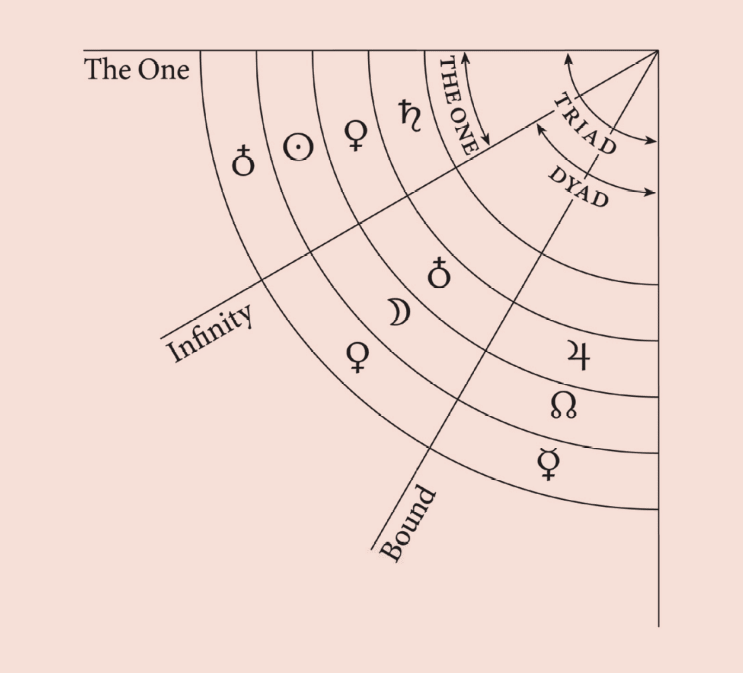
FIGURE 1979 0209-4. One, Dyad, Triad.
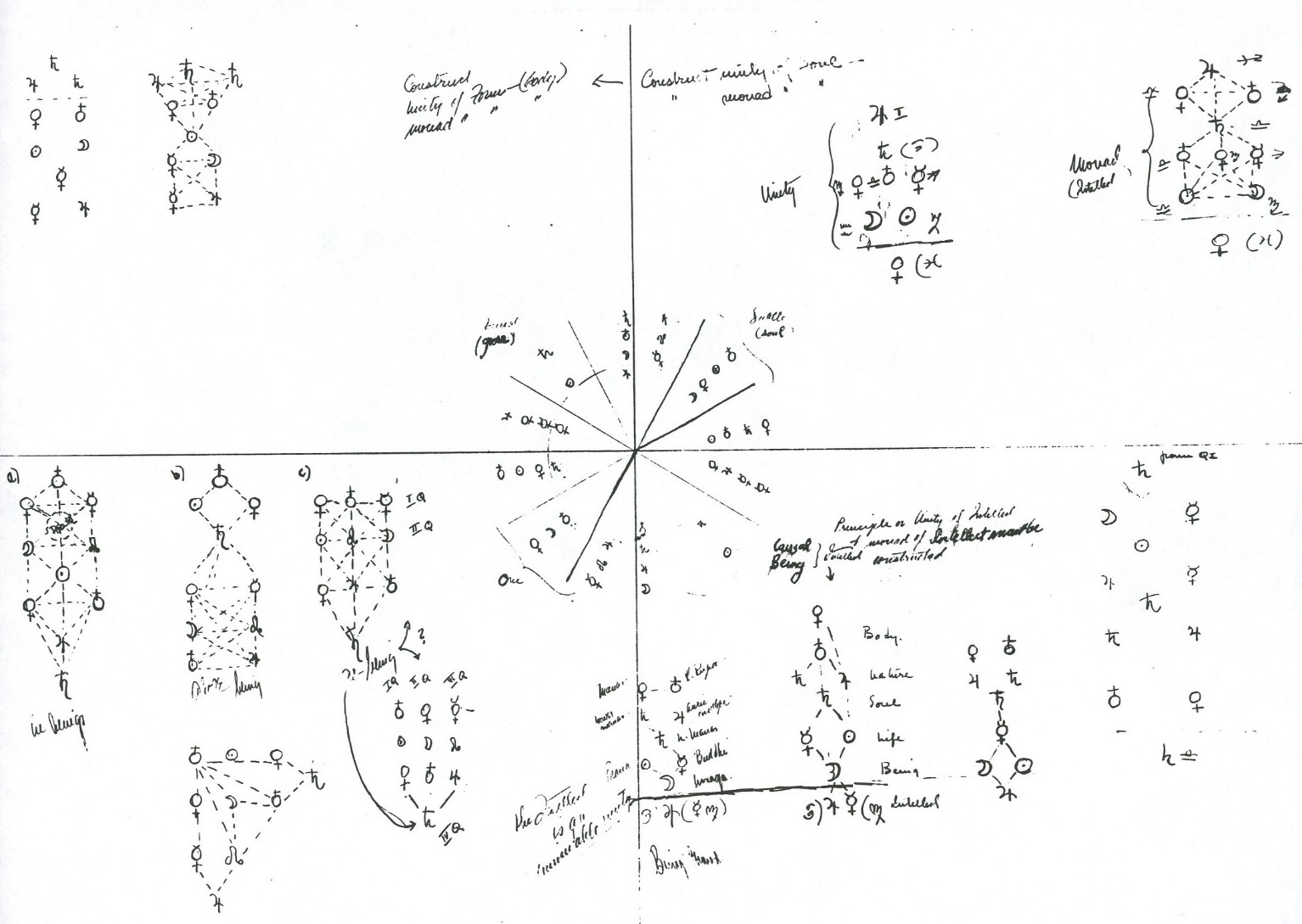
FIGURE AD_B_004. Five Line Metaphysical Chart.
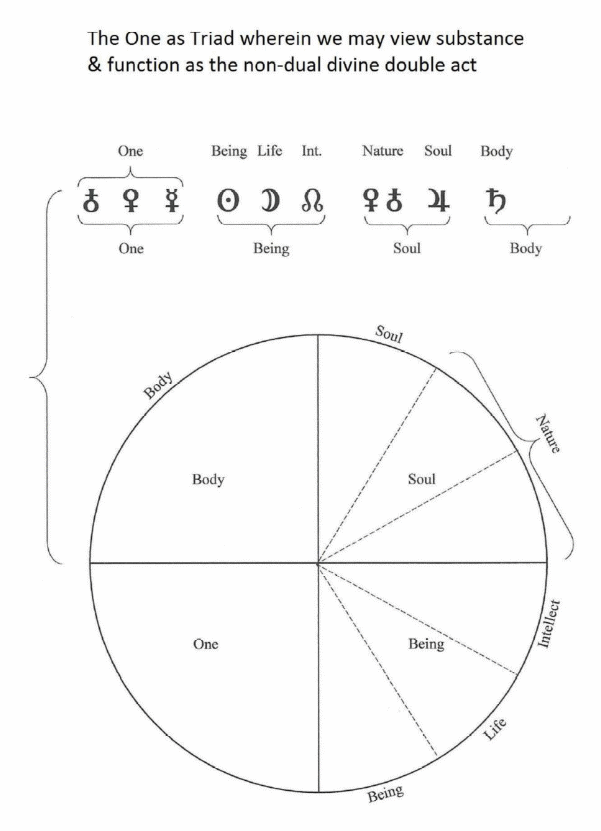
FIGURE AD Supp 202-digital. Triad, Double Act, and Circle.
FIGURE 1979 0209-7. Triad and Intellectual-Principle; Henads and Monads.
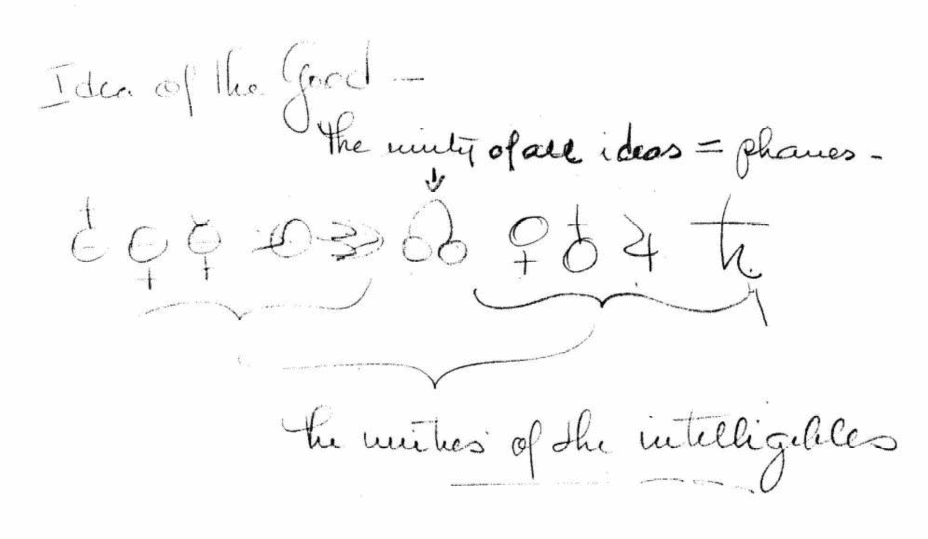
FIGURE 1979 0209-8. Idea of the Good.
FIGURE A025alt IMG_2520 copy. Triad and Henads.
FIGURE AD_A025. Triad, Tetrad, Pentad.
FIGURE 1979 0209-11. Good/Sun analogy correlated with Divided Line.
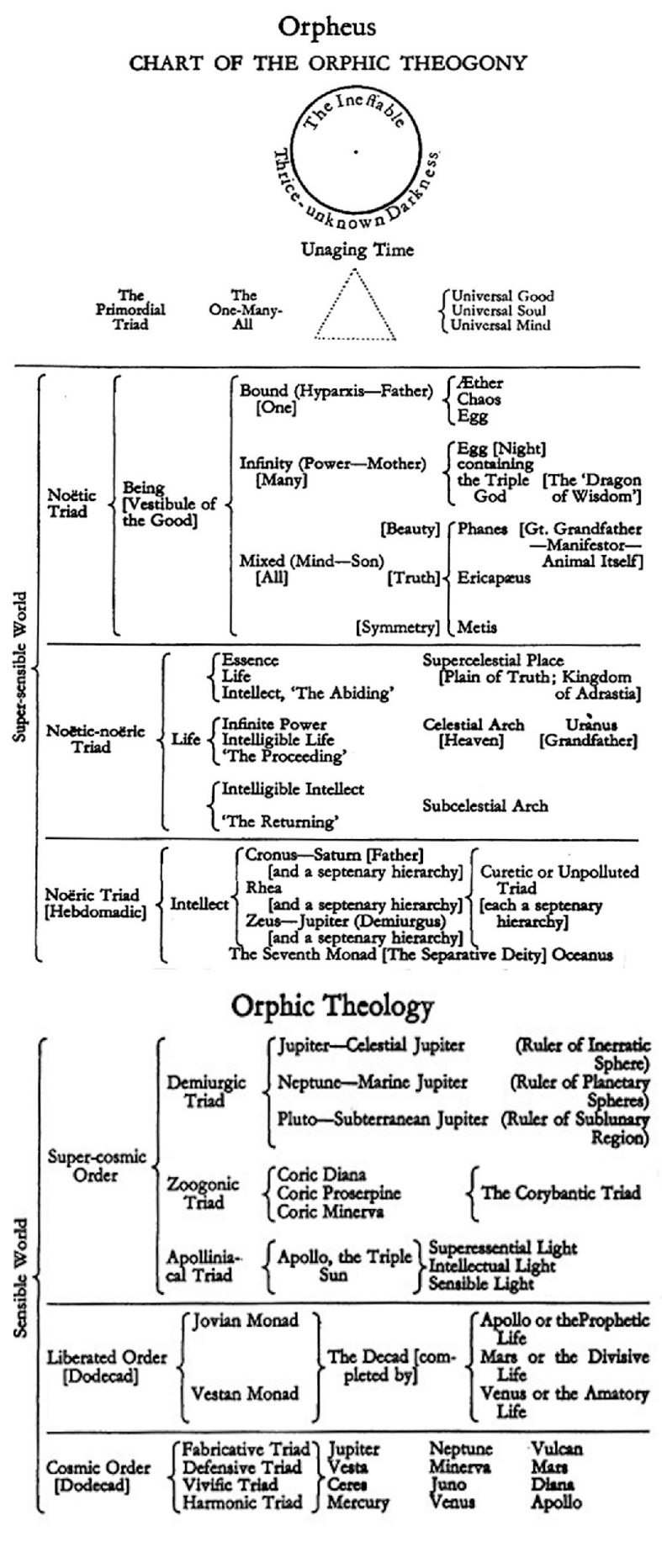
FIGURE 1979 0209-12. Chart of the Orphic Theogony.
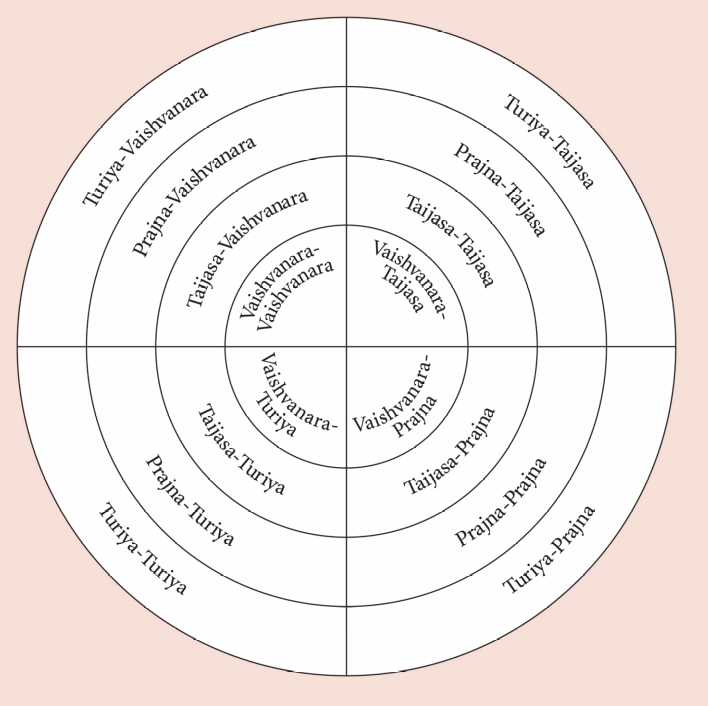
FIGURE 1979 0209-13. Four States of Consciousness in Four Rings and Four Quadrants.
FIGURE AD_B_006. Jupiter Henad.
FIGURE AD IMG_2239 high copy. Divine Mind, Demiurgic Intellect, and Cosmos.
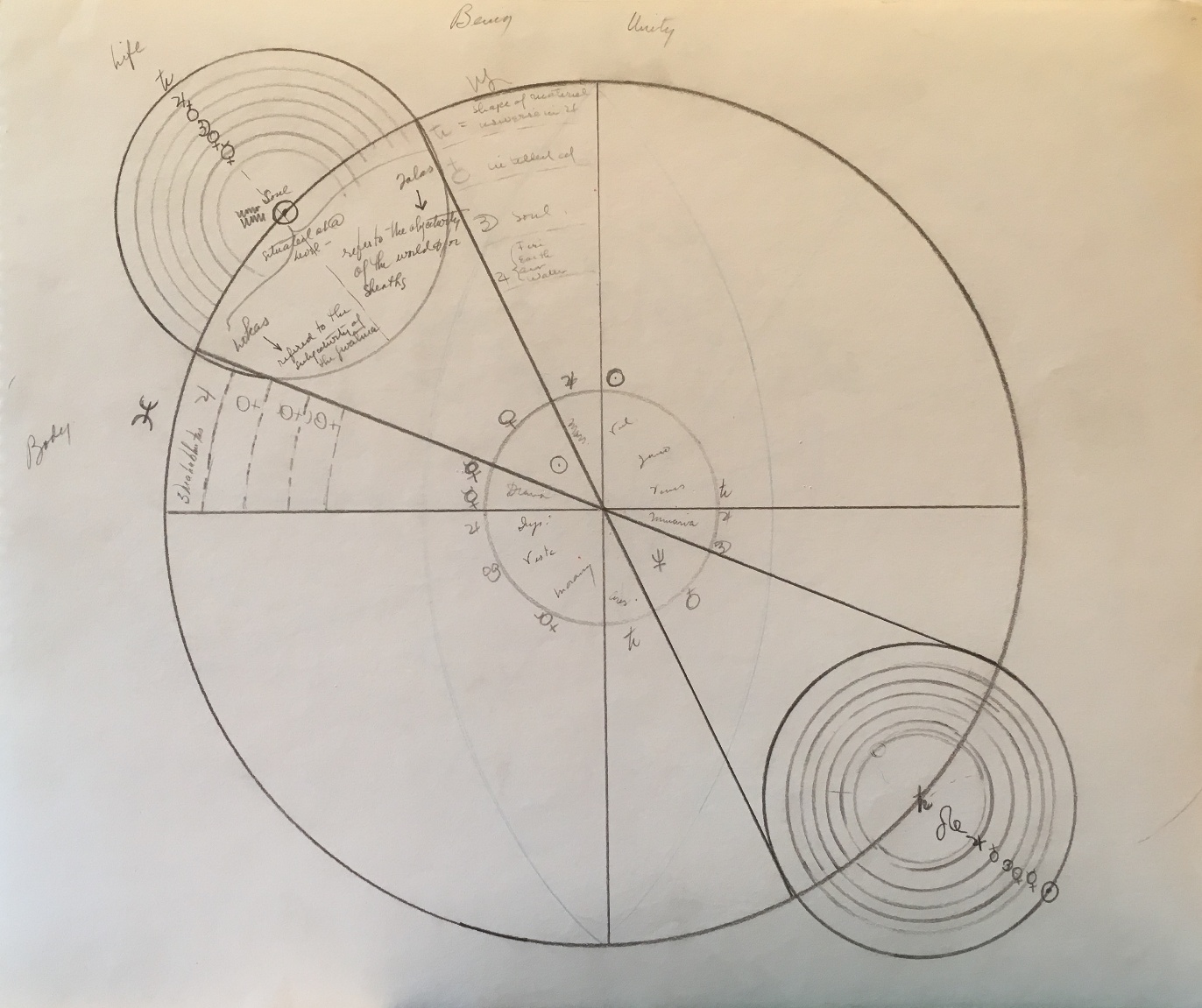
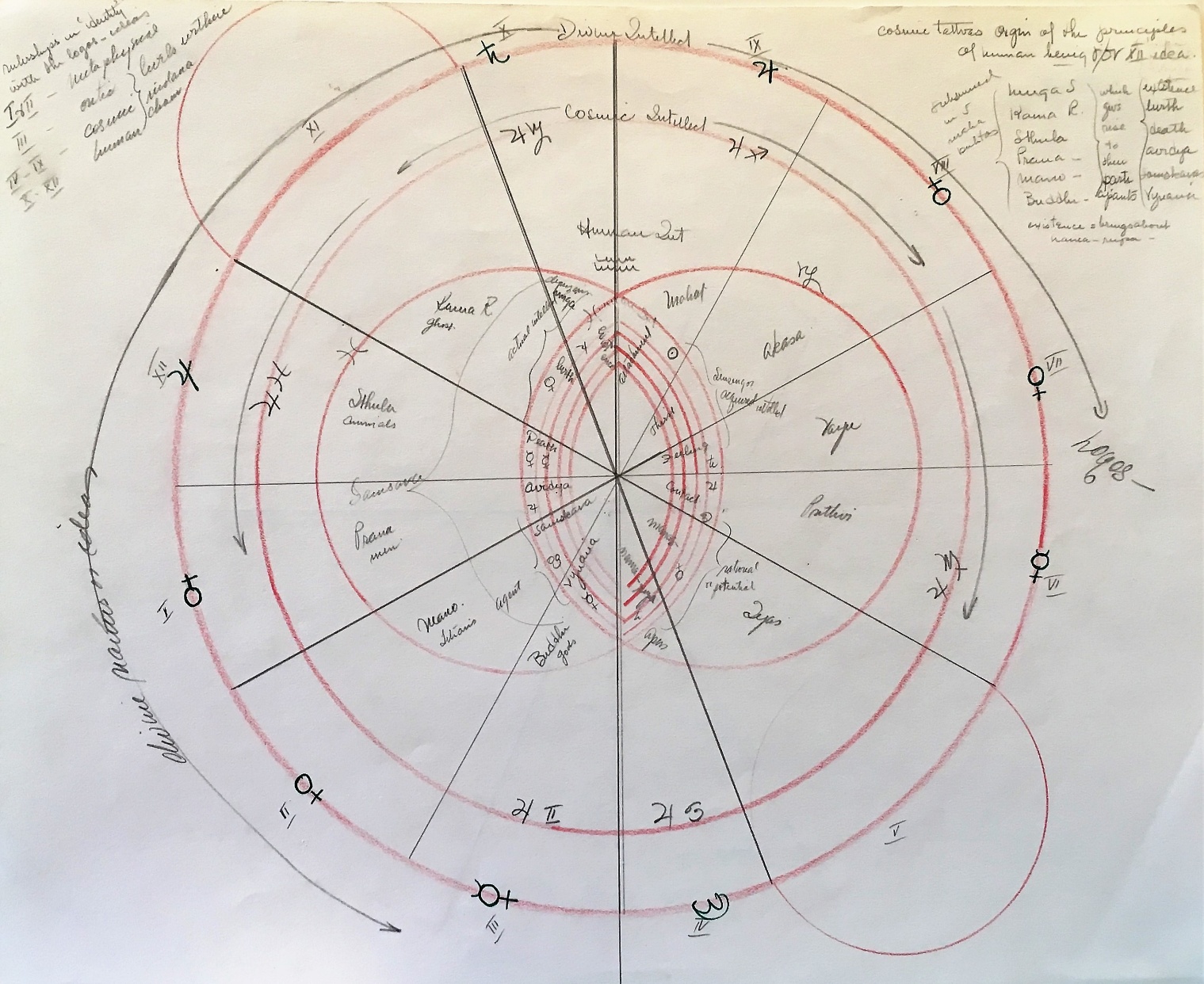
FIGURE IMG_2324 copy. Being, Life, Intellect and Vesica of Houses 10-12, with Six Cosmic Tattvas and Six Theosophical Principles of Man.
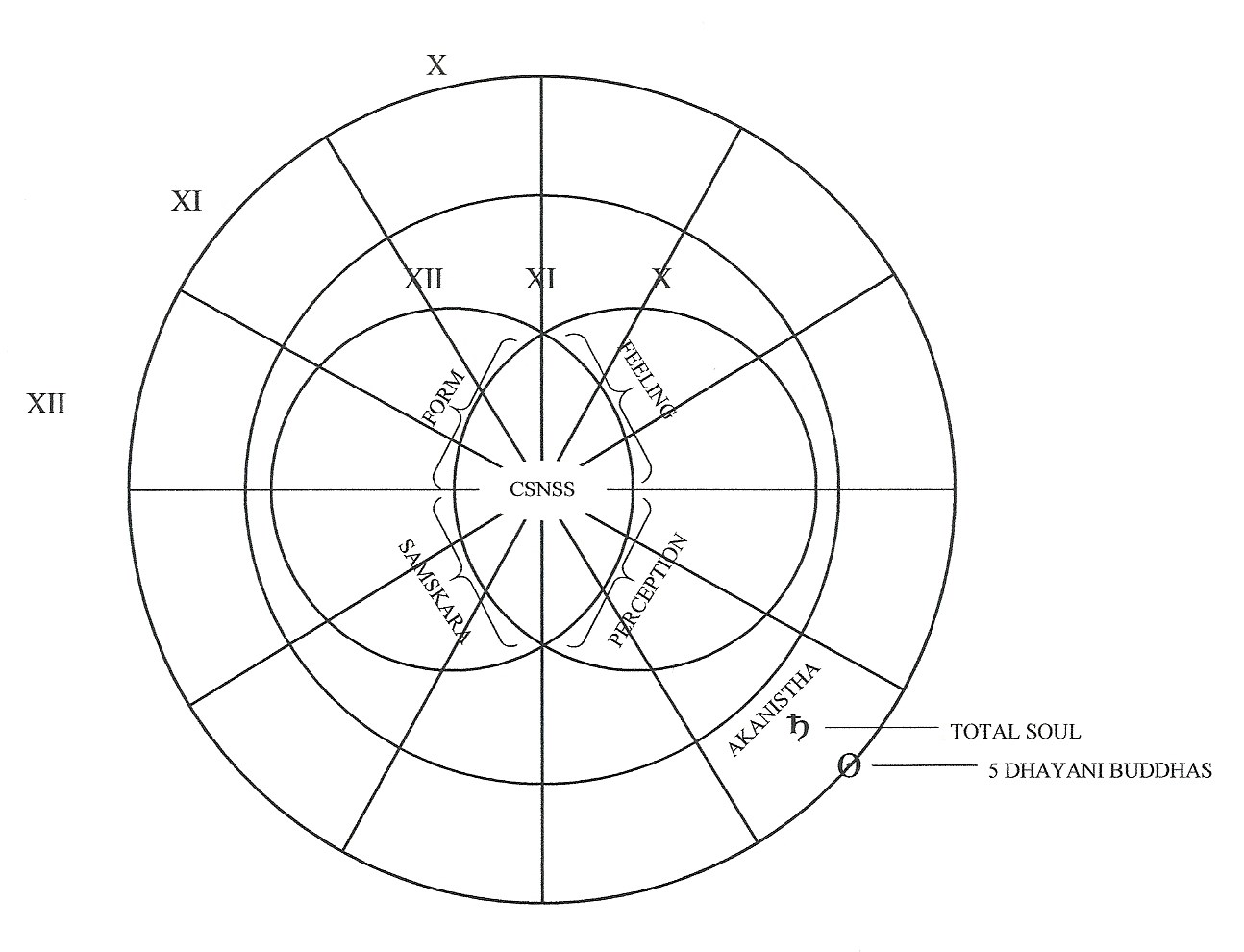
FIGURE CTRTA-1-digital. Divine Intellect, Demiurgic Intellect, Vesica of Houses 10-12 (with Skandhas), Five Dhyani Buddhas, and Total Soul.
FIGURE A018B IMG_2509 copy. Fifth-Eleventh House Axis, Demiurge with Cosmic Gods, Houses 9-12.
FIGURE AD_H_033. The Orphic Theogony Mapped on to the Metaphysical Chart.
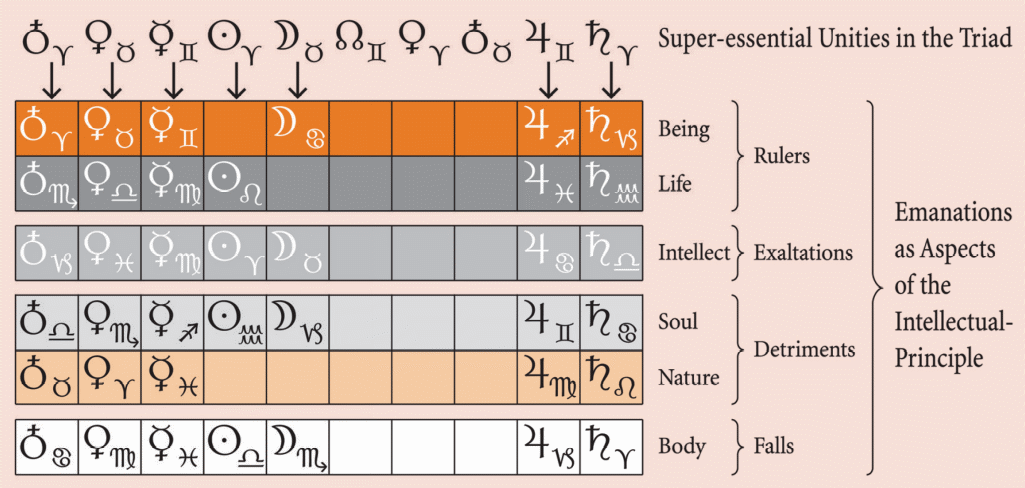
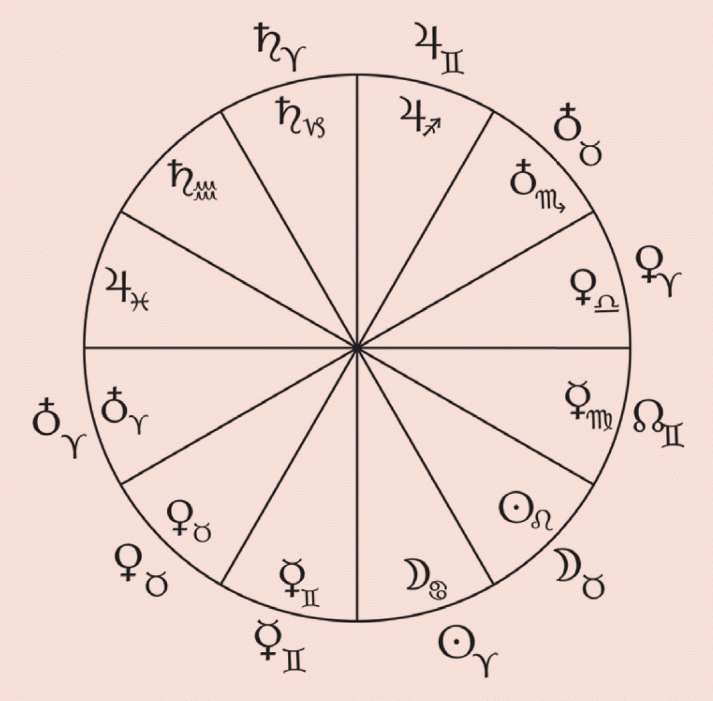
FIGURE 1979 0209-20. Ten Unities and Twelve Rulerships.
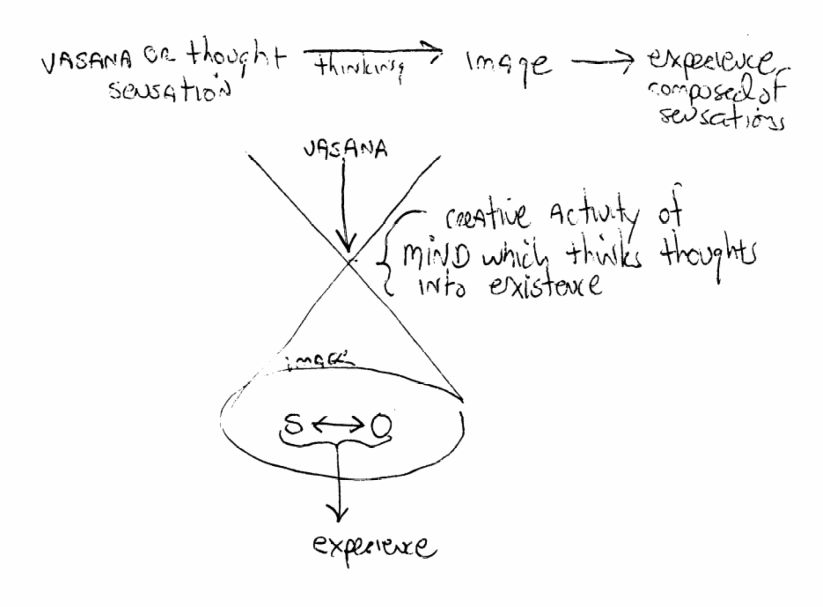
FIGURE 1979 0209-21-AB. Mind Produces Experience.
FIGURE CTRTA-12-digital. Fourth Quadrant Vesica.
FIGURE CTRTA-4-digital. Saturn in Leo and Fourth Quadrant Vesica.
FIGURE A017 IMG_2477 fix. Divine, Cosmic, and Human Intellect; Vesica of Houses 10-12 with Four Intellects and Nidana Chain.
FIGURE 1979 0209-25. Divine, Demiurgic, and Human Intellect.
FIGURE 1979 0209-26. Five Levels of Idea of Man in Houses 9-12.
FIGURE AD_A007. Henads and Monads.
FIGURE 1979 0209-28. Seven Line Metaphysical Chart.
FIGURE IMG_2499 copy. Circle of Twelve Ideas.
FIGURE AD_H_009. Kabbalistic Trees in Four Quadrants.
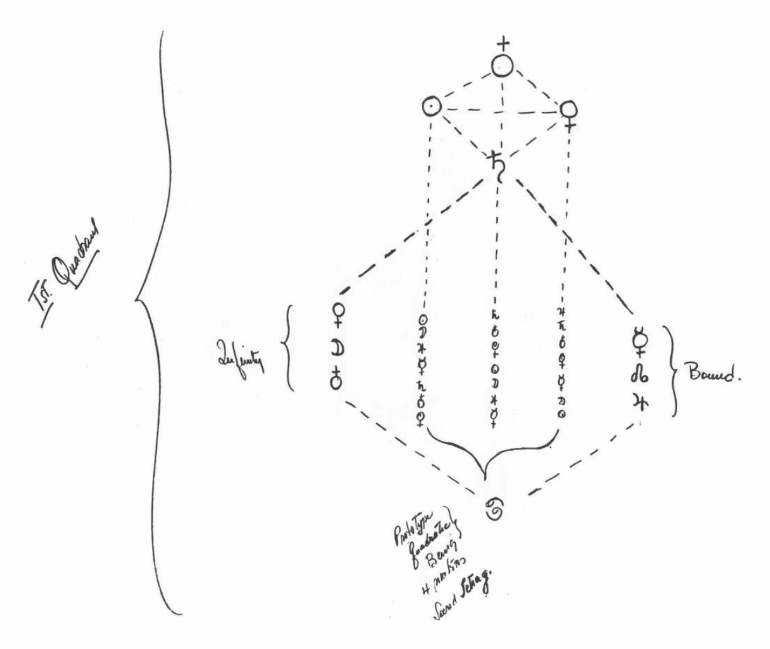
FIGURE AD_H_022b. First Quadrant Dignities and Cancer; Intellect, Soul, and Body Monads suspended from First House Dignities.
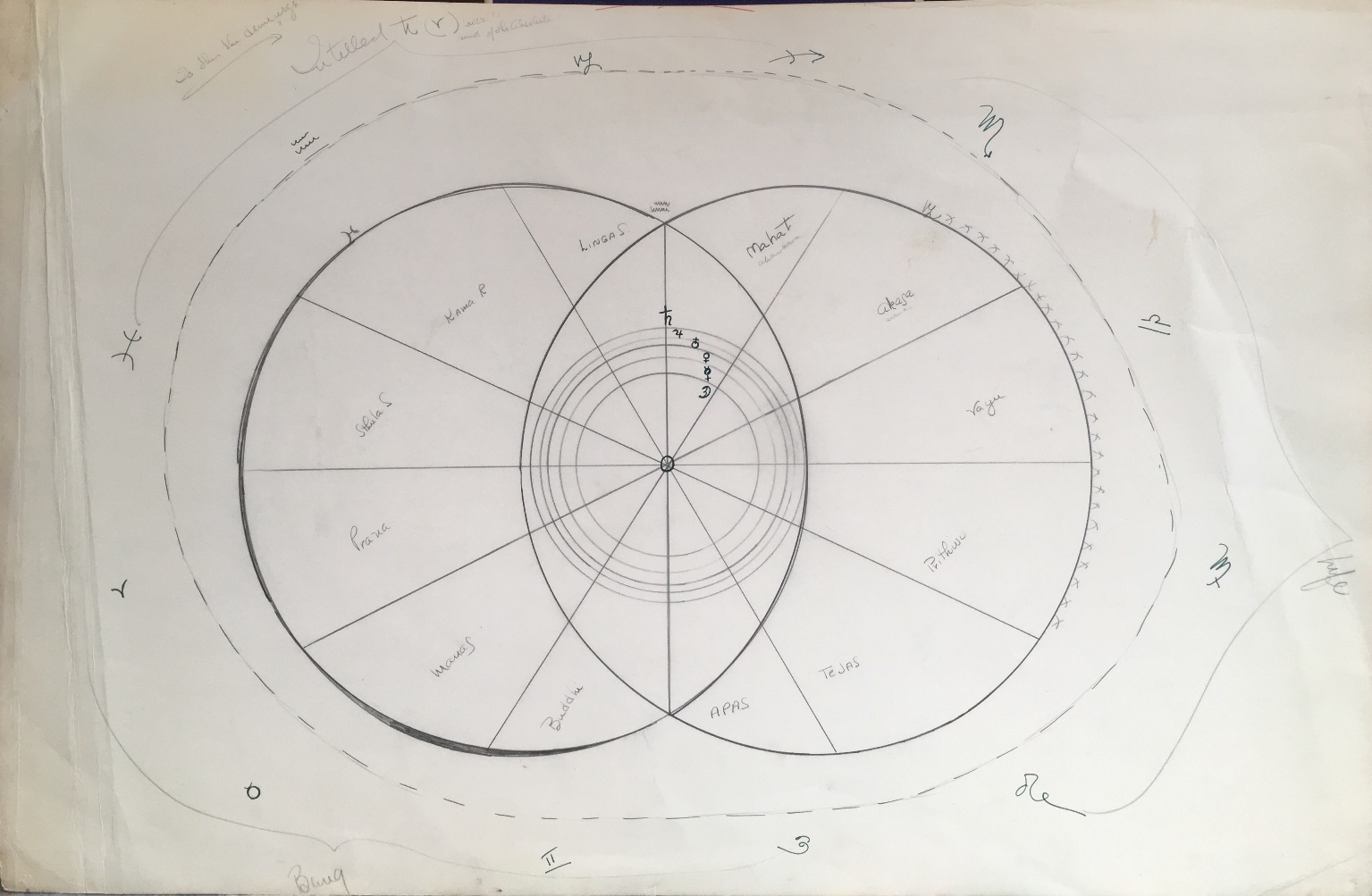
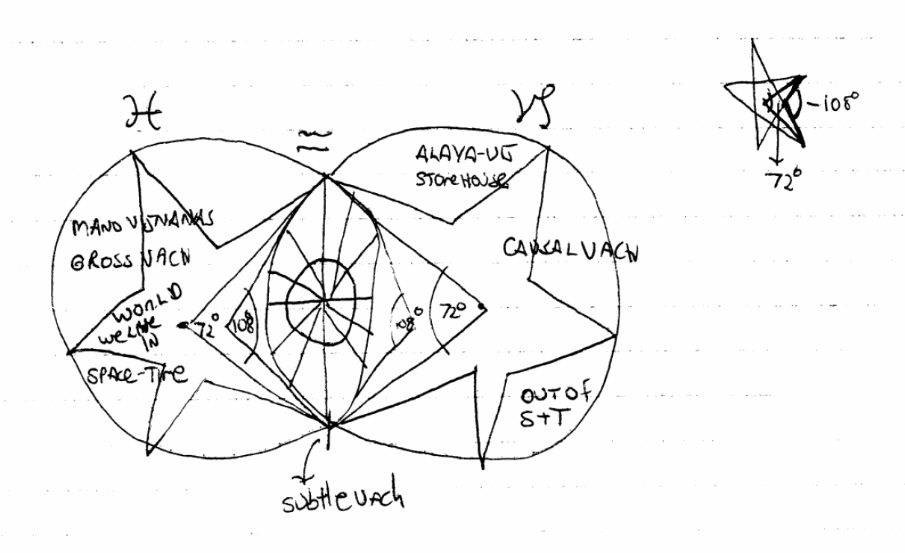
FIGURE 1979 0209-32-AB. Five-Pointed Stars in the Capricorn and Pisces Circles Meeting at the Eleventh House Vesica; Houses 10-12 as Alaya-Vijnana, Manas, and Mano-Vijnana, with the Three Levels of Vac.
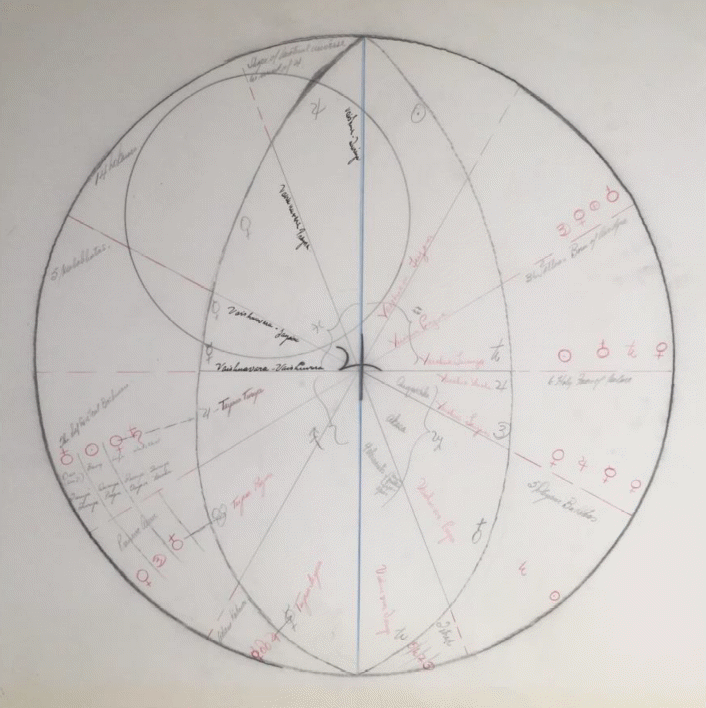
FIGURE AD_A006. The Metaphysical Chart with Orders of Gods and Eleventh House Vesica.
Other diagrams also referred to are not with this transcript version. [Transcriber note: [diagram] means the speaker is referencing a diagram as he or she is speaking. If someone is drawing or writing, with audible sounds of chalk on a blackboard, I indicate this by [drawing] or [writing].]
SABIAN SYMBOLS: Libra 6-Aries 6, Virgo 17-Pisces 17 (Kozminsky)
AD PAPERS read in class:
AD commentary on Thomas Taylor's "Introduction to the Parmenides of Plato," as revised on 1/18/1979
AD commentary on Parmenides, Thomas Taylor translation, footnote 1, p. 42
AD commentary on Parmenides, Thomas Taylor translation, footnote 1, p. 54
NOTES:
AD = Anthony Damiani; RW = Richard (Red) Witter.
For readability's sake, the following substitutions/edits made in Verbatim Transcript: gonna = going to; yeah = yes.
Previous partial transcripts exist.
TRANSCRIBED Verbatim by IT prior to 2017, reformatted by jf 2017. In 2024, IT updates prefatory matter and footer, alters Topic, removes Subject, expands Subsubjects, adds TOC, fixes/completes Book List, adds Plotinus quotes section, relabels audio files correctly and corrects placement of date breaks, fixes errors/typos, adds new notes within transcript, adds thirty-three diagrams and references within transcript to these diagrams, reformats to accord with new conventions. Archival verbatim transcript with AD Papers – V12ap.
AUDIO FILES: 1979 0209a, b; 1979 0210a, b, c, d (formerly 1979 0209c, d, 1979 0210a, b); 1979 0211a, b, c (formerly 1979 0210c, d, 1979 0211a). [Note 1: "Tape" and "Side" refer to original audio cassette tapes that were later digitized into .MP3 files. Note 2: We are missing the last audio cassette tape for this event. At the end is a non-verbatim transcription of this last tape that was done by somebody in Columbus (probably in 1979) with some light formatting/editing by IT. Note 3: The audio files do not always neatly divide by date. This transcript, however, includes "DATE" breaks to assist reading.]
| NEW FILE NAME | OLD FILE NAME |
| 1979 0209a, b | 1979 0209a, b |
| 1979 0210a | 1979 0209c |
| 1979 0210b | 1979 0209d |
| 1979 0210c | 1979 0210a |
| 1979 0210d | 1979 0210b |
| 1979 0211a | 1979 0210c |
| 1979 0211b | 1979 0210d |
| 1979 0211c | 1979 0211a |
1979 02/09 Class Held in Columbus, Ohio (Day 1 of 3-Day Event)
Metaphysical Chart
[Audio File 1979 0209a Begins]
S: I understand that's the Being of Soul [Jupiter in Sagittarius; see FIGURE IMG_2202-Posterboard Metaphysical Chart] because it's where is it in the-- Why that is considered Soul and what do each of the other planets mean, if there is such a thing as a meaning there because-- Does Mars-- Like if Jupiter in Sagittarius always means Soul, what does each one of the other-- Well I'm not saying this right. If I were to take the seven planets, is there a basic meaning for each one of the planets, that's I guess what I want to say, I mean could I always say that Jupiter would represent [AD simultaneously: Alright.] Being of Soul. But-- [AD simultaneously: Let's--] and that if so, why-- how we got to this conclusion.
S: Jupiter is nice. [S simultaneously: Well I have no--] Jupiter is just Being, it's the Being of--
BB: Being of Soul.
S: (It's Soul as image.)
S (simultaneously): It is in Sagittar--
AD (simultaneously): Being of Soul, Being of Soul.
S: Yes, but I just want to know if--
S (simultaneously): Oh, the Being of Soul.
S: If you could take Jupiter by itself, would there always be a meaning for Jupiter to which we could refer? Alright, that's what-- oh, and the same with Mars and that-- Is that an irrelevant question do you think?
AD (simultaneously): No, no, that's-- that's a very high level question. [2 minute 39 second pause while AD draws] You see what I'm doing here?
[student assents, faint]
[almost 39 second pause while AD draws]
S: It's just different ways of interpreting all the [one/two words inaudible]
AD (simultaneously): Yes, this [diagram] is one way, [S: Yes.] ok, this [diagram] is another way, this is-- Alright?
S: Uh-hm.
[Note: For the following paragraph, a very comprehensive diagram exists (AD Mandalas, Fig. L05, Three Ways of Symbolizing the One, Dyad, Triad, and Tetrad) that fits Anthony's words more or less exactly but it is too faint and hard to see and so is not included here. A brief description is as follows. It is a 4 x 4 chart. First column: One, Dyad, Triad/Idea of Good, Tetrad. Second, third, fourth columns: different ways of diagramming the One, Dyad, Triad, Intellectual-Principle. Diagrams on pp. 320-321 of Astronoesis show some of these ways. Three diagrams are referred to below to stand in its place (FIGURES 1979 0209-2, 3, 4). Because they don't contain all the detail of the more comprehensive diagram, there is not always a one-to-one correspondence between Anthony's words and the appended diagrams but the idea is the same.]
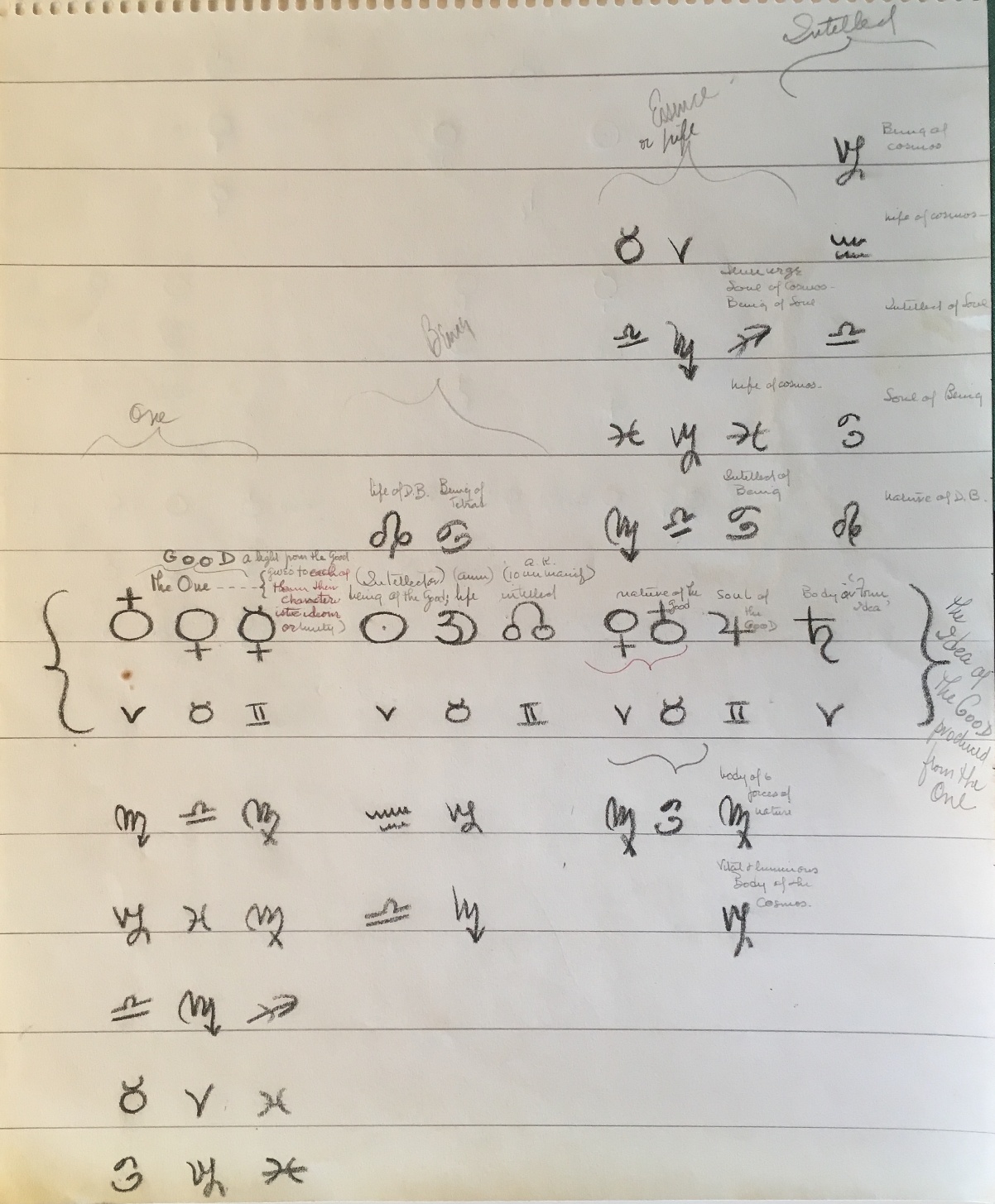
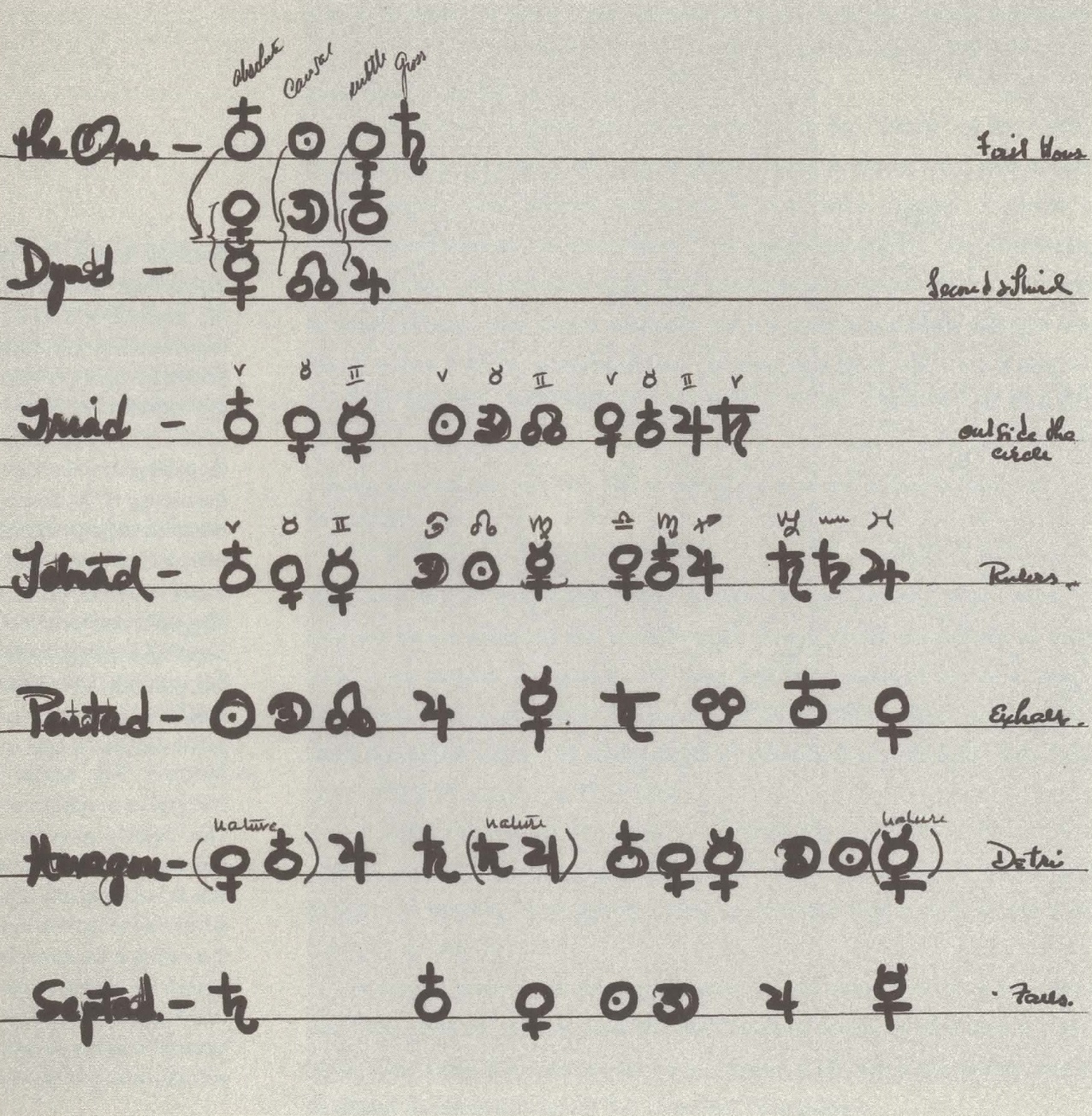
AD: Now, Plato will speak about the One, alright, and I symbolize it this way [diagram] or this way [diagram] or this way [diagram], ok. [Note: See FIGURE 1979 0209-2 for two of the ways and top part of FIGURE AD_H_022b for the third way.] And then he speaks about the Dyad, the infinite Matter, but not matter-- This is Intelligible Matter, ok. He speaks about the Dyad, alright. Or he also speaks about--and from the One come two principles, Infinite and Bound, alright. Infinite and Bound. [Note: See FIGURE 1979 0209-3.] From the One come two principles, Infinite and Bound. If you want, do this here--Infinite [drawing] and Bound. Over here you could see this is the One and this is the Duad and the three of them together will give you the Triad [diagram], ok. [Note: See FIGURE 1979 0209-4.] And the same over here. This is the One, the Transcendent One, up here [diagram], ok. Over here it's really the Duad. If you look you can see, so to speak, that's divided in half, ok, this part here. [Note: This is a reference to a picture with the ten dignities strung around the circle up to the tenth house, with the circle split in half down the middle vertically.] [drawing] Then the Triad would be, so to speak, a com-- the result of the combination of these two, the One and the Dyad, gives you the Triad, alright. And this would be the Triad over here, ok. I also call it the Idea of the Good. [drawing] This would be the Triad, all these together, ok. And the Triad is the same here, down here [diagram], ok. Now this one is the one that's a little difficult so I'll try to show you while I do it. I'm going to work up here, ok, it doesn't matter. [42 second pause as AD draws] Ok, if we look at it this way, ok? You would say this is the Transcendent One and this is the Duad and the three of them together the Triad [diagram].
[Note: See FIGURE AD_B_004 for the following. Quadrants are represented vertically, rings horizontally, except for top line of planets which is the Triad.]
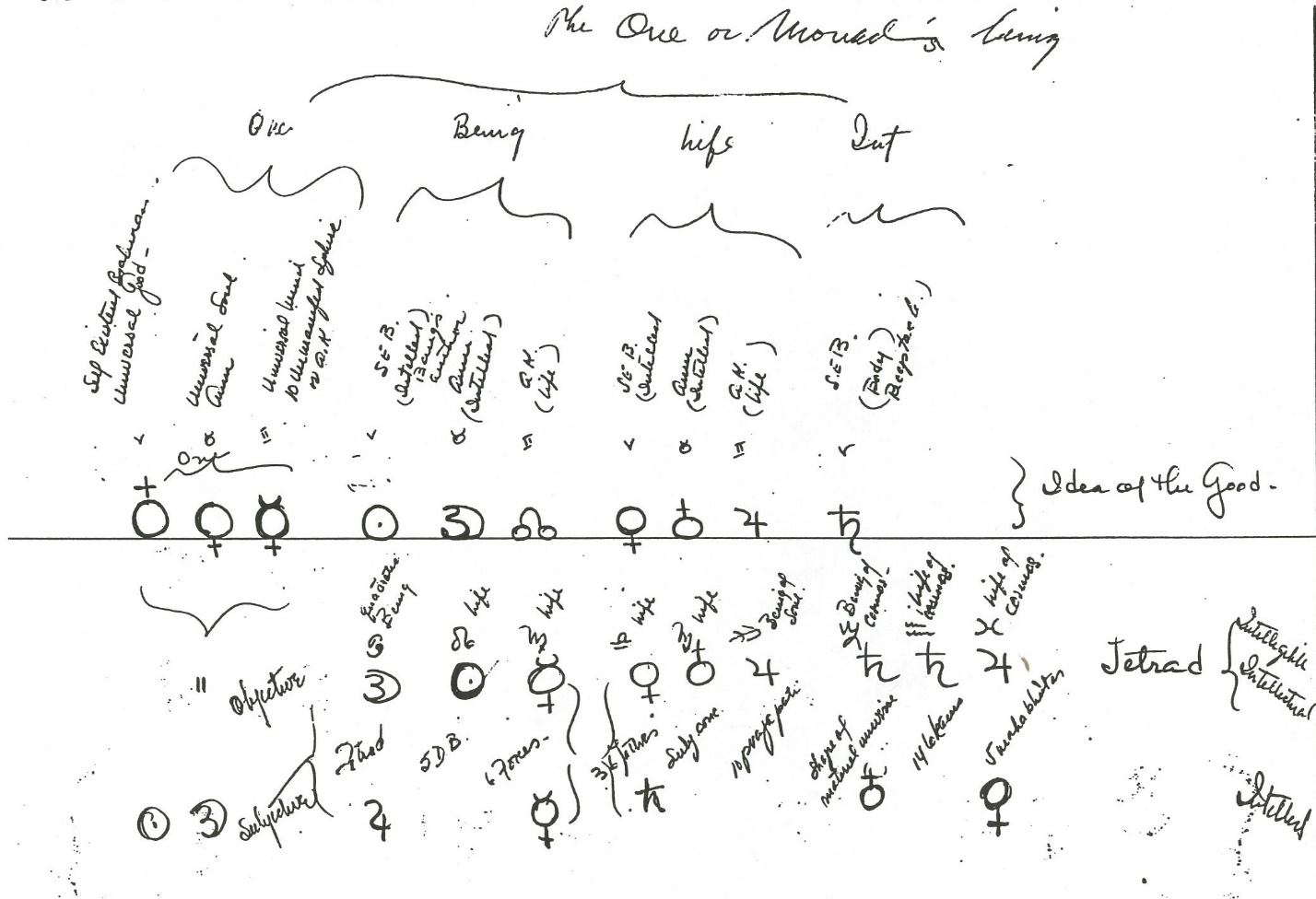
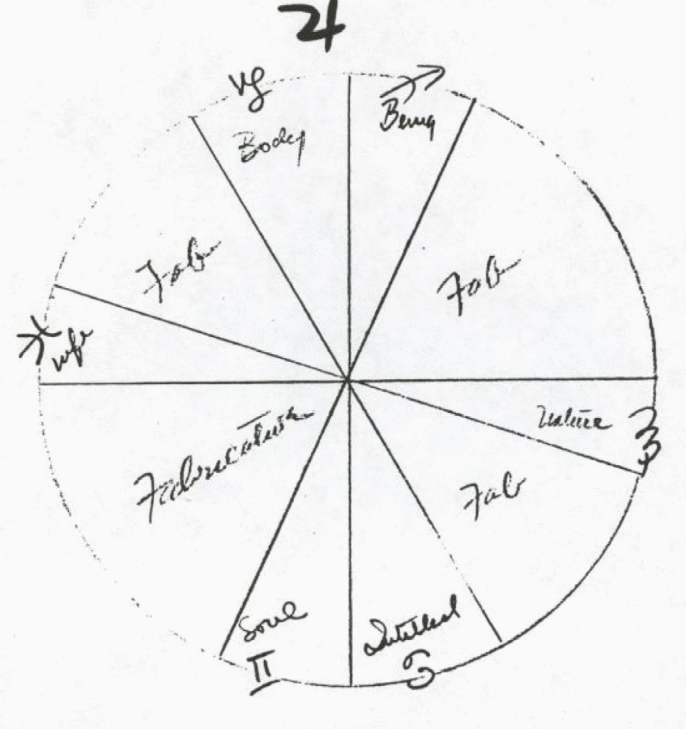
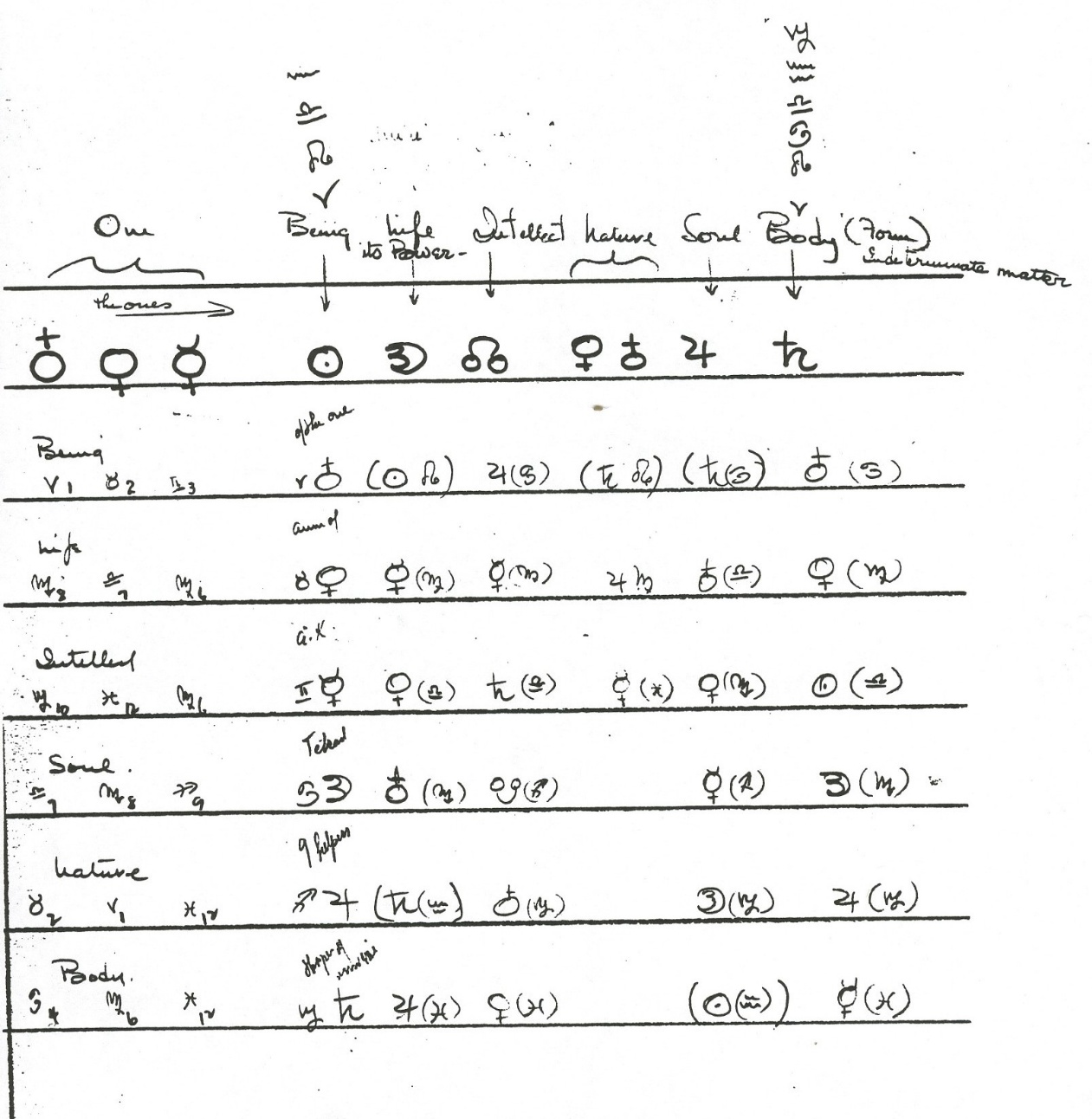
But if you do this here, [drawing] if you start looking at it vertically, ok-- Now, this is the One [diagram], ok. This is Being, Life, Intellect, alright, Soul, Nature, Body. [possible aside: Then why take it, you know?] [S simultaneously: Uh-hm.] Over here it's Transcendent [top line of planets] but if you look at it vertically, alright, it's the Immanent One. It's the One as Immanent, alright. This is the trick over here, where over here you can see it's Transcendent if you look at just the top, alright. Then if you imagine the line of rulerships, you know, the ring of rulerships [second line of planets, staying within 1st quadrant], ring of exaltations [third line, staying within 1st quadrant]. So this would be the rulerships, exaltations, detriments [fourth line, staying within 1st quadrant], and falls [fifth line, staying within 1st quadrant], ok. [Note: See Astronoesis, pp. 323-325, for more on this.] Now just staying with the 1st quadrant, without moving out of the 1st quadrant--these three [Mars Venus Mercury] would be the One [diagram]. [S: Uh-hm.] Alright. This would be Being, Being-- [AD indicating on diagram]
S: Life.
AD: No, this is Being [Sun in Aries], Life [Moon in Taurus], Intellect [Head in Gemini].
S: Oh, alright, (our) Venus and then (maybe--)
AD: Soul [Jupiter in Gemini], Nature [Venus in Aries, Mars in Taurus], Body [Saturn in Aries]. [S: Body.] But, I could also interpret it in terms of four. This would be what? This would be Being [bottom, left of center], this would be Soul [Power/Life, bottom, right of center], and this would be Body [Intellect, bottom, extreme right]. If I interpret it in terms of four, [drawing] I'm working with the substantial point of view, the-- the notion of substance. [S: Uh-hm.] If I work with the seven-- in other words, this is one, two, three, four, five, six-- six, seven, [S: Uh-hm.] ok, then I'm working with the function. [S simultaneously: Function point of view.] In other words, these here seven would be the functional point of view. [Note: See also FIGURE AD Supp 202-digital.]
S: Yes.
AD: Ok? [drawing] Now when I say substance what I mean is I'm working with four levels of consciousness. [drawing] This is all Turiya-Turiya going down this way. This is Turiya-Prajna going down this way [diagram]. This is Turiya-Vaishna-- Pra-- Taijasa [S simultaneously: Taijasa.] [diagram] and this is Turiya-Vaishvanara. So when I'm speaking about four I'm speaking about substance. When I'm speaking about seven I'm speaking about function--Being, Life, Intellect, Soul, Nature, Body. These two always go together [diagram], Nature, ok. [S: Ok.] Now I do the same thing over here, alright. I'm trying to show here's the One [Mars Venus Mercury, top line], alright, but when it's in this triplet-- in this triple form, they refer to this as Good-- Universal Good [Mars in Aries; see FIGURE AD_A025, top left], Universal Soul [Venus in Taurus], and Universal Mind [Mercury in Gemini], ok, when-- when they speak about the One as Immanent, then they speak about it this way. So that this would be the One and this would be the Dyad and together they're going to give you the Triad. That's why I just made quotation marks here [diagram]. Now, this is the one [Triad] we'll concentrate on, ok? I need a lot of [one/two words inaudible] Now in the Republic he speaks about the Idea of the Good. And the Idea of the Good he ref-- I don't know if you recall or not but the Idea of the Good is the entirety of the plan for universal manifestation. And he speaks about the Idea of the Good, he speaks about the One, the Intelligibles, and the Ideas all in the Idea of the Good. So, this is the Idea of the Good. [drawing] Ok, that's in Capricorn. Sun, Moon-- So you see where this [diagram] is coming from, the 1st quadrant.
S: (You think?)
[about 13 pause while AD draws]
AD: [possible aside: Not there.] This is the One [diagram], ok. We said this was Being. [drawing] If we're looking at it from the substantial point of view, or Intellect, Soul, Body [diagram]. Ok. If we're looking at it from the point of view of functioning, alright, then we ignore that and this would be [drawing] Being, Life, Intellect, Nature, Soul, Body. That's the Idea of the Good, ok?
S: Yes.
AD: Looked at in these two ways, from a substantial point of view or from a functional point of view. [drawing] Now, in the Idea of the Good, Plato refers to the fact that they all partake in the Idea of the Good. And since they all partake in the Idea of the Good and the Idea of the Good is a singular thing, alright, it's one, alright, he says that every "one" is given their unity here. So that this here, [drawing] alright, the unity that's given to it is Being; the unity here is Life; the unity here is Intellect; the unity here is Nature; the unity here is Soul; and the unity here is Body, or think of the word 'Form', ok, 'Receptacle', doesn't matter, ok. Now, you got to imagine this process. The One imparts to each of its participants in the Idea of the Good their particular aseity or unity and its-- their characteristic idiom, that which characterizes them as different from others. This is characterized as Soul [Jupiter in Gemini]. This is characterized as Being [Sun in Aries]. This is characterized as Life [Moon in Taurus]. Now-- maybe this analogy might help. I have seven different electrical appliances in front of me, ok, a toaster, an iron, a washer, alright. Now, if they have no power, alright, see, then, you know, they're useless. But when they get plugged in, the power always remains power, it always remains what it is, alright, it remains this electrical power. But when it goes through a toaster it toasts bread and when it goes through a [S simultaneously: (one/two words inaudible)] washing machine it washes clothes, alright. So that we can see that power gets distributed and characterized. In other words, if this is one type and this is a different type and this is another type, the power that goes through them characterizes this as Being, but this one gets characterized as Life [AD indicating on diagram]. [S: Yes.] Ok?
S: Are these un-- are these in descending powers down to Body or is that not--
AD: Well, we can't help but think of it as some sort of hierarchy. But when you deal with eternal principles to speak about any kind of hierarchy is meaningless. Which came first among the order of the eternal principles of knowledge?
S: But even not saying which came first could you say which is the most important or the-- and Being would not be--
AD: As long as you remember that it's only logically prior, ok. But, if you think of an evaluation, it becomes meaningless. Now, this here is Soul [Jupiter in Gemini], alright. Now something very strange, we're saying something very strange. If we think of this one Idea, [drawing] alright, and we're saying something like this: that over here [diagram] Jupiter is given or characterized as Soul. Now that means that I'm going to call this fellow Sam [diagram], ok, this fellow Tom [diagram], this fellow Harry [diagram], ok. But obviously I'm saying that this is different from that [diagram], that's different from that [diagram], ok. There-- there's difference among them, alright. Yet-- yet they're-- here at this level, it's only-- they're all one, united. The example Thomas Taylor gives, for instance, is something like this. [Note: See Proclus, Thomas Taylor (tr.), The Six Books of Proclus, the Platonic Successor, on the Theology of Plato, Vol. 1, Introduction, pp. xxv-xxvi, Vol. 2, Additional Notes, p. xiv.] Imagine the earth, alright, and the earth is common to trees. Each tree though is what it is. So an elm is an elm and, you know, an apple is an apple and an oak is an oak. Now they all share in common earthiness, alright, but each tree becomes what it is, whatever its characteristic idiom is. So that when you start speaking about a God, alright, the first thing you have to say is that the God is. The second thing, what is it, and then we have to bring in a characteristic kind of activity to understand. So you say the God of Love, alright. That means that this God is Love and nothing but Love. Now you could find him in a situation where he's combined with a lot of other things, alright, like in a complex or where there's love mixed with hate and mixed with a lot of other things. But we're not talking about those situations where it's complicated, we're speaking and trying to make it simple. And we're saying something to the-- something to this effect, that the God in his pristine purity is characterized by Love, and that ultimately all the Love that you find in the Universe can be traced back to that God. You see?
S (simultaneously): That was nice, uh-hm, yes.
AD: Alright. Now, if-- if you keep that in mind you say then Jupiter is Soul, alright. So then anytime-- anytime that-- whenever you deal with S-- you deal with Soul, alright, you will be dealing with Jupiter. That's-- that's the-- the way it would work out. But that's not quite true, alright, because look. This God is the God of Being [Sun in Aries], alright, this of Life [Moon in Taurus], alright, this of Soul [Jupiter in Gemini]. Now let me give you an example. [Note: See FIGURE 1979 0209-7 for the following.] Insofar that this is Being [diagram], it gives-- Here, let me-- let me show you--Being, [drawing] and then the Sun-- This is in Aries [diagram]. The Sun in--
S: Leo.
S: Leo.
S: Uh-hm.
AD: No, I--
S: Uh-hm.
S: It's--
S: Aries?
AD: [drawing] And it gives-- yes, Libra, the Sun in Aquarius. Yes, the Sun in Aquarius, ok? The Sun in Aquarius, alright. According to the dignities, that's the Soul [diagram], alright. The Sun in Libra, that's the Body, alright. The Sun in Aries, that's the Intellect, ok. [S: Uh-hm. Go ahead.] Now, Jupiter in Gemini, alright, that's Soul, ok, in Gemini, alright. Now, Jupiter-- Oh, what's after Gemini?
S: Cancer also.
S (simultaneously): Saturn Cancer.
S: That's right.
AD: Cancer, [S simultaneously: That's the Intellect.] Jupiter in Cancer? No, that the--
S: Well, Jupiter?
S: No, Jupiter's--
AD (simultaneously): The lowest aspect of Jupiter in terms [S simultaneously: Oh, oh, uh--] of dignities. The highest aspect is Sagi-- Sagittarius.
S: Jupiter--
BB (simultaneously): Sagittarius--
S: No.
AD (simultaneously): Pisces, [BB simultaneously: Pisces.] [S simultaneously: Pisces.] Cancer, and Gemini--
S (simultaneously): Jupiter in Capricorn.
BB: Capricorn.
AD (simultaneously): Then Capricorn, [drawing] alright, and then Virgo, right?
BB: Well, Virgo's below that one, that's-- Virgo's in Nature. Capricorn's in Body.
AD (simultaneously): Yes, Nature and-- Capricorn is Body, right?
BB: Yes.
AD (simultaneously): Yes, so [S simultaneously: Uh-hm.] they should be reversed. [S: Uh-hm.] [drawing] Now, Jupiter in-- in Cancer is Intellect, right?
S: Yes.
S: Uh-hm.
AD: [drawing] And Jupiter in Pisces is Life, [S: Uh-hm.] and Jupiter in Sagittarius is Soul, Being of Soul, [S: Being.] ok, Sagittarius. Now look. Insofar, insofar that the Sun has Soul, (where it's) Soul, it participates in Jupiter. Insofar that Jupiter has Being, it participates in the Sun. [S: Yes.] [S: Uh-hm.] Do it with all of them. [S: Uh-hm.] And then you'll understand what they mean when they say the Gods are-- all the Gods are in each and each are in all.
S: (Uh-hm/Ok).
S: Say that just-- I [S simultaneously: (one/two words inaudible)] follow that but just say it again so I've got it in-- Just-- now just say that "Insofar as they participate…", that's-- just do that one again.
AD: All the Gods [S: Yes.] are in each and each are in all.
S: Right.
S: Right.
AD (simultaneously): (Good), now, all the Gods are in each and each are in all.
S: Yes, I remember that.
AD: So that when you make a list, alright, when you make a list you'll see insofar that this has Life [diagram], ok, it participates [S simultaneously: It takes--] in this [diagram]. [S: Yes, alright.] Insofar that this has Soul [diagram], [S simultaneously: Soul, participates in Jupiter, right.] it participates in that [diagram], alright. Insofar that this has Nature [diagram], alright, it'll participate down here somewhere in Nature [diagram]. And insofar that this Nat-- insofar that, for instance, this here has Nature, alright, [S: Yes.] Jupiter has Nature in Virgo, it's participating in Nature here [diagram].
S: Alright.
AD: Ok?
S: Uh-hm.
S (simultaneously): Is that what you mean when you say they're going to school?
AD: They're what?
S: They're going to school.
AD: No, [S simultaneously: You used to say--] no, no, no. Here it's a little different. Over here, the whole notion is to show you how all the Gods are in each other, alright. But, this does not apply to the Ideas. All the Ideas are not in each other. Now, let's see what we mean by that. If you take-- if you take a circle, ok, [drawing] and you think of the Ideas, and you say this is the Idea of the 36 Tattvas [diagram], ok; this is the Idea of the Five Mahabhutas [diagram]; this is the Idea of Tetradic Being [see FIGURE IMG 2202-Posterboard Metaphysical Chart]. This [diagram] is not that [diagram] and [S simultaneously: That's right.] that [diagram] is not this [diagram].
S: And never will.
AD: And never will be. Now, how does the connection come about? Well, let's say [drawing] you have the Moon in Tetrad and Venus here [diagram], ok, and let's say you got 90 degree square. So you're relating these two Ideas through those planets, through the Intelligibles. [almost 9 second pause] You see what I'm talking about?
S (simultaneously): Uh-hm.
S: Yes.
S: Planets being the Intelligibles.
AD: In other words-- Yes, the planets would be the Intelligibles. All these are Intelligibles [diagram], I call them Intelligibles. Now this is my vocabulary. I do not call this an Intelligible [Head in Gemini]. This is Phanes. [Note: See FIGURE 1979 0209-8.] [drawing] These are the-- this is the Logos, this is the Ideas, I do not call it Intelligible because of the tremendous confusion that follows. So I call that the Intellect or the Ideas and I will not refer to it at any other way. These I will call Intelligibles [diagram], ok? I'm sorry. These are all Intelligible. They're the Gods.
[brief pause]
BB: Intellect at-- the Intellect is not Intelligibles?
AD: No. Now--
BB: Or is it just Sag?
S: Right.
AD (simultaneously): These are all the Ideas. This here [diagram] is equivalent to all the Ideas around the circle.
BB: Uh-huh.
AD: Alright? Now let's say-- let's say you have a planet in Libra and a planet here [diagram], in this type, Cancer, ok. Now the way these Ideas get related to each other is the aspects these planets are going to make with each other. So let's say you got a few planets in Libra, ok. Well then basically what you're working out is you're differentiating the Idea of 36 Tattvas. You begin to learn something about, you know, the principles that are involved over here [diagram]. But the aspects or numbers is what relates the Ideas to one another through the Intelligibles or the planets. But the Ideas in themselves do not get related, alright. The Five Mahabhutas is an Idea in the Mind of God. Tetradic Being is a-- an Idea in the Mind of God. These Ideas are eternal, indestructible, immutable, transcendent, exemplary causes of all things but they themselves are not in any way involved. It's like I speak to you and the meaning of what I say remains within me but my words go out to you. So these Ideas always remain in themselves, they're self-abiding. Alright, now-- So over here [diagram], over here each-- and at the level of the Idea of the Good, each planet is given its characteristic aseity or unity and it's from that point of view, alright, that you speak about the unity of the planets. So when you speak about Jupiter as Soul, that's because you've got it up here [in Gemini], alright.
S: Yes.
[Note: See FIGURE A025alt IMG_2520 copy for the following.]
AD: Now, let me show you a strange kind of thing that happens with that kind of arrangement. If you take the Idea of the Good, [drawing] like I just did, which is the 1st quadrant, ok-- [11 second pause while AD draws] Ok? Now, in the Idea of the Good, what's included? Well, this is Aries, Taurus, Gemini, right, [drawing] Aries, Taurus, Gemini, Aries, Taurus, Gemini, Aries [diagram], ok. Now, over here in Aries, Mars is in Aries, that's its first rulership, alright; second rulership [S: Scorpio.] Scorpio; exaltation Capricorn, right?
S: Yes.
S: Uh-hm.
AD: Then its Soul-- [drawing]
S: Is Libra.
AD: Second--
S (simultaneously): Well Taurus.
S: Venus.
AD: Taurus; Body, Cancer. [S: Cancer.] Alright, do it with Venus. [drawing] First rulership, second rulership, [BB: Taurus] [S: Taurus.] exaltation, alright, first, second, third, the Body, (I think). Do it with Mercury. [S: Yes.] First, Gemini, [S: Gemini.] [drawing] second, Virgo, Virgo--
S (simultaneously): Virgo.
BB: Sagittarius.
S: Sagittarius.
AD: [drawing] Sagittarius, Pisces, [S simultaneously: Pisces.] [S: Rulership.] Pisces. You see how they all stay below the line [diagram]? They're all below, ok? Now, [S: Uh-hm.] this is the Idea of the Good, ok. Now, go to the next one. Aries, [S: Yes.] Sun in Aries. What follows?
S: Leo.
AD: No sir.
S: Oh.
S: No?
AD: No sir. Take an easy one. Jupiter. Alright, Jupiter is in Gemini. What follows Gemini, in terms of this arrangement, alright?
S (simultaneously): Oh.
BB: Oh, oh, I see.
AD: In terms of this arrangement what would [S simultaneously: Oh, Sagittarius.] follow it would be [drawing] Virgo. And the next one?
S: Capricorn.
AD: [drawing] Capricorn. So this is the Body of Jupiter [diagram], this is the Nature of Jupiter [diagram] and this is the Soul of Jupiter [diagram]. Now, the Intellect of Jupiter. Cancer, right? The Life of Jupiter, Pisces; the Being of the Soul of Jupiter, alright, Sagittarius. Now look at what happened. Some are above the line and some are below the line [diagram]. Take Saturn in Aries, ok. What's below? Nothing. That's the lowest, alright. So then everything above. [drawing] So the highest, the Aquarius, Libra, ok, the Cancer, Leo, and Aries. So everything is above the line. Take the Moon, Taurus, ok, Moon is in Taurus. That's its exaltation. What's above? [S: Yes.] Rulership.
S: Uh-hm.
S: Ok.
S: Uh-hm.
AD: What's below? [drawing] Capricorn, right, [S: Uh-hm.] and Scorpio. [S: That seems like the third (one word inaudible)] The same thing with the Sun, right? [BB: Uh-hm.] The Leo is above, it's a rulership. What's below? Well, opposite will be Aquarius, ok--
BB (simultaneously): That would be Libra.
AD: --and Libra. Alright, you run through it and you see something very strange, ok. [drawing] This is excluded from the Idea of the Good [diagram]. This is included [diagram]. I don't know if you make any sense of this.
S: What does that mean to be [BB simultaneously: Don't erase that though.] excluded from the Idea of the Good?
AD: I use good English, don't I? I mean it's not perfect but it's good English. It's legitimate. Now I'm-- I'm sure, I'm sure that you know the meaning of the word 'include' and 'exclude'.
S: I don't know the ramifications of that.
AD (simultaneously, to another student): Oh [one/two words inaudible] what happened?
S: I broke my arm.
AD: You broke your arm, you got nothing better to do? (some laughter)
S: I went roller skating.
AD: Oh, [S simultaneously: You went roller skating?] for heavens! (RW laughing)
S: And on Sunday afternoon.
S: No (thank you).
AD: Sunday afternoon you went roller skating!?
S (simultaneously): Evening, Sunday night, Sunday night.
S: I just can't skate backwards like I used to do it. (some laughter)
AD: Oh, that makes two of us. That's why I gave it up. (bit of laughter) You alright though?
S: Yes. It only hurts when I laugh.
AD: Oh, well, (laughter) then that kind of simplifies things for us. Now let's see, that means you won't laugh when I write (them/then).
S: Right.
AD: Ok, then I'll say what I have on my mind.
[students assent]
[few seconds of faint background student talking]
AD: [few words inaudible]
[few seconds of inaudible student talking]
AD: Now isn't that enough to drive you out of your mind?
S: Uh-hm.
S: Yes.
S: [one/two words inaudible]
BB (simultaneously): [couple words inaudible]
S: It's the Spirit(--/.)
[brief pause]
[Note: See FIGURES IMG 2202-Posterboard Metaphysical Chart, AD Supp 202-digital for the following.]
AD: But it really is kind of extraordinary. You could do that with each one, alright. This is the Idea of the Good [diagram] or look at it this way. When Plotinus speaks-- Sometimes Plotinus speaks and he speaks about Universal Soul. And sometimes he speaks about Soul absolutely and sometimes he speaks about particular Soul. Now, this will help you-- at least it helps me. [drawing] Alright? Let's say he's speaking about-- if he's speaking about-- These are the quadrants [diagram], ok? Over here [drawing] we put the One, over here Being or Intellect, over here Soul, over here Body, ok [diagram]. Now just supposing, if you remember Plotinus speaks about the three primal principles, ok, the Intellectual-Principle, the Pure Intellectual-Principle. This would be the Pure Intellectual-Principle [second quadrant]. What would it be? Well-- [drawing] That would be the Pure Intellectual-Principle. See, nothing but Intellect, this whole quadrant is nothing but Intellect. So when he says the three primal Hypostases, the One, the Intellectual-Principle, and Soul, ok-- they're pure principles. But, if I do this here, alright, again-- [drawing] Let's say I do this here and I distributed the rulerships, alright, and I distribute the exaltations and the detriments and the falls, alright, so that I'd have these four rings. Now, imagine that this is the Absolute [diagram], ok? In other words, imagine this to be the One, the Absolute One [diagram], ok, then, you notice, the rings will have to take in everything. Like the ring of exaltations which is the Intellectual-Principle runs right through the Idea of the Good, Intellectual Essence, Soul, and Body. You see the difference? This-- this here Intellect [diagram] and this here Intellect [diagram], the difference between these two? Here. [drawing] This will be what? Sun Moon, Head, Jupiter, Mercury, Saturn, Mars, Venus [FIGURE IMG 2202-Posterboard Metaphysical Chart, Intellect dignities], alright.
RW: Uh-hm.
BB: Anthony, on-- You erased the chart before I got on. You had-- where the Head was, you had Gemini, you know, and then you had-- Venus was Aries. What was the Mars, Jupiter, Saturn, which-- What were the houses that those were?
AD: [drawing] You mean in the Idea of the Good?
BB: Yes. Just the last three, Venus, Jupiter, and Saturn.
AD: Venus, Jupiter--
BB: Or Mars, Jupiter, and Saturn, I'm sorry, Mars, (Jupiter--)
AD (simultaneously): Mars, Jupiter, and Saturn, what about them?
BB: What were the houses that you had?
AD: Well, this is all in the 1st quadrant, alright, these are all the 1st quadrant. So this [drawing] is Aries, Taurus, Gemini, Aries. This is all the 1st quadrant. The Idea of the Good or, you know, Inte-- the Intelligible-- the Intelligible One, is all in the 1st quadrant.
BB: Ok.
AD: Now here's the point I'm trying to get at. Over here [diagram], if we speak about the Intellect of the Absolute, you see how it goes around the whole thing? Takes in the whole thing, right? Now, if I speak about the Pure Intellectual-Principle, it's just this here [second quadrant].
S: Uh-hm, ok.
AD: So when Plotinus speaks about Pure Intellectual Essence, here [diagram]. Or, when he says "the three primal principles"--one, two three [diagram], the three primal Hypostases, ok. But, sometimes he'll say Primal Soul, which means this here [third quadrant] or Soul which is nothing but Soul. In other words, everything in here is nothing but Soul [diagram]. There's nothing but Soul in here, ok? [drawing] [one/two words inaudible] ok? There's nothing but Soul. But, if you take a look at the Soul in here [FIGURE IMG 2202-Posterboard Metaphysical Chart, Soul dignities], ok, you go around, alright. [drawing] Over here would be Jupiter, over here would be Saturn, ok, and then continuing, Soul, Mars, Venus, Mercury; and then Sun-- Moon, Sun [diagram]. Now look at how strange this Soul is. This Soul runs through, alright-- It has its summit in the One, ok. It has the highest portion in the Intellectual Essence, the Reasoning portion of the Soul is in here [third quadrant] and the functioning or the Body part of the Soul is in here [fourth quadrant]. So when you're speaking about ring, the Soul as the ring of the Absolute, Absolute Soul, and when you speak about Soul as pure, you see the differences? It'll help you when you study Plotinus, when he speaks about primal Hypostases that are pure and when he speaks about Soul or Intellect, you know, as-- you know-- let's say, includes or is included in the cosmos.
RW: That ring then would be the same as that line [FIGURE AD_B_004, fourth line of planets]?
AD: The ring of the Soul? Yes. Yes, that's where it comes from.
RW: Uh-hm.
AD: That's where it comes from. Just like this here, this one here will be the 12 rulerships spread about [FIGURE AD_B_004, second line of planets], ok. That will be Being. Here's another thing about Plotinus. When he speaks of Being, you got to be careful because he uses it in these three ways. [drawing] This is Being, alright, what I just-- what we just spoke about, the Idea of the Good [FIGURE AD_B_004, top line of planets]. This is Being. Ok? This also is Being, the rulerships [diagram]. Alright, let me do it again. [drawing] [Note: See FIGURE AD_A025 for the following.] (They repeat), alright, then Moon, Sun, Mercury, Venus, Mars, Jupiter, Saturn, Saturn, Jupiter, alright; and the exaltations--the Sun, Moon, Jupiter, Saturn, Mars, Venus, ok. Now, to him, all of this is Being. He calls this [diagram] the Intellectual-Principle. So you see what a real-- how extensive his meaning is. Now if you take this here [diagram], alright, and call this the Idea of the Good, and then you polarize it, like you split it in half into a subject and object, this would be the objective side [diagram] and this would be a subjective side [diagram]. In other words, in Neo-Platonic talk, this is Intelligible [Idea of Good], this is Intelligible-Intellectual [diagram], this is Intellectual [diagram]. This is Being, Life, Intellect [diagram], and all this he refers to as Being. So, you have to keep that in mind (with him).
RW (simultaneously): Wait a minute, do that over again please. [one word inaudible]
AD: [drawing] Being, Life, Intellect; or, if you want, you could use the word 'Power', that's the same thing, ok? Or, he calls this [drawing] Intelligible-- The-- the Neo-Platonists will call this Intelligible [diagram].
RW: The Idea of the Good.
AD: Yes. Then they would call this [drawing] Intelligible and Intellectual. Ok?
RW: Intelligible and Intellectual is the rulership?
AD: Yes, Intelligible and Intellectual.
RW: And it's also the objective?
AD: That's the objective side, yes. And this--
RW: And that's also Life.
AD: Yes. You can-- you can refer to it as Power, Life, Noetic, Noeric, all these terms.
RW: Ok, then-- Now let's go back to-- The Idea of the Good is the Intelligible and Being.
AD: Or Being.
RW: Or Being.
AD: They mean the same thing, Intelligible or Being.
RW: And that's also the same as your indeterminate Triad in the four line chart?
AD: This one here?
RW: Yes.
AD: Yes.
RW: Ok. Then you move to the next one--
AD: Alright.
RW: --and you had the rulerships--
AD: And the exaltations.
RW: Well wait a minute. The rulerships, though, are the same as Life, Intelligible-Intellectual, and the objective.
AD: Yes.
RW: And then you move to the--
AD: Exaltations.
RW: --exaltations. Ok, there you have--
AD: Intellect.
RW: --Intellect and the subjective.
AD: Uh-hm.
RW: Any other terms?
AD: No.
RW: Ok. But you put all those together--
AD: Plotinus would refer to all of that as Being or Intellectual-Principle or the Authentic Existence.
RW: Ok.
S: Who divides them up then?
AD: I do.
S: Oh. (laughter) So we won't find Plotinus dividing them up?
AD: No. Although-- although Plotinus makes a remark somewhere and I don't remember exactly where, but you-- you probably would come across, where he criticizes the notion that the World-Mind is-- that there's really three World-Minds. And he criticizes that notion, he says, "No, it's one World-Mind but it has different aspects." He was criticizing Numenius because Numenius spoke about three World-Minds and Plotinus, you know, consolidated all those into one. He says, "No, it's one World-Mind and it has these different ways of being looked upon." So, I mean, he himself gave me the hint that this is what he's talking about, that in the realm of the Intelligible, in the realm of the world of eternal true Existence and Being, that there's three aspects that could be looked upon. Ok? Alright. Now, I don't know if I answered your question-- but it's right there in-- I don't know, do you have the Republic around? [sounds like AD going to get book] [couple words inaudible] (from out of the drawer).
S (simultaneously): Can you get it?
S: Here's the bookstore's copy.
AD: Huh?
RW: He has one.
AD: No, I'm sorry, this is in Greek. English is harder-- English is hard enough (AD laughing)
[some inaudible student chatting in background; AD flipping through pages; almost ½ minute break]
AD: Boy, this is cold, this book. Where did you get it, out of the refrigerator? (some laughter)
S: She's been carrying it close to her heart. (laughter)
AD: What-- what did he say?
RW: She was-- she was carrying it close to her heart.
[some inaudible student comments amidst laughter]
AD: Anyway, you didn't lose your sense of humor [one word inaudible] (AD laughing) I was afraid of that, roller skating.
S: What [few words inaudible]
[some more inaudible student chatting while AD looking for passage; 1 minute passes, then tape break]
AD: --very carefully. (It's in-- I'm just curious), is this for everyone? You're not ev-- (laughter) I'm not everyone!
S: Yours is the-- show him his private [one word inaudible]
S: He has a private thing there for just him.
AD: I got a private thing?
S: [few words inaudible]
S: [few words inaudible]
AD: Ah.
S: [few words inaudible]
S (simultaneously): That's for [one word inaudible] stomachs that need gentle care.
S: [inaudible]
AD (simultaneously): Oh, really?
[inaudible student talking, about 10 seconds]
S (amidst student talking): Anthony, "I consider it in this manner…"? [few words inaudible]
[a few more seconds of inaudible talking; tape break]
[Transcriber note: I am using Thomas Taylor (tr.), The Republic: A Dialogue Concerning Justice, in Vol. 1 of The Works of Plato, viz. His Fifty-Five Dialogues, and Twelve Epistles, First Edition, London, 1804.]
Plato, Thomas Taylor (tr.) [Republic, Book VI, p. 344, S reading]: "But consider it in this manner. Is there any other species, which hearing and sound require, in order that one may hear…"
AD: Oh no, I'm sorry.
S: [few words inaudible]
[tape break]
Plato, Thomas Taylor (tr.) [Republic, Book VI, p. 345, S reading]: "That therefore which imparts truth to [S reads: is] what is known…"
AD: "…to what is known"?
Plato, Thomas Taylor (tr.) [Republic, Book VI, p. 345, S reading]: "…to what is known…"
AD: [drawing] Yes, read, (go--)
Plato, Thomas Taylor (tr.) [Republic, Book VI, p. 345, S reading]: "…imparts truth to what is known…"
AD: [drawing] Uh-hm. Go ahead.
Plato, Thomas Taylor (tr.) [Republic, Book VI, p. 345, S reading]: "…and dispenses the power to him who knows, you may call the idea of the good…"
AD: Read it again, louder now. Make out-- make out it's, you know, a-- a love letter. (some laughter)
S: That would be quiet.
S (giggling): (Could never read it!) Ok.
Plato, Thomas Taylor (tr.) [Republic, Book VI, p. 345, S reading]: "That therefore which imparts truth to what is known, and dispenses the power to him who knows, you may call the idea of the good…"
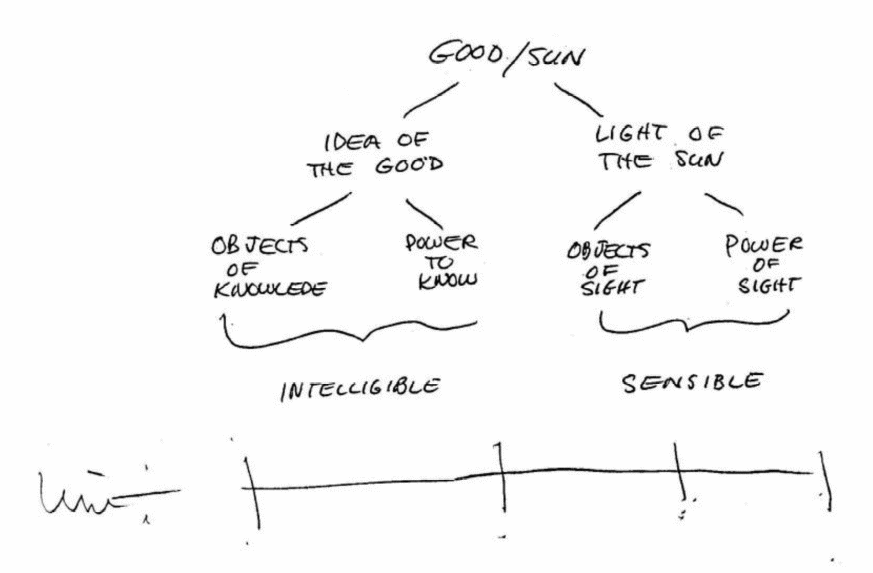
AD: Alright, so this [drawing] is the Idea of the Good we said, right? And he says it imparts Truth to what is known. [drawing] And-- Read.
S: Ok.
[AD drawing while S reads]
Plato, Thomas Taylor (tr.) [Republic, Book VI, p. 345, S reading]: "…you may call the idea of the good, being the cause of science and of truth, as being known through intellect."
AD: [drawing] Alright, now read that whole sec--
(Side 1 of original cassette tape digitized as 1979 0209a Ends; Side 2 Begins)
AD: Yes, keep reading.
Plato, Thomas Taylor (tr.) [Republic, Book VI, pp. 345-346, S reading]: "And as both these two, knowledge and truth, are so beautiful, when you think that the good is something different, and still more beautiful than these [S reads: they are], you shall think aright. Science and truth here are as light and sight there, which we rightly judged to be solar-form, but that we were not to think they were the sun. So here it is right to judge, that both these partake of the form of the good; but to suppose that either of them is the good, is not right, but the good itself is worthy of still greater honour. You speak, said he, of an inestimable beauty…"
AD (simultaneously): Transcendency or beauty.
Plato, Thomas Taylor (tr.) [Republic, Book VI, p. 346, S reading]: "…since it affords science and truth, but is itself superior…"
AD: So he's saying that whatever this is, this Idea of the Good, is superior even to Science and Truth. "Science" here is-- is knowledge, real knowledge. Whenever-- whenever Plato speaks of Science, remember he's speaking about real knowledge, true cognition. No Maya, none of this bunk, you know, he doesn't buy, he doesn't buy any of that. You-- you approach knowledge, true knowledge, gradually, through all your errors and everything up-- until you get up there. Ok? That's where it comes from.
RW (simultaneously): Is your third line, "power" to what?
AD: To know.
S (simultaneously): To know.
RW: To know.
AD: So the Idea of the Good, alright, is the cause of the objects of knowledge and the power to know those objects. [Note: See FIGURE 1979 0209-11.] This would be equivalent to Life [diagram]. This [diagram] would be equivalent to knowing the-- the activity, that activity, alright. Now if you collapse the two of them, combine them, you-- you get the Idea of the Good. But the right way is to start with the Idea of the Good and split it in-- in two, polarize it, bifurcate it, and you'll come out with the rulerships and the exaltations.
S: And the rulerships are the objects and the exaltations are the subject [FIGURE AD_A025].
AD: Uh-hm. Now, to show you even more consistency, ok, if you take-- Can I erase this?
RW: Uh-hm.
[Note: See FIGURE IMG 2202-Posterboard Metaphysical Chart for the following.]
AD: [drawing] If you take-- [about 15 second pause while AD draws] Let me give you an example, ok. Over here you have the Idea of the 36 Tattvas, [drawing] ok. Alright. Now we said that Idea always remains what it is, it's transcendent, it's exempt. It's a model of perfection and, you know-- but it itself is never included. Now, this Venus here [diagram] is in rulership, Saturn in exaltation, detriment, fall, ok. Now, what I want to show you is something like this. Imagine that this is the Idea [diagram], ok. This is one of the Ideas in the Idea of the Good. Now, Venus in Libra means what?
S: 36 Tattvas.
AD: No, Venus in Libra-- [S: Is the Life.] What is the meaning of Venus in Libra?
S: It's the Life.
S: [couple words inaudible]
AD: The Life--
S: What Life?
AD: The Life--
S: The Life of the 36--
AD (simultaneously): The Life of Venus.
S: The Life of Venus, alright. I was going to say that at first.
AD: Yes, because Jupiter also has a Life but you have to locate that in Pisces, right?
S: Uh-hm.
AD: And Saturn has a Life but you have to locate that in Aquarius. In other words, each one of these Intelligibles we said has Being, Life, Intellect, Soul, Nature, Body. So you take the planet Venus. You're not speaking about the Being of Venus which would be in Taurus. You're speaking about the Life of Venus which will be here [diagram]. [S: Uh-hm.] Now, this is the hard part. There's this Idea--36 Tattvas is a Conception of the Father, it's a Conception of the Mind-- in the Mind of God, alright. Now, this Idea has to be somehow injected into Life. So, if we think of Venus, the Life of Venus, Venus in Libra, the-- it's almost like, not only-- not only association, that's not strong enough, but almost like an identity. The Life of Venus models itself upon those 36 Tattvas. It looks to them and essentializes the Idea. Now the Idea-- now this infinite Life is not infinite but this infinite Life includes the 36 Tattvas in it. That's-- you know, that's the essentialization of the Idea. The Idea still remains out there. When I speak to you, the meaning remains within me. My words go forth and you understand them in your way but the meaning remains within me. In the same way, that Idea remains in itself, alright, but Venus essentializes the Idea and now the 36 Tattvas, let's say, are in Venus, in the Life of Venus. Ok.
Now, the Intellect of Saturn comprehends that activity of Venus. In other words, this is the object [diagram] and this [diagram] understand that object. The Intellect of Venus [AD means Saturn] understands the Life, the essentialization of the 36 Ideas in the Life of-- ok, and comprehends them, alright. So you have-- This is like the subject [diagram] and this is like the object [diagram]. But, don't make no triple relationship because there isn't any. The cognition over here is absolute. In other words, in order for me to know you I got to have mind, senses, the relationship. None of that exists over here--cognition is absolute.
Alright, now, let's move one step further. We're going down, ok? Now Mars, alright, we spoke-- This is the Soul of Mars [diagram]. Now Soul or the Soul of Mars has a very specific function and Mars or Nature, the Soul of Mars, comes from the Nature monad or the Nature of the Good and that's a very very specific way of operating. It separates, divides, tears apart, alright. It is the principle of motion, so it separates the contraries, one from another, separates them out. So this Mars separates out the 36 Tattvas that are in the Intellect of Saturn, separates them out, distinguishes one from another, ok, differentiates them.
Now, what does it do with this? It inserts them in the Light, in the Light of the Sun, the Sunlight. Now this Light contains within it these Tattvas, so that the Light becomes image-bearing Light. Image-bearing Light. So the Light is the principle of existence for everything down here. So when this Light comes down here, for instance, it congeals, it becomes an object. Why? Because the principles are inherent in it. So you see how the Idea gets all the way down to the material species. If you can follow that then (I'll go home).
S (simultaneously): Well, just sort of.
RW (simultaneously): How-- how did that get from that Sun into the Body quadrant? Hm?
S (simultaneously): Because that's in the Body quadrant, (it's in here).
RW (simultaneously): [one/two words inaudible] into the fourth--
S: No, the Sun is in [RW simultaneously: See--] Libra, [S simultaneously: Which is Body.] which is in the Body monad.
RW: Oh, I see, we're talking about ring.
AD: Yes.
RW: Ok, I'm sorry.
AD (simultaneously): I just took it. In other words--
RW (simultaneously): I got you.
AD: --this is just an example.
RW (simultaneously): Yes, I was trying to [one/two words inaudible] quadrant(s).
AD (simultaneously): [drawing] I didn't want to do the whole thing, ok. So this-- this is-- this is the rulership [diagram] and this is Life [diagram], ok. This [diagram] is Intellect, ok, this is Soul [diagram] and this is Body [diagram]. And I was trying to show how the Idea gets all the way down here [diagram]. Now, if you understand this, I can go home. There's no need to discuss it.
S: Of course. Oh, I wish I could do all of them.
AD: Oh, you could do all of them.
S: Yes, in-- in six months. I just [couple words inaudible] all the time. (S laughing)
AD (simultaneously): No, they-- they all work-- they all work out like that, they would work out like that.
S: I can see how you're leading up to Matter.
RW: I thought you were going to slip into it when you talked [S simultaneously: Yes, I did too.] about the Ideas congealing.
S: Yes, I did too. I--
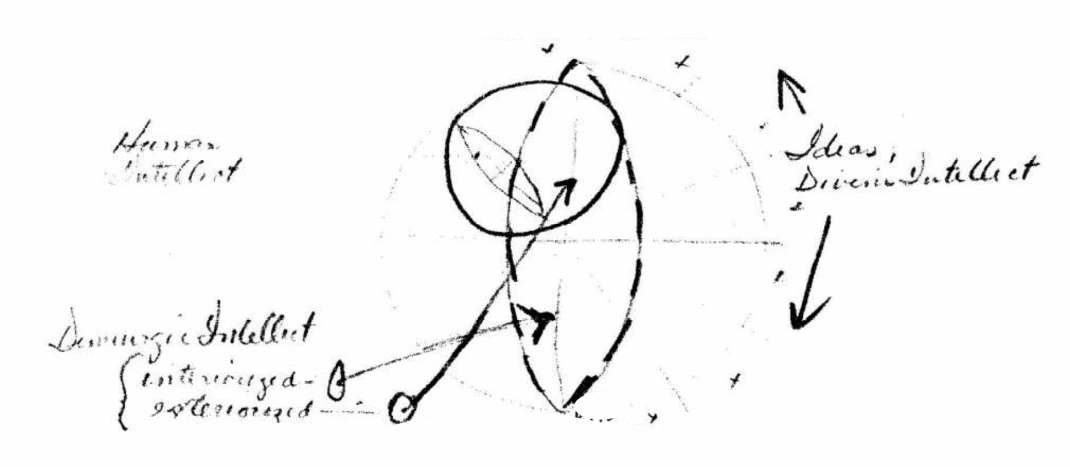
AD: This will give you an idea, this will work up an idea. It'll give us a background for tomorrow [possibly one word inaudible] [about 20 second pause] You can go around all the houses like that. Well you'll have to, you'll have to, when you want to understand later on some of the-- when he speaks about the Demiurge fabricates the universe. Because for that, alright, then we have something really complicated. We have to do something like this [drawing] to understand that. I don't think I could do that tonight. This is the Demiurge and this is the cosmos [diagram], alright. [Note: See FIGURE AD IMG_2239 high copy. Divine Mind/Ideas = outer circle, Demiurge = oval, cosmos = circle in houses 9-12.] And the Ideas are on the outside, ok; the rings are within, ok. This is the Demiurge, this big oval here. Alright? And you have to conceive of the Demiurge assimilating the Ideas in the Divine Mind and with-- and with what it knows of itself, fabricates the cosmos. This [drawing] is the cosmos [circle in houses 9-12]. So you're going-- you're going to need that, both. I don't think I could get into that, not right away. It's-- it's very complex. But it-- it's really quite to the point.
S: [one word inaudible]
AD: Alright, next question.
RW: You did that the last time you were here.
S: Yes, I was going to say you did a lot of it, you--
RW: You fabricated the cosmos right before our eyes. (laughter) And we've forgotten everything you said.
AD: It's alright. Don't feel bad. I'm talking to Randy and he's writing it down and when I get it back I don't recognize it. (AD laughs) I have to go back and hit it again.
RW: It's so subtle. You know, it's-- you know, we-- It's like listening to your tapes from up (there). You can listen to these tapes and turn right around and turn them off and try to (rethink) what you said and turn right back to listening to them again and you missed it. It's just that subtle.
AD: Yes, I know. It's just as hard for me to think it through.
S: When you don't use it all the time-- If we, you know, if we-- Now we got where we-- we use this chart here every time in class, so we got where we understood it and we'd work from it. But we don't use this one and if we would concentrate on it and use it every time we come to class then, then--
AD: Yes, little by little [S simultaneously: Yes.] it builds up, you begin to see it as a-- a visual aid and as you're reading and trying to understand you could bring it into the back-- you know, you could have it in the background, alright.
S (simultaneously): We ought to do that one the same way we do this.
RW (simultaneously): Yes, if Margie would just get busy and--
S (simultaneously): Margie, what did you move away for!? (laughter)
S: [few words inaudible] (more laughter)
RW: When Margie left we lost our chart-maker.
AD: Well, I'm making-- I'm making up all the charts now on big white board, pieces like that. And, I'll have to [few words inaudible] when someone comes here to bring-- bring them (all). But it's going to take me a couple of months because I'm doing each one very carefully. I don't want to-- I mean, a big piece of cardboard costs two, three dollars and I'm very stingy. So I do them in pencil and then one of the girls, when I think it's finally correct, she goes over it with a dark ink, so-- I'll send you the charts. But more-- more charts would [few words inaudible]
RW: Think how much you could learn if you copied those charts for our Columbus group, you would know it.
S: [few words inaudible]
S: [few words inaudible] (some laughter)
S: After a while, not only would you not have to write them on the board, but maybe it would get so you don't even need to pull up the cards, just say "A3" (laughter), "B6"-- Bingo.
S: Bingo
[possible tape break]
[Note: See FIGURES IMG 2202-Posterboard Metaphysical Chart, 1979 0209-3, 4 for the following.]
AD: --Plato and not Proclus because Proclus has his own interpretation, with which I would not agree. [drawing] But, Plato speaks about-- he speaks about the One and he says from the One there comes-- from the One, two principles, alright, which he calls Infinity, Infinite Power, alright, and Bound. And the combination of these two princ-- these two principles produces Being. Now, if we take-- if we try to attack this, I think the easiest way would be to [drawing] go according to the Ideas, follow the Ideas--One, Infinite, Bound. [one word inaudible] [brief pause while AD draws, almost 20 seconds] Now, this-- this here part, [drawing] ok, I'm going to differentiate them one by one. Now, if we take this here Infinite--how can we think of it? The totality of-- We think of the One as the totality of all possibilities accomplished, then one of these will be Active Perfection and the other one will be Passive Perfection. The two of them together would be Absolute Perfection. That's one way of looking at it. Another way of looking at it would be something like this. This is God [diagram], ok.
RW: The One.
AD: Yes. And this is His Infinite Power [Infinity/Taurus] and this is the restriction of that Infinite Power [Bound/Gemini]. Now, in what way is this Infinite Power? Well, let's take an example, first on a psychological level. If you think of an individual, if you think of the samskaras that constitute an individual, alright, the totality of all samskaras would be equivalent to this here part [Venus in Taurus]. Now, let's say an individual is born and he's a human being, alright. Then the vasanas when he was a dog have to be pushed aside, the vasanas when he was a snake have to be pushed-- Only the vasanas as a human being are operative when he's incarnated as a human so that there's some sort of intelligence or wisdom ordering how the vasanas get released [Moon in Taurus]. Ok?
Now, the third part, the Mars [in Taurus], would be the power of a vasana. Let me give you an example. We drink coffee, you know, we're habitual coffee drinkers, it's a habit. And then let's say by some miraculous way we could wipe out all coffee and from your memory all coffee, ok. But, you get up in the morning and you're looking for something, you know, you go around but you don't know what you're searching for, you know. It's the-- it's that habit, alright, it's the-- That energy has a certain habit, a habitual way of functioning, and it seeks to get fulfilled. Now if you think of that-- the functioning of that energy, that's its power. You get the feeling of what I'm talking about? So what we're saying is that because of your experience, certain structures are built into the energy. Your energy gets structuralized. And because it gets structuralized, alright, now it becomes a repetitive act and it's-- you know, it's just done without even any consciousness. And that repetitive act, if you notice, here the point was that it has this tremendous compulsion, you've got to do it, you've got to have that thing. Whatever it was, you'll-- you'll find it until one way or another it's satisfied.
Alright, now, instead of an individual, think of the entirety of all previous manifestations, ok, the entirety of all universes that have ever been. They dissolve, and as they dissolve, or because they dissolve, they leave behind certain traces which we call samskaras. Now, this is the samskaras of all previous universes.
RW: All of Infinity?
AD: Yes.
RW: Ok.
AD: This is-- this is the Being [Venus in Taurus], the standing Being of these vasanas or samskaras of all previous universes. This [Moon in Taurus] would represent the wisdom that accrues from all that. The result of all these universes that have come and gone and manifested, alright, the residue of all this, alright, imagine the tremendous wisdom behind. Ok? [RW: (Now are we--)] That would be the Moon.
RW: That's [S simultaneously: The Moon, (couple words inaudible).] the-- ok, that's the Moon. So the first one was Venus.
AD: The st-- the Being of the samskaras. In other words, they are.
RW: That's Venus.
AD: That's-- They are. Ok? The Moon would represent the ordering principle or the intelligence that accrues from all that and Mars would represent that Infinite Power which is inherent in the very nature of these samskaras which are the result of all prior universes so that there's this tremendous power for the universe to evolve again and again and again. Now every time it evolves, you can see it's just this tremendous power of the samskaras. Alright. This is referred to, as we said, all prior existences, the-- the entirety of all the samskaras of the universe [diagram]. This is the wisdom that accrues [diagram]. The Buddhists call this Prajnaparamita, the wisdom beyond the other shore.
RW: Now that's the Venus?
AD: No, (it's) the Moon.
A few students at once (simultaneously): The Moon, Moon.
RW: The Moon, ok, I'm sorry, the Moon.
AD: And the Mars represents the Nature of that wisdom, the power that it has, ok? Now, if you look at this conception, you can see that you're dealing with Infinite Power, right? All possibilities are in here. All universes (that to) come are here, but in a seed form, potential. Even prior to a seed form because they have no actual existence. They're beyond existence. That's why it's referred to as the wisdom beyond the other shore from which all the Buddhas emerge. Alright? That's-- that's the aspect of Infinity.
Now, this is the aspect of Bound [Gemini]. Now what do we mean here? Well, there's going to be universal manifestation, alright, a whole cosmos is going to evolve. Now, that means that some sort of restrictions have to be placed on this because this is infinite potentiality. This means binding or restricting that infinite potentiality, alright-- that's what Bound means, restrict that infinite power and potentiality to this universe. So all the samskaras necessary for building this universe is all that this guy [Mercury in Gemini] wants. He doesn't want all the samskaras, he doesn't want all that power. He wants a restricted number of possibilities so that this universe can come into manifestation. That would be the Mercury [in Gemini]. Bound, ok? This would be the Ideas of that restriction, the Ideas involved [Head in Gemini]. Phanes would represent the totality of all the Ideas necessary to bring all these samskaras into a harmonious relationship with one another, so this is essentially the Intellect or the Conceptions of the Father. And this Jupiter [in Gemini] is the-- the Demiurgic Soul or the Power-- 'Soul' is better-- that is going to fabricate the universe, going to make a cosmos.
Now, these two together, Infinite Power and the superimposition on that Infinite Power of a certain Plan to realize a certain objective goal is what we-- what is generally meant by Infinite Power and Bound. Now, another way they refer to this is Adam Kadmon [diagram]. Now Adam Kadmon is the Idea of a Universal Man. Now, this Idea is prior to any ontic state, any existential level, any Idea, any meanings, alright, at this level here in the 3rd house. So Soul-- Adam Kadmon means the Idea of Universal Man, which is going to be the cosmos, alright. The Idea of Universal Man, this is going to represent the Being of that notion [Mercury in Gemini]. This is going to represent the Ideas necessary to harmoniously bring together all the various aspects needed [Head in Gemini] and [RW breaks in to tape recorder: Phanes] that's going to represent the Soul that's going to fabricate and build that [RW breaks in to tape recorder: Jupiter] cosmos [Jupiter in Gemini]. So, in a sense, this is like the Idea of the Universe but with these distinctions within it. This would be the-- the Demiurgic Soul [diagram], this is going to fabricate the universe, and the Unity of the universe if going to depend on the Ideas, ok, and the Being of the universe is going to depend on the restrictions imposed on this Infinite Power. So that you have from the One coming these two principles, Infinity and Bound, and these two together are going to create the [fourth/Four], what we call Tetrad, Tetradic Being [4th house/Cancer].
S: When you do it, when you first-- the first time you put this on the board, you put like the Sun, the Mars, and Venus and Saturn, and then-- then on the [one word inaudible] you put the Infinity with Venus and the Moon and [one word inaudible] Mars--
AD: Yes--
S: --and Bound with Mercury and Head and Jupiter.
AD (simultaneously): And then connect them at the bottom, [S simultaneously: And then you connect them at the bottom (and the Ideas-- the Idea) (one word inaudible)] if you want, put Cancer as [one word inaudible] Being. Now once I got this here, alright, then I can derive the Unity of the cosmos from this. Ok?
RW: Now that's the Duad that each-- Plotinus speaks of?
AD (simultaneously): These two together [Infinity and Bound], these two together, Plato refers to as the Duad or the Dyad, either way.
RW: And so Plotinus is faithfully following Plato when he talks about it? When we read it in McKenna, that's-- is that a faithful reproduction of Plato?
AD: Yes, pretty close, pretty close. Although Plotinus brings in other points of view that are not included in Plato.
RW: Ok, now tomorrow when you talk about Matter, I would like for you to talk about the first kind where the Duad's involved, this first movement.
AD (simultaneously): That would be Intelligible-- that would be Intelligible Matter.
RW: Right.
AD: But that's not Matter.
RW: No, but we've been talking [AD simultaneously: (one word inaudible)] about two kinds of Matter in class [AD: Alright.] and they're aware that there's two kinds.
AD: Yes, Intelligible Matter is quite a concept.
RW: Well, if you could just identify where we are because-- in that discussion, in that chapter, there's [one word inaudible] he refers you to.
AD (simultaneously): Uh-huh. (Well--)
S: I have a question on the Soul. Can you jump like that or did you want to stay where we are?
AD (simultaneously): I'm sorry?
S: I have a question on the Soul. Can you jump or do [AD simultaneously: Yes.] you want to stay right where we are?
AD: No, go ahead.
S: I just want to know that in the vesica, are we doing-- in the embodied soul, are we going 9, 10, 11, and 12 or is it just 10, 11, and 12, the embodied soul, if you talk about embodied soul?
AD (simultaneously): Well, you have to bring in 9 because that's the Unity of the Soul. [brief pause] I mean it's the Soul that gives the cosmos its Unity. So 9 is the Unity of the cosmos. 10 is the Material Intellect of the cosmos or the Being. 11 is the Soul of the cosmos. 12 is the Sensible Body of the cosmos. Now, put-- put that in your pipe and smoke it. (laughter)
[Note: See FIGURE IMG 2202-Posterboard Metaphysical Chart for the following.]
S: Back to the 1st quadrant, I don't understand why the Nature of the Absolute is higher than the Soul of the Absolute. Is it possible to explain--
AD (simultaneously): The Nature of the Absolute--
S: --is higher than the Soul of the Absolute.
AD: Why? What do you mean "higher"?
S: I mean like-- Oh, no.
AD: Here, look at-- look at it this way.
S (simultaneously): You have the Natures in the 1st and 2nd house and Soul would be in the 3rd, if you look at the metaphysical chart.
AD: I'm sorry, say it again?
S: Like if you look at the metaphysical chart--
AD: Yes--
S: --Nature would be in the 1st and 2nd house, you know, the Venus and the Mars, and then Jupiter would be in the 3rd house.
AD: Yes.
S: But, you shouldn't think of the houses as being [few whispered words, inaudible]
AD (simultaneously): Alright, let me-- let me try. [drawing]
S: [couple words inaudible]
RW: He looks very modern.
[almost 20 second pause while AD draws]
AD: Now I could read this [diagram] off any way, alright, ignoring this [diagram] (is/as) the One, ok. This would be Being, Life, Intellect, Soul, Nature, Body [diagram]. Or, I could go Being, Life, Intellect, Nature, Soul, Body [diagram]. [Note: See FIGURE AD_B_004, top line of planets; also FIGURE AD Supp 202-digital.]
S: Yes.
AD: Well, it's not a one way street, there's no signs there. But, let me pick up your question. You got the Orpheus book here, haven't you?
RW: Yes.
AD: [AD getting book out] Yes, my girl knows the Orpheus book. Here, [AD hands student the book] turn to the diagram. By the way, I picked her up on the plane this morning. Pretty girl, isn't she? (some laughter)
S: She learned all this [few words inaudible]
S (simultaneously): These are the things [couple words inaudible] (laughter)
AD (simultaneously): Yes, while we were-- She learned all this while we were driving here. (laughter)
S: We sort of think so around here. We miss her.
AD: Margie?
S: [few words inaudible]
AD: What would you put over here [diagram]? Sun, Moon? Or would you put--
S: [few words inaudible]
AD: Hm? [drawing] Sun, Moon, Head, Venus, [S simultaneously: Oh, Mars] Mars, [S: Jupiter] Jupiter, [S: and (Sun/Saturn).] Saturn. [S: Yes.] Now take a good look at Venus. And take a look at Mars. Venus they refer to as--
[Transcriber note: I am using Orpheus by G.R.S. Mead, London: Theosophical Publishing Society, 1896. The following readings are from his fold-out chart sandwiched between p. 86 and 87, the section of the chart entitled Noëtic-noëric Triad. See FIGURE 1979 0209-12.]
G.R.S. Mead [Orpheus, chart, S reading]: "Essence, Life, Intellect"
AD (simultaneously): Essence, Life, Intellect and--
G.R.S. Mead [Orpheus, chart, S reading]: ""[The] Abiding""
AD: Abiding. [drawing] Venus. Mars?
G.R.S. Mead [Orpheus, chart, S reading]: "Infinite Power, [S adds: the] Intelligible Life,"[The] Proceeding""
AD: [drawing] Intelligible Life and Proceeding, ok.
S: Uh-hm.
AD: Jupiter?
G.R.S. Mead [Orpheus, chart, S reading]: "Intelligible Intellect"
AD: Yes.
G.R.S. Mead [Orpheus, chart, S reading]: ""The Returning" [S reads: "The Return"]"
AD: [drawing] Intelligible Intellect and the Returning. Yes. Let's think of this here as the Infinite Life of the Transcendent One [Venus in Aries], ok? Now the Infinite Life of the Transcendent One is Abiding. I mean, if it's Infinite Life where can it go? It's everywhere, absolutely pervasive, no place for it to go, nothing for it to become. Ok? Alright. This here we spoke about as the Infinite Power [Mars in Taurus], ok. Remember, we spoke about the samskaras have this power, alright, they exercise this tremendous compulsion. But that means it's outgoing. Like, I-- the example I used about the coffee, alright, then I wake up in the morning and I start going out, I look for it, alright. That's outgoing. Ok. Now, Jupiter [in Gemini], Demiurgic Soul-- These two [Venus Mars] are Nature, right? Jupiter is Demiurgic Soul and it's Intelligible Intellect and the Returning. Now, if Jupiter, the Demiurgic Soul, fabricates the universe and the creatures in it, what's going to be distilled into them or instilled into them?
S (whisper): [couple words inaudible]
AD: Coming back.
S: [few words inaudible]
AD (simultaneously): Coming back. So, when you take the Idea of the Good, alright, [drawing] Sun, Moon, Head, Venus, Mars, ok, and Jupiter. Now, you look at this as Abiding [diagram], you look at this as Proceeding [diagram], and this is Returning [diagram]. Or, take a look at this as Essence, Life, Intellect [Venus in Aries], this Infinite Power [Mars in Taurus] and this Intelligible Intellect [Jupiter in Gemini]. Now, this [Jupiter] is the gentleman that's going to fabricate the world and included in the fabrication of the world, every creature in one way or another without their awareness, alright, would have these two elements in them. Nature--the Nature of every entity within the cosmos that Jupiter's going to fabricate is going to include the Abiding and the Proceeding elements. So on the one hand, in the Idea of the Good, ok, there's an element that abides, alright. If you think of this [drawing] as Soul, ok, [S: Uh-hm.] an element that abides and an element that proceeds and then an element that returns. So when the Jupiter fabricates the cosmos, the creatures within it will return back or be re-assimilated back to the One, as long as this here, [drawing] these two [Venus Mars], are inserted. Now, again, let me give you further-- We call this Turiya-Turiya, Turiya-Prajna, Turiya-Taijasa, Turiya-Vaishvanara. Now, the same would apply to here [diagram]. Now this here [diagram] is Turiya-Taijasa, Turiya-Taijasa, Turiya-Taijasa. [Note: See FIGURES 1979 0209-13, AD IMG_2239 high copy.] Now, they have community and an identity of substance, the-- the substance here being the Taijasa of the Turiya state of consciousness. So Jupiter will include by the very nature of what it is those elements within itself. So Jupiter's called the fabricator of the cosmos and when he fabricates the cosmos, included in the fabrication of the cosmos and the creatures within it is the desire to return back to the Intelligible One.
S: [one/two words inaudible] it's starting to make some sense.
[15 second pause]
AD: You have to give it a little attention in order to see it.
RW: Psychologically, that's the-- to me, that has been the argument for philosophy, is that innately within us is this-- always this inexorable return, no matter what the situation.
AD: Yes, and you could see this, like for instance, if a person has Mars in Taurus, alright, you will see that there's a tendency for him to be outgoing and, of course, in a-- in many a chart, Mars in Taurus indicates that the person hasn't-- doesn't have yet sufficient experience of a certain kind so he will be outgoing until he gets that experience and then, of course, change could take place. So, if you look at this chart even on the psychological way, you could see that, right. A person has Venus in Aries, there's an awareness in the person of something about the nature of Life, alright. He becomes aware of the nature of Life through that Venus in Aries, becomes, in a sense, almost identified with it, and he thinks he is that Life. [20 second pause] Well, what else?
S: Talk about the Intellect of Saturn, its-- its Body and the-- and becomes the ruler of Capricorn [couple words inaudible] 4th quadrant. I just-- Or would you get to that tomorrow, as the underlying Intellect that goes out?
AD: Oh yes, that's going to be quite a job.
S: Are you going to get to that tomorrow?
AD (simultaneously): Yes.
S: Alright. That bothers me, I don't understand that.
AD: Yes, it's-- it's-- it's very tricky. Now, I'm comfortable in my chair, I don't know about you.
S: We love those chairs, really.
AD: It's director's chair. (laughter) Is my name on the back?
RW: There's a star above it. (laughter)
S: Oh, that's right, you have the special one [one/two words inaudible]
RW: (Kevin/Karen) thought if she would have one that you should [few words inaudible]
AD: I share [one/two words inaudible] mine. I mean my-- I share my chair (at home. She's got one.)
[some inaudible student chatting in background, almost 15 seconds]
AD: I see you people are weakening, you're running to the coffee and cookies.
S: Uh-hm.
[a few seconds of inaudible student chatting]
S: [few words inaudible, amidst chatting] That's repeated in the other quadrant, that Intelligible [one/two words inaudible]
AD (simultaneously): [sounds like drawing] Abiding-- Oh yes. When a principle stays within itself and doesn't move out, alright, then it's abiding in itself. When it moves out, when it has an outward facing Hypostasis, in Plotinus' term, alright, then it's proceeding. [couple words inaudible] (gentlemen), don't let me get off dirty. Come on.
[some inaudible student chatting in background, about 10 seconds]
S: This is all on Matter.
AD: Hm?
S: I said I should've brought my other books. This is all on Matter. I haven't been thinking about anything else.
AD: Well-- In that case, since your mind is on Matter-- (some laughter)
S: Oh, I [couple words inaudible] push-- we're not pushing you. [AD: Well--] I just can't ask any questions.
[Note: See FIGURE AD IMG_2239 high copy for the following.]
AD: You'll have to understand that I-- I'm trying to-- [drawing] trying to very politely tell you that I'll try to present it tomorrow but in the meantime I'm going to try to do some spade work, ok. [drawing] Now, this is one way I present the chart, right, and I say, now look, this-- [drawing] this is the Demiurge inside [oval], ok. And this is the cosmos [circle in houses 9-12]. I could do it in these four ways [diagram] or sometimes what I do is make a circle, call that the cosmos, ok? And if I make that the cosmos, of course, it's easier if I do it this way [diagram] because visually you can see it better, ok. [drawing, about 20 seconds] Now, this way it's much easier to see, we could work with it more easy. [drawing] Now, in the cosmos, ok-- this is the cosmos [circle in houses 9-12], ok. This is Jupiter or the Demiurge [oval]. This is the metaphysical chart or the Ideas in the Divine Mind [outer circle]. [drawing, about 10 seconds] So the Ideas in the Divine-- This is the Demiurge [diagram] and these-- these are the Intelligibles or the powers within the Demiurge--Jupiter, Tail, Mercury [diagram]. You remember this, I'm sure, right? [drawing, about 15 seconds] Those are the powers of the Demiurge [diagram]. In other words, if you look very carefully, the-- the dignities in the 9th house are these here [first quadrant of Demiurge oval], ok. The dignities in the 10th house in the metaphysical chart are these here [second quadrant of Demiurge oval]. The dignities in the 11th house is Saturn and the Sun. The dignities in the 12th house are these here [fourth quadrant of Demiurge oval], [RW: Uh-hm.] see. Spread them inside the Demiurge, ok. [RW: Uh-hm.] Now this is the cosmos [circle in houses 9-12] inside the Demiurge and this is equivalent to Jupiter here, ok. [drawing] This they call Vesta; this they call Mercury; this they call Ceres. The Greek scheme. This they call Neptune; this they call Minerva; Venus [diagram]-- [Note: These gods are not shown in this diagram; see FIGURE AD_H_033, circle in houses 9-12.] You have these, don't you?
RW: No--
AD (simultaneously): [drawing] Juno.
RW: --we don't have all those.
AD: [drawing] This is Vulcan, Mars, Apollo, and Diana [diagram], ok. They're 4 triads, 4 triads--fabricative, defensive, harmonic, and vivific or vulgarly referred to as fire, earth, air, and water. Right?
S: Uh-hm.
[Note: See FIGURES IMG 2202-Posterboard Metaphysical Chart, AD_B_006 for the following.]
AD: Now, here's the problem I worked out, I got-- I got very mad at this problem because it took so long and it was really a-- Jupiter-- the-- this is the Demiurgic Soul [Jupiter in Gemini], alright. Now, if you remember, Demiurgic Soul-- [drawing] Do you remember the Demiurgic Soul, that part of the Idea of the Good? [S: Uh-hm.] Jupiter, alright, fabricates the universe in a twofold way--one, according to the nature or the fountain which is within himself, and secondly according to the Ideas in the Divine Mind or Phanes. Now, once-- What I have to do is take one example at a time, point by point. Jupiter, what is the fountain in himself, what is the fountain of Jupiter?
S: The fountain?
AD: Yes. What's his own essence like?
S: Well, the One.
AD: No, the essence of Jupiter, [drawing] alright-- If this is Jupiter [diagram], right, then the essence of Jupiter, that would be--
S: Uh-hm.
AD: [drawing] [more emphatically] That will be-- This would be-- [even more emphatically] This would be-- This--
[Audio File 1979 0209a Ends]
[Audio File 1979 0209b Begins]
AD: I don't know why you people make me work so hard. [drawing] This is the Being of Soul, right, of Jupiter [Jupiter in Sagittarius], right? And this is the Nature of Jupiter [Jupiter in Virgo], in other words, what the Nature of those-- of that Idea, the 6 forces of Nature, are. This is the Intellect of Jupiter [Jupiter in Cancer] and this is Soul of Jupiter [Jupiter in Gemini]. That's the fountain within himself.
S: Oh, I see what you mean. Yes, I didn't know what you meant.
AD: Oh, what do you mean you don't know what I mean?
S: I do now. I just didn't recognize what you meant by a fountain. I (saw/thought) sprays coming up from a fountain [few words inaudible] (laughter)
AD (simultaneously): Oh, I said his own-- his essence. His essence, his own essence. This would be his own essence [diagram].
S: I see it there [couple words inaudible]
AD: Boy, I can sell you anything. Don't you-- you agree, disagree?
S: Well, I-- that's great.
S: Sounds pretty good, doesn't it? (some laughter)
S: I can see where the sprays-- I could see (what-- what) the sprays (some laughter) are from the fountain.
AD: Now, over here [diagram] we said this-- In other words, think of Jupiter as a God with a characteristic Unity or Oneness or what we refer to as his aseity, alright. Like we spoke about a God of Love, Eros is the God of Love. Now this God, number one, has an existence which is beyond Being, superessential, (super-light), supergnostic, alright. That's his-- his Isness. But then, in order for us to speak about this God, he's got to have a characteristic activity and in the case of Eros it would be Love. Anytime you find Love, that's Eros, one way or another. In the same way, alright, this Jupiter here [in Gemini], when we think of-- Which one were we referring to, Soul?
S: Uh-hm.
S: Uh-hm.
AD: So, when we think of Jup-- whenever we think of Soul, we have to think of Jupiter because that's what characterizes him, that typifies him, that's his trademark. Ok? Alright, now, as I was saying, think of the Jupiter as a One and this One has Being, this God has Being, and this Being has parts and these parts are all interrelated to one another and that each of the parts is-- is characterized by the distinctive aseity or oneness that we refer to as his oneness. Do you follow me?
S: Yes.
AD: So that any place we find Jupiter his characteristic oneness of Jupiter is always noticeable. In other words-- Let me give you an example. Take thr-- take three notes, da-da-da-daam [AD hums the beginning/theme of Beethoven's Fifth]. Ok?
S: It's the 5th.
AD: What? (laughter) Now, do you notice what combine-- Do-- do you notice something peculiar about those 4 notes?
S: They-- they're not like any others.
AD: Well, each one of those notes, so to speak, alright, doesn't make the melody. It's the other way around. It's like the melody distinguishes and specificates and defines each one of the notes.
S: It's [couple words inaudible]
S (simultaneously): The melody does that.
AD: Yes, the melody does it. That's its unity.
S: The melody--
AD (simultaneously): And the notes are the parts.
S: The melody defines the notes.
RW: Like Matter defines the Intelligibles.
AD: (No, no) [possibly one/two words inaudible]
S: So it's like--
S: Melody--
S: --Soul defines Jupiter then?
AD: Well, that's its [S simultaneously: That's what you're saying.] characteristic unity.
S: Yes, like the melody defines the notes.
AD (simultaneously): Yes. In other words, in other words, when you think of a--
S (simultaneously): Oh, I see, I get it.
AD (simultaneously): When you think of-- of Jupiter, no matter where you find Jupiter in a chart, there's something about that Jupiter, alright, which is very special, very specific. No matter where that Jupiter is, there's-- you recognize something about it no matter where it is. What is that which you're recognizing? It's its unity, its oneness. Let me-- let me try this way. Suppose, suppose I take this Jupiter out [AD erases part of the diagram]. Now what does it mean? What does that mean?
S: [one/two words inaudible] doesn't-- It's the unity of-- of Jupiter.
AD: No, I took it out. I took Jupiter out.
S (simultaneously): Yes, then you take all that out [couple words inaudible]
AD: It's all gone. Nothing means anything. If it was possible for me to subtract the melody from those notes, those notes would be just random noise, just random sounds. So what I'm trying to say is it's the unity of Jupiter. Once I put Jupiter back in here [diagram], alright, then immediately everything gets clear, you know what they mean. So it's the unity that gives each specific part its distinctive characteristic and makes it to be a One among all the parts. And all the parts [drawing] are related to each other. And all of them together are Being. The Being of what? The Being of Jupiter. But Jupiter itself is beyond even Being.
S: And you can do that with any planet there--
AD (simultaneously): Any planet.
S (simultaneously): --you might-- you put Mars in the middle and then-- Ok.
AD: And that we would call its essential nature, the fountain within itself. Now, the next question will be, now which would come first? Is this [diagram] in itself or is this derived-- is this derived from the meaning of the Ideas? In other words, if I take the metaphysical chart and I say well, over here, let me put up here [diagram], ok, the-- the Shape of the Uni-- the Material Shape-- the Shape of the Material Universe in the Mind of the Demiurge and when I put Jupiter in Capricorn there and say that's the Body, alright-- Now, does the signification "Body of Jupiter" come from the Idea, the Shape of the Material Universe in the Mind of the Demiurge or is it the other way around? Is it the Body of Jupiter which gives definitiveness to the Shape of the Material Universe?
S: [one word inaudible]
AD: Ah, good. I'll leave you with that problem. You sleep on it. (Sleep on it.)
S: When you say that the parts-- you just said a little [couple words inaudible] the parts are related to one another, they'd be related through that unity, wouldn't they?
AD: Through that unity.
S: Yes.
AD: Now if I took all the planets and did this with each planet and then drew a metaphysical circle, you'd see them all fall into place. The Intellect of Saturn would fall in the 7th house, the Body of Saturn would fall in the 1st house, the Soul of Jupiter in the 3rd house, the Being of the Soul of Jupiter in the 9th house. The whole metaphysical chart would be presented all at once. Now which comes first, the Ideas or the Intelligibles? Again, I say a discussion of this kind is meaningless. Among eternal principles, which comes first? Among principles which are outside of time, which comes first? Stupid!
S: [few words inaudible]
AD: The question is stupid.
S: [few words inaudible]
[Note: See FIGURES AD IMG_2239 high copy, IMG 2202-Posterboard Metaphysical Chart for the following.]
AD: This is just a logical demonstration of some metaphysical principles and you can't-- you can't put them in chronological order. You can put them in logical order but you can't temporalize them. Alright, so, I take this Jupiter and there it is, that middle circle [oval], ok. And I see-- in other words, I understand that this-- this is one aspect of the problem when we say Jupiter has a twofold nature and one is that it has its own nature, its own essential being. The second is that it constructs the cosmos by assimilating-- the words that they use is "swallowing Phanes", "swallowing the Ideas", alright. So in the 3rd house over here when we put the Mercury, the Head, and Jupiter, what they're saying is Jupiter here swallows these Ideas and now he can construct the universe. But it's not that easy because that's an evasion of the problem. What do you mean when you say Jupiter swallows the Ideas? Boy, this is worse than a workout for a racehorse. Because you know what I have to do? I've got to take every one of these powers of Jupiter, alright-- What I did over here [diagram]--this [drawing] is the Idea [36 Tattvas, 7th house], and there's Venus, Saturn, Mars, Sun, ok, and show how when this Idea which goes all the way down to the Sun is going to be assimilated by the Saturn in Aquarius. I have to do that with each house. You see why I retired last week and withdrew for a few days? So, that's-- that's really an ordeal, to reason that whole thing out. I think I did but I don't think I have the energy tonight. Because then as Jupiter or these powers of Jupiter, [drawing] alright-- In other words, these are the Prajapatis. You know what the meaning of the 9th house?
S: Uh-hm.
AD: What is it?
A few students at once: Prajapatis assist the Demiurge.
AD: And that's what I'm going to show, how they help him construct the cosmos. So that for instance, when Saturn takes in the Idea-- Well I did this one here [diagram], ok, let me-- You remember, we said, here's the Idea, [drawing] 36 Tattvas born of Avidya. They get essentialized by the Life of Venus, ok. You remember, we pointed out that the Life of Venus molds its own activity in terms of these 36 Tattvas, these 36 Principles, cosmic Tattvas. Saturn is the only thing that could understand that because the Intellect of Saturn could permit the existence of different things, alright, without interfering with them. That's the meaning of Saturn in the Idea of the Good. It is of the nature of non-Being. Then we said Mars has the function, the Soul-- Soul of Mars distinguishes Tattvas one from another, alright, separates each Tattva one from another. Now, it makes a little packet, you know, it makes a little package of these here and inserts them in the Light of the Sun, alright, and then the Light comes shooting down to the Earth, alright, and the whole universe gets (born/formed), because if you know anything about astronomy, the entirety of our Solar system is nothing but the Light of the Sun congealed, 99% of the substance of our Solar system. Well why did it congeal the way it did? Because inherent in that Light there are the principles which determine how it's going to get congealed. Did you ever try to figure out photosynthesis? (some laughter) You gave up, didn't you? And so did everybody else. In other words, inherent in this Light are the mysterious principles that govern the actual formation of an object. Think of it.
S: What was it that you said Saturn does? [couple words inaudible]
AD: What are you, always behind? (some laughter)
S: Yes, always. (some laughter) [few words inaudible]
AD (simultaneously): The-- the nature of Saturn [S: (couple words inaudible)], the nature of Saturn is that of non-Being or receptacle. Now anytime you find Saturn, like when you find it there [in Libra] where it is the Intellect, [S simultaneously: Yes.] we're referring to the Intellect of Saturn, is of such a nature, alright, that it could permit the existence of these 36 Tattvas within itself without interfering in it. Just like Saturn in the 10th house, alright-- Or, let's imagine that space, alright, you have space and you could put the universe in space. The reason you could put the universe in space is because there's nothing to interfere with anything you put in it. Alright, so then what is the nature of that space?
S: Non-Being.
AD: Non-Being.
RW: (Go ahead.)
AD: If it had any kind of Being, then you couldn't put the universe in it.
S (simultaneously): Uh-hm.
AD: And if [S simultaneously: (one word inaudible)] you had non-- if you haven't got non-Being, where-- where will you put the universe?
S: So--
AD: Yes--
S: Well, I was just thinking about all the different Saturns.
AD: Yes, each Saturn, there's six of them, [S: Yes.] each Saturn will be specificated or def-- its definitiveness will come from the Saturn in Aries because in the Idea of the Good, the Saturn in Aries is the Body. Now [S simultaneously: (one word inaudible)] by Body what do you mean?
S: And you mean by that the receptacle or the non-Being.
AD (simultaneously): Yes, it's the receptacle of the Idea of the Good and it-- it is there that Saturn is given its characteristic unity, its nature of non-Being. So anytime you find Saturn anywhere, it will have that kind of a nature.
S: Even like in Capricorn, the Saturn in Capricorn is like the Being of-- of the universe, so that very Being has the non-Being and then it's got non-Being to receive it?
AD (simultaneously): No, no, no, no, no, no. Now wait a minute. The Idea in the 10th house is what? The Shape of the [S simultaneously: Yes.] Material Universe [S: Yes.] in the Mind of the Demiurgus.
S: Right.
AD: And Saturn is associated or almost identified with that.
S: Uh-hm.
AD: Why?
S: Because it is the receptacle, it can--
AD (simultaneously): Yes.
S: --allow that to come in and--
AD (simultaneously): To exist.
S: --to exist.
AD: Just like in the 11th house, alright, the Life of Saturn is of such a nature that it would permit the plurality of individual lives to exist within it without interfering with them.
S: How about Saturn in Cancer?
AD: That's the Soul of Tetradic Being. Well, I'm going to get to that in a minute.
S: Alright. Well, nobody [couple words inaudible]
AD: So, what I had to do and I won't do it for you tonight but I've had to take each one of these Ideas, alright, the 36 Tattvas, bring it down to the level of the Sun, alright. Now we say that the Light of the Sun is going to be the vehicle in which the 36 Tattvas are going to be thrown right into the sea of generation. Now, that's where it stays. Now this Saturn here [in Aquarius] which belongs to the Demiurge, which is a power, an aspect of the Demiurge, has to assimilate that. Now over here [drawing] you have Taijasa, this whole realm [third quadrant] is Taijasa consciousness. Up here it's Turiya, Prajna, ok, Taijasa, this is Vaishvanara [FIGURE 1979 0209-13]. Now, the consciousness of Saturn in Aquarius is Turiya-Vaishvanara. The Vaishvanara in both [Sun in Libra and Saturn in Aquarius] is what permits a transmission of the Idea into Saturn. They participate in the same common substance. So this Saturn here [in Aquarius] or the Life of Saturn permits the Light of the Sun to come into it and it becomes the intelligible essences or Tanmatra.
S: Can you say that-- I [couple words inaudible]
S (simultaneously): Beautiful.
AD: Huh?
S: Do that-- Just say that again, the-- the Life of the--
AD: Insofar that the (Light/Life) of the Sun, like we said, is this principle--
S: The Life of the Sun, we're talking about the Sun in Aries?
AD: No, we're talking about the--
S: Sun in Aquarius?
S: Sun in Libra.
AD (simultaneously): --the Saturn in Aquarius and the Sun in Libra, ok.
S: Yes, ok [couple words inaudible]
AD (simultaneously): Now the Sun in Libra is what we refer to as the Body [S: Right.] of the-- In other words, when we say Body, we-- look at the whole 3rd quadrant, the metaphysical chart. And that's Soul, alright.
S: Uh-hm.
AD: Now, when we say Body, we mean what is the Form of the Soul? Answer. What Form does Soul have or what kind of Body does Soul have? Come on. [AD snaps his fingers]
S: Soul [one word inaudible]
AD: Light. Exactly. Ok. Sun. [S: Uh-hm.] Now that Light is the principle of all existence. Even in physics, do you remember?
S: Right.
AD: Now, that Light has to be assimilated by the Saturn in Aquarius. [S: Uh-hm.] On the one hand we have the Sun in Libra which is, we said, the Life of the Universe-- um, the Light or the Principle of Existence, Light per se. And included in that Light are these principles or we can call it simply image-bearing Light. And then we have the Saturn in Aquarius which represents (Life), alright. Now this Infinite Life in the 11th house, Sun in Aquarius has rulership-- I'm sorry, Saturn in Aquarius, alright, takes in this (Light) and this Light which this Infinite Life of the Saturn in Aquarius takes in, it becomes the Tanmatras or intelligible essences. You have to do that with each house. That means you have to think out step by step everything that's going on. I'm not strong enough tonight. That means that I have to take-- In other words, I have to go around with the four rings-- [drawing] imagine the four rings-- This is the chart of the Absolute [diagram], right. Imagine the four rings, ok. Then over here [drawing] I would put Mars, over here the Sun, over here Venus, and over here Saturn [FIGURE AD IMG_2239 high copy, first house dignities], ok. And I have to do that with each one [about 10 second pause while drawing] and then show how that gets assimilated. Now who-- who wants to get up there and do it for me? [S: (few words inaudible)] Take a rest.
S: [few words inaudible]
S (simultaneously): I wish I could.
[couple students talking at same time, few seconds]
AD: Huh?
S: God, I wish I could.
S (simultaneously): That's Margie's job.
S: The harder I work the less I know.
AD: It's-- it can be done. It's-- it just requires a-- a little bit of concentration, huh?
S: [few words inaudible]
AD: You know, Timothy decided to read one paper, just an easy one, to the group of astrologers and he says there was six or seven and within two minutes there was two. (laughter) Can't read this [one word inaudible] He wanted to do it, I let him do it but I tried to tell him these people can't possibly understand.
RW: What was the size of the group when he originally started?
AD: What group?
RW: The astrologers.
S: Seven.
RW: Weren't there more than six [S simultaneously: Seven.] or seven originally?
AD: When?
RW: When [S simultaneously: Last week.] he read the paper.
AD: Oh, that was-- Saturday he read it again, he-- he insisted on reading it again. So Saturday there was about eleven people but they were getting very nervous and upset and one guy tried to tape it and the machine wouldn't work and-- The only one I think who was interested was a woman who had studied quite a bit of Plato and she was interested. She (had/asked) some worthwhile questions. But I told him (he would be very frustrated/it would be very frustrating). This is not for them. Most of them are [one word inaudible] They got asteroids, they got Uranian planets, they got more signs, more houses, you know, anything they can to explain, they bring in another planet--"That'll explain it." Why don't you try working one out? Look, I worked this one [36 Tattvas/7th house] out for you, alright. Why don't you try? This is the Idea of Infinity or Power, Aum [second house/Taurus], ok? And we said that that Power or Infinite Aum, this was the standing Being of it [Venus in Taurus]. And then we said this was the wisdom inherent in that [Moon in Taurus]. And we said this was the power that, you know, irradiated outward [Mars in Taurus]. Now, if you look at the 9th house, the dignities in the 9th house are Jupiter, the Tail, and Mercury. Now, this is the Tail [in Demiurge oval, FIGURE AD IMG_2239 high copy], ok, from Jupiter, Tail, Mercury. Now the Tail, alright, is, let's say, going to be impressed by this power coming out from the Mars. Now what do you think that would mean? Wouldn't we be saying like--
S: Prakriti. [Note: Prakriti is associated with Tail in Sagittarius; not shown in this version of the diagram.]
AD: Huh? Go ahead.
RW: Prakriti.
AD: Yes.
RW(?): Prakriti.
AD: The past samskaras of prior universes-- [aside] Sit down, sit down. Don't (worry). The prior power of previous universes is the Matter for this universe. Plato referred to that as disordered motion which the Demiurge had to deal with. Excuse me. [AD leaves room]
S: Did somebody hear what [one/two words inaudible]
S: (Prakriti).
RW: Prakriti.
S: No, the one he just said, that long part. (S laughs)
S: Rerun the tape.
S: Play the tape [one word inaudible]
RW: (He said) what Plato (says/said), I don't know what Plato (says/said).
S: Did anybody hear what he said on that side?
S: [couple words inaudible]
RW: Found the tape.
[tape break]
AD: In this sense it's disordered motion: it's this activity or power, alright, which is not, so to speak, con-- conform-- conformable to reason. The Demiurge has to bring that under the jurisdiction of reason in order to build a cosmos.
RW: Oh, ok, now that makes sense.
S: Why have we in the past called Saturn in Capricorn prakriti?
AD: Let me get into that tomorrow. You're like moths. (some laughter)
RW: She's a (lindie). (laughter)
S: I'm the [couple words inaudible]
AD: You can go around that and do that with all, alright. Now when you do that with all, then you understand the second of the twofold aspect of Jupiter. The first was this one [FIGURE AD_B_006, Jupiter Henad], right? The second aspect of the fabricative Demiurge is he assimilates the-- all the Ideas in the Divine Mind through this process that I just showed you [FIGURE AD IMG_2239 high copy]. Do-- do you see the logic? I mean, I--
RW: Uh-hm.
AD: I'm not asking you (to see--) Do you see the logic behind it?
RW (simultaneously): Uh-hm, uh-hm.
AD: Ok. Because actually what you're doing is you're taking all-- If you take the metaphysical chart, ok, [drawing] and-- and you put the dignities here, you've got Jupiter, Tail, Mercury, Saturn, Mars, Moon, [diagram] ok. In other words, you're taking all these dignities which are the Mundane Gods or the 10 Prajapatis, alright, and they're working for Jupiter, let's put it [one word inaudible] ok, or they're helping Jupiter to fabricate the universe. So he's going to depend on them to understand different Ideas that are in the Divine Mind. But when-- when these Ideas are pulled into the Demiurge, they're not like they are out here. They are modified, distinguished, and separated one from another. The way the Ideas exists in the Divine Mind, the way the Ideas exist in the Demiurge are two different things.
RW: Uh-hm. Ok, just to help me carry this thing through then. The connection of the Tail in the vesica which is prakriti to the Tail in the 9th house-- Over here [diagram] it was the-- the Vaishvanara, in our first example, the Sun [in Libra] to the Saturn [in Aquarius].
AD: Yes.
RW: What's the connection between the Tail--
AD: Well, the Jupiter [in Sagittarius], alright, is Taijasa, alright, but the highest level of Taijasa, Turiya [FIGURES 1979 0209-13, AD IMG_2239 high copy]. Ok?
S (in background): [couple words inaudible]
[pause, about 20 seconds]
AD: Here, let's--
RW (simultaneously): Everything in that ring, then, is Taijasa.
AD: Everything in what ring?
RW: Well, I'm trying to figure out how you got Jupiter as Turiya-Taijasa.
AD: Well, if you take-- [BB simultaneously: (few words inaudible)] all, all-- everything here [diagram] is in Turiya, ok, [RW: Yes.] everything here [drawing] is in Turiya [first quadrant and rulership ring], ok.
RW: So it's the 3rd ring and everything is Taijasa.
S: It's the 3rd quadrant.
AD: I'm sorry. If you [students chatting in background simultaneously] go this way [diagram], everything here is Turiya, right?
RW: Ok.
BB: And the whole [third] quadrant is Taijasa.
AD: Ok?
RW: Yes.
AD: Now, the next line is what? Prajna.
RW: Prajna.
AD: The next line--
RW: Taijasa.
AD: Taijasa. And the next line--
RW: --is Vaishvanara.
AD: --would be Vaishvanara. Ok. Yes, what happened (Red) [possibly few words inaudible]
[about 25 second pause, some student chatting in background]
S: Red? You know, wouldn't you do the one with the vesica [few words inaudible]
RW: I'm trying to get [S simultaneously: No.] the connection between the Tail in the vesica and the Tail in the 9th house.
S: Well isn't that-- Aren't we missing there the Jupiter in Gemini? I mean, just from the chart [possibly one word inaudible]
RW (simultaneously): Well, we're going from Mars [in Taurus] to that Tail [in vesica].
S: No, Red, the Mars to the Tail like we went from the Sun to Saturn [couple words inaudible]
RW (simultaneously): Yes.
S: Remember, the Sun in Libra to the Saturn in Aquarius both had Vaishvanara.
RW: Oh, ok, so Mars is Taijasa. Ok, I got it. Mars is Taijasa-- No, that's not right.
S: To the Tail [couple words inaudible]
RW: The Venus is.
BB: Anthony, on the-- do you-- is-- are they confusing-- are we confusing-- when you got that Mars Sun-- I can't see it-- [S: Venus.] the Venus [in Aries] and Saturn [in Aries] there, that's the outside, that'd be the 1st house, right? But then you-- then you go inside to the vesica and then what are you talking about there? Are you still talking about if you looked at that Jupiter there, then that would be the-- that'd be the 9th house and that would be Turiya-Taijasa there.
AD: Yes.
BB: And then the next one is the Tail and that would be Prajna-Taijasa.
AD (simultaneously): Taijasa.
BB: So you're just working the 9th house down in the thing there but it's still the 3rd quadrant in the vesica.
AD: Now, by this time you must be pretty well confused, huh?
RW: Uh-hm.
[some student chatting in background]
S: Oh, ok.
AD: Go ahead Red, state it.
RW: I don't understand it now. I'm-- I'm really lost.
AD (simultaneously): Alright, state it, state it. Start with the first. Where are you lost? First place you feel lost.
RW: Ok, we've got the Venus, Moon, and Mars [in Taurus/second house].
AD: Yes.
RW: I don't (know if--) I guess what I'm asking is the connection between the Mars and the Tail.
AD: Uh-huh.
RW: What's the common denominator?
AD: Alright, so over here this would be Turiya, this would be Prajna, and this would be Taijasa, ok [diagram].
BB: That's-- that's the 2nd house. That's the 2nd house on the outer ring. It's [AD simultaneously: Now--] not in the vesica.
AD: Uh-huh. Now the Tail coming from the vesica is Taijasa-Prajna.
RW: Oh, ok, I see. Ok. I was looking at the wrong house.
[some student chatting in background, 10 seconds]
AD: So that they share in common the Taijasa consciousness.
RW: Uh-hm.
AD: Ok?
RW: Uh-hm.
S: Oh, ok.
S: Ok, now--
AD: Now that's going one way. There's another way of course and that is if you follow the motion of the planets going around. Then you get something else. But it's complicated enough right now.
BB: Uh-hm.
AD: So, we'll back off of this here because I can see it's--
S: What do you mean, follow the motion of the planets around (it)?
AD: Hm?
S: What do you mean follow the motion of the planets around? You mean go [one word inaudible] by quadrants (or what are you talking about)?
AD: Just follow-- You know the way the planets move? [Note: See FIGURE IMG 2202-Posterboard Metaphysical Chart for the following example.] So one of the ways of understanding how Jupiter, so to speak, swallows Phanes-- If you put Jupiter in the 4th house, the Intellect of Jupiter [Jupiter in Cancer], right-- Now, if you move that Head [in Gemini] over into the 4th house, ok. Think of the motion of this here [diagram] in that [diagram], ok. But now you've got Jupiter [in Cancer] over here. Jupiter is the Intellect over here, right? It's on the same line as this Head [in Gemini]. And if you think of the motion of the planets then the Head would go right into Jupiter. This may be one of the meanings that Proclus is working with when he says that Jupiter swallows Phanes. He goes right into Phanes. The Intellect of Jupiter swallows this here [Head in Gemini]. But I'm-- I'm not sure about that. I-- I still don't like the word because it evades the problem of what does it mean when we say that the Demiurgic Jupiter swallows the Ideas. Though I'm quite sure the Demiurge is not a cannibal, so it must be something very specific he's referring to. But if you do that all around, alright, then what happens, then what happens, is that you will see something like this. [Note: See FIGURES AD IMG_2239 high copy, IMG 2202-Posterboard Metaphysical Chart for the following.] Think of this as the cosmos [FIGURE AD IMG_2239 high copy, circle in houses 9-12], ok; that the Unity of the cosmos is going to come from here, 3rd house; the Being of the cosmos is going to come from here [fourth house/Cancer]; the Soul of the cosmos is going to come from here [fifth house/Leo]; and the Sensible Body of the cosmos is going to come from here [sixth house/Virgo].
[about 40 seconds of inaudible student chatting, comments]
AD: You would still have the problem of explaining what you mean.
[some more student chatting in background, 5 seconds]
AD: [one word inaudible] you'll find I'm pretty nasty when you use words that you can't understand or I can't understand, I'm going to ask you what they mean.
S: Yes.
AD: So, after a while, you know-- You being to feel like, "Well, I said that word but what-- you know, it's dead, it doesn't mean anything." What do I mean when I say Jupiter swallows Phanes? And I have to work it out. That leaves me with the complications but they're worthwhile because after a while I begin to understand what they mean. He doesn't go into these details by the way that I'm doing, I mean, because that's-- drive you up a wall.
RW: Would you do that again, that-- (some laughter) how you built the cosmos?
AD: I didn't build a cosmos. I-- I really got nothing to do with it! I was minding my own business. (laughter) I was up in the Intellectual Authentic Existent, alright, and this fellow come over to me, he had wings. He says, "You got to go down." I says, "I don't want to go down." "You've got to go down." "Alright." So I come down, alright.
S (simultaneously): And here we are. (some laughter)
RW: He gave you a choice of what you were going to do when you came down here now, so that's-- Go back over that again please. (laughter)
AD: Alright, let's go over it again. What did you want to go over?
Couple students simultaneously: [few words inaudible]
RW: How you built the cosmos. (laughter) You had-- you had Soul and Being and--
S (simultaneously): He said that Jupiter was the Soul (for you and I).
AD (simultaneously): Well look, [RW simultaneously: Just (one word inaudible)] any-- any entity that is, insofar that an entity is, alright, we speak about it as having a Unity, we speak about it as having a Spirit or Being, we speak about it as having Soul and you speak about it as having a Body. Ok? So, I could speak about Body, Soul, Spirit, and the Unity. The Unity they never speak about. That's (natural). And if you think of-- if you think of the world, the cosmos, you would say it too has a Body, it too has a Soul, it has a-- a Being or Intellect, and it has a Unity. Alright, now if the universe has these four qual-- these four aspects, where do-- where do they come from? Ok?
RW: Uh-hm.
AD: Alright, now where would the Unity of the cosmos come from? Where would the Being of the cosmos come from? Ok? Alright. So I set myself that problem. Now, what would the Unity of the cosmos consist of? Like for instance, let's say I ask you to build a house, alright, and I give you the plans. I says, "Now, when you build a house, it's got to follow these plans, alright." And so you build a house and it's, you know, architecturally whole, one, it's one house. It isn't the garage is to the left and bedrooms to the right and cellars below, you know, but it's one house, ok.
RW: Uh-hm.
AD: So you say, ok, I followed the plans and there's-- there's the house. So the house depended for its unity upon the plans, alright. Similarly, what does the unity of the cosmos depend upon? The Ideas. Because the-- the cosmos would embody the totality of all Ideas.
RW: Uh-hm, (alright).
AD: So then I would have to look to the Ideas to find where this Unity comes from. Where do I find the Ideas as, you might-- if I could use the expression, monadically?
RW: Uh-hm.
AD: I would have to look in the 3rd house [Head in Gemini]. There the Ideas exist monadically, unitedly, collectively, all at once. They refer to it as Phanes where all the Ideas, so to speak, are like one Idea. But after the 3rd house, they're broken down, I break it down into the 12 Ideas. I go around in circles, so to speak. Alright, so then if the Unity of the cosmos depends upon the Ideas, I have to look to the 3rd house, the metaphysical 3rd house.
RW: Uh-hm.
AD: Now, then suppose I say, well, the cosmos has Being. Where would I derive the Being of the cosmos? Well here, look [diagram].
RW: 4th house.
S (simultaneously): From the 4th house.
AD: Yes. [RW: Ok.] If you put One [AD pointing these things out on the diagram], [RW: Yes.] alright, Power, ok, Tetradic being, ok, the Five Dhyan Buddhis [sic; Dhyani Buddhas], Six Forces of Nature, Supermundane Soul, ok. So then, if this is Quadratic Being [diagram], then obviously the Being of the universe (is/as) right opposite it [10th house] must come from here [4th house]. But I showed you how the Demiurge assimilates the Idea of Being. Fir-- it has to go through the same process here. The Moon [in Cancer] [drawing] is identified with Quadratic Being. Jupiter [in Cancer] is the Intellect of that Being, Saturn [in Cancer] is the Soul of that and Mars [in Cancer] is the Body or the Form of that Intellectual Essence.
RW: Uh-hm.
AD: Now this Saturn in Capricorn [diagram] has to assimilate that, take it into itself. In other words, the very-- the very Being of the universe is like capsulated in the Mars. The Mars is like the Bodily Form of that Intellectual Essence. But by Body don't confuse it with anything--
RW: Oh [couple words inaudible] no form.
S (simultaneously): [few words inaudible]
AD: No physicality, [RW: Uh-hm.] no materiality of any kind, ok. So this Saturn which is in Capricorn swallows or absorbs this Intellectual Essence [diagram], alright, and there you have the Being of the (uni--) And, this [diagram] is the real hard one.
RW: Which one?
AD: This one [diagram], [S: (couple words inaudible)] the Soul of the Universe, because that's where we come in. [drawing]
[student chatting in background while AD draws, about 17 seconds]
AD: That is difficult [referring to diagram]. And-- and really quite beautiful. You know how I very often speak about, so to speak, our soul and I try to-- try to re-- try to recall, you know, try to have people realize that by-- by that we mean your cosmic Self, you know, the extent of your cosmic Self. And like Jung identified the Self with the totality of all cosmic-- I mean, of all psychic functioning. Remember that? Jung's definition of the Self is the totality of all psychic processes.
RW: Uh-hm.
[Note: See FIGURE IMG_2324 copy for the following.]
AD: Alright. Let's take this here, [drawing] this is the 11th house, ok. And this is the form I want to use [diagram], alright. This is the 10th house [right circle], this is the 12th house [left circle], and this is the 11th house [oval/circle in the middle], [RW: Uh-hm.] ok? [drawing] Alright, imagine this is the Sun [in Aquarius, in the middle], ok, this is Saturn [in Aquarius] up here. So what he's saying is that the functioning of the entire-- the entirety of the planetary spheres and all the aspects that they could possibly make, alright, this is what he refers to as your Self. Now, let me give you a simpler version, ok. You take a chart, any-- any chart, anybody's chart, doesn't matter, ok. [aside] [one/two words inaudible] looking for [one word inaudible]
RW: What are you looking for?
S: Somebody's chart.
S: Oh, it's in here. Who's got a chart?
RW (simultaneously): [one word inaudible] where's your chart?
S: Can't find his chart.
AD: Yes, this is no good. You know why this is no good? See, the 360 degrees are missing. Right?
[a couple seconds of inaudible student chatting]
AD: Ok. [RW simultaneously: (couple words inaudible)] (No/Now)-- no, you got the point, right? There's 360 degrees in that circle, alright. And each one-- each one of these degrees-- [drawing] Now this is not exactly right because it's not exactly a degree. But each one of these degrees, if you add them up, you have 360 degrees. Ok? Now, think of seven planets functioning together, combining these degrees. Think of the infinite number of aspects. That is your Self, that is you. Let me-- let me try to be like a little boy, when I used to be happy, and I used to listen to music, and I didn't read books. [writing] A, B, C, D, E, F, G, H-- I didn't want to be enlightened. I was happy. [writing] Z, P, Q, R, S, T, V, ok. Now, I'm going to formulate your chart. Let's see. [writing] Here's R-I-C-H-A-R-D. Ah, look at that, I got Richard. In other words, put a planet every place where I made one of these lines and they're all aspects to one another. You see what I did? [S: Uh-hm.] I got a personality now. [S: Uh-hm.] Alright. Now, think of how many different personalities I can get out of this; all the possible relationships between the planets and those letters. In other words, [drawing] I'm making out that these degrees are like letters of an alphabet, ok, and I'm taking the seven planets and like I'm spinning them around and where they fall, alright, they combine these-- all these-- these degrees in seven different ways, twenty--
(Side 1 of original cassette tape digitized as 1979 0209b Ends; Side 2 Begins)
AD: [one word inaudible]
RW (in background): [couple words inaudible; sounds like RW is flipping a tape]
AD: I forgot the point I was trying to make.
S: You were working with the 5th house.
RW (simultaneously): You were going to present the cosmos and you were concerned about the-- the [one/two words inaudible]
AD (simultaneously): Oh the soul, yes, soul, yes. Alright, now-- If you tell this woman who gives the class on Jung, she's going to think I'm crazy so don't tell her.
S: [couple words inaudible] (some laughter)
[some student chatting in background, about 12 seconds]
AD: Ok, there-- there it is up there [diagram], ok. Now, let's do this here. This is the 10th house [diagram], alright. That means the 10th house is the Material Intellect, 11th house is Soul, 12th house is Sensible Body, ok. Material Intellect-- Now, over here I put Apas-Water [diagram], over here Tejas [diagram], right? [S simultaneously: Uh-hm, uh-hm.] Fire, 5th, right?
RW: Uh-hm.
AD: (Here--) no.
S: [couple words inaudible]
AD: Huh?
S: Yes.
AD: Ok. 6th house?
S: Earth.
AD: [writing] Prithivi. 7th house?
S: Air.
AD: [writing] Vayu. 8th house?
S: Water.
AD: 8th house!? [knocking on board]
S: Fire.
[AD still knocking on board]
A few students simultaneously: Water.
S: No, (definitely) water was the other one [one/two words inaudible]
S: [couple words inaudible]
S: [few words inaudible]
AD (simultaneously): [writing] Akasha. This is the 10th house [diagram], all this is the 10th house. The next one is what they call Anupadika or Mahat, ok. Now, this is the soul [middle oval/circle], ok. Now, ignore this part. Go to the opposite, the 12th house, and that too is divided in twelve, ok, I mean divided in six. Now, opposite-- opposite Apas or Water [writing] is the Linga Sarira. Opposite Tejas, alright, is the Kama Rupa. Opposite Prithivi is the Sthula or the gross body. Opposite Vayu is Pranamaya Kosha. Opposite Akasha is Manas. Opposite Mahat is Buddhi. Now--
S (simultaneously): That's the objectification of it?
AD: Yes. Now what the soul has to do is pull out from the Material Intellect the material needed to construct this person here, you and I. So like for instance, I have Buddhi and Manas, Pranamaya, Sthula, Kama Rupa, Linga Sarira and all these so-called six bodies, alright.
S: Uh-hm.
AD: You see how they connect?
S: Uh-hm.
RW: Uh-hm.
AD: Alright, Akasha, your Manas is a piece of that. Kama Rupa, your desire nature, that comes from the realm, the realm of fire, the fire realm, ok. Alright. And this here realm in between we call the soul or the psychic realm [diagram] and if you want what you could do to make-- make this [drawing] a little understandable, ok, is put the seven planetary spheres here so that you can see that this is like the soul, ok. Alright, and this soul here, this Manas principle, [Note: This is a reference to middle circle/oval as Manas principle, not manas in left circle.] alright, has all these degrees within it [diagram]. And the way these planets combine, [drawing] one here, another one here, another one here, another one here, alright, the number relationships, alright, is what produces the personality here. So that if your Self is truly this here [diagram]-- In other words, if what I mean by Self is the functioning of the psychic realm, then it's infinite, it's cosmic.
S: Uh-hm.
AD: Ok.
S: Uh-hm.
AD: But that for-- that for Plotinus, that for Plotinus would not be the Self. You got Plotinus?
RW: Uh-hm.
AD: Turn to the fourth tractate, first paragraph. [10 second pause] Read the first paragraph.
RW: Let me get to it.
AD: You still didn't get to it?
RW: Fourth one.
S: The first paragraph [few words inaudible]
[some student chatting in background while looking for paragraph]
AD: Now remember, put all this up here, in this realm [diagram].
RW: Uh-hm.
AD: All this goes up here [diagram].
RW: You're talking about the fourth [S: Ennead.] Ennead.
AD: The fourth Ennead, I'm sorry.
RW: Ok.
S: [one/two words inaudible]
RW (simultaneously): And you want the--
AD (simultaneously): You still should have no excuse. (some laughter)
S (in background): [few words inaudible]
[Transcriber note: I am using Plotinus, The Enneads, 4th ed., translated by Stephen MacKenna, Larson Publications, 1992.]
Plotinus [IV.1.1, RW reading]: "1. In the Intellectual Cosmos dwells Authentic Essence…"
AD: Alright, now slowly and loud.
S (in background): [few words inaudible]
Plotinus [IV.1.1, RW reading]: "1. In the Intellectual Cosmos dwells Authentic Essence…"
[Note: See FIGURE IMG 2202-Posterboard Metaphysical Chart for the following.]
AD: Now, where's the Intellectual Cosmos? Look at the metaphysical chart. 2nd quadrant, right? One, [RW: Right.] Being or Intellect, Soul, Body. Ok. Go ahead.
Plotinus [IV.1.1, RW reading]: "1. In the Intellectual Cosmos dwells Authentic Essence…"
AD: Authentic Essence, Real Being.
RW: Real Being.
AD: Ok.
RW: Or "In the World-Mind dwells Real Being."
AD: Yes, yes.
Plotinus [IV.1.1, RW reading]: "…with the Intellectual-Principle (Divine Mind) as the noblest of its content, but containing also souls…"
AD: Now, in the 2nd quadrant we got to find souls, (we're/he's) saying.
RW: Uh-hm.
AD: Go ahead.
Plotinus [IV.1.1, RW reading]: "…since every soul in this lower sphere has come thence…"
AD: Every soul here has come from there, from the Intellectual-Principle.
RW (simultaneously): Principle.
Plotinus [IV.1.1, RW reading]: "…that is the world of unembodied souls while to our world belong those that have entered body and undergone bodily division."
AD: Ok.
Plotinus [IV.1.1, RW reading]: "There the Intellectual-Principle is a concentrated all…"
AD: There, the Intellectual-Principle is a concentrated all. All souls are like one soul. They're mutually inclusive of one another.
Plotinus [IV.1.1, RW reading]: "…nothing of it distinguished or divided…"
AD: In that Life which is undivided and infinite and totally Present to itself at once.
Plotinus [IV.1.1, RW reading]: "…and in that Cosmos of unity all souls are concentrated also, [AD: Uh-hm.] with no spatial discrimination."
AD: Ok.
Plotinus [IV.1.1, RW reading]: "But there is a difference:
"The Intellectual-Principle is for ever repugnant to distinction and to partition."
AD: Ok, we know that.
Plotinus [IV.1.1, RW reading]: "Soul, there without distinction and partition, has yet a nature lending itself to divisional…"
AD: Ahh. Soul there has a tendency towards division, secession, to leave the Intellectual Realm. Is that what he's saying?
RW: Uh-hm.
Plotinus [IV.1.1, RW reading]: "…has yet a nature lending itself to divisional existence: its division is secession, entry into body."
AD: Ok, what's the Idea of the 5th house? Hm? Well look it up. Look in your books, look in your note, and look up what it the Idea in the 5th house?
Many students simultaneously: Dhyan Buddhis [sic; Dhyani Buddhas].
AD: No sir, it's more than that!
S: It's the [couple words inaudible]
S (simultaneously): [couple words inaudible]
AD: Well will you give me the whole Idea please!? [RW simultaneously: (few words inaudible)] The five Dhyan Buddhis or Brahmanas represent in their totality the Jivatma. You don't have it? I'm not going to make you make me any more cookies!
S: I didn't make these cookies. And they're delicious. [couple words inaudible]
AD: You got some [S simultaneously: So somebody else--] nerve, you didn't make no coff-- no cookies?
S: Somebody else could make good cookies besides me! (some laughter)
S: [few words inaudible]
AD (simultaneously): Alright (Philo), what do you think of that Idea?
S: Well, I'll have to think about it. I can't answer--
AD (simultaneously): The five Brahmanas. [S: Yes.] That's exoteric but esoterically it's seven really. But it doesn't matter. The five Dhyan Buddhis in their totality represent the Jivatma who is non-different from the Paramatma. Look, (look--)
S (simultaneously): What's the Paramatma?
AD: The Great Self.
S: That's the Great Self, yes.
AD: Look, if I did-- if I drew a picture like this you'll see it right away. If I take the Sun, [drawing] ok, and imagine the circle going around the Sun, that circle seems to close off the infinite Light of the Sun. It bottles it up and says, "That's as far as you go, no further." [Note: See FIGURE A018B IMG_2509 copy, upper left.] Ok?
RW: Uh-hm.
AD: [drawing] You understand that then?
S: Yes.
AD: Hm? Saturn, the ring of Saturn, delimits the power of the (Life/Light), ok. [S: Uh-hm.] Let me do this. [drawing] That's the Infinite Life [diagram], isn't it? There's no delimitation of the Light of the Sun, is there? [Note: See FIGURE A018B IMG_2509 copy, bottom right.] If the Sun is on the outside, the Saturn [inaudible half word/noise] [drawing]
S: Oh my (goodness).
AD: That's Paramatma [Sun in Leo]. That's going to be little stinking Jivatma [Saturn in Leo].
S: Oh, that's beautiful.
BB: How do you spell it, 'Jivatma'?
AD: Huh?
S: [few words inaudible]
BB (simultaneously): Huh?
S: G-i--
A few students at once: J-i.
AD: J-i-v-a--
BB: Oh, ok, got you.
S: Well then the Sun in Leo is the Paramatma, is that what you're saying?
AD: Yes. That's the Atma. That's the Great Soul. Now, reread that Ennead.
Plotinus [IV.1.1, RW reading]: "1. In the Intellectual Cosmos dwells Authentic Essence, with the Intellectual-Principle (Divine Mind)…"
AD: I'm sorry, Red, start again.
Plotinus [IV.1.1, RW reading]: "1. In the Intellectual Cosmos dwells…"
AD: 2nd-- 2nd quadrant.
Plotinus [IV.1.1, RW reading]: "…dwells Authentic Essence…"
AD: Infinite Life.
Plotinus [IV.1.1, RW reading]: "…with the Intellectual-Principle (Divine Mind)…"
AD: I'm going to leave that unexplained for a minute. "…the Divine Mind as the noblest of its content…"
Plotinus [IV.1.1, RW reading]: "…as the noblest of its content but containing also souls, since every soul in this lower sphere has come thence…"
AD: Every one of us has come from that realm. This is no heresy. This is the God's truth.
Plotinus [IV.1.1, RW reading]: "…that is the world of unembodied souls while to our world belong those that have entered body…"
AD: Alright, that means you have to go down (in/there)-- Yes--
Plotinus [IV.1.1, RW reading]: "…and undergone bodily division.
"There the Intellectual-Principle is a concentrated all…"
AD: So you get the feeling that in the Intellectual Realm, alright, the Intellectual Realm is where these souls are like all one. Go ahead.
Plotinus [IV.1.1, RW reading]: "…nothing of it distinguished or divided--and in that Cosmos of unity all souls are concentrated also with no spatial discrimination."
AD: You see, for Plotinus, in the Nous, the contents of the Nous and that which knows the Nous are not separated in any way. That's why I said, you can't bring in the triple relationship there, it-- it's not operative. That's the realm where Being and Thought are one and the same. Alright, the only-- the distinctions are really logical, that's all. It's like if-- if I took an object and says, "Look, this is 4 inches by 3 inches and it's 2 inches thick and it's made of such and such and it's got such and such a color," this, that, and the other thing. All these attributes are all of one thing. I made distinctions but it's all of one thing. So in the Nous it's the same way. All the contents of the Divine Mind can be distinguished one from another, but only logically, not existentially. So souls there include one another. My soul includes your soul, your soul includes my soul. There's no-- there's no distinction, no separation. It isn't like my body's here and your body's there and they're two different bodies and there's a relationship. None of that exists there and you cannot apply these categories to that realm. And to hell with what any professor of philosophy says. Go on. This is (beau--)
RW (simultaneously): I have a question--
AD: Yes--
RW: --before we go on. "There the Intellectual-Principle is a concentrated all…" Now we're still in the 1st quadrant?
AD: No, he says Intellectual-Principle.
S (simultaneously): [few words inaudible]
S: 2nd.
AD: He doesn't say in the One, he says in the Intellectual-Principle.
S: Intellectual Cosmos.
RW: Ok.
AD: Continue.
RW: Ok.
Plotinus [IV.1.1, RW reading]: "But there is a difference:
"The Intellectual-Principle is for ever repugnant to distinction and to partition. Soul, there without distinction and partition, has yet a nature lending itself to divisional existence: its division is secession, entry into body.
"In view of this seceding and the ensuing partition we may legitimately speak of it as 'divided among bodies'."
AD: Alright, let's stop there. Now, he's saying-- he's saying there that soul has a tendency towards secession, ok. Now if you look at that 5th house, how could you see that? The same thing is missing there that was missing in the 11th house [FIGURE IMG 2202-Posterboard Metaphysical Chart, exaltation ring in fifth and eleventh houses].
S: [few words inaudible]
AD: Yes. In between here, [drawing] in Leo, Jupiter, Mars, Moon, Venus, Mercury. [Note: See FIGURE A018B IMG_2509 copy, bottom right.] Their functioning is going to pluralize the Infinite Life into individual Lives.
S: [couple words inaudible]
BB: Planets go (functionally with what)?
AD: By the way, if you notice, those planets have no dignity there either, those five planets. Just like the five planets in Aquarius [FIGURE A018B IMG_2509 copy, upper left.] have no dignities.
RW: How did you come up with those five planets?
S: [couple words inaudible] Soul.
AD: Well, I saw an [S simultaneously: It's an empty (house there).] empty spot there, I figure I'd (fill/pull) it up right away.
S: [few words inaudible]
S: You know, like he put the seven up there in the 11th house in between the Saturn and Sun and it makes the Rational Soul.
AD: Look, here's the Infinite Undivided Life [Sun in Leo], totally Present to itself in the-- in the Now.
RW: Uh-hm.
AD: What's going to separate one Jivatma from another?
BB: [couple words inaudible]
[almost 10 second pause]
AD: Especially with Saturn [in Leo] as the-- as the center and the Sun, alright. It's almost like saying that that Infinite Life, that Saturn is-- is going to represent that Infinite Life being divided up into individual Lives and each-- each Saturn will be an individual Life, so to speak.
RW: Uh-hm.
S: [one word inaudible]
AD: But it's the functioning of those five planets that has to be brought into operation, that has to be brought in to bear. Otherwise, that Infinite Life, the Cosmic Soul as the unity of all souls, will remain the way it is. In other words, the same way-- Look at it this way. We know that the moment of birth, you know, a person has a chart made out and you can see all the planets, how they were related to one another to produce this individual birth. Now, instead of the birth of an individual body, the birth of an individual soul descending into generation. That makes your glasses wrinkle, huh? (some laughter) And I don't even have bifocals. (laughter) It is so beautiful it's unbelievable, the way this thing just correlates. Now, the interesting part is, let's say that that was one of the Divine Ideas, alright, and that that Saturn [in Leo] represented the pluralization of Infinite Being into-- into individual souls. Now, the Mars [in fifth house of Demiurge vesica, FIGURE AD IMG_2239 high copy] has to separate soul from soul and deliver them over to the opposite. So that your soul, alright-- from the point of view of Jung, this is your Self [11th house/Aquarius]. From the point of view of Plotinus, here's your Self [5th house/Leo]. This is your True Self [diagram]. This [11th house/Aquarius] is only, so to speak, the clothing it has to wear in order to come into manifestation, but this is your True Self [5th house/Leo].
S: And that's [few words inaudible]
AD: Let me give you-- let me quote from the Bible. "And His Life was the Light of Men." [Note: Bible, John, 1:4.] Remember that?
RW: Uh-hm.
S (simultaneously): Uh-hm, uh-hm.
AD: "[And] His Life is the Light of Men." It's pure Life here, pure Consciousness here [Leo]. It's the conscious-- it's the Light of your consciousness there [Aquarius]. Now, if a person concentrates inwardly in meditation, it's very possible that once he can shut out the differentiation of thought or thinking, that he begins to get light, you know, he sees light. And sometimes he even sees colored lights, he sees different colors of light, ok. He might see strong red, green, yellow, it depends. So that very often a person will, let's say, concentrate very intensely on Namo Amida Bitsu, Namo Amida Bitsu, Namo Amida Bitsu, alright, and then the light starts breaking through and it's a red light because that would be the light of the Amida Bitsu, the Bitsu, you know, the-- or what they call the Amida Buddha. If you could find a painting of the Five Buddhas, you'll understand why I'm so fond of them. The Five Dhyan Buddhis [sic; Dhyani Buddhas] or the Five Hierarchies-- They're five families from five different Buddhas. It's possible for us to realize that they're within us and that way we could reach that pure Consciousness by going back into-- in meditation, try to get to that state where you get rid of thoughts and then this light breaks through and then you have to follow this light back to its source and that will eventually take you to-- to that. This fellow says--
[Transcriber note: I am using An Introduction to Buddhist Esotericism by Benoytosh Bhattacharyya, Vidya Vilas Press, Varanasi, 1964.]
Benoytosh Bhattacharyya [An Introduction to Buddhist Esotericism, pp. 7-8, AD reading]: "Before I took up a serious study of the Tantras as my life work I wanted to test the efficacy of some [of the] Mantras [myself]. [First], I took up the Tara mantra, which is considered as a Siddha [Mantra]… The Mantra syllables are: Om Tare Tuttare Ture Svaha. Every night I started repeating the Mantra with full concentration and [AD adds: the] utmost devotion in order to see whether I could [AD reads: can] get any new experience. For a fortnight [AD reads: while] I went on repeating the Mantra vigorously whenever I was free. I used to do the repetition with closed eyes in order that any [AD reads: the] vision of an [AD reads: any] extra-ordinary character may not be missed and in order that my attention may not be diverted. After a full fortnight one day [AD reads: One night] suddenly before my closed eyed flashed forth strong white light, rather remarkable, and within that light I could see very clearly the figure of a goddess with green emerald colour [AD reads: colors] so exquisitely beautiful in all [AD adds: her] limbs that it cannot be described in words. This deity sat in Lalitasana on a double lotus and held in her left hand some leaves and in the [AD reads: then on the] right showed the [Varada] (gift-bestowing) Mudra with a gem of extreme brilliance. The deity stood before my eyes for a few seconds and disappeared into the white light. I was satisfied with this my first experience and did not pursue the matter further…"
AD: Now, this is a personal experience. So this person, by concentrating very intensely on this mantra, alright, so to speak, was able to stop his thought processes and then receive the light, the light started coming through. And if he had persisted in following that light which was, you know, the light like, you know, when you close your mind and-- Well, good example is when you dream, right? You see what's in the dream, your eyes are closed, there's no light coming from anywhere. That's the light of your mind. If you follow that light back, it has to take you back to that pure Consciousness. That's where you come from originally. In other words, if you follow the Logos within you, you go into that. Ok?
RW: Uh-hm.
AD: So what I'm trying to say is something like this here, that the individual soul which we find up there [Aquarius], alright, is ultimately derived from there [Leo], from the Five Dhyan Buddhis, and that your consciousness is like part of that and when a person realizes his Atma, he's reaching that level of Consciousness. You see why that's so beautiful to me and why I'm so concerned with this-- try to understand the relationship that we're speaking about here. Now, these are not only-- I mean, this is not only your soul, alright, but this-- From-- from the Five Dhyan Buddhis, alright, there emanates the Five Bodhisattvas. They're emanations of the Five Dhyan Buddhis because the Dhyan Buddhis are in a state of crystallized purity. It's only an emanation from them. The same thing like, when Plotinus says that every true Authentic Existent has an outward-facing Hypostasis, alright. So their outward-facing Hypostasis is the Bodhisattvas who construct, alright, the personality that's going to come out of that fabrication. Now, these are not only concerned with individual souls but the point I was trying to get, they also are the Soul of that universe.
RW: Uh-hm.
AD: Ok? So that, if I think of this as the cosmos [FIGURE AD IMG_2239 high copy, circle in houses 9-12], alright, or this one here [diagram], imagine here, if I think of this as the cosmos, then this [eleventh house/Aquarius] is the Soul of the cosmos, that's coming from here [fifth house/Leo]. Whereas the Being of the cosmos (I says) is coming from here [fourth house/Cancer], the Unity of the cosmos is coming from here [third house/Gemini].
RW: Get back a minute to the Bodhisattvas. They-- the Bodhisattvas, then, really will produce not only the individual souls but souls of the cos-- cosmos.
AD (simultaneously): Yes, the total-- the total activity of the Five Bodhisattvas is equivalent to the Soul of the universe.
RW: Of a universe.
AD: Yes.
RW: So each universe has Five Bodhisattvas.
AD: I don't know. I wouldn't be surprised, though, because there's an infinite series of Bodhisattvas that emanate from one Buddha.
RW: Uh-hm.
[Note: See FIGURE CTRTA-1-digital for the following.]
AD: Alright. Now you remember, each Buddha, so to speak, rep-- was the Lord of a certain element, a certain sense-organ [RW: Right.], alright. So that you would end up with this kind of decision. If you wanted to follow the Buddhist version, alright-- now imagine that this is the individual soul, ok, over here, this is the individual soul, imagine it in here [oval], ok. Then the Buddhists would say this part, [drawing] ok, is samskaras. This part is perception [diagram]. This part is feeling [diagram]. This part, form [diagram]. [Note: FIGURE CTRTA-1-digital is not from this class but is used to give a general idea. Anthony diagrammed the skandhas in other ways too. See AD Mandalas, Fig. A010 IMG_2492 copy, for an example.]
RW: Form.
S: [few words inaudible]
AD: Now, one Buddha rules over one each. The 5th Buddha is pure Consciousness, Vairocana, the Illuminator, alright. So they rule over one section each. Each Buddha-- oh, I'm sorry, each Bodhisattva rules over a certain element, a ce-- a certain sense-organ, alright, they have a certain symbol. Like Vairocana, the symbol for Vairocana is the eight-- eight-spoked wheel, ok. The symbol for another one is the horse, for another one-- They-- they're all very specific meanings. [RW: Uh-hm.] So that you would end up-- you would end up with that. So in here [diagram], the Buddhists would say that the human being is simply a combination of these five cosmic skandhas. See where they're-- where they're coming from?
RW: Uh-hm.
AD: If you (see/seeing) that, you'll see a lot.
BB: You said there were eleven. Is that samskara or-- and-- what was the second one [couple words inaudible]
AD (simultaneously): Samskara--
BB: Yes. Perception.
AD: --perception, feeling, and form. [BB: And form.] And the fifth one, pure Consciousness, is Vairocana, the Illuminator.
BB: And those are the Five Dhyan Buddhis?
AD: Those are the Five Dhyan Buddhis. They're really seven, you see, but we're only at the stage of the 5th one. There's a-- there's a 6th one which they call Wisdom and there's a 7th one which is the Atma, alright. And each one of these cosmic skandhas has a certain correlation in our (world).
S: Anthony?
AD: Yes, go right ahead.
S: Do they correspond-- would each Dhyan Buddhi correspond to a certain planet?
AD: That's [S simultaneously: Think--] my suspicion.
S: (Thinking of) those five intermediates [few words inaudible]
AD (simultaneously): Yes, that's my suspicion but I haven't been able to, you know, key in yet. But we know, for instance, let's say a person has Jupiter in Leo, ok. Now generally the one thing that you'd recognize about a person with Jupiter in Leo-- Anything in Leo has to be expressed. Well what does that mean? Well that means that if you got something in Leo, that potential which is buried in you is being forced out to the surface. You must express it. So just think of where your Leo is and if you got a planet in, you'll see how important it is for you to express that function. Alright. What do you got in Leo?
BB: Sun.
S: [one word inaudible]
S: Saturn.
S: Neptune.
S: Mars.
S (simultaneously): Pluto.
S: Jupiter.
AD: Well, I mean, just think about it. No, the trans-Saturnians don't count. [S: Oh.] You see, the trans-Saturnians are not in there. They deal with something else. They deal with something quite different, in spite of what the modern astrologers say and I-- I'm-- I mean, again, I'm sounding, you know, like I got a shadow on them, but personally, they're full of baloney. As far as I'm concerned, they don't know what the hell they're talking about. The trans-Saturnian planets are-- are really spiritual planets, they're magnificent, you know. But you got to understand what you're talking about. You got the Orpheus book? And in the Orpheus book, alright, he'll speak about the three rulers. In other words, in the 7th house where we (had/have) the 36 Tattvas, you have [drawing] the three Suns, you have the three Jupiters, and you have the three Vivific Goddesses, alright. [Note: See FIGURES AD_H_033, 7th house, and 1979 0209-12, Super-cosmic Order.] Now, three Jupiters refers to: Celestial Jupiter rules this one [10th house/inerratic]; Neptune Jupiter rules this one [11th house/planetary]; Pluto Jupiter rules this one [12th house/sublunary], ok. The same thing with the Sun: Sensible Sun is this one [12th house/sublunary]; Intellectual Sun is this one [11th house/planetary]; Superessential Sun is this one, in the 10th house [inerratic]. And the same thing with the Vivific Goddesses. What's their name? Diana--
S: [one word inaudible] Diane.
AD: She rules this 12th house [sublunary]. Persephone-- [AD mispronounces]
S: Persephone.
AD (simultaneously): Persephone, [S simultaneously: (one word inaudible) Persephone.] she rules Soul [11th house/planetary]. [S: And Minerva.] Minerva, the 10th house [inerratic]. Alright, so they have to be distributed in that way. So what I'm-- what I'm trying to say is, here's your Pluto rulership [12th house/sublunary], here's your Neptune rulership [11th house/planetary], and here's your Celestial Jupiter rulership [12th house/sublunary]. Now, what do they mean Pluto rules the sen-- sublunary world? [one word inaudible] they can figure it out, then they understand Pluto. And if they can understand what it means when they say Neptune rules-- rules over souls in generation, then I'll listen to them. But as far as I'm concerned, they're a bunch of crackpots. Uranus usually shows-- And I'm-- I'm inclined to think of the Jupiter up in the 10th house--the Celestial Jupiter is Uranus. Because every time Uranus operates, there's an existential crisis brought in a person's life. There's an actual change in the ontic level that a person operates with. Ontic. It's real ontic, it's not a-- a change of one fantasy for another but a real ontic alteration in the substratum of the personality takes place. What time-- Am I released?
S (simultaneously): [couple words inaudible]
RW: Yes, uh-hm.
S (simultaneously): Yes, it's five after eleven.
RW: Five after eleven.
S: [couple words inaudible]
AD: You want to go through more of this? [S: Yes.] You see what you're-- what we're in to?
BB (possibly part of background): [couple words inaudible]
[sounds like some student chatting in background as AD continues to speak]
[Note: See FIGURE AD_H_033, circle in houses 9-12, for the following.]
AD: And then I take these here [cosmic gods in circle of cosmos, upper left], alright, and I translate them into the Gods within. [Note: Not clear to transcriber what AD is pointing to when he says "within".] Because these Gods [diagram] are not the same as these Gods [diagram]. So when over here [diagram], for instance, I have Neptune, it's not the same as Neptune, a planet. [RW: Uh-hm.] So all these Gods here [diagram], alright-- In other words, this is fire, fire, fire, earth, earth, earth, [diagram] you know, you go around, ok. [RW: Uh-hm.] Now these are the twelve, or what they call the four triads, fabricative vivific Gods. These are the Gods, so to speak, that within the Ether of Jupiter establish the foundations of the world.
S: I would get the sense though that you really can't even talk about Pluto and Neptune and Uranus, how it's going to be expressed in a specific chart, and what you don't know, you can't--
AD: Not unless you understand this. You know who come close to it? Marc Edmund Jones. Like for instance about-- like Neptune, he says, symbolized by social obligation. Remember that? [S: Uh-hm.] Now, that's coming pretty close to realizing or recognizing that every soul has a certain obligation, alright. But not to society. He has an obligation, true, to society in a certain sense but what's more important-- it's like (yields) a bill and the (bill he--) It's like Neptune is guiding him through-- Not him. Neptune is guiding the soul through its experiences in the skiff of the universe. So you can't limit his experiences to a racial or to a temporal experience in this world or that. Neptune rules over all of that. And strangely enough they point out he rules-- if you look there [diagram], he rules-- Neptune rules air and water. And the same with-- the same with that Jupiter up there [diagram], which I regard as really Uranus. Alright, now any-- He speaks of Uranus as what? Freedom from obligation, I think, or some sort of freedom. Well that's some-- there's some truth in that because every time Uranus have-- has a-- if you watch, a conjunction, let's say, alright, a person is released from a kind of ontic base that he's been working from and it's usually pretty nasty. You know, I mean the release comes-- like one guy will break his neck, another guy get a heartache or something. It's really ontic. It doesn't kid around. And a square will give you diabetes.
S: What about an opposition?
AD: Oh, an opposition to what?
S: Mercury.
AD: Oh, perpetual, perpetual confrontation with your thinking. [Note: AD has a natal Uranus Mercury opposition.] You're always-- like you're always forced to think about the Higher Self, assuming that you're at this level. If you're not, alright, you're in the state of rage.
S: Well, how do I look everybody? (a bit of laughter)
AD: Well, like Robert [couple words inaudible] has got an exact opposition. And he thought it was because he was losing sport, he was losing tennis games. It wasn't that at all. It was like the ego's ultimate resistance to the Self coming into it. [S: Yes.] But, it's always, it's always a big change and especially natally. Uranus-- So, it's like Celestial, you know, it's like (it) really brings about a profound change. And any time Uranus aspects the chart-- Think of Uranus as the thinking of the Higher Self and you'll be on-- you'll be on track, you'll get on the right track. Because that's what it really is.
S: [few words inaudible] that occurs oftentimes with the Uranus aspect, (it's a need--) You don't need to-- There seems to be [one word inaudible] and (trauma) in the outer world but it's actually a need [few words inaudible] Higher Self too. (I mean that) it's willed and then [few words inaudible]
AD: Well, yes, it could be either way. I don't know, it would depend on-- I'd have to look at the individual chart. Sometimes it's a way of forcing its-- you know, forcing its dictates on you, and sometimes it's symbolic of something that happened underneath, you know. It depends on the individual. I always have to study a chart.
S: Ok.
S: What about Uranus square Pluto [few words inaudible]
AD: Well, that's-- that's a struggle out of your sight. It's really the Higher Self trying to integrate a vision of cosmic intelligence and again, that-- that would call for an individual chart, a reading of the individual chart (and) understand. Now remember, I'm coming from astrology from my point of view, trying to read and understand what the soul is doing. I couldn't give a damn, you know, the individual-- I-- it doesn't interest me. Like you tell me, you come over, "I lost a million dollars." So what, you know. I mean, did it benefit your soul? Good! (AD chuckles) It didn't? Maybe you better get it back. No, I read it quite differently.
S: Do we ever see Pluto and Neptune in these charts?
AD: Will you ever see?
S: Uh-hm.
AD: I already brought it in.
S: You did?
[few seconds of student talking in background]
AD: Pluto rules the 12th house, Neptune rules the 11th house, Uranus rules the 10th house. [S: Ok.] Now, what do I specifically mean? Well, 10th house refers to the Material-- You remember when PB speaks in the Wisdom, he says that the World-Mind is the very source of your being? Alright. That's what Uranus rules, the source of your being. He's the one who brings about alterations there, alright. Neptune rules the soul. Let's say, "You're going to die? Let's see, I think this time I'll send you to xyz out there, ok, or I'll send you down there." But Neptune basically rules the soul as it is generating throughout the universe, gaining a variety of experiences in different bodies, different kinds of environment. Don't think that you have to come back here right away. You could be on a long trip before you come back. By that time all your friends are enlightened and you-- you come back. (laughter, AD laughing)
S: And Pluto?
AD: Pluto rules the sublunary organization. Generally when Pluto operates, there's-- it's noticeable because physiological changes take place. In other words, it rules the causal level of your physiology so that it could alter the conscious apparatus that you're working with. Ok. Pluto could be really devastating.
S: [couple words inaudible] (I mean, we were just--) [couple words inaudible] really thought of it that way.
AD: Huh?
S: I've never thought of it that way.
AD: Oh, join the club.
S: [few words inaudible]
RW: [one word inaudible]
AD: I only wish these Greeks had written in English instead of Greek, I would have studied them more. (AD chuckles)
S (in background): [few words inaudible]
AD: But they-- but they certainly have a marvelous understanding.
RW: [few words inaudible]
S: Yes, but--
AD: Well, did this make any sense or was it [one word inaudible]
RW (simultaneously): [few words inaudible] Things are happening it just takes while.
S (simultaneously): It's like doing it over and over.
S: Can I ask you one question, (Tony)?
AD: Yes, sure.
S: Not on astrology [couple words inaudible] [AD simultaneously: Ok.] [one word inaudible] on this, this that you read. "In the Intellectual Cosmos dwells Authentic Essence…"
AD: Authentic--
S (simultaneously): Authentic Essence in-- in the Intellectual Cosmos. Is-- Does Plato-- Is this different from-- I'm mixed up. Plato's Essence never gets out of the-- out of the-- out of the Source.
AD: Look honey, remember the paragraph where he says the Dyad looking to the One?
S: Yes.
AD: Read it.
S: I've read it but--
AD: Read it again. Just read it to me, read it to me.
S: I can't-- [this is possibly part of the background talking]
[few seconds of inaudible student talking]
S: You mean tonight?
AD: Yes, I want to show you something.
[background talking continues: S: Ok, ok, Plato.]
S: Let's see, that's on page 200 and-- 307.
AD: Now try to keep in mind what I explained over here [diagram], ok, about the Sun there, ok, Sun in Leo.
S (simultaneously): Yes, that's the [one word inaudible] that's what-- that's what threw me.
AD (simultaneously): Alright.
S: [one word inaudible]
AD: And I'll do something for you, just for you (Philo).
S: Ooh.
S: Oh, I don't want to keep you here for-- I just thought you could answer it in a [one/two words inaudible]
AD (simultaneously): Shut up! (laughter)
S: Yes sir.
[some background talking while AD draws]
AD: [drawing] [Note: See FIGURE A025alt IMG_2520 copy for the following.] Now you remember before I told you, if you look at the Idea of the Good or the Intelligible, the Triad, and you go across, you see everything here [diagram], everything here [diagram], everything here [diagram], alright. All this is going to be included in the Idea of the Good. Then this is the Sun in Aries [diagram], ok. Now, the Sun in Aries, what follows would be the Sun in Aquarius, Soul, and then the Sun in Libra, the Body. But, what's not included, what's not included is the Sun in Leo. [S: Alright, that's hard.] That's excluded from the Idea of the Good. Ok? [S: Yes.] The Sun in Leo is what? [S simultaneously: The Five Dhyan--] Essence, Essence. [drawing] Now, read it.
S: Well I can't find it.
AD: Oh. (laughter)
S: Where is it, somebody help me, I thought--
RW: Just [few words inaudible]
AD: Read it, go ahead.
S (simultaneously): You want Dyad [one/two words inaudible] the One?
RW: "The station towards the One establishes the-- being the vision directed upon the One, establish…"
AD (simultaneously): No.
S: How about (393), because I thought--
AD (simultaneously): No, no, no, no. I'll-- Even more exact. You remember when he says, he sa-- this quotation, he says the Intellect or the Intellectual-Principle looking to the One receives from the One the primal Power, that vestige, that trace of Life from the One. You remember that?
S: Yes, I do.
S (simultaneously): Try 392 rather than--
RW: I'm looking.
S: "Thus the Intellectual-Principle, in the act of knowing the Transcendent, is a manifold." Is that it?
AD (simultaneously): Go ahead, read it. Read.
S: Alright, this is on page 392.
Plotinus [V.3.11, S reading]: "11. Thus the Intellectual-Principle, in the act of knowing the Transcendent, is a manifold. It knows the Transcendent in very essence but, with all its effort to grasp that prior as a pure unity…"
AD (simultaneously): No, no.
S: No?
AD: No.
S (simultaneously): That's not it?
AD: The Intellectual-Principle looking to the One receives from the One, Life, its primal Power.
S: [one word inaudible]
AD: Huh? Come on, you got [S simultaneously: Where is that?] to find it. You find it?
S (simultaneously): [few words inaudible] [S simultaneously: (few words inaudible)] This VI.7.17 (is--)
AD: Yes.
S: Ok.
RW: Where is it?
S: VI.7.3.
S (simultaneously): VI.7.17.
S: Oh, he's doing anyway.
AD: Ok. [some student talking in background] Let me read the whole thing, 17.
Plotinus [VI.7.17, AD reading]: "17. But how does the Intellectual-Principle acquire its content, and how does it come to exist, if the content was not in the Filling Principle? It was not in the filled which before that moment was devoid of all content.
"Giving need not comport possessing; in this order we are to think of a giver as a greater and of a gift as a lower; this is the meaning of origin among real Beings. First there must be an actualized thing; its laters must be potentially their own priors; a first must transcend its derivatives; the giver transcends the given, as a superior. If therefore there is a prior to actuality, that prior transcends Activity and so transcends Life. The Intellectual-Principle contains life, and the giver of this life is therefore a principle of greater good, of greater worth than Life; in gaining life the Intellectual-Principle had no need to look for it to any giver in possession of Life's variety.
"The Life was a vestige of that Primal, [AD: The First.] not a life lived by it; Life, then, as it looked towards That was undetermined; having looked it had determination though That had none. Life looks to unity and is determined by it, taking bound, limit, form. But this form is in the shaped, the shaper had none; the limit was not external as something drawn about a magnitude…"
AD: [couple words inaudible]
S (simultaneously): (That was in--)
[Audio File 1979 0209b Ends]
[Audio File 1979 0210a (formerly 1979 0209c) Begins]
AD: [drawing] Is that right?
S: Uh-hm.
AD: I'm sorry, no, ok. [drawing] 2nd quadrant, alright. [S: 2nd quadrant.] So what came into the 2nd quadrant? [S: (one word inaudible)] That primal Power of the One, the Life, the pure Life. In other words, Life, as strange as it may sound to you, is the Power of the One. Remember I told you, you take ten electric machines.
S: Yes.
AD: If they don't have power, they're useless. So you take the whole universe, if Life isn't infused in it, it's-- you know, it's a carbon copy.
S: Well [few words inaudible]
AD (simultaneously): So, can--
S: --where the Essence really was.
AD: Well, Essence, Essence, if anything, is close to the-- to the notion of Life but not Life as we understand it in our sense. It's Life in the sense of Power, the Power of the One. You get a good taste of that when you die. All of a sudden you feel like you're intes-- you know, a tube of toothpaste, and everything is being squeezed out. And then you suddenly recognize this tremendous Power, you know, that is not-- it's not yours, it's just something you borrow--pulled out, comes right out.
S: I don't remember that [one/two words inaudible] (some laughter)
AD: Then you'll see why they call it Power. That's the one time you recognize that it is the Power, the Power that runs the universe.
S: Thank you very much.
AD (simultaneously): And not Wall Street.
RW: Ok, let's do it. Close up shop.
[students getting up to leave, student talking]
[tape break]
1979 02/10 Class Held in Columbus, Ohio (Day 2 of 3-Day Event)
Metaphysical Chart
S: --the World-Mind [few words inaudible] and I thought, you know--
AD: Yes, but that's the profundity of what we're studying because then you begin to realize these two very distinct, you know, principles, cosmic mind and individual mind and somehow the individual's got to worry about his own little garden and the weeds that are growing in his garden, never mind the World-Mind's garden. He'll take care of that. So, I think we do have to exercise some control over what's going on in our own mind; and there's nothing harmful about that, and you're not disagreeing with the World-Mind. I mean, the World-Mind as a matter of fact brought you to the situation where you realize that you have to do this now. It's always the intricacies of the relationship between the individual and the World-Mind that's a big problem. That's really always-- It always stands out but [one word inaudible] Well, I thought I'd feel better today and pick up the problem of (Matter). [this last word is garbled, almost like a tape break]
S: I can appreciate [one word inaudible]
S: Yes.
AD (simultaneously): (Well) better start walking.
S: I can relate to that (Rick).
[few students at once talking over each other, couple seconds]
RW: He's going to-- he's going to squash it here in a minute. (makes squashing noise, some laughter)
AD: Alright.
[20 second pause, student whispering in background]
AD: Why don't you start reading a little, huh?
RW: You want to [AD simultaneously: (Off--)] start right in the very beginning?
AD: Yes.
S: What is this now, which one we read?
RW: It's reading on the fourth tractate, which is II.4, page 105 in the gray McKenna book, on Matter.
Plotinus [II.4.1-3, RW reading]: "1. By common agreement of all that have arrived at the conception of such a Kind, what is known as Matter is understood to be a certain base, a recipient of Form-Ideas. Thus far all go the same way. But departure begins with the attempt to establish what this basic Kind is in itself, and how it is a recipient and of what.
"To a certain school, body-forms exclusively are the Real Beings; existence is limited to bodies; there is one only Matter, the stuff underlying the primal-constituents of the Universe; existence is nothing but this Matter: everything is some modification of this; the elements of the Universe are simply this Matter in a certain condition.
"The school has even the audacity to foist Matter upon the divine beings so that, finally, God himself becomes a mode of Matter--and this though they make it corporeal , describing it as a body void of quality, but a magnitude.
"Another school makes it incorporeal: among these, not all hold the theory of one only Matter; some of them while they maintain the one Matter, in which the first school believes, the foundation of bodily forms, admit another, a prior, existing in the divine-sphere, the base of the Ideas there and of the unembodied Beings.
"2. We are obliged, therefore, at the start, both to establish the existence of this other Kind and to examine its nature and the mode of its Being.
"Now (it will be reasoned) if Matter must characteristically be undetermined, void of shape, while in that sphere of the Highest there can be nothing that lacks determination, nothing shapeless, there can be no Matter there. Further, if all that order is simplex, there can be no need of Matter, whose function is to join with some other element to form a compound: it will be found of necessity in things of derived existence and shifting nature--the signs which lead us to the notion of Matter--but it is unnecessary to the primal.
"And again, where (it will be asked) could it have come from? whence did it take its being? If it is derived, it has a source: if it is eternal, then the Primal-Principles are more numerous than we thought, the Firsts are a meeting-ground. Lastly, if that Matter has been entered by Idea, the union constitutes a body; and, so, there is Body in the Supreme.
"3. Now it may be observed, first of all, that we cannot hold utterly cheap either the indeterminate, or even a Kind whose very idea implies absence of form, provided only that it offer itself to its Priors, to the Highest Beings."
AD: Reread that sentence.
Plotinus [II.4.3, RW reading]: "3. Now it may be observed, first of all, that we cannot…"
AD (simultaneously): No, I'm sorry, the sentence before that.
RW: Oh.
Plotinus [II.4.2, RW reading]: "Lastly, if that Matter has been entered by Idea, the union constitutes a body; and, so, there is Body in the Supreme."
RW: That was the end of a section.
AD: Uh-huh.
RW: Now, section 3.
Plotinus [II.4.3, RW reading]: "3. Now it may be observed, first of all, that we cannot hold utterly cheap either the indeterminate, or even a Kind whose very idea implies absence of form, provided only that it offer itself to its Priors…"
AD: That's (the) sentence.
Plotinus [II.4.3, RW reading]: "…to the Highest Beings."
AD: Yes. "Now we cannot hold as utterly cheap…" Ok. [brief pause] Once more.
Plotinus [II.4.3, RW reading]: "3. Now it may be observed, first of all, that we cannot hold utterly cheap either the indeterminate, or even a Kind whose very idea implies absence of form, provided only that it offer itself to its Priors, to the Highest Beings. We have the example of the Soul itself in its relation to the Intellectual-Principle and the Divine Reason, taking shape by these and led so to a nobler principle of form.
"Further, a compound in the Intellectual order is not to be confounded with a compound in the physical realm; the Divine Reasons are compounds and their Act is to produce a compound, namely that (lower) Nature which works towards Idea and whose first state and last confirm its composite character [RW reads: nature]. Then, too, the Matter of the realm of process ceaselessly changes its form: in the eternal, Matter is immutably one and the same, so that the two are diametrically opposites."
AD: Let's reread that.
Plotinus [II.4.3, RW reading]: "Further, a compound in the Intellectual order is not to be confounded with a compound in the physical realm; the Divine Reasons are compounds and their Act is to produce a compound, namely that (lower) Nature which works towards Idea and whose first state and last confirm its composite character [RW reads: nature]. Then, too, the Matter of the realm of process ceaselessly changes its form: in the eternal, Matter is immutably one and the same, so that the two are diametrically opposites."
AD: (Ok.)
Plotinus [II.4.3, RW reading]: "The Matter of this realm is all things in turn, a new entity in every separate case, so that nothing is permanent and one thing ceaselessly pushes another out of being: Matter has no identity here. In the Intellectual it is all things at once: and therefore has nothing to change into: it already and ever contains all. This means that not even in its own Sphere is the Matter there at any moment shapeless: no doubt that is true of the Matter here as well; but shape is held by a very different right in the two orders of Matter.
"As to whether Matter is eternal or a thing of process, this will be clear when we are sure of its precise nature."
RW: Go on?
AD: A little more, yes.
RW: Section 4.
Plotinus [II.4.4-5, RW reading]: "4. The existence of the Ideal-Forms has been demonstrated elsewhere: we take up our argument from that point.
"If, then, there is more than one of such forming Ideas, there must of necessity be some character common to all and equally some peculiar character in each keeping them distinct.
"This peculiar characteristic, this distinguishing difference, is the individual shape. But if shape, then there is the shaped, that in which the difference is lodged.
"There is, therefore, a Matter accepting the shape, a permanent substratum.
"Further, admitting that there is an Intelligible Realm beyond, of which this world is an image, then, since this world-compound is based on Matter, there must be Matter there also.
"And how can you predicate an ordered system without thinking of form, and how think of form apart from the notion of something in which the form is lodged?
"No doubt that Realm is, in the strict fact, utterly without parts, but in some sense there is part there too. And in so far as these parts are really separate from each other, any such division and difference can be no other than a condition of Matter, of a something divided and differentiated: in so far as that realm, though without parts, yet consists of a variety of entities, these diverse entities, residing in a unity of which they are variations, reside in a Matter; for this unity, since it is also a diversity, must be conceived of as varied and multiform; it must have been shapeless before it took the form in which variation occurs. For if we abstract from the unity the variety and the particular shapes, the Reason-Principle and the Thoughts, what precedes these was something shapeless and undetermined, nothing of what is actually present there.
"5. It may be objected that the Intellectual-Principle possesses its content in an eternal conjunction so that the two make a perfect unity, and that thus there is no Matter there.
"But that argument would equally cancel the Matter present in the bodily forms of this realm: body without shape has never existed, always body achieved and yet always the two constituents. We discover these two--Matter and Form--by sheer force of our reasoning which distinguishes continually in pursuit of the simplex, the irreducible, working on, until it can go no further, towards the ultimate in the subject of inquiry. And the ultimate of every partial-thing is its Matter, which, therefore, must be all darkness since the light is the Reason-Principle. The mind, therefore, sees only in each particular object the Reason-Principle lodging there; anything lying below that it declares to lie below the light, to be therefore a thing of darkness, just as the eye, a thing of light, seeks light and colours which are modes of light, and dismisses all that is below the colours and hidden by them, as belonging to the order of the darkness, which is the order of Matter.
"The dark element in the Intelligible, however, differs from that in the sense-world: so therefore does the Matter--as much as the forming-Idea presiding in each of the two realms. The Divine Matter, though (like the Matter here) it is the object of determination, has, of its own nature, a life defined and intellectual; the Matter of this sphere while it does accept determination is not living or intellective, but a dead thing decorated: any shape it takes is an image, exactly as the Base is an image. There on the contrary the shape is a real-existent as is the Base. Those that ascribe…"
AD: Last sentence.
Plotinus [II.4.5, RW reading]: "There on the contrary the shape is a real-existent as is the Base."
AD: Shape?
RW: Yes. "Shape", s-h-a-p-e.
AD: Alright, reread that sentence, "…the shape…"
RW: Ok. Should I back up a sentence and read to that?
S: Yes, uh-hm.
Plotinus [II.4.5, RW reading]: "…the Matter of this sphere while it does accept determination is not living or intellective, but a dead thing decorated: any shape it takes is an image, exactly as the Base is an image. There on the contrary the shape is a real-existent as is the Base. Those that ascribe Real Being to Matter must be admitted to be right as long as they keep to the Matter of the Intelligible Realm: for the Base there is Being, or even, taken as an entirety with the higher that accompanies it, is illuminated Being.
"But does this Base, of the Intellectual Realm, possess eternal existence?
"The solution of that question is the same as for the Ideas.
"Both are engendered, in the sense that they have had a beginning, but unengendered in that this beginning is not in Time: they have a derived being but by an eternal derivation: they are not, like the (physical) Cosmos, always in process but, in the character of the Intelligible Cosmos, have their Being permanently. For that differentiation within the Intelligible which produces Matter has always existed and it is this cleavage which produces the Matter there: it is the first movement; and movement and differentiation are convertible terms since the two things are arose as one: this motion, this cleavage, away from the First is indetermination (=Matter), needing the First to its determination which it achieves by its Return, remaining, until then, an Alienism, still lacking good; unlit by the Supernal. It is from The First that all light comes, and, until this be absorbed, no light in any recipient of light can be authentic; the recipient is itself without light since light is from elsewhere.
"About Matter in the Intelligible Realm we have exposed more than our purpose demanded."
AD: Oh yes. (Alright.) [students whispering in background; tape break; total pause, almost 50 seconds] Prakriti, let's see if we can formulate some ideas on what prakriti is. [about 10 second pause] Let me see. What we could-- what (could) be referring to the [one word inaudible]
RW: I'm not sure, (prakriti). [few words inaudible]
AD: Yes [couple words inaudible]
RW: Do you want to-- you want to--
S: (Try and reason it out.)
S: [couple words inaudible] Plotinus?
RW: Well, here's the (World as Power). [shuffling about, 20 second pause] Do you want to get into this one?
AD: Yes, but not-- not right now.
RW (simultaneously): Not yet [couple words inaudible]
AD: Yes, I want to keep this for now. We discuss prakriti a little bit, maybe we start getting a feeling of what they mean by this (dead Matter). So [couple words inaudible] Samkhya [RW simultaneously: (couple words inaudible)] text. Samkhya text, what else?
S (in background): [few words inaudible]
[10 seconds pause]
S: We have some books in [couple words inaudible] closet.
[brief pause, noises]
AD: (Look/Pick) up prakriti here, huh? Now you know, this will take us like-- like the fringe or a boundary of rational conception. It's very hard to grasp. Let me try to give an example. In order for anything to appear, you know, in order for a universe to appear, it must have a-- a locus, some place within which it appears. Now, what would this place be in which the universe will appear? Space, right?
S: Uh-hm.
AD: Now, if space is a place within which a universe can appear, is this space some kind of matter? Uh-ah, you see? Can you say it's nothing? If it's nothing then how can anything appear in it? If it's something, can something appear in something?
BB: [couple words inaudible] problem.
AD: Yes. See now, between her and me, for instance, there's no space, I mean this is not space, alright. There's an interval, there's a separation. Her body and my body is separated, alright. By what? Well, the objects, the roo-- the room, the space in the room. But again, what is that space between us? Well, maybe we can get a-- a look at it this way. Imagine this is a dream, alright, again. Now, between her and me in the dream there's a space. But now is that space? Or isn't that space in the dream, the space between her and me, also part of the dream? And if it's part of the dream, then it can't be space because it's being produced by the dreaming mind.
BB: Well [AD simultaneously: (one word inaudible)] in the first case, wouldn't-- wouldn't that space be like prior to having anything in it? That would be-- that would be the One before it moves out or overflows or something like that. And then once it overflows then you do have that-- that-- that space in terms of something to put it-- put it on, you know, the Ideas on. Is that what you're saying?
AD: Yes, something like that. I'm trying to-- I'm trying to locate this Matter or space, you know.
BB: Uh-hm.
AD: And if I-- if I'm allowed to return to this dream, alright. Now in the dream, imagine-- look into a dream that you had, alright, and there's no part of that sensible dream which you could say is empty. If you're looking at the dream, then what you're looking at is the manifestation of, let's say, a certain complex. So everything in that dream is a manifestation of a certain complex. Ok? So that, between me and her for instance, in the dream, the interval between us would by my functioning complex. There wouldn't be no empty space. Alright, now take the whole of the dream and what is the locus in which that dream is taking place?
S: The mind of the dreamer.
AD: The mind of the dreamer. So then the mind of the dreamer provides the space in which the dream can take place. And that space that the mind of the dreamer provides will coincide perfectly, whether she's dreaming that she's a little ant in the corner of a room or whether she thinks she's out in, you know, in the infinite space of the universe, the mind will coincide precisely with that. If it has to be this big, it'll be this big. If the locus has to be that big, it'll be that-- as big as it, or as small, but it'll coincide perfectly. [RW: Uh-hm.] Let's-- let's take an example. We have a screen on the wall and we project a picture onto it, alright. Now, if there is no space there, I mean, if there is no screen there, then that picture goes out into eternity, I mean, into infinity. You won't see no picture. [S: Uh-hm.] We put the screen there and the image hits that screen and we see a reflection of it. Now in the same way, we have to think of the mind here of the person who's having the dream as providing the screen or the drop, backdrop, alright, and the images which are im-- superimposed on that, alright, as the working of the ideas, alright, the ideas being superimposed on that space which the mind provided. Now, what is the composition of that space which the mind provided for the images? This is that problem. Don't get Einstein confused, don't bring him into this. In other words, the Minkowski-Einsteinian geometrical continuum resides within that space. You want to try this again, you want to see if we could formulate it?
S: [couple words inaudible]
AD: We take the example of a dream because there at least we could look back and try to see, ok. And we say that in a dream the entirety of the dream is nothing but the playing out of certain ideas, complexes, it doesn't matter. The whole dream scenario, alright, is nothing but these ideas being played out. But on the other hand, where are these ideas being played out, in what realm, in what place, in what locus? So you have to offer, as a substratum on which the dream is being superimposed, your own mind [RW: Uh-hm.] because that would be the only place where these-- dream is taking place. Alright, fine, then that-- that would be the base or the substratum on which the images are being superimposed. Alright, let's take out the Deck book. We got that with us, haven't we?
RW: Uh-hm.
AD: We turn to this here part, where Plotinus is speaking.
[sounds of papers getting shuffled about, etc; 20 seconds pause]
BB: The mind is acting as the substratum?
AD: Yes [one/two words inaudible]
BB (simultaneously): Our individual mind.
AD: Our individual mind. Yes, I'm-- I'm giving the analogy of a dream, so you [BB simultaneously: Uh-hm.] have to use the individual.
[some student talking in background]
BB: But when we talk about mind as [one/two words inaudible] then we're talking about something different. It's no longer the substratum but it's an idea at that point.
AD: Uh-hm.
BB: And then we're talking about an entirely different substratum which it seems to me is separate from that idea.
AD (simultaneously): Yes, because after all the one who's having the dream, alright-- No, let's say that dream Bob is in the dream, alright, and dream Bob knows what's going on in the dream, ok. Now, that knowing you attribute to the ideas, alright.
BB: Yes. But it's not, it's-- is it?-- it's-- the mind at that point is-- if it's-- if I have a dream at that point, then what-- is not the idea but rather we're still at the point of image, aren't we?-- of, what do they call it, yes, image, idea and image, but you're still kind of in that image area. You're still dealing with the-- with a lower order of matter, aren't you, at that point, still?
AD: Yes, the distinction we were trying to make was this here, that the mind offers a place within which the dreams could take-- alright, and that this place that is-- is offered we're calling the mind. Now generally mind means the knower. Now obviously we're not referring to that aspect of the mind which offers a place in which the dream could take--
BB: Is that what they call that prakriti then [one/two words inaudible] Matter?
AD (simultaneously): Yes, yes. Now I didn't want to use the word prematurely. I first want to present the problem, try to present the problem so that we could [one word inaudible] So, when we say that this mind, you know, the person having the dream, alright, that there's an aspect of his mind which he offers as a base in which [AD claps] the images could be superimposed, alright, the ideas, a complex could be superimposed, now that aspect of the mind which is offered up as a screen on which the images-- alright, that's not mind the way we generally understand mind, a knowing thing, (right/alright).
BB (simultaneously): [one/two words inaudible] the ideas.
AD: Well then what aspect of mind is that?
BB: That's the matter part of the mind.
AD (simultaneously): The matter part. But what, you know, more precisely, what do we mean by "the matter part"? Doesn't-- don't you get the feeling that you're talking about the spaces of the mind?
BB: Now, now, I guess I-- when I'm-- when I hear-- keep hearing this, what I see is the-- is-- We talked about this-- I guess I-- one of the Sundays-- where you have the Ideas and the Matter coming together, essentially, as I understand it. If I were to look at it on a diagram, what I'd do is I'd say, ok, here's the One and that splits out into or differentiates, I guess, out-- Well, I don't know how you do it out. Anyway, but you have the indeterminate which is the Matter and then you have the determinate which are Ideas and I asked Red if that continues all the way down, he said "Yes." But what happens is, is that [S simultaneously in background: (some laughter) It's alright Red.] somewhere in a-- in-- around the Soul part, it seems, they come together. In other words, prior to the Soul area, they're-- they're apart. They're together in a way but they're apart. But then they come together where the Matter part takes on the Ideas one for one, you know. You mentioned [couple words inaudible] or--
AD (simultaneously): No, let's not attack it that way, let's not attack it that way. No. Attack it-- attack it this way, the way I've been working. That may be so, we'll see in a little while. But right now let's attack it this way. We first have to define the problem, we got to bring the problem out as clearly as we can. That's the hard notion, that's very difficult. Because this notion-- this notion of, you know, what is this indeterminate Matter that he speaks about is really-- is really quite (difficult). [10 second pause] Everybody claims to be an authority on it, you know, but you find out that when you really want to pin them down and get definite answers, you find out that it's not been handled. I think Plotinus is one of the few. Let's-- let's read that part where Plotinus speaks about the Matter, huh?
S: What-- what page are you on now Red?
AD: This is from the Deck book.
S: Yes.
RW: Where do you want to start?
AD: Um--
[about 15 second pause]
S: What page Red?
RW: This is on page 88 in Deck, in Nature, Contemplation, and the One, "Is Nature Real for Plotinus?"
[Transcriber note: I am using John N. Deck, Nature, Contemplation, and the One: A Study in the Philosophy of Plotinus, University of Toronto Press, 1967.]
John N. Deck [Nature, Contemplation, and the One, pp. 88-89, RW reading]: "Plotinus' notion of matter is from the outset philosophic. The matter of which he speaks is not matter as we might initially understand the word. It is not the"stuff" of which material things are constituted, nor is it matter as "material things" or "material thing." What we might consider the materiality of the sensible universe, Plotinus would call [RW reads: just calls] simply bulk. Now for him, matter is not bulk, rather it is the component in the sensible universe which makes it not to be the intelligible universe. Plotinus looks from the top down. He himself has functioned as Nous, or at least he has come to see the requirements of Nous, and as a consequence he knows that the world of everyday experience is not the world of true being, the intelligible universe. Why not? Because in the sensible universe the world of being is contained in a receptacle, mirrored in a mirror which is not being. This [RW reads: The] mirror is matter.
"At this point, he might easily be mistaken to mean that the sensible universe mirrors, that is, imitates, an"ideal" world. But as we have already seen, his world of being is far other than an "ideal" world. Furthermore, his doctrine is not that the sensible world mirrors the world of being, but that matter mirrors the world of being.
"Mirror is only a metaphor--a metaphor which will help us to understand Plotinus' meaning but which must be abandoned ultimately. At the outset, it conveys Plotinus' meaning very well. Matter is a mirror, a mirror as a mirror, a mirror solely in its function [RW reads: functioning] of mirroring. Plotinus' matter is not a physical mirror which reflects other physical things. It is pure reflecting quality, pure reflector. Nevertheless it is not, as a modern commentator might be inclined to suppose, a notion or concept of matter. To take it this way would be to idealize and so to falsify Plotinus."
AD: Yes, you see, that was Pistorius. [Note: P.V. Pistorius, author of Plotinus and Neoplatonism.] He tried to deal with the notion of Matter as a logical abstraction, and what Deck is saying is "No, no, it's not that easy."
RW: It's-- (they have) a footnote here.
John N. Deck [Nature, Contemplation, and the One, p. 89, footnote 2, RW reading, brackets in text]: "…Pistorius [RW adds: says]…:"For Plotinus it [matter] is merely a logical abstraction"; … "Matter does not exist. It is the logical abstraction of Negation-Absolute.""
AD: Yes, that's all nonsense.
RW: And Inge says--
John N. Deck [Nature, Contemplation, and the One, p. 89, footnote 2, RW reading]: ""It is a mere abstraction.""
AD: Yes. That's why they-- You see, the problem is so difficult that they think, you know, it doesn't exist. And that's a way of solving it, right?
BB: [couple words inaudible]
S (simultaneously): Well I've sure felt that way. (laughter)
AD: When we put up the One, [drawing] alright, and we say this is the Transcendent One, alright, and as a One we have to conceive of Him in a fourfold way and we refer to that as the Absolute part [FIGURE 1979 0209-2, Mars in Aries], that was the causal part [Sun in Aries], that is the subtle part [Venus in Aries], and this is the gross part [Saturn in Aries]. This is the gross part [Saturn in Aries]. So, this will be all Turiya [FIGURE 1979 0209-13], ok. This would be Turiya-Turiya and Turiya-Prajna, Turiya-Taijasa, this is Turiya-Vaishvanara [diagram]. [drawing] Is that prakriti [Saturn in Aries]? In other words, is prakriti the lower manas of the Transcendent One which is the receptacle in which all manifestation is going to concern itself with? I don't know. We got a problem.
BB (simultaneously): (Sounds good to me.) Sounds good to me. The [couple words inaudible]
S: That's too easy.
AD (simultaneously): Don't get carried away, (laughter) don't get carried away.
S: [few words inaudible]
AD: I (really) want you to think about it.
[couple seconds of inaudible student comments in background]
AD: (Let me see), I'm going to need coffee, cigarettes, and a lot of walking.
S: [few words inaudible]
AD (simultaneously): I never handle a problem of Matter unless I'm in tip-top condition and I'm not in tip-top condition.
S (simultaneously): [few words inaudible]
AD: You got a cigar maybe? (laughter)
S: [few words inaudible]
S: She might have her cigars. (S laughs)
S: We could move the chair back a little bit. Do you need a little more room?
S (simultaneously): [few words inaudible]
AD (simultaneously): No, no, no.
S: [few words inaudible]
[a few seconds of inaudible student talking]
AD: You see, you see, it's that stupid will, it's locked up in the (limb/lymph) system and it's unconscious, you got to move up and down to--
RW (simultaneously): It's like a-- it's like a caged little (ferret).
[few seconds of inaudible student comments]
AD: There's a fellow who used to work with Stevie and he knew that I was his father. He says, "You know, your father walks up and down all night long. Any time I'm coming through, he's walking down, up and down, around the booth, outside." (AD laughing, laughter) Stevie had enough to say, "He…"-- he didn't say, "He's thinking." (some laughter) Alright, let's read a little bit more.
RW: Ok.
AD: This is something you really got to feel your way in because no reasoning will take you into it. And Plato makes it very clear that it's only a bastard kind of reasoning, a spurious kind of reasoning, that's going to give you an insight into what a-- what this Matter is. Go ahead.
John N. Deck [Nature, Contemplation, and the One, p. 89, RW reading]: "His point is not that the world of being is reflected in a concept of matter, but that it is reflected in matter. Likewise matter is not an abstraction. For Plotinus it would be real as opposed to ideal, its existence guaranteed by the fact that the sensible universe is not the world of being.
"The matter which reflects being is other than being: it is non-being."
AD: Now this is-- this is hard [S: Uh-hm.] [one/two words inaudible] hard.
John N. Deck [Nature, Contemplation, and the One, p. 89, RW reading]: "This does not, as we have observed in other connections, mean non-existent or unreal."
AD: Ok, you follow the point here?
S: Uh-hm.
AD: To say that Matter is non-Being doesn't mean that it does not exist.
John N. Deck [Nature, Contemplation, and the One, p. 89, RW reading]: "Matter is non-being in the sense that it is not form, not order, not knowledge."
RW: There's a footnote here.
AD: [one word inaudible]
John N. Deck [Nature, Contemplation, and the One, p. 89, footnote 3, RW reading]: ""It remains…""
RW: I'm footnoting that sentence.
John N. Deck [Nature, Contemplation, and the One, p. 89, footnote 3, RW reading, brackets in text]: ""It remains, then, that if [evil, i.e. matter]…""
AD: Alright, skip that.
RW: Skip it, ok.
John N. Deck [Nature, Contemplation, and the One, p. 89, RW reading]: "As a mirror it reflects the world of true being, the world of Nous. In the…"
AD (simultaneously): Now, could we say, in the analogy of the dream, could we say that there's a part of your mind which reflects back to you, in the dream-- now, we're using the dream analysis because that's helpful-- that reflects back to you the ideas that you have? But, if the ideas are incorporeal-- incorporeal, intangible, it can't reflect that. It can only reflect what the ideas construct. So let's say the ideas construct an image of a chair, or a bear, or a human being, then that part of the mind could reflect back that image to you. But if you project out an idea, how's it going to reflect that? How could, you know, you reflect back an idea which is intangible, has no physical or dimensions or any corporeality? So you can't reflect back ideas. But you could reflect back what the ideas are making. So if the ideas cr-- Let's say you have an unconscious complex and this complex manifests as a bear, you know, chasing you, it could reflect the image of a bear back to you but not the idea "Bear", ok? So then he's saying here, if I follow him, alright, that this indeterminate Matter is a necessary accessory in order for these things to exist. But, it itself has no form, no shape. [one word inaudible] alright, a little more.
John N. Deck [Nature, Contemplation, and the One, p. 89, RW reading]: "In the simple language which Plotinus himself sometimes employs, the world of true being contains the veritable tree."
AD: The Real Tree.
John N. Deck [Nature, Contemplation, and the One, pp. 89-90, RW reading]: "The sensible tree is a reflection of the veritable tree upon matter, or, more accurately, the form, the nature of tree which is upon matter is a reflection. Does this mean that for Plotinus the nature of tree is not really present…"
AD (simultaneously): Ok, let's stop there because he's going to go into the notion of Knowledge and Being. [to student] What did you find about prakriti in Zimmer?
S: Well, quite a few--
AD: Alright.
S: --references.
AD: Let's--
S: They have a ser-- a whole thing on Samkhya and one on Samkhya psychology. They talk about the gunas. They go from the Bhagavad Gita (and they) discuss matter. They talk about a Jiva--
[Transcriber note: I am using Philosophies of India by Heinrich Zimmer, Routledge & Kegan Paul Ltd., London, Second Impression, 1953.]
Heinrich Zimmer [Philosophies of India, p. 379, S reading]: "…the pure and crystal-like, immaterial essence of the pristine individual and the polluting, darkening principle of the material world. The process of life was read as an effect of the interpenetration of these polar principles--an everlasting blending of two antagonistic forces, bringing to pass a perpetual procreating and disintegrating…"
AD (simultaneously): No good. That's all very nice in college. Get from [one word inaudible] Burckhardt. Turn to the section you marked out on prakriti. [almost 15 second pause] Is there something there?
S (simultaneously): Uh-hm.
AD: Let's hear it.
[Transcriber note: I am unable to locate the source of the following quote; it is a paraphrase of a few sentences from Sir John Woodroffe, The Serpent Power.]
[S reading]: "Prakriti is the great Matrix of all things born. And Prakriti is the great Consciousness itself as creative Power. Prakriti"finitises and makes form in the infinite formless Consciousness." There are three modes [or] [S reads: the] Gunas as they are called, in which it functions: first, the mode of…"
AD (simultaneously): No, start again. Start again.
(Side 1 of original cassette tape digitized as 1979 0210a (formerly 1979 0209c) Ends; Side 2 Begins)
S: --alright, are condensations of The Serpent Power, a brief study of Sir John Woodroffe's Serpent Power.
AD (simultaneously): No. [sound of book opening (and/or) closing; to student] Alright, go ahead and read it.
RW (almost whispering, possibly to another student): Tell me what you want while she's doing that.
[S reading, ibid.]: "And Prakriti is the great Consciousness itself as creative Power."
AD: Now aren't we all confused but thoroughly?
A few students at once: Uh-hm.
AD: I am.
RW: Uh-hm.
AD: I don't know what the hell he's talking about.
S: He's talking about [half/one word inaudible]
AD (simultaneously): Prakriti is Matter bu-- it's the great Consciousness. What the hell are you talking about mister?!? What is it? It's both?? Well then we don't need no explanations. Everything has been swallowed up in the infinity of ambiguity. (some laughter)
S: Ok, you want me to stop?
AD (simultaneously): Yes, continue, a little more. I want to show you how-- (laughter)
S: Alright, this is-- this brings a lot of things out. (some laughter) Really. "There are…"
[S reading, ibid.]: "Prakriti"finitises…""
S: And-- and he's got this in quotes.
[S reading, ibid.]: "Prakriti"finitises and makes form in the infinite formless Consciousness.""
AD: You know, I [S simultaneously: It doesn't sound like…] mean, if you said "X is Y and Y is Z and Z is A and A is Q," I would make just as much sense out of that. [S simultaneously: There are--] I mean, people got the idea that they put a couple words together and they said something.
[S reading, ibid.]: "There are three modes…"
AD: Aaaahhhh!! (laughter) I got a Virgo brain, I can't help it.
S: Well, he sure doesn't sound like Plotinus.
AD: Read some more, huh?
[S reading, ibid.]: "There are three modes…"
AD: You see why I used to walk up and down?
S: Oh yes, I see.
AD: I used to try to make something out of nothing, like that-- who was that fellow, counting up to 99 cents, trying to make a dollar out of it? And he kept counting it over and over again. (laughter) Maybe (AD laughing) it'll come to a dollar if he does it enough times! (laughter)
S: Now you know, you told us to read something about the gunas and I looked all through everything I had and read about the gunas and I was-- I was just like you. I wanted to throw the whole thing away. This is why I thought--
AD (simultaneously): Yes, it's despairing.
S (simultaneously): --and I thought, "Well, it doesn't even exist."
AD: It's despairing.
[couple seconds of inaudible student talking]
AD: Well it does exist but we don't know what it is.
S: I mean, that was what I had the feeling (when I--)
AD: The same thing, like when we look over here [FIGURE 1979 0209-7], alright, Body-- this is the monad of Body [diagram], this is the monad of Soul [diagram], ok, and Being, ok. Now Body is not Prime Matter. Body will be formed out of prime Matter but it's not Prime Matter.
[about 10 seconds of inaudible student chatter in background]
S: I didn't think it ever-- Yes. I didn't think it ever-- Matter ever became anything, you know, even--
AD: But, if you listen to him, it sounds [S simultaneously: Yes, that's--] like-- it sounds like it creates everything. [S: That's right.] But don't you think he's speaking about this realm up here [diagram]? I mean, it's the Ideas, it's Being--
S: Yes, he still--
AD: --it's Life that's fabricating the forms or the imitation beings, it isn't Matter. So what the hell is he talking about?
S: When you say Body is not Prime Matter, now are we talking about Matter in two-- two levels? So you mean Prime Matter like Body is not Mulaprakriti? I'm not-- I'm just clarifying it. Or you mean Body is just not Prakriti at all?
AD: No, what I'm trying to say is that when you say "Body", [S: Uh-hm.] the-- an Idea is involved.
S: Uh-hm.
AD: Ok. When you say "Prime Matter", no Ideas are involved. [S: (Right.)] When you say Body, you're saying something specific, like the body of a tree, the body of a man, the body of the universe. You're saying something specific. When you say "the prakriti of the universe"--
S: There's no differentia.
AD: You notice how-- how it's blank? [S: Uh-hm.] The mind says, "Huh?"
S: Uh-hm.
AD: "The prime matter of the universe"--"Huh?" Alright. Let's-- let's try this gentleman.
[Transcriber note: I am using Alchemy, Science of the Cosmos, Science of the Soul by Titus Burckhardt, Penguin Books Inc., Maryland, 1972.]
Titus Burckhardt [Alchemy, Science of the Cosmos, Science of the Soul, p. 98, AD reading]: "Symbolically, materia prima [AD reads: prime matter] lies 'below', because it is completely passive, [and] it appears as 'dark', because, as the absolutely unformed, it eludes every advance of the intelligence. This is the source of the misunderstanding which confuses the material prima [AD reads: prime matter] of the alchemists with the 'collective unconscious' of modern psychology."
AD: This-- this will trip him. He is so interested in playing-- in getting his shadow out against Jung that he misses the whole point. He's going to go off into a tangent.
Titus Burckhardt [Alchemy, Science of the Cosmos, Science of the Soul, p. 98, AD reading]: "Materia [AD reads: Matter], however -- unlike that ill-defined psychic domain -- is not a source of irrational and more or less 'exclusively psychic' impulses, but…is the passive basis of all perceptions. [Moreover], the word 'collective'…"
AD: Oh, let me-- let me skip over the shadow battle.
[AD looking through book; couple inaudible words to himself while flipping pages; about 50 second pause]
AD: He's going to tell you to look up Samkhya to understand what Matter is as though I need to be told.
[about 22 second pause]
S: Did you want any of these other references in this book or did you--
AD (simultaneously): Well if you could find something that he says about the gunas [S: Can I--] that's not academic.
S: Because--
Heinrich Zimmer [Philosophies of India, p. 413, S reading]: "There was no unique, all-inclusive divine Being emanating energy and substance from a transcendental abyss. All action belonged to the world of matter (ajiva, prakriti). Each life-monad (jiva, purusa) was an individual entity, a solitary stranger, dwelling…in the whirlpool of cosmic matter. And these monads floated…like corks, [completely] passive, in the great flowing river of the round of birth and death. They were not reflections of the power of a divine…universal magician…"
S: Oh [few words inaudible] (laughter) He doesn't say anything. (S laughing)
S (in background): [few words inaudible]
AD: Alright, why don't you turn to him, read him.
S: [couple words inaudible]
S: No.
RW: No.
S: No?
RW: Well, this is Methods of Knowledge. The footnote really contains all that he says.
AD (simultaneously): Ok, let's have the footnote.
RW: I'll just read the footnote.
[Transcriber note: I am using Methods of Knowledge According to Advaita Vedanta by Swami Satprakashananda, George Allen & Unwin Ltd., London, 1965.]
Swami Satprakashananda [Methods of Knowledge, p. 335, footnote 2, RW reading]: "The primal constituents of prakriti are the three gunas [(strands)]--sattva, rajas, and tamas, which form a triad, and are inseparable. It is the predominance of one or the other in varying degrees that causes all changes. Sattva is the principle of poise conducive to purity, knowledge, joy. Rajas is the principle of motivity leading to activity, desire, restlessness. Tamas is the principle of inertia, resulting in inaction, dullness, [RW adds: and] delusion."
RW: Let's see--
S: That's it?
RW: That's about all he has to offer. Now, there is a thing here but it's-- Let me read this, maybe this would be helpful.
Swami Satprakashananda [Methods of Knowledge, p. 335, RW reading]: "…prakriti, the origin of all psychical and physical elements, is altogether devoid of consciousness…"
AD (simultaneously): Now, now, you see what he's saying? Go ahead, read it again.
Swami Satprakashananda [Methods of Knowledge, p. 335, RW reading]: "…prakriti, the origin of all psychical and physical elements, is altogether devoid of consciousness and subject to change in proximity to purusa, like iron moving near a magnet. While prakriti is one, purusas are many. Unlike Samkhya, Vedanta maintains that purusa (the individual self) and prakriti (the world of objects--physical and psychical) are both subordinate to Isvara, the Supreme Lord. Further, it holds that purusa, prakriti, and Isvara are basically Nondual Brahman, the ultimate Reality. All objects, physical and psychical, are apparent modifications [(vivarta)] of Brahman through transformations of maya.
"In the Samkhya-Yoga view, all objects, psychical and physical are transformations [(parinama)] of prakriti. These are mahat (the pure mind-stuff), egoism, the internal organ or the mind, the five organs of perception, the five organs of action…"
AD (simultaneously): Ok, you see what he's saying there? Now, he's-- he's saying that the gunas as the ultimate-- ultimate reals are the origin and the genesis of the psychical and physical universe, alright. But on the other hand, these ultimate reals are devoid of any attributes and any determinations. Now come on, mister. You've got to make more sense than that. On the one hand you say that these are pieces, alright, of some-- some sort of bits of energy or particles, and you're saying they have no qualities. And on the other hand you say that the mind and the physical objects are derived from it. Now, I-- I mean, why don't you ask me to believe that out of an egg, alright, can come a chair? You'll make more sense. I can conceive of that. Here's-- here's again some more stuff.
[Transcriber note: I am unable to find the source of the following quotes, need to be checked/referenced. This is possibly AD's paraphrase/summary of the text and not exact quotes.]
[AD reading]: "Two ways of explaining the origin of the physical world: a manifold of ultimate reals, simple and atomic…"
AD: "Atomic" here does not mean science "atomic". These atoms are points.
[AD reading, ibid.]: "…simple and atomic or from a single substance which is assumed to be complex and all-pervasive. In the former, creation, you put together two or more atoms. In the latter, theory of evolution, for in it the same are looked upon as the results of transformation within the primal substance and Samkhya adopts the latter course. Prakriti is not perceived and like atoms is inferred."
AD: They say this is based on reflection.
[AD reading, ibid.]: "The complexity of prakriti, three gunas, for Samkhya does not recognize a distinction between substance and attribute; both form the whole. Everything that emerges from it is also similarly constituted. [AD: Alright.] The gunas, assuming an infinite diversity of forms and powers, can neither be created nor destroyed. The totality remains constant if we take account of both the actual and the potential and prakriti consists of the three primal qualities or substantial entities and are considered as composing all phenomena. These reals have two forms--the determinator or perceiver or and the determined or perceived and there is no intrinsic difference between the perceiver and the perceived. Yoga theory does not acknowledge qualities as being different from substance but primal cause, prakriti, is not a separate category independent of the gunas. Gunas have no purpose of their own to serve but they are always evolving from a relatively less differentiated, less determinate, less coherent whole, to a relatively more differentiated, more coherent whole for the experiences and the liberation of the purushas."
RW: I have a question. That description of prakriti did not sound to me, unless I heard it wrong or misunderstood it, like Plotinus' Matter. It sounded to me like you said that substance and attributes came together to form an object.
AD: Uh-hm.
RW: Did I head that right?
AD: Yes.
RW: And now, Plotinus would not agree with that, nor Plato.
AD: No. You see, what these people are doing, they're trying to describe this formless Matter, this sheer indeterminate Matter, and in order to speak about it, you have to bring up from above, alright, you got to bring from above down below, you got to bring intelligible notions in.
RW: Uh-hm.
AD: If I want to speak about the body atom, I have to-- I have to come from Soul or from Intellect and say "This is illuminating," alright, "This is energetic, this is inertia." But I'm speaking about qualities that are coming from up here [diagram]. This Matter in itself is sheer indeterminate. The gunas are ultimate reals, alright, and they are devoid of all determination. Well then when I speak about something as having some determination, like this is illuminating [diagram], where in the world did it come from? It must come from up there [diagram].
RW: Uh-hm.
AD: So what they're doing-- what they're doing is they're sneaking in into their description of what Matter is, these qualities which are found up here [diagram] and then they're saying that this is what this Matter is.
BB: They're burning the combination--
AD: Yes. And [BB simultaneously: And--] then-- and then-- and then denying, [BB simultaneously: Right, the combination.] alright, denying it. So [RW simultaneously: (But/Well) that's--] I-- I don't think that these people know what they're talking about. Yes--
RW: There's a subtle difference there between Samkhya and Christianity. Whereas Christianity would not deny the difference in the end, they would deny it in the finality. Is that correct? That's what it sounded like.
AD: They will deny it in the end?
RW: That they'll sneak in this form and then at the end say that Matter or Prakriti doesn't combine although they're talking about combination all the way to the end, whereas Christianity will claim that it combines to form the body. Now is that a subtle--
AD: Yes.
RW (simultaneously): --difference between them?
AD: Yes, that would be a good estimate of these two schools.
RW: Ok.
S: Well then what about the Vedantists and Plotinus? In their metaphysics, the Vedantists-- Their-- in their Maya, they veil Consciousness and in-- in Plotinus' Matter, it's-- it's different in that it's the same thing really, but it's different in that Matter is not Consciousness and produces nothing. It's not-- it's not-- it's un-- it's un-- completely undifferentiated and it's nothing, in a way. But the Vedantists, their Maya veils reality. So what-- There is a difference there--
RW: I don't think--
S (simultaneously): --but there's not any difference.
RW: I don't think they would use the word 'nothingness'.
S: Well, that's not right either, I know that's not right but, what is it?
RW: Non-Being.
S: Well, what's that?
RW: Different than nothing. There's a-- there's a Being of non-Being.
S: Yes, well [couple words inaudible]
RW: Is that incorrect? [few words inaudible, possibly not RW]
S (simultaneously): But yet, when it-- when it-- when it en-- and when it enters as an Idea, it-- it causes the difference. Well, wait, no, I'm getting over my head, so--
AD: Let's-- let's then go back with this little that we've done, alright, and let's go back to the analogy of the dream, ok. And in the dream we said that the-- that the mind will offer a certain part of itself as a screen on which the ideas or the sensible images are going to get reflected.
RW: Uh-hm.
AD: Alright. Now that part of itself which the mind offers, you know, as a screen on which images could get reflected, would this have some kind of make-up, some kind of-- In other words, can we go into it and factor out what composes it? Well, that gives us a real problem. Because this is the problem that we're trying to understand. Here, let's-- let's translate it in this sense. [Note: See FIGURES 1979 0209-2, 20 for the following.] If this is the Absolute and this is His Intellect or the Being, alright, and this is His Infinite Life and then this is His Intellect [Saturn in Aries], we would be trying to say something like this. That the Intellect of God, ok-- that the lowest, the grossest part of the Transcendent One is some kind of Matter and that this Matter or this-- this Prakriti or whatever we want to call it, has no determinations, no attributes, no qualities, so that when universal manifestation takes place, it always has like a nice clean screen on which it could project the images. In other words, you throw a universe into being, alright, and this universe would have to have space in which to appear. And this space is what we're referring to as the Body or the grossest aspect of the Transcendent One. Now, space, this space, could not possibly have any kind of determination, any kind of qualities, any kind of attributes. It's absolutely devoid of any quality and yet we say that this here [diagram] is the ultimate-- [RW: Uh-hm.] is the ultimate Matter down at the lowest level, here [diagram], alright, that this is what underlies even when we speak about bodies--if you say that you have a body, well this body would have to be composed of this Primal Matter. And yet we don't know what this Primal Matter is. [one word inaudible] Let's go back to Plotinus.
S: [few words inaudible] we just said if we-- if we're describing Matter as being mind as-- as pure reflector, right, (I mean), well then, then I start thinking about, well, how many different ways can mind be depicted? Mind is the knower, mind is the thinker-- Or is that not important? I'm trying to-- So we-- now we're using mind as pure reflector for-- for Matter.
AD (simultaneously): No, no, you see, what I was trying to say was, if we think of this as the One, [S simultaneously: Yes, uh-hm.] alright, an I, like me, ok, this is my highest part, ok; [S: Uh-hm.] this is the part that is, the isness part; this is the part that has motion, life, alright. And this part here [Saturn in Aries] is like when I have a dream or when I have contents in my mind, that this provides the substratum in which those images could be placed.
S: Uh-hm.
AD: All images are in my mind, ok. So then that means that this part of the mind that I'm speaking about is the substratum in which the images lie.
S: If you're starting from the One, then could you say that Saturn is the reflector of the three entities in--
AD: That their activity--
S: Yes, is reflected--
AD (simultaneously): This [Saturn in Aries] would have to reflect them.
S: The Saturn.
AD: Let me see that one quotation here. [35 second pause; flipping through pages] Where did you stop, here?
RW: Yes.
AD: Alright, let's read from there.
RW (simultaneously): No, I stopped right there.
AD: Let's read this over.
Plotinus [II.4.5, AD reading]: "But does this Base, of the Intellectual Realm, possess eternal existence?"
RW: And this is on Matter, II.4, section 5. The question is--
Plotinus [II.4.5, RW reading]: "But does this Base, of the Intellectual Realm, possess eternal existence?
"The solution of that question is the same as for the Ideas.
"Both are engendered, in the sense that they have had a beginning, but unengendered in that this beginning is not in Time: they have a derived being but by an eternal derivation: they are not, like the (physical) Cosmos, always in process but, in the character of the Intelligible Cosmos, have their Being permanently. For that differentiation within the Intelligible which produces Matter has always existed and it is this cleavage which produces the Matter there: it is the first movement; and movement and differentiation are convertible terms since the two things are arose as one: this motion, this cleavage, away from the First is indetermination (=Matter), needing the First to its determination which it achieves by its Return, remaining, until then, an Alienism, still lacking good; unlit by the Supernal. It is from The First that all light comes, and, until this be absorbed, no light in any recipient of light can be authentic; the recipient is itself without light since light is from elsewhere."
AD: Alright, we're up in the realm of the rulerships in the Intellect, alright, so that's-- that's evidently not the Matter that we're trying to understand because the Matter there is Life [RW: Uh-hm.], ok. That's the Intelligible Life. Alright, let's go on now to the part that we do want to understand.
Plotinus [II.4.6, RW reading]: "6. We are led thus to the question of receptivity in things of body. [AD: (one word inaudible)]
"A proof that bodies must have some substratum different from themselves is found in the changing of the basic-constituents into one another. Notice that the destruction of the elements passing over is not complete--if it were we would have a Principle of Being wrecked in Non-being…"
AD: Again.
Plotinus [II.4.6, RW reading]: "Notice that the destruction of the elements…"
AD (simultaneously): No, no, no, from the beginning.
RW: Ok.
Plotinus [II.4.6, RW reading]: "6. We are led thus to the question of receptivity in things of body."
AD: Ok, now, body-- [AD paraphrasing ] "We are led to the question of receptivity in things of body." Now, if-- if we-- if we think of this as the Body monad [diagram], alright, and concentrate on this while we read that. [Note: See FIGURE 1979 0209-7; also FIGURE IMG 2202-Posterboard Metaphysical Chart, Body ring.]
Plotinus [II.4.6, RW reading]: "A proof that bodies must have some substratum different from themselves is found in the changing of the basic-constituents into one another."
AD (simultaneously): Alright, we don't need the proof but what did he say there? That the substratum of body is something other than body.
RW: Uh-hm.
S (simultaneously): [couple words inaudible] right.
S: Is below body.
Plotinus [II.4.6, RW reading]: "Notice that the destruction of the elements passing over is not complete--if it were we would have a Principle of Being wrecked in Non-being--[AD: Uh-hm.] nor does an engendered thing pass from utter non-being into Being: what happens is that a new form takes the place of an old."
AD: Ok. So the-- you know, a quality like hot could push out a quality like cold, alright, so the quality of hot takes the place of a quality of cold. It-- it's not destroyed, it's pushed out, ok. But we're not interested in that. Let's go on.
Plotinus [II.4.6, RW reading]: "There is, then, a stable element, that which puts off one form to receive the form of the incoming entity.
"The same fact is clearly established by decay, a process implying a compound object; in the compound there is a distinction between Matter and Form."
AD: Ok.
Plotinus [II.4.6, RW reading]: "And the reasoning which shows the destructible to be a compound is borne out by practical examples of reduction: a drinking vessel is reduced to its gold, the gold to liquid; analogy forces us to believe that the liquid too is reducible.
"The basic-constituents of things must be either Form or Primal Matter or a compound of the Form and Matter.
"Form-Idea, pure and simple, they cannot be: for without Matter how could things stand in their mass and magnitude?
"Neither can they be that Primal Matter, for they are not indestructible.
"They must, therefore, consist of Matter and Form-Idea--Form for quality and shape, Matter for the base, indeterminate as being other than Idea."
AD: Ok. (Yes.) Anything that exists over here he's saying is composed of Form and Matter and that you'll never find one without the other. So that even if you reduce a thing to the minutest possible, you know, you would still have a combination of Form and Matter. And he's pointing out that the Forms would have to come from the Ideal World but the Matter which is the base in which these Forms inhere or superimpose themselves on, he's saying that that base, that Matter, is indestructible, eternal. Now, it's the combination of these two paradoxes that we're faced with. How is this Matter, which is indestructible, alright, and the Forms, which seem to come into the body and go out, how do these two ever get combined into, you know, a composite? We could take the analogy of the sandbox, you know. You look at-- there's a-- there's a sandbox and in the sandbox you make an A or a triangle, alright. Now the Form is that triangle; the Matter is that sand, alright. Now you can see that you could put any Form in-- superimpose any Form on the sand. The sand always remains sand. But if I have, let's say, if I have, let's say, an N, ok, on the sand, now, if I want to destroy the N, all I simply do is, let's say, make it into an M, alright. Now, the N is gone and the M is in its place but the sand remains sand; the Matter always remains Matter. Now what in the world could this Matter possibly be? Let's-- let's go over this passage. Go ahead, (sure).
S: Is-- [one word inaudible] isn't this another way of pointing out mentalism, that out of anything that exists there has to be the Idea that it comes out of first for it to-- to take form?
AD: Say it again, I think I missed your point.
S: Well, is-- is the question of Matter-- another way you could look at it is that it shows the connection that things here are-- have to come from something.
AD: Yes.
S: And it would show the-- the-- what is the-- the living quality. [about 10 second pause] That's all.
AD: No, I don't think that helps us yet. True, there's, you know, in the background there's an implication that something is being idealized, an essential process is taking place and the essentialization is that of the (Idea/Ideal).
[about 10 second pause]
S: I guess I-- I-- maybe I don't understand the intricacy of what the problem is.
AD: Well that's why I'm spending this time on trying to bring out the problem because for most people the problem doesn't exist. They're not aware that there is such a thing. And Plato even points out, even with the best reasoning in the world you're not going to get to it.
S: Doesn't difference have something to do with-- with the Matter?
AD: Hm?
S: Doesn't difference have something to do with-- with what Matter is? [one word inaudible]
AD (simultaneously): Well Matter makes it possible for difference to exist.
S: Because you can't become-- there's no such thing as becoming without it.
AD: Without what?
S: Difference.
AD: Yes. But where does this difference exist?
S: It exists in--
AD: And is it the difference that exists or is it that the two objects exist? Difference doesn't exist.
S: The two objects--
RW: Uh-hm.
S: [couple words inaudible]
AD (simultaneously): Could you take it and show it to me?
S: No, no.
AD: Could you show me-- could you show me the difference between these two? Could you point it out to me?
S (simultaneously): No, no, but it takes the substrate before you can see them, before you can point them out.
AD (simultaneously): No, but I mean, what's the difference between these two?
S: Well yes.
AD: Huh?
S: You could say what's the difference between these two in their form or the shape of them.
AD: You can tell me that they're two different forms but can you show me this difference that exists?
S: Well it's non-Being.
S (in background): [few words inaudible]
AD: Besides, there's not enough milk. (laughter)
S: It's non-Being, difference.
AD: Let's keep following my way. You get caught up in the problem of difference and you'll be thrown off. Let's go on.
RW: Ok.
Plotinus [II.4.7, RW reading]: "7. Empe…"
AD (simultaneously): No, no, no, no, no, no. Now let's go back to Deck where you left off, ok? Now look, I know it sounds-- it looks like I'm just going crazy but I'm following out my ideas. Now, we left off with Deck, remember, ok? And he's going to explain the difference between knowledge, alright, real knowledge and imaginary knowledge. And again, this will highlight the notion of "What is this Matter?" Read the last sentence where you left off to them.
John N. Deck [Nature, Contemplation, and the One, p. 89, RW reading]: "In the simple language which Plotinus himself sometimes employs, the world of true being contains the veritable tree."
RW: Is that (what you meant)?
AD: Uh-hm.
John N. Deck [Nature, Contemplation, and the One, p. 89, RW reading]: "The sensible tree is a reflection of the veritable tree upon matter, or, more accurately the form, the nature of tree which is upon matter is a reflection."
AD: Ok, now let's get to the problem.
RW (simultaneously): So we have three things (Tony).
AD: Yes, let's get to the problem, go ahead.
John N. Deck [Nature, Contemplation, and the One, pp. 89-90, RW reading]: "Does this mean that for Plotinus the nature of tree is not really present in the trees which we, and he, experience? Is he making the visible, observable world unreal after all? To escape being misled by such questions we should recall that the whole comparison of matter to a mirror is just that--a comparison. Just as pools of water mirror the sensible world, so matter mirrors the world of true being. Plotinus can hold this without detracting in the least from the reality of matter or of the sensible world. That he is not dissolving the palpable, bulky world of everyday experience in the illusive unreality of mirror images and dreams is evidenced precisely by his comparing the sensible world to mirror images. In doing so he recognizes that the sensible world has its own imitations (dreams and mirror images). He is not saying that the sensible world is an imitation of itself, but rather that it is an imitation of the higher, more real world of true being."
AD: Ok. Go on.
John N. Deck [Nature, Contemplation, and the One, p. 90, RW reading]: "But we may concede all this, and still wonder whether, for Plotinus, the sensible tree is a tree or not. If it is not, it would seem that his whole elaborate structure collapses. The question, indeed, seems to be pre-judged. Has not Plotinus held that a tree is, properly speaking, the true-being tree in the world of true being, and that the sensible tree, since it is not identical with this, is not a tree? More precisely, Plotinus' doctrine is that the sensible tree is not self-identical. But surely this appears paradoxical. The sensible tree is, it would seem clear, the sensible tree. But is it? What, indeed…"
AD (simultaneously): Ok, let's-- let's stop right here. Let's stop right here. The sensible tree-- I'm going to have to see if I could make that.
S: "I see a tree."
[a few seconds of inaudible student comments]
AD: [drawing] The sensible tree, ok?
RW: Ok.
AD: Now, the question he's asking is something like this. Is the sensible tree I see, alright, is that real knowledge of a tree? Now you can see, this is fundamental even in-- in Vedanta. And this is the way he's going to handle the question, which I think is superior to the way the Vedanta school-- I'm looking at a tree. Now this tree that I see, this sensible tree, is it real or not? And he's-- he's going to give his answer. Let's read his answer. In the meantime I'll make a diagram.
RW: Do you want me to reread what I just read or go on?
AD: Take a quick look, I won't be able to recognize it.
RW: Here's where I was reading.
AD: "Thus for Plotinus…"
[20 second pause while AD looks through book]
RW: He goes on for a couple of pages with this tree and True Being Tree.
AD: Yes, let's continue.
RW: Ok.
S: Red, (Red--)
RW (simultaneously): I'm on page 90. [few words inaudible] We're on page 90 in Plotinus, or in Deck.
John N. Deck [Nature, Contemplation, and the One, pp. 90-91, RW reading]: "Tree, if there is any such, and if it can be known, can be known only by another power, which is usually called intellect.
"Now Plotinus would agree that the sensible tree is a tree. He would interpret this as meaning that the physical tree which we observe is, as known by intellect, [RW adds: a] tree. This is to say that the sensible tree, insofar as it is a tree, is the true-being tree, the veritable tree in the world of true being.
"Thus, for Plotinus,"the sensible tree is the sensible tree" could be [RW rereads: Thus, for Plotinus, "the sensible tree is the sensible tree" could be] admitted as a fruitless tautology. As providing any insight into what the sensible tree is, it would be useless. The amended statement, "The sensible tree is tree," tells what the sensible tree veritably is, yet it is untrue of the sensible tree precisely as sensible."
S: (What?)
RW: I'll reread that.
S: (Read it again.)
John N. Deck [Nature, Contemplation, and the One, p. 91, RW reading]: "The amended statement,"The sensible tree is tree," tells what the sensible tree veritably is, yet it is untrue of the sensible tree precisely as sensible. In other words, Plotinus' meaning is that the sensible tree as sensible is non-identical with its own being."
AD: Read that last sentence.
John N. Deck [Nature, Contemplation, and the One, p. 91, RW reading]: "In other words, Plotinus' meaning is that the sensible tree as sensible is non-identical with its own being."
AD: You want to read it again, because that should--
S: (Now I know) [one word inaudible]
S: [few words inaudible]
John N. Deck [Nature, Contemplation, and the One, p. 91, RW reading]: "In other words, Plotinus' meaning is that the sensible tree as sensible is non-identical with its own being."
[Note: See FIGURE 1979 0209-21-AB for the following. This diagram is not from this class but is used to help follow along.]
AD: Alright, that's-- Let me try to give you an example which I think I gave you once before. Let's say-- Now this is an analogy. We have on the one side an unconscious complex [Note: vasana in diagram]. This unconscious complex is intangible, alright, incorporeal, doesn't exist in time or space. Now, you have a dream, a nightmare, and it seems that the subconscious mind, alright-- Let's say-- Now, this is an analogy, the-- that's all. Let's say this is your subconscious mind [diagram], ok, and the unconscious complex exists over here, [drawing] ok. The subconscious mind takes a hold of this unconscious complex and makes it into a tree, let's say the tree you're going to get hanged on, ok. Make it interesting. Now, this sensible tree, alright, which is given to you in the dream is given to you by the subconscious mind. So that over here we have what we call the complex [diagram]. Over here we have a representation of the complex [diagram] which is [S simultaneously: That-- that's the 3rd (one word inaudible).] pres-- given to you by-- given to you by the subconscious mind. Now, this [drawing] representation in the nightmare of that complex, is that identical with the complex?
S: No.
Many students at once: No.
S (simultaneously): [few words inaudible]
AD: No. But it is a representation of the complex. Now, let's go back and see what he's saying when he says the sensible tree is not identical with the Being of the Tree. Well, right where you left off.
John N. Deck [Nature, Contemplation, and the One, p. 91, RW reading]: "…Plotinus' meaning is that the sensible tree as sensible is non-identical with its own being."
AD: So he's saying that this tree here [diagram], the sensible tree as sensible, is not identical with its own being! This complex, this representation of the complex, the dream, the nightmare, is not identical with the complex. Why? Well, we said that this here [diagram], whatever it is in here, alright, is-- what was it, out of time, out of space, incorporeal, non-sensible, alright. But what we see in the dream, alright, is all these things, in time, in space, corporeal, sensible, ok. Well then how could this [diagram] be identical with that [diagram]?
S: So actually what he's saying is that the sensible tree is identical to the sensible tree but it is in no way identical to the Veritable Tree so [AD simultaneously: Uh-hm.] you're not taking-- you're not saying that life is unreal, you're just simply saying that it is not Intelligible, (right)?
AD (simultaneously): Yes, yes.
S (simultaneously): Right.
S: You're right, yes.
AD: Go on. Go on.
S: I (can) go home now.
John N. Deck [Nature, Contemplation, and the One, p. 91, RW reading]: "But if the sensible tree, as known by intellect, by the power which can know what things are, is the tree which has true being, this indicates that Plotinus does not have two worlds, but only one. His world of true being is not, except metaphorically, a world above the everyday world. It is the everyday world, not as experienced by sense, by opinion, or by discursive reasoning, but as known by the intellect, the Nous, the Knower."
AD: One more.
John N. Deck [Nature, Contemplation, and the One, p. 91, RW reading]: "But if the sensible tree, as known by intellect, by the power which can know what things are…"
AD: Now, can we take that apart as you read it? Go ahead.
John N. Deck [Nature, Contemplation, and the One, p. 91, RW reading]: "But if the sensible tree…"
AD: This sensible tree here [diagram].
John N. Deck [Nature, Contemplation, and the One, p. 91, RW reading]: "…as known by intellect…"
AD: As known by Intellect. Now where would Intellect be? [drawing]
[Audio File 1979 0210a (formerly 1979 0209c) Ends]
[Audio File 1979 0210b (formerly 1979 0209d) Begins]
AD: (--everything's) in the back of your mind. We went through that, remember?
Few students at once: Uh-hm.
AD: Go ahead.
John N. Deck [Nature, Contemplation, and the One, p. 91, RW reading]: "But if the sensible tree, as known by intellect, [AD: Go ahead.] by the power which can know what things are, [AD drawing] is the tree which has true being, this indicates that Plotinus does not have two worlds, but only one. His world of true being is not, except metaphorically, a world above the everyday world. It is the everyday world, not as experienced by sense, by opinion, or by discursive reasoning, but as known by the intellect, the Nous, the Knower."
AD: You followed what he did?
S: Uh-hm.
[Note: See FIGURES CTRTA-12-digital, A017 IMG_2477 fix, for the following. In both diagrams, the active intellect (also called agent intellect) is correlated with the first quadrant of the vesica (oval/11th house/Aquarius), potential intellect with the second quadrant, acquired intellect with the third quadrant, and actual intellect (also called sensible intellect) with the fourth quadrant.]
AD: Actually we would have to put the tree over here [diagram] if we wanted to make it-- you know, if we wanted to make the diagram correct, ok. [drawing] Put the tree here.
[couple seconds of inaudible student chatting]
AD: Now, this here part here [diagram], this part here [fourth quadrant of vesica] would be perception-- this is in terms of Plotinus, ok-- perception of shadows. [couple words inaudible] This would be the potential intellect [second quadrant of vesica] which looks into the Intelligible World [right circle/10th house/Capricorn], ok. [drawing] So this is the externally perceived world [left circle/12th house/Pisces], this is manas [oval/11th house/Aquarius], and this is the Empyrean, alright, or the Real World, the Real Intelligible World [right circle/10th house/Capricorn]. Now, here's the soul [oval/11th house/Aquarius] and the soul, you remember we broke it up, we'd say this was the active intellect [first quadrant of vesica], potential intellect [second quadrant of vesica], ok. Now, the potential intellect is what grasps the Forms, separates the Forms in the Matters over here [right circle/10th house/Capricorn] and produces the sensible world up here [left circle/12th house/Pisces]. Alright, so this would be the sensible tree [left circle/12th house/Pisces]. Now if you read that and keep in mind what we just said about this-- these Intellects.
John N. Deck [Nature, Contemplation, and the One, p. 91, RW reading]: "But if the sensible tree, as known by intellect, by the power which can know what things are, is the tree which has true being, this indicates that Plotinus does not have two worlds, but only one. His world of true being is not, except metaphorically, a world above the everyday world. It is the everyday world, not as experienced by sense, by opinion, or by discursive reasoning, but as known by the intellect, the Nous, the Knower. [AD: Uh-hm.]
"Plotinus' world of true being is, therefore, the real world of everyday experience when the latter is known by the best knowing power. The more real turns out to be in the real, in fact, to be the reality of the real. Being, which seemed at one time to be for Plotinus a technical term less extensive than reality, seems able now to coincide with reality, as common sense would appear to demand.
"But is such a resolution satisfactory? The reader might object:"This man is telling us that the world of everyday experience would, if subjected to some mysterious knowing power, turn out to be not at all the way we think it is. Plotinus would have us believe that our ordinary observations and opinions about the world are untrue, but that to some inner eye the world is what it does not in any way appear to be, that is, knowledge.""
AD: Alright, now you're probably saying to yourself, "Now what in the world (does/has) all this got to do with Matter?" Huh?
S: Yes.
AD: Now let me ask you this here. If you understood what he just did, he's saying-- he's saying that there's a production that takes place here [left circle/12th house/Pisces], alright, the sensible. Now let me-- let me change it. Instead of putting 'tree' here, [drawing/writing] ok, let me put 'universe'. Now where does that universe exist, what's the locus of the universe?
S: The Mind of the Demiurge.
AD: In the Mind of the Demiurge. The 12th house.
S: It's the 10th house, the Mind of the world and the Mind of the Demiurge.
RW: If you're going to grasp this and present it there [diagram], we're talking about the individual mind.
AD: Well, yes, individual soul, individual mind, sure. So when the individual mind functions, alright, if the individual mind functions and let's say it creates the sensible experience for you, [S: Yes.] alright, now where is this sensible experience, as you just said, is located in what? In the Mind of the Demiurge. Then this is the Matter that we're speaking about, isn't it?
S: Uh-hm.
AD: Now what-- what cons-- constitutes this Matter? Well, the Hindus say prakriti.
S: How about the samskaras?
AD: No, prakriti, Matter. Now what is this prakriti? They say they're these-- it's like-- If we could think of it this way. If we could think of the Matter of the Demiurgic Intellect, what we mean is this energy of the Demiurgic Intellect and this energy of the Demiurgic Intellect is what is being called prakriti, and this prakriti is constituted of these gunas. [S simultaneously: (few words inaudible in background)] Now any object that's going to exist in the Material Shape, I mean, in the universe, alright, is going to have some kind of shape, it's going to have some kind of, let's say, size, shape, extension. Now, what will this body, whatever it is, be constituted of? Wouldn't it be this energy which we said constituted the Demiurgic Intellect?
S: And that's what the Matter is.
AD: That's what Matter is. So all bodies, as bodies and constituted of Matter, will be constituted of prakriti. So body, so to speak, is a-- is constituted of the gunas.
S: Uh-hm.
AD: Well, I-- maybe I'm moving too fast [few words inaudible]
RW (simultaneously): Well, I had a question--
S (simultaneously): [few words inaudible] and I see that (because--)
RW: --about what you said. I don't see that. [S simultaneously: (few words inaudible)] You just made the statement that, if I heard you correctly, that Matter was constituted of energy?
BB: [one word inaudible] Demiurgus, (yes).
AD: Of the Demiurgic Mind. In other words, when we ask ourselves, well then, what is-- what is the, you know, (those) locus in which the sensible world is produced [RW: Uh-hm.], alright. Now, it has to be some kind of space, space that we don't know [RW: Uh-hm.] because any-- any space that we see is already part of the sensible world, is included as part of the sensible world. Just like when you have a dream and in the dream there's a space between me and her, alright, that's part of the dream. How could you say it's space?
RW: Well I'm hung up on the word 'energy'.
AD: Well, do you find this--
RW: Yes, I understand what you're saying there.
AD: You follow this?
RW: Yes.
AD: Ok.
S: Let me see if I can explain the energy, then-- then you can if I'm wrong.
AD: Alright.
S: Prakriti is made up of the three gunas. Now when they are in equilibrium there's a-- nothing happens. But, when-- but there's motion there.
AD: Well, if they're-- if it's prakriti [S simultaneously: Yes.], then it's undisturbed and it's in a state of equilibrium. Once this equilibrium is ruptured, alright, then you have the 3 constituents of prakriti, [S: Oh.] the so-called sattva, rajas, and tamas, alright. Now, this is really like particles, not so much of some sort of thing but energy. Here, if we take-- if we take a-- a tank of water, (if) it's standing perfectly still, alright. There's no-- there's no shapes in it, no-- no kind of figures, ok. Now, let's say it was conceivable for us to put a motor in there with a fan and the fan creates a disturbance and you see a certain shape all the time. Now you say, "Look at that thing." But that's not a thing. That's only motion, only energy, alright. Now we see it as a thing because it has certain qualities superimposed on that motion. Superimposed on that motion, let's say, would be the colour of the water and the reflections and all that but in itself that motion is meaningless. You can't see motion. You can't see energy. You could only see energy when it congeals and becomes bottled up, it's a thing now. But it's still energy. Now, well, what I'm trying to say, again, is that this energy or this motion in the Demiurgic Mind, that is, the prakriti when it's ruptured, alright, is what they're referring to as Matter. And that this has no status, no attributes, no qualities, no Ideas. You must divorce your mind-- divorce your mind from imposing on that energy any kind of quality, alright. This is the Matter that they're speaking about when they speak about prakriti.
S: But does it have the quality of motion? If it's that first movement is Matter, then I can't--
AD (simultaneously): If the first movement--
S: --is Matter, then I can't divorce the qualities--
AD (simultaneously): No, no, no, no, I don't think that's the way I would put it. I'll try again.
S: Well, I was just reading here from Plotinus, "…it is the first movement…" [couple words inaudible]
AD (simultaneously): No, no, no, that-- that-- that's not the Matter we're speaking of, is it?
S: This is-- this is the part (where there/with the)--
BB: Yes, that's the Primal Matter.
AD: That's [S simultaneously: Intelligible Matter.] Intelligible Matter.
S: Oh, alright.
AD: That's Intelligible Matter. I'll-- I'll get to that in a minute. You see over here, we're interested in trying to understand what is the substratum of a body.
S: Alright, well even taking that away, if you have-- if it's energy [half/one word inaudible] can you still subtract the quality of energy or motion? You know, I think of Matter-- we've been told that Matter is a dead thing decorated, [Note: See Plotinus, II.4.5, third paragraph.] you know, and that-- So then you say it's power or it's motion or that rupture, then to me that has a-- it's beginning to have a quality or something. I mean, it's not a dead thing anymore.
AD: When I say it's motion?
RW: When you say it's energy.
S (simultaneously): It's power, you say, or energy, you know, (it's that--)
AD (simultaneously): Oh, energy.
S: --then-- then I-- I-- it looks like a different thing to me or I feel like it-- you know, it's not a dead thing decorated upon which all else can be imposed. It's got a-- it's got a something of its own, its got a motion that--
AD: Yes, I can see what you're saying, [S: Uh-hm.] then it has power, uh-hm. But now, see if you can take another step further, ok. If we say that there's-- that this has energy, what is the "this" that has energy? Could we think of energy as a-- a-- a mass of melted feeling?
S: Well, it-- it just seems, you know, it's-- I feel like I'm going around in a dead end circle type of a thing, I mean it's like you--
AD (simultaneously): You have to, we have to, we have to.
S: Can non-Being have motion, you know, I just-- you know, non-Being has nothing.
AD: Yes, but non-Being doesn't mean it doesn't exist.
S: It just doesn't participate in Being.
AD: It doesn't have any qualities at all.
S: So to have a-- an energy or a motion is not to have a quality then [one/two words inaudible]
AD: To have energy--
S: To be possessive of power or [couple words inaudible]
AD (simultaneously): No, no, you would be right there. If it has power then it has something.
RW: Well if it has energy it has something.
S: [few words inaudible]
AD (simultaneously): It has something, yes. Now I'm asking you to-- this-- [S: Ok.] What is this which has or which is the vehicle or the carrier of this energy?
S: [couple words inaudible]
S: The gunas.
S (simultaneously): But the energy is not its own?
AD: No.
S: The gunas.
AD: Yes.
S: Well, is the energies once again just reflected upon them (here)?
AD (simultaneously): Yes.
S: Ok.
AD: Because we said that this was the Intellect of the Demiurge.
S: Ok.
AD: So we're saying that actually the energy is really that of the Demiurge.
S: Oh, I see.
AD (simultaneously): But, what is this energy working on, what is it doing? Well, we said it disturbed prakriti and resulted in a rupture of the [S simultaneously: Oh, so the energy of the-- the energy] prakriti so that you have the gunas--
S: --of the Demiurge reflects upon prakriti.
AD: Ok.
S: Alright, is that right?
AD: Yes.
S: But then you're saying that the gunas are--
S (simultaneously): No, that's the--
S: [few words inaudible]
S (simultaneously): Go ahead. No. But then you said what is it that this energy was reflected on? Is that what [couple words inaudible]
AD (simultaneously): What is the vehicle, [S: Right.] alright, what is the vehicle? What is being, if I could use the word, pushed around? Because we said that the energy does not belong to the Matter per se.
S (simultaneously): Right, right. And-- like Philo said the gunas.
S (simultaneously): The gunas.
AD: Yes.
S: I'm having a hard time with Matter and the gunas, I don't see the--
RW: Uh-hm.
S: I just don't see how they're--
AD: Well that's the whole connection I'm trying to make, that what in Samkhya and all the Eastern philosophies, what is referred to as Prime Matter are the gunas. And these irreducible reals, which are capable of indefinite repetition in any object or any number of objects, alright, and which underlie the constitution of any body, is what is the Matter that we're dealing with, the formless Matter. This is the formless Matter. A body is not formless Matter; a body [S simultaneously: (one word inaudible)] is Matter formed--it's got a certain shape, [S simultaneously: Yes, (couple words inaudible)] let's say, alright. If you say the-- the body of a human being, alright, and you subtract all the sensible qualities and all the operational faculties and all that, you still have a body there.
S: Uh-hm, uh-hm.
AD: And what is this body constituted of? Of this formless Matter. What do you mean of this formless Matter? Well, a combination of all these gunas together constitute, so to speak, this body. But what brings them together to form this body? The energy of the Intellect, the Demiurgic Intellect. Take away-- remove the Demiurgic Intellect and it collapses.
BB: Back into that prakriti.
AD: Into the prakriti.
S: But the body isn't prakriti, the body is other than prakriti.
AD: Well, it depends on what you-- If you follow what I just said, subtract all the sensible qualities, alright, subtract anything that suggests intelligibility, subtract all that, alright, and you'll still be left with some kind of body which is the underlie on which sensible qualities are going to be superimposed.
S: And so then you're saying that that is-- that's what you can reduce body to are those gunas and--
AD (simultaneously): To, yes. Alright, now, now, what is body composed of?
S: The body is composed of what's left.
AD: Which is?
S: I don't know. (S laughs) You're saying it's the gunas (right there).
AD (simultaneously): Yes. Well--
S (simultaneously): But I don't understand that.
AD: --there again, you see-- I know, I'm trying to cheat. It's like trying to make you make a leap.
S: You defined the gunas before and I didn't catch it. Some-- something about feeling (or) [one word inaudible]
AD: Yes, you could think of them as a mass of feelings melted down and they're in this indeterminate shape because the gunas-- if we think of that as the ultimate Matter which constitutes the bodies, alright, and if you think further, you say, well, like the gunas will contain or retain-- Plotinus won't agree with this but Samkhya would, they would say, well-- no, not even Samkhya. If you could think of the activity of this body, alright, and then when the body disintegrates and the gunas return back into their primordial condition, that they would keep something of all that activity, alright. Samkhya and Plotinus would say, "No, it does not! The Matter returns back to its formlessness and now could be used for another body and another body and another. But as soon as the principles that hold the gunas together is withdrawn, it collapses back into this formlessness." Take a piece of clay, [S simultaneously: (Alright), I see (why).] alright, and I-- I mold it into a picture, ok. But let's say the cohesion that holds the picture together disappears, the clay collapses and becomes formless, alright. I take it again and I make it into a box, into a square. But no matter what I do with it, when the-- when the energy and the force that holds it together is taken away, it collapses back into an amorphous clay and you could make another object with it. So you can go on repeating this. This Matter could be used over and over and over again to constitute the body of a picture, of a box, a-- alright. But it itself has no form, no shape, no attributes, no qualities.
S: So--
AD: So what I'm saying is that this would be the gross aspect of the Transcendent.
S: Uh-hm.
AD: Prakriti.
S (simultaneously): Now you've gone up, you--
AD (simultaneously): Prakriti. Yes, but [S simultaneously: Is that--] prakriti will exist at different levels. I'm using this level because it's the easiest one, ok. But prakriti, for instance, would exist--
S: Is that Mulaprakriti there that (you drew)?
[Note: See FIGURE IMG 2202-Posterboard Metaphysical Chart for the following. AD is following the Body ring through the quadrants.]
AD: Yes, that's Mulaprakriti there. But, like over here [second quadrant], prakriti would be over here like sattva. Over here [third quadrant] prakriti would be more rajasic, prakriti over here [fourth quadrant] would be more tamasic. Now it doesn't mean that sattva and rajas isn't here, it's in here, but there's a predominance the way the-- they would claim, of the tamas gunas. Over here [third quadrant] there would be a predominant-- predominance of the rajas gunas. Over here [second quadrant] there would be a predominance of the sattva gunas, because the sattva gunas would have to reflect, alright, the Intelligible, the Intellectual. This would have to reflect the Soul so they're rajasic, motion [diagram], right, Soul produces, alright. And this would have to reflect the rigidity of bodies, the inertia of bodies, so tamas would have to be used here [diagram]. This here would be the Mulaprakriti [Saturn in Aries] but if we're thinking of just one word we can call this [S simultaneously: (couple word inaudible)] Prakriti with these three in it but in a state of equilibrium. If you put it in a state of equilibrium, then you look at this here [Saturn in Aries], then this is [S simultaneously: (couple words inaudible)] the lowest Mind of God. The lowest Mind of God becomes the receptacle in which everything is going to occur and that is this (primeless) formless Matter.
[RW whispers into tape: Saturn in Aries.]
S: Saturn in Aries [possibly one/two words inaudible]
S: Oh, how beautifully that's brought together.
AD: It did? [possibly one word inaudible or a student talking] I didn't think so.
S (simultaneously): Yes!
RW: Wait a minute.
AD: That calls for another sickness: coffee. [S: A cookie (possibly one word inaudible)] Go ahead, go ahead, [S simultaneously: (few words inaudible)] keep-- [RW: (two/three words inaudible)] We got-- we got to hit this. [RW simultaneously: It's not clear yet.] This is the most complex subject that you can deal with.
RW: Ok. You were using a lot of terms here interchangeably and I don't understand them.
AD: Because I couldn't find them in one-- in one tradition. Go ahead, go ahead Red, please.
RW: Ok.
AD: (Now/Not)-- now we got to criticize this.
RW: Yes, I-- I really don't understand what you said.
AD: Good, I don't either. Let's try.
S: [one word inaudible] want a cookie?
RW: I don't understand how you can use 'prakriti', 'gunas', and 'Prime Matter' interchangeably.
AD: Why not?
RW: Alright, what happened to secondary Matter?
AD: Well, [S simultaneously: Yes.] no, don't-- [S: Yes.] don't think about secondary Matter. First let me-- let me work with the Primary Matter. Secondary Matter is relatively easy to understand once you get to Primary Matter.
S: Uh-hm.
RW: Alright, where's the-- the--
AD: Your first question, your first question Red, that I mixed the notion of Prime Matter, prakriti, gunas.
RW: Uh-hm.
AD: Well first of all, prakriti and the gunas is the same thing.
RW: Ok, I understand that.
AD: It's only a distinction in terms. When they say prakriti, they mean the gunas are undisturbed.
RW: I understand that.
AD: Ok. So then let's speak about the gunas, ok?
RW (simultaneously): You say-- Wait a minute. Wait, you just said something different. Before you said that Mulaprakriti was the gunas undisturbed. Now you're saying (it's) prakriti is--
AD (simultaneously): Well, Mulaprakriti is really Prime-- is Prime Matter and prakriti as such is secondary Matter, but let me explain that as I go along instead of--
RW: Ok, can I say then Mulaprakriti, the gunas, and Prime Matter are interchangeable (here)?
AD (simultaneously): Yes, yes, roughly.
RW: And that's prakriti undisturbed?
AD: When you say prakriti undisturbed, that means the three gunas are in a state of equilibrium.
RW (simultaneously): Right, I understand that.
AD: Ok.
RW: That's clear at the left over there in the [AD simultaneously: Uh-huh.] Saturn in Aries [diagram].
AD: Uh-hm.
RW: Ok. Now, all of a sudden I'm asking myself, what happened to the substance of the Intelligible?
AD: The substance-- No, the substance of the Intelligibles is something else. [couple words inaudible]
RW (simultaneously): There's Matter there though.
AD: Yes. Ok, let's go to that quotation please.
S: The one that I was just (reading/using)?
AD: The one that you were (reading/using).
S: About the [one/two words inaudible]
AD: Uh-hm.
[about 7 second pause; some student chatting and laughter in background]
AD: Throw me a cookie, I need some energy. (some laughter)
S: We need a bathroom break [few words inaudible]
S: [few words inaudible]
S (simultaneously): Red, that's going to be-- that's going to be 5 and it's going to be on page 108 [few words inaudible]
RW (simultaneously): Yes, I know where we are.
S (simultaneously): I think that's where we are.
S: Look in that bag [couple/few words inaudible]
AD: This is [couple words inaudible] It's my allowance.
S: Treat.
S: They sure are good, Sherri, they're really that good.
AD (simultaneously): You wouldn't want a fat guru around, would you? I'll lose my disposition. Come on, Red.
RW: Ok. I thought Joan was going to read it.
S: Uh-uh, you go ahead.
RW: You read it, I want to listen.
S: Alright, where are we?
RW: And since I'm the only one who doesn't understand it, so let me listen.
S: Oh.
S: Oh, ooh.
S (simultaneously): Oh, sure. Well I just understand it by ear, that's all. I can't remember it after a few weeks.
S: Ok, this is page 108.
Plotinus [II.4.5, S reading]: "For that differentiation within the Intelligible which produces Matter has always existed and it is this cleavage which produces the Matter there…"
AD: Alright, again.
Plotinus [II.4.5, S reading]: "For that differentiation within the Intelligible which produces Matter has always existed and it is this cleavage which produces the Matter there…"
AD: Now that's really beautiful. Only Plotinus could-- only a mastermind could do it.
[about 21 second pause while AD draws; some students chatting in the background]
AD: Once more.
Plotinus [II.4.5, S reading]: "For that differentiation within the Intelligible which produces Matter has always existed and it is this cleavage which produces the Matter there…"
AD: Now, first of all, what is he talking about, what realm?
S: The 1st quadrant.
S (simultaneously): [few words inaudible] in the--
AD (simultaneously): In the Intelligible World.
S (simultaneously): --Realm.
S (simultaneously): Uh-hm.
AD: Now, what possible Matter could there exist in the Intelligible world?
S: The Mind of the One, right? [one word inaudible] that--
RW: He calls it the Life, the [one word inaudible]
AD (simultaneously): He calls it the what?
RW: Life.
AD: That's the Matter in the Intellectual Realm.
RW (simultaneously): (Yes), right.
AD: And this is the Life. [drawing]
S (in background): [few words inaudible]
RW: Right.
AD: Huh?
RW: I understand that.
S (simultaneously): Well wait a minute, why isn't the min-- why isn't it the mind? [few words inaudible] I mean, I though it was going to be Saturn, the Body.
S: Yes, right.
AD (simultaneously): (Lindsay) you follow me.
S: Ok, I'm trying.
AD: You say it's the Life.
RW: Uh-hm.
S (in background): (What did) he say?
AD (simultaneously, to RW): Uh-hm. Now, read your [S simultaneously in background: (couple words inaudible)] sentence.
S: Well--
Plotinus [II.4.5, S reading]: "For that differentiation within the Intelligible which produces Matter has always existed…"
AD: Now, that differentiation which produces [S simultaneously: Yes.] Matter in the Intelligible, what's that differentiation? I showed you already. [drawing]
S: It's the--
S: Oh, [S simultaneously: The (few words inaudible)] the planetary spheres.
AD: Produces not-- It produces individual souls, individual lives [Saturn in Leo]. That's the Matter up in that realm. That's got nothing to do with this [fourth quadrant]. They're like black and white. What is the Matter-- what is the Matter of a soul is his Life. That's no kind of prakriti, that's no kind of guna, that's no kind of Matter, that's no kind of thing at all.
S: But, what we're talking about now is not the 1st quadrant if we're using the Sun in Leo and-- are we? I mean, now we're-- are we using the rings, Being, are you following me? I'm not-- See, I-- the reason--
AD: [drawing] This would be Being [diagram], this would be Life [diagram], this would be Intellect [diagram]. [Note: See FIGURE AD Supp 202-digital, second quadrant.]
S (simultaneously): Intellect, alright. Oh [AD simultaneously: Ok?] [one word inaudible] alright, (uh-hm).
AD: Now, if we take this for a framework-- I don't care what framework you [S simultaneously: Yes.] want, and you want to call this Life [diagram]. Or, if you take this as the [drawing] One [first quadrant] and you take this as Being or the Intellectual [second quadrant], [S simultaneously: Yes.] alright, and this is Soul [third quadrant], ok. [S: Uh-hm.] Now, in the realm of Being, there is a True Authentic Essence, [RW: Uh-hm.] do you remember?
RW: Uh-hm.
AD: What was that True and Authentic [S simultaneously: (few words inaudible)] Essence? This Undivided Infinite Life [Sun in Leo], which is the Matter in the Intelligible world.
RW: Uh-hm. [S simultaneously: Oh, alright (one word inaudible).] I understand that.
AD: Now, this Matter in the in the Intelligible World, this Undivided and Infinite Life [Sun in Leo] is divided by the differentiation which these planets produce [FIGURE A018B IMG_2509 copy, lower right, planets between Saturn and Sun]. They start producing from this Undivided Life, individual souls or individual lives [Saturn in Leo].
RW: I had-- Wait a minute. He said that the differentiation is the other way around, that the Matter provides the differentiation for the Ideas.
AD: Read it.
Plotinus [II.4.5, S reading]: "For that differentiation within the Intelligible which produces Matter has always existed and it is this cleavage…"
AD (simultaneously): Hold, hold, hold. Again.
S: Ok
Plotinus [II.4.5, S reading]: "For that differentiation within the Intelligible which produces Matter has always existed…"
AD: For that differentiation which produces Matter in the Intelligible-- Alright, now, [drawing] think of this whole realm as Prajna consciousness [FIGURE 1979 0209-13, second quadrant], ok. And this would be the Turiya realm of Prajna [diagram], ok. This realm is Prajna-Prajna [diagram]. And he's saying that this [AD points out on diagram] has always existed.
S: Uh-hm.
AD: Well, obviously. Prajna is an eternal. And he's saying that it is this here, alright, this Motion which is producing in Undivided Infinite Life [Sun in Leo], differentiating within it-- [Note: FIGURE IMG 2202-Posterboard Metaphysical Chart, Empties in Leo; also symbolized by planets between Sun and Saturn in FIGURE A018B IMG_2509 copy, lower right.]
[about 8 second pause]
S: Oh, dear!
S: Nothing. (some laughter) My mind's a complete blank.
AD: I know, [RW simultaneously in background: (couple words inaudible)] it's very very difficult. But I'm trying to-- [RW in background: (few words inaudible)] Take-- take this-- take this Prajna (out/around) here [diagram?], ok. Read from there.
[Transcriber note: I am using Essays in Zen Buddhism, Third Series, by D. T. Suzuki, London: Rider and Company, 1953.]
D.T. Suzuki [Essays in Zen Buddhism, Third Series, p. 233, RW reading]: "It is evident therefore that the seeing things yathabhutam in the Prajnaparamita means to see them through the veil of multiplicity which obscures our sight, and to grasp them with Prajna in their state of suchness. Such…"
AD (simultaneously): So with Prajna you grasp these things [diagram] in their state of suchness. Go on.
RW (simultaneously): But what things?
AD: Uh-hm.
RW: What things?
AD: This here [diagram]. Any-- any soul that's coming from here [5th house]. Well, go on.
RW (simultaneously): Ok, in Prajna I'm going to grasp any soul in its suchness.
AD: Yes.
RW: Ok.
AD: Now if you grasp any soul in its suchness, alright, this would be Prajna knowledge.
RW: Right.
AD: Go on.
D.T. Suzuki [Essays in Zen Buddhism, Third Series, p. 233, RW reading]: "Suchness (tathata) [RW tries different pronunciation: or tathata] is an uncouth term, but in Buddhist phraseology one of the most expressive terms."
AD: Ok, let go of the clichés. Go ahead.
RW: Ok.
D.T. Suzuki [Essays in Zen Buddhism, Third Series, p. 233, RW reading]: "Suchness is not to be confounded with the sameness or oneness of things. When"the vanishing of pluralities" is talked of, one may imagine that they are ignored or annihilated in order to reveal their aspect of oneness. But what the Prajna devotees mean is that they are understood in their true relations, not only to one another but to that which makes up their reason of being."
AD: Now, what would that be referring to there? What would-- what would be the reason of being of these individual souls differentiated out of the-- out of that totality of Infinite Life?
RW: The reason of being--
AD (simultaneously): --of being of an individual soul. Wouldn't it be this Infinite Life?
RW: Ok.
AD: That would be it's reason of being. And that's exactly what Prajna consciousness grasps, the reason of being, which would be this Undivided and Infinite Life. He doesn't do a good job, you know. But, if we can continue you can see that the discussion of Matter here [fourth quadrant] is utterly different than the discussion of Matter here [second quadrant]. Look at the difference. [Note: See FIGURE IMG_2324 copy for the following.] Over here we would put the 9 Prajapatis that-- or the 10-- that help the Demiurgus in constructing the Material Universe [9th house/Sagittarius], ok; and over here the Shape of the Material Universe in the Mind of the Demiurge [10th house/Capricorn]; and then the 14 Lokams within the Demiurgic-- within that universe [11th house/Aquarius]; and then the appearance, the sensible appearance of that universe, that would be here [12th house/Pisces]. Ok? Now, suppose I do this. If I say that this is Being [Aries-Cancer] and this is Life [Leo-Scorpio] and this is Intellect [Sagittarius-Pisces], ok. Now, look at the strange transformation that's going to take place. I'm going to do this here. [drawing]
S: Is that (in Aries)?
S: Is that-- Yes.
S: (Well--)
S (simultaneously): That's prakriti?
AD: The Matter that underlies the universe.
S: (Well, of course.)
AD: Can you see that?
S: Yes.
RW: Uh-hm.
AD: You see how the Saturn in Aries, so to speak-- Now this was a point Proclus wouldn't like because I'm saying that the Demiurgic Intellect over here [diagram]-- now this is Tony, not Proclus, ok-- the Demiurgic Intellect is not Jupiter; it's Saturn. [drawing]
S: [one word inaudible] Oh dear [one word inaudible]
[about 27 second pause while AD draws; couple inaudible student words during pause]
AD: Can you see them?
RW: Uh-hm.
S: [few words inaudible]
S: If you do that, when you're making, say in that-- that diagram there where you've made Saturn in Aries right there, then, alright, now the Sun down here in Life, you're really making that-- and this way [one word inaudible] you're making that--
AD (simultaneously): Now this Life here [diagram], this Infinite Life here, ok--
S: Yes.
[Note: See FIGURE CTRTA-4-digital for the following.]
AD: Alright, now let's say that this-- there's a body constructed here, [drawing] let's put it over here [12th house], alright, this body is-- is a result of the functioning of seven planetary spheres [11th house]. Now this Life here [Saturn/Sun in Leo] and this body are not identical by any means. [RW: Yes.] None whatsoever. This you can call-- this Life within you, you can say, "That's my Soul." You can't call the body, the kama rupa, all the sheaths, you can't say that "That's me, that's my soul, that's 'I'." All that would be composed of prakriti but [S simultaneously: If--] this which comes from here [fifth house], that's the reason of being.
S: But in so doing what I wanted to go further was, then each one of those, if you divided that up into four, then each one of those could represent a planet in that 1st house.
AD: Now, say it again.
S: If you were to make Saturn in-- that Saturn in Aries, that [AD simultaneously: Yes.] 4th quadrant, then using the-- the mandala this way, then you could make each one of the quadrants comparable to a planet in that 1st house so that--
AD: Oh yes, that was the very first thing I did. Remember when I divided it up? The first approach was to look at it this way, [drawing] alright. [Note: See FIGURE 1979 0209-2.]
[few seconds of student chatting in background]
S: Ok, well I [few words inaudible]
AD (simultaneously): Now, you can see, you can see if you do something like that [diagram], [drawing] alright, or, even if you want to do it in terms of fourfold [FIGURE 1979 0209-2], [S simultaneously: Uh-hm.] alright, this here Saturn, [drawing] alright, will always, so to speak, be the underlie [S: Uh-huh.] of that 4th quadrant. [S: Uh-hm.] Well then that means that the Matter which is the underlie of the whole 4th quadrant, the Body of the Universe, is what is being referred to as prakriti. This is the formless Matter.
S: Alright, then could I say that-- Now go to the 1st house. Then I could say the Sun in Aries, the differentiation between-- that has always existence-- existed between the Sun in Aries and the Mars in Aries is what produces Saturn in Aries which is the-- the Body or the underlie--
[AD drawing]
S: Does that--
AD: This [diagram] produces this [diagram]? No, you see, we can't do that. You have to understand that in the 1st house, the idea of a One can't be understood. Now, in order for us to understand anything, we always have to work with this notion: there's four gnostic faculties that the Soul has so when it truly comprehends something it will understand it in a fourfold way. It cannot understand it monadically. You follow what I'm saying?
S (simultaneously): I think.
AD: Here, look, let's take a simple example. Jung says that we have four functions--[writing] thinking, sensation, intuition, and feeling. Was that right? Thinking, sensation--
S: Uh-hm.
S: Thinking, [S simultaneously: (Thinking--)] feeling.
AD: Feeling. Huh?
Few students at once: [few words inaudible]
AD: Oh, I left out what?
S: Intuition.
S: Intuition.
Few students at once: [few words inaudible]
AD (simultaneously): Intuition, feeling, [writing] ok.
S: Perception, [couple words inaudible]
AD (simultaneously): Alright, now, now this is not the way I would work it. Feeling and intuition are the same. He's left out rational cogitation. But it doesn't matter, let's use Jung's way, ok. He says, now anything I understand, I can have some sensation about the object, alright, I can think about the object, I have a feeling towards the object, alright, and I get certain intuition, what possibilities compose this object, alright. Now, it is through these four that I can grasp an object. Now you could say, "Well I have no intuition about the chair." Well sure, you haven't looked at it enough. Maybe if you do you'll see something there. You'll see the infinite possibilities that a chair could have in (differing/different) circumstances. Ignoring-- ignoring the trivia, alright, one could say that when we understand anything, psychologically, it must have these four things.
S: Uh-hm.
AD: Alright, now, what I'm trying to say is, you cannot understand the One except as a fourfold aspects of a One. You could never understand the One because one or unity precludes knowledge. You can't have knowledge of a one.
S: Uh-hm.
AD: So the only thing that the soul will do will be try to grasp the four aspects as existing simultaneously and being the One. So when we say, when we say that this [diagram], this [diagram], and-- these four parts of the Transcendent One, that this is the highest part, the Absolute part [FIGURE 1979 0209-2, Mars in Aries], and this is the Being or the Intellect [Sun in Aries] and this is the Soul [Venus in Aries] and this is the Body [Saturn in Aries], we're really trying to say something about this One but, you know, [S simultaneously: And we can't.] in a united way and we can't. [S: Uh-hm.] Anything that we deal with will be that problem, alright. [Note: See FIGURES CTRTA-12-digital, A017 IMG_2477 fix for the following.] Now, if-- if the soul-- and you remember we made the remark now, when you say "Soul", this here would be [drawing] the active intellect [first quadrant of vesica], this would be the potential intellect [second quadrant of vesica], this would be acquired intellect [third quadrant of vesica], if you remember what we did, and this actual [fourth quadrant of vesica]. Whenever the soul tries to understand anything, all four of them come into operation, alright. So this would be [drawing] the sensible part [fourth quadrant of vesica], alright. By that I mean you perceive an image of it, ok, and in-- in Plato's divided line this would be the lowest level. The second part would be the sensing of the existence of something. That would be this part [third quadrant of vesica], alright.
S: Uh-hm.
AD: The rational cogitation, dianoia, would be this part [second quadrant of vesica]. The intuition of what the thing is would be that part [first quadrant of vesica]. Now, if you take these as faculties of the soul, gnostic functions of the soul, then when the soul tries to understand the One it does so in that fourfold way. It's inevitable, it can't get out of that. Now, if you say, well what about when you have union with the One? [AD snaps fingers] There's no knowledge. You've [S simultaneously: (couple words inaudible)] transcended knowledge, you've gone beyond Being. You can't even speak of it.
S: Now, having gone through all this, now let's start where Red-- where we started back [S simultaneously: (couple words inaudible)] there where you said, what is the-- what did we say?-- what is the underlie-- What was the question (earlier)? You said (it was like--)
AD (simultaneously): Alright, now our problem was that there's two kinds of Matters. There's this kind of Matter here [diagram], which is [S simultaneously: Ok.] the underlie of the universe, ok. [S: Alright, yes.] And that would be the formless Matter [S simultaneously: Yes.] which underlies any object that exists in our universe and that-- that would be like the sandbox, you know. [S: Uh-hm.] No matter what figures you make on it, the sand is always there that you could make figures on. So the lowest aspect of the Mind of God is this prakriti, the ultimately reals, alright, which will be like a receptacle and which the soul could project all these qualities [AD points out diagram] on to it, alright. So, coming from above, alright, it could project all these things onto the quali-- onto the quality-less prakriti.
S: Uh-hm.
AD: So if you say, "Well this is a beautiful object," well the beauty don't come from prakriti. It's got no attributes. [S: Uh-hm.] It's got to come from Soul. [S: Right.] This is why I say the Samkhyas are liars. When they say this is Sattva [diagram], that means luminosity, how could it have luminosity? Luminosity has to come from above! (Or/Well) this is inertia [diagram], it doesn't want to move, you know, it's-- How could that be? What you're speaking about is the congealing of these gunas by a superior force. The same thing with this here [diagram]. Can you imagine gunas having rational cogitation? What the hell are you talking about? That's the same old story, like when the materialists used to say, "Thinking is nothing but an effervescence of the brain," you know. Like when you ferment-- when you take grapes and ferment them and alcohol comes out. Well the same way. Your thinking is nothing but an effervescence of the brain, the matter of the brain. And people actually believed it. If you eat more phosphorous, you'll have more effervescence. (some laughter) Like a zoo. You see what I mean, you got to go through all this garbage to understand what they're saying?
RW: Let me give you a little more garbage.
AD: (Sure.)
RW (simultaneously): Go ahead, go on.
S: No, I was just wondering if--
AD (simultaneously): Well someone tells me, (or) when someone wants to give me a-- you know, a definition and he starts talking in this bazaar language that they use-- You know, like when I write something. I back off and I look at it and I say, "Well what the hell did I say?!? I didn't say anything. I got a lot of words together. But that doesn't mean they mean anything! And I could multiply it by a million and still say nothing!"
RW: Even invent a word.
AD: Oh yes, that-- (laughter)
S: Substantiate it.
AD: I'm sorry, go ahead.
S: Well, I really-- I really don't know enough to present this but I'm going to try.
AD: Ok.
S: (It's) just what you said about Samkhya being liars. (some laughter) Is, is-- does that have anything--
RW (simultaneously): [few words inaudible] made her mad. (RW chuckling)
S: Does-- What?
RW (chuckling): Go ahead.
S: No, I-- [S simultaneously in background: (few words inaudible)] it just made me go back to metaphysics and it made me wonder if this part, this-- what they say about prakriti is due to their duality and the fact that they don't believe that everything comes from-- from the Purusha. And it is-- and it is-- it is the Purusha that gives the--
AD: Exactly, exactly. Exactly the point. It's just like when they-- when they say that-- When they say that the Purusha is reflected in the prakriti, it's the same thing like when in Platonism they say Jupiter swallows Phanes. Now, I put myself in this position: What the hell are you talking about, Jupiter swallows Phanes? What is he, a cannibal?
S: Uh-hm.
AD: What do you mean? And I had to go through that story last night where I saw how the Demiurgic Soul absorbs the Ideas from all over the metaphysical chart. "Ah, that's what you mean by swallows. [S: Uh-hm.] Why don't you say what you mean? [S: Yes.] You think I'm some sort of wizard, that I'm going to figure out what your intuitions are?" Now in the same way, when the Samkhyas say "Well the Purusha is reflected in prakriti"-- "Tell me mister, come here. See, I want to-- I want you close so I can punch you right in the nose. What do you mean"reflected"?" [S: Uh-hm.] You see how words are used to obscure understanding? (And you read it), "Oh yes, sure, it's reflected. Sure, great, great [one word inaudible] Now tell me, what do you mean? How does that get reflected? I can't figure it out. How does pure Consciousness get reflected in inconceivable, indeterminate, non-spatial, non-temporal points? How does the word 'reflect' even mean anything in this?!?" So little by little I am going mad. (laughter)
S: Don't they do this just by quoting one another, from one to the other all the time?
AD: By what?
S: Don't-- don't they arrive at those things basically quoting one another all the time?
AD: Yes, it gets-- it gets monotonous. That's why I say, if you read one astrology book you read them all. You know-- You know the way our education is. I-- I run-- I've got to write a paper. Ok! Now this guy's a moron. I'll quote him! (laughter) All of a sudden he's an authority now! Ok, fine. Then I go around quoting all these morons and I made authorities of them, they're all down in my footnotes. And then I hand in the-- the paper to the teacher, he says, "Great!! You're really an authority, you know what you're talking about!" Sure, I borrowed it from that moron. He borrowed it from another one. (AD laughing) And the other guy borrowed it from the other. Now we have institutionalized error. [S: Uh-hm.] As a matter of fact, we've stone sculptured it. So-- Oh come on, let's-- let's get on to (some) [one word inaudible]
RW (simultaneously): Yes, be-- before I carve my error in stone here, I would like to know-- I'm still stuck with when Guenon and Burckhardt talk about materia prima and materia secunda (and--)
AD (simultaneously): Ok.
RW: Where are we? I--
AD: I just (want/wanted) to give-- give you something to (grieve). This is materia--
RW: Well we sure did. (some laughter) Now get me out of it.
AD: [drawing] That's Prime Matter.
RW: Ok.
AD: What they mean by that is this Matter [Saturn in Aries] will underlie all universes [FIGURES 1979 0209-2, 20].
RW: Mulaprakriti.
AD: Mulaprakriti.
RW: Ok.
AD: This Matter-- [drawing]
(Side 1 of original cassette tape digitized as 1979 0210b (formerly 1979 0209d) Ends; Side 2 Begins)
Titus Burckhardt [Alchemy, Science of the Cosmos, Science of the Soul, p. 98, AD reading]: "Materia prima [AD reads: Prime matter], the fundamental substance of the soul [(psyche)], is in the first place the substance of the individual or ego-bound consciousness…"
AD: Prakriti is the matter of the Soul.
BB: Anthony, you said that that Saturn down there was Mulaprakriti [Saturn in Aries] [AD simultaneously: Yes.] and the one up there [Saturn in Capricorn] in the--
AD: The 10th house.
BB: --in the 10th house is what? Just prakriti?
AD: Well, that would be just prakriti. Being.
S: (Which house?)
S: But Anthony, I--
S: [few words inaudible]
AD: Go ahead. We're not finished yet, we're not fi--
S (simultaneously): Oh, I know we're not finished but-- You were talking about Life over here [Sun in Leo] being Matter, weren't you?
AD: Yes [couple words inaudible]
S (simultaneously): (When are we going to get to that?)
S: Yes, I mean, I'm obviously confused. I mean, all we're saying is that Saturn up there in Aries is Mulaprakriti which is the Matter of all universes and then-- then you were talking about-- I mean, I'm sorry but-- then you were talking about this Life, this reason for being, as being the Matter.
AD: I'm sorry? This Life, yes--
S: --being the Matter over there [second quadrant] and I don't get-- [AD pointing out something on board] I don't-- Are you pointing to Saturn there?
S: No.
AD (simultaneously): This here [diagram].
S: Sun?
AD: The Life in the Sun here [Sun in Leo] is the Matter for this whole [second] quadrant.
S: Oh.
AD: Don't-- don't let the word 'Matter' here [diagram] [RW whispering into tape recorder: Matter in the (Sun) is the Life (over there).] and the word 'Matter' here [diagram] be synonymous. They're not. [RW simultaneously: (couple words inaudible)] Intelligible Matter is not synonymous with Matter. When they say the Matter of the Intellectual quadrant and the Matter of, let's say, the cosmos, they're two different Matters.
S: And then even the Matter up there in the Saturn in Aries, the-- the Primary Matter--
AD: Well, (no/look), forget about this now, alright, because we're talking about the Intellectual Cosmos.
S: Ok, alright.
AD (simultaneously): Ok? Now what would be the Matter of the World-Mind? Let me ask you.
S: [couple words inaudible]
S: [one word inaudible] he said Life.
AD (simultaneously): What? It would be Life. What else? The Ideas.
S: Uh-hm.
AD: Ok?
S: That's Matter too?
AD: That would be Matter too.
S: Hm.
AD: So up here in this realm [second quadrant], when you speak about Matter you're speaking about like the contents of the World-Mind. [S: Oh.] Alright? So what are the contents of the World-Mind. Can it be a dead thing, prakriti? What is he going to do, fashion little dolls and say, "Now walk"?
S (simultaneously): Well (maybe) Being Life Intellect there [FIGURE AD Supp 202-digital, second quadrant] is like the Matter of the [S simultaneously: (couple words inaudible)] (World-Soul).
AD: Yes, that would be its content. That's why we refer to this as Being or Intellectual-Principle [diagram].
S: But that's the Matter then there or--
AD (simultaneously): Yes. All the stuff that goes to constitute World-Mind would be its Matter. Alright, so at one time, at one time, you could say-- at one time you could say the Life is the Matter, alright. The activity of Life here [diagram] is the Matter of the World-Mind, [S simultaneously: Uh-hm.] ok. But now from the point of view-- coming from the point of view of Life, [students chatting in background while AD talking] alright, which is the Life of a soul there incorporating a Vision or an Idea, what would be its Matter? The Ideas would be its Matter. Well, don't let [S simultaneously: (few words inaudible)] it confuse you, don't let it confuse you.
S (simultaneously): --I've just been confused because it seems like, you know, on the one hand they're talking-- what I've read-- a little bit that I've read of Plotinus about the Primary Matter and the secondary Matter and of both I thought indeterminate, ok?
AD: Well show me the passage where he speaks about that and we'll try to explain it.
S: Oh dear [few words inaudible]
AD: Go ahead.
RW: I have (us) a quote.
AD: Sure. Please.
RW: From AD.
AD: Go ahead.
RW: It says, "When Life enters Nous, Beings becomes determinate."
AD: Yes, they become-- Life becomes pluralized.
RW: Life becomes pluralized or Beings become pluralized because the Life enters?
AD (simultaneously): Either way, either way. You see, you're trying to arrange a hierarchy, Being, Life--
RW (simultaneously): I understand that there's no hierarchy, I understand that both happen simultaneously. But it seems to-- Ok, I'm [one word inaudible] ok.
S: Now, I want to ask something.
AD: (Now/No), go ahead.
RW (simultaneously): It does happen simultaneously.
AD: Yes. Doesn't he say there that these things are not in time, that they (have any) time [one/two words inaudible]
RW (simultaneously): Right, see, I'm trying to take Ideas like we take them down here [diagram] where there are pure Ideas that have no being until they have a reflector or a receptacle. I was trying to do that in making Life the receptacle and the-- the Being of the Intelligibles needing the receptacle.
AD (simultaneously): Alright, su-- yes, suppose you-- suppose you do that, ok--
RW: Ok.
AD: --now suppose you do that. Now, place this as an eternal act of reason.
RW: Ok.
AD: Now which is first?
RW: There isn't any.
AD: Ok.
RW: I see.
S: Uh-hm.
RW: That was my whole hang-up.
AD: Yes. He makes that very clear. These are not temporal acts at all. When we say that Infinite Life is divided, if you think of some point in time where this Infinite Life gets cut up into pieces, then you miss the whole point.
RW: If I take your quote and say then-- this would help me if I come back to it six months from now-- when Life enters Nous Beings become determinate and vice versa, that everything happens both ways at the same time.
AD (simultaneously): Ok, ok. But you see, 'Nous' is like a generic term, alright--
RW: Yes.
AD: --and it means Being Life Intellect.
RW: Yes.
AD: Alright? You remember the way I took Plotinus and I showed you that for him you would have to put the Idea of the Good, the Intelligible Intellectual, the rulerships, and the exaltations. [RW: Uh-hm.] All this is Nous for Plotinus.
RW (simultaneously): Right, I see.
AD: Now, Numenius says no, they're three different World-Minds. [RW: Uh-hm.] Plotinus says no, they're three aspects of one. [RW: Uh-hm.] As soon as you say Nous you could be think-- speaking of any one of them.
RW: Uh-hm.
AD: Because all these three are an eternal act. There isn't a time when the Sun in Aries doesn't know what the contents of the World-Mind are. It knows them all the time.
RW: Uh-hm.
AD: So it's an eternal act. It's (a) reasoning as-- You remember the passage where he speaks about the act of reasoning of Zeus? He says if you ask him how many universes have been fabricated-- You ever-- you remember reading that?
S (in background): [few words inaudible]
RW: Uh-uh.
AD: There's a beautiful passage and he says, well he lost count, he doesn't know how many. [Note: See Plotinus, IV.4.9, second paragraph.] What do you think, he reasons like we do? It's been going on forever! But anyway, I don't know if this-- If it does nothing else, at least it separates the notion-- Alright, let me do this here. [drawing]
S: Are you going to a new concept or are you going to explain this over again? Because I still have a question on that what you just erased.
AD: Alright, sure, ask the question.
S: Do you mind if we (back--)
AD (simultaneously): No, no.
S: Alright, what I'm having problem with is the word 'Intelligible' because I assume that there are two kinds of Matter. We could-- we could divide them into Mulaprakriti and prakriti or Saturn in [AD simultaneously: No, no, no, no, no. No.] Aries and Saturn in-- No.
AD: No. When you say two kinds of Matter-- Forgot the word 'Mulaprakriti', alright, forget it. There's prakriti, alright, that's one kind of Matter. That's the Matter that will go into constituting bodies.
S: Alright.
AD: It's formless, indeterminate, sheer indeterminacy, ok. No qualities, no attributes, alright. And on the other-- on the other hand, there's Intelligible Matter which is Life, or the Power of the One.
S: Alright.
AD: Ok. Now-- now the Nous has for its Matter this Infinite Life, alright. The cosmos has for its Matter this formless Matter.
S: So when you say-- and you see what I was doing then, as I was going to go on (and/to) say it, but I-- I thought 'Intelligible' was merely a distinction between the higher Matter and the lower. I didn't think about 'Intelligible' meaning Nous, you see. [AD simultaneously: (Oh.)] And it will always?
AD: Oh yes.
S: Alright, that's why-- This is why I couldn't understand how you-- how you got that diagram and how you got it to be both (Sun and the Life). That's where I wasn't--
AD: Alright, let's open to the 4th tractate again and read that first paragraph.
[about 13 second pause as people open to paragraph]
RW: Go ahead [one word inaudible]
S: Is this the fourth Ennead, you mean, first tractate?
AD (simultaneously): Yes, the problem of Souls. Very first paragraph.
S (simultaneously): Ok.
Plotinus [IV.1.1, S reading]: "1. In the Intellectual Cosmos dwells Authentic Essence, with the Intellectual-Principle (Divine Mind) as the noblest of its content, but containing also souls, since every soul in this lower sphere has come thence: that is the world of unembodied souls while to our world belong those that have entered body and undergone bodily division."
AD: You get the feeling that he's speaking about the 2nd quadrant or in other words the spiritual world, right? He's not speaking about the material cosmos. He's speaking about the spiritual world. Go on.
S: Now is this the 2nd quadrant as we have it divided into three, Being Life Intellect [FIGURE AD Supp 202-digital], or is this 2nd quadrant as (it--)
AD (simultaneously): Well, you could use that or you could use-- either one, [S simultaneously: Either one.] either one, it doesn't matter, as long as you remember that you're speaking about the Nous, the World-Mind.
S: Alright.
Plotinus [IV.1.1, S reading]: "There the Intellectual-Principle is a concentrated all--nothing of it is distinguished or divided--and in that Cosmos of unity all souls are concentrated also, with no spatial discrimination."
AD: Alright, now how's the feeling there? You get the feeling of the immortality of the soul there because it's part of the Divine and is the Divine? He says when the soul descends, it's like if you think of a center of a circle and the radius going all the way out to the circumference, alright, but the soul stand and abides in that Intellectual World. It doesn't (let/leave) go. Now Proclus and Iamblichus and some of the others says, "No, when the soul descends, it descends completely." Now there's a difference, isn't there? There's a real difference because they really are arguing here a-- an important point. For Plotinus, the Overself does not come down. [RW: Uh-hm.] It stays where it is. And it has a representative down here, [RW: Uh-hm.] alright, and there's almost a direct (filation/dilation), you know, like a ray of light coming right into it. And again he makes that point very clear if you turn to 1.1.7 [some student chatting in background while AD talks] where he says that the soul does not descend but it projects-- it projects a light into the body. So the soul remains where it is and sends that light down in.
S: Sends a part of itself.
AD: Yes. The Logos principle. Now you see, that's the Matter of the Intelligible World. That's not the Matter of the cosmos. [S: Uh-hm.] Now that doesn't mean that Life is not in the cosmos, Life is in the cosmos but, when I speak about my Life, my soul, alright, the reason of being, my reason of being, I got to go to the Atma. I can't go to the cosmos, I won't find it in the cosmos. Now, here's the point I wanted to make. If we take-- If we take this here notion--
[1 minute 6 seconds pause while AD draws; some student chatting in background; tape break]
AD: [one/two words inaudible] Let's read a little more from the tractate on Matter. Let's read [RW simultaneously: (Wait--)] that. Let's continue now where we left off.
RW: Oh, I'm so confused now, I don't know where we left off.
S: [few words inaudible]
RW: Before we go on, one-- one sentence.
Plotinus [II.4.4, RW reading]: "If, then, there is more than one of such forming Ideas, there must of necessity be some character common to all and equally some peculiar character in each keeping them distinct."
RW: That's where I got the idea that Matter was the common character, this Life, this Matter of the [AD simultaneously: Oh yes, you're right, you're right.] Intelligible World, and that caused [AD simultaneously: Yes.] the differentiation. But--
AD (simultaneously): You could think of-- That sentence, the way you gave it to me, alright, now I don't remember [couple words inaudible] but that sentence the way you gave it to me could apply to both Matters.
RW: I understand.
AD: Ok?
RW: It could. But he used it here as the Intelligible Matter.
AD: Uh-hm.
RW: But I-- I agree, it would apply to both.
AD: Both, uh-huh.
RW: I just wanted to be sure that--
AD: Yes, the common Matter-- In other words, let's say, if you think of the Intelligible Matter in the fifth house, alright, my Life, alright-- now, my soul as my soul could be the common carrier for a number of different Ideas to get actualized within because ultimately your soul is like an-- it has a vision of what it's to accomplish [RW: Uh-hm.] and that vision may require that a few Ideas are embodied in that soul.
RW: Uh-hm.
AD: In the same way, at the lower level, at this-- let's say, at the sensible level, we think-- we think of an object and this object could be the fabrication of a lot of ideas working together on a certain common Matter, alright. [RW: Uh-hm.] So if you take a tree, for instance, and you say in the tree there's the idea-- idea A, B, and C, like for instance it embodies the nervous system, it embodies the circulatory system, alright. And you look at that tree, you could say, "Well the Matter of that tree is serving as a common basis for these three ideas working together to produce that sensible tree." [RW: Uh-hm.] So you could use it-- you could use the prakriti Matter or the Primal Matter here, alright, as the basis of support on which these ideas are working themselves out just like at the higher level you could say that the Life of this soul is the common substratum in which a series of Ideal Forms are getting actualized. [RW: Uh-hm.] Now the Ideas that get actualized in the 2nd quadrant, alright, there the Ideas are like pure, they're almost in-- they're unmixed with images. They have no body, alright. So there you can speak about Life getti-- essentializing the Ideas. But down at the 4th quadrant, when you start speaking about an object, alright, this object-- the-- you can speak about as basically composed of-- it's a composite so it'd be a combination of Form and Matter. The Matter we referred to as the prakriti, the substratum, alright. And the Form, like the form of a dog, the form of a camel, alright, [RW: Uh-hm.] would be a combination of a lot of ideas [RW: Uh-hm.] working themselves out in that common Matter. [RW: Uh-hm.]
Now, here's where you made the point before. The Christians insist that that Matter which underlies these sensible forms, you know, the ideas coming into it, [RW: Uh-hm.] that this Matter becomes the ideas. [RW: Uh-hm.] Plotinus would say, "Never." [RW: Uh-hm.] That substratum, the prakriti, never, never, never becomes anything. [RW: Uh-hm.] If it became anything, then it could not be used again. Let's take the example of the dream analogy, alright. I'm having a dream. I get it-- I project it on to my mind. Now, let's say that I stop the dream and the screen on which the images are projected, the screen retains some of the traces of the imagery, could I have another dream on top of that? No sir. That screen that I project the scree-- the images on has to always be white. [RW: Uh-hm.] If I paint it, it's over--I don't see no more images, I see what I painted. So if that Matter can't be used, then it wouldn't be this Matter which we call formless Matter. [RW: Uh-hm.] Simple, isn't it?
S: [chuckling] Not so easy, no. (some laughter) [inaudible student comment in background] I would like to ask you, you've mentioned that we-- [few words inaudible] we are not a part of the cosmos, what are we?
AD: Well [S simultaneously: You mentioned that (couple words inaudible)] insofar, insofar that your bodies come from the cosmos, alright-- But when I say "bodies" I mean, you know, all the sheaths, like for instance the kama rupa, the linga sarira. All these various sheaths that constitute an entity, they all are given to you from the cosmos, [S simultaneously: Yes (one/two words inaudible)] alright. But that's not you!! That's not you. When you leave, when you leave, you got to return them. And you got to dry clean them. (some laughter)
S: That's ok. Yes, well--
AD (simultaneously): Alright, you return-- you return the bodies, ok.
S: --I just I can't (give up) the idea I am not a part of the [one/two words inaudible]
AD (simultaneously): Yes, the sheaths that the soul uses come from the cosmos and your experience depends upon having these bodies, these various bodies, alright. You can't have no experience-- Like the pure spirit is deaf dumb and blind. In order for Atma to have experience of his red hair, I got to get eyes--"Ah, I see them." But the Atma itself has no eyes. So Nature says, "Alright, look, I'll lend you a suit of clothes. Here's this physical body and inside there's a nice etheric body and inside of that there's even a kama rupa, inside of that, ok, inside of that." Now, with this body which is composed of all these principles, you can go out and have experience of the universe.
S: Ok, now, what (I--) I [one word inaudible]
AD (simultaneously): So that part comes from the universe.
S: But, what about the soul, comes from the universe too?
AD: No.
S: Where does it come?
AD: No. The soul comes from the Atman, beyond the universe, [S: (one word inaudible)] beyond the universe.
S: That's (beautiful).
AD: Yes. And he even makes the remark, Plotinus, somewhere he says that these three pure primal Principles are beyond even the Heavens themselves. [Note: See Plotinus, V.1.10, third paragraph.] And if you're one of them, alright, and you're included in there, soul is included in those primal Principles, then you are beyond the universe itself. And the universe is only a skiff, a boat, a ship for you to have experience in. And he even refers to it as the skiff of the universe in which the soul has-- is like a metaphysical wanderer and gets all this experience. [Note: See Plotinus, III.4.6, last two paragraphs.] So some Sages, alright, they go on different places.
S: [couple words inaudible]
AD (simultaneously): Wait, wait, wait, wait. Other Sages say, "No, no. I had enough. I don't want no more." So they go back into the Solar Logos and stay with Him, alright. Other Sages say, "Well, gee, these poor people down on this planet Earth, they need help, I better keep [couple words inaudible] I better stay there for a while," alright. But, the Sage does have these choices, he does have these choices. He can go on traveling throughout the universe getting different experiences or he could return to his source, the Atma, and help in the-- you know, in the fabrication of the universe or he could stay on this planet, go on helping others. He does have these choices. But, that soul is always beyond the universe. However, that doesn't put us in a position of superiority, don't misunderstand.
[some student chatting in background]
S: [one word inaudible] everybody who (studies/studied) Plotinus, is there [couple words inaudible] something behind the universe? I didn't study [few words inaudible]
AD (simultaneously): Yes, yes, you see, in this picture here [diagram], I try to show that this part here, alright, this part here is the universe [FIGURE CTRTA-12-digital]. Now, let's say that this [drawing] is God, ok, this is God, and this is his Intellect, Divine Mind [diagram], ok, and this is his Soul [diagram], ok, and this is his Body [FIGURE 1979 0209-2]. Now, we exist inside his Body, alright, we exist inside his Body. But our soul comes from here [FIGURE CTRTA-4-digital, 5th house].
RW (whispers into tape recorder): Soul comes from the Intellect.
AD: Intellectual-Principle, has its origin in the Intellectual-Principle. In other words, our soul has its origin in the Intellect of God, not in the cosmos [AD knocks on board]. Yes, if you-- if you-- if you-- if you read Plotinus, after a while you begin to see the way he pounds it into you, alright. Now he doesn't say that your soul is God like a Vedantist would do. He doesn't-- [S simultaneously: No, (oh I) don't say that.] he doesn't get carried away. He says, sure, your soul comes from God and the relationship that your soul has to God is of ultimate consequence. But don't go around like a clown, like the Vedantist, saying "I'm God." You're not God! (some laughter) You could experience the complete unity of being in union with God, whether for 5 minutes or for 500,000 Manvantaras (AD snaps fingers) but eventually you must come out and see that you're again, soul. Now this soul is so magnificent that it can become even the ruler, an Ishvara. In other words, Ishvara or all these Intelligibles that I'm talking about are offices and you get elected and you go and fulfill that office. Now you become the Ishvara of the universe and you get a lot of experience how to run a universe. (some laughter) And if you're really good then they give you your own-- your own erector set, "Alright, go build your own." (some laughter)
RW: If elected, can I refuse to serve? (laughter)
BB: [few words inaudible]
S (simultaneously): (Do not) choose to Red. (laughter)
S: (S laughing) Do not choose [couple words inaudible]
BB (simultaneously): [few words inaudible]
S: When-- when a soul would have union-- or no, no, no. If one would experience union with the One--
AD: You don't experience it, it's not an experience by the way.
S (simultaneously): Ok, I see.
AD: It's not an experience. Try to remember that one, so that you won't be looking for it.
S: If there were union with the One--
AD: Alright, I mean we understand each [S simultaneously: Yes, yes.] other. Ok, go ahead now, say it your way.
S: And, for someone like Ramana, let's say he decided to-- to stay with the One, to-- actively (left) the body--
AD (simultaneously): Yes, they remain in-- in the causal realm.
S: Am I understanding you to say that after a while he has to come out again?
AD: Oh yes.
S: Oh dear. (laughter) [one/two words inaudible] Well, after a thousand lives--
AD: It doesn't matter, you could say the next Manvantara. [S simultaneously: Ok.] But it won't matter.
S: But it would matter if I made the same dumb mistake again. [couple words inaudible] do that, would you?
AD (simultaneously): Oh no, you won't-- [S simultaneously: Oh.] I mean, once you-- once you achieve that status, you won't [S simultaneously: Oh no, I (one word inaudible) oh--] come down to this level of being.
S: That's-- that's what I was--
AD: [one word inaudible]
S: Well my other question is--
AD: In other words, Ramana will always know that he's soul and he'll always know that soul is God; whether you send him to heaven or to hell, it won't matter anymore. He doesn't lose that, ever. So he can stay with the causal-- with the Solar Logos for a whole Manvantara and just, you know, be at His disposal, do whatever he has to do. Or, you know, you say, well the next Manvantara he comes out again. Fine, but he knows where he's at and he knows what he's going to do and he'll still be working for the-- you know, the Great Power, the Supreme Power.
S: Then it sounds like you're saying that-- I don't know how to explain it but-- if he stayed with the One, at the One's disposal, then it seems like there's an-- some sort of-- the only word I can think of is individuality that would let Ramana know that-- that he was not the One. If he's at the One's disposal [AD simultaneously: (one word inaudible)] there seems like a two.
AD: Yes, and Ramakrishna points that out, that even in-- in the Ab-- in the union with the Absolute some traces of individuality remain. Yes, and he says, "Of course, the monistic Vedantists are going to disagree with me." But there's an advantage: Ramakrishna had the experience, the writers didn't.
S: So then, the other question is, is if my soul has its origin in-- in the Intellectual-Principle, to have union with the One would be to go beyond one's own soul.
AD: Oh yes.
S: What's there left?
RW: Only (He knows).
AD: I mean, I-- What's there left?
S (simultaneously): What-- what-- what has union with-- with the One if-- well let's say I must go beyond my own soul to have union with the One, what's beyond, for me, what's beyond my soul? Seems like that that is my-- that's all I would have left there.
S: [few words inaudible] You wouldn't be an "I".
S: Because they-- I know, there's no "I", [S simultaneously: (couple words inaudible)] there's no psychology and all that, I know that.
S: [few words inaudible]
[Note: See FIGURE CTRTA-4-digital for the following example.]
AD (simultaneously): Now, this isn't the example I would want to use but let's say this is the individual soul [diagram], ok. Now, this part of, let's say, the individual soul would be the lower, the appetitive, the imaginative and all that [12th house sheaths, as in FIGURES IMG_2324 copy, A017 IMG_2477 fix]. This would be the reasoning soul [11th house vesica]. This would be the summit of the soul, the very Intellect, the highest point of the soul [Saturn in 5th house]. But do you notice it's-- what it's included in?
S: [couple words inaudible]
AD: It's included in the Intellectual-Principle.
S: Yes.
S: Uh-hm.
AD: So you would recognize that the summit of your soul is a content of the World-Mind. Now, from there, alright, [S: Yes.] to go into the One, ok, then you say well, "What then?" Well then the only thing that could happen is you come out again and there's your soul waiting for you.
S: Who goes in and who comes out though?
AD: Uh-hm. [about 5 second pause] Go ahead, ask it again.
S: Who goes in and who comes out?
[about 20 second pause; book sounds]
AD: [few words inaudible]
S: It's in the (cupboard).
AD: Yes, the big one if you have it. If you have it, I can see the big one. I can't see your small one.
RW: And I'll keep throwing references as you [couple words inaudible]
AD (simultaneously): Oh, it's downstairs? Oh, don't bother.
S (simultaneously): No, it's right here.
AD: Huh?
S: [few words inaudible]
AD: No, I thought you--
RW (simultaneously): Christ said, when he said, "Follow me, you must deny even (your soul)." [Note: See Bible, Matthew, 16:24.]
AD: Yes. That doesn't mean the way a lot of people mean.
RW: I know, but that's the way [couple words inaudible]
AD (simultaneously): In other words, the soul-- the soul is not the ultimate authority no more, the One is the ultimate authority, but that doesn't-- that doesn't destroy the soul. [AD flipping through pages] You just-- you just have to be patient because this is not my book.
S: (The cookie monster.)
[about 13 second pause]
AD: (And) the soul climbing up the ladder and finally reaches the One and does so by negating soul, Intellect, until it reaches that point.
S: Beyond-- [few words inaudible] to the Parmenides?
AD: Yes, it was in--
S: I mean--
[8 second pause; flipping pages]
AD: Might you remember, anyone? There's a very beautiful quotation in Thomas Taylor, the Platonist in the-- I think it was in the first essay on the contemplation of Plotinus' The Beautiful and he has a footnote there where he speaks about the Author of the universe imprints on every creature its signature of being a One. [Note: See Kathleen Raine, George Mills (eds.), Thomas Taylor, the Platonist: Selected Writings, p. 157, footnote 10.] So what we're saying is that every-- every entity, every Purusha, alright, no matter what Purusha, included within it is the notion that it is a One, but I--
RW: Is this thing in [couple words inaudible] you're speaking of?
[8 second pause]
AD: No, this wasn't here. There was a footnote around-- It's a very carefully developed point where he shows how the soul rises to the level of the soul. Then the soul rises to the level of Intellect, it denies that. Then the soul rises to the very summit of its own being and has to deny that in order to get to know the One, but there would be no knowing here. In other words, it's the-- the Cloud of Darkness.
[about 31 second pause while AD continues to search through book]
AD: Well, it's alright, you know, go through [couple words inaudible] it's-- Yes, go ahead.
S: [couple words inaudible] in the Timaeus [one word inaudible]
AD: Yes, there was a footnote in the Parmenides. It may be in the [S simultaneously: That's what (inaudible)] Timaeus too, maybe, yes. He very often repeats his footnotes.
S: Uh-hm.
S: Uh-hm.
S: Anthony, the experience that Ramana would have or Ramakrishna in becoming one with the One would have to be the same and yet, from what I understand, their accounts or descriptions of it is different. Would that be because of their individual psychology interpreting it differently?
AD: Well, there may be some truth in that. There may be a truth insofar that the individual mores, the peculiarity of their way of expressing themselves, all these things perhaps in the statement of the fact, you know, would-- would tend to make people think that there's a difference but the experience itself, alright, is not because it's not any kind of experience. Ok? So, you're-- When you listen to them very carefully, you'll see: if they speak about any kind of experience you know that they're not speaking about union with the One. It's a denial of all kinds of experience.
S: So there like may be periods of-- great periods of enlightenment that are not full or complete enlightenment. The individual is not at one with the One.
AD: Well then [S simultaneously: Is that what you mean?] that wouldn't be enlightenment. I mean, there's-- there's enlightenment, ok. [S: Right.] There's all kinds of degrees of [S simultaneously: (couple words inaudible)] understanding, alright, but what they call this final enlightenment, alright, is permanent. You-- it's forever a possession, you know, if it's the final enlightenment. You don't get rid of it anymore. [almost 20 second pause; some student chatting in background] It's such a confusing subject because the variety of mystical experiences is overwhelming, you know, and there's so many different kinds, there's so many different kinds. But the experience of union with the One is one kind and only one, alright. There's no-- there's no variety in that.
RW (referring to a quote): I don't know if that's the one. There's another long discourse on negation.
[7 second pause]
AD: Alright, was it on this page? [book noises] Oh here it is.
RW: Yes. He-- he starts over here and then goes--
AD: Yes.
[Transcriber note: I am using Thomas Taylor (tr.), The Parmenides: A Dialogue on the Gods, in Vol. 3 of The Works of Plato, viz. His Fifty-Five Dialogues, and Twelve Epistles, First Edition, London, 1804.]
Thomas Taylor [The Parmenides: A Dialogue on the Gods, p. 115, footnote, AD reading]: "But here, perhaps, some one may ask us whether we use negations through the imbecility of human nature, which is not able firmly to apprehend the simplicity of the one, through a certain projection of intellect, and adhesive vision and knowledge? No…"
AD: Oh no, that's your (RW) word. He goes on, he says--
Thomas Taylor [The Parmenides: A Dialogue on the Gods, p. 115, footnote, AD reading]: "We reply, [therefore], that intellect by its perceptions which are conjoined with forms, knows forms, and comprehends [AD adds: the] intelligibles, and this is a certain affirmative knowledge: for that which is, approaches to that which is…"
AD: It's the exaltations reaching out to the rulerships, ok.
Thomas Taylor [The Parmenides: A Dialogue on the Gods, p. 115, footnote, AD reading]: "…and intellect is that which it understands through the intellectual perception of itself. But, [AD: And here's the point."But] by an unity above intellect, it is conjoined with [AD reads: to] the one, and through this union knows the one, by not being that which is being. Hence, it knows the one negatively: for it possesses a twofold knowledge, one kind as intellect, the other as not intellect; one as knowing itself, the other becoming inebriated, as some one says, and agitated with divine fury from [AD adds: some divine] nectar…"
AD: So, what we're saying, and Plotinus says this over and over again, there is no knowledge of unity. By definition, unity precludes knowledge. It's very beautiful. Yes, these people are pretty consistent in that and Plotinus was one of those. You see, Plotinus perhaps wasn't as, let's say-- in the East there might have been people of much more varied experience but Plotinus was a mastermind. He was capable of expressing [RW whispering into tape recorder: Page 113 (sic; 115) in the Parmenides.] and saying what was going on, which is a rare gift. I don't know how to say that except that in my own experience when I try to write some of these things down, I suddenly get embarrassed by the poverty of-- you know, my imbecility, how, you know, it absolutely prevents me from saying what I want to say. I got no mastery of language, words, I can't compose anything. Imagine-- imagine Plotinus would think of something and write it right out. And they still can't figure out how to translate a lot of his stuff because of the-- Well, I don't think they reach his level [possibly one word inaudible] So, there are these peculiarities, you know. Like when you read the Talks with Ramana, most of the time he'll say, "Oh shut up and go meditate," you know, like, he doesn't want to get into this discussion, he doesn't want to argue about it--go get it for yourself. And I can see that too. After a while you can get tired. So he uses the-- what they call the Brahmavadin's attack--"Know Thyself." Anything you ask him, "Go Know Thyself." (AD chuckles)
S (in background): [couple words inaudible]
RW: Saves a lot of energy, on his part. (RW chuckles)
AD: Oh yes. Remember when Porphyry came to Plotinus and started asking him questions and for three days he didn't let go. Plotinus for three days was answering questions. That's an ordeal. (By) that time there's nothing left to you. Anyway-- [about 20 second pause] I don't know if you'd like to try read this to class. It's not completed and there's a lot of errors but it would give an example of the enormity of the problem that I'm working with. See, I think if I saw it I'll [few words inaudible]
S: [few words inaudible]
AD: [few words inaudible]
RW (simultaneously): This is his book.
S: [few words inaudible] you read it.
S: [few words inaudible]
AD: I thought I saw The Language of the Self.
S: [couple words inaudible]
S: It's over here.
AD: That's alright [one word inaudible]
S: Uh-hm.
AD: I got to (call you dash). Do you think you'd like to read that--
RW: I'll read it.
AD: --and save my breath and I could just come in with explanations, ok. [couple words inaudible]
S: [couple words inaudible]
[sounds of door slamming; about 18 seconds of student chatting]
S: Here's the quote from Language of the Self.
RW: Shh!
[Transcriber note: I am using Language of the Self by Frithjof Schuon, Ganesh and Co. Private Ltd., Madras, 1959.]
Frithjof Schuon [Language of the Self, p. 232, S reading]: "…Intellect, which is One, presents itself in three fundamental aspects…first the divine Intellect, which is Light and pure Act; secondly the cosmic Intellect, which is a receptacle or mirror in relation to God and light in relation to man; and thirdly the human Intellect, which is a…"
S (simultaneously): What, human?
Frithjof Schuon [Language of the Self, p. 232, S reading]: "…the human Intellect, which is a mirror in relation to both of the foregoing and light in relation to the individual soul…"
S: Again.
S: Again?
S (simultaneously): Just read it again, [Few students at once: (one/two words inaudible)] don't worry about [one/two words inaudible]
Frithjof Schuon [Language of the Self, p. 232, S reading]: "…Intellect, which is One, presents itself in three fundamental aspects…first the divine Intellect, which is Light and pure Act; secondly the cosmic Intellect, which is a receptacle or mirror in relation to God and light in relation to man; and thirdly the human Intellect, which is a mirror in relation to both of the foregoing and light in relation to the individual soul…"
S: The other quote is from Meister Eckhart.
[Transcriber note: I am using Meister Eckhart, Volume 1, by Franz Pfeiffer. Trans. C. De B. Evans. John M. Watkins, London, 1924.]
Franz Pfeiffer [Meister Eckhart, Sermon XXXIV, p. 94, S reading]: "St Dionysus speaks of three kinds of light the soul has who attains to pure knowledge of God. The first is natural, the second ghostly and the third divine."
S: Uh-huh.
[Note: See FIGURES A017 IMG_2477 fix, 1979 0209-25 for the following.]
AD: Alright, those-- I just brought those quotes in to show you that this is a problem that many of philosophers are preoccupied with and that even a-- a-- you know, a good thinker like Schuon, alright, tries to evade the problem and tries-- avoids facing it but, outside of that, you'll see that they speak about three kinds of intellect. Now, in a-- in a very brief way, ok. [drawing] Remember I put the Ideas outside, alright? There's the Intellect [diagram], ok. This is the Divine Mind, the Ideas in the Mind of God, ok. Then there's a second intellect, ok. This would be the Jupiter Intellect which we spoke about yesterday and I put all the powers within it [diagram]. This is-- he takes in the Ideas from the Divine Mind, ok, and he-- he calls this the Cosmic Intellect and Eckhart calls that the ghostly intellect, alright. And then there's the third intellect which he calls the human intellect which is a receptacle to the Cosmic Intellect and that would have to go in here [diagram]. Now imagine that the cosmos is here [FIGURE 1979 0209-25, houses 9-12], ok, and-- just imagine this, ok. And here's [drawing] the houses, ok. And over here we put the human vesica or, you know, the human soul, ok, and you divide it up, alright [diagram], and [drawing] we put the acquired intellect, active, ok. Now here's the three intellects that (he's) speaking about--[AD points them out on diagram] one, two and three. This [diagram] is a receptacle for this [diagram], this [diagram] is a receptacle for this [diagram]. This is the Divine Mind [diagram]. Alright, and the chart will show that very clearly. You could see the human intellect is based on the Cosmic Intellect. It's built like the Cosmic Intellect. Well naturally, he's our Father and the Greeks always refer to him as Father Zeus, Father Jupiter, the Paternal Jupiter, the Ether Jupiter. And in one of the-- I forgot which one it was, the (Parthenon)? No. They have this awesome-- Now I don't know if that was a vision or a picture? (some laughter) Enormous Zeus, overwhelming. Alright, so, we take this notion and we'll work on it. Now, where was the footnote from, what page? What I've got here--
S: (Of) The Language of the Self? [few words inaudible]
AD (simultaneously): Yes, ok. Here's the footnote from the Parmenides. So what we do is we read the footnote in class and then I write a commentary on it. Now, it's a drag, you know, I mean, there-- I got to write a commentary on a commentator. It gets to be a drag. But the point is that, you know, you read the footnote and you say, "Well what the hell is the guy saying?" That's why I write a commentary on it. So read the [one word inaudible] footnote and this way you'll ask, "What the hell is this guy saying?" (laughter)
S: Footnote.
AD: Yes, footnote.
Thomas Taylor [The Parmenides: A Dialogue on the Gods, p. 42, footnote 1, S reading]: "1 It is necessary, says Proclus, that immovable causes of all things which have a perpetual subsistence in the universe should presubsist in the intellect of the fabricator of the world: for the immutable is present with these, through the eternal power of causes. Hence, of man so far as man, and of every individual form in animals and in plants, there are intellectual causes; and the progression of all things from thence is not immediately into these material genera. For it was not lawful for intellectual, eternal, and immaterial causes to generate material particulars, which have a various subsistence; since every progression is effected through similitude; and prior to things which are separated from their cause as much as possible, such things as are conjoined with, and are more clearly assimilated to, it, must have a subsistence. From man itself, therefore, or the ideal man in the demiurgic intellect, there will be, in the first place, a certain celestial man; afterwards, an empyrean, an aerial, and an aquatic man; and, in the last place, this terrestrial man. All this series of form is perpetual, (the subjection proceeding into that which is more partial,) being suspended from an intellectual unity, which is called man itself. There is also another series from horse itself, from lion itself, and in a similar manner of all animals and plants. Thus, too, there is a fountain and unity of all fire, [and a fountain of all mundane water. And that these monads are more partial than those before mentioned, viz. than beauty, similitude, justice, &c. is evident; and it is also clear that the]…"
[Audio File 1979 0210b (formerly 1979 0209d) Ends]
[Audio File 1979 0210c (formerly 1979 0210a) Begins]
Thomas Taylor [The Parmenides: A Dialogue on the Gods, p. 42, footnote 1, S reading]: "…fountain, or idea, of all the series of man is the most partial of all the forms that are participated by mundane natures."
AD: Well, how would you like to try to explain that?
[about 10 second pause]
AD: Uh-huh, that's what I thought. You wouldn't like to! ( some laughter)
S: What in the world's he talking about? (laughter)
AD: (Ah), that's what I was waiting for. (more laughter)
S: I could've said that.
AD: Read the first sentence.
S: From the quotation?
AD: Yes.
Thomas Taylor [The Parmenides: A Dialogue on the Gods, p. 42, footnote 1, S reading]: "1 It is necessary, says Proclus, that immovable causes of all things which have a perpetual subsistence in the universe should presubsist in the intellect of the fabricator of the world…"
AD: Alright, now, turn-- turn the first page.
S: Ok.
AD: Now the commentary starts on that, right?
S: Right.
AD: Read the first paragraph slowly [one word inaudible from either AD or a student]
[Transcriber note: I am using AD's written commentary on Thomas Taylor's first footnote on page 42 of his Parmenides translation.]
AD [Commentary on Thomas Taylor's footnote to Parmenides, p. 42, footnote 1, S reading]: "The immovable causes are the Ideas, the Conceptions of the Father, His Wisdom. The Immutable is present with these Ideas…"
AD: Alright, so then, what are we saying? [drawing] These are the Ideas, alright, and he's saying what?
S: The Immutable is present with these Ideas.
AD: Uh-hm. The Immutable is present with these Ideas, ok. Follow.
AD [Commentary on Thomas Taylor's footnote to Parmenides, p. 42, footnote 1, S reading]: "…which are the immovable causes of all things."
AD: [drawing] So this is going to be the causes of all things [diagram]. Alright.
AD [Commentary on Thomas Taylor's footnote to Parmenides, p. 42, footnote 1, S reading]: "The Immutable can be considered as the One or the Father, depending on whether the context is metaphysical or ontological."
AD: [drawing] Go on.
AD [Commentary on Thomas Taylor's footnote to Parmenides, p. 42, footnote 1, S reading]: "The Ideas, the Wisdom of God, can be conceived as identical with the Father (inwardly united) or as projections from the Father. (Footnote by Wolfson)."
AD: [drawing] Yes, he asked the question, are the Ideas before God or after God? So if you wanted to have some fun, go find out. Uh-hm, ok.
AD [Commentary on Thomas Taylor's footnote to Parmenides, p. 42, footnote 1, S reading]: "As interior to the Father, they are eternal…"
AD: Hey wait a minute, what are we doing? We're supposed to be doing unembodied Matter. (some laughter)
S: Ooh.
RW: This is-- this is embodied Matter. (RW laughing)
S (simultaneously): (That was rather interesting.) Oh, I was just getting interested. [couple words inaudible]
S (simultaneously): Yes. (some laughter)
AD: No, we could do that later. Let's continue with-- (surprised laughter)
S: (Jenna's) thrown my things away.
S: (I didn't get) [one word inaudible]
AD: A little bit more on unembodied Matter, ok? Well do this later, ok?
RW: You had everybody ready to sit back [couple words inaudible] relax [few students at once: (few words inaudible)] and not work.
AD: That's what I was looking at! That's exactly what I was looking at. They all sat back, put their books away--
S: Uh-huh.
RW: Got out their peanut butter sandwiches. (laughter)
AD: You got peanut butter sandwiches? (laughter, AD laughing)
RW: (amidst laughter) You could have the other half, I don't want it!
S: Could he have it if you didn't want it?
RW: Well, I don't want it. I don't want it, have it. [to S] No, I don't want it, [S simultaneously: (few words inaudible) energy.] I don't want it.
AD: Alright, then, come on, let's read some more from the "[Im]passivity of the Unembodied" (or--)
S (simultaneously): I think that's difficult.
S: Oh dear.
RW: It's a piece of cake, Philo.
S (simultaneously): [few words inaudible]
AD: It is one of-- it is one of the most mystical teachings that you'll ever [S simultaneously: (few words inaudible)] come across.
S: I have a terrible time with this. I still don't know what I'm reading half the time. [AD simultaneously: Uh-hm.] Part of the time I do but half the time, I--
S: That's pretty good, Philo.
AD: But it is so mystical that sometimes you feel you're actually going to dissolve in your thinking.
[student chatting going in background]
S: I just-- I just didn't get a chance [couple words inaudible] so long and then I didn't get a chance to read it over and over. I-- I'd have to read it forty times.
AD: No, no. You'll understand.
[couple more seconds of inaudible student chatting]
Plotinus [III.6.6, RW reading]: "…for Intellect and Life rise from the Beyond-Existence [S simultaneously: Where are you?] (the Indefinable Supreme)…"
AD: Yes, but you want to get to the other Matter, don't you? Get to the Matter about the Body.
RW: Ok.
S: What page Rich?
Plotinus [III.6.7, RW reading]: "7. We are thus brought back to the nature of that underlying matter and the things believed to be based upon it; [S: Where are you?] investigation will show us that Matter has no reality and is not capable of being affected."
RW: Is that--
AD: Uh-hm.
RW: Ok, I'm on page 208, "The Impassivity of the Unembodied," it's III.6.7.
AD: Oh, I didn't [couple words inaudible]
[students looking for page, talking in the background]
AD: Gee, what do you think we're going to-- I make some teacher, don't I? I sit down and have a (peach) while you people are working. (some laughter) Good idea! Go ahead.
RW (simultaneously): (The/A) teacher [couple words inaudible] That's a well-organized teacher.
[40 second conversation between students and AD on how to warm up the room, etc, one of the students is cold]
RW: Ok.
Plotinus [III.6.7, RW reading]: "Matter must be bodiless--for body is a later production, a compound…"
AD: Alright, read that again.
Plotinus [III.6.7, RW reading]: "Matter must be bodiless--for body is a later production, a compound made by Matter in conjunction with some other entity. Thus it is included among incorporeal things in the sense that body is something that is neither Real-Being nor Matter.
"Matter is not Soul; it is not Intellect, is not Life [AD: Uh-hm.], is no Ideal-principle, no Reason-Principle; it is not limit or bound, for it is mere indetermination; it is not a power, for what does it produce?
"It…"
AD (simultaneously): Now, you see what he's saying about this? And this is a perfect description of prakriti.
RW: Uh-hm. This is the kind of thing that brought up the original confusion when you introduced the concept of energy in the gunas and [few words inaudible] that's-- it was hard to grasp that because it sounded like a quality. Here he's taking out all of these [one word inaudible]
AD (simultaneously): He's taking out of-- That's why I told her, she had to go one step further and say "energy." Now what is-- If you say something is being moved, then there's got to be something.
RW: Yes.
AD: That something is what is being referred to as the gunas. Because the energy is a quality. As a matter of fact, it's the force of Will, you know, like the Demiurgic Will is force, is energy. (Yes.)
RW: But you have to bring in the concept of the gunas to really understand what you said because from what Plotinus says, he doesn't-- he doesn't define it into the three sections.
AD: No, he doesn't define it that way, he doesn't work it out that way. You have to remember he's from the Western tradition [RW: Yes.] and he didn't have Samkhya as a predecessor. [RW: Uh-hm.] But you begin to see that he's making it very clear that this Matter is nothing that we're familiar with.
RW: Yes.
Plotinus [III.6.7, RW reading]: "It lives on the farther side of all these categories [RW: Matter, that is.] and so has no title to the name of Being. It will be more plausibly called a non-being, and this not in the sense that movement and station are Not-Being (i.e., as merely different from Being) but in the sense of veritable Not-Being, [RW: Those are capitalized.] so that it is no more than the image and phantasm of Mass, a bare aspiration towards substantial existence; it is stationary but not in the sense of having position, it is in itself invisible, eluding all effort to observe it, present where no one can look, unseen for all our gazing, ceaselessly presenting contraries in the things based upon it, it is large and small, more and less, deficient and excessive; a phantasm unabiding and yet unable to withdraw--not even strong enough to withdraw, so utterly has it failed to accept strength from the Intellectual-Principle, so absolute its lack of all Being."
S (in background): [few words inaudible]
AD: Now, this-- here's-- here's from the Shrine of Wisdom and this is Porphyry, who was a student.
[Transcriber note: I am using Select Works of Porphyry, "Sententiae: Auxiliaries to the Perception of Intelligible Natures," translated by Thomas Taylor, London, 1823. This essay is also in The Shrine of Wisdom magazine, Nos. 45-47.]
Porphyry, Thomas Taylor (tr.) [Select Works of Porphyry, pp. 208-209, AD reading]: "21. The properties of matter, according to the ancients, are the following: It is incorporeal…"
AD: The gunas, they're incorporeal. Don't think of them as bits and pieces of stuff.
Porphyry, Thomas Taylor (tr.) [Select Works of Porphyry, p. 209, AD reading]: "…for it is different from bodies. It is without life; for it is neither intellect nor soul, nor vital from itself… It is also formless, variable, infinite, and powerless. Hence, it is neither being, nor [yet] non-being; that is, it is not non-being like motion, but it is true non-being, the image and phantasm of bulk, because it is that which bulk primarily contains. It is likewise powerless, in the desire of subsistence, has stability, but not in permanency, and always appears in itself to be contrary. Hence, it is both small and great, more and less, deficient and exceeding. It is always becoming to be, or arising into existence; abides not, and yet is unable to fly away; and is the defect of all being. Hence in whatever it announces itself to be, it deceives; and though it should appear to be great; it is nevertheless small. For it resembles a flying mockery, eluding all pursuit, vanishing into non-entity. For its flight is not in place, but is effected by its desertion of real being. Hence, also, the images which are in it are in an image more unreal than themselves; just as in a mirror, where the thing represented is in one place and the representation of it in another. It likewise appears to be full, yet contains nothing, though it seems to possess all things."
AD: So you see where he got his from, huh?
RW: I-- Just what you just read (in a mirror), listen to what he says in the next paragraph.
Plotinus [III.6.7, RW reading]: "Its every utterance, therefore, is a lie; it pretends to be great and it is little, to be more and it is less; and the Existence with which it masks itself if no existence but a passing trick making trickery of all that seems to be present in it, phantasms within a phantasm; it is like a mirror showing things as in itself when they are really elsewhere, filled in appearance but actually empty, containing nothing, pretending everything. Into it and out of it move mimicries of the Authentic Existents, images playing upon an image devoid of Form, visible against it by its very formlessness; they seem to modify it but in reality effect nothing, for they are ghostly and feeble, have no thrust and meet none in Matter either…"
AD: Ok, now let's read further on, ok. Just like a run of selections. [RW: Ok.] By this Matter was really-- is really quite interesting because this is what the alchemists are after. They want to get to the Prime Matter. And if you can get to the Prime Matter you can change things, you know, into gold. It's really quite a problem, this Prime Matter. That's why I said, the alchemists were really involved in trying to understand the nature of Prime Matter and it was really quite a problem.
S: You mean, literally changed into gold or is that just a (fairytale)?
S: [couple words inaudible]
AD (simultaneously): Oh literally they could do it, yes, literally. Don't believe Jung when he says that they were interested in psychology. [S simultaneously: (couple words inaudible)] They couldn't be less concerned! By the way, anything I say here, don't tell your psychology teacher in the group, you know, (laughter) because it will disturb her (more laughter), disturb her. And since I have no-- I mean, I don't want to, you know be negative, you know. Let them do their thing, let them do it. But when Jung says otherwise, he's talking nonsense. There are alchemists that'll blow your mind. They knew secrets and they had secret knowledge that we can't even conceive. And just because Jung has a library in Alchemy doesn't (know) that he knows what he's talking about. Besides, part of that library was mine. I used to work in a bookstore and this man used to come and grab all my books and run off with them. I never forgave him for that. You know, I used to work in a bookstore so I can get these books. So I'd make little piles, this is for me, this is for the bookstore, you know, and then I go hide my pile. And this guy, Dr. Sayer, would come down to the bookstore, look around, see my pile of books, get them, buy them, and run out.
Few students at once: Ooh.
AD: They're in Jung's collection now. [S: Ooh.] So I'm very-- I got a shadow. (some laughter, AD laughs)
S (in background): [few words inaudible]
AD (simultaneously): I couldn't afford them anyway, I wouldn't have been able to buy them. (some laughter) But you know, I was always hoping that--
S: You couldn't have them, you didn't want him to have them.
AD: That's right! (laughter, AD laughing) That's right. But you know, 25 dollars, 50 dollars in those days was a lot of money.
S: Yes, it still is.
AD: And like I bought-- I bought The Suggestive Inquiry into the Hermetic Mystery and that cost me 50 bucks and I'm talking about, you know, 1948, '49, that was a lot of money. That was a week's salary.
S: You still have it?
AD: Huh?
S: Do you still have that?
AD: Oh yes, I still have it.
S: Didn't want to [couple words inaudible]
AD: (Yes.) As a matter of fact, the guy who published the first edition was really impressed, borrowed my copy to publish it and then he gave it back and gave me some money and I bought another one. So that's how I used to build up a library which was really a waste of time, I shouldn't have bothered. Alright, let's read the-- Let's read like a string of selections.
RW: Ok. I'll skip over to the next page where there's-- Philo has a question.
AD: Yes, sure, alright.
S: Go ahead Philo.
S: Oh, well--
Plotinus [III.6.9, S reading]: "Mirrors and transparent objects…"
S: This is the paragraph on page-- the bottom of page 210.
Plotinus [III.6.9, S reading]: "Mirrors and transparent objects, even more, offer a close parallel; they are quite unaffected by what is seen in or through them: material things are reflections, and the Matter on which they appear is further from being affected than is a mirror. Heat and cold are present in Matter, but the Matter itself suffers no change of temperature: growing hot and growing cold have to do only with a quality; a quality enters and brings the impassible Substance under a new state--though, by the way, research into nature may show that cold is nothing positive but an absence [AD simultaneously: Of heat.], a mere negation. The qualities come together into Matter, but only those which are contraries can act upon each other: what effect, for example, could fragrance have on sweetness or the colour-quality on the quality of form, any quality on another of some unrelated order? Therefore, it is entirely reasonable to suppose that qualities can co-exist in a medium (or substratum) without being affected by each other's presence or by the presence of the medium."
S: Now the question that I wanted to add that came to me while I was reading this, if I can get my wits together, I wrote it down now. I put "Study" here, where it says, "…a quality enters and brings the impassable Substance under a new state--though, by the way, research into nature may show that cold is nothing positive but an absence, a mere negation."
AD: Well, bracket all that, put that in parentheses.
S: This is-- this was why I wasn't-- And I said, did-- "Could this be the reaction with Matter…"--
AD: No.
S: --"…the opposite to…"--
AD: No, there's no reaction to Matter. The reaction amo-- the reactions are among the ideas themselves.
S: Uh-hm. Then-- then I thought that maybe the opposite brings the negation. It negates the other.
AD: It negates the other but if by that you mean that it pushes out the other or--
S: That's what it [one/two words inaudible]
AD (simultaneously): It doesn't annihilate it, it just pushes it out.
S: Well I had some questions about that. I just really didn't understand how it worked.
AD: Well, no, that-- how it works is quite a mystery but this much we can gather from what he's saying and I think Deck does a beautiful job of that, you know, when he speaks about the Forms are not in Matter but on Matter, alright. Now, in the same way, if we take the example of the dream analogy, alright, now we said that in the dream analogy a certain idea is being projected onto your mind, alright, and represented by images which are projected onto the screen of the mind. Now, that part of the mind which offers itself as a screen on which images could be superimposed, alright, these images are like vanishing moments of this idea as it gets actualized, one after another, alright. Like the idea is actualizing itself by getting corporealized. As it gets corporealized, the interaction is among the ideas themselves and not the ideas with that aspect of the mind which has offered itself up as a screen on which the images could be reflected. So the interaction is among the ideas themselves. Here, let's use the exac-- let-- let's use the exact example. We have a screen, alright, and we're going to throw movie picture on there, ok, and in the film, alright, you see the bad guy shooting the good guy and the good guy fighting with the bad guy and there's all kinds of noise and dust and broken-- alright. The screen is unaffected.
S: Uh-hm.
S: I see that, I--
AD (simultaneously): The interaction is all in the film.
S (simultaneously): Yes, I see that. What I think was-- was bothering me was the fact that non-Being is an Idea too and it's thrown on the screen too and it-- it interacts--
AD: No, no, it's not thrown on the screen, if you remember what they said. Let's reread this.
Porphyry, Thomas Taylor (tr.) [Select Works of Porphyry, p. 209, AD reading]: "It is [also] formless, variable, infinite, [and] powerless."
AD: It's everywhere therefore, isn't it?
S: Yes.
AD: So then that--
S: [few words inaudible] it's not-- because it's-- I thought because it did have a-- its Being was non-Being, that it was present there at the same time that the (being/Being) was present.
AD (simultaneously): Well, yes, but when you say that it's Being is non-Being, (what you--)
S (simultaneously): --and that's what formed the oppositions.
AD: No, when you say its Being is a form of non-Being, what you're really saying is that it has no forms at all in it, no shape.
S: Yes, well, I was just anxious to know what formed the opposites.
RW: Uh-hm.
S: And this was what I was trying to figure out and I thought maybe--
AD (simultaneously): No, the opposites, the opposites would come from Ideas.
S: Ok, ok, then that's-- clears it up. That was my question.
AD: Always remember, by non-Being, he does not mean absolute non-Being, in other words nothing. He wouldn't waste his time talking about nothing because you can't say nothing about nothing. (some laughter) So to him, what he meant by non-Being was it had-- it has this absolutely indeterminacy. As a matter of fact, he somewhere says, "The secret here is sheer indeterminacy." And if you think of Matter in that way, then you're following the clue.
S: No-thing-ness.
AD: No-thing-ness, no-thing-ness. The closest that we can come to it is in our bastard understanding of the notion of space.
Plotinus [II.4.10, RW reading]: "The secret is Indetermination.
"Likeness knows its like: the indeterminate knows the indeterminate."
RW: He said-- to refer to what she just said--
Plotinus [III.6.7, RW reading]: "It will be more plausibly called a non-being, and this not in the sense that movement and station are Not-Being…but in the sense of veritable Not-Being, so that it is no more than the image and phantasm of Mass…"
AD: Now of course, you're going to end up by saying there is no such thing, it doesn't exist, what are we talking about, what are we knocking our brains out for? Well the whole Samkhya school is built up on the notion of prakriti so they evidently thought it was quite important. I can't even put it on my diagram. (And you really-- I) can't put it on the diagram. How could I possibly put-- Read some more.
S: Let me read this one, 211. I put "Study" by the side of it.
Plotinus [III.6.10, S reading]: "Another consideration: it is a general principle that a thing changing must remain within its constitutive Ideal-Form so that the alteration is only in the accidents and not in the essential thing; the changing object must retain this fundamental permanence, and the permanent substance cannot be the member of it which accepts modification."
AD: "…which accepts modification."
S: "…which accepts modification." Now that's explaining the principle of universals and the particulars, isn't it?
AD: Well, you could look at it that way, yes. But look at it in a more detailed way, he's trying to say something like this. He says, let's say you have an Idea. Let's use a psychological example, you have a mother-complex, alright. Now, there could be alterations in the way this mother-complex is functioning in you but the idea "mother-complex" always remains what it is. These alterations that take place within it are accidental modifications of that condition which we're referring to as mother-complex.
S: I think I understand.
AD: You see with these people how you're always living in the world of Ideas, that you are an expression of the world of Ideas, that it isn't that you have the Ideas but they have you and they are you but you are vanishing momentary appearances of these Ideas.
S: Well this-- that it seemed to make this-- this thing-- [couple words inaudible] thing seems to make this so much more real the fact that-- of this mentalism [one word inaudible]
AD: Yes.
S: It just seems to really be-- become more a part of you when you read this. It's one [one word inaudible]
AD (simultaneously): Well, I'll tell you thing. It'll practically push your mind into mentalism because your mind becomes so subtle and supple and flexible and you begin to realize how everything that we think that we deal with, touch, and handle, there's nothing but this, the Ideas as they are appearing as modifications of themselves. That's all you ever experience.
Look, like in this example here, when I took last night the example and said look, to me this is the Idea, ok, the 36 Tattvas over here, [drawing] ok. [Note: See FIGURE IMG 2202-Posterboard Metaphysical Chart, 7th house.] Now, Venus [in Libra] incorporates that Idea, the way I explained it. But, look at the very strange thing. This is an essentialization of the Idea or if we wanted we could say Venus represents the idealization of this Idea in the Mind of the Logos. And as you trace your Venus down and you keep going into, you know, the lower levels, until you come to the Sun [in Libra], you can see it's like successive levels of Ideation taking place.
So you remember when, for instance, PB speaks about the-- the Mind breaks forth into [one/two words inaudible] Ideation, breaks forth into Ideation, alright, that Ideation is like this descent that the mind takes, alright, from its Absoluteness into the level of Idea. He also says in another place, he says that if the Self is, the Self has-- if the Self exists, that is, then Its Ideas are as eternal as the Self. [Note: See Paul Brunton, The Wisdom of the Overself, "The Birth of the Universe," p. 27, Rider, 1943 hardcover edition.] Then Its Ideas are what I'm calling the Ideas here too and they're-- they're as eternal as the Self. He says that in the very beginning of chapter 3. The Ideas are as eternal as the Self which has them because if you're speaking about the Ideas that the Mind has, Mind capitalized, then they have to be eternal. That kind of Mind doesn't have an idea today and another one tomorrow. So the Conceptions of the Father here, you know, is really an-- it's really the Wisdom of the Father, which is eternal. It's not something in time.
Read some more. See if you're getting a feeling of this notion of Matter. I'm going to send you-- I just thought of it. There's an essay by Dasgupta in a book called Yoga-- Oh, it's an essay, "The Relation of Mind to Body in Yoga Psychology." [Note: See Surendranath Dasgupta, Philosophical Essays, Ch. 12, "Yoga Theory of the Relation of Mind and Body".] Yes, I'll-- I'll get that xeroxed and send it to you. He gives a nice definition. He tries to work out a meaningful understanding of what gunas are and he's forced to come down to the position of thinking of it as a-- a kind of feeling and not any kind of substantial notion at all. He works away from that. Yes, I just thought of that, that's a good essay. I think I'll-- I'll find it. Read a couple of more sentences, you know, string them out.
RW: Ok. Talking about things here.
Plotinus [III.6.9, RW reading]: "…modification comes by contrary acting upon contrary; things merely different leave each other as they were. Such modification by a direct contrary can obviously not occur in an order of things to which there is no contrary: Matter, therefore (the mere absence of Reality), cannot be modified: any modification that takes place can only occur in some compound of Matter and reality, or, speaking generally, in some agglomeration of actual things. The Matter itself--isolated, quite apart from all else, utterly simplex--must remain immune, untouched in the midst of all the interacting agencies; just as when people fight within their four walls, the house and the air in it remain without part in the turmoil."
S: There's a good one, 14.
AD: Go ahead, read.
Plotinus [III.6.14, S reading]: "14. But would this mean that if there were no Matter nothing would exist?
"Precisely as in the absence of a mirror, or something of similar power, there would be no reflection.
"A thing whose very nature is to be lodged in something else cannot exist where the base is lacking--and it is the character of a reflection to appear in something not itself."
AD: Now, he would not say that of Intelligible Matter. He calls Intelligible Matter, Authentic Existence, ok?
S: Uh-hm.
AD: So you see the distinctions between the two kinds of Matters, alright, and one would be prakriti, the other one would be pure Nous or Intellect, you know, Soul. By the way, don't think you're the only one to make a mistake. Some of the mistakes that the commentators make on Plotinus are hilarious. I mean, I don't care how much Greek they know. They're jackasses from the word "go".
Plotinus [III.6.13, RW reading]: "The reflections in the mirror are not takes to be real, all the less since the appliance on which they appear is seen and remains while the images disappear, but Matter is not seen either with the images or without them. But suppose the reflections on the mirror remaining and the mirror itself not seen, we would never doubt the solid reality of all that appears.
"If, then, there is, really, something in a mirror, we may suppose objects of sense to be in Matter in precisely that way: if in the mirror there is nothing, if there is only a seeming of something, then we may judge that in Matter there is the same delusion and that the seeming is to be traced to the Substantial-Existence of the Real-Beings, that Substantial-Existence in which the Authentic has the real participation while only an unreal participation can belong to the unauthentic since their condition must differ from that which they would know if the parts were reversed, if the Authentic-Existents were not and they were."
AD: Now you see (now/that/then) one of the advantages in really trying to comprehend and understand this doctrine is you begin to see how you can be in love with a lying-- what was it you said?
S: A dirty rotten lying image.
S (simultaneously): [few words inaudible] lying image.
AD (simultaneously): --a dirty rotten lying image, and be attached to it. And if you understand gradually he breaks down that enormous attachment you have for these dirty rotten lying images. (laughter) And he goes through it methodically. Now that was the reason why I wanted to read you this paper, alright. In this paper here I make an attempt to try to show the-- the descent of the Ideas--now the Ideas don't descend so I'm only speaking metaphorically--and how these Ideas descend all the way down into material species and get embodied as material species and how they are imitation beings or the way he says, dirty rotten lying images. That's what this paper's about.
S: I'm confused about one detail here.
AD: Listen, if it's only-- if it's only one, you're doing fine. (laughter)
S: It's the one that I'm thinking of [AD simultaneously: Ok.] now. (some more laughter) You mentioned that the interaction is between the images and not between the images and the [one/two words inaudible]
AD (simultaneously): Between the Ideal-Forms.
S: Yes, right, so--
AD: Yes.
S: And then you also mentioned that-- something about the disequilibrium of the three gunas being responsible for what, appearance?
AD: For the mirror, that's the mirror. Those gunas are the mirror.
S: Ok. Isn't the idea that when the gunas get upset you have the various qualities or the--
S: [couple words inaudible]
AD: No, no.
S: --become [couple words inaudible]
AD (simultaneously): That's Samkhya. That's not true.
S (simultaneously): Oh, ok, ok.
AD: That's Samkhya. Let me see if I could do it this way. Now, let's say-- let's say that there's some activity going on in your mind, alright. Now-- oh, let's use any example. Now in the very imagery which is appearing in your mind, this image is a manifestation of a real idea that you have. Now, this is only an analogy. It's, you know, like trying to make a picture. And since I'm a lousy artist you're going to have to be satisfied with a lousy picture. But, if we take this notion of an image in your mind, alright, and you say well now, the very substance of the mind is not what I'm dealing with. What I'm dealing with is these ideas, the way they're pictorializing themselves and making appearances in my mind. So as one idea changes into another idea and then-- and that into another idea, then what I get preoccupied with, alright, are these qualitative changes of the images. But I am not concerned with the matter on which they're superimposed. So all changes are within the forms or the ideas of my mind and not with the substance-- the substratum on which these images are being reflected back (to) me.
S: Ok.
AD: So, the substratum which offers a surface, so to speak, to the ideas which are being projected forth, alright, would be like the prakriti. The images which are being reflected would be like the ideals, the ideal content or the quality or the forms and the way they're working they're way out, alright. So, let's take an example. I have a thought of a beautiful woman and I go to sleep. It's just a desire, ok. But this desire which is a combination of, let's say, a few ideas, alright, works itself out in images, alright, of let's say a bedroom scene. [S: Uh-hm.] But the-- the mind, the substance of the mind doesn't become the bedroom scene. It simply becomes the screen on which these images could get reflected. Now he's saying-- he's saying something like this here. He's saying, that substance of the mind could be used again and again, night after night, to offer itself as a screen on which the images could be projected. If-- if that matter of the mind absorbed and became tainted with the ideas that were going into it, then the next night you can't have a-- have a dream because you'll still have the traces from last night. Alright?
S: Yes, and you'd also create something new too.
AD: So every night, every night, like you'd be playing out different ideas and different notions but the stuff of the mind is the same every night. It offers itself up, you get a vision-- What time?
RW: Time to meditate.
AD: Oh.
[tape break]
[AD drawing while student reads]
AD [Commentary on Thomas Taylor's footnote to Parmenides, p. 42, footnote 1, S reading]: "[The immovable causes] are the Ideas, [the] Conceptions of the Father, His Wisdom. The Immutable is present with these Ideas, which are the immovable causes of all things. The Immutable can be considered as the One or the Father, depending on whether the context is metaphysical or ontological. The Ideas, the Wisdom of God, can be conceived as identical with the Father (inwardly united) or as projections from the Father, external or extra-deical."
AD: [drawing] In other words, outside of God. Now, where I put the numbers up, those are the Ideas, those will stand for the Ideas, ok, instead of writing them out. [Note: See FIGURE IMG_2499 copy.] So this is One, Pranava Aum, [S: Yes.] ok, you go around, Five Dhyan Buddhis, Six Forces of Nature, 36 Tattvas, ok? Those are the Ideas. Now, those Ideas are the immovable causes of all things. Now, if he says "immovable causes" that means that the Ideas always are self-abiding, they remain in themselves forever. So like for instance, when I speak to you, the example we gave, the meaning remains with me and the speech goes forth.
BB: Uh-hm.
AD: Alright, so the Ideas are the immutable causes of all things and the One is present with those causes, with the Ideas. If there's these Ideas or this Wisdom of God, there's got to be God there too. So God is present in the Ideas. And, the way we could look at it is when we take this line here [FIGURE 1979 0209-8], alright-- this here, Phanes, those are the Ideas. See, these were all different [diagram], [RW simultaneously: (few words inaudible)] right? Phanes is the Ideas. These are the Intelligibles, that's the Idea. Ok? Now, over here the Ideas are monadic, they're united into one Idea. Alright? But over here we could spread them out all along and I put numbers to stand for those Ideas [FIGURE IMG_2499 copy].
RW (speaking into tape recorder): ("Over here") is rulerships.
AD: Ok, next.
AD [Commentary on Thomas Taylor's footnote to Parmenides, p. 42, footnote 1, S reading]: "As interior to the Father, they are eternal, and they are everlasting insofar as they are projected forth. Ultimately, the world is the result of these Ideas."
AD: Alright, that's ultimately, the world is going to be a result of the harmony and the unity of the Ideas. Ok.
AD [Commentary on Thomas Taylor's footnote to Parmenides, p. 42, footnote 1, S reading]: "The One, as immanent in Dyadic Being, the Ideas and Intelligibles, distributes Power to each, and consequently, each of these is a 'One'. (Reference to Eight Hypotheses to explain the notion of a One)."
AD: Alright, now here we explained yesterday, remember we took the line, the Idea of the Good, alright, and we said that the characteristic unity of each one of them is imparted to it by the Good. This is the Good, this is Being, this is Life, this is Intellect [diagram]. Or, this is Being-- I'm sorry-- this is the One, this is Being, Life, Intellect, Soul, Nature [FIGURES AD Supp 202-digital, etc.]--
S: Nature.
AD: --Nature, Soul, Body. Ok?
BB: Uh-hm.
AD: I could reverse it, it doesn't matter. Now, what we're saying is, alright, if this is the One, the Intelligible One [diagram], alright, and this is his Being, his Life, his Intellect, Nature, Soul, and Body [diagram], the One is what imparts to each of these their specific and characteristic idiom or aseity, their oneness. Ok. Go on.
AD [Commentary on Thomas Taylor's footnote to Parmenides, p. 42, footnote 1, S reading]: "The first application, other than the One, of the Eight Hypotheses comes here, when we say that the One is present with the Ideas."
[Note: See FIGURE 1979 0209-7 for the following.]
AD: Oh, now, what I'm saying here, of course, there's a little paper written on the application of the 8 Hypotheses to the One. Now, I apply the 8 Hypotheses of Parmenides to every one of these here. They're also "ones". Ok? Like remember we said the Unity of Saturn, non-Being. And, if you put up all the dignities that Saturn has, alright--remember, all the dignities?--Saturn in Aries, [Few students simultaneously: Uh-hm.] Saturn in-- ok-- that this too now is a "one", Saturn is a "one". Just like this is a (One/"one") [diagram], alright, then Saturn will be a "one", alright, but so will this for instance be a "one" [diagram]. [S: Hm.] Ok? Here, the Intellectual monad, that's a "one"; monad of Soul, that's a "one". So I-- I'm take-- I took this notion that what Plato was applying the 8 Hypotheses to was anything that was truly a "one". Anything that is truly a "one", then you could apply the 8 Hypotheses of Plato. Alright, now this isn't-- this is paren-- parenthetically. This is not the main--
BB (simultaneously): Let me see if I understand what you're saying. Ok, so you got in the in-- indeterminate Triad [AD: Uh-hm.] you've got those planets are outside of those first three [diagram]-- The first three [Mars Venus Mercury] is the One but then each one of those lines--
AD (simultaneously): No, the first three is the Good [diagram].
BB: The Good. And then all those other planets are unities--
AD: In themselves.
BB: In themselves. Ok, now, when you're talking about the rulership monad, you're talking about the whole monad itself being--
AD (simultaneously): The monad of Being.
BB (simultaneously): --a unit-- a unity or a "one".
AD: Uh-huh.
BB: (Same way down) in other words, so you got to take them all together.
AD: Yes. And the Intellect-- In other words, when we take-- when we take this circle here, alright, and we say well this is the Absolute, alright, and you look at the Intellect of the Absolute which would go-- would be the exaltations.
BB: Uh-hm.
AD: Now that is a "one" too.
BB: Right.
AD: And a "one"-- the second Hypotheses says that a One has Being, the third one says that the-- the-- the parts are related to one another, ok. So if you take those 8 Hypotheses, alright, Proclus applies them only to the first One, to the Transcendent One. I apply it to anything that's a "one".
BB: Even the Body monad.
AD (simultaneously): Even the Body monad is a "one". So it's an-- It's like all of a sudden I opened Pandora's box. You thought you had only one "one" and I'm giving you bucketfuls. Ok.
AD [Commentary on Thomas Taylor's footnote to Parmenides, p. 42, footnote 1, S reading]: "These Ideas, around the 12 houses of the metaphysical chart, are the immutable causes of things, [AD: Uh-huh.] called by the Chaldeans, the Conceptions of the Father…"
AD: Yes, the Ideas are called by them Conceptions, ok.
AD [Commentary on Thomas Taylor's footnote to Parmenides, p. 42, footnote 1, S reading]: "…by Plato, the Ideas; by St. John, the Word…"
AD: Now you [S simultaneously: Uh-hm.] remember the saying in St. John? "In the beginning was the Word, the Word was with God, and the Word was God." [Note: See Bible, John, 1:1.] Ok.
AD [Commentary on Thomas Taylor's footnote to Parmenides, p. 42, footnote 1, S reading]: "…and by the Hindus, Vak."
AD: Vak.
RW: What's that word?
S: Vak, (Vak).
AD (simultaneously): V-a-k, Vak.
RW: Vak.
AD: Or V-a-c-h. But it means "the Word" and it's often personified by Saraswati. (Alright.) Now, in every tradition you will come across the notion that God has a Wisdom and this Wisdom, alright, is His Idea or His Word or His Logos, doesn't matter. Every tradition speaks about the Word of God. And that's what I'm trying to figure out. Not philosophy, ok. You got a Bible here, haven't you?
S: Over there.
AD: Way (over here).
S: Bottom shelf.
AD: Bottom shelf, wow. [S: (few words inaudible)] A Living Bible. Now I expect it to--
S (simultaneously): [few words inaudible]
S: Well the Living Bible-- Oh, I don't know if that's right.
AD (simultaneously): Paraphrase? Paraphrased?
S: Yes, well--
S: Somebody brought that in with old books they were giving away. (some laughter)
AD: Alright.
[some students chatting in background]
S: It really isn't-- (I would like--) I don't know whether it is an-- an actual Bible.
AD: [looking through Bible] Oh my God. (some laughter)
S: Did you want the St. John one?
S: [few words inaudible]
AD: Don't even give it away.
[some students chatting in background]
BB: Put it on the 40%--
RW (simultaneously): You build bad karma giving that away.
BB (simultaneously): Put it on the 40% sale.
(Side 1 of original cassette tape digitized as 1979 0210c (formerly 1979 0210a) Ends; Side 2 Begins)
AD: --incorporates this essence and uses this essence and through this essence manifests itself. In other words, the soul manifests itself through Man which is a combination of various animals, different essences. I'm sorry--
S (simultaneously): [few words inaudible]
S: There's some crossed out [in reference to AD's paper] after the Sphinx and then it's "…the residue of all prior experience…"
AD: No, ignore that, ignore that. Alright. Alright, just go on.
AD [Commentary on Thomas Taylor's footnote to Parmenides, p. 42, footnote 1, S reading]: "This first exteriorization or projection of the Idea of Man is in terms of the celestial fire, or the sign of Sagittarius. (Ref. Timaeus) The Soul is here represented…"
[Note: See FIGURES 1979 0209-26, A017 IMG_2477 fix for the following.]
AD (simultaneously): Alright, that's-- that's not clear. Alright, we said we have the Idea of Man. [drawing] Here and here is the Idea of Man located in terms of the Zodiac and also the Hydra-headed beast which extends all the way to here [Leo to Scorpio]. Now, the Idea of Man, we said, was incorporated by the Demiurgus, so now we have the Ideal Man. Ok? In other words, this Idea of Man, these essences, alright, which the Demiurge incorporates and makes out of this the Ideal Man, alright, now that we have the Ideal Man, alright, the next step is to see that [drawing] Man is going to be created from all these Forms [diagram]. He's going to come from the Fire, he's going to come from the Earth, he's going to come from Air, and he's going to come from Water. And then after the descent of Man through all these Forms, we come to terrestrial man. So there's going to be a descent. There's the Idea of Man in the Demiurge, in Jupiter, ok. Now, the next Man will be the Fiery Man. After that will be what they call the (Earthy/Earthly) Man or the Empyrean Man. This is referred to as Celestial Man [diagram]. Alright. Fiery Man is referred to the Idea of Celestial Man. The next one is called the Empyrean Man. The next one is called the Aerial Man. How do you spell aerial?
S: A-e-r-i-a-l.
AD: [writing] A-e-r-i-e-l? Then the next one is Aquatic Man. Then the final one is terrestrial man, you and I. So it's a very compli-- complex process, alright. Very complicated. God didn't create man [AD snaps his fingers], there he-- there he is. No. The Idea of Man first was in the Divine Mind. Then it entered into the Mind of the Demiurge. Now we have the Ideal Man in the Demiurge. Now in order for this [possible diagram] to get actualized, it must go through these four stages, these four cosmic Tattvas. Alright? So let's read from there.
AD [Commentary on Thomas Taylor's footnote to Parmenides, p. 42, footnote 1, S reading]: "The Soul is here represented by the celestial fire bequeathed by Jupiter, the Augoeides [AD: Uh-hm.], the star-like body. The Tail represents the totality of Souls, considered as part [AD drawing] of the Universal Intellect (Ring of Exaltations), and included in the universe, and Mercury symbolized Souls proper, which will incarnate or embody the Tail or their role in the world and [S reads: of] Jupiter."
AD (simultaneously): Alright, so when-- in the Timaeus when Plato is, you know, going to have the Demiurge create Man, you know, the Demiurge says, "Now I bequeath to Man my immortal essence, the fiery part. That I give to you, that makes you immortal." That's this here [FIGURE A017 IMG_2477 fix, Jupiter in Sagittarius in vesica]. Now the role that that soul will play in the universe will be this here, samskaras [Tail in Sagittarius in vesica], alright, in other words, what role he's going to play in the universe, whether he's going to rule over something, rule over his body or rule over a-- a region of space or whatever. And then this would be the contents, it would be soul proper [Mercury in Sagittarius in vesica]. This whole thing [drawing] he refers to as the Augoeides--I think--[one/two words inaudible] That's the starry fiery-like-- fiery-like body. Alright? That's the first sheath. Now, this is the Celestial Idea of Man. He's composed of this here. And this is-- this is not imagination because this soul here [diagram], the summit-- your soul I'm speaking about, my soul, his soul, is like fire. It is fire. But don't think of the fire, physical fire. Don't think of that. It is real fire. It's a consuming fire. It's an eternal flame that never burns out. And, in the ex-- in mystical experience you come across it and it could be-- it'll burn you to a cinder if you're not ready for it. You could read about it in some of the mystical books. Go ahead.
AD [Commentary on Thomas Taylor's footnote to Parmenides, p. 42, footnote 1, S reading]: "These three (Jupiter, Tail, Mercury) refer to the summit of the Soul, and as such are perpetual [and] everlasting."
AD: Now if you remember, that's also the part that we (call/called) the active intellect [FIGURE A017 IMG_2477 fix, agent intellect in vesica]. Remember? No, yes?
S: [few words inaudible]
AD (simultaneously): If you look back, you'll see [S simultaneously: Uh-hm.] that it refers to the active intellect. Alright, go on.
AD [Commentary on Thomas Taylor's footnote to Parmenides, p. 42, footnote 1, S reading]: "These three (Jupiter, Tail, Mercury) refer to the summit of the Soul, and as such are perpetual [and] everlasting."
S: And you have in parentheses, Proclus.
AD: Go on, keep going.
AD [Commentary on Thomas Taylor's footnote to Parmenides, p. 42, footnote 1, S reading]: "Nor is the distinctness of Souls abolished, even at this level.
"The next stage in the descent, the Idea of Man is referred to as Empyrean man, in Capricorn. (Ref. second def. of Empyrean in OED)"
AD: Yes, I probably was doing-- doing that. Now this here, alright, the Empyrean Man, is in Capricorn [FIGURE 1979 0209-26, 10th house]. Now this is the Cosmic Man. And Cosmic Man, over here [drawing] there would be Mahat, ok, that's one of the cosmic Tattvas, manas, ok, cosmic manas, alright, and the four elements, Fire, Earth, Air, and Water [FIGURE A017 IMG_2477 fix, right circle of vesica] but in a cosmic situation, you know, they're cosmic elements there, they're not individual. Now, what we're saying is that this Cosmic Man or this Idea of Man from here [diagram] descends to this here [diagram] now. What we're saying is something like this: from the Conception of Man in the Divine Mind, there's a long descent and progression through a series of Ideas all the way down until we've reached terrestrial man [FIGURE 1979 0209-26, 12th house], and what's involved in the fabrication of a terrestrial man. And we have to go through this whole series of Ideas to get down to him. Now, this part here is very mystical [Celestial Man], alright, because that's that summit of the soul, the fire of the soul, the Intellectual part of the soul. This is an eternal immortal part, ok. This part here [Empyrean Man] is like the material part, so they refer to this here-- What was the name of the body?
S: [one word inaudible]
RW: [one/two words inaudible] the summit of the soul.
AD (simultaneously): I think-- I think it was [writing] "gnostic". Ok. See, this is the body-- When you read the book by Mead on the subtle tradi-- [Note: See G.R.S. Mead, The Doctrine of the Subtle Body in Western Tradition.] the mind in the-- this is the Augoeides [Celestial Man], this is the highest part, alright, this is the fiery soul. This part [Empyrean Man] is the gnostic soul, the soul that knows and understands. Alright, go ahead.
AD [Commentary on Thomas Taylor's footnote to Parmenides, p. 42, footnote 1, S reading]: "The common portrayal of Universal Man as in the Zodiac would [S reads: will] apply to Man in the Empyrium. Here would be located a causal material form (substance of the Demiurgic Intellect), an embodiment of the Cosmic tattvas or principles (apas, tejas, etc.). [AD: Uh-huh.]
"Proceeding further downward towards embodiment, the glyph of man becomes aerial, i.e., psychical."
AD: Yes, that would be Aquarius now [FIGURE 1979 0209-26, 11th house].
AD [Commentary on Thomas Taylor's footnote to Parmenides, p. 42, footnote 1, S reading]: "Man here can be conceived of, quoting a contemporary, as"The totality of all psychic processes", the three hundred sixty degrees of existence or the forms in the psychic [S reads: psyche]."
AD: Remember we spoke about that a little yesterday?
RW: Uh-hm.
AD: If you conceive of all the processes that the soul can fabricate, alright, this would be the Psychical Idea or the Aerial Idea of Man. What Jung refers to as the Self, alright, is, according to this conception, this Platonic scheme, alright, much lower down than the True Self. Because this Self is composed of the functioning of psychic systems, aerial, thought systems, ok? That's still not the Self. I-- Go on. I don't know if I gave the name of the body there.
AD [Commentary on Thomas Taylor's footnote to Parmenides, p. 42, footnote 1, S reading]: "Finally, the descent of aerial man into life…"
AD (simultaneously): No, I didn't, huh? The name of the body isn't there? There's a body that accompanies that. I forgot the name of it.
S: In Capricorn [few words inaudible]
AD (simultaneously): No, Aetheraem, Aetheraem, yes. [writing] A-e-t-h-e-r-a-e-m, something like that they spell it, the Aetheraem Man. [9 second pause] And this is-- this is too big, isn't it? [S simultaneously: No (few words inaudible)] I mean you can't-- [S: No.] it's hardly conceivable that this is what's got to go on before we talk about a [S simultaneously: (one word inaudible)] terrestrial man made out of mud and clay appears.
S: Uh-hm.
AD: Alright, go ahead, good, if you follow me.
AD [Commentary on Thomas Taylor's footnote to Parmenides, p. 42, footnote 1, S reading]: "Finally, the descent of aerial man into life-forms is referred to, in Pisces, as aquatic man, swimming in the ocean of life."
AD: Life, uh-hm. And this is still not the terrestrial man. What we're saying is that the next Man that's over here [diagram]-- Over here we put the cosmic Tattvas, alright, and the elements, [drawing] the 4 elements [FIGURE A017 IMG_2477 fix, right circle of vesica]. Now over here we put the whole of the planetary system of the 360 degrees of psychical existence [FIGURE A017 IMG_2477 fix, oval/Aquarius]. Now, over here you have to imagine that the product of this here would be like different life systems, functional life systems [FIGURE 1979 0209-26, Aquatic Man in 12th house]. So that, for instance, you could think of the circulatory system as one organization; you could think of the nervous system as another organization. All the different systems that go to make this body, alright, before we speak about the man incarnated in the body, we have to conceive of these different life systems organized, alright, so that you have what they call the etheric (life/light), the web of life, that the man lives in before he goes into the body, alright. So this is referred to as the Aquatic Man, the Idea of Aquatic Man.
BB: Where's terr--
AD: Hm?
BB: Where's the terrestrial man (there)?
AD: Now he'll show up.
RW: Well, wait a minute--
BB (simultaneously): Yes, but where on the chart?
[few students speaking at once, inaudible, 3-4 seconds]
RW (simultaneously): Alright but, before we get to the terrestrial man, [AD: Uh-hm.] I have a question about the Aquatic Man. Is that the same as this watery emotional subtle realm?
AD (simultaneously): [few words inaudible] the 12th house.
RW: Ok.
AD: You see, like for instance, when we say like-- We speak about we have a functional system, like the kidneys are regulatory of-- of the blood, the purification of the blood, the balance of the protein in the blood and all that, alright. And this life system, alright, has to be conceived of as a little unit of energy, dynamic principle, all by itself because this system could exist in any kind of a creature but modified according to the needs of that creature. You see what I'm getting at?
BB: Yes.
AD: So all these various functional systems each have their own principle and genesis from which they are derived. Now, if you take an animal, each animal will show to perfection one of those functional systems. Do you see what I'm driving at?
BB: You're saying that these are the-- the-- the idea behind the systems or the systems themselves?
AD: No, no, these are the life systems.
BB: These are the life systems themselves.
AD (simultaneously): Now if you take-- if you take a certain life system, for instance, if we take a certain animal-- A camel has seven stomachs, [BB: Uh-huh.] we got one. Or better still, if you think of-- What was the example I used? The animal that-- symphonie-- [Note: Reference is to the siphonophoran. See Guenther Wachsmuth, The Etheric Formative Forces in Cosmos, Earth and Man: A Path of Investigating Into the World of the Living.] I'm trying to think of-- There's a certain animal that is-- [drawing] he has different functional systems, alright, there's six different kinds of cells in him and this animal is held together into a unity. These cells [diagram], all they could do is digest, alright. These cells [diagram], all they could do is reproduce. These cells [diagram], all they could do is combat, (is/it's) defensive. These cells [diagram], all they could do-- think of anything--
S: [one word inaudible]
S: Eliminate.
RW: Eliminate.
AD: Eliminate, ok. These cells [diagram], all they could do is locomotion. That's all they could do, they can't do anything else. All this [diagram] cell could do is digest. Well then who walks around for him? This one [diagram] walks around for him. Who fights for him? This one [diagram] fights for him. And yet, the unity of this thing is maintained by a superior will which is imposed on all of them. Do you see what I'm getting at?
RW: Uh-hm.
AD: These are all individual life functioning systems and they're-- when they're put together in this animal, it looks like they were just thrown in helter skelter. [S simultaneously: Sounds like (couple words inaudible)] In man, they're highly combined and organized and integrated.
S: Is that a real animal?
AD: Yes.
RW: Yes.
AD: It's a small sea animal, I forgot what it is.
S (simultaneously): It sounds like a paramecium.
AD: Huh?
S: It sounds like a paramecium, only--
AD (simultaneously): No, no.
S: Hm.
S: [one/two words inaudible] (where) is it?
AD: I got it in-- Where did I get it from? Oh, one of the notebooks of Goethe. The sympho--
S: Must not have been there.
AD: Huh?
S: I must not have been there, I don't remember it.
AD: Alright, doesn't matter.
RW (in background): (What do you mean?)
AD: But there are many animals that are composed like that. Now if you take a look at a dog, for instance, he seems to develop to the acme, you know, the sense of smell, alright. Another animal will develop to the acme the sense of claws. Another one will develop to the best of the ability let's say the power to climb, alright. Each animal, veterinarian-doctor, each animal develops to the maximum ability one life function system.
RW: Uh-hm.
AD: Ok?
RW: Uh-hm.
AD: And they specify that, you can see that. It's hard for us to see it, you know, in a picture book but when you look at an animal, you know, you see that. Like for instance-- well, you know, you look at a lion. In a cage, it's not so threatening. But if you ever met one alone on the street… (some laughter)
RW: Uh-hm.
AD: It's like that overwhelming nature of the animal just comes at you. Imagine a forty foot python, you know, about this thick around [AD demonstrates] and you'll see what I'm talking about, these life systems, alright. Now each animal, as I said, develops to the maximum capacity one of these systems better than any other animal. Now, take the totality of all these life systems and they have to be combined proportionately and harmonically in the Idea of Man. [S simultaneously: (couple words inaudible)] Now you begin to get an idea of what went into the making of man. [RW: Uh-hm.] Ok. Now that we have all these life systems, now the terrestrial man can appear and he swims in the Ocean of Life and he wants-- someone wants to know what part of the chart do I put him in.
BB: All four.
AD: Huh?
BB: All four?
AD: No, the last part. This is the realm of the Mahabhutas [FIGURE IMG 2202-Posterboard Metaphysical Chart, 12th house/Pisces], the realm of the externally and sensibly perceived world. This is an Ocean of Life [diagram]. You-- you don't recognize that you're swimming in it.
S: The ocean of what?
AD and RW simultaneously: Life
S: Thank you.
AD: You know like the fish in the ocean? They don't know they're in the water. [BB: Right.] You're in the Ocean of Life and you don't recognize it. Because if you take the rulership here [diagram], it's Jupiter, right? What part of Jupiter? The Life of Jupiter [FIGURE IMG 2202-Posterboard Metaphysical Chart, Jupiter in Pisces]. You're swimming in His Life and you don't know it, naturally. Now after that, and within that, within this realm, appears-- appears the terrestrial man [FIGURE 1979 0209-26, 12th house]. So before we got to the Idea of Man, before we get to this man [diagram], we got to go through this development. The Idea of Man in the Mind of God, Universal Man; then the Demiurge absorbs it and he has an Idea of what this Man should be. Then through these various Ideas, as a Celestial Man, here he is absolutely pervasive. The experience of the fire of your soul, you think that the universe is within you, that's how it's experienced. And it's all like one huge raging ocean of fire. Ok?
This is the Cosmic Man [Empyrean Man, Capricorn]. This Man you see when you look at the Zodiacal map and they put the head here [in Aries], the neck here [in Taurus], alright, and you go all around. That's the Zodi-- the Cosmic Man, Zodiacal Man. He's-- he's made of the Great Intelligence, Buddhi, Mahat, the Great Manas, and the Four Intelligible Elements, Fire, Earth, Air, and Water, but as Intelligible [FIGURE A017 IMG_2477 fix, right circle of vesica].
Then after that, this here [Aerial Man/Aquarius] gets the Idea of Man--[drawing] now this is the planetary system, ok--and it tries to create for itself a Man. So that means that this [Aerial Man] looking up to the Idea over here [diagram], the Cosmic Man, it tries to fabricate a Man but according to the mode of his being. Like for instance, if you're fire and I'm sitting here, alright, the heat that comes from you, I respond to it and I say, "Gee, I'm in pain, it hurts." The fire doesn't experience no pain. So this psychical sy-- alright, when the outward-facing hypostasis, the Idea of Man, alright, gets projected out, this incorporates that Idea and makes an idea, responds to that Idea according to its own inner essence. And what that is are these life-forms and these life-forms are inserted into a body of clay and they call that the man. So you see how insignificant this man here [Terrestrial Man] is going to be in comparison to all that went into his making. Now, if I take the-- I don't know if this helps you a little bit. [drawing] When I do this here, ok-- [S: Uh-hm.] I'm sorry. [about 7 second pause] I don't know if you get a clearer idea but over here--
BB (simultaneously): (Right/Wait) but then--
AD: Huh?
BB: --wouldn't you be splitting-- would you be splitting that 12th house then? Is that what you're really trying to convey? In other words, you've got the Aquatic Man there and-- where the systems come in but we haven't got the man yet. And yet we do have man once you got all the systems together. So is that split the-- is that split the 12th house there or is that just--
AD: Does that [possibly one word inaudible]
BB: --are they one and [RW simultaneously: Same.] the same in a way?
AD: I didn't follow.
RW: [few words inaudible]
BB (simultaneously): Aquatic Man and terrestrial man the-- one and the same except that it's just at the lower-- it's-- it's after all the systems come together? Yes.
AD: Well all the systems--
BB (simultaneously): How does that work? I mean, where does it come in? I mean, is it-- You split that thing [diagram] in half and say, ok, the top part is the Aquatic Man (in the 12th--) [FIGURE 1979 0209-26, 12th house]
AD: Oh, over here we're talking about.
BB (simultaneously): Yes, yes.
AD: Well, don't they all have to come in here? [drawing]
BB: Yes, yes, but I mean-- what I'm saying is that it's very hard to conceptualize that that-- you know, that that whole house you would say is Aquatic Man and yet somewhere in that house is the terrestrial man--
AD: Yes.
BB: --in the same thing, in the same breath.
AD: Uh-hm.
BB (simultaneously): And I see that [AD: Alright.] but I can't see it. I can't see it where it comes-- where-- where that man is. [AD points out on diagram] That Mercury [FIGURE IMG 2202-Posterboard Metaphysical Chart, Mercury Pisces Nature] [couple words inaudible] is that that Mercury--
AD: Yes.
BB: --right here in that-- in the soul area?
AD: Uh-huh. So this here [Mercury Pisces Nature] is referred to as the Logos, right? That's the Life or the Light of Man going into his body through here [diagram].
BB: And-- and so the man himself would be that Mercury in Body [diagram].
AD: In Body. And you would have to do this here. You would have to take this here man-- Mercury and imagine it all around here, [drawing] like that.
BB: Yes. Ok, so what [few words inaudible]
AD (simultaneously): And Plotinus call that the Animate, [BB: That--] the living Animate.
BB: That's a living Animate, [AD simultaneously: Yes.] that Mercury in Soul [diagram]?
AD: That Mercury in-- projected into the Body monad.
BB: Living Animate.
RW (simultaneously): (It's) [one word inaudible] the whole thing.
AD/S(?): [one word inaudible]
BB: Yes, I think I understand. But the Mercury in and of itself--
AD: Is just the Logos principle. It's the Light which the Soul imparts to the Body monad--I.1.7 from Plotinus.
BB: Ok. So this Mercury in Body [diagram] is terrestrial man.
AD: In the body, is terrestrial man. Because the Mercury by itself represents all those life systems. The way I conceive of it is like, for instance, when you think of the DNA code, [BB: Uh-hm.] alright, in the seed, in there all the principles are already contained in this material form--
BB (simultaneously): That would be that Mercury in Soul [diagram].
AD: Yes. Ensouled. En-souled.
S: En-souled.
BB: [couple words inaudible]
S: Not "in" but en-souled [couple words inaudible]
RW (simultaneously): E-n-s-o-u-l-e-d.
BB: En-souled.
RW: [one word inaudible] when you're--
S: [couple words inaudible]
BB: Ok, I got you. (some laughter) A little thick.
AD: Now, [S: (We know.)] I know this sounds [couple words inaudible] To-- to me this is extremely difficult. I mean, that's only a jotting down of the main ideas I got to follow to write it up. Now go back to the quotation at the very beginning from Proclus and just read the first few lines and see if you get a feeling of what-- what the-- the job is.
S: The footnote, "It is necessary, says Proclus…"
AD: Yes. Go down to about the third, fourth line.
S: "For it was not lawful…"?
AD: Uh-hm.
Thomas Taylor [The Parmenides: A Dialogue on the Gods, p. 42, footnote 1, S reading]: "For it was not lawful for intellectual, eternal, and immaterial causes to generate material particulars…"
AD: So what he's saying there is it's not lawful to concede that the Idea of Man in the Mind of God is immediately converted into this material man that I'm talking with. This is no Christianity.
S: Uh-hm.
AD: You got to go through this process where God's Conceptions, alright, have to all be worked out to their ultimate detail. And read a little more.
Thomas Taylor [The Parmenides: A Dialogue on the Gods, p. 42, footnote 1, S reading]: "…which have a various subsistence; since every progression is effected through similitude; and prior to things which are separated from their cause as much as possible, such things as are conjoined with, and are more clearly assimilated to, it, must have a subsistence. From man itself, therefore…"
AD: Alright, now, follow here. "For man itself…" Go ahead.
Thomas Taylor [The Parmenides: A Dialogue on the Gods, p. 42, footnote 1, S reading]: "…therefore, or the ideal man in the demiurgic intellect, there will be, in the first place, a certain celestial man; afterwards an empyrean, an aerial, and an aquatic man; and, in the last place, this terrestrial man. All this series of form is perpetual…"
AD: That's-- that means they're forever.
Thomas Taylor [The Parmenides: A Dialogue on the Gods, p. 42, footnote 1, S reading]: "…(the subjection proceeding into that which is more partial,) being suspended from an intellectual unity, which is called man itself. There is also another series…"
AD: Ok, alright. I have to explain that. Now if you read it, how would you explain it to yourself? You see what I-- That's the job I set myself.
RW: I'd call you on the telephone. (laughter, RW laughing)
S: We'd listen to your tape [few words inaudible] (more laughter)
AD: So from the Idea of Man, the Idea of Universal Man in the Mind of God, there-- we have to go through this series of descent and progressions until we get down to the man all the way down. And that means that I have to break down and analyze what the Idea of Man is in the Demiurgic Intellect and how from the Demiurgic Intellect the Idea of Man is suspended and the Idea of Man as a Fiery Man, a Celestial Man, Sagittarius. Then the next Idea of Man, further progression down, is the Cosmic Man or Man in the Empyrean Intellect. Then the next Idea is the Aetheraem Man and there you should get a little clue because we spoke about that Man as the totality of all psychic processes and this was Jung's conception of the Self. Now look how trivial it is in comparison to what the Platonists are talking about! Ok? And then after we finally get to terrestrial man-- when we get the life systems organized and, you know, working, then they're inserted into a terrestrial man. Now, man can appear, not before. So this is quite a different conception than, you know, man-- when they say man-- God made man in His image.
RW: (Wouldn't/Would) you say that Jung never got above that bottom line [diagram]?
AD: I don't think he got above any lines.
S: [few words inaudible]
AD: No, he never got-- he couldn't understand (beyond/behind) the psychic. He refers to the psychoid realm which would take us into the Empyrean Man [RW: Uh-hm.] but he speaks about that as Absolute Knowledge. Now you could see that's not Absolute Knowledge. It's got nothing to do with Absolute Knowledge. Absolute Knowledge is the eternal act of Reason of the Divine Mind or Being. That's-- The Empyrean is not--the psychoid realm is not Absolute Knowledge. Alright, let's read a bit more, Beverly. Let's see if we can get them sick and confused and--
AD [Commentary on Thomas Taylor's footnote to Parmenides, p. 42, footnote 1, S reading]: "The forms are evolved, worked out, here as life systems (lungs, kidneys, etc.) [AD: (one word inaudible)] From this aquatic man the descent is into terrestrial man, which embodies, as a functional image or imitation being, all the fore-mentioned."
AD: Now, would your read that last sentence and you'll see what I mean when I say "imitation being".
AD [Commentary on Thomas Taylor's footnote to Parmenides, p. 42, footnote 1, S reading]: "There are thus six different orders of the idea of man: 1) in the Demiurgic Intellect, Ideal Man; [AD: Uh-hm.] 2) Sagittarius, Celestial Man; 3) Capricorn, Empyrean man; 4) Aquarius, Aerial man; 5) Pisces, Aquatic man; and 6) terrestrial man."
AD: Alright, and we left out the first one, the Idea of Man, Universal Man in the Divine Mind, we left that one out. Now, this is the doctrine of the Logos or the doctrine of Ideas as Plato speaks about them. (And when--) you know, speaking to me about Plato's doctrine of Ideas, you know, I used to look at them and wonder if they were crazy. You see my problem? Let's-- let's hit a little bit more. Go on reading.
AD [Commentary on Thomas Taylor's footnote to Parmenides, p. 42, footnote 1, S reading]: "This, in general, is the progression of Ideas from similar to dissimilar, and will give the Platonists the basis in terms of sheaths for the divided line."
AD: In other words, later on, when we speak about the divided line, [drawing; see FIGURE 1979 0209-26 for this example] and we speak about intuition here [diagram], rational cogitation here [diagram], [S: Uh-hm.] sensing here [diagram], and perception of shadows here [diagram], alright, this is the basis of it. In other words, perception of shadows, [drawing] you got to have a terrestrial body, alright. The sensing, you got to have this aerial body [diagram], alright. For rational cogitation, alright, this aerial body understanding the intelligible [diagram], alright. And intuition, alright, this here [diagram].
Because, if you go here, alright, use this diagram here, [Note: See FIGURE A017 IMG_2477 fix for the following.] you would put this part here [diagram], alright, (this here). [drawing] That would be this one here [diagram], ok? [S: Uh-hm.] That would be in this quadrant here [diagram]. This one here [diagram] would be in this quadrant here [diagram]. This one here [diagram] will be in this quadrant here [diagram]. This one here [diagram] will be in this quadrant here [diagram]. And so if this is the human intellect [oval/Aquarius], this would be the active intellect [first quadrant of vesica], this would be the potential intellect [second quadrant], the acquired intellect [third quadrant], the actual intellect [fourth quadrant]. Over here [left circle of vesica/Pisces] you would have the Linga Sarira, Kama Rupa, ok, Sthula Sarira, Pranamaya, Manas, and Buddhi [diagram]. They're all derived from here [right circle of vesica/Capricorn], right? The Linga Sarira comes from the Water principle [diagram]. The Kama Rupa comes from the Fire principle [diagram]. The Sthula comes from the Prithivi principle [diagram]. Manas-- The Pranamaya Kosha comes from Vayu [diagram], Manas comes from Akasha [diagram], and Buddhi comes from Mahat [diagram]. You see what ha-- how it works out in detail! Now I couldn't make that up! Even a good novelist couldn't do that.
Now, what I was-- what she just finished saying is what I'm saying is Plato had laid down the bodies necessary in order for his divided line to work, alright. This divided line will not work unless you have these various bodies. You cannot perceive images or shadows if you don't have a physical body in which Consciousness is like inside of it, looking out, all it could see is shadows. I mean, if I take-- if I take a-- a big candle, alright, and put it in a transparent or translucent box, all you're going to get is shadow coming out. Alright, once you put that pure Consciousness and these various Ideas of Man, insert them in a physical body, what else can he see but shadows? Oh, well he thinks he's seeing reality. He actually thinks that the sensible tree is the real tree. And like Plotinus says, "No it isn't. It's the sensible tree." Ok? So here-- here-- here it is, the foundations for the divided line he-- he's laying down. Alright, going on a little more, if you could take it.
AD [Commentary on Thomas Taylor's footnote to Parmenides, p. 42, footnote 1, S reading]: "The actual location of the gnostic functions in the Soul will be found to [S reads: through] their locus in each [S reads: all] of the bodies here."
AD: Yes, it would correlate with the bodies, with the sheaths.
AD [Commentary on Thomas Taylor's footnote to Parmenides, p. 42, footnote 1, S reading]: "The Human Intellect or Soul in the eleventh house, would have four forms (Four Intellects, gnostic functions of the divided line). Plato laid down the prerequisites for the four Intellects."
AD: Which later on Aristotle and the Arabians made more clear.
S: Can you say that correlated with the-- the sheaths, are you speaking of the Hindu Manomaya, Vijnanamaya--
AD: Oh yes, [S simultaneously: Ok.] sure. They're they same, they're the same. Of course, they-- they won't say so. You know, they'll say that theirs came first. Everybody says theirs came first, "mine is better," you know, it's always the same bunk. But basically I think that the real-- the people who understand the traditions would say they're saying the same thing. Some more?
A few students: Uh-hm.
AD [Commentary on Thomas Taylor's footnote to Parmenides, p. 42, footnote 1, S reading]: "The Intellectual causes are the Ideas, the Logos, God's Thought or God's Wisdom is the Intellectual cause of every species, and is ultimately the cause of their existence and essence.
"Man, horse, etc, are not directly produced from these immaterial causes, nor is the individual, but rather he is the result of a series of intermediary causes.
"It is not poetic license when he says it is not lawful. These Ideas do not immediately produce the corporeal human being located in space and time. This is accomplished through a whole series of causes, each one following another, until the last effects of those immaterial causes variously combined through the activity of the monads, results in this fabrication.
"Every cause is effected by similitude or hypostasis. The production of the lesser entities, the imitation beings, is through a series of lesser and lesser realities. The Ideas of the One are translated by the monads or Intelligibles of (Being, Life, Intellect, Soul, Nature, and Body)…"
[Note: See FIGURE AD_A007 for the following.]
AD: Alright, now what we're saying here in this last sentence is that these monads, alright, what we call the monads, alright, [drawing] Saturn, Mars, Moon, alright. These are the monads, alright, these are the Intelligibles, and they fabricate, they fabricate, they actually make your body, alright. When you say, for instance, Being, "I Am", when you say "I Live", "I Know", you're speaking about their operations. What does it mean to say you got Jupiter in Cancer? What does it mean to say you got Venus in Pisces? What you're saying is-- Here, maybe this analogy will help. Let me-- let me try this one. [AD erasing] Ah!!! (laughter) [about 28 second pause while AD draws; some inaudible student words in background] Alright. [more drawing; laughter; some inaudible student comments; 19 seconds] Alright now, now-- [more laughter and inaudible student comments; 19 seconds] I'm making up names, ok. This is a hard one, alright.
S: Barbara.
AD: Kathryn? No, but--
S: You want somebody with those letters?
S (simultaneously): [few words inaudible]
AD: What I'm trying to do is something like this. Here's Anthony [diagram]. He thinks he's one entity. But, his oneness comes from here [diagram], his being comes from here [diagram], his life comes from here [diagram], ok, his intellect comes-- his souls comes from here [diagram], ok. Let me do it this way ok. [about 16 second pause while AD writes/draws; some laughter; some inaudible student talking in background] You see what I'm doing? This Anthony, alright, who thinks he is somebody, is a collection of participations in all these Intelligibles [diagram]. Give me another name that has seven--
S: Barbara.
RW: Richard.
S (simultaneously): Barbara.
RW/S [simultaneously]: Barbara.
AD (simultaneously): Richard. [writing] Richard, [RW simultaneously: Barbara.] -i-c-h-a-r-d, ok. [some student chatting in background] Now, Barbara, B-a-b-a--
S: B-a-r--
AD: [writing] B-a-r-b-- (laughter)
RW (simultaneously): Babara. (laughter)
S: Babara.
AD: Alright, now, if it's conceivable, let's imagine that this is a name [diagram], NIA, ok. Now, everything that exists under this here [diagram], alright, under Being, Be-- this Being knows everything under him. Anything that's in Being he knows directly because it's his Being. Under Life, this fellow here, TCR, ok-- Anthony thinks that this is his Life, Richard thinks that this is his Life, and Barbara thinks this is her Life. But looking from the point of view of Life itself, this isn't Anthony's Life, this isn't Richard's Life--this is the Life of this Intelligible. Do it all the way.
S: [sounds like one letter inaudible]TCR? (laughter)
AD: You do it all the way, you do it all the way and you begin to realize that every creature is participating in these monads. And that these monads are not only the actual fabricative and constitutive elements but they are his experience. What he calls his experience is nothing but their activity. I don't know if-- if this is beginning to soak in.
S: Uh-hm.
AD: Now you're beginning to get a picture of what I saw. And this, of course, is the-- the whole thing I've been working on. So that what we begin to see is this Barbara is a compilation, alright. Now I could change it around and say well, Barbara's chart goes something like this, [drawing] ok. [10 seconds pause while AD draws] That would be Barbara's chart [diagram], ok, because according to her natal chart, this is what the participation is in. In other words, her oneness right now is not Mars, Mercury, and Venus, alright. Let's say her oneness depends on the kind of Nature she's acquainted with or [drawing] we could say her oneness depends upon Saturn because this gives her (her/a) feeling of being a "one". There's infinite variability here. When you look at a chart in one person, his I resides in his Mars. In another person, his I resides in the Sun, alright. Look, at what the-- what is dominant in him, ok, and he thinks that that's where his I is. So, what we're getting to is something like this here then, that these Intelligibles are manifesting the Idea. What Idea are they manifesting over here [diagram]? What the Id--
BB (simultaneously): [possibly one word inaudible] the individuality.
AD: What is the Idea they're manifesting here? I'll hit you, right-- I'll punch you right in the nose. What is the Idea the paper talks about?!?
S: The Ideal Man?
AD: The Idea of Man [FIGURE IMG 2202-Posterboard Metaphysical Chart, 5th house].
BB: Sorry. (laughter)
S (amidst laughter): [few words inaudible]
BB (simultaneously): [one word inaudible] me up. (more laughter)
S (simultaneously): [few words inaudible] (more laughter)
RW: He just woke up.
BB (simultaneously): [couple words inaudible] (laughter) [few words inaudible]
AD: No, do you see it Bob, do you see what I'm-- You see, this is what-- what it's manifesting.
BB: Yes.
AD: The Idea of Man is being manifested by these Intelligible planets [diagram] and the Intellect, the Word of God. [BB: Uh-hm.] And the Word of God includes the Idea of Man. The Idea of Man is being manifested by their activity.
BB: The whole thing.
AD: The whole thing. So when they say that the Gods are actually involved in the fabrication of your body, they're telling you the dead truth. Because if you stop to think of it, you got nothing to do with digestion, right? You don't say, "Well, start digesting [one word inaudible]." (laughter) The best you can do is interfere with it. (laughter) You see how all the activity, like the functional system of the various organs, that's the activity of the Gods. So when Plato says that all things are full of the Gods, you understand what he's saying?
BB: Uh-hm.
AD: Yes. And this wasn't poetry. This was TRUTH, down to the level where the ordinary man-- You know, like Tim (went and) read that paper, I says, "Go ahead Tim, you want to read it, go-- go ahead." I can imagine people were (looking), "What the hell is this guy talking about?" (AD laughing)
RW: That would've been [one word inaudible] just to be a mouse.
AD: (AD laughing) Just to be there, (laughter) and look!
S (amidst laughter): (That would.)
AD: Alright, would you read a little bit more or was it finished?
S: No, there's still more.
AD: Ok.
AD [Commentary on Thomas Taylor's footnote to Parmenides, p. 42, footnote 1, S reading]: "The Ideas of the One are translated by the Intelligibles or monads of (Being, Life, Intellect, Soul, Nature, and Body) and are the very essence and being of our experience in order for us to become what we will learn.
"This Idea of Man, which is in [S reads: within] the Divine Intellect, must be placed in the Demiurgic Intellect. The Demiurgic Intellect assimilates not only the Idea of Man, but all the Ideas of the Divine Intellect for the production of a cosmos. (To illustrate this we will use three lights in diagram.)
"Here he is saying that these monads of fire, earth, water, are more partial than the idea of justice, and the idea of man is the most partial of all, [AD simultaneously: Well--] because…"
AD: Yes. There what we're saying Beverly is something like this, that the Idea of Man is so complicated that he is the most partial of all beings. But 'partial' is the wrong word; the most particular. [S: Hm.] See, that's a misunderstanding of Taylor. Not partial, not partial, but particular, because there's so many Ideas involved in the fabrication of Man, you know, the immensity of Ideas, it really makes every man a very specific and unique particular that can't be duplicated. Now, I-- I think I'm crazy for taking this project. I could sit upstairs and read it quietly for myself and finish the book and put it down and go to sleep.
RW: No you can't.
AD: Yes. But I'll te--
[Audio File 1979 0210c (formerly 1979 0210a) Ends]
[Audio File 1979 0210d (formerly 1979 0210b) Begins]
[couple seconds of inaudible student noise]
AD: Yes, the next time you'll be back there anyway. (laughter) You'll be saying, "What the hell is that crazy guy [one word inaudible]?" (laughter)
S: [couple words inaudible] (more laughter)
RW: [few words inaudible]
AD: Huh? They're up in the [couple words inaudible]
[about 5 seconds of inaudible student talking]
AD: That's what PB said to me, he said, "Why don't you go South?" (laughter)
[about 6 seconds of inaudible student talking]
AD: I never liked the warm climate, I never felt comfortable in a warm climate. I can't--
RW (simultaneously): It doesn't hurt enough so you wouldn't work hard enough.
AD: Huh? Yes. It's in the cooler climates. The summer climate I get absolutely dissipated. I got to have cool climate to get into [couple words inaudible]
BB (simultaneously): Just use air conditioning.
AD: I have to have it now, you know. I can't take the hot air. That's one footnote. (laughter)
BB: You scared me. (laughter)
[a few seconds of inaudible student chatting in background]
RW: How would you like to move into the Center for a year? Do this 7 days a week, night and day?
BB: [few words inaudible] (laughter)
S: Only on one [couple words inaudible]
RW: Everybody'll give you a leave of absence for a year.
S (simultaneously): [one word inaudible]
BB: (Not at all, I can do it.)
S: This might be inappropriate but you're saying that-- that each Idea of Man [BB: (few words inaudible)] is unique particular--
AD: No, each manifestation of a man is a particular unique.
S: Ok.
AD: See, the Idea of Man is one and the same for all men [S: Uh-hm.] but the manifestation that takes place, like this man, that man, that man, is very particular and unique. It will never happen again.
S: Hm.
S: Maybe I shouldn't (bring this out) but what about the idea of cloning [few words inaudible]
AD (simultaneously): The idea of what? (laughter)
RW: Cloning.
S (simultaneously): Cloning.
BB: That's the guy that has a, you know, the cap and everything and (pins) his face up--we're just (the/his) servants.
RW: Where you reproduce some way--
S: No, the [S simultaneously: (few words inaudible)] identical reproduction from the-- you know, a cell, taking the DNA and the ability to identically reproduce that organism or the being or whatever. [couple words inaudible]
AD (simultaneously): Yes, but I don't see how you could say identical because [S simultaneously: (few words inaudible)] two things cannot exist in the same place in the same time. [S: (few words inaudible)] You're speaking-- you're speaking nonsense, you're speaking American jargon. Did you ever here of the like-- the inability of indiscernables to be identical? What are you talking about? If you have two people, they're in two places, [S simultaneously: (couple words inaudible)] how could they be the same?
S: You got to get yourself out of it [one word inaudible] (S laughing)
S: I'm saying--
AD: You must be reading too many comic strips.
S: No.
RW: [one/two words inaudible] you think mentalistically though that's not possible. You're talking strictly from a materialistic point of view.
AD: Oh yes, of course.
S: Well--
RW: And from that point of view, they have been able to clone cells. [S simultaneously: (few words inaudible)] But it's strictly--
AD (simultaneously): (No, no, no; no, no, no.)
S: --to make identical reproductions [one/two words inaudible or another S talking].
RW (simultaneously): Yes, but that's strictly [S simultaneously: (one word inaudible)] materialistic. What he's saying is that from the higher point of view that's impossible.
S (laughing): I'm sure from a higher point of view that's impossible.
AD: Look, if you take the DNA formula and insert it in two seeds, you're telling me that I'm going to have two identical twins and I'm going to tell you you're full of baloney! It can't be. If I got two identical seeds and I plant them in the earth--
S: I hear you. (laughter)
AD: What is that supposed to mean? (laughter)
S (amidst laughter): [few words inaudible]
S: [few words inaudible] (laughter)
S (amidst laughter): [few words inaudible] (I'll) hear you.
AD: You mean you understand?
S: Yes.
AD: Ok. [S simultaneously: You want to toss a coin (one/two words inaudible)?] That can't be honey. In the same way like you can't have--
S (simultaneously): I'll just [few words inaudible] (some laughter)
AD: Huh? No, I know, they got a lot of absurd ideas in science but after a while you begin to see they're such a crock of baloney. You'll never find two identical sticks let alone people, two identical stones, because the very nature of any object is to be a particular and to speak about having two identical particulars is like saying 1 is equal to 2. But, you have all these crazy ideas. Scientists are, in many respects, the most irrational and stupid people you can come across.
S: Yep, I believe you.
AD: And I had a couple of philosophy professors who really should have been scientists and you should have been in those classes.
[some more inaudible student chatting in background, laughter; about 9 seconds]
[tape break]
[Transcriber note: I am using AD's commentary on Thomas Taylor's "Introduction to the Parmenides of Plato," as revised on 1/18/1979.]
AD [Commentary on Thomas Taylor's "Introduction to the Parmenides of Plato," S reading]: "a) [AD reads: 1)] [the"speculation] of the one";
"b) [AD reads: 2)] the"unities which subsist in Intelligible natures";
"c) and [AD reads: and c)] the"investigation of Ideas in which the unities of things reside"."
[RW simultaneously, whispering into tape recorder: This is Anthony's paper on footnote in Parmenides, bottom of page 5.] [Note: RW is mistaken. This is AD commentary on page 5 of Taylor's "Introduction to the Parmenides".]
AD [Commentary on Thomas Taylor's "Introduction to the Parmenides of Plato," S reading]: "Our astrological diagram will be a source of tremendous insight into these profound philosophic conceptions, for they are implicit in its unknown symbolism. Our discussions will endeavor to plumb its hidden depths, to bring forth its natural esotericism.
"In Diagram A, we can locate precisely these lofty and--for now--abstract conceptions. It will assist us in perceiving distinctions and making important clarifications at the outset--here and now, at this exalted level--which will prevent the multiplication of error and much confusion later on. Diagram A."
RW: Diagram A is the four-line chart.
AD: Yes, but I run it all they down. You see the One, the Dyad-- you have the Dyad missing there [diagram], ok-- and then the Triad, alright, the Idea of the Good; then after that the Tetrad, the 12 Rulerships; then after that the Pentad, the Exaltations; then after that the Hexagon or the Soul monad; then after that the Septad or the Falls, the Body monad. [Note: See FIGURE 1979 0209-28.]
[12 second pause; some inaudible student chatting in background]
AD [Commentary on Thomas Taylor's "Introduction to the Parmenides of Plato," S reading]: "All three of the references we selected for discussion can easily and naturally be perceived in the Intelligible Triad (the Idea of the Good). It includes the One-as-immanent, the unities of the Intelligibles, and the one monad of Ideas. (See diagram 8, p. 4)"
AD: I don't have that [one/two words inaudible] Oh yes, here. I put it up there, didn't I? Yes, I put it up there. The Unities of the Intelligibles, alright-- These are all Intelligibles, this is the Idea. [Note: See FIGURE 1979 0209-8.] [couple words inaudible] I got it up there [one word inaudible] [drawing]
AD [Commentary on Thomas Taylor's "Introduction to the Parmenides of Plato," S reading]: "Now, what exactly is meant, [we ask], by"the unities which subsist in Intelligible natures"--or…"
AD: What is the meaning of saying, "the unity of Intelligible natures"? The oneness, the aseity, the characteristic idiom of each and every one. Ok.
AD [Commentary on Thomas Taylor's "Introduction to the Parmenides of Plato," S reading]: "…or"first and self-subsistent natures", as Thomas Taylor frequently refers to them elsewhere? And again, precisely what are "the Ideas in which the unities of things reside"?
"We suggest that these two, i.e., the unities in Intelligible natures and the Ideas, are not the same. Though this distinction is at present only tentative and provisional, let's work with it. Let's maintain that the Intelligibles and the Ideas are two distinct aspects of reality that can be juxtaposed and contrasted with one another. Perhaps a difference between them will appear, commanding our inspection.
"Let's first consider the Intelligibles (i.e., the unities which subsist in Intelligible natures). For background, we quote from Orpheus by G.R.S. Mead:
"Another important point to bear in mind in studying the Orphic theology, is that the whole system is fundamentally a monadology, and if this is not clearly seized, much difficulty will be experienced in fitting the parts into the whole.
"The first writer who drew attention to this important tenet in modern times was Thomas Taylor, and so far as I know, no scholar has added to his researches. I shall therefore append here the most important passages in his books on this subject, advising my readers to carefully think out what he says, and this not in a material but in a mystic manner." (p. 55)"
S: [few words inaudible]
AD [Commentary on Thomas Taylor's "Introduction to the Parmenides of Plato," S reading (quote from Orpheus, p. 61)]: ""Taylor sums up the emanation of primal principles or monads, setting forth the septenary order of primal essences as follows:
"'According to this theology, therefore, from the immense principle of principles, in which all things causally subsist, absorbed in super-essential light, and involved in unfathomable depths, a beauteous progeny of principles proceed, all largely partaking of the ineffable, all stamped with the occult characters of Deity, all possessing an overflowing fulness of good. From these dazzling summits, these ineffable blossoms, these divine propagations, being, life, intellect, soul, nature, and body depend: monads suspended from unities, deified nature proceeding from deities.'
"These are the roots and summits of the manifested Universe; each a monad from which all of its kind proceed; all beings proceeding from the one Being, etc., and all bodies from the 'vital and luminous' Body of the Universe. Thus we have a septenary scale.
1. The Ineffable

2. Being
3. Life
4. Intellect
5. Soul
6. Nature
7. Body.""
"(For additional background, we refer the reader to Chapter 26 in Thomas Taylor's translation of the Proclus Commentary on the Theology of Plato.)
"All these primal principles or monads to which Mead refers are (according to our distinctions) what is meant by the"unities which subsist in Intelligible natures", i.e., the Intelligibles. Each is a power of God. We symbolize them in the Idea of the Good thus…"
S: Idea of the Good--it's a diagram.
AD: Well, there's the Idea of the Good [FIGURE 1979 0209-8].
[about 12 second pause]
AD [Commentary on Thomas Taylor's "Introduction to the Parmenides of Plato," S reading]: "We must remind…"
RW: [one word inaudible]
AD [Commentary on Thomas Taylor's "Introduction to the Parmenides of Plato," S reading]: "We must remind our readers--especially astrologers--that these empirical abstractions will remain miserable conceptions of impious minds and will be turned into verbal categories, mere corpses, unless we attend to them with veneration and reverence. For"no single thing was created without him," says John of the Word. "All that came to be was alive with his life, and that life was the light of men. The light shines on in the dark, and the darkness comprehends it not.""
AD (simultaneously): Comprehends it not.
S: The darkness is the One.
AD: Yes.
AD [Commentary on Thomas Taylor's "Introduction to the Parmenides of Plato," S reading]: "This host of eternally self-begotten universal principles…"
AD: That's each one of those Intelligibles, is an eternally self-begotten principle, ok.
AD [Commentary on Thomas Taylor's "Introduction to the Parmenides of Plato," S reading]: "…each a God…"
AD: Each one of those is a God.
AD [Commentary on Thomas Taylor's "Introduction to the Parmenides of Plato," S reading]: "…all together unfolding the Word--suggests something of what Thomas Taylor means by Orphic monadology. Their virgin and immaculate purity is the fountainhead of all true religion: polytheism."
AD: Yes, anyone who tells me he worships the One is a lot of baloney.
AD [Commentary on Thomas Taylor's "Introduction to the Parmenides of Plato," S reading]: "They are responsible for weaving the very garments of our existence and experience, for they are"the roots and summits of the manifested universe itself". [AD(?) simultaneously: (one/two words inaudible)] There is no wonder that the ancients were preoccupied with the ceremonies, rituals and myths of these Gods.
"Of such glorious harmony--pre-established in the Idea of the Good (or the"true form of the universe")--a glimpse is hard to obtain. And once obtained, it is difficult to retain. But to obtain it should be our vow and undertaking.
"These Gods or unities are pre-ontological, pre-ideational. They subsist in ineffable union, in that evenness of oneness where to be one is more than to be."
AD: You better read that again.
AD [Commentary on Thomas Taylor's "Introduction to the Parmenides of Plato," S reading]: "These Gods or unities are pre-ontological, pre-ideational. They subsist in ineffable union, in that evenness of oneness where to be one is more than to be. And it is at this same level of reality that we find the"unity of Ideas": Phanes. It too is a distinct One, whose subsistence among the Intelligibles we distinguish in…"
S: It's-- I can't [couple words inaudible]
AD [Commentary on Thomas Taylor's "Introduction to the Parmenides of Plato," S reading]: "…(differentiate out of) the Idea of the Good (also called Universal Being). [AD: Uh-hm.] [In this sense] we mean pre-ontic…"
AD (simultaneously): If you got-- if you got any questions, just stop (her). This will only be an analysis of that one sentence. I don't care how much Greek you know. When I read these people and they try to impress me with all their Greek knowledge, I say-- you know, I yell at them, "BS! What does he mean? Don't give me the Greek derivation." And they got that disease, you know, they got a disease. "Well this is what the word means and it came from this root and it came from here and it came from here." That's like, you know, Immanuel Kant, I go over to him and say, "Well, who was your father and mother? What did you have for breakfast?" And I find out everything about him, then I take the Critique of Pure Reason and say, "Why can't I understand him?" (laughter) It's the same logic, the same logic.
AD [Commentary on Thomas Taylor's "Introduction to the Parmenides of Plato," S reading]: "We do well to bear this distinction in mind. For the teaching is not only a monadology; it is also a doctrine based on the notion of Logos/Idea/Word."
AD: You see now, this is where I'm going to disagree with Thomas Taylor and Proclus. They make of this a doctrine of monadology. Now, that's not my opinion at all. It's a doctrine of Ideas. Monadology is necessary for the doctrine of Ideas. In other words, this [Phanes/Ideas] is what I'm concentrating on. They concentrate on the Unities, the Intelligibles, ok, and I concentrate on this [diagram] because to me, all this is meaningless [AD knocks on board with chalk to emphasize] unless of God's Wisdom. [RW simultaneously in background, whispering into tape recorder: He's talking about the Ideas.] That's got to come first, to me. I mean, now, someone else could say the Intelligibles come first or you won't know about God's Wisdom. Ok, fine. Now that we're at a standstill, let's get going. If you see that they both have to be operative at the same time-- Like I said, among eternal principles to say which one comes first is absurd. So as she reads the sentence, stop it dead if you don't follow.
The idea behind this here is to-- You know, like when you look at your natal chart, and if you have some comprehension you begin to recognize where your understanding is coming from, where your life is coming from, how, so to speak, you're carried on the back of these Gods, alright. And when something happens and you begin to say, "Look at what's happening to me," you begin to recognize, you know, that it's something which isn't you. It's these enormous principles that are working themselves out and you participate. That's why I wanted to get-- I wanted to make the grill, you know, with Being, Life, Intellect, Soul, Nature, Body, and we'll put a name going horizontally and a name vertically, alright, so that the name horizontally and the name vertically-- Like under Being, the name would be Nick, alright, and going across it would be Anthony, but everything under Nick, alright, would be under Being and you'd say everyone participates in Being. So when I say I have Being, you have Being, this Overself, that Overself all have Being, then you understand that they all participate in the monad of Being, alright, and then you begin to recognize the human condition, not before. It releases constructive forces in you when you begin to understand this [RW: Uh-hm.] and you try-- you try to cooperate with them. Alright, go ahead Barbara, let's see--
AD [Commentary on Thomas Taylor's "Introduction to the Parmenides of Plato," S reading]: "This Logos aspect of the Idea of the Good (or Universal Being) comes into view only when we bifurcate/polarize the Idea of the Good into what are traditionally known as the rulerships and exaltations of astrology thus…"
AD: So I take the Idea of the Good and I run the twelve rulerships and I run the seven exaltations. That's a bifurcation of the Idea of the Good. It's divided into Intelligible-Intellectual and Intellectual. [Note: See FIGURE AD_A025.] And these three principles, the Idea of the Good, the rulerships, and the exaltations, remember we referred to as Being, the Nous, the World-Mind. [Note: This is also symbolized by 1) houses 4-6, as in FIGURE AD_A006 (last appended diagram); and 2) three concentric dignity rings, the outer ring being the Triad dignities, followed by the rulership and exaltation rings.] Ok.
AD [Commentary on Thomas Taylor's "Introduction to the Parmenides of Plato," S reading]: "Another diagram, more visual in its scope and more profound when applied, comes to us from T. Subba Row. From the Zodiac he derives these meanings or ideas."
AD: Alright, (you/we) don't have to read that for now.
AD [Commentary on Thomas Taylor's "Introduction to the Parmenides of Plato," S reading]: "Phanes: the monad or unity of Ideas. What was indicated as the Dragon's Head in Diagram B is here spread out in circular form. [Note: See FIGURE IMG_2499 copy.]
"Prior to the bifurcation/polarization of the Intelligibles in the Idea of the Good into the rulerships and exaltations, these Ideas subsisted in unapparent unity…concealed from our view. But simultaneously with the bifurcation of the Intelligibles, the monad of Ideas becomes available to us as represented in the circle above.
"This bifurcation requires and makes possible a change in our viewpoint. Whereas before our conceptions aimed at the Triad, where distinctions of any kind are extremely subtle, we now focus…"
[7 second pause]
AD: And can you read that? That's Randy's emendations.
S: It says, "To follow on page 8." Here, I'll read page 8 first. I'll read (that).
AD [Commentary on Thomas Taylor's "Introduction to the Parmenides of Plato," S reading]: "…we now focus on the Sacred Tetrad (represented by the fourth line of Diagram A) [FIGURE 1979 0209-28, Tetrad]. Only from the point of view of this Scared Tetrad, the Tetractys of the Pythagoreans, can these Ideas be spread out as they appear in the Subba Row diagram.
"With this bifurcation of the Intelligibles into their rulerships and exaltations--which is no temporal event but rather an eternal act of the metaphysical tissue…"
AD: Oh, what? Metaphysical--
S: An eternal act [one/two words inaudible]
AD (simultaneously): An eternal act. Alright, just-- An eternal act that--
S: An eternal act-- [AD simultaneously: Yes] You just got that in parentheses so I guess that's to take out, huh?
AD [Commentary on Thomas Taylor's "Introduction to the Parmenides of Plato," S reading]: "…of the eternal act--several themes simultaneously enter our discussion. One theme--already presented--is the establishment of Phanes as a four-fold monad in the Sacred Tetrad. It will lead us to a discussion of the Ideas as universal substances, and of the substance point of view in general.
"Another theme which enters at this stage reveals that each of the Intelligibles has a definite internal structure. Each is a One, having Being, Life, Intellect, Soul, Nature, and Body. Each is suited by its internal structure to assume certain very definite positions in the rings of the astrological diagram…"
[Note: See FIGURE IMG 2202-Posterboard Metaphysical Chart for the following.]
AD: Now, what we're saying is something like this. If you imagine each of the monads [sic; henads], Mars, Mercury, you know, all of them, imagine them as monads, alright. That means you break them up and you-- In other words, you do this here. [drawing] You take one monad, Jupiter, ok, like we did, and you say well, over here is its Soul [diagram], over here is its Intellect [diagram], over here is its Nature [diagram], over here is its-- the Being of Soul [diagram], over here it's his Body [diagram], and over here it's his Life [FIGURE AD_B_006]. Take each one of the monads and do that, ok. Now-- now that you got them all in your mind, alright-- [17 second pause while drawing] If you do that with each one of the monads, ok, you'll pull up the chart. Right? [S: Uh-hm.] Automatically (it'll/it'd) be filled. So you say, well the Intellect of Cancer-- of Jupiter is Cancer. That's this [diagram], ok. The Being of the Moon, that's this here [diagram], alright, and you pull up the whole chart. So immediately you'll have splashed on it everything. All the principles are right there. Now you could say, "Well what came first? Did the rings come first or the monads come first?" In other words, did the Being of the Absolute, the Intellect of the Absolute, the Soul of the Absolute, come before the monads or vice verse? Again, you're getting into this stupid talk, you know, what comes first among eternals. Alright, continue.
AD [Commentary on Thomas Taylor's "Introduction to the Parmenides of Plato," S reading]: "With this bifurcation into Intelligent and Intellectual or Intellect, the Ideas get essentialized by Being, Life, Intellect, actualize the previously unspoken Word."
AD: Alright, skip his emendations, [S simultaneously: It's--] they're worse than--
AD [Commentary on Thomas Taylor's "Introduction to the Parmenides of Plato," S reading]: "This theme will lead us to a discussion of the Intelligibles as functional, and to the function point of view in general. Having thus permitted the internal structures of the Intelligibles to determine their relations to the Ideas (as indicated by their positions in the rings of the astrological diagram), the metaphysical chart stands revealed."
S: [couple words inaudible] whole (metaphysical).
AD (simultaneously): Yes, that's the whole chart, the whole cosmic mandala.
S: Right.
AD [Commentary on Thomas Taylor's "Introduction to the Parmenides of Plato," S reading]: "Here we have an immense plurality of significant principles schematized in a single diagram that will aid us in isolating each principle from all the others as our analysis proceeds. We will use it to factor out the many ones/monads/Ideas/pure principles, etc. implicit in the profound symbolism of the prototype astrological wheel and to unravel the complex hypostases presupposed by this Cosmic Mandala."
AD: We are only analyzing one line. Keep that in mind. (some laughter)
AD [Commentary on Thomas Taylor's "Introduction to the Parmenides of Plato," S reading]: "The second half of our initial quote (from Taylor's Introduction) carries over into page six. Parmenides--cast in the traditional role of teacher--initiates a skillful dialectic which will lead Socrates--here his student--to discover for himself the true doctrine of Ideas. To this end, Parmenides introduces four questions.
"We consider the relationship which…"
AD (simultaneously): Ok, that's-- that's it. Because now he goes into-- we go into a different topic and I want to avoid that--the nature of-- the-- the fourfold nature of Ideas. The-- I mean-- that's [couple words inaudible] in the paper. I thought we'd leave it alone. Can I see if [one/two words inaudible]
S: [sound of pages flipping] That's long too. This is [couple words inaudible]
RW: Where was the last one that you just read?
S: [few words inaudible]
[about 16 second pause; few inaudible student words in background]
AD: Yes, we got lost, so I better put a-- I didn't do that one myself [few words inaudible] But did you follow as far as I went?
S: Uh-hm.
S (simultaneously): Uh-hm.
[8 second pause; some inaudible student chatting]
[tape break]
AD: --mundane world. But anything above that, it applies. So it would apply to an Idea. This is one Idea, 36 Tattvas [FIGURE IMG 2202-Posterboard Metaphysical Chart, 7th house]. It will apply, let's say, to Mars here [diagram] or the monad [sic; henad] Mars, alright. It will apply to the Soul ring. It'll apply to the Body ring, alright. It applies in all those levels. But once you go below the Paternal Ether of Jupiter it doesn't apply no more. But I use it for analogy, you know. Like I use the analogy in this way, I say, "You're a"one", alright. And insofar that you're a "one", you have being, soul, nature, and body, etc., ok. But this "one" that I'm speaking about is your Overself, ok.
BB: That's what I thought you were talking about.
AD: Yes.
BB: But--
AD: I could use it that way and I do use it that way so that you get a feeling that the Overself, alright, has Being, and that this Being-- this Being has parts, and these parts are interrelated to one another and all that. But ultimately it won't work out because your Overself is part of the Intellect of the Demiurge so that your Overself, alright, if it's part of the Intellect, then what's truly the "one" is the Demiurgic Intellect. Well we can use it, Bob, we can use it. It's very useful. See because a One, a true One, is beyond Being. And your Overself is not beyond Being. Alright, don't worry about it. You could use it, you could play with it, it's very-- it's very flexible. [10 second pause] I wouldn't want to [one word inaudible] you with any of this anymore. [10 second pause] You see the problem is that somebody else writes them up and I got to edit them and then he writes them up and I re-edit them, correct them, he writes them up and I correct it again. And very often-- I mean, sometimes I could talk, you know, for hours. He doesn't-- he don't catch the idea and it's a real drag, because as I tell him the idea and he's writing it down, he doesn't write down what I tell him.
S: [one word inaudible] Why doesn't he tape it?
BB (simultaneously): (What he) needs is a tape recorder.
S: Yes.
AD: You know what it is to work with a tape recorder? (Well) we tried it, it didn't work out, it's too--
BB (simultaneously): There's a-- there's a machine that I used at one time that, you know, the secretaries--
[tape break]
Thomas Taylor [The Parmenides: A Dialogue on the Gods, p. 54, footnote 1, S reading]: "1 …the partible, the temporal, from which forms being purified, they are liberated from all sensibles, and possess nothing in common with them; so that it is no longer possible to make a transition to any other something common. As, therefore, says Proclus, we observed in commenting on the former doubt, that forms are present with their participants through that which they impart, and are not present through their separate hypostasis; so, [S adds: that] with respect to this second doubt, we say, that forms communicate with their participants, and do not communicate. They communicate by illuminating them from themselves, but do not communicate, in consequence of being unmingled with the illuminated [S reads: unilluminated] natures. So that a certain similitude to them is divulsed, not from forms themselves, but from the illuminations proceeding from them. Hence, through these they are said to communicate after a certain manner with sensibles; not as in things synonymous, but as in things second and first."
AD: Now that's the quotation, alright. That's the footnote. And you read it and you say, "Well, good."
[7 second pause; some inaudible student comments]
RW: And that's the easiest one? (laughter)
S: [few words inaudible] (more laughter)
S: (S laughing) Yes.
BB: He did say "unmingled with the unilluminated natures" there? It should be "illuminated".
AD: Now where are you at?
BB: On the bottom of that footnote.
AD: It says--
Thomas Taylor [The Parmenides: A Dialogue on the Gods, p. 54, footnote 1, AD reading]: "…in consequence of being unmingled with the…"
Thomas Taylor [The Parmenides: A Dialogue on the Gods, p. 54, footnote 1, BB reading]: "They communicate by illuminating from themselves, but do not communicate in consequence of being unmingled with the [BB emphasis] illuminated natures."
AD: Yes.
BB: Oh, I thought you said "unilluminated".
[one word inaudible from BB or AD]
AD: Alright--
[Transcriber note: I am using AD's written commentary on Thomas Taylor's first footnote on page 54 of his Parmenides translation.]
AD [Commentary on Thomas Taylor's footnote to Parmenides, p. 54, footnote 1, AD reading]: "[AD adds: Now what we have to immediately inquire or] What is immediately required [of us] is to conceive of the Ideas in their totality [AD: Alright, Phanes.] as utterly transcendent and models of perfection itself, and at the same time as generative of the many.
"[AD adds: Now] This apparently contradictory statement needs explanation…"
AD: How could a thing be doing both, you know [one word inaudible] contradictory.
AD [Commentary on Thomas Taylor's footnote to Parmenides, p. 54, footnote 1, AD reading]: "…and [AD adds: in order] to help us to perceive our thoughts we shall spatialize them symbolically [by the use of a] [AD reads: around the] diagram. [AD: You know, the 12 houses.] [AD adds: Now] We can think of the Ideas as going around the circle, or more appropriately, within the circle [AD adds: in the 12 houses], the circumference of the circle being the outermost limits of our symbolism, and if we divide the circle into twelve sections of 30 degrees we can place in each of these divisions an Idea or [AD adds: a] Form."
AD: Now, he says the Ideas are considered as generating-- generative of the many.
AD [Commentary on Thomas Taylor's footnote to Parmenides, p. 54, footnote 1, AD reading]: "Now the Ideas considered as generative of the many would require as their effectuating power, the intelligibles, which at a [much] lower level of reality [AD: of course] will be referred to as the planets…"
AD: But over here we refer to them as the Intelligibles.
AD [Commentary on Thomas Taylor's footnote to Parmenides, p. 54, footnote 1, AD reading]: "[AD adds: And] By placing them in their natural dignities we have before us…"
AD: You know, of a model of what we're trying to look at. Now, we get-- we get to lines 1 and 5 of the quote.
AD [Commentary on Thomas Taylor's footnote to Parmenides, p. 54, footnote 1, AD reading]: "The causes of [AD adds: the] sensibles and the many cannot be found by an analysis of what might be referred to as their common matter…"
AD: Now we went through this, this afternoon.
AD [Commentary on Thomas Taylor's footnote to Parmenides, p. 54, footnote 1, AD reading]: "…but rather of the forms and the intelligibles which actualize the appearances of the many. One cannot get to the what of the sensible entity through an analysis of the matter common to all sensibles."
AD: What does he mean by this?
AD [Commentary on Thomas Taylor's footnote to Parmenides, p. 54, footnote 1, AD reading]: "On the contrary, the forms, or rather, the combination of forms which are instantiated by the monads must be analyzed, for they are vanishing instants, and their appearance is what we're calling the [AD reads: this] entity. To know what the entity is one must seek the variety of forms [AD: The Ideas, alright] that are combined by the monads to produce the series of vanishing instantiations.
"[AD adds: Now] What our commentator is pointing out is that to understand the sensible entities, or the many, which are separate one from another, and the changes that take place in them, we must undertake an analysis of the forms or [AD adds: the] Ideas that in their totality constitute [AD adds: any one or] each of the many. Any change within the [AD reads: a] sensible entity assumes the interaction of new and different forms [or other levels] and the analysis of these changes is being done within the forms and through the forms.
"[AD adds: So] Consequently we are witnessing the instantiation of a variety of Ideas which are constitutive of each entity, and which will explain to us the changes in this entity. Furthermore, he points out that the understanding of these changes cannot be accomplished by [an] understanding of the matter which is common to all sensibles or the supposed potency available in matter. We are [AD reads: We're] dealing here with the Platonic conception of matter and [AD adds: this is] unlike other conceptions of matter, this indeterminate matter…"
AD: --which we were speaking about, remember, before, Plotinus'?
AD [Commentary on Thomas Taylor's footnote to Parmenides, p. 54, footnote 1, AD reading]: "…this indeterminate matter does not become the forms.
"Our [AD reads: The] analysis of the forms takes place firstly through an analysis of the intelligibles which have fabricated these imitation beings. Monads…are self-subsistent and first natures, [AD: we said] or Gods. By this, more precisely, we mean [AD reads: By this, we mean precisely] that these monads have a characteristic Oneness…and that this Oneness, or Unity, includes a variety of contradictory qualities when seen without their Unity and their relationship to each other bring about determinate being.
"It is [AD reads: Now] at the level of the Intelligible Triad, or the Idea of the Good, where the characteristic Oneness of each monad…is first revealed. The intelligibles at that level of the Triad partake in the Idea of the Good and there we may perceive [AD: Or there we can see that-- we can analyze them with respect--]…"
AD: I'm sorry.
AD [Commentary on Thomas Taylor's footnote to Parmenides, p. 54, footnote 1, AD reading]: "The intelligibles [AD: The intelligible monads] at that level of the Triad partake in the Idea of the Good and there we may perceive that being is twofold…"
AD: That is, when we speak about the Idea of the Good we can see that it's twofold. It's homogenous and it's dynamic.
AD [Commentary on Thomas Taylor's footnote to Parmenides, p. 54, footnote 1, AD reading]: "…also in respect to Power, or functional, [AD reads: function] [aspect]…"
AD: In other words, at the Idea of the Good we can see the two levels operating. We see the substance level, you know, Turiya, right, ok, and we see the function level, the seven Intelligibles [FIGURE AD Supp 202-digital]. Now, here's an example. I'm going to skip parts.
AD [Commentary on Thomas Taylor's footnote to Parmenides, p. 54, footnote 1, AD reading]: "The Oneness or [AD adds: the] unity of Saturn, for example, prevails through [AD reads: throughout] the entirety of the Saturn monad…"
AD: In other words, when we take the Saturn monad [sic; henad], alright, and we put out all the dignities, alright, that oneness, that characteristic oneness of Saturn has to prevail in every position we find a dignity. So in Aries, alright, Cancer, Libra, wherever that Saturn has a dignity there's got to be something about the Saturn, right, which we can see when we're talking about, alright, Saturn in Libra, Saturn in Aries. In other words, there's a-- a sort of common denominator running through all of it. That's its oneness, alright.
AD [Commentary on Thomas Taylor's footnote to Parmenides, p. 54, footnote 1, AD reading]: "…[it] prevails through [AD reads: throughout] the entirety of the Saturn monad, and each of the dignities [of Saturn] will participate, or share in, that Oneness. That is, each dignity of Saturn will have some activity which we will recognize as characteristic of the Saturn intelligible, or its Oneness."
AD: Now, we have to apply this concept to each of the monads. Each Intelligible is like that. So Jupiter, for instance-- the Sat-- the monad [sic; henad] of Jupiter, alright, is characterized by being Soul. We went through this. Monad of Being, the Sun, alright. Anytime you have the Sun, some-- some kind of Being is being dealt with. So when you think of the Sun in Aquarius, you say it's the Soul of the Universe, you're speaking about the Sun giving being to everything in that Universe, so it has a characteristic of Being, alright. In other words, the Sun in Aquarius is the artificer of our Universe, is the Demiurge of our Universe. So--
AD [Commentary on Thomas Taylor's footnote to Parmenides, p. 54, footnote 1, AD reading]: "This concept must be applied to each of the monads. Further, we must recall that each of these [AD reads: the] intelligibles, [AD: what we said of them, that] each is in all, and all are in each, which [AD reads: what] makes it possible to relate the Ideas to each other, because of the infinite variety of relationships which the monads have with each other.
"Plato would proceed to analyze the forms [AD reads: Ideas] rather than the matter, and this is what we have [AD reads: we've] been attempting. The appearances cannot be held onto long enough to make an analysis of their being except by understanding aprioristically the forms [AD reads: what the forms are].
"[AD adds: Now] The images in a mirror cannot be explained by an analysis of the mirror."
AD: If you take apart the mirror chemically and analyze a mirror, it's not going to tell you what the images are, what the images in the mirror mean. So in the same way, if you analyze the conception of Matter, it's not going to tell you what the Ideas are that are being, you know, worked out.
AD [Commentary on Thomas Taylor's footnote to Parmenides, p. 54, footnote 1, AD reading]: "The analysis must be of the objects being imaged.
"Granting this, we can proceed to see how the Ideas are instantiated or made manifest, by the functioning of these monads.
"What is at issue here is that we make the distinctions which are capital in many other traditions, that is: substance vs. function.
"[Thus], to trace our way back to the Ideas, what is required is an understanding of the bewildering complexity of the via media, that is, the power and functioning of the intelligibles. [AD adds: And] Only by going through this labyrinth can we understand what forms are ultimately involved in the fabrication of an entity, and this tracing of the jointings of the Ideas to one another, leading to an understanding of the entities, proceeds through [AD adds: the] forms and in [AD adds: the] forms."
AD: Oh, I better stop. I'm trying to make it as simple as I can and I'm not going to succeed. Yes--
S: Does prime Matter not participate at all in the Ideas? You know, since they have nothing in common really. I mean, if you use the analogy of a mirror, it doesn't really change at all because of the images on it.
AD: Yes.
S: So would you say that prime Matter does not participate at all in these--
AD: In no way, in no way. You see, that's the Christian conception. In the Thomistic solution to the problem, alright, they took the notion from Aristotle that the soul gets actualized by the body. In other words, the body's the actual form of the soul. Now, if that is true that means that the body is a combination of form and matter, the matter or the body part and the soul. Now, if matter is common to everything, alright, then this matter which becomes your body, alright, and then spreads out and becomes everything in you, alright, like the sap, you know, going into the tree and becoming the tree, it individuates that soul. This is the Aristotelian Scholastic interpretation of matter. This matter is what individuates you and separates you from someone else. Did you follow that?
S: Yes, yes, but we're taking the other standpoint.
AD: Yes.
S: It doesn't [few words inaudible]
AD (simultaneously): They have to have this standpoint because after all, when the resurrection comes you got to have a body around and you-- that means matter is-- is being called for. In the Platonic conception, it's the reverse.
(Side 1 of original cassette tape digitized as 1979 0210d (formerly 1979 0210b); Side 2 Begins)
AD: Each light is what it is, red, blue, yellow, green. But down here it's, let's say, a mixture, a composite, ok. Now, what these people are saying is that when the Ideas here [diagram] are fully actualizing themselves and revealing themselves, ok, they're reflected on that water. Now, when they stop, that's it. The Matter remains there. The Ideas are no longer working, they're not there no more. The Matter still remains. Now you won't see that Matter. There won't be a moment where you can perceive that Matter. Now the alchemists claim that they have separated that prime Matter. [9 second pause] Yes, they separate the prime Matter from any of its manifestations or any Ideas working on it. But, ignoring that, ignoring that, ok, this is the Platonic conception of Matter, alright, so that this water now, let's say you want to shine other lights on it, alright, other lights could shine on it. That same Matter could be used again and again and again, alright. But it wouldn't be so with the Christian conception because that Matter becomes the individual so it gets used up. From a sheer indeterminate Matter it becomes a determinate idea, a determinate form. It's entirely opposite of Platonic conception.
You see how subtle the Platonic conception is? It's almost like saying that Space is the Matter of our becoming, that all the Ideas get played out in Space. I'm speaking about true Space. As a matter of fact, he does refer to it once in the Timaeus. He refers to this Matter as Space, Plato. But there again, that will be quite a difficult conception for Westerners. You know, people like Heisenberg struggled with that conception all their life so don't get discouraged if you're having trouble with it. (All it took was) [couple words inaudible] (paper) and the-- I don't see that there's an easier way except to just keep working on the language until I make it as simple as I can. But the language itself is difficult, the ideas are even more difficult, they're very subtle, it can't be helped, I mean-- I'm going to start very soon on the Chaldeans and they have the same system but they have an entirely different language. I got to correlate it with (my) [one word inaudible] I won't-- I won't be happy until I see it. Alright, let's go on to something easy like Matter, (some laughter) Consciousness, Maya. [one word inaudible] (ok).
S: (No.)
RW: I have a question. In Cornford's paperback here, he talks about the (similar) description of the three factors are Form, [one word inaudible] and Space as the receptacle. Now, various three factors of what? He doesn't-- I don't understand what he means.
AD: Well first of all, Cornford was one of those commentators who believed that when Plato wrote the eight hypotheses of the Parmenides, he was joking about the first one. Yes. He thinks it was a big joke Plato was pulling on us.
RW: Does he say it was a joke?
AD: Oh yes. (some laughter) He doesn't say it's a joke; he says it was--
RW: You talk about bad karma. (some laughter)
AD: How did he put it, he put it that it was a-- a logical disquisition to disabuse the mind, you know, from thinking that there's meaning in words, something like that.
RW: It's a joke.
AD: Yes, it's a joke; so Plato was writing up a joke. This [S simultaneously: (couple words inaudible)] is Cornford. Yes--
S: Referring to the One?
S (in background): [couple words inaudible]
AD: Yes, [S simultaneously: (couple words inaudible)] the first-- the first hypothesis refers to the One. So you can see what his opinion was, alright.
S: Don't read the rest of that.
RW (simultaneously): And-- and I worry about making bad karma for making mistakes. (RW laughing)
S: These poor men, though, they can't answer you. Here they've written it all down and--
RW: And died.
S: --and died, I mean--
RW: And they're in purgatory suffering.
S (simultaneously): [few words inaudible]
S (simultaneously): And they have their (shop). (S laughing, some laughter)
RW: (laughing) Yes.
[about 5 seconds of inaudible student chatting]
AD: They're very disrespectful, a lot of these men.
RW: Well now who-- Is he quoting Plato here? He says-- he's using some of Plotinus' terms.
AD: Go ahead.
S: He does?
RW: It says--
[Transcriber note: I am using Plato's Cosmology: The Timaeus of Plato, translated with Running Commentary by Francis MacDonald Cornford, Routledge and Kegan Paul Ltd., London, 1937.]
Francis MacDonald Cornford [Plato's Cosmology: The Timaeus of Plato, p. 192, RW reading]: "Third is Space, which is everlasting, not admitting destruction; providing a situation for all things that come into being, but itself apprehended without the senses by a sort of bastard reasoning, and hardly an object of belief."
RW: That sounds like Plotinus, terms [few words inaudible]
AD (simultaneously): Yes, Plotinus would say the same thing too.
RW: Yes, so both of them were quoting Plato.
AD: Uh-hm.
RW: Ok.
AD: Now, in the Timaeus, when the Craftsman or the Creator is going to fabricate the universe, there's only three things that are needed: 1) the Ideas, 2) the Creative God, the Demiurge, and 3) the Receptacle.
RW: Uh-hm.
AD: But, what is this receptacle? He doesn't go into this, you see, he doesn't go into [RW simultaneously: Yes.] a discussion of that. He likes to use these nice phrases and he's safe but when you try to get into an understanding of what does Plato mean by Space, it'll boggle your mind.
RW: It was interesting, in-- maybe (it'll surface), I can't recall where I read this but he described Plato's attempt to describe Space and Matter in that he said he uses a whole host of metaphors, analogies, etc., that-- then he goes on to say, "But you must be very careful of this slippery tribe." (RW laughs)
S: Slippery tribe?
RW: Yes. Well, you know, you start using all [S simultaneously: Oh.] these things, you can slip into a lot of mistakes.
AD (simultaneously): Yes, all kinds-- all kinds [couple words inaudible]
S: Ok.
AD: Well then maybe tomorrow we should work on something that you could relax with, take it a little easier instead of this [one word inaudible]
S: There's one more [one word inaudible]
AD: Hm?
RW: Let's go back to Plotinus tomorrow.
AD: Sure, but what?
RW: Hm?
AD: What, more of the "Unembodied"?
RW: Yes, I'd-- I'd like to do a little bit of the "Impassivity of the Unembodied" tomorrow.
AD (simultaneously): Sure, ok, sure.
RW: Because we're going to get into that in the class and that'll give us a handle.
S: What can you recommend-- I probably won't be here, but what are you recommending we-- we go on to (next/now), (I mean soon? You gave us--) Matter was your last recommendation. Or, you know, what we-- what we would do before you came back again, now which direction would be-- [S: (one word inaudible)] You would stay with Plotinus and (go through another--)
AD (simultaneously): Oh yes, stay with Plotinus, stay with him. We-- we started-- I started a class on Saturday afternoon. [student chatting going in background while AD talks] We've gone back to Plotinus and we're starting to go-- where we-- I'm going to review what we did on the Soul, I want to review everything we did on the Soul, [S: Uh-hm.] (you know). Because one-- well, for one thing, the intimacy, you know. [S: Uh-hm.] You begin to feel a certain familiarity with-- you're talking about yourself, [S: Yes, I know.] alright. And you may not know that this is yourself and these are the various parts that constitute the self and these are the various functions, you know, and powers it has. And so for me to read it from a mastermind, you know, Plotinus or Eckhart, any of these men, you know, who have had the experience, then you begin to feel a kind of intimacy springing up between you and your own soul even though like the room-- the door to the room is closed and you don't see the pieces of furniture in it, [S: Uh-hm.] but someone told you the table is here, the window is there, and you know, "Oh, wait a minute, these things I know they're there." So in meditation it's very possible that you could have an experience and be able to nail it. [S: Uh-hm.] You know what's happening. [S: Uh-hm.] Whereas (you'll/you) have an experience and you don't know what's going on, you know, you just know that something happened. And so it's a big-- it's a big improvement, it's a big help.
S: So you would go back over the Soul again, is that [few words inaudible]
AD (simultaneously): Oh yes, I'm going to start them-- we're going to go over that whole thing I wrote on the Soul and plus a few additions I'm going to make as I warm up and-- Because I want that to become very intimate. And then after that we're going to hit the-- the Intelligible, the Intelligible World, try to understand his un-- his interpretation of the Nous, the way he treats it. Then--
RW: Another thing tomorrow I'd like for you to talk about that we haven't talked about yet would be to get into your-- (we) could talk some about the-- the ideas of quantity and quality and magnitude. But then talk tomorrow and explain a little bit about what extension is. [S simultaneously: Yes.] Because that's one word that we really didn't get into yet.
AD: Well, that's really not that hard, you know, like the example of the sand bag. I'll go over it. But, you remember, we spoke about the sand [RW: Uh-hm.], ok. And we imagine the sand in a box. And you measure out in that sand, alright, a line which is twelve inches long. Ok? Now this line which is measured out in sand, you know, like writing in water, ok, is twelve inches long. Now, extension-- extension of this line, alright-- like the only thing that in any way could help us understand this unintelligible Matter is that is has extension. So if I say that this book or this box is one foot long, alright, we can-- like we can imagine that within that, within that one foot, we're measuring off, from the whole box of sand, we're measuring off one foot in it. Now, the one foot that you're measuring, alright, that-- that one foot is not Matter. The one foot comes from something Intelligible, Number, ok, but what you're measuring with it is that which is unnumbered and unintelligible. And so you apply the one foot to that mass, to that indivisible prime Matter and you say you're measuring off one foot of this prime Matter. Now you can see that to say that extension is the only possible idea that we can use to help us get some insight into this-- the nature of this Matter which has no attribute. Alright, well we'll hit the-- you got the passages that he speaks about it?
RW: Uh-hm.
AD: Alright, well, we'll go over to it. It's like, (here--) Oh, oh, how about this here? Take an ice cube in water, alright, and you say what you got there is a cube, one foot cube, and this water has extension. Now you know as soon as that melts there's no more any extension. It goes back into the water and it's an integral part of the water. It can't be-- you can't say there's only one foot of water there. It don't mean anything, [RW: Uh-hm.] (see). But when it's ice, alright, you say "Ah, there's a foot, a cube, a foot of water." So he's dealing with that kind of idea which is, again-- it's a-- It's slippery, (but) there's no two ways about it. And that-- that's the Matter that you deal with-- Oh, that gives you an idea of body. If you take that cube, you know, that cube of ice in the water, that gives a notion of body. There's a body there, alright. [S: Yes.] Now if you look at a cube of water, an ice cube of water in the (act), you can't distinguish it from the water. Isn't that so? I mean, they look-- it looks like continuous with [RW simultaneously: (Yes, I understand) (couple words inaudible)] the water but you know it's measured out, [RW: Uh-hm.] alright. Now let that wa-- let that ice melt and you can see what happens. It-- it becomes prime Matter again. [RW: Uh-hm.] It returns to its source. [RW: Uh-hm.] Ok. But it could never leave that water. That's the whole problem of prime-- prime Matter. [10 second pause] You can come in (lady).
S: [few words inaudible]
S: [few words inaudible] into the hallway.
AD: Well we'll-- Alright, we could try working with more on Plotinus tomorrow. But you have to remember, this is one tradition, you know, and Proclus-- it's one tradition. They look to Plato as the Sage teacher, you know. But basically it's-- they argue among themselves and over a thousand years they developed into a pretty big philosophic system. 'System' isn't the word either because it's not a system. [RW: Uh-hm.] It's an organic whole that really is related. And there-- there was a lot of them back (then), a lot of the Platonists that were quite amazing. Moriales [sp?], you know, was very religious and he interpreted Plato completely in a religious way. Who was the other one? Well, there are quite a few of them. There's a nice book that just came out, The Middle Platonists. That's put out by Cornell Press. It's a nice compilation of a lot of the Platonist ideas. It's like a history of the Platonists that existed between the time of Plato and Plotinus, alright. And they're obscure, we don't know many of them, alright. But, (I'll do a little) [couple words inaudible] we might start getting more and more thoughts about these people, you know [couple words inaudible]
S: Who wrote these footnotes? What-- did Thomas Taylor write those?
AD: Well they're, they're-- they belong to Thomas-- they belong actually to Proclus. Thomas Taylor translated them.
S: So Proclus wrote them.
AD: Proclus wrote the (footnote), yes. In other words, they're the commentary on the Parmenides [S: Uh-hm.] and the commentary on the Parmenides runs three volumes. And what we put here was the essence of that commentary. And Spider is working on the French commentary, you know. And as he's, you know, translating it, after a while you begin to see that Thomas Taylor really did get to the essence and just pulled out the essence of the commentary and took them down as footnotes, you know, the-- Thomas Taylor was a prodigious worker, unbelievable. (He was really a genius), extraordinary man.
S: When you say that someone is religious, translated Plato in a religious sense-- well, what's the other way, what's the non-religious sense [few words inaudible]
AD (simultaneously): Well what I mean by religious was in a sense that they followed a certain ritual, they observed very closely the holiday(s), you know, of solstice, things like that. In other words, the calendar was according to the astronomy and astrology and they stuck to it, alright, and like-- you know, like on the day of the Equinox they would have long meditations and purifications. They-- their religion was closely tied in with astrological happenings. That to me is the only correct religion because there you're dealing-- In other words, if the universe is the Body of God and you-- you're complying with the way that Body is functioning, ok-- You know like there's a-- a momentary pause at sunset when [S simultaneously: Uh-hm, uh-hm.] everything gets very still? Well the Equinox applies much more profoundly to that whole notion.
S: That's [couple words inaudible]
S: I missed the part when [you] explained the Aristotelian conception of Matter is what individuate-- Matter is what individuates you and it becomes you and gets used up.
AD: It-- it individuates. In other words, what makes you-- what makes you different from me? In other words, if the Idea of Man is in me and the Idea of Man is in him, well what makes us two different men? Now the Scholastic conception was that the Matter in me is what differentiates me from him because the Matter in me is not the same Matter that's in him.
S: [few words inaudible]
AD (simultaneously): So this individuates us.
S: Were there never any Christians who were alchemists?
AD: Oh yes.
S: How [few words inaudible]
S: [few words inaudible]
AD: There were only the kind of Christians that [few words inaudible] Actually, actually, you know, they went around mouthing the Church dogma but their understanding was quite different from these--
[11 second pause]
RW: Just imagine Christianity before all of the [couple words inaudible] upheavals and-- and (curses) that we now [few words inaudible] That [few words inaudible] and try to imagine what it was before any of that (hit). It was like-- it was pure Christianity we didn't even know.
AD: Yes, the doctrine of the Logos, for instance, alright, they've done a masterly job of butchering it.
RW: Uh-hm. [7 second pause] We [couple words inaudible] the Church. (some laughter)
S: [possibly one word inaudible] absolutely. (laughter)
S: [inaudible] (laughter)
[28 second pause; some inaudible student chatting in background; AD flipping through pages]
AD: (In this) book I have to have my copy. [Note: Reference is to Mary Anne Atwood, A Suggestive Inquiry into the Hermetic Mystery.] That's so different from this one.
RW: Your copy's different from that one?
AD: Well, the whole number-- the numbering, you know. I mark it up in my own--
RW: Well, I haven't even gotten into that one yet, there's no marks. You have it virgin pure.
S: [few words inaudible]
S: [few words inaudible]
RW: [few words inaudible]
S: Oh.
RW: [couple words inaudible] alchemists. I just got it.
AD: Uh-hm.
RW: You [few words inaudible]
AD: I give a couple of lectures on this already. We took the chapters on the mysteries. There's three chapters on the mysteries--the true subject and the mysteries, part one and part two. They're really quite a [couple words inaudible]
S: [couple words inaudible]
AD: You practically need a key. She wrote this when she was 28 (from memory).
S: Oh [one/two words inaudible]
AD: Like Proclus, he wrote the commentary to the Timaeus when he was 28.
S: Oh, Saturn cycle.
AD: Yes, Saturn cycle.
S: [few words inaudible]
[few seconds of inaudible student chatting]
RW (simultaneously): [few words inaudible] your work this time, [S simultaneously: (few words inaudible)] you can write something like that when you're eight years old in this [one word inaudible]
S: What were you doing when you were that age [one/two words inaudible]
AD: Well you know who the--
RW (simultaneously): I didn't (do so--)
AD: You know where the Theosophists say Proclus is now?
S: Where?
AD: (Don--) who was it? That alchemist, what's his name? The man who lived for a couple of hundred years already.
S: Saint-Germaine?
AD: Yes, Saint-Germaine.
Many students at once: Oh.
AD: But in a previous life he was Proclus.
S: [few words inaudible]
S: [few words inaudible]
AD (simultaneously): You ever read on Saint-Germaine?
S: No.
RW (simultaneously): Uh-hm.
S: [few words inaudible]
RW: He had some vasanas with the ladies he had to work out.
AD: No, that's not true.
RW: [few words inaudible]
AD: (Yes.) That's not true. It's an unfortunate thing, you know, that sometimes you happen to have some students that are females. And the first thing they're going to accuse you of is a bedroom scene. That goes without saying. [7 second pause] Oh that's-- that's a-- that's a cruel one. There's no way around it. But still, you know, the-- [one/two words inaudible] student, male or female, they don't-- you know, they try to work it out. Well, that's inevitable. [RW: Uh-hm.] The first thing the Jesuits do is displace you of that reputation that you're a Don Juan. Remember the story of Raymond Lilly? He was a Don Juan. There was this beautiful duchess at the court that he'd chase and chase and finally she invited him to her bedroom. And she says, "Well [one word inaudible] you didn't love me, you're [one word inaudible]." "Oh," he got on his knees and he ripped off her shirt and there was this cancer eating up her whole chest. She says, "Go ahead and love me." From that day on he turned around and never had any-- anything like that again on his mind and he-- he went on the quest, you know, became an alchemist, who died as a martyr. He tried to reform the Mohammedans and they stoned him to death.
S: [few words inaudible]
AD: Huh?
S: Who-- who was that, what was his name?
AD: Raymond Lilly. A very famous alchemist, 13th century. Well, if you try to follow the alchemists, they drive you crazy. They actually isolate and separate this prime Matter and they can show you that the-- do anything with it.
S: This prime Matter?
AD: The prime Matter. PB told me, he says that-- that they have very secret knowledge.
S: You mean [one word inaudible] alchemists [few words inaudible]
AD (simultaneously): It's not available. What?
S: I always assume that there's just something [couple words inaudible]
AD (simultaneously): Oh yes, there's always-- there's always-- there's always alchemists around.
S: Uh-hm.
AD: (Yes.) Take a look at this. [AD shows the class a ring] Look at. (laughter/surprise)
[few seconds of inaudible student chatting in background]
S: I have to get my glasses.
[9 second pause]
AD: I'll tell you a strange story about that ring. I never wear jewelry, never care to. And, I guess I was, you know, as a musician I need my (fingers on) my fingers, but I never cared for jewelry. Anyway, couple of months ago, before Pluto went on Jupiter-- and I felt uncomfortable about it. I wasn't worried but I felt uncomfortable. And, I had a couple of experiences but one of them anyway went something like this. Went to sleep and I got up in the morning, first thing a call came for me and this fellow called me and I haven't seen-- I haven't seen him for about 8, 9 years. I don't know if you know him, his name is Rosen. Real peculiar fellow. But he came to the store a few times and that was the end of it, when we had the store. And he told me he had a dream about me and he had to tell me this dream. Alright, sure, I'll listen. He says that he saw me graduating and that I only had one thing to do but that I was graduating and I was finished with-- with whatever it was that I was studying and that I would go on to something else as soon as I did that one other thing. [AD snaps fingers] Well yes, ok, you know, ended the conversation, and I went to the secretary, you know, that little secretary that was in my-- where the fireplace is. Now, I've put books in there and taken them out over and again, above and below, you know, half a dozen times. This time I went there and I just pulled out the book--I had no reason for pulling it out--and there was the ring.
S (faint): The ring.
S: What?
S: The ring.
AD (simultaneously): The ring. So I went around asking everybody under the sun who's ring it was. It's a gold ring, you know, I mean, somebody leave it there? And nobody's ring, doesn't claim to be no one. The following day, Gillian came over, you know Gillian.
S: Yes.
RW: Uh-hm.
AD: She felt very bad, she told me the story about this ring which she always had and that she finally lost it and she felt that she lost part of her personality, that something was going to go wrong. And I-- immediately the presentation was that: no, this ring represented something in the past that now was over and this ring symbolized that past, and the losing of that ring and that past are gone, it's over, ok, she'll be going into something new. Sure enough, I understand she's resigning and she wants to go paint and just, you know, do her own thing now. So that, here's-- here's a case of two rings but for two different reasons. In her case, it was signifying the past is done and over with and the ring-- the loss of the ring symbolized that, alright. Now I'm a Virgo, you know, a Virgo's a commoner, you know that. I mean, the aristocracy, I can see that point of view but it doesn't appeal to me. Look at the ring. [AD shows ring]
[8 seconds of inaudible student comments]
AD: I remember the last time I saw PB he offered me a piece of jewelry and I said, "No, I don't care for (any--) you know, I don't wear jewelry."
S (simultaneously): How did that A get in there?
AD: I don't know. I didn't put it in by the way.
S: [few words inaudible]
S: There was an A, it looks like it's (inscribed here) too.
S (simultaneously): (Yes), uh-huh.
AD: I wouldn't have done that, I wouldn't have scratched it like that. [S: Oh, no.] I wouldn't have scratched it like that. So anyway, he offered me a piece of jewelry [couple words inaudible] I says no and then he gives it to Ella May. Now I think, I won't say I-- I quote, I think he says, "Oh yes, it's not time yet." Now the only person that I know of who could've put a ring in that room was PB. But I know he doesn't do those things! So I got a quandary. What happened? Where did that ring come from? [one/two words inaudible] could some-- someone come in my house, put the ring in the secretary and walk out!? You figure it out. (some laughter)
S: Did it fit you Anthony?
[tape break]
1979 02/11 Class Held in Columbus, Ohio (Day 3 of 3-Day Event)
Metaphysical Chart
AD: --has to be an Idea for anything that is and also that the essence of that Idea or the Essence can subsist by itself. It could also mean that the Idea could persist by itself, I-- you know, like the context, I have no context within which he's working. You know what I mean by-- you know, where he's placing this discussion.
S: Well, this was why I-- I was asking you this because I was-- when I asked it-- asked you the question about Essence, I thought when I said I thought Essence was the source and I asked you that question Friday night and I just really still didn't quite understand and I thought maybe that [one word inaudible] represented like principles, you know, or like you say, the Ideas or universals.
AD: Uh-hm.
S: Whereas if the Essence-- I didn't understand [one/two words inaudible] or if there was [possibly one word inaudible] Essence.
AD: That's why I like to take it in, you know, in a context. I like to see the whole context he's using something in and then I could tell what he--
S: I don't remember what page that was on. [S simultaneously: (couple words inaudible)] And in my book-- I have it down in my book but, you know, I write on the sides what it is and when I look in somebody else's book I get lost.
AD (simultaneously): Yes, I know, I know, I have that problem too. In my book I got everything so noted that I know where it is and I could look it up immediately. We all have that problem.
S: Well, I just--
AD: You know, the story is something like this. It's like, if I use a word in a sentence, "The night/knight is coming," alright, and if you don't-- you know, you would have difficulty understanding by that, "Well what does he mean? K-n-i-g-h-t or n-i-g-h-t?" But still, unless, unless the sentence defines the word for me, I don't know what something really means.
S (simultaneously): Oh, (I do). [to RW] Is that [one word inaudible] is that [one word inaudible]
RW: (Yes) it is. (You can have that piece over there.)
AD: That's always been my problem, I could never understand words.
S: Well, (me too). [few words inaudible]
AD: No, I mean that truthfully, I don't understand words. I can get the context of the meaning out, but words--they're letters.
RW: (Like a pen.)
AD: 'Table', I understand that, 'chair'. I understand that. Well, we're going to have to have some coffee so I can start getting miserable, (miserable), rotten. Do you want to-- you want to go into Plotinus?
RW: Sure, sure.
AD (simultaneously): Alright. [few words inaudible] to Plotinus.
RW: [one/two words inaudible] Would you like to take a subject or would you like us just to skip around and ask questions?
AD: Well [one/two words inaudible] you want to do.
S (simultaneously): Why don't [few words inaudible] you got something.
RW: I've got-- what I did on purpose and it may not be the way the class wants to go, I have skipped around and picked out things that we haven't touched on in dealing with Matter.
AD: Ok, good, why don't we do that?
RW: Ok.
AD: It's something to get (start).
RW: Alright, I-- what I have done is, taking the word for instance, 'extension', I've gone through and picked out seven or eight contextual paragraphs where he's used 'extension' and I can read that and then you can comment on it or--
AD: Can we start on another one? Extension's very [one word inaudible]
RW (simultaneously): Ok, let's take-- how about 'prakritic entity'?
AD: Oh, alright.
RW: We've been talking about prakriti but we haven't talked about the prakritic entity. Or do you want to start on another one? Ok. How about--
AD: You didn't find that in Plotinus, did you?
S: (S laughing) Prakritic entity!
S: [few words inaudible]
S: Prakritic entity?
RW (simultaneously): Sure did, sure did.
S: (He used/He'd use) the word--
S: Prakritic entity?
RW (simultaneously): What?
S: Where?
AD: I must have wrote in somewhere. (laughter, AD laughing)
RW: How about 'presence' or 'participation'?
AD: Alright.
RW: Well, let me give you the choices that you have. (some laughter)
S: [couple words inaudible]
RW: You have Love, using Matter as the description of Love; you have prakritic entity; you have presence and participation; you have the Void; you have intermediation of Soul and Nature; or you have extension.
[about 9 seconds of inaudible student comments]
RW: [few words inaudible] a question? (laughter)
S (amidst laughter): [few words inaudible]
RW: Why don't you pick something? I think I'm--
AD: Alright.
RW: --not the way to go.
AD: No, the-- the one you just chose was the-- the last one Nature, intermedi--
RW: Ok, we'll start with intermediation of Soul and Nature.
AD: Well, could you tell me what you mean by that?
RW: Yes. I'll read it to you.
S: What page are we reading from?
RW: This is Deck, page 80.
John N. Deck [Nature, Contemplation, and the One, p. 80, RW reading]: "Matter thus appears to participate directly in the intelligible world. Matter is, as it were, touching the idea from all sides and yet not touching it. There is nothing in between matter and the idea…"
RW: The reference in Plotinus is VI.5.8, 15-21.
AD: Alright [one/two words inaudible]
RW (simultaneously): You see, we haven't finished the sentence yet.
AD: You don't have to, read it again.
RW: The part-- my question, I haven't gotten to. (laughter)
AD (laughing): [few words inaudible] (laughter)
RW (laughing): I knew you--
AD: --need cigarettes. I'm (lacking) in coffee, I'm [S simultaneously: (one word inaudible)] going to have to be really lousy.
S: [few words inaudible]
AD: This guy's got-- I'm thinking [few words inaudible]
RW: That's a just different (song/Psalm).
AD: Yes, that's-- it's a beautiful one too.
RW: Ok, the-- that's--
S (simultaneously): Read it again, read it again.
RW: Alright, I-- let me finish the whole paragraph.
AD: Alright, sure.
John N. Deck [Nature, Contemplation, and the One, p. 80, RW reading]: "Matter thus appears to participate directly in the intelligible world."
RW: The key word here is 'directly'.
John N. Deck [Nature, Contemplation, and the One, p. 80, RW reading]: "Matter is, as it were, touching the idea from all sides and yet not touching it. There is nothing [RW rereads with emphasis: nothing] in between matter and the idea… It would seem that there is no room for the intermediation effected by soul and nature."
AD: Intermediation between Soul and--
RW: By Soul and Nature, between the Intelligible Ideas and Matter. You know, we spent all day yesterday talking about how the Soul and Nature are intermediate and now this statement says it seems that there is no intermediation. Now, in 6.5.8--
S: Wait, [AD simultaneously: Ok.] that's Deck that says that.
AD: Yes, that's Deck that says that.
RW (simultaneously): This is Deck, this is not Plotinus. But he's using-- he's going to use Plotinus-- Ok. [to himself, while looking for quote] Oh brother.
[7 second pause; some inaudible student comments in background]
RW: Ok. VI.5.8. is on "The Integral Omnipresence of the Authentic Existence".
AD: Uh-hm, ok.
Plotinus [VI.5.8, RW reading]: "8. For my part…"
RW: Now I'm-- I'm reading Plotinus now.
Plotinus [VI.5.8, RW reading]: "8. For my part I am satisfied that anyone considering the mode in which Matter participates in the Ideas will be ready enough to accept this tenet of omnipresence in identity, no longer rejecting it as incredible or even difficult. This because it seems reasonable and imperative to dismiss any notion of the Ideas lying apart with Matter illumined from them as from somewhere above--a meaningless conception, for what have distance and separation to do here?
"This participation cannot be thought of as elusive or very perplexing; on the contrary, it is obvious, accessible in many examples.
"Note, however, that when we sometimes speak of the Ideas illuminating Matter this is not to suggest the mode in which material light pours down on a material object; we use the phrase in the sense only that, the material being image while the Ideas are archetypes, the two orders are distinguished somewhat in the manner of illuminant and illuminated. But it is time to be more exact."
RW: Should I go on?
AD: A little bit more.
Plotinus [VI.5.8, RW reading]: "We do not mean that the Idea, locally separate, shows itself in Matter like a reflection in water; the Matter touches the Idea at every point, though not in a physical contact, and, by dint of neighbourhood--nothing to keep them apart--is able to absorb thence all that lies within its capacity, the Idea itself not penetrating, not approaching, the Matter, but remaining self-locked.
"We take it, then, that the Idea, say of Fire--for we had best deal with Matter as underlying the elements--is not in the Matter. The Ideal Fire, then, remaining apart, produces the form of fire throughout the entire enfired mass. Now let us suppose--and the same method will apply to all the so-called elements--that this Fire in its first material manifestation is a multiple mass. That single Fire is seen producing an image of itself in all the sensible fires; yet it is not spatially separate; it does not, then, produce that image in the manner of our visible light: for in that case all this sensible fire, supposing that it were a whole of parts (as the analogy would necessitate), must have generated spatial positions out of itself, since the Idea or Form remains in a non-spatial world; for a principle thus pluralized must first have departed from its own character in order to be present in that many and to ensure frequent participation in the one same Form."
AD: Wow, (ooh)!
RW: [few words inaudible]
AD: [couple words inaudible]
Plotinus [VI.5.8, RW reading]: "The Idea, impartible…"
RW: I'll finish the section.
Plotinus [VI.5.8, RW reading]: "The Idea, impartible, gives nothing of itself to the Matter; its unbreaking unity, however, does not prevent it shaping that multiple by its own unity and being present to the entirety of the multiple, bringing it to pattern not by acting part upon part but by presence entire to the object entire. It would be absurd to introduce a multitude of Ideas of Fire, each several Fire being shaped by…"
AD: Ok, I got the drift, (I got it).
BB: Is he saying that the-- the unity of the Ideas stays the same but they go into multiplicity still having the unity of the Idea intact.
AD: Yes.
BB: And then with the Matter you've got the, I guess what he calls it, the archetype in the simplex or whatever, Matter, stays the same but then it splits out (into/in the) image and those are the thing-- the most close to being the image are the one that-- are the things that come into contact, but the unity and the-- the archetype do not?
AD: The unity and the--
BB: The unity of the Idea--
AD: Yes--
BB: --and the archetype of Matter, the [one/two words inaudible]
AD (simultaneously): The archetype of Ma-- you mean, the imitation being?
BB: Yes, I guess [one word inaudible]
AD (simultaneously): The material species.
BB: Yes, whatever that, you know, that non-Being that's-- stays-- stays where it is.
AD (simultaneously): Uh-huh. Yes, you got the drift. Now, let's see if we can make it nice and-- and clear, you know. You got to make it very clear. So, I'm going to suggest that we get the Parmenides. You remember the page on-- I mean on the Parmenides when he speaks about the six doubts?
RW: (Here--)
S: [few words inaudible]
RW (simultaneously): Here it is.
S: [few words inaudible]
AD: And next time [S simultaneously: You might.] that'll teach you not to pick up any (wares) on the train. (laughter)
S: [few words inaudible]
S: (Run) out of books.
AD (amidst laughter): You're out of books, that's right!
S: Will include fare?
AD: Pick them up, they better have (boats).
S (simultaneously): [one word inaudible] (forget), I like that.
S: Question's real inconvenient. (some laughter)
AD: I did it, I know.
[RW looking for book/page; about 23 seconds until class fades out]
[Audio File 1979 0210d (formerly 1979 0210b) Ends]
[Audio File 1979 0211a (formerly 1979 0210c) Begins]
AD: --with the true definition--
RW: I want you to start me in the proper place because I have several pages of negations and I don't know-- You're going to pick a paragraph.
[8 second pause; some inaudible student chatting in the background]
AD: Could you show me where that was, the six doubts?
RW: Let me see.
AD: You remember the footnote I'm referring to?
RW: I think so.
AD (simultaneously): "Six Doubts Concerning the Nature of Ideas". First, that an idea was not corporeal; second, that it wasn't coordinate with its participants.
RW (simultaneously): Oh, I think I'd like that.
S: We did that.
AD (simultaneously): Third-- Yes, we did that.
RW: Yes.
AD: Oh. I have to try to work out what we did, see.
RW (simultaneously): Is this yesterday?
S: No, [AD simultaneously: No.] it's not, it's last time.
S (simultaneously): [few words inaudible] read last night was on [couple words inaudible]
S: We did it last time.
AD: Last time, oh, not last night, I see.
S (simultaneously): [couple words inaudible] last time you were here.
AD: Huh?
S: It's your paper, the last paper you read last night touched on the six doubts.
AD: Well, it touched on it but the last time I was here I very specifically worked that footnote where he speaks about the six doubts concerning the Ideas. [S: Uh-hm.] Yes, this is-- this is beautiful. I'm using this here [AD drawing] because I got to go on-- I mean, I have to use what you're familiar with. At least, you know, it's not--
RW: Here it is.
S: What page?
RW: It's on page 73.
AD: Yes, [S simultaneously: (couple words inaudible)] that's it. Now--
Thomas Taylor [The Parmenides: A Dialogue on the Gods, p. 73, footnote, AD reading]: "Idea, therefore, truly so called…"
AD: Read that first, ok, [S simultaneously: What (couple words inaudible)] and then we'll start at the top [S simultaneously: 72.] and read it down [one word inaudible]
RW: Ok, read this sentence and then back up.
AD: Yes, this is the true definition of an Idea.
RW: This is on page 73 in the Parmenides and this is "The Six Doubts". I'm going to start in the middle of the paragraph.
Thomas Taylor [The Parmenides: A Dialogue on the Gods, p. 73, footnote, RW reading (while AD draws)]: "Idea, therefore, truly so called, is an incorporeal cause, exempt from its participants, is an immovable essence, is a paradigm only and truly, and is intelligible to souls from images, but [RW reads: it] has a causal knowledge of things which subsist according to it."
AD: A few more, I (need to get) more. Immovable essence, exempt--
RW: Ok, I'll go back there.
Thomas Taylor [The Parmenides: A Dialogue on the Gods, p. 73, footnote, RW reading]: "Idea, therefore…is an incorporeal cause, exempt from its participants, [AD: Uh-huh.] is an immovable essence, is a paradigm only and truly, [AD drawing: Paradigm. (one word inaudible)] [and] is intelligible to souls from images, but [RW reads: it] has a causal knowledge of things [AD drawing: Ok.] which subsist according to it."
[Note: See FIGURES IMG 2202-Posterboard Metaphysical Chart, IMG_2499 copy for the following.]
AD: Now, in that footnote or [one word inaudible] he's going to speak about what a true Idea is, ok. Now, you remember we spoke about a true Idea. We took the Ideas and we said, "Look, this is what we mean when we're speaking about an Idea." We're speaking about [AD drawing] something in the Mind of God, alright. God has certain Thoughts and these Thoughts are equivalent to His Ideas and His Ideas, alright, we put out [diagram] and we referred to them as Ideas in the Divine Mind. Now, we're just using the numbers, ok, 1, 2-- This stands for the Idea. So that, for instance, here's-- when we put the 36 Tattvas here [7th house] and we say this is an Idea in the Mind of God, ok, and you go around the whole chart, each one of these is an Idea. Not that this is the limit of Ideas. It's the easiest and most convenient to work with. You could certainly find more than 12 Ideas but these would certainly be prototype.
And strangely enough each one of these Ideas-- now this is my opinion-- each one of these Ideas could become a philosophy of the Absolute. You know what I mean? Like for instance, take one school, the school of Shaivism in Kashmir. The 36 Tattvas is for them the explanation of everything. They have the philosophy of the Absolute is based on just the 36 Tattvas. Now, Pythagoreanism, alright, based its entire philosophy of the Absolute on the Tetractys. They swore by that; everything comes from that, ok. And, of course, the Idea of a One is very prominent in many philosophies, the Absolute, the notion of the Absolute, alright. In Buddhism, the Five Dhyan Buddhis is really, as far they're concerned, explains everything, you don't need anything else. So what I'm trying to say, each Idea in a certain way will-- could end up or result in a philosophy of the Absolute so that you would end up with twelve philosophies of the Absolute and each one totally sufficient unto itself, doesn't need anything else. And if you want to try it, just get a book out on Shaivi-- Kashmir Shaivism and with 36 Tattvas they'll explain everything for you. They don't need anything else. Everything they want is in that one Idea.
Now, that's to give you an idea of this, you know, a notion of the extent of what an Idea in the Mind of God is and that's how totally inclusive it is. Ok? Now he's saying-- he's saying that-- Proclus is saying that an Idea, here or here [diagram], any Idea, if it's truly an Idea and not a conception in your mind, it's not-- I mean, if it's really an Idea it will have these attributes. It's an incorporeal cause. Well, incorporeal, obviously you know what that means. It's not in time, it's not in space, alright. Obviously, you know, it's incorporeal. Ok. It's exempt from its participants. Well, do we understand that?
RW: Yes.
S: Uh-hm. [few words inaudible]
AD (simultaneously): I think so.
S: That means that the [S simultaneously: (few words inaudible)] participants depend on the Ideas but the Ideas doesn't depend--
AD (simultaneously): Doesn't depend on them, ok. So that the apple falling, so to speak, and hitting you on the head may be an instance of the law of gravity but the law of gravity would still be whether that apple falls or not. So it's an-- it's exempt from all its participants. It's an immovable essence. Well, there again I think it's an obvious thing that the Idea is not something that moves around, like when we say we have an idea, we have it and then we don't have it, it's here and then it isn't here. It's immovable. It abides in itself eternally. Because after all, (we're thinking) about the Ideas in the Mind of God and if they're Idea in the Mind of God they're going to be eternally exempt, eternally abiding. They're not going to come and go.
RW: Does this have to do also with when he talks about how these are-- it's-- they're determined? This is the-- this is the essence of being determined, and having the utmost determination there is no movability (to it). Would that be incorrect?
AD: No, that'd be right. You're speaking there about unicity or the aseity of an Idea.
RW (simultaneously): Right.
AD: Yes. Good. So that-- Then he says it's a paradigm. Well, a paradigm would be like a model of Perfection Itself, alright. So let's say you have a model of a house and you build a hundred million houses according to this model, alright. It's so perfect you can't improve it, you can't perfect it. When Thomas Taylor says that "the Intelligibles perfected," the word should be translated to mean "manifested", not perfected. You can't improve on God's Wisdom. That's absurd. So-- I don't care-- I don't care about language here. It's like Alexander's notion of a God that's improving as time goes on. (laughter, AD laughs) Boy, some God. I wouldn't want to be around till [RW simultaneously: No.] he's really got things worked out! (AD laughing, laughter)
RW: He needs our-- he needs our help and the more we help Him the better He is. (some laughter)
AD: Uh-hm.
S: That's not true.
AD: That's, that--
RW: It's what the Christian's say.
AD: Yes, uh-huh. Well of course-- of course.
S (simultaneously): Yes, but isn't the So-- like the Sol--
AD (simultaneously): It's like I tell people, you know, when you join the Quest now God is so proud that you're involved. (laughter) Oh boy, he's thrilled! (AD laughing)
S: Wouldn't you say like that the Solar Logos is also evolving as well as us?
S: (Yes.)
S: I mean, not [one word inaudible]
AD (simultaneously): Well, I wouldn't object to that. I wouldn't object to that. But [S simultaneously: (few words inaudible)] I would object to thinking that there could be an improvement in God's Wisdom. I would object to that. Because then I don't know what you're talking about. Where do we stop, you know? If it could be improved then we could go on improving it and we start having doubts about God's Wisdom, you know. It's like the story I used to tell you about the Christian God and the Hindu God. Christian God builds the universe, says "Hm, perfect, everything just right." Goes and (beats) it, you know. The Hindu God builds one, says, "Uh-uh," tears it down, builds another one. "That's even worse." Tears that down. And he's been doing it ever since. (laughter) So a paradigm would mean that the Idea that he has is like a-- a-- truly a model of perfection and that upon it will be-- upon it will be based all of manifestation. It will use that as its (prior).
The next one, intelligible from images-- Now, for souls, souls cannot directly grasp an Idea. They can only grasp the Idea as it is presented in an image. So that, for instance, the idea of a-- of a square, alright, has to be presented in an image. You see a square box and then you-- it evokes in you the idea "square". Now you can deal with it, alright. So he's saying that, in a sense, the Intelligible Ideas can only be, for souls that is, are grasped through their presentation in the images, ok. And that's very obvious in psychology where the presence of a mother-complex or any kind of complex is indicated by the images you're having. You read off the images, you say "Ah, this fellow's got this kind of a problem or that kind of a problem," because those images are presenting that complex, ok, which is incorporeal, alright, function in itself. [S: Uh-hm.]
Now, causal knowledge-- [Note: See FIGURE AD_A007 for the following.] You remember the grill that we did yesterday when we-- the grill we did was like we put Being, Life, Intellect, [drawing] Soul, Nature, Body in that order and then underneath, alright, we said, well this is Life [diagram], this is Being [diagram], this is Intellect [diagram], ok. Now, anything that participates in Intellect, alright, let's say [writing] Sam, Karen, Carrie, alright, they participate in Intellect, ok. This here [diagram], this Intelligible, has a knowledge of everybody that participates in it, so it has a causal knowledge of all that participates in it. So that, for instance, if you got Jupiter in Cancer, the Intelligible Jupiter knows who's participating in that. It knows directly because this is its own internal being. Now, because of our separative and dualistic way of thinking, alright, [drawing] we would say something like-- (laughter) we would be saying something like this, "This is my Life, this is your Life, this is his Life," alright. Whereas-- I'm sorry, "This is my Being, my Life," alright, whereas looking from above, looking down, this would say, "No, this Life belong-- this Intellect belong to Mercury, this Life belongs to the Moon, this Being belongs to the Sun." So that each one of these Unities would comprehend in itself everything that is participating in it. Ok? So that's what he means when he says it-- it has a causal knowledge. It's-- it's like saying that the Ideas have a causal and a cognitive knowledge of everyone that participates and is participating in them and they have this automatically because that's providential knowledge of the Gods. And it doesn't abide in the future, it's in the present. It's not something that they have to look (out to). It's always abiding within them.
S: Is that how the Sages work on an interior level to raise the level of mankind, something like that, by working along one of those?
AD: I really don't know. (RW laughs)
S: I just wonder.
AD: I do know that they try to cooperate with the Plan of Universal Manifestation or the manifestation that is taking place where they may be and further it, you know, help it on in any way they could. But how they-- they-- You got to remember, I'm a shoe-maker.
S: [few words inaudible]
RW (simultaneously): It might be helpful to--
AD: Now--
RW: --expand a little more on what images soul is grasping.
AD: What images--
RW: Yes [couple words inaudible] (may be/maybe) a misunderstanding of where those images are coming from.
AD: Well, we went into that yesterday, didn't we, when we were discussing Plotinus speaking about what is knowledge. And he points out that the sensible tree is the sensible tree. It is not the real tree because a knowledge of the real tree would mean that this knowledge is self-identical with itself and grasps itself and is not other than itself. That would be the real knowledge of the tree. But the knowledge that we have of the tree is the tree as it-- as it is presented to us through the functioning of our own mind which delivers the primordial image and from which our experience flows. So that, for us, the sensible tree is the real tree but for him it wouldn't be so, that wouldn't be real knowledge. That would be sensible knowledge. We went over that.
RW: I know. I just want to make sure I really understood what image you were talking about.
AD (simultaneously): Everybody understands that then?
S: Uh-hm.
AD: That's a very beautiful passage in the Deck book. Let's see how else we can explain that. [8 second pause] Soul has knowledge of the Intelligibles through the images. [16 second pause] Well, this would be one way. Again, I think we discussed this somewhat when we pointed out that man has a prior knowledge of the abstract concept of Man because this Universal exists aprioristically in the soul. Remember that?
RW: Uh-hm.
AD: So consequently, man's knowledge-- when, for instance, I use the concept "man", alright, my soul has a knowledge of what man is. Now yesterday we showed how the soul is involved in the production of man. Now if soul produces man, ok, then in the very production of man soul already knows what man is. So that the soul has a knowledge which is productive or fabricative and also gnostic. Now, up in the realm of soul, alright, soul has both these knowledges--productive, it can produce a man, produce all these life systems, integrate them, and present you with an actual man, alright, and it also, because it can do that, it knows that. But, when souls descends, so to speak, into terrestrial man now soul is not fabricative anymore. But, it is still gnostic, it still knows. Do you follow that?
S: Uh-hm.
AD: So that when I see a man, I know, a priori, the man. [RW: Uh-hm.] It isn't-- it isn't the way we have been cursed by the 20th century into believing that our knowledge arises by abstraction. In other words, I see one man, two man, three man, and from all these different men I subtract or abstract their common features and say, "Ah, a man is constituted of such and such attributes; now I know what a man is." The Platonists say it's not like that at all. You know man because you, your soul, alright, has built a man, has fabricated a man, and in order to be able to fabricate a man you have to know what the Idea of a Man is. Therefore, the soul knows and fabricates a man. Now, when that soul descends and incarnates into that which it fabricated, it loses or hasn't got the power to fabricate. But, it could go on knowing. And that-- that would be pretty close to Plato's notion of reminiscence. [RW: Uh-hm.] Alright. It's simply a recollection of what the soul already knew. Now, if you say-- and this, of course, you may not see it as a problem, if you say that from a variety of men I abstract from them what is common among them and I come up with a concept of man, it would be something like this here. And I don't know how they do it. I actually, you know, like-- I'll be honest with you--I think they're crazy. I don't know how they do it. I (try/tried) to understand them. If I have a square here, [drawing] ok, a square box, what they're asking me to do is something like this. I subtract from the square box, alright, the form, and I come out with the concept "square". Their epistemology is a simple matter of subtracting. I look at the man and I subtract from him the features that he has in common with another man, another man, and I put them all together, I say, "Look, concept 'man' must have all these qualities."
S: They're who? Who (was/is)--
AD: The 20th century philosophers, 19th century philosophers--Locke, Berkeley, Hume, all these people. I don't know how they come to it.
S: In order to abstract the idea of square, you'd already have to have the notion of square.
AD: Yes. Exactly. So, what are they trying to prove, you know? But this is the curse, I would say, of Western thought, this notion that you abstract from a particular perception a concept which is hidden in it and you pull it out and say, "Now I know what that is." I can't follow them. I don't know if it's me or them. I have to be really honest. I think they're crazy. [one word inaudible]
S (simultaneously): I think they do it in some things and then they-- and then they think they've done it for all things. I think they do it for things like economics, politics, and other stuff and they end up [AD simultaneously: (Well/No)--] with certain theories that get themselves in trouble all the time.
AD (simultaneously): Can't you see how timely their trouble is? I mean they-- they've been-- they've been living with that trouble ever since they started this stupid notion. No, the Platonists would say you already have the knowledge of the Idea before you're even aware and at the very most all that that object does is to evoke in you the Idea which is already there.
RW: Uh-hm.
AD: And, we tried to show that last night, alright-- I don't know if you remember when last night we were discussing that over here [drawing] you have the Idea of Celestial Man, over here the Idea of Empyrean Man, over here the Idea of Aerial Man, over here the Idea of Aquatic Man [FIGURE 1979 0209-26]. [Note: See FIGURE IMG_2324 copy for the following.] Now, if this here, alright, is the soul of man [oval/Aquarius], ok, and all these dissipated essences which are in his soul [diagram], [Note: Not show in this diagram but usually pictured as little marks along the circumference of the oval.] alright-- Like, let me put the alphabet, A, B, S, Z, ok. And these planets-- [drawing] one planet sits here, another planet sits here, another here, another here [diagram] and they combine and they spell out from the alphabet the name "Harry," ok. You got a-- they produce a Harry, ok. It's absurd to say that the soul doesn't know what it's doing. It builds Harry and then lives in Harry and he doesn't know what he did? But you see, they don't have this concept of a Man, this cosmic Self. They-- they can't understand-- Like Jung tried to, you know, give them a feeling that when you speak about the Self of a person, you have to refer to his comic Self, to the totality of all psychic processes that he's capable of working with. Now, if all the psychic processes is-- are these [drawing] Zodiacal degrees [diagram] and the variety of combinations that could be done with the planets [in oval/Aquarius], you can see that everything that's going to exist here is already contained there. It's already there. It's just a question of working out the combinations. In other words, what I would be saying would be that this exists [left circle/Pisces], the entire configurated and perceptual world exists, but over here [oval/Aquarius] it's in an unmanifested form, it's in the form of numbers. Ok?
S: Ok, I'm (in) trouble with that-- bring in the word 'numbers'. I mean-- you mean the fact that it's simply all of the possible combination up there [diagram]?
AD: Yes, those are the numbers. Instead of saying-- instead of saying "aspects", which is what the astrologers would say, the Platonists would say "numbers". Numbers determines what's going to be perceived out here [AD points out on diagram]. The way, for instance, your planets are aspected to each other. Let's say you have a 5 degree square or a 1 degree conjunction--you're already determined as to how you're going to perceive the world. So those numbers have determined for you the perceptible world. Isn't that so?
RW/S(?): Uh-hm.
AD: All you have to do is read-- read any-- any exposition on astrology and they say, well, got a Mars Venus conjunction, you're automatically triggered off to accept the trivialities of life, alright. Not seriously though. And you let them go on happening as though it were some sort of comedy going on until finally it dawns on you that this is serious. It's meant to be serious, yes. Or a person who has, let's say, a Saturn-Jupiter conjunction, constantly falls and relies on his own resources. They may be inadequate for what's going on but he's going to rely on them anyway. [RW/S(?): Uh-hm.] So a person like that thinks that every time he says something it's the gospel truth. So what I'm trying to say is that our psychical mode of functioning is already predetermined by the very numbers that are operative in our chart. Ok, you got the point! Good. [S: Uh-hm.] Now (you can use) astrology.
S: [couple words inaudible] wanted to ask, you-- several years ago you came out--
AD (simultaneously): You're going to quote me.
S: No, [AD simultaneously: Alright.] no, no, because this came from the-- from the Center, not-- (laughter) was-- was the list of the numbers and what they meant [AD: Uh-hm.] in the aspects. Are those-- would those still hold good?
AD (simultaneously): Oh yes, definitely, yes.
S (simultaneously): Because I copied them again and I use them all the time.
AD: I haven't worked on the problem of numbers. We're slowly approaching it, slowly, step by step.
S (simultaneously): Like you had a-- like-- like number 5 means something, number 4 means [AD simultaneously: Yes. Up to 10--] something and (zero) on up to 10.
AD: --up to 10. For Plato, you see, Plato got to the position where he began to recognize that what he was concerned with and the problem that he wanted to-- I-- I have some doubts but I think he was heading towards the arithmetization of the Ideas; through arithmetic how the Ideas are combined. That's what he was working towards and I hope I-- I-- I could work towards-- towards that same problem, but-- If we go back to our problem then, our problem was this here: that if an object appears, alright, an image appears--and by image we mean an imitation being--then by the very appearance of that image, alright, which is-- like the image here [drawing] let's say was a square or a circle or-- alright, this image which appears here is a reading off of the intelligibles which are these dissipated essences. You following me?
RW: Uh-hm.
AD: So that the soul knows about the ideas, [drawing] like the idea of square, alright, because this image which appears in our psychology or in our consciousness, alright, is indicating that the idea square comes from here [10th/11th house], alright, is being pictorialized here [Pisces/12th house].
RW: Uh-hm.
AD: Alright. So he's saying, he's saying that from images the soul reads off what the intelligibles are. Plotinus also says this in I.1.7. The soul cannot directly grasp the sensible world. So what it does is fabricate the living animate and from the living animate it reads off the sensations and interprets the intelligibles that are operative. You remember that?
RW: Uh-hm.
AD: I.1.7.
S: Uh-hm.
AD: Good.
S: But it also says those images are dirty lying images! (S laughing) I mean--
AD (simultaneously): (I--) Sure, in comparison to Reality.
RW: In carrying this all the way back though, that the intelligible to souls comes from images, you would have to carry that vesica [diagram] then on down to the 5th house. The image that's in the vesica [AD: Yes--] was read originally in the 5th house.
AD: No, no. [S: (couple words inaudible)] That's a likely misunderstanding, Red. I can see that that's partly my fault because I haven't gone into a real explanation of that. This here reading of the-- [drawing] When you traverse this realm here [diagram], ok, when you traverse-- In other words, the reading of ideas, of a knowledge, material knowledge, to read off material knowledge, images, alright, is the functioning of the soul. Over here [5th house] there is no such reading. The soul is in itself, it abides in itself, and it's like a state of unity, it precludes knowing anything. It doesn't have to know anything because it is everything. Alright so, the functioning has to be within this realm here [11th house/oval/Aquarius].
RW: Oh, that's-- I got (you/it)--
AD (simultaneously): The functioning has to be (there/here).
RW (simultaneously): --the two circles that make the [AD simultaneously: Yes.] vesica, the indeterminate and the determinate. Yes, I got it.
AD (simultaneously): See, when you're out of that realm, I mean, you're really-- [drawing] you're really somewhere.
RW: Yes.
AD: Ok, this [drawing] will be the Demiurgic Intellect [FIGURE 1979 0209-25, oval]. And then this would be like the cosmos that you live in [FIGURE 1979 0209-25, circle in houses 9-12] and your soul [FIGURE 1979 0209-25, Human Intellect in 11th house] is within the cosmos, and the knowledge it has is-- Like this cosmos represents the totality of Ideas, it embodies all the Ideas. Our world is an embodiment of the Ideas. So our soul would be able to read off from the way the world is embodied the Ideas that are embodied in it. So it has to stay in here [11th house/oval/Aquarius].
RW: Ok, to complete my diagram then, I would have to-- you'd have to [one word inaudible] [drawing] (it would have to be--) and then-- to make my vesica in here [diagram], and this would be the individual [diagram] that I would be then presenting here as the determinate.
AD: Yes, yes. Ok.
S: Now another way--
RW (simultaneously): I see.
S: Now another way of saying that is that the 9th house which is the Intellect of the--
AD: Active Intellect, yes.
S: Yes, is fed by the-- by the soul of 5th-- by the 5th house down there.
AD: The 9th house--
S: The-- yes, the Intellect of the Demiurge is fed through the 5th house and we're fed through the 9th house.
AD: No, no. Again, I'm not going to scold you because it's probably my horrid explanation but-- [19 second pause while drawing] Oh, what's the difference. (laughter)
RW: And God said, "Oh, what's the difference." (RW chuckles)
S: [few words inaudible]
AD: You see, I'm going to try to explain this [couple words inaudible] it's kind of (beautiful). Over here in the vesica, in the human soul, ok-- and this is the totality of the psychic soul [oval/Aquarius in FIGURES IMG_2324, etc], alright, these are dissipated essences [diagram]. You remember, [drawing] we spoke about these (160) degrees as dissipated essences. [S: I understand that.] They're different dynamic bits of functioning energy, dynamic functioning psychical energy, which can be combined to produce a life system here [FIGURE 1979 0209-26, Aquatic Man in 12th house] and insert it into a physical subject. Now, what I'm trying to say is, that-- You have two principles here, in soul, alright. Now the two principles of soul is 1) its content and 2) its principle. Now the principle of soul comes from the 5th house, the Dhyan Buddhis, the principle.
S: Yes.
AD: The contents, alright, which are these scattered degrees, ok, come from when we-- when we make up the ves-- the vesica and these dissipated contents or essences are its content. This is what it works with. But, what-- what understands or what really perceives the contents of a perception is this pure Light which gets mingled in with this here [FIGURE CTRTA-4-digital]. So that at one and the same time when a person has an experience, let's say he has a perception in his consciousness of an object, the perception of the object, the object is constructed by the dissipated essences in the circle [diagram], but the consciousness that perceives them is pure and is in no way to be confused with the contents. [S: Uh-hm.] The con-- the contents come-- the contents come from the so-called world itself, the cosmos itself.
S: I see what I said, I see what I said.
AD (simultaneously): Ok? But, the pure Light that lights them up comes from the Five Dhyan Buddhis. [S simultaneously: Oh, I see, I see what I--] Now it's not that simple because when a person introspects into his consciousness and succeeds in breaking, you know, halting the differentiation of thought, then Light starts appearing in him. And this Light is the Light coming from the Dhyan Buddhis, but not yet. You still have to go back and back and back until you finally get beyond the-- behind the Light and go beyond, way beyond that Light. Over here [drawing] that Light could appear as red, green, yellow, alright, white, etc. But it's not until you get way beyond the Light and come to the Life itself, the Life of the Five Dhyan Buddhis, the Pure Consciousness, alright-- and so now you can say, alright, the two principles of the soul are, on the one hand, soul here [diagram] gets its Life-- the Light of the soul here [11th house] comes from the Life of the Five Dhyan Buddhis here [5th house]. So that would be its principle. The second principle, the contents of the soul, alright, that would be the dissipated essence which is going to come from all universes prior, you know [RW: Uh-hm.] the totality of all prior manifestation.
RW: Uh-hm.
AD: Now, this is really a problem because--
S (simultaneously): Now that's the Tail in the 9th house? That's--
AD (simultaneously): No, [S simultaneously: No.] no. No, forget about that. Right now try to concentrate on what I'm telling you. The two principles of soul, on the one hand, the Life which comes from the 5th house and becomes the Light in the 11th house [S simultaneously: Yes, I get-- I get that.] and the dissipated essences which are in that planetary region. The combination of these two leads us into thinking or believing, alright, that soul is these two but soul is more than these two, like when we read from the tractate number-- the Ennead number 4, where Plotinus pointed out that soul is ultimately to be derived from the Intellectual-Principle. Now, that's so sweet it's unbelievable. [AD knocks on board] You see what we're talking about?
RW (simultaneously): Uh-hm.
AD: Now, over here [drawing] we say this is Life, the pure Life, and like Saint John says, "This is the Life which is the Light of men." [Note: Bible, John, 1:4.]
[RW breaks in, whispering into tape recorder: The Life from the 5th house is the Light of men in the 11th house.]
AD: And it's that Light that makes you see the contents that are in the soul. But the contents in the soul and that Light which is, so to speak, perceiving them, are not one and the same thing. They're two different principles. And Proclus, in the second volume of the commentary on the Timaeus, goes into a discussion of these two principles but he ignores this one [Saturn in Leo, 5th house] and he concentrates on the dissipated essences. And that made me suspect that he did not have that experience whereas Plotinus had that experience and spoke about the soul as coming from that realm of Intellectual-- the World-Mind.
RW: I've often had a-- a question in my mind and maybe this is a place to ask it. The experience that you have in the 11th house, in the dissipated essences, is like a mystical experience, whereas the experience you have in the 5th house is really one of Enlightenment.
AD: Yes, that's Enlightenment down in the 5th, yes.
RW (simultaneously): Ok.
AD: If you read the "Introduction to the Zen Doctrine" by Jung [RW: Uh-hm.], remember [RW: Uh-hm.], where he speaks about if a man breaks down his rational intellect and touches upon his nature, in other words, the-- the very psychical essences which constitute him, this is for many people a satori. And he thinks that this is what the Zen people are talking about. [Note: See C.G. Jung, CW 11, Psychology and Religion: West and East, "Foreword to Suzuki's Introduction to Zen Buddhism".] Alright, I'll grant him, that's part of the answer. But it's not the whole answer. You reach that, you get a satori of what your unvitiated nature is, these psychical essences, and it's very blissful and overwhelming but it isn't the kind-- it isn't the-- the Enlightenment that they're seeking. Alright, now if we return to our question. You see what a pain in the neck a question is? (some laughter)
RW: I think the others will do as much good as that one.
AD: So if we return to our question which was-- No, this is really quite beautiful-- but I forgot it. (some laughter) He was explaining the nature of an [RW simultaneously: (one/two words inaudible)] Idea, [RW: Ok.] and in these-- in the "Six Doubts" he enumerates, he points out that the first doubt that an Idea is not body for if it was a body it could not be participated in. And he says, that's false, that's not what we mean by an Idea. And this one I make-- if-- if one of the kids in the Center does not understand this footnote, I-- I got to the point where I refused to engage. I-- he goes through this and he points out what an Idea is and what it is not. Now you better know what it is not. At least what it is, I could-- we could leave open, but what it isn't you have to know. So he says an Idea is not corporeal, it's not a body. Fine. An Idea is not coordinate with its participants. Fine. In other words, if you were to identify the melody with the way it was played on the piano, alright, you'd be in trouble because you'd only be able to play it once. And finally, he says, that an Idea-- What did he say?
S: That it was immovable essence.
AD: No, no. What was the third point? An Idea is not--
S: (Conception about) essence.
RW (simultaneously): You're talking about the third doubt now?
AD: Third doubt?
S: Conception of essence?
Thomas Taylor [The Parmenides: A Dialogue on the Gods, p. 73, footnote, RW reading]: "From the third doubt we learn, that it is not a conception of essence…"
AD (simultaneously): Stop! It is not a conception. Idea is not a conception. Like for instance, you say, "I got an idea." That's not what they're talking about. You can't "got" an Idea. That is the-- the utmost folly, you know. That's like saying, "I got God's Wisdom." (AD laughs, laughter)
S: You could still have an image of an Idea.
S: (S laughing) An image of (an Idea)! [possibly one/two words inaudible]
AD (simultaneously): So he says, "If you think that you've got an Idea, you're wrong--you don't got an Idea." Alright, so those are the first three doubts that he tries to prove: you don't have-- Idea cannot be coordinate with its-- with a body, cannot be coordinate with its participant, and it is not an empirical thought that you have in your mind. That's not what we mean by Ideas. Good, ok. Now, the next step.
Thomas Taylor [The Parmenides: A Dialogue on the Gods, p. 73, footnote, RW reading]: "From [RW reads: In] the fourth, we collect that it is a paradigm alone, [AD: Ok.] and not an image also…"
AD: It's a paradigm alone. [brief pause while drawing] And the fifth?
Thomas Taylor [The Parmenides: A Dialogue on the Gods, p. 73, footnote, RW reading]: "From [RW reads: In] the fifth, we learn that intelligible idea is not directly known to us, but from the images of it."
AD: And the sixth you remember, that's the true Idea. Ok.
RW (simultaneously): [couple words inaudible]
AD: So he's saying, it's a paradigm, it's intelligible from images alone, and it has causal knowledge. [drawing] So this-- The first three doubts we won't worry about. We'll work with the-- the next, where he says what it is. We'll work with the positive definition, ok? He says, "This is what an Idea is."
Thomas Taylor [The Parmenides: A Dialogue on the Gods, p. 73, footnote, AD reading]: "…an incorporeal cause, [AD adds: it's] exempt from its participants, [AD adds: it] is an immovable essence, [is a paradigm only and truly] [AD reads: it's a model of perfection], [and is] [AD reads: it's] intelligible [to souls] from images, but [AD reads: and it] has a causal knowledge…"
AD: Alright, let's take an example. We'll take an easy one. [drawing] Or-- [one word inaudible] Ok? That's the-- an Idea in God's Mind. All God's children have shoes. What I'm trying to say is that if there is any creature, it will be a Purusha. If it is a Purusha, it will be an "I", it will be a "one", ok? Now I could say, well, this Purusha, alright, take the 2nd Idea, has a certain content and work with this Idea. Or I could say, every Purusha is going to be bound by the 36 Tattvas, work with that Idea, alright. But we're working with one, let's work with one. [drawing/writing] Mars, Sun, Venus, Saturn [dignities in 1st house], ok. Then putting over here the Demiurgic Intellect, Jupiter here [FIGURE AD IMG_2239 high copy, oval]. Now, let's-- In mundane astrology the 1st house is always associated with the identity of the native that you're talking about. Is that correct?
Couple students at once: Uh-hm.
AD: So when you look for the identity of the native, you look at the 1st house and you see what he identifies with basically. Here's the 1st house. Now suppose you have Mars in there, ok. Now Mars would manifest-- manifest oneness. The Intelligible Mars would manifest oneness. Now, if you got Mars in Aries and you have it in the 1st house, and we're taking, you know, just an example to make it as easy as possible, you're aware, let's say, that you are an I, that you are a "one", you are an I and-- a "one" in the sense that you're a specific individual with an individuality of your own and Mars manifests this. Now, let's say there's two of us like that, ok, you and I, ok. Well, we'll be generous, three of us. Now what is it that Mars manifests? Does it take this Idea of One and drag it out, so to speak, and say, "Here we are"? Think of an example where, for instance, you might have Mars in the 1st house in Aries, ok, and you have this feeling that you are a certain individual so that what's taking place is a manifestation of I-ness, a kind of identity. But precisely, what is it that is manifest? This I that you think you are or you feel that you are or that you will, any one of these, alright--
(Side 1 of original cassette tape digitized as 1979 0211a (formerly 1979 0210c) Ends; Side 2 Begins)
AD: --Sun in Aries, oh boy, you know you're somebody. You're someone, you go around-- ok. But what is precisely being presented?
S: Unity?
AD: Huh?
S: A unity?
AD: Yes, but what does that mean? Like I have it and you have it and she has it. Now, is this Idea, One, divided up into three of us?
S: But aren't you participating?
AD: Yes, but what does that mean?
S: Oh, you mean, it's-- it's like a-- a single unit. Each one has it separately but at the same time it is of the same--
AD: It's of the same nature, we all have this feeling that we are "I's". But now, is this "I" that we have a feeling that we are, alright, is that some sort of body?
S: No.
AD: Because I have an identity with my body and you have it with your body but how could that be one and the same idea? They're two different bodies. So it can't be the body.
S: No, it's (a/the) psychology or an attitude or--
AD: But the same reasoning would apply to psychology.
RW (simultaneously): Yes [few words inaudible]
S (simultaneously): [few words inaudible]
S: The Unity of the Idea of Self.
AD: Yes, is being experienced, [S: Uh-hm.] but precisely what is it?
S: An identity? That's no good (either).
AD: That's another word. You see, what we're trying to say is that that Idea of being a One is incorporeal. It's exempt. It doesn't-- it doesn't participate in you when you say, "I'm an I." That Idea of I doesn't come into you and say, "Here we are." So, the Idea is exempt. Now you can experience it but notice the Idea remains exempt from your experience that your are an I, alright. It is immovable. It doesn't come down into you. Go ahead, keep thinking about it a little bit and you see how--what a mystery.
S: It would almost seem that the-- the I-ness that we relate to or identify with is not the same as the One or the I in the 1st house. Because whenever you say I-ness, there's always a certain identification with--
AD: You're referring to some part of you.
S: Yes, it's always [couple words inaudible]
AD (simultaneously): But supposing, supposing you have the ability and discriminatory powers to realize that that's not what is being referred to. And you have an [S simultaneously: (couple words inaudible)] authentic experience of being, you know, I--
S: Then I would suspect that, if it's really authentic experience of the I, it wouldn't be an experience because you still have something experiencing it.
S: Uh-hm.
AD: Very good. So the Idea of I or One remains exempt.
S: Right.
AD: Right. It is an immovable essence. It is a paradigm because a paradigm would mean it's a model for everyone else who has that experience, ok. It's intelligible from images. Now, what you had refused to identify with in order to have that pure experience, which is not an experience, alright, was precisely the image, the imitation being; in other words, your body, your mind, all these things, alright. You refuse to identify with that. But you're reading off from that the experience of I. Again, quotation, "pure experience", ok.
S: Uh-hm.
AD: So from the im-- from the images, you're reading off the intelligible Idea, I-ness. I don't know if this is getting to you.
A few students at once (simultaneously): Yes [couple words inaudible]
S: [couple words inaudible]
AD: So you see how the Idea is coming into play and yet in no way is caught up in that play. Yes, go ahead [one word inaudible]
BB: I just am-- just-- Is-- is that-- would that be Mars in the 1st house only or is it Mars in Aries no matter where the-- (what the planet)?
AD (simultaneously): No, I (ask/asked) you to stick to the chart this way to make the example as simple as possible.
BB: Uh-hm. Well would that apply to [few words inaudible]
AD (simultaneously): No, no, no, no, no, don't-- don't change the chart. (some laughter) A hundred thousand different factors come in. This is the simplest-- it's a prototype chart, it's an archetype.
BB: Yes.
AD: Alright.
BB: But see, you're talking about the 1st house and-- and the oneness of the 1st house. Now it just happens to be that the 1st house is Aries. But a lot of people got Aries somewhere else and not necessarily the 1st house.
AD (simultaneously): I know-- I know that. (laughter)
BB: And-- and--
S (amidst laughter): You're doing it Bob. (more laughter)
S (amidst laughter): [one/two words inaudible] trying to make a distinction [few words inaudible]
BB (simultaneously): What-- what I-- what I'm wonder-- yes, what I'm wondering if that's a-- if that Mars is the [few words inaudible]
AD (simultaneously): Will you-- will you get that gentleman seven league boots? (laughter)
S: Anthony, would you repeat again.
AD (simultaneously): You see, the difficulty here-- The ideas are so subtle that I-- it's almost like to find an analogy is more work than it's worth, alright. But if-- if-- the example I give is you boil an egg and you want it hard boiled. And you boil it for three minutes. Don't do it anymore because it'll explode the next second. An analogy is only good so much and no more. Alright. And I'm more interested in getting the idea into you. Then later on, you could swing that chart around, put it in any form, any way you want, you know. In other words, you could put Aries in the 11th, 10th, 9, it don't matter, but first we got to grasp-- And these ideas are so subtle, they really are. Because I notice as I'm speaking to Randy to write them down, in the very process of writing them down, when they come back to me, they're utterly changed, they're not even what I said. That's how subtle they are, ok? No, I use this one here because it's very obvious. Now suppose you have the Sun in Aries in the 1st house, alright. The tendency would-- to be to identify the I with the intellect or with your being, alright.
BB: Oh you're-- you're running a real precision there on this-- on the house and the sign itself there.
AD: I have to. It's like working with a lathe. I mean it.
BB: Ok, so in other words, I-- what you're really doing here then, is-- we're not really-- can't even-- I don't see how you could-- or you'd have to have somebody that had that specifically that way to have it exactly what you say that it is so that really, you know, we're just talking about the ideas in a pure sense rather than-- [S simultaneously: (couple words inaudible)] than how it would relate down, you know, a prototype chart.
AD (simultaneously): Chart, yes. Once I get them straightened out, then I could take the chart and make it variable. I could put Aries in the 7th house and I could try to understand what's happening.
BB (simultaneously): (But then--) then you could-- what-- what you'd be doing then would be what? You'd be running a combination of the 1st and the 7th house?
AD: Yes, you'd take a man who has Mars in Aries in the 7th house, then the tendency to identify the oneness would be with the activity in the so-called relationship with his partner or with business or whatever. Ok? [BB simultaneously: Gotcha.] But I (wanted/want) to avoid that. So we're saying now, imagine the Sun is in Aries and the identity that this person will experience will be in terms of his being. And if you watch people with Sun in Aries, you got to give them a project, otherwise they don't stand still. (AD laughs a bit, some laughter)
[few seconds of inaudible student comments]
AD: Now, imagine a person who has Venus in Aries in the 1st house. He will tend to identify-- he will tend to think of his I or his oneness as residing in the subtle flow of life which he experiences, and that would be more real to him, ok, than anything else. And of course if he's got the Saturn in Aries there, then he will tend to identify with the body more than with anything else and call that the I. But you see the ascending grades. Starting with this here [diagram], with Saturn, you identify with the body and you'll have an experience thinking "Oh, I am the body. This is what the One is, this is what an-- a One is, an I," ok. The next ascending (degree) will be the life in the body, he will identify with that. Now, you can see that's a higher level, like it takes it out of that locus and brings it up to a higher level. It's a more subtle level. And if he has the Sun in Aries then he tends to identify with the very being, his very being, he says "That's my I." And of course, with the Mars in Aries, it's like the intentional being that he is, the intention that-- As a matter of fact, people with Mars in Aries are born-- they're se-- their direction is already set. I got three sons with Mars in Aries, I never tell them what to do.
S: I think [AD simultaneously: (couple words inaudible)] (identity with all those) that don't have any [few words inaudible] (lots of laughter, AD laughing)
[some inaudible student comments amidst laughter]
AD: "What did you say Dad!?"
RW: Each class, each class really ought to be on videotape. (laughter)
AD: And-- well, you know, Mars in Aries, for heaven's sakes, even if I look at them the wrong way. "What are you telling me!?" "I didn't say anything!" "Oh, I thought you were trying to tell me something." "That would be the day." (laughter) But look at-- look at the strange experience that you're having, alright. There's this experience of being an individual, true individual. I'm not speaking about egotism now, don't confuse it with egotism. And the-- the Idea remains what it is, incorporeal, because a dozen people could have that, alright. It's exempt. When I experience the I, I don't exhaust it. You could have the experience too, the other one. So this Idea, so to speak, is really exempt from anyone who experiences it. Alright. The same thing with (sameness) and immovable essence. It's not in some place and it moves to another place. Just like when I speak to you the meaning remains within me and the speech goes out. The meaning remains. Where? What are you talking about, "where"? You're going to take a thought and put it in a box and say, "Now I got it in a test tube?" Now people have to always-- the experience of the-- you know, the empirical world is so dominant in language that the very construction of language makes you think that way even if it isn't (that way).
S (simultaneously): [couple words inaudible]
AD: Ok? [S simultaneously: So-- so (one word inaudible)] Paradigm. It's intelligible from the images or imitation beings and this I, this Idea of a One, this Idea of an I has a knowledge of everyone that has the experience of I.
[couple seconds of inaudible student chatting in background; then it continues as S and AD speak]
S: So that we do not experience or identify with the I but only as images. Is that what you're saying?
AD: No, no. No. You were right the first time. This time you're going off. From the images, from the images you become acquainted with the fact that there is an I. In other words, from the images-- and by images we mean here imitation beings--me. Let me touch it, you know. You see I'm pinching it? Imitation beings. From imitation beings, alright, we could read off the ideas that are being presented to us. Just like when I put a square there, you know, a box, I say, "Wait a minute, that's a con-- that's a square," alright. I'm reading off from the image. Now that's a real box I'm talking about so when I use the word 'image' don't think of some, you know, thing in your-- necessarily. It doesn't mean that necessarily.
We're saying anything that's fabricated in the universe is fabricated according to certain ideas and because it's fabricated according to certain ideas, you say, "Ah, wait a minute, that's telling me something about the idea." So let's say I look at a house, I walk in it. I say, "Boy," you know, "this plan of this house in the architect's mind must," you know, "really be great," alright. I know that the house that he built is dependent upon an idea in the architect's mind, ok. So I'm reading off from the house the ideas. The ideas, though, remain what they are. Now I could build another house and not even touch that idea. I won't exhaust it, I won't wear it out or anything like that. So what we're saying is that from the inte-- the-- the sensible objects in the world, we could read off the ideas that that object is composed from or based on, the ideas it's based on. Alright.
So when I look at a person, you know, I could say well, you know, "Look at all the ideas that went into making this person what he is." But, what I'm reading off is the sensible presentation, not the idea, but from the sensible I can see the ideas, so to speak, are being presented though the sensible image. That's what he means by it. Alright, we haven't got in-- we haven't got to the question yet. [RW: (one word inaudible)] Now let's go back-- Without this prelude, it's not possible to explain. Let's go back to the question you asked that Plotinus-- that Deck--
RW: (Right.) You want to reread the sentence?
AD: Yes, I want you to read-- reread the sentence.
RW: Ok.
John N. Deck [Nature, Contemplation, and the One, p. 80, RW reading]: "Matter thus appears to participate directly in the intelligible world."
AD: Alright, now, Matter seems to appear directly in the Intelligible World. Now, let's say that this is the material species. [drawing] I'm speaking about the identity with the body [Saturn in Aries in first house]. Ok? I have the experience of being this body, identified with it. Now tell me, how? He uses the word 'touch'.
RW: Uh-hm.
AD: The Idea "touches and doesn't touch." Now, suppose I have this identity with the body and I say I experience or have the experience of being an I, alright. What-- what precisely am I saying when I say, "I am this body"? Is the Idea the body? No, the Idea is not the body. But somehow it seems that the Idea is being manifested through the body. But if it's manifested with the body as a vehicle or a medium, alright, how does it do this? Does it touch the body, does it [one word inaudible] the body, is the body a manifestation, an expression of it? Go ahead, read-- read the passage. [13 second pause] Red, would you read it again?
RW: Yes, I'm trying to find where--
AD: Oh, ok. Sorry.
RW (simultaneously): --the text part was.
AD: Yes, go ahead.
S: Top of the page [one/two words inaudible]
RW: Yes, that's it, ok.
Plotinus [VI.5.8, RW reading]: "We do not mean that the Idea, locally separate, shows itself in Matter like a reflection in water; the Matter touches the Idea at every point, though not in a physical contact, and, by dint of neighbourhood--nothing to keep them apart--is able to absorb thence all that lies within its capacity, the Idea itself not penetrating, not approaching, the Matter, but remaining self-locked."
AD: Ok, now, let's try to understand that. That's really quite nice. Let's have it again Red, since you found it.
Plotinus [VI.5.8, RW reading]: "We do not mean that the Idea, locally separate, shows itself in Matter like a reflection in water…"
AD: So that this Idea of One does not show itself up in the Saturn, you know, the identity with the body. Ok.
Plotinus [VI.5.8, RW reading]: "…the Matter touches the Idea at every point…"
AD: Well, what does this mean, the Matter touches the Idea at every point? What does it mean to say that the body touches the Idea at every point? How could that be? How could this body touch an Idea? Even an ordinary idea, how could that be? And yet, this body indubitably, you know, claims to have the experience of being this body and not another body. Touches it and doesn't touch it.
RW: Uh-hm.
AD: You see how we're dealing with ambiguities that language cannot handle?
RW: Then he says, it's not like in a physical contact, not like in a neighbourhood--
AD: Uh-huh.
RW: "…nothing to keep them apart…"
AD: So when you say "I have this--
RW (simultaneously): There is no spatial--
AD: (No/Yes). When you say, " I am this I," is it physical? [RW: Uh-hm.] Is there some sort of contact between "I am this I" and the-- the experiencing of it? Is there some sort of contiguity, some sort of spatial relationship? See what I mean when I say that the subtlety of the doctrine is unbelievable? Instead of calling it Maya, the Platonists would throw that out the door--"No, not Maya. Let's understand what's going on." They got a different approach. That's why I like them. I don't like the problem shelved. I want-- I want to understand them. Even if they are unresolvable, at least I understand that.
RW: He goes on to say-- this is after a hyph-- hyphenation (but) going back, says, "is able to absorb," meaning Matter--
Plotinus [VI.5.8, RW reading]: "…is able to absorb thence all that lies within its capacity, [AD simultaneously: Reread that.] the Idea…"
S: (Speak) louder Red.
RW: Matter-- (Now) I'm putting this in (here). Let me start with the beginning of the sentence so that you don't lose the context of what we're talking about, because we're talking about Matter and Idea.
Plotinus [VI.5.8, RW reading]: "…the Matter touches the Idea at every point, though not in a physical contact, and, by dint of neighbourhood--nothing to keep them apart--is able to absorb thence all that lies within its capacity, the Idea itself not penetrating, not approaching, the Matter, but remaining self-locked."
S: That makes no sense.
AD: Huh?
S: Would-- would the Matter be--
S (simultaneously): What is "absorb"?
S: Wouldn't the Matter be the body--
AD (simultaneously): You see, he's taking it the wrong way. What he should understand is that the Idea is universally pervasive.
BB: There's two different [S simultaneously: (I don't know.)] things he's talking about here, isn't there? The--
AD: No, he got con-- he got mixed up. Follow what I said. He doesn't understand the nature of an immovable essence or an Idea. It is universally pervasive. As soon as you understand that, you see how it's possible.
S: The Idea is universally pervasive.
AD: Pervasive. It's infinite and universal in its pervasiveness.
S: Does pervasiveness, does that have-- that I relate to spatial.
AD: No, space would be another one of the-- included within it.
S: Ok, pervasive--
AD: Where is this Idea? Let me ask you this way: where is this Idea, One? Here? [RW grumbles in response] Here? [RW: Uh-hm.] [S: No.] Here? [RW: Uh-hm.] Here? [RW grumbles in response] And yet where is it not? See, so spatial categories do not apply. When I say universally pervasive I mean precisely what I'm saying. And I'm speaking about universal pervasive as even including the entirety of the spatial world as you perceive it. That's included in it.
S: Ok. [few words inaudible]
RW: Can I take [AD: (couple words inaudible)] issue a minute?
AD: Please.
RW: If I--
AD (simultaneously): I tried to prevent it but go ahead. (RW laughs)
RW: I see him qualifying this properly in that he says, if I take out this hyphenated part and add, Matter is able-- now I'm putting this together-- Matter "is able to absorb thence all that lies within its capacity…" So he's qualifying what Matter can do in the fact that Matter does not become a compound, does not become--
AD: Ok.
RW: He's saying that in essence. "…the Idea itself not penetrating…" Then he goes on to add that it doesn't absorb the Idea, [AD: Uh-hm.] "not approaching, the Matter, but remaining self-locked." What he's then saying, which he has said before, that Idea doesn't approach Matter. Matter-- it's-- and again now, I'm qualifying it and saying that there is no neighbourhood here but that Matter comes to the Idea and absorbs it in its way, in its qualified way, again not as compound. So I see him qualifying this properly. Now did I miss--
AD: Well you see, I would disagree with that because he used the term, the Ideas are self-locked.
RW: Well, self-- there's a self-determination, there's-- there's no [AD simultaneously: Yes.] need to go out.
[Note: See FIGURE IMG 2202-Posterboard Metaphysical Chart for the following example.]
AD: Let me show you-- let me show what I-- I would-- how I would do that. This is the Turiya Consciousness [drawing] [RW: Uh-hm], ok. I'm just continuing the example. And the Turiya Consciousness is a simple substance [RW: Uh-hm.] and the Ideas that are pervasive of Turiya or which Turiya is pervasive of the Ideas, doesn't matter, but the Ideas in this quadrant will be a One, Aum, and Bound [diagram], ok. Now, take this here [diagram], ok, leave it the way it is, leave it as the underlie, put your Mars here. Could the Ideas be self-locked? In looking at that as a visual aid, we would say, no, whatever Ideas are associated with this state of consciousness are absolutely pervasive of that whole 1st quadrant. It's not possible not to have the experience, providing like we said that, you know, you get the Mars in Aries and the Venus in Taurus and the Mercury here, [drawing] then that experience is guaranteed because that simply allows its underlie to come through, if I can use that word.
RW: Uh-hm.
AD: So this has to be absolutely pervasive. The Ideas are not self-locked. That's the-- the-- the thing I objected to in his explanation. Go ahead, Cleta.
S: Well what I see here, he uses this analogy about the mirror--the Ideas are shone on Matter as a reflection in water, he was using water [few words inaudible] like a reflection in water.
BB: [few words inaudible]
S (simultaneously): The Ideas do not touch in a physical way. However, the Matter picks up the whole thing but it's the image of the Idea that the Matter absorbs. The Idea does not penetrate. It's the image, and the Matter touches every point of that image of the Idea. And therefore the Idea itself is self-locked, it never penetrates Matter, and yet Matter touches the whole image.
AD: Oh, you may be right, you may be right, yes. If by-- you're interpreting "self-locked" to mean that the Idea is always itself.
RW: Uh-hm.
S: It never penetrates [AD simultaneously: Yes, well, ok--] into it, it never--
AD: --ok then, I stand corrected, very possible. (some laughter)
S: I--
AD: Hey look, don't believe me.
S (simultaneously): I don't know, when I read that, that's what makes sense to me.
AD (simultaneously): Yes, I could see what you're saying, sure.
S: Uh-hm.
S: So the only thing if you-- in that second sentence, the second part, "…the Matter touches the Idea…", (I think you--) perhaps if it were read, "…the Matter touches the image of the Idea at every point, [AD simultaneously: Very good Cleta.] though not in a physical contact…" [AD simultaneously: Very good.] then that would make sense.
AD: Very good. Touches the image of the I-- of the material species at every point, [S simultaneously: (few words inaudible)] sure. Because then we could do something like this, we could say, well alright (you/we) have-- [drawing] Let's say that this arrangement is possible in somebody's chart [diagram], alright, and that this would be the I of the person [diagram], the being of the person [diagram], the infinite-- the life, the subtle life of the person [diagram], and the physical body of the person [diagram], alright. Now these-- all these, so to speak, in their combination, let's say represents this totality, "I-ness", ok. [AD knocks on board] The Idea which is pervasive and underneath touches upon what the Intelligibles have constructed, this imitation being, touches upon that, and now the experience is available to him. Yes. That's very, very-- very good. That's-- that's very good. But do we get the idea anyway?
RW: Uh-hm, uh-hm.
AD: Alright, and we begin to see how in a sense, the Ideas remain what they are, always abiding in themselves, alright, and yet insofar that those Intelligibles are involved in the fabrication of this subject, whatever this subject is, they make possible the communication of the Idea or the touching of the Idea with this entity, whatever it may be. And again, the word 'touching' and 'not touching' is to indicate that it's not a spatial, it's not a sensible thing at all, alright. But they-- they like to use the word 'touch' for an intuition, the Platonists. Intuition is like touching something, you know, when you get an intuition of something you almost feel like you're touching it.
S: Uh-hm.
AD: Ok. Now, let's continue a little more, alright? You have to read from Deck because I--
RW: Oh, ok, wait a minute, we've got [RW sorting through books] Guthrie and McKenna and-- Ok.
John N. Deck [Nature, Contemplation, and the One, p. 80, RW reading]: "Matter thus appears to participate directly in the intelligible world. Matter is, as it were, touching the idea from all sides and yet not touching it. [AD: (Alright.)] There is nothing in between matter and the idea… It would seem that there is no room for the intermediation effected by soul and nature."
AD: Yes, that's what we want to get to now.
RW (simultaneously): Yes.
AD: He says there's no room for the intermediation of Soul. Would you read just a little bit more so I-- I'm-- I want to try to recall the drift.
RW: I'll have to back up, that's the end of the chapter.
AD: Uh-huh. Now, would you accept that, Soul has-- is no intermediation?
RW: No. But I-- I'm-- I found it strange that he would pose-- he is not posing it with a question mark but I think he's posing the question. Not that-- I'm not sure he accepts this, I don't get that feeling. But I think he's [one word inaudible] isn't it strange that we say all these things, how-- so doesn't it seem-- and he says "seem"-- that there is no room for the intermediation effected by Soul and Nature? He ends the chapter. Then he goes on into, "Is Nature Real for Plotinus?" and of course proves another point but-- I thought that that was an interesting thing to bring up after all the work that we did on developing the vesica and the cosmic soul and the individual soul.
AD: Exactly--
RW: Yes.
AD: --exactly.
RW: And I just thought it would be interesting to tie this together today with the class.
AD: Yes, because he's left out what we consider to be the real problem, the urgency in trying to understand this here, alright. [drawing] Because what he--
RW (simultaneously): Because he is correct in that there is a nature of-- of lack of intermediation that comes through in the-- in the presentation. But when you go to deal with it, you find that you then have to deal with a Soul and Nature (to get an understanding).
AD: Yes.
RW: Which is [few words inaudible]
AD (simultaneously): You see, he's forgetting a part where Plotinus very clearly points out that the role of Zeus has in fabricating the universe.
RW: Yes.
AD: He doesn't bring that in, does he?
RW: No.
AD: Now, there are very specific passages in Plotinus, I don't happen to remember them now, but perhaps the index will tell us something about Zeus in his-- alright. [drawing] And Zeus we said was the Demiurgic Soul, alright, and I tried to point out-- Do you remember what I worked at? I tried to point out how the Demiurgic Soul is a fountain within himself and also that he absorbs the Ideas from Phanes. Once he absorbs the Ideas from Phanes and the fountain within himself, alright, [drawing] then we say he can fabricate the world. Now "then", of course, is only-- In other words, the Creator God, when he fabricates the world, he first have to have all the Ideas how to fabricate the world. And there's even passages in many of the other and older Platonists who say that Jupiter had to go to Adrastia and ask for guidance in how to do this. It's in the Orphic Hymns. [Note: See Thomas Taylor (tr.), The Mystical Initiations; or, Hymns of Orpheus.] Because so deep and so obscure are the samskaras of the universe or the Prajnaparamita that he has to ask for her help to fabricate the universe. So Adrastia comes in Plotinus. But anyway, what we were saying was something like this. Now the Demiurge has to assimilate the Ideas which are in Phanes, [drawing] ok. Now these Ideas which are in Phanes are assimilated by the Demiurge, ok. Now, he has the-- the monad of Ideas within himself, ok, and now he fabricates the world. And we pointed out-- well, let's put it in here to make it easier for ourselves. Now the world is within Zeus [FIGURES AD IMG_2239 high copy, 1979 0209-25, circle in houses 9-12].
RW: Uh-hm.
[Note: See FIGURE AD IMG_2239 high copy for the following.]
AD: Ok? Now within the-- within that world-- within that world-- first of all, the world itself will be a representation or it will be based on the paradigm of the Ideas. [RW simultaneously: Uh-hm, uh-hm, (one word inaudible)] Right? The world is built according to the Ideas in the Divine Mind, alright, but as modified by Jupiter. Now, the next point was then the Demiurgic Soul has to fabricate the universe. So this is what we have to do. (Now) I didn't want to go into this because it's so long [one word inaudible] We said the Unity of the world [9th house] comes from here [3rd house]-- [drawing] I'll have to do it the other way. [13 second pause while drawing] Now, this here is the cosmos, ok, from here to here [houses 9-12], that's the cosmos [RW: Uh-hm.], ok. And this was Adam Kadmon [3rd house], Tetrad [4th house], Five Dhyan Buddhis [5th house], and the Six Forces of Nature [6th house]. [RW: Uh-hm.] And we said that the Unity of the world-- let's think of the world as having a Unity-- comes from here [3rd house]. The Being of the world comes from here, Tetrad [4th house]. The Soul of the world comes from here, the Five Dhyan Buddhis [5th house], ok. And the Sensible world comes from here [6th house], sensible bodies, you know, the appearances of the sensible world, [S simultaneously: (couple words inaudible)] alright. So, [RW and S simultaneously: (few words inaudible)] that comes from the 6th house, ok. So that we could say the Sensible from here [diagram], the Soul of the universe from here [diagram], the Being of the universe from here [diagram], the Unity of the universe from here [diagram]. [drawing] The Unity of the world, the Being, the Soul, Body-- Sensible Body, of course. Ok? Now in order for this cosmos to get built-- The very point that he's insisting on, the very point he's insisting on here is being denied, that through the intermediation of the Demiurgic Soul we have the fabrication of the universe. [S: Yes.] Then is it a necessary intermediation? Is it a necessary-- Exactly. The whole point is that the Demiurgic Soul is the efficient agent for the fabrication of the world. That's the whole point. And he's saying, "No, the world is the direct outcome of the Intelligible Ideas." Not on your life. [11 second pause]
Let's see. [10 second pause] [writing/drawing] Jupiter here in Gemini, Jupiter here in Cancer, Jupiter here in Virgo, Jupiter here in Sagittarius, Jupiter here in Capricorn and Jupiter here [FIGURE AD_B_006]. That was-- we showed-- that was the fountain, the internal fountain of Jupiter himself. And then we showed how Jupiter, so to speak, assimilated the Ideas [FIGURE AD IMG_2239 high copy]. Now, these-- this is the twofold respect or nature of Jupiter and Jupiter fabricates the universe. Now, that means that with the aid of the Ten Prajapatis or-- Let me erase this now, ok. Let me put the Ten Prajapatis down, ok. We would have here [writing/drawing] Saturn, Mars, Moon, and Jupiter [in 10th house, FIGURE IMG 2202-Posterboard Metaphysical Chart]. Over here we would have Saturn and Sun [in 11th house]. Over here we would have Jupiter, Venus, Mercury, and Mercury [in 12th house]. Now with the aid of these Ten Prajapatis he constructs and builds the mundane world. [S simultaneously: (couple words inaudible)] And until he does that how-- how-- how is it possible to say that, you know, Soul is not a necessary intermediary?
[13 second pause]
BB: I wondered where those Prajapatis were. Those are the planets in the 10th, 11th, and 12th house?
AD: Yes. They're the dignities of the Intelligibles, alright, and they cooperate and they help Jupiter in fabricating the mundane world. They're also equivalent to the Ten-- the Sephiri [sic; Sephiroth] of the Kabbalist. They're also equivalent to the Dominions, Powers, Archangels, Angels, and Cherubim, and all that, of the Christians. Every tradition has these Ten. In India they're referred to as the Prajapatis. But if you remember the 3rd house-- in the 3rd house, you remember the Idea that T. Subba Row mentions? What's the Idea of the 3rd house [FIGURE IMG 2202-Posterboard Metaphysical Chart]?
S: Adam Kadmon.
AD: Adam Kadmon.
Few students at once (simultaneously): Adam Kadmon.
AD: What else? You remember what else he says about it? [S simultaneously: (few words inaudible)] Why don't you read Adam Kadmon, 3rd house?
S: Well it doesn't say very much.
[Transcriber note: I am using "The Twelve Signs of the Zodiac" by T. Subba Row, from Five Years of Theosophy, Theosophical Publishing Society, Second Revised Edition, London, 1894.]
T. Subba Row [Five Years of Theosophy, "The Twelve Signs of the Zodiac," p. 68, S reading]: "As [S reads: Like] the word plainly indicates, this sign is intended to represent the first androgyne, the Ardhanarishvara, the bi-sexual Sephira Adam Kadmon."
AD: Does he say about-- anything about the Ten Unmanifested Sephiri [sic; Sephiroth]?
S: The bi-sexual Sephira. [flips through pages] Maybe there's something else.
BB: When you read--
AD (simultaneously): Oh, I'm sorry, that's the plural. Sephiri [sic; Sephiroth] is plural in the Hebrew.
BB: When you read and you try to find out about these Prajapatis in reading about it, you can't. It identifies them as offspring of or something like that of the Five Dhyan Buddhis and then you get into Rishis and all that other stuff and it never really defines what those are.
AD: I know that. I have-- I've written away to London to the Buddhist society to give me whatever information, references, they have on the Five Dhyan Buddhis. I don't know if I'll find [few words inaudible]
RW and AD at once: [few words inaudible]
RW (in background): Oh here they are, yes.
AD: Do you have a book here on the Kabbalah?
BB: Oh, I can tell you what [few words inaudible] but see, I [AD simultaneously: Oh, I--] can't get any definition.
S: You can't.
BB: Oh. You can-- you-- well, you get the name [few words inaudible]
AD (simultaneously): Can I sell you, can I sell you a nice book? (AD hands BB a book)
S (in background): [few words inaudible]
BB: It's in here?
AD: A little is in there. Do you have anything on the Kabbalah? Huh?
[5 seconds of inaudible student chatting]
S: That little orange book maybe, with the little--
AD: Yes, I know, The Universal Meaning of the Kabbalah-- [Note: See Leo Schaya, The Universal Meaning of the Kabbalah.]
[tape break]
AD: --fabrication of the universe. So every tradition has these ten or nine, it doesn't matter.
RW: So the Ten Unmanifested Sephiri [sic; Sephiroth] in the 3rd house--
AD (simultaneously): In the 3rd house become manifested.
RW (simultaneously): --become the Ten manifested [AD simultaneously: Yes.] Sephiri [sic; Sephiroth] or the Prajapatis--
AD (simultaneously): --patis.
S: In the 9th.
RW: --in the 9th house.
AD (simultaneously): They're the same thing, yes.
RW: And there are ten of them but we call them nine.
AD: Because Jupiter-- Like they all come out from Kether. If you look at the diagram, they're supposed to all evolve out of Jupiter, according to the Kabbalah.
S: There are only eight up there.
S: Eight? (some laughter)
AD (simultaneously): [pointing out on diagram] 4, 6, 10.
S: Oh. Oh [couple words inaudible]
RW: Come on, Philo. (some laughter)
AD: See this would be-- this would be the crown or Kether [diagram] and they're all supposed to evolve out of him.
RW: Uh-hm.
[Note: See FIGURES IMG 2202-Posterboard Metaphysical Chart, AD_H_009 for the following. FIGURE AD_H_009 is not from this class but is included here to give a general idea of what AD is talking about in terms of drawing a Kabbalistic tree.]
AD: I do that very often with-- when I'm trying to understand something about the chart, alright. Like for instance I'll take all the planets in here [FIGURE AD_H_009, 3rd quadrant tree, extreme upper right], ok. [drawing/writing] Jupiter [in Sagittarius] would be the Being of Soul, ok. Mars [in Scorpio] and Venus [in Libra] would be the Life of the Soul, ok. Then Saturn [in Libra] would be the Intellect of the Soul, ok. Then, the-- I'm leaving one out. Oh-- Venus, Mars-- [writing/drawing] Mars here [in Libra], Venus here [in Scorpio], Mercury [in Sagittarius] here, ok--this would be the Soul of the Soul [diagram], and this would be the Body of the Soul [Sun in Libra, Moon in Scorpio], ok. So I-- I try to work with the Kabbalistic tree too, alright. Now, from the Kabbalistic tree, [drawing] this here, alright, the Body of the Soul quadrant [diagram], I could evolve or suspend from it the 4th quadrant. Just like from this quadrant [diagram], this here [diagram] is suspended from the Mars and Venus of the 2nd quadrant. So I could string a whole-- I could do-- with the Kabbalistic tree I could-- by juggling them around I begin to get different relationships that are operative.
BB: It doesn't help me a bit in this book.
AD (simultaneously): Hm?
BB: It just-- again, it just merely says a bunch of names and gives a description of, oh, what they look like or something like this but it doesn't say what it is that they are in terms of the ideas or whatever.
AD: No, of course not, they won't tell you that.
BB: So I'm not going to get much help on this at all then.
S: [few words inaudible]
AD: There's very little. It's quite esoteric and I know of only two or three pictures that deal-- that even try to portray it. There's a painting of the Five Dhyan Buddhis [sic; Dhyani Buddhas] in the [one word inaudible] collection, you know, the [one word inaudible] Gallery in Washington, it's the only place I've seen it.
S: Hm.
AD: So there's very little about them.
S: When-- when-- when you-- when you start building a tree-- like-- like you did a thing a long time ago where you used the Sun-- all-- all the-- the planets in the 1st house, and from those you built Intellect all the way down and you built-- and you built Body all the way down.
AD: Yes, you could that very--
S (simultaneously): Is-- is that what you call a tree?
AD: No, that's a little different, although it's--
S (simultaneously): No, alright. Well I was just asking about how-- what I want to know is, what does a tree mean?
AD: Well, the way you see it in that Kabbalistic diagram. They take these ten planets or these Ten Sephiri [sic; Sephiroth] and they manipulate them in many ways and try to understand the relationship they have with [S simultaneously: Oh, it's just-- Ok.] each other, alright. But if I take this here, [drawing] for instance, ok, and from this I could build a Kabbalistic tree [S: Yes.] but it's my version. Over here I would put all the rulerships [diagram], ok. Over here I would put all the exaltations [diagram]. Over here I would put all the detriments [diagram] and over here all the falls [diagram] so that everything would be coming from the One. [Note: See FIGURE AD_H_022b.] I could do that very easily (too).
BB: So, run that through again. I was wondering how you came up with that particular tree. So you're saying that on the right-hand-- very right-hand side is the rulerships.
AD: Yes, these are the rulerships, right, this, this and this [diagram]. In other words, Jupiter here, [drawing] [BB: Yes.] Mars, Venus, ok. Those are the rulerships.
BB: Rulerships on the left and-- Oh, you just build them down. In other words, [AD simultaneously: (Right.)] rulership, exaltation. Uh-hm.
AD (simultaneously): Being-- In other words, use the-- use the nature of the ineffable Principles, the monads, alright--One, Being, Life, Intellect, Soul, Nature, Body. Now, over here, this is Being, Life, Intellect, Soul proper, Nature, Body [diagram].
BB: I think I-- I think I mickeyed out on that one.
AD: Yes, and of course this one [drawing] is always trouble. What is the-- what do we mean when we say Soul? We're speaking about something operational. Now how could it be operational if it doesn't have Matter to operate on, tailors the Matter it operates on?
BB: But you-- when you show me that three there and--
AD: No, this is different. I'm taking the 1st-- the 1st house--
BB: Uh-huh.
AD: Alright?
BB: Yes.
AD: Now, the 1st house, I'm thinking of this as the Absolutely Transcendent One.
BB: Right.
AD: Ok?
BB: Yes.
AD: And the Absolutely Transcendent [drawing/writing] has an absolute aspect, [BB simultaneously: Uh-hm.] absolute, ok? It has a causal aspect, it has a subtle aspect, and it has a gross aspect.
BB: Uh-hm.
AD: Now the [writing/drawing] gross aspect would be the tree of the falls, alright. The subtle, the Soul; Intellect; rulerships, Being and Life.
[Audio File 1979 0211a (formerly 1979 0210c) Ends]
[Audio File 1979 0211b (formerly 1979 0210d) Begins]
S: (--difference) between those two?
AD: Between which two?
S: The Nine Prajapatis in the 9th house, (there/they're) by Jupiter.
AD (simultaneously): No, the-- the way it goes, the 9th house, the Idea of the 9th house is something like this: that the Nine Prajapatis aid the Demiurgus in the fabrication of the Material World. So take-- take the Jupiter there [in Sagittarius], ok, and say well now he's going to have nine helpers, ok. And there they are, they're all in the 10th hou-- in the 4th quadrant [FIGURE IMG 2202-Posterboard Metaphysical Chart, fourth quadrant dignities]. [Note: See FIGURE 1979 0209-7 for the following. Find the dignity being referred to and work down.] Now, when you take a look at Saturn in Capricorn, alright, [drawing/writing] Saturn in Capricorn is going to include all-- Saturn in Capricorn is going to include all the way down till Aries. He's going to include all these powers, all the dignities [writing]--Saturn in Aquarius, Saturn in Libra, Saturn in Cancer, Saturn in-- Cancer. Well, that's it. [AD going over diagram] Capricorn, 2, 3, 4--
A few students simultaneously: Leo.
[some inaudible student chatting going on in background; continues on as AD speaks]
AD: Leo, alright. Now all these powers are included in order to build and fabricate the universe. All the dignities of Saturn are required to build the 4th quadrant. Now, if we take another one here, if we take for instance the Mars, alright, the Capricorn Mars, now what's excluded in the fabrication of the Capricorn, I mean of the Mars in Capricorn would be the rulership of Mars is excluded, the Aries Mars is [S simultaneously: Uh-hm, uh-hm.] excluded, ok.
S: Uh-hm.
AD: And the--
BB: Only the ones that are below the line are included.
AD (simultaneously): --cluded, and [BB simultaneously: Ok.] the ones above the line are excluded. So [BB simultaneously: (couple words inaudible)] in the fabrication of the universe, those-- those planets that are there including all the dignities below it are included in the fabrication of the cosmos, the others are excluded. You cannot say, for instance, that the Mars in Aries, alright, is in the 10th-- is in the 4th quadrant because the Mars in Aries or the Absolute is way beyond this [S: Uh-hm.], and completely over, you know-- There's no symmetrical relationship between this [diagram] and the 4th quadrant. None. It's like trying to compare or put on two sides of an equal sign, you know, on the side infinity and on the other side finite and say, "See, they're identified with each other." They never were. Now, I don't understand yet-- I don't understand that yet, you know. Certain plan-- certain aspects are excluded and certain are included. I-- I still don't understand. I do understand this much, that when we speak about a pure Hypostasis like the-- the Intelligible, the Triad, ok, and that certain things are excluded and certain things are included, it-- it's like telling me something like this: that in order to conceive of the Intelligible Triad, certain possibilities have to be admitted, certain have to be excluded. The same thing with the Intellectual Hypothesis. In order to refer to it as Intellectual Hypothesis, certain principles have to be excluded and certain principles have to be included. That's the only general thing I'm sure of right now.
S: Uh-huh.
S: But why?
AD: I don't know, (you know). I haven't been able to work that out and I've spent many nights looking at it.
S: [few words inaudible] First was the Idea and then came the Matter.
AD: And then came the--
S: Matter.
S: Matter.
AD: Uh-huh.
S: And the Matter has nothing to do with the Idea, only the-- the image of the Idea. Ok. The Idea created the Matter.
AD: The Idea what?
RW: Created the Matter.
S (simultaneously): The Idea created the Matter.
AD: No, the Ideas don't create the Matter. The Ideas-- The [S simultaneously: (one word inaudible)] Matter is eternal and infinite too.
S: So the Matter is completely different from the Idea. How?
AD (simultaneously): Yes. How?
S: Yes.
AD: Well, Ideas are determined substances, they're determined, whereas Matter is completely undetermined. Like if you think of a piece of clay, alright, now with this clay you could anything with it--make it circle, make it a jug, do anything you want--but the clay itself has no Ideas in it, no shape. So the Matter has always got to be available so that the Ideas could do anything they want with it.
S: But, now you are saying that, what I think that, if the Idea has to do something with the Matter. It's-- it comes through the Idea but if we-- we-- we crea-- that the Matter is created.
AD: Molded, yes.
S: Molded.
AD: Molded, yes. But the Matter as such is as eternal as the Ideas as such. In this conception, in the Platonist(s), alright, the Ideas are eternal, Matter is eternal, the Demiurgus is eternal. See, it isn't like the Christian conception where God creates out of nothing. It isn't that conception, ok.
S (laughing) I don't believe that anyway.
AD: No, God creates out of a pre-existent Matter which forever is, like everything else. By "God" we mean here the Demiurgus, alright. And that the Ideas of God are so, you know, overwhelming, that you can go on creating universes after universes after universes and no end and you will not be able to exhaust the infinite potentiality and variety that is in the Ideas of God. So, the Ideas of God are like limitless possibilities but the world is a limited possibility.
S: [couple words inaudible] it's worthwhile to write down. The Idea is a limitless [possibly one word inaudible]
AD: Unlimited, [S simultaneously: Unlimited, yes, yes.] yes, or limited-- limitless possibilities.
S: --possibilities. And--
AD (simultaneously): Uh-huh, (but/that) the world is a limited possibility.
S: That's clear, no?
AD: Yes, to me it is. (AD laughs) To me it is.
S: How (were you--) Is that why there's only 12 Ideas around there?
AD: No, no, there again I says, I'm working with 12. Actually, actually, you could--there's more than 12 Ideas; 12 is the best we can come up with. In-- in other versions I can come up with 72 Ideas or 144. I don't want to. In the-- in the vesica you come up with a lot of them, ok.
S: How are you able to exclude the Ideas from the chart then?
AD: Well because I'm working with generalities, I'm not working with these very-- In the making of the-- in the making of the vesica-- [drawing]
[inaudible student chatting going on in background]
[Note: See FIGURE 1979 0209-32-AB for the following. This diagram is not from this class but is used as a stand-in to help follow along.]
AD: Alright. Now when you make a vesica, alright, if this is a circle [diagram], now you take the radius of that circle and you draw another, alright, so that this radius here is equal to the radius of this circle here or this circle here [diagram], ok. So then that means that-- I don't remember the math involved-- but this-- this would give you, I think, 72 degrees, ok. And if you double it, that-- over here [diagram], then that gives you 144 degrees. Now each degree, alright, represents an Intellectual essence. There's another way of doing it where you have 144 degrees, alright, and if you double it you get 288. Let's take an easy one. This is 72 degrees [diagram], ok. So if you locate a planet here [diagram], alright, and let's say this is 5 degrees Aries, then its operation is in 5 degrees Libra too. That's the way the Intellectual essence must work. And if you open-- if you open your book on symbols, you'll see that the man who grasped this idea, Marc Edmund Jones. [Note: See Marc Edmund Jones, The Sabian Symbols in Astrology.] You have to-- you have to work like that.
If you have a planet, so to speak, below the horizon, alright, it's operation is noticed up above the horizon, alright. If you have it above the horizon where this planet [diagram] is functioning in the objective world, the result of that-- of that activity becomes a subjective realization. So they always have to be-- operate-- you have to operate them together. You read any symbol in the Marc Edmund Jones book, you have to read them like that. If you don't, you don't know what you're doing. Most astrologers don't know what they're doing. It's guaranteed.
I don't want to-- I don't want to use no one here personally so use-- use mine. 6 degrees Libra is the Saturn, ok. [Note: Libra 6, "A pilgrim sits on a rustic bench and one by one his ideals in a sort of trance-vision take form before him."] I'll only read positive and negative. And 6 degree Aries would be the opposite, right? [Note: Aries 6, "A black square stands firmly, illumined red on one side."] So I would have to do something like this in anybody's chart. I'm sorry. [drawing/writing] Well, 6 degrees, 6 degrees, ok. 6 degrees Libra, so that means 6 degree Aries, the opposite, ok. [S: Uh-hm.] So, when you read it in the book he even has them like that, opposite each other. So if you read the 6 degree Libra without reading the 6 degrees Aries, you don't know what you're talking about. That's like taking half the person as the whole person. So when he said "the degree is power through full employment of the imagination for the discovery and development of human potentiality." The opposite: "When positive, the degree is the absolute unimpeachablity of genuine self-direction." The two of them go together or they don't go at all.
In other words, what he's saying is there-- if I have ideas, I've got to see them in use and if I see material things and I can't make ideas of them, alright, that too is incomplete. So I got to work with both, the practi-- the ideal world and apply it, and the practical world and make it into an ideal world. And the two of them working together, I'll feel some kind of accomplishment, some kind of fulfillment. If I work with only half of it, it's stupid, can't. Because it's the very nature of consciousness to split and divide all Intellectual essences into their-- into their polarity, into two. You can't be consciousness of just pain. You got to be consciousness of pain and pleasure. You can't know light without dark. Alright, if that operates there it operates mentally too. You can't separate these things.
S: Now, let me see if I get what you're saying.
AD: No. No, no, no, wait a minute. Just one more minute. So, then these will be Ideas [diagram], right, Intellectual essences. Now, there could be 72. In another arrangement I get 144 or 288. I can't work with all those Ideas. What do you think I am, a computer? So 12 Ideas is enough. 12 is enough, alright, keeps us happy. We've got something.
S: You--
S: [few words inaudible]
AD: Alright.
S: But some systems actually enumerated 288 Ideas?
AD: Hm?
S: You mean some systems actually enumerate 288?
AD: If you look into the Esoteric Astrology of Alan Leo, at the very beginning he's got the map of the way the Devatas are divided up and every 2 ½ degrees is one Devata or one God, alright, and the combination of all these Gods is what's going to produce and fabricate the imitation being and its experience. So let's be satisfied with 12 Ideas. Go ahead Bob.
BB: Going back, if I can, when you said that--
AD: You're very intimidating with that big book in front of you and--
BB: [couple words inaudible] that's my brains. (laughter, AD laughing)
[a few seconds of inaudible student commentary amidst laughter]
S (simultaneously): [few words inaudible] supposed to catch up. He might--
AD: I'm almost--
S (simultaneously): --be doing great, I--
AD: I'm almost afraid to say anything to him because it'll go (down)! (laughter)
[about 6 seconds of inaudible student commentary amidst laughter]
AD: Ok Bob, go ahead.
BB: When you were talking about the Nine Prajapatis or those ten planets and you said only the planets-- to work on this idea of the, you know, the universe, fabrication of the universe, you said you had only used those dignities involved so in that particular case you'd be talking about the rulership, the Jupiter in Sagittarius, the Saturn in Capricorn, Saturn in Aquarius and Jupiter in--
AD: Pisces.
BB: --Pisces.
AD: Yes.
BB: That's a little confusing, because you're really only dealing then with two planets.
AD: But there's Mars in Capricorn.
S: And there's the Moon (in Capricorn).
AD (simultaneously): And there's the Moon in Capricorn.
BB: But-- but they're all down-- you know, there's not much underneath those, what you-- In other words, like you drew that tree out of the-- or that--
AD: No, Bob, I think--
BB (simultaneously): --hang on-- on the indeterminate Triad [couple words inaudible]
[Note: See FIGURE 1979 0209-7 for the following. Find the dignity being referred to and work down. See also FIGURE IMG 2202-Posterboard Metaphysical Chart.]
AD (simultaneously): Yes, I think Bob you missed the point then, you missed the point. When we take-- [drawing] Alright, here's Saturn in Aquarius, ok.
BB (simultaneously): Right.
S: No, Capricorn.
AD (simultaneously): Now, this [BB simultaneously: Capricorn.] is-- I'm sorry, in Capricorn. But Saturn in Capricorn, alright, has in-- you include all the others--Saturn in Aquarius, Saturn in Libra, Saturn in Cancer, Saturn in Leo, Saturn in Aries, is all included. Saturn will include all of that.
BB (simultaneously): Oh, oh, I see. Oh, ok, I'm going the wrong way.
AD: Yes, now, we take Mars--Mars is in Capricorn here [diagram], ok.
BB: Gotcha, ok.
AD (simultaneously): Now, Mars in Capricorn, alright, now what's excluded would be Mars in Aries, Mars in Taurus is excluded, ok-- I mean, Mars in Scorpio--
BB: Ok, I got you.
AD: --ok, [BB simultaneously: Yes.] but the others are all included. [BB: Ok.] So, when you bring in the Saturn in Capricorn, he's going to bring in everything that he rules over, ok. The Mars in Capricorn-- in Capricorn has to exclude the Aries, because you can't bring in the Absolute, alright. But, the Intellect of Mars is brought into the ordering of the cosmos, [BB simultaneously: Uh-hm.] ok. And the-- the Intellect of Mars-- Let's see, what's below it: Capricorn--
S: Libra [one word inaudible]
AD (simultaneously): [writing] Libra.
S: Taurus.
AD: Taurus.
S: Cancer.
AD: And Cancer. Now this [drawing] is the Body of Mars [Cancer], this is the Nature of Mars [Taurus], this is the Soul of Mars [Libra], this is the Intellect of Mars [Capricorn]. All these have to be brought in to fabricate the cosmos. [BB: Uh-hm.] So that the Soul-- let's say Soul, Mars here as Soul [diagram] is brought into the fabrication of the cosmos.
BB: Uh-hm.
AD: Now, let's see if-- if that would be so. [drawing/writing] [Note: See FIGURE AD IMG_2239 high copy, seventh house, for the following.] We said that Venus ruled [Libra], Saturn Sun, Moon [diagram]. Now you remember the way we pointed out? We said that Mars [in Libra] takes the contents of the Intellectual Saturn [in Libra], divides and separates all the principles, the 36 Tattvas, alright, and inserts them into the Sun [in Libra] or the Light of the Sun and this Light descends into generation or-- you know, when the Sun goes out with its Light it fabricates and creates a universe, alright. So that the Soul of Mars has taken the Tattvas which belong to the Saturnian Intellect, which came from the essentialization of the Idea from-- by Venus [in Libra], inserts them into the Light of the Sun, and when the Light of the Sun, so to speak, is projected forth and produces a cosmos around itself, built into the Light are the 36 Tattvas [BB: Uh-hm.] so that any entity that starts coming out of it-- you know, like, let's say the Sun is shining on something and then builds a cosmos out-- a world out of it and then this world has a (light/life) and then the creatures that come out of it will embody, each according [BB: Yes.] to its species, a variety of different principles, different Tattvas.
BB: Ok, I got-- I--
S: So that's how the Mars in Libra helps to [few words inaudible]
AD (simultaneously): Is involved-- That's how the Mars in Libra is [S simultaneously: --is involved--] involved in the fabrication of the universe.
S: Ok, (sure).
AD: See? [S: Uh-hm.] And if you take the universe, you'll see-- [drawing] like for instance, the Sun. Alright, the Sun here is in Libra [diagram] [S: Uh-hm.], ok? [writing/drawing] Mars, Venus, (uh-huh), Moon, Sun, ok, Sun in Aquarius, alright. The Sun in Aquarius, underneath it what's included is also the Sun in Libra.
S: Oh.
AD: [one word inaudible]
S: Oh, ok. Oh I see, alright. And then--
AD: What's excluded is the Sun in Leo, Sun in Aries.
S: Aries, yes. Oh, that's really beautiful [couple words inaudible]
AD: But, as you can see, the amount of detail work is, you know, just, you know, flabbergasting, you know, just-- I get-- I get like Red, I-- as I'm putting my head down to go to sleep, by the time it hits the pillow, I'm asleep! (AD laughing, laughter) I don't even put out the light! I just about make it. But that's a good idea, I leave the light on and then two hours later-- (some laughter) [one word inaudible] I can't.
S: Anthony, this probably doesn't-- isn't the right time to bring this up but-- so tell me if it isn't, but I keep thinking about mundane Gods. Now what are the--
AD (simultaneously): Those are the mundane Gods.
S: Those are--
AD: Those are the mundane Gods.
S: That we've been talking about [one/two words inaudible]
[Note: For the following, see FIGURE AD IMG_2239 high copy and imagine the circle that is in houses 9-12 being in the center of the diagram with the 12 Gods spread through the 12 houses, as in FIGURE AD_H_033, upper left circle.]
AD (simultaneously): Yes. [S simultaneously: Yes.] But, I mean, we can't understand-- can't understand this too well. Let me put it this way, I really haven't hit the problem with all that I could. But, what we have to do is-- What I have to-- We already started on this here ok. [drawing] When we take-- when we take the vesica here [diagram] and then inside we put [S simultaneously: Yes, (few words inaudible)] what we call the mundane Gods, back there [diagram] alright. Now, over here we put Jupiter, ok, over here we put Vesta, [S: Yes.] over here we put Mercury, over here Ceres, over here Neptune, ok, and over here Minerva, over here Venus, Rhea, Vulcan, Mars, Apollo, and [S: Rhea.] Diana [diagram], ok. These are the mundane Gods. And the-- our next step is to take these-- [drawing] the powers of the Demiurgic Soul, alright, and show how these Gods, alright, assimilate what the powers of the mundane or the Demiurgic Soul, how they grasp the Idea of the Tetrad, incorporated it into themself, and it becomes, so to speak, this 4th house of the-- of the cosmos, the mundane world; in other words, how this mundane God assimilates from Saturn [in Capricorn, in 4th house of Demiurgic oval in FIGURE AD IMG_2239 high copy] the Tetradic Idea of Being and incorporates it into the world. That's what we're working on now. So that the process, you know, the process is stepping down all the time, from the highest level of the Ideas gradually coming down till the fabrication of the world is completed, and it's a step-by-step progression. So I can't agree with Deck's version.
[8 second pause]
S: [couple words inaudible]
AD: [one word/sound inaudible]
S: Hello?
S: Should I go back to the question I wanted to [S simultaneously: No!] ask you?
AD: But we're not finished, we're still trying to answer this question. (some laughter)
S: Well, when can I ask the que-- when can I ask my question?
AD: Go ahead, ask your question.
[some inaudible student chatting going on in background]
S: Be an Aries. (S laughing)
S: With Mars in the 1st house! (laughter) We were talking about some symbols and about the objective and the subjective side of the symbol. It always bothered me and I've never really understood if you had a Li-- you know, about things that were backward what happened if you had-- if-- if the subjective side of it was in the objective part of the-- of the-- of your chart. So this was what I want to get straight. Now, that's what I wondered what you were saying and from how I understood it, that if-- if the subj-- if-- say if the Aries part is in the 7th house, if Aries is in the 7th house and Libra is in the 1st house, then what gets-- what gets objectified is the Aries part of the symbol and the Libra part of the symbol then becomes the concept in your subjective that's-- it is the concept that you learn from the Aries symbol [AD: Uh-hm.] and it becomes the concept that's in your mind. Now, this evidently-- the symbol, the subjective and the objective is-- seems to be the perfection of an idea, of the whole idea, subjective and objective. But if you have squares or if you have-- if you have say-- if you have squares to this planet that-- of this symbol and so forth, then-- then the perfect concept that you have in your mind will not be that concept, will it?
AD: Well no, of course not, if you have a square it shows that the--
S (simultaneously): So you can't really read-- I mean, when you read these symbols, you have to-- you have to really look at your-- at your--
AD: Aspects.
S: Aspects.
AD: Oh yes.
S: Yes.
AD: Aspects are--
S (simultaneously): That's what I-- Now this--
AD (simultaneously): --aspects are extremely important.
S (simultaneously): Yes, now this-- this is-- this is a real good--
AD (simultaneously): Extremely important.
S (simultaneously): --point and I-- and--
AD (simultaneously): Because you could see where, let's say, two ideas in a person are not getting along. (AD laughs, laughter)
S: Yes, that's right and that's why I say, this-- these symbols are the perfection of the idea [S simultaneously: What happens (next)? (S laughing)] but if in your chart it not-- it's not always the perfection.
AD: No. Oh, that goes without saying, [S: And planet.] sure. Yes, we often have that problem where, let's say, we've ossified, you know, a certain growth in us because these ideas that we're supposed to, you know, embody, let's say--and that's an incorrect mode of speaking--but we haven't. You look at a person's chart and he's got let's say a 1 degree square or 2 degree square. Very often it signifies that this person-- not necessarily, but often enough-- that the relationship between these two ideas has been ossified, they're congealed, alright, and you got to break out of it, alright. And a-- the square is one of the ways of breaking out because it puts you to work on doing something about it whereas a trine, a guys sits on his butt, says, "I don't have to do anything." He's getting help, you know. Sure.
S: Anthony, when you talk about ten Prajapatis and there are nine, which is the (expendable/extendable) planet in that 4th quadrant that you can include or leave (them/it) out? Does Mercury in Pisces count once instead of twice?
AD: No, that Mercury in Pisces is very definite, very important to keep them apart. Because one is the Nature and the other one is Body. And the Na-- the Mercury in Pisces represents the entirety of the Nature of the universe. That means that the Life is completely pervasive of the whole universe, so you can't leave that out. And--
S (simultaneously): Why would it be nine or ten depending on the [one/two words inaudible]
AD (simultaneously): Well, I don't feel that that's so important at all. You know when-- people like T. Subba Row like to throw a lot of blinds, you know, your way. You know what I mean, blinds? Like they deliberately try to confuse you. They'll say a certain amount and then throw in a monkey wrench to confuse you. But all the traditions speak about the Ten Prajapatis or the Ten Dominions and Powers, etc, or the Ten Sephira [sic; Sephiroth]. Now, if you speak-- like in Kabbalism, if you speak of the Ten Sephiri [sic; Sephiroth], alright, you're including Kether, you're saying Kether. But, Kether is equivalent to Jupiter so that means that you only have nine left and Jupiter is the (ten/10th). Now the Jupiter [in Sagittarius] up there in the rulership is the Kether, is Kether itself, the crown, and the nine that emanate from him or come from within him, alright, would be those nine that were part of the ten here [in 4th quadrant]. So he says "the Nine Prajapatis". Now, the other traditions all say ten. So I'm going to go by the majority here in the case that in Christianity you have ten, in Platonism you have ten, ok, in Buddhism you have ten. So the Creator God in almost all traditions is aided by ten. [one word inaudible] It's not important for me. Once I get-- once I get a hold of the whole scheme then one here or one there will easily be understood, you know, why it's that way.
BB: But then that Jupiter would be the 11th then, huh, if you included the ten.
AD: Yes.
BB: Uh-hm.
AD: On the other hand, you could do this way too. If you include the Jupiter [in Sagittarius], the Tail [in Sagittarius], alright, [Note: and Mercury in Sagittarius] then you'd have thirteen right? Now, if you take the Jupiter out you would have twelve, the Jupiter in Sagittarius. Now the Greeks say that Jupiter rules with 24 measures. [Note: See G.R.S. Mead, Orpheus, p. 144.] So that means these twelve and the twelve in the 8th house [FIGURE AD_A006, 8th house].
S: (Oh), what?
AD: In the 8th house, alright, in the 8th house, you have Rhea who is the fountain of Souls. Now-- not only of individual souls but she is the fountain of the souls of the constellations, and you have twelve constellations. So she is the fountain of the souls of the sensible Zodiac, alright, and she is also the fountain of the souls of individuals in the 11th house.
S: Are you now using Rhea in the 8th house of the cosmic order instead of Juno? I noticed you wrote Rhea up there instead of Juno.
AD: I'm sorry?
S: Well, I mean, when you (diagram/diagrammed) to Juno--
AD: Um--
S: (--in the 8th--)
AD: --which one does he have between Saturn and Jupiter?
S: Between Saturn and Jupiter?
AD: Yes, in the diagram.
S: Saturn.
[some inaudible student chatting going on in background]
AD: In the Intellectual part [S: Oh, oh.] he has Saturn--
S: Yes, Rhea.
AD: --Rhea. [S: Uh-hm.] Well Rhea, then, alright-- [S: Yes.] then this would-- this one here would be Juno [diagram]. [drawing] I would use Juno not Rhea because Rhea is the fountain of the big souls. In other words, if-- if in the 10th house, ok, we put [drawing] the inerratic sphere, alright, the stars, the constellations, then we say that this is the body, alright, their soul you have to locate in here [8th house], the soul of these have to be located here. So, Rhea, alright, would be the Mother of these souls.
S: Hm.
S: Well I was-- I thought if--
AD (simultaneously): And since Jupiter rules with a scepter of 24 measures, you would have the twelve souls of the constellation here [FIGURE AD_A006, 8th house] and the-- the ten here [in the 4th quadrant] and the two here [in the 9th house]. Jupiter [in Sagittarius], leaving him out, would rule both these realms. That's the way the Greeks would put it.
S: Ok, there was a passage in Plotinus that I saw that he equated Juno with Venus and he talks about how star of Juno was oft-- or star of Venus was often called the star of Juno and that she was the Soul of Jupiter.
AD: She was the Soul of Jupiter?
S (simultaneously): --of Jupiter [one/two words inaudible]
AD: Yes.
S: Hm. Why do you equate (two things) [few words inaudible]
AD: Venus, Venus-- the Venus of the 2nd house is called the-- the Night.
S: Yes.
AD: Alright. Now, she represents the samskaras of all prior universes in a pre-ontic state and they are so hidden and so obscure that they refer to her as the Night Goddess, the Goddess of Night. And when Jupiter has to construct the universe, he has to go to her to find out how to do it, to get guidance from her, because she has, so to speak, all the samskaras of all prior universes, alright. So then she would be like the Great Great Mother. And the Buddhists refer to her as the Prajnaparamita, the Mother of all the Universes, the Wisdom required in order for universes to be and they refer to her as the Mother. That's why he refers to the-- to this-- the Parmenides-- the dialogue is referred to "On the Generation of the Gods," because that's what you get to understand after a while, the way these Gods, you know, generate the universe and how among themselves-- they're related among themselves. Now, what was the question? (some laughter) Oh I think now we answered it. I think [RW simultaneously: Yes.] we see now that the intermediation of the Soul is an absolute prerequisite in order for the objectification or the materialization to take place. In other words, these Intelligibles fabricate the body of and the sheaths of an entity, you know. And once they fabricate the sheaths of an entity, his Linga Sharira, his Kama Rupa, his Sthula, all these different bodies, now the subject of these bodies, alright, has these bodies and through this body he can get the experience of the Ideas because the body is an embodiment of the working of the Intelligible Gods who are working according to the Plans or the Ideas in the Mind-- in the Divine Mind. So, I-- I can't-- I can't buy that. And even if Plotinus said it, I would have to disagree. All traditions have a Creator God, all of them.
RW: I don't think Plotinus-- he meant that Plotinus said it. And--
AD (simultaneously): No.
RW (simultaneously): --I'm not sure that he was saying it.
AD: No--
RW (simultaneously): I think he was-- he was just presenting this as a strange possibility because it-- it sounded that way as far as he had gone, because his next chapter is, "Is Nature Real for Plotinus?" and he goes on to prove that it is, in Plotinus' way of understanding Nature.
AD: Yes, because I remember definite passages where Plotinus speaks about Zeus, the Royal Soul, the Intellect and Guardian of the Universe, [RW: Uh-hm.] and how he's in an act of constant fabricating the universe without the use of any deliberate reasoning but an eternal reasoning act, [RW simultaneously: Uh-hm.] alright. And I can't see Plotinus taking any other point of view, [RW: Uh-hm.] especially with some of the other remarks he makes in the passage on-- on Zeus, and even on the Soul. Alright.
RW: The next one: in 25 words or less-- (some laughter)
AD: (Now/Well), that excuses me. (laughter)
RW: Or 25 minutes or less? (RW laughing)
[some inaudible student chatting going on in background]
RW: I have an apology to make. I had said that "prakritic entity" was Plotinus' word and I have here "AD".
AD: AD, yes. (some laughter)
RW: Ok, let me read the paragraph.
S: (Name, please.) (some laughter)
S: Where is it?
RW: This-- this is, "That the Intellectual Beings are not outside the Intellectual- Principle: and on The Nature of the Good", which is V.5, page 403 in the grey book.
Plotinus [V.5.1, RW reading]: "Consider sense-knowledge: its objects seem most patently certified, yet the doubt returns whether the apparent reality may not lie in the states of the percipient rather than the material before him; the decision demands intelligence or reasoning. Besides, even granting that what the senses grasp is really contained in the objects, none the less what is thus known by the senses is an image: sense can never grasp the thing itself; this remains for ever outside."
RW: And then I had "prakritic entity".
AD: Yes, I think I know. Well, we might as well try to get a little acquainted with that.
S: Where-- where was that [couple words inaudible]
S: Off page (5403), down [one/two words inaudible]
S (simultaneously): [couple words inaudible]
BB: Fifth-- fifth tractate, V.5.1.
S: Thank you.
[inaudible student chatting in background]
RW: Uh-hm.
S: Thank you. Alright, I got it, I got it.
[8 second pause with inaudible student talking in background]
AD: The Chinese restaurant is next door (Laney/lady). (laughter) [15 second pause; AD erasing] No wonder this arm hurts! That's from erasing and writing. I used to wonder, what do I do with my right arm that it should hurt? (laughter)
S: You know, maybe you could get-- you could get somebody who knew the charts to put them up for you when you talk [AD simultaneously: No, no, (no).] and then they would be up here.
RW: [few words inaudible]
AD: I'm [S simultaneously: (few words inaudible)] going to-- I'm going to make-- I'm-- I'm doing it myself, I'm making charts, I made six of them already, they're about the size of this table.
S: (Uh-hm.)
S: [few words inaudible]
AD: And I'll have someone duplicate them in a book and I'll send them to the Center and you could make your own. There's one that's really beautiful. [drawing] Every time I take one of these things, like I take the Intellectual ring, what it includes and what it excludes, ok; with the Soul ring the same. Or if I take the qua-- you know, the 4 rings, always, the Body monad shows up in every one.
S: Excluded or--
Couple students (in background): It's--
AD: Always included.
Couple students (in background): --always included.
S (simultaneously): Always included [one words inaudible] Hm.
AD: It's really fascinating, you know. And you keep wondering, why does he always show up, what's he doing here? (AD chuckling) Maybe we could answer it this way, [drawing] I think this will be an easier way, about trying to grasp the nature of a prakritic entity.
RW (simultaneously): Uh-hm.
AD: [one word inaudible] these cookies are good. (some laughter)
S: They are good.
S: (Well I'm going to stay home and I'll tell him and you cook.) (some laughter)
AD: [couple words inaudible] you sure you don't want one too?
S: No, I don't [few words inaudible]
AD (simultaneously): They're Chinese [few words inaudible] just said--
S (simultaneously): [few words inaudible]
[tape break]
[Note: See FIGURE 1979 0209-21-AB for the following.]
AD: --a way to tackle these-- all these various points of view. Now, we could start off very simply [RW whispering into tape recorder: (one word inaudible) prakritic entity.] something like this. We take the example that we use of the dream analogy where we say we got three things involved. In the middle, the subconscious mind. On one side, in the unconscious, is a complex, on the other side is the dream which represents that complex, ok. Now, that the complex exists in the unconscious mind, that it exists, means that it must have some kind of standing being. It is not nothing. It's something; we don't know what it is. But we know that this unconscious complex-- let's say that you're thwarting your instincts, alright, and consequently repercussions are taking place-- now in the dream, if you see a bear chasing you or a snake wrapped around your neck squeezing the life out of you or a rat gnawing at your toes or something, alright, that is not the unconscious complex, alright. That's a sensible imagery or a representation in picture form of what that complex is. It's trying to tell you something about it. But the unconscious complex which exists in the unconscious has some sort of existence.
Now what sort of existence is this? We can't put it in time, we can't put it in space because these things are meaningless for it. We can't ascribe sensible qualities to it and we cannot ascribe to it-- oh, any kind of sensible qualities, any kind of attribute, alright, that the sensible would give it. So we say, alright, it exists. Then what kind of existence does it have? Well, it exists in your unconscious mind. Oh, well then it really is something. Yes. What is it? I don't know. The only thing I could tell you about it is that when it appears in my mind, it appears as this rat gnawing at my toe or the snake wrapped around my neck. Oh, I see, then it's some kind of meaning. Yes, some kind of meaning. Well what-- where does this meaning exist? Well, in the unconscious. Is it black? No. Is it white? No. Is it before or after midnight? No. Is it in this space or that space? No.
Ah, so we got a problem, because we have the existence of something but it-- it is not a sensible existence. Yet the way Plotinus would say, this-- this complex in the unconscious is truly itself because it is self-identical with itself and has a knowledge of itself and its being and its knowledge are one and the same thing. But if my im-- if my mind wants to become acquainted with it, it has to make a sensible representation of it in a dream and say, "Ah, I see what that is." And you know it's not the-- the rat gnawing at your toe, alright. So, the existence, the ontic existence of this object in your unconscious is what I'm referring to as the prakritic entity. It has an-- an existence independent of your perception. You can't say that because you perceive it, it exists, alright, because that will be solipsism.
S: The ontic existence of what--
RW: In your unconscious.
AD: In your unconscious.
S: (Its ontic--)
S (simultaneously): [couple words inaudible]
AD: It has [S simultaneously: (few words inaudible)] being, real being; it has real being. Just like for instance, insofar-- if you are real, to the extent that you are real, alright, we could say that you are a memorized image in the World-Mind. You really exist for the World-Mind and within the World-Mind and I could become aware of that if I use the cognitive modes of knowing.
S: Uh-hm.
AD: Alright. But let's say I'm looking at you-- you got grey hair, white hair, I don't know.
RW (in background): No hair.
AD: I change-- I change my cognitive apparatus, I see you differently in a sensible way. And there could be an indefinite plurality of ways of perceiving you and all these indefinite pluralities, alright, all these different ways will be different. Like a dog would see you different, an ant would see you different, a cat would see you different, alright. But, is there a "you" there? Is there something there?
S: Yes, I think there is.
AD: Alright. That's the ontic existence of an entity. He has a real existence independent of the knowing subject. It's the same problem that PB tries to present when he speaks about, this table really exists. Yes, it really exists. It's not-- it-- it's not an-- an illusory object. Why does it exist? Because the idea of the chair in the World-Mind is superimposed on my mind. The collaboration of these two minds produces this object in my consciousness, a representation, alright. Insofar that the cosmic occasion impels or obligates an individual mind to perceive an object then I could speak of the existence of that object independent of my perception of it as a prakritic entity.
RW: Ok.
AD: Ok? Alright, that's all I mean by that.
S: Did you say that the-- the part that the-- the Creator Mind brings to it is prakriti?
AD: Is [S simultaneously: In-- in the--] prakriti-- Yes, the very [S simultaneously: The individual mind brings to it--] substance, the very substance, alright. [Note: See FIGURES IMG_2324 copy, A017 IMG_2477 fix for the following. See also other similar vesica diagrams.] Now, in terms-- in terms of the chart here, ok, if this-- if this [drawing] is the 10th house, ok, this is the 11th house and this is the 12th house [diagram]. Over here we could say exists the object [diagram]. Now, I don't know if you remember, I put over here [drawing/writing] Apas, Tejas, Prithivi, Vayu, Akasa, and Anupadika or Mahat [diagram], ok. Now, these are cosmic Tattvas, cosmic, ok. Now this is the soul [oval/Aquarius], ok, and let's say that the soul reaches out and perceives something which is in-- in the World-Mind [right circle/Capricorn]. Ok? Then it takes that which it perceives in the World-Mind, alright, and transforms it or translates it into a sensible object here [left circle/Pisces]. So like we're saying, this is the unconscious, ok, or the subconscious [oval/Aquarius]. Here's the complex in here [right circle/Capricorn]. Here's the sensible representation of the complex over here [left circle/Pisces].
(Side 1 of original cassette tape digitized as 1979 0211b (formerly 1979 0210d) Ends; Side 2 Begins)
AD: --be the functioning of your mind. So the sensible tree--
RW (simultaneously): Say that again please. The-- the--
AD: This is the Demiurgic Intellect, 10th house [diagram].
RW: Ok.
AD: Ok? And it is composed of the 4 primal elements, alright, Fire, Earth, Air, and Water--not as we see them here, but these are Intelligible [RW: Uh-hm.], alright--and Akasa and Anupadika or Mahat, alright. Now, any object that exists in here [diagram] will be a combination of these here [diagram], ok. So [drawing] let's say this is the object that exists in there, ok. Now, the soul or the subconscious mind goes out, grasps the object, perceives the object. I mean, it actually grabs, separates the Form from the Matter, now takes this form--
RW (simultaneously): Actually what?
S: Separates the Form from the Matter.
AD (simultaneously): Separates the Form from [S simultaneously: (couple words inaudible)] the Matter. I thought you understood that. Al-Farabi went through a lot of trouble to explain that.
RW: I know, go ahead.
AD: Here's the object, right, as it exists in the World-Mind [diagram]. But you don't perceive it as it exists in the World-Mind. When your subconscious mind grasps the complex, alright, you're not aware of that [RW: Uh-hm.]. You're only aware of what the subconscious mind produces in, you know, the sensible experience that you have.
RW: The reason that I got caught right there in that statement was as you were speaking I was thinking of the different opinion where PB says (that/the) World-Mind presents it and you were saying here that it goes out and grasps it.
AD: That doesn't matter, doesn't matter.
RW: Ok, go ahead.
AD: It could be either way. Some people it imposes itself on, (then/them) others go out and grab it. It depends on whether you're greedy or not. (laughter) Now any object here [right circle/Capricorn], alright, would be a combination of these various cosmic Tattvas, either all of them or some of them or-- ok?
RW: In the 10th house.
AD: [drawing] It exists over here. Now, we said that the unconscious or the subconscious mind goes out there. We could be more precise and say the Potential Intellect separates the Form from the Matter, takes this Form, alright, and actualizes it as the sensible world. That would be the way Al-Farabi would say it, ok. What we're saying is something similar. This unconscious mind takes the object, this unconscious complex, makes the representation of it as a rat gnawing at your feet. Ok?
RW: Uh-hm.
AD: Now this-- insofar as this unconscious complex is part of this cosmic Intellect, it has a real ontic existence. Now--
RW (simultaneously): (And there it's) a prakritic entity.
AD: As a prakritic entity, yes.
RW: Uh-hm.
AD: The representation of that here [left circle/Pisces] would be a sensible representation.
RW: Of the prakritic entity.
AD: Of the prakritic entity. Now, Plotinus would say this [right circle/Capricorn] is knowledge as it is in itself, the tree as it really is in itself.
RW: Ok.
S: Which is?
RW: Plotinus is saying that the prakritic entity is knowledge as it is in itself.
AD: Yes, knowledge-- the object-- You remember when he speaks about the tree, the knowledge of the tree [RW: Uh-hm.] is identical with the being of the tree and there is no distinction here, alright, so that the knowledge and the being of the tree are one and the same thing. That's over here [right circle/Capricorn]. Over here [left circle/Pisces] what you have is not knowledge of this ontic being but a sensible tree [RW: Uh-hm.], what the mind did with that and transformed it into the sensible object.
RW: Uh-hm.
AD: Now, here's the interesting part. The Buddhists would call this here kind of knowledge direct knowledge [right circle/Capricorn]. They would call indeterminate perception true knowledge.
RW: Direct true knowledge.
AD: Yes. "Pure sensation" is the term that he uses, Dignaga. [drawing] That's pure sensation. This here [left circle/Pisces], what you see here, he calls that indirect knowledge. Why? Naturally, because the mind has transformed it into something else and he says this-- this is not knowledge, this is not-- you know, this is opinion. Now, Plato would refer to this as a perception of shadows [diagram]. You see why. [RW: Uh-hm.] This would be a shadow compared to the real thing, whatever it may be and as it is.
S: Wouldn't it be like the-- the analogy that you read in the book a while ago, the Ideas are over here and that's the Matter [diagram] reflecting [one word inaudible]
AD: Over here [diagram]?
S: Yes, that's the Idea. The image is shown over there [diagram] on the Matter.
S: [few words inaudible]
AD: No, I don't want to bring that in, that tremendously complicates it. But we could say that whatever this object here is [right circle/Capricorn], alright, could be a portrayal of an Idea, sure, but as it exists in the Demiurgic Mind. If you and I did not exist in the Demiurgic Intellect, we wouldn't be real. Remember PB said that it is the Intellect that gives you-- How did he put it? That the very original substance of your being is derived from the Ma-- the Intellect, the-- the World-Mind. He gives you the very substance of your being. That makes it possible, and you are.
S: That's the real I.
AD: That's the real-- that's the-- not the real I, that's the substance of the I. In other words, what we're saying is that you really have to exist, alright, independent of the attributes, independent of the way I perceive you. Because if I'm an ant and I look at you I see you quite differently than a dog or a human being or a cat. Now which one of those are true? Well none of them are true, they would vary according to the cognition with which I'm functioning. But, does your reality depend upon the way my cognition functions? Of course not. Because then if I'm not perceiving you, you're not? That's nonsense. You are. Why? Because you're guaranteed existence, your real existence, in that realm. Now, the Vedantists say the same thing. They say if it's perceptible, [drawing] it's false. [S: Hm.] Alright. And insofar, insofar that the mind grasps the object the way it is there [right circle/Capricorn], this is indeterminate perception. I'm not interested in agreeing or disagreeing, I just want to understand what these people are talking about, so when a Buddhist says that this is indeterminate perception or pure perception [diagram] now at least I know what he's talking about. That to him is real perception, alright. So when I speak about perception, you and I say, "We perceive the world," alright, and the Buddhists say "We perceive the world," now I know that they're not saying the same thing I'm-- I'm saying even though they use the same word.
S: Uh-hm.
AD: C'est la vie. At any rate, at least I know what they're saying.
S: I'm mixed up.
S: Do the Buddhists and the Vedantists then both say the same thing essentially?
AD: No.
S: They say if--
AD (simultaneously): They state it differently, alright, the-- the-- They state it negatively, the Vedantists. They say if it's perceptible it's false [S: Uh-hm.] whereas the Buddhists say pure sensation is perception. They are in a sense saying the same thing, yes.
S: Now, explain to me-- you said, "so that-- so that when I say I perceive the world and the Buddhist perceives the world, I know what they're saying." I didn't think-- I thought we-- I didn't know we ever perceived, I thought it was apperceived.
AD: No, perceive(d). The word is 'perception'. [one/two words inaudible]
S (simultaneously): Even-- even though we apperceive the-- even though we apperceive the perception.
AD: Yes, but you see, you'll be getting involved in all kinds of technicalities and you'll have to restructure the whole of language.
S (simultaneously): I know, I just said to somebody the other day that actually we don't perceive.
AD: We apperceive.
S: Yes, we apperceive.
AD (simultaneously): Yes, but then you'll have to reorganize your whole--
S: They didn't know what I mean but-- (laughter) But I just-- you know, I-- if I say the wrong thing, then-- did I say the wrong thing?
AD: No. It's just that then you--
S (simultaneously): As long as I understand it.
AD: As long as you understand it. But then you see, if you use that language you'd have to reorganize the whole of the community you live in. (laughter)
S (amidst laughter): Yes, I know but I say they didn't know-- they were trying [possibly couple words inaudible] but--
S: [couple words inaudible] you Philo.
[student talking going on simultaneously with S talking]
S: Ok. [one/two words inaudible] said the right thing.
S: "I apperceive the image [few words inaudible]." (laughter)
AD: Now, let's take a passage out, you know, the IV.4.30. Let's see while we're at it, let's review this from Plotinus. What was it, IV.3.30? [S simultaneously: Oh, (couple words inaudible)] You know, about the reasoning?
S: Yes.
S: [few words inaudible]
AD: Yes, that was [few words inaudible]
S (simultaneously): Page two eighty--
S (in background): [few words inaudible]
S: --six?
RW: Ok.
AD: No, the McKenna is useless.
RW: Oh that's right, Guthrie. We got it. It's-- it's a waste of time to even follow it in McKenna.
S: (Who would like to read?)
RW: Go ahead and read it.
S: [few words inaudible]
S: Oh, is that the one we read last night?
S: Yes, it's the [couple words inaudible]
S (simultaneously): Yes.
[Transcriber note: I am using Plotinos: Complete Works, Vol. II, translated by Kenneth Sylvan Guthrie, Platonist Press, Alpine, NJ, 1918.]
Plotinos, Guthrie (tr.) [Complete Works, Vol. II, IV.3.30, S reading]: "intellectual conceptions are not entirely preserved by imagination.
"30. What about intellectual conceptions? Are they also preserved by imagination? If imagination accompany every thought, and if later it, as it were, preserves its images, we should thus have the memory of the known object; otherwise some other solution will have to be sought. Perhaps reason, whose actualization always accompanies thought, has the function of receiving it…"
AD (simultaneously): Now go more slower. "Perhaps reason…"
Plotinos, Guthrie (tr.) [Complete Works, Vol. II, IV.3.30, S reading]: "Perhaps reason, whose actualization always accompanies thought, has the function of receiving it…"
AD: Alright, let's do this here. [9 second pause while drawing] Go ahead.
Plotinos, Guthrie (tr.) [Complete Works, Vol. II, IV.3.30, S reading]: "…has the function of receiving it and transmitting it to imagination."
[short pause while AD draws]
AD: Go ahead.
Plotinos, Guthrie (tr.) [Complete Works, Vol. II, IV.3.30, S reading]: "Indeed, thought is indivisible…"
AD: Thought here [right circle/Capricorn] is indivisible, see. In other words, this object as a prakritic entity is inseparable from the Intellect in which we find it. It's indivisible. It's hidden in the recesses of Being Itself, the Being, so to speak, of the Material Intellect, ok. Here, take this example. We go back to the analogy of the complex [FIGURE 1979 0209-21-AB]. This complex is buried in the depths of your unconscious mind and it is part and parcel of that mind and not divided off from that mind. It doesn't stand like a star in the sky alone by itself but it's part of your unconscious mind. Now, your subconscious mind has to go in there, alright, and actually pull it out and say, "Ah, that's the unconscious complex," and turn around and say, "Now I'm going to make a representation of this in the imagination so that that cluck could understand what contents he's got buried in him. He doesn't even know he's got this treasure." Assuming that it's a nice complex. (some laughter) Go ahead.
S: Ok.
Plotinos, Guthrie (tr.) [Complete Works, Vol. II, IV.3.30, S reading]: "Indeed, thought is indivisible, and so long as it is not evoked from the depths of intelligence, it remains as it were hidden within it. Reason develops it, and making it pass from the state of thought to that of image, spreads it out as it were in a mirror, for our imagination."
[Note: See FIGURES IMG_2324 copy, A017 IMG_2477 fix for the following.]
AD: So you see, reasoning would be that middle circle [oval/Aquarius], ok, and the functioning of the entire-- entirety of that reason-- of that middle circle, alright, would accompany thought, create the object, alright, manufacture it, fabricate it, produce it, and spread it out in the imagination. And of course that would include your body because your body's included as part of that imaginative process. Now if you translate this in terms of planets, alright, you would have to do something like this. In the 10th house [drawing] where we say Saturn is identical with the Idea, Mars represents the Intellect of that-- you know, the 10th house, the Moon represents the producing Soul, and Jupiter would represent the Body. Now these four [elements in right circle/Capricorn] would have to be Jupiter [in Capricorn], the Body, ok. Mars would have to-- the Soul [Moon in Capricorn] would be involved in the production, so to speak, of-- what is it?-- [AD knocks on board] this part here, Akasa [in right circle/Capricorn], ok. And Intellect [Mars in Capricorn] would be this part here [Mahat in right circle/Capricorn]. Saturn is identified with the whole Idea that the 10th house is trying to convey. So, we would be doing something like this. The whole of the planetary spheres, alright-- [drawing] think of the seven planets (in here) [oval/Aquarius], ok, revolving around with all the Intellectual essences, alright. They have to so combine themselves-- in other words, produce, fabricate, this object here [tape gets muffled for 4 seconds; few words inaudible] buried in intelligence, and they have to make a copy, an imitation of that object over here [left circle/Pisces]. So if you read it you say reason pulls out the thought which is indivisible or undivided from the Material Intellect, alright, and spreads it out in the imagination. Go ahead it, read it.
Plotinos, Guthrie (tr.) [Complete Works, Vol. II, IV.3.30, S reading]: "That is why we grasp (the thought) only when the soul, which always desires rational thought, has achieved a thought. There is a difference between thought and the perception of thought. We are always thinking, but we do not always perceive our thought."
AD: "We are always thinking…" In other words, there's never a time when the planetary spheres stop and say, "Let's take a break boys." (laughter)
S (amidst laughter): [few words inaudible]
Plotinos, Guthrie (tr.) [Complete Works, Vol. II, IV.3.30, S reading]: "That comes from the fact…"
AD (simultaneously): No, and then the next part--
S: That is the next--
AD (simultaneously): Just read that sentence again.
S: Ok.
Plotinos, Guthrie (tr.) [Complete Works, Vol. II, IV.3.30, S reading]: "We are always thinking…"
AD: Alright, that would be the constant movement of the planets, uninterrupted, ok.
Plotinos, Guthrie (tr.) [Complete Works, Vol. II, IV.3.30, S reading]: "…but we do not always perceive our thought."
AD (simultaneously): But you do not always see what it's doing. We do not always perceive its productions. Yes.
Plotinos, Guthrie (tr.) [Complete Works, Vol. II, IV.3.30, S reading]: "That comes from the fact that the principle that perceives the thoughts also perceives the sensations, and occupies itself with both in turn."
AD: So the soul could, on the one hand, be concerned about apprehending or grasping the Intelligibles, or could be concerned with the production that the soul is, you know, creating this object and then the soul could be occupied either with the sensation that's occurring in the body, because of, you know, its relationship with the primordial image of which it is within, or soul could be concerned with rational reason and not be aware of the sensation. So when a person is very concentrated, he's hardly aware of the sensations that are impinging on him from the external world. Soul could function in either way. It's-- it's almost like amphibious, isn't it? It could live in the Divine or it could live in-- you know that place. (some chuckling) Ok?
RW: Uh-hm.
AD: You feel more at home with that passage now?
AD or RW: (Ok)(./?)
[8 second pause]
AD: Bhattacharyya has the same thing.
[6 second pause with some inaudible student chatting in background]
AD: He's got another question. (He's got another--)
RW (simultaneously): When Deck, on page 73, Plotinus-- or Deck says--
John N. Deck [Nature, Contemplation, and the One, p. 73, RW reading]: "For Plotinus, matter is non-being. It is not only non-being, but, in a significant phrase, it has the being of non-being. Matter, which in its way is even a form, [RW emphasizes the following four words] the last of forms…has its own nature…"
AD: Don't give me a look like that, I know he said that and I don't agree.
RW (laughing): Ok, I just was asking, that's all. See, that's answered in 25 words or less. I got a big question mark here and I thought, "What in the world is he talking about?"
AD: Of course. Matter is not an Idea.
RW: Ok. See, that's-- that was easy. Next one.
AD: You think just because it's written down it's dogma?
RW: No, I just wanted to get it confirmed.
S: Which it-- what's-- I didn't get that.
[some inaudible student chatting going on in background]
AD: Especially, especially now, you know, that we saw that prakriti is really-- we're referring to prakriti when we're speaking about Matter, [RW simultaneously: I understand that.] and to refer to that as an Idea would be like saying that the lower aspect of the Transcendent One, you know, [RW: Uh-hm.] is an Idea.
RW: Yes.
AD: That's absurd.
RW: Yes. Ok, that's what it seemed but I-- Deck said it and who am I to argue with Deck?
AD: Me.
S: (Doesn't/Didn't) he say that--
S: [few words inaudible]
S: --that last thing you just said about [few words inaudible] be an Idea, it can't be an Idea?
AD: It can't-- no, it can't be an Idea. [couple words inaudible] to say that the Lower Mind or the-- the Intellect of the Demiurge-- I'm sorry, the Intellect of the Transcendent One is an Idea, I can't say that. But he can say it because he's got a Ph.D. I'll show you why.
S: I'm confused when you use the-- the word 'Intellect' here.
AD: Well--
S: [few words inaudible]
[16 second pause while AD draws]
AD: Being, Life, [S: Oh.] Intellect.
S: Ok. Oh, I see. Yes, alright, I forgot.
AD: That's an Idea [diagram]?
S: No, it's not Idea. (No.)
RW: Now do you want to talk about Love or extension?
AD: Love, love.
S (simultaneously): [few words inaudible]
S: Wait [few words inaudible]
S (simultaneously): [few words inaudible] (Tony), just as you read that, the whole 4th quadrant is an (Idea).
AD: I'm sorry.
S: I mean, I'm just still, you know, thinking about that realm and Saturn in Aries (is not) Idea.
AD (simultaneously): You see, the basic idea I'm coming from is this here. [drawing]
S: Right. Yes.
[Note: See FIGURE 1979 0209-2 for the following.]
AD: Now, if this is the Transcendent One [diagram] [S: Uh-hm.], alright, the Immutable, the Eternal, the Impersonal Brahman, the Absolute, alright-- Now remember I spoke to you that I can't understand the Unity, it's out of the question. [S simultaneously: (couple words inaudible)] I can only try to see the various aspects to understand. [S: Uh-hm.] So, if I look at a tree for instance, I take in the color, I take in the dimensions, the smells, and I say all these things to myself and I say, "Ah, that's a tree." But still, I can't apprehend the tree as it is in itself but through all these aspects I get some idea of the tree. Now in the same way, when I try to apprehend the Absolute, alright, I have to break it up into these four things and I say whatever entity I'm speaking about, the Absolute or otherwise, there would be a part of it which is total, absolute, it's [S simultaneously: (couple words inaudible)] Oneness, it's Unity [Mars in Aries]. This would be its Being [Sun in Aries]. [S simultaneously: Being or (Intellect).] This would be its subtle or [S simultaneously: Life.] Life [Venus in Aries], alright, and this would be its Body [Saturn in Aries]. Now, if I say that this is its Life and this is its Body [diagram], its Body, alright, would be equivalent to Space.
S: Ok. And that can't be an Idea.
AD: No. In other words, the Body of the Lord is the Space within [S simultaneously: (one word inaudible)] which the unity of the universe resides. [Note: See FIGURE IMG_2324 copy, top left, Saturn in Aries as encompassing Sagittarius (through Pisces).] [S: Right.] So then this is part of the-- this Saturn [diagram] is part of the notion of the Absolute, the monad of the Absolute. Then this can't be an Idea, this Matter, Space here, alright. It's this Matter in which Universal Manifestation takes place. How could that be an Idea? That's why I could take the liberty of doing this here [diagram], [S: Ok.] ok? Because if I put the Saturn here [in Capricorn], [drawing] Saturn here [in Aquarius], and Jupiter here [in Pisces], ok, [S simultaneously: Yes.] I could say that the whole of Universal Manifestation is taking place within that. [Note: See FIGURE 1979 0209-20.]
S: Ok, I see. (Do/Can) you also use 'lower Manas' to-- [couple words inaudible] to refer to that Saturn in Aries?
AD: I sometimes refer to it as the lower Manas of God, of the Absolute Principle. And in the Upanishads you'll find passages where they refer to Space (is/as) the Body of the Lord.
S: [few words inaudible]
AD: Huh? I don't know if I could find it, I doubt it.
S: So you're calling that Saturn in Aries the Demiurgic Intellect (then)? You said it was (what)?
S: Yes, but he did say [few words inaudible]
AD: Proclus would get out of his grave and send me a missile. (laughter)
S: That would be the underlie of the vesica?
AD (simultaneously): Let me put it this way, that if we speak about Demiurgic Intellect, then I'm speaking about the One. If I speak about Demiurgic Soul, then I'm speaking about Jupiter.
S: Oh, well, wait a minute, (Demiurgic--)
[some laughter and a few inaudible student words]
S: --Demiurgic Intellect you're speaking about the One, Demiurgic Soul you're speaking about Jupiter.
AD: Uh-huh. In other words, this is what I'm doing. [in reference to book] I can't find it but it's in there.
S: [few words inaudible]
AD: There's-- they don't have no indexes. These people don't have indexes. They write books without indexes so I can't--
RW (simultaneously): They don't want us to find it.
S (simultaneously): [few words inaudible]
[6 second pause with some inaudible student chatting, continuing on as AD speaks]
AD: Here, if-- if you draw the-- if you draw the Intelligible-- [11 second pause while AD draws; RW talking inaudibly in background/into tape recorder while AD drawing] Ok? Now, if I speak of the Intelligible I'll speak of this (as/is) One, this is Being, this is Soul, ok, and this is Intellect [Body] [FIGURES 1979 0209-2, AD Supp 202-digital]. Ok? I could do it, right? Because I'm coming from the point of view of substance. In other words, this [drawing] would be Turiya-Turiya, Turiya-Prajna, Turiya-Taijasa, Turiya-Vaishvanara [FIGURE 1979 0209-13]. I'm coming from the point of view of substance and I'm saying this is the Demi-- this [Saturn in Aries] is the Intellect [Body] of the Triad [FIGURE AD Supp 202-digital, etc.]. Now, let me change it around. [drawing] Let's say I'm [RW simultaneously into tape recorder: Saturn (couple words inaudible) Intellect of the Triad.] coming from the point of view of function. So then this would be the One, this would be Being, Life, Intellect, Nature, Soul, Body [FIGURE AD Supp 202-digital, etc.]. The Demiurgic Soul--I'm coming from there [Jupiter in Gemini]. I'm coming from the point of view of function. But you don't have to agree, I mean, I'm just--
S (simultaneously): No, I'm -- I'm just trying to-- but then when you do the-- [9 second pause; possibly couple words inaudible] But then what's Saturn there-- (there)? I mean, you got-- from function you got Saturn--
AD: Well if this is Demiurgic Intellect-- I'm sorry, [S simultaneously: (one word inaudible) Soul.] this is Demiurgic Soul [Jupiter in Gemini], [S simultaneously: (Yes, I think I knew that.)] alright, then this [Saturn in Aries] is going to be the principle of non-Being within which the activity of the Demiurgic Soul can take place.
RW (speaking into tape recorder): That's Saturn.
AD (coughing): Can I take a rest for a few minutes?
S: [one/two words inaudible] of course.
RW (in background): [one/two words inaudible]
AD: [one/two words inaudible] With a watch like that I'd be frightened to hell. (laughter)
S: [few words inaudible]
AD: I figure any minute I got to go over--
[tape break]
S: --function, we end up in the Saturn in Aries as Intellect [Body], is that correct?
AD: As what?
S: Intellect?
AD: Yes.
S: Then I don't understand how--
AD (simultaneously): If you-- as substance.
S: Substance, (living) substance, [AD simultaneously: Yes.] not function, substance. (Then/And) I don't understand how-- I know it's probably very obvious but I don't understand how (you got--) why you call the Saturn in Aries, Intellect? I mean I-- let-- let's just say that I don't understand. I think we could go on, I just want to [few words inaudible]
AD: Well, it's really not complicated at all. I'm-- I'm thinking of this [drawing] as one entity, [S simultaneously: Right.] alright, one being [S: Right.], ok, and as one being he's-- he's going to have four aspects.
S: Four.
AD: Four aspects.
RW: Like the Idea of the Good here is one being.
AD: Yes.
RW: Ok.
S (simultaneously): Alright, [one/two words inaudible] it's got four aspects.
AD: And it's got four aspects. And the highest-- the highest substance is the Turiya, the highest substance.
S: Right.
AD: And the next would be Prajna, the next would be Taijasa, and the next would be Vaishvanara.
S: Right.
AD: Now the Vaishvanara substance of this one being is the lowest one; that would be this one [Saturn in Aries].
S (simultaneously): Right, ok.
AD: And that corresponds to the gross aspect of this being.
S: Right.
AD: The gross aspect of this being is that within which manifestation occurs.
S: Right.
AD: Well, in that case, then I can say that everything-- everything that's going to-- all of manifestation that's going to occur will be in this being.
S: So you call that Inte-- and you call that Intellect.
AD (simultaneously): Yes, because-- well, in this sense. If this [drawing] is One, [S: Uh-hm.] alright, this is Turiya [Mars in Aries], ok; this is his Being and I call that Prajna [Sun in Aries]; this is his Life and I call that Taijasa [Venus in Aries]; and this is Vaishvanara, alright, and I call that his Intellect [Saturn in Aries]. So that's the lowest aspect of this mighty immense spiritual entity. This is his gross aspect. [Note: See FIGURES 1979 0209-2, 1979 0209-13.]
RW: Saturn in Aries.
AD: Yes. And if you think of this as Space, ok, you say, "Ah, that's His Body." And if you think of the Infinite Life in that Space, you say this is His Soul. And if you think of His Being, alright-- and then you think of Him as a One, alright. Now if you think of it in that way, Turiya, Vaishvanara, Taijasa, alright, you're coming from the point of substance, you're not coming from the point of view of function at all. You're not thinking of what he can do. You're only thinking of that it is or what it is, ok, the underlying substratum, alright. But when you say-- when you say "function", that-- you're going to tear each one apart, ok, and you're going to say this is the One, this is his Being, this is his Life, Intellect, Soul [FIGURE AD Supp 202-digital, etc.]-- Now, each one of these are moving parts, they're working, they're operational. In other words, what I'm saying is something like this, that Being has two aspects, one is substantial, the other is functional. And in that paper, I don't know if you have a copy here, what Plato tried to point out was that Being is not only homogenous but it is also dynamic, ok. So that there's two ways of conceiving of this (of) all the time.
S (simultaneously): [few words inaudible]
AD: So when I-- if I say that this here is the Intellect [diagram], it's like I'm saying, imagine that this here [diagram], alright, this here [diagram] would [drawing] correspond to this [diagram], this [diagram] would correspond to this [diagram], this [diagram] would correspond to this [diagram], and the Saturn would correspond to this [diagram], ok, from a substance point of view, there's the One being. [Note: See FIGURE 1979 0209-2.] Over here [diagram], it's even tighter. I could make it tighter completely by erasing (to the south) [diagram], just putting in One, the One. But, "the One" doesn't tell me anything, tells me nothing at all. In-- even in Chinese mysticism, that's the ultimate they come to, substance and function. Now, if you'd like to, just for a minute, we have Bhattacharyya with us, don't we?
RW: Uh-hm. [possibly one/two words inaudible] bottom.
[19 second pause with some inaudible student chatting in background]
RW: Let me see if I heard you. This is Turiya here [diagram]?
AD: Yes, that would be Turiya.
RW: And then this Being is the same thing as Prajna [diagram].
AD: Yes.
RW: Ok. That's Taijasa [diagram]. Ok.
[3 second pause with some inaudible student chatting in background]
AD: I'm going to try to help you follow this out. I'm going to-- I'm going to take this paragraph from Bhattacharyya, "Vedantic Metaphysics" and we're going to work it out. It won't take long. It's a paragraph. And I'm going to-- I'm going to criticize him, alright. I'm going to criticize him. Now you know my criticism is respectful but I'm going to criticize because I don't agree. I'm going to show why I don't agree.
S: What are we reading from?
AD: "Vedantic Metaphysics" by Bhattacharyya, paragraph 42. What are you reading from?
[Transcriber note: I am using Studies in Philosophy, Vol. 1, by Krishnachandra Bhattacharyya, "Studies in Vedantism," Progressive Publishers, Calcutta, 1956.]
K.C. Bhattacharyya ["Studies in Vedantism," "Vedantic Metaphysics," stanza 42, S reading]: "42. These devatas again…"
AD: Use English please. (some laughter) What's the matter, can't you speak English?
S (simultaneously): Gods?
AD: "These Gods…"
K.C. Bhattacharyya ["Studies in Vedantism," "Vedantic Metaphysics," stanza 42, S reading]: "42. These Gods again have an order among them…"
AD: Have an order. The Gods have an order among themselves, yes.
K.C. Bhattacharyya ["Studies in Vedantism," "Vedantic Metaphysics," stanza 42, S reading]: "…an order really of emanation but capable also of being viewed as of evolution from the human standpoint…"
AD: Alright, now, when he says that these Gods have an order of emanation, alright, like if we put the Idea of the Good like we did over here [FIGURE AD Supp 202-digital, etc.], alright, if you look at the Triad, you say, well it seems that there's an order among them: this is higher than this one [diagram], this is higher than this one [diagram], this is higher than this [diagram], and this is higher than that [diagram]. It seems that way, right? Being, Life, Intellect, Soul, Nature, Body. After all, Being is before Life. If there's no Being there can't be Life, if there's-- if there's no Life there can't be Intellect so one could say that there's an order of emanation and [one/two words inaudible] agree with that, because among eternal principles I can't find no order. But logically we can say, well logically if-- that would be correct. Being has to be before Life. There could be Being without Life. Ok. And the other one he says there's an order among themselves. Go ahead.
K.C. Bhattacharyya ["Studies in Vedantism," "Vedantic Metaphysics," stanza 42, S reading]: "…the absolutely formless indeterminate matter being one pole, and the full-blown waking reality the other pole."
AD: Read it again. [drawing]
S: The whole thing?
AD: No, just that sentence.
K.C. Bhattacharyya ["Studies in Vedantism," "Vedantic Metaphysics," stanza 42, S reading]: "…the absolutely formless indeterminate matter being one pole…"
[17 second pause while AD draws]
AD: Now read it again.
K.C. Bhattacharyya ["Studies in Vedantism," "Vedantic Metaphysics," stanza 42, S reading]: "…the absolutely formless indeterminate matter being one pole, and the full-blown waking reality the other pole."
AD: "…the full blown waking reality the other pole." Well, that won't make no sense right now. Go ahead.
K.C. Bhattacharyya ["Studies in Vedantism," "Vedantic Metaphysics," stanza 42, S reading]: "We may notice two orders of differences, the one comprising the several grades of matter, the other comprising the forms as manifested in each grade."
AD: Now-- again, read the sentence again. Now, you have to be patient with me honey because I want to show you what I'm doing.
K.C. Bhattacharyya ["Studies in Vedantism," "Vedantic Metaphysics," stanza 42, S reading]: "We may notice two orders of differences, the one comprising the several grades of matter, the other comprising the forms as manifested in each grade."
AD: Now, over here are various grades of matter, four grades of matter [diagram]. Alright, this is Turiya matter, Prajna matter, Taijasa matter, Vaishvanara matter [diagram], alright. [Note: FIGURE 1979 0209-13.] Now, the second part of that sentence.
S: You mean going back? Oh.
AD: No, just the second part of the sentence.
K.C. Bhattacharyya ["Studies in Vedantism," "Vedantic Metaphysics," stanza 42, S reading]: "…the one comprising the several grades of matter, the other comprising the forms [AD: The forms.] as manifested in each grade."
AD: Now, what would that mean, "the forms as manifested in each grade"? Let's take one example, ok, the forms manifested in each grade. [drawing] Here's Mars, ok. Here's Mars. Here's Mars. Here's Mars. [Note: See FIGURE IMG 2202-Posterboard Metaphysical Chart, Mars dignities.] I don't have to take all six of them, ok? Now, this Mars is manifesting this indeterminate matter, ok, in four different grades.
K.C. Bhattacharyya ["Studies in Vedantism," "Vedantic Metaphysics," stanza 42, S reading]: "Yet the grades themselves are formed or determinate matter."
AD: Ah, so then this is a formed or determinate matter [diagram]. When I put this Mars here [in Capricorn], alright, the very nature of this form, Mars, alright, the very nature of it-- in other words, we speak about it as the Intellect of the cosmos, the Intellect of Mars--what he's saying here is that this Intellect of Mars forms this matter, the Vaishvanara consciousness, into a certain-- it gives it a certain mold. Yes--
K.C. Bhattacharyya ["Studies in Vedantism," "Vedantic Metaphysics," stanza 42, S reading]: "The same (formless) matter persists through all the grades in all the forms…"
AD: The same formless matter persists through all the grades, through all the forms. Let's take an example. We have the same formless matter in all the circle but it has grades. So over here, over here [drawing] it'll be a point [1st quadrant]. Over here it'll be a line [2nd quadrant]. Over here it'll be a plane [3rd quadrant]. Over here it'll be a cube [4th quadrant]. Is that what he's saying? It's the same formless matter, alright, and it persists through all the grades but as you start going down further and further there's a densification, alright, taking place. Go ahead.
RW: I didn't think you could even start with the point until you got into the 2nd quadrant.
AD: Well that's not important now.
RW: Ok.
AD: That's not important. Actually, you're right. There's no point in the first. Go ahead.
K.C. Bhattacharyya ["Studies in Vedantism," "Vedantic Metaphysics," stanza 42, S reading]: "…so, too, each formed matter persists in its differentiations in the grades below it…"
AD: "…each formed matter persists in its differentiation in the grades below it…" So this formed matter, Turiya, persists in the grades below it. So over here it could be Turiya-Turiya, over here it'd be Turiya-Prajna, Turiya-Taijasa, Turiya-Vaishvanara [FIGURE 1979 0209-13]. So he's saying that this indeterminate matter persists through all the grades all the way down to the lowest, so there's like an increasing densification taking place. Go ahead.
K.C. Bhattacharyya ["Studies in Vedantism," "Vedantic Metaphysics," stanza 42, S reading]: "…the grades corresponding to dreamless sleep, dream, etc., the successive materializations of the same reality. [AD: Uh-hm.] This then is the difference between ordinary realism and Vedantic realism…"
AD: Well we-- we won't bother with that. Go ahead.
K.C. Bhattacharyya ["Studies in Vedantism," "Vedantic Metaphysics," stanza 42, S reading]: "…the Ideas are not only concrete universals but substantial matters of different grades from the pure subject to the grossest material object."
[12 seconds of inaudible student and AD talking about the temperature in the room]
AD: Well, we could always open a window, can't we?
S: Yes.
RW: Can't shut them.
AD: Oh, can't shut them.
S (simultaneously): Can't shut them, no.
RW: They're broken.
S: That other one [one/two words inaudible]
AD: Read on.
S (simultaneously): [few words inaudible]
BB: (This) will be cooled off in a minute.
[couple seconds of inaudible student talking, continuing while AD speaks]
AD (simultaneously): Alright, alright [one/two words inaudible] I know [few words inaudible]
K.C. Bhattacharyya ["Studies in Vedantism," "Vedantic Metaphysics," stanza 42, S reading]: "…the Ideas are not only concrete universals but substantial matters of different grades from the pure subject to the grossest material object."
AD: Alright, we have to go over that again, alright.
RW (simultaneously): Try it again.
S (simultaneously, in background): [few words inaudible]
K.C. Bhattacharyya ["Studies in Vedantism," "Vedantic Metaphysics," stanza 42, S reading]: "…the Ideas are not only concrete universals…"
AD: Like the Idea of a Man is not only a concrete universal, yes--
K.C. Bhattacharyya ["Studies in Vedantism," "Vedantic Metaphysics," stanza 42, S reading]: "…but substantial matters of different grades…"
AD: So that this Idea of Man which is concrete, right--
S (simultaneously): Universal.
AD: This man is a concrete universal--
RW: That's empirical.
AD (simultaneously): --this man, yes, is a concrete universal, alright, [RW simultaneously: (few words inaudible)] he's composed of various grades of matter.
K.C. Bhattacharyya ["Studies in Vedantism," "Vedantic Metaphysics," stanza 42, S reading]: "…but substantial matters of different grades from the pure subject to the grossest material object."
RW: Ok.
AD: Ok?
RW: Wait a minute. Is he then composed of all four grades?
AD: Uh-huh.
RW: Ok. Alright.
K.C. Bhattacharyya ["Studies in Vedantism," "Vedantic Metaphysics," stanza 42, S reading]: "The pure subject is the formless matter…"
AD: Now listen to this very carefully. The pure subject is what we call there the various, you know, consciousnesses, Turiya all the way down. The pure subject is this indeterminate formless matter.
K.C. Bhattacharyya ["Studies in Vedantism," "Vedantic Metaphysics," stanza 42, S reading]: "…the sole reality…"
AD: The only reality, according to the Vedanta.
K.C. Bhattacharyya ["Studies in Vedantism," "Vedantic Metaphysics," stanza 42, S reading]: "…the truth of the grades of materialisation…"
AD: The truth that would underlie the point, the line, the plane, ok.
K.C. Bhattacharyya ["Studies in Vedantism," "Vedantic Metaphysics," stanza 42, S reading]: "…and of all the determinate objects therein."
AD: Any object in there, the truth of it would be the underlying consciousness. This is all Vedantic, you're familiar with it, go ahead.
K.C. Bhattacharyya ["Studies in Vedantism," "Vedantic Metaphysics," stanza 42, S reading]: "The full-blown reality minus this formless matter is absolute negation, the very principle of illusion."
AD: Now, once more. "The full blown reality…"
K.C. Bhattacharyya ["Studies in Vedantism," "Vedantic Metaphysics," stanza 42, S reading]: "…minus this formless matter…"
AD: If you take away-- In other words, if you have an object here, a man, alright, and you take away, subtract, the consciousness that underlies it-- Go on.
K.C. Bhattacharyya ["Studies in Vedantism," "Vedantic Metaphysics," stanza 42, S reading]: "…is absolute negation…"
AD: It's maya.
K.C. Bhattacharyya ["Studies in Vedantism," "Vedantic Metaphysics," stanza 42, S reading]: "…the very principle of illusion."
AD: It's maya, it's illusion.
RW: Uh-hm.
AD: Continue.
K.C. Bhattacharyya ["Studies in Vedantism," "Vedantic Metaphysics," stanza 42, S reading]: "Yet what are the multitudinous 'names and forms' of this full-blown reality?"
AD: All the material species.
K.C. Bhattacharyya ["Studies in Vedantism," "Vedantic Metaphysics," stanza 42, S reading]: "These empty husks of reality are not reality…"
AD (simultaneously): (Now--)
S: [one word inaudible]
K.C. Bhattacharyya ["Studies in Vedantism," "Vedantic Metaphysics," stanza 42, S reading]: "…but they get filled…"
AD (simultaneously): See, you see what he's saying?
RW: Uh-hm.
K.C. Bhattacharyya ["Studies in Vedantism," "Vedantic Metaphysics," stanza 42, S reading]: "…in with the formless matter. Why does the reality enter these unreal forms? It shows that these forms are neither real nor unreal. Such a contradictory thing can only be the principle of illusion; it is darkness only that can be at once revealed and destroyed by light."
AD: Now did you follow that?
RW: Yes.
AD: You see what he's saying? He's saying that all these Gods, alright, that we put up here [diagram] or-- all these are the principle of negation. They're-- they're the denial of the reality which underlies it, the indeterminate matter which underlies it, the very states of consciousness. And he refers to them as "empty husks". Now from his point of view what he's saying is that these Intelligibles, alright, these Intelligibles are empty husks, they're unreal. Go ahead.
BB or AD: Oh [one word inaudible]
K.C. Bhattacharyya ["Studies in Vedantism," "Vedantic Metaphysics," stanza 42, S reading]: "Such a contradictory thing can only be the principle of illusion; it is darkness only that can be at once revealed and destroyed by light. This is the famous principle of Maya, which is one yet manifold, the matrix of all 'names and forms.'"
AD: So then the functioning of all these Gods is equivalent to maya, the principle of maya. Go ahead.
K.C. Bhattacharyya ["Studies in Vedantism," "Vedantic Metaphysics," stanza 42, S reading]: "These, too, must be eternal, coeternal with the pure subject. Yet this does not necessarily argue a despair of explanation."
AD (sarcastically): Oh no, it's really a tremendous explanation.
K.C. Bhattacharyya ["Studies in Vedantism," "Vedantic Metaphysics," stanza 42, S reading]: "Of the forms that constitute individuality, no explanation is possible except that illusion is at its root."
AD: And-- and that's exactly where I say BS. The whole point in all of this is to show how the principle of individuality arises. Don't tell me it cannot be explained. That's dogma. I'm saying it can be explained. That's the whole point in all of this. Go on.
K.C. Bhattacharyya ["Studies in Vedantism," "Vedantic Metaphysics," stanza 42, S reading]: "No universal can exhaust the infinite variety of the individual."
AD: And I could put it the other way around too. No series, no number, infinite number of individuals can exhaust the infinite potentiality of a universal. I'm just doing-- you know, like I'm trying to bring the pro in as he brings the con in, the con when he brings in the pro. Go ahead.
K.C. Bhattacharyya ["Studies in Vedantism," "Vedantic Metaphysics," stanza 42, S reading]: "If even we could trace a consecutive differentiation from the highest universal downwards, each step of the differentiation…"
[Audio File 1979 0211b (formerly 1979 0210d) Ends]
[Audio File 1979 0211c (formerly 1979 0211a) Begins]
AD: (--Vedantist.)
S: Uh-hm, because they won't explain how individuality arises.
AD (simultaneously): Yes.
S: Are they giving reality to the matter and not to the forms?
AD (simultaneously): Yes, yes, but matter here-- [S simultaneously: (couple words inaudible)] matter here is consciousness. Don't think of it as--
S (simultaneously): Oh, not as the [AD simultaneously: Yes.] indeterminate matter that we speak of. I might be working in the office [one word inaudible]
AD (simultaneously): Now, now look at how strange this is, alright. Now they're saying that these Gods which are the Principles or the Ideas or the Forms of all things are empty husks. Now, my way of looking at this would be to say that you're pretty arrogant. To say that these Gods who are eternal self-begotten powers of the Supreme Principle are empty husks--to me, that is absurd. Now, if this principle of maya, these Gods, are so illusory, why is it that they are forever? They are just as eternal. I mean, what kind of explanation are you giving me? I'm-- there's no denial here of, you know, the principle that consciousness, pure consciousness or the grades of consciousness that they're speaking about is the reality. There's no denial of that. But that doesn't mean that I have to say that the others are unreal. They're less real but they're not unreal.
RW: It almost sounds to me [possibly one word inaudible] like he's saying that for these Gods to become real they have to be filled with this matter or this consciousness and it's-- which then becomes a sequential type of thing. And at that level we've learned that there is no sequentiality to anything.
AD: Yes, because the Platonists would say at what point in time did this occur?
RW: Yes, it-- he's placing this-- I'm sure he doesn't think time there but he sounds like there's a sequentiality to it when he states the empty husk and you take away the-- this consciousness, the pure consciousness. Now does he require that the pure consciousness have four levels before the empty husks are filled?
AD: Oh no. No, not at all. The empty husk could be filled at any level of consciousness. In other words, in the-- in terms of a 1st quadrant, alright, the Gods in the 1st quadrant which we refer to as the Intelligibles, alright, are filled with Turiya consciousness. But, if you fill something then you got to have a vessel that you're filling. [RW: Uh-hm.] And if there's a vessel that you're filling then you can speak about filling it.
RW: Well then (his) idea, the Idea of the Good would be pure consciousness (then--)
AD (simultaneously): But that wouldn't be an Idea, would it?
RW: There's no-- there's no det-- you know, because--
AD: What I'm trying to say, Red, is if you follow this thought, the logic of this thought, you don't come up with an explanation, you come with-- you come up with despair--because there are no explanations.
RW: This is so foreign to what we've been studying that-- that I-- I need to struggle with it for a while to see why he said what he said.
AD: [possibly one word inaudible] yes. I'm sure you can--
S (simultaneously): It seems so lifeless that way.
AD: Hm?
S: I mean the forms seem so lifeless whereas it's the other way around [possibly one word inaudible]
AD (simultaneously): Yes, lifeless, empty husk, meaningless, [S: Right.] they're the principle or the deni-- denial of reality [S simultaneously: (They're) negation.] that negate reality, ok. Now you tell me, how could the eternal appear except through transient forms? Is there another way?
RW: He would deny Pythagoras' numbers, Plato's Ideas, all that then.
AD: Uh-hm.
S: Uh-hm.
RW: Ok.
AD: And there's only one criticism I would make which I think is shattering. This principle of negation is as eternal as the absolute? What are you talking about? How could it be a denial? If it's eternal how could you say it's an empty husk of reality? Aren't you talking nonsense? An eternal nothingness? No, that can't be, you can't mean that, because nobody is that absurd. These Intelligibles, like I refer to them in the paper, are powers of God. How could you call them empty husks, empty ideas?
RW: Ok, now play the devil's advocate and defend what he said.
AD: I can't.
S: Could Richard Platek defend him?
AD: I tore him up too. There would be no conversation. I would say that there is no possibility of explanation if you take this point of view, that pure consciousness is reality and nothing else is real. I can't, because that would be a denial of everything that we've gone through, that we (experience/experienced), that we went through in terms of pain. And who wants to deny the reality of pain? Any here?
S: No.
RW: If he-- if you do what he (said--)
[some inaudible student chatting going on in background; it continues as class continues]
S: So, does that mean you're a dualist [few words inaudible]
AD (simultaneously): Of course I'm a dualist!
RW: If you do what he said, you've just wiped out this whole rest of this chart.
AD: Yes. There-- there is no chart.
RW: Oh boy, come on. (laughter)
BB: [few words inaudible]
[inaudible student talking continues in background]
AD: And there is no Wisdom of God. And there is no God. You get as blank-- you get as blank a nihilism as any Buddhist Logician will come up with.
RW: Well, you might as well pack up and go home.
AD: Do you see why I don't submit to one school? The other school stands to correct this school just like this school will stand to correct another one. I won't take the stand with one school. I don't know what Sid told Dalai Lama, but Dalai Lama says "If he works with something like that and he can be impartial, you got something really going there." Now of course, Sid is not exactly alert because he doesn't come that often to class. He ask him, "Do you study Theosophy?" And Sid is unaware that I'm injecting Theosophical ideas all the time. And he says, "No, we didn't study Theosophy." [Note: See 1978 1215a, Dalai Lama audience, bottom of p. 3 through top of p. 5.] Well where do you think terms like 'kama rupa' and 'cosmic tattvas' and all these terms come from, cluck!? (some laughter)
S: I thought that too.
S: [few words inaudible]
AD: I don't have to tell you everything, you know, like if I say, "Well, 'kama rupa', that's from the Theosophical glossary by Blavatsky written in 1882. Before she passed away she wanted you to define and understand this term." I don't have to do that all the time, do I? (laughter)
S: How do they live with it?
AD: How--
S: The Vedantists-- How-- how-- If there's no reality [AD simultaneously: (They--)] of anything, how do they live with it? They live with something.
AD: Sure they live with something.
S: What do they live with?
AD (simultaneously): As a matter of fact, there's an-- a nice little book, I didn't find it here. It's called Glimpses-- Glimpses into Ramakrishna, alright, and there's a beautiful quotation that runs for about two pages where Ramakrishna speaks about Divine Union, you know, Absolute, you know, Unity. And he comes out of it and he says, "Now," he says, "something of your individual-- individuality remains." Not your ego, he's not talking about that. He says, "something of your individual-- individuality remains. This Union is not exactly like the monist Vedantists think it is." I really have to find that page because I want it in-- written up in nice bold letters. And PB once made the remark to me, I don't know if he meant it for me to really know it or not but I picked it right up. He says, "I would (read/re)-- I would write it a little differently."
S: Write Ramakrishna's statement?
AD: Vedanta.
S: Oh, Vedanta a little different.
AD: He was really coming [couple words inaudible]
S (simultaneously): Well some of the greatest things we read come from that.
AD: Yes, yes. But you have to remember there's a difference between a man who's realized and who's achieved that, you know, deific state, and a man who's just a scholar. There's a difference.
S: Yes, I understand that but--
AD: No-- [RW simultaneously: (few words inaudible)] no Western philosopher would say once the soul achieves unity with God, it's God. The Vedantists do. I would feel very embarrassed. You remember in the Hidden Teaching where PB speaks about Al-Hallaja who went around saying he was God and the Caliph thought otherwise and then put him through Neronian tortures, had his body cut up and thrown into the river. [6 second pause] He showed him he wasn't God! (AD laughs, laughter)
S: That was a rough way to show him. (laughter)
S: Well you know, I-- I just, you know-- Now I haven't-- I started out learning about all this from the Vedantists--
AD: Of course you did and I'm-- I was instrumental. (laughter)
S (simultaneously): --and they inspired me so much. What's that? I didn't hear you.
AD: I was instrumental in propagating those clichés.
S: Oh, I know that, I'm so thankful for it. And--
AD: Yes.
RW: You're going to get thrown out of the society.
S: I [possibly one word inaudible]
S (simultaneously): [few words inaudible]
S (simultaneously): I-- it didn't impress me as there being no reality because to me it was so very real because that's what I was striving for.
AD: Yes.
S: That-- in that very thing
AD: To realize that the God is within you.
S: That-- that's the reality of it.
AD: But that doesn't make you God.
S: I didn't-- I don't ever expect to be.
AD: Ok. That's all I'm insisting on.
S: Well would the essence of most Vedantic study be negation then?
AD: Yes, their-- their barrels are trained to attack all these empty ideas. And the despairing thing about the Vedanta is that it leads you exactly to that. And after a while it gets very boring. And, it-- it doesn't explain. They're out to demolish the perceptible world lock stock and barrel. Now from the point of view of method that's worthwhile. From the point of view of final truth I would have hesitations. Because I remember somewhere someone saying that the Ideas of God are as eternal as God. [Note: See Paul Brunton, The Wisdom of the Overself, "The Birth of the Universe," p. 27, Rider, 1943 hardcover edition.] [10 second pause] Anyway, did you get the gist of that paragraph, alright?
[some inaudible student talking going on in background]
RW: I guess we did. (chuckles)
AD: Now you see, he's coming from the point of view of substance, matter, the indeterminate matter. Now, the Buddhist will come from the point of view of function, that there is no indeterminate underlying real substance and that all there is is this functioning, alright, and they attack it lock stock and barrel, the same way. Now, why should I take sides?
RW: [few words inaudible]
AD: Stoke it up! (AD laughing) [6 second pause] It doesn't bother me, Platek or anyone else, I mean, Mahadevan or Shankara, it don't bother me. I still got to think my thing out and-- I got to put it this way without arrogance--I'm given something to do, I got to do it. I got to find out. And if I deny that I'll be denying myself and I'm not anxious to do that right now. You brought that quotation?
S: What (quote)?
AD: In the Kosminsky symbol?
S: Oh, oh yes. You want to read it?
AD: You read it.
S: (Ok.)
AD: I didn't know there was an interpretation to it. I'd like to hear it.
S: This is your Mercury symbol, right?
Isidore Kosminsky [Zodiacal Symbology and its Planetary Power, Virgo 17, S reading]: "17° [17 degrees] Virgo: [S adds: It's] An astrologer seated at a desk, his head resting on his left hand, judging a nativity. [S: And the interpretation is--]
"Denotes a student of the prophetic and curious arts who will command respect, one of skilled judgment and dignified bearing, devoid of pride and littleness. He will prove a trusted guide, especially to the masses, from whom he benefits. It is a symbol of Foreknowing."
AD: (Well/Oh) I better listen to this guy! (AD laughs, laughter, continues on a bit as class continues)
S: (Here's) your birthday symbol.
S: What's the opposite one?
S: Yes.
S: Oh, alright.
AD: That would be 17 Pisces, wouldn't it?
S: Well, that was so good I [few words inaudible]
RW (in background): 17 Pisces.
S (in background): [few words inaudible]
S: That's--
Isidore Kosminsky [Zodiacal Symbology and its Planetary Power, Pisces 17, S reading]: "17° [degrees] Pisces: A gaudily dressed officer holding aloft a spear of gold.
"Denotes one of magnetic force, patience, and determination who wins his way by sacrifice of self for the sake of his ambition and who will never rest until he has achieved his purpose. He is identified with a great cause or a great production, spreading knowledge or giving pleasure. It is a symbol of Announcement."
S: I think [few words inaudible] (laughter)
S (amidst laughter): [few words inaudible]
S: Oh that is something.
AD: Well, you know like I was mentioning to Cleta, we get seized by these archetypes and they can carry us away and we have to keep our humanity, you know. It's important to keep your humanity and not get identified with the archetype and become like a stiff piece of cardboard, you know. You've met some of these Hindu gurus, they walk around, they got the toga on and they-- whatever you want to call it [couple words inaudible]
S (simultaneously): They always have a silly smile on their face [one word inaudible] (laughter)
AD (simultaneously): And-- and always the same stupid remarks, they become so-- I mean, they're so mechanical, you know, so archetypal that I can tell you the word that's going to follow the next word. I mean-- because it's just like playing a record. But that's the way an archetype operates. You remember when you were young and you fell in love and you see the way the archetype seized you and put you through it and you thought you were it. [S: Yes.] A year later the archetype leaves [one/two words inaudible] say, "Now you figure it out!" "Oh, what a (thing)! What happened?!" (AD laughing, laughter) Alright. And we have to assimilate those contents and make them personal, make them human. And if they're not made into-- In other words, it's like you got to insist on your human rights because these things are very impersonal and when they seize you they take complete control and charge.
You saw how very particular PB was. "This is my way, it's going to be done my way." True, he conformed, you know, to his real values but there was that very specific individuality. You could never mistake somebody else for PB. (laughter) (Well/But) I mean if you didn't know him, you know. [S: Yes.] It's like the-- it's like a uniqueness about him. We should say, you know, this will never happen again. It's a fulfillment, it's a fulfillment, a uniqueness that is totally accomplished. And the Hindus I think have this-- this reverse way of looking at things. You get swallowed up in this impersonal archetypal way of operating and that's it, goodbye. No, we have to make it personal. We have to humanize it, alright, and bring it down. Otherwise the whole point of this is, to me, meaningless.
Alright, I think you got the gist now, you'll see the point of view I'm working and I think after a while you'll appreciate it. You can study Buddhism and you can study Vedanta, you can study Platonism, you can study the Scholastics, you can study the Alchemists. And you can see that behind it all there's a really grand primeval wisdom that is neither Hindu nor Buddhist nor Vedantic nor this nor that. Never was. It belonged to the-- it belonged to the race of men, you know, real men. And now they've all decided to nationalize wisdom and everyone has his own variety and brand. This is Israeli wisdom, this is Vedantic wisdom, this is Italian, Greek, Russian. Come on, let's go! We're supposed to be grown-ups. And then what's funny is there's sub-schools within a tradition and they fight among each other. And then within the sects there's sub-schools and they're fighting. To maintain a point that doesn't even exist. Alright, next question.
S: Is this Iran business going to bring anything that's any-- that's any-- is going to be important?
AD: I don't know honey. As I was trying to say over and over again, I couldn't care less for politics. I-- it's like, it's a bad day if I turn on the news. (some laughter) I really don't care.
S: [few words inaudible]
AD: I don't even want to be aware of what's going on. Nothing could bore me more than see all these clowns, everybody (settling/setting) everything and everything getting worse day by day. [S: (few words inaudible in background)] Right? So why bother?
S: Well, I just wondered if you considered it politics or if you considered it something bigger? This is-- this was the thing behind--
AD (simultaneously): Well, evidently, evidently the circumstances that are pushing mankind today are so huge that no one man, no one nation counts anymore. Go get your own garden cleaned out like PB says. Pull out the weeds from your own garden, just worry about your own garden, don't worry about the rest. We can't do anything there.
S: I know that but I just-- you know, I just was thinking-- just had some ideas about it.
AD: It's unfortunate but we got more important things to do, better things to do. Let's do those things. I remember I was walking with PB in Switzerland and he stopped to (take) a paper. He says, "You want one?" and I looked at him, he says, "No, (we) wouldn't want one." (laughter) And then we have some people in the group that are still in that mythological state and Richard is one of them. And last week I finally had to tell him, "Richard, why don't you stop with that baloney, alright, who's right, who's wrong. You know as well as I do, nobody's right, nobody's wrong." All of a sudden greed is very specific, it's Greek greed, Russian greed. It's greed, what's the difference? That's really mythology for me, you know. And myth in the derogatory sense of the term. That's mythology.
RW: One of the messages that I-- this may be an unfair statement. My interpretation of one of the messages that I got from PB while he was here was not to waste my time speculating about things like that.
AD: About things like--
RW: Like the politics and--
AD (simultaneously): Yes.
RW: --world problems. You know, you can just spend an awful lot of energy watching the 6:30 News where they show in vivid color the 6,000 Iranians that were killed today when the-- when they toppled the-- [AD simultaneously: Uh-hm.] the Shah's regime and Khomeini took over and that kind of stuff. You can-- you can get so caught up in that-- It's [one/two words inaudible] like I was telling you the other day about what happens to the images that are-- that you can fill yourself with.
AD: Yes, and then they deprive you of what you really want to fill yourself with.
RW (simultaneously): Yes, and you spend two or three days trying to clean those out to bring back the images that you're getting from Plotinus and you've just blown two or three days.
AD (simultaneously): --days. You've wasted, yes.
RW (simultaneously): Yes, it's--
AD: (And also) he'll come over and tell me, "You know, the Shah of Iran has got 10 billion dollars stashed away." What do I care? (AD chuckles) [S: (few words inaudible)] You know, [S simultaneously: It doesn't-- it doesn't--] what do you want me to-- what do you want me to do, react?
S: It doesn't affect me that way. It makes these images from Plotinus--
AD (simultaneously): Yes, but you see, that's the whole point, if you react then you're caught up in a--
S (simultaneously): It makes these images in Plotinus come back even more vividly.
AD: Well, then you're better off than most of us.
RW: Yes, that's right.
AD: You're better off than most of us. But, as soon as someone tells you, "Well gee, the Shah took 10 billion dollars and stashed it away," you start your anger, your envy, your hostility all comes out and you get caught up and you say, "That guy should be hung!" and before you know it you're in the game.
S: Yes.
RW: And in--
AD (simultaneously): Really.
RW (simultaneously): --reality you don't know the difference between 10 zillion, 10 billion or 10 million. You can't think like that.
AD: Yes.
S: It must be necessary in some way though to check out philosophical ideas as they relate to events in the-- what we perceive as the external world. Now I know international politics is so hokey anyway but I mean there-- there must be some area of external life that is worth considering to some degree just as the screen on which these things are--
AD: If you go-- if you want me to say, yes I agree, that there has been stealing, robbing, murder committed throughout the periods of time known to man historic and post-historic and prior-historic, I'll say "Yes, I'll agree. Now could I go back to my studies?" (some laughter) Because there isn't a damn thing I could do about it, not a damn thing. I worked in a (local), I know, I tried, and I saw what a jackass I was. We got to the position where we can be dishonest, where we could do every crooked thing under the sun for a (gaol/goal). I don't believe the professors in college. I don't believe that revolution, violence, anything is going to settle anything at all. I think it's going to get worse, worse, and boom!! Ok? That's my answer. (laughter)
S: The big boom. (laughter)
S (amidst laughter): Geez.
S: The big boom theory. (laughter)
AD: The big bang theory.
S: Anthony believes in the Big Bang theory.
AD: In the last forty years they spent over a trillion dollars for armaments. This country has got 40,00 warheads. Russia's got 40,000 warheads. What do you want to tell me? 40,000 nuclear warheads? What were you saying?
S: It's got to be (played out), that's [few words inaudible]
AD: 40,000 nuclear warheads. And if you think that flying saucers aren't watching, wondering when we're going to go off our damn rocker, you're crazy too because that's exactly what they're doing, watching us. They figure we're crazy enough to do it. If the Buddha didn't succeed, if the Christ didn't succeed, I'm not going to succeed. (laughter) I know that much! I know that.
[4 second pause with some inaudible student talking in background]
AD: PB refers to these extraordinary spiritual beings that come down and try to help and we get the guy and nail him on a fence! (laughter)
RW (laughing, to himself): Nail him on a fence.
S: Anthony, I didn't understand that, what do you mean by that? (If we--)
AD: We can't wait to get rid of him! "Love thy neighbors." "Shoot that guy, hurry up, before he says anymore!" (AD laughing, some laughter) Come on! You think a professor in [RW simultaneously in background: He's talking about (Christ).] college knows what he's talking about?
[9 second pause]
S: One-- one of the-- (laughter) The Christians are very proud of that though because--
AD (simultaneously): Well we're all proud of it, you don't have to-- (laughter) We're all proud of it.
S: But one of the-- the tenets--
AD (simultaneously): In Cambodia they just slaughtered genocide 2½ million people. They're proud of it. French-trained intellectual Communists. They got the solution to the problem.
S: But one of the tenets of Christianity is that he came and did this as a-- you know, this was all--
S: He died for our sins.
[few students talking at once, 1-2 seconds]
S (simultaneously): He died for us and-- as if he did this willingly and it had to be that way. And we wouldn't have gotten saved otherwise.
AD: We're not saved. (some laughter) I don't feel saved. I figure I'm living in a zoo.
S (in background): (He comes out of the) Columbus zoo.
AD: Alright, let's go back to our studies because we got something worthwhile and these people will be doing this for the next 100,000 Manvantaras. Like the Buddha said, "No matter how far you walk, you will not leave this world." You cannot reach the end of the world by walking. You're not going to get out of samsara by walking.
S: By what?
S: Walking.
AD (simultaneously): Hm?
S: Walking.
S (simultaneously): Walking.
AD: In other words, he's (just) trying to point out that you can only get out of this through understanding and wisdom. You can't get out any other way.
RW: Not horizontally but vertically.
AD: Vertically. Remember in the Proverbs here, wisdom stands at the corners and screams out to the men-- the sons of men, saying "Come, accept my wisdom!" and they trample her underfoot. [Note: See Bible, Proverbs 8.] [sound of AD closing book] You think it's changed?
S: When you--
AD: (Read the) [half/one word inaudible]
S (simultaneously): Is that a different Bible than we had last night?
AD: Yes, yes.
S (simultaneously): Yes [few words inaudible]
AD (simultaneously): Yes. This is the King James [one word inaudible]
S (simultaneously): It's the only thing I had.
AD: Yes. Well, it's still better than that. That's-- that's a [half/one word inaudible] that's a piece of garbage.
S: [one word inaudible] was it that you were going to read, was it Solomon's--
S: [few words inaudible]
AD (simultaneously): Oh no, what I was going to read was in John which was very-- now that you brought it up-- I was referring to the 1.1 of John, Chapter 1.
King James Bible [John, 1.1, AD reading]: "In the beginning was the Word…"
AD: Alright. And I refer to the Word here as the Logos, the Ideas, Conceptions of the Father, Vak, ok.
King James Bible [John, 1.1-4, AD reading]: "…and the Word was with God, and the Word was God. The same was in the beginning with God. All things were made by him; and without him was not any thing made that was made. In him was life; and the life was the light of men."
AD: And I tried to show that in terms of the 5th to the 11th house. It's Life in Him but it's our Light.
King James Bible [John, 1.5, AD reading]: "And the light shineth in the darkness; and the darkness comprehended it not."
AD: That's verse 5.
S (simultaneously): [possibly one word inaudible] is that 9 through-- houses 9 through 12, "in the darkness"?
AD: No.
S: Or 12?
S (possibly same S as above): [one word inaudible]
AD (simultaneously): No, there, there what-- what they're saying is that the Light is not-- the Darkness does not comprehend the Light means that the One [S: Oh.] is unaware of the Nous. The One doesn't pay attention to the World-Mind. The One is inviolable, self-sustaining. So the Darkness doesn't comprehend-- The Darkness here refers to the thrice great unknown Darkness, and that doesn't take any notice of what's going on. And if you interpret it the other way, you're going to have all kinds of absurdities.
King James Bible [John, 1.6, AD reading]: "[AD adds: Then] There was a man sent from God, whose name was John."
AD: Alright, and then it goes into something else. But you can see how really mystical and Logistic the-- the first five verses are inclined, and he's-- he's really speaking about the Wisdom of God and that that Wisdom created all things in heaven and earth. And that would be the-- let's say the Hebrew way of speaking about what, you know, later on, earlier they spoke about as the Logos or the Conceptions, (alright), of the Father, the Idea. It's-- it's the same thing really. I don't think that the real Jewish mystics or Hebrew mystics were, you know, any different than the others. They saw this truth, they-- they lived with.
S: The Darkness is the One?
AD: Hm?
S: The Darkness means the One?
RW: Uh-hm.
AD: Yes. The Darkness, in ancient times, they always refer to the One as the thrice unknown Darkness, that He could never be known. He was above Being and Knowledge.
S: What is "thrice unknown"?
AD: Huh?
S: What is "thrice unknown"?
AD: Well that's the way the Gree-- the Egyptians refer to it, to emphasize the fact that he was completely unknowable, that the very nature of Unity was such that to preclude any kind of knowing Him. And so they--
RW (simultaneously): It's kind of an idiomatic exaggeration to make a point.
AD (simultaneously): Yes, to make that point that He is forever unknown, can never be known. If He could be known then it wouldn't be God.
RW: Uh-hm.
AD: You can't know God, let alone and live because that's absurd, but you can't know Him by-- it would be a standing contradiction. Ok? So that the verse when it's translated, and there are some pretty horrible translations, they miss the point, they didn't understand what John was saying. Because he starting out in this ultra-mystical way--"In the beginning was the Word." And even as great a mind as Goethe says, "Well we should have really said that in the beginning was the Deed." That shows you how little he understands of the Logos principle as it was used by the ancients. You know, they get carried away with their self-importance instead-- Like Luke said, you know, in-- I forgot what passages in Luke, he says there'll come a time when men will be so full of themselves. [Note: Possibly a reference to 2 Timothy, 3:2.] I couldn't think of a better time than the 20th century. (AD chuckling) It's so appropriate. We're so full of ourselves--we know it all, (you know). And they're writing books-- I don't know, how many a dozen a minute, explaining how the world was fabricated, created, and all that, you know. And they got these very flimsy deductions that they base on spectrum analysis. And then they laugh at the ancients for sitting down and meditating and going into a trance state but they get all excited about spectrum analysis. (laughter, AD laughing) I used to sit-- I used to sit and listen to some of these people [possibly one word inaudible] I used to go out with hysteria. It was better than a Jack Benny show. (some laughter) Ok, let's-- let's continue with our own (weeds/leads).
RW: Ok. (some laughter) Would you like to discuss Matter's connection with Love or would you like to discuss the references to extension?
AD (simultaneously): Matter's connection with Love, I'm kind of weak there.
RW: How about extension? (laughter)
AD: No, Love. (more laughter)
[9 second pause with some inaudible student chatting in background]
RW: Ok, I'll read the paragraph and you analyze it for us.
AD: Alright.
[couple seconds of inaudible student chatting in background]
AD: On my-- on the side I'm known as Don Juan so don't worry. (laughter) Isn't that right? Oh no, that was Don Quixote. Oh, I got all mixed up. (laughter, AD laughing) But he was always at the service of woman.
Plotinus [III.5.10, RW reading]: "It is said then…"
S: Which one [couple words inaudible]
S (simultaneously): Where are we?
S: [couple words inaudible]
RW (simultaneously): Oh, III.5.9 [RW means III.5.10].
[about 3 seconds of inaudible student talking]
Plotinus [III.5.10, RW reading]: "And Love…"
RW: I'll read a little prelude to this.
S: Ok.
Plotinus [III.5.10, RW reading]: ""And Love--'born at the banquet of the gods'--has of necessity been eternally in existence, for it springs from the intention of the Soul towards its Best, towards the Good; as long as Soul has been, Love has been.
"Still this Love is of mixed quality. On the one hand there is in it the lack which keeps it craving: on the other, it is not entirely destitute; the deficient seeks more of what it has, and certainly nothing absolutely void of good would ever go seeking the Good.
"It is said then to spring from Poverty and Possession [RW: Those are capital.] in the sense that Lack and Aspiration and the Memory of the Reason-Principles, all present together in the Soul, produce that Act towards The Good which is Love. Its Mother is Poverty, since striving is for the needy; and this Poverty is Matter, for Matter is the wholly poor: the very ambition towards the Good is a sign of existing indetermination; there is a lack of shape and of Reason in that which must aspire towards the Good, and the greater degree of indetermination implies the lower depth of materiality. To the thing aspiring the Good is an Ideal-Principle distinct and unchanging, and aspiration prepares that which would receive the Good to offer itself as Matter to the incoming power.
"Thus Love is, at once, in some degree a thing of Matter and at the same time a Celestial sprung of the Soul's unsatisfied longing for The Good."
RW: Thus endeth the reading.
S: Oh [possibly one/two words inaudible] (laughter)
RW (amidst laughter): [one/two words inaudible]
S (amidst laughter): Ooh.
S: You sound like a Presbyterian. (a little more laughter)
RW: I-- the thing that-- [S simultaneously: (few words inaudible in background)] that caught me on this was I was impressed with the fact that I had never-- you know, I had known about Soul's desire to return as the-- as Love and that this was a Celestial type thing. But I hadn't considered the fact of Matter being-- this Poverty aspect of Matter, I knew that, but I didn't think of it as this longing being considered of as-- as an aspect of Love until we started studying Matter. And I just wanted to hear (a/your) comment on that.
AD: Well, why don't we hear your comments Red? Go ahead, I'd like to hear your comments on it. [one word inaudible] please. I think you have some.
RW: Well, it seemed to me that when you take the Ideas, the Reason-Principle of Poverty, which are exemplified by Matter and you think of anything that has Poverty has a need to return to something that is not Poverty, to the Good, that this is the true definition of Love, almost the truest definition of Love, maybe the-- that's the way it hit me then, that this was the bottom line when you speak of Love. (Wait.) When you can take this Ideal-Form of Poverty in this-- and the Good and this need for Poverty to return to this Good, this-- this aspiration that is-- this overwhelming aspiration of something, that that's-- that it gets into that much indetermination. Like he talks here--"…the greater degree of indetermination implies the lower depth of materiality." Well, the lower depth of materiality would then imply the greater degree of Poverty.
AD: And would-- are you saying therefore that the Soul feels the need to adorn the Poverty of Matter so that it could return to its Source?
RW: No. I see two aspects [AD simultaneously: Alright (possibly one word inaudible)] of return here, two separate aspects. One is Soul and one is Matter. And I-- I don't-- I don't understand why they brought them together unless these are two separate examples. I don't see the connection between the two.
AD: Between the Soul--
RW (simultaneously): --Soul and Matter becoming one in this return to the Good.
[15 second pause]
AD: Well, if we take--
RW: It's like he-- Earlier this weekend we talked about how the Ideas didn't come to Matter so much as Matter came to the Ideas. No we-- it-- metaphorically we always talk about how Matter is impressed on-- I mean-- I'm sorry.
AD: The (Ideas/Idea's) impressed on--
RW (simultaneously): The Ideas are impressed on Matter. But in fact, it works just the other way.
AD: Matter reaches out to the Ideas.
RW: Right. At least that's what it seemed to me.
AD: Now, if we could be a little practical, ok.
RW: Ok.
AD: From a practical point of view. You take a Sage or, you know, as much as we can understand, and we see that they go through this process of refining the various sheaths or vehicles that they work with, [RW simultaneously: Uh-hm.] alright, [RW: Uh-hm.] so that their desire body becomes immaculate, you know; their pneumatic vehicle or their Linga vehicle-- all the various vehicles which are composed of various grades of matter [RW: Uh-hm.], it seems that they are preoccupied with purifying them. Ok? And it might lead one to suspect something like this. Well, when you descend into generation, the spheres, so to speak, provide you with the forms and-- the necessary forms for your experience and consequently it's almost equivalent to saying, "Well, I'm going to lend you these things so that you could have experience and then when you-- when you finish with it you have to return them." Now, the role of the Sage is such that when he does return these garments, these sheaths, that they've been purified [RW: Uh-hm.] and the traces of contamination have been taken away so that this matter could be returned to its proper owner. [RW: Uh-hm.] So it would seem to me to indicate that the soul (experienced/experience) two kinds of desires: on the one hand, this desire, this love to adorn and perfect Matter; and on the other hand, the desire and yearning to return to the One. That's what I thought he meant.
RW (simultaneously): So that's the connection of the two then.
AD: Yes.
RW: I see, I see. Ok. I was trying to make it two totally different functions and it-- it can't be that way.
AD: Yes. And I think like for instance, if we take, for instance, an occult thing from Theosophy, you know, where Blavatsky speaks of something like this. She says, "Well, when the Buddha was finished with his work in this world, his vehicles were so pure, alright, that, you know, they-- it would be a-- a shame to waste them, they were so excellent, you know, and pure." [RW: Uh-hm.] Now, a vehicle like the Kama Rupa of [half/one word inaudible] of a Buddha, for instance, the very nature of its purity is such that Nature wants to use it. And she does. How does she do it? Well, let's-- let's go on and say that Shankaracharya, for instance, was a Sage but he wasn't a person that incarnated. He wasn't a person who had a previous history on this planet but he came from a higher realm, a higher level of [RW simultaneously: Uh-hm, uh-hm.] existence. And in order to come down here and inhabit a human body he had to have vehicles with, you know, which to-- which would suit him, and the only vehicle available (will/would) be something like the vehicle or the sheaths that the Buddha had used. [RW: Yes.] So Nature wouldn't waste that vehicle, give it to him, and he would descend. Because an Avatar, not having any kind of prior vehicle or prior-- you know, prior reincarnations, has no vehicle here [RW: Uh-hm.] that he can get in to. Consequently, she explained it that way by saying, well, this vehicle was pure enough for his use and the Avatar descends, alright. [Note: See H.P. Blavatsky, Collected Writings, Vol. XIV, "The Mystery of Buddha," p. 388 ff.; http://www.katinkahesselink.net/blavatsky/articles/v14/mb_003.htm#.] So that the adornment, the perfection of Matter, on the one hand the soul recognizes as a need. And on the other hand, there's also this other desire for the soul yearning for its own proper summit, and reaching its own goal. And it can feel that, it can feel that. And I-- I would even go and say something like this. It's conceivable that the Sage could choose one or the other, you know, [RW: Uh-hm.], like a Sage could--
(Side 1 of original cassette tape digitized as 1979 0211c (formerly 1979 0211a) Ends; Side 2 Begins)
RW: --like the Bodhisattva. [AD simultaneously: Yes.] It-- it's not-- it's not a-- it's something of degree, a lesser degree.
AD: Yes.
RW: Yes.
AD: And they claim, of course, that the Bodhisattva refrains from entering Nirvana because he-- he wants to be [RW simultaneously: Uh-hm.] used. And there is this pain that he has to, you know, experience somewhat, that--
RW: He's deprived of the--
AD (simultaneously): Yes.
RW: Ok, ok.
AD (simultaneously): I think that's the meaning-- isn't that the meaning of Avalok-- Avalokiteshvara?
RW: Uh-hm.
AD: That he hears the complaint and cries of--
RW: Uh-hm.
AD: Alright. And usually when they paint a Buddha or a Sage, he has very long lobes, you know, (his satellites), you know, long ears--not like mine, short, don't hear anything. But he's supposed to hear the sufferings and the cries that (go) (out/up) and he-- he supposedly, hearing these [one/two words inaudible] these cries and he renounces his own Nirvana. I remember PB making a remark, he says, "Well," he says, "real," you know, "(a real/only a) great Mahatma," you know, he would point to perhaps Ramana. Not to very many though. He says, "That's an example of a Mahatma, but there's not very many of them around." I don't know if he was referring to the fact that Ramana, in my-- from my point of view, or from what I understand, had practically turned himself over to the Logos, you know, to do whatever the Logos wished to do with him. That's a veritable self-sacrifice, a real sacrifice. Alright, that--
RW: Ok.
S (simultaneously, in background): [couple words inaudible]
AD: [one word inaudible] kind of-- doesn't answer it but at least it's more (ample) now, it's more, I think, meaningful.
S: In this thing in the Banquet that I was reading, you know, about Soc-- when Socrates on Love [AD simultaneously: Uh-hm.] that Diotima had said to him-- she's-- one of the things she said to him was that Love was-- the meaning of Love was [AD simultaneously: (What meaning?)] the desire to reach immortality. (And this would be your) speaking of returning.
AD: Yes, yes, that would be a return.
S (simultaneously): And that all of generation, that is the whole idea, procreation.
AD: And one of the most important qualifications Plato insisted on for a philosopher to have was Love and without that he wasn't going to go anywhere, alright.
RW: Yes, but did he mean-- When he made that statement though, he would mean the love of returning to immortality.
AD: Well also the other thing too, because the philosopher-king who became a Sage would have to sacrifice himself for those he governed. Instead of going up into the realms of light he would stay down here until he finished his (doing). And he says, "How could you do this without love?" you know. It's out of the question. So he considered it a very important qualification. And you see how PB always wants that attitude around, kindness, you know, benevolence. You don't have to lay on a floor like a rug for people to walk over you, he wasn't calling for that. But that kindness, that good intention towards others, you know, kind intention, and a lack of negativity and this hostility and criticism, that "Out!", out with that. Because hatred is probably the most destructive disease that we know of, with the possible exception of ignorance. Alright.
RW (simultaneously): I think one of the most striking examples of that-- you had lots of examples, but one that struck me the most was I happened to be sitting beside him when he talked with his son on the telephone and it was an example of-- of a gentle kindness, loving kindness that-- It was a good lesson.
AD: Oh yes, we all need that.
RW: Yes.
AD: (But) we sometimes forget our children, you know.
RW: Yes.
AD: Because they're our children we forget. [RW: Hm.] You could say, "Well, I'll practice kindness with the neighbor, not with my kids, I want to give 'em a boot!" (AD laughing, some laughter) Oh yes, he (really--) But his kindness was very strange, you know. One day I remember we went into a restaurant. So he took out this letter and he says, "I got to write a letter." Ok. So he kept me waiting for 40 minutes while he wrote a letter. You know what he was teaching me? He was practically telling me to my face, "You are the worst correspondent in the world!"
RW: Uh-hm.
S: Oh.
[8 second pause]
AD: It dawned on me, you know. As he was writing I says, "He's telling me something!" (AD laughing) Sure enough. You know, to get me to write you a letter you're going to have to really whistle. (someone whistles) But he-- he was being very kind. (laughter about the whistling) He was being very kind, he was trying to teach me a lesson. Anyway, if I had taken his advice years ago I would've been able to write a little bit today. (Well certainly in) a letter, you know, they're helpful, they make you-- they teach you to express and say things that have to be said and-- precisely and-- unless you just write these random letters that don't mean anything. Letters I write though usually have to be quite precise.
RW: [one word inaudible] you could practice your writing skills by writing each one of us a letter each week. (laughter)
S: He does, practically, with the tapes.
AD: Alright, let's try another question.
S: Save your phone bill.
RW: Would you-- Are we ready to try extension [one word inaudible]
S (simultaneously): (But) we didn't do very well with that because-- (laughter) because--
S (possibly same S as above): Can't you show about where they go on the chart and [one/two words inaudible]
AD (simultaneously): Where what would go on the chart?
[inaudible student chatting going on in background as S speaks]
S: (Well--) well Love as it's brought down with Poverty (and how) the Reasoning-Principles and how in life it's eternally manifest and--
AD: I-- I wasn't thinking of the chart, I didn't think it was necessary there so [S simultaneously: Maybe it isn't.] [one/two words inaudible] so--
S: It isn't-- maybe love shouldn't be subjected to that (kind of) [few words inaudible]
AD: No, I-- I think it's right-- right there, right in the-- so obvious.
S: Where is it?
AD: The cosmic soul, alright, presides over the world and preserves the world and sustains the world and is concerned about the world and does everything it can to prevent us boobs from ruining everything and messing everything. Don't you notice how Nature tries to always restore things that we go ahead and destroy? Isn't that a kind loving concern that Nature or the cosmic soul has for the world, how he tries to maintain and, you know, preserve it?
S: [few words inaudible] because, you know, it's-- love is such a giving thing and it's-- it's not all [one/two words inaudible]
AD: Who gives so completely?
S: That's what I know but [one word inaudible] when we talk about how-- how we could--
AD: No, it would be sacrilege to show that on the chart. Who would say, "Look, I'm a dummy, I don't what you're talking about. My loving parents, they didn't care about me. They booted me out and told me make my best way." Come on.
S: No, I was just thinking, I have Libra intercepted and-- and there's-- there has been so many things about love that I have learned and I just wondered if that was what it was, you know.
AD (simultaneously): (Oh/No) I didn't think it was any place that particular.
S: Well-- if-- if you have to learn lessons in your own individual chart it certainly shows up some place and I would-- (no), I'm sure that I'm putting it way down on a different level entirely but I think it's practical and-- I don't know whether that's what Barbara had in mind or whether she was higher up than that.
AD: [one word inaudible] Well don't you think it's love when the Gods, the Intelligibles, go through all this, of fabricating the vehicles for your [S simultaneously: (Oh, I don't doubt it but--)] experience and sacrificing their-- themselves always and completely?
S: I don't [one/two words inaudible] to disagree with that, I just--
AD: And isn't-- isn't Plotinus saying, we too have to try to imitate their love. And so a man who becomes a Sage shouldn't be so anxious to fly the coop but should hang around for a little while and help those others. And if he has no love, how could he do that?
S: Is that what Neptune means in the 6th house?
AD: Hm?
S: Is that what Neptune means in the 6th house?
AD: I don't know, I don't know. But I know that people like Ramana who stood around and took that abuse for years and years, you know, because it was abuse; or Ramakrishna who went through such pain to teach his students and get them going. I think it was a sacrifice. But, you know, to them it was love. From our point of view it looks like a sacrifice but from their point of view there was no other way--it was love. No, if there wasn't love at the center of the world that governs the world, it'd be a pretty horrid place. It's bad enough, with our own ignorance. Now let's go on to questions that we could--
RW: Ok. I've got some references on magnitude and extension, and I'll just try to pick out a few.
AD: Ok.
RW: Maybe you want to get stuck on just one tractate there. The first one will be the longest and it's a couple paragraphs.
AD: (Uh-huh.) Let's--
RW: This is from "The Impassivity of the Unembodied," III.6.17.
Plotinus [III.6.17, RW reading]: "17. Nor can we, on the other hand, think that Matter is simply Absolute Magnitude.
"Magnitude is not, like Matter, a receptacle; it is an Ideal-Principle: it is a thing standing apart to itself, not some definite mass. When it desires to abandon its station in the Intellectual-Principle or in the Soul and assume (physical) magnitude, it gives to its images (the material forms)--aspiring and moving towards it and eagerly imitating its act--a power of reproducing their states in their own derivatives. The Magnitude which has gone forth to the image-making stage has recourse to the Absolute-Magnitude and carries with it the littleness of Matter, and so by extending Matter enables it, devoid though it be of all content, to exhibit the appearance of Magnitude. It must be understood that spurious Magnitude consists in the fact that a thing (Matter) not possessing actual Magnitude strains towards it and has the extension of that straining. All that is Real Being gives forth a reflection of itself upon all else; every Reality, therefore, has Magnitude which by this process is communicated to the Universe."
RW: I'll skip a little and then it says down here, [AD simultaneously: (possibly one word inaudible)] it says--
Plotinus [III.6.17, RW reading]: "…Matter takes on what we conceive as extension…"
RW: Now that's all on that page. I was in-- basically interested in the comments where there was an extending of Matter, there was (just) extension and straining of Matter towards Magnitude, and Matter takes on what we conceive as extension. That's that paragraph. On the next page there was-- [11 second pause] No, I'll skip that. Ok, the next reference will be [7 second pause] 4-- VI.4.13. Be VI.4.1, VI.4.4, VI.4.8 to VI.4.13.
[12 second pause]
Plotinus [VI.4.1, RW reading]: "But if Soul spread thus wide before material extension existed, then as covering all space it would seem to be of itself a thing of magnitude, and in what mode could it exist in the All before the All was in being, before there was any All? And who can accept a Soul described as partless and massless and yet, for all that absence of extension, extending over a universe? We may perhaps be told that, though extended over the corporeal, it does not itself become so: but thus to give it magnitude as an accidental attribute leaves the problem still unsolved: precisely the same question must in all reason arise: how can the Soul take magnitude even in the mode of accident?
"We cannot think of Soul being diffused as a quality is, say sweetness or colour, for while these are actual states of the masses affected so that they show that quality at every point, none of them has an independent existence; they are attributes of body and known only as in body; such quality is necessarily of a definite extension."
AD or S (in background): Uh-hm.
[10 second pause while RW looks for next passage]
RW: Uh-- And then there was-- I'm taking these out of context of the whole tractate. Is that fair?
AD: Ok, yes.
RW: Because I'm just skipping around, quoting [few words inaudible]
AD (simultaneously): Yes, yes.
RW: Ok. VI.4-- Let's see. [5 second pause] This is the "Omnipresence of the Authentic Existent".
Plotinus [VI.4.8, RW reading]: "Extension is of body…"
S: VI.4 what?
RW: Oh, I'm sorry--
S (simultaneously): 8.
RW: --VI.4.8.
Plotinus [VI.4.8, RW reading]: "Extension is of body; what is not of body, but of the opposed order, must be kept free of extension; but where there is no extension there is no spatial distinction, nothing of the here and there which would end its freedom of presence. Since, then, partition goes with place--each part occupying a place of its own--how can the placeless be parted? The unity must remain self-concentrated, immune from part, however much the multiple aspire or attain to contact with it. This means that any movement towards it is movement towards its entirety, and any participation attained is participation in its entirety. Its participants, then, link with it as with something unparticipated, something never appropriated: thus only can it remain intact within itself and within the multiples in which it is manifested."
RW: And that-- (Here, I'll) finish that section.
Plotinus [VI.4.8, RW reading]: "And if it did not remain thus intact, it would cease to be itself; any participation, then, would not be in the object of quest but in something never quested."
RW: Let's see. [flipping through pages; few words inaudible to himself] This is VI.4.13.
Plotinus [VI.4.13, RW reading]: "13. But how…"
RW: [grumbling or one word inaudible] I'll read up to the-- He's starting the section with a question.
Plotinus [VI.4.13, RW reading]: "13. But how account, at this, for its extension over all the heavens and all living beings?
"There is no such extension. Sense-perception, by insistence upon which we doubt, tells of Here and There; but reason certifies that the Here and There do not attach to that principle; the extended has participated in that cosmos of life which itself has no extension."
AD: Could I have that once more?
RW: That really needs to have a lead up to it.
S: Where was that, what page, (do you know)?
RW: [one word inaudible]
RW/BB(?): [one word inaudible]
S (in background): [one/two words inaudible]
S: VI.4.13?
RW: Let me read the-- the paragraph, part of the paragraph just before that, maybe that will help.
Plotinus [VI.4.12-13, RW reading]: "But this cosmos of life is a self-gathered entire, not divisible into constituent masses but prior to mass; whatever enters is not entering a mass; in other words, the participation is of entire in entire. Any newcomer into that cosmos of life will participate in it entire. Admitting, then, that this cosmos of life is present entire in the universe, it must be similarly entire in each several entity; an identity numerically one, it must be an undivided entire, omnipresent.
"13. But how account, at this, for…"
AD (simultaneously): Would you read that again? That's beautiful.
Plotinus [VI.4.12, RW reading]: "But this cosmos of life is a self-gathered entire, not divisible into constituent masses but prior to mass; whatever enters is not entering a mass; in other words, the participation is of entire in entire. Any newcomer into that cosmos of life will participate in it entire. Admitting, then, that this cosmos of life is present entire in the universe, it must be similarly entire in each several entity; an identity numerically one, it must be an undivided entire, omnipresent."
AD: That's the experience of the One. He's coming from there.
RW: Uh-hm.
AD: When you experience the One you experience it in its entirety and not in a part. And [few words inaudible]
RW: [one word inaudible] anybody who writes like this has had to have (had--)
AD (simultaneously): Yes, yes.
RW: --experience.
Plotinus [VI.4.13, RW reading]: "13. But how account, at this, for its extension over all the heavens and all living beings?
"There is no such extension. Sense-perception, by insistence upon which we doubt, tells of Here and There [RW: Both of those are capitalized.]; but reason certifies that the Here and There do not attach to that principle; the extended has participated in that cosmos of life which itself has no extension.
"Clearly no participant can participate in itself; self-participation would be merely identity. Body, then, as participant does not participate in body; body is has; its participation must be in what is not body. So too magnitude does not participate in magnitude; it has it: not even in addition of quantity does the initial magnitude participate in magnitude: the two cubits do not themselves become three cubits; what occurs is that an object totaling to a certain quantity now totals to another: for magnitude to participate in magnitude the actual two cubits must themselves become the new three (which cannot occur).
"If, then, the divided and quantitatively extended is to participate in another kind, is to have any sort of participation, it can participate only in something undivided, unextended, wholly outside of quantity. Therefore, that which is to be introduced by the participation must enter as itself an omnipresent indivisible."
AD: Would you read that last sentence again?
Plotinus [VI.4.13, RW reading]: "Therefore, that which is to be introduced…"
AD: No, the sentence before that, I'm sorry.
RW (simultaneously): Ok.
Plotinus [VI.4.13, RW reading]: "If, then, the divided and quantitatively extended is to participate in another kind, is to have any sort of participation, it can participate only in something undivided, unextended, wholly outside of quantity."
[7 second pause; AD erasing]
AD: That-- that really very beautifully illustrates the example we were working about [drawing] when we were saying-- Alright, you participate in being a One.
RW: Uh-hm.
AD: [drawing] Now here's the Idea, ok, the Idea of being a One or an I [FIGURE IMG 2202-Posterboard Metaphysical Chart, 1st house]. Now reread that passage and see how beautifully--
Plotinus [VI.4.13, RW reading]: "If, then, the divided and…"
RW: Where am I?
AD: "If, then, the divided…"
RW (simultaneously): Yes.
Plotinus [VI.4.13, RW reading]: "If, then, the divided and quantitatively extended…"
AD: Alright, here's you [diagram], divided, quantitatively extended.
Plotinus [VI.4.13, RW reading]: "…is to participate in another kind…"
AD: In the Idea of a One.
Plotinus [VI.4.13, RW reading]: "…is to have any sort of participation…"
AD: Yes, if this [diagram] [RW simultaneously: (half/one word inaudible)] is to participate in the Idea of a One--
Plotinus [VI.4.13, RW reading]: "…it can participate only in something undivided, unextended, wholly outside of quantity."
AD: See how beautiful that illustrates [diagram] what we were speaking about? You participate in that Idea of a One and that Idea is wholly undivided. And every one of us who can have the experience of "I" does not divide that "I" into pieces.
RW: Uh-hm.
AD: Alright.
Plotinus [VI.4.13, RW reading]: "Therefore, that which is to be introduced by the participation must enter as itself an omnipresent indivisible."
AD: So, the experience of this oneness is omnipresent, indivisible, universally pervasive. The way I [RW simultaneously: Uh-hm.] was speaking about this [diagram?] was the Ideas are universally pervasive and infinite. It isn't that they're somewhere. It was really quite-- Those terms are quite coarse and brutal, they don't catch the way he just beautifully expressed it. Alright, now, if we try to figure out what your problem was.
RW: Well, I just wanted to deal with this concept of extension because it's used really more in Guthrie than it is in McKenna but it's a concept both of them obviously have to deal with and you have used it in your analogy. And then this concept-- I think the thing that caught my imagination and fascination was the-- when it dawned on me that Matter presented itself to the Ideas and then you end up with an object. And there-- that this-- that-- and that (the) extension-- you know, quality, quantity, magnitude, and these are all Ideas but extension is not. And I just thought it would be interesting to-- for you to expand on it.
[11 second pause]
AD: Well, we-- we could try. Well we use the example for instance of a dream analogy and we say that an aspect of the dreamer's mind offers itself up as a screen upon which the ideas that you have could be pictorialized and reflected back to you, alright. We could say that that aspect of the dreamer's mind is like matter which offers itself up to you to pictorialize the ideas. Now, let's say in this process that you want to think of this-- you want to think of a pinhead. Now, the only-- the only attribute that we can give to this aspect of the mind which we-- we are here referring to as matter, alright, and which offers itself up for the pictorialization of your ideas, the only thing that we can say about it, or the only attribute that we can see, is that it has extension. If I think of a submarine, then the mind that offers itself up as the matter on which these images could be pictorialized would be exactly the size of the submarine and all the surrounding scenery.
RW: Not one atom more.
AD (simultaneously): --more, or less.
RW: Yes.
AD: So that--
RW (simultaneously): That's what caught my fascination, that it just-- to a hair, it's [AD simultaneously: Exact.] exactly what is needed and not one bit more.
AD: If it was possible to do something like this. Let's imagine a screen and we're projecting a film on [RW simultaneously: Uh-hm.] the screen, ok. Now let's imagine that we could make the screen-- I mean, the picture that gets projected on the screen, alright, one foot wide, and you would see the screen all around it, ok; two feet wide, three feet wide, four feet square and then it covers the screen perfectly, ok. But now let's imagine I-- I con-- I contract the image three square feet. Imagine that simultaneously with that the screen contracts three square feet. [RW: Uh-hm.] I blow it up five square feet--the screen simultaneously-- Ok. Now, the only possible attribute that I can understand of that screen would be extension. [RW: Uh-hm.] It would coincide with whatever images are being projected onto it.
RW: And to prove it take the screen away--you have no extension.
AD: You have no extension. But neither will you have any place to project your images on [RW: That's right.] and they would go out into infinity. [RW: Uh-hm.] That's extension. [RW: Uh-hm.] That's the only attribute that we can understand about Matter, that we know that it extends itself to the Ideas that are being pictorialized and only to the extent and the precise measurement necessary for those Ideas, no more, no less. Not an atom more [few words inaudible] [possibly S or RW talking simultaneously, couple words inaudible] yes. So that when you imagine a pinhead, and just a pinhead, (no--/know) that's all you're going to get, that's-- the extension of Matter will be precisely the size of that pinhead. So we got the attribute of extension as the only clue into the nature of this Matter.
RW: I just thought that was exciting (as--)
AD: It is.
S (simultaneously): [few words inaudible]
AD (simultaneously): It is, it's very exciting. And certainly the feeling of mentalism is so pervasive in these concepts.
RW: [one/two words inaudible] [S simultaneously in background: (couple words inaudible)] It-- with-- when you study matter (it--) you don't come out of there as a mentalist. (some laughter) You haven't-- [AD: Yes.] you haven't heard anything.
AD (simultaneously): You haven't-- yes, you haven't touched the subject, you haven't touched the subject.
RW (simultaneously): Yes.
S (in background): [few words inaudible]
AD (simultaneously): And, the-- the precision with which these people write and express themselves, Plato included, is enough to, you know, to recognize that these people are speaking from knowledge, they're not speaking from reasoning. Because he points out that you can't become aware of this through reasoning.
RW: The thing that-- that just is mind-boggling is how this man can write prose with such poetry and still have the-- this-- this knife-like precision.
AD: (AD chuckling) He's got a knife-like brain.
RW: It's-- you know, you can-- you can get carried-- you can read this for the joy of either or, [AD simultaneously: Yes.] or both.
AD: And of course, McKenna did a very beautiful job. In some ways he's-- he's so elevating and ennobling when he translated [RW simultaneously: (couple words inaudible)] Plotinus compared to Guthrie, not that I say Guthrie isn't good but in comparison. And even other translations of Plotinus, like we had the one by Armstrong, the first three volumes. It is really atrocious. It is ugly! [one word inaudible] so we certainly have to attribute quite a bit of this to McKenna (who) devoted his life to this work, translating it [possibly one word inaudible]
RW: The interesting thing about Guthrie is we've used it in class and there are-- when we hit something in McKenna that's hard to understand, [AD simultaneously: Yes.] sometimes reading it in Guthrie brings in an understanding that you can go back [AD simultaneously: Yes.] and apply to McKenna and [couple words inaudible]
AD (simultaneously): And then you begin to see what he was trying [RW simultaneously: Yes.] to say, yes.
RW: Well Philo has remarked a few times that Guthrie just kind of flowed so much more beautifully in some of the sections.
S: These three words, I would-- I would like to pinpoint if possible [noise and inaudible student chatting going on in background] [few words inaudible] particular, particular meaning of each one, and that's 'mass' and 'extension' and 'magnitude'. Now I think I understand extension. Now magnitude, as it says over on page 483, (called) "extended quantity." Now extended quantity is also infinity, isn't it?
AD: No, I don't think that's what he's trying to say. Would you read that quote though?
S: Oh, well I don't-- that-- this is just-- where he has down here-- "Magnitude…" This-- I just-- I'm just asking the question to you if extended quantity is infinity.
AD: Well could you--
S: But what he says here is, "Magnitude…" and he has in parentheses "extended quantity."
AD: Yes, I know. Maybe I could take a-- a lead this way. Red, as soon as you get set would you take a look at that-- one-- one of the first quotes on magnitude. Just give me a minute.
RW: Uh-hm.
[AD leaves room; inaudible student chatting in background, which continues even as class continues; 1 minute 2 seconds]
RW: Turn to page 219.
S: (I think) I got it, that's where I am.
RW: (RW chuckling) Oh, I was going to use that to clarify your question.
S: No, that's where I am, I-- I'm just not real-- You know, I'm pretty clear on it but maybe I could [few words inaudible]
RW (simultaneously): No, I-- let-- no, no, I want to hear your (question).
S (simultaneously): [one word inaudible] you know, there's quantity, there's magnitude, there's mass, there's inf-- there's infinity, [RW simultaneously: Uh-hm.] there's extension, there's number. And it's all, you know, sort of all mixed-- it's all together, they all have meanings that are-- that relate to one another and I just--
RW: Barbara--
[sounds like AD comes back]
S: Red, weren't you going to ask him a question about the Primals, you know, when they were [few words inaudible]
AD (simultaneously): [few words inaudible]
RW (to S): That wasn't my question.
S: Remember in class one [AD simultaneously, in background: (few words inaudible) refrigerator.] day you were [few words inaudible] primary categories? [one/two words inaudible]
S (simultaneously): Number, quantity--
AD: No, number I--
S (simultaneously): --mass. Well they all are related, number, quantity, mass--
AD (simultaneously): Yes, but I don't want to-- I don't want to get into number.
S: --extension, magnitude.
AD: Magnitude.
RW: Ok, here we go.
Plotinus [III.6.17, RW reading]: "17. Nor can we, on the other hand, think that Matter is simply Absolute Magnitude.
"Magnitude is…"
AD (simultaneously): In other words, what he's saying here is in the example that we just took-- hold on to that Red--
RW: I got it.
AD: You remember the example we just took, that if you imagine that screen [S simultaneously: Yes, yes.] collapsing or-- alright. He says, now you can't think of Matter as absolute magnitude, infinite magnitude.
S: That's right.
AD: Because when we think of Matter-- and let's say we can't come to an understanding of it, we imagine it as this absolutely infinite pervasive base on which everything could be molded. He says you can't even think of it that way. Go ahead, read that.
Plotinus [III.6.17, RW reading]: "17. Nor can we, on the other hand, think that Matter is simply Absolute Magnitude.
"Magnitude is not, like Matter, a receptacle…"
AD: Ok?
S: Uh-huh.
Plotinus [III.6.17, RW reading]: "…it is…"
AD (simultaneously): So in other words, what he's saying is magnitude is an Idea, Magnitude is not Matter.
Plotinus [III.6.17, RW reading]: "…it is an Ideal-Principle: it is a thing standing apart to itself, not some definite mass."
AD: It's not a piece, a bulk, mass. It's nothing like that. Magnitude is not-- is not like that.
Plotinus [III.6.17, RW reading]: "When it desires to abandon its station in the Intellectual-Principle or in the Soul and assume some (physical) magnitude…"
S: Oh, I get it.
Plotinus [III.6.17, RW reading]: "…it gives to its images…"
S (simultaneously): I get it, don't read anymore. (RW laughs)
AD: So you see magnitude is an Ideal-- is an Ideal in the Intelligible World.
S: It's universal.
AD: Yes.
S: Ok.
AD (simultaneously): And-- and in a sense, in a sense, when it leaves the Ideal World, if we could speak of it like that, alright, and attaches itself to any representa-- to any production that soul makes, then it seems to have a size. But the Idea (of) [S simultaneously: (few words inaudible), ok, (one word inaudible)] Magnitude is neither more nor less.
S: (Yes, right.)
RW: When the magnitudinous [S: Uh-huh.] makes the [one word inaudible] of magnitude. Remember we talked about that in class?
S: Yes, I remember, but I forget.
AD (simultaneously): (I--) I don't know if this would be any help in the notion of magnitude-- of Matter.
S: I think I just never did [one/two words inaudible]
RW: Uh-hm.
S: [couple words inaudible] I--
AD: Now, the terminology that they use here [Guenon book] would be that-- of pure potency. Now, if you think of Matter as pure potency, you're deprived--
RW (simultaneously): This is in Guenon now?
AD: Yes. You're deprived immediately of any sensual or imaginative representation. You can't even-- you can't even come up with an image of potency.
S: Except that it's everything, it's nothing.
AD: But it is nothing. Something could potentially be something else, alright. It isn't (that), it's only potential. So, when they use the term 'potency' you come pretty close to what they're-- Alright, he's saying here--
[Transcriber note: I am using The Reign of Quantity and the Signs of the Times by Rene Guenon, Sophia Perennis, Hillsdale, NY, 2001.]
Rene Guenon [The Reign of Quantity, p. 16, AD reading]: "In any case, matter, as [AD reads: is] a universal principle, is [AD reads: it's] pure potency in which nothing is distinguished or 'actualized', and it constitutes the passive 'support' of all manifestation; it is therefore, taken in this sense, precisely Prakriti or universal substance, and everything that has been said elsewhere about Prakriti applies equally to matter [AD reads: this notion of matter] thus understood. Substance [AD reads: Prime matter], understood in a relative sense…"
AD: Well, we don't have to go into that. [12 second pause while AD flips through book] I wouldn't go into secunda Matter, there's no sense getting into that.
S: I think I understand that now.
RW (speaking to someone in background): Here is that section that we did in class that has to do-- starting right here, talked about this kind of Matter, the Space. Then we went down here and discussed magnitude and shape. Over here, though-- and you might have made a tape on this, magnitude, quality, quantity, or Ideas, and we talked about the quantitativeness and the qualitativeness and the magnitudinous that then becomes the-- what we know of as in Matter. [15 second pause; page flipping] Don't forget to bring another tape on that. I want Philo to-- [S simultaneously in background: (few words inaudible)] Yes, I want to copy it and get that to Joan.
S: Rather than send it to Joan [couple words inaudible] here.
RW (simultaneously): Send it here and I'll get two cop-- I'm going to copy that. Because that deals directly with the question. Listen to it first [one word inaudible]
[15 second pause; some talking going on in far away background, possibly AD with some students]
S: You know, it's so difficult to get rid of something-- of an image which you have in your mind of something already. You know, it's hard to get rid of it--
RW: Uh-hm.
S: (--you know?)
AD (simultaneously): Well that's part of the training and discipline that philosophy imposes upon you. Remember when PB says in the Hidden Teaching that he broke through his childhood karma? Remember that passage? It's like he's saying, and this is one of the first trainings in a lot of monasteries, is that you have to disassociate the words from these associations that they have acquired in a very haphazard manner through the external, you know, circumstances that you were brought up in. And so you-- you remember Marcel Proust, he writes the Swanns's Way. He writes this huge novel of a thousand pages because he remembers a smell and the smell brought back a whole train of association and he goes on and on for a thousand pages. Now, this may be great art, I don't know, but one thing, philosophers are not permitted that luxury of imputing to their psychological associations any validity [S simultaneously: This is why--] and so they have to go out and des-- deliberately destroy them.
S: This is why I wanted to really get in my mind what these three things are, you know, because I'm having to start [possibly one word inaudible] But I--
RW(?) (simultaneously): (You can do it.)
S: [couple words inaudible] I think I-- I think I--
AD: Yes, first you get a glimpse here, then a glimpse there, and then another glimpse. It isn't that-- necessarily that the breakthrough is all inclusive, alright. It's like you keep chipping away until finally you break a hole through and you (go) [one word inaudible] through. Now a lot of these-- a lot of the subjects we discuss, you know, are really-- it's like we touch on one side, another side. You remember the way-- Here. [58 second pause] It's a very deliberate exercise that they carry on in many kinds of meditation and meditation very often brings that out where a person is-- is driven to separate meanings from words and he does come to a position and he does have the experience that-- how, in a sense, how-- how really extraneous words are from meaning, how-- how loose and fla-- flabby they fit meaning, you know.
S: PB has a really good chapter on that [in Hidden Teaching], "The Worship of Words" [few words inaudible] on how-- how (just important) [one word inaudible] are (and--) to unlearn about them.
AD: Uh-hm.
[inaudible student chatting continues on in background as the Sun sets on the last tape we have available for this class]
[Audio File 1979 0211c (formerly 1979 0211a) Ends]
[Transcriber note: We are missing the last tape. What follows is a non-verbatim transcript of this last tape that was done by somebody in Columbus (probably in 1979) with some light formatting/editing by IT.]
C.G. Jung [CW 18, The Symbolic Life, "The Tavistock Lectures," Lecture II, Discussion, p. 60, paragraph 119, AD reading]: "I could not help giving the answer and saying that it is the same bigness as the universe."
AD: And Jung answered back by saying--
C.G. Jung [CW 18, The Symbolic Life, "The Tavistock Lectures," Lecture II, Discussion, p. 60, paragraph 120, AD reading]: "This is really a philosophic question, and to answer it requires a great deal of theory of cognition. The world is our picture. Only childish people imagine that the world is what we think it is. The image of the world is a projection of the [world of the] self, as the latter [AD reads: self] is an introjection of the world. But only the special mind of a philosopher will step beyond the ordinary picture of the world in which there are static and isolated things. If you stepped beyond that picture you would cause an earthquake in the ordinary mind, the whole cosmos would be shaken, the most sacred convictions and hopes would be upset, and I do not see why one should wish to disquiet things. It is not good for patients, nor for doctors; it is perhaps [AD reads: perhaps it's] good for philosophers."
AD: If we have an interest in philosophy, that means that we're willing to put ourselves through this pain and eventually we do, we do separate-- we throw out the associations that words have for us and we start using them in this very precise way so that they say what we mean. And that takes training and time. And that's why I hate to write because it's exactly what writing calls for. When I see what I say coming back to me, I raise my hands in horror. I see how far it is from what I mean.
S: I find it difficult to phrase the question that I want to ask you. And by the time I try to phrase the correct question and work out the meaning of the words, I've got the answer.
AD: Yes. That's why it demands precision. That's why I ask you to repeat that question. We very seldom get to realize that what I'm asking you to do is to formulate that question. If they really formulate that question, my job becomes much easier because now we have a common ground. The example was before--as soon as he said, "Matter is Form," I said, "No, I don't agree." The whole thing was dropped. Because he formulated in his mind a certain understanding which I could immediately reach to instead of playing with a lot of words and saying, "No, Matter is not a Form, it's not an Idea." And the whole question collapsed, disappeared. It wasn't even a question. But it was posed in a book and the man speaks of it as though it's an Idea. And you can be thrown back because the man seems to have an ethical-- you know, he's sincere. I think he's a good student of Plotinus. I think he really loves Plotinus. And certainly he approaches it with a great deal of heady stuff. He doesn't put it down and say, "You really don't know, you were living 1800 years ago, you were primitive." He doesn't take that attitude. You get the feeling this guy's got tremendous respect for Plotinus. You read someone like Armstrong. The guy thinks he's so superior to Plotinus. I say to myself, "Why the hell do you bother with him? If you know so much more, why are you translating him, wasting your time on him?" There's a lot of these creatures. Alright, let's see what else we want to discuss. Could you read them?
Plotinus [V.1.4, AD reading/paraphrasing] "…Identity, Difference, Being, Life, Motion and Rest. … We call them categories of Difference."
S: And then he uses Difference as one of the categories.
S: In McKenna, it's on page 478. He says--
Plotinus [VI.2.8, S reading]: "Thus, in addition to the three (Being, Motion, Stability), we are obliged to posit the further two, Identity and Difference…"
AD: Wait a minute--Being, Motion, Rest.
Plotinus [VI.2.8, AD reading]: "…we are obliged to posit the further two, Identity and Difference, so that we have in all five genera. In so doing, we bestow Identity and Difference upon their subsequents, each of which exhibits a particular identity and a particular difference. Thus, Identity and Difference, considered apart from particulars, have the generic status."
AD: Well, he mentions five. We have six here.
S: Yes, I know.
S: These two are the same, Life and Motion are the same. It depends on your author. Now the other thing that different authors have done, they have then equated with Identity, Sameness and Psychical Essence.
AD: Alright, let's work with these five.
S: What do you call those?
AD: Categories of Being.
S: And Being is one of the categories?
AD: And Being is one of the categories. Stability was the word he used for this. Another word?
S: But as I understood this he didn't include Being in it.
AD: Read it again.
S: Maybe I just didn't read it thoroughly enough, but he says-- Yes, he did.
AD: So Being, Motion and Stability, they come from the Theaetetus of Plato. Remember that? And Plato tries to show that Being isn't necessarily homogeneous. And in so far that Being-- Let met put it this way. Parmenides who preceded Plato sometime had said that Being is immovable, self-identical, and that it could never be otherwise than it is. I don't know if you people have here the poem by Parmenides but it's a revelation that was given where the ancients say that Parmenides of Elea-- where he speaks about this. [Note: See Leonardo Taran, Parmenides: A Text with Translation, Commentary, and Critical Essays.] He speaks about Being as being the truth, Being as eternal. He speaks about it as an immovable sphere. All these different ways he speaks about it.
Now Plato came after Parmenides. As much as he disliked to disagree with Parmenides, he did disagree with him. He says Being is not only homogeneous, self-identical, but Being also has motion. Now if you want to, you can take time out and read Theaetetus where Plato goes into this here. But we don't have to right now. We could try to see what they're speaking about. Anyway, Plato points out that Being is also dynamic. It is not only homogeneous, it's not only unifical, but it's also dynamic. So that means that Being is two-fold. Plato tries to break down the notion of what Being really is. He goes into it in this dialogue, hammer and tongs. But what I thought we could do is perhaps we could show, in terms of the lines here, what they're talking about. If you read the Theaetetus, I would say let's give it a try, but I would have to go through all the arguments in Theaetetus.
S: Well, let's read it and do it the next time. We really ought to do our homework.
S: But this paragraph here shows how difficult it would be to really figure it out because he says--
Plotinus [VI.2.8, S reading]: "Thus, Identity and Difference, considered apart from particulars, have the generic status."
S: Then in the next paragraph--
Plotinus [VI.2.8, S reading]: "They will, moreover, be primary genera, because nothing can be predicated of them as denoting their essential nature. Nothing, of course we mean, but Being; but this Being is not their genus, since they cannot be identified with any particular kind of being. Similarly Being will not stand as genus to Motion or Stability, for these also are not its species. Beings (or Existents) comprise not merely what are to be regarded as species of the genus Being, but also participants in Being."
AD: If you would like to do this, we could get ready for it the next time I come. Read through the Theaetetus, you know the dialogue. I got a paper written which I think you may have a copy of called "The Two-fold Being." [Note: See Scan Files AD SUPP 1287-1295 PLA 2-Fold Being AD Paper V3 P.PDF; PLA 2-Fold Being Alt ver. 2 P 6p.PDF; PLA 3 papers_8Hyp_Non-Being_2foldB.PDF. Also retyped as PLA Plato's Two-Fold Being - AD Supp 1287-1295 (Ver. 1) - V09N.] I could tell you now it's really a dialogue, one of the masterpieces of Plato. He goes into a breakdown of the nature of Being. There's a translation by Cornford, but I don't approve of his comments. I think they're kind of childish. [Note: See Francis MacDonald Cornford, Plato's Theory of Knowledge.] There are some notes on Pistorius. He did some work on that.
S: Would that be in Pistorius' book on Plotinus?
AD: No. I worked that out on a chart and it came out quite accurately. But you'd have to have the background of the argument which is kind of extensive. In other words, he did the same thing like-- If Plato was in the East, he would do the same thing, if he were in the East, that Shankara said, that only Being is and there isn't anything else. Plato would say, "No, that can't be." Because then according to this understanding, there would be no possibility of knowledge. And if there's no possibility of knowledge, there would be no communication and nothing could be said and no experience would be valid, and consequently the whole thing would be a shambles. He said, "No that's not the way to do it. We have to explain." And so he goes into this-- in this dialogue, he goes into an explanation of the nature of Being and how it has certain categories which make it possible for us to get acquainted and understand its nature. It's really quite-- it's one of the high water marks of the Platonists.
S: Why don't we do that since we've done a pretty good job of Matter.
AD: Well, you don't have to start it right away. You could start like a couple of weeks before I come.
S: I think it would take me a little longer than that.
AD: Well, whatever time you think you need, three weeks or something.
[skip in tape]
AD: --makes them available so that they become obtuse and they have to go through the error of commentators to show how it developed-- We're hitting now the Hidden Teaching and we're going to be preoccupied with that for a couple of months because this time-- I haven't done it in a year and a half or two-- this time if they don't get it, I'm going to duck their heads in a bowl of something.
[Note: See FIGURES A017 IMG_2477 fix, CTRTA-12-digital for the following.]
When we were speaking about the four intellects-- Let's imagine that this is the human intellect here [oval/Aquarius/11th house] and a reception to the Divine Intellect, I mean, the Cosmic Intellect. Did you people study that paper? Anyway, remember we spoke about this part here as actual intellect [fourth quadrant of vesica]; this part here as the intellectual agent [first quadrant of vesica]; this part here as potential intellect [second quadrant of vesica]; and this part here as acquired intellect [third quadrant of vesica]. Now if we take this as the background, we say something to the effect like this, that the potential intellect-- Remember in the paper by Al-Farabi, the potential intellect grasps the object which is sitting here [in right circle/10th house/Capricorn], separates the Forms from the Matter and then takes these Forms which are here and projects them out, which becomes the so-called sensible world [left circle/12th house/Pisces].
The Buddhists would say something like this: now this whole cognitive apparatus-- because over here, according to the Buddhist scheme, you would put nama rupa [fourth house of vesica], over here you would put manas and the five senses [fifth house of vesica], over there you would put the five karma indreyas [sixth house of vesica], body, body per se, not sensible body. Now, then the potential intellect goes out to grasp something-- The Buddhists would say this: This entity, this creature is pervaded by a natal ignorance. In other words, remember the nidana chain where they spell it out? Over here is avidya (ignorance) [first house of vesica], over here is samskaras [second house of vesica], over here is vijnana [third house of vesica]. Remember the nidana chain? Then nama rupa [fourth house of vesica]. Now you just complete the chain for yourself.
You can see that this [diagram] is given a certain direction by formation of will in the second house, then this gets individuated by the consciousness. And then this individuated consciousness immerses itself in this storehouse of a person's images. When this entity goes out to grasp an object which is situated in the world, pervading this whole cognitive apparatus is the inherent ignorance. So that as he goes out to apprehend the world-- and you're not aware of this-- Like if we use the example of the subconscious mind goes out, grasps the complex and turns around and presents a sensible image of it. Now think of it the same way here. Your mind goes out, grasps the intelligible. But if you submit your mind to an examination, you will see that it is pervaded by concepts, concepts which are based on all prior misunderstandings. In other words, your perception of the world which is pervaded with your egotism, with your lust for objects, with all these things, when it goes out to grasp that object, it is pervaded by all these preconceptual determinations. Now when it grasps the object and throws the object out here [left circle/12th house/Pisces] and this becomes the perceived world, pervading that perception is all your lust, all your ignorance. So that when you perceive the world, already it is determining how you're going to act, because it's invested with your ignorance.
So let's say a person comes to me and immediately I act hostile towards him because the perception of that entity was not open-ended, was not a clear perception, but it was a perception that was pervaded by my psychology, my ignorance. So now when I project that image out there, the reaction is already predetermined. I'm going to run from him or I'm going to go towards him or whatever the case may be. So they try to understand the nature of these neurotic patterns which are inherent in the very functioning of the manas principle of the man, and they go after it, hammer and tongs, to break it up. If you could break up these pervasive preconceptual determinants, then when you perceive the world, it would be a different world. It would be a world, so to speak, free from your prejudgmental, preconceptual framework, free from your hatred, your stupidity, your wants, your needs and all that. You'd see that world as it is. So they hammer away at breaking up this neurotic, bewildering pattern of perceiving the world. And that means that you have to introspect and break up the conceptions that are within you. Never mind the ones that are outside because that's hopeless. So that once I project the world, it's too late to do anything about it. Now I've got to suffer the consequences. Because inherent in that very perception is emotion. It isn't something that I come up with after the world is projected. It's inherent in it. [Note: See WG Classes 1978 0412a, 0418, 0426, and AD Paper 1978 0412b, for more on Emotion.]
Let me give you the example of the dream analogy. The subconscious mind takes, grasps this unconscious complex, projects it as a dream. Now inherent in that very dream is going to be a fear inherent, or, let's say, which was subsisting in the unconscious complex. So consequently the whole dream representation is going to be pervaded by fear. And you say, "The emotion is in me." What the hell are you talking about? Unless you mean by "in you", everything you perceive. So they go after that. They go hammering at that. Now that part of the study is what I call their concern with methodology. Now there is another part of the study which is dialectics, the reason, to rationally cognize, to break down our pet prejudices. Like, for instance, you say, the Sun rises. Yes, the Sun rises but that's only part of the story. The Sun doesn't rise. The world goes around. That's the other part. So they have to go through this process of reasoning and separate you from your ignorance little by little. And it's really quite an accomplishment.
One of the things about it is that as you begin to apply some of their techniques and methods, you become aware that you start acting in the world in an open-ended fashion. You see someone or you go through a situation or an event and you're not predetermined. You don't already know what to do. You don't know what to do. That's why, kidding around, I tell the kids, "Look, it's all chaos. The whole world is chaos. Don't have any idea that you know what's out there. You don't." And that goes for the PhDs just as well. They think that they're exempt. They are not. And like PB points out, you go to an analyst and he frees you of your complexes, but then you get his. If he's not free, how's he going to free you? Are you kidding me? So what the Buddhists aim at is to really break down this pattern of negative, neurotic behavior and leave you open-ended. So a person comes to you, you're open-ended. You don't have any predeterminations. You don't say, "I don't like his tie, the guy is some kind of a moron."
S: Question re: reading about the methods and how to apply them.
AD: I got the books up there.
S: Which ones? Can you give us the titles with the methods and all the stuff we could do to practice it?
AD: No. I haven't got them up there. I was only kidding you-- the one we don't have and that's the one-- what's it called?
S: Tibetan Buddhism in Western Perspective. [Note: By Herbert Guenther.]
AD: There's about ten essays in there and a couple of them are very good. This one has some of the ideas in it, Tantric View of Life [Herbert Guenther]. But a lot of the Buddhist books deal with that. They're very preoccupied with that because they feel that unless that happens to you, unless you do get rid of your ignorance to some extent, it's really impossible for you to understand philosophy, and so they put you through that training. But I disagree with that, because philosophy does precisely that. It helps you get rid of that neurotic pattern and you should. You begin to see things. You see things are not what you think. You know like we just quoted Jung. And as you study the theory of cognition, after a while, it produces an earthquake. You get shook up and you begin to realize that you're walking around like a little baboon.
S: You start to see things like a [inaudible]
AD: Yes [inaudible] But you see, even Suzuki doesn't satisfy me about that because he has a very strange way. I don't buy all of Suzuki.
S: If you don't agree with it-- I don't know whether to study that or-- my time.
AD: Well that's what you have to consider. You have to consider your time. It's very important. I'd rather you read a little bit and read it well than try to read the whole deal and not too well. So my preference is philosophy. My own experience has been that philosophy broke the back of my ignorance. It really broke it apart and helped me to see more clearly. But I don't like to make those kind of decisions because I [couple words inaudible] to study philosophy, sure, and just as madly as I studied the other things. Anything that I thought would help me, I would study. There's a very fine little book called All Else is Bondage. If you get a copy of that, that's quite good. I forget the author. Who was it? Wu Wei. He's not a Chinese, he's a Frenchman. He's a farmer. PB was telling us the story about this guy, and he's liberated, but when his car won't start, he still gets mad at his wife. I used to make my wife push the car. She got to the point where she said, "I don't want no more rides". I think that's in print. But I think it's in print in Hong Kong. They have American distributors. It's only a 78 page book, but it's really delightful. It's one of the best books I've ever read. All Else is Bondage. He gives it the subtitle of Non-Volitional Living. I usually give that book to people to read who have a couple of rulerships in their chart. They come and tell me, "What should I do?" So I give them the book Non-Volitional Living. "Don't do anything, please, you'll spoil it all."
S: If you don't have time for studying, come to class and just absorb.
AD: Yes. And many of them-- she's taken that attitude now. This girl I was talking about at the Center. And she tells me, you know, the kids, the bird, her husband. And I say, "Look honey, just come to class and get it from us." Very often I'll give you a book, you got the benefit. What are you complaining about? So now she's happy. She comes to class, writes it down and goes away. She does have four rulerships. She's always got to be doing something. If she doesn't use her will, she feels she's not doing enough, not achieving. Alright.
END OF TRANSCRIPT
1979 02/09-10-11 V12ap: Multiday Class: Metaphysical Chart. Copyright 2024 Wisdom's Goldenrod p. vii