DIAGRAMS FOR 1979 0916
Class
Sunday, September 16th, 1979
Verbatim, unedited transcriptClick the series name to view more
CLASS at Wisdom's Goldenrod, Hector, NY
with Anthony Damiani (AD)
September 16, 1979
PB BOOKS; WISDOM OF THE OVERSELF;
"BIRTH OF THE UNIVERSE"
TOPIC: PB Books
SUBJECT: Wisdom of the Overself
SUBSUBJECTS: "The Birth of the Universe," Cosmology, Epistemology
CONTENTS:
UNIVERSE IS A VAST THOUGHT OF THE WORLD-SOUL
THE SOLAR SYSTEM IS THE BODY OF THE SUN
OUR SUN PICTURES FORTH THE UNIVERSE FOR US
KARMIC PROCESSES BRING FORTH THE UNIVERSE
WORLD-SOUL'S MEMORIZATON MAKES KARMA POSSIBLE
IDEAS AND THEIR POWER TO EFFECTUATE THEMSELVES
KARMIC IMPRESSIONS
KARMIC SEEDS ARE THE RESULT OF THE MIND'S TAKING THE FORMS OF THINGS
THE IMAGE OF THE WORLD AND THE SUBSTANCE ON WHICH IT IS IMPRINTED ARE THE SAME
IDEAS IN BEING DETERMINE WHICH POSSIBILITIES WILL MANIFEST
INDIVIDUAL MINDS AND THEIR WORLDS ARISE TOGETHER WITHIN UNIVERSAL EXISTENCE
WORLD-SOUL PROJECTS AND MANIFESTS INDIVIDUAL MINDS AND THINGS
WORLD-SOUL'S MEMORIZATION MAKES INDIVIDUAL ACTIVITY POSSIBLE
WE INTERACT WITH OUR OWN INTERPRETATION OF THE WORLD
NATURE, THE PRODUCT OF THE WORLD-SOUL, IS INTERPRETED BY OUR MIND AS THE SENSE-MANIFOLD WORLD
BOOKS READ FROM OR REFERENCED:
Paul Brunton, The Wisdom of the Overself
Paul Brunton, The Hidden Teaching Beyond Yoga
DIAGRAMS appended to this transcript:
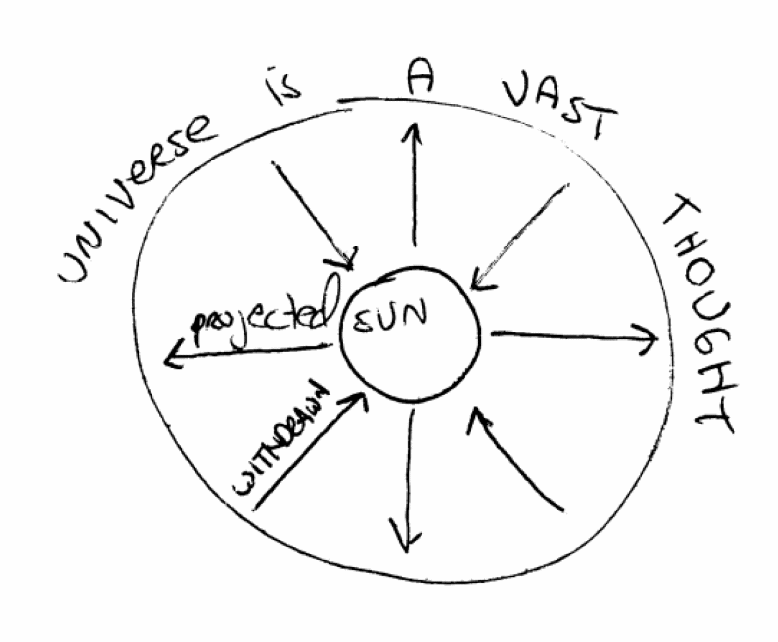
FIGURE 1979 0916-1-AB. Universe as Sun's Vast Thought.
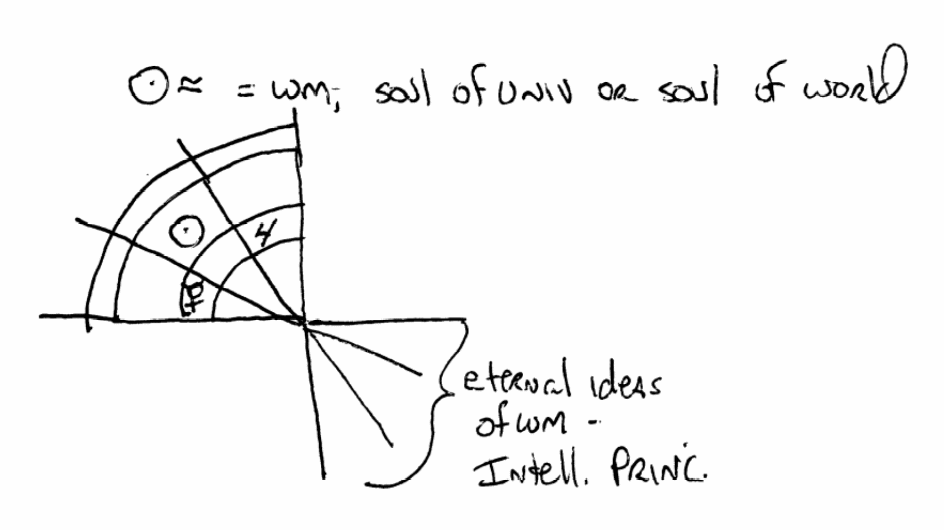
FIGURE 1979 0916-2-AB. World-Mind and World-Soul, with Jupiter in Capricorn and Mercury in Pisces.
[Transcriber note: [diagram] means the speaker is referencing a diagram as he or she is speaking. If someone is drawing or writing, with audible sounds of chalk on a blackboard, I indicate this by [drawing] or [writing].]
NOTE: Sunday night class, part of Wisdom series 1979-1980.
TRANSCRIBED Verbatim by IT 2019; reformatted by JRM & JF 2019-2020, with TOC/Subheads by JRM. In 2023, IT updates prefatory matter, footer, and audio file name, completes Book List, fixes errors/typos, adds two diagrams and references within transcript to these diagrams. In 2024, MW alters Subheads to make more accurate. In 2025, IT updates audio file markers to match new REP audio. Archival verbatim transcript – V14.1a.
AUDIO FILES: 1979 0916a, 1979 0916b. [Note 1: "Tape" and "Side" refer to original audio cassette tapes that were later digitized into .MP3 Audio Files. Note 2: Audio File 1979 0916b was originally recorded back to front, i.e., Side 2 followed by Side 1; REP Studio fixes in 2024.]
1979 09/16 at Wisdom's Goldenrod
PB Books; Wisdom of the Overself; "Birth of the Universe"
Archival verbatim transcript
[Audio File 1979 0916a Begins]
VM: We'll do a fairly rapid review of the first two sections. So I will just read a few selected quotes and maybe make comments or remind you of the kind of correlations or comments that were made before. Any questions come up, we'll try and answer them. So we'll start right on the first page of the first chapter, I mean the third chapter. And, there's these three questions that he's going to try and address in this section and that is, "When did the world begin? Whence did it come? How did it arise?" And the first quote is from paragraph two, where he says--
[Transcriber note: I am using The Wisdom of the Overself by Paul Brunton, Rider and Company, London, 1943.]
UNIVERSE IS A VAST THOUGHT OF THE WORLD-SOUL
PB [The Wisdom of the Overself, "The Birth of the Universe," p. 26, VM reading]: "…the universe is an endless affair. There is no moment at which it has not existed, either latently or actively, and consequently there will be no moment when it will not continue to exist, either latently or actively."
VM: Now remember, we're using the fourth quadrant [diagram], in most cases, to mean the universe. [Note: See FIGURE 1979 0916-2-AB, World-Mind and World-Soul, with Jupiter in Capricorn and Mercury in Pisces, appended to this transcript.] So the universe in this context is an eternal thought let's say. And, in third paragraph, last few sentences--
PB [The Wisdom of the Overself, "The Birth of the Universe," p. 27, VM reading]: "In the same way the World-Mind [VM reads: World-Soul]…"
VM: Usually I guess I'll just-- every case, maybe one or two exceptions--
PB [The Wisdom of the Overself, "The Birth of the Universe," p. 27, AD reading]: "For being a vast thought [and] not a vast thing…"
VM: Did I skip one?
AD: Yeah. "For being a vast thought…"
VM (simultaneously): Oh yes. Sorry.
[AD drawing]
PB [The Wisdom of the Overself, "The Birth of the Universe," p. 27, VM reading]: "This is so because the world…"
VM: Yeah, back up to paragraph two.
PB [The Wisdom of the Overself, "The Birth of the Universe," p. 27, VM reading]: "This is so because the world does not arise by a sudden act of creation but by a gradual process of manifestation. For being a vast thought and not a vast thing, it is brought into being by the World-Mind [VM reads: World-Soul] out of itself, out of its own mental"substance", and not out of any extraneous stuff such as matter is supposed to be by materialists…"
VM: So there the World-Mind is understood as the taijasa consciousness of Vairochana and the universe is brought into existence out of the stuff of this consciousness.
[26 second pause while AD draws]
VM: Uh, the last few lines of paragraph three.
PB [The Wisdom of the Overself, "The Birth of the Universe," p. 27, VM reading]: "In the same way the World-Mind manifests something of its own self in the cosmos. And its own self, as will be shown later, being uniquely eternal and undying, it is inevitable that the world-ideas which have arisen within it are eternal and undying too."
VM: Now here, the reference to world-ideas the way we're trying to understand it, is here you actually have to appeal to principles which are outside of the fourth quadrant. Because discussing these world-ideas as eternal and undying must make a reference to principles which do not have any evolution or motion in them as such whereas pretty much everything that we can discuss in the context of this chapter, in the fourth quadrant anyway, is in constant perpetual state of evolution. So this is one of the few instances in this first part of this chapter where the direct reference is made to, let's say, the Intelligible forms in the second quadrant or in the Intellectual-Principle. [9¾ second pause] So, paragraph six, the last few lines. He really addre-- he's addressing this question, when the universe was born, he says—
THE SOLAR SYSTEM IS THE BODY OF THE SUN
PB [The Wisdom of the Overself, "The Birth of the Universe," p. 27, VM reading]: "It is more reasonable to believe, with the hidden teaching, that the universe never had a beginning and will never have an ending, that it is eternal and self-sustaining because it is the body of God…who is eternal and self-sustaining, and that a perpetual evolution of the entire universe and its creatures is constantly proceeding."
VM: So this fits in very nicely with seeing the universe as the-- the fourth quadrant, the quadrant of Body, the Body of God. But it is eternal nonetheless, unlike our own bodies, at least the physical body.
AD: Let's restrict the example more, let's-- let's narrow it down to the solar [VM simultaneously: Projection on a--] system. The solar system is like the body [student assents] of the Sun, alright. And this way make it really feel like you're living in it, you know.
S (simultaneously): Yeah.
VM: Ok. Anthony wants to emphasize the fact that the analogy really is very forceful if you think of the universe as being your solar system, and that the Sun, analogous to Vairochana, does provide the entire substance of the solar system, including our own bodies and so forth. And the solar system is like the Body of God, and it's eternal unlike-- Well, let's say, a lot of astronomers would not say it's eternal but that's-- that's out of ignora-- of issue here. So this sentence then--
AD: It is eternal in the sense that it's always either coming or going. It always is, either active or latent. Now astronomers wouldn't know about a pralaya period, right?
VM (simultaneously): Yes, yes, that's why [AD simultaneously: Ok.] you were saying, you don't want to have to convert that community.
AD: But then again, you know, you know [three/few words inaudible]
VM (simultaneously): Yeah, those guys are lost. (some laughter) [S simultaneously, faint: I see.] Few notable exceptions. (laughter)
VM: Anyway the-- the next issue he tries to address is causality but we didn't spend much time worrying about causality today because at this lofty level to speak about causality in the limited sense in which the public (use/used) the term normally, if A then B, you know, billiard balls colliding and so on, is totally inapplicable, there's an infinite web of interrelated forces that can be discussed as being the cause of the universe and there's no first cause and so on and PB spends page or so developing that idea. So, he's going to drop causality as a metaphysical principle as he says. [short pause] So, the bottom of paragraph thirteen--
PB [The Wisdom of the Overself, "The Birth of the Universe," p. 29, VM reading]: "The World-Mind does not need to"create"…"
VM: I'm sorry, I sometimes forget to say "World-Soul" but I think almost every case in here it really is World-Soul, Soul of the All.
PB [The Wisdom of the Overself, "The Birth of the Universe," p. 29, VM reading]: "The World-Mind [VM reads: World-Soul] does not need to"create" the universe [VM: Or the solar system, let's say.] out of nothing when it can bring it to birth out of its own self. And as a mental principle it does this by projecting the world as its idea. The world is its self-projection."
VM: This is exactly what Anthony is pictorializing here [diagram]. [Note: See FIGURE 1979 0916-1-AB, Universe as Sun's Vast Thought, appended to this transcript.] Right? The universe is the vast thought of the Sun. It's projecting it outward out of its own mental substance, out of the taijasa consciousness. He also has withdrawing too. I guess you could think of the circumference of this circle [diagram] as sort of like being the Body monad. It provides the locus or the place or the hook on which the World-Mind does its projecting. [short pause] Uh-- Paragraph fourteen.
PB [The Wisdom of the Overself, "The Birth of the Universe," p. 29, VM reading]: "Mind or rather World-Mind [VM reads: World-Soul] is immanent throughout the universe. The universe has arisen out of its constructive meditation but it has arisen in orderly self-determined fashion shaped by its own memorized mental impressions of a former state of active existence. The ceaseless procession of images, picturing forth suns and stars, lands and seas and all things visible emanate from the World-Mind [VM: World-Soul] under a divine immutable mysterious karmic law like water trickling from an inexhaustible fountain."
VM: So, the World-Soul is immanent throughout the universe because the universe is generated or created out of its own mental substance just like, let's say, an individual mind is immanent in all the thoughts that occur within that mind, the same way the World-Soul is immanent in all-- in all aspects of the created world, or let's say the visible as well as invisible world. And it says here that it has arisen out of its constructive meditation. Constructive meditation, of course, is another reference in slightly different words to this notion of projecting the world out of its own mental substance. And here the law of karma comes in now, he says, "shaped by…"
OUR SUN PICTURES FORTH THE UNIVERSE FOR US
AD (simultaneously): I'd like to emphasize one thing, [VM simultaneously: Go ahead.] when he says "The ceaseless procession of images…"
VM: Ok.
AD: Now, he says there, "picturing forth suns and stars".
VM: Yeah.
AD: And you have to here conceive, so to speak, your Sun doing this for us. So maybe astronomers are not getting a picture of the universe they think they're getting.
S (very faint): Yeah.
VM: Uh-hm, it's-- [student assents, very faint] [one/two words inaudible] after a while. This-- I'll just tell you-- share my confusion with you when he says this, I don't really know what it means exactly but-- (bit of laughter) He's been telling me this for years and one of these days I'm going to really, you know-- Then I might have to quit my job, but-- (laughter) So-- the-- Let's see, he said--
AD: "Ceaseless procession…"
PB [The Wisdom of the Overself, "The Birth of the Universe," p. 29, VM reading]: "The ceaseless procession of images, picturing forth suns and stars, lands and seas and all things visible emanate from the World-Mind [VM reads: World-Soul]…"
VM: So, Anthony is saying that the Sun--
AD: The Sun of our solar system.
VM (simultaneously): The Sun of our solar system, which shouldn't be confused with the visible sun which, you know, is related to it but is obviously not the Sun in question that's doing the projecting. That image that we see of the visible sun is itself a projected image. But the Sun of our solar system is projecting forth other entire galaxies, in fact a whole universe which is under study by the astronomers and is, Anthony claims, to be projected from, let's say, the principle of the Sun in Aquarius [diagram]. [Note: See FIGURE 1979 0916-2-AB, World-Mind and World-Soul, with Jupiter in Capricorn and Mercury in Pisces, appended to this transcript.] [short pause] Now I don't really know what that means but-- except perhaps that the Sun in Aquarius provides a certain amount-- mode of consciousness, and everything that we consider to be other stars, galaxies, and so on are aspects of that mode of consciousness.
AD: In the same way that the individual soul elaborates the thingness which is provided by our Sun for us, in the same way, analogously, the Sun pictures forth for itself or, let's say, brings about to birth within itself, an image of the entire universe. So that what the astronomer would be working with would be always through the medium of the Sun's, let's say, bringing into existence, bringing into imagery, what it has pictured forth for itself, its solar system, and all the inhabitants of that system. Whereas we are of the opinion that we are directly looking at the universe. The astronomers are of that opinion, you know, that outside of a little interference from atmosphere, alright, we're looking directly at the solar system and I'm-- I'm sorry, the universe. What I'm saying is that you're looking at the universe through the imagery provided by the Sun. Alright, it's not important.
VM (simultaneously): I'm not trying to disagree, I'm just trying to comprehend.
AD: Yeah, but it's not important. Ok?
S (very faint): Yes it is.
AD: Not now.
AH: Vic, we're not talking about the physical sun.
VM: No, I-- I would understand the physical sun as a hole in the sky.
AH: That's very medieval concept. (bit of laughter)
VM: Well that's the latest modern-- No. (some laughter) Well that's what Anthony was telling me this afternoon and I think you understand it like this, a hole in the sky, not like a big hole in my forehead or something like black hole at Walt Disney movie and all that.
AH (simultaneously): Seriously, it was considered hole.
VM (simultaneously): Yeah, I know, I know, it (has/was) always been considered-- [AS: Tim--] well not always, many people have thought about it as a hole in the sky. But a hole in the sense of being like a bindu point, like a point through which all the images that we can ever come in contact first pour in through that hole. "Through that hole," I don't care for that, let's say a bindu. S-- the vi-- the visible sun represents a certain bindu point or a dimensionless point through which, let's say--
AD: The Intellectual World [student assents] pours through that.
VM: The Intellectual World can pour through and form itself in imagery that we can come in contact with for us.
AH (simultaneously): Can I say something?
VM: I hope nobody from American Astronomical Society can hear me. (some laughter)
AH: Would we say the same thing about the rest of the stars as being bindus?
VM: You'd have to ask Anthony these questions 'cause I get really schizophrenic when [couple words inaudible] (laughter)
AD (amidst laughter): I'm sorry, let's do the-- (more laughter)
VM: I mean it, I really do, it's like one half of my brain is over there and the other-- (laughter) Johanna, did you have a non-astronomical question to ask? (laughter)
JG: It's perfectly non-astronomical, it's-- I don't know what it is. (some laughter) I always-- for me that sentence was--
VM: Which sentence?
JG: Like "the ceaseless procession of the images" [VM: Uh-hm.] and then "picturing forth." I could call it a grammatical questions but I-- question but I'm not sure it's that. Do I have images that then picture forth something? Like, you know, when you compare that to a bindu, you know, I speaking very literal, that behind the bindu is the procession of images and what we're looking to is the picturing forth.
VM: I'm afraid I don't understand.
S (faint): The processions is a lot different [couple words inaudible]
MW (simultaneously): Is the picturing forth something different than the image? Is the image somehow creative of a picture of the sun and the stars? Was that your question Johanna?
JG (simultaneously): Yes, that's-- So if you-- you know, if you--
MW: Here's the way it reads: the images picture forth something (and it--)
JG (simultaneously): The (procession).
RG: No, no, no, no.
VM: I don't think so, I--
S (simultaneously): If you get the [one word inaudible] procession.
RG (simultaneously): The procession that pictures forth.
VM: "…ceaseless procession of images, picturing forth…" I-- if you could use, I think, "thinking" for picturing forth or "projecting", you know, like we've used the Sun as Vairochana projects the universe.
JG (simultaneously): But see, then I still have the difference between image and the actual visible Sun and star and all, you know, that, according--
VM (simultaneously): Well there's-- Yeah. Well there's many uses of the term 'image' and it's often occurs at various levels, so-- "The ceaseless procession of images, picturing forth suns and stars and…and all things visible…" I think he's using 'image' here at a fairly concrete level if he's speaking about all things visible.
JG: Oh, so you tie that in with the sentence in between that that is [one word inaudible] He elaborates what he means by images.
VM: Think so.
RG: Then the picturing refers to the procession then.
[short pause]
VM: Can't wait to get away from this sentence. Could we now?
JG: Yes. (bit of laughter)
S (very faint): (Thought) we did.
S (very faint, possibly same S as above): Thank you.
KARMIC PROCESSES BRING FORTH THE UNIVERSE
VM: The next quote that's-- Like he talks about the special and general law of karma which you remember is-- one applies to us and the other, general one applies to every entity. And then the-- paragraph sixteen.
[short pause]
PB [The Wisdom of the Overself, "The Birth of the Universe," p. 29, VM reading]: "The World-Mind…"
VM: Well, "It is…" I'll just start from the beginning.
PB [The Wisdom of the Overself, "The Birth of the Universe," p. 29, VM reading]: "It is through mutually-acting karmic processes that this universe becomes possible. The World-Mind [VM reads: World-Soul] brings forth its general world-images not by any [VM reads: an] arbitrary fiat but by their natural continuity as the consequences of all those that have previously existed. They are a continuation of all the remembered world-images which have appeared before, but modified and developed by their [own] mutual inter-action and evolution, not by the capricious decree of a humanized God."
VM: So he's saying here that the-- the present universe is structured at least in part by all the universes that appeared before it. Just like our own experience today, let's say, is structured by yesterday's experience and the day before.
PB [The Wisdom of the Overself, "The Birth of the Universe," p. 29, VM reading]: "The World-Mind makes the universe by constructively thinking it. But it does not think arbitrarily. The thoughts arise of their own accord under a strict karmic and evolutionary law. It must be emphasized that on this view the universe constitutes a self-actuating system, although it must equally be understood that the system itself depends on World-Mind [VM reads: World-Soul] for its own continued existence and continuous activity. All the karmic forces and thought-forms carry on their mutual activities, intertwine, inter-act and evolve of their own accord in the presence of the World-Mind just as plants grow of their own accord in the presence of sunlight. But it is to that very presence that they owe their own sustenance and existence."
VM: So it's an important idea of self-actuating system in here. The World-Mind, the World-Soul, provides the substance and the ground for what these karmic forces, which are memorized from previous universes, have their own dynamism, and they-- very much like our own personal complexes, they have a certain momentum, a certain autonomy and dynamism of their own that erupt and evolve always with a strict karmic and evolutionary law. But, in some ways they don't have to be, what's the word-- or the World-Mind doesn't have to reflect and say, "Ah, now it's time to bring out this, now it's time to do that." Things evolve of their own accord but always depending upon the World-Mind like plants on sunlight.
[10½ second pause]
S (faint, possibly part of background): Let's see what he says.
VM: I think that was it for that first section. [short pause] And, perhaps we can go on to "The Karmic Impressions".
AD: Uh-hm, yeah.
[short pause]
VM: Let me just mention that very often, the word 'karma', Anthony likes to discuss it in terms of power and sometimes the power of the Ideas, or the dynamism of the Ideas, the metaphysical Ideas. Sometimes the word 'karma' appears to be almost a synonym for continuity or lawfulness. And so really have to kind of use it or understand it in a given context. Let's see what happens here. Paragraph twenty, the first paragraph of "Karmic Impressions".
WORLD-SOUL'S MEMORIZATION MAKES KARMA POSSIBLE
PB [The Wisdom of the Overself, "The Birth of the Universe," p. 30, VM reading]: "But because it [VM: the cosmos,"as mentalism sh--" "...because it] is, as mentalism shows, a collection of thought-formations and because there is a World-Mind [VM reads: World-Soul] as the unitary ground connecting all these formations, the possibility of karma as an operative force exists. For karma would be meaningless if there were not some kind of orderly continuity between the past, the present and the future of [VM reads: and] all those things and creatures which make up the universal existence. But this implies that Nature must keep and conserve some sort of memory in her secret recesses."
VM: Well first he reminds us that the universe is a thought-formation and this then allows for the possibility of this principle of karma to act. And then he also says that look, in order for karma or the notion of continuity, some sort of power, to carry on the impetus that's been set forth in one universe, for it to take over in the next universe, there has to be some sort of principle of memory to, let's say, carry this continuity or provide for the continuity. So we get to this very important idea about the World-Mind, or World-Soul more properly, providing the memorization for all that manifests within it and that's the subject of the next few quotes.
PB [The Wisdom of the Overself, "The Birth of the Universe," p. 30, VM reading]: "…Nature must keep and conserve some sort of memory in her secret recesses."
[short pause]
VM: The next paragraph, twenty-one--
PB [The Wisdom of the Overself, "The Birth of the Universe," p. 31, VM reading]: "And because memory is not an object which the senses can grasp but something entirely immaterial, this in turn involves the existence of something mental. A mental principle which shall be cosmic in its spatial sweep and permanent in its embrace of time, is and can be none other than the World-Mind [VM reads: World-Soul] itself. Thus the foundation of all karmic working can be traced to the World-Mind [VM reads: World-Soul]."
VM: You could say, "Thus the foundation of all working out of the Ideas," and you could go all the way back to the second quadrant [diagram] if you like. "Thus the foundation of the working out of all Ideas can be traced to the World-Soul." [Note: See FIGURE 1979 0916-2-AB, World-Mind and World-Soul, with Jupiter in Capricorn and Mercury in Pisces, appended to this transcript.]
IDEAS AND THEIR POWER TO EFFECTUATE THEMSELVES
PB [The Wisdom of the Overself, "The Birth of the Universe," p. 31, VM reading]: "The rise, abiding and dissolution of karma [VM reads: these Ideas] is indeed a twin-function to that of its ideation [VM reads: twin-function or is accompanied by the process of ideation of the World-Soul.]"
[short pause]
S: What'd you say?
[15 second pause]
VM: Uh--
S (very faint): Would you--
HP (simultaneously): Oh, I see, yeah.
VM: Go ahead Helen, break the ice.
HP: We just learned that the ideation, the images, imagery, comes from the Sun in the eleventh house [diagram], not the Sun we see but the Sun in eleventh house. Does that-- does this part that it's a twin-function mean that karma also would come from the same level?
VM: Well it's--
HP: It's like a--
VM: I'm not sure Helen, it depends at least in part on how we're understanding karma. I think you would say that there is a certain kind of continuity which you can, let's say, place, diagrammatically speaking, in just the-- just the fourth quadrant but also sometimes Anthony likes to use the term 'karma' to mean the power of the World-Ideas or the power of the metaphysical Ideas to image forth their meaning and so forth and then you would have to think-- well, I don't have any diagrams-- you have to think of it coming from the second quadrant then through the Sun in Aquarius, Vairochana, [S simultaneously, faint: (one word inaudible) yeah.] and then out into the world.
HP: Likewise. So, in a way they both, both are on-- The Ideas also originate in the second quadrant but you have like a source there that comes through the eleventh house. Also the karma has a source there. Am I making--
AD: You could read it very simply this way, that the power and ideation are obverse sides of each other. The Ideas [HP simultaneously: Yeah, they come through, they come--] have power, alright. When that power is being used, the Ideas are instantiating or appearing. [HP: Does that--] When that power is withdrawn, so are the Ideas.
HP: Is--
VM (simultaneously): She's asking, where does it come from, what level?
HP (simultaneously): No, no, no. I'm just asking about in general but-- And do the Ideas have power connected with each one? Do you know like, is it like one [one/two words inaudible]
AD (simultaneously): Yes. It's not an Idea unless it has the efficacy to implement itself.
HP: So it would be s-- they would be the same thing.
AD: So, if you say that there's an Idea in the Mind of God, this Idea will have the power to accomplish its goal, to effectuate its purposes. So that the power and the Ideas, alright, are, as we said, complementary sides of each other. If you have the power manifesting, you have the Idea accompanying it. And if there's the Idea there being manifested you know the power is behind it. So [HP assents] the rise, abiding, and dissolution of power is a twin accompaniment to that of its-- of the functioning of the Idea. That's why I say, the word 'karma' really has to be nailed down, in each [HP assents, faint] instant it will mean something [HP assents] quite different. To me it would be the same thing if every time you see that word 'karma', just use the word 'x'.
HP: And also the-- So the continuity that is-- the continuity that we experience in our, you know, in the unfolding of something, I don't know, a tree or something grows in a certain way. It's like there's one Idea that unfolds itself in these images but the continuity of the imagery also-- both the imagery and the continuity come from the same place.
AD: No, the continuity would come ultimately from the metaphysical Ideas. The memorization of their appearances through the Sun, alright, and insofar that they get instantiated or they appear as images in a world, alright, and then these images are withdrawn, that's the functioning of the World-Soul. The World-Soul, so to speak, retains a memory of the appearance of these Ideas, [HP simultaneously: Of details (couple words inaudible)] but the Ideas ultimately come from a higher realm.
[student assents, very faint]
HP: So like the details like of how a tree appears is a much lower thing than the whole idea of continuity. Is that what you just said?
AD (simultaneously): I'm sorry?
HP: The-- the details like of what a particular tree would appear as, the de-- the details of imagery, is much lower than the whole idea of continuity.
AD: Yes, yeah.
HP: Yeah, that--
AD (faint): Uh-huh.
VM: And maybe we can go to paragraph twenty-three.
KARMIC IMPRESSIONS
PB [The Wisdom of the Overself, "The Birth of the Universe," p. 31, VM reading]: "The World-Mind [VM reads: World-Soul] is all-containing. Since the beginningless past it has gathered these cosmic memories. The patterns of all that goes to constitute a universe previously existed in it in this potential form. The archetype [VM reads: archetypes] of everything found in Nature first existed in this illimitable storehouse. Just as the silent registrations on a gramophone record are converted under suitable conditions into vividly heard words, so the invisible registrations in World-Mind were converted at the ripe karmic time into vividly experienced things. …so the karmic impressions stored during a cosmic night repeated themselves in the space-time world as they passed into actuality and thus appeared again in tangible visible form."
VM: Well let's see. He's stressing the-- the fact that the present space-time universe we have is based upon these karmic impressions which have been memorized and stored in this illimitable storehouse. Again, he must be speaking about the Sun in Aquarius because the-- let's say the Intellectual-Principle in the second quadrant is not storing, then retrieving and then manifesting out. That's far too dynamic and, let's say, ephemeral a function for the Intellectual-Principle but this is appropriate for World-Soul, all this motion, memorization, and re-manifesting the world. You could think of things actually being, let's say, etched into the consciousness of Vairochana but no such storing of imagery can occur in let's say the Intellectual-Principle. [short pause] The next paragraph--
PB [The Wisdom of the Overself, "The Birth of the Universe," p. 31, VM reading]: "The thoughts originally pre-exist in it [VM reads: in the World-Soul] not concretely but in the abstract sense that ideas of an intended effect pre-exist in a [VM reads: the] musician's mind. Such pre-existence of the world-ideas is possible only through the agency of karma."
VM: Let's say through the combined power and continuity that karma provides, this pre-existence of these world-ideas can-- can take place.
BS: Once more please?
S (very faint): (Yes, please.)
VM: Alright.
PB [The Wisdom of the Overself, "The Birth of the Universe," p. 31, VM reading]: "The thoughts originally pre-exist in it not concretely but in the abstract sense that ideas of an intended effect pre-exist in a musician's mind. Such pre-existence of the world-ideas is possible only through the agency of karma."
[short pause]
VM: So there's two levels on which you can interpret this. Maybe we should get into both levels in case something will come out of that. Let's talk about just the karmic impressions, things memorized by the World-Soul and held, let's say, somewhere in the fourth quadrant. I don't know exactly where but let's just say in the consciousness of Vairochana. These things are held in a-- in a similar way to the way a musician would have a-- an idea for a symphony and it's in a timeless shapeless form, but only when it's written out, played out and so on, does it take on actual space-time form. And then he says, "Such pre-existence of the world-ideas is possible only through the--" the power of these-- or, well I guess the continuity of karma or agency of karma, and I'm using karma-- karma here in the sense of, let's say, continuity. Because if it weren't possible for the memorization to take place and there to be some-- well, continuity is the word that [one word inaudible] in my-- Sorry I keep using it because I should maybe come up with a synonym. [short pause] But let's imagine if these-- if the world-idea or these karmic impressions which are memorized would dissolve away as soon as they were formed, there would be no basis on which to bring forth the universe, it would be a brand new thing every time. It just sounds like chaos to me. And there's another way. Go ahead Bert, I'm sorry.
BS (simultaneously): I just have trouble understanding the second sent-- sentence. "…pre-existence of the world-ideas is possible only through the agency of karma." Why the "pre"?
VM: Well "pre" in the sense that it's before the actual space-time manifestation. That's one interpretation. There's a whole other level of interpreting this thing but let's stay at one level. It pre-exists in the sense that-- The individual mind, if you want to use that as an example, that's held in the memory of the World-Mind prior to the actual birth of the individual.
S (very faint): Yeah.
S (faint): Ok.
VM: Ok? And that's its pre-existence. And if it weren't for the continuity, the power of general-- the general law of karma, the continuity of that individual mind, then all the hard work you did in a previous universe couldn't be brought to bear on the present incarnation. Ok? The other level that I think was discussed this afternoon was to think of these world-ideas as really being the patterns for all universes that exist in this-- in the second quadrant or the Intellectual-Principle. And that that's the reference to world-ideas.
BS: Ok, now how would that fit in with the agency of karma?
VM: Well, again, there has to be a certain continuity in the second quadrant otherwise what was formerly the Idea of Man might shift to the Idea of a turtle or something, I mean it's got to have-- You know, again, take-- Yeah, that's good, because we used-- we used the idea of the individual mind being stored by World-Soul and now we can think about the pre-existence of the Idea of Man as an Intellectual-Principle in the second quadrant being the world-idea referred to here. And again if there weren't this principle of continuity, then there-- the Idea of Man wouldn't persist.
S (faint): Vic--
AD: (Yeah), how about this for an easy example. Let's say I have the idea of a novel in my mind, alright. The whole plot is in my mind. And I'm writing out chapter, the second, third, fourth, fifth chapter, alright. Now it's because I have the idea of the whole plot in my mind, alright, that that preserves, so to speak, the identity of the individual sections or, you know, characters that I'm writing about. If I let go of that idea of the whole novel, all the-- the identity of all those partial characters would collapse, would dissolve immediately. So that ultimately we could trace the identity and the continuity of an entity or a thing back to the Idea which it is manifesting. Follow that? [student assents, very faint] Yeah, that's easy.
[students assent, very faint]
VM: Ok. I think-- [short pause] Well, the next paragraph-- Well flies like coffee too. The--
PB [The Wisdom of the Overself, "The Birth of the Universe," pp. 31-32, VM reading]: "This [VM reads: The] karmic seed-form must not be misunderstood. Because everything is really mental, because everything is a thought-formation the memorization of it held by the World-Mind is not a second and separate substance but is the very essence or soul of the thing itself."
VM: So he doesn't want us to think of these karmic impressions as something very different than the memorization of them. The memorization and the karmic impressions are one and the same. And at the same time, they're the essence of the very manifestation that they la-- that they later form the basis for.
S: Is that-- is that what is meant by the efficacy?
VM: Well the efficacy let's say would be the power or the efficiency of these Ideas to provide the basis for manifestation. The efficacy of a psychological complex is its power to jerk you around whenever the occasion arises, I mean-- (bit of laughter) You know, the efficacy of an Idea. Let's say you have-- Oh, Anthony loves this one. You go to bed at night. You have this thought of lust. The efficacy of that thought of lust is that it can generate an entire-- you fill in the details. (bit of laughter) Right? I think that's the way efficacy is used in this context.
S: So the efficacy is just-- is in the-- the power to manifest.
AD (very faint): Uh-hm, exactly.
S: But it seems like, [VM simultaneously: You think so?] from the point that you just read, that each Idea-- it-- it has the power to-to manifest itself. So each-- each Idea would have a particular-- have its own efficacy. (And that) I just don't know the--
VM (simultaneously): Each Idea would have its own efficacy, yes.
S (simultaneously): No, like there's-- it seems like there are two things. There's the-- the power to manifest into the space-time world and then-- but it-- Is that the power of karma? [AD, faint: Honey--] I just don't understand--
AD (very faint): That's ok. (Well go on.)
S: Well each one, each Idea in itself seems to have its own power.
AD (faint): Yes.
S: But-- or is there a general power of--
AD: No we're in a different domain now. We're-- we're speaking about this section here, this karmic seed-form?
S (faint): Yeah.
AD: This is what we're discussing?
VM (faint): Yes, "This karmic seed-form must not be misunderstood."
AD (simultaneously): "…must not be misunderstood [AD reads: understood]." Alright. Now, karmic seed-form. You know, I mean don't take it literally that you have the--
VM: Culver seed company.
KARMIC SEEDS ARE THE RESULT OF THE MIND'S TAKING THE FORMS OF THINGS
AD: And by seeds we-- I mean-- Karmic seed, first of all we have to back off. The example that we use, like what is memory, and we-- we spoke about memory that mind modalizes itself, actualizes itself, by giving appearance to a thing. And then when it withdraws that modalization, included and intrinsic to that very functioning of the mind, alright, is inherent in that substance of the mind the activity it expressed. So if we metaphorically think of the mind becoming a thing, and then, let's say, unbecoming that thing, included in the very substance of the mind is the form that the mind took when it became that thing. Now, this is the karmic seed.
AH: What is, the form, Anthony?
S: Uh-hm.
MW (simultaneously): That in-- that-- that inherent structuralization of the mind.
VM: Let me try it. How about a psychological trauma when you're a kid? Just happens once. The mind pictures forth this scene where you get chased by a big black dog. It just happened once and the mind-- you know, the individual mind presents you with this scene and there's all this emotional reaction in it and so on. And the very modalization of the mind in some sense concretizes, memorizes this experience. And-- and then it's the-- it's the basis for all-- all encounters thereafter with dogs or animals and so on. And it's-- And you shouldn't think of the memorized, that karmic seed, that psychological trauma, as being something material, as being something separate from its memorization. They're really one and the same. It's the very soul of that experience, the very essence of that experience itself. I'm sorry if I interrupted.
AD: No, it's alright.
IF: But Tony, you said something more, and-- Can you please repeat this, when you start to explain that karmic seed? [AD/S(?), faint: Uh-hm.] It was more than Vic's example.
AD: Uh-hm.
VM: Yeah.
S (very faint): Yeah.
AD: I'm sorry, I don't follow.
IF: Well you just (were) explaining the karmic seed before Vic gave an example. Can you please do this once again and (the convention) because it's more than-- more than Vic's illustration.
AD: Well let me try this way. The-- whatever forms, whatever forms that the mind take, these very forms which the mind takes and then dissolves are-- have now become, let's say, intrinsic to the mind's functioning. They're included as part of the mind. That will be a karmic seed. It's-- it's a very subtle idea, it has to be grasped. We use the example where you say someone gives you telephone number and you actually repeat it to yourself. It's like you've taken this very abstract thought and you concretize it, that is, you give it an-- you visualize it in your mind or you repeat it to yourself so that you could hear it. That means that the mind has taken the form of that very thing. Now, now that the-- let's say, the thing is gone or you're no longer thinking about it, because the mind took the form of that thing, alright, the very taking of that form, the taking here, the functional-- the functioning of the mind is memory. So that means that it's immaterial. If that point isn't grasped, then you won't-- you won't understand what they're talking about when they say karmic seeds or bija points or any of these things because this has to be understood.
VM (faint): Should we jump to paragraph twenty-nine and read about memory or--
AD (simultaneously): Go ahead, sure.
VM: Let's jump to paragraph twenty-nine and read about memory. It's a little ahead of where we are but it seems like it's germane to the discussion. Why don't we just read the paragraph right from the beginning, paragraph twenty-nine.
PB [The Wisdom of the Overself, "The Birth of the Universe," pp. 32-33, VM reading]: "To make the next point clearer let us return to our early and elementary study of the way we receive knowledge of external things. The vibration which travels from the surface-sense along a nerve path to cells in the brain-cortex, is concerned only with separate sensations. When these are associated, co-ordinated and brought into consciousness as seeing, hearing and so on, the sense-experience becomes a percept. When such a percept is stored in the mind and later recalled or reproduced, then the faculty of memory comes into play. A little reflection will show [VM: Maybe more than a little but--"A little reflection will show] that this faculty is merely a particular form taken by the image-making power of the mind. If the human mind memorizes through the use of its imagination, then the World-Mind must in its larger way use the same faculty too. If this point is understood then it will be easier to grasp the next point, that karma, being the kinetic memory of Nature, is necessarily coupled with the imaginative power of Nature."
[short pause]
VM: Well--
BS: Is it that-- Is that very imagination, like when mind takes the form of an object, is it the imagination that's given form to this "thing" or object that we [VM simultaneously: Yes.] say is the image that is-- It's sort of-- it's like the mind assimilates the object to itself? Are we saying something like that?
AD: Go on, yes. And then because of that assimilation, [BS: Yeah.] or because it did something, that very didding of something-- (some laughter) Excuse the-- [BS: Oh.] that-- The very fact that it did this thing, alright, this doing, is its memory. The mind has to do it and then he's included-- included in the very substance of the mind his doing; which is an abstract notion, granted. But--
BS (simultaneously): What's an abstract notion?
S: Doing.
AD: The notion of doing, of willing.
BS (faint): Ok.
(Side 1 of original cassette tape digitized as 1979 0916a Ends; Side 2 Begins)
AD: --embody. Well all these terms, alright, is like saying that the mind went out, assimilated, became like the object, and then when you withdrew the mind from the object, now included in the-- in the mind is the very way it functioned when it went out and grabbed him. That's the-- that's what they call memory.
BS: The very way it functioned when it went out and grabbed it. So that's a very specific form of functioning then. (What--)
AD (simultaneously): Well, the functioning of the mind, alright, when it does grab something, that is what we mean by memory.
S: Does it have to do it that-- with the functioning (of/um)-- with something like attention but-- The reason I was thinking of that is because it seems like especially when you're a child, the mind projects all sorts of images but then they're not remembered. And because there's not--
AD (simultaneously): No, we're talking about the real world now, ok. The mind we're talking about goes up, goes out, grabs an object, [student assents] a cup, shows all the characteristics of an object, alright, and there's a formal identity with that object, alright. We're talking about the real world, ok.
S: Yeah.
AD: In the same way, we say when the Sun, [S: Wasn't I?] when the Sun goes out and becomes everything in the universe, in the solar system, then when it withdraws the so-- when it draw-- withdraws the world, when it goes into pralaya, included in that very withdrawal is what it at one time was. Because we have to remember, that S-- that Sun is equivalent to a mental substance or taijasa consciousness. So when it becomes a thing, let's say, for a million years, alright, and then withdraws being that thing, alright, that very mold that it was in is now included as part of the substance of the mind. This is the karmic seed. This is what has to be understood. Take a roll of paper that you had under the bed (for some/for-- from) ten years, I like to use this. (bit of laughter) And then you roll it out, it bangs up. Roll it down, it keeps going back up, right? Ingrained in the very structure of the paper is this position it took. Alright, but the child is a-- a child is the best example because in a traumatic experience, the mind has very intensely become that experience, [S simultaneously: That's what I was thinking of.] and that's included in the mind's functioning now.
S: But a lot of-- but a lot of-- a lot of things are projected out in a child and not memorized in this way. Is that right?
VM: No, I think--
S: Or you just want to--
AD: Well I want-- I'm going [S simultaneously: Ok, I'm sorry.] to leave that out, I'm going to leave that out.
S: Alright.
MW: See you're-- you're only thinking of-- It's not the power of recall that we're talking about, we're talking about that functioning that's--
VM: Functioning in general of memory.
MW (simultaneously): --that's right in my-- I mean, insofar as the child has an experience, that exper-- there's something in that experience that's retained, [S: Yeah.] whether if you ask him about it and it can [couple inaudible student words simultaneous with MW] remember what happened when you were two, that's-- that's not what we're talking about.
S: Yeah.
VM (simultaneously): Right, but it's with you.
S: Yeah, it's [couple words inaudible]
MW (simultaneously): Because when then you look at the actual psychology you see the psychology of the adult can be structured by the experiences that he doesn't remember but his mind took that form and so--
AD: So now if you apply it the same way, from the human being you go back to the level of the Sun. Think of the Sun as this tremendous Solar Being, you know, and it's projecting the whole universe from out of itself. And it becomes everything in that universe. This consciousness now assumes that shape, the form of the thing, for millions of years. And then it withdraws the universe back, alright. It's just like that paper that we spoke about. As it withdraws back, there'll be crinkles in its mind. (bit of laughter) I don't know what [couple/three words inaudible] (laughter) From now on you're on your own. (laughter) But [S: Ok.] that has to be understood so that you get a feeling of the karmic impressions. These things can be reactivated again. The Sun comes out again and again these crinkles in his mind, when it starts manifesting, there's already this tendency for this consciousness to become this particular thing, that consciousness to become another particular thing because it's already in the interior voidness of the Solar world, its-- the substance of-- its mental substance. Alright, we'll just have to let that go, you think about it. As a matter of fact, take it into meditation. It's worth it. The whole alaya-vijnana is based on this concept. [student assents] Alright, and later on when I criticize the alaya-vijnana as not being sufficient, you're going to-- you're going to have to understand these ideas or my criticisms won't be worth anything. Alright.
AH: A while ago we-- Anthony mentioned that memory is a very abstract concept. Was that the phrase (you had there)?
AD: Memory--
AH: That memory was abstract.
AD: I don't know, go on, insist.
AH: I missed that, I didn't understand-- I didn't understand what you meant by abstract, memory being an abstract concept.
[short pause]
AD: I'm sorry, I don't-- I don't recall.
VM: I think he said it was a very subtle idea and was hard to grasp, something like that.
IF: [three/few words inaudible] explanation--
MW (simultaneously): PB's says it's immaterial, memory is an immaterial--
IF (simultaneously): --it's a very abstract notion, when you try to memorize.
VM: Say it again Irushka, I'm sorry, I couldn't hear it.
IF: Well, he was talking about the very form which mind takes is memory or karmic seed. And then he said that any doing, you know, that didding, you know when he was saying, he said that that whole thing is the very abstract notion, though it is associated with that.
AD: But I think most of you know that it's much easier to memorize something you do, alright. Like I have to go around-- I-- in order for me to know how to get somewhere, I have to do it four, five times, alright, then I can get in the car and go there. I don't know about others but I find that very often children learn that way, by doing they learn, they develop that way gradually. And in doing, so to speak, is the whole notion. But you have to ask yourself, well, what's doing? What is it that's the doing? You know, what-what substance are we speaking about? And you would have to bring in this consciousness or this taijasa mental substance that's doing things. In the very doing things appear, and then disappear when it stops doing. Alright, we could go on to others, that's--
VM: Ok. But I guess I would have to ma-- go backwards and (refer) that thought.
AD: So—
THE IMAGE OF THE WORLD AND THE SUBSTANCE ON WHICH IT IS IMPRINTED ARE THE SAME
PB [The Wisdom of the Overself, "The Birth of the Universe," pp. 31-32, AD reading]: "…a thought-[formation] the memorization of it held by the World-Mind is not a second and separate substance but is the very essence or soul of the thing itself."
AD: So let's continue from there.
VM: Ok.
PB [The Wisdom of the Overself, "The Birth of the Universe," p. 32, VM reading]: "If we compare…"
VM: This is paragraph twenty-five.
PB [The Wisdom of the Overself, "The Birth of the Universe," p. 32, VM reading]: "If we compare the World-Mind [VM: the World-Soul] to a piece of wax then the impression [VM reads: impressions] made on the latter by a metal seal represents the memorized unmanifested world and the force or pressure applied to the seal represents karma. [VM: This is karma as power.] And just as the moulded picture is not distinct from the wax itself so the innumerable karmic impressions which compose the memory-image of the whole universe, which is but a great thought, are not distinct from the World-Mind [VM reads: World-Soul] too."
AD (faint): Right.
VM: Thank you. [short pause] So this kind of trying to reinforce-- reinforce that idea that the karmic seeds or the memorizations are not separate from the actual essence or the thing itself. [short pause] Uh--
MB: Vic, this-- this paragraph here, the-- the one that you [VM simultaneously: We just read?] just read about those-- the example of the wax and the seal seems to relate to the notion of karma as applying at the level of the Ideas or at a higher level than that of actually manifesting the world because it talks about the unmanifested world as being-- Wait a minute, I got lost there. Maybe we could go through the analogy.
VM: Ok.
MB (faint): And could we--
VM: Want to go-- go ahead, you want to go through it, you want me to do it?
MB (faint): Um, you could do it. (MB laughs a bit)
VM: Happy. If we compare the World-Mind to a piece of wax, World-Soul to a piece of wax, a piece of wax would be the-- this taijasa consciousness. Then the impressions made on taijasa consciousness by a mental seal--
MB: Metal.
VM: Metal-- My book keeps-- I gotta change (it).
S (faint): Yeah.
PB [The Wisdom of the Overself, "The Birth of the Universe," p. 32, VM reading]: "…by a metal seal represents [VM reads: represent] the memorized unmanifested world and the force or pressure applied to the seal represents karma."
MB: Yeah, so what I was saying is that the-- the impression is the unmanifested world. Then you haven't even talked about the notion in this [VM simultaneously: Oh, I see what you're saying.] analogy of karma as operating in terms of manifesting [VM simultaneously, faint: I see what you're saying.] the world.
[10½ second pause]
VM: Oh, I think Myra though, see, what he wants-- I think what he's trying to get at here though is that the karmic impressions, emphasizing their aspect as the basis for let's say external or concrete existence, ok. Now the psychological analogy would be the childhood trauma. [MB assents, faint] But not exactly how it affects our next experience with a big black dog but let's just say in its unconscious state, alright. Then-- then when he says the impressions made on the wax "by a metal seal represents the memorized unmanifest world…" In other words, I'm understanding that to mean they represent the [MB assents, very faint] sort of unconscious complex in the World-Mind or World-Soul, that karmic seed. "…and the force or pressure applied to the seal represents" power. See I can't-- I don't think we could bring in the world-ideas at this level because you can't speak about the-- the second quadrant as being like wax that you can make impressions on and mold and change and so on, that dynamic kind of discussion can't go on there. Everything is in eternal repose, fully accomplished. [19¾ second pause] Well, if we could go on, paragraph twenty-seven, something like this--
PB [The Wisdom of the Overself, "The Birth of the Universe," p. 32, VM reading]: "In the same way the universe in its potential state is a mental possibility existing in the World-Mind [VM reads: World-Soul], a possibility which has no graspable existence until it appears in actuality as a visible form. Every thought-formation--which means every thing--that exists in this world is born of its corresponding impression in the formless world. The volume and variety of world-appearances arise from the impressions which have resided since the beginningless past in an unbroken chain of continuous transformations in the World-Mind. Every activity, every existence [VM adds: because it] leaves its impress in the World-Mind [VM reads: World-Soul] and the cumulative result of all these combined impressions displays itself eventually as the universe."
AB: Hey Vic?
VM: Yeah.
AB: I think in the example we just used of the seal, we're speaking of karma in terms of its power or its, you know, effectuating it so that it would both preserve these impressions, these subtle impressions that we're talking about now, [VM: Uh-hm.] it would also be responsible for what actualizes [VM simultaneously: The manifestation.] at the appropriate moment.
VM: Right, right.
AB: So he's speaking really of karma in terms of power or force and then later we'll contrast it with the imaginative power.
VM: Yeah, right. That ties in very nicely with this sentence about "…karma is indeed a twin-function to that of its ideation." So the seal is [one word inaudible]
AB (simultaneously): Right, I think-- Is the ideation.
VM: Well no, I was thinking of a-- (bit of laughter) Well, maybe that way too. I was thinking that the karma gives the power to impress the wax with this given design.
AB: Right.
VM: But then karma or the twin-function to that is the fact that that impress in the wax will then be, let's say, the basis upon which a new ideation takes place.
AB: Ok.
AD: If we-- if we use that--
PB [The Wisdom of the Overself, "The Birth of the Universe," p. 32, AD reading]: "And just as [AD adds: in] the moulded picture is not distinct from the wax itself [VM: Uh-hm.] [AD: Alright.] so the innumerable karmic impressions which compose the memory-image of the whole universe…are not distinct from the World-Mind [too]."
AD: Now let's-- let's read it in a complementary world.
VM (faint): Ok.
PB [The Wisdom of the Overself, "The Birth of the Universe," p. 32, AD reading]: "And just as the moulded picture is not distinct from the wax [AD reads: mind] itself…"
AD: In other words, instead of thinking of a picture being impressed on wax, alright, I have a stamp here and I s-- [VM, faint: Uh-hm.] alright, think of, now I'm going to impress mind with this image. Alright, so-- I'm-- the analogy gets very subtle, alright.
AD (paraphrasing): Just as this moulded picture is not distinct from the mind itself, so the innumerable times that you've been stamping the mind with this kind of activity, [student assents, faint] which composes the memory-image of the whole universe, is not distinct from the World-Soul, which is the substance upon which that whole world-image is being imprinted on. So that the image of the world and the substance on which it is being imprinted on are the same.
AB: Ok, but now could you make, anyway, conceptual distinction and say that the-- the force which imposes the image and preserves it he's speaking of in reference to karma. And then when he speaks of the imaginative power or ideation he's speaking in terms of the image, the memorized image.
AD: I'm sorry, the second part?
AB: He speaks of the imaginative power of Nature, or the ideation. Could you correlate that with the image itself that is sustained or impressed upon the mind whereas the karma would refer to the power or force with which it is impressed and preserved?
AD: Yes.
AB: Although you could never separate them.
AD: Yes.
MB: But then--
AD: And here you could see that karma repeats. Let's say like sometimes it's a person's karma to repeat a certain activity until finally it gets impressed [AB: Right or--] on him, his soul.
AB: And when that power was used up, so to speak, then he would not have to repeat that experience over and over again, like the karmic energy.
VM: Better yet, (new one) on the way.
AD (simultaneously): Maybe that's--
MB: This-- this may be (sticking/taking) the analogy far too far but there's nothing that corresponds to the metal seal [AD, faint: Uh-hm.] in this paragraph. Like we talked about the wax as being, just like you said, the World-Soul.
VM: I would say the metal seal is the space-time existence.
MB (very faint): Uh-hm, ok.
VM: Ok, in other words, the World-Mind pictures forth in space and time, let's say, empirical space-time, Wisdom's Goldenrod. And then Wisdom's Goldenrod, after many thousands of years, dissolves, becomes something even greater or whatever. (bit of laughter) And, that's-- the concrete existence of Wisdom's Goldenrod, the buildings and people and their activities in space and time and so on are like the metal seal which then is-- impresses on the World-Mind, on the consciousness of Vairochana, a certain memory of this whole movement of this whole group. And then that forms the basis for our next incarnation on another solar system where we build with etheric logs or something, you know. (bit of laughter)
MW: Lighter ones, yeah.
VM: Lighter ones! (VM laughing, laughter)
S (amidst laughter): Well as long as they're lighter.
VM: I don't know, I think that [MB simultaneously: Well then--] me-- the metal seal could be the space-time existence that's actually-- you know, an actual projection out of the space-time existence because of the nature of memory being that opp-- the other side [student assents] of ideation actually is the tool that impresses on the World-Mind this thought.
MB: Or, in other words, maybe for space-time manifestation would be like the previous activity.
VM: Well, yeah, good, that would-- and that would seem (right).
MB (faint): Uh-huh.
AD/S(?) (faint): Yeah, right, uh-hm.
[short pause]
AD (faint): Alright.
S (faint): Uh-hm. You want to read?
S (very faint, possibly part of background): (Let me read now.)
VM: Paragraph twenty-eight.
PB [The Wisdom of the Overself, "The Birth of the Universe," p. 32, VM reading]: "Thus the general karmic memories of the unmanifested world, like invisible pictures upon a sensitive photographic film which wait for the time when they shall be developed into visibility, rest in the World-Mind [VM reads: World-Soul] and wait for the time when they became activated. Then their energies are released and cause the springing to life of a fresh cosmic manifestation."
VM: And so forth. And then we read this section on memory which I think we don't have to go over again. And he says that the-- paragraph thirty-two--
S (faint): Ok.
AD (faint): [few words inaudible]
VM: Oh I think it's thirty-one I didn't want to read.
PB [The Wisdom of the Overself, "The Birth of the Universe," p. 33, VM reading]: "All the potential thought-forms…"
AD: Things.
VM: Things.
AD: Before we get [one/two words inaudible]
VM (simultaneously): Does it read "things" in your book or-- Oh no, you're trying to add-- I'm sorry. (laughter) So many misprints in this edition that we don't know what to expect.
IDEAS IN BEING DETERMINE WHICH POSSIBILITIES WILL MANIFEST
PB [The Wisdom of the Overself, "The Birth of the Universe," p. 33, VM reading]: "All the potential thought-forms [VM: Which are an alias for the word"things" perhaps. (bit of laughter) "All the potential things] are not brought into activity simultaneously. [VM: Except just before the Dalai Lama comes. (laughter)] Out of the innumerable host available, a selective process inherent in the intelligence of the World-Mind [VM reads: World-Soul] and working always with the immutable law of karma, accepts, associates, and gathers together those only which make for a gradual unfoldment in time and an orderly unfoldment in space. … Hence the universe never appears as ready-made, but as a gradual evolution."
VM: And then the last, I guess, really major idea in this section is--
PB [The Wisdom of the Overself, "The Birth of the Universe," p. 33, VM reading]: "Through its power of constructive imagination, which is its first characteristic, the World-Mind brings the cosmos into being. It can emanate anything because imagination, the most plastic of all elements, is its central activity."
VM: Another way of saying this idea is that, because of the power of this-- or the flexibility of this constructive imagination it can provide for the instantiation of all of the various Ideas, metaphysical Ideas or Intelligible principles, which reside in the second quadrant or the Intellectual-Principle. Bert?
BS: Well, backtrack a little.
VM: Uh-hm.
S: Alright.
S (faint, possibly part of background): [one/two words inaudible]
BS: So if we-- if we're thinking or considering the thought-structures that lie latent in the World-Soul, [VM: Right.] are we now considering these thoughts-structures as being, (I guess they were) conjoined? Um--
AD (faint): Why not let me try?
BS: I'm trying not to use the word 'pictures', let's say images, forms. Something that's not abstract. Something that's not like the childhood complex that could be manifested in many ways but it also contains the way it's going to be manifested. That's where I'm puzzled.
VM: I'm sorry, just say that-- you know, just say it again, [BS simultaneously: Yeah.] I'm-- I just didn't--
BS: We've been talking about thought-structures that are held as memory [VM: Uh-hm.] in the World-Soul. [VM: Uh-hm.] Now, ok, as a m-- as a memory that is not known yet, not brought up to view, it is now in a potential latent state.
VM: Yeah.
BS: Now in its latent state is it also conjoined to the way it's going to manifest-- to the way it's going to manifest to a, [S, faint: Yes.] well, you know--
VM (simultaneously): To a given individual you mean?
BS: Individual or a--
AD (simultaneously): No, it would depend upon the-- the Ideas which will act on the whole. In other words, the Ideas will have to come into play. Let's take an example, an easy example would be like for instance if you acquire certain memory-traces of different kinds of activities, alright, like at-- at one time you used to eat grass. But in this incarnation there's no need for you to eat grass because you're going to be a human being, alright. So that there's a selective ordering going on as to what potential material which is unmanifest in the World-Soul will become manifest and what will remain unmanifest. So, when these-- when these things which get reabsorbed-- reabsorbed back into the World-Soul and become unmanifest, simultaneously with that is not included what will happen in the next manifestation. That's not included in that. The Ideas there will prevail and say what the next manifestation will be like. Did I make myself available?
S (whisper): No.
S (faint): Yeah.
BS: Well, not quite to me. So--
AD: Well your question, your question was, is there included in the disappearance or into-- into the un-- when the thing goes into the unmanifest state, is there included in that what will happen the next time it manifests? That was your question.
BS: Yeah.
AD: And I'm saying no, ok? You understand that? (laughter)
BS: You're saying-- That's what I thought but then the rest, the following paragraph seemed to indicate otherwise.
AD: I don't see where--
BS (simultaneously): But continue-- Well, forget about the following paragraph but I appreciate if you continue. (some laughter)
AD: Alright. Why is that so? Well, because all that the World-Mind does when it retracts the thing and-- well-- Here, simple example. Let's say I project a shadow onto you and then I withdraw it, ok. Now in the withdrawal of the shadow, let's say I withdraw it back into myself, there's no guarantee what the occasion will be the next time, alright. There's only the guarantee that I do have a shadow within me, alright. (some laughter) That's the only guarantee, alright. How it's going to manifest, under what conditions, that's not-- that's not available. So in the same way, when a thing gets unmanifested, included in that is not to be conceived-- you're not to conceive that it already knows what its future manifestation is going to be like and what direction it will take place.
BS: This is what we generally understand as the-- the storehouse of Nature?
AD: Yeah, a storehouse, alaya-vijnana, a receptacle, the bin, grocery store, they got all kinds of names. (bit of laughter)
BS: Well I try to understand Nature (all the time).
[Note: See FIGURES 1979 0916-1-AB, Universe as Sun's Vast Thought, and 1979 0916-2-AB, World-Mind and World-Soul, with Jupiter in Capricorn and Mercury in Pisces, appended to this transcript for the following.]
AD: Well we restricted it to the World-Soul here rather than to the World-Mind. 'Cause it's everything that's manifested in here [diagram], alright. The very boundaries of our, let's say, solar system, its boundaries, everything within those boundaries is what this Sun will memorize. So anything that occurs within it, whether an event, a thing, will be what will get memorized, and, so to speak, get reabsorbed back into it. Just like, for instance, if you think of the totality of bridges that you make to the external world through the series of projections that are constantly going on, alright, and if you-- if you think of that and conceive of the possibility of withdrawing all these projections, alright, then your relationship to the outer world will be cut off. There won't be any relation, period. Because it is through those projections that a relationship to the outer world is established. So that, in other words, these-- all these contents, you know, all these various psychological functions, represent the potentiality and the possibility of relating to an external world. But they do not carry with them the "how" they will relate, in other words, what combinations will accrue so that this kind of world appears and not that kind of world. Alright, that's enough from that.
HS: But when you speak of those potentialities, (are) really necessarily have to be manifest at some time or some future universe?
AD: Yes, in some way or other. Some way or other they will. It would represent the possibilities. If you're thinking of an individual, it would represent the possibilities. If you're thinking of our Sun, it would represent the possibilities. If you're thinking the S-- the Sun of All, you know, in the sense of the Sun principle for all universes. So without these memory-traces or karmic impressions no world is-- can possibly be manifest.
S: Yeah but, see--
HS: It's only the Intelligence that's guiding it is the Ideas? The Intelligence that's guiding the "how" is the Ideas?
AD: That's another story altogether, see. That's another story altogether. What the ultimate Intellectual plan of the universe is won't be found in this [diagram].
HS: When you say that Sun, that Sun is the eleventh or twelfth?
AD (simultaneously): Eleventh house Sun, yeah.
HS (faint): Eleventh house, ok.
AD: The plan of the universe, alright, will come from above the World-Soul. Alright, we got to the part that we want to get to which is the hard part, [student assents, faint] "The Birth of the Individuals".
S (faint): Oh yeah.
VM (simultaneously): Now [couple words inaudible] to get me-- get me riled up.
RG: I have one question before that. In the paragraph before the "constructive imagination, which is its first characteristic"--
VM (simultaneously): [couple words inaudible] (thirty-one)?
RG: I don't know.
VM: Thirty-one?
RG: Yeah.
VM (simultaneously): "All the potential thought-forms…"?
RG: Yeah. And then--
PB [The Wisdom of the Overself, "The Birth of the Universe," p. 33, RG reading]: "Out of the innumerable host available, a selective process inherent in the intelligence of the World-Mind and working always with the immutable law of karma, accepts, associates and gathers together those…"
AD: Working with the immutable law of karma, I would say working with the Ideas.
RG: Well what's the selective process? I mean it seems up to this point we were talking about that process as the law of karma. But here there's a distinction being made, there's another intelligence, there's another process being brought to-- to bear here.
AD: I don't think I follow your question, uh--
RG: Well there-- there are two things in this sentence, there's a selective process inherent in that intelligence of the World-Mind.
AD: In other words, if we think of the totality of the karmic impressions which abide in the World-Soul, alright, as equivalent to samskaras or vasanas. Go on.
RG: Ok, "…and working always with the immutable law of karma…"
AD: Yeah.
RG: I mean, it seems here there are two processes, there are two aspects being talked about, [AD: Uh-hm.] and um, I'm not quite clear on what that is.
AD: Well-- well that's the point I just made, alright. If we-- if we take a certain individual entity, alright, which has-- has a backlog, you know, a memory bank, all kinds of vasanas, alright. Now, whatever higher possibilities that that entity may have to, let's say, make it-- go up to or reach up to, it would have to be a selection of those vasanas which would be conducive towards his ascent to a higher level of being.
RG: And that's other--
AD: Otherwise, otherwise, if that wasn't so, there would be just this constant repetition of the same vasanas. But insofar that Ideas from a superior realm are determining which vasanas are to be used, alright, or what karmic impressions for a world are to be used, that's the selective process, that's which-- that is what's guiding the evolution of that entity. So on the one hand, you have to have this entity which has all these vasanas or the possibilities of understanding experience. And then a higher principle, so to speak, relating certain of these vasanas and say, "I want you to understand higher experiences, so only these will be brought into play, the others we'll leave aside."
[students assent, very faint]
S: Right.
AD: It would be the same thing here. If we say that over here [diagram] the Sun memorizes everything that it projects-- projects out, alright, when it withdraws that, so that there's an immense storehouse here of, let's say, karmic impressions or possibilities of creating, doing things in different ways, alright. But there has to be a higher realm, alright, let's say the Sun in Leo [diagram], determining which possibilities which are in this World-Soul will be selected to create a certain type of world and not another.
RG: And that-- and that's something other than the law of karma.
AD: Well no, that would be the law of karma, but, you see, there again I don't like the i-- the word "law of karma". [RG simultaneously: No but--] Karma doesn't mean anything. [RG: Well, but--] Just k-a-r-m-a. That's all I see there, five letters. (some laughter) I don't see anything else.
RG (simultaneously): Alright. Alright, let's take out the-- take out that word though. There are two things going on there though in that-- in that sentence.
AD: Yes.
RG: Ok, and up to this point it seems like we've talked about the development of the-- of the idea from manifestation to unmanifestation to remanifestation as one process.
AD: Yeah.
RG: This process of x, whatever you want to [AD simultaneously: Yeah.] call it. But now there's something else, there's-- as you-- a higher intelligence being brought to bear along with that process of x.
AD: Yeah. And that I call the metaphysical Ideas are brought to bear, alright, shaping this here [diagram], bringing together certain possibilities for, let's say, manifestation at a higher level. This has to go on, look-- Even if we take this kind of clumsy and awkward example from Theosophy. This [diagram] represents, let's say, the Sun is at one level, prithivi level, alright. There's seven-- six levels above it, alright. Now after the first manifestation, it's gone through prithivi lev-- prithivi consciousness. Everything available in it that could bring about the possibility of a higher level is what will be selected by the Ideas and that's what's going to be manifested, alright. And that's repeated over and over until the Sun itself reaches up to the Atma level. So it's not only a question of individuals evolving, it's also a question of planets and globes and solar systems.
RG: So then this law of x doesn't-- is more-- is sort of more mechanical.
AD: This law of x-- Those are metaphysical Ideas.
S (faint): Right, yeah.
AD: Go ahead.
S: I think I-- I don't really understand that. This-- is the intelligence of the World-Mind and the intelligence of the second quadrant, is that one-- is that the same?
AD: No, they're two different things. The intelligence of the World-Soul--
S: Yeah. That's--
AD: This is a medium through which the World-Mind operates. This is only a medium. The Soul is the medium which produces the universe. Where does it get its notion of what to produce? It has to look up to the Ideas.
S: So then-- [short pause] That the intelligence of the World-Mind which produces-- which is the basis of the universe gets its-- that [AD simultaneously: Its--] intelligence is a copy, it's not--
AD: This intelligence, alright, gets its plan from elsewhere.
S: But it-- but it is based on the intelligence of the second quadrant, isn't it?
AD: Well that's where the [S simultaneously: Don't know.] plan's coming from.
S (simultaneously): Right.
AD: That's where the plan's coming from. [short pause] He would refer to this as the Soul of Nature, more likely. I'm taking it all the way. I don't know, Laurie, repeat it, (it's) just [S simultaneously: No.] not worked out.
S (very faint): [few words inaudible] repeat it.
VM: Louis.
LDS: Yeah. Anthony, you mentioned prithivi consciousness and how there's six levels, and this Sun is-- can be thought of on just the prithivi level.
AD: Well the Sun is evolving through various levels just like the individuals.
LDS: Isn't the Sun the Gayatri?
AD: I'm sorry?
LDS: This--
AD (simultaneously): Yeah.
S (very faint): [few words inaudible]
S: Uh-hm.
VM: What he's talking about.
S (very faint): Right.
AD: Yeah, the S-- the Sun I'm interested in is the one that I see right out there, although I know that's only a representation of it because my consciousness has to make a representation of it for me. Yes, that's why the Gayatri is so powerful, because it's so intimate. You're living in its world. And you're appealing to it for aid. See, I don't want these things to be abstract, that's why I don't like the word 'karma'. I like more precise words because a word like 'karma' is like a wax nose, you could twist it any way you want. (laughter)
S (amidst laughter): Crazy. (more laughter)
AD: Alright, let's go for the difficult part unless you want to keep asking, if you have more questions on it. "The Birth of the Individuals" is going to be troublesome so I'll leave you alone. (some laughter) If I ever-- I'll help you. Go ahead Vic.
INDIVIDUAL MINDS AND THEIR WORLDS ARISE TOGETHER WITHIN UNIVERSAL EXISTENCE
VM: Ok. I can read it and that's about it.
S: That's nice.
VM: Let's start right from the first sentence, paragraph thirty-five, or number one of "Karmic"-- "Birth of Individuals".
PB [The Wisdom of the Overself, "The Birth of the Universe," p. 34, VM reading]: "Just as innumerable stored-up thoughts co-exist in the depths of the individual mind although they emerge into consciousness one at a time, so innumerable stored-up individual minds from previous universes co-exist in the depths of the World-Mind and emerge after the dawn of cosmic manifestation into different kinds of consciousnesses."
VM: Well let's do the analogy one piece at a time. It's horrible. We'll do the analogy first and then (we're/we'll) just trying to get a--
PB [The Wisdom of the Overself, "The Birth of the Universe," p. 34, VM reading]: "Just as innumerable stored-up thoughts co-exist in the depths of the individual mind although they emerge into consciousness one at a time…"
VM: So the individual mind stores or let's say has a series of thoughts in it and they emerge into the light of the soul or consciousness one at a time and become manifest and play themselves out and so on. In the same way--
PB [The Wisdom of the Overself, "The Birth of the Universe," p. 34, VM reading]: "…innumerable stored-up individual minds from previous universes…"
VM: What I think is meant here is all these sheaths of the soul or the objective aspects of the soul, what we're calling the nucleated thought-structure known as the individual mind, this is stored in the World-Mind-- stored, sorry, in World-Soul, and that's where it's-- it's memorized and held. And then, at the dawn of manifestation, these individual minds from previous universes are unfolded in the light of, let's say, the Overself. The light of the Overself is this reference to different kinds of consciousness as Gabriel will tell you. Where is he? There you go.
GA: I'll let that go.
VM: Uh-- (VM laughs a bit)
PB [The Wisdom of the Overself, "The Birth of the Universe," p. 34, VM reading]: "…so innumerable stored-up individual minds from previous universes co-exist in the depths of the World-Mind [VM reads: World-Soul] and emerge after the dawn of cosmic manifestation into different kinds of consciousnesses."
VM: In other words, these objective sheaths, when they manifest in this pure consciousness of the Overself, give rise to different kinds of consciousnesses. Ok?
RG: What do you mean "give rise to"?
VM: Well they take that formerly pure--
RG (simultaneously): They take the form of different consciousnesses.
VM: They take that formerly pure consciousness, and because they're like dirty window panes, they change it into different kinds of consciousnesses.
[short pause]
RG: And you're interpreting the first "consciousness" there as the Overself consciousness?
VM: The first "consciousness" in the sentence you mean?
RG: Yeah.
VM: No, not necessarily. Just the light of the soul. I'm-- You know, then the analogy, I think, has to be jacked up a level.
AD: The example we used, Richard, was if you think of daimons, alright, [drawing] or celestials or supernals, now, they would be coming from the fifth house [diagram], they would be also the pure consciousness, Cognitive-Isness, alright. But the kind of sheaths that they operate through would be like-- let's say a celestial will operate through just a fiery sheath. It wouldn't have any of the lower sheaths, alright. An aquatic would operate only through the aquatic sheath, alright. But individual souls, human souls, you have the four sheaths, fire, earth, air, water, alright. What we're saying here, alright, is when the Sun withdraws the projected universe, included in that withdrawal is the mind, the sheaths, of these pure consciousnesses. Now, that's a very important distinction because, one the one hand, it shows very clearly that the mind is a thing like everything else. Not consciousness, because consciousness doesn't lapse back into unconsciousness, consciousness or cognitive cognition always is pure cognition, never anything else. In other words, the "I" is always "I". Pure Isness is always pure Isness. You can't imagine it manifesting or unmanifesting. But you can conceive of mind coming into manifestation and being withdrawn from manifestation. [RG assents] For instance, if you use the Vedantic terminology, the first sheath would be called anandamaya, the next vijnanamaya, the third manomaya, and the fourth would be pranomaya, alright. And if you use the Greek terminology you would have also a variation, the same thing. These are what gets un-- let's say unmanifested. The pure consciousness always is. Now, if that's so, then depending upon the kind of minds that are being manifested or objective sheaths, you would have different kinds of consciousnesses. In other words, the consciousness manifesting through only one sheath, alright, will be a certain type of consciousness. The consciousness manifesting through a different kind of sheath, (an) earth, fiery, or a combination of them, then you have different kinds of consciousnesses. It's a very complex sentence. And there's more buried than available.
VM: Ok. "And just…" I'm just skipping a few sentences.
PB [The Wisdom of the Overself, "The Birth of the Universe," p. 34, VM reading]: "And just as the objects in the universe come into existence by the power of karma, so do the individuals too. The new creature emerges into the universal existence in much the same way as the new thing, that is through an actualization of the train of its old karmic impressions which are themselves the resultant [VM reads: result] of [a] still earlier existence. The individual and the world rise together at the same moment out of the past which trails behind both. Its karmas [VM: the individual's karmas] are associated with those of the universal existence and do not appear separately or subsequently. The one starts into activity synchronously with the stirring of the other."
VM: So, just as the objects come into existence because of their prior existences, their prior karma, this continuity from previous universes, so too do the individuals. But when he says the world and the individuals rise together, he's speaking about the world that's opposed, the empirical world that's opposed to the individual. Because that's the concrete existence that comes and goes, but of course the world in its totality or let's say the fourth quadrant is not going or coming anywhere.
AD: So that's why he has the contrast, I think we said, between the world and his-- the individual and his world in contrast to the universal existence.
VM: Uh-hm.
AD: If you think of the solar system as the universal existence, alright, and then you think of the individual with his world appearing within that universal existence, you'll get a picture of what he's saying.
RG (faint): What was that, go over that again.
VM: Universal existence, Richard, let's say if you could understand that as the entire fourth quadrant.
RG: Uh-hm.
VM: Your world and my world, with all our personal idiosyncrasies and our projections on that world, our feeling-expectations in relationship to that world, arise simultaneously. Our individuality and that world-- our lower level of individuality, let's say, the-- the individual mind, rises together with our world. But they both occur within the context of this taijasa consciousness.
RG: Uh-hm. I have trouble getting that out of those sentences, that he's distinguishing.
AS/S(?) (faint): Yeah. [couple/few words inaudible]
RG (simultaneously): No, I-- I think when-- when he says the individual and the world rise together, the world there means the universal existence.
AD: No!
S (very faint): Uh-hm.
RG: Yeah I-- I know.
AD (simultaneously): That's the whole point.
RG: I know that's your point.
AD: That's the whole point.
RG: But--
S: But [one/two words inaudible]
AD (simultaneously): You cannot speak of an individual without his world appearing.
RG: But why does he say-- when he says-- the sentence--
PB [The Wisdom of the Overself, "The Birth of the Universe," p. 34, RG reading]: "The individual and the world rise together at the same moment out of the past which trails behind both. Its karmas are associated with those of the universal existence and do not appear separately or subsequently. The one starts into activity synchronously with the stirring of the other."
AD: So where do you want to start? "Its karmas are associated…"
RG (simultaneously): Here. "…with those of the…" The individual's karmas are associated--
AD: No, "Its karmas are associated with those of the universal existence…"
RG (simultaneously): "…the universal existence…"
AD: Yeah.
PB [The Wisdom of the Overself, "The Birth of the Universe," p. 34, RG reading]: "Its [RG reads: The individual's] karmas are associated [AD: Uh-huh.] with those of the universal existence [AD: Yeah.] and do not appear separately or subsequently."
S: Yes.
S: Yeah.
RG: Yeah.
PB [The Wisdom of the Overself, "The Birth of the Universe," p. 34, RG reading]: "The one starts into activity…" (laughter)
VM: Well good, then give me my book.
PB [The Wisdom of the Overself, "The Birth of the Universe," p. 34, RG reading (simultaneously with VM above)]: "The one starts into activity synchronously with the stirring of the other."
AD: Yes. [RG simultaneously: Individual--] In other words, no individual is going to appear without his world.
RG: No, without the universal existence.
AD: Well it will have to be placed in universal existence.
RG: But that's the question.
LR: Well wouldn't it be like--
AD: What's the question?
RG: Whether world here means universal existence [AD simultaneously: Well--] or world means individual manifestation.
AD (simultaneously): Well you decide then, you decide now if this individual, or this mind that's thinking its world into actuality with the appearance of the bodily subject in it, is located somewhere in that solar system or not. And if so, doesn't it have to be at a-- at its appropriate time.
RG: Uh-hm.
AD: Ok. That would be the universal existence. That's why I told you, get away from these big words. Universal existence to me is the solar system. That's all I can refer to as universal existence because I pointed out before, if it is the Sun which projects forth all of the so-called galaxies and suns, alright--
[Audio File 1979 0916a Ends]
[Audio File 1979 0916b Begins]
AD: --see what the objection is yet.
RG: I know what you're s-- You're saying--
AD (simultaneously): You know what I'm saying?
VM (simultaneously): I think [RG simultaneously: Because-- 'cause in this--] what-- Richard's doing one of these things. Excuse me Richard. He's saying, "I agree 100% with what you said. But how did you get that out of these sentences?" Is that--
AD (simultaneously): Oh, that's none of your business. (laughter)
RG: Is that-- What are we supposed to take it on faith that that's what this means?
AD: No, dig it out!
VM: It's a creative intellectual--
RG (simultaneously): Well that's what we're trying to do.
AD: Dig it out. Alright. Dig it out.
VM (faint): Dig it out by yourself [couple words inaudible]
AD (simultaneously): See if the passage makes sense any other way.
RG: It does.
LR: Let's hear your interpretation.
VM: Go ahead, lay it out, right.
PB [The Wisdom of the Overself, "The Birth of the Universe," p. 34, RG reading (simultaneously with VM above)]: "When the World-Mind's energy man…"
RG: Look the-- he's using the word 'universe' here and 'universal existence'.
PB [The Wisdom of the Overself, "The Birth of the Universe," p. 34, RG reading]: "When the World-Mind's energy manifests itself it takes a two-fold character and both the universe and the individuals are born at the same time."
RG: He doesn't say the individual's universe, he doesn't say the world of the individual, he doesn't say individual manifesta-- manifestation. He says the universe, just as it's used in the context we've been using it in the last few paragraphs. "The individual and the world…" and "Its karmas are associated with those of the universal existence…"
VM: Dickie--
S (simultaneously): That wouldn't make any sense.
RG: Why?
AD: Well actually your world and you are going to appear at a certain de-- at a certain point in time of universal existence, not any time.
S: Yes, [couple inaudible student words simultaneous with RG] that's true.
VM (simultaneously): I thought the whole point of The Hidden Teaching was to talk about that an individual must always be in opposition with his-- to his world and they arise simultaneously.
S (simultaneously): Well that's epistemology though, this is cosmology.
RG: That's a different question.
S (simultaneously): We're speaking real world here, not epistemology.
VM (simultaneously): No I-- I don't think it's that different.
S: The wo-- well, wait a minute. [couple/three words inaudible]
VM (simultaneously): Besides it's really a-- Well, I'm sorry, go ahead.
S: (Well I wasn't even) [one word inaudible]
S (simultaneously): Well I mean in prehistoric times when, I mean the universe was manifested and you weren't.
S: Well [couple words inaudible]
RG (simultaneously): When you-- wait a minute, when he says the term [S simultaneously: I mean stop change.] 'individual', we mean merely a center of consciousness, we don't mean necessarily human individual. I mean, the Earth has a-- an individual mind also. We're not ta-- you know, [BS simultaneously: See--] I'm not limiting it to-to human mind.
BS: Richard, that second sentence you were-- that you think key or that you came off there was, "Its karmas are associated with those of the universal existence and do not appear separately or subsequently." And if you [couple inaudible student words simultaneous with BS] went back to that, if you went back to that sentence, if both the individual and the world did not arise together, would not exist simultaneously-- I mean, if there was no universal existence underlying the individual and his world then the world could come in at one time and the individual would come in at another (time). So, I see why there's reason for that sentence (right now).
RG (simultaneously): No that's not the question.
S: Well what's the question?
HS (faint): What's the question?
S (simultaneously): I mean I don't understand [AD simultaneously: What's the question?] the question.
S: [one/two words inaudible] right.
RG (simultaneously): There are three terms being discussed here: the individual, his world of manifestation, [S simultaneously: The universal existence.] and universal existence, which--
AD (simultaneously): There's two terms, the individual and universal existence.
RG: Fine, no problem. (bit of laughter) And everything in that sent-- in the-- in that paragraph referring not to the individual and to a-- a world is referring to the universal existence?
AD: I'm sorry, I didn't follow you.
RG: And anything in that paragraph in contrast to the individual we're calling the universal existence?
AD: No, didn't say that.
RG (simultaneously): Oh.
AD: I'm just trying to simplify the whole thing. [S: Did--] An individual must necessarily be within a world that he produces from his own thinking. This will occur at a certain-- at a certain point-- place and time within the totality of universal existence.
RG: Ok. And the universal--
AD (simultaneously): It's as simple as all that.
RG: I don't think so. Could the universal existence appear without individuals within it either?
AD (simultaneously): Yes, the universal existence, the solar system, could get along very well without you and your world.
RG: I would agree but I don't-- I don't think (RG laughs a bit) that that's what this says. I have a hard time un--
AD (simultaneously): Well what's the point-- what's the point he's making?
RG: I don't-- I don't know.
PB [The Wisdom of the Overself, "The Birth of the Universe," p. 34, RG reading]: "The universe is not manifested first nor the individuals either but both together."
RG: It doesn't say just your universe, it says the universe.
S: What's the question?
SD (simultaneously): Well Dickie, wouldn't that have to be in the context of to whom it's being manifested?
RG: The universal existence is manifested to the World-Soul.
AD (simultaneously): Gee, after all we've gone through in the Hidden Teaching, that if anything appears it must appear to an individual knower.
RG: Yeah but--
AD (simultaneously): Do we have to repeat this all over again?
RG (simultaneously): But who's the knower in this case?
S (faint): Dickie Goldman.
LR (very faint): (You think you can kind of own it?)
AD: Well he said individual and his world.
RG: He says a lot of things in here.
GA: The world, not "his".
AD: Come on, you have to make the criticism more logical than that.
LR: Come on Gabriel.
GA (simultaneously): Ok.
S: Why don't you reread it.
GA: It says if--
PB [The Wisdom of the Overself, "The Birth of the Universe," p. 34, GA reading]: "The individual and the world rise together at the same moment out of the past which trails behind both."
GA: It's not-- my world wouldn't have different karmas than my individuality. They're not two different streams.
AD (simultaneously): No? No? How did you come about that world?
GA: My individuality and my world are tied together.
AD: Is it-- isn't the thinking of your individuality, so to speak, making for-- for it its world?
GA: Uh-hm.
RG: Ok, even in the sentence [GA simultaneously: And--] befo-- before that.
PB [The Wisdom of the Overself, "The Birth of the Universe," p. 34, RG reading]: "One and the same World-Mind refracts itself into a million entities, each different from all others. And just as the objects…"
AD (simultaneously): Wait, wait, I-- wait.
PB [The Wisdom of the Overself, "The Birth of the Universe," p. 34, RG reading]: "[And] just as the objects in the universe come into existence by the power of karma, [RG emphasis] so do the individuals [too]."
AD: Uh-hm.
VM: Fine.
RG: Now, it seems like-- I mean, the objects in the universe seem there to represent real-- real entities that have their own karma attached to them, [AD: Yes.] not just images in an individual mind or the world of the individual that's linked to his karmic manifestation. But-- but they're real objects in universal existence.
AD: Yes, but I didn't see the point now. You moved away from what we were talking [RG simultaneously: No.] about. We'll get to that sentence very soon.
RG: No, this is the point. You're saying that--
AD: No, let's start at the beginning, alright?
RG: Sure.
AD: Let's start at the beginning.
PB [The Wisdom of the Overself, "The Birth of the Universe," p. 34, AD reading]: "…innumerable stored-up individual minds from previous universes co-exist in the depths of the World-Mind…"
AD: Just that.
[short pause]
RG: Yeah.
AD: Hm?
RG: I have no problem with that.
AD: No problem. In other words, you exist in this universe, alright, your mind, your manas principle, alright, and also in a prior universe and one before that. And, if there-- if there was an individual mind existing in this universe, and the one prior to it, it would be associated with its world, [RG: Yeah.] the world that it produced through its thinking?
RG: No doubt.
AD: Alright. Then that would be, so to speak, if we sum this up, it re-- it reappears now in the present manifestation, you could say the individual and the world, his world.
RG: And his world.
AD: And his world.
RG: Correct.
AD: Yeah.
RG: Right.
AD: Now, in what context is this? In a vacuum?
RG: No, in the context of the universal existence.
AD: Of the universal existence.
RG: But I don't-- That's correct, I don't think that's [AD simultaneously: Alright.] what he's saying. (Alright.)
AD (simultaneously): Alright. Well, we'll read the next sentence.
RG: Right, that's fine, we agree. Go ahead. Amazing.
PB [The Wisdom of the Overself, "The Birth of the Universe," p. 34, AD reading]: "…and emerge after the dawn of cosmic manifestation into different kinds of consciousnesses [AD reads: consciousness]."
RG: Uh-hm.
AD: Consciousnesses, I think we got to see. (Do you have) that part?
RG (simultaneously): [one word inaudible] The individual minds within the universal existence take different-- diff-- different appearances, they're constantly [one word inaudible]
AD (simultaneously): Yes, because insofar, insofar that some sort of evolution is taking place in those individual minds, alright, we can expect the appearances or the functioning through those individual minds of different consciousnesses.
RG: Uh-hm.
AD: Alright, now-- now the sentence you want to quote, "One and the same Mind"?
RG: And it's fine--
PB [The Wisdom of the Overself, "The Birth of the Universe," p. 34, RG reading]: "…into a million photographs, each different from all others. One and the same World-Mind refracts itself into a million entities, each different from all others. And just as the objects in the universe come into existence by the power of karma, so do the individuals too."
AD: And here?
RG: Well, it seems to me we're talking about objects in the universe as aspects of the universal existence, not ne-- not as aspects--
AD (simultaneously): "…just as the objects in the universe come into existence by…" what?
RG: "…by the power of karma…"
AD: Yeah, what's that? By the Ideas.
RG: Fine.
AD: Ok?
RG: Fine.
AD: By the Ideas, the metaphysical Ideas.
RG: "…so do the individuals…"
AD: So are you--
RG: Right.
AD: --a-- an instantiation of these metaphysical Ideas.
RG (simultaneously): Right. Both are. The object as well--
AD (simultaneously): Yes, the objects and the individual mind.
RG (simultaneously): --as well as the individual mind.
AD (simultaneously): That's why I said, you have to think of the mind here in this very material way.
RG: Right.
AD: Ok, go on.
RG (simultaneously): Ok.
PB [The Wisdom of the Overself, "The Birth of the Universe," p. 34, RG reading]: "The new creature emerges into the universal existence in much the same way as the new thing, that is through an actualization of the train of its old karmic impressions which are themselves the resultant of a still earlier existence."
AD: Well we said that the new creature, alright, [RG: Uh-hm.] is the memorization of all its prior existences and that its reappearance, so to speak, would be the same like any object's reappearance.
RG: Uh-hm.
PB [The Wisdom of the Overself, "The Birth of the Universe," p. 34, RG reading]: "The individual and the world rise together at the same moment out of the past which trails behind both."
AD: Ok.
RG: Now, the question is, what does the world mean in that sentence? Is it the individual and his world?
AD (simultaneously): The individual and his world. [RG: Well--] Not the universe. The individual and his world.
RG: Ok, well that's--
AD: Because the world that I live in is the product of the individual mind's thinking.
RG: Right.
AD: And there has to be as much a continuity in that thinking as we s-- as we would say that there is of the individual mind.
RG: Does that world have an existence of its own?
AD (simultaneously): Independent of the individual?
RG: Of its own that has a history?
AD (simultaneously, intensely): No. No. It has a history because your thinking has a history.
RG: Fine, ok, then I don't think that's what he's saying here because I think--
AD (simultaneously): I know, I know. [RG simultaneously: What--] What is he saying then?
RG: Why is he drawing this parallel between objects in the universe and individual minds in the universe coming to exis-- exis--
AD (simultaneously): Well don't ask me the question, you answer it now. [RG simultaneously: I'm asking you.] I told you what it is.
RG (simultaneously): No, but answer-- answer why he's doing-- running a parallel sequence of logic for the objects and the individual mind if what he means to say is that what the objects are--
AD (simultaneously): But he-- he does reduce-- he says a thing and a mind, the same way a mind comes into manifestation, so does a thing. What's the distinction?
S (faint): Well--
RG: You're-- what you're saying is is that the thing has no actuality apart from the individual mind's thinking, which is a very different thing to say than-- than the individual mind arises 'cause of its continuity from previous karma and previous universe.
AD: Wait, I'm lost as to what you said I said. (some laughter) Go ahead, I--
RG: You said [S simultaneously: I am (as well).] his wo-- [S, faint: Well I--] The world is a product of an individual's thinking, and therefore--
AD (simultaneously): Yes, but what you're do-- Your experience of the world is the product of your thinking that world into actuality. It's certainly not my experience.
RG (simultaneously): Right, right, right.
MB: But the individual's world never exists in a vacuum apart from the universal existence.
AD: Well, [S, faint: Yeah.] he-- that he already agreed to I think. (VM chuckling)
S: (That's right.)
MB (simultaneously): But that's why I'm bringing it in. He already agreed.
RG (simultaneously): I mean, [VM simultaneous with MB: Only type of--] the only contention is, I mean, when the-- he says "the individual and the world" and we're-- you're putting in its place "the individual and his world" rise together.
S: Well--
AD: Well what other individual-- what other world could there be except one appearing to an individual?
AB: But remember at the same time the--
RG (simultaneously): The world, [S simultaneously with AB: Yes it (is).] the real world, [AB simultaneously: Like (remember we--)] the one that the mind goes out and contacts.
AB: We've said, for instance, that your body is produced.
AD: Can you hold on Alan?
PB [The Wisdom of the Overself, "The Birth of the Universe," p. 34, AD reading]: "The individual and the world resultant of…"
AD: I'm sorry.
PB [The Wisdom of the Overself, "The Birth of the Universe," p. 34, AD reading]: "The individual and the world rise together at the same moment out of the past which trails behind both. Its karmas are associated [AD:"Its karmas" here would be the individual and the world. "…are associated] with (laughter) those [VM simultaneously: (But you didn't) say yes.] of the universal existence…"
AD: I-- what did I say now?
RG: Ok, but you would interpret "its" as referring to both the individual and the world.
AD (simultaneously): Yes, "its" would refer to the individual and his world.
S (very faint): That's why karmas [couple words inaudible]
RG: Uh-hm.
HS/S(?): I'm not sure.
S (very faint): [one/two words inaudible]
S (faint): (Uh-hm.)
S: Yeah but [one word inaudible]
AD (simultaneously): "Its karmas"-- Well--
RG: Sure, go ahead.
AD: Alright.
PB [The Wisdom of the Overself, "The Birth of the Universe," p. 34, AD reading]: "Its karmas [AD: That is, the individual and his world.] are associated with those of [the] universal existence…"
RG: Uh-hm.
S: Yeah, (uh-hm).
S (simultaneously): Uh-hm.
SD: Anthony, [AD simultaneously: So--] are you reading the "its" there as referring to both the individual and the world?
RG (simultaneously): Yes, yes.
AD: And his world, yes.
RG (simultaneously): [couple words inaudible] (saying), yes.
AD (intensely): Yeah. If you understand epistemology, you must grant that world a semi-independent existence insofar that you and I could both have the same intellectual archetype but we could think it differently into manifestation.
S: Dickie, what's your question?
AD: I don't know, that's why I'm trying to find out what his question is besides just sheer objection! (laughter)
RG: That's not my--
AD: Go ahead Richard, keep it up, very good, maybe this-- this-- this gets it out.
HS (simultaneously): Well, could I ask, the world which has a semi-independent existence, is that the universal existence?
AD: A semi-independent existence in the sense that the way I try to point out, [HS: Yeah.] there's let's say the Idea of a thing, [S, faint: Ok.] the Intellectual Archetype of a thing. My mind thinks it into actuality, your mind thinks it into actuality. What appears to you is Richard Goldman, what appears to me is a lily in the valley. (laughter)
S (amidst laughter): That's irrelevant in this [one word inaudible] (RG laughs, student words)
AD: But, you see the point I'm making there Herbie?
HS: Yeah.
AD (intensely): The individual minds think. But insofar that they think, they think the Intellectual Archetype into actuality but each according to its own mode of thinking. That mode of thinking is equivalent to the world that it fabricates or imagines for itself. So that karma can be distinguished from the individual who's thinking it.
HS: Ok. Now the indi-- the semi-independent existence of this world which the individuals later think, is that the universal existence?
AD: No, that is not!
HS: Oh ok.
S (very faint): No, that (is not).
AD (intensely): That takes place inside of universal existence.
[short pause]
S: Hey Dickie, what's your question?
RG/S(?): He doesn't [couple/three words inaudible]
AD (simultaneously): It doesn't matter, the question isn't important. [S: No.] If you followed the argument, you'll gain by it. [S, faint: I don't know.] Right or wrong, doesn't matter. Do you follow the argument, you follow what's going on, you'll gain, if you-- if you don't follow the argument, doesn't matter.
RG: Ok, [one/two inaudible student words simultaneous with RG] let's follow your-- "Its karmas" refers to the [student assents] individual--
AD (simultaneously): But just remember, I got a limit on my breath.
S: Ok.
PB [The Wisdom of the Overself, "The Birth of the Universe," p. 34, RG reading]: "Its karmas [RG: refer to the individual and the world] are associated with those of the universal existence [RG: Ok, we take your interpretation.] and do not appear separately or subsequently. The one starts into activity synchronously with the stirring of the other."
RG: Now there you would say the individual and the world. But now the next sentence.
PB [The Wisdom of the Overself, "The Birth of the Universe," p. 34, RG reading]: "When the World-Mind's energy manifests itself it takes a two-fold character and both the universe and the individuals are born at the same time."
RG: So there you're going to say both his universe and the individuals are born at the same time.
VM (simultaneously): Yes, yes. But universal existence is a universe.
AB: And [couple words inaudible] power--
PB [The Wisdom of the Overself, "The Birth of the Universe," p. 34, AD reading (simultaneously with AB above)]: "…it takes a two-fold character…the universe [AD: In other words, its entire projection takes place, alright.] and the individuals [AD: With their world.] are born at the same time."
AB: So "the universe" you would equate with where he speaks of universal existence earlier in this paragraph.
AD: You see, I'm making distinction between "universe" and "world".
AB: Right, [RG simultaneously: Right, exactly.] right, I see what you're saying.
AD: And [RG simultaneously: Ok.] I'm keeping that distinction and the whole paragraph is understandable.
AB: Right. [RG/S(?) simultaneously: (Ok.)] The universe refers to what is produced by the World-Mind indep--
AD (simultaneously): By the Soul of the World, yeah.
AB: --independently of whether or not I'm included or thinking it.
AD (simultaneously): Yes. Because in-- in a pr-- in the next section, the next chapter, where he's going to say when we think the world appears, and if we don't think the world doesn't appear. Now--
AB: That's my world.
AD: Yeah. That doesn't mean that the World-Mind stopped thinking.
AB: Ok, so when you speak of the individual and his world, that's a product of the individual mind which gives rise to his world which takes place within the universal existence which is a product of the World-Mind.
AD: Exactly.
MB: But I-- I think he also says that the individual and his world and the universal existence also arise together.
AD: I'm sorry?
MB: The individual--
AD: Can you imagine the solar system waiting for you to arise and manifest before it comes into actuality?
MB: Not according to this sentence.
AD: No, it wouldn't make sense. It wouldn't-- it would make no sense to say this-- this whole vast thought of the cosmic soul, in other words, the whole solar system, is waiting for you to manifest.
RG: No but that-- but that's not-- But then, [MB simultaneously: So, in other words, my manifestation--] when the World-Mind's energy, it takes a two-fold character--
AD (simultaneously): I-- I know I got two ears but I got one little tiny brain. (laughter)
MB: So, everybody, every individual manifests then at the same time as the universe-- as universal existence because--
AD (simultaneously): Oh then you never pass away, right?
MB: Never. (bit of laughter)
RG: That--
MB: Not as long as the universe is in manifestation.
AD: How come [AB: Whenever the--] then the life insurance business is so [one word inaudible] (laughter)
AB: Whenever the individual manifests-- mind can manifest his world and him, then that is simultaneous with the universe's manifestation, with the World-Mind's manifestation of the universe. [AD simultaneously: Universe.] However, the reverse is not true.
AD: Exactly.
AB: The World-Mind can manifest the universe without us there and this is where he goes to [possibly one word inaudible]
S (simultaneously): Well, why does it say--
MB (simultaneously): It doesn't say that!
AD (simultaneously with S and MB): As a matter of fact, every now and then, [RG simultaneously: It doesn't say that!!] every now and then you disappear, right?
AB: But why does he speak of the [MB simultaneously: It's done.] prehistoric universe [one/two words inaudible] by the World-Mind?
RG (simultaneously): It manifests to a mind!
AB: To the World-Mind!
S: Doesn't say that.
AB: (So) that's universal existence.
AD: You see, I'm following your epistemology, we're going to get into it in the next section and again you'll have-- it's the same problem that-- from your epistemology.
RG: When he says--
PB [The Wisdom of the Overself, "The Birth of the Universe," p. 34, RG reading]: "[When] the World-Mind's energy manifests itself it takes a two-fold character and both the universe and the individuals are born at the same time. The universe is not manifested first nor the individuals either but both together."
RG: Now what does the universe mean there? Is it the universe of the-- of this-- of the World-Soul or is [AB simultaneously: Or the individual's universe?] it the individual's universe?
S: Are you trying to imply-- I'm sorry Dickie, I just [S simultaneously: Wait.] [couple/three words inaudible]
S: No, (go ahead).
[few students at once, few words inaudible]
VM (simultaneously): Well let him answer your question.
S (faint): Answer the question.
BS: Well I understand his question. I'm taking his side for this one. (bit of laughter) I swear.
S: Would you expose?
AB: Wait, let's hear an answer.
VM: He said it all.
S: [one word inaudible] I would. (bit of laughter)
PB [The Wisdom of the Overself, "The Birth of the Universe," p. 34, RG reading]: "…the universe and the individuals are born…"
AD: You're right Dickie. (bit of laughter) In this case universe means the individual and his world. [S simultaneously: But what is that, what is--] Go ahead, read it. Go ahead.
RG: I read it.
PB [The Wisdom of the Overself, "The Birth of the Universe," p. 34, RG reading]: "The universe is not manifested first nor the individuals either but both together. To put it another way, as the ripples of karma…"
S: Right.
AD (simultaneously): No, never mind the analogy.
S: Yeah. Yeah.
AD (simultaneously): That doesn't help me. [LR: Yeah that--] Read the whole sentence again. "When the World-Mind's energy…"
PB [The Wisdom of the Overself, "The Birth of the Universe," p. 34, RG reading]: "When the World-Mind's energy manifests itself it takes a two-fold character and both the universe and the individuals are born at the same time. The universe is not…"
AD: Alright, stop there. Is that sentence correct, the way I interpret it?
S (faint): Yeah.
S (faint): Which way?
S (faint): Which way?
JC: Which way?
RG (simultaneously): Um--
AD: That the universe and the individuals are two things we're talking about.
S (faint): That makes sense [couple/three words inaudible]
RG (simultaneously): And what is the-- in the [one word inaudible]
AD (intensely): Now read the next sentence, go ahead.
PB [The Wisdom of the Overself, "The Birth of the Universe," p. 34, RG reading]: "The universe is not manifested first nor the individuals either but both together."
AD: Now there's no continuity between these two sentences, right?
RG: It's hard if-- it's hard-- I mean, I don't know what "universe" means there. You're saying in the second part of the second sentence--
AD: Yes, in the first-- in the first part of the sentence the universe and the individuals are two distinct things. [RG: The (universal--)] And the second sentence there he's speaking about the world and the individual.
S: Because of the idea of manifestation there, right?
AD: Yeah.
S: Because of the word-- very word "manifested for him".
RG: Well why wouldn't you say that they mean the same thing in the first sentence [S simultaneously: Yeah.] when it says "the universe and the individuals are born at the same time"?
AD (simultaneously): Because he says it [S simultaneously: In the second, they're manifested.] takes a two-fold character.
RG: Right.
S: [couple/three words inaudible]
PB [The Wisdom of the Overself, "The Birth of the Universe," p. 34, RG reading (simultaneously with S above)]: "…and both the universe and the individuals are born at the same time."
AD (simultaneously): Yeah. So we have to think of a-- we have to think of a universe manifesting and we have to think of an individual. If you have an individual you got to have his world with him.
AB: Why does he say "are [BS simultaneously: Well--] born at the same time" in the first sentence?
BS (simultaneously): Couldn't we say in that sentence-- in that sentence couldn't we say that (bit of laughter) the world of an-- of an individual manifests the universe. The world is a manifestation of the universe for an individual.
AD: I'm sorry?
BS: The world-- this one sentence here, "The universe is not manifested first nor the individuals either but both together." [student assents] Now think of the universe as manifesting, couldn't we-- We have the problem of the use of the word 'world' versus 'universe'. 'World' does seem to be related to individuals. Now we say that an individual and his world rise together. Wouldn't that world be a manifestation of the universe to the individual?
[short pause]
AB: That's true but that doesn't answer--
BS: Doesn't answer what?
AB (simultaneously): --the question, which is whether or not when he speaks of the universe here, he's speaking of the individual's world which is the product of his mind or whether or not he's speaking of the universal existence which is a product of the World-Mind. And Dickie's argument was that because he says that the universe and the individuals are born at the same time and because the universe and the individuals are manifested together, then he must be speaking of the individual's world.
RG: No, I'm not-- I'm saying [S simultaneously: Ok.] the-- I'm not saying that.
S (simultaneously): Ok (that--)
AB: Well that's one thing you're confused.
RG: You could say that. (bit of laughter)
AB: But what are you saying?
S (simultaneously, faint): He-- he's not saying [one word inaudible]
AD: Well--
AB: (I'm) confused.
AD: What are you saying? Say it again then.
LR (simultaneously): No just--
RG: I mean you could say that way, that the universe means the-- the world of the individual or you could say that the universal existence man-- in order-- when it manifests, it also manifests individual minds, not necessarily human minds but centers of consciousness along with it through which manifestation appears.
AB: And there wouldn't be a manifestation if there wasn't an individual [RG simultaneously: Right.] center of consciousness to experience it.
RG (simultaneously): Not that the soul needs the individual minds, but that it wouldn't be necessary for it to manifest if there were no individual minds within it. [students assent, faint] I mean what would be the point?
AD: Again, I still don't follow the difference between what we're saying.
RG: Ok. Well, [S, faint: Yeah.] in that sentence--
PB [The Wisdom of the Overself, "The Birth of the Universe," p. 34, RG reading]: "When the World-Mind's energy manifests it takes a two-fold character and both the universe and the individuals are born at the same time."
RG: In that sentence, what are you saying universe means, a distinct thing from individual?
AD: I would say both the world and the individuals are born at the same time.
RG: Right, and-- and you would say that universe there means the individual's world.
AD: Uh-hm.
RG: Right.
S: Well why [RG simultaneously: Yeah.] this-- why-- what did you say?
PB [The Wisdom of the Overself, "The Birth of the Universe," p. 34, AD reading]: "The universe [AD reads: And the world] is not manifested first nor the individuals either but both together."
RG: Uh-hm. And that would support your contention that the wor-- that it's the individual's world that appears, 'cause the world doesn't manifest except to an individual mind.
AD (simultaneously): Yeah. Now the presupposition of that is that all this is within universal existence.
MB: So, what about that sentence where he talks about the universal existence? Because in that sentence he says--
PB [The Wisdom of the Overself, "The Birth of the Universe," p. 34, MB reading]: "Its karmas are associated with those of the universal existence and do not appear separately or subsequently."
S: Right.
AB: Yeah, your world can't-- your mind can't fabricate a world autonomously, completely independently of the World-Mind.
MB (simultaneously): That would refer to "separately". Now what about "subsequently"?
AB: And--
RG: 'Cause the ne-- and the next sentence, "The one starts into activity synchronously with the stirring of the other." And even if you take the first part of the sentence as meaning the individual and the world and the second part as being the universal existence, then both of those together would not appear without the stirring of the other.
S: Say it again. (bit of laughter)
RG: Alright, yes.
MW: On 33.
AB: But see--
MB: Just read the sentence.
S (simultaneously): [one/two words inaudible]
AB (simultaneously): Wait Dickie. As long as you talk about the individual mind, that's like the noun in the sentence. It won't answer the argument because we all would agree that the individual mind is always synchronous with the World-Mind, right? I mean you c-- it's bracketed within it. So, to answer the question--
MB: What about the "subsequently" part?
S (faint): Yeah.
MB: That would [AB simultaneously: Well--] talk about the ind-- indi-- the existence of universal existence without the individual mind, that's what "subsequently" means.
AB (simultaneously): No, but it could also mean that my mind does not think my world into existence after the World-Mind thinks the universal existence but they're simultaneous.
RG: Right, exactly.
MB (very faint): Yeah, uh-hm.
AB: Ok, so you can't-- that's not answering the argument.
AD: Alright, let's do something, alright. Let's put the book down, alright, and let's summarize this here without looking at-- at the book. Ok? [short pause] I already gave my interpretation. You give me yours.
[11½ second pause]
RG: I don't disagree with the interpretation, I just don't understand what he means there. I mean you're saying when he says the-- the-- the world or the universe and the individual appear together, [one/two words inaudible] don't-- and one has to start with the other, he means the individual's world or the individual's universe that appears.
WORLD-SOUL PROJECTS AND MANIFESTS INDIVIDUAL MINDS AND THINGS
AD (simultaneously): No, let's start at the begin-- very beginning and if you have to use the text just to follow the order or the logic of the paragraph, do so. But, let's see if we can understand it in our own words and in terms of everything that preceded and everything that will follow, ok, because we all read the book a few times so we have some hints of-- We're calling this the s-- the World-Soul, which is going to project and manifest from an unmanifest state [drawing] individual minds as well as the things that are in that solar system.
RG: Right.
AD: Alright?
RG: Great.
AD: And the-- the notion is being made that when the individual appears within this vast thought, that simultaneously with him, and of course I'm going to give my interpretation, simultaneously with that individual mind which is appearing, there will be his world that appears concomitant with that individual thinking mind.
RG: Right.
AD: Ok?
RG: Right.
AD: Now, this individual and his world that appears, I can't say is-- comes into existence the same time as universal existence. It could be located anytime within universal existence.
RG: Yeah, I don't-- Right.
AD: Ok?
RG: Sure it could. Yeah.
AD: And it could be, so to speak, withdrawn, just like when a person passes away, that mind is now unmanifest, [RG: Uh-hm.] alright, it's nothing but a memorized image, alright. Then it could reappear again. When it does reappear, it will reappear at a certain time and at a certain place in that universal existence.
RG: Right.
AD: Ok?
RG: Ok.
AD: Alright, now you say it your way.
RG: No, I agree completely with what you said. The question is, could the universal existence manifest without any individual mind appearing at all?
AD: But insofar that this [diagram] is manifesting it, that's the first mind that-- to whom it becomes known.
RG: Right. And that could be considered as an individual mind?
AD: No, that-- we refer to that as World-Soul.
RG: Ok, but if we say the solar system is its-- is the universal existence--
AD: Yeah--
RG: Then certainly the entities that are the minds of whatever appearance are in that solar system would be-- could be considered as individual minds.
AD: Yes, but they could also be considered as part of it.
RG: Part of what?
AD: In other words, these individual minds that are reappearing, alright, in-- manifesting, are part of that universe which is projected from the soul of-- the cosmic soul.
RG: Right. But, in the sense that--
AD: Now "part" means that it's-- it can be homologized with cosmic soul. I can't do that, for instance, with pure soul, pure consciousness. Ok.
S (simultaneously, faint): Or (experience).
[student assents, very faint]
MW: I didn't-- I didn't understand.
AD: That the mind is as much a thing as anything else in the universe. And it could be homo-- homologized or reduced back to this.
MW: Oh, ok.
RG: The only-- the only thing I think that--
AD: And of course you should be able to see that, because you know that in terms of the epistemology you speak about the mind going out, that has to be the taijasa consciousness that you're speaking about [AD indicates on diagram]. So the individual minds, alright, if we speak about what is the substance of their mind, we would have to say taijasa consciousness because that's the only thing that's going to be able to fit the bill when we speak about the mind darts out, grasps an object, and through formal identity knows what the object is. Go ahead. I'm sorry, Richard. The only thing--
RG (simultaneously): Universal existence mani-- it manifests, out of-- after the dawn of cosmic manifestation, this cosmic manifestation to the-- to the soul of-- we're calling the Sun there. The only question is, would you speak of cosmic manifestation if you also simultaneously didn't speak of some individual mind, not necessarily human, but some center of consciousness that was manifested along with the universal existence?
AD: You want me to say that when the cosmic soul projects the universe, simultaneously with it there'll be individual minds? Sure, fine.
AB (simultaneously): No, he's saying-- he's saying--
RG (simultaneously): Yeah.
AB: --is it conceivable that-- that projection takes place without any individual minds?
VM (faint): No.
AB: Isn't that what you were asking?
RG: Either way, if it's simultaneously with the projection of individual minds--
AD: I'm sorry, now I'm lost. If this universe gets manifested, we have to grant at least one knower, [RG: Right.] the cosmic soul. Because if we don't grant that one [RG simultaneously: Right, right.] knower we're going to have trouble understanding how a polar region could exist independent of our knowing it.
RG: Right, we at least grant that one knower but [AD simultaneously: Ok.] it's questionable whether that one knower would be considered an individual mind in the sense PB's using individual mind here or wouldn't it be.
AD: Well I would say it's an individual mind.
RG (simultaneously): It's an individual mind.
AD: It's one of the Solar Logos, one of the great Solar Beings, yeah.
RG: Ok, fine. Then I don't-- I think we could interpret it both ways and--
AD: Yeah. No, we can't interpret it both ways. You interpret it your way, I interpret it my way. Let's not get carried away. (some laughter)
MB: Anthony? We--
AD: Now I-- One minute please. I want to do that without looking at the text.
RG: Fine.
AD: I don't need the text.
RG: I know.
RG: Well the-- the question doesn't, I mean, arise--
AD (simultaneously): The question doesn't arise when we don't attack words, you know, with that near-sightedness.
RG: But don't we s-- we still also want to understand what the sentences mean in the text, or not?
AD: But I-- yes, I want to understand. But I don't think I will understand through words.
VM: There's a certain tension though, I think I understand Dickie's--
AD (simultaneously): Oh, let's have it, let's have it, it's good for him.
VM (simultaneously): Oh no, but I mean the tension-- I know it's good for all of us but the tension that I think I sense in what Dickie is saying is that I want to use a certain kind of creative interpretation or be able to employ a certain creative interpretation of the text. On the other hand, you want to also read it as closely as you can and not import your own psychology to it too. In other words, stick very closely to the text. And then of course Anthony's interpretation oftens-- often, let's say, digs out more meaning than is apparent, so--
AD: Alright, Dickie, the one sentence I didn't allow you to read, the last one.
PB [The Wisdom of the Overself, "The Birth of the Universe," p. 34, AD reading]: "To put it in another way, as the ripples of karma…"
AD: Which again to me is just an x, question mark, doesn't mean anything.
PB [The Wisdom of the Overself, "The Birth of the Universe," p. 34, AD reading]: "To put it [in] another way, as the ripples of karma flow across the lake of [AD adds: the] World-Mind they move through both the universe and the individual at the same instant and, operationally, in the same way."
RG: See, ok. Seems to me, if you describe universe as world of individual, they wouldn't. The ripples of karma wouldn't flow across both operationally in the same way.
S (faint): Right.
RG: They'd flow primarily through the individual mind to then manifest his world.
AD: I'm sorry, try again.
AB (simultaneously): Yeah but--
AD: Try again. Try again.
RG (simultaneously): It seems if you-- if you use the interpretation that 'universe' there means the world of the individual mind, we wouldn't speak correlatively of the flow of karma or-- we wouldn't speak operationally of the functioning of karma in the same way through the world and the individual mind because we're giving a more on-- we're giving a-- a more ontic status to the individual mind who then creates and manufactures his space-time world.
AB: I don't think he's saying that. There's certain points in the-- in the paragraph where you're-- where you'll in-- [S: Yeah.] where you can interpret the word 'universe' as his world, but in other points it's the universal existence and I think that that's [RG simultaneously: That's what I'm saying.] true here, the universal existence.
RG (simultaneously, faint): That's what I'm saying.
S (faint): Uh-hm.
AD: I'm sorry, I wasn't listening. (bit of laughter)
VM/S(?): Well--
RG: That's my point, Alan.
S: (Is this--)
S (simultaneously): Look--
RG: That's my point.
AB: What?
RG: Anthony's take is interpreting universe--
AB: I know, well--
RG (simultaneously): Right, so--
AB (simultaneously): You know(,) what's new, I mean, he always does that. (some laughter) I mean-- To interpret, Anthony, to interpret this whole paragraph consistently according to your way of understanding it, then the word 'universe' does not [student assents] always mean the same thing. Sometimes it means the individual's world and sometimes it means the universal [AD simultaneously: Yes.] existence. [AD, faint: Yeah.] Now in this last sentence it means the universal existence because of what Dickie just said.
AD: The same thing like the word 'World-Mind' doesn't mean the same thing all the time. There's many words here that don't-- 'Karma' is the most-- most exceptional example because it'll mean a variety of things from the metaphysical Ideas to the power of the metaphysical Ideas, to the Idea of the Intellect-- the Intellectual Idea of the cosmos, it could-- it could mean anything. I've got to go by the context.
AB: Yeah. See the argument is really between assuming that the words have a fixed meaning, which is what we [AD simultaneously: But thi--] do when we read it, and the--
AD (simultaneously): But this is-- this is a perennial problem!
AB: I know. [RG/S(?) simultaneously: Yeah but--] I think it's a base for a lot of ar--
AD (simultaneously): I mean it's just like you tell me you heard the 38th Symphony yesterday and you heard the same thing today and I would say, "You're stupid?" (bit of laughter)
BS: But you still call it (a radio).
AD: Yes, and I can call you a liar.
S (faint): Yeah.
S: (That's because we spoke.)
AD: I don't know if you followed the point now, follow the point! Go ahead.
MB: I just want to ask, is the universal existence the existence of the universe in the taijasa consciousness of the (World-Soul)?
AD (simultaneously): Yes, of the-- of the-- of the cosmic soul.
MB: Now, the individual mind is also a taijasic existence?
AD: Yes.
MB: Now when the individual incarnation dies, does that taijasic individual mind disappear?
AD: His mind, the individual?
MB (simultaneously): That--
S (faint): The individual.
MB: Does-- does the individual mind disappear, that taijasic mind?
AD (simultaneously): No, it doesn't disappear. No.
MB: So then what's wrong with saying [one/two words inaudible] The individual mind which is a taijasic mind of the individual, and the universal existence which is the existence of the universe in the taijasa consciousness of the World-Soul, rise together and [one word inaudible]
AD (simultaneously): And now you're the Solar Logos.
MB: No, but you're sort of a section of that Solar Logos.
AD: Are you? I can assure you it's not anything like that when you pass on.
MB: Wait a second though.
AD: You will still retain the traces of your individuality and still experience a very peculiar world which is not the world of the Sun [S simultaneously: (couple words inaudible) good.] or the-- the universal existence.
MB (simultaneously): But I didn't-- I didn't say-- I didn't say that it was, I just said that--
AD: But you just homologized them, didn't you?
AB (simultaneously): But wait, there's a fine point. You (just--)
MB (simultaneously): No, I didn't homologize them, I--
S (very faint): Alright.
S: [one word inaudible]
MB (simultaneously): (But), I didn't homologize them, we-- we always put--
AD (simultaneously): Well you said I pass on or you pass on, all that's left is this taijasa consciousness of the individual.
MB: I didn't say that all that was left. I said that the taijasic mind of the individual seems to remain-- That's what you said. I asked you does it and you said [AD simultaneously: Of course, it doesn't get destroyed.] it does remain after death.
AD: Yeah, it doesn't get destroyed.
MB: So then, if you're not--
AD (simultaneously): If it got destroyed then it wouldn't be able to reappear the next Manvantara.
MB: So if it hasn't disappeared, if it continues to exist--
AD: Yeah--
MB: --it's also being held as well as the universal existence is also being held in the mind of the World-Soul.
AD: Yes, and--
MB (simultaneously): And that would homologize the individual mind [couple words inaudible]
AD (simultaneously): Yes, and so, and so?
MB: And so the two can arise together, the universal existence and the individual mind, the two can arise together and stay together and perhaps-- I mean that's why [one/two words inaudible]
AD (simultaneously): But they've always been together. They've never been separated.
MB: So, "The one starts into activity synchronously with the stirring…" That's how I was interpreting this paragraph, that those individual minds arise with the universal existence.
S (simultaneously, faint): (I guess so.)
S (very faint, possibly part of background): I'm still [three/few words inaudible]
AD: The universal-- the individual minds arise with universal existence.
MB: Right.
AD: But we said that universal existence is this [diagram] out here. Right? That which is projected forth. That's [MB simultaneously: Right, uh-hm.] the universal existence.
MB: Yeah.
AD: Right. Now the individual minds are part of that universal existence. [MW assents, faint] Correct?
MB: Right.
AD: So then when the individual mind, let's say, is no longer manifested, you're saying now it's one and the same with taijasa consciousness.
MB: No, not one and the same.
AD: Well, what would you say?
MB (simultaneously): They-- it's part of taijasa consciousness [AD simultaneously: Yes.] but it's not identical with the whole of taijasa consciousness.
AD (simultaneously): Ok.
MB: So that-- that's what I was saying was an alternate to explanation of-- of the part--
AD: No, I think all that you're really saying, if I follow you, is something like this. The substance of the individual mind and the substance of the cosmic soul is one and the same thing.
AB: Those can be homologized, [LR simultaneously: Yeah but--] but not the consciousnesses.
LR: Myra's carrying it a step further.
MB: Not-- I'm saying that they-- they get mani-- they get manifested together also because the substance--
LR: That's where you're different. She's saying that because they're of the same substance, then when one manifests, namely the indi-- the World-Soul--
AD (simultaneously): But is that so?
LR: I don't think so.
AD: Ok, then--
LR (simultaneously): Myra's saying that [S simultaneously: Right.] when the World-Soul manifests, then some has to be [couple/three words inaudible]
AD (simultaneously): Then the individual mind has to be manifest.
LR: That's what I think-- Is that what you're saying?
MB: Well it's-- yeah.
S (simultaneously): Yes, that's what she--
RG: That's what it says.
MB (simultaneously): But they say the-- it says the universal existence, appearance, and the appearance of your universe--
AD (simultaneously): Alright, could we go back to this paragraph in this off-- you know, this extemporary style we just took, try to summarize it without looking at it, go back to doing that?
RG: Well, do it-- we can [MB simultaneously: Well I was--] do it one of two ways.
MB: See, the point--
AD (simultaneously): Yeah, one of two ways.
RG (laughing): You can diagram it on the board one of two ways [student assents, faint] too.
S: Well, could-- could I ask you a question. I-- I think I finally got to where I understand Dickie's point. You're saying (S laughs a bit) that--
AD: I wish I knew Dickie's point.
S: Well I think [RG simultaneously, faint: It's alright.] what you're saying, Dickie, let me ask you this, well, 'cause I've been wondering about it for a while. (bit of laughter)
S: Yes.
S (faint): [one word inaudible] me too.
S: The-- when universal existence per se manifests for the World-Soul, it must necessarily also manifest individual minds. Maybe not all individual minds [RG simultaneously: At least one.] but its own.
S (faint): Why at least one?
RG: Well, because it would be the principle. If you allowed one then that would be--
S: Alright, but aside from that. [RG simultaneously: Go ahead.] Are you saying there must also be (bit of laughter) manifest other individuals?
AD (simultaneously): Alright, alright, then what's the big thing? So suppose there is another individual mind manifested with the cosmic soul. So, what's the point?
RG: Just-- the point is just understanding the paragraph.
AB: Then they arise simultaneously and they dissolve simultaneously.
AD (simultaneously): Then they arise-- "They" now refers to one individual mind and the cosmic [AB simultaneously: And (one/two words inaudible)] soul arising simultaneously [AB: Right.] [one inaudible student word] and that would make sense of the whole paragraph, right? (some laughter)
RG: No.
S (faint): (Uh-uh/Uh-hm).
S (faint): That--
RG: That would make s-- (laughter)
S (amidst laughter): Wait.
RG: Listen. (laughter)
AB (amidst laughter): You got to be fair to him, you could--
AD: I am fair.
RG: No you're not. (some laughter) You're not fair. (RG laughing)
AD (amidst laughter): I'm very fair. I argue your interpretations.
S (simultaneously): Let me-- let me ask you. (more laughter)
AB: No, you and lily.
AS: Dickie, are you [one word inaudible]
S (simultaneously, faint): Very (fun). (laughter, student words)
S (amidst laughter): Let me ask you how you are Dickie. (laughter)
S (amidst laughter): That's how we (all--) (more laughter)
AD (amidst laughter) Look Dickie, put down the book and explain that paragraph without the passage. (bit more laughter)
RG: I don't necessarily believe it but I think (RG and another student laugh) that's what he's saying. Alright, I'll do that. I don't care what--
S (faint): (John) [one/two words inaudible] (laughter)
S: Hey.
S (very faint): That's the spirit.
RG: If universal existence arises within the Soul--
AD: Of the All.
RG: Of the All, the Sun in Aquarius, whatever you want to call it, simultaneously with the arisal of the universal existence are the individual minds that are going to appear within it.
AD: Fine.
RG: That's all. And I think when he says the-- (at--) the problem is applying that to the paragraph. We don't disagree with that. I think when he says the World-Mind's energy manifests in a two-- two-fold form through the individuals and the universe and they appear synchronously and not subsequently, he's referring to the universal existence and the individuals within it.
S: Ok.
S: How's that different than what you're saying?
S (simultaneously): Ok, can I ask a--
RG: That's what I'm saying.
S: Here, here, wait a minute.
S (faint): That's what he said.
S: Let's follow it through a little more closely. If the-- What we've established is that the substance of the individual mind and that of universal existence don't differ in terms of substance, right?
AD: Oh yeah.
S: But, I mean, that doesn't necessarily establish that all individual minds must manifest as individual minds with their individual worlds simultaneous with the universal existence, right?
RG: Not all, no.
S: Alright, so it seems to be two different points. [S simultaneously: Or--] The manifestation of the individual and his world, [student assents, faint] the manifestation of universal existence.
RG: Right, but I think the-- I--
S (simultaneously): Or else you'd have to say that when universal existence manifested, you know, if it were a necessary correlate, individual mind manifested also, then you'd have to have every individual mind, right, manifesting [couple words inaudible]
RG (simultaneously): Every individual mind doesn't have to manifest.
S: No.
RG: (I ask--)
S: Ok, that's established.
RG: Just--
S (simultaneously): Well I'm just asking.
RG: I don't think so. I think that's what [S simultaneously: Alright.] PB's saying, is that the universe arises with individuals along with it.
S: Yeah, but if you allow that then, you know, the-- they're not-- it isn't a necessary correlate that any individual mind manifest except for if you regard, say, the Sun as an individual mind, as, you know, having its own vehicle [RG simultaneously: Yeah.] manifested. Theoretically you could say that could manifest for itself.
RG: Right.
S: And each manifestation of each individual mind would be a separate case.
RG: Yeah, but now we're getting away from what those sentences are talking about. I mean-- [couple inaudible student words] Yeah.
S: Well yeah, that's what we're supposed to be doing [couple words inaudible]
RG: But we'll-- alright. Ok. So the-- I mean the universal existence--
S: Well then I don't understand what the point is you're trying to make, because it seems to be the point that you're trying to make is that a necessity for the simultaneity of manifestation of the individual mind with universal mind. [RG simultaneously: But not all--] We've established it goes one way. Individual mind cannot manifest [RG: Without the universal.] without [AD simultaneously: (Without) (one/two words inaudible)] universal mind.
RG: But I'm saying the uni-- I think what is being-- the universal existence wouldn't manifest without some individual minds manifesting along with it.
S: Yeah, at least one. So--
RG: Ok, that's all I think he's saying. So, that--
S (faint): Drop it.
MW: But what is the point that we know?
AD (simultaneously): [couple/three words inaudible] in saying that within.
MW: Well, what would be the meaning of that?
AD (simultaneously): It would be much more to the point to say the way we put it that you first have to have universal existence or the projection of the solar system from the Sun before we can speak about individual minds having any world to experience or even the possibility of a world to experience.
RG: No doubt. (Now--)
GA: You know, it's very confusing now if you follow it because on the one hand, when he first speaks of anything manifesting, in the same sentence he speaks of the new creature emerging into the universal existence and the new thing emerging. [AD simultaneously: So you think--] So he equates-- there's the creature on the one hand and there's the thing, ok, or the creature's world, whatever you want to call it. They both are spoken of as emerging into the universal existence, [AD: Yeah.] which goes right along with what you just said. Then later in the paragraph he juxtaposes the individual and the universal existence, seemingly. I mean that's--
AD (simultaneously): But would that make sense to say?
GA (simultaneously): It doesn't make sense. Not anymore, no.
AH: What emanates the thing Chip?
S: (So just--)
AD (simultaneously): Well, later on, later on--
GA (simultaneously): The only way it would make sense is to include the thing with the individual mind.
AD: Later on when we say, for instance, that the u-- that the--
(Side 1 of original cassette tape digitized as 1979 0916b Ends; Side 2 Begins)
AD: Once you put it in that kind of a situation then you-- you have to see, so to speak, the arisal of the individual mind taking place within the context of a universal existence within which he could interpret with his mind what that universal existence is through his own windows, alright. And then when he disappears so will, so to speak, that interpreting activity of what the universal existence is disappear with him. And then it'll arise with him too because when you come back again, again there'll be a-- you'll be prone to interpret that universal existence the way you did prior. The-- in other words, the train of your thinking continues into your next manifestation. But if you don't have a locus within which you can place all of this, what are we going to talk about? You see again here the emphasis in-- would be in making the Hidden Teaching-- turn it in-- into a kind of solipsism.
MW: Ok. Sometimes I was thinking that maybe the crux of your position was that in fact the Sun does not manifest the universe but in fact it's-- it is the totality of all the individuals manifesting their own world and that's in fact what you mean by the universe. That seemed to be at the bottom of your interpretation, now I don't know if you'd agree with it.
AD: Because later on we're going to get to the-- when we get to the later chapters, alright, the cessation of the individual mind's functioning is going to make available to you the universe which the cosmic soul produced. [short pause] Let's read another paragraph. Let's see if there's some continuity in our interpretation.
S (very faint): (Let's do it, yeah.) (bit of laughter)
S: Uh-hm, yeah.
WORLD-SOUL'S MEMORIZATION MAKES INDIVIDUAL ACTIVITY POSSIBLE
PB [The Wisdom of the Overself, "The Birth of the Universe," p. 34, VM reading]: "To understand the arisal of living beings [AD simultaneously, faint: (one/two words inaudible) is a unity.] out of an apparent void…" (bit of laughter)
S: Yeah, I believe Dickie. (bit of laughter)
PB [The Wisdom of the Overself, "The Birth of the Universe," p. 34, VM reading]: "To understand the arisal of living beings out of an apparent void…"
AD: What's the apparent void here? What would [VM simultaneously: It would be pralaya.] be the apparent void?
RG (simultaneously): Pralaya.
AD: Huh?
RG: Pralaya.
AD (simultaneously): The World-Mind's--
RG: Pralaya.
S (simultaneously): Pralaya.
S: World-Mind's existence.
S (very faint): Yes.
S (faint): Yeah.
AD (intensely): No, I want something more exact!
LR: The interior state of the World-Soul.
AD: Well--
S (simultaneously): Uh-huh.
S: Oh yeah, that's very good, now (RG laughs) let's see some more [couple/three words inaudible]
AD (intensely): Analogously your own unconscious will be like a void to you. Ok, please?
VM (simultaneously): Sorry.
S: Uh-hm.
PB [The Wisdom of the Overself, "The Birth of the Universe," p. 34, VM reading]: "To understand the arisal of living beings out of an apparent void, we must understand that the break in the continuity of individual life which occurs during deep sleep and more crucially between the re-incarnations, occurs only on the surface and not in the depths. The World-Mind acts as a receptacle in which are deposited all the missing links of memory and all the missing mental energies. Hence no creature is really lost, whatever the appearances are. The activities of thoughts, emotion and willed act strung on an"I"-thread which constitute it, fall in the World-Mind's memory like seeds falling in the furrowed earth. The World-Mind's [VM reads: World-Soul's] memorization makes individual activity possible, subtly supports and sustains it. Hence when a world-period is ripe for external manifestation, all the germinal impressions of innumerable individuals which were mysteriously but latently preserved and waited for this hour, are recalled to find their birth in [an] appropriate environment. Every individual existence is thus the summary of innumerable earlier existences."
AD: Go ahead Vic.
VM: I don't know exactly what you mean by go ahead. Talk-- talk about it?
AD (simultaneously): Well explain (some laughter) the chapter, I mean the paragraph.
VM (simultaneously): Right. Well, he's talking about the World-Soul's ability to memorize the individual mind. And how-- whether it's during the time between reincarnations or the time between external manifestations of the universe, the World-Soul, let's say, acts as the receptacle for this-- the mental sheaths of the soul and at the appropriate hour they're manifested along with the individual's world.
MW: And that would-- that could only make sense in the context that the-- those individual sheaths actually have to be part of the universe the Sun is projecting, otherwise this-- otherwise the Sun wouldn't have the memory of it. If it wasn't the Sun's functioning, it wouldn't have the memory of it. [VM: Right.] See what I'm--
VM: Right, right. [one/two words inaudible] but before that.
MW: Right.
VM: If the World-Soul, which is actually doing the memorization-- Let's say the Soul like Saturn in Aquarius-- Saturn in [S: Leo.] Leo [diagram], that doesn't do the memorization of the individual mind, that doesn't hold all these things like-- "The activities of thought, emotion and willed act strung on a"I"-thread which constitute it…" fall (on/in) the Sun in Aquarius, not the Saturn in Leo.
S (faint): Why is that?
MW (simultaneously): But-- and they fall in the Sun in Aquarius because actually it was the Sun in Aquarius that was [VM simultaneously: Out of which they--] projecting those sheaths in the first place.
VM (simultaneously): That's right, that's right. They're-- the-- the Sun in Aquarius was the substance of those very sheaths. Like in an earlier place we talked about the functioning of the senses, or actually I'll get-- at a later place. [students assent, faint] I just skip to-- Says here--
PB [The Wisdom of the Overself, "The Birth of the Universe," p. 34, VM reading]: "For sight and hearing are primarily activities of the consciousness."
VM: In other words, so the five senses and their functioning are primarily modalizations of the taijasa consciousness or the substance of the World-Soul. And therefore it's the World-Soul which actually memorizes the experiences of these-- of these functioning senses.
AD: Wouldn't we have to agree to that if we already decided from the previous section that if the entirety of the solar system is a manifestation of the cosmic soul, everything that's in that solar system, then all activity there which includes, let's say, your most abstract thinking is going to be in pralaya recalled or taken back into that Sun which projected it. I'm taking a very materialistic view of your mind, [MW assents] alright. So that one could see how, so to speak, every activity that's-- that you've carried through, no matter what it is, the World-- the World-Soul will act as a receptacle for that activity because that activity would be a modalization of the-- [student assents] as he said, the consciousness of taijasa or the Sun.
[students assent, faint]
S (very faint): What did he say? (bit of laughter)
S: They do.
AD: Well you have to follow through a couple of paragraphs sometimes. One paragraph may not be clear but the consequences of that paragraph are going to have to line up with the paragraphs before and the paragraphs [RG simultaneously, faint: Uh-hm, for sure.] after. And I'm not going to let one tree set-- I'm not going to say "There's a forest" because I see one tree. We have to fall back on meaning, not words.
RG: Well, the first sentence in the next paragraph brings up the question again.
AD: Go ahead, go ahead.
VM: Go ahead, Dickie, pick it up.
WE INTERACT WITH OUR OWN INTERPRETATION OF THE WORLD
PB [The Wisdom of the Overself, "The Birth of the Universe," p. 34, RG reading]: "The world and the individuals dwelling in it are not only re-incarnations of previously existent forces but they also go on developing themselves and mutually inter-act."
AB: Yeah, wouldn't you have to say the universe, in terms of the way you're understanding the term? You know, the world as--
RG: Or the u-- the real-- I would say the real world, (RG laughs a bit) and the world as--
AB (simultaneously): Right, universal existence.
RG: The universal existence and the individuals dwelling in it. 'Cause we're saying the individuals are dwelling in. If it was-- it was the individual's world, he wouldn't dwell in it, the world would dwell in him.
VM (faint): Uh-hm.
AD: Well let me-- [VM simultaneously: For sure. I could--] let me try this interpretation, alright. Insofar that my thinking, the thinking of this individual mind concomitant with the World-Soul, produces the world that I experience, what I'm reacting to, alright, is the world that my thinking produced and not the real world, the universal existence which is the presupposition of that.
S: Yeah.
RG: But who's the individual that dwells-- dwells in that world?
AD: The indi-- the soul as identified with the bodily percipient. I have to interact-- in other words-- Let me try again. My thinking mind produces for me this manifest world. Now I react to that world which my mind has thought into actuality.
RG: Uh-hm.
S (faint): Yeah.
AD: Now, prior to it I could of course bring in as an explanation which I don't want to do now, is that well if my mind-- what my mind has brought into manifestation or into existence are certain Intelligibles, alright, and I'm reacting to those Intelligibles and from that, alright, follows, so-- so to speak, what we call our experience. So I don't see that I have to take the world, alright, as universal existence, but the world and the individual to me are one and the same thing, they're conjoined, they're indissoluble [RG assents] here.
PB [The Wisdom of the Overself, "The Birth of the Universe," p. 34, AD reading]: "…dwelling in it are not only re-incarnations of previously existent forces but they also go on developing themselves and mutually inter-act [AD reads: interacting]."
AD: I am reacting or interacting with the Intelligibles that my mind has translated in-- into my sensible manifold.
RG: But does that sensible manifold as produced by your mind develop itself?
AD: I'm sorry.
RG: Does that world that your mind produces go on developing itself or does it only do so due to the-- due to your own thinking? I mean, he says here--
AD (simultaneously): No, no, what you're saying-- what you're saying is worthwhile. Say it again, I--
RG: He says--
PB [The Wisdom of the Overself, "The Birth of the Universe," p. 34, RG reading]: "The world and the individuals…also go on developing themselves and mutually inter-act."
AD: Alright, now, let me put it this way. There is a dominant part, alright, of let's say the pure consciousness which is identified with this empirical bodily recipient, and this is what's reacting or interacting with what my mind produced for me. Now insofar that I assimilated what my mind produced for me, then I could raise the ele-- or elevate the subjectivity that I operate with. And if that isn't important, then I don't know why your mind is manifesting the world for you.
RG (very faint): Uh-hm.
AD: It's 10 o'clock, I didn't mean to keep you so late. Vic, that's the (coat place).
RG: But, I mean, that's fine, (laughter, student words) that-- that doesn't-- that doesn't explain [possibly couple/three words inaudible] that doesn't explain how the world in your interpretation develops itself. They could--
AD (simultaneously): Well, let's follow through the next sent-- section.
PB [The Wisdom of the Overself, "The Birth of the Universe," p. 34, AD reading]: "Such interaction occurs in the following manner."
AD: Go ahead.
S: Read it.
AB/S(?) (faint): Go ahead.
PB [The Wisdom of the Overself, "The Birth of the Universe," p. 34, RG reading]: "Out of the experiences of accumulated existences certain impressions tend to repeat themselves so strongly that they assume a structural character, that is, they become energy complexes."
AD: Now could I say right there and then that insofar that my mind is always interpreting for me this universal existence in a certain way, that this certain way in which it has interpreted has become a complex?
RG: Yeah.
AD: Ok. Read on.
PB [The Wisdom of the Overself, "The Birth of the Universe," p. 34, RG reading]: "Just as a stream of water naturally takes the path of least resistance and flows downhill, so these impressions tend to unite first because of habitual repetition and later because of associations and affinities thus established. Thus the impressions are not indiscriminately combined but according to a natural process of growth. These complexes may take the most varied forms. Even the five senses…are such complexes operating in a functional manner. For sight and hearing are primarily activities of the consciousness."
AD: We'll stop there. [11 second pause] Anyone?
LR: Well, if you say that they're activities of the World-Soul's consciousness-- Right? Then you have--
AD (simultaneously): That they are activities?
LR: Yeah. That-- that the sense functionings are not really ours, they don't belong to us.
AD (simultaneously): Yeah, and we could say that these activities are taking place within that projected world or the universal--
LR (simultaneously): Right. But if you say that, then you also have to say, it seems to me, that the individual interacts with the real world of the Sun in Aquarius.
AD: He interacts with the real world? In what way? When I see a sensible tree, I'm reacting to the real tree?
LR: In the sense-- Well, in some ways yes, in some ways no.
AD: In some ways no.
LR: Ok, but if it were entirely--
AD: And I don't know the real tree, I only know the sensible tree.
LR: The knowledge of it is a different story.
RG: Yeah, but in the sense that you're-- [LR simultaneously: In that--] that-- Could I use another example? In the sense that your individual mind is reacting to the motion of the planets, you're not just reacting to the appearance in your consciousness of those planets but to the mental functioning that they're imposing on your mind.
AD (simultaneously): No, in my experience what do I react to? [AD hits board]
RG: In your experience [AD, faint: Yeah.] what do you react to? I don't know in your experience what you react to. (laughter)
VM (simultaneously): Space-time form of the tree. Space-time form of the tree. (more laughter)
S: Well it seems like there-- there are two belts and that's this-- you're on the side of you react to, or one reacts to, one's image that his own mind has of that actual world and not directly with it. But nevertheless it is an image, I mean we went to a great deal of trouble to establish the difference between, say, imagining you have a 100 dollars in your pocket and having 100 dollars in your pocket. If you were actually--
AD (simultaneously): (And do you) fail to make that distinction?
S: I don't fail to make that distinction, no. (bit of laughter)
AD: No, say it again.
S: No I'm saying, that even though you're-- you are reacting to the image that you have of some actual existent, say, which is being manifested by the World-Mind and not directly with that, you are-- your mind is forming an image of something which actually exists. In that sense you are having some contact with it. Right?
AD (faint): Yes.
S: I think that's what Dickie's point just was. Or what Lin-- what Linda was saying.
AD: Well no one will deny that. I'm not denying that.
S (simultaneously, faint): That's [one/two words inaudible] idea of pole.
AD: What was I denying?
LR: What we were talking about the sentence about sensing, hearing, and touching and what those faculties were, and you made the statement before that those faculties are vehicles produced by the World-Soul, not the individual soul. We're not create-- we're not--
AD (simultaneously): Yes, yes.
LR: Ok. If that's so, then what we interact with in terms of our experience is something more real than our own imaginations. Because we're constantly--
AD (simultaneously): No, we are-- we are interacting with the representations in our imaginations and these representations [LR simultaneously: Of--] are ordered and structuralized by a higher intelligence, I'm leaving that part out. [LR: Not only--] What I'm-- what I'm bringing is in-- what I'm bringing in is that I interact to the world that my mind has fabricated for me. [LR: Which--] If we want to get back to the first part of the sentence which says, "the world and the individuals".
S (faint): (Damn right.)
RG: That's the crux of the question, (that's the whole) issue.
AD (simultaneously): Yeah, that's the crux of the question, that's where I'm going back to.
RG (simultaneously): But in a s-- in a sense that the-- even, say, the imagined world is a-- is in some sense related to the-- to the world--
AD: Real world.
RG: --the real world, how could you cut off the interaction and say-- I mean, aren't you also interacting with the reality of the thing as well as your imagined-ness of it? I mean can you really take them apart?
AD: Did you ever have the experience of thinking that she was a beautiful girl and found out she wasn't?
RG: Yeah.
AD: Then you know the difference, right?
RG: Ok, yeah. I mean cert-- certainly there is a difference but--
AD: What was your experience of, of the real girl or what you imagined?
RG: What you imagined.
AD: What you imagined.
RG: Well, alright.
AB: It's what you imagined of the real girl. (student assents, bit of laughter)
RG: But An-- but even in the next sentence—
NATURE, THE PRODUCT OF THE WORLD-SOUL, IS INTERPRETED BY OUR MIND AS THE SENSE-MANIFOLD WORLD
PB [The Wisdom of the Overself, "The Birth of the Universe," p. 34, RG reading]: "We have seen that Nature is simply another name for the handiwork of the World-Mind, a handiwork to which we involuntarily and unconsciously contribute, too, because every object in Nature is known only as a phase of our own consciousness."
AD (faint): Yeah, go ahead.
RG: And this is the crux of the question again because I would say he's distinguishing here object in Nature as the world prior to its knowledge in our consciousness. And I guess we-- of course we only know those real objects as imagined in our-- in our consciousness, but that-- but there-- there are objects in Nature.
S (simultaneously): Yeah, aren't those imaginary forms subject to a constant correction?
AD: Alright, let's read that sentence, "Nature…"
PB [The Wisdom of the Overself, "The Birth of the Universe," p. 34, RG reading]: "…is simply another name for the handiwork of the World-Mind…"
AD: Let's stop right there. So Nature is what? [S, faint: Yeah but--] If we say Nature is a handiwork of the World-- [RG simultaneously: Process (one word inaudible) by the World-Soul manifests it in--] cosmic soul, alright, then what is this Nature?
RG: It's just-- let's say it's the functioning of the World-Soul to manifest the universal existence.
[short pause]
AD: So what would Nature be?
RG: The powers of the soul.
[10 second pause]
S: It would be the World-Mind's imaging of the existence of everything which dwells or exists within its--
RG: Prior to being known by an-- by a-- by [S simultaneously: Yeah.] an individual consciousness.
S: Field, whatever.
AD: Uh-huh. Vic, what do you think? "Nature is simply…"
VM: I would-- Well, the way we tried to talk about it was I think the way these two gentleman are speaking about it, the subtle reason-principles. What we mean by that is these functional powers of the soul which project forth a world which then is interpreted, if you like, by individual centers of consciousness.
[short pause]
AD: Ok. So then we're saying that Nature, or the first product of the cosmic soul, are these reason-principles, and insofar that our mind grasps them and interprets them we have a sense-manifold world, right?
VM: Uh-hm.
AD: Alright. Because that's what every object in Nature is, a combination of the-- these (myria--) various reason-principles or-- [student assents, faint] Then, "The excitation…" Going on. "The excitation of karmic impressions…"
PB [The Wisdom of the Overself, "The Birth of the Universe," p. 35, RG reading]: "…within the World-Mind is reflected in the individual mind as a general picture of the world. The individual has to take it into the very center of his own consciousness, which he can do only by his own act. That is to say, the world-picture must be so assimilated as to be made his own through experience."
AD: Go on.
PB [The Wisdom of the Overself, "The Birth of the Universe," p. 35, RG reading]: "Although the World-Mind mani…"
AD (simultaneously): No, no, no, no.
RG: Oh.
VM (simultaneously): No.
AD: Go on explaining.
S (faint): Go ahead.
RG: Well we've [one word inaudible] it, yeah.
AD (simultaneously): "The excitation of karmic impressions…"
RG (simultaneously): "…of karmic impressions within the World-Mind…" The reason-principles within the soul is reflected in the individual mind as a general picture of the world. [AD simultaneously: Yeah.] The only-- the only way we can know these reason-principles or know Nature is by trans-- is through a transformation of our own consciousness into the sense-manifold. [student assents, faint] And that's it.
VM: But wait, this general picture [RG simultaneously: Right, the general picture-- ] of the world is not the sense-manifold.
RG (simultaneously): Right, right, that's the next sentence.
PB [The Wisdom of the Overself, "The Birth of the Universe," p. 35, RG reading]: "…is reflected in the individual mind as a general picture of the world."
RG: That would be like the primordial image.
AD: Ok.
PB [The Wisdom of the Overself, "The Birth of the Universe," p. 35, RG reading]: "The individual has to take it into the very centre of his own consciousness, which he can only do by his own act."
RG: That would be when the individual has empirical consciousness and centers himself in the body and-- and knows the world as other than himself.
AD: Knows the world through the sensory apparatus, [student assents, very faint] alright. And consequently, because of that, he has to reflect on it. Now the world is his. He assimilates the meaning of the world. Now you see, you can agree with me.
S (very faint): Uh-hm.
S (faint): Yeah.
AD: Alright, I think we kept it pretty late.
VM: I turned into a pumpkin.
AD: We'll repeat it next week, "The Birth of the Individuals".
[Audio File 1979 0916b Ends]
1979 09/16 V14.1a: CLASS: PB Books; Wisdom; Birth of the Universe. Copyright 2023 Wisdom's Goldenrod p. ii