DIAGRAMS FOR 1979 0923
Class
Sunday, September 23rd, 1979
Verbatim, unedited transcriptClick the series name to view more
CLASS at Wisdom's Goldenrod, Hector, NY
with Anthony Damiani (AD)
September 23, 1979
PB BOOKS; WISDOM OF THE OVERSELF;
"BIRTH OF THE UNIVERSE"
TOPIC: PB Books
SUBJECT: Wisdom of the Overself
SUBSUBJECTS: "The Birth of the Universe," Cosmology, Subtle Physiology, Mentalism, Epistemology
CONTENTS:
THE OVERSELF IS AN INTERMEDIARY BETWEEN THE UPPER SOLAR WORLD AND THE TWELFTH HOUSE
KARMIC FORCES BECOME ACTIVE IN THE HEART
THE BRAIN AND SENSES PROVIDE CONDITIONS FOR WAKING CONSCIOUSNESS
THE BODY ITSELF IS A THOUGHT-FORM, A PRODUCT OF THE WORLD-SOUL
THE EXTERNALLY PERCEIVED WORLD IS AN ACCOMPANIMENT TO WAKEFUL CONSCIOUSNESS
AN INDIVIDUAL'S SENSATIONS ARISE FROM WITHIN
CREATIVE ACTIVITY OF THE OVERSELF BRINGS WORLD-EXPERIENCE INTO BEING
MIND RETAINS ONLY THE MOTION OF BECOMING AN OBJECT, NOT ITS SENSIBLE QUALITIES
EXCITATION OF KARMIC IMPRESSIONS REFLECTED IN THE INDIVIDUAL MIND
WORLD CAN BE REDUCED TO FORM-BEARING LIGHT (10TH AND 11TH HOUSES)
CONSCIOUSNESS OR SOUL IS NOT OBJECTIVE MIND
THE OVERSELF EXPERIENCES WHAT ITS MIND THINKS
BOOKS READ FROM OR REFERENCED:
Paul Brunton, The Wisdom of the Overself
Paul Brunton, The Hidden Teaching Beyond Yoga
C.G. Jung, CW 11, Psychology and Religion: West and East, "Foreword to Suzuki's Introduction to Zen Buddhism"
Plotinus, The Enneads (MacKenna translation, 4th ed.)
PLOTINUS QUOTES READ OR REFERENCED: V.3.6
DIAGRAMS appended to this transcript:
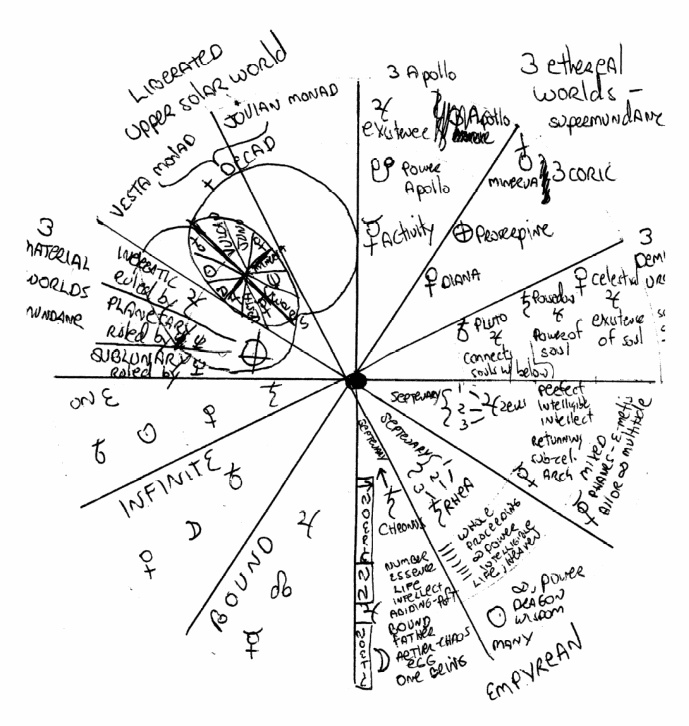
FIGURE 1979 0923-1-AB. Proclus Chart.
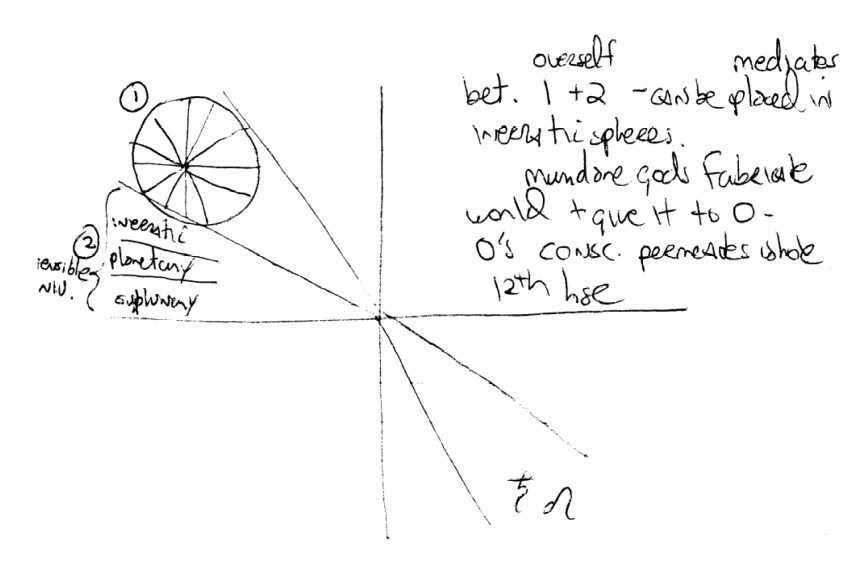
FIGURE 1979 0923-2-AB. Saturn in Leo, Mundane Gods in Eleventh House, Three Material Worlds in Twelfth House.
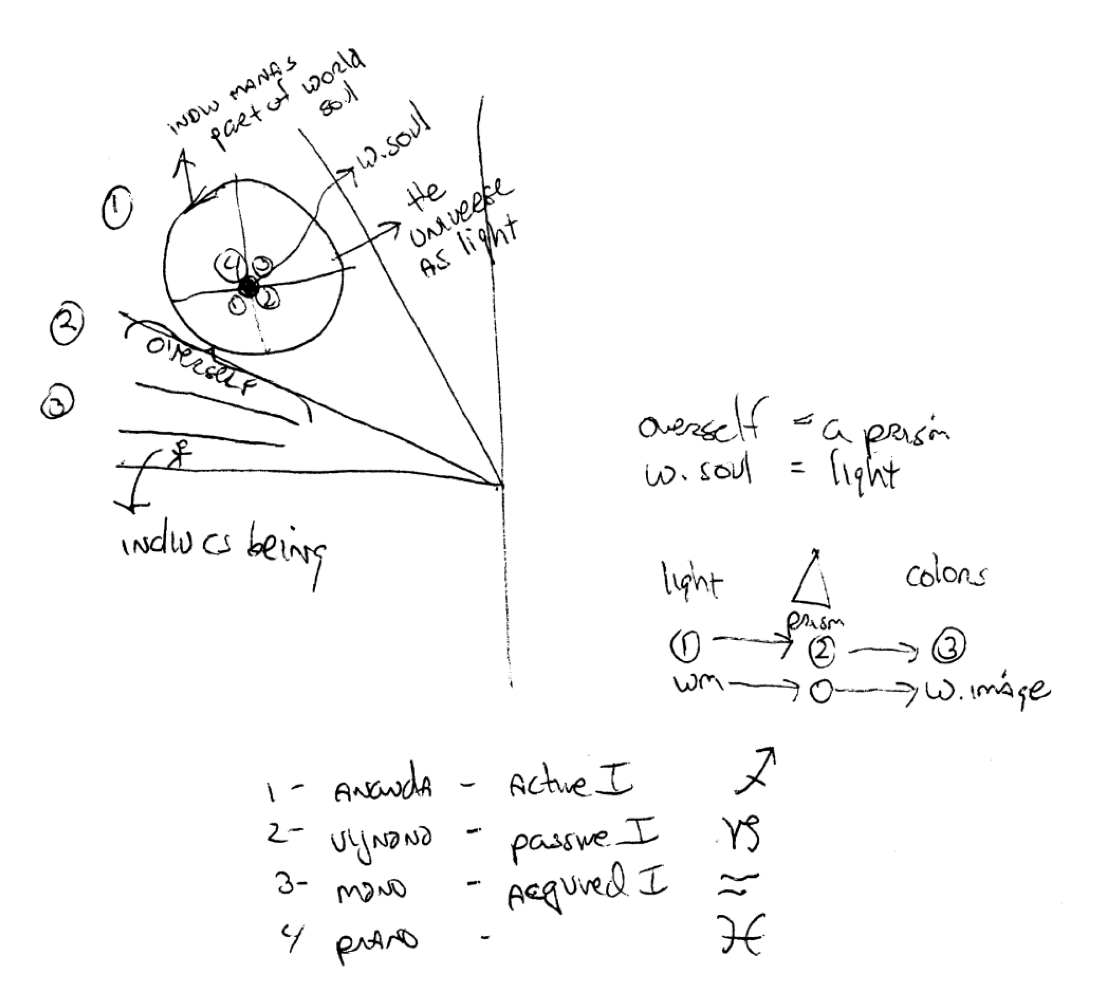
FIGURE 1979 0923-3-AB. World-Soul, Overself, Individual Conscious Being; Overself as Prism; Four Intellects.
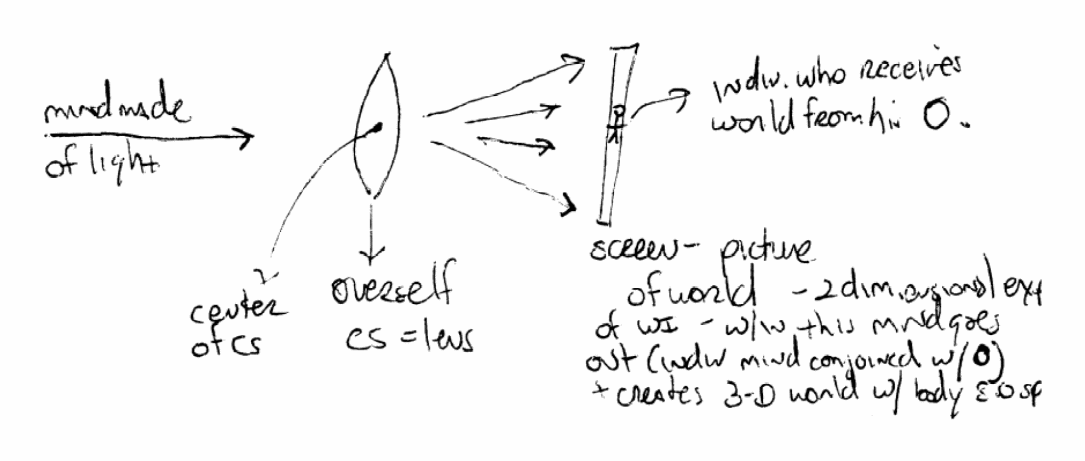
FIGURE 1979 0923-4-AB. Mind of Light, Overself, and World-Image.
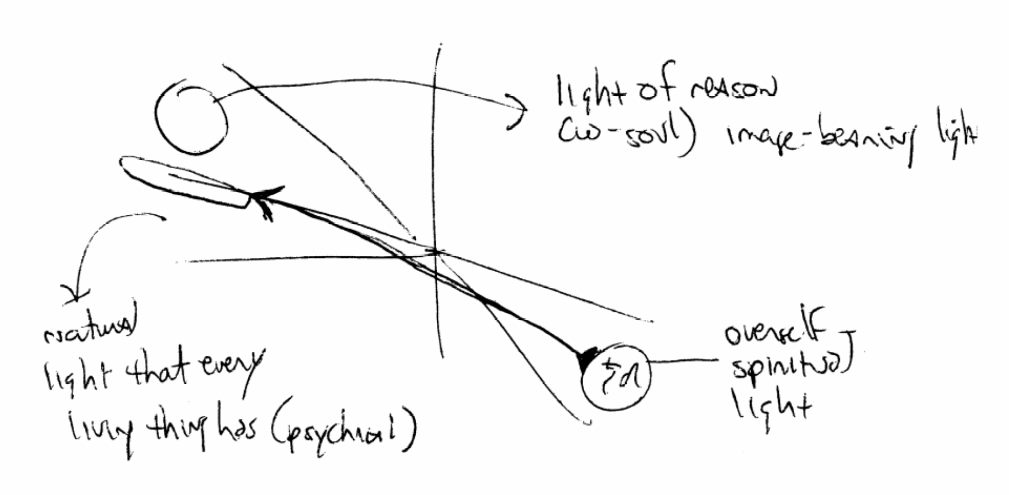
FIGURE 1979 0923-5-AB. Three Lights.
[Transcriber note: [diagram] means the speaker is referencing a diagram as he or she is speaking. If someone is drawing or writing, with audible sounds of chalk on a blackboard, I indicate this by [drawing] or [writing].]
NOTE: Sunday night class, part of Wisdom series 1979-1980.
TRANSCRIBED Verbatim by IT 2019; reformatted by JRM & JF 2019-2020, with TOC/Subheads by JRM. In 2023, IT updates prefatory matter, footer, and audio file name, completes Book List, adds Plotinus quotes section, fixes errors/typos, adds five diagrams and references within transcript to these diagrams. In 2024, MW alters Subheads to make more accurate. Archival verbatim transcript – V14.1a.
AUDIO FILES: 1979 0923a, 1979 0923b. [Note: "Tape" and "Side" refer to original audio cassette tapes that were later digitized into .MP3 Audio Files.]
1979 09/23 at Wisdom's Goldenrod
PB Books; Wisdom of the Overself; "Birth of the Universe"
Archival verbatim transcript
[Audio File 1979 0923a Begins]
VM: Anthony's trying to convince us to review and I think deeper understanding of this section and we're doing our best to be like nichrome wire and provide a lot of resistance. (some laughter)
S (faint): So is that--
VM (simultaneously): I'll start in chapter, or paragraph 38 I think, paragraph 38, which is the third, you know, paragraph of that section.
S (very faint): I don't think so Vic.
S (very faint): Give me that.
VM: Hm? [few seconds of faint background student talking, noises] I want to start in on the section about "We have seen that Nature is simply another name…", that paragraph.
[Transcriber note: I am using The Wisdom of the Overself by Paul Brunton, Rider and Company, London, 1943.]
PB [The Wisdom of the Overself, "The Birth of the Universe," p. 34, VM reading]: "We have seen that Nature is simply another name for the handiwork of the World-Mind…"
S: 37.
MW: 37.
VM: 37. Did I say 38? I meant 37.
PB [The Wisdom of the Overself, "The Birth of the Universe," pp. 34-35, VM reading]: "We have seen that Nature is simply another name for the handiwork of the World-Mind, [VM: or World-Soul] [a] handiwork to which we involuntarily and unconsciously contribute, too, because every object in Nature is known only as a phase of our own consciousness. The excitation of karmic impressions within the World-Mind [VM: or World-Soul] is reflected in the individual mind as a general picture of the world. The individual has to take it into the very centre of his own consciousness, which he can do only by his own act. That is to say, the world-picture must be so assimilated as to be made his own through experience."
[short pause]
RG: Well explain it Vic, [S: Ok.] come on! (bit of laughter, RG laughs)
AD: No, we-- we can all-- we can all jump in on it, alright?
VM (simultaneously): Yeah, go ahead Dickie, you start. (laughter)
AD (simultaneously, amidst laughter): (Victor) you start. You start Vic.
VM (simultaneously): [couple words inaudible] smart guy. (laughter) This is where we stopped about two hours ago and Dickie-- Dickie felt he understood it so I thought I would rather-- (laughter)
VM/S(?) (faint): I may have [one word inaudible] (a snitch for right now).
S (very faint): Well, you would never (snitch).
[short pause]
VM: Well Dickie?
RG: Could we s-- you could start from where we left off.
VM: Where is that?
S: Which one?
RG (simultaneously): Well-- I mean before meditation.
S: Well, actually--
RG (simultaneously): Right.
VM: I feel it's so silly for me to sit up here, you know.
AH: We were having some problem with where to insert the notion of individuality in this description of [VM: Yes.] things.
S: But Andrew--
AH: It seems a real problem.
RG: That it is.
VM: Let me just draw Anthony's diagram. I can-- I can remember what he wrote down but I don't understand a thing, maybe I could save him a little arm motion. Is that alright?
THE OVERSELF IS AN INTERMEDIARY BETWEEN THE UPPER SOLAR WORLD AND THE TWELFTH HOUSE
AD (faint): Yeah, please.
[Note: See FIGURES 1979 0923-2-AB, Saturn in Leo, Mundane Gods in Eleventh House, Three Material Worlds in Twelfth House, and 1979 0923-3-AB, World-Soul, Overself, Individual Conscious Being; Overself as Prism; Four Intellects, appended to this transcript for the following.]
VM: Well here it is but I-- Let me do something useful so I'll erase it and-- I don't know. (laughter) [drawing] Alright. So he drew this circle. (laughter)
S: Very good.
S (very faint): That's--
S: Yeah, hey.
S: Nice.
VM: Alright. (laughter)
S: Yeah.
RG: Hey Vic!
VM: Well I'm-- I'm learning (something here).
S: Oh, oh. (S laughs)
S: Oh. What are you doing? (laughter, student words)
S (simultaneously, amidst laughter): Oh [few words inaudible]
S (amidst laughter): We haven't heard of a Sun. (laughter)
VM: Well, no, let's get serious because-- because there's something very nice happening here and I'm not sure what it is but-- (some laughter) Anthony now is seeing the-- he's taking the tenth and eleventh house [diagram] and putting them together and talking about this as-- [drawing] this is the World-Soul, the Sun in Aquarius [diagram], ok. That's not a great surprise but (we'll--) This is not exactly the same as the vesica as we saw before, there's some correspondences and there are some differences and I don't understand what's happening here but-- This here [diagram] can be understood as the individual mind, he calls this the universe of light.
S: Yeah.
VM: [drawing] Of light. Taijasa consciousness.
JG (simultaneously): The vesica or--
S: [one word inaudible] it's not the--
VM (simultaneously): Well I don't know if we call it the vesica anymore, you'll have to [JG: What is called--] be patient.
JG: Oh, patient.
VM: I think this realm is e-- [drawing] He calls this the upper solar world [diagram].
S: Ok.
AD: I didn't call it that, the Chaldeans called it that.
VM: I'm sorry. The Chaldeans called it this, the upper solar world which is a reflection of the Empyrium over here [diagram]. I don't know how to spell Empyrium. [Note: 'Empyrean' in FIGURE 1979 0923-1-AB, Proclus Chart.]
S: Y in there Vic.
S (possibly part of background whispering): Yeah.
VM: Ok. [VM hits board with chalk] Dot. (bit of laughter)
S: You want to put the light on?
S: Yeah I'm (doing it).
S: You're going to need it. (bit of laughter)
S (amidst laughter): I didn't mean to put the light on.
S: Crazy.
VM: Oh, here's a-- here's an interesting thing now. Things are a little different because--
AB: Vic--
VM: What Anthony wants to see now is he's putting some very interesting [S: 13.] differentiations in the [AS simultaneously: Thirteenth house.] twelfth house [diagram]. Over here is-- let's say this is the sublunary world [diagram]. [drawing] And up here is the planetary spheres [diagram]. And over here is the inerratic spheres [diagram]. Now, you used to think that the inerratic was over here [diagram]. In some ways I guess it still is, the principle of the inerratic is there but let's say its sensible manifestation is over here. And the sensible manifestation of the planetary spheres or the motion of the planetary spheres is in this part of the quadrant and down here is an empirical individual [diagram]. I'm sorry I can't-- I don't want you to think he's fallen into Dickie's thirteenth house. (bit of laughter)
RG: That is the thirteenth.
VM: No it isn't. (laughter) And, [drawing] here's I guess the empirical objects that appear opposed to this empirical subject. Well, that's-- that's it.
RG: Now you left out [couple words inaudible]
AD (simultaneously): [few words inaudible] down, you left all [one/two words inaudible]
S (simultaneously): Paul--
S (simultaneously with AD and S): Boo.
S: Oh yeah.
S (faint): What are you talking about?
VM: Now the Overself (laughter, student words) the part-- this is the part that-- this is the part that caused all the difficulty, or at least for us. The Overself we've always understood as Saturn in Leo over here [diagram] as a-- uh-- And you know, you put the [drawing] Sun in Leo is over here [diagram] and the five Dhyani Buddhis [sic; Buddhas] are the Idea in the Intellect [diagram] which is being, let's say, first essentialized and then brought into Saturn in Leo. But, there's a difficult passage in there where the Overself is spoken of as the intermediary between the World-Soul and the individual. And Anthony wants to see the Overself brought in here [diagram] as sort of the interface between this combination of individual mind and World-Soul.
AD: Of course, go ahead.
VM: This is a-- this-- this wheel with another wheel inside it is the World-Soul and individual mind [diagram], they're still-- and there's sort of a union here if you like. The Overself can be understood as entering at this phase or perhaps when you speak about the notion of the heart, you might say here is the heart [drawing] and the Overself can be understood as manifesting through the heart as the focal point, where the World-- where the World-Soul meets the individual, but, I don't know--
S: Would you go over the divisions in the twelfth house again?
VM: Yeah, that's ea-- I mean I could say things like that but I don't understand what anything means.
S: Ok, well I just didn't get it.
VM: This is the sublunar world [diagram], subluniar-- sublunar world. I guess this is the world that we normally have our experience in. And then above these are the planetary spheres or the-- We used to think about it as the functioning of vesica was the planetary spheres or the motions in World-Soul but this must be the sensible representation. I guess the DR-70 calculates the motions in-- right here.
S (faint): Ok.
VM: Would you-- would you agree with that? The DR-70 isn't working over here [diagram] but I think it's working with sensible representations of them up here, you have to ask the people who work on it, I don't know. Then the inerratic sphere would be the-- the fixed stars, the actual fixed stars that I guess you-- you know, you can see when you look out, the heavens. And they're a sensible representation of the inerratic sphere that-- that we used to talk about as in here [diagram], 'cause they're near the midheaven. So, when you talk about the excitation of karmic impressions in the World-Soul, it's still a motion in this region [diagram]. And then it's reflected in the individual mind as a general picture of the world, that's still, as I understand it, here [diagram]. Then the Overself has to, let's say, superimpose intelligibility on it. And then you get down here [diagram] the picture of the world that you and I know. But that's-- that's jumping ahead, I don't think we can go that fast. But I think that probably sensible thing to do is to go back and read this thing and see if we can string it out on this chart, ok? I'm sorry, I-- I feel like a clown because I don't understand what's happening here.
S (very faint): [couple/three words inaudible]
BS (simultaneously): But in terms of the diagram, just the diagram, when you-- when you mention the Overself, is it just there in the sublunary or is it coming from the second quadrant [diagram]? I don't understand the diagram.
AD: Alright, do you remember the phrase where he says that an Overself is the intermediary between the what?
VM (simultaneously): Yeah, sure.
AD: Alright. This chart we've done in other classes, the Platonist (class/classes). [drawing] This is referred to as the three material worlds [diagram]. This is referred to as the upper solar world [diagram]. And then you have the three ethereal worlds here [diagram]. [Note: See FIGURE 1979 0923-1-AB, Proclus Chart, appended to this transcript.] This is from the Proclus chart, so-- so that you have seven worlds all together, three, one, and three. Alright? Now, this would correspond to the-- [drawing] This is not anything different, it's-- Right now you might be a little confused because this will also be the vesica, I'll show you that the vesica gets derived from here but, for now, if you make this circle here represent the order of the Gods like in Greek-- in Greek philosophy, you'd have Jupiter, Vesta, Hermes, Ceres, Neptune, Venus, going all around [diagram]. [Note: See FIGURES 1979 0923-1-AB, Proclus Chart, and 1979 0923-2-AB, Saturn in Leo, Mundane Gods in Eleventh House, Three Material Worlds in Twelfth House, appended to this transcript.] These are the mundane Gods. These are the Gods that are going to fabricate the universe. That means this here [diagram]. Alright? So they refer to this as the world of light, the upper solar world. And the world exists here but in a form of light, in the-- the very-- the very notion that we refer to as the image-bearing light, and this light which-- This is behind, this is behind, let's say, the sensible Sun here [diagram]. This is not the sensible Sun. This is the sensible Sun here [diagram], ok? So he says-- if you can get that passage he says that between the World-Soul, the Soul of the World, or the World-Mind--
VM (simultaneously): (Is/Was) the passage "from his own Overself", is it (the--)
AD (simultaneously): Yeah.
VM: Is that the one you want or--
AD: He says between the World-Soul [VM: Oh.] and the individual--
VM: "Hence the heart is the focal point…"
S (simultaneously): Paragraph?
VM (faint): "…where the World-Mind through its intermediary the Overself…" Is that the one?
AD: The World-Mind-- the World-Mind--
VM (simultaneously): "Hence…"
AD: Yeah.
PB [The Wisdom of the Overself, "The Birth of the Universe," p. 35, VM reading]: "Hence the heart is the focal point where the World-Mind [VM reads: World-Soul] through its intermediary the Overself affects the personality."
AD: Alright, now, in a quotation like that, you see, if-- if we say that this is the Overself, this whole realm [diagram], alright, and it would be in between, so to speak, the individual, [student assents, very faint] the empirical individual, and the upper solar world, alright, that-- that means that this Overself is absolutely pervasive, it's everywhere. But then you'll get confused when we try to follow the explanations. So instead of doing that, alright, what we did was something like this, and we'll work out the-- we'll work it backwards. We said here's the Overs-- I mean here's the World-Mind [diagram]. Here's the individual [diagram]. And, this is the heart center of the individual [diagram], this is where the Overself can be located, alright. So that between the World-Mind and the individual there's the heart center here, ok? And it is through-- through the Overself, through the-- which acts as an intermediary between the World-Mind and the individual, that this contact is maintained. So we're using this diagram now but it's only a diagram, I mean don't get attached to it.
S (very faint): [three words inaudible] (bit of laughter)
S: You call your Overself an intermediary.
AD: Yes, [one/two inaudible VM words simultaneous with AD] he calls the Overself an intermediary between the World-Mind or the Soul of the World and the individual. If you give them the quote?
VM: Ok. This is paragraph 39. [S, faint: Yeah.] It says here--
PB [The Wisdom of the Overself, "The Birth of the Universe," p. 35, VM reading]: "Hence the heart is the focal point where the World-Mind through its intermediary the Overself affects the personality."
RG: The other thing that's interesting in that quote is the "its".
S: Why? What do you mean "its"?
RG: Well its inter-- I mean the World-Soul's intermediary. It's as if the Overself is the World-Soul's intermediary.
AD (faint): Uh-hm, uh-hm.
S (very faint, possibly part of background): (Yes.)
VM: Yes.
RG: And we seem to be making a very clear distinction that the Overself provides the consciousness, the l-- well, the-- and the World-Soul provides the material here. But yet the Overself here is spoken of as the World-Soul's intermediary.
[short pause]
S: Could you elaborate that? You mean to say [one/two words inaudible] consciousness side to the Overself whereas to the World-Soul we give the matter.
RG: Right.
S: So there seems to be a (discrepancy/description).
RG: So at this diagram on the left here. Or-- or on the right. I mean if the indi-- it's hard to-- it seems like the light is coming from the Overself in the fifth house [diagram], and it's being manifested in the heart in the twelfth and yet somehow it's also spoken of as the intermediary of the World-Soul. So part of it seems to be working very, you know, almost for the World-Soul there. [12½ second pause] But that's another question.
AD: Yes, I don't see what the point is that you're getting at.
RG: I just-- I mean the relation between the Overself and the World-Soul, that's all.
AD: Good.
RG: Is the World-Soul-- I mean it seems from that passage like the World-Mind there is using the Overself as its intermediary between man and itself, between the individual and-- and the World-Mind.
[short pause]
AD: Well suppose-- suppose we-- we draw the Overself, alright? And then just conceive of the world which is a production of the World-Soul, alright?
RG: Right.
AD: And you had, so to speak, this-- Well, we don't even-- we could imagine the situation, the ordinary circumstances, you know, the-- the Soul is fabricating the universe and within the universe, alright, there are a variety of bodies, alright. Now, what would be wrong with something like that?
VM: There's no knowledge, there's no experience.
AD: There's no souls experiencing anything unless we make allowances for the World-Soul, alright. That would always have a knowledge, not an anxious knowledge, but just a knowledge of the universe, the entirety of the universe which is projected from the World-Soul, would be a content of its mind. But there would be no individuals experiencing anything there.
RG: Would there be any life then?
AD: Well there could be life, sure. Could be life.
VM (simultaneously): Not individual life you say.
AD: Yes, that would be the universal life which flows through, you know, life at its lowest, at the vegetal level, life at the animal level. But would there be any individuals experiencing anything you think?
RG: No.
AD: Alright so then, if we-- we're forced to bring in the Overself or the soul of each entity. So we have the body provided. So the-- the picture we have to make is something like this. We think of the universe as projected out from the World-Soul, alright, and within that universe there will appear many, many different types of organisms. We're talking now about the human organism. There would be a human body in that world that's fabricated by the All-Soul. [RG assents] Now, we're going to be discussing this backward, the same way we did this afternoon. Now in order to simplify the discussion, we're going to say that the Overself will be located in the heart, or let's say we'll localize it in the heart somewhere, in the heart area, that's where the Overself resides.
So, we would have a situation where we have the World-Mind producing the entirety of the world, and the entirety of the world the way the World-Mind or the World-Soul produces it is a thought-form, alright, it's not-- it's not anything experienced in wakeful consciousness. So the entirety of the world which is produced would be a thought-form and you would have human bodies in that world. And until there's an Overself located somewhere in the heart of this entity, then there would not be any individual soul getting any experience. But if we put the Overself in the heart atom, the way we've done in this diagram, alright, then we made-- we made a very simple diagram for ourselves. Here's the Soul of the All, alright, here's the empirical world, the inerratic spheres, you know, the planetary sphere and the sublunary sphere, and you're located in the sublunary sphere and you're one of the organ-- organisms that's produced by that World-Soul [diagram], alright.
Up to this point we can see that the World-Soul is, you know, like the Overlord, it's the-- it-- the entirety of the universe manifests from within itself, alright. But, this Overself here which right now we're-- you know, we'll just tentatively say that the Overself coming from heaven knows where is lo-- is localized in the heart of this entity. Now let's pick up the discussion there. Now remember, here's a human body, there's an Overself located within it. And you can imagine the immensity of the universe, and constantly impinging upon any individual in the universe is this totality of all the forces. I would call them the Ideas but you'd get confused. But the totality of all these forces are impinging upon an entity. Ok? [S, faint: Ok.] So you're subject to these enormous influences that are constantly going on. Alright? Let's pick it up from there.
VM: Maybe we should skip that section. What we did this afternoon (was/is)--
AD (simultaneously): Yeah, we'll go back and forth, we'll go back and forth.
KARMIC FORCES BECOME ACTIVE IN THE HEART
VM (simultaneously): "It will be shown when these studies are sufficiently advanced…" Could we jump to that sentence real fast?
AD: Ah.
VM: Paragraph 39.
AD (very faint): Go ahead. Please.
VM (faint): Oh, you don't have the paragraph number. "It is consequently from its own Overself that every individual receives the world-picture." Would you like to go for that paragraph?
AD: Alright, so he says there-- He says-- [short pause] Yeah, please, ok, this is going to be a very nice present.
VM (simultaneously): Uh, this is the beginning of-- near the beginning of paragraph 39.
PB [The Wisdom of the Overself, "The Birth of the Universe," p. 35, VM reading]: "It is consequently from its own Overself that every individual receives the world-picture. We have pointed out in earlier books that the Overself has its human habitat within the heart. Although associated of course with the whole body it has its most intimate association with the heart. Just as a king's rule may extend over a whole country and yet it may also be said to be definitely centred in the palace where he resides, so the Overself permeates the entire body and yet is also definitely centered in the heart. Hence the heart is the focal point where the World-Mind [VM reads: World-Soul] through its intermediary the Overself affects the personality. The karmic forces become active within the heart therefore and there break into space-time existence. Like light-photographs on a sensitive film, they develop into a tiny seed-like thought-form. This is the matrix of the world-to-be. Were this to remain there, then the individual would experience it only in the form of a dream. Indeed, in an earlier period of cosmic evolution such was the strange way in which the immature human race did pass its existence."
AD: Alright, now, let's start with that and I'm going to ask you to ignore the first sentence because of the difficulty and I want to work back to it. "Consequently from its own Overself…" I want to ignore that sentence for now, alright? Let's go to where he says, now, "The karmic forces become active within the heart therefore…" Alright?
VM: Ok.
AD: And so we take this image that we use, locate the body in the universe and there's these forces impinging on that body, alright. The-- these forces, the karmic forces become active within the heart. So if we locate now in the-- in the heart of this body a kind of sensitive area, a point, it's a very sensitive area, we're calling that the Overself. And we say that these forces as they impinge on the human being, alright, these-- and they're thought forces, remember this is not a material cosmic structure that you're speaking about, you're speaking about that this great Solar Being, alright, is thinking this universe into operation, into being, you're in that universe and as He's thinking, you're part of that universe, you're going to be subject to the influences of His thinking, which he calls karmic forces, alright. They hit-- they strike the center of the heart, the heart area. And here's-- here's where perhaps an analogy helps. He says--
PB [The Wisdom of the Overself, "The Birth of the Universe," p. 35, AD reading]: "Like light-photographs on a sensitive film, they develop into a tiny seed-like thought-form."
AD: So if we think of these forces which impinge upon a human being hitting the Overself or the heart area, and there they get deposited, so to speak, and are turned into these germinal thoughts. Ok, you follow that? [student assents] I'm just trying to use a picture, alright. Now if it stays-- if these forces which are coming down into the cosmos and consequently, you know, impressing themselves on-- onto you, if these forces remain in the heart, you will not experience wakeful consciousness and you will not experience a physical universe as you experience it now. You will experience everything in a subtle state, dream state, kind of like, alright? So he says-- he says something has to happen. In the next paragraph he's-- he says what this is. Condition--
VM: What? "In order to provide…"?
AD: Yeah.
THE BRAIN AND SENSES PROVIDE CONDITIONS FOR WAKING CONSCIOUSNESS
PB [The Wisdom of the Overself, "The Birth of the Universe," p. 35, VM reading]: "In order to provide the conditions for a more fully externalized and awakened experience the co-operation of the brain and the senses is required. These act partly in the same way as a transformer which increases the voltage of an electrical current, and partly as a microscope which enlarges the appearance of an object. Unless the world-image is caught by the brain, consciousness will remain at the dream level and physical experience becomes impossible. Hence the thought-form is transmitted to an image-magnifying centre in the outer layer of the brain by processes analogically like those used in the wireless transmission of a newspaper photograph (which reduce the photograph into numerous points of electrical energy and then build it up again from the transmitted electrical impulses), and to the special sensitive centres for seeing, hearing, touching, tasting, and smelling. Here the brain reconverts the received vibrations into a highly magnified picture of which the individual becomes conscious, just as a radio set converts electrical waves into a series of sounds and at the same time highly amplifies them. When all this has been accomplished the individual becomes fully aware of the transformed and magnified world-picture, which the mind now projects as if it were something outside."
AD: Alright so, we start-- we-- I mean we-- We said that the germinal thought-forms were in the heart, and that if they were to remain there, they would be just a knowledge, so to speak, at the dream level. He brings in the brain and the senses. And these germinal thought-forms have to go from the heart center to the brain and spread out through the senses so that the hearing, the eyes, all the senses will be, so to speak, affected. So if we conceive of this process, and by the way if you, so to speak, intercept anywhere along the spinal column, you will see that it'd be like tapping into-- In other words what I'm trying to say is there's a reflection of the universe in your spinal column, the fluid, but that-- that's an occult thing, we won't worry about that. Right now we're-- we're getting to the point where we can see that this is the body, it's a thought-form. These germinal condi-- these germinal thoughts are traveling up the spinal column to reach the brain. Now, here's-- here's the example where he uses later on about the body insofar that it offers resistance, alright, like the nichrome wire offers resistance, and then it starts glowing, in the same way, insofar as the taijasa consciousness and this-- these seeds, these tiny germ-- germinal thought-forms are in the taijasa condition, they rise up the spinal column and reach the brain, we can see that the whole physiological apparatus is going to be a resistance to that, is going to resist that. And conse--
FW (simultaneously): Yeah. In a particular way, to produce our form of thought and experience.
AD: I'm sorry, again?
FW: In a particular way to produce our form of thought and experience.
AD: Yeah.
FW: The resistance of a dog, for example, would be different.
AD: Oh yes, yeah, absolutely.
FW: Sorry.
AD: Ok. Yeah, I see what you're saying. So he says then, that-- This world-image which we said was being superimposed on the Overself which is in the heart, alright, that included in that world-image, I mean included in the germinal seed-- seed-like thought-forms would be the world-image would be supposedly in that, and then when it travels up to the top of the head or to the brain and goes out through the various-- I think of the brain and the senses like-- I think of the senses really as modalizations of the brain, alright. Like, if you see, they're all located around your head. Symbolically, the mind also is like that. If you think of just psychical senses, alright, the psychical senses would be a modalization of the mind. In the same way, the senses are a modalization of your brain and they're obviously all together there.
Now he says, when this goes up to the brain, goes-- this taijasa consciousness, like we said, is ascending, going up through the spinal column, shoots out, alright, through the sense-organs and hits the brain at the same time, alright, there's, so to speak, immediately projected outwardly the-- the whole universe, alright, if we follow this paragraph here. Now it's at the brain, of course, where wakeful consciousness is experienced, because when it hits the-- the-- the brain and-- There the brain of course, because of the very structure of the brain, the very structure of the brain is going to determine the kind of projection that will take place. So consequently if we think-- thought of a different creature, the kind of projection that would take place would be entirely different. He'd see a world quite different than the way we would. So that even Jung, for instance, pointed out that the structure of the brain, he says that's an inheritance from the entirety of the racial-- from the entirety of the inherited past of the race. And consequently the very structure of the brain is that inheritance, the way we have s-- the way man has seen for millions of years is indicated by the func-- the structure of the brain. So inherent in the brain is this structure and this structure determines the kind of projection that would come out and the kind of world that will be experienced. So if we come from even that point of view we can understand that for Jung, these archetypes which are imbedded in the brain, or let's say the brain is a representation of the archetypes, a physical representation of the archetypes, that that would be the very condition necessary for the kind of world you're going to experience. That already determines the kind of world you're going to experience.
So, what we have to-- what have to understand here and I think this is the part that's difficult, is that-- We spoke about-- you remember when we spoke about taijasa consciousness, when I communicate a thought to Avery and I said, "The stove's in front of you," and I said now unless-- unless this superior force of thought is implanted in your mind and then the very conversion of that to an appearance, there will take place simultaneously with it the consciousness necessary to have the experience. [students assent, very faint] They're concomitants. So in the same way, when we think of the taijasa consciousness rising up to the head and the very resistance that the whole spinal cerebral system offers to these germinal thoughts, same thing will happen, there will be this resistance to it, your brain glows. You ever-- you ever feel heat when you think a lot? (bit of laughter) So that it actually-- [S: Yeah.] it actually has the experience at that moment as it gets projected out, there's the experience of vaishvanara consciousness or wakefulness with the content alongside of it. And that's the way I would interpret here when he says, "the brain reconverts-- it converts the received vibrations into a highly magnified picture," and it is at that moment the individual becomes conscious.
THE BODY ITSELF IS A THOUGHT-FORM, A PRODUCT OF THE WORLD-SOUL
PB [The Wisdom of the Overself, "The Birth of the Universe," p. 35, AD reading]: "When all this has been accomplished the individual becomes fully aware of the transformed and magnified world-picture, which the mind [AD: And here's another difficult--"…which the mind] now projects as if it were something outside."
S: Hm.
AD: Yeah?
FW: I have a problem. Insofar as the heart and spinal column and brain themselves are vaishvanara objects, how could we speak of them as bearing this very subtle current? That probably unearths my misunderstanding.
AD (simultaneously): Well, the next paragraph, next paragraph. Yeah, go ahead.
RG: Well, but prior to your perception of them, Freddie, you couldn't consider them vaishvanara objects. Inasmuch as they're the powers which produce your vaishvanara consciousness, they themselves aren't yet in vaishvanara consciousness until you know them. As they are in themselves you would say they're still in a-- Let's say they're manifested but not to the individual mind, they're manifested to the-- to the World-Soul and that's how they're the vehicle as well as being in the world and also not in our perceived world.
FW: So they'd be a taijasa object at that time.
RG: Yeah.
AD (simultaneously): Well yes, the body is a thought-form. The body, like everything else in the universe, is a thought-form. And you've got to always keep that in mind, there's no such-- there's no-- there's no thing like the material thing, there's only thought-forms. Because we said that this body was the product of the World-Mind, right, World-Soul, so that it would simply be a thought-form. It would be-- it would have an existence as a ta-- let's say, substantiated by taijasa consciousness. So it's a thought-form. Anything that exists in taijasa consciousness would be thought, that you recognize. Like when you think of the thought of a table, alright. The thought of the table, not the table, or thought of the table, that's in taijasa consciousness, alright. So in the same way, this body exists in taijasa consciousness, and remains in taijasa consciousness. Now, I'm-- we're using a kind of chronological example which is self-defeating but nonetheless-- So, you imagine that these germinal thought-forms which are in the heart are in this subtle form, alright, and not until they go up through the head, not till they go up to the head will the experience of wakeful consciousness become available. Just like that nichrome wire. Not until the electric tries(--) go to the very end of the wire, alright, and in the very process of going there then the nichrome wire glows and you would call that vaishvanara consciousness of nichrome wire.
S: Ok.
RG: I mean, you could put it this way too, I mean the brain and the heart that we know and see is not other than that taijasa object, it's just not all of it. I mean we get a perception of it. It's not other than that brain but it's more than that.
S: But--
AD: Now to continue answering your question in the next paragraph but, I didn't-- I didn't want to run into that because the example we started-- the figure of speech we started with is really incorrect mode so we're going to have to go back and straighten that out. But if we continue a little while we'll see that we'll be forced back, alright? Why don't we [VM assents, faint] build from there.
VM: Ok. The next paragraph, this really speaks directly to what we've read and Richard was speaking about, it says--
PB [The Wisdom of the Overself, "The Birth of the Universe," p. 35, VM reading]: "It should be noted that the functions…"
VM: Well, let me back up just one minute. Now in this paragraph we just finished reading, the world-image is what's caught by the brain. So that's the subtle thought-form, the seed-like thought-form, PB refers to that as the world-image and that's this structured taijasa consciousness, ok, the form-bearing light. And then he says here--
PB [The Wisdom of the Overself, "The Birth of the Universe," p. 35, VM reading]: "It should be noted that the functions of the brain, nerves and five senses, although correctly described by physiologists, still take place as much within the mental sphere as is the world-image with which they deal. But the latter's"outsideness" [VM: That is the amplified and intensified-- the world-image appears outside. "…the latter's"outsideness"] gives rise to the wrong notion of its being formed out of material substance. Science is honest when it says that thought is the concomitant of molecular movements in the brain, but [it] is merely indulging in imagination when it says that thought is the product of molecular movements in the brain."
AD: Alright, we could try now.
S (very faint): (So that--)
VM (faint): That's (sixty).
[Note: See FIGURE 1979 0923-4-AB, Mind of Light, Overself, and World-Image, appended to this transcript for the following.]
AD: Let's try now. Now thi-- we did something like this. You see this picture here [diagram], alright? We did something like this. We imagined that this is the-- the light which constitutes the World-Soul projection. In other words, we're thinking of that as the mental. This is the World-Mind or the World-Soul, alright, and it's constituted of light. That's the reference, upper solar world, alright, it's constituted of light. [drawing] Let's imagine that this is the light from here. Then we take the consciousness, alright, which is the intermediary between the World-Soul and the individual. So we imagine that this is the consciousness of the individual, the Overself consciousness, and this light goes through this consciousness and gets projected outwardly as the world. And now the empirical person, the empirical entity, appears here, alright. Here's-- here's the heart center, you see? [students assent, faint] And here's an object, alright. Now this is the m-- the mental world. This is a projection of these-- [drawing] the light which came from the World-Mind. And this consciousness refracts ano-- There's a lot of problems here, we're not going to work them all out tonight. And this consciousness projects it out and it appears as this mental world. Alright, now that we did that, let's erase this, ok? Alright? So that all that we have here is the Overself, here's the individual, the heart center, alright, here's an object that appears [diagram]. Now, read the paragraph again.
S (very faint): Go ahead.
VM: "Should be noted…", that paragraph?
PB [The Wisdom of the Overself, "The Birth of the Universe," p. 35, VM reading]: "It should be noted that the functions of the brain, nerves and five senses…"
AD: Alright, the function of the brain, [drawing] the nerves, and the five senses.
PB [The Wisdom of the Overself, "The Birth of the Universe," p. 35, VM reading]: "…although correctly described by physiologists, still take place [AD drawing] as much within the mental sphere as is the world-image with which they deal."
S (faint): [one/two words inaudible]
AD: Ok?
VM (faint): Uh-hm.
AD: The picture will show you, the words will only detract from the showing.
[student assents, very faint]
S (faint): But that-- well--
AH: But what is-- what is it that happens that causes this mistaken impression of its being out there?
RG: That's another question.
AS: That's a-- yeah.
AD: Out there? When you have a dream--
AH: Well apparently--
AD: Well the example we use was like this, alright. Here's a sandbox. Now you've played in sandboxes, right?
AH: Oh, I sure have.
AD: Just imagine nice even sand, (bit of laughter) alright. And you write the letter A in it. Now, the A is external to the sand.
AH: Yes.
AD: But it's not other than the sand. It's not different than the sand. It's not in a vacuum, it doesn't stand outside the sand, it's right in the sand. And yet you have the feeling that the A is external to the sand. The same thing like, whatever appears here, there's the appearance of externality, but it's only an appearance. As soon as you fabricated a thing, the very-- the-- the very creation of the thing brings about the feeling that it's something other than the sand.
AH: So the actual process that we've just been [one word inaudible]
AD (simultaneously): All these things are taking place within this mental realm [AD indicating on diagram].
AH: There's nothing about the process that necessitates the conclusion that it's out there.
AD: Yeah. Just like for instance when you have a dream. You say the dream is taking place outside somewhere. But when you wake up, you see how foolish that was, it never was outside. It was always inside. But the feeling of externality is in the-- in the dream itself. And if that feeling and actualization of the concept of externality does not take place, then you wouldn't think of it as something happening. Yeah--
RG: But that necessity happens because consciousness identifies with the bodily subject there. Right?
AD: Over here [diagram]?
RG: Yeah.
AD: Yeah.
RG (simultaneously): The feeling of externality-- the world could-- that picture could still appear without that "as if it were outside" if the consciousness didn't identify with the bodily consciousness.
AD: Yeah, and we pointed out that that's one of the postulational concepts that our ignorance imposes on us, that we actually believe in externality. When you wake up and you look at the dream you see that you were never outside the dream, you were in the dream. But there was the feeling, "Here am I and there's the bear chasing me and I'm running up a tree," and the bear is external to you. But the whole notion of externality is a fiction that the mind creates. Everything-- all of this exists within the mind. All-- What we said was, what constituted the mind, the light of the mind, which got magnified into this picture, the mental picture, and then you were, so to speak, one of the creatures within that and feel a distinction between other creations going on there. So bringing it back to your question Fred, when he says, the brain, the nerves, the five senses, all correctly described by the physiologist, alright, still are as much within the mental sphere as the world-image with which they're talking about. All of that is within the mental sphere.
[students assent, faint]
S: But isn't all of that within the heart center? [13 second pause] Help me.
VM: You mean the brain and the five senses?
S (simultaneously): When you-- when you say mental sphere, I mean isn't that sort of centered in the heart center now?
AD: Well, as soon as you bring in the word 'experience', you can't talk about the heart center anymore.
S (faint): I know but you left me, (I mean--)
RG: But it's [AD/S(?) simultaneously: But--] still-- it's still mental.
S: It's such a mystery.
AD: Huh? Of course it's a mystery, this is mystical philosophy, this isn't, you know, a mixing up of chemical compounds and-- (bit of laughter)
S: No, but it's just that-- You have to-- ok, you flip back and forth, the heart center seems to be this-- an individual point in-- in some discussions and-- and then in other discussions you realize it's got to be the point where it's the-- it's the non-individual reaches you through that.
AD: Well what do you mean it's not individual, do you have my experience?
S: 'Cause the World-Mind has to meet you there.
AD (simultaneously): Do you have my experience?
S (faint): No, that's in--
AD: Alright, then-- then the forces that impinge upon my-- my Overself center or the heart center in me are not those that impinge upon you.
S: But aren't they the same coming from the World-Soul?
AD: They may be s-- that may be so. But my experience of the world is not your experience of the world so I have to account for it in terms of my own Overself individuality.
S: So would you say that if the-- the modification [couple/three words inaudible] individuality--
AD (simultaneously): But why don't you say it the way I said it? It's complicated enough without getting involved into more complications. We take the body, we put it in the universe, alright. No Overself center, no heart center. Ok? What happens? There's no one there. (laughter, student words) Now you want-- you want someone to be there, right? So you take this Overself and you tell him, "Now look, I'm going to locate you right into this person's heart." Now later on we begin to realize that when you have the experience of the Overself, it's not to be localized in the heart, that it's absolutely and universally pervasive. But I told you, I-- I'm speaking incorrectly for the sake of letting you follow an argument which is difficult to follow.
So we locate the heart center here [diagram], alright. We say that this heart center is the intermediary between the World-Soul and this individual [AD taps on diagram], this living being. That's in between, alright. Now, we've located him in the world of the Overself and there's these forces impinging down upon him. Just imagine this light, inconceivable image-bearing light, pouring down into the universe. Just like for instance if you look one way, you face Aries, you get certain influences, you look another way, you face Cancer, you get different influences, and Libra, you get other influences. Ok? So in the same way, these forces are just impinging upon this individual. As they impinge upon the individual, he gives the example, the Overself center is like a sensitive plate. And as they-- that light hits that heart center, alright, germinal seed tiny thought-forms are deposited there.
Now, if they stay there, these tiny seeds, these tiny germs of thoughts-- In other words, it's like a film which is not blown up to the size of the screen, you'll only experience the world in a dream-like way. So what happens? Nature eventually gets around and Nature is like a laboratory, she's building the body eventually for greater and greater use, alright. So she-- finally the time comes when the brain can-- instead of operating, if I could put it this way, with the sympathetic nervous system where you think you're in union with everybody, it develops the cerebrospinal system where you think you're in opposition to everybody. (bit of laughter) Right? Because the cerebrospinal nervous system differentiates you out of the world. The sympathetic nervous system combines you with everyone in the world. Ok?
(Side 1 of original cassette tape digitized as 1979 0923a Ends; Side 2 Begins)
AD: --the senses, the universe is projected there, and that depends on the very constitution of the brain and the senses that, so to speak, are being-- are channels through which that taijasa consciousness goes out. As it goes out through the organs, alright, it is converted, right then and there, to wakeful consciousness and the object appears with that wakeful consciousness. You become conscious of a wor-- world. Alright? Then the next step happens--you start thinking about it. (bit of laughter) That's the sweat part. Yeah?
S: I'm confused what you said about what accounts for the individuality of experience. You-- is it-- is it the vehicle or is it-- I know what you said to Crystal but different forces impinge on the heart from-- from the World-Mind. Is it at that level or is it from the World-Mind that the individual experience or is it because of your particular vehicles?
AD: Well it'll be a combination of things, we could leave that question aside now, it's not important.
S: And also--
AD: Allow me my fanaticism.
S (simultaneously, faint): (I got you.)
S (very faint): [couple/three words inaudible]
THE ETERANLLY PERCEIVED WORLD IS AN ACCOMPANIMENT TO WAKEFUL CONSCIOUSNESS
AD: I've-- I've got to get this point across, alright, about the production of vaishvanara consciousness with the object alongside of it. This is what has to be done. Because you remember we had the problem of subsuming under one concept, mentalism, alright, the thought of the table and the table. We have to subsume those two under one concept, otherwise we don't understand mentalism. Now we said that the universe was a vast thought projected by the World-Soul. And we've got to understand that the body which is also a vast thought is the very means by which that taijasa consciousness gets converted into wakeful consciousness so that you could see the thought of the chair and the chair are like ice and water, alright, I mean ice and-- one is ice and the other is fluid form of the same thing.
[student assents, very faint]
S (faint, possibly part of background): I told you.
[students assent, faint]
AD: Go ahead.
VM: Can I see if I understand? I'm trying to understand this idea of the body being an entity within taijasa consciousness and then-- but also serving as a means of conversion from taijasa consciousness into vaishvanara. If you use the example of someone lying in a bed having a dream, you can imagine their body being let's say an object within the World-Soul, it's-- still has a certain existence. And although the individual who's having a dream or maybe he's completely asleep, he has no awareness of this but nonetheless it's still an entity within the World-Soul.
AD (simultaneously): Yes but that would also be an example of his experience is in terms of dreamlike states.
VM: Yes, I'm trying to use the whole example but-- So then let's say you're having a dream, (and) perhaps I'm having a dream that you were chasing me with a copy of the Wisdom. (bit of laughter) And I'm-- let's say I'm screaming in the dream and it's still screaming but it gets-- all of a sudden the actual seed-like thought-form is let-- let off and go up-- goes up into the brain and then it actually breaks into vaishvanara consciousness and I wake up screaming. And then I-- but the scream has somehow been transformed right from taijasa consciousness, with the intermediation of the brain and so on, into a scream in waking consciousness.
AD (simultaneously): That's a good example, that's a good example because you wake up screaming, shows [VM simultaneously: Yes, yes, it's continuous.] how the-- the germinal current which is-- was taijasa, which was dream-like, and so if it went up to the head immediately [S simultaneously: It's conscious.] the vai-- wakeful consciousness approaches.
VM (simultaneously): But it's the same scream [S simultaneously: Oh.] is the thing I want, you know. In other words it's (the--)
AD (simultaneously): Oh yes, the continuity, the continuity is persistent.
FW: It's very good but it doesn't explain the transformation.
VM: Oh, gee, I'm-- (VM laughs a bit) I (didn't/did it)--
FW (simultaneously): I didn't expect it to but there's something--
AD: Well, you have to tell me now what you mean by explanation. You mean physiological explana--
FW (simultaneously): No. No, no, no, no.
AD: Well, you have to tell me what you mean by that.
FW: In other words, I'm having a hard time figuring out the transformation between the two states, from the taijasa to the vaishvanara. And I could see like in that box that you have there, that mental realm where everything is still sort of taijasa. And if we follow the seed-like form from the heart to the spine into the brain, and then, you always want to say, and then it's projected outwards, but--
AD: Alright, it's--
FW (simultaneously): Something is lost in the words. It's just words from there for me.
AH: Well maybe that analogy that Vic made would offer a possible insight. It's possible to be dreaming and know that you're dreaming, it's-- Like wakeful consciousness does not necessarily re--
FW (simultaneously): Have to be on the outside.
AH: --require externally perceived world. I mean one doesn't equal the other. Most often that's the way it happens for us. Maybe that's stretching the analogy. But we've all had the experience of knowing that we're dreaming.
AD: Knowing that-- When you know that you're having a dream while you're dreaming, you are dreaming.
S: Uh-hm.
VM: That's part of the dream itself.
S (simultaneously, faint): [three/few words inaudible]
AD (simultaneously): That's part of the dream.
S: Mm.
VM: I dreamed that I knew I was having a dream.
MB (very faint): Uh-hm. (VM laughs a bit)
S: Oh.
AH: How about when you force yourself to wake?
[students assent, faint]
AD (simultaneously): Ah, but that's different then, [VM simultaneously: That's--] isn't it?
S: It goes to the head.
VM: That's where [one word inaudible] shoots (up to/out through) the head.
AD: And as a matter of fact in meditation, you know, when a person puts down his head I know he's sleeping automatically because that's exactly what you're-- we're talking about. As soon as you put your head down, those vasanas are not going up to the head. In other words, those germinal thought-forms are not going to the brain and blowing up. Alright, you put your head down, you're asleep! (laughter, student assents)
AH: Well actually the question I had, is wakeful-- does wakeful consciousness require or presuppose an externally perceived world?
AD: But that's what we're trying to explain, alright, that the externally perceived world, alright, is an accompaniment to wakeful consciousness.
AH: Always, under all conditions?
AD: Well naturally. That's the whole point. It's what was like-- if we could imagine the transition of a dream-like state of knowing to a wakeful state of knowing, one could almost see that the transition that has to take place is in terms of consciousness itself getting much more intense, more localized, more acute, more to a point. In dream consciousness, when you're ill, it's just a vague diffused kind of illness. When you're awake, it's a very localized specific part of your body. So the very transition from a taijasa consciousness to a wakeful consciousness always has in that transition an accompaniment, it has an accon-- it has its content accompanying it.
BS: Is this externally perceived world let's say before-- well how could that be, before it's perceived, does it exist in the same manner? Let's say it doesn't get amplified, doesn't reach the brain and explode into an external world--
AD: It doesn't exist in the same manner for you.
[short pause]
BS: I see. Perhaps potential.
AD: Potentially as soon as it reaches up to the brain because there-- it's simultaneously reaching the brain and becoming aware of a wakeful-- of contents in wakeful consciousness is one and the same thing. We shouldn't, of course, we have a difficulty, we have to keep in mind that we can't make these really rigid distinctions because a person very often is in a state of wakeful consciousness and there's an intrusion from taijasa and he has fantasies or he might have visions. In visions there's always, so to speak, the intrusion, it's the reverse. You're having a dream, it's like you're in a dream-like state, alright, but you're partially awake, so that there would be a conscious attitude is introjected into the dream-like fantasy. So that you would call a vision because the conscious attitudes are present in that vision. Anyway, let's continue the-- in this incorrect mode of speaking just a little while longer.
S (very faint): Yeah.
PB [The Wisdom of the Overself, "The Birth of the Universe," p. 36, AD reading]: "So long as there is a transmission of the seed-picture from [AD adds: the] heart to [AD adds: the] head so long does waking consciousness of the world remain. [Ordinarily] this means therefore that both its transmission and magnification…are continuous and incessant throughout the day."
AD: Now, the next paragraph, "The inner transmission…"
PB [The Wisdom of the Overself, "The Birth of the Universe," p. 36, VM reading]: "This [VM reads: The] inner transmission is constantly going on and the brain is constantly magnifying the original karmic impressions into physical sense-impressions."
AD: Do you notice that? He says from karmic impressions to physical sense-impressions. That's what's going on.
S (faint): Ok.
PB [The Wisdom of the Overself, "The Birth of the Universe," p. 36, VM reading]: "Hence the individual's sensations actually arise from within himself. The materialists who discover [VM reads: The materialist who discovers] that all sensory activities are correlated with certain brain centres and who would therefore make the brain the source of our sense-pictures are not wrong as far as they go, only they have not gone far enough. They have not mapped out all the functions of the brain. The sense-pictures are indeed manufactured in and by the brain of each individual himself. But it manufactures them out of material supplied from within, from a source unknown to and unsuspected by those who would make the feeling in the tips of their fingers the sole test of reality."
AD: Let's stop there. [VM, faint: Ok.] Let's stop there, let's not read on.
VM (faint): Right.
AN INDIVIDUAL'S SENSATIONS ARISE FROM WITHIN
[9¼ second pause, AD drawing]
AD: Alright, so-- He's saying here that the-- this-- the impingement of these cosmic forces on the individual is continuous, there's no lapse in that. And he says these karmic impressions-- the original karmic impressions are turned into physical sense-impressions through that process. Now, the individual's sensations actually arise from within ourself.
[13 second pause]
BS: Well and-- which--
AD: Go ahead.
BS: I don't know.
[AD hits board with chalk]
S: Yeah, ok.
S: We're calling the mental forces coming into the Oversoul the karmic forces, how can it be said that we create or destroy karma and is something that we build or create? It seems like we're using two forms of the word or some--
AD: I'm sorry, (Rick), I didn't follow you.
S: If you're calling the mental energy or mental light coming into the Oversoul as karmic energy, how can it be said that we create or destroy karma? Are we using the word in two different senses?
AD: Yes it's-- that's quite a different question, that's--
RG (very faint): We'll speak of it again.
VM (very faint): Yeah.
AD: We could think, and I've mentioned that you could think of when he uses the term 'karmic impressions' or 'karmic forces' you could think of them as ideal, alright, the power of the Ideas to impress themselves upon us and work out what they have planned to do. Whereas what you're speaking about is really quite different. It doesn't-- it's not this here word (or--) But I'm still interested in "Hence the individual's sensation actually arise from within himself." Can we try to be more specific, what does it mean here.
S (faint): Uh-hm.
AH: Well when he speaks of "himself", he may be speaking of the notion of the self in a grander sense than the psychological self. [student assents, faint] That seems clear. At least back to the level of his heart center. [student assents] You'd have to take it back that far I think.
AD: But we already said that the individual located in this universe and was subjected to these forces which were impinging on him and that what happened was at that sensitive point, the heart center, these forces became seed-like-- tiny seed-like thought-forms, alright. Now, it is from these tiny seed-like thought-forms that, so to speak, the process went on and the world was exfoliated through that, alright. But if this is so, then the sensation, in other words, the sensation of, let's say, the orange that I see on the wall, alright, or the smell that comes to me or the sight of the green of a tree, is not coming from the tree.
AH: It was part of that projection from within.
S (faint): Yeah.
AD: Yeah, that's exactly the point. He's-- the point he's making here is, therefore, the sensation of green doesn't come from the tree but it comes from within myself. Right? [student assents, very faint] You're all so agreeable tonight.
S (faint): That's right.
VM: Senses as exits.
BS: Well no, I thought he was talking about them [VM simultaneously, faint: Soul force.] both ways. Maybe I'm jumping too fast about what you just said.
AD (simultaneously): Well just-- just up to this point, "the individual's sensations arise within himself", huh?
BS: Yeah but he's basing it on a physical-- original-- Let's see.
PB [The Wisdom of the Overself, "The Birth of the Universe," p. 36, BS reading]: "…is [constantly] going on and the brain is constantly magnifying the original karmic impressions into physical sense-impressions."
RG: Yeah but, that's all as exits Bert.
BS: Yeah. But then when he talks about the individual's sensations, is he referring to them as entrances? Either way it would come from the same source, I mean I would grant-- [AD: Yeah.] I wouldn't argue that point at all. I would--
VM (simultaneously): I'm not sure I understand Bert exactly what question you're trying to get.
AD: I mean this is quite a different interpretation than saying that the green that I see on the tree is coming from the green on the tree. What he's saying here is the green that I see on the tree is because the germinal impressions or the tiny seed-like thought-form of the universe which is in the heart gets blown up by the brain and becomes a projected universe and that therefore the green that's on the tree is something that's coming from within me.
VM: But, you know, [S simultaneously: Tree is--] it's like the way you say it, it's sort of--
S (simultaneously): Yeah.
AD: Green on the tree--
VM (simultaneously): --confusing. You want to [S simultaneously: You make it sound like the tree is out there.] leave the tree there and let the green come out of me [students assent] but I want-- the whole thing has got to be coming from within.
S (simultaneously): Yeah.
RG/VM(?): Yeah we'll use [S simultaneously: Yeah.] that improper way of speaking.
AH: But we're not suggesting that [one word inaudible]
VM (simultaneously): The tree and its-- all its sense qualities [AD simultaneously: Yeah, yeah.] arise from this projection through the brain, [AD: Uh-hm.] amplification, intensification.
RG (simultaneously): Well--
AD: In other words, the picture of the universe.
RG: Yeah, the picture of it, all that we know about the tree. I mean we wouldn't go so far as to say the tree itself.
VM: No, no, no, I'm not saying the tree itself.
RG: Right. The sense-picture we'd call the tree, alright.
VM (simultaneously): The twelfth house image of the tree.
AD: So then-- so then when he continues and says--
PB [The Wisdom of the Overself, "The Birth of the Universe," p. 36, AD reading]: "The sense-pictures are indeed manufactured in and by the brain [VM assents] of each individual himself. [But] it manufactures them out of [AD adds: a] material supplied from within, from a source unknown…"
AD: What's this unknown source?
RG: Your Overself.
S: Yeah.
S: What's that?
AH: Well the heart, insofar as it's prior to the experience.
FW (simultaneously, faint): The World-Soul. The light.
AD: Well, we have part of the answer insofar that we said that these forces impinge upon the heart center. That's part of the answer, right?
S: Well, yeah, uh-huh.
S: Is--
S (simultaneously): That-- but it's--
AD: I mean if you stop (then/them) there would be no karmic impressions in the heart or tiny seed-like thought-forms. There will be no world projected [RG assents] if you stop them. [RG assents] So that's part of the answer.
RG (simultaneously): Right.
CREATIVE ACTIVITY OF THE OVERSELF BRINGS WORLD-EXPERIENCE INTO BEING
AD: Alright. [student assents, faint] But then he goes on and this starts becoming difficult.
PB [The Wisdom of the Overself, "The Birth of the Universe," p. 36, AD reading]: "The creative activity which brings the world-experience into being for every individual proceeds ultimately from his own Overself."
AD: And that's like coming out from left field.
S (faint): Would you say it again?
PB [The Wisdom of the Overself, "The Birth of the Universe," p. 36, AD reading]: "The creative activity which brings the world-experience into being for every individual proceeds ultimately from his own Overself."
RG: You know, if that's what he said before, that creative transmission really from-- from the heart to the head doesn't go on, there's no world experience. And that creative transformation of the seed-like thought-form into the magnified world-picture is being done from within the heart center or from within one's own Overself. And so there-- so in that sense you could say the creative activity is from within oneself.
[short pause]
[Note: See FIGURE 1979 0923-4-AB, Mind of Light, Overself, and World-Image, appended to this transcript for the following.]
AD: Well, let's use our-- let's use our analogy, alright, if-- ok? Remember we put [drawing] the consciousness here [diagram], just to, you know, illustrate what we're talking about. We said that this is-- these are the seed-like-- those forces, the light which constitutes mind [diagram]. Alright, the light which constitute mind-- which constitutes mind goes through this consciousness and gets projected as this universe [diagram]. Ok?
RG: Uh-hm, ok. We-- and I think-- I mean that-- that lens I don't think only acts as a passive lens.
AD: Yeah.
VM: It's not passive, I mean the way we were talking yesterday this is where-- well, you see it all up there [diagram]. This is where the creative activity of the Overself [JG simultaneously: Yeah, but that's--] [S, faint: Ok.] imposes itself on those taijasa forms.
AD: Go ahead Anna.
JG: What we have been reading so far did not suggest any creativity, that's why it's actually [AD simultaneously: Yes.] such a bummer. (laughter)
AD: Yeah it's-- it comes-- it comes from, you know, where? You know, what's going on? [JG: Uh--] All the time it was mind, mental, alright.
JG: Yeah, in--
S: Well--
JG: May I say couple of more things or--
AD (simultaneously): Please, go right ahead now.
JG: The individual has to take it into its very-- this world-picture-- You know, a couple of paragraphs up front and so far we had interpreted this very much on a (gross level).
AD (simultaneously): No I left-- I left that out distinctly. I left that our purposely.
JG: But this is where I think the creative activity has to be located.
VM (faint): This, yeah, I think--
PB [The Wisdom of the Overself, "The Birth of the Universe," p. 35, AD reading]: "The individual has to take it into the very centre of his own consciousness, which he can do only by his own act."
JG: This Dickie--
AD (simultaneously): Now, how does that explain cre-- the creativity of the Overself?
JG: It does not explain it to me, but it links it up with that because there is something being done. You speak of an "own act". It has to be some-- some doing more than a mechanical doing or happening. This is how I read it. It does not explain anything actually.
S (very faint): Yeah.
MIND RETAINS ONLY THE MOTION OF BECOMING AN OBJECT, NOT ITS SENSIBLE QUALITIES
AD: No I think you'll find that the difficulty remains and that-- We certainly see and we-- I think we can easily see that there's two factors involved in the so-called world that we live in, that on the one hand we speak about that which constitutes or is mental. [one word inaudible] or we spoke about the World-Soul, the forms coming out of the World-Soul. The other would be the consciousness that has to illuminate that whole thing. And that we know that both of these are involved in the formation of the world but we still have a difficulty.
So what we have to do, if we-- if we could back up for a minute. Let's talk about the way we spoke about memory. You remember, last week or the week before, you were trying to understand what is the nature of memory, alright. And he makes some remarks here which you can go over for yourself but in essence we said something like this, that what memory really was was the functioning of the mind. That very functioning of the mind is retained by the mind when it no longer is the object that it, so to speak, became. So the mind becomes an object, alright, and then lapses from that, takes-- the object disappears but the traces of the mind becoming that object are contained within the mind, it's what the Hindus would call memory traces, vasanas. They're retained by the mind. Now, to make the example easier we did something like this, we think of a thought, you have a thought, you know, an image of a sensible object in your-- and make a picture, and then you forget the thought. And it sinks into the "unconscious", quote unquote, you know, like the unconscious is a big barrel and you drop everything in it. (bit of laughter) But it sinks into the unconscious, you forgot about it. [student assents, very faint] And when it sinks into the unconscious, alright, what kind of existence would it have there? Certainly not a sensible existence. When the image is dropped in the unconscious, alright, it's not a sensible existence that is dropped into the unconscious, in other words, it's the image with all the colors and everything. So what is it that's dropped in the unconscious? Well, at the very most I think, the most we could say is some kind of motion of the mind. In other words, the mind's functioning, it became that thought, and then when that thought lapsed, that very-- that thought which was nothing but the mind's functioning itself, the mind becoming that thought, now that the thought lapses, all that is left of the thought is the fact that the mind once was that thought or became that thought, so the functioning of the mind is all that's retained as a memory of that object. Ok? [student assents, very faint] Alright?
S (very faint): Uh-hm, yeah.
S: Well, go ahead.
AD: (Alright), go ahead.
S (simultaneously): Would it-- [S simultaneously, very faint: Yes (one word inaudible)] would it be a tendency towards motion, more than [S simultaneously, faint: Both.] motion?
VM: Motion.
S: Motion? I mean so you would say that the thought that has lapsed, and the many thoughts that have lapsed, that there's a constant moving?
VM: Don't you notice how your memories change with time? Certain parts of it just sort of fall kind of out of-- almost out of existence. You may idealize the experience or you remember it worse than it really was or-- But it's constantly being transformed. And even in the World-Mind, if you remember where he spoke about the [S simultaneously: Kinetic--] karmic impressions, the kinetic memory of Nature, there is a continual transformation [couple inaudible student words simultaneous with VM] going on, they're not frozen like ice.
AD: Alright, so the kinetic memory of Nature would be this constant movement of the [one word inaudible] memorized impressions and-- of the prior worlds that would be always in constant flux.
S: But in a way that's-- that seems to me to be similar to saying it's a big bag that just keeps getting fill-- more filled up.
AD (simultaneously): Yeah, but that's the nature of our language.
S: Yeah, ok.
FW: More like--
AD: That's the nature of our language, it's dualistic but-- We could speak about any of these things and we'll always have the problem because here we're asked to conceive of mind, which is very subtle, very subtle matter, and that its very functioning is retained by the mind, alright, of that functioning.
VM: The individual mind could evolve.
AD: Yeah, alright. Now, if you think of the mind's thoughts, all of them, each one particularized with all-- you know, with all the accessories and auxiliaries and ornamentation and everything else, and you think that that's what's being memorized, that's not quite so because that's not at all the case. So we-- the most we could say is that what the mind memorizes or what is dropped into the mind, into the unconscious, is this motion, this functioning of the mind is dropped or it becomes-- let's say it becomes the very nature of that-- the matter of that mind.
S: Could we say that that-- once a thought is had and then lapses, that perhaps to s-- to speak of the-- when a thought lapses it's now retained its functioning, that that transforms the mind. So that in that way it would seem to make more sense, rather than--
AD: Well yes, and there you have a cauldron, right?
S: Have a what?
AD: Real seething cauldron.
S (faint): What do you mean?
S: Yeah but-- and that kind of solves the problem for me is thinking of taking in all this, I mean ceaselessly.
AD: Alright now suppose, suppose you recall, suppose you recall one of the thoughts. When it comes out, alright, it doesn't have no body, no content. Doesn't have the sensible attachments that you had when you thought of it and then forgot it. Alright, like I'm thinking of some person, you know, and I'm trying to recall it, you know, I'm thinking, alright. I mean, there's-- He was, let's say, a green fellow, you know, with horns and all that, all that is forgotten. I'm just trying to think of this person, there's only this very abstract potentiality that exists and then when I finally recall him, that activity or that motion comes back to mind. But it does not have sensible concomitants to it.
S: Right.
AD: Where did the sensible concomitants come from? [drawing] It's-- it's like what I'm trying to say here. Over here, constituting-- constituting the solar world, alright, is this mental substance, alright, and this is made of light. And contained within it are the karmic impressions of the world to be. Now, all that that could possibly be would be the schema, the forms, the shape of the things and not the sensible qualities of the things or the meaning of the things. Go ahead Vic.
RG: Yeah. And also--
AD (simultaneously): It's alright, I'm confusing you tonight, go ahead.
RG: Also not the individual mind's-- That's the way it is in the World-Soul, I mean those are the-- basically the schemes for the objects themselves.
AD: This here [diagram]?
RG: Yeah.
AD: Yeah.
RG: But not the way the individual's own, let's say, karmic history will reinterpret them when he manifests them?
AD (simultaneously): Yeah, something is going to happen because [RG assents] when that hits the individual, there's going to be a transformation of that.
RG: Right. So when it hits the Overself--
VM: Maybe it's before that.
RG: What?
VM: Maybe it's before that.
RG: Or before that. But somehow-- within-- the creative activity comes from (within/when) the Overself, it's like the Overself takes the stream of karmic impressions, and along with the individuality that gets attached to it, manifest(s) the object.
VM: See I--
AD: Yes but, wouldn't you have to include that superimposed on that will be these qualities [RG assents] that you're going to manifest as--
RG: Yes.
AD: Yeah.
RG: Yes, the real qualities of the object. I mean you're saying sensible qualities, which streaming--
AD (simultaneously): Yeah, sensible qual--
RG: --which are part of the streaming in of the karmic impressions.
AD (simultaneously): Impressions.
VM: Doesn't he s--
AD (simultaneously): Go ahead.
VM: Doesn't he say that, you know, in that sentence we started out with, the karmic impressions within the World-Soul are reflected in the individual mind [RG: Uh-hm.] as a general picture of the world. I still think that must be off to the left [diagram] (that/of) this Overself--
RG: No, I don't think so, I think-- [VM simultaneously: But--] I think--
AD (simultaneously): A general picture of the world [RG simultaneously: Is (one/two words inaudible)] I'm interpreting as the schemata, [drawing] the shape of the world, the shape of an object, [VM simultaneously: So--] shape of a thing.
RG: So could--
VM (simultaneously): So the interaction-- Excuse me, Vic. So the interaction-- (laughter) the interaction between the World-Soul and the individual mind really occurs in your diagram to the left of this Overself area [diagram]? Is that the way you're understanding it?
S: Why?
AD: The interaction between--
VM (simultaneously): Yeah, the intera-- Well let me just read the thing right (there).
AD (simultaneously): Yeah, please. You standing by Avery to pick up the error?
AS (faint): I'm listening very carefully. (AS laughs a bit)
RG/VM(?): Yeah.
S (very faint): Uh-hm.
VM: Says--
EXCITATION OF KARMIC IMPRESSIONS REFLECTED IN THE INDIVIDUAL MIND
PB [The Wisdom of the Overself, "The Birth of the Universe," pp. 34-35, VM reading]: "The excitation of karmic impressions within the World-Mind [VM reads: World-Soul] is reflected in the individual mind as a general picture of the world."
VM: Now, when you say it's reflected in the individual mind as a general picture of the world, is that still prior to the imposition of forms [AD: Yeah.] from the Overself light?
AD (simultaneously): Yeah.
VM: Ok.
AD (simultaneously): Uh-hm, that's the way I'm looking at it, [VM simultaneously, faint: I'm sorry.] you could--
RG (simultaneously): But he's distinguishing in that sentence between the karmic impressions and the general picture of the world.
VM: Yes he is.
S (very faint): Uh-hm.
RG: And you're saying both those things are on the-- are on the left side there of your diagram? I mean he's [AD simultaneously: The--] not equating the karmic impressions with the general picture of the world.
AD: I am.
RG: I know but he's not.
AD (simultaneously, possibly part of background): Thank you.
VM: That's why I brought this in because--
AD: Read it again.
AS (faint): See he knows he's [one word inaudible]
AD (simultaneously): Read it again, [AS, faint: Yeah, see.] Vic.
RG: They reflect--
AD (simultaneously): Yeah.
VM: Says here the--
PB [The Wisdom of the Overself, "The Birth of the Universe," pp. 34-35, VM reading]: "The excitation of karmic impressions within the World-Mind [VM reads: World-Soul] is reflected in the individual mind as a general picture of the world."
RG: (Yeah/Now) that seems to me to be two different things. The karmic impressions are excited within the World-Soul. Then there's a reflection within an individual mind and--
VM (simultaneously): Wouldn't it have to be this way 'cause we all get a-- we all see the pole.
RG (simultaneously): Right, right, and then that's what we call the general picture of the world.
S (faint): Right.
AS: Where is that?
RG: Well that's the question, where is that in the diagram?
VM: That's coming into the Overself. [one/two words inaudible]
AS (simultaneously): Coming into the Overself, [VM simultaneously: Let's say the--] general picture of the world.
RG: No, I don't think-- I think the general picture of the world arises after-- has got to be with the Overself's consciousness inherent in it. 'Cause that's what--
AS (simultaneously): Well put the individual mind prior-- the-- we said the individual mind was together with the [student assents] World-Soul.
[students assent]
RG: I don't care.
VM: Oh well, it's not a question of whether--
RG (simultaneously): I mean the individual mind may be prior, I mean it'd have to be prior.
AS (faint): What?
RG: But in this-- even-- even if you say it's prior, when we speak about a general picture of the world, we were talking about is as the taijasa consciousness prior-- put it on the same level of the taijasa consciousness with the real brain and the-- and the real body in the World-Soul prior [AS assents] to its projection.
AS: Yeah. Right.
RG (simultaneously): And that seems to be talking about a picture.
VM: But Dickie, [AS simultaneously, faint: Ok.] you know it's-- The way I'm trying to understand this, you know, I don't understand it but the way I'm trying is that these general motions which is all you can say they are to the left of the Overself [diagram] really are completely indeterminate until there's an imposition of the sense-qualities or the functionings (that are) of-- that are ultimately the five Dhyani Buddhis [AS: No.] and so on. You don't think so Avery?
AS: I-- Well that's where-- that's where my problem--
VM (simultaneously): I mean that's what we said today, I may not--
AS: Well, [someone drawing] that's [one inaudible student word simultaneous with AS] where-- right here is where my problem is.
RG (simultaneously): Well when we're talking about a general picture of the world I thought we were talking about the two-dimensional epistemic picture. That's how we talked about it before. Now maybe--
VM: But that's no criteria.
RG: Well that's true but-- (bit of laughter) I mean, it seemed to make sense then. Anthony, is that wrong to think of it as that two-dimensional epistemic picture, the general picture of the world?
AD: Reference to that [diagram]? No.
RG: Without the diagram. This--
AD: Well, diagram--
RG (simultaneously): I mean we-- we referred to it pri-- before as-- we said the general picture of the world referred to an image in taijasa consciousness, a two-dimensional epistemic relation, ok. There was a-- there was a real subtle world of manifestation prior to the individual's knowledge of it.
VM: I thought that was the eruption in the heart center.
RG: Right, the heart center, [AS assents] which is on the rights-- in this diagram on the right [VM simultaneously: Yes.] side of the Overself [diagram].
VM: But that's not--
RG: Yes I know, that's the dilemma.
VM: That's the difficulty, yeah.
AH: Could I ask a more simple question about this passage?
RG (simultaneously): But could we work [S simultaneously: That's the answer?] on this one [S simultaneously: Yeah that--] for a while, Andrew?
AH: Uh--
S (faint): Yeah [one/two words inaudible]
AH (simultaneously): Yeah, this passage, when he speaks about--
RG (simultaneously): Andrew, wait a minute, I-- (RG laughs a bit) We asked a question. I'd like an answer.
[students assent, faint]
[short pause]
AD (faint): Go ahead.
JG: I am not so sure I understand the problem properly. Would you mind repeating more?
RG (simultaneously): Ok, I mean last weekend and--
JG: Yeah I wasn't here.
RG: Well we talked about the karmic impressions as being within the World-Souls and they break into tiny seed-like space-time form in the heart. Ok. It seems that is what we've talked about as the general picture of the world is just-- And you can't really speak about a picture until that breaking out in the heart of a tiny seed-like space-time form. Before that it's just-- it's karmic impression. You can't speak of a pi-- of a world-picture there. Ok?
AS: Then what's the role of the individual mind prior to it?
RG: That's a different question.
AS: No, because--
RG (simultaneously): I don't know Avery.
AS: If it's just karmic im-- But, it's not just--
AH/S(?) (very faint): I (don't--)
RG (simultaneously): Ok, but I'm just saying, this is the way the discu-- I mean-- I don't know what the role of the individual mind is if you put it prior to the Overself.
S: But what is it? In other words, what do you mean by it?
AS: Come on.
VM: Dickie, just for the sake of discussion, I know what the issue is but I'm not sure that other people do so let's just run it through again, the two-- the two points of view, alright? This week, as we're trying to understand it, the individual mind and the World-Soul are up here [diagram]. There is no imposition of the light of the Overself and the forms, let's say, qualities inherent in it.
RG: Right.
VM: Ok? Prior--
S (simultaneously): What-- tell me what you mean by it.
VM: Pardon?
S: What do you mean though when you say the individual mind is (the--) I don't know what you mean.
S: Are you equating that with the Overself?
VM: No, no, I'm saying that-- Anthony said it (with you). The World-Soul and the individual mind are in this section [diagram], ok?
S (simultaneously): What's individual mind?
VM: Well [few inaudible student words simultaneous with VM] I don't know, we can just say it's a memorization within the World-Mind if you like.
S: Oh.
S (simultaneously, faint): If--
S (faint): [couple words inaudible]
VM (simultaneously): And that's all over here [diagram]. Alright? On the other hand, in the past, not too distant past, we spoke of-- and this is a-- you know, I'm just trying to restate your question to be on-- [S: Uh-huh.] be-- you know, if I'm not being accurate, I'm sure you'll kill me. (bit of laughter) But-- And in this sentence it sounds like the general world-picture is still over here [diagram]. So prior to that, or prior to this kind of understanding, what we tried to say was that the karmic forces broke into the heart and in the heart center they became subtle seed-like thought-forms. And there they actually had some sort of subtle space and time existence, that there was a form of structured thought and it appeared that in that-- at that level of discussion, that the Overself's forms were already inherent in the seed-like thought-form. Now-- now we still don't know which--
AS (simultaneously): That was-- can I-- can I answer this?
VM: Oh, you're going to answer it, ok.
AS (simultaneously): Yeah.
VM: I was just stating the question.
AS (simultaneously): No just to that question.
VM: Yeah go ahead, you--
AS: Just the first thing we started with, the excitation of karmic impressions within the World-Mind, is reflected in the individual mind as a general picture of the world. [student assents] Ok? Then he says then the individual has to take it into the very center of his own consciousness.
VM: Uh-hm.
AS: Now, it seems to me there that there's this excitation of the karmic impressions in the World-Soul. [VM assents, faint] It's reflected in the individual mind, which we said was together with the World-Soul, [VM: Yes.] as a general picture of the world. [VM: Yeah.] It's only after that that we've been speaking about this whole process at the heart center, going from the heart center up to the brain.
VM: Ok, well it's just different--
AS (simultaneously): So I don't [couple inaudible student words simultaneous with AS] think it is [S simultaneously: No if it--] just, [S simultaneously: Is there an (one word inaudible) connected to the world?] you know-- it's not just formless-- Well, maybe it is.
RG: He didn't disprove it.
AD (simultaneously): Well let him finish, [VM, faint: Go ahead.] let him finish.
AS: We spoke-- you know, we spoke at one time like of these formless completely karmic seed-thoughts or whatever in the tenth house, and that this activation of that eleventh house, which we call the World-Soul and the-- and the individual mind. Ok? So there's some kind of activation and there's all kinds of things in that eleventh house, I mean we put the-- the five Dhyan Buddhis [sic; Buddhas]-- alright let's-- no, I mean the image of that. We put the skandhas, the functions-- the five functions of manas projecting [diagram]. All kinds of functions are there. We put the elements and so on. [student assents, very faint] And one-- when we did Samkhya we put all the func-- bhava functioning there. Ok? That-- and that we considered as the e-- there's this excitation of those forms which are within that World-Soul or individual mind, whichever one you want to call it. So to say that what the Overself receives in the heart center is just pure formless matter, I don't think that's-- I don't think that's what he's saying here.
RG: I'm not saying the [VM simultaneously: But where will you see that?] karmic impressions are pure formless matter at all.
AS: Oh but that-- but then there's a very-- there's a-- I mean--
RG: But Avery, just go-- [S simultaneously, faint: He didn't (really) answer the question.] in-- I mean--
AS: No, I'm right here.
RG: He starts--
VM: No, I think--
PB [The Wisdom of the Overself, "The Birth of the Universe," p. 35, RG reading (simultaneous with VM above)]: "…[RG adds: the] karmic impressions within the World-Mind is reflected in the individual mind…"
RG: The next place before the--
AS (simultaneously): No, he says the excitation--
RG: Right, of karmic impressions--
AS (simultaneously): --of karmic impressions, reflected--
RG (simultaneously): --within the World-Mind--
AS: Yeah.
RG: Right.
AS: Is reflected in the individual mind as a general picture of the world.
RG: Right.
AS: And I claim that that's-- we call that the eleventh house and I don't think there's any difference there.
RG (simultaneously): Fine.
AD: Alright, could we expound that just one more minute, the excitation of these karmic impressions. Now if we correlate that with what we said before about when thing-- something is dropped into the unconscious and the only recollection-- or the only way that could we think of it is some motion in the unconscious or kinetic memory, right? Now if we think of that as the karmic impression and that's what gets excited, and that's projected out from the World-Mind, alright, that is reflected in the individual mind. [student assents, very faint] Ok? That's what we're saying.
RG: Right.
S: Uh-hm.
FW: What do you mean by "that"?
RG: The question is what--
VM: That motion.
RG: Right.
AS: No but--
AD (simultaneously): That motion, which is-- which we're referring to as karmic impressions, [drawing] alright, is what's reflected into the individual mind.
RG: Right, the question is where do-- what is the individual mind here, where do we place it--
AD: The same place as this is [diagram].
S: Wait I--
RG (simultaneously): But that's-- ok.
S (simultaneously): Do you mean-- do you mean it as--
AD: The World-Soul and the individual mind are concomitants.
RG: But why then does he say the karmic forces become active within the heart and there break into space-time existence?
VM: Because apparently that's later.
RG: But [S simultaneously: But I don't know--] you wouldn't have a general picture of the world until there's some-- some space-time--
PB [The Wisdom of the Overself, "The Birth of the Universe," p. 35, RG]: "…a tiny seed-like thought-form. This is the matrix of the world-to-be."
AD (simultaneously): Now, now, let's sta-- Start again with your question, the question you just asked.
RG: We had talked about--
AD: No, the question you just asked.
RG: What was it? (bit of laughter)
S (faint): Yeah.
RG: I forgot. What is the indi-- where-- where do-- Alright. Where is the--
VM (simultaneously): Where is the general world-picture [RG assents] and [S simultaneously: Where is (one/two words inaudible)] individual mind. Where do these karmic seeds break into the heart.
RG: Right.
VM (simultaneously): Right?
RG: Yeah. Right.
AD: Could you give me the passage you're referring to?
RG: Alright. It's in this paragraph, two paragraphs down from that.
PB [The Wisdom of the Overself, "The Birth of the Universe," p. 35, RG reading]: "The karmic forces become active within the heart therefore and there break into space-time existence. Like light-photographs on a sensitive film, they develop into…"
AD (simultaneously): Yeah, but, wh-- I-- I know the passage, now--
RG: Right, I'm just tying this back in to the-- to the passage about--
PB [The Wisdom of the Overself, "The Birth of the Universe," p. 35, RG reading]: "…[RG adds: the] karmic impressions within the World-Mind is reflected in the individual mind as a general picture of the world."
AS: Right, and it-- oh, yeah.
RG: I don't see how you could speak of a general picture of the world without speaking of it breaking into some form of space-time existence.
AS (simultaneously): It's not the space-time that we know.
RG: No, it isn't here either.
AS (simultaneously): Because he also says--
RG: It isn't here either, it's [AS simultaneously: But--] in dream consciousness here.
AD (simultaneously): Well let's see, what you're saying Avery is that this excitation of the karmic impressions which is in the World-Mind is reflected in the individual mind, we're speaking about eleventh house.
S (faint): Yeah.
AS: I think so. A general picture--
AD (simultaneously): And he's saying that that's down here in the twelfth house.
S (simultaneously): Yeah.
RG: Or, don't put the Overself in the twelfth house, put it in the eleventh house and I'll agree with you that it's all in the eleventh house.
S (simultaneously): Yeah, they just further [one/two words inaudible]
AD (simultaneously): No. No, no. No, no. (bit of laughter, student words) No, no. [S simultaneously: (That sounds like fun?)] You're-- you're missing-- you're missing the whole point then.
RG: I just-- I don't agree with it.
S (simultaneously): It's a clarification on your definition of individual mind, you do mean it as something prior to the Overself. You think PB means--
AD: Why is it prior, [couple inaudible student words simultaneous with AD] just because the diagram?
S: You're putting it in the eleventh [VM simultaneously: No.] house and then you're putting the Overself in the [one word inaudible] [Note: See FIGURE 1979 0923-3-AB, World-Soul, Overself, Individual Conscious Being; Overself as Prism; Four Intellects, appended to this transcript.]
AS (simultaneously): Its functioning.
S: The Overself's in the (fifth).
AS (simultaneously): The functioning-- The Overself is in the fifth, there's no question of priority there, it's absolutely outside of the space-time altogether. It's absolutely outside it. We're talking about a process (now) as in the (fourth).
AD (simultaneously): Everybody has this objection: priority. Well what priority, how can you tell prior?
RG (simultaneously): We-- would you still agree that the general picture of the world arises within taijasa consciousness?
AS: Sure.
S: Uh-hm.
RG: Ok.
AS: And isn't that-- (isn't--)
RG (simultaneously): Now, is that-- is that on the same level of when the--
AD: Karmic forces break into the heart? No, [AS simultaneously: No.] it's not the same level, [AS simultaneously: It's not the same.] it's an entirely different level.
RG: Well why then [couple inaudible AS words simultaneous with RG] would the individual experience it only in the form of a dream? He wouldn't--
AD (simultaneously): I'm sorry?
RG: What would it mean then to say that--
AD: A dream would still be a sensible manifestation, it wouldn't be the thinking going on in the eleventh house.
RG (simultaneously): But not taijasa consciousness?
AD: No, it wouldn't be that kind of thinking at all. [S, very faint: It's not that thinking.] You have no sensible manifestation taking place in the tenth, eleventh house, [RG simultaneously: Yeah, I agree.] or in the individual mind concomitant with the World-Soul functioning together. There's no sensible world there.
AS (simultaneously): See that whole functioning goes on. And then-- and then you can locate the Overself there and then you could talk about a conscious being. Now nobody-- I think the thing is that-- the o-- we're just not emphasizing the other side. Sure it's possible for the Overself to center itself within that individual mind and have experience there. But we're talking about--
VM: Normal functioning.
AS: Se-- the normal sensible [VM assents, faint] experience. And for that kind of experience, the point where the Overself needs to become operative is within the heart. It doesn't need to inte-- apparently, it doesn't need to interfere in that processes of the World-Mind's excitation of the karmic-- The World-Soul can do that all very well. It can excite the individual mind to produce a general world picture, because it does it along with it.
S (possibly part of background): Thank you.
AS: The on-- what does it need the Overself for? The Overself doesn't even function really, I mean, it doesn't-- [VM/S(?): Oh.] it itself as the soul [S simultaneously: Yeah but you're going to individuate.] is a light. It's pure subjectivity.
S (simultaneously): Are you saying then this use of--
AS: Wait, I'm just trying to finish (my) [one/two words inaudible]
RG (simultaneously): In the fifth house it's pure subjectivity.
AS: Yeah, but I'm saying-- but now where-- well where do you need to bring in that notion of the Overself? You need to bring it in in the World-Mind's excitation of karmic forces.
RG: How could you speak of a general picture of the world if there's nobody there to know it?
AS: Is there anybody there to know it?
WORLD CAN BE REDUCED TO FORM-BEARING LIGHT (10TH AND 11TH HOUSES)
AD (simultaneously): Ah, ah, again, we're back to the same problem that you had last night, went over this afternoon, alright, and I-- I doubt that we'll succeed in explaining it but it doesn't matter. We'll give it a try. [Note: See FIGURES 1979 0923-3-AB, World-Soul, Overself, Individual Conscious Being; Overself as Prism; Four Intellects, and 1979 0923-4-AB, Mind of Light, Overself, and World-Image, appended to this transcript for the following.] The tenth, eleventh house, whether you speak about it as the World-Soul or you speak about it as the individual mind, are both, so to speak, of-- concomitant with each other. Now, this-- this is really difficult. Think of that mind, alright, think of that individual mind or the World-Soul as the film in which all the images are. That is the objective universe but in this molecular form as light. Alright? [student assents, very faint] Then we have to think of that is what the Overself is going to experience, what's going to be filtered through the Overself. That light is going to shine through the Overself, alright, and then the Overself is going to be a recipient when it is located as the heart center of an empirical entity of that very world which is being projected from that molecular light which we referred to as image-bearing light which becomes the universe. So this is the strange thing. The Overself is experieng-- experiencing objectively the contents of the mind. Mind there is in this image-- image-form, light-form, alright, mind in the tenth and the eleventh house, alright. That very-- that very light form of the universe becomes the empirical form of the universe in the twelfth house because the Overself as the intermediary between them on the one hand experiences the thinking of the mind which is suspended from it, and on the other hand, as the empirical individuality receives that impression, you know, these karmic forces impinging on the heart and arousing it and going through the brain and then experiencing reflectively or apperceptively the world. [student assents, faint] If you can understand it, you've been doing a lot of meditating. Go ahead.
JG (simultaneously): Would you mind to--
AH (simultaneously): If we experience-- if we experience the reflected world individually--
AD: When he says experience, you're talking about the reflective world.
AH: Alright. But that experience can't have nothing as its foundation.
AD: But we're trying to point out, unlike taking the position of the Buddhists, who say that this world can be reduced to nothingness, we're saying that this world is being reduced to the prototype, its prototype in the image-- in the light which is that upper solar world. We're not going to reduce it to nothingness, we're going to reduce it to the functioning of the light in the tenth and the eleventh house. This becomes the foundation of the world that we're going to experience. But only through the Overself as an intermediary.
AH: Let me ask the question more specifically.
AD: You did. And I answered it very specifically.
AH: Well I have a different question.
AD: Alright, try again.
AH: The ref-- the reflected experience, the world that we know, is somehow in sympathy with the general picture of the world.
AD: With the prototype, yes. Naturally.
AH: Now--
AD: If you make a plan of the building you figure the building is going to follow the plan somewhat.
VM (faint): Except that you're building it.
AH: But I--
AD: Except when we build it. (laughter)
VM (amidst laughter): I mean I understand that.
S: Yeah. (more laughter)
AD: Go ahead.
AH: There's-- there's a [AS simultaneously: But--] sympathy there.
AD: Yeah, in other words, [drawing] this is the negative, this is the positive picture [diagram].
AH: Well, why is there error or why is there the aspect of-- Well obviously the error is the in-- the individual experience.
AD: There's no error in the individual experience.
[Audio File 1979 0923a Ends]
[Audio File 1979 0923b Begins]
AD: --a misunderstanding.
AH: Alright, well a mis-- misunderstanding. How could there be a misunderstanding if this is in sympathy with the real world?
AD: Well, because then-- you see, now we're getting into the genesis. Now we have to go all the way back when man was primitive and the only thing that concerned him was his belly, alright, and the only things that had reality for him were the so-called external things. So under that kind of tutelage and under that kind of guidance, alright, you begin to think that something is outside the mind. So here's an animal coming at you, you say it's outside the mind. Now this gets deposited as memory traces in you and you think that this is the way the world is actually constituted because of your prior experience. Now the purpose of knowledge is to destroy that conception, in other words, that ignorant conception that you formulated because of biological necessity.
VM (faint): Ok.
AD: Go ahead, sure.
VM (simultaneously): Can I just add to that?
AD: Let's-- [S: Yeah.] let's keep it flowing, yeah.
VM (simultaneously): Alright. All this memorization of these elephants chasing you or whatever chasing you actually are stored, as we said, in World-Soul.
AD: Uh-huh.
VM: And that is why these mental, let's say, forces that come from World-Soul have that inherent in them in a sense.
AD: Alright now, if we [RG simultaneously: Right.] take the exam-- if we take the idea, here's the Sun, alright, and it projects the universe out, then takes back the universe, projects it out, takes it back, alright. Now this constant activity of taijasa consciousness, alright, is what is called a karmic impression.
VM (faint): Uh-hm.
AD: When that gets triggered off the world gets projected out again. Ok? Now, if we imagine the world under those conditions, alright, and the mentality of a man not developed sufficiently to understand the subtleties of metaphysics, he's going to insist on the reality and the externality of the boa constrictor that's wrapped around him. (laughter, student words)
S (amidst laughter): I agree, I agree.
VM: And that-- and that-- and that goes to, let's say--
AD: But will any of this-- No, the point is, will any of this be taking place outside of his mind?
VM: No, no.
S: No.
AD: No. Right?
S: Right.
S: Right.
AD: Oh, well then it's all contained over here intrinsically.
VM: In fact all this-- all this depositating-- depositing of experience, the only point I was making, all the depositing of experiences occurs down here [diagram] is actually retained up here [diagram]. [Note: See 1979 0923-3-AB, World-Soul, Overself, Individual Conscious Being; Overself as Prism; Four Intellects, appended to this transcript.]
AD: Yeah.
VM: So that subsequent productions have as its-- as their base these erroneous memorizations if you like. I don't want to call them erroneous, but, I think--
AD (simultaneously): Yeah, alright, alright. The retention-- the retention of these experiences and the interpretation of these experiences is what we're calling a misunderstanding of our experience. But it's not correct to say it's not experience, that there is no thing there. That's not correct, that's the Buddhist version. They will have to defend themselves and they're not around right now. (laughter)
S (amidst laughter): What'd he say?
S (amidst laughter): You're pregnant.
S (simultaneously, faint): (They're) right here. (laughter, student words)
S (amidst laughter): Yeah.
S (amidst laughter): (Listen for a while), they'll be here soon. (S laughing)
RG: I'm no Buddhist but the-- (bit of laughter, student words) When he's-- Going back to this--
PB [The Wisdom of the Overself, "The Birth of the Universe," pp. 34-35, RG reading]: "The excitation of karmic impressions within the World-Mind [AD: Ok, we go back to it.] is reflected in the individual mind as a general picture of the world."
RG: Two sentences later he uses the term "the world-picture".
PB [The Wisdom of the Overself, "The Birth of the Universe," p. 35, RG reading]: "That is to say, the world-picture…"
RG: Now does that world-picture refer to the general picture of the world or is it two different things?
VM: I struggled over that myself. 30-- 37, 38.
S: But what are the alternatives? The world-picture [AD simultaneously: Now--] as--
AD: Yeah.
RG (simultaneously): Well, the alternatives are--
AD: Well--
S: Richard?
RG: Yeah.
AD: We did explain it and we'll explain it again the way we understand it and of course then you could (break/write) your criticism. Avery, you start. "The excitation of karmic impressions within the World-Mind…"
S: He has to make your cues.
AS: I don't care. See, the excitation of karmic impressions, ok? Now, karmic impression, no trouble with that.
RG: No trouble.
AS: Ok [couple/three words inaudible]
AD (simultaneously): The memory of the World-Mind is [RG: X.] projected.
AS: Memorized its own functioning, ok, as a projected universe. It's reflected in the individual mind as a general picture of the world. So that would be the individual mind, this World-Soul, together-- or individual mind together with the World-Soul is functioning. It's a-- it's become-- it's been excited, these karmic impressions have been excited and they're reflected in the functioning of that individual mind. So we called it thinking (these/this) two.
RG: Fine, [S: Fine.] fine, ok.
AS: But, [S simultaneously: You're ok.] that's together with the World-Soul. [AD simultaneously: Ok.] And he says right there, it's reflected in there as a general picture of [RG assents] the world. So we have to conceive that in the eleventh house there's already a general picture of the world.
RG: Yes.
AS: Maybe it is the whole twelfth house, that general picture of the world. That's ok.
RG: Ok fine. Go on.
AS: But there's a general picture of the world including the body, every-- I mean everything that's projected by the World-Soul [RG assents] and the individual mind. Right? General picture of the world.
RG (simultaneously): Yes, great.
AS: Now, right, now, in that general picture of the world, included in that of course are the individual centers, these individual bodies. [S, very faint: Ok.] Right? [S, very faint: I don't know.] An Overself is associated, let's say, with each-- with each one of those individual centers, this light of the Overself is going to become associated. [student assents, faint] Right? Like the heart-- and in particularly in the heart center. We could say it pervades that whole thing but particularly associated with each heart center that's projected by this functioning of the World-Soul and individual mind, within that general picture of the world. Ok?
RG: Go ahead.
AS: Good. Now we say that now the individual has to take it into the very center of his own consciousness.
AD: That means [AS simultaneously: Now--] we have to-- we have to take the individual now with the heart center, the Overself is the heart center.
AS: Yeah. And that means now these-- this excitation of karmic forces which was projected together with the World-Mind and the individual mind projected this, is this general world picture in which was found this individual center. Now together with the association of the Overself, that too is excited by this-- you know, by this excitation of the World-Soul.
AD: But can I stop you right there Avery?
S (very faint): That's not right.
AD: The individual mind and the World-Soul together have fabricated the universe.
AS: The universe.
AD: In there is the individual and the heart center is there.
AS: The heart center.
AD: Now, he impinges upon that heart center, [AS: Right.] alright? in order [couple/three inaudible student words simultaneous with AD] to accommodate us to the sentence, "The individual has to take it [AS assents] into the very centre of his own consciousness…" Here I am standing in the world, alright, [AS assents] and now the very functioning of the-- of the individual mind with the World-Soul [AS simultaneously: Is impinging.] which is, you know, impinging on this individual body with the Overself in it, now I can take into [AS assents] the very center of my consciousness because it's come right into the heart form, alright, these very forces that are flowing into me, and they become deposited as the [AS assents] germinal thought-forms [one/two inaudible AS words simultaneous with AD] which were going to be exploded.
AS: I think Ramana also says it's there that they become associated with the light of consciousness.
AD: Yeah, ok.
AS (simultaneously): With the light of that individual Overself consciousness.
RG (simultaneously): Right.
AS: From there, ok--
RG: Then he says, "That is…"
AS (simultaneously): That's how the in-- that's how the Overself is the intermediary too.
RG: Ok. "That is to…" Alright (then).
AS (simultaneously): He's (conscious of his) own experience.
RG (simultaneously): I mean--
AD (simultaneously): "That is to say…" Go ahead.
RG (simultaneously): "…the world-picture…"
AD: The world-picture.
RG (simultaneously): Now that world-picture refers to what?
S (very faint): I see.
AD: That thinking which the World-Mind, [RG simultaneously: The general pic--] the World-Soul, which has fabricated this universe and which these cosmic im-- impulses [RG simultaneously: Great.] are reaching to the individual heart center.
RG (simultaneously): So the world-pic-- the world-picture there does refer to the general picture of the world.
AS: Don't forget it's also-- [S: Didn't it--] but not--
AD: Yeah, it's a thought form.
RG: Ok.
AS: But it's also-- that immediately-- when that hits that heart center, it's a seed, it's a--
AD: It develops into a tiny seed-like [AS simultaneously: Into a tiny seed.] thought-form. Alright? Now, when this [student assents] tiny seed-like thought-form reaches up to the brain, becomes the more particularized image of the world, now we can say--
PB [The Wisdom of the Overself, "The Birth of the Universe," p. 35, AD reading]: "…the world-picture must be so assimilated as to be [AD emphasis] made his own through experience."
AD: And as soon as you bring in the word 'experience' you got to have [AD knocking on board] a three-fold relationship. That's why I wanted to work it-- I wanted to work back to this passage because it's too much.
AS: See Richard one-- just one thing. It seems that-- now maybe this is wrong but, that-- that whole question of, you know, we always associate the light of the Overself first with that functioning in the individual mind, the eleventh. But it seems that there's really-- If-- if there were a center for that individual-- for that Overself's functioning-- for that Overself's light in the eleventh, you would have the experience right there.
RG: Why? [S simultaneously: No.] It would be taijasa [S simultaneously, faint: Well--] consciousness.
AS: Yes but it's-- but you see-- I don't know. This may be--
RG (simultaneously): I don't see why.
AS: I'm just trying to argue for the non-necessity [RG: I know.] of an actu-- of the Overself's light intervening [RG simultaneously: In the--] there in the eleventh.
RG: Right.
AS: That really the place you need it is going from the eleventh to the twelfth 'cause that-- your conscious experience is going to be centered in the twelfth, not in the eleventh.
RG (simultaneously): Yeah but the Overself's consciousness isn't limited to our conscious experience.
AS (simultaneously): Well of course it pervades everything. That's right, but you-- but it has limited itself to you as a conscious being.
RG: Right.
AS: We're talking about you as a conscious being now. Why is it that you have experience of this sense-world now? It's 'cause--
S (simultaneously): Not because the Overself limited itself here.
AS: Oh, but isn't it [S simultaneously, faint: Yes, but--] because the Overself took its center to be in the heart in some way?
S: Not the Overself.
S (faint): I don't think Tim is here.
AS (simultaneously): Not the Overs-- The Overself doesn't [S simultaneously: No, (what)?] (right/write) conscious--
S: Well I don't know what you want to do with this principle we used to understand as Overself but I don't see [AD/S(?) simultaneously: Well--] how you can-- I mean I-- really, I mean--
S (simultaneously): I'm-- I'm [one word inaudible] with that.
AD: Wait till you get to that!
RG: Ok.
AS: (Think) about it now.
AD (simultaneously): Stick to this passage!
S (simultaneously): Ok, right now.
AS: He's talking about [one word inaudible] of experience.
AD (simultaneously, intensely): Well get to the "Immortal Overself", we'll get [S simultaneously: Huh?] to a discussion of the differentiated unbroken bliss of the Overself. [S simultaneously: No, no, I know.] Right now this is the passage. (bit of laughter)
S: I just want to understand how you get-- when you say individual mind, what do you mean there? Because you don't have any-- is it going to have any creative--
AS (simultaneously): Then it's unconscious.
VM: Yes.
AS: It's un-conscious.
S (simultaneously): Any creative ability there?
AS: No-- no Overself (then).
AD (simultaneously): It's going to have any what?
S: What-- why-- why call it individual mind in the eleventh?
VM: There's the-- there's a stream of individuality.
S (simultaneously): Who's there if the Overself isn't there?
AS: 'Cause it's your karmic-- it's impressions of your previous experience. That's why it's individual mind it seems. In--
RG (simultaneously): But it's always associated with the O-- an Overself.
AS: But associated-- the Overself is everywhere.
CONSCIOUSNESS OR SOUL IS NOT OBJECTIVE MIND
AD (simultaneously): It can be associated but it can also be disassociated because if it can't, then the possibility of liberation has been obliterated. [VM simultaneously, faint: That's right.] [RG simultaneously: The O--] If the-- if the soul cannot free itself from the [S simultaneously: Ok.] objective mind, you cannot get liberated.
RG (simultaneously): Yes, the soul [S simultaneously: Ok, fine.] can free itself from the objective mind but can the objective mind free itself [S simultaneously: From the soul.] from the Overself?
S: Yeah.
AD: I don't follow your question, I--
S (very faint): What is it?
S (faint): That was in(--/.)
RG: Can I-- can I--
AD: One minute. I don't follow your question. No I don't want you to twist words around, what do you mean?
RG: I'm not twisting words around. I mean we're putting the individual--
AD (simultaneously, intensely): Can you imagine the mind trying to free itself from the Overself?
RG: No! But it seems--
AD: Well then why-- why ask the question?
RG (laughing): Because it seems that's the way the diagram is!
AD (simultaneously, intensely): I mean it's the Overself that frees itself from its material adjuncts, not the material adjuncts free themselves from the Overself.
RG: Right! I agree.
S: That's my point. That's what I don't understand why you're going to talk about--
AD (simultaneously): That's your point? Well then you should try to follow me!
S: Then what does it mean to talk about this individual mind in a prior way? It seems a very--
AD: What do you mean a prior way?
AS (simultaneously): No, he's denying the percept is the Overself.
S (simultaneously): You're putting it with the World-Soul.
S (very faint): I don't know.
AD: Yeah.
S: And I don't understand how you're talking about it there as--
AD: Yeah, that's because you insist and you refuse to accept that there's a distinction between mind, so to speak, and consciousness or soul. You refuse to accept that distinction. And that mind is material, actual stuff!
S: Something separate from the Overself.
AD: Yeah, something very separate from the Overself.
S: Ok.
AD: And that if it was-- if this was not so, the Overself or the experience of liberation will be impossible.
S: Ok. So it's kind of like a dead--
AD (simultaneously, intensely): Now, what we're saying is that [AD hitting board] these are material objects. Light is a material thing. It's not consciousness. [S, faint: Ok.] Light is a material thing, right? You could even weigh it, measure it, it has--
VM: E is equal to MC2. (some laughter)
S: So you're supposed to think of it as just a kind of a dead, material--
AD: Exactly, [S: Oh.] exactly! (bit of laughter)
S: When you say individual mind--
AD (simultaneously, intensely): You keep thinking of mind as though it's-- it's the soul!
VM: It's dead memories.
S: What now?
S: You do one more (and then--)
RG (simultaneously, laughing): So one more question about this.
AD: Yeah.
RG (simultaneously): So the wor-- back to the world-picture.
AD: Sure.
RG (simultaneously): The world-picture does represent the general picture of the world.
AD: I'm sorry, again.
RG (simultaneously): Are they equiv-- The world-picture that-- the world-picture must be so assimilated, you could say the general picture of the world must be so assimilated to be made his own through--
AD: Oh no, you don't-- you don't assimilate the general [S simultaneously, very faint: No, (yeah, no).] picture of the world. Once that gets projected out through the brain and the senses, now that's a very specific picture of the world that you're going to assimilate. In other words you're going to assimilate the Intelligibles through the sensible!
RG: So the world-picture is something different than the general picture of the world. The world--
AD (simultaneously): Of course.
AS: It's your world picture as opposed--
RG: As opposed to a general world-picture which is whose?
AD: Well of course you're-- a general world-picture is something that you're going to restrict when you-- when you perceive it.
RG: Right, but is the general world-picture on the level of taijasa?
AD: General world-picture is on the level of the World-Soul [AD hits board].
VM: And the-- there's no individual subjectivity in the way we understand it.
S (faint): Right.
AS: Oh.
AD: There's no [VM simultaneously: Is that right?] self-consciousness, no self-consciousness. As a matter of fact this would-- this would very well agree with the notion of Jung that the-- you know, here you have unconsciousness.
RG: But how-- we-- how could--
AD: Except, except of course for the Sun.
RG: So the Sun there [student assents] is the consciousness that knows it all?
S (simultaneously): That knows it all.
AD (simultaneously with RG and S): Yeah, that's [student assents] the only-- that's [S simultaneously, faint: What?] the only one that you could speak of as subjective.
AS: Or-- or if-- if you could break into that realm--
S (faint): Uh-hm.
VM: If you could direct the Overself consciousness in that--
AS: Or, I mean, wouldn't you say also that if the Overself-- the Overself consciousness does have a capability, [S: Yeah.] when it's at the-- you know, at the appropriate say stage of development of-- of operating consciously in that realm too.
AD: Oh yes, it could experience the solar world.
GA (simultaneously): Makes sense. But the whole idea of meditation [S simultaneously: But--] would be to aim the mind--
AS (simultaneously): Well, I don't know if that's--
GA: No, to aim the mind into that realm and therefore free the Overself up into operation with-- from--
VM: No, I would think the ultimate-- [S, faint: Well--] the ultimate [AS simultaneously: Well--] aim is to get rid of that.
GA: Well, yeah, to get rid of it, but like say you're here-- well, the way Jung speaks of in that essay, "Introduction to [VM: Zen Buddhism.] Zen Buddhism", [Note: "Forward to Suzuki's Introduction to Zen Buddhism" by C.G. Jung, 1939, in CW 11, Psychology and Religion.] it's like if you keep aiming the mind at that eleventh house, when it breaks through--
AD (simultaneously): No, Jung is mistaken there because what you experience there are the rea-- the reason-principles that constitute mind.
GA: Uh-hm.
AD: And he makes the mistake of thinking that that's your subjectivity but that's his mistake.
GA: Oh yeah, I'm not saying--
AD (simultaneously): That's his problem, not ours.
GA (simultaneously): But I'm just picking--
AD: We got our own.
GA: --one part, I'm just picking on that one part of it that-- that by aiming the mind into that eleventh house, then once you enter there, then you have the Overself consciousness of the eleventh house. Whereas what we're speaking of here is particularly the Overself associated with the twelfth house. [student assents] We're speaking of it within the heart center.
AD: Well--
GA: And I think [three/few words inaudible] the crux of the problem.
AD (simultaneously): Alright, I see what you're s-- I see what you're saying, Gabriel, but I would say it's not the mind that you're directing, it's the consciousness you're directing.
GA: Yeah, ultimately, but by manipulating the mind.
AD: You have to be--
AS (simultaneously): Well--
AD: Yeah, by manipulating mind, alright. But it's the-- it's consciousness that has to be directed to the-- let's say, from the more gross aspects of the mind to the subtler aspects of the mind [GA assents] till actually the most aspect-- abstract aspect of the mind, its unity, and then you can speak about the Overself freeing itself even from that.
AS: "Our way is to teach the soul." [Note: Plotinus, V.3.6, "Our way is to teach our soul how the Intellectual-Principle exercises self-vision…"]
VM (faint): Yeah.
GA: Yeah, and the contention that's been going on in this-- in the argument over the last few minutes is that the-- the Overself, if it were in the eleventh house, would really have a picture very unlike what we have here at all, it would be more like a picture of-- I don't know-- (but) you know, (of the) mental processes behind the world.
AD (simultaneously): Well, if-- if your consciousness-- if your consciousness was functioning where the individual mind is conjoined with the World-Mind, alright, you would have a preview of the universe [GA assents] before it ever came about.
GA (simultaneously): It's going to have the whole--
AS (simultaneously): It's not that the Overself would have it, you'd have it [RG simultaneously: But--] as a conscious being, you would consciously experience that.
RG (simultaneously): But doesn't the Overself always have that?
GA: Yeah, but the--
AS: Yeah but you as a conscious being don't experience that, do you? You experience--
RG (simultaneously): But that's not the point.
S: Shhh.
GA (simultaneously): It's like ev--
AS (simultaneously): That--
RG: No.
S (simultaneously): [one/two words inaudible]
AS: Yeah that's the point, the Overself-- the Overself is-- Well I'm so tired I don't know what the--
GA: If the Overself--
AS (simultaneously): But-- (laughter, student words)
RG: Yeah Avery. (RG laughs)
AS (simultaneously): What did I say? But if-- but just from our-- just from the book, since we don't know, you know, just from what we've been saying, we're talking about the conscious being. Now where is your conscious experience and what is it of and what does it depend on? The consciousness of it depends on the Overself.
RG: For sure.
AS: And since the experience you're having is of the sense-world, the Overself must be centered in that sense-world.
RG: No doubt. But you can't also deny that it's centered in the-- in other worlds also.
AS: No, as a [HS simultaneously: No, no, no, no, no, no.] matter of fact where it's [S simultaneously: Yes you can.] really centered is the second quadrant.
THE OVERSELF EXPERIENCES WHAT ITS MIND THINKS
AD (simultaneously): No, you see, you're missing the whole point that what the Overself experiences is its mind, and that's only an appendage to it. It experiences [RG assents] its mind. And you could eventually say well this mind is going to be a copy of something bigger. But this is what the Overself experiences.
RG: Its mind.
AD: Its mind.
RG: Now, [AD simultaneously, faint, part of background: Yeah, get the box.] "its mind" means what?
S (faint): It's the individual.
S: Individual manas.
RG (simultaneously): The individual mind.
AD (simultaneously): Those material adjuncts, [RG: Right.] and the contents of those adjuncts.
RG: Fine.
AS: And they impinge on it. It's like their-- that function--
AD (simultaneously): Now, if you want to say that you [drawing] experience the world, only under these conditions.
RG: Right.
AD (intensely): That this mind, alright, is thinking that world into actuality for you and the Overself is experiencing what your mind or its mind is thinking.
RG: But can we--
AD (intensely): When you don't-- when you don't experience that, you're in another place completely! [RG, faint: Ok.] In other words, when you're functioning without mind, you've gone [AS assents, faint] beyond mind.
RG: But even though our conscious experience does not include those higher realms, the higher adjuncts, can we deny that the Overself never-- that the Overself doesn't experience them even if we don't?
AD: Oh no, I'm not saying that. The Overself has the immediate experience of the intuition or the actuality of the knowledge of a thing [RG simultaneously: So in that sense it would--] right-- right at the very beginning. [RG: So in--] And the very next instant or included within that instant it gets covered sensibly and you say, "Well I see the red box" instead of saying "I see the form of a square."
RG: Uh-hm.
AD: Sure. The Overself has immediate knowledge of that, yeah. But what--
RG: In that sense isn't--
AD: It's not going to help.
RG: Isn't it-- couldn't you talk about it in that sense as in the eleventh house with the adjuncts on it?
AD: Well look, the-- what we're coming to is this here. That consciousness, associated with different types of matter, you have different types of consciousness.
RG: Right.
AD: So if you take-- if you take the analogy of a light shines on a glass pane. Let's say you would have equivalent to prajna consciousness. Then you imagine light shining let's say on water. You'd have something like taijasa consciousness. Then you imagine that light shining on brick wall. Now you got vaishvanara consciousness. (bit of laughter) And what I'm trying to say is, the consciousness per se associated with any of these mediums determines the kind of operation that's going to go on.
RG: Fine.
AD: Alright. So when it experiences this part of the mind [diagram], what we call the sensible, it experiences the world sensibly. When it experiences this part of the mind [diagram], it experiences the world as a potential intellect apprehends that world.
RG: Right. And right now we're only focusing--
AD (simultaneously): But all the time what is the Overself experiencing? Just its own mind.
RG: Fine. Ok.
AD: Now, let's go one back-- one step further, let's imagine that each individual mind, the totalities of these-- all these individual minds in their totality is going to constitute the prototype or the plan of the universe.
RG: Ok.
[student assents]
AD: That's why I wanted to work it back to that section because that's extremely difficult and too involved to be put in this matter.
PB [The Wisdom of the Overself, "The Birth of the Universe," pp. 34-35, AD reading]: "The excitation of karmic impressions within the World-Mind is reflected in the individual mind…"
AD: And I know you read it and you walk away saying, "Oh sure, I understand all that."
S: Right.
[students assent, very faint]
AD: Uh-- But, while we're still carrying on, we're going to leave open that question that the creative activity which brings the world experience, alright? Instead, let's go down to the next paragraph. [short pause, background student talking/whispering] And let-- and let's see if we can, you know, like work our way through a certain amount of confusion, linguistic, semantic. "Moreover these sense-impressions…" Assuming that you read the paragraph before, which you probably did, alright? Really--
VM: You mean the paragraph before? Oh you got--
AD: Yeah, "Moreover the sense-impressions of a thing…", yeah.
S (faint): 45.
S: 45.
S: 45.
S: 45.
VM: Oh, yes.
PB [The Wisdom of the Overself, "The Birth of the Universe," pp. 36-37, VM reading]: "Moreover the sense-impressions of a thing do not of themselves give us the recognition of that thing. For this certain powers of the individual mind must come into play. First, memory must tell us what it knows about the thing and thus classify it; second, reason must consider and judge it. But primarily it is the image-making faculty which handles the sensations, completes the work [and] presents us with a finished external thing and which supplies continuous and independent existence to that thing. It is this imaginative activity of the mind which is the basis of all our sense-experience…"
AD: Let's stop there, ok?
[short pause]
AH: Could it--
AD: Uh-huh. "But before this experience is possible…" Next paragraph.
PB [The Wisdom of the Overself, "The Birth of the Universe," p. 37, VM reading]: "But before this experience is possible, before the sensations can be turned into a recognizable object, certain relations have to be set up [both] among the sensations themselves and between them and ourself."
AD: Alright, and go down to the next paragraph.
VM: "Our mind is so constituted…"?
AD (simultaneously): "…so constituted…"
PB [The Wisdom of the Overself, "The Birth of the Universe," p. 37, VM reading]: "Our mind is so constituted that we are unavoidably obliged to experience the world in the way we do. Without our conscious knowledge and in an instantaneous process, the mind thinks over its sensations, interprets them in terms of this particular space-time order, and then pushes into our conscious field the resulting thought-form which it constructs and it is this that passes for our own personal experience."
AD: Alright, alright. Let's discuss what we just read. I'm sorry we're doing this back and forth way of working it out, but--
VM: Seems to say that there's almost like an organic functioning, like a vegetative-- I mean I don't want to use the word 'vegetative' but I'm trying to look at some sort of natural process, that the mind can actually gather these karmic forces within itself, shape them, group them with memory-images, let's not say memory-images, memories, and then push them into our conscious experience which I understand now, I hope I understand now, as this-- push them into the field of consciousness provided by the Overself. And that all this is really prior to consciousness and that it's--
AD: So then if we use this [VM simultaneously: Yes.] analogy (Dick/Vic). Alright? [few faint inaudible student words simultaneous with AD] This mind here [diagram], alright?
VM: This mind is i--
AD (simultaneously): I'm getting you two confused tonight, huh? (bit of laughter, student words) This mind here has--
VM (simultaneously): (This public) event is the confused mind [one/two words inaudible]
AD: --has got to do all that work, alright, [student assents] (bit of laughter, student words in response to VM's comment) and then push it into conscious--
VM (simultaneously): You mean in-- into-- into this light that's coming from here [diagram]. I would say that this-- this whole thing is the-- what he calls the construction of a sense impression. And as he carefully makes out in the Hidden Teaching the sense-impressions are not conscious. They form the basis of our experience let's say. But this must be, let's say, pushing them into this light of the Overself and there they become conscious experience. And apparently all the workings of memory, association, and imagination are really occurring prior to this light.
[students assent, very faint]
S (faint): [three/few words inaudible]
AD: Well, if we were to try, I mean-- When he says for instance--
PB [The Wisdom of the Overself, "The Birth of the Universe," p. 37, AD reading]: "[But] primarily it is the image-making faculty which handles the sensations, completes the work and presents us with a finished external thing and which supplies continuous and independent existence to that thing. It is this imaginative activity of the mind which is the basis of all our sense experience…"
AD: Yeah?
AH: If we say that the imagination is the basis of all sense experience, there's a conclusion that could be drawn that's rather shocking, at least to me. And that's that-- just the Overself is really the imagination.
VM: No, [S, faint: No.] no, [S, faint: Wow.] I don't [student assents, faint] think he's saying this.
AH: Well, if the basis of all sense-experience, and that starts in the heart--
VM: You see, I'm thinking of it slightly differently, I-- I think I understand what you're saying but just like-- [one inaudible student word] You know, you don't have to think about your stomach doing [S simultaneously: That's right.] the digestion [S, faint: Right.] and so forth, it all works on its own and kind of just does it, you know, assuming that everything is working alright. And I think the same thing with the imagination. It can do this whole thing of constructing a sense-world, gathering memories with it and molding it and then presenting it and it sort of does that to the light of the Overself. Just like the body does its thing and then you all of a sudden might notice it, you might take notice of it, you might not.
RG (simultaneously): But right before this we talked about the power of the-- the power that did that is within the heart, and magnified it and presented the finished external thing, from within the heart to the brain, we talked about that process as providing the external thing. How could it be now the individual mind in the eleventh house that provides a sensible manifestation?
VM/S(?): But--
MW: It does seem that he's speaking about the particularizing process at this point.
S: Talking about memory--
VM: Yeah.
S: --attention.
AH: And I thought we agreed that that was the brain and the senses.
AD (sighing): Ohh.
S (faint): Yeah.
VM: Maybe you can say it. Yeah I-- [student assents] I can go that way too, [student assents] you could say all the memory images are structured in the brain, at a certain kind of organic functioning in the brain.
S (faint): Just [couple words inaudible]
RG (simultaneously): And later on--
PB [The Wisdom of the Overself, "The Birth of the Universe," p. 37, RG reading out of order]: "[Hence] mind must necessarily be able to spatialize its creations… …the foundational power to think of it as being distant from our body."
RG: I mean--
AD (simultaneously): Well no, n-- Well, let's stay as far as we went.
BS: Well I think we have to go-- should I stick my-- You have to think of that eleventh house, as Anthony said, possibly as a-- a mind or a particular function, not consciousness or the Overself per se.
AD: Ok.
BS: The Overself would then light up everything that's contained with it and it would present an external world to us. "Us" is now another aspect of the mind in the twelfth house, where the Overself would locate itself. That Overself from the eleventh house-- Not the Overself in the eleventh house, but the Overself that identified its-- No, you can't say that either. That the light of consciousness that's associated with the eleventh house now would--I'm trying to picturize it--go into the twelfth house heart center and then present the external world to us. And that's it. That's the external world presents to us. It's all before the external world is presented to us. "Us" would be another aspect of the mind.
GA: I think part of the problem is is that what it-- where the Overself seems to be depends on the quality of the mind at any particular stage. Now with our minds, the Overself will seem to be reflected in the O-- in the heart center. Now a mind of say a higher grade may reflect the Overself in a different manner. But it's all from the point of view of the process that the mind is going through. The Overself isn't in any particular place.
S: Right.
AD: Well it doesn't [S simultaneously: But I thought that (you/he)--] seem as though the Overself has any role here, right? And he keeps point-- he keeps speaking about the mind doing all this.
RG: Yeah, but--
PB [The Wisdom of the Overself, "The Birth of the Universe," p. 37, AD reading]: "But primarily it is the image-making faculty which handles [the] sensations [AD reads: sensation], completes the work [and] presents [us with] a [AD reads: the] finished external thing [and which] supplies continuous and independent existence to that thing. It is this imaginative activity of the [AD emphasis] mind which is the basis of all [our] sense experience, not a separate material substance…"
AD: Etc.
RG: Right. Now be-- now how would that not be-- Isn't that the process we just talked about, about the manifestation of the sensible world from within, the process of the heart to the brain? That's what presents us with the external thing in the sense that mind-- when the-- the image goes out through the brain and presents us with a finished external thing.
AH: Maybe-- maybe imagination is being--
S (simultaneously, faint): Wait, I don't know.
AD: Wait I-- I didn't-- I still don't follow your point.
RG: Is it-- isn't this process that we're talking about here that process by which the seed-thought goes from the heart to the brain and gets magnified as the external thing? And it's the imaginative activity within the heart that-- that creates the-- the power to think and externalize the images through the brain. And that's why he says the world is manif-- that the creative power-- power ultimately comes from our own Overself.
VM: You know, Dickie, just in response to that, the sentence that Anthony wanted to leave out or said was hard really does seem to say something very similar. He says, "When all this has been accomplished…" In other words, all that transformation or the amplification and intensification.
PB [The Wisdom of the Overself, "The Birth of the Universe," p. 35, VM reading]: "When all this has been accomplished the individual becomes fully aware of the transformed and magnified world-picture, which the [VM emphasis] mind now projects as if it were something outside."
AD (paraphrasing, with emphasis): And pushes into consciousness.
S: It better.
[short pause]
S (faint): Richard, I think you--
CS: Is the Overself in it-- a part of it now?
AD: I'm sorry?
CS: Is the Over-- it sounds like the Overself doesn't have any function right then.
AD: Well, that's the case I'm making out right now, alright, because the Overself is like a study, you know, [CS assents] he's just in the background. And that constantly what he's speaking about is the activity of the mind, the thinking of the mind, the productions of the mind, the work-- the working of the mind, alright, memory, recall, all these things are-- are of the mind. And then he says it gets thrown into the consciousness, you know, it's pushed into consciousness.
CS: Oh, the consciousness is the Overself.
AD: Alright. So then all this activity which is prior to becoming conscious, alright, is all mentally fabricated.
VM (faint): Are we discussing this problem if you're able to--
S: What's that?
S: But-- well Anthony you told me--
S: Go ahead.
S: I mean I was trying to follow when you said all those things were dead, like they don't have any consciousness in them. But now these are actual, act--
AD (simultaneously): Well, a machine could work, right, it doesn't have to know what it's doing.
S: Could not work, it could be there, but if it's going to have actual activity, [S simultaneously: It could work.] there's got to be some kind of consciousness to have these operations going on or what do you mean?
AS (simultaneously, faint): The World-Soul. [S simultaneously, faint: (Well for instance), World-Soul (one word inaudible) conscious.] The light of the World-Soul.
AD (simultaneously with AS and S): Well, we are distinguishing between mind and consciousness. Now, at all levels of mind, mind's matter, at all grades of it, there'll be some consciousness accompany-- accompanying it. [S simultaneously, very faint: The world exists, right.] But we're distinguishing. One is mind, a material substrate, and the other is consciousness which is aware of what that mind is doing. And we're making this distinction.
S: But, for the things that we're discussing we have to bring them together. Or how would we have these activities even, I mean image-making faculty, memory. You can't say it's one or the other, they both [AS simultaneously: Part of the World-Soul.] have to be there. You have to have [AS simultaneously: Well--] mind and a consciousness to have any of this going on. Don't you?
AS: The mind. You have the Sun's consciousness, [S simultaneously: I mean you can't (just--)] taijasa consciousness.
S: But then you have only the Sun's and you don't have anything like individuals.
AS (simultaneously): You have the individual mind, individual mind there.
S (simultaneously): Yeah the Sun has, [AS simultaneously: But wait.] the Sun's mind.
AS: He says the mi-- "Our mind is so constituted…" Now that constitution-- we said that the individual minds were held in the memorized karmic-- the mem-- the memorization--
S (simultaneously): Yeah, but they're dead. They're not minds [AS simultaneously: Well dead, they're in taijasa--] really, they're memories.
AS: When the World-Mind activates them again they're in taijasa consciousness.
S (simultaneously): And then they have consciousness [AS simultaneously: Wait, wait.] if they're activated.
S (faint): Because?
VM (simultaneously): No, no, they're in motion.
AS (simultaneously): Wait. They're-- the World-- the World-Mind activates them, activates the individual minds. They're in taijasa consciousness, the eleventh house, aren't they? And they're individual because [student assents] they're-- they're the ka-- they're the memorized impressions of your previous mind's functioning. So he says, "Our mind is so constituted…" Isn't that constitution already in the eleventh house when the World-Soul activates them? So they're already const-- your individual sheaths, your four sheaths [diagram] are already constituted in a particular way. [Note: See 1979 0923-3-AB, World-Soul, Overself, Individual Conscious Being; Overself as Prism; Four Intellects, appended to this transcript.] And because they're constituted we're unavoidably obliged to experience the world that the World-Soul is manifesting in a partic-- in a peculiar way.
RG: But if all those powers are in the eleventh house are the individual mind, how could the-- any power in the eleventh house present us with a finished external thing? We [one/two inaudible AS words simultaneous with RG] talked about it as having to go first through this process [AS simultaneously: But didn't we state, but then--] through the heart center.
AS: But the li-- but also the light goes-- goes right into that, I mean, the light of the individual mind, that taijasa consciousness there, is going right into the twelfth house too.
RG: It can.
AS (simultaneously): Goes right in and goes out-- you know, in the other places they say it goes up and goes out through, you know, takes the form of the object.
RG: Yeah, right. But it's still the [AS simultaneously: But--] activity in the heart that makes that possible.
AS: No it's from both, wait.
RG (simultaneously): We're leaving that whole thing out here.
AS (simultaneously): But wait a second, the Overself--
RG (simultaneously): You can't leave it out.
AS (simultaneously): Look, why do you keep saying that the-- it's [RG simultaneously: I didn't say the Overself.] the Overself that's doing this--
RG: I didn't say it was the Overself.
AS: Well then it's the mind.
RG (simultaneously): I said it was the process within the heart.
AS: But wait a second. How many things are there in the heart?
RG: Quite a bit.
AS: Right, ok.
RG (simultaneously): A lot of things are in the heart.
AS: So let's distinguish. What is the principle that he says is the individual mind. I think he says that. Or he says the mind, let's-- When he says, "Our mind is so constituted…" I wouldn't take that to be the World-Mind, (it) is the individual mind.
PB [The Wisdom of the Overself, "The Birth of the Universe," p. 36, RG reading (simultaneously with AS above)]: "The creative activity which brings the world-experience into being…proceeds ultimately [RG reads: ultimately proceeds] from his own Overself."
AD: Yeah, I know, you keep [RG simultaneously: But--] going back to that [AS simultaneously: What book was that?] but you know you don't come up with an explanation and I keep pointing out to you that he keeps piling up information about mind, not about Overself's [student assents] creative activity but about mind's creative activity.
AS: He's just-- he's just talking about the fabrication of the material image, the mat-- the mater-- sen-- sense impressions and so on, the whole construction and fabrication of the world-image [RG simultaneously: He's talking about--] that you're going to get to know about.
RG (simultaneously): He's talking about judgment, he's talking about things that require conscious reflection.
AS (laughing): Well, maybe not.
RG: Oh come on.
S: Image-making faculty.
AS (simultaneously): Yeah? You don't think that that world-image includes the judgments that (you were/you're) going to have about the object?
RG: Then you don't-- then the individual need not have-- have any consciousness at all.
AS: Oh, I didn't-- he didn't say that, we just-- I don't think he just hasn't gotten quite to what that individual consciousness is going to provide. But he keeps saying "the mind", he doesn't say it's the Overself that does this. Our individual mind. Here--
PB [The Wisdom of the Overself, "The Birth of the Universe," p. 37, AS reading]: "For this certain powers of the individual mind must come into play."
AS: These are the powers of the individual mind.
PB [The Wisdom of the Overself, "The Birth of the Universe," p. 37, AS reading]: "[First], memory [AS adds: which] must tell [RG simultaneously: Yeah but--] us what it knows about the thing… [RG simultaneously: But I think in his--] …the image-making faculty…"
AD: Again, [RG simultaneously: But I--] alright, continuing--
PB [The Wisdom of the Overself, "The Birth of the Universe," p. 37, AD reading]: "To bring the karmic impressions [AD reads: impression] of a thing into actualized being, the [AD emphasis] mind has to provide it with relations of extension, size, distance [and] direction, and thus make space along with it."
AD: Again and again it's the mind. [VM assents, very faint] Again--
PB [The Wisdom of the Overself, "The Birth of the Universe," pp. 37-38, AD reading]: "It is only after we enquire deeply that we can at all discover [that] the world which is presented to our senses is really presented to our [AD emphasis] mind, because the senses themselves are forms of consciousness."
AD: You know, forms of taijasa consciousness.
RG (simultaneously): Yeah, what does that (have to do with) forms of consciousness, what does he mean by consciousness there?
AD: Forms of taijasa-- the-- the substance of the Sun, taijasa consciousness.
S: Uh-hm.
RG: But then--
S (simultaneously): That it's an evolute of prakriti.
S (possibly part of background): Headaches.
AD: Alright? And then at the end of that same paragraph--
PB [The Wisdom of the Overself, "The Birth of the Universe," p. 38, AD reading]: "The experiencing mind creates the experience out of itself in such a way that the illusion of receiving it from an external source holds sway."
[11½ second pause with faint background whispering/talking]
S (faint): Go ahead.
S (faint): Go ahead.
AD (faint): Go ahead.
S (faint): Go ahead.
S: I'm misunderstanding being the nature of this Sun. I must be because-- I must not--
RG (simultaneously): Go ahead.
S: You-- this-- when you-- I mean it seems to me that if he (gets/gives) (his/us) explanation, this consciousness-- I mean the only consciousness we (know of/have) in eleventh house that I know of is the Sun, is the World-Soul. Right?
AD (faint): Yeah.
S: Is that right?
AD: Yeah. Uh-hm.
S: It's not Saturn in Leo.
AD: No, it's not, of course.
S (simultaneously): The soul is in a different place and we better keep them very distinct.
AD (simultaneously): It's the World-Soul, which we said projects things, projects its memories which become for us things [AD hits board].
[students assent, very faint]
S: Now we have to see--
S (faint): Yeah.
AD: And the who-- the whole--
S (simultaneously): Then you understand what our problem, I mean--
RG: But you know in this sentence where you just stopped--
PB [The Wisdom of the Overself, "The Birth of the Universe," p. 38, RG reading]: "Mind actually creates what it experiences and actually experiences what it creates."
RG: In your definition of mind there'd be no-- there'd be no experience, it's just this mechanism, you have to bring in consciousness to account for experience.
AD (simultaneously): Yes. Only the light reflected in mind is what's going to [RG simultaneously: But--] experience what the mind does.
RG: But why does he [S simultaneously, faint: Sure.] say it "creates what it experiences and actually experiences what it creates"?
AD (simultaneously): Yes, I know that, I know that.
RG (simultaneously): He doesn't bring in the Overself here.
AD: No, I know that.
RG: So in ev-- I think--
AD: I know that. But the very stance of the whole paragraph, of the whole chapter would be that it's only consciousness that could have experience of what the mind is doing.
RG: But all I'm trying to say here is that the concept of mind here, oftentimes it's used as including the idea of consciousness, as the functioning of consciousness as well. And that to fully separate it like that, I can't understand it at all that way but--
GA: I'd ha-- I'd have to-- to agree to some extent with your-- with that interpretation, you--
AD (simultaneously): Well in that case we're calling the call-- [GA simultaneously: Call it off.] call the class over.
S: That's really--
S (simultaneously): Oh, come on.
VM: Oh come on, that's just-- that's [one word inaudible]
GA (simultaneously): Well, we still got the same question. [S simultaneously: We end up (one/two words inaudible)] It's (unfriendly) but it's just--
AD (simultaneously with VM, GA, and S): That's un-- that's unfair, huh?
VM: You're ganging up.
AD: Huh? (bit of laughter)
GA: There's not-- there's not a complete agreement.
S: True, but just--
S (simultaneously): Ha! (laughter, student words)
S (amidst laughter): Well, (maybe I differ).
AS (amidst laughter): Owe Gabriel about five more minutes.
AD: We'll go back.
GA: It just kind of [S simultaneously: (That won't go well.)] seem at some points that-- that-- [S simultaneously, faint: That won't work.] that he speaks of-- it's almost-- It's like you said, reflecting of consciousness [AD, faint: Reflecting, yeah.] into the mental activity, you know, he seems to include that in what he's saying. It's like unsaid that obviously there's a-- there's some experience.
AD (simultaneously): Yeah, and also from the point of view of ignorance, a person does think he experiences the world, alright, with his mind. He doesn't understand he experiences his mind. But I think we've done enough. We'll keep this up for a while, huh, so that we get really confused. (bit of laughter)
S: Yeah.
S (faint): [couple words inaudible]
AD (simultaneously): But I think after [S simultaneously: Yeah.] a while you'll see out of all that confusion will come a (much) deeper understanding of the intricacies of this chapter, which by the way could've, I think, been done a little better.
[Audio File 1979 0923b Ends]
1979 09/23 V14.1a: CLASS: PB Books; Wisdom; Birth of the Universe. Copyright 2023 Wisdom's Goldenrod p. iii