DIAGRAM FOR 1979 0926
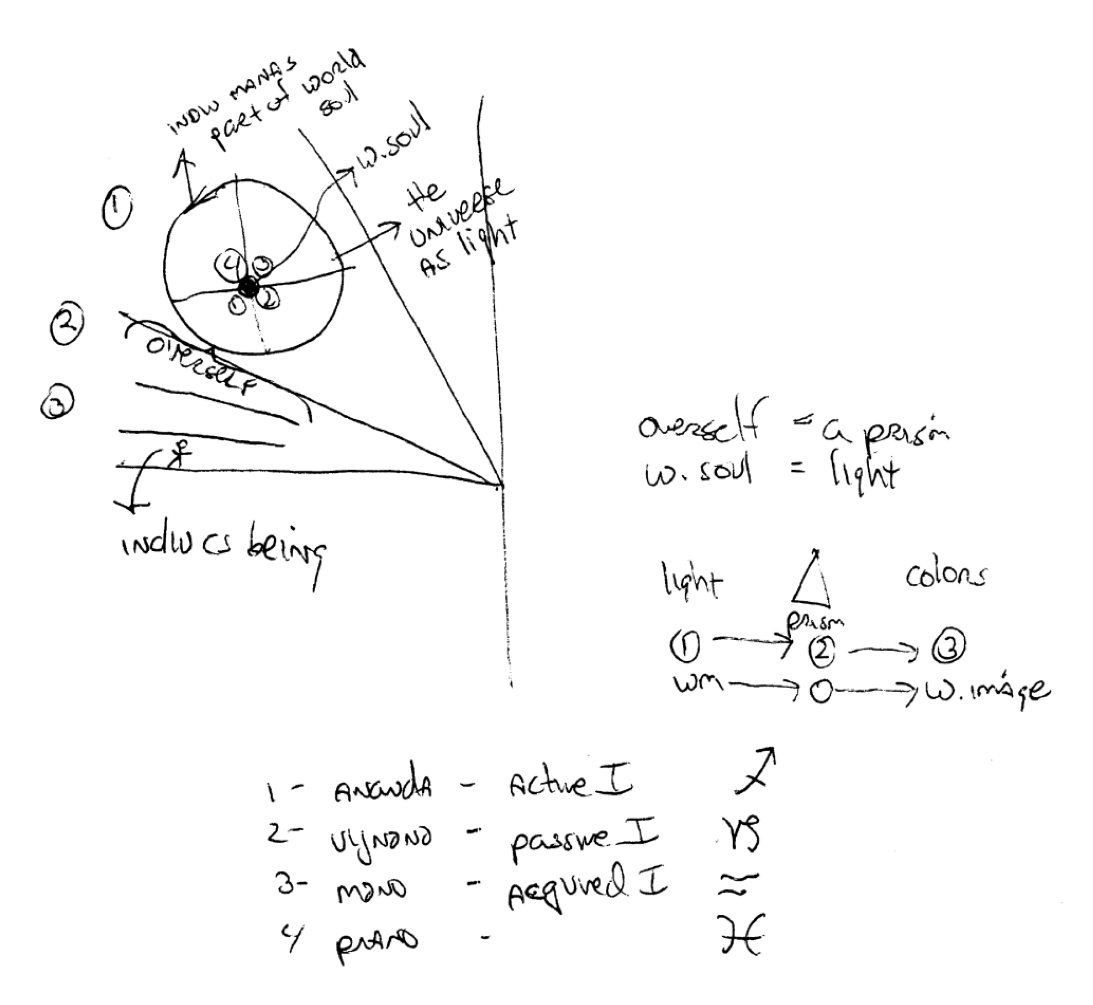
Class
Wednesday, September 26th, 1979
Verbatim, unedited transcriptClick the series name to view more
CLASS at Wisdom's Goldenrod, Hector, NY
with Anthony Damiani (AD)
September 26, 1979
PB BOOKS; WISDOM OF THE OVERSELF;
"THE MEANING OF MENTALISM"
TOPIC: PB Books
SUBJECT: Wisdom of the Overself
SUBSUBJECTS: "The Meaning of Mentalism" (Can Things Be Thoughts?), Epistemology, Subtle Physiology
CONTENTS:
EXPERIENCE TAKES A TWOFOLD FORM
THE DISTINCTION BETWEEN THINGS AND THOUGHTS IS ONLY ONE OF DEGREE NOT OF KIND
WORLD-SOUL IS DISTINCT FROM, YET PRESIDES OVER, ALL INDIVIDUAL MINDS
THE BODY ALTERS DREAM CONSCIOUSNESS INTO WAKEFUL CONSCIOUSNESS
THE BODY PROVIDES THE CONDITIONS FOR DEVELOPING A STRONGLY INDIVIDUAL CONSCIOUSNESS
WE EXPERIENCE THINGS WHEN THE CEREBROSPINAL NERVOUS SYSTEM, WHICH IS WITHIN THE THOUGHT PROJECTED BY THE COSMIC SOUL, RECEIVES FORMS FROM THE COSMIC SOUL
SENSE-IMPRESSIONS ORIGINATE FROM THE SUBTLE FORCES OF THE WORLD-SOUL IMPINGING ON THE INDIVIDUAL
THERE IS A DIFFERENCE BETWEEN THINGS AND THOUGHTS PARTLY BECAUSE THE MIND IS SHARPLY FOCUSED WHEN TURNED OUTWARD, VAGUELY FOCUSED WHEN TURNED INWARD
AWARENESS IS ALWAYS THE SAME IN KIND, BUT ITS QUALITY DEPENDS ON THE BODIES IT ASSOCIATES WITH
THE INDIVIDUAL MIND CONVERTS SUBTLE THOUGHTS INTO CONCRETE THINGS, THUS THOUGHTS AND THINGS HAVE A COMMON SUBSTANCE
THE WORLD IS EXTERNALIZED IN AND BY THE MIND
BOOKS READ FROM OR REFERENCED:
Paul Brunton, The Wisdom of the Overself
Paul Brunton, The Hidden Teaching Beyond Yoga
Plotinus, The Enneads (MacKenna translation, 4th ed.)
PLOTINUS QUOTES READ OR REFERENCED: IV.8.2
DIAGRAM appended to this transcript:
- FIGURE 1979 0926-1-AB. World-Soul, Overself, Individual Conscious Being; Overself as Prism; Four Intellects.
Other diagrams referred to are not with this transcript version. [Transcriber note: [diagram] means the speaker is referencing a diagram as he or she is speaking. If someone is drawing or writing, with audible sounds of chalk on a blackboard, I indicate this by [drawing] or [writing].]
NOTE: Wednesday night class, part of Wisdom series 1979-1980.
TRANSCRIBED Verbatim by IT 2019; reformatted by JRM & JF 2019-2020, with TOC/Subheads by JRM. In 2023, IT updates prefatory matter, footer, and audio file name, completes Book List, adds Plotinus quotes section, adds new note within transcript, fixes errors/typos, adds one diagram and references within transcript to this diagram. In 2024, MW alters Subheads to make more accurate. Archival verbatim transcript – V14.1a.
AUDIO FILES: 1979 0926a, 1979 0926b. [Note: "Tape" and "Side" refer to original audio cassette tapes that were later digitized into .MP3 Audio Files]
1979 09/26 at Wisdom's Goldenrod
PB Books; Wisdom of the Overself; "The Meaning of Mentalism"
Archival verbatim transcript
[Audio File 1979 0926a Begins]
S: Easily.
[short pause, noises]
EXPERIENCE TAKES A TWOFOLD FORM
AD: No more [one/two words inaudible] right, ok? [short pause, noises] Well, we'll start off where-- the last section of the second chapter, "The Meaning of Mentalism". And, we'll follow this till we go into "The Birth of the Universe" naturally. [short pause] We'll have to dialogue here, talk to each other. If you feel like interfering (here), you're welcome to. [10¼ second pause, noises, background student talking] Well Avery, what do you think he means when he says "experience takes a twofold form", all experience can be subsumed under a twofold form? [short pause, background student talking] "Can Things be Thoughts?" Very beautiful, this paragraph.
AS: Well, right over here, this twofold form, he seems to be talking about this distinction that he brings up at the beginning here between the seeming external world, the world which is given, the world of things, and the internal world of thoughts.
AD (faint): Got to speak louder.
AS: Yeah, the--
AD (simultaneously, faint): (The analysis) first.
AS (simultaneously): I think, I think here the-- that when he says experience takes a twofold form, I think as he goes into it, he's talking about this felt distinction between what we call the external world of things, ok, what we normally speak of as things, and our thoughts that we have about those things.
AD: And then of course he says things are in a state of relative fixity, but our thoughts about them are constantly altering, changing. And as a matter of fact-- So then the question he asks at the end of the paragraph is--
[Transcriber note: I am using The Wisdom of the Overself by Paul Brunton, Rider and Company, London, 1943.]
PB [The Wisdom of the Overself, "The Meaning of Mentalism", p. 23, AD reading]: "How is it possible to bring into one and the same category an idea like that of a [AD reads: the] memory of a tree, which represents the inner process of knowing about a tree, and the actual tree [AD: sensible tree] itself? Nobody finds that both the images of individual fancy and the objects of bodily experience are the same in his experience [but] everybody does feel a strongly-marked difference between them."
AD: Now, there may be people here that have exceptions to that. I like to-- I like for them to say so now.
S (faint): (Right.)
RG (faint): [one word inaudible] say so now.
AD: We all agree on that point then?
AH: Would you make that point again please?
AD: That there's a very marked distinction between the pole, especially if I walk into it, alright, and my thoughts about the pole. Real strong distinction. We all feel, and very strongly, that there's a difference here. The pole is one thing, it's a thing, and my thoughts about it are ephemeral, transitory, illusory. Not that you act on that. Ok?
AH: But, I don't understand on what basis the comparison is made because we don't-- we never know anything but the pole of our thoughts.
AD: Well don't you-- you know the actual pole, don't you?
AH: No.
AD: Well walk up to it. If you walk up to it, you touch it [knocks on pole], it won't move.
AH: Oh, that's the pole apart [AD simultaneously: Yeah.] from our (bit of laughter) thinking about it.
AD: That's--
RG: Yeah.
AD: That's the perceived [AS simultaneously, faint: Exactly.] pole, that's the external pole. That's the pole, for instance, that-- that your bodily experience will assure you of its existence, ok. And then there's another one, the pole that you think about, alright, and the phantoms in the cave about that pole. This is the cave [drawing] and you have phantoms saying there's a pole out there, alright, and it's six feet or eight feet or it looks like, you know, one of my nightmares. Alan?
AB: Well, it seems that we're using the term 'thinking' now differently than when we say that the individual mind thinks the object into existence. The pole you think about is after your mind thinks the real pole into existence.
[short pause]
AD: Well do-- you want to go back to the Chapter 12 in the Hidden Teaching?
AB: No, no, I just think that was part of the-- Andrew's question.
S (faint): (I know/And now) I'm confused.
AD: I didn't think that was a part of the question, was it Andrew?
AH: I just didn't understand the basis of the comparison because I-- I would-- I was thinking that even the pole that I touch or bang my head against is a product of-- of my meditation.
AD: Yes. Well could we say-- could we put it this way, there's-- there seems to be a distinction within thought itself, alright. The distinction is within thought itself. One seems to relate to the externally perceived world and one seems to relate to what we think about it. But they will both be subsumed under thought.
AH: Yes.
AD: Well, ok. And these--our experience, all experience falls under those two categories, no matter what experience you think about. Ok? And he says that this is probably one of the most difficult points in this teaching of mentalism. Now, would you read the beginning of next paragraph?
S: Uh-hm.
THE DISTINCTION BETWEEN THINGS AND THOUGHTS IS ONLY ONE OF DEGREE NOT OF KIND
PB [The Wisdom of the Overself, "The Meaning of Mentalism", p. 23, AS reading]: "The answer is that this distinction is certainly a genuine one but it is only of degree and not of kind; it is a distinction without a difference; it does not destroy the essentially mental character of the world outside. What is usually called a thing is a creation, as will be shown later, primarily of the cosmic mind. What is usually called a thought is the creation solely of the human mind. But ideas differ in the force, [the] intensity and the vividness with which they arise in consciousness. Nevertheless they remain ideas. Although only mentalists accept the objects of physical experience as mental states, everybody without demur accepts the thoughts about them as such. Now thoughts arise solely for the individual who has them whereas things exist for all alike. This is the second important distinction between them."
AD: Well could you perhaps suggest what he-- you know, in other words, what he would mean by "it is only of degree and not of kind."
AS: Only of degree-- Well--
PB [The Wisdom of the Overself, "The Meaning of Mentalism", p. 23, AD reading]: "…this [AD reads: the] distinction is [certainly] a genuine one but it is [AD reads: it's] only [AD adds: a difference] [AS simultaneously: Well--] of degree and not of kind…"
AS: Well one thing I thought is-- one thing I thought, (bit of laughter) that the kind is the same and-- and this is I think what Andrew was pointing out and so on where I [one word inaudible] that the kind is the same in that we've already through analysis shown that even the things out-- so-called external things of my experience are mental in character, mental in nature, that the thing is the thought, thought is a thing, ok. So, both of these are of the same kind. But, there's a distinction in-- Well let me see.
S (faint): One thought's a lot stronger.
AS: Yeah. Oh, this-- oh, degree, yes, degree, that's it. There's a distinction of degree in that when he says one is a creation primarily of the cosmic mind, in this case I guess you would say the cosmic mind's thinking is much more powerful than the human mind's thinking. And therefore its creations, those-- the creations that are produced along with the cosmic mind are much more powerful, they have much more vividness and so on. And the ones that are solely the products of the human mind are not so powerful and so they don't appear as striking, like he gives the example of memories. If you have the memory of a thing, you can kind of recall vaguely what it looks like but you don't have as much power as the World-Mind to really hold all the sense qualities and the particular qualities of the thing unless you practice a lot. Whereas the World-Mind has this-- World-Mind's thinking has this power to project things with a mu-- with a much greater intensity.
BS: Would you say--
AS: Yeah--
BS: Would you say then the-- that cosmic mind produces our bodily-based experience [couple words inaudible]
AS: What we call our bodily-based experience.
BS: Any senses that seem-- any sense-impressions that come to us like involuntarily?
AS (simultaneously): That seem external.
BS: And involuntary or stop?
AS: Well, he says that what is called a thing is creation primarily of the cosmic mind and what we normally call a thing is what we were speaking about before, a sensible object known as external to the body, as external to our body, and our body too is one of those sensible objects which are-- which we don't-- Yeah, I think what you said, we don't-- You can't change a tree into something else. There's something given there, there's something given to us. Right, in a tree, you can't make a perception of a tree into a perception of a river or something. There's some basis to that perception, some force behind it which is compelling you to see it a certain way. Whereas with your own fantasies, at least, you have somewhat of a control of them but they're much more fitful and they don't have that clarity and intensity which the objects given to you have. I mean I don't--
AD: If could return to that section then, "it is only of degree and not of kind", like, if I were to have a little cucumber here, alright, and I spoke about the cucumber and I-- then you showed me another one, you'd show me a bigger one, and then you showed me a cucumber that's almost like the-- like the archetype itself, I would say "Well they're all cucumbers, there's no difference in kind here." Right? No difference in kind. But then I ask you to show me even a bigger one and you bring in, let's say, a pumpkin, I say "No, this is something else." (bit of laughter) There's no-- Alright, there's a distinction here, alright. This is a real distinction. So when we say a difference in degree, alright, we're not altering the fact that a thing-- a thing could be an idea, remain an idea, in spite of the fact that in one case you have an intense preoccupation with it like when you see that pole coming at you when you're driving, and when-- if a pole in your mind is coming at you when you're driving, you know, I mean, there's a-- They're basically-- they're basically the same, but as soon as you say difference in kind, you'll bring in an entirely-- an entirely irrelevant thing. So he's saying here that as far as these-- this twofold form of experience takes, alright, we have-- we are dealing with the same kind of a thing, that is, mentalism. And there the-- the dis-- the distinction that we have to look for is one of degree. That's all, alright. And if we understand that point, then we can go ahead and he amplifies that point by pointing out the difference, from our point of view, of what a thing is and what a thought is. And as you pointed out, in the que-- in the-- in the perception of a thing which is imposed upon us by the cosmos itself, alright, there's a kind of a persistence, and an enduring persistence, a kind of givenness, an intensity. And then the second one, "What is usually called a thought is the creation…" But I'd like you to underline the word 'solely', "solely of the human mind." Leave out that word. Yeah?
S: I'm still having a lot of difficulty with this, I-- I brought up this question once before and I still don't understand it. If you have-- if you have-- (can't/got) an idea the cosmos had given to you and is not sensible, doesn't that-- I mean to define something as being cosmic in terms of sensible qualities doesn't seem right because you'll have a big idea it seems, you know, it's cosmically given.
AD: Well how about its givenness then, ok? How about that aspect of the idea? Could you give me an example of what you mean?
S (faint): No.
S (very faint, possibly part of background): [few words inaudible]
S: But I imagine, you know-- you know--
AD: Well, very often--
S (simultaneously): What is it?
S (simultaneously): --suddenly understand something.
AD: Yes, very often an intuition bursts upon you, it's imposed upon you by the cosmos. Doesn't have to come quietly and tiptoe from the back, [student assents] it can come very straightforwardly and just burst upon you. Certainly that-- that could be conceived of a cosmic, you know, force, a cosmic idea. And the-- the assurance that you have is-- is its givenness, it's the strength with which it is given to you, that it seems to come from something other than yourself. That's one of the ways you'll recognize it.
S: Well, I mean that's the way I thought about it but then I didn't quite understand why he phrased it this way. In terms of sensible qualities it seems he's phrasing-- making a distinction that way.
AS: Well, I don't know if he said that, I said that. [S, faint: Oh.] But I don't-- I don't know if he actually says that. I was just-- that-- just seemed that the clearest example of the distinction was-- used the physical sense ob-- the-- the sense object as example.
S: I mean, did you s--
AS: But I guess idea-- an idea could be cosmically given too.
S: But I suppose either that the idea was cosmically-- So, will you-- would you say that the real basis of distinction would be a sort of reflective--
[short pause]
AD: The basis of the distinction? Go on.
S: Between-- between cosmically given and individually given would be more in terms of reflective consciousness? Insofar as you reflect (let's say) [couple words inaudible]
AD: Well what is cosmically given, the thing, is the operation of both, the individual and the cosmic mind operating together. And in the case of the individual, there you can leave out the cosmic and there's just the individual functioning. [short pause] Go ahead. Well don't stop.
JG: Anthony?
AD: Yeah?
JG: Did I understand you right, you said what is given, cosmically given, is the perception of the thing. I mean cosmically conjoined with the individual mind.
AD: Uh-huh. Yeah. That's something that will evolve us-- involve us in constant difficulties, the relationship of the individual mind and the cosmic mind. That'll go on endlessly, the interrelationship, what part is played by the individual mind and what part is played by the cosmic mind or cosmic soul. That goes on forever interfering in your understanding. [student assents, faint] Well it's just as well that you make sure that you get it down straight, and you'll see that after a while that the distinction is a-- is not a s-- precise or it's not let's say stick to it at any price, you know? Because there will be occasions when the individual under, let's say, an extreme state of emotion could bring to recall thoughts that have a compelling reality as much as almost a cosmic impulsion might if-- even if it's just for a minute or two, but it will have that power.
AS: But-- then the thing you would say is if it did that, then the distinction between them would almost be annihilated. I don't mean that they-- you would actually be the cosmic mind but I mean for you, there would be no disti-- distinction between a really powerfully emotional thought that had all this vividness and one which was actually imposed by the World-Mind's thinking.
[students assent]
AS (faint): (Be hard to) [couple words inaudible]
AD (simultaneously): Yes, and I think that gives a person an insight into the potentiality of the universalization of his own intellect. But--
S: Is it-- insofar as one clothes things or gives form to them, because insofar one does that one is-- I mean it's the individual mind and-- I can't (focus).
AD: Yeah, you see, you'll get into trouble. You're going to try-- you're going to try to conceive of them separately.
S: Yeah.
AD: And you won't be able to, see. Because to conceive of them separately, in other words, to try to perceive the object without the mind's functioning automatically places you at the level of a Sage.
LR: Then what do you mean by 'solely'?
AD: I'm sorry?
LR: 'Solely'?
AD: Yeah. Well, you have to give me the question.
LR (simultaneously): Did you just say underline that word 'solely'?
PB [The Wisdom of the Overself, "The Meaning of Mentalism", p. 23, AD reading]: "What is usually called a thought is the creation solely of the human mind."
AD: Yeah, go ahead.
LR: What do you mean by that word? Oh--
AS (faint): Only. (laughter)
AD: I want you to put it in the context that you want me to talk about it.
LR: Well, it seems to bring up the same question, if the individual mind and the cosmic mind are inextricably bound up and it's the cosmic mind which compels the individual to think, then how could anything be solely a product of the individual mind? I mean it sure seems that way sometimes but it's-- I think it's a-- a big step to say--
S: It says "solely for", not "solely by".
S (faint): It says "solely of".
S (simultaneously): "Solely-- solely of".
AS: "Of."
S: "Of." (some laughter)
S: Solely (a product--)
S (simultaneously): No, if we got a different "solely" then-- (bit of laughter)
RG/S(?): Last paragraph, I mean--
BS (simultaneously): Well, (personally you) of.
PB [The Wisdom of the Overself, "The Meaning of Mentalism", p. 23, RG reading]: "…solely of the human mind."
AS: "Solely of."
S: It's the creation--
S (simultaneously): It's only for the individual.
AS: When-- when [BS simultaneously: It's before that.] the cosmic mind imposes its thought on the human mind, on the individual mind, and they think together, that kind of creation he said is a thing primarily of the cosmic mind. But when the cosmic mind doesn't impose its thought, then the human mind's thinking [S simultaneously, faint: (So are you.)] can go on.
RG: Yeah, I mean--
JG: You're talking about very unusual situation here.
AS: No, I'm talking about [S simultaneously: (Right.)] very usual situation. (AS laughing)
RG (simultaneously): Usual, [JG simultaneously: But--] but normally some--
MB (simultaneously): (But) doesn't it have (something--)
AS (simultaneously): Like you're normally doing.
JG: No, as far as the sensible world is regarded there's no question about that.
S: David--
RG (simultaneously): Well even that.
AS: But get-- but a-- See, unfortunately though, as far as the external world, there's a problem 'cause you're always going to have problem of what part the World-Mind provides in the sensible object and what part the individual mind provides.
JG: But the--
AS: But as far as your own fantasies about that world, it's much clearer that that's the product of your individual thinking. The World-Mind doesn't compel you to-- I don't-- I mean I would say, the World-Mind doesn't compel you to have the fantasies [JG simultaneously: The (experience).] you have about a situation you're in. Take it for example you don't have to have those fantasies about it. You walk in a room and all of a sudden, you know, all these fantasies come up. Now, there may be a hook out there for them but still most of them are just products of your own individual mind. Thoughts begin coming up, "Oh, these guys don't like me here, I better get out of here, (oh so/also) we're (on--)" We could have happy thoughts about this and (that). (laughter)
WORLD-SOUL IS DISTINCT FROM, YET PRESIDES OVER, ALL INDIVIDUAL MINDS
AD: But, Linda were you referring to the fact, "solely of the human mind," was your question that, how could there be such a thing, solely?
S: Yeah.
LR: Right.
AD: Is that what you were asking?
LR: Yeah. Last time I asked it you said to cross the word out, but this time you said underline it. (laughter, student words)
MW (amidst laughter): If you crossed it out the best way is to [couple words inaudible] (laughter, student words)
AD: How about the context though? I mean we get thoughts, fantasies, reflections. We could say that these are the products of the individual mind. But then I think your question the last time was something to the effect, "But how could there be an individual mind, they're all part of the cosmic mind, it's all objective sheaths, they all belong to the cosmic soul that produces them. So how could-- we could even conceive of, you know, an individual mind, you know, walking on its own two feet?"
LR: Yeah, but there's no [one word inaudible]
RG: That's a good question.
S (simultaneously): Wait let him--
AD: Yeah.
AH (simultaneously): But it-- but it is possible to have fantasies that have absolutely no basis--
AD: In fact.
AH: In fact.
AD (simultaneously): Oh yes, if you s-- that's very common. (laughter)
AS: Yeah but-- but Andrew, then Linda's point is still though, somebody is, as you-- as you would probably point out, somebody is having those thoughts within-- and having them within the con-- the general context of the World-Mind. After all, what could be outside of the World--
RG (simultaneously): Right. And as we put the individual mind together with [AS simultaneously: With the World--] the World-Soul in the eleventh house [diagram]-- [Note: See FIGURE 1979 0926-1-AB, World-Soul, Overself, Individual Conscious Being; Overself as Prism; Four Intellects, appended to this transcript.]
AH: It's a mental activity for sure. But the example you gave last week, that you had a hundred dollars in your pocket--
AD: And the World-Mind didn't cooperate, and he puts his hand in his pocket, he can't pull it out.
[student assents, very faint]
AH: It's not (my main point).
AD (simultaneously): No, but the question she's asking is something like this. If the individual mind, alright, is part of the whole of the cosmic soul, alright, then you really can't speak about the individual mind thinking on its own. Whatever thoughts it has would ultimately all be derived from the World-Mind or the cosmic soul. But, [LR simultaneously: And--] that would be like to conceive of the cosmic soul as the totality of all these individual minds rather than think of the cosmic soul as distinct and other than all these individual minds although it presides over all of them. And then this way you won't have that problem. And, you know, the next Manvantara repeat.
S: Really?
AD: Alright, so we got that 'solely' straightened out? (AD laughs a bit)
S: No.
S: No.
S (simultaneously): No.
S: No.
DB: Could I--
AD: Well, keep-- keep asking.
DB: You know, it-- You know, [LR simultaneously: See the--] we've spoken sometimes how that the-- what we speak of as-- as thought is a re-- is a reflection of certain vital energies and so forth that go into the constitution of the body and after the body has grown for a while and the development has taken place then the individual begins to conceptualize and develop intellectually. Now all the energies that are contr-- controlling this growth and so forth are coming from the World-Soul. But once-- it's almost as if-- Well on the one hand the-- the World-Soul has provided this structure within which place-- within which the reflective consciousness can take place. But the reflective consciousness itself, its center of reference or its point of view is, ordinarily speaking, solely itself. The individual fantasies that we have are particularly personal, they're all founded upon energies, forces, that the World-Mind has brought about, but they're all purely personal. I mean is that what-- I mean is that a way that you could look at the 'solely' here?
AD: Well, I-- I sus-- I think what you're trying to do is you're going to derive the individual's reflective thinking, you're going to base that upon the vital energies which are inherent in the body. And therefore you'll be able to point out that there could be no individual thinking because ultimately if it's derived from the body or the vital vegetable soul then ultimately all his thinking even comes from the cosmic mind, therefore there is no individual reflection. And so we don't even have our own.
DB: Well I-- I don't want to say that. I think that's what I started out to say but--
BS (faint): Yeah but it could be right.
AD (simultaneously): Louder.
DB: That-- that's not what I really mean to say but--
AD (simultaneously): Alright, then tell us what you mean to say.
DB: Well, that-- on the one hand that seems to be-- that seems to be-- that seems to be true. But at the same time there is another element there that has made that reflective consciousness possible because you don't have that type of activity purely of the vegetative activities, you know, I mean the individual who is-- whose rational mind is no longer functioning, you have the-- the vital forces are still functioning, the body's still there and so on but there isn't that capacity for individual reflection. So there is something else that's-- that's necessary for it.
[17¾ second pause]
AH: Well it's slightly disturbing because if there-- if the individual thinking is based ultimately on cosmic principle, what does that mean-- what does that do to the notion of in-- of that vision of who this individual is?
[9 second pause]
AD: So, shall we then accept the fact that there is an individual?
AH: That there is. [student assents, very faint] Yeah.
AD: And insofar that each person's experience is his own, you can say that there's some individual here. Whereas if it was one ultimate common perceiver, alright, it would be very hard to speak about an il-- an individual. My experiences are not yours. Therefore, you know, there's a principle within me which is operative and separates me off from your experience and other experiences. And if we investigate into what that principle is, alright, we would come up with the certain presuppositions which I think would confirm rather than deny the strength of individual-- individuality. And that ultimately we would come to the position where we'd realize that the World-Soul which presides over many individual minds and more or less is mothering them still is distinct from them and not to be confused with them. So that when the individual mind and the cosmic mind are operating together, we have one kind of creation. When the individual mind shuts off that cosmic influence, then he's thinking on his own, he's really propelled by his own, but this doesn't mean that that individual is existing in a vacuum. It doesn't mean that at all, nor does it even imply it. It simply means that the individual, without cosmic occasions in-- ingressing into him, can think and reflect about his experiences, which are [couple/three words inaudible] [short pause] Alright. Any further question(s)? Questions, no?
JG: I have the question. It-- it's hard for me to conceive in the-- in the context of World-- you know, the individual mind's being nurtured, sort of suspended or resting in the World-Soul, that unless the World-Soul stops, that the human mind will ever stop.
AD: I'm sorry, that the World-Mind st--
JG: Unless the World-Soul stops, you know, like goes in pralaya, that the individual mind also stops. It would-- That's hard for me to conceive of but that's what I understood you to say right now.
AD: Yes.
JG: Am I--
AD: When you're dreaming, alright, you-- you bring up images of-- of that which has no corresponding cosmic occasion or instant. (But), you know, you're--
JG (simultaneously): But some other layer, is there not--
AD: What?
JG: Some other layer of mind, wouldn't that be still working with the cosmic mind? I just have a hard time to see-- see any shut down, even tem--
AD (simultaneously): Well I didn't say it was a vacuum. I didn't say that the individual mind is isolated, separated off, and sent out somewhere in a galaxy, alright, and it's out of this-- the range of cosmic soul. It's still functioning within the realm of the cosmic soul.
JG: But there are then certain layers of the individual mind that are relatively far or not-- not under the influence, direct influence of the cosmic mind. Do I make any sense?
AD (simultaneously): Well keep going, keep going.
JG: Yeah?
AD: Keep going Johanna. What do you mean? Some more.
[short pause]
JG: If we-- if we go back--
AD (simultaneously): Well, like for instance if you're in a state of deep sleep, alright, [JG: Yeah.] your mind's not functioning. But you still persist as a bodily entity.
JG: Yeah.
AD: Yeah but, we said that the bodily entity is the product and the production of the World-Soul.
JG: Uh-hm.
AD: So the World-Soul will maintain it. Just like sometimes people when they're very old, the rational soul leaves their body but the vegetable soul still maintains the body, and all they have are traces and memories of what the rational soul experience. But the-- the bodily form is still there. It's something which is thought into actuality by the World-Soul.
JG: Uh-huh.
AD: Alright, but the individual functioning in that body is no longer there. And if you watch some very old senile people, people who for one reason or another the soul has left their body, you can see the vegetable consciousness can still function. It's still being maintained by the cosmic soul. But there's no individual there. Go ahead.
JG: So it can a-- where does it go? (bit of laughter)
AD: It doesn't go anywhere, I--
JG (simultaneously): Yes I-- I know it does--
AD (simultaneously): It doesn't have to go anywhere. It's not a thing.
JG: But if we spoke of the World-Soul together with the individual mind last time, Sunday class, like a-- just a machinery, you know, like something that runs, and the only-- my true center is really the Overself, which is a different story.
AD: Yeah but we don't want to bring that up now, next week we'll be getting into that, that's hard enough. We want to restrict the questions to see the distinction between the World-Soul and the individual mind, alright, and how they depend on each other or rather how the latter depends on the former. But nonetheless there is a relative independence. [JG assents] There's a relative independence, the individual mind could think for itself. And it would be foolish to take away that prerogative. [JG assents] In the case of dream it's very obvious that, you know, you're making images, you're-- they're coming up from within your own mind, they're not-- they're not thought-forms which the cosmic-- the cosmic soul is imposing on you. They're not that. Although you could say, "Well look, this body comes from the cosmic soul." Yes, but we're talking about the mind, alright, and the way the mind is manipulating that. So I think we could retain the individual.
As a matter of fact, I think I mentioned once that Plotinus pointed out that the World-Soul presides over the universe in, you know, a-- a very serene way, without deliberation. [Note: See Plotinus, IV.8.2.] The whole of the universe is within the World-Soul. And that World-Soul will never be free of the universe which exists within it. Whereas the individual can be free of the body that he has to preside over. Now, if you look at it that way you begin to see that the World-Soul is a constant accompaniment of any body and will always be included in that. And, there's no reason for regret. You could say, "Well look that body, alright, is not really individual mind," you know. It's alright, it's very [one word inaudible] That body is going to express that individual mind. So I don't think we have a problem (there/now). [short pause] Could you imagine all of us thinking the same thoughts? I can imagine all of us not thinking the same thoughts. But the same thoughts? Alright let's-- we try the next paragraph. It's better.
THE BODY ALTERS DREAM CONSCIOUSNESS INTO WAKEFUL CONSCIOUSNESS
PB [The Wisdom of the Overself, "The Meaning of Mentalism", p. 23, AS reading]: "Why is there such [AS adds: an] obvious difference between the two categories of experience if both are really mental in character? Why do we seem to be so certain and definite about our experience of things?"
AD: Tables, chairs, men, women, mountains, clouds.
PB [The Wisdom of the Overself, "The Meaning of Mentalism", p. 23, AS reading]: "The answer is that we experience the one under a different set of conditions from the other, although both sets are purely mental."
AD: This is going to be important in the third chapter, very important. Condition.
PB [The Wisdom of the Overself, "The Meaning of Mentalism", p. 23, AS reading]: "The difference between material things and thoughts like recollected memories is exactly like the difference between the experiences of wakefulness and those of dream, that is the former are common to all but the latter are quite private. The strength with which a sense-impression forces itself upon us lies in its cosmic origin, the weakness with which a fancy arises within us lies in its human origin. [AS adds: And] Thus, anyone can reconstruct physical sensations by using memory images, but the reconstructed sensations lack the sharpness, [AS adds: and] strength and actuality of the original ones."
AD (faint): That's (brilliant).
AB: Anthony?
AD: Yeah. Go right ahead.
AB (simultaneously): This may be a stupid question but, there's an o-- there's an obvious difference between an object I perceive external to the body and a thought I have. Well let's say I think "I'm going to raise my hand", and then I raise it. Then, in a certain sense, it's a conjunction of both because it's also an objective event for another person, so there seems to be something about the body that's a little different.
AH: But Alan, can't you objectify the raising of your own hand? I mean that's-- that's a possibility, isn't it?
AB (simultaneously): Well, yeah I-- I could do that and then not have the question but it feels like I'm doing it. I mean it feels like it's my thinking. Maybe you could say it wasn't really my idea to begin with. (some laughter, student words)
S (faint): Go ahead.
AD: Well-- [short pause] I really-- I really fail to see how this is going to help us understand right now those subtleties that you want to bring up so prematurely. Could we first try to understand [student assents, faint] these-- this point here?
S (simultaneously, faint): (He's throwing) it away.
S: Is that-- is that a-- just an analogy when he talks about like the difference between the experiences of wakefulness and those of dream? Or is there something, you know, when you were talking about like waking consciousness, is-- is that the-- the difference between like the twofold form? That what we see as objective is like when it's in wakeful consciousness and what-- the thoughts that we have are in a more dreamlike or unmanifest-- not unmanifest but-- and the vividness that you were talking about [one/two words inaudible]
AD (simultaneously): Well, I don't think it's an analogy, (ok), it's--
S (simultaneously): I mean is it-- is that really the—
AD: I think that's precisely the point. Let-- let's say something like this, not that it's possible for us to do it except theoretically. If we took our common ordinary experience in wakeful life, alright, and you're aware or you're conscious of the experience you're having, ok. And let's say it was possible to subtract from that experience the consciousness part and leave the content, alright. In the same way let's take a dream, alright, and let's say it was possible to subtract the dream consciousness, the quality of consciousness in the dream state, and you were able to subtract that from the dream state and leave the dream going on, alright. Now if you had these two and you put one in a test tube and the other in a test tube, alright, it would be essentially to say that, yes, we have-- we have two different kinds of consciousnesses, if I can use that term, alright. Actually we can't do that because the-- the consciousness is so dependent upon the medium on which it's reflected. But if-- if we were capable of doing that, then we would be able to say the consciousness we subtracted from the dream seems to be more fluid, you know, less tangible. It hasn't got any sharp contours, any definition, alright. Whereas the kind of consciousness that comes from wakeful consciousness seems to be more precise, more accurate, more sharp, prec-- It almost makes like a stencil outline of the object, alright. So that the con-- the quality of consciousness in the wakeful consciousness and the quality of consciousness at the dream level, if we compare them we can see that there is some kind of difference in terms of degree. They're both consciousness, alright. But one is fluid, rapid, moves about with lightning rapidity. The other in comparison is slow, rigid, you know, can hardly get off of one topic without making sure that the other is very clear, defined. So I would say that it's not an analogy, it's really a-- a pretty accurate--
Now, the point he's going to make is, what brings in the distinction, or what causes that distinction between wakeful consciousness and dream consciousness is that the conditions that we're going to set up are that of the body. Once you have the body, alright, then you've altered that dream consciousness into a wakeful consciousness. That consciousness going through the body, alright, and going up to the brain and flowing out through the blain-- brain, now you have wakeful consciousness, whereas prior to it it was wa-- it was a dream kind, was more fluid.
S: But, I guess-- I guess what I'm asking is then-- is the nature of that-- the individual thoughts of-- of that-- like dreaming, that fluid dream-type consciousness, and that only the perception is-- is the wakeful.
AD: I'm sorry, I didn't--
S: Um--
AS: She wants to know if you-- if you subtracted the consciousness from each one, would you say that the contents that remained were the same? Or would it have to be that the contents also corresponded, like the actual contents of the wakeful experience were vaishvanara and--
AD (simultaneously): Well it's just that the contents, the contents in the dream consciousness approach more closely to the-- the nature of thought, whereas the contents in wakeful consciousness more closely approach the nature of the thing, alright, and that's why I took the analogy to try to pull out the different kinds of consciousness so that one could examine, so to speak, the two of them in isolation. The very-- [short pause] the point that we were making of course at-- at the very beginning was that this is, you know, an extensive abstraction, if I could use that term, alright, that actually you'd find-- find it impossible to separate the dream consciousness from a dream content. Just like you'd find it impossible to separate wakeful consciousness from the thing that accompanies that wakeful consciousness. But I think the important point was if you can analogously-- like when you're in a dream you could almost feel, when you wake up of course, that you're like living in a thought-world, a world of thought, alright, where nothing is really so rigid and determined, alright, and fixed. It seems to be much more fluid, more ethereal, light, alright, whereas when you awake, a pole is a pole [AD bangs on pole]!
[students assent, very faint]
S (faint): Tony--
S (faint): Yeah.
AS: I'm not sure I understood. Can I use an analogy to see if I understand what you mean by the body? [S, very faint: Yeah, yes.] The conditions here you say is the body, now the physical body.
PB [The Wisdom of the Overself, "The Meaning of Mentalism", p. 23, AD reading]: "The answer is that we experience the one [AS: Under a different--] under a different set of conditions from the other, [S, faint: Uh-hm.] [AS: Right.] although both sets are purely mental. The difference between material things and thoughts like recollected memories is exactly like the difference between the experiences [AD reads: experience] of wakefulness and those of dream…"
AS: Now, these are now-- like say you want to have a dream. In order to have experience in a dream, that seemed, you have to-- to-- the mind has to set up a center within that dream. So even within a dream, even though you don't have an actu-- a physical-type body, still you have a center for that dream through which to experience it. Now are you saying something like, if we want to talk about--
AD (simultaneously): You have to-- you have to keep in mind that, you know, the thoughts are in the heart, not in the head.
AS: Yeah. So it's a su-- it's a subtle type [couple words inaudible]
AD (simultaneously): It's a subtle exper-- It's the-- it's the experience of the subtle.
AS: Yeah.
AD: Ok.
AS (simultaneously): Now I'm saying, now if you want to experience this-- experience things, ok, in conscious-- in vaishvanara consciousness, or let's say things, the World-Mind production, in a certain kind of way, then there also you would have to have a certain kind of a-- say a vehicle or a center for that kind of experience. You're saying that the body, your actual physical body, provides you with a place or some kind of access to the World-Soul--
(Side 1 of original cassette tape digitized as 1979 0926a Ends; Side 2 Begins)
LR: --but because the body's necessary also for my fantasies.
S (faint): Yeah.
S (faint): Yeah.
RG: Well I have-- [S: Yeah.] I have trouble talking about our [LR simultaneously: But-- but the--] individual thoughts as-- as being conscious.
AD: Did you ever ask people that died?
S: Yeah.
AS (faint): They have those fantasies too.
AD (simultaneously): Uh-hm. They have fantasies.
LR: Yes, well--
AS: Subtle-- [S simultaneously, faint: (There's/That was) the physical.] it's a subtle body, [S, faint: Not--] not the physical body anymore.
S (faint, possibly part of background): Jesus.
S (faint, possibly part of background): Thanks.
LR: See--
AS (simultaneously): That's right. You have dreams, you really don't need your body to have dreams.
LR (simultaneously): It seems like a pretty obvious distinction except when I think about certain situ-- It's true, when the-- it's true, when the-- when I'm falling asleep, say, the thoughts take on a less wakeful kind of actuality. But, when you use the example say of developing your wakeful consciousness and with that wakeful consciousness discerning the less-- well, discerning sub-- the subtler worlds. In other words, that the object of meditation or contemplation is to-- with that wakeful consciousness to then apply that consciousness on subtler levels, ok. [student assents, faint] So that very often when you're meditating, that vaishvanaric or wakeful aspect of the world does slip away but so does the consciousness become that way and we find ourselves in a dream state. Now, if the purpose or if the goal in some way is to hang on to that awareness, that wakeful awareness, and allow the thoughts to-- or allow the contents to become more subtle, then it seems like that whole pur-- purpo-- that whole condition of the body is not applicable.
THE BODY PROVIDES THE CONDITIONS FOR DEVELOPING A STRONGLY INDIVIDUAL CONSCIOUSNESS
AD: No, but the purpose of the body was to make it possible for you to acquire a very strongly individually-tainted consciousness.
LR: Right.
AD: And unless you do this, alright, when you go into meditation and let's say you are in the subtle realm, if you do not have this very strong centered vaishvanara consciousness, you'll get dismembered.
LR: Right, but-- I mean I've heard you say that.
AD: Alright, so then-- so then that means that you have to rise from the wakeful consciousness and as you go into the subtle realm you are awake in the subtle realm.
LR: What do you mean first of all by dismembered? (bit of laughter)
S: (Really?)
S (very faint): [couple words inaudible]
LR: No, no, I'm seri-- I'm not-- no, I'm serious because [AD/S(?) simultaneously: Oh.] you're-- I don't--
AD: But you're in a dream, it's like you're completely torn out of your center, you're-- you're at the mercy of every thought that comes into your-- into your consciousness and you fluctuate like a cork on-- on the ocean billows. Whereas if a person is strongly centered in his own consciousness, wakeful consciousness, alright, then when he goes into a contemplative state and he does b-- [LR simultaneously: He can't handle it.] live-- let's say break into the subtle world, [LR: Yeah.] he won't have that experience, he'll still be able to hold on to himself and experience the subtle world.
LR: Ok, so you're not sa-- you're not saying then that vaishvanaric consciousness is dependent upon-- [AS: Or produced by.] is caused by the body. Because if you were to say that--
AD (simultaneously): No. No, let me say as a preamble, if you want, that there's only one consciousness, and that that consciousness associated with various kinds of matter produces various kinds of consciousness. So that when it's associated, you remember I says like if you think of a glass pane, consciousness there would go right through, it would be like prajna. And then we said if it hit canvas or something or some darkening, it would go partly through and partly not, that would be like taijasa. And then it would hit a brick wall, it won't go through, and it gets very clearly defined there. And what I'm saying is the light associated with these different mediums produces different kinds of consciousness, what we would call wakeful, the prajna, taijasa.
LR (simultaneously): But the-- then my question would still remain. When the consciousness becomes disassociated from a body, the way you're explaining it, it would be--
AD: Yes, your question remains because you didn't follow what I said and that was that with the experience of the body there's brought about an acute sense of individuality and that is what remains, alright. It's like the consciousness now conceives of itself as being individual because of the variety of tremendous amount of experience through the body and the acuteness of that experience.
S (faint): Uh-hm.
JG: Would you go--
AS: Would you say like that would be like going back along the body monad [diagram], so that-- [LR: Wait (A/Ave).] Let's say vaishvanara requires a certain kind of a body, and in the first place, the simplest one is the-- is a physical body is the best one to evoke because it's the most powerful. But once you've gotten that experien-- once you've built up a certain kind of center, strong center, then that would be the gross-- I was wondering--
AD: That would be the gross [student assents] consciousness, alright.
AS: That would be the gross consciousness. When you went into another realm, [AD simultaneously: Yeah, when you went into--] that would remain as a-- as a fixity [one/two words inaudible] vaishvanara.
AD (simultaneously): Yeah. The same way that we said that all-- all our understanding is the result of prior perception. We would include by that the fact that the individuality is formulated or, you know, gets concretized by the experiences through the body, and now when this individuality who's been forged almost we could say in the experiences of living--and maybe the word is right, 'forged', ok--and deprived of a body, the very intensity of experiences have deposited these very strong traces of wakeful consciousness which he holds on to. So that no matter what state, you know, if he goes even into prajna, he knows that he is going through that. He doesn't come out after let's say a state of prajna and say "Now who was it that it happened to?" He knows it was him that went through that and had the experience and he came out and says, "I had this experience." So that that persisted, it held on to (that).
LR (simultaneously): So then what you mean is that that body is not the cause of vaishvanaric experience but it--
AD (simultaneously): No, not the cause in the sense that it produces it, [LR: It's the--] except in the way I qualify it by pointing out that consciousness in association with a body-- in this case this is pretty, you know-- what do they call it, a shelly body? You know, clay body, alright? Consciousness really has trouble getting through it, and reaching up and out.
LR: So it's not the cause but it is the condition in the sense that it [AD simultaneously: Yeah.] will-- it will bring about vaishvanara consciousness--
AD (simultaneously): Will bring about it, and that's what he means--
LR (simultaneously): --but that vaishvanara consciousness is not dependent upon a body.
AD (simultaneously): No, it's not dependent upon it, it's a principle sui generis.
RG: Ok, now, given that-- the sensible manifestation there, then we compare it to the thoughts of an individual mind within that sensible manifestation. Right, we're c-- we're calling that now a thought created by the human mind. Right?
AD: Go ahead Richard, go right to your question.
RG (simultaneously): Well I'm a-- and then, and then we talked about having relation to dream consciousness is what I can't understand. Because it seems that that thought is in a sense even-- I mean it's inferior to vaishvanara consciousness.
AD: What thought?
RG: The thought that we ha-- that's solely the creation of the human mind.
AD (quietly): Oh, you're catching on.
RG: In this-- well, in the sense that it-- I mean it's-- well, I mean it's essentially unreal.
AD: Yeah.
RG: But it has no basis in reality.
AD: Yeah, and that's why, that's why, if you remember, we spoke about that. Even if you-- that these are illusory thoughts, alright, and that even if you destroy these illusory thoughts their destruction is as illusory as the thoughts that you destroyed.
RG: Uh-hm.
AD: That's the whole point, that's why they're referred to as phantoms in the cave.
RG: Ok, but when we then compare them to dream, we're not comparing them to dream as we refer to the subtle state of manifestation prior to the manifestation through the brain, right? I mean that's-- that--
AD: I still don't follow you. Go ahead.
RG (simultaneously): Well when we talk about these individual's thoughts in this example being like dream, it's not the dream of the cosmic mind prior to its sensible manifestation. I mean it's not-- it's not the ideas in the heart we're comparing it too. It's like-- it's like-- it may be like that in the sense that a dream is private, I mean that was his analogy there. But it's not meant to mean there's an objective state of manifestation that it-- that's occurring that we call taijasa consciousness for example.
AD: Well I wouldn't go that far because there is such a subtle state of consciousness [one/two words inaudible] And it can be if we refer to it as, you know, the dream of Vishnu.
RG: Right.
AD: And that it is objective because this is the thought of the world-to-be.
RG: Right, exactly, but that's not the thought that we have post-vaishvanara.
AD (simultaneously): No, of course. That's right, that's not our thought.
RG: Right.
AD: But we can see that they're-- In the same way, like if we can-- if we can conceive of let's say Vishnu who has in his mind the whole plan of the universe in thought-form, alright, alright, we can see the similarity in a Hin-- in, well, an author, a writer, a painter, who can, you know, have the total idea of the object in their mind. [S, faint: Sure.] Now, you know, we gave the example of Mozart who would be able to contain or hold on to the idea of a sonata, you know, in his mind, the whole of it, alright, and he found the most difficult part was writing it down. That was annoying to him.
RG (simultaneously): Right, right. So I mean in that case the individual mind is contacting a real subtle state of manifestation.
AD (simultaneously): Well yes, I would say quite definitely, you know, (he/you) would be in contact with (the Mantric) Heaven and inspired there he would interpret that, yeah. I think we moved away from (there).
S (faint): Yeah.
WE EXPERIENCE THINGS WHEN THE CEREBROSPINAL NERVOUS SYSTEM, WHICH IS WITHIN THE THOUGHT PROJECTED BY THE COSMIC SOUL, RECEIVES FORMS FROM THE COSMIC SOUL
PB [The Wisdom of the Overself, "The Meaning of Mentalism", p. 23, AD reading]: "The difference between material things and thoughts like [AD adds: the] recollected memories is exactly like the difference between the experiences of [AD reads: between experience in] wakefulness and those of dream, [that is the] former are common to all but the latter are quite private. [AD: And he goes on here.] The strength with which a sense-impression forces itself upon us lies in its cosmic origin…"
AD: Now, I don't know if you remember the way I like to work this out is that if we think of the Sun, alright, as that consciousness, that cosmic soul which will project the entirety of the universe, and this universe which is being projected is a thought in the cosmic soul, ok. And if we keep this-- if we keep in mind that we refer to the cosmic soul or the Sun as the progenitor or the projector of the entire manifested uni-- universe, which is going to include your body, alright, your body is included in that. And, there was-- we went on and we pointed out, now within this body there is a very elaborate nervous system, the cerebrospinal nervous system, you won't speak about the sympathetic nervous system, but the cerebrospinal nervous system, which has been developed, you know, through evolution. And it is this nervous system that we spoke about as the-- well I think we spoke about it in a Sunday class, where we tried to point out that if you take this body which exists within the cosmos, within a universe, and that this cosmos or this universe is-- the cosmic soul is impinging on that body. Let's say there's streaming into that body, alright, the to-- the forms, the Ideas of the Sun, the soul, and it's pouring into that body in this form, and when these impressions reach the heart center of the person, that is, when they actually hit the spinal column-- I'm inclined to think of the whole of the spinal column is-- is involved in the perception of the world.
But, we have to remember that when they're speaking about the heart center here, they're not speaking of the heart center as one of the chakras because that's not what they're talking about. The heart center that they're speaking about includes all the chakras, so-- We have to remember what they're speaking about is that these impulses radiating out from the cosmic soul, reaching down to the human body, and there's a point within that body which he says let's refer to as the Overself center. And there we got deposited these Ideas, the Ideas which are manifesting the universe, get deposited as tiny seed-like thought-forms in the heart. Now, if these tiny seed-like thought-forms go up to the head, [AD snaps fingers] wakeful consciousness and vaishvanara consciousness appear simultaneously. That is, the appearance of the object and the consciousness necessary for that object to appear takes place. Alright, but that's-- that's like running ahead to the third chapter, we can't help bringing that in right now. Go ahead.
S: But at the beginning of the chapter when (he talked of ideas), tonight's lecture, and said that experience takes place in two forms. He's talking about experience after the seed has gone to the brain.
AD: Yeah, yeah, yeah. In other words, he's taking wakeful consciousness as the standard, alright, and he's saying, "Now look, within-- when you-- within your experience of the world, alright, you have the thoughts about things and the things," alright. But now we're at a much more subtle point. This point is much subtler. When he says that--
PB [The Wisdom of the Overself, "The Meaning of Mentalism", p. 23, AD reading]: "…we experience the one under a different set of conditions from the other, although both sets are purely mental."
AD: Alright?
S: (Are) both kinds experience? I mean is that the reference?
AD: That both kinds of experience-- both kinds of experience ultimately can be reduced to some kind of mentalism. [short pause] And, I'm trying to-- I'm trying to answer this question right here, even if I have to anticipate a little bit the next chapter, by pointing out the way we did it, alright. We thought of the Sun or the Soul of All fabricating an entity, alright, and that the Soul of All, that the very substance of the Sun, taijasa consciousness, becomes congealed as this body, alright. But that's only a thought-form. It's like if you were to think-- Now, well, just an example. Let's say you were to think and you had marvelous powers of concentration and you were able to creatively visualize in your mind's eye a person, alright, standing right in front of you. And as you visualize him, it doesn't move, the image stays there, you know. Usually when you think about an image, the ear breaks off and nose flies away, the head contracts, you know. But no. Let's say you had the power of concentration, you could hold it, ok. Now, if we think of the Sun in a similar way, the Soul of All, as thinking, and in its very thinking producing what we call the physical world, our body, this object, that object, trees, etc. Then if we think of it that way, alright, then I think it would be easy for us to make the next-- the next step. Alright?
JG: Which is?
S (faint): Uh-hm.
AD: Yeah, I was hoping one of you would [AH simultaneously: What--] say which is.
S (very faint): And then you could keep talking.
AD: Go ahead (David).
S: It's alright. (laughter)
S (very faint): He's too [one word inaudible]
AD (simultaneously): Well this would be, this would be dream consciousness, right? Vaishvanara consciousness. [S simultaneously, faint: What's that?] And there's the body. Huh?
AS: This would be dream consciousness?
JG (simultaneously): What would be dream consciousness?
AD: Yeah, what the-- what the Sun's-- [AS: Yeah.] Sun's projected world.
AS: Taijasa consciousness.
AD: Yeah, the Sun's projected world, the soul's projected world, alright?
AS: Yeah.
AD: Ok.
AS: And included within it would-- would be your body, [AD: Yeah.] the actual existent body.
AD: Ok. Now all this li-- all this exists at the level of subtle consciousness. Now, we-- you have to recall what I just said. This body which is, you know, a thought-form fabricated by the cosmic soul, is subjected to these cosmic impulses coming to it from all directions.
AS: It's like a receiver he says in one place.
AD: Yeah, receiver.
AS: But that seems to be the prerequisite. That-- that your body exists even in the subtle way [AD: Uh-huh.] is a prerequisite for this process you spoke about going up through the [S, faint: What?] body, through the nerves and up to the brain and through the (senses).
AD (simultaneously): Alright so, like if I-- if I look up there, if I look that way, I'm subject to the influences of Aries and I look over there I'm subject to the influences of Cancer. All these influences are streaming in, alright. Now, insofar that these Ideas which actually are going into the manifestation of the universe, they actually produce the universe, we would call-- he calls them karmic forces, I call them Ideas, insofar that they are producing this body, alright, evolving this body so that a nervous cerebrospinal system is differentiated out of the sympathetic identity system, alright, they're two different kinds of systems. Now the cerebrospinal nervous system, which includes the spinal column and all the chakras in it, and plus that hollow tube in the back of your spine which is very small and which has fluid going up and down it and perhaps in which the whole world is reflected, I don't know, you have to ask the physiologist--
S (faint): There's actually no fluid.
AD (simultaneously): Huh?
AS: I think in Hall he says that.
AD: So, he says, now, now that this body is set up, alright, and these influence(s) pounce upon it and they reach the heart center, there these Ideas or these influences get deposited as tiny seed-like thought-forms. Ok? Remember that. And then these tiny seed-like thought-forms go up the cerebrospinal nervous system, up to the brain, and get projected outwardly as the manifested universe. But, at the moment that it gets manifested as the universe, there's a consciousness that accompanies it which we refer to as wakeful consciousness. The two of them appear together or disappear together.
JG: What are the two? I missed that point the last time you said that too. The two appears--
AS: Vaishvanara consciousness--
JG (simultaneously): Vaishvanara consciousness and [couple words inaudible]
AS (simultaneously) --and the physical object.
JG: Oh. Oh ok, ok.
AD (simultaneously): Just like for instance, now, if I can go back to the analogy. You remember I was talking to Avery and I says, "Avery, you're looking at a hot stove," (bit of laughter, student assents) alright.
JG: Oh yes, he went to the hospital and got treated. (laughter)
AS (faint): [few words inaudible] stove.
AD (simultaneously): And at that instant, at that instant, assuming that I had a powerful consciousness, was a mesmerizer, at that instance, he thinks that into actuality, the stove appears, and with it he's sweating.
S: And that's vaishvanara.
AD (simultaneously): Now-- No, now it becomes vaishvanara.
S: When he sees the stove and--
AD (simultaneously): Yeah, when my idea, alright, transforms his consciousness into a subject-object relationship with that [S simultaneously, faint: Ok.] content established.
LC: Now why is that vaishvana--
AS (simultaneously): That's what I have a question.
LC: Yeah, I've had-- why is that vaishvanara consciousness?
AD: Wakeful consciousness. Don't you--
LC (simultaneously): Why-- Because, you mean, he's gone out of his individual consciousness and joined another con--
AD (simultaneously): No, no.
LC (simultaneously): Why is that vaishvanara?
S: Exactly why it's a thought.
AD (simultaneously): Not necessarily. Huh?
S (faint): I want to--
AS: I think the question is more like, when we speak about these conditions, now you said the conditions are that of the body.
AD (simultaneously): Well, first--
S: Uh-hm.
AS: Yeah.
AD (simultaneously): Hold on Avery.
AS: Oh.
AD: They refer to that as vaishvanara because of the very intensity with which you experience the physical world in comparison to the subtle world. That's why they call it wakeful consciousness.
LC: Be-- because--
AD: Because it's much more acute, the experience, much more localized, much more precise, defined, [LC simultaneously: Than--] articulated.
LC: Than taijasa consciousness usually is.
AD (simultaneously): Than in taijasa, (very) good.
LC (simultaneously): Or than one's own wakeful consciousness usually is.
AD: Than--
LC: Than one's ordinary wakeful consciousness?
AS: That is [AD simultaneously: Yeah.] one's ordinary [S simultaneously, faint: It is it.] wakeful consciousness.
AD (simultaneously): That is one's ordinary wakeful [student assents] (consciousness).
AS: Isn't it pretty-- I mean it's pretty clear.
S (faint): Yeah.
AD: Look if, for instance I'm speaking to you, and finally you understand what I'm saying, alright. [AD claps loudly] "I got it!" [LC simultaneously: Right.] Right? [LC simultaneously: Right. It's very--] Wakeful consciousness, alright, I'm awake! [LC simultaneously: Right.] alright, and then of course you relapse.
LC: Right. (laughter)
AD: Because our state of-- originally our state of consciousness was closer to taijasa than vaishvanara and it is through this constant flow of experiences of intensifying our consciousness that we become more and more awake.
LC: The reason I'm asking is 'cause when we first mentioned that hypnosis, when I-- when I was really young I was once hypnotized. And I re-- everything you said was true. You're aware of every single thing around you, the words keep coming and yet you-- something else happens, you know, you-- Like you see, you do, you see a stove and you do sweat. But I don't-- didn't know why you were calling that a more acute consciousness than one has ordinarily.
S (faint): Obviously it's not.
S (faint): (Alan/Ellen)--
S: Well--
S: He didn't say that.
S: No, no, he didn't say that.
AD: No, it's just [LC/S(?) simultaneously, faint: I think that that's what he was saying.] an analogy. If you can imagine the Sun doing this to you, alright, if you can imagine the taijasa consciousness of the Sun influencing the individual mind so that its taijasa consciousness gets converted to wakeful consciousness and the world appears and the individual in that world has the experience of that world.
LC: Oh, so when you were using the example of the hypnotist and the [one word inaudible]
AD: It's only an analogy to--
LC: Of the Sun to the--
AD: To the individual mind.
LC (simultaneously, faint): To an individual mind.
AD (simultaneously): Yeah. In the same way that I impose a certain meaning on his mind and then he translates that meaning into two things, a content and an awareness to accompany that content, alright, in the same way think of the Sun doing that to the individual mind.
LC: Oh yeah, I believe it.
AD: But the whole point why we--
LC (simultaneously): I was just--
AD: The point why we're doing this is to bring out that-- you know, he says that the-- the only difference is because the conditions are different. Now, what are the conditions, so to speak, that are different? And we have to bring in the whole body because it is the body, alright, and-- which we pointed out-- In other words it's like a receiving set, the body, alright, even though it is just a thought-form, it's still a receiving set. And he points out, as the vasanas travel up from the heart to the head, alright, it's similar to like the radio taking-- bringing in the electrical waves and then producing sound. In a similar way the physical organism or the bodily organism is so constituted that that process is brought about. Now it wasn't always like that. If you go back let's say 50,000 years ago, mankind did not have a wakeful consciousness or the experience of wakeful consciousness, it was gradually brought about by let's say biological necessity, alright, or conditions that we found ourselves in.
LC: That's very hard to imagine.
AD: Well, you take an example, the other example I gave (where/or) you'll have a nightmare. And if you get scared enough, you'll wake up. [student assents, very faint] Alright, and in a similar way you could be living in a world of, let's say, where you have a vague fitful dreamy kind of consciousness, alright, but let a situation develop that brings about a crisis, and you can see you'll make periodic descents into wakeful consciousness and really be awake, grasp a situa-- You probably have that experience if you're driving [AD snaps fingers] and something happens and boom! [AD claps] you come-- all of you is operating, [student assents] then you know what wakeful consciousness is. But we're still approaching it. We're still approaching it. Most people come here and tell me, "Frankly, I don't know how I got here, I don't remember driving." (laughter) [AS: That's what I do.] And of course I'm writing them in my little book, make sure I don't drive with them. (laughter)
S (amidst laughter): Tell Richard.
AD: No, that's all of us, that's all of us. It's an ordinary lapse into taijasa, dream, womb-like, fitful.
LC: But our ordinary consciousness is what you're calling tai-- vaishvanara.
AD: Vaishvanara is the aim--
LC (simultaneously): It's a wakeful awareness.
AD (simultaneously): Yeah, that's the aim of evolution, to bring you down-- Now this was the point Linda was making. Once we really are wakeful creatures, we really have a wakeful consciousness-- And that's why I say, if you're not-- you know, if you're not normal, don't meditate. You know, a lot of neurotic people like to meditate but they already live in a taijasa state of consciousness, they don't need anymore. They have to get to a wakeful state of consciousness, establish that firmly, then they can go into meditation without fear of getting lost in it. But you know, these people if they do meditate, they'll get lost in their thoughts so they'll exaggerate the symptoms they already have. [S: Is it that--] That's why I'm very skeptical, you know, of when people are-- don't-- Unless they're either extraordinarily gifted and contemplative or they're neurotics, you know, they're not fit for meditation. I know that there's a theory that says that everybody should meditate but I don't buy. Go ahead Avery.
AS: But no, two things first, in that exam-- I mean (it's) conditions (here). In the example you give when a person's dreaming and then has a nightmare or something and something happens to catapult him into wakeful consciousness. Now, would you say in that case the condition again is the physical body? That something is sending that consciousness up to the brain and that he's having this dream experience and it's not being transmitted?
AD: Well, if-- if you-- ha--
AS (simultaneously): Is-- is it actually the-- is it actually the--
AD (simultaneously): Have you noticed, have you noticed your nightmares? I don't know [AS simultaneously: (Uh-hm.)] if you've had any recently. But do you notice on a mi-- in a nightmare there's actually the will to get out of it?
S (faint): (What do you mean?)
AS (simultaneously): Yeah. Now, what I'm saying there is that-- I guess it seems like normally there's something that regulates the sleep to-- you know, they say it's something in the cortex in the brain, [AD, faint: Yeah.] the sleep center, you know, (the pull to push), as it were, withdraws your consciousness back into the [one word inaudible] into a [AD simultaneously: Yeah.] taijasa. Now would you say that somehow that's getting activated? If you-- in the dream, when you-- when there's something scary enough in the dream to wake you up, it's like something is pushing your consciousness, actually almost physically pushing it up into the head.
AD (simultaneously): Up to the head.
AS: And that's-- and that's the same [few words inaudible]
AD (simultaneously): And don't you feel relief when you're up in the head?
AS: Yeah. You woke up.
AD: Yeah, you woke up, you're relieved now.
S: (Yeah.)
AS: Ok, but there's another question. When-- when you have-- you said these con-- again these conditions, you say that the-- the world, the Sun's projection-- Ok, talking about the Sun's projection and including the physical body. Physical body acts as a receiver and then this seed-thought goes up to the brain. Now it seems that also though-- It's true, it seems the body is necessary but also one-- the other condition seems to be the World-Mind's thinking in this case. In other words-- Well I'm not sure that's so.
JG (simultaneously): But I thought that's what he refers to, these set of conditions.
AS: Well, yeah but that's-- at that point--
JG (simultaneously): Because the body is-is thought by the cosmic thinker in that instant.
AS: Yes it's true, I follow(ed) that.
JG (simultaneously): And the principle of waking-- Without the body you cannot have that [student assents] waking--
AS: I followed the-- that thing that the body itself is a production of the cosmic mind, and that's what allows it to be a receiver. It's part-- it's part of that perceived world but--
AD (simultaneously): Well I don't think I follow you. Are you trying to say-- I don't-- I'm just guessing now. Are you trying to say that it is the cosmic mind that makes a person wake up?
AS: No, I wasn't referring to the dream example. I was--
AD (simultaneously): Well, alright, ok.
AS: I was referring to your act-- to your physical experience. No. Not that it was. In fact, that's where there's a problem but-- Suppose you're having nor-- your normal physical ex-- wake-- your normal waking experience. Now, the body is necessary, but also the input from the World-Mind is necessary, these seed-like thought-forms [AD: Yeah.] which have been implanted by the World-Mind seems to be another necessary condition.
AD (simultaneously): Yes, but there's a few factors that are necessary, [AS assents] and we pointed out one, that the body has to evolve sufficiently so that you have a developed cerebrospinal nervous system. You can't leave that out, that's very important, you know. Because, if you've noticed, well--
AS: I thought you said that previous state of existence--
AD: Well--
S: Right.
S: Uh-hm, (uh-hm).
AD: Like sometimes if you peet-- if you meet people that are pathologically-- something's wrong with their spinal column, ok. Or also sometimes certain people, you know, undertaking certain exercises, they will never have certain experiences because some kind of harm was done to their spinal column, alright. So, there's a lot of reasons why this whole receiving apparatus has to be in some kind of development and order before the experience of wakefulness, true wakefulness, could take place. That could be retarded by various things. But, what I was wondering at was, like if I was having this nightmare, alright, [AS, faint: I wonder what it is.] and let's say I'm-- I awake, alright, I awake because of the sheer fright. Now, was this wakefulness forced upon me by the wakeful-- the cosmic mind's thinking or was it the individual's effort that got him out of it?
AS: Would say it was the individual [couple words inaudible]
AD (simultaneously): Yeah. Yeah, I would [S simultaneously: (But--/Good.)] say it was the individual that forced [S simultaneously: (But--)] himself out of it.
AS: So that would show that your position--
JG (simultaneously): Why would-- why would you say that, why [AS simultaneously: Wait. That's--] would-- why would you say that?
AS: That's important.
AD: Well just-- just have a nightmare tonight and notice what happens.
S: Oh no.
AS (simultaneously): There doesn't have to be any obj-- I mean the World-Mind doesn't have-- That would show that the-- the condi-- the condition of the World-Mind providing the seed-thought is not a necessary condition of vaishvanara consciousness. Right? I mean if you could-- if you could awaken from that dream without some cosmic stimulus telling you, "Hey, time to get out of the dream," then--
AD (simultaneously): Because ra-- later on your-- that very wakeful consciousness is going to be used to stop the flow of the seed-thoughts. [S: Well--] Go ahead.
S: I-- I just-- even in-- even not in the dream example I'm just having trouble understanding how something like intense fear could bring like that vaishvanara consciousness into operation, and it seems like it does. But any-- a heightened--
AS: [whispering: It's 'cause it did.] I think it was the thing that Anthony [S simultaneously, faint: Right, yeah.] said about providing a center or a nucleus. [S simultaneously: Well-- yeah.] It's like normally it's fi-- you know, the dream is very a-- diffuse. But if something comes in to create a-- an actual vehicle in that dream or that vaishvanara consciousness, then you would have vaishvanara consciousness operating. In other words, if that fear was strong enough it would provide a nucleus, a strong enough nucleus and that's what we spoke of as the [one word inaudible]
AD (simultaneously): Instead of nucleus, go back to the analogy I use. Instead of having a transma-- a transparent medium, you have a brick wall. [S, faint: Yeah.] If you're-- if you're in a state of extreme fear, it's like your thought is becoming dense, [AS simultaneously: You created a body.] and now, and now it could be-- it could be reflected.
S: Ok, but, I really--
JG: Wait a minute, what did you say?
S: You-- that can happen, even when you're, say-- or say that the example of you-- an intense fear, does the-- I guess one of the things I guess I'm asking is, what is-- are you-- is the individual creating the-- that the density of that?
AD: Yes, yes it's through-- it's through your fear.
S: Ok, so that's--
AD: Through your intensity of experience.
S: And that would not be the cosmic--
AD: No.
S: So [S simultaneously: Yeah.] this is how it could--
AS: Your mind substance-- That's what I think that other point of the mind, the same substance. Or very early in the chapter, he wanted to show that it was of the same stuff. It's like your mind is of the same stuff as the Sun's taijasa consciousness, it just it normally doesn't have the power to concrete itself into an object. [S simultaneously: Ok.] But if it's powerful, if the-- that fear is powerful enough, it will concrete itself. The mind, that-- your individual mind has the pow-- it does have the power to concrete itself into an object.
S (simultaneously): Ok, so then at that moment, the quality of the vaishvanara consciousness is the same as-- as when you're experiencing something that's of the cosmic-- of cosmic origin. And yet-- the awareness of it. But-- and yet the content is a-- still seems to be diff-- it's a different kind, it's still thinking.
[student assents, faint]
AD (simultaneously, faint): But I--
S: Or--
AD (simultaneously): Explain, explain, I didn't follow you.
S: Ok, um--
S (faint): Say it again?
S: Say-- say your fear is so great that it actually creates-- it actually like congeals, is that the word, into an object. And you experience that with the same intensity as you do with anything else in wakeful consciousness but it's because of the individual's own creative power.
AD (faint): Uh-hm.
S: Ok? So, it seems like the-- the subject who's experiencing it is experiencing the same-- is experiencing the same intensity, the quality of awareness is the same. And yet there still seems to be a difference. It still seems like you can separate what's from the World-Mind and what's from the individual mind. You know, it doesn't seem-- like even though you--
AS: I think we're saying that the quality of vaishvanara consciousness does not necessarily depend on it being a World-Mind object.
S: That's what I'm asking.
AS (simultaneously): Your individual mind [S simultaneously: Yeah, that's what I'm asking.] could concrete an object that would call forth vaishvanara consciousness, just [student assents] as the World-Mind's consciousness usually does 'cause it's so powerful. But your-- I mean the World-Mind's thinking usually does but your mind's thinking could also.
S: Yeah, ok, that's what I'm asking, so it--
AS: And that just seems to show for me, I don't know if it's right, that this quality of awareness we're speaking of as vaishvanara consciousness is not a principle-- really if you look into it in itself, is not derived from any of the content. It may be called forth by those contents or evoked by them somehow but--
S: Yeah. So that's a set-- that--
AS: He calls it a quality of awareness, I mean--
S: Ok, and is that what he means by set of conditions?
AS: No, the set of con-- the conditions would be the-- not the awareness itself but the condi-- the conditions would be-- well we said the body.
AD (simultaneously): Identification with the body.
S: Ok.
AD: Yeah, go ahead, some more.
S: It appears that fear is (it) freer to help shift the levels of the awareness. But the-- and I noticed [student assents] that fear often resolves almost suddenly and instantane-- What is fear itself, is that part of the awareness? Is it independent? Is it more than just a tree or-- I don't understand. I think I know what fear is. I mean I know the feeling but I don't know what it is.
[11½ second pause]
AD: Well again that would have to go back to the experiences we have had as individuals and the necessity to preserve that individuality. So ultimately fear always comes from the fact that there is the other. Ultimately it always will come from believing in that there is something other than you. Now everyone is very fond of his own existence, including the Sage. And if it's threatened, of course, it would be natural to recoil or to take cognizance of that threat. But, fear has too many facets, I mean it's got a thousand disguises, and I want to avoid getting into that, I mean it's endless. I do want to stick to the point here that we're making. Go ahead.
AH: When you take an example of-- instead of using the example of fear, which is basically an emotional thing, what about an example where the brain and the senses are-- Let's say, you touch a hot frying pan, that's an example we've often used. Could you say at that time that the individual mind is in conformity with the thinking of the cosmic mind? Like, would you still call it a question of intensity in terms of the individual mind?
AD: Intensity of what, the experience?
AH: The intensity of the thinking, talk about--
AD (simultaneously): Well he's acting in conformity with the World-Mind's stricture which is saying, "Look, take care of that body I gave you to take care of. Don't go around lopping off pieces and burning it up." So it will be a very normal reaction. I mean you're only acting in conformity with a higher understanding. [possibly one word inaudible] think it's a higher. I don't see what the point is there.
AH: Well we seem to be talking about the ability for the individual mind to experience a very intense concretized state which we're calling wakeful consciousness. And we use the example of intense fear to be an example of that waking consciousness.
AD (simultaneously): Well, any intense experience will bring about a reaction from what you might refer to as the total human being instead of just a little part of him.
AH: Ok. Well would you say then that at that moment, when there's a total response of the total human being, that that thinking is in conformity with the World-Mind's thought? Or are we still talking about intensity of--
AD (simultaneously): Well that would depend on the individual experiences involved, I couldn't say offhand. I'd have to know what his experiences are. But you'll be correct in pointing out that it seems as though you're being guided into becoming aware and awake. You know like it says in the Bible, "Arise, awake." Don't you see most of us are like somnambulists walking around in a dreamlike condition?
AS: So one of those Zen books also has this exercise, always says put your mind in a state as if it was just in shock.
AD: Yeah, yeah, that's an ideal situation, except that most people run up a big sugar count. (some laughter, student words)
S: Yeah, I have trouble understanding the individual mind. Going back to this thing that you talked before about, the World-Soul-- the World-Soul having an idea of a body or the subtle body within the World-Soul, and then implants these seed-like-- like fought-- thought-forms in the heart center of this body--
AD (simultaneously): Yeah, will you get to your question?
S: Ok, well I'm trying-- ok, and then it goes up to the brain. Where's the individual mind in that? And then you have a-- I mean it seems that-- that that-- that the world is all the-- the World-Soul's projection. I don't understand how the individual mind fits into that.
AD: Well we pointed out that insofar that the cosmic soul projects the universe from within itself, which includes a physical organism which has been developed up to a certain point, alright, then this physical organism is something that the mind uses. I mean it's the vehicle of the mind. Naturally, you would have to say there's a certain inclination for this body rather than another body as far as the mind is concerned. But the individual mind rides upon that vehicle as upon, you know, some horse, and this is the very means that it experiences the world with and it thinks with that. I mean, the body is a necessary adjunct to its thinking because without the body it will not be able to experience the sensible world. So it has to have the body in order to experience the sensible world.
S: You're just saying that that individual mind is linked to that subtle body.
AD: It's linked to that physical body too. The individual mind is the subtle body, alright. The body is the gross one, and we're speaking about the physical body, and the mind is linked to that body. And it must use that body, that's a vehicle for its experience of the sensible world. It can't have experience of the sensible world without that body.
S: No, I understood that but--
AD: But-- go ahead.
S: I don't understand how the individual mind functions, I mean I unders-- Maybe it's hard for me to distinguish the individual mind from what you're calling wakeful consciousness. I can think of-- I can't think of the function of the individual mind. I mean I like to think in the same way that I could think of a function of the World-Mind.
AD (simultaneously): Well, if you want to think of the functioning of the individual mind, think of all the powers: memory, recollection, alright, thinking, reasoning. All these are powers of an individual mind. Did you ever try thinking about something? Don't you feel that you're exerting your own mind? But when you're digesting the food in your stomach, you're not exercising your mind, are you?
S: Uh-hm.
AD: The body's taking care of it, alright. But as soon as you had a difficult problem, the mind's got to go into operation. So, I mean I don't see what the problem is. The individual mind using the body, perfectly legitimate. [short pause] Alright, let's read a little. Oh, go ahead.
S (faint): Quick (sentence).
AD (simultaneously): We're not-- Go ahead.
LR: Just one more question. It seems like PB uses the dif-- the-- to distinguish between the individual's fancy and the actual thing, it seems like he uses sense-impre-- this sentence.
SENSE-IMPRESSIONS ORIGINATE FROM THE SUBTLE FORCES OF THE WORLD-SOUL IMPINGING ON THE INDIVIDUAL
PB [The Wisdom of the Overself, "The Meaning of Mentalism", p. 23, LR reading]: "The strength with which a sense-impression forces itself upon us lies in its cosmic origin…"
LR: And it seems like that idea of the sensation is used a lot to distinguish between personal fancy and--
AD: I'm sorry, I missed you. Say it again.
LR: Seems like that idea of sensation is used--
AD (simultaneously): Sensation?
LR: Sensation.
AD: I don't follow you.
LR: Ok. Say--
AD (simultaneously): Like if we think of this here, [drawing] if we think of this as the universal thought or the product of soul, universal thought, alright, the world, and then everything within this here, everything within this here will be a thought of this cosmic soul, alright. So that over here we have Linda Ruth, ok. [student assents, faint] Right? Now go on with your statement. In other words, if-- if this is the universe, alright, and-- Let's reverse the symbolism, let's say this [drawing] is Linda Ruth, alright, she's in the universe. Ok, this is the whole universe, she's within it. And there's all these forces impinging upon her, ok. You're trying to say that these are sensations?
LR: Yes.
AD: No.
JG (faint): They're sense-impress--
AD: No.
AS (faint): No, neither.
LR: Ok, let's not use that.
AD: You can't possibly-- you can't possibly refer to them as sense-impressions or sensations because these forces are too subtle.
LR: Ok. Um--
AD: I mean think of for instance cosmic rays bombarding you constantly. You have no perception of these things.
LR: Ok.
AD: You can't even think of for instance the forces that are emanating from various, you know--
LR (simultaneously): From-- ok, let me-- let me just-- That really isn't the issue I don't think in my question.
AD (simultaneously): Alright, then, go ahead, go--
LR: Let's say the world is projected through-- from the heart center up to the brain and now it's impinging back upon you and those is what-- those are what we call sensations. Ok?
AD (simultaneously): [drawing] So we're saying that these impressions are impinging on the heart center, right? And they deposit over here what we refer to as these forces, karmic forces. Yeah. And then they go up into the brain, alright? And then they go out and they perceive the tree. That's not only PB's, but that's also Vedantic and Platonic epistemology.
LR: Ok. And they come back and they're sensations.
AD: They don't come back.
LR: Ok, they don't come back. As they hit the tree [couple/three words inaudible]
AD (simultaneously): When you see the pole, you see it directly, you attack it directly. It isn't a question of anything coming back.
LR: Now it's a sensation when it [AD simultaneously: I'm sorry?] hits the tree.
AD: Yeah.
LR: That's what you want to call sensation. That's fine, that's fine, but that's not my question.
MW (simultaneously): And that's perception.
AD: Same as perception.
MW: Sometimes we distinguish them.
S: No we don't.
AD (simultaneously): Sensation would be included within perception. It's like an aspect of perception. When you go out and you perceive the object, [drawing] alright, you see the whole tree, alright. Then you say the green of the tree, but that's already part of the perception. You say the smell of the tree, the height of the tree, these are already parts of that perception.
S: Well I didn't--
S (very faint): We know.
AD: Well--
S: [three/few words inaudible]
AD: I can't [MW simultaneously: I'm sorry Linda.] get-- I don't see her point yet.
LR: No, I haven't asked the question yet, that way I hang on.
AD (simultaneously): Oh, well, I'm (bit of laughter) waiting for you to drop the other shoe.
LR: Thank you.
[Audio File 1979 0926a Ends]
[Audio File 1979 0926b Begins]
LR: --can deliver those sense-impressions, that when one's own fancy is operating we do not have sensation functioning.
S (very faint): I agree.
LR: So far?
AD: Uh-hm.
LR: Ok? I've always had trouble with that and your example of the hypnotist makes it even more confusing to me because the last time we spoke about the hypnotism, you said that a hyp-- a hypnotist might put a hot stove in front of you and you might actually get blisters on your fingers from touching it.
AD: Yeah but the-- that example was simply to explain the conversion from taijasa to wakeful consciousness. That's all the analogy was for.
LR: But now if I-- what-- suppose I bring up that example--
AD: Alright. (laughter)
LR: --in this context. It seemed-- all I'm trying to ask is it really does seem that the individual can bring about those sense-impressions. In other words, if the hypnotist suggests a hot stove, it isn't a cosmic stove, I mean it-- it's not coming-- what-- it doesn't have a reality, that stove. But it does have a reality for the individual mind and in virtue of that the individual can be burned by it.
JG: Cook on it.
S (faint): What?
LR: I don't know about cook on it.
JG (simultaneously): Cooking probably [student assents] also. (JG laughs, laughter)
LR (amidst laughter): Do you see what I'm saying?
AS: Cook on it, cook on it.
S (simultaneously, faint): Cook on it.
S (faint): Oh, cook on it.
AS: You're going to cook on it.
S (simultaneously, faint): Cook on it. (more laughter, student words)
LR: I'm just-- in-- [S simultaneously, faint: Vegetables (of course).] through the years you've always [AS simultaneously: I don't know, but I wish you'd turn off that stove. (laughter)] said that the sensations have to arise from cosmic origin and that's one way of--
AD: Again. The sensation what?
LR: One way of distinguishing the difference between personal fantasy and cosmic reality is by saying that this cosmic reality delivers sensation, these sense-impressions, and personal fantasy does not. And I know you've told me in the past that you don't-- there is no sensation in dream, for instance.
AS: Linda, suppose the guy really concentrate on something powerful enough so he actually opened his eyes and he actually sees it out there.
LR: Yeah.
AS: The guy actually sees it.
LR: Yeah.
AS: Well wouldn't his sensations then be operating?
LR: That's my point.
AS (simultaneously): I mean, normally sensations are cosmic--
LR (simultaneously): Avery, I'm not arguing.
S: Yeah so--
AS (simultaneously): No, I thought I was answering your question, well I may be wrong but let me just--
LR: Oh.
AS: Because you say nor-- I think he means here that normally the sense-- (He has--)
PB [The Wisdom of the Overself, "The Meaning of Mentalism", p. 23, AS reading]: "The strength with which a sense-impression forces itself upon us lies in its cosmic origin…"
AS: And you could have a sense-impression arising from the individual too.
LR: I would think so.
AB: Yeah I mean you're just talking about a special case.
AS (simultaneously): Well, so I don't see what the problem with that is.
LR: Well--
AS (simultaneously): In these-- in most-- in normal waking experience the sense-impressions are-- arise because of the imposition of the World-Mind, [LR simultaneously: Ok, I'm just--] and therefore they're--
LR: I'm-- I'm just-- what I'm asking is, can the individual mind deliver those--
AS: I would think yes. Even the case of the hypnotist seems to bring that possibility.
LR: So what about in a dream?
AS: It could happen in a dream too and you'd probably wake up.
AB: But no, we'd say you could have waking consciousness go into a dream. So it's not necessary for the-- The World-Mind isn't required to produce [S simultaneously: No.] vaishvanara consciousness or sense consciousness. But normally--
LR: Ok, Anthony, would you agree with that?
AD: Well you see, I'm kind of lost. I think what you're doing when you say the strength with which a sense-impression-- I think you're reading-- you're misreading that. You're thinking of, here's an object, alright, let's say this pole here, and that this has a cosmic origin and because of the strength of this cosmic origin that the pole has, that is, it has a real subsistence, alright, it can impose itself on our understanding and there could arise sensation. Whereas what we're saying is the reverse. We're [S simultaneously: That--] saying that insofar that the influences that are penetrating and reach into the Overself of an individual gives cause or rise-- gives cause to rise within him these seed-thoughts which go out through the-- through the spinal column, up into the brain, and then get projected, simultaneously the pole and the body appear in vaishvanara consciousness and that's what he means when he says that cosmic sensation is-- cosmic--
LR/S(?): Origin?
S (faint): Yes.
AS (simultaneously): Cosmic origin (I think).
AD: To sense-impression. That's the-- that's the cosmic origin of a sense-impression.
AS: Seed-thought.
LR (simultaneously): Yes.
AD: Yeah, these seed-thoughts.
AS: Not the sense-impression itself.
AD (simultaneously): Not-- not the brown from the tree.
LR (simultaneously): Yeah, no that's fine. That's ok. I'm just saying, can they-- can the origin of sense-impression be also individual consciousness?
AD: I don't know [LR simultaneously: Can--] what you mean yet, I-- I heard the words but I don't know what (that means).
AS (simultaneously): She means can you-- without-- without this cosmic-- Oh I don't know, I'll give that example again, I don't know if it's a good one. Like when, you know, you're-- you're concentrating--
AD (simultaneously): If I'm dreaming and I think very intensely and I see yellow?
AS: Yeah.
JG (faint): That's what--
AS: That's-- and that would be an individual origin to it.
AD: Yes, but would that be a sense-impression?
S (faint): No.
AS: Well that's-- that's her question.
AD (simultaneously): Or would-- would that be the memory of a sense-impression?
AS: That's-- tha-- I think that's what--
LR (faint): That's the question.
AS: --part of what Linda's--
AD: That would be a memory, wouldn't it.
LR: Now what about the hypnotist example?
AD: What about the hypnotist?
LR: That he's actually burnt by that hot stove which isn't there.
AD: Go on, I mean, go ahead, elaborate.
AS: Is that a sense-impression?
MW: Is that a memory of a sense-impression (MW laughing) or is that a sense-impression?
AD (simultaneously): Is that a sense-impression, is the burn--
S (simultaneously, faint): When you feel heat.
AS (simultaneously with AD): The (burn) that I feel or the burn an actual sense-impression.
AD: Well wouldn't that be more like the intensity of his own thought which brings it about?
LR: But would it bring back-- it would bring about an actual sensation I would think.
AD: Yes. Yeah.
AS: That's the only thing. She's just saying that--
AD (simultaneously): But-- but assuming, yeah, assuming it brings back sense--
LR (simultaneously): It brings about sense-- I'm just saying that that's not always the criterion for the difference between personal thought and cosmic thought. [S, very faint: Oh.] [AS simultaneously: Then it would--] The criteria-- the sense-impression is not always the distinguishing--
AD (simultaneously): But in the case, in the case of hypnotism, when we say a hypnotist has the strength with which to influence you, are you actually fabricating a new creation or is it the intensity with which the mind is functioning and the recollection of a prior functioning?
LR: Yeah, the latter.
AD: So the latter would mean that it's not cosmic.
LR: Right.
AD: It would be something he did, he's doing to himself.
LR: It is, right.
AD (simultaneously): But notice, the resources from which he does it are from-- in terms of his mind's own modalization. That the mind can recollect how it modalized itself into this particular thought, idea, sensation or whatever.
S: But that was before it was different from--
AD: Whereas it's quite different, you know, when--
LR: I'm not trying to say it's the same thing, I'm sorry. I'm not trying to say they're the same thing, I'm just saying that-- exactly what you just said I think, that the personal individual consciousness can produce sensation.
AD: Yes but, the only insertion that I'm pointing out is-- is that this sensation is a recollection. It's not the sensation. The yellow for instance that you see in the dream, is that a sensation? Richard I think had this a long time ago. I don't know if he remembered the answer but-- He says, "Well you see yellow in dreams, don't you? That's a sensation." And I'm inclined to interpret it or to express it by saying that that's a recollection of memory of yellow. [student assents] That's not the yellow.
AS: But then what you're saying what a sensation is is a reaction to a stimulus by the World-Mind. We said that this wasn't sensation itself, [AD: Uh-huh.] these subtle forces. But what the individual mind has in response to this is a sensation.
AD: What the individual mind [AS simultaneously: What the individual mind has it in--] has when it converts-- when it transforms itself into the sensible world or into the sensible image.
AS (simultaneously): Right. In response to the stimulus of the World-Mind is a sensation.
AD (simultaneously): Yeah. But you see, that takes us right back to the point, that the s-- the mind became that sensible manifestation, [AS assents] and in becoming that sensible manifestation, the very mode of its functioning is what it recollects in reproducing sensation, this sensation of yellow.
AS (simultaneously): Right. But then it would always do that even when there was a cosmic origin. See I don't see-- if-- if you say that the sensation part-- No, maybe this is getting off-- We said that this [AS indicates on diagram] isn't a sensation, this cosmic input, these forces striking individual. But, upon-- consequent upon that the individual mind transforms itself into this actual sensible object.
AD: Yeah.
AS: Now, if there's no cosmic input, but the sense-- but the individual mind still transforms itself into this sensible quality, let's just say the quality, the sensible [AD simultaneously: Yeah.] quality yellow, it would seem that, as far as the individual mind is concerned, it's still transforming itself into this quality [AD, faint: Yeah.] the same as if there was a cosmic stimulus. There's no cosmic stimulus, it's true, but that seems divorced from what we call sensation.
AD (simultaneously): Well then what would be the difference, what would be the difference when the individual mind duplicates a sensation like yellow and when there's the actual perception of a yellow? What would be the difference?
AS: Well, when the intensity is the same, it's real hard for me to see what the difference is. I mean if you have a real vivid perception of yellow but nobody else can see it--
AD (simultaneously): But didn't you al-- didn't you already say what the difference is?
LR: Intensity?
AD: Intensity.
AS: Well that's what-- but I'm saying, if that-- I think that was the only thing in Linda's question, that if the individual mind thought this yellow with the same intensity that the World-Mind normally thinks into you, there would be no difference.
BS: Yeah but then it [couple inaudible student words simultaneous with BS] (it amounts) to zero.
AS: In intensity. Yeah, [few inaudible student words simultaneous with AS] but that's all there-- you but-- you never get at the-- [LR: What?] you never get at [AD simultaneously: Ok.] that stimulus that's affecting the mind, you only know the sensible quality. And if the sensible quality is identical in intensity--
AD (simultaneously): But-- but is-- isn't that exactly the point we're making, that it's the intensity which establishes or which is the criteria of the sensation of yellow?
AS (faint): Yeah I--
S: But isn't that what you said at the beginning, there's a difference in degree and not kind. Are we back to that?
AD: Yeah. And also the very next sentence.
THERE IS A DIFFERENCE BETWEEN THINGS AND THOUGHTS PARTLY BECAUSE THE MIND IS SHARPLY FOCUSED WHEN TURNED OUTWARD, VAGUELY FOCUSED WHEN TURNED INWARD
PB [The Wisdom of the Overself, "The Meaning of Mentalism", p. 23, AD reading]: "Ordinarily we do not grasp the fact that we are here dealing with a difference only in the quality of our awareness but make the mistake of believing it to be a complete difference in kind. It arises not only because of the cosmic origin of our environment but also because the mind is sharply and continuously focussed when outward-turned but only vaguely and fitfully focussed when inward-turned. The consequence of the first activity is external physical experience [and] of the second, internal imaginative experience, but they are both of the same [ultimate] mental tissue."
AS: Actually I think that that's Andrew's point.
AH: Is that-- is that a--
AD (simultaneously): Go ahead, go ahead, yeah.
AH: In that sentence it says "external" or "internal", is he speaking of external to the mind and internal to the mind or using the body as a reference?
S: Uh-hm.
AS: I think body.
AH: Well that's really confusing me tonight, um--
AS (faint, part of background): Willie--
AH: When like-- sometimes we're talking about the external object being external to the body. At the same time we're talking about the body being produced as part of that--
AD: Well, let's reread it, alright?
PB [The Wisdom of the Overself, "The Meaning of Mentalism", p. 23, AD reading]: "…because the mind is sharply and continuously focussed when outward-turned but only vaguely and fitfully focussed when inward-turned."
AD: Now he is speaking about the mind being focused either outwardly or inwardly.
AH: But I'm just--
AD (simultaneously) Outwardly--
AH: I'm just wondering what that referent is--
AS: Isn't that like the distinction he made between the thing and the thought of it? Outwardly-turned-- oh go ahead-- would be like the-- [AH simultaneously: Our notion--] our normal experience of things, if the mind was outwardly-turned, went out through the bodily s-- you know-- yeah, out through the bodily sense-organ(s). Inwardly-turned would be when you (have/had) thoughts. So the--
AH: From-- from the perspective of the body?
AS: Well it seems-- I-- it seems here it is from the perspective of the body but--
AH: Well then there's three kinds of experience Avery, there's experience external to the body, experience internal to the body, and also the experience of the world as it is.
AS: Yeah. He says--
PB [The Wisdom of the Overself, "The Meaning of Mentalism", p. 23, AS reading]: "The consequence of the first activity is external physical experience and of the second, internal imaginative experience…"
AS: But they are both mental so it can't be external or internal to the mind.
AH: The body must be the referent.
AS: Unless you want to say that one-- it's internal or external to the individual and you say one had a cosmic origin and that's what makes it external. I mean is that what you were getting at?
AH: Well I'm really confused about-- especially when we talk about the presentation of the body as part of the World-Mind's thought.
AS (simultaneously): But don't we talk about the mind-- we just talked about these seed-thoughts going up to the brain and the mind projected outward as the external world. Right?
AH: But that seed-thought also produces the body and the senses and the brain.
AS: No the body is already-- the subtle-- the subtle body is already there. But I don't think that was the point. The only point was what it means to go-- what he means by "outwardly", "outward-turned". What does "outward-turned" mean?
AH (faint): Yeah, basically the-- the confusion I have.
AS: He says--
PB [The Wisdom of the Overself, "The Meaning of Mentalism", p. 23, AS reading]: "It arises not only because of the cosmic origin of our environment…"
AS: So it's not just the fact that it's cosmic origin that makes it outward-turned.
PB [The Wisdom of the Overself, "The Meaning of Mentalism", p. 23, AS reading]: "…but also because the mind is sharply [AS reads: sharp] and continuously focussed when outward-turned…"
AS: I think outward-turned means that when the mind goes through this receiving apparatus, through the brain and through the-- the spinal column, it gets sharp-- it gets focused through this apparatus. The actual physical body acts as like a lens, a-- a sharpener, so when the mind goes up through-- you know, out through the brain, it gets focused, it gets focused sharply. And that's I think what he means outwardly-turned. If you imagine it residing in the heart center in a subtle form, going out through these physic-- through the physical, you know, well-- through your body, through your spinal cord and your brain, it gets sharply focused. If it doesn't take that route, if it doesn't get outwardly-turned--
AH: But it-- unless it still goes through the brain and is inwardly-turned, right? And that's less--
AD: Well if it's in the brain, it's not inward.
AS: (It's) not--
AH: Well that's my point, if it's in the brain, it's not inward. So the referent cannot be--
AS (simultaneously): It's not in the brain, it goes through the brain, the subtle brain.
JG: See, his point is now, when I understand you, why it-- when the contrast would be fitfully turned when-- fitfully focused and inward-turned so-- [AS simultaneously: Yeah, and that goes with--] he means that when the-- the mind goes back, then it-- you can't really speak of fitfully turned having the same set of lenses. That's [AD simultaneously: Well--] what I understand you to say?
AD (simultaneously): We don't have to use that.
S (simultaneously, faint): You got to use that one (later).
AD: We don't [JG simultaneously: No?] have to use that example. Just think of it, you know, don't look at the book, alright? You see the way the world [JG simultaneously: I-- I don't think--] attracts you, [JG: Yeah.] the glamour, the way it draws all your attention, [S: Yeah.] it's like your eyes [AS simultaneously: The mind goes out.] are going to pop out? [S, faint: Ok.] Your mind's going out, ok. [student assents] Now, as you're listening here and you're trying to think, alright, and you got to inwardly turn, you got to drag the thinking inward. Forget the body. You take, who was it, Xenocrates for instance he sta-- working on a problem of geometry, he didn't even know he had a body for a while, alright, or Archimedes, as a matter of fact, who was speared by a Roman soldier wasn't even aware that the guy had told him to get up, alright.
JG: No, that's what I meant was this--
AD (simultaneously): Now, inwardly-turned means that he's directing his attention inwardly and he's thinking, and there's hardly an awareness of the body. The more inward you are, the less awareness that there is. So it's a-- it's a question of direction. Now how far do you want to go inward?
S (very faint): Yeah.
JG (faint): As far as I can.
S (simultaneously, possibly part of background): Mike--
S: (Carried away.)
AD (simultaneously): Well you can go as far as you want. Don't worry. The furtherest you can go inward would be the outermost.
S: And that's-- and-- (laughter)
JG: But, what-- I have--
LC: Then where's vaishvanara?
AD (simultaneously): The whole point, the whole point we're ma-- we're making here is that he's simply saying that you focus your attention outwardly, alright, and the glamour of the outside world does attract your attention and consequently there is almost an intensity of experience going on. All you have to do is observe yourself.
JG: Oh yeah, I know that.
AD (simultaneously): And as soon as you turn around you say-- it's like you're try-- you're hitting a brick wall. What's the matter, you can't get in there? You can't, alright. That's "fitfully [JG: Well, yeah.] inwardly-turned".
JG: I-- I have a question to you.
AD (simultaneously): Like in meditation. From now on, by the way, those of you who meditate, I'm going-- I'm going to stop whoever sleeps, I'm going to start making noises.
S: But if--
AH (simultaneously): But insofar as we've been fairly specific about this discussion tonight in describing various stages and-- I don't think it's an unfair question to ask what the perspective is that faces outward or inward. But apparently it can't be the body, logically speaking.
AD: Well let's say that outward-- outwardly-- you could say outward thinking requires the cooperation of the body because-- He doesn't say outward thinking, does he?
JG: No. Mind is outwardly--
PB [The Wisdom of the Overself, "The Meaning of Mentalism", p. 23, AD reading]: "…continuously focussed when outward-turned but only vaguely and fitfully focussed when inward-turned. The consequence…"
AD: What I'm trying to say, in order to see the green of the tree, it has to be-- the body has to accompany the perceiving, right? That would be "outwardly-turned". "Inwardly-turned" would be you direct the thinking upon itself and that would be "inwardly-turned". And we could leave it at that.
S (faint): Oh.
JG: Can I ask a question?
AD: Uh-huh.
JG: So far what we have done, you know, starting from paragraph four up to where we have been reading, then we have sort of tackled one set of conditions but not the other one really.
AD: What's the other one?
JG: That's-- that's what I would like to know. (JG laughs a bit)
AD: But we have to wait till we get to that chapter.
JG: Oh is that another chapter or is it in here? That's what--
AD (simultaneously): No, it's not in here.
JG: It's not in here.
AD: No.
JG: But then we have the third point, it seems to me, which is the quality of awareness operating through these-- that set of conditions. Isn't that so?
AD: No, no.
JG: No?
AWARENESS IS ALWAYS THE SAME IN KIND, BUT ITS QUALITY DEPENDS ON THE BODIES IT ASSOCIATES WITH
PB [The Wisdom of the Overself, "The Meaning of Mentalism", p. 23, AD reading]: "[Ordinarily] we do not grasp the fact that we are here dealing with a difference only in the quality of [our] awareness…"
AD: And I tried to point out, if you think of the quality of awareness as the association with the various bodies, mental, physical, [JG assents] ethereal, that it has to associate with, that would be the quality of awareness.
JG: But awareness--
AD (simultaneously): The awareness is always the same in kind.
JG (simultaneously): If that's-- yes, that's what I--
AD (simultaneously): Alright? But, if it's the same in kind all the time, but if it gets associated with different bodies, then the quality of that [JG simultaneously: It changes.] awareness is altered.
JG: Yeah. But how does that now tie in with the-- which it seems to me it must be tied in, with the sharply focused, you know, attention, that-- I have a hard time understanding--
AS (simultaneously): But it says the mind is--
JG: Yeah that's what--
AS (simultaneously): But it says the mind is focused, not the conscious-- not the awareness. Awareness is not--
JG (simultaneously): Oh, Anthony himself just used the word 'attention' and I can't keep these things separate.
AS: Yeah but [JG simultaneously: I can't--] the point-- I thought the point here with the focus was that the mind itself was focused or not, not the awareness-- not awareness itself being focused or not, because it doesn't--
JG (simultaneously): What does that mean then because the only way I-- the only thing I can understand to be focused, you know, from my experience, is attention or my awareness.
AD (simultaneously): Well attention would still be a faculty of the mind. It would still be a mode of the mind's operation.
JG: Uh-hm.
S (faint): Oh.
AD: But the-- the consciousness that's aware whether you're attentative or not is quite distinct from it.
JG (simultaneously, faint): Ok, ok. Ok.
AD: So no problem again.
JG: I had one. (bit of laughter)
S: In this [one/two words inaudible]
AD (simultaneously): You mean keeping attention? Yes, but that's because the mind by its very nature is fitful and always jumping like a monkey from branch to branch. And if you can keep the-- the mind functioning at one thing let's say, you know, an object that it decides to meditate on, that will be a mode of the mind's functioning and that will be like let's say it stays or retains the modal character that it's trying to understand. If it keeps that character, we say we're attentative, alright. But the consciousness neither comes nor goes, it's always what it is. So it's these fluctuations in the mind's functioning or the powers of the mind itself that we're talking about. That comes from practice.
JG (simultaneously): I did-- I didn't understand that point.
AD (simultaneously): That comes from practice. If-- here, let me try this here as an example. If, whether you study an instrument or any trade or profession you're learning, alright, and if you think in the very beginning, like when you first started studying an instrument, now the quali-- the consciousness that you have then and the consciousness you have five years later is the same consciousness. But your mind has gone through the discipline and the training of, so to speak, focalizing, you know, working in a certain way, constantly repeating that, alright, until finally it can let's say coordinate, you know, its fingers and the timing, the tempo, and the reading, and all that is all being done. When the mind is doing that now, alright, we say we have attention. But consciousness doesn't go away and [JG simultaneously: No, that's what I-- uh-hm.] come back, you know, it's always there. [JG assents] Even when you're sleeping. Always there.
S: (What?)
AD (faint): Alright.
JG (simultaneously): So what he says then in this sen-- these two sentences is no-- [couple faint inaudible BS words simultaneous with JG] nothing else [S simultaneously, faint, to BS: Thank you.] than-- Excuse me Bert, I'm not quite finished yet.
BS (simultaneously): You're excused.
JG: That the mind was modalized in a certain way, (even if you--)
AD (simultaneously): Yes, and if you notice when it's modalized in re-- relationship [JG simultaneously: I just have to get used to these words. (JG laughs)] to the external world, you have a lot of practice in that.
JG: Oh yeah.
AD (simultaneously): You know, like you walk down the Commons and you see how your eyes are [AD makes gesture] in every window shop, alright. That actually psychical energy just flowing out, you know, dragging you after it.
AS (faint): That's why you're so tired in being with Tim. (laughter)
AD: Yeah, most people think that they're spiritual.
BS: Well something (that has/that's) (bit of laughter) been puzzling me through all these conversations, I keep wondering what is this body we're talking about. Now with the diagram you have on the board, you have the heart center surrounded by I guess we've been calling it a physical body, or at least a body. The question is, is that body and all the talk about the spinal column with the seed-thoughts getting amplified through the brain and then we have an external world-- Well before the external world, we have-- apparently we're speaking about a body that all this is taking place in. Are we speaking there of the perceived body or is that a later--
AD: Now look. Did you ever have the-- I'm sure--
BS: Well maybe there's no difference.
AD: You ever have the experience (that/as) you're walking down the street (going) anywhere and you're quite aware of the physical impressions that are being made, alright, and then let's say that there's an intrusion of some kind of fantasy or some kind of ethereal delight, alright, and you're having the experience of both the physical world and the so-called other than the physical world, this visionary world. They both co-exist in you, they're both going on at the same time in you. Now, here's the point. It's almost like you have for observation and comparison the fact that you exist both as a subtle body and as a physical body, at the same time. It's like part of your-- part of your consciousness is aware of the subtle world that's in your heart and another part, so to speak, aware of the physical impressions it's taking in. Ever had that?
BS: I think so.
AD: Well, there you have [couple/three inaudible BS words simultaneous with AD] them both for comparison, where you have the-- let's say the pressure or the omnipresence of the physical world, and included in that is so-called the experience of a more lighter world, less of a physical world, more of a subtle world, and you could have them both. As a matter of fact mystical experience does present you with both but more a shift, so to speak, in terms of the ethereal world, you know, or the subtle world.
BS: Ok, I could see that distinction where there's combination.
AD: This is happening now more prosaically every time, right? As we're talking to each other and shaking our hands at each other and moving, alright, yet we're aware of the fact that we're also existing in a subtle realm. That there's a life going on in the-- in the world of thought, alright, which is other than the physical impressions. [S: That (couple/three words inaudible)] You know, squeezing my collar together, choking myself, he's sucking your [one word inaudible] I mean-- right? (laughter)
BS: I think I am.
AD (simultaneously): So, we don't want to make these distinctions too hard, you know, because there's a-- there's a mixture here, a mingling going on.
BS: Ok. But if I may also? Oh that would ruin it. (bit of laughter)
LC: So when we-- we sit down to meditate, and you want to turn your attention inward, you want to have the clear vaishvanara consciousness inwardly, and usually (to--)
AD (simultaneously): Yeah, you want that to accompany-- [BS, faint: Yeah.] In other words, you want to be aware and awake of what you're doing.
LC: Right, rather than this like taijasa-like state that most of us experience.
AD: Yeah, but you see this is the difficulty, alright. Let's say you're concentrating on an idea, alright. Now the idea in itself is in the realm of taijasa, alright, it's in a kind of fluid state. But you have to attack it with a wakeful consciousness and all the resources of wakeful consciousness. Because as soon as you see that you're going to sleep you should get up and go wash your face (with) cold water. Or kick yourself or bite yourself. Do something! Don't go into that drowsy dreamy state.
LC: Yeah right, you--
S (faint): Right.
AD: Because then you've given up the wakeful consciousness and you exist almost totally in that realm, alright, and now anything can happen. And it usually does. You go to sleep. (laughter, student assents)
LC: And-- and the thing about vaishvanara consciousness is that there's this clarity and one-pointedness, you know [AD simultaneously, faint: Yeah.] people used it here a lot but it needn't be that, it could be [AD simultaneously: No, it's--] some-- it could just be walking down the street and you're all-- you're to-- you're all there. There's this total clearness, the lines are sharp, the color-- colors are vivid, there's--
AD (simultaneously): Yeah, that's why I use the example of driving and you almost [LC simultaneously: Driving, right, that's a--] have an accident and where you say the total awakefulness [LC simultaneously: Right.] comes right into operation right then and there. You're totally present, [LC simultaneously: Right.] you're doing everything proper, ok.
LC: Because everything else has gone out of your mind and the other example you used which was good--
AD (simultaneously): Everything-- what is everything else?
LC: All the neurotic-- the busyness.
AD (simultaneously): Yeah, all this dreamlike, [LC simultaneously: Yeah.] vague, fitful, floating around, you know, not being anywhere specific.
LC: Right, [S simultaneously: Let's go.] and the good-- another good example you used was that all of a sudden you understand what you are-- I understand what you are talking about, you know, when it-- Or you get excited, you get an idea, you get lit up, you get excited, everything else-- There's only that one thing, but you're all there, your whole-- everything is--
AD: Ok now, if we could just add this much to it. What is strange is that the communication of an idea, let's say, that takes place between us is in the taijasa realm. It's not the words! I mean the words don't tell you what the thing means.
S: No.
LC: No, because then you could just turn everybody on.
AD: Yeah. Ok so then that means that at the same time that I'm speaking to you, (bit of laughter, student words) alright, and communicating in the taijasa realm an idea, but the words are like the accompaniment for that idea, they ride on that idea, alright. The ideas I mean ride on those words. And then, almost like the idea comes into you, [S: Oh no.] words can keep going wherever [student assents] they want to go. (bit of laughter) They get dissipated in the sound or in the air. It doesn't matter, alright. And that's why it's so complicated. Because all these things are existing simultaneously, one within the other. These distinctions are very hard and they get harder as we try to follow them through. So when he says over here that the--
THE INDIVIDUAL MIND CONVERTS SUBTLE THOUGHTS INTO CONCRETE THINGS, THUS THOUGHTS AND THINGS HAVE A COMMON SUBSTANCE
PB [The Wisdom of the Overself, "The Meaning of Mentalism", pp. 23-24, AD reading]: "We need not deny that external things seem quite different from internal thoughts but we must emphatically deny that--however heavy, [however] solid they may be--they can possibly exist outside the mind's own experience. The comparative weakness of private fancies [AD reads: fancy], the comparative strength of sense-impressions, and the undeniable difference in sharpness, actuality and immediacy between these two classes of thought, deceive us into [AD adds: a] non-recognition of their concealed sameness, of the fundamental oneness of [AD adds: the] stuff out of which they are wrought."
AD: So if we-- if we keep in mind what we wi-- the example we used, you know, about the-- the Sun pro-- projecting the universe out of itself and that its thought, alright, becomes a conscious-- our wakeful object and the consciousness, we can see how that same substance underlies the two of them. It's one and the same thing. In the case of the Sun it would be like we can think of water like, you know-- you know, in a fluid condition or a s-- airy condition. And then when it penetrates through us and comes out, alright, we could think of it as turning into ice. We've taken the thought of the cosmic soul, and in the very functioning and modalization of our mind and projecting it outward we turned it into ice. And now we say "Well gee, how could that table, that ice, be the same like the steam which came into me?" So if we use that example it becomes simpler and simpler to see that they all have a common substance. All-- all our experience of the world has this common substance of mind, whether in a thought-form or as thought-form congealed into ice.
PB [The Wisdom of the Overself, "The Meaning of Mentalism", p. 24, AD reading]: "The World-Mind possesses the power to send forth its imaginations, to project its thought-constructions [and] to fill its own seeming void with countless thoughts of things [AD: It's a thought that becomes the thing, alright, thoughts of things.] in such a way that they are apprehended by all mankind."
AD: So I think here now we can begin to see how on one and the same time, the ideas which are sent forth by the cosmic soul, it's one idea, this body, this tree is one idea, but each mind apprehends it its own way, converts it into ice for itself, alright. When he says--
PB [The Wisdom of the Overself, "The Meaning of Mentalism", p. 24, AD reading]: "Each individual spontaneously receives these ideas through his own mental operations."
AD: I think we have a little trouble here. What do you think--"his own mental operation"?
AS: Yeah (Lou). Maybe if we use this picture [few words inaudible] using another picture.
BS: Well because [one/two words inaudible]
AS (simultaneously): They say that these forces which impinge on the individual are the World-Mind's projection. But each individual spontaneously receives these ideas through his own mental operation. Yeah. It would almost be saying that his own-- his own mental operations are the reception of these ideas. Keep on this [one word inaudible] (you know).
BS: But would it already be individualized when first reaches the heart center? Could this--
AS (simultaneously): Well see, that's a question, is he talking about after it reaches the heart center and this process of receiving the ideas being (a) development or this tiny seed-like thought-form--
AD: Yeah, we could-- we could make two.
AS (simultaneously): Or is it prior to that?
AD: We could make two diagrams. Is this what's going on? [drawing] Like for instance, let's take that this is the cosmic soul, alright. And let's take this surrounding it, alright, to be the individual mind, alright. And it sends out its imaginations, its thought-constructions, to the individual mind, alright, the four circles around it [diagram]. [student assents, very faint] That's one way of looking at it.
S: Uh-hm.
AS: And the other one is--
PB [The Wisdom of the Overself, "The Meaning of Mentalism", p. 24, AD reading]: "Each individual spontaneously receives these ideas through his own mental operations."
AS: Yeah, now when he says individual, if he means the way he's spoken of individual being con-- individual conscious beings, then it would have to be something different and he would have to rec-- he would spontaneously receive these ideas through his own mental operations which would mean he'd have to have his own individual experience of these ideas through this projection of that world, through his [couple words inaudible]
AD (simultaneously): So then we're saying that it's-- the other possible interpretation is we imagine that [drawing] there's an empirical entity [AS assents, faint] fabricated here, ok, [AS: Uh-hm.] this-- the one that we put in the middle of the diagram here. [AS, faint: Right.] [S, faint: That's--] Alright, and these forces Anna are impinging on him [diagram]. Ok? [AS: Yeah.] That would be the other diagram. It's one of these two meanings.
AS: Yeah, and now, in one-- in one case, what he receives already has something to do with his individual mind.
AH: I think it must be the second case because it would be after the-- after the heart center that you could speak of the individual. [S, very faint: No.] The individual--
AD (simultaneously): No, that-- I-- I wouldn't agree with that. The reason that, to me, again the individual would exist-- [drawing] This [diagram] would be the individual too, this would the individual mind. Now, what's not clear is, is he speaking about an empirical individual or is he just speaking about the individual mental processes? If they're individual mental processes, then coming from the cosmic soul, each one is rec-- each one of these individuals or individual mental processes is receiving the thought of the cosmic soul.
AH: What are the individuals in that case?
AD: Individual mind. Individual minds, associated of course with a pure consciousness, but we'll leave that part alone now. But--
AH: Individual minds apart from the production starting at the heart center and finding its place in the brain?
AD: Well, let's read the passage. He says over here--
PB [The Wisdom of the Overself, "The Meaning of Mentalism", pp. 23-24, AD reading]: "The comparative weakness of private fancies, the comparative [AD: Etc, ok?]…deceive us into [AD adds: a] non-recognition of their concealed sameness, of the fundamental oneness of stuff out of which they are wrought. This will [also] explain why the mind should split its activity in such a manner that one type of experience is public whereas the other is private and peculiar to [AD adds: the] personal outlook, character and feeling. The World-Mind possesses the power to send forth its imaginations, to project its thought-constructions [and] to fill its own seeming void with countless thoughts [AD reads: things] of things in such a way that they are apprehended by all mankind. Each individual spontaneously receives these ideas through his own mental operations. The stubborn persistence of the world-idea, the similarity of the total impression which it makes on countless minds, the sense-felt vividness and concreteness of it, are really powerfully and mesmerically imposed upon us. Our thoughts and fancies about it are relatively feebler and fainter efforts."
AD: Now you have to read the paragraph and then pick out the passages which will strengthen what you think is the interpretation.
LR: I don't see why that one sentence couldn't be applied to both of those pictures. In any case it is his own mental operations.
AD: In any case it is his own mental operations, yeah.
LR (simultaneously): Yeah. I mean whether you're speaking of the ontic creation, of the so-called creation or reproduction or recreation of the world, or you're speaking of the reflective consciousness, it's still one's own mental operations. I mean I don't-- I don't see what point you're going to grab on to say which one of those pictures is referred to, because it does refer to both.
AH: It seems to be talking about a particular experience of the world and if that's the case it must include the categories necessary for that experience, which would be space and time and--
AD: Yes, but those are things that are thought into individual mind's thinking. Go ahead.
RG: Yeah, he covers the second case though.
AD: I'm sorry--
RG: He covers the-- the empirical individual's aspect when he says that our thoughts and fancies about it are rare-- relatively feebler and fainter efforts. That if you-- that if he meant the-- [student assents] the second case, where the world-image is being imposed on the empirical individual, he wouldn't speak of it in the sense that-- and in that sense, that's where you have reflections about the world 'cause the world has already been given and it's coming back to the empirical mind. So he must be talking about the first case, where the world is being imposed from the heart center through the brain process.
AD: Yes, I-- I buy that. And also the sentence before, I-- I also-- You see, where he says, "Each individual spontaneously receives (these/this) ideas…" That's not true. (bit of laughter)
S: What do you mean?
AS (simultaneously): In which case it's not true?
S (simultaneously, faint): Yeah.
AD: Each individual spontaneously receiving these ideas.
AS: But I mean, in which of these--
AD (simultaneously): If it was the empirical individual, [AS simultaneously: Right, it would--] you know, it would be very hard to see how they're so spontaneously [student assents] received, [RG: Right.] and we shouldn't be having all this trouble. (bit of laughter)
RG (laughing): Right.
AS: So their spontaneity is more-- right--
AD: Yeah.
S: Functioning.
AS (simultaneously): Over there [diagram].
[Note: See FIGURE 1979 0926-1-AB, World-Soul, Overself, Individual Conscious Being; Overself as Prism; Four Intellects, appended to this transcript for the following.]
AD: In-- insofar that we think of the individual mind, you know, associated with the World-Mind, there we can speak about the individual mind's thinking spontaneously receiving the very thinking of the cosmic soul without, you know, any hesitation. I mean it's your Beloved, it's your Mother, she's not going to mislead you. It's the empirical individual that says, "No, that's not a tree, that's a-- that's a boa constrictor. Look, he looks like a tree."
RC: Is the distinction of public and private applicable in the eleventh house?
AD: Well I-- I don't know what you mean yet.
RC: Well, when he talks about normally things are public and our thoughts are private.
AD: Yes, I think that could be applied there. I think that the thoughts most of us have that are supposedly private already have their substratum or their ground in that realm, in a general way, not in a specific way. [short pause] What do you think?
RC: I guess I just sort of figured that the eleventh house is a public place.
AD: Well, yes but-- (laughter, student words) I think you're correct, alright, but it's also private, I mean, wouldn't you say that the very nature of the way you're constituted determines the kind of fancies you're going to operate with, the kind of reflections that are going to take place? We do reflect differently so at least that much is known, that the ground of our thinking-- So maybe that way we could say that there's something of the private there.
RG: But don't those private fantasies occur in the twelfth house [diagram]?
AD: Yes, I would [S simultaneously: They do, oh yeah.] say that they're actualized in the twelfth house, but their grounds are in the eleventh.
RG: Yeah the structures--
AD (simultaneously): So we have to make provision for the empirical individual's peculiarities, you know, in terms of his fantasy life and-- we have to make provision for them in the eleventh, [RG simultaneously: But (the) structures of (them--)] but they don't actualize till the twelfth.
RG: The structures of the mind [AD simultaneously, faint: Yeah.] would be in the eleventh and [AD simultaneously, faint: Uh-huh.] its appearance would be in the twelfth.
S: I have a question.
AD: Go ahead Willie.
S: Yeah. I wouldn't doubt at all that the-- the constitution of the individual has to be ultimately in the eleventh house or, you know, completely in the eleventh house. But is there any sense in which you would speak-- in which you'd say the cooperation of the individual mind is required in order to constitute that individual in the-- or just in order to constitute the individual? Or wouldn't you speak of that as primarily the functioning of the World-Soul?
AD: Would you say the very first sentence again?
S: Ok, I don't doubt that the constitution of the individ-- of the individual mind is primarily in the eleventh house. [student assents, faint] But in what way would you say the cooperation of the individual mind is required in the eleventh house?
AD: Well I don't know what you mean "in what way".
S (simultaneously): Well, let-- Look, the observation was made before-- (laughter) Oh I'm sorry. (laughter) The observation was made before that you could have a body functioning with just vegetable consciousness. And that-- well, just the body functions are going on and those are just processes of the World-Soul. And that body could be surviving, it could be living without the attention of the individual mind at all. So apparently there is no cooperation necessary to the constitution, say, of that body by the individual mind. That could be solely, so to speak, the effort of the World-Soul, with or without the cooperation of the individual mind.
[short pause]
AD: I still don't grasp your question. Maybe you do Avery?
AS: No I--
S: Don't get it?
AS (simultaneously): I'm not sure--
S: Well I thought-- Maybe I misunderstood [AS simultaneously, faint: Or--] the point here. Uh-- I understood the point to say that the reception in the heart center had to be in the eleventh house, had to be on the same level or some cooperation of the individual mind was being spoken of in the constitution, the actual--
AS: (Yeah), I think we said prior to the reception in the heart center--
S (simultaneously): Prior to the reception in the heart center.
AS (simultaneously): [one/two words inaudible] as it were is the twelfth house.
S: Right, prior to the reception in [AS simultaneously, faint: Or--] the heart center, uh--
AS: The individual mind is already conjoined with the World-Soul's functioning. Why it's constituted of that World-Soul's functioning in fact.
S: Yeah.
AS: Directly part of it.
S (simultaneously): And there's no distinction between the individual mind and the World-Soul there, is there?
AS (simultaneously): Wasn't a distinction? Yeah, sure there's a-- I would say there's a distinction and that's why you can speak about each individual mind there spontaneously receiving the idea. Because-- it's spontaneous because, since the individual mind is a part of that World-Soul, when the World-Soul functions it spontaneously is going to also function along with it, according to its own peculiarities.
S: It's distinct--
AS (simultaneously): It can't help but do it.
S: There it's distinct from the World-Soul?
AS: Distinct insofar that it has certain peculiar ways of functioning. Your individual mind will constitute a world for you differently than mine will.
S: Well, I guess that's what I don't see, [AS simultaneously: Well--] I don't see how it's-- how it's particularly or peculiarly for me prior to the seed-thought in the heart center.
AS: Because it [S simultaneously: I don't--] too-- isn't your individual mind one of those thought structures held by the World-Soul?
S: I started off by saying I don't deny that.
AS: Yeah. Well then it's different from my individual mind.
S: I don't deny that either.
AS: So--
S (simultaneously): It's prior to the reception in that-- Well--
AS: Yeah, because-- It's going to have some part in that-- in that reception.
RG (simultaneously): But what kind of mental operations [S simultaneously: Is that--] take place there Avery?
AS: What do you mean what kind of mental operations? We diagrammed a whole lot of them. (bit of laughter) [BS simultaneously: Is there another (couple/three words inaudible)] The four intellects, you know. There's all kinds of mental oper-- I mean those five functions of manas.
S (very faint): Avery? Good night.
S (faint): True.
AS: Particularizing consciousness. There's a lot [one word inaudible]
RG (simultaneously): Well then there are three interpretations.
AS: What?
RG: There are three interpretations of those passages.
(Side 1 of original cassette tape digitized as 1979 0926b Ends; Side 2 Begins)
RG: --third interpretation.
S: Uh-hm.
S: There isn't.
[short pause]
S: I think I agree with Avery because it seems to me that the individual locus (not--) in the heart center would have to be created along with the reception.
RG: Because you know he-- the "own" is [AD simultaneously: But what--] italicized there, "his own". And the way we've been talking about the individual mind in the eleventh house I don't think he would put "own" italicized there 'cause it's ju-- it's just a-- it's just a functioning, there's no-- there's no ownership there really. There's just a mechanical functioning, there's no ownership until a consciousness appropriates it.
AD (simultaneously): (Ok), but if the reasoning processes aren't yours, what is yours?
RG: Yeah but it-- but if-- They're not yours until you appropriate them.
AD: To me the most intimate possession you have is reasoning.
RG: I agree but you've been-- the way we've spoken in the last (RG laughing) couple of weeks about the individual mind there, it's totally mechanical, there's no ownership yet. There's just this functioning until a consciousness attaches itself to it.
S: Yeah, are you saying now that there is actually a necessary association of the higher consciousness with the individual mind functioning in the eleventh house prior to the reception of the seed-thought in the heart center?
AD (simultaneously): Oh definitely, of course.
S: Ha.
S: Gee it's different than--
S (very faint): Last week.
AS: No you could--
S: I thought-- [S simultaneously: Oh Avery--] well it's different than what I understood I guess.
S (very faint): Wait.
S: [one/two words inaudible] (better if you) divide--
AS (simultaneously): When you say one side of it and you don't say the other side, it seems like what you're saying is that it's the one side but not the other side.
S: Ok, well maybe I'm not following both sides, which could be.
AS (faint): No, I see.
RG: But if you put that consciousness [S simultaneously: Wait.] in the eleventh house, how is it different than speaking about the heart center there?
AS: What con-- How is that different than--
RG (simultaneously): Yeah. [couple/three words inaudible]
AS (simultaneously): The heart center is the-- is the center of the physical exper-- of the empirical experience.
RG: Yeah.
AS: Isn't it? It's the lo-- if it's going to be a locus for your empirical experience it has to be part of that world-image that we already said was fabricated by the individual mind in conjunction with the World-- the World-Mind. Right, isn't it?
RG/S(?): Uh-hm.
AS: It isn't?
JG: The heart center is?
AS: The whole-- the whole physical body. The whole primordial image with the physical body. Your individual mind doesn't have anything to do with the fabrication of the primordial image which includes your body? You mean your-- your individual mind is sheerly-- is just something within that primordial image and is created every time the individ-- every time the primordial image is?
RG: No.
AS: Then it would just be (its/a) gross vehicle and not-- it wouldn't be subtle vehicle.
RG: No.
AS: So if it's a subtle vehicle then it's--
RG (simultaneously): But he's already talking about the World-Idea. He's talking about this as the World-Idea, the stubborn persistence of the World-Idea, the similarity, the total impression which it makes on countless minds.
AS (simultaneously): Yeah.
RG: It seems to me if you speak of it there as a World-Idea and-- and if you-- agree with you that, yes, it is given already to an individual mind, then that World-Idea that's given to the individual has to be--
AS: Sun, Sun's Idea.
RG (simultaneously): Through the heart center.
AS: No, I would say that one-- in fact I agree with you, that one, the World-Idea is the one that the Sun has, the one that the Sun in Aquarius [diagram] has, and it's imposed-- as it thinks that world-- that world into existence, it simultaneously imposes that thinking on the individual mind which is also in the eleventh house. Sy-- it's like a sympathetic-- it's almost like a sympathetic vibration there. Your individual mind is composed of these vehicles which originate from the Sun. Same stuff, same stuff. So naturally, when the World-Soul activates these karmic impressions, your individual mind is also going to be activated. It's going to simultaneously receive these activated karmic impressions 'cause its functioning is of pi-- of a piece with that World-Soul's functioning, [S simultaneously: Just so-- just so.] prior to-- prior to the-- prior to the imaged world. Prior to [couple/three words inaudible]
S (simultaneously): Yeah, just so Avery, the individual mind is-- Ok, that's handy, [S simultaneously, faint: (couple/three words inaudible) what?] that I see anyway, it's functioning of the World-Soul in that sense, right? Now is it distinguishing itself then before association in-- Can you show that in some way 'cause that's what I don't understand.
AS: Well isn't it distinct from your individual-- Let's not s-- let me not do the one with the-- I mean I don't know [one/two words inaudible] discussion.
S (very faint): [couple words inaudible]
S: Oh.
AS: I mean I think it's--
S: Off the point?
AS (faint): Well I don't know.
BS (very faint): I don't know (what's/it's) off the point.
S (faint): What happened?
AD: I'm sorry. (AS laughs)
S (faint): Yeah.
AS: It's (ok). (AS laughing)
AD: What was the question?
S (very faint): I thought [few words inaudible]
AD: I have my own questions, you know.
S: Well--
AS: I don't have any questions.
MW (simultaneously, faint): What was you question?
S: The question--
AS (faint): I don't think that really confuses me.
S: No?
AS: Well, go on Willie.
S (simultaneously): This is (real).
S: What? The question-- I guess the question was, in what way is the individual mind functioning and-- It seems to me quite clear that the individual mind functioning in the eleventh house is a function of the World-Soul. I just don't understand how it is at the same time on that level of consciousness--
AD: That level of consciousness? I don't--
S: The eleventh house, taijasa [AD simultaneously, faint: Yeah, oh yeah.] consciousness of the Sun as a function of the World-Soul distinguishing itself in-- in that realm from the World-Soul prior to association with the body, reception in the heart center.
AD: You say how come there isn't just one homogenous undifferentiated mass in the eleventh house (bit of laughter) [AS simultaneously: Or--] instead of-- instead [S simultaneously: We put--] of individual minds and a variety of creatures that, you know, would-- would absolutely flabbergast your imagination.
AS: Right. Isn't there one view that all there is is a total-- I mean, that it is-- what you're talking about (just) [S simultaneously: Well--] is the totality of those individual minds?
S: If-- if I say that it-- wait a minute, if I say that it's-- [AS, faint: (I don't know.)] it's funct-- it's there-- each individual mind is there a function of the World-Soul, does that then--
AD (simultaneously, faint): No, no.
S: Is--
AD: Each individual mind-- go ahead.
S: Is there a function of the World-Soul, [AD simultaneously: Ok, yeah.] the functioning of the World-Soul in the realm of taijasa consciousness of the Sun, is the necessary correlate of that that it-- that it's one homogenous mass if I say that they don't distinguish themselves?
AD: If they don't distinguish themselves then you only have one [AS simultaneously, faint: You have one.] cosmic soul functioning and none of the minds know that they're minds as such.
S (faint): Yeah, yeah.
[short pause]
S (faint): Uh-hm.
S (faint): [couple words inaudible]
RC: I think I got this when I first got it, um-- You know where [one/two inaudible student words simultaneous with RC] you-- where it talks about like the soul has to be actualizing a certain idea or it's not part of the world, like they say right now the dinosaur is not being actualized so no matter which we way we turn our minds we're not going to see it in the world. Is this what's being spoken of here as the eleventh house functioning? The-- the actualizing of like these individual species, individual minds. So that, from one point of view, if you conceive of the eleventh house as like a metaphysical principle and you say ok, there you conceive of all these minds as simultaneously actualized. But if you look at it from the point of view of our exper-- empirical experience, you'd say well that's actually a process that's being unfolded, that certain individual minds are actualized in one period, then they go latent and other individual minds get actualized. But in either case the-- the objects for any given subject are the-- the other individual minds that are being actualized contemporaneously with it.
AD: Yes, very good Randy, very good. Yes, that realm is completely underestimated. That's a divine bi-unity, that eleventh house. A divine bi-unity. Well, I think it's pretty late, I didn't realize. But, there isn't too much here in this chapter, I think if we want we could emphasize perhaps on page 41 where he says--
THE WORLD IS EXTERNALIZED IN AND BY THE MIND
PB [The Wisdom of the Overself, "The Meaning of Mentalism", p. 25, AD reading]: "Thus we may firmly grasp this great fact that the world is externalized in [AD adds: the mind] and by the mind."
AD: And if you got that sentence-- [short pause] If you could explain that to yourself, "externalized in the mind and by the mind," you've got a grasp of what we've been speaking about. [short pause] Now, on the next page--
PB [The Wisdom of the Overself, "The Meaning of Mentalism", p. 25, AD reading]: "It would be a gross error therefore to mistake mentalism as committing itself to the doctrine of the world's non-existence. The mere affirmation that the world is a form of thought definitely implies that as thought--but not as an independent material entity--it must certainly exist."
AD: So if we say that the wor-- the cosmic soul, the Sun, projects these thought-forms, we are saying the world exists, period, whether you're going to grasp that idea or not.
PB [The Wisdom of the Overself, "The Meaning of Mentalism", p. 25, AD reading]: "The student must fully and clearly understand that when it is said that matter as such is meaningless and non-existent, we do not also say that the form of experience which passes itself off as external is meaningless and non-existent."
AD: And then the next passage which will bother some of you--
PB [The Wisdom of the Overself, "The Meaning of Mentalism", p. 26, AD reading]: "In what, finally, has [AD reads: does] the mentalist's progress consisted [AD reads: consist of]? Not in moving from a lower reality to a higher one, but in moving from a lower concept of reality to a higher one; that is, from matter to consciousness itself."
[10¾ second pause]
AD: And I'd like to proceed next week into Chapter 3, finish Chapter 3, and then work the two chapters together, [student assents] alright, because I think you'll see that they're really interlocked in so many intimate ways that it would-- it's really out of the question to try to understand one without the other. They both have to be worked simultaneously. You know, it's like having a front-- having two fronts going on simultaneously. [S: Yeah.] So, we'll try to proceed with Chapter 3 next week, ok?
LR: And on Sunday?
[Audio File 1979 0926b Ends]
1979 09/26 V14.1a: CLASS: PB Books; Wisdom; Meaning of Mentalism. Copyright 2023 Wisdom's Goldenrod p. ii