DIAGRAMS FOR 1979 0930
Class
Sunday, September 30th, 1979
Verbatim, unedited transcriptClick the series name to view more
CLASS at Wisdom's Goldenrod, Hector, NY
with Anthony Damiani (AD)
September 30, 1979
PB BOOKS; WISDOM OF THE OVERSELF;
"BIRTH OF THE UNIVERSE"
TOPIC: PB Books
SUBJECT: Wisdom of the Overself
SUBSUBJECTS: "Birth of the Universe," Mentalism, Epistemology, Cosmology, Karmic Impressions, Subtle Physiology
CONTENTS:
PHYSICAL BODY AS A CONTENT OF WAKEFUL CONSCIOUSNESS
IMAGE-MAKING FACULTY IS THE MIND MODALIZING ITSELF
THE OVERSELF AS A RECEIVER OF THE FORCES FROM THE COSMIC SOUL AND THE INDIVIDUAL MIND
THE CREATIVITY OF THE MIND, NOT THE OVERSELF, IS WHAT PB IS EXPLAINING
OUR MIND IS CREATIVE BECAUSE IT BRINGS THE THING INTO EXISTENCE FOR US
THE INDIVIDUAL'S FORMAL IDENTITY WITH A THING IS POSSIBLE ONLY BECAUSE THE INDIVIDUAL MIND IN CONJUNCTION WITH THE COSMIC SOUL PRODUCED THE THING
THE MEANING OF PLATONIC REMINISCENCE
IS IT POSSIBLE TO SEE THE TREE AS THE COSMIC SOUL THINKS IT?
IT'S POSSIBLE TO EXPERIENCE ONE'S MIND AS THE COSMIC SOUL FABRICATED IT
SENSATIONS ARISE IN YOU FROM THE COSMIC SOUL'S THINKING
TAIJASA CONSCIOUSNESS IS CONVERTED INTO WAKING CONSCIOUSNESS NOT ONLY WHEN THE MIND GOES UP THROUGH THE SPINAL COLUMN AND BRAIN BUT ALSO WHEN IT COMES BACK TO THE BRAIN
FORMS IN THE SOUL ARE NOT THE SAME AS SEED-THOUGHTS IN THE HEART
BOOKS READ FROM OR REFERENCED:
Paul Brunton, The Wisdom of the Overself
Paul Brunton, The Hidden Teaching Beyond Yoga
W. Pauli, "The Influence of Archetypal Ideas on the Scientific Theories of Kepler" (in C.G. Jung, W. Pauli, The Interpretation of Nature and the Psyche)
DIAGRAMS appended to this transcript:
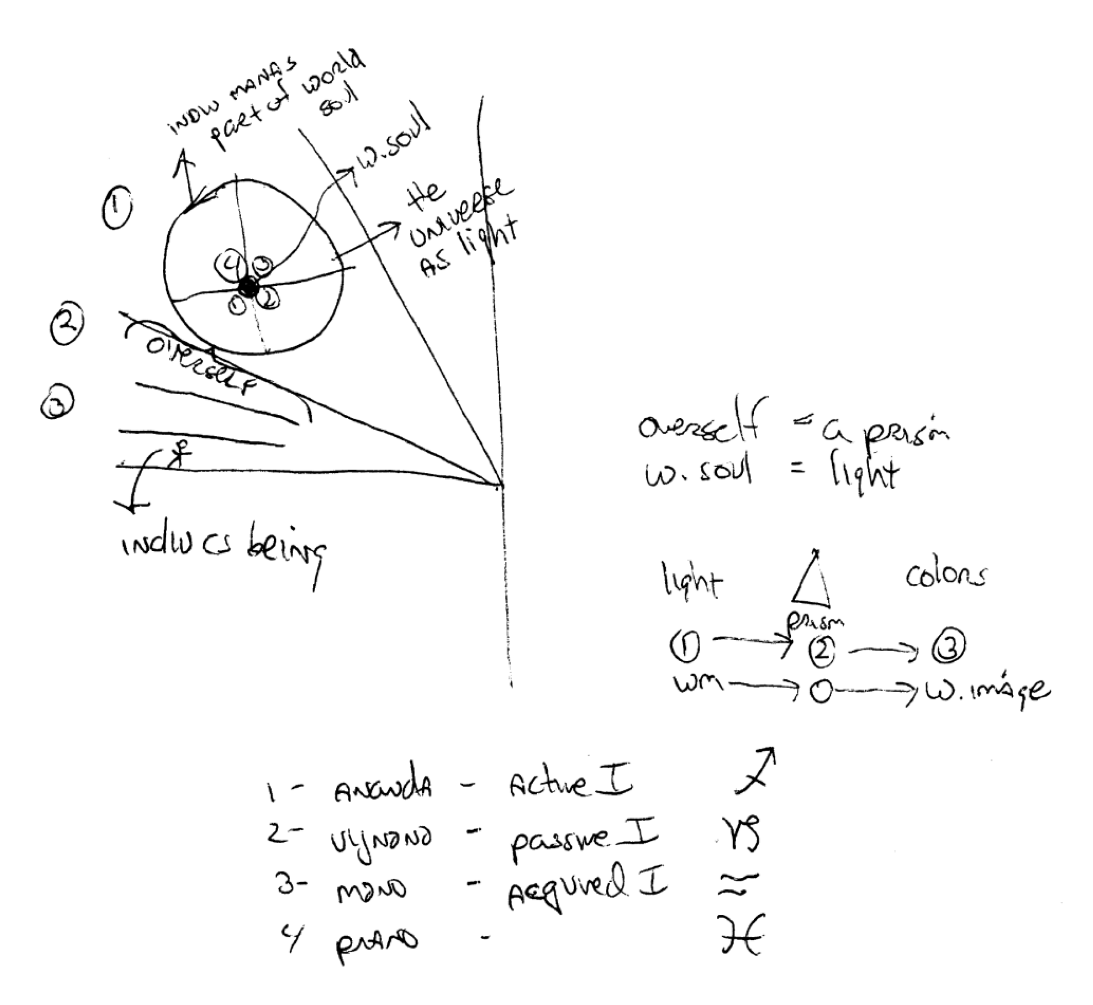
FIGURE 1979 0930-1-AB. World-Soul, Overself, Individual Conscious Being; Overself as Prism; Four Intellects.
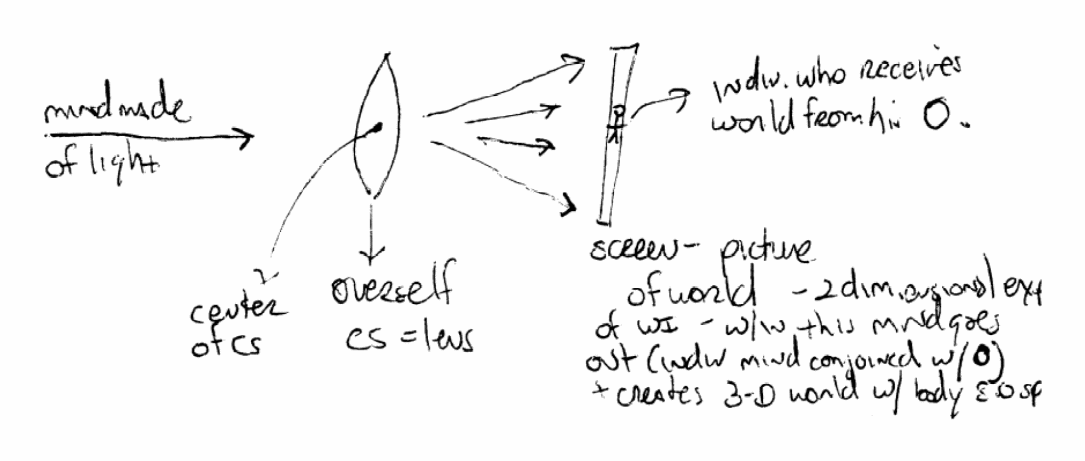
FIGURE 1979 0930-2-AB. Mind of Light, Overself, and World-Image.
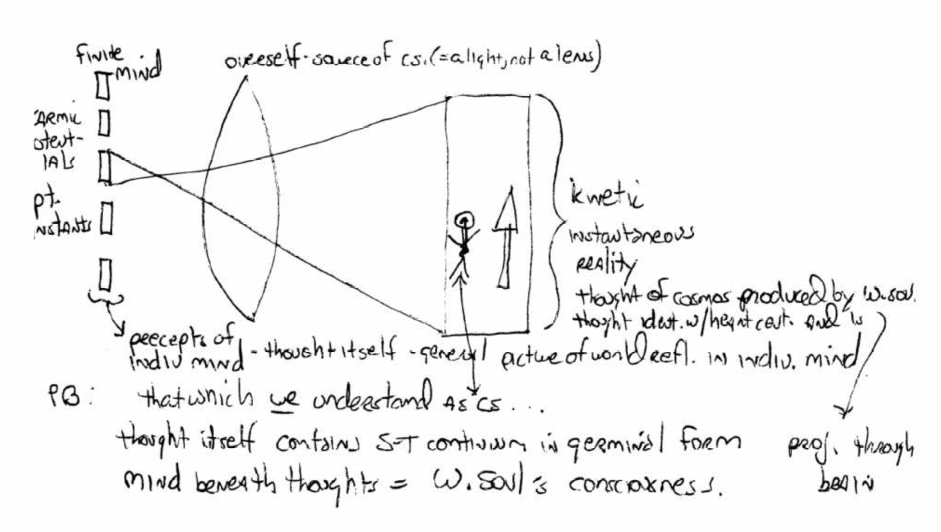
FIGURE 1979 0930-3-AB. Finite Mind, Overself, and World-Image.
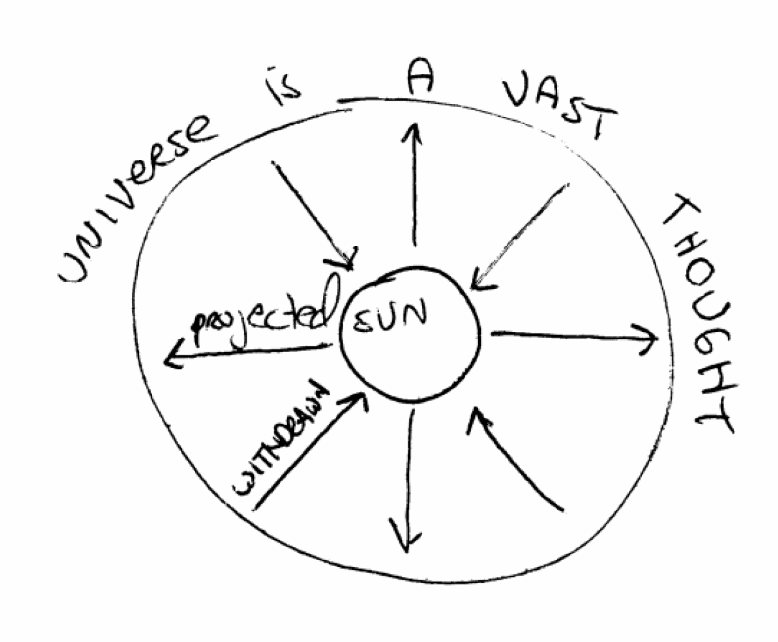
FIGURE 1979 0930-4-AB. Universe as Sun's Vast Thought.
Other diagrams referred to are not with this transcript version. [Transcriber note: [diagram] means the speaker is referencing a diagram as he or she is speaking. If someone is drawing or writing, with audible sounds of chalk on a blackboard, I indicate this by [drawing] or [writing].]
NOTE: Sunday night class, part of Wisdom series 1979-1980.
TRANSCRIBED Verbatim by IT 2019; reformatted by JRM & JF 2019-2020, with TOC/Subheads by JRM. In 2023, IT updates prefatory matter, footer, and audio file name, completes Book List, adds new notes within transcript, fixes errors/typos, adds four diagrams and references within transcript to these diagrams. In 2024, MW alters Subheads to make more accurate. Archival verbatim transcript – V14.1a.
AUDIO FILES: 1979 0930a, 1979 0930b, 1979 0930c. [Note: "Tape" and "Side" refer to original audio cassette tapes that were later digitized into .MP3 Audio Files.]
1979 09/30 at Wisdom's Goldenrod
PB Books; Wisdom of the Overself; "Birth of the Universe"
Archival Verbatim Transcript
[Audio File 1979 0930a Begins]
AD: Announcements.
SS: There are tickets left for that talk.
[tape break followed by laughter]
AD: Questions up to "The World As Our Idea". [15¼ second pause with shuffling about, faint background AD/student talking] Any questions? Yes?
S (faint): Well--
PHYSICAL BODY AS A CONTENT OF WAKEFUL CONSCIOUSNESS
AH: Well we were discussing one earlier today, perhaps inappropriate at this-- at this point but-- The whole idea of the position of the body in this discussion is confusing to me. Just-- the physical body specifically.
[few seconds of very faint background student talking]
AD (faint, possibly part of background): Absolutely.
AH: On the one hand, the body doesn't-- apparently does not have the same-- exactly the same as a-- situation as outer objects like trees and houses.
AD: Why not?
[short pause]
AH: Well cer-- somehow there's more to it than that. Like we talked about each body having a particular karma suitable for a particular incarnation and-- The notion of the body being mental. And on the other end, it certainly has more reality than our fantasies and our so-called mental life. [short pause] I was just very confused about the pos-- the place, the specific place of the physical body in terms of the last few discussions.
S: Isn't the body different from houses and other objects? [student assents] I mean you said it was different in a certain way. But it is.
AD (simultaneously): Well, the body, the body insofar that it's a content of wakeful consciousness [S: It's the house of the soul.] is the same as everything else as a content of wakeful consciousness. In that sense--
S: That-- in that sense it's the same as [AD, faint: Yeah.] any other object. However, isn't the body the vehic-- the house of the soul, the vehicle for the soul, the vehicle for the individual experience? So, it has to have a different meaning than that of the chair.
AD: Well, I wasn't speaking of it in that way, alright. The sameness that I'm referring to is that the moment prior to, if we use a temporal language, the moment prior to wakeful consciousness where everything is subtle consciousness, the mo-- in that moment there's a transition from a subtle consciousness to gross consciousness, there is the body as one of the physical constituents or one of the objects included in external perception as well as any other object known. And I'm speaking about them-- I'm speaking about it at that point being the same as everything else in external perception. I don't mean that the chair and the body of a person are equivalent ontologically speaking, I don't mean it that way, alright. So all we're trying to do is in the description-- in the description of the arisal of wakeful consciousness up to that point where when we spoke about the transformation of the wakeful consciousne-- I mean the dream consciousness into wakeful consciousness, right up to that point. And, at that instant when there is wakeful consciousness gets aroused, at that instant the body, like the chair, are both contents of wakeful consciousness. That's the only sense I meant. And that-- that was the discussion we were having about the fact that the heart center in which the cosmos deposits these influences and then they go up to the-- up through the psychic chakras, up to the brain chakra and then exfoliate as wakeful consciousness. [student assents, very faint] That it's at that point. I don't-- I don't want it to go any further than that. That was the discussion last night, I think what you-- It's a point that keeps coming up over and over again. [13 second pause] But outside of that perennial sore point which I think will go on for a while, could you spread yourself out over the other parts of the chapter?
[33 second pause]
IMAGE-MAKING FACULTY IS THE MIND MODALIZING ITSELF
S: Anthony?
AD: Yeah?
S: Friday night we were trying to get at the creative activity of the Overself and uh, I never really followed.
AD (simultaneously): No, you didn't get to that yet.
S: Oh they still haven't got there? Ok.
AD: I kept emphasizing the creative activity of the mind. [short pause] I don't think you'll find too much about the creative activity of the Overself in this chapter. Because--
S: The character of our creative power though.
AD: I'm sorry?
S: (But), on page-- the fourth paragraph of "The World As Our Idea," one, two, three, four. It-- the char-- it talks about the character of the individual creative power--
[Transcriber note: I am using The Wisdom of the Overself by Paul Brunton, Rider and Company, London, 1943.]
PB [The Wisdom of the Overself, "The Birth of the Universe," p. 41, S reading]: "…is only a semi-independent one. … It is the thinking of the World-Mind that is primarily responsible for the world."
[17¼ second pause]
AD: Well there again it-- I don't think it's referring to the Overself.
[short pause]
PB [The Wisdom of the Overself, "The Birth of the Universe," p. 41, AD reading]: "[AD adds: The] World-Mind thinks its ideas into our mind."
AD: And again the emphasis is on the creativity of the mind.
S: Greater than.
AD: Hm?
S: The emphasis on which mind?
AD: It's on the creativity of mind, that paragraph you just pointed out.
S: It's the creativity of--
AD: Of mind. Not the Overself. [12 second pause] Well in that case, since you understand this section--
LDS (simultaneously): Oh. I have a question.
AD: Yeah, go ahead.
LDS: On paragraph 45, I don't know if everybody's got them numbered, but a few sentences in, he speaks of--
PB [The Wisdom of the Overself, "The Birth of the Universe," p. 37, LDS reading]: "[For this] certain powers of the individual mind must come into play. [LDS: And he speaks of--] First, memory must tell us what it knows about the thing and [thus] classify it; second, reason must consider and judge it. But primarily it is the image-making faculty which handles the sensations, completes the work and presents us with a finished external thing and which supplies continuous and independent existence to that thing."
LDS: In that few sentences there, is he saying that this image-making faculty which presents the image logically prior to any kind of judgment or memory function, are the-- all these functions distinct and the image-making faculty be-- being prior? Or does he mean to imply that they're all included in the image-making faculty?
AD: I don't know that he means to establish any hierarchy or priorities as far as these various powers of your mind are-- are concerned. And I don't know how such a thing could be done.
LDS: Well insofar as sometimes you have the experience of-- of things in the-- in your experience that you don't recognize even though you have an image, [short pause] you know, and that seems to imply that the image-making faculty takes some kind of priority.
[short pause]
AD: Ok, suppose I grant you that, now would tell me what image-making it means?
LDS: What it means? Well it seems that this is an automatic process, in other words, the stimulus-- the stimulus provided by the karmic impression automatically calls into play the image-making faculty.
AD: What does that mean? What do you mean, image-making?
LDS: Image-make-- ok, the image-making takes place, if you want to localize it, from the brain center that he spoke of. It puts-- it extends this-- it spatializes and temporalizes this karmic impression for the individual. It brings-- you know, it brings to bear all the categories.
[16¼ second pause]
AD: Go on Louis, I still, you know--
[short pause]
LDS: Well I was just asking, from these sentences that I read, whether we could say that this image-making faculty in a sense [short pause] is prior to these other functions, it's-- you know, in some logical way, not necessarily--
AD (simultaneously): Well, yes, if you could tell me what image-making means.
S: Thinking.
AD: Thinking.
LDS: Well image-making, as I said, it would-- it would include the categories of extension, relation, external to the body, in most cases.
RG: Ok.
LDS: It gives something-- it gives that thing form, shape. But that's no guarantee that the thing is going to be recognized or-- or that any judgment would be made of it.
AD: Alright, granted. [13½ second pause] Could we say that by image-making faculty you mean the mind, the way it functions, the way it structuralizes itself, the way it modalizes itself?
LDS: Yes.
AD: And is the function of judgment or is memory also the way the mind modalizes itself?
LDS: Yes but--
AD: Well which are you going to give priority to?
LDS: Offhand I would just-- it would seem to me that fundamentally that the mind--
AD: Or is that what he means by image-making faculty?
LDS: Ok, that's what my question was, whether image-making faculty could include all of those. I guess basically that's what I was driving at. And if this--
AD (simultaneously): So then what we're actually saying is that image-making faculty means that the mind could modalize itself.
LDS: Yes. Any mode then that we speak of would be part and parcel of that image-making faculty.
AD: So in-- in a total way then, alright, image-making faculty means the mind's functioning.
LDS: Yes.
AD: Now, what would be the hierarch-- would the-- what would be the hierarchy of the various powers you speak about? He says that that would be the primary faculty. Like its al-- its generator, the World-Mind, that the image-making faculty is its prime-- it's-- this image-making faculty is its prime activity.
LDS: Yes.
AD: And consequently the mind of an individual, that will be its first characteristic too. But the point that we're trying to make clear to ourselves is by image-making faculty one doesn't necessarily have to conceive of pictures, you know. The mind could-- insofar that the mind is, let's say, acting in terms of judging or interpreting something, that too would be conceived of as an image-making faculty or mind functioning and structuralizing itself.
LDS (faint): Ok.
AD: But there again, there again, you see, he's talking about mind.
LDS: Yeah def-- I mean-- This is all about mind and-- using 'mind' here in a s-- in a subs-- a substantive sense. So it's the very substance of our experience.
[18 second pause]
THE OVERSELF AS A RECEIVER OF THE FORCES FROM THE COSMIC SOUL AND THE INDIVIDUAL MIND
AD: So-- Yeah? Yes Dave?
DB: Well this is a-- an unrelated question. We've spoken the last couple of days of the-- if you wanted to say what the experience that the Overself had was, it would be of the-- say the totality of the individual mind that it presided over, ok. Now, would it be possible to discuss the relationship between that and the-- well the intensification of the taijasa consciousness that is the waking state for the empirical personality or the consciousness?
[short pause]
AD: Try again, I didn't follow.
DB: Well, I guess it's-- it's paragraph 38 or the fourth paragraph in "The Birth of Individuals". We've gone ov-- we've gone over it a couple of times but-- number of times actually, but I don't really think I understand it, when he says (the/that)--
PB [The Wisdom of the Overself, "The Birth of the Universe," p. 35, DB reading]: "Although the World-Mind manifests both the individual and world together at the same moment, [DB reads: While the individual and the world manifest at the same moment] the individual is the centre around which the world revolves. [DB: He says--] [This is] partly [because] it is only when the world-image is felt to be his own conscious experience that it can assume any reality for him and partly because he is able to call himself"I" and exist as a separated self only through the setting up of an objective environment."
DB: Now, this last-- last sentence of the sit-- situation it seems to me refers to the waking state of consciousness that we're ordinarily familiar with, the empirical ego and his world of experience. And the problem I have is that when he speaks of the world-image being felt to be his own conscious experience, that I don't-- I don't understand how to relate the notion of the-- the Overself to this separated self.
[15¾ second pause]
AD: I thought I followed you until you said the last three or four words.
DB: I'm sorry?
AD: I thought I followed you till the last four words.
DB: Um-- What were the last four words? (laughter)
S: About the Overself.
S: About the Overself.
S (faint): Repeat what you said.
DB: Well, I mean, you couldn't-- you can't speak of conscious experience without the principle of the Overself.
AD: Yes.
DB: Ok. But at the same time, to equate the experience that the Overself has with the experience of the separated self living in an objective environment doesn't seem to be quite right.
AD: I don't understand this, in a sep-- Do you follow his question Avery?
DB: I mean this--
AS (simultaneously): I do until he brought-- brought in the Overself.
DB: I mean the separated self is the personality or the conscious being, and he experiences, you know, the world of three-dimensional objects and so on and so forth. And--
S (faint): More like [one/two words inaudible]
AS: Separated self by-- is taking it to mean here the bodily self, the bodily experiencer.
DB: Right, the personality, which (you/we) just did.
AS: That individual mind localized in a body center, [DB: Right.] functioning through it.
DB: Ok. But now, you couldn't speak of that individual mind being able to exist or have conscious experience without the association of the Overself. Right?
AS (simultaneously): Yeah. Yeah, yeah.
DB: So when we're s-- See, [AS simultaneously: Yeah.] I mean on the one hand we're speaking of this individual mind, this objective sheath, totality of-- we've spoken of the mind as an objective phenomenon, part of the fourth quadrant [diagram] and so forth. And then what does it mean to speak of that sheath as having objective experience or rather conscious experience? That's what I don't understand.
AS: Well I thought it was the way in which we spoke about these little thought-- you know, we had the little picture where it's not the Overself's consciousness that's known but it's that consciousness is reflected in each of these little seed-thought-- in each of these little seed-thoughts.
DB: Yeah.
AS: And that's what you speak about as this conscious experience.
DB: Whose?
AS (faint): I don't know what you mean 'whose'.
DB: Well you see that's-- I mean that's my problem. Because it would seem that the-- on the one hand the Overself would pervade the fourth quadrant and would, so to speak, be aware of the totality of the individual mind. Ok? Would that be so or--
S (faint): Oh yeah.
AS: I don't know where that comes-- we-- we had the picture where it was only-- only through that image being deposited in the Overself center or being associated with that light of consciousness [DB: Yes.] that there could be conscious experience because the-- that Overself was the intermediary. Right? So [DB simultaneously: Yeah.] it's true that that consciousness of the Overself is necessary for conscious being to have conscious experience. But that's not to say that that consciousness is what is experienced.
[short pause]
S (faint): That's true, I mean--
AS: Unless you're asking about who is ultimately experiencing.
DB: No I don't want-- well, I don't-- I don't really want to get into that, it's just that--
AS (faint): Well then what--
DB: So when he-- when he says that-- the "his own conscious experience" here, alright, I mean this--
PB [The Wisdom of the Overself, "The Birth of the Universe," p. 35, DB reading]: "…it is only when the world-image is felt to be his own conscious experience…"
DB: That 'his' refers to then, are you saying, the individual mind or-- Yes?
AS: Over here? Yeah I would say it refers to the individual in the previous sentence.
PB [The Wisdom of the Overself, "The Birth of the Universe," p. 35, AS reading]: "[Although] the World-Mind manifests both the individual and [AS adds: the] world together at the same moment, the individual is the centre around which the world revolves."
AD: Why don't we do this, why don't we just work that paragraph out all over again? Because I don't understand your question.
[few seconds of background student talking]
S: Which paragraph?
AS: 38.
S: 38.
[16¾ second pause]
AD: So we said the-- He says here that--
PB [The Wisdom of the Overself, "The Birth of the Universe," p. 35, AD reading]: "…the World-Mind manifests both the individual and [AD adds: the] world together at the same moment…"
[Note: See FIGURES 1979 0930-1-AB, World-Soul, Overself, Individual Conscious Being; Overself as Prism; Four Intellects, 1979 0930-2-AB, Mind of Light, Overself, and World-Image, and 1979 0930-3-AB, Finite Mind, Overself, and World-Image appended to this transcript for the following.]
AD: So, here we could think of the conscio-- the All-Soul and the individual mind functioning together, alright, and that the individual mind gets projected out of the All-Soul. Now, in that situation, the individual mind would not be experiencing the world nor would-- can you even speak of any sort of self-conscious experience. So he says now, in order for the world to be his experience, the individual has to be the center of this experience. Now how could the individual become the center of this experience? In other words, on one hand we're thinking of this situation where you have the [drawing] functioning of the cosmic soul and the World-Mind producing, let's say, cosmos. And, up to there we can't speak of any conscious being experiencing any world. So the next step would be that this world-image, this world-image [drawing] here, has to be made-- or has to be made-- has to be felt to be his world-image, alright. And how is this done? So, we spoke about [drawing] creature here [diagram] in which the influences of the cosmos go into the heart center and there they get projected out as the universe and at that instant he becomes conscious of himself and of the world, alright, and now this is his experience.
DB: Yeah.
AD: Ok? Now, some of the-- one of the presuppositions needed for it to be his experience is, as he says here, that there has to be a separation, a three term logic has to come into operation or into being.
AS (simultaneously): (Bodily.)
S (very faint): That's true.
AS: Seems to really be-- the body, as we said, seems to be one of the important conditions, prerequisites, of this whole-- for-- in fact this whole last part of the sentence.
PB [The Wisdom of the Overself, "The Birth of the Universe," p. 35, AS reading]: "…to call himself"I" and exist as a separated self [AS adds: it's] only through [the] setting up of an objective environment."
AS: And that seems to happen through the medium of a body. So you spoke of the outsideness or objectiveness of this experience, it's with reference to a body, [AD, faint: Right.] the bodily center. So the center seems to be a bodily center that we're speaking of.
AD: Yeah, so if we put the-- [drawing] if we put the human being here and we conceive of the-- the thinking processes which go from within the heart center and get projected outwardly as the world, alright, this bodily percipient naturally will be placed in contra-- contradistinction to the environment and now you have established, so to speak, the necessary hostility (bit of laughter) to experience a world. [short pause] I really can't see your question, I--
DB: Well, I guess the question is that, on one hand, you know, you speak of this-- this individual mind, let's say, being objectified in the twelfth house [diagram] with the particular body there. But there's no consciousness, there's no awareness, ok, it's just a-- it's a content within the World-Soul, alright. Now, the functioning of the Overself, insofar as it receives the-- the karmic forces of the World-Mind and brings them to the brain, that makes it possible to assume-- I mean, that makes possible the separate-- the notion of a separated self and conscious experience for the individual mind, ok. I mean is that right so far?
AD: Yeah.
DB: Ok. Now-- [short pause] So on the one hand, the Overself's experience, using the word loosely I guess, would be of the totality of the individual mind that he's associated with, alright.
AD: Instead use the term the individual's experience or the conscious being's experience.
DB: The Overself's experience-- the conscious being's experience would be-- Yeah, I guess that's my problem because the conscious being's experience-- I mean the personality's experience, is of three-dimensional objects and one thought following upon another.
[students assent, faint]
AH: Who said the personality's a conscious being?
AS: But that-- I think it goes with-- the 'conscious' there is like the way he s-- he uses later on when he says "that which we understand as consciousness". Right? I mean it's not--
DB (simultaneously): Yes. Oh yeah.
AS (simultaneously): When we say it's the c--
DB (simultaneously): No I mean it's not-- it's not absolute or pure consciousness over here.
S (faint): Right.
AS: And in that sense it's-- in that sense it's the empirical experience, it's [DB simultaneously: Right.] not the-- you're not having an experience of the Overself.
DB: No, of course not, I mean that's-- I mean I guess that's my question. Because the experience of the empirical individual is kind of-- it's tied up in the taijasa consciousness of the Sun, would be like an intensification of that into vaishvanara. Now that-- and that intensification is kind of made possible because of the ac-- the presence of the Overself in the heart center. Is that not so?
AD: The intensification is made possible because you have a bodily structure there, nucleated thoughts, you know.
S: Yes.
AD: Yeah.
DB: And because there's an Overself that's associated with that [AD: Yes.] nucleated structure.
AD: Yes, that's why we call it the Overself center.
DB: Ok. Well--
[9 second pause]
SD: David, is your question that in the-- the Overself's presence is what-- it seems to be a necessary factor in the intensification of this taijasa experience into the vaishvanara state, [student assents, faint] right? And yet the Overself itself-- why does it play that special role if its own experience is of the totality of that individual mind's functioning.
AD: I don't know [DB simultaneously: Well it--] what you mean. I don't know what you mean. The Overself's experience of the totality of mind's functioning? Tell me what you mean.
DB: Well, I mean insofar as--
AD: I mean there's no-- there's no Overself in this paragraph. There's nothing that he speaks about that would make you think that he's speaking about the Overself in that [S simultaneously, faint: That's right.] whole passage that you're referring to.
AS: The 'own' refers to the individual.
DB: No, I'm--
AS: His own experience [one word inaudible]
DB (simultaneously): See I'm-- well I'm using that-- that paragraph to ask a question that is based on something that we've spoken of the other night or perhaps I misunderstood what you said, you see. I mean I thought you'd said that the Overself's experience was of the-- the totality of the individual mind that it was associated with, that it would know what was going on there.
[short pause]
AS: Yeah but we're not talking about the Overself's experience, it says "his own experience".
DB: I know that.
AS: I would take it to be here the individual's experience.
DB: Yes but that--
AS: The individual conscious being's experience.
DB: Right.
AS: Which is not the same as the Overself's experience, if you could even speak about it as experience. But I-- I'm sorry.
DB: No I-- [AS simultaneously: I--] I mean I--
AS/S(?) (faint): It's ok.
DB: Well all I'm saying is that there's-- there's this individual mind, alright. Now, in the sense that it's a-- felt as being separate and then existing in a-- in an objective ex-- environment, it has conscious experience, ok, because of the presence of the Overself. Well maybe I'm asking a question that is just not possible to ask or it's not worth asking or something.
AS: But I still-- I just didn't get the question.
LR: What's the question David?
S (faint): Uh-hm.
DB: The question is, if we say-- what is the relationship between the Overself's experience of the totality of the individual mind and the individual mind-- and the individual mind's conscious experience of the objective environment that he lives in or the waking state of consciousness?
LR: What is the Over-- What is the beginning of that again please?
DB: What's the relationship? I don't understand it. I mean, because on the one hand the individual mind is functioning insofar as that the conscious being is totally dependent on the presence of the Overself. Ok? But I don't quite see how that (works).
AS: No that-- well I'll just take [one/two inaudible student words simultaneous with AS] a stab at-- and we'll see if I see what you're saying, I don't know. I think the only-- the first place that-- You know, you spoke about-- that first line you said, the Overself's experience of the totality of the individual mind's functioning. Is that what you said?
DB: Yeah.
AS: Well, I'm not sure what you mean by that but in the way we've been working just from this chapter, the first contact of what the individual mind produced was when that seed-thought got deposited in the Overself center. You know, we had that picture: the seed-thought passing into or reflecting off of it the light of the Overself consciousness.
DB: Right.
AS: Now, is that what you're speaking of as the Overself's experience of the totality of the individual mind's functioning?
DB: Um-- well, that would be a very specific part of it. I mean-- Say yeah, yes. I mean--
AS: But--
LR: That picture is really-- [AS: Yeah.] Is that picture up here?
AS: No.
S (simultaneously): Uh-hm.
LR: If that picture-- why don't you draw it, because that picture is right to--
AS (simultaneously): I thought that was-- I thought that happened-- that was what he was speaking about.
LR (simultaneously): I think that's right to David's point. Why don't you draw that picture?
AS: But I don't see what--
LR: Well there's a lot of people that couldn't see that.
AD: What picture? (laughter)
AS: The-- the one with the--
LR (simultaneously): Picture with the Overself light.
AS (simultaneously): The Overself light and these bu-- the [BS simultaneously: Square thoughts.] seed-thoughts which get [S simultaneously: (couple/three words inaudible) yeah.] deposited in [one/two words inaudible] [RG, faint: No not that.] deposited in the--
[few seconds of background student talking]
BS: Square thoughts [couple words inaudible]
LR (simultaneously): And each one of those squares is what was called the individual conscious being. You might want to put this on for him.
AS (faint, part of background): The one with the square.
LR (faint, part of background): That's the same one.
AS (faint, part of background): The one with the square.
BS (faint): [part of background] Yeah. [short pause while someone draws] Good.
AS: I think what you were asking was what is the relation between that deposit of those seed-thought in the Overself center and the consequent from there, blowing up of that seed-thought through the bodily center and so on as vaishvanara consciousness and its corresponding object.
DB: Yeah. I mean because on the one hand--
AS (simultaneously): Well that's it. The-- that seed-thought goes up through the bodily organ. (AS laughing) It's associated with the light of consciousness.
RG: Yeah, but that-- that can't be the only thing Avery.
AS: The only thing what?
RG: That can't be its only function.
AS: What's only function?
RG: Lighting it up.
AS: Yeah but-- I didn't think his question was what the function of that-- or activity-- 'cause that's the question we said we were going to leave out is--
RG: Right. Well I think that's his [AS simultaneously: But--] question there.
AS: Oh is it?
DB: Is it?
RG (simultaneously): I don't know.
DB: If it is then sorry, (student laughs) because I didn't mean to ask it there.
AD: If you-- [LR: No.] if you know what his question is, why don't you say it?
AH: I think--
S: Yeah.
AH: May I try and state it? (laughter)
S: Yeah.
AH: You're asking for the relationship between the expe-- the Overself's experience and our experience.
DB: That's it.
AD: I don't even know what you're talking about.
AH: I don't know either but that's what he asked. (bit of laughter) There-- like what's the relationship between the experience of the Overself and the experience of the empirical mind? Well I didn't know the Overself had any experience.
AS: That sentence [S: Well--] there, the Overself's [BS simultaneously: Well we don't know yet.] consciousness is a pure un-- sing-- undifferentiated one which is being-- which is like having no consciousness at all.
AD (faint): Yeah.
BS: Well, let's say that the--
AS: But, even here [diagram], this isn't pure Overself's experience, this is the subtle realm, this is an experience of the subtle realm, which means if you were to remain at that level, there would only be reflection on a subtle content and a subtle thought would be lit up. When that thought goes up through the bodily organism and comes out as the vaishvanara world with vaishvanara consciousness, that more gross type thought is what reflects the Overself's consciousness. In either case it's a thought which is being lit up and it's a thought which is the experience, and not the Overself's experience. [S simultaneously: Well--] So ei-- in either case the only relation between them is in one case the thought is subtle, in another case, the thought has been-- gone-- has gone through the bodily-- you know, the whole bodily apparatus and become projected as a threefold-- as a vaishvanara object. Right? I mean from the point of view of this paragraph anyway that's the relation between them. It's not a relation in terms of the Overself. It's a relation in terms of the seed-thought is subtle on one hand. On the other hand it goes through the bodily organism and it's blown up as the vaishvanara universe. It's a threefold epistemic relation.
RG: Ok, how do you tie that into the next paragraph?
AS: Ok, yeah. It's fine.
RG: Unless you want to look-- I mean is it, you know [three/few words inaudible]
AS (simultaneously): No--
PB [The Wisdom of the Overself, "The Birth of the Universe," p. 35, AS reading]: "It is [AS reads: It's] [consequently] from its own Overself that every individual receives the world-picture."
RG: Right.
AS: Right here [diagram]. Right? Unless that seed picture-- unless the forces are deposited in the Overself consciousness, unless a seed-thought is deposited there-- And there's the first place you can speak about a world-image, a world-picture. Unless it's first there, going through the bodily organism and up to the brain and so on will not give you a conscious experience. So that conscious being, the guy located in the body with his vaishvanara world, depends upon that seed-thought, his experience depends upon that seed-thought coming from its association with the Overself consciousness, depend-- it-- Then therefore it is from there that it receives the world-picture. [MW(?): Yeah.] Otherwise it won't be a conscious experience. And other things which we-- But you certainly need to bring in the Overself. I don't-- I'm not sure what your objection was unless you have (big objection).
RG: No, I didn't have any objection, I just--
AS: No I mean which part of that paragraph didn't-- doesn't make--
RG (simultaneously): Yeah, that part. I mean in the sense that it said-- [AS simultaneously: Why isn't that there?] I mean, we're keeping emphasizing the fact that it's the consciousness of the Overself that lights up the individual mind and the individual mind is this inert entity.
AS: Inert?
RG: I mean, you know, [AS simultaneously: I don't think it's inert.] it's not conscious until the Overself lights it up.
AS: In fact it's never-- well--
RG: We're going to-- it's constantly in motion, whatever [AS simultaneously: But--] you want to say. But, I mean, we're always-- I don't know, I'm-- the consciousness aspect is being emphasized and not the-- Well, then we get into the question that we want to leave out, taking it back to [couple words inaudible]
AS (simultaneously): Oh, oh, I see, what other-- what else is involved in that Overself.
RG (simultaneously): I mean, the fact that it says that every individual receives the world-picture. It's not saying and every individual receives the consciousness to perceive the world-picture or to manifest the world-picture. It says "receives the world-picture".
S: Yeah.
AS: Yes.
RG (simultaneously): So--
AS: Yeah, so I-- well-- I know what you're bringing in, I know what you're bringing in. And you think that's what David's question was?
RG: I think that's part of it, I mean, certain [one word inaudible]
AS: So you're trying to say that there's something else that the Overself is responsible for in making that seed-thought pass from a subtle condition to vaishvanara condition?
RG: Well, if we speak of it as-- you know, as located in the heart center, and that it's from there that the seed-thought breaks into space-time existence and goes up to the-- the brain, I mean that functioning, seems we're talking about that functioning.
AS: But then again, on the other hand, later on, you know, and later on in the chapter, when he speaks about all these functions of putting it into space, time, and the image-making faculty, and even the thoughts, the memories that come into play and all this stuff, he speaks about that all in terms of the-- the individual mind's functioning, [RG: Yeah.] not in terms of the Overself's functioning.
AD (simultaneously): In the whole chapter, the whole chapter, there is no creativity of the Overself [AS simultaneously: Yeah.] explained to us.
RG: But it seems to be--
AD: And I think that we have to go by that.
RG: But isn't it implied?
S (faint): Uh-hm.
AS: No but, why do you need--
AD (simultaneously): Implied, implied, what? What's implied?
AS (simultaneously): But Richard-- To transform the seed-thought, the subtle picture of the world [AD drawing] in the Overself center, into the vaishvanara image of the world that we have, why-- what else do you need to bring in?
S (faint): That's good.
S: Yeah.
AD: [drawing] All these forces impinge upon the Overself center [diagram]. This is the only point-- this is the only thing he has said that makes us say, "Well, that's creativity."
RG: No.
AD: That's the only point in the whole chapter. Well if-- look, go by the chapter, don't go by feelings about it.
RG (simultaneously): I still don't-- I'm not going by [one/two words inaudible]
AD (simultaneously): I mean pseudo-implications, the possibility that he's leaving things unsaid. The whole chapter, [AD hits board with chalk] the creativity of the Overself resides in the fact that it's an intake, alright, all the forces go into it. That's the only point he makes in the whole chapter. If you find something, let me know.
RC: Yeah. One [RG simultaneously: Alright.] passage on the World-Mind's picture in the right eye and the individual mind's subconsciously formulated in the-- in the left eye.
AS: That's the individual mind.
RG: That's the individual mind.
AD (simultaneously): Again, you're still talking [AS simultaneously: Yeah.] about mind, not Overself, [S simultaneously: That's true.] [RG: Wait a minute.] the creative-- the creative activity of the Overself.
AS: Wait, yeah.
RC: And then he says but the one which the individual actually becomes aware of is the final picture resulting from a fusion of both.
S: Yeah.
RC: And [S simultaneously: Wait Richard.] that seems that we're already talking here about something which has the power to fuse the contents of the individual mind and the World-Mind in a meaningful way [couple/three words inaudible]
[16½ second pause]
RG: I mean he says "the Overself affects the personality".
AD (intensely): I know he says that but that's not it, that's a one-liner, what else does he mean? (some laughter)
S: What?
RG (simultaneously): Well that's the quote. I mean yeah.
AD (simultaneously, intensely): Affects the per-- of course it affects the personality, take the Overself out and there's no [AS simultaneously, laughing: There's no person, there's no--] personality, no one knows anything.
S (simultaneously): Well exactly!
S: Yeah.
RG: Well-- (student laughs)
AS: But that we said already [RG simultaneously: But that's not--] Richard, that the conscious being certainly depends on that consciousness of the Overself but that really doesn't--
RG: He doesn't say the Overself-- I mean it--
AD/S(?) (faint): Yeah.
S (faint): Hold on.
RG: It affects the personality. It doesn't [AS simultaneously: Yeah.] really--
AD (simultaneously): Granted, granted.
RG: He's not saying it creates the personality or without it--
AS: But the personality is jada, is not conscious. The personality is part of the individual mind.
RG: Uh-hm.
AS: Yeah.
S: Right.
S: Yeah.
S (faint): Uh-hm, I see.
RG: I still don't know what it means that it's from its own Overself that every individual receives the world-picture.
AD (simultaneously, intensely): Neither do I. Neither do I, and I won't know until I get to the chapter on the Overself.
RG: Ok. Then--
AD: And I'm going to stop imagining that I know from this chapter.
RG: Fine. We won't talk about it. (bit of laughter)
JA: Could I-- It seems that one-- one thing that's implied there that-- is that the picture that the-- of the world that the individual receives is that it's a world around-- you know, of himself and a world around, you know, the world is revolving around an individual. You see, I mean the World-Mind doesn't create-- doesn't manifest an individual and the world in that way. I mean-- I mean if the individual is manifested along with the world it doesn't have an image of the world that is revolving around him, it's only from the Overself that he receives that mental picture. I mean that would seem to be the only thing that he said about the world-picture that was received (from/in) the Overself.
AD: Well, let's try-- let's try this way. Just a general restatement. We said the individual mind, the cosmic soul conjointly thinking, alright, produce the world, ok. There's no self-consciousness here spoken of, alright. We're just stating this-- this as a fact. Now, insofar that this individual creature [drawing] or bodily organism is fabricated by these two working conjointly, alright, we can't speak of a conscious being. Alright. Now, something has to happen, he says, over here, to the Over-- the Overself is what's going to have to gather these forces that are coming from the cosmic soul and the individual mind which is thinking these things, alright, thinking these things meaning the externally perceived world, not in a vaishvanara but as thought-constructs, alright. Now, the Overself has to gather those forces that are coming into it, alright, and convert them or be of a-- The-- the point is that the Overself seems to be significant in this way, that it is like um-- what could we call it, a-- a sounding board, you know, a rec-- a receiver for all these influences--
[Audio File 1979 0930a Ends]
[Audio File 1979 0930b Begins]
THE CREATIVITY OF THE MIND, NOT THE OVERSELF, IS WHAT PB IS EXPLAINING
S: This is [one word inaudible]
S (very faint): That's alright.
AD: Yeah.
RG: There is one more paragraph that they can refer to there.
AD: Please, I'll listen.
RG: It's the one two paragraphs before the-- the one "that which we understand as consciousness itself becomes possible only through…"
AD: That which we understand as consciousness?
RG: It's two paragraphs before that.
AD: Well read it, will you read it please?
RG: Alright.
PB [The Wisdom of the Overself, "The Birth of the Universe," p. 38, RG reading]: "In the earlier volume it was explained that all the constructive and unifying work which transformed the sensations into a conscious percept was the work of the mind itself. It was not advisable to enter more deeply into this tenet at the [RG reads: this] time as there is no surface consciousness of this work. All these processes occur beneath the threshold of our consciousness, so we do not realize that it is not all one mind which manipulates them. Now it is possible to see that the World-Mind as the Overself also is active in us."
AD: That the World-Mind, please--
PB [The Wisdom of the Overself, "The Birth of the Universe," p. 38, RG reading]: "…as the Overself…"
S: Yes.
AD (simultaneously): The World-- that the World-Mind has the Overself?
RG: As the Overself. That's what it says.
AS: Well, I'm trying to find it.
AD: We're trying to find it, [S simultaneously: Page 53.] alright, go ahead. (laughter, student words)
AS/S(?) (amidst laughter): Not in this [one/two words inaudible]
S (simultaneously, amidst laughter): [one word inaudible] there.
S (simultaneously, amidst laughter): Paragraph 53.
RG: The World-Mind as the Overself.
S: Paragraph 53.
S (simultaneously): Paragraph 53.
BS: What edition? What's the paragraph? Just want to find it.
LR: 52. (bit of laughter)
AD: Alright, go ahead Richard, the World-Mind as the Overself--
RG (simultaneously): "…World-Mind as the Overself also is active in us," which seems to imply that it's the O-- the Overself which does all this work of transforming the sensations into a conscious--
AD (simultaneously): Wait, wait, could you-- could you say-- end the quote? (bit of laughter)
S: Go ahead.
RG: Yeah, in quotes.
AS(?): [three words inaudible]
AD (simultaneously): "…that the World-Mind as [AD pronounces"as" like "has"] the Overself…"
RG (simultaneously): "…as the Overself [S simultaneously: As the Overself.] also is active in us," period, end quote.
AD (simultaneously): Is active in us.
RG: Right.
AD: End of quote.
RG: I mean, yeah.
AD: Now, go ahead.
RG: Ok, it just seems that sentence there is describing the three previous sentences which is talking about the deeper aspect of the transformation of the sensations into a conscious percept. I mean otherwise that sentence doesn't make any-- doesn't mean anything. Now it's [one word inaudible]
AD (simultaneously): Well, it does-- it doesn't mean anything yet to me but I'm listening.
RG (simultaneously): (Ok.) Well let's talk.
PB [The Wisdom of the Overself, "The Birth of the Universe," p. 38, RG reading]: "In the earlier volume it was explained that all the constructive and unifying work which transformed the sensations into a conscious percept was the work of the mind itself. [AD: Uh-hm.] It was not advisable to enter more deeply into this [tenet] at the time as there is no surface consciousness of this work. All these processes occur beneath the threshold of our consciousness, so we do not realize that it is not all one mind which manipulates them. Now it is possible to see that the World-Mind as the Overself also is active in us."
[short pause]
AD: Well that might be very revealing although I don't know what it's revealing. But, I still don't see-- I still don't see the creativity that you are going to imply to it.
RG: Well he seems to be talking about constructive and unifying work which transforms the sensations into the conscious percept. I mean it seems to be saying that it's the Overself that does that. That it-- that's the deeper a--
AD (simultaneously): I don't know, in the face of the chapter, in the face of all that he says in the chapter here that you say now it's the Overself that does that? Can-- can I stop you for an instant then and start quoting all that the mind does, ok, starting at the beginni--
RG (simultaneously): Well the question is-- no what-- You can quote all that the mind does, the question is what is meant by mind. Is it meant to be a totally distinct concept from Overself in this chapter?
S (very faint): Yeah.
AD: Absolutely. [AS: Right.] But that's my opinion.
AS: See, Richard, I could read the paragraph just a little differently [couple/three words inaudible] (laughter)
RG (amidst laughter): I'm sure you can.
AS: But I'm sure you've read it that way too. Like he's first describing, he says, all this is the work of the mind itself. And it was not advisable to enter more deeply into this tenet, ok, in other words, it was not advisable to enter into the Overself at the time.
JC: Yeah, right.
RG: Right.
AS: Right? Same here.
PB [The Wisdom of the Overself, "The Birth of the Universe," p. 38, AS reading]: "All these processes occur beneath the threshold of our consciousness [AS reads: conscious]…"
AS: Ok, same thing, the individual mind. But--
PB [The Wisdom of the Overself, "The Birth of the Universe," p. 38, AS reading]: "Now it is possible to see that the World-Mind as the Overself also [AS emphasis] is active in us [AS reads: it]."
S (very faint): I don't follow.
AS (simultaneously): But he's not going to s-- he's not going to talk about that now.
RG(?) (faint): Oh, I see.
AS: Look, in the earlier volume all these things are unifying work of the individual mind, ok? Now this is-- not the World-Mind, of the individual mind. So that's not ascribable to the World-Mind, what he spoke about in the Hidden Teaching there, ok, it's-- or even if it is you say it's mind.
RG (simultaneously): Sure it is.
AS: It's mind. Oh, no, wait a second though.
RG: In the sense that he talked about it in the Hidden [AS simultaneously: Only--] Teaching it is, [AS: Only--] about the super-- the super-individual factor.
AS (simultaneously): Oh, oh, that part. Oh the super-individual factor. Sure, ok. But all I'm trying to say is here when he talks about these processes which transform and so on--
PB [The Wisdom of the Overself, "The Birth of the Universe," p. 38, AS reading]: "All these processes occur beneath the threshold of our consciousness, so [AS reads: and] we do not realize that [AS reads: it] is not all one mind which manipulates them."
RG (simultaneously): "We do not realize it is all one mind which manipulates them."
AD: Well what would that [AS simultaneously: Fine.] mean, we realize that it's not all one mind that manipulates them? We realize (it's/there's) two minds. [AS simultaneously: That's it's all in the individual mind.] There's two minds, the individual mind, the cosmic soul.
RG: Ok. And that-- then what does that next sentence mean?
PB [The Wisdom of the Overself, "The Birth of the Universe," p. 38, RG reading]: "Now it is possible to see that the World-Mind as the Overself also is active in us."
RG: If that doesn't refer to the previous couple of sentences, what does it refer to?
AD: Well, you'd have to explain to me because I don't understand that, [RG: Well--] "…the World-Mind as [AD pronounces"as" like "has"] the Overself…"
RG: Well, what does this sentence mean?
S (simultaneously): No, as the Overself.
S (simultaneously with RG and S): As.
S: As.
RG/S(?) (simultaneously): I don't know what it means.
LR(?) (simultaneously): Well the way he says it.
S (simultaneously): As. (laughter, student words)
S (amidst laughter): Maybe that's not [one word inaudible] yet.
S: Uh-hm.
[couple seconds of background student talking, laughter]
AD (trying to pronounce correctly): "…the World-Mind as [AD pronounces"as" like "has"] the Overself…" (laughter)
SS: We've gone through this before too. (laughter)
AD: You gotta-- Richard, you gotta tell me what that means, I don't know.
RG: Um--
AD: Is he saying there that the World-Mind is the Overself?
RG: "…the World-Mind as…" a-s, "…as the Overself…" that's what he--
AD (simultaneously): Yeah, tell me what it means!
S: No, no.
RG: "…also is active in us." What I think it means is that he's referring-- I think this is referring to the creative activity of the Overself from which the world-picture arises.
AD: Alright, now suppose I [AS simultaneously: What's that?] grant you that the World-Mind is reflected in the Overself and this is where the picture arises from, ok, which by the way is the same as what we did over here [diagram], right? Same thing.
RG: Right.
AD: This is the World-Mind or cosmic soul [diagram].
RG: Right.
AD: The production-- We're within that production, and the forces of the cosmic soul or the World-Mind is acting on the Overself or through the intermediary of the Overself, and deposits, so to speak, the image of the world.
RG: Ok.
AD: I still don't-- I still don't see the point you're making about its creativity.
RG: Then-- well, that's the point, is--
AD (simultaneously): Yeah, well tell me the point! I don't see it!!
BS: Are you saying that--
RG: You're saying--
AD (intensely): I'm saying that he has not explained the creativity of the Overself in that whole chapter, that what he has explained is the creativity of mind.
BS: You're talking about a convergence of cosmic forces at a point that's called the Overself but is not creative?
AD: I'm saying that's the only thing he speaks about as the creative activity of the Overself. And even that's not amplified, that's left hanging in limbo. Now if you could tell me what that creative activity of the Overself is in that chapter, I'll listen to you Richard. And I'll mention in regard to that, that all he speaks about there is the creative activity of the mind and just drops in the sentence about the creative activity of the Overself but doesn't tell me anything about it. And he won't until the chapter on the Overself.
S: Ok.
RG: So we'll leave it till then.
AD: I've been suggesting that for a long time. (bit of laughter) I've been suggesting that we don't wear seven-league boots, that we go along with the text.
RG: Well, it just so happens that--
AD (simultaneously): And we stop-- stop anticipating, you know, that what you're reading and your interpretation is correct.
RG (faint): Alright.
AD: Oh no, no, of course not, we don't do that.
RG: I'm not saying I know what it means, I'm asking you what it means.
AD (simultaneously, intensely): We-- we all get to the-- we all get to the correct meaning, not to the assumed meaning, we all run right to the correct meaning immediately, as soon as we open a text. Correct!?
RG: Immediately.
AD: I know. [short pause] Come on, let's keep going Richard, good, let's (laughter) get them aroused and angry or something for heaven's.
RG/S(?) (amidst laughter): So you're angry.
RG: You got to get some energy, you know. (RG laughs, some laughter)
OUR MIND IS CREATIVE BECAUSE IT BRINGS THE THING INTO EXISTENCE FOR US
AD: Go ahead Michael, come on.
MW: A lot of these sentences, the passages we've read about the creativity of mind, like when he speaks about the powers of the individual minds come into play, the image-making faculty handles the sensations.
AD: Yeah.
MW: I always get confused as to whether he's speaking about the individual mind functioning with the cosmic soul in producing what we call the image of the cosmos that has that body in it or whether he's speaking about the activity of magnifying that seed picture and blowing it up into the-- the individual's world.
AD: Repeat, Michael, just the last part. The question, repeat the question.
MW: Is thi-- is it-- is he-- is the creativity of mind primarily the thinking along with the cosmic soul or is it the thinking that is producing--
AD: But isn't the creativity of mind insofar that it puts and brings something into existence, isn't that creativity? What would you call creativity?
MW: [one/two words inaudible] that's the creativity.
AD (simultaneously): That's what he says, that-- he actually points out, he says the mind is what supplies continuous existence to that, to anything in your experience. Could you think of something more creative?
MW: But wait. But when you say "in your experience", then I don't know again whether you mean-- See in one case it seems you're speaking about the individual's experience of a world, that three-d relationship. You know, you have a particular world that you're in.
AD (simultaneously): Look, Michael, Michael, let's repeat the quotation.
PB [The Wisdom of the Overself, "The Birth of the Universe," p. 37, AD reading]: "[But] primarily it is the image-making faculty which handles the sensations, completes the work and presents us with a finished external thing and which supplies continuous and independent existence to that thing [AD emphasis]. It is this imaginative activity of the mind which is the basis of all our sense-experience…"
AD: Now, I mean, we're speaking about creativity, could you think of something more creative than that-- that function of the mind which brings into manifestation, into existence our so-called experienced world?
MW: But can I persist?
AD: Yeah.
MW: Is the-- is it bringing into existence the thing or is it bringing into our awareness the waking consciousness of the thing? Because--
[short pause]
AD: Again, again, let's read it. Let's read it, alright?
MW (faint): Ok. I'm--
AD: Because I see what you're trying to do, alright. You're trying to say, "Well look, the mind doesn't fabricate the universe. It only fabricates it for us," as though that's insignificant.
MW: Well maybe it's not insignificant, but is he saying that?
AD: Is he saying what?
MW: That it only fabricates it for us.
AD: Well he says that enough times, doesn't he?
MW: But is-- is that--
AD (simultaneously): But he starts off by-- he starts off by saying that, doesn't he? The very next--
MW: What, you mean the mind creates the thing only for our self?
PB [The Wisdom of the Overself, "The Birth of the Universe," p. 40, AD reading (simultaneous with MW above)]: "But our mind does not create the thing for anyone else: it only creates it for our self."
AD: Well isn't that kind of significant? I mean [MW simultaneously: Well--] suppose there is this universe that the cosmic soul creates, alright. But there's only one way we'll get to ever know it, because we said that's a thought-structure. Our mind has to bring it into existence for us.
MW: Ok, I just want to know if that's what he's speaking about or whether he's speaking about that activity [AD simultaneously: Well, I thought that's what--] of-- of actualizing-- of actually producing the cosmos.
AD (simultaneously): Of making the universe.
MW: Yes, because what do we mean--
AD (simultaneously): But we said the cosmic soul does that.
MW: But we also say the individual thinks along with it.
AD (simultaneously): In conjunction with individual mind, yeah.
MW: But when does he speak about that act of the--
AD (simultaneously): But who do you want to give the credit to? [S: Yeah.] Individual mind, right?
S (faint): Right.
MW: I'm not talking about credit, I just want to know what the activity of thinking along with the World-Soul means. When does-- when does PB speak about that?
AD (simultaneously): Well you remember we spoke about this yesterday or the day before, we pointed out that if you have a triggering off or an excitation of so-called karmic impressions in the World-Mind, that means that the World-Mind or cosmic soul is re-collecting. Insofar that it is re-collecting, that is, it is evoking from within the substance of its own mind or taijasa consciousness, it's evoking the experience of objects which existed in the past and now lapse, and that lapsing is now being recalled. The individual mind has to conform to that, so to speak, the re-collection that the cosmic soul is working with. You remember we spoke about that?
MW (simultaneously): Yes.
AD: This is what we mean when we said that the World-Mind reflects in the individual mind a general picture of the world. Ok?
MW: Now is that activity-- that-- that doesn't seem to be the activity of what he calls like supplying the space-time form of the object.
AD: Uh-- [short pause] Well again you have to be [MW: Yeah.] more specific.
MW: That activity when-- when the-- when the cosmic soul is projecting the universe, ok, and it's on the basis of its-- of its previous activity that's been-- is now a memory, ok. Now s-- as the World-Soul functions we're saying the individual mind is also stimulated into activity. Something like that?
AD: Yeah, alright.
MW: Now, what is produced by that activity is what we're calling this-- the-- the world in a subtle state of manifestation, right? And the [AD simultaneously: Uh-hm.] empirical individual as of yet does not [AD simultaneously: Operative.] have any experience of it.
AD: Yeah, it's not operative, yeah, for him.
MW: So it's hard to speak about that as being an activity that is supplying the space-time existence of the object, the sensible qualities, all that is hard to describe as-- It's hard-- it's hard to understand what that activity is because we only understand the object after the individual, the empirical individual has produced its conscious experience.
AD: Well, Michael, will you get to the point and-- and not to the difficulties.
MW: The point-- I'm trying to understand all these passages where he speaks about the creativity of mind, to me it seems to be speaking about the empirical [AD simultaneously: It--] individual's experience of the cosmos.
AD (simultaneously): It varies, it varies. Sometimes the-- the creativity of mind is the individual mind functioning conjoined with the World-Mind and producing the objects because if that wasn't so then the individual mind would never recognize the object. As we pointed out, there there's an existential and formal identity with the object. At-- at other times we speaking about the individual mind and it refers to the empirical mind that has the experience of the world in the three term-- the three term way. And there again [MW simultaneously: Well, if we--] it's the individual mind but this time it's empirical. It depends on the context he's using.
MW (simultaneously): Well can we go [S simultaneously: Exactly. Context.] through some of these and actually see what the context is?
AD (simultaneously): But no, we went over it! [MW simultaneously: Actually--] I want to-- I want to finish the chapter now. I don't want to go over this no more, I want questions. Do your homework.
MW: We always skip (while/well) there's a lot (more we) didn't say.
AD (simultaneously): Oh no, we didn't skip any of this, I went through this for a month now. I've been hammering away at this for a month. I didn't skip anything. If-- I would say the contrary. I went into a little more detail than necessary. Go ahead.
LDS: Could I pick up a little bit on what Mike was talking about earlier (I think).
AD: Go right ahead. (bit of laughter)
MW: Better have a question Louis.
LDS: I--
RG: Make it a question. (some laughter)
LDS: It's always a statement [couple/three words inaudible] I think what Michael was asking or trying to elaborate was the fact that the-- the projection of the World-Soul is not this corporealized externalized object that we--
AD (simultaneously): The projection of the World-Soul and the individual mind, we made very clear, is a thought-structure, can only be a thought-structure, nothing else, because the only product is thinking. Go on.
LDS: Ok, so I guess the point was that the individual mind does indeed, I mean the total individual mind not just the empirical usage, but the individual mind indeed is creative in the full sense of this term in that it provides this extension, space, time, all the-- all the qualities of the object. Even-- even, you know, as we said, that it's in conjunction with the World-Soul's projection but the individual mind does contribute all these things, you know, the space, the time and all these other categories, you know, so it does have a-- a real power of its own. And it seemed like Michael was asking whether the object that the projection of the World-Soul was giving us was in some sense objective, you know, in the same sense as typical experience.
[short pause]
AH: Objective to what Louis?
LDS: Well, that's the point, I mean it-- it doesn't seem as though there-- the category of objectivity would make any sense there.
[short pause]
AD: Yeah. You take it Avery. I'm going inside and have coffee, real coffee. (some laughter) I can't do this. I don't know what's going on here.
S (faint): Bad transit.
S: Bad transit(s).
AD: I don't have any bad transits.
MW: You've got good transit(s).
S (faint): Oh yeah.
S: Got Jupiter in the (seventh).
AS (faint): Maybe our transits are bad. (laughter, student words)
MW: You never ask good questions.
AS: Well Michael, you want to pursue it or-- [S: What?] I mean--
S (simultaneously): Right (Andy/Randy)?
AS: I'm not--
AD (simultaneously, intensely): I want questions that are thought out. I don't want anxieties! I don't want your misunderstandings! We've been working on this for three weeks, I want questions!!
AS: Richard, did you have a question?
RG: I better not ask it. (some laughter)
AS: No more questions.
SD: I have a question.
S: I got mine but--
S: Hm?
SS: Severin, right.
SD (faint): I have a good one.
AS: Severin has a question.
SD: Yeah, um, what we have in the twelfth house there-- I just want to see about something in the diagram the way it stands now 'cause-- well if we want-- yeah, the one behind you there, with the individual with the heart center there. Now, the-- the subtle thought, the-- the seed-thought which is in the-- is in that heart center in a taijasa state--
AS: Yeah.
SD: Is that the same as what we were earlier, you know like, let's say I'm about to go referrings to the-- as the two-dimensional experience of just the Witness and the content, the thought before it gets blown up into a three-dimensional experience?
AS: I would say it's equivalent to that two-dimensional experience.
SD (simultaneously): Ok, 'cause we had before been indicating that that was-- I mean we put it differently on the chart, we had that in the eleventh I think, and we had the fully blown external experience in the twelfth.
AS: Um, fully blown? No.
SD (simultaneously): Is it that we're now considering them both as different aspects of the twelfth?
AS: Yeah, I would say whenever you speak about an image you're speaking in the twelfth, even if it's a two-dimensional image.
SD: Even that.
AS: Even if it's a subtle.
SD: So that [S simultaneously: (Uh-hm.)] would be like-- its germinal breaking into the twelfth house would be in that state, as a two-dimensional Witness experience.
AS (simultaneously): Yeah I think it would still be there because I think when he speaks about three-dimensional he brings in this notion of a separated s-- you know-- To speak about a three term epistemic relation you seem to need to bring in this notion of a separated self, there's an-- [SD simultaneously: I agree.] a-- an angs-- a-- a subje-- an apparent subject and an object and a relation between them. Now at the subtle level in the heart it doesn't seem like you would have that threefold relation of a s-- of a subject and an object and a relation.
SD: Ok, and then--
AS: But I'm-- the way (we/you) were speaking of it.
SD: And that-- that eleventh house [diagram], ok-- I mean it seems to me that-- I may be wrong but, what's up there as the eleventh house seems to be what used to be the tenth. And what's up there as the twelfth seems to be what used to be both the eleventh and the twelfth, I'm just wondering if I made a mistake on this. But that-- isn't that like the-- [students assent, faint] the Universe in the Mind of the Demiurgus there that we have?
AS (simultaneously): Or [one word inaudible]
RC: Yeah put a couple more houses up there.
AS: Couple more houses.
S (faint): [one word inaudible]
S: [couple words inaudible]
S (faint): Then you'll [AS simultaneously: The thirteenth house.] only [one/two words inaudible] by thirteenth.
S (faint): [one/two words inaudible] people too.
AS: Oh, oh, a couple more hou-- oh I-- Go on, uh-- couple more.
SD (simultaneously): I mean, is what's up there as the-- that vesica [diagram] there now what we used to call the Universe in the Mind of the Demiurgus, that world as thought by the World-Soul?
AS: No, you see-- As thought by the World-Soul it's-- you could-- it is thi-- this thing-- [drawing] the twelfth house here does have an existence provided by the World-Soul's thinking. If not, then when you try and locate now the individual center within that world, you know, his individual heart center where he's receiving these forces, there would be-- you wouldn't be able to speak of it. That first has to be given existence by the World-Soul functioning together with the World-Mind. Then you can speak about the individual(--/.) Once that presupposition is laid--
SD (simultaneously): Yeah but-- I mean the difference is that in the twelfth house there's not only that existence which is provided implicitly by what came before but there's also an overlay of individual image-making and spatialization and all the peculiarly individual things that happen there. I mean that's what sets it apart from the other. Isn't it?
AS: That's what sets it apart from [one word inaudible]
SD (simultaneously): From what comes before, I mean--
AS: From the two-fold.
SD: Yeah, right. Ok, and that's in the twelfth house. But what's up there now as that-- that eleventh house there, isn't-- I mean that's just purely the world as the World-Soul has created it, right? Well I mean together with the individual soul, but it seems that-- the individual mind rather.
AS: Well, I don't know, can you pictorially say that the World-Soul's [drawing/writing] functioning and the individual mind's functioning, the individual mind in fact, is this eleventh house, you know, the four intellects and so on, the objective sheaths, the whole ma-- the whole functioning of the mind is the eleventh house. And if you say it gives existence to what we call the world-thought or, you know, the subtle world-thought, the entirety of the a-- whatever you want to call it, the universal thought which the World-Soul gives existence to, that that is the twelfth house? That these are just the obverse side [drawing] of the same thing? I mean this has an existence, this is the product of the individual-- The individual mind and the World-Soul function together. What is the product of that? Isn't it this whole twelfth house as an existent-- as an existent system of sheaths?
SD (simultaneously): Oh yeah, sure. Well, but there's a distinction between the process and the-- and the product.
AS: But only-- I mean--
AD: Well, let me put it to you this way. Over here, [AS simultaneously: But this--] over here [drawing] when you experience the mahabhutic world [diagram], alright, isn't that an experience of the psyche and nothing but the psyche?
SD: Yes, but it lacks-- There's-- there's still definite differences. I mean there's certainly similarities.
AS: Between--
SD: Between that experience of this-- but it-- what do you mean by psyche there? You're not talking about a purely (individual--)
AD (simultaneously): Well what do you experience [AS simultaneously: Sure. Mind's functioning.] immediately? What do you-- what do you have experience of immediately, all the time? Mind.
SD: Yeah, ok but-- but the word 'mind' there has a dual sense. In the sense that it's purely--
AD: It has a dual sense? Tell me what the dual sense are.
SD (simultaneously): Well in a sense that it's-- it's an individual mind, that's why we would diagram it there as the twelfth house.
AD: Well, it's an individual mind and then what the individual mind experiences, the contents of that--
SD: Are provided by a cosmic mind.
AD: Yeah, but the contents of that individual mind that is experiencing the world are mental too.
SD: Yes.
S (faint): [couple/few words inaudible]
AD: So then what you experience all the time is mind. Alright.
SD: Yeah.
AD: So, what's wrong with it?
SD: Well, I'm not saying anything's wrong with it, I'm just trying to understand in what way the diagram's a little bit different.
AD (simultaneously): But why-- use the analogy I use, which would be easier. Think of the tenth and the eleventh house as light, alright, and that in this light, alright, the whole of the universe is contained. And that as this light projects outwardly, alright, it becomes the twelfth house world. Alright, that's-- that's a pretty definitive way of looking at it.
SD: But in--
AD: Ten and eleven--light; twelfth--sensible world.
SD: But in becoming that twelfth house world there seems to be a two stage process by which it does so. First it becomes those-- that experience in the heart of the karmic seed-thoughts, and then it gets blown out into a three-dimensional world.
AD (faint): Yeah.
SD: Ok, so I mean both those are implied in what we'd now call twelfth house.
AD: Yeah, but they-- they are-- they are a unity. You see, you're-- the distinction we have to keep in mind is that what we call the physical object is the transformation through our-- through the consciousness and the-- and the mental activity that goes on. That subtle mental activity is transformed into what we call a gross with a gross content. And they're both simultaneously in the twelfth house.
SD: If they're-- if they're a unity, and I certainly see a continuity between them, then what I don't understand really is how that-- how that subtle thought--
AD (simultaneously): Well (that--/then) if there's a unity, I mean, what do you mean if? The whole purpose of the Hidden Teaching is to show you that all that you experience are your own thoughts. What do you mean if there is a unity?
SD (simultaneously): Well, it's just that I also see-- I mean I see a big difference between them too. And not a separation but a clear distinction be--
AD (simultaneously): What was the difference that we saw that you're referring to?
SD: Well, the difference is that on the one hand in the heart, this entire experience is seen in--
AD (simultaneously): Isn't the difference the same [S simultaneously: Dream.] thing-- the same thing that he says, I have thoughts of the chair and the chair? Isn't this the difference you're talking about?
SD: No I don't think so, because--
AD (simultaneously): Yeah.
SD (simultaneously): Because [AS simultaneously: It's really not a problem.] what I-- the difference that I see is a difference of-- of the subject's identification on the one hand with a body very localized, and on the other hand the subject's experience of-- of his-- of the contents of his mind as a whole.
AD: Could you be more clear?
SD: Well, again I may be misunderstanding what-- what that experience in the heart center is but--
AD (simultaneously): Well just think of it as subtle knowledge, alright, just like when you go to sleep and have a dream. It's subtle.
SD: Well-- ok let me ask further. In the dream there's still a distinction between subject and object, there's still some kind of a threefold experience. Is that what's im-- are you implying that or are you saying something else when you say it's a dreamlike experience?
AD: Well naturally I'm saying that from the point of view of wakefulness you're looking at the dream and you see that it's not threefold. Never was.
SD: Oh ok. So in other words if-- that experience in the heart then is really still-- it's a--
AD: It is subtle.
SD: But how does that vary, how does that differ from what-- what's produced in--
AD: Avery, is-- I'm sorry, isn't the point that (he) trying to get to is that you can't reconcile the so-called subtle center-- subtle knowledge in the center here [diagram] and the wakeful consciousness, isn't that the point you're getting to?
SD: No it's not that I'm try-- that I can't reconcile them. It's just that--
AD (simultaneously): Well you reconcile them for me now, go ahead. (bit of laughter)
MW (faint): He just did, that's not fair.
SD: Well, from what we've been saying, that wakeful experience is partly produced by simply an intensification of what is experienced in the heart and partly through an identification with one portion of that experience, the body, and calling that an "I". That it's-- it's the same content except that it's been through that intensification magnified.
AD (simultaneously): Does-- does this help you reconcile and bring together into a unity the notion of things and thoughts are being-- are the same, what you just gave me as an explanation?
SD: Well I'm not sure that that's my question, I-- And I'm not sure that's what I'm trying to reconcile. I guess what I rea-- really want to know is it-- what is the difference between what's happening in that-- that eleventh house there, between that production of the world simultaneously by the individual mind assisting the-- the World-Soul, and what's experienced in that heart center?
[short pause]
AS: What's the difference?
SD: Yeah, how do they differ from each other? There's that world that's produced and it's-- it's a totality. And as far as I know in that heart center there still hasn't been that breaking down into a-- a three--
AD (simultaneously): Well thinking isn't exactly the same as thought.
SD: Yes.
AD: Well, there's thinking going on in the eleventh house. What's in the twelfth house is thought.
[short pause]
SD: And that's the only distinction between them?
AD: Only?
SD: Well it's a big--
AD (simultaneously): Yeah, you're going to capitalize it for me too, right?
SD: Alright. I guess that answered my question.
S (faint): Yeah.
AD: We didn't have a question yet.
LR: "Nature is our own idea"--what does that mean? (some laughter)
AS: Pretty specific.
RG (laughing): (Bad) question.
LR/S(?) (faint): That's a question.
AS: Where is that from?
S: Paragraph 70.
RG: Yeah?
AS: 70?
AD: "Nature is simply another name for the handiwork of the World-Mind"?
LR: No.
AD: No?
LR: "Nature is our own idea." Paragraph 70.
AD (faint): The paragraph 70 [one/two words inaudible]
LR: I don't have the same pages as you do.
S: 70.
BS: Page 70.
S: Page--
BS: Page 70, paragraph 70. I guess.
S (faint): Paragraph--
[short pause]
BS: I (have/got) paragraph 71.
AD/S(?) (faint): Yes (you do).
LR: Probably the same one.
MW: The one near the end?
AS: How does it begin Mike?
LR: Ok.
PB [The Wisdom of the Overself, "The Birth of the Universe," pp. 42-43, LR reading]: "But whatever be the origin of our experience, the fact remains that we are conscious only of our own ideas, and that our perceptions of things must necessarily be but pictures in the mind. We see our own constructions in everything which we see."
LR: Now up to there it's-- seems to be a reiteration of everything else. And then this sentence--
PB [The Wisdom of the Overself, "The Birth of the Universe," p. 43, LR reading]: "Nature is our own idea."
S (faint): I bet.
LR: Seems to be using 'Nature' in a very different way from what we spoke about in other places in the chapter. So we--
AD (simultaneously): "Nature is our own idea," would you finish the sentence?
LR: That's the sentence, "Nature [AD simultaneously, faint: Oh.] is our own idea."
S (faint): Well read the next sentence.
AD (simultaneously): A little more.
PB [The Wisdom of the Overself, "The Birth of the Universe," p. 43, LR reading]: "Whether a thing exists outside us which corresponds to these pictures or not, it also could never be known to us if at all as anything other than an idea."
AS: I think it's like that line he says that these ideas are--
LR: I know what you mean.
AS: --are not objects in our consciousness alone even though they are this consciousness's own idea. It's like by saying that Nature is our own idea, it's not saying that [LR simultaneously: It's simply--] it's not also the World-Soul's production but [LR simultaneously: It seems to me--] as we know-- whether exi-- it has to-- everything to be known must also be an idea in our own mind, and therefore it must be also our own idea.
LR: Well--
AS: But I don't know.
LR: That makes sense, Avery, it seems like in the context here he's-- Well, I don't know. It seems like what he's trying to say here might be that Nature is really our own idea of-- of the operation of World-Soul. In other-- in other words before when we spoke of the handiwork of Nature we were speaking about the operation of World-Soul or buddhi. [12¼ second pause] I don't know.
THE INDIVIDUAL'S FORMAL IDENTITY WITH A THING IS POSSIBLE ONLY BECAUSE THE INDIVIDUAL MIND IN CONJUNCTION WITH THE COSMIC SOUL PRODUCED THE THING
AD: Well, why don't we do this, why don't we start at the very beginning of that section, alright, and work (out on) that. Can I read some quotes?
PB [The Wisdom of the Overself, "The Birth of the Universe," p. 40, AD reading]: "[But] our mind does not create the thing for anyone else: it only creates it for our [AD adds: own] self. Our sensations may resemble another man's but that [AD reads: it] does not make them identical with his."
AD: Next paragraph.
PB [The Wisdom of the Overself, "The Birth of the Universe," pp. 40-41, AD reading]: "Thus the experience of the world really becomes each individual's own, quite independent of although quite similar to the experience of other individuals. … Each centre of conscious life really has its own version of its [AD reads: the] environment… [AD, faint: That we-we know.] … Each experiences the world-idea in its own unique way and adjusts it to the form of its own intellect. It supplies its own space-time characteristics and consequently conceives its own experienced world. … World-Mind thinks its ideas into our mind. It is the thinking of the World-Mind that is primarily responsible for the world. We share the ideas, participate in the sense-images thus evoked, it is true, but we do not project their original stimulus. There is [AD reads: There's] a cosmic activity within ourselves. The world is originally the product of World-Mind, and only secondarily by reflection the product of our mind. … The individual re-creates in its own consciousness the idea reflected into it by the former. We assimilate in our individual minds [AD reads: mind] the fruits… [AD: Etc.] … The World-Mind is the hidden cause which stirs our world-image into being but actualization [AD emphasis] of it belongs to us. We are co-conscious with the cosmic mind of the world spread around us; it is not our exclusive personal possession. [AD adds: And] The World-Mind's master perceptions are shared and shareable by the single finite minds only within the limits of their capacity. Each looks through his little window on the universal scene in his own limited way whereas the World-Mind, working through us, perceives its idea of the universe in an unlimited way.
"Were there not this element of [AD adds: the] World-Mind present in our own individual minds, we could not respond to its stimulus and perceive the things lying about in space and moving about in time [at all]. It is this kinship which makes possible our awareness of the external world. [AD adds: And] Without the constructive activity of the individual the world could not take the form under which we know it. Without the co-presence of the World-Mind there could be nothing continuous and significant to enter that form. All the experiences which we gather through the five senses, all our sensations of an external world are derived ultimately from this mysterious radio-like communication of being, consciousness and activity from [AD adds: the] World-Mind. It is we who think the external world into a particular space-time form of existence [AD emphasis] but it is the World-Mind which obliges us to do so."
AD: Ok. Let's try just generally discussing this. Go ahead.
SC: I have a question about the-- the cosmic idea of the world, the World-Idea prior to the individual minds. Is the implication here that there is actually one idea that's presented to all individual minds and that it's-- all that comes in a-- in-- in a sense, to separate or make distinct, comes from the individual minds?
AD: Yes. We could make it very very concrete instead of abstract. There's the Sun, alright, and there's the universe, the boundary of the universe. And it projects the universe out of itself and there is one world.
SC: So there's a-- it's a unity of a sort.
AD: Well, it belongs to the cosmic soul and this is the one-- I'm [SC simultaneously, faint: I know.] thinking of actual physical example. I'm thinking of that Sun out there, see. [SC simultaneously: Ok, the Sun--] I'm trying to be very concrete. There's that Sun out there and within the limits of its boundaries, you know, this is the boundary of the universe [diagram], [SC: Yeah.] that universe within there, there's only one. That's its universe, it did all of that. [Note: See FIGURE 1979 0930-4-AB, Universe as Sun's Vast Thought, appended to this transcript.]
SC: Ok.
AD: Ok. So there isn't two, there isn't five, there isn't ten. There's one universe, one idea of the universe. Now we said that everything that it projects outwardly is its own mental substance. So the universe is just an idea. Fine, but it's one idea. Now the next point you made is that each individual mind will get a picture of it.
SC: Right, according to what that individual mind is, what its past has been and-and what is it now.
AD: Fine, ok, go ahead.
SC (simultaneously): What it is now.
AD: Go on.
SC: Ok. Then these individual minds will have their own individual perception, the distinctiveness of which comes from itself and the (substance is/substances)--
AD (simultaneously): I don't know what you mean, the distinctive--
SC: Well, you have a certain experience. That experience is somewhat different than any others and within that experience there's some-- there's distinctiveness. So there's some kind of recognition of objects in the space-time context. And all of [AD simultaneously: Let's--] that comes from the individual mind.
AD: Yeah. Let's try stating that again. We said that there's a one world there which was produced, that you have individual minds in that world, [SC assents] that these-- let's say a couple of these individual minds are looking at one object. But each individual mind has to manifest that thought which was projected out from the Sun, has to manifest that thought in the individual entity's own experience. That means [SC assents] this mind that belongs to me has got to seize that structure of thought, whatever it may be, and convert it into experience for me.
SC: Right. When-- well, there's-- I'm confused about that. When you say that two different individuals are looking at the same object and bringing that into their own experience, if there was one world the only object they're looking at prior to the production into an individual experience is that unified object, that one world. Is that right?
AD: Say it again now Sam.
S (faint): Oh no.
SC: Is there only one object [AD simultaneously: There's one object--] prior to the production of a world for the individual (mind).
AD (simultaneously): You mean the object that the Sun has created. Like let's say [SC: Yes.] [drawing] it has created this object. Yes.
SC: Well, wait. When you say the Sun has created an object--
AD (simultaneously): Yeah, it projected it out of itself, there's-- there's the form or the thought-structure which we're going to call an object.
SC (simultaneously): Does it create other objects that are different from the--
AD (simultaneously): Oh, it's full, [drawing] it's full of objects!
SC: Prior to the individual mind it's full of objects?
AD: Well, prior or concomitant, doesn't matter.
SC: Concomitant, ok, say concomitant
AD (simultaneously): Doesn't matter.
SC: But that one world is full of objects.
AD: Objects, yeah.
SC: Ok, so--
AD (simultaneously): But we don't know about them, alright. Our mind has to go and grasp [SC simultaneously: Right.] them, seize them, and convert them, otherwise they remain unknown.
SC: Ok, so when-- when the World-Mind thinks a thought into the individual mind, there are different thoughts that are thought into the individual minds, different objects, let's say, that-- that have to enter the individual minds.
AD: Yeah.
SC: And then the individual mind takes that thought and creates its own world, its individual world out of that thought.
AD: Ok.
SC: So two individual minds might or might not have the same thought [LR/S(?): Fed into them.] fed into them, pushed into them.
AD (simultaneously): Yeah. But let's say they have the same thought fed into them.
SC (simultaneously): Ok. If they have the same thought fed into them then I can-- Well I won't say I can understand.
AD: Well I'll have my experience of the object and you'll have [SC simultaneously: Right, ok.] your experience of the object.
SC: So then you'll have a sha--
AD (simultaneously): How many objects are there?
SC: You'll have the shared world, [S, faint: One.] let's say a world that has-- has trees in it, and you can understand the fact that you see trees from the fact that the World-Mind has some kind of a thought of what a tree is.
AD: Yes.
SC: But the fact that you see it in a space-time context as an individual, that would come from yourself, that all would come from yourself.
AD (simultaneously): Would come from your mind.
SC: And yet you always--
AD (simultaneously): Now, suppose I'm looking at this tree Sam, I'm looking at this tree, alright, and I say, "Is that the real tree?" Would that be the real tree? [S, faint: (No/Yeah).] Would it be the [SC simultaneously: The real tree.] tree as it exists in itself, identical with itself?
SC: No.
GA: No.
SC: No.
AD: No.
S (very faint): It's not real.
AD: Ok, what did I do?
SC: But you would have to posit that real tree in a sense, you'd have to--
AD (simultaneously): Well otherwise, otherwise I will be producing my own trees.
SC: That's right. And you wouldn't have other individuals who are having a similar experience of a tree.
AD: Ok.
SD: And yet, wouldn't there be something of that real tree right there in the perception? Because if you go down at that-- if you just say the tree that I see is just a copy, or not a copy but--
AD (simultaneously): Well we didn't say that there was nothing because you made a perception of something.
SD: And it's right there where you see it too, I mean-- Granted it's ov-- it's just your own--
AD (simultaneously): Ok, now, it's right there where you see it. The green on the leaf of the tree is on the tree and not in my mind.
SD: Well--
AD: Is that what you mean?
SD: No, no. It's in your mind but it's also-- What I'm saying is that when you see that image, it's-- it's not like that image is in any way separate from the object, the entity that it's an image of. That real entity is (the world) you see also.
AD (simultaneously): In other words, in other words, the image that I have of the tree is identical with the tree that I am perceiving.
SD: No, it's not identical with it--
AD: Well what is it then?
SD (simultaneously): But at the same time it's not totally separate either.
AD: Ok.
SD (simultaneously): There's-- there seems to be some kind of a presence of the real factor in that perception. Because when you go over to your image of the tree and cut it down, everybody else looking at the tree sees it fall also.
AD: Ok. (bit of laughter, student words) So you're saying, you're saying then, to follow up the conversation, you're saying therefore, alright, the tree which I'm chopping down, alright, there's-- there's a reality to that tree, alright. Insofar that I perceive that tree, there's a formal identity with whatever that object is, alright, and therefore this formal identity gives me knowledge of that tree.
[students assent, faint]
S (very faint): Which tree?
AD: Ok? Well, Mary, Lou, what do you have to say?
S (faint): It's just what [one/two words inaudible]
S: Just what? (bit of laughter)
SC: Could I persist there about this similarity of the objects because there's a real tree?
AD (simultaneously): Oh alright, alright, we'll get back to that point, Severin, hold me to that point, [SD(?) simultaneously: Ok.] go ahead. The similarity of the objects [SC simultaneously: Ok now--] among the various individual minds.
SC: Yeah. I want to make it more complicated. You've got-- you've got this tree, and there's an individual who has a certain-- a certain past that for some reason leads him to--
[Audio File 1979 0930b Ends]
[Audio File 1979 0930c Begins]
SC: It's [one word inaudible]
S (simultaneously, faint): [couple/three words inaudible] (some laughter)
S: Don't say it.
SC: Ok?
S (faint): Uh-hm.
AD (faint): [couple words inaudible]
SC (simultaneously): And I-- I'm trying-- See there's a-- [S: Cut the tree down.] see there's a point here that I'm having [AD simultaneously: No--] a lot of trouble grasping.
S (simultaneously, faint): He wants you to get to the point.
AD: Go ahead, go ahead, go ahead Sam.
SC (simultaneously): Ok. So there's an-- [S: Ok.] there's an individual that in his world has a tree that other people can experience. However there's something very unique in that experience for him, that is, that somehow that tree was in his destiny and crushed-- crushed a leg and yet-- What-- where does that-- the destiny of that individual lie? We see that over and over again in the world where-- where certain things--
AD: Where that thought-structure which was projected out of the cosmic soul was meant to get to that individual who was going to get crushed.
SC: Yeah, right, that's (bit of laughter) a good way to put.
S (faint): [three/few words inaudible]
SC: Ok, so-- so you're saying is that there is a-- this thought-structure prior to the individual, holds within it a lot of the theme of the various individual lives rather than them being held in the individual centers.
AD: I'm sorry Sam, try again.
SC: On the one hand I was seeing the--
AD: No just-- just re-- repeat.
SC (simultaneously): --that that-- Ok. That the thought-structure that's held by the cosmic mind [AD simultaneously: Mind, yeah.] prior to its projection through the individual, that that thought-structure holds within it a lot of what you would call the destiny or the past that--
AD (simultaneously): It's going to affect the destiny of many others.
SC: --of all these individuals. That that-- rather than that destiny being within the individual and its own individual karma or--
AD: Well wouldn't-- wouldn't you say that destiny would be a combination of both, the individual's and the [one/two words inaudible]
SC (simultaneously): I'm just trying to figure out which-- in what-- what way it is both, you know, what's-- what's given by the-- In terms of just the kind of this clean object of seeing a tree, I have an understanding of that. But in a less clear example of-- of s-- of the destiny of an individual over a whole life, I'm trying to figure out really which part is offered by the cosmic thought prior to the individual and what lies in the individual itself. And maybe one thing would be, you know, you talk about an individual-- well as I started off, an individual somehow, because of his past, is--
AD: I don't see a question in there [MW simultaneously: Can I try Sam?] except that you're saying simply that the totality of all these mental events, which we generally call a mixture of mental and physical, alright, the totality of these events are all-- all contained intrinsically in the memory of the World-Mind and when this memory gets projected out certain events will happen which we call destiny. I don't see anything beyond that.
SC (simultaneously): And all that's prior to the indivi-- go-- that's held prior to the individual.
AD: Well that will be memorized by the individual, [AS simultaneously: (one/two words inaudible) yeah.] I mean by the cosmic mind, both the individuals and the events that they're going to experience. If we can get back to that question there. We said that there was a formal identity, alright. I know something about this tree and that means that in me, alright, there is some knowledge about that tree, even though the knowl-- the-- of what I have of the tree is not an existential identity with it but just formal. In other words I know things about the tree, alright.
RG (very faint): Go ahead.
AD: So--
SD (simultaneously): And, when I-- when I create that image, when I--
AD (simultaneously): When your mind fabricates the image, yeah.
SD: It has this dual aspect of on the one hand being my own production, being the fact that when I create that image that doesn't mean somebody else--
AD (simultaneously): No, but that's not your own production.
SD: No, I mean-- well it has that-- the two aspects, 'cause on the one hand--
AD (simultaneously): We said that the two of them have to do it together.
SD: Right, I mean but, on the one hand it is mine in the sense that when I see the tree, that doesn't imply that anybody else is going to, [AD: Yeah.] alright, that-- that I can for instance stop [AD simultaneously: Fine, yeah.] seeing it by not-- not [AD simultaneously: Ok.] projecting, if I close my eyes for instance.
AD: Alright.
SD: But on the other hand, that kind of projection, although it can be-- although it can be said to be the contents of my mind is also not the contents of my mind individually but has some objective character to it, it's the content of the World-Soul at the same time.
AD: Alright.
SD: And that they're both simultaneously present in that perception.
AD: "That both" refers to what?
SD: Both the individual and the-- and the cosmic factor are prim-- are simultaneously present, that it's not just that the--
[Note: See FIGURES 1979 0930-1-AB, World-Soul, Overself, Individual Conscious Being; Overself as Prism; Four Intellects, and 1979 0930-3-AB, Finite Mind, Overself, and World-Image, appended to this transcript for the following.]
AD: How would they be both simultaneously present unless we asserted and reaffirmed what we said yesterday, alright, that if the individual mind, in conjunction with the World-Soul, is not involved in the production of the world, then the individual mind would have no knowledge of that so-called formal identity with the object. In other words over here [diagram] the individual mind with the World-Soul, alright, is producing what we call the tree, alright, it's thinking the tree into actuality. Now that means that the individual mind, insofar that it does with the World-Soul construct a tree, knows. Cosmic soul, let's say, does the tree, makes the tree, and knows it's making the tree, whereas the individual mind only knows that the cosmic soul in itself is thinking the tree. Now, when it reappears over here [diagram], the individual mind knows the tree and so that means there's a formal identity with it, but the individual mind does not make the tree. The cosmic soul does that. So that the formal identity which we posit as a possibility of knowledge for the individual when it grasps an object, alright, [AD hits board] is premised in the fact that it's conj-- conjoined with the World-Soul in fabricating a tree. Huh?
SD: In other words, if my knowledge of the tree started later, in other words if it wasn't in from the beginning--
AD: Yeah, if it wasn't there from the beginning, [couple inaudible SD words simultaneous with AD] would you ever have the idea of a tree? [S, faint: No.] The idea of a square, the idea of a circle? Any idea, if you didn't start it--
SD (simultaneously): You couldn't fuse-- they couldn't fuse, the reality of the object and my imaging of it couldn't fuse later if they weren't simultaneously present together.
THE MEANING OF PLATONIC REMINISCENCE
AD (simultaneously, intensely): Even if they did fuse, would you know anything!? [short pause] [S, faint: Uh-hm.] So you project the mind out, you grasp the tree, so what? You don't know what a tree was to begin with. You never made one! Oh well of course it's unconscious now. We're back to the old position of-- of the Platonists, alright.
SD: But, if [S simultaneously: Well--] we're back to the position--
AD (simultaneously): We're back to the position of the Platonists. The cosmic soul is gno-- gnostic and productive, the individual soul is only gnostic.
SD: But if I understand correctly, that position is based on the idea that there are forms within the soul which--
AD: Yeah, but where did these forms come from?
SD: Well ultimately from the Intellect and that's in the second quadrant [diagram], I'm not sure that's the point.
AD (simultaneously): In the Intellect? I'm sorry. [SD simultaneously: The fo--] You're talking about forms in the soul, right?
SD: Yes. And in Platonism aren't those forms in the soul considered to be ultimately derived from the forms in the Intellect? That--
AD (simultaneously): Well we're not worried about ultimately.
SD: Ok, but you're saying that-- that on an immediate basis those forms can be-- can be traced to the World-Soul and that in that sense they come to the individual soul from the World-Soul and from the fact that the individual soul is producing the world.
AD (simultaneously): Yeah, in other words, like if this is my father [diagram] and he walks me around and he shows me, "This is a circle," alright? Alright, and then later on when I have amnesia and I walk around, I say, "Wait, this must be circle. I did it some time ago." This is the Platonic reminiscence, recollection. [student assents, very faint] You know the thing because somewhere in the distant past you made that thing. Of course with-- with guidance and help from somebody else. But you'd have an awful difficult time explaining knowledge if you didn't have that World-Soul and individual mind functioning together.
SD: So then when in--
AD: You'd be reduced to the same situation like, who was it, Jung? Who was the fellow who wrote on Kepler, you remember? [S, faint: (Yeah/Uh-hm).] Pauli, oh. He says no explanation of sense-knowledge is possible. [Note: See W. Pauli, "The Influence of Archetypal Ideas on the Scientific Theories of Kepler" (in C.G. Jung, W. Pauli, The Interpretation of Nature and the Psyche), p. 152.] He's a scientist, Nobel Prize winner. Like he studied all the ancient texts and the philosophical, modern and ancient, and he knows everything.
SD: But all--
AD (simultaneously): And he got the Nobel Prize for that too.
SD: For that statement? (laughter, student words)
AD: He got a Nobel Prize, not for that statement.
SD: Let's follow up a little (some laughter) further then.
AD: Yeah, let's follow it up.
SD: If-- I mean this may be a little bit off the point but if-- it seems that ultimately the Ideas reside in that second quadrant and--
AD: Well let's not worry about ultimate, please, let's not go that far away. I like proximate causes. You know, when something falls on my foot, let's say that tree falls on my foot, I'm not going to go and investigate the ultimate causes. I'm going to say, "Well the next time make sure your foot is away from someone sawing a tree."
SD (simultaneously): Alright, then to rephrase it, the proximate cause of the individual mind's knowledge [AD: Yeah.] is not the Overself but is the World-Soul. But we don't receive it from our Overself but we receive it from the World-Soul, is that what you're saying?
AD (simultaneously): Yeah, that's what I've been affirming all the time, that that's all that this chapter talks about, constantly, over and over again, everything you know is a functioning of the mind, I don't-- I don't care what it is, every-- ev-- every statement has been about the mind's activity, not the Overself. I'm more anxious to get to the creative activity of the Overself than you are. (bit of laughter) But first you got to understand the objective nature of the world you live in, which is this mental stuff that you experience all the time, so that you don't confuse it with the soul when we get to the Overself. [short pause] You want-- you want to quote some more from that page? [9 second pause] No questions?
IS IT POSSIBLE TO SEE THE TREE AS THE COSMIC SOUL THINKS IT?
LC: Yeah I--
AD: Go ahead, please.
LC: If this tree that you see is a production primarily of the mind, and one sees it because of one's individual abilities, why do you say that the tree's not real when you see the tree? What you're seeing-- I thought-- (laughter)
AD: Who said the tree's not real?
LC: You did. [AS simultaneously: It's not real.] You said, "Do you see the real tree?"
AD: Yeah.
LC: Ok, the tree is real. Do you see the real tree? You've got to see-- if you're seeing a tree, if you're-- [AD simultaneously: In other words, let's leave outs--] if you've got vaishvanara, if you're operating with vaishva--
AD (simultaneously): Let me state the problem differently. Maybe that would be-- Do I see the tree as the cosmic soul projected it?
LC (faint): No.
AD: That's what I mean by real, ok. No, I don't see it. I see it the way my mind interprets it for me.
LC: Right.
AD: (Ok?/Go ahead.)
LC (simultaneously): Now if one was operating with-- if-- Is there any other possibilities?
AD (simultaneously): If I saw the tree, if I saw the tree, [LC: The way the--] if I saw the tree the way the cosmic mind projected it, alright, [LC: Yeah.] should it coincide with the sensible tree?
LC: I don't know. The World-Mind would project it without sense.
S (faint): Yeah.
S (very faint): I don't know.
SD: What do you mean by that, [S simultaneously: It should.] it won't coincide?
S: You mean coincide in space and time?
AD: Yeah.
S: It obviously won't because you won't be-- if you saw it the way the cosmic mind projected it, it would be in space and time.
S (very faint): (Yeah.)
S (faint): Well--
S (faint): [one/two words inaudible] no.
AD (simultaneously): Then this tree that I [LC simultaneously: Wait a minute, wait a minute.] see exists in timele-- in timelessness and spacelessness?
LC: No, [S simultaneously, faint: No.] never. There are no trees without time and space. We know all that.
AD (simultaneously): Well I mean when the Sun projects the universe, [LC: Right.] doesn't it have like a periodic order, this comes into [LC simultaneously: Yes.] existence a certain time, [LC: Yes.] then that, [students assent] then this goes out of existence?
LC: Yes.
S: Yeah.
AD: Well, wouldn't that be s-- wouldn't that be space and time?
S (simultaneously): Well it's not in space.
AD: Huh?
S: Is it?
RG: How could you [S simultaneously: Sure.] deny it? If you denied it was in space we'd go back to Severin's point where the image of the tree would be totally separate from the reality of it and your cutting down of a tree would just be [S simultaneously: That's (right).] your own mental operation.
S: But it's the-- the individual--
AD (simultaneously): Which means I'd have five years supply of wood.
RG: Right. (laughter)
AD: Go ahead.
AS: [couple words inaudible] (some laughter)
S: The individual mind provides those space-time--
S (faint): Yeah but--
SD: Yeah but Spider, that's--
AD (simultaneously): Wait, wait, wait, wait, let Spider finish, go ahead.
S: The individual mind provides that space-time framework in order to perceive that-- that sensible tree.
S (very faint): There's no space.
AS: It's [S simultaneously: Right?] its space-time.
S: Its [S simultaneously: Space.] own space--
AD (simultaneously): Yeah, that's the word, that's the word: its own space-time.
AS: Ju-- just as it constructs an image of the tree it also constructs an image of space-time.
S: Yeah.
RG (simultaneously): Right, it doesn't [S simultaneously: Right.] mean that the tree in the cosmic soul isn't in space-(time).
AS (simultaneously): That doesn't mean that the tree or the space-time don't have a real existence projected by the World-Soul.
SD (simultaneously): Yes, Spider, if the-- [S simultaneously: Ah.] if there wasn't some sort of an objective space, we would have a situation that-- well, you know, I could see the thing in the North Pole even though I'm sitting here.
AD (simultaneously): I don't know that it's objective. [AS simultaneously: (It's objective.) (one/two words inaudible) physical state.] I don't know that it is objective but-- You mean mental.
SD (simultaneously): Not objective in the sense of played out [S simultaneously: Yeah (one word inaudible)] but objective in the sense of non-personal.
AD: Alright.
SD: If there wasn't some sort of an objective basis to space, then the fact that, you know, I can't perceive something that's on the other side of the Earth right now wouldn't be-- make any sense because that-- if the space only came in when I projected it I could project myself in a space with the object over there.
AS: Well, you might be able to.
AD: Well, it might be possible then that Newton wasn't so crazy, that there is some sort of absolute space and absolute time, and that it isn't a form of postulated ignorance. But, leaving that aside.
S: See--
LC: Does one ever see the tree that the Sun projects?
AS: Could.
AH: I don't know what other-- what other tree we see.
AD: No, she's making the point, the s-- [S simultaneously: (Me.)] the tree that the Sun projects is a thought-structure, alright. Through the apparatus that we function with, we reconvert that into a sensible [S, faint: Thing.] thing, alright, we speak of now physical experience. And if you notice the very process of projection, alright, includes as axiomatic in its functioning externality. Ok? So there's inherent in that very projection, alright, the feeling--
LC: External, right.
AD: Yeah.
LC: Separate and external.
AD: Yeah.
LC: Ok. So is-- so one never s-- can one ev-- can one--
AD (simultaneously): Now the question would be, now the question will be is it possible to perceive [LC: Right.] that tree the way the [S simultaneously: You--] cosmic soul [LC: Projects.] thinks it. [LC: Right.] [S simultaneously: Uh-hm.] Alright? In other words, like Akhenaton, was that his name?
S: Who?
S: The Egyptian.
AD: Yeah, you forgot about him?
S (very faint): Yeah.
S (faint): Uh-hm.
AD (simultaneously): He worshipped the Sun?
LC: Oh yeah.
S (simultaneously): (That), oh.
AD: As a matter of fact they all thought he was crazy like you think I'm crazy. (some laughter)
AH: No, it's not possible to see it [one word inaudible]
AD (simultaneously): Why not? [S, faint: Right.] Gee that's what you're working for. You even told me that you heard the rain once like you never heard it before.
AH: Well that's the-- that's the point, you see, it's not possible to experience [S simultaneously: Andrew--] that tree. (laughter, student words)
AD: You mean it's not possible for me to come to the knowledge of the thing the way it is in itself?
AH: Oh I didn't say that.
LC: That would be seeing the tree.
BS (simultaneously): Well if you--
MW (simultaneously): [couple words inaudible] a tree.
BS: If you have [S simultaneously, faint: Yeah.] a conjunction of the World-Soul with the individual mind included within it, then of course I think you would have a real knowledge of the tree as perceived.
AD: As perceived.
BS: Yeah.
AD: But that wouldn't be the knowledge of the tree, (have you) Leslie, as the cosmic soul thinks it. [BS simultaneously: But it has to be that there's a--] That would be like a combination.
BS: No just--
AD (simultaneously, intensely): Yes. But I don't want that knowledge, I want to know the tree the way the cosmic soul thinks it. Is that possible?
BS: Well the cosmic soul thinks the individual soul. No? I'm sorry, maybe not.
AD (simultaneously): Yes, yes, let's [BS simultaneously: Granted, ok.] say fine. But what's that got to do?
SC: Wouldn't that involve--
BS (simultaneously): So it would have to think the tree that the individual sees.
S: Right.
AD: I'm sorry?
BS: It would have to think the tree that the individual sees.
AD: The individual will have to think the tree that the Sun projects, isn't that what you mean?
BS: Or the other way.
AD: The other way?
BS: Sure, either way. (laughter)
S (amidst laughter): Can't [one/two words inaudible]
BS: Well you twisted it around so look--
AD: No I didn't twist. (laughter, student words)
S (amidst laughter): Wouldn't that--
BS (amidst laughter): The individual--
AD: Look, we've been speaking about [S simultaneously: That's good.] the Sun projecting what we call this vast thought. This is the terminology PB uses, right? [drawing/writing] A vast thought and not a vast thing. This is a vast thought, the universe.
BS: Yeah.
AD: So the Soul, the Sun is thinking this into being, alright, into existence.
BS (simultaneously): Vast-- one vast thought.
AD: One vast thought. The universe is one vast thought for this cosmic soul.
BS (simultaneously): Well that's what Sam's [one/two words inaudible]
AD: Huh? So that means [BS simultaneously: Yeah.] there's one universe, alright. Now there's a [drawing] tree in this universe. It-- it's thinking this tree into actuality, it's actually thinking. Now, can I get to this knowledge of the tree as the Sun thinks it without interference by my individual mind? And if that was possible, then would I have real knowledge of the tree, if I can use that expression, [S, faint: Yeah.] which is incorrect.
AH: I would-- I don't know what you mean by, can I know the real tree?
AD: Alright, let's take this example. Instead of him being mesmerized, you're going to be mesmerized, [S: Right.] alright.
S: Right.
AD: I'm going to hypnotize you Andrew and I'm going to say there's a hot stove in front of you. And now you start sweating, you see this hot stove, alright. But let's say that there's a dim recollection while you're sweating and taking [S simultaneously, laughing: Andrew's still (sweating).] your shirt off and everything, (laughter) "Wait a minute, wait a minute, is there really a hot stove here? And, oh, what? He implanted that idea in my mind!" So instead of experiencing the hot stove, you experience the reality of that hot stove, my suggestion, [JC(?) simultaneously: Which is still a hot stove.] (I see) the hot stove in front of you. And you say, "Ah, I see, I see what you're-- what's going on." [student assents] So in a way, if I'm looking at the tree, I say, "Can I really see the tree as it is the way the cosmic mind thought it? Is that possible?" If it isn't, then what the hell are you meditating for?
BS: If it isn't?
AD: If that knowledge isn't possible.
BS: As the cosmic mind sees it.
AD (simultaneously): That you can have knowledge of things the way they are.
S (faint): That's a pure perception?
AD: Yeah, pure perception, if you want to say that.
AH: But I thought we already established the fact that the necessity of the-- of individual experience requires a certain very particular space-time perspective from [AD simultaneously: Uh-huh.] which to view the tree.
AD: Yeah.
AH: Now in order to view the tree as presented by the World-Mind, that particular perspective has to be forfeited, logically.
AD: Good, [AS: Yeah.] fine.
AH: Experientially also.
AD: Fine, ok.
AH: So who is it-- [S, faint: Yeah.] and this is-- and this is really a redundant kind of question for me, I've been asking it for a long time, (bit of laughter) but like what do we mean when we say I have knowledge of the real tree? Like, are we speaking of the individual mind in its most expansive sense at that point? Are we speaking of--
AD: Or we're speaking about knowledge without the mind?
AH: Knowledge without manas?
AD: Yeah.
AH: Alright.
AD: I'm just suggesting. Any other [AH simultaneously: But--] possibilities? Or with a very finely attenuated purified manas?
AH: That certainly does--
AD: These possibilities do exist.
AH: Well that makes more sense to me to speak of it in those terms.
AD: So then the-- let's say the more purified, and by that we mean the less thoughts a mind has about any [student assents] object that it's perceiving, the more likelihood there is that it can perceive the object the way it exists in what you might metaphorically call this timeless state, the way the World-Mind thinks it. I wouldn't say it's really timeless. Go ahead.
SD: When you perceive it the way the World-Mind perceives it though--
AD: The way the World-Mind produced it.
SD: --wou-- produced it, that would have to be on a taijasa level, wouldn't it? In other words, if you externalize it in any fashion--
AD: But if it was a taijasa level, wouldn't there be a coalescence?
S: Yeah.
SD: In which case you wouldn't have a-- any distinction between the subject and the object and you wouldn't call it a perception.
AD (faint): Uh-huh.
SD: But on the other hand if it was at the vaishvanara level, then you--
AD (simultaneously): Well we said that will be gross.
SD: Yeah.
AD (simultaneously): You got to go up.
SD: Oh, in other words you-- at the prajna level. [short pause] But there-- is there a subject and object relationship possible there?
AD: Oh yes, they're much thinner though.
AH: In prajna?
AD (faint): Yeah.
SD: More so than in taijasa?
AD (simultaneously): Yeah, when a Sage says, "I told you so," he's talking about himself. And I've had that happen. In other words, it wasn't the man in the moon who told me so. (RP laughs)
S (very faint): Yeah.
SD: You're saying that it's more possible to have that kind of a subject-object relation there than it is in tai--
AD (simultaneously): You're getting closer to [SD simultaneously: Than in taijasa? ] true subjectivity and true-- truer objectivity.
SD: Hm.
AD: I like to use these terms because they'll-- they'll provide some continuity for our understanding rather than use the terms that there's nothingness there, which blocks all understanding.
SD: To go back to that diagram then that we have on the other board there, when you have that true perception, would that be before-- before it even reaches the heart center?
AD: When you have the true perception of the tree--
SD (simultaneously): Of that tree as the World-Mind has produced it, is that before even (then/that)--
AD (simultaneously): Well then you didn't understand when I said you would be operating from prajna.
SD: No.
AD: Alright.
SD: That's what I'm asking about.
PB [The Wisdom of the Overself, "The Birth of the Universe," p. 41, AD reading]: "Were there not this element of World-Mind present in our own individual minds…"
AD: Now he's not saying in our consciousness, right, or in the Overself. He's saying that the World-Mind or the cosmic soul is present in the individual mind.
PB [The Wisdom of the Overself, "The Birth of the Universe," p. 41, AD reading]: "…we could not respond to its stimulus…"
AD: Now everyone knows that the difference between an unenlightened man and an enlightened man is that he knows that there's this cosmic activity or Intelle-- Intellectual and Intelligible World within him. Alright?
PB [The Wisdom of the Overself, "The Birth of the Universe," p. 41, AD reading]: "…we could not respond to its stimulus and perceive the things lying about [us] in space and moving about in time at all. It is this kinship which makes possible our awareness of the external world. Without the constructive activity of the individual the world could not take the form under which we know it. Without the co-presence of the World-Mind there could be nothing continuous and significant to enter that form [AD emphasis]."
AD: We spoke about formal identity that the mind has with an object.
PB [The Wisdom of the Overself, "The Birth of the Universe," p. 41, AD reading]: "All the experiences which we gather through the five senses, [all] our sensations of an external world are derived ultimately from this mysterious radio-like communication of being, consciousness and activity from [AD adds: the] World-Mind."
RG (faint): Right.
AD: Alright, now we call this the World-Soul, alright, it doesn't matter, World-Mind. And he's saying here that what is derived from the World-Soul is this mysterious radio-like communication, being. Let's say existence. When PB uses the term 'being' it's not in a Platonic sense. Consciousness. But we said that all these thoughts-- [drawing] all these things are its thoughts, and its thoughts are equivalent to the mental substance of taijasa consciousness. So there's a communication of these thoughts or its consciousness. There's the communication, so to speak, it is given existence insofar that the cosmic soul projects it out from itself, is given existence. And it is clothed in, we might say, the substance of taijasa consciousness. And that its activity-- well that's obvious, activity is (work). So he says--
PB [The Wisdom of the Overself, "The Birth of the Universe," p. 41, AD reading]: "…an [AD reads: the] external world are derived ultimately from this mysterious radio-like communication of being, consciousness and activity from World-Mind. [AD: Alright, and--] It is we who think the external world into a particular [AD emphasis] [AD: Alright Spider? (student assents)"…into a particular] space-time form…"
AD: Because when your mind goes out and grasps an object through formal identity, it's setting up all these, you know, categories that are applicable to you. It doesn't-- it doesn't place the object in the 17th century.
S: Right, ok.
[9¾ second pause]
PB [The Wisdom of the Overself, "The Birth of the Universe," p. 41, AD reading]: "…into a particular space-time form of existence…"
AD: Now, we have to remember, we did say that the cosmic soul does project the universe, that the universe exists, exists without our knowing it, but it will never be available to us unless our mind could grasp it in some way, then it becomes known to us. But because it's not known doesn't mean it doesn't exist. We could say it exists in this unknown form, in this unknown way, as the consciousness of this entity.
SC: Or we just say that we can get to know it. [AD simultaneously, faint: (Yes.)] By-- by erasing the contribution of the individual mind we can get back to knowing that?
S: Yeah.
AD: We can get-- Repeat Sam, please, I [couple/three words inaudible]
SC: Weren't we just saying that we can know that thought prior to the individual's projection and that we would do that by erasing the contribution of the individual mind.
AD: That we can get to know that thought.
SC: By erasing the--
AD: And that what we would know here is the object in its actuality--
SC: Yeah.
AD: In its more reality, alright?
SC: Yes.
AD: Yeah.
SC: Ok so on the one hand, in order to create a world for us to know we need the individual's contribution of its own particular space-time sense setting up--
AD: Its own mental processes, its own [one word inaudible]
SC: But on the other hand, there's-- there is the possibility of knowledge beyond that knowledge, that is that once you've done that and you have this world of-- of objects in a particular space-time, it's then possible to somehow erase that-- that individual contribution and-- and then know the thought-forms as they appear in-- in the World-Idea.
AD: Yes, that's what we said.
SC: Ok. Now then the question would be, what is that contribution of the individual mind? What is it that you have to erase? I don't know the answer to that question. The-- there's the dimension of the space-time, the particular space-time form. Is that at the crux of the individual mind's contribution? Or is it that plus--
IT'S POSSIBLE TO EXPERIENCE ONE'S MIND AS THE COSMIC SOUL FABRICATED IT
AD: Oh you want me now to itemize or categorize the various, let's say, idiosyncrasies that the individual mind works with [SC simultaneously: I-- yeah.] so that you could get to know the object in its reality.
SC: Yeah, are there certain particular categories of--
AD (simultaneously): Well, yes, I would say that they are, that there are such things and that one constantly strives to erase those impurities from the mind so that he can get closer and closer to the reality of the object, yes. And that's why they evolved all these techniques.
AH: But basically the techniques are aimed at that indivi-- that experience of individual perception knows itself as one of the thought-forms in the World-Mind.
AD: Well, that would be included in the process of getting to know yourself.
AH: To see the-- the mental tissue--
AD: Yeah, in other words like for instance many of the satoris that you'll read about that these monks have or which Jung referred to as the experience of ones own unconscious attitudes is the experience of an unvitiated nature. That would be like saying experiencing yourself as let's say that cosmic soul fabricated. [student assents, very faint] Now, when I say yourself here I do not mean Overself, but the experiencing of what constituted the mental sheaths that you're operating with. And you're experiencing them in their-- in this direct immediate way without the int-- the interference of any of the reflective apparatus, alright. This would be an experience of yourself, so to speak, this is-- this satori experience would be the Sun's granting your mind this existence and you experiencing that existence in this pure form, ok. So that would be, you know, part-- that's included on the way.
SC: But is that the experiencing of the individual mind itself prior to its operation, without (the) [one word inaudible]
AD (simultaneously): No, not necessarily prior to its operation. But, like we said, can I experience that tree, so to speak, you know, independent or without the empirical mind [SC simultaneously: Yeah.] interfering all the time? What is the reality of that tree? And in the same way, can I experience my own reality, alright? The same thing. Can I experience my-- my being, in this physiological sense, alright, psychical sense, can I experience my being the way the cosmic soul fabricated it [SC simultaneously: Ok, so then--] instead of through this reflective way?
SC: You would have to say the same thing then, that there-- there was this thought-structure in the cosmic soul which was you, this [AD simultaneously: Yeah.] individual, [AD: Uh-huh.] and-- and then there was the-- the individual contribution on top of that. Can you experience it in itself without that individual contribution.
AD (simultaneously): Without that individual contribution, yes. And that will be part of the-- part-- parcel of the whole process of trying to experience what you are really like, what your mind is really like. And they usually refer to that experience as a, you know, a satori because it's so illuminating. But the danger is, and it's very obvious in Jung, to mistake this for the Self. And they [SC simultaneously: I see.] do think [student assents, very faint] that this is the Self.
SC: Right. Whereas what you're really seeing is the thought--
AD (simultaneously): The-- the men-- the mental functioning, the reasoning, the dianoetic principles, whatever you want to call it, it is not the Overself. Not by a long shot. [short pause] So he goes on, he says--
SENSATIONS ARISE IN YOU FROM THE COSMIC SOUL'S THINKING
PB [The Wisdom of the Overself, "The Birth of the Universe," pp. 41-42, AD reading]: "Were this supreme mind [AD: This one here (diagram).] to cease its ideative activity [AD: Its thinking, (drawing) alright.] for a moment, then they would all be stripped of the source of their sensations."
AD: Well, could we try for that? Why did he say it would be stripped of the source of its sensation?
AH: Source of its sensation is the body, and that would be--
AD: No, no, think for a minute. The sensations arise within oneself. (p. 36) And we said that within oneself meant within the Overself center, where the influences of the cosmos impinge and condense upon this heart center and become these tiny seed-like thoughts-forms which from there shoot up through the psychic centers, explode and become the manifested world and then you're conscious of the manifested world with your body included in it. Now where would the sensations arise from? They would have to arise from within you. But where did they come from? From the cosmic soul's influence pouring itself upon this-- upon that center that we call the Overself center. So--
PB [The Wisdom of the Overself, "The Birth of the Universe," p. 41, AD reading]: "Were this supreme mind to cease its ideative activity for a moment…"
AD: Which would mean all these influences that the-- the cosmic soul is sending down, if this was to stop, if the World-Soul was to stop thinking this instant, [AD snaps fingers] alright, well, not even a wrack would be left behind I suspect.
S (very faint): Ok.
PB [The Wisdom of the Overself, "The Birth of the Universe," p. 42, AD reading]: "Just as a man's thoughts can be said to exist only so long as the man keeps thinking them, so does the world-thought have its own existence only so long as the World-Mind keeps thinking it. Were the latter to cease its imaginative labour for an instant…"
AD: Then of course everything ceases. And we can also see here, for instance, the-- the position of the Buddhist(s) who insist(s) that everything is in flux. Every object, insofar that this object is a fabrication of the cosmic soul's thinking, alright, it doesn't have what you call an abiding existence but one in flux (and/in) the World-Mind thinking. It's just like you have to, if you want to, you know, visualize this in your-- in your mind, in your mind's eye and you close your eyes and you visualize it, you can see you have to make a constant effort, and it's this intermittent effort, alright, which finally brings about the image which you visualize. But this visual image has no abiding status. It's you that is giving it, alright. Stop that ideative and the thing collapses right then and there. Similarly over here. The cosmic soul, insofar that it's thinking, alright, means therefore that every object has this kind of, you know, condition of flux. When they go beyond that and say that even this here [diagram] is in flux, then I'm going to disagree. In other words the cosmic soul.
SC: The cosmic soul as opposed to the thoughts within it?
AD: As opposed to the thoughts, yeah. [short pause] So he goes on and he says--
PB [The Wisdom of the Overself, "The Birth of the Universe," p. 42, AD reading]: "The world we experience is an actualization in the individual mind…"
TAIJASA CONSCIOUSNESS IS CONVERTED INTO WAKING CONSCIOUSNESS NOT ONLY WHEN THE MIND GOES UP THROUGH THE SPINAL COLUMN AND BRAIN BUT ALSO WHEN IT COMES BACK TO THE BRAIN
AD: Now this is of course the hard part, alright. Again and again it will always be the hard part. Let's imagine that there is this world of thought which the cosmic soul fabricated, and there's an unvisited area [S, faint: Ok.] which I don't know, I have-- I don't know because my mind has never been there and has never grasped it. So I go there, let's say, with this physical apparatus, I go there, I bring all my equipment with me, and I look and say, "Ah! That's a solar-- no, a polar region," ok? (some laughter)
S (amidst laughter): [few words inaudible]
MW (laughing, faint): A solar region.
AD: Now, we have to say something like this, that the mind, alright, went out to that object, whatever it was, and through a formal identity grasped the nature of that object and made it possible for me to understand that that object existed. Now, let's think of the mind-- To say taijasa consciousness flowing out through the eyes and the ears, alright, and spreading everywhere, or like water in a tank spreading out, the Vedantic-- I mean all these are just analogies. Let's try this way. I'm going to concretize the analogy. Imagine instead of taijasa consciousness that you have water coming out through your eyes (laughing) and your ears, and this water-- this water spreads in all directions all at once, alright. [S, faint: It's crazy.] Now, as the water contacts the object, it includes within the object-- I'm only trying to explain this taijasa-- the functioning of the mind. [student assents] As it contacts the object, it fabricates within itself immediately right then and there an image of that object. It has all the resources within itself to make an image of that object. What you know is that image. You do not know that thought that the cosmic soul created, alright, as it is. You only know it as your mind brings it back to you. So it's not only-- it's not only that the-- And this will be-- this again is going to be something that you're welcome to disagree with because I'm just-- it's not only when the impressions shoot up through the spinal column and go out through the brain. It's also when the mind comes back and goes into the brain that the taijasa consciousness gets converted into vaishvanara consciousness and you have a wakeful conception of the object. So I just, of course, like to complicate everything.
MW: Could you just say it again?
S: Yeah.
S (faint): [few words inaudible]
[student assents, faint]
AD: Well, some girl here was telling me about an experience where she walked out on her porch and she saw a possum. And she jumped. Alright? Now generally she walks around in a dreamy state of mind, you know, the way we all do, nice, nonchalant, nebulous, vague, nothing defined, Crystal, no alertness. (bit of laughter) This possum looks at her and like all of her comes into actual being at that instant. (laughter) Now, from the point that the mind reached-- let's say grasped that object, made an image of that object for the mind, came to the brain, hit the brain, at that moment there [AD snaps fingers] was a sheer awakening. Wakeful consciousness walked in. Ok? Doesn't only have to be from the heart center up to the head. It could also be from outside inside. But anyway. You remember in another passage, some passages we read from Jung where he spoke about this as psychical energy or the libido? I know every man must have had this experience, a pretty girl goes out, he can almost feel the fluid going out of his eyes. Oh no, I'm all alone, huh? (laughter) [one/two words inaudible]
S (amidst laughter): Ten to ten.
S (very faint): Uh-hm.
AD: I'm sorry, it's late, it's a quarter to ten, go home. Unless you got questions, go home.
S (very faint): Yeah.
S (very faint): [one word inaudible] questions.
RG (simultaneously): What (if/do) we don't like--
S (very faint): Right. (laughter)
AD (amidst laughter): That's (you).
S: I smell food, (they're) already [AD simultaneously: Yeah.] home, they're all--
S: Yeah [one/two words inaudible] (laughter)
AD (amidst laughter): What was that?
S: I've heard.
S: [couple words inaudible] [S simultaneously, very faint: Not any more.] any questions, there's no hurry, it's already home.
S: Yeah. (student laughs)
MW: The last point that you mentioned-- See, when I was trying to conceive of-- (what/when) I meant to say formal identity, and using this little picture we have with the heart and the brain center, it-- it-- it seemed as if when that energy got to the brain centers right there the image was fabricated and so I always wondered in what sense you had contacted an object to-- to identify with. You understand what I'm saying?
AD (simultaneously): S-- no, say it again Michael.
MW: It sounded as if that-- it sounded as if the picture you had-- like the brain was just magnifying something that was already present within you in the form-- in that subtle form in the heart, so it didn't seem that there was-- it didn't seem that the mind actually went out to an object. It seemed that as soon as that seed-like form had reached the-- the psychic brain center, it got transformed into, let's say, the green color of the tree, [AD: Yeah.] etc.
AD: Yeah.
MW: It didn't seem that the mind went out through and contacted something that was different than-- than the--
LR: But the forms are also present as projected from the World-Soul.
MW: I know that. But it didn't seem that it was spoken of in the process. I didn't understand where that came in. It seemed that the contact came in at the heart center and not-- and not when it was flowing out through the brain to the object.
LR: Which-- now which contact?
MW: Before--
S (simultaneously): [three/few words inaudible]
MW: You say the mind goes out and takes the form of the object. Where was the object that the mind took the form of?
AD (faint): I see.
LR: In that state beyond us.
AD: Where is the object that the mind took the form of?
LR: Yes.
MW: Right.
AD: Well, that's why it's required to recognize these two ways of looking at it. On the one hand we said that the individual and the cosmic soul fabricate the universe. That's one end, alright.
MW: Uh-hm.
AD: So the existence of the object is guaranteed by that functioning, alright. Now we have to get knowledge of what that did. [MW: Uh-hm.] So we would end up with this kind of an image. We could think of the tree here, [drawing] alright. We could think of the functioning of the cosmic soul reaching to the heart center, alright, blowing up and becoming this here [diagram]. Alright, it blew up and became this whole externally perceived world.
MW: Ok.
AD: Ok? Now, can the mind again go out, so to speak, because it is centered here [diagram], can the mind go out through the eyes and the ears to the object that the-- this [diagram] mind has fabricated? Why not?
MW: That's different than that process of blowing up and becoming the externally perceived world?
AD: What's different?
MW: That process of going out through the eyes.
AD: This process of going [diagram] or this process of going [diagram]?
MW: Yeah, that one [diagram].
S (simultaneously): The second one.
AD: Yeah.
MW (simultaneously): The second. Is that different than what you just said when--
AD: Very different! Very different. [drawing] This here [diagram] will create a doorknob, ok? [S: Yeah.] It'll create a doorknob. Your mind has to go out to that doorknob now and grasp it.
MW: And is that the process that we say the-- the-- acting through the heart center and then going through the-- the--
AD: Yes, going through the senses [student assents] and out into the objects.
AS: Second one, the grasping one.
S (faint): The (grasping).
MW (simultaneously): And so it's only when that [couple inaudible AS words simultaneous with MW] taijasa going through the brain center reaches that doorknob that the World-Soul has produced by its thinking--
AD: With the individual.
MW: With the individual, that this empirical individual can have the formal identity with it.
AD: It's almost like you can say something like this. There's an object existing, alright, and it is possible for me to almost see that object before my mind gets to it. [short pause] If you-- if you [SC simultaneously: See--] work with one, if you work with one theory, if you work with the-- just one theory here, alright, you'll always have trouble saying that even-- even as the world is manufactured from within, that I-- there's still, so to speak, the reflex activity going on, reflective activity going on. Someone-- someone makes a sound out there-- In other words, in other words the-- this is a thought-structure [diagram], it's a-- it's a construct of the taijasa consciousness [drawing] but there are many other constructs of the taijasa consciousness simultaneously of which I am going to be aware. [short pause] You-- you have this continuously.
FORMS IN THE SOUL ARE NOT THE SAME AS SEED-THOUGHTS IN THE HEART
MW: So, would you say then that the-- that seed picture in the heart is primarily what is responsible for allowing the individual to have the forms available to understand the world that's already been projected?
AD (simultaneously): I'm sorry, the seed picture in the heart is primarily--
MW: What is responsible for the individual having the forms available--
AD (simultaneously): No, I said that what's primarily responsible for that is that the fact that the soul is functioning with the cosmic soul.
MW: Yeah, so--
AD (simultaneously): That's what primarily responsible for it having forms within it.
MW: But isn't that-- isn't that functioning what is deposited as that seed form in the heart?
AD (simultaneously): Isn't that--
MW: Isn't that functioning--
AD: Of?
MW (simultaneously): Isn't-- of the cosmic and the individual mind--
AD (simultaneously): Yeah.
MW: Is that function deposited as that seed form in the heart? As well as producing all the objects, doesn't it also in the individual produce that seed form in the heart?
AD: Yes.
MW: Which is what is going to enable it to have a formal identity with the object after it goes through the brain.
AD: Repeat, [S, faint: No.] the last sentence.
MW: Isn't-- doesn't-- what is contained in the heart, isn't that what is-- what is going to be used by the individual--
AD (simultaneously): To become the world for the individual.
MW: But isn't that what enables him to have the formal identity with the object?
AS: I think he means--
MW: See, it seems that the-- the seed picture in the heart is not--
S: Uh-hm.
AD (simultaneously): No, I couldn't agree with that. I wouldn't be able to agree with that because then you're-- then-- then you're locating knowledge, alright, and you're insisting upon the existence of knowledge only when there's these seed-thoughts in the heart. And so I'm-- I can't have knowledge of things that there's no seed-thoughts of in my heart.
MW: Well-- Oh. Well, then I guess I didn't get it. How do you have those two, or what's the difference between them? What would it mean to have a knowledge of something that you didn't have the seed picture in your heart? What would that be (like)?
(Side 1 of original cassette tape digitized as 1979 0930c Ends; Side 2 Begins)
SD: I'm trying to follow up on what Michael just said. He wants to know what it is that, when you have a knowledge of something that's not in a seed state in you heart what that would be like. And you said that there are forms in the soul.
AD: I-- [S simultaneously: (If--)] it would have knowledge of things that are not present here and now.
SD: Ok, so that the [S simultaneously: Right.] seed-thought--
AD: So that would indicate that there would have to be forms in the soul and this is not to be confused with the seed-thoughts in the heart which are-- to use the analogy he used, like the sensitive plate, you know, where light drops on it, photographic radar.
SD: So that the seed-thought in the heart is like the-- well, the (seat/seed) of the perception of the moment.
AD: Yeah.
SD: Whereas if for instance you're engaged in reasoning--
AD: So let's say that there's a perception going at this moment, yeah, and I want to reason about it.
SD: The reasoning does not refer to those seed-thoughts although that may be the content, that may be [one/two words inaudible] content.
AD (simultaneously): Yeah, that may be what my reasoning is about but it doesn't depend on that to know what's g-- what's there, far from it.
SD (simultaneously): In fact you could be reasoning on something that's not an item of perception at all. [student assents] You could be reasoning [AD simultaneously: Obviously.] totally abstractly and then--
AD: Very o-- obvious.
S (simultaneously, faint): Ok.
S: Yeah but you used an example. You said you go into a polar region, ok, and your mind goes out and grasps. And you use that and I thought you use that as an example of-- opposite from the seed form in your heart. You said the-- it was that this-- you said you can get knowledge in both ways.
AD: Well, the unvisited polar region which I am now visiting and which I now see, right, [S: Yeah.] is what we said, the result of the seed activity is, you know, amplifying itself and becoming the world.
S: Ok, I thought that you use that as an example of the other and that's what confused me.
AD (simultaneously): No.
S: I thought you said that's an example--
AD: No, all we're simply-- all I think it amounts to is to say that the seed-thoughts in the heart, alright, are images of the world to become. But these images of the world to become doesn't restrict the functioning entity, alright, to only the contents of that perception. His reasoning could draw on much-- you know, forms that are beyond that. That's not hard. [student assents] Yeah. Willy, yeah?
S: But-- but when you say forms in the soul there, you're still talking about the individual mind.
AD: Yeah, the individual mind. In other words, the individual mind functioning with the World-Mind, alright, and fabricating what we call the world, gets acquainted, so to speak, with all the forms that are in the cosmic soul, gradually or all at once, I don't know [student assents] the process.
S: Right.
S: Those would be the memories and the conceptual apparatus that I would [AD simultaneously: You use.] work with that I would use to interpret empirically.
AD: Yeah, this would be-- I would look at something and say, "I know what that is," alright, and I would have to recollect forms that, you know, I helped bring into actua-- into actuality or to objectivity.
S: So you're calling it divided line opinion.
S (faint): (Yeah, uh-hm.)
AD: I'm sorry?
S: Opinion.
AD: I don't follow.
S: You don't follow?
AD: No.
S: It's not important.
BS/S(?) (faint): Drop that.
S: You want-- you want me to--
AD (simultaneously): You mean when I make the remark that this is such and such.
S: Yeah.
AD: Well if I know the forms in the soul it's not an opinion. If I don't [S simultaneously: But do--] know the forms in the soul it's an opinion.
S: I didn't follow that.
AD: It's an opinion if it's not scientific, [S simultaneously, faint: Yeah (well--)] right?
S: Yeah.
AD: Ok. That's enough.
S: Well it could be either opinion or dianoia.
AD: Well it can't be an opinion if you have a scientific understanding. It couldn't be otherwise.
S: Oh, well maybe I don't understand (opinion). (bit of laughter)
AD: Alright.
S (simultaneously, faint): Yeah, yeah.
S (faint): (Maybe Platonism.)
AD: We'll leave that for Platonism.
S (faint): Wait a minute.
LR: I wish-- I wish (I occupy--)
S (simultaneously): [one word inaudible]
[tape break]
RP: This is something (from) just a few minutes ago.
S: That's what I'm trying to do.
RP: Fred is saying there's a seed-thought in the heart of the image of the world-to-be, it's projected out, the man is exteriorized, or woman, exteriorized [couple words inaudible] having experience [one/two words inaudible] something inadvertent comes across your ken, like the opossum or a loud noise, and produces sensation(s) because-- Although it's not like-- it's not like-- sensation is almost like the (song), which is not even a characterization of it as any distinctive or sense mode. If I understand what he says it's not from the-- the seed-thoughts in your heart. That's because having been externalized, just having-- because the mind has been externalized, it is capable of actually being influenced by external causes rather than internal from the heart out. [one/two words inaudible] trying to shape--
S (faint): Thought.
S: Uh-hm.
S (faint): Thought.
RP: Oh, (or the-- you know). For example, during meditation a loud noise may startle you. That might not be from the heart.
S: Do you think so?
RG: But it would-- ok.
RP (simultaneously): Well [few inaudible student words simultaneous with RP] I think there could-- you're saying well [one/two words inaudible]
RG (simultaneously): It will have to be.
S (faint): It would have to be.
RG: How can you--
RP: I just want to make [one/two words inaudible] (RP laughing)
S: Go get them.
RP: How can you say have I quoted you correctly?
S (faint): I have.
[students assent, faint]
AD: I think so.
S: Yeah.
S (simultaneously, very faint): Really?
RP(?): Really?
S: Who knows. (some laughter)
LR/S(?) (amidst laughter, faint): Really?
RG: How could that be? [S: So--] How could that be though?
S (simultaneously, faint): Go ahead.
AD: How could what be?
AS (simultaneously): Go ahead.
RG: That situation which Richard just described. If sensations are fabricated in and by the mind, how could [AS: But that's manas.] sensation arise externally if it hasn't already been projected from within?
AS: Because the mind is prior to-- functions prior to its localization in the heart center. [student assents] That would be just one part of it.
RG: But--
AS: That startlingness would be because it brings in something else other than that-- that part that normally operates through the physical body.
RG: How-- how could it be?
AD (simultaneously, part of background): Sit there.
S: But if it [one/two inaudible student words simultaneous with S] laden [AS simultaneously: What do you mean?] with vaishvanara consciousness--
RG (simultaneously): It goes through the physical body. Then you have the same problem of how you perceive(d) it.
AD: No I'm sorry, Severin. Repeat that again.
RG (simultaneously): How could you-- how could you ever explain epistemologically the perception of it if you allowed for the-- if you allowed for its origin external to the mind's projection?
MW: No it--
AD: Wait. [S, faint: Yeah (couple words inaudible)] External to the mind's projection?
S (simultaneously, faint): Who said it was external to the mind's projection?
RG: Yeah, if the-- if the [RP simultaneously: But then--] [one word inaudible] is outside the mind--
MW: He didn't say that.
RG (simultaneously): (Well), if it a-- and it [S simultaneously: Well--] wasn't first in the heart center--
BS: Excuse me, is it being startled that we're considering coming in or is it the noise?
RG (faint): It's first within.
S (very faint): [couple words inaudible]
BS (simultaneously): Hm? Well I'd like to know what you're talking about.
RG (simultaneously): Either, either.
BS: Well it can't be. Well it's the sound-- the sound of the board, right, or whatever, like during a meditation Richard hears [one/two words inaudible]
RG (simultaneously): Any sensation.
BS: Ok. That would be like a fabrication of the mind, you see. That's an actual activity. But your startledness or your [couple words inaudible]
RG (simultaneously): It's not a sensation.
BS: But-- but that would be a reaction to that.
S: Well suppose you're meditating and Anthony claps the boards. Did that originate in your heart center?
RG: Sure. Insofar as any perception you have. How-- why is that distinguished [S simultaneously: But that's how it--] from any other perception?
S: What if you're meditating and you don't hear him clap the board?
RP (simultaneously): You said it's almost not a perception, that's the point. It's almost not a perception, you really-- you know, at the instant that it happens you can't even call it hearing.
AS (simultaneously): [one/two words inaudible] Right, it [couple/three inaudible student words simultaneous with AS] don't have any quality-- you can't--
RP (simultaneously): The actual moment-- the actual classification of it as a kind of perception, that takes place afterwards when you insist that it had to be a perception, a sensation, [AS simultaneously: Yeah, he's saying that you're--] [S simultaneous with RP and AS: That's just more hostile.] in one of your sense modes [one/two words inaudible]
AS (simultaneously): You're experiencing your individual mind functioning together with the World-Soul rather than experiencing it through the heart center.
RG: What the difference?
S: Uh-hm.
S: Yeah.
AS: There's a big-- we made a big distinction.
S (simultaneously, faint): [couple words inaudible]
S (very faint): Ok.
RG: You said experiencing your individual mind in conjunction with the--
AS: Suppose you try and explain it that way. You say that your individual mind functions with the World-Soul to fabricate the universe. [student assents, very faint] It did that originally. Right?
RG: Yeah.
AS (simultaneously): Well I can't go on if you don't grant me that.
RG: Go ahead. Yeah, taijasa con-- in subtle consciousness.
AS: Yeah.
RG: Ok.
AS: Now, your-- now normally, though, your individual mind-- that's fabricated. It doesn't know it there. It knows the world through that image, normally it knows it through that image deposited in the physical center, in the heart, in the heart center, subtle-- subtle heart center.
S (simultaneously): The subtle heart.
RG: Yeah, in the subtle heart.
AS: Goes out-- the [RG simultaneously, faint: (That's what I mean.)] image together with the individual mind goes out through the senses and contacts the world sense. You have sensible vaishvanaric experience.
RG: Uh-hm.
AS: Ok, but it seems like what happens in the startling experience is that the mind, the individual mind there is contacting the object but not-- now not going out through-- It's [S simultaneously: Can--] not-- you're not having one of these seed-thoughts which is deposited in the heart center going up and out there. Since the mind really does go out, as it were, since it really is in contact with the world that the vaish-- that the taijasa consciousness of the Sun has projected, there is a possibility that something of that will break through to it from outside the individual vehicle, if you could put it that way.
S (simultaneously): (Goodbye.)
AS: Just like you're dreaming, it's the same thing like you're dreaming, you're in a subtle vehicle, use the example the other way, you're in a subtle vehicle and some shock comes through into your body which is in this example analogous to the World-Soul's projection. Whereas you're normally you're inside the dream functioning in a certain taijasa consciousness, something breaks through from the actual body and it wakes you up. Now that didn't come through the individual in the dream. It come through the real in-- the individual who was fabricating the dream, the individual-- real individual's mind.
LR: It's still-- it's-- in other words it's still experienced again by the individual mind but [AS simultaneously: Right.] not localized in a body.
AS: Not localized through that bodily apparatus going out.
RG: Yeah but how-- yeah, right, but how do you account for it coming in? How do you account for the knowledge of it?
AS: How do you account for the knowledge of it?
MW: Well that--
RG: But the individual mind is--
AS: The individual mind is here.
RP (simultaneously): It's almost not knowledge, it's still (a--)
RG: Yeah but--
RP: It's like almost like withdrawing your attention, it's a-- [AS simultaneously: Yeah. Like the--] They say that it's (action) mode, not a [one word inaudible] mode.
AS (simultaneously): Maybe that's what they mean by the whole man is functioning or is brought in--
S: Uh-huh.
DB: And you only have to account for knowledge of it if you assume that the World-Mind and the individual mind are totally separate to begin with. If they're not, there's no problem.
BS: Excuse me, are we saying that there's a-- Avery, are you suggesting there's a primal image given by the World-Soul in conjunction with the individual mind? Anything after that would be like gnostic, go back to that one again, or anything after that would be an entrance?
S (faint): No.
AS: Well--
BS: Look, that's what you seem to be saying to me, I don't know if I'm right or not, or if I-- if you agree or not.
AS (simultaneously): It could be that you're jolted by that-- jolt, you're-- the individual mind is jolted out of its-- temporarily, very temporarily, jolted out of its association with the whole bodily mechanism. That for that instant somehow you're catapulted out into this position where it was conjoined with the World-Soul and not [RG simultaneously: No, but e-- every (one word inaudible)] the way it is centered through that bodily apparatus. Then you're immediate-- you know, you're immediately you're back in your bodily apparatus, you start interpreting, it was a chip-- it was a woodchuck or whatever it was. But that original shock or impulse of something-- just something there, like a bare existence, it didn't-- it wasn't yet any pa-- bef-- You know, the shock would have to be that you didn't know what it was originally, I mean in the sense of you didn't-- you didn't label it or anything like that. You were catapulted out of your bodily center for-- for that instant.
SD: Yeah but Avery it's hard [AS simultaneously: I don't know.] to see why that has [few inaudible student words simultaneous with SD] to be-- When we-- when we normally think of that in the heart we're not thinking in terms of labeled experience, I mean that's going to come much later.
AS: Yeah, I know.
SD (simultaneously): Why-- I mean why would you--
AS (simultaneously): But it's vaishvan-- but it's-- it's--
SD: Why do we have to posit something outside of what's given in the-- in the seed-thought through the heart I mean 'cause that-- that's not gi-- that's given to the whole person too, isn't it, to the entire individual mind there in the heart? I mean it's not chopped up yet into an empirical personality.
AS: No, but it's a-- it's an image [S, very faint: (It's an image.)] in the heart.
S: Hm.
SD: Well but, you know, it's an image when you run into it the other way too, I mean or is--
AS: What?
S: Totally.
AS: No, we're not (presented).
MW (simultaneously): When (they presented).
SD: The startling.
AS: No, the startling would-- well may-- well maybe this-- I may be just fabricating this but suppose you said that the startling is because it was an actual contact with the object the way that the World-Soul projected it, for an instant. Since you didn't have a seed-thought in the heart-- since it wasn't contained-- let's suppose we say the answer, Richard asked a question, ok--it's not contained, it's not part of that seed-thought in the heart, so it wouldn't be contacted through that medium of that seed-thought in your heart the way it normally is. So what would be contacted in that startling experience? It'd have to be the Wor-- the individual mind contacting the exis-- the existent thing not through the medium of that seed-thought in the heart.
SD: So you're saying it's the seed-thought in the heart which accounts for the individual's contribution, the distortion due to the individual occurs there at that level?
AS (simultaneously): Yes, in most cases.
SD: Wouldn't it occur-- I mean that's part of the sense apparatus. I mean, it was like--
AS: But it's produced by the functioning of the individual mind too there. Right Richard, I mean is that-- I don't know if that's exactly what you were saying, [S, very faint: Uh-hm.] or getting at.
[9 second pause]
S: Avery? I'm very confused and-- (laughter)
AS (amidst laughter): Well I [couple inaudible student words simultaneous with AS] think we all are.
S (amidst laughter): Yeah, right.
S: I thought-- I mean even though you're startled by a piece of information, I would assume that that startling piece of information that hits you, like the woodchuck, is also from this (thought), it's just-- it's the way you apprehend it. It's just an [S snaps fingers] immediate thing. It's almost like saying well suddenly a car crashed into you and you didn't have time to project it out there to crash into you.
AS: But the other thing (is/isn't) like this, (laughter, student words) you-- just like in the picture. The individual mind is conjoined with the World-Soul projecting this whole thing, the whole existence of the universe. Now the individual mind at the same-- simultaneously, as it were, is also functioning through the bodily center and projecting out this seed-thought which has been deposited there. And it, you know, it does that, it's doing that. [student assents] But now-- well one-- but maybe in some instant when it projects out this world-thought, something really startles it, 'cause it's been going along projecting this image. But then something really out of the ordinary strikes it as it-- as its functioning with the World-Soul, and that draws the attention. It draws the attention not to the process, the normal process of going up-- the seed-thought going up through-- and out through the senses, but it draws the attention for an instant to the individual mind the way it was conjoined with the World-Soul's functioning before the individual-- metaphorically before the whole process of going up through the bodily apparatus happens. [S simultaneously: So you're saying--] And that it drew your attention there for an instant. [S: So you're saying--] Just like in the dream when somebody pokes you or something
S: Like the seed form comes in to the individual [AS simultaneously: Heart right here (diagram).] heart center. When it comes in, it's taijasa. You project [AS simultaneously: Yeah.] it out, it's taijasa. You apprehend that projection outward, it's vaishvanara.
AS: As it's projected outwardly.
S (simultaneously): Now, at the point that you hear this sudden startling thing, it's vaishvanara or taijasa? It must be vaishvanara.
RG: If it was vaishvanara I don't think you could hold Avery's position though, 'cause you would have to account for the projection through the brain process.
AS: Unless-- that Anthony-- the thing that Anthony brought in, that at that point, it's so startling that it-- [S: Right there.] [S simultaneously: In.] it comes in [one/two inaudible student words simultaneous with AS] through the-- it comes in through that apparatus.
S: (It goes) the other way.
RG (simultaneously): But how-- what is it, what-- what [AS simultaneously: The other way.] is the sti-- it's a stimulus though [S simultaneously: But that would be a nice time.] if it's within sensible ma-- sensible manifestation.
AS: No, the stimulus is within the World-Soul's manifestation. It's just subtle.
RG (simultaneously): But not sensible manifestation.
AS: No, it's a subtle-- it's a-- it's subtle.
RG: But a possum staring at you--
S (simultaneously): Yeah.
AS: Yeah but what is the p-- yeah, the possum staring at you. But at the time it's a possum and it's staring at you, isn't it already something which was-- Now it's a-- now you've-- it's already a seed-thought has been deposited. Now those world forces have already affec-- you know, those world forces of the possum have affected the heart center. But the [RG simultaneously: So--] instant prior to that, as it were, [RG, faint: Yeah alright.] those particular forces "possum" didn't produce an intentional being in your Overself center. It hadn't yet-- they hadn't yet produced that-- you know, that out-- that outward image in your-- well "outward"-- the image in your Overself center so at that moment you co-- it's almost like you did contact that-- the real exis-- you know. [S: (There you go.)] It's almost like you did have a perception then. I mean I don't know. Maybe, you know, at that instant you did and it quickly-- [AS claps hands] it got overlaid real quick.
RG: Real quick.
AS: Well, yeah, real-- but it-- but not immediately.
S (simultaneously): But if you-- as soon as you [S simultaneously: But prior to (couple words inaudible)] think about it it's overlaid.
AS: Not instantaneously. Oh yeah, even before you consciously think about it, I mean I think the overlay is much quicker than that.
S (very faint): Right.
S (faint): Right.
S: Ok, so you're saying--
AS: You know, they say put your mind-- [AS claps hands] you know, when-- from before.
AD/S(?): [one word inaudible] or something (that--)
LDS/S(?) (simultaneously): Avery, Avery, could I just try--
S: [couple words inaudible]
AS (simultaneously): It may catapult you out of-- out of that for a few-- not out of your individual mind but out of that bodily center.
RG/S(?) (simultaneously, faint): No, that's not the experience you have.
S: Avery?
BS: Or you mean to see [AS simultaneously: What?] it as the fabrication?
AD (very faint, possibly part of background): If you see it. If you could see it.
S (very faint): But then you imply--
AS: Does that make any sense Anthony?
AD: I'm sorry, I wasn't here.
AS: Oh ok. (some laughter, student words)
AD: Although I-- No [S simultaneously: You startled him, huh?] I see, that-- that example was no good because I see (bit of laughter) [S simultaneously: There you go.] what was transmitted through taijasa consciousness was the wakefulness. In other words the-- the person's apprehension of that object, you know, the mind-- the mind's apprehension of that object and the mind's functioning is always in terms of taijasa but what it communicated and what it transmitted was wakefulness.
AS: Right.
S (very faint): Right.
AS: But which way?
AD: To her, to her.
RG (faint): Yeah. Yeah.
S (simultaneously): Don't ask any questions.
AS: But not through--
S (simultaneously): Tony--
AS: But--
S: Yeah [couple words inaudible]
AD (simultaneously): In other words, what I'm trying to say is that the-- what the-- generally like through taijasa or through subtle mental functioning what is communicated is usually, you know, some meaning, some thought, some idea. But in this case what was communicated was wakeful consciousness. That's all. Better forget that example for a week. (some laughter)
S (faint): Ok.
S (very faint): That's all.
AD: A long time. (AD laughing)
[Audio File 1979 0930c Ends]
1979 09/30 V14.1a: CLASS: PB Books; Wisdom; Birth of the Universe. Copyright 2023 Wisdom's Goldenrod p. ii