APPENDIX: AB CLASS NOTES FOR 1979 1107
[Alan Notes 1979 1107 Begin]
11/7/79 "Secret of the I"
First of our thoughts -- our = each individual mind, seed-thought in heart.
Witness-I ≠ I-thought
Every thought that we have is accompanied with the thought of an I -- as each thought is associated with the consciousness the feeling of I arises as existing in its own right.
The thought is a "cover" for the consciousness.
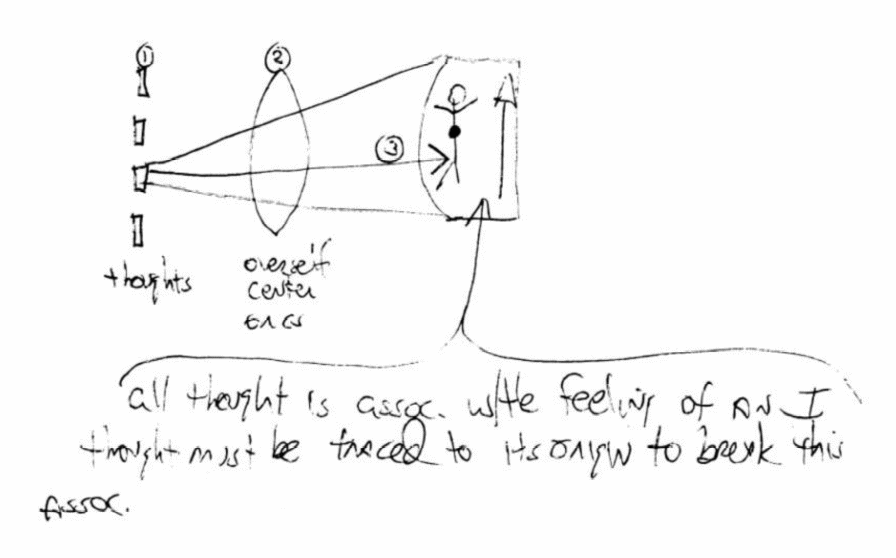
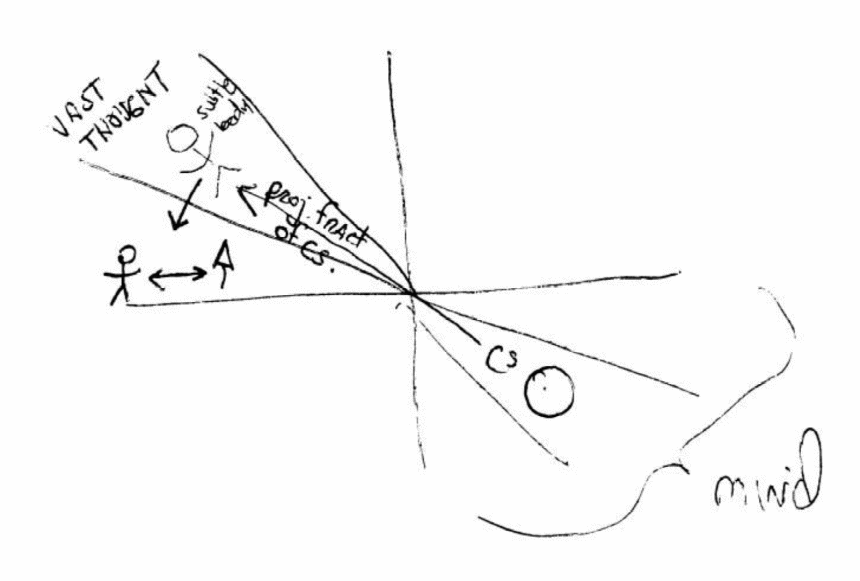
[FIGURE 1979 1107-1-AB. World-Mind's Thinking, Overself, and World-Image. Cs = Consciousness. Bottom line reads: All thought is associated with the feeling of an I. Thought must be traced to its origin to break this association. Facsimile scan from AB class notes.]
The first thing the thought "hits" is the body (brain). Thought rises from heart to brain.
Instead of "the first of our thoughts" read "every thought is accompanied by the sense of I".
"The"I" unconsciously provides the particular space-time characteristics" -- thoughts contain in a germinal form the World-Idea as in space and time.
I is Witness-I which is equal to the totality of the mind's thoughts = Witness-I as substantial = your individual mind.
Individual mind is for one life but Witness-I presides over a series of incarnations.
Paragraph 14 -- Empirical I witnesses dream, Witness-I creates dream, participates in dream -- three levels of "I" from paragraph 45.
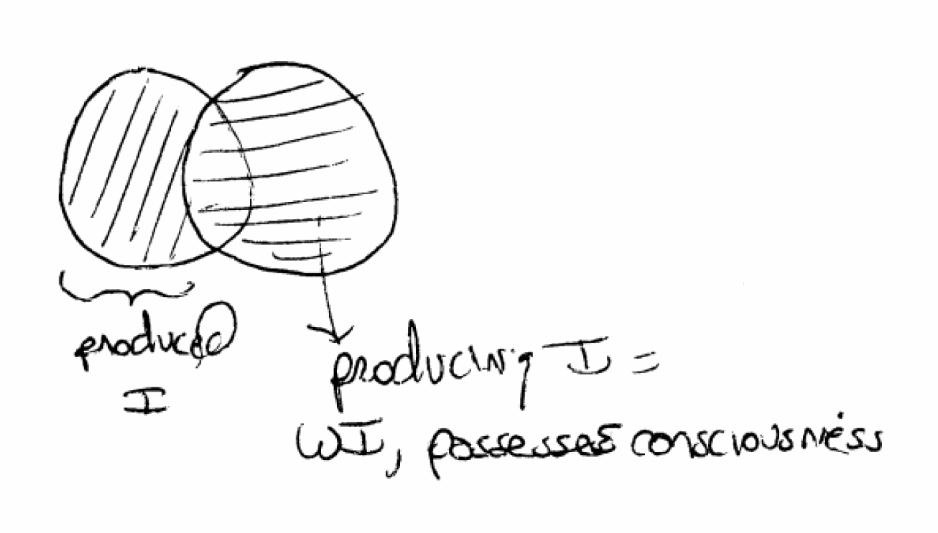
[FIGURE 1979 1107-2-AB. Witness-I and Empirical "I". WI = Witness-I. Facsimile scan from AB class notes.]
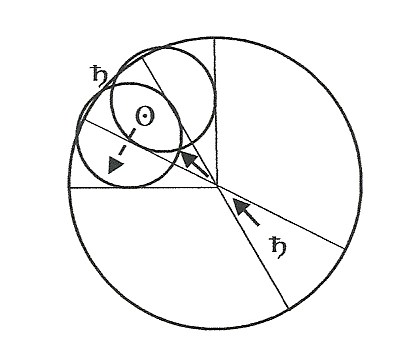
Paragraph 17 -- principle of awareness = Saturn in Leo.
Paragraph 21 -- awareness is Saturn in Leo from second quadrant. Projected fragment of it is in fourth quadrant. Mind from which it originates is Nous.
[Alan Notes 1979 1107 End]
DIAGRAMS FOR 1979 1107
Class
Wednesday, November 7th, 1979
Verbatim, unedited transcriptClick the series name to view more
CLASS at Wisdom's Goldenrod, Hector, NY
with Anthony Damiani (AD)
November 7, 1979
PB BOOKS; WISDOM OF THE OVERSELF;
"THE SECRET OF THE I"
with Appendix: Alan Notes 1979 1107.
TOPIC: PB Books
SUBJECT: Wisdom of the Overself
SUBSUBJECTS: "The Secret of the I," Witness-I, Soul, Mentalism, Thinking, Imagination
CONTENTS:
THE SOLAR WORLD (TENTH AND ELEVENTH HOUSES) IS A REFLECTION OF THE INTELLECTUAL WORLD
THERE IS AN "I" DEEPER THAN THE WITNESS-I AND THE EMPIRICAL SUBJECT
THE MIND OF THE DEMIURGE (TENTH HOUSE) FABRICATES A MENTAL UNIVERSE, WHICH IS THE CONTENT FOR THE EXPERIENCE OF THE OVERSELF CONSCIOUSNESS
ONE INTERPRETATION (HINDU): OUR THOUGHTS ARE PRECIPITATED OUT OF THE FRACTIONAL CONSCIOUSNESS DERIVED FROM THE SOUL
AD'S INTERPRETATION: THE MENTAL, OBJECTIVE WORLD IS NOT DERIVED FROM THE FRACTIONAL CONSCIOUSNESS, BUT OUR INTERPRETATION OR UNDERSTANDING OF THAT WORLD MIGHT BE
FOR A VEDANTIST, THE EXISTENCE OF AN OBJECT NEED NOT BE MOMENTARY, WHEREAS FOR A BUDDHIST, THE EXISTENCE OF EVERY OBJECT IS MOMENTARY
FOR A PLOTINIAN, THE INTELLIGIBILITY OF PRAKRITI (NATURE) COMES FROM THE SOUL; IT'S NOT INHERENT IN PRAKRITI
THINKING IS NOT THE SAME AS THE IMAGINATION: THE IMAGINATION IS A PLASTIC MEDIUM IN WHICH THINKING GETS CONCRETIZED OR PICTORIALIZED
DIANOIA IS INTENSE THINKING WITHOUT ANY IMAGES ACCOMPANYING IT
BOOKS READ FROM OR REFERENCED:
Paul Brunton, The Wisdom of the Overself
William Ralph Inge, The Philosophy of Plotinus
Martin Heidegger, What Is Called Thinking?
I.K. Taimni, The Science of Yoga
DIAGRAMS appended to this transcript:
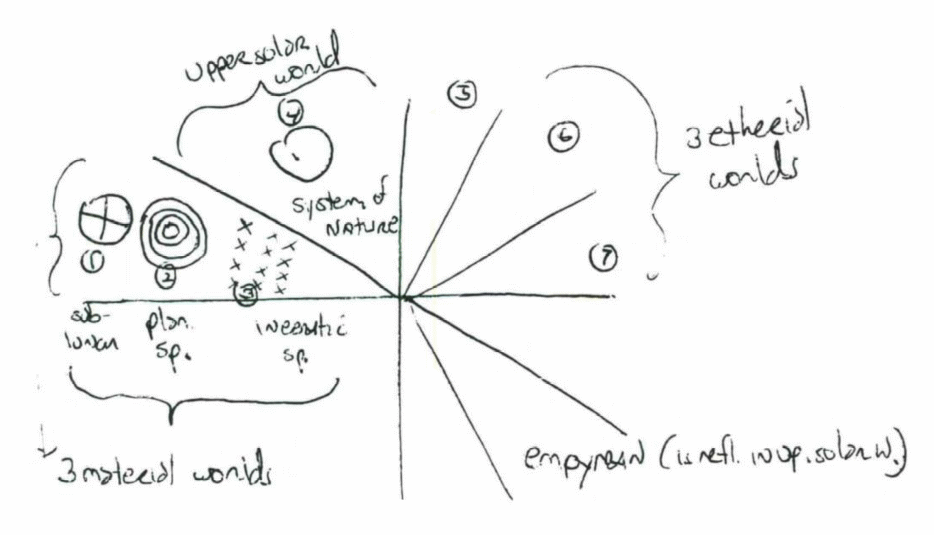
FIGURE 1979 1107-1-AB. World-Mind's Thinking, Overself, and World-Image.
FIGURE 1979 1107-2-AB. Witness-I and Empirical "I".
FIGURE 1979 1107-3-AB. Empyrean, Three Ethereal Worlds, Upper Solar World, Three Material Worlds mapped onto Metaphysical Chart.
FIGURE 1979 1107-4. Saturn in Leo and Fourth Quadrant Vesica.
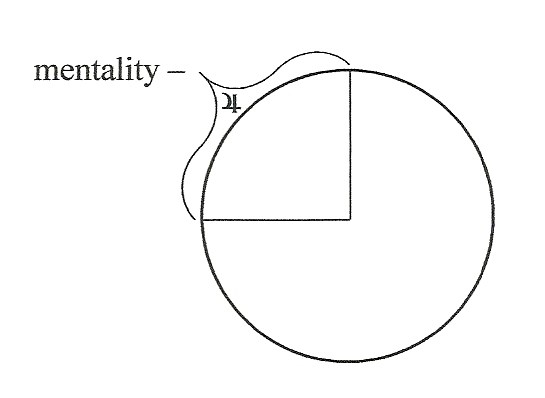
FIGURE 1979 1107-5. Fourth Quadrant as Mentality.
FIGURE 1979 1107-6-AB. Consciousness, Primal Image, and Empirical Experience correlated with Fifth, Eleventh, and Twelfth Houses.
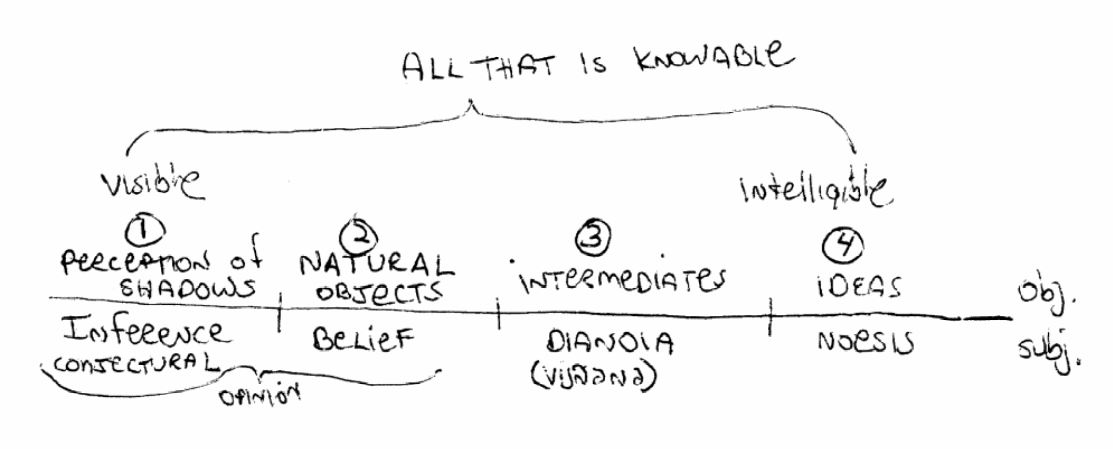
FIGURE 1979 1107-7-AB. Divided Line.
Other diagrams referred to are not with this transcript version. [Transcriber note: [diagram] means the speaker is referencing a diagram as he or she is speaking. If someone is drawing or writing, with audible sounds of chalk on a blackboard, I indicate this by [drawing] or [writing].]
NOTES:
AB class notes have been appended because they contain diagrams that AD refers to in the class and also because we are missing the first audio file for this class. All capitalization and punctuation corrected, all abbreviations and astrological glyphs spelled out in AB class notes.
Wednesday night class, part of Wisdom series 1979-1980.
TRANSCRIBED Verbatim by IT 2019; reformatted by JRM & JF 2019-2020, with TOC/Subheads by JRM. In 2023, IT updates prefatory matter, footer, and audio file name, fixes/completes Book List, adds new notes within transcript, fixes errors/typos, adds seven diagrams and references within transcript to these diagrams. In 2024, MW alters Subheads to make more accurate. Archival verbatim transcript – V14.1a.
AUDIO FILES: 1979 1107a. [Note 1: "Tape" and "Side" refer to original audio cassette tapes that were later digitized into .MP3 Audio Files. Note 2: We are missing the first audio file for this class.]
1979 11/07 at Wisdom's Goldenrod
PB Books; Wisdom of the Overself; "The Secret of the I"
Archival verbatim transcript
THE SOLAR WORLD (TENTH AND ELEVENTH HOUSES) IS A REFLECTION OF THE INTELLECTUAL WORLD
[Audio File 1979 1107a Begins]
AD: (--and--) or the solar world. And the solar world is a reflection of the Intellectual World, alright, so that the world that we are experiencing ultimately can be derived from the Nous or the Intellectual World. But that, you have to remember, it is a reflection of that. So that in the tenth, eleventh house [diagram] you have a reflection of the Intellectual World and in the twelfth house [diagram] you have the product that that reflection is going to produce. [Note: See FIGURE 1979 1107-3-AB, Empyrean, Three Ethereal Worlds, Upper Solar World, Three Material Worlds mapped onto Metaphysical Chart, appended to this transcript.] Now, in that sense, alright, you can trace mind ultimately back to the Intellectual Sphere. But also, in the same way, I'm going to trace the pure consciousness which is involved in the tenth, eleventh, and twelfth house back to that Intellectual Sphere. [Note: See FIGURE 1979 1107-4, Saturn in Leo and Fourth Quadrant Vesica, appended to this transcript.] And what we're going to speak as as a frozen indivisible unity, that is, the consciousness and that-- what the consciousness experiences-- In other words, on the one hand you would have what the Buddhists would call nothingness or the, you know, sunyata, and on the other hand you have the bliss-cognition of nothingness and that this-- these form an indivisible unit. So, this is the way I would express it.
S (very faint): Uh-hm.
RG/S(?) (faint): Ok.
AD: It isn't that mind is going to stay unaccounted for and have no origin and no principle.
RG: No, (Ramana's--)
AD: Alright then, Avery pick up the paragraph, alright, "Although the"I" changes from instant to instant…" The "I" changes, the ques-- questions don't change. (some laughter)
S (part of background): Thank you.
AD (simultaneously): 133, bottom. We start, [AS simultaneously, part of background: Oh, thank you.] "Wonder of Awareness". Just pick out some of the quotes from there, "Wonder of Awareness," huh? I know. Richard, I think you'll see after a while, this is much more intricate than you've ever conceived.
RG: But-- but the-- you-- you obviously think though that-- that this chap-- there's-- there's confusion in here in--
AD (simultaneously): Oh yes there is, and I said I didn't-- I did not want to do this anymore. I-- how would you like to be in my situation? (bit of laughter)
RG: That'd be fine. (RG laughing, some laughter, student words) Yeah.
AD (simultaneously): I got to-- even some of the writings that I--
S (possibly part of background): I pushed the--
AD: (Oh/For) Richard. (bit of laughter) Let me put it this way Richard: I'd rather be wrong. Go ahead.
[few seconds of background student talking, laughter]
THERE IS AN "I" DEEPER THAN THE WITNESS-I AND THE EMPIRICAL SUBJECT
[Transcriber note: I am using The Wisdom of the Overself by Paul Brunton, Rider and Company, London, 1943.]
PB [The Wisdom of the Overself, "The Secret of the I," p. 80, AS reading]: "Although the"I" changes from instant to instant we feel somehow that it knows itself indirectly [AS reads: directly]…"
AS: Indirectly.
RG (simultaneously): Indirectly.
PB [The Wisdom of the Overself, "The Secret of the I," p. 80, AS reading]: "…we feel somehow that it knows itself indirectly through its thoughts, acts and experiences, and that something remains constant and stationary through all these changes. If in one sense there is a continuity between what we once were and what we now are, then this persistent core must be a deeply-buried mental one. What is this mysterious core? Can the"I" know itself directly?"
AD (very faint): Ok, there's more.
AS: He says--
PB [The Wisdom of the Overself, "The Secret of the I," p. 80, AS reading]: "The fact that he could examine his own thoughts showed that there was something in him which was itself deeper than them, for it could not simultaneously be both the owner of the thoughts and the thoughts themselves, both the examiner and that which was examined. What is this"something"? It is, it must be a still deeper "I" which, although usually ignored, must matter most of all. And this, when traced through the conventional confusions and unconscious processes which habitually surround it, is nothing else than the intangible principle of awareness itself whose own existence makes the existence of all the multiple items of awareness itself possible."
AD: Alright, would you read those last few lines, the last few quotes?
AS: This "something" which makes us aware--
PB [The Wisdom of the Overself, "The Secret of the I," p. 80, AS reading]: "…must be a still deeper"I" which, although usually ignored, must matter most of all."
AD: But prior to that didn't he say if we bury deeper into this-- into this core, this mental [AS simultaneously: Yeah.] core, alright-- [AS assents, faint] Now, if you bury deeply into what constitutes the structure of a person, let's say the mental essences, and you expect to find an "I" there-- No. I say no, you won't find an "I" there. You'll find more rational essences, but you won't find an "I".
LR: You--
AS (simultaneously): Right, (true).
AB (simultaneously): But isn't he saying that--
AS (simultaneously): That which makes his burrowing possible, he says, is true(--/.)
RG (simultaneously): He's calling that a still deeper "I".
AS: The "I".
PB [The Wisdom of the Overself, "The Secret of the I," p. 80, AS reading]: "[AS adds: Is] The fact that he could examine his own thoughts showed that there was something in him which was itself deeper than them [AS reads: the thoughts], for it [AS reads: this] could not simultaneously be both the owner of the thoughts and the thoughts themselves, both the examiner and that which was examined."
BS: But isn't that taking--
S (faint): Yeah.
S: [three words inaudible]
S (simultaneously): Then finish it, finish it.
PB [The Wisdom of the Overself, "The Secret of the I," p. 80, AS reading]: "What is this"something"? [S: Ask me.] It is, it must be a still deeper "I" which, although usually ignored, must matter most of all."
[short pause]
AD: In other words, over here--
PB [The Wisdom of the Overself, "The Secret of the I," p. 80, AD reading]: "…for it could not simultaneously be both the owner of the thoughts and the thoughts themselves…"
AD: Let's say that the owner of the thoughts would be what we're calling this manas principle, the individual mind, alright, in its totality, alright. [S, faint: I got it.] Now, the thoughts that it produced would be in the twelfth house or the thoughts let's say-- concomitant with them the body that is revealed, alright. Now he's saying, this cannot be the "I". In other words, a combination of these two [diagram] will not give us the "I". [Note: See FIGURE 1979 1107-2-AB, Witness-I and Empirical "I", appended to this transcript.]
S (faint): Right.
AD: Ok.
PB [The Wisdom of the Overself, "The Secret of the I," p. 80, AD reading]: "…both the examiner and that which was examined. What is this"something"? It is, it must be a still deeper "I" which, although usually ignored, must matter most of all. [And this], when traced through the conventional confusions and unconscious processes which habitually surround it, is [AD reads: it is] nothing else than that [AD reads: the] intangible principle of awareness itself…"
AD: Now, right there, alright, is a truth. I mean we're saying that if you get to the mental processes-- ignore the sensible now, you're beyond that, ok. Just like in meditation, you're beyond all sensation, now you're in the mental processes themselves. They're getting illuminated, alright. And the mental processes will present an appearance of nothingness because there won't be anything you can see, there's nothing objective there. But he says-- he says here, it's even beyond that, it's awareness itself. [RG: Uh-hm.] So evidently, this "I" that he's speaking about here, alright, can't be the Witness-I or the mental processes and the product of the mental processes. In other words, neither the Witness-I nor the empirical subject.
RG: The Witness-I as a thought.
AD: Yeah, that's all the Witness-I is. Over here it would be the total thought [diagram].
PB [The Wisdom of the Overself, "The Secret of the I," p. 80, AD reading]: "…[AD adds: it] is nothing else than that [AD reads: the] intangible principle of awareness itself whose own existence…"
AD: Now because there is the existence of this awareness, the existence of all the multiple items becomes possible.
RG: Ok, now what's this principle of awareness?
AD: Well he doesn't go into it.
RG: No, I'm asking you, what is it in your diagram?
AD: In the diagram it would have to be the Saturn coming from the Nous [diagram]. [Note: See FIGURE 1979 1107-4, Saturn in Leo and Fourth Quadrant Vesica, appended to this transcript.]
RG: But he j-- but I-- but remember-- remember Sunday night (RG laughs a bit) when we went through this and we had the quote, (said/says) "mind as the principle of awareness", and then you were interpreting that as meaning taijasa consciousness.
AD: Again, look, [RG simultaneously: You're not--] you have to pull out the section, we have to go back to the section.
RG (simultaneously): No but-- but he uses-- I mean he-- It's the--
MW: There's no fixed concepts about these words, Dickie.
RG (simultaneously): Leave me alone. (RG laughs, some laughter) Wait a minute.
S (faint): Right.
LR: We could just leave the whole to just--
BS (simultaneously): Well look-- Anthony?
S (faint): [few words inaudible]
RG (simultaneously): Wait a minute, wait a minute. Go ahead.
S: There's still--
AD (simultaneously): Yeah I'll wait.
S (simultaneously): [couple words inaudible] all over.
RG: Wait a minute, wait.
AD (simultaneously): I'll wait, I've been waiting ten years.
RG: The page be-- (bit of laughter) the page before he says mind-- "It is the mind as the intangible invisible principle of awareness…" (p. 78) And, I mean, it still seems that when he says, "it is nothing else than that intangible principle of awareness" he must be referring to the concept of mind here. No?
AD: I'm sorry, I didn't find your place.
RG: Alright, two pages before he-- when he's going through--
S: 131.
RG: Sensation--
AD (simultaneously): 131. Would you please--
RG: He goes through--
PB [The Wisdom of the Overself, "The Secret of the I," p. 78, RG reading]: "It is the mind as the intangible invisible principle of awareness which makes us aware…"
AD (simultaneously): It's the mind-- I have to find it.
RG: Right, it's--
PB [The Wisdom of the Overself, "The Secret of the I," p. 78, RG reading]: "The materialist wholly overlooks the significant role…"
S: Paragraph 10, the end.
AS: Top of the page.
S: Yeah.
AD: Alright--
PB [The Wisdom of the Overself, "The Secret of the I," p. 78, AD reading]: "It is the mind [RG: as the in--] as the intangible…"
AD: What's your problem there?
RG: Now is that different than--
AD (simultaneously): Yes, there, there the meaning of the term 'mind' there is Nous.
RG/S(?) (faint): Alright.
S (simultaneously, very faint): Uh-hm.
S (faint): Uh-hm.
RG: Great, ok.
S: Yeah.
RG: Alright, fine.
AD: Well-- but what else could it be?
RG: It couldn't be anything else. (some laughter)
S: How about [couple words inaudible]
BS: Well no.
JG: No, it would be--
BS (simultaneously): Anthony, on paragraph--
AD (simultaneously): I'm going to have a party. (some laughter) And we'll all-- it's going to be a costume party. [RG, faint: Oh no.] And we all come the way we are. (laughter)
RG: Mind there means the Intellectual-Principle, Saturn in Leo, as-- (some laughter) as the intangible principle of awareness. (more laughter)
S (faint): Go ahead.
S (faint): What do you mean [couple words inaudible]
BS (simultaneously): That's not the one in paragraph 17.
PB [The Wisdom of the Overself, "The Secret of the I," p. 78, AD reading]: "It is the mind as the intangible invisible principle of awareness which makes us aware of…"
AD: --anything.
RG: Right.
AD: Of anything.
RG: Right.
AD: Alright, now-- If I try to do it on the chart it'll be difficult but I think-- I think I could-- I think we pointed this out once before. [drawing] If we have-- if we have an entity here [diagram], ok, and there's a tree here [diagram] and this is-- this is the vast thought, to use a favorite expression, alright. And this is taijasa consciousness [diagram] which is associated with the body, identifies with the body, right. The object that it grasps, let's say, is also taijasa consciousness and that the knower of all this is also taijasa consciousness, in other words, the Sun, ok. Who knows this?
RG: (I guess this doesn't want no--) the invisible principle of awareness.
AD: Yeah. Which means-- which means that [drawing] this subject here [diagram], alright, has within him what you would call prajna or higher consciousness.
RG: Right.
AD: And that's why the term there 'mind', alright, which will immediately make you think, that's the mind he's been talking about which makes images of everything.
RG: No, that's a different-- [AD: Ok.] that's a different aspect of mind.
AD: Yeah. You remember in the beginning of the book he said-- he says, "You're going to have to dig this out with a lot of sweat." You know, like the Indian who buried his gold in the ground? And he says, "I buried these truths deeply in this work." It's literally so. He didn't know-- I-- I don't think he himself knew how true that was when he-- (some laughter)
RG/S(?): Well--
AD: Now, in the next part, going down about two-thirds of the way Richard, where he says--
PB [The Wisdom of the Overself, "The Secret of the I," pp. 78-79, AD reading]: "In ideation, feeling and memory mind is again conscious of itself [RG assents] but this time as the thinking intellect [AD reads: thinking principle]."
AD: What mind could that possibly be that is aware of itself as thinking intellect?
RG: The Nous.
AD: Yeah.
RG: Beautiful.
AD: You're getting on, you're catching on.
RG: Oh.
AD: Go ahead.
S (faint): Wow.
RG (faint): Great.
DB: On paragraph 21--
S: What is that?
LR: What is that last one?
MB (faint): What was that last one?
AS (simultaneously): That was 131. That was on the-- going on [S simultaneously: Previous quote.] to the previous quote that Richard (quoted).
S (very faint): Yeah.
S (faint): Alright.
S (very faint): Ok.
AD: Read it, I don't know what paragraph you're coming--
DB (simultaneously): He says, "What…" it starts out--
PB [The Wisdom of the Overself, "The Secret of the I," p. 81, DB reading]: "What the hidden teaching says is [that] the awareness is itself a separate principle. Part of it acts upon the body, principally through the heart and the brain. It has certain correspondences…"
AD (simultaneously): Well wait. We're going to get to that, [DB simultaneously: Oh I'm sorry.] we're going to get to that in a little while.
[9½ second pause with faint background student talking]
BS: Can I ask a question?
AD: Well we can go right to it then, alright, that-- Yeah? Then [BS simultaneously: Could I-- could I--] we'll go right through that, one minute. Go ahead.
BS: See, I was trying to follow you the past few weeks too, now back to paragraph 17--
AD: Are you a sky walker? (laughter)
MW: A sky--
BS: Sky flyer. (bit of laughter)
AD: Ok.
BS: No seriously, uh--
AD: Yeah. [RG simultaneously: He's serious.] I'm serious too.
S (faint, possibly part of background): Another one?
BS: There's nothing out--
AD (simultaneously): Sky walker doesn't leave any traces. You ever watch a bird when he flies through the air? There's no footprints. Go ahead, go ahead. (laughter, student words) Don't you understand, I'm taking you through now what I might call like a conclusion of all these years that you've been studying. I'm taking you through it now. People who have dropped away before here, alright, before, and I'm-- this is no incrimination, don't misunderstand, they got only a part of the teaching. Ok? Now you're getting it in toto. Go ahead.
THE MIND OF THE DEMIURGE (TENTH HOUSE) FABRICATES A MENTAL UNIVERSE, WHICH IS THE CONTENT FOR THE EXPERIENCE OF THE OVERSELF CONSCIOUSNESS
BS: Ok. Well, this is really not an argument, I just wanted clarification on (a/this) paragraph. In paragraph 17 when he speaks of--
PB [The Wisdom of the Overself, "The Secret of the I," p. 80, BS reading]: "…the intangible principle of awareness itself whose own existence [BS: Now he's talking about existence.] makes the existence of all the multiple items of awareness itself possible."
BS: Now, if I follow, and I-- and I just walked in, but if I follow, (laughter) that would make the cosmic mind a multiple item of-- one of the multiple items of awareness.
AD: Would you repeat that? This co--
BS: That would make the cosmic mind one of the multiple items of awareness if this intangible principle is not the cosmic mind.
AD: Oh yes, oh yes. Because again like--
BS: That's why I was-- what I mean is that's why I was thinking of the cosmic mind as this principle, at least in this paragraph.
AD (simultaneously): If-- if you think of references that I've made once before or at other times, [drawing] and I said if you think of the whole of the fourth quadrant, the tenth, eleventh, and twelfth house, and you think of this as the universe in its totality, alright, and-- We left out the Overself, alright, the Overself consciousness which let's say is coming from here, the fifth house [diagram], ok. [Note: See FIGURE 1979 1107-4, Saturn in Leo and Fourth Quadrant Vesica, appended to this transcript.] This here could preside over any one of these realms. So that what could be the content or the multiple items for this awareness could be anything in here [diagram]. So as an Overself consciousness you can achieve the lowest status, that of being an amoeba, ok, or going on and living in the Intellectual World or in the inerratic sphere. Yes.
BS: So it is definitely the Nous.
AD: So, this whole-- if you think of this whole-- if you think of the-- Well, it's the soul coming from the Nous, alright, and the-- the quality of a soul coming from the Nous is it's a noetic tendency or tendence towards experience what is being-- [drawing] what has been fabricated in-- in the whole of the fourth quadrant. So that your experience of this world, alright, is like in a little tiny corner. But, there's a whole universe that you're going-- going to explore, sooner or later. And, who was it, Plotinus I think, he-- he speaks about the soul as a metaphysical wanderer. [Note: See William Ralph Inge, The Philosophy of Plotinus: "In modern idealism the Soul or self-conscious self tends to be the fixed centre, round which all revolves. In Plotinus it is the wanderer of the metaphysical world."] It wanders throughout all these realms of experience. And this-- this is the world which is fabricated or constructed by the Creator God. The Greeks called it the Demiurge. The Alayavijnanists call it the World-Constructor. By that they do not mean an individual, a Demiurge. What they mean by that are the World Ideas. But, if you read their texts carefully, you see that they-- it's like a truncated metaphysics. They don't want to get their hands dirty and find out, "Well what are these World Ideas?" There's two works that you should read but we'll bring them up in the Buddhist class. So yes, this whole cosmos is content for the experience of this Overself consciousness, and right now the only thing that we're experiencing is our toes and our, you know, ears and our hair. In other words we restricted our experience to our body and what our body relates to, but assuming that one graduates, goes beyond that, then the-- the whole of the universes open up for his experience. And all this is mind. [Note: See FIGURE 1979 1107-5, Fourth Quadrant as Mentality, appended to this transcript.]
BS: Is what?
AD: All this is mind. [bangs on board] Not consciousness, mind. [bangs on board] The whole universe is mind. Who's mind? The Demiurge's mind. And everything you experience in there is going to be mental. So that in the tenth house, for instance, we refer to it as the shape of the material universe in the mind of the Demiurge. So everything in this universe is going to be the fabrication of the Demiurge and it has to be mental. In other words, His Intellect is what we're going to experience of the world, alright, and that's going to be a mental world. Ok?
S (faint): I didn't understand what you just said.
S (faint): Yeah.
S (faint): Yeah.
S: PB was-- let's just say, you said you were boring into this "I" and you won't find anything-- you won't find any essences there you said. You'll just find parts-- reason-principles.
AD (simultaneously): Where are you at Crystal?
S: Well, I'm back there where-- when you said that, I know, ok. I-- I'll leave it, you want me to leave it.
AD: No, the point is that I'm not back there. You remember [S simultaneously: I know.] the story about [S simultaneously: No, it has to do with what you just said.] the Zen monks who were walking, (laughter, student words) alright. And one of them picks up a girl and drops her off the other side and they're walking for an hour. And then the other monk says, "You know we're not supposed to touch a woman?" (student laughs) He says, "I put her down an hour ago, you've been carrying her since then." (bit of laughter)
S: [couple/three words inaudible]
AD: Why didn't you ask the question then?
S (faint): I couldn't.
S: No, go ahead, I'll [couple words inaudible]
AD (simultaneously): Go ahead Crystal.
S: No. Well but--
AD: Because you'll only go back to it sooner or later. (AD laughs, bit of laughter)
S: Well--
AD: Go ahead Crystal.
S: I mean you said there were no essences that you'd get to. [S, faint: No.] But you just said that--
S ( simultaneously, faint): Uh-uh.
S: Yeah.
AD: I said there was no essences you'll get to.
RG (simultaneously): He said that's all you get to.
S: On one hand it's true.
RG: He said that's all you get to when you examine the "I", the rational essences.
S: Oh, he said rational reason-principles are not essences, is what I heard.
AS: They're rational essences.
RG (simultaneously): [three words inaudible]
S: Ok. So that's what I wanted to ask is like what you just said, I mean what you get to, you get to things like the mind of the Demiurge is where you'll get to, but--
AS: Yeah, all the process.
S (simultaneously): I mean before you jump to this pure "I" that's say [couple/three words inaudible]
AD (simultaneously): Yeah, before you get to this pure "I", [S simultaneously: You go through a lot of--] you're going to-- you're going to have to graduate a few schools.
S: And it's as though you do penetrate these various essences [couple words inaudible] correct?
AD/S(?): Yeah so--
S (very faint): Uh-hm, uh-hm.
AD: Yes, you'll penetrate them and you experience them. Then when you finish with them you go beyond, you go to something else. But the world is here for your experience. And if you leave it open-ended, the way an enlightened attitude would suggest, then that experience of course can be quite-- well this-- Alright, David, you wanted to get to this passage, "What the hidden principle says…"
DB: Yes. Uh--
PB [The Wisdom of the Overself, "The Secret of the I," p. 81, AD reading]: "What the hidden teaching says [S: What?] is that the awareness is itself a separate principle."
DB: Yes, the question that I have is the third sentence in it where it says--
PB [The Wisdom of the Overself, "The Secret of the I," p. 81, DB reading]: "It [DB: Meaning the awareness.] has certain correspondences and relations with centres in the brain."
DB: And it seemed to me that that sentence seems to-- seemed to illustrate the relation between the-- the structure of the vesica and how the (mahat) would be-- would correspond to a certain-- with a male body and [one word inaudible] the pituitary and so forth and so on. And-- so I was wondering if in the context of this paragraph could he mean by awareness the association of that consciousness from the fifth house with the taijasa there or would the-- the correspondence go back as far as to the fifth house?
ONE INTERPRETATION (HINDU): OUR THOUGHTS ARE PRECIPITATED OUT OF THE FRACTIONAL CONSCIOUSNESS DERIVED FROM THE SOUL
AD: No, it won't go-- it won't go back as far as the fifth house. You see, what may be coming out later on would be that this life or this light which is separated off from the soul itself and which becomes the-- the content--
AS (simultaneously): [one/two words inaudible]
AD: Huh? Go ahead.
AS (faint): I was just--
AD: Look, we--
AS: You said becomes-- I thought you were going to say becomes the animate or goes to form the animate.
AD: Well ultimately it would go to form the-- But the-- one possible interpretation is something like this. This light which is broken off or separated off from the soul and from which, alright, there's going to be precipitated out of it the totality of what we refer to as those individual thoughts, our mind, that's one interpretation, that's usually the Hindu interpretation, where they say that everything comes out of consciousness. And you get the feeling that consciousness is some sort of grab bag and that everything is going to come out of it, alright. I don't work with that interpretation. It's probably valid but I don't work with it. I don't believe that consciousness is like a storehouse, a bin, and things come out of it, alright. The other interpretation--
PB [The Wisdom of the Overself, "The Secret of the I," p. 81, AD reading]: "The part which thus acts is the part which is projected into a particular space-time existence…"
AD'S INTERPRETATION: THE MENTAL, OBJECTIVE WORLD IS NOT DERIVED FROM THE FRACTIONAL CONSCIOUSNESS, BUT OUR INTERPRETATION OR UNDERSTANDING OF THAT WORLD MIGHT BE
AD: The way I understand that is that there's a part of the soul which, without leaving soul, without leaving the Intellectual Realm, descends into generation, it is that part which gets associated with, let's say, manifestation, and it is that part which presides over manifestation. And he's going to refer to that very often as the Witness-I. But later on one begins to see-- In other words, when we speak about the Witness-I possessing a certain consciousness it is that consciousness and not the soul per se that it possesses. It can never possess the soul per se. So that Witness-I, the totality of-- the homogeneity of the psychical essences and their resulting effects, alright, is what we refer to as the Witness-I and this Witness-I possesses a certain consciousness. It is this consciousness which is broken off, I might say, from the soul which it possesses, [RG assents] and which will endure for the-- for the entirety of a person's evolution until he reaches liberation or freedom from manifestation, alright.
RG: Go ahead.
AD: Go ahead Avery, I (am--) I wanted this disagreement, go ahead.
AS: Well it's not disagreement, I thought it was pretty good. The question is-- I don't know if I can formulate [couple words inaudible] When you speak about this Witness-I, then there's two concepts and one is that there's some-- something, light or whatever, broken off, that comes from the soul itself, the Saturn in Leo.
AD: Uh-hm.
AS: And the other concept is that the Witness-I is constituted by the mind, the eleventh house, the manas principle.
AD: Totality of psychic-- yeah.
AS (simultaneously): Totality of the psychic functioning. And, it certainly seems that both of these are required to constitute this Witness-I because if it was just the pure consciousness of the-- I think what he's saying is if it's just pure consciousness, fifth house, it's not a Witness.
AD: Exactly.
AS: And if it's just the individual mind functioning, it's not conscious.
AD: It's no experience.
AS: There's no experience there. So it's almost like saying that-- You certainly seem to need both of these. And could you say that-- it seems like always the problem is that from the point of view of the empirical fellow in the eleventh-- in the twelfth house, this Witness-- since there already is some kind of association of the soul with this individual mind or Witness, that it's always hard to tell which one-- or-- or could you say that from his point of view it's the next higher principle which is conscious?
AD: Yeah but-- [S, faint: Oh I see.] I think you would right-- you were right in just implying without stating it, it's very hard to tell sometimes which one he's referring to and that's one of the things that I'm-- I-- I said I was going to do here. In other words, if you want to, maybe this analogy would help you. Take the world, alright, and compare it to a piece of cloth, and it's made up of strings from one end to the other, alright, the strings make up that cloth in its totality. Think of each string, alright, each string as an individual mind, so that the totality of all these individual minds is what we call the world, ok. Now this is just an analogy, don't push it too hard. Now imagine that this cloth is in the dark, alright, and you shine a searchlight on one of those strings and you follow that string all the way across. So you would say that this string, this individual mind, associated with this light coming from the searchlight, alright, you would call this the Witness-I that possesses a consciousness.
RG (faint): Uh-hm.
AD: Ok?
S: What, the searchlight?
RG (faint): Yeah.
S (faint): No.
AD: No, you would call the combination of the string with the light shining on it the Witness-I.
S (faint): Right, yeah.
S: Would we call that Witness-I's consciousness 'awareness'? Are we making that distinction?
AD: Well, again, I have to go by the context. I have to-- I have to-- [S simultaneously: So we can't make it flat out?] each sentence, I can't-- If you do that you'll always end up in trouble. As soon as you pin down a meaning to a word, the next time that word changes its meaning, you're in trouble.
[Note: See FIGURE 1979 1107-6-AB, Consciousness, Primal Image, and Empirical Experience correlated with Fifth, Eleventh, and Twelfth Houses, appended to this transcript for the following.]
RG: But here for example, when he says "the awareness is itself a separate principle" that would be the fifth house awareness.
AD: Yeah, yeah.
RG: "Part of it…"
AD (simultaneously): Because, [AS simultaneously: He hasn't said.] because what characterizes the Intellectual or the Nous is certainly the quality of knowing. Now in the-- in the-- in the fifth house it would know there Intelligibles. But down in the fourth quadrant it must know what is sensible or even, let's say, more sublimely, thinking, mental processes themselves.
RG: So when we say that this awareness, part of it acts upon the body, and we want to main-- we-- we have to maintain some link between the soul in the world and the soul in the Intelligible or else we'll have the Proclu-- Proclus problem.
AD: Yeah, yeah.
RG: We have to maintain that-- that somehow the awareness that's inherent in the soul in the fifth, there's a spark of that or there's an aspect of that that's inherent in the-- in the-- in the heart center [one/two words inaudible]
AD (simultaneously): Yeah, they usually reverse it though. The spark is what they call is in the fifth, alright. They call that the spark or the summit of the soul is in the fifth, alright. The lower part of the soul is like in the fourth quadrant, [student assents] functioning or presiding over that.
RG: But in some sense we still have to maintain that the awareness is present in some sense.
AD (faint): Yeah.
RG: Now when we maintain this link between the witness of the principle of awareness and the contents of the individual mind, we're allowing for that link.
AD: (Well), correct. Because once you break that link then you'll have the same trouble like-- trouble like Proclus, how do you get back up there?
RG: Right.
AD: There's no elevator that's going to take you there, alright. [MW: Yeah.] So this fractional consciousness-- Again--
PB [The Wisdom of the Overself, "The Secret of the I," p. 81, AD reading]: "It is this fractional consciousness…"
AD: And if you follow this again you'll see the difficulty in this text. We just said that this fractional consciousness came from the second quadrant or [RG assents] the Intellectual-Principle.
PB [The Wisdom of the Overself, "The Secret of the I," p. 81, AD reading]: "…and not the mind whence it originates…"
AD: And there's only one term-- there's only one possible explanation of mind here--[RG: Fifth house.] Nous.
RG: Right.
AD: Yeah. Because that's where it comes from.
RG: Right.
AD: Ok. But yet if you take the word 'mind' to mean what it meant in the second chapter, "Birth of the Universe", you're in for trouble.
RG: But it does seem in this chapter he uses mind more in the sense of this-- this way now.
AD: Yeah but the point is, again, I don't want to hammer it home but I think you're beginning to see that those meanings are variable [RG: Yeah.] and you got to go by the context you find it in.
RG: Uh-hm.
AD: Alright.
LR: I'm sorry, I think I missed something, where he says this-- there seems to be a paragraph-- a paradox right in the sentence where it says--
PB [The Wisdom of the Overself, "The Secret of the I," p. 81, LR reading]: "It is this projected fraction of awareness which is what we ordinarily term consciousness…"
LR: Now, you think [S simultaneously: (Yet--)] of that as coming from the fifth house, right?
RG: Uh-hm.
AD: Yeah.
LR: But then he says--
PB [The Wisdom of the Overself, "The Secret of the I," p. 81, LR reading]: "…that is the sum of all our personal sensations, thoughts and feelings."
LR: So you [AD simultaneously: Uh-hm.] think of that as coming from the mind.
AD (simultaneously): Now, that's why I brought in the Hindu interpretation, [RG: Right.] you see. The Hindus would say something like this, that all our thoughts, feelings, experiences, etc, alright, are let's say coming out of this [LR: Right.] frac-- fractional awareness. For instance, if you read The Yoga of Science [Note: The Science of Yoga by I.K. Taimni, Theosophical Publishing House, Madras, 1961.] or the Taimni books, this is his interpretation, alright. Now, there are other interpretations and I'm following this other interpretation [LR simultaneously: Yeah.] where I said no, no, no. The-- this-- the feelings, the ideation, the sensations, all that is coming from here, the world itself [AD indicates on diagram]. Now it's true that the interpretation of that may reside in that fractional consciousness, but not the constructed mental objective world. [student assents, faint] Alright? So that for instance, if we did something like this, if we took the analogy of a dream, alright, and I appeared in one of my dreams, and I see certain objects, I'm interpreting those objects, alright, from the understanding that Tony has, not from the understanding that the dream character has. That doesn't mean, that doesn't mean that what (I/I've) experience, alright, or this a-- this understanding which is working in the dream character, is the sum of all these personal sensations thoughts and feelings. See the difference?
LR: Yeah, except that we have a definition or a-- a concept of individual mind [AD: Again--] to which we apply--
AD (simultaneously): Yeah, again. Again, let me put it to you this way.
LR (faint): Ok.
AD: This unvisited solar region exists whether you are aw-- your mind goes into contact with it or not, [LR simultaneously: Right.] alright. Now let's say your mind does go into contact with it. [LR: Uh-hm.] The existence of this object is independent of your mind's functioning, ok, but the interpretation of what that object is may be coming to you from a higher source. But I'm speaking now about the existence of that object, the per se existence of that object. And if I say this is-- this is a mountain, alright, then I have to say well I'm going to-- that's going to be part of the Demiurgic constructed world, alright. That's going to be part of that world.
LR: Well now (we-- so) when we speak of the total-- the sum of all of our personal sensations thoughts and feelings, we would attribute that not to the awareness but to the individual mind.
AD: Yeah. Which we said was part of that cosmos, right? [LR simultaneously: Which is part of the taijasa--] Like that string.
LR: Yeah.
AD: Yeah.
LR: The existence of those-- so-called quasi-existence maybe, of those personal thoughts feelings and sensations is in no way dependent on the awareness, but without the awareness there won't be any experience.
AD (simultaneously): There won't be anyone-- yeah. That's the way I look at it. [LR: Um--] Because my premises are that this [diagram] is fabricating what we call our feelings, our thoughts.
LR: I know.
AD: Ok?
LR: The only problem I have with that is-- [short pause] Would you still give the term 'existence' to those feelings, the thoughts and the sensations? I mean it's not the same as giving existence to the tree or the unvisited polar region. Do you know what I mean?
AD: No I still didn't catch on.
LR (faint): Ok.
AD: Well, could you suggest something instead of 'existence'?
LR: Well that's-- that's precisely that problem. You say that the-- these personal feelings and thoughts are accounted-- are attributed to the individual mind and certainly not the awareness. And yet without that awareness [AD: Yeah.] there won't be any experience.
AD: Uh-hm.
LR: But that's not to say that-- well is-- what status, ok, what-- what status would you give actually to those personal thoughts and feelings if you subtract from them the awareness? It wouldn't be like giving the status of existence to a tree if you're not there. Because, in fact, you can't give those things cosmological existence. And yet they seem to take on the status of existence when the awareness is associated with them.
AD: But I do give them a cosmic existence insofar that I speak about the individual mind conjunct with the World-Soul fabricating the universe.
LR: I know.
AD: Yeah.
LR: Well I know you're giving the individual mind a status in the World-Soul. But now when you actually speak of these personal thoughts and feeling [AD, faint: Yeah.] as thoughts and feelings, there is a status of existence. But as personal thoughts and feelings belonging, in other words, to an individual, it seems like you can't really give them existence unless you associate an awareness with them. Do you see?
AD: Yeah, I see what you're saying now. If I associate awareness with them, they're granted some sort of existence, [LR simultaneously: Uh-hm.] ok. [S, faint: Yeah.] And--
LR: If you subtract that awareness, you would no longer call them personal thoughts and feelings. I mean you might say they're-- they subsist in like the sheath of-- in one of those sheaths, one of those six sheaths, you know, the linga sheath. [AD/S(?), faint: Uh-hm.] But then they're-- you-- in there you wouldn't call them personal thoughts and feelings. I mean they wouldn't have that status, they would be making up some level of--
AD (simultaneously): Well then what's your solution to the problem?
LR: What-- what's my solution?
AD: Leave them together?
LR: Not ontologically leave them together but-- but say that that link has to be there if you're going to speak of things such as personal sensations thoughts and feelings, that that's what he's call-- that's what he called in a previous chapter the conscious being. Remember that term which seemed to refer to the linkage of consciousness with the individual mind, and then we talked about the conscious being--
FOR A VEDANTIST, THE EXISTENCE OF AN OBJECT NEED NOT BE MOMENTARY, WHEREAS FOR A BUDDHIST, THE EXISTENCE OF EVERY OBJECT IS MOMENTARY
AD: Well then that's an interesting point because it'll bring up what the Buddhists and the Vedantists are arguing about all the time. Insofar that the individual mind can reveal to itself an object, alright, then the knowledge of that object will endure as long as the thought of that individual endures. From the point of view of the-- of the Buddhist, they would say no object could endure for more than an instant because the very nature of existence is that it's instantaneous. So on the one hand you have the cosmological framework of the Buddhist which puts everything in this momentary situation, instant after instant, alright. Existence, you might say, is efficiency. And then on the other hand you have the individual awareness which illuminating that existence, alright, and revealing-- the individual awareness with the mind, alright, the mind revealing to that awareness the existence of an object, the existence of the object which is revealed by that individual mind could endure as long or as short, but it doesn't have to be momentary.
RG: Uh-hm, yes.
LR: But it seems like in one case you're speaking of the objective constituency of the object and in another case you're thinking about-- you're talking about some kind of subjectivity, which of course the Buddhists wouldn't admit to.
AD: Oh no, they-- they ultimately [couple/three words inaudible]
LR: Yeah but the subjectivity for them would be just as instantaneous as that object.
AD: No, [LR: No?] no, when they speak about the appreciative and discriminating wisdom which is abiding and what it perceives is emptiness, alright, they're speaking about it.
MW: So, Anthony [LR simultaneously: (So--)] are you suggesting that there's-- is there a possibility of a-- like a non-mental knowledge of the sense in the empirical world on the part of this fractional consciousness?
AD: No, not on the part of a fractional consciousness.
MW: Well--
AD: On the part of a Sage perhaps.
MW: So this fac-- this other factor, I mean this-- when we talk about knowledge that can work for more than a moment, we're not talking about a Sage's knowledge, right?
AD: We're not what?
MW: We're not talking about a Sage necessarily to speak about that.
AD: Oh, you can be speaking about anyone. There's not a--
MW (simultaneously): Right. And we're-- we're trying to ask, how is that possible. Right?
AD: Well, how is what possible?
MW: How--
S (faint): Start it again.
MW: How is it possible to have knowledge that lasts for more than a moment in the empirical-- or of the empirical world?
AD: The-- the Vedantists would suggest, alright, that insofar that it is the Overself consciousness or the Nous consciousness which knows an object, alright, then that puts it outside of the momentary existential--
[short pause]
MW: Yeah, I think that-- that was what I was trying to get at by saying it was a non-mental knowledge.
AD: Alright, we better [MW simultaneously: (Sorry.)] cut this off. We won't get through "The Secret of the I".
RG: May I-- could I just ask one-- one question?
AD: Yeah, go ahead.
FOR A PLOTINIAN, THE INTELLIGIBILITY OF PRAKRITI (NATURE) COMES FROM THE SOUL; IT'S NOT INHERENT IN PRAKRITI
RG: In pursuing this line of thinking now, not the Vedantic line where the homogeneity, let's say, of the thoughts lapses back into the conscious principle, but holding them distinct, it's-- it seems to be more formulated in a Samkhya mode where the purusa is the principle of consciousness and-- and the (twelve) thoughts and feelings are manifestations of [AD: Nature.] Nature, prakriti. Now, then how do you solve the Samkhyan dilemma of the relationship there? Then how (does/is) the purusa reflect at all into the Nature and even light up those thoughts which are not of the same nature?
[11 second pause]
AD: How does the purusa light up those thoughts--
RG: If those thoughts themselves are not of the same substance as the light. You know, the critique that's always brought against [AD simultaneously: Yeah.] the Samkhyas at that point.
AD (faint): Uh-huh. [short pause] Well if the Samkhyas can't answer it, why do expect me to answer it? (some laughter) What did the Vedantists do, you remember?
RG: Yeah. They make prakriti into-- and purusa into one principle and they call it Ishvara.
AD (simultaneously): Uh-huh, and that's it, right, they solved it.
RG (simultaneously): They call it Ishvara. Right.
AD: Well, you like that as an explanation?
S (very faint): Not really.
S (very faint): (Not really.)
AS: But I thought you solved it-- I thought you solved that Samkhya problem (laughter) by saying that-- Whereas Samkhya says that all the intelligibility is on the side of prakriti, we would say that the intelligibility of the whole situation does come from the soul ultimately, whereas prakriti-- whereas Samkhya wants to pull it out of that prakriti as it were and leave it all completely separated off from the purusa, so they lose the link which is that intelligibility. [RG simultaneously: Well you still have--] They won't speak about [RG assents] the Intelligible. Then what's real--
RG (simultaneously): You still have the problem of the reflection.
AS: No, but then what's-- there's no real reflection. Because [RG: There's no awareness.] you need to have a reflection if you need to say that there's something really to be known that's ultimately real in the prakriti. But if the soul ultimately does-- what the soul is knowing when it knows the fourth quadrant is really those ideas which are inhe-- which are inherent in its own nature, then you don't really need to-- then you don't need to break-- you don't have the gap in the first place.
AD: But even, even there there's a-- another kind of dualism because in order for the ideas or the forms which are in the soul to get instantiated, then [AS: Yeah.] you have to bring into [AS simultaneously: Bring in matter.] existence the formless matter, [AS: Yeah, that's--] alright, so the instantiation of the ideas on a formless matter makes matter the cause of the appeara-- of the apparent world.
AS: Yeah. Well, there's a problem there. At least you don't have it the other way. (AD laughs, laughter) Sorry. Push it all the way down to the-- which you already had. (some laughter) All the stuff you didn't [one/two words inaudible] No-man's land.
S (faint): Uh-hm.
AD: Huh?
S (simultaneously): Never mind.
AS: Never mind. (bit of laughter)
AD (simultaneously): Well, let's do one more paragraph and then we'll take a breather.
THINKING IS NOT THE SAME AS THE IMAGINATION: THE IMAGINATION IS A PLASTIC MEDIUM IN WHICH THINKING GETS CONCRETIZED OR PICTORIALIZED
PB [The Wisdom of the Overself, "The Secret of the I," p. 81, AD reading]: "With what faculty does man dream of distant continents at night and with what faculty… [AD: Alright?] At what point of the universe dare he say that any object, however distant, is outside his mind? …the most distant star within its operation of knowing, we are entitled to say that mind is everywhere. It is like space of which nobody could say where it ends. [AD adds: And] Space is indeed the form which mind takes. But this is the same [AD adds: thing] as saying that mind is formless. [AD adds: The] Mind occupies no definite position in space for the simple reason that space itself is its own production."
AD: Now, I think this paragraph is going to be quite difficult so-- [short pause] What-- what do you think the mind is here that he's referring to?
PB [The Wisdom of the Overself, "The Secret of the I," p. 81, AD reading]: "Is it [AD reads: It is] not with the mind and does this not show that it [AD reads: he] can embrace the most distant places?"
[10¾ second pause]
S (faint): Wouldn't it be the individual mind here?
[short pause]
AD: Well--
PB [The Wisdom of the Overself, "The Secret of the I," p. 81, AD reading]: "…with what faculty does he picture them in imagination [by day]? Is it not with the mind…"
(Side 1 of original cassette tape digitized as 1979 1107a Ends; Side 2 Begins)
PB [The Wisdom of the Overself, "The Secret of the I," p. 81, AD reading]: "…imagination…"
S: Yeah.
AD: Now, what is he saying there?
MW: Something is forming imagination.
S: Well then he says (we/you)--
AD: So you're saying, Michael, that the mind which grasps whatever the object is and then pictures it in the imagination or lays it out in the imagination, you're saying that? Or forms the imagination, orders it, structures it?
MW: Yeah.
AD: So then the mind and the imagination two dis-- distinct things, alright, I mean you're making a distinction [MW simultaneously: Yeah.] between them.
S (faint): Right.
S: Good for you.
AS: The rational mind.
RG (simultaneously): You can also say the mind is formless.
AS (faint): The eleventh house, yeah, [S: Yeah.] that your mind is formless. So it must be the mind that produces all of the experience, not--
PB [The Wisdom of the Overself, "The Secret of the I," p. 81, AD reading (simultaneously with AS above)]: "[AD adds: So] Is it not with the mind and does this not show that it can embrace the most distant places?"
AD: Now he's not speaking about the imagination, right, he's speaking about the mind that can embrace the most distant places. [MW assents, faint] In other words, is there any limits to the conceivability of your thinking? Yes, for most of you. (AD laughs, laughter) In other words, we do impose certain restrictions on our thinking and whether acquired or inbred it doesn't matter. But the point is he's saying here--
PB [The Wisdom of the Overself, "The Secret of the I," p. 81, AD reading]: "Is it [AD reads: It is] not with the mind and does this not show that it can embrace the most distant places? At what point of the universe dare he say that any object, however distant, is outside his mind?"
AD: Not outside his imagination, outside of his mind. In other words, can you tell me something that I can't think of?
S (faint): Yes.
AD: If I could think the sensation, hardness, into actuality, [AD hits something], "Ouch!", ok, and I can think a lot of other things into actuality, where does this stop? [short pause] So evidently, I think it's become obvious he's pointing out that the essence of-- rational essence of mind is really incomprehensible. This is the part that everyone, you know, pushes aside.
EC: But the individual mind's limited by the senses.
AD: Well, if you let them limited you but-- Certainly you could sit down and sometimes go into a reverie and-- Like, let's say you came up with an inspirational work or an artwork or something, your senses had nothing to do with it. You're sitting in a dark corner, all of a sudden you get this inspiration, it comes down into your brain, you say, "Wow!"
EC: No but-- well I've been speaking more objectively in terms of going out as far as the-- you know, any [couple words inaudible]
AD (simultaneously): Yeah but you see, I'm trying to take away that spatial conception you're working [EC simultaneously, faint: Oh. Uh-uh.] with and that he puts down when he says, you know, what restrictions can we place on the mind. When you say-- when he says here--
PB [The Wisdom of the Overself, "The Secret of the I," p. 81, AD reading]: "At what point of the universe dare he say that any object, however distant, is outside his [AD reads: the] mind?"
AD: And I'm trying to take away that spatialized conception of the mind that you have and think of it as, so to speak, as thinking or mental processes. And if you think of them in that way, then you can see that there's nothing outside of the universe that you can't think into actuality and spread out in the picture of your imagination.
S (faint): I don't understand the distinction between imagination and thinking.
S (very faint): Thinking is [one word inaudible]
AD: Well, this is the imagination [diagram], ok, and this is thinking [diagram]. [short pause while drawing] The imagination is only form. In other words-- in other words, think of the imagination as substantial, alright. Just imagine some amorphous clay and I think-- think very hard and all of a sudden, I'm thinking of a square and you see that amorphous clay become a square. But the thinking is not the imagination.
S: Did you imagination-- imagine something with form?
AD: When you say you imagine something with form, you have-- the presupposition of that is that you have to think the form first before your-- the imagination assumes that form. Ah, but there's mysteries all around us. [students assent] Mostly in us.
S (faint): I don't-- I still don't understand what the faculty of imagination is.
AD: Well, as I said, try to think of it as some kind of substance, ok. And then when you think, alright, in that substance there appears what you're thinking.
RG: But in that sense you're really not using imagination as a faculty but as the stuff (with/of) which--
AD: Yeah, the stuff, the stuff.
RG (simultaneously): Thinking is the faculty which produces an image.
AD: But he says here--
PB [The Wisdom of the Overself, "The Secret of the I," p. 81, AD reading]: "…with what faculty does he picture them in [AD emphasis] imagination…"
RG (simultaneously): Right, right.
AD: Alright, so the imagination is this plastic medium in which my thinking can get concretized or pictorialized.
RG: Right.
AD: But my thinking is not imagination because I could think and leave all imagination behind.
RG: Right [one/two words inaudible]
AD (simultaneously): I could think without any phantasms, any.
RG: But imagining means thinking in the imagination.
AD: Imagining-- I'm sorry.
RG (simultaneously): Yeah. To imagine would mean to think in the imagination.
AD (simultaneously): Yeah, in the imagination, yeah.
S: Ok. But what is thinking, I mean, how--
AD: Ah, [LR simultaneously: I don't know.] I wish I could give you a definition. But since we've done away with it and all the Buddhist schools have denied that it's [S, faint: Yeah.] worth anything and all the Vedanta schools, we're going to have to do that for ourselves, what is thinking.
S: Is thinking meditation?
AD (simultaneously): I read a provocative book by Heidegger called What is Thinking? [Note: Martin Heidegger, What Is Called Thinking?]
RG (laughing): What is-- yeah, right.
AD: And I didn't find out, so I'm going to try a few others. (AD laughing a bit)
S: Well how do you-- how do you start to understand it?
AD: Well, let's not get off into that. (AD laughing a bit) Go ahead David.
DB: Well, would it be possible to speak of the imagination here as being the totality of the-- the fun-- of the taijasa consciousness that the individual mind is constituted of, and that that faculty which is going to manipulate or determine what forms are going to take place in that would be-- Could that be considered as being the-- the part of the soul which tends towards separation and division and so forth? Is that what he means here?
AD: I'm sorry, try again.
DB: Well, I was wondering if we could conceive of the imagination here as being the-- the totality of the individual mind, the taijasa consciousness of the-- of the individual mind and of course the cosmic--
AD (simultaneously): The substance of the individual mind, yeah.
DB: And that the faculty which is going to, so to speak, manipulate that imagination, would that faculty correspond to the notion of the ten-- of a tendency in the soul towards division and separation? Because he says, "What-- With what faculty does man dream" and so forth.
DIANOIA IS INTENSE THINKING WITHOUT ANY IMAGES ACCOMPANYING IT
AD: You remember we said that-- that a part of the Overself consciousness gets separated off. [Note: See FIGURE 1979 1107-6-AB, Consciousness, Primal Image, and Empirical Experience correlated with Fifth, Eleventh, and Twelfth Houses, appended to this transcript.] That was an incorrect mode but it makes the point. And this-- this separated off consciousness presides or is possessed by the Witness-I.
DB: Yes.
AD: And this Witness-I possesses this partial or fragmentary consciousness. Now, [DB assents, faint] it is the Witness-I which we're referring to or have been referring to as the thinking. In other words, this realm here [diagram] we've been referring to as thinking or the products of thinking. [Note: See FIGURE 1979 1107-2-AB, Witness-I and Empirical "I", appended to this transcript.] [DB assents, faint] And that a person could be thinking and no images would accompany his thinking.
DB: Yes.
AD: Alright, that would be what the Platonists would call, you know, dianoia, reason, pure reasoning. But (from/for) all of us, alright, when we think, there's always images accompanying our thinking.
DB: Yeah.
AD: And so, this has been so persistent that now the-- when we-- when we think something, we hardly can distinguish it from we're imagining something. So after a while by a successive series of degradations, we don't even think, we imagine, [DB: Yes.] alright. And eventually that does come to pass, that's all we do is imagine. But, it isn't that fragmented or cut off or sectionalized consciousness from the Overself which is the thinking. It presides over that thinking.
DB: Yes. No I was thinking, I'm sorry, that-- that-- I mean I was thinking of the-- of the imagination to include that pictureless dianoetic activity.
AD: Yes, only as pictures but not as the dianoetic faculty itself.
DB: Yeah.
AD: It doesn't include that in itself. Alright.
S (simultaneously, faint): Can thinking-- can thinking and meditation ever be [couple words inaudible]
AD: Well eventually that's what you do. When you meditate very intensely you get into a thought world where there are no images accompanying what you're doing.
S (faint): Go into meditation [couple words inaudible]
AD (simultaneously): All me-- all images are left behind.
S: So a higher kind of thinking can be meditation then, or--
AD (simultaneously): Oh yes, if you think very intensely. I gave the example, you remember, of Archimedes, who was thinking very intently. Among a lot of the old Platonists you'll find that this was true, they were capable of such deep-- Xenocrates was another example, he was concentrating so deeply that he'd hardly be aware of his body for hours. That's not a very comfortable situation, you know, but it can be done and this is thinking that's not accompanied by, let's say, a bodily counterpart and then after that even the sense-imagery is done away with. And if-- well, those of you who have, you know, studied science, I mean many of the advanced positions in science, they're so abstract that there's no accompaniment of any images, it's impossible to have any images accompanying it. Alright, we better call it a night. Yeah, go ahead.
S: I was wondering, Anthony, if words themselves are a kind of image.
AD: Oh words, sure.
S: I won't, you know-- In that respect, how can we get to thinking that doesn't use words?
AD (simultaneously): Well you-- It's the same thing like Aristotle says, there's no thinking without words or images. Try it, find out. Try it. As a matter of fact that's one of the very first courses of Zen meditation, to break off all association with words and images.
LR: Why did you say it wasn't comfortable? You mean it's not safe?
AD (simultaneously): What? Oh it's very difficult, very hard.
LR: No, you said it wasn't a comfortable situation when these guys--
AD: When these--
LR: When these guys would have no awareness of their bodies and they'd just go off into--
AD: Well, you saw what happened to Archimedes, right? Yes.
LR (simultaneously): That's what you-- you meant it wasn't safe.
[students getting up to leave, background student talking until the end]
AD (faint): No, it wasn't safe. Also in certain types of trance, I mean, someone has to be watching over you. You can commit some real stupid mistakes. That's why they usually have someone guiding you or watching you.
LR: Remember that story about, I can't remember who the characters were but, you know, he was asked a question and he can't (comment).
AS (simultaneously): No, it was Shankara. (What?)
LR (simultaneously): It was Shankara?
AS: Yeah.
LR (simultaneously): And he have to go find out(--/.)
AS (simultaneously): He left his body (there/here).
AD: Yeah, he left his body and--
AS (simultaneously): His disciples had to-- had to look out so he could get some experience.
LR: He was having such a good time he didn't want to come back?
AS: Oh no, that was another story but [S simultaneously: And that was-- that was (one word inaudible)] that was in that one that he-- [AD: That was, that was--] that he had to watch out.
LR: The--
AD (simultaneously): You got the two of them mixed up again.
AS: That was the other one with the incarnation of Vishnu.
S (faint): That was Vishnu [couple words inaudible]
S: [couple words inaudible] (bore/four)--
LR (simultaneously): And he became a king and he followed [one word inaudible] and then he [few words inaudible]
AD (simultaneously): In the divided line of course when you get up to the third section, dianoia [diagram], you're starting to leave all imagery behind. [Note: See FIGURE 1979 1107-7-AB, Divided Line, appended to this transcript.]
LR/S(?): Isn't that [few words inaudible] is?
AS (simultaneously): The guy who asked him the question was going to come get his body [couple words inaudible] he (had to quick/didn't quite) go back into his body.
AD: But it does take you very often [couple/three words inaudible] [few seconds of background student talking] Well--
[Audio File 1979 1107a Ends]
1979 11/07 V14.1a: CLASS: PB Books; Wisdom; Secret of the I. Copyright 2023 Wisdom's Goldenrod p. iii