DIAGRAMS FOR 1979 1212
Class
Wednesday, December 12th, 1979
Verbatim, unedited transcriptClick the series name to view more
CLASS at Wisdom's Goldenrod, Hector, NY
with Anthony Damiani (AD)
December 12, 1979
PB BOOKS; WISDOM OF THE OVERSELF;
"THE IMMORTAL OVERSELF"
TOPIC: PB Books
SUBJECT: Wisdom of the Overself
SUBSUBJECTS: "The Immortal Overself," Soul, Witness-I, Epistemology, Idea of Man
CONTENTS:
IF ALL YOUR PRESUPPOSITIONS ARE ABOLISHED AS YOU APPROACH THE OVERSELF, YOU WILL EXPERIENCE YOUR OWN SOUL, NOT THE WORLD-MIND
THE WORLD-MIND, THE NOUS, IS IN YOUR SOUL
THE TENTH AND ELEVENTH HOUSES ARE LIKE THIS MARVELOUS MACHINERY THAT WILL EVENTUALLY PRODUCE BUDDHAS
THE OVERSELF, WHEN IT BECOMES UNIVERSALIZED, CAN PRODUCE ITS OWN UNIVERSE
THE SIX REALMS OF EXISTENCE IN BUDDHISM AND THE UNIQUE OPPORTUNITY OF A HUMAN BIRTH
THE LIGHT IMPARTED BY THE OVERSELF TO A PARTICULAR BODY IS NOT THE OVERSELF PER SE
THE DIFFERENCES BETWEEN ONE PERSON AND ANOTHER ARE INHERENT IN THEIR DIFFERENT BODIES, WHICH ARE FABRICATED BY THE COSMIC SOUL
THE INTELLIGIBLES ARE PRODUCING THE VARIOUS SHEATHS TO MAKE A BODY AVAILABLE TO THE IDEA OF MAN, THE MYSTICAL "WORD MADE FLESH"
THE LIVED SPACE OF THE BODY IS THE FIELD WITHIN WHICH EXPERIENCE OCCURS
THOUGHT, OR COGNITION, IS THE MEANS BY WHICH YOU EXPERIENCE THE BODY
THE COGNITIVE LIGHT IS DISTINCT BUT NOT SEPARATE FROM THAT WHICH THE SOUL EXPERIENCES, WHICH IS MIND
THE UNDIFFERENTIATED, UNBROKEN CONSCIOUSNESS OF THE OVERSELF IS NOT SELF-AWARE BECAUSE SELF-AWARENESS REQUIRES AWARENESS OF THE CONTRAST BETWEEN TWO THINGS
OUR PERSONAL CONSCIOUSNESS IS AN INTERMITTENT CONSCIOUSNESS
THE PROCESS OF SETTING UP AN OPPOSITION BETWEEN THE "I" AND THE "NOT-I" IS VERY COMPLICATED
DISCUSSION: DOES THE OVERSELF LIMIT/DIVIDE ITSELF OR IS ITS UNIVERSALITY RESTRICTED INSOFAR AS IT ASSOCIATES WITH AN INDIVIDUAL MIND?
IN CONCENTRATION, IT'S THE MIND NOT THE UNIVERSAL CONSCIOUSNESS OF THE OVERSELF THAT GETS FOCUSED
WHAT DISTINGUISHES ONE OVERSELF FROM ANOTHER IS THE WAY EACH ONE ASSIMILATES THE IDEA OF MAN THAT IS IN THE MIND OF GOD
BOOKS READ FROM OR REFERENCED:
Paul Brunton, The Wisdom of the Overself
Paul Brunton, The Hidden Teaching Beyond Yoga
Buddha, Anguttara Nikaya, Rohitassa Sutta
T.W. Rhys Davids (tr.), The Questions of King Milinda
DIAGRAMS appended to this transcript:
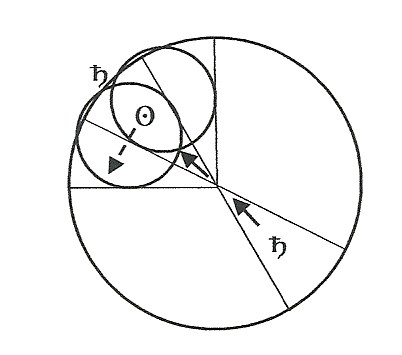
FIGURE 1979 1212-1. Saturn in Leo and Fourth Quadrant Vesica.
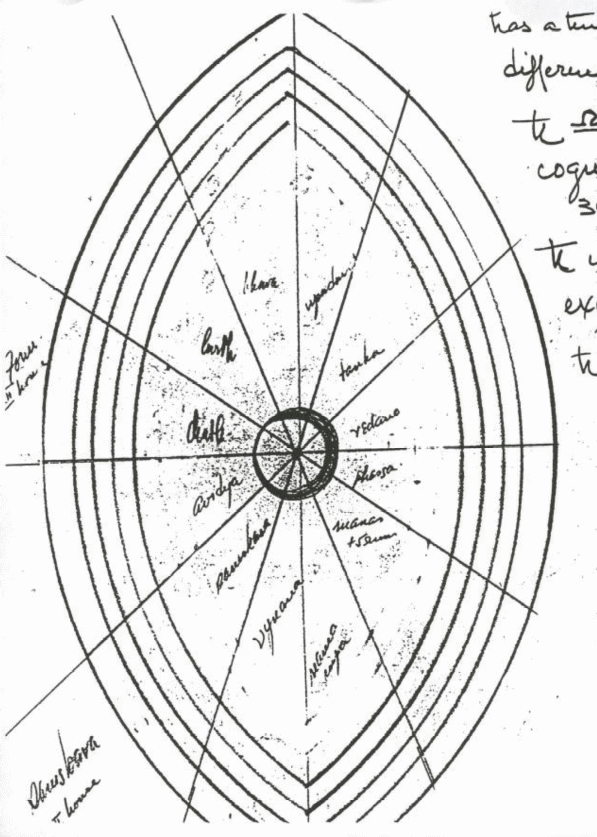
FIGURE AD_A007Bmagnify. Vesica with Nidana Chain.
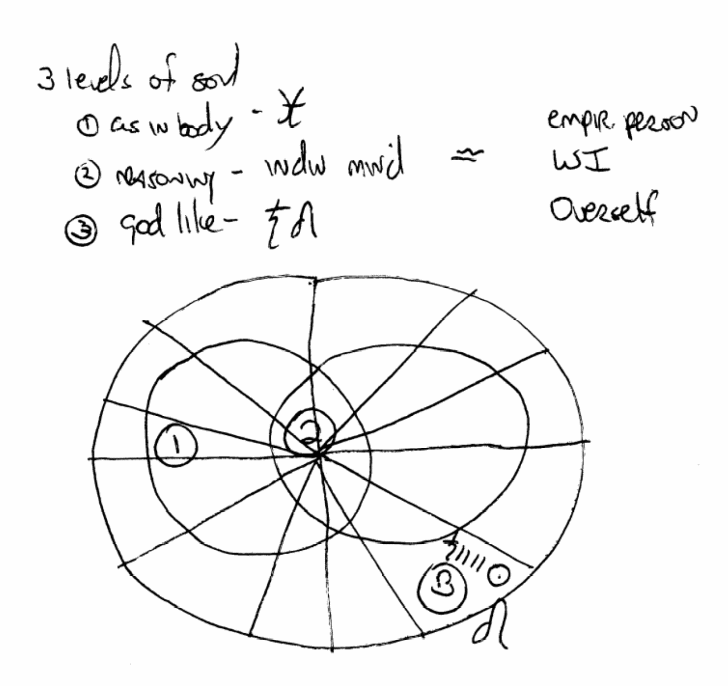
FIGURE 1979 1212-3-AB. Three Levels of Soul.
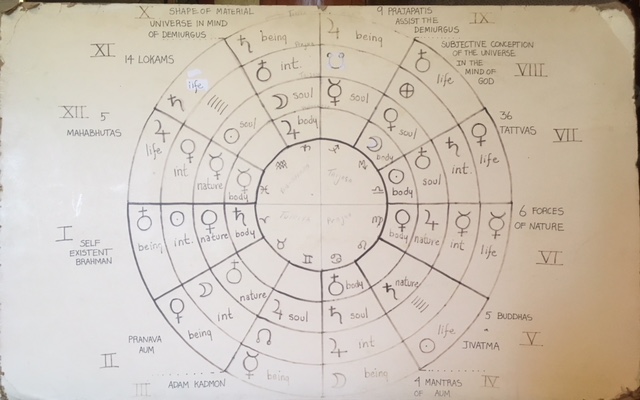
FIGURE IMG_2202-Posterboard Metaphysical Chart.
FIGURE 1979 1212-5-AB. Overself, World-Mind's Thinking, Primal Image.
Other diagrams referred to are not with this transcript version. [Transcriber note: [diagram] means the speaker is referencing a diagram as he or she is speaking. If someone is drawing or writing, with audible sounds of chalk on a blackboard, I indicate this by [drawing] or [writing].]
NOTE: Wednesday night class, part of Wisdom series 1979-1980.
TRANSCRIBED Verbatim by IT 2019; reformatted by JRM & JF 2019-2020, with TOC/Subheads by JRM. In 2023, IT updates prefatory matter, footer, and audio file name, completes Book List, adds new notes within transcript, fixes errors/typos, adds five diagrams and references within transcript to these diagrams. In 2024, MW alters Subheads to make more accurate. Archival verbatim transcript – V14.1a.
AUDIO FILES: 1979 1212a, 1979 1212b. [Note: "Tape" and "Side" refer to original audio cassette tapes that were later digitized into .MP3 Audio Files.]
1979 12/12 at Wisdom's Goldenrod
PB Books; Wisdom of the Overself; "The Immortal Overself"
Archival verbatim transcript
[Audio File 1979 1212a Begins]
SS: The-- the paragraph where it begins--
[Transcriber note: I am using The Wisdom of the Overself by Paul Brunton, Rider and Company, London, 1943.]
IF ALL YOUR PRESUPPOSITIONS ARE ABOLISHED AS YOU APPROACH THE OVERSELF, YOU WILL EXPERIENCE YOUR OWN SOUL, NOT THE WORLD-MIND
PB [The Wisdom of the Overself, "The Immortal Overself," p. 116, SS reading]: "The experience which one man has when he first comes into [the] consciousness [SS reads: conscious] of the Overself is absolutely identical with that which all other men have when they too come or shall come into it."
SS: We were speaking of the memory content of the Overself and that would appear to make each Overself individual and-- and that aspect of the Overself you could distinguish one from the other. On the other hand we spoke of the-- the World-Mind's point of view of the Overself as being all one, they were all of the same substance. And we were looking at it from those two points of view. And-- so when one has the experience of the Overself, is that from that point of view when-- of the World-Mind? Is it that in looking at them from an individual point of view like we are now it would appear as though they were different, but that if it was the World-Mind's standpoint it would appear that they were all the same? And that when one has the experience of the Overself one is taking that point of view, that they're not different at all, that they're all having-- that they all appear absolutely identical as he says here?
[short pause]
AD: I wouldn't approach it that way, Steve. I would say that from the point of view that we're operating from now, [SS: Yeah.] here and now, [SS: Yeah.] (if/that) rooted in the separative ego, you know, the empirical ego [SS: Uh-hm.] that has its fictions and postulates about what it's all about, that when one approaches the Overself with those-- those preconceptions, he does have a different opinion than someone else who's also let's say approaching the Overself from these preconceptions and fictions. Now, one of the prerequisites and (one of the) conditions to, I don't know-- to approach or let's say to get to the threshold of the Overself is exactly that those presuppositions and preconceptions are abolished. And if they are abolished then the experience of one's own soul is not from the point of view of the World-Mind but from the point of view of his own soul. The experience is of one's own soul, not the World-Mind, that would be a further step up, a further ascent. So that if we say that soul represented this indeterminate tendence to self-knowledge, if we say that it represented pure subjectivity, that which is most precious and valuable in each and every one of us, and that it is not conditioned by any of our thinking, and if each and every one of us were to wipe away whatever conceptions we have about it and say reach it, then it would be the experience of the soul, and not from the point of view of the World-Mind.
Now, the point of view of the World-Mind would come about because we would say that if they're all rooted in that, then the experience would have to be the i-- would have to be identical because they're all rooted in the same substance so each individual soul is rooted in that substance and you got rid of the fictions that your mind works with, you elaborate the methods and the technique until you got to that point, when you got to that point the very thing that separates you from someone else is like a divergence as far as what the meaning of life is for you or for him or for someone else. All those things are done away with, they're not there. So that the experience one has is directly of this-- this soul as being made of the very substance of the World-Mind and so you'll all have the same identical experience, alright. So I wouldn't say it was the experience of the World-Mind right (here/there).
SS: So in that sense they're absolutely identical, the Overself.
AD: In that sense they are, yeah.
SS: When there aren't those preconceptions.
AD (simultaneously): Because they-- yeah, because if they are all, the way he points out, divisions within the World-Mind itself, the Greeks would say the Nous, you know. I imagine the Hindus would say the Atma is Brahman, you know, because when it's in the World-Mind, if you think of World-Mind as Brahman and you think of Atma so to speak as a part or included in that, [SS assents, faint] alright, they interchange them and say Atman is Brahman. I would say for more precision, I would say that soul is not World-Mind, although there's an identity-- an identity in the sense of existence, [SS: Yeah.] they're both existentially of the same substance. So, there would be a commonality that two people experience the Overself consciousness would recognize each other.
SS: In respect to that substratum, to that existence. But the point that I don't understand is, when you speak of the individualness of an Overself--
AD: I'm sorry? When we speak of--
SS (simultaneously): When we speak of the in-- you know, the-- those-- the-- well, when we made that distinction that my Overself is not your Overself, that souls are distinct and they gain a self-knowledge, alright.
AD: No, I [S simultaneously: They're--] disagreed with that interpretation. That's not self-knowledge.
SS: Well, let me ask this, what makes Overselves distinct even from the level of--
AD: Let's read on and [SS simultaneously: Ok.] I think-- let's turn to the next page and let me go back to the notion of memory, alright.
S (very faint): Yeah.
SS: That-- because I'd like to understand that part of memory [couple/three words inaudible]
AD (simultaneously, faint): Yeah I-- I have a-- a different way of looking at it, I don't know-- precisely disagree but I look at it in a different (light/way), I [student assents, faint] see a little different there.
SS (simultaneously): Uh-hm.
S (very faint): Ok.
S (simultaneously, possibly part of background): Thank you.
AD: If we read the last line--
THE WORLD-MIND, THE NOUS, IS IN YOUR SOUL
PB [The Wisdom of the Overself, "The Immortal Overself," p. 116, AD reading]: "From the human standpoint the Overself is the deeper layer of mind where man can become conscious of God. It is the timeless spaceless immanence of the universal being in a particular centre."
AD: Do we follow what he's saying here? This is um--
[students assent, faint]
[16½ second pause]
S (very faint, possibly part of background): I don't get any of that.
PB [The Wisdom of the Overself, "The Immortal Overself," p. 116, AD reading]: "…timeless spaceless immanence of the universal being in a particular centre."
AD: Well we could try. Yeah--
JG: The particular center-- If we understand by the timeless spaceless immanence are referred to as-- as the Overself, and from a human point-- standpoint we take that down to the empirical level, then that center is a-- a particular center of body.
AD: Well it doesn't matter right now Johanna, you could say whether we think of universal being as immanent in the Overself [JG: Yeah.] or if you think of universal being as immanent in the Overself of this particular person, ok.
JG: Oh I see.
AD: Doesn't matter now. The point is do you follow what he's saying there, I mean the import of the passage.
JG: One thing I don't-- do absolutely not understand is the deeper layer of mind.
S: Oh.
S (very faint): Yeah.
JG: 'Cause we have taken great care so far to separate the realm of mind from that of the light.
S (very faint): Yeah.
AD: Well, the standpoint of the Overself is the deeper layer of the Nous where man can become conscious of God.
JG: Yes, well--
S (faint): I do.
JG: I think--
AD: It's only in the World-Mind that you can become conscious of God.
[short pause]
JG: Then-- ok, no then-- It's only in the mind-- in the World-Mind as the World-Soul?
AD: No.
JG: No?
AD: The World-Minds. The actual Intellectual-Principle.
S: Uh-hm.
AD: So if we want we could translate it that way. The Overself is the deeper layer of the mind, you know, it's part of the Nous. When he speaks about the World-Mind divides itself into innumerable centers, that would be one way of saying it. Another way of saying it would be if you wanted to follow through with the-- Richard's terminology, you know, we could think of for instance the empirical being, then we could think about the Witness-I of the empirical being, alright, then we could think of the Overself. And if we want-- and call those three things mind, alright, then we could say that the deepest layer of the mind would be in contact with the World-Mind, if you wanted to interpret it that way. In other words, if you think of the mind as having a stratum, [JG assents] you know, like layers, and that this mind that we work with in the empirical world is superficial in comparison to the Witness-I which presides over a whole series of empirical minds, and of the Overself which presides over the Witness-I, and if we think of these three as using the term 'mind' for those three, then we could say the Overself is the deepest layer of this mind. Those are the two ways of looking at it. So you see, I'll leave you room to, you know, try to think it out for yourself, follow your own inclination. Now, if we get back to the point--
PB [The Wisdom of the Overself, "The Immortal Overself," p. 116, AD reading]: "From the human standpoint the Overself is the deeper layer of [AD adds: the] mind where man can become conscious of God."
S (very faint, possibly part of background): (Good/Big) deal.
AD: Yeah, go ahead.
DB: Could-- could that be interpreted as, insofar as the individual has a contact with the universal being, the World-Mind, that it's from-- it's because of that that he could be aware of-- of-- be of Mind in itself, be a unity? Is that-- is that what he's saying (here/there)?
AD: Well, yes, we could say that. But I was looking for a dramatic, you know, rephrasing of that sentence. Just, you know, a-- a very dramatic phrasing of that sentence. Now, in a different language so that-- you know, because this is memorized, you know, when we talking about this here I know you got it memorized. So if you say it in different words, you know, then I think you've got the import. But isn't he saying something like this here, that the World-Mind is in the soul?
S: Ah.
DB: Yeah.
S (very faint): Just what I thought (initially/originally) and then I thought--
JG (simultaneously): Where did you squeeze that out? (JG laughs a bit)
S (faint): Yeah.
S (faint): Uh-hm.
AD: That's right in the sentence. The World-Mind is in your soul. And to the extent that you recognize that here at this level, at the empirical level, to the extent that you recognize that the World-Mind is within your soul, alright, and that you have a contact with that soul, then the intelligible universe is within you. In other words, that's what distinguishes an enlightened man and an unenlightened man. An unenlightened man, the ignorant man thinks quite differently, he doesn't think that the whole of universal being is within him. He thinks it's all out there.
JG: Do you refer yourself now to the last sentence, it is the spaceless timeless immanence of the universal being in (a/the) particular center?
AD (simultaneously): Immanence of the universal being in you.
JG: Yeah.
AD (faint): Yes.
JG: And the particular center being the self?
AD (simultaneously): Yeah you, you're a particular center.
JG (simultaneously): Yeah. Yeah I'm--
AD: And this is within you. So, you would say a man of an enlightened attitude would be a man who recognizes the world, an intelligible world, the World-Mind, this Intellectual-Principle is within him. [JG simultaneously: So actually--] Otherwise the whole notion of Buddhahood would be quite meaningless, wouldn't it? Or Christhood or whatever you want to call it, Selfhood, would be meaningless. [short pause] Yeah--
AB: If you define it this way, that it's where you become conscious of God, wouldn't that lead to saying that there were different Overselves? Because if the World-Mind is in the soul then it's not identical with the soul.
AD (faint): I don't follow your point yet.
AB: Well previously he was speaking about how there's really only one Overself.
AD: Yeah but I told you I-- last week, I don't buy that.
AB: Yeah.
AD: I don't want my Overself to be your Overself. I-- I'm very greedy, I want mine to myself. You could get your own.
AB: Right but--
S: Oh. (laughter)
AB: I was just saying that this sentence could be interpreted as saying that there would be different Overselves. Because if it's where you become conscious of God, it's not equal to God or World-Mind and therefore I would be conscious of mine in a different way-- well--
RG: Yeah but Alan, he never says the Overself is equal to. I mean even when he speaks of there's one Overself.
S (very faint): Yeah.
S: In fact he talks of it as one [one word inaudible]
AD: You see-- and that point of course was well taken but, if the Overself of each individual person is like-- when he come-- when a-- when a person becomes aware of his own Overself and receives some information about universal being, and another person also has the same experience or-- usually the knowledge of these two would be-- would coalesce, you know, be meaningful-- there won't be contradicti-- there won't be contradiction between them. So, there would be let's say the intelligible world will be present to both of them. The discrepancies may arise and occasionally do from the point of view of the cultural mores, personality distinctions that we make between one Sage and another, alright. So there there may be some differences but basically even those are very limited in comparison-- in comparison and relatively to the almost overwhelming similarity of states that are [one/two words inaudible]
JG: Anthony, you started out the class, you wanted to go more into the memory content.
AD: I'm going to wait till I finish this section.
JG (simultaneously): And then you come back to that sentence.
AD: Yeah, and then--
JG: Why did you do that?
AD: I'm sorry?
JG: I try to follow why you did jump from the memory content which you were-- wanted to work--
AD: Well I want to go back to the memory content [JG: Oh yeah.] when I finish this section, then go back to it. And I think you get a different view [JG: Oh I see.] from the way I look at it. Go ahead.
THE TENTH AND ELEVENTH HOUSES ARE LIKE THIS MARVELOUS MACHINERY THAT WILL EVENTUALLY PRODUCE BUDDHAS
S: Before we go back to it, could I ask one question? Last week we spoke about an image of the Overself. After I thought about that like the only image that I could come up with that would-- I mean that's a hard-- hard thing to think of, an im-- the Overself (that has/as) an image. Would that-- would the Overself's image be the-- be astrology or be the universe? Could I consider that an image of the Overself?
AD: No not really. Again I think you're jumping the gun, if you could wait. You're referring to where he says the Overself is truly an eternal image of the World-Mind?
S: Well, that and we've u-- we've used it other times speaking of an image of the-- of the Overself, we've never really defined one.
AD: Yeah.
S: I mean I'm interested in images, so what--
AD (simultaneously): Yeah that's very advanced, because the notion of the soul as an image, you know, an image of the World-Mind--
S: Well I know we can't think of it in-- as an image in the empirical world. I mean it's not something that I can put my hand on and say this is what the image of the Overself is. That's why the only thing I could possibly think of would be astrology, a whole, you know, a-- a whole planetary--
AD (simultaneously): It's even-- it's even above that.
S: It's above that. It's above the universe? Oh see then-- I-- I use that point of view when I-- when I tried to understand the sentence that we're doing right now.
[Note: See FIGURE 1979 1212-1, Saturn in Leo and Fourth Quadrant Vesica, appended to this transcript for the following.]
AD: Uh-- [short pause] I can see why you would do that, very often I take the tenth and the eleventh house [diagram] and say here's the astrology, here's what it's based on, and here's there's an image of the soul and in not-- in my soul there's an image--
S (simultaneously): And you put the vesica [diagram] right there. I mean before we had it separated and now all of a sudden it's taken away from everything else and it's this small-- well not small little thing but all of a sudden it's in the fourth quadrant [diagram].
AD: No. [S, very faint: Ok.] No, it's in the second [diagram], isn't it?
S: The vesica?
AD: Oh, I'm sorry, I--
S (simultaneously): You always put it in the tenth and eleventh, twelfth house-- in the eleventh and twelfth house [diagram].
AD (very faint): Well--
S: That's-- that's where I'm picking up the image of astrology anyways.
AD (simultaneously): See, I think of the tenth and the eleventh house like the Tathagata, the womb where the Buddhas are fabricated, produced.
S: I know but that doesn't mean anything to me.
AD: Well like if you-- if like if every one of us is potentially a Buddha, you know, [S: Uh-hm.] the production of Buddhahood is what that tenth, eleventh house refers to. In other words the way your experiences are prefigured so that ultimately from the quintessence of these experiences you extract a certain amount of wisdom and that after many eons and eons of considerable effort, one generates within himself the causes that direct that stream of consciousness to that point of Buddhahood, ok. [student assents, very faint] So I regard the whole (thing), the tenth and the eleventh house as this-- I-- words are inaccurate but it's like this marvelous machinery that will eventually produce essentially an enlightened attitude in a person so that he can become a Buddha. I have to back away from that, that's--
S (very faint): Uh-hm.
S: I'd be happy to back away from that.
AD: Alright. (bit of laughter)
S: I mean I just-- that's not--
THE OVERSELF, WHEN IT BECOMES UNIVERSALIZED, CAN PRODUCE ITS OWN UNIVERSE
AD (simultaneously): The-- the notion of the Overself as an image of the World-Mind I think would be-- we would get closer to it this way, if we think-- if we think that the Overself or the soul, there's something analogous in the soul to the World-Mind. Now the World-Mind we know is like the archetype of the universe, [S: Ok.] alright, and that the whole of the universe has the archetypal Idea in the World-Mind. Now similarly the individual soul, alright, produces for each individual his world. And when he finally learns about everything that there is to learn, then his soul becomes like a Logos principle. In other words, it too could produce the way the World-Mind produced.
S (simultaneously): Alright. Am I correct in assuming that when you put the vesica in the tenth and eleventh there, in the fourth quadrant, that's the individual soul?
AD: That's the individual soul as immersed in [S simultaneously: Ok. But--] generation, in manifestation. But--
S: But we didn't say that-- we said that the Overself wasn't above the World-Mind.
AD: No, I didn't say that, no.
S (simultaneously): Ok. So now if we say that the soul is part-- (you see) if you s-- I mean-- did you say the soul is part of the Overself-- or part of the World-Mind or did you say the World-Mind is part of the soul, I forget, [AD simultaneously: No, I said that--] I thought I heard you say the World-Mind is part of the soul.
AD: The soul is a part of the World-Mind, it's made of the same essence as the World-Mind. I also said that the s-- the World-Mind is included in the individual soul.
S: Ok.
AD (faint): Yeah.
S: But then when I think of the universe and I say that the Overself isn't-- is the image of the universe and you say no it's-- the Overself is higher, then [AD simultaneously: Because--] the on-- only other place I could put some--
AD (simultaneously): The Overself is higher than the universe.
S: The Overself is higher than the universe.
AD (simultaneously): Yeah.
S: Oh, yes, right.
AD: Because the Overself could ultimately, when it learns, produce its own universe.
S: Yeah but I-- when I say universe I'm not just thinking of Mars and Saturn and Pluto and our stars. I'm thinking of the universe, everything that's in the universe.
AD: When you become a big girl, then you get your own erector set. (laughter) In other words, it's po-- there's the potentiality of the soul to get universalized. That's what Buddhahood means. But if I could do it this way. If we put this-- let's say that this is the realm of the World-Mind [diagram], alright, [drawing] and this is the wor-- this is the cosmos [diagram], alright. That's the cosmos, world. And that this soul descends here and is learning in the world first-- first in the twelfth house, you get all the experiences that it can get through various planetary sojourns, and then, so to speak, the tenth and the eleventh house. So that the soul after it learns the lessons here can rise above in the administration of the cosmos. That's the ultimate notion, alright.
S (faint): Uh-hm.
S: That's why you spoke about Buddha material.
AD: Yeah now, this here part [diagram], this part here, alright, is where [drawing] Buddhas are being made. In other words, if we are all potentially capable of universalizing our Intellect, it is this functioning here that's doing it. Over here you put ignorance [diagram]-- [drawing] you remember the nidana chain that the Buddhists work with? [Note: See FIGURE AD_A007Bmagnify, Vesica with Nidana Chain, appended to this transcript.] Alright. And a series of experiences will accrue and bring about ultimately an eventual understanding of the purpose of life, alright, and then let's say one decides to follow that clue up and-- well--
JG (faint): What do you mean follow that clue up, Anthony?
AD: Well when you really and truly realize that life is suffering, then you're going to try to figure a way out.
JG (faint): Uh-huh.
THE SIX REALMS OF EXISTENCE IN BUDDHISM AND THE UNIQUE OPPORTUNITY OF A HUMAN BIRTH
AD: Alright, but most of us are not convinced. (And enough said.) And so we keep hitting ourselves, alright, and-- and Buddhists, they really throw it on the line, they say look, you can't make the decision tomorrow, next year. It's now or never. If you don't recognize the uniqueness of being a human being, well, then there's other ways of convincing you. And also, you know, they-- (laughter) [S, faint: Yeah right.] they point out, you know, life is very-- there's no guarantee that you're going to come back as a human being over and over again, you-- you may go to different realms of existence, like over here the denizens of hell, over here the hungry ghost, (bit of laughter) and over here the animals, and over here men, over here titans, over here gods [diagram]. And you could be born in any one of these realms. Now for instance if you're born in the realm of the gods, alright-- they're devas really, not Gods, they're devas actually, well you're so happy you wouldn't think of ever becoming a Buddha, alright, until of course the end when your armpits start to smell and you (student laughs) smell foul odors, [S laughing: What?] and you're no longer-- long-- no longer interested in-- in your throne. Those are signs of approaching death. But all the time while you're a deva you're not interested in-- you're happy, why should you want anything to change, everything's perfect, alright. So you might be born as a god, ok.
S: Is that the Christian [AD: No.] heaven? It isn't?
AD: Now, these are-- [S simultaneously: I mean is that-- is that where they got their ideas from?] [drawing] these are the six degrees of existence according to Buddhism. You've probably seen the Kalachakra wheel where there's this [S simultaneously: I know.] evil gentleman in the middle laughing, (laughter) [one/two words inaudible] inserted in there's, you know, six circles, I mean six divisions in the circle, and each one represents one of the possible places where you may be born.
S: Uh-hm, I just wondered if that's where they got their idea for the heavens, you know, the-- the gods.
AD (simultaneously): (The description) experience on the part of many Buddhists.
S (very faint): Ok.
AD: I mean (bit of laughter) [couple words inaudible] [S simultaneously: Silly (one word inaudible)] [S simultaneously: Silly Buddhist.] And you can-- you can actually visit those places. You can--
JG: You can visit them.
S (very faint): Yeah. (bit of laughter)
S (faint): Uh-huh.
S (faint): Yeah.
AD: They very [S simultaneously: Oh my God.] often, they very often-- well, for instance, [S: What are you laughing at Louis, it's not funny.] you don't have to actually go out of the way. I mean, I don't have to point out to you that you can-- you can see the animal traits in yourself, you don't have to go there.
JG (simultaneously): Oh yes, but I worry about my godly traits. (laughter)
AD: Well anyways, these are [S simultaneously: Very good.] the six-- these are the six realms of existence and if you see the Kalachakra that-- you know that's what it's referring to and you could be born in any one of them. We got off the point, didn't we.
S (faint): Yeah we did get off the point.
S: Well you're on--
S: We were talking about the image of the Overself.
JG: You were speaking [AD simultaneously, faint: Huh?] about the-- the World-Mind.
AD (simultaneously): Oh, so the Overself could live anywhere, it could live here, here, here [diagram], it could live anywhere, ok. But let's say, let's say it outgrows all of these places, then it could live in this realm here [Note: eleventh house]. [S, faint: Uh-huh.] [S simultaneously: Oh.] That would be like the manas principle where it could be like, what could we say, the purely intellectual being thinking all the time. And then it could even live here [Note: tenth house], alright, like c-- a c-- the celestial part of the universe.
S: Ok, wait a minute. Do you say that the-- if the universe is a thought and that's why the Overself and the World-Mind are higher than the universe?
AD: Well, the Overself from the point of view of an individual is superior to the universe because that is what's most precious in you.
S: In the universe, ok. But how can we speak about an image then?
AD: That's why I wanted to wait because you're not ready to understand what he means when he says the Overself is an eternal image of God. Because you're going to see pictures.
S: Alright.
AD: And it's--
S: Yeah.
AD: Does not refer to the picture. Actually, we've been working on that problem for a long time, trying to understand precisely how that-- how the Overself images the World-Mind, and uh-- In the meantime it first has to go to school and learn from God's world, alright, how the world is and what rule-- what the principles are involved. And then after we understand that we could talk about going to the next level of-- Because over here remember you have to become what you want to know, I mean in-- in-- in the real world you have to become what you want to know. You can't get it through concepts. [S, faint: Right.] Alright let's start with the next paragraph, (Avery would you start). We'll read a paragraph at a time.
PB [The Wisdom of the Overself, "The Immortal Overself," p. 116, AS reading]: "Why am I myself and not somebody else? This is an important question which can find a final answer only when we [can] penetrate into the co…"
S: (Cancel.)
S (faint): 22 paragraph.
S (very faint): Uh-hm.
S (very faint): 22, is that the one you're doing?
S (very faint): Yeah.
THE LIGHT IMPARTED BY THE OVERSELF TO A PARTICULAR BODY IS NOT THE OVERSELF PER SE
PB [The Wisdom of the Overself, "The Immortal Overself," pp. 116-117, AS reading]: "…only when we can penetrate into the consciousness of the Overself which projected this particular"I" into incarnation, for an entire tangle of evolutionary necessity and karmic history would need to be unravelled. Meanwhile it may be said that the Overself projects itself into a series of separate beings but instead of holding its light they hold its shadow. Although the Overself is but a segment of the one World-Mind its expressions during cosmic manifestation, that is personalities, will each possess traits of their own which differentiate one from the other. These are the transient differences which divide the innumerable living beings but they all exist on a lower level than the Overself which eternally unites them. And just as each of the figures in a dreamer's mind lives a characteristic life of its own in a semi-independent way, so the personalities projected by the Overself largely follow their own course once they have been placed at its starting-point. The Overself within the person is always the same and always aware of its relation to it, even though the person is so ignorant of this relation. The memory of the essential characteristics of all former related incarnations are registered and preserved within the Overself, although it does not need to sit and brood over this knowledge, which is kept latent."
[26¼ second pause]
SS: What separate beings does he mean here when he says that the Overself projects itself, separate beings? Are these different--
AD: Well, you could think of the same or the one-- (the/they're) one and the same life of a particular soul as getting projected into body A, then when that body passes on, body B, and then body C and body D. So you will have a series of-- alright. And, if you remember we pointed out that the body was something which was provided by the cosmic soul which built and fabricated from within its own mental substance that body, and then this-- this Overself light would be "inserted" into that body and gain experiences or let's say live out its life through that body. [SS assents] Now the light which is imparted to that bo-- particular body, alright, is not the Overself per se because it doesn't come out of the World-Mind and go down into the body. So it imparts some kind of light to that body. Now that body has a life of its own. Alright?
SS: And to hold its shadow?
AD: Well, by the time the light-- when the light first enters into the body, alright, and the effect of that light, by the time it reaches out through the orifices, the brain and all that, alright, by that time it becomes gloom and doom. (bit of laughter)
SS: It's not really light.
AD: Well it's no longer [SS simultaneously: It's not pure.] light because the very nature of our inner being obscures that light, so the thoughts we have, the dispositions, the moods and all that that, you know, we claim, all that is like the big veil, you know. Like it brings about the densification, the corporealization of that light. It started out nice but by the time it gets through it comes out murky, brown and blue. (bit of laughter) But nonetheless, nonetheless the-- um-- [9¾ second pause] It is possible to get back to that light the way it is. [SS, very faint: Ok.] The point that I was trying to make was that through the pathways provided by the structure and the fabrication of the body, the very nature of the way the body is built so that it is subject to certain influences as they come into it, the very structure and nature of the way the body is fabricated, that it provides these pathways through which the influences could go into the body, alright, then come out as the sense perceived world, it's that-- it's from there to there, so to speak, these-- between these two points that the light gets dimmer and dimmer.
[short pause]
S: It's not so hard to understand when he says the Overself projects itself into a series of beings but what does he mean when he says that the Overself projected well this particular "I" and later on when he says it projects personalities when we have attributed that to function of the mi-- individual mind before?
AD: Well it's more-- I would say it's much more complicated than that. If we take this here to be the point of the Overself [diagram], alright, and that it gets invested in the functioning of the manas, alright, where we say there's just these mental processes going on, and then that these mental processes or the-- that entirety produces the empirical individual here, you can see there's a steady-- a steady downgrading of this light which is imparted to that. The-- this light here [diagram] doesn't go directly into a human body. [Note: See FIGURE 1979 1212-3-AB, Three Levels of Soul, appended to this transcript.]
S: Right.
AD: It goes into that-- [S simultaneously: So it's--] into the-- uh--
S (very faint): Are you sure it doesn't?
S: So it seems that they (one of) conjunction or of a personality, conjunction of the individual mind and the Overself.
AD: Yeah.
S: And that the projection that's happening from the Overself is I guess you would say maybe part of-- I mean it might project it-- the light into the manas and then the projection that comes from the manas is [one/two words inaudible]
AD: Well--
S: Is that--
AD: The manas, so to speak, we said does build this entity, alright, the cosmic soul. So that means that your body represents the actualization of these mental processes and psycho-essences together. In your body there is the corporealization and your body is the corporealization of these psychical essences, the thinking (he's/we're) saying. So what we're really saying is this is karma corporealized.
S (faint): The body.
AD: And this is what you're going to experience. Now, the illuminating principle, the cognitive principle is joined to that manas, alright. But it isn't that this stretches there [diagram], I don't-- I mean most of the writings we know they would say a light is imparted to that, [student assents] but the Overself light itself does not go down there, it doesn't descend there. So it always stays distinct from that.
THE DIFFERENCES BETWEEN ONE PERSON AND ANOTHER ARE INHERENT IN THEIR DIFFERENT BODIES, WHICH ARE FABRICATED BY THE COSMIC SOUL
S: Should we make a distinction, like when in the beginning of the paragraph where he says-- he talks about a particular "I" being projected, and later on when he talks about personalities, are they the same? Is your "I" or--
AD (simultaneously): That particular "I" that is projected and the personality, what we call the personality, I tend to equate those two.
S: Ok, and the body then is--
AD: In the body. We're sticking--
S: Ok.
AD: In other words, this light was just projected from the Overself into-- let's say through the medium of the secondary intermediate principle, that that is exactly what we mean by an "I". This is what we usually mean by an "I", I'm not saying this is the true me but this is what--
S: Uh-hm.
[18¼ second pause]
AD: Um--
JG (faint): I think--
PB [The Wisdom of the Overself, "The Immortal Overself," p. 116, AD reading]: "Although the Overself…"
AD: Let me ask a question.
PB [The Wisdom of the Overself, "The Immortal Overself," pp. 116-117, AD reading]: "Although the Overself is but a segment of the one World-Mind its expressions during cosmic manifestation, that is personalities, will each possess traits of their own which differentiate one from the other."
AD: Now these traits which distinguish one personality from another, where would they, so to speak, what would be their ground?
S: Go ahead.
SS: Cosmic soul.
S (faint): Cosmic soul.
S (faint): That's ok.
S (very faint): Individual [couple/three words inaudible]
CDA (simultaneously): It's the individual mind.
AD: Think so? Why?
SS: Because that's where the karma is registered, that's where it's imprinted. That's where the memory of these mental bodies exists, in the cosmic soul.
AD (simultaneously): In other words like if this imparted light to a product of the cosmic soul, alright, and that cosmic soul-- I mean that product of the cosmic soul, this body, is built in a certain way, let's say certain defects are inherent in it, then that Overself associated with that body experiences the defects of functioning through that body.
SS: But it's-- but it's associated with the body that's right for that Overself.
AD: Yeah I-- we're not there yet, [SS: Ok.] what we're trying to get here is that these differences that arise between one and another will be inherent in the very body that is fabricated by the cosmic soul, alright, that-- that it will not be in the Overself.
SS: Right.
AD: Ok.
JG: It doesn't s-- I know what you're saying but it-- I have a hard time accepted-- accepting it or following it through because he always-- he gives the Overself now such a priority in terms of even our worldly existence, you know, that it is directly involved or working with the production of it, that's at least how it sounds to me. Later he even says that otherwise--
AD (simultaneously): The higher self--
PB [The Wisdom of the Overself, "The Immortal Overself," p. 117, AD reading]: "This higher self…"
PB [The Wisdom of the Overself, "The Immortal Overself," p. 117, JG reading (simultaneously with AD above)]: "The memory of the essential characteristics…"
AD: Yeah, read the next paragraph--
PB [The Wisdom of the Overself, "The Immortal Overself," p. 117, AD reading]: "This higher self does not itself evolve…"
PB [The Wisdom of the Overself, "The Immortal Overself," p. 117, JG reading (simultaneously with AD above)]: "…does not [itself] evolve through widening experience…"
AD (faint): (Read it.)
JG: Does not evolve like the--
PB [The Wisdom of the Overself, "The Immortal Overself," p. 117, JG reading]: "…through widening experience like the personal self which it sends forth to taste of the fruit of the Tree of good and evil."
S (faint): Yeah.
S: What did he say?
S (faint): Where's she reading?
S: Paragraph 14.
JG (simultaneously): That's paragraph 14.
THE INTELLIGIBLES ARE PRODUCING THE VARIOUS SHEATHS TO MAKE A BODY AVAILABLE TO THE IDEA OF MAN, THE MYSTICAL "WORD MADE FLESH"
PB [The Wisdom of the Overself, "The Immortal Overself," p. 117, AD reading]: "The body provides the field of experience, [JG: Yeah.] thought and feeling provide the means of experience, whilst [AD reads: while] the higher self is the ultimate experiencing being in man, the mystical"Word made flesh"."
[short pause]
AD: Start-- start again.
FW/S(?) (simultaneously): Should I ask Avery?
AD: Sure.
FW/S(?): Avery, (would/read)--
AD (simultaneously, faint): Well he's-- he's not a person non gratis, he's got (the pages) where he's from. (bit of laughter)
FW: Were you saying that the mystical Word would stand for the Idea of Man?
AS (very faint): Yeah. Uh-hm, yeah.
PB [The Wisdom of the Overself, "The Immortal Overself," p. 117, AS reading]: "…higher self is the ultimate experiencing being in man, the mystical"Word [made flesh]"."
[short pause]
AS (faint): And that's the ultimate experiencing being.
S: (We/I) can't hear you clearly.
JG: Avery could you speak up?
AS (faint): No, Fred-- Fred said it, that's what it said.
AD: Speak louder then, say it louder.
FW: I asked him.
S: I think--
S: Ask him again.
AS: They won't do it.
FW: Could you say that the mystical word would correspond to the Idea of Man.
AD: In other words, say the whole thing. (bit of laughter)
PB [The Wisdom of the Overself, "The Immortal Overself," p. 117, AD reading]: "The body provides the field of experience, thought and feeling provide the means of experience…"
(Side 1 of original cassette tape digitized as 1979 1212a Ends; Side 2 Begins)
JG: But it doesn't say how it's being done.
[Note: See FIGURE IMG_2202-Posterboard Metaphysical Chart appended to this transcript for the following.]
AD: Well, the Word made flesh is what we've been working on for years, trying to understand that whole mechanism involved. That's why the notion of putting the Ideas-- in other words, we've been working on this a long time. These would be the Ideas [diagram], alright, [drawing] the Fourth Idea, the Fifth Idea, Sixth Idea, all these Ideas, alright, Seven, Eight, these are the Ideas, all those, or the Divine Thoughts, Thoughts in the Divine Mind, and these-- these ultimately have to be manifested. So the Idea of Man is ultimately manifested over here [Note: twelfth house]. [S: Sure.] It doesn't have to remain like this all the time, I mean the man could get bigger and more beautiful. Or he might get uglier, smaller, dwarfish, impish, you know. But ultimately this creature has to express the Idea of Man. Wouldn't be appropriate for him to (not). And that's why it was necessary to go through this long gyration of trying to work out all the details of how this here [diagram], all the planets and dignities, how they as intelligibles are producing the various sheaths to-- made available to this Idea of Man a body through which he could operate. So we-- we won't go into that because that's too involved, you'd have to see me after class.
CDA: Can you think of the-- the soul of its own-- own wisdom as separate from the World-Mind choosing--
AD (simultaneously, faint): I'm sorry.
CDA: Can one think of the soul in its own wisdom, in its-- can you think of it as separate from the World-Mind in its--
AD (simultaneously): No not separate. Distinct, but not separate.
CDA: So how would you think about the-- this intelligence that is choosing a particular individual mind in order to experience? How would you think of that intelligence as-- in terms of the relationship between the soul and the World-Mind?
AD: Between the--
CDA: The-- you-- You know, how is that intelligence getting communicated to-- to the cosmic soul in this choice of a particular individual mind? Does that make sense? And it's sort of--
AD (simultaneously): In other words how-- how does karma know precisely what body to give this individual soul.
CDA: Well karma is--
AD: Yeah, that's your question.
CDA: Is that--
AD: How does karma know that you deserve this kind of a body.
CDA: But where are you saying karma is when you put it that way?
AD: Adrastia, justice, all these terms. Divine Wisdom. [CDA simultaneously: Ok.] How does it know that this is the body suited for this soul.
CDA: Well, I-- that almost sounds a bit presumptuous, to ask that question.
AD: Well yeah, that's why I put it that way. (laughter) I mean, to expect an answer from me, that's-- (more laughter) It's very embarrassing if you think I could answer questions like that. (laughter)
CDA: Well, I was-- I was sort of poking more towards some more-- more precise understanding of-- of-- not how it knows because that's obviously something else but--
AD (simultaneously): Well, in many traditions they do-- they do speak about the laws of karma who know exactly what your desserts are and what the consequences of prior actions-- what the results of those prior actions are.
CDA: So but would this be determined after the soul has made this contact with the cosmic soul? Or prior?
AD (simultaneously): Again, that's part of the same question Carol.
CDA: Is it? Ok.
AD: Part of the same question. You ask me the how, the why and the when, and I plead ignorance.
S: Uh-hm.
CDA: Well, you know, last week I asked a question that was also inappropriate. (laughter)
AB (amidst laughter): Next week?
S: I think she's right [couple words inaudible]
CDA: Now--
AD: You're going away on vacation, right? [CDA simultaneously: Uh-hm.] So I won't be able to get back at you. (bit of laughter)
CDA: But, you know, the question that I had last week was fu-- stumbling around, you know, this-- trying to find a way to conceive of this differentiation of souls in the second quadrant, you know.
AD: To conceive--
CDA (simultaneously): How to conceive of the souls being separated in the second quadrant. And-- and how this-- the-- how there is this difference in their visions, and that does this difference in their visions determine how the-- the different kinds of incarnations that these souls are going to--
AD (simultaneously): Well, I would assume that that would be part of the answer, yes.
CDA: Ok, can you tell me where I could read it?
AD (simultaneously): But the experiences-- in other words, if the soul has a vision of what it is to become, and what's operative in the soul is the desire to accomplish that [CDA simultaneously: Yeah, yeah.] vision of what it is to become, then accordingly experiences will be granted to it that would permit it to become that which-- But, the mechanism of all this is beyond me.
CDA: Yeah, no I-- Is there some place in Plotinus where he talks about this?
AD (faint): No.
CDA: No. I couldn't find anything.
AD: Well, those are pretty well-- closely guarded. [17¾ second pause] Well let's read that paragraph, "This higher self…", you know? Let's read another paragraph, let's (hear) another one.
AS (very faint): Ok.
THE LIVED SPACE OF THE BODY IS THE FIELD WITHIN WHICH EXPERIENCE OCCURS
PB [The Wisdom of the Overself, "The Immortal Overself," p. 117, AS reading]: "This higher self does not itself evolve through widening experience like the [AS reads: a] personal self which it sends forth to taste of the fruit of the Tree of good and evil. Each reincarnated"I" may be symbolically thought of as being but a point dwelling in the superior self's infinite and eternal experience. The body provides the field of experience, thought and feeling provide the means of experience, whilst the higher self is the ultimate experiencing being in man, the mystical "Word made flesh". It is the inner ruler of the ignorant personality, the divine deputy to profane life. It stands to its related successively reincarnated persons in the relation of a sun to the planets which circle around it. In this sense, as that which exists behind and above his sensation-emotion-thinking being, as a thread-soul by which all the innumerable reincarnations are joined together, we may call it the real being of a man. And although as the hidden observer it owns the ego it does not do so in the sense of personal ownership. It is as disinterested and as impartial towards this reflected shadow of its own being as towards all others. The explanation why the division involved in such self-fragmentation was the only way in which any "I" could come into being at all is a most metaphysical one and consequently a most subtle one."
AD: Can we stop there before we get into the second part of the paragraph? [10¾ second pause] Body provides the field of experience, could we (discuss) that?
S (faint): Anthony? [S, very faint: Uh-hm.] I didn't understand that, what [one/two words inaudible] providing the means of experience? I-- why isn't that open to me?
S (very faint): Right.
AD: Well that's why I said let's discuss first the body-thought. [short pause] Well--
AS: He spoke about it as the immovable spectacles of sensation. And [S simultaneously: Who said that?] we had that example where the mind actually goes out and takes the form of the body. It's through-- it's through its effects on the body that the cosmos is going to come in contact with the Overself, like the meeting-point between what the Overself can know and what's in the cosmos will be provided by the body so it's-- or through the body. So it would be the field. (Well) all your experience [couple/three words inaudible]
AD (simultaneously): Remember that very s-- remember that very famous saying by the Buddha?
AS: Yeah, the Buddha.
JG: What was it?
AS (faint): [one word inaudible] in this fathom length-- in this fathom-- (laughter)
S (simultaneously, amidst laughter): (He hasn't) announced it.
S (amidst laughter): What did (you/he) say?
AS: He says in [S simultaneously, faint: In this fathom-length, yeah.] this fathom-length body lies the world, the-- you know, everything in the world and the way out of the world. [Note: "I tell you, friend, that it is not possible by traveling to know or see or reach a far end of the cosmos where one does not take birth, age, die, pass away, or reappear. But at the same time, I tell you that there is no making an end of suffering and stress without reaching the end of the cosmos. Yet it is just within this fathom-long body, with its perception and intellect, that I declare that there is the cosmos, the origination of the cosmos, the cessation of the cosmos, and the path of practice leading to the cessation of the cosmos." Anguttara Nikaya 4.45, Rohitassa Sutta]
JG (simultaneously): I'm always afraid you'd skip [one/two words inaudible]
AS: What?
JG: I'm always afraid you skip the world. (JG laughs a bit)
S: But--
BS (part of background): Ed--
JG: Doesn't field also say--
AD: Do you understand that quote?
SS: Would you repeat it again?
S (simultaneously): No.
S: I didn't.
S (simultaneously, faint): Well say again.
AD: Well then listen to it. Listen to the quote.
AS: This is-- it's not exact but it's--
AD (simultaneously): This is the Buddha. This is a Buddha speaking, alright. It's not one of our quotes. (bit of laughter)
AS: Right. In this fathom-length body lies the world, everything in the world, and the way out of the world.
S (very faint): Uh-hm.
[short pause]
AD: Ok? So, the perception of the world depends upon this body.
JG: And it's also limited to the body because you never go beyond it. Right?
AD (simultaneously): Well, we don't know about that.
S (very faint): Uh-hm.
S (faint): Right.
AD: If it-- if-- if he says that it's the way to get you beyond it, then evidently [JG simultaneously: I mean it's--] it's the necessary prelude. So, what were you saying about this theme, that it is the immovable spectacles? Remember the quotation from the Hidden Teaching?
AS (simultaneously): Yeah the-- this quotation is we on-- we only know about the world through the reports of our senses, the reports the senses presented to us. [Note: "The point which must be grasped--and it will need a concentrated subtlety of thought to grasp it--is that we never know the panoramic external world in itself. We see that world only through the immovable spectacles of the sense-reports which we receive concerning it. We cannot bring it under direct observation. What we directly observe is--our mental reaction to it, i.e., ourselves! Without ever being conscious of this certain and simple truth we live day and night in no other world than that whose form is figured for us through what is termed sensation." Paul Brunton, The Hidden Teaching Beyond Yoga, E. P. Dutton & Co., Inc., New York, 1969, pp. 257-258.] So, in this condition that we're in, we only know about this world of the World-Soul through the world which has-- even some places he has the quote it says, we experience the world within the senses. Within the senses.
AD (faint): Yeah.
AS: Well, it's like field here is-- everything that we know about is the way it affects our body or comes through our bodily organism. That's what I would say.
AD (simultaneously): So then it's the lived-- it's the lived space of the body which is the first requirement in order for there to be a field within which experience can occur. A lived body is not the same as the body you talk about [student assents] or that surgeo-- surgeons discuss, that's not the same thing.
AS: (Right/Wait) and he's-- I mean he's speaking about the body here as the-- the World-Soul's or that vast-- the vast body, the body-- the body as it's contained in the World-Soul but not the Earth-- not the image you have, not the sense image you have of a body, the actual-- or the actual sense experience.
AD: So if we wanted to we could think of it, perhaps to expand our version of it, it's like the heart would be our experience of the Sun's functioning. Venus would be like our experience of the regulatory principle that governs our solar system, alright. Each one of these organs, if it's a lived organ and experienced in a vital way, each one of these organs, each one of these physiological functions, represent cosmic principles but manageable within the body so that you're experiencing these cosmic principles directly.
S: What did you say about Venus?
AD: Regulatory principle, just like it is in your body. It regulates the amount of proteins in the blood, it purifies the blood stream, etc, and all that. Eventually maybe it'll do that for our psyche, it'll teach us how to regulate our psychical functioning. Because from the physiological point of view, we first learn-- we first learn from a physiological point of view, then we learn from a psychical point of view. In other words, inherent in the instinctual patterns and functions of our physiology is a wisdom that later on might come up to the surface of our consciousness. But in the beginning it's only experienced as part of our bodily functioning. But at any rate, he's calling this-- this body, he's calling this the field of experience. And, that's quite an important statement. So if we take-- take the point of view that all these various functions, physiological and psychical that we operate with in a body, we have an experience of these cosmic principles, alright, in this way. So Nature found out after a while, "I don't have to create a dinosaur, a huge eighty-ton reptile, in order to experience anger. A little cat will do the same thing." (bit of laughter) Alright? It got smaller and smaller and now in the size of a little cat she experiences-- cat experiences anger, self-- the instincts of self-preservation. In other words, all these principles she's experiencing within that body more simply. (bit of laughter) [student assents, faint] Yeah, that's why they gave up these big eighty-ton things.
S (faint): Yeah. (bit of laughter)
CDA (faint): Ecological.
AD: But the point we're trying to get at, that these are cosmic principles and you could see them functioning in the universe. You could see them functioning in yourself. I don't have to be like-- kidding around, you know, very often I can tell you when I got a bad aspect, I got a certain amount of-- more acid than I can use. Bad aspect is going on. I can look it up and sure enough there it is. Otherwise it doesn't happen. So these cosmic principles are functioning in my body. And you could do that in a mental way too, you can see that a lot of your thoughts are really readily manufactured for you, alright, and tomorrow you'll wake up and you'll have a bright and happy intuition and you go away very inflated thinking who you are, ok. You look at the ephemeris, you see a Jupiter trine Mercury and you get deflated, ok, "Ah, that's what's going on." So you're experiencing all these cosmic principles in yourself. And you don't have to be a cosmic being, you could be a little 4' 10" gentleman. (bit of laughter) So that would be the body, alright.
SS: Is that the understanding of a macrocosm in the microcosm?
AD: Yeah. Or part of the meaning, part of-- The next part would be--
THOUGHT, OR COGNITION, IS THE MEANS BY WHICH YOU EXPERIENCE THE BODY
PB [The Wisdom of the Overself, "The Immortal Overself," p. 117, AD reading]: "…thought and feeling provide the means of experience…"
AD: Now, Christine wanted to understand that. Go ahead--
AB: Couldn't you say that the way you experience the body is in terms of emotion, you know, or thought?
AD: Try elaborating.
AB: Like you wake up and you're in this mood and that somehow a modification of that bodily apparatus which is reflecting the energy of the pa-- the planet. I mean you experience it in terms of these psy-- psycho-- psychical processes.
S (faint): Uh-hm.
[short pause]
AD: Yes. But, could we help her, she-- I think she wanted to know what does it mean, provide the means of experience.
S (faint): You see, it seems that, from what I understand you also have a-- a mental and emotional vehicle which are also bodies. And those I assume are also given by the cosmic. They consequently would be such fields of what we consider normally as the physical body. I mean, I got confused, are--
AD: Yeah we're-- I think we're on the right track. Richard, you wanted to say something?
RG: The body-- body remains unknown until it arises within consciousness. It may be the field but it's unknown to you until the forms of consciousness take it up within itself. And those forms of consciousness are thinking and feeling, [AD, faint: Alright.] etc.
AD (faint): Did-- did you follow what he's saying?
S (very faint): No I didn't understand.
AD: Try again.
RG: If the body that's being spoken of here as we said is that which is given within the cosmic soul prior to any-- anything we know, in order-- that essentially is what he's calling the field of experience (rather) than the locus in which all conscious (happens) could take place. In order for that to happen there must be-- consciousness would take certain forms (in which) to reveal this field of experience of course. Those forms of consciousness are thinking and feeling. I don't know if that is--
AD: Yes, that point's very important that you ask and that he's answering. Remember in a-- in a different way-- well, not really too different, when we were speaking about the Vedantist point of view we pointed out that in the Vedantist epistemology that the mind-- the mind can reveal the object to you when it goes forth and grasp(ed) and coincides the ob-- with the object, then it reveals the object to you. And, if we were more precise I think they would say a vritti or a psychosis or a thought, alright, is what's going to reveal. So, if we think of the mind going to the body, grasping, enveloping the body, coinciding with the body, that very thing that it does, at that one instant it reveals the body to you, alright, and whatever the body experiences that are available, they must become available through that vritti, through that thought. So the thought is the very means by which you're going to experience that body. Yeah (we--) you have doubt. Speak up.
[short pause]
S (faint): (You could say) I'm just using thinking is like thought in a different way. Seems from all our [couple words inaudible] that the consciousness coming in contact with these different bodies, not--
AD: Well, it would be consciousness that illuminates a vritti or a psychosis. We're not talking about that. We're talking about the means, that thought is the means. If thought does not, so to speak-- if thought is not the means or the intermediate, then consciousness cannot know the body. It can only know an object through a thought. Try to-- try to become-- try to know anything, alright, and you see implicit in the presupposition is thought. How can you know your body if there's no thoughts? [student assents, very faint] Ok, then you've answered your question. The thought is the means by which you know. Feelings are the means by which you know. I mean your body could be walking around let's say after twelve hours and be very tired but if you have no thoughts there's-- there's no fatigue that you can talk about. Just like if there's an object existing out there, it's covered, the way they would say, with a veil of darkness, and if your mind doesn't go out there, apprehend it, I mean grasp it and reveal it, you will not know that object, so thought is the very means by which you can have experience.
S (faint): It's really hard for me to grasp because it seemed like this intermediary--
AD (simultaneously): But I thought it was so common.
S (faint): Well, just seems like what you're calling thought and feeling (flowing/going) into one or the other hand, it's either on the [AD simultaneously: Well--] consciousness side or it's on the body side that counts, right, you know?
AD: You got me. Say it again.
S (very faint, possibly part of background): [couple words inaudible] yeah.
AD: Say it again Christine, I-- I don't-- [S, very faint: Ok.] you know, I don't follow what your difficulty is.
[short pause]
S (faint): I don't need to-- I sort of [three words inaudible]
AD: Well, alert the others, you know, don't-- (You) got a problem figured-- trying to figure out, you know, why is thought or feeling the means.
S (faint): Yeah, I mean it-- when I try and figure out what it means it seemed like the one hand I'm thinking like it's just the body and then when I listen to [one word inaudible] I (think) the consciousness and I can't see exactly how--
AD: Well no, not the consciousness, he says thoughts and feelings. [S, faint: Yeah.] Why do you keep changing the word?
S (faint): Because I don't understand.
AD: Well stick with the words. You want to try elaborating that a little bit, anyone?
[11½ second pause]
JC: I think she's saying something like the thoughts and the feelings are material in a sense that they're-- they're part of the mind, the mind is a material thing that's illumined by consciousness.
AD: Ok.
JC: (She has/I have) trouble grasping how something which is kind of a body, let's say the mental sheath, could-- is the means to grasp say the contents of the cosmic soul.
S (very faint): Yeah, is that what--
JC: Maybe you could say well the mental sheath is another content of cosmic soul.
S (very faint): Yeah. [few words inaudible]
AD: Alright then would you repeat it for us?
JC(?) (faint): That's just a chart.
S (very faint): Uh-hm.
JC: There seems to be a distinction between everything in the fourth quadrant is some sort of body or [one/two words inaudible] of sorts, is a mental sheath, and then we talk about the twelfth house, some sort of external sense experience. But it's all in reference to some sort of body. And illuminating that is the consciousness. Now, when you speak of thinking and feeling, it-- it is definitely an intermediary let's say between sense and consciousness, but on the other hand how is it different from the field of experience itself insofar as it's a body or a-- or the-- the material-- the mind (as/is) a material thing? [short pause] So, I mean the question of differentiating and--
AD: Well, is your mind a material thing for you?
JC: Not the way sense experience seems to be, the mind seems to be much more--
AD: Much more--
JC: Flexible and that life-- I say (to bring it under) control, I can manipulate the-- what it is I'm going to know, at least it seems so, according to what I'm thinking about. Well--
AD: So [JC simultaneously: It does seem to be more--] what would be wrong with saying that something which is relatively subtle is the intermediate between consciousness, the ultimate experiencer, and the body? Or any bodies, any object. (I see.)
S (simultaneously, faint): It's not-- You could say that feeling is a-- is an object as much as a-- as much as a tree, just in a different kind of space, I mean--
AD (faint): Might be right, Christine.
AS (simultaneously, faint): But--
GA: Yeah but Chris--
RG (simultaneously): I mean, is that true in terms of your experience?
S (faint): Of course not.
S (very faint): Uh-hm.
S (very faint): No.
MB: Well maybe--
RG: But can you really say that?
S (faint): Yeah (I mean--) (bit of laughter)
S (faint): Right.
RG: Really?
S (faint): No.
S (faint): I mean-- (bit of laughter) I--
S: In--
RG: In terms of your own knowledge, in terms of your own--
S (faint): Well I mean I go around identifying with it but it still is a--
MB: But maybe you could look at it the opposite way, like he says thought and feeling provide the means of experience. If you didn't have thought and feeling, you wouldn't have experience, if you just had your consciousness that wouldn't be any kind of experience to speak of. I mean you don't have to look at it as a-- as a-- as an actual connecting link in a physical or in any other sort of way between the body and consciousness. I mean it isn't-- it is a functioning mental sheath. But at the same time without it you don't have experience and that's what he's saying I think.
S (very faint): (Very good.)
S (simultaneously, faint): Uh-hm. Uh-hm.
AD: You know sometimes I get the feeling that you're not asking a question as much as registering astonishment, why is it this way. (bit of laughter)
S (faint): Yeah.
S (faint): That's true.
S (faint): True.
RG: But you know, but I-- even if you take the mental sheaths as part of the body, and I think you can in this sentence, that the body represented all the material aspects of any level of sheath you want to think about, when he refers to thought and feeling I think he's speaking of a conjunction of consciousness with those sheaths, and it is then you speak of conscious experience. So I think he's meaning something different by thought and feeling than just a material sheath, but it-- but it's conjoined with the illumination of consciousness.
S (faint): I see. [couple words inaudible] that that conjoinment is acting upon another sheath by [one word inaudible]
RG: Yeah, I could see that the body represents all-- you know, all the-- you know, the five sheaths. That's the field of experience is those five sheaths, that at any one of those levels you could have a conscious experience. When that happens we call it knowing of some sort, whether it be through feeling, willing or thinking.
S: In a way thought and feeling is-- I could be all in error here because I have little formal understanding of this but, thought and feeling was defined as the body's vehicles for knowing or a means for the body to know. There's an-- a deeper level of knowing. The body is defined as corporeal and as somewhat individual. It would seem that thought and feeling is truly an intermediary concept between the corporeal and the non-corporeal, between the individual and the non-individual, the-- the-- the Oversoul, in a sense that if you look at layers it-- it is inter-- intermediary in several different aspects of the concept, of the concepts that we're talking about. It is-- it has some substratum in physiology. But it also has some substratum in-- in-- in-- in subjectivity. And it truly is-- is not totally a physiological phenomenon. A thought or a feeling truly is not the same as the body. Or at least as we-- as I experience it, it is something more. It is also not an ultimate reality either, but it is somewhere in between, as I experience it.
[short pause]
AD: Now we could try to elaborate a little more, like when you experience dreams, alright, they're-- let's say it's not because the blanket's wrapped around your neck but say experiencing a dream and there you can see that fundamentally you're just living in thought, alright, and experiencing thought. It's only when, you know, those currents go up to the head that then you become aware, so to speak, through those thoughts of the body. So it's always a means. [aside, very faint] Not now. No. What other way?
RG: Do you-- do you think he left out willing there on purpose?
JG(?): Yes. (laughter)
AD: [few words inaudible] right now. [short pause] I think the concept is too difficult. If you think of it as a biotic force, and if you think of that biotic force as containing or intrinsic to that biotic force is contained the experiences that one will go through, then there won't be need to use the term 'will'. [short pause] Do we have any more suggestions on this line?
S (faint): Uh-hm, (yeah).
AH (simultaneously): I kind of missed the point. Are we trying to find ways of understanding how thought and feeling are not of the same substance of the body?
AD: Well, I think that would be secondary. The point I think was that it was a means. It's a means. This what must be kept in mind.
AH: Thought and feeling are a means.
AD: A means. Here, if we take the example that we go through over and over again, there's this cosmos which is produced by the cosmic soul, alright, and your body is part of that cosmos. But there's no possibility of you becoming aware of various parts of that cosmos unless thought can be operative and from-- localized as in the body and spreading out, you know, as the mind and then experiencing that. So that unless-- unless we think of thought as the intermediary between ourselves and let's say various parts of the cosmos, no ex-- there won't be the possibility of having experience of that object through-- through these-- it's a very subtle means. Now, it's irrelevant right now that thought and feeling are material, it's irrelevant. It's subtler, thoughts, you know, feelings. In contrast to this kind of a reality we would say that they're subtle, you know, and that they're material in comparison to this here [diagram]. But, I think that well would be besides the point and unwarranted right now, it would-- it's wiser for you to realize that subtract-- subtract from your life thought and feeling and tell me what you've got. So if we reverse it we can see how necessary they are as a means towards experiencing let's say the idea, the cosmos as an idea, and that ultimately this cosmos will represent the-- or let's say has as its principle the archetypal Idea of the universe in the World-Mind and how ultimately you will be able to experience that ultimate Idea in the sensible. Without-- without the intermediation of thoughts, that growth can't take place.
S (faint, possibly part of background): [couple/three words inaudible]
S: If you're equating that thought with vritti, then what (Anthony) [one/two words inaudible] feeling?
AD: That too will be a vritti.
S (faint): That too is a vritti, ok.
AD (simultaneously): You can never know-- you can never know a [S simultaneously: Yeah what--] feeling without a thought.
S (faint): Ok, great.
AD (simultaneously): Try it.
[short pause]
S (faint): So you're saying thought is primary.
AD: Yeah, cognition's primary.
S (faint): But feeling is-- is (division) of thinking?
AD: Well-- Yes, you could say-- you could say that, you know, when thought truly is precise and accurate and more of a kind of discriminating awareness, then you could say that thought and feeling are fused. And so one experiences the delight of that kind of understanding or knowing. But generally for us they're not so. There's either a predominance of one or the other.
S (faint): They're both-- they're both vrittis, right?
AD: They're both-- No, cognition's the vritti. You can't know feelings without them-- without cognition, without knowing.
S (faint): Yeah, ok. We're trying--
RG: But-- but in the sense that we normally use thinking generically, wouldn't that in this passage more refer to the words, the term 'means' here?
AD: Would you repeat again Richard?
RG: In the sense that we normally use thinking generically as primal to-- to any function of conscious-- functioning of any consciousness whatever, creates the forms, wouldn't that more refer to the concept of the means of experience here, that thinking represents the means of experience and that thought and feeling are the result, [AD simultaneously: Yeah.] are within that.
AD (simultaneously): Yeah, yeah. Yeah that's a good distinction.
PC: Anthony?
AD: Go right ahead.
PC: Would you say that when he's referring to thought and feeling there he's talking about manas or the eleventh house, whereas when he talks about the body as a field of experience he's talking about the twelfth house?
AD: Yes.
PC: Yeah? So in that sense the one is a means more than the other because it's more closely identified with the-- the consciousness?
AD (faint): I'm sorry, I didn't follow.
PC (simultaneously): That the thought and feeling being the eleventh house would be more closely identified with consciousness, and the body--
AD (simultaneously): Yes well don't you feel that there's a greater intimacy with the thoughts than there is with objects? It's like thoughts are like first cousins, you know. The body is like a third cousin.
PC: Right. So in that sense the one is more of a direct vehicle, so therefore it's the means whereas the other is the field to which you apply those things.
AD: Ok.
[short pause]
THE COGNITIVE LIGHT IS DISTINCT BUT NOT SEPARATE FROM THAT WHICH THE SOUL EXPERIENCES, WHICH IS MIND
[Note: See FIGURE 1979 1212-1, Saturn in Leo and Fourth Quadrant Vesica, appended to this transcript for the following.]
JC: We speak of the-- the Saturn principle in Leo [diagram], (through) the Overself consciousness projects-- or let's say its consciousness presides over the vehicles in the fourth quadrant, and we say that it's not it directly but like something that-- a light that it gives forth and presides (over that). Could you make a distinction that you-- in this sense, that it's that light which is the essential thinking energy that manipulates the substances of the fourth quadrant, the various vehicles, to give rise to your experience. But I wonder, you know, like when you speak of the rational soul or reason-principles, that it's not that-- that energy, let's call it, or that light from the Overself that is the real power that manipulates what you'd call the bodies which are the field of experience there.
AD: I may be mistaken but I didn't take it that way. I can see what you're saying in the sense that let's say a person has to go through a physical experience of pain and breaks a knee or something, ok. I would call that a real objective event that has taken place in the Mind of the cosmic Demiurge, ok, and that there's no getting away from that. But the Overself of an individual may so interpret that that he experience ecstasy. But the fact of the broken knee, his broken knee, alright. Now, these two are in indivisible unity, you know. And the interpretation of that broken knee could be varied according to the Overself principle. [JC: Ok.] But that fact as facticity is facticity.
JC: Ok. And the cosmic soul has determined that you're going to break a knee. And you may experience that according to the meaning that's inherent in the Overself. [student assents, faint] I guess what I'm wondering is is that is this thinking energy-- well energy is wrong but, is thinking this light that's given from the World-Mind? Is that the thought energy? (You know), we speak of rational processes. Can we distinguish that from the vehicles?
AD: What-- you're referring to the Overself as the--
JC: Presiding in the manas principle, [AD: Yeah.] the light that's in the manas. Is that the thought energy that's, you know-- I mean you could say there's a vehicle there perhaps and there's this energy. Well I don't know if I would say this light. But is it-- is it that light itself which they speak of the soul, this moving, thinking, is it-- is it in that itself? What is the thinking principle? What's the--
AD: No, I keep them separate.
JC: Which separate?
AD: Keep them separate, the cognitive (light/life) or the tendency towards knowledge inherent in the soul and that which the soul experiences which will be mind, keep these two as distinct, not separate.
JC (simultaneously): Is the light that's in the manas-- is the light that's in the manas the same as that Saturn in Leo?
AD: No not really.
JC: But that's what I'm wondering.
AD (simultaneously): The impression is that it is but it's not so, [JC, faint: Right.] not really.
JC: That's what I was wondering.
AD: Because you cannot separate cognitive-isness from itself, you know, alright, so it always remains what it is, the Overself. But the-- the experiences that we have, the thinking, if you s-- if you want to get into that problem I think-- I think you'll have to wait a while.
JC: The knowledge which is also fabricative, that's what I'm wondering, is it that-- that light that's presiding (in/over) the [one word inaudible]
AD (simultaneously): No, it's not that light. That's the point I'm making. The light is not fabricative.
JC: Not the Saturn in Leo.
AD: Alright then what are you talking about is fabricative?
JC: Say the Saturn in Aquarius [diagram].
AD: Well you're talking about in fourth quadrant, [JC assents, faint] that is fabricative.
JC (faint): Right.
AD: Yeah. That's quite different.
S (very faint): Yeah.
JC: But that's what I'm trying to distinguish there. Because when you read this one--
AD (simultaneously): Now again, remember, this is my interpretation.
JC: When you read this about the field of experience and the means of experience, you could say that it's that fabricative light or the thought energy (and we--) that's present in the manas which is the means [AD: Yeah.] of experiencing the body which is the field, and you could distinguish in the fourth quadrant right now between the light and-- and the body that it's presiding, the body provided by the cosmic soul that that light's presiding over.
S (very faint): Yeah.
S (very faint): Anthony?
S (very faint): Go ahead now. Go ahead.
AD: Go ahead. [S, very faint: Yeah.] Go ahead. I can't-- Eleanor?
EC: The Overself principle is-- is unchanged and is eternal, right Anthony?
AD: Yes.
EC: So, the Overself experience, the ecstasy has to oversee in that case somehow or other (that) the vehicle of that individual must be in a place to get-- It isn't the Overself that's changing experience when that [one/two words inaudible] there because it's unchanging somehow or other. The power of that Overself is strong enough to overcome that objective fact of a broken knee in that vehicle or um-- You hear what I'm trying-- Red?
S (faint): Yes.
EC: The Overself is always in a state of ecstasy or whatever. It's the vehicle that has to somehow [AD simultaneously: Well then what would this--] be strong enough or have enough equilibrium or-- or arrive at a-- at a state where it can experience its true self which is in a state of ecstasy.
AD: Well then what would that passage mean--
PB [The Wisdom of the Overself, "The Immortal Overself," p. 117, AD reading]: "…whilst [AD reads: while] the higher self is the ultimate experiencing being in man, the mystical"Word made flesh". It is the inner ruler of the [ignorant] personality, the divine deputy to profane life."
[Audio File 1979 1212a Ends]
[Audio File 1979 1212b Begins]
S (whisper, possibly part of background): Yeah.
S (faint): (Sure.)
S (very faint): I don't know.
AD: No but I-- the-- the words I'm quoting here "is the ultimate experiencing", [EC simultaneously: Experiencing.] i-n-g.
RG: In the sense-- the sense here seems to be that the Overself experiences the field of the body through thinking and feeling, and that it does have some relation to the world of our experience.
AD (part of background): Ed--
RG: The experiencer.
THE UNDIFFERENTIATED, UNBROKEN CONSCIOUSNESS OF THE OVERSELF IS NOT SELF-AWARE BECAUSE SELF-AWARENESS REQUIRES AWARENESS OF THE CONTRAST BETWEEN TWO THINGS
EC: I-- I mean I see that too, I'm just trying to-- since it's unchanging even though that does happen, where that-- where that change improves so that can be a conflict, that's what I'm saying.
AD: Are you trying to put together for instance that the Overself is an undifferentiated consciousness and at the same time refer to his Overself consciousness as experiencing, there's conflict.
EC: Right.
S: Hm.
[short pause]
AD: Well what do we think of that?
S: Oh.
AH: How the Overself can at once be the experience and the experiencer?
AD: No, how it could be the experiencing or the experiencer, alright, and how it could be an undifferentiated unbroken integral awareness.
EC: Yes.
S (faint): Yeah.
RG: It only goes on to say that the Overself limits itself. An aspect of itself (then) becomes finite.
EC: I'm-- I see that too but I'm asking for help.
AH: Perhaps its experience [RG simultaneously: It's illumined.] is the experience of that unbroken awareness.
AD: Alright then let's see if this explanation helps us any. Avery?
S (very faint): Yeah.
AS(?) (very faint): [couple words inaudible]
AD: When he says, "If we were to see some white alone…" In the middle where we (were there).
AS: He's trying to understand why this division was necessary in order for an "I" to come into being. He says, for example--
PB [The Wisdom of the Overself, "The Immortal Overself," p. 117, AS reading]: "If we were to see white alone in everything and everywhere and always; if we were never to see [a] red or [a] blue or even a faint grey; if we had never known at any time any other colour than white, would it be possible for us to see anything at all? For without the experience of contrast we would not even be aware of white as such. Where everything is always white and where we have never known existence without it, we would not only be unconscious of all other possible colours and chromatic variations but we would also be unconscious of white as being white. For the blackness of coal would be meaningless without, say, the whiteness of snow with which it could be contrasted."
AD (faint): Some more.
PB [The Wisdom of the Overself, "The Immortal Overself," p. 117, AS reading]: "Now the Overself's original consciousness is a single and undifferentiated one. This means that its only awareness is of existence but not of personal existence. It is conscious yet not self-conscious in space and time. But such a consciousness is in a certain sense equivalent to having no consciousness at all. For experience can only begin when we can begin to distinguish between something that is, be it our own self or an object, from something that is not. We can know anything, whether it be our own self or an object, only when we can oppose it by a second thing. Therefore a single undifferentiated consciousness is, from a merely human standpoint of course, like having no consciousness at all."
AD: I think we have to continue, we have to read--
PB [The Wisdom of the Overself, "The Immortal Overself," pp. 117-118, AS reading]: "[AS adds: And] Thus self-awareness can arise only when there is awareness of a contrast between two things. We become aware of the existence of anything only in and by becoming aware of what it is not at the same moment. For unless we can distinguish it in this way we cannot distinguish it at all. Now the very first of such contrasts must necessarily be that which exists between the self and what lies outside it. That is to say, the opposition of the idea of"not-me" must arise if the mind is to become aware of the idea of "me". If there were no second thing there could be no conscious existence for the "me". [The] existence of "me" implies the imperative need of a co-existing and contrasting "not-me". Self-consciousness must limit and restrict itself by "not-me" if it is to be at all. The one must always presuppose the other. For to know anything at all is to draw a clear circle within which consciousness must lie enclosed and outside which there will simultaneously lie whatever is to be known as not itself. Knowledge can only come into being if it is knowledge of something which is not the knower. Hence the very idea of a self implies its being distinguished from what is not the self, which means from what is outside it."
AD: We have to read little more, have to read more. Let's get the (woman).
PB [The Wisdom of the Overself, "The Immortal Overself," p. 118, AS reading]: "Now if the Overself is to set up the opposition of an"other" which is separate and distinct from itself, its [AS reads: the] first step must necessarily be to limit a part of itself to less than what it really is, to contract away part of its own infinitude and freedom. Its second step must be a narrow and intensive concentration on that which it thus presents to itself and which is now seemingly independent and apart. Every concentration of mental power involves a self-forgetting proportionate to the intensity with which attention becomes absorbed in the thought of that which is external to it. Its third step must be to provide this limited ego with a field of experience to complement and complete it, of which it can become conscious as something outside itself."
[short pause]
AD (faint): Can I get one more paragraph and then I think they'll be patient enough.
PB [The Wisdom of the Overself, "The Immortal Overself," p. 118, AS reading]: "Thus the projected person has come into being. It exists through what is external to it and the latter exists through it; [AS adds: and] both are inter-locked. The two are inseparably coupled in each indivisible moment of individual consciousness. Thus the person's world-experience is born and in so far as the one confronts the other, self-consciousness is aroused, just as the electric current which meets with the obstacle of a piece of carbon during its onward flow strives to overcome the resistance [and] through this striving [AS adds: it] generates light. This resistance which the"me" requires is got through the limitation provided by its space-time perceptions and sense-operations. In the case of man the setting-up of the five senses produces the externalization of his perceptions and consequently of experience, thus producing objects for his consciousness and "matter" for his belief. Nevertheless we must not fall into the easy error of forgetting that this felt opposition does not render consciousness independent of the world. It has already been shown that both the "me" and the world unfold from a common source, the hidden mind. Their opposition must therefore be only outwardly apparent [and] not inwardly irreconcilable. They are still related and not isolated. For although felt in experience as separate and opposed, they are known in analytic reflection as joined and united."
AD: Now this is going to take us backward and forward, so-- [9½ second pause] Let's see now if we could-- [short pause with some laughter] Alright, why don't you start?
S: Me?
AD (faint): Yeah.
S: Well, the first thing that came to my mind when we [one word inaudible]
AD: First sentence, work with the first sentence. Make out-- [S simultaneously, faint: You want-- sure.] make out that we're very ignorant, alright. Remember like when we were children and we were learning our alphabet and you would read one word at a time? And when you got through the sentence you felt so good. [couple inaudible student words] That's-- repeat that.
S (faint): [couple words inaudible]
S (very faint): I've always-- yeah.
S: You could read--
AD (simultaneously): One sentence.
AS (faint): This business about white-- [S simultaneously, faint: Oh the white.] you don't see white alone.
S (faint): Uh-hm, yeah.
S (faint): Ok.
AS (very faint): (Kind of associate.)
PB [The Wisdom of the Overself, "The Immortal Overself," p. 117, S reading]: "If we were to see white alone in everything and everywhere and always; if we were never to see a red or a blue or even a faint grey; if we had never known at any time any other colour than white, would it be possible for us to see anything at all?"
S: No.
AD: No. What [S simultaneously: And--] is he saying in essence there?
S: You have to have some kind of contrast.
AD (simultaneously): Is he saying contrast, opposites-- Like day is meaningless without night, pain without pleasure, you have to have opposites [student assents] all the time, (something) like that.
S (very faint): That one's easy.
AD: Now, the next one. (bit of laughter)
S (faint): Maybe.
AD: "The Overself's original…" It's not-- it's not easy because-- it's easy to read and understand, it's very difficult to admit it in your consciousness. Everyone admits this consciousness that pleasure without pain is meaningless, alright, but as soon as pain comes he screams like hell. (laughter) "Why me?" So he hasn't accepted the fact of complementarism. But the next sentence--
PB [The Wisdom of the Overself, "The Immortal Overself," p. 117, AD reading]: "Now the Overself's original consciousness is a single [and] undifferentiated one."
AD: We're getting to Eleanor's question.
PB [The Wisdom of the Overself, "The Immortal Overself," p. 117, AD reading]: "[AD adds: And] This means that its [AD reads: the] only awareness is of existence but [AD reads: and] not of personal existence."
AD: So over here [diagram] we can think of the Overself's consciousness as aware simply of existence, sheer existence, nothing else, alright. So it's not aware here of personal consciousness which is there [diagram], right? [Note: See FIGURE 1979 1212-3-AB, Three Levels of Soul, appended to this transcript.] Like the personal consciousness you and I have.
S: Is that-- would you say that that would be the Overself as identified with the World-Mind and looking towards the World-Mind?
AD: Yeah, it's identified, it is of the same substance as the World-Mind.
S: And-- and there is-- at the-- at that level there is no distinctions?
AD: No distinction. It's an eternal act. There's no vari-- variation in it. So he's saying that kind of consciousness to us is like no consciousness. [student assents] Because it would contrast again with what we said previously, alright, that if there was only white you wouldn't be aware of anything. Well in the same way, if the Overself was only aware of the World-Mind, alright, it would know no such thing as personal awareness. It would only know this universal existence [AD hits board].
MB: Anthony?
AD (very faint): Go ahead.
MB: Maybe it's premature to go back but when he says the higher self is the ultimate experiencing being in man, that's a pretty big ultimate then.
AD: What's a pretty big ultimate?
MB: The higher self is the ultimate experiencing being in man. It's not like saying the higher self is actually the experiencer in the experience. It's like saying ultimately when you trace back your experience you get to that Overself which is-- which consciousness-- provides the consciousness for the experience so that he's ultimately the experiencer in that way. But when you speak from the point of view of-- of this paragraph which talks about it's not the awareness of the personal existence, then that Overself awareness is quite a different thing from our experience.
AD: Yeah. Alright that-- that's made the point even now, that point could be made even now, sure.
PB [The Wisdom of the Overself, "The Immortal Overself," p. 117, AD reading]: "It is conscious [AD: he says] yet not self-conscious in space and [AD adds: in] time."
[Note: See FIGURE 1979 1212-5-AB, Overself, World-Mind's Thinking, Primal Image, appended to this transcript for the following.]
AD: Now, could we go back just for a minute to an example we use some time ago? I don't know which way I drew it so it doesn't really matter. [drawing] But, we said this was the light of the Overself, alright. And then we took these here like seed-like thought-forms or thoughts, alright, and that it-- it illuminated these thoughts, shining through these thoughts, alright, it illuminated a thought and what appeared was, so to speak, the-- the primal image, alright. And within this primal image I'm-- I'm here, ok, and there's the object, a tree, right, and the clouds, alright, and the sky and the grass, alright, all that appeared [diagram], alright. Now if you remember in this example here, we said insofar that this here, this thought here [diagram], like the picture on the screen, alright, is incessantly being changed one after the other, second after second there's another image being projected, and we appear within that image and this entity and the objects, so to speak, within the primal, this entity when he tries to refer to his consciousness, the realization there is that that consciousness is not unbroken, integral, there's breaks in it. You dream, you sleep, you catnap, alright, all these various things shows that there's interruptions. So therefore this consciousness that we experience here, the personal consciousness we experience here, [drawing] is nothing like this consciousness which is forever integrally unbroken, ok. Alright, you remember that analogy. You could take this here [diagram] and put it in the heart center, it doesn't matter. You could do it both ways. Doesn't matter. So he says here--
PB [The Wisdom of the Overself, "The Immortal Overself," p. 117, AD reading]: "It is conscious yet not self-conscious in space and [AD adds: in] time."
AD: In that image.
PB [The Wisdom of the Overself, "The Immortal Overself," p. 117, AD reading]: "But such a consciousness is in a certain sense equivalent to having no consciousness at all."
AD: This here consciousness [diagram] is like having no consciousness at all, if it was always the same, no variations, no break, alright.
AH: From the point of view of personal consciousness it's like having no consciousness at all but--
AD (simultaneously): Yeah, from the point of view of personal consciousness, yeah. It's immutable. So--
PB [The Wisdom of the Overself, "The Immortal Overself," p. 117, AD reading]: "For experience can only begin when we can begin to distinguish between something that is…from something that is not [AD reads: isn't]. We can know anything, whether it be our own self or an object, only when we [can] oppose it by a second thing. Therefore a single undifferentiated consciousness is, from a merely human standpoint of course, like having no consciousness at all."
AD: So, he's-- he's like hinting here that in order for this consciousness, alright, to know, alright, it has to set up an opposition. The opposition would be here [diagram], like for instance between me as the percipient and there the world that's perceived. If you got this kind of opposition, alright, you got a contrast--the self, [drawing] the me, alright, and the not-me.
S (very faint): Ok.
AD: Yeah?
AH: Well if the question is untimely ignore it but, in the same way that this consciousness seems like no consciousness at all from the point of view of personal consciousness, its knowing would be unlike any knowing that we can be familiar with. Like are we using the term 'knowing' as continuous? [short pause] When we say that this knowing is uniformly defined and--
AD: Well, well, let's-- let's take an example, alright. Suppose I say, well the body isn't very important. Ok? Now I know without any criteria, any reflection, any thinking, that stands as a lie. Because I certainly won't go out and mutilate it, and I won't get rid of it. So that there's a knowledge which-- which is in me which is direct and immediate. But it's overlaid with all these concepts and opinions. Opinion would say well you should really be more severe with yourself, you should maybe go around with a cat o' nine tails and keep beating yourself till you bleed and maybe get a little infection and in the hospital for six months. (laughter) This way you become holy, you know? (more laughter) But there's this other knowledge that says "Come on, cut it out," you know. "This is valuable, this is precious. And through it experience becomes possible and I can grow with that." So there is a kind of knowledge which is direct, immediate, and we might refer to it as instinctual. If that's what you mean by continuous, I'd say yes.
S (very faint): (Uh-hm.)
AH: Well I guess, if I may persist, what-- what does it know?
AD: Well we're not ready for that yet. That's not-- that's not the question we're working with. You want to know what does this know over here [diagram]. [drawing]
S (faint): Uh-hm.
S (very faint): Uh-hm.
AH: It would be like knowing nothing at all from the point of view of our knowledge.
AD: That may seem so but let's wait till we get to that. (bit of laughter) In other words, what the soul knows in a sense insofar that it's part of the World-Mind and there's contents in the World-Mind, what does it know and how does it know, we have to leave that question aside right now. But we-- you can answer this one that he's working on now. So he's-- he gives the hint.
S (faint): Yeah.
OUR PERSONAL CONSCIOUSNESS IS AN INTERMITTENT CONSCIOUSNESS
PB [The Wisdom of the Overself, "The Immortal Overself," p. 117, AD reading]: "We can know anything, whether it be our own self or [an object], only when we [can] oppose it by a second thing."
AD: Now we cannot know this consciousness directly, alright. This is the realm [diagram] he's speaking of. He says but we can know this here, alright, if we set up this opposition here. In other words, here's the not-self, here's the self, alright. Now this personal consciousness, even though it's intermittent and not reliable, you know, like you want to study you fall asleep and there's the end of consciousness. (AD laughing, laughter) Ok? But, you can, so to speak, become self-conscious here [diagram]. And you start becoming aware of the fact that you are a conscious being, but in this dwarfed way, very very reduced. Every one of us thinks of ourselves as self-conscious beings. But remember, with the stipulation that if this image is changing, in other words, [writing] 1, 2, 3, 4, 5, etc, you know, going on and on, if we think of this as constantly changing and consequently the body here from moment-to-moment changing with the rest of the world, naturally, alright--
You can't do like Zeno does, he says now look if I [drawing] shot-- shoot an arrow into the world, I mean up into the sky, and it has to travel from one instant to another, alright, there can't be no real motion because it goes from one place to another, another, another, and if you keep dividing these places it goes to they get shorter and shorter the-- that arrow will never move. [S simultaneously, faint: It's just the (arrow).] You know, the paradox. The point that he's forgetting is you got to put this arrow in here [diagram]. If you put this arrow in here, now listen carefully because the famous Zeno paradox will fall apart, if you put the arrow in here, then it isn't that the arrow is moving but the whole thing is constantly changing. If you take the image-- if you take the notion of a projected screen, alright, and the image gets projected on a screen, alright, well, if we have just one still projected you can see the arrow doesn't move, alright. But if you move-- if the-- if you crank it up and you keep projecting (image) you see the arrow moves and so does everything else is changing in that. So don't do this kind of thing, alright, where you take the arrow out of the context of the primal image and then analyze its velocity and its motion and direction and say see it can't move, it's a paradox. That's nonsense. That's not an analysis of the situation.
As a matter of fact if Bertrand Russell had-- who also believes this point of view, if he had taken-- taken up with the Buddhists he might have learned something from them. [drawing] You know, he believed-- he said there can't be any self-identity. He says after all, the police have no right to say that you're the same person now as you were yesterday. (AD laughing, bit of laughter) Yeah but the causes that brought about your being today are the same causes that'll bring about another being tomorrow. (bit of laughter) You remember the story about this fellow, The Questions of Kind Milinda. He [student assents, faint] planted a mango tree-- (CDA laughs) planted a mango and the tree grew and then the mangos came and he stole the mangos. And he says "But that wasn't the same mango, I didn't steal his mangos." The court-- the judge says "To jail with you, [S: Yeah.] (what a) wise guy." (AD laughs, laughter) You see the point? Again-- [S: Yeah.] Alright. [drawing] Over here we have to set up the opposition, this is what he's saying. Now through this opposition that's set up, we begin to get a feeling of this personal consciousness in this very strange way as intermittent consciousness. Go ahead.
S (simultaneously): Well, could-- so, could you say then we start out with this undifferentiated consciousness, the Overself as identified with the World-Mind, that's how we started. But then you say that the next step is that the Overself has to become conscious of itself?
AD: No. He says that the Overself is not space-time conscious, not self-conscious in space-time.
S: Alright, right. And-- but it has to become-- it--
AD: No, I'm not discussing that. All I'm doing right now is refreshing your memories from something in the past. What we did in the past, that's all I'm doing, I'm refreshing your memory. I'm not doing anything yet.
S: But I am. (S laughs) Ok.
AD: You're just jumping. (bit of laughter) You anxiety-ridden creatures. (laughter)
S (faint): We've been trying to rid of it.
AD (simultaneously): Can't you sit patiently [three/few inaudible student words simultaneous with AD] and see what happens?
AH: Yeah.
S: Oh.
S: Same here.
AD: No, she can't sit patiently so let's hear it. (bit of laughter) Go ahead Johanna.
THE PROCESS OF SETTING UP AN OPPOSITION BETWEEN THE "I" AND THE "NOT-I" IS VERY COMPLICATED
PB [The Wisdom of the Overself, "The Immortal Overself," p. 117, JG reading]: "For experience can only begin when we can begin to distinguish between something that is, be it our own self or an object, from something that is not."
AD: You can only speak of experience, alright, when you can separate, so to speak, the "I" from everything else.
JG: Oh that's--
AD: So in this--
JG (simultaneously): I am not I, that's what he--
S (faint): (Uh-hm.)
AD: In this-- in this picture here [diagram], alright, which is the primal image, [JG assents] you remember in The Wisdom of the O-- in the-- in the Hidden Teaching he says the image is first--
JG (simultaneously): First, then-- yes.
AD: And then we can have experience because within that image there's going to be a bifurcation, a separation between the subject and the object. Now even at this late stage where you have the primal image you still have no experience, alright. It's much later on over here [diagram] or when the-- [short pause] when the vasanas, memory traces become operative that the separation between the subject and the object takes places, when one says "Look at that animal, it's chasing me, it's trying to eat me" and you climb up a tree. "That animal is not I. If he eats me I won't be. Up a tree I go." Alright, there's a real gulf. (bit of laughter) Just look at your feelings, alright. Your feelings are very positive. They'll tell you in a very distinct way the world is not "I", I am not the world. If you can't say that, if you say the world is I and I am the world, you are now, so to speak, the recipient of the whole primal image. That's quite a different experience, that's not experience as we know experience.
S (faint): [couple/few words inaudible] because (did you make) that separation up a level too. It's not to say that that's the only separation of self and not-self in the primal image but there could be a prior level too.
AD: (Well) yeah. Now I'm sorry Crystal, I didn't follow. Like over here [diagram] I'm making a separation?
S: Well-- I know what you're trying to explain, within the primal image is-- as though that-- that's the separation of self and not-self but can't you also talk about separation of self and not-self even prior to that?
AD: Yeah, then can you wait till we get to it? [S, very faint: Yeah.] Or come to the Sunday class, we have coming attractions. (bit of laughter)
S (very faint): That's true.
S (simultaneously): You just mentioned that when you said the whole imagery becomes knowledge.
AD: Yeah. Continue Avery.
AS: Next paragraph, "Thus self-awareness…"?
AD: No, no, (we don't--)
S (simultaneously, faint): (We don't--)
AD: Just the top.
PB [The Wisdom of the Overself, "The Immortal Overself," p. 117, AS reading]: "Thus self-awareness can arise only where there is awareness of a contrast between two things."
AD: Alright, so there we pointed out--
AS/S(?) (very faint): Explain it.
AD: Alright--
PB [The Wisdom of the Overself, "The Immortal Overself," p. 118, AD reading]: "Knowledge can only come into being if it is knowledge of something which is not the knower."
PB [The Wisdom of the Overself, "The Immortal Overself," p. 118, AD reading]: "Knowledge can only come into being if it is knowledge of something which is not the knower. Hence the very idea of [a] self implies its [AD reads: it] being distinguished from what is not the self, which means from what is outside it."
[Note: See FIGURES 1979 1212-3-AB, Three Levels of Soul, and 1979 1212-5-AB, Overself, World-Mind's Thinking, Primal Image, appended to this transcript for the following.]
AD: Now of course you can see that this diagram (is) going to take it over here [diagram], alright, because it's over here that the full implications of the diagram-- If we say that this is the knower, [drawing] the knower can only know what's outside of it, [students assent, faint] this realm here [diagram]. It cannot know this [diagram]. And the process is very intricate and very involved, although in terms of the passages here they're-- a simplified version, you know, is put forth. Here's the knower [diagram], part of that universal consciousness of existence or let's say it's conscious of universal existence, alright. And it has to associate with this realm here [diagram] and then associate with the thinking manas [diagram] and then as this thinking produces an empirical subject [diagram] and inserted in that empirical subject will be the thinking, alright, you can see that this whole thing is to set up-- to set up this image here where we have a separation here-- [drawing] let's put a tree over here, ok-- where there's this distinction between the "I" and the not-I. All this paraphernalia.
AB: Isn't that the sense in which the body is required as the field of experience?
AD: Yeah. Yeah and also like if you wanted to take a higher point of view, like for instance if we say that this here [diagram], the mundane universe, the higher world, is an Idea of the Mind of God. Now this Idea in the Mind of God is being mani-- manifested in a sensible way. Now the only way that this soul could know the sensible universe is through the intermediary of the body. That's all. Through the intermediation of the body then this soul could know the sensible world and see in the sensible world the ideal world. Now this is again off the point, it's a little ahead. But that's-- well that's not here or there. The point that we're getting is I'm trying to show how complicated the process is of setting up an opposition between the "I" and the not-I. It's very complicated. All this is being done to set up this opposition, now this Overself, let's say, which is the ultimate experiencer of this person declares that he is not that tree and there's no way you can convince him. (Go ahead/Alright).
EC: Anthony? This is a extra little-- All those heavens that you were talking about, all those special heavens that you were talking about the other night, is that in the primal image, still in the primal image, heaven and Earth is still in the primal image?
AD: I don't know, what was I talking about?
EC: Well, every state of mind seemed to have its own heaven, you know, after-- Remember?
S (faint): Yeah.
EC: I--
AD (simultaneously): No, I don't remember.
EC: No state of mind and didn't have [one/two words inaudible]
AD (simultaneously): How could I have been in heaven and not remembered? (laughter)
EC: Well [couple words inaudible] present, ok. [S simultaneously: What are the lokas essentially.] No is that in the primal image, is that [S simultaneously: One of those six Buddhist--] heaven is as much in the primal image as the Earth, right? I mean after death the soul's experience is still experiencing, it would be still in the primal image if you talk about the heaven that you're going to have to be part of, the soul, is that part of the primal image or-- or don't-- shouldn't I ask that question?
[12 second pause]
AD: Can I back away from that Eleanor, it will just confuse. [short pause] I'm sorry, where was I? So--
PB [The Wisdom of the Overself, "The Immortal Overself," p. 118, AD rereading]: "Knowledge can only come into being if it is knowledge of something which is not the knower. Hence the very idea of a self implies its [AD reads: it] being distinguished from what is not the self, which means from what is outside it."
AD: That's italicized, did you notice, Richard?
S (very faint): [couple words inaudible]
RG: Right.
AD: That's italicized, it's outside it.
DISCUSSION: DOES THE OVERSELF LIMIT/DIVIDE ITSELF OR IS ITS UNIVERSALITY RESTRICTED INSOFAR AS IT ASSOCIATES WITH AN INDIVIDUAL MIND?
PB [The Wisdom of the Overself, "The Immortal Overself," p. 118, AD reading]: "[Now] if the Overself is to set up the opposition of an"other" which is separate and distinct from itself, its first step must necessarily be to limit a part of itself to less than what it really is…"
AD: What's the matter, you're going to work in here?
S (faint): [one/two words inaudible] (laughter)
S: Here.
AD: Where did (Marie) go, on vacation or something? (laughter)
AS (faint): Got inspired.
AD: Go ahead, try it Avery, how would you put that?
S (simultaneously): There you go.
AS: Well-- It's funny when he says it must "limit a part of itself to less than what it really is". Um-- [short pause] I don't know what he's saying.
AH: He has to set up a primal kind of dualism in order for (it) to be any experience.
AS: Ok, well I want to say precisely what, you know-- Yeah. But, does it really? I mean, if the-- if it's really infinite consciousness, if it's really the Overself consciousness, how can it limit itself?
S (faint): Right.
AD: How could it?
AS: How could it-- Well, ok.
S: And why should (it)?
SS (simultaneously): By associating with an ego.
AS: No. No, that's not what I mean.
AH: How could it limit itself?
AS: Yeah. What I mean is, we spoke about this Overself's original consciousness which is (totally) undifferentiated. Now is it really that consciousness-- I think it was-- is it that consciousness which is going to become aware of this finite ego situation?
AD: You have to turn on some heat. (laughter)
JG: No, Avery.
RG: But Avery, if it's inherently free, must-- mustn't it also be inherently free to limit itself?
AD: Well it does sound peculiar to say that it limits itself, huh?
RG (faint): Well, he says it does.
S (simultaneously): Well then, that's all I see.
S: It's (the Quest).
AD (simultaneously): Let's not-- maybe it's not expressed correctly.
AS: No I can't--
PC (simultaneously): It said it's going to limit a part of itself.
JG (simultaneously): Part of [couple words inaudible]
AS (simultaneously): No but it doesn't have any-- but to say it's part of itself, does it really have any parts? It's a single, undifferentiated consciousness, [CDA simultaneously: But what about--] the Overself in the second house [Note: second quadrant]. So the question really is though is it really the Overself conscious-- when we speak about this part of itself that is limited to the fourth quadrant or contracted away, is that really the original Overself's consciousness?
S: Uh-hm.
S: Must be.
RG/S(?): Well, (my intuitions--)
AS (simultaneously): Is that what knows-- is that what knows in the fourth quadrant?
RG: But does that first step have to be the relation in the fourth quadrant?
AS: No, no. Well-- it's fir-- ok, [CDA simultaneously: Isn't it the Witness?] it's first step, it limits a part of itself to less than what it really is.
RG: Right, now let's-- what-- [AS simultaneously: Now what is that?] let's talk about what that first step is.
AS: Yeah, what is that first step. I would say--
PB [The Wisdom of the Overself, "The Immortal Overself," p. 118, AS reading]: "[Its] second step [must be a] narrow [and] intensive concentration…"
AS: I would say the first step is going from the-- the fifth house to the eleventh house [diagram], so that in some way instead of speaking of this infinite Overself consciousness, you now can speak about a Witness consciousness. [Note: See FIGURE 1979 1212-1, Saturn in Leo and Fourth Quadrant Vesica, appended to this transcript.] And what it limited itself-- it's limited itself to the individual mind which is going to oversee. And instead of remaining intent on that intellection, instead of remaining that undifferentiated consciousness in the fifth house, it's going to in some way, and this is the-- this-- it's going to in some way associate with an individual mind. And it's really the individual mind which is going to provide the limitation. The Overself itself-- I can't understand the Overself itself doing the limiting. It's like saying it can choose to associate with the individual mind but then it's the individual mind which does the limitation. I-- [RG simultaneously: Well--] I have a lot of trouble [CDA: But--] seeing how it's the original consciousness which is being--
[Note: See FIGURE 1979 1212-5-AB, Overself, World-Mind's Thinking, Primal Image, appended to this transcript for the following.]
AD (simultaneously): So then what you're saying is something like this. If we think of this as the individual mind with the series of thoughts, alright, [AS, very faint: Yeah.] that universal (light/life), alright, is restricted by the upadhi there.
AS: Right there is that-- the first step would be right there.
AD: Right there it takes place.
S: You mean there's [S simultaneously: But--] not anything in the-- there's not any like principle of division or anything like that in the Overself itself that--
AS (very faint): I don't [couple/three words inaudible]
S: Could you go over--
S (simultaneously): But, ok, ok, wait.
AS (simultaneously): Richard would disagree.
RG: No, no, [S simultaneously: Can I--] no I agree with it but are you-- are you conceiving of those stills as the entire karmic history of an entity or as presiding over a particular manifestation? Because I would tend to say that the first step represents the division of Overself from its enti-- entire history, [S, very faint: Why?] [S, faint: Why?] the entire train of karmic sequence.
S: No.
AD: Say it again.
AS (simultaneously): It's the other way around.
AD: Say it again [S simultaneously: Well--] Richard, I'm sorry.
RG: That that-- the first step of-- of this li-- limit-- limit of the infinitude and freedom would be the association with a particular train of it--
AD (simultaneously): Thought, yeah, yeah.
RG (simultaneously): Of historical entity.
S: Oh.
S (very faint): But Richard--
RG: Now [S simultaneously: Was that it?] that which [S simultaneously: I see.] differentiates one Overself from another.
AD: Yeah, well, that's what he claims.
S (faint): Yeah.
AD: Uh-huh. Whereas I claim otherwise, [RG simultaneously: What do you claim?] that what distinguishes one Overself from another is a reflection or the assimilation of the Idea of Man. [S, faint: Ok.] That will not distinguish one Overself from another, not the divi-- the historicity.
RG: Well--
AS: 'Cause they're already distinct.
RG: Well but it's just gone on to say that there's no-- how can you even conceive of distinction within this undifferenced consciousness? I have a hard time understanding between them.
AD (simultaneously): Alright. That we'll-- we'll get to in a minute, in a few minutes, but right now then we could reverse the way he expressed it, right, and say insofar that that consciousness is associated with a certain ser-- series of thoughts or a mind, individual mind, its universality by definition is restricted. And not that the Overself divides itself up or, you know, breaks itself up in any way. I mean it's just a question of expression I think.
RG: Well I don't know, I think there's a real difference of opinion there. I mean by rephrasing it I think-- I think it's-- it means something different. I mean you're saying no, the Overself doesn't limit a part of itself, that in-- that there's these two different terms, the individual mind and the Overself.
AD: Well, the way I'm translating that is to say that the Overself limits a part of itself is really to do this here [diagram]. That's what he's saying.
RG: Right. But you're-- right. I-- But, to say that it limits a part of itself and to say that that part that it limits is the individual mind or to say that it associates itself with another that you call the individual mind seems to be a different meaning.
S: Can I--
AD: Well, let's-- let's say it-- let's-- let's make the reverse statement. If the Over-- Overself did not identify with a stream or the upadhis or sheaths of any kind, alright, its consciousness would be unrestricted, it would be a universally pervasive consciousness, alright. [student assents] So then contingency of our experience depends upon those series of thoughts. [student assents, faint] That's exactly what I'm saying, that's all. [student assents, faint] I think it's a question of expression. Whereas in our mind, in the connotations that would arise in our mind when we say the Overself limits a part of itself, limits itself or in some way sectionalizes itself, just takes away from us the very meaning of what we just found out the Overself to be.
S: Um--
RG: Ok I don't-- I don't see why that inherently does that.
AD: Well--
AS (faint): Tie in Yoga.
S (very faint, possibly part of background): [couple words inaudible]
PB [The Wisdom of the Overself, "The Immortal Overself," p. 118, AD reading]: "…its first step must necessarily be to limit a part of itself to less than what it [really] is…"
AD: Now, to me the connotations that would arise would simply be that-- that there could be parts to this universal and pervasive consciousness. [S simultaneously: See (one/two words inaudible)] In other words, in other words what I'm saying-- one minute-- what I'm saying is-- is if this is what he's talking about, alright, like the consciousness that the physical being experiences which is intermittent, I would say that this is not so because the consciousness-- and this brings up the Buddhist-- the Hindu, you know, Vedantic argument, that the consciousness there, alright, is-- is not consciousness that a Vedantist would be speaking about. [S, very faint: No.] That's not consciousness.
RG: Right. But when he says the Overself is the ultimate experiencing being in man, I m-- it just seems he's making more of a continuity there in the whole process, and that-- I don't-- I don't know.
AS: Yeah but it is the light, it is the light from this Overself that-- that's going to be reflected in that [RG: Right, I--] individual mind [couple words inaudible] Of course, its question is, I think once it's reflected in there in some way or associated, is it still the original Overself consciousness.
S (faint): Yeah.
RG: Right. Yeah I mean, we've already set up a-- another term, call it the individual mind, call it-- call it some-- some sheath, call it what you like.
S: [one word inaudible]
AD (simultaneously): But we didn't set it up, he set it up. He-- without even going back to the chapter on "The Birth of the Universe", right here.
PB [The Wisdom of the Overself, "The Immortal Overself," p. 118, AD reading]: "Knowledge can only come into being if it is knowledge of something which is not the knower."
RG: Right.
PB [The Wisdom of the Overself, "The Immortal Overself," p. 118, AD rereading]: "[Hence] the very idea of a self…"
AD: Alright, until the end where he says--
PB [The Wisdom of the Overself, "The Immortal Overself," p. 118, AD rereading]: "…what is outside it."
AD: Now these two may be an indivisible unity, I'm not going to argue that point. But he is making a distinction here.
RG: True. But then in the next sentence he goes on to say that it's the Overself that sets up that dichotomy, sets up that distinction.
DB: You know, actually--
RG: So--
MB: Yeah it really [DB simultaneously: Could--] does sound like-- like the Overself-- like you've said the Overself seems to split itself up. I mean, even if--
AD: All we're doing, all we're doing, and it's not necessary to accept this, alright, is for those of us for whom certain connotations arise that the Overself is being taken apart into sections, that if we just put it a little differently we'll keep everything the way it is. The Overself will have its integral consciousness, it won't be sectionalized, and we could happily proceed to the next part. For those of us who have psychological connotations. (bit of laughter) Yeah, go ahead.
DB: Would it be possible to interpret it as the-- when he says--
PB [The Wisdom of the Overself, "The Immortal Overself," p. 118, DB reading]: "…to limit a part of itself to less than what it really is, to contract away part of its own infinitude and freedom."
DB: Well, if he's-- if we speak of the less than what it really is as not being something that is within the Overself in any way, but that that part of it which is associated with less than what the Overself in itself is, that part representing (the) certain powers that the Overself has, and it's these powers, faculties or whatever, that are associated with-- with this other-- [S, faint: Yeah.] well, we spoke of it I guess as the individual mind.
(Side 1 of original cassette tape digitized as 1979 1212b Ends; Side 2 Begins)
[12½ second pause]
IN CONCENTRATION, IT'S THE MIND NOT THE UNIVERSAL CONSCIOUSNESS OF THE OVERSELF THAT GETS FOCUSED
AD: Uh, second step? Now I'm not going to give you my interpretation, you give me yours first.
S: (Should we--/Just read.)
PB [The Wisdom of the Overself, "The Immortal Overself," p. 118, AS reading]: "[Its] second step must be a narrow and intensive concentration on that which it thus presents to itself and which is now seemingly independent and apart. [AS: And he says] Every concentration of mental power involves a self-forgetting proportionate to the intensity with which attention becomes absorbed in the thought of that which is external to it."
AD (faint): Uh--
CDA: It seems that-- that he's speaking more of a-- of the consciousness going into taijasa and-- and that the consciousness itself is not-- or can you speak of the consciousness itself not changing but the um-- um-- No, I don't know how to ask what I'm going to ask.
S (faint): (Right/Yeah).
PB [The Wisdom of the Overself, "The Immortal Overself," p. 118, AD reading]: "…a narrow and intensive concentration on that which it thus presents to itself…"
AD: Now, a narrow and intensive concentration. You'll be doing the same thing to the universal consciousness of the Overself, right, it can get narrower and narrower and narrower. [S simultaneously, faint: It won't.] And will this make sense to you?
S (faint): It won't.
CDA: It would only make sense if-- if it was sort of like if-- it was sort of like a funnel-type thing where it-- at only-- that it got narrower but at the same time it didn't. I don't-- I don't know how to describe it so--
AD (simultaneously): Here look, if we take the example of light and a magnifying glass, alright?
CDA: Yeah.
AD: The light is universal, it's everywhere you look. Now, if you take a magnifying glass and you focus that light, alright, which is getting concentrated, the light or is it the magnifying glass?
CDA: The light. Concentrated. Magnifying--
AD (simultaneously): In other words, the power of concentration is where?
CDA: Oh in the magnifying glass. Power of the concentration is in the magnifying glass, in that--
AD (simultaneously): Look, if we're-- suppose-- suppose you're studying something, alright, and what's-- what's required is that the mind remains with the subject of inquiry. Is it required that consciousness be brought in? Or is it that the mind has to learn to stay put to the task?
CDA: It's the mind.
AD: Well then is it-- is it the consciousness which is getting narrower?
CDA: Well the mind is directing the consciousness.
AD: The rays [CDA simultaneously: But--] of the consciousness?
CDA: Well, it's like if the mind is all dispersed, the consciousness will be dispersed.
AD: Well the consciousness is universal, it's everywhere. [CDA assents] The light is everywhere, right? So then you need this mechanism to concentrate it. Well then what is it that's concentrating?
CDA: The mind.
AD: Do you have trouble-- when you're sitting down and you're meditating, alright, now no matter whatever obscure hidden fantasy, thought, whatever comes up you're conscious of it, right? But you're conscious that you're not concentrated, right!?
AH/S(?) (faint): Right.
AD: Well what does that mean? Doesn't it mean that your mind is not on the same object for consideration, whatever it may be, continuously? But then wouldn't it mean that it's the focusing of the mind, it's that this-- all this light has to be focused on the mind, the o-- the object has to be made smaller and smaller. So if you think of the mind like going out in all directions, [drawing] let's think of this as the mind having thoughts all over the place, alright? And the blackboard is the consciousness. Well the consciousness, so to speak, is always illuminating that thought. Now if you could have the same thought over and over again, then it's the mind which, because you're keeping a rein on it, in other words, the light must go through what-- the thought I'm holding in my mind all the time, then it's the mind that is what is [one word inaudible] Then read that section again, second step.
PB [The Wisdom of the Overself, "The Immortal Overself," p. 118, AS reading]: "[Its] second step must be a narrow and intensive concentration on that which it thus presents to itself and which is now seemingly independent and apart. Every concentration of mental power involves a self-forgetting proportionate to the intensity with which attention becomes absorbed in the thought of that which is external to it."
AD: That's the way I would interpret that.
CDA: It seems like he assumes that we're already--
AD: Huh?
CDA: It seems like he is assuming here that we already realize that we're speaking about the Witness part the-- of the part of the Overself. That that was the first step.
AD: The same thing like what's going on here. When this pervasive universal light, so to speak, presides over something up there, alright, that is what's narrowing down this universal consciousness, if you want to speak about the consciousness getting narrower. It's that whole operation that's going on there, the combination of all these psychical sense-- essences which are getting combined in a certain-- in a certain way is focusing this light [diagram].
S (very faint): Yeah.
S (faint): Go ahead.
S (very faint): Yeah.
AD: Go ahead.
AS: You know the-- another way to interpret this also, I don't know--
AD (simultaneously): Please, please.
AS: I was thinking that--
AD: The more the merrier.
AS: --the-- in the other chapter he says the first thought is "I". If in fact that all thought is pervaded by this I-ness, this I-thought, or this-- the first contraction of the Overself, it's the first limitation that's put on it (is/as) an "I" or we'd say the Witness-I. In the second step, this intensive concentration seems to refer to the body, an actual center of consciousness within the body now. And then the third step would be the world-thought. Similar to those three steps you've brought in before, the I-- the I-thought, the body-thought and the world-thought. [couple/three words inaudible] and its third step must be to provide this limited ego.
CDA: The field.
AS: Yeah. Said there the concentration of mental--
PB [The Wisdom of the Overself, "The Immortal Overself," p. 118, AS reading]: "…a narrow [and] intensive concentration on that which it thus presents to itself…"
AS: But now the association with that personal center in the body.
[9 second pause]
S: (Yeah.)
AD: Alright let's--
AS: And then finally the projection of the whole field of experience through that.
AD (simultaneously): Alright, first step, limit part of itself to what it really is. And you equated that--
AS: I'm just saying the first-- in one place it seems like the first limitation that he could speak of (unconsciously/unconscious there), it was the I-thought.
AD: Alright, but isn't that right there [diagram]?
AS: Yeah. No I wasn't-- I don't know--
JG: Where were you pointing to Anthony?
AD: The-- if you read the first step, Avery.
PB [The Wisdom of the Overself, "The Immortal Overself," p. 118, AS reading]: "…[AS adds: to] necessarily [be] to limit a part of itself to less than what it really is…"
AD: Yeah, I get it.
PB [The Wisdom of the Overself, "The Immortal Overself," p. 118, AS reading]: "…contract away part of its own…"
AD (simultaneously): It limits itself to this here [diagram]. The next step?
PB [The Wisdom of the Overself, "The Immortal Overself," p. 118, AS reading]: "…a narrow and intensive concentration on that which it thus presents to itself [and] which is now seemingly independent and apart."
AD: Alright, that would be the object. Go on.
PB [The Wisdom of the Overself, "The Immortal Overself," p. 118, AS reading]: "Every concentration of mental power involves a self-forgetting…"
AD: Now the third step.
PB [The Wisdom of the Overself, "The Immortal Overself," p. 118, AS reading]: "[Its] third step must be to provide this limited ego with a field of experience to complement and complete it…"
AD: Again, I would say the interpretation is the same. You're speaking about the mind.
AS: Yeah.
AD: Go ahead.
AS: Well, I don't-- I don't--
DB (simultaneously): I know a lot of the--
RG: I don't disagree that in that-- that he's speaking about the mind in the second or third step. But the question is what is the relation or is there a relation between the mind and the Overself in the first step.
[9 second pause]
AD: That again-- that again is a much more advanced question which I would like to put off, alright. But you do get through various philosophies, you know-- like for instance in the Shaivism where they speak about the five kanchukas which determine for (and) our soul the experiences that it must have. That means these kanchukas bring about the experiences necessary for the soul's unfoldment of its own inherent power. And that means that they have to delimit it or etc, alright, but what they're speaking about is the association with the minds necessary for its unfoldment. So the-- I think those questions are a little too-- too ahead of us right now. Because ultimately the soul can be freed of all these vehicles, alright, and go on to (a) freedom in this sense here, that it'll be in the part of the World-Mind. So that if the ultimate aim is to be free of all these, alright, then we can't say that they are really intrinsic to the soul. [student assents, very faint] That's the way I look at it.
WHAT DISTINGUISHES ONE OVERSELF FROM ANOTHER IS THE WAY EACH ONE ASSIMILATES THE IDEA OF MAN THAT IS IN THE MIND OF GOD
S (faint): Is the individuation, that projection out of-- from the Overself, which is an absolutely unique, [AD assents, very faint] the point to distinguishing one Overself from another?
AD: No, that's going to be here [diagram]. [Note: See FIGURE 1979 1212-3-AB, Three Levels of Soul, appended to this transcript.] That's going to be the Overself consciousness in the World-Mind. I'm coming from a different point of view, what I'm saying is what distinguishes one Overself from another Overself is the way it assimilates the Idea of Man which is in the Mind of God. That's the real distinguishing principle between one Overself and another and not the accrual of experiences here, although that is not necessarily excluded but that would not be what establishes the principle of individuality. If I think of Overself as different from that Overself, then it has to be over here [diagram] where the difference is. The way this soul assimilates the Idea of Man is going to be different from the way another soul assimilates the Idea of Man. Because soul per se is indeterminate, sheer indeterminacy assimilates a form which is presented to him by the Intellectual-Principle and it becomes that form. Over here [Note: fifth house] they're (in/an) indivisible union, over here [Note: eleventh/twelfth house] they're not.
CDA: Anthony you just-- you just--
S (simultaneously, faint): Oh I see. But once it's projected outward from the mind and the five senses, then it-- then it loses that unity.
AD: Well yeah, this is-- this is the ultimate-- We'll get to this, this is much more difficult. As a matter of fact we're doing a lot of preliminary work now with working on the Idea of Man in-- in the various traditions how that's presented. But you know it's a strange thing. The only thing that there are are more men and women. And the hardest thing I can find out about is what is man. It's all taken for granted, everybody knows what man is and this is a dogma and a ridiculous one because we don't know the possibilities contained in the Idea of Man. We haven't got the foggiest notion. If a Buddha represents the ideal man or a Christ, oh boy we got a lot-- a lot of digging up to do to find out what the Idea of Man is. Well, it's a quarter to, I'm going to call it quits. I'm a union guru. (laughter, student words) But if you want to think about-- read through. And, if you get a chance, you know, in meditation, it's really quite a beautiful thing where he says the Overself is truly an eternal image of the World-Mind. Because I've been working on that for years. I mean I don't announce when I get this (board/bored), "Look, I'm still on that sentence that I read 25 years ago," you know.
[Transcriber note: As students get up to leave, AD continues to talk to some students in the background. I do my best to tease out the audible parts.]
JG (faint): If you chant it in medit-- get to it in meditation, maybe we could-- (we could) pick up that (thing/theme). Would you pick up (that theme) for meditation?
AD: Yeah [couple words inaudible] Man is made in the image of God, ok. [few seconds of background student talking] Otherwise you'll go around thinking that this is it. This made the image [couple words inaudible] (bit of laughter) That's really lunacy. [few seconds of background student talking while AD draws] By the way, we'll be closed Christmas, right-- right, no classes. Enjoy your Christmas. When's Christmas (by the way)?
S: Next week.
S: Oh no, the week after next.
AD (faint): Oh next week.
[few seconds of background student talking]
SS: Anthony? Anthony, it would be even worse if we were to think that God was the life inside the body.
AD (faint): Yeah because that's what [one word inaudible] said. Man is made in the image of God [three/few words inaudible] his body is matter. And like [one/two words inaudible] it's (mind boggling).
[33 seconds of inaudible AD and student talking]
AD (faint): Yeah but then, you see, you're thinking of the Overself as some kind of word he applies. And then it's [couple words inaudible] missing the point.
[1 minute 26¼ seconds of inaudible AD and student talking]
[Audio File 1979 1212b Ends]
1979 12/12 V14.1a: CLASS: PB Books; Wisdom; Immortal Overself. Copyright 2023 Wisdom's Goldenrod p. iii