DIAGRAMS FOR 1980 0102
Class
Wednesday, January 2nd, 1980
Verbatim, unedited transcriptClick the series name to view more
CLASS at Wisdom's Goldenrod, Hector, NY
with Anthony Damiani (AD)
January 2, 1980
PB BOOKS; WISDOM OF THE OVERSELF
"THE IMMORTAL OVERSELF"
TOPIC: PB Books
SUBJECT: Wisdom of the Overself
SUBSUBJECTS: "The Immortal Overself," Plotinus, Idea of Man, Soul, World-Mind, Intellectual-Principle, Metaphysical Chart, Essences, Ego
CONTENTS:
THE OVERSELF IS AN ETERNAL IMAGE OF WORLD-MIND
MAN AS ESSENCE IS ETERNAL, BUT MAN AS A PARTICULAR EXISTENT IS IN FLUX
WE DON'T KNOW THE TOTAL WISDOM INCLUDED IN THE IDEA OF MAN
AS HUMAN SOUL, IF YOU ARE IDENTICAL TO THE IDEA OF MAN, YOU ARE A BUDDHA; IF YOU ARE DISTINCT FROM IT, YOU ARE A PARTICULAR MAN IN EXISTENCE
MATTER REACHES UP TO THE IDEA OF TRANSCENDENTAL MAN AND EMBODIES IT, AND THEN A PARTICULAR MAN APPEARS
THE HUMAN SOUL CONTAINS A SPECIAL OR UNIQUE VERSION OF ALL THE IDEAS THAT ARE IN THE WORLD-MIND
ESSENCES ALWAYS PRESENT; IF WE COULD DEMATERIALIZE THE THING OR SITUATION BEFORE US, WE WOULD GRASP THE ESSENCE
IT IS ABSURD TO TRY TO GRASP ON TO AN "I" THAT IS NEVER SELF-IDENTICAL FROM MOMENT TO MOMENT
WE EXPERIENCE DIFFERENT REALMS OF EXISTENCE BECAUSE THE FORMS IN EACH LEVEL OPERATE DIFFERENTLY
IF I GIVE UP A FALSE CONCEPTION OF WHAT I AM, THEN I DON'T HAVE TO SUFFER WHAT THIS "I" EXPERIENCES
THE "I" THAT IS CONTINUOUS BUT NEVER SELF-IDENTICAL IS NOT THE "I" YOU ARE REALLY INTERESTED IN
THE UPWARD FACE OF THE OVERSELF IS THE AWARENESS OF THE CONTENTS OF THE WORLD-MIND, THE NOUS, AND THE DOWNWARD FACE OF THE OVERSELF INCLUDES EVERYTHING, GOING ALL THE WAY DOWN TO THE SENSIBLE
USING THE MIND ASSIGNED TO THE SOUL, THE SOUL GOES THROUGH DEFINITE EXPERIENCES, GARNERS FROM THOSE EXPERIENCES WHAT IT NEEDS, AND GOES ON, BUT IT DOES NOT TAKE THAT MIND WITH IT
THE MIND THAT GETS ENLIGHTENED IS THE SOUL IN THE NOUS (IN THE FIFTH HOUSE), NOT THE MIND THAT CONSTITUTES A SET OF EXPERIENCES
"OUR WAY IS TO TEACH OUR SOUL . . .": THE SELF-CONTEMPLATIVE ACT OF THE INTELLECTUAL-PRINCIPLE PRODUCES THE SENSIBLE WORLD, AND THE SOUL HAS TO LEARN TO RECOGNIZE THAT
THE SENSIBLE WORLD IS ABSOLUTELY NECESSARY IN THIS SYSTEM BECAUSE UNTIL THIS POTENTIAL WITHIN THE SOUL GETS ACTUALIZED, WE DON'T HAVE THE EXPERIENCE OF IT
ALL THE EXPERIENCES YOU'RE GOING THROUGH ARE UNDER THE GUIDANCE OF THE WORLD-MIND
BOOKS READ FROM OR REFERENCED:
Paul Brunton, The Wisdom of the Overself
Plotinus, The Enneads (MacKenna translation, 4th ed.)
Leo Tolstoy, War and Peace
P.D. Ouspensky, Strange Life of Ivan Osokin
Buddha, Dhammapada
Diamond Sutra
PLOTINUS QUOTES READ OR REFERENCED: II.9, V.3.6, V.9.8, VI.4.14, VI.8.14
DIAGRAMS appended to this transcript:
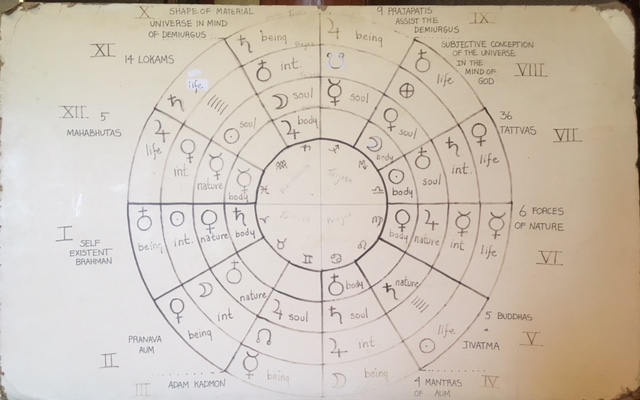
FIGURE IMG_2202-Posterboard Metaphysical Chart.
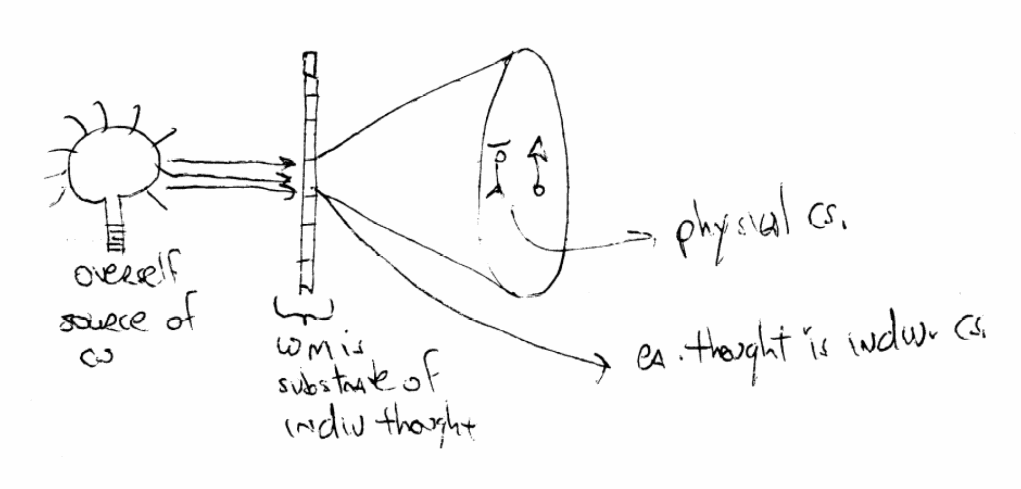
FIGURE 1980 0102-2-AB. Overself, World-Mind's Thinking, and Physical Consciousness.
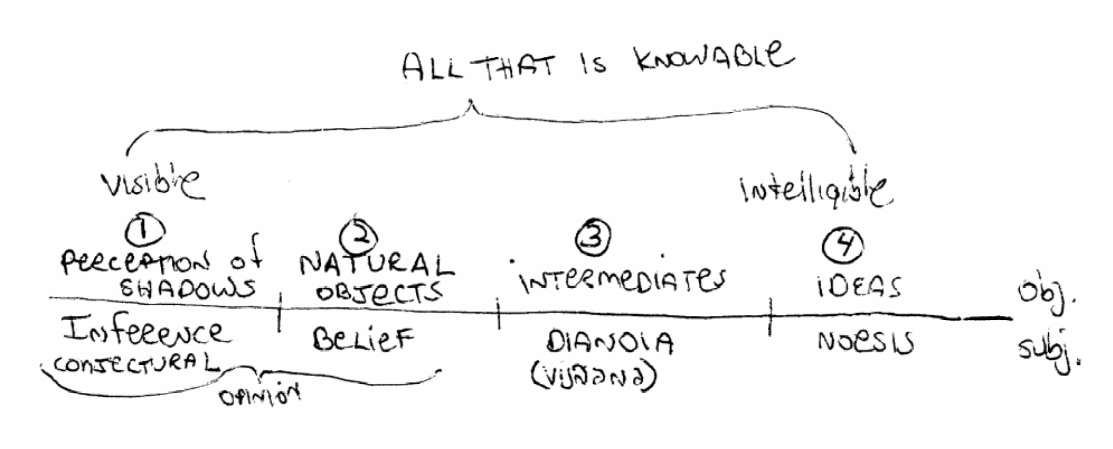
FIGURE 1980 0102-3-AB. Divided Line.
[Transcriber note: [diagram] means the speaker is referencing a diagram as he or she is speaking. If someone is drawing or writing, with audible sounds of chalk on a blackboard, I indicate this by [drawing] or [writing].]
NOTE: Wednesday night class, part of Wisdom series 1979-1980.
TRANSCRIBED Verbatim by IT 2019; reformatted by JRM & JF 2019-2020, with TOC/Subheads by JRM. In 2023, IT updates prefatory matter, footer, and audio file name, completes Book List, adds Plotinus quotes section, adds new notes within transcript, fixes errors/typos, adds three diagrams and references within transcript to these diagrams. In 2024, MW alters Subheads to make more accurate. Archival verbatim transcript – V14.1a.
AUDIO FILES: 1980 0102a, 1980 0102b. [Note 1: "Tape" and "Side" refer to original audio cassette tapes that were later digitized into .MP3 Audio Files. Note 2: In 2025, REP Studio cuts dead air from file b and improves its sound quality.]
1980 01/02 at Wisdom's Goldenrod
PB Books; Wisdom of the Overself; "The Immortal Overself"
Archival verbatim transcript
[Audio File 1980 0102a Begins]
AB: Paragraph 21.
S: Uh-hm.
S: What page?
S (faint, possibly part of background): Yeah.
AB: 200.
S (faint): Yeah.
S (faint, possibly part of background): See if-- you got it for Sunday (night./right?)
S: Yeah.
[17 second pause with faint background student talking]
S (faint): What not-- what paragraph?
S (very faint): 15.
AB: 21.
[9 second pause with faint background student talking]
AD (faint): Why don't you oblige, read (the) first paragraph?
THE OVERSELF IS AN ETERNAL IMAGE OF WORLD-MIND
[Transcriber note: I am using The Wisdom of the Overself by Paul Brunton, Rider and Company, London, 1943.]
PB [The Wisdom of the Overself, "The Immortal Overself," p. 119, AB reading]: "The Overself is truly an eternal image of World-Mind. Therefore it is written in the Bible that God made man in His own image. The reference here could never have been to the lower aspect of man, the petty creature who frets and fumes his way through life. The phrase fits finely however to the immeasurably higher aspect of this twofold species. The fact that men have turned round and denied their person, nay, even sacrificed their person, points to the presence within them of something which is different from the person, points indeed toward [AB reads: towards] the Overself. Each man therefore has two faces. One is downturned toward [AB reads: towards] the earth but the other is upturned toward [AB reads: towards] World-Mind. The first is the"person" and the second is the Overself."
[19¼ second pause]
AD: We did speak about it a little bit but--
S: Uh-hm.
S (faint): Yeah.
S (very faint): Uh-hm.
AD: Perhaps you might refresh our memory?
S (very faint): Yeah.
AB: Um, I think it-- there was a discussion of how the Overself [AD, faint: (Is) the (one word inaudible)] as an image of World-Mind is-- you would make a distinction, it's not an image of the One as in Plotinus. And then that-- we discussed the way it functions to embody the Idea of Man through our experience.
[17¾ second pause]
AD (faint): Anything else? Just go on.
[20¼ second pause]
MW: I think he also said-- he spoke of briefly about the Idea of Man as being-- we were like referring to Plotinus where it spoke about each Idea as a special form of the Nous or the Nous in a special form [Note: See Plotinus, V.9.8, third paragraph.] and we said the Idea of Man in some sense is, let's say, the special form of the World-Mind. In this sense you could speak about Man-- I'm-- I'm not quite sure on this but I thought maybe you were saying something like-- and that would be the highest sense in which you could say Man was an image of God, you know, kind of sense that that-- that Idea itself, the Idea of Man, was-- I don't know if you can say it's an image of the World-Mind but it is the World-Mind in a-- in that special form. [AD simultaneously: Well that's good.] But insofar as the soul has that Idea then maybe that's the sense in which-- that the man is the soul that has somehow been wedded to that Idea and maybe that's what's in an image of-- of God.
AD (faint): Anyone has a Plotinus on him?
S (very faint): I do.
S (very faint): [three/few words inaudible]
S (faint): Richard might.
AD (faint): Anyone has a Plotinus on him? I wanted you to see this quote.
S (faint): I don't have a copy. Didn't we talk about it in Plotinus class?
AD (very faint): I want to read the passage. (I don't have it.)
MW (faint): The one that I just remembered?
AD (faint): He gives an explanation of the-- how essence brings existence into being.
MW: [couple words inaudible]
S (simultaneously): V--
LR: Avery? (bit of laughter)
AD (faint): Oh he's here?
AS (simultaneously, faint): (You want) which one?
S (very faint): Yeah.
LR (faint): Essence brings existence into being.
AS (faint): V.3.2.
S (simultaneously): It's V.3.2.
LR: V.3.2?
AD (faint): V.3.4.
S: V.4.
LR: Is that it Avery?
AS (very faint): Huh? [couple words inaudible]
AD (simultaneously): The one on Man.
MW: The one-- I think it's VI.8.15. (bit of laughter)
S: It's fine.
AS (very faint): No which-- I don't know [few words inaudible]
S (faint): I don't either.
AD: VI.8--
MW: 15.
AD: 15 or 14, yeah.
LR: Well that was--
AD (simultaneously, faint): VI.8.14. [short pause] There's an elaboration of some of the passages here which are quite beautiful in Plotinus. If you could find the paragraph maybe you could read it. (You/It) (can kick the needle of) the discussion.
S (very faint): (For the discussions.)
S (very faint): Right.
[short pause]
AD (very faint): (Assuming) it was 16.
LR/S(?) (very faint): Of course.
AB/S(?) (very faint, possibly part of background): Yeah, it's in there.
AD: (Let's see here.) [12¾ second pause] Well, you see if you can make anything out of it and--
S: Alright.
MAN AS ESSENCE IS ETERNAL, BUT MAN AS A PARTICULAR EXISTENT IS IN FLUX
Plotinus [VI.8.14, AD reading]: "[Another approach:] Everything to which existence may be attributed is either one with its essence or distinct from it [AD reads: from its essence]. Thus any given man is distinct from essential man though belonging to the order Man: a soul and a soul's essence are the same--that is, in the case of soul pure and unmingled; Man as Form (or Idea) [AD reads: Man as type] is the same as man's essence; where the thing, man, and the essence are different, the particular man may be considered as accidental; but man, the essence, cannot be so; the Form of Man is self-determined [AD reads: the type Man has real being]. Now if the essence of man is self-determined [AD reads: is real], not chanced or accidental, how can we think That to be accidental which transcends the Form of Man [AD reads: the order Man], author of the Form [AD reads: author of type], source of all being, a principal more nearly simplex than man's being or being of any kind? As we approach the simplex, accident recedes; what is utterly simplex accident never touches at all."
AD: Is that too much?
S: Uh-hm.
S (very faint): No.
AB: When-- when he says that each man has two faces, one downturned and one up-- upturned, perhaps you could say that the accidental man is the lower face and whatever is real in that is derived from the Ideal Man which is analogous to the Overself. And just as the accidental man embodies the-- the Overself, the Overself is an image of the World-Mind or the soul is an image of the Nous insofar as it embodied all the principles contained in the Nous.
AD: Well, take a sentence at a time. First sentence.
S (very faint): That's good.
PB [The Wisdom of the Overself, "The Immortal Overself," p. 119, AB reading]: "The Overself is truly an eternal image of World-Mind."
AD: No, from Plotinus.
AB: Oh, sorry.
Plotinus [VI.8.14, LR reading]: "…Everything to which existence may be attributed is either one with its essence or distinct from it."
AD: You notice this very strange way of trying to explain it?
Plotinus [VI.8.14, LR reading]: "…Everything to which existence may be attributed is either one with its essence or distinct from it."
AD (faint): Existence attributed. So it's existence which is in flux. It's existence which comes into being and goes out. Not essence. This is di-- directly in opposition to of course the Christian point of view. Existence is finite. [S, faint: Anthony--] And it's characterized by essence. He's saying the exact opposite. Essence always is, alright, and when it gets characterized, then the flux of existence comes into being and just as easily goes out of being. (He's got) a very strange point of view you really should try to understand. Once more.
Plotinus [VI.8.14, LR reading]: "…Everything to which existence may be attributed is either one with its essence or distinct from it."
[short pause]
JG: Anthony? I really fail to see the point, what you made. Could you say a little more?
AD: About what we just said?
JG: Yes, about what you just said. I didn't--
AD: Well most of us think of existence as permanent and essence as getting embodied every now and then. Do you follow that?
JG: Ok.
AD: Now his point of view is the reverse. Essence is permanent and eternal. And occasionally or accidentally, alright, it gets embodied, this essence gets embodied. Then there is the flux of existence. You have to think about it many times because you have to remember you've been indoctrinated with the other point of view. And in Christian theology that's the-- that's something they're always ramming, so to speak, that existence is primary, you know, and that the essence in this clase-- in this case Man as an essence is something that has only a possible existence, not an actual existence. And it gets actual when it's brought into existence. So in the Creator's act, you know, you can say that the essence Man is given a existence and that's what they call the act of creation. But it's existence which is paramount. Without that existence the Idea of Man or any man, the essence of Man remains in the realm of the possible and doesn't get actualized. But he's saying the reverse, the essences are always eternal, they always are what they are. And there's many essences but we're speaking about one essence, Man. And that if this essence, so to speak, approaches or when we say matter approaches essence, then it actualizes the idea of that essence and there is the existence of a particular man. So it is existence which is constantly coming and going, it's in a constant state of flux. Essence is always what it is.
S: Richard?
S (very faint): Yeah.
LR: Matter approaches the essence?
AD: Yeah.
S (very faint): Uh-hm.
LR (faint): Did you say that?
AD: Yeah, matter approaches the essence. (bit of laughter) See, I said it. (laughter) Alright.
LR: When matter approaches the essence, it [AD simultaneously: Yeah because--] turns the essence into existence?
AD (faint): Yeah, because from this point of view, from the Plotinian point of view, it is the matter which makes possible the existence of an essence, an abstract or possible essence.
CDA: Could you-- would you say that one more time?
AD: Huh?
CDA: Would you say that one more time? (CDA laughing, some laughter)
AD: Drank an awful lot at that party last night.
CDA: It was rusty.
S (very faint): Oh I know that.
AD: We're saying-- I don't know if you remember there's another passage when Plotinus speaks about the alien engrafts itself upon the essential. I think it was I.1.7. Probably not. Do you remember Avery?
CDA: Yeah I remember, yeah.
AS (faint): VI.4.14.
AD (simultaneously): And they-- VI.4.14. Alright. You don't have your Wisdom? Where are you? You sit up here, I can't stretch my neck all night. (bit of laughter) He speaks about the alien who's engrafting himself upon-- upon the soul. And there you, so to speak, have the same idea being propounded. These essences always are there, always, alright, they're-- And there's many of them. Matter reaches out to this essence, embodies it, if I could use an incorrect mode of speaking, and there's the-- could we say the appearance of an essence? Or-- the appearance of an essence.
CDA: Would the appearance mean the same as existence and-- and--
AD: Well unless, unless-- unless there is that actualization of the essence there can't be no existence. There won't be any-- any existence to speak of.
CDA: Are you speaking of it--
AD (simultaneously): So everything in existence is an actualization of some essences.
CDA: Alright, [AD: Alright.] so you're speaking of existence as being-- (is/as)-- it's only in the fourth quadrant [diagram]?
AD (faint): Yeah.
S (faint): Yeah.
AD (faint): Exactly. Ex-istence.
CDA (very faint): Ok.
AD: Existere, which means that the principle is outside of oneself.
CDA (faint): Ok.
MB: But when he-- in that first sentence when he says that everything that exists is either one with its essence or not one with its essence, then when you speak of the existence of something that's one with its essence, you're not speaking of that essence itself, you're speaking of the appearance of the essence? Or are you speaking of the fact that you can't deny existence even to that essence itself?
AD (faint): I don't follow you.
MB: The first sentence from the Plotinus that we read says that everything which exists is either one with its essence or [AD simultaneously: Yeah, yeah.] not one with its essence. So if you think of the first kind of existence, the existence of things that are one with their essence, are we saying that that is the appearance of the essence or--
AD: No, that wouldn't be an appearance.
MB: That would be like--
AD: If it would-- if it was one with its essence how could it appear?
MB: That's what I was wondering. So then even at the level of essence we cannot deny existence to that essence in a certain sense. We cannot say that the essence--
AD (simultaneously): No, they-- they don't have existence at that level, you can say that they are. That's Being you're speaking about, not existence.
MB: Except that it says in the quote all things that exist are either one with their essence or not one with their essence. So then I'm saying what kind of existence do we speak of when we-- in the first part of the quote.
AD: Well I just told you. [MB simultaneously: You put it--] That's Being, that's not existence.
MB: Ok, so then the term-- the way we want to use 'existence' wouldn't necessarily be the same way that's translated there.
AD: You want the-- that-- the sentence made clear, right?
MB: Yeah.
AD: If a thing is one with its essence, [MB: Yeah.] then it is Being.
MB: And not existence or appearance.
AD (simultaneously): Not existence, no.
MB: Ok 'cause that's slightly different than the way it's worded in the quote I think.
AD: Fine, I don't care about the quote. (some laughter)
MB (amidst laughter, faint): Yeah but I thought--
S (faint): It doesn't say World-Mind [few words inaudible]
AD (simultaneously): It's the content, the meaning of what he is saying that's all-important.
MB: Ok, I just thought that was a point of confusion.
S (faint): [one word inaudible] (who said it)?
AD (simultaneously): Well, from the-- from the general context of Plotinus that would go without saying. Something cannot be essence and be in existence.
S: Right.
AD: Impossible! How could you say of any of the eternals or the primals or the Hypostases that they're in existence without really meaning that they're in Being, that they are Being? In other words for the Platonic school the only thing that is eternal are-- are Beings. Anything in existence is not eternal, it can't be Being. Yeah. So the second sentence?
LR (faint): I just read that.
AD (faint): Yeah.
Plotinus [VI.8.14, LR reading]: "Thus any given man is distinct from essential man though…"
AD (simultaneously): You follow that? Any given man is distinct from essential man. So if we say that the essential man is the Idea of Man in the Mind of God, then any given man is distinct from that.
Plotinus [VI.8.14, LR reading]: "…though belonging to the order Man: a soul and a soul's essence are the same--that is, in [the] case of soul…"
AD: Now you explain that, a soul and a soul's essence.
[9¾ second pause]
S (very faint): I can't do it.
S (very faint): I can't do it. (bit of laughter)
AD (faint): Well try.
S (faint): Read it.
Plotinus [VI.8.14, LR reading]: "…a soul and a soul's essence are the same…"
SD: Is-- is he saying that the individual soul is not really different from All-Soul?
AS (faint): No.
LR: A soul and a soul's essence.
SD: But wouldn't a soul's essence be soul itself?
S: Yeah.
S (faint): Yeah.
S (very faint): Uh-hm.
S (faint): Uh-hm.
VM: You're saying something like the Saturn in Leo [diagram]--
AD: (Well/No) he's saying it, he's saying it.
VM (simultaneously): I'm sorry, Saturn in Leo, let's say soul of man, is identical or substantially the same as the Idea of Man which it embodied and there isn't a distinction you can make between the principle of soul, second quadrant [diagram], and the Idea of Man that it's embodying.
[students assent, very faint]
AD (faint): What do you think?
VM: In fact, without embodying the Idea of Man you speak of Saturn in Leo there as being completely indeterminate.
WE DON'T KNOW THE TOTAL WISDOM INCLUDED IN THE IDEA OF MAN
AD: Correct? [short pause] We're leading into a kind-- a little discussion about what PB means when he speaks about the Overself as an image of the World-Mind [few words inaudible] So we have to draw (on/an) analogy. [9¾ second pause] Now that doesn't mean [MW simultaneously: But--] that we know the essence of Man when we say there's the Idea of Man, you know. Because this is what Guenther would say, you have a definitive, articulated, particularized notion of what the Idea of Man is and now you'll cripple yourself with that notion because you won't be able to accept the fact that some men are different than other men and they have different-- they're operating different, we're not saying that. The Idea of Man as it exists in the Mind of God is an essence. The depth, the profundity, the width, the comprehension, the total wisdom included in that Idea of Man precludes the possibility of me saying I know what man is and he should act accordingly, he should act this way and he should act that way and not this way and not that way. That doesn't permit me to do that because then I would be saying that I know the Idea in the Mind of God. And only a nincompoop would go around with that kind of profession. So that's why I tell you but you have to be careful because Guenther very often uses straw men. He says well, you know, eighteenth century philosophy believed in essences. Well, what eighteenth century philosophy came to believe as essences was already a downgraded degradation starting with Christian Wolff about the seventeenth century and continuing all the way to the nineteenth. And we're not-- I'm not going to take a misrepresentation of a doctrine and criticize it as a doctrine. So here we have an example (where) Plotinus is making this very clear. Read another sentence. Yeah, sure.
S (faint): [one/two words inaudible]
ME: I can't distinguish between the way he's using the Idea of Man there and the way-- talking about soul.
AS HUMAN SOUL, IF YOU ARE IDENTICAL TO THE IDEA OF MAN, YOU ARE A BUDDHA; IF YOU ARE DISTINCT FROM IT, YOU ARE A PARTICULAR MAN IN EXISTENCE
AD: Well they're-- they're distinguishable but not separable, number one. Number two, when he speaks about soul he speaks about it as a [LR/S(?), faint: Given.] given-- give-- he speaks about it as a life, an undetermined life, an unformed life, when he's speaking about soul as pure Hypostasis, alright. But then he speaks about soul also as being human soul and he brings in the notion or the Idea of Transcendent Man and weds it to that. So now soul, human soul, alright, would have to have for its essence the Idea of Man. This defines human soul. Now if-- if I am or you are identical with that Idea of Man, then of course you are the essence, you are what the Easterners would call Buddha. [student assents] But if we're not then we're separated from that essence in the sense that we're not identical with that essence, so we come into existence. But the essence itself doesn't come into existence, it isn't that it comes in at a certain time and then leaves and comes in, it always is and that means it's in the realm of Being. Whereas I, you, a particular man that embodies that essence comes into existence and goes out of existence. And even while we are existent, it's only for a duration of a thought. So you can say man is a perpetual-- you know, perpetual state of flux. Same idea like the Buddhist. [students assent, very faint] Let's read another line.
Plotinus [VI.8.14, LR reading]: "…Man…"
LR: (No/Oh).
Plotinus [VI.8.14, LR reading]: "…a soul and a soul's essence are the same--that is, in [the] case of soul pure and unmingled; Man as Form (or Idea) [LR reads: Man as type] is the same as man's essence…"
AD: Man as type. [LR simultaneously: Now that's--] Man as archetype.
LR: Ma-- capital M, Man as type is the same as man's essence (that/but) it's not.
S (faint): Yeah.
LR: So that would be like the Buddha.
S (very faint): Yeah.
AD (faint): Alright, the image of Man.
Plotinus [VI.8.14, LR reading]: "…where…"
LR: I'll read the whole (sentence).
AD: Yeah, read the whole thing.
Plotinus [VI.8.14, LR reading]: "Thus any given man [LR: Small m.] is distinct from essential man though belonging to the order Man [LR: Capitalized.]: a soul and a soul's essence are the same…"
LR: Now here it seems that he's speaking of soul's essence as the order Man.
S: Can't hear you.
S: Move.
Plotinus [VI.8.14, LR reading]: "…that is, in [the] case of soul pure and unmingled; Man as Form (or Idea) [LR reads: Man as type] is the same as man's essence; where the thing, man, and the essence are different, the particular man may be considered as accidental; but man, the essence, cannot be so; the Form of Man [LR reads: the type Man]…"
LR: Capital M.
AD: Essen-- I'm sorry. Accidental, you can use the word 'contingent' if you want, ok? It may be, it doesn't have to be, contingent, perhaps, you know. This individual man might be, might not be. So there's a certain contingency about particular man but there isn't any such contingency about essential man.
Plotinus [VI.8.14, LR reading]: "…the Form of Man is self-determined [LR reads: the type Man, capital M, has real being]. Now if the essence of man is self-determined [LR reads: is real], not chanced or accidental, how can we think That to be accidental which transcends the Form of Man [LR reads: the order Man], author of the Form [LR reads: the type], source of all being, a principal more nearly simplex than man's being or being of any kind?"
AD (faint): Alright, now he's heading into the One.
[short pause]
LR: Yeah, well here's the other-- did you want that other quotation about [couple/three words inaudible]
S (very faint): Uh-hm, uh-hm.
AD (faint): Well yeah, could you read that?
[short pause]
LR: Ok. He asks what are we.
MATTER REACHES UP TO THE IDEA OF TRANSCENDENTAL MAN AND EMBODIES IT, AND THEN A PARTICULAR MAN APPEARS
Plotinus [VI.4.14, LR reading]: "Are we that higher or the participant newcomer, the thing of beginnings in time?
"Before we had our becoming [LR reads: beginning] Here we existed There, men other than now, some of us gods: we were pure souls, Intelligence inbound with the entire of reality, members of the Intellectual, not fenced off, not cut away, integral to that All. Even now, it is true, we are not put apart; but upon that primal Man there has intruded another, a man seeking to come into being and finding us there, for we were not outside of the universe. This other has wound himself about us, foisting himself upon the Man [LR: Capital M.] that each of us was at first. Then it was as if one voice sounded, one word was uttered, and from every side an ear attended and received and there was an effective hearing, possessed through and through of what was present and active upon it: now we have lost that first simplicity; we are become the dual thing, sometimes indeed no more than that later foisting, with the primal nature dormant and in a sense no longer present."
AD: So you can see what a fate (we're/we've) got ourselves involved in. But basically the idea here is if you try to evolve, (well), is that matter reaches up to the Idea of Transcendental Man and embodies it, alright, and in that very embodiment of this Primal Man the particular man appears. And that's difficult for us to understand. But he would apply that to almost any essence that gets embodied. If an essence gets embodied that means some matter approached up to it, accepted the Form, and in accepting the Form or the Idea of the thing, let's say temporarily because matter in itself doesn't have too much of concern one way or another what Idea gets embodied, or that for a temporary period that Idea is embodied. And so we can see like matter reaching up to the primal essences, embodying them and "revealing", quote, unquote, revealing them. And our experience of those primal essences is always going on, although we're unaware of that.
S: What's the notion of what we talk about when-- before the soul descended, they have not [three words inaudible] that's not the same.
AD: No, I think that it's alright. It's alright.
S (simultaneously): But that seems different than what you just said, it seems--
AD: Well, in metaphysics it's the same thing like when you're in an elevator which is out in space, there's no ups and down. There's no real direction. Just another [one/two words inaudible] speaking. So we want to say the soul descends or we want to say matter reaches up, then it's enough.
S (faint): So, it's just the-- the idea then of this-- the matter and the essence coming together and-- and the matter embodying the essence and bringing the essence into existence?
S (very faint): Yeah.
AD: So what exists is the matter, not the essence. [short pause] Think about it just for a minute. What exists is the matter, whatever that matter is, not the essence. And the matter is a perpetual flowing kind of thing. So anything that exists in matter has this kind of perpetual existence, you know, from moment-to-moment, instant-to-instant. Whereas the essences always are.
S: Oh but the essence couldn't exist in matter because it can't be in flux, ok, it'd have to be as it is always in time so--
AD (simultaneously): It always is what it is. So in metaphysics which deals with and is concerned with the realm of Being or hidden, there's no such thing as being existent. Being doesn't exist, Being is the principle of existence. But it itself does not exist. Well we started, (now) we ask [one word inaudible]
CDA: So matter always exists? Always? Eternally exists-- (laughter)
AD: And it's incorporeal by the way.
CDA: Yeah, yeah.
SS: That's the hard part.
AD: Any more?
S: For me thing is like, then the embodiment is an act of the matter? [S, faint: Uh-hm.] But isn't matter a-- a purely passive principle, is it capable of an act?
AD: Well it's not capable of an act in that sense, no. You're taking the elevator up or down?
S (very faint): Yeah.
S: So, we're speaking more metaphorically here when you say that.
AD: Of course you're speaking metaphorically. After all, whether it's metaphysics or philosophy or science, I mean, it's really a kind of animal faith to believe that these words are saying anything. (bit of laughter)
S: That's (right).
AD: It's a response of the organism. (AD laughing) If you take that response as actually delivering to you knowledge, you go back and have another party.
S (very faint): Yeah.
S: Right. (S laughs, some laughter)
S (amidst laughter): [one/two words inaudible]
AD: You haven't had enough parties. (AD laughing)
S (simultaneously, faint): It's already [couple words inaudible]
AD: Go ahead, read the next pa-- Let's go on to the next paragraph.
S (very faint): (Is it so?)
S (very faint, possibly part of background): Hey Lauren--
AB/S(?): Of PB?
AD: Yeah, PB. Well, I don't want to turn this into a Plotinus class. (Alright.)
PB [The Wisdom of the Overself, "The Immortal Overself," p. 119, AB reading]: "Why do we so pathetically…"
AD: Well uh-- no, pick out something-- (laughter) [couple/three words inaudible] I'm not going to read every line with you.
PB [The Wisdom of the Overself, "The Immortal Overself," p. 119, AB reading]: "It is only, in short, because the Overself is present behind its limited expression the person that the latter can understand at all how limited it is."
THE HUMAN SOUL CONTAINS A SPECIAL OR UNIQUE VERSION OF ALL THE IDEAS THAT ARE IN THE WORLD-MIND
LR: Can I stop one second?
AD: Sure.
LR: So when PB says "The Overself is truly an eternal image of World-Mind", could you take that-- the World-Mind there to be the Idea of Man the way it's being used? I mean if you were to translate would you think of it that way? Or not? Or would there be another way to think about it? Tim?
AD (faint whisper): Well, [AB simultaneously: Could--] negotiate.
LR: Well I-- I'm-- I'm always confused when it says God made man in His own image. By man I think we're speaking of Overself in that second sentence.
AD: Well what would be the image of the World-Mind, I mean if we spoke about the World-Mind?
LR: The image would be the Overself, isn't it?
AD: No, no, no. If [LR simultaneously, faint: (Oh/Ok).] we wanted to-- Like what would be our notion of the World-Mind? What would be our idea of what the World-Mind?
LR: Uh--
[short pause]
AD: Plurality of the Ideas, [LR simultaneously: Yeah I'm think--] just content?
LR: The content of the Intellectual Realm which is the universe.
AD: Which would include the--
LR (simultaneously): Which (actualizes/actualize as) the universe.
AD (simultaneously): Which would include the universe, yeah. What else? You could-- you could add quite a bit to it, I mean when you start thinking about the World-Mind as contents, the kind of existence it has, the Being of the World-Mind, the derivation of the World-Mind, the genesis, all these things, alright, you come up with a certain notion of what the World-Mind is like, yeah. So we would say something like this. [Note: See FIGURE IMG_2202-Posterboard Metaphysical Chart appended to this transcript for the following.] If we think of the World-Mind as having-- when we diagram it we-- we think of the World-Mind as these twelve Ideas [diagram], alright. And, we say now that the soul is an image of the World-Mind. So if the Idea of Man is a special and a unique form of the World-Mind itself. You remember when Plotinus says that [LR: Ok.] all the Ideas, alright, are contents of the World-Mind, yet each Idea of the World-Mind is like a unique and special form of the World-Mind. Now follow carefully, alright. Now he's saying that the Idea of Man which is the essence of soul, human soul, alright, is one of those Ideas, alright. Then that means that human soul is a special form of the World-Mind. [student assents, very faint] The Overself is an eternal image of God.
LR: Ok but now the Overself is a-- [short pause] the Overself--
AD: Have you grasped that?
JG: No.
LR: No.
AD: I haven't either. (laughter) You think you--
LR (simultaneously): The Overself ha-- has a-- a special derivation of its own and when we speak of the Overself we're speaking of human soul, [AD simultaneously, faint: Yeah, human soul.] like you were saying to Michael. And so in that you're speaking of human soul you're speaking of something which is kind of carved in the image of man, which [AD simultaneously: Yeah.] embodies that principle, the Idea of Man.
AD (simultaneously): The Ide-- the essence of Man, yeah.
LR: But now you're speaking of World-Mind as being comprehensive not just as the Idea of Man but of many Ideas or all of the Ideas.
AD (simultaneously): Ideas, uh-hm.
LR: So when we say the Overself is truly an eternal image of the World-Mind, that's why I ask my question, more specifically it's an image of man which--
AD: No. No more-- it's specifically an image of the World-Mind. That's-- that's the point to grasp.
LR: And there are more than one-- [drawing] and there are--
AS/S(?) (faint): The (World-Mind/World's Mind).
AD: [drawing] If we take our division, you know, in terms of the rulership, you know, we go around this way and we say each of these represents an Idea. Each of these is an Idea, going around. Use the circular form of the chart, not the quadrant, alright. So over here we would place the Idea of Man [diagram]. Now if all these Ideas are Ideas that belong to the World-Mind, they're its content, ok. Each Idea calls forth the Intellectual Act. You remember the way he put it, it's a duality-in-unity. All the content-- all the Ideas, all the Intelligibles are contained within the World-Mind, alright. Now, he's saying that the-- we're saying that the soul is an image of the World-Mind or God. So there has to be some kind of proportion or analogy established. In other words there will be, comparatively speaking, the-- an Intelligible World in the soul just as over here [diagram] [drawing] there are all the Intelligible Ideas, alright. So similarly a human soul will contain a special or unique version of all the Ideas which are in the World-Mind. You must follow this a couple of times before you catch on. Otherwise the Intelligible World could not [LR simultaneously: (Would be) (one word inaudible)] exist, could not exist in the human soul. [S: Yeah.] So if we say that a human soul contains within himself the Intelligible World, what we're saying really is that it contains the World-Mind or-- and the variety of all the Intelligible objects that are in the World-Mind, alright, are contained in this soul. Now, now go back and think it over. Man is made in the image of God. It's this man [diagram] that's made in the image of God.
JG: Which man, (you mean/and in) particular, Anthony, the Sun?
AD: The Saturn, the soul. [Note: Saturn in Leo.]
JG: The soul.
AD: Yeah. In the [JG simultaneously: Could you--] same way that the World-Mind has many Ideas, alright, in the same way the soul too contains them. It has to be a-- a miniature reflection of the entirety of the Intelligible World.
JG: I'm not sure where to locate in the diagram at-- so to speak the World-Mind.
AD: Well I told you, go around this way, the Ideas and the rulerships [diagram]. If you take an Idea here [drawing] and you take a rulership, an Idea here and a rulership, take it this way, alright, rather than working just the second quadrant. [JG assents, faint] Alright, think of it, think of--
SS (simultaneously): That would be the World-Mind.
S (simultaneously with AD): So--
AD: Think of all of these as all the Ideas in the World-Mind.
JG: And what would this-- the Sun be then, would it--
AD: The Idea of Man.
JG: The Idea of Man.
AD: Or Five Dhyan Buddhis, doesn't matter. Alright, so this would be an Idea in the-- in the World-Mind, this would be an Idea of the World-Mind, this would be an Idea of the World-Mind [diagram]. All of those Ideas, so to speak, are contents of the World-Mind. [JG assents] Ok? Including the Idea of Man. [student assents, faint] Now, each Idea is a special and unique version of the whole.
JG: Contains the whole.
AD: [next three sentences spoken very intensely] Is a special and unique version of the whole. Don't turn my words around! A special and unique version of the whole. In other words, over here we have the 36 Tattvas [diagram]. [drawing] [JG assents, faint] This is one Idea, ok. I could take this one Idea and work the whole chart out with it. I could take another Idea and work the whole chart out with it. So each Idea is a special version of the whole. You follow that?
S (faint): Uh-hm.
AD: Ok.
S: Yeah.
AD: Now I forgot the point. (bit of laughter)
LR (faint): [few words inaudible]
S (faint): Uh-uh.
AD: Oh yeah.
LR (faint): Yeah.
AD: So, this is one Idea, the Idea of Man. And it is the essence of soul.
JG: Uh-huh.
AD: Now that means that soul is a unique form of the World-Mind. Or the way they put it in the Bible, an image of God.
[short pause]
S (faint): Go ahead.
SS: Being in the fifth house [diagram], does the soul have a special relationship to the Idea of Man as-- in addition to embodying or being in relation to all the Ideas? See what I'm saying? Because it's in the fifth house--
AD: Yeah but then you didn't follow. Insofar that it's in the fifth house, alright, that means that the essence Man and soul, alright, are the same. But now the Idea of Man is like a special version of all the Ideas, [SS simultaneously: Of all of them.] a unique special way of looking at all the Ideas. Now if you can see that, then you can see what he means when he says that man is an image of God. It's like saying man is an image of the World-Mind. If World-Mind has all these Ideas then all these Ideas in a very special way are in the soul of man.
SS: Ok.
S: So then would there be other essences that would-- that would look upon the World-Mind in a very different way than the Idea of Man?
AD: See essences are unlimited. I mean, they're-- they're unlimited. Metaphysically speaking we can't count them. And so when-- that's why I made the remark that this kind of statement does not include or give us the right to determine what a man's essence is and talk about a man as though it's something we know. We don't. He does present these unique possibilities which can be actualized. But to actualize them calls for a very special effort and training.
ESSENCES ALWAYS PRESENT; IF WE COULD DEMATERIALIZE THE THING OR SITUATION BEFORE US, WE WOULD GRASP THE ESSENCE
S: Are any of these other essences within our reach?
AD: Constantly.
S (faint): They are?
S (very faint): [one/two words inaudible]
S: Even though they're different than the Ideas.
AD: Oh yeah. Constantly always in front of us, looking at us in the face and we don't recognize them. But I'm sure you've noticed that. When you see something beautiful, alright, we dematerialize it. It's momentary, granted, but you dematerialize it for that moment. You've caught the essence. But of course the animal in us comes back and says "Wait a minute. Now how can we make use of this," you know? And, right away we start counting, we say "Well no, that's not the way to look at a thing," but generally, and very often very many instances you momentarily see a beautiful sunset or person that you love or-- And in that moment where you catch beauty on the wing you dematerialize a person and it's like he has been etherealized. And then the very force of our empirical and selective and pragmatic [one word inaudible] forces us to cut it out and say "Wait a minute, I got to feed him" or "I gotta clothe him" or "I gotta cover the window because the Sun will ruin the drapery" or-- you know. (bit of laughter) You-- those essences are gone. But they're always in front of us. [short pause] Alright.
S (faint): Better than one.
S: Right.
S (faint): We're moving right along.
AD: Well that's why most traditions tell you try and-- try to avoid operating with very determined concepts, you know, and with pre-- prefigurations or pre-knowledge or predetermination of what you're going to experience because in that very act you exclude the possibility of experiencing essences when you already have the idea in mind what it is that you're going to meet. Whereas if you-- if you could wipe that out of your mind and meet a person or a situation or event, even a painful one, all of sudden you could grasp the essence that underlies or is being embodied or-- you see, that's the wrong expression. The essence doesn't get embodied. It's existence that gets embodied. But, it's our-- it's our coinage, it's our way of abusing the ideas. But in that instant, you-- you know, you feel that that essence is there and then it's gone. The variety of essences is really undemonstrable, I mean there have been and there probably are many essences we have no idea of. So we're talking about an infinite realm.
(Side 1 of original cassette tape digitized as 1980 0102a Ends; Side 2 Begins)
IT IS ABSURD TO TRY TO GRASP ON TO AN "I" THAT IS NEVER SELF-IDENTICAL FROM MOMENT TO MOMENT
PB [The Wisdom of the Overself, "The Immortal Overself," pp. 119-120, AB reading]: "[Every] individual is necessarily incomplete because of his finitude. All his endeavours, whatever direction they take, are expressions of his [AB reads: the] unconscious quest for completeness… Hence all his [AB reads: these] characteristics bear an illusory resemblance to those of the Overself…
"When we [can] come to regard the limitations of the surface self as ephemeral [ones] we open the gate to correct understanding of the hidden dimensionless mind at its centre. The various distinctions which arise within this mind, the innumerable thought-forms which are perpetually being born in it, do not diminish or exhaust it. … [Similarly] each incarnate creature limits itself unnecessarily when it refuses to realize that it is not really different in essential nature from the Overself. [11½ second pause] … [In the same way] the Overself has always been the single being out of which the many reincarnations have appeared, the sublime unity which always escapes the doom of these multiple and perishable personalities whose separateness is as much a surface illusion as the separateness of [all those] dream figures. It is their truly abiding nature. It contains the highest form of immortality."
[short pause]
AB: So he's making the point that analogously the-- the person, the relationship of the person to the Overself is that of existence to essence. And that which truly is within the person is essential and not accidental or contingent.
[short pause]
AD: Why don't you read the next paragraph?
S (faint): Read it.
AD: "It was earlier noted…"
PB [The Wisdom of the Overself, "The Immortal Overself," p. 120, AS reading]: "It was earlier noted that everything throughout the universe is sentenced to be forever in motion and forever in flux. But what do such changes mean unless they mean that everything is forever making changes and thus modifying its own identity? And in the case of human beings where--even leaving out the equally definite but less perceptible bodily changes--the thoughts and feelings alter so quickly that the conscious being of a few minutes ago is not quite the same as the present one, the change in identity is not only inescapable but also irretrievable. The mental state or emotional mood which has passed away can never again be got back precisely as it was. Do what we will we cannot keep a fixed unbroken identity but must submit to a perpetually changing one. We are continually forced to surrender the"me" from moment to moment. Then why not yield to Nature's bidding and surrender it altogether? Why run vainly after something we can never even hope to catch? To comprehend this universal truth, to accept its inflexible lesson, [AS adds: and] to cease trying to cling only to the transient identity of the personality, in short to refuse to allow the "me"-thought to arrogate sovereignty to itself and thus dominate its own thinker--this is the necessary prelude to opening the heavy door which bars our way to discovery of what exists behind the "me". [For] this reason every illumined religious mystical and philosophical [AS reads: philosophic] teacher has voiced the need of self-surrender."
[11 second pause]
AS (faint): It's a pretty big (poem). [14 second pause] Go ahead.
S (very faint): Yeah.
S (very faint): (See that/Scoot back).
[short pause]
AD (faint): I'm sure you have thoughts on it.
S (faint): I don't.
[48 second pause]
AD (faint): Then you understand it, right? Go to the next paragraph. [short pause] Like you said, the part where he speaks about the base of an illusory "I" that we're always trying to grasp, alright, (and since you were) grasping [one word inaudible] Why would that be so?
AH: Why is it so that the "I" is illusory?
AD: That you can't grasp it. You know how often you like to embrace yourself but you've never really succeeded?
S: Through [couple/three words inaudible]
S (simultaneously): (Pardon?)
S: Because part of the "I" is the subject of experience.
AH (faint): (You/It) cannot grasp.
AD (very faint): I missed (the point).
AH (faint): Well, if we (are attempting) to grasp the subject of our experience, the very thing that we use in that effort is the subject.
AD (faint): No I don't think that was [AS simultaneously: No.] the example there.
AS: I think he was talking the opposite way. You can't grasp it 'cause it's illu-- it's transitory like everything else.
AD/S(?): Yeah.
AS: It doesn't-- it doesn't exist for a mo-- for more than a moment at any time, how can it be grasped? As soon as you grasp it it's something else. Whatever you grasp never is.
[Note: See FIGURE 1980 0102-2-AB, Overself, World-Mind's Thinking, and Physical Consciousness, appended to this transcript for the following.]
AD (simultaneously): You see, if you don't understand this then you would have trouble in saying that-- You remember the diagram we use where we (say) let's say [drawing] that this is the light of the Overself and that these are the pictures of the world-to-be [diagram]. And then they appear as the world, alright. And here's the world [diagram]. And we said that this-- this is picture one, this will be picture one, then two comes in, then this is the second still, this is the third still. Ok, you remember that diagram? Alright. Now, imagine this fellow trying to grasp himself. He's no sooner trying to grasp, one is already two, so it's another person trying to grasp himself. Did you follow the point? [short pause] Better try to understand this point, it helps-- it helps reduce self-adulation. (laughter, student words) You know, if this is like the film you see on-- projected on the screen, still after still is running, and you say now hold the camera, just let me look at still one, alright, and there's this gentleman here, and you-- you say now this gentleman is going to grasp himself, run the-- run the movie projector. (bit of laughter) Number two comes along, it's another man. In other words, this was what he called physical consciousness. And the experience of physical consciousness cannot embrace the self. It no sooner is, it isn't. And so what he says there, why-- why keep chasing this evasive, this illusive "me", why keep loving it? Plato put it very well, he says we can no-- no sooner say it is, it isn't. And Eckhart was the best of all, every hello was a goodbye. (some laughter)
S (very faint): (Great comment.)
GA(?): That was Eckhart?
S (very faint): It was Eckhart?
S (faint): I thought that was Heraclitus [one/two words inaudible]
AD: Well he said you can't step in the same river twice. Eckhart would say there isn't even the same river to talk about. (AD laughs)
AH: I guess I don't understand what physical consciousness is. Like if this passage is restricted to the notion of physical consciousness, I don't really understand what that means. Is the physical consciousness consciousness insofar as it relates to our body or is that--
AD: To what?
AH: Oh it relates to our body, physical consciousness?
AD: Physical consciousness is what you know now.
AH: My-- my psychological (space/state).
AD (simultaneously): Right here and now, right here and now. Anything that you're capable of receiving or understanding, sensing. If we think of the world as, you know, when we spoke about in "The Birth of the Universe", that the world is a constant and incessant manifestation of cosmic soul's thinking and this thinking is intermittent, you know, incessant, constant, second after second. And this of course has been more or less scientifically verified, that nothing remains still, nothing abides, everything is in constant procession.
Then obviously if you can't have the same position for any two minutes, to speak about something as self-identical with itself in the cosmos that we live and know is really, you know, poetry, animal faith. You know, an animal has to have that faith, right? If you think of an animal he's-- he's got to figure out eating food so he's got to believe that there actually is an object over there that he can eat. So he's got to go around with that belief, see, so you can say it is a species of animal faith. And up to a certain point it pro-- it provides, you know, for our biological functioning. But when we enter into the realm of reason, then something else occurs, something quite different, we begin to understand in a different way. It's almost like we're trying to jump out of our skin, if I could put it that way, we can't but it's like trying to, and we begin to understand through our reasoning that our animal faith is positing the existence of some sort of self-identical object outside of itself. And it has to do so in order to survive biologically. But from a point of view of truth, then a person has a right to question that.
So, in the divided line of Plato if you remember, the first line was the perception of shadows and the second line he referred to as faith. [Note: See FIGURE 1980 0102-3-AB, Divided Line, appended to this transcript.] We have this faith in the existence of something. And if you start questioning that you can see that it's simply the organism response to its environment. But the response that an organ makes to an environment is of the very nature of the organ that's responding. So if you expect truth in that direction you're going to be in for, well, pretty much of a shock.
So, this would be a physical consciousness that we operate with, alright, and that from this point of view, when we were explaining this we pointed out that the incessant recreation of the imaged world is taking place right in front of our very eyes constantly and we are along with it. I mean don't think that you're standing outside the realm of the-- of the image or-- and you stay self-identical with yourself and that the world-image is moving on. No, you are part of that world-image and you too are in this incessant flux. So you can't really speak of yourself as abiding for two moments in time. Therefore, trying to grasp or to hold on to an "I" is an absurdity. But, you'll see the next instant that's exactly what we'll do, I'll run out there and keep drinking my coffee and-- and then run out there for (cures). Um-- [short pause] Would you reread 14?
AS/S(?) (faint): I don't know what you're talking about.
S (faint): Hm?
S: Well, (27).
AS: 27. You read 26.
S (faint): You read 26.
AD: 202, we're still there?
S (faint): No.
AH: Anthony?
AD: Yeah.
AH: If this is so, and of course it is-- (laughter)
AD: You said that very nostalgically. (laughter)
AH: Then I-- what position could-- does one take intellectually in denial of the "I" that's really its affirmation in some sense [couple words inaudible] Like there's no place to stand outside of this illusory "I" except through reason, is that it?
AD: Well, no, if you recognize that much then why not just give up the notion?
AH: But somebody has to do that.
AD: Give up-- give up even (renunciation) or denial.
AH: Well see but that would be the case, that both experiences have to be dropped.
AD (faint): It would be the middle way. [short pause] You even [one/two words inaudible] after a while. [student(s) assenting, faint] (bit of laughter) It'll help you carry the cosmos on your shoulders there. Well, let's go to page 303.
AB(?): 203.
AD: 203, yeah, 203. (bit of laughter)
S (faint): But not to that paragraph.
S (faint): Which paragraph?
AB: 27.
WE EXPERIENCE DIFFERENT REALMS OF EXISTENCE BECAUSE THE FORMS IN EACH LEVEL OPERATE DIFFERENTLY
PB [The Wisdom of the Overself, "The Immortal Overself," p. 120, AD reading (simultaneously with AB above)]: "It may be objected that we feel the personality as the basis of all [our] conscious existence…"
S (very faint): What paragraph (is that)?
S (faint): Well--
PB [The Wisdom of the Overself, "The Immortal Overself," pp. 120-121, AS reading]: "…that to be conscious at all we have to pay the price of finitude [and] that try as we may we cannot divorce consciousness from the personality. How then can it be annihilated unless we want to annihilate our own existence completely? The answer is that man first of all is called upon to understand that the world in which he lives consists of various levels of being, each one providing through the forms which it takes a perpetual space-time suggestion for the creature [AS reads: creatures] within it. This done, he is not called upon to deny his own personal being but only to deny his false conception of that being, that is to recognize it to be only an underself. He is not even asked to say that it does not exist but only that its existence is thought-constructed. He is asked to admit that his present understanding of"I" is incomplete and must be perfected. Do what he may man cannot give up the "I" for it is that which has brought him to birth, but he can give up the illusions about it which hold him captive, the wrong concepts wreathed around it which lead him astray into sin and suffering. Strive as he may man cannot disentangle himself from desire for his earthly existence depends upon it, but he can, when he becomes the personality's witness, disentangle himself from his habitual enchainment to desire. He is asked to dwell again and yet again in this strange new world of thought until it eventually becomes as familiar and as intimate as his daily self."
AD (faint): Alright, stop, discuss there, go ahead.
LR: We (didn't/could) first of all discuss the sentence "The answer is…" (bit of laughter)
AD (very faint): (Read it.)
PB [The Wisdom of the Overself, "The Immortal Overself," p. 120, LR reading]: "The answer is that man first of all is called upon to understand that the world in which he lives consists of various levels of being, each one providing through the forms…"
AD: Yeah let's-- let's discuss that, sure. [9 second pause] (Said) part of the sentence say "me". (bit of laughter)
AS: Well that's just this realm of the existence, right, and one and the same thing. Remember the one about the water and the one guy sees it as water, the other guy sees it as something else. Similarly it must be his own-- his own view of what he is, the conception-- You know when you said before, the "me" only-- the separate "me" only comes into existence when it's opposed to a whole world, a sel-- a seemingly external world. So similarly as-- the forms that his experience takes and how he experiences himself are conditioned by these forms, these different levels of being that we speak about, the realms of existence which constantly are suggesting to him some-- [S, faint: Yeah.] some kind of unity.
LR: So-- ok, I-- I would ask what the forms are exactly or if each-- is he trying to say do you think that each level of existence has its peculiar space and time feeling that goes along accompanying--
AS: A whole peculiar realm of existence, sure, I [couple words inaudible]
S (simultaneously, faint): Yeah.
LR: And yet they're not separate from one another. I mean it's--
AS (faint): He (said/says) the world in which he lives--
LR (simultaneously): The world in which this man lives consists of various levels of being, each level providing a space-time suggestion through the forms which (it takes/exist). [student assents, very faint] Now, how do you see the-- how-- how do you see what's meant by those forms?
AB: Like this-- my conception of myself takes the form of a physical entity in this level of being so that I normally think of the body as myself. But I have to realize that that's only a false conception of what I really am. In the same way in the subtle world or whatever, like Avery was saying-- like a god would have a conception of itself as a-- you know, a-- not having a body. But it would still be a false conception relative to the-- the ulti-- the idea which it was actualizing.
[short pause]
AD (very faint): Go through the whole thing again.
LR: So (your/you're) take in that-- you're giving the example of yourself as one of the levels of being and the form you take being a body? And that's the way [AB simultaneously: That--] you're understanding?
AB: The-- the self takes various forms according to the level of being and [one/two words inaudible]
LR (simultaneously): Ok I'm asking about the level of being-- I thought the forms refer to the level of the being, [AS, faint: Yeah.] [student assents, very faint] ok. And I--
AS: Each level of being provides [couple inaudible AB words simultaneous with AS] particular forms. By being I don't-- I don't think he-- I think he means more like existence here.
S (very faint): Uh-hm.
LR: Yeah I do too.
AS (simultaneously): And he doesn't-- he's not-- he's not meaning second house Being.
LR: No, I think he--
AS: He's using being more like what he used it for realms of existence.
LR: Or object-- it's the kind of objective-- he's not talking about subjective entities by levels of being, he's speaking of objective space, isn't he?
AD (very faint): Objective (possibilities/possibility).
LR: Yeah I'm just--
AS (faint): Yeah.
[10 second pause]
AB: Like let's say you were born into a different loka. You would have a different conception of yourself. But you would have to realize that that would not be what you really were. [9 second pause] Like any of the different possible actualizations of the essence as existence are not that essence.
AS: Also I-- I think also the suggest-- you can't quite help it but I think-- you would say like your body, the body that you have, the present life (is/as) the five senses that you operate with are what give you a view of the world and the whole thing we went through. Without the five sense-- the five senses do determine what of the world you're going to see. So in a sense it's this body that you're given that's very life-- I think that's implied there.
LR (simultaneously): And that would be in terms of the form of one of the (five).
AS (simultaneously): Yeah, that provides the form. The body had to be appropriate to that level of being and through that-- that vehicle you're going to experience this world. And so you're going to have a continual space-time projection. Depends on what kind of vehicle you're using. But then you always take that vehicle that you're using to be the "me" or the "I" and you would take that to be yourself when really that's a part of the whole environment and it's not really the one that's inhabiting it.
AD: So (in the) denizen of hell, you take yourself to be a creature of the denizen-- as a denizen, right? [S, very faint: Yeah.] And when you're born in the heavenly realms you take yourself to be a god. So in each of these different realms you'll take your "I" to be different. But if we start with the very first part of the sentence perhaps.
PB [The Wisdom of the Overself, "The Immortal Overself," p. 120, AD reading]: "…man first of all is [AD reads: man is first] called upon to understand that the world in which he lives consists of various levels of being…"
AD: Right here and now in this-- in this world that you live, can you distinguish various levels of being?
AH: Without-- not from within-- not from within my own experience but certainly there's the levels of being of the animal kingdom and other life forms here on the Earth.
AD: Well, isn't there levels of being for instance within you when you speak about your mind as different than your body?
AH: In that sense.
VM: Can break it. Go ahead.
AD: So-- And if you make the distinctions that we made, you know, when we go further like the manomaya kosha and the anandamaya kosha, in other words different levels that are to be found within one cer-- same person. So that you'd recognize there's a mental being to you or breathing or a life vehicle in you. Kama rupa should be very common, I mean-- [student assents] You can almost watch it operate independently. That's where you can take a really objective view, see it in its own right telling you what to do [one word inaudible] your (mind). But, here-- there would be a case of where there's various levels of being or strata of various levels of being in the very world you live in.
Now if you take each one of these various levels of being that you experience right here and hypostatize them, put them as cosmic principles, so that in the same way that you say well, I know myself also as a mental being, that there will be a cosmic tattva or cosmic principle that you could refer to as mental. And if you existed in that realm, what would you be like? And again, you know, the forms operative in that realm would give you a different notion or a different ki-- kind of identity. So, the-- he's speaking about the fact also that the variety of experiences that we have would ultimately fall back on the particular level of being that we're operating with or within.
So it's very possible a person passes on and goes through some of these realms and experiences himself differently in these various realms. But in order to experience yourself differently in these various realms, there would have to exist in those realms objects or some kind of environment which-- which was forms, the forms in that realm will be different from let's say the forms that we have here. And so you would have an experience of that level of being through the forms because those forms are different-- different than the one you have here. So, if you lived in a mental realm you would have a mental body, you would experience objects as mental, alright, it would be a different kind of experience than you [one word inaudible] you usually operate with when you're here. It has to be more (conducive).
S (simultaneously): You can become attached to that like you do with physical experience?
AD: Oh we get attached to everything. Yeah. (bit of laughter)
S: And so you might not be able to recognize those different parts of the realm of existence.
AD: I'm sorry?
S: You said-- you gave an example (of/if) mental-- the mental body as being one of the other distinct-- other than one we (catch with) your senses.
AD: Yes. You notice that for instance in dream?
S: But wait a second, when you get a [one word inaudible] you get attached to this dream but you don't-- you don't really see that you're the one that's participating.
AD: You don't see that you-- I didn't follow.
S: Well you said before you start saying-- Oh let me see here.
AD: But all these-- all these would be false conceptions of yourself. [short pause] Alright Terry?
S: Yeah. I just don't see how we could recognize the other forms of our life when we can't even recognize the one that we're living in.
AD: I-- I don't follow you there.
S: You can't-- wait, you can't recognize what we are in this particular life in the senses because [couple words inaudible] senses.
AD (simultaneously): But you go around saying you're a woman, don't you? I go around saying I'm a man if someone asks me.
S (simultaneously): You know that's not what I'm talking about.
AD: Well, what do you mean? (bit of laughter) The forms he's talking about. [S simultaneously: I'm-- and I'm just (couple words inaudible)] Any object that I can become acquainted with or know in this world must have a certain form.
S: Yeah.
AD: Alright, that's how I become acquainted with this level of being, through these variety of forms.
S (faint): Ok.
AD: Ok.
S (faint): Yeah.
AD: So, [S simultaneously, faint: (Ok.)] when I'm in the-- in the, let's say a different realm, we spoke about the one of hell, that seems to fascinate all of us, there you experience yourself quite differently, alright, and any other creatures that are there would have forms that are peculiar to that level of being. They won't be the forms like we can experience them here. So in-- in that realm of being for instance I come over and cut you with a knife, alright, and it doesn't do anything, I mean I just cut you in half and then you're all together again. So I can keep doing this for a long time and put you through excruciating pain and yet you-- you're never dissolved or, you know, fragmented into pieces. So it would be a different experience-- in other words, that level of being would be experienced differently because the forms operate differently. They're different kinds of forms.
LR: What to me seems to be implied by this paragraph, and that's why I was trying to ask about this, that the point is that it's not-- he seems to be implying-- well actually say that it's not so much a question-- in one's quest for the Overself, it's not so much a question of subjugating or undermining any of these levels because they will never be undermined and they have an actual objective status. So that when you speak of the kama rupa or the desire level of being, it's not something that's going to go away no matter how hard you chisel at it, there's always going to be desires to replace it because that actually is an objective plane of existence. That the question is rather to disassociate or detach than to try to keep undermining something which actually has an object-- I mean, why-- I mean that seems to be a very important point that he's-- you're trying to bring out because you could go trying to destroy something the rest of your life that you don't like which has an objective being and won't go away but isn't really you anyway.
AD: So, you would suggest then--
LR: Well I used to think you could destroy those things, you know, I don't think so (anymore).
AD: Like destroy the "me", the "I".
LR: These [S simultaneously: Yeah.] different-- yeah. These different--
AD (simultaneously): Well of course if you understand, then you'd see how hopeless it would be. I mean it isn't there long enough for you to destroy it. (AD laughs a bit, bit of laughter)
[students assent, very faint]
LR: Well he uses the example of the desires, how it's not good-- he can't--
IF I GIVE UP A FALSE CONCEPTION OF WHAT I AM, THEN I DON'T HAVE TO SUFFER WHAT THIS "I" EXPERIENCES
PB [The Wisdom of the Overself, "The Immortal Overself," p. 121, LR reading]: "Strive as he may man cannot disentangle himself from desire for his earthly existence depends upon [LR reads: on] it, but he can, [when he becomes the personality's witness], disentangle himself from his habitual enchainment [to desire]."
S (very faint): To desire.
AD: So--
LR: So it's not as if that desire body, or if you want to make that one of those levels of being, it's not as if one actually destroys that.
AD (simultaneously): So, if we took a-- if we took an actual example and I conceive of myself (as) this "I", alright, and I'm faced with an existential crisis, I know I must die, and if I understand the nature of what I'm speaking about, this conception of the "I" that I'm speaking about, and I really understand it, then I know that this-- this "I" of course can't die because it's not going to be around that long. (AD laughs a bit, bit of laughter) So I lose the fear of death because I've given up this false conception of what I think I am. If I give up that false conception of what I think I am then I'm not going to suffer the consequence because over here, in thinking of myself as this "I", I must suffer whatever I assume that this "I" will have to go through. So if this "I" must be dissolved at some time, then of course I will be faced with the notion of annihilation and I must suffer that. Whereas when I understand that this is not my "I", alright, then I maybe don't have to suffer that, all that imaginary illness. You know it's like the story, I'm going to the dentist tomorrow morning to get a tooth filled. And all night long I'm in pain and agony thinking about going to the dentist. And then when I go there he tells me you don't have to get your tooth filled. (bit of laughter, student words) But I did suffer. (laughter) I like that analogy. (laughter)
S: Anthony, [S: Who?] Anthony--
S: He cleans his teeth.
AS/S(?) (faint): Right [few words inaudible]
S (simultaneously): Anthony? Um--
S (simultaneously, faint): That's (right/true). (laughter)
AD: They're making fun of it. (laughter)
VM: No, I think it makes the analogy better. (laughter) Like there is no "I", there are no teeth. (laughter)
AH/S(?): And what dentist could you possibly worry about? (laughter, student words)
AD: But you see, this word, this word "I", it's a-- a sort of fictional account of the feeling of-- or the-- what-- what could we call it, subjectivity, true subjectivity. And ascribing my true subjectivity to this-- to this object here, then of course this misconception, this false understanding is going to deliver me into the pain-- into the pain. Any false ideas we have will do this. And so the most fundamental problem that mankind is faced with is ignorance. There's no-- no getting away from that (one/point). I know that they all have their share, hunger, poverty, all these things, but ignorance is number one.
S (faint): Yeah.
S: Yeah.
AD: Go ahead uh--
EC (faint): In that moving picture it does seem a lot like annihilation unless that-- that moving part in that picture begins to notice the light is holding that moving picture. If they don't-- if that person or non-person doesn't have some idea that there's a light that's constantly holding that moving picture it is like annihilation. Only when that light he unders-- begins to understand that that is what the light that's-- that causes it, there has to be something behind there or it is annihilation.
AD: Why yes, yes. False conception taken away usually brings one closer to the true and not that that abiding light will be the soul, it would be-- even that abiding light would be soul imparting a lesser part of itself to the-- to the lower. But it wouldn't be really the "I". But still it would give a person confidence. Any-- at any rate, I don't think that that's too much of a problem, you're seeing that-- in order to understand a certain degree or realm of existence. And in this doctrine you always must become that which you will learn. You-- there's no other way of learning, you know. Like if you're going to learn compassion, you won't read about it in a book, you actually have to experience it and it may-- it may mean that a person let's say is sent to the gallows and for a moment experiences compassion for all living things which at one time he ridiculed. So we become that which we learn, this is the learning process that these people are speaking about. So in a similar way we have to take this idea and say that if I'm going to know something about the kama rupa, that plane of existence or any other plane of existence, then I have to get embodied in that plane of existence and experience that plane of existence in this direct immediate way, there-- that's the only kind of experience and teaching that would make sense, everything else will be secondary, you know, would be purely-- purely imaginary kind of (thing). You'll find that out when you get on the path. The first real crucial test that comes upon you I hate to see how down to earth [couple words inaudible] get.
[noise]
THE "I" THAT IS CONTINUOUS BUT NEVER SELF-IDENTICAL IS NOT THE "I" YOU ARE REALLY INTERESTED IN
AH: But, Anthony, you've spoken of this "I" being unavailable because it's so-- so temporary. But--
AD (simultaneously): But this "I" here is the same like saying the hairs of a tortoise.
AH: Yeah. Well how could--
AD (simultaneously): Or the horns of a rabbit.
AH: Well how could it-- how could it be--
AD (simultaneously): How could I, how could I catch it? How could I catch the horns of a ha-- a rabbit?
AH: Moreover, how could it identify with any plane of being? How--
AD: I don't follow you, go ahead.
AH: How could the-- how could this "I" who-- who apparently has the nature of the hairs of a tortoise could identify with the karma rupa for instance?
AD: Well through mistaken notions. Through believing in fictions. You remember the story, Hitler said the bigger the lie, the more apt they are to believe it?
S: Yeah, yeah.
JG: But the (parody), there is not even time enough to dream of such lies. (bit of laughter)
AH: Well the illusion of time--
JG (simultaneously): Is it not that the Overself is actually--
AD: Here?
JG: No, I mean there is actually in that-- there is no time to get all those misconceptions. [short pause] We have spoken of the Overself as being empty.
AD (simultaneously): Do you remember the story, you remember the story we said about this man who planted, he had a mango seed and he planted a mango tree?
JG: No I never heard.
AD (simultaneously): And the tree grew up and ga-- there was mangos in his yard. Another man came by and s-- took a couple, he stole a couple. Man caught him and brought him to the court. He says "But the mango that I took was not the mango seed that he buried, they were two different mangos." Just because I say that this (is/isn't) from moment-to-moment doesn't mean that there isn't a stream of continuity. So that the continuity of consciousness can-- is accountable what I did yesterday and what I'm going to experience today. [three/few very faint words inaudible] That poor fellow was sent to jail for stealing the mangos. (bit of laughter)
VM: It wasn't even the same guy who went to jail.
CDA: Right. (laughter)
AD: It was the effects of that guy. (bit of laughter)
AB: He was responsible for what the previous guy--
VM (faint): That's right.
S (faint): It wasn't the same guy.
VM (faint): So (not) the same guy who stole my pen.
AD (simultaneously): Uh--
S (very faint): Uh-hm.
S (very faint): Yeah.
S (very faint): Yeah.
S (faint): That's alright.
S (faint): Then we won't put you into jail. (bit of laughter)
S (very faint): Yeah.
RG (faint): Come on now.
S (faint whisper): Thanks Jeff.
S (very faint): Hey, don't put him in jail. (bit of laughter)
S (very faint): That's the funniest thing I've heard. (bit of laughter)
AH: But our experience, our experience of continuity is not the kind of continuity that-- that you just mentioned. The experience that we have of the persistence of this illusory "I" is not really continuity in any sense, is it? The fact that I-- I think myself to be the same person I was yesterday and in a kind of naïve way, is that in any sense karmic continuity or--
AD: I still don't follow your question.
AH: You just mentioned continuity, Anthony, [S, very faint: He did.] the necessity of-- of believing in continuity. But are you speaking of continuity as any-- this psychological entity's imaginary (selfs) that persists in time from this year to the next? Is that the kind of continuity you're referring?
AD: If-- when I speak of continuity here of course I'm referring to the fact-- like for instance when we speak about the river, alright, the continuous flow of water but it isn't the same water. So there's continuity but there's no identity. That's what we're saying here, there's continuity but no identity. And if-- if you have such a high regard for your "I", alright, and everyone has, and you-- you consider these things very carefully you will begin to see that that's not the "I" that you really are interested in. So, what do they call it, misplaced fallacy of concretion. [10 second pause] Well let's read a little more.
[short pause]
S (very faint): Read it very slowly.
AD (very faint): Go ahead, why don't you read some more.
AS (very faint): That's-- well--
AD (very faint): Remember? Very few got the book.
S (very faint): Yeah.
AS (faint): Well, we finished that paragraph.
AD (very faint): Yeah, ok, start another one.
THE UPWARD FACE OF THE OVERSELF IS THE AWARENESS OF THE CONTENTS OF THE WORLD-MIND, THE NOUS, AND THE DOWNWARD FACE OF THE OVERSELF INCLUDES EVERYTHING, GOING ALL THE WAY DOWN TO THE SENSIBLE
PB [The Wisdom of the Overself, "The Immortal Overself," p. 121, AS reading]: "If we assume that by metaphysical probing he discovers and by ultra-mystic practice he sees at last that the"I" is not in the body but [AS reads: that] the body is really in the "I"; if he realizes that the personal "I" like everything else within his [AS reads: its] ordinary experience is really a thought-construction which feigns a permanent and stable entity of its own; if he penetrates deeply beneath it and uncovers its hidden essence as mind, what has he done? He has got rid of a mistaken idea--however powerful, however hypnotic and however over-confident his belief in it formerly was--and he has substituted for it the contrary idea of his higher individuality, the Overself which can never be annihilated, which forever remains what it was, alike in quality but distinct in characteristics from the World-Mind. The personal consciousness which he has evolved after so many incarnations, with so much effort and through so much toil, is not swept away. It remains. Only, it takes its proper secondary place. It becomes subordinate to the Overself. Both are there within the same zone of awareness. He keeps this sense of his own personal transience alongside his sense of a sublime ever-abidingness in the Overself."
[9½ second pause]
AH: Avery, [LR simultaneously: Whose self-consciousness?] is that zone of awareness the Overself?
AS (faint): Where is this? Oh.
AD (faint): (First of all/Just the form), wait.
EC: But in that person we haven't put any Overself, so they're not there yet.
LR(?): Very habitual.
S (faint): But it's central.
S: Yeah.
AS: Andrew--
AH: That-- this refers to this-- the same [LC(?), faint: Ok.] zone of awareness, is that--
PB [The Wisdom of the Overself, "The Immortal Overself," p. 121, AS reading]: "[It] becomes subordinate to the Overself. [AS adds: For] Both are there within the same zone of awareness."
AH: Is that the Overself, the zone of awareness?
AS: See the Overself's awareness-- well, the-- I don't see how the little guy could be aware of the Overself so if they're both there it must be the Overself's awareness. I think he's saying that you can have both the sense-- the Overs-- awareness of the Overself and of the personal, it's-- the individual, both the sa-- at once as it were. Right?
PB [The Wisdom of the Overself, "The Immortal Overself," p. 121, AS reading]: "He keeps this [AS reads: the] sense of his own personal transience alongside his sense of a sublime ever-abidingness in the Overself."
AS: So the zone of awareness must include the Overself.
AH: Well I was wondering if it might be--
AS (very faint): (I don't know.)
AH: It's not important I guess.
AS (faint): (Well/Yeah) [one/two words inaudible] [short pause] Question is it's hard to understand how that can happen.
AH: Yeah, it seems a-- a bit of a paradox.
S (very faint): Uh-hm.
S (faint): Why?
AB: It's like before when he said that each man has two faces, one is the Overself and one is the personality. If you could be aware of yourself in both senses simultaneously, then the two would exist within the same zone of awareness.
[students assent, very faint]
AH: That sounds strictly French, Alan.
S (faint): Uh-hm.
S (very faint): (Oh no/I know).
S: I think it's a partial refresher.
S: Uh-hm.
[Audio File 1980 0102a Ends]
[Audio File 1980 0102b Begins]
AD: --soul and awareness of the personality can be included all within one awareness. [S, faint: Anthony?] But he's not speaking about the Overself's awareness of the contents of the World-Mind.
AS (faint): Right.
S: Yeah. I don't think Alan was saying-- saying that.
AS (simultaneously): I don't think Alan-- I don't think-- I'm not sure he was saying that.
AD: Upward face and downward face of the soul, the upward face would be the awareness of the contents of the World-Mind, the Nous. Downward face, the downward facing soul would be the Overself but now included within that everything going all the way down to the sensible.
AB: Ok, so what he might be referring to here is the two aspects of the downward face, [AD, very faint: Yeah.] that is the Overself--
AD (simultaneously, faint): Included-- included within the soul's consciousness, alright, would be the sensible man. And that doesn't make [one word inaudible] this eternal (field).
AB: Yeah like Andrew, if you're having a dream and you're aware of the dream Andrew as an aspect of Andrew's mind, that's not schizophrenic because one is taking place within the other, there's not two, you know, separated selves.
AD: Or if you could recall any mystical experience you ever had, it didn't exclude the experience of an empirical at the same time. [short pause] I'm not speaking about Nirvikalpa of course.
S (very faint): Yeah.
S (faint): Right (Richard)?
S (simultaneously, very faint): [one word inaudible]
S (very faint): (No.)
S (laughing): I forgot. (student laughs)
EC (very faint): [one word inaudible] (CDA laughing) (that last) statement was nice.
S (faint): (Great.)
EC (very faint): So that heart center got (put there) what you used to do, you know, when you take that picture [one word inaudible] with the heart center in that-- in that person, that [one word inaudible] person. And like how can it possibly help [few words inaudible]
AD (faint): Yes that-- well that-- that heart center would not, so to speak, be in existence.
EC (faint): Well, even that but it's got to be, I mean you've got to show it, you've got to [AD: Yeah.] explain that otherwise that picture didn't make any (sense).
S (very faint): Yeah.
AH: If we said that the zone of awareness was the mind it seems easy to understand.
AD (very faint): No, you wouldn't say the zone of awareness is the mind because awareness includes mind. That's a little complicated.
AH: I didn't understand what you said about the two faces that look down.
AD (faint): Well if you think of the Overself as consciousness, [S, very faint: Right.] but it's only facing upward, the (World-Mind), and it faces downward. And (taking/thinking) that downward gaze you have to be the empirical man.
AH: So the zone becomes the Overself.
AD (faint): Well, included within the awareness of that soul would be the empirical man, just like the example he gave you of a dream, or a vision. You've had a vision for instance, you look at a vision, and you still exist in an empirical world, you're going on, you're drinking coffee and you're looking at this vision. And included in one zone of awareness are these two different levels (bit of laughter) of one's being. Then people come over and ask you, "But how could I say my japa and go on working in the world?" Well try it and find out instead of talking so much. [short pause] I'm sure many of you have been in love one time or another and you carried the adoration in your-- the back of your mind and you went on doing the things you had to do in the world. That's all within one zone of awareness. But that's part of the ingrained (tendencies) we operate with, you know, that our zone of awareness is-- excludes anything we don't-- you know, we can't think of. We can't imagine that the zone of awareness could be enlarged infinitely. One could imagine himself-- you can imagine this for instance that you think you are the universe, the whole world, everything, the clouds, the sky, the trees. I think if you read the Tolstoy account, and War and Peace has a very beautiful account of that, that was Tolstoy's experience he actually had. And in that experience he thought he was everything. He went around eating, chopping wood, arguing with his wife, he went on doing these things. (bit of laughter) And then gradually it started receding, started contracting, (and starting to) finally lost it and he was back to this normal identity that we operate with. I'm on Tolstoy again, what (is) this [one/two words inaudible] (it's crazy). But he disagreed with me, well the framework, yeah. [short pause] Don't ever postulate that the way you operated is necessarily the way things are. Because if you do then you already put obstacles in your way. But it's in moments (in raised) being that help transcend everything that you understand now and do not exclude what you think you are now. [students assent] Let's read some more.
LR: Wait a second.
SS (simultaneously): I think Linda had a question.
LR: No one else asked it.
AD: Huh?
LR: No one else asked the question.
AD: Well go ahead Linda.
LR: Alright.
AD: I just want to see if you're truly tired.
S (faint): Yeah.
LR: Well you knew I'd ask it. Just waiting for someone [AS simultaneously: Which question?] else to ask it.
S (faint): Which one?
S (very faint): Consciousness.
USING THE MIND ASSIGNED TO THE SOUL, THE SOUL GOES THROUGH DEFINITE EXPERIENCES, GARNERS FROM THOSE EXPERIENCES WHAT IT NEEDS, AND GOES ON, BUT IT DOES NOT TAKE THAT MIND WITH IT
PB [The Wisdom of the Overself, "The Immortal Overself," p. 121, LR reading]: "The personal consciousness which he has evolved after so many incarnations, with so much effort and through so much toil, is not swept away."
AD: Now could I-- could I ask the question you're going to ask? (bit of laughter)
LR: Sure. I'll answer it, alright? (laughter)
S (faint): What'd I tell you?
AD (faint): Well--
LR (simultaneously): Come on. Go ahead.
AD: This is going to be, let's say, your way of pointing out the error in my thinking, that when a person let-- is-- consciousness that we are, alright, is not personal consciousness and that as we evolve, alright, our mind evolves with us. So that when a series of incarnations, one following upon the other, our mind gets more, more evolved as we go along. So that the evolution, the refinement of our personal consciousness is a result of all we suffer. Therefore, ok, this consciousness has evolved at a certain level, let's say level of (being), [student assents, faint] and this is the consciousness it operates with, this is the mind it needs in order to operate.
S (very faint): Isn't that the same?
AD: Whereas my theory is that's all nonsense.
S: [one word inaudible]
S (faint): You said it. (bit of laughter)
S: Ok.
LR: Yeah that's exactly what I was going to say. No, I really-- first of all, (laughter) I was going to ask what is the personal consciousness.
AD: Well the refinement, the evolution, the congenital bag of ignorance that we carry around with us all the time, [LR simultaneously: Is it what--] that the Overself carries with it.
LR: Is it what you refer to as individual (mind)? Are we speaking about the same thing as we did when we were speaking of individual mind? Ok, so the personal consciousness is in some way evolving? You would say true or false?
S (very faint): True.
AD (faint): I wouldn't say that. (bit of laughter)
S (faint): False or true.
LR: You would say [S simultaneously, faint: (Prove it.)] false or true to that?
AD: I would say true. It's just a question of what do we mean by personal consciousness here.
LR: That was the first question.
MB (simultaneously, laughing): (I thought--)
AD: Yeah. (some laughter) In other words, that the mind I have now is a more refined version of the mind I had let's say in-- in on-- incarnation-- ten incarnations ago.
LR: No-- ok, oh, I got you. This is a very subtle point. No it's not a different version of the same mind.
AD: It's not a different version of the same mind.
LR: Right.
S (faint): (Hm/Mm).
S: Well--
LR: Correct?
AS: Huh?
AD: Well that's my interpretation.
LR: Uh-huh. However, there is a--
AD (simultaneously): Standard interpretation is that it's the same mind refined [LR simultaneously: Well, I understand it's yours.] (that go) to a peak of operational efficiency, [LR, faint: Right, exactly.] etc, etc.
S (faint): David--
LR: Yeah but-- He's very sleepy. So it's not-- it's not-- (student laughs) it's not a separate version of the same mind. Because [S simultaneously, very faint: (World-Mind) (one word inaudible)] that mind doesn't have that kind of status that it could be changed into. In other words, it doesn't have a-- a perpetual status of it--
AD (faint): Doesn't have what?
LR: It doesn't have an eternal status that would allow for the fluctuations of--
AD (faint): No, it wouldn't.
LR: It wouldn't.
S: The personal mind.
LR: The personal consciousness.
S (simultaneously, very faint): [couple words inaudible]
LR: And yet in some way it has a continuity.
AD: Do you remember-- yes, it has-- it has a persistence. You remember the-- the point Plotinus made that was a one-liner? Avery you remember it?
LR: Sure, V.4-- (some laughter)
AS: Yeah.
S: Yeah?
S (faint): Uh-hm.
AS: It's III.2.14. Four-- four-- I know what--
AD (faint): [one word inaudible] line [AS simultaneously: Yeah I know.] [one word inaudible] line [couple words inaudible]
S: V.5.14 [AS simultaneously: I think I know it. I think I--] are you thinking of? [Note: Student misspeaks, V.5.14 does not exist.]
S (very faint): Yes.
AS: Yeah the one--
AD (simultaneously): It's something to the effect, [AS simultaneously: Yeah.] it's something to the effect that in the next Manvantara--
AS: The same-- the same forms which continually--
AD (simultaneously): Same forms which existed in this Manvan-- Manvantara will reappear so that in the next Manvantara you might have another Socrates. But the Socrates that you would have in the next Manvantara would not be the Socrates that you had in this one. Now, will we have, so to speak, two different minds here or is it the same mind, the same set of experiences that a soul in Manvantara A had to go through, and Manvantara B the soul had to go through-- a different soul went through those same experiences. In other words can we say that, alright, if these were all the experiences of Socrates, alright, and when Socrates passed on, the soul of Socrates withdrew, it no longer inhabited or went through those experiences, does he take that mind with him or does that remain there and in the next Manvantara there is a repetition of that?
LR: It does not take it with him.
AD: Well is it a personal possession?
S (faint): No.
LR: No.
AD: Well that's one interpretation.
LR: Ok but now--
AD (simultaneously): I don't have to accept it.
LR: Ok but, you can't just make that blanket statement, I mean that warrants, seems to me, other questions.
AD: That seems what?
LR: It doesn't-- it's not a question of possession, ok. But is it a question of some kind of relationship. Is there a real relationship or is it, well, the way you speak of accidental or adventitious?
AD (simultaneously): Well it's a real relation, I'm not going to say it's an unreal experience that this soul has.
LR: No I don't mean it in a-- that way, I mean the Overself's identity or connection to an individual mind. Alright let's-- you want to drop it?
AD: Yes, (we/you) could. You have to see it for yourself. There comes a point where you begin to see that the experiences you went through and you had and the soul garnered from those experiences what it needed and went on.
AS: Yeah but like, if you just added the words 'right to'.
AD: The soul never looks backward. Human beings look backward, the soul never looks backward. It did something, it's over, let's keep going.
S: Anthony? If the personality--
AD (simultaneously): You can carry that baggage with you all the way through eternity?
AS: It does say the personal consciousness is evolved.
S (simultaneously, faint): It's the personality that decides. And the mind decides, the mind that we're talking about. And these become altars in that lifetime. Do they get cleared like glass doors in the next (life/one)?
AD: No, that's what we're discussing, right, the mind that's assigned to a soul, through that mind the soul goes through the definite experiences, garners from those experiences what it needs and goes on. It does not take that mind with it.
S (faint): No. So what-- what about that mind that we can have? Is it clear again? I can shed it. But is it [couple/three words inaudible]
AS (simultaneously, faint): No. It's your old karma [one word inaudible]
S: Or is it altered?
AD (simultaneously): Yes if-- if you understand by clearing to be that that same set of experiences will be reduplicated (in him).
S (simultaneously, faint): Yeah.
S (faint): By another soul.
AD: By another soul.
S (very faint): Yeah.
MW (faint): I see that's very (insightful). (some laughter)
AD (faint): And in spite the-- in spite the Nietzschean [one word inaudible] [few seconds of background student talking] There's a-- there's a book by Ouspensky called the Strange Life of Ivan Osokin. Any of you read it?
S (very faint): No.
AD: If you get a chance you could look it up. This fellow lived his life, he says "If I had to do it again I would do it all different." So he did it again.
S: All the same way? (laughter)
S: So I don't care.
S (laughing): (Deny it.)
BS: You're a--
AD (faint): They're prefigured, predetermined. These are the experiences that the soul wants, that's why you inhabit-- inhabited or went through everything you had (to go through).
BS (faint): So when you speak of no baggage, you're referring to-- [S laughing, faint: What baggage?] why are you referring to a [possibly one/two words inaudible] [few seconds of background student talking] When you speak of self-consciousness, am I now referring to the soul, a determined self-consciousness? Therefore it never attains anything new, it remains [one word inaudible] self-consciousness experience.
AD (very faint): And see, exactly [one word inaudible]
S (faint): That's a--
AS: Well, I mean, yeah.
BS (simultaneously): So it doesn't pick up anything after you go through those experiences.
[few seconds of background student talking]
AD (faint): Yes it would be-- would be-- would be in a sense without knowing that it's divine.
BS: Oh without it.
[students assent, faint]
AD (faint): That's not worth the soul's, [AS simultaneously: That's kept separate from (one word inaudible)] you know-- Because like he points out the consciousness of the Overself is universal and pervasive and immutable. And that's like you never left consciousness at all.
AS: The right--
S (faint): (Answer.)
S (very faint): [couple words inaudible]
CDA: Anthony?
PC: So Anthony, but how could you speak of what it is that the soul garners from its experience in-- Is it just self-consciousness or is it aspects of the Idea of Man?
AD (faint): What about self-consciousness?
PC: It implies--
AD (very faint): Consciousness would be-- an essence would not be self-conscious.
S (faint): Like karma?
AD (faint): Because essences are not self-conscious. They walk around [few words inaudible] reason, they don't care if they get embodied or unembodied.
PC (faint): I don't-- when you speak of a soul assimilating the Idea of Man, does that imply more than the self-consciousness or is that your-- [S, very faint: Uh-hm.] oh.
AD (faint): Well, what we're speaking about is (when that completely--) when you say that it's implied that it's getting wedded to the Idea of Man, what that (implied/implies), all these experiences that a person's going through, the soul is going through. That's what we mean when you say it's assimilating the essence of Man. How else would you assimilate the essences you've got?
S (very faint): Yeah.
S (faint): Uh-hm.
PC (faint): I guess I'm just trying to get a clearer idea of what-- Is it assimilating qualities or is it just a--
AD (faint): Yes but when you say assimilating qualities that would be like assimilating the Ideas. Qualities at a lower level would be the Ideas on a higher level. The only understandings are Ideas as they, so to speak, are in foreign matter and that (repeats) down upon matter we call the qualities, this is-- this is the qualities that these Ideas (already begun). So every instantiation of an Idea is only appreciated or recognized as such through these qualities.
[short pause]
[students assent, faint]
THE MIND THAT GETS ENLIGHTENED IS THE SOUL IN THE NOUS (IN THE FIFTH HOUSE), NOT THE MIND THAT CONSTITUTES A SET OF EXPERIENCES
SD: I have a related question. He seems to be saying here that through the-- through the-- through the discovery of the mind, the individual mind, as being the underlie of all our experiences of the personality, that that automatically leads to a discovery of the Overself, or he seems to imply that. Because when he says that-- well, what has he really done--
PB [The Wisdom of the Overself, "The Immortal Overself," p. 121, SD reading]: "…if he penetrates deeply beneath it and uncovers [SD read: discovers] its hidden essence as mind, what has he done? He has got [SD reads: gotten] rid of a mistaken idea…he has substituted for it the contrary idea of his higher individuality, the Overself…"
SD: So, am I interpreting that correctly, that-- that the discovery of the mind, the individual mind underlying our personality is not a separable experience from the realization of the Overself?
AD (faint): I don't follow you, Severin, try again, I didn't follow you. Try again please.
SD: Alright, just this one-- I'm selecting out the portions of the sentence that--
PB [The Wisdom of the Overself, "The Immortal Overself," p. 121, SD reading]: "…if he penetrates deeply beneath it [SD:"It" meaning his "I".] and uncovers its hidden essence as mind…"
SD: And I assume that what he mea--
AD (faint): Its hidden essence there would be the substance of the Overself. In other words, the Overself as the Nous.
S: Not the individual.
SD: Do you think of mind as World-Mind there?
S (very faint): (No.)
AD: If-- if it's the other interpretation, if you investigate into the nature of mind and you see that it's this bag of congenital ignorance, certainly that's not going to lead you or lead to discovery of one's own self. That's not the self you're looking for. The mind that, let's say, provides you with all these experiences which you can sum up as saying "my life", alright, (it's/that's) not the essence of mind. So one has to discriminate, so to speak, by the term 'mind', you know, when one investigates into oneself, introspects into oneself, he separates the "I" from the mind. If he is to find his "I" he must do that.
[short pause]
CDA: Anthony? I have always understood you as saying that-- that we actually do make a change in the individual mind, that we actually have a responsibility to purify it and that it-- that it is in fact the individual mind that gets enlightened. So I don't understand how the next time it would all happen the same way.
AD (very faint): I didn't hear you.
CDA: You said previously that you-- when you gave the example of that book by Ouspensky, that it would all be the same and that Socrates-- it would all be the same in the next Manvantara.
AD (simultaneously, faint): There would be a repetition of those destiny of Socrates.
CDA: Ok.
AD (faint): Go on.
CDA: There's something that changed. So you're making a distinction that it's [AD simultaneously, faint: It's something--] the destined experiences say.
AD (faint): Something that changed, go ahead.
CDA: In the individual mind, that I am changing this-- this individual mind through the process of learning philosophy. Is that true or not? (bit of laughter)
S (faint): [few words inaudible]
[few students at once, few words inaudible]
AD (simultaneously with student talking): (I don't understand exactly.)
CDA: Pardon me?
AD (faint): (I have to) understand it before I can [one/two words inaudible]
RC (very faint): She was talking about the discipline, that is the discipline from something (on higher).
LR: No, that's [S simultaneously, very faint: No.] not what [S simultaneously, faint: No.] she's asking.
AD/S(?) (simultaneously, faint): No.
S: Let her answer.
S (faint): Ok.
S: Yeah. (S laughs a bit)
S: Understand (something/some thing).
S: Yeah.
AD (very faint): (That's important to her.)
CDA (simultaneously): Ok, I have-- ok. You-- I have understood that it's-- that it is the individual mind that becomes enlightened. If this is true I can only-- I can think of it in two ways.
AD (faint): How can that which exists get enlightened?
CDA: Well I don't know but-- (laughter) You know, I remember it--
AD (simultaneously): (Existence--) existence in that way, ok.
CDA: Ok so you're s--
AD: No, go back to the statement. The individual mind, what would that be referring to there?
CDA: Well--
AD: Wouldn't it be the soul in the Nous? It's like taking the World-Mind and referring the World-Mind only to yourself or your portion of it and you call that the individual mind. In that context it would make sense, yes, that's what gets enlightened. But not [CDA simultaneously: I can understand that (couple words inaudible)] the mind, if you think of the mind as a set of experiences that you're going to go through, alright, and they're prefigured, predetermined, how does that get enlightened?
CDA: Is that mind that you're speaking about about these set of experiences the eleventh house mind [diagram] or is it the empirical--
AD: No it's the-- it's the fifth house when he's speaking about [CDA: Wait.] the mind-- when you speak about the individual soul as part of the World-Mind. That's the mind that gets enlightened. Would you turn to the passage from Plotinus when he speaks about we have to teach our soul--
S (simultaneously): Uh-hm.
S (faint): Yeah.
S (faint): Ok.
AD: Would you please?
AS: V.3.6.
EC (simultaneously, very faint): [few words inaudible]
AD: I know, I know.
AS/S(?): [couple/three words inaudible]
MW: Yeah, exists, that would be--
AD/S(?) (very faint): Yes.
AD: You know the passage?
S (faint): Alan knows it.
AD: Then Plotinus is confused too.
S: Yeah.
S (faint): And Socrates?
S (very faint): No he's saying--
S (simultaneously): What? Give it to someone? [AD: Well--] I'll read it.
S (very faint): Well read it.
S (very faint): Read it.
S (very faint): Read it?
AD: You remember in the part, in the Wisdom, somewhere here, he says we must study the real in phases, step-by-step? [Note: "We have to study the Real by progressive phases." Paul Brunton, The Wisdom of the Overself, p. 203, Rider 1943 edition.] I don't remember where it was.
S (faint, part of background): Oh, I see it now.
AD: Um--
S (faint): That was [one/two words inaudible]
MW/S(?) (faint): Go ahead.
S (very faint, part of background): You see it in the back?
AD: Now, if I had told you-- if we had spoken about this ten years ago, I'm sure you would have thrown rocks at my windows.
MW: You want this quote from Plotinus?
AD: Yeah, I just wanted-- Well, you'll come across it, I think it's in the chapter on "Unveiling of Reality" where he speaks you must understand the (reals) in phases and step-by-step, a little at a time. To do it prematurely all at once would be no understanding. But, would you read that?
"OUR WAY IS TO TEACH OUR SOUL . . .": THE SELF-CONTEMPLATIVE ACT OF THE INTELLECTUAL-PRINCIPLE PRODUCES THE SENSIBLE WORLD, AND THE SOUL HAS TO LEARN TO RECOGNIZE THAT
Plotinus [V.3.6, MW reading]: "Our way is to teach our Soul how the Intellectual-Principle exercises self-vision …"
AD: Would you stop and reread it? Because we're all confused.
Plotinus [V.3.6, MW reading]: "Our way is to teach our Soul how the Intellectual-Principle exercises self-vision; the phase thus to be taught is that which already touches the intellective order…"
AD: Well would you read that again?
Plotinus [V.3.6, MW reading]: "…the pha…"
S (simultaneously, faint): [couple words inaudible]
MW: What?
JG: Scream it.
AD: Scream it. (bit of laughter)
Plotinus [V.3.6, MW reading]: "…the phase thus to be taught is that which already touches the intellective order…"
AD: In other words, that part of the soul which is already into-- in the Intellectual Realm. Listen to him carefully.
Plotinus [V.3.6, MW reading]: "…the phase thus to be taught is that which already touches the intellective order, that which we call the understanding or intelligent Soul, indicating by the very name [(dia-noia)] that it is already of itself in some degree an Intellectual-Principle or that it holds its peculiar power through and from that Principle. This phase must be brought to understand by what means it has knowledge of the thing it sees and warrant for what it affirms…"
AD: Do you follow that? Do you remember when the Dalai Lama was speaking about it, he says well, he says I won't bless you but, you know--
MW (faint): Teach you the doctrine.
AD: He says but I'll teach you the doctrine. You remember that?
S (very faint): Yeah, uh-hm.
AD: You see why the doctrine is so important?
JG: No.
AD: Thank you Johanna. (bit of laughter) I'm going to give you a big bunch of celery.
AS/S(?): Celery! (laughter, student words)
S: I don't get it.
S (faint): I don't either.
AD: Talk about it for a few minutes, just talk about it. Maybe we'll do this here. After we finish the chapter on the World-Mind, how many of you have a Plotinus text? Most of you? (And) the other half are waiting up for copies. (bit of laughter) But I would have liked to have done this after you read the World-Mind in the Wisdom, then to read the World-Mind according to Plotinus. Because it would considerably expand [couple/three words inaudible] You'll take this passage and read this very slowly and carefully.
Plotinus [V.3.6, MW reading]: "Our way is to teach our Soul how the Intellectual-Principle exercises self-vision…"
AD: Alright, now, discuss that just for a minute or two, see if you get the general idea of what he's saying.
[short pause]
LC: Who's the "our"? "Our way…"
S (simultaneously): Yeah.
AD (faint): The traditional. The traditional philosophies [MW simultaneously: Our way.] and religion. Neo-Platonism, Buddhism, Vedanta. Our way. [LC/S(?), very faint: Our way.] In this case it's Neo-Platonism.
LC: How do you--
MW (simultaneously): Next you'll ask who is our soul.
LC: No. How do you teach-- is what does it mean to teach the soul?
AD: You have to speak louder, we want to hear you.
LC (simultaneously): What-- what does it mean to teach the soul? How do you teach the soul?
AD (simultaneously): That's very good Leslie. Go ahead, how do (you/we) teach the soul?
AS: Yeah.
LC: My question. (some laughter)
S (faint): Well--
AS (possibly part of background): Well you can come in.
JG (faint): I don't--
AH (simultaneously): Is it possible to equate the Intellectual-Principle with the zone of awareness we talked about a few minutes ago?
S (very faint): Yeah.
[10 second pause]
MW: This is V.3.8.
AS: 6.
MW: 6? Top says 8.
S: Uh-hm.
LR/S(?) (simultaneously): No it's--
MW (faint): Yeah.
S (faint): Yeah.
AD (simultaneously): Leslie you find out?
LC: No I'm not-- no. Nothing.
MW: Well, sit here.
LC: Elaine started to say some--
AD (simultaneously): What are you doing here?
S: By doing something.
AS (simultaneously): Yeah.
S (faint): Teaching the soul.
LC: Teaching-- I'm teaching the soul?
AD: If you understand the doctrine and you keep doing this.
LC: Is it-- do you mean by-- just by going through experience, just--
AD: Well by going through experiences, yes, by meditation, by study, by trying to understand these doctrines that have been left behind by men who had the experience and know what has to be done.
LC: Oh! But, if the soul-- [few faint inaudible AD or student words simultaneous with LC] if the soul is essence but that which is in experience is existence, then in order for the soul to--
AD: In order to teach the soul--
LC: In order to teach the soul there has to be existence.
AD (simultaneously): You have to learn how to extract the essences from existence.
LC: Ah-ha.
AD: Exactly!
S (faint): Yeah.
S (faint): (How could this be right?)
AD: Go ahead Avery.
AS: That-- it seems to me that's really the answer to the question Linda keeps asking. It's the soul which has to learn these experiences. So the question of where this development is going on, it's really for the soul, so the soul must keep the essences of those experiences. And it's there that you could really talk about-- is it-- is it there that you could really talk about some kind of learning process or some kind of development or something like that.
S (very faint): Go ahead, go ahead.
AD/S(?) (faint): (Alright.)
S (very faint): Go ahead.
CDA: So, can I just clarify my question? [S simultaneously, very faint: (You can-- yeah.)] That means that the individual mind is in no way affected by this teaching of the soul? [short pause] Is it so that the individual mind--
AD (simultaneously, faint): What do you mean by individual minds [couple words inaudible]
CDA (simultaneously): Well I think-- I'm thinking more of the eleventh house individual mind, [AD: Alright.] the actual structure of--
AD: Alright. Eleventh [S simultaneously, faint: Pisces.] or twelfth [diagram], fine, ok.
CDA: They're not-- they're not at all changed by-- by these experiences.
AD (simultaneously): Those experiences will be reduplicated in the next eon.
S (faint): By another soul Anthony?
AD: By another soul. Another soul will go through those same experiences that this soul went through in-- in this eon.
CDA: But, are you just--
AD (simultaneously): So, what's there to refine there? What are you going to make a triangle more triangular? [short pause] But isn't all your experience concerned about abstracting essences from what you experience?
CDA: Yes (it is).
AD: So this is what you're teaching your soul although you're very unconscious about how-- what's going on. So the doctrine tries to make you very conscious of what's going on so you-- you could do the job. No one willingly undertakes this, believe me. Go ahead. Go ahead A-- Vic.
VM: This-- this idea of teaching the soul or experiencing these essences through let's say-- oh well just in general experience, isn't this what Plato talked about being a true learning as reminiscence, in other words, the soul remembering its true home in the Intellectual-Principle through experience in the world?
AD (faint): Well you could bring that in, you could bring that in. But Plato himself would be the first to point out that it was-- takes existence itself, you know--
VM: No, that's why I say through the world.
AD (simultaneously, faint): [one word inaudible] those essences which otherwise always remain what they are in the other realm. It's here that it counts, here's where everything's going on that's important. Reminiscence(s) would be (in the same or) getting back to those essences.
[short pause]
MW: Anthony I-- what is-- when he says, "how the Intellectual-Principle exercises self-vision"-- Yeah because we're always say--
AD (simultaneously): Isn't-- isn't he saying there, isn't he saying there that the Intellectual-Principle contemplating, so to speak, alright, contemplation of itself produces the sensible world.
S (faint): Yeah.
AD: So the con-- the self-contemplative act of the Intellectual-Principle produces the sensible world. And the soul has to learn to recognize that.
MW: So you-- you're saying in that-- what we were calling abstracting the essences in a fact is this recognition. Because when you recognize that the-- the Intelligible is in some sense producing [AD simultaneously: In front of you.] the sensible, then that would mean that the-- that the essence-- I don't know if you would say that the essence in the experience has to be from the Intelligible, something like that.
S (faint): Yeah.
MW: But--
AD (simultaneously): But, this is really a very strange situation that he's speaking about, it's almost like he's saying that you have to teach your soul, alright, to recognize that the plan of the universe (or the) plan of the universe which is projected out as the sensible universe, alright, that the soul [couple/three words inaudible] with that very principle which is doing this and it's trying to get the soul to concentrate on that projected cosmos which is a product of this-- of the Intellectual-Principle.
BS: So you would-- I don't understand how the soul comes in as a separate principle. I'm asking about the chart right now, I understand how it's a separate principle within the Nous, that it could be taught. I could-- I somehow get the impression, and I know I'm probably wrong but the impression I keep getting is that the soul is something (you/we) created, like somewhere in between the sensible and the World-Mind.
AD (faint): Well, if you want to say created in the technical sense that it is eternally generated then you'll be correct. If you think of creation in time you would be wrong. So if you think of the soul as eternally generated by principles which are superior to it, then-- then you would be correct. Now, if we think of the soul as an eternal generation of the World-Mind and a product of the World-Mind, now this soul, even though it is so close to the Intellectual Realm, is unaware, so to speak, of what the contents of that Intellectual-Principle are, in other words, the sensible universe that it's manifesting. And you have to undertake, alright, to inform the soul of what's going on gradually step-by-step. So that you would, so to speak, from a gross operative realm of personality you would refine it and bring it to a subtle realm and then to a causal realm. You have to do this. The whole point for instance in Buddhahood is this here. I think I quoted from the Dhammapada where the Buddha said "I by myself became a Buddha." So that the whole burden of the work is thrown on you as an individual. Now there's another-- there's different versions of religion where they say "Believe, thou shall be saved," alright. There you don't have to do anything. All you have to do is believe and you will be saved but you're not going to be a Buddha. Buddhahood entails, you know, this work upon oneself, this constant working upon oneself for however long. And you have to make yourself that. But that doesn't mean you don't get help or things like that but you are involved in what you want to become. You have to generate within your consciousness the very causes that are going to produce that effect. So a Buddha is in a sense self-made.
SD: Anthony you say you have to raise it from operating on a gross level to a subtle level to a causal level. But the "it" that you're talking about, that's this soul which is supposed to already be--
AD (simultaneously): (Then we/Let me) go back-- back on the merry-go-around. Go ahead.
SD: I guess I really don't understand, if the soul is in the Intellective order how we could speak of it as operating-- Does it get identified with the gross level? Does it forget itself?
MW: It didn't know itself to start with, isn't that it?
AD (faint): You remember previously we said that this matter extends itself or approaches soul? (Lead yourself here) and embraces it? And then you have soul operating at the lowest level, vegetative, and I forgot what you forgot [couple words inaudible] that it is in the sensible faculty. Why don't you come to Plotinus class, (that's all). Because it's the same questions you keep asking. Right Randy? [11¼ second pause] Go ahead.
S (faint): You still can believe and you shall be saved, is it ok if you say that you won't become a Buddha, but what does to be saved mean?
AD: Save your soul, they usually probably are referring there, now I'm-- I'm not of that denomination. (laughter)
S (faint): Are you a Buddhist?
AS/S(?): Yeah.
AD: But I imagine that would mean that you could go to heaven. Salvation usually refers to the fact that you can enjoy a heavenly (rest period/respite) for a while. Only they make it into eternity, they make it forever. So generally those people who live according to the religious principles that they've been instructed with, they go to heaven and they have a period of rest and bliss. But that's not liberation, that's not unconditional liberation in the sense that we speak about it, to be free of all kind of existence. Alright, that's quite different. So, you can go to heaven but you're still in existence. These people are talking of a state beyond existence. Ok. Want to read another passage? It's pretty late. [MW: You mean another sentence?] Read another line. Maybe they'll go home and pull out the book and read it again. Some might even memorize it and meditate on it.
S (faint): Uh-hm.
MW: Well, I'll start the last one I just (thought).
AS (faint): You put your last [one word inaudible]
THE SENSIBLE WORLD IS ABSOLUTELY NECESSARY IN THIS SYSTEM BECAUSE UNTIL THIS POTENTIAL WITHIN THE SOUL GETS ACTUALIZED, WE DON'T HAVE THE EXPERIENCE OF IT
Plotinus [V.3.6, MW reading]: "This phase must be brought to understand by what means it has knowledge of the thing it sees and warrant for what it affirms: if it became what it affirms, it would by that fact possess self-knowing."
AD: You want to stop there?
MW: Yeah.
S: What's the "its" (that they're) referring?
S (very faint): Ok.
MW: The what? The "it" is the soul.
S (very faint): Reread it again now.
Plotinus [V.3.6, MW reading]: "This phase must be brought to understand by what means it has knowledge of the thing it sees and warrant for what it affirms: if it became what it affirms, it would by that fact possess self-knowing."
AD: What-- now what you wanted to add to that? Your explanation? Come on, I heard it, go ahead.
LR: It has self-knowledge. It doesn't have self-knowledge, the soul. That's the part that we're trying to get our soul(--/.)
MW: Yeah. If a-- well--
LR: Teach our soul what-- Intellectual-Principle does have self-knowledge. Its knowledge is itself. The soul doesn't seem to have that inherently.
AD (simultaneously): It has to actualize that. It has to actualize that. That's [couple inaudible student words] the need for repeated embodiments.
MW: This is when he says it-- if it became what it affirms?
AD: And what is it affirming? [S, very faint: I don't know.] That its essence is Man. So through repeated embodiments as this or that particular man, it acquires a knowledge of itself. Vic, I didn't write this. This is the way it is. (bit of laughter) You didn't know that when you got into this that you had such a task ahead of you, did you?
VM/S(?) (faint): I thought it was very short.
AD: Yeah, everybody has that idea, the quick path, the sudden enlightenment. Hui-Neng, you know, listens to the Diamond Sutra and says "From the first not a thing is." And all the Zen people go around saying "From the first not a thing is" and they snap their fingers. (some laughter) But they're as stupid then as they were before! (some laughter)
S (faint): That's nice Anthony.
AS (faint): They-- they snap their fingers (really hard). (bit more laughter)
S: Go ahead. Go ahead.
MW: It sounds like--
S: Go ahead.
MW: It sounds like it-- he's saying that the soul has some kind of knowledge but doesn't understand why it has the knowledge. [S, faint: (Fortunately.)] But what is-- what is that knowledge that it has?
AD: It can only understand that when it actualizes it.
MW: You mean it--
AD: In other words, by becoming man again and again, drinking from the experiences of being man, which man means, you know, to think, manas principle. And by man continuously experiencing himself, soul expe-- constantly experiencing these experiences that man must go through and abstracting them-- from them essences, these essences build up higher and higher portions or levels of his own understanding till finally he builds up a sufficient body which you might call causal. And with that he begins to understand what's going on.
S (very faint, possibly part of background): (I don't know.)
AD: But that's-- that's just a way of putting it so you can understand, I can't put it my way because if I put it my way you won't understand. Because again you're-- you're thinking "Ah, look, he's back to it. He's building his mind up, alright, he's going to carry it from incarnation to incarnation."
LR: Well I was thinking the Star Trek [one/two words inaudible] (laughter)
MW: So, when he says-- (more laughter)
AD: Go ahead. (bit more laughter)
MW: So when he says that it has-- it has knowledge of-- it says the knowledge of a thing it sees, we're saying in some sense there's this-- the knowledge it has is because the Idea of Man is already its essence. You might say like from the first the essence of man-- [AD simultaneously: It is that essence.] or the essence of soul was man and--
AD (simultaneously): But you see, essence is always abstract and always will remain so. And unless it's actualized we don't and cannot know of it.
MW: And that's the becoming the thing that it affirms.
AD: When I see the sunset and, so to speak, I catch beauty on the wing, alright, now that's the only way I could know beauty. True, I could forget about everything sensible about that. Just dwell and contemplate on that essence of the beautiful. In music you see this very clearly in the Hindu system where they have the nine ragas where you experience a definite emotion, alright. And when you experience that essence in itself, alright, and let's say you're-- you're given to contemplating that essence, alright, you can-- you can almost push aside the whole of the sensible-- that formed part of it, alright. But if that sensible wasn't there, you wouldn't have looked up and said "Look at that beauty." So until it gets actualized, this potential which is within the soul gets actualized, we don't have the experience of it. Now you can see in this whole system you can see how absolutely necessary the sensible world is. No sane mystic would push it aside and say, you know, it's the work of the devil. If you read-- if you remember Plotinus' remarks against the Gnostics. [Note: See Plotinus, II.9.] [MW assents] They considered the Gn-- the Demiurge evil. And he pointed out no, that's not so at all. Without this, we wouldn't-- we wouldn't be able to get enlightened. The thing that surprises a lot of people is they didn't realize how much work was going to be involved in it for them. [students assent, faint] I mean everyone thinks he's a Buddha-head, naturally a Buddha. We all have that, right? Until we get a first unpleasant experience and then we feel abandoned. [S: Yeah.] Alright, finish the passage.
ALL THE EXPERIENCES YOU'RE GOING THROUGH ARE UNDER THE GUIDANCE OF THE WORLD-MIND
MW: Well, the last phrase was--
Plotinus [V.3.6, MW reading]: "…if it became what it affirms, it would by that fact possess self-knowing. All its vision and affirmation being in the Supreme or deriving from it--There where itself also is--it will possess self-knowledge by its right as a Reason-Principle, claiming its kin and bringing all into accord with the divine [imprint upon it]."
(Side 1 of original cassette tape digitized as 1980 0102b Ends; Side 2 Begins)
AD: I'll read it, ok? It's a very beautiful paragraph and I think probably one of the most helpful.
CDA: Which number is it?
S: 37 [AD simultaneously: Uh--] in the old edition [one/two words inaudible]
AD (simultaneously, faint): Well, um, 36, yeah.
S (simultaneously): I don't what year it is.
CDA: 37? Is that what it is?
PB [The Wisdom of the Overself, "The Immortal Overself," p. 123, AD reading]: "Thus it is for man [S: 36.] himself [S: 36.] [AD rereads:"Thus it is for man himself] to rise into the grade of philosopher and make his partnership a conscious relation instead of an unconscious and stunted one as it is at present. When we can comprehend what life is seeking to achieve in us, then the universe will cease to oppress us and become more acceptable. An important value of such a message is the peace which the larger outlook brings through bringing a proper proportion to human outlook. So long as the surface self torments itself unendingly with unsatisfied and unsatisfiable desires which experience in death both their final and worst frustration; so long as it oscillates excitedly in time only to be given ironically its own final quietus by time itself: so long does it display ignorance of its true relation to its own hidden source. When we can lift ourself to this higher standpoint, rebellion against life as it is dies down. We learn the wonder--for it is nothing less--of total acceptance and learning, widen out such peace as may already have become ours. And if we share in the activity of the World-Mind we share also to some degree in its wonderful possibilities. Not that the ray can become more than it is--a representative of the sun on earth--but that it can draw from that which pervades it the affirmation of its divine quality.
"We not only need a purpose in life; it must also be a satisfying purpose; and what could be more satisfying than such a sacred co-partnership?
"When we understand that the World-Mind is the basis of all existence; when we realize that it is the sustaining and uniting principle of our own self as well as of all other selves, our prayer and our efforts will henceforth be for the welfare of all creatures, not merely for our own."
AD: And there he goes into the Bodhisattva thing about a Sage (or he) uses the word once. [short pause] There's a paragraph where I would say if we pay very close attention to it, he's like telling you something to the effect of this world, the experiences you're going through, they're all under the guidance of the World-Mind. You're-- the experiences, the pain, the frustration, all these things are guided. There's guidance behind them. Your experiences aren't meaningless, you cannot do what I do, charge them to miscellaneous, no, they're all meaningful. And the World-Mind is behind it directing it, but we can't see it most of the time. So sometimes we wonder about the experiences we go through and if we look at them very carefully, try to be objective, even when they're painful, we know that something's being [one/two words inaudible] back there. Certainly not the World-Mind's back there. So, it helps us to take the-- you know, the frustrating situation that we're in with a little more resignation or calmness. The trouble here is very often some people take this to mean sit back and don't do anything, fatalist attitude. And some telling you well it's God's will. And I always tell them I don't know what God's will is until I try everything. Then I find out which one was his will! (AD laughing, some laughter) But it's-- it's a very beautiful paragraph and it's quite true, "you learn the wonder--for it is nothing less--of total acceptance and learning". So, we can accept the world and what it's giving to us and it's gradually, I can't accept it all at once, we'll all have some complaints. But gradually we begin to see that in even the most idiotic experiences sometime have a lesson for us.
Alright, I won't-- I'll call it quits now. Get a chance, read "The World-Mind", the chapter on the World-Mind, there-- there isn't that much left in this chapter. Read the chapter on the World-Mind. And if you get-- if you can keep it like a distant thing, alright, I'll try to correlate it-- we'll read the Plotinus chapter on the Intellectual-Principle and we'll make comparisons. And I think it be-- it'll be helpful. Plotinus is-- he's got a depth of profundity that's very hard to beat. [few seconds of background student talking] Don't forget Friday. Robert's going to inform us.
[Audio File 1980 0102b Ends]
1980 01/02 V14.1a: CLASS: PB Books; Wisdom; Immortal Overself. Copyright 2023 Wisdom's Goldenrod p. iii