DIAGRAMS FOR 1980 0116
Class
Wednesday, January 16th, 1980
Verbatim, unedited transcriptClick the series name to view more
CLASS at Wisdom's Goldenrod, Hector, NY
with Anthony Damiani (AD)
January 16, 1980
PB BOOKS; WISDOM OF THE OVERSELF;
"THE WORLD-MIND"
TOPIC: PB Books
SUBJECT: Wisdom of the Overself
SUBSUBJECTS: "The World-Mind," Cosmic Soul, Solar Logos, Soul, Cosmology
CONTENTS:
THIS CHAPTER IS ABOUT THE COSMIC SOUL IN ITS OWN INTEGRAL UNITY, NOT THE WORLD-MIND (NOUS)
MENTALISM MEANS THAT EVERYTHING WITHIN OUR SOLAR SYSTEM IS ULTIMATELY REDUCIBLE TO THE FUNCTIONING OF OUR COSMIC SOUL, WHOSE VISIBLE EMBLEM IS THE SUN
OUR SUN, WHETHER ACTIVELY OR LATENTLY, HAS ALWAYS BEEN MANIFESTING A UNIVERSE
WHEN THE COSMIC SOUL WITHDRAWS ITS PROJECTION OF THE UNIVERSE, THE TRACES OF ITS FUNCTIONING ARE LEFT IN ITS SUBSTANCE, AND THESE TRACES BECOME THE ESSENCE OF THE THING'S EXISTENCE WHEN THE COSMIC SOUL AGAIN MANIFESTS A COSMOS
TO REALLY UNDERSTAND KARMIC LAW, WE MUST UNDERSTAND WHAT ESSENCES AND IDEAS ARE
ANYTHING THAT'S MANIFESTED IN THIS UNIVERSE HAS A CONTINUITY THAT IS SYMBOLICALLY REPRESENTATIVE OF THE UNITY THAT IS IN THE SOUL
THE COSMIC SOUL DOESN'T CREATE THE KARMIC POTENTIALS THAT ACTUALIZE THEMSELVES AS THINGS IN EXISTENCE
DOES THE GROUND THAT COSMIC SOUL OFFERS TO THE KARMIC POTENTIALS REFER TO MATTER AS WHAT MAKES THE EXISTENCE OF THINGS POSSIBLE?
MATTER IS THE PRINCIPLE OF EXISTENCE: WITHOUT MATTER NOTHING WOULD BE IN EXISTENCE
THE NOTION OF A PERSONAL GOD IS ELIMINATED IN THIS PROCESS
THERE IS A DISTINCTION BETWEEN THE THINGS THEMSELVES AND THE GROUND THAT SUPPORTS THEIR EXISTENCE
THE FORMS THAT THE COSMIC SOUL WORKS WITH, ELABORATES, AND GIVES LIFE TO ARE OTHER THAN THAT LIFE
LIFE, THE VERY SUBSTANCE AND INTEGRAL PRINCIPLE OF SOUL, IS BOTH IMMANENT IN, AND TRANSCENDENT TO, EACH THING
COSMIC SOUL DOES NOT MAKE THE BEGINNINGLESS FORMS THAT IT ENLIVENS
"EACH SEPARATE LIFE LIVES BY SOUL ENTIRE": IF YOU GRASP THE LIFE IN YOURSELF, YOU'LL GRASP LIFE IN ITS UNIVERSALITY
THE SOUL CONTEMPLATES BEING THROUGH ITS LIFE IN REPOSE, WHICH IS ETERNITY, AND PRODUCES THE SENSIBLE WORLD THROUGH ITS LIFE IN MOTION, WHICH IS TIME (BUT IS NOT IN TIME)
MENTALISM MEANS EVERY OBJECT IN THE COSMOS IS PRODUCED BY THE COSMIC SOUL AS PART OF ITS THOUGHT, AND THUS EVERY OBJECT HAS THE SAME SUBSTANCE, WHICH IS THE LIFE PRINCIPLE, OR TAIJASA CONSCIOUSNESS
IN THIS CONTEXT, "MATTER" REFERS TO LIFE; IN GENERAL THE MEANING OF A TERM IS NOT FIXED BUT VARIES WITH THE CONTEXT IN WHICH IT'S USED
BOOKS READ FROM OR REFERENCED:
Paul Brunton, The Wisdom of the Overself
B.V. Raman, Planetary Influences on Human Affairs (formerly published as Astrology and Modern Thought)
Plotinus, The Enneads (MacKenna translation, 4th ed.)
Percy Bysshe Shelley, "The Cloud" [poem]
Ernst Haeckel, The Riddle of the Universe
Plato, Republic
PLOTINUS QUOTES READ OR REFERENCED: III.7, V.1.2
DIAGRAMS appended to this transcript:
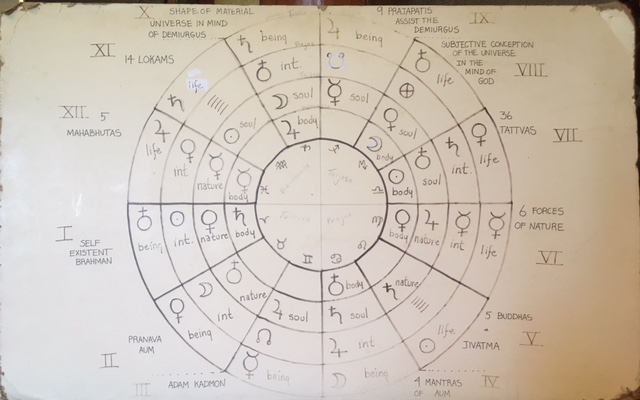
FIGURE IMG_2202-Posterboard Metaphysical Chart.
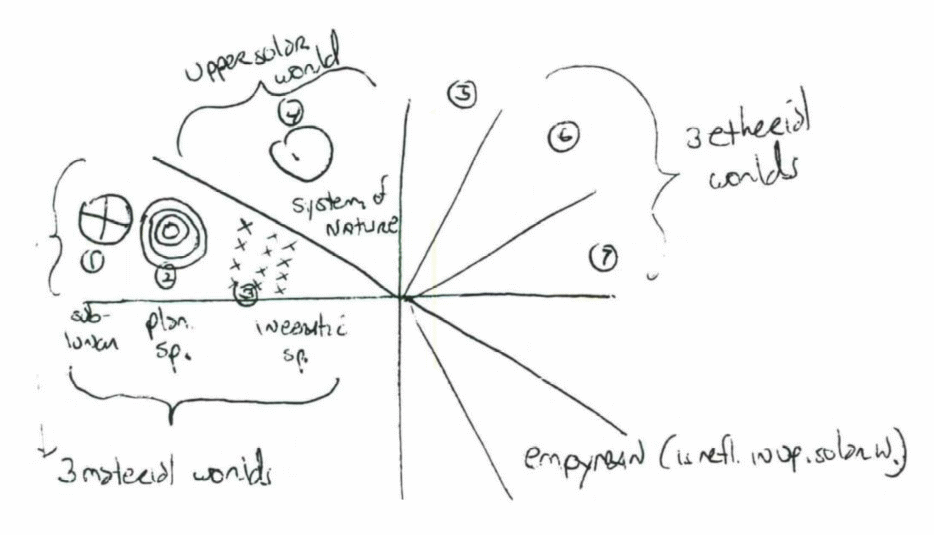
FIGURE 1980 0116-2-AB. Empyrean, Three Ethereal Worlds, Upper Solar World, Three Material Worlds mapped onto Metaphysical Chart.
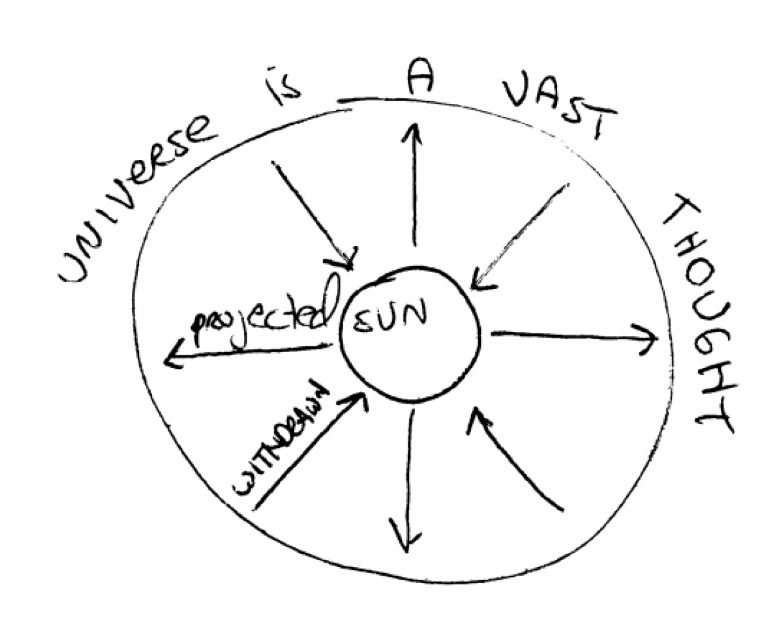
FIGURE 1980 0116-3-AB. Universe as Sun's Vast Thought.
[Transcriber note: [diagram] means the speaker is referencing a diagram as he or she is speaking. If someone is drawing or writing, with audible sounds of chalk on a blackboard, I indicate this by [drawing] or [writing].]
NOTE: Wednesday night class, part of Wisdom series 1979-1980.
TRANSCRIBED Verbatim by IT 2019; reformatted by JRM & JF 2019-2020, with TOC/Subheads by JRM. In 2023, IT updates prefatory matter, footer, and audio file name, completes Book List, adds Plotinus quotes section, adds new notes within transcript, fixes errors/typos, adds three diagrams and references within transcript to these diagrams. In 2024, MW alters Subheads to make more accurate. Archival verbatim transcript – V14.1a.
AUDIO FILES: 1980 0116a (formerly 1980 0116b), 1980 0116b (formerly 1980 0116a). [Note: "Tape" and "Side" refer to original audio cassette tapes that were later digitized into .MP3 Audio Files.]
| NEW FILE NAME | OLD FILE NAME |
| 1980 0116a | 1980 0116b |
| 1980 0116b | 1980 0116a |
1980 01/16 at Wisdom's Goldenrod
PB Books; Wisdom of the Overself; "The World-Mind"
Archival verbatim transcript
THIS CHAPTER IS ABOUT THE COSMIC SOUL IN ITS OWN INTEGRAL UNITY, NOT THE WORLD-MIND (NOUS)
[Audio File 1980 0116a (formerly 1980 0116b) Begins]
AD: I was gonna work backward. I was going to try avoiding a problem of co-- you know, confronting something which-- I found this distasteful. But, perhaps-- perhaps it's-- something more important prevail and I'm going to work it out this way. I'm going to go back to the chapter on the World-Mind, start with the one on the "God in the Universe," and, I'm going to have to reset the phraseology, terminology. [short pause, shuffling about] And I asked Tim to stand by and pick up some notes so that you don't have to write to PB, Tim will report.
S (faint): Oh, I see. (bit of laughter)
S (faint): How many more of the days has it been, do you know?
AD: I want to know who's on first and what's on second. (laughter)
S (amidst laughter, faint): Oh I (see).
RG: I don't know.
S (faint): Who's on third.
AD: But I don't do this light-heartedly, I've thought this over very carefully. If you remember, in the second chapter-- no, the third chapter, "The Birth of the Universe," he speaks about the World-Mind. I rephrased the title and I called it the World-Soul. And in that chak-- in that chapter, "The Birth of the Universe", we spoke rather extensively in some detail. And it did come to something like this, that the universe was a projection of the cosmic soul or the World-Soul. And, that everything in that universe was part of that cosmic production. This was the exterior-- exteriorization of the cosmic soul's functioning. Now, in the chapter on the World-Mind, I think he's speaking about cosmic soul again but not the exteriorization of the inward contents, alright. Not that exteriorization but the inwardization. So if you can get the drift of what I'm saying now, you'll see that I'm going to make some radical innovations in his terminology.
RG/S(?) (faint): Yeah, (that's nice, that might--)
CDA (simultaneously): Could you just repeat that [S simultaneously, very faint: Yeah right.] one more time (please)?
[few seconds of background student talking, laughter]
AD: Each-- in the chapter on "The Birth of the Universe" [CDA: Yeah, go ahead.] we spoke about the fact that what he called the World-Mind, I used a different terminology, I called it cosmic soul, and that the entirety of the production of the cosmic soul, our universe--
EMD: Can you please speak louder, nobody hears you back here. (laughter, student words)
AD: If I speak louder you'll say I'm yelling! (laughter, student words) Chapter 3, "The Birth of the Universe". When we went through that, I re-baptized the terminology, I-- I used terms like cosmic soul instead of World-Mind. And, we try to show in terms of the explanation that we were working through that the entire solar cos-- the entire universe, our universe at least, and this of course analogously could be applied to all universes but in terms of our universe the Sun or the cosmic soul was and is the fabricator of that, and that that represented the exteriorization of its internal contents. Now in the chapter on the World-Mind, again, I'm going to refer to the World-Mind, what he calls the World-Mind I'm going to call that the cosmic soul. But now it will be the cosmic soul standing in its own integral unity, abiding in its own essence. This would be cosmic soul, this is not World-Mind. Now-- Here's a little booklet I received from PB just to give you an idea.
[Transcriber note: I am using Planetary Influences on Human Affairs (formerly published as Astrology and Modern Thought) by B.V. Raman, Raman Publications, Bangalore, 1982.]
B.V. Raman [Planetary Influences on Human Affairs, p. 58, AD reading]: "The Sun is addressed in the Vedas as the Soul of the universe. He is the visible God. And without the Sun's heat and light nothing could exist in the world even for a single second. Varahamihira calls the Sun as [AD reads: He is called] Kalatma or the Soul of Time because Time exists only on account of the Sun. In fact, the Sun is the fountain-head of the life-force. The Sun's power is the cause of the cyclic motions of the earth and other planets."
AD: And he goes on and on, alright. So, I'm taking that point of view, I'm working from that point of view. Now if you have the Wisdom with you turn to the section on the World-Mind. And I'd like to start right in the-- in the middle of it. "God in the Universe".
LC: So you're calling the Sun the cosmic soul and--
AD: What he's calling World-Mind, [LC: You're call--] I'm calling cosmic soul.
LC (simultaneously): Cosmic soul.
[short pause]
S (faint): And--
CDA: But you're not speaking at all about the universe at the same time or the manifestation of the universe?
AD: I'm sorry?
CDA: The way you just-- the way you just said that it-- that World-Mind in this chapter is the cosmic soul abiding in its own essence--
AD: Yeah you--
CDA: So you don't-- you shouldn't think of it in terms of manifestation of this universe.
AD: Well you can't cut it off from that.
CDA: You can't.
AD: No, you'll have to bring that-- that in. But you'll have to make a distinction between its exterior life and its interior life.
CDA: Oh ok, ok, ok.
[9 second pause]
AD: Why don't we start reading Avery [couple/three words inaudible] (paragraph).
MENTALISM MEANS THAT EVERYTHING WITHIN OUR SOLAR SYSTEM IS ULTIMATELY REDUCIBLE TO THE FUNCTIONING OF OUR COSMIC SOUL, WHOSE VISIBLE EMBLEM IS THE SUN
[Transcriber note: I am using The Wisdom of the Overself by Paul Brunton, Rider and Company, London, 1943.]
PB [The Wisdom of the Overself, "The World-Mind," pp. 181-182, AS reading]: "When we understand mentalism we understand too that the World-Mind does not exist separately alongside the universe but in it and as it. The world was not arbitrarily created by outside intervention but was periodically self-born through the hidden activity of karmic forces under an ultimate law. The impressions of all objects in the universe lie latent within the inner depths of the World-Mind, until they become active by the general working of karma when they are externalized in the familiar space-time level which we call the physical world. The world-series is not only self-actuating but also self-determining. There is no intervention of an outside being simply because there is no outside being. Thus it is the heritage of karma which really brings the appearance of a universe into being and not a personal creator. We must not personalize the World-Mind in relation to its activity. It does not make the world like a man making a boot. It does not create the collected karmic potentials but only offers the ground for their existence. They form a self-active system. The belief that all these karmic energies are like the parts of a vast machine which is alternately set in operation and stopped by a [AS reads: the] machine-tender and that their operator is a separate personal God sitting in solitude beside them would not be a correct one. For they do not need any separate entity to"work" them. The karmic forces are set in motion spontaneously, not by the [AS reads: any] arbitrary fiat of a personal power. [AD, faint: (one/two words inaudible) go on.] The mind-substance of World-Mind is their inseparable ground and from it they derive their self-actuating power. According to our human way of looking at things they have existed since the beginningless past and their very nature constrains them to self-actualize themselves as a cosmos when they rise out of latency and to dissolve this cosmos when they subside. There was no special reason why an external power had to make a world out of matter but there was every reason why it had to make it out of its own self because the latent karmic impressions within it had to manifest themselves."
AD: Alright, let's discuss this paragraph.
[24¼ second pause]
LR: If we think-- if we (distinctly are) cosmic soul instead of World-Mind, how do you-- how do we then think of the sentence there's no outside being?
AD: But could we start with the first sentence, I want to work with one sentence all the way through. First sentence.
[9 second pause]
MW: Well, first sentence is [AD simultaneously: Yeah.] "When we understand mentalism…"
RG: Let's stop right there. (laughter)
S (amidst laughter): Oh. (laughter, student words)
MW: If-- if we follow the line of thought that we started, we talked about mentalism as being the functioning of the cosmic soul, that it's out of its mental substance that it produces the universe. So, if he's still speaking about mentalism, he's speaking about the mental, [S, faint: Yeah.] then it seems like it could be plausible that he's still speaking about the cosmic soul here. The-- I mean it sounds like the-- the same thing he spoke about in chapter 3.
AD: Uh-hm.
RG: Uh, but--
MW: Objection?
RG: But it-- (bit of laughter) well, I don't know.
AD: Now, would the analogy for instance be strengthened by if we think of the Sun, alright, and the Sun is a visible emblem of that invisible (life), but if we think of the Sun as a visible emblem and we say that the Sun exists in the universe and in it and as it. So on the one hand we're saying that it's the very nature of the life-force, the life principle, the heat and the light that comes from the Sun, to congeal into what we might call the entirety of a solar system, and everything within that solar system would ultimately be reducible to or traced back to that cosmic soul's functioning. And he's referring to this as mentalism, this is mentalistic in its nature. And I suggested that an (easy/easier) way to look at that would be to think of the cosmic soul or the Sun, alright, as composed of a substance which we refer to as taijasa consciousness, or a consciousness which you're only very s-- we're only very slightly acquainted with when we're in a dream state, alright, where we can see ideas in motion, and they're not fixed really into anything, I mean they're quite variable. They have no fixed reference points. So if we think of the Sun that way and I think the-- the sentence would follow easily.
PB [The Wisdom of the Overself, "The World-Mind," p. 181, AD reading]: "…the World-Mind does not exist separately…"
AD: If we say the World-Soul or the cosmic soul--
PB [The Wisdom of the Overself, "The World-Mind," p. 181, AD reading]: "…does not exist separately alongside the universe but in it and as it [AD reads: but is in the universe and as the universe]."
S (very faint): Yeah.
RG: Would you make the corollary point then that if you took the World-Mind to be World-Mind or Intellectual-Principle that it would exist not in the universe but apart from it?
AD: I don't want to get into that problem now, it's too advanced.
RG: But-- but how could-- I mean how could we not get into it if you're proposing the-- [AD simultaneously, faint whisper: Yeah.] I mean a different explanation?
[short pause]
JC/S(?): Do it.
RG: I mean I'm going to have a very hard time following this.
AD: It just do-- it just doesn't mean anything to me when you say "in it and as it". I don't know what you're talking about.
RG: What doesn't?
AD: When you say that the Intellectual-Principle or the World-Mind is in the universe and as the universe, I don't know what you're talking about.
RG: Well that's what I'm asking.
AD: Well I'm telling you. That's why I'm saying it's a very advanced problem. I don't think we have the necessary prerequisite information to handle it. I know some of us think we do. Go ahead.
AS: But-- See I think Michael's point was good, this sentence follows directly from chapter 3 and the one that A-- you know, that Anthony made at the beginning and Michael followed. There's no-- I mean, despite whatever other things you may want to bring in, it certainly is right on the same lines as chapter 3. If you go along with the chapter 3 as being the World-Soul, as being the actual, you know, energy of the universe and so on, then it cert-- I mean, it certainly fits that way here. Because he's speaking about the universe, I mean in a very similar way to-- it's almost a repetition of what he said in chapter 3. I mean I don't see-- I don't see your objection here anyway.
RG (faint): I'm not-- I'm not objecting.
AS: No, I'm just saying--
RG (simultaneously): [couple/three words inaudible] I mean-- (if--)
AD (simultaneously): But I [AS simultaneously: Because it follows--] follow-- follow your point but it's very advanced really, although the word-- the wording won't make you think so, you know. So it's a very advanced question because the understanding-- One of the reasons why I kind of broke up last week was-- trying to present some of the understanding we have gathered from understanding Plotinus and in delivering some of that information, it (is) too mind boggling. This just will not fit, it won't fit. There's no-- we don't even have the terminology. [short pause] So he goes on and he says--
OUR SUN, WHETHER ACTIVELY OR LATENTLY, HAS ALWAYS BEEN MANIFESTING A UNIVERSE
PB [The Wisdom of the Overself, "The World-Mind," p. 181, AD reading]: "The world was not arbitrarily created by outside intervention but was periodically self-born through the hidden activity of karmic forces under an ultimate law."
AD: Now, there is nothing outside of this solar system, alright, there's nothing outside of this solar system.
S: What?
AS: That's a leap. That's what the sentence said. [12¼ second pause] That's funny, in--
S (faint): Go ahead.
AD: Go ahead, Avery.
AS: Well, in the-- in the chapter 3 also he says there's no time at which this cosmos did not exist either latently or actively. So even when it's latent it's not something outside of itself, it's just latent. And then in it-- and then it becomes actualized in ei-- in both cases this-- it says from potential being to actual becoming. There's no-- you're not speaking of any outside intervention. He's saying there's nothing-- it's a self-contained system, the World-Soul.
AD: So, [S, faint: Oh yeah.] like our Sun which is the center of our system, not that other systems cannot exist within the locus of prime matter, I'm not discussing that, but anything you would know outside of this system would have to be through this system. And if you remember Avery pointed out in a previous chapter, that chapter 3, where it is the cos-- the cosmic soul that provides us with the images of the procession of the stars and galaxies and everything else. So whatever we know we're going to know through that medium. But to get back to this point, number one will be something like this, our Sun, which is a pigmy among many Sun, that within its system, alright, and within its activation and activity, that it has been perpetual, it has always been. There's never been a time, so to speak, where our Sun, our cosmic soul, did not manifest a universe. Whether actively or latently it was always, so to speak, itself manifesting a universe. So I'm speaking in terms of one solar system to simplify matters. Now, within our solar system, we would be saying something like this, "the world not arbitrarily created outside but was periodically self-born", we would have to think of the Sun, our Sun as the center of our system from which again and again there was projected forth this vast universe and then when pralaya set in it was withdrawn, alright, and again when manifestation occurred it was projected out and then withdrawn. So there's no need to call on anything outside of our solar system, outside of the cosmic soul of our system. There's no need to call on anything outside of that. Because if we say that the universe is, so to speak, a manifestation of the cosmic soul, if everything within our universe is a congealing of the light and the heat from our sol-- Sun, then why go beyond our solar system to try to, you know, bring in an ab extra, deus ex machina, God from outside? There's no need for it. No?
RG/S(?) (very faint): (Well) I mean how--
AD: I know today we've learned to think in very big numerals, you know, so that, after all this Saturn is not that far away, you know.
[short pause]
JG: What does the ultimate law refer to, Anthony? Is that the karma-- karmic law, the general law of karma?
PB [The Wisdom of the Overself, "The World-Mind," p. 181, AD reading]: "…but was periodically self-born through the hidden activity of karmic forces…"
AD: Well, what do you think?
JG: I think it's the ultimate. The only law I can come up here is the ultimate, the-- is the karmic law.
AD: Yeah, and do you remember it?
JG: The one is general, the [AD simultaneously: Yeah.] other applies only to human beings.
AD (simultaneously): And, what was the general law?
RG: Every entity [JG simultaneously: The--] inherits the characteristics of his own existence, it was suggested that's (general).
S (simultaneously, faint, part of background): More tea.
AD: Unless--
RG: That's (justice).
JG (simultaneously): And does it.
RG (faint): Because of the effect.
S (very faint, possibly part of background): [couple words inaudible]
BS (very faint): It's own-- it's own continuity is.
AS: Uh-hm.
RG (faint): (Well exactly./Law of (one word inaudible))
AD: So what do you think of that law now? It-- in other words, we would have to apply that law to the cosmic soul here and say that it is the very nature of karma that in order for this entity to continue, alright, it has to adjust effects to causes or causes to effects, effects to causes. So that this would mean a perpetual projection of its own substance and then a withdrawal of that, perpetual, so there would be no beginning to this process and there's no end to this process. Now of course this is, you know, very contrary to what we've been-- the West been lead to believe that there-- it's like a linear progression that starts at a certain time, it's going to end at a certain time. What he's saying that-- there's none of that. Its beginning is too far back, alright, and we can't trace it and it'll go on forever. It's very uncomfortable. Now it doesn't mean that it'll go on the-- forever the way it is now. It's very possible there might be a spiralling process going on, (the perfection/imperfection) in the very universe itself being accomplished. But I would think that that's what he means when he says the-- under an ultimate law.
BS: Uh, so, excuse me. So when you say that we don't have to go out of this solar system, do you mean (if--) do you mean that limited to the terms of the individuality of this cosmos? You mean--
AD (simultaneously): Well I'm limiting it to this cosmos, [student assents] to our world.
BS: Like we don't have to go out of it to find [short pause] its particular reason for being?
AD: Well another solar system would have that Sun for its soul and, so to speak, that-- that soul would be operating in a similar way as we spoke of our Sun, as having a perpetual re-embodiment of its own inwardness taking place and a withdrawal of that. Now, if we see this happening in many solar systems, alright, then we could universalize it in the way of saying that cosmic soul, alright, that means the Suns of all universes, cosmic soul, alright, so we've universalized it, and say cosmic soul constantly projects forth universes and then withdraws them. But I'm-- I'm restricting the usage so that we can follow more simply.
[9¾ second pause]
WHEN THE COSMIC SOUL WITHDRAWS ITS PROJECTION OF THE UNIVERSE, THE TRACES OF ITS FUNCTIONING ARE LEFT IN ITS SUBSTANCE, AND THESE TRACES BECOME THE ESSENCE OF THE THING'S EXISTENCE WHEN THE COSMIC SOUL AGAIN MANIFESTS A COSMOS
PB [The Wisdom of the Overself, "The World-Mind," p. 181, AD reading]: "The impressions of all objects in the universe lie latent within the inner depths of the World-Mind, until they become active by the general working of karma when they are externalized in the familiar space-time level which we call the physical world."
S (very faint): Hm.
AD: Now, you have to de-- we have to depend on this understanding of what memory was, you remember we spoke about memory? And we took the case of an individual mind and that the recollection or the traces left behind in the substance of that mind's functioning constituted the memory of that entity. Remember us speaking about that? Ok? And we said now apply this in a general way to the cosmic soul, that insofar-- if we think of the cosmic soul, like we think of an individual mind, that the entirety of all its functioning leaves traces behind of that functioning within itself, then when it recollects or let's say it withdraws the universe from manifestation, all that functioning has left traces in the very substance of its being so that they become withdrawn, they go-- they let's say go-- get interiorized. Now, when projection or manifestation proceeds, these-- this would be the very essence of the thing's existence in the manifested universe. You remember we spoke about this in chapter 3? Good, if you remember it you're doing very well.
FW: Speaking of essence you're still not leaving the realm of the cosmic soul?
AD: No we're using essence in this very restricted use in terms of the context. And the context would be something like this, like sometimes we say well, let's say I had a date or meeting or an appointment or an engagement with friends twenty years ago, you know. I don't remember the details, but I say, well, I remember the gist of it, the essence of it, you know. It left certain feelings behind which I call memory traces. And that if I could recapitulate those memory traces, then I've-- all the details of that scene could be, you know, manifested, exfoliated, projected outward. [S, faint: Ok.] It is those traces that we're referring to as essences now, I'm-- I'm not in the realm of essences of the World-Mind, not by a long shot. (We still haven't) [one word inaudible] So, try to remember, words-- [short pause] Words are phonies. They always were. They're as phony as three dollar bills, words. You have to always go by a context.
JG: So Anthony, what you call the internal life of the World-Soul or cosmic soul, is that those memory traces? 'Cause I have a hard time--
AD (simultaneously): No, no. Irrelevant. Leave the question out right now.
JG: Ok.
AD: I-- I'll answer that question, Johanna, but not-- not [JG assents] now. I-- Ok? Then the next sentence, Avery?
S (very faint): Uh-hm.
AS: "The impressions…" Is that--
AD: The way that we both have (to do it). (bit of laughter)
S (faint): That's right.
AS: Yeah.
PB [The Wisdom of the Overself, "The World-Mind," p. 181, AS reading]: "The impressions of all objects in the universe lie latent within the inner depths of the World-Mind, un…"
AD (simultaneously): And we refer to cosmic soul, alright.
TO REALLY UNDERSTAND KARMIC LAW, WE MUST UNDERSTAND WHAT ESSENCES AND IDEAS ARE
PB [The Wisdom of the Overself, "The World-Mind," p. 181, AS reading]: "…until they become active by the general working of karma when they are externalized in the familiar space-time level which we call the physical world."
AD: Alright. By the general working of karma--
LR: Can we use an astrological example to explain [AD simultaneously: Let's try.] the self-actualization? Like would it work to think of an entity having certain karmic traces and the self-actualization wouldn't imply a kind of creation but rather, I mean-- let's say one's karma merited the need to go through some kind of, you know, say Saturn Jupiter conjunction, that that would be the only way that-- that it's-- that certain meanings could be absorbed. And you know how he's always saying at the right karmic time and when all the causes are lined up the right way. I mean would that be appropriate way of thinking about it, that the actual planets have to be in a certain position and that karma-- for the karma to suit it? I'm not saying this (well/right). That when the con-- ex-- when the conditions of the world are such that they match, are appropriate for the karma of that individual or the stored memory of that individual mind, then the actualization will happen without, as he says, any outside being enforcing or putting it into manifestation because that would be like the right karmic time.
S: (Got to--)
LR: Am I making--
AD (simultaneously): Yeah, I think I follow what you're saying. First of all we have to remember that in this case here we're discussing the fact that the arisal of the universe, [LR simultaneously: I know, it's the universe.] alright, would mean that even the planetary bodies that appear and everything [LR simultaneously: Have to arise.] else, they would be governed by a-- a functioning of this karmic law. But if we took a specific instance of it and we say that, well this person arises (at his) time, he's born at his time, there's a karmic law which governs the continuity of this entity and this is a time for his appearance. Or if we take even a more particular and specific example, if you ever watch the transits of the Moon, after a while you'll be annoyed with your feelings and you'll see how mechanical they are and they will arise periodically at a certain day in the month, alright. Of course you're carried away, you think that they're de novo, you know, fresh, original and all that. But if you're cautious and careful you'll see that it's quite mechanical. And after the third, fourth month, you'll be quite annoyed with seeing the mechanical repetition of this feeling coming up, you know. Yeah, so-- But that karmic law of course, we're not going to really understand the karmic law until we get to an understanding I think of what essences and the Ideas are. See because that karma-- that word 'karma' is-- could mean so many things, in one context it could mean power, another time it could [LR simultaneously, faint: Idea.] mean Ideas. [AS assents] So--
AS (simultaneously): But, when we mentioned that before, he's-- it doesn't seem here like he's speaking-- we once said-- one interpretation of karma is the power of the Ideas. But it doesn't seem like he's speaking about here, it seems like he's speaking of like the spindle of necessity that they speak of, the-- the workings of the-- well the workings of the planetary spheres and the World-Soul. Or-- or he-- or is he including also the power of the Ideas? I don't know, uh-hm.
AD: Alright, let's continue anyway.
PB [The Wisdom of the Overself, "The World-Mind," p. 181, AD reading]: "The world-series…"
AD: And this is not a baseball game he's talking about, ok?
PB [The Wisdom of the Overself, "The World-Mind," p. 181, AD reading]: "The world-series is not only self-actuating but also self-determining."
AD: World-series I imagine here would have to do with the arisal of a universe and its dissolution and then the arisal again of the universe, so that you have-- and, you know, infinite series of universes arising and dissolving. And he would call this a series, a world-series, ok. So--
PB [The Wisdom of the Overself, "The World-Mind," p. 181, AD reading]: "The world-series is not only self-actuating but also self-determining."
[short pause]
LC: The world not only comes out from the cosmic soul but it-- its determination of when it will come out and what it will produce also comes from within the cosmic soul.
AD: Well you're saying that it comes from within-- But what does he mean by self-actuating more precisely? It arouses itself into being?
LC: Yeah, it-- it mo-- it pushes forth-- it motions forth, from its own motion, from its own power it goes forth. It is-- the universe is thrust into being from its own--
AD: So if we think of-- if we think of the cosmic soul and the universe lying latent within it, alright, or just like for instance when we go to sleep at night, and then at a certain moment we automatically arise and-- and wake up and go about our business. So in a similar way you think that the universe lies latent in the cosmic soul, that at a certain point, alright, it arises out of that (seed/see) and starts actualizing itself. And it keeps doing this back and forth. And what about the self-determining?
LC: What it will actualize, what becomes actualized, also comes from within. It doesn't come from any place else. The kind of universe that will be produced, conjunctions, the-- the-- even probably the as-- even probably just the objects all come-- all are determined.
AD (simultaneously): It's like a larger scale version of-- of what we make ourselves to be?
[students assent, faint]
LC: Oh.
BS: But the mode of perception is unique for all the individuals of this particular solar system.
AD: Yes.
BS: It could only happen here, in that sense it's in this solar system, in that sense it would be so-- [someone taps on board, probably AD]
AS: Hm. Can you also say that whatever forms are going to manifest in this universe are product of the-- this total karmic history of the universe that depends upon the forms that were manifest in the previous universe, and that whatever activity goes on in this universe will determine this universe's own existence in the next-- will determine the universe's existence in the next (part).
AD/S(?) (faint): Alright.
[short pause]
AD: Well it almost sounds atheistic, you know.
S (faint): Uh-hm.
AS: Sounds just like Samkhya.
PB [The Wisdom of the Overself, "The World-Mind," p. 181, AD reading]: "There is no intervention of an outside being simply because there is [AD emphasis] no outside being."
AD: Now of course if we say this universe, alright, then you would say yes, but there's another universe outside of this one and that would be an outside being. So over here if you-- if you want to limit that kind of reasoning, just think of the universe in its totality. There's nothing outside the universe, ok. But, you don't have to get carried away with your omnipotence and omniscience to-- This universe alone, alright. Within matter there could be var-- a variety of s-- of nuclei within it and one may not know about the existence of the other, at all. So, we could use the analogy.
AS (very faint): Yeah.
PB [The Wisdom of the Overself, "The World-Mind," p. 181, AD reading]: "There is no intervention of an outside being simply because there is [AD emphasis] no outside being. Thus it is the heritage of karma which really brings the appearance of a universe into being and not a personal creator. We must not personalize the World-Mind [AD reads: cosmic soul] in relation to its activity. It does not make the world like a man making a boot. It does not create the collected karmic potentials [AD reads: potential] but only offers the ground for their existence. They form a self-active system."
AD: That's the bottom there, let's get on with it.
CDA: How-- how does it offer a ground as--
AD: But can't we start [CDA simultaneously, faint: It's not (one/two words inaudible)] with the beginning line, why do you people always go read last line?
CDA: It's the last-- well, the first one on the way back. (laughter)
AD: Alright, you win that one. (laughter) Ok.
S: Go ahead.
S (very faint): Those were [couple words inaudible] (bit of laughter, student words)
S (faint): Yeah.
S (faint): Yeah.
AD (very faint): Alright.
S (faint): Forgot to do karma.
PB [The Wisdom of the Overself, "The World-Mind," p. 181, AD reading]: "Thus it is the heritage of karma which really brings the appearance of a universe into being…"
[9¾ second pause]
AD: Well it's relatively straightforward, except if you get into the word 'karma'.
S: Right.
LC: Well, that which came before determines that which will follow.
AD: That which came--
LC: That which came before determines that-- what-- which will follow.
AD: Alright.
LC: And it's not as-- an internal-- it's an internalized system, it's not something coming from nowhere, things don't happen arbitrarily.
AD: Yeah. But, there is-- there is always this something mysterious, you know.
LC: It is mysterious.
AD: Uh, [S, faint: It is.] what is there in us that tends to repeat whatever activity we undertake? There seems to be some kind of a-- a substratum, you know, if you think a certain thought today, tomorrow you'll be thinking it and before you know it it becomes a very fixed attitude. So there seems to be some sort of underground, some sort of substratum, some kind of principle, some kind of law which they generally refer to as karma, alright, that we'll probably have to investigate and get into much more deeply. But for now let's take that just, you know, on the surface. So--
S (very faint): Right.
AD: So this impersonal law, alright, he says, really brings the appearance of a universe into being and not a personal creator. So we're getting rid of the notion of a personal creator and a kind of abstract impersonal law which is always operative. Always operative, you know. Once something is done, it can't be undone. You know like this kid who was watching his father through the window fixing a flat tire. And the father looked up to him and says "No, I can't change the channel." You know, this is real life, like a brush stroke, once you put it on the paper, you can't erase it, it's-- that's it, alright. So-- (bit of laughter) Go ahead.
JG: This father had pretty elaborate thoughts while he was changing a tire.
AD (simultaneously): What?
JG: This father had pretty elaborate thoughts while he was changing the tire.
AD: He had pretty what?
JG: Elaborate thoughts while he was changing a tire.
S (very faint): Oh yeah.
JG: I don't get the story. (laughter)
AS: Sorry Johanna, we can't change the TV channel. (laughter)
AD (amidst laughter): Well it's simply--
AS (laughing): (Different) story it is.
JG (simultaneously): Get the translator.
AD: It was a TV scheme.
AS: Can't take it back.
AD (simultaneously): Don't worry about it. It was simply that these kids looked at so much television, you know, you can turn the channel. Well you can't do that with life. Once you do something it's done, [S simultaneously: Oh.] it can't be undone.
S (faint): Oh, oh, oh.
S (simultaneously, faint): Oh.
AD: And these kids were telling their father, look, can-- can't we change the channel, do you really have to fix the tire?
JG (laughing): I thought of the English channel. (laughter)
AD (amidst laughter): Alright Johanna, alright. (more laughter)
S (faint): [one/two words inaudible]
S (very faint): [couple/three words inaudible]
ANYTHING THAT'S MANIFESTED IN THIS UNIVERSE HAS A CONTINUITY THAT IS SYMBOLICALLY REPRESENTATIVE OF THE UNITY THAT IS IN THE SOUL
RG: I have a question [couple words inaudible]
AD: Go ahead, Richard.
RG: When we speak about the law, continuity of each individual's own existence, and the self-actuations, determination, it-- it seems to me that that self-determination and that continuity must transcend the ebb and flow of its appearances, and that that continuity must be rooted in a-- in a principle that transcends its motion.
AD: Oh yes. But you see there again, there again, that continuity would on a higher level be the unity of the entity.
RG: Ok.
AD: See but the continuity would be its appearance in the space-time world. And that's a point that Plotinus hammers at-- hammers away at, that anything that's manifested here in this universe, alright, has this continuity which is symbolically representative of the unity which is in the soul, [RG: Right.] alright. Yeah.
LR: Well that's why, I mean--
AD: That's-- that's why I'm avoiding that discussion right now.
LR: But--
RG (simultaneously): But it seems you're basing the-- your-- your point of view on that distinction.
AD: I'm basing my point of view--
RG (simultaneously): The point of view that this is talking about the cosmic soul and not the World-Mind as we've understood it before on that very distinction or-- or on a-- on the distinction of that very level.
AD: There wouldn't be no continuity in the World-Mind. There will be total identity, the-- the present-- the infinity and eternity will be present with all its objects.
RG: Right but-- but from the point of view of the universe, looking up, contemplating that--
AD: No, the universe wouldn't contemplate, it would be the soul that contemplates the Ideas.
RG (simultaneously): Ok, well--
AD: The universe doesn't contemplate Ideas.
RG (simultaneously): A portion of the soul contemplated. It wouldn't appear as a-- you're saying it wouldn't appear in any way as a continuity in the distinction of substance and its appearance, there would be a total identity. That's why it's within the cosmic soul. I mean you couldn't even speak like this within the Intellectual-Principle.
AD: No, you can't.
LR: It's-- I think it's that-- it's precisely because we're not bringing in the aspect of some kind of unity that it-- I don't know, I guess I should formulate this as a question. Because we're not speaking of the aspect of unity, it seems very difficult, at least for me, it always has, to understand the notion of self-actualization and (grasp--) I mean it's only when you bring in an idea which combines or encompasses both the idea of its becoming and its being that it's easier to follow how it would take that inward and outward kind of motion. But just to say it self-actualizes from--
(Side 1 of original cassette tape digitized as 1980 0116a (formerly 1980 0116b) Ends; Side 2 Begins)
LR: --the principle that encompasses it.
AD: Well you'll find the larger principle very similar.
THE COSMIC SOUL DOESN'T CREATE THE KARMIC POTENTIALS THAT ACTUALIZE THEMSELVES AS THINGS IN EXISTENCE
LR: I mean is it possible to see the self-actualization as-- in this context without seeing--
[short pause]
AD: Perhaps instead of using the word 'self-actualization', if you use the term 'thing-actualization' it'll get you closer to it.
[11¾ second pause]
JG/S(?) (faint): How come?
LR: Thing-actualization? (laughter)
AD: Yeah. What's getting actualized is a thing, not a self. How could the self [LR simultaneously: Oh.] be actualized?
S: But that's not what [AD simultaneously: What is--] the term implies.
AD: Huh?
S: The term doesn't seem to imply that though, you know. I mean soon as you define more--
LR: You're talking in terms of the individual mind, yes, rather than-- [short pause] When you say thing-actualization I wasn't thinking in terms of the self coming in and going out.
[short pause]
S (faint): Yeah.
AD: Well let's start again, I [S simultaneously: Yeah.] missed your point.
LR: Well, I think I'll drop it.
PB [The Wisdom of the Overself, "The World-Mind," p. 181, AD reading]: "We must not personalize the World-Mind in relation to its activity."
AD: Well, don't keep it to yourself, you know. Mention, say a few words out loud. I see you nodding your head but you don't say it.
MW: Well, self-actualization might be that it's inherent in the process, the-- this process of manifesting the universe which the very process structures, let's say, this taijasic consciousness in such a way that after this withdrawal of the universe it-- there's going to have to be another subsequent functioning that's going to manifest universe. But there isn't-- it's self-actualizing in the sense that there's not an entity apart from this process which has some kind of choice as to well, should the universe be manifest now or not be manifest. It's inherent in the process, it's almost mechanical.
AD (simultaneously): Right.
PB [The Wisdom of the Overself, "The World-Mind," p. 181, AD reading]: "It does not make the world like a man making a boot. [AD: And he goes on."It does not create…" Now--] It does not create the collected karmic potentials [AD reads: potential]…"
MW: Yeah. It certainly can't create it in the sense of something that was not there is suddenly produced because we're speaking in terms of-- of a-- of beginningless process. So the world-- the karmic potentials can't be created because they're the result of-- of a previous functioning which there's never going to be a-- you're never going to be able to get a point in time when there wasn't some karmic potential.
AD: So then we have to think of these things, so to speak, as always having been. And that there's a varying modification going on as they go on evolving. Sometimes backwards, sometimes forward. And then he goes on--
DOES THE GROUND THAT COSMIC SOUL OFFERS TO THE KARMIC POTENTIALS REFER TO MATTER AS WHAT MAKES THE EXISTENCE OF THINGS POSSIBLE?
PB [The Wisdom of the Overself, "The World-Mind," p. 181, AD reading]: "…but only offers the ground for their existence."
[short pause]
CDA: Could that mean that--
AD: Only offers their ground, only offers a ground for their existence. The existence of what?
CDA: The karmic potential(s). [one/two words inaudible]
AD (simultaneously): The existence of what?
S (very faint): Thing.
S (very faint): The thing.
AD: Of things.
CDA: Things.
MB: What do you mean by--
CDA: But it's-- the things are its thoughts. So the-- and where are the thoughts coming from? The thoughts are coming from-- [short pause] Is-- are--
AD (simultaneously): No, no, no, follow, follow what I'm saying.
CDA: Ok.
AD: Follow what I'm saying.
PB [The Wisdom of the Overself, "The World-Mind," p. 181, AD reading]: "…[AD adds: it] offers the ground for their existence."
AD: Now, what-- what existence, the existence of what? Of a thing you said.
S: (Uh-hm.)
CDA (simultaneously): Somebody else said that.
AD: Alright, alright.
CDA: That-- is that a--
AD (simultaneously): The existence of a thing.
CDA: A thing like this pillow?
AD (simultaneously): Now how does--
CDA: Is that what you mean?
AD (simultaneously): Yeah, anything, yeah, [CDA simultaneously: Ok.] anything, ok. It offers the ground for the existence of a thing. But we understand that existence is constantly varied. Is that so?
CDA: Yeah, ok.
AD: I mean existence isn't stationary.
CDA: So are you thinking of that in terms of like taijasa consciousness?
AD: Well no, I was thinking of this-- does this mean matter?
RG: Which?
S: What? Ground or--
AD (simultaneously): What, which, where, when? (laughter)
RG: Ground.
S: What did you mean when you said [S simultaneously, faint: Ground (or--)] these things [LC simultaneously: The ground is the matter.] always having been?
RG (faint): Is it ground Anna?
S (simultaneously, very faint): I don't know.
S: Changing, existence, [S, faint: Ground.] in existence they always--
PB [The Wisdom of the Overself, "The World-Mind," p. 181, AD reading (simultaneously with S)]: "It does not create the collected karmic potentials but only offers the ground for their existence."
S (very faint): (Here.)
[short pause]
JG: You mean since the way you described existence is this-- existence is going back and forth and concentrate. [S, faint: Yeah.] So there must be something--
AD (simultaneously): Well, you know, we say [S simultaneously with JG: There's not a--] a book is in existence, right?
JG (faint): Yes, right.
AD: Pillow's in existence, you're in existence, I'm in existence, alright. But then we went on and [JG simultaneously: Something--] we understand that existence is momentary or it's varying, it's transitive, it's always on the move, it's never self-identical, [JG assents] alright. Now he's saying that the cosmic soul offers the ground for the existence of things.
JG: Offers that when-- which makes the momentariness possible.
AD: It-- again?
JG: It offers that which makes that momentariness of fleeting existence possible.
AD: Possible?
JG: It must be relatively stable and that's why you (introduce--)
AD (simultaneously): No, [S simultaneously: No.] you don't have to say [JG simultaneously: No?] that, we don't have to say anything else.
JG: I mean, [AD simultaneously: You say-- you say it's offering--] because you said matter, because you said matter, that's what I was driving at.
S: That's right.
AD (simultaneously): Well, I said matter, that doesn't mean that it's known.
JG: No. That's true.
CDA: So you think that's what it means though?
AD: Well I'm not saying what it means, I'm asking.
RG: Ok.
AD: Because if I say what it means you people will throw pillows at me.
CDA: So it could mean that. [BS, faint: Subjective.] But it's not matter.
AD (simultaneously): So I have to convince you that you think that this is so. (RG laughs) [student assents, faint] Alright, then-- then explain it.
LC (simultaneously): Oh, that's amazing if you would say that the-- the cosmic soul offers-- matter-- matter is the ground for all the objects.
AD: For the existence of these things.
S: Uh-hm.
LC (simultaneously): Yeah.
AD: Maybe that's why they call it Mahavairochana or Rupakaya, the Buddhists.
S (very faint): (Right.)
[short pause]
AD: But that's off the point.
JC: Anthony, is it matter in the sense of a receptacle or matter in the sense of the consciousness--
AD: Ah, here [S simultaneously, faint: Go on.] we go into a definition, right?
JC: Well, I mean, is it-- when you say Mahavairochana are you speaking of it-- aren't you speaking of the consciousness of that entity providing the basis for anything to arise within it and not necessarily a-- a basis in terms of a substrate that we speak of that receives-- [S, faint: Ideas.] that is ref-- as Ideas reflected in it.
AD: Well, I know you like to ask questions but, suppose you try answering it and let's go back to this page, 295, you have the hard cover?
JC: No. In the same section?
AD: No, it's "A Philosophic View of Religious Worship," one, two, three, four, I guess the fourth paragraph. At the very end he says--
MATTER IS THE PRINCIPLE OF EXISTENCE: WITHOUT MATTER NOTHING WOULD BE IN EXISTENCE
PB [The Wisdom of the Overself, "The World-Mind," p. 175, AD reading]: "Human arrogance must inevitably bend the knee in submission before the World-Mind. [AD: Which we call cosmic soul.] For it [AD reads: cosmic soul] is not only the first state of matter, but also the first source of individual being. Hence but for its very presence the atheist would be unable…"
AD: Take over sir. Alright. Made the mess?
AS: Any other questions, Jeffrey? Jeffrey I'm sorry, could you go on? Could you go on Jeff? I'm not sure I followed your point about the--
JC (simultaneously, faint): What point? Well he says--
AS: Because we did make the point about Vairochana even when we called it consciousness that it's not-- it wasn't conscious-- they don't use the word 'consciousness' in the way that we were using it, they use it as one of the five skandhas and not as the principle of pure consciousness.
JC: Yeah I understand that, it's even--
AS (simultaneously): They were using it as a vehicle.
JC: You could even look at it as momentary (now). But, it is an intelligent life or some intelligence in a sense is in it.
AS (simultaneously): Well there's no doubt that the World-Soul is conscious or inte-- that it's intelligent. But, how does its-- how does it function in relation to the manifestation of the cosmos. He's saying here that the World-Soul is the ground for that manifestation. It doesn't create the karmic potentials. It almost seems like he's speaking about this self-active system. It almost seems like we could go back to the interpretation of the Ideas, and that they're getting instantiated through the functioning of the World-Soul. And the-- and the World-Soul is proving the ground or the matter [JC: Substance.] into which these Ideas can get instantiated [JC: Yeah.] and mani-- manifested as-- you know, as Johanna said, this momentary existence of the Ideas, the momentariness, that existence needs this ground, the matter, which the World-Soul provides.
JC (simultaneously): It's like when you think of the consciousness as an intelligent medium which translates the Ideas and projects them into the-- and say into matter? Are you-- are you going to equate the unintelligence of matter with the consciousness of the World-Soul?
AS: No I don't think he would say here that the World-Soul or-- certainly the World-Soul is not unconscious. But the point is in what way does it function to provide the existence of these karmic potentials which in themselves are not-- are unmanifest.
JC: Well you could look at the karmic potentials as operative forces which are-- need that substance in order to-- to be but maybe not to be active the way that they are characterized. And that that characterization is what has to be in a certain continuity but that it relies on the World-Soul to support them, their-- their existence. But not necessarily, you know, the interrelationship of them and their activity in the way that they would do.
AS: Well, "it offers the ground for existence" seems to say that. It allows them to exist. They couldn't be in existence--
AD (simultaneously): But what would be the principle of existence then? Isn't matter the [AS simultaneously: Matter.] principle of existence?
AS: I-- I could almost interpret this as-- well I-- I don't know. We said that not-- that anything that's outside of matter incorporeal, we spoke about that as essence and not existence. Using existence in the sense of-- in the-- in the-- well, in the sense of reflected in matter or embodied.
JC: Say it's a principle of their appearance [AS simultaneously: Fourth quadrant.] in the world.
AS (simultaneously): Yeah but it-- but if existence meant-- I mean, in this sense I think means fourth quadrant [diagram] type appearance. [Note: See FIGURE IMG_2202-Posterboard Metaphysical Chart appended to this transcript.]
AD: Thingness.
JC: But the-- [AS simultaneously: Yeah.] the forces [AS: Particularity.] continue to exist potentially without appearing.
AS: Well that's ok, you would say even their potential existence in that sense depends on the World-Soul. Their-- b-- their potential and active existence depends on the World-Soul. But in themselves they may not. Only their existence depends on the World-Soul, not their-- not what they are in themselves maybe.
JC: You mean their [AS simultaneously: I mean like the--] [one/two words inaudible] the way they're--
AS (simultaneously): Well, [LC simultaneously: Well, yeah.] like the notion-- well, I don't know if we want to do it.
AD (simultaneously): Look, existence. Think about the word for a minute very carefully, alright. In order for anything to exist, alright, anything, matter must give it being, which is of course in the nature of non-being. There cannot exist anything if it's not in matter. Now matter, the word is unknown right now, [student assents, faint] ok, we're just using it in this questioning way. Ok?
JC: Do you include the World-Soul?
AD: The World-Soul? In what way?
JC (simultaneously): It can-- that it can only be as an entity insofar as that [couple/three words inaudible]
AD (simultaneously): But we don't know what the World-Soul is now, we're just speaking that it provides the matter for the existence of a thing, alright. And you remember we pointed out in a previous chapter that the Sun, alright, intermittently thinks the universe into being, that means it's got a sort of discontinuous existence. Now existence itself is transitive. You follow that?
JC: It's always in motion.
AD: It's always-- it's always changing. [student assents, very faint] You know like Shelley when he says about the-- I'm trying to-- "I change, but I never die"? [Note: "I change, but I cannot die." From "The Cloud" by Percy Bysshe Shelley.] I think he was in the clouds, he's speaking about them, he's saying "I change, but I never die." In the same way this matter always is. But, we won't get into a-- an understanding of what the isness of matter is because that leads us into its non-being status. But right now, what we have to understand is, if that is not provided, then nothing could come into existence. That's all I'm asking you to try to understand. Don't go beyond that point.
S: It [half/one word inaudible]
RG: Who-- that (said/says)--
AD: Can you understand that point? [S, very faint: Yeah.] That matter is the principle of existence, no matter, nothing will be in existence. I said existence, I didn't say nothing is.
S (faint): Yes.
AD: Ok?
CDA: Didn't--
AD: Alright. So then he's saying if we think of the Sun as providing the matter for the possibility of the thing's existence, alright, now we got an anchor. If you hold onto this very carefully elaborate kind of thinking, and it is subtle, when we get into the notion of matter it'll boggle your mind. But for now, ok?
JC (simultaneously): Are you looking at the Sun's substance as this matter or is the Sun--
AD (simultaneously): Well evidently, according to this here passage, that's what it-- that's what he's saying. He's saying here--
PB [The Wisdom of the Overself, "The World-Mind," p. 181, AD reading]: "It does not create…but only offers the ground for their existence."
RG: And the 'their' in that sentence refers to what?
AD: I'm sorry.
RG: The 'their' in that sentence refers to what?
PB [The Wisdom of the Overself, "The World-Mind," p. 181, AD reading]: "It does not create the collected karmic potentials but only offers the ground for their existence."
AD: 'Their' refers to the things.
RG: It doesn't refer to the karmic potentials?
S: [couple words inaudible]
AD (simultaneously): Karmic potentials! [S simultaneously, faint: It's the things.] What are you-- what's the difference!?
S (faint whisper, possibly part of background): Ok.
CDA: Anthony--
AD: I'm sure you all read this book. Go ahead.
CDA: I-- my mind has been conditioned--
AD: Just your question, just your question. I'm going to be very dictatorial [CDA/S(?) simultaneously: Ok.] tonight. If-- [CDA simultaneously: We have--] if I'm not you will get lost. [CDA: Ok.] It's a Serbian smog. (laughter, student words)
CDA: So is my heritage. The way we have described in the past of the things in this universe as being a result of vaishvanara consciousness. There was never any matter in that explanation of the way taijasa-- of thoughts of the cosmic soul being in taijasa and coming through the individual and becoming vaishvanara and becoming things. Now I would like to know how to put these two concepts together.
AD: (Well/But) I don't want you to go that way, I want [CDA simultaneously: You don't.] you to go this way first. Go this way first.
CDA: Will they--
AD: They'll come together. They'll come together.
CDA (faint): Ok.
AD: Read the next sentence, (will you)?
PB [The Wisdom of the Overself, "The World-Mind," p. 181, AS reading]: "They [AD simultaneously, possibly part of background: Thank you.] form a self-active system."
AD: What's the 'they' refer to Dickie?
RG: Karmic potentials.
AD: Things.
S (simultaneously, faint): Anything.
AD (intensely): I like the word 'things'. Because that's very mysterious.
S (very faint): Thing.
RG (faint): Thing(s)?
AD: Yeah things. That's very mysterious.
S (very faint): Things [couple/three words inaudible]
AD: So-- Come on, elaborate.
RG: Well I think what you said before, that these things have a generation inherent in themselves to manifest themselves a certain way and don't need any other power to do so.
AD: Nothing outside them. So naturally you can see that it would lead you to suspect that there's much more behind this, alright, than we are acquainted with right now but we don't want to go beyond that because these things may be the instantiation of the Ideas but right now let's not pursue that.
LR: Well you did refer-- you just referred back to the sentence that said the World-Soul is the first state of matter.
RG: (Go ahead.)
JG (faint): Is what?
LR: Soul is--
RG: Go ahead.
LR: You just referred us back to the statement that the Wor-- that said the World-Soul is the first state of matter. And also the first source of individual being.
AD: Yeah. [LR: Um--] Or things. You have to excuse me. I want to be very materialistic tonight.
LR: Right. Or thing(s). [short pause] Can't we get into a discussion of what that would be?
AD: What?
LR: What would it mean here?
AD (simultaneously): Discussion of what?
LR: The first state of matter. (AD laughs, bit of laughter)
AD: In about a hundred years from now meet me in my cave. (laughter)
LR: Well I mean why are we doing all this (set-up) if we're not going to talk about it?
MW (simultaneously, faint): Think I know what he's shown her. (laughter, student words)
AD: We'll get into a discussion of matter but not now. These are-- leave the-- I think the problem of matter is the most difficult of all problems.
LR: Yeah, PB said that too.
AD: No.
S (simultaneously, very faint): Yeah.
AD: Go ahead.
S (simultaneously, very faint): Did he?
CDA: The One.
AS: Yeah.
LR (simultaneously): (You guys) actually agree on something.
CDA (simultaneously): After the One, after the One.
RG: After. (laughter)
AD: Yeah.
LR: I'll show you a statement.
RG (simultaneously): After [one/two words inaudible]
CDA (simultaneously): No he says second, the second.
AS (simultaneously): No he says after matter. No, no, he says [LR simultaneously: After matter this is the (second).] after matter the problem of the One is the second-- how the One becomes [CDA simultaneously: Oh.] the many [LR simultaneously: Is the second.] is the second most [RG simultaneously: Right.] important [student assents, faint] after matter.
LR: After [AD simultaneously: Oh.] matter.
CDA: Oh he says important, he doesn't say the most.
AS (simultaneously): So matter (is/isn't)--
AD: Good. I'm glad to hear that. (bit of laughter)
AS: Or difficult. I don't know if he says important or difficult but-- Difficult.
S (simultaneously): Deepest and darkest.
AS: The deepest and darkest.
AD (simultaneously, faint): Deepest and darkest.
AS/S(?) (laughing): What?
AD: Alright, the next part shouldn't be too much.
JG (simultaneously): No, excuse me Anthony, I'm-- The things also include the ground.
AD: I'm sorry?
JG: The things and the ground form the self-active system. Without the ground you have no self-- self-active system. Well because you refer to the thing.
AD: Well, over here the-- the reference to the things or to the appearance or the instantiation of the karmic potentials, alright, they must have ground in order for them to exist. In other words, in order for these Ideas to instantiate themselves, effectuate [JG assents] themselves, alright, they must do so in some locus which happens to be matter. [student assents, faint] That matter provides the possibility of the existence of things. [JG assents, faint] And these things in their existence could evolve. But they cannot evolve unless they're in existence. So the ground provides the matter for the Ideas to get instantiated, that is become things, and as things, because of the modification, the interrelationship that's constantly going on between various things in the universe, alright, the spiralling evolution can-- can continue. So he goes on to say--
THE NOTION OF A PERSONAL GOD IS ELIMINATED IN THIS PROCESS
PB [The Wisdom of the Overself, "The World-Mind," p. 181, AD reading]: "The belief that all these karmic energies are like the parts of a vast machine which is alternately set in operation and stopped by a machine-tender and that their operator is a separate personal God sitting in solitude beside [AD reads: besides] them would not be a correct one."
AD: Now this is a very common idea in most of the Eastern traditions. The-- the notion of a personal God is not there. In Buddhism, in Jainism, they don't have personal God. These things are processes, they're laws in themselves. Now, of course the mythological and the mythological mind likes to frame these things and pictorialize them, make images of them and what could be better than to make-- make an image of man out of these things. But if we cut through all of that, alright, and we come to these impersonal processes, that kind of comfort is taken away from us, alright.
LC: Is this sentence also implying that the various karmic activities that are at work might not even be related to each other?
AD: Uh--
S (very faint): Uh-hm.
S (faint): Yes.
[short pause]
AD: In my opinion, yeah. Because there are very many essences and Ideas that are in no way, you know, in communication. Like the Ideas that are-- that this world embodies, another world might embody other Ideas and they're in no way related to each other, none at all. But, that'll take us too far away.
PB [The Wisdom of the Overself, "The World-Mind," p. 181, AD reading]: "[For] they do not need any separate entity to"work" them."
AD: That is, they don't need a God, a personal God.
PB [The Wisdom of the Overself, "The World-Mind," pp. 181-182, AD reading]: "The karmic forces are set in motion spontaneously, not by the arbitrary fiat of a personal power."
AD: Alright, so, I think after a while you'll begin to see that the notion of a personal God is really eliminated in this process.
JG: But that still leaves the whole thing pretty mechanical, you know--
AD: It does sound mechanical, doesn't it?
JG: Ver-- yeah and very-- processes that go on, I mean, there's no way of softening. [AD simultaneously: Well--] That's how it sounds to me.
[short pause]
AD: Well don't despair yet Johanna, go ahead.
S (faint): Uh-hm.
THERE IS A DISTINCTION BETWEEN THE THINGS THEMSELVES AND THE GROUND THAT SUPPORTS THEIR EXISTENCE
AD: "The mind-sub--"
PB [The Wisdom of the Overself, "The World-Mind," p. 182, AS reading]: "The mind-substance of World-Mind is their inseparable ground and from it they derive their self-actuating power."
AD: Alright.
S (very faint): [couple/three words inaudible]
BS (very faint): I agree with you now.
AS (faint): I don't know.
LC: Are you going to call the mind-substance of the cosmic soul matter, is that what-- is that what are you leading to?
S: [three/few words inaudible]
AD (simultaneously): Well you could speak up, go ahead, speak up. Not only that, it seems also he's saying that power is derived from matter.
S: Uh-hm.
RG: If you interpret the mind-substance of the World-Mind as matter, yeah.
LC: Or the life-- the substance of cosmic soul is matter.
AD: Well in that previous passage that we just tentatively used, he does speak about it as matter, doesn't he?
LR: First state of matter.
RG/S(?): Yeah.
AD (simultaneously): The first state of matter.
S (very faint): Yeah.
S (faint): Go ahead.
AD: Well, we still don't know what this matter is, I mean, let's leave it open, let's not, you know-- you-- in a Hindu system they might call it shakti, I don't know, but let's leave the question open. And you know they worship shakti, the mother shakti, the mother goddess and all that. Let's leave it open. But it does seem that he's making a connection here between this power-- Alright, perhaps an attribute of this matter is power. Yeah.
RG: Ok but now we have a concept that the i-- that these things themselves don't possess their own power, but their power's given to them by a principal that's their s-- would be their superior.
AD (simultaneously): Uh-huh, that too is there, yeah, yeah. You ever feel that you're living-- living on borrowed time?
JG: Yeah but also how do you now account for the effect you-- I mean, you still (for--) still are dealing with the self-actuating power you get from some place else, that's a bit strange.
AD: I don't follow you yet.
JG: I mean the wording is like-- or as he said the mind of the cosmic soul-- or the matter of the cosmic soul gives the thing the power to continue.
LC: No it derives it.
JG (simultaneously): And-- Well derive.
AD: Well by-- [JG simultaneously: Yes.] it would follow by necessity, if matter gives the thing its existence, evidently it has [JG simultaneously: Is it--] the power to do so. So power would be an attribute of that matter, whatever that matter might be.
LR: But what she's saying is how-- if it derives its power from somewhere else how can you speak of it as self-actuating.
RG (simultaneously): Self-actuating power.
LR: In other words, the thing is self--
AD (simultaneously): Well like for instance if you take a seed, alright, and you plant it and you don't give it no water, alright, and you don't give it no sunlight, and no nutriment from the soil, then it can't actuate itself, it can't become what it-- its inherently intended to be. But if you put a little water on, a little sunlight, you know, [S: I think so.] then it [RG simultaneously: Right, but--] actuates itself and becomes that plant.
RG: But in that e-- then the power is not self-actuating [S simultaneously: Right, sure.] but other-actuated.
S: Right.
AD: What do you mean?
RG: Well, the power in that example is coming from the nutriments that you're giving to the seed to grow, not from itself.
AD (simultaneously): But he says "and from [AS simultaneously: Oh.] it they derive".
RG: Their self-actuating power.
AD (simultaneously): Yeah. I would-- I would trans-- I would translate it to mean that, if you give me everything I need, you know, the water, the soil, the Sun, then I could actualize myself. If you don't give it to me I can't actualize myself. That's the way I interpreted it, ok?
RG: Or the other way of interpreting it is that they're-- they're adhering to it in the mind-substance of the World-Mind.
AD: They-- I'm sorry?
RG: That these things are inherent in the mind-substance of the World-Mind.
AD: Ok. Continue Avery.
PB [The Wisdom of the Overself, "The World-Mind," p. 182, AS reading]: "According to our human way of looking at things…"
AD: Which is all messed up, (messed/next) up.
PB [The Wisdom of the Overself, "The World-Mind," p. 182, AS reading]: "…they have existed since the beginningless past and their very nature constrains them to self-actualize themselves as a cosmos when they rise out of latency and to dissolve this cosmos when they subside. There was no special reason why an external power had to make a world out of matter but there was every reason why it had to make it out of its own self because the latent karmic impressions within it had to manifest themselves."
[student assents, faint]
AS: Yeah.
AD: Go ahead Avery, want to comment?
S (very faint): (He said--)
RG: But--
AS: Well, um-- Even the point-- I mean they don't-- even in the point that the power for these Idea-- for these things to manifest is from matter, it isn't that they're made out of matter, but that matter is the power for them to exist or is the ground for their existence. So it is not like the World-Soul is making the things out of matter. It makes the things somehow out of itself or it manifests them out of itself and matter is the ground for that manifestation. It almost seems here as if these things or the karmic impressions do have an existence within the World-Soul itself.
AD: I'm sorry, that last sentence?
AS: Well the sentence where he says that the World-Soul or the World-Mind--
PB [The Wisdom of the Overself, "The World-Mind," p. 182, AS reading]: "…had to make it [AS reads: a world] out of its own self because the latent karmic impressions within it had to manifest themselves."
AS: So, it seems like he is taking the point of view that in some way the karmic impressions are within the World-Soul. Oh I don't know.
AD: The karmic impressions are within the World-Soul, in other words these things are within the World-Soul. But I--
AS (simultaneously): But they're latent.
AD: Yeah but--
BS (faint): The matter seems to be something else besides these things.
CDA: Yeah.
AD: Exactly.
CDA: Uh-hm.
BS (simultaneously, faint): In fact it's awfully hard, if it gets all-- according to the [one word inaudible] it gets all the nutriment, ok, from the World-Soul, from ma-- from matter, ok, it would almost seem like these things in themselves are immaterial. I know that sounds weird but I can't--
AS: Yeah.
S (very faint): Yeah.
AD: Well why don't you just hold on to that, just hold on to that.
JfL (faint): It seems almost like it would be backwards.
AD: Hm?
JfL (faint): Seem-- seems like it's backwards.
AS: Hm?
JfL: That we're looking down instead of up.
AD: I don't follow you.
JfL: Well it seems, going again, it seems that these karmic impressions-- I mean didn't you-- I mean the World-Soul would-- would contain them as--
AD (simultaneously): Yeah but it doesn't say that they are World-Soul or that they belong to World-Soul.
JfL: But they wouldn't have to.
AD: Huh?
JfL: They wouldn't have to, it would only be sort of the combination of all of them almost.
AD: The combination of all of them [JfL simultaneously: It's like they derive--] would still not give you World-Soul.
JfL: But it gives-- but that's where they would derive their power from.
AD: Yes. But there is a distinction being made here between species or things themselves, alright, and the ground that supports their existence.
JfL: But that can be above just as it is below.
AD: What do you mean above and below, I don't--
JfL: The plant-- the karm-- the karmic--
AD: Ground doesn't mean the ground [AD hits board] of all.
JfL: But-- well can't you have the karmic impressions and their matter as (inherent--) a collective grou-- you know, group, just as you would looking down you would see the actual matter. You're not going to see the actual matter but you would see the thing and the matter together.
AD: I still don't follow you, you'd see the thing and the matter together?
JfL: Yeah the thing, the things you're calling the karmic impressions as a thing would be the matter side when you're looking down.
[short pause]
AD: I'm sorry, uh--
JfL (simultaneously): It seems to flip back and forth.
AD (simultaneously): --sir, I still don't follow you. Go ahead, keep talking, maybe we'll catch-- Go ahead, Avery, I'm listening.
AS: Yeah I understand what he said.
AD: Well then repeat it for us.
JfL (simultaneously): I mean could you s-- you've-- but we've [few words inaudible]
AD: Go ahead, repeat what he said.
AS: I think, but I'm not sure.
AD: Well-- we'll find out this way, go ahead.
AS: Well, he's saying that just as in the world you have a thing that's manifest.
AD: Louder.
AS: When you have a thing that's manifest, it's-- the matter is the ground of it. So you have the thing and its matter are together there in the manifest-- in the manifest thing. When you speak of a manifest thing there's a matter which is its ground and the thing, the thingness or the form.
JfL (simultaneously): Which is a reflection.
S (faint): Right.
AS: The form which rec-- which uses it or sits on it. And you're saying that similarly if you think of what's unma-- the unmanifest, in other words within-- latently within the World-Soul, he's saying well back there the World-Soul provides the matter, so the World-Soul is matter. But together with this matter--
JfL (faint): But it's a limiting-- it's again I'm limiting it to karmic, you know, impressions are limited there. It doesn't have all of [couple words inaudible]
AS: That I don't-- that's--
JfL (faint): Well just the way he was describing it (here/there).
AS: It doesn't have all--
JfL (faint): It's not-- the-- the cosmic soul that we're talking about isn't in contact with them all at once [few words inaudible] have their [one word inaudible]
AS: Well I think the question is on this-- the part here, "there is every reason why it had to make the world out of its own self". Now, what concept is its own self? Well he said before there was matter, it provided matter. Also that the World-Mind was the first state of matter. The question is does it-- does it also include--
JfL (simultaneously, faint): But if you make it [few words inaudible] the matter shouldn't be (besides).
S (very faint): I believe.
JfL: Matter is still--
RG: But you know, in that-- in that concept of the innermost self of the World-Mind he may not mean the first state of matter, nor he may not mean the World-Mind. If-- if the innermost self of the World-Mind is Mind, as he says in a few places, then the karmic potentials would inhere in something that transcends them.
AD: You say that again?
RG: If the s-- if the self of the World-Mind or if its-- its own self, as being used here, is something that transcends it in this--
AD (simultaneously): Yeah but if we're-- if we're-- we're not referring to this as World-Mind, we're referring to this as soul. [RG simultaneously: Ok.] So what would be the innermost self of the soul? Life. And it's that very life, alright, which is its innermost self. And this will be the producing or fabricating cause of anything that appears. Now if that was not s-- if that was not so then the life of this cosmic soul which is guiding through this matter the evolution of this entity, it could never occur. [short pause] But, we're anticipating. And I'm giving you conclusions. [AS: But--] I would rather not.
AS: But I thought the question here that Jeff were-- Jeffrey was asking was, are we distinguishing the latent karmic impressions as something which is not its own self. Says the World-Mind makes it out of its own self. Now are you saying its own self does not include the latent karmic impressions necessarily, that they just abide within it but are not necessarily its own self or do not necessarily constitute its own self.
[10¼ second pause]
AD: I-- I don't-- I don't understand Jeff. I don't understand what he's saying. According to the text we've-- we've been led to follow something like this. On the one hand you have cosmic soul's substance. This makes it possible for things to exist. Now existence here could be manifest or unmanifest. [AS, faint: Ok.] But in either case you're referring to existence, you're not referring to Being, ok.
AS: Yeah in either case you're dependent on matter for their [one word inaudible]
AD (simultaneously): In either case you're dependent [S simultaneously, faint: I do.] on matter for the existence of an unmanifest or manifest thingness. And I don't see your problem. And I'm going to keep them separate all the way because I'm not going to say that the thing is cosmic soul, or cosmic soul is the thing.
AS (faint): I think that was his only question.
RG (faint): Right, ok.
AD: We want to keep them distinct as we go along.
AS: But I think that was his question.
AD: Was that the question?
JfL (faint): No.
AD (faint): Oh.
JfL (faint): Well that-- well that's alright.
RG: But when he says that the world is made out of it-- his own-- its own self then what does that mean.
AD: I'm sorry, the world--
RG: The world is made out of his own self, its own substance.
AD: Well we just-- we just pointed out, didn't we, in order for the world to be, the only kind of being that the world can have is in existence, right? [RG assents] And that means that the only way it could be is that matter provides its subs-- itself as a substratum. The world cannot come into existence without that substratum of what we're referring to as matter here. Just try to conceive of the actuality of something without this matter, whatever it might be.
RG: I couldn't (do that).
AD (simultaneously): You have to remember, matter could be very incorporeal.
RG (faint): Yeah.
S (very faint): Intelligible.
RG: Ok, I could accept that point, it seems to me he's making-- I don't know, he's making a little different point here in that he's making the world not on-- matter not only the ground or the cosmic soul the ground but that the world is an appearance of the cosmic soul. It makes the world out of its own self, not provides only the--
AD: No, no.
RG (simultaneously): But that's what it says. [MW: Then--] What does it mean?
RG/AS(?): It do--
AD: Go ahead read it, read it again.
RG: Ok.
PB [The Wisdom of the Overself, "The World-Mind," p. 182, RG reading]: "There was no special reason why an external power had to make a world out of matter but there was every reason why it had to make it out of its own self because the latent karmic impressions…"
AD (simultaneously): It makes the world out of its own self.
RG: Right.
AD: What did we say the world is? It's an existent entity. As existence it's transcendent. Only matter could provide that possibility.
CDA: So--
RG: Ok then, the problem becomes clearer in the next paragraph.
AD: Alright. I think, I think you'd be-- I think we're pretty safe if we hold onto the distinction that Bert had made before, alright. On the one hand we seem to have some kind of immaterial essences which are going to symbolize as karmic impressions, and on the other hand as this matter which is going to be the substratum for the existence, not the essence, but the existence of the essence. I hate to put you through this.
JG: I love it. (bit of laughter)
S: [one/two words inaudible]
S: [one/two words inaudible] why?
S: Could you repeat what you just said please, I'm just blank. (some laughter, student words)
AD: You repeat it.
AS: The World-- the World-Mind, in order to provide-- in order for these karmic impressions which we can think of, as Bert said, as incorporeal, immaterial essences, in order for them to come into existence, they need matter. E-xist. The [S simultaneously, faint: Ok, yeah.] only way they can stand as appearances, as (appearing/apparent) things, because existence means momentary, the only way they can do that is some-- some principle has to provide them with the matter in order for them to do so. (See/Since) the one thing they don't have is matter, [S simultaneously: Because they were (one/two words inaudible)] they can't exist, yeah. And they can't exist without it. So therefore they need the principle of the World-Soul to provide them with this matter for their existence. And it does that. And then when it provides them with that matter, when it gives them the matter, then they can self-actualize. You certainly have a power to-- well--
AD: That's alright, we'll go over this passage. These passages are very difficult, they're very difficult. Let's read just a little bit more to try to--
PB [The Wisdom of the Overself, "The World-Mind," p. 182, AD reading]: "Hence for this [AD reads: the] superfluous concept of a special creator mentalism substitutes the superior one of a principle which being nothing else than Mind [AD reads: Soul], reproduces the universe out of its own substance [AD: Life.], contains it within itself and is thus both immanent and transcendent."
AD: I gave you the advantage, go ahead.
RG: Ok, um-- Seems here that-- I mean that problem becomes clearer that somehow, whether you call it soul or mind this principle, whatever we're going to determine [one/two words inaudible]
AD (simultaneously): Now I'm going to-- I'm going to consistently hold on to the interpretation that he is speaking about soul.
RG: Ok, well--
AD: And then we can go back and follow through with the interpretation of World-Mind, if you want. But we have to take one interpretation, go all the way through. If it's coherent, consistent, if it makes sense, ok. If it self-contradicts itself, [RG: Ok.] we're in trouble.
RG: Soul.
PB [The Wisdom of the Overself, "The World-Mind," p. 182, RG reading]: "…Mind [RG reads: Soul], reproduces the universe out of its own substance, [RG: Now--] contains it within itself [RG: Contains the universe within itself.] and [RG adds: the soul] is thus both immanent and transcendent."
RG: Seems to me he's saying here that soul-- inherent within soul are these things, these karmic potentials, in an-- in a-- in an essential way if you like. And that out of-- out of its substance which is in a sense these karmic potentials, it reproduces, it doesn't produce.
AD (simultaneously): No, these-- no its substance is not these karmic potentials.
RG (simultaneously): But it says! Alright. Alright.
AS (simultaneously): Yeah but Richard, suppose you say that, yes it contains things but as existence, not as essences. In other words when he--
RG (simultaneously): Why does (he say--)
AS: Because he says repro-- re--
RG (simultaneously): Reproduce.
AS (simultaneously): It can-- Yes, it contains the reproduced universe. It doesn't contain--
RG: Oh no, "reproduces the universe out of its own substance". It doesn't make--
AS (simultaneously): That's right.
RG: Alright, it doesn't in the-- that sense produce the universe out of its own substance.
AS: Right, it reproduces [RG simultaneously: (Reproduce.)] the universe. You know why? Because the universe already [JG simultaneously: Has been produced.] has its own essence. It already-- you can't say-- it has Being, ok, but this World-Soul allows it to be reproduced, that is it allows it to have existence. Existence is a reproduction of the universe. That's what's in existence. A reproduction of the universe is in existence. Namely the universe you know. But how does it do it, it reproduces it by means of its own substance, suppose we say that, by means of that matter. And therefore--
RG (simultaneously): Ok but he doesn't say by means of, he says out of.
AS: That's right, out of its own substance it re--
RG (simultaneously): And then--
[Audio File 1980 0116a (formerly 1980 0116b) Ends]
[Audio File 1980 0116b (formerly 1980 0116a) Begins]
AD/S(?): (--ancient.)
S: Yeah.
S (very faint): [couple/three words inaudible]
AS (simultaneously): What do you mean?
RG: It doesn't sound like--
AS: Well let's go back.
RG: --like my-- like there's a separate ground that [one word inaudible] these Ideas here.
AS (simultaneously): When you say the universe is inseparable from the universal Mind, wouldn't you say that the existence of the universe is inseparable from the matter which allows it to exist?
RG: Well, I can't read it like that (now).
AS: Well, why not? Is it separable? If you separate the universe from the matter, does the universe exist anymore?
S: No.
S: Yeah.
S: Yeah.
AS: If you say that the matter is the principle through which the universe has its existence--
RG: No, I agree. [AS simultaneously: If you separate the form--] No it doesn't exist in your sense, no.
AS: Right, then it wouldn't.
RG: Alright. In the sense that--
THE FORMS THAT THE COSMIC SOUL WORKS WITH, ELABORATES, AND GIVES LIFE TO ARE OTHER THAN THAT LIFE
PB [The Wisdom of the Overself, "The World-Mind," p. 182, RG reading]: "Mind takes on a myriad forms and holds [AS simultaneously: Yeah.] them as though they were other than its own self."
AS: Yeah.
RG: I mean it seems that the mind is taking on these-- I mean--
AD: Yes but more accurately it'll be to say that the life which the Sun represents takes on myriad forms, alright, and that life which is immanent, the Sun, so to speak, is immanent in each and every one of the creatures, it's immanent through that life. Don't go off into some imaginary immanence. We're talking about an actuality. [RG, faint: Sure.] You look at the Sun squaring your Mars you get a heart attack, you know that the life is no longer immanent and now it's transcendent. Don't go off into the imagination, stick to something you can understand.
RG (faint): Right.
AS: Well--
RG (faint): Right.
AD (intensely): Now you as an entity, alright, you pass on. The substance is returned, so to speak, to the S-- to the Su-- cosmic soul. Substance, matter, ok. But you as an entity still persist! You still persist. Well then that means that you are not the same as the substance of the-- of that cosmic soul. That means that the forms which the cosmic soul works with and elaborates and gives life to are distinct and other than that life. And believe it or not you are. The truth is higher than life.
RG: Go over that again.
S: [one/two words inaudible]
AD (simultaneously): Alright now, we'll listen to your interpretation.
RG: No, go over that again.
S (faint): Yeah.
RG (faint): You won't go over that.
AS: The-- Also when we did the notion of Vairochana which you mentioned, and they had the notion that Vairochana was obedient to these conditions through which it actually gave itself to become the substance of the universe [AD: Yeah.] and was moulded by these other principles. Well--
AD: Uh--
S (faint): (Go ahead.)
PB [The Wisdom of the Overself, "The World-Mind," p. 182, AD reading]: "The universe is as inseparable from the universal mind [AD reads: cosmic soul] as [a] man's ideas are inseparable from his own mind. Thus mind [AD reads: soul] is moulded and yet Mind [AD reads: Soul] is the moulder."
AD: This is soul, this is not Mind.
[short pause]
PB [The Wisdom of the Overself, "The World-Mind," p. 182, AD reading]: "Mind takes on [AD: Soul takes on] [a] myriad [AD adds: of] forms…"
AD: There's only one thing that produces soul, is the company of soul, where-- I'm sorry, the company of forms, where all forms reside, that's soul!
S: What is mentalism?
AD: Huh?
S: When we speak of it in terms-- when we translate it now--
AD: Stick to the text.
S: Well that's where the text begins.
AD: Yeah.
S: Speaking of mentalism.
AD: Yeah. Stick to the text. Don't run away from this text now. Because that's going to be the-- that's going to be the common denominator underlying the class from now on.
S: But I can't [AD simultaneously: (Well--)] understand any of it.
AD: Get rid of what you think you do understand and the text will flow. [short pause] Don't you [S simultaneously: My--] see you've read this thing in a certain way, you understand it in a certain way, and you refuse-- you would refuse, even if it was true, another interpretation.
LIFE, THE VERY SUBSTANCE AND INTEGRAL PRINCIPLE OF SOUL, IS BOTH IMMANENT IN, AND TRANSCENDENT TO, EACH THING
MW: Could you explain again what reproducing the universe out of its own substance, what is-- you said substance meant life here?
S (very faint): Yeah.
AD: Well, what would be the integral principle of soul?
S (very faint): [one/two words inaudible]
MW (faint): (It's not soul), life.
AD (simultaneously): Would be life. But not life as we understand it here because life as we understand it here is divided and separated. And, its continuity, so to speak, is only a resemblance of the unity which life has in the soul. So that life would be really the very substance, the integral principle of soul. Now when soul produces, alright, if we think of cosmic soul, alright, it has these forms, it enlivens these forms, it gives them life. And it takes their life too, it takes it back. So here we can see that it's immanent in every entity. Insofar that there's a life in an ant, a fly, a mosquito, a rat, a lion, then that cosmic soul is immanent in the creature. But if that cosmic soul is immanent in the creature in terms of the life of that creature, then that could be present in the creature. So cosmic soul is present in the creature in this way of immanence through life, the life that it gives to it, alright. It's also transcendent. What does that mean? Well since every life here comes ultimately from this cosmic soul, and this cosmic soul is transcendent to all these individual lives. So it's both immanent and transcendent. We don't have to go to a principle like the World-Mind.
COSMIC SOUL DOES NOT MAKE THE BEGINNINGLESS FORMS THAT IT ENLIVENS
MW: And the-- the things-- we're talking about the thing that it is immanent in we're talking about as the karmic impressions, uh--
AD (intensely): It's immanent in that thing. Now [MW/S(?) simultaneously, faint: Yeah.] that thing could be a man. If it's a man that means it's a form. If it's a form, it is not the cosmic soul. Cosmic soul does not make the form of man, or the form of lion! But it enlivens-- enlivens the form of lion, the form of man, the form of a rat.
MW: So previously you spoke about it does not create the karmic potentials-- even there's a, as it were, a higher interpretation of that, it's not just that, as it were, that these karmic potentials are like beginningless thoughts or vasanas, it's--
AD (simultaneously): Well that's why they would be beginningless, karmic potentials are beginningless. If we say that the form of man, alright, [MW: It is because they're form(s).] it's beginningless! It has no beginning, it's one of the essences in the Mind of God or the World-Mind. So how could it have a beginning? But if you think of it spatially, if you think of it as constituted or coming from out of the cosmic soul, alright, then you're going to always try to find the explanation of that Idea of Man in the cosmic soul. And cosmic soul and the life-- the life that comes through the cosmic soul is only a vehicle for those forms. Don't read it your way. Otherwise I'll stop doing it and we'll do it-- we'll read it your way again. And you'll go on reading it for another twenty years. Continue reading. Try my obnoxious way for awhile, huh? Go ahead, read some more. [three inaudible AS words simultaneous with AD] I got to walk over the people here. Now you see you got me aggravated, I got to start walking around.
S: [couple words inaudible]
AD: (See--) (laughter)
BS (faint): I don't plan to stand far away [one/two words inaudible] of life in matter?
AD: Well perhaps, perhaps what he means by matter, when we say what's the-- what's the matter that the cosmic soul operates with if it provides the matter for the entity. Well matter may be this life. [S, very faint: Oh.] That's why I didn't want to define matter.
BS: And all those things we think of such as growth and so on. Uh-oh.
[short pause]
AD: Continue Avery.
PB [The Wisdom of the Overself, "The World-Mind," p. 182, AS reading]: "The universe is as inseparable from the universal mind as a man's ideas are inseparable…"
AD (simultaneously): Read it the other way Avery. We'll let Dickie re-- read it the-- that way.
PB [The Wisdom of the Overself, "The World-Mind," p. 182, AS reading]: "The universe is as inseparable from the universal mind [AS reads: the soul, the World-Soul] as a man's ideas are inseparable from his own mind. Thus mind [AS reads: And thus the soul] is moulded and yet Mind [AS reads: Soul] is the moulder."
AS: Well I'm not sure here. Well--
PB [The Wisdom of the Overself, "The World-Mind," p. 182, AS reading]: "Mind [AS reads: Soul] takes on a myriad forms and holds them as though they were other than its own self."
AS: I think this-- is that where we left off? Is that the last one we read?
PB [The Wisdom of the Overself, "The World-Mind," p. 182, AS reading]: "Mind [AS reads: Soul] takes on [a] myriad forms and holds them as though they were other than its own self."
LR: See the problem is the way Anthony's talking, they are other than itself.
[students assent, very faint]
JG: Yeah and even that self--
LR (simultaneously): And that's what-- he's-- here he's talking about mind and its thoughts, and the thoughts are not other than mind. But what Anthony's saying is the forms of the World-Soul are other than its own self. And so it's-- it really can't be read with just that substitution.
AD: Please read it again?
LR: He-- (or/our) "Mind take…" I'll read it the way he says. Or I'll read it--
AD (simultaneously): Yeah, read it the way-- read it the way he says.
PB [The Wisdom of the Overself, "The World-Mind," p. 182, LR reading]: "Mind takes on a myriad forms and holds them as though they were other than its own self."
LR: Now, he uses the analogy of the thoughts and the mind which aren't other than the mind. But the way you're speaking about World-Soul, the forms are other than the World-Soul.
CDA: No he's saying that too, he's saying that too.
AD (simultaneously): Well I would ask you, where do these forms or thoughts that the mind have come from?
LR: Where do the thoughts--
AD: In other words the presuppositions of thought--sameness, difference, motion--where do they come from?
LR: Well what mind are you speaking of?
AD: Any mind. [short pause] I know what you're trying to say, you're-- you're trying to say that the analogy on this basis wouldn't be valid and I'd have to agree with you. Because what I'm deliberately doing here, alright, is taking-- calling this cosmic soul, putting it in between the World-Mind and the sensible universe.
LR: Right.
AD: Alright? Insofar that we speak about the production of a universe it must be through the Logos principle of soul, soul is what produces the universe.
LR: Right, so it's not creating the forms. It's bring-- give-- [AS simultaneously: Right.] it's enlivening them is what you're saying.
AD (simultaneously): Enlivening in this particular instance.
LR (simultaneously): Right. So I'm just claiming that the analogy doesn't really work because in the analogy of the Mind in itself, you can't really separate.
AD: Well-- I could work that analogy out but it would be difficult.
LR: Ok. I think that's where I got lost.
AD: Alright. Ignore the analogy then. Let's stick to the-- just the substance of the paragraph. Continue.
LR (simultaneously): Subs--
S (very faint): Yeah.
S (very faint): Yeah.
PB [The Wisdom of the Overself, "The World-Mind," p. 182, AS reading]: "When we know fully by insight the essence of the tiniest ant, we know also the essence of the whole universe."
AD: Right there.
[9¾ second pause]
AS: Well-- You know it's interesting that Plotinus has that line that the Soul gives ins-- gives itself entire to every particular uh--
AD: Yeah, remember that?
AS: Existent.
AD: She's not here tonight but [AS simultaneously: Yeah.] (we/you) could repeat it, so--
AS: Yeah well I think that's what he means here that whether-- whether you have--
"EACH SEPARATE LIFE LIVES BY SOUL ENTIRE": IF YOU GRASP THE LIFE IN YOURSELF, YOU'LL GRASP LIFE IN ITS UNIVERSALITY
AD: Well, repeat the quote from Plotinus because it'll astound people. And they'll just go by it.
AS: I think [S simultaneously: (Which) quote?] he say-- he says something like the Soul gives itself entire to every particular being.
AD: Each life [AS simultaneously: Each life, yes.] lives by Soul entire. [Note: "…each separate life lives by the Soul entire, omnipresent in the likeness of the engendering father, entire in unity and entire in diffused variety." Plotinus, V.1.2]
CDA (simultaneously): Life lives by Soul entire.
AS: That's right.
AD: Each life!
AS: Uh-hm.
MW(?) (faint): Yeah.
AD: So if you know the essence of a rat, a fly, a mosquito, you know the essence of anything in the universe. Again I wouldn't put it that way.
AS: Right.
AD: I wouldn't use the term 'essence' here.
AS (simultaneously): Essence, yeah. You-- I gue-- you would really say the existence, the existence of the tiniest ant, and the existence-- knows the existence of the whole-- 'cause it's the soul which gives the existence to that essence, whether it's the essence of an ant or the essence of the entire universe, but not the essence.
JG: I don't get it.
AS: Well--
AD: Repeat.
JG: [one word inaudible] would you?
AD: Repeat. This is like Hollywood, you know, they keep saying repeat, cut, repeat, [AS simultaneously: Repeat it?] cut, repeat. (bit of laughter)
AS: Well, just that we don't generally mean by-- by the essence of a thing, for example, you say the essence of man you usually mean the Idea of Man. [JG assents] You don't generally mean the way we're talking about the life, which is the one life of the soul entire is what each individual life lives by. That would be-- in other words it might be, if you interpret the same, we know fully by insight the existence of the tiniest ant, then we know also the existence of the whole universe 'cause we're saying the existence that any thing has as existent in the universe is due to this one principle of life or soul. And that insofar as it is it's-- they're all the s-- they have the-- the identical life supporting them.
JG: So what-- what you--
AD (simultaneously): If you grasp-- if you grasp that life in yourself, you'll grasp life in its universality. You come into contact with life in its universality and you'll recognize it's the same in you as in every one else. This is the first jar confirmation in Buddhism for those [AS assents] who are interested.
[short pause]
AS: You recognize the universality of your life.
AD: [three/few words inaudible] that maybe there might be a cave there in Dharamsala?
AS: And he says here, I mean the-- it makes more sense the way he says in the next line.
PB [The Wisdom of the Overself, "The World-Mind," p. 182, AS reading]: "For the mind-stuff [AS: or the soul-stuff, life] which is behind the form of an ant is one and the same mind-stuff [AS: or soul] as that which is behind the form [AS emphasis] of a universe."
AS: And--
AD: And you rem-- [AS simultaneously: That's (nice).] remember we put the Sun in the middle and we think of it as radiating in all directions? This limitless circle around the Sun, and we say it radiates in all direction. What does it radiate? I just read you a quote, you want to hear it again? Ok.
B.V. Raman [Planetary Influences on Human Affairs, p. 58, AD reading]: "The Sun is addressed in the Vedas as the Soul of the universe. He is the visible God. [And] without the Sun's heat and light nothing could exist in the world even for a single second [AD reads: instant]. Varahamihira calls the Sun as [AD reads: The Sun is also called] Kalatma or the Soul of Time because Time exists only on account of the Sun. In fact, the Sun is the fountain-head [AD emphasizes rest of sentence] of the life-force. The Sun's power is the cause of…"
AD: Etc, etc. That was a quote. Here's another one but it's much harder, I can't make it out. The Riddle of the Universe. [Note: Ernst Haeckel, The Riddle of the Universe.]
S (faint): I thought we had [S simultaneously: Oh.] (slides).
AD: If I read you quotes from that we'd be all night on one. So [couple inaudible student words simultaneous with AD] let's go over this point here. If [couple/three inaudible student words simultaneous with AD] we say that it is this life coming from the Sun which enlivens every and any form from an ant to a dinosaur to a human being, alright, and it is possible for a little ant to recognize the life principle within itself as soul, then that ant would understand the life of the universe, would understand that that permeates the universe. Then you would say, "Ahh, I'm everything. I am the universe!" Because one cannot distinguish between the life in himself and the life in others. Impossible. It is only your ignorance, the way it's working now and saying "He's he and I'm I and there's a different life between us." So, continuing.
AS: Well--
AD: Let's read that again.
PB [The Wisdom of the Overself, "The World-Mind," p. 182, AD reading]: "When we know fully by insight…"
AD: And of course it would be insight, it wouldn't be thinking.
PB [The Wisdom of the Overself, "The World-Mind," p. 182, AD reading]: "…the essence of the tiniest ant, we know also the essence of the whole universe. For the mind-stuff [AD reads: life principle] which is behind the form of an ant [AD: alright] is one and the same mind-stuff [AD reads: life principle] as that which is behind the form of a universe. The mind [AD reads: soul] is the world. He who can perceive this has travelled far."
AD: And we only have a few minutes, I'm not going to keep you late. Can I read you from Plotinus a little bit? This is not exactly Plotinus, it's a writer on Plotinus who wrote on--
THE SOUL CONTEMPLATES BEING THROUGH ITS LIFE IN REPOSE, WHICH IS ETERNITY, AND PRODUCES THE SENSIBLE WORLD THROUGH ITS LIFE IN MOTION, WHICH IS TIME (BUT IS NOT IN TIME)
BS: By soul you mean Overself? Oh I'm sorry.
AD: No, no.
BS (simultaneously, faint): (It's because) [couple/three words inaudible] When you speak of the life and does it mean the Overself?
AD: Uh-hm. Yeah, I'm speaking about-- That's why I wanted to give the physical example and point to that Sun and say "that". You can't do that with the Overself, you can't point to the Overself, but I can point to the Sun. And even if that's only an emblem, that's a pretty good one. Just notice how moody you get after a couple days of foggy weather.
[short pause, flipping of pages]
S (very faint): [couple/three words inaudible]
AD: Why do you think the ancients always worshipped the Sun? Constantly.
AS (faint): [couple/three words inaudible] place.
S (faint): Yeah.
[short pause, flipping of pages]
AD (faint): Well, it'll take me a minute to find it.
[9 second pause]
[Transcriber note: The following seems to be selections from, or commentary on, Plotinus, III.7. I am not able to find the reference, quotes need to checked.]
[AD reading]: "In order for soul…"
AD: Now think of soul here as the Sun, cosmic soul.
[AD reading]: "In order for the soul to produce the many effects of which it is capable, it must descend from a state in which it only contemplates eternity, and must now make itself, in a sense, temporal."
AD: So let's think of the cosmic soul, the Sun, as contemplating the World-Mind, alright. If it just does that, no world, no universe is going to appear. So it also has to descend. So he says--
[AD reading]: "…and now must make itself, in a sense, temporal. This is not putting its own life in time."
AD: The life of the soul itself is not in time, he's saying.
[AD reading]: "For this new mode of life is time."
AD: See the distinction? In itself it's timeless, the life in the soul is timeless. But once it produces, let's say this body, then that is in time, that is time.
[AD reading]: "But all its effects in the sensible universe must be in time, for soul produces everything through its own life and in that life."
AD: Ok?
[AD reading]: "Thus the universe and all its developments must be in time because there can be no motion of any kind in the universe that does not have soul as its principle. This life of soul is one of thought in which it produces its effects by translating into multiplicity the world of Being that it contemplates."
AD: So soul contemplates the world of Being and then produces the sensible world from that contemplation.
[AD reading]: "It is this activity of thought that produces succession in the universe by constantly receiving new actualizations from the standpoint of the universe, as has been said. Thus time progresses with the life of the soul, for it is the life of the soul as this life passes onward unceasingly."
[short pause]
AD: Now, he speaks about-- he's speaking about the Intelligible World, alright, the World-Mind, the Intellectual-Principle.
[AD reading]: "If eternity is life that exists in repose, identity, and self-contained infinity, and time must be considered as its images, just as this sensible world imitates the intelligible world, then instead of the intellectual life we must think of time as another life belonging to this creative power of the soul, a life that is so called by a kind of equivocation in relation to the intellectual life. Instead of the motion proper to Intellect, there is the motion of a part of soul; instead of self-identity and permanence, [AD: and which would be in the World-Mind] change and activity that is ever different; instead of the indivisible and one, an image that is one only in continuity; instead of self-contained infinity and completeness, [AD: Like in the World-Mind.] that which proceeds to infinity by unending succession; instead of that which is whole all at once, that which is a whole by coming into existence part by part. And by always so coming into existence, in this way will time imitate the infinite and perfect completeness of Intellectual-Principle. So long as it will strive for greater and greater addition to its being, for its being imitates in this way the Being of Intellect. We must not think then that time is outside of soul any more than in the realm of Intellect eternity is outside of Being. It is not a mere accompaniment or consequent upon soul, but being analogous to eternity, it is manifested in soul, dwells within it and is united to it."
AD: It might be too much all at one time but you can see what he's speaking about now. We think of this cosmic soul as contemplating the World-Mind and all the Ideas that are in the World-Mind, alright. Then it produces, so to speak, according to those Ideas. But when it's contemplating the Higher, it's in eternity. It's eternal in a sense that there's nothing taking place one after the other. Everything is self-identical, everything is in a state of repose. But when the soul produces, like when we think the Sun projects a world out of itself, alright, now once that projected image gets thrown out, those images and time are one and the same thing. Now we begin to see that the soul, this cosmic soul, and there's many passages in Plotinus that give us very beautiful descriptions of it, he does not equate that with the World-Mind. That is the intermediary. On the one hand you have the World-Mind [Note: fifth house]. On the other hand you have the sensible universe [Note: twelfth house]. The soul is in between [Note: Sun in Aquarius, eleventh house]. Looking up to that [fifth house] it produces that [twelfth house]. [Note: See FIGURES IMG_2202-Posterboard Metaphysical Chart, 1980 0116-2-AB, Empyrean, Three Ethereal Worlds, Upper Solar World, Three Material Worlds mapped onto Metaphysical Chart, appended to this transcript.] It's the intermediary, it's the Logos, the operational principle. We follow that?
Alright, now, the point that we're getting at is how does the soul, how does the soul, so to speak, when it-- when we think of these Beings that exist in the World-Mind-- for instance Overself exists in the World-Mind, alright. Now it has to a-- the soul has to create, fabricate, so to speak, ideas, give them a certain form. And in giving them that form then the Overself could come to birth in that vehicle that the Sun gave birth to, that the Sun produced, gain the experience that that vehicle provides, alright. Then when the soul withdraws the life from that vehicle, that vehicle decomposes, goes back into what it prime-- it was prior, alright, but that soul is not, so to speak, decomposed along with the vehicle.
JG: Would you go over the last couple of points once more, if you don't mind Anthony, I don't (follow).
AD: But I do mind.
JG: Ok then--
AD: You go over it.
JG: Yeah it doesn't matter who.
AS: Well, starting from where, from the "Soul looks to the World-Mind"?
JG: After-- and [AS simultaneously: When the soul looks at--] can you explain the part where-- the-- of what the role pl-- the part the role-- the soul plays.
AS: Yeah the soul-- then the-- ok, then the indiv-- the Overself gets immersed in this--
JG: Yes and the Overself is an Idea in World-Mind, not in the soul, and after that [one word inaudible]
AS (simultaneously): Not in-- the Wor-- wait, the Overself is an Idea in the World-- is in the World-Mind and not in the World-Soul.
JG (simultaneously): Yes, exactly, yeah, uh-hm.
AS: Yeah. [couple inaudible JG words simultaneously with AS] The World-Soul creates all these vehicles. That's its outward aspect is the whole generation of existence of the universe. Just exactly the way PB spe--
JG (simultaneously): But it doesn't create the forms, right? The World-Soul.
AS (simultaneously): It get-- right, it doesn't create them, it gets them from the Intellectual-Principle in Plotinus' view. It only transmits them to matter. [JG assents] I mean this is the way s-- he-- it transmits them into existence. It translates the Ideas into existence. Now once they're in existence and they form the universe, then the Overself can, as it were, become embodied in this universe. It can become immersed in this universe and gain a certain experience. And then when you die and your vehicles decompose they go back into the World-Soul that gave them existence, the Overself doesn't decompose.
JG: I know, yeah.
AS: Yeah. But that's what he's saying.
JG (simultaneously): More specifically I don't understand, could you go over that point with the forms again? [AS simultaneously: How--] Because I don't--
AS: What point?
JG: I understood Anthony to say before in context of what we said tonight that the World-Soul, the cosmic soul--
AD (simultaneously): Does not create the forms.
JG (simultaneously): --does not create the [AS simultaneously: Right.] forms and I would [AD simultaneously: Alright.] like [AS simultaneously: That's what he said.] to know where they're coming from.
AD (simultaneously): Now, what do we mean by forms is what you really want to know.
JG (simultaneously): Yeah.
AD: The form [AS simultaneously: Yeah.] of man, does the World-Soul create the form of man?
AS: No.
JG: No.
AD: No.
JG: According to you not and the only--
AD (simultaneously): If-- if you say-- if we say that it-- it enlivens this body, fabricates this body, alright, and if you confuse this body with the form of man or the Idea of Man, you're on the wrong track.
JG: Yeah I guess that's what-- what's happening.
AS (faint): Yeah.
AD: That's why I told you to keep in mind what was said before when he was suggesting that these immaterial essences are not exactly the karmic impressions but the karmic impressions is what's bringing them into existence. So, if we think of the Idea of Man, alright, per se, the way it is in itself, it's a form, an Idea in the Mind of God. Soul-- the soul can't bring that into existence. It's the Mind of God that the-- God's wisdom that this Idea of Man arises. Yes. Alright.
S (very faint): Uh-hm.
LR: So then you'd have to say that some forms-- well, if you have to use the word 'forms', you have to be more specific. It seems that the Overself brings something along with it and that World-Soul [AD simultaneously, faint: Yeah.] provides something along with it and we'd have to go and do a whole thing of distinguishing what we meant by--
AD (simultaneously): Yeah, we'd have to distinguish the vehicles from the soul and the use of this.
LR (simultaneously): And the forms in the soul.
AD: But if right now if we can grasp this notion that the cosmic soul, alright, is what gives life to us, alright, and-- in a very very specific real way. I mean you can look at a hundred charts, Sun progress(ed) square Mars, [AD snaps fingers] life comes to an end. The whole life push is blocked. Why the Sun, why not Saturn? No, not Saturn, Sun. Because that's the life principle in us. That's why they refer to it as Kala-Atma. It's the life principle. And it's an enormous unbelievable thing like when Plotinus pointed out that each and every one of us lives by Soul entire. Not by a part of soul. It isn't that a little part of soul comes into him, another little part of soul goes into him. But the whole of soul goes into him, the whole of soul goes into him. And you say but, you know, that's like telling me one times ten is zero.
JG: It's really very hard to conceive of.
AD (simultaneously): Well-- well of [one inaudible student word simultaneous with AD] course it's very hard because if you bring the categories that you acquired in the-- in your mythological framework, your way of thinking, and you try to apply it to soul, it's meaningless. My soul does not exclude your soul. My body does exclude your body. Otherwise there'd be no fun in the world. (laughter) We're getting, we're getting to a very important point, alright. Let's read just a little bit more [JG simultaneously: But on the other hand--] to complicate it.
JG: Oh, ok, I don't know.
AD: The very-- Now, she came up with a question.
MENTALISM MEANS EVERY OBJECT IN THE COSMOS IS PRODUCED BY THE COSMIC SOUL AS PART OF ITS THOUGHT, AND THUS EVERY OBJECT HAS THE SAME SUBSTANCE, WHICH IS THE LIFE PRINCIPLE, OR TAIJASA CONSCIOUSNESS
PB [The Wisdom of the Overself, "The World-Mind," p. 182, AD reading]: "Thus mentalism renders it easier [AD reads: easy] for us to understand three great truths. First, that the universe is God made manifest; second, that God must be immanent in the world just as our own mind is immanent in every one of our thoughts; [AD adds: and] third, that because it has a mind behind it, the universe cannot be a senseless affair but must possess a consistent meaning. The world is so intimately connected with the World-Mind that it becomes meaningless and unthinkable apart from it."
AD: Let's try, alright. [short pause] Well come on, answer the first part, you.
S: Why me?
AD: Yes, you!
S: Uh-uh.
[short pause]
AD: Look, I think you can remember this. You remember when we were speaking, we made a diagram, something to this effect. [short pause] [drawing] We said, if we consider this to be the soul [diagram], alright, cosmic soul, and that it's radiating in all directions a cosmos [diagram]. [Note: See FIGURE 1980 0116-3-AB, Universe as Sun's Vast Thought, appended to this transcript. This diagram is not from this class and thus not exact but is close enough to help follow along.] And we refer to this cosmos as a vast thought, ok. And we said here's an object here--a human body, alright. Here's another object here, a tree, ok. And that what this radiated was its own being, its own substance. What was its own substance?
S (faint): Taijasa.
AD: Taijasa, right? Life principle. They're the same thing. Like when the Platonists speak of-- speak about this vivifying celestial fire that goes out through the orifices of the head and coincides with the object so that you know it. Well, what's your problem?
S: I don't have any problem with that.
AD: You don't-- [drawing] Well then you do understand mentalism. Because if this was the Sun which gave birth to everything in the cosmos, alright, and by everything, we mean every object in this cosmos, alright, and here's you and here's a tree, alright, and we say that what-- the substance of this entity is the same as the substance of this and the same as the substance of this, then we have a common ground, so to speak, where we connect all these three. The only catch is here that he who knows, the only one that really knows, is this here [diagram]. The life principle that's immanent in you and in me and in the ant and in the mouse, alright, is the same life principle, that is what ultimately knows. But we like to go around saying I know, you know, he knows.
IN THIS CONTEXT, "MATTER" REFERS TO LIFE; IN GENERAL THE MEANING OF A TERM IS NOT FIXED BUT VARIES WITH THE CONTEXT IN WHICH IT'S USED
CDA: Can I-- I-- I don't know if you'll allow this question but--
AD: Go ahead.
CDA: We've al-- you've always spoken of matter as non-being, and--
AD: Oh. (Well--)
CDA: Ok, I warned (you). (CDA laughs)
AD (simultaneously): You're not going to see-- You see how you stuck a meaning to the word 'matter' in this case?
CDA: Well, I don't understand either one of those words but--
AD (simultaneously): But in this case, what is the matter in this case?
CDA: That's what I want to ask.
AD: But why should you ask, just look, what is the matter in this case?
CDA: Well it's life!
AD: Yeah!
CDA: Well that's why I don't [one word inaudible]
AD (simultaneously): Come to the head of the class!! (bit of laughter) Yes, that's the point. A word-- it's-- the word is 'matter', right? Like, suppose you hear two Zen masters talking and they say "What's the matter on hand with this koan?" What do you think they're talking about, clay!?
JG: They might, you never know. (JG laughs a bit)
AD: It's just a word! Words do not have any meanings. Did you know that? [CDA simultaneously: I knew (that/it).] Words have no meanings. Even when you go to the dictionary, they still don't mean anything. Oh, come on! (AD laughs)
S: So-- so in this paragraph then the word 'God' means the soul?
AD: Yes.
JG: Ok.
AD: And you can-- can refer to it as the God. You remember in the-- [LR, faint: Page?] in Book VI, what was it, the Republic? And Plato says well who is that-- You remember how-- how did it go?
S: Which one?
MW: Who was that [one/two words inaudible]
AD (simultaneously): In Book VI when he's speaking about the-- what's the common bond between the visibility and the sight and he says, "Come on, who is it," you know? "Oh I know who you mean, the Sun, yes, that blessed God that we all refer to as the Sun." Alright, go home.
S (very faint): That's (uh/a)--
CDA: Can--
AD: When you read about matter in the Intellectual-Principle, [CDA simultaneously: It's talk--] what is it going to be, some more clay?
CDA: No I think you-- I think I've gotten that point, [AD: Ok.] you know. That-- I wanted to just ask, technically, the way you're-- the way he's speaking of the life of the Sun as being the matter and the substance of this-- of this universe, [AD: Uh-hm.] is this a-- a-- a very different way of speaking of matter or can it-- is it-- You don't have to tell me how now [AD simultaneously: No but you see--] but just is it-- [AD: Yeah but--] is there a continuity in the idea?
AD (simultaneously): But honey you've got to see-- No, you got to see again. You got to see from my point of view. You've tabbed the word 'matter' with some association that is eradicable, [sic; ineradicable] I mean you just will [CDA simultaneously: Well--] not admit that matter could be used in a plurality of ways.
CDA: Well that's just what I'm asking you.
AD: But-- but if the text very clearly shows you that matter here is referring to life. In another chapter matter may be let's say [CDA simultaneously: Yes, ok.] prime matter, prakriti.
CDA (simultaneously): Ok, ok, that's just what I'm asking 'cause it's--
AD: Well of course.
CDA: Yeah.
AD: Of course. That's why the Zen training is very good, the first thing they try to do is disabuse you from words. I give somebody a mantra, the first thing he asks me is what does it mean. I say what the hell's the difference, if I tell you, you won't know anyway! They're hung up on these words. 'Evam', what does it mean, what does it mean? Well why don't you do it and find out! I'm surprised you don't run to the dictionary. (bit of laughter)
AS (faint): 'Evam' isn't in the dictionary.
AD: Ok. Don't worry Dickie, you'll get your medicine. (RG laughs a bit)
S (faint): Which medicine? (RG laughs)
S (very faint, possibly part of background): This is spooky.
AS: 'Evam' is in the dictionary?
S (laughing): Yeah, which dictionary?
S (faint): Sanskrit.
AS: The Sanskrit dictionary.
[background student talking/laughing, few seconds]
[Audio File 1980 0116b (formerly 1980 0116a) Ends]
1980 01/16 V14.1a: CLASS: PB Books; Wisdom; World-Mind. Copyright 2023 Wisdom's Goldenrod p. iii