DIAGRAMS FOR 1980 0703
Class
Thursday, July 3rd, 1980
Verbatim, unedited transcriptSEMINAR at Wisdom's Goldenrod, Hector, NY
with Anthony Damiani (AD)
July 3, 1980
PLATO; PARMENIDES;
INTRODUCTION BY T. TAYLOR
TOPIC: Plato
SUBJECT: Parmenides
SUBSUBJECTS: "Introduction to the Parmenides" by Thomas Taylor, Intellectual-Principle, Metaphysical Chart, Demiurge, Nature, Imagination
CONTENTS:
Two-fold nature of Being: Being is and has power, introducing multiplicity
Second quadrant as pure Being, dignities in second quadrant as Being diversified
Ring view: whole ring as Being/Intellectual-Principle
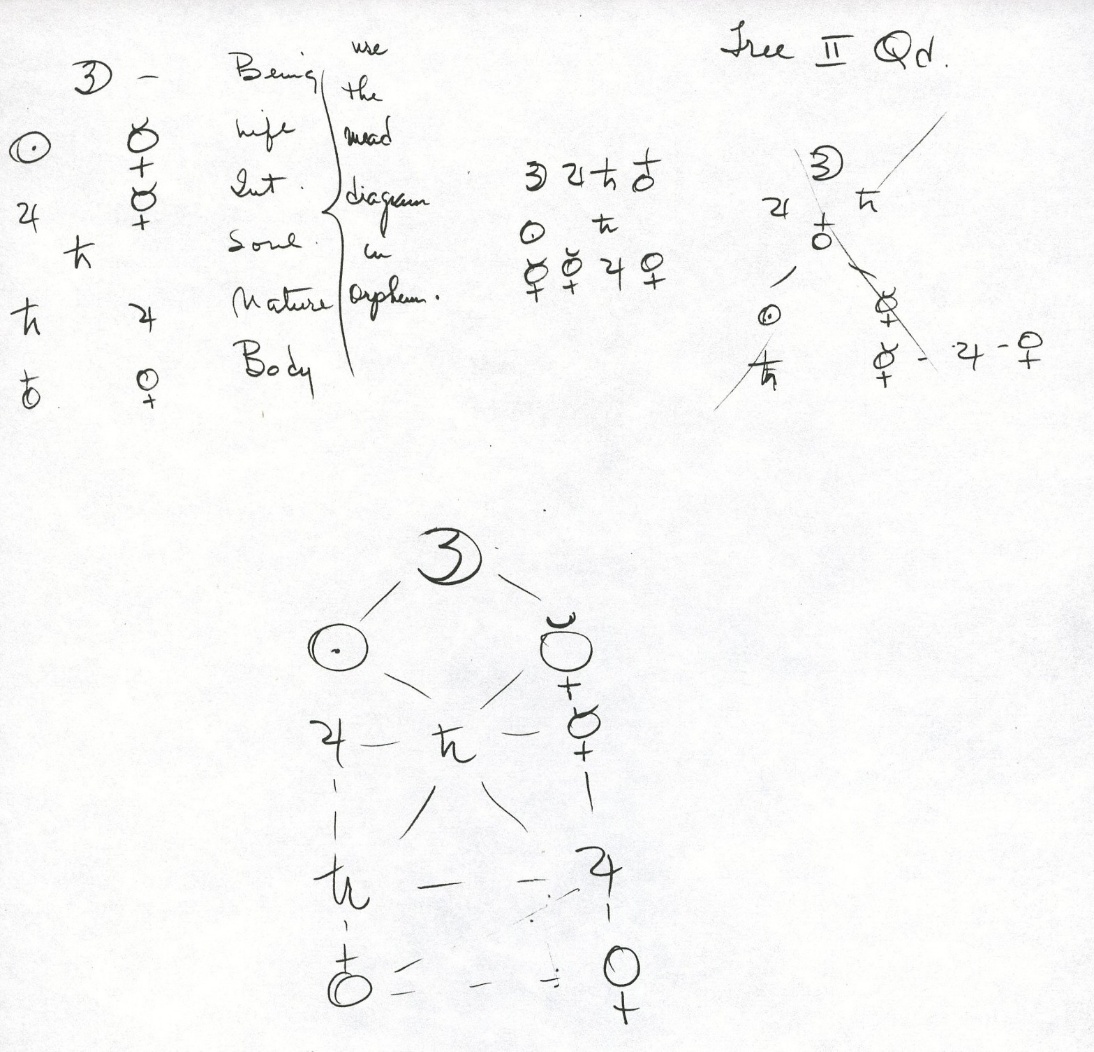
Second quadrant tree diagram
Reading/discussing T. Taylor, "Introduction to the Parmenides"
Intelligible (dignities) as universal species; universal reason (Ideas) as object of intelligence; same idea expressed in Plotinus, V.1.4
Soul possessing truer forms to judge corporeal natures
Forms in soul are movable and discursive; first intellect (animal itself) contains most true species
Phanes (first intellect) as rulership Mercury in Virgo; as exaltation ring
Phanes as paradigm vs. Demiurge as agent
"Luminous chain of substances" as circle of Ideas; as four rings
Triple Apollo in ninth house as intermediary between Jupiter in Virgo and Sun in Aquarius
Twelfth house world as fabrication of Demiurgic Intellect/eleventh house vesica (Nature)
Nature as irrational and without imagination; as the capacity to produce physical reason-principles (seeds)
Cosmic soul's taijasa substance is included in fabricated entity and becomes the means by which it apprehends objects in the world
Brain cortex as imagination; mind going out through senses will interpret object according to archetypes/vasanas built into brain; our imagination imitates the Sun
Sun in Aquarius as last member of Soul ring is outside of system of Nature yet Nature is directed through its activity
The higher the creature, the more determined its time of birth
Distinction between cosmic soul's imagination and human imagination
Our imagination a product of motility operating through bodily structure imbued with reason-principles; solipsistic position
Brain damage affects your imaged world
Matter must be organized so that higher principles can evolve through it
Nature's production of images not to be confused with soul's awareness of them; example of computer, catatonic/vegetative state
Nature has no morality; it's we who have to bring reason into operation
Limitations of computer thinking
Our weakest understanding is the system of Nature; secrets of Nature known to alchemists
Immovable vs. movable causes; hierarchy of causes
Nature doesn't have everything manifested all the time; she contains the idea potentially and can reproduce it given certain conditions
No universal knowledge in lower half of divided line
Levels of knowledge and reality; more perfect knowledge not necessarily sensibly represented; imagination of knowledge vs. knowledge of imagination
BOOKS READ FROM OR REFERENCED:
Thomas Taylor, Introduction to the Parmenides (Vol. 3), in The Works of Plato, viz. His Fifty-Five Dialogues, and Twelve Epistles
Plotinus, The Enneads (MacKenna translation, 4th ed.)
Plato, Sophista, Timaeus
Proclus, Thomas Taylor (tr.), The Six Books of Proclus on the Theology of Plato
George Santayana, Poems, "Solipsism"
PLOTINUS QUOTES READ OR REFERENCED: V.1.4, V.9.8, VI.7.7
DIAGRAMS appended to this transcript:
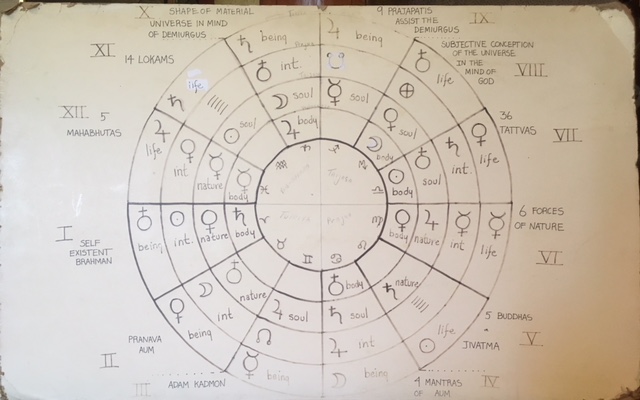
FIGURE IMG_2202-Posterboard Metaphysical Chart.
FIGURE AD_D_033. Second Quadrant Trees.
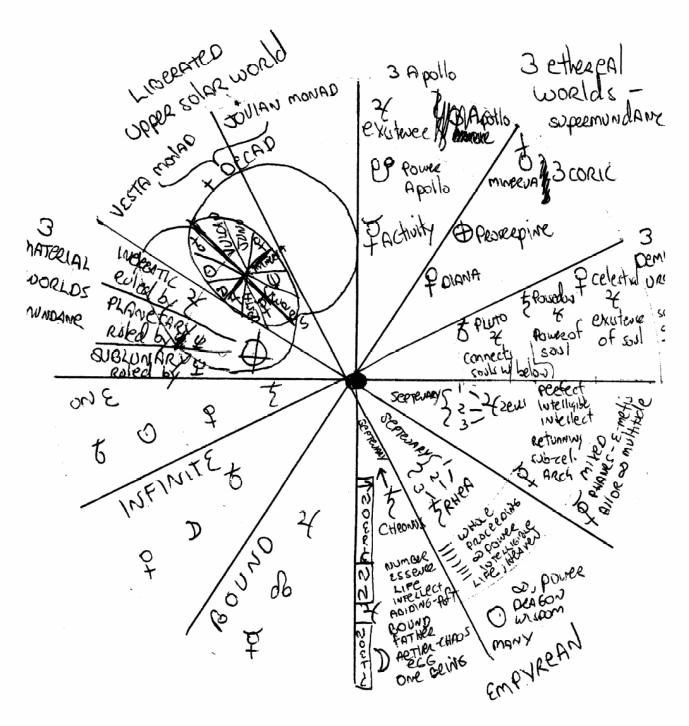
FIGURE 1980 0703-3-AB. Proclus Chart.
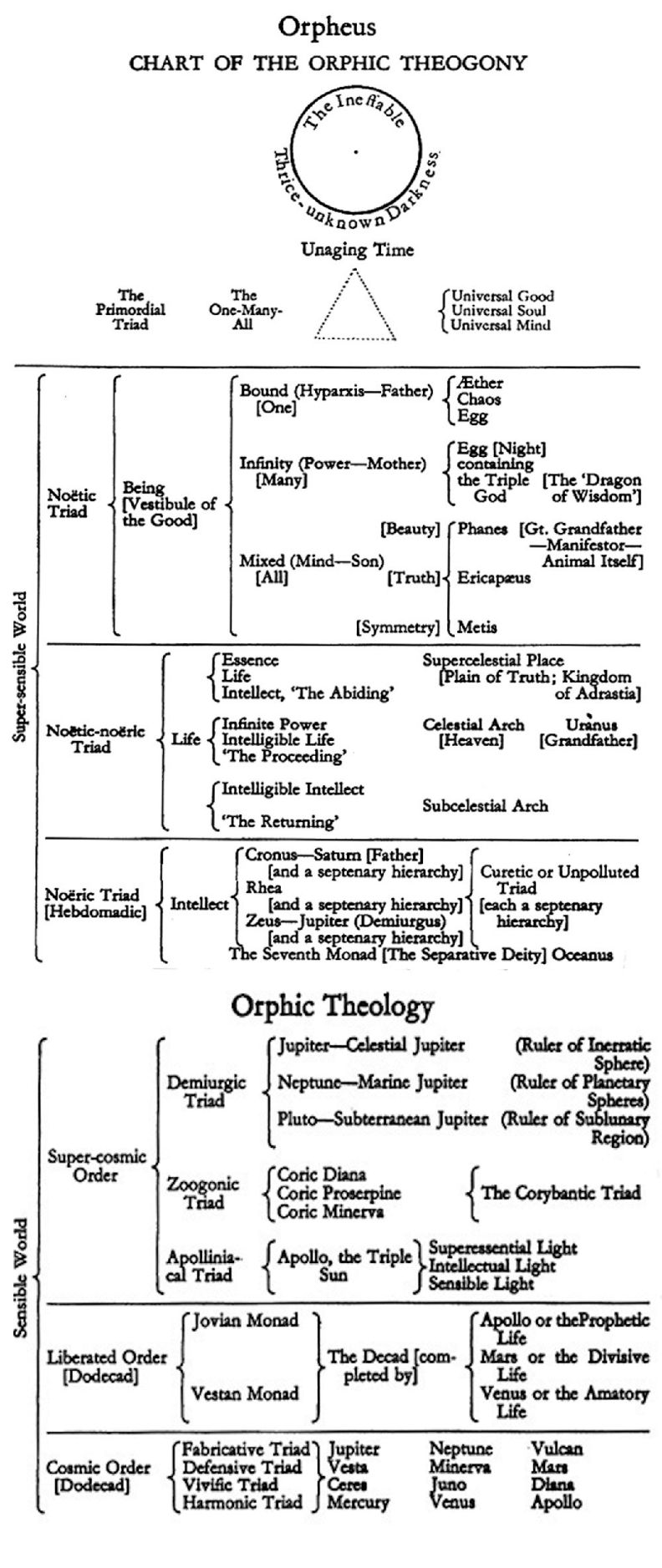
FIGURE 1980 0703-4. Chart of the Orphic Theogony.
FIGURE 1980 0703-5-AB. Divided Line.
Other diagrams referred to are not with this transcript version. [Transcriber note: [diagram] means the speaker is referencing a diagram as he or she is speaking. If someone is drawing or writing, with audible sounds of chalk on a blackboard, I indicate this by [drawing] or [writing].]
NOTES:
We only have one audio file for this class and are missing the rest. Scan File 1980 0703 PLA Parmenides intro p1-17 P.PDF, the partial transcript for this class, is used to fill in for the missing audio both in the middle and the end of this transcript.
This is a Thursday. It appears to be a Seminar.
TRANSCRIBED Verbatim by IT (with added sections from partial) prior to 2018, reformatted by jf 2018. This is V12a (2023) and has: updated prefatory matter, footer, and audio file name; TOC and Book List completed; Plotinus quotes section added; new notes within transcript; typos/errors corrected; five diagrams added and references within transcript to these diagrams. Archival verbatim transcript – V12a.
AUDIO FILES: 1980 0703a. [Note 1: "Tape" and "Side" refer to original audio cassette tapes that were later digitized into .MP3 Audio Files. Note 2: Parts of this audio file are faint and hard to hear.]
1980 07/03 SEMINAR at Wisdom's Goldenrod
Plato; Parmenides; Introduction by T. Taylor
[Audio File 1980 0703a Begins]
AD: They didn't. [S, faint: (Of what?)] And of what-- what is their nature, and how lesser beings participate in it. So-- [28½ second pause] Alright? [26 second pause] What do you think that-- you understand it?
RC (faint): This could (lead into) that paragraph [one/two words inaudible]
AD: Yeah, yeah. You follow page 5, there'll be no page 7. [10 second pause] So over here you might need a note that you have the twofold nature of Being, Plato (insists). [16½ second pause] What we mean by that was that in Being, you have homo-- homogenous Being, unity of Being. And we also have the diversity in Being, or heterogeneity in Being. And this of course was one of Plato's ideas was that Being Is and Being has power. So right away he introduced multiplicity of Being. I would assume that when he says One Being that would be the homogeneity of Being. [AS assents] And when he speaks about twofold Being he's speaking about the unities that are to be found in Being. [students assent, faint] You follow there Carol?
CDA: Uh-hm.
[short pause]
[Note: See FIGURE IMG_2202-Posterboard Metaphysical Chart appended to this transcript to follow the class along with any other diagrams referred to.]
AD: So, it's almost like on the one hand saying the second quadrant [diagram], alright, it's Being, it's simple Being, pure Being, alright. And then when he speaks about the unities in Being, that would be this, this, and this and this [AD indicates on diagram], all the-- all the dignities. Now, he's speaking about Being as diversified, opened up (in) piece. So that must be the idea behind that two-- twofold nature of Being over here. We could also do it with the ring I think, huh?
AS: Yeah.
AD: You could think of the whole ring-- you could think of the whole ring as Being, Intellectual-Principle [diagram]. And there it is a unity, one string of Ideas, the monad of Ideas is the true unity. It's a true unity over there. And then you could break down each one of them and you would have [AS: Yeah.] those unities (in--)
AS: That's just what he's doing in Sophista. [student assents, faint] Same idea.
AD: Now this is going to be the troublemaker, where we have Moon [Note: in Cancer per partial transcript], One Being [diagram]. 'Cause that-- we're seeing that if you made the-- you know, if you made the Kabbalistic tree you would have to do something like this. [Note: See FIGURE AD_D_033, Second Quadrant Trees, appended to this transcript.] [15¼ second pause while drawing] [AS assents] Would have to do something like that [diagram]. So this would be Being [diagram]. This would be Life, Intellect, and Soul, Nature, Body [diagram]. This whole thing he calls One also. This here [Note: Moon in Cancer per partial transcript] he calls the One Being. You could see, everything has to participate. [16¼ second pause] I like this because (it defies) the answer, it's [one word inaudible, possibly student] You can smell a question, (yeah).
[15¾ second pause]
S: Is Avery--
RC: You know, anything different you're calling the Moon the One Being and bracketing the whole tree and calling that the One?
AD: Bracketing the whole tree?
RC: Yeah, (I'm speaking out of left field), but bracketing the whole tree and it's-- it's all the One.
AD: You mean put over here the One Being [diagram].
RC: Well-- well that's what I asked, is it?
AD: Yeah, you could do that.
S (faint): Uh-hm, yeah.
AD: Just like you could take all the rulerships, run them all up and down with the Ideas and call that the One Being [diagram]. [17½ second pause while drawing] Then the next important point was this here.
[Transcriber note: I am using Thomas Taylor, Introduction to the Parmenides (Vol. 3), in The Works of Plato, viz. His Fifty-Five Dialogues, and Twelve Epistles, First Edition, London, 1804.]
Thomas Taylor [Introduction to the Parmenides, p. 6, AD reading]: "[But] intelligible is a certain universal species; for universal reason is always the object of intelligence. And hence there are such things as intelligible and common species of things which we call ideas."
AD: Now let's try that again, you know? Let's say that he's calling the dignities an intelligible. [AS assents, faint] He says--
Thomas Taylor [Introduction to the Parmenides, p. 6, AD reading]: "[But] intelligible is a certain universal species…"
AD: Alright. No problem there. Then he says--
Thomas Taylor [Introduction to the Parmenides, p. 6, AD reading]: "…for universal reason…"
AD: Which I consider to be the Ideas going around the circle.
Thomas Taylor [Introduction to the Parmenides, p. 6, AD reading]: "…is [always] the object of [AD adds: this] intelligence."
AD: So these Ideas [AD hitting board to indicate] are the object of these Intelligences [diagram]. And because of that, because of that, there is such a thing as intelligible and common species (ok/of thing). Because these Ideas are the objects of the Intelligibles, that means that anything that the Intelligibles manifest, like let's say they manifest the Idea of a Man or a Horse or Lion, then because of that [11 second pause] there are such things as intelligible and common species of things. So because these here dignities let's say manifest a man, therefore we have a common species which are things which we call the Ideas. The Idea of Man is here [diagram], ok, the Idea of Lion, Horse, ok. We had that point. I'm just taking-- I'm just pulling out the quotes that I consider important, I'm just letting the rest go by. So that's the last sentence in the second paragraph.
Thomas Taylor [Introduction to the Parmenides, p. 6, AD reading]: "[But] intelligible is a certain universal species…"
AD: Like the Sun Mercury [diagram] or the--
[short pause]
AD/S(?) (faint, possibly part of background): Ok.
AD: These are universal species. [short pause] [AS assents, very faint] Like if we think of the Sun in Leo as the Idea of Man [diagram], that would represent a certain universal species. And universal reason which is the Idea of the Five Dhyan Buddhas is the object of this Intelligible. Yeah because if you-- there are universal species (or) universal Ideas in manifestation.
AS: It's almost like he's saying the u-- the Intelligibles are a certain universal species because they're-- I mean you can't think of them separated from the Ideas.
AD: Yeah.
AS: So we're speaking about this dignity in a sign [AD simultaneously, faint: Sign.] and therefore it is a certain universal species. [AD simultaneously: Isn't it also--] But if you just considered it by itself--
AD: Isn't it also the same idea that Plotinus has when he says the Ideas think the object and the object causes [AS assents] the Ideas to think them? [Note: Plotinus, V.1.4, third and fourth paras.]
AS (simultaneously): They (have/had) to both be together, otherwise--
AD (simultaneously): So over here he's trying to point out that unity of duality.
S (faint): Right.
[short pause]
AD: And (knowing/ignoring) the argument, alright, we go to now page 7, [AS assents, faint] is true species. [AS assents, faint] So if you-- you can use, you know, words that are practical, if you had trouble like with 'species', alright, you think of animal as genera. All the different kinds of animals are species. So genera like subsumed, alright. (We) think of mathematics as genera, and species are [one/two words inaudible]
Thomas Taylor [Introduction to the Parmenides, p. 7, AD reading]: "True species, therefore, have a subsistence [AD reads: exist] somewhere."
AD: He goes on to say that our soul has an Idea, a truer Idea, than the actual object that exists, so in the soul there's a truer Idea of Man or Horse or Lion or Square or Circle than when we find them in the sensible world. And there the argument is simply to prove that if they're not first in the soul, these Ideas, then we could never understand when we do see a horse or a lion or a circle or a square we would never be able to understand it. So first the Idea has to be in the soul before it could be understood out there. And he says that the Idea which is in the soul is more correct, more proper, more exact. Right? That, you know, you-- [AS assents, faint] (either) word. No problems now, right? After this third, fourth, fifth time it starts becoming clear? [short pause] Next page, eight, he says--
Thomas Taylor [Introduction to the Parmenides, p. 8, AD reading]: "The soul, [therefore], possesses truer forms, by which she judges of corporeal natures."
AD: In other words, the sensible thing. [short pause] Alright, you read.
S (very faint): I don't have it.
S (very faint): (Me neither.)
Thomas Taylor [Introduction to the Parmenides, p. 8, AS reading]: "[But] neither are these forms in the soul first forms, for they are movable; and though not subsisting in place, yet they have a discursive procession through the intervals of time. Nor do they always exist in energy; for the soul does not always energize through them. Nor do they [AS reads: And they don't] subsist in a total but in a partial intellect. For as the soul is not total intellect, on account of its self-motive nature, so the intellect which is in [AS adds: the] soul is not a total and first intellect, but [AS adds: it] suffers a remission of intellectual union, from its connection with [the] discursive energies of soul. [AS adds: And] There is, therefore, above soul, and that intellect which is a part of soul, a certain first intellect, in itself entire and perfectly complete, in which the first and most true species of all things are contained, and which have a subsistence independent of time, place and motion. And this first intellect is no other than the vital nature, or [AS reads: of] animal itself, in which Plato in the Timaeus represents the artificer of the universe contemplating the ideas of things, and fabricating the machine of the world according to this all-beautiful exemplar."
AS: Hope it shows. That's what we put as Phanes in our chart there [diagram], animal itself. [Note: See FIGURE 1980 0703-3-AB, Proclus Chart, appended to this transcript.] And this this first Intellect, which is no other than, I don't know, the animal itself.
AD: And again we could interpret this in two ways, right, using the quadrant or using the ring. If you use the quadrant (way--)
[12 second pause]
S (very faint): You don't want to use the quadrant, right?
[11¾ second pause]
AD: Would you show, Avery?
AS: Well do you want--
AD (simultaneously): Show us the two ways of doing it.
AS: Well, you know, I guess if you use the ring [DB: Yeah.] idea, the reason, [S, faint: Go on.] I guess you would say all of the-- all the Ideas are contained in the-- [S, faint: Avery?] in the rulership. [S: Avery?] They are all conjoined. But if you do it at the quadrant (way/ring) I think you have to say it's that Mercury in-- the way Proclus does it would be more like the Mercury in Virgo [diagram]. And there when he says the "first intellect is no other than the vital nature, or animal itself," which contains all these Ideas, well, the Ideas are contained in Phanes in an Intellectual way, in other words, each of these Ideas is a peculiar form of all the other Ideas. So it's true that Phanes would have all the Ideas but according to what he calls Intellect. Because, they might be-- they would also be found in the-- in the fourth house and the fifth house but not according to Intellect. In the fourth house it would be according to Being [diagram], and in the fifth according to Life [diagram]. But there in Phanes it would be according to Intellect, what he said.
CDA: Could you just say that again, you're saying all the Ideas are contained in the fourth house in terms of Being? [AS: Well--] All the Ideas--
AS: Yeah.
CDA: 'Cause you're saying-- [AS: I'm--] Is that--
AS: It's like the idea in Plotinus that each Idea is the entire Intellectual-Principle in a special form. [Note: Plotinus, V.9.8, third para.] So-- I mean that's how to try and understand when he says that Phanes or animal itself has all the Ideas, but we put Phanes particularly in his chart [CDA assents] in the-- in the sixth house [diagram], it's the rulership.
AD: Because this would be One, Being, Life, Intellect, Soul, Nature, Body [AD hitting board to indicate].
AS: Yeah. So in his [CDA simultaneously: So it--] diagram that's Intellect, the sixth house. And the-- the Ideas have to be contained there too. [CDA assents] But in a special form, in the special form in which they are in the Intellect.
CDA: So how is--
S (simultaneously): I think Anthony--
CDA (very faint): Go ahead.
S (very faint): Yeah, the rulership [couple/three words inaudible]
[student assents, very faint]
S (very faint): [one/two words inaudible]
CDA: Does he ever explain how-- you know, how-- the transition from the One into-- into--
AD (simultaneously): Speak a little louder Carol.
CDA: Does he ever explain the transition from-- of the I-- how the Ideas get somehow put into Being in the fourth house so that you could understand how [couple words inaudible] Is that a crazy question?
AD: I think we'll have a partial discussion of that later on when we get into the text itself.
CDA: You know, 'cause when you think of Phanes being in the first quadrant that's in Plotinus--
AD (simultaneously): When you think of what?
CDA: When you think of Phanes being in the first quadrant in Plotinus, you know, you-- is--
AD: That's not Phanes, that's a transcendent copy of Phanes.
CDA: Transcendent.
AD: Transcendent copy of the Ideas actually.
S (faint): Right.
CDA: But he doesn't-- does he speak about that [AD: No.] transcendent [AS simultaneously: No.] copy? (It has--)
AD (simultaneously): No, no, don't [AS simultaneously: Don't bring it in yet.] bring-- don't bring Plotinus in or you'll get very mixed up.
CDA: Well I--
AD: Let us do that. Let me and Avery do that for a [CDA simultaneously, faint: Ok.] while until you get the drift. Because you have to remember this man is not capable of handling what we-- what Plotinus does here. [CDA simultaneously, faint: Ok.] Plotinus is the only man who handles the doctrine.
AS (simultaneously): Well, it's interesting 'cause-- Also, see, it's at this point that he-- he first speaks of the Ideas per se in Phanes. Because see, also there's other-- the other terminology we have is One, Many, All. Phanes is the All. [S, possibly part of background: Who?] It's like if you conceive of the Ideas in his One Being they're not separated or-- they're not distinguished at all. [CDA assents, faint] It's One Being there.
CDA (faint): Yeah, right.
S (faint): Avery?
AS: Well, gets rid of that question. (AS laughs) But, now, if you do the ring thing, if you do it with the rings, where he first says if we go-- there's above-- Well first talks about in soul there's not a total Intellect. Ok so there we have to (go) [one word inaudible] the whole Soul ring [diagram].
AD: Yeah.
AS: And then when you go up to the Intellectual ring, to the exaltation [AD simultaneously: Yes.] ring [diagram]-- Now--
AD: There the Ideas would be immovable.
AS: There they're immov-- it almost seems like if you did it that way his animal itself wouldn't be the rulerships but the exaltation ring.
AD: Yeah.
AS: Because, it's in the-- it's in Phanes that the Ideas are actually distinguished. So, I mean it's like the first-- the rulership ring would be like the One Being or something like Being united. [AD or student assents] And it wouldn't be-- when you bring in the exaltation ring you could speak about what he calls animal itself. That would still be a total Intellect.
AD: Yeah.
AS: That would be like turning this-- turning it-- Well, yeah, because, when you take Life-- [AD simultaneously: Yeah, what you're saying--] This would be Being and Life [diagram], this would correspond to the rulerships of Being and Life, but the Mercury [diagram] would correspond to the exaltations.
AD: (Now/Yeah), precisely, what [S simultaneously, faint: I think it's the other way around.] you're saying-- I think more important now, Avery, [AS: Yeah.] you're pointing out the lack or the deficiency in his reasoning [student assents] which has made a leap. [student assents, faint] In other words, the interval between one reason and the other is so big a gap that when you traverse it you're bound to fall in. Remember what I told you, when you reason, reasoning-- like reasoning is a process: step, next step, next step, next, ok. Now, if there's too wide a distance between two steps you're going to fall in. Most people don't see that, you know, they reason from one point to another and they assume a continuity. When we try here to read it we'll see that between reason A and reason B there's a huge gap, an interval. And we've got to fill that in as much as we can so that we don't have to walk over a bridge from one reason to the other. Now that's exactly what he does here. He jumps, he jumps.
S: [one/two words inaudible]
AD: The--
Thomas Taylor [Introduction to the Parmenides, p. 8, AD reading]: "And this [AD reads: The] first intellect is no other than that [AD reads: the] vital nature…"
AS: And he jumped from the soul to that.
[student assents, very faint]
S: [couple words inaudible]
AD: So he jumps from the soul, let's say-- If we wanted let's say that this was the Soul of Jupiter [diagram], alright, he jumps to this here [diagram], and this [diagram] is left out. [AS assents] Or, he's jumping to this here [diagram] and not giving us the true idea.
AS: Well, that-- in other places he does give that whole series of intelligences.
AD: Yeah.
AS: (In some--) and then here he--
AD (simultaneously): Well, remember, this is just a summary so we-- and an introduction so let's not accuse him too quickly.
AS (faint): Yeah, (I mean), we keep trying. [11¼ second pause] Want to go on?
[short pause]
AD: So he calls this Phanes the vital animal. Actually Plato does that. Plato calls this the vital, the animal. [short pause] And then he says--
Thomas Taylor [Introduction to the Parmenides, p. 8, AD reading]: "…Plato in the Timaeus represents the artificer of the universe [AD: the maker of the universe] contemplating the ideas of things, and fabricating the machine of the world according to this all-beautiful exemplar."
AD: So he's calling Phanes the Maker of the world. [10 second pause] That's relatively straightforward now, huh?
[11 second pause]
S: We'll try [few words inaudible]
S (very faint): Uh-hm.
S (very faint): Yeah.
[9¾ second pause]
AD: Do you want to try the next paragraph?
S (faint): Yes.
AS: You want to do the whole [couple words inaudible]
AD (simultaneously): Well I think-- I think we have to do this whole paragraph.
AS: Yeah.
Thomas Taylor [Introduction to the Parmenides, p. 8, AS reading]: "Again, the artificer of the universe must be a God. Every God operates essentially, or produces from his essence that which he produces, because this is the most perfect mode of production. Every thing which operates essentially produces an image of itself. He, therefore, who fabricated the universe, fabricated it an image of itself. [But] if this be the case, he contains in himself paradigmatically the causes of the universe: [and] these causes are ideas."
AS: And I think we made the point that he's still speaking about Phanes here.
AD: Yeah, uh-hm. Well let's finish the paragraph and then discuss it, see if--
AS: Ok.
Thomas Taylor [Introduction to the Parmenides, p. 8, AS reading]: "…[and] these causes are ideas. [AS: Causes of the universe.] [AS adds: And] To which we may add, that the perfect must necessarily antecede the imperfect; unity, [AS adds: antecede] multitude; the indivisible, the divisible; and that which abides perpetually the same, [AS adds: must precede] that which subsists in unceasing mutation. [AS adds: And] From all which it follows, that things do not originate from baser natures, but that they end in these; and that they commence from natures the most perfect, the most beautiful, and the best. For it is not possible that our intellect should be able to apprehend things properly equal, similar, and the like, and that the intellect of the artificer of the universe should not contain in itself the essentially equal, just, beautiful, and good, and, in short, every thing which has a universal and perfect subsistence, and which, from its residence in deity, forms a link of [AS reads: in] that luminous chain of substances to which we very properly give the appellation [AS reads: name] of ideas."
[45½ second pause]
AD: (My--)
AS: There is some question on who the "he" is that fabricates the universe, so-- (I mean), so-- There's a difference between the way--
AD (simultaneously): Go ahead Avery.
AS: Well just-- you know, we brought this up a lot. It's just-- it's really not-- he doesn't seem to make it clear enough. Because we sometimes speak of the Demiurgus as the Jupiter in Sagittarius [diagram] containing the whole-- being the ar-- the artificer of the universe, the Demiurgic Intellect. But, the way he's speaking, he seems to be speaking here of Phanes in the sixth house [diagram]. That's the way he's used Phanes.
Thomas Taylor [Introduction to the Parmenides, p. 8, AS reading]: "He, therefore, who fabricated [AS reads: fabricates] the universe, fabricated it an image of itself. …he contains in himself paradigmatically the causes of the universe: and these causes are ideas."
AS: Of his essence. And when he says every God produces from his essence-- you know-- [short pause] What's the essence of Jupiter that he's speaking of, or the essence of the archetype?
AD: What a doozy.
S (faint): (Doozy.)
S (faint): I don't understand what (you're/he's) trying to say.
AS: I mean, but-- you know, every time we do this, we've done it a certain way but he seems to be doing it-- if we just-- if we follow his chart, follow the consistency, he seems to be doing it slightly different here.
S (very faint): I would think.
AS: Every God operates from his essence. [student assents, faint] And then he says--
Thomas Taylor [Introduction to the Parmenides, p. 8, AS reading]: "Every thing which operates essentially produces an images of itself."
AS: Now what-- the universe then is an image of the paradigm that's in Phanes.
Thomas Taylor [Introduction to the Parmenides, p. 8, AS reading]: "He, therefore, who fabricated the universe, fabricated it an image of itself."
AD: Why "itself" there?
S (faint): He can--
AS: Previous (instance--)
AD (simultaneously): Why not himself?
AS: Himself.
AD: Yeah.
AS: Itself.
DB: Because it's--
AD (simultaneously): Itself.
DB: --isn't-- isn't himself-- isn't the "him" the activity [AS simultaneously: I don't know. Yeah.] of that fabrication?
[short pause]
AD: In other-- you--
DB: I mean the it--
AD: (What) you're saying--
AS (faint): He means the universe itself.
AD: You're saying if you think of his activity then you have to refer to the Demiurge.
AS: The Demiurge.
DB (simultaneously): Right, but the "it" would be--
AD (simultaneously): As the agent.
DB: Yeah.
AS (simultaneously): Uh-hm.
DB: The "itself" would be the Phanes.
AD: Well, we certainly could make that point, put that out in the open.
CDA: Will you say that again David? The "himself" would be Jupiter and what?
DB: Yeah, would be the activity of that essence, the essence being Phanes, the activity being the Demiurge, the fabricating, and the-- when you speak of that God producing essentially, what that means is that Phanes is making an image of itself, and that image would be the universe.
CDA (faint): Phanes is making an image of itself through the Demiurge? The Demiurge is (kind of like--) the (Phanes--)
DB (simultaneously): The essential production of Phanes, alright, the activity of that [CDA assents] essential production, not the product but the activity, would be the Demiurge.
CDA: Ok.
DB: I-- I mean I-- I think that's one way of-- what-- of seeing what he's saying.
[short pause]
AS: See in this view then it's Phanes that fabricates the universe is what you're saying.
DB: Well--
Thomas Taylor [Introduction to the Parmenides, p. 8, AS reading]: "He, [therefore], who fabricated the universe, fabricated it an image of itself."
AS: And you're saying the fabrication is the Demi-- is Jupiter and the "itself" is Phanes?
S: Yes.
DB (simultaneously): (Almost), yeah.
AS/S(?) (faint): (I'm going) to criticize it.
Thomas Taylor [Introduction to the Parmenides, p. 8, AS reading]: "He, [therefore], who fabricated [AS reads: fabricates] the universe…"
AS: It isn't-- well, I mean, just the way you say if we talk about the soul, the s-- the universe isn't an image of the soul which produces it, it's an image of the Intelligible paradigm of the Ideas. So Jupiter doesn't make-- Jupiter doesn't make the world an image of himself, he makes it an image of his-- the prior, the Ideas.
S: Yeah.
S (faint): I see.
AS: That--
AD: How about that last sentence?
Thomas Taylor [Introduction to the Parmenides, p. 8, AD reading]: "…every thing which has a universal and perfect subsistence, and which, from its residence in deity, forms a link of that luminous chain of substances to which we very properly give the appellation [AS reads: name] of ideas."
[short pause]
DB: Well-- I-- the-- I had a question about that which was that you can think of a luminous chain as being-- on the one hand going all the way around the circle, you know, all the Ideas would be the luminous chain, on the other, could you consider that luminous chain as being--
AD: Circle of Ideas.
DB: Yeah. But I'm-- but could he also mean there that, you know, there would be that the Ideas, the Intelligibles and reasons in the soul, and the reasons in Nature and so forth, would that-- could he mean that in a horizontal or a vertical way?
[short pause]
AD: Well what do you think?
S (faint): Why shouldn't (it be)?
AD: In other words, he's applying it on the circle and then down the rings, going down [diagram], alright. [student assents, faint] And that is the luminous chain. It certainly seems to have both applications. [student assents, very faint] 'Cause we could think of both things going down this way [diagram] and going down the ring structure from the rulerships to exaltations to detriments to fall, and we would think of that, it would have to be connection between these, right? And we could also think about it as going down the ring structure. [37½ second pause] Well that paragraph (that's next), we ought to read.
S (very faint): Yeah.
[1 minute 42 second pause]
AD: See, in this passage here he's speaking (and/that) he's referring to, again the same ambiguity comes up.
Thomas Taylor [Introduction to the Parmenides, p. 10-11, AD reading]: "[Thus], fire [both] imparts heat [AD: (Body) (one word inaudible)] [to something else, and is itself hot; and soul imparts life, and possesses life]: and this reasoning will be found to be true in every thing which operates essentially. The cause of the universe, therefore, fabricating from his very essence, is that primarily which the world is secondarily. [AD: And it goes on.] [But], if the world is full of all-various forms [AD reads: various ideas], these will subsist primarily in the cause of the world: for it is the same cause which gave subsistence to the sun and moon, to man and horse. These, therefore, are primarily in the cause of the world; another sun besides the apparent [AD reads: visible], another man, and, in a similar manner, every [other] form. There are, therefore, forms [AD: Ideas.] prior to sensibles, and demiurgic causes of the phenomena pre-subsisting in the one cause of the universe."
AD: And there it seems to refer to Phanes. [short pause] Although I imagine these [one word inaudible] the Demiurge (and) there too. So evidently there's an identity between Phanes and the Demiurge which in these passages hasn't been really clarified but-- [1 minute 18 second pause] Then paragraph on page 12 seems to be the Demiurge now. So he goes back and forth. [22 second pause] If you read from the top of page 12, I think you'll see that.
[student assents]
AS (faint): Um-- Somewhere over here.
Thomas Taylor [Introduction to the Parmenides, p. 12, AS reading]: "…cause of the universe is neither able to generate, nor contemplate, things more beautiful than the phenomena, [AS adds: then] how is the one the fabricator of the universe, but the other of a part of the universe? For a greater power is effective of things more perfect, and [a] more immaterial intellect contemplates more excellent spectacles. The maker of the world, therefore, is able both to generate and understand forms much more accurate and perfect than the phenomena. Where, then, does he generate, and where does he behold them? Evidently, in himself: for he contemplates himself. So that, by beholding and generating himself, he at the same time generates in himself, and gives subsistence to forms more immaterial and more accurate than the phenomena."
[10 second pause]
AS: See, I think this is the same thing we had with PB, the same interpretation, that there's one aspect we call the Wor-- which he calls the World-Mind, which (you) called the World-Soul, which has this double aspect, it looks inwardly, and then outwardly it's concerned with the manifestation of the universe. Then there's also the Intellectual-Principle and that contains the Ideas immutably. So he seems to be making that distinction not all the time though, that in Phanes the Ideas are there immutably in the Intellectual-Principle. But in this Jupiter, Jupiter has a two-fold nature and in one sense he's looking to himself, beholding itself, and in the other-- his other aspect he's actually concerned with manifestation. But it's hard to see how Phanes itself is concerned with manifesting the universe.
AD: As being an agent of any kind.
AS (simultaneously): As any-- as any kind of agent or activity. At least in the Timaeus you know where some [couple words inaudible] he always uses Zeus as a Demiurge, Jupiter as the agent, dianoetic energy and so forth. But, the Phanes (and/that) he contemplates, paradigm, is (not making) a universe. He's not concerned with activity. But-- but-- but insofar as Jupiter or the Demiurge looks to himself he would contemplate the Ideas and he would have within himself or within his Intellect the Ideas in some form.
[short pause]
AD: Anytime he speaks about making, fabricating, doing, we'll have to refer to Jupiter.
AS: That's (right, yeah).
AD: Isn't there a place where he refers to him as father and maker, in another place maker and father?
AS: Yeah that's I-- but that's in the-- he has this long commentary in the Timaeus of discussing that, but it's actually in the Timaeus. Each of them has a-- each of them does have some-- that's another thing here.
[short pause]
S (faint): (You need to understand.)
[short pause]
AS: And I have to look it up but I think he's-- he has a chain of them and I think the Jupiter is only maker and the Phanes is only father and then the ones in between are both or there's something like that. [S, faint: Anthony?] He has a very complicated--
AD: Alright, that's in the Timaeus, let's-- [AS simultaneously: Yeah it's in--] let's look that up as soon as we finish this Introduction.
AS: Yeah. He seems to (only talk--)
[49¾ second pause]
AD (faint): See in the paragraph on page 13, the second paragraph, bottom line.
Thomas Taylor [Introduction to the Parmenides, p. 13, AD reading]: "…the whole world from the all-perfect monad of ideas, and the parts of the visible universe from monads which are separated from each other."
[16 second pause]
AD: It's almost like he is saying we need both of these things, on the one hand we need the Ideas, alright, and on the other hand we need the Intelligibles which are going to manifest these Ideas. So the fabricative Intellect or the Demiurgic Intellect, the Jupiter, is (going to be) involved in the making whereas the Ideas stand as the paradigm. [10½ second pause] In either case the-- if you think-- if you think of the Jupiter in Virgo [diagram] as contemplating the Ideas within himself, which will be the Mercury [in Virgo] [diagram], (so all of these things now), that would be Soul Absolute, Absolute Soul. Remember when he speaks about two-fold Soul? [AS assents] That would be Soul Absolute. Then when he speaks about that which orders the universe, [couple/three inaudible AS words] that would be the cosmic Sun, right, the cosmic Soul, the Sun in Aquarius [diagram]. But we wouldn't-- we couldn't go through there directly, we would have to go through the ninth house where he has the three Apollo [diagram]. [Note: See FIGURE 1980 0703-3-AB, Proclus Chart, appended to this transcript.]
AS (faint): Uh-hm. [couple words inaudible] chart.
AD: Huh? In other words, it isn't direct from Zeus, the--
AS: No, we could follow it that way or you could follow it around if you had the ring, you could follow the Soul ring around also [diagram]. He's saying like that-- it almost seems like that Zeus and the way you spoke of it too is like that Life within the Intellectual-Principle, but it's like that aspect of Zeus is con-- almost contained within Phanes, [AD: Uh-hm.] whereas the other one--
AD: Is outside of Phanes, uh-hm.
AS (simultaneously): Is outside it. [students assent, faint] Yeah it's interesting that the way we had the diagram that is the triple Apollo is the ninth house [diagram].
AD (faint): Could you possibly refresh the triple Apollo? Remember what he spoke about it? Or with [one/two words inaudible] No, huh?
AS: Yeah I-- I know what it is. He's always got names. Yeah, it's in the Theology. [Note: Proclus, Thomas Taylor (tr.), The Six Books of Proclus on the Theology of Plato.] One of them is the-- it's-- it's like-- isn't there the Intelligible One, the--
S (faint): Well, the answer is yes.
S (faint): I don't even know one from the other, can--
AD: We'll look that up too.
AS: Yeah, that doesn't seem-- one-- one of them is the Intelligible. They're actually in the Orpheus chart, that whole Orpheus chart [couple/three words inaudible] [Note: See FIGURE 1980 0703-4, Chart of the Orphic Theogony, appended to this transcript.]
[student(s) assenting, very faint]
[short pause]
AS (faint): [couple/few words inaudible]
S (faint): Apollo.
S (faint): Apollo.
AD (faint): [one/two words inaudible]
AS: That's--
AD: No. Let's get some here.
S (faint): Paul?
S (faint): Uh-hm.
AD: Superessential.
AS (faint): Yeah that's right.
S (faint): Intellectual.
S (faint): Intellectual.
AD (simultaneously, faint): Intellectual and sensible.
S (faint): Yes, those three.
[14¾ second pause with faint background student talking]
AS: Thank you.
[short pause]
AD (faint): Three kinds of light that he's speaking about, right? He's speaking about three kinds of light. Superessential, the Jupiter; Intellectual, the Tail [diagram]. Sensible would be Mercury [diagram]? That is a transcendent [one word inaudible]
AS (faint): Yeah, that would be the light of the whole sixth house. [short pause] Sun.
[27 second pause]
AD (faint): Yeah the next one, got to stick to these next two pages.
S (very faint): I see.
(Side 1 of original cassette tape digitized as 1980 0703a Ends; Partial Transcript Begins. There are no diagrams in this partial; all indications of [diagram] are implied and added by the transcriber.)
[Note: See FIGURE 1980 0703-3-AB, Proclus Chart, for the following.]
If we think of Jupiter and within Jupiter there are the various monads: Vesta, Hermes [vesica in 11th house], he would be saying that the visible world is a construct of that Intellectual aspect or the Intellect of Jupiter. These would be the monads separated from one another. So that means each of those (Jupiter, Vesta, Hermes, etc.) would be a monad. So if we think of, say, Vesta in the second house [diagram], she would be a monad, the unity of all the samskaras. Hermes [diagram] would represent the unity of all the consciousnesses. Jupiter, itself, the Demiurge, itself, is what transmits the Idea of Phanes into the world. But it is up to the twelve monads to distribute the parts of the unities.
Jupiter, itself, would be in a way outside of that vesica [diagram] so he would represent the superessence. He is outside of the tenth and eleventh house so he would represent the superessential light. The next Jupiter would represent the Intellectual light, so that would be the Tail in the ninth house [diagram]. Remember this is a chart of the One, this is not our chart. The functioning of Nature in the vesica [diagram] is a light. That is the image-bearing light, the light of manas or the light of Nature. But then when that fabricates the universe that brings about the existence of the inerratic spheres, the planetary spheres and the sublunary spheres. Now you have the sensible light coming from the Sun [diagram]. Dionysius, Eckhart, Paracelsus, Bonaventura speak of this, but they all tell us very little about that light.
The world, the universe is a manifestation of the monad of Ideas. And all the creatures that appear within it, all the individual entities are fabricated by the Intellect of the Demiurge. They refer to Jupiter in different ways: as being Soul and as being Intellect. The Soul part contemplates Phanes and the Intellectual part fabricates what it envisions. So the Royal Soul contemplates Phanes, absorbs Phanes. The Royal Intellect which includes Jupiter, Vesta, Hermes, etc, that fabricates. So, therefore, the world would be an appearance of the Idea and the creatures that appear within that world would be fabricated by these powers, these various monads within it. So that when we make the vesica and put Hermes, etc, all around [diagram] we are saying that the fabricative Intellect of Jupiter is making the terrestrial man. These Gods make the entities that are in the twelfth house [diagram]. These Gods, each one a separate monad but contained within Jupiter, fabricate the world. So that means that the individual which appears here is composed of the six principles, these Gods brought him together. There is a kind of coherence in what he is saying. The plan of the universe comes from Phanes, but the fabrication of the creatures within that universe comes from the Intellect of the Demiurge.
Thomas Taylor [Introduction to the Parmenides, p. 14]: "Let it then be admitted, that man is from seed; but seed possesses productive powers in capacity, and not in energy."
This is important but not in terms of continuity of what I am working with. Man is from sperm. The archetype or plan of Man is in that seed. He is saying that the reason-principles in the seed do not have the energy to manifest themselves. In other words, the DNA in themselves are powerless to reveal or manifest or assimilate the outside substances that build a body.
Thomas Taylor [Introduction to the Parmenides, p. 14]: "For, since it is a body, it is not naturally adapted to possess productive powers impartible and in energy: for every where a subsistence in energy precedes a subsistence in capacity…"
Prior to the DNA or the reason-principles that are in the sperm he is saying there is a subsistence of the reason-principles in energy or in the Soul. So the Idea of this man who is functioning here and now was contained in a latent form in the seed. But prior to that it was contained actually in the Soul. Specifically, in Nature.
Thomas Taylor [Introduction to the Parmenides, p. 14]: "…since, being imperfect, it requires the assistance of something else endued with a perfective power. This something else you will say is the nature of the mother; for this perfects and fashions the offspring by its productive powers. For the apparent form of the mother does not make the infant, but nature, which is an incorporeal power and the principle of motion. If, therefore, nature changes the productive powers of seed from capacity to a subsistence in energy, nature must herself possess these productive powers in energy. Hence, being irrational and without imagination, she is at the same time the cause of physical reasons."
She is without imagination, hence she is going to produce in us imagination. Nature can produce a man but she cannot understand a man. That is strange, that Nature has no understanding. But he says that Nature produces. Now if it has no imagination and yet it produces let us say a man, a man does have imagination. The system of Nature operates beyond our imagination and it imposes its products on our imagination. (Nature produces the world and gets back certain things. But if you think of Soul, that, of course, does not get back anything. That would be the higher phase of Nature.) If she has no imagination then it must be a combination of the matters in the tenth house and the essences in the eleventh [diagram] and through taijasa consciousness [diagram] the combination of these two produces the man with imagination. Would imagination be the Sun's consciousness, cosmic soul [diagram]? That would make a lot of sense. The finest substance in our body, that in the brain, corresponds most closely to the Sun. In the Theology it says that the Sun is the substance of the imagination. Cosmic soul then would be the substance of the imaginative world. Any modification of the body must be pictorialized in the imagination, otherwise it won't know about that modification.
They speak about the light going out from the eye, spreading over the object, immersing the object. That would be the imagination. That very light is what is referred to as the imagination.
(Partial Transcript ends for now, picks up again later; Side 2 of original cassette tape digitized as 1980 0703a Begins)
DB: --the power to imagination, the power--
AD (faint): What'd you mean by that?
DB: Well, the taijasa, ok, there's a certain power of imagination but that that requires something else in order for there--
AD: Well yes, naturally.
DB: Ok.
AD: It has to have the object [DB: Right.] to be spread out upon.
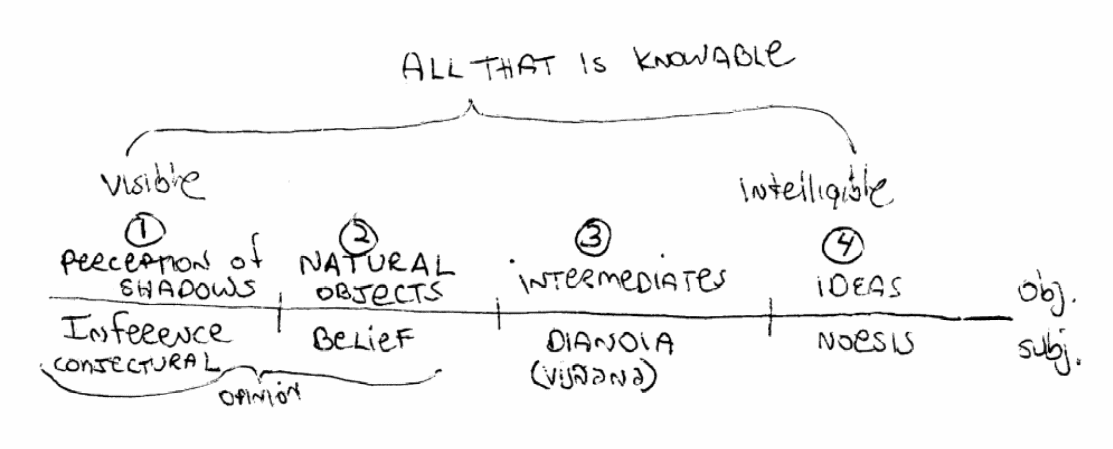
DB: So that-- well, if you use, if you use imagination as a-- as a noun, you'd-- you'd be speaking of the-- the lower part of the divided line [FIGURE 1980 0703-5-AB], the perception of shadows, but as a verb it would be more like the-- the-- [short pause] Well-- Like the faculty of imagination resides in the Sun but it re-- in Aquarius [diagram] but it would require the-- the-- the object or the resistance of matter in the twelfth house to actual-- to be able to form an imagined world.
S (faint): Yeah, uh-hm.
[24¼ second pause]
DB: I mean when-- when he says here that Nature is irrational and without imagination, I mean, she would-- it would have to have the power of imagination but it wouldn't have the actual appearance of the imagined world in itself.
AD: Yes, Nature is not what we see.
DB/S(?): Right, uh-hm.
AD: When he speaks about the system of Nature it's not the trees and the birds (imagery/in a tree). That's not Nature, Nature is this capacity to produce the seed of a lion or the sperm of a lion, which can become the lion. So Nature is preoccupied with producing these physical reason-principles of sperm. So that means that it's even on the other side of the sensible world.
DB: Yeah.
AD: Yeah, ok. But that-- that would mean that it also produces, insofar that it produces an animal or a man, that it's also producing a man of imagination, or a dog with imagination, animal with imagination. [short pause] That means like the ingredient that we're referring to as imagination is something which is completely in the system of Nature, the tenth and eleventh house [diagram]. And what I'm saying is that that ingredient is substances of the cosmic soul, the Sun itself, taijasa. And that gets included in fabricated entity and it becomes the mode or means by which he apprehends other objects in the world. That-- that sound right to you, (possibly student: according to this)?
[16¼ second pause]
DB: The-- [short pause] It would almost seem that the-- when he s-- when he speaks of the seed possessing the productive powers in capacity that there he's speaking of something else other than the system of Nature.
AD: Well, that's already a product. Seed contains the principles necessary for it to become an entity, operate as an entity.
DB: Yes.
AD: But they're latent, [DB assents] it's not ripe. [DB assents] You could have a seed of wheat laying in the Egyptian granary for 3000 years and the-- there's in it the principles for it to become the plant, [DB assents] but they lie-- lay latent until the conditions are favorable for that to happen. [DB assents] So, what Nature produces is that capacity or that seed that can have the capacity, going from (a/one) potential state to an actual state, that's what Nature produces. [11¼ second pause] So you might say-- it's almost like saying that Nature produces the entirety of the unperceptual world, a world that's not yet in manifestation but in a state ready to become manifested.
AS: Yeah but what about the actual manifested imagination, is that also from Nature? I think that was the question. I don't understand how that's-- That may be the basis, and unless you see that whole-- that may be the basis for imagination--
AD: If Nature produces the seed, now we're just talking, if Nature produces the seed of man, alright, and that man comes into being, gets actualized, is born as a baby, that means he's got a body, it means he's got a brain, right? [AS assents] Then that body and that brain provide, so to speak, a vehicle through which the imagination functions or is it-- is that, for instance the cortex on the brain, is that the imagination?
S (very faint): Yeah that's (good).
AD: Let's imagine that the imagination is a cortex of the brain. Let's imagine that the, you know-- the mind goes out through the orifices. And that means that when the mind goes out through the orifices it has to go through this layer, the cortex layer, right? And as it pushes out through the cortex layer, alright, there-- it carries-- it carries the very archetypes which are going to interpret for it what it sees.
AS: So you're saying the images are already incorporated in the body by Nature.
AD: Yeah. The archetypes-- the brain is the structural heritage, alright, which encompasses or includes the vasanas or archetypes. And if we think of-- see, this is a crazy idea but, [drawing] if we say this is the head of man, alright. [AS assents, faint] You see [one/two words inaudible] And we say that there's an out-coming from within, alright, going-- going out-- going out, let's say through the eyes, which is the easiest way to understand. That means that the-- there has to be a substance, a very light-filled substance which is part of the brain. And when the light pushes out through the orifices, alright-- We're not going to-- Like if we can imagine a veil, you know, and you push a stick through it, alright, the veil encompasses the stick and as the stick goes out you're touching the other object but they'll-- there's that veil around that stick. So now what you know is always this intermediary, the veil, and not the object directly, you know the archetypes that that light spread out among that object. Look, there's always that intermediary, the vasanas, that are interpreting what that object is.
AS: So you're saying then the light itself doesn't contain those images.
AD: Yeah.
BB: So what you're saying is is that what we're seeing--
AD: The light itself becomes the imagined world or the sensible world. [AS assents] It doesn't contain the images. Now how we interpret that cosmic production would be according to this veil or this-- this film, alright, which is in the brain and which when it shoots out, alright, when the mind shoots out through the orifices, it takes part of that with it. In other words what I'm-- what I'm talking about is superimposition. [AS assents] So when this mind darts forth, it carries the vasanas or memory traces which are inherent in the brain structure and will interpret the object according to tho-- that potential. [short pause] So any modification of the body, alright, already contains (some/soul) interpretation. [student assents, faint] I mean this is just one way of trying to explain this. I'm sorry Bob, what (did/do) you say?
BB: I was just wondering, are-- is what you're saying that they're in a way maybe two aspects of this imagination, one is that you're saying it comes though that veil or something like that, in other words it's already-- it's running through some kind of filter that's coming down through Nature and that's one type of imagination.
AD: That filter--
BB: And then the other type of--
AD (simultaneously): --is produced by Nature.
BB: Right. And then the other type of imagination, a higher imagination would be the light itself, in other words, that's bringing the Ideas or something in their pure form.
AD: Cosmic production.
BB: Uh-huh. And that's-- both of those-- well, the one where that light is bringing that cosmic, whatever you said, is going through that Sun in Aquarius [diagram]. Is that right? Or are both of them going through the Sun in Aquarius?
AD: Are both of them?
BB: Yeah, in other words--
AD: No, only the higher would be.
BB (simultaneously): The higher would be going through.
AD: The higher. In other words we say that the universe is the product of the cosmic soul, and we call all the objects that exist in the universe, these products, we call them the activity of that soul, that soul-- the cosmic soul imagining the universe, alright. But when we talk about imagination in ourselves, alright, then we have a slightly different version. We have to think of the light shooting through the brain, the orifices, [BB assents] spreading itself out, alright, almost like it imitates the Sun.
BB: Uh-hm. The question I guess I would have then is-- maybe I don't quite follow something, is is that you've got that tenth and eleventh house that-- circle there with those unities [diagram] or number two as the vesica, either way you want to look at it there, that that Sun in Aquarius is in Nature, in other words, in what you conceive in that-- those two houses as Nature.
AD: Yeah.
BB: And, if it's a part of Nature--
AD: It's also a part of the Soul [diagram].
BB (simultaneously): That-- then in its conception here, maybe I don't understand, but if it's part of Nature in this conception, then either one of those imaginations would have to be-- levels of imagination would also have to be coming through Nature. In other words, so it would seem to me that Nature would inherently have also that power of imagination, yet he says (that) it doesn't, that it's irrational and unimaginative.
AD (simultaneously): No because that cosmic soul would be part of the Soul ring [diagram].
BB: So what you're saying is is that the Soul ring in terms of that concept is in itself kind of outside of the concept of Nature in the-- in the two-- in those-- in the-- in the tenth, eleventh house conception of Nature. Is that right?
AD: Yeah.
BB: Ok.
S: Right.
AD: What do you think about it Avery?
AS/S(?): Yeah.
AD: Saying that cosmic soul or the Sun in Aquarius which is the last of the Soul ring, alright, the last member of the Soul ring, seems to somehow be outside of the system of Nature, yet Nature is directed through its activity. [student assents, very faint] Wasn't that the part that Plotinus said when he referred to the cosmic soul as tentatively illuminating and sketching the plan out? [Note: Plotinus, VI.7.7, third para.]
S (faint): Uh-hm.
AS: Yeah [one/two words inaudible]
AD (simultaneously): Souls come later and articulate it.
S (faint): Yeah.
[14¼ second pause]
BB: Boy it's a tough idea to kind of visualize how it can be outside of Nature but it's a part of it at the same time.
[9¼ second pause]
AD: (Maybe you could) speak about that.
S (faint): Yeah. Yeah.
RC (simultaneously, faint): That example that you used about the Egyptian seed, and--
AD: About what?
RC: About the seed in Egypt. Like say that on the one hand Nature produced the seed [one/two words inaudible] How about that actualization of the seed like from 3000 years earlier? [short pause] Now it gets planted [one/two words inaudible] Like I'm thinking in terms of how PB talks of the individual mind as whatever, being stored and actualized by the World-Mind, and stored (and) not actual. [student assents, faint] [short pause] In that example with the seed there, the seed has been made, it's been produced. What it will become is determined. But, does the same agency determine when it will get actualized, when it will get planted or draw soil? [12¾ second pause] [AS, faint: Well, well--] I think the final cause and the efficient cause [couple words inaudible]
AD (faint): Yeah, see that's not relevant right now Randy, but I would say that the higher creatures, yes, the lower, no. You know, things like seeds and plants certainly will have to be actualized [one word inaudible] according to the season, and that would be [one/two words inaudible] But a creature being born, he has to be born under certain conditions and certain planets, he can't be haphazardly (brought into--) So man has a definite time to be born. I don't know-- I don't know if the-- I don't know if it can be at any time because the higher the species the more determined the time. Isn't that so? I mean women only fertilize or ovulates at a certain time. [student assents, faint] So evidently it sounded like [couple words inaudible]
RC (faint): Just seems like one of the things (that's/that is) being talked about is position of a immaterial sort of-- Hold on. Is it the same agency that's being talked about as actualizing the material [one/two words inaudible] and they're both Nature?
[17¾ second pause]
AD (faint): (That/I) would have to I think be(,) both of them run through Nature.
BB: It seems like we're dealing with two dynamic forces rather than one potential and the other dynamic. I don't know if those are good terminology but, it just seems like you got both at the same time doing-- you know, actually functioning. And the big problem is, how can you have one without the other and-- in other words, how can you have Nature without the one, the soul that's on-- or whatever, that imaginative quality and-- and yet you got to have both and just by the observation that you have both. In other words, how can they be mutually exclusive.
AD: How could they be--
BB: How can they be kind of mutually exclusive in a way.
AD: How could they, the--
BB: The-- the Nature and that soul-- that quality of imagination coming in, whatever.
AD: I didn't say they were exclusive. Why can't they be working together?
BB: Yeah, I suppose. Well if they're-- yeah. If they're working together then wouldn't you say they were both part of Nature then?
AD: Oh yes, yeah, they refer to this whole lower aspect of the soul as part of Nature. He even calls it Nature, the lower part of the soul.
[student assents, very faint]
BB (faint): I don't understand though why [one word inaudible]
AS: I don't understand that one, being irrational without imagination. Would you say that the Sun is without imagination, the Sun in Aquarius? But the use of the word--
AD (simultaneously): In the true sense of the word, yes.
AS: I don't understand why you say--
AD (simultaneously): Yeah. I would say that, in the true sense of the word. If we're using imagination in the anthropomorphic sense, I would say the Sun is without imagination. [AS, faint: Yeah, but--] But we've-- we've used the term that the Sun produces the universe through its imaginative activity, right? So you're referring--
AS (simultaneously): This is not the same thing.
AD: Yeah but they're not the same thing.
AS (faint): No, they're not.
AD: I mean, it's just like when you say-- remember Spinoza's dictum? When you say dog-star [AS simultaneously: Yeah, right, I know.] and when you say dog, there's nothing in common between them.
AS (simultaneously): But that's-- that's why I don't understand the-- the way he's using the term then.
CDA: Well before-- before you said that Blavatsky said that the Sun was the substance of the-- the imagination?
AS: No he-- Proclus said that.
CDA (faint): Is that [one/two words inaudible]
AS: Proclus said that.
CDA (simultaneously): Proclus says that Sun is the substance of the imagination? So is that sort of almost principial?
AS: Me? [11¼ second pause] I don't understand.
AD: What was the question again?
CDA: Well, if you could think of the Sun as the-- as a principal of imagination.
S: No.
AD: It doesn't matter how you think of it, as long as you try to keep apart the confusion that's going to result when you think of the human imagination and the cosmic soul who could imagine the universe.
CDA: Well--
AS: Yeah.
CDA: Well I guess that's what I was asking, is--
AD: 'Cause the cosmic soul's production of the universe, which you might say is an imaginative activity of the cosmic soul, is certainly not what you think of.
CDA: It doesn't-- does-- but does it have anything to do with the functioning of our imagination or is that just (fairly/clearly) in terms of the world?
AD (simultaneously): Yes, insofar that it decided how to produce you, it's already built in to-- into the body the way that that imagination's [CDA simultaneously: Well--] going to function. That's irrelevant.
CDA: Ok.
AD: It's irrelevant. You know, it's something like this. Nature produces this tiny little bomb. It's wound up and everything, ok? Set the release mechanism and it'll blow up.
DB: Is it-- is it possible that-- is it possible here that he's just using Nature very specifically as-- as the forces, the powers that are within the cosmic soul insofar as they are going to determine and structure matter, and that if you define Nature just as that outward-facing activity of the cosmic soul, that those powers in themselves, that functioning and that activity, wouldn't have to have the kind of imagination because it would just be productive?
AD: Yeah. That's what he's saying Nature is, it's that activity. It's what he's saying it means. And he's leaving out the imagination completely. [AS assents, faint] [short pause] Do you-- do you know any other passages where he speaks about Nature, Proclus?
DB: Yeah, there's that-- that one s-- that footnote there in the Parmenides, I think it's around fifty something or other, where he speaks about the-- oh-- Do you know what I mean Avery?
AS (faint): Yeah.
DB: He s-- there's that ascension? [short pause with very faint background student talking] Yeah, later on in that.
AD: Well I think you got a view of this page, we'll move on.
S: (Class.) (bit of laughter)
DB: Alright, it's on--
AS (faint): (Right, yeah. Right.)
AD: Uh-hm. Next page, 15, right in the middle.
AS: Uh-hm.
AD: And read [one/two words inaudible] That's the part I was looking for.
[student assents, faint]
AS: Ok, "But if…" Ok--
Thomas Taylor [Introduction to the Parmenides, p. 15, AS reading]: "But, if nature contains productive principles, it is necessary that there should be another cause prior to nature, which is comprehensive of forms; for nature verging to bodies energizes in them, just as if we should conceive an artist verging to pieces of timber, and inwardly, by various operations, reducing them to a certain form: for thus nature, merged together with and dwelling in corporeal masses, inspires them with her productive powers and with motion; since things which are moved by others require a cause of this kind, a cause which is properly irrational [indeed], that it may not depart from bodies, which cannot subsist without a cause continually residing with them, but containing the productive powers of bodies, that it may be able to preserve all things in their proper boundaries, and move every thing in a convenient manner."
[students assent, very faint]
AD: That phrase there, "containing the productive powers of the bodies," you explain.
[short pause]
AS: Well, (the) productive powers of bodies. Well doesn't Plotinus say a similar thing, that this-- these are the productive powers or reason-principles that are always conjoined, or conjoined with the matter he says.
AD: Yeah.
AS: Because without them you would just have pure matter, body requires both aspects, the reason-principle and the matter, just pure matter. And that Nature is responsible for-- the power of Nature is to continually keep these reason-principles conjoined or active within bodies and con-- keep them conjoined with matter.
[student or AD assents]
[short pause]
Thomas Taylor [Introduction to the Parmenides, p. 15, AS reading]: "…thus nature, merged [together] with and dwelling in corporeal masses, inspires them with her productive powers and with motion."
AD: But then body would have to be like a prerequisite for these reason-principles to operate with, wouldn't it?
AS: But what would it be be-- I mean [AD simultaneously: Before.] how would you conceive it without-- how would it be any kind of thing other than matter?
[short pause]
DB: Well could-- couldn't it--
AS: Yeah, it says that here. [student assents, very faint] [one/two words inaudible] that are coordinated with bodies.
[11½ second pause]
AD: He says these "bodies, which cannot subsist without a cause continually residing [AS simultaneously: Yeah.] with them". Can we [AS simultaneously: Right.] interpret it that way?
Thomas Taylor [Introduction to the Parmenides, p. 15, AD reading]: "…but containing [AS simultaneously: (That was--)] the productive powers of bodies, that it may be able to preserve all things in their proper boundaries…"
AS (simultaneously): Yeah, if you remove these productive principles you wouldn't have body.
AD (simultaneously): Well, then body disperses.
S (faint): Yeah it'd be the Body ring [diagram].
Thomas Taylor [Introduction to the Parmenides, p. 15, AD reading]: "Nature, therefore, belongs to other things, being merged in, or coordinated with, bodies. But it is requisite that the most principal and proper cause should be exempt from its productions: for…"
AS: (Well/But)-- well, I thought it was like what you were saying, like when the mind goes out to the body, that body is already contains all these productive reason-principles.
AD: Yeah. And manifesting them over again, yeah.
AS: And therefore when the individual mind goes through or that light shines through them, I don't know, we could almost say that--
AD: Well the first contact would seem to be, the first deep contact [AS simultaneously: Yeah.] would seem to be with the reason-principles [AS: Yeah.] in the body, right?
AS: And that's what would be activated as the imagination would be those reason-principles that are actually contained in the body or actually contacted by it. This is a productive body. The con-- it's like Nature itself doesn't have imagination but the contact of that light with the reason-principles is what we call the imagination.
AD: Going out through the orifices and--
AS (simultaneously): Going out and like a light shining through this film, [AD: Uh-hm.] or (I think so), this film (got each of these).
RC: Could you say that I (already) have it? I mean, that Nature is always-- Nature is always in that producing some kind of-- some kind of body, some kind of physical reason-principles. But when you talk that way there's no-- imagination could be stroke of luck. But, when the forms of the soul, or the particular forms of soul comes to subsist or comes to be in energy, you would think--
AD (simultaneously): In the body.
RC: Yeah in the body, then that's a moment of imagination.
AD: No. That's not a moment of imagination unless you're thinking of imagination in the higher sense. But those reason-principles working through that mask, corporeal mask or that body, alright, we're saying is the imagination for that entity. You can go over it again, (Avery).
RC: Pictorial imagination?
AD: Sure. In other words, the motility that operates through my body goes out through the orifices. The combination of that motility and the bodily structure, that combination would produce what we call our imagin-- our imaginative functioning. Is that the way you understand it?
RC: You're asking me?
AD (faint): I am, yeah.
RC: Yeah well, I-- I guess I'm asking like where are you deriving that motility from?
AD: That's part of the produced universe. Don't you have to breathe every moment? Every breath you take in, doesn't it produce a modification of the body, producing motility in all parts of the body? You haven't been attending the Buddhist classes.
RC: Well, (yeah/I have).
[short pause]
AS: (Go on.)
RC: There's two things that-- that seems are being attributed to Nature here. One seems to be the production of the vehicle, the production of the body, an actual organizing of, the working up of the matter into some type of determinate system.
AD: Yes.
RC: That takes motility. I mean that takes some-- [AD simultaneously: Yeah.] that takes some kind of power.
AD: Yeah, and the interaction of these two with each other.
RC: Of what two?
AD: Of what you just said. Do you know what you just said?
RC (simultaneously): I didn't know that I got two yet.
AD: Oh you certainly do.
RC: Ok, what are the two then that I got?
AD: Say your sentence again.
RC: That the--
AD: Nature is producing these bodies.
RC (simultaneously): Nature needs to work up this formless matter into some type of determinate form.
AD: So then you'd put the two of them right there? It's producing these things, producing and things.
RC: Ok. [short pause] But Nature has no-- it doesn't have any cognition or any imagination.
AD: Yeah.
RC: Or it doesn't represent this activity to itself, right?
AD (simultaneously): No, it doesn't. Doesn't have any need to.
RC: Ok now, when we talk about representation, we talk about (what)?
AD (simultaneously): Saturn [one/two words inaudible] house.
RC: Yeah, some type of motility flowing through this already ordered mechanism.
AD (faint): Uh-hm.
RC: But now we've presupposed the ordered mechanism.
AD: Yeah. The cosmic soul produced this mechanism. And at the same time that it produced this mechanism, it's in a world where there's constant production going on. There's a constant int-- flow of prana, if you want to put it that way. So the body is breathing. Every breath, alright, there's motility going on in the body. Motility produces modification of the body. This modification of the body is what you calling the reflection in your imagination. And this is what you were speaking of as describing-- or this is the means by which you describe the world. This is not different from what Santayana's been saying.
AS: Uh-hm. But--
DB: So-- so then imagination would be the interaction between the product of the functioning of Nature, the body, [AD simultaneously: Yes.] with the whole-- with the-- the functioning of Nature.
AD (simultaneously): With the whole that it's-- that it's within.
DB: Right, ok.
AD: Nature produces the body in the world, I mean I'm not in a vacuum, I'm produced as part of the world, included in the world. [DB assents] There's an interaction between me and the world--that's motility. Every time I take a breath I individualize-- what's cosmic prana (is/as) individualized. Now it's my breath. It goes through my body. Boom! the interaction, there's an imagination of what the world is. A modification of this body is my-- what I'm calling the imagination. And in that imagination I think I'll find an explanation for the universe. So Santayana has a big laugh. That's why he wrote the poem on solipsism. [Note: George Santayana, Poems, "Solipsism".] Remember that one? [students assent, very faint] [RC, faint: It's in--] 'Cause under those conditions only you exist. That's the only thing you're entitled to claim absolutely.
RC: But where is the-- I still don't see where the imagination-- where the pictorialization comes in in this (quote).
AD: Where does it come in? If you cut part of your brain you'll see that there'll be a gap in your imagination.
RC (very faint): Ok.
S (very faint): Oh I see.
S: Yeah, I s--
BB (simultaneously): But that's this lower imagination that we're talking about in [RC simultaneously: Will there be a change of images?] terms of the--
AD: There'll be a gap in your imagination, there are people that actually-- they have part of their brain rot, when they are looking out they don't see a person, they see a line.
RC: Uh-hm. Where would that-- well maybe I'm taking comically the wrong direction but I would think that that would be an inability of the vehicle to structure that idea.
AS (simultaneously): (Randy/Maybe) you're con-- you're confu-- I think, I'm not sure Randy but I think the confusion is between the imagination and the awareness of that imagination. I'm not sure. You're talking about this motility flowing through this physical body as reason-principles that are given in the body and that's what's responsible for the entirety of the ima-- imagery that is perceived. [RC: Ok.] And that-- he's not talking about at all here the pure soul let's say which is going to be aware of that [AD: Of that imagery.] imagery. We're talking about the production of the imagery which you see, just the world that you see, the actual world that you experience is a production of that motility flowing through your body, activating these reason-principles which are these produc-- these seminal reason-principles which are part of the body. [RC: Yeah.] That's not talking about the--
RC (simultaneously): Yeah. I think I understand it but what I'm trying to get at is if Nature doesn't have imagination but there is this stuff going on, there are these interactions going on, and Nature doesn't have imagination, then what is the locus in which you say that imaginative activity does reside? Like you don't say the body has imagination, you don't say Nature has imagination.
AD: Yeah I didn't follow. What is the locus in which what resides?
RC: The m-- the thing that we're calling imagination. Like how does interaction become imagination unless it's like some element comes in and I say this is the locus.
AD (simultaneously): But if I-- if I destroy-- if I destroy a part of your brain and you cannot anymore imagine something, where is the locus?
S (faint): Uh-hm. I don't know.
[short pause]
AD: Part of your brain deteriora-- deteriorates so that you cannot distinguish a man from a broom, alright, that's basically on your imagination, wouldn't you say that the functioning of the brain, the body (or) motility that proceeds through it, wouldn't you say that that's where the imagination is, if you want to say it has an "is"?
S (very faint): Yeah, true.
AD: All they have to do is stroke your brain cells with an electric current and your imagination immediately comes into operation. So evidently it must have a great deal to do with the cortex, the brain. [9¾ second pause] Wouldn't you think so? Well besides, I don't think we want to get into that notion.
RC: Ok I guess we-- it's just-- the important point I think was [one word inaudible] I could make a bunch of balls out of clay. And I could put them in a jar and shake them up. And they'd be interacting and they'd be related and their shapes would be changing whenever they bounced off each other. But that wouldn't be (the beginning of) imagination.
AD: Yes, that would be giving them imagination if they had brains! Take away the imagination and they'd be just balls bouncing around, not knowing that they're bouncing around or that there's any motility or any-- any movement in the jar.
RC: But it-- maybe it's sort of odd to think that it's one of the lumps of clay can be ordered in such a way as to become a brain, I mean--
AD: What do you mean odd? I think that's very well planned.
S (faint): Yes. (AS laughs)
DB: I mean--
S: Yeah.
S (faint): Uh-hm.
DB: Isn't it something like if you take the Idea of Man as a reason-principle that's going to determine particular body to be a man's body, that-- that that matter which is going to be determined would have to correspond to that Idea, and insofar as it was doing that it would have to be capable of the imagination? I mean it's something--
AS: I think what David's saying is you were conceiving a pure matter without the intelligibility and he's saying-- what he's saying right here is that Nature is imparting this intelligibility to it. In fact that there's never body-- you never even-- even body is not spoken of without reason-principles, without intelligible and intelligibility, if you want. Body is not pure matter.
AD: (Yeah), didn't you study biology at all?
AS (simultaneously): The body, the brain is-- is intelligibly organized, is quite intelligent.
AD (simultaneously): Didn't-- didn't you (study) biology? The material is quite [one word inaudible] they try to get a point across, you know, how important the organization of matter is so that higher principles could evolve through it. They may say there is no higher principles but that's irrelevant right now. The whole point of studying biology is the intricacy and detail which went (for) producing the body that goes on. Well I thought that was all passé.
RC: Ok I-- I guess I can see it, Lenny can program a computer for (somebody). Ok.
AD: Fine.
S (very faint): Yes it's fine.
AD: Now you have to talk. (bit of laughter)
S: Yeah.
RC: You can't make it see the images, but you can produce the images.
AD: Yeah, you can produce the images. Now if it had a soul then it would [RC simultaneously: Then--] see the images.
RC: Ok.
AD: Yeah. Now you can see that that-- a computer for instance would be, you know, variously organized. One computer would produce a certain set of images, another computer will produce different images. And then all computers would have to have some kind of input, some kind of power going into them so that the production could be-- be brought in. That's what (they're) finding out. [student assents, very faint] That's what we would like to work on. We have a few people here who are interested in that [AS: See I think--] [couple/three words inaudible]
AS: See when they speak about sems and rlung in Buddhism, and it seems like the rlung is like that motility going through but I think the sems actually refers to the-- that-- like that spark of the soul that would actually know the (imagery/images).
AD: Knowing, yeah.
AS: Because you say the rlung is the vehicle for the sems and that the rlung goes out and takes this form, but then it's the sems which actually provides the meaning or knows that, [AD (simultaneously): It knows, yeah.] you know, the awareness, that it is the actual [one word inaudible]
AD (simultaneously): Well that's the cognitive relatedness that the soul can operate with, [RC assents, faint] alright. And Santayana has a great deal of trouble speaking about that because he speaks about it in a very peculiar sense, he-- he says like for instance well the images are produced in the psyche but if there isn't the intensity of the soul-- [AS simultaneously: He-- yeah.] What do you mean intensity of the soul?
AS (simultaneously): He says well it arises-- somehow arises out of the matter. [RC assents, faint] Yeah-- yeah I think-- I think [couple/three words inaudible]
RC: Yeah that's where I was having trouble, I was thinking imagination-- for me the word 'imagination' was carrying the sense of there being a knowing involved or the conscious.
AD: No, not unless the soul is there, ok. So that for instance if you take a person in a catatonic state or in a-- but they take a person who's let's say in a veg-- vegetative, ok, and the soul has withdrawn. The images are being produced. [RC: Yeah.] But there's no one interpreting them or knowing them or caring for them, or even concerned with them. And all you'd have there will be a vegetative organic functioning going on.
RC: Is that to say that they're being produced without being perceived?
AD: (Yeah.) It's like the black cat in a da-- black-- the philosopher who's looking for a black cat in a black room or dark room which isn't there. Alright, we spent enough time on that, let's move on. He does show, in short, Nature is irrational. It requires a leader. You remember, even Santayana pointed out, Nature has no morality. [student assents, faint] Everything is alright for Nature. Son kills the father. You know, these crazy things that go on, he says from Nature's point of view she's not moral, doesn't make-- pass judgment. It's we who have to bring reason into operation.
CDA: Doesn't he say somewhere that if Nature had reasoning she wouldn't stay in the body, she'd [possibly one word inaudible]
S: [few words inaudible] (laughter)
S (simultaneously): (This we know.)
S (faint): I hear this, that Nature could be--
AD: She'd have to be pretty crazy, wouldn't she?
S (simultaneously): She'd never stay here. (S laughs)
AD: "What the hell am I doing in this body!?" Alright, can you turn next page, see if we might find this productive Nature?
[19¾ second pause, flipping of pages]
AS: This Nature--
AD: Randy, isn't that the idea that they're working with to produce a computer? A computer, for instance, which instead of having let's say the program-- a program, (this and) that, alright--
S (faint): But in a chart.
RC (faint): Yeah but a computer (would obviously--)
S (faint): [one word inaudible]
AD: And then study its functioning. And this way you'd be able to imitate (the--)
CDA/S(?) (very faint): Creepy.
AD: Of course it's creepy.
S: I heard though they put computer to the brain which can think for you.
AD: It cannot think for you.
S: I mean you can think and they put all the informations in there.
AD (simultaneously): It'll-- it-- it'll prescribe, it'll prescribe a certain abstract schemata which if you follow, alright, then you (would/will) be caught up in its web of relationships and you will be thinking according to the schemata that it's operating with. But if you're smart you don't follow it.
CDA: It's real creepy.
RC: See that's-- [AS simultaneously: Oh yeah (but--)] that's the beauty, I've already gotten (a brain).
AD: Yeah?
RC: That's the beauty, I've already gotten a brain.
AD: Yes, you already got but you gotta--
CDA: There's no--
AD: You got any choice.
CDA (faint): (Uh-hm.)
S (faint): You can have something that goes [couple/three words inaudible]
AD: Uh-hm. So unless they do that of course then they'll be able to imitate intelligent human patterns as fu-- as the functioning of intelligence. Well of course they think without computers [one word inaudible] (ideas) from imagination. [short pause] How about the next page 16, ok. [student assents, very faint] [short pause] Avery, would you read some more?
AS (very faint): [couple/three words inaudible]
AD (faint): I think that's our weakest understanding too, the system of Nature. [student assents, faint] See we can work out principles, one, two, and three quadrants [couple words inaudible] quadrant, that system of Nature is like a crossbow. [AD snaps fingers] It's almost like you have to be [one/two words inaudible] (this entire thing). Because there's secrets in [couple/three words inaudible] So the noted alchemists, for instance, were capable of producing prime matter, secondary matter, things like that [couple/three words inaudible] or capable of transforming metal. So they must-- they must have a knowledge of these secrets which they refuse to leave or record.
RC: See, well [few words inaudible] saying that Nature on the one hand [one word inaudible] (up/out) the physical reason-principles, and the very interacting of those physical reason-principles with others in Nature.
AD: With other physical reason-principles [RC assents] in other bodies, yeah.
RC (simultaneously): Uh-huh. Is sufficient to promote (the imagery).
AD: Yeah.
RC: And then-- but meanwhile, how would you (use) (soul/solar) or sometimes any of the other [one word inaudible] you know. [student assents] Now, a particular form of soul comes in there and then you can talk about a knowing act, [AD simultaneously: Yeah. Ok.] and imagery (is/as) something that's being put there on that level.
AD (simultaneously): Yeah. Uh-hm. If it doesn't-- No, no, wait.
RC: But we haven't talked about the agency that brings that form in the soul into that.
S (faint): Right.
RC: Ok.
AD (faint): You got to remember, we have to go [few words inaudible] or beings of higher levels, spiritual level. [student assents, very faint] Well this is of course what's been going on in the past forty, fifty years in science.
RC: And that second one is what we really have to get to be able to talk about-- I mean in-- But in addition to this thing Nature would produce, soul would have to be active, right?
AD: Yeah. And it would seem that progressions would indicate that. Let's say that you have transits going on and a certain situation is occurring, right? Well the accompanying progressions would indicate what understanding is accompanying this situation here. So it's already inherent in the natal chart. [10 second pause] Well, let me see what things (is) [one/two words inaudible] [students assent, very faint] [12¼ second pause] Why don't you find a paragraph (in place)?
AS (faint): Want me to go look it up?
AD (faint): (It's a) paragraph.
S (very faint): You might. [student assents, very faint] You gotta.
AD (faint): Ask a question.
Thomas Taylor [Introduction to the Parmenides, p. 16, AS reading]: "In the fifth place, things produced from an immovable cause are immovable and without mutation; but things produced from a movable cause are again movable and mutable, and subsist differently at different times. If this be the case, [AS adds: then] all such things as are essentially eternal and immutable must be the progeny of an immovable cause; for, if from a moveable cause, they will be mutable; which is impossible. Are not, therefore, the form of man and the form of horse from a cause, if the whole world subsists from a cause? [AS adds: And] From what cause, therefore? Is it from an immovable or [from] a movable cause? [But] if from a movable cause, the human species will some time or other fail; since every thing which subsists from a moveable cause ranks among things which are naturally adapted to perish. We may also make the same inquiry respecting the sun and moon, and each of the stars: for, if these are produced from a moveable cause, in these also there will be a mutation of essence. But if these, and all such forms as eternally subsist in the universe, are from an immovable cause, where does the immovable cause of these subsist? [For] it is evidently not in bodies…"
[Audio File 1980 0703a Ends]
[Partial Transcript Begins]
Thomas Taylor [Introduction to the Parmenides, p. 16, AS reading]: "…since every natural body is naturally adapted to be moved. It therefore subsists proximately in nature. But nature is irrational; and it is requisite that causes properly so called should be intellectual and divine. Hence, the immovable causes properly so called should be intellectual and divine. Hence, the immovable causes of these forms subsist primarily in intellect, secondarily in soul, in the third gradation in nature, and lastly in bodies. For all things either subsist apparently or unapparently, either separate or inseparable from bodies; and if separate, either immovably according to essence and energy, or immovably according to essence, but movably according to energy. Those things, therefore, are properly immovable, which are immutable both according to essence and energy, such as are intelligibles; but those possess the second rank which are immovable indeed according to essence, but movable according to energy, and such are souls: in the third place, things unapparent indeed, but inseparable from the phenomena, are such as belong to the empire of nature; and those rank in the last place which are apparent, subsist in sensibles, and are divisible: for the gradual subjection of forms proceeding as far as to sensibles ends in these."
So causes are things and the Intellect is immovable in both ways according to essence and energy. But the soul is immovable only according to essence or substance but not according to its function. Like Saturn in Leo according to its substance is the Intellectual-Principle, the second quadrant, but according to energy it has a nature which tends towards division. So its energy is dianoetic, it's divisive, it is in time and in motion. But apparently Nature must be moveable also according to substance.
"Things unapparent" refers to invisible things, the reason-principles. The reason-principles belong to the empire of Nature. So the reason-principles as they exist in the actual sensible and are divided have sense qualities. So the Ideas, ultimately when they are in the sensible object, this is as far as the Ideas go.
Insofar as these reason-principles come into subsistence "lastly in material objects" you would have to presuppose matter as the substratum of that. He is saying that matter is reflecting the Intelligible world. And that reflection of the Intelligible world is what we call the sensible.
Any of the Ideas which exist in Nature are sometimes manifested and sometimes not. They would be moveable in terms of essence but at times in energy. Sometimes in act and sometimes not in act. Many species of animal no longer exist. They're not in act. Nature still has these forms in herself but they are no longer being produced. Given another millennium they may be produced. You can get rid of all manifestations of, say, a horse or of a lion but not of the Idea. The Idea would be contained within Nature potentially. She can reproduce that idea given conditions. So that in Nature when you get down to Body, sometimes she has essence in production and sometimes she doesn't. Sometimes she has them in sensible manifestation and sometimes not. So that means that essence and energy are not steadfast like in the Intellect where they are always an essence, always an energy. Nature doesn't have everything manifested all the time.
The whole world comes from the Jupiter [diagram], the creatures within it from the secondary light or Intellectual light or the Tail [diagram]. The separate creatures are the separate monads [diagram] which is the Intellectual fabricative energy of the Demiurge. [Note: See FIGURE 1980 0703-3-AB, Proclus Chart, appended to this transcript.]
Thomas Taylor [Introduction to the Parmenides, p. 17]: "From knowledge also we may perceive the necessity of the same conclusion."
How to show the subsistence of Ideas.
Thomas Taylor [Introduction to the Parmenides, p. 17]: "For last knowledge is that of bodies, whether it be denominated sensible or imaginable: for all such knowledge is destitute of truth, and does not contemplate any thing universal and common, but beholds all things invested with figure, and all things partial."
All knowledge depends upon the brain, (it's/its) imaginal essences. It is never a contact directly with reality. So you take the bottom part of the divided line, that would be imaginable, the next part of the divided line would be the sensible [FIGURE 1980 0703-5-AB]. But the interaction between these two is never going to give us the prefigured Truth.
Perception of shadows is the images that appear in your imagination. Shadows of what? Of the sensible objects in the next part of the line. In either of those two you are not going to get any universal knowledge. It is out of the question.
There are realms of knowledge and they have varying degrees of reality that they correspond to. Perhaps if you do see the bush and not the brigand you can see the reason-principle that the bush has become from that reason-principle or the Ideas that go into making that reason-principle. So there are higher grades of knowledge in reality going on all the time. They won't say it is an illusion. Because when your tooth aches you can say it is illusion and it goes on hurting. And it will go on hurting as long as you keep saying illusion.
You can see that the more perfect knowledge is not necessarily sensibly represented. When you have the knowledge of what a circle is without using a circle except in the sense in an abstract schemata, that is a higher grade of knowledge than the knowledge you have when you see a wheel rotating. That is higher because it is always more universal, that is always applicable. On the one hand there is imagination of knowledge. On the other hand you can have knowledge of imagination, which places everything you know at a very different level from knowledge.
[Partial Transcript Ends]
1980 07/03 V12a: SEMINAR: Plato; Parmenides. Copyright 2023 Wisdom's Goldenrod p. iv