POSTER AND DIAGRAM FOR 1980 1119
Class
Wednesday, November 19th, 1980
Verbatim, unedited transcriptClick the series name to view more
CLASS at Wisdom's Goldenrod, Hector, NY
with Anthony Damiani (AD)
November 19, 1980
NEO-PLATONISM; ASCENT TO INTELLECTUAL BEAUTY
TOPIC: Neo-Platonism
SUBJECT: Ascent to Intellectual Beauty
SUBSUBJECTS: Rollo May, Creativity, Art, Cezanne, Santayana, Essences, Generic Image, Deck ("Is Nature Real for Plotinus?"), Knowledge-Being, True Cognition, Plotinus
CONTENTS:
Quote from Thomas Taylor/Proclus on the eye
Reading Rollo May, The Courage to Create, on the creative act and how Cezanne sees a tree
Reading George Santayana, The Realm of Essence, on essences
Essences equivalent to forms in soul, not to Ideas in Nous
Essences manifested by flux of matter
Plato, Symposium: ascent to Intellectual Beauty is graded and gradual
Santayana's discussion of essences does not go as far as Ideas in Nous, he stops short
Essences are immaterial, are not in existence
Essences maintain their aseity, even when combined with other essences
Essences are infinite, only a small portion used in manifestation
Pure Being as aesthetic matter of essences – what is it?
Pure essences are experienceable
Reading George Santayana, Obiter Scripta, on Proust
Inner man must be fed a steady diet of essences
Attention is the avenue to essence
Zen story about attention
Reading Rabindranath Tagore, The Gardener
Essences cannot be possessed
Love can reveal the psychical essence, and even the Idea, of the person loved
Mankind's greatest passion is laziness, takes another passion to shake him out of it
Eckhart: If you can't be a sinner, you can't be a saint
'Realist' used to refer to one who believed in the Ideas, now refers to one who believes in becoming/matter
Art is to help us get to the essences
Re-reading Rollo May, The Courage to Create
Trying to see the tree the way the World-Mind sees it
The highest creativity is the understanding
Vedanta: the coincidence of the substratum of subject-consciousness and substratum of object-consciousness gives birth to true cognition
Reading John N. Deck, Nature, Contemplation, and the One, "Is Nature Real for Plotinus?
World of true Being duplicates sensible world
Knowledge and Being are identical in world of true Being
Plato's criticism of Parmenides: Being includes power to manifest, Being Life Intellect are a unity
We perceive a generic image when we perceive the sensible tree
Importance of Sautrantika doctrine
Ordinary human cognition is not identical with its object but is dependent on the generic images in the psyche
Deck: "The cognition which is its object is the only cognition which is knowledge."
We can use the Nous, but we are not the Nous
Reading Plotinus, V.8.4
BOOKS READ FROM OR REFERENCED:
Plotinus, The Enneads (MacKenna translation, 4th ed.)
Kathleen Raine, George Mills (eds.), Thomas Taylor, The Platonist: Selected Writings
Rollo May, The Courage to Create
George Santayana, The Realm of Essence: Book First of Realms of Being
George Santayana, Obiter Scripta: Lectures, Essays and Reviews
Plato, Symposium, Sophist
Marcel Proust, Remembrance of Things Past
Rabindranath Tagore, The Gardener
C.G. Jung, CW 11, Psychology and Religion: West and East
John N. Deck, Nature, Contemplation, and the One: A Study in the Philosophy of Plotinus
PLOTINUS QUOTES READ OR REFERENCED: V.8, V.8.4, V.8.6
POSTER and DIAGRAM appended to this transcript:
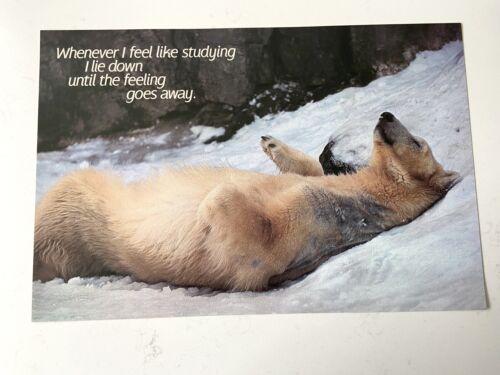
FIGURE 1980 1119-1. Polar Bear Poster.
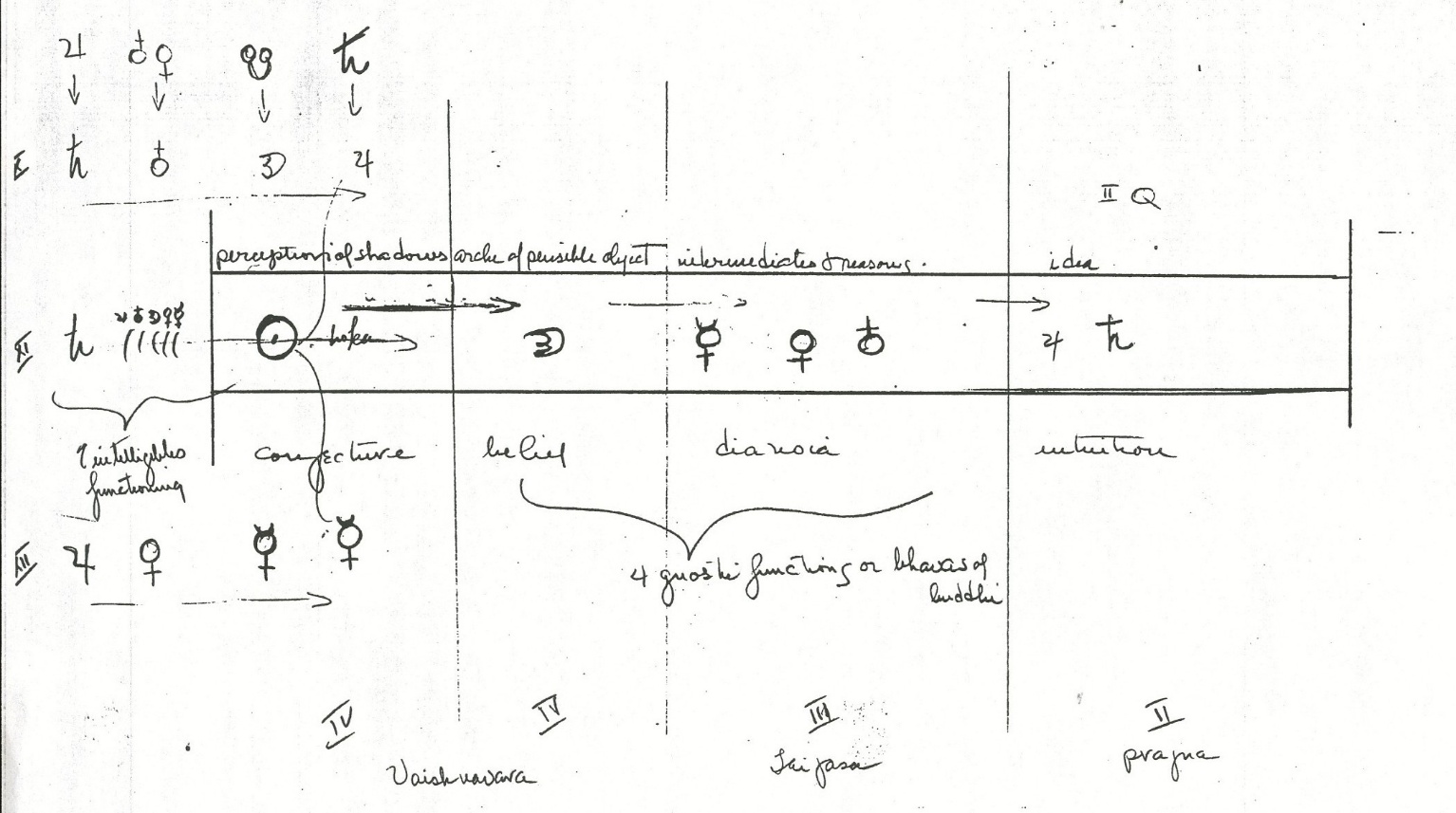
FIGURE AM008. Subject and Object Series with Divided Line.
[Transcriber note: [diagram] means the speaker is referencing a diagram as he or she is speaking. If someone is drawing or writing, with audible sounds of chalk on a blackboard, I indicate this by [drawing] or [writing].]
NOTES:
- This class is part of a series on Beauty, Essence, and Inspiration. See also WG Classes 1980 1112, 1113, 1126, 1128, and 1203.
TRANSCRIBED Verbatim by IT 2023. Archival verbatim transcript – V11a.
AUDIO FILES: 1980 1119a, 1980 1119b. [Note: "Tape" and "Side" refer to original audio cassette tapes that were later digitized into .MP3 Audio Files.]
1980 11/19 at Wisdom's Goldenrod
Neo-Platonism; Ascent to Intellectual Beauty
[Audio File 1980 1119a Begins]
[silence, some background noises; AD starts speaking at 0:00:31.4]
AD: Well, you're going to do the Intellectual Beauty, the tractate on Intellectual Beauty? [Note: Plotinus, V.8.] So, we'll try-- we'll-- we'll try to elaborate. And--
S (very faint): [few words inaudible] (laughter)
AD: Is that modern art? [9¾ second pause with faint background student talking, laughter] We're going to try to get the correct approach to this tractate on Intellectual Beauty. So I was-- I'll suggest a few innovations. It's-- it's a tractate that says nothing really. He's not giving away anything. You're not going to get it. Even though you might think that beauty is in the eye of the beholder. By the way, you reminded me of that. I got a quotation for you about the eye, the-- [10½ pause, flipping of pages] I might still-- I might still find it.
AS (very faint): You want me to read?
AD (faint): [couple words inaudible]
AS (faint): Do you want me to read and also on the blackboard?
AD (faint): Uh-hm. It's what I want.
[9¾ second pause, flipping of pages]
S (very faint, possibly part of background): That's an objective.
[9 second pause, flipping of pages]
AD: Would you read it to--
S: Yeah.
AS (faint): Ok.
AD: The-- the problem last week was she said that beauty was in the eye of the beholder and I told her don't take these people so literally. So now I found a quotation where Proclus speaks about the eye-- the eye of the beholder, what they refer to and what they mean by eye, e-y-e.
S (faint): Right.
AS: Says this--
[Transcriber note: I am using Kathleen Raine, George Mills (eds.), Thomas Taylor, The Platonist: Selected Writings, Bollingen Series LXXXVIII, Princeton University Press, Princeton, NJ, 1969.]
Kathleen Raine, George Mills (eds.) [Thomas Taylor, The Platonist, p. 157, footnote 10, AS reading]: "This inward eye is no other than intellect, which contains in its most inward recesses, a certain ray of light, participated from the sun of Beauty and Good, by which the soul is enabled to behold and become united with her divinely solitary original. This divine ray, or, as [AS reads: ray, which] Proclus calls [it] [Greek word], a mark or impression, is thus beautifully described by that philosopher [(Theol. Plat. p. 105)]."The Author of the universe, (says he) has planted in all beings impressions of his own perfect excellence, and through these, he has placed all beings about himself, and is present with them in an ineffable manner, exempt from the universality of things. Hence, every being entering into the ineffable sanctuary of its own nature, finds there a symbol of the Father of all. And by this mystical impression, which corresponds to his nature, they become united with their original, divesting themselves of their own essence, and hastening to become his impression alone; and, through a desire of his unknown nature, and of the fountain of good, to participate him alone. [And] when they have ascended as far as to this cause, they enjoy perfect tranquility, and are conversant in the perception of his divine progeny, and of the love which all things naturally possess of goodness, unknown, ineffable, without participation, and transcendentally full.""
AD: We'll discuss-- we'll discuss that later when we get into Intellectual Beauty. I want to quote-- I want to read a quotation from a book by Rollo May, it's called The Courage to Create. But I'm not reading it so that you can go out and create anything, I'm just-- thought this might lead-- this might lead us right into what we want to understand. He says--
[Transcriber note: I am using The Courage to Create by Rollo May, W.W. Norton & Company, New York, London, 1994, copyright 1975.]
Rollo May [The Courage to Create, pp. 77-78, AD reading]: "Cezanne sees a tree. He sees it in a way no one else has ever seen it. He experiences, as he no doubt would have said,"being grasped by the tree." The arching grandeur of the tree, the mothering spread, the delicate balance as the tree grips the earth--all these and many more characteristics of the tree are absorbed into his perception and are felt throughout his nervous structure. These are part of the vision he experiences. This vision involves an omission of some aspects of the scene and a greater emphasis on other aspects and the ensuing rearrangement of the whole; but it is more than the sum of all these. Primarily it is a vision that is now not tree, but Tree [AD: Capitalized.]; the concrete tree Cezanne looked at is formed into the essence of tree. However original and unrepeatable his vision is, it is still a vision of all trees triggered by his encounter with this particular one.
"The painting that issues out of this encounter between a human being, Cezanne, and an objective reality, the tree, is literally new, unique and original. Something is born, comes into being, something that did not exist before--which is as good a definition of creativity as we can get. Thereafter everyone who looks at the painting with intensity of awareness and lets it speak to him or her will see the tree with a unique powerful movement, the intimacy between the tree and the landscape, and the architectural beauty which literally did not exist in our relation with trees until Cezanne experienced and painted them. I can say without exaggeration that I never really saw a tree until I had seen and absorbed Cezanne's paintings of them."
AD: This is Rollo May by the way, this is not Cezanne.
Rollo May [The Courage to Create, pp. 78-81, AD reading]: "The very fact that the creative act is such an encounter between two poles is what makes it so hard to study. It is easy enough to find the subjective pole, the person, but it is [AD reads: it's] much harder to define the objective pole, the"world" or "reality." [AD adds: And] Since my emphasis here is on the encounter itself, I shall not worry too much at the moment about such definitions. …MacLeish uses the most universal terms possible for the two poles of the encounter: "Being and Non-being." He quotes a Chinese poet: "We poets struggle with Non-being to force it to yield Being. We knock upon silence for an answering music."
""[AD adds: Now] Consider what this means," MacLeish ruminates. "The 'Being' which the poem is to contain derives from 'Non-being,' not from the poet. And the 'music' which the poem is to own comes not from us who make the poem but from the silence; comes in answer to our knock. The verbs are eloquent: 'struggle,' 'force,' 'knock.' The poet's labor is to struggle with the meaninglessness and silence of the world until he can force it to mean; until he can make the silence answer and the Non-being be. It is a labor which undertakes to 'know' the world not by exegesis or demonstration or proofs but directly, as a man knows apple in the mouth." [AD: End of quote.] This is a beautifully expressed antidote to our common assumption that the subjective projection is all that occurs in the creative act, and a reminder of the inescapable mystery that surrounds the creative process.
"The vision of the artist or the poet is the intermediate determinant between the subject [(the person)] and the objective pole (the world-waiting-to-be). It will be non-being until the poet's struggle brings forth an answering meaning. The greatness of a poem or a painting [AD reads: painter] is not that it portrays the thing observed or experienced, but that it portrays the artist's or the poet's vision cued off by his encounter with the reality. Hence the poem or [the] painting is unique, original, never to be duplicated. [AD adds: And] No matter how many times Monet returned to paint the cathedral at Rouen, each canvas was a new painting expressing a new vision.
"[Here] we must guard against one of the most serious errors in the psychoanalytic interpretation of creativity. [AD adds: And] This is the attempt to find something within the individual which is then projected onto the work of art, or some early experience which is transferred to the canvas or written into the poem. Obviously, early experiences play [AD reads: experience plays] exceedingly important roles in determining how artists will encounter their world. But these subjective data can never explain the encounter itself.
"Even in the cases [AD reads: case] of abstract artists, where the process of painting seems most subjective, the relationship between being and non-being is certainly present and may be sparked by the artist's encountering the brilliant colors on [AD reads: of] the palette or the inviting rough whiteness of the canvas. [AD adds: And] Painters have described the excitement of this moment: it seems like a re-enactment of the creation story, with being suddenly becoming alive and possessing a vitality of its own. …
"[AD adds: Again] The receptivity of the artist must never be confused with passivity. Receptivity is the artist's holding him or herself alive and open to hear what being may speak. Such receptivity requires a nimbleness, a fine-honed sensitivity in order to let one's self be the vehicle of whatever vision may emerge. It is the opposite of the authoritarian demands impelled by"will power." … [But] an artist's "waiting," funny as it may look in cartoons, is not to be confused with laziness or passivity. It requires a high degree of attention, as when a diver is poised on the end of the springboard, not jumping but holding his or her muscles in sensitive balance for the right second. It is an active listening, keyed to hear the answer, alert to see whatever can be glimpsed when the vision or the words do come. It is a waiting for the birthing process to begin to move in its own organic time. It is necessary that the artist have this sense of timing, that he or she respect these periods of receptivity as part of the mystery of creativity and creation."
AD: Let's stop there. And, I think it's written in such a straightforward English that I don't think any of you had any trouble understanding it. I would reorganize some of the passages there, you know. But I won't do that now because that'll confuse. But what I wanted to do was review-- You see what we're leading into? You remember the passage we studied in the Deck book about when do I really see a tree? That's what I'm leading into. So, if you keep that in the back of your mind as a goal, and the goal being for instance when there's human cognition of a tree and when there is true cognition of a tree. And in-- in between those two of course is the whole of the intellectual ascent to Beauty. I hope you (didn't--) you're not going to find beauty in a museum. That much you're right. At any rate-- As you students remember you studied Santayana for a while. And, [short pause, bit of laughter, flipping of pages] since I don't believe it, I'm going to just quote off some quick references to sort of remind you of what I'm-- what we're going to say.
S (faint): Ok.
[short pause]
[Transcriber note: I am using The Realm of Essence: Book First of Realms of Being, New York: Charles Scribner's Sons; London: Constable and Co. Ltd., 1927. Volume sixteen of the critical edition of The Works of George Santayana.]
George Santayana [The Realm of Essence, p. , AD reading]: "Sometimes sense itself…"
AD: This is an easy way to do a class, just read to them.
George Santayana [The Realm of Essence, pp. 6-9, AD reading]: "Sometimes sense itself, without any dialectical analysis, distinguishes essences from facts, and recognizes them in their ideal sphere. This happens for a very simple reason. The stimulus that calls animal attention to some external fact, in provoking an act of the body, also presents some image to the mind. Moreover this labour of perception may be more or less welcome, pleasant, or life-enhancing, apart from its ulterior uses; and sometimes this incidental emotion is so strong that it overpowers the interest which I may have had originally in the external facts [AD reads: fact]; and, I may suspend my action or continue it automatically, while my thought is absorber in the image and arrested there. As I was jogging to market in my village cart, beauty has burst upon me and the reins [have] dropped from my hands. I am transported, in a certain measure, into a state of trance. I see with extraordinary clearness, yet what I see seems strange and wonderful, because I no longer look in order to understand, but only in order to see. I [have] lost my preoccupation with fact, and am contemplating an essence.
"[AD adds: Now] This experience, in modern times, is called aesthetic; but it has no exclusive connection with the arts or with the beautiful. It is really intellectual, and the high Platonic road. … [short pause] [AD: Now--] If the thing is beautiful, this is not because it manifests an essence, but because the essence which it manifests is one to which my nature is attuned, so that the intuition of it is a delightful exercise to my senses and to my soul. This pleasure and refreshment welling up in me, I courteously thank the object for, and call its intrinsic charm: but an intrinsic charm is a contradiction in terms, and all that the object possesses is affinity to my life, and power over it, without which it would be impossible for me to observe it or to think it beautiful.
"[AD adds: And] The beautiful is itself an essence, an indefinable quality felt in many things which, however disparate [AD reads: different] they may be otherwise, receive this name by virtue of a special emotion, half wonder, half love, which is felt in their presence. The essence of the beautiful, when made an object of contemplation by itself, is rather misleading: like the good and like pure Being, it requires much dialectical and spiritual training to discern it in its purity and in its fullness. … …the beautiful is a great liberator of other essences. The most material thing, in so far as it is felt to be beautiful, is instantly immaterialised, raised above external personal relations, concentrated and deepened in its proper being, in a word, sublimated into an essence: [AD adds: and] while on the other hand, many unnoticed Platonic ideas, relations, or unsubstantial aspects of things, when the thrill of beauty runs through them, are suddenly revealed, as in poetry the secret harmonies of feelings and of words. …
"This [AD reads: Now the] native affinity of the mind [AD adds: is] to essence rather than to fact…the very nature of spirit or intellectual light. The sort of intelligence which adapts one natural being to another, and may be found in the conduct of animals, or even in the structure of their bodies, does not consist in thinking; it is an adaptation of life to its conditions, a form of behaviour in matter, which must exist and flourish before thinking or even feeling can arise at all. Intuition would [AD reads: will] be impossible without an underlying animal life, a psyche; for how should the sheer light of intuition actualise itself, or choose the essence on which it should fall?"
[9 second pause, flipping of pages]
AD: Now, we have to spend just a moment or two refreshing our memory on what he means by essences and then seeing if he's speaking about what the Platonists refer to as the forms in the soul. [short pause] And again this will be very brief.
George Santayana [The Realm of Essence, p. 18, AD reading]: "The principle of essence, we have seen, is identity: the being of each essence is entirely exhausted by its definition; [AD adds: and] I do not mean its definition in words, but the character which distinguishes it from any other essence. Every essence is perfectly individual. There can be no question in the realm of essence of mistaken identity, vagueness, shiftiness, or self-contradiction."
AD: Now again, these are just quotes just to refresh your memory, I'm not going to read the book.
George Santayana [The Realm of Essence, p. 18, AD reading]: "This inalienable individuality of each essence renders it a universal; for being perfectly self-contained and real only by virtue of its intrinsic character, it contains no reference to any setting in space or time, and stands in no adventitious relations to anything."
[short pause]
AD: Now-- [9½ second pause] Now, again--
George Santayana [The Realm of Essence, pp. 20, 22, AD reading]: "(p. 20) Since essences are universals not needing to figure in any particular place or time, but fit to figure in any [AD adds: way], it is not possible to investigate the realm of essence by empirical exploration. You cannot go in search of that which is nowhere. Some essences will appear or occur to you, since whatever intuition life may awaken in you must light up some essence or other; but what further essences, if any, there may be is not discoverable by simply waiting for them to turn up. Nature is indeed very rich in forms… … [short pause, flipping pages]
"(p. 22) The realm of essence [AD reads: essences] [AD: he says] is comparable to an infinite Koran--or the Logos that was in the beginning--written in invisible but indelible ink, prophesying all that Being could ever be or contain: and the flux of existence is the magical reagent, travelling over it in a [AD reads: over its] thin stream, like a reader's eye, and bringing here one snatch of it and there another to the light for a passing moment."
[short pause, flipping of pages]
AD: Alright, and one other remark that I insist that you try to keep in mind when we're discussing this.
[10¼ second pause, flipping of pages]
George Santayana [The Realm of Essence, p. 38, AD reading]: "When on looking at a palm tree, a Roman road, or the horizon, I say to myself, How straight! I have exactly the same clear feeling: and this pure essence, not its irrelevant context, is what actually fills my mind, and is the essence apprehended. All the concomitant stuff, if it were noticed in turn, would merely supply other essences of the same universality. It is impossible that anything should appear which is not universal: for it is definite and might evidently appear again. Hence the possibility of discourse: its terms are coined [AD: That is the terms of discourse."…are coined] into fixed values, and can pass from mind to mind, retaining their original meaning."
[15 second pause, flipping of pages]
AD: Now concerning all essences, one more final remark.
George Santayana [The Realm of Essence, pp. 45-46, AD reading]: "No essence, [as we have seen], is abstract essentially, since it defines itself and might appear alone to an intellect strung to that key: and in the case of pure Being we have high testimony…assuring us that, in fact, it appears alone to the human intellect in its ultimate reaches; and even when not realised separately in intuition, it can be discerned both analytically and intuitively in every essence whatsoever. [AD: Now--] Pure Being supplies, as it were, the logical or aesthetic matter which all essences have in common, and which reduces them to comparable modes on one plane of reality. Pure Being is thus found in all essences somewhat as light is in all colours or life in all feeling and thought; and philosophers like Parmenides and Spinoza…assure us that we always have an adequate intuition of this pure Being, [usually] buried under vain illusions, but when unearthed and isolated seen [AD reads: seem] to be very mighty in itself and easily recognisable."
AD (faint): Now--
S (faint): (Where is that?)
AD: Now, I think it's going to ended up-- end up with us having a dialogue. So, before I quote any more, have a-- do you have a feeling of what he spoke about as essences?
S (very faint): Uh-hm.
AS: Yeah, well--
AD: Well go ahead, talk, they want to hear you.
S (very faint): Yeah.
AD: They want to hear you.
AS: Well, I mean, from what we read of him before I'm not sure but, it seems that he's speaking about essences as not in themselves. I mean he-- he doesn't seem to be equating essences with the way we spoke about the Ideas in the Intelligible, but more perhaps the forms in the soul or the forms as they are actually in the vehicles that the soul [one/two words inaudible] the way that they would be in the-- say in the fourth quadrant [diagram]. I mean several of his passages seem to indicate that-- like when he says essences are only apprehendable through some-- through the medium of psyche and not directly in themselves, that essence in the s-- essence to be experienced has to have some animate-- animate or psyche as its basis of experience. And he seems to be talking about the experience of that essence as it is [S, faint: Tony?] to an embodied being.
AD: I like that distinction. I think we'll keep it. Essences are like the forms in the soul you said. And we're going to keep that distinct from the Ideas.
AS (faint): Yeah.
AD: I think that's a good distinction. So that for instance circle, squareness, triangularity, all these things-- all these forms can be found in the soul. But we're going to distinguish them from the Ideas for instance, like the Idea of Man, which we would have to find in the Divine Intellect according to the Platonist. So--
AS (simultaneously): Which he doesn't seem to really speak of [couple words inaudible]
AD (simultaneously): No, he doesn't speak of that but we'll-- we'll help him along.
AS (faint): (Yeah/Alright).
S (very faint): (That's good) [one word inaudible]
AS: Well, I mean you could-- I mean maybe the thing when he said also, he doesn't speak of it because he's always speaking about the experience we can have as-- well [couple words inaudible]
S (very faint): I don't know.
JfL: Didn't he touch on that a little in the last pa-- in the last passage when he was talking about [one word inaudible]
AS (simultaneously): Pure Being?
JfL: The essence or the pure Being.
AS (very faint): Maybe.
AD: I'm sorry, I didn't hear you.
JfL: Just in the very last passage that you read.
AD (simultaneously): Yeah, what about that?
JfL: That he might have been alluding to the Ideas when he was talking about the pure Being that were prior to the essences, giving the (life/light), I thought that's--
AD: No Jeff, there-- that-- there didn't seem to be any implication. Of course it was only a quote but I know the chapter, there was no indication at any place of Ideas. When he does use 'ideas' he's always using them in the sense of forms, when he does bring in the word 'idea', specious reality, things like that, it's always forms that he's talking about. I'll bring you a quote later on to show that he tends to disown the Platonists when they really reach up to the higher levels. We're bringing this in here, this notion of essences, because we want to keep it first at the lowest level possible, where you and I can discuss essences in the sense that they're like units of meaning or signification. So, within a room there would be a hundred thousand essences, I mean there's-- If that wasn't so there would be nothing manifested, nothing meanable for (us). So whether we speak about this square box or this rectangular table or the space between two poles, we're always bringing in essences of some kind or another. And, the point that we want to make very clear is that these essences are generally manifested by matter. The flux of matter is manifesting these essences.
So that, if you remember when Avery was speaking last week and he was reading Diotima's speech to Socrates [Note: See Plato, Symposium.] and speaking about the various levels or grades that we have to traverse in order to reach to the highest beauty, he started off with the lowest one, the love of body, corporeal things. And, in the Platonic tradition the idea is that one should be able to see in the body the form that, so to speak, pervades that body and gradually get to love the form of the body. Then separate the form from the body and just to love the form. And that this was a process, a-- you know, a stepping, an ascent to higher and higher levels. So you went from body to I think, what was it, the laws, institutions, things like that, and that there was a certain beauty to be observed there and then he speaks about the excellences or the virtues of the soul and he speaks about the beauty that is to be observed there. But in each case, it's a gradual ascent. It is not, you know, a quickie, it's not a fly-by-night thing.
Now, when you read-- when you read Plotinus of course or when you read many of these books, most of us have the notion that we could immediately apprehend the beautiful with the least amount of discipline, understanding. And so we're going to dispel that notion because, as we talk about it we're going to be revealing to ourselves how little we understand.
LR: You know there's something else about in-- in the quotation, specifically the words about the uniqueness of each essence. Each essence is just its definition. I think Plotinus talks about that in-- in the thing on Beauty too where he says each manifestation is just what it is, nog-- not an aggregate of discursive reasons and theorems, but a unique unity. [Note: Plotinus, V.8.6.]
AD (simultaneously): Uh-hm.
LR: I think they're talking about the same kind of thing. The absolute uniqueness, the fact that it's not coming as a combination of any forms in matter but is contained in its special [S, very faint: Well--] uniqueness as part of--
AD: Well, when we were reading about the way Cezanne tried to see a tree, alright, I-- I picked on that paragraph because we're going to try to read when Plotinus speaks about how we see the tree. And I thought the same tree might serve both purposes. But-- [short pause] Santayana tends to-- [short pause] Santayana's concern with essences are of essences that are revealed in the psyche, alright, and of which we can have an intuition of, first of all because we're so constituted or the constitution of our psychical being is such that it admits certain essences, and coming from the subjective side, that these essences can be apprehended because of our inner constitution. So we can have an intuition of an essence within a clearly defined realm. And he works-- he works from the lowest and gradually goes up. But he'll stop at a certain level. He won't go beyond the intuition of the essences which for instance we would say would take place in the Nous. He stops and decides not to go, well-- go that far. Well, at any rate, to make this, you know, like-- [short pause] to make this whole subject of essences and Intellectual Beauty something that [short pause] we can be familiar with-- [11¾ second pause] Um-- There was one quotation in here which I think most of you probably remember it. I don't have it here but, well, the one he spoke about where he-- he called Proust-- Do you remember that-- You see, most of the people here aren't familiar with those quotations. Randy, do you happen to have it?
RC: Did you bring it back from the guest house?
AD: No. Well, we need it, would you go get it? (laughter)
RC: Where is it?
AD: The bookshelf next to my bed. It's Obiter Scripta. [Note: George Santayana, Obiter Scripta: Lectures, Essays and Reviews.] [short pause] Well, while he's gone to get the book, let's see, what do you recall about essences? Anything else?
[short pause]
LR: That's all you ever know.
CDA: There were simple but there were also complex essences.
AD: Good, and you can combine a lot of them together.
CDA (faint): Yeah.
AD: What else do you remember? Were they in existence?
CDA (faint): No.
AD: They weren't in existence. What kind of existence did they have?
CDA: None.
AD: Why? This is an opportunity [CDA simultaneously, faint: Because--] for you. (some laughter)
CDA: Because they always--
AD (simultaneously): Why?
CDA: They were in some kind of eternal stasis, I don't know, they always were-- are what they are.
AD/S(?) (very faint): What do you mean?
CDA: They don't change ever.
AD: They don't change. Go ahead, Louis.
LDS: Well, he talks about the essences of the realm of truth. The realm of truth for him are those essences that have been, will be or-- you know, have been or will be. And-- that is in terms of manifestation, that at one time or another, they either have or will be exemplified in existence. And he calls essence--
AD (simultaneously): Yes but they themselves did not exist.
LDS: No the essences themselves do not exist, but they can-- existence can provide the occasion for their-- for their appreciation.
AD: Or manifestation. Well then what kind of being do they have? See there's no sense discussing Plotinus Intellectual Beauty if these ordinary concepts aren't understood. You don't have to believe them or agree with them. But what kind of being would they have if they're not in existence? Evidently it can't be any kind of material being.
S (very faint): Well--
LDS: Well I guess we'd have to say that they're-- that, you know, they're rooted in the soul.
AD: Rooted in soul, so they would have a kind of immaterial being, they're not localized or have any sort of material existence.
LDS (faint): Right.
AD: Because matter is always in a state of flux. You combine essence with matter, you'll be speaking about essences in continuous flux which is absurd. If meanings do not remain stationary long enough you won't be able to have any discourse. As essences, alright, every moment in your life they're going on right in front of your very eyes. And I guess that's reason enough for us to ignore it.
S: Uh-hm.
LDS: I think the point was you never experience a pure essence for Santayana.
AD: I'm sorry.
LDS (simultaneously): Or, no, that was a possibility.
AD: That was a possibility, that you can experience pure essences. The reason why we want to bring this out is because this is exactly the Platonic high road, the road to the World-Mind, the Beauty and the Beautiful.
LDS: Yeah as a matter of fact I think when we talked about that that it sounded as if in that area were-- he brought in the possibility of experiencing pure essence. He was like opening the doors to something like the notion of Buddhahood or [one word inaudible]
AD (simultaneously): And then slammed the door right away.
LDS: Yeah, slammed it. But you know, it was almost like the notion-- I'm-- some of us speculated that it was like the notion of a Nirmanakaya Buddha, that if the vehicles in manifestation were of the right constitution and totally purified, then this possibility of experiencing the pure essence was there. It was like--
AD: Evidently he was wiser than he knew. What else do you remember about essences? Well this'll be a delightful summer. [12¾ second pause] And he turned and looked at me and said what did I do last year, what did you do last year? (some laughter)
S: I think he said that even though you could have these complex essences, and one essence can form the part of a complex essence, that in themselves each-- ea-- there is no way that they could actually be mingled. He said each essence maintained just pure essence.
S (very faint): Yes he did.
AD: So the essence of line is not lost in the-- let's say the form of a circle.
S: Right. He sa-- he actually seemed, when he was speaking of complex essences, he actually seemed to be speaking of the way they could be combined in matter and form a relative sort of an essence, you know, that they have like a maintenance in a material form. And that, say one part of that complex would be subservient to the whole of whatever that essence was. Like he said-- he was very specific, he said you could have an essence of a particular landscape involving all the parts of that landscape, the color of the sky, the-- the height of the trees, the relationship of objects to each other say in geometrical terms or terms of color, something like that. But each essence in itself, insofar as it was say red or whatever, was not in any way mixed with the other elements of that (complex).
AD: Go ahead.
LDS: The other thing he said was that there was infinite-- infinite essences, there would be an essence for every possible condition of matter. You know, like for--
AD (simultaneously): Well he did speak of essences as infinite, yes. He spoke of only a small portion of which are used in manifestation [LDS simultaneously: Yeah that would be the realm of truth.] here and that there were be-- there will be an infinite amount unavailable under which we could have no possible idea. What about this notion that the pure Being is the aesthetic matter of the essences? What do you think he meant?
RC: It was-- I don't know, that-- [S simultaneously, very faint: Uh-hm.] that was an interesting one.
AD: That was interesting, yes I know it's interesting.
RC: 'Cause we did that-- we talk about--
LR (simultaneously): I think he might mean the Venus.
S: Uh-hm.
RC: We talk about sometimes in Plotinus context that the soul is like matter to the Ideas.
AD: Yeah when we say the life, the indeterminate life, [RC: Yeah.] is a receptacle for the Ideas and all the Ideas are reflected in that one life. So you would say that that would be the-- the matter that the World-Mind moulds.
RC: Yeah and that pure Being would be Soul being.
AD: You think that's as far as he went? So, for him that pure Being is the very underlying stuff or the ascetic s-- the-- the aesthetic sensibility that underlies our perception of essences. And it wouldn't be any sort of material that we would be aware of in this world. So over here, in this world, anything that we can in any way contact or touch or know about has some sort of matter underlying it. But in the world that he's speaking of where essences exist, there matter, if you wanted to use the word 'matter' which could be very misleading, was not matter of any kind. And we'd have to go to his definition of matter, you remember he speaks about it in a certain way. [student assents, faint] Alright, the term 'essences' should become more and more meaningful because any time you see a great painting, or any time you hear great music and you're moved, you may be approaching an essence. But because you're misinformed, and unaware of the dialectical process involved in tracing these essences back to their origin, ignoring what Santayana says, that they must be embodied, because you can get to pure essences-- There wouldn't be much-- much point in it.
LR (simultaneously): See-- but I think it's also important to bring out that for him all you know is essences. I mean, what you just said is true, that to get to a pure essence is rare. But at the same time, every minute all you know is essences, you never know the matter.
AD: Yeah.
LR: So that must mean that it's not pure essences you're knowing all the time in the purity the way you're speaking of them. And yet, in though-- it's not anything else than a defilement or a clouded version of those essences that you know all the time and there's nothing else that you do know. You never get outside of (your own knowing).
AD (simultaneously): Yes that's true. You never get outside of that because-- But the point I was making was that, we do want to get to the pure essences themselves and not feel that we are constrained to remain always with embodied essences. Randy, would you read that? I know it's a repetition for some of us here but we have patience so we could listen to this. It's a small excerpt that Santayana wrote on essences and in regard to the literary work of Proust, the author of Remembrance of Things Past, I think you've read it. [Note: Marcel Proust, Remembrance of Things Past, also translated as In Search of Lost Time.] Remember he starts off by smelling, and it ends up in 2800 pages?
S (simultaneously, faint): (Opus.) (bit of laughter)
AD: Randy, would you read it?
RC: Do you want some of his introduction or just (start it off)?
AD (simultaneously): Yeah read-- yeah, read his introduction too.
RC (simultaneously): (Um--)
[Transcriber note: I am using Obiter Scripta: Lectures, Essays and Reviews by George Santayana, New York: Charles Scribner's Sons; London: Charles Scribner's Sons Ltd., 1936.]
George Santayana [Obiter Scripta, p. 273, RC reading]: ""No novelist," writes Mr. Desmond MacCarthy, "has ever done such complete justice (as has Proust) to the great fact that all things pass and change." Yet this complete absorption in the flux of sensations, and abstention from all judgments about their causes or their relative values, leads Proust in the end…"
(Side 1 of original cassette tape digitized as 1980 1119a Ends; Side 2 Begins)
AD: --but he remarks that life is soul. Life is soul. So if all of a sudden you start noticing that there's some sort of activity stirring in your soul, evidently you must have fed it the right food, because it's moving again. So vitality comes into you, you get enthusiastic, you feel happy, alright, you even enjoy a certain, what can we say, release. So he's saying in that passage there that we do really have to feed this inner man celestial nourishment. [student assents] Now celestial nourishment means that it can't be some kind of material food. I mean there's no sense giving him oatmeal. (some laughter) What can you feed him, what can you give it?
S (very faint): Essence of oatmeal.
AD: Huh?
S (very faint): Essence of oatmeal.
AD: The essence of oatmeal? (bit of laughter)
S (very faint): What are you talking about?
S (very faint): The essence of oatmeal.
AD: What would you feed it, Randy?
S (faint): Yeah.
S (very faint): [few words inaudible]
RC (faint): It's-- it just see-- it seems that any perception you can actually pay attention to is a stimulus (in some sense). It would--
AD: Well, I won't deny, I won't deny that, that there's essences constantly embodied. The whole world is a manifestation of essences, we know that. But what kind of essences would you feed it? Going to go around looking at boxes and say "Ah, there's a square. Eat that." (laughter) So you run out and you go get a Scriabin etude.
RC (faint): Well, and sometimes seems to change, (right)? As you develop, the essences that may be food at one stage wouldn't be--
AD (faint): At another stage.
RC (faint): Maybe because they're too high or too low at each stage.
SD: Well, also, I mean, to the extent that the mind can close things off with a predetermination that it knows what's there, it won't reach through to the essence. So it has to be something that can sort of sneak behind the defenses that we've set up.
AD: Yeah he says that somewhere. Avery, would you open the book I got there? [S, faint: Yeah.] Open to the page, that paragraph where he speaks about attention. Read that paragraph.
CDA/S(?) (very faint): Which one?
AS: Uh-hm.
George Santayana [The Realm of Essence, p. 15, AS reading]: "The approaches to essence are therefore [as] various… [Or] we may say that for the mind there is a single avenue to essence, namely, attention. Awaken…"
AD (simultaneously): Come on, say it three times. (bit of laughter)
S (very faint): John, come on.
George Santayana [The Realm of Essence, p. 15, AS reading]: "[Or] we may say that for the mind there is a single avenue to essence, namely, attention. [AS rereads: Or we may say that for the mind there is a single avenue [S simultaneously, faint: Wait.] to essence, (some laughter) namely, attention.]"
AD: This way I don't have to repeat that Zen story. Remember the Zen story, a man asked his teacher to put an inscription? He just built a new house and he says sure and he wrote the word 'attention'. He says, "Well can't you say a little more?" "Sure," and he wrote the word 'attention' again. (bit of laughter) Came back twenty minutes later, "But certainly you can say more than that" and he said "Sure." Attention again. (bit of laughter) It's (very Zen) story which I (wrote/like). (laughter) So attention is one of the avenues to essences. Just like when you were arguing and discussing certain points in class you need to be very attentative. This is what I mean by listening. Can you listen? Continue, Avery.
George Santayana [The Realm of Essence, pp. 15-16, AS reading]: "Or… (laughter) Awaken attention, intensify it, purify it into white flame, and the actual and unsubstantial object of intuition will stand before you in all its living immediacy and innocent nakedness. But notice: this attention, discovering nothing but essence, is itself an animal faculty: it is called forth by material stress, or by passion. The passions, in so far as they are impulses to action, entangle us materially in the flux of substance, being intent on seizing, transforming, or destroying something that exists: but at the same time, in so far as they quicken the mind, they are favorable to the discernment of essence; and it is only a passionate soul that can be truly contemplative. The reward of the lover, which also chastens him, is to discover that in thinking he loved anything of this world he was profoundly mistaken. Everybody strives for possession; that is the animal instinct on which everything hangs; but possession leaves…"
AD (simultaneously): Let's-- let's stop. About this lover who was profoundly mistaken. There's a quote from Tagore, one of his poems.
S (faint): Uh-hm.
[Transcriber note: I am using The Gardener by Rabindranath Tagore, New York: The Macmillan Company, 1916, copyright 1913.]
Rabindranath Tagore [The Gardener, #49, p. 86, AD reading]: "I hold her hands and press her to my breast.
"I try to fill my arms with her loveliness, to plunder her sweet smile with kisses, to drink her dark glances with my eyes.
"Ah, but where is it? Who can strain the blue from the sky?
"I try to grasp the beauty, it eludes me, leaving only the body in my hands.
"Baffled and weary I come back.
"How can the body touch the flower which only the spirit may touch?"
AD: Remember that? And I don't expect you to remember it, I only read it four times. After ten times you start remembering. Would you read that passage again, about the Platonic lover?
AS: You want me to?
S (very faint): Uh-hm, read it.
George Santayana [The Realm of Essence, p. 16, AS reading]: "The reward of the lover…"
AS (faint): Let me start back a little.
George Santayana [The Realm of Essence, p. 16, AS reading]: "The passions, [in] so far as they are impulses to action, entangle us materially in the flux of substance…but at the same time, in so far as they quicken the mind, they are favorable to the discernment of essence; and it is only a passionate soul that can be truly contemplative. The reward of the lover, which also chastens him, is to discover that in thinking he loved anything of this world he was profoundly mistaken. [9¾ second pause] …possession leaves the true lover unsatisfied: his joy is in the character of the thing loved, in the essence it reveals, whether it be here or there, now or then, his or another's."
AD: So then it was the love that revealed the character of the thing adored. [short pause] Would you read that passage again, I'm not sure I understand.
[short pause]
George Santayana [The Realm of Essence, p. 16, AS reading]: "Everybody strives for possession; that is the animal instinct on which everything hangs; but possession leaves the true lover unsatisfied: his joy is in the character of the thing loved, in the essence it reveals, whether it be here or there, now or then…"
[short pause]
AD: This is getting closer to home as to what essences are?
[short pause]
CDA: Yes.
AD: But we'll keep trying.
AH: Is this saying that the character-- the character of the thing loved is the essence of (it)?
AD: Yes. It's almost that, if it could be feasible to put it this way, that in loving someone, and depending upon the intensity of the love and of course how much it illuminates what you love, the essential psychical essence, and even possible, the Idea which is being embodied by that psychical essence, is revealed in that love. And, one becomes acquainted with the essence character of that person. That's-- that's what you love to begin with. [short pause] And this of course is true of almost all, you know, our material possessions. You listen to a beautiful piece of music, you go out and buy the recording. Now you got the essence pocketed away, right? You got it in file, you got it in your-- in your safe. Or you see a beautiful painting, that doesn't satisfy you that you captured the essence although you think you're going to capture it again. So you go out and steal the painting. (bit of laughter) Go ahead, (Andrew).
AH: Earlier-- earlier part of that passage remember he talks about this-- this passion or mania (for/or) something is involved or tangled in materiality, but, it's beneficial because it quickens the mind.
AD: And forces you to make a commitment.
AH: What does-- what does it mean it's beneficial to quicken the mind?
AD: Because mankind's greatest passion is laziness and it takes another passion to shake him out of it! Even if it's only momentary, a day, six hours, eight hours. Otherwise, notice what happens. You saw the sign I put up there?
AH (faint): Yeah.
AD: Whenever this feeling that I should study overtakes me I lay down until it passes. (laughter) [Note: See FIGURE 1980 1119-1, Polar Bear Poster. This poster used to hang at WG in the 1980's.]
LR (amidst laughter): You put it there.
AD: Let me read you another quote which I read to you a dozen times. That's one thing I like about these classes, I could read the same quotes for twenty times until they get-- (laughter) You-- Before I have to worry about these people catching on that I'm doing the same one. (laughter) [27¾ second pause with faint background student talking, some laughter, flipping of pages] Uh--
C.G. Jung [CW 11, Psychology and Religion: West and East, p. 547, paragraph 892, AD reading]: "The intellect has no interest in the nature of the perceiving subject so far as the latter only thinks logically. The intellect is essentially concerned with elaborating the contents of [AD adds: a] consciousness and with [AD adds: the] methods of elaboration."
AD: Intellect here of course doesn't mean what it means in Plato. Intellect here is biological adaptation.
C.G. Jung [CW 11, Psychology and Religion: West and East, p. 547, paragraph 892, AD reading]: "A rare philosophic [AD emphasizes the following word] passion…"
AD: Andrew--
C.G. Jung [CW 11, Psychology and Religion: West and East, p. 547, paragraph 892, AD reading]: "A rare philosophic passion is needed to compel the attempt to get beyond [AD adds: a rational] intellect and break through [to] a"knowledge of the knower.""
AD: Or if I can quote Eckhart. He made the remark, "You can't be a sinner, you can't be a saint." Because either way you're going to have to make a commitment. And if you don't have that kind of energy behind, you're not going to make any commitment, which most of us of course will not do, we won't make any commitment. A commitment means self-responsibility and who the dickens wants anything to do with that? Alright. You feeling at home with essences? Little bit, just a little (bit/better)?
S (simultaneously): Tell me again why they don't exist.
AD: Hm?
S (very faint): Tell me again.
AD: I'm sorry?
S: Tell me again why they don't exist.
LR: He uses existence in a very--
AD: Well, in his technical jargon, alright, in order for anything to exist, matter has to be the substratum.
S: Oh.
AD: Alright?
S (faint): I see.
AD: And it's only, so to speak, in our world, in the material world, where we can properly speak of existence. When we say something exists we mean it has momentary-- it's in-- it's involved in a momentary process of becoming. So that from moment-to-moment it is becoming, never really is. That's what we mean by existence here. But if something is never becoming but it always is what it is, alright, then it cannot participate in the matter of this world, alright, because it would have to constantly be becoming. And you can speak about that as true Being, whereas what we enjoy here is existence. And the very word gives itself away. 'Existere' means that the principle of one's thing, of this being or this entity is outside of itself. So if I say "I exist," alright, I'm referring to this empirical personality that you're looking at in front of you. It has an existence, that means that it's instantiated in matter or appears in matter or combines with matter in some fashion or other and this is in a process of always becoming. Alright, so when I say I exist, we have to take it in that sense.
Now the essences that never change, never de-- they don't depend on any ca-- kind of matter which they localize, you can't say that the essence of a square weighs four pounds and the essence of a circle six pounds. All these things are meaning-- meaningless and irrelevant in the world of essences. You're speaking about the world of true Being. And we want to get back later on to that essay on Intellectual Beauty where he starts speaking about that, the kinds-- the kind of being that these essences have in the Intellectual-Principle.
S: Now this is a-- is this-- this has only to do with this one man, his idea of existence, right? Uh--
AD: No, that's generally the trend in philosophic thought.
S: Ok.
AD: Yeah, it's general-- Except for the past two hundred years where existence or reality was referred to as this world of becoming. But generally-- You see like for instance, during Platonic times, if you believed in the Ideas you were called a realist, alright.
S: Right.
AD: Right.
S (simultaneously): Otherwise you're an idealist.
AD (simultaneously): Today it's the other way around, if you believe in the Ideas, alright, you're an idealist. So the language does go through this-- Go ahead.
S (very faint): Yeah.
AH: If-- if this passion for an object quickens the mind and it turns into some kind of official process, does it really make-- or what kind of distinction is made between objects at-- at the level of practice. Like obviously some-- some lovers are passionate for different things, you know. Like the painter or the-- Right? Would the experience of the essential quality of objects be similar? [S simultaneously, faint: (Well--)] Or does something-- something hinge upon the object?
AD: I didn't follow the question [one/two words inaudible]
AH (simultaneously): Let's say-- let's say a man is in love with a woman in a-- in a very passionate sense. Or let's say a person is in love with food. He demonstrates an-- the same kind of passion.
AS: Yeah. Yeah but as he says there's levels, from that quote in the-- in the-- in the Symposium, there's levels of invol-- of essence, as it were. I mean I-- and I don't know if that's what you're getting at.
AH: Yeah, yeah.
AS: There'd be a level of essence say-- he says at the l-- at body, at the level of body is different from that essence you would get at at the level of, say, art, which is different from the level you would get at when you're speaking of the virtues and so on.
AH: But how about in the case where it's involved with materiality, would-- would art be involved with materiality?
S: Uh-uh.
LR (faint): Hard to say.
AD: Is what?
AS: Is art [AH simultaneously: (Is again--)] involved with materiality.
[short pause]
AD: Well, the question could be yes and no, could be answered both ways. The Italian philosopher Benedetto Croce for instance believed that the intuition was more than sufficient. Once you had that you could-- you can forget about the rest. Whereas some of the others would insist that the intuition has to be expressed through a medium and that you have to master that medium so that you can give a proper expression to that intuition. So it would depend on-- on that. For most of us, we would like it expressed through a medium, otherwise we don't get to the essence. So the presentation of art is to help us get to that meaning-- get to that essence. Let's go back now. Let's go back to this, um-- the quote I started with.
Rollo May [The Courage to Create, p. 77, AD reading]: "Cezanne sees a tree. He sees it in a way no one else has ever seen it. He experiences, as he no doubt would have said,"being grasped by the tree." The arching grandeur of the tree, the mothering spread, the delicate balance as the tree grips the earth--all these and many more characteristics of the tree are absorbed [AD reads: revealed]…"
AD: I'm changing the wording now.
Rollo May [The Courage to Create, p. 77, AD reading]: "…are absorbed [AD reads: revealed] into [AD reads: in] his perception and are felt throughout his nervous structure."
AD: Where he has absorbed into his perception, I'm saying revealed in his per-- perception.
Rollo May [The Courage to Create, pp. 77-78, AD reading]: "These are part [AD reads: parts] of the vision he experiences [AD reads: experience]. This [AD reads: The] vision involves an omission of some aspects of the scene [AD: etc]… …
"The painting that issues out of this encounter between a human being, Cezanne, and an objective reality, the tree, [AD: The encounter between these two.] is literally new, unique and original. Something is born, comes into being, something that did not exist before…"
AD: I would change that and I would say, what's coming into being has always been. But for him, it is not yet. And it's the intensity of the attention that he's trying to grasp this tree that is going to bring something into being which was not there before. It's-- What I'm trying to say here is you're trying to see the tree the way the World-Mind sees the tree. And it requires this enormous receptivity and attention, alright. So, you have to excuse me, I'm-- I'm just rephrasing some of Rollo May. He's a fine man but he's a psychoanalyst so he's automatically limited. (bit of laughter)
Rollo May [The Courage to Create, p. 78, AD reading]: "The very fact that the creative act…"
AD: And, to apprehend the way things exist in the Intellectual-Principle is a creative act. But, not in the sense that you're making anything. Unless you want to say keeping the mind still is making something.
Rollo May [The Courage to Create, p. 78, AD reading]: "The very fact that the creative act is such an encounter between two poles is what makes it so hard to study. It is easy enough to find the subjective pole…"
AD: That's what he thinks.
S (faint): Uh-hm, yeah.
S (simultaneously): Uh-hm.
Rollo May [The Courage to Create, p. 78, AD reading]: "…the person, but it is [AD reads: it's] much harder to define the objective pole, the"world" or "reality.""
AD: So now what he's speaking about is this encounter that each person has with his own world, alright, and that he must force out from himself with-- in this encounter with his own world, and it requires a creative approach. Now, again, I'm kind of leading into my-- what-- what (we said--) my-- my focus of interest, and that is if anything is creative, it's the understanding. Above painting, above music, above the arts, above everything else. If it's truly understanding, it's creative insofar that it will transform the personality. I cannot conceive of a higher creativity. But that's not to downgrade the others. So let me continue. Um--
Rollo May [The Courage to Create, pp. 78-79, AD reading]: "…Archibald [AD reads: Mr.] MacLeish uses the most universal terms possible for the two poles of the encounter:"Being and Non-being." He quotes a Chinese poet: "We poets struggle with Non-being to force it to yield Being.""
[12½ second pause]
AD: You're looking at this tree, right? This very tree that Plotinus is going to speak about and Avery's going to speak about now, the sensible tree, alright, and you try to force out of this becoming tree, a tree which is an appearance in the sensible world, the reality it possesses, the reality it has. And so you knock on the door of Non-being and you keep knocking until finally the Idea of Tree appears, or you know the Idea of Tree. But, again they're poets, so you'll have to allow them-- The Chinese poet says--
Rollo May [The Courage to Create, p. 79, AD reading]: "…"We poets struggle with Non-being…""
AD: That is, the sensible world. I'm looking at this tree but I don't see the tree! What I see are-- is everything else but the tree. All you have to do is stay there and watch it for a minute, and you see how hard it is to see a tree.
Rollo May [The Courage to Create, p. 79, AD reading]: "…"We poets struggle with Non-being to force it to yield Being.""
[short pause]
AD: "We struggle with Non-being to force it to yield Being." It's like when the Vedantist is swearing away and cursing. If the substratum of the subject-consciousness can identify with the substratum of the object-consciousness, [AD snaps fingers] cognition will arise! True cognition. True cognition. Which is of course divine.
LR: I remember we were speaking about this the last time we were doing this.
AD: No I'm sorry, I'm sorry. I have to finish the sentence.
LR (very faint): Oh I'm sorry.
AD: Now, between this sensible tree that we see and the cognition of the true Tree, there's the whole of Jacob's ladder we gotta climb. Do not be misled into thinking that when the Vedantists say the substratum of the object-consciousness coincides with the substratum of the subject-consciousness [AD snaps fingers] and we have knowledge, "knowledge" here in quotations, of the tree, don't-- don't be-- don't be misled. Because this is an enormously difficult complicated process of penetrating and going into deeper and deeper layers of understanding until when you perceive the tree, what you will perceive is the way the World-Mind sees the tree through you, and the substratum of the tree and the substratum of the subject is the Nous and the bliss inherent in both is one and the same and there's a coincidence and knowledge is born. But it is not going to be, you know, the way you people like to travel with seven-league boots? Beauty is in the eye of the beholder, everything was solved in one-- in one sentence, in one-liner.
So, this is what we're going to have-- this is what we'll have to follow through, that from the-- the point that we just spoke about where we see the sensible tree and until we arrive at the true cognition, the divine knowledge of the tree itself, the tree as knowing itself by grasping itself, by being self-identical with itself. Alright, to arrive at that, between these two points is going to be the whole ladder of ascent or what Plato and Plotinus in the reading we did for you is a concern with going from lower levels of value to higher and higher levels, and the highest level of all, of course, is to see Beauty itself, but we won't speak about that. Alright that-- that's the project that we're getting closer to. I'm sorry Linda, would you excuse me? Go ahead.
LR: That's ok, I don't-- [short pause] I think you were-- you just answered it really but-- The last time we were reading Deck on this point about the tree, I can remember discussing what activity was required if you were actually trying to attempt to know something seemingly external to yourself such as a tree. And, I remember we raised the point about looking within or looking without if it were that tree that you were trying to get to know. And there was a confusion that I was left with about it-- I think it has to do with his idea of what he speaks about passivity and receptivity, and difference between them. But, I can't remember what-- was it a matter of developing the kind of receptivity that the soul would need to perceive the genuine Idea of that tree, or did you speak of it in terms of-- does one speak of it in terms of a focus on something particularly in that tree itself that you're looking at, again, seemingly external to yourself. In other words, is there an inward way as well as an-- I hate to say outward because they're all contained within the same given psyche.
AD: Well, yes, I follow what you're saying now. It's going to be the same problem that's going to arise continuously. And the Buddhist class is a perfect exemplification of this.
LR: Yeah.
AD: Um--
S (faint whisper): (What's that?)
AD: It'll come to something like this, when we're looking at the sensible tree, are we looking at a generic image. If we are, then we never came into contact with the real tree but only with the images built up in our own psyche of that reality. Alright? So we'll see then which way should we attack the problem to be able to get to the real tree.
LR: Ok, and one further thing, is it-- I mean, we've got all these diagrams showing the different ways that pure sensa-- that there's a contact with something real. But, is there-- would one come to the same true perception, cognition of an object going through matter or going inwardly, directly to soul? Either way you have to say that there's a real Idea contacted but would it be the same? Would it be the same tree that's contacted?
AD: We'll find out. Avery's going to start. Now Avery did this a couple times, I did it a couple times, I'm tired of it so-- We'll let Avery start in. Avery, would you mind? We're going to go over that section where Plotinus is speaking about the perception of a sensible tree.
[37¼ second pause]
AS: Alright I-- No he's in-- yeah. I was just seeing where to start this. It's in this-- it's in the chapter, "Is Nature Real for Plotinus?" And he-- he starts off, he asks-- this by-- Deck says-- um--
AD: Speak louder, Avery.
[Transcriber note: I am using Nature, Contemplation, and the One: A Study in the Philosophy of Plotinus by John N. Deck, Burdett: Larson, 1991.]
John N. Deck [Nature, Contemplation, and the One, "Is Nature Real for Plotinus?," p. 81, AS reading]: "The closely textual [AS reads: This] presentation of Plotinus' treatments of contemplation and production, in which the sensible world has been seen as the product of Nous and/or nature contemplating, must be supplemented by an attempt to understand more profoundly the import of what Plotinus is saying."
[13 second pause]
AS: He says--
[10 second pause, flipping of pages]
John N. Deck [Nature, Contemplation, and the One, "Is Nature Real for Plotinus?," p. 82, AS reading]: "[But] when Plotinus says, philosophically, that the nature of plants and trees is a contemplation, is he not making them out to be less than real? Is not"thought" less real than "things"?
"The objection that thought is not as real as things probably means nothing more than that human thought is less real than material things. Now the contemplation which, for Plotinus, is nature (a) is not [AS adds: a] thought, (b) is not human, and (c) is for him more real than material things."
[11¾ second pause]
AS: Then he-- he examines these further.
AD: Yeah but, let's start with the-- with the body of the--
AS (faint): Uh-hm. Ok.
John N. Deck [Nature, Contemplation, and the One, "Is Nature Real for Plotinus?," p. 84, AS reading]: "Let us, as Plotinus himself does, give a [crude] description of the world of true being, which can be refined subsequently."
AS: Bottom of 84.
John N. Deck [Nature, Contemplation, and the One, "Is Nature Real for Plotinus?," p. 84, AS reading]: "The world of true being appears to duplicate the sensible world…"
AD: You know what he's saying there, right?
S: Yeah.
S (faint): Yeah.
AD: The world of true being duplicates the sensible world. When you're in heaven, alright, you'll see that-- the table there for instance, you'll see it in heaven. The fire there, you'll see it in heaven, the fire you see in heaven is an intelligible fire. The fire you see here is a physical fire. He's not talking poetry, he's-- he's talking the truth. I mean as far as those who've had the similar experience. There is an intelligible fire when you're in heaven. When you're in heaven means of course when you have a different state of mind than the one you have now. Doesn't mean you take an elevator. (some laughter)
S (very faint): Yeah.
S (faint): Ok.
AD: Alright.
John N. Deck [Nature, Contemplation, and the One, "Is Nature Real for Plotinus?," pp. 84-85, AS reading]: "There are trees, plants, earth, etc. [AS reads: trees, planets, earth, men] in the world of true being. There are, however, these differences between the world of true being and the material, sensible world: everything in the world of true being is eternal and immutable, and everything is identical with knowledge of itself. For example, the tree in the world of true being is identical with the knowledge of tree."
AD: You want to stop and discuss that for a minute? [short pause] Yeah, go ahead.
S (faint): But, that would seem to imply that when tree is known (in/from) true being, there's nothing left by then about it that isn't given in that knowledge. In our experience of tree ordinarily, we're continually being corrected by new experience, finding out more about the tree in a round-a-bout kind of way. (You won't see) the tree in real being unless it's given entire.
AD: That's pretty good, Andrea, yeah. The totality of the knowledge of the tree is the tree. So there knowledge and being are identical. Or they're synonymous. Alright. Continue, Avery.
John N. Deck [Nature, Contemplation, and the One, "Is Nature Real for Plotinus?," p. 85, AS reading]: "Why must there be a true…"
AD (simultaneously): Oh by the way, do you ever feel that you're synonymous with yourself? Ok, just wanted to make sure. (bit of laughter)
S: Uh-hm.
S (very faint): I see.
S (very faint, possibly part of background): What is that?
S (very faint): [few words inaudible]
AS: Hm?
S (very faint): [few words inaudible] (bit of laughter)
John N. Deck [Nature, Contemplation, and the One, "Is Nature Real for Plotinus?," p. 85, AS reading]: "Why must there be a true-being tree? Why must there be a more real tree? Is Plotinus despairing of explaining the real world, [and] taking refuge in a heaven of ideas? And, even supposing for a time that there is a tree in a world of true being, why must it be identical with knowledge of tree? [short pause]
"[Plotinus' answer to this] question would [AS reads: seems to] comprise the following two points: [AS: Rather the answer to this question.] (a) the tree in the world of true being is tree, that is to say, it is self-identical. It is true being, true tree because it is self-identical. And (b) identity with knowledge is necessary for self-identity, or, more properly self-identity is, exactly, knowledge of self."
AD: Avery, will you discuss those two points?
John N. Deck [Nature, Contemplation, and the One, "Is Nature Real for Plotinus?," p. 85, AS reading]: "Let us discuss [AS adds: the] both arguments."
S (very faint whisper): What page is that?
AS: Hm? This is page 85. So first "the tree in the world of true being is tree. It is true being, true tree." It's not that it's, as he says a-- a more real tree, it is the tree. [9¾ second pause] Again, the-- the second one, "identity with knowledge is necessary for self-identity". Well he's going to speak about exactly why that's so. It's as Andrea said I think, there's nothing-- nothing left behind in that tree which is unknown. There's the tree to be really self-identical-- If you were to be self-identical, there wouldn't be any part of you which is unknown to yourself. But I th-- but in the state we are, there's lots of parts of us that are unknown to ourselves. So he says-- the second point is that in order for there to be perfect self-identity, there must be perfect knowledge of itself, there can't be anything in itself that's unknown to itself. For example you look at a tree here and there's lots that's unknown, given by the fact that there's more you can know. Sensibly there's always more, you could investigate it more closely or cut it open, you know, stuff like that.
RG: I don't get it.
AS: Hm?
RG: I don't get the point here why knowledge is defined through self-identity.
AS: Well he said-- well I-- I think the other way, he says--
John N. Deck [Nature, Contemplation, and the One, "Is Nature Real for Plotinus?," p. 85, AS reading]: "…identity with knowledge is necessary for self-identity…"
RG: Why not just i-- why-- why idenawe-- identity with knowledge and not identity with being there, in that definition?
AS: In this definition?
RG: Yeah.
AS: He's already-- I think he's already mentioned the thing of being. That was point (a).
RG: Right. I don't see the reasoning for point (b) yet.
AS: You don't see-- You mean, why can't there be a tree which is real being but is not completely known to itself?
RG: Yeah why do we-- why do you have to bring in knowledge here at this point? I mean I don't think you-- I don't--
AD: What you would be speaking about will be something unconscious, something like a stone. It would have being. [couple/few words inaudible]
RG (simultaneously): And it would be-- and it'd be self-identical with itself.
AD (simultaneously): Well how could it be self-identical with itself then?
RG: What's the meaning of identity?
AD: No, that's not-- that's not even important here.
RG (simultaneously): No. When you said self-identical I-- what does that mean?
AS: He's just telling you. He's-- that's-- he's defi-- self-identity is exactly knowledge of self.
AD: If you say a thing is itself, alright, this would also have to include its activity, wouldn't it.
RG: I don't see why. Isn't it-- isn't the thing different from its activity to be its-- to be itself?
AD: You're not speaking about Being now. You're speaking about the One, which precludes knowledge. [RG simultaneously: Ok.] Unity precludes knowledge. You're-- we're speaking about Being now.
RG: Ok so, I'll take your definition then, Being and its activity.
AD: I'm sorry?
RG: Ok, Being and its activity.
AD: Yeah, Being and its activity. So that activity must be known to itself if it is to be truly Being. Because that activity is not outside of Being.
MB: I thought another way of looking at self-identity was that it doesn't depend on anything other than itself for its Being or for--
AD: Say it again, Myra?
MB: The definition of self-identity-- or another way of looking at what you were saying is that self-identity of an object means that it doesn't depend on anything outside of itself. When-- if something is self-identical with itself that means it doesn't depend on anything else for its existence or it doesn't [AS assents] depend on anything else [few words inaudible]
AD (simultaneously): In other words, this would be an instant where you cannot apply dependent-arising. Exactly.
MB (faint): Unless you use some special definition of it.
AD: No, no, (bit of laughter) exactly, that's-- that's what-- that's what Plotinus would say.
S (very faint): Uh-hm.
S: Yeah.
AD: And if you want to use the-- if you want to use the term dependent-arising, you would have to say that that arising takes place within itself.
MB (faint): Right, at the level where-- the level [AD simultaneously: At that level.] of Being right when he's--
AD: Let's use the example that we used once before that might help us, alright. On the one hand we have the dream, alright, on the other hand we have the unconscious complex which is manifesting into the dream. And let's say the unconscious complex is the being itself, the thing itself, the Idea, the Tree, whatever we want to refer to. So that this Idea itself, or this complex itself, when it gets manifested as let's say some item in our dream world, the manifested dream appearance will always have to be related to that complex. Now what we're saying is that that complex would have knowledge of all the possible manifestations that it can, let's say, express itself through. That would be knowledge and being as one and the same. In other words, more abstractly, the principle of a-- principle of manifestation is not only itself but everything it can manifest is included in that principle. So, to say Being is not enough. We must also bring in the notion of power or manifestation or knowledge. If you stick to the first definition, Being itself, it's the very criticism that Plato made, to regard Being as homogenous and not also heterogenous. Not only is it, but it also has power. You could see why that Plato remark was so crucial, the Sophist is so crucial to an understanding of what we're talking about in the Platonic tradition. And when he criticized Parmenides, he said he did it with reverence but it had to be done, because we could-- we cannot allow the notion of Being to remain in that undifferentiated homogenous state.
RG: So you have-- alright but, so you have Being and its an-- and its activity.
AD: Yeah. Now how are you going to combine them together?
RG: With Intellect.
AD: Except through knowledge.
RG: With Intellect.
S (very faint): Right.
AD: Yeah. That's why Being, Life, and Intellect are always considered as a unity. The thing, the activity of the thing, its understanding of its activity.
S (faint): Yeah.
AD: Separate these out and you won't have true Being.
RG: And this is one critique of Proclus (you have then).
AD: Hm?
RG: This is a critique of Proclus, right, in that sense.
S (very faint): (Not really.)
AD (faint): (Alright.)
RG: No but, I mean, he would say, it seems, from what we understand, that Being is prior in some sense.
AD: Yeah but, he don't bother me.
RG: [one/two words inaudible]
AD: 'Cause he says a lot of things in different works as though to make sure he covered all the ground just in case. [short pause] Let's read a little more now, because we want to get closer to this notion. [short pause] Go ahead.
John N. Deck [Nature, Contemplation, and the One, "Is Nature Real for Plotinus?," p. 85, AS reading]: "The"beingly" tree is self-identical. This is…"
AD: The tree in the realm of true Being is identical with itself. Yes.
John N. Deck [Nature, Contemplation, and the One, "Is Nature Real for Plotinus?," p. 85, AS reading]: "This is comprehensible, but [AS adds: it] seems tautological [AS reads: a tautology]."
AD: You know what tautology means? I don't.
AS: Means self-identical.
AD: Hm? (bit of laughter)
AS: It means-- means self-identical.
AD (simultaneously): Means what?
AS: Means self-i-- self-evident, self-identical.
RG (simultaneously): Self-evident.
AS: A is A.
AD (faint): No, tautology doesn't mean that, does it?
AS: I think it means A is A.
RG: It means that when you state something that doesn't add anything to what's already there.
MB (faint): Yeah, so the definition of circle is an (instant of--)
AD (simultaneously): Ok. It's redundant, alright, let's go on. (bit of laughter)
RG (faint): Go ahead.
S: Right.
RC (faint): (It's) what else?
[Audio File 1980 1119a Ends]
[Audio File 1980 1119b Begins]
AS: --images!
AD: Yes.
AS: When Santayana says apprehension-- apprehension of essences, that's not what he means by the Idea-- by the beingly tree.
AD: Yes because the-- the generic image of the tree, alright, is not the real tree that we're talking about.
AS (faint): Yeah, I (know).
AD: And this generic image of the tree we could say, and exclude as we're saying it, that it's something which is brought into manifestation by other forces than what we know, ok? So that we're dealing with a generic tree. Or we could say that the generic tree, there is a structuralization in our imagination which gives us the generic image of a tree and this is what we are perceiving.
S (very faint): Yeah.
AS: It's known by opinion and imagination.
AD: Ok.
AS: Not that our-- not that as in the ca--
AD (simultaneously): Now that does not exclude, what William [AS simultaneously: Yeah.] was saying was that this generic image, [AS: Yes.] alright, through a process of reasoning, which is also what the Sautrantikas would say, could get us to the inferential truth.
AS: Or-- or even as in Cezanne's [S simultaneously: Yeah.] case get us to an apprehension of something more real about the tree. I mean if we assume that Ce-- that when he saw the tree he actually was apprehending something in a-- in his soul say, or was apprehending some level of the tree that wasn't the sensible tree.
AD: Yeah.
AS: I mean we're not leaving that possibility out.
AD (simultaneously): No, we're not leaving that out.
MB (faint): You could--
AD: Alright. So let's keep the question and where we find it. Do we apprehend the real tree when we are perceiving a sensible tree?
AS/S(?): No.
CDA: No.
AD (simultaneously): Alright. Yes?
AS (simultaneously): Yes and no.
MB: Yeah, I just wanted to ask a further question which was that when you said that according to Santayana's essences which we placed in the soul, now you're identifying that with generic images and you're saying well that's what we see when we see the sensible tree. But are we ev-- [student assents] we're not even apprehending those images per se in a pure form, what you can call the pure [AD simultaneously: Well again I think--] [one/two words inaudible] sensible experience?
AD: I think that's irrelevant right now.
MB (very faint): Well I think [couple words inaudible]
AD (simultaneously): More to the point would be the fact that Santayana would say well, without the psyche and the material underlie of the psyche, the generic image cannot come into being. Postulating the existence of the material substratum and the psyche superimposed on that, the generic image can come into being. This makes it possible for an essence to be apprehended by intuition. But I don't-- I don't want to go into that. What I want to go into is this question that Plotinus is discussing is, obviously we do not apprehend the tree. Like the example I gave, if I have a complex, and that complex gets manifested in the dream as let's say some frightening thing, alright, each night a different species of animal is being revealed to frighten me, that complex is some sort of fear. What is being manifested in the generic images, alright, is one thing. The complex is on the other side of that. I would have to, in other words, imagine the subconscious mind in between the unconscious on one side, and these are just incorrect terms, alright, the dream consciousness on the other, the subconscious mind converting this unconscious fear into an image. Now this image which is being perceived by the dreamer's consciousness, alright, is not self-identical with itself! The complex is, the fear is self-identical with itself and includes within itself all the possible manifestations, alright, but not that particular manifestation. That particular snake that I'm looking at is not that unconscious complex and does not include within itself all of-- all of the n-- let's say possibilities that the unconscious complex itself has.
MB (simultaneously): But and-- And I think we s-- we said that like this-- the sensible object or the dream manifestation is not identical with the complex because it's not permanent and lasting but also because if you analyze it into its qualitative parts it doesn't add up to the whole no matter what we do.
AD: Yeah, that could be brought in too.
MB (simultaneously, faint): Still have all the qualities and not be the (content).
AD: Now you can see why the Sautrantika doctrine is so important to understand. It's going to come up all the time over and over again. Sure, go ahead.
RC: I'm not sure about this but it seems that Plotinus is talking here at a-- at a deeper level than we've talked about in any of the Buddhists classes, especially following on what Louie said-- I mean what Willie said. It seems that-- that they would only go so far as to say-- the Buddhists that we've talked about would only go so far as to say that maybe you can have cognition of this tree [student assents] which has no inherent existence. We'll say that it exists but you're never really going to find it if you look for it. It seems that Plotinus is saying here that the Intelligible Tree would have to inherently exist, and that the one that's not self-identical is the one that in our other discussions we've agreed to call ultimate.
AD: Well, I don't know. We'll have to wait till the Sautrantikas define for us what they really mean by pure sensation. And pure sensation may be the same as the knowledge of the tree as self-identical with itself.
RC: Well they do say that that object disintegrates moment-by-moment, which sounds like it is not identical with itself.
AD: Yes but that wouldn't disagree with what-- necessarily disagree with what-- what Plotinus would say. In the Intellectual Realm, the Idea of the thing, alright, posits, makes possible the manifested object which will disintegrate from moment-to-moment.
RC: Yeah. But the sensible tree would be disintegrating from moment-to-moment.
AD: Yes but the principle of the manifestation of the sensible tree, alright, would not necessarily disintegrate and they-- they might very well say that-- that pure sensation would give us this knowledge of the unique particularity of that tree. So we don't know enough about the Sautrantikas yet, we haven't covered that much ground. Let's continue with this tree. You can see why George Washington chopped it down, go ahead. (laughter) [short pause] A little more.
John N. Deck [Nature, Contemplation, and the One, "Is Nature Real for Plotinus?," p. 85, AS reading]: "This is why Plotinus says that the nature in a sensible tree is like a dream. It is like a dream, but it is not one of our dreams. It is a reality which is like a dream when compared to something which is more real. …
"Still, why is the sensible tree not"tree-itself"? Principally because (and this brings us to the second part of the argument delineated (AS reads: from) above) [AS repeats: The sensible is not tree itself because] an entity such as a tree is properly itself only when it is identical with knowledge of itself. A thing is itself when it has a grasp of itself, when it has possession of itself, when it is interior to itself, when it is transparent to itself. These conditions are realized only in self-knowledge."
AD: You ever have the feeling that you're inside out? No? Alright, continue.
John N. Deck [Nature, Contemplation, and the One, "Is Nature Real for Plotinus?," pp. 85-86, AS reading]: "The same result can be reached by starting with cognition rather than with things. Plotinus is perfectly aware that ordinary human cognition is not identical with its object. But what is cognition trying to accomplish?"
AD: Louis, you see the point here?
LDS: What is cognition--
AD: Ordinary human cognition is not identical with its object. Because ordinary human cognition is dependent upon the generic images which are built up in the structure of its own psyche. If there wasn't that interference of course then you'd have true knowledge. Keep going.
John N. Deck [Nature, Contemplation, and the One, "Is Nature Real for Plotinus?," p. 86, AS reading]: "But what is cognition trying to accomplish? For Plotinus, it is seeking full possession of its object, that is, it is trying to be its object. The cognition which is its object is the only cognition which is, properly speaking, knowledge."
AD: You follow that? Again the Vedantists in their own way: [AS simultaneously, faint: The (substratum), yeah.] only when the substratum of the object-consciousness coincides with the substratum of the subject-consciousness does knowledge arise. Until then, it's maya. Go over that once more. (We/You) only gone over it ten times.
John N. Deck [Nature, Contemplation, and the One, "Is Nature Real for Plotinus?," p. 86, AS reading]: "For Plotinus, it [AS reads: cognition] is seeking full possession of its object…"
AD: Isn't that so when you want to-- when you want to know something you want-- you want it entirely, completely, fully? Nothing left out, otherwise you feel your knowledge is incomplete. Alright, you can see in-- in that level of knowledge a striving towards completion, a striving to unify with the-- with the object of knowledge.
CDA: There's always so-- there's something in you that knows when you-- when you don't have it, you know, that seems to me given almost, I mean [one/two words inaudible]
AD (simultaneously): But there's rare moments when a person does experience the essence unembodied in its purity, and knows he's identical with (Being). 'Cause they're both coming from the same realm. Continue, please?
John N. Deck [Nature, Contemplation, and the One, "Is Nature Real for Plotinus?," p. 86, AS reading]: "…it [AS reads: cognition] is seeking full possession of its object, that is, it is trying to be its object. The cognition which is its object is the only cognition which is, properly speaking, knowledge.
"The object, on the other hand, if it is to be"being," must be knowledge. Therefore Plotinus sees in the ordinary dualism of cognition and object an urge toward, and [a] reflection of, knowledge-being or being-knowledge."
AD: It's like when we take the circle, the outermost circle, the rulerships and a-- and we refer to the Ideas. We say that the rulerships substantialize or essentialize those Ideas. In some way or another those rulerships embody the Idea which is basic-- which is really an immaterial power, an immaterial beauty, an immaterial presence, alright. And at that level, the rulerships, so to speak, are trying to embody it in a-- in the sense that as princ-- as a principle of difference is op-- operative, it separates off its Idea from the totality of all Ideas. And this-- this will follow all the way down. Continue.
S (faint): Uh-hm.
AS: Um--
John N. Deck [Nature, Contemplation, and the One, "Is Nature Real for Plotinus?," p. 86, AS reading]: "The knowledge-being, then, which is"above" both ordinary cognition and the sensible universe is a perfect intercommunication. It is both all knowledges and all beings and also Knowledge and Being. Knowledge-Being is the Nous. The ordinary translation, "Intellect," is perhaps remote; we could remain close to the etymology in [AS reads: we'd remain closer by] rendering it the "Knower.""
[10¾ second pause]
AS: I don't-- do you want to just [one/two words inaudible]
AD (simultaneously): Yeah, discuss it.
AS: I think that's just what you said.
RC: He did say there that-- that this knowledge-being would involve both ordinary knowledge and the sensible universe.
AD: Yes.
RC: I mean it seemed to put it like two removes from our experi-- our normal experience.
AD: Well he says it's [AS: Why?] from-- from the sensible and from human cognition.
RC: Well it's-- And normally they would have human cognition which is an inadequate representation of a sensible reality. And then he seems to be saying that this knowledge-being is beyond even what that sensible reality reveals.
AD: I'm sorry.
RG (simultaneously): But that-- that's only looking at-- that's looking at the-- the whole relation from the side of Being. If you look at each from each side, then it's not really two levels removed. In other words, to look at human cognition as only an inadequate representation of sensible reality, you could just as look at sensible reality as an image with-- through human cognition.
RC: Well--
AD: I think what Richard is trying to say is they're coordinate to each other.
RC (faint): Ok.
S (very faint): Yeah.
LDS: In other words, Plotinus' use of sensible cognition would be the same as the Buddhist notion of just conventional cognition, not pure sensation.
AD: Uh-hm.
RG: Right.
LDS: It's like the realm of opinion.
[10¾ second pause]
AD: Shall we continue a little more?
AS: Um-- goes on in this stuff about the knower.
John N. Deck [Nature, Contemplation, and the One, "Is Nature Real for Plotinus?," p. 86, AS reading]: "[But] someone might argue:"Granted that the urge of being is towards self-identity through self-knowledge, and that the urge of knowledge is towards identification with being, what proof do we have that these identities, which are really one identity, are actually achieved? How do we know there is a world of true being? How do we know that there is a Knower which is this world of true being?""
AS: Yeah. Then he goes on.
S (faint): Uh-hm.
John N. Deck [Nature, Contemplation, and the One, "Is Nature Real for Plotinus?," p. 87, AS reading]: "What, in sum, is the Knower?"
AS (very faint): [few words inaudible]
John N. Deck [Nature, Contemplation, and the One, "Is Nature Real for Plotinus?," p. 87, AS reading]: "What, in sum, is the Knower? Is it the"ideal of intellectual knowledge," something towards which intellectual knowledge is striving but which is, at present, unreal? This is not at all the way the Knower looks to Plotinus. For him, the Knower is, it exists, it is living, it is eternal, it is more real than the efforts made to reach it. Further, it is not what intellectual knowledge seeks to become, or to be like: there is no intellectual knowledge which is [AS emphasizes following word] not the Knower's knowledge, or, to put it another way, cognition is not knowledge unless it is the [AS emphasizes following word] Knower's knowledge."
AS: With a capital K he keeps using this Knower.
John N. Deck [Nature, Contemplation, and the One, "Is Nature Real for Plotinus?," p. 87, AS reading]: "To the extent that his cognition is knowledge a man is the Knower."
AD: In other words, to the extent that a man truly knows something, he is the Nous. And in all other instances he's not, alright.
AS: Yeah this bears on another argument that [AD simultaneously, faint: Yes.] came up at some point, if I remember.
AD: Yeah. Which was?
AS: Which is that, it's not that you become this knower. Then that knower always is. Or it's not that that knower becomes. The knower is what is it and you, man, may or may not participate in it. But the fact of his gaining participation in it doesn't mean that it's temporal or-- you know, temporal, or dependent on his becoming it. It is what it is.
AD: So, we can use the Nous but we are not the Nous. So when you have an instant of true knowledge, you're using the Nous but you're not the Nous.
AS: It's still the Nous' knowledge and you just happen to get out of the way.
RG (simultaneously): Get out of the way, yeah.
AS: I mean that's the way he's using it but-- Yeah that's what he says, that--
John N. Deck [Nature, Contemplation, and the One, "Is Nature Real for Plotinus?," pp. 87-88, AS reading]: "We have described the Knower or Nous at length because the knowledge, the contemplation of which is more real than things, is properly the knowledge possessed by the Nous. [short pause] We have seen that this contemplation is identified with being, that is, with the more real, and, in fact, with the being even of such things as trees.
"In the Nous, in the world of true being, the being of tree is a fully self-conscious contemplation. Nature is a declination from true being and from fully self-conscious contemplation."
AD: Would you go back, start again?
AS: "In the Nous…"?
AD: "In the Nous…"
John N. Deck [Nature, Contemplation, and the One, "Is Nature Real for Plotinus?," p. 88, AS reading]: "In the Nous, in the world of true being, the being of tree is a fully self-conscious contemplation."
AD: Let's stop, let's-- ok, just the Intellectual Beauty right (here).
AS: V.8?
S (very faint): (You got it?)
AS: (Page) 420.
S (very faint): What page?
S (very faint, possibly part of background): I need [one/two words inaudible]
[9¾ second pause; flipping of pages]
AD: On page 426 where he says--
Plotinus [V.8.4, AD reading]: "(Perfect wisdom:) for all the Principles of this order, dwelling There, [are] as it were visible images projected from themselves, so that all becomes 'an object of contemplation to contemplators immeasurably blessed'. The greatness and [AD adds: the] power of the wisdom There we may know from this, that it embraces all the real Beings, and has made all and all follow it, and yet that it is itself those beings, which sprang into being with it, so that all is one and the essence There is wisdom."
AD: Go back and read that passage.
John N. Deck [Nature, Contemplation, and the One, "Is Nature Real for Plotinus?," p. 88, AS reading]: "In the Nous, in the world of true being, the being of tree is a fully self-conscious contemplation. Nature is a declination from true being and from fully self-conscious contemplation."
AD: Alright, we could leave that part out. Nature is less than-- than that. But-- continue.
John N. Deck [Nature, Contemplation, and the One, "Is Nature Real for Plotinus?," p. 88, AS reading]: "Yet in nature the identity of"being" and "knowing" is still relatively preserved, although the "being" is imitation being…and the identity is relaxed."
AD: Go on a little more. Leave out the part about Nature.
AS: Ok. Um--
S (faint): Go ahead.
[short pause]
AS: I think that's-- Says--
John N. Deck [Nature, Contemplation, and the One, "Is Nature Real for Plotinus?," p. 88, AS reading]: "The nature of sensible, material things, is both real and an act of contemplation because the Nous which is more real is, just because it is more real, necessarily an act of contemplation."
S (faint): Would you read that one again, Avery?
John N. Deck [Nature, Contemplation, and the One, "Is Nature Real for Plotinus?," p. 88, AS reading]: "The nature of sensible, material things, is both real and an act of contemplation because the Nous which is more real is, just because it is more real, necessarily an act of contemplation."
[short pause]
AS: (Maybe/I need) but---- He really goes into Nature more. Speaking about the way in which Nature retains some of the character of Nous in its contemplation and production.
AD: Alright, then let's go back to this page 426, alright, just to get an insight [couple inaudible AS words simultaneous with AD] into that. Where he says--
Plotinus [V.8.4, AD reading]: "…so that all becomes 'an object of contemplation to contemplators immeasurably blessed'. The greatness and [AD adds: the] power of the wisdom There we may know from this, that it embraces all the real Beings, and has made all and all follow it, and yet that it is itself those beings, which sprang into being with it, so that all is one and the essence There is wisdom. If we have failed to understand, it is that we have thought of knowledge as a mass of theorems…"
AD: Etc.
[9¼ second pause]
AS: So, we have said a thing before, the-- It's the Nous which has knowledge of the Real Being insofar as it is Real Being. He's saying all of the-- everything there is identical with the wisdom of the-- of the Nous.
AD: Alright. So then the-- [couple inaudible AS words simultaneous with AD] the tree--
AS: Even-- even the tree. So the tree that we have here isn't true-- isn't the true tree. Tree would really be that tree which is identical with the Nous or which is part of the Nous' knowledge.
[short pause]
CDA: Does he-- does he equate knowledge with contemplation? Does it [AD simultaneously: Yeah.] mean the same thing?
AD: Same thing.
LR: Yet--
AD (simultaneously): What-- what about your question now, Linda?
LR: Yeah I'm [few words inaudible] It's the same. [AS assents] Yet if you have pure sen-- if you have a pure sensation, if you have a real contact with an object say, wouldn't that be intelligible knowledge within the sensible? In other words, aren't you contacting the real tree while contemplating a so-called sensible tree.
SD: Why isn't it the contemplation of Nature that you're contacting?
AD: I'm sorry?
SD: Well, I'm just thinking, maybe what you're contacting in that pure sensation is the contemplation of Nature which is--
LR: Well I say sensible tree in quotes, I mean I-- I don't quite know what to (do).
AD (simultaneously): Well you know where she's coming from, you know, from the diagrams we've been working with, although we can do it without the diagram but maybe for some it'd be easier.
[11 second pause]
AS: He's really asking, can't you go the other way to contact the--
LR (faint): [one/two words inaudible]
[AD drawing]
AS: --the intelligibility of the tree.
[45¾ second pause while AD draws]
[Note: See FIGURE AM008 for the following. See also WG Class 1980 1126 for a more thorough exposition.]
AD: These are the Ideas [AD hitting board with chalk; top left line, representing third quadrant rulerships and exaltations] which inform the matter, alright, and all this is matter [tenth house dignities], alright. And these-- this Soul, the ar-- the Soul here [Sun in Aquarius] articulates and brings out those-- that I-- the forms which in-- I mean, the Ideas in the matter, articulates it by providing the forms-- let's say the forms, alright. [drawing]
LR: Let's say those essences in this--
AD: This part here [tenth house dignities] is providing the matter. [drawing/writing] The result is going to be the hylomorphic creature, creature made up of form and matter [in twelfth house; creature not shown in diagram]. You-- and the issue here is, if this entity here [diagram], alright has contact with the material world this way, [Note: Either a reference to looking up from twelfth house to tenth house, or from double Mercury to Jupiter in twelfth house.] alright, that will be pure sensation, and it should be able to understand the particular-- the particularity of each and every thing in terms of the Idea which informs it. This would be the notion of pure sensation. [drawing] So this would be pure sensation [diagram]. On the other hand, coming from here [diagram], alright, we would say insofar that some modification is taking place in the soul, alright, and this modification is an image, it would be coming from here [Soul ring dignities at level of divided line, from right to left] that the u-- an understanding of what that image embodies, what essence that image embodies would have to come from this part of the soul or the cognitive side of the soul. Wasn't that the brunt of your question?
LR: I didn't hear the question.
MB (faint): So--
AD: Isn't that the brunt of your question that you want to know?
LR: I didn't hear you forming a question. I mean I followed you but I didn't--
AD: Where's pure cognition?
LR: Oh ok. Is it the same which-- either way you go. In other words--
AD (simultaneously): Coming from here [drawing] we would have the Soul [top left line] informing the matter [tenth house dignities], right?
LR: Yeah.
AD: But this-- this part of the Soul, alright, is the Absolute Soul [top left line]. [drawing] So that means this is part of the World-Mind and in other words these here [Soul ring planets at level of divided line] will be part of the-- the ring going around the circle. Ok. This part-- this part here [Saturn in Leo] lives in the Intellectual-Principle, second quadrant, that's pure cognitive-isness, ok, and that could relate to the modifications that are in this image and intuit the essence which is being embodied. Now she wants to know, alright, which is divine knowledge or true cognition.
S (very faint): (I don't get it.)
S (very faint): Uh-hm.
RC: Yeah implicit in that is where is the real tree.
LR (simultaneously): Well, which?
AD: Hm?
RC: Implicit in that same question is where do you locate the real tree.
LR: Well that's part-- that's--
AD: Well that's the question, yeah. You have to come next week for the answer. (bit of laughter) They really can't take it.
S (faint): Come on.
[few seconds of faint background student talking, some laughter]
LR: We're done?
[Audio File 1980 1119b Ends]
1980 11/19 V11a: CLASS: Neo-Platonism; Ascent to Intellectual Beauty. Copyright 2023 Wisdom's Goldenrod p. iv