DIAGRAMS FOR 1980 1203a
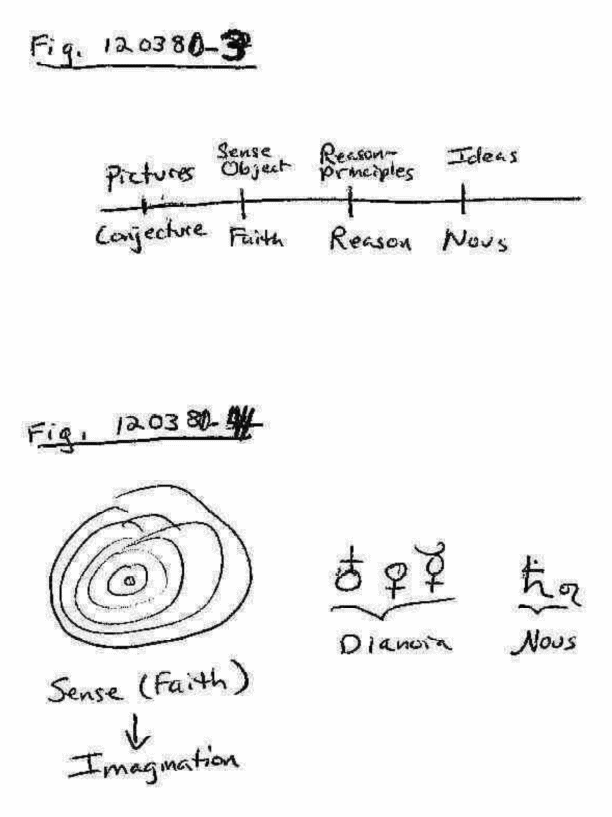
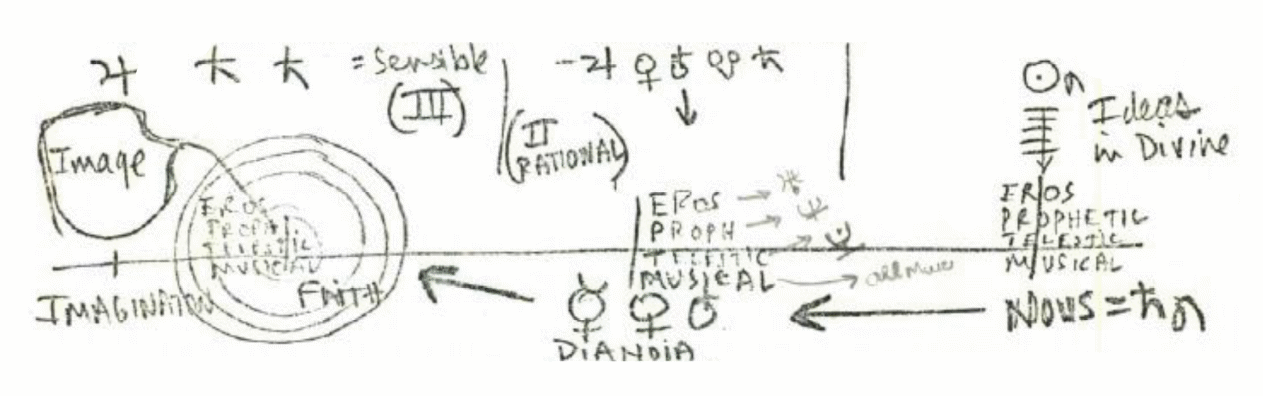
[FIGURE 1980 1203a-4-JF. Metaphysical Chart components with Sense/Imagination, Dianoia, Nous. Facsimile scan of redrawn version from jf's class notes.]
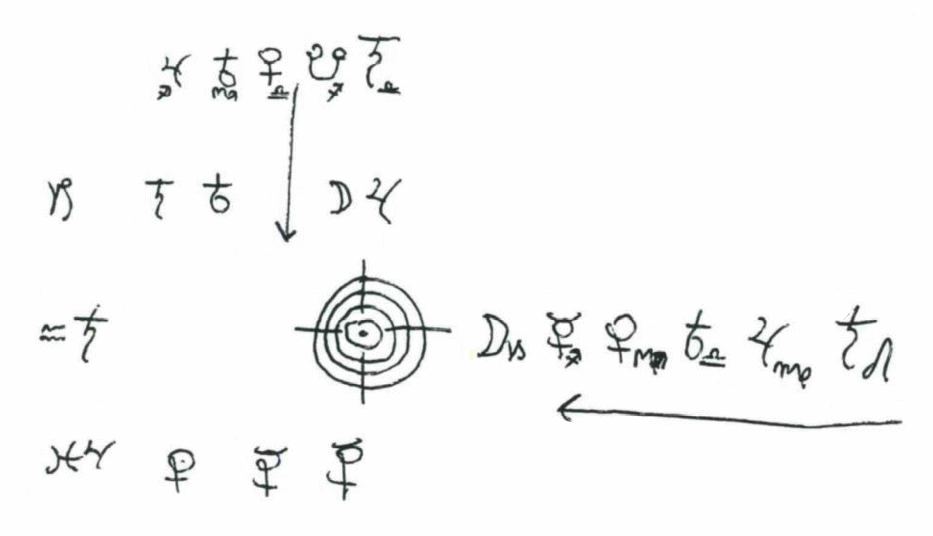
Class
Wednesday, December 3rd, 1980
Verbatim, unedited transcriptClick the series name to view more
CLASS at Wisdom's Goldenrod, Hector, NY
with Anthony Damiani (AD)
December 3a, 1980
NEO-PLATONISM; ASCENT TO INTELLECTUAL BEAUTY
TOPIC: Neo-Platonism
SUBJECT: Ascent to Intellectual Beauty
SUBSUBJECTS: "Plato and the Four Inspirations" (Shrine of Wisdom article), Divided Line, Soul as Gnostic and Fabricative, Art, Music, Gods, Aspects
CONTENTS:
Shrine of Wisdom quotes
4 stages of descent, ascent
4 of Divided Line, 4 Inspirations
Musical lowest corresponds to planets & Head & Tail or 9 spheres, in 12th
Telestic 11th
What is Telestic: virtue, good works, will
How do we know a person's level: by outward descriptions
Perhaps inspiration filtered by aspects
Hard to tell what inspiration is, especially inwardly
Ring Soul
Levels of these 4
Beethoven example
Dante, 3 divisions in Divine Comedy
Hindu scripture (book) considered as embodiment of the God
Plotinus on the musician, I.3.1
The musician
Student discussion on experience, images
Immaterial knowledge connected with imaginal experience
Deck tree example
Highest, all essences included in Idea of Man
2nd, 3rd, 4th Q. of Soul ring
What are reason-principles?
Saturn in Leo & context
Mars, Venus, Mercury & rulerships of 3rd Q
Difference between 2nd & 3rd
Absolute Soul (rulers and exaltations in 3rd Q.) eternal & its products (detriments and falls in 3rd Q.) in time
2nd (Ideas in stasis), 3rd (Ideas in motion)
The object
Sense & conjecture together
Opinion
Animal faith
Conjecture
Why unification of frenzy and inspiration needed
"Inspiration & Art" quote
Soul as a plurality
4 levels of Gods
Inspiration, its delivery, soul or Gods
Beethoven
Inspiration: 3 levels, 4 faculties
Bring it down
Technique & inspiration, Cezanne
Dianoia
Archimedes example
Functioning of reason in imaginal body of Sun
Tracing back, complicated
Fabricative & gnostic
Beethoven
Intelligible vs. physical fire
Beethoven
Imagination
Conjecture & referent object
New things never before in the sensible
Lowest of gnostic faculties still has direct access to reason-principles
Divided Line diagram
4 sections of Divided Line, 4 passions
Vertical & horizontal
Must come into sensible
But mostly we don't know the Intelligible
Shelley "Hymn to Intellectual Beauty"
Inspirations & daemons
Participating in providential knowledge
What is inspiration & who receives it?
From Gods, Soul interprets according to its own mode of being
4 levels of Gods, inspirations
According to the mode of being in Soul
No sliding scale
Musical vs. Amatory
Each one at highest level, 3 ways
What is inspiration, who gets it?
Knowledge of the Gods in inspiration
Inspired person mouthpiece for the Gods
Looking to unity
All the way down
Amatory: fascination–at all 4 levels
Rays vs. inspirations
4 manias minimum required
BOOKS / MAGAZINES READ FROM OR REFERENCED:
William Oliver Strunk (ed.), Source Reading in Music History, Volume 3
Pontus de Tyard, Solitaire Premier, Ou, Prose des Muses, Et de la Fureur Poetique (First Solitaire or Prose on the Muses and Poetic Furor)
Shrine of Wisdom, "Plato and the Four Inspirations"
Brother Lawrence, The Practice of the Presence of God
Plotinus, The Enneads (MacKenna translation, 4th ed.)
Vyasa, Bhagavad Gita
Dante Alighieri, The Divine Comedy
Plato, Phaedo, Republic, Symposium
Percy Bysshe Shelley, "Hymn to Intellectual Beauty", Prometheus Unbound
Thomas Taylor, Introduction to the Philosophy and Writings of Plato
PLOTINUS QUOTES READ OR REFERENCED: I.2.6, I.3.1, IV.3.30, V.1.12, VI.7.7
DIAGRAMS appended to this transcript:
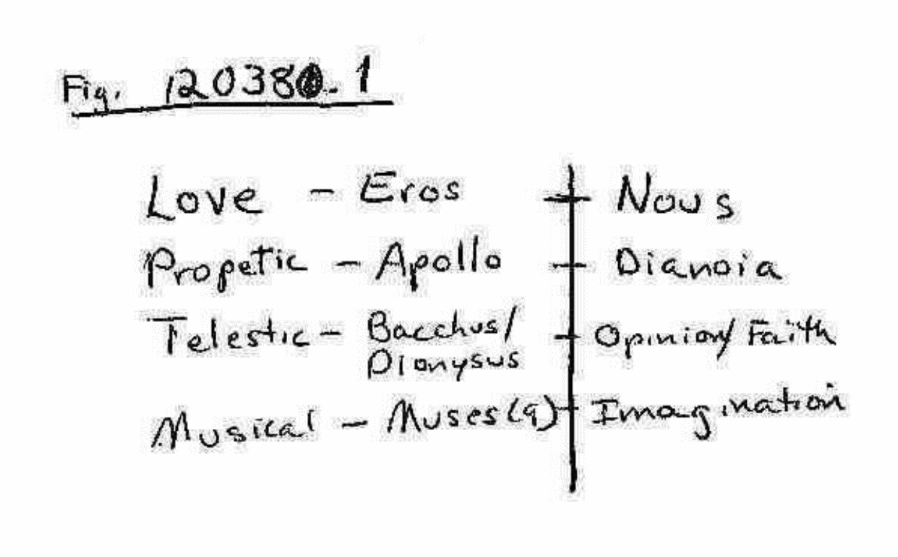
FIGURE 1980 1203a-1-JF. Four Inspirations & Divided Line/vertical.
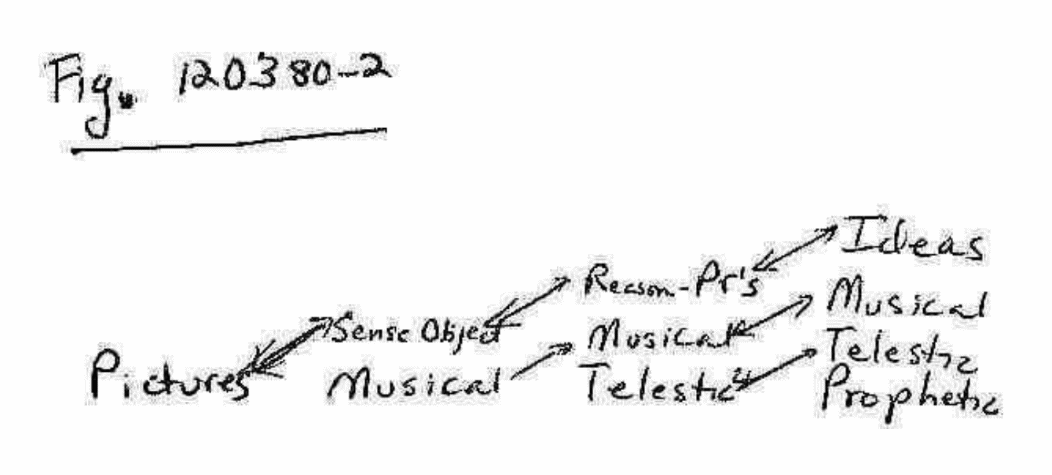
FIGURE 1980 1203a-2-JF. Stacked levels of Divided Line.
FIGURE 1980 1203a-3-JF. Divided Line/horizontal.
FIGURE 1980 1203a-4-JF. Metaphysical Chart components with Sense/Imagination, Dianoia, Nous.
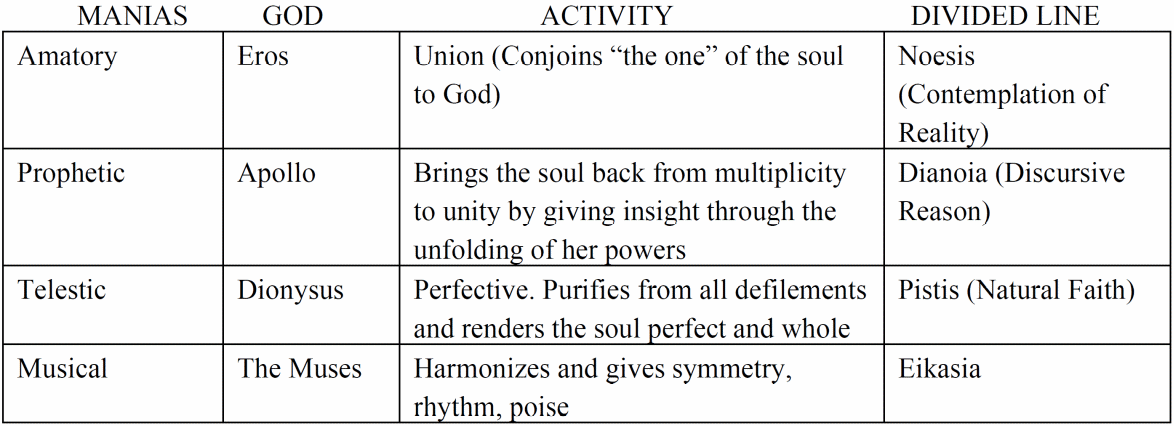
FIGURE 1980 1203a-5. Table of Manias/Inspirations from Shrine of Wisdom.
FIGURE 1980 1203a-6. Four Inspirations, Divided Line, and Orders of Gods.
FIGURE 1980 1203a-7-AB. Vesica of Houses 10-12 and Four Intellects.
FIGURE 1980 1203a-8. Four Inspirations and Divided Line.
FIGURE IMG_2202-Posterboard Metaphysical Chart.
FIGURE 1980 1203a-10-AB. Subject and Object Series.
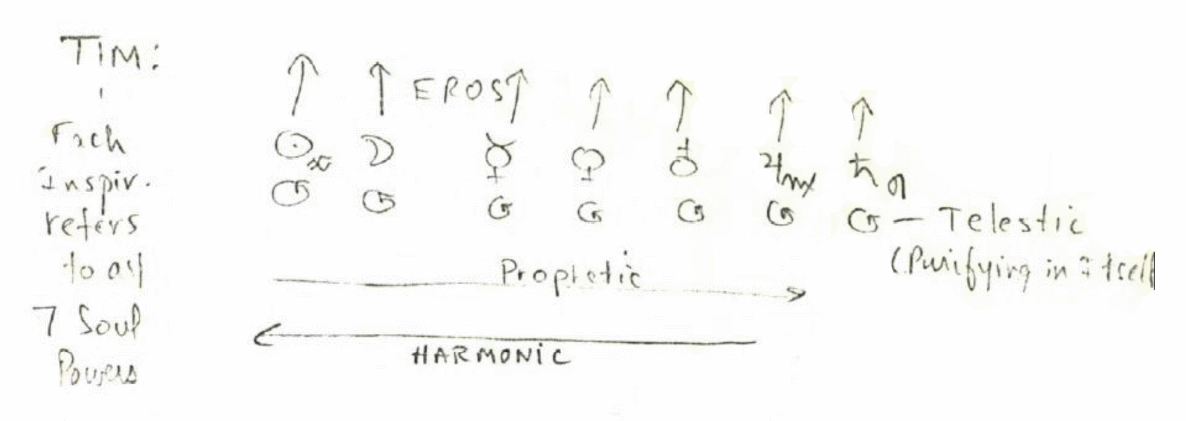
FIGURE 1980 1203a-11. Seven Soul Powers and Four Inspirations.
Other diagrams also referred to are not with this transcript version. [Transcriber note: [diagram] means the speaker is referencing a diagram as he or she is speaking. If someone is drawing or writing, with audible sounds of chalk on a blackboard, I indicate this by [drawing] or [writing].]
NOTES:
This is 1980 12/03a, Neo-Platonism; Ascent to Intellectual Beauty Class, and the first entry associated with this date. 1980 12/03b = Buddhism; Tenets, for which we have no audio, just JF notes.
Earlier partial transcript exists (Scan File 1980 1203C3 PLA four inspirations with diagrams.PDF).
This class is part of a series on Beauty, Essence, and Inspiration. See also WG Classes 1980 1112, 1113, 1119, 1126, and 1128. 11/26/80 begins the discussion on the Four Inspirations.
See also Plato on the Divided Line, end of Republic, Book VI.
Wednesday evening class.
TRANSCRIBED Verbatim by IT prior to 2018, reformatted by jf 2018. Originally transcribed by June F. in 2006, part of Plato set. In 2023, IT updates prefatory matter, footer, and audio file name, alters Topic, Subject, Subsubjects to make more accurate, completes Book List, adds Plotinus quotes section, fixes errors/typos, adds new notes within transcript, adds six diagrams and references within transcript to these diagrams, reformats to accord with new conventions. Archival verbatim transcript – V12a.
AUDIO FILES: 1980 1203a, 1980 1203b. [Note: "Tape" and "Side" refer to original audio cassette tapes that were later digitized into .MP3 Audio Files.]
1980 12/03a at Wisdom's Goldenrod
Neo-Platonism; Ascent to Intellectual Beauty
======================
SHRINE OF WISDOM QUOTES below for reference, needed for context for this class:
The following Shrine of Wisdom excerpts are from the essay series "Plato and the Four Inspirations," part I "The Nature of Inspiration" & part II "The Four Inspirations".
Shrine of Wisdom, p. 152: In the dialogue Phaedrus Plato distinguishes four kinds of inspiration or "mania." The word "mania" or madness signifies that which completely transcends the consciousness of the individual through whom it is operating, so that he is "not himself." … There are other manias besides the four given in the Phaedrus, but these four are the chief. As Thomas Taylor says, quoting from the Scholia of Hermeas on the dialogue: " … Here, however, he alone delivers these four manias because these alone are sufficient to the soul in the attainment of its proper apocatastasis (or complete restoration)."
Shrine of Wisdom, p. 155: Thus Plato distinguishes the four inspirations: the Musical, which inspires the soul to express itself in song and poetry; the Telestic, under the influence of which the soul is inspired to perfect itself and take the necessary steps which will free it from the evils and diseases resulting from sin; the Prophetic, which inspires the Soul to interpret the future so that men may direct their lives rightly; and, last and highest, the Inspiration of Love which arises in the soul as the result of the contemplation of Beauty.
Shrine of Wisdom, pp. 158-9: In his translation of the Scholia of Hermeas…Thomas Taylor says: "Since Plato here delivers four kinds of mania, by which I mean enthusiasm, and possession or inspiration from the Gods, viz., the musical, the telestic, the prophetic, and the amatory…we must first speak about enthusiasm, and show to what part of the Soul the enthusiastic energy pertains… Hence that which is primarily, properly, and truly enthusiasm from the Gods, is effected according to this one of the soul, which is above dianoia and above the intellect of the soul; which is at another time in a relaxed and dormant state. This one, likewise, becoming illuminated (by the Gods), all the life of the soul is illuminated, and also intellect, dianoia, and the irrational part, and the resemblance of enthusiasm is transmitted as far as to the body itself."
Shrine of Wisdom, p. 159, Scholia of Hermeas, cont.: "Other enthusiasms, therefore, are produced about other parts of the soul. For dianoia is said to energize enthusiastically, when it discovers sciences and theorems in a very short space of time, and in a greater degree than other men. Opinion likewise and the phantasy (eikasia), are said thus to energize when they discover arts, and accomplish admirable works, such, for instance, as Phidias effected in the formation of statues… You have, therefore, for the producing cause of enthusiasm the Gods; for the material cause the enthusiastically energizing soul itself, or the external symbols; for the formal cause, the inspiration of the Gods about the one of the soul; and for the final cause, good."
Shrine of Wisdom, p. 160: Thus it may be seen how inspiration, enthusiasm, or mania is, in its highest aspect, a divine gift, which can only be received through the one of the soul--that is, the soul energizing as a unity, with all her manifold energies and faculties directed to one end.
Shrine of Wisdom, p. 183, Scholia of Hermeas: "It remains, therefore, that we should unfold the nature of each of the manias, previously observing that those which are internal, and originate from the soul itself, and give perfection to it, are of one kind; but the external energies of them, and which preserve the outward man, and our nature, are of another. The four external, however, are analogous to the four internal manias."
Shrine of Wisdom, pp. 183-4, Scholia of Hermeas: "To this ascent [of the soul]…these four manias contribute. And the musical mania, indeed, leads to symphony and harmony, the agitated and disturbed nature of the parts of the soul, which were hurried away to indefiniteness and inaptitude, and were filled with abundant tumult. But the telestic mania cause the soul to be perfect and entire, and prepares it to energize intellectually. … The Dionysiacal (telestic) inspiration…renders it perfect, and causes it to energize according to the whole of itself, and to live intellectually. But the Apollonic (prophetic) mania converts and excites all the multiplied powers, and the whole of soul, to the one of it. Hence Apollo is denominated as elevating the soul from the multitude to the one. And the remaining mania, the amatory, receiving the soul united, conjoins this one of the soul to the Gods, and to intelligible beauty. …"
Shrine of Wisdom, pp. 184-5, Scholia of Hermeas: "But let us also consider their external energies on man, and what they outwardly effect about us. The musical mania…causes us to speak in verse, and to act, and be moved rhythmically, and to sing in metre, the splendid deeds of divine men, and their virtues and pursuits; and through these, to discipline our life, in the same manner as the inward manias co-harmonize our soul. But the telestic mania, expelling everything foreign, contaminating, and noxious, preserves our life perfect, and causes us to be sane, entire, and perfect, just as the internal telestic mania makes the soul to be perfect and entire. Again, the prophetic mania contracts into one the extension and infinity of time, and sees, as in one present now, all things, the past, the future, and the existing time. Hence it predicts what will be, which it sees as present to itself. It causes us, therefore, to pass through life in an irreprehensible manner; just as the internal prophetic mania contracts and elevates all the multiplied and many powers and lives of the soul to the one, in order that it may in a greater degree be preserved and connected. But the amatory mania converts young persons to us, and causes them to become our friends, being instructive of youth, and leading them from sensible beauty to our psychical beauty, and from this sending them to intelligible beauty; in the same manner as the internal amatory mania conjoins the one of the soul to the Gods. All the above mentioned manias, therefore, are superior to the prudent and temperate energies of the soul."
Shrine of Wisdom, p. 186: But the Musical Inspiration itself has various degrees, and the nearer it approaches to perfection, the more it partakes of the nature of the other inspirations. Thus Proclus, in his commentary on the Republic, distinguishes three kinds of poetic energy corresponding to the three lives of the soul.
Shrine of Wisdom, p. 188: The Musical Inspiration is said to be imparted by the Muses. The Muses were said mythically to be nine in number and were attendants of Apollo who, in this respect, had the name of Musagetes, Leader of the Muses. The Muses are not only the powers which enable souls to express themselves in poetry and song, but those which give harmony to the motions of the Cosmos itself… "For the Muses generate the variety of reasons with which the world is replete; but Apollo comprehends in union all the multitude of these." [quote from T. Taylor, Notes on the Cratylus] … Hence when the soul is truly inspired by the Muses, she is able to imitate in her works the divine harmonies of the Cosmos.
Shrine of Wisdom, pp. 188-9: The Telestic Inspiration is that which enters into the Ordinative Arts, or all those which are of a perfective, remedial, directive, and ordinating character. It is this inspiration which directs the activities of all healers, reformers, legislators…and carries them a stage further than would be possible by any purely deliberate and human power. … the ideals at which these arts aim are those of Goodness and Harmony, and…they depend more on the will and the volitional nature… Of this inspiration also there are many degrees, but in its highest forms the goodness which it brings to man is one which is not particular and partitive but universal and integral. … The Telestic Inspiration is said to come from Dionysus, with whose worship the Eleusinian Mysteries, the most celebrated institution of antiquity which was concerned with the perfecting of men, were connected.
Shrine of Wisdom, pp. 189-90: The Prophetic Inspiration is correlated with the Interpretative Arts, which reveal to mankind the profundities and mysteries of Infinite Truth. All sacred writings, all pure intellectual arts, all prophetic utterances are aspects of this form of inspiration. This it is which inspires every true teacher… Philosophy, Pure Mathematics, Dialectics and Logic, Education, and all systems of instruction are aspects…into which the Prophetic Inspiration enters. … In its highest aspect the Prophetic Inspiration is revelatory and initiatory, for it introduces the soul to the vision of Truth. The Prophetic Inspiration is received from Apollo, who is "the leader of intellectual and indivisible harmony." By the power of Apollo the soul is collected into one… Instead of beholding truth imperfectly and in different aspects at different times and by means of different faculties she beholds it perfect and entire.
Shrine of Wisdom, pp. 190-1: Last and highest there is the Inspiration of Love, by which the unity of the soul is conjoined with the Unity of all unities. This is the inspiration which enters into all those arts which may be termed elevative. Religion, which is the art by which man is enabled to return to God, is essentially an elevative art. … The giver of this last inspiration is Eros, the first of the Gods "who first leapt forth from Mind, clothing himself with the fire with which he is bound." "Love converts all things and assimilates them to the nature of the Beautiful." --Proclus in Theology of Plato. … In the Phaedrus Plato speaks of three kinds of love, into each of which enters the amatory inspiration.
See also FIGURE 1980 1203a-5. Table of Manias/Inspirations, redrawn from Shrine of Wisdom, appended to this transcript.
=============================================
[Audio File 1980 1203a Begins]
AS: --he know, and--
AD: Yeah.
AS: --on Plato, quoted-- quoted by somebody else but apparently--
S (faint): Well--
AS: It's not word for word. Says um-- and-- [short pause] Well, says here--
[15 second pause, noises]
[Transcriber note: The original source of the following quote is Solitaire Premier, Ou, Prose des Muses, Et de la Fureur Poetique (First Solitaire or Prose on the Muses and Poetic Furor) by Pontus de Tyard. However, the secondary source most likely being used is Source Reading in Music History, Volume 3, edited by William Oliver Strunk, W.W. Norton & Company, Inc, New York, 1950. I do not have access to the 1950 edition which would be the one read from, so all quotes need to be checked.]
William Oliver Strunk (ed.) [Source Reading in Music History, Volume 3, AS reading]: "…[AS adds: the] Platonic philosophers hold that the soul in descending into the body loses that unity which it enjoyed in the sovereign One, who is God. In this descent, the superior parts of the soul are overcome by the inferior parts and become drowsy and subject to perturbations(,) so that the whole soul is full of discords and disorders. The work before man is to make the return journey to the place whence he has fallen. In its fall the soul passed through four stages, and it must therefore also pass through four stages in its re-ascent. The four stages of the descent are, first and highest, [AS adds: he says] the Angelic understanding, second the intellectual Reason, third Opinion, and fourth Nature. The ladder by which the soul may rise back again through these four degrees is by the four kinds of divine fury. [AS: Says--] In four ways…man may be seized by divine enthusiasm. The first is by poetic enthusiasm, proceeding from the gift of the Muses; the second is by the knowledge of the mysteries and secrets of religions under Bacchus; the third is by the ravishment of prophecy, vaticination, or divination under Apollo; and the fourth is by the violence of amorous affection under Love and Venus."
[short pause]
AS: He has a little more. [short pause] He has this one. Does that make sense so far?
AD(?) (very faint): (Not yet.)
AS: No? Some of it didn't to me but [couple words inaudible] (AS laughing)
RG (simultaneously): Yeah, I mean, I don't understand what the middle two are, I mean, [AS: What?] what-- whatever that is. (RG laughing) Maybe--
AS: I mean, ignoring his original-- [RG: Original, yeah.] the descent--
RG: What the prophetic inspiration.
AS: Yeah. Well I-- he hasn't said much yet. (AS laughs a bit)
RG: Well--
AS: He just sa-- this-- he says [AS paraphrasing] the four stages of the descent are first the angelic understanding. Well, I could see-- the Nous. Second, the reason; third, opinion; and fourth, Nature. And the ladder by which the souls may rise again through these four degrees is four kinds of divine fury. He doesn't say much about them.
S: That's-- so that's enthusiasm [couple words inaudible]
AS: Yeah, the ones that we read [one word inaudible] Well, I mean, I don't know we start from the highest or the lowest. Should we put them on the board again Amy?
S: Sure.
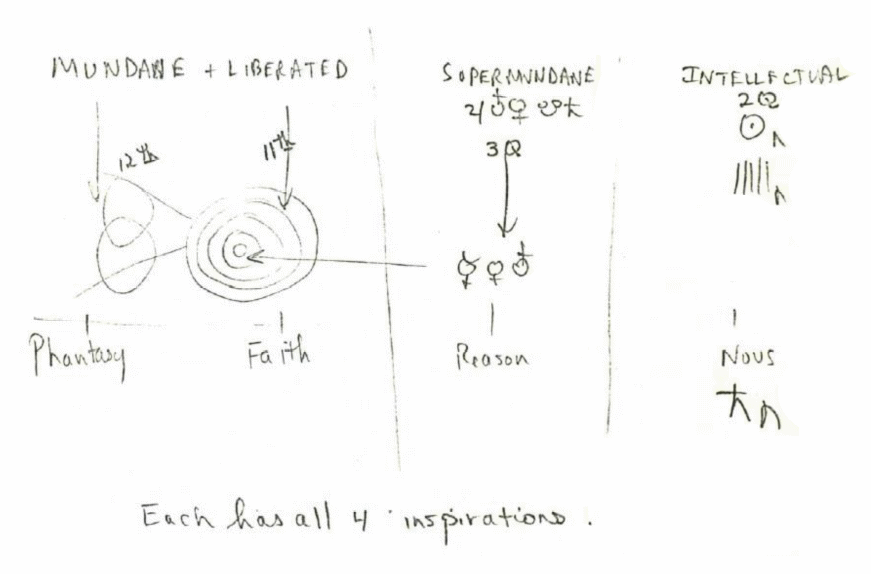
[Note: See FIGURE 1980 1203a-1-JF, Four Inspirations & Divided Line/vertical, appended to this transcript for the following.]
AS: Ok. So the-- starting from the highest one, the highest one, he says is Love or Eros, [short pause while writing] under the-- Ok, and he corresponds them with a certain God, ok, Eros. And the second one, [writing] the second, if we put them in a hierarchy, which sometimes he does, the second highest he calls the Prophetic, to which he ascribes the God Apollo. Ok?
S (very faint): Ok.
[short pause]
AD (very faint): Bacchus was the next one.
AS: Yeah. I'm trying to read this, I got some word here. Oh, ok. Ok, the third one he calls in here Bacchus [writing] or Dionysus, [short pause while writing] ok, which is the Telestic, which you could also say has to do with the purification associated with the will, the mysteries, the development of the virtues and so on, but we should do that going backwards. And then the Musical [short pause while writing], which there are nine. The Musical for them includes poetry, actual music, dance, history--
LDS: Painting.
S: Painting.
AD: The expressive arts, [AS simultaneously: Well, painting.] all the expressive arts.
AS: Yeah. And, the Muses. [writing] Now, as you'll see in this, and perhaps we should read right from this-- He has this line here where he now says:
[Transcriber note: JF is using "Plato and The Four Inspirations," Part I, The Shrine of Wisdom, Vol. VIII, No. 29, Autumn 1926.]
Shrine of Wisdom ["Plato and The Four Inspirations," Part I, p. 157, AS reading]: "There is an intimate correspondence between these four faculties and the four inspirations."
AS: Ok, and that's part of what we want to investigate, what this intimate correspondence is. Now the four faculties, which we've described before as Nous or Noesis, [writing] or Intellection, apprehension of the Ideas, ok; Dianoia; opinion or faith; and [S, faint: Perception of shadow.] imagination, [S, faint: What page?] or phantasy. Call this the imagination. [short pause while writing] So he says that--
Shrine of Wisdom ["Plato and The Four Inspirations," Part I, pp. 157-158, AS reading]: "There is an intimate correspondence between these four faculties and the four inspirations. Thus Noesis, or the vision of universal ideas of real being, corresponds to the inspiration of love; Dianoia to the Prophetic Inspiration, because by means of the use of reason man is able to interpret the significance of that which he sees around him. The Telestic or Perfective Inspiration corresponds in a general way to the faculty of Opinion or Pistis, because both depend mainly upon the will. It is the will which operates when man sets out to ordinate his life, and the will which decides, in the absence of rational knowledge, whether a given opinion shall be accepted or rejected. Finally the Musical Inspiration similarly corresponds with Eikasia [AS: or imagination], for this inspiration is the least conscious of all and pertains more to the outward than [to] the inward nature of things."
S: Yeah.
AS: But then he goes on and says--
Shrine of Wisdom ["Plato and The Four Inspirations," Part I, p. 158, AS reading]: "This correspondence is not rigid, for any or all of the [four] inspirations may operate through any [or all] of the four faculties [and] it is thus possible for the soul to ascend to the heights on the wings of any one of them."
[short pause, couple very faint background student words]
AS: What?
S: Would you read it again?
AS: Yeah. Then he goes on to say:
Shrine of Wisdom ["Plato and The Four Inspirations," Part I, p. 158, AS reading]: "This [AS reads: The] correspondence is not rigid, for any or all of the four inspirations may operate through any [or all] of the four faculties [and] it is thus possible for the soul to ascend to the heights on the wings of any one of them [AS reads: of these faculty]."
AS: Any one of these inspirations.
[14¾ second pause]
AD (faint): Continue.
AS: Ok so--
CDA: Is that all he says about that?
AS: Hm?
CDA: Is that all he says about that, about--
AS (simultaneously): Right there that's all he says.
S: Where are you reading from Avery?
AS: Oh that's from the Shrine of Wisdom article.
S: What?
AS: I'm sorry, page 157 to 158. Um-- I don't know that he speaks much more about it in here. Well we'll read a few more quotes in a minute. Let me just see if he-- He has some-- [short pause] Let me read a little from here. This is again from this Ficino. Um--
William Oliver Strunk (ed.) [Source Reading in Music History, Volume 3, AS reading]: "The lowest point which the soul, in falling here below, has reached is the body, to which he is so firmly attached…that the superior part is stunned and astonished…by its fall, and the inferior part agitated and full of perturbations… She seems incapable of any [just] action unless, by some means, this dreadful discord is transformed into a gentle symphony, and this impertinent disorder reduced to a measured equality, well ordered and ordained. [And] to do this is a [AS reads: the] peculiar duty of Poetic enthusiasm, awakening the drowsy part of the soul by the tones of Music, [and] soothing the perturbed part by [the suavity of sweet] harmony… [short pause] [AS: And so on]. Yet this is as yet as nothing, for the inconstant solicitude of diverse opinions caught up in the continual movement of a multitude of images and corporeal species must be effaced, and the soul now awakened and well ordered must concentrate the parts and powers which are so diversely diffused and separated. For this is proper the holy communication of religious mysteries and secrets and the purifications and devotional offices which incite the soul to gather herself together in dedication and complete reverent intention, prostrating herself before the divinity which she adores. And when by these means the diverse powers of the soul formerly dissipated here and there in various exercises are drawn up and gathered together in the unique intention of the reasonable understanding, then the third enthusiasm is necessary to set aside these intellectual ratiocinations, concerning principles and conclusions, and to reduce the understanding to union with the soul. This comes about through the ravishment of prophecies and divination. Whoever is moved by divining or prophetic enthusiasm, in the interior contemplation he joins his soul and all his senses together, rising high above all apprehensions of human and natural reason, to draw from the most intimate, remote, [AS: Ok.] and profound divinity the prediction of those things which must come to pass. Finally, when all that is in the essence and in the nature of the soul is made one, she must, in order to return to her source, suddenly withdraw herself into the sovereign One who is above all essences. [AS: Well, I mean--] [AS misreads:"And this is the great Celestial Venus."] [And] this the great and Celestial Venus accomplishes by love, that is to say, by the fervent and incomparable desire which the soul, when so elevated, has of enjoying the divine and eternal beauty."
[short pause]
RC: Would you read that again, starting with the essences part, above [one/two words inaudible]
AS: Yeah.
RC (faint): And the sentence before that.
AS: Yeah.
William Oliver Strunk (ed.) [Source Reading in Music History, Volume 3, AS reading]: "Finally, when all that is in the essence and in the nature of the soul is made one, she must (in order to return to her source) suddenly withdraw herself into the sovereign One who is above all essences. And this the great and Celestial Venus accomplishes by love, that is to say, by the fervent and incomparable desire which the soul, when so elevated, has of enjoying the divine and eternal beauty."
[12¼ second pause]
AS: So it-- [student assents] [15¾ second pause] I think this who-- Is it worth going over that Anthony or not?
AD: But why don't you try a little bit with the four gnostic functions, line them up.
AS (simultaneously): Ok. You want a diagram at all?
AD: Yeah.
AS: Ok well, I-- tentatively, let me just talk about it a little first and then see if there are any quotes that can substantiate this but-- But if we start at the lowest one perhaps, where he says that the Musical or the Muses is associated-- the inspiration of the Muses is correlated with the Imagination. But, he says--
[Transcriber note: JF is using "Plato and The Four Inspirations," Part II, The Shrine of Wisdom, Vol. VIII, No. 30, Winter 1926.]
Shrine of Wisdom ["Plato and The Four Inspirations," Part II, p. 188, AS reading]: "The Muses are not only the powers which enable souls to express themselves in poetry and song, but those which give harmony to the motions of the Cosmos itself…and in the Norse [AS adds: myth] to the nine giant maids who turn the World-mill." (bit of laughter)
AS: And in this little thing and in several places he talk about-- he talked about the imagination or the imaginative realm, it seems like this first-- if we do them in a kind of hierarchy, I don't know-- what do you think, it seems like the first level, the Musical, refers to the-- to the harmonization of the imaginal essence or the 12-- the whole 12th house realm that we spoke of. Now, I think last week we were talking about, these Muses seem to correspond to the motions of the-- the seven planets plus the Head and the Tail for example.
AD: Or the other possibility is they refer to nine spheres, I think.
AS: The spheres.
AD: Eight spheres and the totality is the ninth.
[Note: See FIGURE 1980 1203a-6, Four Inspirations, Divided Line, and Orders of Gods, appended to this transcript for the following.]
AS: Yeah. So if we talk about [drawing] within the 12th house, ok, we have an in-- the inerratic sphere [diagram]. This is all imagined within the imagin-- within the 12th house world, the realm of the representation or imagination. And we talk about the spheres of these planets [diagram]. Now I don't know, this is just a conjecture too so, you know, I'm not sure. But it seems that, at least outwardly, the representations of the imagination are in this 12th house realm and that, on the lowest level, the Muses which are concerned with manifesting this, the Mundane Gods in other words, concerned with-- the cosmocrators who are concerned with manifesting this world, are what give harmony to the universe and are what inspire the ima-- what inspire our imaginative activity with their providence, let's say. So, I mean, at this level, [drawing] at the level of this who-- considering the whole 12th house as constituting this whole realm of imagination or representation, that it would be these cosmocrators or Mundane Gods who would be inspiring you with this Musical inspiration, the inspiration of the Muses at the lowest level. So for example there-- outwardly, see, as they-- In here he speaks also inwardly and outwardly. Outwardly, most of these are always associated with some kind of actual external embodiment, like either in terms of music, in terms of actual notes, or in art, in terms of an actual medium, a physical medium in the imagination. This also seems to correspond to that first tantra level that they speak of, the Charya Tantra, where there's an actual physical object that you concentrate on, or the object of your devotion, or a beauty let's say, is some actual-- is some sensible object. Ok, so, I think--
Now, I'm going to try and do them first just by doing them by levels. Because then it gets complicated when he says that well, each of these is actually on all four levels. So I'm not really quite sure how to do that yet. But the next one, see, seems to be going from the outward manifestation to the inward. This really seems to do with the purifying of the vasanas that we find in the 11th house, the Telestic, the Mystical, Faith. Also, he speaks of all of the purifications there. You know, he even [writing] calls this Faith sometimes in the Divided Line, and all of the Virtues, and also roughly the-- the early Paramitas I think that they speak about. For example, the perfection of-- the perfection of charity, the perfection of strength, sila, the perfection of manners and so on, these-- the first five at least seem to deal-- up-- even up to the one, the perfection of meditation, seem to do with actually stilling the motions of the vasanas, actually purifying internally.
So like a Telestic-- oh, I don't know, we thought of maybe this example, Telestic inspiration, like uh-- Musical I think we can see obvious outward examples of Musical inspirations, you know, produces a great work of art externally or a great musical piece. This one [Telestic] I was thinking maybe something like the Brother-- the Brother Lawrence example that we had. Sees this tree and he's suddenly inspired to realize that his whole life was, you know, just meaningless in this outward way. Something inward had to be developed now, he had to go through this whole purification proce-- process maybe. [CDA: What about--] It was some kind of a Telestic inspiration. It was going to work on his-- So I'm-- It seems that, I mean just roughly, what I'm trying to say I guess, is if this-- if this refers to the fourth-- well, I don't know how to-- I'm trying to do it in a-- on the whole scheme. [drawing] But if this first one [AS indicates on diagram] refers primarily to the imagination which we put in the 12th house, this [diagram] seems to refer to the 11th house, the purification of the vasanas.
SD: The 11th house of what?
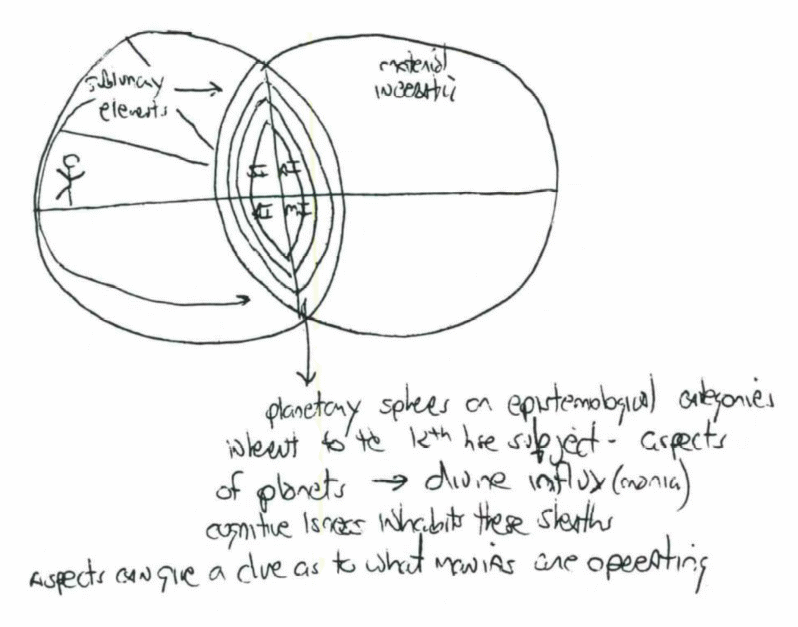
AS: Well ok, let's-- [students assent, faint] That is of course not the 11th house of this vesica [diagram], [Note: Acquired Intellect in FIGURE 1980 1203a-7-AB, Vesica of Houses 10-12 and Four Intellects, appended to this transcript.] but that's-- see that's I think, if we get into the difference between [student assents, faint] putting the [drawing] four gnostic faculties all in the 11th house, [Note: Four Intellects in FIGURE 1980 1203a-7-AB.] or spreading them out 12th house, 11th house, 3rd quadrant, and back to the Saturn, [Note: See FIGURE 1980 1203a-6.] I think that will be the difference between when he says each correlates to a gnostic faculty and yet each one can go through all of the gnostic faculties. I think he's-- I think he must be mixing up the two levels, the two different levels of which we speak of the gnostic faculties, namely all at one-- one level as it were or spread out through the chart.
CDA: Didn't ritual go with Telestic?
AS: Yeah. [CDA simultaneously: Ri-- religious ritual.] Ritual, religion, but-- yeah. But also-- I-- see I'm not positive, I mean we'd have to read some of these quotes but, I think also-- well let me read these.
Shrine of Wisdom ["Plato and The Four Inspirations," Part II, p. 189, AS reading]: "The Telestic Inspiration [is] said to come from Dionysus, with whose worship the Eleusinian Mysteries, the most celebrated institution of antiquity [which was] concerned with the perfecting of men, were [AS reads: was] connected."
[short pause, flipping of pages]
AS: Let me see. Well, see the outward examples he gives are leaders--
S (very faint): [few words inaudible]
S (very faint): (Well--)
AS: See--
[short pause]
S (faint): I'm already lost.
[short pause]
AS: Well, as I said, I don't know, I was thinking of the chapter in-- for example, in Plotinus where he speaks about the virtues. I don't really want to read from it right now, but--
[short pause, flipping of pages]
AS: Oh, it's right here. He says-- [9¾ second pause] "…the supreme Rectitude of the Soul…" [Note: See Plotinus, I.2.6.] Well, he goes through them all there, I can't do that. Sorry. Here he's talking about purification going through all-- through all the levels. That's a good example of that but it's not good for this. I think we spoke about it mostly as kind of purification. In term-- he speaks about it in terms of religion, but what do you think? He talks about it in terms of the will. I mean, I guess [RG assents] you sit down and meditate and you try to still your thoughts. I suppose that that would be, you know, this Telestic operation, purifying operation.
S: Or like, you'd have that kind of insight that-- of the karmic sequence of thoughts, wouldn't that be that, you realize that your thoughts are making the next moment and those are making, you know, and you realize what karma is, wouldn't it be that inspiration?
[student assents, very faint]
AS: Yeah, also when you perform-- somebody who's into performing good works-- yeah, karma. I mean like he gives examples of world leaders, like Gandhi and so on, somebody like that would have really a fantastic Telestic ins-- inspiration to lead his country and-- It's not a Musical inspiration, ok, it's really one of a recognition of the greater good of humanity, and of performing works of compassion and so on. Would all be somebody who is not-- not working-- I mean that would be an example of not somebody who's working on purification but who had reached some degree of purification so that this inspiration could come into him.
SD: Well in terms of the working outwardly it's like he's purifying the institution or a country or whatever that he's working with. Or as a ruler, you can see that outwardly that the ruling involves the sort of bringing into one orderly form the various impulses of a-- of a country, whereas internally one would be trying to rule [AS assents] oneself.
AS: Yeah. Now, can you s-- [drawing] I don't know, can you see a correlation with the notion-- with the way we spoke about opinion and the Divided Line? That's a-- that's harder.
RG (simultaneously): Yeah, because I-- I don't think operating according to the Telestic you really-- you know the causes of your action. [AS assents] You'd have an ideal of goodness, [student assents, faint] but you're [AS simultaneously: (couple/three words inaudible) religion.] acting in according-- yeah, you're acting in [AS assents] accordance with the o-- the real object, the world, [AS assents] but you're not aware of the-- of the underlying causes.
AS (simultaneously): The causes behind it. Yeah, and for example like, you know, you might-- you'd read like the Gita, it says, well, do these certain [RG simultaneously: Right, and you do them.] works and then you do it, [RG: Right.] you know, you actually go ahead and do it, like karma yoga. Seems that would operate that way. [S simultaneously: Why (would it) be--] You would-- you would be performing the operations without knowing the ca-- without knowing the causes of it.
S (simultaneously): I think if you really were inspired on that level, it would only be because you actually knew in your very being what karma was, you actually knew that you needed to act this way in order to purify yourself, in order--
RG: But know [AS simultaneously: You knew that you did.] in what sense, know in what s-- in the will you know, I think, but you don't know in terms of-- [AS drawing] of an intellectual insight, which would be to the next level, I think, which is [S simultaneously: Oh, ok.] equivalent-- equivalate-- [student assents] would relate to dianoia.
AS: You don't have a direct apprehension of the reason-principles.
RG (simultaneously): In other words, the idea appears clearly to do this action and your will engenders it. And in that sense it's clear, it's a clear inspiration, but it's coming through the will.
SD: When we make the correlation of the inspirations with the gnostic faculties, is it that it operates at that level, or is it that each of the inspirations is what forms a [AS simultaneously: That's--] bridge as it were to go from that gnostic faculty towards the one above it?
AS: That-- What we have to talk about of course is, what is the relation between the inspiration which comes to the faculty and the faculty itself, I mean, obviously we're often operating in the imagination or the opinion, we're not always being inspired, ok. What is it that's going to bring about an inspiration into this particular faculty? Even agreeing that (there/their)-- that different faculties will get their inspiration from different Gods or different places, exactly what do we mean by that?
SD: Wouldn't it be something along [couple inaudible student words simultaneous with SD] the lines that the inspiration [couple inaudible AS words simultaneous with SD] is what brings the phantasy or whatever functions or gnostic faculties is affected here, brings it into accord with what's above it so as to align it with the higher faculties?
AS: Well I mean if we do this lowest example here, as it were, perhaps-- I say lowest but perhaps it's-- perhaps it's applicable for all four of these, see, that's-- we need to get into that somewhat, the example where the guy is actually here [drawing; see FIGURE 1980 1203a-2-JF, Stacked levels of Divided Line, appended to this transcript for this and following discussion] in the physical world here, you know, here he is, and let's use-- let's say we're at the level of the Musical inspiration, because we haven't decided if these [diagram] fit there too. And, you know, he's going to-- go--
RG (simultaneously): Yeah, but wouldn't all those have to operate in terms of a real physical [one word inaudible]
AS (simultaneously): They will-- Well yes, that's the thing, they're all going to operate-- so I think we'll see that all of these are going to be reflected in the-- in the imagination, too. In fact, every time-- the des-- all the descriptions we give will be of the outward man. Because we'll say, oh, how do we know he's musically inspired? He wrote a piece of music or he-- he did a piece of art. How do we know he's telestically inspired? He's a great leader or something. How do we know he's prophetically inspired? [RG, faint: Great teacher.] Yeah, he's a great teacher. How do we know he's inspired by Eros? Ok well it's [student assents] obvious. (bit of laughter, students assent) Has divine-- [few inaudible RG words simultaneous with AS] you know, divine union. [S: (See--)] That one's not so outwardly obvious (according to) the man. He has Nirvikalpa samadhi or some people [one/two words inaudible] (bit of laughter)
TS (very faint): That's the outward.
AS (simultaneously): But-- That's the out-- [RG: That's the outward.] but-- (some laughter, student words) No but the que-- but on the lowest level may-- I don't know, I-- I thought we used some example like this, like your chart, [drawing] you know, you have certain aspects-- certain aspects one day and an inspiration comes to you. You could do some piece of art or you produce a great [student assents, faint] piece of music.
RG: Or you get an [AS simultaneously: No--] intuition into some idea.
AS: Or you get an intuition into some idea. Or you get a divine inspiration of how to act. Right? I mean, we got Brother Lawrence, he sees the tree. Or you have Uranus on Venus and you have some kind of samadhi or whatever. So, in some way, it gets-- I think we're getting into the-- the convolutions rather quickly but obviously in some way, there is some [drawing] relation even here of these-- of say the aspects of the cosmocrators to all of these different kinds of inspiration, or at least there seems to be. Now perhaps it's only that the inspiration's always going on at some higher level and only when the aspects are good is this filtering down. I mean that's a complicated problem. They say the Gods are always pouring forth their Providence or Goodness but we just aren't fit to receive them. And maybe this is just indicating when our vehicles or whatever are fit [student assents] to receive, when our gnostic faculties are fit to receive these inspirations. Now does this also tell us which [drawing] of the gnostic faculties is going to receive the inspiration? Can we actually see that from the transits? [S, very faint: Yeah.] I don't know, maybe, I mean-- If we say there's some indic-- you know, even if-- even if he has any-- even at the level of Nous there's some divine union you'd say, well you'd look to his chart and try and understand, you know, [student assents] if there's some correlation, you'd say well, this indica-- does this mean that oh, the Providence was given often? No, the Gods-- as we (say/said), the Gods are always producing but this might [drawing] indicate when his faculties were fit to receive it or fit to receive that inspiration, corresponding inspiration, but it gets convoluted.
S: And like you wouldn't look at just a world leader's chart and say it's always Telestic. I mean [AS simultaneously: No.] it just seems to what you're saying now like, you know, in a way [AS simultaneously: Um, I'm not sure.] that's an outward-- You say well Gandhi was only-- it was a Telestic inspiration.
AS: It may be though.
RG (simultaneously): Well o-- only-- only in his aspect as a-- a world leader, we don't know what went on inwardly.
S: Ok, that's what makes a really--
AS (simultaneously): In-- inwardly. That's another convolution, [S simultaneously: They all-- (RG simultaneous with AS: Yeah.) they're all in there.] right? That's the other convolution, you say well, on one way they're-- they seem to be graded but he says someplace, we read I think, one of the things he said that, any one of these four can take you up to the highest levels. For example through the Musical inspiration you could-- Beethoven had this vision of the spheres now. I don't think we would-- or he had a vision of the Muse, the Intellectual Beauty or music at some [one word inaudible] and we don't know what his internal experience was, perhaps, but certainly wouldn't (necessarily/necessary) limit it to this lowest realm, to the 12th house realm.
RG: Yeah, it also seemed the working of the Mu-- of the Muses in that inspiration and the workings of Eros are very-- you know, it's very hard [AS simultaneously: Hard to distinguish.] to distinguish and they interrelate all the time.
PD: But if by definition the object of the imagination's knowledge is a phantasm, how can you say it apprehends an inspiration that's at the level of the Gods?
AS: How can you say that it apprehends?
PD: Well--
RG: I mean the physical-- but when you're saying there's a physical being in the 12th house, you're always talking about the corporeal aspect.
[student assents]
PD: Yeah, but the function in the being that realizes the inspiration that's at the level of the Gods isn't the imagination.
AS (simultaneously): Isn't there, no.
RG: No, that's [one word inaudible]
AS (simultaneously): So we have to bring in the rest of it.
RG: Right, just as when we say the body of the planet is doing the transiting in the 12th house, we don't mean it's the body-- it's only that-- that mass of matter up there that we're calling Saturn. And that's working on a soul level [AS drawing] also, interacting with the soul of the individual I think. But see--
LR (simultaneously): I don't think it is in this explanation you come up with (a third/the chart).
AS: No, I-- I'm-- I was just-- I was trying to do-- I was first trying to understand what he meant by this correlation.
LR: I know but it's--
AS: And there is some.
RG: Yeah.
AS: I mean I think he-- these two [diagram] seem to fit. The will, ok, does fit with opinion in that this doesn't know the cause. The next one does actually know the cause, the reason-principles which are the cause of the thing, the Prophetic. He does have some vision into the Intellectual-- into the reason-principles. This one, Nous [diagram], is the apprehension of Real Being, the Divine Beauty, ok, at its highest level. But now there are several things, I mean, even though it's at its highest level [drawing] correlated to the Nous, we don't want to say there's no love down at this level [diagram], I mean it also filters all the way down. See, I have two-- let me just put up this little scheme which I-- The-- maybe there's something in it but-- maybe there's something of what Paul was getting at, I'm not sure. I think what Paul-- what-- maybe what you were saying is that the imagination [drawing] may happen here, the aspects and so on happen here [diagram], but what's really getting inspired is not this imagina-- imaginal being. I mean imagi-- suppose you were in the dream, for example, something goes on; this little guy in the dream, some big impulse comes in from outside. The little guy in the dream isn't the one who's really being inspired. The purpose of that inspiration, the-- what is being inspired we would say is truly the soul, [few inaudible PD words simultaneous with AS] in fact he says the one of the soul.
PD: Take for instance like the-- when we speak of Beethoven's mystical experience, the external [student assents] realization in music is [AS assents] at the imaginal level maybe. [AS: Oh yeah.] But where the experience is in terms of his [AS simultaneously: Sure.] being would be the Nous.
AS: Right, well that's-- so-- in terms of his being would be the Nous, yeah.
LR: So how can you--
RG: But that doesn't answer the question [S: Yes.] of how change gets effected in the vehicles to allow at certain times inspiration to happen and at other times not.
AD: Well the best way would be to put up the ring Soul [diagram], [AS simultaneously: That's what I was going to do.] and then the--
AS: Well that's what I-- [drawing] I was going to do this [couple/three words inaudible AD words simultaneous with AS] diagram, I don't know if it's-- Should-- I can-- should I do it here?
S: Uh-hm.
AS: You can't see there Anthony? I'll-- I'll get rid of this.
AD: (Good.) Well get rid of it.
AS: I'll erase this.
AD (simultaneously): [couple words inaudible]
[Note: See FIGURES 1980 1203a-4-JF, Metaphysical Chart components with Sense/Imagination, Dianoia, Nous, and 1980 1203a-8, Four Inspirations and Divided Line, appended to this transcript for the following.]
AS: Well I have this tentative, you know, picture. [19¾ second pause while AS draws] Now-- I think in most of the places where he speaks of the one of the soul, he definitely is meaning the Saturn in Leo getting conjoined with the Intellectual-Principle or Divine Mind, [AD, very faint: Yeah.] being conjoined with the Nous, either the Sun--
AD: Wouldn't that give you the three levels right there?
AS: Yeah, one, [drawing] two, and the imaginal, three. [Note: Three Levels as: 1) Saturn in Leo (noetic); 2) Mars Venus Mercury (dianoetic, Soul ring planets); and 3) 12th house spheres of cosmos (imaginal).] Now these would be three levels of Eros.
S (faint): Of course.
AD (simultaneously): Three levels of anything.
AS: Of Love, yeah.
AD: How [three/few inaudible student words simultaneous with AD] about the others? [AS simultaneously: Ok, well--] It would give you the three levels of the others.
AS: Ok, well, of course that's-- I don't know.
S (faint): For Plotinus (and) [one word inaudible] too.
AS: Well, see what I'm saying is-- How could I say this? I think I see what you're saying, like if you talk about the Musical Inspiration then there would be one level of it which would be here [diagram] but that would only be the outer expression of it, just as the outer expression of this Love would be here [diagram], [S: Right.] ok. The next level, the rational or dianoetic-- [drawing] Maybe if we do it this way. If this is the dianoetic-- using the Divided Line in the largest sense, this would be the dianoetic [diagram], this would be the Nous [diagram], the Noetic, the first two levels of the Divided Line, you know, the highest two, which deal with the Ideas and the reason-principles. The next two levels of the Divided Line would really be in here [diagram], sense and opinion, or let's say opinion and phantasy.
Now, when he says that each of the inspirations can operate through all of the different gnostic faculties [AS indicating on diagram], even though there is some affinity one for the other, then from this diagram he would seem to be s-- and also where he says that each of the four inspirations can take you to the highest level, then it seems that the origin of each of these inspirations would be back here [diagram]. When he says the true nature of the inspiration is a contact with the-- is the unity of the one of the soul with the Divine Mind or with the Beauty of the Ideas, that would happen here for any-- for any of these inspirations [Note: at the level of Nous].
So the Musical, for example, here would be the outward expression of the music(,) would be in the imagination, the m-- the actual piece that the guy writes, you know, like Mozart or Beethoven. I think that's what Paul was getting at too. But a-- but that isn't-- the inspiration doesn't-- isn't originating from there, that's the expression of it. To find out [drawing] the reason-principles that went into that expression, you would have to go back here to the second level or the next higher level [diagram] and say that at this level, say in the Beethoven-- I-- you know, I guess in the Beethoven or the Mozart or Archimedes, here he would see-- he would have an inspiration more of a whole at this level, he would see this idea within the soul [AS indicates on diagram]. Perhaps he even had an inspiration-- [drawing] Now, this is where I get a little confused. Certainly there seems to be a level of that Musical which would be even in the Divine. But it's not clear to me that the inspiration always has to originate here or maybe it could originate at a lower level.
CDA: Well, wouldn't it depend upon what-- I mean not-- n-- the normal person doesn't have the reasoning soul as a faculty of-- as a conscious faculty, so it would depend on whether that was available, [AS assents] you know, of whether an inspiration could become conscious or actually, you know--
AS: Yeah, we-- we gave this example. [CDA: I see.] It may be that he-- you know, his music-- he-- he doesn't really have-- like, say Beethoven consciously had this experience up here, we suppose, but some other composer may not. He may produce very harmonic-- you know, it may be very harmonizing and pleasant, but he may not have actually consciously had the experience at that level. On the other hand, you could suppose that people would have union with the One or with the Divine Mind and not have to produce a musical piece or anything in this world of imagination. Now--
RG (faint): (Read) from Plotinus how the musician (exists) in those three [one word inaudible]
AS (simultaneously): Yeah, [CDA simultaneously: Uh-huh.] yeah, that's nice Richard.
RG(?) (simultaneously): [couple words inaudible] yeah, in the [one word inaudible]
AS: [couple words inaudible] is it-- is there some more comment on that or--
AD: On what?
AS: Well, I mean--
AD: Well, and Beethoven was a good example. He said "I don't create, I only bear witness to creation that takes place in my soul." But the possibility of working with a better example would be take a great literary work, alright. If you take a great literary work, let's say [AS simultaneously: Like Dante.] Dante's Divine Comedy, where you can see that there's, you know, the theological wisdom, that there is the rationality, and that there is the imaginative expression of that, alright, and one might easily be lead to presuppose that Dante had the Beatific Vision, especially if you read the third book, the Paradiso, and never mind the Inferno. Everybody reads Inferno, I don't know why. But there's a clear example where you can see the theological wisdom, you know, which would correlate with the Saturn, [student assents] alright, [AS drawing/writing] and the-- the Purgatorio you can see is the operation of the rational, and then the work itself that we're acquainted with you'll see in-- [AS simultaneously: It's down here.] in that realm [diagram]. So that there would be these three divisions in one and the same work, three (levels) of inspiration operative at one and the same time.
RC: They sometimes call it, the Hindu scriptures, the body of a certain God [three words inaudible] They actually call the book the body of a deity [three words inaudible]
S (very faint): Yeah.
AD: The actual physical book, yeah.
RC: Yeah.
AD (very faint): Uh-hm.
S: The words.
AD (very faint): The book [one/two words inaudible]
AS: Is some embodiment of that original inspiration.
[short pause]
RG: Anthony? I mean we did this from Plotinus on the musician, goes through those three levels also.
S: Where is it?
RG: In Dialectic, page 37.
S: Uh-hm.
BS: Page what?
RG: Page 37.
AS (simultaneously): Page 37.
RG(?) (very faint): Plotinus.
S (faint): What page was this?
[short pause with background student talking]
RG: I.3.
S (very faint, possibly part of background): Ok (David).
RG: Ok.
Plotinus [I.3.1, RG reading]: "The musician we may think of as being exceedingly quick to beauty, drawn in a very rapture to it: somewhat slow to stir of his own impulse, he answers at once to the outer stimulus: as the timid are sensitive to noise so he to tones and the beauty they convey; all that offends against unison or harmony in melodies or rhythms repels him; he longs for measure and shapely pattern.
"This natural tendency must be made the starting-point to such a man; he must be drawn by the tone, rhythm, and design in things of sense: he must learn to distinguish the material forms from the Authentic-Existent which is the source of all these correspondences and of the entire reasoned scheme in the work of art: he must be led to the Beauty that manifests itself through these forms; he must be shown that what ravished him was no other than the Harmony of the Intellectual world and the Beauty in that sphere, not some one shape of beauty but the All-Beauty, the Absolute Beauty; and the truths of philosophy must be implanted in him to lead him to faith in that which, unknowing it, he possesses within himself."
[short pause]
RG: And so we have the three levels there of the-- the tones in sense, the reasoned scheme in the work of art, and the harmony of the Intellectual.
AS: It's interesting, then he goes on to--
RG: To the ultimate.
AS: Yeah, I mean--
RG: He doesn't-- he doesn't have that--
AS (simultaneously): Still does an interesting--
RG: Yeah.
BS: So if he already possesses it in himself it's like [couple/three words inaudible] (through/true) opinion. Then he just [RG simultaneously: No.] doesn't know--
(Side 1 of original cassette tape digitized as 1980 1203a Ends; Side 2 Begins)
S (faint): [couple words inaudible]
BS: Well whatever but it must descend right into the imagination, if he is living on the level of the musician, you know, music or art or whatever. If it descends right into the imagination, it must be implicit in there that he's living in true opinion because the inspiration has to come from the higher level right down into it, I think. [couple/three inaudible RG words simultaneous with BS] That's what inspiration means.
RG (simultaneously): True opinion when he's creative.
S: Yeah.
BS: Well, when he's a musician or he's bringing harmony. So it's like he's in-- harmonized or internalized everything within himself, you know, I'm bringing my own words now. But that's a vantage point to start with, it's not like the imagination has to be corrected, because it's already in the imagination, it's just a question of where his position of knowledge is coming from.
S (very faint): I don't get it.
RG(?) (very faint): Ok.
BS: That's the way I read it.
S: (Yeah.)
PD: You don't think that section you-- we just read wasn't so much from the creative point of view [AS: Right.] but from the point of view [AS simultaneously: The inspiration.] of an experiencer.
RG: Well it's from the point of view of the-- [SC simultaneously: Just finish.] of the ascent.
PD: Right, of the person trying to appreciate, let's say, beauty.
BS: Yeah.
PD: First it works through imaginal forms and attempts to discern it at that level.
BS: Yeah, I don't mean it has to be a musician, has to create anything. It's the internal perception that's in the imagination.
PD: All our knowledge is variously imagination though.
BS: I know that.
AS: Is what?
S: Our knowledge is what now?
PD: All our knowledge is in the imagination.
AS: Well, maybe not.
BS (simultaneously): No, all our imagination is in the imagination.
S (faint): Maybe not.
PD: No, our intuitions or inspirations are covered and we appreciate via images.
AS: Not necessarily though.
S (very faint): Not really.
AS: Some would disagree, I mean-- I mean they don't-- the inspiration doesn't have to be.
PD: The inspiration itself isn't coming from the imagination. [AS simultaneously: No, nor does--] In our experience it's embedded in our images.
AS: Not necessarily.
RG (simultaneously): Not necessarily.
S (very faint): Yeah.
PD: You ex-- you have a imageless state of consciousness?
AS: You might.
PD: You're a Buddha?
AS: I don't think [BS simultaneously: Ok.] Buddha, I don't see why Buddha if you mean [drawing] that this is in-- if you mean this is the imagination [diagram].
PD: Experientially--
AS (simultaneously): Why not a direct [drawing] apprehension of reason-principles at this level [diagram]?
PD: That may be happening in the depths of the soul, Avery, but in terms of experience you're always working through images.
AS: Ok, but--
RG (simultaneously): How could you deny the possibility of-- of-- I mean that's what we're trying to understand. Isn't it?
BS (simultaneously): That's why I called it true opinion rather than incorrect, for the very reason that you're giving, that within the imagination there's the coordination let's say of imaginal experiences, I don't care what you want to call them, you want to call them pictures, phantasies, but there's a harmony which is the musical aspect. They're brought together in a center.
[AS drawing in background]
RG(?) (faint): It's the Nous' point of view but not yours.
AS (simultaneously, faint): No, No [couple/few words inaudible]
BS (simultaneously): Yeah, like the magnet's in the center. You could pick up extraneous stuff and that wouldn't harm it.
S (simultaneously): [couple/few words inaudible] or internal?
PD: But the inspiration itself Bert you're not locating in the imagination, [S simultaneously: He's staying right here.] are you? Because that's the next--
BS: Well, you see there-- I think that depends on a school('s) or method. But in some sense yes, in another s-- not according to the-- the ascent though. But it's gotta be here.
S: Wouldn't you say it was [couple words inaudible]
BS (simultaneously): Otherwise you wouldn't have it.
S: It has to penetrate all the levels, is that what you're saying? It seemed to me the way you're using the word 'inspiration' that-- I mean, if you're going to call it inspiration, you said you meant that then it could come to any level, that 'inspired' means to inspire somebody's gardening, I mean, put the seed in the right place, I mean, it doesn't matter how earthy. [BS: Well--] It doesn't matter what level of inspiration. Shouldn't it be able to come to all of them? Is that what you're saying?
S: Only one.
S: I mean inspiration, I thought you were saying it penetrates the imaginative level, it's not that it wants to get rid of the imagination. It makes beauty right there, in the imagination, express a piece of music.
BS: Could I ask another question? Maybe it'll get (there).
AS: Yeah.
BS: Ok?
S: Ok.
BS: Let's say a person is living on the-- I hope you don't mind we're winging at this one, a person's living on the level [AS simultaneously: Well, if it's rel--] of the-- of the dianoetic, ok. Now maybe this does not necessarily rule out the Musical or the imaginative.
RG: Yeah, of course not.
BS: Yeah.
S: Uh-hm.
BS: Or [S simultaneously: But that's what--] in the Noetic.
S: That's the way, in the Phaedo, that's what Socrates does, I mean he's-- he's-- I-- obviously he's in the Noetic, would you say? And he has a dream that he has to write music, so he starts writing poetry in the middle--
AS (simultaneously): Well, again, I mean Anthony gave the Dante example where present you have all three of these levels, now-- And then Paul's question of course brings up, we don't know what-- I mean we see the outward book and all three of those levels are in the book. The book itself of course is wholly within the imaginal. [student assents] But now in hi-- Dante's inward experience, did he-- did his-- was his experience actually of these bodiless realms [diagram] or was all of the experience, even of this [diagram], taking place here within the imagination [diagram]?
PD: For a person like Dante I couldn't say because he may [S simultaneously: Why not?] be able to shut the mind down.
AS: Well if he could, then he would be outside of the imagination.
PD (simultaneously): Then he would be outside of the imagination.
RG (simultaneously): But Paul-- ok, but Paul, I can--
AS (simultaneously): But why does that make him a Buddha?
RG: I think the level you're talking about is this first level of the Muses, where all the manifestation, in terms of the Shrine of Wisdom article, is coming through the imagination. That's what they mean, I think, by the level of that inspiration, that it does come and manifest through the imagination. The other three levels I think they would say predominately don't have to manifest through the imagination but according to the real object if it's opinion, according to reason if it's dianoia, and according to Nous if it's Noetic. It doesn't-- I mean, would you deny that that-- those experiences are possible?
PD: No, no. But in terms of experience I would say that it is an image.
RG: What-- why are you defining experience that way? It seems you're defining it according to the--
PD (simultaneously): [couple/few words inaudible] that I know experience.
RG: What?
PD: That's the only experience I know.
RG: Oh, alright, well that-- I mean that's fair. But I'm saying, [AD simultaneously: (So, so--)] it seems that's experience according to the level of phantasy, according to the Musical inspiration they're talking about.
PD: As well as the next two levels, the experience would be occurring through the imagination.
S: [one/two words inaudible]
AD (simultaneously): I think what Paul is trying to say is the immaterial knowledge is concomitant with the imaginal experience.
AS: Yeah.
AD: It's there.
AS: There's no problem with that.
AD: It's there.
RG: The-- but the reverse question would be, does the imagination have to be there for the immaterial experience?
AD: For the immaterial?
RG: For the immaterial inspiration to be perceived by the-- by a-- an organ that--
AD: If we-- if we go back to the example we used, when do we know the tree, when did we truly know the tree? Alright, the true knowledge of the tree, when you would be having the knowledge of the tree in the Nous.
RG: Right.
AD: The knowledge that you have of the tree here would be sensible knowledge which will [student assents, faint] be an imaginal essence.
AS: But the true knowledge of the tree does not have to be an imaginal essence.
AD: No. I'm sorry? The true know--
AS (simultaneously): But the true knowledge of the tree is not of an imaginal essence.
AD: No, nor is the imaginal essence presence-- present [AS simultaneously: Right.] necessarily with that.
AS: That's-- [RG: Right.] that was the point.
AD: But if we have any knowledge in the imagination, I think [AS simultaneously: The other is--] this is Paul's point, then the other must be concomitant [AS simultaneously: No I--] or simultaneously [AS: Well--] present with it.
RG (simultaneously): Yeah, yeah, for sure.
AS: Yeah, that's ok, I thought-- well, and that's irrelevant what Paul's point.
BS (simultaneously): I don't see where you're disagreeing, (what) I was saying, if that's the--
AD (simultaneously): Well we're not disagree, we're just arguing. (laughter) This is when you know I disagree with you. [AD does something] (laughter)
S (amidst laughter): Uh-oh.
AD: Disagree with what I said? (laughter) [amidst laughter] (I disagree) with you (then) sure you agree with (me). I'm just trying to clarify what he said and you said, that's all.
BS: Oh, ok. (bit of laughter)
AD: But that will give you the three levels that they refer to each-- each one of them to. I mean the highest, the middle, and the lowest.
[students assent, faint]
RG: Uh-hm.
S: Just skip it.
AS: Yeah.
AD: Well tell me then, if you-- if that bottom line represents the passions of the soul [diagram]--is that what you're doing?--then what would be the object of those faculties?
AS: In each of those?
AD: Yeah.
AS: Well, we have to do each one separately.
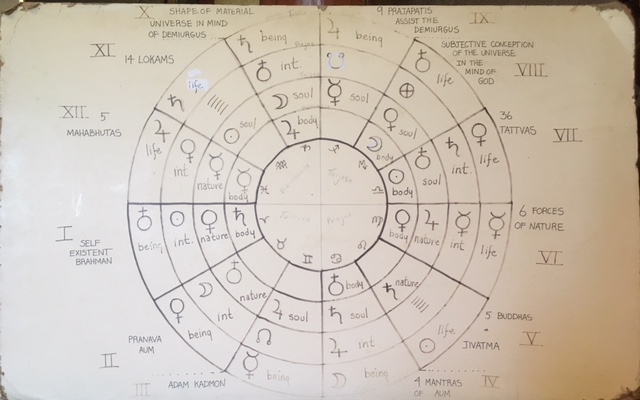
[Note: See FIGURES 1980 1203a-8, Four Inspirations and Divided Line, IMG_2202-Posterboard Metaphysical Chart appended to this transcript for the following.]
AD: Well, you take the Saturn and Jupiter, alright, that would be in the [AS drawing] [student assents, faint] 2nd quadrant [diagram], Mars Venus Mercury in the 3rd [diagram], [AS simultaneously: Uh-hm. Well I'm saying--] alright, and the Moon and the Sun in the 4th [diagram]. [AS: Yeah, well--] Now what would be the corresponding objective--
AS: Ok, well, for this one [diagram], certainly that's the easiest I think 'cause you would say that what the object of the Noetic vision of the soul is or the object of this Eros would be the Ideas in the Divine Mind, say the Idea of Man in particular would-- [students assent] would be-- Now--
AD: All the essences that are included in the Idea of Man.
AS: Yeah. [student assents, faint] Now, at each of the other levels, at the other two levels I have this problem. On the one hand you could say [drawing] the object for this reasoning [diagram] is the Idea which has been intuited at this level [diagram], and that's its object as it were. This dianoetic takes what's-- takes what's in this pure Thought and that's what it apprehends.
RG: And puts it into reason. [AS simultaneously: Puts it into reason.] So Plotinus says the entire reasoned scheme of art [AS: Yes, but--] would be at that level.
AS: But where is this reason that it puts it into [drawing] is coming from this 3rd quadrant [diagram] [RG assents] also.
RG: Yeah.
AS: So which would you say is the content of this dianoetic passion of the soul? Is it-- is the content of it going to be the reason-principles themselves which are objective and part of the 3rd quadrant and [RG assents] never really yours [RG assents] but are universal reason-principles, or is the [drawing] object the vision that your higher soul has is now transmitted this way [diagram] [RG simultaneously: Or--] to the reason?
RG: Or as we said-- or as we had-- we had this discussion on Friday, is the [S simultaneously, faint: That's good.] vision of the reasoned scheme through the dianoia, is that the manifestation of the Ideas in the 2nd quadrant?
CDA: Wait, can you say that again?
RG: Is when we look at the-- what is the object of dianoia and we say it's the reasoned scheme in some sense, reason-principles, is that the very manifestation of the Ideas in the 2nd quadrant? [CDA: Oh.] And in that sense it's both.
S: No.
S: Uh-hm.
DB (simultaneously): You mean the faculty would be the manifestation of the Ideas [few words inaudible]
RG (simultaneously): No, no, the objects of the faculty. Reason looks to the objects of reason.
DB: Right.
RG: That object isn't-- whatever we call them, reason-principles.
DB (faint): Yeah, uh-hm.
RG: We call them reason-principles 'cause they're in the s-- we-- they're experienced in the soul. But the reason-principles themselves, if they're the manifestations of the Ideas in the soul, then it's both, what its object is. Its object proper to the soul would be the reason-principles, but what is-- what are those reason-principles?
AS: Right, in-- in that Proclus he has three 'cause it also knows the--
S: (Uh-hm.)
RG (simultaneously): Knows the--
AS: What it produces.
RG (simultaneously): What it produces.
AS (simultaneously): But I don't think we would-- we would say that (here). [9¼ second pause] Or, the o-- the only-- I'm not sure-- [S: Say it.] [short pause] We could do-- I mean are we saying that one coming one way-- [drawing] Like here it seems more obvious, or maybe not, that what knows, the passion in the soul, let's say the Saturn here [diagram], and what it knows is certainly this Idea in the Divine Mind, say the Idea of Man [diagram]. Ok, now on the next level, [drawing/writing] the passion in the soul is the next function, the dianoetic function, the function of dianoia, which is a certain threefold [diagram], ok, universal knowing, willing, and feeling let's [RG assents] say. Ok now, what is apprehended by that knowing, willing, and feeling primarily is the object that this Saturn has co-- is the Idea coming from the Saturn [diagram], and that it is apprehended through these universal reason-principles which are contained in this universal knowing, willing, and feeling.
RG: Fine. And-- yeah.
AS (simultaneously): And then we'll say that this-- it's almost like-- I-- e-- except it keeps--
AD: I don't follow you, would you repeat that?
S (very faint): Yeah.
AS: Yeah. Well, if we say this Saturn, the highest part of the soul, has an apprehension of the Divine Idea, ok, of the Idea of Man. And I know it's just-- I'm not working this right. Say this passion, the highest passion, [AS indicates on diagram] Noesis or Wisdom, has as its object the Divine Beauty, Intelligible Beauty, or the Ideas.
AD: You're saying that the Intelligible is available to Cognitive-Isness.
AS: Right, [AD simultaneously: Yeah.] and that alone.
AD: Yeah.
AS: Now, the question-- what is available to the next level, to dianoia, right, the passion-- the faculty of dianoia which here we're representing as this threefold, universal knowing, willing, and feeling [diagram]. Ok? Now, on the one hand, its content is what it receives from pure Thought. [student assents] As he says, the reason takes what's in the depths of Thought--
AD (simultaneously): And what's the content of the Mars Venus Mercury or the reasoning soul?
AS: Well, he says the content of the reason soul is reason-principles.
AD: Yeah.
AS: Ok, is the for-- these forms but, what I'm trying to say is--
AD: Well what's wrong with making the rulerships in the 3rd quadrant that content?
AS: Well that's if you go this way [diagram], it would seem that that's true, ok, this 3rd quadrant here. That's talking objectively, the objective content, ok? But, could-- [RG, faint: I mean--] could you not also say that it's possible that-- isn't there some way of saying that what this apprehends is--
AD: I'm sorry Avery, what I-- what I meant was Mars Venus Mercury as containing the forms in the soul. [AS: Yes. Oh.] Now that becomes acceptable as a vehicle which can translate the reason-principles [AS assents] in the 2nd (quadrant).
AS: That's what I tried to say.
RG: Uh-hm.
AS: Yeah, ok. So in other words, just what we said it-- Well, let's see if I could say it again. This dianoetic [AD simultaneously, faint: Yeah.] function is [drawing] this certain threefold [diagram]. This is universal reason-principles [diagram], they're not really the individual's. He has at his disp-- they have at their disposal the entire reasoning content, all the reason-principles of the 3rd quadrant, with which to apprehend what's in the 2nd quadrant, Cognitive-Isness, or what's-- what's apprehended here [diagram]. The-- I don't know if that's what you were saying.
AD (simultaneously): I think we could add to that that insofar that the Mars Venus Mercury is contents or cognitive cogni-- contents as well as fabricative of the 3rd quadrant, what we mean by that is, if you took the rulerships of the 3rd quadrant, [AS assents] that would make-- [AS drawing] that would make it necessary to conceive of those faculties, alright, in-- in terms of progression and procession.
AS: These faculties, [drawing] yeah.
CDA (simultaneously): Could you say that again [student assents, faint] please, I don't--
AS: In terms of the procession of the rulerships [diagram].
S: Uh-hm.
AD: No, what I'm-- In the 2nd quadrant all the reason-principles are eternally in a-- [AS assents] they're in a state of eternal stasis, alright, [AS: Right.] eternal, immutable, etc, ok.
AS: But here they're in process [diagram].
AD: Over there they would have to be in process.
AS: Right. Because these-- whatever-- [drawing] this can't grasp that as an entirety.
AD: Yeah.
S (faint): Uh-hm.
AS: So that--
AD: So then that means, that means that we have to think of the Mars Venus Mercury [diagram] alright, as products of the Absolute Soul. [student assents, faint] But Absolute Soul in itself of course would be an eternal reason-principle but the products of Absolute Soul would be in time or temporality. [AS assents] So the Mars Venus Mercury has for its origin or its eternal generation the Absolute Soul.
AS: You mean these [diagram]?
AD: Yeah. And what it does is translate the indivisible Thought in the 2nd quadrant because its very nature is to put it into procession and time.
RG: Uh-hm.
AS: Well then we have a funny situation, which isn't funny but it seems we're saying this, that the dianoetic faculty or passion of the soul is really [drawing] coming from here [diagram]. This is where this threefold knowing, willing, and feeling or particular intellect, being, and life are derived from here. Its content as it were is the Idea coming from the Saturn [diagram].
AD (simultaneously): Exactly, yeah.
AS: Ok, so normally we would think of the subjective series as the-- as the function but really it seems these three, the function of dianoia doesn't properly belong here [diagram]. It's the functioning of dianoia properly belongs to the 3rd quadrant and it [RG assents] functions to grasp as object the Idea in the Saturn.
RG: Yeah, but the grasping of its object takes place through the reason-principles.
AS: Exactly.
RG: In the 3rd quadrant.
AS (simultaneously): That means that those reason-principles are the functioning [S simultaneously: Of--] of dianoia.
RG: Why the functioning of or the prior to? Why the functioning of dianoia? Why don't-- I mean--
AD: The-- the-- [S: Yeah.] the Intelligible world in the 2nd quadrant is, as we said, in eternal stasis. In the 3rd quadrant it would be in eternal movement.
RG: Right.
S: Yeah.
AS: And he's saying-- I think you're saying simply that the apprehension of this eternal stasis by the reason-principles in the 3rd in a threefold way is what we call dianoia. [RG assents] That apprehension of this Idea [diagram] by the reason-principles here [diagram] is dianoia.
RG: Yeah, but when you point to-- to that and say the apprehension of that Idea, it doesn't apprehend that Idea as that Idea is.
AS (simultaneously): Right, it apprehends it as a dianoetic object.
RG: Right, through the-- through the rulerships [AS assents] in the 3rd quadrant. Right?
AD: Not through the rulerships [AS simultaneously: Not through it but--] [RG simultaneously with AD and AS: Not-- I mean as--] but because-- but because those rulerships, [AS, drawing: Over here.] the nature of those rulerships is Ideas-in-Motion, Ideational Motion. [RG: Right.] When you think of the 8th house, the Subjective Conception of the Universe, alright, you-- you're speaking about the [AS assents] [AS drawing] existence of the universe in God's Mind. Now if you're speaking of it as an Idea, that has to be in motion, [RG assents] alright. But when we're speaking about the Ideas in the 2nd quadrant, those Ideas are not in motion, they're in eternal stasis. [RG: Sure.] Now the functioning part of the soul, or the knowing, willing, feeling, alright, which let's say is something that's almost an expediency as far as Saturn in Leo is concerned-- [RG assents] You follow?
RG: Uh-hm.
AD: Well, if we say that the three Ideas coming from 7, 8, and 9, and symbolized by the rulerships, show the ideational nature of the Subjective Conception, then that is of conc-- conceiving the world as in motion and in time, whereas the 2nd house [Note: quadrant] Idea is-- is quite different.
RG: Right.
AD: So, we have to borrow, so to speak, the faculty of reasoning--
AS: From these here [diagram].
AD: Yeah.
RG: Yeah.
AD: From above the objective soul, alright, so that we could extend or display or manifest in time the Ideas that are indivisible in the 2nd quadrant.
RG: Right. But the objects and the content that that three-- threefold dianoetic soul knows are the objects in the 3rd quadrant.
AD: No. [S simultaneously: Then what you just did--] The object-- the objects it knows must [AS simultaneously: Come from the 2nd.] come from the 2nd quadrant.
RG (simultaneously): They-- I agree they come from the 2nd quadrant but as the organ of di-- dianoia (is/has) constituted it, it can't know them as they are in the 2nd quadrant, they could only know them as they're unfolded in the 3rd quadrant.
AD (simultaneously): 3rd quadrant, yeah.
AS: As in time.
RG (simultaneously): Because if it knew them in the 2nd quadrant--
AD (simultaneously): So the genesis and origin of those three faculties are the rulers of the 3rd quadrant.
RG: Right.
AD: Yeah.
AS: It says, you know-- they know "what is impartible, partibly".
RG: Ok, yeah. There's no argument that the origin of them is-- is in the 2nd quadrant. But they can only know them as far as their organs can let them know them.
AS: Right, but still if you ask what the object of that vision is-- You see, it's a funny-- yeah, I mean--
RG (simultaneously): Well yeah we had-- well how you use the term 'object,' I mean--
AS (simultaneously): Well-- when-- you know, when you ask what is it that it knows, it's not cut off from that Noetic object.
RG: No. But it knows [AS simultaneously: That is its object.] that Noetic object as threefold or [AS assents] as reason-principle.
AS: But that refers to the mode of apprehension, not to the object.
RG: But it does-- it does refer [couple inaudible AS words simultaneous with RG] to the objects in some sense, 'cause the object has to--
AD (simultaneously): Yes, of course it's referring to the object but it could only grasp the object in this threefold way.
RG (simultaneously): Right, right. So therefore it isn't the object as it is in the 2nd quadrant.
DB: But inso-- no.
AD (simultaneously): It's a merry-- merry-go-round.
S (faint): Uh-hm.
S (simultaneously): What--
RG: How could it be?
DB: Its object is its-- [S, faint: David--] I think that object that you're talking about is the-- it as understood as being fabricative. [student assents] I mean insofar as it's gnostic it's looking towards the 2nd quadrant but in the process of that knowing it-- it's fabricating that content as unfolded.
AD (simultaneously, very faint): Yeah.
AS: I see the problem, Richard, I think. [S simultaneously, faint: Sure.] It's just that I think that we don't-- or that Anthony doesn't want to say that the [drawing] object of these is just what's here [diagram].
RG: For sure, yeah, yeah.
AS (simultaneously): Well that's the only point, to say that not-- this [diagram] isn't operating in a vacuum. [RG: Right.] You can't say that all [drawing] it's knowing is the reason-principles in the 3rd.
RG (simultaneously): I agree, because embedded in those reason-principles are its causes.
AS: Which is (these) [AS indicates on diagram].
RG: Which is there.
AS: Well, that's the whole problem of course, how you-- how to say "embedded in" those reason-principles (are his/or as) causes.
RG: Because if you didn't allow-- I mean the soul-- when the soul knows the reason-principles it also knows that its prior is the Ideas. Otherwise it could never know that there was an Intellectual-Principle from within soul, and you wouldn't have an In-- We went through that [one word inaudible]
AS (simultaneously): Do you know he says dancing around-- the dianoia [RG assents] dances around the Intelligible, you know, he [RG assents] has quaint poetic way of saying it but--
AD: Alright, ignoring that part of the argument, now you take the Mars Venus Mercury [diagram] and yous-- you insert that into that Moon Sun [diagram].
AS: Yeah ok, so where's-- so the object here then-- well, I mean I keep saying that this-- it's-- it seems what's coming out here is that the faculty of dianoia is coming [drawing] from the 3rd quadrant and that the object of that dianoia is coming from the 2nd quadrant. Let's not say it [RG simultaneously: Ok, alright, yeah.] is the 2nd quadrant but is coming from there. [RG: That's fine.] And the faculty is going to be [RG assents] coming from here [diagram].
AD: Because it's never going to leave there, Richard.
RG: Yeah, I know.
AD: It don't leave.
RG: I don't have a problem with that.
AS (simultaneously): It's not going to go anywhere.
RG: Yeah, right.
AS: I see, ok. So the third-- now at the third level, let's suppose that-- [drawing] suppose we even say we separate opinion from phantasy here [diagram].
RG: But, let me just say, I mean like for the view of the triple path that's proposed there, I mean that's like looking-- looking to Intellectual-Principle, looking to the 2nd quadrant from within that threefold dianoia. It's conceiving of the Intellectual-Principle and the way to it from within that threefold-- from aspect, from within knowing, willing, and feeling.
AD: Yeah. [student assents, very faint] Yeah but we-- we have to keep the object always intact in the Intellectual realm.
RG (simultaneously): Right. Ok.
AS: Yeah, he said he [RG simultaneously: Ok, sure, right.] must be led to the beauty that manifests itself through these forms. [RG: Sure.] So the beauty is manifesting itself through these forms in the (planet(s)).
RG (simultaneously): Sure, but-- right. But he must be led to know that also by transc-- transcending the [AS simultaneously: By going the-- yeah.] dianoia also, that also.
S: You're the one--
AS: Yeah. I see. So, let's see, so if we-- let's see, so then the third one-- [level of the divided line; compare FIGURES 1980 1203a-3-JF and 1980 1203a-4-JF] Now this one gets harder.
AD (simultaneously): I would put-- I would put the sense object there [diagram] and the conjecture in the 4th [diagram].
AS: Yeah, [drawing] that's what I'm doing. Opinion goes with the actual sensible object here [diagram]. [student assents, faint] I don't know if that's what you're saying, and this one [diagram]--
AD (simultaneously): Well, opinion for me usually covers those two [diagram].
AS: Yeah, ok.
AD: So I would put the-- I would put the [AS simultaneously: Ok.] sense object where you have the circles [diagram].
AS: Yeah. [drawing]
AD: And conjecture down there [diagram].
AS (simultaneously): Yeah, that's what I-- sometimes he uses opinion for the faculty here of the higher one. Opinion seems to mean both, both of them, and also the higher but-- So this would be the actual sensible object or the object of Nature, [drawing] and phantasies with the phantasm--
AD: Yeah, uh-hm, yeah. And those [AS simultaneously: --which will be over here (diagram).] are being considered as one.
AS: Ok, in the threefold scheme we're not really distinguishing the two lower parts [AS indicates on diagram] [AD: Yeah.] of this Divided Line because we're saying even-- even if something is here [diagram] it's always going to be tied up with some imagination [diagram] automatically, maybe not(--) the reproduction. Now-- now here we get into-- I don't know, if-- because if we extend this scheme now, we again come acro-- the problem of what the proper o-- what the proper object of that opinion is. Yeah it seem(ed)--
S: Yeah.
AS (faint): I don't know.
AD: [couple words inaudible]
[short pause]
AS: Let me see if I can state the problem. Ok, if we start just with this one [diagram], we have that the faculty of apprehension here, ok, is the presence of these three [diagram] within the-- within the-- within the imagination. In fact in some way we could say that this whole thing is the imagination, this whole realm of the Sun in Aquarius is the realm of imagination [diagram].
[short pause while AS draws]
AD: And wouldn't the products also be within the imagination, [AS simultaneously: Oh yeah.] the vegetal soul?
AS: Oh, yeah, certainly. [drawing] Certainly whatever is produced by this is part of the imagination. [student assents, faint] But by actual sensible object-- oh no, I see, I see yours-- The actual-- by calling this sens-- by saying that the object here [diagram] is the actual sensible object, are you saying that it's actually contacting something of these forces coming from [AD: From above.] the material substratum as it were, from the 10th house?
RG: It would have to contact the 10th house.
AS (simultaneously): [drawing] Yeah. Right. That's what we're leaving out of the picture which we should have here.
RG (simultaneously): Right, that's what opinion knows. I mean opinion would [AS assents] [AS drawing] have to know that if it knows the real ob-- the real sensible object.
AS: So opinion primarily knows the reason-principles as embedded in the material substratum. Faith.
RG: Yeah.
AS: Ok? In other words, it's not-- it's not knowing here the reasons behind it. It's only-- it's not knowing these reason-principles as they are in themselves in the dianoetic. It's knowing them only as they are already embedded in the matter and therefore it has lost the origin of them [RG assents, faint] back here [diagram].
AD: That would be animal faith, right?
AS: Yeah. So-- as Santayana uses.
AD (simultaneously): Animal faith has an absolute assurance and guarantee, alright, that matter is localized in every sensible object.
AS: Uh-hm. And this is its guarantee is because of that-- that force that's forcing it to believe that.
RG: And that's why they equate it with the Telestic [one/two words inaudible]
AD (simultaneously): And then even below that, then you got the conjecture [diagram].
AS: Yeah, [drawing] conjecture or ima-- perception of shadows, assimilation he calls it.
AD: Now you can see with this fragmentary scheme in front of you why the soul has to be-- become unified under some sort of frenzy, otherwise you go around in the fragmented state of mind that you're usually in.
AS: Because [LR simultaneously: Yeah, but wait I wanted to--] this is like this continual circle. (laughter, student words) It takes a lot of-- it takes-- it's like-- Oh! Vic would-- too bad Vic's not here 'cause it-- it's just like those things with the-- you know, they send up these spaceships. You know, like if you send it up with a little bit of force it just comes right back down. If you send it up with enough velocity it might circle the earth but it will never get away from it. It needs a tremendous initial velocity to get the thing out of the Earth's pull altogether.
RG (simultaneously): Like frenzy.
[student assents, faint]
AS: Yeah, it's-- it's like it just-- it requires this incredible amount of energy to push-- to push it out of the-- this whole-- the whole of this conjecture [diagram]. Yeah? I'm sorry.
AD (very faint): (Go for it.)
TJ: Avery?
AS: Yeah.
TJ: I'm trying to make sense out of what you're saying and what it says in this article maybe here on page one hundred and--
S: Don't worry.
AS: Ok, sure. Uh-hm.
TJ (simultaneously): On 219.
AS: It's good to bring in the article.
TJ (simultaneously): It's-- it's at the bottom of that page, it says--
AS: 219?
AD: Loud! [couple words inaudible] loud.
AS (simultaneously): Oh, "Inspiration and Art".
RG: Yeah.
TJ: Yes, it says that--
[Transcriber note: JF is using "Plato and The Four Inspirations," Part III (Inspiration and Art), The Shrine of Wisdom, No. 31, Spring 1927.]
Shrine of Wisdom ["Plato and The Four Inspirations," Part III, p. 219, TJ reading]: "Inspiration is not a faculty of the soul, but an inbreathing of superior principles which may vivify and heighten all [the] faculties. It is [TJ reads: It's] a participation by [TJ reads: of] the soul of That Which is above [TJ adds: the] soul."
AS (simultaneously): Great.
RG: Right, right.
AS: Beautiful.
TJ: Ok, so--
AS: There you have it.
RG: Yeah.
LR: Read it again. Please?
Shrine of Wisdom ["Plato and The Four Inspirations," Part III, p. 219, TJ reading]: "Inspiration is not a faculty of the soul, but an inbreathing of superior principles which may vivify and heighten all the faculties. It is a participation by the soul of That Which is above [TJ adds: the] soul."
S (faint): Yeah.
TJ: So you're--
AS (simultaneously): We can go on.
AD: Now, if you-- [TJ simultaneously: Right.] if you use-- if you use soul in the-- in a [AS assents] sense of plurality, think of soul as plural, alright, in other words, let's say, composed of seven pieces, [AS assents] seven souls, you don't have one soul, you got seven of them, ok. Now you [TJ simultaneously: Absolutely.] should go out feeling rich, [TJ simultaneously: (Ten of them/Tentative) in my--] right? Each part of that soul is going to be inspired by something either beyond it or above it, [AS assents] and the chart will show you that.
RG (simultaneously): Right. So--
AS: Yeah Terry, like [TJ simultaneously: Alright.] right here, that's-- right from the highest one even, especially, it-- the soul itself is inspired by the Idea of Man [diagram].
RG: Right, I mean-- and that's what this line is saying, I mean the inspiration always comes from that level but it gets interpreted according to whatever organs are-- the soul is energizing with.
AS: Or-- yeah, that's-- see I-- that's one.
RG: Yeah.
AS: You're saying it could-- it could always come from here [diagram].
RG (simultaneously): Well, as we just said, if that's the o-- that's always the object.
AS: But is that always what's inspiring it? I mean, maybe one of these Gods here in the Supermundane [diagram] is inspiring the soul to a proper apprehension of its object which is here [diagram]. [Note: See FIGURE 1980 1203a-6, Four Inspirations, Divided Line, and Orders of Gods, appended to this transcript for this and the following.]
RG: But that's still--
AS (simultaneously): See, by "above it"-- see, I-- I mean [TJ simultaneously, faint: Yeah.] I-- I mean I'm saying [TJ simultaneously: That was the other way.] maybe when-- Well maybe you could say that the inspiration is coming-- he says it's from outside it, the inspiration he says too comes from the Gods. And I was thinking there's four-- there's these levels of Gods, you have the In-- Intellectual Gods here [diagram], the Supermundane Gods inspiring the dianoetic [diagram], the Liberated Order inspiring the opinion [diagram], and the Mundane Gods or the cosmocrators inspiring the imagination [diagram].
TJ: Yeah, he says that it isn't-- it isn't of the soul, it's got to be above the soul, so [student assents] it's got to be from Supermundane.
AS: But the soul has [drawing] parts too, I mean it-- the soul has these different faculties and levels [diagram].
TJ: But he doesn't-- he's [AS simultaneously: No.] talking about the whole thing.
AS: But--
AD: Yeah, but we're trying to explain [AS simultaneously: But we're trying to--] (here/to you) what he's talking about, which he doesn't know.
AS: See, I'm trying to say that-- well there are two-- I mean there's two views, one is-- not just two views but-- There's-- we talk about the inspiration at the highest level. [drawing] And, you could say well in one way that would-- that could filter all the way down and he'd express it in his imagination. [TJ assents] You know, he has an experience here [diagram] and then it gets filtered down, ultimately he writes great piece of music or something, but it seems that you could talk about inspiration happening at any of these three levels [AS indicates on diagram].
RG: Right, but if you talk about as the soul receiving what's above it, you-- in either-- in either view it's still from the Intellectual-Principle, whether the ring or the 2nd quadrant.
AS: Over here it is [drawing/diagram].
RG: And over there-- yeah, and over there it is [diagram].
AS: Ok, but over here [drawing] [RG: Yeah.] it would be from here [diagram], it would be Intellectual.
RG (simultaneously): From the rulerships though, right?
AS: Yeah, or from the Jupiter in 9th house [diagram].
RG (simultaneously): Right. So it'd still be in In-- Intellectual-Principle.
AS (simultaneously): [drawing] But if it came-- if you said this way [diagram], that doesn't seem quite right.
RG: No, that doesn't seem right.
AS: Here what-- it seems the inspiration-- well, I don't know if that's-- [S simultaneously, faint: What?] The soul is being inspired, the soul here-- let's suppose we have the soul which-- your soul is inhabiting this imaginal essence here [diagram] [drawing] and you have certain aspects and you say well this-- you got inspired. But wouldn't these Gods, the cosmocrators, be-- at this-- if you're identified at this level, couldn't it be these Gods, the cosmocrators or Mundane Gods [diagram], that are delivering some inspiration to the soul?
RG: Yeah but the delivery of the inspiration isn't the same as the inspiration itself.
LR: Yeah it is.
AS (simultaneously): Well let's say it is the inspiration.
RG(?): Well I--
LR (simultaneously): I think it is. I think that's-- it's not a--
AS: It's not the faculty but it's the inspiration inspiring the faculty.
LR (simultaneously): It's not the faculty. The inspiration is the actual--
CDA: The energy
AS: The intuitive energy.
LR (simultaneously): God's energy.
CDA (simultaneously): Energizing.
AS: Yeah, he says-- he talks about [one/two inaudible student words simultaneous with AS] the en-- the-- we talked about as some kind of energizing, so you [drawing] get a cert-- you know, these aspects energize yous and you shoot up here [diagram].
LR: It's actually being pulled up by one of those Gods, I think, rather [student assents] than it being embedded in--
RG: But what's being pulled to what?
LR: The soul.
RG: To what?
LR: Energizing towards one of those Gods.
TJ: Or its unity.
AS: No. The God is energizing, is enabling the soul to have a view of the Ideas let's say.
RG (simultaneously): Right, right.
AS: But the-- the inspire-- maybe I got this wrong but I was trying to do it this way, that the inspiration is not the content of the faculty knowing the thing either. [CDA: Yeah.] The inspiration is like this third feature as it were and--
LR: The force.
AS: Yeah, it's like this force of attraction or this force of com-- of propulsion or whatever that the Gods are inspiring the soul to know the Ideas or to know properly whatever their proper object is. Now, I--
LR (simultaneously): The inspirations aren't contents [S simultaneously: Well--] in that-- in the sense of--
RG: I don't-- how could-- I don't see, I mean-- I don't see how you could say that the inspiration isn't a content.
TJ/CDA(?) (simultaneously): Well--
LR: Ok, well I have to qualify it, it was good [AS assents] enough to just say that. [AD, faint: Yeah, yeah, yeah.] What I mean is it's not a particular--
AS: Yeah, it is.
RG (simultaneously): And the inspiration isn't the In-- isn't Beauty from the Intellectual-Principle, that can't be the inspiration?
LR: It could be, sure. But it's not necessarily a particular content, I think it's the energizing, the particular force, which is attracting the soul, and the content could vary, I mean the re-- you could speak of the realm of that inspiration. But to pin it to a particular content--
RG (faint): What are you saying? I don't follow so far. I mean--
LR (simultaneously): Well, I mean--
AD: You have to decide what ins-- at what level you're speaking about inspiration.
RG: Right.
LR: Well--
CDA: Yeah because--
LR: Yeah, I wasn't speaking [three/few words inaudible]
AD (simultaneously): Are you speaking at the level, for instance, when Beethoven was writing the Third Symphony and then he couldn't put in a minuet, and he had to wait until he had sufficient understanding of what he was doing to throw it out and put a scherzo in, are you right in there or you-- are you talking about it at that level, are you talking about it at the level of the pure breathing into his soul of the harmony and symmetry that's in the Intellectual realm or-- where are you talking about?
RG: Well I think we're trying to understand the line in here that says--
PD: Could you take that-- could you take a person like Beethoven and say one, the receptivity of his soul is the highest level, the Nous. The second level is his knowledge of the principles of harmony, would represent the dianoia. The third level, his ability to perform an instrument and demonstrate it in the existential world.
AD (simultaneously): Yeah that's-- that's what-- that's what I'm aiming at, so that when he wrote the scherzo, for instance, instead of the minuet, alright, that showed that the rational aspect of the soul was inspired to recognize that the symphonic form or the sonata form needed a different kind of arrangement, alright, and it required the rational understanding and knowledge that he worked with, the technique, ok.
PD (simultaneously): To realize that inspiration that was (really) his goal.
AD (simultaneously): To realize-- to realize that inspiration which was even above that, alright. That's why I ask him, what level are you talking about, which inspiration? You already recognize that there's three levels of it, and that there's four faculties, now you have to start speaking more-- more clearly which one you're referring to. I'm sure, Richard, you get up in the morning sometimes after a good night's sleep with an inspired idea.
RG: I don't.
PD: So the (bit of laughter) actual creation of the piece takes place in Beethoven's imagination, where all the previous, quote, "relative knowledge"--
AD (simultaneously): Well the imagination is where you'll work it out, [PD simultaneously: Where you worked it out.] where you'll work it out, otherwise we're not going to get anything.
S: Yeah.
AS: Not where he has it.
AD: I'm sorry?
AS: But in-- well I-- it seems, but in the Beethoven example, not where he has the original inspiration.
AD: Yeah.
PD: The receptivity of the soul with the Nous.
AS: Yeah, uh-hm.
AD (simultaneously): Yeah, well otherwise we'll be coming up with Croce's theory, you know, you get the intuition, well, forget about the rest. And the world will get impoverished, right, we wouldn't have all these great art works around. So they do have to bring it down to this level. Or the example we used of Cezanne where he kept looking at a picture of a tree and he kept looking at a tree until he could see it the way he was inspired to see it. But then he had to paint it. And if he didn't have the technique he wouldn't be able to paint it, but he had the technique, but now he had to be inspired rationally to reformulate certain principles in painting. So you're not going to be speaking of one thing anymore, now, from now on when you speak you're going to include three things. That's why I just told Terry that those sentences are just clichés. Nothing is explained by those sentences, we're explaining them now.
S: [couple/three words inaudible]
AS: But still [one word inaudible]
S (simultaneously): [couple words inaudible]
AD: What do you think, the understanding is going to come with the words, Terry?
TJ: No, no, what I was saying is explain the sentence--
AD (simultaneously): Well you have to work-- we have to work it out.
TJ: --through the-- your words because I was interested in, you know, just what the object was. But it seems-- it seems understandable to me that it-- that it does kind of like, for me, you know, you open the valves and you can receive it. (laughter) And it comes from one soul, from the World-Soul, from-- to the human soul, that--
AD (simultaneously): Which valve was that or-- (laughter)
TJ(?) (amidst laughter): You noticed.
S (amidst laughter): (Let's move on.)
TJ (amidst laughter): Well I think we should (move on).
AS: I think that was the hot water valve [one/two words inaudible]
S (simultaneously, faint, possibly part of background): Can you write it down?
[short pause with faint background student words, bit of laughter]
AS: But--
S: Ok.
S: Yeah.
AS: David has a question.
LR(?): Sure.
DB: It seems that the dianoetic faculty has got a peculiar relation from all of the others, and I know you went over it quite a bit earlier but I'm still not sure I understand it. Because it seems that the origin of the faculties, for example, opinion, imagination, and-- and the Noetic seems to be within the soul ring and it-- and the object for all of them seems to be something prior--you know like in opinion it's the 10th house and so forth and so on--but this dianoe-- dianoia has a very peculiar relationship to-- because it seems that-- I mean the way you were speaking of it, the faculty actually comes from principles-- the objective portion of it, and the contents seems to come from within the subjective portion.
AD (simultaneously): Well that's not anything unique, David, you find that also in the next ring, [RG assents] in the next part of the ring.
S: I know, but--
DB (simultaneously): Um-- what-- in-- in opinion?
AD (simultaneously): That's always going-- that's always going on, that's always--
AS (simultaneously): Yeah, what's the real object here [diagram]? It's [RG simultaneously: Right, it's-- right.] from here [diagram]. It's the reason-principles coming in. You could say, oh what's apprehended is here [diagram], but you could also say, no, this is an a-- [drawing] this material vehicle, the vehicles here [diagram] that are built up are actually enabling you to apprehend the reasoning of the soul [diagram].
RG: And that-- and that the organs of opinion [AS simultaneously: They're going to receive.] are determined by the objective correlates in the 4th quadrant [diagram].
DB: So then the-- you see, that-- I mean--
S (faint): Which one?
AS: Same [DB simultaneously: So the--] process [RG assents] but that's ok.
DB: No, you've got to please forgive me because, I mean this is quite complicated. I mean if you take opinion, alright, you're saying the object of opinion--
AS: A pinion, you know what a pinion is? (bit of laughter)
DB: Yeah, you put it in the [AS simultaneously: The rings.] pieces of metal and hold it together.
AS (simultaneously): Right. Pinions. Oh, go on, I'm--
DB: No, I just want to know, is the object of opinion the content of dianoia? And if so, why is it not spoken of as-- I mean on the-- the way the Divided Line is ordinarily put up, the object of opinion is sense. I mean--
RG: It's a funny use of the word o-- [DB: Well--] different use than we normally [couple words inaudible]
DB (simultaneously): Ok, granted, but I mean what-- is it-- is it that in contemplating the objective portion, say for example, of the Divided Line, say opinion, alright, now that contemplates or tries to understand what's going on in the 10th house. [Note: See FIGURE 1980 1203a-8, Four Inspirations and Divided Line, appended to this transcript.] Alright now, what arises from that activity is something coming from a higher level of subjectivity.
RG: Or objectivity.
DB: Well--
AD: Could you be more precise, David?
DB: Well, for example, I mean, say you have someone working within the 11th house, alright, now he's trying to understand something about some principle of engineering like Arch-- Archimedes. He was working at trying to understand the relationship of the weight of various metals, and he's got this problem and he's dealing with it and making experiments and so on and so forth. Now, on the one hand the object of opinion would seem to be the contents that are concerned with the problem that he's involved with, alright, but at a certain point he would be inspired, so to speak, and the object that he's dealing with would be coming from the dianoetic faculty. Do you see what I [one word inaudible]
AD (simultaneously): Well, if we take Archimedes, we'd have to place him below that Sun [diagram], right?
DB: Right, ok, yes. He's in Syracuse or wherever.
AS: Yeah.
DB: Right?
S: Wherever it was.
AS: Yes, that's where-- it was where he [one word inaudible]
AD (simultaneously): And the objects that he's working with, he was trying to find out about the brass-gold mixture, alright?
DB: Yeah.
AD: That also will be where we located him.
DB: Yes.
AD: That would be in the realm of the perception of shadow.
DB: Yes.
AD: Alright?
DB: Uh-hm.
AD: And he has this faith that behind the brass or behind the gold there's some kind of matter that's localized in it and each is, so to speak, itself and not any other matter, it belongs to this ring or to this bracelet(s) or whatever, alright, but we're still down in that realm, ok?
DB: Right.
AD: But now, if we want to understand how these two di-separate things, which we located in the realm of perception, alright, have a unifying factor we have to go to the realm right above it which is the Sun, right, where we have the functioning of reason in the imaginal body of the Sun [in Aquarius]. In other words, you have a combination of matter and form there, alright, and that's where the true knowing is taking place. In other words, the-- the-- the subject-consciousness [Note: coming from Soul ring] can be located there, alright, the object-consciousness [Note: coming from third quadrant rulerships and exaltations] can be located there. [Note: See FIGURE 1980 1203a-10-AB, Subject and Object Series, appended to this transcript.] [DB assents, faint] And we find out that the substratum of each has a certain matter coming from above [diagram], alright, [DB assents, very faint] and essences coming from the ring [diagram]. [DB assents, very faint] Now we can stay there, alright, we can stay there and solve the problem there, where the Sun is. Or we could move back, in other words, factor out--
[Audio File 1980 1203a Ends]
[Audio File 1980 1203b Begins]
AD: --it's a [one word inaudible] Now then when you go to the-- let's say, the reasoning part that understands the essences, alright, you find out that the reasoning faculty is subsumed under the rulerships of the 3rd quadrant, just like you find out that the matter is informed by the Idea in the 10th which ultimately are from the 9th house, ok. [DB assents, faint] Can't help that. And you can go on doing this until you reach the Intellectual realm where you can, so to speak, bring together in one concept, a Universal Ideation Storehouse and a Universal Subject Wisdom. But until you get there you're not going to-- you're going to have to go on factoring all the constituents that go to make an experience what it is. It can't be helped that it's complicated, I mean we didn't-- we didn't devise that. It's--
DB (simultaneously): Oh. Oh I'm not-- I'm not com-- I'm not complaining that it--
AD: That's the way the cookie crumbles. (bit of laughter)
DB: But is it-- is it s-- is it something like from the level of Saturn on down, whenever you're dealing with a situation, there's a certain objective portion and a certain subjective portion, alright, [AD: Uh-hm.] and that--
AD: And that ultimately they'll coalesce in the 2nd or in the Intellectual-Principle.
DB: Yeah, ok. And that-- that you could--
AD (simultaneously): But in the texts that Plato or Plotinus write, alright, that whole process is pushed aside and ignored. They don't go into these details. And like Plotinus said, if we're worthy of calling ourselves students of philosophy then we have to do that for ourselves.
LR: But when you're talk--
DB (simultaneously): Could I--
LR (faint): Go ahead.
DB: Well I just have one other question that-- that-- that it wouldn't be necessarily true to insist that the subjective element is-- there would be a subjective and a-- and an objective element coming from both the soul ring itself from Saturn-- I mean from Mars Venus Mercury on down.
AD: We pointed out that they're both-- they're both operative reason-principles and there are subjective soul reason-principles, and we pointed that out over and over again, alright, that they can be used this-- this way. [student assents, very faint] You could think of the soul as fabricative or you can think of it as gnostic or you could think of it as both, fabricative and gnostic.
[short pause]
PD: Now if we went back to the analogy of like Beethoven and these latter works when he went completely deaf and he could not physically hear [AD: Yeah.] the music he wrote [one word inaudible]
AD (simultaneously): Or Homer, who was blind.
PD: They-- like they lost one-- one of those phases of the soul, quote. Like Beethoven took his stand completely on, let's say, the first two, the highest [AD simultaneously: Yeah, uh-hm.] phase of the soul and the reasoning principle.
AD (faint): Yeah.
AS: So what happened to the imagination?
PD (simultaneously): And he worked it out in his imagination without the faculty of belief, in Platonic scheme, the sense faculty.
AD: Well, Paul, you can [one/two inaudible student words simultaneous with AD] hear those things better up there than down here.
S (very faint): [few words inaudible]
AD: There's an Intelligible Fire up there, there's a burning fire down here. You're not going to have the burning fire down here, the physical fire down here, without the Intelligible Fire up there. But you can have an Intelligible Fire up there without a burning fire down here. And to live in that realm, you have a true perspective. So Beethoven probably heard the melodies better up there. As a matter of fact, as he became deaf his music became better. (bit of laughter, RG assents)
PD: The point I was making was he took his stand more and more upon, what we say, the individual soul-- [student assents, faint] completely within his own soul [AD: Yeah.] and less upon the objective input of matter.
AD: Yeah, exactly, that's why he says, "I don't create. I only bear witness to the creation in my soul." That's precisely the point. The man who thinks he's creating a work of art, you know, is suffering from megalomania.
S (faint): Uh-hm.
RC: It seems to be [BS simultaneously: Well, however--] an important point was made the other night that Paul's bringing out here, that usually when we talk about phantasy and opinion as two gnostic faculties, we say that phantasy looks to the sensible objects or makes some image of the sensible object in the world.
AD: Now, wait a minute, two gnostic functions, conjecture or the perception of shadows is a gnostic function.
RC: Yeah.
AD: As long as we have a body, alright, then that process takes place.
RC: Right. And normally we consider its appropriate referent object to be a material sensible object.
AD: No, no.
RC: Its referent object, not the image itself.
AD: Ok, [RC: But--] the referent object, ok.
RC (simultaneously): Yeah. We'd consider what it's making an image of as some material thing.
AD: Uh-huh.
RC: And what Paul's bringing out here is that that faculty does not necessarily refer to a sensible material thing but it can refer directly to a reason-principle.
AD: But that's exactly one of the other quotes I think Louis used, do you remember? That the imagination could be brought down to make images or it could be brought to conform to the objective reality. But it can also, so to speak, be stopped.
RC: But in the sense of like, the Muses-- the Musical inspiration does not necessarily operate in imitation of the sensible world.
AS: Never-- not only not necessarily, I mean, but I wou-- I would say doesn't, is not in imitation. [RC simultaneously: That's the deal.] That's the way Plotinus puts it.
RC: That's the difference I was trying to bring out between the way we normally speak of phantasy as a gnostic function having it-- a necessary reference to sense, whereas it seems in terms of the inspiration, [AS: Oh I see.] that's [TS assents] not necessarily the case.
AD: Well, I think in this term the Muses would be making the sensible world.
[student assents, faint]
RC: Yes, yes, but the--
AD (simultaneously): They referred to the celestial karma(s).
RG: Your karma.
RC: But the difference that I'm trying to make is that part of their making of the sensible world is through the artist, and that part of what he or she is bringing into the world had never been sensibly manifesting prior to that.
AD: I didn't follow you, start again.
RC: That the inspired artist is like a co-creator of that sensible world, I don't-- you know, a diminished level. [AD: Yeah, yeah.] But the things that that artist is bringing into the sensible world can be things which have never been in the sensible world before.
AD (faint): Uh-hm.
RC: So that it's not an imitation but [AD simultaneously: (You back?)] it actually is a participation in that creation.
AS: Yeah. Isn't that what he says, that the-- that the artist isn't making an imitation of something which is in the sensible, [RC simultaneously: Yeah. Just trying to figure it out.] in the thing we read on Beauty.
RG: Right, but then in terms of the Muse-- the Muse's inspiration it seemed-- and internally to the soul, it seems to be taking the disparate elements in the phantasy and making them more unified, making them more symmetrical.
S (faint): Uh-hm.
RC: Just trying to bring out that the difference between speaking in the context of the inspiration from when we talked before about the gnostic faculties seems to be that in terms of the inspiration, the lowest of the gnostic faculties can be conceived as having direct access to reason-principle(s) rather than at best getting to a sensible object.
AS: Well I'm-- I'm not sure I understand what you're saying Randy, but if we did it--
AD (simultaneously): Well why-- why not put up the Divided Line in a simple fashion now.
AS: Yeah, that's-- I-- I wanted to [AD simultaneously: Yeah.] do it on the diagram [AD: Yeah.] because-- That's where their question is really coming from. In fact, I-- I think there's still some question of the distinction between the way we s-- if-- we've spoken about the gnostic faculties a lot, exactly how-- how does the notion of inspiration enter into the normal functioning of the-- of the gnostic faculties? Does it always (enter them). Or what-- I mean what does that mean? [drawing] I mean if we just put it up simply, if we just-- [Note: See FIGURES 1980 1203a-2-JF, Stacked levels of Divided Line, 1980 1203a-3-JF, Divided Line/horizontal, appended to this transcript for the following.] (This is) just the lowest one, in other words.
AD: Conjecture [diagram].
[short pause while AS draws]
AS: Faith [diagram], [student assents] Dianoia or Reason [diagram].
[14½ second pause while AS draws]
AD: The pictures above. Pictures above faith [diagram], [AS drawing] I mean; the sensible object above belief [diagram]; [S, faint: Distinguish.] the intermediates or reason-principles above that [diagram]; and the Ideas above that one [diagram].
[30½ second pause]
AS: Now these-- these faculties [diagram], the way he does them in the Republic anyway, are said to be the passions of the soul.
[short pause while AS draws]
LR: What does that mean?
AS: Yeah, well--
LR: What does it mean that they are the passions of the soul?
AS (faint): What he says there.
LR: What does it mean, like does it mean that they're equatable with the four passions?
AS: Passions-- oh, passions. Oh I see why you're-- oh, yeah [couple words inaudible] (bit of laughter)
LR (faint): That's--
S (faint): [couple/three words inaudible]
AS: [couple/three words inaudible] the same.
BS (simultaneously): I hope you think of the same thing.
S (faint): Don't you?
S (faint): Yeah.
AS (faint): It's interesting.
[students assent, faint whisper]
LR: Avery--
AS: I hadn't thought of it that way.
S: She meant [couple/three words inaudible]
AS: I know what she meant [one/two words inaudible] (laughter)
BS: That's-- that's the inspiration.
AS (faint): (I see.)
PD: Well that's-- that's why I was using [AS simultaneously: He calls them (one word inaudible) of the soul.] or I used the analogy of Beethoven, receptivity of his soul to Nous functioning [AS simultaneously: Yeah, but the--] was the inspiration.
AS: --that--
LR: That was [AS assents] (a very) [couple words inaudible]
PD: Or would be the-- [S simultaneously: Yeah.] the Eros.
[AD whispering in background, student laughing]
AS: What's that Paul? Say it again?
PD (simultaneously): Would be the Eros function.
AS: Over here [diagram].
S (whisper): Yeah, that's right.
PD (simultaneously): Right. (bit of laughter)
AS: You're saying Eros conjoins Nous with the Ideas.
PD: Right, (with) Ideas. [AS simultaneously: And--] With the analogy of Beethoven, his knowledge of the harmonic principles constituted the dianoetic function, which is the second level.
AD: Now I think what he's trying to [AS simultaneously: Huh?] do is put the Telestic-- the Prophetic, the Telestic, and the Musical the way you did the arrow.
AS: Yeah.
AD: Put it like that, alright.
AS: That's what I'm saying, yeah.
AD (simultaneously): Yeah, and then run them also [AS drawing] the other way, horizontally [diagram]. [student assents, very faint] Now Musical is at the lowest but it-- it can go all the way up-- up to the top level.
RG: Right.
AS: See, I really need-- let me try and do this.
AD: Avery, before you erase it off, alright.
[Note: See FIGURE 1980 1203a-2-JF, Stacked levels of Divided Line, appended to this transcript for the following (based on jf's notes, which may not be entirely correct).]
AS: No, I'm going to lea-- I was going to leave this, I was just going to do this. [drawing] [LR: That's--] Well you-- since he's not here I'll use the archetypal structure, typical type of archetypal scheme. [10¾ second pause while AS draws] They should be going the other way 'cause this is-- the highest [RG assents] one is on the bottom [diagram] but can't help that Richard. [drawing] And so the object here is this-- the imaginal object, right, pictures. [drawing] And over here it's the sense object [diagram].
[AS continues to draw as class continues]
AD: Ok, so you have them going vertically and horizontally.
AS: Yeah.
AD: Do you have a hierarchy? And you had the hierarchy spread over the three levels.
AS: Uh-hm. [9 second pause while AS draws] Well there may be others here [AS indicates on diagram], I was just saying that [AD, faint: Vic (possibly one word inaudible)] the-- the Musical inspir-- i-- [LR assents] the [RG assents] example we gave before, those different aspects of that Musical inspiration stretch from the highest of the soul to the lowest. And he does have quotes in Plotinus where he says-- like, he says in places, unless-- unless that Nous-- unless what-- he says we're always intellective, how come we're not aware of it? He says, unless that goes all the way down into the actual sensible man and he's not going to know about what's going on up there. Ok, I think that was-- maybe that was one of the points that Paul was bringing up in a sense, that unless this inspiration-- the Musical inspiration may happen here [diagram] but unless it come all the way down and be expressed we won't know about it here.
AD (simultaneously): Yeah. We are always intellective but we do not always perceive. [Note: See Plotinus, IV.3.30.]
AS: Right.
PD (simultaneously): If it works through the totality of the being it's unexperienced by the being, [student assents, faint] by the conscious personality
AD: Yeah. So, you see you're getting gypped all the time, or most of the time.
S (very faint): Uh-hm.
AS: Yeah, he says--
Plotinus [V.1.12, AS reading]: "The answer [is that] all [the] Divine Beings are unceasingly about their own act … for [AS reads: but] not all that passes in the Soul is, by that fact, perceptible; we know just [AS reads: we only know] as much as impinges upon the [AS reads: on this] faculty of sense. Any activity not transmitted [to the sensitive faculty] has not traversed the entire Soul: we remain unaware because the human being includes [AS adds: the] sense-perception…"
[student assents, very faint]
[short pause]
AS: But there was another one-- there's one other one that really-- [short pause] His intellections here are vivid perceptions. [Note: See Plotinus, VI.7.7, last para.]
AD: I'd ask them if they got any questions, you see that Paul's asleep.
S (faint): Yeah.
S: I don't understand [AS simultaneously: It's ok.] the progression.
AS: I'm used to that all day long, they won't-- [S, faint: Yeah.] they fall asleep. (AS laughs, some laughter)
S (amidst laughter): What are you going to do?
AD: Remember that poem [AS simultaneously: Get good (beds).] by Shelley on the "Hymn to Intellectual Beauty," he starts off with "That awful unseen power…" Any of you remember it, "Hymn to Intellectual Beauty"? Maybe you ought to read the first stanza if you got it with you, Tim.
RC: It's page 566, you were looking for it.
AS: What? Yeah I--
S (simultaneously, faint): I thought you were looking to pick people too.
AD: There's [AS simultaneously: I found out I didn't want to--] a very good essay or good idea that you can try working on, the meaning of dreaming and waking in Plato, and then try to figure out what category you belong to now.
RG: Mm.
S (faint): Uh-hm.
S: You could think about [one/two words inaudible]
AD (simultaneously): (You would) think that they're obvious. (laughter)
S: Uh-hm.
AS: Wasn't there a third?
S (very faint): Uh-hm, yeah.
AD: That's-- I'm sure that's going to become a doctorial thesis some day.
S: Right, uh-hm.
RG: Which one you fall into.
AD (very faint): That gives me [one word inaudible] (bit of laughter)
S: The third one, (you'd like it).
RG: Good idea.
S (very faint): The third one is obviously not for him.
TS/S(?) (faint): Did you find it Avery?
AS: I think it's Tim.
RG: Tim's got it.
TS: Yeah, I got it.
AS: Yeah, read it.
[Transcriber note: I am using The Complete Poetical Works of Percy Bysshe Shelley, Student's Cambridge Edition, Houghton Mifflin Company, 1901.]
Percy Bysshe Shelley ["Hymn to Intellectual Beauty," p. 346, TS reading]:
"The awful shadow of some unseen Power
Floats though unseen among us, visiting
This various world with as inconstant wing
As summer winds [TS reads "winds" with long "i" then corrects himself ] that creep
from flower to flower…"
S: Uh-hm.
TS: Summer winds [with long "i"]. (laughter)
AS (amidst laughter): Take it Randy. (more laughter)
Percy Bysshe Shelley ["Hymn to Intellectual Beauty," p. 346, TS reading]:
"Like moonbeams that behind some piny mountain shower,
It visits with inconstant glance
Each human heart and countenance;
Like hues and harmonies of evening,
Like clouds in starlight widely spread,
Like memory of music fled,
Like aught that for its grace may be
Dear, and yet dearer for its mystery."
AD: That put them to sleep Tim, you should find the one about suffering. (AD laughs, some laughter)
TS (amidst laughter): You want that one? [one/two words inaudible] I know where that one is. (laughter, student words)
AD: You remember Prometheus Unbound, read them the one about suffering. Hurry up! (AD laughing, laughter)
S: What page?
TS: You want--
S: Yeah [one word inaudible]
AD (simultaneously): Nah, I'm just kidding. It won't wake them up either.
LR: Go on, read it Tim, go ahead.
TS: "Ye happy dead, whom beams of brightest…" (bit of laughter)
S (very faint): That's good.
S (very faint): That's good.
AD: Well, any questions now? That wasn't--
LR (simultaneously): Yeah, what's an inspiration?
TS: I'll read another one. (bit of laughter)
[short pause]
AD: I have to answer that?
LR: Yeah, I thought that's what we were supposed to be talking about.
AD/S(?) (faint): Well, yeah.
AD: Well, go back to the most primitive example you had, where you had good aspects and you were inspired and you wrote a sonata or you, you know, did a great painting, Linda. What would inspiration be?
LR: Well, see I was thinking of them not as the gnostic faculties but as the--
RG: Inspirations aren't the gnostic--
LR: I know, but there seems--
AD (simultaneously): You were-- you were what? You were thinking--
LR: I was thinking of them more the way we spoke of the daemons when we didn't speak of the daemon. (bit of laughter) You know what I mean.
S (very faint): Yeah. (some laughter)
LR: When we were speaking of daemonic powers we were speaking of--
AD: Yeah, but we could use-- we could use the example of the cosmocrators, because they operate through the daemonic powers. All they [one word inaudible]
AS (simultaneously): But I think--
LR (simultaneously with AD): Can I finish my sentence?
AS: Yeah. But let me just say something like-- (lots of laughter)
RG (amidst laughter): "Yeah but…" (more laughter, student words)
S: He didn't say when you could finish. (bit more laughter, student words)
AS: [drawing] But the diagram's a little misleading.
AD: Male chauvinism, that's what it is. (more student giggles, student assents)
AS: I'm sorry.
S (faint): Yeah.
S: You can theorize Linda.
S (faint): [couple words inaudible]
AD (simultaneously): Try again then.
LR: I'm trying to understand these manias.
AD: I thought you said you wanted to try to unders-- understand inspiration.
LR: Uh-hm.
S (very faint): Yeah.
AD: Why bring in the daemons?
LR: Manias.
S (very faint): (She said) mania.
LR: Yeah. And I was making an analogy to when we spoke of daemonic powers we spoke of connecting forces, that which connected one strata, one level, to another, and in the same way I thought we were trying to understand the inspirations. Insofar as you were standing at a certain-- in a certain loka, say, or in a certain mental space, the inspiration is what pulls you up. It was a kind of connecting ener-- energy or power, ok. Not so much that it was equivalent to or correlated to a particular faculty but that it actually was the energy which conveyed-- the conveyance to an idea or a [AS: Yeah.] content.
AS (simultaneously): That's what-- when you say it's what connects the faculty with its proper object, it helps-- it helps to connect, I mean I don't know, say it helps to connect-- Like, even-- even the level of conjecture, it helps the conjecture to contact more or better its proper object. Like over here the proper object of Nous is the Ideas [diagram] and Eros, or any of these at their divine level, would conjoin the Nous and the soul to-- or the one of the soul, as he says, to the Ideas. Here, at this level [diagram], it would conjoin the reasoning to its proper object.
SD: What do you mean by "pictures" there, that-- say, well one, that doesn't seem to make much sense because--
AD (simultaneously): What he means by "conjoin" is "participate".
AS: Yeah.
RG: Right.
AS: You can part-- you--
AD: You participate in the knowledge-- providential knowledge of the [S: God.] God's energy.
AS: Yeah. They always know them very clearly.
AD (simultaneously): That's one of the-- that's the example [LR simultaneously: So--] we use when we use the cosmocrators [AS: Yeah.] as an example. You get this trine and you get a happy [AS simultaneously: But--] inspiration or a happy idea, let's say, alright? It's a participation on your part in their providential knowledge.
LR: Ok so--
RG (simultaneously): So to speak about the--
AD (simultaneously): That was-- that was what we were leading to constantly.
LR: Ok, so--
AD: So why'd you ask the question?
LR: Because it-- nothing seems very explicit, maybe it's just me, but I'm-- I don't-- I haven't--
AD: Well whose knowledge is it, for instance, when you do have an aspect that reveals a happy idea to you, or a great idea?
LR: I would say it's the power of that God.
AD: Yes, but I would say that if the vehicle wasn't suitably prepared and didn't have the right instruments [LR simultaneously: For sure.] for that reception, that energy would be wasted.
LR (simultaneously): But we're not-- that's-- but that's the point, we're not speaking of who's receiving the inspiration, or are we?
AS: That's part of it.
AD (simultaneously): I thought we were.
LR: Ok, [AS simultaneously: Yeah.] well that's the part that I'm fuzzy about. I mean I thought when we were speaking of these inspirations we were speaking of them as like the ex-- the outward power of the God to whom they're attributed, [AS simultaneously: Yeah, that's--] so that the inspiration of, say, Love, Eros-- that-- that was Eros, it was the direct power of Eros that was-- that was linking you to that inspiration.
AS: But the Gods are always providing their providence and you don't always receive it.
LR: That's fine, I mean that's--
AS: That--
AD (simultaneously): What's your point Linda?
LR: I want to-- what's my point.
RG: Well, let me try to put-- I know her point (now). Let's say you have a transit and you get-- you know, you get-- you get an inspiration or an intuition. I think Linda's asking, what is it-- what is the in-- inspiration? Is it-- let's say you get a Uranus transiting on your Mercury, you get a-- a big idea. Is it that the inspiration is the cosmocrator Uranus giving its knowledge? Is it, let's say, the degree that's being activated that the transit is going on? Is it some content that Mercury has in the sign that it is?
AD: Well I didn't-- I didn't think that she was asking that much detail. I thought that what she was asking was, inspiration--what is it? and two, who receives it? The other stuff is all for seminar.
RG: Well, I think that's--
AD: Yeah, sure.
S: What were you asking?
AD (simultaneously): You think in terms of the back of the book. [RG assents] Right? Wasn't that what you were asking? The inspiration must come from the Gods, whether they're the Mundane, Supermundane, or etc, ok, and it is the soul that receives it but it receives it according to the mode of its own being, and not any other way. [short pause] It cannot take something from outside itself. Whatever it takes from above itself, you know, we say the Supermundane Gods, alright, then it must interpret it according to its own mode of being.
LR: Ok, so the soul receives these inspirations according to its own mode of being. Now when they speak of Four Inspiration(s), what's meant by that?
AD: Well, that you could have the inspiration coming from the level of the Mundane, Supermundane, Liberated Order, and Intellectual Order. [Note: See FIGURE 1980 1203a-6, Four Inspirations, Divided Line, and Orders of Gods, appended to this transcript.] And in that case you're participating in the knowledge of those Gods, and if you want to make it easier for yourself you think of an Idea as the unity [LR simultaneously: I guess I don't un--] and your inspiration is included under that unity.
LR: I guess I don't understand the hierarchy in the definition of these insp-- of what an inspiration is. In other words, to say that poetic inspiration or Musical inspiration as opposed to like the inspiration of Eros, that one takes you to a higher level than the other, I don't see why that's definitively so. I don't understand why any of the-- What-- what is in the higher-- what seems to me to be on an ordered level is not so much the inspiration in the way you've defined it but rather the mode of receptivity of the receiver.
[students assent, very faint]
RG: But what-- but what did he mean by-- I mean--
LR: You know, you-- you s-- you'd brought up two things, who receives the inspiration and the power of the God that is the inspiration.
AD (very faint): Yeah, yeah, yeah.
LR: Now the-- the-- this power will be received according to the apparatus of the soul, [AD assents, faint] according to the level of the soul, or the attention of the soul.
AD (simultaneously): The mode of being of the soul.
S: Yeah.
LR: Now that's what's on a s-- that seems to me to be what's on a sliding scale, I mean that's what you can-- you can speak of as fluctuating according to--
AD: I don't see why you say it's a sliding scale.
LR: Alright, that's not the right word.
AD (simultaneously): We've gone through the various-- the plurality of the different members of soul's being and the way that each one has its own function to perform. So there's no sliding [AS simultaneously: Quite distinct.] scale there, they're quite-- they-- they're [one/two words inaudible]
LR (simultaneously): I don't mean that, I mean according to the gnostic faculties there's a wider and wider scope of the soul's knowledge.
S (faint): [one/two words inaudible] (same stream).
LR: Go on Dickie, I--
RG (simultaneously): Well, let me try, I mean, [LR, faint: Yeah, go ahead.] we talk-- let's take the-- the lowest and the highest according to the-- of the inspirations and they did say they're all, you know-- any one of them could lead you to the highest level also.
LR (faint): Right.
RG: But what did they mean by the Musical inspiration? In some sense it means the expression of the inspiration, the expression in the imagination. That's what they mean under the category of this type of inspiration. Not that the m-- that music can't lead you to higher and higher levels, but as it leads you, let's say it leads you upward, then it's coming under the domain of the-- the Amatory, which is-- which is more trying-- is the inspiration of union rather than expression. And what's why that's conceived as the highest inspiration 'cause it's trying to lead you to a more unified state while the Musical inspiration is leading towards an expression of a particular content.
LR: Uh-hm.
RG: So--
PD (faint): Yeah.
RG: Ok? So you could imagine music leading you to the level of the highest but at-- at that level it would be under the aspect of union, which is a little different than its own proper mode of expression.
LR: Now what-- but, it's not that clear to me. In other words, couldn't one be inspired by that Eros or that inspiration towards union--
RG: Yeah.
LR: --and be-- [RG simultaneously: And create-- and manifest musi-- mu--] and be composing music?
RG: Oh yeah, then, then--
LR (simultaneously): I mean isn't that--
RG: Sure, then the music is being worked on a-- on the-- under the Eros and the Amatory is being brought down into the level of expression. Both can be going on at the same time.
LR: I would imagine.
RG: Yeah [couple words inaudible] yeah. Both can go on at the same time.
LR: I had trouble with (those).
AD: You could try this way too, if you take-- take a look at that last line where you have Eros, Prophetic, Telestic, Musical [diagram], alright, you could imagine Eros divided in those four ways. In other words, you-- if you-- if you took Eros, you can say well Eros has these divisions within it: you know, Prophetic, Telestic, and Musical or expressive. [Note: See FIGURE 1980 1203a-8, Four Inspirations and Divided Line, appended to this transcript.] And you could do that with each one up there at the highest level. Put each one at the highest level and divide it up in three ways like that. But that's not-- that's irrelevant, the real question is, what is it and who gets it?
LR: Ok.
AD: It was the question you asked which is much more fundamental. What is inspiration and, you know, who is it that receives it? And you-- you'll have to work with the easiest examples and look at a transiting chart.
LR (simultaneously): See, I can see it in two ways in wording your question that way. In one sense, you can see it from the soul's point of view, the experience of it, and the inspiration is a certain opening-- [AD: Yeah.] a certain opening of the soul or a receptivity of the soul.
AD: Let's say that the soul is going to participate in this God's knowledge.
[student assents]
LR (simultaneously): The other way of seeing it is the energizing by the God towards the soul.
AD: Yeah, well it would be the same thing, wouldn't it?
LR: I don't know.
S: [couple words inaudible]
S (very faint): [couple words inaudible]
LR (simultaneously): I don't know if it would be. I mean it meets at the same place but it's looked at more--
AD: I mean look at the-- look at the glee that Archimedes was thrown into, you know, almost an ecstatic rapture. He ran out of the bathtub naked, screaming eureka! Alright? So evidently the knowledge that belongs to the Gods, and you've heard that over and over again, that this was knowledge that was owned by the Gods or belonged to the Gods, and it's brought down to men, it's done-- it's done so through their inspiration. As a matter of fact the Introduction to Plato, [Note: Introduction to the Philosophy and Writings of Plato by Thomas Taylor.] you remember? Thomas Taylor points out that Thomas-- that Plato was a hierophant or a mouthpiece for the God. And in the writing of the Symposium he was under the inspiration of the nymphs. No, the-- the question that Richard proposed, of course, should be attempted Saturday morning, the work on that, alright, that's more detail. But obviously I think it's something you can see, that when the person is inspired, and he receives a happy idea, that he has in some way participated in the unity of a God or the unity of an Idea which the God is characterized as.
[student assents, very faint]
[14¾ second pause]
[Note: See FIGURE 1980 1203a-11, Seven Soul Powers and Four Inspirations, appended to this transcript for the following.]
TS: It almost could seem as though any one of the planets in the soul ring could have all four modes of inspiration. That in the-- [student assents] their being inspired by the various rulers or exaltations of those signs in which they are, that the Amatory is the inspiration to relate each planet, each soul planet, to that Idea; that the Perfective or Telestic would be to perfect that planet itself; the Expressive would be to manifest it in the Sun in Aquarius; and Prophetic would be to refer it back to the-- the Saturn in Leo.
[students assents, very faint]
AD (very faint): (I didn't follow you.)
S (very faint): I see.
S: You run through that again?
TS: Well, the-- taking the whole soul ring, that each one of those planets could be energized by a-- a God, and that according to its-- the way in which it's energized or the direction of that energization would be the way one would speak about it as a-- a mania. And that the different levels would be according to whether it was part of the soul in the 2nd, 3rd, or 4th quadrant, but that each-- any one of those would have these different manias. And since that the Amatory would be for example, say, the Mercury in Sagittarius, the Amatory would be to refer it to [S: Saturn.] the unity of the Idea of Sagittarius. The Amatory-- the highest level of the Amatory would be Saturn in Leo referring to the Idea of Man. But that say the Perfective would be(--) so that that soul's Saturn in Leo itself was being perfected according to the Idea of Man or its-- its participation in the Mercury or its Moon-- participation in the Moon and the Sun. That its Prophetic would be the way in which all of its elements are referred back to its unity in the Saturn in Leo and then its Musical or Expressive would be its projection in the Sun in Aquarius or in the sensible universe.
RG: Uh-hm. Yeah.
[short pause]
TS: Does that make any sense?
AD: You want to get up there and show me what you're talking about?
TS: That's good. [short pause] If you took the-- [11 pause while drawing] the soul ring, [S: Yeah.] [AD: Yeah.] and we're saying that above it you could have the Idea [10 second pause while drawing] or-- and the rulership [diagram]. [AD: Yeah.] Ok? Now I'm saying that um, as we're within each one of these [diagram], if these are energized by those-- that Jup-- the rulership or the exaltation, that it would have any one of the manias in it, that, as it were, through-- to be drawn up to that Idea would be the Amatory for that aspect of the soul, would be the-- the Amatory mania for that aspect of the soul [diagram]. It would seek union there. The Prophetic would be [drawing] this way [diagram], it would be an integration of the unity of-- of the individual soul according to its own-- its own unity here in the Saturn in Leo [diagram]. Telestic would be [drawing] the perfection of any one of these according to itself [diagram]. And the Expressive would be this way, insertion of any of these in the Sun in Aquarius [diagram].
AD: Yeah, ok, yeah. [10½ second pause] Alright, they can go home now. They won't ask no questions, send them home, Avery.
S: (Yeah.)
AS: You can go home. (laughter)
[short pause]
AD: Continue your nap.
[short pause]
BS: Well I just [S simultaneously: Thank you.] wanted to note-- You win.
VM: They know, Bert. Go ahead.
BS: That the-- the above chart that Avery put up there we called archetypal just, you know, to remind us of how Saturn creeps up a degree through each of the quadrants until the Musical under the Ideas or the Musical that starts on the lowest level becomes the Musical on a higher level (and then you got) an integration of it [couple words inaudible] [Note: See FIGURE 1980 1203a-2-JF, Stacked levels of Divided Line, appended to this transcript.] [AS: But that's not--] And the Saturn Aries becomes the Saturn in Capricorn.
[student assents, very faint]
AS: Well that-- it wasn't meant that--
BS: No, I just looked at it that way, put it that way
AD (very faint): I know.
BS: Of course not the same level but it is in a sense a kind of matter, it is the imagination.
AS: Each of those should go all the way across [diagram].
BS: Excuse me?
AS: Each of those should go all the way and have an aspect in each.
BS: Yeah. Once you told me(--/.) Wait. I didn't follow you.
AD: Eros could go [AS simultaneously: Each.] all the way down to the Sun [one word inaudible] [AS assents] ok, Prophetic can go all the way down to the Sun, Telestic all the way down, and the Muses can go all the way down [diagram], alright. [Note: See FIGURE 1980 1203a-8, Four Inspirations and Divided Line, appended to this transcript.] So if you take Amatory, Eros, and go all the way down to the Sun, ok, there you love a body, alright. And you can go all the way up--There the soul loves its prior. [students assent, very faint] [S: Like--] Where the dianoia is there you can say the soul loves reason-principles. [S, very faint: That's good.] So some men gets fascinated with reasoning, some me-- some men get fascinated with the Intellectual-Principle, some get fascinated with a material object, and some get fascinated with their phantasies about material object(s). [AS drawing] Most of us are fascinated by all of them, the phantasies about material things.
[short pause while AS draws]
AS: Anthony, uh, I think-- Do you think these could be the-- could these actually be explicitly worked out at the four levels? I mean like, [drawing] you have these four--
RG: Which (four)?
AS: The four levels in the rational, the Mars [drawing] Venus Mercury and the Moon [diagram]. Here we have the image here, the four la-- the four rings: sensing, feeling, knowing, and willing [diagram]. And here we have-- those are an image of these four [diagram], which in turn it seems must be an image of-- I mean-- I don't if we're s-- is there some implication that these could be-- that at the highest level these four [diagram] could be conceived like the different rays, a different inspiration might come through the different families or different rays from the Sun? And that that-- if the highest aspect of all the inspirations are-- are really here [diagram].
[student assents, very faint]
S (faint): I don't know, I mean--
AD: Well I-- [AS simultaneously: I don't know if it--] I don't if I-- if I follow what you're saying Avery, you're trying to say dependent-- what ray a man is on depends upon that primary inspiration.
AS: Yeah, or that the primary inspiration is the ray that the man is primarily on.
AD (simultaneously): Yeah. So that whether he become let's say a person interested in wisdom-knowledge or whether he [AS assents] becomes interested in bhakti depends upon which ray--
AS (simultaneously): But that-- that's really the origin [AD simultaneously: Yeah.] of what they mean by those different inspirations and that's why really those pervade all the way down, [AD: Yeah.] I mean he follows that ray as it were, [AD: Yeah.] you know, throughout.
[student assents, very faint]
AD: Yeah, that would give us more than four manias but [AS simultaneously: That's why I was asking.] that's alright.
AS: He says there are others.
S (faint): (You're) within the material.
AD (simultaneously): Yeah. But [S simultaneously, faint: What?] four is the minimum required. Minimum requirement is four.
LR: What do you mean by that?
RG: Requirement for what?
RG/S(?): Hm.
S: Your maniac certification. (some laughter)
AD/S(?) (whisper, amidst laughter): Yeah. (laughter)
S (amidst laughter): What's that?
S (amidst laughter): What did he say?
S: (We need some) maniac certification.
S: Oh.
AS: You need a what?
S (simultaneously): From New York State. (laughter)
AD (amidst laughter): Certainly [couple/three words inaudible] New York State's.
S: Which all of us have, right.
AD (simultaneously, faint in background): I didn't think of it. Then I'll feel lonely.
[background talking, shuffling about; continues until the end]
AS: Four maniacs of the apocalypse.
CDA: It'll be a charge I remember soon. (CDA laughs) Only madmen are allowed.
[Audio File 1980 1203b Ends]
1980 12/03a V12a: CLASS: Neo-Platonism; Ascent to Intellectual Beauty. Copyright 2023 Wisdom's Goldenrod p. vi