DIAGRAMS FOR 1981 0109
APPENDIX: EIGHT HYPOTHESES (Cornford trans.)
HYPOTHESIS I
2. The One (having no parts) is without limits.
3. The One (being without parts) has no extension or shape.
4. The One (being without parts or extension) is nowhere, neither in itself nor in another.
5. The One (not being a physical body in space) is neither in motion nor at rest.
6. The One (lacking the above qualifications) is not the same as, or different from, itself or another.
7. The One is not like, or unlike, itself or another.
8. The One is not equal, or unequal, to itself or to another.
9. The One cannot be, or become, older or younger than, or of the same age as, itself or another, or be in time at all.
10. Since it is not in time, the One in no sense 'is', and it cannot even be named or in any way known.
HYPOTHESIS II
2. A 'One Entity' is a whole of parts (both one and many).
3. A One Entity (having parts) is indefinitely numerous and also limited.
4. A One Entity (being limited) can have extension and shape [AD handwrites 'schema' above 'extension and shape'].
5. A One Entity (being an extended magnitude) can be both in itself and in another.
6. A One Entity (being a physical body in space) can have motion and rest [AD handwrites 'Power + being' above 'motion and rest'].
7. A One Entity (as above qualified) is the same as, and different from, itself and the Others.
8. A One Entity (as above qualified) is like and unlike itself and Others.
9. A One Entity (as above qualified) has, and has not, contact with itself and with the Others.
10. A One Entity (as continuous quantity or magnitude) is equal and unequal both to itself and to the Others.
11. A One Entity (as discrete quantity or number) is equal and unequal both to itself and to the Others.
12. A One Entity (as above qualified) exists in Time, and is and is becoming, and is not and is not becoming, older and younger than itself and the Others.
13. A One Entity (being in Time) has existence and becomes. It can be the object of cognition and the subject of discourse.
HYPOTHESIS IIA
COROLLARY ON BECOMING IN TIME
2. The transition in becoming and change is instantaneous.
HYPOTHESIS III
2. When the element of unity is abstracted from any one whole or one part, what remains is an element of unlimited multitude.
3. The combination of the unlimited element with limit or unity yields the plurality of other ones.
4. The Others, so defined, have all the contrary characters proved to belong to the One Entity of Hyp. II.
HYPOTHESIS IV
2. The Others, having no unity, cannot possess any of the contrary characters.
HYPOTHESIS V
2. A Non-existent Entity, being knowable and distinguishable from other things, can have many characters.
3. A Non-existent Entity has unlikeness to the Others and likeness to itself.
4. A Non-existent Entity (being a quantity) has inequality to the Others, and has greatness and smallness and equality.
5. A Non-existent Entity has being in a certain sense.
6. A Non-existent Entity can pass from the state of non-existence to the state of existence, but cannot change or move in any other way.
HYPOTHESIS VI
2. A Nonentity cannot begin or cease to exist or change in any way.
3. A Nonentity cannot have any character.
4. A Nonentity cannot be specified as distinct from other things, or stand in any relation to them, or exist at any time, or be the object of any cognition or the subject of discourse.
HYPOTHESIS VII
2. The Others will differ from each other as masses unlimited in multitude.
3. Such masses will present an appearance of unity and number.
4. There will be an appearance of greatness, smallness, and equality.
5. There will be an appearance of limitedness and unlimitedness.
6. There will be an appearance of likeness and of unlikeness and of all the other contraries.
HYPOTHESIS VIII
2. The Others cannot even appear one or many, or as having any character. There is nothing that has any being whatsoever.
Class
Friday, January 9th, 1981
Verbatim, unedited transcriptCLASS at Wisdom's Goldenrod, Hector, NY
with Anthony Damiani (AD)
January 9, 1981
PLATO; PARMENIDES;
Eight Hypotheses, Hyp. 2
with Appendix: Eight Hypotheses (Cornford translation).
TOPIC: Plato
SUBJECT: Parmenides
SUBSUBJECTS: Eight Hypotheses Hyp. 2, One, One Being, Double Act, Unities, Essence
CONTENTS:
Reading/discussing Thomas Taylor (tr.), Parmenides, on the One's participation in essence (Hypothesis 2)
One and essence as distinct but not separate; correlation with Plotinus' Double Act; essence as super-essence, not in the conventional sense
Diagrammatic representation: Aries as substance of the One, first house dignities as essence (function) of the One
Hypothesis 1: substance and function undistinguished; Hypothesis 2: substance and function distinguished
Debate over whether the essence is distinct from or identical to the One
"One" and "Being" aspects of One Being both have parts; participate in and characterize each other
The revelation of the One to itself is its own essence; exhibits the One as the source of all
Distinction between essence of Soul and Intellectual-Principle and essence of the One
Uniqueness of One-essence relationship
Does Mars manifest Aries or does Aries manifest Mars?
When Aries is manifested by Mars, Aries participates in its own essence; manifested Aries is not identical to Aries per se
Eight Hypotheses can be applied to anything that is a unity; distinction between different levels of unity
Question about why manifested Aries is not identical to Aries per se
The One's participation in its own essence allows for it to be all things and yet remain undivided
Unities can be spoken of as zeros or ones
"One" and "Being" as parts of One Being; each part contains both One and Being, cannot be separated
"One" and "Being" are differentiated through principle of Difference (Saturn in Aries)
Number/multiplicity shown to be implicit in the One; every number must participate in essence
Essence distributed through all things, present in each part; the One present in every part of essence
One Being is both one and many, whole and parts, finite and infinite; example of Soul as one and many
One Being participates in figure/shape - either straight, round, or a mixture
The One as the unit of measurement
The One is necessarily both in itself and in another
Appendix: Eight Hypotheses (Cornford translation)
BOOKS READ FROM OR REFERENCED:
Thomas Taylor (tr.), The Parmenides: A Dialogue on the Gods (Vol. 3), in The Works of Plato, viz. His Fifty-Five Dialogues, and Twelve Epistles
Plotinus, The Enneads (MacKenna translation, 4th ed.)
Plato, Republic
PLOTINUS QUOTES READ OR REFERENCED: V.1.2, V.2.1, VI.8.16
DIAGRAMS appended to this transcript:
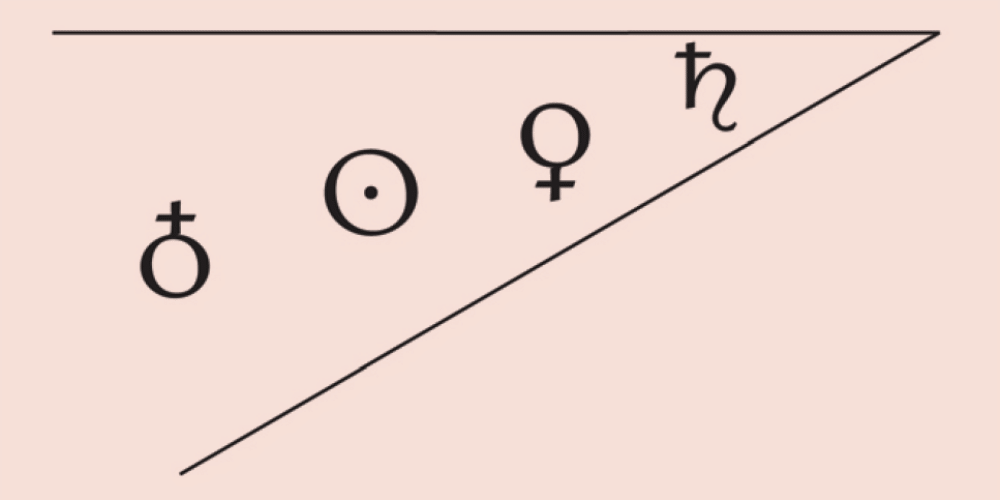
FIGURE 1981 0109-1. The One-Only.
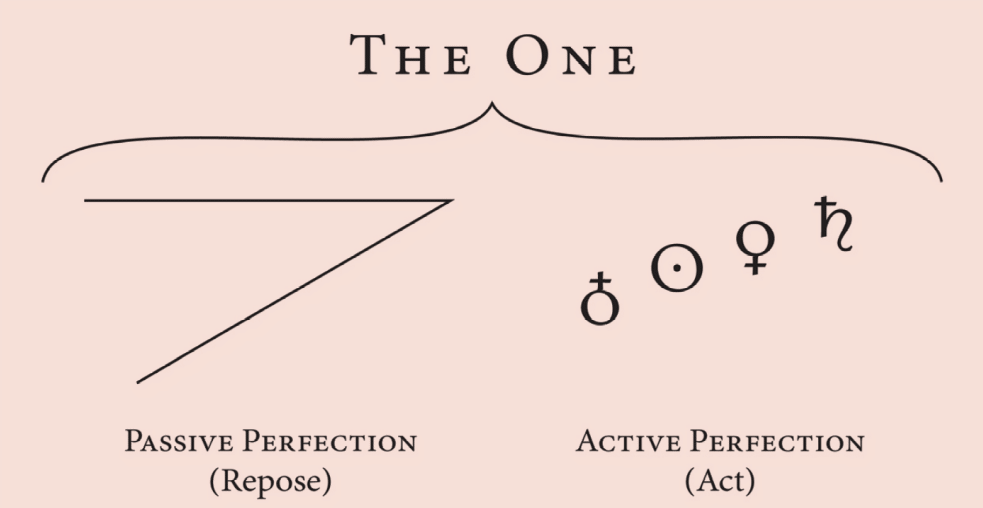
FIGURE 1981 0109-2. Active and Passive Perfection.
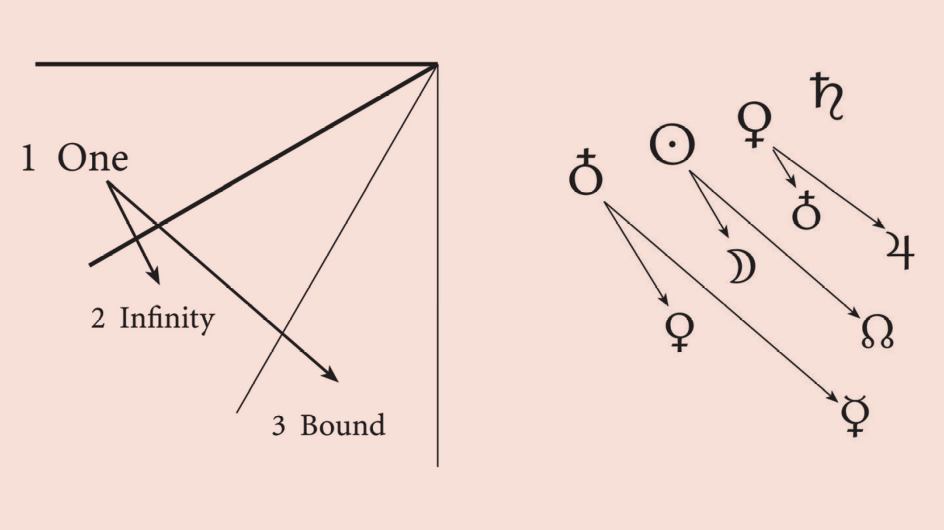
FIGURE 1981 0109-3. One, Infinity, Bound.
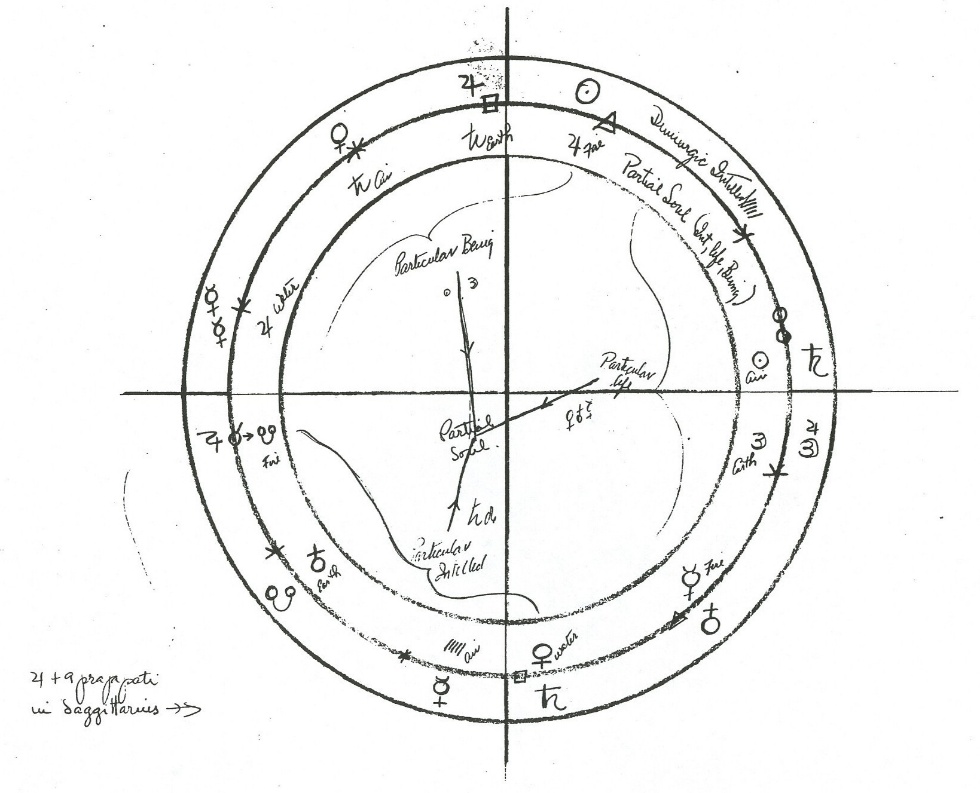
FIGURE AD_E_022. Demiurgic Intellect and Partial Soul.
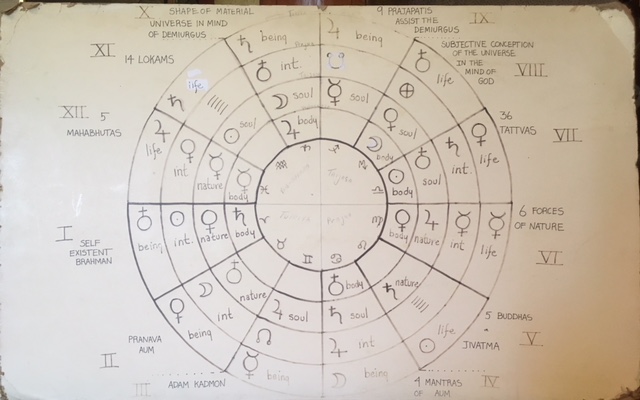
FIGURE IMG_2202-Posterboard Metaphysical Chart.
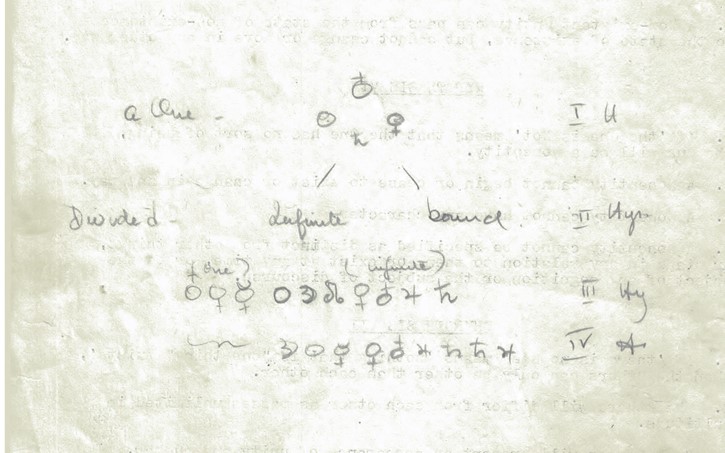
FIGURE PLA Eight Hypotheses of Plato B-p.4.PDF (for reference only). Facsimile scan of Anthony Damiani hand-drawn diagram (originally on back of copy of Cornford Eight Hypotheses): Hypotheses I-IV, with 1st Quadrant Dignities (Hyp. I-III) and Rulerships (Hyp. IV).
Other diagrams also referred to are not with this transcript version. [Transcriber note: [diagram] means the speaker is referencing a diagram as he or she is speaking. If someone is drawing or writing, with audible sounds of chalk on a blackboard, I indicate this by [drawing] or [writing].]
APPENDIX: The Eight Hypotheses, as translated by F.M. Cornford in Plato and Parmenides, are appended for reference only. They were typed out and used in other WG classes on the Eight Hypotheses. AD made some handwritten edits and these are noted accordingly.
NOTES:
- This class continues the discussion of Plato's Parmenides Hyp. 2 that was started in WG CLASS 1981 01/02.
TRANSCRIBED Verbatim by IT 2021. In 2025, IT expands Subsubjects and Plotinus quotes section, completes TOC, adds new note within transcript, adds five diagrams and references within transcript to these diagrams. Archival verbatim transcript – V12a.
AUDIO FILES: 1981 0109a, 1981 0109b. [Note 1: "Tape" and "Side" refer to original audio cassette tapes that were later digitized into .MP3 Audio Files. Note 2: In 2025, REP Studio cuts dead air from file b and improves its sound quality.]
1981 01/09 at Wisdom's Goldenrod
Plato; Parmenides; 8 Hypotheses Hyp. 2
[Audio File 1981 0109a Begins]
[Transcriber note: I am using Thomas Taylor (tr.), The Parmenides: A Dialogue on the Gods (Vol. 3), in The Works of Plato, viz. His Fifty-Five Dialogues, and Twelve Epistles, First Edition, London, 1804.]
Plato, Thomas Taylor (tr.) [The Parmenides, p. 165, RC reading]: "…summarily assert that the one is, this would be no other one than that which participates of essence."
AD: Did you take a look?
RC: Of essence.
AD: Of essence? Yeah, go on.
RC: Go on?
Plato, Thomas Taylor (tr.) [The Parmenides, pp. 165-167, RC reading]: "Certainly.
"Again, therefore, let us say, if the one is, what will happen. Consider then whether it is not necessary that this hypothesis should signify such a one as possesses parts?"
AD: Well which part did you like? (student laughs) Or did you like all of them?
RG: There are many parts.
RC: I like the part that--
Plato, Thomas Taylor (tr.) [The Parmenides, p. 165, RC reading]: "If, therefore, any one should summarily assert that the one is, this would be no other one than that [RC adds: one] which participates of essence."
AD: Of what essence?
RC: Of the essence of the One.
AD: Well then why didn't you read the part where it says about the participating in the essence of the One?
RG (faint): It is the essence of the One.
AD (simultaneously): That's the one that you should read. [student assents, very faint] Because that's the-- that's the, you know-- that's the (other one).
S: 164.
AS: 160.
RC: 161.
AS: Uh-hm.
S (very faint): Yeah.
S: Yeah.
RG (faint): That's my point. (bit of laughter)
Plato, Thomas Taylor (tr.) [The Parmenides, pp. 161-163, RC reading]: "But consider from the beginning, if the one is, can it be possible that it should be, and yet not participate of essence? It cannot. Will not essence therefore [AS simultaneously, speaking directly into mic and drowning out most of what follows: This is for you Red Witter so listen carefully.] be the essence of the one, but not the same with the one? [for], if it were the same, it would not be the essence of the one, nor would the one participate of essence; but it would be all one to say the one is, and one one."
AD (faint): That's the part you picked out. [S: (Uh-oh.)] You explain(ed) it to me? [short pause with faint background student talking] Because of that, that part, the whole Eight Hypotheses falls apart. 'Cause already in the second one it falls apart. [12 second pause] Maybe you could make a comparison with Plotinus' remark on the Double Act?
AS: For that one?
S (faint): That one.
AD: When he speaks about the One's Being.
AS: Uh-hm.
AD (faint): Yeah.
AS: Well, I think that by-- when he speaks of essence here he certainly doesn't mean-- Or in the positive way. He seems to mean the same thing as when Plotinus says that the Being of the One is constituted by a self-originating self-tendance. [Note: Plotinus, VI.8.16, "That his being is constituted by this self-originating self-tendance--at once Act and repose…"] So he here-- also here is using the word 'essence' or 'being' as super-essence, and not in the normal way we would think of essence. He says that the essence is the essence of the One.
AD: What do you mean normal?
AS: I mean the norm-- the way most people think of it.
AD: But what's normal? I mean what do you mean by normal here?
[short pause]
AS: Well, I don't know.
S: Uh-hm.
AD (faint): (Does anyone) here know?
S (very faint): Anyone know?
AS: Well let me rephrase that. (bit of laughter)
AD (faint): That's better.
AS: Let me not say normal around [one word inaudible]
AD (simultaneously): Metaphysics isn't normal to begin with.
AS: That's-- that's what I meant. (bit of laughter) Ok, anyway. Start from the beginning. He says--
AD (simultaneously): Why should (you) be interested in metaphysics or philosophy? Don't you have enough problems?
S (very faint): No.
S (faint): You sound like Anthony.
S (faint): No. (bit of laughter)
S (very faint): (Distinguish) it.
AD: Normal [S simultaneously, very faint: (Right.)] people wouldn't study philosophy.
LR (faint): If only that was right. (laughter)
AS: Let me draw this picture on the board. (laughter)
RG: That's a good move.
AS: Well see it's the same picture, we don't even have to draw it again.
AD: You don't, no. Put the light on, this way I can see it.
AS: It's the same picture.
S (faint): Show-- oh show them all in person.
AS (simultaneously): How the-- we spoke about the Double Act of the One. This is the same thing. Now I-- my contention is that what we've been doing is very similar to this twofold Act where this-- where the Act of the One is inseparable from the One. Absolutely united with it. And the same thing here. He says the essence of the One, and he seems to indicate that that-- that essence of the One, being the One's essence, is in a way inseparable from the One. And it seems to be equivalent to when Plotinus says that the One's Being is self-constitutive. And the same thing here, the essence of the One or the One participates in essence seems to be equivalent to that second Act that the One-- of the One. So if we consider these ones as the essence-- well last week when we spoke about this, we spoke about the essence of the One as being these ones, ok, and similarly in Plotinus if we look at the ones as the second Act [AS taps on board; FIGURE 1981 0109-2, Act], then this would be the One's essence.
S (faint): Uh-hm.
S (very faint): Zeros.
AS: The zeros. Well, we'll call them ones. It doesn't matter. Same thing. Um-- Let me do-- (put that--) and--
AD: You know, that Double Act seems to be constitutive for instance when we work with the fourth-- third quadrant, where we look at the Demiurgic Intellect, you're looking at the house position [diagram]. And then when you look at a particular soul you're looking at the ring position [FIGURE AD_E_022]. [AS assents] And there you have a Double Act also.
AS: Yeah. See, we tried to trace that all the way down from-- from the One to the Intellectual-Principle and the Soul and then to the material realm also. But it seems al-- oh yeah, that these two also seem equivalent in some way to the first two Hypotheses in the Parmenides, the difference between looking at the One as absolute and not being able to say anything about it [FIGURE 1981 0109-1] and the Second Hypothesis where he says the One has Being, but this Being is-- the way we're interpreting it is the Being is not something dis-- separable from the One [FIGURE 1981 0109-2]. So it is the One's essence. So it is the One's [AS taps on board] own internal structure if we could even speak that way.
RG: But it-- but it is not One. He makes the point it is not the-- the One, otherwise the-- we would have One One, not One essence.
AS: The essence of the One is not the One, otherwise it would be all the same to say--
RG: Right. So in one se-- what sense are you diagramming the distinction?
AS: Between the One and the essence?
RG: Yeah.
AS: Well, in a sense we said I think we're diagramming the One in the Second Hypothesis here, we're diagramming a distinction between-- [AS taps on board; FIGURE 1981 0109-2] in this one, I mean not-- without referring to the First Hypothesis which gets confusing, just with respect to this Hypothesis, say right here, that the One represents the substance of this-- of the first house, and the essence, [drawing] its essence represents these unities [diagram]. [short pause] Do you want to do more of it?
RG: [three/few words inaudible]
AS (simultaneously): And he says the essence is the essence of the One, ok. So--
RG: And then you're going to call that-- that-- that whole One Being.
AS: Yeah. That's the whole-- this whole thing now, you have [drawing] a One, and it has the One aspect and the essence aspect. And together it's One Being. And he says, the One--
RG (simultaneously): Of which part is the One and a part is essence.
AS: Appears to be. [AS hits something] That's not the oracle, that's just-- (AD laughs, laughter) This is just for emphasis. Yeah, so, [drawing] these-- this is his self-constituted essence, which is not really separated from the One itself, but in this view we speak about it as the One Being. And the One participates in essence.
RG: Right.
AS: [drawing] In-- insofar as any one of these can be seen to be manifesting that One. This manifests it as Being [Mars in Aries] and this is, say, Intellect [Sun in Aries], Nature [Venus in Aries]. Ok? Where we're-- where we're using essence more as [drawing] the nature of the One, the essence is what makes a thing to be what it is. [RG: Right.] And to be in a super-essential way here.
RG: But, you see, saying it that way seems to make it closer to the fact that-- I mean, then I can't hold onto his other side of the argument that in what-- what is really the distinction, in other words, we-- we are really saying One One. We're not really saying anything different. In other words, when we speak of the Double Act of the One, [AS: Yeah.] it is both the One in both aspects. And we don't-- we don't speak of two-- even two aspects, the One looked at in two ways. But in the--
AS (simultaneously): We don't look at the One in two ways?
RG: Well we do look [AS simultaneously: No, no.] at it in two aspects but it is [AS simultaneously: Yeah.] the One. We don't-- right? And even when you--
AS (simultaneously): It is the essence of the One, yeah.
RG (simultaneously): And even when you say it's the self-constituting [AS simultaneously: Right.] internal structure of the One, [AS, faint: Uh-hm.] it doesn't seem we're saying it's other-- it's anything other than the One.
AS: But it does seem to be saying something more than just to say One One. What? So what else is it saying? Must be saying something slightly different. Otherwise we would've stopped at the One, the First Hypothesis.
RG: Well if it's (described/ascribed) there, yeah--
AS (simultaneously): And then we wouldn't have said anything.
RG (simultaneously): --what-- so yeah, so I need-- so-- right, so what is the difference then?
AD: Well let's start again. What is the One's [RG simultaneously: Right.] essence?
AS (faint): It's--
RG: Seems to be something other than the One.
AS: Why?
AD: Well if we said that the Mars was the Being, ok, Sun Intellect.
S (very faint): Uh-hm.
AD (faint): Ok?
RG: Yeah.
AD: Soul the Venus, Body the Saturn, alright, we use these as very simple terms. Then the essence of the One or what defines the One would be-- a One would be these four put together. But the One would not be the same as the essence. Now why-- why would we say that? [11½ second pause] Why did we say that the Soul essence, alright, was not a different kind of essence? We said that certain-- a certain qualities or characteristics contributed to make that Soul essence to be Soul and not anything else. Now what makes the One to be One?
[11¼ second pause]
DB: The only-- [RG simultaneously: The unities, right.] the only thing that could make it to be One would be its essence, I mean, according to this description, which for Plotinus would be that self-originating self-tendance. Insofar as you speak of One as Being, it would be that essence which would go off of that.
S (very faint): Is that [one/two words inaudible]
S (very faint): Yeah.
DB: Well you said what makes the One to be One. Well, insofar as we're speaking of One-- of a One which has Being, it would be the essence of that One which makes it possible for the One to be. Otherwise you couldn't-- you-- you could just stop at the First Hypothesis.
AD (very faint): Yeah, what she was saying, ok.
DB (simultaneously, faint): Oh (ok).
S (very faint): (Uh-hm. Go ahead.)
S (very faint): Yeah.
S (very faint): (Right.)
S (faint): What--
DB: You asked, what was-- what was it that makes a One to be One as opposed to--
AD (simultaneously, faint): Yeah well what's the essence of the One.
DB: Well, I mean, in the diagram it's diagrammed in terms of the dignities in the first house, ok, and Plotinus seems to talk about that Being or essence as having a self-originating self-tendance which is a different kind of understanding of essence than say Soul essence or Intellectual essence. So it would be the essence of the One which would make it possible to be.
[16 second pause]
AD (very faint): (So/It's all) (when he says--)
S (faint): Go ahead.
DB (faint): The essence of the One is to be.
S: Uh-hm.
DB: You mean-- you don't like (it). I-- But it's the essence of the One that makes it possible for the One to be. [student assents, very faint] Now I mean, that's what he said. [S simultaneously, very faint: Richard (couple words inaudible)] I mean that's what Plato said.
S (very faint): (We get) what (Plato) said.
DB: Oh, ok. Well I was-- I would-- I was saying that it was--
AD: Well then, you'd have to agree with Richard. If the essence makes it to be One, then it would be all one to say One One.
AS (simultaneously, faint): The One. Or One One.
DB (simultaneously): No, it's the essence that makes it possible to be One as opposed to-- [AS, faint: One.] as opposed to One, yeah. I mean it's through the One's participation in essence which makes possible the-- the Being of the One or One Being.
AD/S(?) (very faint): [couple words inaudible]
AS (faint): Yeah but--
AD: Go ahead.
RG: I think the question was not Being and ess-- in Being sense but Being in terms of its One status.
DB: You mean the First Hypothesis?
RG: No. Well no, just one hy-- One aspect. Let's-- To be the essence of the One and the One is its two concepts which he clai-- he says are not the same because if they were the same we would have a One One and not-- we wouldn't need another term. So either this term refers to something distinct or it doesn't. [AD, faint: Uh-hm.] Or it's really just another way of speaking about the One itself. He seems to be claiming it is another way of speaking about-- there is some distinction between the essence of the One and the One.
AD: Yes, I agree so far.
RG: That-- [S, faint: Right.] that-- that-- see that's the question, my only-- my question here is now by diagramming the essence of the One as the-- the zeros in the-- in the first house, how are we saying that that's other than the One?
AS: Not saying other. He didn't say other.
RG: He says they're not the same.
AS (simultaneously): They're distinct. Well, but Richard, aren't we distinguishing-- distinguishing them in a diagram by distinguishing the dignities from the substance of the sign itself. He's saying that activity is dis-- is distinguished in our diagram from the substance which that activity is manifesting.
LR: I think--
RG: Yes, no but-- but we had-- [S, faint whisper: Yes, no. (bit of laughter)] no, because our view of the One as absolute substance and infinite unlimited function--
AS: Is the first view.
RG: Wait a minute. Is looked at-- You're saying now by looking at the One as absolute substance, [AS simultaneously: No.] as the sign, and you're saying that's really the view of the One, and the view of the [AS simultaneously: No.] essence of the One is the planets as function is not the One.
AS (simultaneously): In the Second-- in the Second Hypothesis, that's what-- in a sense what we're s-- No, not quite. No, this is the Second Hypothesis, [RG simultaneously: Right.] not the First. If we were in the First Hypothesis, then we wouldn't be-- we would have them absolutely united, which they are.
RG (simultaneously): But you've made substance prior.
AS: How have we made it prior?
RG: By your saying the One now is the substantial aspect [couple/three words inaudible]
AS (simultaneously): No, but the One is not prior to his self-constitution. In [RG simultaneously: Right.] this Second Hypothesis, the One is not taken as prior to his essence in this sense. Since [S simultaneously, faint: (Why?)] his essence is-- is hi-- is-- since it's the One's essence, the One's essence in this Second Hypothesis is not prior, is not-- is not later, I'm sorry. The oneness aspect is not prior to the essence in this Hypothesis. Because the Hypothesis is if the One participates in essence.
RG: Right.
AS: And I don't think there's any priority given in this.
LR: See also [RG, faint simultaneously: Sure there is.] I think we said [AS simultaneously: So you--] that the-- in saying that the One-- that the essence of the One isn't the same as the One, we also said that it's not different from the One.
RG (simultaneously): He says--
Plato, Thomas Taylor (tr.) [The Parmenides, p. 164, RG reading]: "Does it not signify that the term is is something different from the one?"
AS: Well that's what we're saying here, I'm sa--
LR: But wait a second, if it were-- if it were an other, let me use the word 'other', if it were other than the One, it couldn't be the essence of the One [S simultaneously: Right.] is I think what we said.
AS: Alright, I try again but--
RG (simultaneously): You say that I really don't-- I mean--
AS: I--
RG: What does it mean to say it's different?
LR: Would you--
AS: It shows you right there that this-- here, the function here is different from the su-- is distinct from the substance [FIGURE 1981 0109-2].
RG: And you're calling the function essence and the substance the One?
AS: In this view if we're distinguishing them here, yeah. Why not?
RG: I-- 'cause I-- I think that's giving a priority [AS: No!] to the substance view.
AS: Why?
RG: When you're talk-- want to talk about the One as absolute substance and absolute function.
AS (simultaneously): When you want to talk about the One as absolute we said already the One is equal to absolute substance is equal to absolute function.
RG: Uh-huh.
AS: That's fine, on the one hand it is. And that's al-- and then you won't talk about its Being. You'll be in the First Hypothesis. Now we're dropping that Hypothesis. So we've already established that function and substance are not either one of them prior.
RG: Right.
AS: That's fine. We've already taken care of that. When Plotinus says that his-- that activity, that Act is identical with the One, we've already established that, so that's-- we don't have to worry about that now.
RG: Fine.
AS: Now we're going to talk about the way in which the One has essence or Being.
RG: But when you diagram that one now--
AS: This-- which one?
RG: The One as absolute substance and unlimited function, how are you going to diagram--
AS (simultaneously): United [FIGURE 1981 0109-1]. I diagram them as the first house with--
RG (simultaneously): With the planets in there.
AS: With the planets either in them or merged back into them as [student assents] inseparable. Suppose I diagram them as-- I won't draw-- suppose I di-- draw this diagram-- I mean-- you know, where he called them [drawing] zeros and they're at-- they're inseparable, like the activity is merged back into the substance. We say that they're absolutely indistinguishable. And then we've denied the possibility that there's a priority to either the substance or function.
RG: Fine.
AS: Ok? And now I think he's talking about this activity as being its self-constitutive nature. When it does that, it is-- We already said that Act was inseparable from them. But now the essence-- it's self-constitu-- that essence constitutes itself. That activity constitutes itself as the One's-- as the One's essence. And that self-constitutive Act is not other than the first Act, ok? I'm-- ok, so I was saying that.
RG (simultaneously): But I think he's saying it is other.
AS: Is other.
VM (simultaneously): It's different.
RG: Otherwise [AS simultaneously: Well right here it's other.] then you're going to have One One and not One essence.
[Note: See FIGURE 1981 0109-2 for the following.]
AS: Right, exactly, in this view it is taken as distinct from the One as abiding. Repose and Act [AS taps on board]. I think he's just doing here, in this thing [drawing] you've got Repose and you've got Act [diagram].
RG: But, Repose and Act are united.
AS: In the First Hypothesis they are.
RG: Yeah.
AS: In this Hypothesis, as you pointed out, he is distinguishing them.
RG: Right.
AS: Because unless they're distinguished, then later on they're not going to be able to be, you know, separate. I take that view. Let's suppose we put that there.
RG (simultaneously): Alright, so we distinguish them and now in the diagram how [couple words inaudible]
AS (simultaneously): And in the diagram we say that [drawing] this refers to the Act aspect [diagram]. But the same ones that were here absolutely united and you couldn't distinguish in the second Hypothesis, or in the second Act, we now say that this one [diagram], [drawing] his self-constituting nature, this self-constitution is its own Act. It is the one's Act which is identical with the One in the First Hypothesis so we'll forget that. But here [diagram] it's distinct from the One. It takes itself as distinct from the One as substance. So we [RG simultaneously: Right. So--] take the One aspect as the Repose or substance and the Act aspect as that self-constituted essence.
We say now wait, this Act, is this something brought in ad hoc or something, no. It is the One's Act. Ok? And in this view, it is distinguishing itself from Repose. Now-- It may be one particular aspect of the Act that's allowing it to seem distinct from the One aspect, and that may be the peculiar function of the principle of Difference [Saturn in Aries], ok. In other words, only one of these [drawing] principles is Being. Suppose you say they're all essence. This one is Being [Mars in Aries]. This particular part of that Act of essence, the Act of the essence, the particular part of the Act of the essence, if we want to say that, which is allowing them to be distinct at all is probably the Saturn principle here [diagram]. 'Cause then he's going to have that line that says not a-- it's not as Being that it's-- not as essence that it's distinct from the One, and the One isn't distinct as One, but it's through Difference. But I'm saying that now it-- I think it's also like-- or when we-- [AS tapping on board] may or may be-- [couple words inaudible] (better) stay with this one, I guess.
DR: You're saying in-- in that view that the One that you've got written in that first house distinguished from the essence or the planets, like are you-- if you're going to describe that One, would you then go back to the-- to a similar description that you gave in the First Hypothesis?
AS: Well, no, because in this Hypothesis [drawing] he is distinguishing between Act and Repose. He has to be, otherwise his-- I mean Richard's point is good in a way, there is-- there's got to be a distinction. We-- he is distinguishing essence. But this-- this essence is no less one than the oneness, is no less the Absolute One than the oneness part. That's the problem I think. The essence he's speaking [drawing] about here is not any less the Absolute One than the oneness aspect is the Absolute One. But the One is capable of being seen under these two aspects.
DR: Well, that's-- that's what--
AS (simultaneously): Or-- or we do that one where Plato says God exhibits Bound and Infinity. And I would say that would-- that would apply here [diagram]. When he says God exhibits Bound and Infinity, this is his exhibition of God-- God's exhibition, or the One's exhibiting Bound and Infinity, is exactly, I think, what Parmenides is speaking of as the One has Being. If he doesn't exhibit Bound and Infinity, then we won't-- we won't say anything.
DR: Well, maybe you could say a little more on that.
AS: Well, the Bound and Infinity [drawing] are inherent, they're equivalent to the One. But on the other hand, they can be seen as the One exhibits these, its second Act is to exhibit Bound and Infinity or to be self-constitu-- to self-constitute its own essence.
DR: The one part would be Bound and the other part Infinity?
AS: I think that they would correlate. Or Act and Repose [AS taps on board]. Or as he uses here, he says the One aspect and the essence aspect. Here's the-- Now we're in the Second Hypothesis and we're speaking about the One's self-constitution. Oh yeah, he says self-- self-directed Act or He's-- He willed Himself. [Note: Plotinus, VI.8.16, "Thus not 'as He happened to be' is He but as He willed to be."] Ok. The willing in the Self, [AS hits board] the Self aspect would seem substantial, and the willing aspect, which seems functional, are not [AS tapping on board] really different from each other, they are actually identical. But if we're going to talk about them, we're going to talk about them as distinct. He wills Himself into Being.
DR (simultaneously): (In other words), [RG simultaneously: Those can be--] it keeps coming up, that every time you distinguish, and this is [one/two words inaudible] to understand, every time you distinguish in the Second Hypothesis the One from its essence, [AS: Uh-hm.] and if you give the-- if you say that the essence is one part, then the essence in some ways answers all your questions of what this thing is. Whereas now when you say substance (for/to) the One, it's somehow void of these essential qualities, which make it difficult to grasp just what One that is.
AS: You mean-- you mean when here [AS tapping on board] when we're speaking about this One aspect as opposed to the--
DR (simultaneously): Yeah, on the one hand it seems that, you know, if you go on to say well what's the One as-- as juxtaposed to its essence, if you-- [AS simultaneously: Yeah.] if you had to conceive it, it-- it would seem that you would use essence again to conceive it all over again.
AS: That's what I-- I didn't quite--
DR (simultaneously, faint): That's [couple words inaudible] and that's what my confusion is.
AS: That's what I didn't quite understand.
DR: In other words, if you say that that One is just substance, how do you conceive the substance completely-- it's certainly void of all qualities, not just (bare) underground.
AS (simultaneously): I know. This-- this is a bad analogy probably. [drawing] But you know that when we did the Soul, ok, when we looked at the two aspects of Soul, and we had these Intelligibles [diagram], right, the Jupiter, Ven-- let's just do the rulership ones, it doesn't matter. And we said that-- those-- those manifested the essence of Soul [AS taps on board]. And what was that essence of Soul? We had Soul essence, the signs [diagram], versus these functioning Intelligibles. They're inseparable but we distinguished them. Ok? And we went back, we said oh but this is Soul, these signs are Soul substance as it were. [Note: See FIGURE IMG_2202-Posterboard Metaphysical Chart, third quadrant.] Well, over here [diagram], what's the substance here? It's the One. And I wasn't really saying anything different from the essence of the One.
DR: Right.
RG: But if you're not really [AS simultaneously: But--] saying anything different, you're not talking about what he's talking about there.
AS: Ok then I won't say I'm not saying anything really different. Yes, I am saying something different.
RG: But I don't think you-- I don't think you really are.
AS (simultaneously): Ok, it's different. Isn't Act different from Repose?
RG: In that-- at that realm?
AS: It-- look, let me put it this way.
RG (faint): No.
AS: Well let me put it this way. Look, we talk [drawing] about this as Being [Mars in Aries], right? We talk about this as manifesting the Intellect of the One [Sun in Aries]. Talk about this as manifesting the Difference of the One [Saturn in Aries]. Aren't these all the One?
RG (faint): Yes, that's [one/two words inaudible]
AS (simultaneously): Well that's what we're indicating by saying that they're all [AS taps on board] manifesting the One.
RG: And that's why I agree and would say you're not yet talking about the Second Hypothesis.
AS: But I distinguished these!
RG (simultaneously): You are talking about only the One.
AS: Yes, but I'm always talking about only the One. Your problem is that you can't understand that within the One there's also this-- these distinctions. You're saying that in order for it to be the One, I can't have distinctions in it.
RG: No. I allow-- no, I'm not saying that at all because I would allow--
AS (simultaneously): Yes.
RG: I would allow--
AS (simultaneously): What distinctions do you allow in the One?
RG: I would allow the view of unlimited function and absolute substance and you could have all the distinctions you want.
AS (simultaneously): There's no distinctions within unlimited function and absolute substance. They're absolutely one. What kind of distinctions are there?
RG: They have to be all--
AS (simultaneously): That's a distinction?
RG: They have to be all there.
AS: If they are distinguished then we're not in the One.
RG: Well then-- then that's what (your point is).
AS: No, you-- (AS laughing) No, you said what dis-- I'm saying, why can't you allow there [AS tapping on board] to be distinctions also within the One?
RG: I can.
AS: The view that the One is not just some homogenous simplex [RG simultaneously: I--] but he says infinite depths of power, [RG simultaneously: I'm not saying it isn't.] self-constituting self-tendance.
RG (simultaneously): I'm just trying to understand the difference between the essence of the One and the One, I'm not saying it says nothing about the view that there are distinctions within the One. This is another question.
AS: That's what this is saying. He says the One participates in essence.
RG (faint): That's right.
AS: Ok. So [RG simultaneously: Therefore--] here we're showing how the One participates in essence. The claim is it's the same One. So here's the One again [diagram], and [drawing] we're showing that it participates in essence.
RG: But it's par--
AS: Here is its participation in essence [diagram]. At the same time it is One, it is in Repose.
RG: Ok but that One in fact, I thought the Second Hypothesis has parts.
AS: That's right, isn't it, because as a matter of fact it's Mars in Aries, [drawing] Sun in Aries, Venus in Aries. Right? Doesn't it have parts? When we speak about the essence as having parts he's going to say that the One itself will have-- appear to have parts.
RG: Ok but you've only diagrammed the aspect of the essence as having parts, what you got here.
AS (simultaneously): No, as a matter of fact, I think we could show that-- that you could show that the oneness too will have parts. He goes into that.
RC: Wait a minute, wait a minute, wait a minute, wait a minute, wait a minute.
AS: He's going to go into that. But--
RC (simultaneously, faint): That having parts is ascribed to the One Being, not to the One.
AS: To the One. The One he's speaking of.
RG (simultaneously): And the One as the One Being.
AS: He says, just as the Being gets parceled out as it were, so does the One aspect of it.
S (simultaneously, faint): One of the One Being.
AS: He does-- he says both.
S (simultaneously, faint): He says--
RC (faint): But did you say that the One possesses parts, that even like [couple words inaudible]
AS (simultaneously): The One he's speaking of.
RG: Yeah, the One he's speaking of.
DR: Yeah, the first [AS simultaneously: Yeah.] part would be the One and its essence. [couple/three words inaudible]
AS (simultaneously): That was where we had ended up in fact.
S: Ok.
Plato, Thomas Taylor (tr.) [The Parmenides, p. 171, AS reading]: "[AS adds: The] One being, therefore, is not only many [AS reads: one], but it is likewise necessary that the one which is distributed [AS emphasizes following word] by essence should be many."
AS: Because otherwise each of these [drawing] couldn't be a one. We've preclu-- if the One couldn't be participated by essence in this Hypothesis, you'd preclude the possibility that there would be real unities here, that these could be real unities [AS tapping on board].
RG: Why? Why doesn't that just-- the other side, the converse can answer that.
AS: No, the converse would be--
RG (simultaneously): That the essence participates of the unity and that grants it the unity, not that the One has to have parts.
AS: Not that the One has to have parts. But if it's the essence of the One, if it really is the One's essence which is identical with the One, [RG simultaneously: But it's not. But it's not identical with the One.] which is the point Randy made before, in its first aspect-- no it wasn't Randy, well it doesn't matter who made it. But it was a good point, it was Michael, yeah, it was a good point.
RG: What is it?
AS: The point being that in this case since it is the essence of the One, and not essence as a separate principle, being the essence of the One, he went-- he goes through this little thing where he says that ea-- that the essence-- [drawing] when we say One Being, we assert oneness of the Being [AS tapping on board] and we assert essence of the One. So in this happening, in speaking of this Second Hypothesis, the essence we're speaking of is unific kind of essence. We're not second quadrant essence or third quadrant essence and so on. It's oneness type essence. And therefore each of these as an essence has to be a one also. It has to par-- there has to be a participation in oneness.
RG (simultaneously): Participates in unity, for sure.
AS: Yeah. Well that's all he's saying by the One gets parceled out, as it were, as parts.
RG (simultaneously): No, that's looking at it how the essence gets unified, not how the One gets parts.
AS (simultaneously): It's both. When the essence gets unified, the oneness gets essence. They both participate, the two aspects. He doesn't gi-- he-- it's--
RG: Ok.
AS: It's an almost symmetrical relation in this Hypothesis. Because that essence isn't secondary to the-- I think that in this Hypothesis the essence aspect is not secondary to the oneness aspect. Because the essence aspect is, again, I mean if we go back-- if we were to go back to the first Hypothesis, we'd see that that essence or activity aspect is not really a secondary aspect of the One. I'm sorry, I [couple words inaudible]
S: Yeah, I see.
RG: But if it's not a secondary aspect of the One--
AS: This whole view is a second view of the One.
RG: But it's a second view of the One in which essence is distinct from One.
AS: In which essence is being distinguished, yeah. Because now it's not the same, see, you know, as you said, we're not just saying One One. We're saying-- we're talking about the One's Being. It is exhibiting its essence, those poor fellows you want to look at. Oh no but-- but that point-- I think Richard he make-- that point though he does make that, when you speak about a One Being, he says that the Being aspect [AS tapping on board] is characterized by oneness, [RG assents] and that the [RG simultaneously, faint: (One is characterizable.)] One is now characterized by Being.
RG: Right.
AS: So that when the One participates in Being we're also saying that Being now is unific, [AS tapping on board] these are unities. [RG assents] Because they are the essence of the One. Alright though that leaves us back at--
RG (faint): Well I agree with that. We agree on that point.
AS: (Leaves/Leads) us back up here [diagram]. See, if this is the way that the-- suppose we say this is-- this Being [AS tapping on board] is the One-- the way that the One reveals itself to itself. Over here it has abs-- this absolute function we say, unlimited function. And this unlimited function has the function of revealing the One to itself. The revelation of the One to itself is its own essence. He says He Wills Himself into being. And this isn't a timed kind of thing. Now if the One reveals Himself to Himself, he reveals [AS tapping on board] Himself to Himself. So we distinguish. He reveals Himself to Himself. Now, I mean, the revealing of Himself [AS tapping on board] is this activity or his Being. And he reveals Himself to Himself in these four modes and, you know, we claim through Being-- [RG assents, faint] like-- like T. Subba Row says every-- every being to the highest has-- has these four aspects. So He reveals Himself to Himself as the unities [AS taps on board]. Now, this revealing Himself to Himself is-- I would say again it is-- it i-- it is that first Ac-- it is really the activity. First activity.
RG (simultaneously): Isn't that the first Act though?
AS: Is this the first Act?
RG: I mean in the passages we were reading Wednesday on the willing Himself [AS: Yeah.] [one/two words inaudible]
AS: Uh-hm.
RG: You were take-- how are you taking that, as the second Act or the first Act?
AS: Well, see, I'm say-- I guess I'm taking the view that there's-- there's only the act of the One, the unlimited activity of the One is identical with the One.
RG: Then we're speaking of the One One.
AS: Right, that's here [FIGURE 1981 0109-1].
RG: Right.
AS: But now if we speak about that unlimited Act revealing the One to itself--
RG: I don't know what that means other than the first Act.
AS: Well, we said it was non-dual Act.
RG (simultaneously): Well, I mean, what do-- what do you mean revealing Himself to be? (He) [one word inaudible] all--
AS (simultaneously): He said it was-- He exhibits his innate characteristics, his internal structure. He's not just absolute homogenous point, but [RG simultaneously: Right.] also the One is the source of all and contains in its internal structure all the unities.
RG: Ok but in the passage we read from Plotinus we-- we then [AS simultaneously: And that is his Being.] also interpreted the second Act as the second and third house [FIGURE 1981 0109-3].
AS: Ok, I think that would work here too. I mean if we want-- I was going to say, if you want to do it with the second and third Act-- the second and third house, we could do it here too. We could do that. But the point is that in the second Act there seems to be [drawing] some internal structure that you can speak of, which I think that internal structure is what he's calling the Being of the One, what makes it to be what it is, not-- yeah. 'Cause One as absolute One is not even a be-- not a-- you know, we're not even going to speak of be. But here we're going to speak about the internal structure of the One. And I think-- yeah, if you wanted to equate it with this is the One as the source of all, yes, this is what'd you have to look to. If you wanted to look to the pres-- the presubsistence of Nous in Being within the One, yeah you'd have to look to the Being [AS taps on board] of the One if we recognize the super-essential subsistence of Nous and Being in the One. And if we wanted to look to the unities, if we traced up-- you know, we traced back all the principles of Being back to the One, [LR: Yeah.] to their unity, yeah, I'd say we'd say-- [AS tapping on board] I think we'd say that would be the Being aspect, the Being of the One or the essence of the One. [student assents, very faint] And if we did that--
LR: Issuing Act.
AS: Um--
LR (very faint): Issuing.
AS: Yeah but there was-- we did make that point, and even Richard made it, that that Act attains to real Being. That's a low-- you know, [RG simultaneously, faint: (one word inaudible) yeah.] the attainment of that-- he agrees with that-- the attainment of that to real Being would be-- now if we were to further show that all of the, you know-- [drawing] all of the dignities like in the rulerships or the exaltations were suspended, then we would say that's its attain-- it's attained to Real Being, but as the second Act itself all it's doing is exhibiting the internal structure. It seems though that you-- The oneness aspect is the fact that these [AS tapping on board; first house dignities] all really are unities. They're all inseparably grounded in the substance of the One. And I think there is a different way of looking at-- I would say just as [drawing/writing] you're looking at Act-- that just as as a non-dual way of looking at the Act which you seem to look at this Double Act, simultaneously you have a double view of the substance aspect of it. Or the Repose aspect. But on top. This is a-- well, just (a warm). [short pause] You can pass out.
AB: Avery?
AS (very faint): Yeah?
AB: When you speak in the Second Hypothesis of this parceling out or exhibiting of the distinctions inherent in the One, would you say that the One's [S simultaneously: Yeah.] essence is what is exhibited, or would you say that the essence is what is doing the parceling out?
AS: Oh yeah, I didn't say that quite-- He doesn't say parceling out I don't think.
AB (simultaneously): Well but-- but still there's these distinctions that are latent in the One.
AS: Yeah.
AB: And-- [AS drawing] and now in the Second Hypothesis, you know, by drawing in these four planets we're explicating in a sense [AS simultaneously: Yeah we try--] some of what's inherent in the One. So we speak of the essence of the One is the essence-- what the-- the One contains or is the essence the Act which expresses what is contained in the One?
AS: Yeah but see the Act, that Act itself is what's contained in the One. I'm not sure how to distinguish them, he says [AB simultaneously: Well--] that in that they're-- each of these is united to the One.
AB: But, ok, in the First Hypothesis the way we were reading from Plotinus, the Act is the One, you really can't separate them at all, [AS: Yeah.] but we are making some kind of separation in the Second Hypothesis [AS simultaneously: (You understand.)] between the Act and the One or between the One and its essence. We're not saying-- the essence or the-- well I-- I would say, the essence is not outside of the One but it's certainly distinguished.
AS: [drawing] Ok I think we're doing something like this, we say this is-- this is manifesting the Being of the One [Mars in Aries], or manifesting the Intellect [Sun in Aries] or the Nature of the One [Venus in Aries], [AB assents, faint] or the Difference [Saturn in Aries]. Now, we said all-- all of these constitutes the One's essence. We've made-- I mean we've made that distinction before between Being and essence. Suppose we do. The only-- the problem here of course being that by Being we mean superbe-- you know, [AS tapping on board] we don't mean these to mean that what they mean--
AB: So--
AS: How can I say it, super-essential Being, super-essential Intellect.
AB: They're man-- the One's essence is being manifested and the One's essence can be spoken about as super-Being, Intellect.
AS: But, the only problem with the wording is that when you say the One's essence is being manifested, it seems like there's an essence which then gets manifested. Because they're saying-- I think he's saying this activity is its essence. This self-ma-- the activity-- the activity itself is its essence. There's no-- there's no essence which these then-- which these manifest somehow. I mean I-- unless I kind of just trying to conceive it now, (just go) there. [AS tapping on board] That the-- this act-- this fourfold activity, if we could put it that way, is its act-- is its essence. Now he does say, I mean that, when you speak about the essence, it's unific. [drawing] So these are ones or zeros, and in that way Being is One, Being is characterized by One. This kind of essence [AS tapping on board] is characterized as One, as unities. If you go to the second quadrant, [drawing] like the Gods, the Intelligibles there, they're characterized as Intelligibles, Being [diagram]. Here they're characterized as One. Similarly when these-- these manifest-- these Acts-- this is the Act of the One, the-- the One is getting characterized as essence. Ok, so it's no longer just the One One but the One Being. And these Beings aren't just essence, they're essence which is One. They're unities. And so in both-- so we have a distinction now, right? And what I'm trying to say is there's a participation [AS tapping on board] both ways he's saying. That's along later on though. Come again?
AD/S(?) (very faint): Go on.
AS: Yeah, Randy.
RC (faint): There seem to be like a-- a very subtle but very different kind of wrinkle in last week's discussion.
AS: Yeah? Ok.
RC: In the sense that, the way the question was originally posed was what makes the One to be One. And, [AS: Started out with--] in that sentence, like when he talked about that what makes Soul to be Soul, what makes Intellectual-Principle to be Intellectual-Principle, what makes the One to be One, it seemed to be a slightly different wrinkle than to talk about oneness as one side of the coin or Being as another side of the coin.
S (very faint): Go ahead.
AS: Go on. [short pause] Go on, I-- You mean--
RC: But there has to be something different about the essence of the One from the essence of Soul. Because the [AS simultaneously: True.] essence of Soul makes things to be Soul, it doesn't make it the One.
AS (simultaneously): True, no doubt.
RC: The essence of--
RG: But the essence of the One does not make things to be-- the One to be One. The essence of the One, he points out, makes it to be the essence of One Being and not of the One itself.
DB: Yes, but it-- but, that's the whole point. I mean it makes the One to be One, not (One).
RG (simultaneously): Yeah but in what sense do you mean essence, do you mean-- I mean even if you use it-- I mean, the way he's using it here, [S, very faint: Uh-hm.] [DB, faint: Ok.] he's not asking what makes it to be One.
DB: Yeah!
RG: No. Because the One, he points out, of which the-- of which it participates essence is the One which is a part of a whole we call One Being and is not of the One of-- that isn't the One Being.
DB: Right. Well that doesn't mean anything because it doesn't participate in Being. I mean that's the whole point of this Hypothesis.
RG (simultaneously): But to-- Yeah but to say what makes it One--
AS: No, no, David-- but David made a distinction before between-- what David was saying, I thought, was this is what made it to be One.
(Side 1 of original cassette tape digitized as 1981 0109a Ends; Side 2 Begins)
AS: --will that makes Him to be One. So again there is some subtle distinction here between essence and One as One One. And David also pointed out I think the distinction between the fact that the essence is what makes it to be One, it's n-- it doesn't make it One. The One isn't One because of its Being. I think that's what you were arguing. That the One isn't what it-- the One isn't the absolute One because of its Being. [student assents, very faint] Ok and I don't think [one/two inaudible student words simultaneous with AS] David was saying that. I think he was just saying that what makes it be One as characterized in some [RG simultaneously: Right.] way as One-- Even to say characterized as One [RG: Ok.] is to already say that it's its own self-manifestation in some way, is n-- is to take it out of-- is-- is to take it out the realm of the Absolute One and to say that what makes it to be One is it essence. But "be" here-- I mean, you know, be in the su-- [RG simultaneously: Ok.] in the super-essential way. I'm not sure, I-- I thought that's what he had [student assents, faint] said before.
RG: But to be One, it isn't One as uncharacterized, it's One as participating in One Being.
AS: Oh it's-- it's now the One as participating in essence, but that's not to say that it's not still the One that we're speaking of.
RG: But it's the One that is-- that is a part of a whole.
DB: Yeah but the essence [AS simultaneously: Um--] that it participates in is not the essence of something other than itself. I mean it's its own essence.
AS: Yeah and the other thing is, this oneness part [AS tapping on board; Aries/first house] of it may be part of a whole. But this oneness part of it is not necessarily pri-- and it may be this is going overboard but-- In other words, these aspects [Act and Repose] are distinct from each other. That's not to say that either of these aspects is distinct from the One. I-- I don't know if I-- if that's-- you know, if that's the (character) [one word inaudible]
RG (simultaneously): If they're not distinct then there's-- there's One One.
AS: Well, in-- if we jump-- but if you say they're not distinct--
RG (simultaneously): But even if-- but if you're looking at the relation you're still looking [AS simultaneously: Right.] from the Second Hypothesis.
AS: Right but if you're going to go back to that, [AS tapping on board] if you're going to say there's any relation, you're right, you're going to go back to the Second-- you're going to go to the Second Hypothesis. So we're not saying that.
RG (simultaneously): So you can't even relate them as non-distinct or else you're within the Second Hypothesis.
AS: No except that he's starting the Hypothesis saying that we're talking about the One again. Let us go back again to the One and see what happens if the One is. And, now David's point I think was to say, now let's see what makes it be One, let's see what it's e-- the essence of the One is, rather than saying the One One.
RG (simultaneously): And then he says, if you're going to talk about the One as is, [AS, faint: Uh-hm.] then you're going to talk about it as within this whole of parts we're calling One Being.
AS (simultaneously): And you're going to distinguish One essence, [RG simultaneously: One and essence.] and One.
RG: Right.
AS: Ok.
DB: And later he says that these two parts of this One Being that he first speaks of, he said those two parts are One and "to be".
AS: Yeah. Oh yeah. [RG or another student assents] One, the substance [Aries], and essence, [AS taps on board] to be [first house dignities]. Well here they are. See, don't these in some way [drawing] characterize this-- I-- characterize maybe isn't the right word. Yeah. The One-- this One participates in these [AS taps on board]. We do say that these are manifesting that first house. This isn't separable off. It i-- the Mars is manifesting something of the Self-Existence, and so is the Sun and so is the Venus. And in doing that, isn't each of these also a-- [AS tapping on board] that particular kind of essence which is characterized by oneness. In manifesting oneness it gets characterized as one. And getting characterized is probably wrong also 'cause it is one. It is part of the-- it a-- they were-- they were originally part of the One. That it would be wrong if we thought that that was then something added on that characterized it. It's the One on-- it's the-- it is the Act, that activity which we said was inseparable from the One. Going back to that.
RC: I was thinking that-- this might not--
AS: One divided by One and it still remains One. Like you got, here is One, it's divided by One here [diagram], and it still stays One. You know, Eliade has a thing, you know, divide it by two or you multiply it but it-- it really neither. It's-- I-- and I-- I don't know. It's kind of poetical but, it seems like you say the One is revealing itself to itself [AS tapping on board] is what's happening here and not added on. The Act isn't added on. I don't-- that wasn't the point anyway.
RC: Well I just wondered if-- if-- given that these two parts, when you analyze these two parts of the One Being as One and "to be", you seem to reflect back to the original two terms that were discussed as the One and the essence which it participates, that [few words inaudible]
AS (simultaneously): Yeah. The One and "to be" are the same thing.
RC: No that essence of the One [AS simultaneously: Yeah.] and "to be".
AS: Are the same.
RC: Are the same.
AS: And the One-- I said the One and "to be" is the same as the One and its essence [RC: Yeah.] that it participates in. I think so. [student assents, very faint] Isn't that-- isn't that-- wouldn't you think so?
RC: Well they seem distinguishable, I mean--
AS: Well--
[short pause]
RC: Not to be anything in particular.
AS: To be anything-- Not to be anything in-- It's the "to be" of the One though. (AS laughs) Just like I said it's the essence of the One.
RC (simultaneously): But like the Universal Being in the-- another chart [diagram].
AS: Oh. Ok, except that that's all-- that's looking at it with reference to, you know, Being and say well this is the principle of Being. And I was saying yeah, I-- I would agree with that-- I would agree that that seems right, that this is the pre-existent, the super-essential [AS tapping on board] Being and Nous within the One, but I don't think that's-- he's coming from the other way here though. He's saying here not-- it's the essence of the One. I mean, what you're saying yeah but I'd say a-- but also he's saying it is-- this is the essence of the One. This essence of the One may be the archetype, the super-essential Nous and Being within the One. But here it is the essence of the One. It's not just the archetype of what's going to follow. It's not just here the principle of Universal Being meaning Universal Being as the principle of Being and that as its definition.
RC: Is there any other place that we--
AS: It may be that but secondarily.
S (very faint): Yeah.
RC: Is there any other place that-- that we in any way distinguish anything from its essence, I mean that we talk about it as anything other than its essence? Is this the only place?
AS: The only place that-- say again?
DB/RC(?): No.
RC: It's-- it seems unusual, I mean, to try to distinguish something from its essence. Normally when we do that, we talk in terms of an appearance, you know, and say well, there's this appearance and that it's not quite-- well anything to which existence may be attributed, either one with its essence or distinct from it.
AS: Yeah, go-- I'm not quite sure I--
RC: 'Cause usually when we try to get like what e-- what a thing really is, what anything-- what makes a thing to be what it-- what it is, [AS: Yeah.] we talk about that as its essence.
AS: I-- you're saying the principle of that is going to be found right here in the One.
RC: That's what I'm trying anyway.
AS: Well I think that sounds reasonable, that the-- the principle of anything later on is going to be found here. But--
AD (faint): Could I ask, is Mars-- is Mars manifesting Aries or is Aries manifesting Mars?
[10½ second pause]
S (faint): Go ahead (now).
AD: Well, just an ordinary thought.
RG: Ordinary thought.
AD (simultaneously): Does Mars manifest Aries or does Aries manifest Mars? You'd say Mars is manifesting Aries.
RC: Well I'd actually have to say it would be a problem for me.
AD: It would be a problem for you?
RC: 'Cause I can see person's Mars m--
AD (simultaneously): What have we been reading all these charts for all the--
RC: I can see a person's Mars much more easily if it's in Aries than if it's somewhere else.
S (faint): Uh-hm.
AD (faint): Yes, but what does that got to do with what we just (asked)?
RG: Well then in some sense the sign also manifests the--
AD: The sign manifests the planet?
RG: Well no, that's what I-- that's what Randy's claiming in some sense.
AD (simultaneously): Well, well, I'll keep quiet.
AS/S(?): No I'm-- (bit of laughter). You don't have to keep quiet.
RG: Normal parlance though we say that the first planet--
AD (simultaneously): Normal parlance? What is that then?
RG (simultaneously): The planet is concomitant [couple words inaudible]
AS (simultaneously, laughing): Oh! Oh Richard! (some laughter)
S (simultaneously): Oh more normal parlance.
S (very faint): Oh [couple words inaudible]
S (faint): I said this [S simultaneously: Oh you--] different word. (bit of laughter)
AS (faint): Not normal.
RC: But what would it mean?
AD (simultaneously): Why don't you take them both on and see if Aries manifests Mars or Mars manifests Aries. You can always go by that.
S: Yeah. (some laughter) Yeah the normal--
AS: Randy, you know your comment that the Mars is more visible in Aries may be because exactly it's manifesting Aries.
RC: It's manifesting its own selfhood.
AS: No, because it's manifesting Aries. When you put it in Cancer, it may not be so visible. It's because it's manifesting Cancer. Not because of the Mars neces-- not because the Mars principle. If there is a Mars principle it's different.
RC: Well it's interesting [AS simultaneously: I'm just saying, that that's--] that the unity of Mars is also there.
AS: The what?
AD (simultaneously): See how confused everything is now?
RC: It's interesting because the unity of Mars is also (in Aries).
AS: Is also where?
RC: In Aries.
AS: Yeah I know. But--
AD: All I asked was a simple question, which manifests which?
S (simultaneously): That's not a simple ques-- (some laughter)
S (amidst laughter): And I think that--
S (very faint): [few words inaudible]
RC: Well he does it both ways here, he says--
AD: No I'm-- I'm asking you. I'm not an-- I'm not asking him, I'm asking you. Mars manifest Aries or-- or Aries manifest Mars? And if Aries manifest Mars, would you mind telling me what it manifested?
AB: I don't think you could say that the substance or in this case the One, the Repose, manifests anything here.
AD (simultaneously): No, no, no, [RG simultaneously: No but he's talking about normal charts.] no, no, I'm asking about Mars in Aries, now don't you change the subject. (some laughter)
AS: Wait, this is normal parlance now right?
S (faint): What are you talking about? (some laughter)
AD: Aries manifest Mars, now tell me what is manifested?
RG: Both. I have to agree, both Aries is manifested and the quality of Mars is manifested.
AD (simultaneously): Well tell me, what of Mars is manifested in Aries!?
RG: Its energy to act (I'd say).
AD: Energy to act? You could say that of every planet!
RG: That's right.
AD (simultaneously): You mind getting a little more specific?
RG: That's right. In that you could say that of every planet it works both ways.
S (faint): Uh-hm.
RC: So it's really the-- it's really the person's selfhood that's getting manifested. (bit of laughter)
AD (very faint): (What'd you think?)
S: [possibly one/two words inaudible]
RC: I guess. I mean it's done in a martial mode obviously.
AD: No all-- all I'm asking-- I'm not asking for delineation of a chart. (bit of laughter) I'm asking, when you look at a chart, do you say the Mars is manifesting the Aries or the Aries is manifesting the Mars? What would you say, Bob?
BB: I'd say (I was ignoring), not to ask me.
AD: What would you [few inaudible words simultaneous with AD] say-- anyone.
VM/S(?) (simultaneously): Pick a quote.
RG: I'm not taking no quote. They're all going to [AD simultaneously: Take a quote, sure.] agree with you, come on! (RG laughs, some laughter)
S (faint): No we're not [couple/three words inaudible] one.
DB (simultaneously, faint): I got Mars in Libra so I'll agree with you.
S: Uh-hm.
S (very faint): Yeah.
S (faint): Yeah.
AD (simultaneously): See, Libra always gets affected by its nearest environment. (some laughter)
RC (faint): So we know Mars didn't affect the Libra when it's in Libra.
AD: What does it manifest in Libra?
RC: Libra definitely doesn't manifest the Mars (anyway).
DB: I'll agree with (Randy). (laughter)
AS (speaking directly into mic): See I told you Red.
RG (simultaneously): But Libra doesn't not manifest the Mars. (RG laughing)
RC: But on the other hand the unity of Mars is not in Libra.
AS (simultaneously): Talking to the--
AD: I'm not speaking about the-- all I-- all I want to do-- if-- if I have Mars in-- in Aries I would ask you, what is this showing me? You--
LR: That God (didn't, uh-hm).
AD (simultaneously): You mean, will you go into the bathroom, (bit of laughter) think it over?
S (faint): Yeah. (bit of laughter)
RC: Well to me the Mars is always more apparent than the Aries. I have to really--
AD (simultaneously): Alright, the Sun in Aries.
S (very faint): Yeah.
AD: What does the Sun in Aries do?
AH: Is it-- is Aries--
AD (simultaneously): Is Aries manifesting the Sun or the Sun manifesting Aries?
RC: But, to me manifest [AS simultaneously, possibly part of background: (Gets it all.)] means to limit or number various [one/two words inaudible] I guess that's what I still (want to do it).
AD: You see Aries being manifest.
RC (simultaneously, faint): Yeah, yeah.
AD: Alright then, if Aries is being manifested by the Sun, is Aries participating in Aries? In its own essence?
RC (faint): Yeah.
AD: Alright, that's all I wanted to ask, see?
BS: What was his answer?
AS: He said yes.
AD: That's all. It was very simple. Does Aries participate in its own essence when the Sun is manifesting it? Alright. Could we say that the One, so to speak, participates in its own essence? Why not? [short pause] We could make it simple, we could say there's John Doe, first house. He's got being, he's got an intellect, he got a nature and he's got a body. Does each one of these manifest John Doe? Of course. John Doe is participating or being manifested in his body or in his nature or in his intellect. So he's participating in his own essence. How do you people read a chart!? You mean when you read a chart you're reading someone else's, you don't read the first house chart? I mean, where do you look for the native? Any place?
RC: Now could you s-- can you--
AD (intensely): Where do you look for the native, the identity, where do you look for the entity?
RC: Ok.
AD: That's it!
S (very faint): David?
RC/DB(?): Can you-- [S simultaneously: Let me--] can you speak like directly to Dickie's question or--
AD: I'm not talking to Dickie.
RC: Ok, let me ask-- (bit of laughter)
AD: You answer him.
RC: What's [S simultaneously: What?] the-- in what sense is the Aries-- is the Aries that's participating in the Aries, (bit of laughter) (the first group) of Aries, just say you participate in it. Like why is it different to say-- why is it not--
AD (simultaneously): Why is Aries different from the Aries that's being participated in.
RC: Yeah like why don't you just say Aries Aries.
AD: No, you can't!
RC: Ok, that's what I [couple words inaudible]
AD (simultaneously): They're not equivalent. They're not equivalent. Is that so, Richard?
S: Yes.
AD: Because if that were so (bit of laughter) then you would be saying there's no need for Mas-- Mars to do anything. Aries is Aries.
RG: No, I agree Mars manifests Aries.
AD: Oh you do?
RG: Yes.
AD: Oh. You must have some trines tonight. (some laughter)
S: Go ahead.
RG: Of course Mars manifest(s).
AD (simultaneously): Let's continue Randy a little bit more. Because you're the one who said that last week there was a wrinkle. Yes, there was something important said last week. But last week and this week is seven days in between. And the genesis of your whole evolutionary development is out the window in seven days, I know that. [RC: Well--] It only takes me two days.
RC: It seemed that something that was fairly pervasive through last week's class is that this essence of the One made ones to be one. That insofar as you talked of any plurality of ones--
AD: Yeah, that was very important, yeah.
RC: That--
AD: It's the same thing like in the Republic when Plato says that the Good imparts to each and every one of the beings their unique aseity, [RC assents, very faint] what makes them to be what they are, yeah. And I'm saying the same thing here but I'm trying to say it very simply with astrological language. When Aries is manifested by Mars, Aries is participating in its own essence. Now, the essence which is mani-- let's say the Mars manifesting the essence-- Mars manifesting Aries, that manifested Aries is not identical to or equivalent to Aries per se. [short pause] See how simple? [short pause] If it was, alright, if Mars manifested Aries in that identical fashion, then everyone who has Mars in Aries will be Self-Existent Brahman right then and there, there would be no need for any chart reading. [short pause] Yes that was the point last week. But it was a little more difficult because we spoke about the Aries as being manifested by a unity. If we wanted to be technically correct we would have to say the One is being manifested by the unities which are found in the first house. And of course that's no kind of manifestation. I mean there's nothing being shown, nothing is being revealed. Because unities can only manifest the Unity. [student assents] So the Unity could participate, so to speak, in its own unity through what the unities manifest of the Unity. Now if you followed that you're good.
RC: Yeah.
AD: Ok, no problem.
RC (simultaneously): And each of those unities spoken of that way would be entitled to-- a part of them-- the One part of them was entitled then to everything that was said about the First Hypothesis.
AD: Each one a unity, oh yes.
RC (simultaneously): Yeah. And the "to be" part (and/then) the-- constitutes the Second (Hypothesis).
AD (simultaneously): Yes but you see that-- that I derive, alright, the unity-- the notion of unities I derive from the First Hypothesis and-- In other words, I worked the Eight Hypotheses on the first house, then I was able to apply that to all levels of spiritual reality. Anything that is a unity, I can apply it to. But of course there'll be levels, so to speak, of spiritual reality below the first quadrant where you would have Being, alright. They're no longer unities, they're not equivalent to let's say zero(s) or nothingness, but they're equivalent to some sort of characteristic. Now once you have Being, again you can apply the Eight Hypotheses but you have to keep in mind now that the unity of the Being is not like the unity in the first house, which is a-- what did he say, super-essential, super-gnostic, super-vital and all that.
RC (faint): (Came from the other one.)
AD (very faint): Uh-hm.
RC: Can we go over that (in every sentence)?
AD: Go ahead. Richard would like to go over it too.
LR: I'd like to ask a question.
AD: I can't hear a word you're saying. Louder!
LR: When you said that the Mar-- the Aries which Mars manifests is not the same Aries as Aries Aries--
AD: Yes?
LR: Could you-- is it other than Aries?
AD: Is it the same as Aries?
LR: No I asked you was it other.
AD (simultaneously): I asked you too! Is the Aries manifested in my chart if I got Mars in Aries equivalent to the Aries in Aries?
S: [couple words inaudible]
RC: It's not by Aries that it would be.
AD (simultaneously): By definition [couple inaudible RC words simultaneous with AD] it will be absurd!
RG: Because it's participating in Mars.
AD: Yes, it's limited.
RG: Right. And therefore it's participating [student assents, very faint] in the unity [LR simultaneously: But--] of Mars-Aries.
AD: I'm sorry?
RG: Therefore it's participating in Mars-Aries as a-- as a unity, as the whole of which those two are its parts. And in that sense it's to say it's in Aries Aries.
AD: Yes, but as soon as you said Mars-Aries, alright, then you have to say Sun-Aries and Saturn-Aries. [RG assents] You've got to bring in the principle of Difference. But we could wait for that discussion.
LR: That--
S (faint): Uh-hm.
AD/S(?) (very faint): Go ahead.
LR: See, my problem is if you do that, if you say Mars manifesting Aries manifests a different Aries--
AD: Not a different Aries.
LR: Ok, limited?
AD: Alright, we could say limited.
LR: Well, how would you say it, that's my question. Because I don't-- see I'm--
AD (simultaneously): By-- by definition manifestation, alright--
LR: But we're not talking about manifestation either though.
AD: Well, we're saying Mars manifests Aries. As soon as you bring in the word 'manifest' by-- by definition you excluded the possibility that all of Aries could be available to you.
LR: But we're not talking about manifesting that way, we're talking about the-- I thought we were talking about the internal structure of the One.
AD: Go on.
LR: If we're talking about the internal structure of the One, then I have a very difficult time understanding how--
AD: The internal structure of the One--
LR: The internal structure but--
AD (simultaneously): Being-- Being would manifest something of the One. What it manifests of the One, that One which it is manifesting is not in essence different from the One.
LR: I-- if you--
AD (simultaneously): And you could do that with the four dignities together or singly.
LR: Ok here's what I-- What I'm asking is, if you say that by putting the four dignities in the first house, you're showing, demonstrating the internal structure of the One, I have a very difficult time if in saying that you won't just say that the One that they are demonstrating isn't the same One, Aries. In other words, the internal structure of the One is not demonstrating a different or separate One. It's demonstrating the One. It's a different way of looking at the One. It's not another Aries.
AD: I'm sorry, I don't follow your point at all.
LR: I can't understand when you posit another One now. Is the One-- and I-- I thought we avoided this completely last week but now in (your) repetition I'm-- The One which--
AD (simultaneously): But-- but if we say that Mars is manifesting Aries, alright, the Aries which is manifested is the Aries [LR assents] which we speak about as the One. Now if you say that it is the same as the One, alright, and then you say the Sun manifests Aries and Ve-- and Venus manifests Ar-- they're all the same as the One, how many Ones do we have?
LR: One One.
S (very faint): Uh-hm.
AD (faint): Yeah.
RG: And then you--
LR (simultaneously): That's fine.
AS: No but--
RG (simultaneously): But then you don't have the essence of the One.
BS: Why can't Mars in Aries [LR: Wait.] totally [LR simultaneously: Bert can I just--] manifest the Being [S simultaneously: But--] of the One?
AD: Well that's what we mean when-- when we speak about Mars or--
BS: Not partially manifest the Being of the One but totally manifest the Being of Aries.
AB: Yeah but the Being of-- is not the totality of the One. So it manifests a part of the One.
BS (simultaneously): I didn't say that. But it is the totality of the Being.
AD: What Bert is saying, he's saying let's think of Mars as manifesting all the Being of the One, yes. [student assents] Alright, go on with the others.
BS: Same thing.
AD: Go ahead.
BS: The Sun--
AD (simultaneously): Then is the One exhausted?
BS: Excuse me?
AD: Then is the One exhausted now?
BS: Exhausted?
AD: Yeah.
BS: I'm not speaking of functioning as exhausting something.
AD: No but if each one manifests the totality, all of Being, all of Intellect, all of Nature, and all of Body, will there be a One left?
BS: Will there be a One left? Yes.
AD: Well then how could it totally manifest all of Being, all of Life, all of--
BS: Because you're thinking of a unity. Well I would think of a-- if I could stretch the word-- a unity of the unities. [short pause] That's poetic, I know, but it's--
AD (simultaneously): No, no, no, no, no, it's alright.
[11¾ second pause]
BS: This is the example you gave before, John Doe is made up of-- but yet John Doe is still there but each part of him manifests that aspect of him.
AD: Alright. Let's say that that's so, Bertrand. Let's say that Mars manifests the totality of the Being of the One. Ok?
BS (faint): Yeah.
AD: Does the One participate in its own essence still, whether that essence is Being, Intellect, Nature, or Body.
BS: Well, according to the way the Hypothesis going, yes, it would have to participate in it because unity of the One-- Huh.
AD: So we're still the same place. [BS: Yeah.] The Unity is still participating in its own essence.
BS: Yeah.
AD: Well, fine, then we got that done. [short pause] That's why the astrological symbolism could be helpful. [short pause] Go ahead Alan.
AB: Well, I was going to say, maybe another way to say it is that if the Unity didn't participate in its own essence, then nothing else would, and--
AD (simultaneously): And what?
BS/S(?) (faint): Tell him.
AB: Well not nothing but-- If-- if the One didn't participate of its own essence, then nothing else could have unity.
AD: Nothing else would have the One in it, yeah.
AB: Right so--
AD: The One wouldn't be available to everythi-- every being.
AB: Right. So you could reason that argument from manifestation and you could say because we perceive or experience unity, then the One itself must experience that essence of itself. Otherwise, you wouldn't have anything else besides the One.
AD: Well, I didn't follow the second part.
AB: Well I was just reasoning the same conclusion from the bottom up, so to speak. I was saying that because we perceive unity within manifestation--
AD: Who perceives unity within manifestation? Are you another one of these normal people? (bit of laughter)
S (very faint): Yeah right.
AB: Well, you speak--
AD: No, the point you've made before is-- is much more accurate, that insofar you could speak of any Being, any Idea, a soul, alright, they will all have to have unity.
AB: Right, that's what I was trying-- Or, you know, we speak of the--
AD: Remember Plotinus makes the remark, he says the One is in each [student assents, faint] and yet remains undivided. [AB assents] It's in each and every one, and yet remains undivided. [Note: Plotinus, V.2.1, "'The One is all things and no one of them'…"]
AB: Now that-- to be able to say that necessitates the One participating in its own essence.
AD (faint): Essence.
AB: Because we would just always reside in the sheer aloofness of the One if we didn't have this.
AD: Alright then, why don't you continue some?
S (very faint): Go ahead.
S (very faint): Yes.
AD: Avery, why don't you continue where you left off last week because this was the only point I think was review. And see if the same logic applies as we go along.
S (very faint): Uh-hm.
S (very faint): Uh-hm.
JA: Avery, first--
AS (simultaneously): Yeah. Jeanne, he had a--
AD (simultaneously): [couple words inaudible] Hurry up Avery. (bit of laughter)
S (very faint): Uh-hm.
JA: Last week we talked about the unities as zeros and now this week we're talking about them as ones. And, are you--
AS (simultaneously): Same thing.
JA: Same thing?
AS/S(?): Yeah.
JA: It makes the original take different sides.
AS: Where did we speak about them as ones?
JA: Well you did. I'm lying.
AB: You said One divided by One equals One.
JA: You said--
AS (simultaneously): Said the same thing, we said that the essence of the One was these ones.
JA: Yeah but, why did we make a point of talking about the unities metaphorically as zeros for a long time and now switch back to talking about them as one(s)?
AS (simultaneously): Just because they happen to use the word 'ones' or 'unities'. And we use the word 'zeros' because that way we wouldn't get caught up in this notion of them having some kind of a separate entityness or amount or quantityness.
JA: Ok well I thought that was-- that's why I liked calling them zeros because that way you could think of them as not [AS simultaneously: Ok.] adding anything to the One.
AS: Uh-hm.
JA: So, that's why I wondered if now you're calling them ones you were adding something [AS simultaneously: I didn't think so.] in talking about them. Ok well I--
AS (simultaneously): I didn't think we were adding anything.
JA (faint): That's, you know-- that's all I really want.
[18 second pause]
S (faint): Ok.
LR: Uh-hm.
AD (faint): Why don't you continue, Avery.
DB (simultaneously): Where are you going to start us off?
AS: Go ahead, more questions.
DB: I just wondered where you were going to start. I mean on 168 or before that.
AS: I don't know.
S: Well--
[1 minute 18¾ second pause, flipping of pages]
AD: No, I'm waiting for him to continue reading. I didn't hear no one yet. Go ahead, why don't you continue reading from where we left off last week and apply it.
S (very faint): Uh-hm.
S (very faint): Go ahead.
S (very faint): Yeah.
S (very faint): (What page?)
RC/S(?) (faint): Well I don't want to do that because then it won't follow.
S (very faint): Well--
AD (faint): Alright, we can continue? Continue.
RC (faint): Um-- [short pause] I was thinking 167 maybe?
S (very faint): Uh-hm.
[17½ second pause, flipping of pages]
Plato, Thomas Taylor (tr.) [The Parmenides, pp. 167-168, RC reading]: "If the term it is is spoken of one being, and the one, of being which is one, and essence is not the same with the one, but each belongs to that same one being which we have supposed, is it not necessary that the whole of it should be one being, but that its parts should be the one and to be? [S, faint, possibly part of background: Yeah.] [S, very faint, possibly part of background: I don't think so.] It is necessary. Whether, therefore, should we call each of these parts a part alone, or a part of a whole? Each should be called a part of the whole. That which is one, therefore, is a whole, and possesses a part. Entirely so. When then? Can each of these parts of one being, viz. the one and being, desert each other, so that the one shall not be a part of being, or being shall not be a part of the one? It cannot be. Again, [RC reads: And] therefore, each of these parts will contain [both] one and being, and each part will at least be composed from two parts…"
RC: To understand it I-- to understand it I need explanation, I-- It's come up a number of times before but I still don't--
DB: Can I--
[short pause]
RC: If-- there's one-- if there's one way, but I don't think that's the way you mean, if the One being spoken of is the One which is, and that One which is is composed of two parts, one of which is the One, and the other is "to be", [23¾ second pause] it's hard for me to turn around on each of those two parts and see why each of them is not the same with two parts.
[short pause]
DB: I-- I'm not sure, Randy, but I was bothered by the same question. I think that there's an answer here, you know, like he discusses the-- the thing. But he says that the One Being is a whole and the parts are the One and Being. Then it says--
Plato, Thomas Taylor (tr.) [The Parmenides, p. 168, DB reading]: "Can each of these parts of one being, viz. the one and being, desert each other, so that the one shall not be a part of being, or being shall not be a part of the one?"
DB: It-- it's I think in the way of understanding that relationship that you can speak of the fact that each-- one of these will then be composed of One and Being. Because, in a certain sense I think what he's doing here is saying that the whole from the standpoint of Being, which Being is a part of, is the One, ok, and the whole from the standpoint of the One, of which the One is part of, is Being. Ok? So that if you-- you have One Being, alright, now the parts of that are One and Being in the sense that he says that Being is a part of the One, not Being is a part of the One Being. Do you see that kind of distinction, I mean that the wholeness there can be looked at in two ways and if you're looking at it from the point of view of Being the wholeness would be the One and if you're looking at it from the point of view of the One the wholeness would be the Being?
[short pause]
RC: If you're looking at it from the point of view of Being, the wholeness would be the One.
DB: Yeah, where he says that they can't desert each other and so that Being shall not be part of the One. Ok the One there would be the wholeness which Being is a part of. I think that that's the way he discusses it here.
RC: Well could it-- could I translate it, would I be changing the meaning if I were to say, like in this sentence "Can each of these parts desert each other". If I were to read it as, "Can each of these parts, namely the one and the essence of the one, desert each other, so that the one shall not be a part of the essence of the one, or that the essence of the one shall not a part of the one?" Can I do that? Where it's from doing that that I seem to run into trouble now turning around and applying the notion that each of those two terms that I've distinguished in the chart, how they're implicit in the chart. [15 second pause] Or-- or is it just a dialectic that before he was saying they're not the same, that here we're not saying that implicit in the same but also might be.
[short pause]
AD (faint): Please start the quote again Randy.
Plato, Thomas Taylor (tr.) [The Parmenides, p. 168, RC reading]: "Can each of these [RC reads: the] parts of [RC adds: the] one being, viz. the one and being, desert each other, so that the one shall not be a part of being, or being shall not be a part of the one?"
[short pause]
AD (faint): Any problem there?
[short pause]
RC: I don't know how to understand the part.
AD (very faint): (Well, you're not going to understand it. Go ahead.)
RC: Can either Aries or Mars desert each other in such a way that Aries shall not be a part of Mars or Mars shall not be a part of Aries? No.
Plato, Thomas Taylor (tr.) [The Parmenides, p. 168, RC reading]: "It cannot be. Again, therefore, each of these [RC reads: the] parts will contain both one and being…"
AD: Each of the parts.
RC: Right. And that seems to be saying in terms of the symbolism that Mars contains both Mars and Aries and Aries contains both Aries and Mars.
AD (faint): Aries contains both Aries and Mars. And Mars contains--
RC: Both Mars and Aries.
[11¾ second pause]
AD: Alright just--
RC: Each of the parts of this One Being--
AD: Well, we said the parts are--
RC: Mars.
AD: Aries and Mars.
RC (faint): Mars.
S (very faint): (Go ahead.)
Plato, Thomas Taylor (tr.) [The Parmenides, p. 168, RC reading]: "…each of these parts will contain both one and being…
AD: Each of these parts contain both One and Being.
RC: So Mars contains both Mars and Aries, and Aries contains both Aries and Mars.
AD: Uh-hm. So you have One Being in both cases. Go on.
Plato, Thomas Taylor (tr.) [The Parmenides, p. 168, RC reading]: "…and each part will at least be composed from two parts…"
RC: So, Mars in Aries will be composed at least from Mars and from Aries.
AD (faint): Yeah.
RC: And Aries will be composed at least from Aries and Mars.
AD (faint): Mars, alright.
Plato, Thomas Taylor (tr.) [The Parmenides, p. 168, RC reading]: "…and, on the same account, whatever part takes place will always possess these two parts…"
RC: For any-- anything else I talk about it's going to have both Mars and Aries implicit in it.
S (very faint): Right.
Plato, Thomas Taylor (tr.) [The Parmenides, p. 168, RC reading]: "…for the one will always contain being, and being the one…"
S (very faint): Uh-hm.
AD: Alright.
RC (simultaneously): Aries will always contain Mars and Mars Aries.
AD: (No.) And you just-- just go on applying the symbolism. Go ahead.
Plato, Thomas Taylor (tr.) [The Parmenides, p. 168, RC reading]: "…so that two things will always be produced, and no part will ever be one."
[Audio File 1981 0109a Ends]
[Audio File 1981 0109b Begins]
AB: I have some confusion there because I don't know how you could receive the One apart from its essence.
S (very faint): Yeah.
[9¾ second pause]
S (very faint): Uh-hm.
AD (faint): Read-- read the beginning of the sentence.
S (very faint): Yeah.
S (very faint): Uh-hm.
Plato, Thomas Taylor (tr.) [The Parmenides, p. 168, RC reading]: "If we receive dianoetically…"
AD (faint): Ok? [12½ second pause] Go ahead.
RC (faint): But from there or from last (sentence)?
AD (faint): Yeah, from there, (read it).
Plato, Thomas Taylor (tr.) [The Parmenides, p. 168, RC reading]: "If we receive dianoetically that one which we said participates of essence, and apprehend it alone by itself without that which we have said it participates, will it appear to be one alone? Or will this also be many? [AD, very faint: Well--] I think it will be one. But let us consider another certain circumstance. It is necessary that its essence should be one thing, and itself another thing, if the one does not participate of essence…"
AD (very faint): Yeah.
RC (faint): Aries without the One (will be) Mars without it, Aries will participate of Mars.
AD (faint): Yeah.
RC: But as essence it partici-- that--
Plato, Thomas Taylor (tr.) [The Parmenides, p. 168, RC reading]: "It is necessary that its essence should be one thing, and itself another thing, if the one does not participate of essence; but as essence it participates of the one."
DB (faint): Ok, so, could I--
S (faint): Go ahead.
RC (faint): What do you think that means though?
AD (faint): Well we [one word inaudible] that maybe somebody might offer a suggestion. Let's reread it.
Plato, Thomas Taylor (tr.) [The Parmenides, p. 168, RC reading]: "It is necessary that its essence should be one thing, and itself another thing, if…"
AD (simultaneously, faint): Well, its essence should be one thing and itself another thing.
Plato, Thomas Taylor (tr.) [The Parmenides, p. 168, RC reading]: "…if the one does not participate of essence…"
RC: So there to get-- you go into One.
S (very faint): Yeah.
Plato, Thomas Taylor (tr.) [The Parmenides, p. 168, RC reading]: "…but as essence it participates of the one."
S (faint): Yeah.
RC/S(?) (faint): The One whose essence participates of whole thing?
AD (faint): Try again, try again that part.
S (simultaneously, faint): Yeah.
AD (very faint): That's the (goal).
RC: Aries is essentialized by Mars, participates of both Mars and Aries. And in that case, its essence would be one thing and itself another.
[16½ second pause]
DB: But--
S (very faint): Go ahead.
DB (very faint): Can I try something here or--
AD: You gonna follow through?
DB: I think so. I mean, I don't know, I'm not-- I might not but, if we say-- just changing the words and say--
AD: No I want-- I want the symbolism applied.
DB: Yeah, that's what I'm trying to do. Say, it is necessary that-- change essence and just use Mars there and for One use Aries, ok. So, it is necessary that Mars should be one thing and Aries another thing if Aries does not-- does not participate in Mars. Ok? Just-- I mean, the way we diagrammed it before. Then this next sentence is, but as-- but as Mars, Aries participates of itself or of Aries. [short pause] Because that's what we're discussing. I mean, it's--
AD (simultaneously): Randy?
RC (very faint): (But) see, I was (putting them first).
S (very faint): Continue.
[short pause]
Plato, Thomas Taylor (tr.) [The Parmenides, p. 168, RC reading]: "If, therefore, essence is one thing, and the one another thing, neither is the one, so far as the one, different from essence, nor essence, so far as essence, different from the one…"
AD (faint): Can you translate now?
RC: If, therefore, Mars is one thing, and Aries another, (either/neither) is Aries so far as Aries different from Mars, nor Mars so far as Mars different from Aries.
AD (faint): Yeah.
[short pause]
Plato, Thomas Taylor (tr.) [The Parmenides, p. 168, RC reading]: "…but they are different from each other through that which is different and another."
AD (faint): So there he would be saying, if Mars manifests Aries, alright, or-- and is different. Go ahead.
RC (faint): You wouldn't notice any difference if-- if there was a principle of Difference in it.
S (faint): Yeah.
AD (faint): Ok, yes. Now he's bringing in that principle to be able to establish what we say Mars manifested [one/two words inaudible] from the thing which is being manifested.
RC: So it seems also that he's saying that the essence of the One doesn't differ from the One except insofar as we bring in this principle [student assents, very faint] of Difference that allows us to distinguish.
[short pause]
Plato, Thomas Taylor (tr.) [The Parmenides, p. 168, RC reading]: "So that different is neither the same with the one nor with essence."
RC: Saturn is neither Mars nor Aries.
AD (very faint): Uh-hm.
RC (faint): Or is neither reducible to the Mars or Aries.
S (faint): Uh-hm.
Plato, Thomas Taylor (tr.) [The Parmenides, p. 168, RC reading]: "What, then, if we should select from them, whether if you will essence and different, or essence and the one, or the one and different, should we not, in each assumption, select certain things which might very properly [be] denominated both these?"
RC: So if we should take from out of these Mars and Saturn or Mars and Aries, or Aries and Saturn, should we not in each of these cases be picking out those which might very properly be denominated-- it's [S, very faint: Yeah.] mutually self-establishing.
AD (faint): Alright.
RC: So we couldn't talk about essence without assuming the One, we couldn't talk about the One-- couldn't talk about the One without assuming difference.
AD (faint): And would that be established as what now? Well the next paragraph he establishes what now? Go on, next paragraph.
[short pause]
Plato, Thomas Taylor (tr.) [The Parmenides, pp. 168-169, RC reading]: "After this manner: Is there not that which we call essence? There is. And again, that which we denominate the one? [And] this also. Is not, therefore, each of them denominated? Each. But what, when I say essence and the one, do I not pronounce both these? Entirely so. And if I should say essence and different, or different and the one, should I not perfectly, in each of these, pronounce both? Certainly. But can those things which are properly denominated both, be both, and yet not two?"
[10½ second pause]
AD (faint): In other words, you can call each thing what it is, alright. You will end up with so many different (unities). [couple inaudible RC words simultaneous with AD] You got two. Then he says you'll have three. Now what do-- what's the purpose of that whole discussion in that whole paragraph?
RC (faint): Trying to show that number is implicit in the One. He can do it [one/two word inaudible] (what that word is for) and you can choose the right words.
AD (simultaneously): No, it's fine, [RC/S simultaneously, faint: Yeah.] it's fine. Three is fine, four, five, ten. He's establishing number. [students assent, very faint] Yeah.
S (very faint): Uh-hm.
DB: But, I mean, about the number, I don't know if this is important but I did-- I went through and I added them up and I got 1, 2, 3, 4, two 6's and a 9. (bit of laughter) It was just in the way in which he does this with the oddly odd and evenly odd and oddly even. Is that important or--
AD: Well I don't know, you added it up. (laughter)
DB: Well, um, you know, it start out with a one, he's got two, and then he's got twice two, he's got three and he's got thrice three, and he's got twice three and thrice two, so it's-- I just wondered [AD/S simultaneously: Well--] if there was some significance (to that).
AD (simultaneously): Yeah but what does it-- what does it add up to, the paragraph?
S (faint): Twenty-eight. (laughter, student words)
S (amidst laughter, faint): What's that?
S (amidst laughter, faint): Twenty-eight?
S (faint): I'm sorry. (more laughter)
S (amidst laughter): (It's) right up there [couple/few words inaudible]
DB (simultaneously): Eventually [LR simultaneously: What happened?] put (him) there.
S (faint): Not that solvable. (bit more laughter)
AD (faint): Well what would you say the paragraph leading you to? Multiplicity, right?
DB: Yeah, it seems definitely once you--
AD (simultaneously): Alright. Alright, then go on to the next paragraph.
RC (very faint): Ok.
AD: Don't get hung up.
Plato, Thomas Taylor (tr.) [The Parmenides, p. 170, RC reading]: "But if number is, it is necessary that the many should subsist, and an infinite multitude [RC reads: number] of beings…"
AD (faint): Ok? That's all.
Plato, Thomas Taylor (tr.) [The Parmenides, p. 170, RC reading]: "…or do you think that number, infinite in multitude, will also participate of essence? By all means I think so."
AD: Now what does that mean?
S: Yeah.
[short pause]
RC (faint): Number is an essence unto itself. Number seems to be [few words inaudible] or essence or One.
AD (faint): Ok.
Plato, Thomas Taylor (tr.) [The Parmenides, p. 170, RC reading]: "If, therefore, every number participates of essence, will not each part also of number participate of essence? Certainly. Essence, therefore, will be distributed through all things which are many…"
AD (very faint): Gotta read the paragraph (louder).
Plato, Thomas Taylor (tr.) [The Parmenides, p. 170, RC reading]: "Essence, therefore, will be distributed through all things which are many, and will not desert any being, whether the least or the greatest: for how can essence be absent from any being? In no respect."
DB: Yeah, could I just ask here, is he using essence still the way he was previously, (supreme) essence of the number?
AD: Why not? I want to keep it in the first house, I don't want to move out yet.
DB: Oh yeah.
AD: All of those unities are going to be numbered. Every one of them. He's just speaking about those numbers having essence, they have to. He's speaking about as a unity it must have some essence. Continuing.
Plato, Thomas Taylor (tr.) [The Parmenides, p. 170, RC reading]: "Essence, therefore, is distributed as much as possible into the least and the greatest, [and] into all things every way, and is divided the most of all things, and possesses infinite parts. It is so. Very many, therefore, are its parts. Very many, indeed. But what, is there any one of these which is a part of essence, and yet is not one part? But how can this be?"
AD (faint): Now what is he really doing?
RC: That each thing which is inhabited has an element of genuine--
AD: Unity.
RC: Unity.
AD: One.
RC: Unity of the One.
Plato, Thomas Taylor (tr.) [The Parmenides, p. 170, RC reading]: "But how can this be? But if it is, I think it must always be necessary, as long as it is, that it should be a certain one; but that it cannot possibly be nothing. … The one, therefore…"
RC: The one. Both terms italicized.
AD/S(?) (faint): Yeah.
Plato, Thomas Taylor (tr.) [The Parmenides, p. 170, RC reading]: "The one, therefore, is present with every part of essence, deserting no part, whether small or great, or in whatever manner it may be affected. It is so."
AD (faint): And this will be equivalent to saying that the One is in every being.
RC/S(?) (very faint): Ok.
RC: In every body of every being.
AD: Yeah. Every being would have to have the One in it. So that, Plotinus later on when he says the One is divided among all and yet remains intact. [short pause] And strange-- stranger yet, Plotinus even says that the entirety of the One is present in each and every one.
RC (faint): Yeah he says and since the One cannot be [one word inaudible] that all [few words inaudible]
AD (simultaneously, faint): I'm sorry, cannot-- [short pause] Continue.
[short pause]
Plato, Thomas Taylor (tr.) [The Parmenides, p. 170, RC reading]: "Can one being, therefore, be a whole, subsisting in many places at once? Consider this diligently. I do consider it, and I see that it is impossible."
AD (very faint): Read a little more. [short pause] Let's read on, read more.
Plato, Thomas Taylor (tr.) [The Parmenides, pp. 170-171, RC reading]: "It is divided, therefore, since it is not a whole; for it can no otherwise be present with all the parts of essence, than in a divided state. Certainly. But that which is divisible ought necessarily to be so many as its parts. It ought. We did not, therefore, just now speak truly, when we said that essence was distributed into very many parts; since it is not divided into more parts than the one, but into parts equal to those of the one…"
AD: Alright, now--
RC (faint): There are not more beings (than there's/other than) a One.
AD (faint): Are not more beings than there are One? Let's continue.
Plato, Thomas Taylor (tr.) [The Parmenides, p. 171, RC reading]: "…for neither does being desert the one, nor the one, being [RC reads: nor does the one desert being]: but these two always subsist, equalized through all things. … The one, therefore, which is distributed by essence, is many and an infinite multitude. So it appears. One being, therefore, is not only many, but it is likewise necessary that the one which is distributed by essence should be many."
RC (faint): I'll read that again.
Plato, Thomas Taylor (tr.) [The Parmenides, p. 171, RC reading]: "One being, therefore is not only many, but it is likewise necessary that the one which is distributed by essence should be many."
AD: Now, if you took that and you applied it let's say to the notion of Soul. Read it again. Think of-- think of the Soul the way Plotinus thinks of the Soul, you know, the unity is Saturn [in Leo] and all the rest all the way down to the Sun [in Aquarius; FIGURE IMG_2202-Posterboard Metaphysical Chart], alright. And you remember he speaks about the Soul as a unity. But then he speaks about the Soul as having parts. The Soul is a one and many. Remember? [RC assents, very faint] Alright, now-- now read that passage.
Plato, Thomas Taylor (tr.) [The Parmenides, p. 171, RC reading]: "One being, therefore is not only many, but it is likewise necessary that the one which is distributed by essence should be many."
[short pause]
AD: So, when Plotinus says that the entirety of Soul is present in each and every life-- [Note: Plotinus, V.1.2, "…each separate life lives by the Soul entire…"]
S (faint): Go ahead now.
AD: See why he called Plato the Master? Go on a little more.
Plato, Thomas Taylor (tr.) [The Parmenides, p. 171, RC reading]: "And, indeed, in consequence of the parts being parts of a whole, the one will be defined according to a whole: or are not the parts comprehended by the whole? Necessarily so. But that which contains will be a bound. How should it not? One being, therefore, is in a certain respect both one and many, whole and parts, finite and infinite in multitude."
AD: Now, you're applying it to Soul, right? Yeah you can apply it to the first house too if you want to (but) I'm just trying to recall what Plotinus-- how he worked it out for instance with Soul, Soul in Intellectual-Principle.
S (very faint): Yeah.
RC: Well it seems to be applicable to everything we've done with twofold Being.
S (very faint): Yeah.
[18 second pause]
AD (faint): A little bit more, go ahead, continue.
Plato, Thomas Taylor (tr.) [The Parmenides, p. 171, RC reading]: "As it is bounded, therefore…"
RC: Speaking of One Being.
Plato, Thomas Taylor (tr.) [The Parmenides, p. 171, RC reading]: "…must it not also have extremes? It is necessary. But what, if it be a whole, must it not also have a beginning, middle, and end? Or can there be any whole without these three? And if any one of these be wanting, can it be willing to be any longer a whole? It cannot. The one, therefore, as it appears, [S, faint: (Hey Randy?)] will possess a beginning, end, and middle. It will. But the middle is equally distant [RC read: different] from the extremes…"
AD: Yeah he's talking about a circle there. Go on.
Plato, Thomas Taylor (tr.) [The Parmenides, p. 171, RC reading]: "[But] the middle is equally distant from the extremes; for it could not otherwise be the middle. It could not. And, as it appears, the one being…"
RC: "…the…"
AD (very faint): (Well/Oh) that's good.
Plato, Thomas Taylor (tr.) [The Parmenides, p. 171, RC reading]: "…the one being such, will participate of a certain figure, whether straight or round, or a certain mixture from both."
DB (very faint): (Hm), exactly, it's a--
AD: Well, tell us about it.
RG: Yeah.
RC: Well the way he's got this last sentence--
Plato, Thomas Taylor (tr.) [The Parmenides, p. 171, RC reading]: "And, as it appears…"
RC (faint): "The one" is italicized and the next word 'being' is not. So that it seems to read it as the One participates in certain figure. And viewed from this point of view, the One has-- what has appeared is the internal schema of the One.
AD (faint): So he's speaking about the One Being. And if Being has any kind of schemata then its appearance of the One is taking-- is traced back.
RC (faint): So when Santayana says that-- what he says about the essences, that the essences are the-- the marks (that) [couple words inaudible] that those are the units by which we measure things, it seems that he neglects to emphasize the unit part of that, that he--
AD: Plato?
RC: No, Santayana.
AD: Santayana.
RC: That he emphasizes the fact that these are real beings. But he doesn't seem to emphasize the fact that each of them is also legitimately a unity.
AD (faint): And you see why Plato referred to the One as the unit of measurement.
RC (faint): Yeah.
RC/DB(?) (faint): The unit of measurement.
AD (faint): The unit of measurement. [student assents, very faint] Now of course if you get a slide-rule out, you won't get any help here. So he's speaking about the One in the soul as the unit of measurement for that soul. The One in anything is the unit of measurement for that thing.
RC: In its essence.
AD (faint): So I could take-- I could take my natal chart and think of the first house as the unit of measurement of that thing. Everything I know about that thing is going to be from that unity. I'm going to have to measure it off (for/of) that unity. [student assents, very faint] So why shouldn't I go ahead and make-- get all my aspects from him?
RC (very faint): From the first house?
AD: Yeah, from the unit of measure. [short pause] Alright, let's continue some more. Let's continue.
RC (faint): The way he's been speaking of there, see, "the one being such, will participate a certain figure", he says--
Plato, Thomas Taylor (tr.) [The Parmenides, p. 171, RC reading]: "Will it, therefore, being such, subsist in itself and [RC reads: or] in another?"
RC: The "it" here seems like it's going to go back to the unit.
AD (very faint): Uh-hm.
Plato, Thomas Taylor (tr.) [The Parmenides, pp. 171-172, RC reading]: "Will it [RC reads: Will the one], therefore, being such, subsist in itself and in another? How? For each of the parts is in the whole, nor is any one external to the whole. It is so. But all [RC adds: of] the parts are comprehended by the whole. Certainly. But the one is all the parts of itself; and is neither more nor less than all. Certainly. Is not the one, therefore, a whole? How should it not? If, therefore, all the parts are in the whole, and all the parts are [RC adds: in] the one, and the one is a whole, but all the parts are comprehended by the whole; hence, the one will be comprehended by the one, and so the one will be in itself. It appears so."
AD (faint): You better take your symbolism and work that out.
RC/S(?) (faint): Yeah.
AD (faint): Start from (beginning).
[13 second pause]
RC (faint): Will Aries as having a certain internal schema subsist in itself and in another? Therefore each of the four planets is in Aries, and no one of them is external to the whole which is Aries and all four of them. [AD, very faint: Uh-hm.] But all of them are comprehended by that whole, the big Aries, and all four. For Aries is in all of them, and is neither more nor less than all of them. So Aries must therefore be a whole. If, therefore, all of the parts are in the whole, all the planets are in Aries, and all the parts are Aries, and Aries is a whole, and all the planets are comprehended by this whole, then Aries will be comprehended by Aries, 'cause all four planets are Aries. So Aries would be in itself and it's operating through the four planets.
AD (faint): Now, continue the rest.
Plato, Thomas Taylor (tr.) [The Parmenides, p. 172, RC reading]: "But again, the whole is not in the parts, neither in all [RC adds: of them], nor in a certain one [RC adds: of them]."
AD: Now, try it with the symbolism.
RC (faint): Ok the whole, he was saying before, was not just Aries but Aries and--
AD (faint): [couple words inaudible] uh-hm.
RC: So, Aries (and/in) all of the planets is not in all of them.
RC/S(?) (faint): Well, see--
S (faint): Or reverse.
RC: Not in the four planets, nor in any one of them.
[short pause]
Plato, Thomas Taylor (tr.) [The Parmenides, p. 172, RC reading]: "For, if it were in all, it would necessarily be in one…"
AD: Go on, finish the sentence.
Plato, Thomas Taylor (tr.) [The Parmenides, p. 172, RC reading]: "…for, if it were not in some one, it would not be able to be at all. But if this one is a one belonging to all [RC adds: of] the parts…"
RC: This Aries belongs to all of the planets.
Plato, Thomas Taylor (tr.) [The Parmenides, p. 172, RC reading]: "…and the whole is not in this one…"
RC (faint): In-- in the One, yeah. The one here he's talking about (is) one as the--
AD (very faint): Go ahead.
RC (faint): I think the one here, this one he's talking about, is not the One but he's talking about one of the powers.
AD (faint): Continue.
RC: For, if Aries were in any-- were in all of these parts it wouldn't necessarily be in one of these parts.
Plato, Thomas Taylor (tr.) [The Parmenides, p. 172, RC reading]: "…for, if it were not in some one [RC adds: of these parts], it would not be able to be in all [RC adds: of them]. But if this one is a one belonging to all the parts, and the whole is not in this one, how can it any longer be a whole in all the parts?"
[short pause]
AD (very faint): Now-- now try again the symbolism, yeah, yeah.
RC (very faint): I don't know where to start.
Plato, Thomas Taylor (tr.) [The Parmenides, p. 172, RC reading]: "…this one is a one belonging to all the parts…"
RC (faint): That one should be (whole).
AD (faint): Go on.
Plato, Thomas Taylor (tr.) [The Parmenides, p. 172, RC reading]: "…and the whole is not in this one…"
[short pause]
S (faint): You just made the four planets (put) together disregarding Aries. That's doesn't give you the whole which is Aries [couple words inaudible]
AD (simultaneously): In itself.
S (faint): Read again.
Plato, Thomas Taylor (tr.) [The Parmenides, p. 172, RC reading]: "But if this one is a one belonging to all [RC adds: of] the parts…"
AD (faint): That would be the Aries again.
Plato, Thomas Taylor (tr.) [The Parmenides, p. 172, RC reading]: "…and the whole is not in this one…"
AD (faint): And the whole is not in this one. The whole would be the combination of Aries with the planets is not in-- in Aries per se. Yes David?
DB (faint): [couple words inaudible]
AD (faint): Yeah, go ahead.
Plato, Thomas Taylor (tr.) [The Parmenides, p. 172, RC reading]: "…how can it any longer be a whole in all the parts?"
AD (faint): Can it be the whole in any part. Of course not. (Then you'll destroy it.) Is that what he said?
Plato, Thomas Taylor (tr.) [The Parmenides, p. 172, RC reading]: "Nor yet in [RC emphasizes following word] any of the parts. For if the whole should be in some of the parts, the greater would be in the lesser; which is impossible."
AD (very faint): Yeah, it's impossible.
Plato, Thomas Taylor (tr.) [The Parmenides, p. 172, RC reading]: "But since the whole is neither in many, nor in one, nor in all the parts, is it not necessary that it should either be in some other, or that it should be nowhere? It is necessary. But if it is nowhere, will it not be nothing?"
AD (faint): [couple words inaudible] go ahead.
Plato, Thomas Taylor (tr.) [The Parmenides, p. 172, RC reading]: "And if it is a whole, since it is not in itself, is it not necessary that it should be in another? … So far, therefore, as the one is a whole, it is in another: but so far as all things are its parts, and itself all the parts, it is in itself: and so the one will necessarily be in itself and in another."
AD (faint): Alright. So the one would have to be in itself and in another. And if we look at the symbolism again you can see that. Aries will have to be in itself and it will also have to be in that-- manifested by the dignities in the first house. Alright, before yous all fall asleep we'll continue some time in the future but next Friday I won't be going on with the Parmenides.
RC (faint): Do you know what we're going to be doing?
AD: Sorry?
RC (faint): Do you know what we're going to be doing?
S (very faint): Probably.
AD (faint): Well we'll work on the third one. Because I'll be-- it would be compressing the class so just one-- one class would be Platonism and on Friday it'll be variable. I'd like to do Bhattacharyya. And this way we could have arguments all day and all night long. [students assent, very faint] Sure.
S (faint whisper): Yeah.
[Audio File 1981 0109b Ends]
1981 01/09 V12a: CLASS: Plato: Parmenides, Hyp. 2. Copyright 2025 Wisdom's Goldenrod p. iii