DIAGRAMS AND POSTER FOR 1981 0123

Class
Friday, January 23rd, 1981
Verbatim, unedited transcriptCLASS at Wisdom's Goldenrod, Hector, NY
with Anthony Damiani (AD)
January 23, 1981
ASTROLOGY; THEORY; IDEA OF MAN
TOPIC: Astrology
SUBJECT: Theory
SUBSUBJECTS: Idea of Man, 12 Houses, Symbolization, Plotinus
CONTENTS:
Houses vs. signs, the problem
Idea of Man as the Soul, subject
Analogies
Essential Man vs. accidental man (VI.8.14)
Idea of Man & the derivative, born man (VI.7.2)
Soul sympathies
Idea of Man in the chart: Houses
Self-knowledge (VI.8.14)
Fabricative & gnostic, Being & Knowledge
Intuition & aspects
Idea of Man, contingent man
Essences in phenomena: "Feed yourself a correct diet of essences"
The Intruder (VI.4.14)
Universal pervasion of Ideas, including Idea of Man
Authentic Man & compromise-total (II.3.9)
Who's the native?
Which soul is being read in the chart?
"Our way is to teach our Soul"
Cosmic circuit like a mirror in which Soul reflects itself
Houses vs. signs
Uniqueness of each human soul
Pure souls & otherwise
"Our way is to teach our Soul," reason & insight (V.3.6)
Souls distinguished by desires
Idea of Man & empirical man in Buddhist terms (VI.5.6)
Comments on Dalai Lama & KCB
Cosmological scheme & the dignities
Houses & signs, defining signs
Students on signs, houses
Zodiacal function is basis of one type of degrees; other type of degrees is Earth's memory traces left behind in matter
Cognitive Isness in the objective cosmos, gnostic & fabricative
Where's the knower in the chart?
Houses as symbolic, include notion of Man
Translating houses into Metaphysical Ideas
Houses as essences that constitute Man
As mundane covering through which inner Man can intuit meaning
Planets as soul functions
Heart as point where connection is made
Who's the knower?
Why Hindus use mundane chart
Acausal appearance
Soul and Intellection, vision of Idea of Man by Soul (IV.3.30)
The Sun, Saturn
Higher soul and sense-perception (VI.7.6)
Immaterial knowledge accompanies empirical knowledge
Houses where Soul reads off meanings
Retrospective awareness of meanings
Dream example for Soul knowing essences
BOOKS READ FROM OR REFERENCED:
Anthony Damiani, Astronoesis
Cicero, Dream of Scipio
Plotinus, The Enneads (MacKenna translation, 4th ed.)
A.T. Barker (transcriber, compiler), The Mahatma Letters to A.P. Sinnett from the Mahatmas M. and K.H.
Plato, Timaeus
Swami Nikhilananda, The Mandukyopanishad with Gaudapada's Karika and Sankara's Commentary
Krishnachandra Bhattacharyya, Studies in Philosophy, 2 volumes, "The Subject as Freedom"; "Studies in Samkhya Philosophy"
PLOTINUS QUOTES READ OR REFERENCED: I.1.7, II.3.9, II.3.12, IV.8.2, IV.3.30, V.1.12, V.3.6, VI.4.14, VI.5.6, VI.7.2, VI.7.3, VI.7.6, VI.8.14
DIAGRAMS and POSTER appended to this transcript:
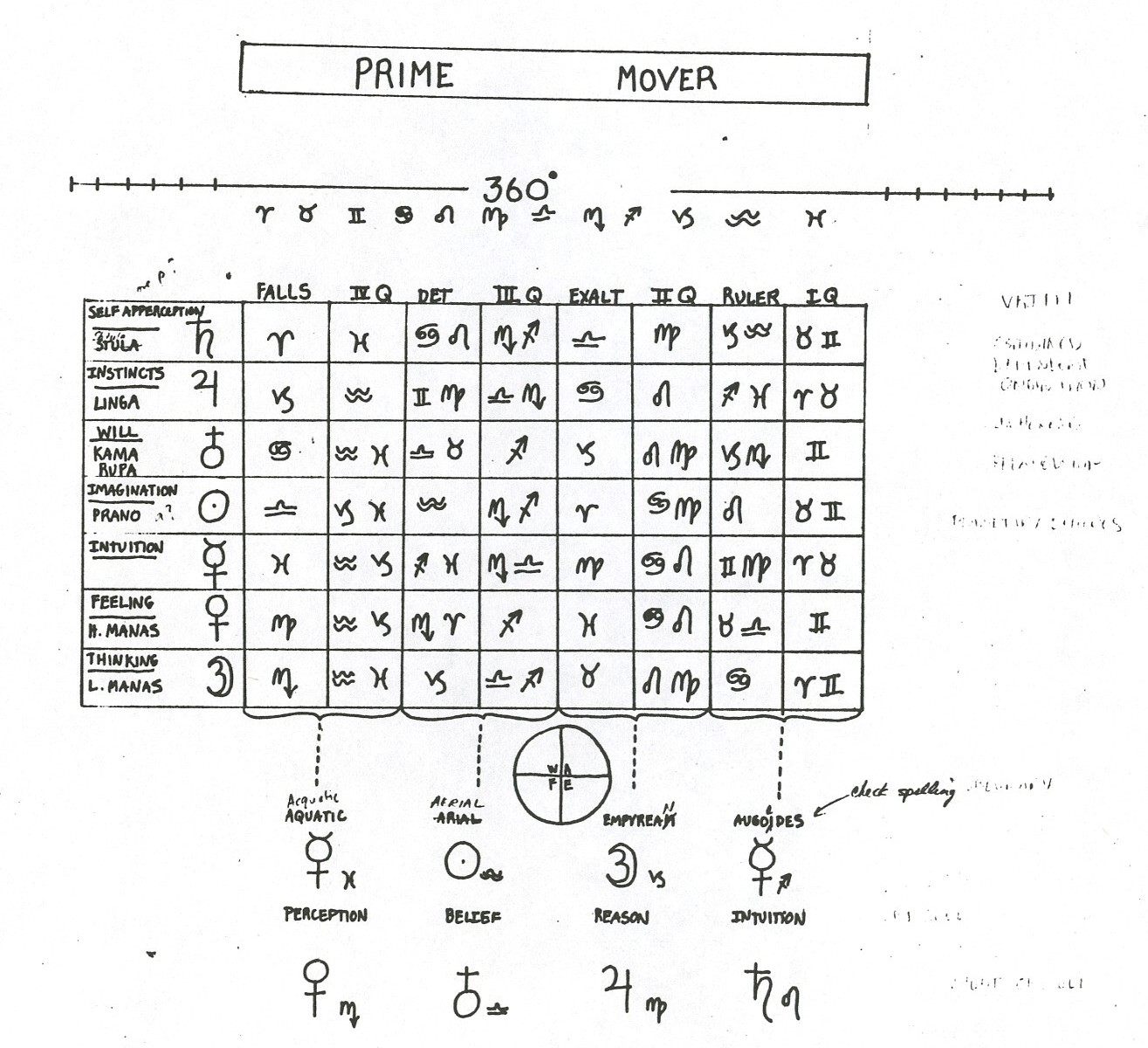
FIGURE AD_G_003. The Grid, 12th House Levels, and Divided Line.
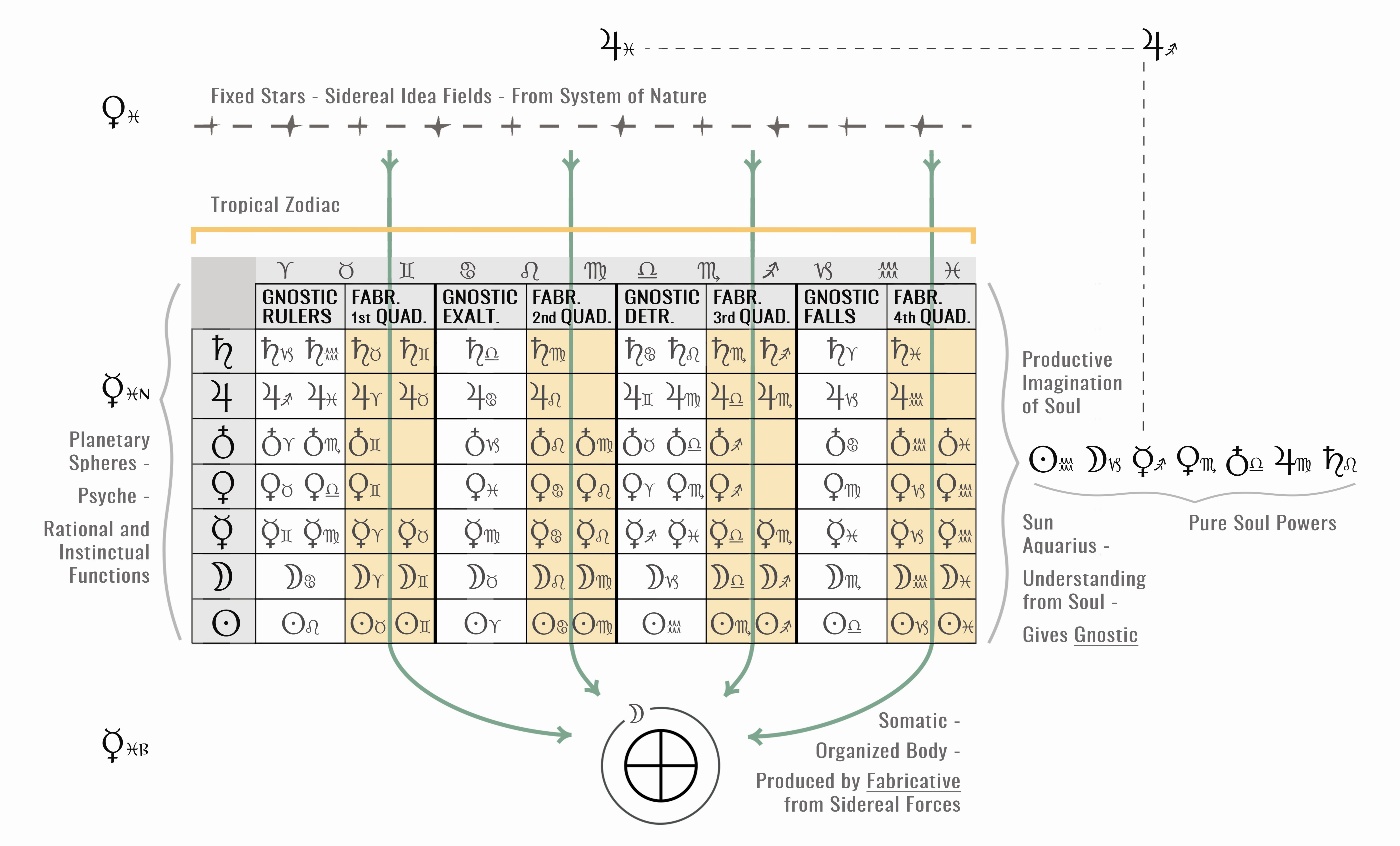
FIGURE Gnostic-Fabricative-1. "The Grid" – Gnostic and Fabricative.
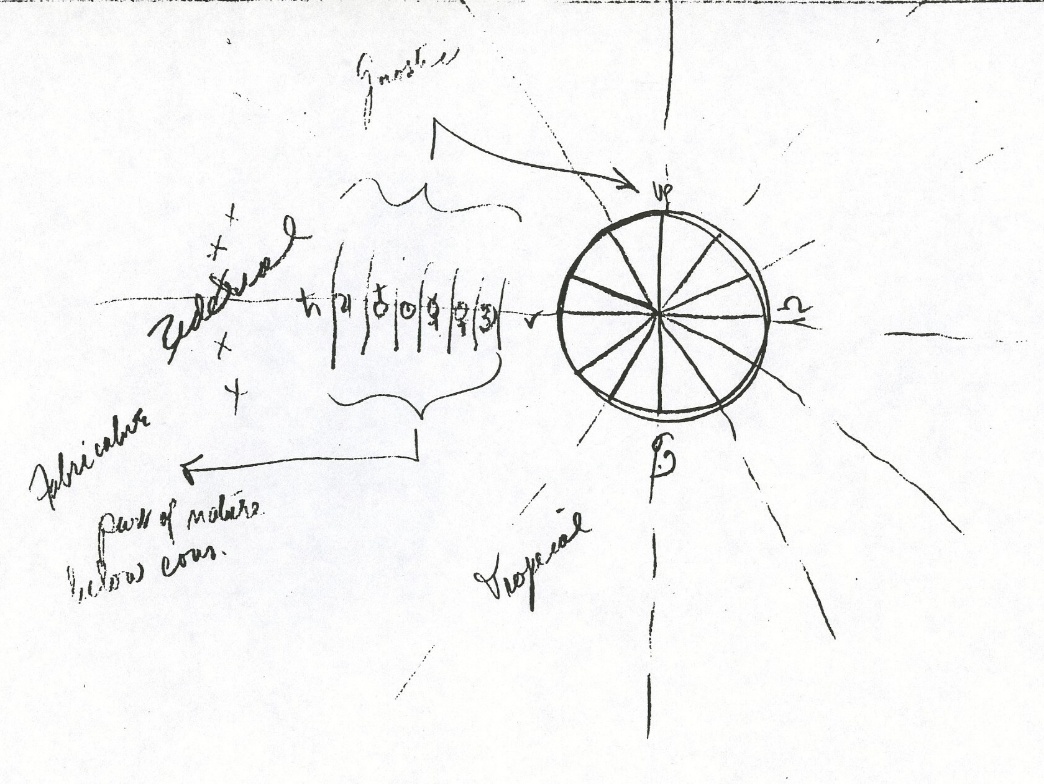
FIGURE AD_B_009. Earth/Natal Chart, Planets, Zodiac.
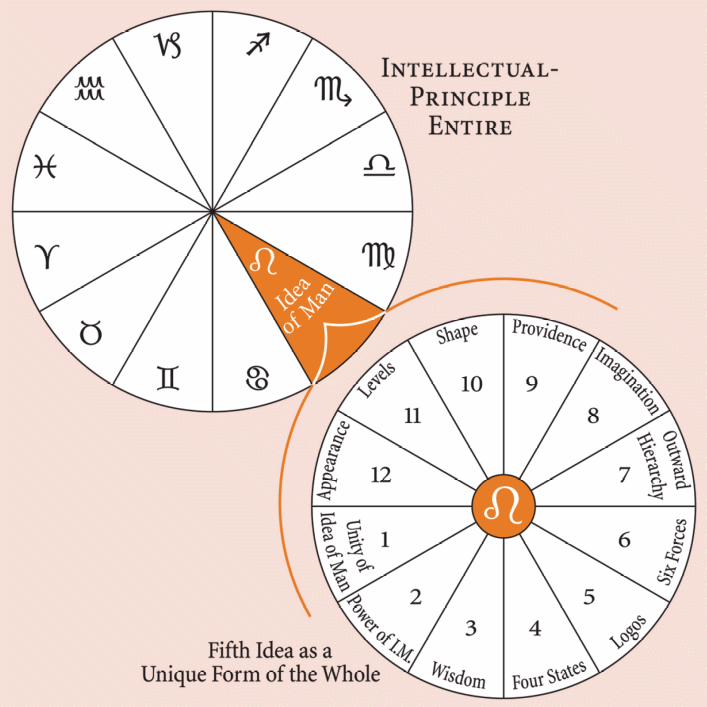
FIGURE 1981 0123-4. Fifth Idea as a Unique Form of the Whole.
FIGURE 1981 0123-5. Polar Bear Poster.
Other diagrams referred to are not with this transcript version. [Transcriber note: [diagram] means the speaker is referencing a diagram as he or she is speaking. If someone is drawing or writing, with audible sounds of chalk on a blackboard, I indicate this by [drawing] or [writing].]
NOTES:
This early 1981 class series on the Idea of Man was held on Wednesdays.
In these classes Anthony Damiani speaks about, among other things, the relation of Soul to Nous and Being, and to the Cosmos; perception; and "teaching the Soul". A large portion of these classes is devoted to Anthony Damiani's laying-out of the components of the three Idea of Man mandalas; herein we can see some of his metaphysical chart methodology. In these classes, one should remember that Anthony Damiani is working out his speculations in the metaphysical chart; therefore his symbolization of astrological and metaphysical chart concepts may not exactly match that in Anthony's later thinking or in Astronoesis.
For further reading on the Idea of Man in general, refer to Astronoesis pp. 147-165, the Editors' Extension on the Fifth Idea. Astronoesis pp. 114-117 is about "Each Idea is a Unique Form of the Whole". Astronoesis pp. 132-133 includes two Twelvefold Idea figures, to which the reader may also want to refer.
Previously printed, distributed 2003 as part of a set on the Idea of Man.
TRANSCRIBED by jf 2003 from Audio Cassette Tapes; reformatted by jf 2018. In 2020, IT does two additional passes from MP3 Audio Files (and also using V11r) and makes verbatim (V12a). Almost all that was inaudible is now audible. V12a has updated Topic, Subject, Subsubjects; numbers spelled out where appropriate; Book List completed; Plotinus quotes section added; new notes within transcript; diagrams replaced with five new ones; new formatting. In 2025, IT updates audio file markers to match new REP audio. Archival verbatim transcript – V12a.
AUDIO FILES: 1981 0123a, 1981 0123b, 1981 0123c, 1981 0123d. [Note 1: "Tape" refers to original audio cassette tapes that were later digitized into .MP3 Audio Files. Note 2: In 2024, REP Studio cuts dead air from files b, d, separates off Santayana class fragment from file d.]
1981 01/23 at Wisdom's Goldenrod
Astrology; Theory; Idea of Man
[Audio File 1981 0123a Begins]
AD (faint): --in order to, alright.
S: What?
[18¾ second pause]
[Note: See FIGURES AD_G_003, Gnostic-Fabricative-1, and AD_B_009 for the following.]
AD: Now you know we always had the problem of trying to understand the relationship of the houses to the signs. It was very baffling. So we-- [17¾ second pause] Well we-- we worked out this system, this system here. And if you want you can imagine-- [10 second pause while drawing] I'm imagine the Prime Mover outside of that, the inerratic sphere, and then starting with your planets you take Saturn and go down [diagram]. [21¾ second pause while drawing] I think you remember. We said that they are both fabricative and gnostic. If you take the planets, you could divide them six-- six aspects of the planet are gnostic functions, six aspects of the planet are fabricative, and that they're all simultaneously operative. (We/You) have to conceive of the operation in that fashion. [15¾ second pause while drawing] So if you did something like this you'd have to say this is gnostic in Aries, this is fabricative, this is gnostic, gnostic, fabricative, fabri-- gnostic and fabricative. And you can go around the chart. Now imagine-- imagine it-- try to imagine it as actually operative, all seven pla-- all seven spheres moving one within the each, one within the other. I try to make it so-- [9¾ second pause] There's still a debate going on about, if this is the Earth, when you-- when you're speaking about the zodiacal degrees are you referring to the traces of life which have been left behind on the planet, [drawing] and these will be the zodiacal degrees. Or do you refer to the-- the degrees to the sign? I'm putting them here [diagram].
And then out here we put the sign Aries [diagram], [short pause while drawing] and this is the first house. Now the problem was the relationship of the planets, the degrees, and the signs to the houses. So that--
S (faint): (Are/Were) you able to read it?
AD: If you look at any chart, the only fixed thing about a chart is the houses. We always-- you always have the same houses: 1, 2, 3, they never-- they never alter. And if you want to use any s-- any system they usually-- even if you cross out and you have just quadrants, there's still an arrangement. So what does it mean when we say that if you spin-- spin the signs, planets, and degrees, if you spin them all around, any-- in any position you want, what do-- what is that in relationship to the house? And that's the problem that we were faced with. I couldn't understand it.
And, the simplicity of the idea is still enough to cause concern but-- And very simple it would be-- the idea would go something like this: Who is the native of the chart? And we'd have to point to a subject and say he's the native. [9½ second pause] And this man or woman that we're pointing to is a-- is a soul. And this soul is universally pervasive. It is an Idea, the Idea of Man. And the Idea of Man is eternal, immutable, pervasive, universally pervasive. So that, when you're speaking about the subject of a chart, that's who you're speaking about. We had a lot of argument last night about this here. That the difference between self-existence and self-nature is something that was necessary, you remember we spoke about it here? And that the nature, the nature of an entity was something that if you took away from me or took away from anyone, there could be no knowledge. There couldn't even be a claim to illusion, illusory knowledge, there could be no-- no claims to knowledge at all. Well at any rate-- [short pause] If-- if we took the subject and said that the subject was this soul, the Idea of Man, and imagine the Idea of Man as equivalent to the [black]board itself, and superimpose the whole-- superimpose the whole of the sphere here, the inerratic sphere, planetary spheres and sublunary sphere, on that eternally immutable pervasive presence of the Idea of Man, then those houses would refer to the Interior-- the Interior Man, True Man, the Idea of Man [FIGURE 1981 0123-4].
And this is the chart I'm reading. [short pause] I'm not reading the chart of some egotist who thinks he's a-- an individual in the way he does, I'm reading the chart of the Idea of Man operating through this chart. So if I took the [black]board as representative, let's say, of the soul, and I can imagine all these aspects going on, I can imagine this spirit [AD taps on board] working through that chart. The whole chart is a superimposition on that universally pervasive spirit that we essentially are.
So, what we did was try to go back to Plotinus'-- who's always really a tremendous help in these matters, find quotes. We found a few. Maybe Avery-- [AS, faint: You haven't seen it? No?] he could help. [short pause, faint background student talking] I always been fascinated by the Idea of Man, I think it's really a great Idea. (laughter) I'm surprised, Tim told me that PB included it in another one of his categories, the Idea of Man, so, there-- there might be something to it.
AS (simultaneously, faint): That's where the Idea [AD simultaneously: Huh?] (of Man) (was/with) content.
AD: Well-- At any rate, we'll try reading a few-- few quotes. But try to have this picture in your mind, you know, the way I just (described). Here's a-- here's an example I use: Imagine a room, alright, with nothing in it, bare, dark, quiet, alright, like a room is closed, and it's pervaded entirely by-- by the space in the room. Think of this space like the human soul, human spirit, ok. Now you got this gizmo, it's a machine, alright, and what it does is produces little clones, ok. (bit of laughter) And you take it and you put it in that room. Every time a little clone gets produced, this universally pervasive spirit identifies with one of those clones and says "That's me!" Ok? And down he goes, gets into that clone, and now that clone goes around saying "I'm an 'I'." That kind of a picture will suit you then? Alright. (bit of laughter) Take the machine out.
But there is the experience in mysticism where you can experience yourself as the axis of the universe, and yet the revolving of the-- the revolving of the universe within you. And on the one hand you're the axis, and on the other hand, you're also part of that universe that's revolving. The presence of both, you know. So that in one sense if you [AD knocks on board] think of this here as the axis, the board as the axis, the spirit, eternal and immutable, alright. But then that spirit is identified with some entity in that gizmo, and he's revolving around with the-- the spheres, so that there's this experience of being both. In the Dream of Scipio--for any of you who've read it--remember? He speaks about the experience of being far away, and looking upon the revolving planets.
Well at any rate, we have a few quotes that I think might help illustrate the idea, bring it out into the open. I think it's even possible that a subject or an author as difficult as Bhattacharyya might be made clearer. [short pause] Why don't we start with a quote or two? Do you have them?
AS: I have them in the order we did them.
AD: Alright let's--
AS: It's probably ok.
AD: Good.
AS (faint): So we did that. The one, 8.14, "First everything to which existence…"
S (very faint): Yeah.
S: What page are we--
AS (faint): Do you want that one?
AD (very faint): Yeah. And, of course I'd like to bring in Plotinus.
[few seconds of faint background student talking]
AS: Doesn't that help?
S (faint): Yeah, that helps.
S (faint): Well--
S (faint): Everybody confused it.
BS (very faint): What the name of it again?
AS: VI.8.14. If we don't get to all of them I'll list [couple words inaudible]
S (simultaneously, faint): (Sure/Yeah).
S: What are they all?
AS: Hm?
S: [one/two words inaudible]
AS (simultaneously): VI.8.14. [10¼ second pause, flipping of pages] Where he says--
Plotinus VI.8.14 (AS reading): Everything to which existence may be attributed is either one with its essence or distinct from it. Thus any given man is distinct from essential man though belonging to the order Man: a soul and a soul's essence are the same--that is, in the case of soul pure and unmingled; Man as Form (or Idea) is the same as man's essence; where the thing, man, and the essence are different, the particular man may be considered as accidental; but man, the essence, cannot be so; the [Idea] of Man is self-determined. [Note: Published Plotinus has Form rather than Idea in last line.]
AS: So he just lays out there the distinction between the essence of man and man as a particular existent. You want to just read some of these Anthony?
AD (simultaneously): Well let's-- let's [AS simultaneously: Or--] read that slowly now and let's see if they could see how simple and pervasive the idea is.
Plotinus VI.8.14 (AS re-reading): Everything to which existence may be attributed is either one with its essence or distinct from it.
AD: Any problem there? Alright.
Plotinus VI.8.14 cont. (AS re-reading): Thus any given man [AS: small 'm'] is distinct from [the] essential man--
AD: So could we take the essential man and say that's the blackboard. A small man, an actual man, alright, will be anyone that appears let's say when we [drawing] make a chart out. And you say this is my chart, ok? This will be a small man, accidental man. Blackboard will be essential man, the Idea of Man.
[short pause]
Plotinus VI.8.14 cont. (AS re-reading): Thus any given man is distinct from essential man though belonging to the order Man [AS: capital 'M']: a soul and a soul's essence are the same--that is, in the case of soul pure and unmingled--
AD: Any question here?
[10¼ second pause]
S (faint): Keep reading?
Plotinus VI.8.14 cont. (AS re-reading): --Man as Form (or Idea) [AS adds: also] is the same as man's essence; [AS adds: but] where the thing, man, and the essence are different, the particular man may be considered as accidental; but man, the essence, cannot be so; the Form [AS reads: Idea] of Man is self-determined.
AD(?) (faint): Alright?
S (faint): Alright, yeah I-- I guess the accidental aspect. I'm not sure if it changes.
AD: But when we-- when we say that all those points there represented your natal chart, alright, now, you think of that as a psychosomatic organism. Ok? It's a vehicle which has been built-- built up by the System, organized Nature. And this is a perishing kind of thing. And if it comes into being and goes out of being it's a dependent-arising, it's not self-existent. The Idea of Man, the blackboard, that's essential, that is always what it is. But the other, the appearing man, is accidental. And, any time you hear the word 'accidental' it means, you know, contingent. It's not the eternal Man.
S (simultaneously): Right. It's not something that essentially is chance or [AD simultaneously: Yeah.] anything like that, it's more--
AD (simultaneously): And yet he includes that accidental man in the Order of Man. In other words it comes under the-- it comes under the Idea of Man. That's because the physical psychosomatic sheath that is built up is a manifestation of the Idea of Man. I mean it isn't a haphazard, it just didn't, you know, come from [student assents] a fortuitous-- It's something being built up.
S: So 'accident' really doesn't mean what it's saying.
AD: No, any time you hear the word 'accident' you could change it to 'contingent' and that'll help you.
S: Alright, fine.
[short pause]
AD: Let's try another.
AS: Uh-hm. Ok, this is the end of VI.7.2, page 562.
[15½ second pause, sounds of paper shuffling]
HS: Could I ask a question of Avery?
AD: Sure.
HS: In the-- in the last thing we read, does it-- does it-- it seems to be "one with its essence or distinct from its essence". When you have an existent man, is it established that there's part of the existence that's one with the essence?
AD: Existent man part of the essence?
HS: No-- well--
S (faint): Are you--
AD: Is that what you're saying?
HS: Does it have-- was it established that part of the existing man has-- is a part of-- somewhere within the existing of that man there's a place called "one with the essence man". Was that established in that quote? Like the i-- the idea of the self-nature as we're talking about last night coming out in--
MB: I think-- [short pause] I think there's a different meaning of the word 'existence' he used in this quote.
AD: No, I first have to understand your question. You got a text there? Could you read it, Richard? The part that he's referring to?
HS: Just refer-- I was just referring to the quote.
AD: Yeah.
HS (simultaneously): I want to know was it if--
AD: I want the quote exactly.
S (faint): Keep doing it.
RC (simultaneously, faint): I think especially the last sentence on there.
HS: Which-- which one? [short pause] You want the whole quote?
S (faint): No.
AD: Well, no, I want the part that you're speaking about.
S (faint): There you go.
S (faint): Go on.
S (very faint): Uh-hm.
S: Uh-hm.
AS: Go on.
AD: Yeah.
GA: It's coming up in the beginning of the thing.
S: Just read it to us.
AS (simultaneously): I think the first line.
S (simultaneously, faint): What was the sentence?
S: Yeah.
S: Read it.
AS: Oh I thought-- I thought Herbert was going to read it 'cause he--
HS: Oh you want--
AS: Well I [S simultaneously: Yeah.] thought there was a specific--
AD (simultaneously): Read it out to us.
Plotinus VI.8.14 (HS reading): Everything to which existence may be attributed is either one with its essence or distinct from it. Thus any given man is distinct from essential man though belonging to the order Man: a soul and a soul's essence are the same--that is, in the case of soul pure--
AD (simultaneously): Don't-- don't read too much, just [HS simultaneously: I don't (couple words inaudible)] go to where you want.
Plotinus VI.8.14 cont. (HS reading): --Man as Form (or Idea) is the same as man's essence; where the thing, man, and the essence are different, the particular man may be considered [as] accidental; but man, the essence, cannot be so; the Form of Man is self-determined.
HS: Now, the question is this: Is-- is this-- when you talk about the existing man, the thing man, is what has been established there that he's distinct from the essence as existing? Ok. Now in the establishment of the existing man as distinct from the essence, are we also saying that there is the essence there?
AD: No.
HS: Oh you're not saying-- Ok that was my question.
AD: There's a distinction between existing man and essence of man. [couple inaudible HS words simultaneous with AD] Existing man he says is contingent. It's accidental. Essential man is not. He's eternal and immortal, alright. Now, before you get on to your point, Herbie, ok, let's-- let's conceive of this pervasive spirit, you know, the subject as true freedom, alright, the blackboard, ok. And a certain aspect is operative. Let's say a good aspect where he gets a piece of knowledge. This piece of knowledge is like a mirror in which the Idea of Man, the soul, is reflected and sees its own image.
HS: The Idea of Man working through the contingency, the motion, [AD: Yeah.] gets to see in himself a-- in an image taken as a configuration within the motion.
AD: In other words, at a certain moment, let's say, in time, I apprehend a truth, a real truth, an authentic truth. And it-- let's say it's brought about by aspects that are beneficial to us then. So at that moment this pervasive spirit, the subject, alright, perceives himself.
[16¾ second pause]
RC: One of the quotes that we used this afternoon was right on that point there, the one where he says that the soul's intellection doesn't become a human perception until it acts on the imagination.
AD: That's IV.3.30, isn't it?
RC: The end of that, yeah.
AD: Yeah. Well I want to do one quote at a time. Did you follow, Herbie?
HS: I think I follow this.
S: Is that supposed to be readily understood?
S (very faint): Uh-hm.
S: (Which is) all-pervasive.
AD (simultaneously): Well, if you're quiet, if you're quiet, you'll understand. [short pause] Go ahead, Richard.
RG: I think I understand the concept but I don't understand how it relates to the symbolism of the houses.
AD: You--
RG: Well I think I understand the quote, I don't (see the relationship).
AD (simultaneously): Well, I haven't picked that up yet, Richard.
RG: Oh.
AD: In other words, if I think of the houses as the Idea of Man, alright--
RG: What-- now where-- yeah, why are you thinking of it that way?
AD: I'm sorry? [RG/S(?) simultaneously: Yeah, this is hard.] Why I'm thinking of it that way?
RG: I mean-- and what does it-- yeah what does it mean to say that the houses represent the Idea of Man?
AD: Well, who we talking about? Whose identity, whose possessions? [AD knocking on blackboard]
RG: Well, if we talk about the native we're talking about his-- his whole chart, I mean his-- all-- all the-- all the constituents of the chart, all of that [one word inaudible]
AD (simultaneously): Well, yes, we're speaking about the native. Now who's the native?
RG: And who is the native?
AD: Yeah. I'm asking you, WHO.
RG: I would--
AD: Not the what, I'm asking you WHO.
RG: Who?
AD: Who. Owl, you know, whoo. (student laughs)
RG: The soul is the native predominantly.
AD (very faint): Yeah.
RG: Ok.
RC (faint): It's the one thing--
AD: Take a little time to see it though. So if you think of the soul as these twelve houses, the contents of the Idea of Man.
RG: Ok, that's where I'm stuck.
AD: Wait. You have to wait awhile. It's only one quote. We got about twenty-five for you.
RG: [one/two words inaudible] I mean the quotes won't help me if I don't see the-- the symbolism.
RC (simultaneously, faint): Well that's the one thing-- the one thing all natives will have in common is (that).
RG: What?
RC: The one thing that all natives will have in common is those twelve houses regardless of how many degrees from one to another or where the planets are, [RG simultaneously: And what--] what signs are in them.
RG: Yeah. And that is supposed to bring me to what conclusion? Is that-- that because of that they symbolize the contents of the soul?
AD: The Idea of Man, working through those things, the subject. Be patient Richard. Let's do another one. Another quote?
AS: The next ones are in VI.7, [S: No.] the end of 2. This one here, VI.7.2, page 562, the end of VI.7.2. Says:
Plotinus VI.7.2 (AS reading): Take for example the Idea of Man; Man entire is found to contribute to it; he is in that Idea in all his fullness including everything that from the beginning belonged to Man. If Man were not complete There, so that there were something to be added to the Idea, that additional must belong to a derivative: but Man exists from eternity and must therefore be complete; the man born is the derivative.
[short pause]
AD: That's relatively straightforward, there's no problem there. Unless you see one. You have to ask questions because for me the clarity is too obvious, you know, you have to ask me.
AS: Says a little more on that.
AD: Alright, (yeah).
AS (simultaneously): Maybe. On 3, a little fur-- near the bottom. He says:
Plotinus VI.7.3 (AS reading): [But], at this, sense-perception--even in its particular modes--is involved in the Idea by eternal necessity, in virtue of the completeness of the Idea…[AS: Ok.] the cause, There, was one total, all-inclusive; thus Man [AS: capital 'M'] in the Intellectual was not purely intellect, sense-perception being an addition made upon his entry into birth: [AS adds: and] all this would seem to imply a tendance in that great Principle towards the lower, towards this sphere. Sense-perception is, precisely, perception of the world of sense.
[short pause]
AS: Ok. And then he says-- he says the same thing again one more place where you have soul when it comes down. 6-- in VI.7.6 in the beginning says the same thing. Says:
Plotinus VI.7.6 (AS reading): [But] how can that higher soul have sense-perception?
It is the perception of what falls under perception There, sensation in the mode of that realm: it is the source of the lower soul's perception of the correspondences in the sense-realm. Man as sense-percipient becomes aware of these correspondences and accommodates the sense-realm to the lowest extremity of its counterpart There, proceeding from [the] fire here to [the] fire Intellectual which was perceptible to the higher soul in a manner corresponding to its own nature as Intellectual fire. If [AS adds: the] material things existed There, the soul would perceive them; Man in the Intellectual, Man as Intellectual soul, would be aware of the terrestrial.
[short pause]
S (very faint): Go ahead.
S (very faint): Go ahead.
[short pause]
DR: I don't have a specific question, I just didn't follow. [three/few words inaudible]
S (simultaneously): Avery you're going too fast.
AS: I'm sorry, I may have read it too fast. (We should go--)
AD: Well, we can't take too big a mouthful of Plotinus, you know, we have to do it in short doses so suppose we start and [AS faint: Ok.] explain and then we'll do the next one.
AS: Do you want to start right back at the beginning of that, David, [DR simultaneously: Where he s--] (the one that) Man-- take the I-- "Man entire is found to contribute to it"? The-- he is--
Plotinus VI.7.2 (AS re-reading): Take [for example] the Idea of Man; Man entire is found to contribute to it--
S: We capitalize Man there?
AS (simultaneously): Capital 'M' Man entire.
Plotinus VI.7.2 (AS re-reading): --is found to contribute to it--
DR: To it. To the Idea of Man?
AS (simultaneously): The Idea of Man.
Plotinus VI.7.2 cont. (AS re-reading): --he is in that Idea in all his fullness including everything that from the beginning belonged to Man [AS: capital 'M'].
DR: Now how is a dis-- what's the distinction between the Man entire and the Idea of Man? Isn't there one being made? That wasn't my original question though.
AS: Well, I think he's just saying that-- I don't think there's really one, I think he's just saying that everything-- anything which can-- anything which can be manifested under the-- under the notion of Man is already included in the Idea. In other words that that Idea is per-- all-- everything that occurs in the sense perceptible world is already-- is present in some way to the Idea of Man. So Man entire is already found complete. Or the Idea in-- "he is in that Idea in all his fullness". I think the Man entire is anything that has to do with Man on any of the levels is already included in the Idea, in the eternal Idea of Man. [short pause] He says:
Plotinus VI.7.2 cont (AS re-reading): If Man were not complete There, [AS: capital 'M' Man again] so that there were something to be added to the Idea, that additional must belong to a derivative--
DR: Now when he speaks of Man being complete (There), I mean can-- well I know you can't number things but we're speaking of one Idea of Man?
AD: Yes, if God had an Idea of Man, everything necessary would be there, including the number of men. Everything would be there. Instead of saying God, you could say that the Intellectual-Principle thinks the Idea of Man. Included in that one Idea is everything necessary for it, not only-- not only its manifestation but its return, its return back to the Idea fulfilled.
DR: And you say it also includes even the number of men? [AD/S(?) simultaneously: Number--] In a way there isn't a distinction there [one/two words inaudible]
AD (simultaneously): The number of souls. I'm sorry?
DR: It even includes the distinction among souls?
AD: Each soul has a different operative principle. And some souls are higher than others, there's a hierarchy even among souls. But souls include one another, they don't exclude one another. So one soul knows all souls, and all souls know each other, and there's a mutual sympathy that extends throughout.
DR: And you're saying that sympathy is through the Idea of Man?
AD: Well the Idea of Man is basically what these-- these souls that we're talking about. Souls don't have to be just men. But if you say Soul-Man, Essence of Man, and you're bringing them together, then you're speaking about human soul, alright. Then they would have to be mutually inclusive of each other. [short pause] Read a little more now.
AS (faint): Says:
Plotinus VI.7.2 (AS re-reading): --but Man [AS: capital 'M'] exists from eternity and must therefore be complete; the man born is the derivative.
AS: The small 'm' man.
AD: We would locate him in the chart, the man that's born. But the universally eternally completed Idea, Man, we say is the blackboard. Just like for instance when they say, where is the universal Horse? He's everywhere and nowhere. He's universally pervasive. Given a receptacle it'll appear in that receptacle, in other words given the conditions for his appearance he'll appear.
DR: So you're saying the same Idea of Man is born in each man.
AD (simultaneously): Idea of Man, Idea of Horse, Idea of Lion.
DR: And each instance-- I guess I'm just asking for repetition. If you say the same Idea of Man is born in each man, as a similar case the-- the Idea of Horse being present in every horse, that somewhere I remember this notion that man is a species unto himself.
AD: Yeah that's-- that's a little difficult. We'll leave that out now. Because that's the man fulfilled. That's the man who's realized the Idea of Man in himself, alright. That's a Buddha, in Eastern thought.
AS: I mean in this diagram, just to use the-- the notion we're working with, it seems to say, if you say that that-- that Idea of Man is present identically-- no, let's not say identically, but the Idea of Man, the essential Man, is present in each individual man's chart, then what we're saying that that presence is, is that-- the house system, the fixed house system, [RG: I don't--] the first Idea, second Idea, all of those Ideas around the chart are representing the essence of Man, or the Idea of Man.
RG (simultaneously): Why isn't it the signs, why isn't it the planets? Why do you pick the houses?
AD (simultaneously): That's part of the material world.
RG: Which?
AD: The planets, the inerratic spheres, the sublunary realm.
RG: And the houses aren't?
AD: No.
RG: Well-- so I don't-- symbol-- I mean symbolically I don't understand how you get to that.
AD: Well we're try-- we're trying to deliver that information.
AS (simultaneously, faint): Information. (Similar) to provoke.
S (faint): Yeah.
AD: We're trying to deliver it, Richard.
BS: Also when--
AD: Louder.
BS: I'd say, what would it-- what does it mean when you said that only when--and you said this quite often--only when certain aspects are formed think that the subject, so to speak, knows itself, there's some-- some kind of faculty brought out or some kind of conjunction going on between one and the other where the subject seems to be revealed through that aspect. Because on one hand the aspect wouldn't seem to be any different from the subject that it's revealing. On the other hand it takes the aspect.
AD: Think of the analogy of a telescope, you know, telescope tube. If it's-- if it's bent at right angles you can't see through, and if it's straightened out you see right through, and a good aspect it's like the deliverance of self-knowledge, a bad aspect is-- is the refutation of that knowledge or the blockage of that knowledge.
BS: Well in that case would it be a deliverance of one to the other? Of the true subject to the embodied subject, so to speak? Deliverance of that self-knowledge? I mean are they distinct or are they the same? Is that a strange question?
AD: No. I-- again I would have to ask you, who is it that is the recipient of that knowledge, whether correct or incorrect?
BS: It would have to-- there's only one subject.
AD: Yeah.
BS (faint): Yeah.
AD: Now that subject can, so to speak, delude itself. Let's take that not as very correctly stated.
BS: Some sense it can.
AD: Yeah, in other words, from the Self there could be a-- a condition of ignorance prevailing. Within the subject's Self, ignorance can prevail, or knowledge. Now, when ignorance prevails, we don't have knowledge about something. But if knowledge prevails, what is the knowledge about? Self-knowledge--then he knows himself. And the intuition could take place in any realm, any house, any place according to this scheme now. Because if you think of the seven planetary spheres as being both fabricative and gnostic at the same time, alright, then intuition, dianoia, belief, and sensation could take place any place, any where, any time [FIGURE AD_G_003].
[short pause]
BS: And what is exactly with the aspect again?
AD: Well, we're constituted of two parts, alright, the Being part and the Knowledge part. The Being part, for instance, of Saturn, will be the-- where Saturn is not in dignity, so that would be like Taurus, Gemini, Virgo, Scorpio, Sagittarius, and Pisces. That would be the fabricative side, ok. Where Saturn is in dignity--Aries, Cancer, Leo, Libra, Capricorn, and Aquarius--there it is a gnostic Saturn. Now you got six on one side and six on the other, six gnostic, six fabricative. That would be the unity of Being and Knowledge. In other words, insofar that you're speaking of mundane gods, contained in the mundane gods is both aspects, the Being side and the Knowledge side.
BS: Being sides would refer to a fabricative.
AD: The Being side is the build-up of your psychosomatic organism; the Knowledge side is what it thinks it knows. But both are subsumed under the unity of all the seven planets. [short pause] You're having trouble, Bert?
BS (faint): I'm ok so far. But, my second question I think is what you answered (that ask) as well, is what happens when the-- there are no aspects being formed to give knowledge and that would seem to be more the--
AD: When's that?
S (faint): Yeah.
BS: Excuse me?
S (simultaneously): When?
AD: When's that?
S (simultaneously): Yeah, when is that?
BS: I'm sorry?
AD: When is that?
BS: When is--
AD: When is that there aren't aspects that are delivering knowledge? Do you know the time, the place? Major aspects are going on every seventeen seconds.
BS: Yeah, it's true, if they weren't delivering knowledge I wouldn't talk (about) (them/that).
[22 second pause while AD draws]
AD: You can do this with all the planets. [16¾ second pause while AD draws] This will be-- I mentioned once before that the mundane gods are the lowest unities, alright. Below the mundane gods there are no longer any unities. Alright. So this would correspond we said to sensation, this to belief, this to reason or dianoia, ok, this to intuition [FIGURE AD_G_003]. Now the working out of these here, how they're building, is much more complicated. You'd have to take the Idea, the Idea of Samskaras, Limit or Boundary, Six Powers.
BS (very faint): Oh I see.
AD: So, this here builds the psycho and this the psy-- the somatic-- psycho-so-- psycho-somatic organism, alright. And then you-- you have to imagine all of the other planets doing that too. The idea is very simple.
CdA: So when-- I-- is he done? (bit of laughter)
AD: Any other question? You're only allowed to talk in private. No questions? Go ahead. That goes for you too. (AD laughs a bit) Alright, come on.
S: Go ahead.
AD (simultaneously): Go ahead, Carol.
CdA: When you speak of intuition there, and a person has that--
AD: Louder.
CdA: You-- when you-- where you-- when you speak of intuition in-- in the terms of the planetary sphere, would you say that an individual who has Saturn in-- what is it that's intuition?
S: Capricorn, Aquarius.
CdA (simultaneously): In Capricorn or Aquarius, that that would be the vehicle's participation in the intuition of that god.
AD: Yes, you're [CdA simultaneously: Yeah.] taking in-- you're partaking, you're participating [CdA simultaneously: You're partaking.] in its knowledge.
CdA: But it's-- it's different that an intuition as you said before that an intuition could happen at any time, at any place, and it-- it really wouldn't have to be any one that had any dignities or rulerships, say, that-- Is that-- is that so? I mean you said before that if (this--)
AD (simultaneously): You mean if you have no rulerships you're not going to [AS simultaneously, laughing: Can't get intuition.] have no dignity, I mean no intuition?
AS (simultaneously): Can't get intuition.
CdA (simultaneously): No it-- no I'm saying that this is a very different way of using the word.
AD (simultaneously): Yes, because-- you remember the way we looked at it, we-- we're looking at the [AS simultaneously: Of course, yeah.] seven planetary spheres, alright, [AS simultaneously: It's got intuition.] and it's not possible-- I mean if you think of your chart, ok, you'll see that Saturn has a position in every house.
CdA: Yes, that's-- [student assents, faint] that's just-- I just wanted to clarify that [AD: Yeah.] the different kinds of-- of the use of that word 'intuition'. This intuition is the intuition--
[Audio File 1981 0123a Ends]
[Audio File 1981 0123b Begins]
AD: We've been thrown off by trying to put the functions on the four axes, alright. And that was Jung's naive notion of the-- of the four functions. But if you look at this way, if you look at the seven spheres and dignities, alright, then that's-- that conception has to be thrown out. There's no such-- there's-- I've watched very carefully over and over again, and I've noticed intuitions in myself and in others, nothing to do with the cusp. They not even in the midheaven or the nadir or the descendent. Nothing to do with that. But there was aspects going on. There were aspects going on. Anyway, let's return to the more philosophic understanding of this. Oh I'm sorry, Lauren.
LCG: I think what you (remembering in) that quote.
AD: Ok. The end of the quote?
LCG: Yeah. He says if-- the last two sentences--
Plotinus VI.7.2 (LCG reading): If Man were not complete There, so that there were something to be added to the Idea, that additional must belong to a derivative: but Man exists from eternity and must therefore be complete--
LCG: The first sentence of this, "If Man were not complete", something would need to be added for the man to be a-- a derivative. But it says "but Man exists from eternity" and is complete, which leaves Man not a derivative.
AS: Capital 'M' Man. [short pause] The man born is in a way a derivative because he does depend on some outside influences.
S: Well that's a second quadrant (view).
[short pause]
AD: Lauren, did you follow? [short pause] The Idea of Man is complete. Nothing has to be added, nothing at all. And then Avery says now, the second man, the contingent, the man that's born, accidental, alright, he's a derivative. [short pause] [LCG simultaneously: And is he (one/two words inaudible)] The same like [VI.8.]14 where he speaks [AS simultaneously: Yeah, same thing.] about accidental man and essential Man.
AS (faint): Yeah, yeah.
LCG (simultaneously): Is he going to be anything added to the Idea of Man? Is it [AS simultaneously: He--] going to derive from the [one/two words inaudible]
AS: He doesn't add anything to the Idea of Man, but something is added to the whole thing to get him. He-- [AD simultaneously: And--] he doesn't add anything-- nothing that goes on in him, as it-- as it were, adds to the Idea 'cause the Idea is complete. [LCG: Right.] But to get a derivative man you have to bring in this acc-- the accidental, the whole cosmic scheme. That's accidental to the essential Man. It's almost tautology because the essential Man is self-complete. [short pause] [couple words inaudible]
AD (simultaneously): Alright, let's take another quote, Avery.
PD: Are-- are you [AS simultaneously: I didn't know if you wanted--] saying that the [S, faint: He exists.] Idea of Man or Spirit of Man which you're trying to indicate by the houses or the-- that the houses represent a--
AD: Essential Man.
PD (simultaneously): --the-- the subjective light that's interpreting and organizing the circumstances of existence? And it's doing so with the Idea-- Idea of Man or the-- or Man's understanding of the twelve Ideas. So it's interpreting existence in terms of the a priori assimilation of the twelve Ideas that inhere in the soul.
AD: Yes, pretty much, yes. Basically, and this was one of the important reasons why Santayana had delivered some beautiful intuitions, he said-- he said that when you apprehend an intuition, alright, you-- you dematerialize the phenomena and at that moment there's the experience of an essence. Now, at that moment, the Idea of Man, or the Subject which contains within him all the contents or all the essence that makes man to be what he is, alright, is what assimilates, or let's see-- is what is capable of apprehending an intuition which is embodied, so to speak, in the phenomenal world.
PD: (So/Well) in one sense you could-- you-- we could still say we're speaking of-- we have two lines of evolution or-- well when we speak of the-- the zodiac and the planetary spheres as the objective unfoldment, and the individual spirit or soul being symbolized through the diagram of the houses?
AD: Well, it's not so much that he's symbolized as that he works through that. In other words, it's like the Idea of Man, alright, in using that vehicle, that is, what is constructed by this whole gizmo, alright, using that vehicle and gaining experience though that vehicle, (it's/is) possible because there are instances in the way that this gizmo functions--something is brought-- a circumstance, an event, a situation, a relationship arises--and the very essence of that, alright, is captured by the Idea of Man which is within you, recognizes that essence. At that moment, [AD snaps fingers] phenomenal-- the phenomenal world is de-materialized--you are that essence. It's the same thing like saying you recognize the deep mode of being--I like to quote someone--or the specific ess-- the specific emptiness of that event, situation, or person.
The reason-- well I prefer to use the word 'essence', it's a positive thing. The essence of one phenomena is not the essence of another phenomena, but they are both, so to speak, without existence in the sense that they don't exist. Their-- their-- their Being is not in existence but beyond existence. And this is what the essence in you, the Idea of Man in you, the Subject, captures in the world. And, if you feed yourself a correct diet of essences, you should be able to evolve spiritually.
S: Right.
PD: I think I just better wait. You're dividing the houses up twelve-fold.
AD: Yeah.
PD: And I-- I was directing my question I think to that.
AD: Well look, if for instance, if for instance the Idea of Man excluded this here [diagram], alright. Suppose the Idea of Man excludes that, you won't recognize it in someone else. So these houses are the contents or the essences that constitute Man. It's this here that recognizes these Ideas, that recognizes what's out there.
PD: But in the-- in the specific individual chart, are we saying that's what this soul brings to the realm of experience? Or is that what he's going to acquire through the realm of experience?
AD: No, he brings. Brings. From the realm of experience, of course, these essences within him get evoked. They get evoked, they're brought-- they're brought into operation. But they're always there. Now, again, this is coming from a Platonic point of view where never in a million years will you understand the Idea of circle, no matter how many times you see a wooden wheel, unless a circle is already within you. Maybe the hundred and first time you'll finally recognize that that's a circle but that's because the Idea is already within you. [10¾ second pause] Shall we read a little more? Try to pick out the important passages, I don't want to drag it out too much.
S (faint): Uh-hm.
JC: I have a question. When the world's constructed that this soul is then going to read-- read from that world the essences that exist within it, and (that/then) if you say that they get evoked at some point, certain aspects occur, there's an event--
AD: Go ahead with your question.
JC: Ok. [short pause] Is the essence within the soul evoked always with the circumstances? You don't always understand [AD simultaneously: No, no.] what's going on. But that may not be because the reason-principle within the soul is inactive but rather because that knowledge is not-- well, let's say, is-- is not transmitted, so on, or--
AD (simultaneously): No, you can apprehend it-- you can get an intuition any time.
JC: Ok. You can grasp a reason-principle let's say within you. But, if you see what I'm saying, is there-- is it that the-- the world is presented for us, we don't construct it, our soul just lives in that world that's created by the Demiurge. And, does the Demiurge and the powers that be work with the Demiurge, evoke the essence within us whenever we see-- I mean maybe the it-- that they don't evoke but-- Like if I look at a circle, say I'm a primitive and I don't understand much about circles, is it that after I look at a circle enough that--
AD (simultaneously): No, it's just the gods, it's just that the gods make it possible for you to do so, to apprehend an essence, to get the intuition of an essence. [JC: Oh I--] You have to do it.
JC: They-- because they place circles in the world, so to speak.
AD: No, because they make the aspects available. So that you could understand that something's embodied in-- in the matter. [short pause] But if they did that for you, they really would be nursing you all along, wouldn't they?
JC: Yeah but they also evoked-- Oh you mean you're saying they are-- they are nursing you all along because--
AD (simultaneously): They're nursing you all along, do you-- do you want them also to digest the food you got to eat?
JC: Well, they do run my digestive processes it seems. (JC laughs a bit) Um--
AS/S(?) (faint): [couple/three words inaudible]
S (faint): Uh-hm.
AD: Let's get on with the quotes, because the quotes will give you more explanations as we go along, and you're anticipating questions that the quotes will fulfill. [short pause] Please.
AS: You want to read them?
AD: Yeah, another (book/quote).
AS (simultaneously): These are different. That's the one, the Intruder.
AD: The Intruder, yeah.
AS (simultaneously, faint): (Do) that one? That's a good one, yeah.
AD: Remember about the Intruder?
S (faint): Uh-hm.
AD: Alright. (Read to them.)
AS (simultaneously): It's VI.4.14.
Plotinus VI.4.14 (AS reading): Before we had our becoming Here we existed There--
AD: Do you follow that? Before we were born, we existed in that pure realm, just pure souls, alright?
Plotinus VI.4.14 cont. (AS reading): --men other than now--
AD: It's hard to believe but, go on.
Plotinus VI.4.14 cont. (AS reading): --some of us gods--
AD: Some of us GODS.
Plotinus VI.4.14 cont. (AS reading): --we were pure souls, Intelligence inbound with the entire of reality, members of the Intellectual, not fenced off, not [AS reads: nor] cut away, integral to that All.
AD: Alright, do you get the picture there? There's a pure soul, you're in that heavenly realm, unpolluted, alright. Alright, now see what happens, go ahead.
Plotinus VI.4.14 cont. (AS reading): Even now, it is true, we are not put apart; but upon that primal Man--
AD: Upon this primal Man, [knocks on blackboard] go ahead.
Plotinus VI.4.14 cont. (AS reading): --there has intruded another--
AD: There has intruded another.
[short pause while AD draws]
Plotinus VI.4.14 cont. (AS reading): --a man seeking to come into being and finding us there, for we were not outside of the universe. This other has wound himself about us, foisting himself upon the Man [AS: capital 'M'] that each of us was at first.
AD: You get the feeling of a boa constrictor wrapped around you? [short pause] Go ahead, Avery, take it.
AS: A little more.
Plotinus VI.4.14 cont. (AS reading): Then it was as if one voice sounded, one word was uttered, [AS: So on.] [and] from every side an ear attended and received and there was [an] effective hearing--
[short pause]
AS: What act-- uh-hm.
S (faint): Go ahead.
HS: Will you take comment about seeking us there, two sentences back?
AS: Because "we were not outside of the universe".
S: Yeah.
HS: Yeah.
S (very faint): Can you please (reread)?
AS: But primal Man, the essence of Man, is not anywhere, he's not in any place, so he's not outside of the universe. Is-- it's like (it's/he's) everywhere present. [S simultaneously, faint: (So--)] The cha-- the sect-- see, the Ennead [VI.4] is on the Omnipresence of the Authentic Existence. It's not like there's a-- it's not like there's some essence of Man up in the second quadrant and this fourth quadrant guy has got to somehow go up to the second quadrant, he'd never do it if it was cut off. But the soul is always all-pervasive. It's always that background as it were. [HS: Ok, and then (if--)] So that entity of craving or whatever they call it, you know, the Intruder, can ac-- can foist itself upon that Cognitive Isness, the pure soul, become one with it.
HS: That's the-- that's what you mean by seeking-- seeking us there?
AS (simultaneously): Yeah. I think so.
HS: Here?
Plotinus VI.4.14 (AS reading): --a man [AS: small 'm'] seeking to come into being--
HS: Yeah.
AS: This particular chart you've got.
Plotinus VI.4.14 cont. (AS reading): --and finding us there--
AS: Finding us in the cosmos.
Plotinus VI.4.14 cont. (AS reading): --[for] we were not outside of the universe.
HS: "Us" and "we" is like the Idea of Man now?
S (faint): Uh-hm.
AS: Yeah, the "we" there is the primal Man. The ma--
Plotinus VI.4.14 (AS re-reading): --a [AS adds: small 'm'] man seeking to come into being and finding us there, for we [AS: the primal Man] were [AS reads: was] not outside of the universe. This other has wound himself about us, foisting himself upon the Man [AS: capital 'M'] that each of us was at first.
[short pause]
AS (faint): [few words inaudible]
PF (faint): I have a question.
AD (faint): Go ahead.
AS: Yeah.
PF: Is the Intruder just the planets or is it the whole wheel?
AS: The planets, the signs, the degrees.
PF: Ok, it's everything that's drawn upon the blackboard.
AS: Everything that's superimposed on the house-- on the-- on the house system.
PF: But it does include the (houses). (student laughs) Does it include the house system itself?
AS: Well, see, the house system-- well-- we have to develop this but that's-- the point is that, I guess you would say, that that's the-- that house system is what's fixed. And everything else there is imposed on it, is foisted upon it. That when-- that when-- maybe we could say it this way. When this Intruder foists himself upon this essence of Man, he says then you have-- it is "as if one voice sounded". You have the two of them together. Right?
PF: The Intruder and the--
AS: And the primal Man.
PF (faint): And the primal Man.
AS: Now, that means that that Idea of Man is present with that Intruder as it were, the two of them together. So that Idea of Man has to be there all the time, the fixed thing that's going to interpret everything that the Intruder does. [student assents, faint] And that-- those Ideas, the first house is always Self-identity, the Idea of Self-identity, Self-existence. We're saying that if you--
[9 second pause]
PD: If you said that the houses [AS simultaneously: You could--] represent the pervasion of the spirit in a certain locus in space, [AS simultaneously: Yeah.] would that be like a way to indicate it, that [AS simultaneously: It's very very good.] (pervading--) the spirit pervading space out and radiating in directions instead--
AD (simultaneously): In all directions.
AS: Right.
AD: Not only, not only the human soul, but every Idea which is a universal has that nature. So if you say the Idea of a Horse, alright, the Idea of a Lion, every and any Idea has this universal pervasion. Now if-- if let's say--
PD: But it necessitates the-- the incarnation to tie it to the realm of the constellations and planets and the elements.
AD: Yes, as a matter--
PD (simultaneously): Prior to that you can't speak of it pervading the cosmic circuit.
AD: It pervades the cosmic circuit, alright, but when it goes into the cosmic circuit, there's a definite way in and a definite way out. They speak about-- I forgot which-- which was-- Capricorn I think is the way in, Cancer is the way out, or the other way around.
S: The other way around.
AD: The other way around? And, Plato referred to that as the Spindle of Necessity, and that the spirit entered into it, alright, and it'll spiral around and come out eventually and go back to its source. And he speaks about souls coming from the galaxy, the Milky Way, and descending and finally condensing like dew onto the Earth, and getting incarnated and step by step working their way back.
PD: So bringing it right down mundanely, the houses indicate that pervasion by the spirit of so-- certain--
AD: Of the whole cosmic circuit.
PD: Its relation or its pervasion of the cosmic circuit as far as it's concerned.
AD: Yeah. And, there's an interesting letter in one of the Mahatma Letters where one of their Sages speaks about, that even Sages whose conscious-- whose Atmic consciousness has pervaded the universe has not gone beyond the confines of this universe yet. [short pause] [student assents, faint] I don't-- I don't remember what letter it was, but it was in The Mahatma Letters. A.P. Sinnett.
[short pause]
LR (very faint): What does that mean?
AD: Well, it's this in-- indefinite evolution of the human soul. It could expand into all infinity, and Plotinus in one place speaks about the intellect of the human soul is capable of being universalized. [Note: See Plotinus, IV.8.2, fourth para.] I imagine but--
LR: But universalized meaning--
AD: To become coextensive with the universe. [short pause] But remember he says this is potential. And somewhere else, I think I quoted to you Eckhart, he said that if God could make anything greater than the soul, he would have done so.
S (faint): Yeah.
[10 second pause]
AD: Alright let's-- let's go on to another quotation and try to pick a couple of the important ones and then we could--
S (faint): Yeah.
AS: Well that seemed like (one), I was trying to [AD: Yeah.] go on to-- (We/You) have to do that (James). [short pause, flipping of pages] He says in several places something like this one.
Plotinus II.3.9 (AS reading): [For] every human Being is of twofold character; there is that compromise-total and there is the Authentic Man--
S (faint): I'm trying to [couple words inaudible]
AS: Oh I'm sorry.
AD (simultaneously): The compromise-total and the Authentic Man.
AS: II.3.9. Says-- and he also adds:
Plotinus II.3.9 cont. (AS reading): --and it is so with the Cosmos as a whole--
[short pause]
AS: That's--
S: Is (a/uh)--
AS (faint): [few words inaudible]
AD: So you see what compromise is now.
S (very faint): Uh-hm.
LR: Where-- what--
HS: (Would--) cosmos as a whole?
AS (faint): II.3.9.
AD: "So is the Cosmos as a whole."
GA (faint): Yeah.
AD: In other words, the cosmos has a soul, the same way that you're supposed to have a soul, alright, your body has a soul presides over it. Now, we as here now as individual empirical beings are a compromise between Authentic Essential Man and this imitation of Being. [someone taps on blackboard] You're a compromise of those two.
[11¾ second pause]
AS (faint): Do you have one more? It's--
LdS (faint): Avery?
AS: Yeah?
LDS (faint): In that II.3.9, [AS: Yeah?] what about this-- the quotes of Plato in the Timaeus as being that? It may not be the appropriate [one word inaudible]
AD: You have to speak louder, Louis.
LdS: He quotes the Timaeus in the second par-- well second paragraph.
AS (simultaneously): I don't see where it is. Oh previous there.
LdS: Yes.
[short pause]
AS: Yep.
LdS: Could you explicate that or would that not be germane to what we're doing?
AS: Um, I don't know, I have to read.
Plotinus, earlier in II.3.9 (AS reading): In the Timaeus the creating God bestows the essential of the Soul--
AD: No, leave that out.
AS: That's not it.
AD: Leave that out.
AS (faint): Yeah.
S: Too bad.
AD: These quotes are very carefully looked over.
AS: The "essential of the Soul" that the creator God bestows is not the pure Cognitive Isness. Oh here's a good one.
LR (faint): That's good that they've [one word inaudible] a soul in there.
AS: Yeah. Yeah the--
AD: Well you see, in trying to present an idea (or an/on) intuition, alright, it's wise to try to approach the easiest way, make it accessible. Then we'll-- we could have the discussions later.
AS: Here's-- here's another one.
Plotinus II.3.12 (AS reading): All that thus proceeds from the supernal [AS: The spheres.] combines [AS reads: combine] into a unity (in the subject concerned) and every existing entity takes something from this blended infusion so that the result is the thing itself plus some quality. The [AS reads: This] effluence does not make the horse but adds something to it; for horse comes by horse, and man by man: the sun plays its part no doubt in the shaping, but the man has his origin in the Human-Principle. Outer things have their effect, sometimes to hurt and sometimes [to] help…but they do not wrench the human being from the foundation of its nature; though sometimes Matter is the dominant, and the human principle takes the second place so [that] there is a failure to achieve perfection; the Ideal has been attenuated.
LR (faint): Where are you reading from?
AS: That's II.3.12.
[17¾ second pause]
LR: When you're-- I don't-- This question might not be appropriate. But when you read a chart, you are reading the chart of the man there. Isn't that so?
AD: Maybe you are.
LR: Well let me ex-- let me say what I meant. We-- you never-- what I mean is the interpretation is never interpreting Cognitive Isness per se.
AD: I'm always interpreting on the chart, what does the soul want to do?
LR: Right, exactly, so that's--
AD: What does the soul seek from this experience?
LR: Ok. But what you're interpreting-- I don't think you're saying-- the "who" to whom you're trying to speak is that soul, the highest soul, but the interpretation is about the lower soul and its trans-- its translation of experience to that higher soul. You're not interpreting-- it seems you're not interpreting the highest soul per se, because there's no interpretation, not from this point of view. Seems like you're taking this other-- you're taking the lower and trying to pull out--
AD: Well, it's better to say "the middle".
LR: Well, what-- I'm just going--
AD: Not the lower, the middle.
LR (faint): I'm going towards it too far, (not--)
AD: Yeah because we want to keep in mind that quotation when he says we teach our souls.
LR (faint): Well that's the one I'm thinking.
AD: Yeah, well, then turn to that.
AS: Which one you want? "Our way is…" That one?
S (faint): Yeah.
AS/S(?): [one/two words inaudible]
S (faint): Uh-hm.
AS: You want to read?
AD (faint): Yeah, she wants to read.
AS: Ok.
AD (very faint): She wants to read.
LR/S(?) (very faint): I do?
AD (very faint): Yeah.
LR: I don't know if this fits in here.
AS: V.3.6.
AD: Well in a way it does.
AS: V.3.6.
LR: I mean I guess what-- I guess what I'm trying to say is in-- in locating the native of the chart which has been the problem, it makes very clear that the-- the problem is not concerning the native per se, but in the relationship of the "other" to that native. In other words, you're-- in-- in locating that native, everything else is spread out in relief. The conscious distinction too. And the essences-- the things you're actually reading are an attempt to distill the essences like you said in the experience for that native. You're not describing the native. You're describing [AS: Why not say--] the being which is incarnated.
AS: Why not say you're describing what that soul is going to learn of itself. I mean it's like in your quote: "Our way is to teach our soul." I mean maybe that's what the soul is learning here. This is indicating what the soul is learning of itself. In other words, the Idea of Man is revealing itself through--
LR (simultaneously): Yeah but I thought you-- that's I mean-- If you said it that way, if you say what the soul is learning of itself, then you're-- [AS, faint: The Idea of Man.] then what you do is fuse the distinction and I thought these other quotes were providing a distinction. I mean I thought what you were trying to do is bring out the distinction as it were. There's [AS simultaneously: Between--] this lower man, there's this Intruder which is superimposed upon this underlie, the soul. And that's what your quotes are--
AD: I [AS simultaneously: Yeah.] still don't follow you, there's this lower man, the Intruder.
LR: The Intruder.
AD: Do you want to teach him?
AS (faint): (That's a good problem.)
AD: He's such a waste of time. He's not going to be around long enough to benefit.
AS: We're saying that he's just like the-- I mean the quotes make it seem as if he's getting everything [LR: No.] and the soul's getting nothing but he's the occasion in which or through which the soul is going to learn or to experie-- or [LR: I don't know if I have--] perceive the Idea of Man.
AD: No when you read the chart, you're reading the chart of a soul.
LR: But in saying--
AD: Now it's true you're not going to commu-- communicate with the Cognitive Isness. Although believe me, sometimes you know it's listening better than the reasoning part.
LR (simultaneously): No, I didn't say one could communicate with it.
AD: Huh?
LR: No, I didn't say you were going to [three inaudible AS words simultaneous with LR] communicate with it, that's-- that's the hope, that you get to the--
AD: (Now/And) sometimes in a discussion, in talking with someone, very often dawns on you that there was part of you that understood much better than you did what was going on.
LR: My-- my only point was that you're not, I mean-- we say that astrology is an attempt to interpret something. Right? And all I was trying to say or ask about was that you're not actually interpreting anything of the true Self. What you're interpreting is the way in which the Intruder-- you're really trying to penetrate the mystery of this Intruder such that the soul can benefit from this ex-- these experiences, namely, made up of the different configurations of the spheres.
AS (faint): Let me try.
S: But--
LR: The soul, (it'd still) be the--
AS (simultaneously): But I don't see-- I'm not sure quite why you say that. I mean it-- I see in one sense it makes sense. But suppose you say the soul originally has a vision of the Idea of Man. [LR, faint: Yeah.] And what you're reading in the chart is the way that that I-- that vision is act-- being actualized.
LR: Yeah now how is that vision being actualized?
AS (simultaneously): Why not come the other way? The so-- the chart is-- might be telling you that too. Why (is) it just telling you the Intruder side?
LR (simultaneously): Wait a minute, wait a minute. No, no, stop. How is that vision being actualized?
AD: Well how is-- how [AS simultaneously: Well--] it's being fulfilled.
LR: By what now?
AS: For example--
AD (simultaneously): That's what the chart reading is about.
AS (simultaneously): That's-- that's what it's really-- I mean that's what-- Suppose-- I mean this is wild speculation, but--
LR (simultaneously): Wait a minute, just--
AS: I'm telling-- I'm going to say. Suppose you say that the first Idea is the first house. Now part of the soul's vision of the Idea of Man includes a vision of Self-identity of all these twelve Ideas. Now maybe the-- all the signs, the degree symbols, planetary activities that all had to do with the first house, [LR simultaneously: That's the way it's being actualized.] that is the way that that vision is being actualized.
LR (simultaneously): That's what I'm saying.
AD: Yeah.
AS: But-- yeah but I'm stressing the-- I'm stressing the side that's saying it's that vision that's being actualized, not the side that's saying oh well this Intruder happens to be-- That's--
LR: But that's-- I don't think you're s--
AS: Ok, well--
LR: It's not-- I mean I-- The actualization part--
AS (simultaneously, faint): That's it (Paul).
AD: Well let's go over this slowly. We take your first house, ok. We say that the identity of the native is revealed here. And you have a sign, not Aries, alright. Libra. That stands you upside down, right? Cancer, Capricorn, anything, not Aries, first house. You got a certain number of degrees there. You got, let's say, planets there, alright. Now, what is being brought together is a-- a network of circumstances which are manifesting that Identity. And you have to see it in the circumstances, events, situation, relationships, persons, you have to see that Identity being revealed in that operation.
LR: The identity which is coming from the soul.
AD: Well, it takes you back to the identity of the soul.
LR: The identity you're speaking [AD simultaneously: Ok, yes.] about part of the soul.
AD: Yes.
LR: And those particular situations, Libra, thirty degrees or whatever, [AD: Yeah.] is what's going to try to actualize what is in the soul. Yeah I'm [one word inaudible]
AD (simultaneously): So that this-- the whole of the cosmic circuit is a sort of revelation to the soul of itself. It's like a mirror in which the soul reflects itself and now sees itself in those circumstances, situation and events. So if a chart-- if an astrologer--if there are any that are worth anything--can't read the chart from the point of view of the soul, then they should stick to making money.
RG: Well, the-- what is the difference then between the identity that's revealed by the first house, let's say you have whatever sign you have there, and the identity that's revealed by Aries somewhere else.
AD: Aries is not identity.
RG: What is it?
AD: Well, I know you're anxious to get into this discussion, I just want to build up a [RG simultaneously, very faint: Ok.] few more and then we'll do that. Ok?
RG: Yeah.
AD: I-- I know you're--
RG: I'll wait. Go ahead.
BS: So, could I ask a question? You have this so-called Intruder on one end.
AD: Louder Bert.
BS: Excuse me?
AD: Louder!
BS: Yeah. You have this Intruder or lower man on one end. You have the Idea of Man, so to speak, on the other end. And in the middle we ha-- we seem to have a position of a soul.
AD: No.
BS (faint): That's (where) I'm (lost).
AD (simultaneously): Soul and the Idea of Man, (Soul-Form/Soul, Form) of Man, same thing.
BS: Soul and the Idea of Man?
RG: Uh-hm.
AS: They're wedded, they're in--
RG: Yes, you can understand it.
AS (simultaneously): They're in s-- (insoluble).
AD (simultaneously): If you're speaking about human soul you're speaking about one thing.
[10 second pause]
BS: Speak of human soul as being the one thing.
AD: Yeah, that's why you're saying human soul.
BS: The Idea of Man.
AD: Yeah. In the soul.
BS (faint): So why the question? I was thinking of some kind of uniqueness to each soul.
AD: There-- that too, that too. Insofar that each soul has its own version or vision of the Idea of Man makes it unique.
BS: Well that's what my-- that's why I was putting the soul in the-- the center as other than. It may be wedded but I thought it was other than. And I don't understand.
S (faint): We know.
AD: Can't you imagine a pure human soul? No. Can't imagine it, of course not. Let's conceive it.
BS: You're asking me to imagine it or conceive it?
AD: I says we can't imagine it, let's [S simultaneously, faint: You (can't).] conceive it.
BS (faint): Oh that's the (meeting) of-- ok.
S (faint): Yeah.
AD: Pure human soul. Before it comes and descends into manifestation, before it incarnates. Or let's say having gone through all its incarnations it has achieved the status of pure human soul. [short pause] Now that's quite different from the cosmic circuit, the totality of the cosmic circuit. Now it could, and there's a quotation where he speaks about it, that pure human souls, in conjunction with other pure souls, together fabricate and administer the universe. Those souls which are not pure descend and preside over a particular body, let's say. Ok? So there's some souls, so to speak, that their purity permits them to work with the higher soul in fabricating the universe. Most of us here, I would say, not being at that-- in that status come down here and preside over a body. And that seems to be more than we can handle. (AD laughs a bit) [12 second pause] Ok? Shall we try another one?
S (very faint): Yeah, yeah.
AD: Try another?
AS (simultaneously): There's-- there are a couple other ones, ok. (That/The)--
LR (simultaneously): Just [one/two words inaudible] is that-- is the "Our way is to teach our soul", is that an appropriate--
S (faint): No.
AD: Alright, read IV.3--
LR: No, no, no. I don't know if it fits in with what you're trying to say now.
AD: Well, you can, of course.
AS: V.3.6?
S (very faint): Go on Avery.
AS: You want the--
S (very faint): Uh-hm.
AD: "Our way is to teach our soul", [AS simultaneously: Do you want it?] she wants it, she likes that one.
AS: Ok [one word inaudible] Now--
S (faint): (There's an) [one word inaudible] previous line. Read that.
AD: Read it, Linda.
AS: Now-- But, see, there's a previous line, he says--
Plotinus V.3.6 (AS reading): [But] now that we are once more here--living in the secondary, the Soul--we seek for persuasive probabilities: it is through the image we desire to know the archetype.
Our way is to teach our Soul how the Intellectual-Principle exercises self-vision; the phase thus to be taught is that which already touches the intellective order, that which we call the understanding or intelligent Soul--
AD: Very simply, Linda, wouldn't you say there he's saying we got to teach ourselves to reason? [11 second pause] What do you think? Something none of us want to do. Remember in the [AS simultaneously: People would rather die than think.] preface to the Mandukya? I'd rather die than think. [short pause] That's why I got that sign up there about the polar bear [FIGURE 1981 0123-5]. (bit of laughter) Don't die, just go to sleep. (bit of laughter)
S: Uh-hm.
PD: Is he saying that or to learn the vision of the Intellectual-Principle? Is that he's saying is reasoning?
AD: Yes, he says--
LR (simultaneously): Word-- the word is dianoia, the-- the Greek they give is [one word inaudible] [Note: Plotinus V.3.6 had continued: "…indicating by the very name (dia-noia) that it is already of itself in some degree an Intellectual-Principle or that it holds its peculiar power through and from that Principle."]
AD: Same thing like the Tibetans would say inferential reasoning.
PD: But-- but read this-- read that sentence again, or that section.
Plotinus V.3.6 (LR reading): [But] now that we are once more here--living in the secondary, the Soul--
PD: I can't hear you Linda.
AD: Louder.
LR: Oh.
AS (faint): It says the other.
Plotinus V.3.6 (LR reading): As long as we were Above, collected within the Intellectual nature, we were satisfied; we were held in the intellectual act; we had vision because we drew all into unity--for the thinker in us was the Intellectual Principle telling us of itself--and the Soul or mind was motionless, assenting to that act of its prior. But now that we are once more here--living in the secondary, the Soul--we seek for persuasive probabilities: it is through the image we desire to know the archetype.
Our way is to teach our Soul how the Intellectual-Principle exercises self-vision--
PD: Right there. The vis-- the self-vision of the Intellectual-Principle, do you call that the dianoia functioning, [AD simultaneously: No.] or would you call that prajna or insight?
AD: No, the vision of the Intellectual-Principle is the universe.
PD: Is what?
AD: Is the universe. And you have to teach your reasoning soul to conform to that vision, to the reality that is the world.
PD: Yeah but, we want to be able to exercise through the Intellectual-Principle in us.
AD: After you do the reasoning.
PD: But I just want to keep the-- the other thing there too.
AD: Yeah but you see how beautifully he's saying there that we have to teach our soul that it must conform to the vision of the universe which the Intellectual-Principle has. Once we can teach our soul to do that, alright, that will be like the highest inferential knowledge that the Tibetans speak about. The next thing is clarity of insight. No more reasoning, but actual prajna.
PD: Well that's-- I mean that first sentence could be interpreted in that light, that that's what we have to teach our soul is to function through prajna.
AD: Yes but you see it has to go through that process of reasoning. Reason here in the highest sense, you know, dianoia. Because, like let's say-- let's say that-- let's say the soul has a desire for something which isn't beneficial for its development, alright, and you have to turn around and teach the soul "you can't do this". That sounds like a real chore. Because the soul, you have to remember, what distinguishes one soul from another is the peculiarity of its desire, its vision, its vision of what it is, its vision of Man. So the only differences that one would find between souls would be that desire. I don't remember the quote where he said it, but there are a couple of quotes he says that. [short pause] Well we'll take one more good quote, ok, and then we'll try to satisfy Richard.
S (very faint): [couple/three words inaudible]
AD (faint): Alright.
AS (faint): Well--
AD: I'd like to carry on with the Idea of Man but there's such a paucity of information, you know. No matter where we go we haven't found anything. Probably the only place would have to be in the Platonic tradition. Or maybe perhaps the Kabbalah might have ideas about the Idea of Man but-- I think you're going to be very frustrated for the next week or two. [short pause] They do speak about the Great Man, the Microcosm and-- the Macro-- What do they call it, anyone remember?
AB: The Macroprosopus?
S (faint): [couple words inaudible]
AD (simultaneously): Yeah, [S simultaneously, faint: The what?] the Great Man. Or Adam, the First Adam.
[Audio File 1981 0123b Ends]
[Audio File 1981 0123c Begins]
AD: Randy, any one that you like in particular?
RC: Well, of the ones we haven't done, I think probably [AS: IV.3.30.] either IV.7.1 or VI.5.6.
AD: Read it, Randy.
S: Which one?
S (very faint): We just read it.
S: I think that they're both the same.
[students assent, faint]
RC (faint): Maybe VI.5.6.
BS (faint): What did he say?
[flipping of pages]
AD: Louis, he's a Greek Buddha to me.
LdS: So it was really nice that one we discussed. V.3.6 was one read. That was the whole notion of [one/two words inaudible] [students assent, faint] where he says it was through the image that we try to know the archetype. Yeah, right saying that we have to work through this image [AD: Yeah.] to get an idea of this archetype or-- or persuasive po-- probability would be like rational possibility.
AD: Yeah and what they [Buddhists] insisted upon, this intense inferential kind [LdS assents] of reasoning so that you finally convince yourself, and the Vedantists the same thing. You've got to go through this intense reasoning where all doubt is destroyed, conviction arises, certainty, assurance. I mean, can you imagine the first time man came to the realization that it's not the sun that rises, what an effort that must have been to break out of that kind of an ignorance? It requires effort.
LdS: But in the Sautran-- in the levels of knowers they talk about correct assumptions would be like borrowed knowledge, like if you read books and you listen to teachers, [AD: Yeah.] you assume what you read or what you hear.
AD: Yeah, that makes it easier than that [LdS simultaneously: But--] you should have to work it out for yourself.
LdS: The real break with the collective mentality [AD simultaneously: Yeah.] would be that next level of intellection.
AD (simultaneously): Next level you break (them). But I think most of us experience that if you sit down for a couple of hours for instance with any really profound writer--Bhattacharyya is an example--you'd rather go out and chop wood for eight hours. It's a real intellectual exercise. What was it Emerson said, to read Proclus was like taking a five-mile hike. Yeah. An hour of Proclus reading. Alright, let's read the next one. Randy?
RC: The top of [page] 536. VI.5.6. It's about maybe a third of the way into the --
Plotinus VI.5.6 (RC reading): Thus, when Man enters into [RC adds: the] human form there exists a particular man who, however, is still Man [RC: capital 'M']. From the [RC reads: this] one thing--
AD: Stop right there, reread it. And especially to Herbie and Louis and all the people who insisted lack of self-nature.
PD: Only Paul. (laughter)
AD: Paul too. Anyone [PD simultaneously: Paul too.] else I'm excluding? Read it, please, very slowly.
Plotinus VI.5.6 (RC reading): Thus, when Man enters into human form there exists a particular man [RC: small 'm'] who, however, is still Man [RC: capital 'M'].
AD: Continue.
Plotinus VI.5.6 cont. (RC reading): From the one thing Man [RC: capital 'M']--man in the Idea--material man has come to constitute many individual men: the one identical thing is present in multiplicity, in multi-impression, so to speak, from [the] one seal.
This does not mean that Man Absolute, or any Absolute, or the Universe in the sense of a Whole, is absorbed by multiplicity; on the contrary, the multiplicity is absorbed by the Absolute, or rather is bound up with it. There is a difference between the mode in which a colour may be absorbed by a substance entire and that in which the soul of the individual is identically present in every part of the body: it is in this latter mode that Being is omnipresent.
AD: Ok. [short pause] Try it, Randy.
RC: Well we said that Man as this special Idea is omnipresent, and that it will enter into the receptacles. Those receptacles will manifest certain part of it, and their manifesting of it will be bound up with the being of that Idea.
[short pause]
AD: So the very first sentence is--
RC: Well actually the phrase before that he was talking about Intellectual Beings per se.
AD: Yeah but you see the very first sentence, the way the eternal, immutable Idea of Man is present in the self-dependent-arising man, the accidental man, that you have both right there. So that would mean that you would have the specific emptiness which underlies the empirical man. That would be the specific essence of that man, that is its own emptiness. Just like the dependent-arising man, the historical, conditioned man, alright, is the dependent-arising which is a purely conventional truth. These-- these things can be put together. [PD simultaneously: Double relationship.]
Like I told the-- I told the Dalai Lama that I couldn't possibly retain any kind of humanity if I believe that Shankara and the Buddha and a few others that I mentioned were in disagreement. I would have to give up my manhood. I might as well go psychotic.
PD: It's becoming more and more of a problem to understand the relation between this essence or Idea and the specific entity that you speak of as embodying the Idea or participating in the Idea. I see-- I see an infinite abysmal gulf between those two realms tonight.
AD: You see a lot of work. (student laughs) You don't see a gulf, you see a lot of work. (student laughing)
S (faint): Yeah.
PD: I mean, it's nice poetry. But I--
AD: Well that brings us to the point that Richard is interested in. Ok? But I got a surprise for you, Richard, you're going to work the problem out.
S: Uh-hm.
S (faint): (No doubt.)
LR: By the way, didn't the Dalai Lama jump up and down or something?
AD: Yeah, he was very happy when I made that remark. Well could anybody in their sane mind believe that?
S (faint): No.
AD: I don't see-- I can't even conceive of it. I can't conceive how they're all arguing with each other, each one thinking the other one's wrong. You get a man like Guenther calling Shankara what and calling Plato what?
CdA: What?
AD: Well, I didn't want to repeat it. (laughter)
LR (faint): Avery, could you just read--
AD: And I was wondering, what did he get the Nobel Prize in, stupidity?
S (very faint): [couple words inaudible]
S (faint): In (metaphysics), yeah.
S: Gotta read a mouthful.
S (faint): (No you don't.)
S: Read another one.
[9¼ second pause with faint background student talking]
AD: Are you comfortable? Come on up here, Richard, come on. Come on. [short pause] Come on up here, Richard, (you hear me)? You know your criticisms are appreciated.
S (very faint): They are?
RG (very faint): Well I was just saturated.
AS: He's Dr. Heckle.
S (faint): Hm?
RG: I can criticize from any point in the room.
S (faint): (That's right.) (laughter)
RG: (I'm) discriminating to that.
S: It's a universal. (laughter)
S: [couple words inaudible]
AD: (Guru/The room). (RG laughs)
AS: Dr. Heckle and Mr. Jibe.
S: That's right. (bit of laughter)
S: Dr. Heckle and Mr. Jibe.
S (faint): Mr. Jibe (in fact). (bit of laughter)
S: What was that?
AS: Dr. Heckle and Mr. Jibe. (some laughter)
AD: I think ultimately, Richard, you're going to find that what you're reading, or we're going to study "The Subject as Freedom"-- I like to also do the article by Samkhya once more. Like ju-- a review for everyone. After that, that'll be the last time, I'll never do it again. We could review, and-- I think you remember, I did bring Bhattacharyya into the store and I did recommend him. You remember that far back?
RG (simultaneously): Yeah, sure.
S (simultaneously, faint): Ok.
AD: He is one of India's great thinkers. I never doubt that way. But we do have to work out our problems for ourselves.
Now what we want to work out here is that we have to conceive of the whole cosmic circuit as a material thing. You have to think of the inerratic sphere, planetary sphere-- Let me put up the chart just momentarily. Because the-- I think the immensity of the concept that we-- [25 second pause while drawing/writing] Now this Jupiter, the Venus, and the double Mercury [in Pisces]. [Note: See FIGURE Gnostic-Fabricative-1, Jupiter in Pisces on top, the other three strung out vertically along the left side.] Instead of doing it that way, alright, we're going to imagine that the Jupiter refers to the inerratic sphere, ok, the Venus refers to the planetary revolutions, ok, the sublunar, I mean the planet, and that to the sublunary, ok. [Note: The first three diagrams are all useful in helping to follow the class here, adjusted for any alterations AD makes.] So we would have this is Jupiter, this is Venus, and this is the double Mercury [diagram]. Alright, we'll work with this diagram. [short pause] Let's see, this would be [writing] tenth house, eleventh, and twelfth house. And, we're saying something to the effect that the spirit is all-pervasive, the Cognitive Isness, Atma, is a universally pervasive spirit, alright. There isn't any place in this universe you can go and be without it. Alright. [short pause] So, we take this here, ok-- [short pause] Prime Mover, [drawing] let's say that's the first zodiac. Then we have the second zodiac, ok, the actual zodiac. Then over here we have the planetary spheres, ok, and we have to think of these as, as we said, fabricative and gnostic, ok. Then-- [17¼ second pause] We'll put Scorpio here [diagram], ok, doesn't matter, any sign will do, Taurus would have to be-- Alright. Oh, one other thing. We don't have to put the house numbers, most of us could count fortunately, [drawing] but we do have to put the degrees, zodiacal degrees. Where are the zodiacal degrees in your thing?
RG: Where are they?
AD: Yeah, where would you locate them, in the diagram? [9¾ second pause] Try to say it.
S: Both.
RG: They're within the signs.
AD: Within the signs?
RG: Yeah.
AD: Why, because it says zodiacal degrees, therefore they're in the degree-- in the zodiac.
RG (simultaneously): No. 'Cause there are thirty degrees to-- to a sign, and the houses aren't fixed with how many degrees that could be within them.
AD: Uh-hm. But you say the degrees are with the zodiac.
RG: I would say they're differentiations of the m-- of the material zodiac.
AD: So, in other words, [drawing] you would put the degrees out here [diagram]. And this would be the sign too.
RG: Yeah they'd be at-- differentiations of the sign into particular archetypes.
AD: Ok.
S (faint): Yeah.
AD: Let's pick it up from there. [9¼ second pause] [aside, faint: Sit down.] Ok?
RG: Sure.
[short pause]
AD: Your question?
RG: Now what-- oh my que-- what's the distinction between sign and a house?
[14¼ second pause]
AD: I don't know. (bit of laughter) Ask someone there, maybe they could tell you.
CdA: I-- I would like a definition of the signs.
RG: Well that would-- that would give us the answer.
CdA: Well, I mean, [student assents] [AS simultaneously: She wants (couple words inaudible)] why not start there? I mean what-- [AS simultaneously: That's what he'll get to.] what does it mean to have the signs?
RG (simultaneously): Well, 'cause we're try--
AD (simultaneously): Loud, loud, Carol.
AS (simultaneously): 'Cause we're-- that's [RG simultaneously: We're trying to find that out.] exactly the question Richard's asking [RG: What's the di--] is what's a sign.
RG: Right.
CdA: Well I thought you were asking what-- what's the diff--
RG (simultaneously): Well implicit in that--
CdA: Yeah, obviously.
RG (simultaneously): Well, implicit [S simultaneously: (Well--)] in that is what comes to the two terms of the relation of the question we're asking about.
CdA: Ok. Well--
RG: Which we don't know, they're both unknown in one way.
CdA: So you obviously you can't answer the question.
RG: Without defining the terms.
CdA: Without defining the terms.
RG: That's right.
CdA: Right, ok.
RG/S(?) (simultaneously): [one word inaudible]
S: Start with the inerratic spheres, start with the zodiac.
AD: Well we can't make you out back here.
RG: Oh no, that's already pre--
AD (simultaneously): What'd you say so far? (some laughter)
RG: Nothing.
AD: I-- I heard something but I--
CdA: Talking to me?
AD: Yeah both of you.
CdA: Well I-- It seems that the terms have to be defined before you can even approach the question. And--
AD: What terms?
RG: Sign and house.
CdA: Sign and house, ok, so we've defined the house, now--
RG: No we haven't.
CdA: Well--
RG: Wait a minute, that's already presupposing the answer, that's my question.
CdA: Well--
RG: Oh no, you're not going to get off that easy. (RG laughing)
CdA: First you have-- [AS/S(?) simultaneously, faint: You have to say something.] I mean if you--
AS (faint): Go on.
AD (simultaneously, faint): Go ahead Randy, say something.
RC: First of all you're talking about the tropical signs, we're talking about the Aries that happens when the Sun crosses the equator.
RG: Well, alright, is this what we're defining by sign?
RC: That's the signs we're talking about here. [couple words inaudible]
RG (simultaneously): Now it's already the signs within the twelfth house,
RC: The ones that-- right, in the twelfth house, ok.
RG (simultaneously): And we're not talking about any relation of what the signs mean as they're in dignity all through the rest of the chart or anything like that?
RC: No in this context we're taking about the Taurus that you could have in the tenth house, that I can have on the ascendant.
RG: Yeah, but there's a implicit question in that as to what that Taurus refers to.
RC: Yeah but we do know that that Taurus, by the way that we define it, is the tropical Taurus.
S: But wouldn't--
RG: No, wait a minute.
HS: Just-- what does that mean though, you just--
AS: It is not constellationally defined, he means it's being defined by the point of the ecliptic crossing the equator.
RG: Well yeah but [one word inaudible]
RC (simultaneously): (Well actually it's after birth.)
S: Right, [AS simultaneously: Yeah, that's all he's saying.] it's defined by the relationship of the planets.
RG: Just as the house is defined by the relationship of latitude and longitude.
RC: Ok.
RG: Now it [RC simultaneously: Now--] just seem-- Well how-- it seems to me that in the discussion, we weren't using-- he--
RC (simultaneously): Well the houses are really defined by-- the house as a house is not really defined so much by the latitude and longitude as the number of degrees in the house delimited by the latitude and longitude. House remains a thirty degree division. Everybody's first house is in the first house.
RG: That's not true, a first house could [AS simultaneously: No. He doesn't mean--] have sixty degrees or five degrees.
S (faint): [couple/few words inaudible]
AS (simultaneously): Richard, he doesn't mean every-- every [S simultaneously: It means you have a first house.] house remains a--
S (simultaneously): It's a superimposition of a-- of a twelvefold structure upon the-- upon the zodiac as seen in relationship to the Earth.
RG: So?
S: Ok. Well it's a completely [RG simultaneously: Can I--] relative definition.
RG: No, but that's not the thirty degree question.
AS: No but he wasn't saying that.
S (simultaneously): No it is, I mean-- It's the superimposition of a 30-degree segment upon the zodiac as viewed relative to a particular position.
RC: In terms of the vi-- in terms of the houses your midheaven and ascendant are always going to be square. [RG assents] They're always going to be ninety mundane degrees apart. It doesn't matter how many zodiacal degrees you got between them.
S: Yeah.
RC: The number of zodiacal degrees between them will be determined by the latitude and longitude.
S: Right.
S: Right.
RG: Fine, ok, so what's the point?
RC: So the houses are being texted-- taken as a fixed twelvefold division of the circle. The zodiacal content can vary according to the point on the Earth from which those houses are projected [one word inaudible]
RG (simultaneously): But the zodiacal sign still always contains thirty degrees.
RC: Sure.
RG: So, seems you could look at it from either way.
RC: Right but now about the-- the (content/contact) of those zodiacal signs, given that we're talking about a zodiac that's based on a relation between the Sun and the Earth--
RG: But wait, what does that mean that that's what-- that that-- what-- see when we say the sign it seems we're limiting now the concept of the sign to that. And what does it refer-- I mean, we refer that-- I mean we have to give each referent its due in each case.
RC: Yeah but if we're going to talk about the Taurus your Sun is in, and if we're going to talk about that Taurus, we've got to admit we're talking about a tropical Taurus.
RG: In its most material aspect, yes, but what about in all its other aspects?
RC: Well insofar as-- as we're talking about the one that we're saying is actually rotating around the houses.
RG: But if that doesn't refer to a real Idea, what's the point? I mean, if that-- if that's just the material zodiac--
RC (simultaneously): Well, it might refer to a collection of vasanas in the Earth's memory.
RG: Yeah. [one/two inaudible RC words simultaneous with RG] And what about the-- and what about the other levels of-- of the Idea that we have talked about as-- as a sign?
RC (simultaneously): Well that might have been a house from the very beginning.
AS: No, but for example, suppose you say that that I-- that that zodiacal sign is an immaterial reason-principle which is organizing all of those material vasanas which are connected with that immaterial reason-principle. See I think the basic idea, if I follow this, is we're following this twofold scheme. Now on the one hand you have this whole objective procession, the third quadrant to the fourth quadrant and so on, tracing the reason-principles objectively, all the way down into the cosmic manifestation, wherein you are producing all of these vehicles, dissi-- out of these dissipated essences. Ok? So you do have these immaterial reason-principles you're still speaking of as the signs, and they're organizing as it were the con-- the materially embedded traces that are left in the Earth's ve-- in the Earth's fire earth air and water. And this whole process, the whole cosmic process is going to build up these vehicles, leaving traces behind in the Earth's atmosphere and so on. Within that your particular vehicles are going to be built up. [RG assents] And that whole thing is, as it were, the whole objective series. Now separate from that and completely distinct from it is the subjective-- the subjective soul view [FIGURE Gnostic-Fabricative-1]. [RG assents] That too is going to bring with it the Ideas. [RG assents] Ok? Because the soul itself contains all the Ideas in its vision of the Idea of Man. [RG assents] Ok now, I think what then-- what the notion is, that at this point in the chart, the actual chart, is where [chalk on board sounds] these two seem to be-- they come together, where you have the superimposition of one on the other.
RG: And you're saying that the houses refer to the Ideas aspect.
AS (simultaneously): Well, this is the funny thing. It seems that-- what does it mean to say that the houses are always fixed? Now, not that the contents, ok. Agreed, every individual has totally different contents within the first house, second house and so on. There's different sign there, it has different planets, different aspects, the whole business is different. Ok? Except that that basic structure of first house, second house and so on, stays-- I mean the meaning of the first house as Self-existence [RG assents] let's say, remains what it is.
RG: And so does the meaning of the signs. [AS simultaneously: Yes, except for--] And so does the meaning of the planets.
AD: How does the meaning of the [AS simultaneously: No, that's--] sign Aries remain the same in the seventh house?
RG: I would say that the seventh house represents the locus where the-- where the principle of-- of identity manifests itself.
AS: No. But the sign-- but by what we just said, Richard, [CdA simultaneously, faint: What do you mean by locus?] the sign-- wait, the sign isn't organizing the meaning so much as the sign is organizing those materially embedded reason-principles, in other words the dissipated essence that are going to constitute his vehicle. It's a meaning--
RG (simultaneously): And I-- I don't see it.
CdA: Could you--
AS: Well, because zodi-- I mean, zodiacally-- what we're s-- I mean, astronomically, so to say astronomically, according to everything you know in philosophy, that astronomically the zodiacal sphere together with the planetary spheres we know is the-- he calls it the cosmic system, the cos-- the system of fates, [RG assents] all those material affective-- as he says, everything that's going to affect the lower man is this influence of the cosmic circuit. Ok? And if you look at-- you can-- you can ignore the house system and just talk about the Earth now, from the Earth's point of view within the whole cosmos, the planetary positions in the signs can be looked up in the ephemeris.
RG: Right.
AS: Ok? So that's referring to the cosmic manifestation. [student assents, faint] Exce-- the objectively given universe as it were. The materially organized cosmos, if you--
PD: But the outer ring, the zodiac, the prime mobile, they're fixed circles too, I think that's what Richard's trying to drive at, actually that you're working with two fixed circles.
AS: They are-- well--
PD: And the changing condition is the changing relationship between the two fixed circles.
AS: Not exactly.
AD (simultaneously): It doesn't matter, you're still in the material cosmic circuit. You're put in that.
AS (simultaneously): Exactly the point.
AD: But, you could have-- you could have wheels turning within wheels as many as you want, the prime [AS assents] mover, three zodiacs--
AS (simultaneously): Yeah.
PD: But I-- I don't think you-- I think Richard's saying you could say they're not turning either, and what's-- the actual conditions of movement is what's between them.
AS: No but, that is--
PD: Planetary spheres--
AS: The distinction is not so much between what's fixed and so on, it's between-- the big distinction seems (here) between the whole material fabrication. And certainly there are immaterial reason-principles going into the fabrication of the universe. There's no denying that. But we seem to be distinguishing very sharply between the reason-principles going into the material constitution of the cosmos and the whole cosmic circuit embedded in and functioning in matter, the four elements, and the soul now, the individual soul, the individual soul, which is going to, as it were, inhabit this vehicle, or which is going to be this Cognitive Isness that's going to have the experience of everything that's going on in this cosmos, [PD simultaneously, faint: (Well I think--)] without which the whole thing is just a mechanical-- [PD simultaneously, faint: Well I think--] more or less, let's say, mechanical motion.
PD (simultaneously): You have to be more exacting or differentiating. And we say functioning--[AS assents] can we speak of the zodiac functioning or are we speaking of the planetary functions?
AD: No, the zodiac functions insofar that he-- it emits-- there's an emission of, let's say, particles from it which are captured by the Saturn, the outermost ring, and organized by the Saturn, going down through all the planetary systems in fabricating the cosmic circuit. So (there--) that's one zodiacal degree. There's another degree, the one that Richard is-- what he should look into, is that zodiacal degrees which are read, even by psychics, are not about what's going on in the zodiac but what's going on right around here on this [AS simultaneously: In the Earth.] Earth. In other words, the imagery left behind in the traces of matter. These are the zodiacal degrees that you're reading. Don't think when you read 1 degree Aries you're reading 1 degree Aries up there. [AS: But--] But you always have that tendency, you know.
AS: But you made a good-- I thought you made a good point from that.
AD (simultaneously): Down here is where they count, it's these degrees here that count.
RG: But I don't-- I-- I can accept that but then I don't see why you--
AD (simultaneously): But then do you see-- If you accept that then (you/you're) saying that you're seeing that the zodiacal degrees, alright, from the zodiac are being organized by the planetary sphere, which ultimately will go into organizing the [AS simultaneously: The elements.] traces of-- of life left in matter on the Earth.
RG: O-- yeah, ok.
AD: So then the vasanas that are brought together in the fire, earth, air, and water, the elements of our Earth, alright, you're speaking about the vasanas in there. You're not speaking about those degrees. [RG assents] Ok. Then what organizes that matter to produce this particular body the way it does?
RG: The planets.
AD: It would be the whole of the planetary spheres, alright. But this whole thing is objective from one end to the other!
RG: I'll grant you that.
AD: Alright. Then where and how are you going to bring in the Cognitive Isness that explains that functioning to you?
[short pause]
RG: Well--
AD: What is there in you that explains what the meaning of Scorpio on your ascendant, or Libra on your ascendant, or anything on your ascendant?
RG (simultaneously): What explains it to me is the-- is the functioning of various planets. I mean can a house explain anything to me? What ex-- what allows me that perception is the link of the planet back to its subjective source. It's not just objective. It has objective elements and subjective elements.
AD: Yes. You're saying that it has fabricative and gnostic functions.
RG (simultaneously): Right. [AD simultaneously: (Ok.)] And in the gnostic powers of the planets we-- we can find the understanding that-- that explains our functioning to us.
AD: Do you find the knower?
RG: Do you find the knower? I'd say nowhere in-- in the whole chart, I mean, do you find the knower in--
AD: In other words, when you're reading my chart you don't know that I'm the knower.
RG: I don't know that you're the knower? I don't know what level of knower that is.
AD: Any level.
RG: Yeah there (was) some level--
AD (simultaneously): Grant me the retards level at least.
RG: Yeah, there are some levels of knowers when you're reading the chart.
AD (simultaneously): You're talking to the knower, right, [RG: Yeah.] when you're reading (his/this) chart.
RG: Sure. I could--
AD (simultaneously): Where is he?
RG: I'd say he's all the planets, fi-- the relation of all the planets. Mercury's a knower, Saturn's a knower, Venus is a knower.
AD (simultaneously): Why don't you say that you're made out of bricks and pebbles?
RG: I don't understand now why you're-- why the hou-- but if I grant you the materiality, (ok--)
AD (intensely): Don't worry about the houses, let's stick to this point. You're saying that I am the aspect between Jupiter and Saturn?
RG: That you are?
AD: Yeah.
RG: I asked you-- I--
AD (simultaneously): That's what you're referring to as--
RG (simultaneously): No, I qualified that by asking you at what level of knower. And you said at any level. Yeah there's a level of knower there. It's not the ultimate level of knower, it's not the Consciousness that in-- that lights up those knowing aspects.
AS: It's not even the individual soul that inhabits those aspects 'cause they aren't you. They aren't the soul. They're part of-- you're participating in the whole cosmic circuit.
RG: Fine.
AS: That c-- that cosmic circuit may in fact be revealing vasanas to itself. But in that way you'll participate in that. That is still not your soul as a knower.
RG: Ok, and where is your soul as a knower?
AS: Well--
AD: Where?
AS: Is it any where?
RG: What is it?
AD: Isn't that absurd, where?
RG (simultaneously): No, (it was in) the diagram, what are you saying?
AD: Isn't that absurd?
RG: What?
AD: Where?
RG: No you ask me where all the time. (laughter) In the diagram.
AS: That's right, you're supposed to say nowhere.
S: Yeah. (laughter)
RG (amidst laughter): I'll say nowhere, I'll gladly say nowhere.
S (amidst laughter): Everywhere.
AD: Tell me, Richard, do you think that when you see aspects going on in the ephemeris that that's you?
RG: No.
AD: I mean because tomorrow you have a square, alright, and you're cross and irritable. And the next day you have a trine and you're cross and irritable. (lots of laughter)
AS: Well then you know that it's not the aspects. (more laughter) You-- you get the hint that it's not the aspects after a while, you're just cross and irritable. (AS laughing, more laughter)
S (amidst laughter): Look at the aspect(s).
AS: You don't look them up.
RG: No, I don't think it's-- it's me.
AD: You don't think it's you. You think they're just aspects all the time.
LR (simultaneously): You say "Look what's happening to me."
RG: What? I don't think it's [S simultaneously: Oh yeah, right, right.] you but it may be me. (some laughter)
AD: I-- I lost the thread, what?
RG: It may be the "me", it's certainly not the "I".
AD: Oh. Well what a wonderful grant. (bit of laughter) It may be the "me" but it's not the "I". Then where is the "I" coming from? Where is the "I"? [short pause while drawing/writing] Where is the "I"? [short pause] You think those aspects which show the gnostic and fabricative functions is you?
RG (faint): No, just granted you (they're not).
AD: I'd have to interpret that two ways: either you're very conceited to think that you're one of those gods, or you're very stupid to conceive of yourself as some sort of material thing. (bit of laughter)
S: I think (make it--)
LR: Or both.
RG: Right.
AS: Take your pick.
S: Or both of them.
S (faint): Or both.
S: None of the above.
AS/S(?): All of the above, neither.
RG (simultaneously): Ok, so where's-- where's the knower?
PD: But if-- Could I digress a minute?
RG: No, [few inaudible student words simultaneous with RG] no, no, [S simultaneously: No.] don't di-- don't digress a minute.
S (simultaneously): Oh yeah, let him talk, Richard.
RG (simultaneously): No!
PD: Maybe it's a progression.
RG: Don't-- wait a minute, let me just say-- (some laughter) let's finish this Paul.
AS: It's just a question, you could remember the question.
PD (simultaneously): If we're say-- if you said the houses represent the [RG simultaneously: Come on, Paul.] pervasion of spirit in the cosmic circuit, then maybe the cross on the chart is indicating that subjective gnostic entity. The c-- the angle cusps-- Because I understand very well what Dickie's saying. The second house in itself is-- if there's no planets in it, nothing there, I cannot see how you say it's the knowing consciousness in a person's chart. Whereas if you say the angles represent this subjective consciousness apprehending or connected with the cosmic circuit, I can-- I think I can follow that and--
AS: You think an Idea or the soul needs one of the cosmocraters in order to know?
PD: To know in this realm? Yes.
AS (simultaneously): No, in order to Know, period, [PD simultaneously: In this realm.] in order to be-- in order to be a Wisdom-Consciousness, does an Idea--
PD (simultaneously): Once in this realm it's tied to a vehicle, yes.
AS: That's right, and doesn't it have degrees in that house, in every single house? And don't [PD simultaneously: Doesn't (the--)] those degrees-- Doesn't it have a sign in every single house? And doesn't every one of those signs have rulerships and so on? And isn't there some kind of material activity going on all the time for it to impose a meaning on?
PD (simultaneously): But you-- first you're saying that the cosmic circuit, the zodiac and the planets, are not representing your subjective knower.
AS: Right.
PD: And now you're trying to revert back to it and say they are, Avery.
AS: No.
AD: No, no, we're not, not the knower.
AS (simultaneously): No, you didn't fo-- then you didn't follow what I said.
PD (simultaneously): They're not the knower, ok.
AD (simultaneously): No!
RG: [one/two words inaudible] the houses are the knower.
AS (simultaneously): They're the occasion.
AS: Not exactly.
PD (simultaneously): You said that the houses are the knower or did--
AS (simultaneously): No, not exac-- no not-- I don't think exactly. When you put it that way, that the houses are the knower, you make it sound like the houses themselves are knowing in that sense.
RG (simultaneously): And that's how it soun--
PD: That's how it sounded, Avery.
RG (simultaneously): That's how it's [AS simultaneously: I don't think--] (almost) appearing to sound.
AS (simultaneously): I don't think that's exactly--
AD: No, we're saying that the houses are symbolic.
AS: Right.
AD: They're symbolic, alright, [PD: Of course.] of the [AS simultaneously: Of the Idea of Man.] essences which are to be included in the notion of Man, transcendental [AS assents] or essential Man. Now instead of putting there, like in the mundane chart they would put first house identity, second house possessions, third house lower mind, translate those back into the metaphysical Ideas. First house would be Self-existent entity, second house would be the Power or the Infinity or the Samskaras, third house would be the combination of these two which produce an individual, lower mind [FIGURE 1981 0123-4]. Or if that's too difficult use the Nidana Chain.
PD: No, I'm just going back to the past fifteen minutes, you've been [AS assents] speaking about the knower, who's the knower, where's the knower.
AS: No, could I try-- can I try and just do this-- do a picture? Maybe in Buddhist terms. Suppose you say that these are twelve kinds of emptiness, [drawing] twelve kinds of absolutely immaterial wisdom-consciousnesses as it were, Ideas, universals, essences. Ok? Now-- now, what happens within each of these, the degrees there and the planetary aspects, suppose those are the occasions for the revelation of that immaterial, absolutely immaterial essence or emptiness. Now those essences remain what they are, they are fixed as it were, they never really become existent, they can't possibly become that. But whatever goes in there is going to evoke the knowledge which is contained in the Idea of Man--to be imposed on that particular material occasion that's going on in that house. When it does that, the soul then knows it.
RG (faint): And where's the soul that includes--
AD: Let me try this way 'cause you-- [AS simultaneously: Alright, alright.] just a little more further expansion. So let's say you have some situation prevailing in one of the houses, alright, some circumstantial situation. Now we're saying that this would be like the material side, the objective side, ok. But we're thinking of the houses, alright, as the essences which in their totality constitute Man. Now in the second house there are certain essences which constitute Man which will apprehend intuitively the meaning of let's say the loss of a possession which takes place by second house aspect.
S (very faint): [couple words inaudible]
RG: What?
S (faint): Yeah.
PD: I'm getting [couple words inaudible]
RG (simultaneously): Run that by again, I didn't--
AD (simultaneously): The apprehension, the understanding of why a certain loss-- a certain loss has occurred, [RG assents] alright, let's say some bad aspect, Mars-Mercury square second house rulership and all that, and you lose something value, [RG assents] ok. Now what we're saying is something like this, that aspect or those essences that go into constituting transcendental Man is what is interpreting and understanding the significance of that loss. If it does so in an intuitive fashion, we say it got to the essence of the situation, abstracted that, and that was the meaning or the interpretation of that whole aspect. So the houses are the material or the mundane outer covering, alright, which the inner transcendental Man can convert or, you know, intuit as to what that meaning is that's going on in those circumstances.
RG: Oh, ok, I mean-- yeah.
AD: Now if you don't have the distribution of the essences of Man throughout the twelve houses, alright, then it would be difficult to see and understand how an event which is taking place in the mundane world and which is sig-- signified or indicated by planetary positions can be interpreted.
RG: Ok, and then the link back to the under-- So if the-- the houses are where the outer manifestation occurs, the organ that interprets it I'm having trouble seeing. We-- then you said the inner Man interprets it.
S: Yeah.
AS (simultaneously): The Idea interprets.
AD: Alright now, read that-- read that quotation where the in-- physical fire is understood because the inner Man understands the intelligible fire.
RG: Ok.
AS: Right here.
RG: Now symbolically though in the cha-- I mean just in the chart that-- how are you representing the inner Man in this-- in this diagram?
AD: The houses [AS simultaneously: Well right here's--] are symbolical of that inner Man.
RG: And the outer circumstances.
AD: And the outer circumstances.
TS: And you're saying--
RG: But I-- I don't understand why the inner Man isn't the subjective consciousness that--
AD: It is that! [AS: It is.] [RG simultaneously: But--] That is the inner Man!
RG: So then [AS simultaneously: Straight (from--)] why use sym-- why use that symbolism when you already have the-- the planetary symbolism here of the inner Man? What is it adding to use the houses as symbolic of that?
TS: Seems like you're speaking of the Ideas, that they're-- these intelligible Ideas which are the-- the very essence or nature of Man, of the inner Man, that it's these twelve Ideas as it were that-- through which he is-- is able to extract meaning [RG simultaneously: But isn't--] or-- or actually intuit meaning in-- as being manifested or evoked by circumstances. That you need the whole twelve metaphysical Ideas, you know, like-- like the-- I think the quote Avery's reading on the intelligible fire [VI.7.6] [few words inaudible]
RG (simultaneously): But don't we need the planets conjoined with it to give us the-- the intel-- the intelligibility?
TS: Well, the Idea(s)--
AD (simultaneously): No, the Interior Man, the Interior Man is far removed from the cosmic circuit.
AS (simultaneously): [couple words inaudible]
RG: No, no, forgetting about the cosmic circuit, the planets from the subjective consciousness, don't we need those in order to--
AD: They're not planets.
RG: Principles, whatever you want to call them, I mean they're-- they look like planets.
AD (simultaneously): Yeah they're reasoning-- they're essences or reason-principles that constitute soul.
RG: Right.
AD: So the essence of soul, we said, is absolutely pervasive.
RG: Ok. And isn't it this conjoined in the houses that gives that--
AD (simultaneously): Conjoined in the houses?
RG: How--
AD: How do you conjoin it? How do you [RG simultaneously: Forget that.] conjoin an immaterial reason-principle?
RG: I'm just trying to grapple with the who-- The subjective Man that understands it seems to be this-- this subjective Man here [diagram]. Ok, but then you're saying no, it's-- he's-- it's the-- it's the essence in the house that understands it. Now I don't--
AD: I don't see no difference between (them).
RG (simultaneously): I don't-- or I don't understand that transition, that's all. How do you make that transition in the diagram?
[short pause]
AD: How far could I go when I use the seven planets, you know, as symbolizing the Cognitive Isness. I say that the Saturn [in Leo], for instance, is the subjective unity and I work all the way down to the Sun, [in Aquarius, through the Soul ring] alright [FIGURE Gnostic-Fabricative-1, right side]. Now we say that these seven represent the s-- represent the soul. Ok? Now, can the soul go down any further? [short pause] Even Plotinus makes the remark, alright, that soul imparts something of itself to the organized body. [Note: See Plotinus, I.1.7.] [student assents, faint] Now, what it imparts of itself to the organized body, if we imagine space as the immensity of this pure soul, and the cosmic circuit located within that, alright, then there's a point between these two. What would that point be, where the connection is made? The heart?
S (faint): Uh-hm.
AD: Yeah. Through that point, alright, this pervasive universality of the Idea, the subjective Cognitive Isness, contacts the empirical man and works through that. And that's the symbolism I'm working with. [short pause] But I-- I really want to get directly-- directly to the most fundamental of all, alright. What is there in you that understands, when understanding is there, and who is it in you that knows when knowing is taking place? Could it be the zodiac, the planetary spheres, the sublunary realm? Could it even be the cosmic soul? Because the cosmic soul is only going to end up with the yogic direct perceiver or an identity with taijasa consciousness. Who is it in you that really knows that? [short pause] And that's why the Hindus, I think, specialize in an absolute mundane chart. And it is through the mundane chart that they know about what this soul is up to. They cannot know any other way, nor can you or I. It must be through this mundane. Anyway, let's go to this quotation.
AS: This seems to come back again to that notion of an aca-- the a-- it's through the acausal. If you say the whole planetary system is causal, it's only the acausal appearance which is going to tell you about the acausal principle.
AD (faint): Uh-hm.
AS: It's-- is it also like that dharma, the-- the fifth dharma we--
[Audio File 1981 0123c Ends]
[Audio File 1981 0123d Begins]
AD: --by the soul.
AS: Yeah, I mean in a sense that's--
AD: But read that quotation, [AS: Yeah.] please.
AS: This is the one from VI.7.6.
S (faint): Yeah.
AD: And let's read also the other quotation that intellection is always taking place in your soul.
AS: Ok, I'll read that first.
AD: Yeah, read that first.
AS: IV.3.30. Actually there's a few where he says that but--
Plotinus IV.3.30 (AS reading): This explains…another fact: the Soul is unfailingly intent upon intellection; only when it acts upon this image-making faculty does its intellection become a human perception--
AD: Now, we'll stop there because that's pretty difficult. Once more?
Plotinus IV.3.30 (AS reading): --the Soul is unfailingly intent upon intellection--
AD: What would that mean, Richard? [short pause] Soul is always unfailingly intellectual.
RG: There's an aspect of the soul that's always contemplating the Intellectual-Principle.
AD: Alright. Intellective act, thinking. Alright, we could say the soul is always thinking although we may not understand what that thinking is.
RC (faint): Planetary spheres never cease in their motion.
S (very faint): Oh no.
S (faint): But I don't think it is that.
AS: No.
RG: No, not at all.
AS (simultaneously): What? No, just the--
AD: They're understanding. Good, ok.
AS: Well Randy did that purposely to--
AD: So the soul is always unfailingly thinking.
RG: We-- I mean we've interpreted it in the past as the Saturn in Leo [AD simultaneously: Uh-hm.] contemplating the second quadrant.
AD: So that the vision of itself as Man is an eternal vision, that means it's always contemplating that vision. [AS: Fixed.] It's always thinking.
AS: Fixed.
AD: Go ahead.
S (very faint): Yeah.
S (faint): Uh-hm.
S (faint): Go ahead.
Plotinus IV.3.30 cont. (AS reading): --only when it [AS: The soul.] acts upon this image-making faculty--
AD: Now what is the image-making faculty?
S (faint): It's been defined as the--
RG (faint): Uh-hm.
S: The Sun.
S (faint): The Sun.
AD: It's the same as the vegetal soul, [AS: Or the--] or the reproductive soul. What would that be?
AS/S(?): The whole thing.
S (very faint): Right.
S (faint): Avery--
AD: Sun, right?
RG: Sun in Aquarius.
S (faint): Uh-hm.
AD: Your Sun [AS simultaneously: He has it here.] in Aquarius. Yeah.
AS: In a sense too, in this quote, the whole business.
AD: Well, everything that [AS simultaneously: Everything in the Sun.] would be the consequences of that Sun's functioning.
AS: Yeah.
AD: So, if we repeat that sentence?
Plotinus IV.3.30 (AS re-reading): --Soul is unfailingly intent upon intellection; only when it [AS reads: the soul] acts upon this image-making faculty--
AD: And you remember we refer to the Sun as the imaginative aspect of the personality, like Saturn is self-apperceptive aspect, ok. So if we think of the Saturn, the Cognitive Isness, acting on the Sun, alright, then imagery is going to be produced. Go ahead.
Plotinus IV.3.30 (AS re-reading): --only when it [AS reads: the soul] acts upon this image-making faculty does its intellection become a human perception--
AD: You follow that?
RG: Uh-hm.
[short pause]
S (faint): Avery?
AD: Ok, continue.
Plotinus IV.3.30 cont. (AS reading): --intellection is one thing, the perception of an intellection is another: we are continuously intuitive but we are not unbrokenly aware: the reason is that the recipient in us receives from both sides, absorbing not merely intellections but also sense-perceptions.
AD: So that's the middle phase of the soul, right, which can turn either way.
S (faint): Right.
AS: He says in another place also that:
Plotinus V.1.12 (AS reading): --the Soul maintains its unfailing movement; for not all that passes in [the] Soul is, by that fact, perceptible; we know just as much as impinges upon the faculty of sense.
AD: It has to come all the way down into the body.
AS: No. Ok. You wanted that other one about the--
AD: Yeah, now the other one.
Plotinus VI.7.6 (AS reading): But how can that higher soul have sense-perception?
It is the perception of what--
AD: How can the higher soul have sense-perception? The higher soul?
[short pause]
RG: Where are you, Avery?
AS: VI.7.6.
[short pause]
AD: You follow, Bert, huh? We're speaking about how could the higher soul have sense perception. The higher soul is in the Intellectual Realm, not in the sensible world. How could it have sense perception? Go ahead.
VI.7.6 cont. (AS reading): It is the perception of what falls under perception There--
AD: "There" referring to what?
AS: In the Intellectual.
RG (simultaneously): Intellectual.
AD: Uh-hm.
Plotinus VI.7.6 cont. (AS reading): It is the perception of what falls under perception There [AS reads: in the Higher], sensation in the mode of that realm:--
AD: Comma?
AS: Commas. Quote-- colon.
Plotinus VI.7.6 cont. (AS reading): --it is the source of the lower soul's perception of the correspondences in the sense-realm.
AD: Alright.
AS: We're saying the quote--
AD (simultaneously): Would you stop right there?
AS: Yeah. No he's say-- saying what we said in the previous quote. The soul's unfailing intellection, it's perception-- which he calls perception of the intelligible--
Plotinus VI.7.6 cont. (AS reading): --is the source of this lower soul's perception of the correspondences in the sense-realm.
AD: Do you notice what he's saying there, Richard? He's saying there that the immaterial knowledge is always accompanying your sensible knowledge, that you are a Buddha and you don't even know it. Or I.
AS: Richard said that too.
AD (simultaneously): That you know the specific emptinesses that [AS simultaneously: Somebody that--] accompany each and every object. That you're operating with prajna continuously and you're unaware. [S simultaneously, faint: When you say-- so I--] Now tell me, where would you put prajna in the chart? [9¾ second pause] Let's reread that, [AS: Yeah.] Avery, that [AS simultaneously: He has--] last sentence please.
AS: He's saying also if you-- if that weren't so, you wouldn't have any perception if it wasn't for that, I mean-- There's no perception in the sense realm per se, cut off. Well anyway.
Plotinus VI.7.6 (AS re-reading): [But] how can that higher soul have sense-perception?
It is the perception of what falls under perception There [AS reads: in the Intelligible], sensation in the mode of that realm: it is the source of the lower soul's perception of the correspondences in the sense-realm.
AD: He is saying it is the source, isn't he?
BS (faint): He also says sensation in that realm.
AD: No. Notice what he's saying here. It is the source of sensation here.
BS: Well, could you read it (once more (one word inaudible)/what does that say)?
AD: Read the sentence for him.
Plotinus VI.7.6 (AS re-reading): It--
AS: The soul-- the higher soul's-- what he's--
Plotinus VI.7.6 (AS reading, begins again): [But] how can that higher soul have sense-perception?
AS: Peculiar way.
S (very faint): Yeah.
Plotinus VI.7.6 cont. (AS reading): It is the perception of what falls under perception There, sensation in the mode of that realm--
AS: He's calling sensation in the mode of the Intellectual. He has said that before also, that there is-- even sensation, even "sense-perception…is involved in the Idea by eternal necessity" [VI.7.3]. And that's what he's trying to indicate here. The source of your s-- the source of sensation down here is the higher soul's-- what he called before intellection.
AD: You know what he's saying here, Richard? If we wanted to put it in different terms? That your empirical knowledge is a participation in the eternal knowledge.
AS: Vedanta?
AD: Yeah.
AS: Vedanta was here.
AD (simultaneously): That's why the Vedantists don't distinguish between empirical knowledge and true knowledge.
AS: Yeah he says there's no-- what does he say, there's no justification for the triple-- for the s-- the triple epistemology.
AD: Uh-huh.
AS: Because there's no-- it's absolutely unjustified. Or when they say that--
AD: I want-- I want to, you know, make sure that you read Bhattacharyya my way.
RC: In that quote about teaching the soul it says that the phase to be taught must understand "by what means it has knowledge of the thing it sees and warrant for what it affirms".
AD: I didn't hear you, Randy.
RC: In that-- further on in that quote that he talks about [AD: You mean--] teaching the soul, he says--
Plotinus V.3.6 (RC re-reading): --the phase [thus] to be taught…must be brought to understand by what means it has knowledge of the thing it sees and warrant for what it affirms--
AD: Yes, now your point?
RC: Well that seems to be saying the same thing that you just said.
AD: Yeah. Ask Randy to repeat it, I mean-- Avery, repeat that last sentence that you just read. Repeat the last sentence you just read [AS assents] to me from that quote.
Plotinus VI.7.6 (AS re-reading): --it is the source of the lower soul's perception of the correspondences in the sense-realm.
AD: Once more, Avery, please, once, twice, five times, ten times. This way in the next lifetime they'll have a half a dozen septiles.
Plotinus VI.7.6 (AS re-reading): --it [AS reads: the higher soul's perception] is the source of the lower soul's perception of the correspondences in the sense-realm.
DR: I guess I'm not understanding that right, that's Saturn but--
AD (simultaneously, intensely): No that's it, Dave. Read it again! Sooner or later you gotta do it for yourself! I'm not going to be around with you all the time. Read it once more and you think it out. Use the dream example. Once more, Avery.
Plotinus VI.7.6 (AS reading): --perception There, [AS: the higher soul's perception]…is the source of the lower soul's perception of the correspondences in the sense-realm.
AD: Try Dave, go ahead, now.
DR: If you-- if you say that there's a-- if sensation has its source in the archetype, then sensation There doesn't sound like sensation There. It sounds like something else There.
AD: Alright, call it something else, call it intellective.
DR: Ok. If it's intellective There, then I still don't have the connection to the sensation here. There's still some hiatus which somehow you dissolved a minute ago that I don't see.
AD: Isn't, for instance, in dream an example where the idea which is externalized and corporealized the example that you want?
DR: Alright.
AD: Like one part of your mind thinks a thought. Another part of your mind corporealizes that thought and gives you a space-time image. The one at the higher phase, let's say, is the intellective act; the one at the lower phase is sensation, alright. But there you can see one is intrinsic to the other. The idea externalized or corporealized is inherent in that. [short pause]
Now, the reason I'm dwelling on this passage a little bit, ok, is you could do the same thing in the chart. The very situation, events, relationships, circumstances, that are occurring in your mundane experience, everyday ordinary experience. Now you can see that this gives you an advantage. Like any king, any prime minister, no matter how great or little a person, they don't have an advantage over you. Look at it this way. Suppose you know absolute happiness, ok, and so does a king, alright. You think there's going to be a difference in weight, if I could use an incorrect analogy? How full of happiness can you be, and how full of happiness can the king be? But, going back to this example, then if we take the mundane, everyday circumstances that occurring, and we're saying that here the Idea of Man is what's interpreting the meaning of these circumstances, events, etc, that are happening, and you tell me, "I don't notice that". You may not because you're in a state of unconsciousness, or a nebulous consciousness, or a womblike consciousness, or you're always fantasizing, but the soul is reading off right from its experiences what that means.
DR: So you're saying that's the-- that's the connection there.
AD: That's the houses.
[short pause]
DR: (To find) the reading off of the me-- of the meaning as-- as the experience goes on [AD simultaneously: Uh-hm.] is the connection between [couple words inaudible]
AD (simultaneously): Now, you can become conscious and aware. You can be conscious and aware that the soul is actually assimilating and interpreting that experiences through the essence inherent in itself. [10¾ second pause] I'm sorry, it's after 10, I'm sorry.
TS: If what you're saying wasn't true--
AD (simultaneously): We'll continue tomorrow.
TS (simultaneously): If what you're saying isn't true then-- then you wouldn't be able to say a person was capable of being retrospectively aware of the true meaning of an experience.
AD: Say it again Tim.
TS: That a person-- it's because of this that you could-- could say that a person is-- could be retrospectively aware of the true meaning of an experience. In other words he in [AD simultaneously, faint: Yeah.] reflection can see what the soul knew at the time of the actual experience.
AD (simultaneously): Yeah.
S (faint): Yeah.
AD (faint): Uh-hm.
AS: So the Vedanta would say too.
TS: Yeah Vedanta would say--
AS: Yeah Vedanta-- well, that--
S (simultaneously, faint): This is where Vedanta is--
AS: Yeah the Vedantic line: but capable of immediate perceptual use.
AD (simultaneously): Well, how big is that hiatus-- hiatus for you people, is it shortening up a little bit? Paul?
PD: No.
AD: No?
S (faint): What hiatus?
AD: Richard?
RG: Well--
AD: Little bit?
AS: We finally get to the Overself's act.
MW: So [couple/three words inaudible] the soul can know the essences that are being manifest in the situation without also saying that the soul was producing the essences.
S (faint): Yeah.
MW: Right? We're distinguishing--
AD (simultaneously): Yeah, we could say that because we would say the production from the cosmic circuitry is the work of the Universal Soul, alright, making that whole gizmo, alright. It's similar like for instance when you have a dream, alright. In a way you're immanent, in your entirety, in that dream. There isn't any part of that dream where your immanence is excluded. But there is a certain part of that dream for instance that you get concentrated on and you try to understand it. But you cannot restrict, you cannot restrict any of the circumstances, events [few words inaudible] in that dream from the house structure. Now please, don't look at the circle and say that's my house structure. That's like the person who's looking for the Cognitive Isness wants me to put a sign out there pointing to the second quadrant.
S (very faint): Yeah.
S (faint): Avery, why (do) you [three words inaudible] I mean I know it isn't (cognitively) but it's like where do you get-- where-- where is [AD simultaneously: Alright.] (precondition) of the whole?
AD: Buona sera.
[Audio File 1981 0123d Ends]
1981 01/23 V12a: CLASS: Astrology; Theory; Idea of Man. Copyright 2021 Wisdom's Goldenrod p. iv