DIAGRAMS FOR 1981 0218
Class
Wednesday, February 18th, 1981
Edited transcriptCLASS at Wisdom's Goldenrod, Hector, NY
with Anthony Damiani (AD)
February 18, 1981
METAPHYSICAL CHART; IDEA OF MAN
TOPIC: Metaphysical Chart
SUBJECT: Idea of Man
SUBSUBJECTS: Three Idea of Man Zodiacs, 12-fold Idea of Man, Relation of Soul and Nous
CONTENTS:
Wise of Egypt, picture images, each Idea special and unique form: V.8.6
Metaphysical 4fold vs. Ontological 3fold charts
Three concentric Idea of Man mandalas in Metaphysical Chart
From within human heart, circles radiating out
Levels of Man reflected in you
12th house is sensible cosmos; 10 & 11 not sensible
Correlations between the 3 Idea of Man circles
All this backdrop for epistemology, psychology, ontology, accurate knowledge in natal chart
12fold metaphysical & Idea of Man charts
3fold division perhaps peculiar to Idea of Man
Quadratic perhaps from ring structure
Idea of Man schemata & Divided Line in your chart
3fold vs. 2fold
Intellectual-Principle & Soul: VI.9.5
Reason-principles
Logos in the Soul: Eckhart's first sermon
Soul: Logos & Number
"I see a tree" encompasses levels of reality
Idea of Man in Nous: VI.7.2
Soul's Self-vision & Nous: V.3.8
Soul knowing Nous & house structure, 12 house cusps an excerpt of 360
Soul looks up or down
Levels of knowing: Divided Line
The 'We'
Leo: Sun, Empties, Saturn
Leo & Aries
Soul as a Logos, Soul's vision of Nous
Man's, Soul's self-knowledge & Nous: V.3.4
Sun in Leo
Self of Soul in Nous; Soul knows itself only as becoming Nous; denying your Soul
Soul's vision of Intellectual-Principle, reason-principles: III.8.5-6
Saturn & Sun in Leo; seed dropped into Saturn is like Bodhicitta
Soul's periodic necessity to descend
Psychical essence gets bifurcated into emotional subjectivity and externally perceived object
Example: 1 degree Aries, Leo, Sagittarius
Yogacara
Mental, emotional, physical as 3fold, in terms of archetypes
Different ways to work things out
Degrees in mental, emotional, physical
Planetary spheres of cosmos within the triadic mandalas
That Soul 'retracts'
On Plotinus' writings
BOOKS READ FROM OR REFERENCED:
Plotinus, The Enneads (MacKenna translation, 4th ed.)
Plato, Republic
Franz Pfeiffer, Meister Eckhart, Volume 1, trans. C. de B. Evans
PLOTINUS QUOTES READ OR REFERENCED: III.8.5-6, V.3.3, V.3.4, V.3.8, V.8.6, VI.7.2, VI.7.3, VI.9.5
DIAGRAMS appended to this transcript:
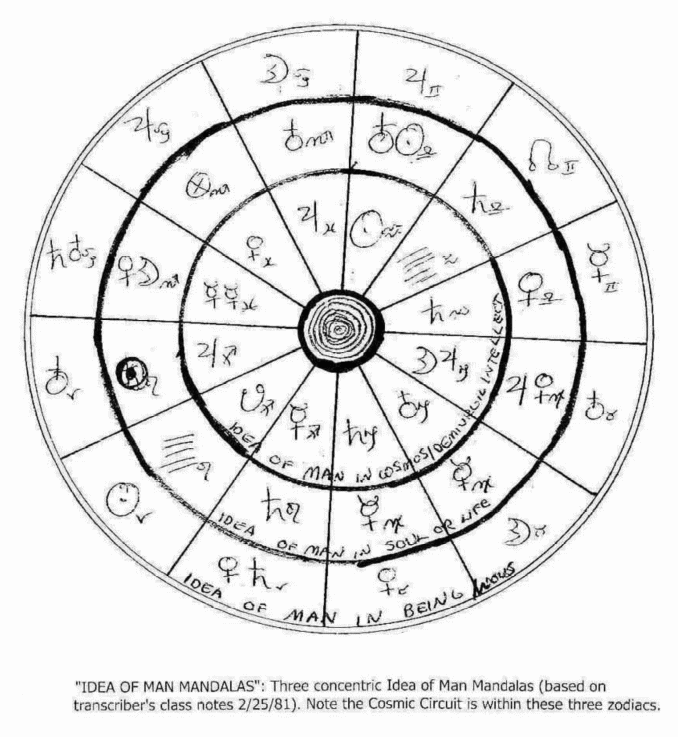
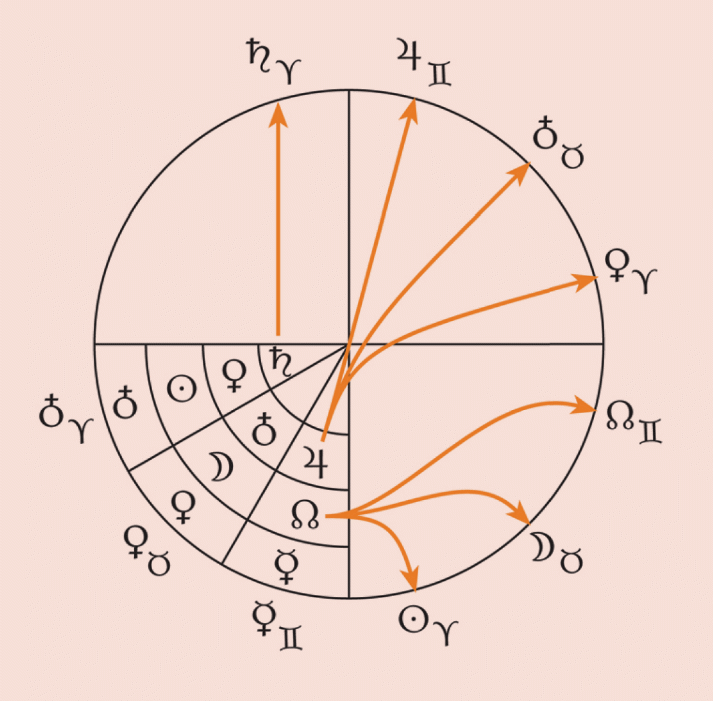
FIGURE 1981 0218-1-JF. Idea of Man Mandalas.
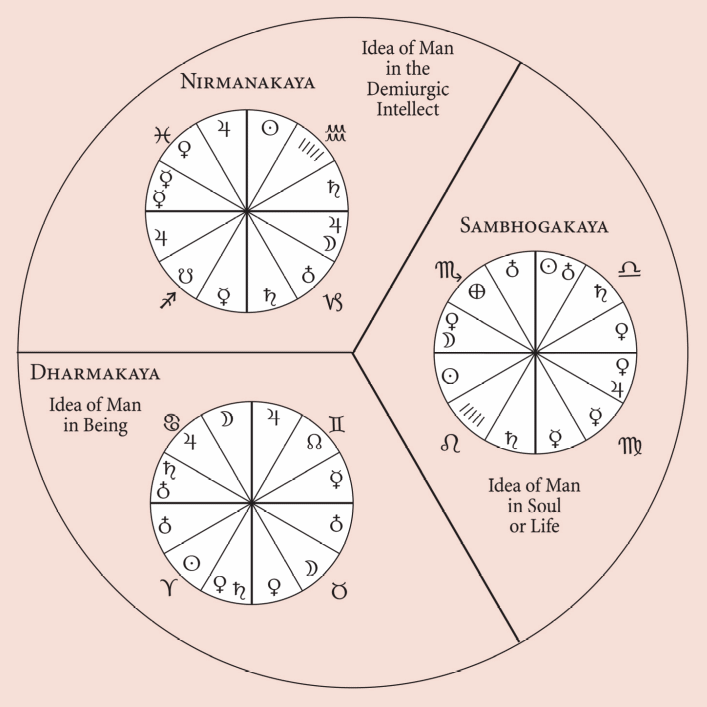
FIGURE 1981 0218-2. Twelvefold Mandalas for Each Level of the Idea of Man.
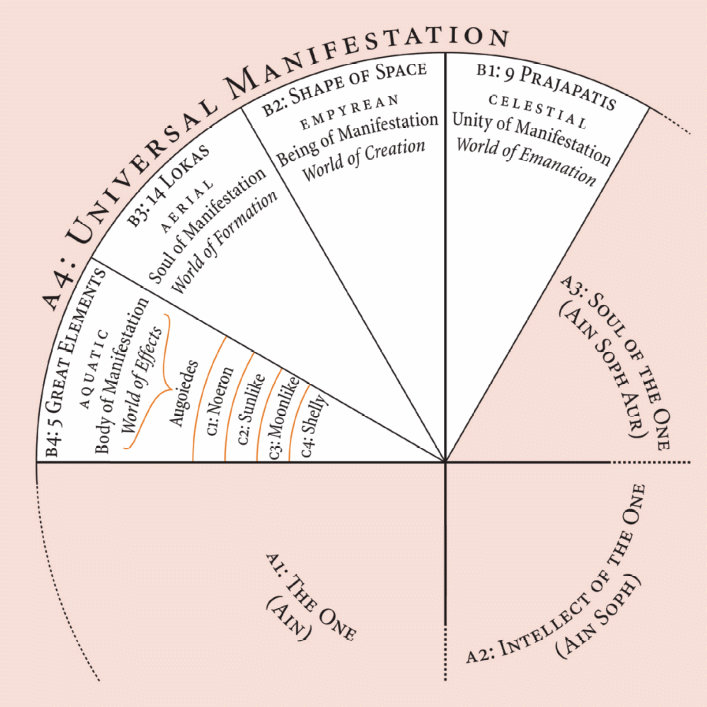
FIGURE 1981 0218-3. Three Hypostases and Two Levels of Cosmology Mapped onto Metaphysical Chart.
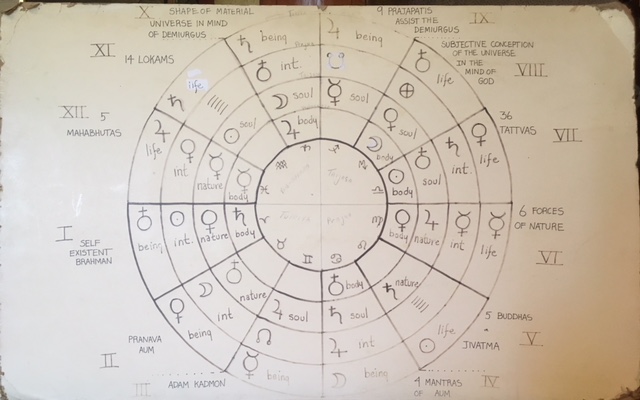
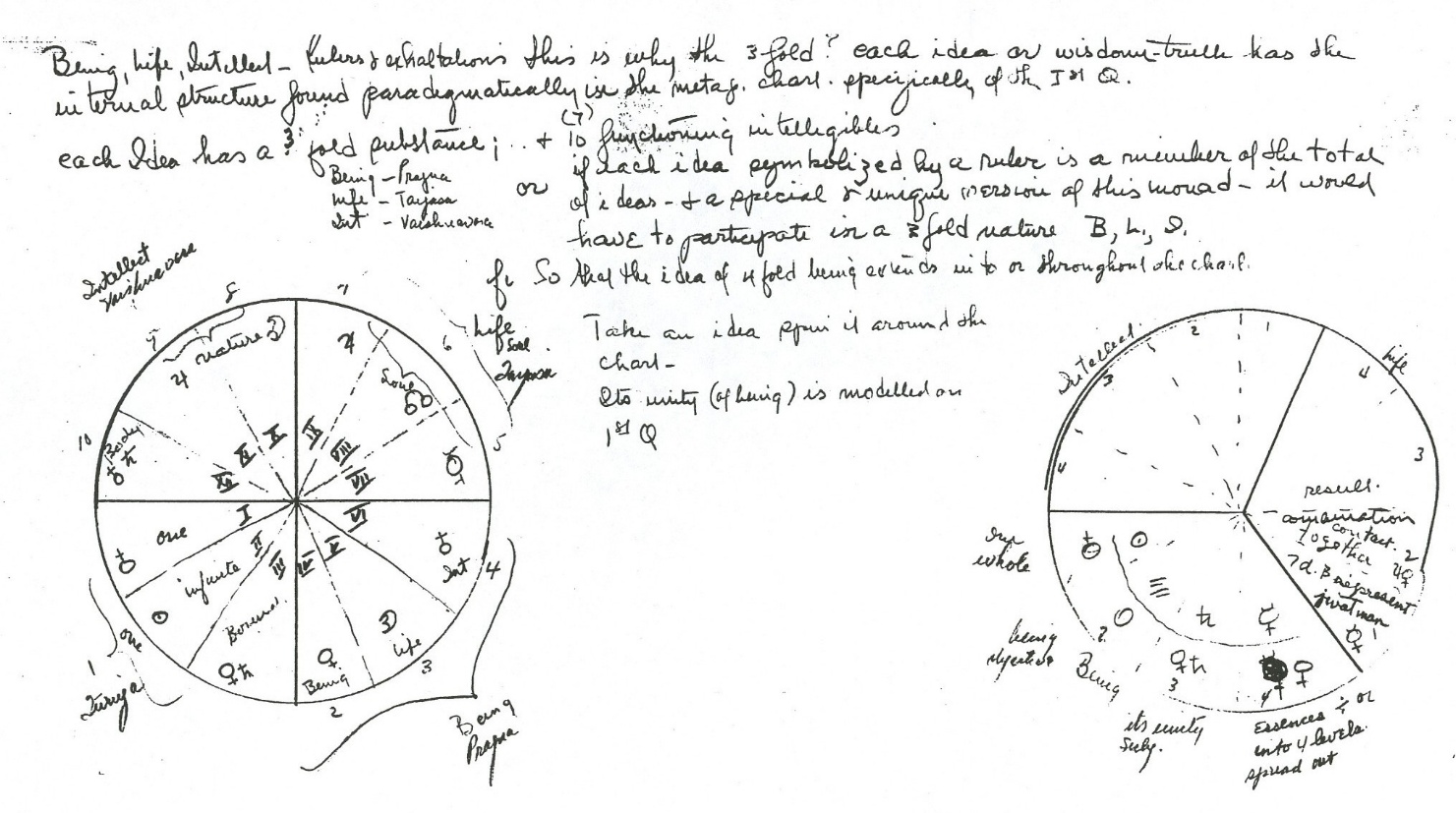
FIGURE IMG 2202-Posterboard Metaphysical Chart.
FIGURE AD_E_025. The Internal Structure of Each Idea as Found Paradigmatically in the Metaphysical Chart.
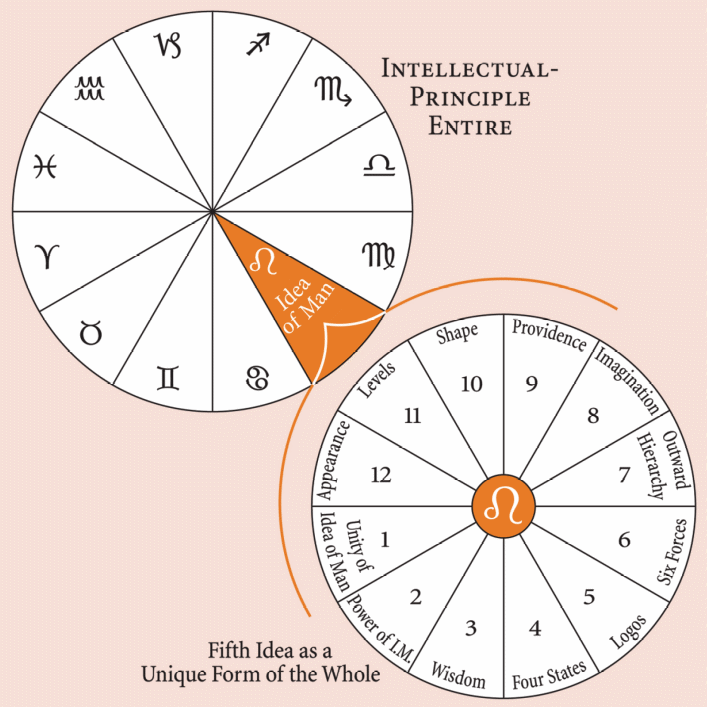
FIGURE 1981 0218-6. Fifth Idea as a Unique Form of the Whole.
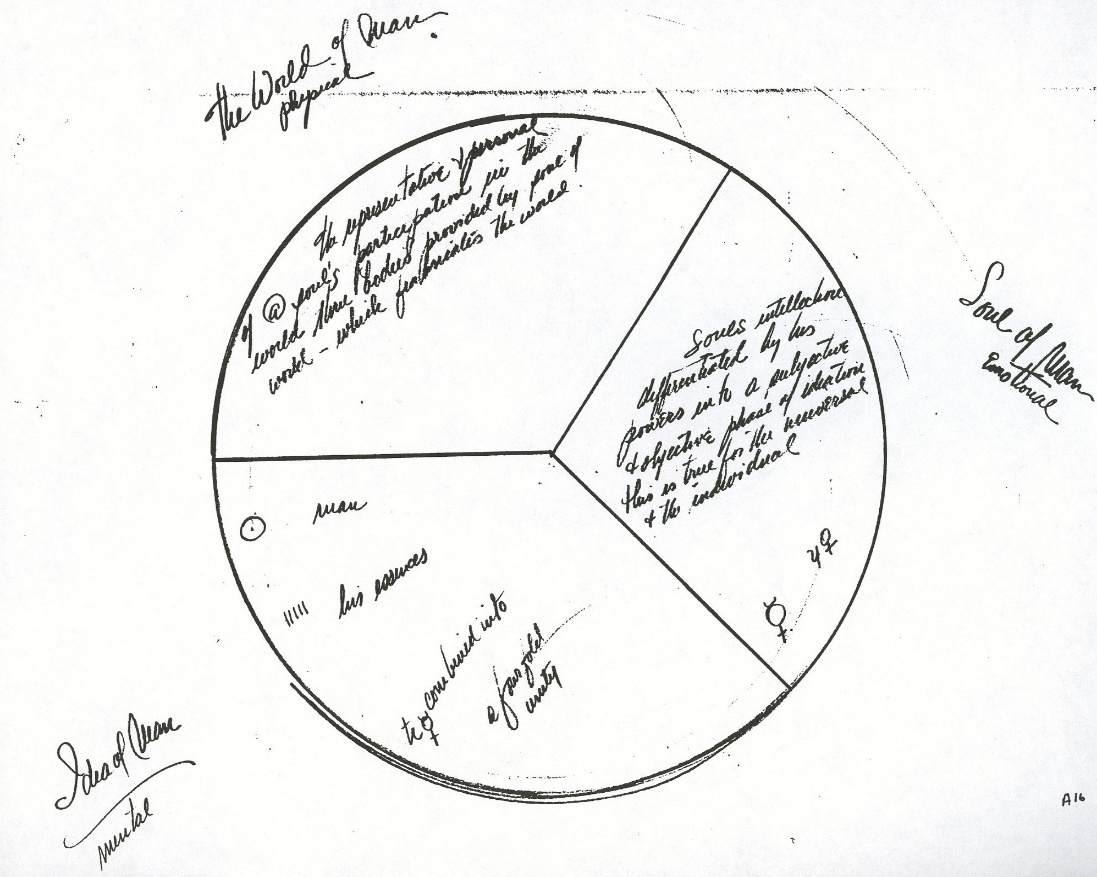
FIGURE AD_A016. Idea of Man (Mental), Soul of Man (Emotional), World of Man (Physical).
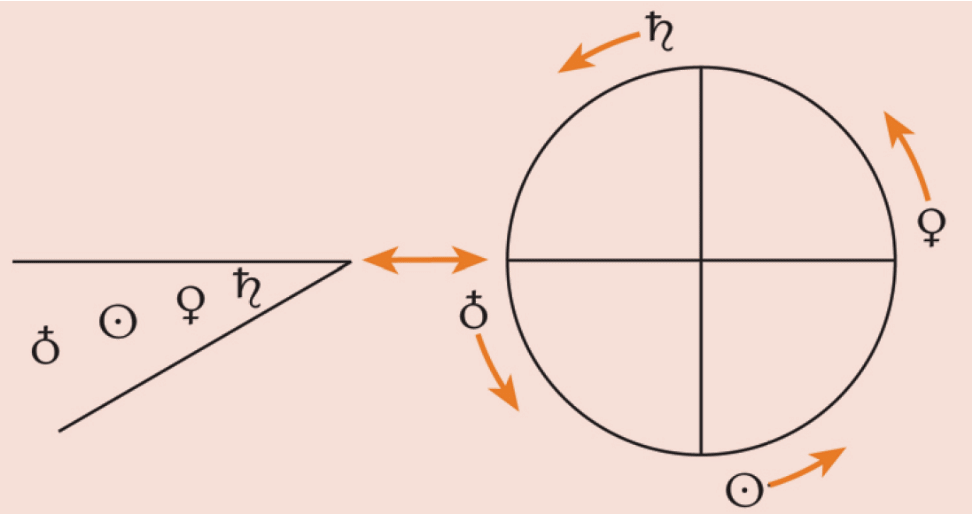
FIGURE 1981 0218-8. First House Dignities unfolded as Four Quadrants.
FIGURE 1981 0218-9. From Unities to Rulerships.
Other diagrams referred to are not with this transcript version.
PAPER read in class:
- On 12-fold Ideas – divided into Being, Life, Intellect. This may be (partially) a paper by AD, or at least organized notes, that AS is reading or working from, but as of 6/2003 there's no such to be found.
NOTES:
This early 1981 class series on the Idea of Man was held on Wednesdays.
In these classes Anthony Damiani speaks about, among other things, the relation of Soul to Nous and Being, and to the Cosmos; perception; and "teaching the Soul." A large portion of these classes is devoted to Anthony Damiani's laying-out of the components of the three Idea of Man mandalas; herein we can see some of his metaphysical chart methodology. In these classes, one should remember that Anthony Damiani is working out his speculations in the metaphysical chart; therefore his symbolization of astrological and metaphysical chart concepts may not exactly match that in Anthony's later thinking or in Astronoesis.
For further reading on the Idea of Man in general, refer to Astronoesis pp. 147-165, the Editors' Extension on the Fifth Idea. Astronoesis pp. 114-117 is about "Each Idea is a Unique Form of the Whole." Astronoesis pp. 132-133 includes two Twelvefold Idea figures, to which the reader may also want to refer.
Previously printed, distributed 2003 as part of a set on the Idea of Man.
TRANSCRIBED by jf 2003 from Audio Cassette tapes; reformatted by jf 2018. In 2024, IT updates prefatory matter and footer, replaces tape markers with audio file markers, alters Topic to make more accurate, completes Book List, adds Plotinus quotes section, corrects typos and some listening errors, adds new notes and alters some existing notes within transcript, removes one diagram and adds eight more and references within transcript to these diagrams, reformats to accord with new conventions. Readable edited transcript – V11r.
AUDIO FILES: 1981 0218a, 1981 0218b. [Note 1: "Tape" and "Side" refer to original audio cassette tapes that were later digitized into .MP3 Audio Files. Note 2: In 2025, REP Studio digitizes Audio File 1981 0218a, cuts alchemy class fragment from beginning of Audio File 1981 0218b.]
1981 02/18 at Wisdom's Goldenrod
Metaphysical Chart; Idea of Man
[Audio File 1981 0218a Begins]
(noises, people talking, shuffling of papers)
AS: I wanted to read this one quote first, on V.8.6, and then (inaudible), and then however-- and then to go over some of the ideas on the Idea of Man. (inaudible) This-- he's talking about this:
Plotinus V.8.6 (AS reading): ". . . the wise of Egypt . . . they exhibited the absence . . . in convey[ing] the propositions of reasoning [they] drew pictures instead, engraving in the temple-inscriptions a separate image for every separate item: thus they exhibited the absence of discursiveness in the Intellectual Realm.
"For each manifestation of knowledge and wisdom is a distinct image, an object in itself, an immediate unity, not an aggregate of discursive reasoning and detailed willing. Later from this wisdom in unity there appears, in another form of being, a copy, already less compact, which announces the original in terms of discourse and unravels the causes by which things are such that the wonder rises how a generated world can be so excellent.
"For, one who knows must declare his wonder that this wisdom, while not itself containing the causes by which Being exists and takes such excellence, yet imparts them to the entities produced according to its canons. This excellence, whose necessity is scarcely or not at all manifest to search, exists, if we could but find it out, before all searching and reasoning.
"What I say may be considered in one chief thing, and thence applied to all the particular entities."
AS: I think that's one of the ways we were trying to speak of an Idea, that:
Plotinus V.8.6 (AS rereading): ". . . each manifestation of knowledge and wisdom is a distinct image, an object in itself, an immediate unity, not an aggregate of discursive reasoning and detailed willing. Later from this wisdom in unity there appears, in another form of being, a copy, already less compact, which announces the original in terms of discourse . . ."
AS: --and so on. And it seems we were talking about-- well-- I think, in one way we were talking about-- he's trying to speak of each Idea, and particularly the Idea of Man, okay, as the unique manifestation of knowledge and wisdom, a distinct Idea in itself, and yet at one with the Intellectual-Principle as a whole. And that contained in this Idea is the way in which it's going to unfold -- And symbolically we'd put it this way, the way it's going to unfold in the other two realms. So in one realm we would have the Idea of Man, or any Idea, in the Nous, conjoined with the Nous, a unique form of the Intellectual-Principle. And then the way that that Idea is imaged, as it were, in the Soul. (drawing on blackboard-sounds) And we could consider this as universal too. The Idea of Man in the Nous or the Divine Mind, (drawing) or at one with God's Wisdom, and then the Universal Idea in the Soul, and then the third aspect, the way that this Idea was in the cosmos, the Grand Man in the Cosmic Manifestation, the Universal Man [FIGURES 1981 0218-1, 2]. Which they speak of it having these four levels, of Celestial, and then Empyrean, Aerial, and Aquatic. [Note: See FIGURE 1981 0218-3. See also Astronoesis, p. 339, endnote on Universal Man.] Now, I wanted to go over a few of the points we made last week and the week before. And if there are any questions or anything to add, some of these things I just don't know, so if there are blanks, they're blanks, they're either not worked out, or I didn't get them, or whatever. But he has in many places the notion that any Idea or Real Being in the Divine Mind or Nous is a unique form of the Divine Mind or Intellectual-Principle, okay.
[Transcriber's note: The first part of the following exposition sounds like it *may* be (partially) a paper by AD, or at least organized notes, that AS is reading or working from, but as of 6/2003 there's no such to be found. AS comments/exposition interspersed with paper as read.]
[Note: See FIGURES IMG 2202-Posterboard Metaphysical Chart, AD_E_025 for the following.]
PAPER/NOTES (by AD(?), AS reading): "These Authentic Beings are the essence of the Intellectual-Principle, he says that in many places, they are not outside of it, and the Intellectual-Principle in one respect is all of these Beings in one total. So in the one sense the essence of all the Ideas is inseparable from the intellection of the Divine Mind, but also each Idea is a distinct power, is self-caused, and is a 'one'.
"Now this view of each Idea as a unique unit or a unique Idea or a unique 'one' in the Nous is based on a view of ontology, is a view of an ontological unity. It's not the metaphysical One, or the metaphysical Unity, or the metaphysical principles contained in the One; the view here is that each Idea is an ontological unity. But as such we have to see how (drawing) it is based on the metaphysical paradigm. So that it seems that just as the World-Mind itself, just as the Intellectual-Principle itself is an image of the One or the metaphysical. And similarly each of these Ideas which is a special and unique form of the Intellectual-Principle is also exhibits the principles which are in the One. It too, each Idea will be an image or will be structured by the metaphysical principles of the prior. And so each Idea, no matter which of the Ideas we put, will be a Unity in Being, okay. It will be in Being, but it will be a Unity. And so we'll be able to apply in some sense the whole metaphysical chart to explicate the unfoldment of that Idea.
"Now-- in some way the first quadrant then has to be found to be the paradigm for the structure of any 'one,' but it seems that since the unity of an Idea the way we're speaking of it, is in Being, the first level, the Metaphysical Level, or the Absolute Level, is left out. And so each Idea as a Real Being, or a Unity of Being, is going to be described in terms of the other three levels: Being, Life, and Intellect. So when we switch from -- in other words-- within, if we just consider the first quadrant, we'd have the paradigm of all four quadrants, (drawing-on-blackboard sounds) we'd have the paradigm of the fourfold-- for example, in the Mars, Sun, Venus, and Saturn [in Aries] [FIGURE 1981 0218-8]-- okay-- which if we strung out the whole Triad, (drawing) we'd have Mars, Venus, Mercury, and so on-- The One; Sun, Moon, Head; Venus, Mars Jupiter; and Saturn [FIGURE 1981 0218-9]. In other words we could describe it as One, Being, Life, and Intellect, prefigured within the One, in some way.
"Now when we speak about each Idea as a Being, or even as a One-Being or as the Unity of an Idea, or the unity of the Being of an Idea; and the Life of an Idea; and then the Intellect, then in a sense we're leaving out that first level, and we're describing the Idea in terms of the three levels which pertain to Being. So it seems as just as in the metaphysical, Being, Life, and Intellect are implicit but not really explicit, in any Being, any One-Being, or any Idea, the Being, Life, and Intellect are explicit-- but the One in some way is only implicit in it. So it will be a 'one' but it will be a 'one' of Being, or an ontological unity. And the basis of it, the presupposition or principle of it which is the One, will only be seen in there implicitly as it were. Primarily it will be threefold in terms of Being, Life, and Intellect. And that should come out in some way. So it's almost like if we have the background for the whole thing is the metaphysical, then within that we're going to have the level of Being, and then the level of Life or Soul, and within that the level of Body or Intellect, depending on if you're going to go One-Being-Life-Intellect, or you're going to go One-Intellect-Soul-Body. Okay, it doesn't matter. But that would be this threefold. Or, I guess another way to diagram that, is that around this whole thing, around the whole threefold nature of an Idea (drawing,) you'd put the One, the metaphysical principle. So, anyway, the first quadrant is the paradigm for the fourfold structure of any Idea, okay.
"Now, the next point, another point-- Now these Ideas we spoke of as the Wisdom of God and even-- well, I'll leave that out--
"We must express all the principles that are in the metaphysical chart, okay, and we used these metaphysical principles to explicate any one of these ontological unities, in particular this Idea of Man [FIGURE 1981 0218-6]. So something that IS, has a Unity, it has a One-in-Being. It has certain Essences or Potentialities and so on. The way we've analyzed this should show up as principles that are in the metaphysical chart, but according to Being. We'd better do an example-- okay--
"So if we do this a little differently. We have a couple of pictures I guess-- (drawing) So if we started out examining one Idea in particular, the Idea of Man, by saying that there was-- first would be the Unity of that Idea. (drawing) And somehow I guess, we'd have to imagine outside of this whole thing, as it were the background for this whole discussion, there is (drawing) the metaphysical. Now -- at once-- (drawing) --now. I don't want to -- as soon as we do that we have the fourfold division, or a fourfold division, of metaphysical as the background. So every Idea, as a Real Being, is going to have a Unity, Essence, a Soul Aspect, and Body Aspect -- or a Unity aspect, of Being an aspect, a Life aspect, and an Intellect aspect, according to this fourfold. But also this fourfold is going to apply to every level of that Idea. The Idea itself or a Real Being will have a Being aspect, a Life aspect, and an Intellect aspect. So I don't know if we can diagram that, but it's like saying that-- Again if we go back to this other one here, if we speak about the Idea in itself, in the Nous or in Being, the Idea in the Soul, and the Idea in the Cosmos or in the Intellect, each of these is itself going to be a fourfold [FIGURES 1981 0218-1, 2]. That fourfold structure will have to apply to each of these three levels of any Being. And the way that we're going to indicate that, is you'll see that the four, or actually the twelve, levels within the fourfold itself would be the twelve divisions. Okay, instead of just the four would be able to break those up into three. So actually we'll have four levels, one within each other. The outermost level or the metaphysical is like the paradigm for that Idea. And from those metaphysical principles we're going to try to tear apart or explicate what's inherent in the nature of any Idea. And that we will do on three levels-- on the level of Being, as we said-- we could diagram it like this or we could diagram it like this -- on the outside we'd have the metaphysical principle, okay. The first level in would be the this level of the Idea in the Nous, or in Being, (drawing) the next level inside that would the Idea as it is in Soul, and the next level the Idea as it is in the Cosmos or in the Demiurgic Intellect. And strangely enough, or not strangely, we get these four levels which almost seem to correspond, again, to those four metaphysical levels, where only the three inner ones apply to the Being of an Idea, the fourth level, the outer--I mean the first level, or Absolute level-- is only implicit as the paradigm or the principle of the Idea."
AS: I don't know if I made that clear, I'm not sure. Now I don't know if that's so either but it's--
AD: (Well use) the astrological chart, that's easy--
AS: You mean the fourfold of the--
AD: The astrological chart-- Where you would have first the blank space, then you would put the 12 houses, (AS: Okay.) (inaudible) and there you would have the same thing, (inaudible) but all the way down.
AS: Yes, I can build it up, I'm not sure what the highest level would be there--
AD: You'd have to leave it out--
AS: The highest level--okay.
AS: Okay. So now-- if you put one inside the other-- you will be able to line them up and see how the twelvefold zodiac as it were in the Nous, the twelvefold in the Soul, and the twelvefold in the cosmos [FIGURE 1981 0218-1-JF]. Over here I have the whole chart divided into a threefold [FIGURE 1981 0218-2]. But if we did it without our example, namely the chart, then the Nous -- in other words, this aspect, as you can see here-- You have to think of the outer one pervading, as it were, the inner ones. So that the Nous aspect here includes already within it the causes of everything that's going to unfold, and pervades the Idea in the Soul and in the cosmos. So in our example of the chart, it would be the chart paper itself. And somehow if you could imagine that the wisdom of the Idea of Man was infused into the chart paper itself. And that would be like the intellectuality which would have to be available. Or if we imagined -- I think we gave this example-- like 360 rays coming out somehow, it's like before you even have the 12fold house system, if you image the Idea of Man itself in the Nous or the Intellectual-Principle, as the background of that, and imposed on that would be the Idea of Man in the Soul, the house structure, (drawing-lines-noises) the particular house structure, and then imposed on that is the Idea of Man in the Soul, would be radiating out from the center-- Oh, we should do it backwards -- and imposed on that the whole zodiac, the 12fold zodiac with the planetary spheres and the whole cosmic functioning.
Or, if we did it the other way around, if we started with the cosmic functioning and we imagined a point, like in your heart center, and radiating out from that the Soul, the pure Soul, (drawing) which then would be like a background for everything that's going on in the cosmic circuit. And then if we could imagine that thing against the background of the Nous, which remained as it were fixed, or completely stable, and which would always in some ways would have to be available. That last level I don't know how to diagram it -- Okay.
Or, in some of the charts we've done, this, the third level here in the cosmos, would be the whole of the cosmic circuit: the planetary spheres, the inerratic sphere, and so on, and all the aspects. The Idea in the Soul would be in the Cognitive Isness, the way that the Individual Soul, or the Unit Soul, or the Saturn in Leo, or Cognitive Isness, was conjoined with the particular image of the Idea of Man. And this would be the universal Idea of Man in the Divine Intellect. It wouldn't even be [just] any particular Idea, it would be the Idea of Man, which the Soul-- which, he says, that the Soul can use when it turns itself to the Nous. But it's not-- the Soul looks this way towards the cosmos. When it looks this way towards the cosmos, it's watching, as it were, the functioning of the planetary spheres and so on, the whole cosmic circuit. When it turns inward to its own prior, the Nous, then that Nous must be available to it, the Idea of Man itself or in the Nous, which originally contains everything, of course, that the Soul will manifest, or that the Demiurgic Intellect will manifest in the cosmos. So again this chart seems to show how this Idea in the Nous pervades the Idea in the Soul which then pervades the Idea within the cosmos as the Demiurge's manifesting.
LDS: Avery, so what do you mean by cosmos up there, or Intellect in equivalent terms. Cosmos or Intellect in equivalent terms?
AS: The Demiurgic Intellect, the third one.
LDS: That includes-- The limit of that would be like the inerratic sphere, and then the planetary spheres? (inaudible)
AS: We would think of that as the whole functioning of the cosmic circuit.
LDS: Okay.
AS: But-- it could include more if we were doing this (drawing-sounds) in this manner. They speak of these four realms in the last four houses that we spoke of-- the Empyrean, the Celestial, and so on--Celestial, Empyrean, and so on-- I mean if we were going to transpose this all into our cosmos, I mean into the actual 12th house, as it were, or right into the chart, it seems-- then the cosmic circuit or the functioning of the cosmos would include the sublunary, the planetary spheres, and up to the inerratic sphere, okay, all of that [FIGURE 1981 0218-3]. This level here would be the Idea of Man as it is conjoined to the Cognitive Isness or the pure Soul, which is pervasive, let's say, of your cosmos. (drawing-sounds) And somehow I would have to conceive that the basis for both the Idea of Man in the Soul, the Cognitive Isness even, and the cosmic circuit is the Idea of Man that's absolutely all-pervasive, that's in the Nous. The way he speaks about it here-- we'll do some quotes on that, where he says that each is a unique form of the Intellectual-Principle, but is not any individuals-- in some sense this is a unique form of this Idea of Man in Nous, this is a unique form of the Intellectual-Principle; the Idea of Man in the Soul is a unique form in a unit Soul, is a unique form of that form of Man, of that unique form of Man. Namely a unique form in the Soul, it's like an image of that. And in the cosmos even further it would also be -- I guess you could look at it either that the image, the Idea of Man in the cosmos is an image of that Idea of Man in Nous and the Idea in Soul. Or-- I suppose there's a way you could go this way, and say that the Idea of Man in Soul images the Idea of Man as a particular form or a unique form of the Idea of Man per se in Nous, and that the Idea of Man that's manifested in the cosmos would be a particular form of that Idea [of Man] in Soul. But that would be for an individual. You see what I mean? (S inaudible)
Like you'd have the Idea of Man per se, you'd have the Idea of Man in the Cognitive Isness, in your pure Soul, and then here it would be, as it were, your individual chart-- the man that's manifested. So just as these three would hold for Universal Man in the cosmos, universal Man in Soul, and the universal Idea of Man, it seems also for an individual you would have your individual vehicle, the Soul, your Soul Cognitive Isness with the Idea of Man, and then the Nous (inaudible).
LDS: The only question I have, Avery, is I didn't understand what it meant in the ontological depiction there of the three realms, the three divisions of that chart, what it mean to put cosmos in that last division [FIGURE 1981 0218-2]. Because I always think of cosmos as the 12th house. But -- I may not have--
AS: Well, in this view, if we took it as really ontological, the whole last four houses in some way would be the cosmos, everything that's within the Demiurgic Intellect.
AD: You're only thinking of the sensible cosmos, Louis. When you're in the 12th house, you're only thinking of the sensible cosmos.
LDS: And the three--
AD: There are other parts to the cosmos which are not sensible, which is what 11 and 10 are about. To get the substratum of the sensible cosmos you would have to go to the 10th house.
AS: This would be the prior matter [10th house] and the prior form [11th house] and the prior unity [9th house] to the actual sensible manifestation [12th house]. It's like in a sense the whole dharma system, and the whole matter that underlies that prior to manifestation. And in their view even, the unity of the Demiurgic Intellect would be what contains the whole business.
LDS: So the boundary of cosmos then would be that Demiurgic Intellect.
AS: Yes. Just as here the boundary is Life, the pure Cognitive Isness. We'll do that. I think that will show up when we actually try to describe each of the whole realms and try and see what's contained in each of these three sectors, (LDS: Right.) and in what way they differ, or in what way they're correlates to each other. Because in one way they really are correlates as we'll see, the whole division will match up. For example, you'll have Aries, Leo, and Sagittarius and so on, and everything in there will match up very well so that when you do this and you superimpose one on the other, this will all be -- you'll have Aries, Leo, Sagittarius, one underneath the other [FIGURE 1981 0218-1-JF]. So for example this one is the Unity of the Idea of Man in Being, the next one is the Unity of the Idea [of Man] in the Soul, and this what unifies the Idea in the cosmos, and this will be the Jupiter, the Jupiter in Sagittarius. This one will be the Sun in Leo, the Idea of Man in Life, and this one the Unity of the Being of the Idea of Man, or some kind of notion like that.
AD: It sounds a little strange, but we've been building up this huge backdrop, this stage from which the questions-- whether the questions that are asked, whether by Plato or Plotinus or any of the sages, this is the backdrop, this is the stage. This is the recommended reading. And the problems that we're faced with in epistemology or psychology or ontology don't have this as a background alright, and you're just throwing, bandying a lot of words around. You follow what I'm doing? The world is the stage on which the plays are going to appear, it's not going to be on page 18 of some book. (silence)
The (inaudible) we use that is because we can to some extent verify quite a few of these things as we go along, by empirical examples. I mean we can empirically look at the transits, look at a chart, look at the ephemeris, and sometimes even have accurate knowledge of what is coming or what would come to pass. And the implications are as far as the chart is concerned is that it's in the chart the possibility of accurate knowledge from the Nous is available. In the chart, accurate knowledge of the Soul's interpretation of some situation or event is available. That's what we're working on.
AS: Yes--
CDA: If the Unity of the Idea-- (AD: Louder.) If the Unity of the Idea in the Being is itself the Idea-- right? -- that the Idea as a Unity in Being, as a One-in-Being, is itself as an Idea (AS: Yes.) as opposed to symbolized by the Mars [in Aries]. The Idea as a Unity is itself as a Unity. Then you put the Mars, the Sun, and Jupiter [rulerships of Aries, Leo, and Sagittarius] (AS: Well, we'll have to talk about that--) and that's-- that's what I was going to ask you to talk about--
AS: Well we'll have to--
CDA: How those are conceived of as--
AS: Well, there's still a hard point there-- I mean, they're conceived as being the principles of the unfoldment of an Idea-- we said we were going to take the metaphysical paradigm as the principle-- I mean it seems that's what a presupposition is -- you put the Unity of the Idea in the 1st house say or-- well see, in some way it's actually the whole first three of these [first quadrant] within Being, in some ways this whole thing is the Unity of that Being. But it seems that what you're doing is (inaudible) -- everything that we examine and see that's within the Idea okay is-- it's principle is in this metaphysical chart. In other words, we're applying the metaphysical chart to an Idea, it's like a juice extractor or something. Or like you know a fluorescent screen or something, and you jot down that Idea on it and it shows up the whole structure of how that Idea, of the Idea. So you put any Idea here, and these 12 principles, or 10 or whatever, will show you exactly the structure of that Idea. In Being. And then the same thing will happen in Life or the Soul. And in the Cosmos.
AD: Avery, put on the other board, put the metaphysical chart on the other board, the 12 houses. [Note: See FIGURE IMG 2202-Posterboard Metaphysical Chart.] Carol, this is very straightforward, it's a little complex but it's very straightforward. (drawing sounds) Now you think of those 12 houses as the metaphysical chart alright-- 4 quadrants, 12 houses. And you got the Ideas around it, alright. Now if you take one Idea-- what we're saying is something like this-- the key to understand and unfold the contents of one of the Ideas, is going to be based on that model, the metaphysical chart. So we take one Idea, 'X' Idea, and the key Ideas that are given to us in the metaphysical chart-- are applied to that one Idea.
So if you take the Idea of Man, which is the 5th house Idea in the metaphysical chart. And if you look at it, if you look at the first four houses of the metaphysical chart, that would correspond to the outermost ring over there. The next four houses in the metaphysical chart are the next ring inside. The last four houses of the metaphysical chart correspond to the innermost circle [FIGURE 1981 0218-1-JF]. That's one Idea, how the other Ideas are worked out, heaven knows. But at least about the Idea of Man, we should be able to find out something.
BC: So you're saying that the 3fold is just basic to the Idea of Man and not to any Idea?
AD: As far as we know, yes. We don't know, it might be an entirely different arrangement with another Idea.
AS: Yes, I mean it seems just-- this isn't necessarily so, but it since the 5th house is the one, I mean, at least in ontology, that establishes the break from Being. Like you have Being-Being-Being-Being [1st four rulerships are Being; see FIGURE IMG 2202-Posterboard Metaphysical Chart] in rulerships. Or you could look it this way, the priors, the four priors to the Idea of Man gives you the threefold. Alright, you have these four, and then the next four in Life, and then Intellect. So in a sense the break does come at Leo. But that may just be an adventitious kind of reasoning. It should come out of the reasoning, there should be some way that, and maybe there is when we go through it, that the hardest thing is just from these principles to see what see how you actually get those four, to get those first four houses. Maybe what we do that, it will come out why it turns out that the-- in other words we are saying that-- I got to say the right-- The first four houses in the metaphysical chart are determining-- and only those four-- are what are determining the Being of the Idea of Man. And the next--
AD: That would be the first zodiac.
AS: Yes. And the next four houses applied to the Idea of Man are determining the Life of that Idea of Man. And the next four-- 9, 10, 11, and 12-- the Intellect, or the Cosmic Manifestation or the Cosmic Man aspect. Now, the other thing that seems to come out is, in the metaphysical that fourfold structure is according to the rings-- Mars, Sun, Venus, and Saturn [in Aries]-- okay, which does establish the quadrants [FIGURE 1981 0218-8]. But here the fourfold is according to houses. I see that's what's happening-- that's one point, I don't see clearly why that distinction comes up here. You see what I mean, Robert-- The metaphysical, the principle of the fourfold, is in the first house, even, and that establishes the quadrants, that establishes that anything will be a fourfold. And now we're applying that fourfold to the Being of an Idea, to the Life of an Idea, and to the Intellect of the Idea. Or to the Being, the Soul, the Body. Well, when we're applying it to the Being now, the way it comes out, is that it's actually being applied as the first four houses. It's not being applied per se according to the ring, but according to these four houses.
So in other words this whole first part, the Unity of that Idea of Man in Being is Aries, the Essence of the Idea of Man is Being, we referred to the principle of Taurus, the Life of the Idea of Man in Being or its peculiarity is Gemini, and finally the Fourfold Being that it has to Taurus [sic; Cancer]; it's the body aspect of Being of the Idea of Man [FIGURE 1981 0218-1-JF, outer ring]. Okay, rather than stringing around the Mars, Sun, Venus, and Saturn as we did in the metaphysical which would all be from the first q-- from the first house. So we've gone from this ring view to a house view, and not only that, we've brought in, it's true also, we've brought in the fourth house. Okay. That seems reasonable, because we can't really speak about Being unless we go out of the first quadrant, you can't talk about the Nous, in some way that makes sense. If we just did this [1st house] as the fourfold we would just have metaphysics. But I don't see clearly why-- I mean there's something there in going from the metaphysical view to the ontological where we do have to go out of the first quadrant. The principles are in the first quadrant, but in order to speak about 'a' Being, it seems we do need to go into this, to bring in this 4th house, or to go outside of the first quadrant. But I don't see clearly yet why it happens to work out that way--
AD: Now with that as a background, if you do some of the readings on the Idea of Man or the Idea of Soul, you should have available in front of you a schemata by which you can understand these things. So for instance, when Plato speaks about the Divided Line, and he says that the Soul looks down into manifestation it loses its way and gets obscured. Whereas when it looks up to the Nous alright it is guided. [Note: See Plato, Republic, Book VI, 508d.] Now if you look at that diagram, the middle circle being the Soul, the Soul could get lost in the perception of shadows, or in belief. Or the Soul could reason, which would be its own faculty. Or the Soul could look up to the Nous, the principle above it, and it would have accurate knowledge. So you can take an example from, let's say, Plato where he speaks abut the Divided Line, AND SEE IT RIGHT IN YOUR CHART. That's what I'd like to see you do, see it in your chart. (drawing-on-blackboard-sounds) This is the kind of conception in the background that I think the Platonists were working with for a thousand years. Which they very cleverly, I think, disguised. But if you read carefully in some of the writings of the Neo-Platonists, Proclus, Plotinus, Moderatus [of Gades], I think with this as a background I think you could understand a lot of the ideas that they're speaking about. I also suspect that this is the basic meaning of the Kalachakra in Buddhism. So it's your ball, you play with it.
AS: Of course I don't have any of the quotes (inaudible) on Soul. I have a whole list of them. Well, I'll maybe get the (inaudible) ones first where he does speak-- I guess it probably pays to read that one first that Anthony read the other day, in VI.9.5, that really seems to say it about the most clearly, it's very amazing, VI.9.5. And then there are a lot of quotes-- Um, one big difference between the way we interpreted some of the quotes before and the way this seems to interpret them-- before we really kind of had a twofold rather than a threefold, where in a lot of quotes we interpreted the way that the Soul comes in contact with the Intellectual-Principle is the way that it contains this image of the Idea of Man, even in the higher Soul. Whereas now it seems we've brought in the Idea of Man in the Nous, or in itself, which the Soul actually doesn't contain. But if anything, this diagram shows that it [Nous] contains the Soul.
And so in some way, it's that-- in the quote that we read and that we'll read again, it's that in us which really knows. When the Soul looks into itself it's really looking at the Idea of Man per se. And so we have really a threefold, and not just this, not just the twofold.
S: Are you saying that it was twofold because like our 2nd quadrant served both for the Soul and for the (inaudible).
AS: Yes. In a sense when we did it that way. We had the distinction between the cosmic circuit and then the Cognitive Isness in its vision of the Idea of Man which it contained. And here we're now bringing in a third, higher level, the Idea of Man in itself. Which -- seems to make further distinction within that, within the higher level. But this one in VI.9.5 that we actually read-- I don't know-- it says--
Plotinus VI.9.5 (AS reading): "Soul must be sounded to the depths, understood as an emanation from [the] Intellectual-Principle and as holding its value by a Reason-Principle thence infused. Next, this Intellect must be apprehended, an Intellect other than the reasoning faculty known as the rational principle; with reasoning we are already in the region of separation and movement: our sciences are Reason-Principles lodged in soul or mind, having manifestly acquired their character by the presence in the soul of Intellectual-Principle, source of all knowing.
"Thus we come to see Intellectual-Principle almost as an object of sense: it is perceptible as standing above soul, father to soul, and it is one with the Intellectual Cosmos; we must think of it as a quiet, unwavering motion; containing all things and being all things, it is a multiple but . . ."
(Side 1 of original cassette tape digitized as 1981 0218a Ends; Side 2 Begins)
Plotinus VI.9.5, continued (what's in <> brackets is from the quote but not on the tape): "<. . . at once indivisible and comporting difference. It is not discriminate as are the Reason-Principles, which can in fact be known one by one: yet its content is not a confusion; every item stands forth> distinctly, just as in a science the entire content holds as an indivisible and yet each item is a self-standing verity."
AS: So actually with that first paragraph we didn't read, [Plotinus VI.9.5: "Those to whom existence comes about by chance and automatic action and is held together by material forces have drifted far from God and from the concept of unity; we are not here addressing them but only such as accept another nature than body and have some conception of soul."] he starts there with the material, the material forces and so on. And next he talks about Soul. So now he's at the second level there, which must be "sounded to the depths, [and itself] understood as an emanation from Intellectual-Principle and as holding its value by a Reason-Principle thence infused."
S: (What would that be), Avery?
AS: I think that would be the Idea in the Soul. Because he often speaks of reason-principle even for the highest phase of Soul, that that's conjoined with what he calls the "Reason-Principle." He uses reason-principle very loosely and takes it quite, to even to the summits of the Soul.
S: So how can I understand the reason-principle in Soul?
AS: It seems when we say that the Soul has a vision of the Idea of Man, and is wedded to it and contains it--
AD: Read the first sermon by Meister Eckhart on the Birth of the Logos in Man. [Note: See Franz Pfeiffer, Meister Eckhart, Volume 1, trans. C. de B. Evans, Sermon I, p. 3 ff.] But that would be equivalent to-- this is loose talk-- but it would be equivalent to an algebraic formula, it would be the sum total of everything that *this* Soul will manifest through (inaudible, someone coughs). So you know, like if you take the number of 15, you know that you got 15 units, but you know that 15 is the sum total of all the units, and that 15 would be equivalent to the Logos or the reason-principle in the Soul. And that as it unfolds each of the units within it, alright, the definition of Soul is Being, so to speak, manifested. He calls that a reason-principle. But he also calls the Divine Idea a Reason-Principle. He calls any of the Authentic Beings a Reason-Principle. So like Avery says, it's very loosely used, and you always have go by the context you find it in.
S: So in this case you're saying it's related in some way to Number?
AD: Yes, but we won't get into that. Yes, as a matter of fact, (inaudible) they would even refer to the totality of beings in Being as Number. They have a very strange use of Number, three, four different levels of meaning for it. We're not ready to tackle anything like that.
SS: So this reason-principle infuses from the Intellectual-Principle, is infused into that Soul?
AD: Yes.
SS: That would be the way I'd interpret.
AD: If I could take you back all the way, to when you say "I see a tree," alright, you'll see that you traverse all the levels of reality from the Nous all the way down to the sensible world. "I see a tree"-- you have all the levels of reality right there. That's why it's the hardest thing in the world to explain. So you take it for granted that you see a tree. (S inaudible) (silence)
AS: Okay. I guess that one is fairly clear now. Anthony, do you think we should go over more of the quotes that we've done before?
AD: Let's do some more quotes.
AS: How about this one in VI.7 now? VI.7.2, VI.7.3. I know we did these before but-- And then a little later in VI.7-- near the beginning of where he says that -- he's talking about the cause.
S: Which ones?
AS: VI.7.2, it's about [page] 561.
Plotinus VI.7.2 (AS reading): "We see a man--or an eye, if you like--but this is an image or part of an image; what is in that Principle is at once Man and the reason of his Being; for There man--or eye--must be, itself, an intellective thing and a cause of its being; it could not exist at all unless it were that cause, whereas here everything partial is separate, and so is the cause of each. In the Intellectual all is at one so that the thing is identical with the cause.
[AS: And he says later on--] ". . . by this search after the cause the thing's essence is reached, for the essence of a thing is its cause. I am not here saying that the informing Idea is the cause of the thing--though this is true--but that the Idea itself, unfolded, reveals the cause inherent in it.
[AS: And then a little later--] ". . . where could a Forming-Idea, a member of the Intellectual-Principle, turn in quest of its cause? We may be answered, `In the Intellectual-Principle'; but the two are not distinct; the Idea is the Intellectual-Principle; and if that Principle must contain the Ideas complete, their cause must be contained in them. The Intellectual-Principle itself contains every cause of the things of its content; but these of its content are identically Intellectual-Principle, each of them Intellectual-Principle; none of them, thus, can lack its own cause; each springs into being carrying with it the reason of its being. No result of chance, each must rise complete with its cause; it is an integral and so includes the excellence bound up with the cause. This is how all participants in the Idea are put into possession of their cause."
AS: It seems now that he's talking about this first level of that Idea, the Idea in the Nous, the Idea of Man in the Nous, which is self-caused, self-originating, self-determined. And "all [of the] participants in th[is] Idea are put into possession of their cause" which itself contains all of the possible manifestations either in the cosmos or in an individual soul. And this is how those "participants in the Idea are [at once] put into possession of their cause" of the Idea in the Nous. And then he says on the next page-- he says, Man, for example--
Plotinus VI.7.2 (AS reading): "Take for example the Idea of Man; . . ."
AS: Again I think we could interpret it as that first third there [FIGURE 1981 0218-2].
Plotinus VI.7.2, cont. (AS reading): "Man entire is found to contribute to it; he is in that Idea in all his fullness including everything that from the beginning belonged to Man. If Man were not complete There, so that there were something to be added to the Idea, that additional must belong to a derivative: but Man exists from eternity and must therefore be complete; the man born is the derivative."
AS: In all of these ones where he says that this question that we seem to have had before-- I don't know if this answers it-- I don't know-- when he says:
Plotinus VI.7.3 (AS reading): ". . . sense-perception--even in its particular modes--is involved in the Idea by eternal necessity . . ."
AS: It seems also to be speaking of the Idea of Man per se--
AD: A nice contrast to that would be V.3.8. (shuffling of papers) It was a continuation, I think, of what we did last week, in answer to your previous question. V.3.8.
AS: Yes. When we spoke about the self-knowing of the Soul is dependent upon the Intellectual-Principle knowing through it. So--
Plotinus V.3.8 (AS reading): "Now comes the question: what sort of thing does the Intellectual-Principle see in seeing the Intellectual Realm and what in seeing itself?
"We are not to look for an Intellectual realm reminding us of the colour or shape to be seen on material objects: the intellectual antedates all such things; and even in our sphere the production is very different from the Reason-Principle in the seeds from which it is produced. The seed principles are invisible and the beings of the Intellectual still more characteristically so; the Intellectuals are of one same nature with the Intellectual Realm which contains them, just as the Reason-Principle in the seed is identical with the Soul, or life-principle, containing it.
"But the Soul (considered as apart from the Intellectual-Principle) has no vision of what it thus contains, for it is not the producer but, like the Reason-Principles also, an image of its source: that source is the brilliant, the authentic, the primarily existent, the thing self-sprung and self-intent; but its image, Soul, is a thing which can have no permanence except by attachment, by living in that other; the very nature of an image is that as a dependent it shall have its being in something else, if at all it exist apart from its original. Hence this image ([the] Soul) has not vision, for it has not the necessary light, and if it should see, then, as finding its completion elsewhere, it sees another, [and] not itself.
"In the pure Intellectual there is nothing of this: the vision and the envisioned are a unity; the seen is as the seeing and seeing as seen.
"What, then, is there that can pronounce upon the nature of this all-unity?
"That which sees: and to see is the function of the Intellectual-Principle."
AD: The reason I thought we picked that out is that we can see the references to the levels that he's working with there. And I think that Steve's question would further amplify that. You see what he's saying, that the Soul cannot have a vision of itself as a Logos, but and only when it can identify with the Nous. We were discussing that with Jeff last week.
AS: Yes. The question of the Soul's self-vision which depends on the Intellectual-Principle. Only the Intellectual-Principle is self-knowing in the sense that he uses it. So if on here he would say if "the Soul (considered as apart from the Intellectual-Principle)" would be that 2nd third, the Idea in the Soul, or the Soul, either looking down towards the lowest or the cosmic circuit, or even if it were to remain in itself in its own reasoning, it still would not be self-knowing. Anthony, the end of this tractate also-- the last paragraph of [V.3.]8-- he says--
Plotinus V.3.8 (AS reading, reads first phrase, then starts again): "If the Soul is questioned as to the nature of that Intellectual-Principle--the perfect and all-embracing, the primal self-knower--it has but to enter into that Principle, or to sink all its activity into that, and at once it shows itself to be in effective possession of those priors whose memory it never lost: thus, as an image of the Intellectual-Principle, it can make itself the medium by which to attain some vision of it; it draws upon that within itself which is most closely resemblant, as far as resemblance is possible between divine Intellect and any phase of Soul.
AD: Try discussing that, especially that last sentence.
(silence in the class)
AS: Actually (I'd like to) read it again a couple of paragraphs prior to it, we would read this one. Well it's one thing here, it says here:
Plotinus V.3.8 (AS rereading): ". . . it has but to enter into that Principle, or to sink all its activity into that, and at once it shows itself to be in effective possession of those priors whose memory it never lost: thus, as an image of the Intellectual-Principle, it can make itself the medium by which to attain some vision of it; . . ."
AS: In some way, I'm not really quite sure what he's saying, in some way there is already within the Soul an image of the Intellectual-Principle. And we could see that either from this diagram, okay, if the Idea of Man here is this Being circle, over here the Idea of Man in Being, then the Soul, the Soul already contains an image of the Nous within it [FIGURE 1981 0218-1-JF]. We said even if we're speaking here of the Soul as the Cognitive Isness, or the Saturn in Leo, it already in some ways contains a vision or has a vision or an image -- or is a vision--
RG: It says it only does that when it sinks itself back into it.
AS: But, he says--
Plotinus V.3.8 (AS rereading): ". . . at once it shows itself to be in effective possession of those priors whose memory it never lost: . . ."
RG (hard to hear): Alright. But only when sinks all its activity back into Intellectual-Principle, it doesn't seem that it's considered apart when you speak of it that way.
AS: Right. Yes.
RG: So it seems only when it's conjoined to the first third could you speak of it that way--
AS: Yes, as the primal self-knower and so on. But wouldn't you say also, it does contain some image?
RG: Yes, it is an image of that. That's how it could even have the trace in it, to trace yourself back to it.
AS: Right, that's what I'm saying. This image of the Intellectual-Principle which seems to be what he says is its memory that it never loses.
RG: (inaudible) Or that the image is the way it gets back to memory which it never lost which are the contents of the Intellectual-Principle.
AS: It's like, it's almost like what the Buddhists talk about, like within -- I don't know if we could say that-- that that original vision or image which the Soul has is what's going to lead it back to the Intellectual-Principle. But-- In other words, if we diagram this, which (inaudible), we'd say when it sinks its vision into the Intellectual-Principle now we're talking about the Soul looking up to its prior, the Idea of Man in the Nous.
DR: Avery, suppose you use the other diagram. [Note: Reference to either FIGURE 1981 0218-1-JF or 1981 0218-2.] When we lay it out that way, I can't help but think of the diagrams (loud noises on tape during DR's comments) the diagrams as Being (inaudible) that somehow that distinction-- if we speak about Being it already excludes Soul and cosmos. But if we're talking about the Soul wanting to (comment on?) Intellectual-Principle, the soul has but "to enter into that Principle, or to sink all its activity into that, and at once it shows itself to be in effective possession of those priors--" --almost as if to say that the separation between the Soul and the Intellectual-Principle is not quite the way the Soul might imagine. I might be going off on something (inaudible)-- sink its activity into that-- (AS: Go on--) Well, by laying those rings out, it doesn't seem like you're talking about the approach of one entity to another, with something going out to grasp another, but rather that the original already is the primal knower of all that that secondary is.
AS: Right.
DR: Well, if it's going to have any kind of knowledge, if the secondaries are to have any knowledge of the prior, it can only have it insofar as the prior knows itself in some way.
AS: Yes, if it's going to know that Intellectual-Principle per se, then--
DR: When he says "If the Soul is questioned as to the nature of that Intellectual-Principle", do you think he's speaking about something particular about the nature of the Intellectual-Principle? Or do you think it's -- he says, the Soul knows the Intellectual-Principle, and I'm generalizing it.
AS: Well, it seems whatever it could know about the Intellectual-Principle, it would have to stop doing the activity that's characteristic of the Soul.
DR: Well-- I'm not real sure, sometimes that diagram leaves me somewhat confused, but somewhat questioning, as to whether that Soul -- I mean, if you say that those rings-- you know, whenever you draw a chart, it's always the chart of *a* being or an entity or a 'one' or something, (AS assents) but it's at least a whole, and in this case it would be so, an ontological chart. Well, then that level of Soul that we're separating out now, and say that the Soul is to know the Being, and if you look at that chart, it's almost like saying that if the Soul is to know the being that the-- you can't really say that 'it' is because the being is degraded--
AD: If you wanted to use the chart, David, it would be easier -- look at it this way -- think of the Nous as being 180 lines, alright instead of 12, 180 lines, or 360, say 360 of them. Think of the house structure, 12 lines as an excerpt from that Nous standing out, those 12 lines standing out from the 360 or the 180 or whatever, okay. So that the 12-house structure is immersed in the 180-line structure. Instead of using the rings, I'm trying to show you how to get the diagram more directly. You follow what I'm saying, David? (DR: I have the picture.) You have 180 lines crisscrossing all from the center, okay. Now 12 of them are selected for your house structure. But they are *part* of the 180.
DR: Okay, now are they a distinct-- are they completely distinct parts or are each of those 12 just another one of those 180?
AD: They are both. On the one hand, they are part of the 180 alright, because the Soul is part of the Nous, but at the same time the Soul is a definition of itself, in other words the Soul as a Logos in itself, as its own definition. So that the 12 house cusp meanings would be the way the way the Soul is operating in the body, or knowing through the body.
DR: Somehow--
AD: On the other hand, the Being of Man is what is interpenetrating through the Soul. So that the Soul could either look backward or forward. If it looks into the cosmic circuit, if it gets identified with the body, it gets identified with the experiences that are going on, alright, and interprets that, you would say, well the Soul is interpreting the mundane situations, events, etc., that you're going through. And that may not be good enough, you may want more accurate knowledge and then you'd go further back. And that would mean that the 12-house structure will become indistinct. You know, when you're looking at a tree, you don't see the bird, but all of a sudden through reflection the bird appears, but then it disappears again. Alright, like it's (hit) it, but our ability to pay attention, let's say to identify with the 180 lines, isn't available to us all the time. He says we use the Nous, --you remember-- we can use the Intellectual-Principle, the World-Mind, but we are NOT the World-Mind. [Note: See Plotinus, V.3.3, eleventh para.] But we can use it. So the Soul has that kind of, what would you say, amphibious position. You know, it's a bird and a fish.
DR: In the Intellectual-Principle and of the Intellectual-Principle (inaudible)--
AD: It's being inserted into material object, so it's amphibious.
S: But the Soul looks to its source, of the 12 lines it can find the source of all 360? (AD: What?) Looks to the source of its own 12 liens, it can find in that source the source of all 360?
AD: Yes, that would be the background. In a way, here probably is a correlation although we haven't worked that out yet. There's a very good possibility that the 360 degrees of the zodiac represents the Nous. But the way we get it of course is trying come through all, you know, that whole psychological garbage can.
S: (inaudible) the Soul knowing in either direction? I was thinking of that knowing as thinking or a--
AD: Well, it could be any one of those things-- you could think of the Soul as knowing in the sense when the Soul is inserted into the body and sees a chair, alright, we can speak about sensory perception. Or you could be working out a geometrical proposition, then like the Soul knows *more * of the forms that are within it, and less concerned with the way that they are manifested in an object. But when it knows the forms as they are in the Intellectual-Principle itself, that's above its own being.
S: So-- it could fluctuate and (inaudible)--
AD: You remember the Divided Line? We put at the one end perception of shadows, the sensible object, dianoia or reasoning, and then Intuition. Now think of that line as a sliding scale. And the Soul could know in any one of those things. Or all of them simultaneously. In the case of a Buddha, for your information, alright, the material object and the immaterial knowledge that accompanies the object is available to him simultaneously. But to us, if we see a wagon wheel, alright, and we get concerned with the actual material thing and we're looking at it in the sensory way. And then when we believe that it does embody a circle, and we believe that there's a reason-principle behind that. So the knowledge of the Soul can traverse, it can go up and down these realms. You could travel with it--
AP: (inaudible, the rest is hard to hear) When it says that we are the Intellectual-Principle and use the Intellectual-Principle but we are not the Intellectual-Principle. But I thought you said that all three levels are in our chart. So -- when you say 'we' and 'use' are you just saying that (inaudible)--
AD: Yes, the Soul (communicates).
AP: But if we're not the Intellectual-Principle, then what's the (inaudible) our chart?
AS: But on the other hand if we don't participate-- he says, I think the notion is. that we're never apart from it. In other words, the Idea of Man contains us. So insofar as we participate in that Idea of Man, we're not the *entirety* of the Nous, we're not the entirety of this Intellectual-Principle, but it contains us, I mean in some way we are an excerpt from it. He says the Idea contains in itself already everything that can manifest from it. In particular it contains, the particular vision that your Soul can have of it also.
S: So whenever you use the term 'we' or anything that at all relates to a-- or 'I' or anything that's personal, you're already at a level of the Soul.
AS: Yes, it seems so-- (S: If you're talking about--) If you're talking about the Soul's participation--
S2: (inaudible) use, we can't (inaudible)
AS: No--
RG: No, part of the 'We' is the Soul in the Intellectual-Principle, part of the Soul never leaves the Intellectual-Principle. He refers to the 'We' in that context also. It's just not the Intellectual-Principle--
AS: -- entire. (S inaudible) It may be like the analogy one Idea to the whole Intellectual-Principle, you'd say well that one Idea, the Idea of Man, is NOT the entire Intellectual-Principle entire, but it is it in a special unique form. Okay. And it would seem you would say the same for a 'We' for an individual unit, it would also be that Idea in a unique form. Although it wouldn't be the totality of the Idea of Man, it would certainly have to, I would say, include an aspect of the Idea of Man per se, it would have to include the intellectual part.
LCG (hard to hear): Would the Sun in Leo be (inaudible) expressing that, or (inaudible) the Intellectual-Principle or a portion of it, and yet all contained within the Idea of Man?
AS: Hm. (silence, then inaudible)
AD: What was the question?
LCG: I asked if that could be explained in any way in terms of the Sun in Leo? In terms of the Sun in Leo. (AD: What?) Well, in the way that it's a part of the Intellectual-Principle, as being in the first two rings, as opposed to the Saturn-- [Note: See FIGURE IMG 2202-Posterboard Metaphysical Chart.] (AD: Start the question from the beginning, say it again.) Um well-- she was asking how the Soul could, in what way is the Soul part of the Intellect-- (AD: In what way is soul?) I'm trying to say this correctly and I'm not sure I'm going to-- In what way is it [Soul] part of the Intellectual-Principle? In what way is it related to the Nous, as it were, I mean -- and um, am I saying it right? --um--
AD: Well, Avery explained that, didn't he? Insofar that the Idea of Man, is a special and unique version of the whole of the Intellectual-Principle, alright, that's gives you access to the Intellectual-Principle.
LCG: Right, I was saying , could that be symbolized by the Sun in Leo? In terms that the Sun and the Saturn are both contained within the Idea of Man and yet the Saturn is--
AD: Yes, you could symbolize it by the Sun in Leo.
LCG: That's what I was asking.
AS: There's a question-- This is more a diagrammatic question than a real question probably-- But I'm not quite sure in one way how to relate this to the other picture that we had with the Sun and the Saturn. Because in some way when we spoke about the Soul's vision of the Idea of Man, we spoke about the way that this indeterminate principle of Life or Cognitive Isness is conjoined with this special form of the Idea of Man. Now in some way according to our diagram, all of that is in the Soul ring, [FIGURE 1981 0218-1-JF, 2nd ring] is in this Soul, is in this third here. Because that ring is the Sun, and then the Five [Empties], and then the Saturn [all in Leo], if we do it that way. And in some way that Unity of the Soul is its peculiar vision of the Idea of Man. And there isn't a need, in that sense, to go into the first ring, the Being of the Idea of Man. Now it seems there are two ways you could say it. One is to say that this Sun in this first quadrant of the Soul, the first quadrant here in the Soul third, is the Soul's intellectual aspect, or is its participation in the Idea of Man per se. Or the other way to say it, is could it diagrammatically transcend the Saturn looking at the Sun, and participate directly?
AD: I'm not sure, Avery, but I would tend to say (AS in background inaudible) that the Mars, Sun, Venus, Saturn [in Aries; FIGURE 1981 0218-1-JF, first quadrant of outer ring], alright, is what is bringing out the meaning of that Sun in Leo. And that going around that circle which is trying to bring out the definition of the Ideas, that's all we're doing there.
AS: Right.
RG: And that doesn't yet relate to a particular Soul--
AD: Yes.
AS: But the question is, is that the Intellectual-Principle working through us? I'm not saying it right. The Mars-Sun-Venus-Saturn that's the Idea of Man in Being, the outer ring. Okay, now in some way that already contains everything. Now we speak about an individual Soul, and its vision of the Idea of Man. Now in one way we could talk about that vision completely staying within the 2nd third, and say that whatever it will know of the Idea of Man, whatever it, as an individual soul, whatever it can know, is that particular vision that it's conjoined to. But in another way, everything that it knows is conditioned by the principles in the Idea of Man as Being. I just-- I'm not sure--
AD: I follow you, yes.
AS: It does both-- In other words, can the Soul-- If we say that the Soul contains an image of the Idea of Man, is the Soul again contained *in* the Idea of Man? So that it in one way it would be looking to its own vision? In other words, he says it always has a memory, or it always contains the Idea of Man in some way, would that be the image that's in it? But then when he says it can also become the Intellectual-Principle or become united to it, is that almost transcending that image that it has of the Intellectual-Principle, and directly apprehending the Nous? Or is that just not a-- an invalid question--
AB: Avery, the quote you were just reading, he says [V.3.8] "as an image of the Intellectual-Principle, it can make itself the medium by which to attain some vision of it; it draws upon that within itself which is most closely resemblant, as far as resemblance is possible [AS: Right--] between divine Intellect and any phase of Soul." So it would seem that it's more the--
AS: Which one does that seem?
AB: That it actually doesn't attain the Nous but that it has an image of the Nous within it which is acceptable--
AS: But then-- if we really make-- maybe this is a bad diagram in a sense that we were saying, you were saying just before. It seems to indicate that this Soul here is completely separate from the Intellectual-Principle.
AD: I'm still trying to grasp your question-- I would think of the Sun in Leo, alright, as the Logos principle, or definition of a Soul. (AS: Yes.) Now the first third of that triadic chart, [FIGURE 1981 0218-2] that part there, (AS inaudible) that would contain all the Logoi, all individual Souls.
AS: Right. Now does the Soul have access to that directly or only as it were through the Sun here?
AD: I think it would have to have access-- (inaudible) (AS inaudible)
JfL: We were talking last week about this-- right?
AD: If we think of the Logos as an outflow of the Intellectual-Principle, then we contract that outflow to a point, let's say, alright, and we'll call that the point, we'll call that the Logoi, there are many individual Logoi. Now all those Logoi are like Sons from the Father. So the Idea of Being in Man, (AS in background: We could think of that as the Father.) we could think of that as the collection in a unified way of all the individual Logoi. But there they would be contained in a first triad, the entirety of the Soul's definition would be contained collectively and unitedly in the One. Whereas in the second triad, you're speaking about something unfolding in Life. (AS: Right--) Now what would they have in common? [Note: For more on all these 'Suns' here and below, cf. Astronoesis DRAFT pp. 163-4.]
AS: The Idea of Man.
AD: No, I'm using the example, we could think of, so to speak, the definition of the Soul, or the Logos of the Soul, as it was common between the first triad and the second triad. So only when the Soul has contracted itself to a Logoi, can it have Reminiscence of what it was in Being. When it's spread out, unfolded in Life, it cannot have that vision.
RG: Okay, but then a further question is: When it had the vision of the Logoi, what is the nature of that vision, is it--
AD: Then it has to be part of the Intellectual-Principle in that vision, but that would place you back in the Idea of Man.
RG: But then it doesn't know the-- Then it knows--
AD: But everything is lopped off.
RG: It doesn't know itself with any kind of imagery, that it knows itself--
AD: Then it's lopped off.
RG: --then it knows itself as Intellectual-Principle.
AS: I mean, Jeff is right, we read last week where he said:
Plotinus V.3.4 (AS reading): ". . . a man becomes Intellectual-Principle when, ignoring all other phases . . . , he sees through that only and sees only that and so knows himself by means of the self--in other words attains the self-knowledge which the Intellectual-Principle possesses."
(S inaudible; AS inaudible)
AD: So like you're saying when the Hindus say Brahman is Atma and Atma is Brahman--
AS: So then in that case--
AD: Soul is in the Intellectual--
AS: So it's almost like saying at that point, if the Soul were contracted to a point, he would no longer be in this third, but actually would be a point within the Divine Mind.
AD: So you see it shares common characteristics.
AS: I know. That's what this diagram shows.
AD: The Saturn in Leo is at one and the same time both.
AS: Yes. In a sense that's what this diagram shows--
AD: Look the Sun in Leo is part of the rulership ring-- (AS: Yes, I know.) So it makes it part of Being, and it's also a rulership of Life, or in terms of a Life principle. [Note: See FIGURE IMG 2202-Posterboard Metaphysical Chart.] So when you contract a Logos into a point and you say it's the Sun, you have both there. And it's the nature of the Soul to live in either realm.
JfL: I think the critical point to remember here is that-- (AD: Louder, Jeff.) I think the critical point here to remember is that when the Soul does contract, then it knows the object as dual but identical. And by that (it knows) Intellectual-Principle--
AD: It knows the object-- what do you mean?
JfL: The vision that it is looking for, when it contracts, when you were describing its contraction to the Sun, that contraction, although still dual, is identical, and that makes it the Intellectual-Principle.
AD: Is identical? identical with what? with Being?
JfL: Yes.
AD: If it's identical with Being, or Nous, then it could know Soul. But as long as it's not, alright, it can't. He makes it very clear that the Self of the Soul is the Nous. He makes that very clear, that's your real Self.
JfL: Yes. But I'm saying that if the Soul, in striving and contemplating its higher or prior, it's when it contracts that it is identical, and it's just by that action that it is identical, and it is the Intellectual-Principle and it is the Nous.
AD: No, that's only the prerequisite there.
JfL: Well what separates it then?
AD: It's not, even when if it contracts, alright, we could imagine a point, where it contracts to a point alright, it still not Intellectual-Principle. When it is Intellectual-Principle, then it knows its own definition. What I'm trying to say is, only from the point of view of it being Nous does it know its own definition. But as long as it is Soul, at any point , it can't know its own definition. . . .
[Audio File 1981 0218a Ends]
[Audio File 1981 0218b Begins]
AS: --you have to deny yourself in order to know your Self.
AD: They all say that. You want to follow me, deny your Soul.
AS: It's almost like hierarchy with Samkhya. Distinguishes the Self from the Self, but here-- Yes, well--
LCG: Um, (AS: Yes.) if you do--
AS: Somebody else (went).
LCG: Oh.
AS: Louder though.
S: Go ahead.
AS: Well it's okay, just have to do it louder 'cause--
AD: Yes, no private discussions here, speak up.
LCG: Well, um, I just (wish--)
AS: A private discussion will get corporal punishment, go ahead.
LCG: Finish that up just a little bit. If you say that the Sun [in Aries] is paradigmatic of that Sun in Leo, and when you string it around in Taurus, is it proper to say that that Idea is contained, as it were, in those superessential essences of the One? I mean, as being -- (AS: Wait-- if you string it around it's in Taurus? I don't get it.) I mean, you're stringing around the [Aries planets] Mars, Sun, Venus, and Saturn [FIGURE 1981 0218-1-JF, first quadrant of outer ring].
AS: The paradigm is the Sun in Leo though not the Sun in Aries. The Logos principle is the Sun in Leo.
LCG: Yes. But it's paradigm as it-- it's similar paradigmatically, the Sun-- as he talked about it in the Intellectual ring, it's symbolically the paradigm--
AS: No, no, there's a-- See, we're using this thing two different ways. That's where a little bit of my confusion is--
LCG: I'm jumping--
AS: Because if you're in the 5th house, let's say this is the 5th house-- [in FIGURE IMG 2202-Posterboard Metaphysical Chart]
The Sun is part of the Intellectual-Principle, it's in the rulership ring. (LCG: Right.) Here [in FIGURE 1981 0218-1-JF, second ring] we're speaking of this ring here as an artificial ring, this is an explication of the Idea of Man in Soul. And the principle of the Idea of Man in Soul is what we're calling this Logos principle. And in way when we explain these two houses, see, when we explain the first two houses in the Idea of Man in Soul, you don't get an individual Soul's definition as a Unit until the 3rd house of that. Because in some ways these first two, the Unity of the Idea [of Man] in Soul, and the Essences, are really conjoined with the prior, this is the way that the Soul is part of the Intellectual-Principle. That's what this is. This is the way [3rd house] the way the Soul is a distinct thing. As soon as you have a 3rd house of this ring here, the Soul will remain a distinct principle. If it denies its distinctness, okay, --I think what we're saying is -- if it denies the way it's a unique Unit Soul, and becomes conjoined with this Logos principle, the Sun in Leo, in a sense you don't have a difference, an Idea of Man in Soul anymore, you would then have this whole thing as in the Nous. (LCG: Right.) But then you wouldn't have this Individual Soul.
LCG: Right, and I'm saying in the Nous, paradigmatically-- (AS: You mean in this ring here?) Yes. Should I not do that? (AS: Yes. In the Nous, paradigmatically.) When you put the Sun in the 2nd house there [Sun in Aries in FIGURE 1981 0218-1-JF], are you saying that that Idea, the Sun is symbolizing a particular Idea, I mean in the Nous it's an Idea, I'm not trying to say it's [the Idea] in Soul, but in the Nous, it's-- and you talk about the 2nd house as Being the superessential essences-- is that Idea contained-- that would say that the Ideas are contained within the superessential essences of the Nous. (inaudible S/AS comments)
AS: If you're talking about this Unit Soul as contained in the Nous (LCG: inaudible, it's already divided in three, okay.) It's already in three. (LCG: I'm sorry--yes.) Does that answer it? (LCG: Yes.) There's another really nice, sort of long passage, where he talks about-- I think it's really to the point, I don't know if you wanted to do anymore. It's in III.8, Nature, Contemplation, and the One-- and he seems to talk there about the Soul's relation to the Intellectual-Principle, and the nature of it before it actually attains that vision and so on. I don't know if you want to pursue this but-- It starts in III.8.5, I'll try and skip some of these passages but some of them are really neat, on the second paragraph, page 242:
Plotinus III.8.5 (AS reading): "The primal phase of the Soul--inhabitant of the Supreme and, by its participation in the Supreme, filled and illuminated-- [AS: I think it'll be clearer that he's speaking about the Intellectual-Principle as Supreme.] --remains unchangeably There; but in virtue of that first participation, that of the primal participant, a secondary phase also participates in the Supreme, and this secondary goes forth ceaselessly as Life streaming from Life; for energy runs through the Universe and there is no extremity at which it dwindles out. But, travel as far as it may, it never draws that first part of itself from the place whence the outgoing began: for if it abandoned its prior (the Intellectual-Principle), it would no longer be everywhere (its continuous Being would be broken and) it would be present at the end, only, of its course.
"None the less that which goes forth cannot be equal to that which remains.
"In sum, then:
"The Soul is to extend throughout the Universe, no spot void of its energy: but, a prior is always different from its secondary, and energy is a secondary, rising as it must from contemplation or act; act, however, is not at this stage existent since it depends upon contemplation: therefore the Soul while its phases differ must, in all of them, remain a contemplation . . ."
AS: He goes on-- on the next page, 244, in [III.8.]6:
Plotinus III.8.6 (AS reading): "In proportion to the truth with which the knowing faculty knows, it comes to identification with the object of its knowledge.
"As long as duality persists, the two lie apart, parallel as it were to each other; there is a pair in which the two elements remain strange to one another, as when Reason-Principles laid up in the mind or Soul remain idle.
"Hence the Reason-Principle must not be left to lie outside but must be made one identical thing with the Soul of the novice so that he finds it really his own.
"The Soul, once domiciled within that Principle and brought to likeness with it, becomes productive, active; what it failed to hold by its primary nature it now grasps with knowledge and applies in deed, so becoming, as it were, a new thing and, informed as it now is by the purely intellectual, it sees (in its outgoing act) as a stranger looking upon a strange world. It was, no doubt, essentially a Reason-Principle, even an Intellectual Principle; but its function is to see a (lower) realm which these do not see.
"For, it is not a complete thing: it has a lack; it is incomplete in regard to its Prior; yet it, also, has a tranquil vision of what it produces. What it has once effectively brought into Being it produces no more, for all its productiveness is determined by its lack: it produces for the purpose of scrutiny, in the desire of knowing all its content: when there is question of practical things it adapts its content to the outside order."
AS: And after that he goes into that paragraph on the sage, as an example:
Plotinus III.8.6, cont. (AS reading): "The Sage, then, has gone through a process of reasoning when he expounds his act to others; but in relation to himself he is Vision: such a man is already set, not merely in regard to exterior things but also within himself, towards what is one and at rest: all his faculty and life are inward-bent."
(silence)
JfL: That's what we were talking about before, the closer he gets to the reason-principles, the closer he can get (inaudible). (AD: Jeff, speak a little louder.) I was just saying that the Soul as it becomes closer linked with the reason-principles, the (forming) Idea, that it becomes closer again to the Intellectual-Principle self--
AD: Well, if we try to picture that, Jeff, the Saturn [in Leo] and the Sun [in Leo] is a nice example of that. If you think of Saturn as a pure indeterminate Life, a Life that's shapeless, no form, amorphous, and that a seed is dropped into it, alright, and that seed is the Logos or the Word or the Idea that it is to embody. Now that indeterminate Life, that sheer Indeterminacy, molds itself according to that seed Idea, that's invested in it. I think the Buddhists are going to call that Bodhicitta but that doesn't matter right now. At any rate, that life, that Soul will try will to live up according to that seed-thought which is implanted in it by the Sun.
AS: And eventually-- I think they would say-- eventually to get to the prior of that seed. In that words that whole--
AD: Well, if it gets fully actualized, alright, and that doesn't mean endless samsara, but if it gets fully actualized, then it will so-to-speak become actualized, it will be the Word actualized. And that necessarily recall it to its prior.
AS: In all these examples, and like in this one too, he does seem to say that that original vision that the Soul has, it's still indeterminate in a way. The original, that originally the Soul is like this indeterminate principle of life. And that that's why even though it does get informed by this reason-principle, it still needs to go through this whole process. It's like saying-- it's almost like a seed gets dropped, if we use this diagram-- it's almost like a seed gets dropped into this Soul okay, but then the Soul has to go through this whole process in the cosmos in order to actually actualize itself back into the Intellectual-Principle. I mean it almost could be going into your heart.
AD: And he speaks about Soul's necessity to descend into generation. (AS: From time to time.) And every now and then, it's periodical, it reappears. So it would be, it seems as though he would be disagreeing with the notion of the ultimate emancipation of that.
AS: Yes. I mean that's very-- I mean-- that may mean like--
AD: Like the jivanmukti would never come back. He's saying soul has to be embodied.
AS: I mean is he-- I mean is he like saying-- I mean this is really strange. Suppose you say the Intellectual-Principle is like infinite, no Soul could possibly encompass this thing, this is infinite, from the Soul's point of view, it's infinite possibilities, this Idea of Man. Now say that one of these Ideas drops into the Soul. It goes through this whole process to actualize that. Well there are still infinitely many more of these essences, as it were, in the Idea of Man, or in the Intellectual-Principle. And another one of those could drop into the Soul.
AD: Yes but now you'd have to use a spiral, (AS: Yes. I mean that--) to give the idea of man's possible evolution.
AS: Okay. You would assume that if it assimilated one of those Ideas, at the next level it would, you know, at least have that-- you know--
AD: I can't go that far, I can't think that far but-- It would be trying to say that, if it actualize itself, alright, there will be *levels* in that actualization. (AS: Well (inaudible).) There's secrets and limits. Don't worry, we won't exhaust them.
AS: We'll get exhausted. (student giggles) Andrew--
AH: Avery, the last passage you read, when the Soul is fully involved in generation, there's a reference to parallel streams of-- what's referred to as some kind of dualistic presentation.
Plotinus III.8.6 (AS reading): "In proportion to the truth with which the knowing faculty knows, it comes to identification with the object of its knowledge.
"As long as duality persists, the two lie apart, parallel as it were to each other; there is a pair in which the two elements remain strange to one another, as when Reason-Principles laid up in the mind or Soul remain idle."
AH: What happens when the Soul retracts to that parallel state? Can you speak of that as a retraction, of the parallel streams (inaudible)?
AS: I was looking at the-- I may be wrong but I was looking at these parallel streams as something like here and here. Say there's a parallel stream between the Idea manifested in the cosmos and the Idea the way it is in the Soul, and could you say that that's kind of a parallel stream?
AH: Well, I was thinking of it in the sense of a subject and an object and (the role of) generation. I guess--
AS: Maybe this would be the principle of that, I don't know. As long as this was going on-- In other words, when the Soul really did come into identity with the Idea, it wouldn't even need to know it here, but it would be knowing-- the identity of it with the Idea could only happen really back in the Nous, and never really over here. I don't know, I was trying see if those were like the parallel streams. But I don't know if that's what he's referring to--
AD: Well, that's the level I would interpret it at. (AS: --lower level--) But you could have a lower level, for Andrew, you could take the central psychical essence, it's gets bifurcated into the emotional subjectivity and the externally perceived. Now these two are running parallel. Your emotional subjective states and the externally perceived, are both a bifurcation of what you are integrally in terms of psychical essences. Put up the triad, in terms of the metaphysical [FIGURE AD_A016]. You can see that, when you read, for instance, your-- if you read 1 degree, let's say, Aries, 1 degree Leo, 1 degree Sagittarius, you can see Leo and Sagittarius, there's like a bifurcation of 1 degree of Aries. One is in the mental, um, physical realm and the other is in the subjective realm, emotionally subjective, alright. Put up the chart with the mental, the division-- this would be basically in your chart. (AS: The threefold?) The same thing like the Yogacaras would say, Andrew, that the mental or the psychical essence is your reality, and that there is no externally perceived or emotional subjectivity, they're both included in the reality of the psychical essence.
AS: Which chart, just the threefold?
AD: The (inaudible), the mental there, emotional in the next, and physical in the third.
AS: The paradigm is the threefold we just had up [three concentric Idea of Man rings], with the Idea in Being, and the way it's in Soul, and the Body. But here it's mental, in terms of, this would be like an archetype. (AD: Yes.) I mean like in Jung's sense for example, which bifurcates into the emotional or the apparent subjective side, and the physical.
AH: Is this diagram in terms of generation, Avery?
AD: Yes, yes, this is where you are now, that's why I brought down here.
AS: In fact, I think we even correlated--
AD: To use an example, Andrew, say you have a Mother Complex, let's say, okay. Now, there's two ways that you know that Mother Complex, you don't know it in itself, you only know it the way you experience it subjectively, and the way you relate to your mother, something that's not emotionally subjective but external, that's the way you know the complex. You don't know it in itself, because the complex or the archetypes are the condition for manifestation. But it can't be *in* manifestation, except (inaudible: {when you get a satori}?) and you know that's what you experience, the (drawing on blackboard sounds, hard to hear) psychical essences. You follow that? Now Yogacara is coming from there.
AS: It seems like the Yogacara, something like, in a effort to unite the emotional with the physical, you'd actually get back, if that were strong enough, you'd get back to the archetype, the original here, which would be going in a different direction.
AD: (inaudible) psychoanalyst bill, get a direct insight, a satori, and you don't have to have a psychoanalyst. (student giggles)
TJ: Avery, are you going by houses or signs?
AS: Um-- we try it with signs. It seems like if you read 1 degree Aries, it seems that the symbol--
TJ: Does it matter where Aries is? then you still read it there?
AS: Well, you tell me--
AD: I didn't hear it--
AS: She wants to know-- Is it by houses or signs, in other words, no matter where Aries is, we're still reading the Aries as mental and the Leo as-- and Sagittarius--
AD: (inaudible) work it out, tell her to come to seminars.
AS: I told her to figure it out--
AD: There's a one, a two, there's a twofold, threefold, fourfold, fivefold ways of working these things out, we haven't worked them out--
TJ: But if you say that Aries is mental, if you day that 1 degree Aries--
AD: No, I didn't say that Aries is mental, (I meant) the first third. (AS: The first third; I put the Aries there, it might be the first third--) I was just dividing up the circle in three thirds, and I'm saying that one third is going to be archetypal, psychical. One third is going to be emotional subjectivity. One third is going to be the externally perceived.
AB: Terry's asking if you look at someone's chart--
AD: I don't know what Terry wants. (student laughter; several people talking at once)
TJ: If you're reading 1 degree Aries you have to read 1 degree Aries as mental if you say it's mental, even if it's in the emotional--
AD: Even if it's in the second third or the third third. I'm saying, I haven't worked that out, come to seminars, you're hopeless.
AS: But Terry, the other possibility is--
AD: Put the light on! (student laughter)
AS: It's getting hot. (more student laughter) It's getting hot here. (inaudible)
AD: And the other possibility--?
AS: Well, what she was saying, I mean, there's other possibilities, besides always fixing the mental as Aries. Wherever you have a degree, you can always find the other two that are trine to it, but it may not be necessarily the one that's in Aries, Taurus, Gemini, or Cancer represents the unity aspect of it-- I mean, it's just a logical possibility, I don't know-- Maybe it's the one that's in the first third according to houses-- I mean you switch around, suppose you have 1 degree Sagittarius someplace in the first four houses, maybe that represents the archetypal one, and those other two are emotional and physical.
AD: It may not even be that way too, Terry, it might be that the archetypal will be found in the second circle, (AS interrupts: --the degree) the Soul circle. We don't know, we haven't worked it out. A coming attraction--
AS: But anyway, I don't know-- this would be like a psychological example.
AH: Is this analogical to the passage you read?
AD: Yes, that's analogical. (AS: Analogical.) There you would in the first triad, you'd put the Idea in the Being of Man; in the second triad you would put it in the Soul; and in the third you'd put it in cosmic manifestation. Now the Idea of the Being of Man in the first triad would include the other two.
AS: Analogically.
AH: There's the two parallel streams, so to speak.
AS: Yes, there's the Idea in Being, and you'd have it in Soul, and then in the Cosmos. The Being of the Idea of Man would be what's manifesting both of these streams: in the Soul subjectively and in the cosmos. But it seemed like maybe from an individual point of view what we're saying is-- the analogy we're using was to put the Idea in the Soul as the archetype. And that itself is being manifest subjectively and objectively. I mean the analogy might apply to each-- to any of these pieces of this too.
AD: But there you'd have to bring in a much more complicated level. Now where he's got cosmos, and you put the 7 spheres, alright, and 6 spheres, so to speak, (chalk-on-blackboard sounds) you have 6 aspects to the gnostic and 6 to the fabricative. The gnostic will refer probably to the subjective and the fabricative would refer to the objective. So-- But we're getting into seminar work, let's get back to Plotinus.
AH: Well, we're speaking of the Soul as retracted. Does the other stream retract as well?
AS: You mean in this--
AD: Don't (think of) the word literally 'retract'. Don't think of it literally, you know, like it pulls out, it vacates the premises, don't think of it that way. Think of it more in the sense that compulsive feelings and conceptual judgments have ceased. Then the Idea of Man or the Nous is operative in you. (silence) Nice thing I like about this book, Andrew, in 500 pages Plotinus has everything down. If we're going to get this from the Buddhists it's going to take 5000 volumes. And I think they have at least 50,000 volumes.
S: How many volumes? (student comments)
(silence)
AS: Well, nowhere to go. He has a lot of quotes where he speaks about the way that the Soul is linked to the Divine Mind. And now it seems the interpretation can be done a little differently than what we did before. I still have a conceptual question with-- You know, when we did it before we always had the Saturn [in Leo] looking to the Sun [in Leo]. (RG: Right.) And now in some way I still can't resolve that, in some way again that's still all within that Soul quadrant. Now (inaudible) (through) rings. (student snickers) But--
CDA: He likes it.
S: Yes.
S: I mean-- (student laughter, student words)
AS: You want two hot dogs? (student laughter) But in some way now this is a little different. Or is it really a little different? Are we saying that this in us, this Being here in us is that Soul, the Sun in Leo, versus the Saturn. And that if you wipe out this-- Well, okay, yes, if you wipe out Saturn in Leo, you don't have the Idea of Man in Soul anymore but you have the Idea of Man-- a Logos-- I think that's probably what Anthony was getting at there. If this Logos is not conjoined with a human Soul, its Logos principle per se is part of the Divine Mind. So in that sense we could fit the two diagrams we had together, you know, the Saturn looking to the Sun. In a way that's a vision from the point of view of Saturn. Oh that's right, oh he already answered that, they're the two houses with the [Soul] ring, you don't have an individual Soul till the third [which has Saturn in Leo].
[Note: Anthony seems to have left. Last 15 minutes of Audio File 1981 0218b, Side 1, and first 10 minutes of Side 2 not transcribed; continuation with student discussion, mostly RG/AS, on the "summit of the Soul".]
[Audio File 1981 0218b Ends]
1981 02/18 V11r: CLASS: Metaphysical Chart; Idea of Man. Copyright 2024 Wisdom's Goldenrod p. v