DIAGRAMS FOR 1981 0304
Class
Wednesday, March 4th, 1981
Edited transcriptCLASS at Wisdom's Goldenrod, Hector, NY
with Anthony Damiani (AD)
March 4, 1981
METAPHYSICAL CHART; IDEA OF MAN
TOPIC: Metaphysical Chart
SUBJECT: Idea of Man
SUBSUBJECTS: Idea of Man in Soul, Three Zodiacs, Animate, Divided Line
CONTENTS:
I.1.8: detriment dignities in I.M. (Idea of Man) in Soul & I.M. in Cosmos
The 'We', undivided and divided
Soul goes forth, Animate, bodily modifications
How do we possess the Divinity?
Intellectual-Principle & Authentic Existence
Saturn in Leo, Cognitive Isness, & the 'We'
I.M. in Soul and Cosmic Circuit
For Soul to make sense of cosmic circuit's goings-on, it makes SENSE
Dream example
I.1.9: Body, Soul, Ideal-Forms
Understanding, outer & inner
I.M. in Soul with components delineated, some correlations to Idea of Man in Cosmos (includes Leo, Virgo, Libra, Scorpio subtopics)
Leo: 5 Dhyani Buddhas, I.M. in Soul underlies I.M. in Cosmos
Virgo: Six Forces, & Fourfold Being
Projection of Meaning
Teaching the Soul
Libra: 7th house, Tattvas, Archetypes
Scorpio: Subjective Conception, Forms of Feltness, dream example
Doing this with actual natal planets
Juxtaposing the three I.M. charts
"Our way is to teach our Soul"
Divided Line
Whole of Intelligible World in Soul
Understanding twofold: objective & subjective
Soul needs Six Powers to make divisible its own vision's indivisibility
Proclus vs. Plotinus
Zeus, Demiurge
Divided Line
Sense perception & Soul in all three I.M. zodiacs
Seeing different components of these mandalas
BOOKS READ FROM OR REFERENCED:
Plotinus, The Enneads (MacKenna translation, 4th ed.)
Plotinos, Kenneth Sylvan Guthrie (tr.), Complete Works, Vol. II
Rene Guenon, The Symbolism of the Cross
Plato, Phaedrus, Timaeus
T. Subba Row, A Collection of Esoteric Writings, "The Twelve Signs of the Zodiac"
Lama Anagarika Govinda, Foundations of Tibetan Mysticism
Anthony Damiani, Astronoesis: Philosophy's Empirical Context; Astrology's Transcendental Ground (published 2000)
PLOTINUS QUOTES READ OR REFERENCED: I.1.7, I.1.8, I.1.9, III.4.3, III.4.6, III.8.6, IV.3.30, V.3.3, V.3.6, VI.7.3, VI.7.7
DIAGRAMS appended to this transcript:
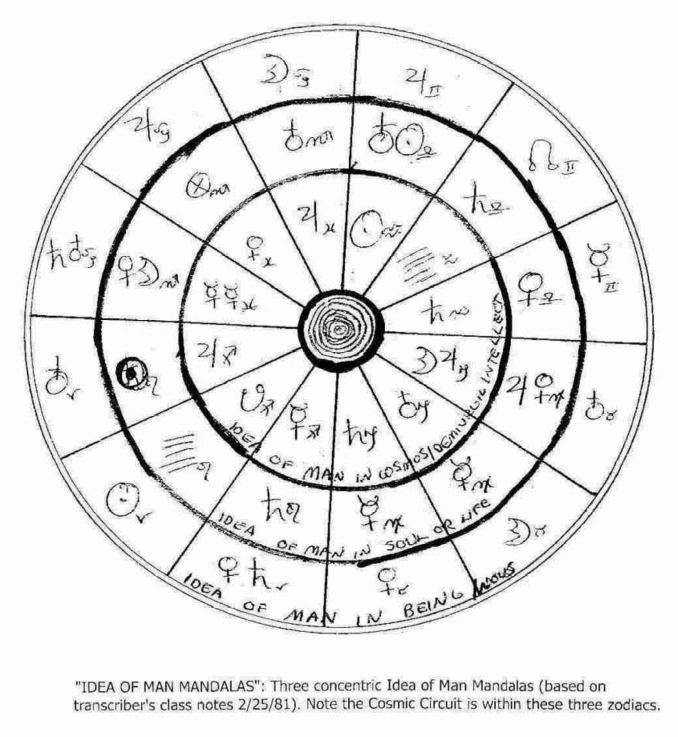
FIGURE 1981 0304-1-JF. Idea of Man Mandalas.
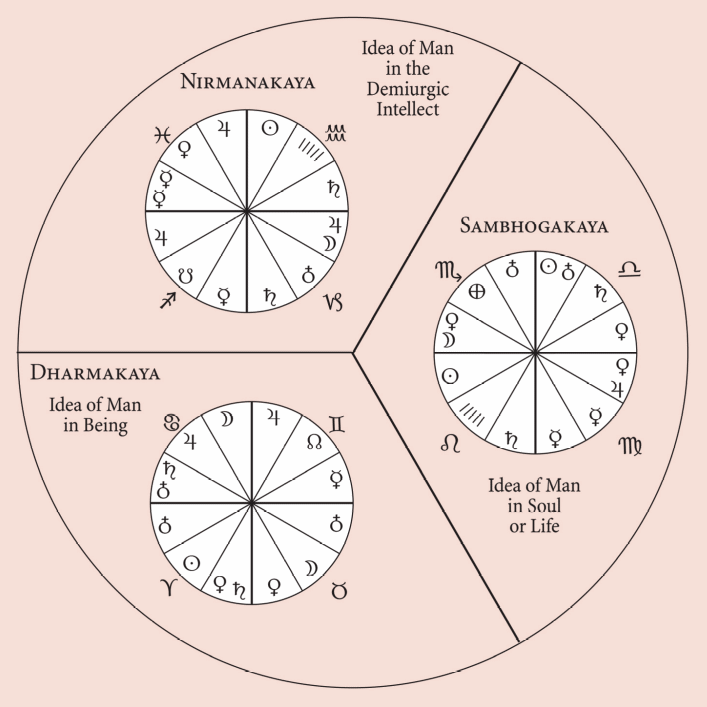
FIGURE 1981 0304-2. Twelvefold Mandalas for Each Level of the Idea of Man.
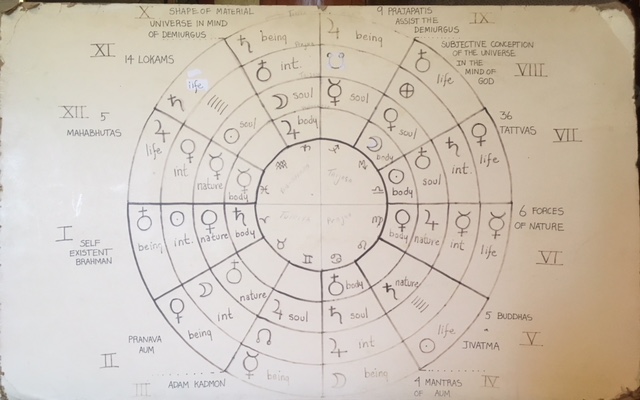
FIGURE IMG 2202-Posterboard Metaphysical Chart.
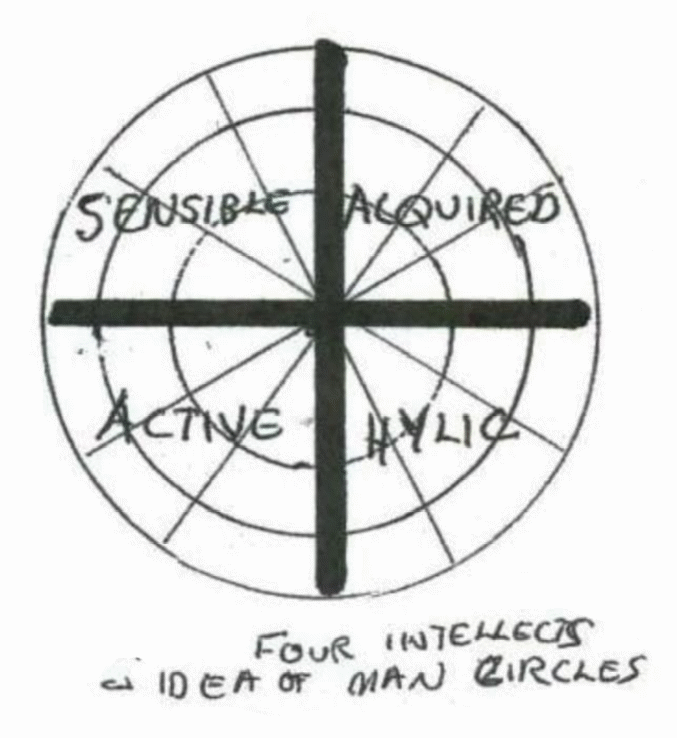
FIGURE 1981 0304-4-JF. Four Intellects and Idea of Man Circles.
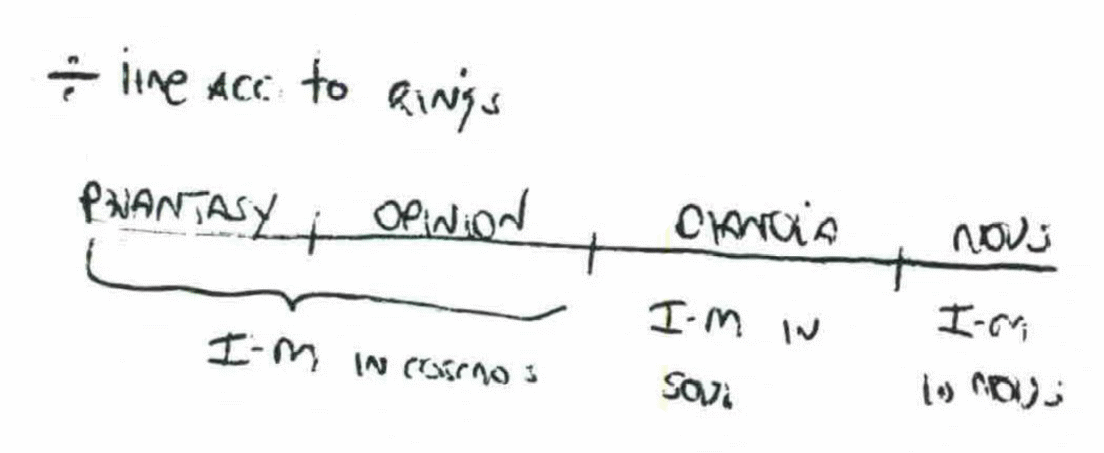
FIGURE 1981 0304-5-AB. Divided Line According to Idea of Man Rings.
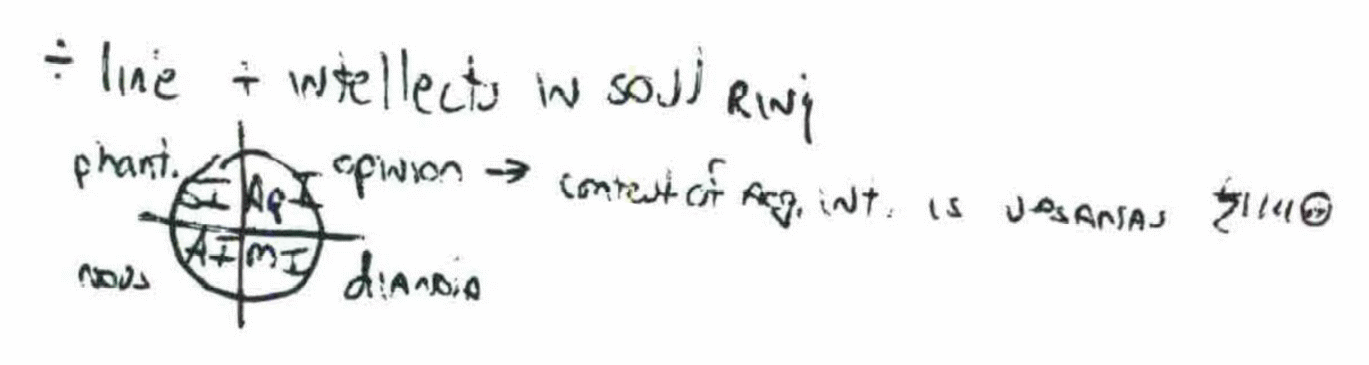
FIGURE 1981 0304-6-AB. Divided Line and Intellects in Soul Ring.
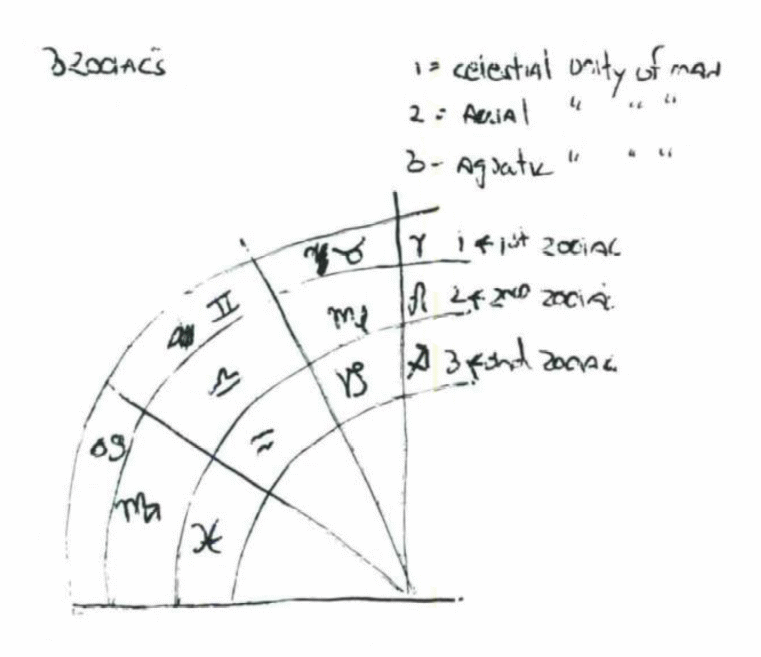
FIGURE 1981 0304-7-AB. Three Zodiacs in Houses 9-12.
Other diagrams referred to are not with this transcript version.
NOTES:
This early 1981 class series on the Idea of Man was held on Wednesdays.
In these classes Anthony Damiani speaks about, among other things, the relation of Soul to Nous and Being, and to the Cosmos; perception; and "teaching the Soul." A large portion of these classes is devoted to Anthony Damiani's laying-out of the components of the three Idea of Man mandalas; herein we can see some of his metaphysical chart methodology. In these classes, one should remember that Anthony Damiani is working out his speculations in the metaphysical chart; therefore his symbolization of astrological and metaphysical chart concepts may not exactly match that in Anthony's later thinking or in Astronoesis.
For further reading on the Idea of Man in general, refer to Astronoesis pp. 147-165, the Editors' Extension on the Fifth Idea. Astronoesis pp. 114-117 is about "Each Idea is a Unique Form of the Whole." Astronoesis pp. 132-133 includes two Twelvefold Idea figures, to which the reader may also want to refer.
Previously printed, distributed 2003 as part of a set on the Idea of Man.
TRANSCRIBED by jf 2003 from Audio Cassette tapes; reformatted by jf 2018. In 2024, IT updates prefatory matter and footer, replaces tape markers with audio file markers, alters Topic to make more accurate, completes Book List, adds Plotinus quotes section, corrects typos and some listening errors, adds new notes and alters some existing notes within transcript, removes three diagrams and adds fives diagrams and references within transcript to these diagrams, reformats to accord with new conventions. Readable edited transcript – V11r.
AUDIO FILES: 1981 0304a, 1981 0304b. [Note: "Tape" and "Side" refer to original audio cassette tapes that were later digitized into .MP3 Audio Files.]
1981 03/04 at Wisdom's Goldenrod
Metaphysical Chart; Idea of Man
[Note: Audio File 1981 0304a Side 1 to 1/3 through Side 2. Mostly Avery talking with some student discussion and reading Plotinus quotes (no Anthony). The first six diagrams (appended) correlate with the following topics touched upon: the series of Kepler classes (WG Classes 1981 0221, 0228, 0307, 0314, 0321), diagram on 3 levels of Idea of Man, all-pervasiveness of Soul, Soul a point outside of space and time (allusion to Guenon quote in Symbolism of the Cross), 2 modes of knowledge for the Soul, 3 zodiacs, Four Intellects, passions of the Soul, 3 (4) ways for Soul to know Nous (in metaphysical chart), Divided Line, Soul as Double Knower, Soul and perception/the sensible, the Animate. Plotinus quotes read in this portion of the class are below.]
Plotinus V.3.3: We are not the Intellectual-Principle; we represent it in virtue of that highest reasoning faculty which draws upon it.
... we perceive by means of the perceptive faculty and are not, ourselves, the percipients: may we then say the same of the understanding (the principle of reasoning and discursive thought)?
... our reasoning is our own; we ourselves think the thoughts that occupy the understanding--for this is actually the We--but the operation of the Intellectual-Principle enters from above us as that of the sensitive faculty from below; the We is the Soul at its highest, the mid-point between two powers, between the sensitive principle, inferior to us, and the intellectual principle superior. We think of the perceptive act as integral to ourselves because our sense-perception is uninterrupted; we hesitate as to the Intellectual-Principle both because we are not always occupied with it and because it exists apart, not a principle inclining to us but one to which we incline when we choose to look upwards.
The sensitive principle is our scout; the Intellectual-Principle our King.
Plotinus VI.7.3: But, at this, sense-perception--even in its particular modes--is involved in the Idea by eternal necessity, in virtue of the completeness of the Idea; Intellectual-Principle, as all-inclusive, contains in itself all by which we are brought, later, to recognize this perfection ... Man in the Intellectual was not purely intellect, sense-perception being an addition made upon his entry into birth: ... Sense-perception is, precisely, perception of the world of sense.
Plotinus VI.7.7: But this is to anticipate: our inquiry was, How there can be sense-perception in man without the implication that the Divine addresses itself to the realm of process. We maintained, and proved, that the Divine does not look to this realm but that things here are dependent upon those and represent them and that man here holding his powers from Thence is directed Thither, so that, while sense makes the environment of what is of sense in him, the Intellectual in him is linked to the Intellectual.
What we have called the perceptibles of that realm enter into cognizance in a way of their own, since they are not material, while the sensible sense here is fainter than the perception belonging to that higher world, but gains a specious clarity because its objects are bodies; the man of this sphere has sense-perception because apprehending in a less true degree and taking only enfeebled images of things There: perceptions here are Intellections of the dimmer order, and the Intellections There are vivid perceptions.
Plotinus I.1.7: [F]rom the organized body and something else, let us say a light, which the Soul gives forth from itself, it forms a distinct Principle, the Animate; and in this Principle are vested Sense-Perception and all the other experiences found to belong to the Animate.
But the `We'? How have We Sense-Perception?
By the fact that We are not separate from the Animate so constituted, even though certainly other and nobler elements go to make up the entire many-sided nature of Man.
The faculty of perception in the Soul cannot act by the immediate grasping of sensible objects, but only by the discerning of impressions printed upon the Animate by sensation: these impressions are already Intelligibles, while the outer sensation is a mere phantom of the other (of that in the Soul) which is nearer to Authentic-Existence as being an impassive reading of pure Ideal-Forms.
And by means of these Ideal-Forms, by which the Soul wields single lordship over the Animate, we have Discursive-Reasoning, Sense-Knowledge, and Intellection. From this moment we have peculiarly the We: before this there was only the `Ours'; but at this stage stands the We (the authentic Human-Principle) loftily presiding over the Animate.
There is no reason why the entire compound entity should not be described as the Animate or Living-Being--mingled in a lower phase, but above that point the beginning of the veritable man, distinct from all that is kin to the lion, all that is of the order of the multiple brute. And since The Man, so understood, is essentially the associate of the reasoning Soul, in our reasoning it is this `We' that reasons, in that the use and act of reason is a characteristic Act of the Soul.
Plotinus I.1.8: And towards the Intellectual-Principle what is our relation? By this I mean, not that faculty in the Soul which is one of the emanations from the Intellectual-Principle, but The Intellectual-Principle itself (Divine-Mind).
This also we possess as the summit of our being. And we have It either as common to all or as our own immediate possession: or again we may possess It in both degrees, that is in common, since It is indivisible--one, everywhere and always Its entire self--and severally in that each personality possesses It entire in the First-Soul (i.e., in the Intellectual as distinguished from the lower phase of the Soul).
Hence we possess the Ideal-Forms also after two modes: in the Soul, as it were unrolled and separate; in the Intellectual-Principle, concentrated, unified.
And how do we possess the Divinity?
In that the Divinity is poised upon the Intellectual-Principle and Authentic-Existence; and We come third in order after these two, for the We is constituted by a union of the supreme, the `undivided essence of Soul'--we read--and that which is `divided among bodies'. For, note, we inevitably think of the Soul as being present to bodies in division: in so far as any bodies are Animates, the Soul has given itself to each of the separate material masses, regardless of magnitude; even in the whole universe it remains one and undivided: say rather that it appears to be present in the bodies by the fact that it shines into them: it makes them living beings not by merging into body but by giving forth, without any change in itself, images or likenesses of itself like one face caught by many mirrors.
[Audio File 1981 0304a, Side 2 Begins, 1:07:29.2]
AS: Anthony, should we go over that passage [last two paragraphs of I.1.8, above], I'm not sure I understand it.
AD: Go over it.
AS: See-- The way I'm interpreting that now-- (begins drawing on blackboard, mumbling to himself)
AD: It might be easier if you draw the last four quadrants.
[Note: See FIGURE 1981 0304-1-JF for the following.]
AS: The last four? Yes. Well, what I was basically thinking of, the distinction we made between the first four parts of the Soul-- Saturn Jupiter Mars Venus [detriment planets in Idea of Man in Soul, Leo through Scorpio], and then the next level would be the Mercury Moon and the Sun [detriment planets Sagittarius, Capricorn, Aquarius]. And that each of the-- if we do just this-- if this is the Soul ring, with the Leo, Virgo, Libra, and Scorpio; and inside of that is Sagittarius, Capricorn, Aquarius, and Pisces. Okay. Well, if you notice one peculiar thing, in this Soul ring, in this Idea of Man in Soul, the last or the 3rd dignity in each of the sectors is *Soul* per se. The Cognitive Isness (in) the Soul: the Saturn, Jupiter, Mars, Venus. Okay. Within the next realm in, the 3rd third, we also have the 3rd dignity in each of those is Soul: Mercury, Moon, Sun, yup the Sun in Aquarius, and then the Nature Mercury in Pisces.
LC: This is talking about body, (inaudible)?
AS: Yes. Bodies though, vehicles-- So--
Plotinus I.1.8 (AS reading): ". . . the Divinity is poised upon the Intellectual- Principle . . . and We come third in order . . ."
AS: Okay well. So this is the Nous. The Nous and then the One. And the Divinity is even outside of that [Nous].
Plotinus I.1.8 (AS reading): "[A]nd We come third in order after these two, for the We is constituted by a union of the supreme, the `undivided essence of Soul'--we read--and that which is `divided among bodies'. For, note, we inevitably think of the Soul as being present to bodies in division: in so far as any bodies are Animates, the Soul has given itself to each of the separate material masses. . . [or] say rather that it appears to be present in the bodies by the fact that it shines into them: it makes them living beings not by merging into body but by giving forth, without any change in itself, images or likenesses . . ."
S: Would you do the next four (inaudible)-- the one in the 3rd third.
AS: That's what I got to, this is the 3rd third here. The Jupiter and the Tail. Now it almost seemed that in each of these the relation here between each of these Soul faculties and the one that's bound up in the Cosmic Circuit could almost be the way that these Soul powers shine into the Animate. That's what I was trying to say. In other words, these, the Saturn Jupiter Mars Venus, are the Pure Soul Powers. Whereas the ones that are bound upon with the cosmic circuit (something weird, 'chipmunks' on tape here: --the Jupiter ring--) are the way that these shine into there. Okay like here you have Mercury [in Sagittarius], well this Mercury would be like the representative or Logos of the Saturn in Leo, the real unity here. The Moon [in Capricorn] here, going right around, this would be the Moon in Capricorn, and this would be [correlated with] the Jupiter in Virgo; it's like all of these Soul Powers of Jupiter in Virgo would have as their vehicle the Moon in Capricorn, the substance of an objective Soul. Whereas here the Mars in Libra would have to work through its image, through the Sun in Aquarius. And the Venus [in Scorpio], the knower, the subjective knower would work through this [Nature] Mercury in Pisces. Maybe he's only talking about the very last ones there. Should I go over that again, (S inaudible) or do it some other way?
S: Well, let's go over that again-- 'without any change in itself, images or likenesses'--
AS: I don't know. Does that make any sense? No? Okay. Well maybe we should--
AD: Well try to understand it without the diagram first.
AS: Okay, well-- Well--
Plotinus I.1.8 (AS reading): "[H]ow do we possess the Divinity? . . . the Divinity is poised upon the Intellectual-Principle ... and We come third in order after these two."
AS: Now by the 'We' he means not the One, not the Nous, not the Idea of Man in Nous, but the Soul, okay. The 'We' as the Soul. He says that it is:
Plotinus I.1.7 (AS reading): ". . . this `We' that reasons, in that the use and act of reason is a characteristic Act of the Soul."
AS: So at least he seems to be starting with the Saturn in Leo.
Plotinus I.1.8 cont.: "[T]he We is constituted by a union of the supreme, the 'undivided essence' of Soul . . ."
AS: And normally we would say that would be like the Saturn in Leo, the Cognitive Isness, or the 'undivided essence of Soul'. That which is `divided among bodies' would have to be the lower powers of the Soul. Those lower powers which are becoming divisible or actually present for our immersed, or can become immersed in the bodily activity or the cosmic activity. He says [I.1.8]: "the We is constituted by a union of the supreme, the 'undivided essence of Soul'", the permanent Unity or Saturn in Leo, "and that which is 'divided among bodies'". (LC inaudible) Or, maybe he's -- the way we interpreted this in the Timaeus was quite a bit different, so-- But he says "constituted by a union of the supreme [with] the 'undivided essence of Soul'". (inaudible) This is a problem because we interpreted this last time as being-- (knocks on blackboard) the passage in the Timaeus we interpreted was as being the fabrication of the objective Soul from the undivided essence and the divisible. I can't see that here.
TS: It seems that the undivided here means the Soul, the Idea of Man in Soul, (AS: Yes.) and the divided as it were the Cosmic Circuit. (LR inaudible)
AS: Are you agreeing or disagreeing?
TS: I think I'm agreeing.
AS: Okay.
AB: Well, you were singling out--
AS: I was singling out these particular ones. (AB inaudible) It's not the way we did it last time and I'm trying to see if there's some-- the Idea of Man in Soul, and superimposed on that is the whole cosmic circuit.
TS: And those two together are what is 'We'.
AS: And those two together is what is 'We'. But--
Plotinus I.1.8 cont. (AS reading): "For, note, we inevitably think of the Soul as being present to bodies in division: [AS: We think of it that way--] in so far as any bodies are Animates, the Soul has given itself to each of the separate material masses . . .; even in the whole universe it remains one and undivided: say rather that it appears to be present in the bodies by the fact that it shines into them: it makes them living beings not by merging into body but by giving forth, without any change in itself, images, or likenesses . . ."
AS: That seems to be the way that we interpreted it over here, that the Cosmic Circuit is going on, these modifications happen, and the Soul appears to be present in those modifications [cf. Samkhya]. But the Soul itself remains always distinct from those modifications.
CdA: Well, that's just like the example you gave out in the beginning, of the point, of the dot of light coming through.
AS: Yes, the one that, the same example we used like on Saturday--
AD: But, Avery, what would those modifications mean? Unless the Soul gives forth from itself, the images that make those modifications (inaudible)--
AS: Exactly. Exactly. They wouldn't mean anything for the Soul. That's why he says that it shines into them, it gives forth from itself images or likenesses of itself, like one face, catching it [in many mirrors]. (inaudible) That seems to agree somewhat with what we're saying, that these Soul Passions, or these Powers of the Soul, in this second realm here, are what really illuminate what's going on in the body, in the Animate.
Plotinus I.1.8 cont. (AS reading): "[I]n so far as any bodies are Animates, the Soul has given itself . . ."
AS: But not really given itself, I mean it can't give, it [Soul] really can't be combined with the body. It's like saying that this Cosmic Circuit only becomes an Animate when it's superimposed on the Soul, upon the Idea of Man in the Soul. And then you would have an Animate by the fact that that Soul illumes what's going on in the Cosmic Circuit.
JC: In the first part of I.1.7 he speaks of the Soul as giving forth a 'light from itself' and I took that to be the image that the Soul is giving forth, it resides in the body, and then the Soul reads off what's going on in the body by means of that light, that light that's given forth from the Soul.
AS: Yes-- And the light given off, is that which is becoming divided? (JC assents) And the undivided essence of Soul is what remains-- (JC: Is that.) The Idea of Man in Soul. (JC: Yes.) Yes, right-- but--
JC: See, Soul is a middle essence between Nous which is completely undivided, and the essence which is 'divided in body' which would be like this light which is divided in body. The Soul is both divided and undivided, even though it can preside over body, it can know body, it's never divided in any of its knowledge, it always remains integral in its own essence.
AS: I wasn't quite going that way-- I think the Soul itself always remains always undivided here.
JC: Yes, I agree.
AS: But the WE-- he says, seems to include also the Animate. He says:
Plotinus I.1.9 (AS reading): "That Soul, then, in us, will in its nature stand apart from all that can cause any of the evils which man does or suffers; for all [this other stuff] . . . belongs only to the Animate, [or] the Couplement.
JC: So there he seems to be saying it's standing apart--
AS: Yes--
JC: At the same time it says that it gives forth an image from itself, and that's what's you could say, living and suffering in the body.
AS: (inaudible) I was trying to understand that well, we said this Soul remains apart always, the Idea of Man in Soul, okay, but that-- But I was particularly looking at these, because these seem to correspond to the Soul Powers as, in the Soul ring, the detriments here, in the outer one, okay, and they become, and they almost appear as images of those Soul functions. (Or something like that--) What's really-- I don't see how he answered that question, How do we possess the Divinity?
Several students: Right. (inaudible)
Plotinus I.1.8 (AS reading): "In that the Divinity is poised upon the Intellectual-Principle and . . . We come third in order."
TS: I have a different version, it says "Intellectual-Principle and Authentic Existence." [which is how I.1.8 actually reads, but 'Authentic Existence' left out above.]
AS: Yes. Well-- he just talks about how we possess the Intellectual-Principle, in these two ways, insofar as we contain it in an image, and then insofar as we contain it in a peculiar form, or insofar as it all pervades even Soul. Well, in the same way it seems that the Divinity would pervades the Nous, and therefore would pervade the Soul? So it's in that way we possess the Divinity? But then I don't see how what -- it doesn't seem to have to do this question here though,
TS: Going just with this first sentence here, I was wondering if you could say that when you speak about the Intellectual-Principle as the Authentic Existence, that that's speaking about the Idea of Man in Being, (AS: Right.) as the Intellectual-Principle as in the Idea of Man. Whereas the first one of those as 'poised upon the Intellectual-Principle' is, as it were, upon the 2nd quadrant itself.
AS: Oh, I see, distinguishing between Intellectual-Principle and Authentic Existence, okay. But-- now--
TS: Isn't Divinity the One?
AS: Yes, I'm reading Divinity here as the One. In this case here, he says it's "poised upon the Intellectual-Principle," in other words, the duality he always gives of Intellection and Being. Authentic Existence-- I think you're right -- I think it means Being. And Intellectual-Principle or the Nous and the Divinity or the One is poised above these, "We come third in order"-- It's this usual triplicity that he does: the One, the Intellectual-Principle, and the Soul, we come third in order. But then he says: "the We is constituted by a union of the supreme, the 'undivided essence of Soul'--
TS: Now is that Saturn in Leo, is that Jupiter in Gemini? (silence)
AS: The We-- I don't see how--
TS: No, no (inaudible),
AS: Yes, right, the 'undivided essence of Soul' -- if it's constituting the We-- I see what you're saying, (S inaudible) I'd say the Saturn in Leo--
TS: I just asked that question, because he says "the supreme . . . the . . . undivided . . . Soul," when he says that it's the supreme Soul, I'm wondering if it here would go as far as the Jupiter in Gemini and the Saturn in Cancer, as in that Idea in Man in Being. I'm still staying within this diagram. (inaudible) I was wondering if it was something like that, that you would be speaking about the different quadrants of the Idea of Man in Being. Divinity being the first quadrant of the Idea of Man in Being. Insofar as it's the same planets as the One.
AS: Yes.
TS: Okay. And then as the Intellectual-Principle is the 2nd quadrant there, it is the Material Intellect as it were, and Authentic Existence being the 3rd quadrant, and supreme the undivided Soul as the Saturn in Cancer.
AS: No, you just jumped, I thought you were going to do the Jupiter in Gemini. I thought you were going to do this one over here, this little thing and saying this is the Divine, and then this is the Intellectual-Principle, and this is the supreme Soul.
TS: No. No, I wanted to call that, when you just wrote 'supreme Soul' is 'Authentic Existence'.
AS: Oh, Authentic Existence--
TS: And then the last one where he speaks of the supreme undivided essence as the being the (AS: Supreme Soul--) Supreme Soul. And the (inaudible) as including the whole thing--
AS: Um-- I don't see how, not using the diagram, I don't see how the speak of the 'We' as constituted of a union of that with that which is divided among bodies.
TS: Yes.
DR: Avery, there's a totally different reading. Instead of just saying that which is divided among living bodies he says "the We is constituted by a union of the supreme, the 'undivided . . . Soul'--we read--and that [Soul] which is 'divided among bodies'." Is that--
AS: I'm reading it-- That second Soul is not here but I'm reading it that way, that Soul which is divided among bodies.
DR: It almost seems like his meaning there is that these two Souls which he's speaking of, aren't separated, let's say, in the way you're pointing in the diagram of the Soul and the Cosmic Circuit. Rather, it seems that his meaning is more that-- Well he says, How is it that we possess the Divinity? He seems to be implying that this 'We' is constituted by a union of something which is already linked or is already part of the supreme or is linked to the supreme closely, and in this second Soul which is divided among living bodies, his implication seems to be that it really isn't another thing, but rather this *insert* into the Cosmic Circuit, this insert into what we would call the Animate, which isn't really separate from the original Soul, but yet we speak of it as a Soul divided among bodies.
AS: It's become divisible. That part I would go along with.
DR: Whether it is in fact is the Soul--
AS: Yes. It only appears to be, it never is divided.
DR: And that's what you'd mean--
AS: The whole (Animate)--
DR: (inaudible) That insert of the Soul into the Cosmic Circuit--
AS: I understand that. That's what I was trying to say by saying that this illuminates what's going on here. (DR: Right.) I don't understand the higher one as being--
AD: Juno! [Note: He means Rhea, see a little later in transcript; cf. also figure on Astronoesis *draft* pp. 83-84.]
AS: --part of the--
AD: Juno.
AS: Juno but that would be--
AD: And also an Individual Soul, Unit Souls--
AS: Yes. But that would be Saturn in Leo.
AD: (inaudible) (both) Saturn in Leo.
AS: That's what I was trying to say--
AD: Juno's never divisible about bodies, Unit Souls are--
AS: (mumbles) I think that you're going to say somehow that the aspect that's becoming divisible about bodies, it doesn't mention this 3rd third at all, it just mentions the fact, maybe as David was saying-- What would be the 'becoming divisible' aspect? If this is the indivisible, if this is the Saturn in Leo--
AD: It would be in Soul, the Cognitive Isness which is divisible about bodies, but not the Cognitive Isness itself.
AS: Right. Well then that seems--
AD: But Juno per se is never divisible about body.
AS: Rhea.
AD: And he's referring the 'We' is the Unit Soul and Juno.
AS: Rhea? You mean Rhea?
AD: Rhea. (AS assents) That's the 'We' he's talking about.
AS: Yes, I would agree with that. You'd want to say that it's not at all concerned with the 3rd third.
AD: I'm not even looking at the diagram.
AS: But I mean in terms of the 'We', the becoming divisible is just referring purely to the Cognitive Isness.
AD: Well, the Cognitive Isness or the Unit Soul would be the unity of many parts, and some of its parts are what are divisible about body.
AS: Right.
AD: But I think you better try to understand that last sentence he got there. (AS: Which one?)
Plotinus I.1.8 (AD reading): "[I]t makes them living beings not by merging into body but by giving forth, without any change in itself, images or likenesses . . ."
AS: Well, I thought that was the way I would interpret, the way-- Suppose you said there's this Cosmic Circuit going on, this functioning going on, and then in order for the Soul to have experience of that it would have to give forth from itself, from itself subjectively, a meaning to what was going on. And if each of those, any of those meanings that it gave forth would be an *image* of what it itself contained. And that would be like what it projected on to that cosmic circuit or gizmo. And those would be the images given forth all the time. It isn't in itself change.
AD: (inaudible) believe you, though.
AS: I think that's what we're trying to say--
LdS: Avery, when you say images, do you mean reason-principles?
AS: I'm trying to say something like the indivisible part of the Soul, he says the Soul remains what it is, without any change in itself. What we mean by that, the Idea of Man in Soul, he doesn't say it's the whole thing. This whole Idea of Man in Soul, the 2nd third. Without any change in itself, it can interpret or give a meaning, project a meaning onto this cosmic gizmo which is really superimposed upon it. And that's this 2nd third, the Idea of Man in the Soul that remains unchanged. The cosmic gizmo, the cosmic circuit rather, is imposed upon it, all these bodily functions. The Soul, without any change in itself, can interpret or give meaning to every thing that occurs in the body without itself becoming bodily. The images that he's speaking of-- is a funny word of images, he means all the meanings that are being imposed on your experience without which you won't have any experience.
LdS: In other words, like there's this existential functioning of the cosmic (inaudible) circuit going on. (AS: Yes) And the Soul in order to make sense out of that and assimilate whatever's going on there--
AD: In order to make sense out of that, it makes SENSE out of that.
AS: It makes sense--
LdS: Or it gives it sense to make sense-- (AS: Yes.) By this projection principle, or reason-principles, or he says here, images--
AD: So if you took the example of the dream--
LdS: Yes. Without the dreamer's mind or without--
AD: If you weren't immanent in the dream, or if you didn't project the meanings that are inherent in you, all you would have there would be a flux of sensation.
LdS: That whole scenario would be--
AD: --yes, it would be meaningless. There'd be a flux of sensation: there'd be colors, sounds, smells, you know, alright, but there would be no meaning to it. So the Soul or you immanent in it is what projects meanings onto the dream, and now it means something to you. But the sensations per se, the scenario going on, in itself, the flux of sensations, is meaningless. (AS assents, then inaudible) Now maybe you have an idea of the underlying meaning of a psychological term like projection.
LdS: These images are like living dynamic live-giving images, they're not static two-dimensional.
AD: The other is purely existential facticity, in itself it could mean anything. But they don't believe you, Avery, they don't believe you--
AS: Well, I-- (LDS interrupts)
AD: Do another quote, (inaudible).
LdS: If you speak of a common experience the existential facticity of the world or the cosmos, those two different individuals are going to have their own individual interpretations of this.
AS: Yes. But we go on a little more, he says--
Plotinus I.1.9 (AS reading): "Thus we have marked off what belongs to the Couplement from what stands by itself: the one group has the character of body and never exists apart from [the] body . . ."
AS: Okay, that's the facticity of the body or the object, it never stands apart from body. Even if you say, even those who say, well but this body must be organized in some way, they say well there must be some intelligibility inherent in it. But still yes, I think he would say, yes we'll grant all that, but still even that ordering of body is never apart from body, okay. He says:
Plotinus I.1.9 cont. (AS reading): ". . . the one group has the character of body and never exists apart from body [or organized body], while all that has no need of body for its manifestation belongs peculiarly to Soul: and the Understanding, as passing judgement upon Sense-Impressions, is at the point of the vision of Ideal-Forms, seeing them as it were with an answering sensation (i.e., with consciousness); . . ."
AD: Would you read that again? that last line.
Plotinus I.1.9 reread: ". . . the Understanding, as passing judgement upon Sense-Impressions, is at the point of the vision of Ideal-Forms . . ."
AD: What does he mean by that it's at the point of the division of the Ideal-Forms?
AS: Yes--The vision.
LdS: Wouldn't that mean that the Soul has to, prior to these experiences of the sense impressions and so on, it has to have grasped something of the Ideal-Forms first?
AD: Well, is it prior or is it simultaneous? Are the Ideal-Forms that he speaks are at that point where they become objective and subjective?
AS: (assents)
LdS: I guess they're simultaneous.
AS: It's "at the point of the vision of Ideal-Forms". In other words what he said in other places, it's that Soul's vision which can make the link between the objective forms and the subjective conceptions. So it has access to the--
[Audio File 1981 0304a Ends]
[Audio File 1981 0304b Begins]
AS: --thought.
Plotinus I.1.9 cont. (AS reading): ". . . [it] see[s] them as it were with an answering sensation (i.e., with consciousness); this last is at any rate true of the Understanding in the Veritable Soul. For Understanding, the true, is the Act of the Intellections: in many of its manifestations it is the assimilation and reconciliation of the outer to the inner."
AS: That really sounds--
CdA: You think the Intellections are these four modes? What are the Intellections?
AS: What are the-- It is the Act of the Intellections.
CdA: Act of the Intellections.
AS: The understanding, he's saying, is the Act of the Intellections, that has the pure vision that the Soul has.
CdA: Okay, why is it in--
Plotinus I.1.9 cont. (AS reading): ". . . in many of its manifestations it is the assimilation and reconciliation of the outer to the inner."
AS: Now he saying like from the outer to the inner, when we said that the outer perceptible and the inner concept are linked or are unified through the Understanding which the Soul has. This Understanding itself is really the Act of the Intellections, is really the Act of a Vision, of an inward Vision, I don't think he means Intellections-- I think he means the Soul's Act is a Vision or an Intellection. I mean, yes.
AD: Is he saying there, Avery, that the reason-principles that are used to fabricate the Cosmic Circuit are also the reason-principles inside the Understanding of the Soul.
AS: Yes. He doesn't say that, but I think that's implied, he says: "it is the reconciliation of the outer to the inner," so these Ideal-Forms, in other words, would have to be what orders the outer as well as what orders the inner conceptions and so on. The Ideal-Forms being the ones in the 2nd Soul ring [Idea of Man in Soul], the Ideal-Forms that are in the Soul itself? Although um-- This previous, it may be referring at a higher level, I don't know. There's a previous line, he says:
Plotinus I.1.9 (AS reading): "The Intellectual-Principle either apprehends its object or does not: error is impossible."
AD: (assents)
AS: So that would be the Nous.
Plotinus I.1.9 cont. (AS reading): "The same, we must admit, applies to ourselves [the Soul]: either we do or we do not put ourselves in touch with what is object to the Intellectual-Principle, or, more strictly, with the Intellectual-Realm within ourselves: for it is possible at once to possess and not to use."
AS: I think he means the way the Idea of Man is present in the Soul, so either we use that or we do not. If we do use that though then we would have the Understanding that he calls the 'True,' the true understanding, the Act of the Intellections. It is the Act that is based on the Ideas that are in the Soul itself. And by means of these, okay, by means of this true Understanding there is possible the assimilation and reconciliation of the outer to the inner. If you don't take that point of view of Soul, if you're tied up with that cosmic manifestation, you're within that duality of the subject and the object. And so, it's like your being in the dream it seems, where you are the apparent dreamer with the object, you can't reconcile the dream object with yourself because you can't see both of them as manifestations of a single dreamer, a single Idea.
AD: Suppose you take the Idea of Soul in Man, alright? The Leo, the Virgo, the Libra (inaudible). (AS: Okay.) Let's take those four ideas and see if you can work them out because I think you might be able to get some insight as to what he means [by] the reasons in the Soul.
AB: Avery, what you're referring to seems to be what Plato calls Reminiscence.
AS: Yes, in other places where he brings in Reminiscence. He seems to be saying that everything that goes on in the Cosmic Circuit--
AD: Erase the whole board! (inaudible)
AS: -- we can interpret in terms of those four ideas -- the Leo, Virgo, Libra, and Scorpio. In other words, those four Ideas represent the Idea of Man as it's available to the Soul, to the Understanding.
AD: Take Leo, you don't have to make circles, just take Leo, alright. Now in Leo we got three [dignities]--we got the Sun, (drawing-on-blackboard sounds) continue, just go around. (more drawing) About that I'm sure, so let's leave that a question mark, the Mercuries might be together in the 4th, so let's leave it like that. (AS inaudible) The Jupiter and Venus.
AS: And then the Venus seven, and then Scorpio. (drawing sounds)
AD: Alright, if the Soul is projecting meaning onto the Cosmic Circuit, (so if) anything's going on in the Cosmic Circuit where he speaks about existential facticity, whatever meanings that are projected there would have to be coming from here, right?
AS: This would be like the house system.
AD: So, if we say that this is the house system, then, just bandying it about, what would the meaning of the Sun [in Leo] be? The meaning of the so-called Empty spaces? The Saturn, the-- Because that's what's getting projected onto the Cosmic Circuit. So if we don't understand that, we'll be saying that the Soul projects meanings onto the Cosmic Circuit.
AS: And we don't know what they are.
AD: And we don't know what is being projected, alright. So why don't you play with that for a little bit. I mean the Sun, you can see is part of the Rulership, the Sun in Leo, and if that represented the 7 Dhyan Buddhis, or 5 or whatever you want to refer to--
AS: That's his identity.
AD: Identity? Are you saying--
AS: The Unity of the Idea of Man in Soul is those 7 Dhyan Buddhas. He [T. Subba Row, "The Twelve Signs of the Zodiac"] says the 7 or the 5 which in their totality constitute-- (AD: The Jivatma.) --the Jivatma, so those constitute (inaudible).
AD: So what you're saying there, they're defining the nature of Man there, the Idea of Man, the *living* Idea of Man.
AS: Which they do.
AD: What are the five? You remember the way the Buddhists speak about that? Equality, Wisdom--
AS: The Five Wisdoms.
AD: The Five Wisdoms, remember how he speaks about it? [Note: See Govinda, Foundations of Tibetan Mysticism, and Astronoesis, pp. 148-156.]
AS: The Wisdom of Equality, that goes with feeling. (AD assents) And then there's the All-Accomplishing Wisdom, (AD: That would be karma.) karma. And then there's the Mirror-like Wisdom, I think that goes with dharma, Aksobhya. Then there's the Dharmadhatu Wisdom. And then there's the Discriminative Wisdom, which is the Knower.
AD: And they're all listed under the Sun, they speak of the Sun as Vairocana, or-- (AS inaudible) So in that first house is the Ocean of Possibilities which in their totality would signify Man, the Idea of Man. But from that total possibly that constitutes the Idea of Man, it's not going to be all of them that get inserted (AS interrupts) into the Unit Soul, but a selection is made from that.
AS: That makes sense and this is something like what they speak about as Buddhahood, this would be like the Sun, the peculiar family or combination of those Dhyan Buddhas would have to be traced back to here, the Essences, what corresponds to the Essences. But a peculiar combination of those would be wedded to a Cognitive Isness would give you a unit Soul.
AD: So we have a little bit of an idea of a Unit Soul, the Wisdom that's inherent in a Unit Soul, alright. (CDA interrupts) It's just a species of poetry, don't take it as philosophy.
CdA: You were talking about the meanings being projected, so--
AD: Let's wait until we go around-- You won't understand the first part, none of us will. (CdA: Okay.) So the next one would be Mercury, I mean, the sign of Virgo. Well, there we have the Six Forces of Nature, and we spoke in this abbreviated form, we should try to keep in mind that those Six Forces, what we have of them in our body, is not the way they are in the Soul. So for instance the kundalini that is in the body is not the way that it is in the Soul, the Mantrashakti that is in the body is not that way in the Soul. So all these various powers: Parashakti, Mantrashakti, Kriyashakti, all these 6 powers are in the Soul, but they're certainly only represented in the body.
TS: I was wondering if that would be related back to the Fourfold Idea of Being there. That it would be that Mercury as the organization of the Powers of Nature which would be the potential or complete Divided Line, all the faculties, all the gnostic faculties of the Soul and their ability to either refer themselves back to the Intelligibles or to associate themselves with the sense impressions would be involved in those Six Forces there. (AD: I didn't follow.) I don't know about following--
AS: I think you're trying to relate the Six Forces or Powers in the Soul to the notion of Fourfold Being.
TS: Yes.
AD: You could say that they're going to be applicable to four levels.
TS: I was thinking, that if we spoke of them, as these Forces of Nature as applicable to the Four levels, that might be what we call the gnostic faculties of the Soul, the Divided Line. In other words, there's the Nous level would be prior to that in some way, just like we say there are three actual and one potential.
AD: But what you would be saying would be that at the various levels or stadia of existence, the passions of the Soul can be operative. The Soul operates for instance in the subtle realm, the Divided Line is operative there. If it's inhabiting, let's say, the realm of the Nous, the Divided Line is operative there, the passions of the Soul are operative there. Well, why not. If you looked at it that way, then of course the sense faculties would always be potentially contained in the Idea of Soul in Man. Try the next one, the 5th, the 5th house [of the Idea of Man in Soul ring].
AS: The way that the 5th house Idea (inaudible). It seems that we spoke that as something, as the Intellection that the Soul would have, (AD: would have) which the actual-- That would all be within the notion of the Six Forces.
AD: If you say (inaudible, someone sneezes), you would mean for instance-- let's say at a lower level we'd call it some kind of thinking, alright, but at that level, he calls it Intellection. (inaudible) Intellect there, (inaudible) on there. (AS interrupting here and in some of the following, hard to hear)
AS: He calls it perception.
AD: Perception of what though? Wouldn't it be perception of--
AS: Of the Ideas, of the Essences--
AD: Yes. So then it would be the perception of the indivisibility of the Idea of Man which each Unit Soul contains.
AS: The perception of its own Idea of Man. It would be a perception of the Idea of Man which is conjoined with that unit Soul.
AD: So by Intellection that's what we would mean. And when they say that the Soul intelligibles, or when the Understanding reaches into the Intellectual Soul and spreads it out in the imagination, [Note: See Plotinus, IV.3.30, Guthrie trans.] then what he would be saying is that this Intellection here, alright, has to grasp the indivisible totality of that Vision and spread it out in the imagination through the reasoning.
AS: The divisibility of it seems would be in the next house, the 6th, that would seem to have to go with that Jupiter, the Jupiter and the Venus seem to represent the discrimination or the breaking up of those, I mean, that's the 6th house proper, the 6th house of that 6th, and would have to discriminate that Intellection; where he said that reasoning is going to spread it out, it would have to be distributed according to those Six Powers of the Soul, not according to just-- If this is a Vision or perception of that Idea of Man, if it's going to be broken up and distributed, it would have to be the various Forces as actualized, or it would have to be the various, the Six Forces that are going to going to spread that perception out.
AD: Differentiated. (AS: Differentiated) Spread it out.
AS: But not Kundalini, Mantra, and so on, in terms of manifestation, in terms of working within the Soul completely. (inaudible, 6th)
AD: If you get into the diagram now, I think we're still short of trying to, you know-- what sort of company the Soul keeps as far as the Ideas, we still haven't found any. Let's try the next one. (AS: I'm sorry--) Let's try the next one.
AS: We still don't know what we're talking about.
AD: No! We haven't gotten something specific, like when we say that the Soul projects the meaning in to some event that's going on in to the Cosmic Circuit, alright, it seems that the most we could say is that-- that last sentence we read-- the last quotation we read (AS: Assimilates the inner to the outer?) No. (S inaudible) When he speaks about the images. (AS inaudible, students inaudible) Not by merging into body, the Soul doesn't merge into body: "it makes them living beings not by merging into body but by giving forth, without any change in itself, images . . . of itself."
So that's what we're working toward, we're trying to work towards an understanding of where these images-- in other words, if I have a dream tonight, and I appear in a dream, and I'm solving a very important, let's say a quadratic equation or something, and I think it would be very foolish if I gave the dream Tony credit for the solution of the problem in the dream, I have to give it to *me.* I get up and I tap myself on the back, "you're very smart," I could ignore the dream Tony. What I'm trying to say here is that is that something similar is going on. The Soul projects its meaning alright onto the situations, events, relationships, alright, and it is that *meaning* that we're dealing with. I know-- you look at me with such (askance), you don't believe me, do you?
AS: That their theory of knowledge it has to work like that--
AD: What about *their* theory of knowledge? (student snickers)
AS: It's disbelief. (more snickers)
AB: When we look at you, we're just projecting the meaning onto you.
AD: I don't want you too-- Look--
AS aside: Psychologists--
AD: Dr. Berkowitz--
AS: Doctor-- (more laughter, inaudible)
AD: Jung. He speaks about projection all the time, what is it, (from a vacuum)?
AB: He's saying something similar, that from within ourselves we're giving meaning to our experience by associating that which is within us to something that's outside of us.
AD: Yes. So this is really like the-- you know, the everyday food that you're eating, because you could live without water for awhile, without bread for awhile, and even without air for awhile, but you can't live without perception for a moment!
AB: Life would be meaningless.
AD: Yes. Utterly meaningless. But that's what we're trying to understand, where these meanings are coming from, that we're constantly projecting everywhere. Because you're not going to be able to follow his advice when he says that we have to teach our Soul, [Note: See Plotinus, V.3.6, seventh para.] if you don't understand what this is all about. So our Soul could perhaps even misinterpret things. Otherwise why bother teaching our Soul anything.
AB: The Soul is doing it anyway, but by teaching the Soul, the understanding one is really--
AD: No. To teach the Soul, then you have to know more than the Soul, or at least enough to tell it, Look you're on the wrong track. But that would mean you would have to study a little philosophy so that you could understand what the World-Mind's vision of itself is, and conform to that vision of itself and not according to the Soul's desires. So we do have to understand this.
AB: By "teaching the Soul" would that be analogous to understanding how the Idea of Man is informing the Soul or--?
AD: No. In order to be able to teach Soul, you'd have to understand how the world, the sensible world, is conforming to the Intellectual Idea of the World, and that the Soul has a role to play in that and must conform to that. Hopefully. So everyone has to get around to building his own little erector set.
Alright, so then if we go back to this here. So the 7th house meaning, let's say we still don't have-- The 7th house would be Libra, so you would have the 36 tattvas spread out in there, alright. (S: 24.) Now if you don't study Samkhya, if you have no idea of what the Tattvas are or any of that, there's no sense discussing that, and we can go on the next one, right? You remember we studied the Samkhya theory: Prakriti, Buddhi, Ahamkara, etc. all the way down, don't forget the last ones, the 5 sense organs, the 5 sense faculties.
AS: This is an interesting one, it's almost like this one here, I know it's not good to bring in the next level, but-- If we said that there's an organization of the vasanas, the Saturn of Aquarius, it's almost like saying this Venus [in Libra] would understand the epistemological categories through their priors. And if this had the 36, the 24 tattvas themselves, (AD assents) this would actually be the principles that are going this way, they would be principles behind what organizes the vasanas here. (AD: Yes.) But here it would not be the organization this way but the organization of the Soul's subjective knowledge.
AD: Okay, but from that realm, for instance, if you remember what we were talking about Saturday, when we said that the essence of the Soul understands the archetypes, and the sensible representation of the archetypes, you're coming from there. (AS inaudible) You're coming from there, exactly! But that's the whole point isn't it? You remember the remark was made that we have the archetypes, that is, the presuppositions of our personality structure, and then we have the sensible representation which is their functioning, alright. Now what is it in us that can compare or bridge, you know, build a concept which bridges the sensible and the archetypes? And he says, Why, that's the very essence of the activity of the Soul, that's where they're coming from.
AS: The pre-archetypal archetypes.
AD: Yes!
AS: The principles of those--
AD: Because, like for instance, when you take the Jupiter, Mars, Venus, Tail, and Saturn [rulership & exaltation planets, of houses 9, 8, 7, the 3rd or Soul Quadrant; see FIGURE IMG 2202-Posterboard Metaphysical Chart] and you say that's organizing the matter, well then that means that this here, this here is the prior of all our epistemology, this does understand why epistemology must work the way it does. (AS assents) So from the 7th, 8th, and 9th house we would have the distribution, so to speak, of the 24 tattvas, the principles, in other words, the 5 sense organs, the 5 motor activities, the 5 tanmatras, 5 bhutas, Manas, Ahamkara, and Buddhi. Go ahead--
AS: Another thing that comes up right over here, which is interesting, that-- See there's some other things happen here, one of which is the one that you seem to be bringing out now, and that is this dividing, there's a division here, there is a natural division of this into two. Between--
AD: Yes. Because house 5 and 6 is both in the Nous and in Life, yes. And 7 and 8 is in Life.
AS: Well, in a sense, the description you just gave, well you're saying that this is part of the Idea of Man in Soul but really it's also participation in the Universal Soul, the third quadrant, so it's in some sense, starting with these 36 tattvas, the 7th house is some kind of objectivity, in a way that these 6 [the first 6 houses] aren't. Because this is dealing with these objective principles, the Tattvas. From here on they're really tied up with the Universal Soul.
TS: It's interesting-- You're said there that the Venus is taking in the Idea of Libra which is ruled by Venus, it's one of the four places where there's an identity of something.
AD: Yes. In the Soul, in the Idea.
AS: The Venus is (inaudible).
AD: And the transmission of that has to be uninterrupted and continuous.
TS: In other words the Idea of Soul, or the Idea of Man in Soul is the Life of the 36 Tattvas in the metaphysical chart.
AD: That's right. Because these tattvas in themselves, if you try to conceive of them as purely abstract tattvas, pure principles, it's only in Life that they mean something. So if we speak about Ahamkara, Buddhi, as psychic, if we speak about the 5 motor organs, the 5 sense and karma indriyas, buddha-indriyas, alright, they don't mean anything unless they're inserted in Life, whatever that Life might be, (what) its most attenuated form might be like, but they'd have to be inserted in there. What would the Saturn then represent?
AS: Here it's in the 8th the Subjective Conception-- We had some--
AD: No. The Subjective Conception would be all the way down, it would be the last quadrant.
AS: Okay-- But-- if you have that spread out in knowledge--
AD: The distribution of meaning in these tattvas.
AS: Right. But that would have to be spread out in knowledge. (AD: Yes.) In the Soul's knowledge. And that would seem to be that Saturn in Libra. Because that Saturn in Libra knows that Venus in Libra, or would represent the knowledge of that Venus in Libra.
AD: And then draws it out, so to speak, in the sense of some sort of matter, which is going to be the psychical matter. In other words, if you org-- We're speaking there about the way that the matter of the Soul, the Sun [in Libra].
AS: In other words, this would be the psychical reason-principles, that would have to be embedded. The psychical essences would have to be both separated from one another, and also embedded, (AD: embodied) have a-- (AS/AD talking at once, can't hear)
AD: So we have the precursors, we have the precursors of what we might call the dissipated essences, in the 11th house, that's going to organize those dissipated essences. So in other words, if the Soul is going to have certain kinds of tropisms in a body, to work in a certain way, that's organizing them.
AS: And also in a sense, it seems the Saturn is organizing them.
AD: Yes.
AS: As well, because you would have those Five Empties [in Aquarius, exaltation] below the Saturn.
AD: Alright, so that would give us another section of the Soul. And what we're saying is all these meanings are going to be inserted in the everyday world that you live in. Do you remember Wang-Yang-Ming the way he used to say, that the transcendental is learned in the empirical. I know that you don't believe that either. You remember that, any of you?
AS: The higher learning and the lower learning. (is talking throughout next sentence by AD)
AD: The higher learning takes place in the empirical world, you don't go to Shambhala to learn until you first graduate here. Alright then the next one is the Subjective Conception of the Universe in the Mind of God. So if we say that God has an Idea of what the universe is, just the Idea now, the Idea of the Universe, and we say that Mars [in Scorpio] represents that, or is that Idea is assimilated in Life. Again, we're speaking about these things in Life, otherwise they don't mean anything. And the-- let's say that there are different grades within that one Idea of the Universe in the Mind of God, the various grades of knowledge in that one Idea has to be accompanied by a Life quality, (AS: That would be the Part of Fortune.) which is the Pars Fortuna. Alright. And Jung has a psychological representation of that. You remember when he speaks about a man loves, let's say, a woman that's like a mother, (AS: Eve,) like a biological Eve. And then he, let's say there's a change and he loves Helen and has romantic notion. Now, and then he loves Sophia alright, I mean the Virgin Mary, I forgot the order. But you can see there what's he's saying is that there's a very distinct qualitative difference that accompanies the knowledge-- in other words, you must be capable of certain feelings, in order to understand certain knowledge. You can't have, so to speak, a certain type of feltness to understanding -- let's say a gross kind of feltness to understand ethereal subjects, wisdom, things like that. So the Pars Fortuna represents the variety of the qualitatively felt differences that life brings around.
AB: Could you correlate that with the different forms of life that Plotinus speaks of but as in the Soul?
AD: Yes, you can. There's an Intellectual Life, there's a vegetative Life, the Life that accompanies each kind would have to be different, qualitatively different. So if you go into one of those swamps where you see all kinds of creatures devouring one another, well their feeling about life is different than the kind of feeling of life that you have. Right?
The next one: Moon-Venus, Venus-Moon. (students giggling) I think that'll give you an idea why that Pars Fortuna is exalted in Scorpio. And why it is also placed in the ring of Exaltation. See we don't think like that, we say well, intellectual knowledge can be divorced from one's feelings. Baloney!
AS: Not if you have the Part of Fortune in Scorpio [as AD's natal chart does].
AD: No, the feeling's already predetermined what you can appreciate and what you can't appreciate. Alright, let's try the next one, Venus and Moon. You see Venus would stand for -- oh, in Scorpio it's usually a congealing and restriction, a lack of fluidity in one's feelings, there's almost like a frozen core of feeling inside one-- unless Uranus happens to go over it. (student snickers) And then what would the Moon be, what would the Moon in Scorpio be? That again would have to be the material substratum, alright, but the material substratum there would be equivalent to what? Ahamkara? Let's say if we took ring, you have Buddhi, Buddhi, Ahamkara, Manas, Ahamkara, they both would be Ahamkara, yes they both would be ahamkara. So they Moon would be the Ahamkara. So there we would have to think of the substantial -- But substance here wouldn't be in terms of anything in the 4th quadrant, alright, substance here would be in terms of *Soul* substance. If you said that the Sun--
AS: Isn't-- Wouldn't-- I was trying to make an analogy to the Mars, Sun [in Libra] to the psychical--
AD: If you said the Sun represented the Red-force, then the Moon would be the Black-force, alright--
AS: Aha, yes. That's what they're saying.
AD: That's exactly what they're talking about. Alright, that's just a very rough thing, it's a very rough notion of the meanings that are in the Soul. But it's not enough. It seems that the 8th house is really a mystery because what the Subjective Conception of the Universe in the Mind of God is, quote "the Idea of the Universe in the Mind of God." And the Soul participates that, in that, then the Soul has a knowledge of what the universe is to be like, because it's participating in that knowledge, alright. So then the projection of meaning -- in other words, now if we take the Cosmic Circuit and we put it around here, alright, the Fourth Quadrant would be there [as corresponding to the quadrant of Scorpio]. So the meanings that we're giving to the fourth quadrant and the cosmic circuit will be coming from there, the Subjective Conception of the Universe.
AS: That's the one we started out with one night before you came here. The actual sensible manifestation is what's being interpreted by Scorpio. (AD inaudible)
AD: Now we're back to this point where we're speaking about the dream, I have a dream where I solve this difficult equation in mathematics, alright. And now the dream appearance of the sensation of colors, sounds, and all that, alright, that would be the existential facticity which the Cosmic Circuit represents when we superimpose it on that. But the meanings that it's giving to that would be coming from this realm here. So it would be the Tony that is immanent in the dream, just like the Soul is immanent in this cosmic circuit, which is providing those things with meaning.
AS: Is that just, is that about being immanent, is that just the fourth quadrant of the Soul thing, or would it be all of them?
AD: Well, we could try working the whole thing out.
AS: Because, see, if we use the analogy, if we just consider the fourth, that's what we were trying to do before--
AD: So you'd have Sagittarius, right, (AS: Yes.) Capricorn, Aquarius, and Pisces. (AS parroting AD)
AS: Now within the Cosmic Circuit you have the actual appearance, the sensible manifestation, and that would be Pisces within that. Now it interprets the actual sense appearance would be that Scorpio, the subjective conception there.
AD: But we have to work that out, whether there's a one-to-one correlation between the (inaudible).
AS: Because it's--
AD: I don't want to push the point-- You don't want to give them too much at one time.
AS: Can I ask to just to do an example, like is it really? Suppose you took an example, like you have some planets in the 5th house? And would you say that the reason why they interpret the 5th house as the self-expression or something like that is because it's really, the Soul's perception of the Idea of Man really has to be expressed. Like you say, we interpreted this Mercury as the Soul's Intellection or its perception of the Idea of Man which it contains. And that if we really wanted to understand the 5th house activity, we'd have to understand it as trying, if the Soul has planets in the 5th house it was really trying to manifest something of its perception of its own Idea of Man.
AD: Well, wouldn't you say that it would have to there *express* --
AS: --express, that's what I'm saying, it's trying to express its perception that it has of the Idea of Man.
AD: Of the Idea of Man.
AS: And that somehow it seems you should be able to go around and say that something of these meanings actually applied.
AD: That's an interesting seminar that we could have. Go ahead, John.
JL: I have a kind of an methodological question. When you refer to the Venus in the 7th, you interpreted it according in terms of the meanings of the metaphysical chart. Are you doing that same kind of comparison with the others? I assume you are.
[Note: See FIGURE 1981 0304-7-AB for the following.]
AD: More or less, John. Here's another way that I tried. To do this chart, I don't know if you can see this-- (drawing sounds on blackboard) Stay there, stay there. (inaudible student comments, AD mumbles to himself, then seems to be humming to himself with student snickers) Now, we could put one over here, let's call this the Aries, alright, then over here we can put the Leo or the Soul, then over here we can put the Sagittarius zodiac. These are all different zodiacs. I call them one, two, and three zodiacs, different zodiacs. Alright so that in here you could put the Cosmic Circuit, in here you could put the Soul, and over here you could put the Idea of Man in Being. So that you could juxtapose them very easily, you could just take a look and you see, (knocking on blackboard) look at this here. Now there's more interesting consequences but we won't go into that now.
S: Is there some reason why you're doing it in the 3rd third there? (S inaudible)
AD: Well, this would be-- In other words if this was the metaphysical chart alright, this would be the Unity of Man, the Celestial Unity of Man, Gnostic Unity of Man, Aquatic, no-- This is Aerial, this is Aquatic, and the Terrestrial Man is somewhere in there. So that you'd have all 4 hypotheses [hypostases] right there, staring you, in a very compact form. [Note: See Astronoesis, p. 339, Endnote 45, "Universal Man".] But the distinctions between the 3 zodiacs is very available to us. Instead of working with a chart like this where we have 3 charts superimposed on everything (inaudible).
JL: I have a question--
AD: Go right ahead.
JL: Like the expression "one must teach one's Soul how the Intellect has self-vision" -- would you say that?
AD: Turn to it and read it correctly. Try to regard Plotinus as scripture so that if you read him sometimes and say a couple of words wrong, you can throw the whole thing out. He writes with exactitude, precision.
Plotinus V.3.6 (JL reading): "Our way is to teach our Soul how the Intellectual-Principle exercises self-vision; . . ."
AD: So the Intellectual-Principle exercises self-vision. That means the Intellectual-Principle, it sees itself, and when it sees itself, of course, in that self-vision the whole of the sensible manifestation comes into being, the whole world comes into being because that's the archetype of the world. Alright, read the next line.
Plotinus V.3.6 cont. (JL reading): ". . . the phase thus to be taught is that which already touches the intellective order, . . ."
AD: Touches the intellective order, let's say, would be that second quadrant where Virgo [& Jupiter in Virgo] is, that's very close to the intellect of the Soul itself. So that's the phase we have to teach.
Plotinus V.3.6, cont. (JL reading): ". . . that which we call the understanding or intelligent Soul, . . ."
AD: They also call that, in terms of the Divided Line, I think they refer to that as the Material or the Hylic Intellect--
JL: (assents) They're both dianoia.
AD: Yes.
JL: Well, it's just that I had a question relevant to the coordination of these three levels, whether the Soul ring, using the Soul zodiac as referring to the Aries zodiac and its object. (AD assents) The Aries zodiac would be its phase, or its referent object as intellective.
AD: Well, I think he covered that when he spoke about the Divided Line. He pointed out, that if the Soul looks upward, or if it looks downward -- If it looks downward the-- what's he call it, the perception of shadows and the belief in the sensible object, alright. If it looks to itself, if it reasons, if it looks up to the Intellectual-Principle which is within it, then he can have intuition. So this here could work both ways. And he says we can use this here, but Soul is never this here. (knocking on blackboard) But it can use it, possess it, something you can use, anytime you want.
JL: Is there a coordinate relationship between the upper and the lower?
AD: I don't see what you mean by 'coordinate'.
JL: Well, is the Aries zodiac, the intellective phase of the cosmic image?
AD: This would be like the Intellect, is that what you're saying?
JL: Yes, the Intelligibles.
AD: In other words, this would correspond to the Nous.
JL: Yes.
AD: Yes. This to the Soul, yes. Now would there be a correlation, you're saying, between these two? Well, I think the way that Plotinus says it, is that the whole of the Intelligible world is in the Soul. [Note: See Plotinus, III.4.3 (last para), III.4.6 (sixth para from end).] And they say that too in Buddhism and in most of the traditions, that the whole of the Intelligible World is in your Soul. Now I know that you're not going to believe this. Nobody does. But that's the difference between an enlightened man and an ignorant man.
JL: I really meant that coordination of that Nous to the lower.
AD: Well, you've got to be more specific, what do you mean by 'coordination'?
JL: The cosmic circuit has its objective-- in perception it's objective to us.
AD: The cosmic circuit-- (JL: Yes, our experience is--) About the cosmic circuit, yes, the third one.
JL: It's objective in our experience, yes.
AD: Yes. But objective is not necessarily meaningful, you could say it's existentially a fact.
JL: So the meaningful aspect, or the intelligible aspect (is from above).
AD: Is coming from the Soul or above, yes. Now, when you do find meaningfulness in the objectively given world, you have found the reason-principles that are guiding that objective world.
JL: So there is a coordination.
AD: There is a coordination, yes. I think Avery read the line where he speaks about the understanding as divisible here. It has two phases, one is objective and one is subjective. So the reason-principles that are in the Soul are also reason-principles that went to construct and build the universe. And when you find those reason-principles in an object, it's because they are in the Soul, you'll never find them if they're not in the Soul. Alright, Avery, continue please.
AS: Where? (mumbles to himself)
JL: If you take the Virgo in the 2nd quadrant, would you say, that the way that the Soul, the way that the Soul perceives the metaphysical phase of the-- the metaphysical phase of the Intellectual-Principle, it does it through the Six Forces?
AD: Yes.
AS: I'm not sure yet what you mean by the metaphysical phase of the Intellectual-Principle. Talking about the Soul ring here? The Idea of Man in Soul, like the one we have here.
JL: Yes, yes, okay. That's participation in the Intellectual-Principle is, so to speak, through the Six Forces, and the way that it interprets, so to speak--
(Side 1 of original cassette tape digitized as 1981 0304b Ends; Side 2 Begins)
AS: Okay. It receives the intellectuality, the Nous, you have five here. The way that this quadrant of the Soul would receive the Nous is in terms of the Six Forces. You know, I mean it seems to--
JL: Yes, that in a sense the way--
AS: The Six Forces or Powers of the Soul would be principially here.
AD: See, if the Soul did not have a Material or a Hylic Intellect, it could never make divisible the indivisibility of thought which is inherent as its own vision. So it needs those Powers of the Soul, alright, to differentiate from that indivisible whole vision, (AS: Over here--) and work it out, as a (need) for itself, alright.
AS: That's going that way--
JL: Actually what I'm asking is, is the Soul's experience of that Intellectual-Principle through those Six Forces? or as those Six Forces?
AD: No, no. Those Six Forces will be preoccupied with the lower phase of the Soul. The Soul per se, the Unit Soul per se, would have to operate from out of the first quadrant [of Idea in Man in Soul chart] to understand metaphysically the Ideas. Now of course I expect Jeff to say, well Proclus would interpret it differently, yes. Proclus would say that what it gets to know are the Ideas in the Demiurgic Mind. But Plotinus would say, no, it does so directly. The summit of the Soul can intuit the Ideas metaphysically in the Divine Mind, what they call the Divine Man, directly and not through the Demiurge.
JC: Right. Proclus would connect the Soul up to some divinity above it.
AD: Yes.
JC: (inaudible) the vehicles which it perceives--
AD (talking at same time as JC): --the Divine Names--
JC: Some Souls are connected to the Demiurge, some to other deities--
AD: And that's where exactly, that's exactly where Proclus marked off, his mystical experiences. In other words, he showed us where he was coming from.
JC: Well, I assume he had that vision. I mean, Proclus could see within the Divine Mind--
AD: I assume that he was limited by the Demiurgic fabrication. If--
JC: You're saying that as far as his vision went, was to perceive in conjunction of the Demiurge--
AD: Yes. And that his vision was restricted by the Demiurge. Whereas Plotinus was not.
JC: Well, he [Plotinus] does say though that the Demiurge leads the train of Souls around the Phanes-- (AD assents during this)
AD: Yes.
AS: --is it the Demiurge--
AD: Plotinus himself spoke of his union with the One.
AS: Did you say the Demiurge, though, Jeff?
JC: Yes. In the Phaedrus it's the Demiurge that leads the train of Souls to up the supercelestial place.
AS: Or is it Zeus?
AD: Souls always have a leader.
JC: Jupiter--
AS: Or is it Zeus? It's Zeus, see, not the Demiurge though.
JC: But, Demiurge--
AS: Well I don't know-- he uses it in two ways-- and I'm not clear--
AD (hard to hear, talking at same time as AS/JC): It can refer to two different things, it can refer to the Demiurge of the Universe and it can refer to the Unit or the Soul, Unit, either of the unit, soul.
JC: Juno.
AD: Rhea I think (inaudible). It can go right up to the unit, unitary nature of Soul per se.
AS: In Gemini. I thought John was asking a different question, though. Because, and this is confusing also, to me, that the way you drew it here, the Soul-- in one sense all these are passions of the Souls in the second ring in.
AD: Yes. You could see the four of the-- all of the Divided Line right there [FIGURE 1981 0304-6-AB].
AS: Yes, right. But we're using the Divided Line-- at the beginning when we were talking about that-- there's really two ways you're using it. You can keep it completely within the Soul, in which case this would be the Nous, the Dianoetic would be here, okay, the Opinion, and then finally the power of Perception. But in an other way, we also have this ring sandwiched in between the Nous running completely around it on the outside, and the Cosmic Circuit inside it. Can this-- does this say the Dianoia, does this also function two ways? That's what you seem to indicate here. In other words the whole of the outer ring is Nous. The whole of this ring is reason [FIGURE 1981 0304-1-JF]--
AD: Why not, why not, Avery?
AS: Well I'm saying, they're two--
AD: Why can't we say that that portion of the Soul which we call Dianoia can reason about what's below as well as what's above? So if the Soul didn't have that capacity to reason, alright, then like Plotinus pointed out, the sage plies the act of reason, he would never be able to communicate through reasoning. [Note: See Plotinus, III.8.6, last para.] (AS: But that's not what I--) (Didn't work.) No? Alright. It's like a Rorschach test (your understanding) tonight. (laughter)
AS: Okay. I'm sorry.
AD (laughing): Look I'm sorry.
AS: I thought I made that clear, I guess I didn't. (noises on tape) I thought John was getting at something else I don't quite understand. Which is this -- well I'll just it for myself even if it wasn't what John was getting at. We had this whole ring of the Nous around here. The Idea of Man in Being is around this, all the way around the outside. So, (if) the diagram seems to indicate it's available to any of these Soul powers. So in that way this whole ring of the Soul is dianoia (knocking on blackboard), is reason. To the Nous, the whole outside as Nous. This whole ring as reason. And the 3rd third as sense and opinion. In other words, in any one of these you could say that Soul look up to its prior, not in the reason, not just in the one in the second quadrant of the Soul but also-- It seems you could say it looks both ways. And I--
AD: I think the fourth quadrant would be the most difficult, alright.
AS: Yes, that's the one we started out with, the question we started out with, because if this the perception in the Soul [FIGURE 1981 0304-6-AB], if this is the sense perception in the Cosmic Circuit--
AD: (inaudible) the sense perception that's taking place.
AS: Yes, so this is the faculty of perception in the Soul, and these are the sense impressions here. But also we would say in Cancer here is the prior of everything perceptible, perceivable, and conceivable. Right in the Nous itself. The Idea of Man in the Nous already contains anything which can manifest. It already contains-- He says there, the Idea of Man contains in itself a ray, the power of sensation, the principle of sensation, or sense (and so on). Now does that mean that these powers here in the Soul also have access directly. (inaudible) There is really a correlation here: Cancer, this is Scorpio, this is Pisces [FIGURE 1981 0304-1-JF, fourth quadrant]. We have the correlation this way that the Soul powers can look down into manifestation, perception, and then have sense perception, perception of the modification of sense impressions. And this power also, even the lowest of the four passions, can it look directly up to its prior? Or do you have to go around this way until you get to the summit of the Soul, the Saturn in Leo? I don't know if the diagram is saying anything.
AD: Well, could you say that there's a correlation, not necessarily a direct perceiving.
S: Even what we just said about Proclus, wouldn't it be like saying that like at one level of Soul, he (has) penetrated into the Nous, the outer ring, but he didn't go into the highest level of the Soul and from there into the Nous.
AS: No, (I don't know). I mean your diagram on this board seemed to show that more clearly. (AD: Seems to what?) Seems to show that more clearly. What you're saying-- The whole thing, he called this whole thing the Nous, you said this whole outer ring here, the Aries zodiac. Which is Aries, Taurus, Gemini and Cancer, that whole Aries zodiac is like the Nous. So this second zodiac which is the Idea of Man in the Soul, (AD assents) okay.
AD: Alright, the last one would be--
AS: And the last one is the Idea of Man in the Cosmos--
AD: I mean the last one of the Idea of Man in Soul.
AS: Is Scorpio.
AD: You'd have Scorpio in between--
AS: Pisces and Cancer.
AD: Pisces and Cancer, yes.
AS: Now, so in one way when you say that the Soul looks up to its prior, could you say that that Scorpio, that perception there, is looking up to its prior, Cancer, or the Idea of Man as Being. Or-- Everything perceivable and conceivable already contained in the Idea of Man.
AD: You have the Idea of Man in Being, but you can (inaudible) in terms of Fourfold Being.
AS: Right. And is that what this perception would have available to it? (AD: To it.) Just as here in Libra-- with each of these here you could do that. Just as within Soul itself, you have Leo as the Intellectual part, Virgo as the Dianoia, Libra as the Acquired or the Opinion, and Scorpio as the sensible part [FIGURE 1981 0304-6-AB]. In other words you almost have even prefigured in the Nous, the four levels of perception in the Soul.
DR: Avery, I thought John was trying to get at something else.
AS: I don't know-- John, was that what you were trying to get at? (JL: No.) Then what were you trying to get at?
S: I thought that when he went around the circle like that, when you went around, that at any point when you got to one of the houses, the interpretation could be based -- like for instance when you get around the Soul ring there you have on the board, and get to the Mars, let's say in the 10th house, on one level you could interpret it in terms of the fact that it's the 10th house, and another to interpret it in the fact that it's the Scorpio section. (AD/S inaudible)
AS: Well, I think that was obvious from the way we interpreted these, like this one here. Because these two really are what they are, I mean you have to do one that's not. We would interpret this one in terms of Four Levels of Being, in terms of the 4th house Idea and in terms of the 6 forces.
S: Yes and I--
AS: I think you have to bring in both.
S: Yes but-- I mean is there a difference about what is provided and what aspect of it you're looking one way and what aspect of it you're looking the other way.
AS: I think I see what you're saying. In terms of 10th house-- in terms of the 4th house you're really coming this way in the interpretation. In terms of Virgo, you're really looking at it in terms of the Soul itself. Because outside of here it isn't Virgo any more it's Taurus, if you go into the Nous. So the Virgo interpretation is in terms of the Soul itself. The 4th Idea interpretation is coming from the outside, the Nous itself or even the metaphysical principles.
S: Or I was thinking that one of them could be what it deals with and the other could be the way it deals with that.
AS: Oh boy, you really want to (inaudible).
AD: Well if you take a look (through) with that diagram [FIGURE 1981 0304-1-JF], it's much more available.
AS: Over here.
AD: Yes. Where you put, for instance, the Aries, alright, you'd put the Leo, and you'd put Sagittarius. And where you have Taurus, underneath you'd have Virgo, and underneath you'd have Capricorn. (AS: Yes.) Alright, so that you have the signs, I mean the distribution in terms of the signs (and the) elements.
AS: Right. But then he's saying-- Yes. But then he's saying also that within Aries, Leo, and Sagittarius, if we break this up into decans or three, the first third of each one of these levels all would be Aries, the 2nd third of each one of these would be Taurus, and the 3rd third would be--
AD: Yes well, we'll leave that, we'll leave that for Timothy.
AS: Yes that's what he was asking about. More.
AD: Alright, it's after 10, you better go home. Go home and think about the Soul. (sounds of class breaking up)
[Audio File 1981 0304b Ends]
========
Transcriber's Note: March 4, 1981 is the last Idea of Man class in this series for which a known tape exists. On March 11, 1981, according to my notes, there was a class using the Idea of Man mandalas, and leading into the relation of the Soul and Nature, including the soul's descent into the cosmos. A couple of tidbits from my 3/11/81 notes directly related to the Idea of Man:
--When you find reason-principles in an object, you'll find them because they're in the soul, not otherwise.
--Through the fourth quadrant or the third third [Idea of Man in Cosmos wheel], a Buddha will be born (Idea of Man or Tathagatagarbha).
1981 03/04 V11r: CLASS: Metaphysical Chart; Idea of Man. Copyright 2024 Wisdom's Goldenrod p. iv