APPENDIX 1: 1981 0307, 0314 PARTIAL TRANSCRIPT
FROM CLASS SAT. 3/7 & 3/14/81
Kepler [handwritten]
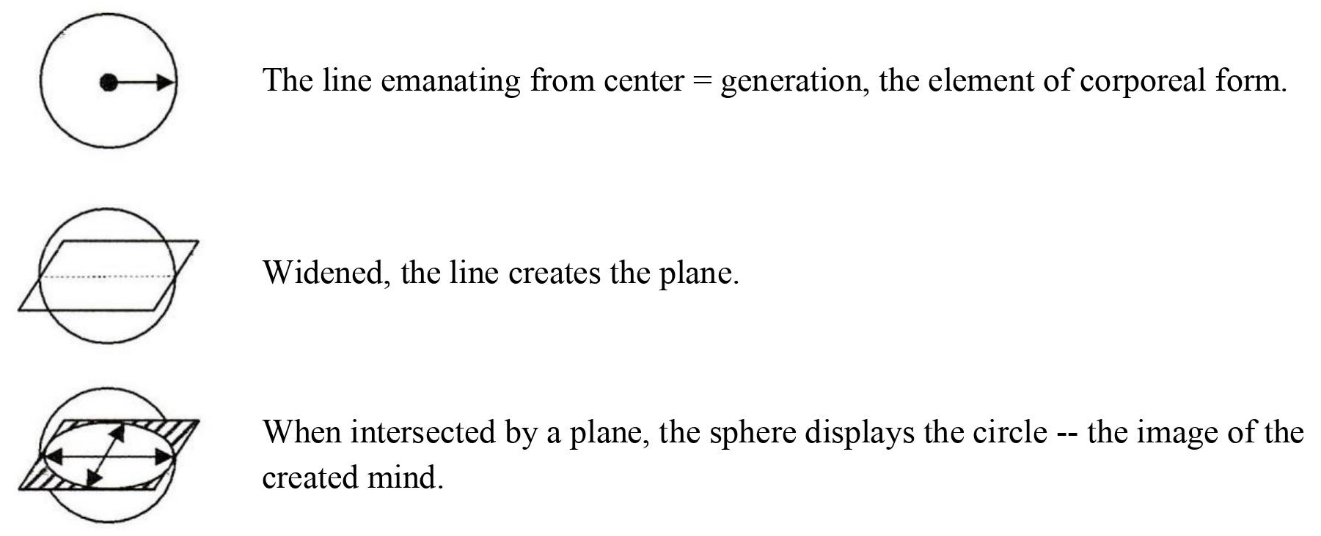
The question to be considered here, as defining the Individual Soul and its entrance in and relationship to the Cosmic Circuit, will be first explicated by the symbolic use of the point, line, and circle or sphere, primarily in response to Kepler's use of these symbolic representations.
We begin with the conception of the Soul as the House Structure. It is immaterial, outside of Time and Space; it is non-localized, an absolute continuum. In order to manifest, the Soul thus conceived must localize itself into a point, i.e., the body, or more specifically the heart center. Through this point the Soul radiates out and pervades the Cosmic Circuit. Thus the Soul is in immediate contact with the stellar influences and these influences are directly known by the Soul by the fact of its omnipresence. There is no need then for a medium through which the so-called astrological influences to take place, no need for the stars to ray forth their influences and, so to speak, move the body. It is the Soul that is doing this. So the question becomes whether the Soul's vehicles are determined by the Cosmic Circuit, or by the Soul itself as immanent within the Cosmic Circuit. (And further, what is the nature of this point?)
The influences on the Soul within the Cosmic Circuit are both the fabricative and gnostic powers of the spheres. These are grasped by the Soul by an instinctual understanding. The way the Soul grasps the fabricative act of the Cosmic Circuit is its way of building and thus determining its vehicle. Its simultaneous grasp of the gnostic act of the Cosmic Circuit is its knowledge of what it is doing. So the Soul learns directly from the Cosmic Circuit how to fabricate the vehicles necessary for its experience, and the very forces used to build the body are the means by which the Soul knows what it is doing. The body is thus a reflecting apparatus for the Soul -- this 'relation' is best stated as immediacy -- of one's own Soul to one's own body -- and which is productive of our experienced world.
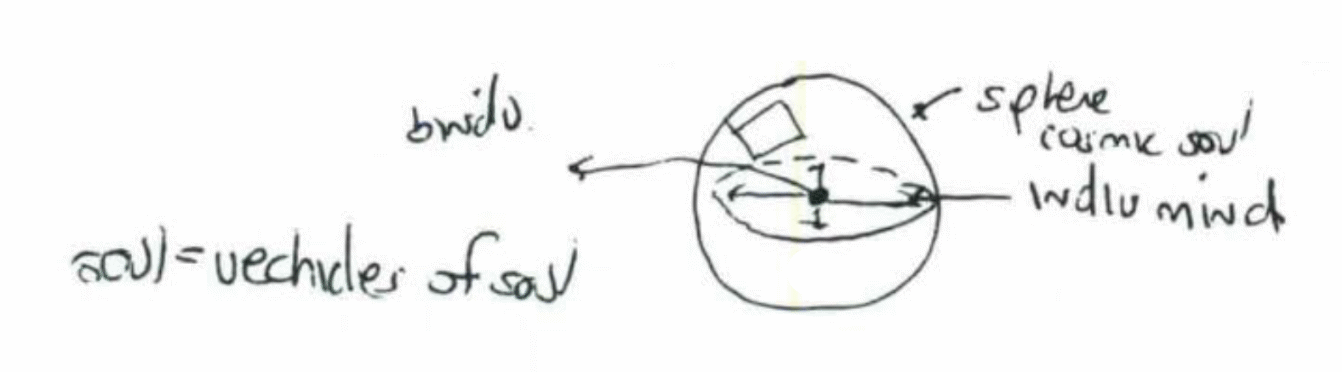
The Soul therefore is actually a sphere and potentially a point; the sphere symbolic of the Soul's absolute pervasiveness. In order for it to appear it must create a point, that is, a body. We can now correct the image Kepler is working with. God is not the creator -- Soul is. As the Soul is equated with the sphere, the radii, converging to the point, are equivalent to the actualization of the knowledge which is inherent in the Soul. Thus it is the point which is actualized. The only meaningful representation we can give the Soul would be a sphere, which as Proclus said is the most perfect form.
With this image in mind, this process must be explored in greater detail, the problems involved more fully explicated.
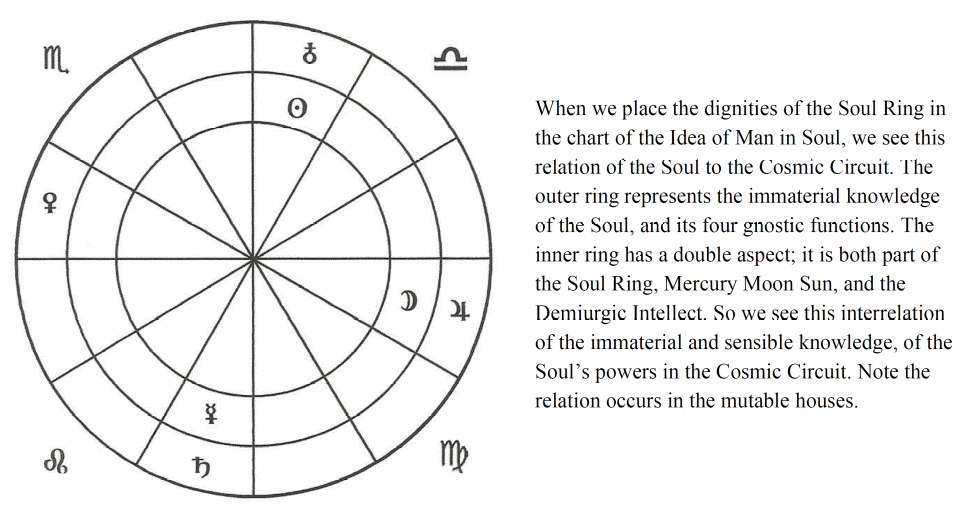
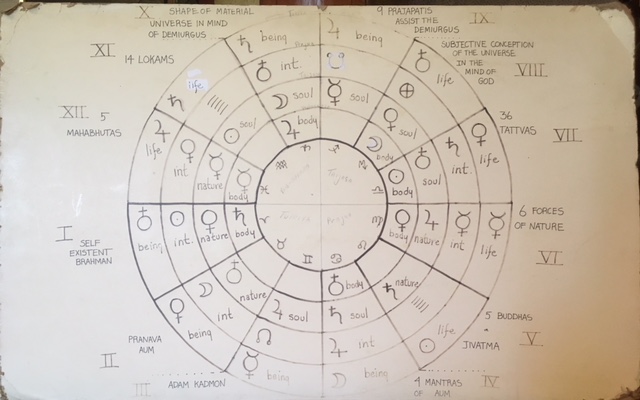
[FIGURE 1981 0314-1. Idea of Man in Soul and Cosmos. Computer generated by NT from 1981 0307 & 0314-08R17.PDF (formerly 1981 0314-08R17.PDF).]
Saturn in Leo -- the unity of the Soul -- is located at one and the same time within the Intellectual-Principle and the triad of Life. Out of this Universal Soul are precipitated out Individual Souls. The order in which this comes about must be established. The Cosmic Circuit is superimposed upon the Soul as the 12-fold House Structure. But we see the Mercury Moon Sun, the lower powers of the Soul, namely the Ahamkara, as concomitant with the Cosmic Circuit. So it is from the Ahamkara down that the Soul contacts the Cosmic Circuit -- it is here the process of its individuation takes places.
This is an important distinction which must be kept in mind. The Soul is not a part of Nature (as Kepler so describes it), rather the Soul participates in Nature. It is the nature of this participation that we must explore. Concerning this question two points of view must first be explained and then combined in order that we might understand this process: first, the Soul as prior to the organization of the body, and secondly, the Soul as immanent in and functioning through the body.
In order for the Soul to enter the Cosmic Circuit it must have a physical body in which to localize itself. Now the entire System of Nature goes into the fabrication of this body prior to the Soul inhabiting it. As Plotinus says, Nature organizes a body and the Soul imparts a light to it, [Note: Plotinus, I.1.7.] but this body is not distinct from Nature that organized it. Samkhya says that the cosmic functioning has to be unified as a body, has to appear as though it were a subject knowing an object -- only then can the pure Soul identify with it. As in a dream, the mind has to project the subject-object relationship before the dreamer can identify with what is going on.
The substance of the body is on Earth. The soul of the substances, fire, earth, air and water, is going to organize this body. Then what we call the astral influences, the vasanas, as the traces of life left behind in the substance of the Earth, will be ordered. It is these three things that are being organized into a living body. So the Earth itself is the point on which the stellar influences are operating; the Earth has a soul, a matrix of forms to combine and organize the substance that is within it into a body. Within this body is the heart, the center through which the Soul will enter and hence radiate out to pervade the Cosmos. (Thus we establish the geocentric point of view.)
In the Samkhya's description of the world as a 'feeling projection', there is implied this cosmic sympathy of elements -- and in reference to the organization of the body as just described, is implicit the fact that all the cosmic forces that go into building the body are immanent in the body.
The question can now be further stated as to how the Soul, now localized in the heart center, is in contact with and can learn from its experience in the Cosmic Circuit.
The Vedantic point of view is that from this point with the heart the light of the Soul goes up to the brain and in that light are contained the vasanas. In the brain there is a functional distribution of the vasanas, in consequence of which an imaged world appears. These vasanas then become for the Vedantists the sole determination of the Soul's experience. There is no consideration of the prakritic entities existing in their own right, no consideration of a prior organization and selectivity of the vasanas. In this view the body seems to be the entire universe for the Soul, determining the Soul's experience.
P.B. has remarked that if the Soul did not shoot forth and take the form of the universe, that it would stay at a mythological dream state. The Soul must expand forth in order for it to be actually precipitated out of the Universal Soul. It is only in what the Buddhists regard as a life of suffering that the possibility of the actualization of the Soul can take place.
In I.1.7 Plotinus states "the faculty of perception in the Soul cannot act by the immediate grasping of sensible objects, but only by the discerning of impressions printed upon the Animate by sensation: these impressions are already Intelligibles…"
We are here led to a much wider point of view -- where the Soul is not limited by its identification with the body. Plotinus is saying that the Soul's experience of the Cosmos is of intelligibles. The Soul reads the sensations, but prior to being sensations they are intelligibles. The body is necessary for the Soul to have this sensible experience, but this process develops into an apprehension of the transcendental meanings in the empirical experience. We may start out with the most insignificant experience, but as we develop we reach out to greater and greater understanding of the functioning of the entire System of Nature.
Thus the Soul must be considered omnipresent in two ways. Considered as nowhere -- it is outside of time and space; considered as everywhere, in that through the body it radiates out and pervades the entire Cosmos. In this second sense, the question arises as to the Soul's relation to the Time and Space in the Cosmos.
From the point in the heart, the Ahamkara, the light of the Soul, goes to the brain. In that light are contained the vasanas. These vasanas are distributed throughout the brain and become the imaged world -- but that light does not stop there. It shoots out into the universe and takes the form of the universe. The individual manas, conjoined with the body schemata, coincides with the cosmic manas. [Handwritten to the right in the margin: Anthony -- I was most unclear on this point.] This is, so to speak, happening simultaneously. There is the pure presentation, the imagery on the one hand, and the Soul knowing that presentation on the other. Now there can be no appearance within the reflective consciousness. It is this coincidence of the individual manas with the cosmic manas where the Soul assimilates the ideas, as the numerical relationships with the Cosmic Circuit -- and whereby its knowledge is deposited in the Ahamkara. And based on this assimilation, the Soul animates the physical body.
So we can state, with Plotinus, that the mind goes forth and strikes the object where it is, directly and immediately. [Note: See Plotinus, IV.6.1, fourth para.] There is ultimately no limit to the Soul's omnipresence. In the beginning it is unconscious, but as she assimilates and reflects upon experience, she can understand these forces that constitute the entire System of Nature, the Cosmos which the Buddhists refer to as the Womb of the Buddhas. It is here the Soul is individualized; the purpose of this cosmos is to provide this process for the Soul -- and to produce every now and then, a Buddha.
Thus the Soul is here to learn what it is that the Intellectual-Principle is fabricating through the efficiency of the Demiurges. If the Soul reaches out to the entire Cosmos and comes into contact with the intelligibles -- and also comes into contact with the transformation of that knowledge as sense knowledge, then the Soul would be learning two things, the transcendental in the empirical. It would gradually come to the realization that the immaterial knowledge accompanies the sensible object. This is ultimately what we are being led to.
Referring again to the chart -- the Soul is here the house structure as the Idea of Man in Soul -- the question is raised as to whether the Soul is these forms or has these forms as its content. Proclus states in his Commentary on Euclid's Elements that the forms are the essence of the Soul itself -- and these forms in the Soul are images of the forms that are in Nous.
[File 1981 0307 & 0314-08R17.PDF (formerly 1981 0314-08R17.PDF) Ends]
APPENDIX 2: AB CLASS NOTES FOR 1981 0314
[Classnotes AB 1981 0314 Begin]
3/14/81
p. 578 R. Talks [Typist's note: Sri Venkataramiah, (Swami Ramanananda Saraswati), Editor, Recorder, Talks with Sri Ramana Maharshi.]
Problem of relating Kepler's chart and point to heart center.
Kepler -- soul is a part of Nature.
Fludd/Platonists -- soul is not a part of Nature but participates in the process of Nature (circuit).
Red, white, and black drops in Tantra symbolize the process through which the soul becomes individualized.
Problem is the soul's relationship to the body -- where and how does it enter the body -- how is purusha reflected in the buddhi?
Definition of body as body schemata is the soul as part of Nature, not the body per se.
Kepler-Fludd argument finally culminated in Spinoza.
Are the forms within the soul, soul? Does the soul grasp itself, or something which is not itself.
[Classnotes AB 1981 0314 End]
DIAGRAMS FOR 1981 0314
Class
Saturday, March 14th, 1981
Verbatim, unedited transcriptClick the series name to view more
CLASS at Wisdom's Goldenrod, Hector, NY
with Anthony Damiani (AD)
MARCH 14, 1981
PHYSICS; KEPLER
with Appendices: 1981 0307 & 0314 Partial Transcript and Classnotes AB 1981 0314.
TOPIC: Physics
SUBJECT: Kepler
SUBSUBJECTS: Soul, Soul/Nature connection, Epistemology, Samkhya, Animate, Astrology, Proclus
CONTENTS:
Aspects: Soul, center & circumference (Kepler)
Talks with Ramana: Vasanas rising from heart to brain & expanding into world
Guenon quote, Soul & circle
Idea of Man in Soul, Cosmos diagrams
Universal Soul
Ahamkara
Cosmic Circuit & Soul: Sun or Earth at center
Samkhya: cosmic circuit apparent subject with which Soul identifies
Human being a feeling-projection of cosmic functioning
Feeling-projection accounts for natural sympathy between objects
Vasanas
Earth substance, soul of elements, & Earth vasanas organized into living body
Connection through heart center to Overself
Omnipresence of Soul: two ways
Three definitions of heart center
Ahamkara
Cosmic forces immanent in body
Omnipresence explained vis-a-vis Ramana quote
Soul associates direct with cosmic influences
But needs body to associate with them
Mind goes forth
Omnipresence, body necessary for sensible experience
Soul learns transcendental in empirical
Animate, Soul's faculty of perception, Intelligibles (I.1.7)
Soul & number
Experience necessary for Individual Soul to individuate
Soul needs experience, suffering, for actualization
Soul not aware of contact with Intelligibles, only sensation
Soul knows what's going on (transits), even if we don't know at the time
Ahamkara spreads out form of universe, prior to its appearance as image
Ramana vs. Plotinus
The "world-image process" re-explained
The Soul's learning, teaching the Soul
Individual Soul here to learn through Demiurgic Soul's fabrication
Buddhi, Ahamkara
Fludd vs. Kepler on Soul/Nature Relation
Proclus on Forms in Soul
Logistics
Appendix 1: 1981 0307 & 0314 Partial Transcript
Appendix 2: AB class notes
BOOKS READ FROM OR REFERENCED:
W. Pauli, "The Influence of Archetypal Ideas on the Scientific Theories of Kepler" (in C.G. Jung, W. Pauli, The Interpretation of Nature and the Psyche)
Sri Venkataramiah (Swami Ramanananda Saraswati), Recorder, Talks with Sri Ramana Maharshi
Paul Brunton, The Wisdom of the Overself
Rene Guenon, Symbolism of the Cross
Plotinus, The Enneads (MacKenna translation, 4th ed.)
Proclus, Glenn R. Morrow (tr.), A Commentary on the First Book of Euclid's Elements
Plato, Timaeus
PLOTINUS QUOTES READ OR REFERENCED: I.1.7, IV.6.1, IV.4.23, V.3.6
DIAGRAMS appended to this transcript:
FIGURE 1981 0314-1. Idea of Man in Soul and Cosmos.
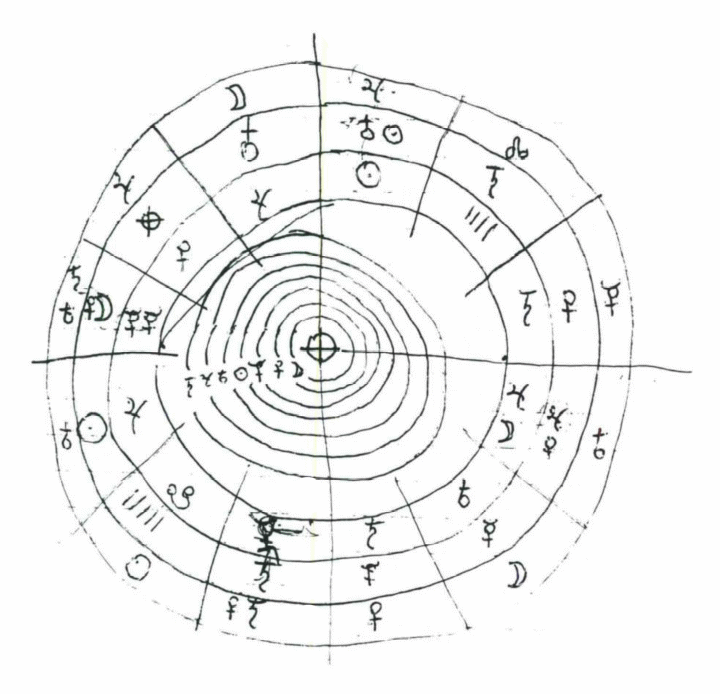
FIGURE 1981 0314-2-AB. Three Concentric Idea of Man Mandalas and Cosmic Circuit within these.
FIGURE 1981 0314-3. Kepler Relation of Circle and Sphere; Line, Plane, Sphere.
FIGURE 1981 0314-4-AB. Cosmic Soul and Individual Mind, Sphere and Point.
FIGURE IMG_2202-Posterboard Metaphysical Chart.
Other diagrams also referred to are not with this transcript version. [Transcriber note: [diagram] means the speaker is referencing a diagram as he or she is speaking. If someone is drawing or writing, with audible sounds of chalk on a blackboard, I indicate this by [drawing] or [writing].]
NOTES:
This class was held on a Saturday.
We are likely missing the first twenty minutes of this class because it got recorded over. The class seems to start in the middle.
We are missing the middle audio file for this class. This is noted within the transcript.
Scan File 1981 0307 & 0314-08R17.PDF (formerly 1981 0314-08R17.PDF), the partial transcript for this class, has been appended for completeness. It contains a good summary of the whole class as well as a diagram. All spelling, punctuation, and capitalization errors have been corrected, quote looked up and corrected, planetary glyphs spelled out in scan file.
AB class notes have also been appended. Retyped from Classnotes AB 1981 0228 to 1981 0315.PDF. All punctuation and capitalization corrected, abbreviations spelled out in AB class notes.
TRANSCRIBED Verbatim by IT 2022. Archival verbatim transcript – V11a.
AUDIO FILES: 1981 0314a (formerly 1981 0225b), 1981 0314b (formerly 1981 0314a). [Note 1: "Tape" and "Side" refer to original audio cassette tapes that were later digitized into .MP3 Audio Files. Note 2: Audio File 1981 0314b (formerly 1981 0314a) sound quality is not great. Note 3: In 2024, REP Studio separates off Audio File 1981 0314a from audio file for WG Class 1981 0225b.]
1981 03/14 at Wisdom's Goldenrod
Physics; Kepler
[Audio File 1981 0314a (formerly 1981 0225b) Begins]
AD: --Venus. Is that what he might be working with? As that what's-- is the principle of corporeality? In other words, when we have a 45 degree or a 90 degree angle between two planets, you have two straight lines, alright, I mean two lines meeting. This would be the aspect. Is this the principle of corporeality?
VM: Sure, that's just the way we look, I mean-- One of the ways that we've diagrammed it is to say that the cosmic circle-- circuit, which can be understood in a geometric sense as all these combinations of the various aspects, taking the vasanas and putting them together to make a corporeal body, then is, let's say, enlivened or the soul-principle comes through that, infuses it let's say. And, in a sense it does seem like you could say, well these various angles which are making up the cosmic circuit, that is the plane of corporeality, that is the vehicle for the soul.
VM/S(?) (faint): Go ahead.
AD: Well, it almost sounds as though what he's saying is that the aspects are the Holy Ghost.
S (very faint): Uh-hm.
VM/S(?) (faint): Yeah.
[short pause]
S (faint): And you could see them on the angles, talk about the relationship between those angles.
AD: Then how would we work it with this passage here? Because there seems to be some confusion on page 187. [10¾ second pause, various shuffling noises] Would you read that long paragraph, Avery? "In so far that…"
AS (simultaneously): "In so far…"?
AD: Yeah.
[Transcriber note: I am using W. Pauli, "The Influence of Archetypal Ideas on the Scientific Theories of Kepler" in C.G. Jung, W. Pauli, The Interpretation of Nature and the Psyche, Bollingen Series LI, New York: Pantheon Books, 1955.]
Jung, Pauli [The Interpretation of Nature and the Psyche, pp. 187-188, AS reading, quoting Kepler]: "In so far, then, as the souls are perceptive of the celestial radiations and are thus moved by them, as it were, with an inward self-contained movement, we must regard them as points; but in so far as they in turn cause movement, that is to say, transfer the harmonies of the radiations which they have perceived into their operations and are stimulated to action by them, they ought to be considered as circles. It follows that, in so far as the soul takes cognizance of the harmonies of the rays, it must chiefly concern itself with the central figure; but in so far as it acts, provoking meteoric phenomena (or what corresponds to these in human beings) it must devote itself to the circumferential figure. In an aspect, however, the effectiveness is of greater interest to us than the manner in which the aspect may be perceived by the operating soul; therefore the consideration of the circumferential figure [AS reads: circumference figures] is more important [to us] than that of the central figure."
VM (simultaneously, faint): Oh that's his [one word inaudible]
S (very faint): Yeah.
AD: Now, we got a problem, yeah?
AS: Well that's this--
VM: Maybe not, I mean if you s--
AS (simultaneously): We have this picture.
VM: If you equate the inner point, let's say, with the soul, the way we use the word 'soul', coming from the third quadrant, [Note: See FIGURE IMG_2202-Posterboard Metaphysical Chart appended to this transcript.] that's where the meaning is invested or, let's say that's where the meaning shines through, coming from the third quadrant. But the actual occasion and dynamic circumstances which reveal that meaning occur in the houses, and I would equate that with what he's speaking about as the circumference here. Now most of us are interested in: Am I going to get a job? or Am I going to do this or that? In other words, if we're worried about the external affairs and the-- what he likes to say here: "…the effectiveness is of greater interest to us than the manner in which the aspect may be perceived…" In other words, the meaning may be perceived by the operating soul. Therefore we concern ourselves with the fourth quadrant business, with the cosmic circuit. Well it's a speculation.
[short pause]
AB: Vic, I thought by "the manner in which it is perceived" the way it actually hits the soul versus the way the soul acts upon it.
VM: But-- but isn't that what we mean by meaning or let's say the essences that are constellated-- the dissipated essences that are actually constellated is the way we perceive something. And I-- I'm just speculating that that really is coming from the center or-- which I'm equating or trying to make homologous with the third quadrant soul.
AB (simultaneously, very faint): Third quadrant soul.
[short pause]
AD/S(?) (very faint whisper): They're not the same.
S (very faint): They're not the same.
[22 second pause]
AS: Well, does-- it goes along with that other quote [couple words inaudible] He has the other part where he says that it's actually a circle and potentially-- I'm sorry, is actually a point [VM simultaneously, faint: And potentially a circle.] and potentially a circle. Well he's using whatever that one meant, which I didn't follow either but it seems to follow in that it's actually this point wherein all these rays converge, you know, like you're talking about these rays of light, somehow seems to be conceiving of all these rays of light being emitted by the planets and when they make certain aspects, they all converge at a point.
S (very faint): Uh-hm.
VM: We reversed that the last time too though.
AS (simultaneously): Yeah. No I mean I'm ju-- I know, but I'm just trying to do [VM simultaneously: What he's talking about.] whatever his analogy seems [VM simultaneously: Right.] to be here. [VM: Right.] It's actually a point, and then once this body, as it were, is formed-- I thought that's what he's saying, after this body is formed, this body of light, all these ty-- these forces of the cosmos converge, making certain angles and so on, whatever, that then-- it's ok-- "…as it were, [with] an inward self-contained movement…" the celestial radiations are moved by the-- "…are thus moved [couple words inaudible]" "…transfer the harmonies of the radia…" and then it's potentially a circle. So then he's talking about [VM simultaneously, faint: The (one word inaudible)] from that point [VM assents, faint] actually expanding outward, that the souls actually expand outward. Now-- I mean I don't know what-- it's right or wrong but it seems that that's the analogy he used in the last-- the last one.
VM: Yes.
AS: But they--
S (faint): [few words inaudible]
Jung, Pauli [The Interpretation of Nature and the Psyche, p. 187, AS reading, quoting Kepler]: "…[AS adds: they] are stimulated to action by them, they ought to be considered as circles."
AS: So when they act, they're-- he's considering it as a circle, [student assents, very faint] but originally they are just this-- (he/it) considers it as a point.
VM (simultaneously): When they're receptive they're the point. Is that [AS simultaneously: Well yeah.] sort of what he's saying? When they're [S simultaneously, faint: Well I don't know. Well yeah.] receptive of these influences they receive it in a point. When they act on it they expand into a circle.
CDA/S(?) (simultaneously, faint): [one word inaudible] yeah.
AS: And that's the difference between what he calls that central figure and then the outward figure.
AD: Jeff, would you read that quotation from the Talks? You have it with you?
JC (faint): Yeah. Um--
AD: Now this is--
AS: Which one [S simultaneously, very faint: Ramana.] is that Jeff?
AD: This is from Ramana.
JC (simultaneously): This is page 578 from Talks with Ramana.
[short pause]
S: It's five.
VM (simultaneously): It's 578?
AS (faint): [one/two words inaudible]
S (faint): [one/two words inaudible]
AS (faint): Yeah.
JC: It's actually spread over about three paragraphs here. I'll read the highlights.
[Transcriber note: I am using Talks with Sri Ramana Maharshi, recorded by Swami Ramanananda Saraswati, Sri Ramanasramam, Tiruvannamalai, 2006.]
Ramana Maharshi, Swami Ramanananda [Talks with Sri Ramana Maharshi, Talk 616, pp. 597-598, JC reading]: "The world is thus [JC adds: contained] within and not without. … [JC: And then he quotes Sri Ramana Gita.]"The entire universe is condensed in the body, and the entire body in the Heart. Thus the Heart is the nucleus of the whole Universe." … Again, "The world is not other than the mind, the mind is not other than the Heart; that is the whole truth." So the Heart comprises all."
JC: Again, there's an illustration in the Upanishads somewhere of the-- the seed of a fig tree. He says--
Ramana Maharshi, Swami Ramanananda [Talks with Sri Ramana Maharshi, Talk 616, p. 598, JC reading]: "The source is a point without any dimensions. It expands as the cosmos on the one hand and as Infinite Bliss on the other. That point is the pivot. From it a single vasana starts, multiplies as the experiencer 'I', [JC adds: the] experience, and the world."
JC: And then he gives a-- talks about an experience that he had, says--
Ramana Maharshi, Swami Ramanananda [Talks with Sri Ramana Maharshi, Talk 616, p. 598, JC reading]: "When I was staying in [JC reads: at] the Skandasramam I sometimes used to go out and sit on a rock. On one such occasion there were two or three others with me including [Rangaswami Iyengar] [JC: he named somebody]. Suddenly we noticed some small moth-like insect shooting up like a rocket into the air from a crevice in the rock. Within the twinkling of an eye it had multiplied itself into millions of moths which formed a cloud and hid the sky from view. We wondered at it and examined the place from which it shot up. We found that it was only a pinhole and knew that so many insects could not have issued from it in such a short time. [JC: Says--]
"That is how ahankara, [JC adds: the] (ego) shoots up like a rocket and instantaneously spreads out as the Universe.
"The Heart is therefore the centre. A [JC reads: The] person can never be away from it. … The Self is bound to the Heart… … It [JC reads: The Self.] stays in the Heart and holds other centres also according to circumstances. But its activities always centre around the heart."
[11¼ second pause, flipping of pages]
AD (faint): That's--
S (very faint): Uh-hm.
JC: Says--
Ramana Maharshi, Swami Ramanananda [Talks with Sri Ramana Maharshi, Talk 616, pp. 596-597, JC reading]: ""When the vasanas are projected from the Heart they are associated with the Light of the Self and the person is said to think. The vasanas which lie embedded in an atomic condition grow in size in their passage from the heart to the brain. The brain is the screen on which the images of the vasanas are thrown and it is also the place of their functional distribution. The brain is the seat of the mind, [and] the mind works through it."
"So then this is what happens. When a vasana is released and it comes into play, it is associated with the light of the Self. It passes from the heart to the brain and on its [JC reads: the] way it grows more and more until it holds the field all alone and all the vasanas are kept in abeyance for the time being. When the thought is reflected in the brain it appears as an image on a screen. The person is then said to have a clear perception of things. He is a great thinker or discoverer."
JC: So on and so on. He says--
Ramana Maharshi, Swami Ramanananda [Talks with Sri Ramana Maharshi, Talk 616, p. 597, JC reading]: "…[JC adds: nothing] is really original or new. It could not manifest unless it was already in the mind. It was of course very subtle and remained imperceptible, because it lay repressed by the more urgent or insistent thoughts or vasanas. When they have spent themselves this thought arises and by concentration the Light of the Self makes it clear, so that it appears magnificent, original and revolutionary. In fact it was only within all along."
[short pause]
JC (faint): Says [one word inaudible]
[10 second pause]
AD: Now you have to remember, he's a Vedantist. He's going to explain things from the Vedantic point of view and about the Vedantic doctrine. We still have to try to work out whether so we can get that-- Also the heart is generally spoken of in three ways. [S, very faint: Ok.] As a center of the emotional being, as a center of the mental being, and as a center of the spiritual being. So we have to keep that in mind as we're going along and we have to-- we're-- we're going to have to try to decide which center he's speaking about. There's the emotional center, the mental center, spiritual center. I assume he's-- I assume he's speaking from the highest point of view. [short pause] Then in that case that would make any-- any heart center the-- the ce-- the point from which each person would be the center of his universe.
S (very faint): Ok.
AS (faint): PB has that line also, the heart as the hidden-- the hidden meeting point-- the hidden meeting point of the Overself between the World Mind and the individual. He talks about that-- that point [one/two words inaudible]
AD (simultaneously): Do you have that quotation too?
JC (simultaneously): Yes.
AD: Would you read that too?
JC (faint): Yes.
AS (faint): Yeah.
JC: "It is…" I hope this is the one.
[Transcriber note: I am using The Wisdom of the Overself by Paul Brunton, Rider and Company, London, 1943.]
PB [The Wisdom of the Overself, "The Birth of the Universe," p. 35, JC reading]: "It is consequently from its [JC reads: his] own Overself that every individual receives the world-picture. We have pointed out in earlier books that the Overself has its human habitat within the heart. Although [JC reads: Though] associated of course with the whole body it has its most intimate association with the heart. … Hence the heart is the focal point where the World-Mind through its intermediary the Overself affects the personality. The karmic forces become active within the heart therefore and there break into space-time existence. Like light-photographs on a sensitive film, they develop into a tiny seed-like thought-form. This is the matrix of the world-to-be. Were this to remain there, then the individual would experience it only in the form of a dream.
JC: He says that's the way we used to experience it earlier in our evolution.
PB [The Wisdom of the Overself, "The Birth of the Universe," p. 35, JC reading]: "In order to provide the conditions for a more fully externalized and awakened experience the co-operation of the brain and senses is required. These act partly in the same way as a transformer which increases the voltage of an electric current, and partly as a microscope which enlarges the appearance of an object. Unless the world-image is caught by the brain, consciousness will remain at the dream level and physical experience becomes impossible. Hence the thought-form is transmitted to an image-magnifying centre in the outer layer of the brain by processes [JC reads: a process] analogically like those used in [the] wireless transmission of a newspaper photograph (which reduce the photograph into numerous points of electrical energy and then build it up again from the transmitted electrical impulses), [and] [JC: he says, and it's also sent] to [the] special sensitive centres for seeing, hearing, touching, tasting, and smelling. Here the brain reconverts the received vibrations into a highly magnified picture of which the individual becomes conscious, just as a radio set converts electrical waves into a series of sounds and at the same time highly amplifies them. When all this has been accomplished the individual becomes fully aware of the transformed and magnified world-picture, which the mind now projects as if it were something outside.
AD: Outside, and he stops there?
JC: Um--
AD: Outside the mind or just outside?
JC: Well, outside of the individual and it seems to be outside.
AD: Well, there's the Yogacara school for you. [15 second pause] Can you go over something again? The Guenon article? In this article he says he's-- he's working on a geometrical representation of the Being or the soul. [short pause] Avery, would you please?
[short pause]
AS: Oh yeah.
AD (faint): Uh-huh.
[Transcriber note: I am using Symbolism of the Cross by Rene Guenon, Luzac & Company, LTD, London, 1975.]
Rene Guenon [Symbolism of the Cross, pp. 127-128, AS reading]: "In the spatial representation of the total being, it is undoubtedly true that before any determination has been made, each point is potentially the centre of the being who is represented by the extension in which that point is situated; but it is only potentially and virtually so, until the real centre has been actually determined. This determination implies that the centre is to be identified with the very nature of the principial point, which, in itself, is not properly speaking anywhere, since it is not subject to the spatial condition, and this allows it to contain all the possibilities of that condition. What are everywhere, then, in the [AS reads: a] spatial sense, are only the [AS reads: that] principial point's manifestations, which in fact fill space in its entirety, but are no more than the mere modalities, so that"ubiquity" is really no more than a sensible substitute for true "omnipresence". Furthermore, if the centre of space endows as it were with its own nature all other points by the vibration it imparts to them, this is true only in so far as it makes them participate in the same indivisibility and freedom [from conditions] that it enjoys itself [AS reads: itself enjoys], and this participation, to the extent that it is effective, thereby frees these points from [the] spatial condition."
[13¾ second pause]
AD: "But in turn…", the next page, Avery.
AS: Yeah.
AD (faint): I think there's a (big bracket--) bracket and--
Rene Guenon [Symbolism of the Cross, p. 128, AS reading]: "Thus, in space considered in its existing reality, and not as a symbol of the total being, no point is or can be the centre; all points equally belong to the domain of manifestation, by the very fact of belonging to space. Space is one of the possibilities whose realization falls within that domain, which, in its entirety, constitutes no more than the circumference of the"wheel of things", or what might be called the outwardness of universal Existence."
AS: And again of course here inward and outward, center and circumference is to use symbolical language. [11½ second pause] There's a little more. Then he has this Taoist text quote, it says--
Rene Guenon [Symbolism of the Cross, pp. 129-130, AS reading]: ""The point which is the pivot of the norm is the motionless centre of a circumference on the rim of which all contingencies, distinctions, and individualities revolve." … [AS: He said--] It is [AS reads: It's] the centre that is rightly speaking nowhere, because, as has been said, it is essentially "non-localized": it is not to be found anywhere in manifestation, since it is absolutely transcendent in respect thereof, while being at the centre of all things. It is beyond all that lies within the scope of the senses or any faculty proceeding from the sensible order… … …it is therefore really the circumference that is everywhere, since all places in space, or more generally, all manifested things…are only elements in the "stream of forms", points on the circumference of the "cosmic wheel"."
AD (faint): Alright.
AS: Ok, to sum up.
AD: No, don't sum up, you'll confuse us.
S (very faint): Yeah.
AS (faint): Yeah.
AD: Now, the way I-- I want to try to put these various passages together.
LR: Could I just ask a quick question about that?
AD (simultaneously): Sure.
LR: At first I thought he was speaking about the circumference as the manifestation of the point. And every point would radiate out and create its own circumference. And then I thought he switched to speaking of circumference as--
AD: Well what you're asking for is what does he mean.
LR: No. Well--
AD (simultaneously): And that's exactly what we have to try to work out, see.
LR (simultaneously): But I'm asking something specific too.
AD: Yeah, alright.
LR (simultaneously): Which is does he change the i-- does he change the meaning of circumference or is he speaking of the same (idea/meaning)?
AD (simultaneously): Well my dear, I s-- I said we had to work this out. We don't know what he means. We just read a lot of words. Gotta work this out. [student assents] Isn't that so? You want to read that again and see if you could make anything out of it? It doesn't mean anything to me that words are put together in grammatical syntax. I gotta-- I--
VM (faint): Especially (Kepler/him).
AS: It sounds like English.
AD: It sounds like English.
AS (simultaneously): But I can't make heads or tails of (it).
AD (simultaneously): You think an idea is being conveyed when you try to say now what does it mean!? You stop. Doesn't mean anything! [short pause] So we'll just-- we'll just jab at it, ok?
VM/S(?): Jab, Jabberwocky.
S (simultaneously): Hm?
AD: Let's say that this point here is the equivalent of this circle [diagram], ok, because I can't draw inside the point.
VM: It's-- it's a circle in the heavens though, is that--
AD (simultaneously): So this circle is the point, alright? And also, I'd like to say that it is the soul. Now he's going to speak about unity, but I'm not that advanced.
VM (simultaneously): Put it down now.
AD: Alright.
VM: Yeah.
AD: I'm going to speak about the soul, alright. And inside the soul, so to speak, inside and outside does-- he says it's a non-localized point, ok. So if we try to think of soul, we would be forced to recognize that soul is spaceless, alright, timeless, it doesn't have these things. So all we're going to do is symbolically try to understand what the soul is, and one of the things that we've been doing is saying something like this. This is the Idea-- I mean this is the Idea of Soul in Man [sic; Idea of Man in Soul]. [Note: See FIGURE 1981 0314-1, Idea of Man in Soul and Cosmos, appended to this transcript (embedded in partial transcript).] [drawing] And we worked out this arrangement, ok. [short pause while drawing] Now remember, none of these things exist, exist in the precise sense of the word.
S (very faint): Ok.
AD: Alright? Um-- [9 second pause while drawing] What was the next one, Avery?
AS: In this we said--
AD (very faint): Oh I see.
AS (faint): It's Mars.
AD (simultaneously, faint): [drawing/writing] This is Mars.
(Side 1 of original cassette tape digitized as 1981 0314a (formerly 1981 0225b) Ends; Side 2 Begins)
AD: --Libra. [drawing] [S, faint: Scorpio.] And this is Scorpio, alright. That's the second third of the circle that we worked with, this was the Idea of Man in the Soul. And the one that-- I think we pointed out that all these mutables of-- where we can almost-- we spoke about this as the soul and we spoke about this as the way the-- the soul, the individual soul is precipitated out, or individualized out of this scheme.
In other words, when we take the scheme, and we're speaking about just this part of the metaphysical chart, alright, which is what, [writing] 5, 6, 7, 8, alright, and we-- we speak about Saturn [in Leo] as the unity of the soul or Cognitive Isness. And we can see that this Cognitive Isness is located at one and the same time, alright-- On the one hand, it's within the realm of the Intellectual, the second quadrant, at the same time it's also within the triad of Life, alright. [Note: Idea of Man in Soul or Life; cf. Astronoesis Fig. 152.] So on the one hand it's Intellectual, on the other hand it's Life, alright. And it's this point, alright, that we're trying to lay out here and understand. Now if we think of this arrangement here, we could see that we're speaking about, let's call it Universal Soul, it-- you know, this is the Universal Soul [FIGURE 1981 0314-1, outer ring]. Out of this Universal Soul, individual souls have to get precipitated out and individualized, separated off from this principle itself. Now, I think this is what we're saying here, when I take this whole-- all the dignities from here, lay them out this way [diagram], I'm saying that [drawing] from out of this here an individual soul is being precipitated out. Alright. What was the next one? [short pause] Alright.
Now, that individual soul, in order for it to be individualized, in order it-- in order for that individual soul to become a un-- unit human soul in its own right, alright, it seems, it seems that from the point of view of Ahamkara onward that occurs. [Note: See FIGURE 1981 0314-1, second ring plus Mercury Pisces Nature (not shown in this diagram, see FIGURE 1981 0314-2-AB).] [VM assents, faint] Huh? I mean above Ahamkara, [S simultaneously, faint: Ahamkara.] it would be like part of the whole Soul, part of the Universal Soul. [VM assents, very faint] From Ahamkara downwards, it gets individualized. Now, how would the process of individualizing the soul take place? Our supposition is that--
Now we're locating-- we're locating the cosmic circuit within the soul. Now we say the soul has no dimensions, no size, none of that, it's completely unlocalized. So, don't take these circles as, you know, anything but metaphors. And we could imagine over here, so to speak, the cosmic circuit, ok? Now, I'm going to work different than Kepler's idea, although I don't think there is that much difference because I think in some diagrams [drawing] we showed that you could have Saturn at the outermost, the Sun-- the Sun in the middle, and also the Earth in the middle, depend-- I forgot how to do it. You f-- you remember?
S (very faint): Yeah.
AS (faint): Yeah. You can just [couple words inaudible]
AD (simultaneously): I mean it's so obvious to me that the Sun isn't the center of the world. I'm the center of the world.
VM (faint): Then how do you use Sun?
AD: Huh?
VM: I mean if you say the Sun is a symbol for the Overself, the Overself is the center of the world.
AD: Well I was thinking it in a relative sense. And especially the way Guenon just described it. Let me see if we could evolve it out of the diagram. Alright so, [drawing] we can imagine in various positions the cosmocrators as both fabricative and gnostic, alright, and the cosmic circuit is being superimposed on the soul. [Note: See FIGURE 1981 0314-2-AB, Three Concentric Idea of Man Mandalas and Cosmic Circuit within these, appended to this transcript.] [20¾ second pause] [AD says the following softly] It's the order of these things we have to work out.
S (very faint): Yeah.
AS (very faint): Uh-hm.
LR: You just said-- you just left off saying that the soul-- that to speak of the process of individuation for a soul, we're speaking of it from the point of Ahamkara.
AD: If we insert, if we insert the soul into the cosmic circuit, and-- now, this is just a rough idea of what I'm working with-- then the-- the cosmic circuit which provides the-- the stage, that is, it provides an object-subject relationship, the cosmos-- now this was important with the-- especially the remark Avery made last night, the cosmic circuit-- Avery, you remember the quote now?
AS: That the world is a feeling projection of the body?
AD (simultaneously): The world is a feeling-projection, yeah.
AS: Oh but, you mean the other thing that-- [S, faint: Well--] I think. In order for these-- in order for the Purusha, the pure soul to have experience, this cosmic functioning has to be unified as a body, it has to appear as if it were a subject knowing an object. They say only through-- only through the ability of the cosmic circuit functioning to appear as if it were a subject, as if it were knowing, it's only through that that the soul can actually [AD simultaneously: Can identify with that.] identify with it.
AD: So if we took (a/the) simple [AS simultaneously: And that's what they mean by evolve, (yeah).] example like the dream, alright, the mind first has to project the dream, alright, and you have a subject-object relationship in the dream before the dreamer himself can identify with what's going on. So, what Avery's just said was that the-- the cosmic circuit, which we refer to as the mind, alright, through a feeling-projection creates a creature, and now knows itself through that creature. [student assents, very faint] Now, what we're saying is, this is the stage necessary in order for the soul to immerse itself and identify with what's going on. Do you follow that?
VM (simultaneously): Can I-- can I just comment on that a little bit? To use the dream analogy again. The dreamer's mind, let's say, unfolds this dream scenario but, the point I thought that Avery was emphasizing, the Samkhya people always emphasize, is that there has to be posited in that scenario some empirical subject that appears to be knowing the objects around it. Only when that occurs, can an actual dream take place. Isn't that right, some sort of appearance?
AD: Only when that takes place can an identification [VM simultaneously: Yes. But then--] on the part of the Purusha take place.
VM: Right.
AD: Now, this is in-- this is really--
VM (simultaneously): In other words, you've never had a subjectless dream.
S (very faint): Uh-hm.
AD: Yeah.
S: (What?)
S (very faint): Uh-hm.
AD (simultaneously): But, what's really-- Here's-- here's the way we ended up last night, and last night was leading into the same thing because it seems to be one perennial problem everywhere, now as far as we're concerned. We say that the creature which appears-- let's say a creature appears on the Earth, a human being. They say something to the effect that he is a feeling-projection of that functioning. The same way like for instance at night I'm walking and instead of seeing a bush I see a brigand. The brigand is a feeling-projection of my functioning. In a similar way, the entity which we're speaking about as a human being is a feeling-projection of the cosmic's functio-- functioning. Now that it has projected itself out there, so to speak, alright, now that there's a relationship of a-- an object, the world, and a subject, the seeming subject which knows the world, alright, we have the stage and the Purusha could come in and identity with that.
LR: I just-- can I-- I-- Same point [AD simultaneously: Yeah.] that confused me last (night), when you say that the creature is a feeling-projection of the cosmos's functioning, are you saying the same thing as the cosmos organizes itself into these separate bodies and then the Purusha can identify with one?
AD: Uh-hm. Yeah.
LR: Now why does it-- you're saying the same thing. Those two statements to you are the same.
AD: The two statements that--
LR: That the entity is a feeling-projection of the cosmic functioning: A.
AD: Yeah.
LR: And B, that the cosmos organizes itself into separate bodies and then the Purusha can identify with.
AD (faint): Yes.
LR: Those are the same. I have a very hard time understanding one of them and not the other. Namely that to say the creature is a feeling-projection of the cosmos without pre-- without presupposing a subjective identity is very difficult for me.
AD: Think of a retard.
VM/S(?) (faint): (Projected forwards.)
LR: I'm sorry, I didn't get the analogy.
AD: Or think of the way Plotinus would say it. Nature organizes a body. And then the soul imparts a light to that organized [LR assents] body. [Note: See Plotinus, I.1.7.] So Nature has to organize a body which the soul can impart a light to. But if Nature organizes a body, this body is non-distinct from the Nature which organized it.
LR: No, that's ok.
AD: Alright, then what's your problem?
LR: When you say feeling-projection--
AD: Alright, call it cosmic functioning. [LR: Well--] I like 'feeling-projection'.
LR (simultaneously): No, no but you--
VM: No I like feeling.
LR (simultaneously): But you're referring [couple/three inaudible student words simultaneous with LR] to something when you say 'feeling-projection', [VM simultaneously: Yes.] I don't know what you're referring to, that's what I'm asking about. Are you referring to--
S (simultaneously): But are you talking-- you're not talking about personal feeling.
AD: No.
LR (simultaneously): Well obviously not.
S: You know [couple words inaudible]
S: Yeah.
LR: Obviously not, (Bert).
AD (simultaneously): That feeling-projection is something that's going to exist throughout Nature as what we know as sympathy between various objects in Nature.
LR: Can you say more?
AD: If you put a dime in the slot! (bit of laughter)
S: Go ahead. (bit of laughter)
LR (faint): (Life goes on.)
AD: Go ahead, David.
AS: It could be a nickel.
DB (simultaneously): Might be-- is it possible that the feeling-projection is concerned with the-- the motility of the vasanas that are constituting a particular body, and it's at that point that the true [couple words inaudible]
AD (simultaneously): No, no, because the vasanas are going to be at a much lower level. The vasanas are, we said-- we're going to stray away from the point but temporarily we said that the substance of the body is on Earth. The soul of the substances, the fire, earth, air, and water, which is going to organize this body. And then what we would call the astral influences will be the vasanas or the traces of life which have been left behind in the substance of the Earth. It is these three things that are being organized into a living body. Now these three things are organized into a body, that means that you're going to also have a heart in that body. That heart is going to be the center, the point through which what we call this non-localized [AS simultaneously: Yeah, the Guenon.] soul, [VM simultaneously: Principle of soul, yeah.] alright, which is everywhere and nowhere.
AS: Is going to fill up space.
AD: Fill that space.
AS: See that's-- I-- yeah, you're explaining there the Guenon quote when he says the point really is-- is nowhere, it's not in space or time, that's [AD simultaneously, faint: Yeah.] this whole-- the soul or [AD simultaneously: Yeah, soul.] just the-- the outer ring, the Soul Ring [in FIGURE 1981 0314-1; second ring in FIGURE 1981 0314-2-AB]. And then once you have the conditions for that, that point, then it actually fills space. So, it's-- it's omnipresent in two ways. I mean previous to this it's really omnipresent 'cause it's nowhere, it's this pure Idea.
AD (simultaneously): Alright, yes.
AS: And then it's omnipresent when it's associated with the body because it pervades the entirety.
AD (simultaneously): Right, the quote that he read.
AS: Yeah, uh-hm.
AD (simultaneously): On the one hand, coming from behind, [AS assents] so to speak, the-- we'll speak of the soul as unlocalized, omnipresent, everywhere, alright.
AS: Yeah.
AD: Now, the cosmic circuit presents him with a body. [AS: Right.] That point that it inserts itself in that body is the [AS assents] Ahamkara. [AS: Right.] Now it goes into that point and from there it spreads out again and fills up the universe. So on the one hand you have what seems to be something behind space, not in space. [AS assents] And then on the other hand when it localizes itself in that point, in the heart center, [AS: Yeah.] alright. And, remember we got three points here, we got three definitions of the heart center.
AS: Yeah, on three levels.
AD: Alright. So that, if we take one of those definitions, when it enters the heart center--and if we remember what that remark that Ramana just made--and spreads out to fill to the ends of the world, but that would be from Ahamkara down.
AS: Uh-hm. And that's what he said.
AD: So the higher portions of the soul are not involved in that process, it's the lower portions from Ahamkara down, or, even [AS simultaneously: He said--] Plotinus I think would make that remark [AS assents] that it's the lower power of the soul.
AS (simultaneously): That is how the Ahamkara shoots up like a rocket and (then) [one/two words inaudible]
AD (simultaneously): (And he--) and--
S: This is--
AS (simultaneously): Now, I think also the Kepler seems to fit in, [VM: Yes.] in that the point that we're speaking of is in some ways already a con-- I don't-- maybe you would disagree but it seems you could say that point that we spoke of, the necessary physical point actually, is a confluence of these cosmic forces. You know, we spoke about the physical, the etheric, and the astral [AD simultaneously: Uh-hm.] have or-- all been organized, it seems that-- it seems you could refer that to the-- [student assents] to the functioning of these cosmic rays converging at this point he speaks about.
AD (simultaneously): Yeah, yeah. Ok.
AS (simultaneously): That point is the phy-- the actual, like the heart center. [three/few words inaudible]
AD (simultaneously): Well, insofar that a body has been built and [AS simultaneously: Yeah.] organized, alright, we can say that the organization of that body, the structuralization, its genesis and all that, required as its prior, alright, the cosmic circuit which was building that. So all these aspects would have a role [AS simultaneously: Yeah like--] in the organization of that body.
AS (simultaneously): Yeah. And like they're inherent in that body. I mean so what-- like when the light-- when the soul associates with that heart center, all of those forces that went to build that vehicle are there, right there as it were.
AD: They're immanent in that body.
AS (simultaneously): They're immanent in that body. So, the soul spreading itself out as it were doesn't-- I mean that-- it-- at that contact, as it were, it would have access to all of those different-- it would be able to read off or interpret or [S, faint: (I don't know.)] get associated with the whole cosmos.
AD (simultaneously): Well, that-- that would be the point then, Avery.
AS: It would know.
AD (simultaneously): Would it be, would it be that the body which is the organization of these principles, would the soul be reading off that, [LR simultaneously: That's like when--] [AS simultaneously: I--] that functioning? Or, if we think of the soul as going through that point and extending itself to the extremes of the world, alright, then when it does so, [AS simultaneously, faint: Yeah I know it's--] alright, then it would be immediately subjected to stellar influences that are going on. You see what I'm saying?
LR: Yeah it's like you [S simultaneously: No.] said once [S simultaneously: No.] that [S simultaneously, faint: (No s--)] [AD simultaneously: At that point.] there was only one object and that was the body.
AD: Alright. Let's go over this again.
AS (simultaneously): No I-- Your-- you-- the question is-- not really.
AD (simultaneously): The bo-- the organized body is presented to the soul. The soul inhabits the body, alright. Now, if you remember the quotes that Jeff just read, from that point in the heart it goes up to the brain. There's a functional distribution of that light, alright, through the brain, the vasanas get distributed at the brain, and then spread out as the world. But then if you look out, alright, and you see a star or you see a planet or you see the Moon, alright, that's quite a distance away. Evidently this light which is imparted to the soul must traverse the entirety because he speaks about it as [AD snaps fingers] going on [AS simultaneously: Instantaneous.] in an instant. Now if it touches, if it touches the extremities of the world we live in, the cosmos we live in, alright, then it will be immediately subjected to the astral influences that are operative right-- right at that moment.
VM: Isn't the subjugation to the astral forces logically prior to the unfoldment--
AD (simultaneously): I know, that's what we want to think!
VM: But you don't want to think that way.
AS (faint): Right.
AD: That's what we want to think, I want to combine the both points of view. I want to combine the point of view where the astral influences are prior to the formation of the organism, alright. Once that organism-- once that organism is, let's say, structuralized and operative, alright, then the soul operating through that organism and spreads out to the infinities, alright, then that formless mind, because that's what we're speaking about, alright, has a direct contact, an immediacy, an immediate contact with those astral influences. It isn't that they have to come down now to this body.
VM (faint): Ok.
S (very faint): Uh-hm.
AD: The-- the association is direct.
AS: Right, now they-- the only question is, why the soul needs to associate through that point and can't be omnipresent with the original. If we imagine (an/the) original forces of the cosmos, as it were, building this vehicle, why this-- it seems to be saying that the soul can't identify with those, or can't be functioning along with that.
AD/BS(?): The those and that?
AS: Yeah. I got to say it more clearly.
S: Look--
AS: Ok, we're trying to put these two points of view together, that the cosmic functioning, these forces converge at this body, and the soul through that point spreads out to the universe. So in order for the soul to feel the effect of the cosmic influence, (you're) correct--
AD (simultaneously): No transmission is necessary.
AS: Right, not-- no bodily transmission.
AD (simultaneously): --mission is necessary. I don't need the etheric medium.
AS: Right. But on the other hand, why can't the soul as all-pervasive be pervasive of the original cosmic functioning, which were these forces converging together at the body?
VM: Say the last part again.
S (very faint): [one/two words inaudible]
S (very faint): Uh-hm.
BS: Prior to the expansion is--
AS: Prior-- yeah prior to-- you know, we say well it has to be localized through this body.
AD (simultaneously): Before the soul inserted itself into (a/the) body, alright, [AS/S(?) simultaneously: Why just--] why couldn't it directly deal with the cosmic circuit?
AS: Or rather we're saying that it doesn't, and that seems to be the point of why (that/the) body is necessary. Somehow in this explanation is that the individual soul, in order to-- in order to get the influences of this cosmic circuit, it can't be just omnipresently identified with the cosmic functioning. It needs that bodily point, needs that-- that point to operate through.
AD (faint): Alright.
AS: I mean that seems to be implied 'cause otherwise we wouldn't have to posit this whole thing of the soul going out filling the cosmos if it was already identified with the cosmic [AD simultaneously: Cosmic.] functioning.
LR: But wouldn't the--
AD (simultaneously): And Plotinus makes the point, he says that the soul cannot directly apprehend the sense world.
AS: Right. All those points.
AD (simultaneously): And to do so it must do-- do so through a body. [Note: See Plotinus, IV.4.23.]
AS: And-- and that's why-- that's the one point I don't quite understand why, if it's doing so through the body-- it seems that the body itself, as part of the cosmic soul, as part of the a-- as-- sympa-- in sympathy with the entire cosmos, it seems that the body somehow must be inclusive of all the cosmic-- of all these-- [LR: That's--] of all the cosmic force, and why it needs to go beyond-- I don't quite understand it as going beyond the body. The body seems to be the entire-- its entire universe [LR simultaneously: Its what?] of what it's going to read off, in other words, why can't--
LR (simultaneously): Why do you have to go further than the body if the body is a [AS simultaneously: The body scheme.] constellation [AS simultaneously: Yeah.] of all these cosmic forces?
AD: No I'm not asking you why do we have to, do you?
LR: Do you have to.
AS: Yeah.
LR: Yeah.
AD (intensely): No, not do we.
AS: We.
AD (intensely): Do we or don't we?
LR: Yeah. That's what I'm asking too.
DB (simultaneously, faint): Well, if-- is--
AD (simultaneously): Don't they speak about the mind shooting forth, going out? Do we or don't we? If we do, alright, then is that explanation feasible, that the contact with these forces [LR simultaneously: And the--] is direct and immediate?
LR: And the other point of view that you're talk--
AD: Is that it's locked up in the body.
S (faint): (Isn't it--)
LR (simultaneously): But that body is the object for the Self.
AD: I don't know what you mean, that body is an object.
LR (simultaneously): That body insofar as it's constellated of-- as it's composed of all the cosmic forces which fabricated it, that body is none other than a fabrication of the entire cosmic circuit.
AD: Yes.
LR: So, when-- when it is somewhat-- when it is organized to some extent and a subject can identify with it, or become localized in space through it, that body becomes the entire object.
AD: No, it's not the entire object!
LR: I'm asking. That-- isn't that [AS simultaneously: No, but--] what--
AD (simultaneously, intensely): No, it can't be! If we just-- if we just stated our premises that the cosmos fabricates through a feeling-projection this body, and that [student assents] you have the state set up of this body in the world within which it resides and now the Purusha identifies that, why limit the subject identification to the body? Even if the body is the entire System of Nature for that soul? You don't want to restrict its experiences to that body.
LR: That's-- isn't that the question?
AS: No, he's starting out with that premise, that it's not restricted to that body.
LR: Well but isn't that the question you're asking? Does it go-- does it-- does it--
AS (simultaneously): I think he was asking. [few words inaudible]
AD (simultaneously): I'm not asking, not I'm not. I'm stating it. The mind goes forth and strikes the object directly and immediately.
LR: What do you mean by object?
AD: Anything in the universe!
LR: A tree?
AD: Huh?
LR: A tree?
AD: A tree, sure, why not? You more likely. [AS: Yeah.] Goes out and strikes you. [AS: Right.] How am I going to become aware of a world!?
S (faint): Is he--
AS: Yeah. Now, again, it can do that 'cause the soul is pervas-- is omni-- can be omnipresent. Now, behind the whole thing it's omnipresent we said in this funny way, it's outside of everything.
LR (simultaneously): You (could try to taking) these leaves, I don't--
AD: Wait I-- I'm going to get schizoid. One at a time.
AS: Before this um--
AD: Go ahead.
AS: Before-- before it identifies with that center or works through that center it's omnipresent we said in this other peculiar way, it's outside of space and time altogether. And through the medium of this point, it goes out and becomes omnipresent in the second way, as it were, he says ubiquitously and it's throughout the whole of the cosmos. It's this immaterial principle so obviously it can-- I mean there's no limits of space and time [student assents, faint] in that way. But we still are saying that that bodily center is necessary for its experience, for ex-- for having experience.
AD (simultaneously): For (the) sensible experience.
AS: For sensible experience, say if it wants to know an external, so-called external object or these cosmic-- or even the cosmic influences, it must do so through the body, not that it's only knowing the body.
DB: Yeah but-- Avery, isn't it possible that-- that when it's associated with the body it's that which makes the-- the knowledge of the soul possible, now the particular experience or the sensible world, but in terms of its being affected, I mean couldn't we speak of its association with the cosmic influences prior to that? And that it's that association which makes possible the particular transformations that could go on while there's an association?
AS (faint): (Well) I didn't follow.
AD (faint): Uh-hm.
DB: Well on the one hand it seems like there would-- there would have to be an association with-- with the cosmic forces prior to-- to actually being identified with the body. And it would be this association that would make-- like that would be the medium for its being affected. But its pervasion of the-- of this-- of the universe through the body is in terms of its knowledge, and that's what it's going to know. Do you see what--
AS (faint): Not really, not yet.
AD: Try again.
DB: Well, like-- [short pause] When the soul is identified with the body, it immediately pervades the cosmos, ok.
AD: Yes.
DB (simultaneously): Now, that pervasion of the cosmos by it seems to be in terms of its knowledge, you know, like goes out through the various sense organs and [AD simultaneously: Yeah. Uh-hm.] and perceives what's around it.
AD: Yes.
DB: But, wouldn't it seem that its capacity to be affected by the influences of the, um--
S (faint): I don't know how.
AD: Cosmic circuit.
DB: The-- yeah right, by the cosmic circuit, wouldn't be in terms of, say for example the Mahabhutas but through-- no I mean not-- it's not because it can see that it's affected by the cosmic forces but be-- but prior to seeing, it's associated with the-- with the entirety of the-- the cosmic forces, but not in terms of knowing anything about it. It's present there. But it's not aware of the functioning, there's no point of view-- there's no localized perspective from which it can function in terms of knowing anything about what's going on or being affected by it.
S: David, you do--
AD (simultaneously): Yeah, I'd say-- I'd agree with that.
DB: And it's-- and it's because it-- there's that association prior to the identification with the body that when the-- when the planets make aspects and so forth, that there could be a-- you know, some kind of transformation.
AD: What you're essentially saying is that the way the soul can be affected is through its experiences in the cosmic circuit.
DB: Yes.
AD: Yeah.
S (very faint): Ok.
S (faint): Right.
AS: I mean that-- it's a problem (with him) but--
AD (simultaneously): Now, when we say that its experiences in the cosmic circuit, we're saying that it's learning much more than is available to us. In other words, we will be saying something like Wang Yang-ming said, that we're learning the transcendental meanings in the empirical experiences. So that through the empirical experiences we rise up in our level of understanding. So we may start out with the most insignificant experiential things but as we go along in the development, alright, we reach out towards greater and greater understanding of what constitutes the cosmos. So that the soul is learning about that cosmos, alright, and the functioning in that cosmos through the fact that it has a body in there and it's directly learning.
In other words, it's not only-- the-- the way I understand this is that the soul is not only learning from, let's say, you know, making a bench, alright, you know, with a hammer and nails and a saw it's making a bench, but I would say that the soul is also learning for instance that this morning this man got up and insisted on right away doing something and-- in this case making a bench-- because Mars moved into Capricorn. So his soul is unconsciously learning something about the nature of the forces that constitute the entire System of Nature. Now, in the beginning that would be unconscious, later on as he assimilates and reflects upon the experience he goes through, he begins to understand, in a more conscious way, the forces that in their entirety constitute what we call the System of Nature, the cosmic circuit, and the particular vehicle that he's got to operate through. Yeah that's what we're talking about when we speak about that.
And then again didn't-- um-- now, maybe you could remember, when Plotinus was speaking about the reasoning soul-- just one minute. IV.3.30, he speaks-- do you remember the way he speaks about it? [S, faint: Uh-hm.] I-- I'm not sure if it was IV.3.30 but he says that the soul reads off the living Animate the impressions that are made on it, which were prior to being sensations.
AS: I.1.7. He says [couple faint inaudible VM words simultaneous with AS] but they were ideal before--
AD (simultaneously): You got it? Do you have the--
AS (simultaneously): Alan has the (one).
AD: Would you turn to I.1.7?
AS (simultaneously): It's I.1.7 Alan, it's got the [one word inaudible] Yeah well that's it seems what we're talk-- that's what we're talking about, that soul entering the heart there as it were, it's going to read off the impressions that are made by the cosmic circuit, the Animate, [LR: I--] the impressions [couple words inaudible]
LR (simultaneously): What is it reading off of?
AS: Well read--
AD: Well, [S simultaneously: Uh-hm.] we have to read the quote.
Plotinus [I.1.7, AB reading]: "The faculty of perception in the Soul cannot act by [the] immediate grasping of sensible objects, but only by the discerning of impressions printed upon the Animate by sensation: these impressions are already Intelligibles…"
AD: What does he mean there?
AB: Well I said--
Plotinus [I.1.7, AB reading]: "…while the outer sensation is a mere phantom of the other (of that in the Soul) which is nearer to [AB adds: the] Authentic-Existence as being an impassive reading of pure Ideal-Forms."
AB: What the soul is reading-- the impression that the soul is reading off of in the Animate is actually--
AD: The sensations.
AB: Right, is actually a deriv--
AD (simultaneously): But you see, in these sensations are what?
AB: Intelligibles.
AD: That they existed in a prior form as Intelligibles.
AB: Right and the-- when the soul is reading them, they're really based on these Intelligibles.
AD: Right, read it again.
Plotinus [I.1.7, AB reading]: "[The] faculty of perception in the Soul cannot act by the immediate grasping of sensible objects, but only by the discerning of impressions printed upon the Animate by sensation: these impressions are already Intelligibles, while the outer sensation is a mere phantom of the other (of that in the Soul)…"
AD (simultaneously): Now, try to understand what he's saying. And I think if you understand that you'll understand the next point which is that the soul reads the sensations off, alright, but prior to these being sensations, you're talking about Intelligibles. And the way the soul is going to learn about these Intelligibles is first through the body, the practical experiences, the empirical experiences which are indicative of the transcendental.
S: Uh-hm.
AB: Well, like on Wednesday when we were talking about Reminiscence, the point was that the soul doesn't learn anything new, but that through the experience of the body is evoked something which the soul already contains. So in the case of these impressions being Intelligibles, it's through the reading of them on the Animate that the soul awakens.
AD: Reminiscence will take place in the soul.
AS: Uh-hm. That's--
DB (simultaneously): But-- but, by Intelligibles there doesn't he mean the-- the actual-- well the, say mathematical proportions of the-- the (heavenly) bodies?
AD (simultaneously): That would be a beginning, that would be a beginning. But they themselves would be of something far greater.
DB: Oh, yes, right.
S (faint): Uh-hm.
AS: Yeah. Well--
AD (simultaneously): Remember the way he [Plato, Timaeus] speaks about. He said the Sun and the planets were put there so that it could teach us about numbers.
S (faint): Uh-hm.
AS: Yeah.
AD: Now numbers could be taken in a, you know, in a simple way of thinking of arithmetic. But you can take it in a Pythagorean way of thinking of them as the Ideas. So if the ser-- the soul first learns to count, you know, one, two, three, without using your fingers, then later on, it can learn to realize that what it's counting is the way the Ideas or the definition of a thing is being put together.
AS: If-- could you also say like, in your example, the soul shoots out, or taijasa shoots out. Now before-- of course this is prior to our awareness of it, it already knows the entirety of what's going on in some pre-- [S, faint: Yeah.] pre-conscious way and then presents to itself a picture, an image of that. In other words, we're not aware of that contact with the-- I mean we n-- we're not necessarily aware of that contact with the cosmos.
AD: But you see then, Avery, if you said that, alright-- not that I disagree because I'm just bringing in a counter position--
AS: Yeah.
AD: If you say that then there wouldn't be no need for the soul to be crystallized out of the Universal Soul, become individualized. Because it-- what we're saying is it's these experiences that are individualizing, precipitating the individual soul out from the Universal Soul.
AS: Yeah.
AD: And these experience therefore are necessary in order for this to happen.
AS: Yeah.
AD: Ok? So I don't know that we would have to say that the soul knows all these things prior to its descent.
AS: No that wasn't what I was saying.
AD: Alright, go ahead.
AS: I was saying that-- When the soul-- when you said the soul goes out in-- in all these quotes [few words inaudible] I'm sorry.
AD: Go slowly, go slow.
S (faint): I thought-- I thought--
AS: I wasn't talking about the soul's identification prior to going out, I was trying to-- it seemed that you were saying that the soul going through-- through this heart center, functioning through this heart center and identifying with these cosmic forces-- forces, was pri-- was-- that was its experience of the cosmos, but that that wasn't necessarily available to us in that form. Well, I'm sorry.
AD: I'm a little confused. You see, that's why I mentioned as a preface to what Ramana said, that you have to remember you're coming from the point of view of a Vedantist, alright. There's no need for us to go through this. [AS simultaneously: There's what?] If you're a Vedantist, alright.
S (very faint): Yeah.
AS: Yeah but--
AD: And, what I think I am saying is that you're taking the functional distribution of the vasanas on the brain and then expand it as the universe, alright.
AS: Yeah.
AD: Now PB also makes the remark that if this did not happen, alright, then the soul would stay at that mythological stage. Now I don't know if it would be possible for the soul to get actualized at that stage. [AS assents] But I assume that it has to expand forth and become the universe in order for it to get actualized, actually precipitated. It's only in what the Buddhists regard a life of suffering that the possibility of the actualization of the soul could take place. It will not take place in heaven.
AS: All I was trying to say is in the Plotinus quote, where he says the impressions are first Intelligible, [AD: Alright.] ok, that that-- that would be the soul's conta-- the soul's going out and contact with the cosmo-- with the cosmic soul, or the cosmic functioning, and that what we call this-- this later sensation-- Unless you're saying that is the actual--
AD (simultaneously): Go ahead, go ahead. Go ahead, Avery. When it first contacts, when the-- from the heart center it moves out, [AS: Right.] it makes an immediate contact with the Intelligibles.
AS: Yeah, with that--
AD (simultaneously): But what we know on-- is not that soul's contact [AS simultaneously: Yeah.] with the Intelligibles, but the way they're revealed to us as sensations.
AS: Yeah.
AD: Ok.
AS: But that's where the real-- the real learning of the soul is in that original contact. Well you always say, you know, these transits are going on, we're not-- I mean the soul is learning, we're not aware of what the soul is learning.
AD (simultaneously): Alright, I see what you're saying now.
JfL: Wait, I don't understand.
LR (simultaneously): I don't.
JfL: I thought that the soul--
AD (simultaneously): Well, ask him again.
JfL: Well, Avery, I thought the soul wasn't doing it through the cosmos circuit, I thought it was actually [couple inaudible AD or student words simultaneous with JfL] doing it directly, right with the Intellectual-Principle.
AS: No, no.
CDA (simultaneously): No.
AS: No, no, the directness was the directness [LR/S(?) simultaneously, faint: Right.] with the cosmic circuit. The thing we denied was that-- was that it was only the bodily modifications. The soul goes out-- all the quotes that Jeff read and so on, where the soul goes out through the heart center and spreads out to the universe. That's-- it's there that the soul really contacts the cosmic forces, and that's where the soul's really learning. But we know a lot of times, you know, an aspect goes on, we don't know what really happened till ten years later, but the soul knew then. The soul knew what was really going on then but we didn't. Now the fact that that soul knew what was going on then was because it actually went out through the body, took-- got-- contacted the cosmic forces directly. But the-- the lower sensation couldn't-- couldn't reveal that to us yet, I mean, the lower thinking.
LR (simultaneously): What do you mean when you say the soul goes out wi-- the soul contacts the cosmic circuit directly?
AD: The Ahamkara spreads out, takes the form of the universe prior to its appearance as an image in our reflective consciousness.
LR: Spreads out through body or not through body?
VM (very faint): Probably through body.
AD: It has to go out through the body.
AS (simultaneously): [few words inaudible]
LR (simultaneously): Ok.
AD: From this point in the body, yeah.
LR: So, isn't body the determining--
AD: No because, again, this is the Vedantic point of view. What Ramana would be saying is that the distribution of the vasanas which becomes the actualized imaged world for you is what you're experiencing. What [AS simultaneously: Right.] Plotinus would be saying would be that prior to that, alright, [couple inaudible LR words simultaneous with AD] the soul has made contact with the [AS simultaneously: It's already made contact.] form of the universe.
LR: How? You just said it was through body. [couple faint inaudible student words simultaneous with LR] How?
AD: Here.
LR: Prior to what? [AD simultaneously: Let's--] I thought you said it entered through Ahamkara, I'm sorry. Ok, go. (bit of laughter)
AD: I'm sorry, (I try to remember). David? We said that there's this point in the heart, alright. From that point in the heart, the soul goes up to the brain. In that light of the soul, there are contained the vasanas. These vasanas are distributed throughout the brain and become the imaged world. But that light does not stop there, that light shoots out into the universe, and [AS assents, faint] takes the form of the universe. That is, so to speak, happening simultaneously. So you have the presentation, pure presentation on the one hand, the imagery, and on the other hand, the soul which knows what that presentation is, of what Intelligibles that presentation is.
AS: But then our actual sense-perception is based on the body, it's just the soul's knowledge is not. I mean maybe we can make that distinction. The soul may actually shoot out and encompass the cosmic forces and know them directly. But what we know as our sense-perceptions and so on later is-- is actually based on what's held back, as it were, that's-- that's what we-- that's what his lower sensation is, it seems. And I mean I don't know if that's [few words inaudible]
JfL (simultaneously): Wait, can I try again the [one word inaudible]
AD (simultaneously): Sure, try again.
JfL: It seems that the world per se is informed in a prior way the same whether you're talking about the heart center. The heart center looks up, just looks out and projects and picks up the impressions, you know, in the sense world just as the soul is informed by the Intellectual-Principle, that's what--
AD: Start again, start again, do it again.
JfL: (In order) to put this-- this whole thing in the way I imagine it. That the soul-- when the soul is reading-- when the soul is trying to-- when the Intelligibles-- Intelligibles are out there, the soul has already kind of informed it, formed physical world. In other words it-- it has to be presented. Like the soul isn't going to inhabit anything, it has to present a pretty body, it has to present something pretty enough for the soul to come into it. Likewise the Intelligibles have to be already out there, otherwise when the soul-- when the spark comes into the body, to the heart center and goes out and, you know, looks for the-- it looks for the things that it's already put there. But it seems-- I guess I don't think of it as happening in the body, that's just a localization of it, I think that it still happens up in the soul. Just it's-- I thought that's what it was, I thought it was a reminder in that sense of what the Self is-- has as its own image of the-- of the World-Mind.
AS: Yeah it-- I don't know, I--
JfL: What am I (missing)?
AS: But it seems like still the-- what's reminding it or what's-- what's forcing it to come out, bring out from itself these Ideas.
JfL: From itself, what self? Are you talking about the [DB simultaneously: (The form.)] self that's in the body, that heart-self, or [AS simultaneously: No.] you talking about the soul?
AS (simultaneously): No, no, but the soul-- the soul is pri--
JfL: Bringing up to the soul-self, right?
AS: The only thing is I thought that we were talking about not-- not the relation of the soul back to the Intellectual-Principle per se, but the way that the soul is learning from the cosmos. The-- the cosmos itself has the Ideas embedded in it, in this cosmic functioning.
JfL (simultaneously): That's right but in soul.
AS: No, it's two different-- no, not from the soul (that's/it's) learning. From the World-Soul maybe. Otherwise I'm-- maybe I'm confused but-- The soul isn't-- that soul that's going out through the heart center and becoming-- and filling up the cosmos is not what's-- hm-- I would say it's-- that's-- it's learning from that cosmic circuit. I don't know if we were saying that but--
JfL (faint): Well, what [couple words inaudible]
AS (simultaneously): That's what's evoking a knowledge in that soul.
JfL: It is evoking (a) knowledge but not in that, not in body.
AS: No but it's the soul we're talking about.
JfL: But not that little spark either.
VM (very faint): Right, right.
AS (simultaneously): What little spark? (bit of laughter) I don't follow. [short pause] Ok try-- like on this-- I don't know, maybe if we use this diagram here [diagram], [drawing] this point here. Jeff what-- if you say that this is-- these are the-- this is the cosmic--
AD: Well, I think Jeff's problem is he already started that the soul knows everything.
AS: Yeah, I know, that's [AD simultaneously: He--] what I'm trying to say that he's learning-- got to learn from the cosmos.
AD (simultaneously): Right, and it would-- it would make it useless for-- if you keep in mind what Plotinus says, We have to teach our Soul. [Note: See Plotinus, V.3.6, seventh para.] I mean, then that whole passage becomes useless. What do we have to teach our soul, it already knows it.
JfL: Because it has to correlate with it a kind of-- It's kind of like in three-dimen-- in two-- got two ways of doing it, it's first sort of saying ok, well, I need a bo-- I-- you know, that they need a body to go do this work. They-- it sort of has to tell them-- Nature let's make one that has these kinds of things because I want to be able-- you know, I want to be able to do all these things, because it knows that it needs that kind of form. So it presents the Intelligibles likewise out there as a model for what its vision is. And when it perceives them through the lowest order, then it is reminded (of) that sense of the-- [student assents] of the vision that [couple words inaudible]
AD (simultaneously): It is reminded by sense [JfL, faint: Of what's potential.] of the forms that are within it but it-- it's not necessarily reminded of the cosmos that it's built, which is what [AS simultaneously: It hasn't.] you're getting at.
AS: Which it hasn't built.
AD: Which is quite different. There's quite a difference between the Demiurgic Soul and an individual soul.
JfL (simultaneously, faint): Well (they're two soul(s)), right, so there's two [one word inaudible]
AD: There's quite a difference between the World-Soul and individual soul which is a portion of that World-Soul, and has to learn what it is that the Intellectual-Principle is fabricating through the efficiency of the Demiurgic Soul. I think you have to try to keep in mind that the individual soul is here to learn. And if it takes-- if it takes a few manvantaras that's what it's going to do, that's what it's going to learn. Now there-- the point is how and what is it going to learn? And there's certain things that are going to be required, and he says if we want to learn about-- the soul wants to learn about the System of Nature, the cosmos, then it must go through this process of identifying with a body and working through that body, so that it could understand through that body, and the experiences that accrue what the meanings of the Intelligibles are insofar that they're deposited as these material objects, bodies. I think you're off the--
[Audio File 1981 0314a (formerly 1981 0225b) Ends]
[Note: We are missing an audio file here.]
[Audio File 1981 0314b (formerly 1981 0314a) Begins]
AD: --some of the naïveté of the Jungian psychologist. He's-- if anything he's coming from a point of view of Samkhyas or this-- He's a Samkhya, born in ninth century Ireland I think. (laughter) [Note: Reference is to John Scotus Eriugena (aka Johannes Scotus Erigena).]
VM (faint): That's such a [AS simultaneously: Seventh] (great idea).
AD: That idea. Let's turn to a little bit of Fludd. We were reading from page 217?
VM (faint): Lauren.
AD: Vic, how's your voice? Could you read? Yeah, go ahead.
VM: My voice is alright, my brain is not (working).
BS (simultaneously): I'm sorry about this. One question before [one/two words inaudible]
AD (simultaneously): Go ahead, sure, go ahead Bert.
BS: About the Buddhi of--
S: Buddhi.
BS: Under Buddhi you have A-- Aha-- Ahamkara as the individualization, appropriation of [one word inaudible] Is the appropriation referring to Buddhi as containing Ahamkara as a individual potential, in other words for one soul? Or does it also-- well, that's one question. That when you say--
AD: Try it again.
BS: Yeah.
AD: Avery, this is yours. Go ahead. Try it again.
BS: Well it's a little confusing when you put knowing, willing, feeling on one side of certitude, and that implies modes of knowledge there.
S: Right.
AD: [one/two words inaudible]
BS (simultaneously): Or act or--
AS/S(?): Well primarily knowledge.
BS: Ok. Uh-- If Ahamkara is an appropriation of-- of something let's say, it would only-- seems to me it could only refer to Buddhi which will contain [AD/S(?), very faint: Yeah.] what it's appropriating in potentia. So it's not the image as known through the senses yet. But let's say if we could take the second house Idea and transfer it up there and say the total possibilities for individuala-- individualization but exists in Buddhi.
AS: Right.
BS: Ok?
LR (faint): Yeah, go ahead.
BS (simultaneously): Uh-- Does the Ahamkara, so to speak, appropriate one of those possibilities, [AS simultaneously: Well yeah if you look at the tree.] possibly the traces left in--
AS: Well, just-- say just like with a tree, you know, it's a tree, there's a tree. They'll have an Idea of a tree in Buddhi but the Ahamkara says well it's my knowledge of the tree. At the level of Ahamkara it's got to say it's my-- it's my-- this is my experience. This is my knowledge of a tree.
BS: Yeah.
AS: But at Buddhi, you wouldn't say it's my knowledge of a tree, it's tree. It's a tree. There you'd-- [S, very faint: A tree.] Without the "I", without the (mine/mind) that finitizes. Without appropriating knowledge as his. So it's the universal.
BS (simultaneously): Is that what (you really meant there)?
AS: Yeah.
BS: You have to read more.
AS: Yeah, (it is/his) I-maker. Ahamkara also means I-maker.
AD: Yeah.
JC: Could you say that appropriation is based on the fact that the cosmic circuit gives something to the-- [student assents, very faint] the individual mind that's there and that is its-- that knowledge is within the individual mind before it's projected as a world. So, the basis of saying in the-- that I would appropriate anything in my experience is the fact that that knowledge is already given to my individual mind and is being projected as its content.
AS: Yeah I think it is a function of the cosmos that would do that. It's not--
BS (simultaneously): But when you say "I see a tree" it's-- it's already a product of-- it's gone all the way down through the senses. Now you're attributing that, you're collapsing this--
AS (simultaneously): That was going the other way.
BS: Yeah, you're collapsing it somehow back into Buddhi and saying the tree is originally known there, so there's the certitude.
AS: Right, there's a certitude of tree. You don't have to say it's my knowledge of tree, it's-- it is tree, it's--
BS (simultaneously): But now you're referring back to the senses again.
AS: No, no, we're not [BS simultaneously: Yeah.] talking about a knowledge of the sensible tree as sensible, it could be a knowledge of the-- a buddhic knowledge of tree. It could be a knowledge of the tree that's not-- doesn't come down to the level of senses.
BS: Then it doesn't have to come down to the level of senses.
AS: Well if you go the other way and start from senses here [diagram], ok, then this would, again coming back up you-- well you have just sense functioning. There's not necessarily anybody knowing it. And you'd have this imagery which organizes the sense functioning. Again it doesn't have to be somebody saying "I know a tree." Ok, it just could be sense functioning and mental just the way that the Buddhists do it. It's only at this level [diagram] coming-- if you want to come up, at this level the guy says, "Oh, I'm a knower," he appropriates that knowledge that's here [diagram], insofar as now there seems to be an "I" reflectively knowing it. So there's an appropriation, it's my imagery, it's my senses. But now, now he can appropriate the knowledge from below. Or appropriate it from above if you want to come down from above. But if you want to come starting from the senses [AS knocks on board], it's only at this level that he becomes individual, like out of this-- you know, like out of this uroboric condition he becomes an individual in some way. There's a notion of himself as an individual, it's his knowledge. It's also his actions now that begin punishing him for individual acts that he does. Before that part (and) they don't. There's no law of an individual. There's no Ahamkara principle, (his) [one word inaudible] is not individuated. He's part of-- he's just part of the general manas functioning and part of these two lower functionings. So there's no appropriation of anything to him. [BS simultaneously: So--] Those forces go on, things go on but--
BS: So are you considering that Buddhi as an underlie or a substratum which gives certitude to the other three functions even if you take them individually?
AS: Well, yeah, I would-- they would say yeah, everything that could go on here [AS indicates on diagram] is certi-- certified by what's-- by the knowledge of Buddhi.
BS: So if you could-- you don't have the prefigured knowledge of Buddhi let's say, if you're not aware of that, still it's acting. Its very-- [student assents, faint] its very being would be the substrate for the other three.
AS: Well in their system yeah but the [BS simultaneously: Samkhya system?] [one word inaudible] evolve out of Buddhi, [student assents, very faint] in terms of evolution. But in ter-- I mean in terms of coming down and in terms of the evolution of an individual, it would go the other way around.
BS (very faint): (In terms of) evolution (of an individual).
AS: I mean just historically you would start out just this an-- lowest animal has sense functioning. And then out of that sense functioning would build up certain images, and eventually, you know, this conceptual knowledge of himself as an in-- as an "I", as an ego, would arise out of that. Which would finally lead to some kind of cer-- certain knowledge, would finally lead you to [couple words inaudible]
AD (simultaneously): Which would [few words inaudible] in this here [diagram].
AS: Yeah.
AD: So, you could look at this way. You take a Sage, you would have both the-- you would have this here [diagram] and you would have this here [diagram]. He sees a tree, and he also has the immaterial knowledge that accompanies-- In other words, the Idea of the tree is present to him. All the processes that are involved in that, alright. So this would be like, when they speak about a Buddha who has the knowledge of a particular and the immaterial knowledge or the principles to make that particular what it is, they're both present to him. Now, if we locate ourselves here [diagram], alright, and we're not speaking about a Buddha, we're speaking about a person, he has the image of a tree, alright. He doesn't have this [AD taps on board] necessarily. Usually not. This is what he would see. Then he might say, "Oh, I can-- I can understand that this was put together for me by the communal senses or the manas functioning which is vikalpa and sin-- and sankalpa putting together," you know. And then, insofar that he said it was my knowledge he (appropriate it/appropriated). But all of this could exist here [diagram], in one stroke. So, in Buddhism for instance, when they speak about the Sage has both knowledge, the Buddha has both knowledges, he has the knowledge of the particular and the universal as that particular, whereas we only have the knowledge of the particular. So, the Sage would be both a cosmic and an individual knower. And that's why PB refers to the fact that, even when you're liberated there's still about two and a half percent of the ego left. [short pause]
Let's go back to this reading. Put it off. Um-- Before we go too far I ask one or two people, we're going to start working with the so-called notion of matter, starting with the elements, so-called elements, and working our way through them. Because I-- I think that we lack an understanding of matter, or for instance if we speak about earth, air, fire, water, which is the soul of what we experience here as cohesion, liquidity, etc. So we'll have to get into that discussion in order to make these things more understandable. So we'll work-- we'll work our way through the seven prakritis as a-- with as much detail as we can. Why don't we read this thing from-- Now Fludd answers back Kepler. And you remember my dictum. When an argument keeps going on for a couple thousand years, they're both right. [students assent, very faint] The quote. [student assents, very faint] Now, go ahead, would you?
VM: Do you want to start the proper page on 217 or A?
AD: No, 217, where he answers.
VM: A. In other words, [AD simultaneously: Yeah.] "A. The image of God is not [AD simultaneously: Uh-hm.] a part of…"
Jung, Pauli [The Interpretation of Nature and the Psyche, p. 217, VM reading, quoting Fludd]: "A) The image of God is not part of anything. B) Now, on the basis of what has been granted, the human soul is the image of God. C) Therefore, it is not a part of nature.
"A is clear…"
AD: Now, the image of God is the soul.
VM: Cosmic soul.
AD: Yeah.
VM/S(?) (faint): Yeah.
AD: Or even individual soul, [student assents] like when you say man create-- God created man in his own image.
VM (simultaneously): God created man in his own image, yes.
AD: So don't think of a picture..
VM: No, ok.
AD: So the image of God is not part of anything, or again when the Platonists refer to the eternal generation of the soul by the Intellectual-Principle. Again that's not an image. Ok.
VM: Ok.
AD: Alright, let's read now.
VM (simultaneously): Anthony, just-- it's just like of a geometric proof [few words inaudible]
AD: Yeah you can see how this [VM simultaneously: It's like a (one word inaudible)] [one word inaudible] [AS assents] culminated in Spinoza.
S (simultaneously): Yeah.
VM: It seems like-- ok. Well I don't know anything about-- anyway--
Jung, Pauli [The Interpretation of Nature and the Psyche, p. 217, VM reading, quoting Fludd]: "A is clear…"
VM: That is, that the image of God is not part of anything.
AD (very faint): Yeah, ok.
Jung, Pauli [The Interpretation of Nature and the Psyche, p. 217, VM reading, quoting Fludd]: "…because God is the One and Indivisible according to axiom 6. B is your own assertion as it is cited in the second question and as the speech of Hermes [Trismegistus] about the extent of the mind declares, according to axiom 2.
"Now we shall go on to the second question: whether the circle with its divisions by the regular polygons is reflected in the soul because the latter is the image of God?
"I shall not hesitate to answer this question also in the negative, supported by the strongest and most encouraging arguments of the Philosophers. Namely, [because]:
"1. Plato, first of all, says that the soul, separated from the corporeal laws, is not a number having quantity and is neither divisible nor multiplicable. But [it] is uniform, revolving in itself, rational, and surpasses all corporeal and material things."
VM: Continue?
AD: Yeah, please.
Jung, Pauli [The Interpretation of Nature and the Psyche, pp. 217-218, VM reading, quoting Fludd]: "2. Aristotle and Plato say that the Creator maintained the soul as a totality before any division, and Pythagoras makes it a"one in itself" and says that it has its unity [VM emphasizes following word] in the intellect.
"3. Pythagoras, in his letter to Eusebius [VM reads: Mr. E.], acknowledges that God is a unity and indivisible and says that duality is the Devil and evil, because in it lies multiplicity and materiality. And Plato holds that all good exists as One; but evil, he holds, comes from chaotic multiplicity.
"4. Cicero says that it would not be possible for perfect order to exist in all the parts of the world unless they were united by one single divine and continuous spirit."
AD: By the way, don't underrate Cicero. He's quite a Platonist.
[short pause]
Jung, Pauli [The Interpretation of Nature and the Psyche, pp. 217-219, VM reading, quoting Fludd]: "5. God can neither be limited (brackets in text) [defined] nor divided nor composed…
"6. By the Platonic philosophers God is said to be present (brackets in text) [lit.: poured into] in all things. (brackets in text) [He is called] the world-soul (which, they say, contains the formula of the whole) inasmuch as He, universally diffused, fills and invigorates all things.
"7. God can be determined neither according to essence nor according to quality nor according to quantity, inasmuch as no predication can comprehend Him. [Scotus.]
"8. The Pythagoreans and the Platonists regard the world-soul as being enclosed within the seven planetary spheres and say that within the first sphere it rests in the highest mind; and [then], they say, [it] has become identical with it. [AD: Yeah.]
"9. As [all] numbers are in the One, as all radii of the circle are in the centre, and as the powers of all the members are in the soul, so, it is said, is God in all things and all things in God. [Ars chymica.]
"10. Hermes [Trismegistus] says that God is the centre of any one thing--a centre the periphery of which is nowhere."
S: Uh-hm.
AD: Alright, let's go to 222.
[short pause, flipping of pages]
VM: A, B, C?
AD (faint): Alright, you read now.
BS/S(?) (very faint): [few words inaudible]
AD (faint): Alright, you try to read that, "You maintain…"
Jung, Pauli [The Interpretation of Nature and the Psyche, pp. 222-223, VM reading, quoting Fludd]: "… You maintain, then, that the human soul is a part of nature and that in the soul the circle is reflected with its divisions by the regular polygons because of the fact that the soul is the image of God. But I say that the soul, at least with respect to its essence, cannot be divided from nature as a part can be divided from the whole, according to that statement of Hermes [Trismegistus (Poimandres 12)]: The mind is in no wise divided from the essence of God. Rather it is bound up with Him as is the light with the body of the sun. For we see that the solar rays are bound up with the body of the sun and cannot by any means really be divided from it, because the essence of light is a unity and cannot be divided into parts; but naturally with respect to us who abide in multiplicity we say that the soul of one man differs from that of another in number and kind, [VM adds: and] although in truth, all souls have a continuous relation to the one world-soul or the Metathron…"
AD: That's a Kabbalistic (analogy).
S: Uh-hm.
Jung, Pauli [The Interpretation of Nature and the Psyche, p. 223, VM reading, quoting Fludd]: "…as has the sunlight to the sun. Consequently, multiplicity really lies in matter and not in form which is nothing but a continuous emanation from God, or the Word of God, imparting life and being to all creatures. When it is withdrawn [VM adds: or] (brackets in text) [revoked] life is destroyed, as it says in Psalm 104…"
AD: Alright. If we go back now to the beginning where he says--
Jung, Pauli [The Interpretation of Nature and the Psyche, p. 222, AD reading, quoting Fludd]: "[But] I say that the soul, at least with respect…"
AD: Oh, first before that. Avery, maybe you can help. Vic.
Jung, Pauli [The Interpretation of Nature and the Psyche, p. 222, AD reading, quoting Fludd]: "… You maintain, [then], that the human soul is a part of nature and that in the soul the circle is reflected with its divisions by the regular polygons…"
VM/S(?) (faint): Well, yeah.
AD: Can you help us with that? Could we go back to-- Oh, we erased it. We go back to that circle, that plane. The circle that intersects the sphere. [Note: See FIGURES 1981 0314-3, Kepler Relation of Circle and Sphere, 1981 0314-4-AB, Cosmic Soul and Individual Mind, Sphere and Point, appended to this transcript.]
VM: I think what he's speaking about there, Anthony, is that the-- the soul is analogous to the clear figure of polygons. You know like he's got this diagram in here.
AD: Well first of all a polygon means--
VM: Means [S simultaneously: Yeah.] many-sided figure.
AD: Is (he/it) referring to the five polygon?
AS: That's a polyhedron.
AD (faint): Polyhedron, alright.
AS: He's talking about (the--)
VM (simultaneously): I think he's talking about this diagram here. Is this what you sort of--
AS (simultaneously): Yeah he's talking about planes and--
VM: The pa-- the diagram on 184.
AS (simultaneously): [few words inaudible] It's like a square-- [S simultaneously: 184?] triangle, square.
VM (simultaneously): 184. I think that's--
AS: Polygon is when it's triangle, square, pentagon. Plane figure [VM simultaneously: It's a regular-sided figure.] [one word inaudible] by itself or [one word inaudible]
S (faint): Nice detail.
VM: Do the sides have to be equal-sided-- [AS/S(?) simultaneously: No.] equal lengths to the side of the polygon?
AS: Only the regular polygon means that.
S (simultaneously): No, no. No, no, the regular ones.
S: Regular.
AD: Regular.
AS: Oh he does say regular polygon.
AD: Yeah.
AS: The sides and angles are all equal.
S: Uh-hm.
AD: Then, could we try to understand--
AS (simultaneously): Yeah. Like an aspect.
AD/S(?) (faint): Ok.
AS (faint): Hopefully we're not going to call them [one/two words inaudible]
AD: Could we try to understand what Fludd is saying that Kepler is saying.
S (faint whisper): Yes.
AS: Well he says he's maintaining that the human soul is part of Nature. But part of Nature. (It's in) the soul, he's talking about this part but--
Jung, Pauli [The Interpretation of Nature and the Psyche, p. 222, AD reading, quoting Fludd]: "…and that [AD emphasizes following word] in the soul [the] circle is reflected with its divisions by the regular polygons [AD reads: polygon]…"
VM: See Kepler wants to try and understand the astrological influences by saying that there are certain harmonies vested in the soul, and he symbolizes these harmonizes by these regular polygons. Then he says the angles of the-- of the rays or the various planets coming in, when they coincide with these regular polygons or make some sort of proper numerical relationship, then the soul is effective. And I thought that the point Kep-- or Fludd was making was that no, all these divisions, all this multiplicity, all these notions of polygons and so on that you're speaking about, that's a part of Nature, not the soul, soul is a unified essence prior to that. And in terms of our diagram, Fludd is coming from the-- the Idea of Man in the Soul and Kepler is coming from the Idea of Man in cosmic circuit. They can't seem to come to any terms.
AS: Well, that was what he said in the first part but then what does this line mean--
Jung, Pauli [The Interpretation of Nature and the Psyche, p. 222, AS reading, quoting Fludd]: "I say that the soul, at least with respect to its essence, cannot be divided from nature as a part can be divided from the whole…"
AS: So, it could be argued-- See, this line--
Jung, Pauli [The Interpretation of Nature and the Psyche, p. 222, AS reading, quoting Fludd]: "… You maintain, [VM simultaneously: That's a line.] [then], that the human soul is a [AS emphasizes following word] part of nature…"
S (faint): Yeah right.
AS: He could be arguing with that because he doesn't want to say it's a part.
VM: It's all of Nature.
AS: Right. Or he could be arguing (with it) because he says well the human soul is not tied up with Nature at all. They're two different things. [VM simultaneously: So--] In one case you would say that the soul is totally (immaterial). But then what does this line mean when he says, well you can't-- it's not a part of Nature because it can't be divided from Nature as a part at all. It's one with Nature. I-- I mean that's-- that really (extremely) based on it.
S: Yeah I know.
VM: Like 'cause [S simultaneously: (The horror.)] it says here [couple words inaudible] [AS/S(?) simultaneously: I don't know.] and things before, 217, [AS/S(?) simultaneously, faint: Yeah I know.] something that seems very different.
S: Well, if you continue on in that paragraph though, [AS: Yeah.] where he quotes, you know, Hermes from the Poimandres.
AS: Yeah.
Jung, Pauli [The Interpretation of Nature and the Psyche, p. 223, S reading, quoting Fludd]: "The mind is in no wise divided from the essence of God. Rather it is bound up with Him…"
S: Now that's the end of the quote I imagine.
AS: Yeah.
Jung, Pauli [The Interpretation of Nature and the Psyche, p. 223, S reading, quoting Fludd]: "Rather it is bound up with Him as…"
S: And I assume the "it" there means the soul. Soul is bound up with God--
Jung, Pauli [The Interpretation of Nature and the Psyche, p. 223, S reading, quoting Fludd]: "…as is the light with the body of the sun."
AD (faint): Yeah.
S: Ok. So, I mean it identifies [one/two inaudible student words simultaneous with S] the su-- [AS simultaneously: Alright.] it says that the soul is, in a way, bound up or a part of God, not of Nature.
AD: But then he is speaking about the Intellectual Soul, isn't he? He's speaking about the, let's say, what we would refer to as Saturn in [AS: Yeah.] Leo [see FIGURE IMG_2202-Posterboard Metaphysical Chart].
S (simultaneously): Well, he's saying, the essen-- the soul, at least as-- as insofar as its essence.
AD: Yeah, at least insofar as its essence.
VM (simultaneously): So that's like soul in-- in-- I mean the Saturn in Leo is in Nature.
AD (simultaneously): That's the point, Spider. That's the point. It seems that they both got different ends of the meaning of soul, [S: Uh-hm.] alright. Kepler got the tail end of the meaning of soul, Fludd's got the head [S simultaneously: The head.] [AS laughing: Yeah.] of soul, alright.
S: Right.
AD: The head of the soul or the way Plotinus speaks about soul as a unity which could never be destroyed, he's speaking about like the Saturn in Leo which is in conjunct or shares a common-- commonality with the very substance of the Nous.
S: Uh-hm.
AD: Alright. That-- [S simultaneously: That's what Fludd's working from.] that is the essence of the soul, could never be anything but what it is the way Plotinus points out.
S (very faint): Right.
S: Right.
AD: But then Fludd is coming along, taking the-- what we would [VM simultaneously: Kepler.] call the Sun--
S (simultaneously): Kepler.
AD: Kepler.
S: Kepler.
AD: The Sun Moon and Mercury [diagram], and saying no it's part of Nature.
VM/S(?) (faint): Yes sir.
S: Uh-hm.
AD: Now, the easiest way for us to see this when we take the ring Soul and we go from Saturn [in Leo] and then we have to string it all the way around into the fourth quadrant [diagram]. [Note: See FIGURE IMG_2202-Posterboard Metaphysical Chart, Soul ring starting with Saturn in Leo.] So part of it is part of the System of Nature, alright, but part of it or the unity is also part of the World-Mind and identical or an image of God, (ok).
S (simultaneously, very faint): Right, right.
S (faint): So then--
AD: And then they're both right.
S: And they're both [one word inaudible]
AD: Or both wrong.
S: They're both the soul now.
VM (simultaneously): But they're both incomplete with its [one/two words inaudible]
AD (simultaneously): Or they're both incomplete.
VM (simultaneously): And that's right, that's right. Better now to say they're both incomplete.
AS: So I guess he would say that by image of God we don't mean some kind of reflection of God. He means image in this way, that it's part of Divine Mind, or it has a Divine Mind present (in--)
S: What?
AS: Both of them. But I still don't-- I mean I follow that explanation for most of what he's saying. That line there is very strange though unless it's just translated wrong.
S: Which-- which line?
AS (simultaneously): He sa-- well he says that--
Jung, Pauli [The Interpretation of Nature and the Psyche, pp. 222-223, AS reading, quoting Fludd]: "…the soul…cannot be divided from nature [VM: Well--] as a part [can be] divided from the whole…"
VM: Well if you take the word 'essence' seriously then you have to take Nature at a higher level of the cosmic circuit.
AS: No but he took the [one word inaudible] Yeah, ok. It just-- it just doesn't seem that-- maybe that's just a type error. [short pause] See 'cause he's talking to-- to Kepler.
VM/S(?): Emphasis.
AS: "Well you maintain that the soul is part of Nature. And you don't think"--
S (faint): Yeah, right.
AS (simultaneously): Unless he's saying that, well, in fact the way that the soul is present is completely in this immaterial manner, and in that sense is not a part of Nature but it's pervasive of the whole of Nature. I see-- I could-- I could understand it here.
VM: Oh but you know, just go back to 217 to give you some-- [AS simultaneously, faint: (Oh/No) but--] I mean to confirm what-- what he means by soul.
AS: Yeah. Well he-- oh, yeah.
VM (simultaneously): He says--
Jung, Pauli [The Interpretation of Nature and the Psyche, p. 217, VM reading, quoting Fludd]: "1. Plato, first of all, says that the soul, separated from the corporeal laws, is not [students assent, faint] a number having quantity and is neither divisible nor multiplicable."
VM: In other words, you can't associate it with polygons.
Jung, Pauli [The Interpretation of Nature and the Psyche, p. 217, VM reading, quoting Fludd]: "But it is [VM adds: a] uniform, revolving in itself, rational, and surpasses all corporeal and material things."
S: Well it shows where Fludd's coming from.
VM: That's what I'm saying, it shows where [student assents] Fludd's coming from so if he speaks about the essence of soul, clearly it can't be identified with the-- what we would call the cosmic circuit or the material world.
[short pause]
AD: Now, then that would bring in something interesting which maybe we'll try to get into pretty soon and that is, are the forms which are in the soul, soul, or are they, so to speak, just forms within the soul, that is, the soul has accompany all these soul-- all these forms within itself.
S: Contents.
AD: So that, if there was an insight into a form or into an idea, alright, that the s-- the soul itself, alright, would be grasping something which is not itself.
VM: Well, could we say some-- (at least that) I understand your question, I don't want to answer, I just want to understand it. You're saying if the soul has an insight into a form, are these forms actually a part of the cosmic circuit or are they actually a part of soul proper, in other words, the soul--
AD: Are they intrinsic to soul? Are the forms intrinsic to soul.
S: Or are they merely contents.
AD: Are there-- or the-- or are they [S, faint: Yeah.] merely contents.
LR (simultaneously): Which forms are you speaking of here?
S (faint): Uh-hm.
S (faint): (Ok.)
AD (simultaneously): Any form. Idea of circle, idea-- whatever idea.
VM: I don't see how it could grasp something that's not really itself. Or at least without employing principles that are in its own nature. Well that's an awfully good question.
AD: Are you people dragged out or should we read a little bit more?
AS: Yeah.
S: (Read/Leave) that for me.
JC (simultaneously, faint): Yes. I don't see a problem. (bit of laughter, student words)
AB: Doesn't it also depend whether or not you're speaking of objective soul or subjective soul in the--
LR (faint): No.
AD: No.
CDA: Oh.
AD: Well what time is it now?
S (faint): Well if we're objecting.
AD (faint): I'm going to be (here) [S simultaneously: Right.] (sharp). The reason I wanted to read this is because I don't want you people to go out and buy a copy or xerox (or it would drift) and--
S: We do read Jung.
VM: Well [AD simultaneously: Huh? No I--] the first way to get you (guys) to xerox it is to read it.
S: Yeah.
S (faint): Right. (bit of laughter)
S: Gotta ignore it.
S (very faint): Uh-hm.
S: Yeah.
S (simultaneously): Yeah. (bit of laughter, student words)
VM: As soon as you say that, Anthony, everybody starts to [one word inaudible] and put their hands down. (bit of laughter)
S: What's the book?
VM: (I think) what's the book?
S (faint): [couple words inaudible]
VM (simultaneously): (It's about) [couple words inaudible]
AD (simultaneously): It's the one we were using last week. The-- Morrow's translation.
VM: Oh yes.
S (faint): I know but--
BS: This on the Euclid diagram?
S (simultaneously, very faint): (But it seemed) we just talked about that one.
S (very faint): I guess nobody's telling (you).
S (very faint): Yeah.
S: Yeah.
AD (faint): Or better we wait.
[short pause]
[Transcriber note: I am using A Commentary on the First Book of Euclid's Elements by Proclus, translated by Glenn R. Morrow, Princeton University Press, Princeton, New Jersey, 1970.]
Proclus, Glenn R. Morrow (tr.) [A Commentary on the First Book of Euclid's Elements, p. 14, AS reading]: "…Plato constructs the soul out of [all the] mathematical forms, divided [AS reads: divides] her according to numbers…deposits in her the primal principles of figures…"
AD (simultaneously): As you probably all can see, we're leading in-- into the Timaeus [AS: Timaeus.] ultimately.
Proclus, Glenn R. Morrow (tr.) [A Commentary on the First Book of Euclid's Elements, p. 14, AS reading]: "All mathematicals are thus present in the soul from the first. …the soul is the full company of them [AS reads: of these forms].
AS: And then he says--
Proclus, Glenn R. Morrow (tr.) [A Commentary on the First Book of Euclid's Elements, p. 15, AS reading]: "In these forms consists the essence of the soul."
[short pause]
AS/S(?) (very faint): (Look) familiar [one word inaudible]
AD (simultaneously): Yeah.
S: Sounds pretty glaring, doesn't it?
S (very faint): Yeah.
VM/S(?) (very faint): I don't know, I don't know.
AS: Yeah [one/two inaudible student words simultaneous with AS] [few words inaudible] [VM simultaneously: And that's--] Proclus, in that sense.
VM: In that sense. I mean that seems very harmonious with Kepler sort of.
LR: Well that's Proclus' dictionary.
S: Thank you.
S: Proclus and Kepler.
S (simultaneously): Yeah.
S: Right.
S (faint): Thank you.
S (simultaneously, very faint): Uh-hm, ok.
AS (faint): Proclus meant to be--
[10 second pause]
AS: But he said--
Proclus, Glenn R. Morrow (tr.) [A Commentary on the First Book of Euclid's Elements, p. 14, AS reading]: "There is [left] only the conclusion that soul draws her concepts both from herself and from [AS adds: the] Nous, [AS adds: and] that she is herself the company of the forms [AS reads: form]…"
[short pause]
S (very faint): I forgot.
[20¾ second pause]
AD: Alright. Let's read just some abstracts and--
Proclus, Glenn R. Morrow (tr.) [A Commentary on the First Book of Euclid's Elements, p. 3, AD reading]: "…I think, that Plato assigned different types of knowing to the highest, the intermediate, and the lowest grades of reality."
AD: This is obviously the divided line.
Proclus, Glenn R. Morrow (tr.) [A Commentary on the First Book of Euclid's Elements, p. 3, AD reading]: "To indivisible realities he assigned intellect, which discerns what is intelligible with simplicity and immediacy, and by its freedom from matter, its purity, and its uniform mode of coming in contact with being is superior to all other forms of knowledge."
AD: That's the highest part of the divided line where intuition directly apprehends-- directly apprehends the intelligible. Now in all of these-- all of these I think you're going to see that Proclus, and I like to pick on Proclus because Jeff likes Proclus.
S (very faint): You like him now.
AD: Proclus doesn't bring out the most amazing problem which Plato over and over again, very slyly and subtly keeps formulating in a more-- metamorphosizes and-- as he goes from dialogue to dialogue. And that is that the soul, even with the intuitive faculty of apprehending an intelligible, very often interferes in the apprehension of that intelligible because it itself is a medium through which the insight is taking place. This will go all the way down to the level of even sense knowledge. That a very median of acquiring or understanding something, being a reality in its own right, interferes with what is being acquired. And this is a real problem that Proclu--
JC (simultaneously): You say Proclus doesn't bring that problem out?
AD: Hm?
JC: Proclus I think says that many many times. [student assents, very faint] Says the soul apprehending the whole [couple words inaudible] (laughter) dianoetically, one by one at a time.
AD: No, uh-uh, no. He's not touching the problem at all. Let me [few words inaudible]
JC (simultaneously): [few words inaudible]
AD: Too bad (you--) too bad (he--)
[couple/few students at once, few words inaudible, laughter]
AS (simultaneously): [few words inaudible] soul can only do [one word inaudible]
AD (simultaneously): And you make sure you get all the quotes, right?
JC: Well I-- yeah, I think I've got them.
AD: Good. (laughter) Next Saturday we'll have a conference.
S: That's amazing.
[few students at once, few words inaudible, laughter]
AD: That's the only way, I get them angry they'll come-- they'll come back with all their quotes ready. (laughter)
S: Is it?
AD: Anyway, then he goes on, he says-- (laughter)
Proclus, Glenn R. Morrow (tr.) [A Commentary on the First Book of Euclid's Elements, p. 3, AD reading]: "To divisible things in the lowest level of nature, that is, to all objects of sense-perception, he assigned [AD reads: assigns] opinion, which lays hold of truth obscurely, whereas to intermediates, such as the forms studied by mathematics, which fall short of indivisible but are superior to divisible nature, he assigned understanding. Though second in rank to intellect and the highest knowledge, understanding is more perfect, more exact, and purer than opinion. For it [AD reads: the understanding] traverses and unfolds the measureless content of Nous by making [AD adds: it] articulate its concentrated intellectual insight, and then gathers together again the things it has distinguished and refers them back to [AD adds: the Intellectual-Principle or] Nous."
AD: But, let me go to the part where he deals just with the soul essence. Alright, on this-- in this page he says--
Proclus, Glenn R. Morrow (tr.) [A Commentary on the First Book of Euclid's Elements, p. 11, AD reading]: "[And] how can we get the exactness of our precise and irrefutable concepts from things that are not precise?"
AD: So how do you get, you know, the idea of a circle from a wagon wheel which is [one word inaudible] not quite circular.
Proclus, Glenn R. Morrow (tr.) [A Commentary on the First Book of Euclid's Elements, p. 11, AD reading]: "For whatever yields knowledge that is steadfast has that quality itself in greater degree. We must therefore posit the soul as the generatrix of mathematical forms and ideas. And if we say that the soul produces them by having their patterns in her own essence and that these offspring are the projections of forms previously existing in her, we shall be in agreement with Plato and shall have found the truth with regard to mathematical being."
AD: Now there you can see he's saying that the forms are these essence of soul itself.
[short pause]
Proclus, Glenn R. Morrow (tr.) [ A Commentary on the First Book of Euclid's Elements, p. 13, AD reading]: "If, [however], mathematical forms do not exist by abstraction from material things…"
AD: That is, we don't take the circle out of the thing.
Proclus, Glenn R. Morrow (tr.) [A Commentary on the First Book of Euclid's Elements, p. 13, AD reading]: "…or by the assembling of the common characters in particulars…"
AD: Every-- all men have two legs, therefore by man you mean that which has two legs.
Proclus, Glenn R. Morrow (tr.) [A Commentary on the First Book of Euclid's Elements, p. 13, AD reading]: "…nor are in any way later-born and derivative from sense objects, of necessity the soul must obtain them either from herself or from Nous [AD reads: the Nous or Intellectual-Principle], or from both herself and that higher intelligence. Now if she gets them from herself alone, how can they be images of intelligible forms?"
AD: So he's saying that the forms which are in the soul are images of the forms that are in the Nous.
Proclus, Glenn R. Morrow (tr.) [A Commentary on the First Book of Euclid's Elements, p. 13, AD reading]: "And how can they fail to receive some increment of being from the higher realities, occupying as they do a middle position between indivisible and divisible nature?"
AD: Again--
Proclus, Glenn R. Morrow (tr.) [A Commentary on the First Book of Euclid's Elements, p. 14, AD reading]: "There is left only the conclusion that soul draws her concepts both from herself and from [AD adds: the] Nous, that she is herself the company of the forms, which receive their constitution from the intelligible patterns but enter spontaneously upon the stage of being. The soul therefore was never a writing-tablet bare of inscription…"
AD: And you remember Aquinas said that the soul is like bare and that the experiences in the world write on the soul, and then the soul gets to know. Alright, he's saying no, that was never the case, the soul always was full. The same way like Jung would say, that inside the person there's all these archetypes. It's not that he's empty and anything-- the way he reacts is already predetermined by the forms that are in him.
Proclus, Glenn R. Morrow (tr.) [A Commentary on the First Book of Euclid's Elements, p. 14, AD reading]: "For soul is also Nous, unfolding herself by virtue of the [AD reads: that] Nous that presides over her, and having become its likeness and external replica. Consequently if Nous is everything after the fashion of intellect, so is soul everything after the fashion of soul; if Nous is exemplar [AD reads: exemplary], [AD: That is, the paradigm.] soul is [AD adds: a] copy; if Nous is everything in concentration, soul is everything discursively."
AD: And then he goes on to say--
Proclus, Glenn R. Morrow (tr.) [A Commentary on the First Book of Euclid's Elements, p. 15, AD reading]: "In these forms consists the essence of [AD adds: the] soul. We must not suppose number in her to be a plurality of monads, nor understand the idea of interval as bodily extension…"
AD: So when you think of interval, alright, in the soul, there's no distances between two points and you say there's the interval I'm looking for. In the soul they would not exist that way.
JC: That's the criticism of Kepler.
AD: Huh?
JC: That's this-- that thing you read about when Fludd says soul doesn't contain numbers, that's the sense in which he's arguing I think against Kepler. Because it does contain mathematicals because in--
AD: And that's one of the things we're going to try to (help the--/alter.) Try to--
JC (simultaneously): Yeah. Yeah I mean--
AD: All we can do is try to get an insight, how do these forms exist in the soul if they don't exist in the fashion that we understand them from a reason-- you know, a reasoning point of view. And then he goes on to point out how soul projects all these sciences, whether you speak about geometry and all that so that all these forms have to be in the soul. [short pause, flipping of pages] I'm just going to pick out as quickly as possible.
[short pause]
Proclus, Glenn R. Morrow (tr.) [A Commentary on the First Book of Euclid's Elements, pp. 26-27, AD reading]: "Let us, then, not say that Plato excludes mathematics from the sciences, but only that he ranks it second to the one highest science; [AD: Dialectics.] nor that he declares mathematics to be ignorant of its own principles [AD reads: principle], but says rather that it takes its principles from the highest science and, holding them without demonstration, demonstrates their consequences. Similarly he sometimes allows that the soul, which is constituted of mathematical ratios, is a source of motion and sometimes that it receives its motion from intelligible things."
AD: And that's going to be a whopper.
CDA: What page is that?
S: 106.
S (very faint): Yeah.
AD: Same text, I have 27.
S: I have (27).
JfL: You know, I-- I hate to bring this up today.
S (simultaneously): [one/two words inaudible]
JfL: It just seems like you--
AD (simultaneously, faint): He wants to bring it up.
S: Yeah.
JfL: I mean there's [one/two words inaudible] (Western) text, but then you have--
S (faint): What?
JfL (faint): Almost every (person) you're reading.
JC: But, isn't it that the soul contains these forms in essence but not necessarily in activity? It doesn't [couple words inaudible]
AD (simultaneously): I'm sorry, I didn't hear you.
JC: The soul contains the forms in its-- in its essence in some way, but not necessarily in activity, meaning--
AD: Well the thing I [JC simultaneously: Well, I don't--] would have to an-- the thing I would have to say to Jeff is what I just said previous-- previously. We're going to have to try to understand what he means by forms in the soul. That may require quite a lulu. It may be really difficult to understand that. Whereas what you're speaking about when you speak about forms in the soul, you're speaking about numbers in quantity or (in math). And the reason I want to bring this up is because this is exactly the point Fludd is disagreeing with Kepler about.
S (faint): Right.
S: But in many cases(--/.)
S (very faint): (Yeah/Yes).
AD: I'm not agreeing but--
JfL: But the last-- the last phrase that you just read about the intelligible [couple words inaudible] about-- let's see, the-- well I think that's right out of one of those seven, isn't it? How we know these (only)?
AD: Well, make a complete statement.
S: Why don't you--
JfL: To me that's a--
AD (faint): I mean, you should've [couple/three words inaudible]
LR (simultaneously): 27.
S (faint): Yeah.
S: When you said that the soul [LR simultaneously, faint: I think it's 27.] is the source of motion (and/that) sometimes you'll see these motions and intelligible things. Is that what you mean?
S (very faint): No.
AD (faint): (Now/And) what was your other [one/two words inaudible]
JfL (simultaneously): Well I guess it's not quite--
S (very faint): I guess it's important.
JfL: But I guess I was associating it with the-- both with the cosmic circuit as having [couple words inaudible] by the soul. Would it be--
AD: Well, that wouldn't be intelligible. The cosmic circuit is not the Being.
S (faint): A little [one word inaudible]
S (faint): Oh.
S (very faint): (What was that?)
S (faint): Ok.
S (faint whisper): Yes.
LR (simultaneously): Well you know, one thing about what you're saying that might connect these, that there is a World-Soul. And, the World-Soul is governed by many of the same principles as any individual soul. And the World-Soul is the soul of the cosmic circuit. You know, so--
JfL (faint): And they basically using soul as the Saturn in Leo.
AS: But that's-- that's the whole problem is where he is speaking from. Is he speaking about the forms materially embedded, I mean, there's a-- there's a numerical organization in the cosmic circuit but there's also mathema-- there's also forms at the second string level [diagram]. Now that seems to be what has to be distinguished from.
LR: Or as part of the soul.
AD: One of our problems is that if you read a text, any text, you know, forget about the chart, when you read a text, you would be surprised at the variations of view that you could project into the text that you're reading. It's like a Rorschach. An ink blot.
S (faint): Yeah.
AD: Now, as you read-- as you read a text and you say well I understand it well, alright, there's two possible ways of finding out if you understand. One is to get involved with, let's say, a discussion, in a logos discussion, alright. And there, and most people have a-- a dislike for groups, because they don't recognize the fact that their so-called shadow projection is really a way of their retaining their ideas and feeling secure in their understanding. (bit of laughter) And that's-- that's a very common thing.
LR (faint): Did you say an inner logos discussion?
AD (faint): Hm?
AS: In a-- in a logos discussion.
S: What's that?
S (very faint): [couple words inaudible]
AD: Remember the way Plato pointed out, I don't admire the man who writes about a-- book about the One, alright, but the man who can in a discussion affirm, defend, [AS: Oh yeah.] discuss. This is the kind of man, because you can write a book about these things and be very secure, you know, in your retreat, an apartment or penthouse or hut, somewhere where no one can get to you. But when you get into a discussion, your most cherished ideas are going to be blown up and thrown out the window. (laughter) So a lot of people who think that they don't like the group because they're [AS simultaneously, faint: Proclus (couple/three words inaudible)] superior to the group are really what they're-- really admitting their problem. They're saying, "I don't want to get into a discussion because then what I think might be thrown out the window," alright. [student assents] So, that would be the value, you know, in having a discussion and forget the--
JfL (simultaneously): Sure, you go along, you define-- But I'm putting on my own (storyline) here.
AD: No but what I'm-- I would ask you to do Jeff would be something like this. You think your idea is true? Then write it up in really concise form and present it. It may be true. It may not. We're never going to know until it's presented and then we can discuss it, that's the only way. There is no other way. Unless you're a Sage. But, we don't have to worry about that. (laughter) I mean Jung is not our problem, we don't have to worry.
S (faint): Yeah.
S: Yeah.
AD: Alright, we'll continue next week. We'll continue next week. It'll get more and more expansive as we go along. To me that [one word inaudible] [couple seconds of background student talking; continues as AD speaks] [couple words inaudible] I find one thing, Jeff, accept nobody, but if I could reason a thing out, think it out, I accept it.
S: Anthony, would you please [one word inaudible] what's happening with those to the [one/two words inaudible]
AD (simultaneously): I think I'm off tomorrow.
S: Tomorrow.
S: The time. What's happening at what times on Sundays.
AD: What's happening on Sunday?
S: At what time? The time.
AD: Oh, you mean the Buddhist class?
S: And the meditation that go along (with--)
AD: Oh, 9:30 we have the Buddhist class. After the class we'll meditate.
S: What is-- what time is that?
S: 10 o'clock.
AD (simultaneously): Probably be about 1:30. [S, very faint: Ok.] About 1:30 we'll meditate.
CDA (simultaneously): Will there be a meditation after (Mimamsa)?
AD: No.
CDA: No meditation.
AD (simultaneously): At 1:30 meditation, and then that will bring you (for/through) the day and all you people are free for the Sunday evening.
S: What about the Sunday evening?
S (simultaneously, very faint): [couple words inaudible]
AD (simultaneously): [one/two words inaudible]
S: What appears [couple words inaudible]
AD (simultaneously): Watch television. (laughter)
VM: Say vision. (laughter)
S (faint): (I see.)
S (simultaneously): Yeah so the (program's/programs) on TV.
S (simultaneously): Ok. (laughter)
S: (Or/But) you can miss all the football games [few words inaudible] (some laughter)
S (very faint): And then you'll get those ten [one word inaudible] you bet.
LR: Yeah.
S: Yeah.
AD: Then what?
S: No!
AD (simultaneously): It's-- it's still in an experimental mode. Go ahead, try it out and sell them, you know.
LR (simultaneously): You have to wait till the kids are out of (daycare).
AD: No, maybe in the library.
VM: Just let them out, tear the whole (thing) down.
LR (simultaneously): Just let them around here while everyone's [few words inaudible]
AD (simultaneously): Well, then you have Sunday school probably at the library [one/two words inaudible] oh yeah.
S (simultaneously): (Yeah.) Then they gotta be taken home and, (you know, washed). [few inaudible student words simultaneous with S] It's--
AD: Oh I see. (laughter)
AS: A little bit of a problem for the meditation [S: Yeah.] is what they're saying, like, [S simultaneously: That's alright.] they can leave-- Sunday school's over like 12:30, 1.
LR: No, 1 o'clock.
S: 12 o'clock.
AD (simultaneously): What time is [S simultaneously, faint: 12.] Sunday [S: 12.] school?
S: 12.
AD: 12?
S (faint): 12.
S (faint): Starts at 10.
S (faint): Yeah.
AD: Yeah um--
S: Yeah um-- (some laughter)
LR: His whole Center's full.
AS (simultaneously): (Yeah. You better) have kids [CDA simultaneously: No.] right (now). (laughter)
LR: It's [one word inaudible] I know, [CDA simultaneously: It's full.] I know, I have no doubt--
AD (simultaneously): You know, it's just like no matter how-- [S simultaneously: Civil.] which we try to work it there's always [couple words inaudible] (take place). But we always try.
LR (simultaneously): It was easier before.
S (simultaneously, very faint): [couple words inaudible]
AD: Huh?
S: Why?
S: We had one.
S: I forgot one.
S (very faint): Uh-hm, that's really--
LR: No, I mean just the way we had been doing [S simultaneously, faint: This is very creative.] it in the early morning and that--
AD: Can't do eight hours.
S: That wasn't working.
AD: In the evening [few inaudible student words simultaneous with AD] they're dead. Thought I was coming to [S: A morgue.] a mausoleum. (laughter)
S (faint): Start to call me.
AD: To have a class in the morning [S simultaneously: It's alright.] it's over.
S: It's alright.
S (faint): I'm not-- I'm not supposed to tell (you what to do).
AD (simultaneously): At night-- Now, that's what they're doing.
LR (simultaneously): It's alright, there's a minority of people who have kids involved in Sunday school. I mean, you know, it's in a [one word inaudible]
S (simultaneously): I'm not complaining, I was asking.
LR (simultaneously): Definitely a loud fraction of the people [student assents] but it's still a minority.
S (simultaneously, faint): But you got this. (bit of laughter)
S (faint): Or one could sit [couple words inaudible]
S (very faint): [couple words inaudible]
S (simultaneously): Louder Linda, louder. (S laughs a bit)
AD: You have to try to compromise, I mean you got to make the best arrangement.
LR (simultaneously): I'll take [few words inaudible]
AS (simultaneously): Run Sunday school for four hours.
S (simultaneously): I think that if the class was at 1.
LR: No, if the class started at 10 instead of 9:30 it wouldn't-- you know, if the kids aren't there. Or if Sunday school started at 9:30 instead of 10.
AD (simultaneously): Oh, well then we could start it at 10, there's no-- You could start at 10.
LR (simultaneously): No I mean that's just one small fact.
S: Yeah [couple words inaudible] you start [one word inaudible] at 1, yeah.
AD (simultaneously): Alright. [LR: And then--] 10 o'clock class will start.
LR: Or Sunday school cuts off.
AD: Alright, [few inaudible student words simultaneous with AD] that simplifies one thing. But then what do we do for their lunch!?
S: Well, um--
S: (They in favor.)
CDA: They [S simultaneously: But all (couple words inaudible)] have a-- these are the snacks. (laughter)
AS (amidst laughter): Ok, they're all-- these are the--
S: (Right.)
[tape break, noises]
[Audio File 1981 0314b (formerly 1981 0314a) Ends]
1981 03/14 V11a: CLASS: Physics; Kepler. Copyright 2022 Wisdom's Goldenrod p. iv