DIAGRAMS FOR 1981 0320a
APPENDIX: AB CLASS NOTES FOR 1981 0320a
[Classnotes AB 1981 0320 Begin]
3/20/81
Anthony's paper.
1) Name
2) Concept
3) Figure
1-3 are means to know thing.
4) Knowledge (of thing)
5) Reality of knowledge ('evidentness' or intelligibility)
1-4 do not give you the reality of the thing -- in revealing the thing they interfere with it. They are part of becoming.
Example:
Saturn: 1) in Aries - sensation, 2) in Cancer, Leo - belief, 3) in Libra - dianoia, 4) in Capricorn, Aquarius - intuition.
The very means of knowledge prevent (through their distortion) the actual attainment of it.
In mathematics or the sciences the very logic of a line of reasoning forces you through to its conclusion but in philosophy an idea or truth (#5) does not compel us to follow though to the end. This is a weakness of philosophy -- we not have the means to force a person to follow through a point to the end. = The inadequacy of the reasoning process that it cannot force you to follow through the consequences of your thinking.
Why is it compulsive in the sciences and not in philosophy?
Truth itself may be infinite.
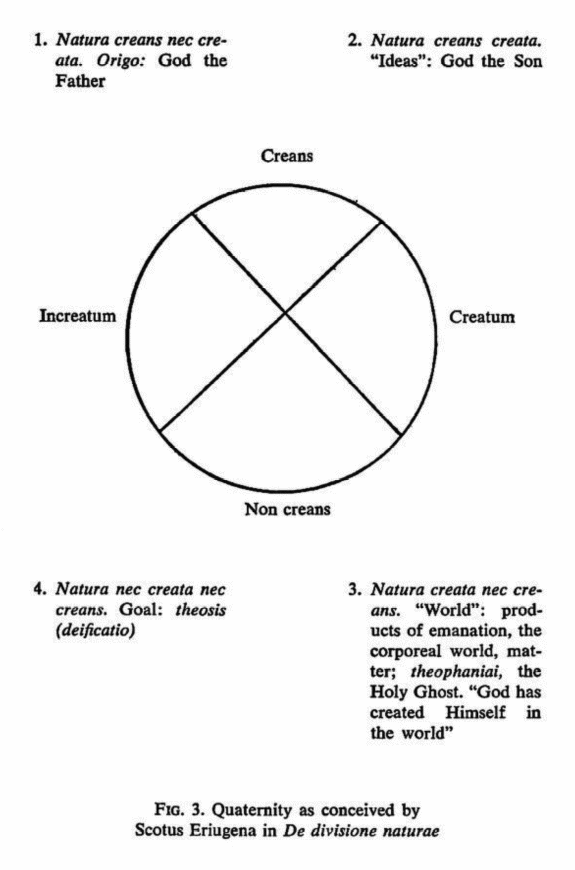
Erigena the Scott -- 4 categories in the division of Nature. (see Kepler)
1) uncreated and creates (prakriti)
2) created and creates (psyche - 7 vaikritis)
3) created and does not create (differentiated effects - vikaras)
4) uncreated and does not create (purusha)
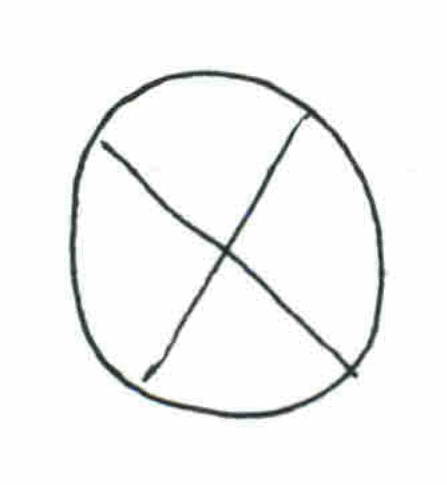
[FIGURE 1981 0320a-3-AB. Erigena's Fourfold. Facsimile scan from AB class notes.]
Active: 1) that which creates, 4) that which does not create
Passive: 2, 3
Samkhya Review
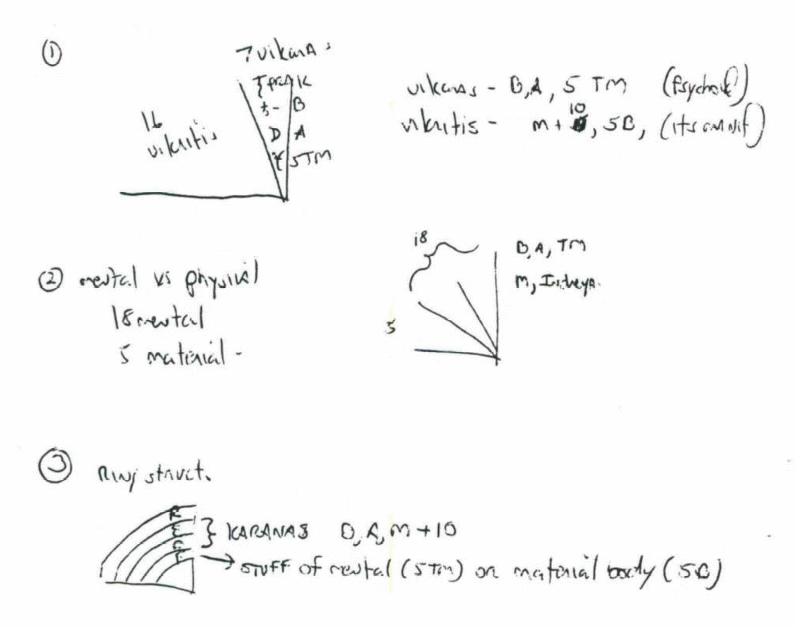
[FIGURE 1981 0320-4a-AB. (Figure 1). 23 Tattvas as Cause and Effect. Prak = Prakriti; B = Buddhi; A = Ahamkara; 5 TM = 5 Tanmatras; M + 10 = Manas and 10 Indriyas; 5 B = 5 Bhutas; Manif = Manifestation. Facsimile scan from AB class notes.]
[FIGURE 1981 0320a-5-AB. (Figure 2). 23 Tattvas as Mental and Physical. B = Buddhi; A = Ahamkara; TM = Tanmatras; M = Manas. Facsimile scan from AB class notes.]
[FIGURE 1981 0320a-6-AB. (Figure 3). 23 Tattvas Mapped onto Ring Structure of Fourth Quadrant. R E D F = Rulership, Exaltation, Detriment, Fall; B = Buddhi; A = Ahamkara; M + 10 = Manas and 10 Indriyas; 5 TM = 5 Tanmatras; 5 B = 5 Bhutas. Facsimile scan from AB class notes.]
Karanas take a form of knowing on 4 levels (sense, samkalpa, appropriation, certitude).
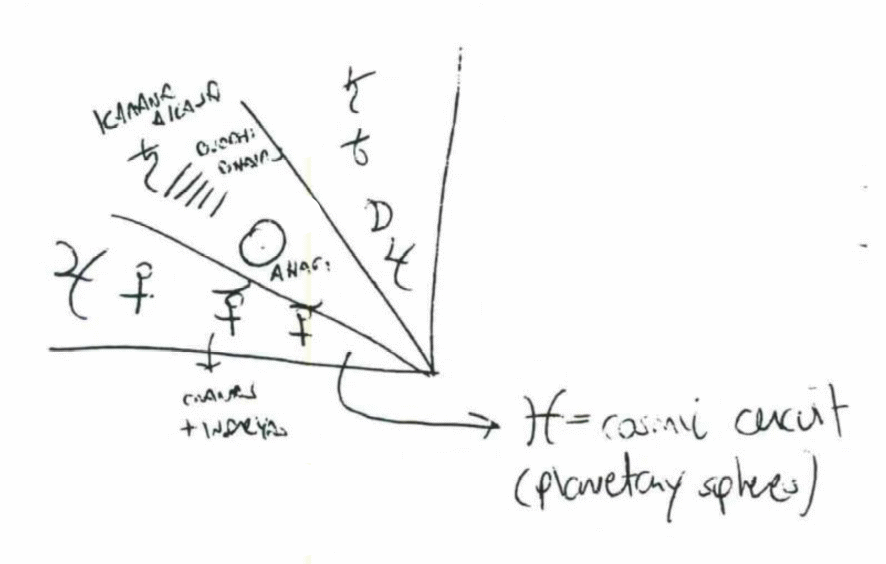
[FIGURE 1981 0320a-7-AB. Tenth and Eleventh House Tattvas as underlie of Twelfth House Cosmic Circuit. Aham = Ahamkara. Facsimile scan from AB class notes.]
Do planetary spheres contain a duplicate of Samkhyan principles?
The mental body inserted in the physical body is the subject-object relation (not necessary to being in the soul).
The living animate does not require the soul.
[Classnotes AB 1981 0320 End]
Class
Friday, March 20th, 1981
Verbatim, unedited transcriptCLASS at Wisdom's Goldenrod, Hector, NY
with Anthony Damiani (AD)
March 20a, 1981
PLATO; 7TH EPISTLE
with Appendix: Classnotes AB 1981 0320.
TOPIC: Plato
SUBJECT: 7th Epistle
SUBSUBJECTS: "Dialectic and Sophism in Plato's Seventh Letter" paper, Samkhya, Epistemology, AD Methodology, Erigena the Scot
CONTENTS:
Reading of Plato's Seventh Epistle, passage on four means & Idea: name, description, image, knowledge, Idea/thing-itself
Reading of Anthony's (Gadamer's) paper
Words
Geometry, mathematicals
Where is the real circle?
Levels & ideas
Communication of ideas
Not a hierarchy or pyramiding of ideas, back & forth
Ignorance of an Idea
Chart & house structure: subject & object
The Animate's interference
Intuition of the Reality is not that Reality
The weakness in philosophy vs. mathematics
Use the means to deliver philosophy, they don't force
Science
It's because of the means that understanding different in philosophy
Knowledge of the means interferes with knowledge of reality
Mathematical circle beyond the means; but most mathematics & science within means, only
Truths of mathematics & Being
Interrelatedness of Ideas; all rooted in Being
Psychological compulsions & reason
AD posing a question
Why so many philosophical schools?
Premises in the soul?
Compulsions in individual & natal chart
Soul & logic
Every interpretation in some way correct
Agreement with Jung up to a point
360 example
Two sages both speak the truth
Truth may be infinite
Parmenides dialectic
Plato a smart fellow
Pauli
Elephant & blind man
Erigena the Scot, fourfold
Fourfold with Samkhya terms
Jung, quadratic figures
Samkhya fourfolds
Pauli blinded by Jung's orthodoxy
Difference between Psyche & Soul
Bad upbringing
AD's methodology, bringing the idea to the foreground
Diagrams with Samkhya principles
Using Jung's terminology for this
Psyche includes subjective & objective
Overview of three ways
Finding all this in cosmic circuit
Soul as uncreated & entity fabricated by cosmic circuit
Entity, receptacle
Principles of 10th, 11th underlie 12th
Soul knows through intermediary, mental body
Subject-object relation is mental body inserted in physical
Four levels of psychic functions versus epistemological categories
Jung's, Aristotle's categories
"Cake is baked"
When you wake up, can you define the limits to which the mind extends?
Little child assimilates physical and psychic atmosphere; what's written in his chart is being fulfilled by the immediacy of the environment
Projection, relation of Soul to cosmic circuit
Pervaded–limits of universe
Image
Ahamkara prior to image
Tanmatric substratum
Bhutas
Ahamkara & react
Body, object created by cosmic circuit
Object fabricated by cosmic soul, part of primal image
Appendix: AB class notes
BOOKS / MAGAZINES READ FROM OR REFERENCED:
Hans-Georg Gadamer, Dialogue and Dialectic: Eight Hermeneutical Studies on Plato, "Dialectic and Sophism in Plato's Seventh Letter"
Plato, Epistle VII, L.A. Post transl. in Edith Hamilton & Cairns, eds., Plato: Collected Dialogues
Shrine of Wisdom, Part II of "Extracts from Thomas Taylor's Dissertation on the Platonic Theory of Ideas," 7th Epistle extract
W. Pauli, "The Influence of Archetypal Ideas on the Scientific Theories of Kepler" (in C.G. Jung, W. Pauli, The Interpretation of Nature and the Psyche)
K.C. Bhattacharyya, Studies in Philosophy, Vol. 1, "Studies in Samkhya Philosophy"
Paul Brunton, The Hidden Teaching Beyond Yoga
Paul Brunton, The Wisdom of the Overself
Plotinus, The Enneads (MacKenna translation, 4th ed.)
PLOTINUS QUOTES READ OR REFERENCED: IV.4.23
DIAGRAMS appended to this transcript:
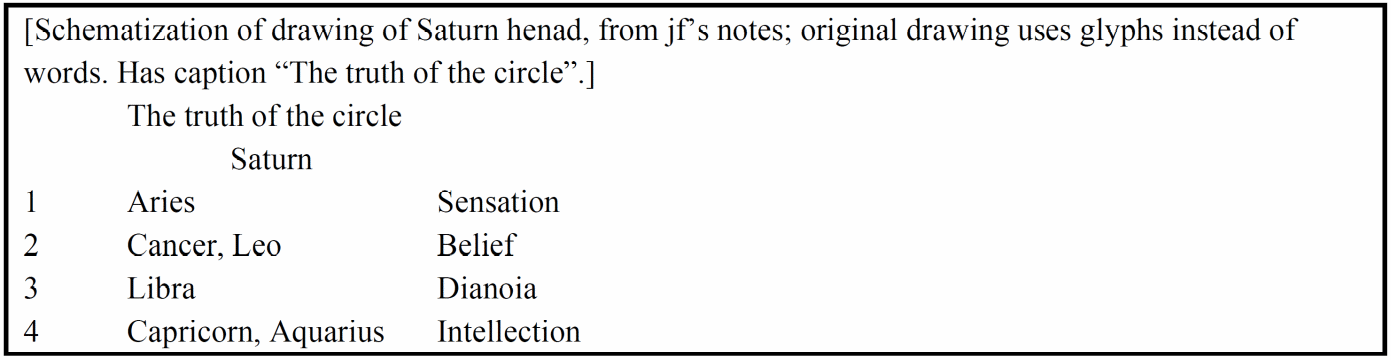
FIGURE 1981 0320a-1-JF. The Truth of the Circle: First Quadrant; Saturn Henad.
FIGURE 1981 0320a-2. Erigena's Fourfold (W. Pauli).
FIGURE 1981 0320a-3-AB. Erigena's Fourfold.
FIGURE 1981 0320a-4-AB. 23 Tattvas as Cause and Effect. (Figure 1)
FIGURE 1981 0320a-5-AB. 23 Tattvas as Mental and Physical. (Figure 2)
FIGURE 1981 0320a-6-AB. 23 Tattvas Mapped onto Ring Structure of Fourth Quadrant. (Figure 3)
FIGURE 1981 0320a-7-AB. Tenth and Eleventh House Tattvas as underlie of Twelfth House Cosmic Circuit.
Other diagrams also referred to are not with this transcript version. [Transcriber note: [diagram] means the speaker is referencing a diagram as he or she is speaking. If someone is drawing or writing, with audible sounds of chalk on a blackboard, I indicate this by [drawing] or [writing].]
AD PAPER read in class:
- Annotated Abridgment of Hans-Georg Gadamer's "Dialectic and Sophism in Plato's Seventh Letter". Retyped as 1981 0320b V09BN. Plato - 7th Epistle. It seems there was another class held on this paper in January 1981 (references in Idea of Man classes), but as of 2018 there are no audios extant for this.
NOTES:
This is 1981 03/20a, Plato; 7th Epistle Class, and the first entry associated with this date. 1981 03/20b = Plato; 7th Epistle Book Notes.
This class took place on a Friday.
Samkhya = final portion of this class, fairly abrupt changeover (see note in middle of transcript).
See the Idea of Man and Iamblichus class series for more context (both occurred in first half of 1981).
AB class notes have been appended because they contain diagrams referred to in the class, and also for completeness. Retyped from Classnotes AB 1981 0319 to 1981 0425.PDF. All spelling, capitalization, and punctuation corrected, all abbreviations and astrological glyphs spelled out.
TRANSCRIBED Verbatim by IT 2016 (V11a), reformatted by jf 2018. There was an earlier transcript version done by jf in 2006 which was included in the 2007 Plato series transcripts. This new version is V12ap (2022). It has AB notes and diagrams appended with references to these diagrams inside the transcript; updated prefatory matter, including change in paper title; Book List expanded and altered; Subsubjects expanded; Plotinus quotes section added and Plotinus reference added inside the transcript; a number of errors corrected inside the transcript; second diagram replaced by a more detailed version of the same from Pauli's essay; appended paper removed, now stands alone; date in footer and elsewhere throughout the transcript corrected to say 1981, not 1980; new formatting to accord with new conventions. Archival verbatim transcript with AD Paper – V12ap.
AUDIO FILES: 1981 0320a, 1981 0320b [Note: "Tape" and "Side" refer to original audio cassette tapes that were later digitized into .MP3 Audio Files.]
1981 03/20a at Wisdom's Goldenrod
Plato; 7th Epistle
[Audio File 1981 0320a Begins]
AD: --um, we keep running up into it. You want to read this to the class?
AS (faint): (My agents) [one/two words inaudible]
AD: At any rate, in the 7th Epistle, Plato has a letter, kind of long letter but there's about two pages in it where he speaks about a circle. There are only two pages but [S, faint: That's all, yeah.] I blew it up into twenty [in the book notes/paper, below], so-- (some laughter) So if-- to refresh your memory, if you didn't read it. Would you read the passage?
[short pause, shuffling of papers]
Plato, Epistle VII, 342a-343c, L.A. Post transl. in Hamilton (AS reading): For everything that exists there are three classes of objects through which knowledge about it must come; the knowledge itself is a fourth, and we must put as a fifth entity the actual object of knowledge which is the true reality.
AS: I'll read that again.
Plato, ibid (AS reading): For everything that exists there are three classes of objects through which knowledge about it must come; the knowledge itself is a fourth, and we must put as a fifth entity the actual object of knowledge which is the true reality. We have then, first, a name, second, a description, third, an image, and fourth, a knowledge of the object. Take a particular case if you want to understand the meaning of what I have just said; then apply the theory to every object in the same way. There is something for instance called a circle, the name of which is the very word I just now uttered. In the second place there is a description of it which is composed of nouns and verbal expressions. For example the description of that which is named round and circumference and circle would run as follows: the thing which has everywhere equal distances between its extremities and its center. In the third place there is the class of object which is drawn and erased and turned on the lathe and destroyed--processes which do not affect the real circle to which these other circles are all related, because it is different from them. In the fourth place there are knowledge and understanding and correct opinion concerning them, all of which we must set down as one thing more that is found not in sounds nor in shapes of bodies, but in minds, whereby it evidently differs in its nature from the real circle and from the aforementioned three. Of all these four, understanding approaches nearest in affinity and likeness to the fifth entity, while the others are more remote from it.
The same doctrine holds good in regard [AS reads: regards] to shapes and surfaces, [both straight and curved], in regard to the good and the beautiful and the just, in regard to all bodies artificial and natural, in regard to fire and water and the like, and in regard to every animal, and [in regard to] every quality of character, and in respect to all states active and passive. For if in the case of any of these a man does not somehow or other get hold of the first four, he will never gain a complete understanding of the fifth. Furthermore these four―[names, descriptions, bodily forms, concepts (square brackets in original.-jf)]―do as much to illustrate the particular quality of any object as they do to illustrate its essential reality because of the inadequacy of language. Hence no intelligent man will ever be so bold as to put into language those things which his reason has contemplated, especially not into a form that is unalterable―which must be the case with what is expressed in written symbols.
Again, however, the meaning of what has just been said must be explained. Every circle that is drawn or turned on a lathe [AS adds: or] in actual operations abounds in the opposite of the fifth entity, for it everywhere touches the straight, while the real circle, I maintain, contains in itself neither much nor little of the opposite character. Names, I maintain, are in no case stable. Nothing prevents the things that are now called round from being called straight and the straight round, [AS reads: and vice versa] and those who have transposed the names and use them [AS adds: now] in the opposite way [AS reads: in opposite ways] will find them no less stable than they are now. The same thing for that matter is true of a description, since it consists of nouns and [of] verbal expressions, so that in a description there is nowhere any sure ground that is sure enough. One might, however, speak for ever about the inaccurate character of each of the four! The important thing is [that], as I said a [little] earlier, [AS adds: that] there are two things, the essential reality and the particular quality, and when the mind is in quest of knowledge not of the particular but of the essential, each of the four confronts the mind with the unsought particular, whether in verbal or in bodily form. Each of the four makes the reality that is expressed in words or illustrated in objects liable to easy refutation by the evidence of the senses. The result of this is to make practically every man a prey to complete perplexity and uncertainty.
[Plato's Letter continues; Anthony liked this version of Thomas Taylor, as found in the Shrine of Wisdom, Part II of Extracts from Thomas Taylor's Dissertation on the Platonic Theory of Ideas, p. 176, on the following passage from the 7th Letter of Plato, 344b: "For a thing of this kind … cannot be expressed in words, like other disciplines, but by a lasting familiarity and conjunction of life, with this divine object, a bright light on a sudden, as it were leaping from a fire, will illuminate the soul, and there preserve and nourish its splendour."]
S (faint whisper): Right.
AD (faint): Alright.
S (faint): Yeah, yeah.
S (very faint): Yeah.
AD: It's only two page but it's-- it's-- he's really got quite a bit in there. I'm going to try to explain the way I understand this, [S, very faint: Good idea.] what he is saying here. [short pause] And I'm going to steer away from the chart just for a while so that this will be just straight talk. You won't have to think of the chart. So--
Anthony's paper (AD reading): In the 7th Epistle Plato illustrates a unique and important notion that the means in and by which an intuition is miscarried in the delivery and communication. Because of this interference philosophy cannot compel or insist upon allegiance as in other disciplines. For instance, in geometry, (we/he) can bring together proofs enough which by virtue of their logical cogency compel the auditor to admit or submit to their validity. This does not seem to be the case in philosophy.
AD: You follow that?
S: Yeah.
VM (faint): All too well.
AD: In geometry you won't be able to say "Well I disagree with you." [VM simultaneously: There's no schools.] In philosophy you can go on doing that.
Anthony's paper, cont. (AD reading): Why doesn't the possibility of compelling someone to understand --for instance, the way the other disciplines force us to-- exist for philosophy?
AD: Why don't we have this problem, why don't we have this situation in philosophy?
Anthony's paper, cont. (AD reading): And Plato tries to tell us something about this difficulty in the 7th Epistle. But the many elephant-- elements…
AD: Elephants too. (AD laughing, laughter)
Anthony's paper, cont. (AD reading): But the many elements of interference with which the soul is involved in its attempt to understand a piece of knowledge and communicate it. He enumerates the various components integral in the process of understanding.
AD: And he-- he listed them here. [cf. Plato read earlier]
Anthony's paper, cont. (AD reading): The factors spelled out are simply the name or the word for the thing, the explanation or conceptual determination…
AD: You know, what he calls the definition, also the-- he uses the term 'logos' a lot.
Anthony's paper, cont. (AD reading): …the definition, and an image or a model, the figure itself, and finally the piece of knowledge that is grasped.
AD: Now for the problem.
Anthony's paper, cont. (AD reading): All these four provide no certainty of themselves that the thing will come to be known as it truly exists.
AD: Alright, you follow that? In other words, you have the name "circle," alright. You propose a definition. You define it conceptually, right? You make a figure of it. And then you understand something of that figure. Now these four are means to grasping the reality. So--
Anthony's paper, cont. (AD reading): All these four provide no certainty of and by themselves that the thing will come to be known as it truly exists. The circle, for instance, what Plato calls an Idea in the strict sense of the concept, belongs to the category of mathematical constructs which constitute a sort of intermediate between sense perceived and intelligible. Now such entities [AD: These mathematical intermediates.] are especially suited to illustrate the transition to pure thinking or dianoia and better, and the way to true knowledge, or the turn to the idea.
AD: Like there's a turning, all of a sudden you begin to feel that you're thinking without the use of any phantasms or images.
Anthony's paper, cont. (AD reading): Plato asserts that all these four…
AD: These are-- [one/two faint inaudible student words] [11½ second pause] Um-- [AD possibly semi-reading this sentence] This is the way we said to true or what he calls scientific knowledge in his way of speaking.
Anthony's paper, cont. (AD reading): Now even he who has not seen all the metaphysical implications of the concept of pure thinking, but only grasps something of it in mathematics, will realize the possibilities for knowledge that lie in turning towards dianoia. In a manner of speaking one looks right through the drawn circle and tries to keep the 'pure thought' of the circle in his mind. Thus the example Plato chooses is one of those entities which have a propedeutic effect, or educational effect, in regard to philosophic thought, just like in yoga. They school one's vision for that which is(,) unwavering, and they raise the soul, as it were, to the level of pure thought in that they turn it away from all that is encountered in sense experience or in conversations in which mere opinions are bantered about. Now obviously the circle is an instance of the knowledge of all those things which one can know.
Now with this example in mind it can easily be shown that one cannot communicate knowledge unless one has a name for it and is able to explain the word by which one names a thing, formulates a conceptual determination. The word comes first, obviously. The words have and do give a linguistic characterization, associations that are peculiar. The clarifying conceptual determination or definition of Plato for instance is one that gives an example, where he says that everywhere on the periphery equidistant from the center, this is exactly what a circular line actually is. [AD: Continuing--]
The example shows us what Plato means by the logos. [AD: This is what he refers to when he says a logos, a logos is a statement, a definition. It's not any statement at all but an essential statement, it tells you something about the essence of a thing.]
Then on the list is a figure of the mathematical example chosen. Now these may be thought of [as] symbols, and Plato's point of departure is that the circle one sketches in the sand or on the blackboard and erases. But in any case, although the model is destructible, the circle itself cannot be destroyed.
Now fourth on Plato's list is knowledge, insight, true opinion. [14 second pause] And it's not to be found in the sounds or in the body of tangibles, but something which is found in the soul. Now, this too is not the thing itself, the knowledge, the insight, this is not the thing itself. For the circle itself is not in the soul. It is something distinct in the soul. It is one thing identical with itself and different from everything which occurs in the soul. In the soul many things occur. Now, if seen in this light it makes sense to place the insight together with the other three means of acquiring knowledge.
AD: So we would have to take all those four and put them under one category.
Anthony's paper, cont. (AD reading): Insights, true opinion, real knowledge do not belong to the true reality but to becoming. They are part of the intellectual stream of life. So our grasp of a mathematical theorem in our thought is not independent of our intellect. It is part of it and it is not certain that I can reproduce the theorem in my thought, even if I do know it. Like any thought, it takes part of the coming into being and the passing away in a being other than itself. Unlike the thing itself, science in the soul is not timeless.
The closest to the thing itself is obviously and only insight. Suddenly everything which contributes to the intelligibility of the thing-- [AD: I'm sorry. (corrects himself as follows)] The closest to the thing itself is obviously insight. Everything which contributes to the intelligibility and the internal relationships of the thing to itself is present to me all at once. The steps of the proof, the name or the word, the auxiliary construct which is so difficult to find, the model, and all that leads onward into the insight. More than anything else, this evidentness which makes one to say "I've got it" is the intrinsic relationship of mathematic structure as such. Plato calls this evidentness - Nous. And he quite rightly distinguishes it from the science which I have attained when I master mathematics. Now despite all the differences among these four there is something common to all which makes it possible to put them together. They must all play a part if one really wishes to grasp a thing--they all make a thing present to us some way or another--the concept, the illustration, and above all the luminousness of an insight which comes to us out of all these -- circle itself. Thus besides these four which are the circle, the circle itself isn't there. Plato's simple enumeration of all these things, apparently so diverse, is not without its justification.
These four are needed, are indeed indispensable. But they are of such a nature that if one avails oneself to them, one could never grasp the thing itself with complete certainty. One could never be sure that with these means the thing itself is displayed in its full -- that is, this concealed intelligibility. And this is the basic experience in every philosophic endeavor, in every philosophic discussion. Words, which are just words, are not supposed to be mere empty talk. They should be capable of constructing the thing meant, of re-constructing the thing meant in another person, erecting it so that it is there in him.
Now what is the reason that the means, whether taken individually or all together, are actually incapable of compelling someone to understand? What is their weakness?
We must keep clearly in mind that Plato's exposition of this weakness is designed for those with no previous education in philosophy. Each of these four means has a tendency to bring reality of a specific sort to the fore--instead of the reality of the thing itself, which is supposed to be displayed in word or discussion, example or knowledge. They all have an intrinsic distortion tendency, so to speak. The elements involved in the process of bringing something else into manifestation assert themselves as whatever particular thing they are. In other words, they all are something besides the thing that they are presenting. They all have a reality of their own -- a character which differentiates them from that thing. The word 'circle' is not the circle itself -- nor is the statement which defines what a circle is, nor is a circle which is drawn. And even my insight into that which a circle is, is not the circle. All these are means and assert themselves as whatever they are, and push themselves to the fore; they suppress that which is displayed in them.
Now we assume that the intelligibility of a sign, a word, etc, lies in the fact that it points away from itself, does not assert itself as an independent reality, but is subservient as a function. Nonetheless, Plato's argument is still valid -- the fact that the sound of a word can bring something else to the fore which does not represent the thing meant, results from precisely the fact that insofar as it is a sign it depends upon a particular convention. The possibility of renaming shows and demonstrates that the sound by which the word names a thing does not carry its meaning in itself unambiguously. What Plato has in mind is obviously that this ambiguity of words allows a word to let something else be there instead of presenting the thing, that is, the thing meant.
This applies also to the next step, the definitional statement, because it is made up of words. Now clearly the ambiguity of a word is reduced directly by its positional value in the context of what is spoken. Having seen that, one might well proceed to a critique of the idea of an unambiguous coordination of sign and the thing designated. The assumption that a perfected instrument of designation exists by which everything that one means and thinks precisely could be designated, is a nominalistic prejudice, the untenability of which has been, I think, demonstrated by Wittgenstein's investigations. One might think that the transition from single words to the whole of speaking would suffice to overcome the weakness which lies in naming. One would like to believe that Plato's dialectic does justice precisely to this consideration in opposing the logos as the blending of the ideas to the fruitless undertaking of defining things atomistically. As a matter of fact, it seems to me that here we have the answer to the question why Plato rejects definitional statements -- same argument which he used against the single word. The weakness of the word as such is overcome by the logos. In fact, its purpose as a clarifying conceptual definition is to transcend the artificiality which lies in the ordinary use of language with its mere naming of things. By determining the concept, it lets the thing itself be present as it is determined. Insofar as one has established a definition, one seems to be beyond mistaking one thing for another.
But even this isn't so. In the 7th letter no logical insight is presupposed by which one could have attained only at the end of some course of instruction. The point of departure is the dialectical experience, which everyone has from the start. If one wants to describe the dialectical experience of thought, one may not just presuppose a systematic doctrine of classificatory concept formation; instead one must display, or show, how the procedure of conceptual definition itself contains something arbitrary and (certain).
AD (faint): Let me leave it there.
S (faint): Uh-hm.
Anthony's paper, cont. (AD reading): We see something of this in Plato's doctrine against the possibility. The interweaving of the highest genera in the Sophist, and even more, the dialectical exercise which the young Socrates is put through by the elder Parmenides, leads only to the negative insight that it is not possible to define an isolated idea purely by itself, and that the very interweaving of the ideas militates against such a positive concept or definition.
Now only if one has an immediate and fundamental dialectical experience in mind, does one understand what Plato means when he describes the ultimate possibility of knowledge as a lingering with all four, a lingering which passes back and forth from one to the other. All attempts to read an ordered ascent into this series of means, a graduation of them which would correspond to the ascent of the soul over the whole system of knowledge up to the Idea of the Good, would be mistaken.
AD: Now-- it's the same idea, just repeated.
Anthony's paper, cont. (AD reading): The weakness of the first three are pointed out in detail in the discussion of the weakness of the logoi. There is no mention of the weakness of the fourth, of the state of the soul when it recognizes and knows. And the state of the soul, which we call scientific knowledge or insight into the truth, must also be of such a nature, that it asserts itself and thereby conceals the thing itself.
AD: The soul by asserting itself conceals the thing it's trying to reveal.
Anthony's paper, cont. (AD reading): It seems to me that the demonstration on this point is not given for the sole reason which is implied, to a certain extent, through our exposition. For when there is mention made in what follows of the bad upbringing of the soul and the helplessness of the individual soul, in confrontation with the dialectical techniques of an opponent, and when well-intentioned refutation and uncontentious questioning and answering are called for, an indirect indication is given for what Plato has in mind. In knowledge and insight there is distortion too. In argumentative discussion the distortion, which any knowing implies, and which can push to the fore, is the obstinacy which makes us refuse to acknowledge that someone else might be right.
To sum up, somewhat: If one stays with the phenomena, the thing itself, one can see that the weakness of all the four is the same. All the four means are trapped in the dialectic of the image or copy. Insofar as all four are attempting to present the thing in and through themselves, they must of necessity have a reality of their own. That which is meant to present something cannot be that thing. It lies in the nature of the means of knowing, that in order to be means, they must have something inessential about themselves.
Then this is the fundamental source of our error; we are always mislead into taking that which is inessential for something essential. What occurs here is a sort of falling away from what was originally intended, that is, from the orientation of all these four means. Plato says expressly that this happens to all of us, and that it fills us with confusion and uncertainty.
One must constantly keep in mind that from the first to the last word of the so-called theory of knowledge in the 7th Letter refers to the community which exists among people speaking to one another. It raises this question as how an insight can become comprehensive and present for me and for you -- or put another way -- how a thing can be there in what is said in such a way that it is truly there, disclosed, and not to be confounded by any objections. The Greek experience had gone through the eerie feeling that in discussion, any insight could be confounded and lost, and even mathematics could be discredited by the Sophist shadow boxing.
So let's take an example -- and this of course is one of the necessary means by which knowledge is presented. They belong to the class of images, synonyms, and they correspond in a certain way to the figures we have in mathematics. They themselves are not what is meant, but that which is meant becomes visible in them. They are what one paints in order to make clear what is actually meant. They are, in other words, paradigms or models. Here's the example. He who asserts that truth must be spoken and that it is a precondition in order for us as human beings to communicate and live together. This is presupposed. Now he who seeks to justify this assertion must certainly present evidence concerning the validity of this assertion. [S, faint: Anthony--] So that it may be possible to penetrate to the depths in which human communication has its foundation in this requirement, in respect of which all pragmatic concerns are secondary.
So there is no means of compelling someone to see the truth who does not want to see it. Not only is it possible for him to point out what everybody says or does, that is, disregard the need for truth, he can justify his evasion theoretically by placing the whole truth in question. For instance, what Hitler might have done as to what is truth. [S, faint: Right.] Now he who has no sense of propriety, from whom no response is drawn when recourse is had to these concepts, will never understand what they are about. He will in fact be of the opinion that he knows better than anyone else, and will seem to be the one who sees through the naiveté of all those inhibited by such morality. It is for this reason, the knowledge which we require of one another, the fifth thing, the thing itself, which is constantly endangered, and is one of the most marvelous insights of Plato, when he says this danger has its source in the weakness of the logos.
Now the example makes it clear what is meant when the text says that he who is himself supposed to get a vision of the thing itself. Or he who would engender that vision in another must have an affinity for the thing, besides having the intellectual gifts of comprehension and memory. And the purpose of the Socratic dialogue was to avoid being talked out of the fact that there is such a thing as Truth, Beautiful, the Good. And what is sought and made available in the Epistle is this and more. For Plato would maintain that he would understand what is truly good and truly bad must at the same time understand the falsity and the truth of the whole of reality. It does not mean an intact whole of any specific thing being talked about. Rather, this all-inclusive expression is meant to point beyond single opinions about any one thing.
This mood of thought had long since passed beyond the specific example from which it had taken its departure, that is the circle, and made a transition from the mathematical virtue, [AD mis-speaks: "which is all speaking of his circle" then corrects himself] which in all speaking of the circle aims at the circle itself, the true virtue. It has uncovered the indissoluble unity of the whole as the foundation of this insight; true knowledge can never be reached by anything partial.
Another example in the Parmenides. Parmenides shows that a single idea by itself-- [AD: This is a side swipe at a lot of you people.] that a single idea by itself is not knowable at all. And here is the source of the error which the young Socrates makes. In any insight an entire nexus or web of ideas is involved. Plato's actual question is in regard to the constitutive organization of the structural principle of this interconnectedness of the ideas. Just as the exemplary system of the mathematical sciences provides a unified continuum extending from the number, to the point, to the line, the plane, and the solid, so too the ascent and descent of Oneness to Multiplicity, the merging of what lies separate into an astonishing and transparent Unity, with many far-reaching implications, is the law which in fact governs the progress of philosophic insight and the whole discourse of the logos. It gives the appearance of rigid schematizing. But it takes the number one and two or the One and the Dyad as a general-- generative principle of all insight, the structural principle of any discourse which properly reveals things under discussion. Perhaps this appearance of rigidity may be the reason why Plato thought it admissible to start putting it down in writing. What this doctrine actually prescribes is the felicitous experience of advancing insight which happens to the person who proceeds along the proper path to the solution of a problem, the way of discourse which reveals the thing being discussed. It is this very dialectic of the One and the Many which establishes the finite limits of human discourse and insight.
AD: [couple/few very faint inaudible words] [17 second pause] Of course we can take the diagram and the chart and the two points of a point that we can indicate everything that we've said here very simply. But I wanted to avoid that, I-- I thought it would be better we had a little discussion of this because we've been hitting this with Buddhism something awful, I mean this inability, this absolute inability where the word, the concept, instead of helping to reveal knowledge, they become the very means of blocking knowledge. And, this become almost an issue in the Buddhist class so last night we decided to throw text aside and go at it at our own because-- because of this very problem. But, if I could stop now and just discuss this for a few minutes. Because I think it's worth realizing.
[short pause]
VM: Anthony I-- I have a really basic confusion, and let me see if I can state it simply. You started out by saying in your paper, or maybe it was-- you were just saying this yourself that, in geometry you don't have various schools of geometry, everybody agrees that there's a certain logical cogency, there's a certain irrefutable nature of the proofs in geometry.
AD: Yes.
VM: Ok?
AD: Even if you, even if you brought in a different geometry.
VM: Sure. If you say take the five axioms of Euclidean geometry, from them flow a whole series of very nice results and-- and, you know, if you could follow the proof you would have to agree with it. But then, right after that you take the idea of circle, and that's one of the mathematicals that would be of great utility in Euclidean geometry and so on, and then use that as an example of how you can never know the circle in itself and that there's no certainty in dialectic and so on. And I just couldn't make that transition.
AD (simultaneously): You missed the point.
VM: I missed it entirely, that's why I said [AD simultaneously: You missed the point, good.] this is my basic confusion.
AD: Good.
VM: Good, that's the point but--
DB: Well I, look, I-- I mean, isn't the distinction be-- being made between the fact that in geometry what you're doing is discussing interrelationship of all these ideas on a practical level and how they relate to the-- the world we live in, whereas--
VM: It's not the way I think of geometry but-- I mean geometry has practical applications but I don't think of that as its primary function by any means.
DB: What--
EMD (simultaneously): We can't hear anything back here.
VM: I'm sorry.
DB: Well when you-- when you study, like when you go and try to understand a triangle, is that the idea of getting to know the triangle in itself? I mean is that the way-- I mean it's been a long time since I did any geometry. But I don't remember them mentioning that.
AD: But let's-- let's enumerate what we said, ok? [student assents, faint] That we have the word or the word or a name for a thing, and that we defined an object with the use of words, conceptually [VM assents] determine. [VM: Ok.] That is we pull out the essences, the attributes, what makes the thing to be-- you've got a definition. Then the next thing is we make a figure of the circle, or any object, does it-- doesn't matter for-- [VM assents, faint] could be any object. And these three would correspond let's say to the means or vehicles by which we're going to try to understand a circle. [VM assents, faint] Then the fourth one, the fourth one, was knowledge of the circle, it's an actual piece of knowledge, you know, piece of knowledge. [student assents, faint] That's the fourth one. The fifth one is the circle itself. Now ask your question.
VM: Well I can just state it again, I mean I-- obviously I missed the whole thing but I'm hoping that there are others who missed it.
AD: Well that's why I blew it up into 20 pages, or 12 pages.
VM: Alright you start out by saying mathematicals, [AD drawing] like circles, triangles, and so on, they, in the context of Euclidean geometry, have a very well-defined nature and there's no arguments about whether or not a sum of the interior angles of a triangle is 180 degrees and so on. As long as you state your axioms, you work from there, there's no problem. Then after you've made that assertion, which I certainly agree with, you then use one of those very mathematicals themselves to show the weakness inherent in, let's say, discourse, or more than discourse, the weakness of knowledge, period. And that's I guess--
AD: Not the weakness of knowledge but--
VM: The weakness of knowledge to grasp the true reality.
AD (simultaneously): If-- if we-- if we try working-- I-- if I do it on the chart you'll see it right away, [AD drawing, see below] see I--
VM: Maybe I shouldn't though.
AD: If we do this here, these are the 12 houses, alright, the structure of the soul. [VM assents] And then [drawing] inside here we place let's say the planetary system, alright.
VM: Ok.
AD: And [drawing] we speak about the planetary system so to speak as constructing for us the sheaths of the soul, alright. If we took-- if we took one for instance, Saturn in Aries, Cancer, Leo, Libra, Capricorn, and Aquarius. This [diagram] will be equivalent to let's say sensation.
VM (very faint): Ok.
[student assents, very faint]
[23 second pause while AD draws; see FIGURE 1981 0320a-1-JF, The Truth of the Circle: First Quadrant; Saturn Henad, appended to this transcript]
AD: Ok?
VM: Ok.
AD: We could do that with-- with all of them, right? I just took one as an example, you do that with all the planets. So the dignities of the planets or the gnostic side of the planets, alright, are providing us with the means to get an insight into the reality of the circle. Now where is the idea of the circle in all this? Looking at the cosmic circuit. [short pause while AD draws] And then this would be the realm of the soul [diagram] let's say. [drawing] But he speaks about-- he speaks about the evidentness or the dis-concealed intelligibility of the circle. Where are you going to find that?
VM: The dis-concealed? I don't know what you mean.
AD: The intelligibility of the circle.
VM: Lack of intelligibility of the circle? I'm sorry Anthony, I'm-- I'm really (AD laughs) dense tonight I guess.
CDA (simultaneously): Bless you.
S: [couple/few words inaudible]
AD: The circle.
VM: Where you--
AD: Where would you find it?
VM (simultaneously): You're not going to find it in the planetary spheres, ok, fine.
AD: Here [diagram]?
VM: Well, I'm not sure you'd find it there either. That's the circle in the soul might be [AD simultaneously: Yeah.] there but the real circle is probably a 2nd Quadrant entity.
AD: So then we would say it's the idea of Being, [drawing] alright, it's the idea of Being. So that would be the next circle below that [diagram]. So then the truth of the circle, the reality of the circle, the circle has a reality, [VM: Yeah.] is in this realm [diagram].
VM (faint): Would be-- yeah, ok.
AD: Are any of these four that reality?
LR: But you know, Anthony, it's almost-- seems to almost belie the point to draw the diagram on the board because-- (VM laughs a bit)
AD: Go on.
LR: (Ok.) Because it seems like the very point you're making in that paper is that no image-making-- that there (aren't/are) various levels of revealing or disclosing an idea, and yet each of those levels, because they are a thing in itself, will-- will display itself more than it will the idea that it's trying to convey.
AD: Yes, they'll interfere, they'll have a tendency to interfere with the evidentness of the idea that you're trying to perceive.
LR: And, when we draw-- when you just-- when you go to the board and draw several circles, the-- the distinction of levels then is the very-- seems to me the very thrust of what you're saying in that paper then is not made clear, it's all--
(Side 1 of original cassette tape digitized as 1981 0320a Ends; Side 2 Begins)
VM: So the symbol supposedly points beyond itself, as he says in there, I-- I mean--
LR: No, it's not denying that that's possible, that's obviously one of the first-- that they're all pointing towards something.
VM: Right.
LR: What I'm saying is-- When you-- when you say well 4th quadrant, 2nd, 3rd, ok, you look at circle on the board and you see one's there on the left and one is over there on the right, 4th quadrant, 2nd quadrant. It doesn't convey the fact that-- the realms that-- that that symbolizes maybe [one/two words inaudible]
AD (simultaneously): That that symbolize? I'm sorry, I don't follow you yet.
LR: That's ok, I'll-- it's (just/took) me [couple words inaudible]
[short pause]
AD: Let me reread this.
Anthony's paper (AD re-reading): Insights, or intuitions, too, do not belong to true reality but to becoming. They are part of the stream of intellectual life. Our grasp of a mathematical theorem or any truth in our thought is not independent of our intellect. It is part of it and it is not certain that I can reproduce the theorem in my thought, even if I do know it. Like any thought, it takes part of the coming into being and the passing away in a being other than itself. Now, unlike the thing itself, [AD: The fifth, the reality. "Unlike the thing itself] science in the soul is not timeless. The closest to the thing itself is obviously an insight.
AD: Could we continue? Because you gotta-- you gotta antagonize me, otherwise I--
S (faint): Try [couple words inaudible]
VM (faint): I understand.
AD: I mean you missed the point to begin with.
VM: I understand that.
AD: You missed the point. (VM chuckles)
LR: Wait, what I was trying to say was, the point of view of the-- the point of view of the paper(,) this (here/year)(,) is from the point of view starting with a reality, how is it to be disclosed.
AD: How is it--
LR: How is a real idea to be disclosed, say to another. It presupposes the fact that that idea is grasped initially by someone.
AD: That it can be grasped, yes.
LR: If you're disclosing an idea to this class, or trying to I should say, if you're attempting to convey some truth, what we're presupposing is is that truth is understood by at least one person participating, and now the-- now the-- the procedure is the dis-- the-- the dis--
AD: To try to communicate that to others.
LR (simultaneously): The demonstration of it, ok.
AD: And these are the choices I have.
LR: Right. Now this is a very different-- that's the point of view of this paper, this is very different from starting from a point of not grasping any truth and working up. In other words, we're starting from the top and seeing how it could be brought down. That's what you're-- that's what the subject-- that's what you're dealing with.
AD: No, the-- the idea I think is really quite simple. Perhaps its simplicity is our difficulty. And that is that, in grasping reality, let's say the circle itself, that the very means that are employed interfere, [LR: Yeah.] interfere, first they interfere in my grasping that reality, and secondly, if I do grasp it, in delivering it to someone else.
LR: That's right, and I'm saying that those means are going to mean something very different for he who starts at the bottom to try to ascend to an idea, than they mean for someone who begins with the idea as grasped and tries to reveal it.
AD (simultaneously): But again I've pointed out-- again I pointed out that if you have that view, I think it would be mistaken for Plato because it is not a hierarchy or pyramiding of the ideas into a hierarchy and an-- a reaching up to an ascent, but rather a going back and forth. And that this process of going back and forth brings about the felicity, you know, of one's progress, and understanding is taking place. So I try to-- try to avoid that extreme.
LR: Except that, it can be-- it's going back and forth when the idea is grasped.
[student(s) assenting, faint]
AD: Well I--
LR: If the idea-- if you're con-- if I'm starting from a point of ignorance of the idea, I first have to get a name for--
AD: You have to get--
LR: I have to get a name, I have to hear a definition, I have to conceive an image, I have to do all those things. From that point of view those-- those means are necessary. And even a certain order to them is necessary. Whereas, if I actually had grasped the idea of circle, those means are just means. They don't stand for anything in themselves now but they're to be used as vehicles for transmitting a truth. Do-- do you see the difference?
AD: I still don't see the point. I still don't see your point.
LR: Well I don't know if it's worth pursuing. [short pause] I mean--
AD: Keep at it.
LR: Well do you see the distinction I just made between [AD simultaneously: Between--] two people, one who has a grasp of an idea and one with no grasp of the idea, how the means towards knowledge for the one who is ignorant become an actual goal in itself, the means have to be attained as on a greater scale, I first have to get the data, [student assents] I just have to-- have to get a meaning for-- I have to begin to conceptualize about it. Only for him who has the grasp of the idea are those means a sliding dispensable tool.
[short pause]
AS: And even if you don't have the idea itself, even if you don't have the reality of the thing, it will still provide like a sliding scale, various means for its expression. You're just talking about where-- I think where the person's identified. Either-- either you're talking about somebody who has the-- the reality of the thing itself and then wants to express it to somebody else, or you're talking about the reality of that thing itself wanting to express itself to you. In either case it's a question of those forming-- of those being, on the one hand, a medium for the expression of the knowledge, and on the other hand, being-- having nec-- of necessity to interfere with that expression in some way or the other. But I don't-- it doesn't seem that the operation is any diff-- I mean I can't see the distinction between the two, not in terms of the opera-- not in terms of the functioning of these means, I don't see the difference.
AD: Well could we-- could we discuss the idea a little bit and then worry about, you know, the other details? [S: Yeah.] Do you follow the main idea of what I'm speaking about here?
LR (faint): The distortion of truth.
AD: Huh? [student assents, faint] Good, if you have the idea then we go back to Samkhya, ok. [one word inaudible] you want to-- You don't want to go back to Samkhya? (AD laughing, laughter)
S (amidst laughter): No [few words inaudible]
S (faint): [couple words inaudible]
AD: Go ahead.
DB (faint): Well, I don't know, perhaps I just missed this but that's a very psychosomatic function.
AD: 'Cause you have that-- you have that problem in the chart. In the chart for instance, if we think of the soul or the house structure as the soul, alright. And then inside the cosmic circuit we have the production of the cosmic circuit, the entity, or let's say the subject and the object, alright. You have the two of them inside the cosmic circuit. Now the soul has to identify with the entity or the creature which is part of the cosmic circuit. This cosmic circuit is going to deliver certain experiences. These experiences will require a thrust of the soul, a superimposition or an extraction, whatever-- whichever way the moment is, the soul must read off, must read off what's happening. It's-- it's like an elaboration of the problem when Plotinus says that the soul cannot have experience of the sensible world directly. [Note: See Plotinus, IV.4.23.] So it does so through what he calls the living Animate. But the living Animate will present the very obstacle to understanding that sensible experience. Even if you want to say that the living Animate has all these means at its disposal, the Divided Line or these various ways of looking at it. So that these will be of a distorting tendency. Go ahead.
S: Yeah, when you say that the-- the Animate will actually interfere with understanding the sensible, what you're calling understanding the sensible there-- Isn't the presupposition of what this knowledge is about actually not about the sensible but always about what you're calling the reality of the knowledge.
AD: Yes.
S: But--
AD: The reality.
S: Yeah, so you're saying the name, concept, figure and-- and knowledge provide an occasion for understanding the reality of the knowledge, not--
AD: They-- they don't-- they don't give you enough-- they're only intermediaries.
S: Yes.
AD: Alright now if they're only intermediaries, these four are only (intermean), then when the soul does pierce, so to speak, to the knowledge and has the experience of Circle Itself, we can disregard the four above, right, because then--
S (simultaneously, faint): [couple words inaudible] he put them in.
AD: Isn't that so? But that's not the way it usually is, what usually happens is the piece of knowledge or the reality that we're speaking about is something which is in the stream of the soul of the intellect, it's part of the life of the intellect. I mean, it has a historical position, time, place, it occurred and all that. [student assents, faint] But is reality of that nature?
S: No.
AD: Well then you actually have-- are missing the point, that is, the reality itself is being missed. And you're taking an intuition, which is something, let's say, of the soul's functioning, for that reality.
S: Yeah.
AS: This--
AD: Go ahead.
S: I don't know if I'm focusing on this wrong or not but this seems to be the all the same as all that point that we've been discussing in Buddhism all the-- all this time in a-- that in-- I probably shouldn't even mention it but-- about the inherent existence. Because it seems like the-- what you're saying the interference is, or-- is the application of what-- If I understand, you're saying the reality of the knowledge is a timeless thing, it has no--
AD: It has no history.
S: No history, and therefore no-- no real direct reference [student assents] to the name, the concept, (and so forth).
AD (simultaneously): So the intuition of that reality is not that reality.
S: Right. And the intuition of that re-- it seems like that intuition--
AD: But then, would you see the following point, which is what I'm really concerned about.
S: The following point, first--
AD: Which is the weakness that exists in philosophy, in the reasoning process, that doesn't compel you to think something the way you have to in math. That's the whole point. In philosophy [student assents, faint] we do not have this absolute compulsion, that once a line of reasoning is delivered to you that you must follow this and you can't disagree. We don't have this in philosophy. You have it in math, you have it in the other disciplines. You don't have it in philosophy.
S: Insofar as you're speaking of philosophy as the--
AD: Insofar speaking of philosophy.
S: At all (you're saying/per se). It--
AD: Insofar-- I'm speaking philosophy Willie.
S: Yeah.
AD: I'm speaking philosophy. Now in philosophy the ultimate concern is to reach that reality, alright. In mathematics, the other disciplines, you're reaching something else, a portion of being. Some-- a portion of being, being is cut into segments and this part is-- is cosmology, this part is science, this part is math, this part is history, alright, and we're talking about just those different parts of being. But when we're speaking about reality per se, what I'm trying to get at is that in-- is the very nature of philosophy, that even though you do have an insight into this reality, you've actually penetrated into it, and then you try to deliver it to someone else through these means--no compulsion. [LR: Aren't you saying that--] [AD speaks following sentence intensely] They do not force you to think that way. They can't force you.
LR: Anthony--
AD: So ask yourself again, why?
LR: Aren't you saying that in philosophy the goal is outside the realm of the means, whereas in some of these other--
AD: Outside the realm of belief?
Few students at once: Means.
S: The means she said.
AD: Yes.
LR: Whereas in some of these other things the actual understanding lies within the same realm as the means, and therefore can be more easily conveyed, that there's a leap that has to be taken which cannot be bridged by any of the means you're using.
AD: Yes, I'm saying that.
[student assents, very faint]
LR: And um-- well then-- would the a-- would there-- in this point of view that you're espousing-- would the point of view that you're espou--
AD (simultaneously): It's not a point of view, it's just an observation.
LR: Pardon me?
AD: It's not a point of view, it's just an observation.
LR: Ok, and this observation would um-- when you ask the question, how can an insight or how can a truth be disclosed, would your point of view be that it cannot?
AD: How can an insight--
LR: How could a truth be unfolded or disclosed?
AD: Yes.
LR: Would your point of view be that it cannot be? Would that be Plato's--
AD (simultaneously): Not that it cannot be, but I cannot compel it to operate the way it does in geometry.
LR: Can it actually be disclosed at all?
AD: Yes it can. [S: Right.] It can. Otherwise they wouldn't-- they wouldn't be writing anything. But the point, the point is that it is not compulsive. In philosophy we do not have those means to compel someone to follow a course of reasoning and come to the conclusion which delivered the-- delivers the insight into reality.
S: The-- the strength of the argument itself won't compel the person, but if the per-- if the person who is being argued with or to whom the argument is being presented has actual experience of the reality of that knowledge, then that is compulsive, that's (final).
AD: But that's not the point Willie, yes, but that's not the point. The whole point we tried to make and that Plato's trying to show in the [S simultaneously, faint: The inadequacy of--] 7th Epistle, alright, is what?
S: Is the inadequacy of the [couple inaudible student words simultaneous with S] means of communication.
AD: The inadequacy of the means, the inadequacy of the reasoning process, that it simply cannot compel a person or force him to follow the consequences of his thinking.
LR: But-- but--
AD: Time for coffee. (bit of laughter) Go ahead, what?
LR: But wouldn't another reason for that also be that in philosophy you're-- that following the course of that reasoning one gets to a point where there has to be a leap taken by the soul?
AD: A what?
LR: A leap, a-- like in Hypothesis IIA, I mean there has to be a leap that's required to get to that-- to get to that understanding. And it's a-- it's a leap that's made on a whole different level from any of the discourse, or the course of reasoning that one has followed. [student assents] There's a whole other thing that enters which is an act of the soul which can't-- which no-- no one can compel another one to take. You can rea-- you can go up through a course of reasoning to a certain point. But at that point there's a leap that can only be taken by the person who wants to understand. And that's from the point of view of that individual soul.
AD: Go ahead Avery.
AS: Yeah but a question, how does the cosmic circuit then compel the soul to arrive at certain knowledge? I mean I can-- I could understand that in terms, you say, well, ok this-- these concepts don't compel. But in some way, very strangely, may-- maybe it doesn't, I mean maybe it really doesn't, but it sure does seem like in that case there is-- there is a com-- a compelling of the soul or an activating of the soul or a forcing the soul to bring out from itself this knowledge of the idea, so it does seem to compel, unless we're s-- unless you're saying that even that knowledge is at the level-- e-- unless you're saying that even that is at the level of knowledge and not at the level of the reality. Maybe I'm at a different point than what Linda's--
AD (simultaneously): Trey-- try again Avery.
AS: Yeah maybe I'm at a different point than what Linda's saying but-- [LR: Yeah.] [S: It would--] but, maybe putting it this way, that the-- You know we gave this example, the cosmic circuit which has at its disposal all of the-- the lower-- these means. Anything that the soul knows through these-- through the-- through this functioning, through the Animate, will be something which is evoked by these means, the medium, and will not be direct, ok. Yet, in some way, what this means here has to-- it does seem does compel the soul or does evoke from the soul a knowledge of that reality. Now, in that case it does seem that the lower three have the power of compelling the soul to follow a certain-- not-- not a-- not a conceptual reasoning but like an a-- it's like the series of-- the series of aspects and so on are almost compelling that soul to bring out a certain knowledge from within itself. And that seems harder, the-- that--
DB: But that's [S simultaneously: Yeah but is that guaranteed?] still all at the level of four. I mean I-- isn't that still dealing with the-- I mean--
AD: Alright, suppose it compels [AS simultaneously: No I'm asking.] you to accept something. Now you try to deliver that to someone.
AS: Yeah but I-- I guess I'm trying to make a-- an analogy, maybe it's not a good analogy but-- maybe it's not an analogy but, [S, faint: Ok.] in-- is--
AD (simultaneously): No I follow, the point I'm making now is, [AS: Yeah.] suppose your soul is compelled to understanding something, alright, [AS: Right.] evidentness which the Nous proclaims to it. Alright. Now you try to communicate that to someone else and see how strong those structures are.
AS: Well, I follow that, but then why-- but then-- I guess I'm not understanding something then. In the functioning of the cosmic circuit, what is it that's compelling? Then you're almost saying that it isn't these lower ones that are compelling the soul to have that knowledge but almost Nous directly. And that when I try and convey something to somebody else, as soon as I put it in terms of these mediums, in terms of concepts or figures or something, there's no-- there's no transmission possible. It's like you say the structure is too weak, it's like a weak bridge, it can't-- it can't hold the force of the Nous, ok, if I try and convey something to somebody. I may have the direct experience of it but as soon as I have to bring it down into, you know, into the lower-- into concepts and images, I-- it won't-- those concepts and images won't hold the reality. I follow that, they-- and they therefore can't compel the other person to have that.
AD (faint): Uh-hm.
AS: Yet, on the other hand though-- I mean suppose we take the other example though of the co-- take the cosmic's-- Is it-- but-- isn't there something-- well no I-- ok. That-- that one I follow but-- Now take the example though, the soul is learning from this cosmic ex-- cosmic circuit, is learning from the-- maybe it isn't learning from that. I mean maybe that's the point, that that isn't-- that the cosmic circuit is not evoking the knowledge of reality?
S: But--
AS: Wait Willie.
AD: I'm right-- I don't follow you yet.
AS: I may be not be able to commu-- my concepts and images may not have the ability to hold the weight of reality but it seems like-- although it may be wrong, it seems like the cosmic circuit's functioning does have the ability to hold the weight of that reality of the Nous in some way. My functioning-- my concepts may not.
AD: That's-- no one's disagreeing with that.
VM (faint): Yeah.
AS: Yeah but I'm s-- but all I'm saying is--
AD: The point I think you just made, and made adequately, was that there may be a compulsion in it for you, [AS: Yeah.] alright, but you try to transmit that [AS: Ok.] and you'll see how all those structures become meaningless and maybe even worthless.
AS: Yeah but that's not-- but that seemed to be an important question for me because that seemed to say something about the nature of how-- you know we were trying to understand how what goes on in here [diagram] is evoking some knowledge within your soul, now it may not for somebody else. Some transit's going on, something's going on. You may have a direct-- that may trigger in you a knowledge of reality, whereas it won't in somebody else, it may not have that compulsion. But when it does have that compulsion--
AD: Try to universalize it.
AS: When it does have that compulsion, who--
AD: Yeah, try to universalize it. Go ahead.
[short pause]
AS: I don't know, can you, I mean can you, you can't univer--
VM (simultaneously, faint): Oh that's the point.
S (very faint, in background): [three/few words inaudible]
AD: Look, if I discovered a new science, alright, and I lay out the laws, and you follow this science, you will be compelled by the reasoning processes inherent to complete it and go through with the same results that I do. That's what science is all about.
AS: Right but that's on the level--
AD: Try it in philosophy.
AS: Right, that's on the level of these [diagram] though, that's not at the level of-- of s-- of reality as it were.
AD: I'm sorry?
VM (very faint): Right.
AD: They-- they're used indiscriminately, you use that in philosophy as well as mathematics or science. Don't you use the same system?
AS: Yeah.
AD: Now, the point, the point is this here. Why is it compulsive in mathematics and science and chemistry and not in philosophy?
AS: Well, I thought Linda's point was pretty good on that. [student assents, faint] That in-- in philo--
AD: Why is it we'll both read the same text and disagree?
AS: I'm saying because the disagreement is coming from the lower, the way-- I mean just you said reading it. As soon as you say that, reading or images or so on, part of the knowledge is coming through these [diagram] and therefore my-- my concepts and so on that I'm bringing to the understanding-- it's not because the reality is different, but it's because the unders-- our understanding is different, our vehicles, our mediums are--
CdA (simultaneously): But aren't you using the [LR simultaneously, faint: (couple words inaudible) is different.] same vehicles for science?
AS: No, no, no, no. Well I'm just talking about the first state, in the case of-- you-- you're speaking about a compulsion. I read about the knowledge of reality and [AD(?), faint: That's good.] you read about it, and you have a knowl-- you have those-- you do follow the reasoning and say I don't. Now it's not that the reality is different but that the problem is in the-- in the means. [AD, softly: Yeah.] That my means are-- the means through which I'm understanding are different from the means which you're understanding, and that's the only thing that's available for the understanding of the reality.
AD: Or of any other discipline.
AS: Or of any other thing.
VM: Well why don't you [AD simultaneously: Alright.] [HS simultaneously: Or why--] disagree about geometry though?
HS: Yeah, where is the compulsion there, right.
AS: Be--
CdA(?): Yeah.
AS: Because-- well I-- I mean I-- I think that's what she was getting at before, because in the case of mathematics, let's say, it seems that for one thing the object of that knowledge is the very structure in those four itself. [LR simultaneously, faint: The goal (couple words inaudible)] In other words, you ha-- I mean-- in-- let me put it this way, I think maybe you could say this. That, if you speak about philosophy, the object of which the rea-- the reality of the object you're trying to get at is certainly outside of those four.
AD: (Achievable.)
AS: Ok? But, one of those four too could be the object, let's say, concepts or so on, could also be taken as an object for knowledge, and then they could be--
AD (simultaneously): Yes, yes, we [half/one word inaudible] We pointed that out, that [AS simultaneously: That they could be--] they themselves have a reality of their own which interferes.
AS: Right. It interferes with the knowledge of true reality.
AD: Of the true, yeah.
AS: Ok, but in the case of the disciplines where there is a compulsion, it seems you're saying that those are grounded in the reality of those lower things. If those have a reality themselves--
AD (simultaneously): Well these-- these things are realities in themselves, aren't they?
AS: Right.
AD: Like we tried to show there, they're realities in themselves. [student assents] Alright, now, no matter what subject we study, alright, we have to use them.
AS: Right.
LR: Anthony--
AD (simultaneously): Alright, now the question is very simple. Why is it we're compelled in geometry to follow, and in philosophy we don't have to?
VM (faint): Let's (move on).
AS (simultaneously): Well I'm trying to-- that's what I'm trying to say [one word inaudible]
AD: Ok, go ahead.
AS: I mean it may not be right but I've--
AD: Go ahead.
AS: That's what I was speaking to before, is that it seems that in philosophy the kn-- the reality you're speaking of is a reality which is beyond those four, whereas in mathematics, say, or in--
AD: No! The mathematics too, the circle is beyond those four! That's the point he missed. [AS: Yeah.] Now you're-- now you're getting it. See how infectious it is?
VM (simultaneously): It's catching-- it's catching (him slowly) [one word inaudible] (bit of laughter)
AS: Well, then in that case--
AD (simultaneously): This here-- none of this here [diagram] is the circle itself.
AS: Right, I follow that.
AD: Ok, this is-- this is the circle itself [diagram].
VM: I thought you were [S simultaneously: Right.] arguing--
AD: [knocking on blackboard as he speaks] This has an abiding immutability which is always what it is, it is not in the process of becoming in time or anything like that. You get an insight into that circle, alright. It's part of the intellect, the intellect's understanding, but then it goes.
AS: Yeah.
AD: So, the point would be here then, alright, that this here [diagram] is never really any part of these here [diagram]. These are just means to help you get here. [VM, faint: Ok.] You get here, you can forget about these-- you know, [VM simultaneously: Then you're dis--] you can throw them away.
AS: No but, what I--
VM (simultaneously): You're disagreeing with Avery's and Linda's point then, that the object of science in the conventional sense is among these four. And that's [AD simultaneously: Yeah.] why, [AS/S(?) simultaneously: Why (few words inaudible)] that's why it has compulsion. Whereas philosophy's object is the reality of knowledge or beyond and that's why it doesn't have compulsion.
AD: No.
AS: No, that's not--
LR: That's [AD simultaneously: No.] what [one/two words inaudible]
VM: No I say you're disagreeing with that point of view.
AD: Oh yeah, yeah.
VM: Good.
LR: But the level-- [AS simultaneously: No but--] it's not that the object is-- the object is in a different realm, it's that the level of understanding required is in a different realm. If you're trying to work out a mathematical proof, the level of understanding required lies within the ken of the means that you're describing.
VM: Say it again, the level of understanding this lies what?
AS: I disag-- well-- And I kind of agree with L-- see I-- I don't-- I don't know [LR simultaneously: But--] why you say that the object of knowledge for the math-- say for the mathematics-- I would agree that the circle itself is not part of those lower four. But, is the structure, say, of a science or of a mathematics really speaking to the reality of the object or is it speaking to the means-- you know, not science means knowledge so, isn't it really speaking to the means of knowledge rather than to the reality of the object?
AD: I'm sorry.
AS: In other words, the structures of mathematics are saying almost they're-- they have a self-reference, they have a reference to the means of expression rather than to the reality of the object. All these-- all the theorems you have about circles, I-- even as he says there, that it's everywhere equidistant from the center and so on, that's really what mathematics is dealing with. Is it really the-- is-- are those theorems really dealing with the reality, are they really speaking about the reality of the circle or aren't they speaking more about the way that that [VM simultaneously, faint: (one/two words inaudible) interrelationships.] reality is expressed in those lower four?
VM (faint): Yeah.
AD: Yeah.
AS: Insofar as it's speaking about the way that the reality is expressed in those lower four, it's speaking more about the structure of those lower four through which reality is expressed rather than the reality itself.
AD (simultaneously): Self, yes.
AS: And in that sense, the-- the reference is to something that's graspable in-- in the con-- in other words, logic applies, it's almost like you're saying-- I mean [couple/three faint inaudible words] good. I agree, again I agree that the circle itself, the reality of the circle is outside, but it's not clear to me that what science is dealing with is the reality of that object. It's dealing more-- it seems to be dealing with the knowledge and representations of that object. And the whole of a logical structure therefore is self-contained within that. I mean, the point is you could have a different geometry and it would be perfectly self-consistent and you could show-- and somebody would have to follow your reasonings. But, then if you asked him, but is this really the way reality is, then that question is what really broke through, I mean they all thought-- until Gödel, until Gödel's theorem, mathematics thought that it was talking about reality, and he showed that no, what mathematics was actually talking about was not the reality but the structure of the appearance.
AD: Yeah.
AS: And that's why you could compel-- once you-- once you've granted somebody these premises, you're really talking about the structure of logic that everybody follows.
AD: Uh-hm.
AS: And not about the reality. [S: Oh yeah.] Because in fact, if you bring in the reality of the circle into mathematics, you won't have that compelling nature, which is proved by the fact, for example, parallel lines. Suppose we say lines have a certain reality in themselves, let's say straight lines. There really isn't a compulsion in mathematics because there are at least two different mathematical systems, one of which says one thing about lines and the other one which says something else. So they cannot be compulsive. As soon as mathematics tries to turn to the actual reality and not to the way it's represented, I think there is no more compulsion. The compulsion is only within staying-- within talking about the representation of the knowledge, or the knowledge and the representation.
AD: It's like you're telling me that the essences, like for instance Euclidean geometry doesn't exercise a compulsiveness. [VM, very faint: No, it's--] Or Riemannian geometry doesn't--
AS: No. No I'm not saying that.
VM (simultaneously, faint): I don't he's (saying that). I don't think he's saying that.
S: No.
AS: No they do, I'm saying that they do exercise a compulsiveness.
AD: Alright, go ahead.
AS: That I'm--
VM (faint): Uh-hm.
LR: Avery, can I try just--
AS: That-- you know, that they do-- that that is exactly where they do exercise a compulsiveness, within Riemannian geometry or Euclidian geometry.
AD (quietly): I really missed your point.
S: [couple words inaudible]
VM (simultaneously): Well let me see if I follow your point Avery, you're saying the reason that, let's say, philosophy doesn't have the compulsion is that it's not concerned just with the logic of interrelationship of the concepts, but it's trying to point beyond them to a superior reality. Whereas the reason mathematics has a certain compulsive logical nature is that you neglect the reality itself and you're only dealing with the interrelationship of the concepts. And there you define a system of logic and it follows through with a certain kind of compulsion. I'm not sure I agree with you, I just want to see if I understand you.
JC: You could-- you could say that sciences other than-- all sciences except for one assume certain first principles, and those principles which are within the soul [one word inaudible] the conclusions will follow. But the science of Being examines first principles. It's the soul looking to a superior reality, its own first principles, and how can a lesser product of those principles grasp the principles themself, all it can get is certain images of them.
S (very faint): Yeah.
AS: There's still-- there's--
S: It's not-- but it's not that in the-- in the science you're-- you're talking about something completely other. But, is it-- it seems to be tied up with that-- those factors that you're dealing with in the science do have a reality of their own. You're still trying to reason about the circle, you're still trying to name the circle or form a concept of the circle, and the circle the way you're explaining it is a reality in itself, there is a circle which exists, which is. There is a circle.
AD: Truly is, yeah.
S: Truly is. Now, when you start to find out or try to find out about this circle, you're dealing with these elements, that each has a reality in itself, which can be made into a-- a sort of a closed system that's only a system of self-referral, it only-- it only appears to refer to itself even though it is about that circle. Or you can't-- I can't see like totally divorcing the means of knowledge about that reality in itself from it, although you can't make an i-- a relation of identity between them, you can't say the reasoning that you have about the circle is identical with the circle in itself. But it's still about it, (wouldn't you) say, right?
AD (simultaneously): Yeah. Yeah. About to scream anything you say. I--
S: It's not the point though.
VM: Maybe you could start from the beginning.
AD: No. There really isn't that much to the idea.
S (faint): There is.
VM (simultaneously): Look, I agree with you, philosophy doesn't have the kind of [S simultaneously: (There is.)] logical compulsion that say arithmetic or mathematics or physics does. Yet they use the same means in their arguments. How come? That's really the point, isn't it?
AD: Yeah. [S, faint: That is (one/two words inaudible)] How come it breaks down in philosophy?
VM (simultaneously): How come, yeah.
S: Yeah.
VM: Now some people are trying to say well the object of philosophic thought is at a higher level than the other sciences and that's the reason for the lack of compulsion, but apparently you don't agree with that!
AD: No.
VM: So then what is--
AD: The immutable truths of math and of being [VM simultaneously: Ok, so then what are-- what is the difficulty in philosophy?] in general, alright, in-- are the same truths of philosophy. Go ahead, Bob.
VM (simultaneously): Is it-- isn't it--
BB: Is what you're really saying here, uh, see--
AD: I'm not really saying anything, I took it [BB: I--] back everything long ago. (bit of laughter)
BB (simultaneously): Yeah. But, once you break out of that simultaneity of a-- in that-- that exists in that reality, once you break out of the simultaneously, you're dealing with something that may be more sequential or something that is less than that simultaneity. And so you can explain something that is not totally simultaneous but you can't explain the simultaneity. For example in geometry you might have a concept for the total-- totality of geometry. [S: Right.] But in explaining it to somebody, you're going to explain it in terms of various principles and so forth. And that reasoning is going to allow somebody to see exactly-- or if they follow that reasoning they're going to see the same thing that you're trying to explain. But to try to explain that simultaneity can't be done, you're saying that there is-- you have an idea or a inter-- the idea itself is really an interweaving of all these ideas. And to try to explain that interweaving is not possible to do. You can only explain it in terms of either analogy or in terms of some type of reasoning or whatever to approximate that simultaneity, but it can never be done unless somebody were able to see that same type of simultaneity. Is that what you're saying? (laughter, student words)
S (amidst laughter): No.
CdA (amidst laughter): I mean-- I mean it--
AD (simultaneously): Gee this sounds quite different [possibly one/two words inaudible] (more laughter)
CdA: I don't know if I could say it but it seemed like at the end you said that you really c-- no one idea could be understood isolated by itself.
AD: Oh yeah, that goes without saying.
CdA: And I think that's what Bob is referring to, that in o-- in order to have a glimpse of reality, you don't really just see one idea, that somehow a whole--
AD: Oh no, that's it, that's quite secondary. [CdA simultaneously: I thought that's what he was saying.] I mean that's just part of the dialectical reasoning, you know, to learn to disentangle the ideas which interweave among themselves so that you could follow one through.
CdA (faint): I thought that's what he was saying.
AD: But-- It's like a Rorschach test. (laughter)
S: I know, I know.
AD: [one/two words inaudible] (more laughter)
DB: Speaking on behalf [VM: It proves the point.] of my two cents, isn't it the point that any--
AD: Proves the point, doesn't it? Yes.
VM (simultaneously): Doesn't it? Yes.
CdA: Yes.
AD: Yes.
S (simultaneously, faint): What point?
VM: Proves your point unfortunately, (right).
S (simultaneously): (Resend?)
S (very faint): Yes it did.
CdA (faint): We all have experience in the matter.
DB (simultaneously): I mean is it-- it seems to me that the basic distinction--
AD (simultaneously): I can't compel anyone to follow me when I'm [VM simultaneously: Not a bit.] reading the paper. (AD laughing) No amount of reasoning will do that. I'm sorry Dave.
CdA (simultaneously): Will you tell us?
DB: I'm just-- (some laughter, student words) I mean isn't there a basic distinction between any kind of science, whether it's mathematics or biology or physics, and philosophy, in that philosophy is the only one whose direction is necessarily towards that fifth state?
AD: No, they're all rooted in Being.
DB: No, they're all rooted there.
AD: They're all rooted in Being.
DB: Yes, right but-- but you can-- you can take any one of the other disciplines and study it and your direction is not in terms of trying to turn your soul around and aim it towards that. And it would seem that the compulsiveness I mean has something to do with the fact that-- that-- and this is just my opinion, but it seems that philosophy itself can't be compulsive. I mean, what I'm familiar with in terms of compulsion is my own psychology. And generally the reason that, you know, when somebody's trying to say something and I won't listen to it it's because there's some complex which I've decided is going to take the place of the reality of the knowledge. I mean--
AD: But why should a complex override a reason?
DB: Oh well, it's because of its compulsion. I mean--
AD: Not necessarily.
DB: Well, alright, can--
AD (simultaneously): One can be doing the wrong thing and knows he's doing the wrong thing.
DB: Right.
AD: So I can-- I could set up a proposition for you: I think therefore I am. [DB assents] Or I could reverse it and say: I am therefore I think.
DB: Right.
AD: Now which one are you compelled to follow?
S: Yeah.
DB: Well they both seem to make a certain amount of sense.
S (faint): Yeah. (laughter)
VM: That's too bad, though, I mean-- Still don't know why though.
DB (simultaneously): I mean, the first one got more airplay but--
AD: The first one got what?
DB: More airplay, the--
AD: More airplane?
DB: Airplay more.
AD: Oh.
S: [one/two words inaudible]
DB: But-- (bit of laughter)
AD: Well-- It's just a-- it's just a-- like a question mark so that as we proceed in our studies and we're trying to communicate to someone else what we've thought out, alright, we can blame the inadequacy of the mediums of communication rather than our own stupidity. And we'll all feel better for it.
S (simultaneously): (If you) say that(--/.) (some laughter)
VM: See, I mean I certainly agree with you but I still don't understand why it's [one/two words inaudible] I mean it's--
S (faint): H2O is always water, [VM/S(?) simultaneously: (Did you--)] (it's the dewpoint).
VM: In that paper, if-- if it were possible for me to understand it, there is the answer to the question?
AD: No.
VM: Or were you just posing the question? See I--
AD (simultaneously): I was posing the question, I will answer Plato at some other time.
VM: Oh, I see, the [S simultaneously: Oh.] answer is not in there explicitly.
AD (simultaneously): And the answer's not in there.
VM: Ok because I couldn't remember where you explain it.
AD (simultaneously): The question is very valid, very [VM simultaneously: Oh, indeed.] significant and meaningful. It's one that we're all forced to. I mean all you have to do is look into a history of philosophy, [VM: Right.] you know, and you go through a table of contents and you'll see 101 different schools, each-- each one battling the other. Why should this be in philosophy? There-- you don't have that in mathematics do you?
VM: No.
S: [couple words inaudible]
AD (simultaneously): Even for instance when you have two geometries, and here I must emphasize [VM simultaneously: There's no conflict.] you have two essential geometries--given one you must follow through with the consequences.
VM (simultaneously): Yes, yes. There's no [AS simultaneously: Great.] conflict.
AD: Yeah.
AS: Oh but Anthony, I'm so-- but if--
AD (simultaneously): No I'm not-- [AS simultaneously: No, no but--] I won't resent you.
AS: No I'm saying in-- in the-- just what you said, given one geometry you must follow through. I would say given one system-- given one individual mind's system of thought-- it's like saying that each individual mind is a science itself. And the compulsion is only coherent within that. Just like in a s-- just-- I mean-- I really don't see the difference in that in a science, like in a Euclidian geometry, given the premises, you must follow through with the consequences.
AD: Yeah.
AS: That seems true as f-- so far as philosophy is anything.
AD (simultaneously): Now tell me, what kind of science of the soul are you talking about that will compel you to follow the reasoning processes in the--
AS: No I'm talking about once you've ex-- just what you said, it-- once you accept premises, then you should have to follow out the consequences.
AD (simultaneously): Yeah. Alright
AS: But the problem is--
AD: Can you find them in the soul?
AS (simultaneously): --the di-- the different-- the difference--
AD (simultaneously): Can you find them in the soul?
AS: Can you find--
AD: A set of premises, [AS simultaneously: No, no.] which if you follow-- [AS: No.] follow through they will compel you--
AS: No.
AD: Ok.
AS: No. That-- but there's logic, I mean--
AD (simultaneously): Alright, then we got the point, (you/we) got the point, it's-- it's alright. Alright, let's go back to Samkhya now that we can understand a lot of our--
LC: Wait, there aren't any premises in my individual soul that compel me toward anything specific, that compel me toward a certain working out of something. [couple faint inaudible student words simultaneous with LC] Is that what you're saying?
AS: No, I think in the individual there is compe-- that's exactly where the com-- But it's only-- but insofar as my whole vehicle --
LC (simultaneously): So you're saying soul is soul?
AS: Inso--
AD (simultaneously): Now look, it's really, really simple. [student assents] We both have two different, utterly different natal charts, [AS assents] ok? Like you and me. When I take geometry and you take geometry we will be able to follow [VM: And communicate meaningfully too, right.] the axioms and communicate them and force the delivery of certain results, whether we like it or not, you know.
LC (simultaneously): Yeah. Yes [one/two words inaudible]
S (simultaneously): So that-- that's [couple/few words inaudible] the compulsion?
AD (simultaneously): And that's not becau-- Huh?
S: That's what you're referring to (as) compulsion?
AD (simultaneously): That's compulsion, yes!
VM (simultaneously): Yeah, right, right.
S: Ok.
VM: There's a right or wrong answer and you--
AD (simultaneously): You can't say two and two [AD claps hands] is five because I like it!!
S: I-- I-- I understand. (some laughter) Ok.
AD: You're forced. Alright. Now given a set of propositions in philosophy, why is it we will not agree!? That's as simple as all that.
S (very faint): Yeah it is.
VM: Perhaps because the one, the philosophy, really requires a transformation of the soul, whereas the other sciences do not. I can be a great mathematician, a great physicist, whatever, but there's not a real demand on the part--
AD (simultaneously): But what-- what are the presuppositions of that?
VM: Well I don't know what the presuppositions are but there is not a demand, in the case of philosophy, (who I am).
AD (simultaneously): Suppose someone comes along and say doesn't it require-- doesn't it require a transformat-- transformation of the soul in order to follow logic?
VM: To some extent it does but not to the [LR simultaneously: No, not the same way.] extent that philosophy does.
AD (simultaneously with VM and LR): No? [LR simultaneously: No you--] Well try talking to a savage or a primitive.
VM (simultaneously): No. No wait a minute, it does take some [LR simultaneously: Not in the same way.] acuity.
AD: Try to explain to him--
VM (simultaneously): I'm agreeing, I'm agreeing. I'm saying certainly a certain amount of training is required, you can't go to a guy in the street [S simultaneously, faint: And talk to him.] and say here's Riemannian geometry.
AS (simultaneously): Right, he may not agree two plus two is five.
VM: "Here, let's follow some-- some of these very abstract results." He does need training and concentration and logical ability and manipulation of thought and so on and so forth but the level of transformation required to really penetrate to the tru--
[Audio File 1981 0320a Ends]
[Audio File 1981 0320b Begins]
AD: The other point of view to remember is something like this, alright, and this-- this could be a staggering thing, that everyone's interpretation is correct. And you're really in trouble.
HS: Yeah but that-- but then you'd have to, so to say-- let's say everyone's interpretation is correct.
VM: Some more correct than others.
HS: No. (student laughter) No, that's not what I was going to say. Everyone has a piece of the rock. (laughter) Now-- [S: Herb.] but then when you're talking about communication there would have to be some sort of openness to that proposition. You'd have to be able to say: Oh, you know, I might have a view and then the other guy has a view. And then when you're talking-- when one guy is talking to the other guy, it's to say that view the other guy has doesn't [VM: Negate your--] do a job on my view. [VM: Yeah.] You know, it's not that he's out to get my view. Is that what you're saying?
AD: I'm saying something like this.
HS: [couple words inaudible]
AD: You have 360 degrees in a circle, I'm going to use this as an example. Now let's say an X number of those degrees constitute your personality. And these X number of degrees, alright, will interpret all the other degrees that are not constitutive of your personality. Now do it with the next person. Y number of degrees constitute his personality, alright, and he will interpret all the other degrees which do not constitute his personality.
VM (faint): Yeah.
HS: Ok and it's quite possible for the X number and the Y number to be accurate to the best of that's--
AD (simultaneously): Each one accurate and absolutely, let's say, theoretically actually fulfilling the consequences that are inherent in his psychic functioning. Now you tell me which one is right.
VM: So you agree with Jung, that everybody's philosophy is an outplaying of archetypal psychology then, [S simultaneously, faint: Of course.] at least at this level.
AD (making grumbling noises): Oh, mm… (laughter)
S: Don't [couple words inaudible] (S laughing)
VM: Come on, I'm psychic.
AD (simultaneously): This is just a-- this is just a primitive example so that we can get going.
VM/S(?) (faint): Well--
LR: No you actually said you do agree with him up to a point.
AD: Up to a point.
VM (simultaneously): Yes, well that's first--
LR (simultaneously): In other others, as long as anyone's in their psychology what Jung said is true.
VM: Well--
AD: But tell me, what would you do then?
CDA (simultaneously, faint): That's different than--
HS: Ok but--
AD: Wouldn't you say that everyone's basis in philosophy is just as good as anyone else's?
HS: That-- but that, ok, that would presuppose--
VM (simultaneously): My archetypes are as good as the next person.
AD: Yeah, my archetypes are good as yours.
S: Right.
HS: But you set it up differently, you [CdA simultaneously: No.] said one of the-- you know, like one of the-- one of the ones realize so to say what-- what is the object of the, you know, the-- of contemplation. And now the-- now the--
AD: I'm sorry.
HS: Well-- well you said one-- the-- like-- If you have a view--
AD (simultaneously): Let's go over the example because it's [HS simultaneously: Ok.] a little complicated. [S simultaneously: (I didn't--)] You got 360 degrees, alright. 10 degrees constitutes the personality. [student assents, faint] The other 350 degrees are going to be experienced or interpreted [VM simultaneously, faint: Through those 10 degrees.] by those 10 degrees. [couple/few inaudible student words] Now the second personality, Y-personality, has the next 10 degrees that constitute his personality, and he's going to interpret all the degrees that do not constitute his personality, alright. [VM simultaneously, very faint: That's pretty much (one/two words inaudible)] Now, we're supposing that they're all-- each one is doing it accurately and correctly. Now which point of view is correct?
VM: Well I think that's-- you'd have to stand outside this.
AD (simultaneously): Now that would be coming from Plato's point of view where he would point out [AD speaks rest of sentence with intensity] the inadequacy of any of the means to deliver compulsiveness or compulsion when it is trying to reveal truth.
HS: So you-- that would even work with let's say both X and Y then have a view of the real object.
AD: Yeah.
HS: And then you'd really have trouble.
AD: Yeah. And that's why even with two Sages, they will speak to you the truth, both of them will speak to the truth, but I'm quite sure many people will walk away thinking that one of them is lying.
VM: Right, (won't/we'll) let many flowers bloom then.
S (very faint): Oh yeah.
LR: But is there a level at which they would agree?
AD: Is there a level--
LR: I mean if you say they're both speaking the truth [AD simultaneously: Uh-hm.] here, it's the speaking that manifests the dichotomy in their view, that's not the truth.
AD: No, no, you're doing the same thing!
LR: Each selection of ten degrees--
AD (simultaneously): You're trying to say the diversity of the truth resides in the medium through which they're being expressed. In other words, you're [LR simultaneously: No.] saying that the different means-- he has one set of vehicles and he has the other set of vehicles and the difference in truth lies because of the differences in their vehicles through which they're expressing themselves. And what I'm trying to point out is, [LR simultaneously, faint: The truth is--] this may not be so!
VM: So let me just--
LR (simultaneously): The truth may be i-- the truth may be infinite and therefore--
AD: Yes. Yes. Exactly.
LR: --provide for--
AD: Yeah. You don't-- don't say any more, you'll spoil it. Truth may be infinite.
VM: Yes. And this is why Plato says that's why I never wrote any about-- about any of these things. Because I could never squeeze that infinite truth into any finite, rigid system of words.
AD: So in the Parmenides he takes one, a one, and a "one that is", and a "one that is not", forces you into a dialectical antinomian kind of thinking, and everybody gets screaming mad that you want to keep at the 1st house and stay in the 1st house. Cause he wants to apply it all to ONE THING. [short pause] Ok. You get a chance, you could read the 7th Epistle now. I can find much more in it. A very smart fellow, Plato.
[students assent, very faint]
VM (faint): (Lao-Tzu would say that.)
AD: When I get 20 pages out of 1 I know I'm beginning to understand a little bit about him.
S (very faint): What--
LR: Would you read those again?
AD: Uh-uh. (laughter) They go into the fire.
LR: No, come on.
[NOTES FROM JF]== this is the end of the portion of class on Anthony's paper on Plato's 7th Epistle; begin section on Pauli, Samkhya, misc.
For more on Samkhya terminology, see K.C. Bhattacharyya's article "Studies in Samkhya Philosophy". The 24 tattvas beyond the pure Purusha are Prakriti, Buddhi, Ahamkara, 5 Tanmatras (subtle, root elements), Manas, 5 Jnanaindriyas (sense organs), 5 Karmaindriyas (action organs), 5 Bhutas (gross elements)]
AD: Plato's advice. (AD laughs) I gotta rewrite it. Alright, let's go to the Samkhya now because tomorrow we're going to try to make a connection between Kepler, Fludd, and Erigena the Scot, which-- wasn't it Bill Pauli? What was his name, Wolfgang?
VM: Wolf, yeah.
AD: (That's--)
S (faint): Wolf, that'll become-- (some laughter)
VM: Wolfgang is much more highfaluting in a way.
AD: But he didn't-- he didn't deliver the goods.
VM: No he did. He's a better physicist than a philosopher, I agree, and--
AD: He's a Nobel prize winner wasn't he, '45.
VM: He's a very fine philosopher.
AD: Very fine [S simultaneously, faint: Physicist.] physicist you mean.
VM: He's a physicist, sorry.
AD: Yeah.
VM: Not a philosopher.
AD (faint): No.
VM: Good hobbyist though.
AD (very faint): Yeah.
S (faint): [couple words inaudible]
AB (faint): Well, again that's an example before.
AD: Well alright, Avery, let's go back to the Samkhya. Because we're going to need a little help tomorrow.
S (faint): Ok.
AD/S(?) (faint): You think it's too late?
AD (faint): It's almost 10.
[student assents, very faint]
S (faint): This--
AD: I didn't think it'd take this long. Just a simple idea.
RS: No it's important.
S: Well you could read us the idea and we could [few words inaudible] (some laughter)
[few seconds of faint inaudible background student talking]
RS: You have the theory of an elephant and 5-- 5 blind people.
AD: I'm sorry Ram?
RS: That story of one elephant and 5 blind people looking at that elephant.
AD (simultaneously): I thought it was 5 elephants and one person! (AD laughing) [S: Yeah.] Yeah. (bit more student laughter)
AS (faint in background): What did Anthony say?
[few seconds of faint inaudible background student talking]
AD: Well at any rate, I think-- I think for instance that, when we use the chart, you know, and we try to understand that-- that chart in terms of what we've been doing like, we said that the cosmic circuit, and-- We try to understand the cosmic circuit in terms of the Samkhya system. And in the Samkhya system-- I'll bring-- I'll bring in the quotations tomorrow they've been working. I didn't bring a book with me. But, in Erigena the Scot-- I want to bring this in now because it'll bear repetition. Erigena the Scot says something like this. In the division of Nature, he says there is four categories. And he speaks about them as the first division, that which is uncreated and creates. The second division, that which is created and creates. The third division, that which is created and does not create. And the fourth division, that which is uncreated and does not create. That's the fourfold division that Erigena the Scot works with. Most of you I think are familiar with the fact that I mentioned to you, he's about a 9th century philosopher. The students stabbed him to death with their pens. (laughter) [few seconds of background student talking/joking] At any rate--
VM: They had pens and big pens [couple words inaudible]
AD (simultaneously): Yeah, they had bigger pens. (laugher, student words)
S: No they had those-- they had--
VM: Quills.
AD (simultaneously): They still have 'em, the quills?
S (simultaneously): [one word inaudible] and quills, yeah.
VM: Eagle feathers. (VM laughs a bit)
AD: So Pauli has this arrangement. [AD drawing; see FIGURE 1981 0320a-2-AB, Erigena's Fourfold, appended to this transcript for the following.] I don't know if I remember this right. Anyone has a text with him?
S: Yeah, [S, faint: Uh-hm.] yeah.
AD: Would you turn to the section? [9 second pause, turning of pages] Erigena the Scot was a strange man, in the darkest times of Europe he wrote this work on the division of Nature which runs about a thousand pages or so. And the little that I've been able to get-- it's never been translated, but the quotations I've been able to follow up with, seems to be almost a dupli-- a replica of the Samkhya system.
VM: Really?
S (faint in background): Richard--
VM: Well--
AD: Would you read off what he has there?
VM: You mean from-- from the diagram, this diagram, what you've got there? Well at the top he's got 'crean', c-r-e-a-n-s. And then--
AD: No, give us the English on the [VM simultaneously: Well I--] page before.
S: But where [one/two words inaudible]
VM (simultaneously): English on the page before?
S (faint in background): It's the next page Lou.
AD (faint): Or the next one.
S (simultaneously, faint): Third page.
VM (faint): Ok but this--
S (faint): The page after.
S (faint): Very (last um--)
[few seconds of background student talking]
AD: He says he di-- he has a-- a fourfold principle, and that this fourfold is [VM: Oh I see, yes.] a double pair. One is active and one is passive.
VM (faint): Ram is sure [few words inaudible]
S: It's on the third page.
S (faint): Third.
VM: Third page, in 240?
S (faint): Down a third of the page [S, very faint: Yeah.] in this.
VM: Well read it if you know where it is.
S (faint): Well I don't have it.
VM: You don't have it either.
AD: Yeah, I'll look at it.
S (simultaneously, faint): [few words inaudible]
S (faint): Here you go.
S (faint): Yeah, you got it.
[14 second pause, flipping of pages]
VM (faint): It's coming.
AD: That's where he got the Nobel Prize I guess.
VM: No, he didn't get the Nobel Prize for this. Come on now. I know you're trying to get me awake but--
Wolfgang Pauli, The Influence of Archetypal Ideas on the Scientific Theories of Kepler (VM reading): In his work [VM: so on]…he introduces two pairs of opposites: a pair of active principles, [viz., the creans] (that which creates) as opposed to the [non creans] [VM: opposite principle which is] (that which does not create)…
VM: So that which creates and that which does not create, it's a pair of opposites. [short pause while AD draws] Ok. Then a pair of passive principles: that which is created, and that which is not created.
AD: That which is created, and that [VM simultaneously, faint: Not (one word inaudible)] which is not created [AD indicates on diagram].
VM: Uh-hm.
Pauli, ibid (VM reading): By the aid of this terminology, which is very attractive to the mathematically minded, Scotus arrives at his four natures, a conception, that may be illustrated by the schematic drawing…[VM: that you have on the board] which also reveals the connection of Eriugena's system with the Platonic cycle of emanation and re-absorption.
AD: Alright, don't go into the Platonism because [VM simultaneously: Ok.] it's not Platonism. [VM assents, faint] It's Paul-ism.
VM: Paul-ism.
AD: Paul-ism, yeah.
VM (simultaneously): Ok.
AD (simultaneously): Alright, the first, that which is uncreated [10 second pause while writing] and creates. The second, that which is uncreated [short pause while writing] and does not create.
[student assents, faint]
VM: It's funny, I don't get this out of here.
AD: No, you won't [VM simultaneously: It's--] get it out of there.
AS (simultaneously): [few words inaudible]
AD: I don't know Latin but he doesn't even know English. (laughter, student words) Uh-- [short pause with more laughter, faint student words in background] That which is created [short pause while writing] and creates. Or, that which is-- that which is created and does not create. [short pause while writing] That's the division he has.
AS: They're the same as the Samkhya ones?
S: Yeah, it's the same thing.
AD: Yes, [S simultaneously, faint: Exactly.] will you show us?
[The following schema of this fourfold with Samkhya is from jf's notes, which apparently AS put on blackboard. Jf's notes have no further diagrams, so they will need to be reconstructed.
--That which is uncreated & creates: Prakriti
--That which is uncreated & does not create: Purusha
--That which is created & creates: 7 Prakriti Vaikritis / Psyche
--That which is created & does not create: Vikaras / differentiated effects]
AS: Well, I mean, I don't know (what you're going to put first).
AD (simultaneously): Alright, just look at it. [AS simultaneously: Well, Prakriti--] You could use the word 'produce'.
AS: Well, I know what they are.
AD: This--that which is uncreated and creates [AD indicates on diagram].
AS: Yeah, Prakriti.
AD: Prakriti.
AS: And then Purusha. [AD writing] (Both.)
S (faint): The next one?
AD: The next one?
AS: The next one is Purusha.
AD: That which is uncreated and doesn't create.
AS (simultaneously): Does not create.
[short pause while AD writes]
AD: Next.
AS: The seven-- seven Prakriti-Vaikritis.
AD: That which is created [AD indicates on diagram] [AS: 10th house.] and creates.
AS: Yeah, they're both created and they create.
AD: Create.
AS: Those (will--)
AD (simultaneously): Alright, but instead of using Prakriti what-- I mean Vaikritis, what did we use, Psyche?
AS: The Psyche.
AD: The Psyche?
[AD writing]
AS: The next are the Vikaras, the effects, the manif--
AD: The differentiated affects.
AS (faint): Uh-hm, differentiated.
[short pause while AD writes]
AD: You know, in other words once-- once something sensible is produced, I mean it doesn't create anything, that's [VM assents, faint] the end of it. That's the effect.
VM (simultaneously): That's the non-cau-- non-causal evolutes, is that what they call them?
AD: Yeah. Fourfold scheme, alright. And the scheme he had, he had this, you know, naive notion that all you have to do, [drawing] you know, make out you're Jung and make a quadratic figure and you've got it all solved, see. That's what Jung does, anytime he's got a problem he makes it in-- he makes it four problems. Alright, so he-- he would take this one here, [drawing] this one here, and then three and four. The numbers may be different but basically [VM simultaneously, faint: Yeah, right. That's the way--] that's the system he's working with, ok. Now look at what we do. This whole realm for instance, [drawing] alright, is Prakriti, alright, I mean this here. And the Purusha we're saying is the 12th house structure [VM simultaneously, faint: 12th house structure, yeah.] underlying it, underlying it, ok. And then the Psyche, alright, we spoke about-- well we can speak about them as the dignities, alright, the gnostic dignities and the fabricative dignities [knocking on blackboard] would correspond to the Psyche, ok. The differentiated effects will be [drawing] the entities that appear here, in the sensible qualities. Or we could do the diagram the way Avery had done it, this way. So over here you will put Prakriti, then the Psyche, then the effects of the Psyche [AD indicates on diagram], but you don't have no room for the Purusha coming from here, ok. Alright. But this was the fourfold scheme he's working with. This is the fourfold scheme that the Samkhyas are working with too. I don't know if I should-- Hey Vic, what time is it? Too late?
VM: It's 9:30.
AD: 9:30? I'm not going to read no more Letters [Plato Epistles], (alright).
S: How come?
[41 second pause]
AD: I'm not going to hit this tomorrow because I wanted Avery to do some more in Samkhya and I-- I really want background in Samkhya for this. [9 second pause] Where'd we leave off, on the bhavas? I'm not-- Remember the review we did Monday? Do you think you could duplicate that now? I got some notes on it.
AS: Where is it?
AD: If you could review that, see then tomorrow I can go right into-- what I wanted to do was to show that Pauli, alright, unconsciously, in thinking on these three men, Fludd, Kepler, and Erigena the Scot, was being driven by what he did not know. Because in those three, alright, we can put together like the whole notion that is in the back of his mind that's he's working towards, if I could use that expression, and because he's blinded himself with this Jungian orthodoxy, he can't see what he's doing any longer. And so there's a confusion between the notion Psyche and Soul. The Psyche is part of the world, just like the physical world is part of the Psyche. [Note: Even though the Greek word Psyche means exactly Soul (which is where Pauli is coming from), Anthony differentiates these two terms. --jf] So you take the subject and the object, they're all included in the Psyche. So when he starts referring to that as Soul, he went way off on-- he lost [one word inaudible] But that's part of his upbringing. What did Plato refer to it as?
VM: Bad companionship.
AD: He referred to it as a bad upbringing. [S, faint: Is that right?] Bad upbringing. Well if we can get Avery to review as quickly as possible what we did Monday. (You game?) Come on, let's give it a try. You want your paper or this write-up?
AS (faint): (This first.)
AD: None of them are reliable so we don't need none.
AS: Why not just do it over.
S: Yeah.
[18¼ second pause]
AD: You see like-- while he's writing, um, like very often, I told you, the way I work is blind for a while. We started the Saturday class. I don't know-- I don't have no signposts, I just start, keep working. It'll take some time before what's behind or what's unconscious becomes available to me. And I have to wait for that moment. I know when the moment does-- comes and it won't be in the terms of a diagram by Fludd either. I mean, I don't work like that. I got to understand what the archetype that Fludd is working with as well as Kepler. Scotus gave it to me, but then I couldn't interrelate the three of them, I had to bring the three of the-- Now that, after third or fourth week, now it starts coming together, I begin to see the idea pushing to the foreground, and the very problem that I spoke about that Plato mentions is the problem that everyone will have when he tries to bring that idea to the foreground, because then it's interfered with-- oh, got a real-- [VM, faint: (Mustard.)] a lot of garbage. Whether they're-- they're my-- my gnostics-- my gnostic functioning or conventional or society's, but it's there. Well anyway we wanted to make a quick-- quick review because this will help bring together what we did tomorrow-- what we're going to do tomorrow, what we did tomorrow. (laughter) I like that. (more laughter)
VM: We can go on.
AD (simultaneously): You see how we put words together. (laughter)
AS: We did it tomorrow, we'd--
VM/S(?): We did it tomorrow.
AD (simultaneously): We put words together.
VM: That-- this apparent meaning.
S: Yeah.
AD: Yeah.
S: Oh.
VM: It's not really there. It's like the book-- Come on Avery, give us a review.
S: He already did it tomorrow.
VM: Oh [S simultaneously: Great.] sorry, it's done.
AS: We did-- (laughter) We'll [VM simultaneously: I missed it, I missed it.] do it yesterday, don't worry.
VM: It's a review of the view.
AS: Wait till yesterday Vic.
VM: Oh.
AS: Yeah. It's a view of the review. The review. Well let's see, there were three-- three main diagrams to review.
AD: Yeah put the [AS simultaneously: First one--] diagrams up.
AS: The first, the first diagram is-- is a classification of the-- of the 23 tattvas, the objective tattvas. [Note: See FIGURE 1981 0320a-4-AB (Figure 1), 23 Tattvas as Cause and Effect, appended to this transcript for the following.] And it-- it really follows this Sco-- the Erigena thing. Namely, you have unmanifest Prakriti. So, forget about that. [Note: That's the 24th --jf.] And then they group the 23 manifested tattvas, and he speaks about three different groupings of those tattvas, ok. [drawing] One is into something like this, where you take-- you have the 7 causal tattvas, the 7 manifest tattvas that are caused and also cause further manifestation, which they call Buddhi, Ahamkara, and those guys ok. (Well/So) this is-- that's Prakriti but below that you have Mars-- You have Buddhi, Ahamkara, Tanmatras. [Note: Reference is to 4 levels of matter in Capricorn/10th house: Prakriti: Saturn; Buddhi: Mars; Ahamkara: Moon; Tanmatras: Jupiter.]
VM: Ok, so you're counting the Tanmatras as five?
AS: Ok, one way or the other, (so) count them as 5 and count the others as-- so you get 7.
VM (simultaneously): So that's where you get 7, ok.
AS: Versus-- [drawing] that leaves 16 which are effect-- effects, which is Manas, the-- the Manas, the Indriyas, and the Bhutas. Ok? So that's one division. Ok, and that seems to be a division between what he calls this-- the [drawing] Absolute Psychoid principle or the 10th house, and the psychic manifestat-- the manifestations of that, which are effects but don't produce anything.
AD: Avery, would you put them down?
AS: Yeah.
AD: Put down the symbols because we can-- we can stay with one chart.
AS: Yeah. Well that's what-- that seems that the divisions will come out as we do it, [writing] [AD, faint: Right.] of Buddhi, Ahamkara, and then Tanmatra. And this is--
AD (simultaneously): Those 7 are very famous by the way, in any occultism you always come across the 7 Prakritis, they refer to them as the 7 Prakritis.
AS (faint): Uh-hm, so--
AD: Seven different levels of matter. Prakriti itself is considered the unity of matter but that unity of matter could-- can be differentiated out into 7 different levels. And that has to be because the 4th-- [AS writing] the 11th house idea requires-- requires 7 levels of existence. Ok.
AS: And so-- so then these 16 mental and physical principles here in the 11th, 12th house have these Prakritis as their basis, and that seems to be the first distinct-- his first division of the tattvas is between these Prakritis and let's say the effects of those. Now the second division he makes within this--
AD: Avery, do you think therefore that like when Jung speaks about the psychoid realm it would also have to have that division, 7-fold? And that his notion of an absolute matter, you know, as the basis of the psychoid realm is misleading.
AS: Yeah. Well here-- I mean it's gonna-- the thing, they both-- here they say it's absolute mind [AD: Uh-hm.] rather than absolute matter. So, these are-- these are the principles [drawing] which-- which-- They say that they are-- just as in Er-- in the Erigena thing, Prakriti is uncreated but it creates. These principles are creative, they're evolutes of the unmanifest Prakriti, but they also create. Ok? They're also creative, the creative matrix if you want to put it that way. Now, insofar as these are like cosmic or abs-- he says they're principles of the absolute mind, they also, as created, as it were, also form part of the mental body. Ok, so then he has the second division, where instead of distinguishing between these Prakritis and their effects, he distinguishes as it were between two kinds of principles according to mental or physical. [Note: See FIGURE 1981 0320a-5-AB (Figure 2), 23 Tattvas as Mental and Physical, appended to this transcript for the following.] So-- Then he distinguishes between [writing] 18 mental principles and 5 material principles. So this is the mental body, and the material body. Now here what he considers mental body, he includes these three principles, or 7, the Buddhi, Ahamkara, Tanmatra, as part of the mental body, together with the Manas, and the Indriyas, which are 11. So the 18 principles in the mental body are these 7, the-- they're 5-- [writing] if you consider 5 Tanmatras, the Ahamkara, Buddhi, and Manas and the Indriyas. And when you bring those in, Manas and the Indriyas, all 18 of those constitute the mental bodies of individuals, and the 5 Bhutas, the 5 gross elements, as it were, the Mahabhutas, or the Bhutas, are what constitute the material body. Ok, so the 10th-11th house system as a whole is the whole mental body, [student assents, faint] which is presupposed and is immanent in the material body.
VM: Are you still using the symbolism where Saturn in Aries [AS writing] is karana-akasha?
AS: Yup.
VM: Then the-- the Five Empties and the-- how-- how do you apportion Manas and the Indriyas--
AS: Don't. These are Buddhi-bhava.
VM: Oh, so then are all the Manas and the Indriyas (in the other one)?
AS (simultaneously): They have to be considered as part of the mental body too.
VM: I know but are you-- are you [AS simultaneously: In the Sun.] putting them in the Sun?
AS: Yeah. Like they're exa-- I think they're pretty closely exactly what-- or sim-- not exactly, but similar to what those Buddhists spoke about as that 11-fold base [VM assents, faint] before you speak about the actual appearance.
VM: Yeah, yeah.
AD: 11 ayatanas.
VM: Yeah--
AS: The 11-- yeah, the ayatanas. [writing]
VM (simultaneously): --alright I-- I see, sure. And Jupiter in Pisces is still aviveka, right?
AS (simultaneously): Yeah. Now all this is going to be imaged in here, that's what we're going to do over there. But we're going to-- yeah, aviveka-- [drawing] same-- the same ones we had before. [VM assents, faint] So this is Buddhi-- That's ne-- I'm going to do that next, that's now the-- within this scheme now you can bring in his third classification. [Note: See FIGURE 1981 0320a-6-AB (Figure 3), 23 Tattvas Mapped onto Ring Structure of Fourth Quadrant, appended to this transcript for the following.] Ok these both talk about a house division almost, if you were. It's like-- and they seem to be in this order, like [drawing] first you speak about this principle of psychoid or what he says absolute mind, versus its manifestations. Then you speak about the 10th, 11th house as the mental body for the Purusha versus the 12th house as the material body, ok. And now, within that division, now you could speak about the ring structure and you could distinguish the-- his third division he says, this-- again leaving out the-- the unmanifest Prakriti, these are inner organs, [short pause while writing] this-- these two rings are the-- your inner organs: Buddhi-- like the an-- the ones that comprise an antahkarana or inner organ. Karanas--organs. Buddhi, Ahamkara, Manas, and the Indriyas versus "stuff", let's just say. These are organs, 'cause these are outer organs here too [AS indicates on diagram]. Organs versus "stuff" of the mental body and the material body. So this is a distinction between, say, functionings of the psyche versus psychic stuff or material stuff, which would be here [AS indicates on diagram]. So you have functioning, mental functioning, or functioning immanent in the body, but they're both functionings. They're both karanas, organs. This one-- these back here would be mental and these would be the same functions as immanent in the body [AS indicates on diagram].
VM: I forgot what he called the first Mercury in Samkhya-ese.
AS: Well, I don't know if we really--
VM: Did you ever give it a name? Like you [AS simultaneously: I think it's Manas.] talk about Buddhi-linga and Buddhi-bhava, that's why.
AS (simultaneously): No but we talked about this as Manas also.
VM: But how do you distinguish it from the other Manas, there was a big difference between that Manas and the Sun's Manas.
S (faint): I think (he already said).
AS: No, I would say that-- well--
VM: Maybe I'm getting lost in the labeling [AS: No.] and I'm missing your point.
AS: Well maybe I'm not explaining clearly but-- [short pause while writing] Well, I guess I'm saying that, in this division here, [drawing] each one of these points out something slightly different. In this one, in this division of karanas vs. "stuff", the karanas are what can take a form of knowing, an apparent knowing, either sense-- those four levels of knowing, sense, samkalpa, appropriation or individuation, [VM assents] and certitude.
VM: Right.
AS: And so those are the functions of these organs. Whereas the apparent substance of either the mental body or the physical body is these two [AS indicates on diagram], the lowest level here.
[short pause]
AD: So you follow in brief what he's doing? You got these 23 principles. [AS: 23.] They could be arranged in 3 sets, 3 kinds of sets but there has to follow a certain order, because if you don't follow in a certain order you won't see them. And, what we've been doing is like taking the terminology and transferring it into English, so instead of saying Buddhi and Ahamkara, we'll say psychoid realm, the psychic realm. Within the Psyche there'll be the principle of individuation, alright. Principle of individuation will develop certain means through which it could express and actualize its individuality, so that means it has to develop a Manas and the senses and all that follows [AD indicates on diagram]. So I'm using that terminology. Now we can take Jung, alright, Jung would be like based on an empirical psychology or in terms of psychology, but we can transpose those into cosmic terms. [VM: Sure, put that--] So when he says-- when Jung speaks about the principle of individuality, alright, it's legitimate, alright, everyone does have such a principle. On-- we use that principle for instance in the Fludd diagram where we say from that point in the heart, alright, the Ahamkara spreads out and becomes [the world --jf], that's where the individualization or the actualization of the soul, differentiating itself off from the Absolute Soul, starts taking place, alright. But if we could, if we could use synonyms with which we have more associations, alright, then when you say Psyche, alright, you can see by definition it's going to include the subjective entity and the objective world that he perceives are both included in the idea of Psyche. Now this is going to be necessary because when they start speaking and-- you know, when Pauli starts speaking about the Psyche as Soul, alright, you're going to see the confusion of the Psyche there and the Soul as the 12th house structure or the Saturn in Leo, you're going to see these two things confused; and the consequence of that confusion. That's why I want this really clarified in your mind, this is one of the good diagrams, I think it'll really help us see the distinctions that we have to hold in our mind as we go along.
AS: It seems there is an overlap, that the-- I mean through these [AS indicates on diagram], in-- in the way that these Buddhi, Ahamkara, and Tanmatras are both part of this 10th house in the-- in the first organization, but in the second organization [one/two inaudible VM words simultaneous with AS] they really are part of the mental body. In the same way the Manas and the Indriyas, according to one definition, they really are part of the mental body, but on the other hand they are really the part of the mental body that's immanent in the material body. And that's why it doesn't seem wrong to put them either in the 11th house or the 12th house. As in the 12th, the sense functionings are actually oper-- operating through the material body, and the Manas is organizing the sense content. But actually they're really i-- they are part of the mental body because you can take yourself to be the Manas, they would say. [S, faint: Sure.] That's what distinguishes mental body-- See each of these has a distinguishment. The first one has a distinguishment of this one, the grouping of 10th versus 11-12th, is Prakritis versus effects [AS indicates on diagram]. The second grouping of mental versus material, they use the fact that the mental body is what the Purusha can be identified with, ok, whereas the material body only indirectly identified with. And then the-- the third division, the one of organs versus "stuff" seems to be almost in terms of the knowing-- those knowing functions, the apparent knowing functions, versus the "stuff" of those knowing functions. The knowing functions being able to be taken as either mental-- um, yeah, as either in the mental body purely or as immanent in the material body, [AS indicates on diagram] over here.
AD: Now, the next [AS simultaneously: That's where we got to (one/two words inaudible)] thing we did was take that 12th house, right, and we turned it into the cosmic circuit. [Note: See FIGURE 1981 0320a-7-AB, Tenth and Eleventh House Tattvas as underlie of Twelfth House Cosmic Circuit, appended to this transcript for the following.] Instead of leaving it in that way(,) so that we could explore deeper, alright, [AS assents] we took the 12th house and say well lets imagine that that's now the cosmic circuit: the inerratic sphere, the planetary spheres, and the sublunary spheres. We'll forget about the inerratic sphere and just concentrate [student assents] on the planetary spheres, [S simultaneously: I think that--] the cosmic circuit per se, alright. Now, can we find in the cosmic circuit a duplication of everything which is there? 'Cause if we can't then our analogy doesn't push all the way down to Valois.
VM: You're saying the cosmic circuit now is really only as you're diagramming it here, as only unfolding the 12th house? I thought it used to be 11th and 12th.
AD (simultaneously): Well, the cosmic circuit, cosmic circuit would be not only the sensible world but the mater-- the mental in the sensible, so you can combine these two and show them as, you know, the sensible world. In other words, in the sensible image of the cosmic circuit, we know that immanent in it is the [AS drawing] mental functioning.
VM (faint): Ok. Ok, fine.
AD: Now all of this still excludes the Soul, we haven't brought in the Soul, ok.
VM (simultaneously): No, no, there's no Soul yet. Ok so the 11th and the-- actually the 10th house are still implicit in this. Fine. Guess the Soul is another principle right outside this whole story.
AD: Yeah, the Soul-- like in that fourfold scheme, he says the Soul is that-- the Soul is "uncreated [VM simultaneously: Uncreated.] and does not [AS simultaneously: (couple words inaudible) create.] create". [VM simultaneously, faint: Yes that's (couple words inaudible)] Now we can see [AS simultaneously: Yeah but Plotinus--] that the Soul is going to inhabit that sphere. The Soul is uncreated, even the Platonists speak about an eternal generation of the Soul, which means it's uncreated. And we're also going to speak about, so to speak, it's not created and it doesn't create anything. But, there's this peculiar relationship of the Soul (which/with), let's say, an entity in there which has been fabricated by that cosmic circuit, and included in that is going to be all these four principles. Once you insert the Soul into that cosmic scheme, now you got those four-- the fourfold division of Nature the way Scotus is speaking about. Ok?
VM: Ok, good. Not that it compels me now, don't get it wrong.
AD: There's no compulsion [VM simultaneously: Ok, right. (VM laughing)] in anything we say.
VM: Ok. (VM laughing)
HS: Could you just do the thing with the last part, could-- You say that the 12th house now, the-- the planetary sphere should, if everything is correct, recapitulate the 10th, 11th, 12th as it is on the board there, (right)?
AD (simultaneously): Well not recapitulate but it could be a receptacle. In other words, the mental body, the mental, could be inserted in the material. [HS/S(?): Look--] So that in the sensible world, or in the, let's say, organism, we know that there's a mind inherent in it. Now mind here of course is not Soul. It's a mental functioning. And we can-- and we can say that that gets inserted into the sensible.
HS: Into the sensible. Now would necessarily all the principles in the 10th, 11th be inserted, have to somehow be seen to be in the 12th house?
AD: They have to be the underlie of the 12th house.
HS: It would ha-- it would have to--
AD: They must be. Otherwise when physics is investigating it's never going to get to any matter than, let's say, sensible matter, so it has to be in there. Just like in a glass of water, which I drink, it satisfies me physiologically, alright. There's also the chemical laws that say what water is, and there's also the subatomic laws that say what and how the chemical laws that govern and you can keep going all in that one glass of water.
VM: Ok.
HS: Then there's one other-- just a thing. That-- then when you say this uncreated and uncreating Soul, it too you said will show up now in the 12th. Is that what you said?
AD: Yeah. What we're saying-- well, what they say, is that the Soul can only directly identify with the mental [HS simultaneously: Yeah.] body, not with the physical body. The same thing like Plotinus: The Soul can't directly know the sensible world, it could only know it through an intermediary. And then it could know the sensible world.
HS: Ok and the mental body that it's going to be identifying with is the mental body now inserted into the physical 12th.
AD (simultaneously): Physical body. [student assents, faint] Now, the mental body inserted in the physical body, alright, and this is going to be really a catch, is the subject-object relationship. [short pause] Don't bring the Soul in and call that the subject. [short pause] If-- if we use this other diagram, if we do it this way, [drawing] and we say this is mental, emotional or subjective, and this is the physical, this is what we're talking about. Within the mental, within the psyche, is going to be the subject, [VM assents, faint] and the externally perceived world that he's dealing with. We don't have to go to the Soul. So you can take-- you can theoretically think of some sort of animated creature, alright, wi-- in which the Soul has left. Alright, you take the example of Shankaracharya, alright, he wanted to find out what the pleasures of the court were like. So he practically put his body in a state of stupor, trance, and he left, he went away. But the body had to go on functioning. So there's a living organism, alright, but the Soul vacated. Took up premises somewhere else and then came back and inhabited(,) (he/and) went away. So we can have the Living Animate, alright, without the Soul.
LR (faint): He almost didn't make it.
AD: Sorry?
LR: He almost didn't make it back in time.
AD: Yeah well there were some pranksters around who wanted to-- Alright. And we'll try to conclude it now. Avery, then we went to this cosmic circuit, ok, and we think of the 7 planets. Now we know that-- the division of the 7 planets into a gnostic and fabricative, alright, we know that and we've worked that out somewhat, ok. Where'd we go from there?
AS: Well-- [short pause] We tried to-- we were trying to put them on there, this is this conjecture, if-- the-- they make this distinction between the-- the cosmic knowing functions, the bhavas-- the bhavas of Buddhi, and then [drawing] the knowing functions as immanent in the material body, or the knowing functions as in the antahkarana, or those four levels--
AD (simultaneously): The lang-- the language-- the language I like (here).
AS (simultaneously): The four levels of psy-- of the psychic functions [AD simultaneously: Yeah, Avery--] versus the epistemological category.
AD: [one/two words inaudible]
VM: Those are the psychological functions now down--
AS: Yeah, we're going to-- now-- well, no, in this big-- in the big diagram we have two levels of functions, we have epistemological functions [VM: Yeah.] which actually organize the structure of the thing, [VM: Right.] and then we have psychological [VM simultaneously, faint: That's what I mean. Those are the (psy--)] functions which are the immanence of those in the material body, say, [VM assents, faint] or in some way they're reflections of those, or the functioning of an apparent subject.
AD (simultaneously): So-- so if we took an easy example, alright. If we say that the laws of thought--space, time, causality, etc, alright, let's use them--are in the 11th house, [VM. faint: Right.] ok, they're immanent in our psychological functioning. When one examines his own psychological functioning, he could see that the laws of thought are a necessary presupposition. They-- they're not obvious, but it's a presupposition and one knows that in order-- in order for him to become aware of an object that these categories are presupposed in his psychological functioning. So there you can see the immanence of the epistemological in the psychological. Now Jung is going to be speaking all the time about the psychological categories. [VM simultaneously: Categories of the imagination.] And Aristotle speaks about the categories, alright. They are not the epistemological categories, we have to keep them distinct. But when they're in the human being, [AD claps hands] there's the cake that's baked. The cake is baked and you gotta figure out what are the ingredients. And if you ever try to figure out from eating a cake what went into it (bit of laughter) you'll see it's awfully difficult.
VM (faint): Yeah.
AD: So we try to transpose that into the cosmic-- come down all the way to the cosmic function. And, there is difficulty and confusion but I think we worked part of it out, didn't we?
AS: Yeah. Well there's some conjecture that if you take over here the gnostic functions of the planetary spheres, ok, and I have this notion--
VM (simultaneously): Avery I'm just a little bit confused, when Anthony drew that diagram [one/two words inaudible] the inerr--
AS (simultaneously): Well I-- there's no s-- there's no houses here yet. I just had (those/them) stand there, I didn't have enough room--
VM (simultaneously): Oh, ok, fine, fine, fine, no houses yet, alright.
AS: I didn't have enough room to put in those 7 levels.
VM (simultaneously): Alright, 'cause I thought you would put the Saturn and Jupiter in the Soul.
AS: No I didn't have enough [VM: Ok.] room to put in the 7 levels.
VM: Ok, fine.
AS: So, this is this-- the-- the cosmic functioning, which is producing-- [drawing] let's say these are the elementary spheres here, [VM assents, faint] the elements, the sublunary, ok, and we say, ok for an individual so this would be his vehicles are produced here. And then we had this notion of this would be like the point, the heart center or something, through which that individual taijasa would spread out to the universe. Well it seems that maybe one conjecture is that these planetary spheres have that-- if we speak about these cosmic bhavas or the epistemolo--
(Side 1 of original cassette tape digitized as 1981 0320b Ends; Side 2 Begins)
AS: --but immediately the concepts get to work and evolve the thing out into an empirical knowledge.
AD: Yeah.
AS: He says--
AD: I remember that.
AS: Now I [couple words inaudible]
DB (simultaneously): By not apprehending it as such [couple words inaudible] is (simulated/stimulated).
AS (simultaneously): Yeah, but not apprehending it as such there's-- yeah, exactly.
AD: Ok, good.
AS: He has a good line on that.
LR: I know.
S: Well let's do it again.
AD (simultaneously): See Buddhism [one/two inaudible AS words simultaneous with AD] [one/two words inaudible] [CdA(?) simultaneously: But--] now and then.
VM: Not too often.
AS: Only Guenther though.
VM/S(?): Fine.
DB: You know the-- the problem I seem to be having is that I'm not quite sure where the pervasion by the Ahamkara or the Soul is taking place. Now is that pervasion of the cosmic circuit prior?
AD: The moment you wake up, alright, the instant you wake up, can you define the limits?
DB: To which my consciousness extends?
AD: Extends?
DB: Well--
AD: To which the mind extends.
VM: To the coffee pot. (laughter)
DB: When I wake up, [S: Right.] about one o'clock in the afternoon-- Well, no, alright, but that's--
AD: Now if you [DB simultaneously: But--] think of it as a very subtle sort of stuff, alright, then the walls of your room, alright, would not interfere with its spreading out to the end of the world. And if you-- if you keep in mind like for instance a little child assimilates the psychic atmosphere as well as the physical atmosphere it lives in, it's immediately understandable that the child's personality is being formed right then and there. [DB: Yes.] And that the stars are being fulfilled, in other words what's written in his chart is being fulfilled by the immediacy of the environment.
DB: But, [student assents] see--
AD (simultaneously): You could-- you could-- you never have to express a word, for instance, alright, a negative word, but you could be inwardly negative, the child will grow up negative.
S: Huh. (laughter)
LR: What if you expressed a negative word, then [possibly one or more words inaudible] (laughter, student words)
S (amidst laughter): Yeah, I think that's better. (laughter, student words)
AD: Huh? But I'm exaggerating the example, no one is completely negative. 90% maybe.
LR (simultaneously): And if you express the word(s) then the child (would/will) grow up positive, right?
AD: If you express it?
LR: Uh-hm. If you express the negativity--
AD (simultaneously): Well, that would depend on--
S (simultaneously): It's a double negative, right?
S: Yeah right. (bit more laughter, student words)
LR: (You paid us.)
VM (simultaneously): [one/two words inaudible] Don't use those kind of examples.
[few seconds of background student talking/joking as AD begins to speak]
AD: Alright. No more-- no more examples. [LR simultaneously: No more examples here.] But, the same thing like Plato pointed out in the article we just read, it is-- you see through the example, you see the reality by means of the example, but you lose it the next moment. Because the very means that you use to get to it, alright, deprives you of holding on to it.
LR: Avery could you just-- just repeat, the last thing you did, and I think this is what [one/two words inaudible] we said about (Soul), when you put together that diagram, alright. Just run through it once more, [AS: Oh no this--] 60 seconds. Here's the cosmic circuit--
S (very faint in background): Well I can't do that.
AS: It's-- it's not-- I mean, you could work it out too, it's not final, I mean it's-- what I mean is it's not--
LR: Ok.
AS: It's just a conjecture, you know, it's just--
LR (simultaneously): Well what is your conjecture, what did you say, I-- [AS simultaneously: Oh yeah well I did-- oh you want me to re--] you intentionally mumbled it.
AS: No, [LR simultaneously: Ok.] nothing intentionally Linda.
LR (simultaneously): You need to repeat it. (bit of laughter)
AS: Well, see, we have this-- we're trying to translate this diagram [LR assents, faint] over into what's happening here [AS indicates on diagram]. That's the start, ok. And they do make a distinction, we made the distinction here between-- use this English words, the epistemological-- epistemological [LR simultaneously, faint: Epistemological.] categories that are actually causally productive, and they use the distinction too between this cau-- the causal production and then this one, the appearance [AS indicates on diagram]. Or between the epistemological categories and the psychological functions which refer to a reflective knower or the-- or a conscious experient which they say is the immanence of a mental body in a physical-- in these physical vehicles. And it sort of is the reflection of that mental in the-- in the material. Now it seems here that, if we speak [drawing] about this planetary functioning, gnostic and fabricative, I don't know which-- you know, which one is-- which we would say is which but, that in there the epistemological categories are present, [LR: Ok.] in other words all the bhavas of Buddhi are actually present there, pure and impure and so on. Ok? Now, they're fabricating this vehicle here. Now we had this notion that this is like this point, the heart center, through which the taijasa, the Ahamkara, spreads out and it associates with the whole of this cosmic functioning. But the individual's mental body is also immanent in this con-- in this cosmic function.
LR: Well that's the point I got [S simultaneously: Yeah.] confused, right there.
AS: Well [one/two words inaudible] you know, you wake up, [LR: Yeah but--] and you're identified--
LR (simultaneously): Somehow I didn't get the con-- alright, you've got this cosmic soul 'cause you have all these-- these rays, these spheres, you're calling those planetary spheres the epistemological function.
AS (simultaneously): And they produce material vehicle here.
LR: They're producing--
AS: They produce [drawing] a material vehicle, [LR simultaneously: That's what you're--] suppose you got fire, earth, air, water in the middle, the elements, the Bhutas.
LR (simultaneously): And you're saying the Ahamkara is coming through the central point?
AS (simultaneously): The elements-- the-- that-- once that thing is cons-- is fabricated for you, then that's, you know-- then the subtle-- the subtle body, the mental body here can then function through that, the taijasa can spread out there. Let's leave the Soul out altogether even. I mean let's leave out the a-- the Purusha. [VM simultaneously: Sort of like--] 'Cause that doesn't really-- I mean that's-- suppose we leave that out. We could assume that the Purusha is identified with that mental body in their system.
VM: Can you say Avery that that's like when the brain is manufactured with all its subtle layers and centers and so on, [AS simultaneously: The heart center too.] it amplifies the amplifier [AS simultaneously: Well I would--] and the transmitting mechanism so that the subtle seed-thoughts can be then-- flow into the world?
AS (simultaneously): Yeah I was thinking of the heart center though more like.
VM: Well, ok, the heart center would be in the center of that--
AD (simultaneously): Gee I wanted to leave out the subtle physiology [AS: Yeah.] for a while 'cause we're still not ready.
AS: Yeah. Ok, well leaving all that out, let's just say that this-- these mental body isn't a physical thing, I mean it's pervasive, it-- you wake up and it goes out to the ex-- limits and it doesn't require-- that's the thing we argued with in the other-- in the Kepler. [VM(?): Yeah.] It doesn't require the speed of light or anything. The mind can be all-pervasive as soon as you open your eyes and it-- as soon as it pervades through the whole bo-- through the body and goes out to take the form of the entire cosmos. Now at that instant, that mental body [drawing] is conjoined with the cosmic mental body and it experiences whatever functioning is going on there, whatever the aspects are, it doesn't need to wait. I mean it gets the aspects right there. However now, we say this individual wants to have reflective knowledge, he wants to experience those aspects right within the body, otherwise they aren't in a particular enough way. You know like, Plotinus says this [AS tapping on diagram] provides a kind of specious clarity which otherwise is not available, so the bo-- that body is really important, that ego center is important for really concretizing his experience.
CdA: Isn't that--
AS: And the link, [drawing] the link back somehow is this mental body which is all-pervasive now. The-- whatever modifications are in that mental body are immediately, not at any speed of light but are immediately reflected in this material vehicle, fire, earth, air, and water. And there arises the conscious experient, the experiencer in the body, the psychological knowing functions, which are based on these mat-- on epistemological functions, but are also reflected in and require this built-up vehicle. Now, as I said I mean this is just conjecture and there's some ques-- you know, the questions are exactly how does the epistemological functions going on in the cosmos get transmitted [couple faint inaudible VM words simultaneous with AS] and effect-- how do actual bodily organization, bodily modifications give rise to a psychological knowledge. What's the link between the psychological knowledge here and the actual functioning here [diagram]? And then of course the further question, what's the link then back-- how does then the Soul subjectively impose a meaning on whatever psychological functions are going on. Those questions are-- you can--
VM (faint): So things yet have to be worked out.
AS: Yeah. Yeah but--
AD: Yeah but I think the general idea is there, alright. We could start getting more specific, think of projection as the most meaningful way to understand the relationship of the Soul to the cosmic circuit.
VM/DB(?): Projection?
AD: Projection, [AS simultaneously, faint: Projection.] instead of reflection.
AS: Yeah. Projection. Yeah we-- we had a couple of good examples. This seems to be too. I mean the thing-- the interaction does really seem to go both ways. In other words, the cosmic circuit on the one hand evokes some meaning from within and will evoke-- e-- evoke a different meaning from different individuals. On the other hand there's-- on the same hand there's a projection outwardly of a meaning from within the Soul on to whatever circumstances are there. [student assents, faint] Tim had some good-- some more good examples.
DB: The problem, [AS, faint: It's fine.] I-- in a way this is the same question I asked before, but I'm still unclear as to when-- we speak of this pervasion [S simultaneously, faint: Oh yeah but--] of the cosmic circuit by the Soul. Now is this cosmic circuit the-- I mean are we saying that because the Ahamkara, the Soul is projected through the body and pervades the cosmos, that the actual, you know, little planet up there, the big planet, Jupiter, that moves around, it's at that level that effects are generated within the individual?
AD: You remember when they-- when Jung had the experience, or [Scipio] Africanus, or any of these people speak about the experience of being placed at the limits or the confines of the universe?
[student assents, very faint]
VM/S(?): [one/two words inaudible]
AD: So, if I were to ask you, how big is this Self that you're talking about, what are you going to point to?
VM: (A living book/Everything but).
DB: I'm not-- I'm not trying to dimin--
AD (simultaneously): But, that's what we mean by pervasive.
S (faint): It's the cosmic.
VM (faint): Yeah.
DB: The-- see the problem-- I mean, I-- I see all-- it would seem to me that what is being pervaded here is an image of the actual functioning of the cosmic circuit. That it's the--
AD (simultaneously): No, that image only occurs [VM simultaneously: Yeah, yeah.] upon its functioning and its return into the body and getting reflected in the body. Once it's [VM simultaneously: Then you (one/two words inaudible)] reflected in the body then you speak about an image.
DB: So that the-- that's all I want to get clear.
AD (simultaneously): The Ahamkara is private-- is prior to the image.
DB: That's [AS simultaneously: Right.] what I'm-- yeah but you see that's been the problem, we've been speaking-- we've got this organized body, this thing here, and out of it [AS simultaneously: Oh but--] is projected this.
AD: Organized body does not mean this one here [AD tapping on diagram].
AS (simultaneously): No, no, this isn't the o-- the [DB simultaneously: But that's why-- that's why I thought--] organized body is the vast body, [DB simultaneously: That's why I did--] the vast brain. You remember the vast brain. (AS laughing)
S (faint): Right.
DB: That's why I've been-- that's why I've been unable [AS simultaneously: The vast thoughts in--] to understand it because I mean you say the body composed out of the elements of the-- the physical Earth. I mean that's (why/one)--
AD (simultaneously): Yes.
AS: Oh, I see.
AD (simultaneously): If you look at the diagram too you could see-- you could see at the bottom end where the body ring is you have Jupiter, the Tanmatras, and the Bhutas, and the mental is [student assents] inserted in that. [student assents] But [DB simultaneously: Yeah.] you have-- you have a subs-- you have a Tanmatric substratum which is [S simultaneously: Wait--] what is in contact with everything .
AS: They're named the Bhutic.
DB (simultaneously): Ok, so the pervasion is in terms of the Tanmatras but--
AS (simultaneously): Oh but-- but you know David, even in Samkhya system, they make a good point. See they even say, these are the Bhutas [AS indicates on diagram], suppose you say these are the Bhutas, they say they're infinite qualitied spaces. This isn't even the appearance. What you're knowing now, they would say, that's an appearance and it's not even an appearance of these Bhutas, it's an appearance through these Bhutas. These Bhutas are infinite spaces as it were, this vast-- you know your-- the actual Bhutic basis of what they're calling your body is not the appe-- you know the one that you're seeing now, that's a-- that's a reflected image, an appear-- it's appearance.
DB: Yeah, ok.
AS: It's not a-- it's not the real organized body.
DB: In other words-- I mean, so basically when we-- when we speak of this pervasion of the Ahamkara of the cosmic circuit we're not speaking of it at the level at which we perceive the world.
AD: No
DB: It's taking-- like it's in the astral world [couple/few words inaudible]
AD (simultaneously): No that's the distinction-- that's the [AS simultaneously: (So you didn't get it.)] distinction I made to Carol. [AS simultaneously: It's the Prakritic (one word inaudible)] You have the experience, you get [S simultaneously: World.] the-- it's like the Ahamkara, alright, experiences the Mars going into Capricorn, alright. You react to that.
DB: Right.
AD: You reacted, [DB simultaneously: Ok.] that's the whole point between the-- the apprehension by Ahamkara of the intelligibles and its reflection in the personality. There's [DB assents] a big difference.
DB: I-- all I wanted to make sure of was that-- that the Ahamkara didn't-- didn't require the physical body as a medium for apprehending that change of Mars going into Capricorn, that it was taking place prior to it.
AD (simultaneously): But, the Ahamkara has to have the body to go through that center.
[student assents, faint]
DB: Ok now--
AS: No David, I'm s-- here look, the--
DB (simultaneously): That's in terms of the reaction though.
AS: No, [S, faint: No.] no!
DB: Alright, [AS simultaneously: The physical body--] then what body are we talking about?
AS: Look, we made it-- remember when we did the Hidden Teaching? And we-- David, remember the distinction between the appear-- we gotta make a distinction between the actual Prakritic body, I mean the actual vehicle, and what you're seeing now as the body.
S: Uh-hm.
DB: Ok.
AS: The actual body is-- I'm--
VM (simultaneously): The thought in-- in the World-Soul [AS simultaneously: Is as much-- yeah.] is much more reality than my image of-- my body-image let's say.
AS: Yeah.
DB: Ok.
AS: It's like a real [one word inaudible] it's a real--
VM (simultaneously): And that's the distinction I think they're trying to hold on to.
DB: Now are we saying-- alright now just let me ask one question, is that body physical or what?
VM (very faint): Which body?
DB: Whatever body it was. Not the imaged body. But this body through which this Ahamkara is pervading the cosmic circuit through.
AS: Yeah it's the actu-- it is the actual physical body, I don't know what to say. It's what-- it's the-- it's more-- it's not-- I don't know [S simultaneously: It's (one/two words inaudible)] what to say 'cause if I say it's the physical body you're going to point to the one that's-- you have an image of.
DB: I always thought--
AD: It's the object created by the cosmic soul.
AS (simultaneously): Yeah, the Prakritic body.
DB: Ok, that's fine, alright.
AS (simultaneously): That's better, yeah.
DB (simultaneously): Ok, that's-- that's much better, [AD: Ok.] 'cause I don't know anything about it.
AD: Alright, we'll continue tomorrow.
S: Ok.
[class breaking up; background student talking as CdA, AS, and AD talk]
CdA: Avery, why don't we just say vaishvanara consciousness is-- is not in-- it's not in the-- it's not in a (big thing).
AS: Vaishvanara consciousness.
CdA (simultaneously): The-- all those particles, yeah.
S (possibly part of background): To all the spots?
[short pause]
AS: By vaishvanara consciousness-- you got to tell me what you mean by vaishvanara consciousness.
CdA (simultaneously): Anthony, can I ask one thing?
AD: Huh?
CdA: Where is the waking consciousness?
AD: Go to the Wisdom of the Overself, read the second chapter [Note: Third chapter.] very carefully where he speaks about the transformation that takes place once the seeds, the seeds-- the seed-thoughts go into the subtle heart, alright, and when they shoot up to the brain, alright, the subtle brain, which means the object made by the cosmic soul.
AS (faint): Yeah that's what he means by subtle brain.
AD: [snaps fingers] Then [AS simultaneously: (Made sense.)] [one word inaudible] it's vaishvanara.
CdA: But--
AS (simultaneously): But how?
CdA: Yeah, so you're saying that it's at this point, when the Soul's coming out, when the-- when the-- the Ahamkara is spreading out pervading the universe, and that contact with the cosmic object--
AD: No, here's the object alright, let's say this is fabricated by the cosmic soul. This is the entity that the cosmic soul produced, alright, the Sun produced it.
CdA: Ok.
AD: Alright. But that is part of the primal image. You don't know that, alright. Through that center, alright, the Soul is going to come into that. Now, it comes in the form of these drops or seeds, and when it goes into the subtle heart center, the subtle body, and reaches the head, at that instant there's a transformation of the subtle consciousness into the wakeful consciousness. Read the se-- the second chapter, "The Birth of the Universe," over. Don't let me go over it.
[students continue to talk in background, then loudly played music while students keep talking]
[Audio File 1981 0320b Ends]
1981 03/20a V12ap. CLASS: Plato; 7th Epistle. Copyright 2022 Wisdom's Goldenrod p. vi