DIAGRAMS FOR 1981 0325
Class
Wednesday, March 25th, 1981
Verbatim, unedited transcriptCLASS at Wisdom's Goldenrod, Hector, NY
with Anthony Damiani (AD)
March 25, 1981
METAPHYSICAL CHART; SOUL & NATURE
TOPIC: Metaphysical Chart
SUBJECT: Soul & Nature
SUBSUBJECTS: Soul-Nature-Body Connection, Mercury in Sagittarius, Causal and Subtle Physiology, Seed-Thoughts, Drops, Gods, Daemons, Platonism, Astral Body
CONTENTS:
Problem: Soul-Body Connection
Experiences in cosmic circuit actualize unit soul
Sun, Moon, Central Channel
Seed-thoughts/80 Prakritis/Drops of Light
Drops as twofold: light and mind
Hydra-headed beast
Lion, Sun
Occult interpretation of "The Spirit Mercurius" (Jung)
Five Sheaths
G.R.S. Mead on daemons
G.R.S. Mead on astral body
Thomas Taylor footnote in The First Alcibiades quoting Proclus on Six Classes of Daemons
Functioning of cosmocrators transmitted to creature through rational daemons
Aspects bring daemons into operation
Problem: How to conceive of daemonical nature as drops
Red and white drops in Tibetan Buddhism and the build-up of the organism
BOOKS READ FROM OR REFERENCED:
Paul Brunton, The Wisdom of the Overself
G.R.S. Mead, Orpheus
C.G. Jung, CW 12, Psychology and Alchemy
C.G. Jung, CW 13, Alchemical Studies, "The Spirit Mercurius"
Mary Anne Atwood, A Suggestive Inquiry into the Hermetic Mystery
G.R.S. Mead, The Doctrine of the Subtle Body in Western Tradition
Plato, Thomas Taylor (tr. and comm.), The First Alcibiades (Vol. 1), The Cratylus (Vol. 5), in The Works of Plato, viz. His Fifty-Five Dialogues, and Twelve Epistles
W. Pauli, "The Influence of Archetypal Ideas on the Scientific Theories of Kepler" (in C.G. Jung, W. Pauli, The Interpretation of Nature and the Psyche)
Sallustius, Thomas Taylor (tr.), Sallust: On the Gods and the World
Lati Rinbochay, Jeffrey Hopkins, Death, Intermediate State and Rebirth in Tibetan Buddhism
Plotinus, The Enneads (MacKenna translation, 4th ed.)
PLOTINUS QUOTES READ FROM OR REFERENCED: I.1.7, IV.4.13
DIAGRAMS appended to this transcript:
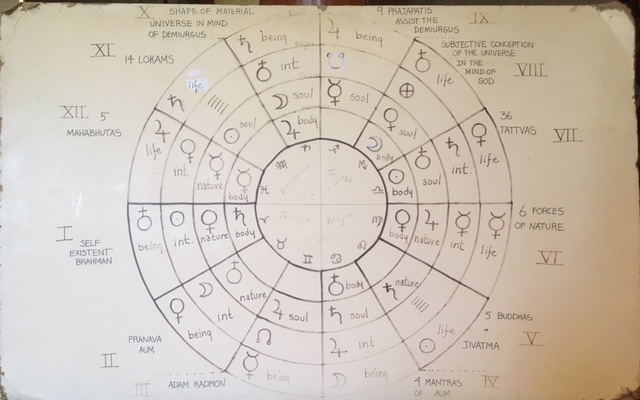
FIGURE IMG 2202-Posterboard Metaphysical Chart.
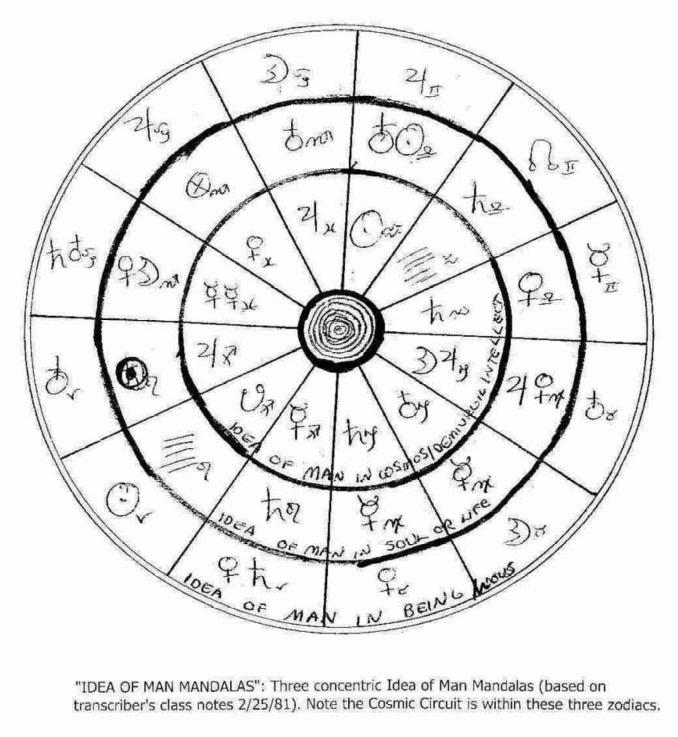
FIGURE 1981 0325-2-JF. Idea of Man Mandalas.
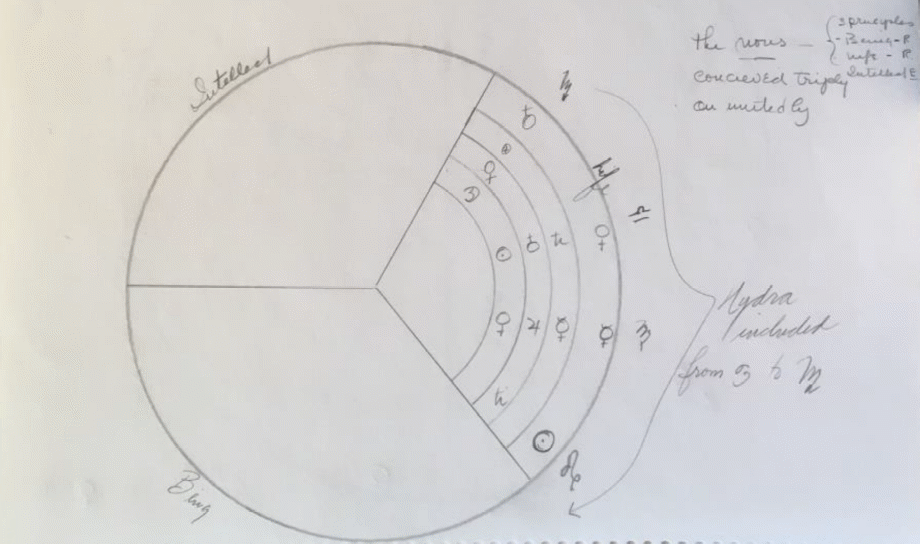
FIGURE A002B IMG_2480 copy (bottom). Nous and Hydra-Headed Beast.
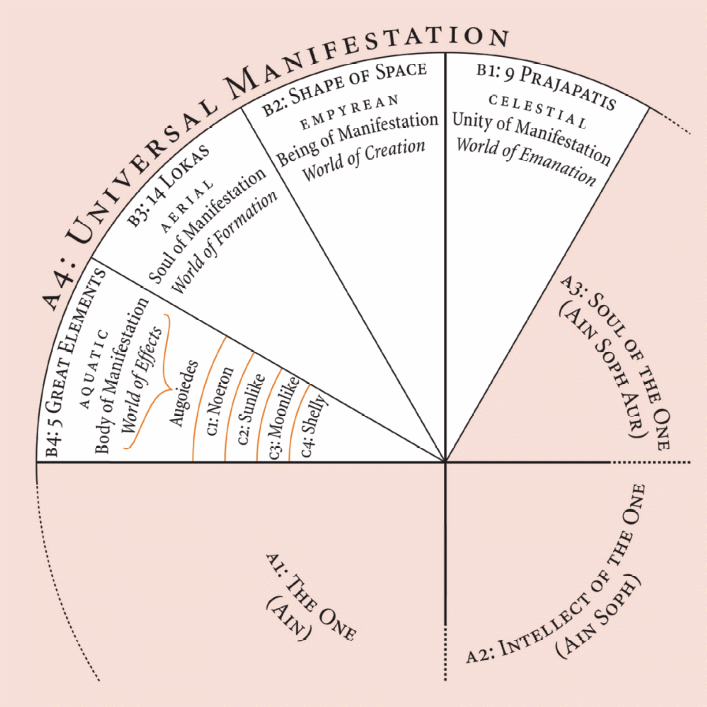
FIGURE 1981 0325-4. Three Hypostases and Two Levels of Cosmology Mapped onto Metaphysical Chart.
Other diagrams referred to are not with this transcript version. [Transcriber note: [diagram] means the speaker is referencing a diagram as he or she is speaking. If someone is drawing or writing, with audible sounds of chalk on a blackboard, I indicate this by [drawing] or [writing].]
TRANSCRIBED Verbatim by IT 2022. In 2024, IT adds four diagrams and references within transcript to these diagrams. Archival verbatim transcript – V12a.
NOTES:
It is possible that the audio file for this class is misdated and that the actual date is 1981 0326. However, Events Master, Blue Book, and the Audio File all show 1981 0325, so leaving as 1981 0325 until more information becomes available.
Partial transcript exists (Scan File 1981 0325 & 0327S2-02R14.PDF). It mistakenly has 3/27, 28/1981 written on the inside of it but it is really a summary of this and the 3/27/81 class.
AUDIO FILES: 1981 0325a. [Note 1: "Tape" and "Side" refer to original audio cassette tapes that were later digitized into .MP3 Audio Files. Note 2: We only have one audio file for this class, we are missing the rest.]
1981 03/25 at Wisdom's Goldenrod
Metaphysical Chart; Soul & Nature
[Audio File 1981 0325a Begins]
LR: --but show the soul, which contained the soul a little bit. [student assents, very faint] But we make them in terms of the Idea of Man (of) Soul (as) the outer ring [diagram].
CDA: Louder, I can't hear you.
LR: You have-- we've been working with these two circles, one being the Idea of Man in Soul, the planets from Leo to Scorpio [diagram], and the cosmic circuit inside of that, the planets in Sagittarius through Pisces [diagram]. [Note: See FIGURE 1981 0325-2-JF, Idea of Man Mandalas, appended to this transcript. Ignore the outermost ring.] And we found that in both cases the planets in the third, sixth, ninth, and twelfth house are the planets that are in the Soul Ring. [Note: See FIGURE IMG 2202-Posterboard Metaphysical Chart appended to this transcript.] Um-- I wondered if we could try to get at how the two rings go together in terms of which planets line up in each of those views. Which is something I'd like to figure out.
AS: Linda we just-- we just touched on it very little.
LR: Well, for instance, that the Saturn goes with the Mercury [diagram].
AS (faint): Right.
AD: Yeah, Linda, you're-- you're back to Monday. You're back to Monday. You want to turn this into a seminar?
LR (simultaneously): (Well you might want to answer this.) Do you want to go back somewhere else?
AD: No, doesn't matter to me.
LR: Well, I mean [AD drawing] I was just asking a concrete--
S: Oh.
AD: Huh?
S (very faint): Yeah.
TS: He had a quote for (it).
S (faint): He did?
LR: I just would like to try to figure out that correlation.
AD: Yeah I-- I know, that's the one we're [drawing] trying to figure out too.
LR (faint): I thought I'd give an introduction. [AD, very faint: Well--] If that's what you want to get into.
AD (faint): See--
[short pause while AD draws]
AD (faint): [couple words inaudible] a third, and over here we have the Saturn [in Leo], Jupiter [in Virgo], Mars [in Libra], Ve-- Venus [in Scorpio]. Well, I got to turn it around.
LR: Oh, see that-- I was working with a different-- that's right.
AD (very faint): [couple words inaudible]
LR: Um--
[17½ second pause while AD draws]
AD: This is where all our problems are [diagram]. [11 second pause while drawing] 'Cause this-- if this is the part that's in the soul and this is the part that's in the cosmic circuit, ok, the transition is over here [Mercury in Sagittarius]. [Note: See FIGURE IMG 2202-Posterboard Metaphysical Chart appended to this transcript.]
[short pause]
LR: Could we put up the other diagram too, also?
AD: Which one?
LR: The one that shows the two circles [diagram]. [Note: See FIGURE 1981 0325-2-JF, Idea of Man Mandalas, appended to this transcript. Ignore the outermost ring.] Draw a circle.
AD: Draw a circle.
[AD drawing]
LR: And draw another one.
AD: Draw another one?
LR: Yeah. [AD drawing] Now put in the houses.
AD: Put in that-- in both circles?
LR (faint): Yeah.
S: That's right.
LR (simultaneously, faint): Yeah.
[AD drawing]
LR: But just put in the-- alright. [short pause while AD draws] And now, in the outer circle of the third house, put in Saturn. [AD drawing] And inside-- Ok, you got it.
AD/AS(?) (faint): And more of it.
[AD drawing]
LR: And inside you put Mercury--
[short pause while AD draws]
LR (faint): I see, Sagittarius, Moon.
AD: Uh-hm.
LR: Sun.
[short pause while AD draws]
AD: What's the inner circle?
LR: Pardon me?
AD: What's the inner circle?
LR: That's the cosmic circuit with the-- this demonstrating the Soul planets that are within the cosmic circuit. Those planets o-- that you've got over there, Mercury Moon Sun, right? That's Sagittarius through Pisces [diagram].
AD: Oh, ok. It's the same problem.
CDA: Yeah.
AD: The problem really is-- well, in Samkhya they speak about the soul gets reflected in matter. What do they mean by the word 'reflection'? [12½ second pause] And then Plotinus says the soul imparts a light to the organized body. [Note: See Plotinus, I.1.7.] What does he mean "imparts a light from the soul to the organized body"? [11 second pause] I suppose the same thing for-- he said for the Wisdom, you know, when PB speaks about the seed-thoughts in the heart, alright. Where are they coming from and what are they? [students assent, faint] And again the same problem is how does the soul, pure soul, alright, transmit something of its indivisibility in the cosmic functioning, [student assents, faint] if soul, let's say, that's present in this body here. That's the problem basically she's asking.
LDS: Well, I hope this isn't unrelated, maybe it is but, in-- in the Orphic Theology-- [Note: G.R.S. Mead, Orpheus.]
LR: We just thought of it.
LDS: --where they [S simultaneously, faint: Yeah.] talk about-- and it seems like they're talking about the same process you just depicted, that is, that they speak of Rhea as-- there's three aspects of Rhea. The-- the highest aspect is-- was identified with Kronos or Saturn. And, it's Rhea that will-- will be the imparter of soul, life, or light to partible souls and to the Demiurgus. In other words--
AD (faint): Yeah.
[students assent, very faint]
LDS: If before-- isn't it before Zeus or Jupiter can take what Saturn gives to it in terms of the Demiurgic plan for the universe, the intermediary is Rhea?
AD: Go on with your question, try again.
LDS: Well I'm just asking, is that the same--
AD: No, no that's-- you're talking about-- when you speak about Kronos and Rhea producing the unit souls you're talking about an eternal generation. You're not speaking about drops or seed-thoughts being dropped into the heart, reflecting or fulfilling the-- the vision which is already in the cognitive-isness or the Saturn [in Leo], the unit soul. You--
LDS: See I thought before we spoke of Rhea as being-- the highest aspect of Rhea would be in the fifth house as the Saturn [in Leo] [diagram]. [Note: See FIGURE IMG 2202-Posterboard Metaphysical Chart appended to this transcript.]
AD: Yes.
LDS: But--
AD: She-- Rhea could stand for Absolute Soul, [LDS, faint: Yeah.] and stands for unit soul. So, you could look at that Ring, you know, the Soul Ring [diagram], either as belonging to an individual or as belonging to Rhea. So you're speaking there about eternal generation of soul. But we're not speaking about that, Louis, what we're speaking about now is this-- there is a soul, and the soul does have-- it-- it has totally unified vision of itself. And we want to see the fulfillment of that vision, and that fulfillment requires the cosmic circuit in order for the individual soul to get precipitated out of the Absolute Soul or Rhea. So the experiences in the fourth quadrant or the cosmic circuit are required to make a soul, a unit soul, which is only a potential soul, to actualize it.
LR: You know, one thing that-- I'm sorry. Go on.
LDS: I think I see the difference.
AD: Yeah. So that would be equivalent like the bodhicitta dropped into the individual entering into the cosmic circuit. And the growth of that individual bodhicitta to the full stature of the potentiality which is inherent in-- in the cognitive-isness.
LDS: So you want to limit the discussion here to the-- 'cause--
AD (simultaneously): You have to limit the [LDS simultaneously: Yeah.] discussion, you can't, [LDS: Yeah.] you know, run riot.
S (faint): Where is that quote from by Plotinus, the one about that the soul [AD simultaneously: Huh?] imparting its life?
S: I.1.7.
S (simultaneously): Where is that?
S (faint): (I.1--)
AD: I.1.7?
LR: You know, one thing about this diagram, Anthony, on that board that shows up immediately is that the-- the correlation is in terms of element, is through element. Somehow there's this-- the-- that if we could understand the elements we could--
AD: If we could understand the elements?
LR: It's just a possibility of a community of su-- (remember/the way) we used to talk about (community/unity) of substance, the way the Saturn in Leo--
AD: No I don't think-- I don't think that that's the problem. Even if you think of the soul of the elements, or what Steiner referred to as the etheric forces, and if you think of the elements as you know them here, the gross elements here, the manifestation of the gross elements or the way the body gets built up through these elements, alright, is still not the problem of how soul, the light which the soul imparts through this individual organism, this is transmitted. [short pause]
If we look at this-- in this one here, where we see-- where we see the Moon [in Capricorn] and the Sun [in Aquarius] [diagram], alright, we know that the Moon isn't-- is part of the material world and we generally refer to that as the substance aspect of the Ahamkara, and the Sun to the activity. [Note: See FIGURE IMG 2202-Posterboard Metaphysical Chart appended to this transcript.] What do they call it? Taijasa? But that would be also part of the material world. And between the Moon and the Sun we know that these drops have to be put-- inserted into it. The Moon and the Sun we know to stand for the shush-- the ida and pingala, the so-called big nerves that encircle the sushumna, the central. And it's in the central canal, the sushumna, that these drops or seeds, winged seeds are to go-- get dropped in. And these winged seeds are equivalent to what they call prakritis, the Buddhists call them the eighty prakritis. When they get dropped into this channel, they transform, they evolve and transform themselves into our mental states. The light which is within them remains what it is. But the outer shell of them are what they call the mental concomitant which we experience. So the example I used was-- but if you s-- if you're looking at one of these winged seeds, you know, coming down into the channel, and you look at it very carefully, slowly, and it seems to be like a puff of smoke or a cloud that's transforming itself gradually little by little, and it starts assuming the picture, let's say, of a cat. And you're looking at this. And then the next-- in the next instant you experience fear. Now that fear is what I'm referring to as the mental concomitant that you experience. The cat that you see in there, of course, these are the animals within us. These animals within us. It's what we have to discipline and train.
Remember when Plato speaks about the hy-- the hydra-headed beast? And (you/he) looks up-- says if you look up to this constellation, I think it was from Cancer to Scorpio, there-- there's the hydra-headed beast. [Note: See FIGURE A002B IMG_2480 copy (bottom), Nous and Hydra-Headed Beast, appended to this transcript.] And that refers to the innumerable desires which are implanted in the human soul and these innumerable desires are the various animals. Now, if you remember in the Saturday class, Kepler believed that the zodiac was within us. [Note: See Kepler series, WG Classes 1981 0221, 0228, 0307, 0314, 0321.] But that's a nice generality, you know. You could put everything inside and be safe. But specifically the zodiac that's being referred to when we say that the zodiac is within you is this-- all these animals. It's, so to speak, their-- the nature of these animals which, when they descend into us as seed-thoughts, and that's the only way they can come because we're referring to the constellations from Cancer to Scorpio, and it's for sure that they don't descend into us. But something of-- of them-- some indication of them is given in these prakritis so-called which enter into the sushumna, and then we experience various mental states. And you know, like (you're full of) the person and you say isn't he cunning. And then you realize that he has a very strong affinity to a fox or something. Or, it's like-- you know, he's like a bull, and then you see he's got a strong-- These animals are literally within us. And Plato goes on to say that these have to be forged into the semblance of a man. The "I" has to be [one word inaudible] told. So, very often when you look at the alchemical drawings, sometimes you'll see a lion-- a lion like trying to swallow the Sun. [Note: See C.G. Jung, CW 12, Psychology and Alchemy, p. 332, plate 169 for an example.] You ever look at the alchemical pictures?
S: Uh-hm.
AD: (And/In) which lion is about to swallow the Sun. And that's of course-- what's happening there is the desire nature is consuming one's sense of "I". And the reverse kind of pictures where the Sun, so to speak, seems to take into itself or assimilate the lion, then-- then you have the reverse, alright. Apollo or the Sun God or the Idea of Man is molding these desires to suit its-- its own manifestation. That's a reverse and I-- you'll see these things in-- if you look through alchemical pictures. You'll see a lot of these pictures that we're talking about. You know, you may see them in some of Jung's writings. If you look through them, I think you'll see them. And he'll refer to these as, you know-- like you see the hairy man in one of these winged seeds. And he will speak about that as the shadow, that's all nonsense, that's-- that's a perversion of these doctrines, he doesn't know what he's talking about. Because this-- like the hairy man is not the shadow but something of our animality, of our gorilla-like nature, it's coming to the fore, is going to be experienced as a mental state. True you can project that onto someone and then speak about the shadow but, when they're speaking about these seed-thoughts that come into the heart that's an entirely-- That's even prior to any kind of psychology. Psychology only will come into being after these seed-thoughts get manifested as our mental con-- concomitants, or mental states.
See but, it comes down to this here. Is there-- First of all, what is the modus operandi by which the indivisibility of the soul's total vision of itself gets transformed or gets actualized by its experiences in the cosmic circuit. That's one question. And the other question is, would be like, that Mercury that we see in Sagittarius seems to be like the in-between, seems to be the in-between between the second third and the third third [diagram]. So Hermes-- Hermes always has this double function. Alright, it could mean the depths of matter, it could mean the heights of spirituality, (it) could mean the devil, it could mean God. I don't think I have to inform you how devious and uncertain all our names of Hermes are. Call him messenger of Jupiter, psychopomp. I call it all these things, the psyche. You know, I-- I can't remember, there was an article on Mercury by Jung. Speaks about finding the Mercury in a bottle under a tree. [Note: See C.G. Jung, CW 13, Alchemical Studies, "The Spirit Mercurius".]
AS (faint): "Spirit Mercurius".
AD: Is that so?
AS: "The Spirit Mercurius", yeah, he says-- he-- he relates that fairytale about, [S, very faint: What?] you know, Mercury.
AD: Well actually, see actually I think that that-- that signifies a much deeper thing than Jung was talking about. I would interpret that to mean the seeds that are in the causal body. [student assents, faint] Alright. When these seeds which are in the causal body, so to speak, drip out one-by-one, and you go to the subtle body, alright, then from the subtle body to the gross body, Mercurius in that bottle represented those seeds, seed-thoughts, of which the causal body would be the tot-- total representation of all the seed-thoughts we're going to experience or all the mental states which we're going to experience. And Jung's interpretation of course was abs-- I think a little bit psychological. And not that it's besides the point. I wouldn't say it was besides the point. I would say it didn't go into the point, it didn't penetrate into the depth of meaning that the-- what was it, a-- a legend, fairytale, or whatever it was, [AS simultaneously: Yeah.] that it contained. [AS assents, faint] So, that's the problem Judy over here wants me to work with and-- I-- I don't think we have enough background, research or-- Everybody here wants to sit on their butt and think I'm going to come up with the answers. This is something I think we're going to-- it's going to take a lot of investigation. John, you said you were looking in the Atwood book? [Note: See Mary Anne Atwood, A Suggestive Inquiry into the Hermetic Mystery.]
JC/S(?): Yeah.
AD: Why don't you do that, just see whatever you can find there, it's 600 pages, I don't want to go through it again. And it's got no index. Now PB in the Wisdom speaks about the seed-thoughts but never says anything else about them, you know, where they come from, how they're produced, what-- what do they really refer to. And the Buddhists have a couple of texts on it. But the obscurity there is just as rampant as it is anywhere else. So evidently either-- either it's a very well-guarded secret or nobody knows. Or those who do know are not going to tell us! [students assent, very faint] There's an alternative, you could try to figure it out for yourself, or you could try to-- you could take somebody's word for it.
AS: Whose word do you take? (bit of laughter)
AD: We got Mead. I don't like to take anybody's word. I mean unless it could be worked out in terms-- [AS: Right.] [student assents, very faint] coherent logical-- Not according to our logic because we don't-- in our logic don't-- we're illogical.
LR: See, what I was asking specifically really, I didn't-- I mean--
AS: (Vic--)
AD (simultaneously): Now-- (AS laughs) Now she waters it down a little (bit) and then--
LR: Well that-- this problem's your problem, I was--
AD: What do you mean my problem!?
LR: I read this-- I was asking something more specific about contain--
AD (simultaneously): Four more years to retirement.
LR: How many?
AD: Four. Go ahead.
LR (simultaneously): How many?
[short pause]
AD: And this problem will take four years. Specifically? Yes.
LR: Yeah. This is the mai-- this is the general thing you're laying out, that you're working with. I was wondering in that diagram where there is a communion of substance in terms of the elements, the Sagittarius to the Mercury and Jupiter to the Moon (and so on) [diagram], [Note: See FIGURE 1981 0325-2-JF, Idea of Man Mandalas, appended to this transcript. Ignore the outermost ring.] whether it's from within the element that the-- remember when you said that it could-- it's possible that it's-- that the soul is actually-- plays a part in fabricating the body, the physical [student assents, faint] body? I was wondering if the diagram illustrated that through the elements in any way, the Leo Saturn somehow building up a fiery body as the Mercury, the Jupiter-- [S, faint: Yeah.] earthy Jupiter going to the Capricorn Moon. Whether somehow contained in the elements there's a hint of at least how the body could be (fabricated) from something that has no form to something which has a form. And that's--
AD (faint): Yeah.
LR: Or if it's correct to think of that at all as given by the soul, the-- the indivisible part of the soul. You did--
AD: Well this much I think we can see, that Saturn and Mercury in combination down below [diagram], [LR: Yeah.] alright, seems that the Mercury in Sagittarius up there, [LR, faint: Yeah.] alright, must have reflected in its-- the-- the Mercury must reflect something [LR, faint: The Head part?] of the-- [LR simultaneously: The divisible?] the vision of the soul.
LR: Yeah.
AD: Yeah. So that corresponded to what was referred to as the Celestial I think by Plotinus. [Note: See FIGURE 1981 0325-4, Three Hypostases and Two Levels of Cosmology Mapped onto Metaphysical Chart, appended to this transcript for this and the following. This diagram is from Astronoesis, p. 236.]
LR: The Mercury?
AD: Yeah.
LR: And that's part of Love.
AD: Yeah, (that'll/they'll) refer to the Celestial, before it comes into generation, before it manifests in the world, and-- I think that's where we were working at. And at the same time of-- instead of conceiving of a-- an individual individual, I mean-- you know, (it's warm--) an individual soul coming-- instead of conceiving of an individual soul coming into manifestation, suppose you think of a whole solar system coming into manifestation, and that Mercury would represent that too. So that that Mercury could represent let's say the cosmic soul descending into manifestation or the individual soul descending into manifestation. When they descend into manifestation, you remember he says the first robe they put on is the Augoeides or the Robe of Glory. Remember? So that the Mercury in Sagittarius would probably correspond to the Robe of Glory that the individual soul comes-- gets wrapped in as it desc-- comes into manifestation. So that's probably why they refer to it as a Celestial. [short pause] And then the second-- the second-- Avery, do you remember what the second one was, in Capricorn?
LR (simultaneously): Empyrean? The Empyrean?
AD: The Empyrean realm. So as the soul descends into the next level, it wore-- it wears or puts on a body which they refer to as the Empyrean body. I think there's another name for that.
JC (simultaneously): Helio.
AS: The Noer-- the Noeron?
JC (simultaneously): It's Helio or (some--)
AD: The Noeron, yeah, the Noeron.
JC: Oh Noeron? What about the-- for the-- this Helio, then (the Lunar), and [AD simultaneously: Yeah.] then the Shelly.
AD: When he--
LR (simultaneously, faint): (To) read books.
AD: When it descended in the ele-- into the eleventh house, they speak about the soul's putting on an Aerial body.
DB (faint): Pneumatic.
AD (faint): I'm sorry?
DB: I think that was the Pneumatic [VM/S(?): Yes sir.] they spoke about.
AD: The Aerial body, Pneumatic.
DB: Yeah.
AD: And then they speak about an Aquatic body in Pisces.
JC: I think that's the etheric double.
AD: Huh?
JC: The etheric double.
AD: Etheric double. And then there [JC simultaneously, faint: Terrestrial.] appears the Terrestrial body. After all that, then it appears or puts on a Terrestrial body. And, Terrestrial body in their language I think was Shelly body. We said the Moon and Sun body.
JC: I never understood that though. I mean the consistent terminology is if you-- you know, like one schema would be Terrestrial, Aquatic, Aerial, which is the astral, Celestial, covers everything from the planets to the stars. And I believe a purified Celestial body is called the Augoeides, [student assents, faint] when you-- you know, you're fully actualizing the soul in that vehicle and now it becomes a reflector for the rational. And now you call it the Augoeides. Before that sometimes they call it the Ethereal [AD: Yeah.] in an unpurified state.
AD: Alright, now if we try-- if we were to use our own thinking on this matter, and we said that the-- the soul want-- wanted to impart some of its light to an a-- a body actually here, alright, it would have to go through this process, it would have to go all-- through all these various bodies. So that before-- before we get to the gross physiology, we'd have to understand something about subtle physiology and probably something about causal physiology. I don't know if we're in a position to do that. I mean what would the structure of the causal body be like? What would the structure of the subtle body be like? And assuming that-- assuming that we understood something about the structure of these bodies, and we understand how could-- how could the indivisible soul from Saturn [in Leo] to Venus [in Scorpio] [diagram], how would it produce from within itself what you call seed-thoughts?
[short pause]
JC: I wonder if aren't-- aren't-- I thought that the seed-thoughts were the production of the cosmos and the Gods that rule in the cosmos. Like they're determining how manifestation will unfold. But the life essence that's given by the subjective soul, or that light, would be what gets formed by that cosmic motion. See what I mean, it's like it explodes with that.
AD (simultaneously): Alright, so then what-- what you're saying is like, surrounding this kernel, alright, the winged-seed, alright, the seed-thought, surrounding its-- it envelops this point of light. Inside this, there's this point of light. Now the seed-thought surrounding this point of light, that's given by the universe, and the point of light is given by the soul? Alright. So now our problem becomes compound. How would-- how would the cosmos and the soul work together to make such an arrangement or, you know, produce (such)? [short pause] Yeah?
DB: Well--
S (faint): Well, go ahead.
S (faint): (I gots--)
DB: Well, if you-- if one starts out from the position of, there's a determination at the highest level of the soul before the soul's entry into the cosmos, then the experiences that the soul is going to have within the cosmos will have to bear some direct relation to that, to that initial determination, ok. So, it would-- I don't know if this makes sense to speak this way but it would seem almost as if the soul's entry into the cosmos doesn't get just any particular series of bodies but gets a series of bodies that are fabricated by the Demiurgus in accordance with the particularity of that soul's vision which it's going to have to actualize.
AD: Well that's (already/only if) we assume.
DB: Ok.
AD: Yeah. The karma will provide. I mean, in order for the continuity of your karma to persist, there would have to be some correlation, yes. And this is of course what the laws of karma are supposedly engaged in, you know. But, we-- we have no inkling, no insight or hindsight or foresight as to what this really means, what does it mean to speak about drops of light, drops of mental prakriti. (Yeah) go ahead.
DB: And could-- I don't-- I came across a passage today in Plotinus on Nature that comes after the quote we were working with the other day on the twofold Demiurge that-- It's a little bit more general than the specific question of the drops and so forth, but I thought that it might help-- be helpful in some respects, I don't know. You know where he talks about the distinction between Nature and imagination and intellection of the soul?
AD: No.
S (faint): No.
DB: It's-- well it's on IV.4.13.
S (very faint): Go ahead, read.
AD: Go ahead and read it.
DB: Ok, well--
AD: Oh.
DB: Um--
[short pause]
Plotinus [IV.4.13, DB reading]: "This Wisdom is a first (within the All-Soul) while Nature is a last: for Nature is an image of that Wisdom, and, as a last in the Soul, possesses only the last reflection of the Reason-Principle: we may imagine a thick waxen [DB reads: wax] seal, in which the imprint has penetrated to the very uttermost film so as to show on both sides, sharp cut on the upper surface, [DB adds: and] faint on the under. Nature, thus, does not know, it merely produces: what it holds it passes, automatically, to its next; and this transmission to the corporeal and material constitutes its making power: it acts as a thing warmed communicating to what lies in next contact to it the principle of which it is the vehicle so as to make that also warm in some less degree."
DB: And this is the way--
Plotinus [IV.4.13, DB reading]: "Nature, being thus a mere communicator, does not possess even the imaging act. There is (within the Soul) intellection, superior to imagination; and there is imagination standing midway between that intellection and the impression of which alone Nature is capable. For Nature has no perception or consciousness of anything; imagination [DB adds: that is] (the imaging faculty) has consciousness of the external, for it enables that which entertains the image to have knowledge of the experience encountered, while intellection also engenders--of itself and by an act derived from its own active principle."
[9 second pause]
LR: Why don't you keep reading that?
Plotinus [IV.4.13, DB reading]: "Thus the Intellectual-Principle possesses: the Soul of the All eternally receives from it; this is the Soul's life; its consciousness is its intellection of what is thus eternally present to it; what proceeds from it into Matter and is manifested there is Nature, with which--or even a little before it--the series of real being comes to an end, for all in this order are the ultimates of the intellectual order and the beginnings of the imitative.
"There is also the decided difference that Nature operates towards Matter, and receives from it: soul, near to Nature but superior, operates towards Matter but without receiving in turn; and there is the still higher phase (the purely Intellectual) with no action whatever upon body or upon Matter."
DB: Now, this is just really speculatively--
AD (very faint): Go ahead, try now.
DB: Yeah, speculative on my part but I thought-- we were thinking-- you've spoken of the Saturn as the Intellectual part of the soul. If-- within this context, perhaps what he calls the imagination here which stands midway between intellection and-- and Nature might refer to those three planets prior to the Mercury [in Sagittarius], [Note: Jupiter in Virgo, Mars in Libra, Venus in Scorpio. See FIGURE IMG 2202-Posterboard Metaphysical Chart appended to this transcript.] and that from Mercury on downward, that's the-- the function of Nature, in that it-- production.
[27 second pause]
AD: Those were quite-- I don't know what you mean from Mars Venus Mercury [diagram] is the imagination. Is that right?
DB: Well, yes. Mars Venus Mercury or maybe including Jupiter but that that would be what he means here by imagination, and then that the Moon [in Capricorn] then Sun [in Aquarius] and Mercury [in Sagittarius] would refer to the Nature insofar as that's its-- the-- that operation towards matter. And it seems-- it seems the way that-- little I can understand about these drops is that their impetus, their movement is, or seems to be towards matter, you know, their motion is towards--
AD: Yeah. Before we get to the drops, I mean, I want to understand or follow your-- [short pause] follow your use of the diagram.
AS: I don't follow.
JC/S(?) (very faint): There's not--
AS: I-- I didn't follow (yet/you). I don't understand what you mean by calling those imagination in that quote.
DB: Well--
AD (simultaneously): Go back-- [AS simultaneously: David, I don't understand (how--)] go back and read this section. Where are you reading?
S (simultaneously, very faint): (Well), yeah.
AS: Yeah I don't really see it.
DB: It's on 298.
S: Uh-hm.
DB: But-- [short pause] but it said--
AD (very faint): (Check it.)
AS: 13, IV.4.13.
AD: See this will bring us to the same standstill, uh-- Even after we work it out, you're going to come to the same standstill.
AS (faint): Still the same planets, I don't know, it doesn't (matter/work).
DB (faint): Ok, well [couple words inaudible]
AD (simultaneously): But-- but work, go ahead, work it out because this will show the problem that I just, you know, spoke about. This will bring that problem out-- out again. It doesn't help us to say that, if we think of Nature as in between the Mercury [in Sagittarius], alright, and the other Mercury [Nature Pisces], you know, these two Mercuries [diagram], [DB, faint: Right.] and that a transmission of what's in the Mercury in Sagittarius takes place through the intermediary of the Sun and the Moon and produces reason-principles which then get inserted into body. Because the same problem still is there.
AS: That would be the imagination, (the--)
AD (simultaneously): What do we mean? What are we talking about?
DB: Well see this is--
AS (simultaneously): But see in that example I think that would be the imagination is the Sun and Moon [AD simultaneously: Yeah, I know.] which is transmitting what's in the Mercury to the other Nature.
AD (simultaneously): Yeah, that's taijasa consciousness, yeah.
AS: And that-- And Nature is the Mercury [one word inaudible]
AD (simultaneously): See what I'm getting at, Dave? See the-- it's a generality, I mean-- it'll satisfy you to a certain point. But then when you read a description of drops, alright, when you read a description of winged seeds, [AS, faint: Uh-hm.] you're going to say, what is it?
DB: See the-- but the main reason I brought this out was-- and-- I mean this isn't to contradict what you just said, but, simply the emphasis that he is placing on the fact that what he means by Nature here is completely fabricative, I mean there's-- the way he speaks of it is there's no gnostic activity that takes place within Nature, that from his standpoint that stops at the level of the imagination in the soul.
AD: Yes we understand that Nature is the last of the intelligibles, and that its functioning is below, or what you'd say, consciousness or sensation is even below that.
S (faint): Yes, we know.
AD: I follow that. But I'm-- I'm asking if we can conceive the problem in-- in terms of specificity, not in terms of words, but could we get-- could we conjure up some kind of image in our mind or some sort of example. [short pause] That's why I didn't want to attack this problem, because, [AS simultaneously, faint: Well I think (couple words inaudible)] unless we get a-- you know, a happy intuition, a leading insight, you can't break into it.
TS: I think there's a-- I found a more specific passage.
AD: Let him finish. Ok. Go ahead, Dave.
DB: No, well I was-- just-- this is just real short but, would it not have something to do with the actual constitution of the organized body? That given the seed-thought, that it would require this body which has been fabricated, so to speak, in a-- as an image of the whole zodiac and planetary spheres and so forth?
AD (simultaneously): Say it again, given this body--
DB: Yeah, given the organized body, that it's within that framework that these seeds are going to be able to function, ok, and make some type of-- make their presence known, so to speak?
AD: Make its presence known?
DB: Make the-- um-- it's like if the physical body or the organized body here-- the-- the-- let's just say the Terrestrial one 'cause that's, you know, what I know about, that given its constitution as being an image of the whole zodiac, that that's like the-- the television set or the screen upon which these seeds are-- it's the interaction between the seeds and the organized body which gives rise to a particular experience. If you're going to have a body, it wouldn't be any--
AD: Alright, so if you take the organized body like a television set, alright, and then the electrical impulses that come into it is the seed-thoughts, [DB: Right.] alright, then we could say the combination of the two is going to give us some sort of experience. Now, if we took that point of view, what would-- what will be a correlation, you know, like the electrical impulses that go into the television tube, what would be the correlate or an equivalent?
[short pause]
DB: The equivalent? You mean the-- in terms of electrical--
AD (simultaneously): Yeah, to the electrical impulse.
DB: Would-- well--
AD: We're going to say seed-thoughts, right?
DB: Well see it's-- it's the-- it's the seed-thoughts but there's also the fact that there's that undifferentiated light from the-- from the soul which is-- provides the channel. It's like the line through which they travel. But yeah, the seed-thought. The seed-thoughts would be the signal, the specific signal that's going to be transmitted but the electricity, you know, I mean just the-- the wavelength and I'm getting confused 'cause I don't get-- I don't know electronics.
AD: I know. (bit of laughter) I know, that's the problem. That's the problem. What is a seed-thought? [short pause] [DB simultaneously: The-- they--] Go over it.
DB: You know, they-- Mead speaks about something that's very similar to that. The-- the whole section on the (daemon). [Note: See G.R.S. Mead, The Doctrine of the Subtle Body in Western Tradition.]
AD: The whole section?
DB: There's that-- I think it's from Synesius where he's talking about the-- the daemons contain the images, what will become our images. [student assents, very faint] Well, maybe I should read it.
[12 second pause]
(Side 1 of original cassette tape digitized as 1981 0325a Ends; Side 2 Begins)
JC: Can you look at the natal chart possibly as--
AD (faint): Wait, wait a minute, wait.
JC (very faint): Sorry.
[1 minute 2 second pause]
AD (faint): Where was the material on the daemons, that was in Alcibiades? We have the Alcibiades and Synesius--
DB: I've got the Synesius.
AD (faint): You got Synesius?
S (simultaneously): Yeah.
S (very faint): But look at this one.
AD: You got an Alcibiades [S simultaneously: Yeah.] (around this morning)?
S (faint): Look up.
JC (faint): There's also the Cratylus. I think it's the Cratylus. There's a long footnote on daemons.
AD: You remember-- do you remember the passage?
JC (very faint): I read it long ago.
AD: Was it in the notes?
JC (faint): In Timaeus-- uh, Taylor's translation.
AD: In the notes?
AS (faint): Uh-hm.
AD: It wa-- was it in the notes to the Cratylus?
JC (faint): I think so. I think it was in the middle. There's two passages that I remember he spoke about in the Platonic (orders). One was the Alcibiades, the other was the notes to the Cratylus.
AD (very faint): Do we have the (note)? (What page?/Ok.)
S (faint): (It's/This) where we keep--
[10½ second pause]
JC (very faint): (Great.)
[short pause]
S (very faint): (Avery) could work with this.
AD (faint): Give that to Avery. Open on the footnote on the daemon.
S (faint): (David), you could try these.
DB: Um-- This is page 71, it's called--
AD (faint): Where he speaks about the way the daemons insinuate themselves in our consciousness?
DB: The Doctrine of--
JC/S(?) (faint): Of what?
DB: It's The Subtle Body Doctrine. Let's see. [11¾ second pause, flipping of pages] Well, there's a description of the relation between the various bodies but he says at one point that--
[Transcriber note: I am using The Doctrine of the Subtle Body in Western Tradition by G.R.S. Mead, London: J.M. Watkins, 1919.]
G.R.S. Mead [The Doctrine of the Subtle Body, p. 96, DB reading, quoting Synesius]: ""Moreover the whole of the genera of daimones are supplied with their substance by this mode of life… For during the whole of their existence they are of the nature of images and take on the appearances [DB reads: appearance] of happenings.""
AD: Read it again.
DB: The--
G.R.S. Mead [The Doctrine of the Subtle Body, p. 96, DB reading, quoting Synesius]: ""…the whole of the genera of daimones are supplied with their substance by this mode of life… For during the whole of their existence they are of the nature of images and take on the appearances of happenings.""
DB: Um--
AD: Once more please?
G.R.S. Mead [The Doctrine of the Subtle Body, p. 96, DB reading, quoting Synesius]: ""…the whole of the genera of daimones are supplied with their substance by this mode of life… For during the whole of their existence they are of the nature of images and take on the appearances of happenings.""
DB (faint): Um-- You can go on (now).
AD: Take on the appearance of happenings?
DB: Yes, there's a-- that's footnote, and--
AD: So they-- what the Buddhists are calling prakritis these people are calling daemons.
DB: Yeah I think so. Um-- [short pause] Do you want-- do you want me to go on?
AD: Uh-hm, uh-hm.
DB (simultaneously): There's a couple of paragraphs after that, says--
G.R.S. Mead [The Doctrine of the Subtle Body, p. 96, DB reading, quoting Synesius, brackets Mead's]: ""As for man he is conscious of many things by means of this [essence] even when by itself, and of more when there is another [? a daimon or spirit] with it.
""For [the orders of daimones] make thoughts always to have some mixture of imagination, except perchance a man in a flash establish immaterial contact with an idea.""
AD: Again, once more?
DB: Well maybe I should start it back farther but--
AD: No, just repeat what you just said.
G.R.S. Mead [The Doctrine of the Subtle Body, p. 96, DB reading, quoting Synesius, brackets Mead's]: ""As for man he is conscious of many things by means of this [essence] even when by itself, and of more when there is another [? a daimon or spirit] with it.
""For [the orders of daimones] make thoughts always to have some mixture of imagination, except perchance [DB reads: when] a man in a flash establish immaterial contact with an idea.""
[short pause]
AD (faint): He seems to be saying that the seed-thought is a combination of the daemonical essence and the imaginal essence.
S (very faint): Uh-hm.
[12½ second pause]
JC (faint): Maybe the daemons form the way our imagination's operating.
AD (faint): Yeah but I think he's pointing out here that you have two things. On the one hand you have the imaginal essence, which is the same as Nature, alright. And on the other hand you have the daemonical nature which, in conjunction with that imaginal essence, becomes what he's referring to as our thoughts. [short pause] (Go ahead.) Yeah go ahead. Already [couple words inaudible] we should go or read it before-- (Go ahead.)
DB: Um--
AD (faint): Start (all over again).
DB: Alright, this is 71. (If) this comes in a discussion of the imaginative spirit and so forth, and he's talking about the body of imagination.
AD (faint): Which is equivalent to the astral body.
DB: Right, the astral. Uh--
AD: He's speaking about the astral-- And again that's what the Buddhists would refer to as the direct mental perceiver. The superior man has an insight into that realm. [short pause] Alright, start Dave.
DB: Ok. I'll start-- maybe it's page before this one. I want to start at the beginning. Um-- Says--
G.R.S. Mead [The Doctrine of the Subtle Body, pp. 94-95, DB reading, quoting Synesius, brackets Mead's]: ""Before…the [body of] imagination can receive God, the incomings [of sense must] flee away out of it.
""But he who keeps it pure, by living a life according to nature, has it ever in readiness, to be the most extended common-sensory, [even] in this life.
""Spirit so purified is sensible of [DB reads: to] the dispositions of the soul, and is not unsympathetic in itself [to them], as is the shell-like envelope [sc. the gross body].""
AD: And he's saying the astral body that's purified is susceptible to [one/two words inaudible] from the soul, go on.
DB (faint): Ok.
G.R.S. Mead [The Doctrine of the Subtle Body, p. 95, DB reading, quoting Synesius]: ""For this spirit is precisely the borderland between unreason and reason, between body and the bodiless. It is the common frontier of both, and by its means things divine are joined with lowest things.""
AD: So he's saying that the astral realm is the in-between the rational and the irrational.
G.R.S. Mead [The Doctrine of the Subtle Body, p. 95, DB reading, quoting Synesius, brackets Mead's]: ""Therefore it is difficult for its nature to be comprehended by philosophy [alone].""
DB: That is, just to-- as distinguished from a mystical philosophy.
AD: Practical, sure.
G.R.S. Mead [The Doctrine of the Subtle Body, p. 95, DB reading, quoting Synesius]: ""For it lays under contribution what suits it, from both of the extremes, as from neighbours, and images in one single nature things that are poles apart.""
AD (faint): Repeat that last sentence.
G.R.S. Mead [The Doctrine of the Subtle Body, p. 95, DB reading, quoting Synesius]: ""For it lays under contribution what suits it, from both of the extremes, as from neighbours, and images in one single nature…""
AD: So the astral combines, so to speak, the promptings of the soul and the incoming functioning of the senses.
G.R.S. Mead [The Doctrine of the Subtle Body, p. 96, DB reading, quoting Synesius]: ""As to the extent of this imaginative essence, nature has poured it into many divisions of being. Indeed it goes down even as low as irrational creatures, so as the better to extend itself.""
AD: It goes down how far?
DB: Even as low as irrational creatures.
AD (simultaneously): Irrational, yeah.
G.R.S. Mead [The Doctrine of the Subtle Body, p. 96, DB reading, quoting Synesius]: ""Moreover the whole of the genera of daimones are supplied with their substance by this mode of life… [AD: Ah.] For during the whole of their existence…""
AD: No, once more.
DB (faint): Alright.
G.R.S. Mead [The Doctrine of the Subtle Body, p. 96, DB reading, quoting Synesius]: ""Moreover the whole of the genera of daimones are supplied with their substance by this mode of life…""
AD: Let's say, what is this mode of ge-- of reason?
DB: Uh-- yeah.
S (faint): Uh-hm.
DB: The whole of the daemons are supplied-- they're constituted by this astral essence, imaginal essence.
AD: The imaginal essence.
G.R.S. Mead [The Doctrine of the Subtle Body, p. 96, DB reading, quoting Synesius]: ""For during the whole of their existence they are of the nature of images and take on the appearances of happenings.""
AD: Once more.
DB (faint): Ok.
G.R.S. Mead [The Doctrine of the Subtle Body, p. 96, DB reading, quoting Synesius, brackets Mead's]: ""For during the whole of their existence they are of the nature of images and take on the appearances of happenings. [short pause]
""As for man he is conscious of many things by means of this [essence] even when by itself, and of more when there is another [? a daimon or spirit] with it.
""For [the orders of daimones] make thoughts always to have some mixture of imagination, except perchance a man in a flash establish immaterial…""
AD (simultaneously): Ok, you follow what we-- You follow this?
S: Not the last line because-- Would you repeat it?
DB: Uh-- "For [the order of daimones]…" that one?
S: Yes.
G.R.S. Mead [The Doctrine of the Subtle Body, p. 96, DB reading, quoting Synesius, brackets Mead's]: ""For [the orders of daimones] make thoughts always to have some mixture of imagination, except perchance [DB reads: when] a man in a flash establish immaterial contact with an idea.""
DB: Then he says--
G.R.S. Mead [The Doctrine of the Subtle Body, p. 96, DB reading, quoting Synesius]: ""But the transcending of imagination is as difficult as it is blissful.""
AD (simultaneously): That's a yogic direct perceiver.
HS (faint): So how do you follow the part where he talks about the daemons are the appearance?
AD: Louder Herbie.
HS: I didn't follow the part you-- in a sense that the daemons are the appearances.
AD: (Alright.) That's the-- that's the crux, that's it.
HS/S(?) (faint): Yeah.
AD: Read it again to him.
S (very faint): Ok.
DB: Um--
G.R.S. Mead [The Doctrine of the Subtle Body, p. 96, DB reading, quoting Synesius]: ""…the whole of the genera of daimones are supplied with their substance by this mode of life… For during the whole of their existence they are of the nature of images and take on the appearances of happenings.""
HS: The daemons are supplied with their subs--
AD (simultaneously): Just change that word to 'mental happenings'. [short pause] They are the mental concomitants.
HS: As distinguished from the-- from the essence? [one/two words inaudible]
AD: Well, they're to be distinguished from the imaginal essence, yes. But the imaginal essence or imagination is one thing. Daemons are another thing. Combined, they produce what we call our happenings, the happenings in our conscious life.
S (faint): Daemons produce-- (they don't want to).
AD: It's got to be-- that has to be the connection between-- that has to be what on Saturday we were discussing in one of the articles when Pauli was asking what is the bridge between sense-perception and conceptions. That's the bridge. [Note: See W. Pauli, "The Influence of Archetypal Ideas on the Scientific Theories of Kepler" (in C.G. Jung, W. Pauli, The Interpretation of Nature and the Psyche), p. 152. See also Kepler series, WG Classes 1981 0221, 0228, 0307, 0314, and 0321.]
[short pause]
HS: But, are they re-- is it-- we only got (two). Is it like super-refined matter that's capable of grasping something inferior? Or is it something-- or is it something--
AD: I don't understand you.
HS: Maybe I'm thinking of [one/two words inaudible] too concrete a way. But-- The immaterial soul enters into the moving material cosmos.
AD: Yeah. And what was-- what is the intermediary [HS: Yeah.] by which that becomes possible?
HS: And we speak of this daemon, you're talking-- you're talking about the side of a very refined matter capable of formulating in terms of the informing reason-principle? Or are you talking about something that's actually coming out of the reasoning of the soul, I don't know, grasping that.
S (very faint): [few words inaudible]
AD: Well, now we have to stop. Now, that question can't be answered until we hear from Avery and the division of the daemon. Now there's different division of the daemons. And it's going to be a certain class of-- a certain class-- a certain class in that division which, so to speak, will connect the soul with the body.
[11¾ second pause]
AS: You want to go--
AD: Shall we try, Avery?
AS: Yeah, do you want to-- you want the place where he speaks about the different divisions in--
AD: Huh?
AS: Do you want where he speaks of the different divisions of them?
AD (simultaneously): Yeah, different divisions.
[short pause]
AS: Actually, this has some other interesting lines I should--
AD: Alright, read them, it might be a little (different).
AS: It's um--
S (simultaneously): Avery can read it.
LR/S(?): Read it.
AS: This is The First Alcibiades, on the second and third page of it. Actually the whole first [sic; second] footnote which is several pages is on the daemons. [short pause] Says--
[Transcriber note: I am using The First Alcibiades, in Volume 1 of The Works of Plato, viz. His Fifty-Five Dialogues, and Twelve Epistles by Plato, Thomas Taylor (tr. and comm.), First Edition, London, 1804.]
Thomas Taylor [The First Alcibiades, footnote, p. 17, AS reading]: "[Hence] whatever is ineffable and occult in the gods, [AS adds: the] daemons and heroes express and unfold."
AD: Alright, right there, you see what he's saying? What's in the Gods is going to be expressed by the daemons.
[short pause]
Thomas Taylor [The First Alcibiades, footnote, p. 17, AS reading]: "They likewise conciliate all things, and are the sources of the harmonic consent [AS read: of harmony] and sympathy of all things with each other."
AD: Alright, they patch everything up.
Thomas Taylor [The First Alcibiades, footnote, p. 17, AS reading]: "They transmit divine gifts to us, and equally carry back ours to the divinities."
[short pause]
AS: And he says-- he says--
Thomas Taylor [The First Alcibiades, footnote, p. 17, AS reading]: "Daemons therefore, receiving their first [AS reads: The daemons receive their] subsistence from the vivific goddess, i.e. Juno, [and] flowing [AS reads: flow] from thence as from a certain fountain, [AS adds: and] are allotted an essence characterized by soul."
AD: Again. "Allotted an essence characterized by soul"?
AS: They're allotted an essence characterized by soul.
[short pause, flipping of pages]
LR: What-- what do they receive from Juno?
AD: Their subsistence.
AS: Their subsistence.
LR: As opposed to their essence?
AS: No, no, I don't know that he's making that distinction here. He's just trying to say--
Thomas Taylor [The First Alcibiades, footnote, p. 17, AS reading, quoting Proclus]: ""Let us [now] speak in the first place [AS reads: speak first] concerning daemons in general; in [AS reads: and] the next place, concerning those that are allotted us [AS reads: humans] in common; [and], in the third place, concerning the daemon of Socrates.""
AS: Ok? Concerning them in general, he says they derive--
Thomas Taylor [The First Alcibiades, footnote, pp. 17-18, AS reading, quoting Proclus]: ""…their first subsistence from the vivific goddess, [i.e.], Juno, [and] flowing from thence as from a certain fountain, are allotted an essence characterized by soul. [AS adds: And] This essence in those [AS adds: daemons] of superior order is more intellectual…in those of a middle order, [it] is more rational; and…the third degree, and [AS reads: those] which subsist at the extremity of the daemonical order, it is various, [AS adds: and] more irrational and more material.""
AS: But they all have their subsistence from Juno but-- in the eighth house, yeah, there [diagram]. [short pause while AD draws] And from thence they have different levels-- orders of subsistence according to intellectual and so on.
AD: Alright, now the-- does he give us a classification system?
AS: Yeah. He just-- there's one other-- one or two other lines here, he says--
Thomas Taylor [The First Alcibiades, footnote, p. 18, AS reading, quoting Proclus]: ""He therefore will not err who asserts that the mundane artificer established the centres of the order of the universe in daemons; since Diotima also assigns them this order, that [AS adds: is] of binding together divine and mortal natures…""
AD: Binding together divine and mortal natures. So, if you think of the soul as divine and the body as mortal, it's the daemons that combine them or--
S (faint): Uh-hm.
AS: He says--
Thomas Taylor [The First Alcibiades, footnote, p. 19, AS reading, quoting Proclus]: ""In the next place let us speak concerning [AS reads: of] the daemons [which are] allotted mankind. For of these daemons, which as we have said rank in the middle order, the first and highest are divine daemons, [and] who often appear as gods, through their [transcendent] similitude to the divinities. [For], in short, that which is first in every order preserves the form of the nature prior to itself [AS reads: the former nature of its prior].""
AS: Ok well--
Thomas Taylor [The First Alcibiades, footnote, p. 19, AS reading, quoting Proclus]: ""The next to these in order [AS reads: in order to these] are those daemons who participate of an intellectual idiom, and preside over the ascent and descent of souls, and who unfold into light and deliver to all things the productions of the gods.""
AD: Which one would that be? Would that be the Celestial?
AS: I think so. I think that's the essential daemon that he speaks of.
AD (simultaneously): Essential daemon? That would be then equivalent to the Mercury in Sagittarius.
AS: But I'm not sure. The one-- well, yeah, he has another passage later, maybe I should read the two at once.
AD: Alright.
Thomas Taylor [The First Alcibiades, footnote, p. 19, AS reading, quoting Proclus]: ""…the first and highest are divine daemons, [and] who often appear as gods, through their transcendent similitude…""
AS: Ok? And of these he says--
Thomas Taylor [The First Alcibiades, footnote, p. 19, AS reading, quoting Proclus]: ""…the highest of them [AS reads: therefore of these] conjoin souls proceeding from their [AS reads: the] father, to their leading gods…""
AS: That's these first ones, the highest one.
Thomas Taylor [The First Alcibiades, footnote, p. 19, AS reading, quoting Proclus]: ""…for every god, as we have said, is the leader in the first place of daemons, and [in the next] of partial souls. … These divine daemons, therefore, are those which are essentially allotted to souls, [and] conjoin them to their proper leaders… But daemons [AS reads: Now those] of the second rank… [AS goes back to the previous paragraph] …are those [daemons] who [AS reads: which] participate of [AS reads: in] an intellectual idiom, [and] preside over the ascent and descent of souls, [and who] unfold into light and deliver to all things the productions [AS reads: production] of the gods.""
AS: And he says--
Thomas Taylor [The First Alcibiades, footnote, p. 19, AS reading, quoting Proclus]: ""…from these the souls of the multitude derive their elections. For the most perfect souls, who are conversant with generation in an undefiled manner, as they choose a life conformable to their presiding god, so they live according to a divine daemon…""
AS: So this isn't those. [short pause] Anyway-- So the second one is the-- is that one that presides over the ascent and descent of souls.
AD: Alright, but that's still not the one we're looking for, go on.
AS (faint): Yeah.
Thomas Taylor [The First Alcibiades, footnote, p. 19, AS reading, quoting Proclus]: ""The next to these in order are those daemons…""
AS: No, sorry.
Thomas Taylor [The First Alcibiades, footnote, p. 19, AS reading, quoting Proclus]: ""The third are those who distribute the productions of divine souls to secondary natures, and complete the bond of those that receive defluxions from thence [AS reads: from divine souls].""
[9¾ second pause]
AS: It's about the point, says on here. [short pause] Should I just read through them?
AD: Yeah.
AS: Ok. So--
Thomas Taylor [The First Alcibiades, footnote, p. 19, AS reading, quoting Proclus]: ""The third [are] those [who] distribute [the] productions of divine souls to secondary natures, [and] complete the bond of those that receive [AS adds: the] defluxions from thence [AS reads: from divine souls]. The fourth [AS adds: rank] are those that transmit the efficacious powers of whole natures to things generated and corrupted, and who inspire partial natures with life, order, reasons, and the all-various perfect operations which things mortal are able to effect. The fifth are corporeal, and bind together the extremes in bodies. … [For] it is this ultimate middle nature which has dominion over corporeal goods, and provides for all natural prerogatives. The sixth [AS adds: and last] [in order] are those that revolve about matter, connect the powers which descend from celestial to sublunary matter, perpetually guard this matter, and defend the shadowy representation of forms which it contains.""
[short pause]
AD: I think we could work that out?
S: Maybe.
AS: Maybe, we-- we worked it over once Tim, remember?
TS: Yeah.
AS: We had a couple-- there were-- there were a couple of ways that we worked it out.
LR/S(?) (faint): (Last week.)
AS: Hm? Didn't we?
TS: Yeah, definitely.
AS: Do you-- oh good.
LR: It's easy to see from this why you get hit with other daemonic images when you try to dissolve any of those (forms).
S (faint): Oh yeah.
AD: We don't have a-- we don't-- you don't have here Sallust: On the Gods, do we?
DB: I've seen that. It might be up at the library.
S: Uh-huh.
AD: Alright, never mind, we'll work it out.
LR: It is here.
DB: You have seen it?
S (faint): Uh-hm.
S (faint): Go look for it.
AD: That's alright, don't bother, no, we'll work with this here. Start with the last one.
Thomas Taylor [The First Alcibiades, footnote, p. 19, AS reading, quoting Proclus]: ""[The] sixth in order are those that revolve about matter, connect the powers which descend from [AS adds: the] celestial to sublunary matter, perpetually guard this matter, and defend the shadowy representation of forms which it contains.""
[11¾ second pause]
AD: So there would be this-- let's give it a name, sublunary daemons, alright?
[short pause]
AS: I mean or even-- well-- the previous ones in a way are also sublunary 'cause they're [AD simultaneously: Well--] corporeal.
AD: Well, we could--
AS: The previous one. (Now) this one's--
Thomas Taylor [The First Alcibiades, footnote, p. 19, AS reading, quoting Proclus]: ""…defend the shadowy representation of forms which it contains [AS reads: forms in matter].""
AD: Matter.
AS: The fifth, the previous are the corporeal daemons. They--
Thomas Taylor [The First Alcibiades, footnote, p. 19, AS reading, quoting Proclus]: ""…bind together the extremes in bodies. For, how can perpetual accord with corruptible bodies, and efficients with effects, except through this medium? For [it is] this ultimate [middle] nature [which] has dominion over corporeal goods, and provides for all natural prerogatives.""
AD: Yeah, go ahead, yeah.
S: Could that be like the upper and lower Mercuries in Pisces [diagram]?
AD (faint): I don't know yet, I-- I-- [AS, faint: He doesn't.] I'm working on the classification.
AS: I'm not sure either. [couple words inaudible]
AD: On the one hand he seems to be talking about the daemons as they're involved in maintaining the form of an-- of a creature. The second level seem to be concerned with the functions that goes on within the creature.
AS: I think one of these levels one time we spoke of as like, yeah, the functions, the flow-- the heart-- the pumping of the blood and so on, and all of the bodily [one word inaudible]
AD (simultaneously): Yeah, all these-- all these functions that are going on in the body [AS: Ether.] is the second one. [AS simultaneously: It's like-- almost like an ether.] The second daemons are in charge of that.
AS: Yeah the pran-- the lower pranas or something [AD simultaneously, faint: Ok.] [couple words inaudible] the body.
AD: The third, going-- (yeah).
AS (simultaneously): Ok, going upwards.
Thomas Taylor [The First Alcibiades, footnote, p. 19, AS reading, quoting Proclus]: ""…those that transmit the efficacious powers of whole natures to things generated and corrupted…""
AD: So then that would be-- that would be like the transmission of the cosmocrators' functioning [AS assents] to the creatures here.
S (faint): Yeah.
AS: Yeah, the results, the-- the transmission like of the aspects (to them).
AD: So then they would be the rational daemons, wouldn't they?
S: Um--
S (faint): No but--
DB: Um--
AS: That almost seem--
Thomas Taylor [The First Alcibiades, footnote, p. 19, AS reading, quoting Proclus]: ""…inspire partial natures with life, order, reasons, [AD simultaneously: Yeah.] and the all-various perfect operations…""
AD (simultaneously): Those would be the-- those would be the rational daemons.
AS: Right, yeah. He seems to be-- if I follow his-- Proclus' standard type of, you know, ordering scheme it seems that-- ok so it would be-- in other words, the first would be the material, then the irrational, just the [AD simultaneously, faint: Yeah.] fourth would you say. And the next one up like the rational [AD simultaneously, faint: Rational.] powers that would flow from the-- (from) the planetary spheres.
AD (simultaneously): Next one after that.
AS: The previous one--
Thomas Taylor [The First Alcibiades, footnote, p. 19, AS reading, quoting Proclus]: ""…are those who [AS reads: that] distribute the productions of divine souls to secondary natures…""
AD: Last one.
Thomas Taylor [The First Alcibiades, footnote, p. 19, AS reading, quoting Proclus]: ""…and complete the bond of those that receive defluxions from thence.""
AS: Production of divine souls. See this would somehow transcend the planetary spheres if that's what he's--
JC: Aren't those the ones that's conjoined the rational soul to the cosmos? Conjoined rational essences to I guess the circuit. What's it-- he says conjoins whole [AS simultaneously: (No.)] essences to--
Thomas Taylor [The First Alcibiades, footnote, p. 19, AS reading, quoting Proclus]: ""…[AS adds: they] complete the bond of those that receive [AS adds: the] defluxions…""
JC: Of soul.
Thomas Taylor [The First Alcibiades, footnote, p. 19, AS reading, quoting Proclus]: ""…[AS adds: they] distribute the productions of divine souls to secondary natures…""
AS: "Distribute the productions of divine souls to the secondary natures."
[short pause]
AD (faint): Try the next one, above it.
AS: The one above that is I think the one that presi-- he says there's one--
Thomas Taylor [The First Alcibiades, footnote, p. 19, AS reading, quoting Proclus]: ""…those who participate of an intellectual idiom, and preside over the ascent and descent of souls, and [who] unfold into light and deliver to all things the productions of the gods.""
[short pause]
AS: See that-- that one-- one [AD simultaneously: See--] about ascent and descent of souls, I don't know, that really does seem like the-- the eternal vehicle.
AD: Yeah that would be the Celestial.
AS: The Celestial.
AD: Celestial daemon which would be equivalent to the Mercury in Sagittarius.
AS/S(?) (very faint): Yeah.
AS: But the prior one isn't really properly speaking in (this/his) class of that nature at all, that would have to be up at the-- I mean if (we) want, that would be like the Venus, that would be in the eighth house one, the very first one [AD simultaneously, faint: Yeah.] that deal with the pure soul.
AD (simultaneously): So then we have the one-- the Celestial daemons from the ninth house. Then the next one must be what connects-- what connects the Celestial to this-- to the planetary.
S: Wait, why?
AS: Let's see, the one-- ok, the sec-- going down in order the second was those that conjoined-- no that--
Thomas Taylor [The First Alcibiades, footnote, p. 19, AS reading, quoting Proclus]: ""…preside over the ascent and descent of souls, [and who] unfold into light…the productions of the gods.""
AS: So that-- that was the Sagittarius Mercury, the Celestial. And then--
Thomas Taylor [The First Alcibiades, footnote, p. 19, AS reading, quoting Proclus]: ""The third are those who distribute the productions of divine souls to secondary natures…""
AD: Oh that must--
AS: Unless-- it depend-- I mean if we follow that ordering and it's-- if that's the tenth house, if you say that the defluxions of divine souls is like the illumination of the cosmos from the sec-- from the third quadrant to the second, and not-- I don't know. I'm (so--)
AD (simultaneously, faint): I-- I mean I was thinking of it differently. Yeah, go ahead Dave.
DB (simultaneously): Well, I was just wondering the-- that distribute on--
AD: The distribution of the souls [LR simultaneously, faint: By souls to secondary nature(s)?] to secondary natures.
DB: Right. That sounds the way we've been speaking about going around the-- the soul, the Idea of Man in Soul, we're talking about the sixth house, there's that differentiation of the fifth house intellection. It's spread apart in terms of the Six Holy Forces [diagram]. [Note: See FIGURE IMG 2202-Posterboard Metaphysical Chart.]
AS: I think it's a lot lower down though, David. (Don't you?) I mean--
DB (simultaneously): Well, I wasn't thinking of it at the--
AD: The secondary natures, that would be the distribution of souls to different solar systems.
AS (simultaneously): Yeah. Different bo-- even diff--
AD: Different systems altogether. [student assents, faint] And also according to, like each-- different souls are under the auspices of different Gods, alright. So, you might-- you might be a follower of Apollo, another one might be a follower of Venus.
AS: But that's-- yeah.
AD: But it's not only in terms of within the planetary system but in various systems, in various solar systems. The whole of a solar system would be considered a secondary nature coming [AS simultaneously: Yeah.] down, right? So the distribution of souls to various, you know, mansions you might say. [DB assents] Alright but-- alright. That-- all-- the-- those don't get us. The one that ha-- we have to go to is the one that-- that combines the rational, alright, with the corporeal.
Thomas Taylor [The First Alcibiades, footnote, p. 19, LR reading, quoting Proclus]: ""…transmit [the efficacious] powers of whole natures to things generated…""
AD: Again?
AS: Fourth one.
LR: The fourth one.
Thomas Taylor [The First Alcibiades, footnote, p. 19, AS reading, quoting Proclus]: ""…those that transmit the efficacious powers of whole natures to things generated and corrupted, [and] who inspire partial natures [with] life, order, reasons [AS reads: reason]…""
AD (simultaneously): Alright, so he's saying that something is transmitted, let's say from the cosmocrators to the entities that are corrupt-- [AS: Yeah, generated and corrupted.] Now I'm getting like Thomas Taylor, corrupt [AS simultaneously: He's-- right.] all the time, the dregs of humanity (then).
LR: Generated.
AS: Generated natures.
LR (faint): Generated.
AD: What he's saying is there's a transmission that takes place between the cosmocrators and the entities here, [student assents] creatures here, the humans here.
AS: Yeah in other words--
AD: So this would be the rational daemons.
AS: Yeah. You're thinking now-- that's like the picture we had of the-- the whole of the cosmic spheres, and the-- like the center, the Earth there, you as your vehicle and the-- we're talking now of the transmission, how those [AD simultaneously: Yeah, if we put a--] conjoin us to the-- to the planetary spheres.
AD (simultaneously): If-- if we were to put up the--
AS: In fact those three lower ones are--
AD: I-- I think it's the three lower ones we're going to have to be working with anyway.
AS: Within the cosmic circuit.
[short pause while AD draws]
AD: Well I'm not going to stay here and make seven circles on your life. [22¾ second pause while drawing/writing] So the transmission of their functioning-- the transmission of the functioning of the cosmocrators is done through the dae-- daemonical-- the rational daemonical essence. The tribe of, or the herd of daemons that they refer to as rational.
AS: Then, I would-- the one-- the quote that David was reading, (the) Synesius, that's the Mead book, would seem to be those that-- what's happening there is you're saying the production of those images that-- that we would have would take place there (then).
AD: So then, if we try to conceive of the Sun as the imaginal essence, alright, the imagination, which produces for us the primal image and the daemonical nature, how the tribe of rational daemons insert themselves into that imaginal essence and transmit it to the creatures here. [short pause] Now again, how?
AS: He says--
Thomas Taylor [The First Alcibiades, footnote, p. 22, AS reading, quoting Proclus]: ""[But] the daemon alone moves, governs, and orderly disposes, all our affairs.""
AS: (What's--)
AD (simultaneously): He gives more?
AS: "The daemon…" "For the daemon alone…" [couple words inaudible]
AD (faint): (No/I) wonder daemonology is [one word inaudible]
Thomas Taylor [The First Alcibiades, footnote, p. 22, AS reading (simultaneously with AD above), quoting Proclus]: ""[But] the daemon alone moves, governs, and orderly disposes, all our affairs. [For] he gives perfection to reason, measures the passions, inspires nature, connects the body, supplies things fortuitous, accomplishes the decrees of fate, and imparts the gifts of providence. In short, he is the king of every thing in and about us, and is the pilot of the whole of our life.""
AD: So that would be-- so, the rational daemon--
AS (simultaneously): But here-- well-- It's not clear which daemon he's speaking of here, he-- well maybe he's-- 'cause he was referring to Socrates so he may be referring to the intellectual daemon.
S (very faint): (No.)
AD (faint): No, well, that sounds correct. Read it again.
AS (faint): I'm not sure.
AD: And just-- just think of a natal chart when you're reading that.
AS: Yeah. Yeah, no, he-- that's right, he is. He says-- he--
Thomas Taylor [The First Alcibiades, footnote, p. 22, AS reading, quoting Proclus]: ""…calls intellect the governor of the soul; but he everywhere calls a daemon the inspector and guardian of mankind. … [But] the daemon alone moves, governs, and orderly disposes, all our affairs. [AS: Yeah.] [For] he gives perfection to reason, measures the passions, inspires nature, connects the body, supplies things fortuitous, accomplishes the decrees of fate, and imparts the gifts of providence. In short, he is the king of every thing in and about us, and [is] the pilot of the whole of our life.""
AD: And these have to be connected with those drops.
S (faint): Right.
LR: You'd almost have to get a description of how they live to find out.
CDA: What are they? I mean, what--
LR (simultaneously): What they have for breakfast, (bit of laughter) what time they go to work.
TS (faint): Welcome to the aspects.
LR (faint): The aspects.
AD: No the aspects I would say release them.
LR/S(?) (faint): Yeah.
TS: Well is their form.
AD (simultaneously): Bring them into operation.
S: Yeah.
TS: I was thinking of them as the forms that-- the geometric forms that--
[20 second pause]
AS: Yes, he's describing this daemon of Socrates. Says--
Thomas Taylor [The First Alcibiades, footnote, pp. 22-23, AS reading, quoting Proclus]: ""…according to the energy of his daemon, he received the light proceeding from thence…""
AS: From the divine I guess.
DB/S(?): Remember--
Thomas Taylor [The First Alcibiades, footnote, p. 23, AS reading, quoting Proclus]: ""…neither in his dianoetic part alone, nor in his doxastic powers, but also in his spirit, the illumination of the daemon suddenly diffusing itself through the whole of his life, and now moving sense itself. … The voice, therefore, did not act upon Socrates externally with passivity; but the [daemonical] inspiration, proceeding inwardly through his whole [AS reads: the whole of the] soul, [and] diffusing itself as far as to the organs of sense, became [at last] a voice, which was rather recognized by consciousness…than by sense: [for] such are the illuminations of good daemons…""
AS (faint): Well--
AD: Yes Jeff?
JC: Well, you say the aspects release the daemons, that would make sense, and-- Remember when you spoke about each planet had different levels? You might be operating with kama rupa level of such and such a planet. That might be determining-- I mean your own causal body let's say are the daemons working with you or at a certain grade and the aspects are releasing certain levels of daemonic functioning, depending on the level of the planet that is operative in your-- in your natal chart.
AD: Yes. Yes, that-- That's no problem in conception. But the problem-- the-- the problem is to imagine or try to conceive of the daemonical nature as drops. [16½ second pause] David, you remember the section on the drops, about the kernel being light and the outer-- You-- you remember that from the [DB simultaneously: Yeah.] Buddhist text?
DB: Um-- Yeah, I was going to say I-- [S simultaneously: I couldn't remember.] I have-- there's just one more quote from Mead that [AD: Go ahead.] might be relevant, I'm not sure. Um-- says--
G.R.S. Mead [The Doctrine of the Subtle Body, p. 97, DB reading, quoting Synesius]: ""For the life that is pictured forth is surely of the imagination or of a mind that has recourse to imagination.
""[9. (137D.)] In any case this psychic spirit, which the blessed ones [DB: Referring to the initiated from the Chaldean Oracles.] call also [DB reads: also call] 'spirituous soul,' becomes both a god, and a daimon capable of assuming any form, and an image…in which last the soul works out its corrections.""
DB: But--
AD: I-- I don't see the-- That's not in relation to drops, is it?
DB: Well-- um-- No it's-- it's only that it's this reference to the psychic spirit or spirituous soul as becoming-- as being capable of assuming any form.
AD: Yeah but--
DB (simultaneously): But I don't know if that's--
AD: Yeah, you're saying that the astral-- that the astral could assume any image, any picture, any form. In that case then it can assume the form of a drop easy enough.
S (very faint): Uh-hm.
DB: Maybe that's its form, you know, within, say, its transition from the astral to the physical. I-- you know, I've got this other quote.
AD: Alright, go ahead.
DB: This is on page 67 of Death, Intermediate State, Rebirth.
[Transcriber note: I am using Death, Intermediate State and Rebirth in Tibetan Buddhism by Lati Rinbochay and Jeffrey Hopkins, Forward by H.H. the Dalai Lama, Gabriel/Snow Lion, Valois, NY, 1979.]
Lati Rinbochay, Jeffrey Hopkins [Death, Intermediate State and Rebirth in Tibetan Buddhism, p. 67, DB reading, brackets part of text]: "With respect to how the drops are formed, the mass which is a composite of the essences of the white and red constituents [drops] as well as the very subtle wind and mind, which is the size of a large white mustard seed, and which abides inside a slight empty place in the central channel at the heart, is called the 'indestructible drop'… From the white drop one part goes up inside the channel-wheel at the crown of the head and remains there… It directly and indirectly increases the white drops in other parts of the body. From the red drop at the heart, one part goes down inside the channel-wheel at the navel and abides there; it is called 'the Fierce One'. It directly and indirectly increases the red constituent in other parts of the body."
DB: There's really not much else. Unless-- unless--
AD (simultaneously): Any-- any other-- any other quotes on the description of the drop in terms of what constitutes it?
DB: Well, there's the-- just in terms of the embryology, talking about the drop in the heart, the--
AD: Go ahead.
DB: Uh-- Speaking about--
Lati Rinbochay, Jeffrey Hopkins [Death, Intermediate State and Rebirth in Tibetan Buddhism, p. 62, DB reading]: "The place in the semen and blood where the consciousness initially enters later becomes the heart. In it there is a [DB reads: the] mass the size of a large white mustard seed…which is a composite of four factors: the very subtle wind and mind, and [DB adds: the] essences of the semen and blood. With that in its middle…"
DB: And after that it's just a description of the channels and--
AD (simultaneously): No. That's the build-up of the organism.
DB: Right.
AD: That's the build-up of the organism.
DB: But, see the-- but prior to that it's this-- it's this whole business with a-- that fourfold factor in the heart, you know, the mind, the subtle wind, or the very subtle wind I guess they'd call it, and those-- the essences of the red and white drop.
AD: Yeah the essences of the red and the white drop would be the essences from the male and the female, alright. In other words, in the-- This is the occult theory that the-- the entire body of the male for instance is involving and producing the semen and this semen would contain, let's say like a-- like the essence of the entire body of the male. So that if the body of the male has some lack in it, alright, then it will show up in the child and that goes for the female too. In that case, you'd have the essence of the mother which is to be found in the blood, the essence of the father which is found in the semen. That essence which is put into this here comes from the fact that in the body of the male-- it takes the whole body of the male to produce this-- this drop of semen and in this drop of semen is like a representation of the whole organism of the male. If there's any shortcoming in that organism of the male, it gets revealed in that drop and that drop, so to speak, is the archetypal pattern of the child to be, alright, and that applies to the female too, the two of them together, alright, produce. And when they produce they're going to produce, again, reduplicate themself. So you're going to have the subtle mind, the winds, the essences-- What was the fourth one?
DB: Well, see-- no, there was a-- the two, the essence of the red and white, and then there was what they call the very subtle wind and the mind.
AD: Yeah, the pranas and the mind.
DB: Right. And that-- but the-- the pranas themselves, the five pranas, I think the way they talk about it is that they all come out of this initial very subtle wind which serves as the vehicle for the mind.
AD (simultaneously): Yeah. Yeah look, the subtle wind is the pranas. Now, the mind that they're referring to, [DB simultaneously: Yeah.] what mind are they referring to?
DB: Well, my contention would be that it's-- refers to the-- the clear (light/life) or the-- the individual incarnating consciousness.
AD (simultaneously, faint): No, they can't be.
GA: That's the mother clear light is the subtle-- the subtle mind and the-- the subtle wind. It's the very subtle wind, it's not the prana.
[Audio File 1981 0325a Ends]
1981 03/25 V12a: CLASS: Metaphysical Chart; Soul & Nature. Copyright 2022 Wisdom's Goldenrod p. iii