APPENDIX: 1981 0325, 0327 PARTIAL TRANSCRIPT
Notes -- 3/25, 27/1981 [Note: It is possible that the correct date is 3/26, 27/1981 because in the 3/27 class AD keeps referencing last night and referring to the 3/25 class. The partial transcript mistakenly has 3/27, 28/1981.]
How is the Soul's vision of itself transformed into experiences in the Cosmic Circuit?
Plotinus says the Soul imparts a light to the organized body.
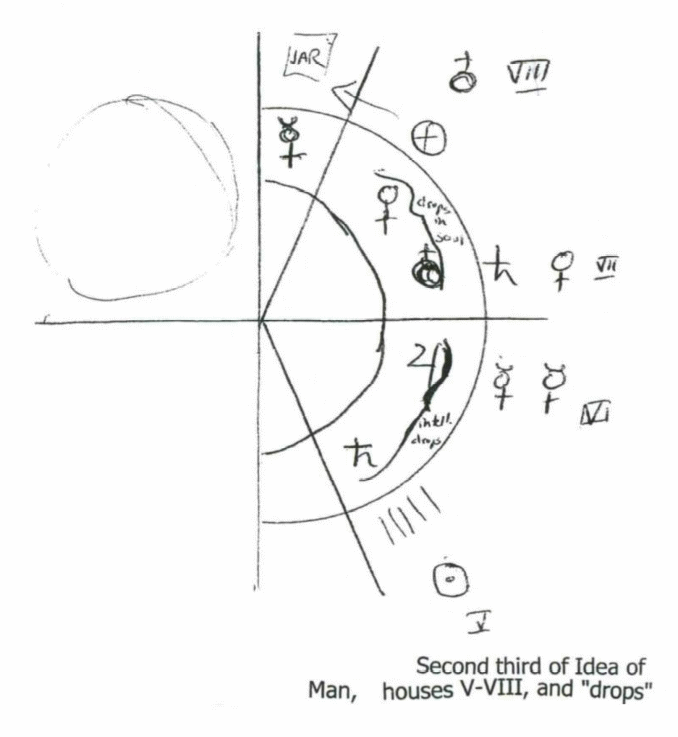
Buddhist occult physiology describes seed thoughts which are dropped into the central channel -- the outer shell of which becomes our mental states; within these drops is the light of the Soul.
The Spirit Mercurius is described as the entirety of these seeds which an individual will experience. They are within the causal body, then drop into the subtle and then into the gross body.
How can the indivisible Soul produce these seed thoughts? Or, does the Soul provide the kernel of light and the Cosmos supply the form or outer covering? If this is so, how does the Soul and Cosmos work together to arrange this production?
The Greek's equivalent to these seed thoughts, explaining the gap between the Soul and the Cosmos and between perception and conception is the orders of the Daemons. (There are six orders as enunciated by Proclus.) It is the fourth order that we must be concerned with at this point. This order is the Rational Daemons, whose purpose it is to transmit the functioning of the planetary spheres to our consciousness. Insofar as the Taijasa Consciousness of the Sun/Aquarius is the imaginal essence which produces the primal image, our individual imagination is of this same essence. And the Daemons are also of this essence, but are not the imagination. They insinuate themselves into our imagination and affect a change, a reordering therein. (imputation by thought)
For Plotinus the indivisible thought is the Subjective Wisdom of the pure Soul, which is always itself, is never conjoined with the Cosmic Circuit. But the lower powers of the Soul are somehow in contact with the Cosmic Circuit. In IV.3.30 Plotinus speaks of "Reason, whose actualization always accompanies thought." Reason receives the thought of the indivisible Soul and transmits it to the imagination. So Reason itself is within its transmission, and actually fabricates the entity.
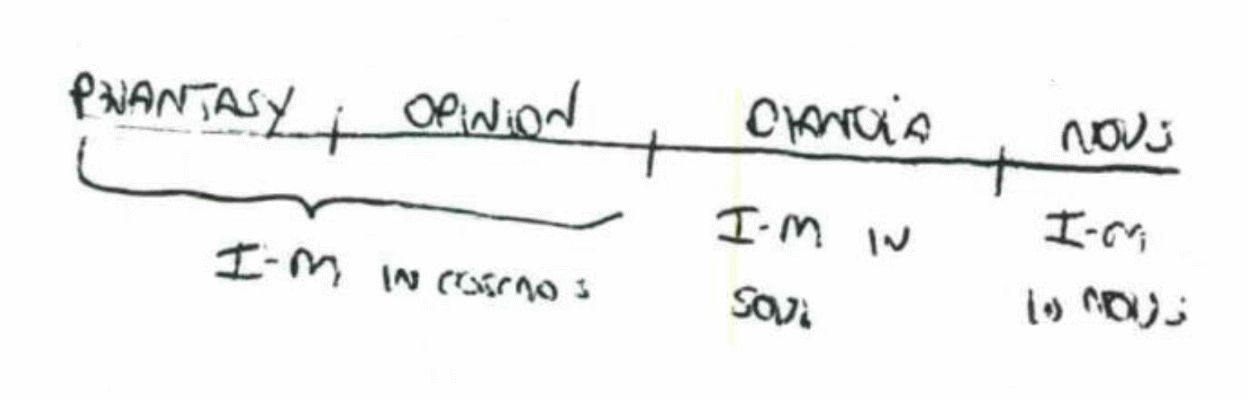
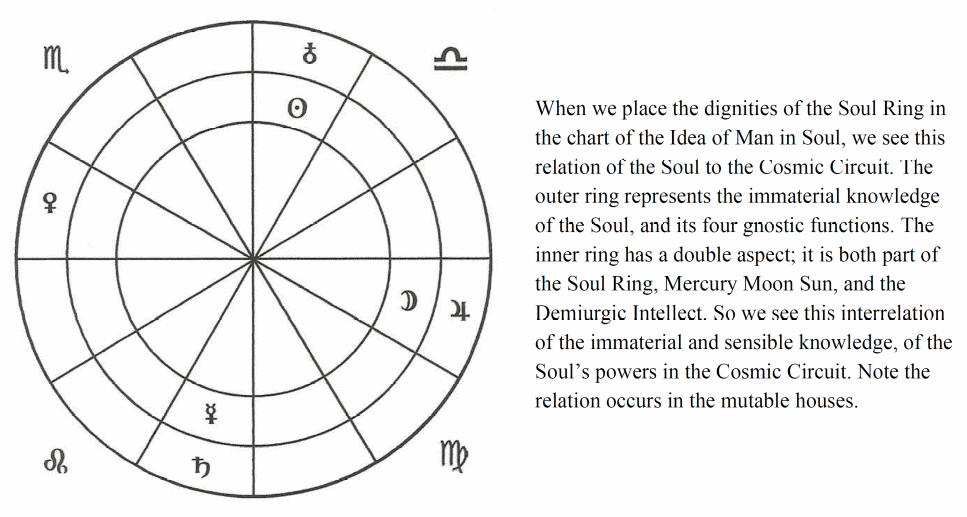
Mercury in Sagittarius can represent this Reason as the intermediary between the indivisible Soul, Saturn [in Leo] Jupiter [in Virgo] Mars [in Libra] Venus [in Scorpio], and the Mercury [in Pisces] Moon [in Capricorn] Sun [in Aquarius] in the 4th quadrant, as the Celestial vehicle of the Soul. Insofar as the Reason portrays itself within the imagination (11th house) it is within the Cosmos, but insofar as meaning resides in the Soul it is not within the Cosmos. The example of the divided line was used here. The lower half of the divided line -- sense knowledge and belief (animal faith) does not require the functioning of Soul for the kind of knowing that is experienced or presented to an entity. The powers of dianoia and intuition on the other hand is the knowledge by which the Soul interprets (and corrects) events in the Cosmic Circuit and is thus not within it.
So the question is now -- is the concept within the Cosmic Circuit?
What is a concept? Is it that by which the Soul is cognizant of the experiences within the Cosmos, being the rational thought processes, the epistemological categories in the 11th house? Or is to be conceived as the meaning from the immaterial Soul, for meaning must come directly from the pure Soul.
Is the imagination structured by the Soul in such a way for meaning to be pictured forth? Or is the imagination structured within and by the Cosmic powers? Or both together?
Insofar as the direct apprehension of Intelligibles is possible, there must be a link from within the Cosmic Circuit to the Intelligible realm.
Again, insofar as we have this gap between the Rational Soul in the 11th house and the sense perceiving entity in the 12th house, and the question of how the indivisible thought of the Pure Soul is available to the 12th house entity…and as we have an explanation from Plotinus of the Reasoning Soul as the intermediary, the 11th house becomes the pivotal point from both directions.
[File 1981 0325 & 0327S2-02R14.PDF (formerly 1981 0327S2-02R14.PDF) Ends]
DIAGRAMS FOR 1981 0327
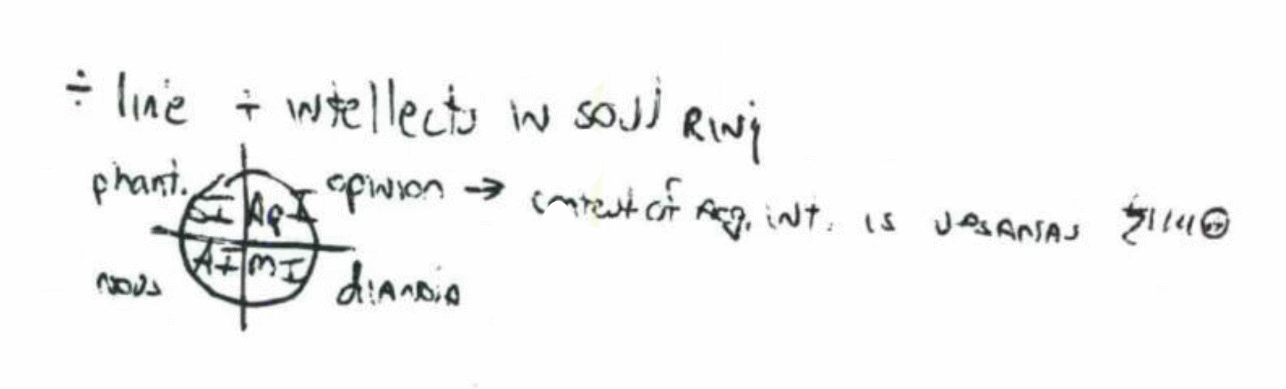
Class
Friday, March 27th, 1981
Verbatim, unedited transcriptCLASS at Wisdom's Goldenrod, Hector, NY
with Anthony Damiani (AD)
March 27, 1981
EPISTEMOLOGY; DIVIDED LINE
with Appendix: 1981 0325 & 27 Partial Transcript.
TOPIC: Epistemology
SUBJECT: Divided Line
SUBSUBJECTS: Kepler, Pauli, Daemons, Mundane Gods, Liberated Gods, Concept/Percept, Samkhya, Jung, Archetype, Belief, Mercury, Soul-Nature-Body Connection
CONTENTS:
Introduction and recap of previous class (March 25): logical gap between sense-perception and concept (Pauli); Plotinus IV.3.30; planetary correspondences in the Soul ring; daemons and their role in manipulating imagination
Overview of six hierarchical levels of daemons according to Proclus; fourfold classification of rational daemons; each sphere/planet has its own tribe of daemons
Need to understand daemons for subsequent study of Tantra, deity yoga, Kabbalah
Reading from Hans Lewy's Chaldean Oracles and Theurgy; demons luring souls to corporeal passions; daemons inhabit human bodies; ascetic morality as protection against evil powers
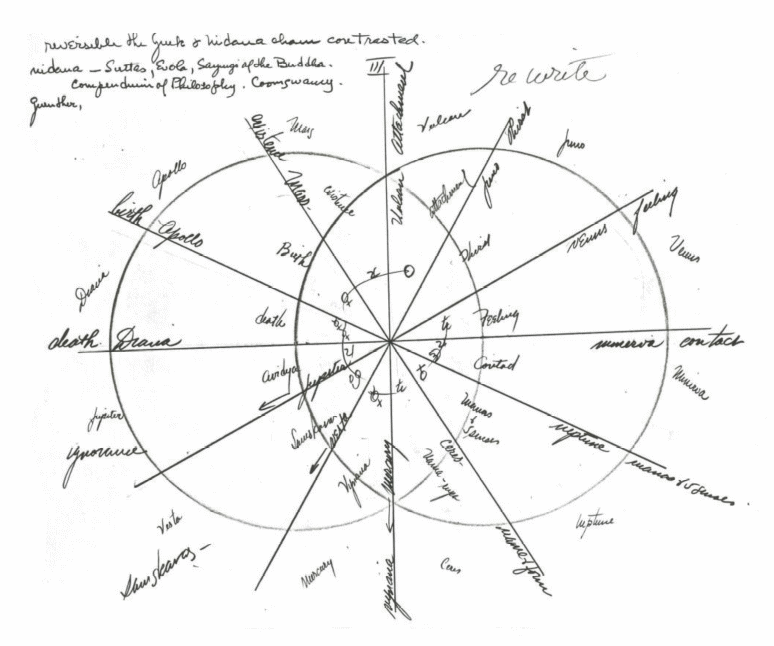
The vesica and four orders of rational daemons; correlation of vesica with nidana chain
Discussion of distinction between liberated and mundane orders of gods: liberated order in 10th-11th house; mundane order in 12th house
Failure of logic to connect sense-perception and concept; daemons as possible connectors
House structure as equivalent to soul containing cosmic circuit; example of Saturn square Mars and broken leg to illustrate meaning and events
Question of whether concept is inside or outside the cosmic circuit
Plotting Plotinus IV.3.30 on divided line; division between soul in and independent of cosmic circuit
Samkhya's view that the subject is within prakriti; bifurcation within psyche into subject and object; possibility of concept arising within prakriti/fourth quadrant
Fourth quadrant subdivided into mental, emotional, and physical aspects; mental as containing both emotional and physical; suggestion that mental corresponds to realm of gods (11th house)
Discussion of archetype (mental) and its bifurcation; question of how archetypes invest experiences with meaning
Animal faith (belief) versus human understanding; correlated with lower and upper section of divided line; lower section part of cosmic circuit, upper section part of soul knowledge
Question of whether knowledge comes from soul or from cosmic circuit; examples of benzene ring, Cassirer
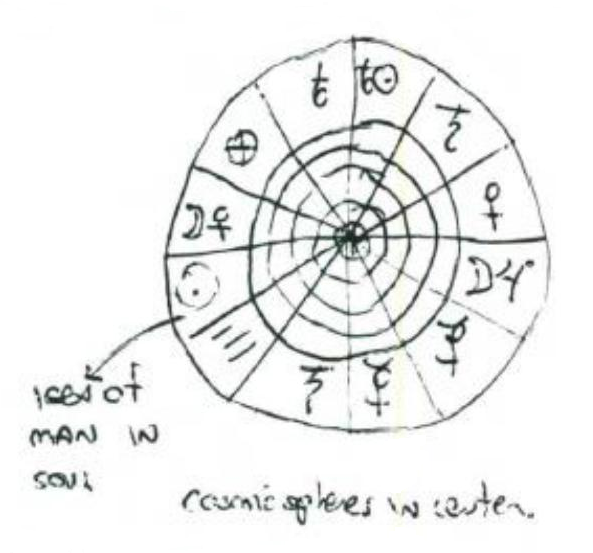
Idea of Man in four quadrants; relationship between soul quadrants and planetary spheres
Quote from Proclus on Idea of Man abiding essentially in souls, not an abstraction from sensibles
Quote from Jung on the multiple aspects of Mercurius
Quote from von Franz on "the one and the other"; problem of indeterminacy of subject and object; problem of two knowers (cosmic and individual)
Dream analogy insufficient; archetypes and apparent subject part of cosmic threefold
Debate about divided line; confusion about where to place aspects of cognition in the cosmic circuit; dianoia placed in eleventh house, transposes Thought into imagination
Mercury in Sagittarius as reasoning is part of cosmic circuit, but as soul's intellection is not part of cosmic circuit
Critique of Jung's theory that the archetype connects subject and object; you are not the psyche
Correlation of divided line and intellects in Soul ring
No knowledge at level of sense-perception and belief
Two core problems: 1) how the cosmic functioning produces apparent subject and object; 2) how the soul's subjective knowledge relates to or imposes meaning on cosmic production
Discussion of whether these problems can be seen as one if individual soul is placed inside cosmic soul
Question of whether soul's meaning comes through same route as cosmic production
Problem of soul riding on vehicles of archetype and pseudo-subject distinguished from problem of how soul superimposes meanings from within itself onto cosmic events
Student suggestion that meaning arises when certain aspects allow light of cosmic soul to come through and conjoin with individual soul
Distinction between Nature's organized body and soul's interpretation; question of how soul's interpretation accords with functioning of organized body
Appendix: 1981 0325 & 27 Partial Transcript
BOOKS READ FROM OR REFERENCED:
W. Pauli, "The Influence of Archetypal Ideas on the Scientific Theories of Kepler" (in C.G. Jung, W. Pauli, The Interpretation of Nature and the Psyche)
Plotinos, Kenneth Sylvan Guthrie (tr.), Complete Works, Vol. II
G.R.S. Mead, The Doctrine of the Subtle Body in Western Tradition
Thomas Taylor (tr. and comm.), The First Alcibiades (Vol. 1), The Parmenides (Vol. 3), in The Works of Plato, viz. His Fifty-Five Dialogues, and Twelve Epistles
Sallustius, Thomas Taylor (tr.), Sallust: On the Gods and the World
Hans Lewy, Chaldaean Oracles and Theurgy: Mysticism Magic and Platonism in the Later Roman Empire
C.G. Jung, CW 8, The Structure and Dynamics of the Psyche, "On the Nature of the Psyche"
C.G. Jung, CW 11, Psychology and Religion, "Psychological Commentary on The Tibetan Book of the Great Liberation
C.G. Jung, CW 13, Alchemical Studies, "The Spirit Mercurius"
Marie-Louise von Franz, Number and Time: Reflections Leading Toward a Unification of Depth Psychology and Physics
Plato, Sophista
Plotinus, The Enneads (MacKenna translation, 4th ed.)
PLOTINUS QUOTES READ FROM OR REFERENCED: I.1.7, IV.3.30
DIAGRAMS appended to this transcript:
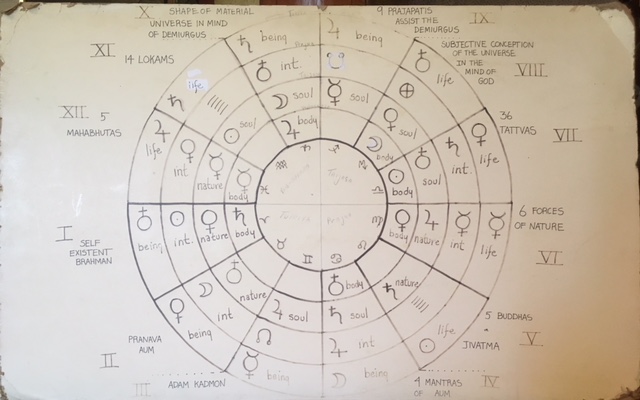
FIGURE IMG 2202-Posterboard Metaphysical Chart.
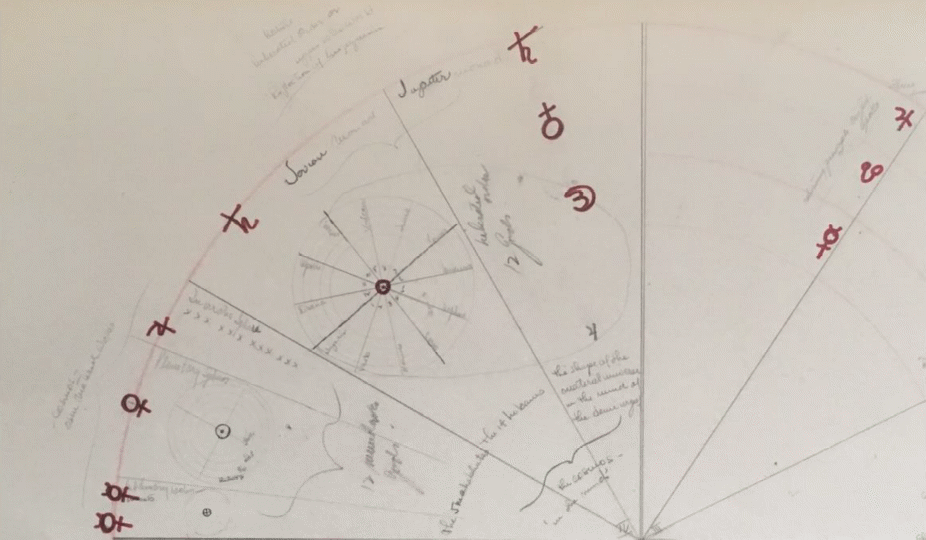
FIGURE IMG_2319 copy. Proclus Chart (excerpt).
FIGURE AD_D_013. Vesica of Liberated Order and Nidana Chain.
FIGURE 1981 0327-4-AB. Mandala of Idea of Man in Soul.
FIGURE 1981 0327-5-AB. Divided Line and Idea of Man in Nous, Soul, and Cosmos.
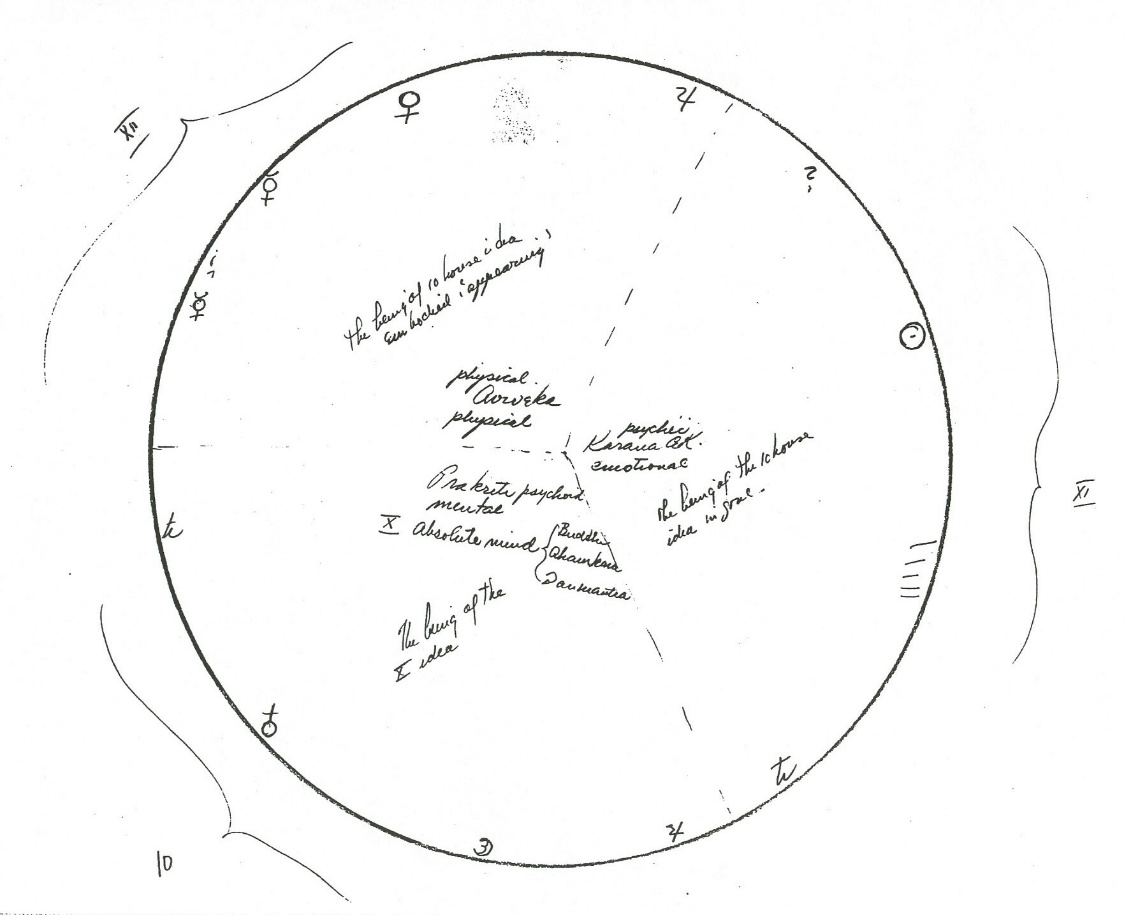
FIGURE AD_E_019. Prakriti, Karana Akasha, and Aviveka Mapped on to Houses 10-12.
FIGURE 1981 0327-7. Idea of Man in Soul and Cosmos.
FIGURE 1981 0327-8-JF. Second third of Idea of Man Mandalas, Houses V-VIII, & "Drops".
FIGURE 1981 0327-9-AB. Divided Line and Intellects in Soul Ring.
Other diagrams also referred to are not with this transcript version. [Transcriber note: [diagram] means the speaker is referencing a diagram as he or she is speaking. If someone is drawing or writing, with audible sounds of chalk on a blackboard, I indicate this by [drawing] or [writing].]
NOTES:
The partial transcript for this class (Scan File 1981 0325 & 0327S2-02R14.PDF) has been appended. It mistakenly has 3/27, 28/1981 written on the inside of it but it is really a summary of this and the 3/25/81 class. All spelling, punctuation, and capitalization errors corrected, all abbreviations, planetary glyphs, and some numbers spelled out.
This class took place on a Friday.
TRANSCRIBED Verbatim by IT 2022. In 2025, IT completes TOC, expands Book List, adds new notes within transcript and alters some existing notes, reorders diagram section, replaces three diagrams, adds two diagrams and references within transcript to these diagrams, updates audio file markers to match new REP audio. Archival verbatim transcript – V12a.
AUDIO FILES: 1981 0327a (formerly 1981 0327b), 1981 0327b (formerly 1981 0327a). [Note 1: "Tape" and "Side" refer to original audio cassette tapes that were later digitized into .MP3 Audio Files. Note 2: Parts of Audio File 1981 0327a (formerly 1981 0327b), Side 2 are speeded up. Note 3: In 2024, REP Studio consolidates files a and a(2) into one audio file.]
1981 03/27 at Wisdom's Goldenrod
Epistemology; Divided Line
[Audio File 1981 0327a (formerly 1981 0327b) Begins]
AD: No. Notice the ground here. If anybody feels [S simultaneously: Here.] uncomfortable, leave. If you feel uncomfortable leave.
S (faint): Why don't you leave.
AD: I think I go.
S (faint): Yeah. (laughter, student words)
AD: Uh-- [short pause] [Note: The following is a summary of WG Class 1981 0325.] Well we started by pointing out that, in the Kepler book where he points out that it's been logically ascertained that we can't seem to establish a relationship between sense-perception and a concept. [Note: W. Pauli, "The Influence of Archetypal Ideas on the Scientific Theories of Kepler" (in C.G. Jung, W. Pauli, The Interpretation of Nature and the Psyche), p. 152.]
S (faint): Oh yeah. Ok, yeah.
AD: Gotta take off from there. Avery, why don't you reread it?
S (very faint): Uh-hm.
AS: So-- ok so-- Then we-- we were-- we read a few quotes, we read the quote from the-- from the Enneads, you know, IV.3.30 where he presents the problem that way in terms of the transmission of the immaterial and impartible Thought into the imagination through the medium of the reason and we laid out the soul, you know, the soul's imparticible, impartible Thought, you know, the first four planets. [Note: See FIGURE IMG 2202-Posterboard Metaphysical Chart, Saturn in Leo, Jupiter in Virgo, Mars in Libra, Venus in Scorpio.]
VM: In the Soul ring, yeah.
AS: In the Soul ring, and then going into the imagination [VM simultaneously, faint: Sun, right.] into the fourth quadrant, the Sun Moon Mercury. [Note: Sun in Aquarius, Moon in Capricorn, Mercury in Pisces.] And that Mercury [in Sagittarius] sits right in between them there. Ok, and we specifically then started working on the problem of how these reason-principles are insinuated into the imagination and what's the correlation between the subjective meanings that you come up with and the-- the actual material object or the materially fabricated object or the cosmic spheres and so on. So, we had this quote from The Subtle Body [Note: G.R.S. Mead, The Doctrine of the Subtle Body in Western Tradition.] David read on the imagination, and the relation of the imagination and how the daemons can manipulate that imagination and actually insinuate themselves in it because they themselves are akin to this imaginal essence. And then he had that quote that normally we operate with the imagination but that sometimes the daemons can actually manipulate it, present things in that manner.
And we went through the different levels of daemons, they speak about various orders of daemons, you know, from the divine-- you know, Proclus has in a couple of places his six levels of daemons--the divine daemons who conjoin you to a god. It's like your star. And then the next level the Intellectual daemons which preside over the ascent and descent of souls. And then the third level of daemon which actually places you, gives you a certain allotment within the universe. And the fourth level they call the rational daemons who are responsible for transmission of certain thoughts and reasons and so on, those are actually the ones I think that we s-- that they speak about as insinuating themselves and manipulating themselves in the imagination. And then there are two lower ones at the level of body and the level of matter. Ones at the matter seem to preserve those life essences which are permanently embedded in the matter, keep them going as it were, fixating them. And we-- we read that and there's-- there's another-- there was another short quote in-- That's (when) the Alcibiades-- you know, the Alcibiades notes [Note: Thomas Taylor (tr. and comm.), The First Alcibiades (Vol. 1), in The Works of Plato, viz. His Fifty-Five Dialogues, and Twelve Epistles, footnote, p. 17ff.] and then there's-- there's another short note on that in-- in-- in Sallust on the Gods. [Note: Sallustius, Thomas Taylor (tr.), Sallust: On the Gods and the World.] Well anyway, it's the same, it's basically the same.
Then we ended up with this quote on-- and then we ended up with a quote where he speaks about, like for example on one level you'd have different types of daemons. Like you'd have a guardian daemon and the fabricative daemons and so on. And, the life-giving daemons, which seem to correspond like, you know, the ordering we had, the mundane gods, [S: Yeah.] Jupiter, Vesta, and so on and they had four different groups of gods [FIGURE IMG_2319 copy, 11th house]. [Note: Later in the transcript these Gods are called Liberated. See pp. 9-10.] Well these daemons are associated with certain of the gods, all herds of daemons. So certain of them would have certain characteristics depending on which gods they were associated with. And there are guardian-- they would have a guardian characteristic or a fabricative characteristic. I guess, you know like when-- we didn't state this explicitly but I guess, you say well some of the planets are in their-- in-- you know, the planet-- a planet may be in dignity or may be in non-dignity, it may be fabricative or gnostic. Well I mean it may be that there's certain daemons who operate more gnostically and others more fabricatively. But-- anyway he had these other-- this classification instead of a hierarchical one it seemed like within each level you'd have-- they would have different peculiar characteristics or peculiar jobs to fulfill. More creative or harmonic-- you know, the four, fabricative, harmonic, vivific or life-giving, and--
S: Yeah.
AS: Yeah.
VM: So you're saying (that/at) each level of daemon (you) have these four functional things, that it's four types of functioning, something like that?
AS (simultaneously): Well, I think we talked about those mostly just at that fourth level in the hierarchy, the rational ones, [VM simultaneously: Alright.] the ones that affect the imagination and so on. We spoke about those. Like the whole-- concerned with operating from the point of view of the eleventh house system [diagram]. We spoke about that vesica where he had the mundane gods [FIGURE IMG_2319 copy, 11th house], [Note: Later in the transcript (pp. 9-10) these Gods are called Liberated and the ones in the 12th house are called Mundane.] from there into the twelfth house [diagram]. Like those-- they would have their operation would be to actually-- they would be like the transmitters, cosmic spheres, or they'd be the transmitters of the energies of the gods.
VM: Speak about daemons, is that another way of speaking about the motion of the planetary spheres? Or is there a distinction between them?
S (very faint): No.
AD: No they're different from the planetary spheres. Each sphere has its own tribe of daemons.
VM: Oh you mean like the sphere of Saturn, Jupiter, and so on.
AS (simultaneously): Carry out the work.
AD: Carry out the work.
VM: They're actually the intermediaries between that sphere and let's say the lower realms?
AD (very faint): Yeah.
AS: That's--
S (faint): Interesting.
AS: When we talked about that, you know, a certain aspect goes on and we say well how does this influence [VM simultaneously, faint: In other words, the work (few words inaudible)] the ima-- how does it get-- how does a concept arise, you know. Certain aspects going on and a certain concept arises in your imagination. Well it's not always all your doing in fact. You ever get the feeling that--
VM: You're almost tricked.
AS: Given to you. [student assents, very faint] Yeah. Well something's being given or transmitted. So they're doing the job of transmitting them.
AD: And the reason we-- we've chosen to do this here, or we're being led into it gradually I think, is because on the one hand, we want to get into tantra de-- and deity yoga. And there we're going to be dealing with all the same problem with the gods and what not. And on the other hand I-- I'm also anticipating getting into the Kabbalah some and there you'll be dealing with, what do they call it, 72 powers of God or whatever. And you'll be dealing with it there. So either-- you know, either way we go we're going to have to have some basic understanding of what they mean when they speak about these demons, daemons, yeah. And, of course in the Orient they have different names for them, they call them devas, gods and goddesses, gods, alright, goddess. And, they tell you that, for instance, if you carry on certain meditations where you very intensely concentrate on an image and eventually the image appears or if you say the mantra very intensely a god or goddess appears. And then you have to resolve them back into emptiness, alright. And again there would be many different levels of gods. Actually when one first has these experiences in the beginning, gets quite carried away with it but if they persist the experiences get deeper and deeper and ramifications are too vast.
So, if we do it in a Western style (we could/if we) try to get acquainted with what some-- some of this is in Western tradition. I read-- I read some parts of a chapter called "Chaldean Demonology" and I'm sure that those who read on Buddhism and feel that it was almost like a text from, you know, Tibet in (thirteenth/fourteenth) century. I mean, did I bring it? It's a book called Chaldean Oracles and Theurgy by Lewy. [Note: Hans Lewy, Chaldaean Oracles and Theurgy: Mysticism Magic and Platonism in the Later Roman Empire.] It was published some time ago in Cairo. [Note: AD misspeaks. Originally published in Le Caire, France.] And, he's a scholar, you know, so, he could to some extent do it in a scholarly way, you know, and not really be too concerned with it. [9¾ second pause] They-- they did of course take this very seriously and they-- they didn't think it was anything to-- And the difficulty of course is [one word inaudible] that our disbelief today makes it even more difficult, you know, for us to understand any-- But (if) our disbelief can act against us too. [10¾ second pause] Something like this, this is just--
[Transcriber note: I am using Chaldaean Oracles and Theurgy: Mysticism Magic and Platonism in the Later Roman Empire by Hans Lewy, Paris: Institut d'Études Augustiniennes, 2011, Third Edition.]
Hans Lewy [Chaldaean Oracles and Theurgy, pp. 264-265, AD reading]: "These [AD reads: The] demons lure the soul to corporeal passions and to an"animal" life. They bring about, as an [AD reads: the] Oracle says, [AD: And this is the Chaldean Oracles.] the "stifling of true Eros" that had been blent with the soul at the time of her creation and kept awake her yearning for a return to her divine place of origin. Gradually they [AD reads: these daemons] take up their abode in the body of the person they have seduced: [AD: And he quotes--] "Thy vessel [AD reads: The vessels] the beasts of the earth shall inhabit"."
AD: And that's from the Bible.
Hans Lewy [Chaldaean Oracles and Theurgy, pp. 265-266, AD reading]: "Temptation by the demons cannot be avoided; for it is inherent in earthly existence. [AD adds: And] Through a residence in the human body the soul finds herself in the sphere of influence of [Heimarmene], the force of Destiny…"
AD: Or they'd say something like this.
S: Uh-hm.
[short pause]
Hans Lewy [Chaldaean Oracles and Theurgy, pp. 266-267, AD reading]: "As the theurgists conceived it, Destiny is a power thought of as personal, which becomes individualised in its demonic satellites. The immediate effect of the Chaldean initiation was to eliminate this danger. The theurgist who had accomplished the sacramental rites was immune against the action of the demons…
"The power of the demons is manifested in the dimensions of the region they inhabit, extending as it did throughout the entire intra-mundane space [AD reads: sphere]. The fragment of an Oracle which constituted the beginning of a conjuring hymn, enables us to form an [AD reads: the] idea of the multiplicity of the spirits appertaining to the Chaldean pandemonium…"
AD: Goes into some examples. Evidently they-- they occupied the entire planetary-- all the planetary spheres and the interim unnamed sphere and the sublunary sphere. So they're everywhere. Each has its own tribe of herd-- or herd of daemons. And, they speak about these daemons as effectuating or actualizing the demands of justice or whatever had to be done. [15¼ second pause, flipping of pages] Now-- (and/um)--
[short pause]
Hans Lewy [Chaldaean Oracles and Theurgy, pp. 275-276, AD reading]: "An ascetic morality is one of the chief consequences of this demonology. The terrestrial world is given over to the evil powers, who menace not only the body but also the soul of man. Every psychic affection [AD adds: or emotion] to which man is subject and every evil deed which he commits attracts those spirits and invests them with power over him. Occasional rites do not afford sufficient protection against these tempters; constant danger requires permanent purity."
[15¼ second pause, flipping of pages]
AD: This must have had a tremendous influence on Christian ethics. Well, over here it gets a little more technical, I want to save it for (open) discussion (we'll have). So-- [short pause] I thought that this would lead us right into the vesica, you know, and we'd go over that again, and see now if we understand it a little better. So the last-- the last thing we did was when we took the six divisions, you know, and the fourth division was the division of the rational demons. Evidently these have to do with work-- these work or are the messengers of the rational soul. This is the one we're interested in. I don't know that we can understand anything about demons who assign the celestial to the star which is going to be his home, where he comes from. And I don't know that we can understand demons that preside over the entire span of our incarnations, the Intellectual demons. And I don't think we can understand the ones that (distribute) us to the various planetary spheres or-- and say this is what your allotment is from that realm. But I think we can start from the ones on the rational soul and work our way down. Although when we get into matter I think there again we're going to be met with the greatest obscurity. So, why don't-- why don't we do that one, huh? The rational demons was what he had. I think I got a quote for some-- on the vesica and we could start with that.
AS: Let's do Vesta.
AD: [drawing] We used to do the vesica, alright. [14¼ second pause while drawing] I think Jupiter, Vesta, [writing] Hermes [FIGURE IMG_2319 copy, 11th house]. Avery?
AS: And Ceres.
AD: Ceres.
AS: Neptune.
AD: Neptune.
AS: Minerva. Minerva. [AD writing] Venus. Juno. Vulcan. Mars. Sun. And then Diana [diagram].
[short pause]
AD: Now, we've of-- I think quite a few times we've correlated that with the nidana chain [FIGURE AD_D_013]. And, when they speak about the combined dependent origination, that's much more meaningful and much more helpful call it combined dependent origination. I think it's very misleading to call this ignorance. [short pause] And, I think it takes the greatest wisdom to figure out and unravel our lives for us and help us get back to where we-- where we were set. But at any rate, I'd like to try working on that. Now, remember the order, he called the-- he had four classes [writing] of demons, right?
AS: Yeah.
AD: And he called them [writing] purificatory, the next-- it doesn't matter the order.
S (faint): Oh yeah.
S: Fabricative.
AD: Fabricative?
S (faint): No [VM simultaneously: Ok.] generative.
AS: Yeah well, [S simultaneously: Well fabricative was first.] there's good-- there's fabricative.
AD (simultaneously): Hm?
AS: There's fabricative.
LR (simultaneously): Purifying.
[AD writing]
AS: And then generative. [short pause while AD writes] There's one that's harmonic but that's not what they call him.
S: Perfective.
AS: Perfective.
S (simultaneously): [one/two words inaudible]
AD: Perfective.
AS (simultaneously): Yeah.
[short pause while AD writes]
AD: And they refer to these as the four-- These are all the rational daemons. [12¾ second pause while writing] And, we thought of these here as purificatory was--
AS: It would just be the guardian, right.
AD: Guardian. So that would be Vesta--
AS (faint): Vesta, [JC simultaneously, faint: Minerva and Mars.] Minerva, and Mars. In Taurus or in Capricorn.
AD (very faint): [writing] (Capricorn.)
AS: In Aries Leo Sagittarius. [AD writing] Cancer. I guess, Scorpio and Pisces. Then you have Gemini Libra Aquarius.
[short pause while AD writes]
AD: We got as far as that. Right? We made that equation. Would you continue? I have a paper on the vesica, you want to-- [Note: See "The Greek Mundane Gods and the Vesica," 1978 0827C1-12R13 GRK mundane Gods.PDF. Read in WG Class 1981 0328.]
AS (simultaneously): Want to go-- Yeah, I understand. Well that-- Yeah that's from there, he talks about these four different, or how-- [S: Important.] find them.
S (faint): (Have it.)
AS: Also-- there's also in The First Alcibiades. I just said well, he says some dae--
[Transcriber note: I am using Thomas Taylor (tr. and comm.), The First Alcibiades (Vol. 1), in The Works of Plato, viz. His Fifty-Five Dialogues, and Twelve Epistles, First Edition, London, 1804.]
Thomas Taylor (tr. and comm.) [The First Alcibiades, p. 17, AS reading, quoting Proclus]: ""…some are allotted a purifying and undefiled power; others [a] generative; others [a] perfective; and others [a] demiurgic [power; and], in short, [AS: And here's the thing.] they are divided according to the characteristic peculiarities of the gods…""
AS: And since they're under the mundane gods it seems appropriate that they're actually-- you know, they're carrying out the-- the effluxions or whatever they're called. That they transmit the efficacious powers of whole nature to things generated. So the whole nature is if-- you say the wholes are the gods or the spheres of the gods, then they are carrying-- they're the efficacious powers. You have an aspect and there has to be some medium that's effecting this transmission of power. And so they seem to do that according to these various roles. I mean-- So I-- I guess-- I guess what he's trying to say, but I'm not-- I'm not really sure is that say, if you look at these gods, Taurus, Virgo, and Capricorn, for example, they would have a guardian nature. Vesta, Minerva, and Mars, you know, they classify them according to that. Or maybe pick an easier one I guess. Like fab-- fabricative. Aries, Leo, and Sagittarius. So associated with those particular signs would have to be these fabricative [AS indicates on diagram] level, the fabricative order of rational daemons. Ok, and associated with the earth signs would have to be the purifying or guardian order of daemons. So, I guess it would seem that planets in-- well, you know, speculate that planets in those signs would-- when the planets-- when a planet was in one of those signs for example it would exhibit peculiarly a fabricative characteristic. [VM simultaneously: How do you arrive--] Of course we don't know what--
VM: How do you arrive at the correlation Avery, I mean is it just--
AS: Oh well, we'll just-- you read what he said. How do I arrive at the-- the-- Oh. Because that's what these are called.
VM (simultaneously): In other words, why do you say--
AS: They're call-- these gods are classified as that. They're the same names.
VM (simultaneously): Oh you mean tradition is--
AS: Oh yeah, the-- [writing] these three, Jupiter, Neptune, and Vulcan, that's-- that's the way even Taylor in all the places [VM simultaneously, faint: (Ok.)] that list the mundane gods. I think-- I-- we didn't mention that right here but the-- they are called-- the or-- they do have a fourfold ordering of these gods too which is according to [writing] fabricative-- That's the fiery ones, ok? And that's why-- and that's-- and he calls them they are fabricative.
VM (faint): Ok.
AS: And the next ones are called guardian. [writing] Those are the earth ones, associated with earth, guardian, or if you look what they do, they're purifying, they really are the ones that-- Minerva for example. I mean it's pretty obvious. Virgo, ok, it's purifying. Same with the other two, the Vesta and the Mars. The Mars is responsible the divulsion of forms from matter, that's what it is. And, the third one, the perfective, they-- here they're called harmonic. [writing] That's-- yeah. And also perfective, Hermes, Venus, and Apollo [AS indicates on diagram]. They're perfective, they lead souls back purif-- They perfect-- they perfect the generated natures so, those are the perfective order. And then the generative are life-giving ones. In this one they called vivific. [writing] (These two.) Order. So-- and these are tra-- yeah these are traditional, and, they do-- you know, they do the grouping and it's according to four. It would seem that the one that Taylor was discussing in the footnote there is the same-- it's the same four. But the words are almost exactly the same. And as he says, they're grouped according to the particular or peculiar powers of those gods. So I mean-- I guess somehow we imagine that [drawing] the gods themselves, the mundane gods are here [diagram]. But the way that their powers are-- You know, when they speak about combined dependent origination, there has to be a modus operandi, something has to actually do the work as it were. Ok so, whatever these powers of these daemons are, they seem to have this middle realm-- they seem to be assigned this middle realm between say the contemplation of the gods and the actual generated production.
VM: I'm not clear, are they functioning between the eleventh house and the twelfth house or the tenth and the eleventh or-- [AS simultaneously: Ok well--] How do you actually--
AS: Ok well, there were-- we had these fi-- these five or six different levels of the god-- of the daemons.
VM: Yeah.
[Note: See FIGURE IMG_2319 copy for the following.]
AS: And I-- there are some [drawing/writing] that are back here in the ninth house. [VM assents, faint] You know, if we did the order of the soul, the ninth, the tenth, eleventh, twelfth. There are some which are back this-- that he said, you know, those conjoin you to your star, the celestial to the star. And now there's a concern with, you know, the ascent and descent of souls and so on so-- But the peculiar order that's here seem to be concerned with the epistemological categories. I mean that's exactly the way we would speak about that. Kant makes them very dry and so on, you know, he says well the working of the mind to produce our thoughts and so on but, if we think of the World-Soul's thought, you know, the activation of karmic impressions and so on. As he said who-- somebody has to care to make sure that the karmic laws are carried out, the spindle of necessity. And this is this eleventh house [diagram], right, I mean the way we've spoken of it a lot of time. Through the Sun in Aquarius [diagram] these karmic forces get activated on (a) World-Souls. Ok? So the World-Soul's activation of these karmic forces, something has to-- these seem to have to carry out the actual job of combining-- You know, like when he spoke-- also in Buddhism they spoke about the dharmas combining to produce an entity, a prakritic entity. Or to have some effect, there's a transit going on.
S (faint): [couple words inaudible]
LR: I've never been able to see or understand, what is the connection between those, the mundane gods, and the planetary spheres or the dignities?
VM/S(?): Uh-hm.
AS: Well, I don't-- I'm not really sure, Linda, but I know they speak about--
LR (simultaneously): Well I mean how do you see that 'cause I-- you know, [AS simultaneously: Well they speak about two--] that you have the Mars there and you have Venus and-- what--
AS: Yeah. They-- they call-- they-- there are two orders of these, there are liberated orders and mundane order.
LR: These are the mundane order.
AS: Well, it's not clear.
LR: Oh.
AS: Ok? Because they assign the same names and the same classifications to both. Ok? And they do a second order, what they do the-- in the twelfth house, they do this order of the gods which is different. They have the twelve gods assigned to the inerratic sphere, [writing] the seven planetary spheres, and the four sublunary elements. And that's a twelve. Ok? And they assi-- and these gods are distributed that way in the twelfth house. In other words, if we draw our [drawing] [S simultaneously: Can we see this one?] picture of the inerratic sphere, then the seven planetary spheres, and then the four sublunary elements [diagram], [writing] they distribute their provinces that way in the sensible world, in the-- in the three material realms. And they correlate. If you notice you got-- you got the seven planets or almost. Ceres is Saturn. Ceres is the a-- is an aspect of Saturn. So you have Saturn, Jupiter, Mars, Venus, Sun, Moon, and Mercury. Ok? And then they have this-- then one of them, I think it's Minerva [AS indicates on diagram], is the-- they assign to the celestial. Ok and then the other four [AS indicates on diagram] they give the provinces of the four elements. And I don't-- I don't know what the connection is though. I just know they give them the same names, they have-- they have that-- a set here and then they have the ones over here in the eleventh house. So, in the eleventh house they would have like the psychical-- they would have a psychical province. In the twelfth house they have an actual-- provinces in the three material realms. But the way we spoke [drawing] about them mostly was in terms of these epistemological situation or the functioning of the Sun in Aquarius, the World-Soul.
CDA: But I thought-- I-- I mean I'm-- [S, faint: Yeah.] this might be [AD simultaneously: Speak up.] wrong but I thought that the mundane gods didn't go for-- I mean you really can't speak of mundane gods beyond-- after the eleventh house. See--
AD (simultaneously): Yeah, the mundane gods (are what you're talking about).
AS (simultaneously): The cosmocrators are here [AS indicates on diagram; twelfth house]. These are the-- these are really the liberated order, the tenth, eleventh house.
CDA: The mundane gods are in the twelfth house?
AD: Yeah, the cosmocrators you see are the mundane gods.
CDA: That's their body.
AS: Yeah but they're--
CDA: Ok.
AS: That's what makes them mundane in fact, they say that's their definition.
CDA (faint): Ok.
AS: Mundane, the lowest order of gods, mundane, means that they have actu-- bodies which appear. These gods you-- you don't see the bodies (of) in the eleventh house.
AD: Remember when we were speaking about Minerva [AS simultaneously: So they're liberated.] appearing to someone, appeared to someone, they take on a form. I refer to them as epistemological categories for that reason. Because if you wanted to-- if you wanted to like get a feeling of the subtle delicacy of these things, alright, you're speaking about thinking processes. [AS assents, faint] And now, what kind of matter would be involved in thought processes? That's why I refer to it as the epistemological subject there, and the epistemological categories.
AS: Yeah.
AD: But anyway let's get back. The main point is this here. That in the Kepler article it was-- it was said by a man of fame, you know, that there is actually an inability on the part of logic to establish a connection between a sense-perception and a concept, that logic will fail and has failed. And I think we began-- we began to poke around trying to see if there was an explanation for this failure. And when we spoke about it last night, some people had difficulty in recognizing that there was a problem. They didn't see no problem, you know, that on the one hand you have a sense-perception, on the other hand you have a concept, and they didn't see that there was a problem, how to get them together. [student assents, very faint] It's a pretty big problem. And we gave the example like, a situation occurs in the external world and a meaningful superimposition on that event takes place. On the one hand you have the external and on the other hand you have the internal, and what I was asking was, how do you bring them together? Because if they're not brought together you're going to be living a schizophrenic life. And then of course the suggestion was brought up that these are what supply-- supply the connection between the inner meaning, the concept, and the external sense-perception.
VM: In the context of Kepler in that article that you bring up, would you say that these twelve gods would be what made the connection between Kepler's religious vision or his vision of the sphere and the point and the Holy Ghost and so on and the sense-perceptions of the planets?
AD (simultaneously): Vic I don't know. It's something we're going to try working out now. [short pause] Keep trying to assure people that philosophy is nothing but a swarm of problems. [short pause] First of all, before we start on this, can we try to understand-- You remember the way we set up the thing? We say something like this. [Note: See FIGURE 1981 0327-4-AB for the following. This diagram is not from this class and is used as a stand-in to help follow along.] We say on the one hand, we have the house structure [drawing] which gives us the-- the soul, alright. This is equivalent to the soul [diagram]. And on the other hand we have inside the house structure the cosmic circuit. Ok? Now inside the cosmic circuit we have the planetary, ok, functioning. Then in here, imagine ourselves in here where we're having our experience [diagram]. Now the question would be this here. If we locate ourselves inside the cosmic circuit, alright, and an event arises, a situation, it takes place here [AD indicates on diagram], alright. You step in front of a car you break a leg and you find out you got Saturn square Mars, ok. Now--
VM (very faint): Is the broken leg in Leo?
AD: Hm? (some laughter)
S: They don't send you [one word inaudible]
AS (simultaneously): But the Saturn square-- but the Saturn square Mars is going [S simultaneously, faint: (Ok.)] on here [diagram].
VM (simultaneously): Oh ok, so the actual [AD simultaneously: This is the--] broken leg experience is in (the) [few words inaudible] (bit of laughter)
AD: Well, no, Saturn [AS simultaneously, faint: Well--] won't have a broken leg, nor will Mars.
S: (How dare you.)
VM: Anthony, I'm just saying that (some laughter) the actual material experience I go through is in that s-- [AD indicates on diagram] there, right, the broken leg is there, let's say it's meaning-- it's a meaningful [S simultaneously: It's a leg.] correlation, I don't want to say cause.
AD: That's an external event, alright?
VM (simultaneously): Fine.
AD: A bone is broken, ok. That's an external event.
VM (simultaneously): [few words inaudible] Saturn square Mars (for others).
AD (simultaneously): And-- Yeah well, let's put [drawing] Saturn here and, alright, you'd have a Mars here somewhere [diagram], ok. Now the question is, where would we find the meaning. Is-- is the concept inside the cosmic circuit?
S (faint): No.
VM/S(?) (faint): I'd say (exactly).
S (faint whisper): Ok.
AS: Is it?
S (faint): I think (so).
AS (simultaneously): Well it's a question.
S (faint): Uh-hm.
AD: (I'm getting) good questions too.
AS: There are in other words--
VM: It had to be according to the soul.
AS: Yeah, is-- something's going on in here [diagram], how does that evoke or correlate with a meaning which is imposed on it. [student assents, very faint] 'Cause even if you say the guy breaks his leg there may be many different meanings that that event could evoke or correspond to. Or is that not what you're getting at?
AD: Well, what I'm getting at first of all is, are we-- are we quite sure that the cosmic-- that the meaning, the concept, alright, is something going on inside the cosmic sphere? We know the external object is. But is the concept included or part or in the cosmic sphere, or is it coming from the soul outside the cosmic sphere and superimposing itself on happenings in the cosmic sphere. Go ahead Dave, I'm sure you could help us.
DB: Yes, well--
AS: Yes or no Dave?
DB: Yes.
AS: Ok, go on.
DB (simultaneously): Well, no.
AD: (Yes) what? [DB simultaneously: No.] No well-- (laughter)
S (amidst laughter, faint): No wait.
DB: No and, isn't the point with the concept that it has to-- I mean the word meaning "bring together", so that the concept itself wouldn't be found outside the planetary spheres or the cosmic circuit. Neither could it be identified only with the objective circumstances that are going on. But in some way, it has to be a conjunction of the meaning which are-- which would be coming from the outside circle with the actual circumstances that are taking place at the-- within the center.
AD: I think you got around the question.
DB: No. No.
AD (simultaneously): Would you-- could you tell me (the) point blank: [S simultaneously: David--] inside or outside?
DB: Well, it is-- it has to be, it's experienced within the-- within the [AD simultaneously: (Yeah.)] experience, [CDA simultaneously: 'Cause--] alright. But the meaning-- the meaning itself I don't think ever-- it in itself ever really--
AD: (Wait) in the (circumstance).
DB: Gets in there, but it does seem to have the power to--
AD: You mean when I say four feet, six feet, or square or circle, I'm talking about something outside the cosmic circuit?
DB: Well, you see, that's why I was trying to say that it's a conjunction, because two, alright-- [S, faint: Louder.] alright, I mean, as an essential number, is-- I mean does transcend the cosmic circuit.
AD: Alright it's-- Go ahead, I threw the ball.
S: Well, I take a more radical point of view. Ok, let's say [AD/S(?) simultaneously: (Yeah.)] when you're talking about a circle or two feet or four feet you are talking about something outside of the cosmic circuit. I think what Dave is trying to say is that is applied to some material event. But I don't think that there's the necessity inherent in the-- in the material event that it be interpreted in exactly that way.
AD: What are you saying William?
S: Well, I'm saying that--
AD: Is it inside or outside?
S: I'm saying the concept is outside the cosmic circuit.
AD: Why?
S: Well, let me try from another direction. If it-- if it were inside or generated from within the cosmic circuit, then I would think that the-- what you call knowledge or concept would be delivered in the same way as-- as sensible experience is delivered, it would be given. You wouldn't have to search for it, you know.
AD: But where would you say for instance perception of shadows takes place, inside or outside the cosmic circuit? Or belief. Where would that take place, inside or outside? Dianoia, where would that take place, inside or out?
CDA: Inside this. Take--
S: Well, it's a--
AD: You're all great one-liners. (laughter) One words.
S: No I'm saying-- No, the perception-- [someone drawing] even perception of shadows, even fantasy, or belief or opinion, it's about the cosmic circuit but it is not-- Oh, nobody likes this. (laughter)
AD: Good.
AS: No, somebody's got a flat tire, it's ok.
S: Yeah.
S: No but it's not-- I'm saying it isn't generated within the cosmic circuit. That just that-- that capacity [S simultaneously: Wait a minute.] that now the concept is not something that arises. Well maybe not the capacity but concept itself is not something that arises as part of the sensible manifestation.
CDA: Willie it--
S: That's not to say, Carol, that-- that what is sensibly constructed is not constructed according to various reason-principles, and that those reason-principles are not inherent. The reason-principles are inherent in what is sensibly given.
CDA: But it--
S: But those reason-principles I don't think are delivered directly to you. When you have a sensible perception of something, the reason-principle of what it is does not enter into you so that when you sensibly see something you immediately understand what it is.
AS: Yeah but then what-- what sense--
CDA (simultaneously): So what do you mean by concept [AS simultaneously: Yeah.] [S, faint: Uh-hm.] that--
AS (simultaneously): On the-- you know, [S simultaneously: I--] if you take the other view also.
S (simultaneously): Concept seems to be what you are able to evoke within yourself that corresponds to the reason-principles that are manifested in the sensible object.
CDA: But isn't it-- is-- well I'd like to ask what you mean by concept then because--
S: Meaning.
AD (simultaneously): (You need to) speak louder, Carol.
CDA: What do you mean [S simultaneously: Meaning.] by concept?
S: Well--
AS/S(?): Can I--
LR: Would you [S simultaneously: Well see--] be outside the cosmic circuit (in stark contrast)?
S (faint): Ithaca.
AS: That's a good question. (some laughter)
LR (faint): I don't (eat).
S: Well--
AS (simultaneously): Oops. (AS laughs a bit)
CDA: How can you speak of a concept without a subject-object relationship?
S: I don't think that the specific meaning that you attribute to what you sensibly experience is inherent as part of the nature of whatever that thing is that you experience.
CDA: Yeah but that doesn't mean that it's outside of the co-- how does that imply that it's outside of the cosmic circuit?
S: Well, ok. In the terms of the discussion we're having right now it's either inside or outside but--
CDA: No, no, because you can-- can't you [S simultaneously: Ok, it's happening.] s-- can't you say-- it might not have anything to do with what actually happened but it doesn't mean that-- that it's-- that it just establishes the hiatus once again, it doesn't-- it doesn't say that it's out of the cosmos to say that.
AD: You mean when I was working a theorem in geometry I was outside the cosmic circuit and didn't know it? And I accepted marks for that?
S: If you got an A you were. [S: What--] Theoretical point of view then. (bit of laughter)
DB: No but-- but, just to s--
AD (simultaneously): Well evidently the problem is not that simple, huh?
S (very faint): No.
S (very faint): No.
S (very faint): Simple.
AS (faint): [couple/few words inaudible]
CDA (simultaneously): Could you [S simultaneously, faint: (Say it again.)] say what you mean by concept?
AD: Well, it's been said, any-- any meaning that you can come up with.
CDA: But it's meaning that is-- is going to be present to the empirical individual here.
AS (simultaneously): Well, I don't see how you'd have a concept without both ends.
HH: Yeah, I don't see how you could say it's either outside or in-- It has to be both. What does it happen in a vacuum? You walk on the street you break your leg [AD simultaneously: Well, then you a--] when Saturn squares Mars?
AD (simultaneously): You tell me Harold, where's thought? Is your thought in space?
HH (simultaneously): Well, I can't. It's both! It's in and out.
AD (simultaneously): Your-- is your thought in space!?
HH: Is it not in space?
AD: I never seen it in space. (laughter)
HH: There's a space and-- It's both, it's in and out. It's both. (laughter) You're not going to go and break your leg, you know what I mean, or you're not going to have Saturn square Mars, it's both, it's the total thing, it's like you can't-- you can't vacuumize it. It's both.
S: No I mean it see-- it seems to be exactly what you're talking, (always--) (laughter)
AD: He's very insistent. (laughter)
S: No it seemed to be exactly the problem-- problem. When you examine it, you really cannot find when-- where one melts into the other, [HH simultaneously: Right.] you know? There seems to be that you do have to make a distinction as you say between thought and a material manifestation. And one does not seem to really partake of the other or melt into or become the other. So if I have a concept which is essentially a meaning, and I could have an idea that's totally screw-- completely off the wall about what's happening.
S: But how could we--
S: (And one) presented with the same sensible data as anybody else, you know, who has an adequate [AD simultaneously: Uh-hm.] idea to what's happening.
AD: Yeah. Yes.
S: Oh I could too Dave. (laughter) So, you know-- so that, you know, there's no necessary relation between what I think and what appears. So, therefore, I would say that there is no actual relation between what I think and what appears, there's only a possible--
AD (simultaneously): Don't you see that you'd be making a mockery of all knowledge.
HS: Yeah but, [S simultaneously: Ah.] that's what you're calling meaning?
AS: Yeah.
S: No.
AS: No? If [S simultaneously: But what sort of--] there's no correlation then--
AD (simultaneously): If there's no relationship--
S: Ok. Ok, no relation-- no relation--
AD (simultaneously): Then there's no compulsiveness [S simultaneously: You're right.] in my reasoning processes.
S (simultaneously): You're right.
AS: Wait a minute.
S: No relation is not right.
AS (faint): [couple words inaudible]
AD: Ok.
S: But there's no-- there's no-- I mean what is the connection, is it a material connection?
AD: Well that's what I'm asking you, I mean don't you [AS simultaneously: That's the question.] talk [couple words inaudible] (some laughter)
AS: That's the-- [S simultaneously: Well--] that's the whole question that Pauli brought up and [S simultaneously: Yeah.] dismissed as impossible for logic to-- in fact to answer the question.
S: Yes it is impossible for logic. (laughter)
DB: Well, it is.
AD: David-- David's got an answer.
DB: Yeah, I've got another answer. No, I mean [AS simultaneously: He didn't like that.] isn't the fact that-- I mean, we have-- we have Saturn square Mars and instead of breaking our leg we have a very strange thought, ok, yes.
AD (simultaneously): You have-- [S simultaneously: Yeah, alright.] alright, you have a strange thought, yes. (laughter)
S (amidst laughter, very faint): [few words inaudible]
DB (simultaneously): And, isn't-- there's-- there's an appearance [couple words inaudible]
AD (simultaneously): Your whole conceptual system breaks down. (laughter)
AS (amidst laughter): Yeah right. That's [one word inaudible]
S: Ok.
DB: Now, I mean isn't-- couldn't it be said that any-- any appearance of meaning within mind is a-- is a particular arrangement of the imagination, the imaginative substance that the individual's working with, ok. [AD, faint: Uh-hm.] And as such, there will be this--
AD (simultaneously): It wouldn't be part of the cosmic circuit.
DB: Right but-- see the-- the other part that I think that you have to bring in is that, were it not for the fact that that evokes some measure of response on the part of the soul, it wouldn't-- I don't think it would be necessarily apprehended as some kind of meaning. I mean it would be just a-- that-- like a blank phenomenalism on a-- on a-- on any subtle plane.
AS: Hm?
DB: Well I mean there would just be the appearance-- there would be like a-- the mechanics would be going on, you know, there would be this thought and so forth but [AD simultaneously: Well--] it wouldn't be recognized as such.
AD: Well isn't that ninety percent of our inner lives?
DB: Right. [students assent] So, but I mean the point is, it's not really a meaning until there's some type of response on--
AD: On the part of the soul?
DB: On the part of the soul.
AD: But you just said that the soul could respond, but that response can only be, so to speak, figured in our imagination. So that what you did was to say in effect something like this, and Harold of course is going to be pleased, that part of the answer is in the cosmic circuit. Insofar that reason portrays itself in the imagination, it's part of the cosmic circuit. But insofar that which is being portrayed is not part of the imagination, that's not in the cosmic circuit.
S (very faint): Uh-hm.
DB: Yes. That's-- But--
[Note: See FIGURE 1981 0327-5-AB for the following. This diagram is not from this class and is used as a stand-in to help follow along.]
AD: Well then-- then could we resume what we started out by saying, saying something to this effect. We have to take the divided line. I think most of you by now should have it. [drawing]
AS (faint): Close. Almost got it. (bit of laughter)
AD: It should be, you know--
(Side 1 of original cassette tape digitized as 1981 0327a (formerly 1981 0327b) Ends; Side 2 Begins)
AD: So we really have to try to see if we follow now. If we followed what was just said, it would seem that he would be saying, you remember the quote we had last night, IV.3.30. Shall we read it again? It'd be the nineteenth time but, so what? If you don't have any septiles, you certainly will by the end of this incarnation. [14½ second pause] Do you have it? Read it, please, the parts that are pertinent.
S (faint): Well--
AS: He says--
[Transcriber note: I am using Plotinos, Complete Works, Vol. II, translated by Kenneth Sylvan Guthrie, London: George Bell and Sons; Grantwood, N.J.: Comparative Literature Press, 1918.]
Plotinos, Guthrie [Complete Works, Vol. II, IV.3.30, AS reading]: "Perhaps reason, whose actualization always accompanies thought, has the function of receiving it [AS reads: thought] and transmitting it to imagination."
AD: This realm here, imagination [diagram].
Plotinos, Guthrie [Complete Works, Vol. II, IV.3.30, AS reading]: "Indeed, [AS adds: the] thought is indivisible…"
AD: This Thought is indivisible [diagram]. The vision of the soul of its own destiny. This is an indivisible Thought. Go ahead.
Plotinos, Guthrie [Complete Works, Vol. II, IV.3.30, AS reading]: "…and so long as it is not evoked from the depths of intelligence, it remains, as it were, hidden within it."
AD: Alright. That's the knowledge hidden in the higher self, the Overself, soul, Intellectual. Ok.
Plotinos, Guthrie [Complete Works, Vol. II, IV.3.30, AS reading]: "[AS adds: The] Reason develops it…"
AD: This reason develops this here [diagram].
Plotinos, Guthrie [Complete Works, Vol. II, IV.3.30, AS reading]: "…making [AS reads: makes] it pass from the state of thought to that of image, [AS adds: and] spreads it out as it were in a mirror, for our imagination."
AD (simultaneously, faint): For imagination.
[short pause]
AD: Now, according to this quotation it would seem that [drawing] this part here [diagram] certainly seems to be part of the cosmic circuit. Alright? This part here [diagram] is not part of the cosmic circuit. If we were to distribute the ri-- the ring Soul, alright, we'll use the ring because that's the easiest representation, [drawing] we'd probably have to do something like this. You know that story about think ahead? (AD laughs a bit) And then over (here--) (some laughter) [drawing] We'd have to do something like that, I don't know if that's exactly correct. But, he calls this the soul, the higher phase of the soul, the indivisible phase of the soul. And, the reasoning part of the soul, the reasoning part of the soul takes that buried indivisibility of Thought and spreads it out in the imagination, and as spread out in the imagination that-- that actualization of the reason accompanies the object which is actualized. So that buried in the sensible knowledge, alright, are the reason-principles. [short pause] So then-- [short pause] If we said that this here part [diagram] represented the soul involved in the cosmic circuit, and we got that far at least, this part is the soul independent of the cosmic circuit, not in the world, not in time, not in space. Then it seems that the connection, so to speak, between these two [diagram], the connection between these two, requires an intermediary. Now, let me bring in another complication.
VM: Can I just ask to make sure I-- Would you say that what you're speaking about is the instantiation of dissipated essences in our experience in the sense realm, is that another way of phrasing?
AD: The instantiation [VM simultaneously: Of dissipated essences.] of the Ideas.
VM: Well I thought they-- would they be Ideas? I thought that would in-- more properly be spoken of as dissipated essences. Or are dissipated essences [AS simultaneously: I'm not--] in the actual cosmic circuit, [AS simultaneously: Yeah.] that's their instantiation.
AS (simultaneously): Yeah.
AD (simultaneously): Yeah what you [S simultaneously: Yeah it is.] speak about instantiation you're speaking about the Ideas, the way they're being momentarily portrayed from instant [VM: Yes.] to instant so--
VM (simultaneously): Yes, isn't that the transmission you're speaking of?
AD: Yeah that's the transmission I'm speaking of. If we say that the soul has a vision of its own destiny, you know, Saturn in Leo [diagram], [VM assents, faint] and that this is the indivisible whole Thought, alright, the tr-- the manifestation of that total vision, alright, will take let's say eons of time, whatever time it takes. And that we-- we needed an intermediary between the higher soul and the soul that's involved in Nature to take the Thought which was buried and transform it. Now you have to think of these as actual processes, don't think of them as things going on in the reflective consciousness.
VM (faint): No, no, no.
AD: When-- when he says that reason actualizes something, you're speaking about reason actually fabricating and creating an entity, alright, and inherent in that thing that it builds are the reason-principles in it. So, we have to take a very profound view of what they're saying. But here's the other problem I wanted to bring up if I can, ok. You remember in Samkhya I keep pointing out that when they're speaking about a subject, that it's not the soul. That the subject that they're referring to is within the realm of prakriti and [VM assents, very faint] part of prakriti. So that if-- if we-- if we say that the prakriti-- from prakriti evolves buddhi and the-- or the psyche, and from the psyche evolves the principle of ahamkara or the principle of individuation and the sense-organs and sense functions, alright, and we have to keep in mind that from prakriti we get the psyche, and within the psyche there is a split, a bifurcation, there's an object and a subject relationship within the psyche, not outside of it, alright. So that means that on the one hand you have a subject and on the other hand you have an object. Now this is all within the psyche. And that the ari-- arisal of knowledge is a form of aviveka or ignorance. Correct?
AS: Uh-hm. I mean that's what they--
AD: Yeah, this is what Samkhya says. Now, the ari-- the arisal of a concept could take place then within the psy-- within the Samkhya system, within the fourth quadrant, universal manifestation. And, we're leaving out the soul just temporarily and we'd say on the one hand you have the psyche, or the subjective psyche of a person, the ego, and on the other hand you have the objective psyche, alright, the outside world, the external world. And that the ideas which arise-- I'm trying to say this as simply as I can. The notions that arise within the subjective ego which is psyche, alright, is the counterpart of [AS simultaneously: Of the objective world.] the objects that appear in the objective psyche. [students assent, faint] So then if you have this situation, is there any need to bring in the soul?
AS: Not in that way. But you seem [CDA simultaneously: Well--] to have two-- you seem to have-- there are two different, as it were, subject-object relationships, if you want to put it that way. On the one hand, the one you just spoke of, there's a psyche, the individual psyche or the imagination, versus the actual prakritic entity or the [AD: Uh-hm.] cosmic sphere. And that's a different problem of how-- it seems that's a different problem of how the one there relates to the other from how the meanings in-- or maybe it's-- it seems a different problem from how the subjective soul, the-- the cognitive or the subjective wisdom--
AD (simultaneously): Yeah what I'm doing, Avery, is something like this, alright. What--
AS (simultaneously): --comes in and interprets what's then pictured in the imagination.
AD: This is what I'm doing, alright.
AS: Uh-hm.
[AD drawing]
[Note: See FIGURE AD_E_019 for the following.]
AD: If we say that this is the mental, ok, [AS simultaneously: Yeah.] in the-- in the cosmic sphere, and don't go (in the self), alright, [AS simultaneously: Yeah.] mental [diagram]. [drawing] And this is the emotional or subjective [diagram]. And this is the physical perception [diagram], [AS assents] ok.
AS: And that-- see that-- the-- the answer--
AD: And so the mental would include these two [diagram], wouldn't it?
AS: Right. But the mental is this. I think in our-- in our scheme, this-- in-- in this problem here, the mental is these epistemological categories or the gods which preside-- which get bifurcated.
S: Well--
AS: Well I'm just-- I'm just suggesting [AD simultaneously: Go ahead.] that there's a relation between-- in this problem it seems if we're within this-- the cosmic spheres, then the material fabrication and the-- the images which are-- are in-- in the-- [S, faint: Tropes.] the modification of the im-- of the imaginal essence, the modification of our psyche, are both as it were-- are-- have to be related to this cosmic function, to-- to the eleventh house. Whereas the subjective meaning is something else. Now if we speak about a soul now getting, you know-- imposing a meaning on those modifications, that's a diff-- that's a whole different-- seems to be a different level of relationship.
AD: Alright, you want to try again?
AS: I don't know if--
AD: Go slower, Avery.
AS (simultaneously): Well, you drew this-- I thought the picture of the-- the mental as including both the emotional and the physical, we say there's an actual bodily or physical modification, physical entity even, [AD: Uh-hm.] if the leg gets broken, and the emotional is like some kind of imaginal or conceptual response to that, or some inner-- psychical, some kind of psychical thing. Both of these are under the auspices of the mental, like it bifurcates. In other--
AD (simultaneously): Alright, so the mental would correspond like to an archetype, ok.
AS: Yeah. Like in this realm-- I was trying to say like in this-- that would be like something in this realm here [eleventh house], the realm of the gods.
AD: You're saying that the mental corresponds to that, ok.
AS: This realm. And then one-- then within here, within this realm you would have-- within the twelfth house you would have an app-- as Samkhya says an apparent knower and the known o-- and the object corresponding to that, an actual-- a bhava and a vritti say as subje-- an apparently subjective (knower/knowing) and an actual modification.
AD (simultaneously): So then what you would be doing would be taking this mental, put it in here [eleventh house], [AS: Yeah.] alright, and then take the subject-object relationship [AS simultaneously: As those two.] and put it in here [twelfth house]. Ok.
AS (simultaneously): And that's in here [diagram]. And that's-- that problem is, I think-- is a different problem from the first problem you said of how the subjective knowledge of the soul or how the Saturn in Leo or how the soul's knowledge is then imposing a meaning on that subject-object relation going on with him.
AD: You follow?
VM: Yes, [S simultaneously, faint: Isn't it--] I think so.
AD (simultaneously): You want to-- You follow or you want to go over this?
AS: We need to go over it.
S (simultaneously): Yes I follow.
AD: We need to go over it.
S (simultaneously, faint): Go over it.
HS: (Well) I (can't).
LR (simultaneously): But see--
AD: Avery, go ahead over it, slowly.
S (very faint): Yeah.
AS: Yeah but, I mean there's two-- there's two problems.
LR (simultaneously): It seemed to be the whole prob-- well it seems like in that--
AS (simultaneously): I mean, they're both problem. But, yeah.
LR: It seems like the problem in that-- in those terms-- I hate to say this because I know I'm going to get my head chopped off but I don't know if there's any right words to say it. There--
AD: Go ahead.
LR: The [one word inaudible]
AS (simultaneously): You won't be able to.
LR: The problem the way-- the problem looking at it as the archetype getting bifurcated into an emotional or physical scenario is no longer a problem because you don't have to find-- the bridge that you're looking for is presupposed in that bifurcation. In other words, when you say how do I connect that physical to the mental--
AD: Well, tell me this then, how would the archetype communicate that?
LR: That's-- alright, that's-- [AS simultaneously: Still not that simple.] that's the (typal) nature of the problem. I mean, you're no longer looking for how the physical and emotion are connected because you see it as both archetype.
AS: No but then-- well--
LR: Now if you ask it how the archetype--
AS: But see Linda, I'm saying that neither--
AD (simultaneously): What you're saying, Linda, if I follow what Linda is saying, just let me try to elucidate her [AS simultaneously: Yeah.] statement. She's saying you have the emotional percept-- the emotional subject and the physically perceived [AS assents] both subsumed under the archetype, [AS assents] alright, then the need to have something to span the sense-perception with the subjective ego, alright, is-- is right there in the archetype.
AS: Yeah. That's one point.
VM: Yeah, but still we don't know how the archetype effectuates that-- that whole drama. Isn't that the issue, I mean the daemons come into play there and actually they're the effective agents of that bifurcation?
AD: Well you remember when Jung pointed out, he said something to the effect that the conflicts in our consciousness are the personifications of the gods. [Note: See C.G. Jung, CW 11, Psychology and Religion, "Psychological Commentary on The Tibetan Book of the Great Liberation," p. 495, paragraph 791.]
VM (simultaneously, faint): (Yeah), gods, yes.
S (faint): Uh-hm.
S (very faint): Yes.
DB (faint): Yeah.
VM: But the way he-- wouldn't he say something like this, he'd say, when you have a-- there's an experience in the outer world, there's a meaningful correlation--
AD: In the inner.
VM: --in the inner world or the psychic world, it's the archetype which is the third-- [AD simultaneously: The tertium quid.] third factor or the tertium (compationis) or some-- [AD, faint: Yeah.] some-- something that allows you to compare or meaningfully correlate those things. That's fine to say that the archetype in some ways brings meaning to those two diverse-- apparently diverse phenomena. But still it doesn't say how it actually occurs, I mean, how does the archetype invest those things with meaning, how does it actually join if you like, that's--
AD: Well maybe-- maybe we should try to define more clearly what the archetype is. [short pause] His definition would be that-- the traces of life. The same like the others, tropisms that humanity leaves behind, racial humanity leaves behind, or traces of the way it functions in matter and that it gets recapitulated. That-- that would be one way of looking. Then that would mean that the very structure of matter-- matter, the gene-- generic in-- the genetic in-- involvement, you know, in matter, is a sort of basis or pattern which is operative in our subjective life as well as the objective. But still it doesn't satisfy.
S (very faint): Ok.
AD: It sounds nice with words but I-- I don't see the puppet strings.
DB: Well, isn't it the-- I mean if you speak about the archetypes only as traces left behind in matter, say that that's the way the physical body for example is constructed, [AD, faint: Uh-hm.] that's-- that only has to-- that can respond to a given stimuli but it can't cause-- it has no causal characteristic. [LR, faint: Yeah.] You know, I mean, say this-- say it had built into your body these various archetypes, but it's still going to require the activity of the planetary spheres to, you know, wake them up, bring them into manifestation, or resonate in accordance with-- I mean, it doesn't mean--
AD: Accordance with the environment.
DB: Yeah. I mean there's gotta-- I mean, just to say there are traces left behind doesn't-- doesn't solve the problem of the fact that these archetypal influences have a very-- and they seem to have quite an intelligence behind them, are capable of some fairly--
S (very faint): Yeah.
S (faint): You want to say that--
VM: There's maybe a clue. I'm not sure. Jung used to speak about two aspect of the archetype, he used to talk about a dynamic and a-- or energic aspect, the part that would operate through the feelings (and/or) the instincts (and/or) the bodily organism, the actual compulsion inherent in the archetype, and then he also would speak about the meaning, the formal aspect.
AD: Uh-hm.
VM: And perhaps he was not quite correct there, the-- those are not really the same level of the archetype, perhaps the dynamic or the energic or instinctual, biologic, whatever you want to call it, archetype that would actually manifest itself in behavior, so forth, was perhaps this mental level of the archetype, [AD simultaneously: Well the way he's--] what you called a meaning, [AD simultaneously: Yeah, the way he speaks of it--] was really from a higher realm and not the same (thing--)
AD (simultaneously): Yeah but the way he speaks of it, at the lowest end you have sense functioning. [VM assents, faint] And as you progress to the higher end or the higher [VM simultaneously: Ultraviolet, yeah.] spectrum, it becomes the archetype or more towards the ideational level. [Note: See C.G. Jung, CW 8, The Structure and Dynamics of the Psyche, "On the Nature of the Psyche".]
VM: Yeah.
AD: So that means that the closer we approach the archetype, the closer we come to the ideational content or what he calls the spiritual aspect of the archetype.
VM: Uh-hm.
AD: Alright? But, it has a common-- a common substratum, both of them have a common substratum. The sense [VM simultaneously: Well they both (one/two words inaudible) in the psychoid, let's say.] functioning that's going on and the archetype, alright, they both have the psychoid as a common [VM assents] factor or the common ground [VM assents] between the two.
VM: Uh-hm.
S: I-- I-- I think this brings in the distinction that Avery was talking about [one/two words inaudible]
AD (simultaneously): Well wait, wait, one minute Willie, hold on. Then again, if that is so, where would the meaning reside?
VM: Well that's what I was suggesting.
AD (simultaneously): Would the-- would the concept be part of the fourth quadrant, part of the world?
VM: No I was going to suggest that that meaning of formal or essential aspect of the experience, that must actually come from the soul realm. I mean this is just a speculation or--
AD (simultaneously): Well let's-- let's try this way. There's an objective [VM: Say--] external stimulus, alright, there's a subjective response [VM assents] to that stimulus, alright. Now this could happen without meaning.
VM: Yes. You could be put through a lot of changes and have no idea what's going on.
AD: Take any creature, you know, a very low [VM simultaneously: Yeah, right here.] creature, and he'll respond automatically, [VM assents, faint] alright, according to the, you know, genetic construction of his body. [VM assents] Alright, but that doesn't necessarily bring in that there's some meaning. [VM assents, faint] Go ahead, Linda.
S (very faint): No.
AD: Go ahead, Dave-- Sid.
SP: This-- couldn't you think of several kinds of meaning, I mean there's like sort of new meaning and used meaning.
AD: New meaning--
SP: And used meaning(s). (bit of laughter) You know, in that-- that there's like common meanings, you know, and these common meanings are sort of like deposited as traces. You know, like you can logically figure out the meaning of something.
AD (simultaneously): Belief.
SP: Yeah.
AD: Belief. Animal faith.
SP: Yeah. You just-- you know, you just set to work what you're thinking and you go oh, this is what this means.
AD: Yeah. So--
SP (simultaneously): But that's not a real cognition of--
AD (simultaneously): That's not real, no.
SP: --of-- of meaning, you know, and like so-- but sometimes if you tune your-- the thinking so that the thinking isn't just mechanical but it's a-- there's a real exertion in the-- that kind of thinking and then [couple words inaudible]
AD (simultaneously): That's the kind nobody wants to do.
SP: What the meaning that then descends from out of the cosmic circuit and then you get like a light bulb meaning (that/then) illuminates.
AD (simultaneously): Alright, so if we take the example a fox sees a duck crossing the road, alright, [SP assents] he goes after it because that's a meal for him, right?
SP: Uh-hm.
AD: It's a belief, it's ingrained, it's part of the fox's nature to go after a chicken, a hen, a-- whatever.
S (faint): Well--
S (faint): Right.
S (faint): Yeah. (bit of laughter)
SP: But usually that's when we get an idea it's that kind of--
AD: That's a conventional truth?
VM: This used meaning is a conventional truth.
AD: Yes. [VM assents] What he's calling used meaning.
VM: Right.
SP: What I meant, [S simultaneously: Yeah.] it's just there to be picked up, you know, like without much exertion.
AD (simultaneously): So then, it's like a belief.
SP: Yeah.
AD: It's a belief.
VM: It's a belief in the self-subsistent nature of the object.
S: Uh-hm.
AD: Yeah that that object has something that the fox [student assents] could eat. [VM/AS(?) assents] He won't chase something unless [VM assents] it's-- he could make a dinner out of it.
LR: Yeah that's why I-- that's-- I mean, Sidney kind of stated what I was thinking too, that when you speak of most conceptual knowledge you're speaking from within that bank of what he's calling these meanings.
AD: Belief.
LR: I don't think that most concepts-- I don't take this-- the view that most of the conceptual thinking is part of both and we're dealing with that, I think most of it's all within, I think we're just spinning off these old-- these old structures that are processes [AS simultaneously, faint: Yeah but-- yeah.] that are happening, that are meanings that had been embedded in matter and that very rarely do we get to something of what Sidney's calling new meaning and when we do, [AD drawing] the problem of--
HH: It's gotta be both because you won't get to this new meaning unless then you went-- you know, you go back to your ephemeris and then you see what aspects you had. If you don't have the right aspects like-- let's say you have like this heavy opposition. Just let's say you have this heavy opposition. Come hell or high water you're not going to accomplish what you wanted to accomplish. Ok?
SP (simultaneously): Yeah but there's this-- there's a factor of assimilation.
LR (simultaneously): Wait, what's your point? I didn't get it.
HH: Well it's showing that it's coming from within and without, from the co--
LR (simultaneously): What is?
HH: The meaning. You may not get to the meaning until the opposition (passed off). Or you may really get to the meaning because you're having a-- they (effect/affect) on you, (let's have a talk).
S: I think the standpoint you're (taking/saying), what is the-- [HH simultaneously: Oh.] that the ones that are delivered by the aspects [HH simultaneously: Ok.] are-- are the old and used.
AS: No.
LR (faint): No, not (necessarily).
S (simultaneously, faint): Obviously no.
S (simultaneously with LR and S, very faint): [few words inaudible] uh-hm.
VM: So these--
AD: So, it seems that we're coming down to something like this then, huh? [S: Again.] It seems that this-- this type of information or knowledge seems to belong to part of the sensible world.
VM (faint): Which type of information belongs to it, yes.
S: Well--
AS (simultaneously): And that, see--
AD (simultaneously): The perception of the shadow, [students assent, faint] and the belief in the existence, [couple inaudible VM/S words simultaneously with AD] material existence of an object. [VM assents] That seems to be part of the cosmic circuit.
S: Indeed.
CDA: Can I ask it a little different way?
AD: If you say it real loud.
CDA: Well, la-- when you do the--
AD: Oh, here she goes quoting me from 1864, go ahead.
CDA: Right. (bit of laughter) '65 I think in June. (CDA laughs)
AD: You can't get away from your past.
CDA: Now when you draw the-- the soul, the 12-fold structure, and you put the cosmos in between, and you divide it into four and you put the gnostic functions in the soul [FIGURE 1981 0327-7]. And these gnostic functions are energizing into the cosmos, they're all four energizing into the cosmos.
AD: Uh-hm. They're energizing into the cosmos?
CDA: Well they're ener-- they're--
AD: They're functional, let's--
CDA (simultaneously): They're-- they wouldn't-- you couldn't just--
AD (simultaneously): But let's say they're functioning so that we don't commit ourselves yet.
CDA: Well you can't conceive of them as soul functioning without--
AD (simultaneously): You remember, you're on-- you're on a-- you're on a stand, you say the wrong word you're going to be hung.
CDA: Alright.
AD: They're functioning, the gnostic functions of the soul.
CDA (simultaneously): Ok. But you can't speak of them as being functions without in relation to the cosmos. I mean the soul does not function without cosmos. So, that's [AS simultaneously, faint: Well, maybe not.] just precisely my--
AD: Don't you think that that's [AS simultaneously: It might.] kind of presumptuous [AS simultaneously: Maybe not.] of you to say?
AS: It doesn't need the cosmos.
S (very faint): Why not?
AS: Soul's functions [CDA simultaneously: Well--] are the soul's functions. It can function without the cosmos.
CDA: Well I don't know that. I mean, I don't know.
AS: Well, as a matter of fact--
AD (simultaneously): Well, alright.
CDA (simultaneously): But I mean-- yes, maybe it's presumptuous but I'm just saying-- I don't know that but I'm looking at the chart, [AD: Yeah.] and this is the way I understood the-- that. That these gnostic functions are available to this-- this ensouled entity in a cosmos, ok. That's really what I was asking. What I wanted to bring in. That how-- looking at it in that way, how could you make this division.
AD: Well, I think what the division is referring to was something like this, Carol, now hold on, alright? We-- we started by pointing out the possibility that the knowledge that arises within is part of the empirical world, is part of the sensible world. It's-- it belongs to the fourth quadrant, alright, and isn't really soul knowledge.
CDA: Right.
AD: Alright. And the second half of the divided line, which is going to go about correcting the knowledge that you have of the sensible world is part of soul knowledge. When you go through a process of inferential reasoning to correct the innate mind's insistence on the material existence of an object--I'm not going to say inherent existence--[S, very faint: It's ok.] material existence of an object, alright, it's the higher reasoning that has to correct that. The innate mind, the mind that believes that that duck weighs four pounds and make a good dinner, you're not going to deprive that fox of believing in that.
CDA: Ok.
AD: No how.
CDA (very faint): Ok.
AD: Alright. So then, the division we was making was something like this. That there seems to be inherent in the sensible world itself a certain amount of knowledge that comes with that sensible world, alright, and that knowledge seems to belong to the lower part of the divided line. The higher part, the higher knowledge, which foxes do not participate in, alright, or ducks or geese, seems to not be involved or is not part of the cosmic circuit. Because a fox will always chase a hen assuming that the fox is hungry and he can run. [student assents, very faint] I may not always chase a hen. (bit of laughter) Why?
S (faint): [one/two words inaudible] to get to the other (side). (laughter)
AD (amidst laughter): You can (never--)
S (amidst laughter, faint): (So), there I am.
CDA: Because you know better.
AD (simultaneously): No, no, no, I'm serious, why?
CDA: It's because you know better.
AD: Because a higher knowledge [CDA simultaneously: Yeah.] is coming into operation. Now that higher knowledge which is coming into operation, again I ask the question, is it part of the cosmic circuit?
S (faint): Uh-hm.
S: No.
DB: If it is-- Anthony?
AD: Go ahead.
DB: If it wasn't part of the cosmic circuit, it couldn't really be said to be coming into operation because it does have an effect upon the-- you know, the person who is involved in the cosmic circuit. It might not originate from that necessarily but it does come into and determine events that go on within the cosmic circuit or it would appear so.
AD: Yeah. You believe in free will too.
DB: No, [AS simultaneously: But even so that doesn't mean that it's part of it.] I'm not saying-- no wait a minute, I'm not saying that-- I'm not saying you can just do that. Because it also seems from what we've seen that certain aspects may go on that make possible the appearance of that level of meaning within the empirical situation, or at least close enough to it so that it can make a difference. I mean, you know, if you have Jupiter on Mercury and then you get some really big idea, [AD/S(?): Yeah.] ok, now, perhaps that-- that idea will come from this-- from the level of the soul. But it would be a, you know, cosmic situation that would make its appearance possible. Well I don't know if I just pulled the wool over my own eyes with that.
AD: Well (good--) but we'd be back again to what we said before. You'd be saying on the one hand that the event in the cosmic circuit, the occasion, alright, provokes let's say the soul's activity into interpreting that. And so in your imagination there would be-- there would appear the formula of the benzene ring, you know, and you'd be able to write it out and say-- But where it came from, alright, is not part of the cosmos. [student assents, faint] You can't bring it into the co-- how could you?
LR: But is the problem where it came from or is the problem-- Then we've been dealing with this--
AD: The problem, the problem now is, how is that communicated?
LR: Right.
AS (faint): Can I--
LR: And, we've been dealing with this tenet that the reason the soul comes in there at all is so that its knowledge will conform to the knowledge of the cosmic circuit. The soul-- something incarnated, and now the knowledge has to come into some kind of conformity so that the soul's actually going to grow, going to learn something.
AS: Well, I think to ask the question this way, what she's saying. Suppose you have that example with the benzene ring. Ok? And that something structures the imagination in the guy's dream so that something is communicated. Now, a), is the original-- is what's structuring that imagination the cosmos functioning. Ok? If you say that, if we say what's-- that-- he thought-- he thought about this thing very intensely and then he had a dream. And some kind of knowledge was delivered, pictured forth in that dream. Now, was the knowledge that was pictured forth in the dream coming-- It was obviously outside of the dream, it was outside of the cosmos, but was it being transmitted by the cosmic functioning or was it being transmitted from his soul. Was it-- was it coming-- was that-- was the knowledge that was transmitted itself coming from his own soul, or was it something which was delivered to him by say these daemons and the functioning of the gods [student assents] because he evoked that.
AD: That's the point. That will be the point.
AS: Yeah, I mean--
S: Could-- could I ask--
AS: I mean forgetting about the actual-- well once he wakes up and then he knows-- you know, once he wakes up and-- oh now he understands it, I mean that's already within-- that's already within the twelfth house, the empirical subject-object. But, in a sense where was the knowledge, where would we say that knowledge was coming from that informed his dream or that structured his dream, or structured his imagination.
HS: Ok, Avery, in what you just said then, you-- if-- is there a possibility that the knowledge, (haven't thought of) this, doesn't necessarily come from the soul but is it-- but might very well not be in the cosmic circuit? Isn't that--
AS (simultaneously): You mean neither?
HS: Be like a-- say for instance a reason of the object.
AS: Well, I take-- I take it if it was a reason of the object then it's part of the co-- the structure of the cosmos. In other words, he had this dream about the benzene ring. Obviously the cosmos is really structured that way in some respect. [HS simultaneously, faint: Ok.] So, why not that the cosmos is actually informing his dream, these daemons, whatever the-- He thought-- thought about it intensely enough and evoked-- evoked the meaning. Now, the question is, was the meaning evoked from his own inward, from his soul, [VM/S(?), faint: Actually, yeah.] or was it evoked by-- I mean, or was it being delivered to him by the-- the-- the gods or the daemons--
HS: Ok, and in-- and in delivering--
AS (simultaneously): --structuring his imagination.
HS: And either way, what-- how he structures that had to do with, so to say, his previous functioning within the cosmos.
AS: Well, in either way there's some question of how the-- how the knowledge got mediated, I mean how it actually--
LR: But Avery, you s-- you said it came from daemons only in the latter possibility.
HS: From the object.
LR: It would come--
AS: No, no, I didn't say that.
LR (simultaneously): You said did it come from the cosmic circuit or did it come from the daemon.
AS: Oh I-- [LR simultaneously: Or did it come from the soul.] no I said, did it come from-- subjectively from the soul or from the cosmic functioning.
LR: Right, in either case-- right.
AS (simultaneously): In either case it could be the daemons who are functioning to transmit it.
LR (faint): Right. (Right), yeah.
AS: Yeah, no doubt, I--
VM: You know--
AS: I mean I-- I also don't see any answer to that.
VM: The-- let me tell you a little story that's actually--
AD (simultaneously): Carol, do you have the Parmenides around? The Parmenides. That's volume 3?
S (very faint): Yeah.
VM: The way the story is actually told may be actually a slightly better example. A man's working on a set of notes for a lecture that he's gotta give and he's sitting in a train yard. The trains are hooking up.
AS: Oh yeah, I know that one.
VM: And actually the jolt [AS simultaneously: Good one.] of the train, they're hooking up like this and bang [one/two words inaudible]
AS (simultaneously): It's a different one. Yeah but that--
VM (simultaneously): He got it-- later that night he had the dream of the uroboros, there's no benzene ring explicitly in the dream, there's a snake biting its tail which is a further unfoldment of the intuition that occurred initially [AS simultaneously: Yeah, right there.] with the hooking of those trains, alright. Now, if you just take--
AD (simultaneously): Well then don't take that example, take the one of Cassirer who stepped on the bus and saw the whole philosophy of symbolic forms.
VM: Alright, that's [AS simultaneously: Good.] just as well, I mean I don't-- I don't think that it matters. The point is that the cosmic occasion [AS simultaneously: Yeah that's different.] of the train hooking up [AS: Yeah.] or stepping on a bus, [AS simultaneously: Is irrelevant.] it seemed to have very little connection [AS simultaneously: Yeah.] to the real insight.
AS (simultaneously): No and that case is really different.
S: Well that's enough.
VM: And so [AS simultaneously: That's different from it being--] that would lead one to think that the daemons [AS simultaneously: It's a totally different example.] working through the subjective soul [AS simultaneously: No I would s-- but--] was actually fabricating [one/two words inaudible] which is a--
AS (simultaneously): But see that's a different example altogether. Because in one case you're talking about the imagination being structured and the knowledge coming through that, in the other case it's almost like the way he said, you could go-- in the Synesius quote he says well, you could in fact do away with imagination altogether and directly apprehend that. [Note: See G.R.S. Mead, The Doctrine of the Subtle Body in Western Tradition, p. 96.] That would be-- that seems to be a [student assents] really different example.
VM (simultaneously): Oh so you're saying Cassirer is different than--
AS: Well I mean just the way you express that example seems to be different from the-- the way--
S: Directly apprehend which, Avery?
S: [couple words inaudible]
AS (simultaneously): In the example of Cassirer for example. I mean I don't know, you would say--
S (simultaneously): But what-- what was it that he directly apprehended that you're talking about?
AS: What was it that he direct-- I would say--
S (simultaneously): I-- well--
VM: It had nothing to do with the bus.
S: Yeah, that it would-- what he directly [VM simultaneously: It was least--] apprehended was not in the cosmic circuit [VM simultaneously: Right.] from, (let's say the--)
AS (simultaneously): Yeah, it was-- it was direct--
VM (simultaneously): At least the chemist had a vague connection with the cars hooking up.
AS: Well even there I'm saying, it-- it's really-- Unless you say that, even in the case where the guy had that dream, the dream act-- the actual structuring in the imagination was irrelevant to the transmission of the knowledge. All I'm trying to say, in the example with the bus, you know, it's like something cleared away, like a pi-- like they would say like a pinhole was there for a minute. And the knowledge, the-- there was like some kind of almost direct intuition. It may have taken him years to work that out, but I-- it wouldn't-- I don't-- doesn't seem to me that right at that instant you would say there was an in-- imaginal representation, it was almost like there was something direct. The soul directly saw something, some idea which was in itself, and then it took a long time to work it out. But maybe I'm-- maybe I'm a little confused.
HS (simultaneously): Ok, then in that--
AD: Remember the passage where he speaks about definition, the Idea of Man is not abstracted from the particular man. It's not an abstraction.
AS: Not an abstraction.
AD: I can't think the text at all.
AS: I think I found--
AD (simultaneously): So let's do this just-- just to see if we can get some help.
S (faint): I can't really see (what--)
AD (faint): Why don't you talk to Fred, you don't have to--
S (simultaneously, very faint): [couple words inaudible]
AS (faint): Hm?
[few seconds of faint background student and AD talking]
[Note: See FIGURE 1981 0327-4-AB for the following.]
AD: [drawing] Let's say this was the soul, alright. We divi-- we put it in four instead of twelve, alright, and we said that this was Leo, Virgo, Libra, and Scorpio [four quadrants]. And, if you try to keep in mind the Ideas, alright. So this would be the Idea of Man, transcendental Man, alright, the unit soul, the summit of the soul is here [Leo, first quadrant]. This is the powers of the soul [Virgo, second quadrant]. This were the essences of the soul [Libra, third quadrant], ok. And this one was the subjective conception [Scorpio, fourth quadrant], alright. Now, if we put the [drawing] cosmic circuit in here [in the middle], let's imagine that this is the whole of the cosmic circuit [diagram]. This would be the inerratic sphere. Within the inerratic sphere, we had the planetary system functioning, ok. Just imagine the planetary system, ok? So then we have to connect the bottom, alright, the soul's-- the soul quadrant to the planetary sphere. And the whole point that we're trying to make is, what do they mean, what does Samkhya mean when it says the soul is [S simultaneously, faint: Reflect(ed).] reflected? What does it mean? Yeah. And then double reflected or triple reflected. [S, faint: But--] And what does it mean-- what does it mean when the s-- when the Vedantists says something like, everything is nothing but the concretization or manifestation of Turiya ultimately. I mean, are those answers for us? Not for me.
CDA: No, they-- [AD simultaneously: They're not answers.] they don't conceive of the soul--
AD (simultaneously): Alright then, if we work on this principle because this is what we're doing.
AS (faint): Limitation(s).
AD: We say [drawing] that these are the contents of the soul, five, six, seven, and eighth houses, these are the contents of the soul [diagram]. [Note: See FIGURE 1981 0327-8-JF. This diagram is not from this class and is used as a stand-in to help follow along.] Then it's this here realm, the Idea of soul, alright, the Idea of Man in soul which means it's a living thing, the Idea of Man in soul, the meanings that this soul works with will have to be found in this realm [houses 5-8]. And it is these meanings that are going to be superimposed, injected, somehow connected with a material event going on over here [fourth quadrant].
AS (faint): Yeah, that's really the--
AD: Alright, that's the problem. Now, we said, we said or we think-- we think we understand that the knowledge in here [diagram], alright, this knowledge doesn't require soul functioning.
VM (faint): You mean to the right [diagram], yeah.
AD: That one there, the sensible world. If the-- if the cosmic soul, the Sun produces, [VM assents, faint] alright-- produces a tree and a dog, then the dog knows what the tree is for.
VM: Right.
AD: Ok? The dog doesn't have to say, "Now what is a tree? And under what species? Under what genera?" I mean the dog doesn't have to do any of that, it's just part of its instinctual understanding and belief that it could work that way, chase a cat, go to a tree, whatever it has to do. But when-- when we start asking, what is a tree, this knowledge is useless. It's not going to help. So then we have to import the meanings from the soul realm.
VM: Is it fairly useless though? It seems like it's a--
AD: No, I don't mean useless in that sense, nothing is useless and, for heaven's sakes, how could the cosmic domain be useless?
VM (simultaneously): It seems like a--
AD: Allow me a couple exaggerations [VM simultaneously: Alright. So I--] until I--
VM (faint): Sorry. Sorry.
AD (simultaneously): Ok. (some laughter)
S: Yeah.
AS: I can't read this. I (can't) read this.
AD (simultaneously): You can't read it? I know, the book is so badly printed. Do you remember-- do you remember the quotation in Proclus, one of the footnotes which we worked over some time. And Proclus pointed out and all Platonists would point out, that the knowledge of a man or knowledge that this is a man, alright, will not be brought about by the fact that you see a hundred men, a thousand men, a million men. And--
VM (simultaneously, faint): (Wants you to have) sixth house too, isn't that?
LR: (That's) [one/two words inaudible]
AD (simultaneously): Right? And he [VM simultaneously: It's in the sixth house (though).] further says that if you abstract the common characteristics that belong to each man, you still will not come up [student assents, faint] with the notion of man. Well where does the Idea of Man reside? He says it resides in the soul. The Idea of Man resides in the soul and because it resides in the soul, it's possible for you to understand the object out there which is a man. And that's the quote we were looking for because he did it very beautifully.
AS: It's right-- I think this is it.
VM (faint): It's the sixth house, isn't it Avery?
AS: Well I think it's in here where he says-- where he's talking about concepts?
AD: Yeah.
AS: Is that the one? He says--
[Transcriber note: I am using Thomas Taylor (tr. and comm.), The Parmenides (Vol. 3), in The Works of Plato, viz. His Fifty-Five Dialogues, and Twelve Epistles, First Edition, London, 1804.]
Thomas Taylor (tr. and comm.) [The Parmenides, pp. 58-59, AS reading]: "This conception, therefore, he [Proclus] says is ingenerated in souls… And this is that form of posterior origin…which some of the followers of Aristotle…so much celebrate, [but] which is entirely different from that reason or form which abides essentially in souls, and does not derive its subsistence from an abstraction from sensibles. [AS adds: It is] Looking to this essential reason [AS adds: that] we say, that the soul is all forms, and is the place of forms…"
AD: You remember that footnote?
VM: Yes.
AD: I think we went over it quite a-- And, I think we tried to use the example that-- [14½ second pause] Well, at any rate it'll come to me. So at any rate then, if we had-- if we had this-- if we had this in the back of our mind and now we ask the question-- and, we don't have to agree, I mean tentatively we can say, alright, there's a soul and part of the soul, part of the soul is involved in the cosmic circuit. [short pause while drawing] What was it, Mars, Venus, ok, [S, very faint: Mercury.] and Mercury here [FIGURE IMG 2202-Posterboard Metaphysical Chart, third quadrant Soul ring]. Ok. Ok? So this part is part of the visible world, part of the sensible world [fourth quadrant Soul ring], this part-- this fellow here [Mercury in Sagittarius] seems to be trouble.
S (very faint): Yeah.
S: Which one?
S (faint): Mercury in Sagittarius.
VM (simultaneously): Mercury's trouble.
AS (faint): Yeah, the Mercury.
AD: Let me read you a couple of things that Jung wrote about Mercury which I thought were really--
AS (faint): That--
VM/S(?) (faint): Oh yes.
C.G. Jung [CW 13, Alchemical Studies, "The Spirit Mercurius," p. 237, paragraph 284, AD reading]: "The multiple aspects of Mercurius may be summarized as follows:
"(1) Mercurius consists of all conceivable opposites. He is thus quite obviously a duality, but is named a unity in spite of the fact that his innumerable inner contradictions can dramatically fly apart into an equal number of disparate and apparently independent figures.
"(2) He is both material and spiritual.
"(3) He is the process by which the lower and material is transformed into the higher and spiritual, and vice versa.
"(4) He is the devil, a redeeming psychopomp, an evasive trickster, and God's reflection in physical nature. [AD: More.]
"(5) He is also the reflection of a mystical experience of the artifex that coincides with the opus alchymicum. [AD: Next.]
"(6) As such, he represents on the one hand the self and on the other the individuation process and, because of the limitless number of his names, also the [AD reads: he can also be referred to as the] collective unconscious."
AD: Just, you know, a little touch of what subtleties there's in Mercury. Do you remember the other quotation here? It was a really beautiful one, [AS simultaneously: Yeah. I remember.] the one where we don't know which Mercury we're talking about.
AS (simultaneously): Oh "the one and the other".
AD: The one or the other, you remember where it is anyone?
AS (simultaneously): I-- I might be able to find it.
AD (simultaneously): Go ahead, see if you can find it.
AS: You can't step on [few words inaudible]
AD (simultaneously): Now, again, I still don't know if it's this Mercury here [in Sagittarius] here we're talking about. As though I don't have enough problems, it could be the Mercury here [S simultaneously, faint: Double-- double Mercury in Pisces.] in Nature [Pisces] which is inserted into the body. So we'll talk about both of them and see-- see if we can flush it out. [short pause] Well then, we see what we're doing?
VM: I see the problem, I certainly don't see any hint of an answer so far but that's a [one/two words inaudible]
AD (simultaneously): Well I think, I think this much, I think this much is becoming maybe out in the open. We'll have to be more precise. Over here you could have the sense object, right, I'm sorry, here's the sense object [diagram], [VM simultaneously, very faint: There's our fancy fox.] alright, and you can have a perception of that and a belief about that sense object, ok. [Note: Not clear to transcriber what diagram AD is pointing to but the general reference is to bottom half of the divided line.] So that when we say that there's some meaning for a fox when that hen runs across the road, there's some meaning for it. But, if we say that there's a meaning for that fox, a belief in the existence of a potential dinner, alright, it's an entirely different story when we say well now the soul has to bring some meaning into your life. I mean if you live the life of a fox, in a short while you're going to get very discouraged and you're going to say there must be more to life than eating hens! [student assents, very faint] Yeah. So you'll take up-- you find it? Read it, read it.
AS: Um-- Jung says-- That's fine.
S (very faint): You don't need it.
AS: Oh. Ok.
[Transcriber note: I am using Number and Time by Marie-Louise von Franz, Northwestern University Press, Evanston, IL, 1974.]
Marie-Louise von Franz [Number and Time, p. 92, AS reading, quoting Jung]: "Conscious perception means discrimination. Thus, structures arising from the unconscious will be distinguished when they reach the threshold of perception; such structures then appear to be doubled but are two completely identical entities--the one and the other--since it has not yet become clear which is the one and which is the other." (laughter)
LR: (Keep going.) (more laughter)
S (very faint): What'd she say?
S (faint): Used to be (a fancy) example of [one/two words inaudible]
AS: Ok. But--
S (simultaneously): What volume is that from?
VM: That's von Franz.
AD: No that's Number and Time, von Franz.
S (simultaneously): Ok.
AS: Yeah but it is Fra-- but--
S (very faint): (By/My) volume.
AS: I don't--
S (faint): But--
AD: Now there are some astrologers who [AS simultaneously: Kinderträume.] want their-- a double Mercury in Virgo. They don't know the fun they're missing. Why it's both ruler and exaltation, exalted.
AS/S(?) (faint): (Very good.)
AS: (What--)
S (faint): Go.
AS: Now--
AD: It is the only thing of that ki-- of the kind in the chart, you know? You want to read it again, Avery?
VM (faint): (Yeah right.)
S (very faint): Uh-hm.
AS: This con--
AD: (simultaneously) And, we have to see if we could understand what that means, I mean besides laughing at it.
AS (faint): Um [one word inaudible]
Marie-Louise von Franz [Number and Time, p. 92, AS reading, quoting Jung]: "Conscious perception means discrimination. [AS adds: And] Thus…"
AD (simultaneously): Right? You take a primordial discrimination, subject from the object.
AS: And that's like-- In fact, that's the primary discrimination that's needed for conscious perception.
Marie-Louise von Franz [Number and Time, p. 92, AS reading, quoting Jung]: "Thus, structures arising from the unconscious will be distinguished when they reach the threshold of perception; such [AS reads: these] structures then appear to be doubled…"
AS (faint): (Right.) Some [one word inaudible] event.
VM (simultaneously, faint): How is that?
Marie-Louise von Franz [Number and Time, p. 92, AS reading, quoting Jung]: "…but are two completely identical entities--the one and the other--since it has not yet become clear which is the one [and] which is the other."
AS: But I thought that was in the realm we had of the mental, the archetype, and then you have-- from that you have this physical and the-- the emotional [FIGURE AD_E_019].
AD (simultaneously): You're referring to the tri-- the triad, yeah.
AS (simultaneously): Tris-- the triad. And that the one tattva as it were has an aspect of both apparent subjective functioning and actual physical modification. [someone drawing] And, it's-- and as Vic was pointing out with that duality thing, you can draw the line almost anywhere in that process. [student assents] I mean depending on where the soul is situated, the true subject is, the subject-object pole within these-- the empirical, you could put that subject-object division almost anywhere, it's like a continuum between the two.
AD (simultaneously): Yes well we were speaking about the indeterminacy of the subject and the object.
AS: And which is the one and which is the other.
AD (simultaneously): If you move-- if you move the subject over you reduce the extent of objective knowledge. Move the objective know-- expand the objective knowledge you've re-- you've reduced the subjectivity, [AS assents] so it's a sort of sliding position, [AS assents] an indeterminable position.
AS (faint): Yeah. And--
AD: And that's what the philosophers suddenly realized, the indeterminacy of knowledge, you know, like it was a bombshell. [AS simultaneously: And that the--] Like they've never read Plato say, well, you know, a thing could be in motion and could be at rest. They didn't-- they missed the point 2500 years ago. Remember when he defines something in Sophia? [Transcriber note: I believe AD is referring to Sophista by Plato.] It has to be, and it could be in motion or it could be at rest, but rest isn't motion and motion isn't rest.
[Audio File 1981 0327a (formerly 1981 0327b) Ends]
[Audio File 1981 0327b (formerly 1981 0327a) Begins]
AD: So he started breaking up the genera-- the genera of Being.
AS: Maybe. Yeah. But it seemed that that's the one and the other that he's speaking of. I'm not sure if that's all that he's speaking of but-- he says (the two) [few words inaudible]
AD (simultaneously): Also another way of looking at, now there's a couple ways.
AS: Yeah.
AD: For instance you could think of the-- you could think of the cosmic soul, the Sun, as the knower, alright; the subject that he creates or fabricates as a subjective-- a subject knower within the cosmic Sun's proj-- projection. Now you have two knowers, the Sun as the cosmic soul producing the entity, alright, then a reflection of the knowledge of the cosmic knower in the individual knower. And again you'd have a double Mercury and you'd be wondering who knows what.
[short pause]
CDA: Do you-- I mean, when you give that example, what-- what kind of kno-- knowing is that when you give the example of in-- as you just did of the cosmic's-- of our participation in knowing of the cosmic soul.
VM: It's a (sense world).
AD (simultaneously): Well in the case of the sensible [CDA simultaneously: It's still--] world where the fox chases the hen, who's the knower?
CDA: But is that the-- [AS simultaneously, faint: Hopefully(--/.)] it's just hard to conceive of the cosmic soul and all of the dharma functioning as just that--
AD (simultaneously): Well, don't bring in dharma functioning now, don't bring in [CDA simultaneously: Well, but that's the--] twenty framework.
CDA: Whatever, you know, it seems that that is purely just sensible experience [couple words inaudible]
VM (simultaneously): It's material [one word inaudible]
AS: Yeah.
AD (simultaneously, emphasizes each word): Purely sensible experience.
CDA (very faint): Purely sensible experience.
AS (faint): But--
AD: That's [AS simultaneously: That's what you get--] like when someone tells me that pure sense functioning.
CDA: I don't mean pure, [S simultaneously, very faint: That's just--] I mean merely.
AD: Merely (bit of laughter) [S, faint: Yeah.] sense functioning.
AS: Mere sense--
CDA (simultaneously): That's--
AS: Mere sense--
AD (simultaneously): I mean i-- I mean isn't [CDA simultaneously: That's--] that, isn't that a cause célèbres, you know? [student assents, very faint] Really something to say now what do we mean when that-- a sense organ, alright, protoplasm, can evolve after a billion years into cognitional activity. What do we mean? What is there in protoplasm that contains this capacity to do so?
S (very faint whisper): Imagination.
AD: Huh?
S (faint): Imagination?
CDA: Yes, the-- the cosmic soul is--
AD: A hungry soul?
S (faint): (Yes.)
S (very faint): [few words inaudible]
S (faint): Same thing (bit of laughter)
AS: You're it.
AD: I mean if you mumble I'm not going to know what you're saying! (bit of laughter)
AS: Project voice.
AD (simultaneously): I mean, we could-- we could do like the occultists and say something like this, protoplasm has the matter of the stars inherent in it, alright, protoplasm-- plasm, some sort-- some kind of star stuff is in that matter. Shake your head, Carol. (laughter)
S: (Did that) [one/two words inaudible] (bit more laughter)
AD: Alright let's-- let's leave that because there we're getting into inscrutables-- the inscrutable. Let's go back to our problem, ok?
VM: Can I state the problem in a very psychological way? I'm going to try and be-- try to work with the dream analogy. Maybe this is inappropriate but-- Let's say you have a dream and in the dream there's an apparent sort of knowledge and action, the guy knows a tree, he runs from the bear, he does all this business. So this really appears to be some kind of knowledge going on. On the other hand, that would be, let's say I would try and place that all in the sensible.
AD (simultaneously): Uh-hm.
VM: But it's only if you can wake up and view the dream as some [AD simultaneously: Now--] unfoldment of-- of archetypal content and bring some meaning to it other than the running around in the dream, that's when let's say a meaning is actually perceived in the dream. Wouldn't that be analogous to this importation of a meaning from the soul into the sensible?
AD (simultaneously): No, you see, that's where I disagree.
S (simultaneously): Can I--
AS: Yeah.
S: Can I try and [one/two words inaudible]
AD (simultaneously): That's where I disagree.
VM (simultaneously): Oh good. [S simultaneously: Let me try a little different interpretation.] Let me understand it then, I--
CDA: Wait, wait.
AS (simultaneously): Wait, wait, wait (everyone).
AD (simultaneously): Go ahead Avery.
AS: But see, in your example I think with the dream, you're just going back and saying well, here's the guy over here [AS indicates on diagram, twelfth house], right, (and) subject-object relation, and you're saying well to understand what's going here we can go back this way as it were to cosmic functioning [eleventh house] I think.
AD/S(?): Yeah.
AS: Ok whereas that's not the same thing as the soul's meaning itself would have to somehow be in that example of the guy's actual experience.
S (very faint): Uh-hm.
VM: But I would say that the archetype actually was played out in the dream.
AS: But the archetype is not coming from the soul. The archetypes aren't coming from the soul in that example though.
VM: Wait a minute.
AD/DR(?): That's that threefold stuff, yeah.
CDA (simultaneously): You're in the cosmos, that's (why) [couple words inaudible]
AS (simultaneously): They're part of-- that's the threefold in the cosmos [FIGURE AD_E_019].
AD (simultaneously): Otherwise you'd be saying that the traces of life which are left behind in matter is in the soul.
S: Right.
AS: Yeah, that's-- there's two--
VM (simultaneously): No, I'm trying to use the thing on an analogy, I-- [AS assents, faint] I mean I'm not saying this--
AD: Yeah I know, that's why it won't work.
AS: Yeah 'cause--
VM: Hold it, I'm a little confused.
AS: No but I--
CDA (simultaneously): He's making it a absolute--
AS (simultaneously): See I would say even-- Yeah. Within the dream even-- I don't know how to say this but--
AD: Are you people [S simultaneously: Yeah.] confused?
AS/S(?): Yeah.
S: Yes.
AD (simultaneously): Good. Alright.
S (faint): Yeah.
S: Can I--
AD: Back up. [AS: Um--] Back up.
S (simultaneously): I lost it.
S: Could I try? There's I think the-- I had the same idea, I mean that what-- what we're calling the archetype-- for-- forgetting so much about the analogy but that actually is the deposit of this previous functioning, let's say, in matter. Now, when you talk about-- and that can be occasion say, or that can actually be a manifestation of some cosmic event that's going to actually bring this archetype into some sort of manifestation. But when you talk about what sort of meaning that you're going to have in relation to that archetype, what, you know-- how an archetype-- what meaning it's going to have for an individual, that has to come from the soul. You know, insofar as just the archetype [AS assents] just manifesting, that the manifestation of the archetype is not a-- is not a function of the soul at all.
AS: Well, ok, so that's-- Yeah, I was basically saying that except at this point-- it might be begging the question to say exactly which is coming from which but I think the point was also more that, on the same line, that there are these two-- the two-- two things going on, I tried to say before I think. In the one hand you have this subject-object relation here [twelfth house] being manifested by the cosmic circuit and then-- and we trace it back that way to that link [eleventh house]. But on the other hand whatever is going on here is also going to be the occasion for this-- the subjective soul's knowledge. So we have two, really they're two different problems going on. And the one of them is how the soul's subjective knowledge is getting imposed or correlated with whatever's going on within the cosmos. On the other hand what's going on within the cosmos itself is this threefold.
[Note: See FIGURE AD_E_019 for the following. This diagram is not from this class so there is not necessarily a one-to-one correspondence with what is being described but it is close enough to help follow along.]
AD: Let's do it this way then, ok? If we take this here sphere here, [drawing] divide it in half--subject and the object [diagram], ok? In terms of the threefold thing.
AS: Yeah.
AD: This one here [diagram], ok? We would say here would be the physical perception [twelfth house], there's the emotional subjectivity [eleventh house]. Then this [S: Which way?] would be the archetypal realm [tenth and eleventh houses together]. [AS assents] This would be the psychoid realm [tenth house]. [drawing] This is not the soul, not your soul.
S (simultaneously): Right.
AS: Now that's one whole schema.
VM (simultaneously): I agree.
AD: Ok?
VM (faint): I agree.
AD: But if you-- you agree, then you see the point of Samkhya.
VM: Well, I guess I don't.
AD: That the subject [few inaudible student words simultaneous with AD] is something within the objective domain. It is not truly a subject.
DR: Ok, wait-- wait a second.
VM: The apparent subject [couple words inaudible]
AS (simultaneously): The apparent subject.
AD: Wait a minute. Ok. (some laughter)
VM: The [AS simultaneously: What?] apparent subject, yeah. It's just a bhava of buddhi.
DR (simultaneously): No, at the same time that you make that division, you've also said that that one over there, the lower half of that [AD simultaneously: Uh-hm.] divided line [FIGURE 1981 0327-5-AB], [AD: Yes.] is bound up in the cosmic circuit.
AD: Uh-hm.
DR: Now that part over there has a connection. That's part of a [one word inaudible]
AD: The sensible world here [twelfth house], ok?
DR: Yeah.
AD: Here's an-- someone that has sense perceptions, alright, [DR: Alright.] and he has beliefs about the thing that he has sense perceptions, alright? Then this part will be dianoia [eleventh house].
S (very faint): Uh-hm.
S (faint): Yeah.
DR: Well now I'm completely lost.
AD: Why?
S: But how is that (the soul)?
AD (simultaneously): This will [drawing] be the rational soul [eleventh house]. This will be the realm of the archetypes [tenth and eleventh houses together]. [DR simultaneously: The planets--] And this would be the psychoid realm [tenth house].
DR: Where would you put that then?
AD: Put what?
DR: Well now you get--
AS (simultaneously): The Leo Virgo Libra Scorpio is outside of that altogether [houses 5-8].
DR: Hold on.
VM: I thought the Intelligible World was in the soul.
DR: If you-- if you put those-- you're going to take that divided line and you're going to put sense-perception and belief into the--
AD: Cosmic circuit, part of the cosmic circuit.
DR: Part of the cosmic circuit. How about dianoia and the thought itself, is that going to be outside the cosmic circuit or inside the cosmic circuit?
AD: Well that would be part of the cosmic circuit. That's in the eleventh house [diagram], alright, that's part of the fourth quadrant.
DR: What we're calling the Intelligible World.
AD: What you're calling Intelligible, yeah.
VM: Wait a minute, you just spent I thought a whole (ton of time)--
AD (simultaneously): Wait, wait, let--
VM: I'm sorry.
AD (simultaneously): Make-- make sure--
VM (simultaneously): Sorry.
AD: Make sure he follows.
S (faint): Go ahead.
AD (simultaneously): You follow?
S: (Yeah.)
DR: No, that doesn't--
AD: You don't have to agree, I'm just saying you follow?
DR: No.
AD: Well, (pull the quote), right? (bit of laughter)
DR: No because [HS/S(?) simultaneously: I thought you agree.] I thought before you said that that was-- I thought we had a-- a [AS simultaneously: He agrees that he doesn't follow.] picture of the soul there. (bit of laughter) And-- and I thought that you were saying that what's bound up with the sensible world on the left-hand side, sense-perception or belief, is bound up with the cosmic circuit, [AD: Yes.] and dianoia and intuition is not bound up with the cosmic circuit.
AD: Yes.
DR: And I thought that was coming from, let's say, that Leo Virgo Libra Scorpio on the diagram right next to it [FIGURE 1981 0327-8-JF], that [student assents] somehow that was outside the cosmic circuit and part of the soul.
AD: Uh-hm.
DR: And that that soul there is not the same as what you would call the cosmic soul or the Sun in Aquarius. That would be part of the cosmic circuit.
AD: Yeah.
DR: So that you--
AD (simultaneously): Well, I think you're-- the question--
DR (simultaneously): So how could you-- so then how could you transpose that dianoia and intuition onto the board [AS/S(?) simultaneously: Right.] next to that.
CDA (simultaneously): To the vesica.
DR: How are you going to put dianoia and the-- and the intuition into that--
AD: No, just dianoia, I didn't say intuition.
CDA: Because--
DR: Ok, what--
HS: To dianoia.
CDA: Because the soul [few words inaudible]
DR (simultaneously): You're going to leave the dianoia in the realm of those daemons there say, or [couple words inaudible]
AD (simultaneously): Well, dianoia, eleventh house, alright, is the reasoning part of the soul.
DR: I don't follow.
GA: Well, yesterday you said--
DR (simultaneously): If you say it's the reasoning part of the soul, is that eleventh house the soul?
AD: No.
DR: Then how could you say that the reasoning part of the soul is the eleventh house?
AD: Why don't you take out a quote from Plotinus, he's claiming that the soul is a unity and a diversity at the same time.
S (faint): Yeah.
AS: Says they don't form unity.
CDA (simultaneously): But could--
AS: But, I think that that was-- I-- e-- and-- or also even in the quote of reason has to develop the pure Thought, like we'd say the soul, the Leo Virgo Libra Scorpio, has that pure Thought, and the imagination where it's spread out would be like the twelfth house, seemed to be saying it's the function of these epistemological categories, tenth and eleventh house or whatever, is--
AD: To take that indivisible Thought and spread it out into the imagination.
AS: And spread it out.
AD: So, this [AS simultaneously: And he calls that (there/bare) reason.] is the reasoning phase of the soul which takes [AS simultaneously: In a funny way.] the Thought which is indivisible, [drawing/writing] alright, trans-- transposes it or translates it into the imagination, and inside the imagination you have a subject-object existing, a pseudo subject-object we should say. But then these two realms, alright, the eleventh and twelfth, are equivalent to up to here now [FIGURE 1981 0327-5-AB, first three sections of divided line].
S (very faint): Oh.
AD: Now, this [Mercury in Sagittarius/reason] is going to be peculiar because on the one hand this is going to be part of the cosmic circuit [Note: As represented in eleventh house, per partial transcript.] and it's also going to be part of the intellection in the soul. But it won't be reasoning [AD hitting board with chalk] when you speak about it as intellection in the soul.
DR: It won't be reasoning?
AD: It won't be reasoning. There's-- there's no reasoning going on there in the Nous.
DR: So on the one hand we're saying that the eleventh house-- hou-- house is the cosmic circuit, or part of the cosmic circuit, and on the other hand you're saying that the eleventh house is the reasoning part of the soul.
AD: Let me-- alright, let me try to be more drastic now, alright. And again, this is all speculative day, right?
DR: No that's fine.
AD: I mean, over here we put the-- we put the archetypes over here then [tenth and eleventh houses together]. So we would put [drawing] 360 archetypes, or 72. Ok?
DR (very faint): Ok.
AD: These would be the archetypal realm. And this archetypal realm creates, let's say, or fabricates an entity here [twelfth house], an object here, you or I, ok. We're both at one and the same time subject and object because not only am I a subject but I'm also an object to you. So we could say this of everyone here. So you have the subject-object here in the sense that we did it over here [diagram], ok. You know, you divide it up, over here you have the mental, over here you have the [DR: Yeah.] emotional, over here you have the physical perception [FIGURE AD_E_019]. So we're taking-- we're taking the mental here [diagram], and we're saying here's a subject and here's an object within that. So then this will be the archetype [tenth and eleventh houses together], this will be the pseudo-subject, pseu-- and object [twelfth house], ok? Yeah. Alright, now, how do these two [diagram] get connected? Jung says it's the archetype.
VM: He doesn't tell you how they're connected but he says that's-- that's the third--
AD (simultaneously): That's the-- he says that's the connection.
VM: That's the connection.
AD (simultaneously): And I say no.
DR: Could you explain?
AD: How could it be the connection?
DR: Then could you explain?
AD: The archetype is simply the conditions for the possibility of manifestation. [DR assents] But the condition for the possibility of manifestation isn't the same thing as the manifested thing nor is it inserted in that in the sense that it-- it'll say to itself "I am this, I am thus and thus." There has to be something else that comes into operation. Here, even better. Insofar that Jung was able to distinguish between the archetype and their effect as, you know-- manifesting an effect, then his position was beyond the archetype. You could say well he inferred them in his imagination. Fine. Inference is just as good a way to get out of it as anything else, if it's correct inference.
DR: I'm failing to see your subtleties.
AD: Well-- You have the same problem in the Kepler article. Because Pauli seems to be of the opinion that the subject is the psyche and that's the whole thing I'm struggling with. You are not the psyche. You're more than the psyche. If you go back to the fact that in the heart you have three centers, the emotional or vital center, alright, the mental purusha or the mental center, and the atmic center or the spiritual center. Even that would give you a clue that you can't be the mental being although there may be a period when you are identified with the mental being just like there's a period where you're identified with the physical being.
DR: Unfortunately in my understanding there's like a hiatus. I can-- I can hear what you're saying when you-- when you speak about the soul--
AD (simultaneously): I have that trouble too, Dave. I have that trouble too, I get intuitions and I don't understand them.
DR: It's like I'm looking at two different systems. And I can almost hear that you're making a relation between the two. But I see that threefold of the mental with the emotional and physical as one system or the archetype unfolding into subject and the object, and that's one explanation. Now we put that on the shelf and bring out this other explanation of the [AD simultaneously: Soul.] divided line. Soul.
AD: The soul.
DR: And somehow I can almost see that they're about to keep (touching) each other and I can't see that.
[Note: See FIGURE 1981 0327-9-AB for the following. This diagram is not from this class and is used as a stand-in to help follow along.]
AD: Yes, but what's wrong with that? Now suppose I do that. Suppose I go ahead and do that. So this-- this would be-- let's say this would be the active intellect, [drawing/writing] alright, or the intuitive part of the soul [diagram]. This would be the hylic reasoning or dianoia of the soul [diagram]. This here would be the belief that the soul works with [diagram], this would be the sensible that the soul works with [diagram]. And I could leave this-- the functioning in here [diagram]. [VM simultaneously: Now you have the whole divided line.] But you can see that these two [diagram] are going to be extremely, you know, interconnected.
DR: That's where the-- but that's where the problems start. So long as you keep them completely separate, it's easy to conceive, or at least to, you know, roll around the concepts.
AD: But when we s-- when we speak about cognition, we're speaking about this realm [diagram]. And when we're speaking about sense-perception we're speaking about this realm [diagram]. [student assents, very faint] There can't be sense-perception if you don't have an eyeball. So there's-- you've go to be in the cosmic circuit, the-- the soul operating through a body will use-- use the eyeball. So that ha-- [drawing] there's that connection between these two which is very intimate and hard to, let's say, trace the joint and separate one from the other. But it isn't the eye that sees.
AS: That's the point, the soul looking through the eyeballs or using the eyeball as a medium, what does it see?
AD: It will be just a flux of sensations. And if it evolved into an animal stage there would be let's say peculiar shapes and forms that it could deal with, you know, in the sen-- in terms of belief but there'd be no knowledge. You're not-- we're not talking about knowledge when you're speaking about sense-perception and belief. Plato calls them sleep walkers.
DR: See I have a-- a bit of a flavor that might be wrong but, somehow, when you talk even about sense-perception and belief, it seems as though you're speaking of something that's of a-- of a different order than the unfoldment of let's say the archetype into a pseudo-subject and object. That to me seems like an unknowing situation. Sense-perception and belief almost sound like even though that-- that might not be much knowledge at all, it does smack of some sort of--
AD: It does smack of--
DR: Some sort of knowledge. I mean to name the object might not be much, but--
AD (simultaneously): A fox doesn't name a hen.
DR: Well he recognizes one.
AD: Recognizes is name calling.
DR: Yeah, that's what I'm saying.
AD: Well he doesn't recognize anything!
GA: We're talking about human knowledge.
AD (simultaneously): Yeah, it's the same thing that they tell me in the Buddhist books. They say you can train the eye to recognize the father. I say bunk, because recognition is Platonic. That's reminiscence of what the soul is doing.
GA: But isn't this soul knowledge?
AD (simultaneously): A stimulus-- a stimulus reaction, an o-- a reaction to a stimulus is not knowledge. So if you train the eye to react to the fact that the father comes in, this isn't recognition. Let's get our terminology straight. The next thing you'll be telling me will be the amoeba swallowing up foods of particle has a-- you know, a knowledge of-- of chemistry.
DR (simultaneously): [few words inaudible] said.
S (faint): Nutrition.
AD: Nutrition. Go ahead, keep it up, good. (bit of laughter) [short pause] We're back to the real fundamental problem: how is that communicated?
AS: Anthony?
AD: Go ahead, yeah.
AS: Well, when you say-- let me just try again. When you say how is that communicated, again we have these two communications. Well I brought in the notion of these daemons or it seemed we brought them in to try and explicate certain problems. There's still a question of which problems they solve. In one hand you have a problem of the relation [drawing] of this whole realm, epistemological, the eleventh house, how is that actually going to produce the apparent subject and the apparent object here. How is it-- how is this going on. How is anything at all-- how is this getting transmitted from here [AS indicates on diagram], ok. And that's one problem. And it seems one of the things we brought in, the daemons, to try and understand the efficacious powers of this realm here to produce both the apparent subject and the prakritic object here.
Now the other problem, if we use this diagram we could see that whatever is-- whatever that's going on there, whatever the functioning is going on to produce an apparent subject and object, at a certain level, ok, it may not-- there may not be as you say a conscious knower but at a certain level there is a conscious knower. There is a level where meaning is actually coming in from the soul. There is a level where this-- in other words, this can be built up. The psyche can be worked up to a certain point where it can become the vehicle for transmission of some inner knowledge. Or it can begin to evoke the soul's knowledge, and then we would say like at the third level of those Buddhist knowers, like the self-knower or something like that, that now we have-- a subjective meaning can function, in other words now the soul can actually bring out the meanings from within itself to interpret what goes on there. So that's a second problem. How does the subjective meanings in the soul relate [drawing] to what this cosmic circuit or what the gods have produced here.
Now, I-- there are two-- they seem to be two different problems. But is it possible that like one-- that the solution to the two problems is like tied up with each other. In other words, [drawing] this is the Sun here in Aquarius and then there was the Moon back here [in Capricorn]. This-- this set-up, and then let's say there's a double Mercury here [in Pisces]. Suppose even that that is the double-- that that is the-- the subject-object here bifurcated from the Sun, I don't know. But, that same series is part of the series for the s-- for the individual soul too. And in one and the same time, the cosmic circuit is intelligently or whatever fabricating a subject-object relation. But also this same set-up is the way in which the individual's Thought is evoked or is, as he says, the reason develops that indivisible Thought and spreads it out in the imagination.
Now that could be an individual's process too [drawing] if we imagine that this is spreading-- I mean if we imagine back here then there's Mercury in Sagittarius and then the Saturn and so on [diagram], this could be an individual series which is then developing this pure Thought. Or, on the other hand, it's also part of the whole cosmic functioning to produce what's going on here. [student assents, very faint] On the one hand it seems like the two question are separate--the functioning of the cosmos producing an apparent subject-object, how that happens, and how the soul could then relate to the cosmic production seem to be two different problems but then if you look-- if you draw the diagram this way, it seems that they are-- they're related problems, they're completely interrelated problems. I don't know if I--
CDA: Could you-- can you [AS simultaneously: (Should I make this) clear again?] just try and ask the-- just simplify--
AD (simultaneously): But why can't you make it one problem by putting the individual soul inside the cosmic soul?
AS: That's what I'm saying. Would that-- would that show both of the problems to be the same then?
AD: Yeah.
S (faint): Well--
[short pause]
DB: Well, you know that business from Synesius, the-- the imaginal essence which-- or the Augoeides body which the soul is given upon its entrance into the cosmos and so forth--
AS (faint): That's not the imaginal essence.
DB: Well that's what he calls it [one word inaudible] um--
AS: Ok.
DB: He speaks of that as actually [AS: Ok.] residing within the body itself, within the manifested prakritic entity in the twelfth house. I mean that when a soul is incarnated that that vehicle is actually present within the primal image which the World-Soul has-- has projected.
[short pause]
AD (faint): I don't think I followed you.
DB: Well-- We're trying to make these connections, ok.
AD: Well will you-- will you pull out the quote you're referring to.
DB: Yes.
CDA: I--
AS: David I'm sorry, [CDA simultaneously: Are you--] there's one-- there was one thing, David, I-- sorry. I think you're trying to answer the question-- I'm not even sure I-- I was-- what I was trying to do is get the-- like get the question [student assents, faint] clear. And, I think you're trying to answer it, which is good, but I-- I'm not even sure what the question is-- I mean I'm not sure it's-- Well, maybe it is but--
DB (simultaneously, faint): Ok. Well, go ahead.
S: So when you insert the individual soul [AS simultaneously: I'm sorry, I--] into the cosmic soul, what it-- what would that look like?
AD: Well, the reason I said we do that so that this way we don't have to work with two problems, work with one problem. Individual soul inside the cosmic soul and we'll work with that situation. But, let me see if uh-- First we have this problem here, the connection between these two [diagram]. Now Jung would say there is no need for a connection, this is the connection. The archetype is what connects these two.
AS: Right, I mean we--
AD (simultaneously): Ok?
AS: Yeah, in other words [one word inaudible]
AD: So you have these two here, the object and the pseudo-subject are connected by the archetype. [AS assents, very faint] Ok. That would be one part of the problem. Now if we take-- if we take a different point of view and we say no, that-- that is not the cognizer.
AS: Right. The cognizer is outside of the whole business.
AD: The cognizer let's say is coming from here [diagram], ok. [AS assents] And the Moon, the Sun, and Mercury [diagram], alright, may-- may be the cognizer. But, you'd have to-- you'd have to bring in the whole realm of the soul to understand the forms which, let's say, the Universal Soul implanted in the matter.
AS: Right. [student assents, very faint] I guess, I guess what I'm asking then in that context is, if we say that this-- there's an im-- maybe using that imputation by thought terminology, this whole eleventh house is imputing or producing this world. Now, if there's-- if the soul is also imposing a meaning on that, is it the same-- is it the same process here? I mean can we look at it the sa-- is it the same exact thing, is it the same exact process? In other words, this-- the gods here are producing this world, apparent subject-object relation. So they are taking something which is within themselves [drawing] as it were and manifesting the su-- this world. Now, if the soul comes along, if the individual soul does the same thing, on the basis of this fabricated world, and it imposes a meaning from within itself, I mean is-- is that also coming along the same route? [9 second pause] I mean does this-- does this diagram translate? Well-- Is that what you're saying, that this diagram with the soul outside can be translated over into this, with the soul third outside of the cosmic functioning [FIGURE 1981 0327-8-JF] can be translated into this diagram?
[short pause]
GA: Doesn't it have to? Is that what you [S simultaneously: Yeah (one/two words inaudible) uh-hm.] tell us, you draw a chart concerning one of the--
AS: Yeah but I mean specifically, you'd say this--
AD (simultaneously): See, he's going back to the prob-- problem we left aside, how does the soul get inserted into the cosmos. [AS assents] And that would have to bring in the Mercury Moon and Sun all over again.
AS: Ok well, why don't we say that.
AD: Yeah. That's problem you're hitting again.
AS: Well-- [GA, faint: Yeah.] I just-- 'cause you said well [AS hitting board with chalk] here we have the soul-- we said, this subjective meaning is being imposed on whatever's going on here. Whatever's going on here, by that we mean whatever's going on in here, do we mean the production from the eleventh house to the twelfth house, production of the sensible world.
AD: Well I'm-- I would [AS simultaneously: Or a state within.] state the problem really simple, [AS simultaneously: Ok.] alright. I think the simplest statement of the problem would be this here: that soul or subjective knower, alright, uses and rides on those vehicles, the vehicle being the archetype, alright, and the-- this-- the pseudo-subject and physical perception that occurred.
AS: Uh-hm. And how does that happen?
S: Well, Anthony--
AS: And that's the question.
AD: Well, that question I told you we have to leave alone until we get a sufficient amount of knowledge concerning occult physiology.
AS: Right.
AD: Alright. The other-- the other question, we (won't) be able to handle it, which is how does the soul superimpose upon the cosmic event meanings which are from within itself. Go ahead [one word inaudible]
AS (simultaneously): How did it get there to-- That's a different question from how it's actually inserted, how it-- how it imposes the meanings?
S (very faint): Uh-hm.
AD (simultaneously): I think, I think for now I'll keep them separate. How the soul superimposes the meanings, alright. Because the o-- the other alternative will be that the-- that inherent in the soul functioning, alright, in the drops if we use those words, the meanings are already in the drops.
AS: Yeah well--
AD: I don't want to go that way.
GA: But, put it in Buddhist terminology. Would-- just terminologically, that you'd have the clear light, which you're calling the soul, which is riding on the mind and motility. Now the mind and the motility then (aren't/are) spoken of in degrees in terms of the archetype manifested in the twelfth house. That motility goes from being subtle to being the actual elements and what they call [one word inaudible] that the mind correspondingly goes through a gradation of changes as the subject of those motions. But that all along there's still the clear light which is riding [AD: Which is dis--] all of this.
AD: Distinct from that.
GA: Yeah. And that at any point, there-- the soul could actuate at any point within that whole process of mind and motility and be the apparent-- that's where meaning would arise.
AD: Repeat the last sentence?
GA: That that clear light could be reflected at any point along that development of mind and motility. And it's at that point that you would speak of meaning arising.
AD: Well again, I think the problem with that theory will be something like this. It will be only the soul's attention which brings about meaning. 'Cause that's what I think you're saying. In other words, it's-- if it's only the direction, what that light shines on, alright, is where the meaning, how the meaning is brought out, then it will be equivalent to saying that the meanings are in the cosmic circuit-- I'm not disagreeing with it I'm just-- the meanings are within the cosmic circuit, and by the soul's attentative light on that, alright, then that meaning becomes clear to a person.
GA (simultaneously): Ok. I think that there's more to it, it's not just where the soul's attention is. The soul's attention is seen in a reverse way in that there is also a soul behind the cosmic functioning. And it's when that soul that-- say the clear light, that there's another type of clear light that's behind the cosmic functioning. And when the cosmic functioning is such that that other light can shine through, then the attentiveness of the individual soul just showed up. So it appears to be the cosmic operation that points out the attentativeness of the individual soul. But it's only because there is also a clear light behind the cosmic operation which peaks through that brings about the occasion of noticing the attentativeness of the-- of the individual soul.
[29½ second pause]
AD: Try again.
[short pause]
GA: Ok.
AD: Just the latter part.
GA: Just-- ok.
AD (faint): What's the matter?
GA: On the one hand it would seem if we just spoke of the clear light of-- or the individual soul's attentiveness being wherever the meaning would arise, we wouldn't be able to explain how it arose. But, if there is also a clear light or a soul-- a soul behind the cosmic functioning, and dependent on that cosmic functioning to open up a peephole or some place for that light to come through, it's where that light comes through that the individual soul's attentiveness is noticed. In other words, that there's an actual perception of thought in the imagination. It's when that light-- the light of the cosmic soul shines through that the indi-- the light of the individual souls conjoined with it in its own attentiveness is noticed.
S (very faint, sounds like part of background): Ok, I can't find it.
GA: The functioning of the cosmic circuit is the occasion for the-- the light behind the cosmic soul to come through.
AD: I really don't understand you, Chip, I-- You follow? Anyone follow?
AS: I don't think I followed his (saying).
AD: (Go ahead.)
AS: He's saying-- you're saying that, well, this whole cosmic functioning really is-- got the World-Soul in back of it. They call it the-- I don't know which one, the mother clear light or--
GA: Yeah.
S (faint): Yeah.
AS: I don't know if that's really the right-- I mean I don't-- I know they use that word.
GA (simultaneously): You were-- well you were po-- posing the question, are the two functionings the same, but you know, is the individual soul functioning in the same way as the cosmic soul.
AS: No that wasn't really what I was ask-- but just to go-- I'm trying to understand, you're-- I think what you're saying, I don't know, is that there's this clear light that really pervades the cosmic functioning. Right? Is that what you're saying? And that the-- that-- that clear light, say when there's a certain aspect or a func-- something going on in the cosmos, it's that clear light which peeps through and conjoins with the individual soul, yeah, in order to--
GA: In other words, that meaning is established or some spiritual life, a spiritual growth is established by the conjoining of those two.
S (very faint): Oh yeah.
GA: The degree of enlightenment or the degree of intuition or soul knowledge is dependent on the conjoining of those two lights, a mixing of those two lights.
[short pause]
AS: I--
GA: I'm sorry.
AS: No well--
AD (simultaneously): It's alright, just (still a/no) problem. Alright, why don't we continue tomorrow.
LR (faint): Can we read a sentence in here?
AD: Well I-- I-- one of the reasons why I was going through Samkhya so heavily was to bring in this notion of a pseudo-subject which they're, you know, always speaking about, as non-distinct from the "I" or identical with the "I". And what I did-- what I'm doing is like separating that purusha from the cosmic circuit and saying within the cosmic circuit there is this mechanism which thinks it's an "I", alright, and functions like an "I". It's just like when Plotinus says Nature produces an organized body and the soul imparts a light to it. [Note: Plotinus, I.1.7.] And that organized living body is something produced by Nature, alright. Even if you want to say soul in conjunction with Nature, the fact is that that body's produced. Now you got a subject and an object, alright. But if you leave it at that level, it'll be at the animal level. [AS assents] It will not be the soul interpreting what's going on. So now we bring in the purusha and put it into that body, into that organized body, and we speak of now having a real subject, alright.
AS (simultaneously): That-- right there is the problem.
AD: Right there's the problem because you're gonna have a confusion of the subject which [AS assents] Nature has given, the organized living body, and the soul interpreting the functioning [AS assents] of that organized living body.
AS (simultaneously): But-- and the problem is how does the interpretation given by the soul accord with the functioning of that organized body.
AD: If it does, and it doesn't always do that.
AS (simultaneously): Right, if it does. And the other problem was, how does the functioning of Nature actually produce the organized body.
AD (faint): Well, I don't know.
LDS (faint): Anthony, you'll be--
AS (simultaneously): Well I thought that was--
AD: I handled that, Avery.
AS: No but that-- but wasn't those the two problems that you were asking before?
S: Uh-uh.
AS: Again I don't see are-- those seem to be really different problems. Unless I just-- unless I fell off the boat again, which is possible.
AD: Alright, we'll hammer it tomorrow. Go ahead, Lin. Go ahead [couple words inaudible]
LR (simultaneously, faint): Just the last question. (It's/Just) a little slow.
AD: Bring it [AS simultaneously: Isn't--] back tonight. Alright, your jackhammer.
VM/S(?): Big hatred.
AS/S(?): Yeah.
AD (simultaneously): Here you go. You want [one word inaudible]
AS (simultaneously): [few words inaudible]
LR (faint): Send it to me just in case. Does it contain only the meaning that are-- that are of vasanas in the cosmic circuit? Or does it also bring in directly the meanings of the cosmocrator?
S (faint): Yeah.
RG (faint): (How do you know that?)
AD (faint): But I don't think it (reveals) the meaning from the (present) meaning.
LR (very faint): It could only [few words inaudible]
[background student talking simultaneous with LR]
AD (faint): They do speak about the Sun's prakriti, which is matter and essence to produce an entity. But, I haven't come across it saying that it also abides in the entity that it produces a prajna knowledge. I've never come across anything [one/two words inaudible]
AS (simultaneously): Well you're just bringing in the fact that this isn't a purely material functioning, that there's really an intelligence, which is the soul-- which is part of the soul, the World-Soul.
[Audio File 1981 0327b (formerly 1981 0327a) Ends]
1981 03/27 V12a: CLASS: Epistemology; Divided Line. Copyright 2025 Wisdom's Goldenrod p. iv