APPENDIX 1: 1981 0328, 0403 PARTIAL TRANSCRIPT
Notes -- 3/28 and 4/3/81
The Liberated Order of Gods
References:
Hymns of Orpheus, T. Taylor (footnotes)
Orpheus, Mead
Oration to the Sovereign Sun, E. Julian
Paper on the Vesica (1978) [Note: See "The Greek Mundane Gods and the Vesica," 1978 0827C1-12R13 GRK mundane Gods.PDF.]
We are speaking of these gods as the rational principles of the World Soul, which rule over manifestation. They may also be considered as the lords of karma, who distribute, according to an individual's karma, the intellectual needs of the soul.
As creatures of the sensible world, our experiences have to be ordered in such a way that we can be assimilated back to the gods. Our karma may interfere with what the gods will provide, but they are the artificers of a natal chart and the experiences in that particular body will awaken the soul to certain reason principles within itself and eventually lead it out of the samsaric realm. The gods must conjure up experiences that will force you to reason and bring out the logos within you. They arouse the rational soul's reason potential at the level of the empirical person by arranging experiences so that significance can be extracted from them.
The triads of these gods are arranged as follows:
Fabricative (Fire) Jupiter, Neptune, Vulcan
Defensive: (Earth) Vesta, Minerva, Mars
Vivific: (Water) Ceres, Juno, Diana
Harmonic: (Air) Mercury, Venus Apollo
In the Samkhya system, the second of the three groupings of the objective tattvas can help to clarify the framework in which we are speaking of these gods.
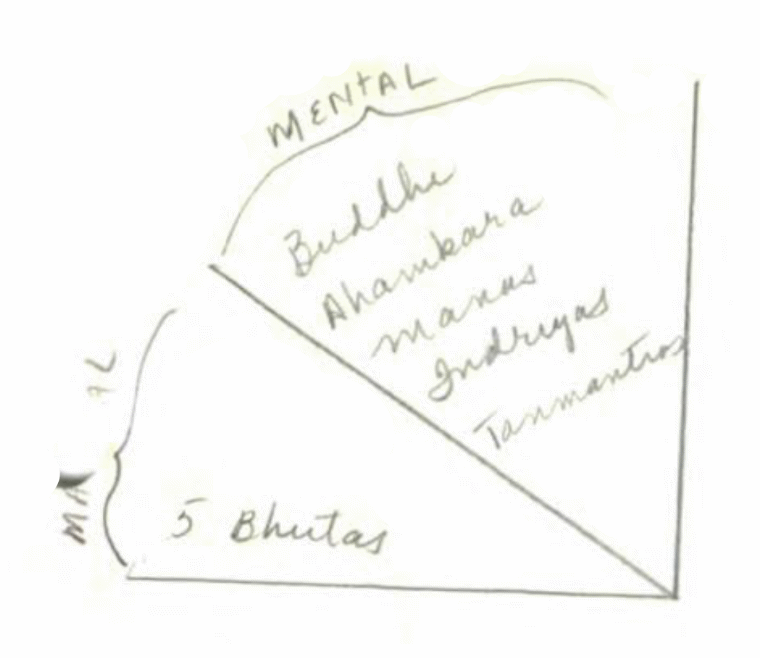
[FIGURE 1981 0328-1. Samkhya Tattvas in Houses 10-12. Faded word = Material. Facsimile scan from 1981 0328-06R13 GRK Liberated Gods N.PDF.]
This ordering can be correlated to the upper solar world (10 and 11) and the 3 material worlds in the 12th house. The stuff of the mental realm is the tanmatras. KCB speaks of the apprehension of something in the tanmatric world as pure devata, as a god or deva. So it seems that these liberated gods function in the tanmatric realm, the mental realm, and not in the material realm. In the Greek classification the mundane gods have a corporeal vehicle, and the liberated order is free of bhutic matter. The mundane gods (and the Nidana chain) are placed in the 12th house.
Harmonic Triad -- coordinating principles
Mercury: (we read from the paper on the vesica)
Venus: is double as morning and evening star. She presides over the vasanas, the traces of life functioning left on the Earth and the organization of these into a body -- and the forms that are inherent in the intelligibility of the spheres. The higher Venus has something to do with combining or associating a soul with that combination. The lower Venus is concerned with coordinating the production going on here on Earth with the celestial scheme and she binds them together. The higher Venus associates a soul with that.
Apollo: (see paper) As the 10th and 11th houses represent the upper solar world, the Sun in Aquarius is the reflection of the Empyrium [sic; Empyrean], the Sun in Leo, and it is thus the medium between the 5 Dhyani Buddhas and the sensible man. He is the vehicle that the forms from the 5th house ride on. He provides the orb of the eye and the understanding of the rational soul.
Fabricative Triad
Jupiter: In the 3-dimensional diagram we see the two aspects of the Demiurge. The first is Jupiter as Absolute or Universal Soul, which remains in itself, and its contemplation gives rise to the second Jupiter, who gives life to alter-motive natures and is actually concerned with the cosmos. The first Jupiter imparts to the second something of its contemplation. The Jupiter of the liberated order is maybe what Mead says is the lower monad which receives that peculiarity.
So we can think of Jupiter as ruling the supermundane sphere, the third quadrant, and he rules the fourth quadrant insofar as he informs all the matter as Absolute Soul, and then constructs the matter he informs with. There is also another reference to Jupiter -- "He possesses the oriental center" -- as the first of the liberated order.
The other problem that comes up with Jupiter is that he is the dispenser of life, so when we put avidya as the first house in the Nidana chain, it seems more like it means the life impulse that's given to an individual, which combined with samskaras gives us the vijnana in the 3rd house.
Quotes on Vesta, along with the quotes on Jupiter and Mercury should give an insight into the first quadrant.
P.B. [Paul Brunton] speaks of the Cosmic Soul retaining karmic seeds or the basis of activity of every creature, and it is this aspect of the Cosmic Soul, preserving the essences, we would equate with Vesta. So earth signs seem to have something to do with the preservation of the essence of the being -- what makes a being to be what it is.
Vesta preserves the essences that preside over the human being, which will be distributed and govern the individual's incarnation. This is an order of essences that somehow preside over the soul manifesting, and that manifestation according to the essences, or what this man is going to be. We are not speaking about vasanas, rather those principles in us that make us remain what we are -- the stream of continuity in incarnations. The continuum of the 'mere I' is presided over by these essences which belong to a particular soul and not to another. Vesta grants to the soul the essences that will give it that continuity. The essences in the 5th house will determine the distribution that follows in the 12th house -- in other words, the reason principles that are going to preside over its manifested state. Referring to the metaphysical chart, i.e., Saturn Saturn Jupiter in the second quadrant; the Saturn as Rhea gives birth to souls -- this is the eternal generation of souls. In the liberated order this is referred to as Vesta. Each unit soul has its own vision of the Idea of Man; in order for that to be fulfilled the essences must be supplied by Vesta. The essences preserved by Vesta in the 11th house will preside over the 12th house vasanas, governing and manipulating them to produce the results necessary to fulfill the soul's vision of itself.
Vesta is referred to as the "fire of the earth". This means the soul of the earth, earth as tanmatra, which is involved in manipulating the gross element. So when Vesta is called the fire of the earth and it is said that in her abide the essences that preserve the sameness of man, then this would mean that the essences are in the soul of the elements and not in the gross elements. Thus it is the earth gods that preserve the essences that provide for the identity of a being.
Can we correlate or see a continuity now between avidya (or life impulse), samskaras, individual vijnana and Jupiter, Vesta, and Mercury? In the 11th house, or image bearing world of light, are the reason principles that are presiding over and deciding how to manipulate the vasanas in the earth -- the bhutic elements in the 12th house.
The Buddhists speak of a "coarse view" of emptiness, and one of the coarse views of emptiness is to recognize the mundane gods (as the Nidana chain) as fabricating and bringing out the presentation from which our experience follows. There is a subtler view of emptiness, which would be the vesica itself, and there is a third view which we won't be concerned with now.
Ceres: The individual consciousness in the 3rd house must be provided or nourished with names and forms -- intelligibility and perceptibility -- in the sense that its essences must be clothed in some way. That is nourishment given by Ceres. The soul coming from the 1st quadrant (vesica) needs this for its sustenance and amplification. The whole 2nd quadrant gives the material basis for a soul; Ceres provides the sheaths which in the 12th house is the generic mentality.
Neptune: Neptune and the fabricative daemons preside in a general way over the soul coming into manifestation. When they say Neptune rules the progression of the soul, this means the unfoldment of the reason principles that it contains.
Minerva: Minerva is said to have "vanquished the giants because she rules over these ultimate artificers of things." These ultimate artificers would be the cosmocrators. Their intellectual nature (Minerva's) will be the destruction of fabricative activity. In a mundane framework, every penetrating insight that gives an understanding of the nature of samsara is a destruction of the titanic or fabricative order.
"She arranges necessity under intellect". If we think of the planetary spheres as the spindle of necessity, Minerva arranges the descent into the spheres according to the intellect of the individual soul.
[File 1981 0328-06R13 GRK Liberated Gods N.PDF Ends]
APPENDIX 2: AB CLASS NOTES FOR 1981 0328
[Classnotes AB 1981 0328 Begin]
3/28/81
Hymn to Apollo [Note: Julian (Emperor of Rome), Thomas Taylor (tr.), Two Orations of the Emperor Julian; One to the Sovereign Sun, and the Other to the Mother of the Gods.]
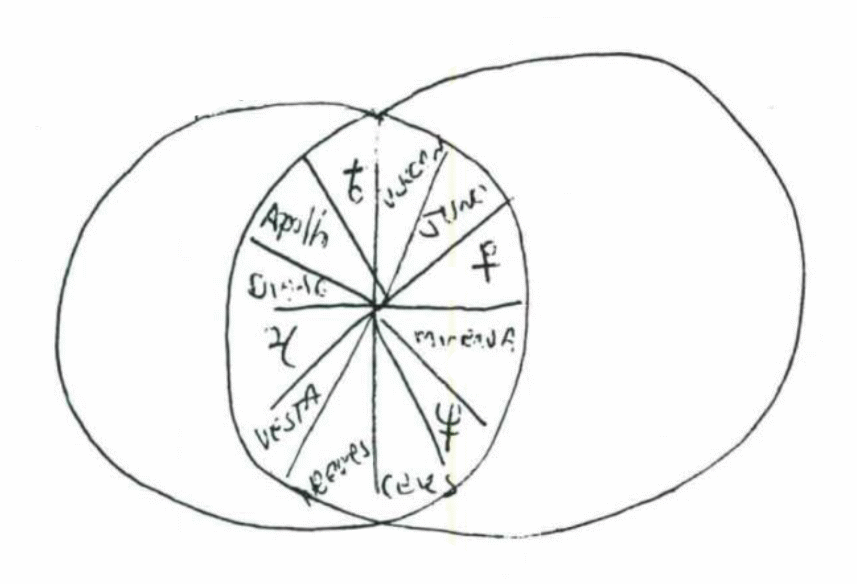
[FIGURE 1981 0328-2-AB. Vesica of Liberated Order. Facsimile scan from AB class notes.]
Jupiter in Sagittarius -- supermundane king of light divine.
One is to Intelligibles as Sun is to sensibles.
Apollo (Aquarius) illumines mental world.
Sun (Pisces) illumines sense world.
Pisces -- 3 material worlds
Aquarius, Capricorn -- upper solar, liberated order
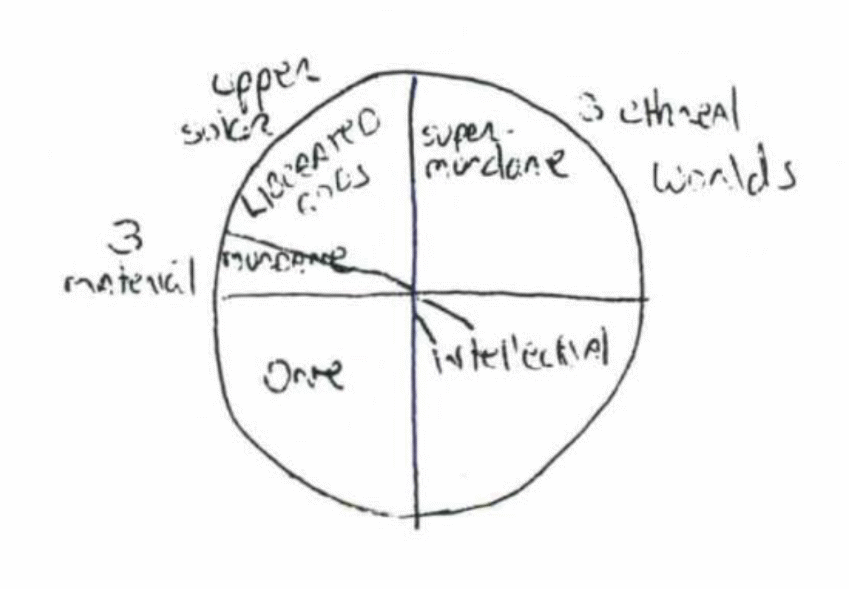
[FIGURE 1981 0328-3-AB. Metaphysical Chart and Orders of Gods. Facsimile scan from AB class notes.]
Solar Triad -- Harmonic Triad
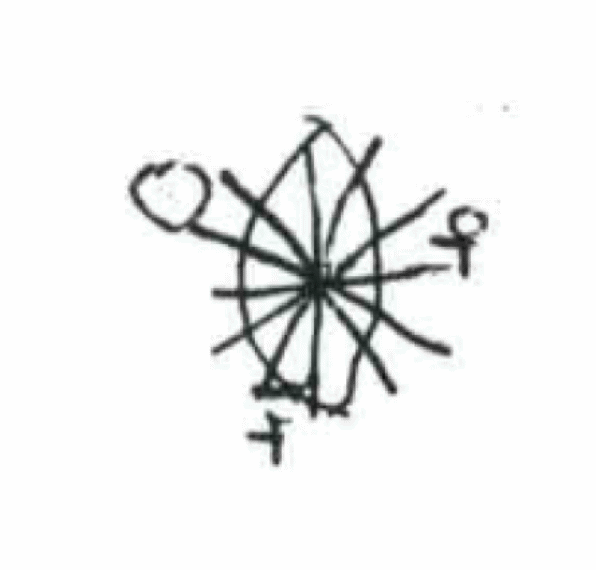
[FIGURE 1981 0328-4-AB. Solar/Harmonic Triad. Facsimile scan from AB class notes.]
Truth Mercury or Fixed (Inerratic) Enunciates Truth and Intellectual Light
Beauty Venus or Planetary Everything confused destroys (it understands chaos)
Symmetry Apollo or Sublunary Binds universe in symmetry
Venus stands for beauty -- brings symmetry and proportion into the universe
Paper on mundane gods of vesica (8/27/78) [Note: See "The Greek Mundane Gods and the Vesica," 1978 0827C1-12R13 GRK mundane Gods.PDF. In 1978 the Mundane Gods were correlated with the house-11 vesica (or alternatively with houses 9-12), but in 1981 the Mundane Gods were correlated with house 12 and the Liberated Gods with the house-11 vesica.]
Quotes on Mercury.
Mercury (Sagittarius) unfolds truth into light (truth inherent in the individual soul, Saturn in Leo).
Contents of unit soul are reflected into Mercury.
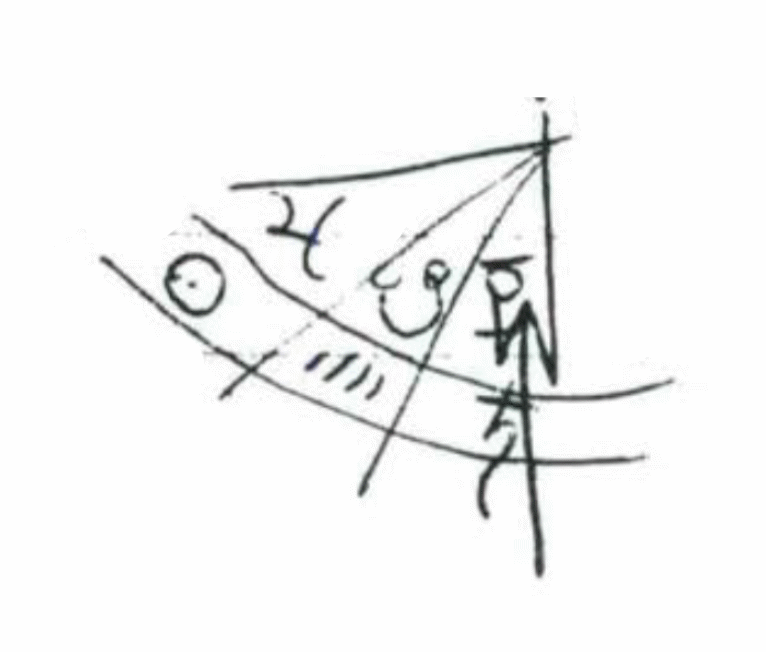
[FIGURE 1981 0328-5-AB. Idea of Man in Soul and Cosmos: First Quadrant. Facsimile scan from AB class notes.]
Lower Venus binds form and matter (planetary and sublunary). Coordinates production on Earth with celestial spheres.
Higher Venus binds a unit soul to the form-matter complex.
[Classnotes AB 1981 0328 End]
Class
Saturday, March 28th, 1981
Verbatim, unedited transcriptCLASS at Wisdom's Goldenrod, Hector, NY
with Anthony Damiani (AD)
March 28, 1981
NEO-PLATONISM; LIBERATED ORDER OF GODS
with Appendices: 1981 0328 & 0403 Partial Transcript and Classnotes AB 1981 0328.
TOPIC: Neo-Platonism
SUBJECT: Liberated Order of Gods
SUBSUBJECTS: Emperor Julian, Samkhya, Harmonic Triad (Apollo, Mercury, Venus), Combined Dependent Origination, Nidana Chain, Emptiness
CONTENTS:
Reading/discussing T. Taylor (tr.), Two Orations of the Emperor Julian, "To Apollo and the Sun"
Is offspring of Jupiter a reference to physical Sun or God of Sun?
Apollo's connection to nine Muses; Muses' role in harmonizing universe; distribution of Muses through sensible world; correlation with Prajapatis in Sagittarius; each number has a Muse
Proclus' point of view expounded in Taylor's introduction to Orphic Hymns
Study of twelve liberated gods gives basis for translation into alchemy, nidana chain
Combined dependent origination as most fundamental tenet of Buddhism
Critique of Nagarjuna's interpretation of combined dependent origination; critique of C.C. Chang's presentation in The Buddhist Teaching of Totality
Appendix 1: 1981 0328 & 0403 Partial Transcript
Reference materials
Liberated gods as rational principles of World-Soul; rule over manifestation; lords of karma; distributors of intellectual needs of soul
Gods order experience to evoke soul's reason potential
Four triads
Liberated gods function in tanmatric realm (houses 10-11); mundane gods placed in twelfth house
Venus: presides over vasanas; lower Venus binds form and matter, coordinates production on Earth to celestial spheres; higher Venus binds unit soul to form-matter complex
Apollo: Sun in Aquarius; medium between Dhyani Buddhas and sensible man; vehicle for forms from fifth house; provides eye orb and understanding
Jupiter: two aspects; as Universal Soul; as first of liberated order, the dispenser of life
Vesta: preserver of karmic seeds; guardian of human essences; preserves continuity of soul's manifestation; soul of earth element
Reason-principles in eleventh house manipulate vasanas in twelfth house
Coarse view of emptiness correlated with mundane gods; subtle view of emptiness correlated with liberated gods
Ceres: nourishes soul with names and forms; becomes generic mentality in twelfth house
Neptune: presides over soul coming into manifestation
Minerva: victory over giants (cosmocrators); destroyer of fabricative activity; arranges descent into spheres
Appendix 2: AB class notes
Hymn to Apollo (Julian)
Jupiter in Sagittarius as supermundane king of light divine
Apollo (Aquarius) illumines mental world; Sun (Pisces) illumines sense world
Pisces as three material worlds; Capricorn, Aquarius as upper solar world
Solar/Harmonic Triad: Truth (Mercury/Inerratic), Beauty (Venus/Planetary), Symmetry (Apollo/Sublunary)
Venus as beauty
Mercury in Sagittarius: unfolds truth into light
Lower and higher Venus
BOOKS READ FROM OR REFERENCED:
Julian (Emperor of Rome), Thomas Taylor (tr.), Two Orations of the Emperor Julian; One to the Sovereign Sun, and the Other to the Mother of the Gods
Orpheus, Thomas Taylor (tr.), The Mystical Hymns of Orpheus
G.R.S. Mead, Orpheus
Kathleen Raine, George Mills Harper (eds.), Thomas Taylor, The Platonist: Selected Writings
Garma C.C. Chang, The Buddhist Teaching of Totality: The Philosophy of Hwa Yen Buddhism
DIAGRAMS appended to this transcript:
FIGURE 1981 0328-1. Samkhya Tattvas in Houses 10-12.
FIGURE 1981 0328-2-AB. Vesica of Liberated Order.
FIGURE 1981 0328-3-AB. Metaphysical Chart and Orders of Gods.
FIGURE 1981 0328-4-AB. Solar/Harmonic Triad.
FIGURE 1981 0328-5-AB. Idea of Man in Soul and Cosmos: First Quadrant.
Other diagrams also referred to are not with this transcript version. [Transcriber note: [diagram] means the speaker is referencing a diagram as he or she is speaking. If someone is drawing or writing, with audible sounds of chalk on a blackboard, I indicate this by [drawing] or [writing].]
AD PAPER read in class:
- "The Greek Mundane Gods and the Vesica," 1978 0827C1-12R13 GRK mundane Gods.PDF.
NOTES:
Scan File 1981 0328-06R13 GRK Liberated Gods N.PDF, the partial transcript for 3/28 and 4/3/81, has been appended because we are missing audio files and it contains a diagram and a good summary of the whole class. All spelling, punctuation, and capitalization errors corrected in scan file.
AB class notes have been appended because they contain diagrams that are referred to and also because we are missing audio files for most of the class. All spelling, capitalization, and punctuation corrected, all abbreviations and astrological glyphs spelled out in AB class notes.
TRANSCRIBED Verbatim by IT 2022. In 2025, IT updates prefatory matter and audio file markers to match new REP audio. Archival verbatim transcript – V11a.
AUDIO FILES: 1981 0328a. [Note: We originally had two audio files for this class: a) 1981 0328a (formerly Audio File 1982 0227d), a 5½ minute fragment from the very beginning of the class; b) Audio File 1981 0328b (formerly 1981 0328b GODS AND DLL), an almost 7 minute fragment from somewhere in the middle of the class. In 2025, REP Studio consolidates these into one audio file, improves sounds quality, cuts out Dalai Lama at WG fragment (we have elsewhere).]
1981 03/28 at Wisdom's Goldenrod
Neo-Platonism; Liberated Order of Gods
[Audio File 1981 0328a Begins]
AD: --anybody behind.
VM: Nah, we pick him up years from now, doesn't matter.
AD: Years from now you may not have to pick him up.
VM: (Two/True).
S (very faint): Yeah.
VM: I guess I'm-- I'm getting used to it. I used to think that you had to move in a straight line but I learned that shortest distance between two points is not a straight line.
AD (simultaneously): It's a circle. (laughter)
S (amidst laughter): What did he say?
VM: Good luck.
AD (simultaneously): Better still a spiral.
VM: It's when space-time is curved--
S (very faint, possibly part of background): (Wait/Right) for him.
AD: Thank you (Vic).
TS (faint): I figured that was a slow ball.
[19 second pause with background student talking]
S: And did we have Two Orations?
VM (simultaneously, possibly part of background): You need to write (a book).
S (faint, possibly part of background): Oh here it is on you.
VM: Two Orations?
S (faint): Yeah.
VM: Is that the one that I have? What page is it Avery?
AS: 33. [Note: Reference is to pagination as it appears in the 1932 reprint, which is also available at www.sacred-texts.com/cla/toj/index.htm.]
S (simultaneously): It's on 33.
PD/S(?) (very faint): 33.
S (very faint): This exact (paper).
S: Hm? Not yet.
VM (simultaneously, faint): Ah yes, here it is.
S (simultaneously, faint): (Strategy.)
[11¼ second pause with background student talking/whispering]
VM: I hear crickets.
[37 second pause with background student talking/whispering]
AD: Time to start. Start reading the poem.
[Transcriber note: I am using Two Orations of the Emperor Julian; One to the Sovereign Sun, and the Other to the Mother of the Gods Julian (Emperor of Rome), translated/annotated/introduced by Thomas Taylor, London: Edward Jeffrey, Pall Mall, 1793.]
Julian, Thomas Taylor (tr.) [Two Orations of the Emperor Julian, p. lxi, AS reading]: "To Apollo and the Sun."
AS (faint): Well you want me to just read a few lines?
AD: Just read a few lines.
VM (simultaneously, faint): [couple words inaudible] (is a criminal).
Julian, Thomas Taylor (tr.) [Two Orations of the Emperor Julian, p. lxi, AS reading]:
"The Sun's resplendent deity I sing,
"The beauteous offspring of almighty Jove,
"Who, thro' the vivifying solar fount
"Within his fabricative mind conceal'd,
"A triad form'd of splendid solar gods;
"From whence the world's all-various forms emerg'd
"From mystic darkness into beauteous light,
"Perfect…"
AD (simultaneously): That's enough.
AS (faint): Yeah.
S (very faint): Do it again.
AD: Jeff, your interpretation.
JC: Ok.
AD: The Sun [JC simultaneously: He's-- he's singing to the--] (or/is one of) the deity I see.
JC: Right, he sings--
AD (simultaneously): Now you're saying he's singing about the God of the Sun?
JC: Yes, I mean, there are many levels of the Sun apparently. But he's--
AD (simultaneously): But, we have to start off with the Sun that we're looking at.
S: [one/two words inaudible] (things).
S (very faint): What are you looking at?
S (faint): [couple words inaudible]
JC: Well, sure, I mean, that's the only way we're going to find out about another one.
[students assent, faint]
AD: So he says he's going to sing to the God of the Sun. "The beauteous offspring of almighty Jove…" Now, who is he referring to?
JC: Jove is Jupiter.
AD: Jupiter. Yeah but who is he referring to as the offspring?
JC: I think (broadly/probably) the Sun here is what is referred to as Apollo in the supermundane order. That's the part where I saw the offspring.
AD (simultaneously): No, no. Jeff, I don't want you to do that.
JC: Ok.
AD: I want to go one line at a time.
JC (simultaneously): He's saying the Sun-- the Sun is the offspring of Jupiter.
AD: Sun is the offspring of Jupiter.
S (very faint): Uh-hm.
AD: Now--
JC: So it--
AD: Now what I'm asking is, who is the offspring? Is it the Sun or the deity of the Sun?
JC (faint): Well I would-- it's the deity.
AD: Now look at the line carefully. Who is he referring to?
JC: "The Sun's resplendent deity". [short pause] He's just saying the Sun God is suspended from Jupiter, fabricated--
AD (simultaneously): (He's) saying the God of the Sun is an offspring of Jupiter.
Julian, Thomas Taylor (tr.) [Two Orations of the Emperor Julian, p. lxi, AD reading]:
"Who, thro' the vivifying solar fount
"Within his fabricative mind conceal'd…"
AD (very faint): Well--
JC (faint): And (only--) He says flowing from Jupiter's contemplation.
AD (faint): So you're saying (within/that in) the Mind of Jupiter there arise in him this deity. First deity.
S (very faint): That's right.
[short pause]
S (very faint whisper): [couple/three words inaudible] (student laughs)
S (very faint): That's important.
[short pause, student laughs]
AD (very faint): But I think he's still saying that it's a God. It's--
(Side 1 Ends; formerly 1981 0328a)
[Note: We are missing one or more audio files here.]
(Side 2 Begins; formerly 1981 0328b)
AD: Everything is transformed into the sensible, and then we have the Intelligible empty of the total vision and it's all been actualized in the sensible. Is that the way you're thinking? Ok. Then I'll stand by what I said last night. Let's go on. Come on, we only got three-- three of these people, alright. I mean three of these guys. Any more quotes for Apollo?
AS (faint): Yeah there's one. Connection with the nine Muses.
AD (simultaneously): (What?) You people weakening?
AS: That connection with the nine Muses.
AD (simultaneously): Huh?
VM: Oh we'd love to see Apollo. (laughter) Sensible-- sensible representation of (it/him).
AS (simultaneously): (Right.)
S (faint): I like that.
BS (very faint): Yeah.
AD: Alright. You can go on and see Apollo.
[short pause]
AS: That connection with the Muses that he speaks of [few words inaudible]
AD (simultaneously): Yeah, that's a problem all by itself, I think that would be the Sun, the leader of the nine Muses.
AS: Yeah. Because see--
AD (simultaneously): Well, this is Jeff's--
AS: Yeah. Is he saying something like over here [diagram], if we have the Sun in-- in here, the Sun is receiving this Demiurgic power. And that those nine Muses though would refer here to the sensible world. [drawing] I don't know. And I don't really--
S (very faint): That's kind of a wrong chart.
S (very faint): (Try.)
JC/S(?): [few words inaudible]
AS (simultaneously): They seem to be s-- the Muses are spoken of I think also in conjunction with the harmonizing of the universe the same as Apollo. Like carry-- I don't know even if they carry out the orders of fate also. I think they're connected with this essay. But I was just-- But I have to look up the quote.
AD: Yeah, we worked it then a little bit in terms of the inspiration.
AS: Yeah.
AD: (Or a fairytale.)
JC (faint): (So I) remember [AS simultaneously: And als--] [couple words inaudible] in terms of the culture and apparent body.
S (very faint): Yeah.
AS: But they're really-- I mean they're almost-- I think they're correlated with those Pra-- like the nine Prajapatis are in the-- it's in Sagittarius that the nine Muses I think are-- are like the representation of those powers within the Sun. 'Cause the Sun is the vehicle of that Demiurgic power.
AD: You think they could be distributed through the sensible world, one (who's standing in a sphere)?
AS: There's something like that, I think they do distribute them. They-- I know they distribute them according to numbers also. Each of the numbers [student assents] has a Muse, (a sacred fourth), yeah. One, two.
S: [couple words inaudible]
AD (simultaneously): Alright, if you get a chance for next [AS simultaneously: Taylor.] week, read the introduction very carefully. I'm going to criticize it heavily. Jeff, come with your ammunition.
JC (faint): No, I'm afraid that I-- I don't think that they digress.
JC/S(?): It's not very clear.
AD: Well, if you have The Platonist, you could also read the introduction to the Orphic Hymns. [Note: See Kathleen Raine, George Mills Harper (eds.), Thomas Taylor, The Platonist: Selected Writings.] But, I think the introduction, most of us are familiar with the theory stated there. And they will be basically coming from Proclus. We will be expounding Proclus' point of view.
JC: Oh you mean on the various levels of the One? Jupiter and-- (They) put--
AD (simultaneously): Tries to give you a thumbnail sketch.
JC: Right. Down through Bacchus.
AD: Uh-hm.
AS: They're going with interpretation of the--
JC: Sure [few words inaudible]
AD (simultaneously): See what I really want to do is go around with all those Gods, alright, get the twelve Gods. Because that will give us a basis, as I said, for a translation into alchemical occultism, Buddhist occultism, the nidana chain, alright, all these things that I'm quite sure based on that. The nidana chain is very obviously based on that. As a matter of fact remember I told you that there's about fifty sutras and the Buddha says that through rational insight and inquiry, meditative equipoise, he got this insight into the combined dependent origination which he regards as the most fundamental tenet of Buddhism. And I'm going to argue with every one of the Buddhists up and down the line from Nagarjuna about emptiness on this point. Combined dependent origination I think has much deeper significations than the-- than to the consequences that are employed by the so-called-- you know, by Nagarjuna. Another book in that direction will be like The Totality Philosophy that-- what's that--
S: Chang.
AD: Chang. [Note: See Garma C.C. Chang, The Buddhist Teaching of Totality: The Philosophy of Hwa Yen Buddhism.] Because they reduce-- they reduce combined dependent origination to something that's not even available to us.
S (very faint): Yes they do.
GA: Because they would argue that the view of emptiness is necessary to-- to [few words inaudible]
AD: This is the view of emptiness. This is what makes for every material existent to be what it is in the flux of process and change.
GA (faint): And I was just saying that there's a good [one/two words inaudible]
AD: And I'm-- I'm going to say that this is a view that you can understand, what they're talking about you can't understand. Philosophically (I'm going to (make/hit) that) point.
GA (simultaneously): (Wait.) They say that here. (bit of laughter)
AS: On page 32 [few words inaudible]
GA (simultaneously): Let's-- (bit of laughter) You won't understand these things, or [one word inaudible] these things unless you study it with someone who knows it. Just like, you know, you (won't) believe this guy, you know.
AD: You get that from Nagarjuna?
GA (faint): I have [half/one word inaudible] you know, the Old and New Translation School, they're trying to give the-- (bit of laughter)
AD: I'm reading it.
GA (faint): He said something in here too, didn't he?
AD: Say that again.
GA (faint): You said he didn't.
AD: Well, it's anybody's slip, it's in my book. (AD laughs a bit)
GA (faint): (You sure?)
AD: Yeah. Just that middle (of) the Old School in hindsight.
GA (faint): Well there's two-- there's-- You sure? There's modern and ancient and they're [one word inaudible] within. They're two different articles. This-- this is the good one.
AD: These people are trying to convert me. (bit of laughter)
GA (faint): But, did you read the one where he said he felt like he was being patted on the head? It was on (an 8-track).
AD: Yeah, I--
S (faint): Yeah but--
GA (faint): Herbie knows.
AD: Alright. I think that-- I think this would be an easy way to get into their theory of-- It's successful because it's Western, you know, objective. You don't have--
[Audio File 1981 0328a ends abruptly. We are missing all other audio files for this class.]
1981 03/28 V11a: CLASS: Neo-Platonism; Liberated Order of Gods. Copyright 2022 Wisdom's Goldenrod p. iv