DIAGRAMS FOR 1981 0410
Class
Friday, April 10th, 1981
Edited transcriptClick the series name to view more
CLASS at Wisdom's Goldenrod, Hector, NY
with Anthony Damiani (AD)
April 10, 1981
NEO-PLATONISM; IAMBLICHUS; GODS
TOPIC: Neo-Platonism
SUBJECT: Iamblichus
SUBSUBJECTS: Gods, Daemons, Soul, Metaphysical Chart
CONTENTS:
This book is Iamblichus' answers to Porphyry's questions sent to an Egyptian priest
Gods & knowledge of Gods
Eternal generation of higher Soul, Gods, & manifested cosmos
Soul, Same & Difference
Gods & eternal generation of Soul
Distinguishing orders of Gods, daemons, heroes, etc.
Gods comprehended internally
Differences between Gods essential
Seeing this in planetary Gods, astrological aspects
Book VI Republic quote
One as Good
Definition of Soul
Motion of Soul can't be correlated exactly with motion of body
God's ideas don't modify Gods
The Good & Being
"Illustrious peculiarity of the Gods"
Neo-Platonic tradition's coherence
The Good: Unity per se, in Being (Gods), & in Soul
Perpetual arrangement in Soul
Perpetuity vs. eternity
Soul & Good
Gods (daemons, heroes) & Souls
Order of Heroes
Daemons
Daemons as angels, as mediums through which Ideas are unfolded
Gods in Soul ring & on down, Gods rule over aspects of your being
God's Unity stops with Mundane Gods
Our unity is adventitious
Universals & particulars: if Gods universal, why do they appear just here?
Allotments of the Gods to certain cities, statues, Ideas, etc.
Gods can appear: Athena
Greek & Hindu mythology
Vesica, Mundane order of Gods
Light & the Gods' illumination of things, events
Actual appearance of God (vs. imagination)
Iamblichus, Proclus, Jung are tantrics
Universals & particulars & Gods
Statues of the Gods
Gods' allotments
Categories of thought: universals & particulars
Can't separate categories but we do so in our understanding
AD trying to provide a glimpse of the 'upper solar world'
Passivity & impassivity don't apply to Gods
Higher Soul is impassive
Two Souls: intelligible & "that which follows the periods of the worlds"
Gods & Fate: principle of Soul capable of being united with Gods
Jesus on denying your soul
Divisions of daemons: Dionysius the Areopagite & Proclus
Gods/Henads
Gods fabricate universe/body
"Everything full of Gods"
Statues, images of Gods
Foundation of astrology: continuity of sublunary natures with cosmocrators
12th House Mundane Gods
Aspects
Gods exist together
Cosmocrators fabricate another order
Epistemology & tropical zodiac
Synchronicity
Iamblichus a remarkable book
BOOKS READ FROM OR REFERENCED:
Iamblichus, Thomas Taylor (tr.), Iamblichus on the Mysteries of the Egyptians, Chaldeans, and Assyrians
Plato, Thomas Taylor (tr. and comm.), The First Alcibiades (Vol. 1), The Republic (Vol. 1), in The Works of Plato, viz. His Fifty-Five Dialogues, and Twelve Epistles
Plato, Parmenides, Timaeus
Plotinus, The Enneads (MacKenna translation, 4th ed.)
Dionysius the Areopagite, The Divine Names
Homer, Iliad; Odyssey
Bible, Matthew (16:24-25)
Roberts Avens, Imagination is Reality: Western Nirvana in Jung, Hillman, Barfield and Cassirer
PLOTINUS QUOTES READ OR REFERENCED: VI.5.8
DIAGRAMS appended to this transcript:
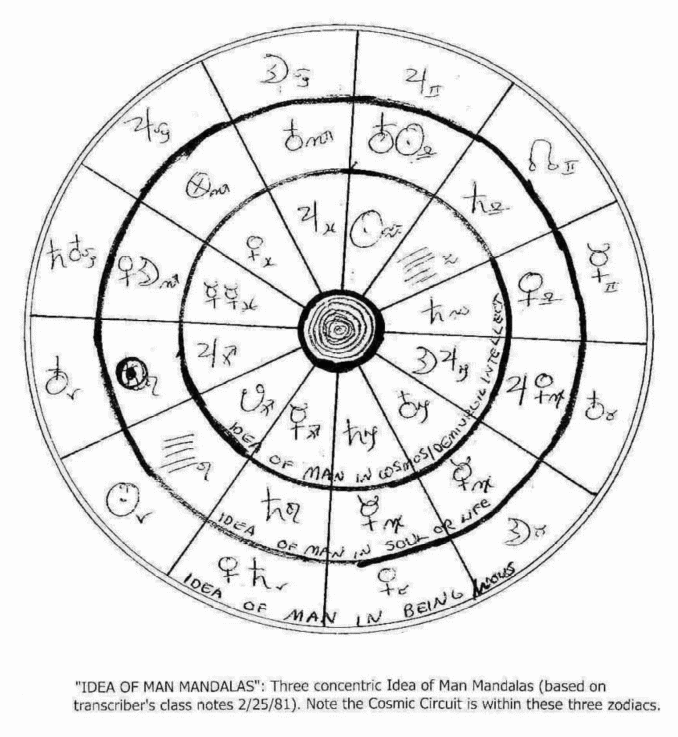
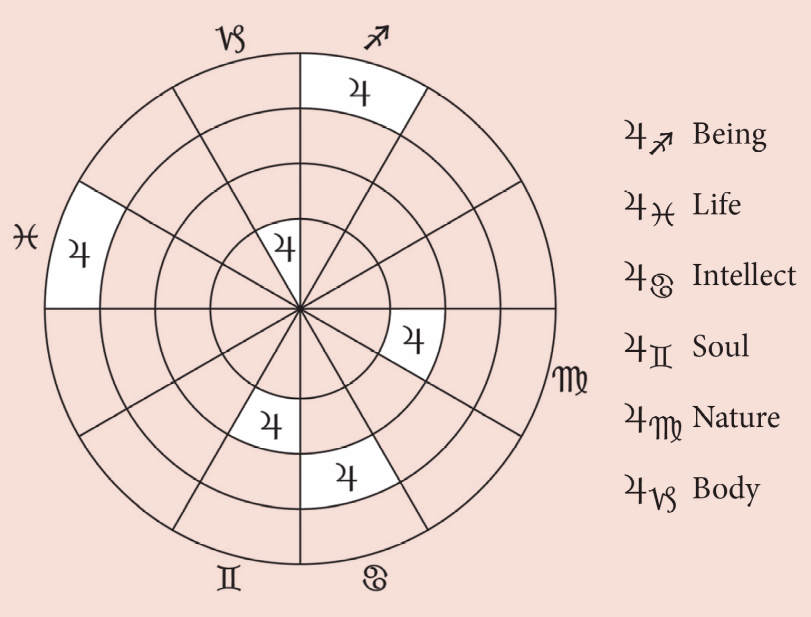
FIGURE 1981 0410-1-JF. Idea of Man Mandalas.
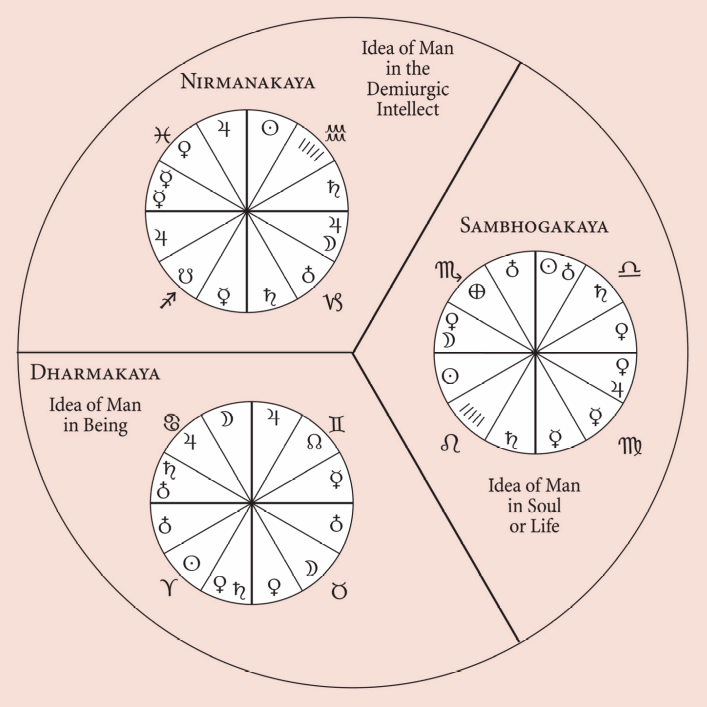
FIGURE 1981 0410-2. Twelvefold Mandalas for Each Level of the Idea of Man.
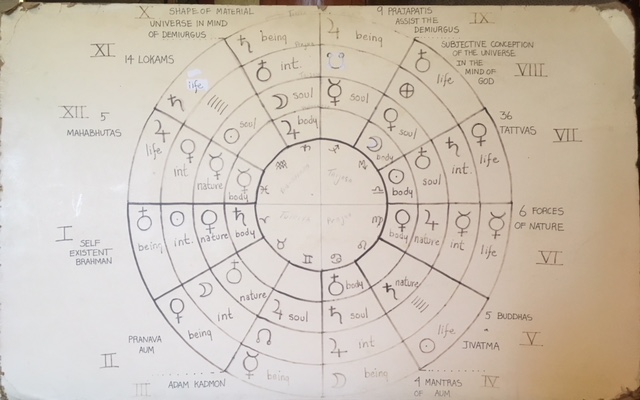
FIGURE IMG 2202-Posterboard Metaphysical Chart.
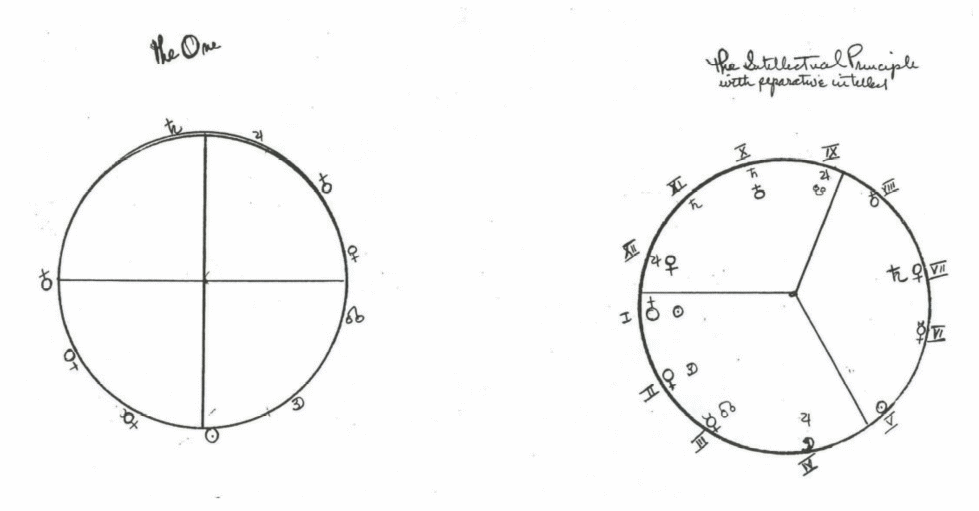
FIGURE AD_E_017. Circles of the One and the Intellectual-Principle.
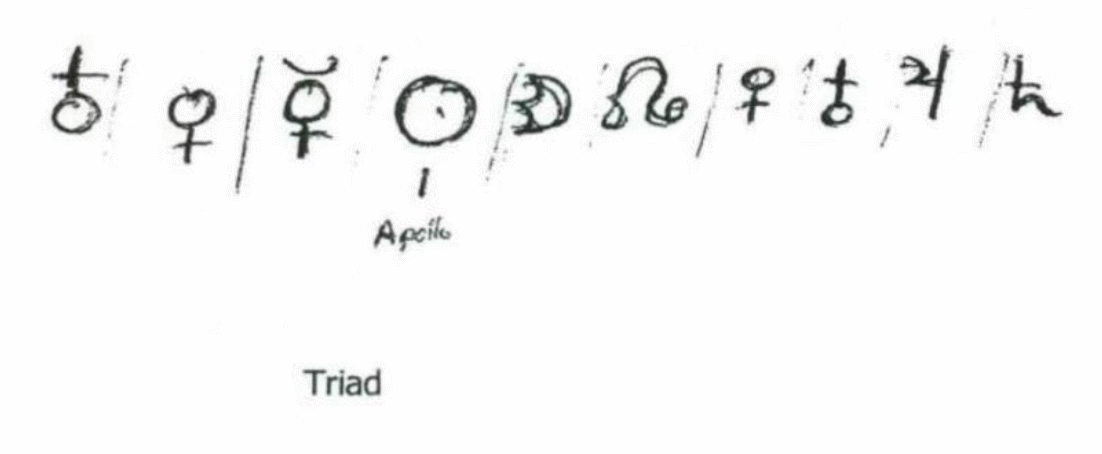
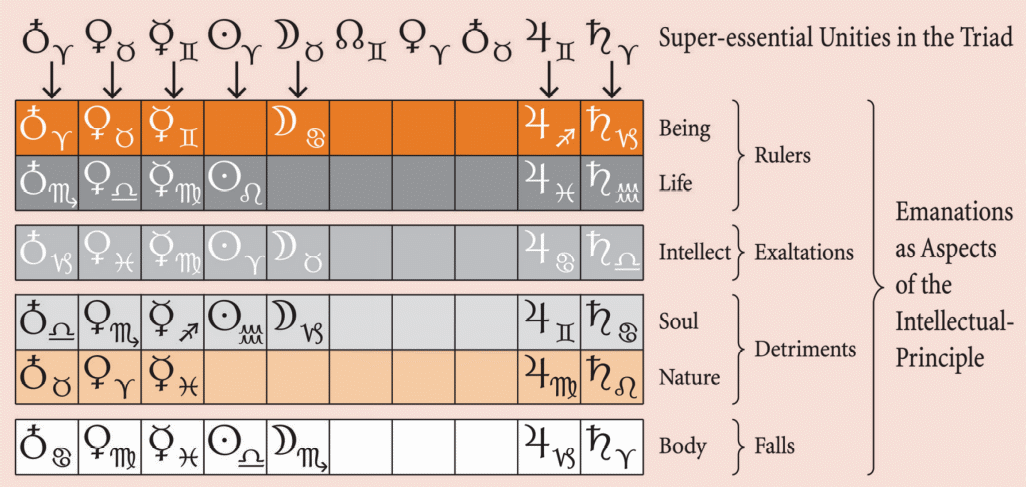
FIGURE 1981 0410-5-JF. Triad.
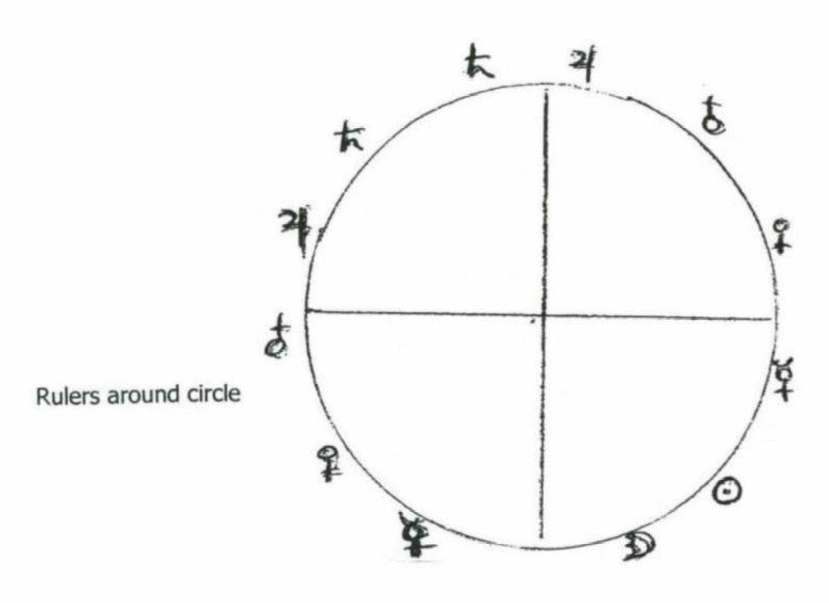
FIGURE 1981 0410-6-JF. Rulers Around Circle.
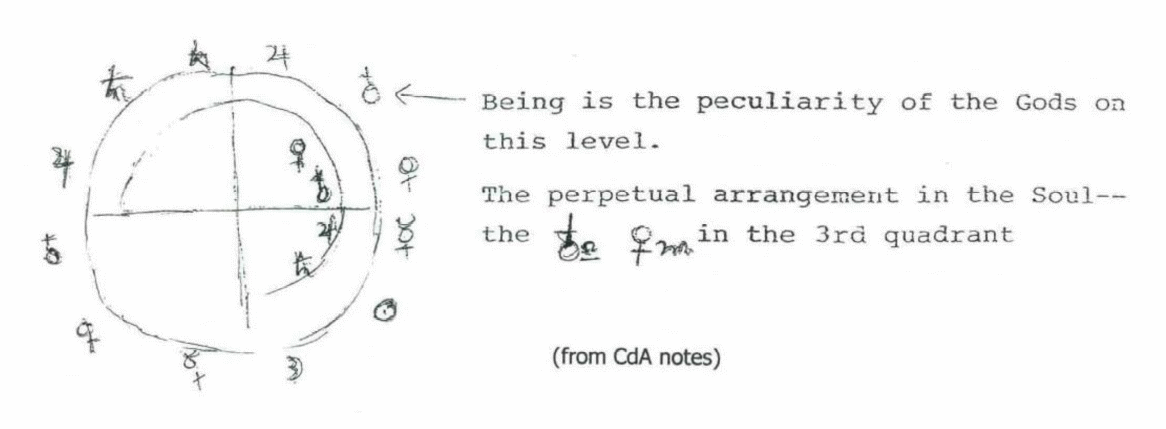
FIGURE 1981 0410-7-CdA. Rulers Around Circle, with Saturn in Leo through Venus in Scorpio in Soul Ring.
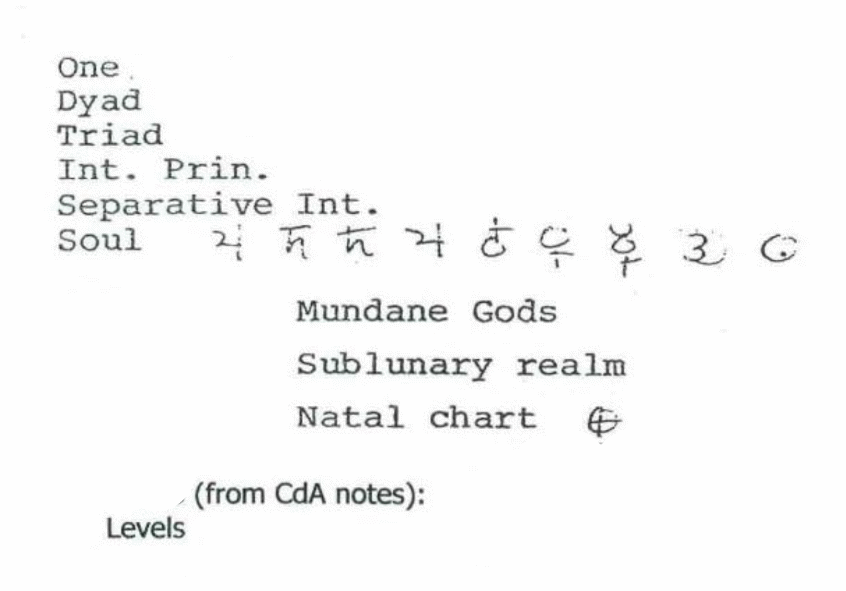
FIGURE 1981 0410-8-CdA. Levels.
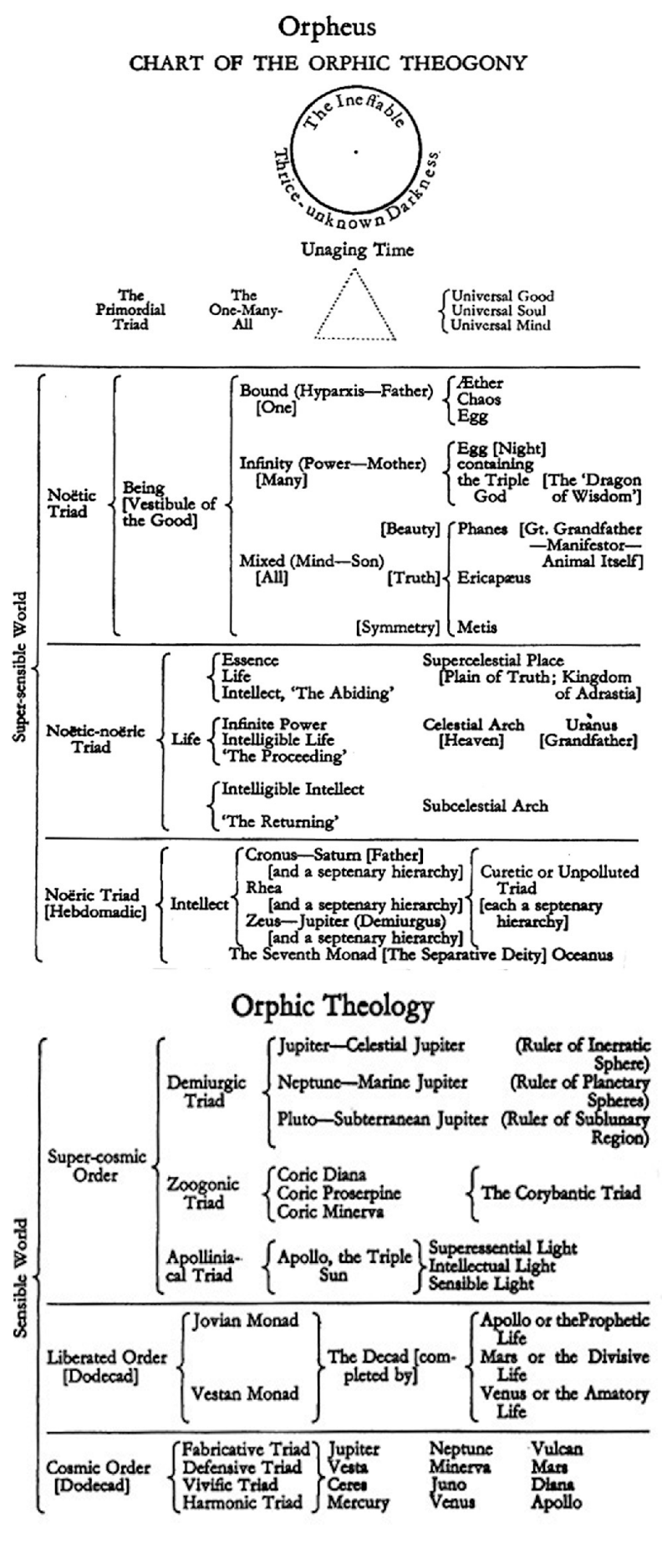
FIGURE 1981 0410-9. Chart of the Orphic Theogony.
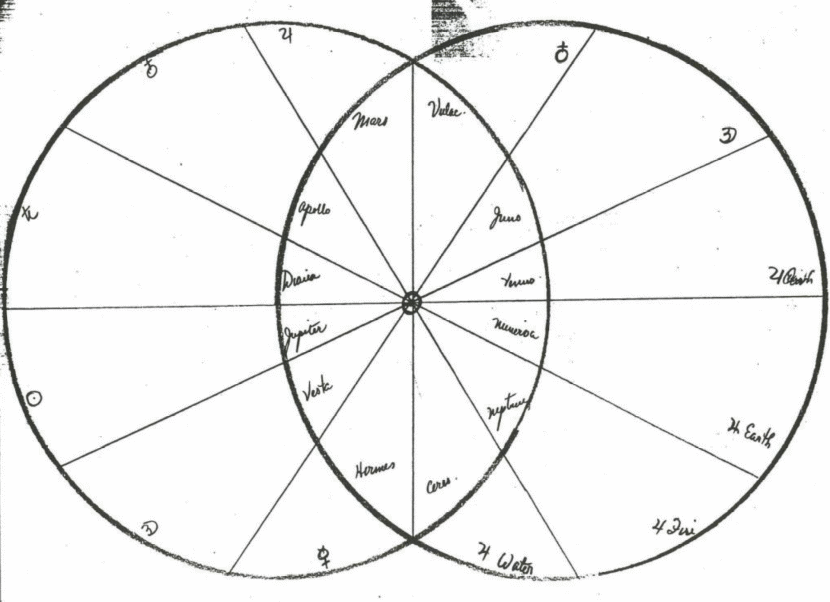
FIGURE AD_E_034. Vesica of Houses 10-12 with Liberated Order of Gods.
FIGURE 1981 0410-11. Triad and Intellectual-Principle; Henads and Monads.
FIGURE 1981 0410-12. Jupiter Henad.
NOTES by JF:
This class was part of a 1981 series on Iamblichus: 04/10 (Friday eve); then Saturday mornings 04/11; 04/18; 04/25; 05/16; 06/06; 06/13. The class date sequence shows gaps; however, other Saturdays in this time period are on Number or the Kabbalah.
Other 1981 class topics, immediately prior to PB's death, appear to have been cosmology, the Idea of Man, the problem of knowledge, Kepler, alchemy, subtle physiology, Tibetan Buddhism and tantra, Kabbalah, the history of Platonism.
On Some Terminology in the Iamblichus classes: The Cognitive Isness can be considered to be synonymous with the Individual Soul principle, the Atman, the Saturn in Leo. "Drops" of light are often referred to. As far as I understand them, these subtle "congealed reason-principles" are coming from the third or Soul quadrant down into the embodied individual; further references to drops may be found in Tibetan Buddhist subtle physiology. "Genesiurgic" is a word used in Thomas Taylor's translation of Iamblichus; Anthony speaks of "genesiurgic tendencies" as being the planetary influences.
Previously printed, distributed 2003.
TRANSCRIBED by jf 2003 from Audio Cassette tapes; reformatted by jf 2018. In 2024, IT updates prefatory matter and footer, replaces tape markers with audio file markers, alters Topic, expands Subsubjects, completes Book List, adds Plotinus quotes section, corrects typos and some listening errors, adds new notes and alters some existing notes within transcript, redoes diagram section with seven diagrams added and references within transcript to all appended diagrams, reformats to accord with new conventions. Readable edited transcript – V11r.
AUDIO FILES: 1981 0410a, 1981 0410b. [Note: "Tape" and "Side" refer to original audio cassette tapes that were later digitized into .MP3 Audio Files.]
1981 04/10 at Wisdom's Goldenrod
Neo-Platonism; Iamblichus; Gods
[Iamblichus. On the Mysteries of the Egyptians, Chaldeans, and Assyrians. 3rd ed. Tr. from the Greek by Thomas Taylor. London, Stuart & Watkins, 1968 [1821]. Italicized quotes in text, between *"..."*, are Porphyry's questions being addressed by Iamblichus; square brackets in quoted text are in published version unless otherwise noted; minor variations read on the tape restored to text version in printed book. Pp. 1-16 of the book are the text of Porphyry's letter.]
[Audio File 1981 0410a Begins]
AD: Now supposedly, it was supposed to be a letter written by Porphyry to an Egyptian priest asking him a whole series of questions. These questions are answered each one, one at a time by Iamblichus -- what does he say, that the limits, that the limits of propriety-- (S: We can't hear anything that you're saying--) You've got to listen louder. (EMD: We are listening louder; student laughter.) He takes you right to the limits of what could be said of a (thing). As we go along we'll try to explain the answers that Iamblichus gives. For Porphyry, as you know, is the editor of the Enneads and a student of Plotinus, for how many years-- 88 years or something? (inaudible students) Now he starts off and I'm going to start off with the first question he asks, Iamblichus, the question is:
Iamblichus, pp. 23-4 (AD reading): "In the first place, therefore, you say, *"it must be granted that there are Gods."* [AD adds: --end of quote-- and the answer by Iamblichus:] Thus to speak ... is not right on this subject. For an innate knowledge of the Gods is co-existent with our very essence; and this knowledge is superior to all judgment and deliberate choice, and subsists prior to reason and demonstration. It is also counited from the beginning with its proper cause, and [AD adds: it] is consubsistent with the essential tendency of the soul to *the good*. If, indeed, it be requisite to speak the truth, the contact with divinity is not knowledge [AD adds: the contact with the Gods]. For knowledge is in a certain respect separated [from its object] by *otherness* [AD comments: you know, subject-object relationship]. But prior to the knowledge, which as one thing knows another [AD adds: prior to that kind of knowledge], is the uniform connexion with divinity, and which is suspended from the Gods, is spontaneous and inseparable from them. Hence, it is not proper to grant this, as if it not might be granted, nor to admit it as ambiguous ...; nor are we worthy thus to explore it, as if we had sufficient authority to approve or reject it. For we are comprehended in it, or rather we are filled by it, and we possess that very thing which we are, [or by which our essence is characterized] in knowing the Gods."
AD: Do we follow what he said there? No questions? Oh--Alright! (DR inaudible) I'm sorry, David-- (DR: If it's no inconvenience, I'd like to hear it again.) You want to hear it again? Get your own book! (DR inaudible; AS: Should I read it again?) Yes, he wants to hear it again.
Iamblichus, p. 23 (AS reading): "In the first place ... you say [AS adds: he's answering Porphyry], *"it must be granted that there are Gods."* [AS adds: Porphyry says] Thus to speak, however, is not right on this subject. For an innate knowledge of the Gods is co-existent with our very essence; and this knowledge is superior to all judgment and deliberate choice, and subsists prior to reason and demonstration. It is also counited from the beginning with its proper cause, and is consubsistent with the essential tendency of the soul to *the good*. If, indeed, it be requisite to speak the truth, the contact with divinity is not knowledge. For knowledge is in a certain respect separated [from its object] by *otherness*. But prior to the knowledge, which as one thing knows another, is the uniform connexion with divinity, and which is suspended from the Gods, is spontaneous and inseparable from them. Hence, it is not proper to grant this, as if it not might be granted, nor to admit it as ambiguous (for it is always unically established in energy); nor are we worthy thus to explore it, as if we had sufficient authority to approve or reject it. For we are comprehended in it, or rather we are filled by it, and we possess that very thing which we are, [or by which our essence is characterized] in knowing the Gods."
AD: Could we have an example of this, what they're saying, or could we elaborate it a little bit since you all understand it?
DB: (inaudible) When he speaks of it as being consubsistent with the essence of the Soul as tending towards the Good-- in the first third of it I think, the beginning. Is that referring to -- I mean, it almost sounds like the way we've spoken of the relationship of the Soul to the Idea of Man, and (inaudible) is this the second quadrant sort of association (inaudible)?
AD: Well, ask somebody in class, David. If we played it twice, pick on somebody. (inaudible, student laughter) Robert, yes--
BB: He's speaking about it as being beyond knowledge and relation.
AD: Are you going to answer his question or are you going on to another one?
BB: Well I-- I don't know.
AD: Oh no, I want the question answered.
BB: (inaudible) I think the second quadrant, he's talking beyond knowledge, and he's talking about essence, that it's something that's-- not something that is compatible --I wouldn't say compatible-- is not the same as--
AD: He says it's above reason.
BB: Above reason-- which we find in the third quadrant.
AD: So he's talking about the eternal generation of the higher Soul.
BB: Yes, I think so.
AD: Which is, so-called, generated by the Gods.
BB: Right.
AD: And they-- if we want to use an example at a lower level, you know, like when we speak about the generation that takes place in the manifested world, the bodies that are built and the psyche that inhabits the body and all that, there you can see again-- and this is a lower level, alright-- there you can see the cosmocrators building the entity, alright. So they are 'consubsistent with that entity', the uniform connection with the entity. There is a difference though, the Soul inhabiting a body in the cosmic circuit can withdraw from that. Whereas in the second quadrant, the Cognitive Isness can't withdraw from its (own). It can deny itself, but it can't withdraw, but the denial will be temporary. Alright, Robert, your question now--
BB: (inaudible) Well I was trying to relate to what he was saying and relate to whether or not I was understanding what was being said.
AD: Alright, yes, question-- No questions?
RG: I have a question. When he says in the second sentence: our "innate knowledge of the Gods is co-existent with our ... essence" -- um, this coexistence, does it seem to mean, you could interpret that our Soul is constituted by those Gods, and that the innate knowledge of them-- that's why we have innate knowledge of them. But I don't know if that's the meaning-- it seems that the meaning you just gave is not that-- was that you were distinguishing between the objective cosmocrators and the individual souls--
AD: No. That's a lower phase.
RG: Okay. In this sense it seems these saying then that our Soul is constituted by the Gods, and therefore there has to be an innate knowledge of them, a knowledge which isn't knowledge, because it could be separated if that's our essence.
LR: Well, Dickie--
AD: We would call that knowledge by identity.
LR: You just said our Soul is constituted by these Gods-- but he says that our knowledge of the Gods--
RG: --is coexistent with our essence--
LR: "Is coexistent with our essence." (RG: Yes.) Now is the knowledge of the Gods the same thing as our Soul--
RG: Well (inaudible) -- I was asking if you could draw that implication. Being that there is an innate knowledge in us of the Gods which are coexistent. What else does that coexistence mean other than that they constitute us?
LR: Okay, how would you elaborate on that to say that they constitute our very Soul?
AD: Well, would you show how the Saturn might possibly be constituted by the Genera of Being?
RG: The Saturn?
AD: Yes, the Saturn in Leo. Anyone?
[Note: See FIGURE 1981 0410-1-JF for the following; c.f. also FIGURE AD_E_017, which compares the quadrants of the One with the threefold.]
AS: Well, when we had the Sun and then the Five Empties and then the Saturn [in Leo] in fact each of those-- Well maybe this picture-- when we did the (chalk-on-blackboard-drawing sounds) the Idea of Man in Soul, and we have the 3rd house in each of those. (more drawing sounds) Are we saying--
AD: Now what I was thinking about is-- if you put the Saturn in Leo there, in the 5th house, on the one hand, it is part of the second quadrant, it is part of the Intellectual-Principle. [Note: See FIGURE IMG 2202-Posterboard Metaphysical Chart.] Right? On the other hand it's part of the second third which means it's part of Life. The third point is its Intellect, alright, in the sense of the Soul as Intellect, the highest part of the Soul is Intellectual Soul. Same and Difference would also apply to it. It is a Same-- in other words Same, when we speak of Soul the definition of Logos would be on the one hand, Same; and on the other hand it's Different from itself. It has to combine these contraries. Now this could only be constituted by the Gods themselves. And you would be saying that they comprehend us in themselves. And that's what Plato referred to when he spoke about the Soul as an eternal generation.
CdA: Is it the Gods' comprehension that it's the eternal generation? (AD: The Gods' comprehension?) The Gods' comprehension of the Soul that is the eternal generation?
AD: That is the eternal generation of Soul. And then, continuing:
Iamblichus, p. 25 (AD reading): "The connascent perception, therefore, of the perpetual attendance of the Gods, will be assimilated to them. Hence, as they have an existence which is always invariably the same, thus also the human soul is conjoined to them by knowledge, according to a sameness of subsistence ..." [Transcriber note: Text omitted between here and next Iamblichus quote.]
AD: And we just pointed out that this knowledge can only be spoken of as a higher knowledge by Identity. No otherness. Go ahead--
AS: I was thinking also before-- what I was trying to think of-- was that each of these, each of the planets in that Soul ring [see FIGURE 1981 0410-1-JF: Idea of Man in Soul, Leo through Scorpio, second ring] we spoke of as a Logos, an expression of the Ideas, in particular of the Being and Intellect, in each house. (AD assents) And in that sense the soul itself was an eternal generation by the Gods, and of the Gods, In other words, it was being (in) that third ring [FIGURE 1981 0410-1-JF: Idea of Man in the Demiurgic Intellect or Cosmos], it was an expression of the Intelligible, Intelligible-Intellectual Gods above it. And in fact each one of those is also expressing the Ideas, and it would be eternally constituted by the Divine Mind, by the Intellectual-Principle which is the first two rings [in FIGURE 1981 0410-1-JF]. (inaudible) And in that sense the essence of the Soul was constituted by the Gods.
AD: Do you follow what he's saying? (silence)
Iamblichus, pp. 25-6 (AD reading): "You ... seem to think, that there is the same knowledge of divine natures as of any thing else, and that one thing, rather than another, may be granted from opposites, in the same manner as it is usual to do in dialectic discussions. There is, however, no similitude whatever between the two kinds of knowledge. For the knowledge of divine natures is different from that of other things and is separated from all opposition. It likewise neither subsists in being now granted, or in becoming to be, but was from eternity, uniformly consubsistent with the soul. And thus much I say to you concerning the first principle in us, from which it is necessary those should begin who speak or hear any thing about the natures that are superior to us."
LR: Could you read that last part again-- the knowledge of divine natures?
Iamblichus, p. 26 (AD rereading): "It likewise neither subsists in being now granted, or in becoming to be, but was from eternity, uniformly consubsistent with the soul."
AD: Now, we discussed that (inaudible), okay. Now the second question, Porphyry asked Iamblichus.
Iamblichus, p. 26 (AD reading): "With respect to your inquiry, *"what the peculiarities are in each of the more excellent genera, by which they are separated from each other?"*"
AD: Now do you follow the question--? (S: No--) You see, you won't know the answer then.
LR: What (are/of) the peculiarities separating the genera of Gods, is that what we're speaking of here?
AD assents. (LR inaudible)
AS: And also, I think, the heroes, the daemons (LR: Daemons--)
(silence)
DR: I guess I don't follow the question, I don't follow the question, if that's what he's asking, he's saying that the genera of the Gods, the heroes, daemons, whatever, progression they're of, I would have thought that there is a peculiar order of Gods that he's speaking of, that--
AD: Well, what would let's say distinguish, let's say, the Supermundane Order from the Liberated Order, what would distinguish the Liberated Order from the Intellectual Order? So of the various Gods that they speak of, and which they'll speak about in almost any tradition, there are different levels of Gods, okay. So in Platonism you've heard of the Mundane Gods, the Liberated Gods, the Supermundane Gods, the Intellectual, and etcetera. So there's all these various orders of Gods. And he says, Well, what distinguishes them one from the other? [Note: See FIGURE 1981 0410-9 for Orphic Orders of Gods.]
DR: Maybe at some later point I can ask the question, the question that immediately arises --and that is that if you're speaking about an order of Gods that are so united to the essence of the soul that they can not be separated in any discursive way or in any way, I would have thought that not all those orders of Gods would have been included in the discussion but only, let's say, the Gods of the (inaudible) is that conceptual--say, the Intelligible Order--
AS: Yes, the Genera of Being itself.
DR: Let's say that once you get down below a certain level of Gods, that they might not necessarily fit this description of the Gods that he's speaking of-- Do you follow my confusion?
LR: It's a different question, this is a different question than the first one. Now maybe by the answer to this question you'd be able to see better what the Gods are, that refer to the first question, who the Gods are that--
AS: But also--
DR: I can't see that they're completely separate.
LR: No, no. The first question is about the connection between each Soul to the Gods which constitute its essence, correct?
DR: Well, the first question that pertained to the Gods was saying that there wasn't any knowledge of them.
AD: Well, he was really defining why a knowledge is possible.
DR: What knowledge of the Gods is possible.
AD: What knowledge of the Gods is possible.
DR: Okay. If I follow what you're saying now, you're saying is that the Gods -- all the orders of Gods -- will be known in this peculiar manner. (AD assents.) Starting from the Intelligible, or if there are any beyond, down through the Mundane Gods, including the Liberated through the Mundane, and all those different orders. That's news to me. (student snickers; AD: That's what?) That's something new to me. It doesn't follow my ordinary conception where I have Mundane Gods as being contacted in quite a different way, let's say, in your analogy, you spoke of the way that the psyche might connect through certain archetypes to a body, but that might be a different order of Gods working in which the contact is then quite different.
AD: Yes. You could do that quite different. And also-- the ritual that you attend for let's say, a psychical God would be different than the rituals opposed for an Intelligible God. So to the psychical essences you offer puja and-- you know-- worship, and-- But for the higher Intellectual Gods, that's not feasible.
DR: But all are known in this same peculiar manner, all the different orders of Gods.
AD: Yes.
DR: All of the Gods.
AD: Yes. They would be apprehended internally. (silence) If you apprehend-- now it is broken up-- because I'm not going to read the whole thing--
Iamblichus, pp. 26-7 (AD reading): "But if you apprehend the peculiarity to be, as in prior and secondary natures, [AD: That's first and second level.] differing in their whole essence and whole genus, a certain simple condition of being, definite in itself; in this case, your conception of peculiarities will be reasonable. For these peculiarities of things, which have an eternal subsistence, are simple, and entirely exempt. The inquiry, however, proceeds imperfectly. [AD: Your question wasn't just right, you know, it wasn't to the point.] For it was necessary, in the first place, to inquire what the peculiarities are of the more excellent genera, according to essence; in the next place, what they are according to power; and thus afterwards, what they are according to energy. But, as your question now stands, with respect to the peculiarities by which these genera are separated, you alone speak of the peculiarities of energies. Hence you inquire concerning the difference in the last things pertaining to them; but you leave uninvestigated such things as are first, and most honourable in them, and which are the elements of their difference."
AD: We'll go back to the first part, let's see if we understand it. Iamblichus, by the way, is referred to some of the later Platonists as posterior to Plato, you know-- but not in genius. Read.
Iamblichus, pp. 26-7 (AS rereading): "But if you apprehend the peculiarity to be, as in prior and secondary natures, differing in their whole essence and whole genus, a certain simple condition of being, definite in itself; in this case, your conception of peculiarities will be reasonable. For these peculiarities of things, which have an eternal subsistence, are simple, and entirely exempt. The [AS substitutes: Your] inquiry, however, proceeds imperfectly ..."
AS: Do you want to stop there?
AD: Just the first part-- what would you say that means? (AS: Well--) Go ahead--
DB: I think he was saying something to the effect that the-- in discussing the distinction between the hierarchies of the various levels of Gods was not as important as trying to understand the peculiar distinction of Gods insofar as they were constituted differently one from another. See what I mean? On the one hand, it's a vertical ana-- a horizontal analysis from the Intellectual Gods on down, on the other hand it seems like he was discussing what the peculiar distinctions between the Intellectual Gods were themselves.
AD: Well, very simply, what is he saying there? He's saying what establishes the differences between one God and another.
AS: Right, and not according to the way it's manifested, but according to the way it is essentially. (S inaudible) What the essential peculiarities of the Gods are rather than what the difference in the way that they're manifested is almost. In other words, not the way that we participate in them, because that will almost certainly show up some differences. But almost he's saying, What is, What distinguishes the Gods in their essence, rather than in the way that they are--
AD: Read that once more, it's very simple, we've done it a hundred times.
Iamblichus, pp. 26-7 (AS reading, drawing-on-black-board sounds in background): "[I]f you apprehend the peculiarity to be, as in prior and secondary natures, differing in their whole essence and whole genus, a certain simple condition of being, definite in itself; in this case, your conception of peculiarities will be reasonable. For these peculiarities ... which have an eternal subsistence, are simple, and entirely exempt."
AD: (inaudible) Each one of these is a God, let's say, alright, and we refer to this, alright, as Being, and what characterizes the uniqueness of this God from this God is Being [cf. FIGURE 1981 0410-5: is pointing to Sun as the 'Author of Being']. This one would be Life [FIGURE 1981 0410-5: Moon]. So this is characterized by Being, this is characterized by Life. This very simple condition of Being is what characterizes each God. So like for instance, if you think of a much lower level, you cannot mistake Eros for Artemis or for Apollo, they have a very simple and unique kind of Being, which separates them from all, from the others. It is difficult as you come down the ladder. As you come down the hierarchy of the Gods they become more and more complex, the simplicity of the God here gets combined with a lot of other Gods here and so that you have in one God--like sometimes if you speak about Apollo they have a certain number of characteristics, and you have to single out one idea from the other to get to the essence of this God and separate it from the other Gods. You have to learn to do that in astrology, right, Tim? (silence) I mean, can you tell when you're looking -- let's say you've got three aspects going on, or four aspects, can you tell which one is doing what? That's what you're supposed to be able to do. So if you don't have a straightforward direct apprehension of the God in itself, the characteristic of the God, its manifestation is going to be confusing because it'll combine with other Gods and you're not going to know which one is which. Read the sentence again. Now you can use your Book VI of Plato. Book VI of Plato? (student snickers) The part where Plato speaks about the One imparts essence and power to each of the Gods. See if you can find it. (AS: I'll see if I can find it. ) Okay. Re-read.
AS: He says:
Iamblichus, pp. 26-7 (AS rereading): "But if you apprehend the peculiarity to be, as in prior and secondary natures, differing in their whole essence and whole genus, a certain simple condition of being, definite in itself; in this case [AS substitutes: then], your conception of peculiarities will be reasonable. For these peculiarities of things, which have an eternal subsistence, are simple, and entirely exempt."
AD: So the Gods above Eros will always be-- you remember the way Plato refers to him as a 'mighty daemon' who could never be mistaken for another one. Each Gods has their own peculiar characteristic or aseity that separates him from all others.
VM: Is this the quote you mean here?
Plato, Republic, T. Taylor trans., V. 1, p. 345 (VM reading): "That therefore which imparts truth to what is known, and dispenses the power to him who knows, you may call the idea of *the good*, ..."
AS: The next one--
Plato, Republic, T. Taylor trans, cont. (VM reading): "... being the cause of science and of truth, as being known through intellect."
AS: Keep going, the next page too the top of the next page (VM: The next page?) Turn over, top up there, the middle of that paragraph. (VM inaudible, student chuckles)
AD: That's alright, we didn't agree with you. Go ahead. (more inaudible student comments, then laughter, inaudible comment by AD; VM: Get your own book; inaudible; more student laughter): Well, that's part of the class-- (AS inaudible) --to know which quote I want. (AS inaudible)
AD: Once more.
Plato, Republic, p. 346 (VM rereading): "We may say, therefore, that things which are known have not only this from *the good,* that they are known, but likewise that their being and essence are thence derived, whilst *the good* itself is not essence, but beyond essence, transcending it both in dignity and in power."
AD: So the Good would be like equivalent to the One, alright, the One gives to each of these their being and their essence. So that Being, Life, Intellect, Soul, Nature, each is imparted that peculiar characteristic by the One itself. But the One is above that or beyond that. Alright, Avery, let's continue with the classification of-- (AS: Do you want me to keep reading?) Yes, please.
Iamblichus, p. 27 (AS reading): "The inquiry, however, proceeds imperfectly. For it was necessary, in the first place, to inquire what the peculiarities are of the more excellent genera, according to essence; in the next place, what they are according to power; and thus [AS substitutes: then] afterwards, what they are according to energy. But, as your question now stands, with respect to the peculiarities ... you alone speak of the peculiarities of energies."
RG: Can you read the question again so we can understand it? (S: inaudible; inquiries)
AS: --inquiries.
Iamblichus, p. 26 (AS rereading Porphyry's question): "With respect to your inquiry, *"what the peculiarities are in each of the more excellent genera, by which they are separated from each other?"*"
RG: I don't understand the question.
AS: It's not clear from the inquiry that that was peculiarly what he was asking about. I think Iamblichus is just trying to make some distinctions.
LR: Are you reading the answer now?--
AS: No, no, that is Porphyry's question.
RG: But why is it an imperfect question? (inaudible)
AD: Well, let him finish and answer it.
RG: But it seems already we could understand, why, why--
AD: No. That's just a clarification of the question. Part of the way. That would not be sufficient to understand the aseity of a God. But let Iamblichus answer.
AS: Um, okay.
Iamblichus, p. 27 (AS reading): "But, as your question now stands, ... [AS substitutes: you're speaking of the difference of them according to] the peculiarities of [AS adds: their] energies. Hence you inquire concerning the difference in the last things pertaining to them; but you leave uninvestigated such things as are first, and most honourable in them, and which are the elements of their difference. [AS adds: And] In the same place, also, something is added concerning *"efficacious and passive motions,"* which is a division by no means adapted to the difference of the more excellent genera."
AS: See his question, his original question was:
Iamblichus, p. 1, Porphyry's original question (AS reading): "*But I inquire what the peculiarities are in each of the more excellent genera, by which they are separated from each other; and whether we must say that the cause of the distinction between them is from their energies, or their passive motions, or from things that are consequent ...*"
DR: Oh--
AS: He didn't quote that in his reply, see that helps. And then it's clear that he's asking which of these things is it-- well, he's saying, actually none of those is that by which we define the peculiarities of the Gods. It's not really through their energies or their motions, but through their unique aseity which is given in their unity, in their essence. So he says:
Iamblichus, p. 27 (AS rereading): "Hence you inquire concerning the difference in the last things pertaining to them; but you leave uninvestigated ... the most honourable ... which are the elements of their difference ... such things as are first."
AS: Did you want to discuss that thing-- the essence, power, and energy?
AD: No. (inaudible)
Iamblichus, p. 27-8 (AS reading): "Hence, neither must we admit in them motions of such a kind as arise from action and passion. For neither do we admit in the soul a self-motion, which consists of the mover and that which is moved; but we conceive that it is a certain simple essential motion, subsisting from itself, and not possessing a habitude to another thing [AS substitutes: other things], and exempt from acting on, and suffering from, itself."
AD: Let's stop there, do you follow? (LR: No.) He's giving the definition of Soul, what makes Soul could be Soul and nothing else. You already had this in Proclus.
AS: He says-- he's talking about these Gods, and he says, first of all we must not admit in them "motions of such a kind as arise from action and passion." For in fact even in Souls we don't admit that the Soul is a "self-motion, which consists of a mover and that which is moved; but we conceive that it is"a certain simple essential motion, subsisting from itself, and not possessing a habitude--"
AD: --relationship.
AS: "... and exempt from acting ..."
AD: In relationship. (AS: In relations--) So you have to think of Life as a simple motion divorced or separated from or unrelated to any kind of object at all. So, if you remember in Plotinus he spoke about it also, he spoke about it as a sheer indeterminate-- indeterminate animism. This is the principle of Soul per se. So when you think of World-Soul for instance, it is this straightforward, simple, animistic principle. When it gets embodied in the world, it moves the world. The movement of the world depends upon that Soul moving the world. But one can not and should not confuse the movement of, let's say, the planetary spheres, alright, with the World-Soul per se. The World-Soul is distinct from that which it moves. And then Plato goes on to make the remark that because of this, there is a certain-- that is, the motion, that the simple motion in itself of the Soul cannot be precisely translated. In other words you wouldn't have a one-to-one correlation, the motion in the Soul cannot be correlated to the motion of a body exactly. There will always be some --what can we say?--
VM: Transigence of the matter (inaudible)?
AD: Yes, you could say that. Just like for instance, you can't have a complete-- if you imagine a ball rolling down a plane, there will always be a tiny element of friction so that there wouldn't be a pure equation. (VM: Right.) In the same way, you cannot translate the indeterminate Life-principle per se-- that is, have it move a body without there being some interference by the body, and consequently there won't be a one-to-one correlation. Alright, let's read some more.
Iamblichus, p. 28-9 (AD reading): "But, in the more excellent genera, all things must be conceived .… in merely existing [AD substitutes: being. He has 'existing', I'm changing it to 'being'.]; and wholes have a precedaneous subsistence, are separate by themselves, and have not their hypostasis from, or in others; so that there is not any thing in them which is accidental. Hence the peculiarity of them is not characterized from accidents."
AD: 'Accidents' meaning any modification. So if you think of one element--fire-- alright, taking a lower example-- fire in itself as a whole, all cases of fire that you will see here are included in that Intelligible Fire, the cases of fire that we see here, the examples of fire that we see here in no way modify, alter, change the wholeness of this Fire which is one whole --that's about what he's saying there.
S: (inaudible) I've been trying to keep in mind the question--
AD: Well, apply that to the Gods, okay. So if we take one of the-- if we go up a little higher, if you take one of the cosmocrators, alright, and the functioning of the cosmocrators is going on, you look at the ephemeris and you got a bright idea tomorrow, okay, it's possible, so this idea is already totally included and comprehended by the God, and it doesn't alter his status in any way, it doesn't modify the totality of his knowledge which includes let's say a perception that you may have had that was true.
S: I lost sight of the question, I still--
AD: Well, the answer should be enough-- you lost sight of the question, naturally. The wholes remain whole-- always. Don't let (inaudible).
VM: You said this in another way, by saying they're exempt. Isn't that--
AD: Yes, yes. There's no mutilation, there's no exclusion, it isn't that when you get a happy intuition that you took a chunk out of the God's knowledge and say, now, 'this is mine'-- but you're only participating in the totality of knowledge that he operates with. Alright, read the next chapter [Chapter V].
Iamblichus, p. 30 (AS reading): "In the next place, let us direct our attention to the solution of your inquiries. There is, therefore, *the good itself* which is beyond essence, and there is that good which subsists according to essence ..."
AD: So nobody (screws)-- (student snickers) -- Go ahead--
Iamblichus, cont., p. 30 (AS reading): "I mean the essence which is most ancient and most honourable, and by itself incorporeal."
AD: You know what he's talking about, right? (AS: Well--?) The One-Above-Being, the One-in-Being, and -- (S inaudible) Good, very good. The first and second hypotheses [of Plato's Parmenides]. (S inaudible) Go on, we won't get into a discussion about them.
Iamblichus, p. 30 (AS rereading): "There is, therefore, *the good itself* ... beyond essence, and ... that [AS substitutes: the] good which subsists according to essence; [AS adds: and] I mean [AS adds: here] the essence which is most ancient and most honourable, and by itself incorporeal."
AS: Being.
Iamblichus, pp. 30-1 (AS reading): "And this is the illustrious peculiarity of the Gods, which exists in all the genera that subsist about them, preserving their appropriate distribution and order, and not being divulsed from it, and at the same time being inherent with invariable sameness in all the Gods, and their perpetual attendants."
AD: Okay, what's he saying?
VM: Could we say, like on this diagram [see FIGURES 1981 0410-5, 6, 7] that you just drew up there, the One in that-- the first hypothesis One, let's say, is not on this diagram, but the One that is *in Being* would be the Mars, Venus, and Mercury (AD assents), the first three of this Triad. And these first three of the Triad infuse or give aseity to all the other Gods which follow after it, and they get their characteristic nature from that, from that principle, the principle of the Good in Being. This is sort of homogeneous or uniform Being.
AD: What is he saying about these here in the realm of Being? (chalk-on-blackboard drawing sounds)
(Side 1 of original cassette tape digitized as 1981 0410a Ends; Side 2 Begins)
AS: --then you've got the good which subsists according to essence.
AD: Uh-hm.
AS: Okay so now, if we're speaking now of the Gods at this level, then are we going to discuss the question whether there is a peculiarity of the Gods which is--
VM: Are the superessential.
AS: Well, okay not even say su-- which is according to the Good itself beyond essence, the way we did the first quadrant. And we're going to distinguish that. In other words, when he says "this is the illustrious peculiarity"--
AD: I-- Jeff isn't here so I wouldn't-- I would be missing all the fun.
AS: Right. Yes.
AD: (Go--) go on.
AS: That's what I meant, you don't want to-- that's why I asked (AD: Jeff isn't here (today).) if you want to (inaudible). Yes because that-- the terminology suggests in a way that this is the highest-- that this is the proper subsistence. As he says, "the illustrious peculiarity of the Gods". And in that sense, it's not clear he would speak about the Gods as--
AD: I want to avoid bringing out the notion of how the Unities are formed within the Triad. Because I would have to disagree with Iamblichus too. (AS: I know.) Iamblichus and Proclus, you know, were of one kind.
AS: (inaudible) he says, in the reading "this is the illustrious peculiarity" -- I took by "this" the second essence, the essence of --the Good which subsists according to Being.
AD assents: Go on.
AS: You want me to keep reading that?
AD: Let's read then. I think you'll see a sort of a uniformity in the Platonic tradition. There will be diversions here and there, I mean, Proclus will disagree with Plotinus, Plotinus seems sometimes to over-elaborate. So there does seem to be some slight disagreements. But the Neo-Platonic tradition as a whole is really quite remarkably coherent. You have to understand this difficulty in any tradition. You know-- The Vedanta, they all scream "Vedanta," but you got four schools of Vedanta, or three, some insist on three. And each one says that their version is the Vedanta. So you're going to have this, there's a limit at where the understanding just dissolves and can't work it out. Let's continue with--
S: Is that the same question?
AD: Yes. He's going to continue.
AS: Just continuing right on from there, he says:
Iamblichus, p. 31 (AS reading): "In souls, however, which rule over bodies, and ... pay attention to them, and which, prior to generation, have by themselves a perpetual arrangement, essential good is not present ..."
AD: Stop there, stop there.
S: Read that again please.
AS: He just has these two, he has two kinds of essences: the Good, two kinds of: the Good beyond essence, and the Good or the One which subsists according to essence. Now--
Iamblichus, p. 31 (AS reading): "In souls, however, which rule over bodies, and ... pay attention to them, and which [AS adds: which souls], prior to generation, have by themselves a perpetual arrangement [AS adds: --in these souls] essential good is not present, nor the cause of good, which is prior to essence ..."
AS: So these first two, they don't have a unity which is superessential, nor do you have that Unity or Good which is characterized by Being as in the Gods, but in the Souls, in the third removed as it were--
AD: [referring to FIGURE 1981 0410-7-CdA] So the Soul is third removed, and he speaks about a perpetual arrangement which is within the soul. And if you think of this is the Subjective Conception of the Universe [Scorpio], that is the knowledge of the universe as something in the Mind of God. And think of this as the Tattvas [Libra], alright. So he would be saying that this Soul has a perpetual arrangement within itself. The way it's going to manifest into the cosmic circuit, alright, this arrangement is already prefigured here, so there's a perpetual arrangement within the soul of everything's that's going to go on here. But that's not the point he's making.
VM: The point he's making about the Gods, those levels of the Gods, not to be confused with the Good as essentialized.
AD: Yes. They're not to be confused with anything above [rapping on blackboard, drawing]. So we would tend to call this here realm the Nous (drawing-on-blackboard)-- everything going through here, we would call this the Nous.
VM: The rulers and exaltation rings.
AD: The rulers and exaltations, yes. Because they're-- that's Intellectual Being, it is always what it is.
AS: Okay. He seems to be saying that that Nous is not directly present in the Soul (AD assents), but they're incapable of receiving the whole of it.
LR: Are you saying-- I don't understand, there's three different Goods, are you're saying? Is that--
AD: No, no. We're speaking about only two Goods, he's speaking about only two Goods, but now he happens to bring in the Soul. Would you read the part on the Soul again?
Iamblichus, p.31 (AS rereading): "In souls, however, which rule over bodies, and [AS adds: so on] and ... prior to generation, have ... a perpetual arrangement, [AS adds: in these souls] essential good is not present, nor the cause of good, which is prior to essence ..."
AS: Neither of those subsistences of the Good that he spoke about in the previous-- (S/AS inaudible)
AD: (You follow that--?) The One and the Intellectual-Principle, are what, you might say, incorporeal Being, and Beyond-Being, alright. (LR assents) Now the third thing he's speaking about is Soul, but he's saying-- Boom! (knocks on blackboard) they are not present in the Soul, the way they are in themselves at any rate.
S: I think I understand the general sense of the passage but I don't understand the thing of having a perpetual arrangement.
AD: This is the perpetual arrangement [FIGURES 1981 0410-6, 7]. The entirety or the prefiguration of this whole explication of the Idea that it is wedded to over here. (more drawing sounds)
VM: But is the use of the word 'perpetual' to connote this motion that he spoke about before?
AD: No. Perpetual connotes the correlation to eternity. This is eternal, this is perpetual. The Soul is perpetual in manifesting a universe, it's always doing it.
VM: (inaudible) motion.
AD: But it is in time, yes. (VM inaudible) This is never in time, this is in eternity. So he speaks about this as a perpetual arrangement, a timeless ordering of the manifestation of its contents. Because the soul can only become objective to itself by manifesting its contents and then reading them off, the way Plotinus said.
AS: Vic, I wasn't sure what you were saying. Here it's not in time, or in motion, even in the Soul, because he said before the Soul too even, he said even the Soul is a simple subsistence, a simple motion.
VM: I thought simple referred to a simple uniform motion.
AS: But you see he made the point that it's-- it doesn't consist of the "mover and the moved" but of a "certain simple essential motion".
VM: Yes. A simple essential motion, I don't know what that means, but I assume it--
AD: That would be that Soul here, wouldn't that, Avery?
AS: Yes.
VM: Yes.
AD: That would be the Soul here.
VM: Right, right. And when you speak about the Gods at that level, you refer to them as perpetual because--
AD: Now-- over here they would be in the Intellectual, alright, (VM talking at same time as AD, can't make out either) Over here you can speak about a perpetual arrangement. (VM: Ah, that's why I said--) That's why I said the peculiarity of the diagram can help us out of these situations because (VM: The hyparxis of soul is--) it's in the second quadrant, alright, but then it's also in the second third [referring to Leo] (knocks on blackboard). (VM & AD talking at same time, can't make out)
VM: So it would be determined by Life not (inaudible).
AD: Yes. So Soul has as its summit Intellectuality and Life.
AS: He's not speaking strictly of Intellectuality, also, because he's speaking about Souls which rule over bodies.
VM: (inaudible) So that would be bereft of body in some way. (inaudible)
AD: This one can, yes. But you can see over here, this is a prefiguration of its unfoldment of the contents that would be applying to here. So this would be the Soul that's going to preside over bodies which are involved in the cosmic circuitry. Go on--
Iamblichus, cont., p. 31 (AS reading): "[B]ut to these [AS adds: souls] a certain participation and habit, proceeding from essential good, accedes."
Iamblichus, p. 31 (AS repeating): "To these souls a certain participation and ... good, accedes."
AS: They do participate in a way.
VM: What -- e-x or a-x?
AS: A as in A-B-C -- accedes.
VM: I was wondering.
AD: They participate, in some way, in the Good. Insofar as they are the Logos of the Intellectual-Principle and carrying out the Ideas, you know, or manifesting the Ideas, and if you trace the Intellectual-Principle back to the One, you would see that the Logos or Soul is in some way participating in the Good.
AS: Then he goes on: He says:
Iamblichus p. 31 (AS reading): "Such [AS reads: This] therefore, being the beginning and end in the divine genera ..."
AS: The beginning being the Gods, the Gods he's talking of, and the end being souls which rule over bodies. Or souls.
Iamblichus, pp. 31-2 (AS reading): "Such ... being the beginning and end in the divine genera, conceive two media between these extreme boundaries, viz. the order of heroes, which has an arrangement more elevated than that of souls, in power and virtue ... and in all the goods which subsist about souls and which [AS adds: order], though it entirely transcends the psychical order, yet, at the same time, is proximately conjoined to it ..."
AD: Alright, you better read that again, I think it was tough.
Iamblichus, pp. 31-2 (AS rereading): "Such, therefore, being the beginning and end in the divine genera ..."
AS: The Gods and Souls are the beginning and the end.
VM: The essentialized good is in the Soul and is the beginning and end respectively?
AS: Yes.
Iamblichus, pp. 31-2 (AS reading): "[T]he beginning and end [AS adds: respectively,] in the divine genera, conceive two media between these extreme boundaries, viz. [AS substitutes: the first of which] the order of heroes, [AS adds: this order of heroes] ... has an arrangement more elevated than that of Souls, in power and virtue ... and in all the [AS adds: other] goods which subsist about souls and which [AS adds: order of heroes], though it entirely transcends the psychical order [AS adds: soul order], yet, at the same time, is proximately conjoined to it, through the alliance of a similar formed life."
AD: Alright, Avery, you try it.
AS: Well, he hasn't said exactly what these order of heroes is. But he says we have the Nous I guess, or the Divine Mind as we spoke of, or the Essential Order of Gods, and then we have Souls, the particular human Souls and so on that have charge over particular bodies. Which he also considers in some ways divine. They too are divine.
AD: In between them he places the heroes.
AS: In between them he has two mediums--the first of which-- I guess the one closer to Souls is what he calls the heroes, this order of heroes.
VM: When he's speaking about Souls here, would he be speaking third quadrant level of Souls?
AD: Just follow the ring Soul.
VM: The whole ring soul?
AD: Follow the ring Soul, yes. But what he would be saying here then would be that the communication that takes place between the Soul and the Nous is done through the heroes.
AS: Is done through the heroes. At the lower end.
AD: At the lower end. Just like for instance the communication between let's say, Soul, rational Soul, and irrational body, down at the lower. You have the daemons communicating or providing the bridge between those two. You follow?
VM: I think so-- Let me just ask-- so you're saying that the communication with the Intellectual-Principle with the Saturn in Leo in this diagram is not direct, it goes through this order of the heroes?
AD: The heroes, yes.
TS: Would those be like in exaltation ring now, would those be like the bodhisattvas? (AD: Louder, Tim!) Would that be like the bodhisattvas or--
AD: Yes. They're the medium through which the higher Nous communicates with the Soul. Just like the daemons are the medium through which communication takes place between us and the Cosmocrators or the Liberated Order or the Supermundane Order. Remember the famous saying in the ancient philosophy "Nature abhors a vacuum"? --no space in-between, nothing-- there's a hierarchy all the way. Alright, continue.
Iamblichus, p. 32 (AS reading): "But the other medium [AS adds: between the Souls and the Intellectual-Principle or the Gods], which is suspended from the Gods [AS adds: now this one is more allied on the other side, to the Gods], though it is far inferior to them [AS substitutes: the Gods], is that of daemons, which is not of a primarily operative nature, but is subservient to, and follows the beneficent will of the Gods."
AD: You could translate the word [daemons] there--angels.
VM: So that difference in the way that you were using 'daemons' and the way he's using it here--
AD: No, no, don't worry, there's six orders of daemons.
VM: Oh-- (some inaudible student comments)
AD: You have the same thing in Christianity, don't you? Dominions, Powers, Thrones, etc. (inaudible student comments)
AS: Learn your angelology. (VM inaudible angelology)
AD: (inaudible) Christian upbringing. (some student snickers) Continue.
Iamblichus, p. 32 (AS reading): "But the other medium [AS adds: we'll say angels], ... is suspended from the Gods, though it is ... inferior to them, ... which is not of a primarily operative nature, but is subservient to, and follows the beneficent will of the Gods. It ... unfolds into energy the invisible good of the Gods, being itself assimilated to it, and gives completion to its fabrications conformably to it [AS substitutes: this invisible good of the Gods]."
S: Read that again.
Iamblichus, p. 32 (AS rereading): [AS begins: "This order, the angels] unfolds into energy the invisible good of the Gods, [AS adds: this order is] ... itself assimilated to [AS substitutes: the invisible good of the Gods], and gives completion to [AS substitutes: the Gods'] fabrications."
(inaudible, AS/S on reading of the above quote)
AD: Continue.
LR: Read it again. (AS: Again?) Did you read it right?
AS: Yes. I read it right.
Iamblichus, p. 32 (AS reading): "For it renders that which is ineffable in the good of the Gods effable, illuminates that which is formless in forms, and produces into visible reasons [or productive forms] that which in divine good is above all reason."
AS: I think he's speaking of different orders, too, here. He says, this order of angels "renders that which is ineffable in the good of the Gods effable" okay, and this order "illuminates that which is formless in forms, and produces into invisible reasons [or productive forms] that which in divine good is above all reason."
AD: Alright, do you want to talk about it?
LR: It seems like reason would be correlated with forms (AD: Reason would be correlated with what?) What he's calling the level of forms--
AD: Isn't he speaking about the paradigm of the Ideas which is found in the Intellectual-Principle, and the unfoldment and the energizing of those Ideas is through the medium of the angels. You're going to come across this in Dionysius the Areopagite when you read his (Celestial Names) (hard to hear, someone sneezing).
LR: I'm just coming off that one phrase where he said "renders ... illuminates the formless into form".
VM: No, Linda, it's the formless *in* forms.
LR: Yes.
AS: Yes, it "illuminates that which is formless in forms".
LR: Right, and also in putting, transferring the ineffable to the effable, or the formless to form, it seems as if he was implying that it's putting into reason the things which are beyond reason.
AD: Well, he's taking things from the Intellectual Realm and putting them into the Rational. (inaudible student comments) Yes. Because you have to remember the ideas are paradigms in the Intellectual-Principle, and they always remain what they are. They're immutable there. In the same way like you'll have the same correspondence in the Soul, the Ideas in the Soul have to be translated into something manifestable, and you're going to have an intermediary doing that too. Continue a little more.
Iamblichus, p. 32 (AS reading): "These middle genera [AS adds: I think he means both of them] .. give completion to the common bond of the Gods and Souls, and cause the connexion of them [AS adds: of Gods and Souls] to be indissoluble [AS adds: indissoluble bonds]. They also bind together [AS adds: as] the one continuity of things from on high as far as to the end."
AD: (inaudible) Go ahead, (inaudible) you discuss it.
AS: He didn't distinguish those two orders.
AD: You'll get that in Dionysius.
RG: (inaudible) these two particular orders.
VM: Why stop with two?
RG: I mean, in other words, why doesn't can't the energy directly--
AS: (inaudible) to the Soul.
RG: --of Intellect be directly delivered to the Soul's summit?
AD: That's what that energy is for. (AD inaudible, then silence) This is a repetition here.
Iamblichus, pp. 42-3 (AD reading): "[T]he divinities are characterized by this, that they are not comprehended by any thing, and that they comprehend all things in themselves. But terrestrial natures possess their existence in the pleromas [p.42 has T. Taylor footnote here, which AD reads in place of"pleromas": In the plenitudes, or *total* perfections, of the Gods]; and when they become adapted to divine participation, then prior to their own proper essence, they immediately possess the Gods, which [latently] pre-existed ..."
AD: So um-- the next chapter. So if we did something like this -- I know the diagram won't really do the trick. [Note: See FIGURE 1981 0410-8-CdA for the following.] But if we took the 7 lines, you know we start with the One, alright, and then we have the Dyad, then the Triad, then you have the Intellectual-Principle okay, coming from that you have the Separative Intellect [exaltation] ring, then you have the Soul. Now could you read off the Soul planets, what were they?
VM: Saturn in Leo, (Jupiter in Virgo) --or earlier, Jupiter in--
AD: Yes. The Jupiter [in Gemini, beginning], Saturn, Saturn, Jupiter, Mars, Venus, Mercury, Moon, and Sun. (VM & other students prompting AD while he's drawing) Now, you'll just concentrate on this line for a minute. Now if from here we imagine everything suspended from here, alright, so that you have over here the Mundane Gods, and then coming below the Mundane Gods, alright, let's say, you have the sublunary world down here, and you exist in here, and you are the result of the combination of their functioning altogether. So he would be saying something to the effect here, that they (knocking on blackboard), they, these Gods rule all aspects of your being. And this is what a chart actually shows. All the aspects of the being that you understand are included and comprehended in them. So that we're at the very bottom of the ladder. And the other point that I'm making is that the unities of the Gods stops with the Mundane Gods. There's no more unities below that, you cannot speak of a unity. If it is-- Although from their point of view, that is from the point of view of the Gods, that unity would be adventitious, from our point of view it's a metaphysical compound, we're not going to be able to dissolve it. Let's read the next chapter now. This man summarizes sometimes in a page what takes Proclus about a hundred pages. (VM: Yes, it's much more succinct.) Let's read the whole chapter.
AS: Okay. This is Porphyry's question he's going to answer.
Iamblichus, pp. 44-5 (AS reading, text begins with Porphyry's question): "*"Why, since the Gods dwell in the heavens alone, there are invocations by theurgists of terrestrial and subterranean Gods?"* For what you asserted [AS adds: and Iamblichus says; AS repeats phrase as: Because what you asserted] in the beginning is not [AS adds: really] true, [AS adds: namely] that the Gods circumvolve in the heavens above: since all things are full of them [AS substitutes: the Gods]."
AS: Even with the question, he's just pointing out the question isn't quite rightly put, but actually that disposes of that question, why do they supplicate terrestrial and subterranean Gods? (VM inaudible)
Iamblichus, cont., p. 45 (AS reading): "You also inquire, *"How some of the Gods are said to be aerial, and different Gods are allotted different places, and circumscribed portions of bodies, though they possess infinite, impartible, and incompressible power?"*"
AD: You know we got the same problem yesterday, right? The universal cowness, why does it appear just in this cow? The Gods are universal, why do they appear just here?
Iamblichus, cont., p. 45 (AS reading, Porphyry's question cont.): "*"And how, likewise, there will be a union of them with each other, as they are separated by divisible circumscriptions of parts, and by difference of places and subject bodies?"*"
AD: (inaudible) (AS: Go on?) Yes.
Iamblichus, p. 45 (AS reading): "[T]he best solution will be obtained by surveying the mode of divine allotment. A divine nature, therefore, whether it is allotted certain parts of the universe, such as heaven or earth, or sacred cities and regions, or certain groves, or sacred statues, externally illuminates all [AS adds: of] these, in the same manner as the sun externally irradiates all things with his rays."
LR: What does he mean 'all of these', what does the 'these' refer to?
AS: The things, its allotments, the God illuminates all of these allotments in the universe, whether the heavens, earth, sacred cities and regions, statues and so on.
AD: Part of the reason, over here, we're going to see that this would be the reason, for instance, when we get to the vesica [FIGURE AD_E_034], this is very difficult. When we speak about the Intellectual Demiurge, why one God has this for an allotment, let's say the 1st house meaning, another God has a 7th house allotment, a 7th house meaning. So that-- I know they tend to seem imaginary, you know -- the Gods-- But who was it? -- Athena for instance, if you read the ancient, you know the Iliad, the Odyssey, and it's very hard to pick up a God, you know. (student chuckles, inaudible comments)
AS: You mean like Odysseus was always -- Athena would always help him out.
AD: I was thinking for instance, when--who was it?--Achilles was mutilating the body of Hector (inaudible exchange AD/HS) No, Hector, yes. And Priam came to get it back. But (snaps fingers) he looked in an instant like they referred to Athena as the 'bright-eyed one' --you know. And in an instant he saw she was there and that she did not approve of this. In other words you can only get a glimpse of a God operating, and, we could call it a psychological super-projection, you know, or a super-imposition. But they are actual things that you could see in the world around you, and that's why the vesica to me is very important. Because the peculiarities that, let's say, are inherent in the situations, events, circumstances, the personality traits, you can see the operation of that God, but one has to be very quick for him, you know, to catch him in the act. I'll try to get some examples together as we work on the vesica. Um, I don't know, I used to love Greek mythology, I don't know if any of you ever read any of it. But I could (inaudible) Artemis, or Apollo, or Hermes, all these Gods had certain peculiarities. Which in the old days, you know, in the 19th century science of mythology, it tried to show that it was an accretion of a lot of characteristics which finally gave you this God. But actually the God was totally present, and that gradually it became manifested as the mythology expounded these characteristics and brought them to life, and then one began to recognize the working of these, of a certain God in a certain kind of situation or event. The Greeks, of course, and the Hindus are great at mythology, and it's in the mythology where I think you can get these lingering traces of their activity going on. And that's what makes the vesica so hard to understand. Because their [sic] total functioning of the vesica results in each one of the lower orders of the Mundane Gods -- and through them there [vesica] the transmission of their characteristics takes place. We'll try harder in the vesica, I know it's difficult but it's really worth it, it's-- let's read some more. Re-read that passage.
Iamblichus, p. 45 (AS reading): "A divine nature ... whether it is allotted certain parts of the universe, such as heaven or earth, or sacred cities and regions, or certain groves, or sacred [AS substitutes: even] statues, externally illuminates all these, in the same manner as the sun externally irradiates all things with his rays. Hence, as light comprehends the things which are illuminated by it, thus also the power of the Gods externally comprehends its participants."
AD: Now Vic made a point last week when we were talking about light, and he pointed out that in itself it is invisible.
VM: Invisible and (inaudible).
AD: Yes, yes. Yet it illuminates, and makes possible for us to see, but it itself remains invisible. And here's an analogy of the Gods, so to speak, alright, they remain invisible, but they illuminate or shed their light on what's happening. So if we say light is coming from Apollo, the God remains invisible, yet he's illuminating every situation, or whatever object, event. So you're going to have to develop some perspicuity. And a real keen seen of sight. Go on--
Iamblichus, pp. 45-6 (AS reading): "As, likewise, the solar light is present with the air in an unmingled manner; but this is manifest from no light being left in the air, when once that which illuminated it has departed, though heat is still present with it, when that which heated it is entirely withdrawn; thus also the light of the Gods illuminates separately, and being firmly established in itself, wholly proceeds through all beings. Moreover, the light which is the object of sensible perception, is one, continuous, and every where the same, [AS adds: and] whole; so that it is not possible for any part of it to be separate and cut off from the whole, nor to be inclosed in a circle, nor at any time to depart from its illuminating source. After the same manner, therefore, the whole world being partible, is divided about the one and impartible light of the Gods."
AD: This is going to be important later on for the Buddhists because when they're going to be speaking about the Gods being resolved back into emptiness, alright, don't let your imagination run away. Because these are very powerful beings. In the Kabbalah I think they refer to them, I think, as the 72 Powers of God.
CdA: I don't understand how-- that last sentence. If you could read it over again--
AD: See, we're not talking now, we're *not* talking now to the Buddhists, we're not talking about what imagination can conjure up and concretize and that gets dissolved back into your imagination. We're talking about an *actual appearance* of a God, which is quite different. And to speak about resolving them back into the emptiness, you know, to think that they get dissolved back into this non-being of the mind of the imagination, will be a real misunderstanding of the whole Tantric system. That's why I'm doing it in a Western terminology first before we hit the Buddhists. Because I'm almost confident there, that it will be possible to make a correlation between what these-- these are tantrics, I mean, Iamblichus was a tantric, Proclus, they were tantrics. (VM or AS inaudible) Even Jung for instance, is a tantric of a lower order, but he's a tantric and doesn't know it, he thinks he's a psychologist. Go ahead. (AS inaudible) Do you want to continue? (VM inaudible)
AS: Carol wanted the last line-- He says:
Iamblichus, p. 46 (AS reading): "After the same manner [AS adds: as the light example, the sensible light example] ... the whole world being partible, is divided about the one and impartible light of the Gods."
AS: This light of the Gods can be all-pervasive.
AD: Let me make another remark now, too. Although it may not be pertinent now, but it's good to keep it in mind. No we don't-- we're going to come across the argument in philosophy and we will consistently--that the nature of a universal, cowness, horseness, lion-ness, you know, and there's going to be big arguments about that. This I think will give you an insight into the possibility of resolving that argument, and taking a stand either in conceptualism, nominalism, or the other, okay. To understand the nature of the universals or to understand the nature of Gods is to take philosophy right out of its academia, you know, that sickness it has, that you find things in words, and put it right back into the sensible world. Go ahead.
Iamblichus, p. 46 (AS reading): "But this light [AS adds: of the Gods] is every where one and the same whole [AS adds: it is whole], and is impartibly present with all things that are able to participate of it; [AS adds: this happens] through an all perfect power fills [AS substitutes: filling] all things, and by a certain causal comprehension, incloses and terminates the whole of things in itself, and is every where united to itself, and conjoins ends to beginnings.…"
[Iamblichus, pp. 46-7 {this part not read on tape but transcriber thinks important}: This too, heaven and the world imitating, revolve with a circular motion, are united to themselves, and lead the elements which are carried round in a circle. Hence the world causes all things to be in each other, and to tend to each other, makes the end of one thing to coalesce with the beginning of another, as, for instance, earth with heaven, and produces one connexion and concord of wholes with wholes.]
Iamblichus, p. 47 (AS reading): "Will not, therefore, he who surveys this conspicuous statue of the Gods ..."
AS: And he's talking about the heavens, he just made an allusion to the heavens--
VM: And the statues (inaudible)?
AS: Yes. The whole world--
Iamblichus p. 47 (AS rereading): "Will not, therefore, he who surveys this conspicuous statue of the Gods ..."
AS: That's the universe--
VM: The manifest world, right.
Iamblichus, cont., p. 47 (AS reading): "... thus united to itself, be ashamed to have a different opinion of the Gods, who are the causes of it, so as to introduce among them sections, and separations, and corporeal-formed circumscriptions?"
HS: He's saying something like-- when he speaks of the light of the Gods as a whole, and intelligibility or intelligence is brought to the world. And yet prior to that each God is given its allotment within this whole pattern of intelligibility that comes out. And yet now he's saying that now if you want to-- he says it comes as a whole, but yet you want to like, isolate one section and say this is the unity, the wholeness. (inaudible) If you want to worship the tree or something. Or I guess, as you move more towards the worship a particular --maybe even philosophic formulation of (inaudible) -- you're missing the whole of the form.
LR: I don't follow you.
HS: I don't know, I think we're having a discussion of universals. There (inaudible) are present, but that cows only go to cows. Yes, you say you want to worship cows--
AD: So Athene only protects Athens-- (HS: Yes, alright.) What's your point? (HS: I guess that's what he was saying.) That's what he's saying.
LR: I don't-- (inaudible student comments, giggles) I thought that the question that this was the answer to is, How is it possible for the Gods to have these allotments? And then the answer seemed to be, (HS: They have allotments.) They have allotments. (HS: Yes and--) And they illuminate what's allotted to them to illuminate.
CdA: But that's (because) only the world is partible and they're not.
LR: How can that be?
LR: I think I missed the point.
AS: Anyway, it's more like-- even though-- the emphasis is more like, How is it possible even though these Gods are impartible and indivisible, but they still are said to have allotments? (LR: Yes.) Wouldn't that somehow destroy the indivisibility? He says, No, the indivisible nature of the Gods can pervade all of the-- he's not answering the question in the way you're speaking to it, he's coming from the other side-- he's just saying -- he's taking the question--
S: At the end--
LR: From the point of the view of the world it looks like the Gods are split up (inaudible).
AS: That's more like what he's saying.
LR: By itself, there are--
AS: He's not even questioning that there are allotments, he's taking that for certain, he's saying how is that possible, wouldn't that divide up the Gods and make them divisible. But he's saying, No, the Gods remain can remain indivisible just as light can remain indivisible, even when it appears to be divided up in (inaudible), in illuminating the world.
VM: The very last part where (he's) saying if you separate these Gods into sort of material categories, you break them up according to body or region or something like that, that's the mistake, and you would sunder their wholeness and indivisibility.
AD: Let's take an example that you're familiar with. When you speak about the a priori categories of thought, alright, and let's say one refers to causality and another one refers to space and time, and unity, plurality, alright. Now insofar that they're all totally present in you, alright, they're undivided. But insofar that you can recognize and you could make a distinction in your understanding that that space and time have to be present, you know, a priori, then you could recognize and distinguish in the thought that you have the distinction between these universals which are all conjoined on the one hand, and yet you could distinguish between them. So that if, let's say, you make a statement where there is a unity of meaning, alright, you'll recognize that the category of unity is pervasive, alright, in the same way that like what could impart meaning to words is also pervasive. All these things are totally all-pervasive. But *we're* the ones making the distinctions. Now this is where the intellect tends to become daemonic, alright, and take a unified presentation which corresponds to reality, and then break it up into judgments. This is another way of saying what the Vedantists and the Buddhists are talking about. Okay. I like this way better because it's not abstract, it's very concrete. Alright. In our thought, we have the unity of feeling, alright, or emotions and thought and imagery and all the epistemological categories and all the topological categories, alright, and as the intellect gets differentiated it can separate one from the other. But you know you're only doing that theoretically, you can't do it actually. In having a thought you can't separate the a priori space and the a priori time. But you can see it's indicated right in the very thought that you have. Alright, so we have to expand this to include the whole of the corporeal world, this is the way the Gods operate. They're totally and indivisibly present, alright, but we only distinguish what we can understand.
CdA: Is that the main distinction or is there um-- if we could understand (some thing) it would be fully present (inaudible)?
AD: If we could understand them-- No. Of course not--you have to remember, we're just human beings, not Gods.
CdA: Well, I didn't mean to make it sound that way, but the example in the beginning was that there was some localization that happens from the standpoint of (here) but is that an absolute kind of thing?
AD: In the same way, in the same way that we said that there's unity present to meaning of a sentence you're uttering, in the same way we'll be able to say looking at a certain grove and a certain Goddess presides over that, alright, it's not that all the Gods are going to preside over it, a certain God is going to preside over it. Just similarly like you say the unity is presiding over the meaning-- all the Gods aren't going to preside over the meaning, okay. And this of course, little by little ultimately and hopefully, I should produce in us some kind of glimpse as what that upper solar world, because that's what we mean when we say the upper solar world, when we think of the Gods operating in their totality, alright, it's in that common light medium that they're functioning. When we refract that or differentiate that, we claim to be thinking. (student snickers) Alright, let's continue.
Iamblichus, p. 48 (AS reading): "After these things, you again subjoin another division for yourself, *"in which you separate the essences of the more excellent genera by the difference of passive and impassive."*"
[Audio File 1981 0410a Ends]
[Audio File 1981 0410b Begins]
AS: --distinction, those that are passive and those that are impassive.
AD: Impassivity and passivity are the distinctions to be found among the genera or the Gods. Go on.
AS: And Iamblichus says--
Iamblichus, p. 48 (AS reading): "But neither do I admit this division. For no one of the more excellent genera is passive, nor yet impassive in such a way as to be contradistinguished from that which is passive ..."
AD: Now stop. See if you can follow what he just said.
VM: Please read the last sentence, the line--
AS: Yes.
Iamblichus, p. 48 (AS rereading): "[N]o one of the more excellent genera is passive, nor yet impassive in such a way as to be contradistinguished [both AD, AS add: or opposite] from [AS substitutes: to] that which is passive ..."
AD: In other words, when we understand something, it's basically based on the oppositions or complementaries. So if we understand hot because we understand cold, and vice versa, or pain and pleasure we understand because they're based on each other. Now he says, Don't try to do this with passivity and impassivity, it won't work. Because the impassivity of the Gods is not the opposite of the passions of the Soul. So he's using the word impassivity in this very peculiar way.
S: (inaudible) impassivity in that realm, that would imply that passivity also.
AD: They're not subject to the passions. So that you're not going to understand them. (AS tries to interrupt) So basically all thinking is based on antinomies, you know, on contradictories. And the highest type of thought does produce the most acute antinomy in our mind -- actually, anxiety, because of the tension of the opposites. But that's the way we have to think, that's the nature of dialectical thinking. and, tonight we had another example of that, somebody insisted on one point of view and I insisted on the other, and only when he ranted the other point of view that we had two points of view that I relax. (student giggles) It will be so comfortable to take the point of view -- you know, 'it's this way', not that way -- you could sit back, everything is-- everything is alright. But everything is not alright. Nothing is right! Everything's wrong in my thinking. (student giggles) Go ahead--
AS: So then he is going to admit that the Gods are impassive. But not in such a way to be opposite to that which is passive. Because they have to include everything which is passive. He says:
Iamblichus, pp. 48-9 (AS reading): "[B]ecause they are entirely exempt from the contrariety of action and passion; and because they are not at all adapted to suffer, and have essentially an immutable firmness, on this account I place the impassive and the immutable in all the divine genera."
AS: So that division of passive and impassive won't help in distinguishing what (orders of Gods).
Iamblichus, p. 49 (AS reading): "For consider, if you are willing, the last of divine natures, viz. a Soul purely liberated from bodies. (AS/AD inaudible) What does such a soul want with the generation which is in pleasure, or the restitution which is in it to a natural condition, since such a soul is above nature, and lives an unbegotten life? Why, also, should it participate of the pain which leads to corruption and dissolves the harmony of the body, since it is beyond all body, and the nature which is divided about body, and is entirely separate from the harmony which descends from the soul into the body?"
AD: He's speaking about the highest Soul.
Iamblichus, p. 49 (AS reading): "But neither is it in want of the passions which precede sensation: for neither is it detained in body, nor inclosed by it, so as to require corporeal organs ... [I]n short, being impartible, and abiding in one and the same form, and also being essentially incorporeal, and having no communication with a generated and passive body, it cannot suffer any thing either according to division, or according to a change in quality, nor can have any thing which is allied to any kind of mutation or passion."
AD: I wanted to read-- At the very end of the book he has a distinction between the two Souls and I thought I'd review it quickly. But, finish this first.
Iamblichus, pp. 49-50 (AS reading): "But neither does the [rational] soul, when it accedes to body, either itself suffer, or the reasons which it imparts to the body [AS adds: suffer]. For these *reasons* are *forms*, and being simple and uniform, they receive no perturbation in themselves, and no departure from their proper mode ..."
AS: (Okay, Herbie?)
AD: So if you think of the drops, the congealed reason-principles dropping down into the channel system as light, nothing could happen to them. They're essentially simple forms. It's only the prakritis or the matter in the channels which disturb, you know, which bring about a disturbance of that reason-principle. (inaudible student, AD assents)
Iamblichus, p. 50 (AS reading): "Hence, as soul is the first origin of generable and corruptible composite animals [AS reads: composition], but is itself by itself ingenerable and incorruptible; thus, also, [AS adds: it follows] though the participants of the soul suffer, and do not wholly ... possess life and existence, but are complicated with the indefiniteness and diversity of matter, yet the soul is itself by itself immutable, as being essentially more excellent than that which suffers, and not as possessing impassivity, in a certain deliberate choice, which verges both to the impassive and the passive ..."
AD: I mean-- read this-- (AS inaudible; S inaudible)
AS: He's saying-- he's basically following the notion--he's going to start well, even the Soul itself, even if you consider the rational Soul as we were just saying, those drops, even that is really impassive and doesn't take any affects, or passions, or perturbations, from the body which they seem to inhabit. Even less the Gods which rule over the Soul, they're going to be impassive. Even though they too may rule over the entire universe, in which you see all this stuff going on, all this generation, but even while pervading it, ruling over it, they remain totally impassive. Just as your soul can remain totally impassive even when it's operating through the body.
AD: This is a division that's going to come in useful. It's from the one of the last chapters.
Iamblichus, p. 308 (AD reading): "You say, therefore, *"that according to many of the Egyptians, that which is in our power depends on the motion of the stars."* What the truth, however, is respecting this, it is necessary to unfold to you from the Hermaic conceptions [AD substitutes: Hermetic doctrine]. For man, as these writings say, has two Souls."
AD: Alright, and we say 7, but now try to understand the way he's dividing the soul.
Iamblichus, cont., p. 308 (AD reading): "And one, indeed, is derived from the first intelligible, and participates of the power of the Demiurgus; ..."
AD: So he's saying one Soul, alright, participates in the power of the Demiurgus and is an Intelligible, so that would be the Saturn in Leo.
Iamblichus, cont., p. 308 (AD reading): "... but the other is imparted ..."
AD: But the other is *imparted*--
Iamblichus, cont., p. 308 (AD reading): "... from the circulation of the celestial bodies, to which the soul that sees God returns."
AD: So he's saying now there's another soul, so you see this is an entirely different classification. When we speak about, for instance, we're born on this planet, the planet itself gives us the substance or the earth gives us the substance of our body, alright. But then the soul of this body that we have here, is imparted to us from the celestial spheres, okay. And the inerratic spheres is going to impart the unity and all that. So that you have a soul in the celestial spheres, which is being given to this individual body, conjoined to that individual body. This soul is *not* soul in the sense that he was just referring to, which is above all that.
Iamblichus, cont., p. 308 (AD reading): "These things, therefore, thus subsisting, the soul that descends to us from the worlds follows the periods of the worlds; but that which is intelligibly present from the intelligible, ..."
AD: That is, the Soul that is present from the intelligible realm, from the Intellectual--
Iamblichus, cont., p. 308 (AD reading): "... transcends [AD adds: is beyond] the genesiurgic motion [AD adds: of the spheres, is beyond that], and through this a liberation from fate, and the ascent to the intelligible Gods, are effected."
AD: So he's saying that in order to reach the intelligible Gods, we first have to transcend the Soul, alright, which is part of the cosmic circuit, and find our own Soul or Overself or whatever you want to call it, and from there you can pick up the trail to the Intelligible Gods.
LR: Why do you say that this is a whole new classification?
AD: Well, he's speaking about two Souls here.
LR: Well, haven't you been speaking about same division for the last--
AD: You're very bright. (student snickers) Good for you. You get 'A'.
LR: Oh! Really! you say it's a new classification. This is--
AD: It's not new, I've spoken of this, the Idea of Soul in Life, and the Idea of Soul in Body, yes. [Note: See FIGURES 1981 0410-1, 2.] We've spoken about this. (student snickers and inaudible comments) Um-- let's say it out loud! Go ahead--
DB: Can I ask one question about that passage? Towards the end of it, he spoke of that Soul which descends 'to us' referring to the second soul (AD assents), is that correct, did I hear that right?
AD: Yes.
DB: In what sense does he mean that? I mean is the 'us' is referring to the embodied individual and the planets?
AD: Yes.
DB: Okay, now, the descent of the secondary soul, does that anything to do with --
AD: --the descent of the higher Soul--
DB: Oh, is it the higher soul, okay I'm sorry--
AD: Yes. And that's why we used the Mercury as the intermediary. That's the way it descends.
Iamblichus, pp. 309-10 (AD reading): "Hence that of which you are dubious is not true, *"that all things are bound with the indissoluble bonds of Necessity,"* which we call Fate. For the soul has a proper principle of circumduction to the intelligible, and of a separation from generated natures; and also of a contact with real being, and that which is divine. *"Nor must we ascribe fate to the Gods, whom we worship in temples and statues, as the dissolvers of fate."* For the Gods, indeed, dissolve fate; but the last natures which proceed from them, and are complicated with the generation of the world and with body, give completion to fate. Hence we very properly worship the Gods with all possible sanctity, and the observance of all religious rites, in order that they [AD adds: the Gods] may liberate us from the evils impending from fate, as they alone rule over necessity through intellectual persuasion. But neither are all things comprehended in the nature of fate, but [AD substitutes: for] there is another principle of the soul, which is superior to all nature and generation, and through which we are capable of being united to the Gods, of transcending the mundane order, and of participating eternal life, and the energy of the supercelestial Gods. Through this principle, therefore, we are able to liberate ourselves from fate. For when the more excellent parts of us energize, and the soul is elevated to natures better than itself, then it is entirely separated from things which detain it in generation, departs from subordinate natures, exchanges the present for another life, and gives itself to another order of things, entirely abandoning the former order with which it was connected."
AD: Now there it was about as clear and explicit as these teachings were made, you know. Because Proclus can be very confusing. You know, he says so many words, that you're never quite sure which ones (inaudible). But in Iamblichus there's this absolute articulation, precise, not with all the detail I like, but enough to get me working. What time is it?
S: 9:30.
AD: 9:30? Alright. We'll read a little bit more and then-- This is really a good book, it's one of the few books that I've enjoyed, and I've read (inaudible)--
S: (inaudible) edition?
AD: This one was done by Thomas Taylor, the translation by Thomas Taylor. Watkins put it out--oh, a dozen years ago. (silence) Okay. Now we come to something which I think is very appropriate to astrology, alright. And it's Chapter XVII [Section I], would you?
VM: Anthony, before we go on, just to see if I can summarize the last (inaudible)-- Was he saying something like there's an aspect of soul, the part that's generated by the motion of the planetary spheres, that really is subject to destiny or karma or fate, as he put it, and that's the one that you have to live out, let's say, as your destiny or karma and so on. On the other hand there's an aspect of soul which is superior to that, which is not bound by the Spindle of Necessity, to use that kind of poetic metaphor, and that would be, let's say, to use PB's language that's the soul that--
AD: That's the higher soul--
VM: --that's where grace, let's say, would emanate from--
AD: Yes. But now the next important point, and don't forget this, is that only through that-- (VM interrupting) excuse me-- only through that can you ascend to the intelligibles. So that -- I can't recall but maybe some of you do, remember in the Bible Jesus speaks about the Soul twice, at one time he speaks about the denial of the Soul, and another time he speaks about the acceptance or going with it. Any of you remember?
DB: (inaudible) follow, those who follow me have to deny their Soul.
AD: Yes. (DB: That one.) That one I know, there's another one where he speaks about accepting it. Well, if you come across it-- because it's been a bone of contention, you know, because there's these two contradictory things that theologists have been battling with for a long time. He makes very explicit reference to one -- he says, you must deny your soul in order to follow me. [Note: Bible, Matthew, 16:24-25.] That would be for you to deny your soul which is given to you by the planetary spheres. But then there's another passage where he says you must follow the higher Soul to find me, I don't remember the passage. But if they see, if they see that these two souls that Jesus was talking about was a reference to what Iamblichus is saying here. By the way you have to remember that some of the students of Proclus and that whole school, like Dionysius the Areopagite who wrote Celestial Names and um-- a few other works, was a student of the Neo-Platonists, alright, and when they discovered his book, alright, this book, they thought it was an early Christian. And so it very heavily influenced Christianity for about 500 years before they discovered that it was a Platonic work. (student laughter) But by that time it had infiltrated the whole tradition. Alright, and it became a really important work in the early Christian tradition, Dionysius the Areopagite. You know, it was really looked up to.
LR: What did they say also to the (inaudible)?
VM: About two Souls?
AD: I don't follow you.
LR: What-- Did they say it's one of the daemonic orders that binds those two souls? that keeps them, and brings (inaudible) return to the higher--
AD: I think we went over that, and we'll probably have to go over it again. When you know, Proclus gives the order of six divisions of daemons, and the first, the highest was the Celestial, alright-- that's pure love, the Celestial is just the nature of Love, Pure Love, okay. Then there was the second daemon that was concerned with--? [Note: See Thomas Taylor footnote in The First Alcibiades quoting Proclus on Six Classes of Daemons.]
AS: The intellectual, it presides over the coming and going.
AD: Yes. The coming and going of the Soul. The coming into manifestation going on, alright. And then there was a third that brought you to your proper sphere. (LR inaudible)
AS: Your allotment.
AD: Yes, alright. So the same way like the Hindus, they have this mapped out, they have a map, you know, of this whole-- Alright, let's read this one more chapter, then. And Friday and Saturday is going to be really heavily (inaudible) occultism for awhile. Maybe we could crack open the Timaeus later.
AS: Okay, there's another doubt of Porphyry. He says:
Iamblichus, p. 65 (AS reading): "*"For,"* it may be said by you, [AS adds: For, Porphyry says] *"how, conformably to what we assert, can the sun and moon, and the visible natures in the heavens, be Gods, if the Gods are alone incorporeal?"*"
AD: Do you follow the question? (students assents) There's the sun, there's the moon, they're divisible, ['divisible' on re-checked tape; CdA has 'visible'] how can they be Gods? (student in background, hard to hear: they're visible and invisible)
AD: Okay, let's see the answer.
Iamblichus, p. 65-6 (AS reading; sounds of drawing-on-blackboard in background): "To this we reply, that the celestial divinities are not comprehended by bodies, but contain bodies in their divine lives ...; that they are not themselves converted to body, but they have a body which is converted to its divine cause; and that body does not impede their intellectual and incorporeal perfection, nor occasion them any molestation by its intervention. Hence it does not require an abundant attention, but follows the divinities spontaneously, and after a certain manner, self-motively, not being in want of [AS adds: any] manual direction; but [AS adds: body], through an anagogic tendency, being itself uniformly coelevated by itself, to *the one* of the Gods."
S: Avery, I forgot what anagogic is.
AD: Anagogic, analogical. (S inaudible) Today we wouldn't use that word, we'd use analogical. But you see what he's saying here, this is the thing we've been working on a long time. If you say here's Jupiter, here's the Unity of Jupiter, okay, running through it, Jupiter, okay. And we say this is the Being of Jupiter, this is the Life of Jupiter. The Intellect of Jupiter, the Soul of Jupiter, the Nature of Jupiter, the Body of Jupiter. [Note: See FIGURES 1981 0410-11, 12.] Which is suspended from all the others. From all the others it will be operating through this here. You could do that with all of them.
AS: (Go on?) (AD: Yes.)
Iamblichus, p. 66 (AS reading): "It may also, if requisite, be said that a celestial body is most allied to the incorporeal essence of the Gods. For as the latter [AS substitutes: incorporeal essence of the Gods] is one, so the former [AS substitutes: celestial body] is simple; as the latter [AS substitutes: and as the essence of the Gods] is impartible, so the former [AS substitutes: also the celestial body] is indivisible;* ..." [Transcriber note: A footnote here by T. Taylor, read below.]
AS: And he adds:
Iamblichus book, p. 66 bottom, footnote by T. Taylor (AS reading): "*For as a celestial body consists of light so pure and simple, that, compared with a terrestrial body, it may be said to be immaterial; ..."
AD: Of course the astronomers are going to disagree with that, you know. They're going to show you that the covering of a--what is it-- ammonia clouds over Jupiter. (VM assents) Aristotle found it necessary to conceive of all of the planets outside of the sublunary spheres. (inaudible) (tell him.) Go ahead--
DB: The way he's using 'body' here is more as being the celestial body of a God-- as not so much something that the God inhabits but as a-- um --the circumstances whereby all the various levels of the Gods, you know, from the One--
AD: He doesn't live in that body. (DB: No?) That's right.
DB: But the body itself would be like an expression of all those various levels of the Gods, you know--
AD: In a similar way, in a similar way, when you say that the Soul cannot contact directly the sensible world but must do so through an intermediary, in a similar way the corporeal essence of the God, or the characteristic aseity, cannot directly operate in the-- or directly produce or fabricate a universe but must do so through its intermediary which is the body. The body of that God. And it is through that body that the-- I think he's pointing out, that it is through the functioning of that body that the world is fabricated, the statue of the universe.
DB: So-- I mean, it's a really much different conception of the notion of body than we would have here, because it's not given to it by something external to itself, but something that it itself has (inaudible)--
AD: --has projected--
DB: --has projected from within.
AD: --from within, yes. And it's not a house that it goes and lives in, yes. Let's continue--
Iamblichus, p. 66 (AS reading): "It may also, if requisite, be said that a celestial body is most allied ..."
AD: No, (inaudible).
Iamblichus, pp. 66-7 (AS reading): "To which may be added, that it [AS substitutes: the celestial body] imitates the sameness of the Gods, by a perpetual motion, which is invariably the same, and which subsists according to one reason and one order. It also imitates a divine life, by the life which is connascent with ethereal bodies. Hence, this celestial body does not consist of things contrary and different, as is the case with our body; nor does the Soul of the celestial Gods coalesce with the body into one animal from two things ..."
AD: Okay, that was what you just said, David.
Iamblichus, cont., p. 67 (AS reading): "... but the celestial animals of the Gods are entirely similar and counited, and are throughout wholes, uniform, and incomposite. For things of a more excellent nature are always transcendent in them, after the same manner; and things of an inferior nature are suspended from the dominion of such as are prior, yet so as never to draw down this dominion to themselves. But all these are congregated into one coarrangement and perfection; and, after a certain manner, all things in the celestial Gods are incorporeal, and wholly Gods; because the divine form which is in them predominates, and inserts every where throughout one total essence. Thus, therefore, the visible celestials are all of them Gods, and after a certain manner incorporeal."
AD: So you remember the famous statement? That everything is full of the Gods. (silence) One more page, while you people are so quiet and docile.
Iamblichus, pp. 71-72 (AD reading): "In the next place, therefore, we shall answer your question, *"What it is which conjoins the Gods that have a body in the heavens with the incorporeal Gods."* [AD adds: What joins them together?] What this is, therefore, is evident from what has been ... said. For if these Gods, as incorporeal, intelligible, and united, ride in the celestial spheres, they have their principles in the intelligible world, and intellectually perceiving the divine forms of themselves, they govern all heaven according to one infinite energy. And if they are present with the heavens in a separate manner, and lead the perpetual circulations of them by their will alone, they are themselves unmingled with a sensible nature, and exist together with the intelligible Gods."
"It will be better, however, to answer you more particularly, as follows: I say, therefore, that the visible statues of the Gods originate from divine intelligible paradigms, and are generated about them. But being thus generated, they are entirely established in them, and being also extended to, they possess an image which derives its completion from them. These images likewise ..."
AD: These images are not the bodies of the Gods. Now watch how precise he does this--
Iamblichus, pp. 72-3 (AD reading): "These images likewise fabricate another order; sublunary natures are in continuity with them, according to one union; and the divine intellectual forms, which are present with the visible bodies of the Gods, exist prior to them in a separate manner. But the unmingled and supercelestial intelligible paradigms of them, abide by themselves in unity, and are at once all things, according to the eternal transcendency of themselves."
AD: We have to stop there-- that's really, I mean, if this isn't the foundation of astrology, I don't know what is. In one page he just lays it out. But notice the important thing, he speaks of the continuity or the Unity -- Buddhists, pay attention, okay-- the continuity and the unity of the sublunary natures, with the cosmocrators. So that when we speak about a presentation you have to conceive of that as uniform, the presentation which, for instance, the Madhyamikas speak about, before our conceptual judgments are imposed on that, that's the presentation that they're talking about. Don't think that that presentation is the intelligible reality, the ultimate reality. Because (they tell you) right away, you know, inference -- they jump into the One. I'm telling you-- all these fanatics are marvelous-- they can take one giant step and be in the eternal, forever and ever. You want to go over that passage and we'll call it quits. Go over that passage, see if you understand it, because it's really beautiful. It makes you hesitate to go out and steal somebody's book. (student snickers, comments)
AS: That was a non sequitur. (more inaudible comments)
Iamblichus, p. 71 (AS rereading): "*"What it is which conjoins the Gods that have a body in the heavens with the incorporeal Gods."*"
AD: In other words, if you take Jupiter in Sagittarius, what connects the Jupiter, so to speak, in Capricorn, with the Jupiter in Sagittarius? So what's, where's the connection?
Iamblichus, pp. 71-2 (AS rereading): "For if these Gods, as incorporeal, intelligible, and united, ride in the celestial spheres, they have their principles in the intelligible world, and intellectually perceiving the divine forms of themselves, they govern all heaven according to one infinite energy."
AD: Go ahead--
HS: The celestial spheres here would be like the celestial (inaudible) in the 12th house so would you say?
AD: Yes. (HS: Okay). The 12th house Gods, the Mundane Gods, alright, the very planets you look at when you open your ephemeris -- you look to them to see what's going to happen here, and they're looking at (inaudible, because of student laughter)
S: (What's) going on down here. (more student laughter)
AS: They look in their ephemeris, they say what do I have to do today? Are you saying that the energies -- you know, they always have this argument-- well, how is it that these little planetary -- the planetary bodies we see, they make these different aspects, and then we get affected. How can bodies have such an effect? And he's saying, no, it's because what's operating through these spheres is the intellectuality of the Gods.
AD: Yes, but they forget their own body, don't they? I mean if the mind didn't push the body, it won't do anything. Inertia is mankind's greatest passion so right there we got proof that unless the intellect moves us (inaudible). (student giggles)
AS: Well you could well turn the argument on to the guy himself, well your body won't do anything either if it wasn't for the mind working through it.
AD: (inaudible) Alright, continue--
Iamblichus, p. 72 (AS reading): "And if they are present with the heavens in a separate manner, and lead the perpetual circulations of them by their will alone, they are themselves unmingled with a sensible nature, and exist together with the intelligible Gods."
AD: Now what is it that exists together with the Intelligible Gods?
AS: The Mundane Gods.
AD: The Mundane Gods. You remember the remarks we used to make, about the spheres, the spheres being so to speak can be conceived of in this way-- as having a body, soul, spirit, and unity.
AS: Yes. So even the so-called Mundane Gods are those which, as he says, "ride on the celestial spheres" -- they themselves--
AD: He gives us an explanation of what's going on in an aspect. And you think it's because two planets or two masses are at 90 degree angles, you really don't understand what you're doing. Nor do you deserve to understand.
AS: Actually he's tracing it directly to the Divine Mind.
AD: Yes, exactly.
AS: The Intellectual-Principle. That they subsist together with the Intelligible Gods. (AD: Alright, just finish reading it--) He even says somewhere, in Plotinus, supposing we assume-- he says somewhere, supposing we, no-- We suppose that the Intellectual-Principle applies itself directly to the material realm, he speaks about that. [Note: Possible reference to VI.5, especially VI.5.8.] It's almost like saying that through these Gods this intellectuality is present. I don't know if you want to go that far.
AD: Well, we did that when we did the threefold chart [Idea of Man mandalas]. You remember? [Note: See FIGURE 1981 0410-1-JF.]
AS: Yes.
AD: We superimposed the soul on the cosmic circuit and the Nous on the Soul.
AS: Yes.
Iamblichus, p.72 (AS reading): "It will be better, however, to answer you more particularly, as follows: I say, therefore, that the visible statues of the Gods [AS: The planets we see, for example, these visible statues of the Gods.] originate from divine intelligible paradigms, and are generated about them. But being thus generated, they are entirely established in them [AS adds: in the intelligible paradigms], and being also extended to, they possess an image which derives its completion from them [AS substitutes: from the intelligible paradigms]. These images likewise fabricate another order ..."
AD: Alright, the cosmocrators fabricate another order, and again, I'm going to ask you try to keep this in mind, because it's really worthwhile, go on. Because if epistemology on Sunday is really going to be answered, the questions in epistemology is going to be answered by the sensible universe, not by a footnote in another book.
Iamblichus, p. 72 (AS reading): "These images [AS substitutes: cosmocrators] likewise fabricate another order; sublunary natures are in continuity with them, according to one union ..."
AD: You remember the way that we used to say that the epistemological categories [in the 11th house] are concomitant *with* the *tropical* [zodiac] categories. You put the tropical in the 12th house, and let's say, the epistemological, and you say, You cannot think hardness without hardness being present too! They're concomitant with each other.
HS: Are you talking about the epistemological categories, or are you talking about what's coming from higher down into the lower--
AD: But you see, if you say 'coming down', you're going to impose an order of temporality. Whereas I'm telling you to conceive them as a simultaneity. It isn't that an aspect forms, and *then* something happens. There's a simultaneity. In other words, Jung's notion of synchronicity was really off the wall. Synchronicity is in every (1/16th) instant occurrence. (someone saying something inaudible) Hm? If there is a coincidence between an event and a meaning and you want to say it's synchronicity, you're-- you're loco. (student laughter) It's no special phenomena, it's been going on ever since the world's been around. (more student giggles)
VM: But the awareness of it is only occasional, and that's (where Jung was).
AS: Yes but-- but he missed the point of what synchronicity really is.
VM: I agree. It's a 24 hour a day, every day of the week occurrence. I don't see it that way.
AD: (inaudible) there's a scarab, a woman is talking about a dream and she has an Egyptian scarab in the dream, all that, and a scarab flies through the window, it's trying to get in because he wants to get analyzed too! (student laughter) So he says that's an example of synchronicity. Now because the world-- you know, in our conceptual mind everything has become so familiarized and vulgarized, alright, we can't see that that's going on every instant in time. The meanings you work with and the situations you find yourself in. It's not a special thing.
LR: I--
AD: Did you ever ask yourself, you look at the printed word--
AS: How the objective reason-principles correspond with the uni-- yes, you'll see a meaning there.
AD: So what is axiomatic in Platonic philosophy, the correspondence of subjective reason-principles with the outer objective world, alright, is axiomatic. He [Jung] thinks it's a remarkable-- Oh come on, let's stay away from psychology.
LR: You're talking about the mundane order and he says that both can be (inaudible).
AD: I told you, the ultimate was when I saw this book which finally came out, it was called-- by a Jungian, it's called *Imagination Is Reality* [by Roberts Avens]. I figured that's it, it reached the limit. (student laughter) No further comment, go ahead.
LR: When he says the-- he's talking about the Mundane Gods as the image of the celestial and he says they impart--
AS: No. Of the intelligible paradigm.
LR: Right. And he says they fabricate another order?
AS: Yes.
AD: Yes.
AS: The sublunary.
AD: In other words, the cosmocrators, which are an image of the Intelligible or the Intellectual, alright, (LR: --fabricate--) fabricate the order that we know, the sensible world. (LR: Okay.) And that it is continuous with their functioning.
AS: In fact, all three. He says:
Iamblichus pp. 72-3 (AS reading): "These images [AS substitutes: The celestial Gods] likewise fabricate another order; sublunary natures are in continuity with them [AS substitutes: the celestial] ... and [AS adds: then] the divine intellectual forms ... are present with the visible bodies of the Gods, [AS adds: and] exist prior to them in a separate manner. But the unmingled and supercelestial intelligible paradigms of them, abide by themselves in unity, and are at once all things, according to the eternal transcendency of themselves."
AD: Alright. Well is your faith in astrology vindicated? (S: Yes.) Yes, I think so, I think this is a remarkable work. He really expounds-- It's one of the really few good books on Plato-- Unfortunately, most of his works are lost.
AS: Pretty good, (pretty) good. I think somebody said they saw some of them footnoted in French or German, some-- couple of other fragments.
AD: Yes, there's some minor works or there's some minor pieces left behind. But the bulk of his writings are lost (inaudible). Lost or destroyed. Alright, well-- I don't know, would you want to continue with this tomorrow or do you want to start plunging into the vesica which is very difficult? I thought this would be a nice preamble to the vesica because the vesica is very difficult.
VM: Let's do this.
AD: Up to you people.
VM: That's right.
AD: I'd like to do them all at one time. Alright, we'll continue.
AS: Take a break for now and--
AD: Take a break for a few hours. See you later, alligators.
[Audio File 1981 0410b Ends]
1981 04/10 V11r: CLASS: Neo-Platonism; Iamblichus. Copyright 2024 Wisdom's Goldenrod p. vi