DIAGRAMS FOR 1981 0411
Class
Saturday, April 11th, 1981
Edited transcriptClick the series name to view more
CLASS at Wisdom's Goldenrod, Hector, NY
with Anthony Damiani (AD)
April 11, 1981
NEO-PLATONISM; IAMBLICHUS; GODS
TOPIC: Neo-Platonism
SUBJECT: Iamblichus
SUBSUBJECTS: Gods, Daemons, Soul, Cosmos
CONTENTS:
Gods & prayer, meditation
Prayer, ritual itself contains its own symbolic energy that unites to the God's energy
Precision needed for efficacy of ritual, some kinds of prayer
God & symbol
Alignment of the 'We' in prayer
Prayer & humility
Psychical vs. higher Gods
Proper attitude
Contact with Gods experienced as a kind of touch
Invisibility of Gods & Daemons
Gods & bodies
Which Porphyry wrote the questions
Profundity of Iamblichus' answers
Sun & Moon are visible, how can they be divinities?
Alchemists
The body: ours, Gods', PB's
Sun in Aquarius
Celestial bodies of Gods: one Idea informing one planet's substance
Our bodies' substance: many Ideas
Gaia & Matter
Blavatsky's view of pralaya
Body, sensible body, matter
Iamblichus on benefic & malefic planets
Gods' energies in astrology
Aspects
Circumstances & continuity with God's functioning
Interpretations according to "your nature"
Ramana
Three part question, given commixture of Gods' energies in Soul: What is individuality?
Why disharmony with Gods?
Allotment of individuals?
Saturn in Leo, higher soul
Lower soul: continuity between cosmocrators & that which they produce
Disharmony in cosmos/lower soul, including individual mental states, ordained, included in the total functioning of the Gods
Soul's purpose in cosmic circuit
Nidana chain
Soul must periodically "descend"
Iamblichus abolishes dualism: the sensible is NOT a copy
Participation
Continuity all the way down, Nous operates directly
Proceeding, Abiding, Returning
Our body is an adventitious union, body of Gods has simple subsistence
You're living on borrowed goods, renunciation
Sun and Moon & Timaeus–talking about the Ideas
Orders of Gods & Metaphysical Chart
Cosmocrators united with Intelligible Gods
Intelligible Gods vs. daemons
Plotinus & his God
Your own daemon inseparable from you: good & bad angels
Gods vs. Daemons
Daemons watch over us
Heroes
Thomas Taylor' Proclus bias
Different appearances of Gods, archangels, angels, daemons, according to power & energy
Daemons keep unprepared out
Distinguished through manifesting symbols
Archangels "awesome"
Books on occultism with pictures of daemons
Manifestations of types of beings
Dionysius the Areopagite
Epistemology
Modes of perception, imagination, & beyond
How Gods reveal themselves: Hermes example
Archangels effectuate power through speech (vs. angels)
Daemons, heroes
Experience of soul is as of a tenderness or caress
Heroic souls
Moving of the world by these beings, light
Varieties of mystical experience; in William James; in Iamblichus
Iamblichus book should be in your collection
BOOKS READ FROM OR REFERENCED:
Iamblichus, Thomas Taylor (tr.), Iamblichus on the Mysteries of the Egyptians, Chaldeans, and Assyrians
Thomas Taylor, "General Introduction" (Vol. 1), in The Works of Plato, viz. His Fifty-Five Dialogues, and Twelve Epistles
Plato, Republic
Edith Hamilton, Huntington Cairns (eds.), The Collected Dialogues of Plato (Timaeus)
Proclus, Thomas Taylor (tr.), The Six Books of Proclus, the Platonic Successor, on the Theology of Plato
Plotinus, The Enneads (MacKenna translation, 4th ed.)
W. Pauli, "The Influence of Archetypal Ideas on the Scientific Theories of Kepler" (in C.G. Jung, W. Pauli, The Interpretation of Nature and the Psyche)
Geoffrey Hodson, Fairies at Work and Play
Francis Barrett, The Magus: A Complete System of Occult Philosophy
Clarence E. Rolt, Dionysius the Areopagite on The Divine Names and The Mystical Theology
William James, The Varieties of Religious Experience
PLOTINUS QUOTES READ OR REFERENCED: IV.3.11, IV.8.5, V.3.17, V.5.4, VI.4.11
DIAGRAMS appended to this transcript:
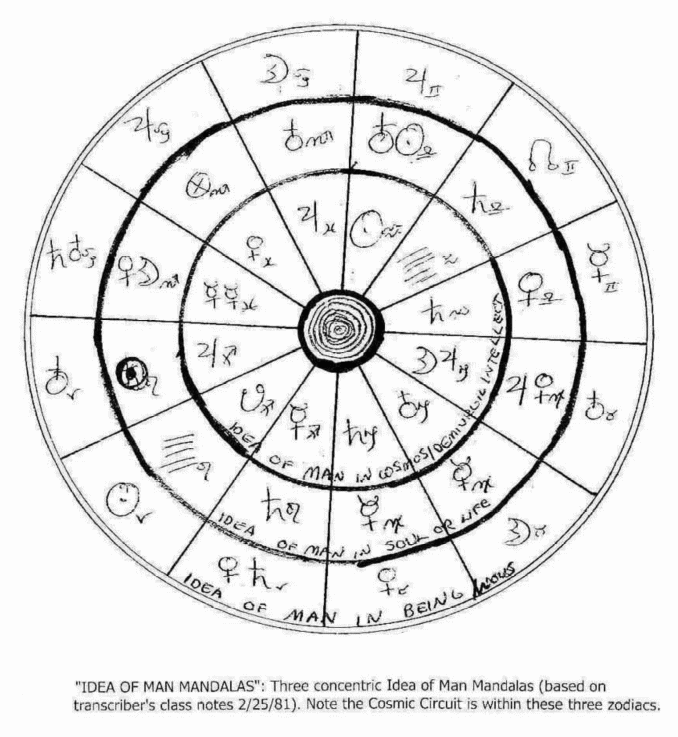
FIGURE 1981 0411-1-JF. Idea of Man Mandalas.
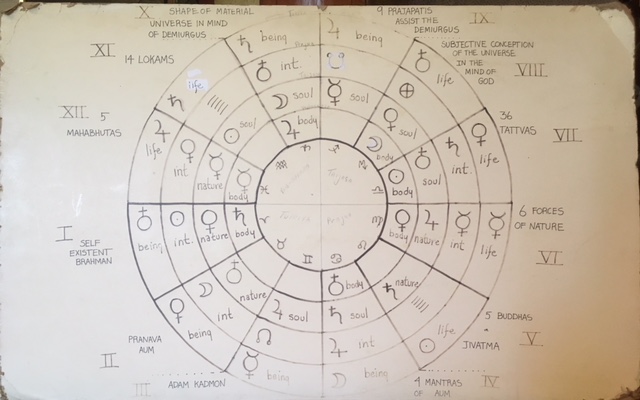
FIGURE IMG 2202-Posterboard Metaphysical Chart.
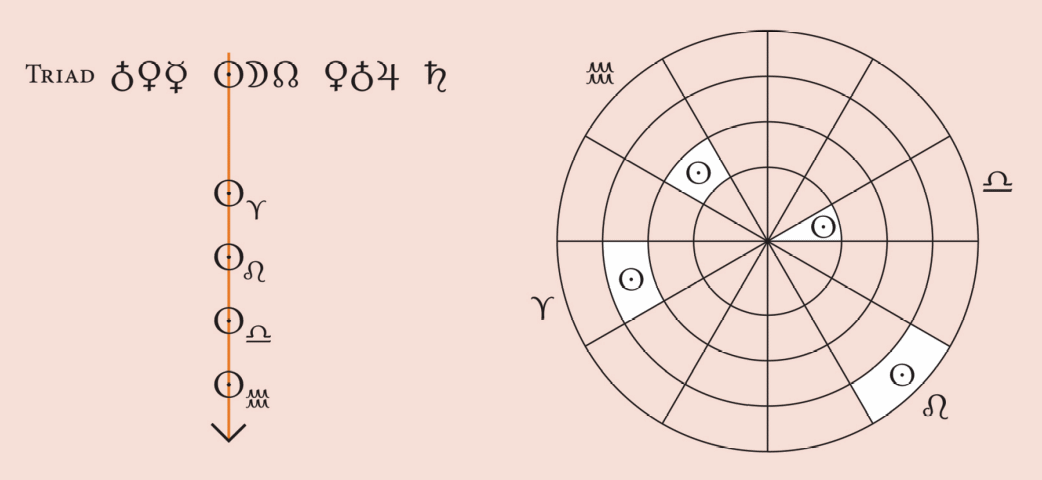
FIGURE 1981 0411-3. Henad of the Sun.
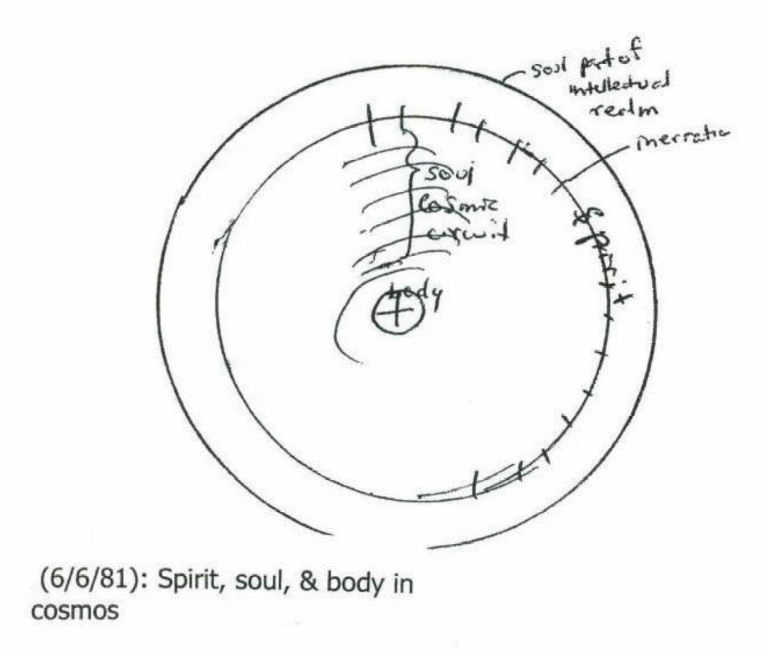
FIGURE 1981 0411-4-JF. Spirit, Soul, & Body in Cosmos.
NOTES by JF:
This class was part of a 1981 Saturday AM series on Iamblichus: 04/10 (Friday eve); then Saturday mornings 04/11; 04/18; 04/25; 05/16; 06/06; 06/13. The class date sequence shows gaps; however, other Saturdays in this time period are on Number or the Kabbalah.
Other 1981 class topics, immediately prior to PB's death, appear to have been cosmology, the Idea of Man, the problem of knowledge, Kepler, alchemy, subtle physiology, Tibetan Buddhism and tantra, Kabbalah, the history of Platonism.
On Some Terminology in the Iamblichus classes: The Cognitive Isness can be considered to be synonymous with the Individual Soul principle, the Atman, the Saturn in Leo. "Drops" of light are often referred to. As far as I understand them, these subtle "congealed reason-principles" are coming from the third or Soul quadrant down into the embodied individual; further references to drops may be found in Tibetan Buddhist subtle physiology. "Genesiurgic" is a word used in Thomas Taylor's translation of Iamblichus; Anthony speaks of "genesiurgic tendencies" as being the planetary influences.
Previously printed, distributed 2003.
TRANSCRIBED by jf 2003 from Audio Cassette tapes; reformatted by jf 2018. In 2024, IT updates prefatory matter and footer, replaces tape markers with audio file markers, alters Topic, expands Subsubjects, completes Book List, adds Plotinus quotes section, corrects typos and some listening errors, adds new notes within transcript, adds two diagrams and references within transcript to these diagrams, reformats to accord with new conventions. Readable edited transcript – V11r.
AUDIO FILES: 1981 0411a, 1981 0411b, 1981 0411c. [Note: "Tape" and "Side" refer to original audio cassette tapes that were later digitized into .MP3 Audio Files.]
1981 04/11 at Wisdom's Goldenrod
Neo-Platonism; Iamblichus; Gods
[Iamblichus. On the Mysteries of the Egyptians, Chaldeans, and Assyrians. 3rd ed. Tr. from the Greek by Thomas Taylor. London, Stuart & Watkins, 1968 [1821]. [Italicized quotes in text, between *"..."*, are Porphyry's questions being addressed by Iamblichus; square brackets in quoted text are in published version unless otherwise noted; minor variations read on the tape restored to text version in printed book. Pp. 1-16 of the book are the text of Porphyry's letter.]
[Audio File 1981 0411a Begins]
AS: You want to read some other--
AD: The whole chapter.
S: Yeah.
Iamblichus, pp. 60-1 (AS reading): "After this, you pass on to another division into contraries, viz. the division of Gods with reference to daemons. For you say, *"that the Gods are pure intellects;"* but you propose this opinion as an hypothesis, or you narrate it as a dogma adopted by certain persons. And you infer, *"that daemons are psychical essences participating of intellect."* Neither, therefore, am I ignorant that this is the opinion of many philosophers; but to you, I do not think it is proper to conceal what appears ... to be the truth. For all such opinions are full of confusion; since they wander from daemons to souls, which also participate of intellect; and from the Gods to an immaterial intellect in energy, which the Gods entirely excel by a priority of nature. Why, therefore, is it requisite [AS substitutes: 'should we' for last phrase] to attribute to them these peculiarities, which are by no means appropriate? And thus much concerning this division, for it would be superfluous to make any further mention of it.…
"Farther still, having said [AS adds: Porphyry said] *"that pure intellects are inflexible, [i.e. not to be changed or altered] and unmingled with sensibles,"* you [AS adds: therefore] doubt, *"whether it is requisite to pray to them."* But [AS adds: Iamblichus answers] I think it is necessary to pray to no others than these [AD remarks: and these should be the Gods; AS: --the Gods--]. For that in us which is divine, intellectual, and one, or intelligible, if you are willing so to call it, is most clearly excited in prayer; ..."
AD: So he's saying the Intellectual Soul is excited by prayer.
Iamblichus, cont., pp. 61-2 (AS reading): "... and, when excited, vehemently seeks that which is similar to itself, and becomes copulated to perfection itself. But if it should appear to you to be incredible, that an incorporeal nature can be capable of hearing sounds, and it should be urged by you, that for this purpose the sense of hearing is requisite, [AS adds: and] that it may apprehend what is said by us in prayer; [AS adds: then] you willingly forget the excellency of primary causes, which consists in both knowing and comprehending in themselves at once the whole of things. The Gods, therefore, do not receive prayers in themselves, through any corporeal powers or organs, but rather contain in themselves the energies of pious invocations; and especially of such as, through sacred ceremonies, are established in, and united to, the Gods."
AD: So what is he saying there? The Gods don't hear you with their ears because they don't have any ears. So then how would they know?
AS: --that they--
AD: That the energy invoked by prayer or meditation is what they do know. They know that directly.
CdA: That is from them-- that (same energy) is from them.
AD: Yes, it's from them. But the point would be that it's their energy, that they comprehended within themselves, which is what you're using to invoke them. So they have direct access to that. And that's why it's so important in meditation to eliminate all, you know, conceptual thinking. They're not interested in that. So it's a slow beginning, we'll go slow--
AS: So then they don't receive the prayers "through any corporeal powers or organs," but through "the energies of pious invocations".
Iamblichus, cont., p. 62 (AS reading): "For then, in reality, a divine nature is present with itself, and does not communicate with the intellectual conceptions in prayer, as different from its own.
[AS adds: And Porphyry asks] *"Supplications, however, ... are too foreign to the purity of intellect to be offered to the Gods."* [AS adds: And Iamblichus answers him:] But this is by no means the case. For on this very account, because we fall short of the Gods in power, purity, and every thing else, we shall act in the most opportune manner, by invoking them with the most vehement supplications. For the consciousness of our own nothingness, when we compare ourselves with the Gods, causes us to betake ourselves spontaneously to suppliant prayer."
(AD inaudible, but seems to be a request to reread last sentence)
Iamblichus, p. 62 (AS rereading): "For the consciousness of our own nothingness, when we compare ourselves with the Gods, causes us to betake ourselves spontaneously to suppliant prayer."
Iamblichus, cont., pp. 62-3 (AS reading): "But from supplication, we are in a short time led to the object of supplication, acquire its similitude from intimate converse, and gradually obtain divine perfection, instead of our own imbecility and imperfection.
"If, indeed, it is considered that sacred prayers are sent to men from the Gods themselves, that they are certain symbols of the divinities, and that they are only known to the Gods, with whom, in a certain respect, they possess the same power, --how can it any longer be justly apprehended, that a supplication of this kind is sensible, and not divine and intellectual?"
AD: Do you follow that? I don't. Do you want to try? Re-read.
VM: Just re-read.
S: Yes.
AS: He says:
Iamblichus, pp. 62-3 (AS rereading): "If, indeed, it is considered that sacred prayers are sent to men from the Gods themselves, that they are certain symbols of the divinities, and that they [AS substitutes: these prayers] are only known to the Gods, [VM: To or through?; AS: To the Gods: these prayers are only known to the Gods] with whom, in a certain respect, they [AS substitutes: these prayers] possess the same power,-- [AS adds: then] how can it any longer be justly apprehended, that a supplication of this kind is [AS substitutes: these supplications are] sensible, and not divine and intellectual?"
AS: I think he's saying like, this prayer may have this (word), the outer aspect, these words you say, but the prayer itself is really a symbol or a direct transmission from the Gods, or is a direct link with the divine-- with the divinity.
AD: So locked up in the symbol is the essence.
S: (Or/Of) the Soul.
AD: Or the energy of the God in the symbol is-- symbol is the means by which communication with the God is possible.
AS: Yes. And that that's the efficacious part of it, not the fact that the symbol might have any conceptual meaning to it or anything like that.
AD: So that, for instance, in a ceremony or a ritual-- a ritual has to be performed according to very highly precise rites in order to invoke the energy of the God, which is the God. And if the ritual or the-- you know, the early mankind when you read about mythology they were very, very careful in performing these rituals in a very highly prescribed manner and that even the slightest deviation would throw the whole thing off. And so they had to do these rituals. That's a symbol. That's a symbol, when you perform certain actions. And through that symbol there was a direct and immediate contact with the God. I think somewhere Plotinus pointed that out. [Note: Possible reference to IV.3.11, first paragraph.] And, in their mythologies they also tried to reduplicate the same thing, that is, they tried to reduplicate the action of the God in a certain way and this brought about their providential energies into manifestation. So with mantrams, you know, and rituals and certain kinds of prayers, if said precisely the way they have been prescribed, have an inevitable efficacy.
BB: Is he talking pretty much about an individualistic type of thing, or is he talking about ritual or what I kind of think of as ritual, like when you're in a church or in a group or something like that, is it really the individual that has to do this-- you know, you're not going to derive anything from somebody else doing it? Is this inherent in what he's saying?
AD: It seems what he's saying is that that it seems that the individual has to do it, to gain any benefit.
S: Anthony, can you say in a sense that if the prayer or the ritual is done like properly, that it is the actual God, that it's because you actually do reach it through that energy that--
AD: Yes, but you have to separate the sensible concomitant with/from the energy that's involved. Try it again now, see if you can try it-- um, (silence) It's useless-- but let's try it. The shining bulb, you know, the light bulb that shines, that has to be separated from the energy which is traversing or is coursing through it. They're two different things. In the ritual we would focus on the sensible qualities of the ritual, what he's saying is that it's not that, but the energy which is, let's say, coursing through the filament and the resistance of the filament, alright, brings about that light. But what he's saying is that one has to separate the sensible manifestation from the energy of the God. It's the energy of the God which is really the God, and the light which, let's say, is spread from the bulb, that would be the symbol.
AS: Anthony, this analogy keeps reminding me, the analogy with the-- when we spoke about (inaudible) the drops and they have this kernel of light, but then they have an outer covering, is this kind of also a symbol for example, for this God's energy (inaudible)? Like the mantram or the ritual-- is like this outer covering, like there's this inner core of energy which is transmitted through this outer symbol? (inaudible) (AD: Say it again, say it again.) Well it seems like you're saying like there's this outer symbol or this outer husk or the covering, and the inner core of this is this energy of the Gods. And it's like the outer covering is like the vehicle -- these prayers, or invocations, and proper rituals -- is like a vehicle for that energy of the God to enter that--
AD: Yes, (to enter), yes.
AS: Similarly like these drops or seed-thoughts are like the vehicles for (inaudible)--
AD: So those (different vrittis) which are the surrounding shell would be like the sensible manifestation of that --
AS: The inner light--
AD: --the inner light, yes.
AS: The (vehicle of) light. And it seems like that would be individual [symbol], whereas this [inner light] would be like the [symbol of the] Gods that are (in that) (inaudible).
AD: So he's asking us to keep that in mind, in order to understand the efficacy of the symbols of the Gods. And even now that it's been handed down that there are certain symbols which are very powerfully efficacious, but that would get us into magic here. The use of certain formulas will bring about the evocation of a *lower order* of beings.
AS: It seems also to go along with this theory, though, that we read last night, about the allotments, certain particular places, certain statues, certain cities, and so on, are *allotted*, and have these Gods for their allotments. So it seems like certain rituals or certain formulas also -- so that that is the God's allotment, that it has the power to evoke.
AD: That's why they would manifest (there/here).
VM: I have a basic confusion. It started out by saying, or the reading started out by saying that when we pray, it's the Intellectual Soul that's excited. And then it seemed to move over into a direct appeal to the Gods. Am I to understand that, granted you're appealing to the Gods, but it's through the-- say, the *agency* of the Intellectual Soul, that this actually occurs, that the transmission occurs, through that, through that (pattern, someone coughs), to use that word?
AD: I think what you're saying is that the efficacy of the symbolic ritual depends upon it being translated or transposed by the Intellectual summit of the Soul, the Intellectual Realm.
BB: Yes.
S: (inaudible)
AD: I think it would-- I think it is necessary to put it that way, because you can refer to the Intellectual part of the Soul as well as the rational, (and the rational is the) 'WE'. [tape re-checked/verified by jf; but CdA had: because you can refer to the Intellectual part of the Soul as well as the rational and irrational as the 'We'.] And that consequently there's a conformity of the 'WE', you know, an alignment of all the parts with it, would naturally operate. So I think that you have to bring that in.
VM: I'm sorry, I don't understand.
AD: Alright, the question will be yes, it would have to be that way. But, one could simply think of it this way, that in a true sincere prayer, (VM inaudible) there would automatically be an alignment with the higher soul.
AS: There's this line, I read this before but why not? He says, the previous page:
Iamblichus, p. 62 (AS rereading): "For the consciousness of our own nothingness, when we compare ourselves with the Gods ..."
AD: Well--
AS: In those-- in a lot of the Buddhist texts they speak about before you can practice deity yoga you have to have a proper view of the emptiness of the empirical personality.
AD: Well, that seems very technical, just put it this way: You have learned the first lesson and yet it'll be the last one -- humility. (AS: Yes.) Not nothingness in a technical sense. (AS: No, it isn't, no.) Because if you nothingness, I don't think you'll be praying to the Gods. Alright, let's keep reading this. This is just to warm us up before we get on to more difficult chapter(s).
AS: And Iamblichus says:
Iamblichus, p. 63 (AS reading): "You say, however, *"that the things which are offered in supplications are offered as to sensitive and psychical natures."* And, indeed, if the offerings consisted of corporeal and composite powers alone, or of such things as are merely subservient to corporeal organs, your assertion would be true. But as the offerings participate of incorporeal forms, of certain reasons, and more simple measures, the aptitude of them is to be surveyed according to this alone."
AD: Try once more, because I think it went right over our heads.
AS: He's saying um--
Iamblichus, p. 64 (AS rereading): "You say, however, *"that the things which are offered in supplications are offered as to sensitive and psychical natures."* And, indeed, if the offerings consisted of corporeal and composite powers alone [AS substitutes: only], or of such things as are merely subservient to [AS: the] corporeal ... [AS: then] your assertion[AS:s] would be true."
AS: That the supplications are only offered to the sensitive and psychical. But--
AD: Again, let's try to understand that, what is he saying? What is it that you're offering to the sensitive and the psychical Gods? To them you could burn incense, right?
S: Correct ritual--
AD: And what is it that you offer to the higher Gods?
S: It would be the intelligibles that the rituals are trying to express.
AS: He also says "certain reasons". Well whatever--
AD: Well, we have to try to make this more explicit, you know, use ordinary examples.
AB: Since you have that inner aspiration, or devotion that would be more incorporeal than, say, enacting a ritual or lighting (some) incense, so that would bring you closer to the energy of that God. Whereas if you only--
AD: That would be the 'reason'.
AB: Right, a 'certain' reason. Whereas if you only did the-- if you only viewed the ritual as an external thing, then maybe you would only invoke a lower sensitive.
AD: (assents) That's to the ones you burn incense or put flowers on the altar, and all these things, I -- what we're saying is that these supplications -- they're useful, I mean-- this puja, it's a form of worship-- but it reaches only the psychical Gods. "Only" -- quotations, underline it. (S: Haha.) But the offering of the soul, let's say, a true form of itself, a sincere desire to offer itself, and this is the reasoning-principle in you that you're offering to the God, this is what they say, *feed on*.
AB: But if you did the puja with the proper attitude then it would be invoking that reason, wouldn't it? So in other words if you just go and put the flowers on the altar, but if you have that real sincere attitude of devotion and supplication, then you're doing all of them.
AD: You're doing all of them. But most of us start at one level and gradually work up to higher levels. Let's reread that thing.
Iamblichus, p. 63 (AS rereading): "And, indeed, if the offerings consisted of corporeal and composite powers alone [AS substitutes: only], or of such things as are merely subservient to [AS adds: the] corporeal ... [AS adds: then] your assertion would be true [AS: namely that the things are offered to the sensitive and psychical natures]. But as the offerings participate of incorporeal forms, of certain reasons, and more simple measures, [AS adds: then] the aptitude of them is ... according to this alone."
Iamblichus, cont. p. 63 (AS reading): "And if a certain alliance, or similitude, is present, which is either proximate or remote, it is sufficient to effect the contact of which we are now speaking."
AD: So if there is some affinity between you and the higher God, alright, then this is a means for a possible contact, the ground or the medium for the contact. This is usually experienced as a kind of *touch*.
AS: He says:
Iamblichus, p. 63 {sentence italicized in printed text} (AS reading): "For there is not any thing which in the smallest degree is adapted to the Gods, to which the Gods are not immediately present, and with which they are not conjoined." (silence)
AD: Go ahead, continue. How about the next chapter, and what's the question?
S: The Gods--
Iamblichus, p. 64 (AS reading): "The difference which separates *"Gods from daemons by the corporeal and incorporeal,"* is the next thing that follows in what you have written; this being much more common [AS substitutes: is a much more common opinion] than the former difference, and yet it is so far from expressing the peculiarities of their essence, that it does not afford a conjectural knowledge of them, nor of any accidents which pertain to them."
AD: So we can't know anything about the Gods, or the daemons, by using this as a criteria. In other words, their invisibility cannot be used as a criteria. Both Gods and daemons are invisible.
Iamblichus, cont., p. 64 (AS reading): "For neither is it possible from these things to apprehend whether they are animals or not, and whether they are deprived of life, or are not at all in want of it. Farther still, neither is it easy to conjecture how these names are predicated, whether in common, or of many different things. For if in common, it is absurd that a line and time, God and daemons, fire and water, should be under the same incorporeal genus."
AS: That's not a very good division of corporeal and incorporeal. There's lots of other things that are incorporeal, that we wouldn't call Gods, or that we wouldn't want to, like "mind" --I mean, lots of things.
AD: So you can see, he takes the whole of these questions and shows how absurd, how little understanding there is in even asking a question that way.
LR: What was the question?
AS: Whether you can use this criterion of incorporeality to describe the Gods and daemons.
AD: They're both (inaudible).
AS: --as characteristics.
LR: Are you trying to distinguish between Gods and daemons?
AS: Or to distinguish Gods and daemons from other things. Or distinguish among Gods and daemons. (some whispering among students, can't hear) Yes, atoms--
VM: --the hydrogen atom--
AS: Yes, in fact, if-- neither is it easy (inaudible, someone blowing nose)--
Iamblichus, pp. 64-5 (AS reading): "... neither is it easy to conjecture how these names are predicated, whether in common, or of many different things. ... But if [AS adds: we conjecture about describing corporeality] of many things, what reason is there when you speak of the incorporeal, that you should rather manifest by it Gods than points (AS chuckles); or when you speak of the corporeal, that you should not be thought to speak of the earth rather than of daemons? For neither is this very thing defined, whether Gods and daemons have bodies, or are carried in bodies, as in a vehicle, or use them, or comprehend them, or are alone the same with body. But, perhaps, it is not proper to examine this distinction very minutely. For you do not propose it as your own decision, but you exhibit it as the opinion of others."
AD: He throws the question right out the window. (student chuckles)
AS: In other words that's not--
VM: Did Porphyry actually write these questions or is that just a (inaudible) for students?
AB: Porphyry wrote him a letter.
AS: There was a letter--
AB: In the beginning of the book [pages 1-16].
AS: Yes. There's the letter in the beginning of the book. There is some question as to whether-- as to who answered it. They claim that Iamblichus answered it.
VM: It doesn't matter.
AD: It sounds like Iamblichus because of the profundity of the answers, you know, the precision, the experimental understanding, because these things can't be understood from a theoretical point of view, they can't be worked out from there. It's already obvious I think, we began to see that this man is coming from inside, answering questions from inside.
AS: Do you want me to read the next one again?
AD: Yes. That's where we left off last night. I'd like to go over that again.
AS: Okay. So then he says, we'll drop this question, and instead take up the next question you have which is more exact:
Iamblichus, p. 65 (AS reading): "*"For,"* it may be said by you, [AS adds: to us, said] *"how, conformably to what we assert, can the sun and moon, and the visible natures in the heavens, be Gods, if the Gods are alone incorporeal?"*"
AS: There's a more precise question.
AD: That's where we left off last night. I'd like to go over this chapter again. Just continue--
AS: So we reply to this:
Iamblichus, pp. 65-6 (AS reading): "... that the celestial divinities are not comprehended by bodies, but contain bodies in their divine lives and [AS adds: in their divine] energies; ..." [inaudible S/AS interchange about doing it again]
Iamblichus, p. 65 (AS rereading): "... we reply, that the celestial divinities are not comprehended by bodies, but contain bodies in their divine lives and [AS adds: in their] energies; ..."
AD: There he's stating correctly the way to view it, the bodies or the cosmocrators do *not* contain the Gods, it's the other way around, that it has to be understood. (AS: Yes.) The Gods contain the bodies. (AS/S inaudible comments)
LR: And when he says 'celestial divinities' is that a specific order?
AD: The Celestial divinities.
AS: Yes. The Mundane Gods.
LR: Are the Mundane Gods?
AD: Yes, they're celestial divinities.
AS: The planets. In particular, because he's speaking about--
LR: I thought-- I thought the planets were the *bodies* of-- okay, that's (inaudible).
AS: Well that's the whole question here.
AD: Read it to her again.
AS: That's the whole thing. He says, How--
Iamblichus, quoting Porphyry, p. 65 (AS rereading): "... *"how ... can the sun and moon, and the visible natures in the heavens, be Gods, if the Gods are alone incorporeal?"*"
AS: And he's saying they're (inaudible)--
Iamblichus, pp. 65-6 (AS rereading): "To this we reply, that the celestial divinities are not comprehended by bodies, but contain bodies in their divine lives and [AS adds: in their] energies; ..."
LR: So, I'm confused, I thought that answer meant that what we see is the *body* of a divinity, but in no way exhausts the power or energy of the divinity.
AD: (inaudible) It's the other way around. (AS: Yes.) The divinities contain the bodies within them.
LR: Right. So I'm still not clear as to my question, I asked whether (inaudible, AS interrupts) divinities and I thought what we saw were the bodies (AS: Yes.) descended from the celestial divinities.
AD: And so what would we call them? Bodies? Or celestial divinities?
AS: But they're divinities still--
LR: Well, you can't separate them, I think (that's the point).
AD: Yes, they're celestial divinities. Now what order of divinities are there? The Mundanes, the Supermundanes -- you want to know what 'celestial' refers to-- all of them.
LR: Okay.
AD: He's not making a division or a distinction there.
LR: Okay (that's fine). In other words -- it's not a question, I thought he was saying too, it's not a question of bringing together a power with a body, the body is a *direct* output of that power, you don't have to connect one thing to (another).
AD: You know, they promise us that in the future when we become enlightened beings that we would be able to produce from within ourselves the necessary vehicle. So you read about in the legends the way you might be mentally formed. So when you go to heaven, you know, you produce your own body. You won't need a father and a mother. And then as the body gets old, the odors start showing up and you know that you're getting old, and it's time to withdraw it. And so, you're on your way too. (student chuckles) Well anyway, that's what the legends say. (AS: Even--) Right now it has to be provided for you because you don't know how to do it. But from what we understood, we said that the Soul is concomitant or is, let's say, working with the Cosmic Soul, learning how the Cosmic Soul fabricates and does things, so you too are learning that. Of course this is all unconscious. But we have the quote that some time it'll become conscious. As this wisdom arises more and more to the surface, you know, to our (consciousness), our understanding, then those processes become available to us. The same thing like for instance some of the studies that the alchemists performed, they're repeating the experiments in nature, they're learning (through) those experiments how to bring certain results about but they're doing it consciously now. So they usually call that the cosmology not a metaphysics. And they have a certain truth up to a certain point. Let's continue.
AS: Okay. He says: And they--
Iamblichus, pp. 65-6 (AS reading): "... the celestial divinities ... are not themselves converted to body, but they have a body which is converted to its divine cause; and that body does not impede their intellectual and incorporeal perfection ..."
AD: Like our body. It's in the way when we try to think. You'll notice it if you eat a lot of potatoes before. (student chuckles, inaudible comments)
AS: The Gods don't eat potatoes.
VM: Or beans. [reference to Pythagoreans, who were forbidden to eat beans]
Iamblichus, cont. p. 66 (AS reading): "... nor [AS: does this body] occasion them any molestation by its intervention. Hence it does not require an abundant attention, but follows the divinities spontaneously, ..."
AD: (inaudible; students chucking next is hard to hear) you get up in the morning and you brush your teeth and you wash your face. You ever notice the meticulous attention PB gives to the body? You notice?
Iamblichus, p. 66 (AS reading): "... it does not require an abundant attention, but follows the divinities spontaneously, and after a certain manner, self-motively, not being in want of manual direction; but, through an anagogic [AS substitutes: analogical] tendency, ... itself uniformly coelevated by itself, to *the one* of the Gods."
AD: We could simply illustrate it by saying that the Sun in Aquarius or even the sensible sun, but the Sun in Aquarius would have to act in absolute conformity with the Sun in Aries, it must simply follow the wisdom that's inherent in the highest Unity of the Sun itself. [Note: See FIGURE 1981 0411-3.] And you would have to do that with all the planets. If you remember, we (started) with this project [referring to the Idea of Man Mandalas, see FIGURE 1981 0411-1-JF], I think you remember then when we tried to see how the Nous underlies the houses, remember? We took the Idea of Man in Matter, then the Idea of Man in Soul, and put that as the underlie. Now over here you have justification for putting the Idea of Man in Being under even that. So that you probably would have the Nous underlying the Soul, the Soul underlying the Body.
LR: It's interesting, you just said the Sun in Aquarius would have to act in absolute conformity or harmony with the Sun in Aries as its principle. But it seems like it wouldn't have to necessarily be in conformity say with the Mercury-- say Mercury or one of the other Gods, and that's a point that--
AD: (You put) it forward.
[Audio File 1981 0411a Ends]
[Audio File 1981 0411b Begins]
LR: --so much-- that there's so much controversy and disharmony in the world, I think he says that in that order itself there are differences. Not that they have wars or are in that kind of conflict, it doesn't appear as conflict, but they are definitely different one from another.
AD: Yes.
LR: And aren't--
AD: (Right), but the total is harmonious, he also said that too. That this equilibrium has its place in this order but it's part of the *total* order. Continuing.
Iamblichus, p. 66 (AS reading): "It may also, if requisite, be said that a celestial body is most allied to the incorporeal essence of the Gods. For as the latter [AS reads: incorporeal essence of the Gods] is one, so the former [AS reads: celestial body] is simple; as the latter [AS reads: essence] is impartible, so the former [AS reads: celestial body] is indivisible; and as that [AS reads: the essence] is immutable, so this [AS adds: body] is unchanged in quality. If, likewise, it is admitted that the energies of the Gods are uniform, a celestial body also, has one circulation."
AD: For you, Vic, just in case it might cause you some annoyance since you're an astronomer, they're talking about *bodies*, and that's different from the sensible. In the sensible being there is an instantiation of the Ideas going on -- in the body. But they're speaking about the uniform quality of the body, and that would mean that the matter that goes into constituting the individual body of a planet is of a uniform substance. Now our bodies are also a uniform substance, but there is this-- there are divisions within it, there (are) various forms-- remember when we speak about the Idea in-forming the matter. Now in the question of, let's say, ourselves, there are many Ideas in-forming many matters to make together, to bring together a composite body. This is for you too, Spider [student name], this is alchemical. Whereas in the case of a planet as the body of a God, there is *one* idea in-forming that matter. So when Carl Sagan wants to criticize them, you'd have an answer for him. (student chuckles) Do you follow the point?
VM: No, I'm afraid I don't. (inaudible)
AD: *Matter* is in-formed by the Ideas, alright. (VM: Alright.) That become ultimately an object. Now, in the question of *our* matter, alright, many Ideas are in-forming our matter. In the question of the Gods, it's *one* Idea in-forming that matter. (VM: Alright.) So in the bodies of the Gods there would be a uniform and simple subsistence. In the bodies of humans, there would not be a uniform and simple subsistence, there will be a variety of forms *in* the body.
VM: Alright. But when you're speaking about body at the level of the Gods, now are you speaking about, say, the Sun in Aquarius, which is to distinguished, let's say, from the apparent sun which appears in the sublunary realm?
AD: I wasn't referring to the Sun in Aquarius. I'm in the 12th house, where there is *matter*, we're speaking about *that* matter -- this is always a problem. When you speak about the matter has to be brought together to form a body, before any instantiation could take place in it. (VM: Okay.) That's what they're speaking about. That the matter of the body of the God has only *one* Idea in-forming that formless matter. So it would be uniform throughout that body. Whereas in the matter of an individual there are many Ideas informing, to bring together the body of that underlies that individual's unity. And I'm only bringing that out because this would be very difficult to understand. If you read it again you'll see -- you'll say, Wait a minute, that planet Jupiter has 90 elements or 112 or 200 like we have, you're completely off the point.
VM: What is this uniform subsistence, that's let's say underlying the form of Jupiter?
AD: One Idea.
VM: One Idea--
AD: It's characterized by one Idea. One Idea is in-forming that whole body of the planet. As he said, the Gods are characterized by a certain aseity, a certain unique singularity which represents them and nothing else. It is this which in-forms the body of a God.
VM: But I don't see what that has to do with the fact that there might be 90 elements in Jupiter, I don't see any difference, contradiction.
AD: Well, if you say there's 90 elements, you can easily come to the next position which inevitably follows, and say, But the body of a God is *not uniform*, it is composed of many, many elements.
TS: What you're saying is that by seeing 90 elements on Jupiter, we're standing as it were within the realm of the--
AD: --the realm of instantiation.
TS: The body of the physical man is projecting back a differentiation -- it's only our sensible perception of the physical body, it's not the actual body itself that we see.
AD: Yes, I'm simply trying to talk-- would read it again?
Iamblichus, p. 66 (AS rereading): "... a celestial body is most allied to the incorporeal essence of the Gods."
AD: Alright. Turn 'body' -- is what I'm talking about-- there's a difference between body and sensible body. They have to be very carefully distinguished. We speak about a body which is organized by the Gods, the human habitation, but then they speak about reason-principles getting inserted into that body. Alright. And you have a compound, alright --reason-principles plus the body. And there's manifestation of what the living reason-principle was. What we're trying to say here is, if you think of a reason-principle inserted into a planetary body, then it's just *one* reason-principle. Whereas in us the reason-principle is constituted of many, many factors. Alright, don't let it bother you, just think about it. Because (then) now coming from the scientific point of view there very often is a tremendous-- it seems that there's tremendous contradictions, you know, like when they speak about the Earth as the Mother of the Gods and everybody starts saying, but, you know, this is the least of the planets blah-blah-blah and they go on and on. But Gaia refers to Matter at the most primitive form. And again there would be a lot of confusion. I'm only mentioning this because the scientific world, in criticizing these people, has no understanding of what they're saying. And then to criticize a straw man, you know, is just to pile up error upon error.
VM: Yes, it usually goes in both directions. (AD: Yes.) Neither can't understand (the other).
AD: Yes. Well we saw that with Pauli. Saw that with Pauli. [Note: Reference is to W. Pauli, "The Influence of Archetypal Ideas on the Scientific Theories of Kepler" (in C.G. Jung, W. Pauli, The Interpretation of Nature and the Psyche). See also WG Kepler Classes 1981 0221, 0228, 0307, 0314, 0321 where this article is discussed.] Let's continue a little more.
AS: Okay so he says:
Iamblichus, p. 66 (AS rereading): "[A]s the latter [AS reads: As the essence of the Gods] is one, so the former [AS reads: their celestial body] is simple; as the latter [AS reads: essence] is impartible, so the former [AS reads: their body] is indivisible; and as that [AS reads: the essence] is immutable, so this [AS adds: the body] is unchanged [AS reads: unchanging] in quality."
AD: I also launched this criticism at Blavatsky. That she criticizes this view, and she says that when pralaya sets in, and everything below the third lokas dissolve, she missed the point. They're not talking about the sensible world which disappears. They're talking about the *body* which will *never* disappear. In pralaya the sensible body will disappear. The whole planetary system will dissolve, but not that body.
S: Yes.
VM: Okay.
AS: He has this footnote, he says:
Iamblichus book, footnote by T. Taylor on p. 66 {goes with indivisible} (AS reading): "*For as a celestial body consists of light so pure and simple, that, compared with a terrestrial body, it may be said to be immaterial; ... [AS adds: analogously to] the light of the sun."
VM: This may be a small point, when you look at Jupiter, we'll go back to Jupiter, the sensible body. But the Jupiter in, let's say, Capricorn, that's the body, the Celestial Body, that's being referred to here. [Note: See FIGURE IMG 2202-Posterboard Metaphysical Chart.] And that is an eternal principle, and that is of a uniform nature. Is that the distinction? And that is informed, let's say, by *one* Idea, the Idea that's inherent in Jupiter.
AD: Yes.
TS: I thought you were saying that in the sublunar world, looking at the body of the Mundane Gods in the 12th house, we would see those bodies in the 12th house as sensible. But they in themselves still in the 12th are of a uniform matter. (AD: Yes.) That not only in the subtle-- not only do they endure in Capricorn say as a subtle organization of matter but there's actually a gross organization of matter which is beyond the sensible perception of it, beyond the sensible body that we see.
AD: Yes. This might help in terms of the chart, the way the shape of a material body in the 10th house. You're speaking about just the *shape* of the material body. Whereas in the 12th house, that is corporealized, sensibilized.
VM: Even that body, though, is eternal.
AD: No, that's not eternal. The sensible qualities are never eternal, can't be. The representation of the universe is constantly changing. (inaudible)
AS: Actually I thought that Vic's example of the Jupiter in Capricorn was a good example. And in fact-- (EMD: Can you people speak louder, we can't hear you back here.) Sorry-- Well, the Jupiter in Capricorn example did seem appropriate, because it seems that the Shape-- just as you are saying, that you are suggesting-- that Shape of the Material Universe includes the Shape of all the celestial bodies, of all the Gods' bodies -- and that never dissolves. In a sense, that's what never dissolves, that plan of any-- So whenever the Gods manifest the universe again, those solar systems will be based on that plan back in the 10th house in some way, the actual body, that simple essence of body. And then that simple essence of body might have to accrete to it all the different kinds of sensible mater, as it were. Like the sensible body of the Earth here has accreted to it a certain amount of sensible matter, but the actual-- the body itself, the basis-- the corporeal base of that is a simple uniform essence.
AD: Alright. We spent enough time on that. We'll have to spend a lot of time on Matter later on. But not now--
AS: Do you want to go on with it?
AD: I'll read here.
Iamblichus, pp. 68-9 (AD reading): "Your next inquiry doubts, *"how some of the Gods are beneficent, but others malefic."* This opinion, therefore, is assumed from the predictors of nativities. [VM aside: Yeah, right, Jeanne Dixon. Inaudible comments, laughter] It is, however, entirely remote from the truth. For all the Gods are good, and invariably the causes of good; and all of them are uniformly convolved to one good ... The bodies, likewise, which are subject to them possess immense powers; some of which are firmly established in the divine bodies themselves, but others proceed from them into the nature of the world, and into the world itself, descending in an orderly manner through the whole of generation, and extending without impediment as far as to things which have a partial subsistence.
"With respect to the powers, therefore, which remain in the heavens in the divine bodies themselves, there can be no doubt that all of them are similar. Hence, it remains that we should discuss those powers which are thence transmitted to us, and are mingled with generation. These, therefore, descend with invariable sameness for the salvation of the universe, and connectedly contain the whole of generation after the same manner. They are likewise impassive and immutable, though they proceed into that which is mutable and passive. For generation being multiform, and consisting of different things, receives [AD repeats 'receives' with emphasis] *the one* of the Gods, and that in them which is without difference, with hostility and partibility, conformably to its own contrariety and division."
AD: Let me go over this last sentence. These Gods--
Iamblichus, p. 69 (AD rereading): "... are likewise impassive and immutable, though they proceed ..."
AD: That is, they go into what is mutable and passive, they proceed into, let's say, you and I.
Iamblichus, p. 69 (AD rereading): "For generation being multiform, and consisting of different things, receives *the [AD substitutes: this] one* ..."
AD: Whatever each one of the Gods offers, alright, receives each of the one, you can conceive of each of them, all of them working together as one. He says you and I receive the *one of the Gods*.
Iamblichus, p. 69 (AD rereading): "... and that in them which is without difference ..."
AD: In other words they're trying to give us the Good (VM: Yes, I see). But -- We receive it "with hospitality" and divisibility, "conformably to" our "own contrariety and division." (lots of embarrassed student giggles while AD makes this statement)
Iamblichus, p. 69 (AD rereading): "It also receives that which is impassive, passively; ..."
AD: In other words, the impassive radiation coming from the Gods is received by us passively, in other words you don't have much choice. Um--
Iamblichus, p. 69 (AD rereading): "... and in short, participates of them according to its own proper nature, and not according to their power."
AD: So that the reception of the aspects, alright, or the reception of the powers coming from the Gods is really dependent on the peculiar vehicle or vehicles that we're operating with. Which differentiates, divides, and assimilates according to its own mode of being. But again if you remember, Plotinus would say, that's not the Gods, that's YOU, the Gods don't do that. [Note: Possible reference to VI.4.11, first two paragraphs.] Yes--
CdA: Would this be the same level that they speak of as the seeds in the chakra system, where they--
AD: Leave that out. Hostility, divisibility, partibility-- (student laughter) It's a little more involved, Carol, I'd like to answer that later, not now.
TS: Would you say that-- (AD: Yes?) That the Sun would go to reveal this partibility, irritability what have you. And others would tend to harmonize it, these orders of the Gods: fabricate, defensive, guardian, would --
AD: Wouldn't that be what you mean by 'good aspects' and 'bad aspects'? (TS inaudible) That's why PB asked you what were the aspects, he didn't even want to know where they were. But usually if the aspects are agreeable, usually you tend to act in conformity with them. And if they're disagreeable, you're fighting, and they're going to have to take you by the scruff of the neck. Some people read charts just by the aspects, they don't care what the planets are. (student snickers, laughter) He goes on:
Iamblichus, p. 69 (AD rereading): "It also receives that which is impassive, passively; and, in short, participates of them according to its own proper nature, and not according to their power."
AD: So we participate in this radiation from the Gods, according to our own nature.
Iamblichus, cont., p. 69 (AD reading): "As, therefore, that which is generated ... participates of being generatively, and body participates of the incorporeal, corporeally; thus, also, the physical and material substances which are in generation, participate of the immaterial and etherial bodies, which are above nature and generation, in a confused and disorderly manner."
AD: So now we know why we never could really figure out what's going on in our chart.
DB: Anthony-- Is this the transition from the energies of the Gods to circumstances? That when they get expressed in the circumstances, it's at that point that they become disorderly.
AD: No, the circumstances aren't disorderly.
DB: Well, what I mean by that is the interpretation of that, the circumstances.
AD: Yes. That's another story. The circumstances will be in continuity or union with the functioning of the Gods, so there won't be no disorder there, even if there's a tempest raging.
DB: I'm trying to pin down where that disorder comes from, would that be-- (AD: I'm sorry--) In really trying to specify where this disorder aspect comes in, would that be in the reflective apparatus that these circumstances--
AD: We said, according to "your nature".
LR: What is that?
AD: You don't know what your nature is like? (LR: No--) What are you asking me for? I wouldn't know. (student snickers) Tim, put up a sign, will you?
AS: You mean, (when we're) disagreeable?
S: Isn't this what Ramana meant that the gods are at his feet?
AD: What?
S: Isn't this what Ramana meant when he says the stars are at my feet? He's walking up Arunachala, says the stars are at my feet, I play football with the stars.
AD: Yes, but that's alright for Ramana.
S: Yes, from Ramana's point of view, not from ours. I'm saying, from his point of view that's what he means. It's agreeable nature. (student laughter)
AD: Yes but that's because they-- he transcended the realm of fate completely.
LR: See I have-- I know you want to go on now and ask this question but I-- (student snickers)
AD: Avery is friendly to you, go ahead. We have to look at our charts and see if they're compatible. (student laughter; AS: That's pretty obvious.)
LR: I mean, you don't have to look at the chart for that. But-- (S aside: A square chart is okay.) But certain questions that do arise in my mind, not just on this point but on what we're read when we read, with starting with last night, that our Soul is a-- a commixture of certain energies of this Gods. (AD assents) Alright, if you start from that premise, which I find hard to understand completely too, then in my mind certain questions arise as to what an individual soul's Cognitive Isness actually is. (S: Each one-- I couldn't hear it; AD: he wants it louder; inaudible)
S: The last part, I heard everything right up to the punch line.
LR: What an individual Soul's Cognitive Isness actually means. And if all these vehicles again, are commingling of the energies of the Gods, all the way down, then how is it possible that certain natures arise in apparent disconformity. And-- (AS inaudible) And, thirdly-- (student laughter)
VM: Egyptian man is slow, you know. (student laughter)
AD: I think those questions will be answered.
LR: But there seems to arise, at least for me, or--
AD: Go over it. Go over your question, even if we don't answer it, we have, I think, a good question, go ahead. We won't answer it, let's put it that way. But it's an important question and it has to be kept in mind, try again would you, Linda. (S inaudible)
LR: Well, we start with the premise that-- (AD: Louder, Linda.) We start with the premise that, what our Soul is, is a commixture, a co-mingling of the energies of these Gods. And that no matter what level of powers of the Soul you're speaking of, there will be a corresponding order of Gods to explain how those vehicles are constructed and of what they consist. Okay. So the question arises for me, what is an individual, what's the meaning of individuality in soul, and what is Cognitive Isness if all Soul can be explained by the innate presence of the Gods' energies? And if it is explained in terms of the commingling of the Gods' energies, then how is it possible for any nature to respond in disharmony to that, if that's what the nature is? And one further thing, which arises for me is, what determines the particular allotment of individuals, in terms of these Gods' energies and co-mingling? Obviously everyone isn't the same. Okay, that's all.
AS: (inaudible) (AD: Alright, go ahead.) I thought that one of these questions seemed to imply -- well, he talked about the two Souls, the thing we read on [page] 308 [read, discussed the previous evening 4/10/81], and this is talking about the lower Soul, as it were, which is bound up with the cosmic circuit. And this cosmic circuit in fact, your lower soul is completely, bound up with that, almost is a production of that cosmic circuit. And then you're saying, Well if the Gods themselves are producing this lower soul, how could it ever be in disconformity with the further productions of the Gods? In other words, the Gods themselves, he says, are completely good, they produce your vehicles and so on, this lower soul's vehicles. Now then on the other hand, well we say it isn't because of the effluxions of the Gods that there's any evil or any disharmony, but it's because of that nature which *receives* the effluxions, that nature which receives the effluxions of the Gods is itself (VM: fabrication) a fabrication of the Gods. Okay. And so-- (during AS comment, drawing-on-blackboard sounds in background)
LR: And that deals with the cosmic circuit soul. (AS: Yes.) And also last night we were speaking of the higher part of the soul also being-- (AS: --being) --produced by the commingling of these energies.
AS: Oh-- the Intelligible Gods. (LR: Yes!) I see what you're saying-- (LR inaudible) The soul is an effluxion.
LR: The (inaudible) last night is that even that higher part of the soul is a fabrication of this.
AD: Let's go over your question, from the beginning, yes. We'll start with the first part.
LR: Maybe I should see what you're drawing on the board.
AD: Start with the first part of your question, please, Linda.
LR: Okay. It's said that in all parts of the soul, all the parts of the Soul that you can speak of, whether it be the intelligible Soul, the highest part, or the very sensible nature which a production of the Soul, no matter which part you speak about, you're speaking about a certain co-mingling of powers of these Gods. I thought that was the premise that you used.
AD: Well, that's not exactly so. I mean, the commingling or the production of the soul at this level is an eternal generation. So this has a steadfast kind of being. [referring to Higher Soul, Saturn in Leo]
LR: No, no, I'm not saying that all the powers of the soul are the same, I'm saying that no matter which level you take, you're going to find a corresponding order of Gods to account for that production.
AD: Yes. Go on.
LR: So that at the highest level, say the Saturn in Leo, the fabrication is of the daemons connected with the Idea of Man.
AD: Daemons? No. There's none there.
LR: Well, we said that they were between the Sun and the Saturn there was an order of daemons or bodhisattvas or (something like that) . Okay, that's not the question, sorry about that--
AD: Alright, go on.
LR: But we spoke of both-- of both the Saturn in Leo and lower orders of the soul as being a production or the commingling of these powers.
AD: Alright, yes, alright, you're repeating that. (LR: Okay.) We're saying that this realm here (pointing to diagram of the tripartite cosmos-- similar to FIGURE 1981 0411-4-JF), alright, we're saying that this realm here is the product, is a product, this whole realm is the cosmic circuit, alright, and that-- let me try again. We said the Earth gives us the body, the matter of the body, the planetary spheres gives us the Soul, alright, and the inerratic sphere gives us the Unity or the Intellect of that, that triplicity: they usually refer to that as Spirit, Soul, and Body. So you have a Soul there to deal with. And then we speak about this Soul here, the Cognitive Isness [Saturn in Leo], okay, you speak about that as the Soul. And your question, I think was to the effect-- wouldn't these natures which are produced in the cosmic realm, be in conformity with the product, with their progenitors, because there is a union or a continuity between the cosmocrators and that which they produce. Was that your question?
LR: Yes.
AD: And we said, yes, there would have to be such a um, a union, there would have to be such a correspondence. I mean, when the chart indicates a physical event happening, like for instance, you break a bone, that's a product or a continuity of the cosmocrators' functioning. Now I think the question was something to the effect-- I'm sorry-- (inaudible student comments)
VM: Given the individual Soul from all levels is a production of these Gods, where does the possible disharmony (AD: arise?) arise? I mean, if it's all a production of the Gods, and a fabrication of the Gods, how is it that the lower ever gets into a disharmonious or a painful situation regarding the actual functioning of these Gods?
LR: Or, said another way, what is it that we speak of-- you just referred to it as 'by individual nature' which repels or seeks to divide the energy of the Gods. (VM: Receives (inaudible)) What would that nature be if not the production of these Gods? (AD/S start to talk) How could it be something other or in a discontinuous way?
AD: What would that nature be which receives the influxions from the Gods in a hostile way? (VM assents) Is that your question?
VM reading: "... hostility and partibility, conformably to its own contrariety and division."
DB: I mean there is something else that has to be brought in that, that just to be able to receive, have a nature and then within the universe it's capable of receiving the um, activities, the energies of the Gods is a function of their activity, alright. But I don't see why that's necessarily a contradiction, the very fact that it's capable of receiving even though it's not in a perfected manner is also a function of their-- I mean its-- do you see what I'm saying?
AD: Yes, I see what you're saying.
DB: I mean, that that's a positive thing too. Even though--
AD: But you won't be able to convince her.
DB: But-- but you see there's a question of-- (LR: I'm sorry, David, but--)
AD: Stop! You won't be able to convince her. You won't be able to convince anyone that conflict and anxiety is a lot that he inherits.
DB: But I mean, even-- see, that's the problem, conflict and anxiety aren't here absolute nothingness, I mean it's an actual--
LR: But that too is a configuration (inaudible).
AD: The receptacle that receives in a parted and divisible manner the effluxions from the Gods which are totally unified, one, and whole, is as much situated within that scheme, as anything else.
S: Excuse me, could you define that in the area of the Gods also? (AD: Sorry.) Wouldn't you have to find some conformity--
AD: Yes, your anxieties are in conformity with their functioning.
LR: Hm.
S: Yes, although there is-- (student laughter) not in a sensible manner. (AD: I'm sorry?) Not in a sensible manner.
AD: Well, if you're speaking about anxiety, you're not speaking about sensible, alright, you're speaking about something mental, the Soul. So if the Soul experiences anxiety in the sensible world, and receives what is happening in the sensible world in a partible way, or in a-- you know, in a fragmentary way, *that is ordained.* I don't want to go into this, because we get into the argument that I want to avoid-- you people believe in the possibility of the freedom of choice.
LR: No, not any more, but I--
AD: Not any more?! (student laughter) Not for you. (LR: I don't think that--)
S: How does that imply a divisiveness of sorts amongst the Gods?
AD: No, no, not at all. (student inaudible)
S: The Soul of the Gods.
AD: No, your neuroticism is already included within their total functioning.
S: I'm sorry, say that again?
AD: Your neuroticism is accepted within their total functioning.
S: Uh-hm.
S: Yes.
AD: So it doesn't imply any divisibility in the God's operation.
S: I don't mean divisible in the sense that there's a separation between any of their aspects. But that they are unities.
AD: They are unities and it includes all the divisions we find in the neurotic personality, that's already included in there. But--
S: Does that feel better (when you--) (student laughter)
JL: Yes.
AD: That's part of the advantages of a little astrology, you look at your chart and you see a Moon-Saturn conjunction, you say well, tomorrow I'm going to be depressed, I might as well accept it.
S: Start now. (lots of student laughter)
AD: Start now. (more laughter) Alright, why don't you continue reading, Avery, please. Yes--
LR: What about the first line where you get-- I don't get how any of the-- I don't see what-- I'm not asking for an answer but I don't even see that we're dealing with the question. To say it's preordained, how does that answer the question? (AD: Well, again--) I don't see how you've dealt with this question at all, not even showing me why we can't answer it. To say it's all preordained, how does that answer the question about what the nature--
AD: I think the question gets answered as we go along, as we more thoroughly and profoundly understand of the interrelationship of the Cognitive Isness as it gets immersed into the cosmic circuit. (LR: Right.) I think the question does get answered.
LR: Okay but I-- So you're just saying--
AD: If we say, if we say that the ultimate purpose-- something like this, if we say that the ultimate purposes of our experience in the cosmic circuit is to crystallize the Soul out of this undifferentiated Absolute Soul, and it requires these experiences to do so, (LR: Yes.) it may very easily seem as though these experiences are in a certain sense haphazard and fragmentary. But a more total view would show us that they're not.
LR: I agree with that, Anthony, I don't-- I follow that.
AD: You follow that in a sense the Cognitive Isness will be operating in the cosmic circuitry with, let's say, a vision of what it is to acquire from that. And that this vision may have to be corrected by the cosmic circuit. After all, we are here to learn. And if this is the production of the Cosmic Soul, then the individual Souls are certainly going to learn and get differentiated out from the Absolute Soul through those experiences. And the physical body-- the soul which is the fun-- which is produced by the planetary system attached to that physical body or etc, alright, this is the field in which the Cognitive Isness, so to speak, this is the field in which it operates. It's learning from the Linga Sharira, if you want to use that, the subtle soul, it is learning from the physical. And it is, let's say, organizing its understanding of itself or objectifying itself through those experiences.
VM: This is why for example you object to the use of let's say the Nidana Chain, the first house being designated as ignorance, because in some ways, that ignorance is a little misnomer insofar as it's the-- (AD: It's the work of the Gods.) it was exactly required to, let's say, (AD: Yes.) elicit the truth of that Soul.
AD: Yes, it's the work of the Gods so I can't refer to it as a Nidana Chain. I can refer to it as combined-dependent-origination and not the chain of ignorance. That's like saying the laws of karma don't know what they're doing.
TS: So when Plotinus speaks of the Souls and their ascent and descent from time to time, are you saying that even for the hero, as the cosmic circuit itself reflects the manifestation of the Ideas, there's a necessity for an individual to descend into that cosmos again and again to have its particular vision of those Ideas corrected?
AD: Corrected or, (TS: Or improved, refined?) let's say, revisited, reexamined. Because you're speaking about a Soul that only now and then descends. (TS: But that would mean--) And also, Plotinus I think makes the point that it was necessary for it to exercise its powers every now and then so that they don't atrophy. [Note: See Plotinus, IV.8.5, last two paragraphs.]
S: I'm sorry, which Soul were you referring to?
AD: The higher Soul, Cognitive Isness, that's achieved a certain status, you know, is no longer an embodied being, alright, every now and then has to descend to exercise its powers and to, so to speak, re-- review, you know, its own standing in the cosmos. So that even the very highly advanced ones come down every now and then. I imagine that might coincide with planetary cycles. The heroes would have to have the specific function they're going to perform.
S: I would almost get the impression from this that it's that very Saturn in Leo-- if I may say this-- that (is going to) differentiate itself. In the so-called descent.
AD: Yes, ultimately. That's the way the Soul gets to know itself.
LR: But you are saying then that there can be this continuity between what's presented by the cosmic circuit and what their vision of each Soul brings with it-- what the vision is that each Soul brings with it. And that would have to be explained too. (AD: That would have to--?) That would have to be explained, too. That there could be such a, this continuity, I mean I could see it in terms of well, one individual Soul could never contain the whole picture, in that sense.
AD: Well, that's enough, isn't it?
LR: No.
AD: No? Well, write the letter to Iamblichus.
LR: Well, I can't. (inaudible)
AD: (inaudible) Alright, let's continue. Avery, please--
AS: Do you want to go on with that chapter, or the next one?
AD: Continue with that chapter.
AS: So he says: um, so it's wrong to attribute this--
Iamblichus, cont. p. 69 (AS reading): "As, therefore, that which is generated ... participates of being generatively, and body participates of the incorporeal, corporeally; thus, also, the physical and material substances which are in generation, participate of the immaterial and etherial bodies, which are above nature and generation, [AS adds: and they participate of these] in a confused and disorderly manner.
"Hence they are absurd who attribute colour, figure, and contact to intelligible forms, because the participants of them are things of this kind; as likewise are those who ascribe depravity to the celestial bodies, because their participants sometimes produce evils. For the participation from the first could not be a thing of this kind, unless the recipient had some mutation."
AD: So he's saying there's just a simple act of projection going on, right? You're projecting your evil qualities into Saturn, saying "Oh--"
VM: What's that got to do with it?
AD: Alright, let's start with the next one, chapter XIX. This is important chapter.
Iamblichus, p. 71 (AS reading): "In the next place, therefore, we shall answer your question, *"What it is which conjoins the Gods that have a body in the heavens with the incorporeal Gods."*"
AD: We read this last night. And we're going to go over it.
Iamblichus, p. 71-2 (AS reading): "What this is, therefore, is evident from what has been before said (AS adds: that the Gods that have a body with the incorporeal Gods). For if these Gods, as incorporeal, intelligible, and united, ride in the celestial spheres, they have their principles in the intelligible world, and intellectually perceiving the divine forms of themselves, they govern all heaven according to one infinite energy."
AD: Now, if we follow this here, this philosophically--if we follow this philosophically, the dualism that they attribute to the Platonic school is abolished. The sensible is *NOT A COPY* of the intelligible. The word 'copy' is utterly misleading.
VM: Isn't this a different way of trying to tackle the same problem as we discussed in the notion of participation?
AD: Yes.
EMD: Can you speak louder, Vic, please?
VM: We tried to tackle this same problem by discussing the notion of participation. A simple-minded notion of participation is that there's some corporeal body that participates of the essence of the Gods and so on. But this view is a more unific view, which speaks -- well-- about the body as an 'aspect' of, let's say, the intelligible God.
AD: It's included in their functioning. (VM: Right, right.) So that participation, if it doesn't mean this, is misunderstood. Yes, we went over that note quite often. It's-- in Platonism I think it's the most misunderstood term of all, participation. I think it's the word itself. When you participate in something you're getting a piece out of it. You know, I participate in a pie, I get my piece.
(Side 1 of original cassette tape digitized as 1981 0411b Ends; Side 2 Begins)
Iamblichus, p. 72, text between above and where AS continues reading below (not on tape): And if they are present with the heavens in a separate manner, and lead the perpetual circulations of them by their will alone, they are themselves unmingled with a sensible nature, and exist together with the intelligible Gods.
It will be better, however, to answer you more particularly, as follows: I say, therefore, that the visible states of the Gods originate from divine intelligible paradigms, and are generated about them. But being thus generated, they are entirely established in them, and being also extended to, they possess an image which derives its completion from them.
Iamblichus, cont., pp. 72-3 (AS reading): "These images [AS adds: the Celestial Gods] likewise fabricate another order; sublunary natures are in continuity with them, according to one union; and the divine intellectual forms, which are present with the visible bodies of the Gods, exist prior to them in a separate manner. But the unmingled and supercelestial intelligible paradigms of them, abide by themselves in unity, and are at once all things, according to the eternal transcendency of themselves."
AD: We worked on that last night and I think it was important. Oh you have to go on reading.
VM: No, next paragraphs--
AD: We have to go on reading right till the end. This is a very important chapter.
Iamblichus, p. 73 (AS reading): "There is, therefore, one common indivisible bond of them according to intellectual energies; and there is also this bond according to the common participations of forms, since there is nothing which intercepts these, nor any thing which comes between them."
AS: See, there's one continuous stream all the way from the top all the way down.
AD: That's what I meant when I said that the hardest lesson of all to learn is that the Nous is operating directly. We like to think of intermediaries.
Iamblichus, p. 73 (AS reading): "For indeed, an immaterial and incorporeal essence itself, being neither separated by places, nor by subjects, nor defined by the divisible circumscriptions of parts, immediately concurs, and is connascent with sameness. This progression also, from, and the regression of all things to, *the one,* and the entire domination of *the one,* congregates the communion of the mundane Gods with the Gods that preexist in the intelligible world."
CdA: Is the Nous-- (AD: Louder.) If the Nous is directly present, what are the intermediaries doing?
AD: Let's go on.
CdA (laughing): I do! Come on! (AB inaudible, student laughter)
Iamblichus, p. 73 (AS reading): "Farther still, the intellectual conversion of secondary to primary natures, and the gift of the same essence and power imparted by the primary to the secondary Gods, connects the synod of them in [AS adds: indivisible,] indissoluble union."
AD: Once more please.
AS: (inaudible) what synod is?
VM: A convention. (AS: Convention?) Something like that.
Iamblichus, p. 73 (AS rereading): "Farther still, the intellectual conversion of secondary to primary natures, and the gift of the same essence and power imparted by the primary to the secondary Gods, connects the synod of them in indissoluble union."
AD: Alright, what does that mean?
AS: It connects the total -- he's saying it goes both ways, there's this conversion of the secondary to the primary natures (S: and back), that's the return, that's going back-- And then there's also--
AD: If we took a simple example. Saturn is radiating something to you, alright, which eventually builds up a proper ego structure, okay. Now that the ego begins to understand, alright, it tries to get back to Saturn, it tries to be that principle, alright. And this radiation between the two is what cements them into a bond of union. So the primary natures give something of themselves -- you know, the outward-facing hypostasis, which converts the-- that to which it is given. Then this in turn reverses. So you have the proceeding, alright, the abiding, and then the returning.
AS: It's almost like that which proceeds or is given off-- this is the spark which is present in the individual which is actually going to evolve within him. (inaudible)
AD: If we could use an example at the lowest level: like the fire projects or outwardly throws out the heat. And the object receives that heat and it starts getting warm, alright, so that it is receiving that radiation from the hypostasis and it gets converted back to the principle.
AS: Maybe how that's how the thing with the heliotropism works-- the Sun's light which is imparted to the plant then almost, it has this affinity with the Sun itself, it's that in the plant which turns it to the face the Sun. I don't know if that would be an analogy.
AD: Yes, the sunflower.
AS: Yes.
AD: But at any rate, the point that he's making is that this is the *bond* or this is the cement between these two. Go on.
Iamblichus, pp. 73-4 (AS reading): "For in things of different essences, such as soul and body, and also in those of a dissimilar species, such as material forms, and those which are in any other way separated from each other, the connascent adventitious union is derived from supernal causes, and is lost in certain definite periods of time."
AD: Once more. (AS inaudible)
Iamblichus, pp. 73-4 (AS rereading): "For in things of different essences, such as soul and body, [AD: alright] and also in those of a dissimilar species, such as [AS adds: several] material forms [AS adds: I guess], and [AS substitutes: or] those which are in any other way separated from each other, the connascent adventitious union is derived from supernal causes ..."
AD: Alright. So if we think of a human being is composed of, let's say, its lower principles, the physical gross body, the astral body or the Soul, and the kamarupa or desire body, alright. These are compounded or joined together as a metaphysical unity. Alright. And he says that when these are returned back to their source, they will dissolve at a certain period of time. (AS inaudible) The body will be dissolved, and then the astral, and then the higher.
AB: They're an adventitious union.
AD: They refer to that as an adventitious union. But I told you, from our point of view it is a metaphysical compound, because the separation of these things from one another would result in your death.
AB: But for instance before, when we spoke of the Gods -- of the body of the God as having a simple subsistence, that would not be an adventitious union, in other words not (inaudible).
AD: No, that would not be adventitious. That's why we said that the unity of the Gods extends all the way down to the mundane order, the mundane Gods, it stops there. After that there is no more true unity, but only an adventitious or a metaphysical compound. Continuing:
Iamblichus, p. 74 (AS reading): "But by how much the higher we ascend, and elevate ourselves to the sameness both in form and essence, of first natures, and proceed from parts to wholes, by so much the more shall we discover the union which has an eternal existence, and survey the essence, which has a precedaneous and more principal subsistence, and possesses about, and in itself, difference and multitude."
AS: And this would be a true union, as opposed to an adventitious kind of union. He has this note. (AD: Read it.)
Iamblichus book, footnote by T. Taylor, p. 74 (AS reading): "The nature of *the one,* as it is *all-receptive,* and *all-productive* ... exhibits in itself a certain representation and indication of multitude; for it is all things prior to all."
AD: Do you want to try explaining that? That's a very short summary of what Plotinus-- who took very deliberate pains to be allowed. Read the first part, it's really quite good.
AS: He says:
Iamblichus book, footnote by T. Taylor, p. 74 (AS reading): "The nature of *the one,* ... is *all-receptive,* ..."
AD: Stop! is 'all-receptive'. The nature of the One is all-receptive. (CdA inaudible)
AS: Everything is returned to the One? Is that what he's saying?
AD: So you're living on borrowed goods. You know like-- (AS interrupts, inaudible) the modern saying? My life is a borrowed life, I have to return it, sooner or later. Everything we have or use or-- is borrowed. (S inaudible) Huh? (S: You're renting; inaudible; then student laughter). That's why the Hindus say that the one thing that will immediately liberate you will be if you could renounce. Renounce, and you're liberated. Try it. (inaudible student comments, then laughter)
S: The best part of something is by giving it up. (more laughter, inaudible comments)
AD: Alright, let's continue with the chapter. (S/VM inaudible) That's never a *proof* of renunciation.
VM: To give somebody else's stuff away? (lots of laughter)
AD: Continue with the chapter.
Iamblichus, pp. 74-5 (AS reading): "Since, however, the order of all the Gods is profoundly united, and the first and second genera of them, and all the multitude which is spontaneously produced about them, are consubsistent in unity, and also every thing which is in them is one,--hence the beginning, middles, and ends in them are consubsistent according to *the one itself;* so that in these, it is not proper to inquire, whence *the one* accedes to all of them. For the very existence in them, whatever it may be, is *this one* of their nature. And secondary genera, indeed, remain with invariable sameness in *the one* of such as are primary; but the primary impart from themselves union to the secondary genera, and all of them possess in each other the communion of an indissoluble connexion.
"... [AS adds: And so,] therefore, the perfectly incorporeal Gods are united to the sensible Gods that have bodies. For the visible Gods also are external to bodies, and on this account are in the intelligible world; and the intelligible Gods, through their infinite union, comprehend in themselves the visible Gods; and both are established according to a common union and one energy."
S1: Did you bring your Plato with you by the way?
S2: Ah, I have it here.
AD: Avery, do you remember the quote-- when Plato speaks about the World-Soul put the Sun and the Moon and the Stars, so that we could learn to count? Or was that the Timaeus? (S inaudible) You have it, alright. (S inaudible)
AS: Yes. I think it is Timaeus.
AD: Remember, he says, for our benefit, he put the Sun and the Moon in--
VM: To teach us how to count. That's Timaeus, I'm pretty sure.
AS: Well, he does say he enkindled-- he talked about time-- that he enkindled a light in the spheres of the Sun and the Moon for the benefi--
S: For the benefit of what?
AS: For the benefit of mankind, he says.
AD: Yes, and in order to learn to count (AS inaudible) --to enumerate-- Now if you really think about that, do you think that the Creator God put the Sun and the Moon up there so that you could learn to go 1, 2, 3 (student laughter) 4, 5?
VM: No, he's talking about the Ideas.
AD: Aahhh!
VM: So that you could learn to know the Ideas.
AS: Yes, that 1, 2, 3, and that's--
AD: Would you believe the commentators if you've read them--
S: Oh yes--
AS: (Where) the shepherds looked up at the stars and they learned how to count from them.
AD: And they produced astrology.
AS: One days, two days, they could only count to about ten.
AD: If you see that, then you see what Plato is saying. It is from the planetary spheres and their functioning and their function that we get to know the Nous. And in the Republic where he points out by lying on your back -- no, by going out into the night, and looking up at the skies, you will find the *reasons* of things. [Note: See Plato, Republic, Book VII, 516a-b. See also Thomas Taylor (tr. and comm.), The Works of Plato, viz. His Fifty-Five Dialogues, and Twelve Epistles, Vol. 1, General Introduction, p. lxiv.]
VM: Because you're not going to do that.
AD: No? You will do that, you will find the *reasons* -- that's um-- you're thinking of another quote.
VM: I'm thinking of the one where he says *don't think* you're going to understand astrology by looking at the skies. [Note: See Plato, Republic, Book VII, 528e-529e; cf. Astronoesis, p. 9.]
AD: No, no. It's another quote where he says you go out into the night -- not when the sun is shining-- because then you can't see the stars-- but you go out into the night, and then you can see the stars, and there you can find the *reasons of things*.
VM: The reasons of things. Like the individual stars are almost like--
AD: Yes, in other words you're looking at the starry spheres (VM: --sensible) and you can see what the aspects are, that are going on, and you can find the actual reasons of what constitutes a thing, to make it to be what it is and the way it is. Because, we pointed out, that the sublunary realm is in union and continuity with the cosmocrators. So (t)his cosmology, in spite of what all the texts and commentators say, is based on that. Alright. And if you read comments on what epistemology is -- we could have a real good time. (inaudible student comments)
Plato, Timaeus 38b ff. (Jowett trans., in Hamilton & Cairns, Bollingen) (S reading): "Time, then, and the heaven came into being at the same instant in order that, having been created together, if ever there was to be a dissolution of them, they might be dissolved together. It was framed after the pattern of the eternal nature--that it might resemble this is far was possible, for the pattern exists from eternity, and the created heaven has been and is and will be in all time. Such was the mind and thought of God in the creation of time. The sun and moon and five other stars, which are called the planets, were created by him in order to distinguish and preserve the numbers of time, and when he had made their several bodies, he placed them in the orbits in which the circle of the other was revolving--in seven orbits seven stars." [Note: cf. also Timaeus 47a-d.]
LR: What page are you on?
S: That's Timaeus 1167.
AD: As I told you, Plato doesn't give anything away, nor does Plotinus, unless you work for it -- even Pauli, you have to work for it. Let's continue, Avery.
AS: That's about the end of the chapter. He says:
Iamblichus, p. 75 (AS reading): "But if this [AS adds: union] deserves to be doubted, the contrary would be [AS adds: even more] wonderful, viz that there should not be this union of the visible and intelligible Gods."
AS: And here he says:
Iamblichus, p. 75 (earlier than the text above; AS reading): "[T]his is the illustrious prerogative of cause and orderly distribution of the Gods, on which account the same union of all the divinities extends from on high, as far as to the end of the divine order."
AS: And (inaudible)
TS: Would the Nature planets starting with the Venus in Aries be the order of the visible Gods? [Note: See FIGURE IMG 2202-Posterboard Metaphysical Chart.] Or the rulers and exaltations are the order of the Intelligible Gods?
AD: I don't know if you could put it that way, the Intelligible Gods were to be found in the second quadrant, or the rulerships, yes. The Intelligible-Intellectual Gods, the Intellectual Gods, the Supermundane, the Celestial, I mean Liberated -- and then the cosmocrators [Mundane]. The system I'm working with, Tim, is the one I showed you-- and the other problem we had was how to translate all the rulerships going around the circle into the second quadrant. And how to reverse that, how the Gods in the second quadrant are the rulerships going around the circle. I haven't been able to figure that out.
Iamblichus, p.76 (AD reading): "For you doubt *"what it is which distinguishes daemons from the visible and invisible Gods, since the visible are conjoined with the invisible divinities."* But I, beginning from this as the first thing, shall demonstrate what it is in which they differ. For, because the visible are united to the intelligible Gods, and have the same idea with them ..."
AD: That is, the planets, the cosmocrators, are united with the Intelligible Gods, and have the same Idea as we find in the Intelligibles.
Iamblichus, p. 76 (AD reading): "... but daemons are far distant from them, according to essence, and scarcely adumbrate them through similitude [AD adds: or likeness], on this account they are separated from the visible Gods; and they differ from the invisible Gods, according to the difference itself of the invisible."
AD: So he's pointing out here that the daemonical order is an entirely different order, and not to be confused with the Gods, the cosmocrators.
Iamblichus, p. 76-7 (AD reading): "For daemons, indeed, are invisible, and by no means to be apprehended by sense; but the Gods transcend rational knowledge and material intelligence."
AD: Now you've heard of stories, that the Gods, I mean the daemons can be brought into view, you can actually see them, on certain occasions. But they would have to clothe themselves in order for them to become perceptible. But this cannot happen with the Gods.
Iamblichus, p. 77 (AD reading): "... but the Gods transcend rational knowledge and material intelligence. And, because they are unknown and unapparent [AD substitutes: invisible] to these, they are thus denominated [AD substitutes: called]; but are said to be invisible in a way very different from that in which this is asserted of [AD substitutes: we would say the] daemons [AD adds: are invisible]. What, therefore, have the invisible Gods, so far as they are invisible, more excellent than the visible Gods [AD adds: the cosmocrators]? Nothing."
AD: Let me reread:
Iamblichus, p. 77 (AD rereading): "What, therefore, have the invisible Gods, so far as they are invisible, more excellent than the visible Gods?"
AD: In other words, if you took the Jupiter in, let's say, in Sagittarius or in Pisces, what does it have which is more excellent than the planet Jupiter that you see? And he says: Nothing.
Iamblichus, p. 77 (AD reading): "For that which is divine, wherever [AD substitutes: whatever] it may be, and whatever allotment it may possess, has the same power and dominion over all the natures that are arranged under it. Moreover, though the invisible Gods should become visible, yet they rule over invisible daemons. For neither the place, which is the recipient of divinity, nor a certain part of the world, produces any mutation in the dominion of the Gods."
AD: Nothing could stop their power and their operation. You can -- what do they do? use a wall of lead 16 feet in depth-- so that cosmic radiation can't go through it? (VM inaudible) And he's saying here, that the Gods won't be stopped by it. (student giggles; VM: (inaudible) the Gods.)
AD: No (inaudible).
AS aside: See if the aspects would affect it (inaudible).
Iamblichus, p. 77-8 (AD reading): "But the whole essence of the Gods remains everywhere the same, indivisible and immutable, which all subordinate beings similarly venerate, in the order assigned them by nature.
"By the assistance ... of this reasoning, we may discover another difference between Gods and daemons. For both the visible and invisible Gods, [AD adds: have] indeed, comprehend [AD substitutes: comprehended] in themselves the whole government of whatever is contained in all heaven [AD substitutes: all the heavens] and the world, and in the total invisible powers in the universe. But those powers that are allotted a daemonical prefecture, distributing certain divisible portions of the world, govern these, and have themselves a partible [AD substitutes: divisible] form of essence and power."
AD: And now he's breaking down, the dominion of the Gods, from the dominion of the daemons. It seems that the daemons have less authority, alright, and dominion, than the Gods. That the Gods are universal in scope of their power, whereas the daemons are not. You remember the story about Plotinus when he was taken by an Egyptian priest and the daemon had nothing to say over him. It couldn't in any way compel him or force him to do anything. And they refer to Plotinus as 'the divine'.
Iamblichus, p. 78 (AD reading): "They are, likewise, in a certain respect, connascent with, and inseparable from, the subjects of their government."
AD: The daemons. I'll read that again.
Iamblichus, p. 78 (AD rereading): "They are ... in a certain respect, connascent with, and inseparable from, the subjects of their government."
AD: So that the daemon that rules over you, alright, is inseparable from you. You remember the story, you have a good angel and a bad angel on either side. They stay with you all the time, and at the end the bad angel says, "Come along with me." (student laughter)
Iamblichus, p. 78 (AD reading): "But the Gods, though they may ride in bodies, are entirely separated from them. The providential attention, therefore, to bodies, produces no diminution in those to whom body is subservient: for it is connectedly contained by a more excellent nature, is converted to it, and is not the cause of any impediment to it."
AD: We've already mentioned this: our body is a source of discouragement, impediment, obstacle, and all that but-- (VM inaudible) Don't project that onto the Gods' functioning.
Iamblichus, p. 78-9 (AD reading): "But the adhering to a genesiurgic nature, and the being divided about it, necessarily give to daemons a more subordinate condition. In short, that which is divine is of a ruling nature, and presides over the different orders of beings; but that which is daemoniacal is of a ministrant nature, and receives whatever the Gods may announce, properly employing manual operation, as it were, in things which the Gods intellectually perceive, wish, and command. The Gods, therefore, are liberated from the powers which verge to generation; but daemons are not entirely purified from these [AD reads: them]. And thus much concerning this distinction ..."
AD: So the distinction he's making is that the Gods are the generators of the world and rule the world and all that. But that the daemons are the ministering agencies. And when we get into the-- we're going to go over that whole order of the daemons, I am still looking up more information, and they will be the intermediaries between the cosmocrators and what's going on with us here -- they're the in-between, the in-between goers.
LCG: Is that your answer to Carol's question?
AD: I don't answer Carol's questions. Remember I took her out and she confused me (and all that). (student chuckles)
S: Amazed.
VM (laughing): That's terrible karma.
AD: Alright, the next chapter. And this I have trouble understanding so maybe if we discuss it, it might come out.
Iamblichus, p. 82 (AD reading): "It is also necessary to demonstrate to you, in what daemons, heroes, and souls differ from each other, and whether this difference is according to essence, ... power, or ... energy. I say, therefore, that daemons are produced according to the generative and demiurgic powers of the Gods, in the most remote termination of progression, and ultimate distribution into parts. But heroes are produced according to the reasons [or effective principles] of life in divine natures; and from these, the first and perfect measures of souls receive their termination and distribution into parts." [AD to inaudible S: Let me read the whole chapter and then we'll discuss it, it's only another paragraph.]
"Since, however, the nature of daemons and heroes is thus generated from different causes, it is also necessary that the essence of the one should be different from that of the other."
AD: You remember we said, 'essence' means the definition of a thing. So don't let the word frighten you. Essence, actually, it really means existence. In Latin when you find the word 'esse' it means to exist.
S: 'To be', isn't being and existence a simile?
AD: No. It would have to depend on the context, and since these are daemons, they would have an eternal nature just like soul would. So you would have to speak about their productions as an eternal generation.
Iamblichus, cont., p. 82 (AD reading): "Hence, the essence of daemons is effective, and perfective of mundane natures, ..."
AD: So that means the daemons, let's say will be working with us, to perfect us.
Iamblichus, cont. pp. 82-3 (AD reading): "... and gives completion to the superintendence of generated individuals."
AD: So it's going to preside over the individuals.
Iamblichus, cont. p. 83 (AD reading): "But the essence of heroes is vital and rational, and is the leader of souls."
AD: Okay, now--
DB: Would it make sense to start out with the 5th house? and perhaps consider the heroes as being the empty spaces between the Saturn and Sun? [Note: See FIGURE IMG 2202-Posterboard Metaphysical Chart.] And the essence of the daemons can be found in each of the space between, beneath the Saturn? (inaudible) empty spaces (inaudible) daemons.
AD: I would rather discuss the idea first before thinking of using the chart. So when he says "the essence of heroes is vital and rational, and is the leader of souls"--
AB: So when you're saying in the second quadrant there's Life, that's where the Life third starts [cf. Idea of Man Mandalas, FIGURE 1981 0411-1-JF, Life-rulership planets are from Leo to Scorpio], I thought that like the heroes were like a higher order of Souls, you know, higher than our Souls, and that they were more perfect though-- so they would have a vital essence composed of Life and Reason whereas ours would be more imperfect.
AD: Well, you're not telling me anything because that goes without saying--
LR: "Vital and rational" -- wouldn't that have to do with the leading Souls into the cosmos? Rather into the (inaudible). It seems that the heroes are concerned with the rational order and vitality of life would be away from the intellectual possibly, but leading souls into generation.
AD: I'm trying to understand this sentence.
Iamblichus, p. 83 (AD rereading): "But the essence of heroes is vital and rational ..."
DB: Does that mean that when an individual develops within himself a living understanding, that that's being provided to him by the heroes? That when the process of the development of the rational ego takes place this is their activity?
AD: This is under their supervision, yes, but that has nothing to do with the definition that I'm trying to understand.
TS: Well, you said the heroes, last night when you spoke of the heroes, would be in the exaltations in Leo. (student snickers)
AS: David just mentioned that.
TS: I know. That would be the unity of the heroes. But would the essences, like the fivefold genera of Being is what composes the essence of the Intelligibles, would the essences of the heroes be the Saturn, Jupiter, Mars, Venus, [detriments in Idea of Man in Soul; in Leo, Virgo, Libra, Scorpio], in those four planets as a group, as vital and rational?
AD: Any other possibilities? Any ideas? "The essence of heroes is vital [AD substitutes: 'living'] and rational, and is the leader of souls."
AS: I'm sorry. I'm not sure yet how that distinguishes the human souls or partial Souls from heroes. By saying that the essence of heroes is living and rational. How is that opposed to saying (S inaudible ) any Soul, any Soul it seems would have an essence which is living and rational. It's hard for me to see that that provides any distinction here. Unless--
AD: Maybe that's the problem I'm having. I can't see (it). (inaudible student comments) It's the same definition that we would use (for Soul). (AS inaudible)
TS: What if by Soul you meant the secondary Soul, those powers of the cosmic circuit?
AD: No, no -- I don't think so. "The essence of daemons is effective, and perfective of mundane natures, and gives completion to the superintendence of generated individuals. But the essence of [AD: the] heroes is vital and rational and is the leaders of souls." You might be right. (S inaudible) Yes, Bob?
BB: The distinctions very possibly that daemons are more in terms of kind of like progressive or -- he says 'generative' -- in other words, like they're bringing down something. Whereas like heroes are kind of self-subsisting, and have a more internal, are more--
AD: That would apply to Souls too.
BB: But are we talking about, are we talking about a kind of higher aspect to heroes-- something that would be like-- like when we talk about the Cognitive Isness and the Saturn in Leo--it has two aspects, but in one respect when we were talking like the daemons or with in the Soul ring, we're talking about something that's coming downward, it's kind of like um descending. Whereas--
AD: You want to bring it up to the Sun [in Leo]?
BB: Well, I'm not even sure about that. I'm wondering, whether or not. (AD starts to say something) One is coming down, and the other one, it's like you talked about the one time -- I don't know where we are on this-- but the Sun in Aquarius, and the Saturn in Leo relationship there, in other words that type of inward pull or something like that, that would be kind of more like the function of a hero. Whereas the daemon would be more like something like would be interpreting that descent of the Soul? I wonder if that might--
AD: Go back to what the heroes are--
BB: They would -- be like that inward pull-- when you talk about that relationship between the Sun in Aquarius and the Saturn in Leo, it would like that um -- it would be like an inward pull, it would be like-- We talk about the second quadrant, for example we talk about something that exists simultaneously within itself, and it's like, maybe I'm seeing this (inaudible) but the-- it's like that unific inward aspect to it, that it seems to me would be like the nature of these Gods which are heroes -- versus the other which is a multiplicity or pluralistic (inaudible)--
AD: Yes. You're not getting to the point!! (BB: That would be like--) What do they mean by hero?! (several inaudible student statements; S: The returning?)
VM: How about the returning aspect of the Gods?
AD: Turn to the passage, you got to go by the context, not by the--
CdA: Further-- in the beginning he says that:
Iamblichus, p. 82 (CdA rereading): "But heroes are produced according to the reasons [or effective principles] of life in divine natures ..."
CdA: Could he be meaning that the Soul as the Saturn, Jupiter, Mars, Venus, receiving from the Intellectual-Principle those Ideas (and/in the) houses?
AD: Well, why wouldn't that apply to Soul too? (S: Or heroes.)
CdA: What do you mean? No, that--
AD: What does he mean -- what we're trying to find out, is , what is the distinction between hero and Soul?
AB: I think hero is a higher (inaudible)--
AD: I heard that, I heard that!!
S: Isn't it an exemplar for the Soul?
AD: What? An exemplary Soul, what do you mean by that? (several people trying to talk at once; S: It stands--)
AS: Maybe it's one in which we'd say the Mercury has gotten activated. I mean, if you-- I'm trying to see-- to say, he says it's a 'vital and rational essence' in there. Now maybe it is the distinction between the-- maybe um-- it's like the Soul before it's gotten-- before that--
AD: Do you want my opinion?
Students: Sure, yes.
VM: There isn't a distinction.
AD: I think it's Thomas Taylor interfering with Iamblichus. Because the way he's got the distinction here, alright, it is no distinction, number one. Number two, he's placing them into the cosmic circuit.
CdA: He's putting the heroes there?
AD: In the cosmic circuit. And this sounds too much like Proclus. Alright, I'm just going to ignore that and wait until I get a hunch on it.
AS: He says more about that later on. (inaudible)
AD: Let's read the next chapter. Which has some really interesting fragments to it. I'm very suspicious because it goes along smoothly, and then all of a sudden there's you know, a real Procleus [sic] element coming up.
AS: It is kind of a forced (inaudible).
Iamblichus, p. 85 (AD reading): "Let us, however, now proceed to the appearances of the Gods and their perpetual attendants, and show what the difference is in their appearance. For you inquire, *"by what indication the presence of a God, or an angel, or an archangel, or a daemon, or a certain archon [i.e. ruler], or a Soul, may be known."*"
AD: Now these things are actually so, I mean-- I remember PB once making a remark about an archangel. I'm telling you, the room froze, it was electrifying. I know there was something there.
Iamblichus, p. 85 (AD reading): "In one word, therefore, I conclude that their appearances accord with their essences, powers, and energies."
AD: So the appearance of a God somehow must conform to the power, the essence, and the energy that the God operates with.
Iamblichus, p. 85 (AD reading): "For such as they are, such also do they appear to those that invoke them ..."
AD: If you remember in the very beginning of the Proclus Theology of Plato, where he says when you approach the adytum and you want to get to the hall of the Gods, he says there's these threatening appearances that start coming at you, alright, all kinds of daemons appear and shape themselves before you. And usually they succeed in scaring the hell out of you and chasing you away. Those will be a lower-- let's say they will be an order of daemons but they have a very specific function. Those that are not purified cannot come in, and they're kept out.
LR: Well, what does that mean? "For such as they are, so they appear--"
AD: Let's read some more from the chapter. There might be some indication that the very appearance must be an appearance or a conformity-- remember we spoke of about the symbol as being a transmission of something of their energies. And the symbols that, let's say, that they manifest, would have certain peculiarities, which would help you recognize one God and distinguish it from another God. But here again we're getting into occultism, which is getting deeper as we go along.
Iamblichus, p. 85-6 (AD reading): "[T]hey exhibit energies and ideas consentaneous to themselves, and proper indications of themselves. But that we may descend to particulars, the phasmata, or luminous appearances, of the Gods are uniform; those of daemons are various; those of angels are more simple than those of daemons, but are subordinate to those of the Gods; those of archangels approximate in a greater degree to divine causes; but those of archons [AD substitutes: rulers], if these powers appear to you to be the cosmocrators, who govern the sublunary element, will be more various, but adorned in order; but if they are the powers that preside over matter, they will indeed be more various, and more imperfect, than those of the archons [AD substitutes: rulers] [...so called]; and those of Souls will appear to be all-various. And the phasmata [AD substitutes: luminous appearances], indeed, of the Gods will be seen shining with salutary [AD substitutes: a healthy] light; those of archangels will be terrible, and at the same time mild; those of angels will be more mild; those of daemons will be dreadful; those of heroes ... are milder than those of daemons; but those of archons [AD substitutes: the rulers], if their dominion pertains to the world, produce astonishment, but if they are material, they are noxious and painful to the spectators; and those of souls are similar to the heroic phasmata [AD substitutes: luminous appearances], except that they are inferior to them."
AD: Let's go over this again because only Mrs. Ybor [elderly mystic residing in cottage at WG] could tell you how *crazy* this is. (student snickers) [Note: See WG Interviews 1981 0318, 1981 1015, and 1982 0106b for Mrs. Ybor's accounts of her mystical experiences.] You don't know what's batting at your doors. (inaudible student comments; S: woodpecker) These are all experiences, these are all very precise experiences. Read one at a time, slowly, so this way, if they have experiences they don't have to come to me. (student laughter, inaudible comments) They don't know, I have to run home and look at a book! (more laughter) Go ahead, Avery, start.
AS: Yes.
LR: Before he starts just one small thing.
AD: Pretty soon I'm going to start wearing a hearing aid. I can see why they complain about-- [about students not talking up, hard to hear]
LR: But you can give it to Ella May when you sit up here.
[Audio File 1981 0411b Ends]
[Audio File 1981 0411c Begins]
Iamblichus, p. 85, not on tape but part of quote: Let us, however, now proceed to the appearances of the Gods and their perpetual attendants, and show what the difference is in their appearance. For you inquire, *"by what indication the presence of a God, or an angel, or an archangel, or a daemon, or a certain archon [i.e. ruler], or a soul, may be known."* In one word, therefore, I conclude that their appearances accord with their essences, powers, and energies. For such as they are, such also do they appear to ...
Iamblichus, pp. 85-6 (AS reading): "... those that invoke them, and they exhibit energies and ideas consentaneous to themselves, and proper indications of themselves. But that we may descend to particulars, the phasmata, or luminous appearances, of the Gods are uniform; those [AS adds: appearances] of daemons are various; those of angels are more simple than those of daemons, but are subordinate to those of the Gods; those of archangels approximate in a greater degree to divine causes; but those of archons, if these powers appear to you to be the cosmocrators, who govern the sublunary element, will be more various, but adorned in order; but if they are the powers that preside over matter, they will indeed be more various, and more imperfect, than those of the archons [properly so called]; and those of souls will appear to be all-various. [AS to AD: Do you want me to keep reading? go over it? AD: Finish this.] And the phasmata, indeed, of the Gods will be seen shining with salutary light; those of archangels will be terrible and at the same time mild; ..."
AD: It shouldn't be 'terrible', the word should be awesome, terrible to us would be, you know, signifying a kind of terror, it's really awe, tremendous awe.
Iamblichus, p. 86 cont (AS reading): "... those of angels will be more mild; those of daemons will be dreadful; ..."
AD: Now there's some books where they have paintings or drawings of daemons. What was that old book that was put out recently? (S inaudible) Is somebody saying something? (student laughter)
AS: Must be a daemon back there. (inaudible students)
AD: Can't think, there's a few books though that deal in occultism where they-- the people who had seen spectacles, these spectacles, drew the daemons, you know, uh-- And they're reproduced in some of the old books on occultism. One-- (VM: What about--) one of them was reproduced but it was (inaudible) book.
VM: What about that--
AD: There's one, the-- by [Geoffrey] Hodson, The Fairies at Work and Play. (student assents) Um-- (student chuckles) What was the name of that-- remember that (inaudible). Oh The Magus by Francis Barrett. That has quite a few illustrations of different daemons. So if you invoke one, I suggest you go look at the pictures first. Alright. Chapter finished?
AS: Not quite.
Iamblichus p. 86 (AS reading): "Those of archangels [AS reads 'angels' but really means archangels] will be terrible [AS reads: awesome] and at the same time mild; those of angels will be more mild; those of daemons will be dreadful; those of heroes (which you have omitted in our inquiry, but ... we shall give an answer ... [AS adds: anyway]) are milder than those of daemons; but those of archons, if their dominion pertains to the world, produce astonishment, but if they are material, they are noxious and painful to the spectators; and those of souls are similar to the heroic ..., except that they are inferior ..."
AS: He goes on a few other descriptions. (inaudible)
AD: Go on a little more, there's higher orders, too, here, just in the sense of kinds of light, there's variations in the light itself, I don't think he goes into that. (AS: No, I don't think he does.) Okay. Was there any more in that chapter? (AS: No, I think that's mostly it.) Now, instead of going into a detailed discussion of these right now, we'll wait until we do Dionysius the Areopagite, although you may not know that you're going to do it. I don't know if that book's in print even.
AB: Um, in the Shrine of Wisdom, on Celestial -- (LR: Yes, the Shrine of Wisdom--) [Note: Reference is to Dionysius the Areopagite, The Divine Names.]
AD: No, no, that's a very bad version. Although we may have to use it. I got the Rolt edition in the library (inaudible) where he gives the order. [Note: See Clarence E. Rolt, Dionysius the Areopagite on The Divine Names and The Mystical Theology.] Alright, go on to the next chapter, read it.
AS: Do you want to read from the beginning? "Proceeding therefore to other peculiarities of them--" (S inaudible)
S: Would they, if I could just ask this, would they be like subjective levels of apprehending the intelligibles?
AD: Well, I don't know what you mean by subjective, do you mean are these 'objective'? (student laughter, inaudible comments) That's what she wants to know and I didn't want to answer that yet.
S: In this context, subjective and objective have a double meaning.
AD: Well, I think the question you're both basically asking is this: Is this their objective manner or their mode of being, and not something I'm superimposing on them? But that would take you into the whole notion of epistemology, all over again. What do I know? And how do I know?
LR: Did you mean each level of knowing there would be a corresponding level of the appearance?
S: Well, that of course is one way of putting it. I didn't--
LR: I didn't think you were asking how much superimposition there was, but rather a different moment of knowledge revealed different appearances, which would have to be (inaudible).
AD: Well, it depends on whether you're speaking about operating through the imagination or outside the imagination.
LR: Well, there's a level in which you transcend the operation altogether.
AD: Yes, there's modes of perception, they're not through the imagination, and you get an entirely different view of these beings. There's modes through the imagining which can-- it's a little different. There is an element of subjectivity, which is operative and which distorts the way they really are. That's why I don't like to answer some questions because it'll just get us all over into the whole business of epistemology, and after 10 years of it, I'm tired!
AS: Well basically what you're saying the answer is that, it's the same on any level you speak of it. The epistemological question whether it's on a sensible level or on any of these levels is really the same question, it's essentially the same. (S inaudible)
AD: Let's read a little bit, let's pick out. I didn't mark this up. Oh well, just read it because-- you might get acquainted with it.
AS: Chapter IV [Section II].
Iamblichus, p. 89 (AS reading): "Proceeding, therefore, to other peculiarities of them [AS adds: the various levels], we say that with the Gods, indeed, there is acuteness and rapidity in the energies, which shine forth with greater celerity than those of [AS adds: the] intellect itself, though in themselves they are immoveable and stable."
AD: Alright, so if you think of the God Hermes for instance, in the vesica, he himself is stable, he doesn't move, but on the other hand, Hermes is present wherever thieves are forging banknotes (student chuckles), and wherever commercial operations are proceeding, and wherever somebody's getting a happy idea, I mean he seems to be present everywhere, and yet he's abiding where he is. (student inaudible comments)
Iamblichus, p. 89 (AS reading): "With archangels, the celerities are, in a certain respect, mingled with efficacious energies. Those of angels partake of a certain motion, and do not, similarly with archangels, possess a power which is effective by speaking."
AD: Read that little part again.
Iamblichus, p. 89 (AS re-reading): "Those of angels partake of a certain motion, and do not, similarly with archangels, [AS adds: do not] possess a power which is effective by speaking."
AD: So the archangel has an effective power through speech, and if he enunciates to you, while you're in meditation, that you are the truth, alright, it's an effective power. Something is really being communicated. Whereas with the angels there's a variety of motions that they-- and through that motion or energies they accomplish certain changes inward, in, let's say the sensitive and the psychical being, they're different. But if an archangel makes a pronouncement, you can take it as the word of truth. (Continue) reading.
Iamblichus, p. 89 (AS reading): "The operations of daemons appear to be more rapid than they are in reality. [inaudible student comments] In the motions of the heroic phasmata, a certain magnificence presents itself to the view; but in accomplishing what they wish to effect, their energies are not so rapid as those of daemons. In the phasmata of archons, the first energies appear to be most excellent and authoritative; but the second have a more abundant representation, yet in actions fall short of the end. And the phasmata of souls are seen to be more moveable, yet are more imbecile, than those of heroes."
CdA: What does it mean that the "actions fall short of the end"?
AS: The archons.
AD: Read the whole sentence (again).
Iamblichus, p. 89 (AS rereading): "In the phasmata of archons, the first energies appear to be most excellent and authoritative; but the second have a more abundant representation, yet in actions fall short of the end."
AD: That's because they need intermediaries to accomplish and to achieve their purpose or their goal.
VM: What level of Souls is he speaking about here? "The phasmata of Souls are seen to be more moveable, yet are more imbecile, than those of heroes." Is this the rational Soul that he's speaking about?
AD: No. The experience of the Soul per se, is various. Like it can be manifested as a streak of tenderness or a warmth around your body, sometimes as a caress, or a kiss; in comparison to the manifestations of heroic souls, these are quite different than that. In comparison to the heroes' manifestation -- there, he uses the word 'imbecile' but it doesn't have the connotations for them that it has for us. I mean this is 18th century English, it's not as elevated or exalting as the appearance of-- But the manifestations of the Soul are felt in this way, a very kind of sweet tenderness, you feel like a breeze blowing upon you, and you're melted away. Alright. Now in comparison to the exaltation of the heroic Soul where there's a firm conviction that grows within you to live the rational life. I mean there's a comparative evaluation going on [by Iamblichus]. Continuing--
Iamblichus, p. 88-9 (AS reading): "In addition to these things also, the magnitude of the epiphanies [or manifestations] [AS reads only"or manifestations] in the Gods, indeed, is so great as sometimes to conceal all heaven, the sun and the moon; and the earth itself, as the Gods descend, is no longer able to stand still. When archangels appear, certain parts of the world are moved, and a divided forerunning light precedes them. But they exhibit a magnitude of light commensurate to the magnitude of their domination."
AD: Now I know it's difficult for you, like you would like a real detailed description, you know. But it doesn't work like that because prior to sensible manifestation it isn't that you could describe these activities or appearances in terms of what you know in the sensible world. It's really out of the question, it's impossible to give a description of these things. But in mysticism itself, if you have any text you know like James, you know, or (inaudible) or any of the investigators. James is good because there's such an abundance and a variety there that after awhile you begin to get confused, you know. I don't know if you've ever read *The Varieties of Religious Experience*. And you begin to get confused because the experiences could be so varied. Most of us have this very naive notion that in meditation that you follow this very strict straightforward line of hitting the bull's mark, the bullmark, (VM: Bull's eye.) --bull's eye-- you know like the Zen people talk about it. But it may not be like that at all, it may be that you go into a world of experiences that are *utterly* inconceivable. So you get into that and you don't know what's going on-- and she's [Mrs. Ybor] an example of that because she doesn't want to do any studying or any preparation-- and so you come out, and you don't know what happened. Alright, you may have a magnificent display of colors, each color signifying a certain quality or idea being presented or something, but there's no training, no discipline, no willingness to listen to what's been-- to follow some advice. So there's the problem of trying to explain. And it really can't be explained. The person's being *taught* let me put it that way, he's being taught. And if you think of the soul as a metaphysical wanderer, he will visit many, many of these regions. Now some people don't do that, they'll go more or less a pretty much direct path, like Plotinus suggests, you know, aim bull's-eye, just go for that, ignore everything else. [Note: Possible reference to Plotinus, V.3.17, last line, or V.5.4, third paragraph, first sentence.] Because if you get caught up with these other things then there's-- there's a kind of wandering from that, alright, but that doesn't mean that these things are irrelevant. They are SO varied that they are beyond any possibility of classification. That's why I thought this was a real amazing thing that he's doing. Shall we continue a little?
AS: And then he goes through-- he actually seems to be going through all these different levels for all these--
AD: Just read, just to give them an idea as how varied these things can be, and to disabuse us of the fixed notions we have of what may happen and what may not happen. David--
DB: There was one passage that Avery just read (inaudible) I think it was about the appearance of the archangels, "forerunning"--
AD: Dividing light preceding its appearance.
DB: Um-- I just wondered if there's any way to understand that.
AD: No. (DB: No.) After all, some Souls live in that region, and after awhile they feel quite at home there. And then you can have celestial understanding of these things. But we who live on the other side don't, won't. But still, it's alright to be acquainted with. Continue--
Iamblichus, p. 90 (AS reading): "The angelic light is less than the archangelic, and more divided, but in daemons it is still more divided, and the magnitude of the manifestation is not always equal to them. The manifestation of heroes is still less than that of daemons, but exhibits more of an elevated condition. Again, the manifestation of such archons as preside over mundane forms, presents itself to the view as above measure great; but such of them as are distributed about matter, exhibit in their manifestations an abundance of pride and arrogance. Those of souls are not all of them seen to be equal, but appear to be less than those of heroes."
(silence)
Iamblichus, pp. 91-3 (AD reading): "In a similar manner, likewise, we must determine concerning the light of these powers. For the images of the Gods, indeed, are replete with a fulgid light. Those of archangels are full of supernatural night. Those of angels are luminous; but daemons present themselves to the view with a turbid fire. The light of heroes is mingled with many things. And, with respect to archons [AD adds: or rulers], the light of those that have the government of the world is more pure; but of those that preside over matter, exhibits itself mingled from things of a dissimilar and contrary nature. And the light of souls manifests itself to be partibly [AD substitutes: divisibly] filled with many of the mixtures which exist in generation.
"... also, to what has been said, the fire of the Gods, indeed, shines forth with an indivisible and ineffable light, and fills all the profundities of the world, in an empyrean, but not in a mundane, manner. But the fire of archangels is impartible [AD substitutes: indivisible] indeed, but is seen to possess about itself an abundant multitude, either preceding or following after itself. The fire of angels is divided, except that it exhibits itself in the most perfect ideas. That of daemons is still more shortly circumscribed by a distribution into parts, is effable [AD emphasizes word], and does not astonish the sight of those that have seen more excellent nature. The fire of heroes has, after a certain manner, the same things as that of daemons, but at the same time falls short of the most accurate similitude [AD substitutes: likeness] to it. Moreover, with respect to archons [AD substitutes: the rulers] , the fire of those that are of a more elevated order, is more pellucid; but of those that are material, is more dark. And the fire of souls is seen to be much divided and multiform, and is commingled from many of the natures that are in the world. Again, the fire of the Gods appears to be entirely stable. That of archangels is tranquil; but that of angels is stably moved. The fire of daemons is unstable; but that of heroes is, for the most part, rapidly moved. The fire of those archons [AD substitutes: rulers] that are of the first rank is tranquil; but of those that are of the last order is tumultuous. And the fire of souls is transmuted into a multitude of motions."
AD: Now you can see the extraordinary ability of this man to be able to classify. (S inaudible) Yes. He lived there, and he you know-- and he lived there long enough to be able to start discerning the various levels and strata of their functioning.
Iamblichus, p. 93 (AD reading): "[T]hat which purifies souls is perfect in the Gods; but in archangels it is anagogic. Angels alone dissolve the bond of generation. Daemons draw souls down into nature; but heroes lead them to a providential attention to sensible works."
AD: Here's one possible -- this should be included in the division of the daemons and the heroic souls.
S: Could you read those three again please?
Iamblichus, p. 93 (AD reading): "[T]hat which purifies souls is perfect in the Gods; but in archangels it is anagogic. Angels alone dissolve the bond of generation. Daemons draw souls down into nature; but heroes lead them to a providential attention to sensible works. Archons [AD substitutes: Rulers] either deliver to them the government of mundane concerns, or the inspection of material natures. And souls, when they become apparent [AD substitutes: visible], tend in a certain respect to generation."
(AD/S inaudible)
AD: We'll continue with this next Friday. [Note: Remaining classes were on Saturdays.] Hopefully I'm trying to work out a map, and trying to organize and systematize these.
(student questions about when they will have books)
AD: I think that this is one of the few books, that definitely should be in your collection. And it should be read now, and maybe in a couple of years from now read it again. Because the meaning of this man deepens as you go along. (S: Will it be ready soon? AD: (inaudible) Wednesday.) Don't forget what I suggested, if you get a chance to look at some books by mystical writers, you'll see that they--generally unless they are really of an intellectual stature, they won't know what's going on-- they'll just be carried away-- aaahhh-- you know, any appearance of a light, any appearance of a power like-- when they come within you, when you get a visitation, then the power could be so overwhelming that you think that you will explode into millions of pieces. I mean-- and every experience is different, utterly different from every other kind. And it's like if someone put you on the planet Mars and you go look for a certain apartment (student laughter) you just don't know what's going on. No idea. And they may not even have apartments, you know. (laughter) We'll continue this next Fridays, Saturday.
VM: (inaudible) You know, I like the idea of meditating right after class, like the thing you do on Sunday, is it possible to do it on Saturday, too? I always hate to bring this up--
AD: No, no I think-- I think that's a good suggestion.
VM: 'Cause you know, you just go away for a couple of hours then you come back again.
AD: Yes. Suppose I bring that up, suggest to him speak about it Sunday, Wednesday, and Friday, and then institute it next Saturday. (student laughter) Look, any time you change something here-- (VM: No I know it's right, that's--) You know it's like that goose that came into the hallway and they had taken away the flowerpot, it got completely disorientated and ran out wild.
VM: That's why I bring--
[Audio File 1981 0411c Ends]
1981 04/11 V11r: CLASS: Neo-Platonism; Iamblichus. Copyright 2024 Wisdom's Goldenrod p. vi