DIAGRAMS FOR 1981 0613
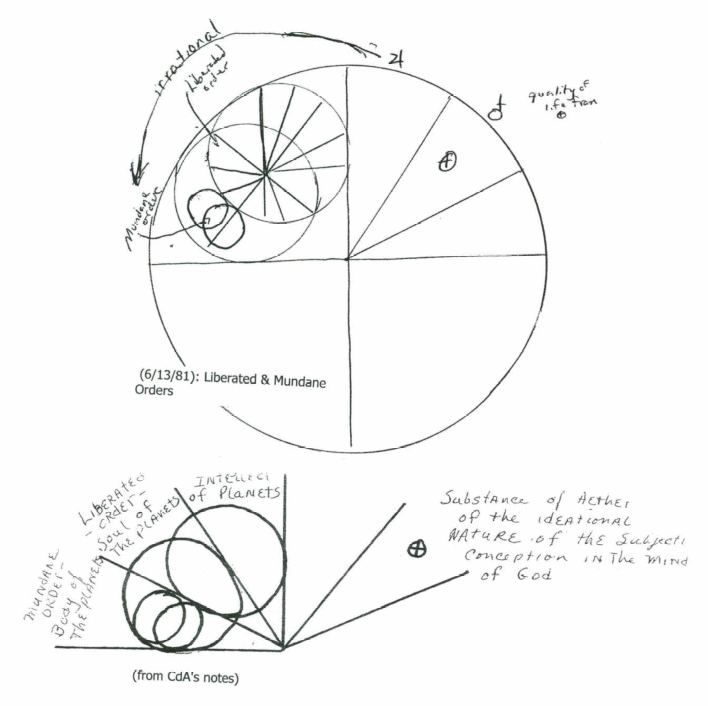
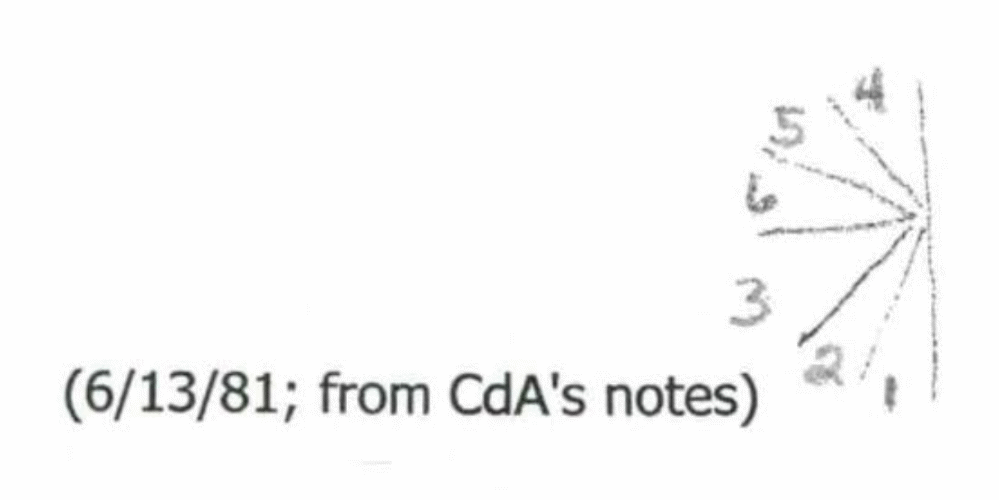
[FIGURE 1981 0613-4-CdA. Liberated and Mundane Orders. Facsimile scan from CdA class notes.]
Class
Saturday, June 13th, 1981
Verbatim, unedited transcriptClick the series name to view more
CLASS at Wisdom's Goldenrod, Hector, NY
with Anthony Damiani (AD)
June 13, 1981
NEO-PLATONISM; IAMBLICHUS; DAEMONS
TOPIC: Neo-Platonism
SUBJECT: Iamblichus
SUBSUBJECTS: Daemons, Gods, Astrology
CONTENTS:
Worshipping the daemon, two ways: theurgic through visualization, mantras, Kalachakra; natural way through astrology
How to find ruler of your chart
Porphyry asking these questions hard to believe
The essential, ruling daemon
Truth of astrology
High level of astrology in previous times
Iamblichus' "siddhis"
Lord of Nativity & daemon
Plotinus, ruler = God
T. Taylor's opinion of Plotinus
True felicity = knowledge of Gods
Soul led to participation in Demiurgic powers
According to Iamblichus, Soul led to Prime Mover, not to I.P.
Plotinus: Soul is released, joins Demiurge in co-administration of universe, operating from Intellectual Unity of Soul
Reading of T. Taylor's footnotes on daemons
Tribe of daemons
Jupiter ruler of 24 measures
Daemons, higher level
Higher influences affecting partial souls
Inserting ratios into Soul, which Soul needs for production
Daemons guide, transmit to Soul
Three orders of Daemons
Subsistence from Juno, 8th house
Daemons of middle rational order, allotted mankind
8th house connection to daemons, Part of Fortune
Whole tribe of daemons to each of Gods
10 & 12 orders of daemons, daemons associated with Soul, Body, and Being/Intellect of planets
720 = 10x72, or 24 = 2x12 positive and negative
Soul of elements & daemons
Daemons suspended from unities
Jupiter & Juno
Aristotle, Plato, Plotinus
Soul of elements & "completion of wholes"
Irrational daemons & orders of cosmocrators in mundane versus rational daemons' effect is mental
Trace daemonical working to light of Liberated Order
Middle realm of daemons allotted mankind
First, divine order of daemons
Planet as Geniture of Chart, 7 rays, or 5/7 Dhyani Buddha families
Divine daemons & perfected souls versus essential daemon of imperfect souls; life choice of more perfect souls
Six orders of daemons
6th: material daemons, forms in matter
5th: corporeal, organize (physiological) bodies
4th: level of mental
3rd: allotment of souls to portion of universe
Cosmological correlation of levels
2nd & 1st: discussion of prime mover, Sun in Aquarius, Liberated Order, Demiurge
Summary of six levels of daemons
Bodies & last powers
No difference between statues of Gods, and Soul, Unity
Mundane Gods, statues in 12th, Soul 11th, Intellect 10th, Unity 9th
Supermundane, Liberated, Mundane orders & transmission
Buddhist Six Realms scheme
Cosmological scheme with 10 Sephiroth
BOOKS READ FROM OR REFERENCED:
Iamblichus, Thomas Taylor (tr.), Iamblichus on the Mysteries of the Egyptians, Chaldeans, and Assyrians
Proclus, Thomas Taylor, The Philosophical and Mathematical Commentaries of Proclus on the First Book of Euclid's Elements, Vol. 2
Plato, Thomas Taylor (tr. and comm.), The First Alcibiades (Vol. 1), in The Works of Plato, viz. His Fifty-Five Dialogues, and Twelve Epistles
Plotinus, The Enneads (MacKenna translation, 4th ed.)
Guenther Wachsmuth, The Etheric Formative Forces in Cosmos, Earth and Man: A Path of Investigating Into the World of the Living
Julian (Emperor of Rome), Thomas Taylor (tr.), Two Orations of the Emperor Julian; One to the Sovereign Sun, and the Other to the Mother of the Gods
Plato, Timaeus
PLOTINUS QUOTES READ OR REFERENCED: IV.3.15, IV.8.2
DIAGRAMS appended to this transcript:
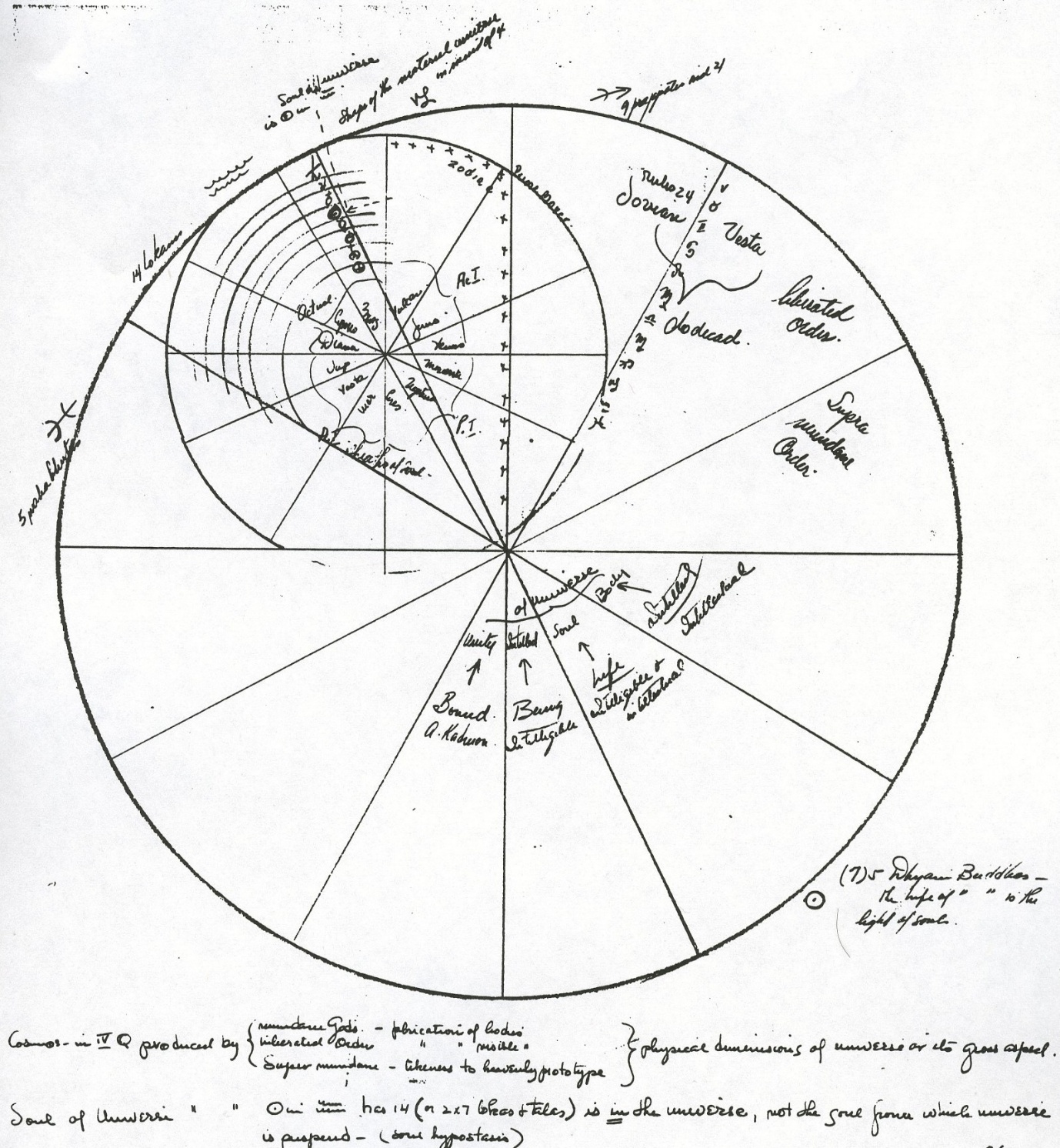
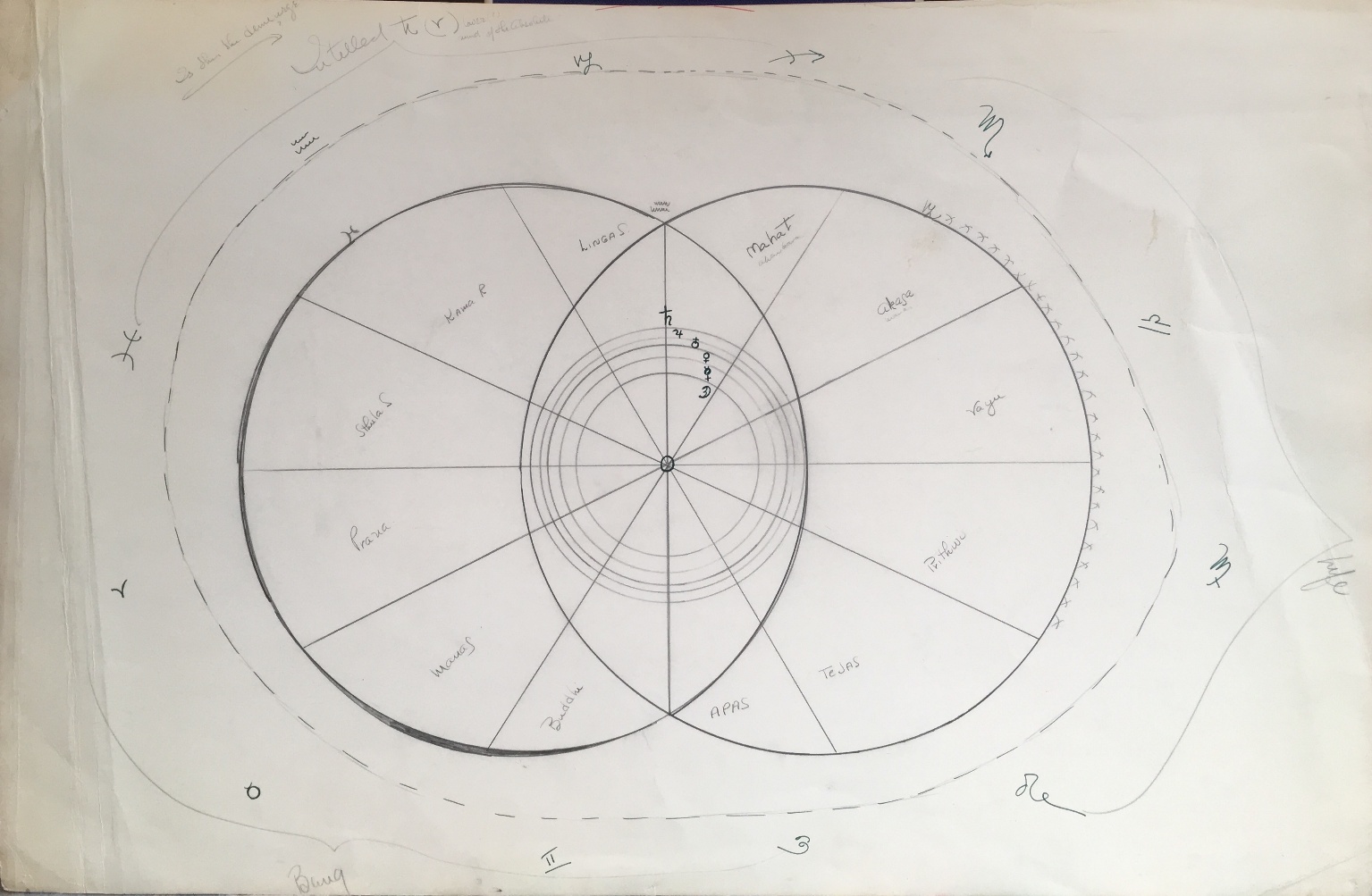
FIGURE AD_A006. The Metaphysical Chart with Orders of Gods and Eleventh House Vesica.
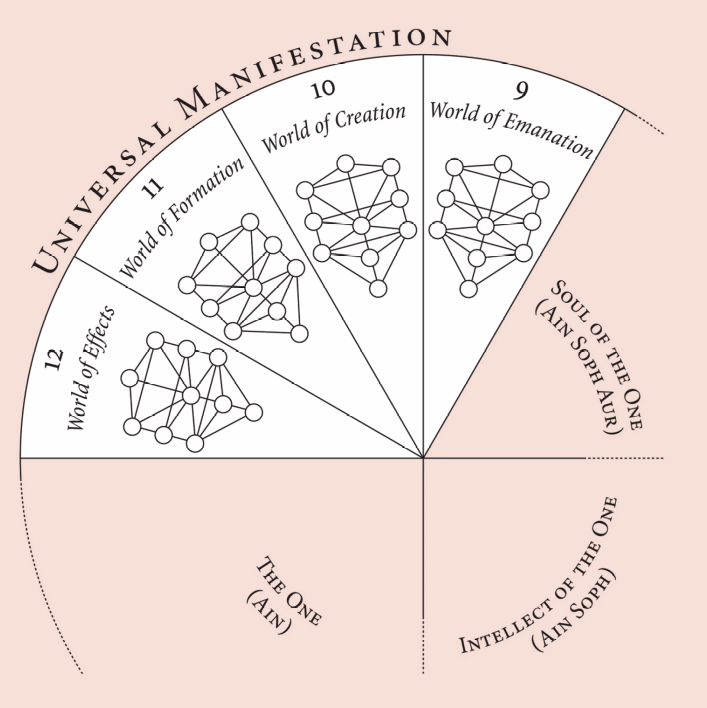
FIGURE 1981 0613-2. Four Worlds of the Kabbalah.
FIGURE 1981 0613-3-JF. Liberated and Mundane Orders.
FIGURE 1981 0613-4-CdA. Liberated and Mundane Orders.
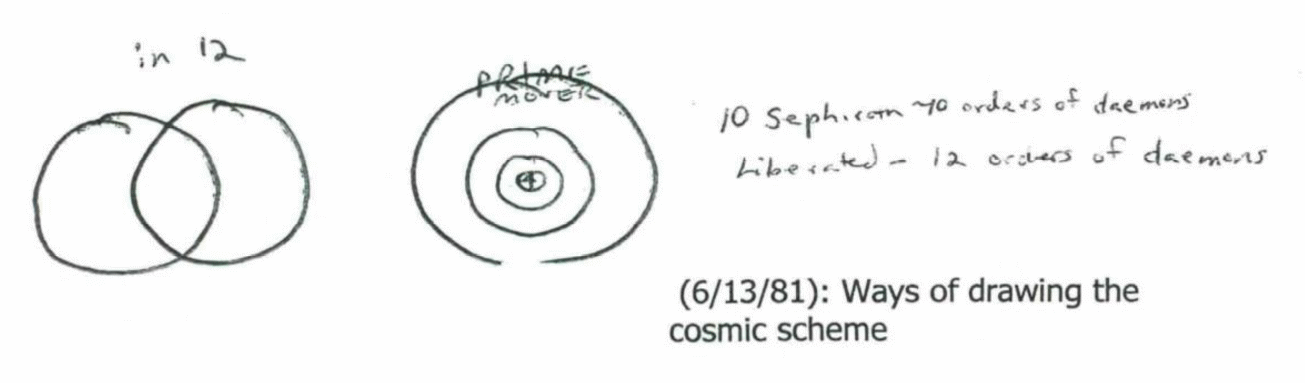
FIGURE 1981 0613-5-JF. Ways of drawing the cosmic scheme.
FIGURE IMG_2324 copy. Being, Life, Intellect and Vesica of Houses 10-12, with Six Cosmic Tattvas and Six Theosophical Principles of Man.
FIGURE 1981 0613-7-CdA. Six Realms of Existence.
NOTES by JF:
This class was part of a 1981 Saturday morning series on Iamblichus: 04/10 (Friday eve); 04/11; 04/18; 04/25; 05/16; 06/06; 06/13. The class date sequence shows gaps; however, other Saturdays in this time period are on Number or the Kabbalah.
Other 1981 class topics, immediately prior to PB's death, appear to have been cosmology, the Idea of Man, the problem of knowledge, Kepler, alchemy, subtle physiology, Tibetan Buddhism and tantra, Kabbalah, the history of Platonism.
On Some Terminology in the Iamblichus classes: The Cognitive Isness can be considered to be synonymous with the Individual Soul principle, the Atman, the Saturn in Leo. "Drops" of light are often referred to. As far as I understand them, these subtle "congealed reason-principles" are coming from the third or Soul quadrant down into the embodied individual; further references to drops may be found in Tibetan Buddhist subtle physiology. "Genesiurgic" is a word used in Thomas Taylor's translation of Iamblichus; Anthony speaks of "genesiurgic tendencies" as being the planetary influences.
Previously printed, distributed 2003.
TRANSCRIBED by jf 2003 from Audio Cassette tapes; reformatted by jf 2018. In 2024, IT does two more passes, corrects listening errors and makes verbatim, updates prefatory matter and footer, replaces tape markers with audio file markers, alters Topic, expands Subsubjects, completes Book List, adds Plotinus quotes section, corrects typos, adds new notes and alters some existing notes within transcript, adds three diagrams and references within transcript to these diagrams, reformats to accord with new conventions. Archival verbatim transcript – V12a.
AUDIO FILES: 1981 0613a, 1981 0613b. [Note: "Tape" and "Side" refer to original audio cassette tapes that were later digitized into .MP3 Audio Files.]
1981 06/13 at Wisdom's Goldenrod
Neo-Platonism; Iamblichus; Daemons
[Iamblichus. On the Mysteries of the Egyptians, Chaldeans, and Assyrians. 3rd ed. Tr. from the Greek by Thomas Taylor. London, Stuart & Watkins, 1968 [1821]. [Italicized quotes in text, between *"..."*, are Porphyry's questions being addressed by Iamblichus; square brackets indicate words omitted in the reading of the text, unless otherwise noted. Pp. 1-16 of the book are the text of Porphyry's letter.]
[Audio File 1981 0613a Begins]
AD: In other words, we have to-- [short pause] oh, we're going to have to organize our understanding of that in a way that's probably different than the way it should be. You know, the Buddhist understanding. [short pause] (We've been) reading from Chapter I, Section IX.
[23½ second pause]
Iamblichus, p. 313 (AD reading): "... consideration of the peculiar daemon is twofold, [the] one being theurgic, [but] the other artificial; and the one drawing this daemon down from supernal causes, but the other from the visible periods in generation; [and] the one making no use whatever of the calculation of [AD adds: the] nativities, [but] the other meddling with methods of this kind; [and] the one worshipping this daemon in a way more universal and supernatural, but [AD reads: and] the other partibly conformable to nature; this being the case [AD reads: cause], you appear to me to have absurdly transferred a more perfect sacred operation to one that is human, and in this to have exercised your inquiries."
AD: There's two ways to worship a daemon. One according to the Geniture, the Lord of your Chart, and the other is to get initiated into the Kalachakra [Buddhist initiation], so yeah.
S (very faint): [few words inaudible]
CdA: Is that a similar distinction that you were making last week, about one being in the imagination and the other not?
AD: I don't think that the distinction is primarily that. I think the distinction, at least when you work up, is that there is a worship of the daemon which is not based on the way Nature operates but the way the Celestials operate. And that there are certain ways of worshiping that daemon which are different than the way we would ordinarily conceive of worshiping through the natural human mode, which would be propitiation, you know, things of that nature. The worship of the second kind, the higher kind, is supernatural; there the worship I think is carried on according or in conformity with universal laws that govern manifestation. We'll have to work into this gradually, it's going to be very, very laden. In the next chapter--
JC: Can we go over the first chapter again though? I'm not sure I followed.
AD: I'm sorry?
JC: What we just did, you know, I couldn't bite into it anywhere. Could we go over it [couple words inaudible]
AD: Got teeth? Go ahead, go over it.
JC: Can I read? I'll read it.
AD: Sure, go ahead.
[short pause]
Iamblichus, p. 313 (JC reading): "Let us now, therefore, to the utmost of our power, endeavour to discuss the manifold doubt concerning the peculiar daemon, and which also is subject to various objections. Since, however, to speak summarily, the consideration of the peculiar daemon is twofold, the one being theurgic, but the other artificial; and the one drawing this daemon down from supernal causes, but the other [from] the visible periods in generation [JC rereads: or"from the visible periods in generation"]; and the one making no use whatever of the calculation of nativities, but the other meddling with [JC adds: the] methods of this kind; and the one worshipping this daemon in a way more universal and supernatural, but the other partibly conformable to nature; this being the case, you appear to me to have absurdly transferred a more perfect sacred operation to one that is human, and in this to have exercised your inquiries."
JC: Um--
[11 second pause]
AD: The higher form of worship of the daemon--
JC: Is he working with two daemons here?
AD: No.
JC: Saying that he-- One he seems to be saying-- well the higher, he says it's a theurgic mode, and he contrasts that to another way using the circulations of the stars.
AD: Then how would you worship in the theurgic mode? Wouldn't it be similar to what the Tibetans do in the practice of the mandala, the projection of the inner God through the utterance of the mantram or the invocation of the mantram?
JC: Try to evoke the presence of that daemon. [short pause] And the other way, he says you're using the--
AD: The natal chart.
JC: The natal chart.
AD: So then that would mean you have to find out the ruler of your natal chart, the Geniture, the Lord of Your Chart. Then you would have to worship it according to the natal of our chart, I mean the way the-- Well they might-- they might call it a natural religion, you worship it. So that at certain hours of the day [few words inaudible] certain periods of time that it was, and there the worship is a more natural way. So, let's say the hours from 6 to 8 in the morning, let's say one worships a power when he goes-- alright, does libations or invocations and practices the Gayatri and things like that, 'cause he knows that there's a correspondence between those hours of the day and that peculiar Lord of this Chart. So that's a more natural way that's dependent upon calculation-- calculations of your chart, understanding who the Ruler of the Chart is. The other way is quite different. You're not dependent upon the nativities at all, you know, the (many) working out of the chart. So there are two different ways of worshipping so-called Lord of Your Chart. And one would be this natural way. And the natural way I think is going-- is probably we would say religion of mankind, that belongs to mankind in the sense that in the ancient times they used to worship the planetary cycles and influences in the various periods of time. And that would be natural because they are noticeable in the heavens, you know, (because) you can see them. Whereas the other one is quite different altogether. You can practice the invocation of the God, the mantram, and build up, and in life that finally it gets projected and that's done independent of the time of the day. That's-- that's what he means by supernatural there. Supernatural in the sense that one goes within the planets and finds the-- projects the God according to a certain prescribed ritual, projects the God outward from himself and then dissolves it back into himself. So he gets this feeling of divine pride, you know [few words inaudible] the Gods. That would be the supernatural way. The natural way is like you look at a festival, a calendar festival, and there you have list of the days, the hours, the periods, when the planets are there, you know, most beneficent aspect, we work and worship that way. So, I think that's all he's referring to here.
CdA: But he's speaking about the same daemon, there's two ways of worshiping [AD simultaneously: Yeah.] the very same daemon.
AD: Yeah.
JC: Are you saying the natural way is-- does not bring you into direct contact?
AD: I'm not saying anything. I'm just saying that these are the two ways.
JC: Is one more mystical, the other more religious?
AD: That-- [short pause] One is more mystical, one is more natural. [short pause] If we weren't-- if we weren't overwhelmed by the conditioning of the peculiar cultural mores, let's say we were living in a period of time where mythology was more in evidence. And, person would naturally take to the worship of certain planetary configurations than he would now, now he's hardly aware of it.
JC: So he'd be like recognizing certain periods of the day or days of the year that'd be sacred to certain Gods and you would naturally feel reverence for those, especially the one that's the ruler of your nativity. (wonderful bird song in background; it's spring)
AD: And you remember we-- I think was pointed out in some of the discussions that the person who studies astrology should be aware or capable of experiencing these influences. Now evidently if he's not, then he's not really capable of worshipping because it would be just rote, you know. But if he's capable of experiencing these influences then he responds to them in a natural way. And that would be the natural worship. A lot of it was carried on in the Roman time. They worshiped the various divinities, the celestial-- the mundane divinities that were-- But I imagine that that would mean that you'd be in contact more with the cosmocrators whereas what he might be suggesting is a possibility of contacting-- there'd be higher aspect of the cosmocrator, the soul of the cosmocrator let's say. That's too little to-- to be on, yeah.
BB: Was-- how do you know what's the ruler of your chart? I know it sounds--
AD: Ask Tim.
[short pause]
TS: Ask [one/two words inaudible]
AD: Uh-hm. There's ways of working these things out, I mean, you won't know by looking at the chart but there's ways of working it out. Manly Hall has one way, I think the simple arithmetic way is to find out which of the planets has the most strength in your chart, who rules your chart. Then there's a Hindu way which is much more complicated, and that applies I think to certain periods of time in your life. So there's a variety of ways but you have to look them up. You have to get an astrologer to do it. They tell you-- [LR simultaneously: I know I'm first.] [inaudible BB and LR comments simultaneous with AD] in India they tell-- [S: Huh?] in India they tell you who your Lord is, you know, they give it to you. I think they used to do that, they used to-- [VM: It's on your birth certificate.] when they give you a birth certificate. [few words inaudible] (laughter, inaudible student comments) Like, you could work out the Geniture of the Chart by-- I don't know, by the disposition, find out which planet is finally the ultimate ruler of the chart. So that in terms of-- Like let's say you have a Jupiter in Libra, and Venus rules Libra and Venus is in Libra or Taurus, then Jupiter is ruled by Venus, alright, and you go all the way down and you find out that Venus rules your whole chart ultimately. So that you would be concerned with-- Venus would be more the star of your chart than any other. [Note: Anthony has both Jupiter & Venus in Libra.] Now the Hindus have a different way, certain periods of your life are ruled by different planets. So it's a whole complicated study you'd have to get into.
TS: Yeah they also [one/two words inaudible]
AD (simultaneously): So get [one word inaudible]
TS: They do a whole long thing with strengths and weaknesses by how-- what proportional distance it is from the Midheaven and Ascendant, and whether it's in rulership or exaltation and like that, they have quite a complicated way of adding up, you know, which subdivision and which sign it's in or something. I did one once. (bit of laughter)
BB: I mean, there's no real way that any of us could really figure it out.
AD (simultaneously): There's no real what?
BB: Way that any of us could really figure that out and do.
S: Well, certain of us can.
AD: I think you can figure it out. Just watch which one does the most. (laughter)
S: Damage?
S: Damage.
AD: Not necessarily damage, no.
S: Yeah, (no).
S (possibly part of background): Thank you.
[short pause]
AD: Um-- This I can read, Avery? Chapter II.
Iamblichus, p. 314 (AS reading): "In the next place, here also you appear to me to have cut off only a certain small part of the discussion concerning the peculiar daemon. For since it is usual with those who artificially operate about nature to invoke this daemon in an orderly manner from the decans, [from the] dispensators of influxes, [from] the signs of the zodiac, ... [to summarize AS says: and so on], and from the world, this being the case, you do not act rightly in assuming one, and that the smallest part of [all] these, viz. the lord of the geniture, and making your inquires about this alone. Here, likewise, again from one of the things proposed to be considered, you inquire *"how the lord of the geniture gives the peculiar daemon, and according to what kind of efflux, or life, or power, it descends to us from him."* You also speak concerning the calculation of nativities, and ask *"whether there is any reality in it or not;"* and likewise concerning the invention of the lord of the geniture, *"whether it is impossible to be found, or possible."* In what respect, however, do these things pertain to the domination of the daemon? For it is evident that our knowledge of the manner in which he subsists, contributes nothing to his essence and the cause of his existence. For in things which belong to the empire of nature, such as are generated in the universe have a proper stability of their own essence, though we should be ignorant how they are produced. In this way, [therefore], we reply in common to your doubts."
[short pause]
AD: As soon as where he says "how the lord of the geniture gives the peculiar daemon, according to what kind of efflux, life, power, it descends to us from him." [short pause] We're going to try to work that out in a little while, we'll have to-- we'll try to go over in our mind what was the tribe of daemons, which one has rulership over what. But in the next chapter he starts by asking a question and then showing how contradictory the question is and how they're all-- Now it's very hard for me to believe or accept Thomas Taylor's notion that the person who asks these questions was Porphyry. I can't believe it.
VM: They seem like they were naïve some of them.
AD (simultaneously): Huh?
VM: Some of them seem so naive.
[short pause]
AD: Anyway--
Iamblichus, p. 315 (AD reading): "You say, then, *"that he is happy who having learned the scheme of his nativity, and knowing his proper daemon, is thus liberated from fate."*"
VM: It's that easy, huh? (bit of laughter)
AS/TS(?): Five sessions.
AD: I imagine the daemon would correspond to one's Ishtadevata.
AS: Yeah, when they speak about the yidam.
AD/S(?): Or yeah.
Iamblichus, p. 315 (AD reading): "[For] if our proper daemon is distributed to us from the scheme of our nativity, and from thence we are able to discover him, how can we *be liberated from fate,* through a knowledge of the daemon imparted to us by fate?"
AD: So [couple words inaudible] then tell us what are you talking about.
Iamblichus, p. 316 (AD reading): "For the proper daemon of everyone does not entirely accede from the scheme of the peculiar nativity; but his origin is more ancient than this, which we shall hereafter discuss [AD reads: and we'll discuss that hereafter]."
S: Uh-hm.
AS: Well, for example, you know, when we did those orders of daemons, the one which the essential daemon was responsible for, one thing for the act-- for the-- the souls coming into generation, but that's all, and it seemed that that essential daemon will go over the whole-- a whole series of lives. And so, I don't know, is he saying in some sense to speak about essential daemon as prior to any one of the particular lives, [AD: Uh-hm.] and in some sense is above each one of those. Although there may be some other daemon indicated by the natal chart.
JC: Is the ruler of the chart the particular daemon from which the life which is an efflux of the stars takes its origin? And that's why is a certain ruler.
AD: I'm sorry, Jeff, would you try again?
JC: When you speak of the ruler of the chart as its daemon, is it the ruler because the life which is in our body, which is an efflux of the stars, comes from that particular planet or daemon?
AD: I don't know. Something we have to work out. It's a problem. [18¼ second pause] So he goes on and he says--
Iamblichus, p. 315 (AD reading): "But if, as you say, we are truly liberated from necessity through this daemon, how is he allotted to us by fate?"
[short pause]
AD: So he shows a contradiction there.
Iamblichus, pp. 316-7 (AD reading): "[For the] proper daemon of every one does not entirely accede from the scheme of the peculiar nativity; but his [AD reads: the] origin [AD adds: of this daemon] is more ancient than this, [which we shall hereafter discuss]. [AD: And he says we'll discuss that later, so we'll have to wait. Then--] To which may be added, that if the descending daemon was to be alone surveyed from hence [AD reads: here], he will not be happy who obtains the knowledge of his [AD reads: this] [genesiurgic] daemon. And who would [following brackets part of text] [willingly] receive this daemon as his leader to a liberation from fate, if he was given to him for this purpose, that he might accomplish the distributions of fate? Farther [AD reads: Further] still, this appears to me to be only a certain and the [AD reads: a] last part of the theory pertaining to this daemon; [and] that the whole theory of his essence is omitted by a method of this kind. But these things, indeed, though they are falsely asserted, yet at the same time are not utterly foreign from [AD reads: for] the purpose. The doubts, however, adduced by you in the next place, concerning *"the enumeration of the canons and the genethlialogical science,"* as they are inscrutable, are not attended with any ambiguity in the present discussion. For whether these arts are known or are incomprehensible, yet, at the same time, the efflux from the stars [AD reads: star] distributes to us the daemon, whether we know it or not. But divine divination is able to teach us concerning the stars, in a way which is most true, and [following brackets part of text] [when we are in possession of this] we are not entirely in want of the enumeration of [AD adds: the] canons, or of the divining art."
AD: Yeah. It seems that he's suggesting here that there's a way of knowing the astrological science without the mediumship of that, all the work involved.
VM: Yeah, without calculations, absolutely.
S (faint): Let's be [one word inaudible]
AD: Would you read the next?
AS: [one/two words inaudible]
AD: Yeah we just want to go quickly through some of these things and then we want to go back and see if we could rebuild the system. Alright?
Iamblichus, pp. 317-8 (AS reading): "If, however, it be necessary, dismissing these particulars, to speak ... the truth, you do not rightly infer *"that a knowledge of this mathematical science [AS reads footnote: calculating nativities] cannot be obtained, because there is much dissonance concerning it, or because ... some [other] has [AS reads: have] written against it."* For if this reason were admitted, all things will be incomprehensible. [For] all sciences have ten thousand controvertists [AS substitutes for last phrase: have those that doubt], ... As, therefore, we are accustomed to say in opposition to the contentious, that contraries in things that are true are naturally discordant, [and] that it is not falsities alone that are hostile to each other; thus, also, we say respecting this [mathematical] science, [that] it is indeed true; but [that] those who wander from ... it, being ignorant of the truth, contradict it.… For time always proceeding the divine mode of knowledge becomes evanescent, through [AS reads: though] being frequently mingled [and] contaminated with much of what is mortal. This [AS reads: The] divine mode is indeed [following brackets part of text] [in astrology also], and a certain clear indication of truth, though it is but small, is at the same time preserved in it. For it places before our eyes manifest signs of the mensuration of the divine periods, when [AS reads: and] it predicts [the] eclipses of the sun and moon, [and the] concursions of the moon with [the] fixed stars, and when the experience of [the] sight is seen to accord with the prediction. Moreover, the observations [AS reads: observation] of the celestial bodies through the whole of time, [both] by the Chaldeans and by us, testify [that] this science is true. Indications, also, more known than these might be adduced, if the present discussion was [AS reads: were] precedaneously about these particulars."
[short pause]
AS: [couple words inaudible] doesn't say very much, except that he's saying some people doubt astrology but-- [VM simultaneously: Not only that it's--] Even if it-- even if it doesn't get you to the-- you know, the absolute highest truth, these daemons, there is still something in it of the truth.
VM: He also seemed to be saying that some of the practitioners of astrology, insofar as they wander from the truth, contradict it, but that in itself does not deny the validity or the truth inherent in it.
AS: Yeah.
[short pause]
AD: Well that would be true of any science, wouldn't it (then Louis).
VM (simultaneously): Yes, that's the point he makes here, it's true of any science given to the Gods-- given by the Gods to man.
AS: You want to go on? Want to go on to the next one?
AD: Yeah.
AS: There was one which he--
Iamblichus, p. 319 (AS reading): "You say then ... *"that the discovery of the lord or lords of the geniture, if there are more than one in a nativity, can scarcely be obtained, and by astrologers themselves is confessed to be unattainable; and yet they say that the peculiar daemon is from thence to be known."* But how can astrologers confess that the knowledge of the lord of the geniture is not to be obtained by them, when they deliver clear methods for the discovery of it, [and] teach us rules by which we may discover the doubts; [some giggling; VM: Bunch of bum astrologers in those days. (VM laughs)] some, indeed, giving us five, others more ..."
AD (simultaneously): Can you imagine the-- can you imagine the level of astrology then?
VM: Yeah but apparently they even had problems in those days though.
AD: They al-- I think you'll always have them. You'll always have problems. We don't forget that we're human beings and not Gods. And that's why we fortunately have a belly I guess to remind us we're human. But the point he's making there is one of the things that, remember, we spoke about briefly a couple of weeks ago, we said the Greeks must have had and must have perfected, as far as their own claims and their own satisfaction, they must have perfected an astrology. But Ptolemy could only be the culmination, or let's say a restatement of an astrology which must have been existent at that time. So they must have had quite a bit of knowledge, if they're able to calculate the natal daemon. And to invoke him it must have been further depth of understanding as to the means to get into that interior world. So that, you could go back, you know, 1500 years later and we see someone like Fludd making these marvelous diagrams but he doesn't know what they mean, nor do we. [9 second pause] At any rate, they must have had access to some really esoteric knowledge. I don't know how true it is that the Chaldeans surveyed the whole of time, the whole period of evolution. What would it be, 300,000 years, the whole precession? They had records of a whole precession? Hard to believe. [short pause] Let's wait for the comment here. The Sun, you know, [JC simultaneously: Because it's all 12.] [couple/three words inaudible] zodiac. [short pause] Read some of the more hi-- more of the highlights from the--
AS: You want-- ok, um-- Can't really see the underlinings.
S (faint): What part are you rereading?
AS: See--
Iamblichus, p. 319 (AS reading): "Omitting this, [however], let us direct our attention to a thing of greater consequence, ..."
S: Where are you?
AS: Bottom of 319.
Iamblichus, p. 320 (AS reading): "For if it is possible to discover the lord of the geniture, the daemon imparted by him will be known; but if this knowledge is unattainable, we shall be ignorant of the lord of the geniture according to this hypothesis, [and] yet, nevertheless, he will have an existence, and also the daemon imparted by him. What therefore hinders, but that the discovery of him may be difficult through [AS adds: the] prediction from the nativity, and yet through sacred divination, or theurgy, there may be a great abundance of scientific knowledge on this subject? In short, the daemon is not alone imparted by the lord of the geniture, but there are many other principles of it more universal than this."
[9 second pause]
CdA: I'm not clear what-- what the-- how he's making the distinction between the lord and the daemon.
[short pause]
VM: I think he's-- pardon me when he's saying that you can get some insight into who the daemon is or what the daemon is through the lord of your natal chart but the natal chart itself does not generate the daemon, does not give rise to it because it's more ancient than the natal chart or a part of-- prior to let's say the cosmocrators.
CdA (simultaneously): Both the lord and the daemon are more ancient than the natal chart, it seems.
VM: Hm, no.
AS (simultaneously): No, the lord of the chart is [one/two words inaudible] is the chart.
VM (simultaneously): Is one of the cosmocrators.
AS: Is concomitant with the chart but he's making a distinction between that it seems and the daemon, and a full knowledge of-- In other words, he's saying the knowledge of the-- I think-- a knowledge of the lord of the horoscope will not give you a full knowledge of the daemon.
CdA (simultaneously): Yeah, yeah.
TS: In other words, it's [CdA assents] a significator of the-- the daemon.
AS (simultaneously): A significance. Signifies.
TS: The daemon itself could be known other ways and--
AS: And more essentially.
TS (simultaneously): Isn't he also saying that, that it can be known other ways?
S: Yeah.
AS (simultaneously): Yeah, and more essentially. Although he is saying that there is a-- there is a connection. I don't think he's denying that there's a connection with this thing. It's a sort of a level of signification.
CdA: Isn't he making-- wasn't before he was-- the first distinction was between--
AD: Wait we're not-- we're not ready yet for detail. Just-- just wait a while. An understanding of your question--
[Note: The following excerpts from Iamblichus' biography by Eunapius are from Thomas Taylor, The Philosophical and Mathematical Commentaries of Proclus on the First Book of Euclid's Elements, Vol. 2, London, 1792. Square brackets indicate words omitted in the reading of the text, unless otherwise noted.]
Thomas Taylor, Iamblichus biography, p. 310 (AD reading): "[The] two following circumstances, relative to the theurgical powers of this wonderful man, [AD adds: Iamblichus] are related [by Eunapius], which the reader may credit or reject as he pleases. At that season of the year, when the sun rises in conjunction with the dog-star, Iamblichus went with his disciples to sacrifice, in one of the suburbs of the city; and after the sacrifice was performed they returned to town, gently walking along, and discoursing concerning the gods, ... [Then] Iamblichus, who was perfectly lost in thought in the midst of this discourse, whose voice was fallen [AD reads: falling], and his [AD reads: the] eyes immoveably fixed on the earth, turned to his companions and exclaimed:"Let us take another road, for not far from hence [AD reads: here] there is a funeral procession". Iamblichus [AD reads: And] accordingly [AD adds: he] chose a purer way."
AD: And then it goes on to explain that he seemed to have some sort of second sight. [short pause] But it's the second one that I'd like you to read, I can't read it. Did you use "The Restoration of the Platonic Theology"?
S (faint): [few words inaudible]
AD: Read that second thing about Iamblichus. The man evidently had what the Hindus would call siddhis.
Thomas Taylor, Iamblichus biography, p. 311 (AS reading): "[But] the second relation is far more wonderful ... His associates therefore, not satisfied with his testimony of his extraordinary powers, were desirous to try [AS reads: desired to see] him in [a] greater affair, and upon soliciting Iamblichus for this purpose, he replied that a proof of this kind was not dependent upon his own will, but must be referred to a proper opportunity. [S: Right.] In a short time after this, they [all] went to Gadara in Syria, a place so famous for baths, that, after Baiae in Campania, it is the second in the Roman empire [AS reads: they went to a certain place in Syria, and after that in Campania]. Here a dispute concerning baths arising while they were bathing, Iamblichus smiling, said to them:"Though what I am about to disclose is not pious, yet for your sakes it shall be undertaken;" and at the same time [AS reads: and at that time] he ordered his disciples to enquire of the natives, what appellations had been formerly [AS reads: formerly been] given to two of the hot fountains, which were indeed less than the others, but more elegant and graceful. Upon enquiry, they found themselves unable to discover the cause of their nomination [AS: of their being named this way]; but were informed that one was called ..., eros, or love, and the other ..., anteros, or the god who avenges the injuries of lovers. Iamblichus immediately touching the water with his hand (for he sat perhaps on the margin (AS reads: side) of the fountain) and murmuring a few words, raised from the bottom of the fountain, a fair boy, of a moderate stature, whose hair seemed to be tinged with gold, and the upper part of whose breast was of a luminous appearance. His companions being astonished at the novelty of the affair, let us pass on says he, to the next fountain; (some student giggling) and at the same time he arose, fixed in thought, and performing the same ceremonies as before, called forth the other love, who was in all respects similar to the former, except that his hair, scattered in his neck was blacker, and was like the sun in refulgence. At the same time both the boys, eagerly embraced Iamblichus, as if he had been their natural parent: but he immediately restored them to their proper seats, and when he had washed departed from the place. After this affair, the astonishment of his familiars and disciples was so great, that they submitted to the doctrines of Iamblichus with implicit assent." (lots of laughter)
VM: Everybody likes--
MW: That shut them up.
VM: Everybody likes miracles.
MW: Yeah.
AD: Well, not miracles, these people had real knowledge in-- Has a chapter in there on the use of magic or the efficacy of magic. He goes into it.
AS: [few words inaudible]
CdA: Who's it by?
AD: Taylor.
S: Taylor?
S (faint): Yeah.
[10½ second pause]
AS: And now you said five.
AD: Five?
S: We'll get it there.
AD: Could you make anything of that footnote on five, down at the bottom?
S: Yeah.
TS: I'll take a look at it. You mean the one on the star of the Lord and the Geniture?
AD: Uh-hm. Bob?
BB: Huh?
AD: If you happen to have the book, if you look at the footnote, they give an indication of how to find the Geniture in your chart.
TS: Just--
BB (simultaneously): What-- what page is it on?
LdS: 319 at the bottom [couple words inaudible]
Iamblichus book, T. Taylor footnote, p. 319 (TS reading, quoting Hephestion): ""... star receives the luminaries in their proper boundaries, in their proper house, in their proper ...""
TS: What? What's the next one? Yeah.
JC: Altitude.
TS: Altitude. Oh yeah. In a--
Iamblichus book, T. Taylor footnote, p. 319 (AS reading, quoting Hephestion): ""... and in the proper triangle." ... "and if besides it has contact, effluxion, and configuration.""
VM: Yeah, that's [one/two words inaudible]
TS: Star receives the luminaries so if it rules the Sun and the Moon.
AD: So you really have to get to work if you wanted that information, wouldn't you, Bob?
BB: I-- I don't need to understand what he's talking.
AD: Well that's alright. (laughter)
AS (amidst laughter): He has Mercury-- Porphyry there too.
AD: Huh? That's what I mean when I say [AS simultaneously: Ptolemaeum.] (you really) have to get to work.
TS (faint): Proper altitude [few words inaudible]
RG: This is a proper altitude.
AS: It sounds like a distance from the cusps.
TS: Distance from the Midheaven.
AS: The Midheaven, yeah.
TS: And the altitude is one-- Proper triangle would be the [one word inaudible]
S: Go ahead.
AD: Try to give away the secret.
AS (simultaneously): So you're happy?
S: Uh-hm.
TS: I can't even [one word inaudible] back here.
AS (simultaneously): Doesn't matter. That's ok.
VM: Next year it will be a button on the DR-70 [astrology computer]. (laughter)
AS: Now that would've sold some machines. That's the-- (bit more laughter)
VM: We'll get-- we'll get them on it.
AD: Then they won't even have to work for it.
VM: Yeah right. It's the 20th century.
AD: Alright, we're going to direct our attention to something of grave consequence. Go ahead, next, 320, "If it is possible--"
AS (simultaneously): Ok, in VI. Oh, do you want to read that discussion?
AD (faint): Yeah.
Iamblichus, p. 320 (AS rereading): "For if it is possible to discover the lord of the geniture, the daemon imparted by him will be known; but if this knowledge is unattainable, we shall be ignorant of the lord of the geniture according to this hypothesis, and yet, nevertheless, he will have an existence, and also the daemon imparted by him. What [therefore] hinders, but that the discovery of him may be difficult through prediction from the nativity, and yet through sacred divination, or theurgy, there may be a great abundance of scientific knowledge on this subject? [AS adds: And] In short, the daemon is not alone imparted by the lord of the geniture, but there are many other principles of it more universal than this."
AS: And note there he says--
Iamblichus book, footnote by T. Taylor, p. 320 (AS reading): "According to the Egyptians [AS adds: that] every one received his proper daemon at the hour of [his] birth; nor did they ascend any higher, in order [AS reads: and they didn't go to any higher order] to obtain a knowledge of it."
AD: As far as we know that's because they didn't write these things down. Yeah that doesn't mean that they [few words inaudible]
AS (simultaneously): It's not likely that they would have written down.
AD: If anything the Egyptians never wrote anything down, if they could help it. They might make a picture of it and let it go at that. [short pause] Alright, then, we have just a little bit more.
[short pause]
Iamblichus, p. 321 (AD reading): "If, however, it be [AD reads: It is] requisite to unfold to you the truth concerning the peculiar daemon, we must say that he is not distributed to us from one part of the heavens, or from some one of the visible elements; but that from the whole world, the all various life contained in it, and the all various body through which the soul descends into generation, a certain peculiar portion is distributed to each of the parts in us, according to a peculiar prefecture. This daemon, therefore, is established in the paradigm before the soul descends into generation; and when the soul has received him as its leader, the daemon immediately presides over the soul, gives [AD reads: giving] completion to its lives, and binds it to body when it descends. He likewise governs the common animal of the soul, directs its peculiar life, and imparts to us the principles of all our thoughts and reasonings. We also perform such things as he suggests to our intellect, and he continues to govern us till, through sacerdotal theurgy, we obtain a God for the inspective guardian and leader of the soul."
AD: Maybe here we should stop and read the thing on Plotinus.
VM: Yeah, he's got a God, right.
AD: Alright, you read it, I'll drop it.
AS: You want to keep-- keep--
AD: Yeah keep reading that VI.
Iamblichus, pp. 321-2 (AS reading): "For then [AS: when we obtain this God] the daemon either yields or delivers his [AS reads: its] government to a more excellent nature, or is subjected to him, as contributing to his guardianship, or in some other way is ministrant to him as to his lord."
[17 second pause]
AD: Go over the next Chapter VII [Section IX].
Iamblichus, pp. 322-3 (AS reading): "From these things, therefore, it is easy to answer your next question. For the peculiar daemon does not rule over one of the parts in us, but, in short, over all the parts at once, and extends to every principle within us, in the same manner as he was distributed to us from the total orders in the universe. For that which it appears to you proper to add as an indication *"that daemons preside over the parts of our body, so that one is the guardian of health, another of the form of the body, [and] another of the corporeal habits, and that there is one daemon who presides in common over all these;"* this you should consider as an argument that there is one daemon who is the guardian and governor of every thing that is in us. You must not, therefore, distribute one daemon to the body, but another to the soul, and another to intellect: for it is absurd that the animal should be one, but the daemon that presides over it multiform. For [every where] the natures that govern are more simple than the natures that are governed. [And] it will be still more absurd that if the many daemons that rule over the parts are not connascent, but separated from each other. [But] you also make contrariety among them. [For] you speak as if *"some [of them] were good, but others bad."* Evil daemons, however, have no where a ruling allotment, nor are they oppositely divided to such as are good with equal authority and power.
AD: How's your eyesight, Vic, can you read that paragraph? It's on Plotinus' daemon.
VM (simultaneously): I think so. "But though Plotinus ...", [AD: Yeah.] is that the one?
[Note: The following excerpts from Plotinus' biography are from Thomas Taylor, The Philosophical and Mathematical Commentaries of Proclus on the First Book of Euclid's Elements, Vol. 2, London, 1792. Square brackets indicate words omitted in the reading of the text, unless otherwise noted.]
Thomas Taylor, Plotinus biography, p. 226 (VM reading): "But though Plotinus was thus universally esteemed at Rome, and in general by all who had the happiness of his acquaintance, yet he had one vehement enemy in the person of Alexandrinus [VM reads: Alexandr-- well, anyway] Olympius, who had been [for] a short time the disciple of Ammonius, who desired to arrogate to himself the chief place in philosophy, and endeavoured to render ..."
(Side 1 of original cassette tape digitized as 1981 0613a Ends; Side 2 Begins)
Thomas Taylor, Plotinus biography, cont., p. 226 (VM reading): "... companions,"that the soul of Plotinus possessed such a mighty power, that it immediately repelled malignant influences directed upon his person, on the authors of the evil." But Plotinus, when Olympius first machinated his sidereal inchantments, was conscious of his design, and said to his friends: "Now the body of Olympius is contracted like a purse, and all his members are bruised together." After Olympius, therefore, had often [VM reads: had been] found to his own detriment, that the baneful influences intended for Plotinus were repelled on himself, he desisted from such base [VM reads: bale] and fruitless undertakings."
VM: I would guess so. (laughter)
MW: [couple words inaudible] in principle.
VM (laughing): Right, right.
Thomas Taylor, Plotinus biography, cont., p. 226 (VM reading): "Indeed, said Porphyry, Plotinus naturally possessed something greater than the rest of mankind, which the following extraordinary relation abundantly evinces."
AD: Now listen to this carefully, this is very beautiful.
VM: This is all from the Introduction by Porphyry, isn't it?
AD (simultaneously): No, that's from there.
VM: Oh this is taken from here, I see.
Thomas Taylor, Plotinus biography, cont., pp. 226-227 (VM reading): "A certain Egyptian priest, who at the time visited Rome, and who became suddenly known to Plotinus by one of his friends (perhaps Porphyry himself), desirous to exhibit his wisdom in that illustrious city, persuaded our philosopher to attend him, for the purpose of beholding, through his invocations, his familiar daemon; to which request he readily consented. But the invocation was performed in the temple of Isis; this being the only pure place in Rome the Egyptian priest was able to find. (student snickers) However, instead of a daemon, as was expected, a god approached, who was not (says Porphyry) in the genus of daemons. The Egyptian astonished at the unexpected event, exclaimed,"Happy Plotinus, who hast a god for a daemon, and whose familiar attendant does not rank among the inferior kind!" But this extraordinary and delightful vision was of short duration: for the priest affirmed it was not then lawful to interrogate any thing, nor any longer to enjoy the vision because a certain common contemplative friend, who was present at the spectacle, suffocated some birds which he held in his hands [VM reads: hand] for the sake of safety, either impelled by envy, or terrified with fear."
AD: So the daemon of Plotinus was a God.
VM: This is nice and it says--
Thomas Taylor, Plotinus biography, cont., p. 227 (VM reading): "As Plotinus, therefore, was allotted a daemon belonging to the diviner orders, the divine eye of his soul was perpetually elevated to this guardian deity."
AD: Go on.
Thomas Taylor, Plotinus biography, cont., p. 227 (VM reading): "On this account he composed a book concerning every man's familiar daemon, ..."
AD: He goes on to say somewhere further on that this God always more or less directed and guided Plotinus' contemplation on the One, and that [three/few words inaudible] how could we say it?-- exact and precise understanding. At any rate, there's another remark that Thomas Taylor makes, alright, he says that he considers every-- every sentence of Plotinus a volume and every word an oracle.
VM: Taylor said that.
AD: Yeah.
VM: Why didn't he translate him more?
AD: Why didn't he translate him? He got stuck with Proclus, what can I tell you. Probably it isn't-- it-- it's extremely difficult to translate Plotinus, from what I understand of the Greek they say his language is obscure. You really have to--
[11½ second pause]
Thomas Taylor, Plotinus biography, cont., p. 229 (AD reading): ""He poured forth (says Porphyry) [AD reads: Porphyry says"He poured forth] [many things] agitated by the impulse of inspiring deity; and was often wonderfully affected with the object of his investigation." With me indeed every page of his works is a volume, and every sentence an oracle."
AD: Thus-- ok. Alright. He's also considered one of the luminaries of Platonism, Iamblichus, but there's not many works left. So we left off-- We just want to quickly go over this so that we can go to the (study of) [one word inaudible]
AS: That's the end of VI.
AD: End of VI.
AS: And we did VII too, yeah.
CdA: Are you going to explain this later? Or not? I'm--
AD: Am I going to explain (the la--) We're going to try to understand this right now.
CdA (simultaneously): Oh ok, I just (want--)
AD: We just-- you have to build up a little bit, you know. [short pause] We finished VII, is that right?
AS (simultaneously): Finished VII.
TS: Yeah.
AD: Um--
Iamblichus, p. 323 (AD reading): "Afterwards, abandoning these particulars, you pass on to the opinion of philosophy. But you subvert the whole hypothesis concerning the peculiar daemon. For if [following brackets part of text] [as you say] *"this daemon is a part of the soul,"* such, for instance, as the intellectual part, *"and he is happy who is in possession of a wise intellect,"* there will no longer be any other more excellent or daemonical order, presiding over, as transcending the human soul. But certain parts of the soul, or a certain divided power, will have dominion over many of the forms of life that are in us; and will rule over these, not connascently, but as naturally exempt, and as transcending the whole of our composition."
[short pause]
AD: There's some, you know, goes on.
AS: "After this ..."?
AD: Yeah.
Iamblichus, pp. 324-5 (AS reading): "[After this, therefore], you also mention another disquisition concerning the peculiar daemon, which represents [AS reads: which he says] *"some as worshiping two, but others three, daemons of this kind."* The whole of this, [however], is erroneous. [For] it is a false mode of proceeding to divide the causes that preside over us, and not refer them to one; [since] this wanders from the union which has dominion over all things. [AS adds: And] The opinion, [likewise], which distributes this daemon into body, and [the] government of body, draws down his domination to a certain most minute part. So that what necessity is there for those who embrace this opinion to direct their attention to sacred operations, the first principle of them being futile? There is, therefore, of each of us one peculiar presiding daemon; but it is not proper to think that this daemon is common to all men; nor again, that he is common, but is peculiarly present with each individual. For division, according to species and difference of matter, do not receive the communion and sameness of things essentially incorporeal. *"Why then [following brackets part of text] [you say] is the peculiar daemon invoked by a common mode by all men?"* Because the invocation of him is effected through one God, who is the lord of daemons; who from the first defined to every one his peculiar daemon; and who, in sacred operations, unfolds to every one his proper daemon, according to his own proper will. For [always] in the theurgic order [AS adds: the] secondary are invoked through [AS adds: the] primary natures. [AS adds: And] Among daemons, therefore, one common leader of the cosmocrators about generation sends to each of us his peculiar daemon. Hence, when the peculiar daemon is present with each of us, he then unfolds the worship which is proper to be paid to him and his name, and likewise delivers the proper mode of invoking him."
[short pause]
AD: And so it would seem that in Tibetan Buddhism you would have something like that. That their whole ritual and ceremonies supposedly the revelation given to men by the Gods, how to worship them, whether the yidams, you know, [one/two words inaudible] whatever of the Gods. This would be their claim. [short pause] And last-- Did we do the last section? But felicity-- about felicity? [short pause] Wants to know if there is some other way to felicity and happiness. [cf. p. 327] And he says--
Iamblichus, p. 328 (AD reading): "... a knowledge of the Gods is accompanied with a conversion to, and the [AD reads: a] knowledge of, ourselves."
AD: And this is the only felicity. In Chapter II when he speaks about "the phantasy is never excited when the intellectual life energizes", we pointed out that extreme intellection reduces the energizing of the life functions in the body. Remember? This brought about a depletion of the imagery going on. [9¼ second pause, flipping of pages] Ok. [short pause] He does answer the question of how to get felicity on page 332.
[12¾ second pause, flipping of pages]
Iamblichus, p. 332 (AD reading): "There is, therefore, no other dissolution of them than the knowledge the Gods. For to know scientifically the good is the idea of felicity; just as the oblivion of good, and deception about evil, happen [AD reads: happens] to be the idea of evil."
AD: Well, one more, on Chapter VI [Section X], with 334. We need-- we need to know (this section). "Moreover, ..."
Iamblichus, p. 334 (AS reading): "[Moreover], after it has conjoined the soul to the several parts of the universe, and to the total divine powers which pass through it; then it leads the soul to, and deposits it in, the whole Demiurgus [AS reads: Demiurge], and causes it to be independent of all matter, and to be counited with the eternal reason alone. But my meaning is, that it peculiarly connects the soul with the self-begotten and self-moved God, and with the all-sustaining, intellectual, and all-adorning powers of the God, and likewise with that power of him which elevates to truth, and with his self-perfect, effective, and other demiurgic powers; so that the theurgic soul becomes perfectly established in the energies and demiurgic intellections of these powers."
AD: You notice that? The soul participates in the demiurgic power(s).
AS (simultaneously): I know.
AD: In the demiurgic intellect.
[short pause]
Iamblichus, p. 334 (AD reading): "Then, also, it inserts the soul in the whole demiurgic God. And this is the end with the Egyptians of the sacerdotal elevation of the soul to divinity."
AS: He seems in that other passage also to refer-- to talk about the cosmocrators, the one-- the one da-- they speak of Jupiter as a mighty daemon. He seemed to refer the distribution of the daemons to souls to the Demiurge in that other passage. [student assents] [one/two words inaudible]
AD: Yeah let's try now, if we-- if we go back to that footnote. Yeah, yeah?
LR (simultaneously): Well did we just-- Could I ask something about this one? He's saying in this one that through this Providence the soul is not being led. I'm just confused about what level the soul is. The soul is not being led to its own principle but led to the Demiurgic principle? Through the world to the Demiurgic principle? I mean when he speaks about the self-begotten, self-moved God--
AD: Self-thinking thought.
LR: Pardon?
AD: Self-thinking thought. Or the prime mover.
LR: Where are you thinking of that?
AD: Huh?
LR: Where are you putting that?
AD: What do you mean, where I'm putting it?
LR: What concept is that-- what--
AD (simultaneously): He's saying that that's where the soul is finally led to, conjunction or union with self-moving thought or the prime mover.
LR: The prime mover in what sense?
AD: The Demiurge.
LR: So, this isn't a principle that's leading the soul back to its own highest unity.
AD: Yes.
LR: I'm just confused [AD simultaneously: Uh-hm.] about where the soul is being led here, I don't get it.
AD: Let's see, I think what you want is that, according to Iamblichus, he's not following our mode of understanding, the soul should be led back into the Intellectual-Principle and yet--
LR: Oh no, we have two-- we have two ways of doing it, ways.
AD (simultaneously): Yeah, and the other way is what?
LR: Well I mean here he seems to be following the path of the universe, it seems like he's being led through the-- say the Sun in Aquarius, or the energies of the world (applied to him).
AD (simultaneously): Do you remember, do you remember when Plotinus points out that when the Soul is released, then it rejoins the co-- the-- rejoins the Demiurge or the Lord of the Universe in the administration of its affairs. [Note: See Plotinus, IV.8.2, fourth para.]
S: Uh-hm.
LR: Right, that's what I'm asking.
Ad: Yeah, so it's the same thing.
LR: That's what he's speaking (right--)
AD: Yeah, that's the same thing.
LR: So, when you were doing like that--
AD: Footnote, Alcibiades.
LR: You know, when we speak about these two different paths leading from one principle and one kind of follows the objective side and one follows the subjective side. [AD: Yeah.] This would really be the objective tracing almost back-- of the soul back through the cosmos and the different phases of the cosmos to the Demiurgic power.
AD: It would-- if we retraced it in terms of the chart, you'd be going from the 12th [LR: 11th.] to the 11th, 10th, and 9th, and there you would join the Demiurge in administering the universe. And it certainly, it certainly would imply that the person is also capable of, well, you know, operating from the intellectual unity of the soul.
LR: Oh one would have to imply the other?
AD: Because after the-- after the-- yeah, what do you think you're going to do? I mean you get liberated, what are you going to do?
VM: You get your own erector set.
S: But you never [three words inaudible]
S (simultaneously): [few words inaudible]
AD: No, most don't get their own erector set, most join in the adventure of administering and working together. So, assuming that a person has gone beyond the 12th house, alright, then there's no more need-- he doesn't have to worry about drops or anything coming in and informing him, he knows directly what to do through intuition. So that means he has access to the intellectuality in his soul, he operates from here, and he does what he has to do in the universe. So, if you remember when Plotinus was dying he submitted his soul back to the World-Soul where he would work with the higher powers. You don't become a vacuum when you're liberated. Go on.
LR: No but, it seems that there's really a choice.
AD: I mean, I heard that too. (bit of laughter) Let's go back now to the distribution of the-- the un-- the footnote we did with the daemons. [VM: (Oy.)] Because we're going to have to try to put some things together.
AS: You want the one where he goes through the six, [AD: Yeah.] Liberated Order and that whole--
AD (simultaneously): Yeah. Most of you read the footnote, once, twice. So if you read it eight times, this will be the ninth time.
[Note: During this second part of the class, the footnote on daemons by Thomas Taylor in his translation of Plato's First Alcibiades was read and discussed. Square brackets indicate words omitted in the reading of the text, unless otherwise noted.]
AS: I guess we'll just start this from here. ""Let us--""
S (very faint): Which page now?
AS: Page 19 in this First Alcibiades. Says--
Thomas Taylor, Footnote to First Alcibiades, p. 19 (AS reading, quoting Proclus): ""In the next place let us speak concerning the daemons which are allotted mankind. For of these daemons, which as we have said rank in the middle order, the first and highest are divine daemons, and who often appear as gods, through their transcendent similitude to the divinities.""
AD: And divinity here would be what, the cosmocrators? In other words, he speaks about the tribe of daemons which accompanies the cosmocrators.
AS: (There's a definition) of them in--
AD: (The--)
AS: That was on the previous page, yeah.
AD: Ok. Alright, so we have to think of the tribe of daemons as accompanying the cosmocrators. And that there's--
AS: Actually-- he actually says-- specifically, the Lib-- on a previous page says the Liberated Order. They're in one-- well actually--
Thomas Taylor, Footnote to First Alcibiades, p. 18 (AS reading, quoting Proclus): ""[Hence] they are in one way subservient to the liberated gods ..., who are the leaders of the wholes prior to the world [AS reads: universe]; and in another [AS adds: way subservient] to the mundane gods, who proximately preside over the parts of the universe.""
AD: Ok.
VM: So that's what he means by middle order then, in that sense.
AS: Although Vic, this is [AD simultaneously: No.] before he talks about the middle order. He's just speaking in general about the daemons are these powers ministrant to deity, and in one way subservient to the Liberated Order, in another to the Mundane Order. He says--
Thomas Taylor, Footnote to First Alcibiades, p. 18 (AS reading, quoting Proclus): ""... there is one division [of daemons], according to the twelve supercelestial [AS reads: liberated] gods, and another [AS adds: division] according to [all] the idioms of the mundane gods.""
AD: Then that would be the 24 measures. And so Jupiter is ultimately the ruler of the 24 measures that are all under his jurisdiction. [Note: See FIGURE AD_A006.]
[9½ second pause]
S (faint): What do you (think)?
S (very faint): [few words inaudible]
AD: You want to start from the beginning of that whole footnote now on the daemons, [AS simultaneously: Daemon.] since we have to-- we have to-- really have--
AS (simultaneously): Yeah, I'm sorry, I shouldn't have stopped there.
AD: The daemons, you have to remember, are a higher orders than souls. Even of heroic souls which would be like bodhisattvas so, don't let that word throw you off, you know, that the Christians have--
LR: He does speak about the evil daemons as being of a much lower order.
AD: Yeah. Yeah but the daemonical order itself, alright, is of a higher nature than hu-- than soul and heroic soul. Now we equated heroic souls with bodhisattvas. [student assents, faint] And we can see the level a daemon is coming from.
AS: Maybe I should start back in [one/two words inaudible]
AD (simultaneously): Alright. Yeah. Pick out the passages because this is going to be--
AS: The beginning of it was-- Well I'll start from 16. Says--
Thomas Taylor, Footnote to First Alcibiades, pp. 16-17 (AS reading): "As there is no vacuum in corporeal, so neither in incorporeal natures. [AS reads: As there is no vacuum-- There's no vacuum in the incorporeal natures.] [AS adds: And so] Between divine essences, [therefore], which are the first of things, and partial essences such as ours [AS reads: as our own], which are nothing more than the dregs of rational nature, there must necessarily be a middle rank of beings, in order that divinity may be connected with man, and [that] the progression of things [may] form an entire whole, [suspended] like the golden chain of Homer.… This middle rank of beings, considered according to a twofold division, consists of daemons and heroes, the latter of which is proximate to partial souls such as ours, and the former [AS adds: daemons, proximate] to divine natures ... Hence whatever is ineffable [and occult] in the gods, [AS adds: the] daemons and heroes express and unfold."
AD: Repeat.
Thomas Taylor, Footnote to First Alcibiades, p. 17 (AS reading): "[Hence] whatever is ineffable [and occult] in the gods, [AS adds: the] daemons and heroes express and unfold. They likewise [AS reads: And they also] conciliate all things, [and] are the sources of the harmonic content and sympathy [AS reads: they're the sources of harmony and sympathy] ... They transmit divine gifts to us, and equally carry back ours to the divinities. But [AS reads: Now] the characteristics of [AS adds: the] divine natures are unity, permanency in themselves, [a] subsistence as [an] immovable cause of motion, transcendent providence, ... and these characteristics are [preserved] in them according to essence, power and energy. On the other hand, the characteristics of partial souls are, a declination to multitude and motion, a conjunction with the gods, an aptitude to receive something from other natures, and [to] mingle together all things in itself, [and through itself]; ..." [last phrase not read on tape, but see below]
AD: Let's go over that phrase.
AS: He's distinguishing between the-- the characteristics of the divine natures which are unity, whereas in partial souls there's "declination to multitude and motion".
AD: Ok [couple words inaudible]
AS: Yeah. In the Gods, there's permanency in themselves, but in partial souls there's "an aptitude to receive something from other natures". In the Gods, there's "transcendent providence, and possesses nothing in common with the subjects of their energies".
AD: If you don't follow just-- Go ahead.
AS: And also-- But in the partial souls there's the characteristic of mingling "together all things in itself, and through itself," part of which they receive from other natures. [short pause] And then he says, this-- between these two extremes "we shall find the order of daemons," whose peculiarities are in between these two.
JC: Yeah. Something that the partial soul receives would be impulses from these other intelligences or daemons working in soul and-- You know, could you see it in one sense from higher sources working, directing the soul, partial soul?
AS (simultaneously): Yeah.
JC: And maybe also from below in the sense that the soul's understanding can be confused about material natures, about the na-- about the-- you know, a true understanding of the world let's say, the material aspect. So in a sense it's being affected from-- in terms of its understanding outwardly and also insofar as it is influenced by the multitude of intelligences that are working in the universe.
AD: So we need that septile, try to see what Jeff is getting at.
AS: Ok. Where he says "the characteristic of partial souls", for example, is "an aptitude to receive something from other natures".
AD: So, we're saying it receives other reason-principles from other nature. [AS: Right.] When they speak about inserting the ratios into the soul, you're speaking about inserting the reason-principles into the soul. So "receives from other natures"--
S: Uh-hm, I mean--
JC: That occurs when the soul is so-called generated, and it has these reason-principles inserted within it, but as far as when they become active, they become active at particular periods of time. Maybe that is due in some sense to guiding intelligences that are activating let's say the soul's --
AD: Alright, yes, you could say that.
JC: You could say that?
AD: But if you speak about the reception that the soul is taking-- it's taking on, would be it's-- it's receiving these ratios, but on the other hand, when it produces, alright, it needs those ratios so that's where the reception really comes in, that's where it's really taking in something, if I follow what he's saying here. But, you could work with that. [short pause] Alright, repeat that, go on.
AS: So, those are the characteristics of the divine natures: unity, permanence, and so on. And the characteristics of partial souls, the declination to motion, multitude, an aptitude to receive something from other natures. And then, peculiarities of the daemons in between are--
Thomas Taylor, Footnote to First Alcibiades, p. 17 (AS reading): "... to contain in themselves the gifts of divine natures, in a more inferior manner than [the] gods, but yet [so] as to comprehend the conditions of subordinate natures, under the idea of divine essence."
AD: So he's saying there that the daemons transmit the higher to the soul and at the same time comprehend and guide it.
[10 second pause]
AS: Ok and then he says--
Thomas Taylor, Footnote to First Alcibiades, p. 17 (AS reading): "In short, daemons and heroes are composed from the properties of the two extremes--gods and partial souls; but in daemons there is more of the divine, [and] in heroes more of the human nature."
[10½ second pause]
AS: And then he goes to Proclus'. (I'm going) to read that.
AD (simultaneously): Alright then, let's (start).
AS He [Proclus] says he's going to speak first about daemons in general, then about those allotted mankind, and third about the daemon of Socrates in particular.
Thomas Taylor, Footnote to First Alcibiades, pp. 17-18 (AS reading, quoting Proclus): ""Daemons therefore, deriving their first subsistence from the vivific goddess, [Note:"i.e. Juno" is footnote to footnote] [and] flowing from thence as from a certain fountain, are allotted an essence characterized by soul. This essence in those of the [AS reads: a] superior order is more intellectual and more perfect according to hyparxis [AS reads: to their principle]; in those [AS adds: daemons] of a middle order, it is more rational; [and] in those which rank in the third degree, and which subsist at the extremity of the [daemonical] order, it is various, more irrational and more material.""
CdA: Can you go over that again?
AS: Yeah, there's three orders of daemons, according to the intellectual, rational, and irrational. You want to go earlier.
CdA (simultaneously): Did they come-- they're all subsumed under Juno as the (six--)
AS (simultaneously): Right. They all derive their subsistence [CdA simultaneously: So--] from Juno.
AD (simultaneously): Yeah.
CdA: Do they-- is-- is this the same as the individual-- the source of the individual souls also?
AD: See, maybe we put it-- no, seems to be the 8th house. [Note: See FIGURE AD_A006.]
AS: 8th house, yeah, Juno.
CdA: Oh, Juno in the 8th.
AS (simultaneously): Is not quite distinguished right now.
CdA (simultaneously): Ok, I'm sorry, ok.
AD (simultaneously): But--
AS: But that would also be why he says, they "are allotted an essence characterized by soul", would be the third quadrant Soul.
CdA: Ok.
AD: Yeah.
AS: And then he says there are these three orders. And l-- when later he talks about those allotted mankind, he says they're from those of the middle order, that is, those which are rational.
CdA: So if these-- if their subsistence is in the-- the-- you would say the third quadrant Soul, how are they superior to--
AD: I-- That's Proclus. I just have to follow him.
CdA: Ok.
AD: You're telling me, how come? You know, Plotinus would put the Soul in the second quadrant and here the daemons [CdA assents] are in the-- origin-- [CdA assents] their origin's in the third, how come-- how could they be superior? This is Proclus. I don't know. Go ahead.
AS: He talks a little. Anyway, there are these three levels, ok, you know the ones, the intellectual, the rational, and the irrational. Then he says--
Thomas Taylor, Footnote to First Alcibiades, p. 18 (AS reading, quoting Proclus): ""... they are distributed in conjunction with the gods, as being [AS reads: and are] allotted a power ministrant to deity. Hence they are in one way subservient to the liberated gods ..., who are [the] leaders of wholes prior to the world; [and] in another [AS adds: way] to the mundane gods, who proximately preside over the parts of the universe.""
AD: So if the Liberated Order and the Mundane Gods, then that means that we would have to think of the-- [drawing; see FIGURES 1981 0613-3, 4]
AS: But you know, their subsistence is from Rhea.
AD: So we'd be speaking about, there's an order of Gods in this realm here, [AS: Right, in the--] Liberated Order, [drawing/writing] in here. And then he's speaking about another order in here, let's say this is the planetary spheres; inerratic, planetary, and sublunary, and there's the Mundane Order of-- [AS: Right.] of (that).
AS: Now-- You know, Anthony, I almost could make sense, you-- well I don't know if you said the same here, but if you say that it is the Demiurge that distributes these daemons to these two orders, and we put the Demiurge in the 9th house, then it almost would make sense to say that the essence of these daemons is coming from the 8th house. Now, you said there Jupiter rules the 24 measures, [AD: Yeah.] which are responsible-- he's primarily responsible for distributing these powers, which then the Liberated and Mundane Orders of course do the partial way. But then from there, in the 9th house, these powers of the daemons would be distributed into the Liberated and Mundane Orders. And perhaps you could say their essences do come from 8th. (That'd be interesting.) I don't know what the relation is there. I don't--
AD (simultaneously): I don't either, I don't either. Are they--
AS: Well it's almost (what) we were doing the other-- the other night. [couple words inaudible]
AD: [drawing] You're saying they're coming from here?
S: Do [couple words inaudible]
AS (simultaneously): I don't know. I'm just trying to follow this using-- trying to use this chart.
AD (simultaneously): Their substance-- their substance would be that of the ether?
AS: I'm just-- I'm just trying to see if that could make any sense. You know, [AD simultaneously: I--] sim-- you know what you were doing the other night, with the ether coming from the 8th house, that in some way, that-- I mean just to follow this schema-- or even if there is some way to make sense of that, saying that those daemons do have a connection with the ether.
CdA: [one/two words inaudible]
AD: Yes, their very-- their very substance may be of the ideation nature, of an ideational nature. If we-- if we think of the 8th house Idea as the Idea of the Universe, their very substance or what constitutes them would be the substance of that ideation or that Idea of the world.
VM(?) (simultaneously): Yeah, yeah.
AS: There's one other thing too which, I don't know if it's relevant but-- I was thinking that, if there is some determination of the quality of the life from this Part of Fortune [in Scorpio, 8th Idea], then that in a sense would detai-- determine the level of daemon that was operative. Like if-- it's rare, but if you were to move up during a lifetime say from one level of daemon to another, seems this [Part of Fortune] would have to indicate that. So there may-- there seems to be some connection.
AD: Alright, let's leave the whole thing open.
AS: Ok. Anyway, he says--
Thomas Taylor, Footnote to First Alcibiades, p. 18 (AS reading, quoting Proclus): ""[Hence] they are in one way [AS reads: they in one way are] subservient to the liberated [gods] ... another to the mundane ... For there is one division of daemons, according to the twelve supercelestial [gods], [AS: The Liberated Order.] [and] another according to ... the mundane [gods]. For every mundane god is the leader of a certain daemoniacal order, to which he proximately imparts his power; viz. if he is [AS reads: that is, if he's] a demiurgic god, he imparts a demiurgic power; [AS adds: Ok, and if he's a guardian, he imparts a guardian power, and so on.] ... And about each of the divinities there is an innumerable multitude of daemons, [and which are] dignified with the same appellations [AS reads: appellation] as their leading gods.""
AD (faint): Well, alright.
AS: Like if we did that division--
AD (simultaneously): Is-- is there any way-- is there any way-- If we put the Gods here, [AS simultaneously: Right, yeah.] the vesica, ok. [Note: See FIGURE AD_A006, upper left.]
AS: Yeah, he says the-- then he says that with each of those 12 there's a whole tribe of daemons.
S (faint): Uh-hm.
AD: So over here if we put the Jupiter Tail. What did we have, um-- Jupiter, Vesta--
AS: Minerva.
AD: Miner-- no. Hermes?
AS (simultaneously): Oh I'm sorry, Hermes, yeah.
AD: Hermes.
AS: Ceres.
AD: Ceres.
AS: Neptune.
AD: Neptune, go around like that, [AS: Yeah.] then there's an order of daemons associated with this, alright. [students assent, faint] And there's an order of daemons associated let's say-- instead of using this diagram, let's imagine the circle, [AS simultaneously: The ring.] ok. [drawing] The rings, ok. [Note: See FIGURE 1981 0613-5-JF for context for this next discussion.]
AS: In each of those spheres is a (12-fold).
AD (simultaneously): And he says each these spheres has an order of daemons.
VM: Yep.
AD: This is going to tie in, well, with the Kabbalah. [student assents] Alright so then over here, over here where we have the prime mover going down to the sublunary, alright, you've got the 10 spheres, so you have 10 order of daemons. Over here where you have the 12, alright, you have 12 order of daemons. So in other words, there's daemons-- If we think of the Liberated Order as the soul of the planets, alright, and this is the being of the planets, whatever that might be. So there would be daemons associated with the soul of the planets, there would be daemons associated with the body of the planets or the cosmocrators.
S (faint): Uh-hm.
AS: And with the being or intellect of the planets.
AD: And with the being or intellect. Now, what in the world would that be?
AS: I don't know. Do you think that's his division here where he says some are intellectual, others are allotted rational, and the others irrational.
S (faint): [couple words inaudible]
AS: [couple/three words inaudible]
CdA: Yeah.
AD: It's Proclus. He's always confusing.
AS: And he always does--
VM: He likes those triplicities, huh?
S: Uh-hm.
S: I have a question. On that point with Jupiter [one/two words inaudible] 24 measures [one/two words inaudible] I just remember a long time ago when you said that that was from the perversion, you know, it was really [one word inaudible] 24 measures (in that). Would you agree with that [couple words inaudible] using the ten.
AD: Even that what?
S: Would you agree with that still, you know, about using the ten-- you know, ten spheres but the twelve [few words inaudible]
[short pause]
AD: (Twelve--) [short pause] I'm going to have to work with the 24 for a little while, see if I can get something out of what he's saying.
TS: (Got) something, the truth in there that-- in the 24 today that-- If the three hundred and-- if the circle is not divided into 360 parts but is divided into 720 which is, you know, 6 x 5 x 4 x 3 x 2, that then you end up with, you know, 10-- 10 subdivisions of 72 each, and you also end up with 60 subdivisions of each sign. So in other words there's a base-- A lot of the older traditions, the Hindu and Greeks, speak about a day and a night division of each sign. I was realizing that if you split each sign-- each degree in each sign in half, you have it but within each degree they speak about the day side and the night side of-- of the sign. And that would give you the 24 measures, the 24 signs, in other words, 12 signs but a positive (I mean--) a positive and a negative subdivision of each degree of each sign. Would you--
AS: But by day and night does he mean-- do they mean like Mundane and Liberated, in other words, the sensible versus the soul side. I mean is that a-- is it actual or do you-- could they mean something like that?
TS: They don't seem to mean something actual whatever they do mean. Right. (TS laughs) I've been trying to figure that out.
AS (simultaneously): But then you would say each degree like had a meaning in the-- in the munda-- a mundane meaning and also a-- [TS: Yeah.] a soul meaning or--
TS: Yeah, within each, you know-- but within each sign you would have both sets of meanings. Because that's-- there's 720, you know. If you come up with 720, you end up with a much more useful subdivision.
[15¼ second pause]
JC (faint): Sixty minutes.
AD: Alright, we're auditors. Go on, Avery. (AS laughs a bit)
AS: Let's see.
Thomas Taylor, Footnote to First Alcibiades, p. 18 (AS reading, quoting Proclus): ""[And] from these [AS adds: daemons, the] mortal natures [also] participate of [AS adds: the] divine influxions. [And] thus [AS adds: for example] animals and plants are fabricated, bearing the images of different gods; [AS adds: by] daemons proximately imparting to these the representations of their leaders.""
AS: Now, even in that-- in the Wachsmuth example, where he says that each of the ethers imparts a certain picture. [Note: See Guenther Wachsmuth, The Etheric Formative Forces in Cosmos, Earth and Man: A Path of Investigating Into the World of the Living.] Well there-- I mean there are-- usually he puts one of the Gods as a leader over each of the elements also, the Mundane Gods, there are the-- they also assign one to each of the element spheres. And so even there it would be at the level of daemons he calls irrational or material that are actually imparting the power-- the productive power producing-- the production of those ethers even would you say is effected by these daemons. I don't know, is that an example? At the lowest level.
AD (simultaneously): Are you (putting/including) the soul of the elements with the daemons?
AS: Yeah, the soul of the elements which is leaving its characteristic mark [AD simultaneously: (Mark or distinction.)] on its production. Of course, in the animal it would be higher. [short pause] Anyway, he says--
Thomas Taylor, Footnote to First Alcibiades, p. 18 (AS reading, quoting Proclus): ""[But] the gods in an exempt manner supernally preside over daemons; ...""
AD: Ok, that's enough.
AS (simultaneously): Or-- yeah.
Thomas Taylor, Footnote to First Alcibiades, p. 18 (AS reading, quoting Proclus): ""For the representations of [AS adds: the] first are seen in [AS adds: the] last natures; ...""
[Note: Above quote continues with phrase: "and the causes of things last are comprehended in primary beings."]
AD: Wait a minute, Avery, then-- You know there's a possibility here. The way-- the way we think of the-- the Unities, from the Unities all the others are suspended.
AS: Yeah.
AD: Then if we think of the soul of the Gods, or the soul of the planets, they would be the Unities from which the daemons are suspended.
AS: Yeah.
AD: And the daemons would be included in their Unity or in their soul.
AS: Right.
AD: Then what he's saying is that the daemonical substance is of the nature of the soul of a planet.
AS: Yeah. (That would make--) that makes sense.
AD (faint): Go on.
AS: So then one-- then maybe one speculation with that, suppose we say it's Jupiter which rules the 24. Let's say Jupiter is like the Intellect, the Demiurgic Intellect. Then if you-- if you talk about the soul, the Liberated Order as soul, would that be referred to Juno? You know, they always [AD simultaneously: Yeah.] put Jupiter and Juno together.
AD: Alight, Jupiter, uh-hm.
AS (simultaneously): So Juno would be like the soul. But not soul in the third quadrant but more like the soul of the planeta-- of the spheres.
AD (simultaneously): Yeah.
AS: And so you'd refer the daemonical essence to that order, [AD or student assents] the order-- the Liberated Order considered as the soul of the mundane, of the sensible world, and that would make more sense.
S (faint): Go ahead.
CdA: But when you say that, do you-- do you mean the whole, the-- the being of a-- I don't know how-- what word to use-- but that the daemons begin here, there's no prior principle, that they actually [AD: Uh-hm.] begin as--
AD (simultaneously): Yeah. That's what I'm saying, yeah.
[students assent]
AS: (They're) the [one word inaudible] yeah.
S (simultaneously): Uh-hm.
DB: Is it possible that-- that what the daemons are is the application of the Six Holy Forces to each soul these-- the Liberated Gods? I mean that as the Gods, you know, perpetuate their power, that that power is transforming the (opposite) Orders, the divisions that-- that they have corresponding to the daemons is the reflection of the power of the Six Holy Forces within the Gods of the Liberated Order?
S (faint): Liberated Order?
AS: Yes.
S: Can't you see?
AD: I can't make that connection. I don't follow that connection. [short pause] Well, I think what we're suggesting is that the daemonical order arises from the soul of the Gods, which means we're not working with that third quadrant, we're working with the fourth.
DB: I-- yeah, it seems that-- it seems that-- that the daemonical order works off-- comes out of the soul of the Gods within the fourth quadrant, say. But that what that daemonical-- (what this--)
[Audio File 1981 0613a Ends]
[Audio File 1981 0613b Begins]
AD: --it's all the way at-- the whole page is quotations. Was he-- but, in the case of Plotinus, we read the remark and we know that he was directed and guided by a God. But Aristotle was referred to as a "daemonical intellect," wasn't he? Which makes one take-- ask (him if you don't-- 'Cause) Aristotle and Plato, can they be combined? That ultimately of course anything can be combined but was he following out the higher teaching, or was he bringing the higher teaching down one level?
JC: (I mean) if they call him 'daemonic' are they saying maybe he's coming off the rational order.
AD: Yeah, rational order. And Plotinus would be coming off the intellectual order. Continue, Avery.
AS: Ok. So he says that--
Thomas Taylor, Footnote to First Alcibiades, p. 18 (AS reading, quoting Proclus): ""The middle genera [too] of daemons give [AS reads: that gives] completion to wholes, ... bind and connect; participating [indeed] of the gods, but participated by [AS reads: but also of] mortal natures.""
AD: "Gives completion to wholes". If we think of the elements as wholes, he's saying they're giving "completion to wholes," alright, that's the remark he just made about the soul of the elements actualizing themselves and leaving behind a signature of their functioning in an object. That would be the completion of wholes? The next phrase?
Thomas Taylor, Footnote to First Alcibiades, p. 18 (AS reading, quoting Proclus): ""... the communion of which [AS adds: wholes] they bind and connect; ..."
AD: The communion of which--
[short pause]
AS: In other words-- That-- I thought also, could you also say the wholes of the planetary spheres?
AD: Yeah, you could say that.
AS: And then you would say that like you have an aspect, so they're responsible for the communion that takes place between these various spheres, the combinations of those powers would be comprehended in the daemons. And he says they bind and connect the communion of those wholes. Or they bind and connect powers of the planetary spheres for example.
AD: Yeah so that-- so what-- actually what he's saying is if there's a union between the mundane world and Gods that fabricate it, they're-- they are what provide the-- [snaps fingers] In other words, they're the equal-sign between, let's say, the cosmocrators and the effect of the cosmocrators' functioning, the entities in the apparent world.
LR: I-- I got lost. Say just--
AD: When-- when we say that the world is in union with the cosmocrators, or the cosmocrators insofar that they produce the world are identical with the world, alright. So what-- what we're saying here now is that that word 'identical' with the world or 'equal' to the world, that equals sign really stands for the daemonical nature which carries out the orders of the cosmocrators.
LR: The cosmocrators though, don't we-- you're speaking about the Mundane Gods as the cosmocrators.
AD (simultaneously): The Mundane Gods.
LR: And so what order of the daemons would do that? Not the high--
AD: I think he refers to them as the irrational daemons.
LR: Right.
AD: Now I suppose the rational daemons would be the ones that would communicate or bring about an [LR simultaneously: The soul.] identity between the soul of the cosmocrators functioning and the states of mind which we experience because of their functions, so that the rational daemons would be the equal sign or the identity between these two. If we think of the daemons as that which binds the Gods to their production, or the soul of the Gods to the mental production, alright, then it seems that the order of daemons has to do with that identity or that equal between-- that equals sign between these two.
LR: So in some ways the-- what you've been saying here is that the delivery of, say, events in our lives by the cosmocrators would come through irrational daemons, [AD simultaneously: Yeah, it's a-- it's--] and the states of mind or the mental concomitants would be--
AD: The higher order of daemons.
LR: The rational order.
AD: So if you get a happy intuition, it would be, let's say, the effect of a daemonical or nature working. Because if we were-- I think if we were able to trace back and-- yeah, I think there might be some validity. But if we trace back the-- the verbally clothed thoughts that we have back to their source or origin, alright, we would get back to a kind of light. This light would be the substance of the daemonical natures. And that would be coming from the Liberated Order. Let's go on, let's keep poking.
Thomas Taylor, Footnote to First Alcibiades, p. 18 (AS reading, quoting Proclus): ""He therefore will not err who asserts that the mundane artificer established the centres of the order of the universe in daemons; ...""
AD (faint): And that has to go through that.
AS: Yeah. They bind together, ok, (in a sense). Of the souls as--
Thomas Taylor, Footnote to First Alcibiades, p. 18 (AS reading, quoting Proclus): ""Nor do we praise those who make certain of the gods to be daemons, such as the erratic gods ... we are persuaded by Plato, who calls the gods the rulers of the universe, but subjects to them the herds of daemons; ..."
AS: Ok. Then he goes on to the daemons which are allotted to mankind.
Thomas Taylor, Footnote to First Alcibiades, p. 19 (AS reading, quoting Proclus): ""[For of] these daemons, which as we have said rank in the middle order, the first and highest are divine daemons, [and] who often appear as gods, through their transcendent similitude to the divinities.""
LR: Wait, Avery, is this a division within the middle order or is this going back here?
AS: He said he's going to speak of three things, first of the daemons in general, which he did
LR (simultaneously): Now he speaks of that man-- yeah.
AS (simultaneously): And now about the daemons allotted mankind.
LR: But when he says the first of these, was he speaking the first [VM simultaneously: First of these rational daemons.] of these within the manki-- rational daemons?
AD (simultaneously): Yeah, uh-hm, uh-hm.
AS: Right.
AD: Within [LR simultaneously: Ok.] those assigned to mankind.
VM (simultaneously): Triplicity within a triplicity.
LR: Right.
AS: No. No not tripli-- this-- the-- the three-- the three aspects of daemons are according to intellect, according to the rational, [LR: Rational.] and the irrational. [LR: Right.] [VM: Right.] He's now speaking of the ones that are allotted to mankind as being of the nature of the rational ones I think, but I'm not sure. [LR simultaneously: But--] He says--
Thomas Taylor, Footnote to First Alcibiades, p. 19 (AS reading, quoting Proclus): ""[For] of these daemons, [AS: Of the ones allotted mankind.] [LR: Right.] which as we have said rank in the middle order, ..."
LR: Which is the rational order.
AS (simultaneously): Which is the rational order.
Thomas Taylor, Footnote to First Alcibiades, p. 19 (AS reading, quoting Proclus): ""... the first and highest [AS: Of those allotted mankind, which are in the middle order."... the first and highest of these] are [AS adds: the] divine daemons, [and] who often appear as gods, through their transcendent similitude to the divinities.""
AS: These are the ones allotted to mankind.
[someone writing on blackboard]
Thomas Taylor, Footnote to First Alcibiades, p. 19 (AS reading, quoting Proclus): ""For, in short, that which is first in every order preserves the form of the nature prior to itself.""
VM (faint): Uh-hm. Ok.
AD: Does he really give them a name?
AS: Well, later he says--
AD: Alright then, don't worry.
AS (simultaneously): ""These divine…"" The divine daemons.
AD (simultaneously): Divine. Divine, ok.
AS: Yeah. They're called divine daemons. And he says in this-- the other paragraph, I'll read this with it. He says--
Thomas Taylor, Footnote to First Alcibiades, p. 19 (AS reading, quoting Proclus): ""... the highest of them [AS reads: the daemons] conjoin souls proceeding from their father, to their leading gods: for every god, as we have said, is the leader in the first place of daemons, [and in the] next of partial souls. For the Demiurgus disseminated these [AS reads: them], as Timaeus says, into the sun [and] moon, and [the] other instruments of time. These divine daemons, therefore, are those which are essentially allotted to souls, and conjoin them to their proper leaders: ...""
AD: So then this order of daemons is what joins the soul to its leader, and the leader here could be any one of the cosmocrators.
AS: Uh-hm. ""... and every soul"" from--
CdA: But that would-- that would be [AS simultaneously: Lord.] the lord of the nativity.
AD: Uh-hm.
S (faint): Yeah.
AS: Right.
Thomas Taylor, Footnote to First Alcibiades, p. 19 (AS reading, quoting Proclus): ""... and every soul, though it revolves together with its leading deity, requires a daemon of this kind [AS adds: to conjoin it].""
AD: Alright, we got the drift there? [student assents] [9¾ second pause] You got the drift, ok?
LR: No, not quite.
AD (simultaneously): No? Alright, go over it.
LR: Conjoins each soul to its proper leader does it say? Which [one word inaudible]
AS: To its leading deity.
S (very faint): Leading deity.
AS: Or he says "to their leading gods".
LR: So the leading gods. Now, if this is the highest order, the divine order of daemon, why would it be conjoining the soul to the cosmocrator, why wouldn't it be conjoining the soul to something not yet within the sphere, like the mental order-- of the mental order. In other words, wouldn't it be another order of daemon for mankind who would conjoin it with the cosmocrator, and this order, as you were saying, would maybe join it with a--
AD: Well let's-- let's wait and find out, Linda, [LR simultaneously: Ok.] why. I follow what you're saying. It seems that the highest or the divine rational daemon should join the soul first to, let's say, the Augoeides.
LR: Yeah, something like that.
AD: Yeah. But I don't know, let's find out what he's saying. That may be, that may be. It's possible that the intellectual Gods, then, that the intellectual daemons would be in this realm here, you know. (drawing; see FIGURES 1981 0613-3, 4) [student assents] This would be the rational-- the intellectual, rational, irrational. [AS assents] I'm sorry I'm turning it into a seminar but I-- (yeah).
AS (simultaneously): And the divine would be in the first order, in [AD simultaneously: Why?] Sagitta-- Would you say then the divine order, I mean that's what Linda was saying, the divine order that he just spoke of would conjoin it with the Augoeides, would that be back in the 9th house?
AD: Yeah but he's not saying that. It's-- it might be possible, look, if we keep this in mind. You remember the way-- the way we understood in the Kabbalah that over here if you have-- in the 12th house you have the prime mover, ok. [drawing] And then in the 11th house it's called what? [Note: See FIGURE 1981 0613-5-JF.]
AS: The highest (knower)? Cherubim? [AD: As--] Seraphim, Cherubim? [couple inaudible AD words simultaneous with AS] See [one/two words inaudible] those orders it's the one with wheels. Cherubim.
AD (simultaneously): Yeah. In other words, in the [few inaudible AS words simultaneous with AD] Kabbalistic system where you have-- [drawing]
AS: Seraphim.
AD: Let's see, 1, 2, 3, 4. Alright, you have these four worlds, [AS assents] alright? [Note: See FIGURE 1981 0613-2.] And, consequently you have over here the prime mover or the sensible world, over here you have the Soul of the God, over here you have the Intellect of the God, and over here you have the Unity of the God. So this was Jupiter proper, he was called "I AM THAT I AM". Then they had another name for him when he was in the Intellect. Then they have a third name for him when he's in the Soul, and they call him the Prime Mover when he's in the fourth, alright. Now, it's possible that insofar that the Soul is joined, he says to a cosmocrator, [AS: Yeah.] alright, that it's automatically joined with all of (these things).
AS (simultaneously): The whole series.
AD: Yeah, [AS: Yeah.] the whole series.
AS: Yeah, I follow you.
AD: Alright.
AS: Ok.
AD: Let's see what happens, let's go on.
AS: Ok, so--
Thomas Taylor, Footnote to First Alcibiades, p. 19 (AS reading, quoting Proclus): ""... the highest of them conjoins [AS reads: the highest order, or the first order is that which conjoins] souls proceeding from their father, to their leading gods: ...""
[short pause]
AD: And, she just remarked that that was the Geniture of the Chart. That's probably also what the Theosophists mean about the 7 rays, [AS: Yeah.] that the soul is conjoined to one of those [AS simultaneously: One of those rays.] rays and works from one of-- one of those rays, one of those--
VM: Yes.
AS: I mean is there also a link with the Buddhist notion that they have these families, the Dhyan Buddhi families, that you can--
AD (simultaneously): Yeah. The five, in this case seven.
AS: Or seven, you know, and you can find--
AD (simultaneously): Because the last two haven't manifested.
AS: And there's a certain mark you can even find of that family and so on.
Thomas Taylor, Footnote to First Alcibiades, p. 19 (AS reading, quoting Proclus): ""The next to these in order are those daemons who participate of an intellectual idiom, and preside over the ascent and descent of souls, [and who] unfold into light and deliver to all things the productions of the gods.""
AD: He calls that intellectual?
AS: The intellectual, they--
Thomas Taylor, Footnote to First Alcibiades, p. 19 (AS reading, quoting Proclus): ""... preside over [the] ascensions and descensions of souls, [AD drawing/writing] and from these the souls of the multitude derive their elections.""
AD: This seems to be even more detailed than the Tibetan Buddhist.
AS: And he says-- he also makes a remark that of cour-- in the case of--
Thomas Taylor, Footnote to First Alcibiades, p. 19 (AS reading, quoting Proclus): ""… the most perfect souls, who are conversant with generation, ... they choose a life conformable to their presiding god, ...""
AS: That is, according to the first daemon.
AD: Yeah.
AS: And this daemon doesn't choose the lives but they choose it themselves in conformity with the first daemon, the divine daemon.
Thomas Taylor, Footnote to First Alcibiades, p. 19 (AS reading, quoting Proclus): ""... they live according to a divine daemon, ...""
AS: Ok, and not accor-- for-- and he gives the example of Plotinus ""being governed by a divine daemon"".
CdA: I don't understand that.
AS: Where he says--
Thomas Taylor, Footnote to First Alcibiades, p. 19 (AS reading, quoting Proclus): ""To souls therefore who live as those that will shortly return to the intelligible world whence they came, the supernal is the same with the daemon which [AS reads: that] attends them here; ...""
AS: The supernal I guess being the divine daemon is the same with that which attends them here.
VM: Yeah but that part--
Thomas Taylor, Footnote to First Alcibiades, p. 19 (AS reading, quoting Proclus): ""... but to the imperfect souls the essential [AS adds: daemon] is different from the daemon that [AS reads: which] attends them at their birth.""
VM: Just a minute here, if we're going to make the correlation of Lord of Nativity or the Geniture with the divine daemon in other [AS simultaneously: No.] words, it doesn't seem appropriate [AS simultaneously: No.] that he would make any correlation (in analysis).
S (simultaneously): But it's tight.
AS: No, that's--
CdA: Still make a (choice).
AS: He wouldn't. And it seems in the Iamblichus where he said, well, you could tell something from the nativity but the essence, [S, faint: Ok.] he seemed to be saying, well but that divine daemon would-- could only be contacted--
VM: Through theurgic methods.
AS (simultaneously): With theurgic methods perhaps. And also here-- and he says, "to imperfect souls the essential". That's the first one which he speaks of. The divine daemon that is essentially allotted to the soul conjoins them to their God, "is different from the daemon that attends them at their birth." [short pause] But, ""to those souls--" Well interesting. Now this is-- this is also another crazy conjecture but, I mean, is he saying something like-- Yeah, didn't PB suggest that one-- that to look at this-- the horoscopes of those-- of sages and so on? That it would be that in that case, since-- since that essential daemon was so closely linked with the actual life choice, that you would be able to get something of that from the chart. And he seems to be saying here that in the case of those who will shortly return, the supernal, the divine "is the same with the daemon that attends them here". To imperfect souls, that's not their-- it's different.
TS: I would say another-- (see) all the souls is [one/two words inaudible] That the trans-Saturnians seem to play a big part. I mean it's--
[short pause]
AD: Alright, give us some more (please).
AS: ""The third--""
TS: Well, can I ask one question on that? Well the difference between the essential and the-- this daemon of the Geniture, could that be that the essential daemon would be, or as it were, in Aquarius. Are you speaking about the Kabbalistic thing, uh-- Whereas the-- if-- intellectual would be in the last one, in the 12th house? The Daemon of the Geniture would be a-- the Lord of the Geniture would be-- have to do with the association with one of the spheres of-- in the 12th house, but its connection-- from what you were just saying here, that its connection to the 11th-- the other levels of that same ray or same Sephiroth might be different? It would only be-- they would only be identical for the person near liberation?
[12¾ second pause]
AD: Hold on to it. Read him that quote, let's see his whole clarification, let's proceed.
AS: Ok, from here-- so the first the divine or essential, and next the intellectual--
Thomas Taylor, Footnote to First Alcibiades, p. 19 (AS reading, quoting Proclus): ""... preside [AS reads: presides] over [the] ascent and descent of souls, [and who] unfold [AS reads: unfolds] into light [and] deliver [AS reads: delivers] to all things the productions of the gods.""
AS: Third.
S: Uh-hm.
AD: Go ahead.
Thomas Taylor, Footnote to First Alcibiades, p. 19 (AS reading, quoting Proclus): ""[The] third [are] those who [AS reads: that] distribute the productions of divine souls to secondary natures, and complete the bond [of] those that receive the defluxions [AS reads: effluxions] from thence [AS reads: there].""
LR: Once more please.
Thomas Taylor, Footnote to First Alcibiades, p. 19 (AS reading, quoting Proclus): ""[The] third are those who distribute the productions of divine souls to secondary natures, and [AS adds: they] complete the bond of those that receive [the] defluxions [AS reads: effluxions] from thence [AS reads: from the divine soul]. The fourth are those that transmit the efficacious powers of whole natures to things generated and corrupted, [and] who inspire partial natures with life, order, reasons, and [the] all-various perfect operations which [AS adds: the] things mortal are able to effect.""
JC: Could you read it again?
Thomas Taylor, Footnote to First Alcibiades, p. 19 (AS rereading, quoting Proclus): ""The fourth [are those that] transmit the efficacious powers of whole natures to things generated and corrupted, [and] who [AS reads: they] inspire [AS adds: the] partial natures with life, order, reasons, and the all-various perfect operations which [AS adds: the] things mortal are able to effect.""
AS: So there's the rational, the part-- the reasoning. They have to do with the reasoning powers.
Thomas Taylor, Footnote to First Alcibiades, p. 19 (AS reading, quoting Proclus): ""The fifth are corporeal, and [AS reads: they] bind together the extremes in bodies.… [AS: And--] The sixth [in order] are those that revolve about matter, connect the powers which descend from the celestial to [AS adds: the] sublunary matter, perpetually guard this matter, and defend the shadowy representations of forms which it contains.""
AD: (It's easy/Sees it), now start with the last one and working back.
S: Are there six, is that it?
AD: Yeah.
S: Six. I remember.
AD: But, remember when we spoke about the ideas in-forming the matter. So that, he's saying that there's a class of daemons that are assigned to the task of-- keep a guarding or presiding over that combination of the ideas which are in matter.
S: Yeah.
AD: And he [AS simultaneously: But--] calls-- calls those what, material daemons?
AS: These "are those that revolve about matter," material daemons.
AD: Alright, let's call that material daemons, [S simultaneously: Alright.] the sixth class.
AS: Seemed like also the-- the actual-- the traces of life functioning which are finally inherent in the matter. I mean, al-- I mean would you say that example, for example, in the four elements--
AD (simultaneously): No. I didn't. [AS: Ok.] He doesn't say that yet, and he-- all he says is about they preside over the matter which is being in-formed by the forms.
AS: Yeah.
AD: Alright. You want to include the vasanas there, I couldn't follow but, [AS: Go on.] I'm not sure.
AS: Oh I'm-- when-- I mean in terms-- I thought we gave the example of the four elements in the [AD assents] middle, for example, and they're being ordered and arranged by the forms, by the Ideas. Ok, but the impact of those forms had to come all the way down to actually organize those four elements [AD: Yeah.] in order to produce a certain vehicle.
AD (simultaneously): And here-- and-- and so, [few inaudible AS words simultaneous with AD] in order to (attain) these vasanas or these traces of life in matter you're saying is being guided by the daemons, ok.
AS (simultaneously): Well, I don't know.
AD: Alright, that can be included. [AS simultaneously: Ok, and I--] But I think the important point here he's making is that the Ideas which are in-forming matter is the-- is presided over or guarded by the material daemons. [AS assents] This is just a name--material daemons--they preside over that. Alright, the one before that, the fifth.
Thomas Taylor, Footnote to First Alcibiades, p. 19 (AS reading, quoting Proclus): ""[The] fifth are corporeal, and [AS reads: they] bind together the extremes in bodies.… [AS adds: it] has dominion over corporeal goods, and provides for all natural prerogatives.""
AD: Now 'corporeal,' that would be a body already produced. [to himself] He calls corporeal daemons--
S: [couple words inaudible]
S: [one word inaudible] on the bodily, wouldn't it?
AD: Go ahead.
S: [few words inaudible]
DB (simultaneously): "They bind together the extremes in bodies" would have to do with the harmonic functioning of all the various systems in the body. So that the blood, you know, would be related to the lymph system and so on, so forth. They would-- they would work together in a coordination of all those activities.
AD: Read that again.
Thomas Taylor, Footnote to First Alcibiades, p. 19 (AS rereading, quoting Proclus): ""The fifth are corporeal, and [AS reads: they] bind together the extremes in bodies.… has [AS reads: they have] dominion over corporeal goods, and provides [AS reads: they provide] for all natural prerogatives.""
AD: That's just like a politician. (laughter) [VM: It is.] Says a thousand words and you can't find out what he means.
TS: Could that be the daemons that organize the etheric body, the astral body, and the physical body, some of them? In other words, you took the four elements, and-- just--
AD: I guess it can be. It can also be the daemons that let's say relate together the sthula, you know, the etheric, the kama rupa, [TS assents] it might be those, the corporeal daemon. To the fourth? Yeah?
JC: The natural prerogatives, could he mean by that the life-systems in the body?
AD: Yeah, it could mean that too, yeah.
JC (simultaneously): Like, you know-- like (feeding), nutrition or--
AD (simultaneously): Yeah, could mean that too. But that's-- that could all be generalized by saying the sthula, you know, the kama rupa, and the linga, these are combined together or bonded together by their functioning. [AS simultaneously: Oh yeah, I--] And that would be like summarizing all of it. The physiological functions are included in that. When you say these six names of a body, you're just speaking about six aspects put together.
JC: Right, but I was just trying to distinguish between-- (about) a vegetative functioning, I wouldn't necessarily include the kama rupa as--
AD: Try to get it to work without the kama rupa.
AS: Yeah I left out this line, he says--
Thomas Taylor, Footnote to First Alcibiades, p. 19 (AS reading, quoting Proclus): ""For, how can [AS adds: the] perpetual accord with [AS adds: the] corruptible bodies, and efficients with effects, except through this medium?""
AS: That he-- he seems to be talking about the interrelation between the various levels of bodies. [student assents, faint] That most-- the most perpetual bodies with those which are the most corruptible and corporeal. [S simultaneously: (Apply it) to the--] Almost like the insertion of the-- it's almost-- could it almost be like when he talks about like the formation-- I don't know, this is maybe way off, like that indestructible heart atom is present within the generated physical. He's talking about the coordination or the--
JC: Could you read it again, Avery?
AS: Well--
Thomas Taylor, Footnote to First Alcibiades, p. 19 (AS rereading, quoting Proclus): ""The fifth are corporeal, and [AS reads: they] bind together the extremes in bodies.""
AS: He usually means by that 'extremes,' you know, from the highest type of body to the most corruptible one.
Thomas Taylor, Footnote to First Alcibiades, p. 19 (AS rereading, quoting Proclus): ""For, how can perpetual [AS adds: bodies] accord with corruptible bodies, and efficients with effects, except through this medium?""
[15¼ second pause]
AD: I'm sorry, Jeff, Proclus is a storehouse of confusion.
S: Yeah.
AD (faint): (And I'd) like to do is [one word inaudible] problems (more) than I do.
JC: Well, on these more esoteric things it's not so blatant.
AS: Not so blatant?
JC (simultaneously): Obvious.
AD: Alright, we'll just let it stay at that, the combination of let's say all the physiological functions, or these [LR simultaneously: It's hard to see where--] six aspects which constitute the entity.
LR: It's hard to see where if he's laying out the hierarchal scheme of daemons allotted to man that the one-- and he's putting the body one above the matter one, and if you say that the material one is what's responsible for informing-- the Ideas informing matter, that's a fairly high order of daemons right there, joining the Ideas to matter.
JC: But, in the Nature principle which imposes sensible qualities on matter, and moves matter like Nature does, you know, the winds or-- well, I mean-- I mean, [AD simultaneously: (Winds?)] you know, the forces of Nature (essentially). [LR simultaneously: Oh, that's different than--] That is a lower level of functioning than say the physiological processes or the [LR: Yes, if you interpret it that way.] vegetative processes that have been working with those forms and imposing on (that).
LR: I thought he was saying Ideas informing matter at the highest level.
AD: No, no. That would be the rulers that--
LR: Oh I see, ok.
AD (simultaneously, faint): No, that would be the ruler.
LR: Sure, then-- then it's [few words inaudible]
AD (simultaneously): But-- but it would seem that those daemons would be subjected to those rulers.
LR: Ok.
AD: In other words it isn't Jupiter per se that informs the matter but the tribe of daemons that are, you know, under his guidance. What did he have for the fourth?
Thomas Taylor, Footnote to First Alcibiades, p. 19 (AS rereading, quoting Proclus): ""The fourth [are] those that transmit the efficacious powers of whole natures to things generated and corrupted, [and] who inspire partial natures with life, order, reasons, and the all-various perfect operations which things mortal are able to effect.""
[10 second pause]
AS: This seems to be at the level of the mental functioning.
AD: Uh-hm. [student assents, faint] It's what we sometimes, you know, think of as the Gods or the ones that combine the various degrees into a whole. [short pause] And he calls them what, Avery?
AS: He doesn't really call them anything. The fourth-- he doesn't have a name for them.
Thomas Taylor, Footnote to First Alcibiades, p. 19 (AS rereading, quoting Proclus): ""... [AS adds: they] transmit the efficacious powers ... [AS adds: they] inspire partial natures with life, order, reasons, ..."
AD: [couple/three words inaudible]
JC (simultaneously): Because he calls them natural too.
AD: Alright, you can use that name, yeah.
JC (simultaneously): There's also an order called irrational daemons.
AD: Yeah, we can call them natural.
VM: Natural or rational?
S: Natural.
AD: No you see, rational get us confused.
JC: Irrational.
S: So aren't rational--
AS: We're all what?
S (simultaneously): Whereas aren't all these underneath the rational [VM simultaneously: That's right.] order [one word inaudible] I mean aren't these all certain (things) underneath that ruler?
AD: Yeah.
[someone drawing/writing]
S: So you wouldn't want to call those rational. It's what we're getting and confusing.
S: Right.
AD: We need a third order.
S: I think it already is.
Thomas Taylor, Footnote to First Alcibiades, p. 19 (AS rereading, quoting Proclus): ""[The] third [AS adds: order] [are] those who distribute the productions of divine souls to secondary natures, [and] complete the bond ...""
AD (simultaneously): So those daemons--
AS: You got this in terms of a certain allotment and certain locus of operation, certain--
AD: Those daemons who assign the soul to--
AS: Certain portion of the universe.
[11¼ second pause]
JC: My guess might be connects the soul to its celestial vehicle.
AD: Yeah.
JC: The natural ones connect the soul to its irrational vehicle, the corporeal one are working with the vegetative nature.
[short pause]
AD: Can you come up with a name for the third?
JC: I think he calls them rational some place. The rational intelligences which connect that-- the reasoning of the soul to the celestial. And when you talk about reason getting inserted--
S (faint): [few words inaudible]
AD: That would be assigning a soul to a certain body. [12 second pause] Once more, Avery.
Thomas Taylor, Footnote to First Alcibiades, p. 19 (AS rereading, quoting Proclus): ""The third are those who distribute the productions of divine souls to secondary natures, and [AS reads: they] complete ...""
AD: That's the reverse then, isn't it? Once more.
Thomas Taylor, Footnote to First Alcibiades, p. 19 (AS rereading, quoting Proclus): ""[The] third are those who distribute the productions of divine souls to secondary natures, and [AS adds: they] complete the bond of those that receive defluxions [AS reads: effluxions] from thence [AS reads: there].""
AD: That almost sounds like the daemon we're speaking about which is the--
AS: The Geniture.
AD: The Geniture.
TS: Yeah, sounds like the-- [AS: Yeah.] that one which connects the movement of the planetary spheres or the actions of the planetary spheres as the souls of the Mundane Gods to the soul of secondary nature.
AD: Where did he have that there?
TS: 315? [of Iamblichus]
AS: Uh-hm. You might follow in going in the other order, because if the second is that which presides over all the ascent and descents, [TS: That would be--] and the next one down would have to be that one which presides over each, of-- over a particular life, [TS simultaneously: So you'd say--] the particular allotment in one life.
TS: It seems like you could say that the second is associated with primum mobilum and that the-- the third with the planetary spheres, fourth between the planetary spheres and the sublunary, and the fifth connects up the sublunary-- the-- the elements in the sublunary, and sixth instantiates the forms in--
[short pause]
AD: Go over that again, Tim.
TS: That the second level is what connects the individual soul to the prime mover, the-- or the zodiac, and that--
AD: Well go ahead, prime mover.
TS: But the third connects the soul to the planetary spheres, the motions of the planetary spheres. The fourth connects the soul-- connects the motions of the planetary spheres to the sublunar. The fifth integrates the sublunar elements--earth, air, fire, and water--into the bodies, the four-- the corporeal bodies, the individual soul. And then the sixth has to do with the instantiation of forms in those matters.
AD: Yeah that seems pretty good. It seems pretty good.
CdA: They say that-- please, can you try it once more, Tim?
TS (very faint): (Guess so.)
S: Uh-hm.
[17¼ second pause while someone draws/writes]
AD: Daemon in a nativity.
S: Uh-hm.
[30¾ second pause with faint background talking/whispering]
AS: Yeah. The fourth-- 'cause that's interesting, that would put it at the level of like the Moon, [TS: Yeah.] or the Manas.
TS: Right, that's that thing where he's--
AS (simultaneously): Where these reasons "inspire partial natures with life, order, reasons," and so on.
TS: I was thinking like you've talked about the Active Intellect or the Agent Intellect as the Moon. The Moon itself is connecting the other planetary spheres to the Earth.
LR: Tim just-- Oh.
S (faint): Uh-hm.
CdA: What's the--
AD: Go over it once more for her, Tim.
TS: The second connects to the primum mobilum, prime mobile, the third the planetary spheres, the fourth I guess would be like the Moon or the connection of the Moon to the four elements, the Earth.
LR: [few words inaudible] I mean--
TS: The fourth is connec--
LR: No, do you know what I mean? Connecting-- are you speaking of one co-- what-- Just start over.
MW: What is being connected to what?
LR: Yeah.
TS: Well, the functioning of the prime mobile or the zodiac is connected to this-- to the individual soul via the daemons, the second order of daemons. The functioning of the planetary spheres is connected to individual soul by the functioning of the third daemons, and so forth. The fourth, the functioning of the Moon, or the connection of those planetary spheres to the Earth seems to be that fourth, like the-- is it the Agent Intellect he talks about?
AD: Yeah, the Active Intellect.
TS: Oh, Active Intellect?
AD: That's-- that's the Arabs though.
TS: And then-- then the fifth seemed to be a organized-- or lower bodies, the etheric, or kama rupa, etc, (except--) Other ones had to do with the instantiation of forms in that-- that same matter.
JL: Could the third be considered rational in the sense that it controls the distribution of those planetary cosmocrators in terms of-- in terms of the aspects? [14 second pause] Rational in the sense of, you know--
TS: Well, yes, ratios, so, I suppose the reasoning of the-- you know, the distribution of the numbers or the motion of the spheres would be instilling those-- the reasoned motions of the spheres into the soul. The aspects are a kind of number.
JL: I mean there wouldn't be the-- there wouldn't be the-- the planet-- the planets themselves, it would be the relationships.
TS: Yeah right.
JL: The matrix that would be set up has them included.
TS: Yeah.
AD: You didn't come up with the first one though, Tim.
TS: Well--
LR: Obviously the drops.
TS: The drops? (Talking) about anything on the head of a drop.
AS: I think what you said before was quite good. They would conjoin soul with some of-- one of the Liberated Order in the 11th house. And that would be prior to the soul. This is [TS assents] going to be their essential connection. And then the first vehicle in the whole thing would be in the intellectual, in the stars, the prime mobilum.
TS: That would seem to be. Yeah.
AS (simultaneously): We'd go back there between lives, you know, we'd be in the inerra-- in the prime mobilum, go back to your star. But then the Lord of the Nativity would be actually that descent through the planetary spheres would determine that.
TS: So the first would be like when they speak of-- that followed from the Dhyan Buddhis in the 5th, that would be more like Buddha-Family, the first-- the first daemon.
AS: I think what Tim said before seems right in this scheme. If the first one, the essential, connects the soul with some one of that Liberated Order in the 11th. And the intellectual one, the next one, presiding over all the lives, that would be like between lives you'd return to your star, that would be in the prime mobilum. Then in the actual descent, each life through the planetary spheres, that would determine the Lord of the Nativity. Within the given life then the next three would be operative. Within the given life, the accession of all the reasoning and so on from the sublunar to the [one word inaudible]
AD (simultaneously): I didn't follow the first one now. Say that again?
AS: The first one.
AD: Yeah.
AS: Well--
AD: The essential daemon.
AS: Ok, well, if you said that the essential daemon he says connects-- "conjoins souls ... to their leading god." And we associate that with one order of the Libera-- one of the Liberated Order. In some way that would be the-- that light energy which is beyond thinking of the-- thinking of the whole of the-- the Liberated Order, from the Sun in Aqua-- through the Sun in Aquarius being behind the whole of the prime mobilum, the 11th house. So the first order of daemon would connect-- would essentially connect the soul with-- with one of those orders of Gods in the Liberated Order.
AD: And the next one?
AS: The next one would actually be-- would be within the prime mobilum itself, the intellectual, preside over the [AD simultaneously: What you-- yeah.] ascent and the descent of soul.
AD: You made a big leap.
AS: Well--
AD: The divine soul, you know, into a prime mover.
AS: Well, when we talked about-- we had this picture where we had the prime mobilum.
AD Yeah.
AS: And right beyond that is the Sun, we imagine the light of the Sun in Aquarius. And, I mean I don't--
[short pause]
AD (faint whisper): [one word inaudible] (personally).
TS: Of course the other way would be--
AD: It's alright. It's alright, we'll--
AS: Break it up according to (start the--)
TS: Well that they would-- the prime mobilum might be the first, and the second would be stars in the zodiac.
AS (simultaneously): Yeah, I see.
AD/S(?) (faint): What'd you say?
AS: Put them all over in there.
AD: Go ahead, yeah.
TS: 'Cause that's the 360 degrees that would (make more).
AD: Would you read the first?
AS: Let's see. First--
Thomas Taylor, Footnote to First Alcibiades, p. 19 (AS rereading, quoting Proclus): ""... the first and highest are divine daemons, [and] who often appear as gods, through their transcendent similitude to the divinities.… [AS: And he says--] the highest of them [AS reads: these daemons] conjoin souls proceeding from their father, to their leading god: ...""
AD: Yeah. "... proceeding from their father, their leading ..."
[short pause]
AS: And he says--
Thomas Taylor, Footnote to First Alcibiades, p. 19 (AS rereading, quoting Proclus): ""For the Demiurgus disseminated these ...""
AS: He doesn't-- he doesn't get to--
AD (simultaneously): Yeah, you see, that's the-- that's the mix-up.
Thomas Taylor, Footnote to First Alcibiades, p. 19 (AS rereading, quoting Proclus): ""... sun and moon, [AD: You see?] and [the] other instruments of time.""
AD: Now, is he saying that the Demiurge disseminated these souls that are coming from their father or is he saying the Demiurge is the father of these souls?
AS: No, I don't think he's saying the Demiurge is the father, the Demiurge disseminates certain-- these souls into these various instruments, say, into the sun and moon or other instruments of time.
MW: Are those instruments of time the ones that he's calling the leaders of the soul?
[short pause]
AS: (Did he say anything?)
Thomas Taylor, Footnote to First Alcibiades, p. 19 (AS rereading, quoting Proclus): ""These divine daemons, [therefore], are those which are essentially allotted to souls, [and] conjoin them to their proper leaders: and every soul, though it revolves together with its leading deity, requires a daemon of this kind.""
[short pause]
TS: Hey, so that gives him [one/two words inaudible]
AS: Yes he does. Right, there seems to be some kind of confusion in some way. 'Cause although he says the souls "revolve together with its leading deity", it seems to be in the 12th house already, talking about a conjunction with one of the [AD simultaneously: Yeah.] spheres but, on the other hand, then he says though that "daemons of the second preside over ascension and descent". In Plotinus he says, and in other places, when the soul first looking down into the universe first gets the starry vehicle, first comes into the region of the-- into the heavens, gets a heavenly vehicle. [Note: See Plotinus, IV.3.15, first para.] It seems there it's-- it's at that point for now that it's essentially conjoined.
JC: Isn't that a third level, conjoins the soul with secondary natures?
AD: So, let me go over this, the first one you're conjoining the soul with the Demiurge, the prime mover, the second one with the inerratic sphere, the third with the whole of the planetary spheres, alright, that would be the Lord of the Geniture of the chart. The fourth is associated with the sublunary, alright. Fifth with the corporeal. And the sixth with the material daemon.
(Side 1 of original cassette tape digitized as 1981 0613b Ends; Side 2 Begins)
AD: --the redistributing of subatomic particles in the sixth--
S: For the alchemist? We would be--
AD (simultaneously): (For) alchemy.
AS: You know--
JC: Linda mentioned something that I'm reading [couple words inaudible] That the Mundane Gods, though they preside over the bodies in the universe, of the stars and the planets and so on, they themselves are considered to be divine souls and eternally conjoined with the Intelligible World, and that these other angels, daemons, heroes, and so on, carry out their vision.
AD: Yeah.
JC: So, to equate the Mundane God with the body I mean is misleading. They preside-- I mean the body follows, you know, a certain model.
AD (simultaneously): Body, the body is the last effect of the Mundane Gods.
JC: Right.
AD: Yes.
JC: Well, I'm just not clear that that's--
AD (simultaneously): But we're not belittling them. I mean [JC simultaneously: Ok.] we're not belittling them by saying that because we know that those bodies, like I think Iamblichus pointed out, remember he speaks about they contain these powers among which we're acquainted with only the last of those powers.
JC: The body would be like the most perfect statue of the Gods.
AD: Of the Gods, yeah, (ok).
JC: Like a beautiful horse.
AD: There's nobody living in the-- yeah.
JC (simultaneously): But, I want-- I guess I also want to try and say is that apparently the Mundane God goes all the way to what is referred to technically as eternal Being. Its intelligence is-- is one with the Intelligible World. And, the whole train of souls and so on that follows that God stretches through all the orders.
AD: Yeah he--
JC: But--
AD: Iamblichus said that.
JC: Ok, but one other points is that the-- the soul [one word inaudible]
AD (simultaneously): So what's the difference between the Intelligible-- the statues of the Gods and the unity of the Gods? He says none!
JC: They're one God.
AD: Yeah. None. He says there's no difference between the unity of the God and a statue that represents that God.
JC: Ok.
AD: Remember that?
JC: Yes.
AD: Well then, the cosmocrators are quite powerful.
JC: Right. It's just that the Gods-- I mean the souls that work with the Mundane Gods are particularly interested in the cosmos. I mean that's their-- [AD: Yeah.] their duty or--
AD: Yeah that's why if we put the statues of the Gods in the 12th house, we would put the soul of the Gods in the 11th.
JC: But those could be the souls of the Mundane Gods in the 11th.
AD: That's what I'm saying! And the Intellect of those Mundane Gods in the 10th.
JC: Ok.
AS: And the unity in--
AD: In the 9th.
JC: Ok and-- but there's like the Liberated Orders and Sup-- these terms, Liberated and Supermundane Orders, they are ruling over-- how could I say-- I would see the Mundane Gods more as a-- a medium by which these other higher souls which have no connection with the universe, their-- the knowledge that those Gods contain (is) translated through the medium of the Mundane Gods into--
AD (simultaneously): Exactly. Exactly.
JC: --you know, the-- [AD simultaneously: Yes.] the physical [AD: Uh-huh.] levels of physical orders.
AD (simultaneously): Yeah. So the apparent world or the presentation of the apparent world we said coincided with the functioning of the Mundane Gods.
JC: Right. You said the shape of the-- of the Supermundane, the visible qualities Liberated, and the organization of the body is from the Mundane. However, you could say that the Mundane Gods preside over all three of those immediately but they're transmitting say from the Liberated Gods the intelligence which forms the visible qualities, and they're transmitting from the [one/two words inaudible]
AD (simultaneously): The same thing like when they said that the sensible Sun is the medium through which form and matter is concreted. [Note: See Julian (Emperor of Rome), Thomas Taylor (tr.), Two Orations of the Emperor Julian; One to the Sovereign Sun, and the Other to the Mother of the Gods.] [student assents, faint] So that mean that the higher-- the Soul of the sensible Sun, alright, and other higher aspects of it are using the sensible Sun to transmit that. So if we don't understand what photosynthesis is, that's nothing unusual. Alright, we're going to cut it off now so that we can have a couple hours before we pick up.
CdA: Would it be appropriate--
AD (simultaneously): This is going to be a jungle.
AS (simultaneously): Can I-- can I ask one more--
VM: You could see that.
AD (simultaneously): This is going to be a jungle, believe me. Putting together--
AS (simultaneously): Yeah. Actually I have one more little thing. You know the way-- Maybe those Gods, you know, in the Buddhist scheme and so on they have those six realms of existence in the 12th house. Now, these almost seem to correlate with those-- with the six realms of existence I think.
AD (simultaneously): That's the next thing (gonna) work up.
[Note: Class is breaking up, with people picking up papers, walking about, talking, etc.]
AS: Because, you know, if you do that, some things like these-- The lowest one is the matter, the actual matter being [one word inaudible] Then the etheric is certainly the forces. The astral forces is exactly the way he describes the effluxions [one/two words inaudible] and so on. (And) you go [couple words inaudible] the Lord of the Nativity [couple words inaudible]
AD (simultaneously): Yeah, here's an idea that Avery has before we break it up, it might be worth keeping in mind. We tried investigating it, we should have some time and try to investigate this.
AS: We tried doing that once.
AD: Yeah we tried but-- You have to hit the things a few times, you know? I know just a couple people in my life who knew everything. They were psychotic. (AS laughs) You know when we do this here? [drawing] And we put the six aspects or the six realms of existence and we call this the linga realm, kama rupa, alright, the stuhla, etc. [Note: See FIGURE IMG_2324 copy.] You remember that. Now he's equating the Gods with these--
LR: The daemon.
AD: I mean the rational daemons with this realm. So material Gods would be found here, ok. Go ahead, read the whole thing.
AS: The 12th house. I mean the material-- yeah, the material one, sthula.
AD (simultaneously): Material God would be here.
AS: Yeah, and then the next-- the next level of daemons, the corporeal with the [one word inaudible]
AD (simultaneously): Alright. Write them along here, write them along here, that might be part of it. But, I think I've-- even if that's not true, it would be true as a lower application.
AS: [writing] Yeah, sthula, the corporeal would be the etheric.
AD: Yeah.
AS: Ok. The next one the astral. And the next one up would be from the realm of prana.
AD: Uh-hm.
AS: Prano, (buddhi). [writing] But (if you knows) where it's at. This 4 5 6 3 2. [Note: See FIGURE 1981 0613-7-CdA.]
AD: So you may have some kind of arrangement like that too that works out. See, I think we're going to have to build up a little background 'cause I want to go a little more into Wachsmuth, Paracelsus, and some of the alchemists before we hit the Timaeus, there's no sense hitting the Timaeus until we got some background.
AS (simultaneously): Well, also-- Oh and this one also, in the other description, this is realm of the Gods, and that's what he says "conjoins the Gods". The next one they call the realm of the-- well, the daemons, [AD simultaneously: Yeah, (daemons).] in their terminology. And the third one is the realm of men. Ok, this is the Lord of-- where the Lord of the Nativity would be. And the animals, the animal realm. And then the hungry ghosts and the-- This might be--
AD (simultaneously): Hungry ghost.
CdA: Which numbers are which there?
AD: Hm?
AS: [couple words inaudible] that house. You might--
CdA: Oh, that's the house. I see now.
AS: If you do that--
AD (simultaneously): The connection's going to run all the way.
TS: Yeah but if you do the-- the ten Sephiroth in the 10th house, in the 12th house? 10th house.
AD: Yeah.
TS: In 12th house. Could it be that-- that that scheme that we use for the cosmos, the-- the prime mobile and the inerratic spheres and seven planetary spheres, that there's one inside each of those-- those Sephiroth [TS pronounces 'Sephiri']. So the prime mobile would be like connecting to that actual-- that Sephiroth. And that would be the-- [three inaudible AS words simultaneous with TS] the identity would run all the way to Jupiter.
AS: We did that in fact. I mean, I don't-- But I'm not sure what you're saying.
TS (simultaneously): So if you can-- No, there's ten.
AS: Yeah. We connected the prime mobilum with the Kether. And then the next [TS simultaneously: Right. Yeah, ok, that's-- I'm saying--] one with the inerratic, and the next one with the--
TS: --the Ke-- that the prime mobilum as the Kether-- the prime mobilum of one of the ten cosmoses in the 12th house would be connected to Kether, the prime mobilum of another would be to Binah, another to Hochmah and so forth, [AD simultaneously: (And) you need--] you can see it-- So there would be ten-- [AS: And--] ten cosmoses designed like that one that we always use in the 12th house.
AS: Why not six? I could see six, I can't see ten yet.
TS (simultaneously): Well-- Just--
AS: Now, you've only got me up to six-- six of them. (AS laughing) I didn't see ten.
TS: How about one more?
AS: I thought you were saying-- (laughter) you say in each of these realms there's a-- there's a whole [TS: Right.] prime mobilum.
TS: Right.
AS: Six, four. [to himself] There's three.
TS: No. That would be-- that would be the connection then to the whole of that big-- the ring as it were. The ring would give you the last four houses.
AS: But I still don't see why you need different ones 'cause why not just connect the ring view straight with the ten Sephiroth [AS pronounces 'Sephiri']?
AD: And make-- put them in levels. Put the ten [AS simultaneously: Just the way we did.] Sephiroth [AD pronounces 'Sephiri'] in seven levels.
AS: Yeah.
AD: Make the connection that way.
AS (simultaneously): That's why we did that. Why do you need more-- why do you need a bunch of prime mobilums in the 12th house, I didn't-- I just didn't see that yet.
TS: Well, supposing you started with the ten Sephiroth in Sagittarius, ok, and you have your [AS assents] 10 there. And you have the 10 names of God there and the 10 whatever they are in the next one. And you have the 10 types of angels in Aquarius, right.
AS: Yeah.
TS: Now, could there be 10 world systems? Not one world system with ten subdivisions but 10 world systems with this sixfold division inside it. One world system for each Sephirah starting from Aquarius.
AS: (Can you) go on? I'd just really like (to) say why.
TS (simultaneously): Top line in [one/two words inaudible]
AS: In the prime mob--
[Audio File 1981 0613b Ends]
1981 06/13 V12a: CLASS: Neo-Platonism; Iamblichus. Copyright 2024 Wisdom's Goldenrod p. v