PLATONIC ORIGINS HANDOUTS FOR 1981 0620
Class
Saturday, June 20th, 1981
Edited transcriptCLASS at Wisdom's Goldenrod, Hector, NY
with Anthony Damiani (AD)
June 20, 1981
PLATONISM; HISTORY
TOPIC: Platonism
SUBJECT: History
SUBSUBJECTS: Definition of Philosophy, Orphic Hymns, Mythology, Parmenides, Heraclitus
CONTENTS:
About History of Platonism classes
Hymn to Minerva
Quotation, T. Taylor's "General Introduction to Plato"
Classical philosophical schools from Plato
Virtue
Truth
Amputation of base matter
Hierocles' definition of philosophy
PB's essay in Mahadevan's book
First have to reach rational soul
Debt to Thomas Taylor
800-year-span
Historical influences
Exoteric versus mystical line
Exoteric line fragmented
Zeller quote–Wisdom & Knowledge/Greeks
Taylor, on Hymns as foundation
Like Iamblichus' higher
Hymns both exoteric and effective
Mystery Schools associated with Orphic
State mysteries versus genuine ones
Mysteries in Greece
Pythagoras, first attempt at rationality
Editions of Hymns of Orpheus
Hymn to Vulcan read by AD
Mental body as fire
Hymns as mystical initiations
Mrs. Ybor's necklace
Mythological experience, true myths
History of consciousness
Intensification of experience
Overview of early philosophers from Aristotle
Heraclitus & Fire
Fire & objective soul
The dry soul
World-fire, taijasa
Zeller book
Thales first one to conceptualize
All-One position/Being
Parmenides: Being & not-Being
Reading of Parmenides poem, journey to the goddess
Transition from mythological to conceptual consciousness
Importance of stories, myths
Mythical & conceptual
Any time, some are advanced, philosophy not evolutionary
Parmenides' philosophy from mystical experience
Parmenides speaking of Being as a whole
Plato's experience beyond that
Parmenides/Being, Plato/One
Their writings are external
Both truth & opinion
Conflict with the collective
Comprehension of mystical experience delivers truth
Tracing back the gods
Stages & when you're going through them
Mystical states
Plato's two horses (Phaedrus)
BOOKS READ FROM OR REFERENCED:
Sallustius, Thomas Taylor (tr.), Sallust: On the Gods and the World
Thomas Taylor, "General Introduction" (Vol. 1), in The Works of Plato, viz. His Fifty-Five Dialogues, and Twelve Epistles
Pythagoras, The Golden Verses of Pythagoras
Hierocles (of Alexandria), Commentary of Hierocles on the Golden Verses of Pythagoras
Plotinus, The Enneads (MacKenna translation, 4th ed.)
T.M.P. Mahadevan, Invitation to Indian Philosophy
Kathleen Raine, George Mills (eds.), Thomas Taylor, the Platonist: Selected Writings
Wilhelm Windelband, A History of Philosophy
Eduard Zeller, Outlines of the History of Greek Philosophy
Manly Palmer Hall, Journey in Truth: Idealistic Philosophy from Orpheus to St. Augustine
Thomas Taylor (tr.), The Mystical Initiations; or, Hymns of Orpheus
G.R.S. Mead, Fragments of a Faith Forgotten
Aristotle, W.D. Ross (tr.), Metaphysics
Plato, Parmenides, Phaedrus
Leonardo Taran, Parmenides: A Text with Translation, Commentary, and Critical Essays
Daniel M. Tredwell, A Sketch of the Life of Apollonius of Tyana or the First Ten Decades of Our Era
G.R.S. Mead, Apollonius of Tyana, The Philosopher-Reformer of the First Century A.D.
HANDOUTS appended to this transcript:
- FIGURES 1981 0620-1, 2, 3, 4, 5. Platonic Origins Handout.
NOTES by JF:
This is the first class in this series. 07/04/81 & 08/08/81 are the other two dates for which there are extant tapes; Anthony does not speak in these classes although they continue with this history of Platonism theme: 7/4/81 in particular is very interesting, 8/8/81 has lots about Proclus. Summer 1981 continues with Timaeus classes.
Last part of this class, very little by Anthony, not transcribed, see notes.
Near end of this transcript, Parmenides poem about visiting the goddess is read and commented upon.
TRANSCRIBED by jf 2006 from Audio Cassette tapes; reformatted by jf 2018. In 2024, IT updates prefatory matter and footer, replaces tape markers with audio file markers, alters Topic, expands Subsubjects, completes Book List, corrects typos and some listening errors, adds new notes and alters some existing notes within transcript, adds diagram references within transcript, reformats to accord with new conventions. Readable edited transcript – V11r.
AUDIO FILES: 1981 0620a, 1981 0620b. [Note: "Tape" and "Side" refer to original audio cassette tapes that were later digitized into .MP3 Audio Files.]
1981 06/20 at Wisdom's Goldenrod
Platonism; History
[Audio File 1981 0620a Begins]
AB: --and now they have the time to do it.
S: You can have a good (start).
MW: Well, (inaudible) when they start.
S: Great.
AB: So, what we're trying to do in this class-- we're not sure how long it will (AS: Yes.) take-- and we're not sure what we're doing either but aside from (inaudible) it could take two or three weeks, depending on the amount of discussion. What we'd like to do is give a general overview or history of Platonism, including the antecedents to Plato, the traditions that were prior to Plato which Avery is going to talk about. And then all the way from Plato to Plotinus, and then after Plotinus, and down through Proclus and a little bit longer. During the time at which Platonism and Neo-Platonism was really flourishing and a lot of this was going on. And hopefully try and show the development of some of the ideas that were discussed regarding the Platonic doctrine. And actually there's a tremendous amount of similarity to a lot of the arguments that we have here, in terms of how to understand some of the things that Plato said. And Jeffrey [Cox] pulled out a few quotes and [Orphic] hymns to read first, just kind of as a-- to set the feeling and get a little bit, a general introduction. And, usually the Platonists say that you should give thanks and honor to the gods before doing anything, so I think it's appropriate to start with a hymn. This is a hymn to Minerva and it's from this book Sallust: On the Gods.
Hymn to Minerva, by Thomas Taylor, in Sallust: On the Gods and the World, p. 160 (AB reading):
"Great Progeny of Jove, divinely bright,
"Only-begotten source of mental light,
"Whose beams the wise with vivid force inspire,
"And leap resounding from a fount of fire,
"Thee I invoke with supplicating voice,
"Adore thy power, and in thy aid rejoice,
"To thee my wings from Hyle's stormy night
"I stretch, impatient of a speedy flight;
"For thee my soul far more than life desires,
"And to thy light incessantly aspires."
AB: Okay, and then from the first volume of [Thomas Taylor] Plato in the General Introduction, we're just going to read a short paragraph, which kind of gives credit to Plato for being the important influence in this whole discussion.
Thomas Taylor, General Introduction to Plato, v.1, p. 3 (AB reading--slight insignificant variations from published quote both times it's read; below is as published): ""Philosophy," says Hierocles, "is the purification and perfection of human life. It is the purification, indeed, from material irrationality, and the mortal body; but the perfection, in consequence of being the resumption of our proper felicity, and a re-ascent to the divine likeness. To effect these two is the province of Virtue and Truth; the former exterminating the immoderation of the passions; and the latter introducing the divine form to those who are naturally adapted to its reception."
"Of philosophy thus defined, which may be compared to a luminous pyramid, terminating in Deity, and having for its basis the rational soul of man and its spontaneous unperverted conceptions,--of this philosophy, august, magnificent, and divine, Plato may be justly called the primary leader and hierophant, through whom, like the mystic light in the inmost recesses of some sacred temple, it first shown forth with occult and venerable splendor. It may indeed be truly said of the whole of this philosophy, that it is greatest good which man can participate: for if it purifies us from the defilements of the passions and assimilates us to Divinity, it confers on us the proper felicity of our nature. Hence it is easy to collect its preeminence to all other philosophies; to show where they oppose it they are erroneous; that so far as they contain any thing scientific they are allied to it; and that at best they are but rivulets derived from this vast ocean of truth."
AD: That's a quotation that's certainly weighty, very weighty, I mean, if you follow that quotation, that's a tremendous definition of philosophy.
Several students: Where are your reading from? (AB: It's from page--)
AD: It's very seldom you come across anything so significant.
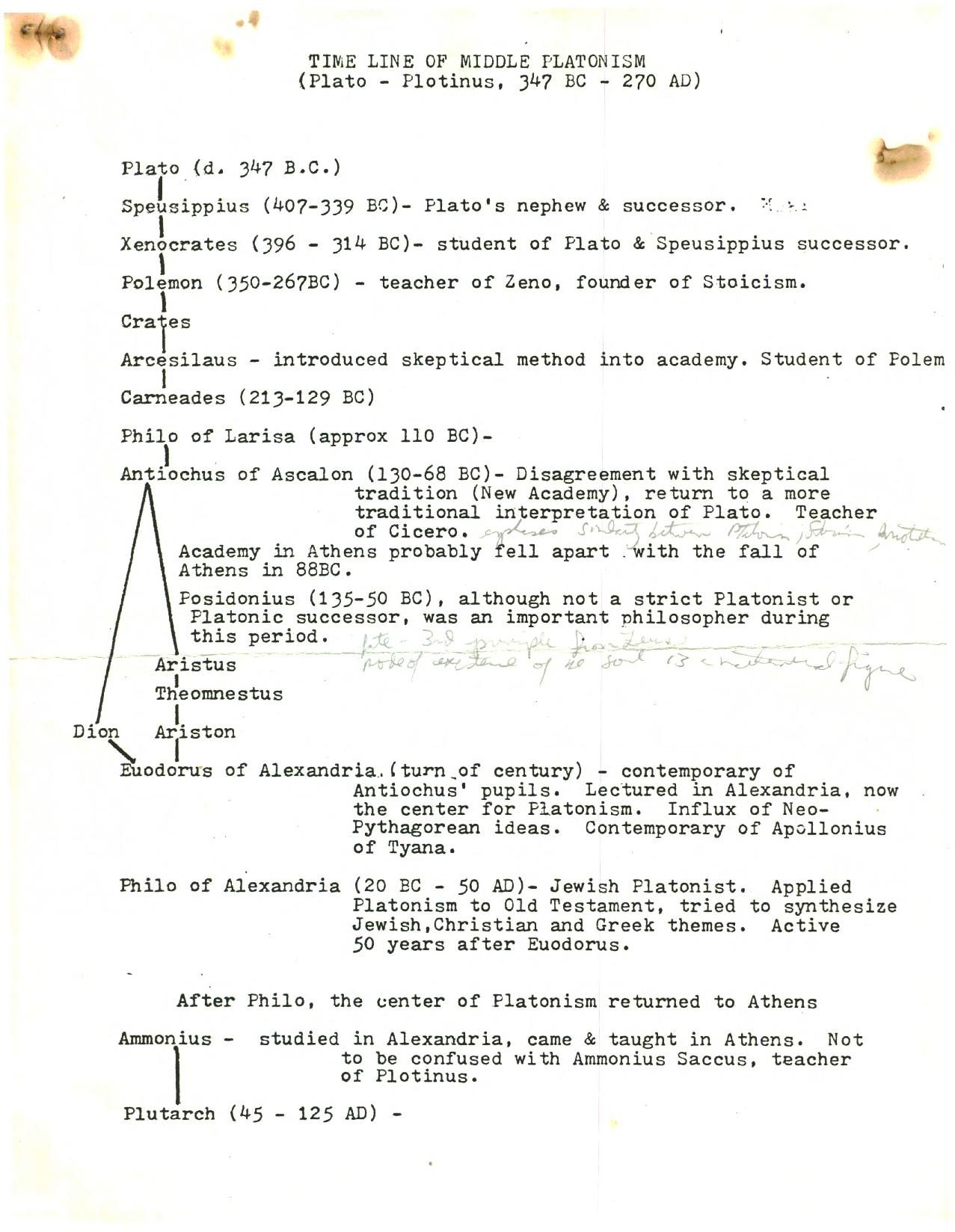
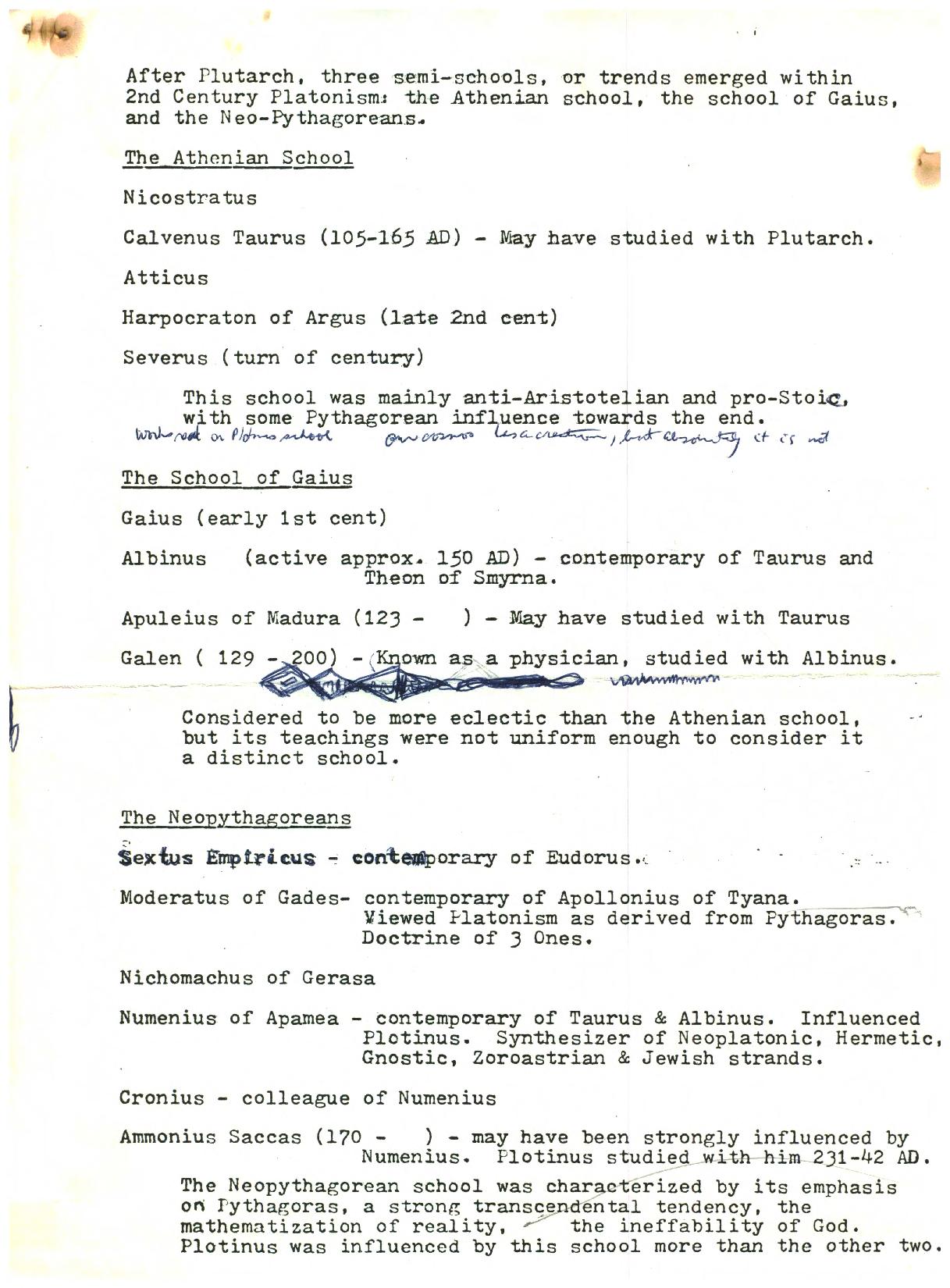
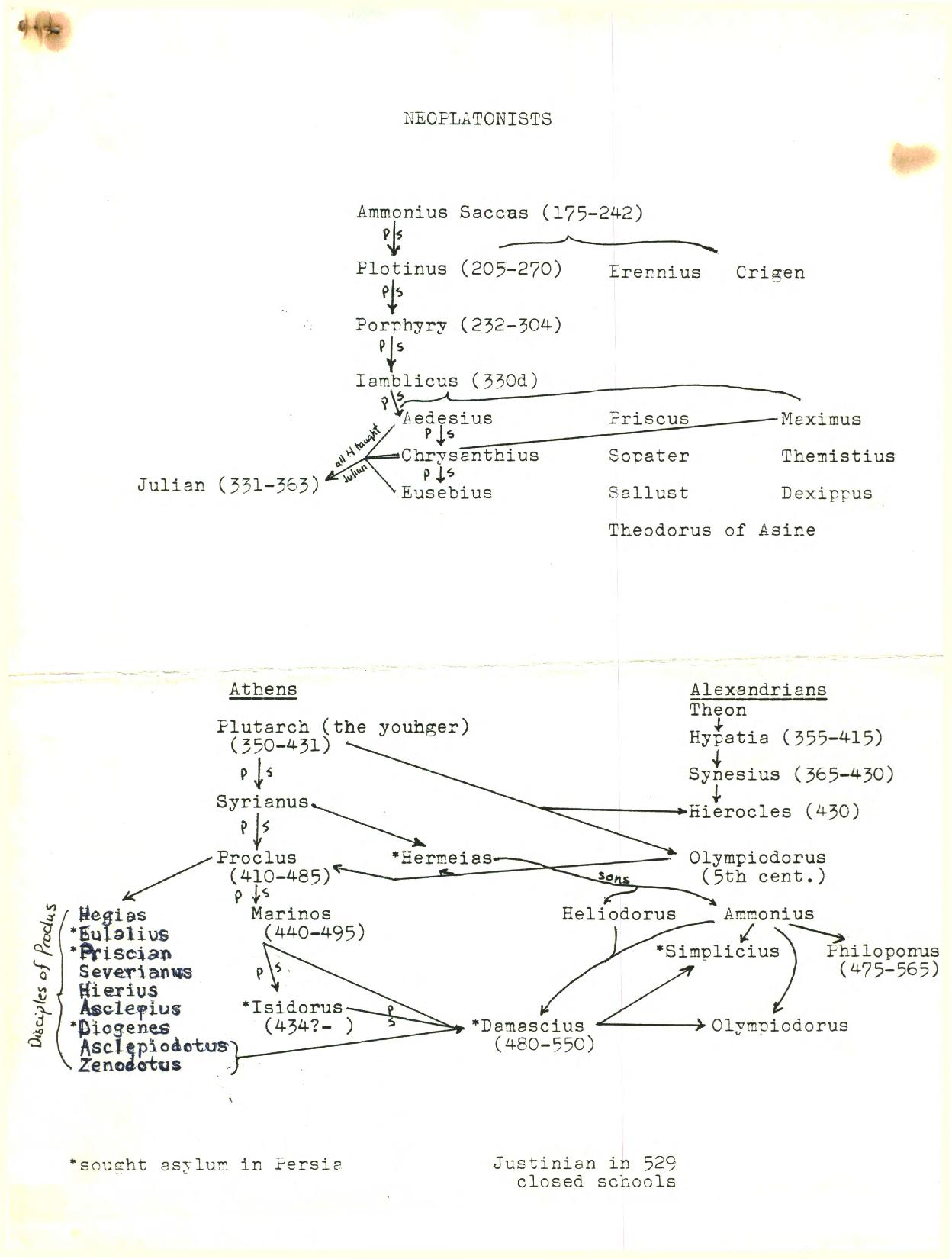
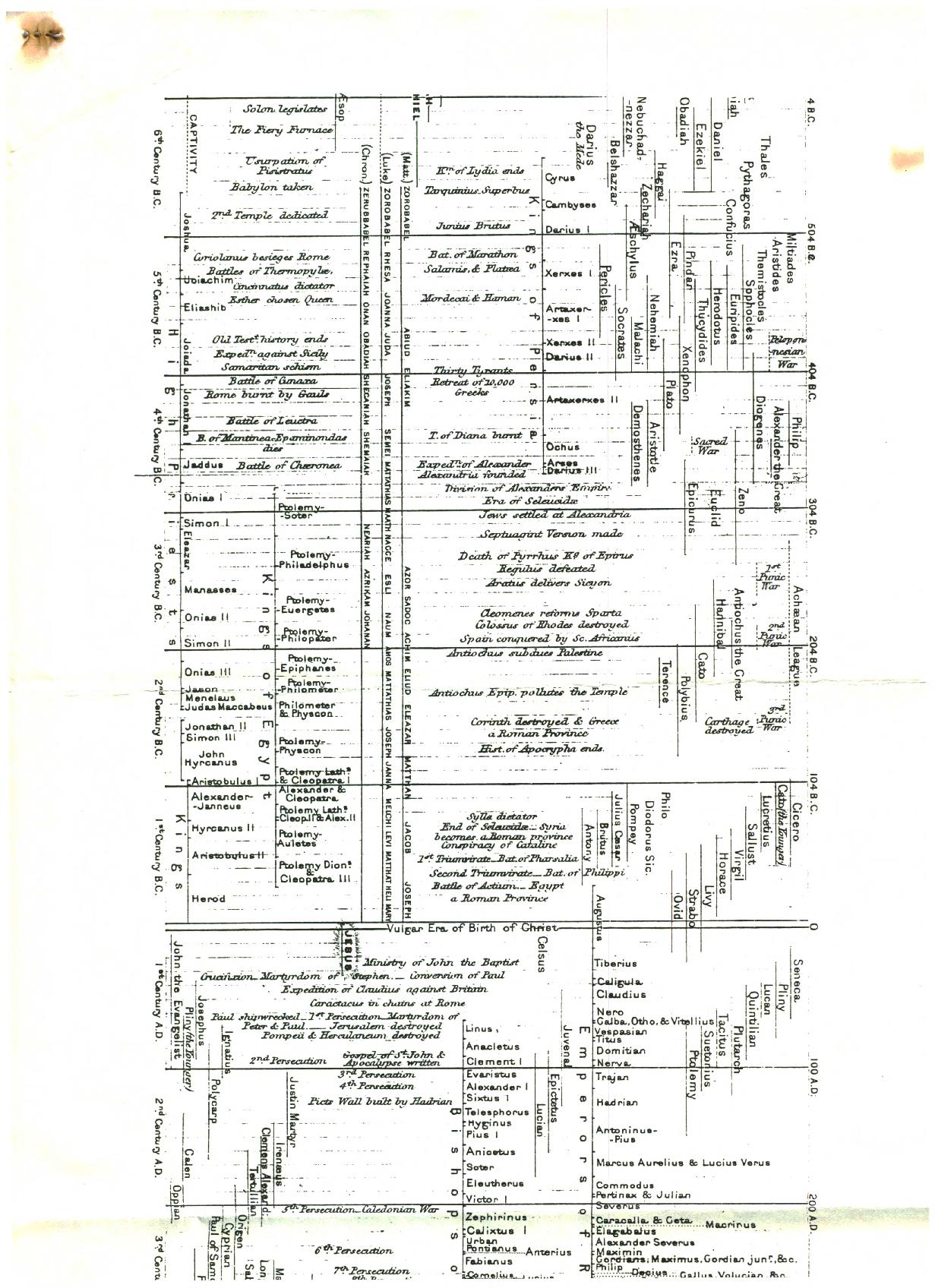
AB: It's from page 1 in the General Introduction of volume 1 of Plato, which I think most of us have by now. (inaudible) That's what I was trying to show with this diagram later, [a timeline of the various Platonic-derived schools, lineages, see FIGURE 1981 0620-5] that the concluding point in the paragraph (is) that Platonic philosophy is really the source of a lot of these other philosophies. You can really show how a lot of the four or five main different philosophic schools at the time, all the way up through Plotinus, had their roots in Platonism and elaborated different aspects of the Platonic doctrine.
S: Our survey's only going to go up to about the year 529 A.D.
S: Re-read that quotation please?
AB: Yes. (student laughter, then quote re-read)
AD: You don't mind if I intrude-- do we want to discuss that for a couple of minutes? Or (re-)read it for your self. Hierocles, I think was the formulator-- I think he wrote a commentary on Pythagorean symbols. Do you know?
S: The Golden Verses [of Pythagoras, commentary on].
AB: Well, he starts out by saying it's a purification from material irrationality and the mortal body. So that living in the sense world, uncertain of who we are, philosophy will restore us to our true nature. And he says that's done through Virtue and Truth. "Virtue exterminates the immoderation of the passions."
AD: And virtue is, the way Plotinus would call it, he called it the "excellences of the soul."
AB: And all philosophies have some systems of ethics or purification associated with them by which you bring yourself into the proper state(s) of development. And then Truth "introducing the divine form to those who are adapted to its reception." So I guess through some kind of rational understanding or also through this ethical development you can have the divine form or the intelligible actually inserted into you and experience that.
AD: How would you interpret for instance, when they say something like "it amputates base matter"?
AB: Well you can say that the soul is somehow involved or enmeshed in this matter, then the--
AD: Don't use the word 'matter' in that way because everyone (inaudible). But suppose you have a certain way of-- style of life which is not appropriate for the reception of truth.
AB: Well then if you engage in some kind of philosophic development, it will amputate that old habit-style, it will throw it (above).
AD: That's what they're calling matter. (student comments) Yes, the lifestyle which is unreceptive to the acquisition of philosophic knowledge. And, you can very often see that right in the chart operating. Big planets go over your small ones and certain lifestyles they're just cut off. They're no longer, you know, appropriate for development. So they would call this "amputating base matter". I hope you don't think they come along with an axe and chop off a piece of wood. They're not going to give anything away, you're going to have to think what they're saying. (S inaudible) Vasanas, past tendencies, modes of being which are inappropriate to your philosophic development. So you could see very often, as you study your, let's say-- your chart, you can see certain aspects coming out which we consider horrendous or terrible, and the wise thing to do is to put on a sackcloth and do it for yourself instead of having it done to you. This would be the "amputation of base matter."
AB: Where he says that "truth introduces the divine form," you could say that as, in order to introduce this divine form you have to push out all this other stuff. And then he says that, "Philosophy ... [has] its basis the rational soul of man, and its ... unperverted conceptions."
AD: See the nice thing about it is philosophy is not the study of Kant and Hegel. (inaudible student comments) That's not what philosophy is, people keep thinking it's the study of these texts, it's not. That's only an auxiliary, a support. And he speaks about that truth as a "vast ocean" (inaudible) that each one has to get for himself. But there again, the indication is of the-- he's speaking about the vast ocean of possibilities which we can't even get a glimpse of. It's quite a definition of philosophy, one of the most beautiful I think that you'll ever come across.
AB: I think he's also assuming in the definition that the goal which we're seeking is already present within us as our own soul.
AD: (assents) And he refers to that as the "base of the pyramid."
LDam: What does he mean when he says (inaudible) it's the only true philosophy, (inaudible), does he mean it's like a continuing from India--
AD: No, no. As a matter of fact, there's a book called Invitation to Philosophy [Invitation to Indian Philosophy] by Mahadevan, there's a series of essays in it dedicated I think to Shankaracharya. And there's one essay in there by Paul Brunton, and in this essay, PB keeps on saying, well, this is what Shankaracharya believes. And he writes about this belief that Shankaracharya has. And this belief was that at one time this wisdom was primeval, one and alone, and that it got diversified through the various cultures. So that as the migrations from the north -- this is speculation-- came down, some went to Greece, some went to India, alright, and probably some remained in Norway (student laughter)-- all these rivulets, alright, those streams from this one primal ocean of truth. And then as the various mores or cultures of various races of men settled down, each one started expounding it in his peculiar way. So that you would have one group of people saying it one way, and another group of people saying it another way. But yet they'd be talking about and referring to that same primeval wisdom. But the mores of the different races would present it to you in a different light-- that's why we work with, and (inaudible) trying to see it as a body of knowledge, of which they have, you know, refracted through the prism of their own limitations, mental or otherwise. Then refracted that one primeval truth into a lot of little streams. But Blavatsky makes this claim too, and quite a few of the writers make that claim that this is all one knowledge, and that what's happened is this tremendous diversification that's taken place. And now the aim would be if we were to have one philosophy is try to bring it all back to that primeval state. You're not starting with Orpheus though?
AB: No, well, I think Avery--
AD: Avery's-- well okay, fine.
AB: Avery's going to go over the three Plato (inaudible) that I was going to mention. (inaudible student comments) Okay. One thing we just want to mention (inaudible) there were a couple (inaudible) we were thinking of reading--
DB: I have a question in the quote you just read. (AB: Yes.) Based on what he speaks of the basis of the pyramid being the rational soul, would you say something like through the development, through the exercises of the rational faculties in man, the formation of virtue and truth are evoked? And that rather the soul is elevated from (inaudible) matter to ascend? Or, -- how does that happen? He says that virtue the means whereby one gets out of here, but um at the same time the rational soul man is the basis for that pyramid, so are Virtue and Truth considered as latent within the rational soul, or are they something that can be evoked from so-to-speak without?
AD: We first have to reach the rational soul. (DB assents) That would be the base of the pyramid. And then when you reach the rational soul you start thinking or speaking about the ascent to the One, the apex. You first have to reach the rational soul.
DB: So that-- so that with the transformation it's made possible by virtue of-- through (inaudible)--
AD: Well if you reach the rational soul, the excellences and virtues of the soul start becoming prominent, and they start working. Give them a chance to work and then they will take you up there naturally. So before we start speaking about anything higher than that, alright, we first have to become rational. Which is quite an achievement by the way. Alright, let's continue.
AB: Okay. I just think it's just worth mentioning very briefly the enormous debt we have to Thomas Taylor. Because almost everything that we read about the Platonic tradition or that we quote from was translated by him. And so if you read for instance in the book Thomas Taylor The Platonist his biographies, it's quite amazing the enormous hardships that he went through in his own personal life, a great cost to himself physically and mentally, things he endured in order to do this, and tremendous criticism and misunderstanding from the whole academic and cultural environment that he was living in. So I think it's just appropriate to mention our debt to him before we go into a lot of this.
AD: Remember when Emerson went looking in England-- (S: Couldn't find him.) they didn't even know who he was -- Emerson went to England searching out his books and getting manuscripts and trying to find out something about him, and no one even knew him.
AB: Now what we're going to do, Avery's going to talk this morning about the different traditions like the Orphic and the Pythagorean and other traditions PRIOR to Plato, which were influential on Plato. And now what I'm going to do, I'm going to talk about (inaudible) from Plato up to Plutarch, according to (inaudible) but he's right down here [on the Platonism/Greek philosophy timeline, FIGURE 1981 0620-5]. Then Herbie, probably next week, is going to take us up to Plotinus. And that period is roughly called 'Middle Platonism' but I'll go into that a little bit more after Avery. And then Tim is going to talk about Ammonias Saccas who was one of Plotinus' teacher, and bring us up to Iamblichus. And then we'll conclude with Jeff and Bo talking about the Athenian and Alexandrian Platonic traditions which followed upon Iamblichus. So that hopefully we'll just give you a feeling for the whole span of Platonism, by going over this. And if you look at the timeline on the handout, the big timeline [FIGURE 1981 0620-5], just to kind of mention the span that we're talking about-- if you look at 504 BC close to the top that's where you have Pythagoras; Plato was in around 404 BC; the founding of Alexandria was around 375 BC; the turn of the century where we have Philo and a lot of these other philosophers; and then we're actually going up to 400 AD practically, at the end of this diagram. So we're spanning a period of almost 800 years, which is, if you think about it, is quite a long period of time, and a lot to condense, the way we're doing it. But this timeline, if you get a chance to look at it another time, there's a lot of historical events and dates in there that will give you the context, for these philosophic teachings. I guess, that's all I was going to say, Avery.
AS: I thought you were going to go over that whole--
AB: Which one? (inaudible)
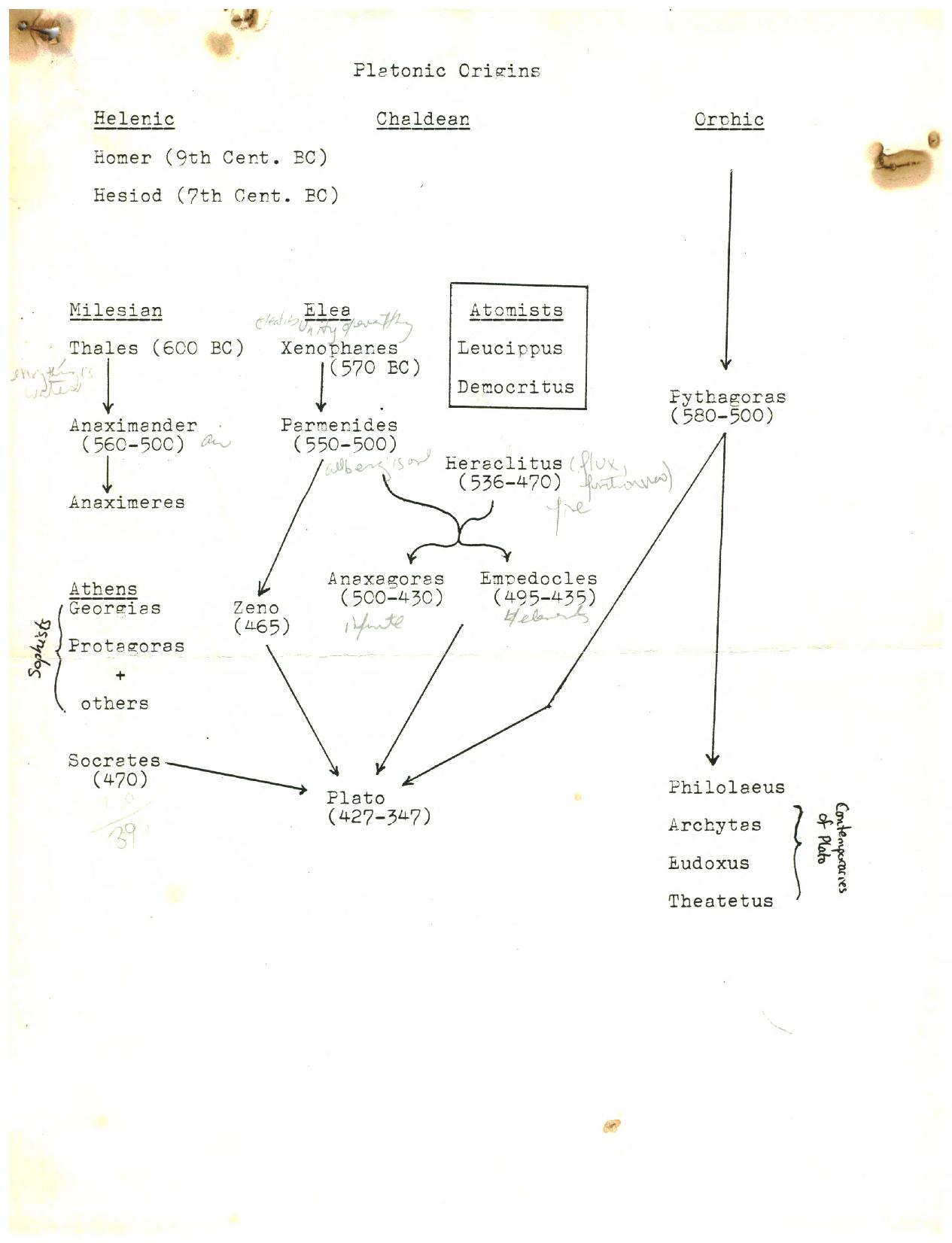
AS: No, that's okay. (inaudible, then sounds of shuffling around) Well maybe the thing to do is to read (an account) (noises, inaudible) this diagram (S: Which diagram?) and then go right into it-- (inaudible) The one that says Platonic Origins [FIGURE 1981 0620-1]. And then what I have-- mostly what I have is some quotes on various people from various sources. Um, to try to make clear-- if you look at this diagram, it shows, it's a little bit misleading. Okay. It's a little bit misleading I think because most of these at least most of the academic historians have a certain notion of history, that things develop and there's certain ideas and you know they get built up more and more. They would want to say, for example, that Plato-- like it shows all the different influences of various of these philosophers, um, telling you what Plato was about, you know-- saying what he's done is based on part on building up on these other philosophers have already said or argued about. And in some sense that's true. I guess. Because he certainly does live at a certain period of time, and has these certain philosophies around him, from which he learns. But I guess in another sense the historical point of view doesn't always show the wisdom which Plato himself has gotten and not historically, but say from whatever inner experiences or development that he's gone through. So -- anyway though this does kind of show the historical-- the several different streams of thought which led up to Plato -- I guess I do need the blackboard-- can I erase this, Alan?
AB: Yes, go ahead.
AS: I guess I'm-- I'm not sure really how to start. (S inaudible) Okay. (inaudible) Okay, well-- it seems that just in general that there are these two main streams of thought that you could trace prior to Plato. And one of them was what we might call the exoteric, or-- you know, philosophy not in the sense of the way that Alan described it in that first quote on Plato from the Taylor Introduction, but more of what they normally today think of philosophy, you know, just speculative philosophy. And that's one stream. And you could follow that all the way down through these different schools-- the Milesians, you know, Thales who they speak of, as the first quote "philosopher", and Anaximander, and so on, the Eleans, the Atomists, Heraclitus, and Anaxagoras, Empedocles, Zeno, and even the Sophists before Socrates. And all of those, you could say, are engaged in some kind of a rational speculations-- some of them are nature philosophers, some of them are interested in investigating nature, others are interested-- certainly they all seem interested in answering this one question, which Windelband states as:
Wilhelm Windelband, A History of Philosophy, p. 27 (AS reading): "What is ... the original ground of things, which outlasts all ... change, and how does it change itself into these particular things, or change these things back into itself?"
AS: Okay, and they're all pretty much concerned with that, in some ways. But if you read them sometimes it's not clear that they have any basis in anything outside of the speculative thought. And now the whole other school, the whole other line that you can trace, is the line through the Chaldeans, the Orphic tradition, Pythagoras, and then finally into Plato, which sometimes they speak of as the mystical line. But it isn't really completely mystical so much as it really, it seems to be ground in something more REAL as it were, than just speculative thought. There's some basis: either the cosmos itself is the basis for their thought, the actual cosmos, or some kind of mystical experiences, or as Taylor, as this quote I'll read from Taylor on Orpheus, on the whole hierarchies of the gods, based on the fact that man can't get everything just from his own -- the whole universe is full of gods, divinity, the higher powers, and it's through this that we can engage in some true speculations about the nature of things, and not just from man's own individual rational thinking. In other words, his thinking isn't really cut off from divinity. And if it is, it may get not get at the actual state of affairs. And you'll have all of these different speculations as to the nature of the universe. Now um, I guess we should start--
PF: Avery, can I ask a question?
AS: Yes.
PF: (inaudible) chart here, you divided them into two streams, now the first stream is the Milesian on down, and then the second stream-- that includes the Chaldeans and the Orphics on down?
AS: Yes. I think as I go through some of these, you'll see that there's kind of-- as I said, one is kind of--an exoteric kind of philosophy, at least that what it seems to me on reading this.
PF: From the Milesians on down.
AS: Yes. If you (look at) the Milesians, the Eleatics, the Atomics, Heraclitus, Anaxagoras, Empedocles, Zeno, and so on, if you read what they say, you know, they're always coming from some kind of implicit or explicit, say-- material basis. Like they're in the fourth quadrant, but they're not bringing in, they don't seem to be bringing in really any of the principles which would be beyond that.
Whereas the other stream it seems, almost from the very beginning, has this doctrine which goes all the way up, say, if not to the One, at least to the Divine Mind. And it's like there, you might say that there's a development in that stream, but in some sense there isn't really. It's almost from the very beginning they have this entire doctrine, and it gets transformed in various-- you know-- the outward manifestation of it gets transformed a little bit, at one time it's more in terms of symbolic speculat-- let's say in terms of Orphic tradition, it's more in terms of mythological speculations, in terms of the gods-- not really mythological but-- And then in Pythagoras it gets transformed into a kind of symbolical representation of that one doctrine, okay, numerologically and symbolically representing these highest truths. And then in Plato he seems to take that and actually try and put it into what we'd call a philosophical or a reasoned doctrine. But it's the same doctrine. You know, it's like-- there's not really a development. It's just coming out in a different form.
Whereas if you read all these other guys, you know, you read like Thales, Xenophanes, Parmenides, Heraclitus, and each one takes one little section, and he says, one guy says well everything is air, the other guy says everything is water, the other guy says it's all atoms, okay, and then Parmenides says it's all one, Heraclitus says no, it's all flux, okay. And then of course the Sophists, they're like the logicians, they're saying, well we can analyze everything in terms of logic. And it's like they don't really have the complete picture of what's going on. So there you can say, well there's either a development, or there's a continual back and forth argument, one guy says this, and the other guy (inaudible, someone sneezes) the nature of things is really in flux, and the other guy says, no the nature of things is really a unity. And they go back and forth, okay. And along in that tradition, I would even put like Homer, perhaps, I don't know, and Hesiod. (S inaudible/Orphics?)
They're right up at the top there. In a sense Hesiod even-- you know Homer is perhaps a little better but they talk about the gods and so on, but they talk about them in a way -- you know like even in Homer where he represents the gods as actually having some kind of you know-- I don't know how to say it -- they're almost on the level of man by that time, they're almost on the level of having communication, and they have certain vendettas and well, it's not really quite-- it seems that they're coming from more of an exoteric view of these things. And then of course the Chaldeans --there's really no beginning of this whole-- that whole tradition coming down, you can't say, well it began with Orpheus because actually-- and as Anthony pointed out-- this speculation is of that one philosophy -- there's one primordial wisdom filtering down through all these various cultures. And this particular stream here, the Chaldean, and the Orphic, Pythagoras, and Plato seems to be the peculiar way that it filtered into the Greek tradition. And of course, then, I would say, into the whole Western tradition, whatever that filtered down.
And of course, also some of these people like Pythagoras also traveled to Egypt. Pythagoras was supposed to have traveled all over-- India, Egypt, and so on. Plato himself was supposed to have gone to Egypt and been initiated into the mystery schools there. So there is a tie in. Whereas if you read these other guys, and it's like they're plunked down in a vacuum somewhere, and they just start from their investigation, they try to build up a whole system almost out of-- you know, in a vacuum, either in a vacuum or out of their own speculative whatever-- there doesn't seem to be a tie-in to a tradition, you know. Whereas for Plato, Pythagoras, Orpheus, the Chaldeans, you could trace it all the way back, there really is a (inaudible).
PF: (inaudible) It seems like Parmenides would be included in the more esoteric--
AS: No--
PF: He doesn't?
AS: No, from what I can unders-- you know, I would include him in the whole exoteric. I would suggest that one line, going from the Chaldeans, the Orphics, Pythagoras, and then in to Plato. Although, well, -- let me start from the first, from Homer. Zeller has this remark here, he says-- however there is something, there is another side, he says, um, he's talking about Homer, and he says:
Eduard Zeller, Outlines of the History of Greek Philosophy, p. 8 (AS reading with slight variations to following; printed version follows): "Even Homer's language betrays the intellectual structure of the Greek mind. For even in the violent world of warrior heroes, it is mind (nous), that is superior and not the will, for which there is actually no word. That a man's actions depend on the state of his knowledge was as axiomatic to the Homeric poets as it was for Socrates. They regarded what we call"character" as knowledge: the king "knows justice", the savage Cyclops "knows wantonness", the hate-filled Achilles "knows wrath like the lion". And although the word (sophein) [knowledge] occurs only once, ... nevertheless Odysseus, the master of his fate, with his never-failing cleverness, appears as the prototype of the Greek "wise man"."
(silence)
AS: Okay, I don't know if-- so I guess he's trying to say that even from these beginnings of this Greek culture, there's some-- there's some kind of a predisposition in the Greek racial or cultural development towards that of knowledge, rather than towards one of the other particular emphasis. That is to say from the beginning that there's kind of an emphasis on knowledge. Even before the influences of the Mystery Schools, before the influences of this doctrine, this kind of a universal doctrine, the very cultural, the very racial predisposition of the people was towards this line of knowledge, rather than say particularly that of the will. And that's just a point. Okay. I guess we should start probably with talking about Orpheus and the Orphic tradition. I'll read some of these things from Taylor in the Hymns. There's a few places I've found, Taylor in the Hymns is pretty good, and his introduction, and [Manly Palmer] Hall also in his Journey in Truth has some really nice sections on Orpheus, Pythagoras, Plato. (more silence in class, mourning doves outside) Hall says:
Manly Palmer Hall, Journey in Truth, pp. 47, 48 (AS reading): "Although it is usual to consider Orpheus a mystical character, it is probable that he lived some time prior to the 12th century B.C. (more silence) ... [He says:] Both Pythagoras and Plato were Orphics, but it is difficult to determine the full measure of what this implies." (silence; then someone apologizes for something; more silence; AS: Okay; silence)
S: More coffee, Avery?
AS: Maybe some coffee. (student giggles; then silence, then sounds of turning pages) Okay, so we're trying to trace starting with Orpheus anyway, although it's much earlier, this tradition of this one, this philosophy, say-- I'll just read it.
Thomas Taylor, Introduction, The Mystical Initiations; or, Hymns of Orpheus, pp. 13, 14-15 (AS reading): "The vulgar systems of mythology are here entirely useless; and he who should attempt to elucidate the theology, or hymns of Orpheus, by any modern hypothesis, would be ridiculously employed.… But with the ancient philosopher, the deity is an immense and perpetually exuberant fountain; whose streams originally filled and continually replenish the world with life. Hence the universe contains in its ample bosom all general natures; divinities visible and invisible; the illustrious race of daemons; the noble army of exalted souls ... According to this theology, the power of universal soul does not alone diffuse itself [AS adds: diffuse its influence] to the sea, ... while the ... air and aether [are] destitute of life ...; but the celestial spaces are filled with souls, supplying life to the stars, and directing their revolutions in everlasting order. So that the celestial orbs in imitation of intellect, which seeks after nothing external, are wisely agitated in perpetual circuit around the central sun. [pause in reading]
(p. 24) "Hence we may with reason conclude, that not only the universe, but each of its eternal parts is animated, and endued with intellect, and is in its capacity similar to the universe. [pause; he says {p. 34, quote is from Porphyry]"God, intellect, and soul are each of them every where, because no where.""
(pause)
AS: Then Taylor says this. He notes that this fellow [Scaliger]:
Thomas Taylor, Introduction, The Mystical Initiations; or, The Hymns of Orpheus, pp. 88-89 (AS reading): "... in his notes to these hymns, that they ought rather to be called initiations, because they contain only invocations of the Gods, such as the initiated in mysteries are accustomed to use; but they do not celebrate the nativities, actions &c. of the divinities as is usual in hymns. It is on this account we have entitled them mystical initiations, which is doubtless their proper appellations."
S: I don't understand that remark, Avery, can you clarify that?
S2: Read it louder, please.
AS: Um. He makes the point here [p. 88 ff.] that although Homer and Hesiod spoke of the gods and so on, they aren't really the fount-- their notion of the gods, and their descriptions, isn't really the foundation of this whole Platonic tradition, but rather they've adapted the Hymns of Orpheus as the basis for their theology. And he says:
Thomas Taylor, Introduction, The Mystical Initiations; or, The Hymns of Orpheus, p. 88 (AS reading): "... these hymns ... ought rather to be called initiations, because they contain only invocations of the Gods, such as the initiated in mysteries are accustomed to use; but they do not celebrate the nativities, actions ... [AS adds: and you know, the interactions of the gods with men and so on] of the divinities as is usual in hymns. It is on this account we have entitled them mystical initiations, which is doubtless their proper appellations."
LCG: Is this what Iamblichus was talking about, those two kinds of-- would you call it devotion, but he was talking about the rituals, some that are more in terms of at certain solstices and certain cosmological times and there was another that was more of an internal kind of rite, as it were. It sounds similar to what he's talking about here, that this (inaudible)--
AD: Well this would be the higher one.
LCG: Right, right.
AD: There was two kinds of worships, one which was practiced by the ordinary, say, astrologer, and one was practiced by an initiate.
LCG: Right.
AD: Now Avery would like to read, do you have the Hymns there?
AS: Yes.
AD: Read one of the Hymns and see if you can see what they're talking about, take maybe the one to Mars or Venus, one of them.
AS: Yes.
AD: (inaudible)
AS: See whereas he's saying-- I mean it's something like what I was trying to say with the philosophers too, that whereas the theologies that were normally are-- there's two kinds of theology, one of which is kind of exoteric and talks about, you know, the relations, the gods to men and their actions and so on. And then there are some that are actually-- some hymns, some that are actually effective, it's like--
(Side 1 of original cassette tape digitized as 1981 0620a Ends; Side 2 Begins)
AS: --but then a later person, a later Platonist, an Athenian actually wrote these down, Onomacritus, who had been initiated into the Mystery Schools.
LCG: So these had been passed down, verbally?
AS: Yes. Either passed down verbally, and were only written down much later.
AB: Avery? When we hear about the Mystery Schools and all these initiations and these practices, that would be associated with this esoteric (AS: Right.) theme that you're talking about.
AS: Yes, that's what I was trying to get-- I was-- I was going to get into as soon as I get my head together. (S inaudible) Yes. That all the Mystery Schools, the Dionysian and Bacchical Mysteries and so on are all mostly associated with this whole Orphic tradition. Okay. And that these hymns were actually used in those, you know, mystical-- And I have a little thing on the Mysteries, I'll read that. Anyway, this is to Mercury:
Thomas Taylor, Orphic Hymn XXVII, To Mercury, pp. 152-153, The Mystical Initiations; or, The Hymns of Orpheus (AS reading):
"Hermes, draw near, and to my pray'r incline,
"Angel of Jove, and Maia's son divine;
"Studious of contests, ruler of mankind,
"With heart almighty, and a prudent mind.
"Celestial messenger, of various skill,
"Whose pow'rful arts could watchful Argus kill:
"With winged feet, 'tis thine throu' air to course,
"O friend of man, and prophet of discourse;
"Great life-supporter, to rejoice is thine,
"In arts gymnastic, and in fraud divine:
"With pow'r endu'd our language to explain,
"Of care the loos'ner, and the source of gain.
"Whose hand contains the blameless peace the rod, [AS repeats last line]
"Corucian, blessed, profitable God:
"Of various speech, whose aid in works we find,
"And in necessities to mortal kind:
"Dire weapon of the tongue, which men revere,
"Be present, Hermes, and thy suppliant hear;
"Assist my works, conclude my life with peace,
"Give graceful speech, and memory's increase."
(inaudible)
AB: Avery, in the quote you read before that it seems that the Hymns are actually trying to bring about a contact or a knowledge of the real nature and essence of that god, and was not describing the activities of a god or that Mars is involved in this war and helped it -- you know, a situation like they do you know in a lot of the other mythological accounts.
(silence; then inaudible student)
LCG: Avery, did this whole tradition revolve around the hymns?
AS: I don't think so. Let me read you some of the other-- from Mead [G.R.S. Mead, Fragments of a Faith Forgotten]. Um, there were certain what they called 'State Mysteries' and there were also, there were private mysteries. He says around this time, it was right before this time the 6th century [BC], right before Pythagoras, the numbers of these schools were greatly increasing, he says: "almost every variety of Oriental mystery cult found its adherents in Greece." This may be seen from a study of the religious associations among the Greeks (inaudible). So this whole influence was coming into Greece at this time, he says: "among private communities and societies of this kind, there were to be found many undesirable elements." But also there were many-- just couldn't be satisfied by the-- their needs couldn't be satisfied by the state religion. You know, the state mysteries, I think much like in Rome, the Catholic Church, you know, (with) open worship services and so on. Because that's the outer trappings. Whereas in these, so called secret or private mysteries, there are actually teachers, say, and there was actually a tradition which could unfold for you some of these higher truths in some form or other, either through mystical experience or through symbolism and so on. He says:
G.R.S. Mead, Fragments of a Faith Forgotten (version from www.sacred-texts.com) (AS reading): "Among these private foundations were communities of rigid ascetics, ... [who] gave themselves entirely to holy living; such people were said to live the"Orphic life" and generally were known as Orphics. ...
"These Orphic communities [AS reads"They" for last phrase, then reads "appear to have been the refugees of those who yearned after refuges --" (laughter) -- it should be:] appear to have been the refuges of those who yearned after the religious life; and among them were also the Pythagorean schools. [He says] Pythagoras [could not have] established something entirely new...; he developed something already existing [there], and when his original school was broken up ... [there still were these Orphic communities. He says,]
"[I]n the Pythagorean tradition ..., we see the signs of what I have called the philosophic Mysteries; it is therefore in the best of the Orphic and Pythagorean traditions that we will find the ... [true] nature of the real Mysteries and not in the political Eleusina[n mysteries] or the disorderly elements [he says] of the Oriental cults.…
"In fact the Orphics did much to improve the Eleusinia and supported them as ... necessary means for educating the ordinary man towards a comprehension of the higher life. [However,] It stands to reason ... that the Mysteries which [really] satisfied the aspirations of the Orphics and Pythagoreans were somewhat higher than the State-Mysteries of the ordinary citizen.…
"We have then to seek then for the innermost religious life of Greece in this direction, and to remember that the inner experiences of this life were kept ... secret and not paraded on the housetops. Pythagoras [for example,] is said to have been initiated into the Egyptian, Chaldean, Orphic, and Eleusinian Mysteries; [but] at the same time he was one of the chief founders of Greek philosophy. His philosophy, however, was not a thing of itself, but the application of his intellect-- [and] especially of his mathematical genius-- to the best in these Mystery-traditions; he saw that it was necessary to attempt to lead the rapidly evolving intellectuality of Greece along its own lines to the contemplation of the inner nature of things; otherwise in the joy of its freedom it would get entirely out of hand and reject the truths of the ancient wisdom."
AS: I think, what I was trying to say before, (inaudible), the Milesians, the Eleatics, and so on, they were this first wave of the development of the intellectuality, the rationality and so on that was coming into man at that time. But I think without the other side of it here, and again there's the quote that Alan read at the beginning, without, what he's calling this other side, the truths of ancient wisdom had to get integrated in with the rationality and intellectuality that was coming into Greece that it was developing there. And I think it's only with Plato that the two of them are really, truly combined into one unified system. But I think as he's pointing out Pythagoras probably was the first one who actually tried to do this-- to integrate the rationality with the mystical side, or (I might not say) mystical, but with the truths, as he says, of the ancient wisdom. I think still with Orpheus-- see with the Orphic tradition they much more lean to the side of these Mysteries, the rationality isn't so clear. You read these hymns, it's not a rational explanation of philosophy, it's more of a symbolic or a pictorial representation. Although if you practice these, you will get at the essence of these gods. It won't be through this rational dissection, it won't be through a philosophical discernment, okay. With Pythagoras, I think, it was this first, it was like the bridge, from the purely mythological way of getting at things, to the philosophical, and that bridge was through symbolism. I think it seems that all his of things with the numerical, the tetractys (drawing on blackboard sounds) all these things you're saying, these-- you know--the Golden Verses, the symbolism of the tetractys, the number symbolism-- are all meant to try and-- like a first bridge to taking the mythological and bringing it into the rational, to actually bridge that gap, which I think is only completed with Plato. But see, parallel to the Pythagorean schools that we're speaking of (drawing sounds) and the Orphics again it's beginning at this time, around the 6th century [BC], of the rational philosophers, Thales and all these. Thales, Parmenides, and I think that was partly where Parmenides was -- just as he said, if the intellect is given free speculation, without bringing in the truths of ancient wisdom, then it can kinda fly off wherever it wants to. Zeller made that (clear) (inaudible).
(sound quality from here on is poorer, air conditioner or fan turned on)
AD: Could I read one, (AS: Yes.) Avery? To Vulcan. (AS: Uh-hm.) This is one of the Hymns. By the way, this edition and the one you have, the notes are missing in that. [referring to PRS edition] (AS: Yes, uh-hm.) It's really a truncated-- This is Taylor's original with the notes by him. This is to Vulcan. And, see what it might bring up as we read it, okay.
Thomas Taylor, Orphic Hymn LXV, To Vulcan, pp. 197-198, The Mystical Initiations; or, The Hymns of Orpheus (AD reading): "[The] Fumigation from Frankincense and Manna.
"Strong, mighty Vulcan, bearing splendid light,
"Unweary'd fire, with flaming torrents bright:
"Strong-handed, deathless, and of art divine,
"Pure element, a portion of the world is thine:
"All-taming artist, all diffusive pow'r,
"'Tis thine supreme, all substance to devour:
"Aether, Sun, Moon, and Stars, light pure and clear,
"For these thy lucid parts to men appear.
"To thee, all dwellings, cities, tribes belong,
"Diffus'd thro' mortal bodies bright [AD edition seems to have"rich" and strong.
"Hear, blessed power, to holy rites incline,
"And all propitious on the incense shine:
"Suppress the rage of fires in the unweary'd frame,
"And still preserve our nature's vital flame [AD reads from his edition 'frame']."
AD: Do you get a feeling of Vulcan?
MW: You say that the Sun and the Moon were portions of what--
AD: That what shines through the Sun and the Moon. (silence) (inaudible) work on it, huh?
TS: (inaudible)
S: You think it's a reference--
S: Sorry.
S: Tim?
S: I said it sounds like taija(sa).
AD: It sounds like--
S: Taijasa.
AD: Taijasa a little. (inaudible) That "unwearied frame"-- Perhaps-- perhaps if we speak of him as a fabricator of psychical essences you'd feel closer to him. What forges together the various psychical essences that constitute your mental body or any mental body. That if one had an insight into that mental body he would see this fire. Think a few people here who had some kind of experience where they saw their mind as a fire, (strictly) fire, then you would be paying homage to Vulcan, wouldn't you. So the poem is really meant to try to reproduce, you know, something of that experience and everything else is secondary. That why he called them mystical initiations. Each one of those poems would give you some characteristic about a god, which can be experienced. But you have to bring yourself to a mythological consciousness and get away from the conceptual consciousness. Alright, Avery.
VM: That's the way Mrs. Ybor [elderly mystic residing in cottage at WG] does philosophy.
AD: Well Mrs. Ybor had the experience, she called it Loki. He handed her this necklace on a thread. Now that would be Vulcan who strings together all those beads on that string, and each one of those beads would represent the life-- You could think of it as one life or many but if you think of it as one life, as the essences-- like each bead would represent certain psychical essences and they're all combined in a certain way to produce this necklace-- and there that would be the forging and bellowing, the work of the Vulcan and Loki.
VM: What I meant was that this mythological consciousness or this sort of mode of appreciation of the truth that the Orphic Hymns try and evoke in-- seems very alive and sort of that (inaudible) of her development that Mrs. Ybor goes through, not that she doesn't understand at all rationally but that's certainly not the emphasis. [Note: See WG Interviews 1981 0318, 1981 1015, and 1982 0106b for Mrs. Ybor's accounts of her mystical experiences.]
AD: No, the emphasis is really like the experiences (VM: Experience.) are deposited in this mythological framework and it is possible to re-experience it when the things are understood mythologically. And that's why, for instance, Jung regarded the myth as the vehicle or container or the bearer of a-- (S: (Certain truth.)) the value or the feltness of the experience. It wouldn't be wise to stop there because there's more beyond that but, it is in the mythological experience that one comes very close to understanding these things without the interference of the-- let's call it the conceptualizing mind. So it becomes really quite valuable. The myths are the depository-- I would say true myths are the depository of the experience of ancient man or, you know, (reflected/refracted) behind in this rational, in this mythological way, and you can pick it up and go back to that. But to read myths that way takes a special training. Then later on of course I think we'll see that they do use allegories to convey philosophic truths. If you read the introduction to the Fables of Homer in Plato where Taylor had that disbelief, that'll give you an example of that. [Note: See Thomas Taylor the Platonist, "An Apology for the Fables of Homer".] Even Dante used it, (why) in trying to expound philosophic truth through analogy. Misunderstand the analogy and you'll end up with complete-- Let's continue with Zeller.
AS: Um-- (S inaudible)
AS: Okay well, Zeller here makes this point at this time, he says:
Eduard Zeller, Outlines of the History of Greek Philosophy, p. 17 (AS reading, text as in published book, minor variations by reader ignored): "The Greek of the 6th cent. B.C. who was no longer satisfied with the traditional religion had two courses ... : that of rational thought and investigation, which the Ionian physicists followed, and that of [the Orphic tradition]. ... These ... lines of development were, however, not completely separated, but crossed and re-crossed ..."
AS: The mythological and the Orphic way and the rational thought and investigation which, he says, "have a common end." Well, I don't know.
S: (inaudible) mythological understanding (inaudible) (S/AD/AS inaudible)
S2: Parmenides--
AD: (inaudible) once you get to the meaning you're out of concept. Well you think you've worked the meaning? If you restrict meaning to, you know, verbal concept, you will be impoverished.
GA: Isn't that what he's getting at in the Hymn to Mercury, that the great divine fraud is words, (student snickers) the conceptuality? That thinking gives you-- presents (its) meaning but it's like a fraud. So its divine part is what really does bring meaning. But before it brings meaning, it brings about something that isn't meaning at all.
S: What does he mean by that?
S: Hm.
AD: I think probably you will notice that period he's speaking about is one that started happening what I would call in the history of consciousness, you know, a stage was developing (inaudible) the-- let's call it mythological consciousness to-- I don't want to call it rational-- can we call it mentality consciousness? I don't think we've achieved the rational consciousness yet, although most historians are so anxious to include that as part of our past. (student snickers) But I would say that if you follow the history of consciousness and you start with an archaic consciousness, you know, and you went through a magical consciousness, then a mythological consciousness, about that time I would say there was a break and the conceptual consciousness started developing. So that something like this would be totally inadequate for a conceptual consciousness, would say anything doesn't mean anything. They had-- they were transmitting part of that kind of state where-- it's a kind of state that for instance almost any trifling aspect that's going on in the heavens is experienced tremendously at all levels and depths of your being. Whereas today a person could have a major conjunction going on, you know, maybe even two or three of them before he says "Oh wait a minute, something's going on." So see it's really become-- it really has become concrete, turned into matter almost.
LDam: But that's [mythological] more aligned with Nature. In some sense wouldn't you say that?
AD: Well I think it's more than Nature, unless you give Nature a, you know, broad definition. But yes, it's closer to Nature. The separation, the alienation from Nature hasn't taken place (yet/here). But once conceptual thought becomes intense, then the alienation is experienced. The subject-object dichotomy gets reinforced and is (inaudible). One actually thinks of himself as "I" and the rest as "not-I" very intensely. And then of course if you really approach this intensification, psychosis sets in. Alright, let's continue.
S: I don't know (inaudible) is there a difference in the development of the iconography at this time? (inaudible) the development of Greek sculpture, something was more (participated in) at this time-- was this (inaudible)-- you know, even at the time of the Mysteries, they had like a full kind of iconography, and statues, and--?
DB: I'm not sure if (inaudible) statues of men, you know, various athletic pursuits, and so on and so forth, as opposed to just the human body. (inaudible)
AS: Well, let me go to the other side. I don't really have a lot to say on the other side of these (people). Just a brief--
VM: On the exoteric side?
AS: Yes, well just a brief-- Aristotle in the beginning of his metaphysics, goes through at least a brief description of most of these people. Of you know, Thales, and so on.
Aristotle, Metaphysics, I.1 (version by W.D. Ross, found on web, AS reading): "Of the first philosophers, then, most thought the principles which were of the nature of matter were the only principles of all things. ... Yet they do not all agree as to the number and the nature of these [AS adds: material] principles. Thales, the founder of this type of philosophy, says the principle is water ..., getting the notion perhaps from seeing that the nutriment of all things is moist, ... Some think that even the ancients who lived long before [this] generation ... had a similar view of nature; for they made Ocean and Tethys the parents of creation, [and so on]."
AS: I guess he didn't really understand too well the mythological, the meanings (inaudible student comments), the mythological meanings.
Aristotle, Metaphysics (AS reading): "Anaximenes [AS reads: Anaximander] and Diogenes make air prior to water. ... Empedocles says it of the four elements."
AS: He was the first one to bring in four elements.
Aristotle, Metaphysics (AS reading): "Anaxagoras ... says the principles [AS adds: the material principles] are infinite in number ... From these facts one might think that the only cause is the so-called material cause; but as men thus advanced, the very facts opened the way for them and joined in forcing them to investigate the subject."
AS: Then he goes through them in somewhat detail. I mean not in (inaudible).
AB: It seems like some of these academic philosophies were based on a literal interpretation of the mythological, you know, mystery.
WA: Avery-- (AS: Yes--) Did you find out much on that line on Heraclitus? (inaudible student discussion)
S2: Oh yes you meant a line.
AS: Most of these schools-- they used to take all of these schools which were developing around 600 BC and so on-- they weren't in Greece proper, they were all over on the coast of Ionia here, which I guess it's now Turkey, and so on. And there were -- early Greek colonies over here (knocking on blackboard). And it seems, just from reading the little fragments that they have and things, that almost every kind of view was represented -- like Heraclitus would really be the Buddhist view, the flux view, the function view. I don't know, I didn't really investigate too much.
WA: I guess-- he's one of the most fragmentary of them-- I think at that time what everybody said about him was really obscure -- and it seems like the whole-- the western way, the doctrine of the logos and everything would be sort of traced back to Heraclitus, (inaudible).
AS: Well let me add this-- the way the thing seemed to go-- I'm not sure-- the one school, the Eleatic school, who eventually-- and the main proponent was Parmenides-- who we do have some fragments from. Who says that-- that everything-- that all being is one. We do have some fragments from him. Where he says um, --let me read-- he says basically that there's only which exists always is, and that which never exists is not. And that everything which basically is one, that being is one. And there isn't really no multiplicity. Whereas you have Heraclitus who says, really there's only multiplicity.
WA: Didn't he say that it was a unity but including the multiple? (inaudible) I'm sorry--
AS: Go on.
WA: Once (inaudible) there's isn't much around, but I thought that what he said-- it's just that it wasn't pure multiplicity: "Fire was the first of all things," and that everything was a unity but included a multiplicity. I thought he was talking about the logos. (inaudible student dialogue)
AD (hard to hear): Then why call it fire?
WA: I don't know that he called it fire. But it would seem to be (inaudible).
VM: Well, maybe the ideas, as you were saying last night when these reason-principles come in, they always fuse or come in with a great flash of light or fiery intellection, it's hard to tell what (inaudible; inaudible student comments)
MW: These people you were talking about as exoteric, I always wondered whether in fact they weren't so exoteric but it was just that they'd always be commented on by very exoteric commentaries.
AS: Well that certainly is possible, Michael.
MW: That is to say, everything is water, everything is fire, are they in fact speaking about what we called the elements, the soul of the elements? Or does Water in fact not even refer to an element? I mean, I don't know.
AS: Well, I agree with you, I don't-- when they say everything-- when Aristotle says that these guys say everything is Water, that-- by no means do I think they really thought that everything was just what we would call Water. I mean what they meant by Water I think is obviously something very different. Here's what Willie's referring to, see this-- he says:
Eduard Zeller, Outlines of the History of Greek Philosophy, pp. 45-46 (AS reading): "Heraclitus comprehended [the whole of nature] as uniform whole, [that it] neither come[s] into being, nor does it pass away…. [And] Heraclitus saw in it a spiritual principle-- [a] Logos, [as he says in here. But he says that ] ... he regarded the world-reason as bound up with a definite material substrate, [that is] fire. [But that this fire, that this principle of nature] … was the unceasing changing of things, the instability of all individual things.… he saw in this general law of the universe and only regard the world as something involved in incessant change and ever subject to new modifications. Everything flows and nothing is permanent: one can never [AS reads 'cannot'] step into the same river twice. [AS adds: Or even once.] ... everything passes into something else and is thus seen to be something that assumes various shapes and passes through the most varied states ..."from everything One is made, and from One everything." [Fr. 67] The essence of all things according to Heraclitus [is] fire: [he says] "this world, which is the same for everyone, has been made by none of the gods or men, but ever was and is and ever shall be an eternal, living Fire." [Fr. 30]"
AS: This sounds just like what the Buddha said-- when he talks about the whole world is on fire.
S: I think of it a little differently.
AS: "Kindled and extinguished measure for measure." But he also--
VM: But he said the essence of the world is Fire. I mean maybe this is really taking it (literally), but perhaps the essence is there continually instantiated in that flux that was refereed to as the Fire. Because as we've said many times, if you didn't have any essences, the notion of flux would be meaningless there would be no distinctions within it that can be discerned as flux.
AS: Yes but he says this process of change is never still, there are never any permanent forms, everything is continually in a process of transition. (VM inaudible) "Strife is the justice of the world." [Fr. 80.]
VM: It's hard to argue with some (inaudible) not know much about it.
S: I don't know where you're reading from, Avery, but it sounds almost as if the Fire he's talking about is not a material basis at all.
AD: In other words it's not one of the elements.
AS: Yes.
S: Not the soul of the elements. It's the soul.
S: Well in fact at one time--
AD: Well, could we be more precise?
AS: Yes. Well, I think he would be taking the point of view that the whole 12th house is being continually imaged forth by the Sun in Aquarius. (S: Form-bearing light.) Form-bearing light. He does say that:
Eduard Zeller, Outlines of the History of Greek Philosophy, pp. 46-47 (AS reading): ""... the hidden harmony of nature always restores harmony from the contraries, and that the divine law, ... fate [or] ... universal reason, ... or Deity rules everything, [and] that the fundamental essence changes according to fixed laws into all things and returns from them into itself.""
AS: I think you're thinking of fire like taijasa consciousness.
VM: Well, with some structure in it. Even though it's completely changing and evolving. Is he the one who admits to having fixed laws?
AS: Yes, he says that (inaudible) he's not saying that everything is just an arbitrary flux, he's saying that there are certain fixed laws and so on. There's some more here, I think he makes that point here too. At least Zeller says that:
Eduard Zeller, Outlines of the History of Greek Philosophy, p. 47 (AS reading): "That the soul of men is a part of the divine fire, the purer this fire is the more perfect the soul.… [And he says, for example, using the example of the sun,] that the sun is renewed every day, in that the fire collected in the boat of the sun is extinguished every evening and during the night is formed anew."
DR: Avery, you started talking about a fire, as part of the objective soul, and then he says that this fire is also part of something--? (inaudible)
AS: I think by soul here he means what we would call the soul that comes to us from the stars, or from the sun. Not the higher soul, perhaps, the objective soul, that which is part of the-- which is given by the Sun in Aquarius, or just part of the cosmic circuit. And is continually being regenerated. And he also made that comment: "The driest soul is the wisest and best." [Fr. 118] And he says [Zeller, p. 47]: "Since however the soul-fire is likewise subject to continual transformation, it must" be continually restored through the senses, the breath, the light and air.
S: Avery, what is a dry soul?
VM: Uh-oh! (student laughter)
AS: It has less emotions, not so emotional. (CdA: Not emotional.) Pure (inaudible), (student laughter) free from the passions, the emotions. He says:
Eduard Zeller, Outlines of the History of Greek Philosophy, p. 47 (AS reading): "When the soul leaves the body it is not extinguished, but returns whence it came, to the world-fire."
AS: So again, this world-fire, I guess the way you're trying to say it, it's like the taijasa consciousness.
VM: Something like that, yes.
AS: He's speaking then of the objective soul returning to the World-Soul from whence it originally came.
S: (inaudible) read these quick histories of Greek thought--
AS: I know.
S: But the commentators do and make these men sound like fools. (inaudible several people talking at once)
S: (inaudible) some books, so many books.
AS: Actually I found this one with Zeller, I mean, in many places, he's generally sympathetic, I mean he doesn't make-- he's pretty objective, he doesn't generally make derogatory comments or anything like that in it. Though it's really hard to find stuff in it.
JA: What's the title of it?
AS: But I think you're right, if you try to diagram them--
S: History of Greek Thought, maybe.
AS: Of Greek Philosophy. [Outlines of the History of Greek Philosophy] I think you're right, I think that Aristotle's comments that these guys are just talking about some kind of matter or one of the elements is really off the point. (JA interrupts) If they only say there's one, that everything is Water, I mean, he could be referring to the sea of generation, the whole fourth quadrant. But when he says everything is Fire, he's saying it's all produced by taijasa consciousness, everything is in flux, what is he referring to? It is a valid point. (The) Parmenides (inaudible) everything is Being.
MW: Yes, commentators say that about the Parmenides, they say he thought that everything was one globe. You know, I think he speaks about it. They think that he's speaking about a material sword. (AS assents) (But he thinks) it's from spirit.
WA: Do you have more also on Thales and (Anaxagoras)?
AS: Yes, I mean I could read you a little more (inaudible) I think. (S inaudible)
VM: Why did they say Thales was the first philosopher, is that what you said, Alan? (S inaudible) What contribution did he make specifically that people (inaudible) on that-- (AS inaudible) Was it a systematization and a rationalization?
AS: Yes, they were the first ones, the first one to come up with a some-- let's not say rational-- some kind of a conceptual, a conceptual system to explain, rather than a mythological one. He seems to be the first one that this germ of conceptuality or individuality has come in, (VM assents) rather than a mythological consciousness. Not that he's the most profound, I mean just, like he happens to be the first one. And also he was pretty much--
VM: I guess the difference would be that he was trying to explain it, but I don't know whether it's inner or outer. That it's (not) appealing to the gods, and trying to work it out, in a conceptual mode or something like this.
AS: Yes. Well, at least give a conceptual explanation. Not that he wasn't using the mythology also, but he was trying to interpret it, in a certain conceptual way. At least give a conceptual framework of what's apparently-- from fragments that you have, we really don't know. Like the Eleatics, okay, their view was:
Eduard Zeller, Outlines of the History of Greek Philosophy, p. 42 (AS reading): "The basic idea of this philosophy was the unity of everything, that is the All-One. This All-One was a the same time the Deity without beginning and without end, always similar to itself and unchangeable."
AS: And that's the position that, for example, like Plato ((at)tacks on), argues in his Parmenides
Eduard Zeller, Outlines of the History of Greek Philosophy, p. 43 (AS reading): "[The] Deity is completely self--sufficient, and in need of nothing. A multiplicity of gods, with superiority and subordination is unthinkable."
AS: Now (inaudible) where are you coming from when you say that everything is unchangeable Being? and that non-being in no way is?
VM: (It's not in the) 12th house.
AS: Well-- (silence) (inaudible) "Thought is not different from Being" --this is what Parmenides says--
Eduard Zeller, Outlines of the History of Greek Philosophy, p. 50 (AS reading): "Thought is not different from Being, for it is only thought of Being (Fr. 8, 34 ff). The only perception which is true is that which shows us in everything an unchanging Being, namely Reason; the senses, on the other hand, which present to us the manifold of things, creation, destruction and change, that is the being of Not-Being, are the cause of all error.…"
AD(?): (inaudible)
[Audio File 1981 0620a Ends]
[Audio File 1981 0620b Begins]
AS: But, you know, it's interesting, both these guys-- neither-- I mean neither of the two, Heraclitus or Parmenides, is really taking the point of view of just the pure sense (one/world). Because obviously if you do, the notion of complete becoming is not really available 'cause things do have a subsistence. But on the other hand-- I was going to read-- can you find the e-- I was going to read the e-- I was going to read some from-- (inaudible) But--
AD: You're going to read his-- (AS: Yes.) Yes, read his-- the mythological-- the experience, mythological (inaudible), (is it)? The way the Goddess took him to truth.
AS: This is Parmenides, fragments from Parmenides' poem. He starts off-- This is his beginning here.
Leonardo Taran, Parmenides, Fragment I, pp. 8-9 (AS reading; poem is read twice; [addition] = in Taran's translation, except as otherwise noted): "The mares which carry me, as far as ever my heart may desire, were escorting me, when they brought and placed me upon the resounding road of the goddess, which carries through all places the man who knows. On it I was carried; for on it the well-discerning horses were straining the chariot and the maidens were leading the way. The axle glowing in the naves was sending forth the whistle of a pipe (for it was being whirled about by the two rounded wheels on either end) [both readings AS omits phrase in parentheses -jf] whenever the daughters of the sun, leaving the realm of night, hastened to escort me towards the light, after they had with their hands pushed back the veils from their heads. There are the gates [separating] the ways of day and night and they are enclosed by a lintel and a threshold of stone; and the etherial gates themselves are covered with big wing-doors, of which Dike, whose vengeance is stern, possesses the rewarding keys. The maidens appeased her with gentle words and knowingly persuaded her to push back quickly from the gates the bolted bar. And a gaping chasm of the doors was produced by the gates' opening which had set revolving in the sockets one after the other the brazen axes [sic in translation, though Kingsley has 'axles' -jf] fitted with bolts and pins. Straight through them [on first reading AS reads: 'Straightaway then' -jf] did the maidens guide the horses and the car on the broad way. And the goddess received me gladly and took in her hand my right hand and addressed to me the following words:"O young man coming to our abode joined with the immortal charioteers with the horses which carry you, welcome!, since it is by no means an evil lot that sent you forth to travel on this road (for it is far away from the wandering of men), [on first reading AS omits phrase in parentheses -jf] but right and justice. It is necessary that you shall learn all things, as well the unshaken heart of well-rounded truth as the opinions of mortals in which there is no true belief. Nevertheless you shall learn these [opinions] also, [both readings, AS adds: "that is," -jf] how the appearances, which pervade all things, had to be acceptable.""
AD: You notice, do you notice the transition going there? Do you see in that quotation he read, how he was coming from a mythological consciousness, and very easily make(s) the transition to a conceptual consciousness?
AS: Yes, and he goes on, in the next [fragment], he actually makes the transition, I think in this next--
AD: So-- and it would be very strange for a philosopher to start with that myth-- Here you are expecting philosophy and he's telling you a myth. So you think.
AS: He says [Parmenides fragment]: "Come then I shall tell you--"
AD: No-- Avery-- read it again, because these people have forgot how to tell stories and listen to stories. (student snickers) They all started with television. You remember when you were a child, how you used to like to listen to stories, but they fed you what? They fed you stones, instead of bread. Listen to this myth that he's telling you. Then when you go home, you read the myth of Phaedrus. Maybe we ought to do that for a little while, you know, but after the history, maybe we ought to go into some of these Greek myths. And see if they're myths, or if you're the myth. (student snickers) Read it again, once more, go ahead.
Parmenides poem re-read; see above.
AS: And he says:
Leonardo Taran, Parmenides, Fragment II, p. 32 (AS reading): "Come then, I shall tell you, and do you pay attention to the account when you have heard it, which are the only ways of inquiry that can be conceived; the one [says]:"exists" and "it is not possible not to exist," it is the way of persuasion (for persuasion follows upon truth); the other [says]: "exists-not" and "not to exist is necessary," this I point out to you is a path wholly unknowable. For you could not know that which does not exist (because it is impossible) nor could you express it."
(silence)
Parmenides, Fragment III (AS with a different translation): "For it is the same thing to be thought and to exist. Or to be known and to exist." [Taran (p. 41) has: ". . . for the same thing can be thought and can exist"]
(long silence)
LCG: (inaudible) They were based on mythical experiences, and (something) beyond the conceptual, it seems, it's the only place that they could take it, is if they hadn't had they experience themselves, (would be from) some conceptual thing.
AS: And I don't know.
WA: But it sounds like--
AS: (inaudible) he sounds like he did have--
S: Yes.
WA: (inaudible) describing it, it's the experience.
AS: He sounds like he did have the experience.
S: Yes, right, I mean there's no conceptual way of describing that and the transition sounds-- you know, it sounds very natural.
WA: The thing is instead of just staying with the experience in a mythological framework he's beginning to conceptually describe it.
AD: He's not beginning, he's right (inaudible) at that (level). I mean even Plato had the greatest respect for Parmenides and regarded him as-- when he had to disagree with him he regarded him as the (inaudible).
WA: I just think he was one of the first to be (inaudible).
AD: See we shouldn't-- we shouldn't be of the opinion that at a certain time men started conceptualizing, because at a certain time there's always men who are conceptualizing, there's always men. In other words, instead of a linear progression of history, you know, like let's say you have various periods in history, the appearance-- at all of those times there will always be among that-- let's say that particular period, there will always be advanced men. They won't all be at the level of that collective. And some would be very advanced and they would be, let's say, trying to show the others. So that if we think that conceptual-- conceptuality started about that time, I mean with everybody, you know, irrespective because definitely there were very many wise men who had gone through that whole development of conceptuality and into rationality (and been through all that). That's the one flaw which is really damaging to the evolutionary skeptical mode or theory of knowledge, that, you know, insofar, insofar that I stand on my grandfather's shoulder I could see further, but sometimes my grandfather might see further than me even though I'm standing on his shoulders, because I'm half-blind. So this evolutionary mode of thought which says, "Well what came before is incorporated and included in this" is not necessarily true.
WA: Well the whole idea that consciousness ever actually evolved.
S: Yes.
AD: Well the whole idea that the evolution of consciousness is taking place simultaneously for all men let's say (at a) time is not true.
WA: See but bringing in this-- it seems like-- I don't know, maybe this is completely off the point, but it seems like the idea of evolving, consciousness evolved, is kind of this phylogenetic view of (inaudible), almost a materialist view.
AD: Yes.
WA: And then something like this is not really related to that view, you know, the sort of conceptuality that's coming (for about) Parmenides is not-- you know, it's all of the phylogenetic or material evolution (inaudible).
AD: So we can see in his mystical experiences is where his philosophy is coming from. And it's not coming from those people around him because very clearly he says, "Don't go that way. That's misleading." The goddess makes it very clear, "This is the way," and so she's of course speaking about (the states). But if you notice very carefully, he's very guarded in what he's saying. He's guarding it with his-- throwing out that little-- a little bit of what he has experienced comes through, but there's another place where he does speak of the experience of Being as a whole, or Being not only as a whole but simultaneously present everywhere, and where the arisal of false knowledge is not even a possibility. But that's a particular metaphysical experience, he's coming from there. He was expounding that theory, which is the one that Plato later on criticizes because his experiences went beyond that. Now, when the scholars and the academicians examine the external traces of that experience, I mean the writing of that, then in that writing they're going to see an evolution. But actually what that evolution is, is the experiences of Parmenides and Plato, for instance. And Plato's not saying, "Look, I had the experience of the One," although he does start making-- you remember when he says, to see the Idea of the Good is difficult and hard to attain, and having attained it, it's impossible to hold on to it. So he's telling you, "I've had the vision." Parmenides has the vision of Being. But the writings that they left behind, alright: in Parmenides the experience is of a homogeneous Being and the experience of Plato was the One itself. So now if these two people leave writings behind, you're going to trace an evolutionary growth from Parmenides to Plato in their writings. (WA: Yes.) And you're going think that you know it. You don't know a darn thing because those writings are the most external, the most remote, the farthest thing possible from the experiences they had.
WA: How about in general, would you say this about like the two lines that are being distinguished, the Orphic, and two, this one from Parmenides (inaudible). That according to what you're saying the line that would go through, you know, the Milesians (inaudible) and all that, it's not-- it's usually treated as if these people were theorizing. What you're saying is they weren't theorizing, I mean they were describing experiences they had.
AD: Well, Thales became a millionaire through his astrological prediction.
WA: Oh the olive (one).
AD: Yes.
WA: So what-- it seems like really the-- I don't know the--
AD: Huh?
S: This is my fault, Willie.
WA: Maybe this is going too far but, you know, these two lines would almost be like bhakti and jnana. That the-- the part that Avery was calling the exoteric school would really be the development of-- maybe not the development but pursuit of truth through knowledge or knowing (inaudible) through the mystical (AD: Wait a minute now.) experience (inaudible).
AD: (Willie), I could see that.
DR: But rather than always thinking it's knowing, the goddess told him that they would be simultaneous, that his vision of the truth was going to be coincident with his working in the (fields) of men. (S & CdA whispered conversation in background: CdA: Should we do Heraclitus? (inaudible) CdA: No we can't do it now.) Do you think that was his particular-- I mean you think this was something given to him particularly or would you say that's a general necessity? To view truth, one would also have to go through the workings of the opinions of men.
AD: (inaudible) obvious, isn't it.
DR: Well, for us it is. There's some that-- you know, it does seem to be just the basis and wholeness to the experience. If it's necessary that both go on simultaneously, then you'd say that the mystical experience doesn't necessarily (inaudible) truth per se.
AD: See the way I saw it was not only is mystical experience necessary but the conflict with the collective is a necessity because that's the only way you're going to really understand your experience. The experience doesn't come self-explained. There's this constant interaction between, you know, opposite points of view that clarify the mystical experience and make-- (make) one vehicle (understand) (inaudible) go on further.
DR: So wouldn't you then say that-- that it's a comprehension of the mystical experience that delivers truth and not the mystical experience itself.
AD: Yes. Yes, it's inherent in the experience but you've got to dig it out.
DR: So what she was telling him there is giving him this guide, and that's the guide to truth and she's sitting there giving him-- or opening the gates for him. But then at the same time he has to go through the opinions of men as well. But you make a distinction then if you say some man goes further. You could say that's dependent on the experiences that are given to him?
AD: Uh-hm.
DR: Like you say Plato's experiences went further than Parmenides'. Well it seemed that that would then be not dependent on his working through opinions, but on what's opened up, you know, how many gates are opened up. You know, but that gives really no--
AD: Well, you could also make the correspondences that we were trying to show last night. As you're tracing back the gods, as you just identified with certain aspects, alright, more and more (inaudible). So we know, let's say, from the-- you remember, the Mercury in Pisces (inaudible) red drop and you get white drop, that that's what you're really bringing out. That's what you're really understanding. So the ascension through these drops, alright, has corresponding, you might say, schools of thought accompanying (it). But none of them are final, you know.
DR: Well you can't-- it's always seemed to me that in some way, if it's known that they're not final before you ever go through them, then there will be that effort to pierce--
AD: Oh no. No, it's not at all like that when you're going through them.
DR: Each one seems final.
AD: Yes, it (seems). When you're going through it you think "This is it."
DR: And that must-- that's appropriate.
AD: That-- yes.
DB: But--
AD: For his growth. For his stage. But the most difficult part of all of this is of course to recognize that there's these various levels and stages within it. Theoretically it's always very easy to do that but when you go through one of them, you can't conceive of any greater. Until the next time. So, you know, you listen to a piece of music, you say this is the best, the greatest, (student snickers) -- nothing like it, you know. Six months later you're listening to something else and you'll repeat the same story. And some people after awhile learn, "Well wait a minute, it's all good, you know"-- instead of making these judgments and just try to see where it's taking them to. But the mystic cannot help but follow out the intense compulsion that accompanies the mystical state.
AB: Anthony, do you want to go into the-- do Plato any more or--
AD: Just go on with what yous gonna do. (AB inaudible) Because I'm going to pick up some of these people later on, Parmenides is one of them, Mystical Hymns is another, the Orpheus. (AB/DB/S inaudible)
DB: In that poem that's just read, would the journey through the glimpse, (inaudible) the chariot and so forth, on the path of the gods or something like that, would that refer to the movement in the central channel of the heart, or is this beyond that or like (inaudible).
AD: I don't know anything. (inaudible) (go) on to it, because that's (inaudible) speaks about. But someone else uses the notion of the horses, if you remember. Plato [in the Phaedrus] speaks about two horses, a black and a white horse. (inaudible) What was the (inaudible), one was the irrational soul, the other was the rational soul. And the driver would be the intellect of the soul. Again for those (inaudible).
[HERE = Halfway through Audio File 1981 0620b, Side 1. History of Platonism continues, mostly an exposition by AB, Plato through Plutarch, very little AD, which is noted below.]
AD comment on Tredwell book on Apollonius of Tyana better than G.R.S. Mead's. [Note: See Daniel M. Tredwell, A Sketch of the Life of Apollonius of Tyana or the First Ten Decades of Our Era; G.R.S. Mead, Apollonius of Tyana, The Philosopher-Reformer of the First Century A.D.]
AD in reply to Library of Alexandria burnt 3 times: (inaudible) heated up the baths. ... I think the Christians started it and the Mohammedans finished it.
After a few comments on Alexandria: AD: So we'll pick up with Alexandria next week.
[Audio File 1981 0620b Ends]
1981 06/20 V11r: CLASS: Platonism; History. Copyright 2024 Wisdom's Goldenrod p. v