Class held on multiple days
Saturday, November 14th, 1981
Edited transcriptCLASSES at Wisdom's Goldenrod, Hector, NY
with Anthony Damiani (AD)
November 14 & 21, 1981
PHYSICS; SPECIAL RELATIVITY
TOPIC: Physics
SUBJECT: Special Relativity
SUBSUBJECTS: Inertial Reference Frame, Speed of Light, Space-Time Interval, Lorentz Transformations, Invariants, Simultaneity, E = mc², Light (taijasa consciousness)
CONTENTS:
The four explanations for planetary motion: soul, action at a distance, fields, curved space-time
Special relativity as background for general relativity
Three questions: the observer in all experience; what is relative and what is fixed; why "space-time"
Inertial reference frame; three-dimensional coordinate axes
Reference frames as the observer; inertial frames and Newton's first law
The space lab and falling elevator; an observer on earth as non-inertial
The laws of physics the same in any IRF; no experiment can detect rest or motion
The constancy of the speed of light: Einstein's radical step; Michelson-Morley
The length-contraction formula L = L₀√(1 − v²/c²); mass and time likewise observer-dependent
The mutuality of the changes; the twin sent near the speed of light
The relativity of time order; causality not reversible
Atomic standards; the light-second; units where c = 1 and E = m
The pole and the barn; paradox resolved by the lack of simultaneity
The speed of light (Doppler shift in wavelength), the laws of physics, and S
The space-time interval formula; S the same for all observers
Two inertial reference frames observing an event
Newtonian vs. relativistic transformation equations; the total symmetry of space and time
No account of the world without the observer; the three invariants; space and time as two aspects of a whole
Relativity including Newtonian physics as a limiting case
Science involved in epistemology; relativity relative to the fixity of the laws
The Intelligible World and the objective ideation of the Sun in Aquarius; 12th house
The Buddhist view of no inherent existence denied; the Cosmic Soul's objective ideation
Light (taijasa consciousness) as projecting the Intelligible into the sensible; unmanifestness
Sun in Aquarius instantiating the Ideas at the speed of light; physical light as the presence of principial light
The space-time interval as the invariance of the Intelligible object; the reason-principles (Liberated Gods)
Each person as an IRF, his chart his space-time reference; transits in reverse order
Is motion totally relative?
The physics arguments: no objective frame in the void; every observer at rest with respect to himself
Newtonian relativity inherited by Einstein; rest equated with motion
The context objection: the tropical and sidereal zodiacs; Maxwell's field energies
Consciousness at rest with respect to itself; physics taking the standpoint of the Void Intellect
BOOKS READ FROM OR REFERENCED:
George Gamow, Mr. Tompkins in Wonderland
Bertrand Russell, The ABC of Relativity
DIAGRAMS embedded in this transcript:
FIGURE 1981 1114 & 21-1. Three-Dimensional Coordinate Axes.
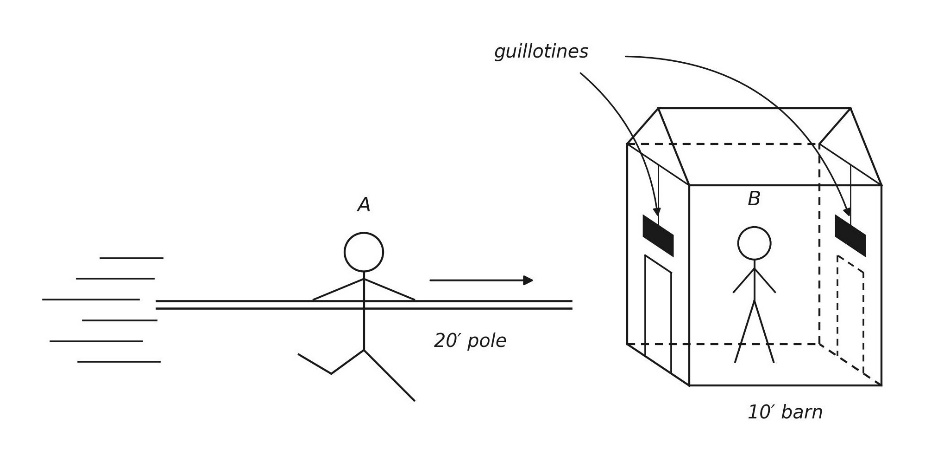
FIGURE 1981 1114 & 21-2. The Pole and the Barn.
FIGURE 1981 1114 & 21-3. Two Inertial Reference Frames Observing an Event.
RETYPED AND REFORMATTED by IT 2026
NOTES:
RETYPED PARTIAL TRANSCRIPT (hence V10). From 1981 1114 and 21 PHY relativity-11R21.PDF. THERE ARE NO AUDIO CASSETTE TAPES EXTANT.
These were Saturday AM classes, part of a series with presentations by VM (Vic Mansfield) on Physics, and part of a series of classes in autumn 1981/early 1982 when Anthony was exploring physics in relation to the astrological cosmos and System of Nature.
Victor Mansfield was a member of Wisdom's Goldenrod, professor of physics and astronomy, Colgate University. See https://www.paulbrunton.org/victormansfield.php.
All spelling, capitalization, and punctuation corrected.
1981 11/14 & 21 at Wisdom's Goldenrod
Physics; Special Relativity
[File 1981 1114 and 21 PHY relativity-11R21.PDF Begins]
Special Relativity -- Saturday, 11/14/81, 11/21/81
Four explanations for the motions of planets were mentioned last week: (1) soul (2) action at a distance (3) fields (4) curved space-time. The historical transition from (1) to (2) and from (2) to (3) was discussed, ending with Maxwell's equations and the fields' emergence as an actual existent or even the primary physical reality. The transition from (3) to (4) is the result of general relativity, which will be next week's topic. Special relativity must be examined first, as a necessary background for understanding general relativity. Mr. Tompkins in Wonderland and The ABC's of Relativity (by Russell) are good sources on this topic, but don't go into the philosophic issues much.
Three questions are hopefully to be clarified: (1) How does relativity show that the observer must, of necessity, be brought into account in all experience? (Quantum theory goes further, casting doubt on the very notion of objectivity independent of a subject.) (2) What is relative and what is fixed? (It's a very common misinterpretation of relativity to think that it says that everything is relative.) (3) Why is the term space-time used, joining the two into one?
The first concept we'll need is that of an inertial reference frame (IRF). A reference frame is a set of Cartesian axes, a standpoint from which measurements (of distance, velocity, etc.) can be made. It consists of three perpendicular lines to organize all measurements of position in three dimensions, and a clock.
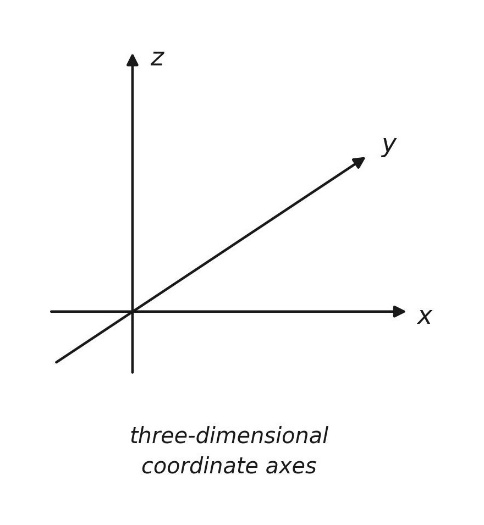
The reference frame represents the observer, and may be stationary or moving in any way. A reference frame is inertial if it is one in which Newton's first law holds: a body at rest remains at rest, and if moving maintains constant velocity (= both speed and direction), unless a force is applied to it. An example of an IRF would be a free-floating space lab (or also a free-falling elevator, in terms of only the objects inside it). In these situations, if I hold an object and then let it go, it just stays there, remaining at rest (with reference to me). If I push it, giving it motion (with reference to me), then it maintains that same speed in that same direction with no change whatsoever (until it collides, or is caught, or otherwise meets with an external force). In other words, an observer standing on the earth is not an IRF, for an object that he lets go drops, and an object he pushes changes both speed and direction (downwards). The force of gravity, acting on a reference frame from outside, makes it non-inertial. If we have one IRF, then any other reference frame that has a constant velocity with respect to it is also inertial. If the second frame is accelerating, with respect to an IRF, then it is not inertial.
All of special relativity follows, using only high school algebra, from only two assertions. The first is that the laws of physics are the same in any IRF. For example, in a smoothly moving train at constant velocity one could walk, drink coffee, or play pool in exactly the same manner as in a house. But if the train speeds up, or goes around a curve (a change of direction means velocity is changed) then this is no longer true, new physical patterns emerge. (Gravity makes the above not really examples of an IRF, but insofar as purely horizontal motions are concerned, the house and steady train are inertial frames.) One consequence of this assertion is that one could never be able to perform an experiment inside any IRF to determine whether it was at rest or moving. Ordinary experience confirms, then, that the laws of physics are the same in any IRF, and this assertion by relativity was no new idea. The second assertion, however, that the speed of light is constant in all IRF's, was the bold and radical step in Einstein's thinking. The Michelson-Morley experiment confirmed this position, but Einstein did not know of that experiment; theoretical considerations (and intuition) were what led him to posit that the speed of light was independent of the velocities of the observer or the source.
The first obvious conclusion from the above is that if two IRF's are moving with respect to each other, the meter stick and clock in one must differ from those in the other, or how could they measure the same speed of light? After all, velocities are normally added: if light moves past one observer, and a second observer moves past the first, say, towards the light source, then he would expect the light to be passing him at a greater speed. Special relativity ends up by showing that mass, length, and time are all three dependent on the observer, on his IRF. For instance, L = L0√(1 − v2/c2), where L0 is the length of an object measured by an observer at rest with respect to it, L is the length of the same object measured from another IRF moving with respect to the object's frame at a velocity v, and c is the constant speed of light. The speed of light is enormous (one light-second, the distance traveled by light in one second, is about 7 times around the earth), so that except for galaxies or atomic particles the velocities we experience are so much less than c that v2/c2 is approximately zero. In the above formula, this makes L approximately equal to L0. In other words, at normal speeds the difference in length measurement is negligible, but as v gets large, as it gets closer to c, the observer is more and more a significant factor. The formulas for mass and time similarly show the measurements differing more as velocity increases. The astonishing fact is that these changes are mutual: if you and I pass each other at a large speed, your meter stick will appear shorter, and your clock will be slowed down, as measured by me --- but from your frame of reference it's my meter stick that shrunk and my clock is slow! Nor are these changes merely subjective illusions; they deal with the actual physical processes in each frame of reference. If one of two twins is sent in a rocket, near the speed of light, and spends 10 years going and 10 coming back (by our clocks), the trip may only take a half-year of his time. Not that it only felt like a half year to him, but he would in fact have only aged that much, and be biologically almost 20 years younger than his twin!
Another result of special relativity is that the time order of two events may also vary with the observer. Two events may be simultaneous in my frame, but an observer moving past me quickly enough will see one event as occurring before the other (or vice-versa, depending on his direction of motion). This can not, however, reverse the causality between two events. That is, if I shout and this causes you to wake up, no observer will be able to see you wake up before my shout. Only events whose time separation is so small that light could not get from the one place to the other in that time, can have their temporal order reversed.
Units of measure are now standardized by basing them on certain invariant atomic phenomena. One such atomic event gives a fixed length which, when multiplied, defines the length of the meter. Another atomic event is used as the basis for defining the second as a unit of time. If, as would seem natural, we used the same atomic event as the basis of both length and time units we would be replacing the meter with the light-second as our unit of distance. These units, while not practical for ordinary use (every ordinary length would be a minuscule fraction of one light-second) are very appropriate in physics. In these units c = 1. Then Einstein's famous E = mc2, another of special relativity's results, becomes even more to the point: E = m. The atomic bomb illustrates how matter can become energy (incidentally, only a minute amount of matter is converted to energy in even the most powerful bombs). Similarly, a photon (zero mass, pure energy, moves at velocity = c) can split into an electron and a positron, each with mass obtained from the conversion of energy.
One striking relativity paradox is the pole and the barn. Person A runs at the barn carrying a 20 ft. pole, going through the open doors of the 10 ft. barn. If he goes fast enough, his 20 ft. pole appears only 5 ft. long to observer B in the barn, and it easily fits in the barn! Observer B can even let a pair of guillotines drop on the doors and "frame" the pole inside the closed barn for that instant. But to observer A it's the barn that's shrunk (to 2½ ft.) and there's no way his 20 ft. pole will fit! The key to the paradox is the lack of simultaneity: the guillotines' fall is simultaneous for B, but not for A, who therefore does not experience the impossibility (in his frame) of the pole fitting in the barn.
If the magnitudes of mass, length, and time (and properties like velocity that are based on these three) measured by the observer are relative, what, in special relativity, is fixed? Built into the very axioms of this theory are two invariants: the speed of light and the laws of physics. The speed of light is constant but the wavelength does vary. If the light source is approaching you, the wavelengths will appear shorter to you (up the spectrum, towards blue, violet, ultraviolet, X-rays). If it's receding, you get longer wavelengths (red, infrared, radio). This is called the Doppler shift, and the amount of shift increases with your velocity relative to the light source. The laws of physics have the same mathematical form in any IRF. For instance, Maxwell's equations remain true, and a revised form of Newton's laws of mechanics also hold in any IRF. A third invariant in special relativity is S, the space-time interval. Observed events have both a space and time position. The space position can be expressed as three coordinates, (x,y,z), where x is the right (or left) distance from the observer, y the forward or backward distance, and z the up or down distance. If the event occurs at time t, it can now be expressed by four coordinates, (t,x,y,z). If two events are (t1,x1,y1,z1) and (t2,x2,y2,z2) then the space-time interval between them is given by S = √(c2(t2−t1)2 − (x2−x1)2 − (y2−y1)2 − (z2−z1)2).
This can be simplified by using the units that give c = 1, and by only considering motion along a line, one-dimensional so we can ignore y and z. Then S = √((t2−t1)2 − (x2−x1)2). What is S? It is not something we can grasp in ordinary experience. We do have some feeling for the time interval between two events; this is t2−t1 (the difference between their times). The space interval, or distance, between two events, x2−x1, is also familiar. We may never have seen them expressed algebraically, but once their algebraic expression is explained it can be seen to specify some aspect of ordinary sense experience. The space-time interval, S, can be seen to be a mathematical combination of space interval and time interval, but it is not something that can be apprehended as directly in sense experience as they are. According to Newtonian physics, given two events both t2−t1 and x2−x1 will be the same for any observers. In relativity this is denied. As seen above, observers with different velocities will get different results for both the time interval and the space interval. But the space-time interval, √((t2−t1)2 − (x2−x1)2), will still be perceived the same by any observer. So, for instance, if one observer perceives a larger time interval between two events, he will also perceive a correspondingly larger distance between them, so that S will come out the same.
Although S may be difficult to grasp in any non-abstract form, it is our first clue as to why physicists speak of "spacetime", one word. S combines into one measure the space and time intervals between two events. Even more illustrative of this combining of space and time are the Lorentz transformations. Let us again, for simplicity, assume motion only along a line, the x-axis. Take two IRF's, moving at a relative velocity v along this line, and let t = 0 be the moment when their origins coincided. Then if one event is observed by both of them it will have coordinates (t,x) in one IRF and (t′, x′) in the other.
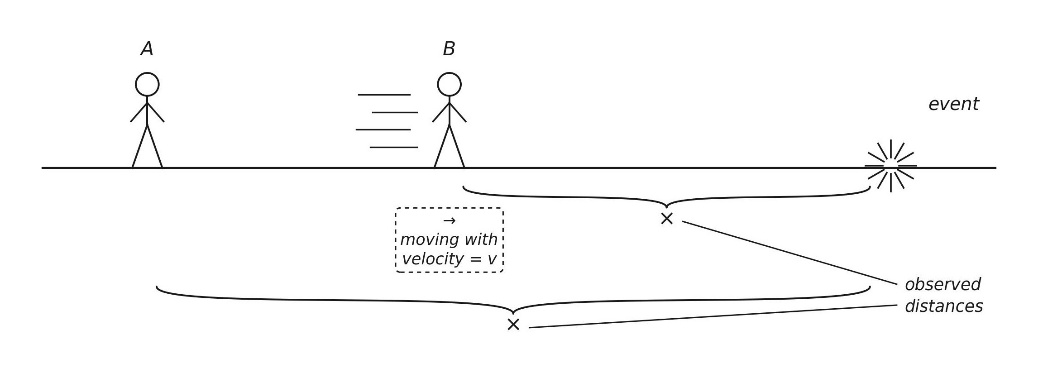
How are these two sets of perceptions related? In Newtonian physics, the equations that relate the reference frames are: t′ = t and x′ = x − vt. That is, the observed time is the same, and the observed distance will vary, the difference being the distance between the observers (see diagram), which is vt, the rate of their relative motion times the time elapsed (rate times time equals distance). In relativity, the equations that transform from one IRF to another are more complex (again, units are used that give c = 1): t′ = (t − vx)/√(1 − v2) and x′ = (x − vt)/√(1 − v2). The equations themselves, and their derivations, are not the issue. The point is that they have a total symmetry of space and time. That is, the time t′ depends on both the time and space, t and x, from the other frame. Similarly, the space measure, x′, also depends on both time and space. Even more remarkable, the two equations are also symmetrical in that if we take either equation and replace every "t" by an "x" and every "x" by a "t" we get the other equation! So, seeing them interrelated on such an equal footing, we get some feeling for why physics treats space-time as one.
Summing up, let's consider the three questions we started with. (1) Mass, length, and time measurements, even perceived simultaneity of events, all vary with the observer's velocity. Therefore no account of the world can properly leave out the observer. (2) Although these quantities, and others based on them (such as velocity, momentum, energy), are all relative, three things are not: the speed of light, the laws of physics, and the space-time interval between two given events. These are invariant in any IRF; with certain qualifications they remain invariant in general relativity, and now for any reference frame, inertial or not. (3) The invariant space-time interval, and the symmetry between space and time in the Lorentz equations, indicate that space and time seem to be two aspects of a whole, closely related. A fourth important point is that relativity does not invalidate Newtonian physics, but includes it as a limiting case and defines its boundaries. That is, at low velocities the equations of relativity are very well approximated by Newtonian equations. (At such low velocities, with relativistic effects negligible, the simpler Newtonian equations are the more practical.) In similar fashion general relativity will include, not cancel, special relativity.
What are the philosophical issues raised by special relativity? It deals with perception, and science has thereby involved itself in epistemology. One cannot speak of any objective quality without reference to an observer --- but this familiar consequence of relativity goes hand in hand with a less-observed significance: what are the implications of the three invariant factors? Relativity is itself relative to the fixity of the laws that produce relative experience. There is an Intelligible World, and an objective ideation of the Sun in Aquarius based on that----these are not relative. This ideation brings forth observers and their perceived worlds within it (the 12th house), and these perceived worlds are relative, both horizontally (different perceptions compared with each other) and vertically (being of a lower kind compared to the Intelligible). The Buddhist view of no inherent existence is definitely denied here. The laws of physics are a reflection of the inherent existence of the Cosmic Soul's objective ideation, even if my personal experience is relative and therefore has no inherent existence. This being, that must appear.
Light plays a special role because it is the power of projecting the Intelligible into the sensible; it is the taijasa consciousness, both cosmically and individually. In general relativity light is used as the ideal clock, to measure time, and as the standard of "straightness" to order space. In short, it is not so much that we measure light as that we measure all else by light. In the dream, the dreamer's mind projects out its contents at the speed of light. Therefore, if one of the dream subjects approached the speed of light, he would approach unmanifestness. The scientists can't let go, can't deal with the unmanifestness. In waking life it is the Sun in Aquarius, containing all the observers, that instantiates the Ideas at the speed of light. The invariance of c is the relative identity of all the individual minds projecting the Intelligible. But is all this a discussion of physical light, or of something more principial --- and what is the relation of physical light to that? Physical light is the very presence of this principial light in the physical world.
What is the space-time interval? Is it the point-instant? Is it analogous to the "space" between two stills on a movie film? The relativity of length, mass, and such, as opposed to the fixity of the laws of physics and the space-time interval, indicate that we should not isolate the object. The real object is not the particular one whose length and such we measure, but is the whole image. The space-time interval is the invariance of the Intelligible object, reflected in our experience. Like the laws of physics it is an image of the reason principles (liberated gods) structuring the projecting power of the Sun in Aquarius.
The concept of an IRF also has philosophic import. Each person is an IRF, his chart being his particular space-time reference. Relativity deals with relating the experiences of one such individual mind to another. The relativity of time order can then be pictured in an interesting way. Transiting Uranus (for example) is an objective event, and consider two people, each of whom will get the transits Uranus on Venus and Uranus on Mercury. But one chart has Venus before Mercury, so he gets Uranus on Venus first. The other has Mercury before Venus, so he experiences the same transits in reverse order.
Is motion totally relative? That is, to return to the example of the person who approaches the speed of light and, therefore, unmanifestness ---- physics would challenge that statement. It would say that, all motion being relative, you can't say "so-and-so is going near the speed of light", the statement is meaningless. If others see him as moving at such a speed, he sees them as moving at that speed. So who then becomes unmanifest --- he or they? Again, if we are on earth then we automatically identify ourselves with the surroundings as a fixed reference. So if I am moving with respect to another person, I use the earth as a basis for saying who is moving (and how fast) and who is at rest. But if we are out in space moving with respect to each other, then there is no objective frame to refer to. Assume a complete void, no stars to gauge one's motions by, no environment to serve as a reference, only empty space. One will then naturally perceive oneself at rest, and perceive the other observer as moving. In fact, the whole concept of a reference frame is based on the assertion that every observer perceives himself at rest, and all else as moving or still with respect to himself. That is why, from earth, it is natural to think of the sun as moving around earth, and earth at rest. One must imagine oneself identified with the sun as a reference frame to picture the earth as rotating and as revolving about the sun. (Even then, we still see the sun as moving and earth at rest, because of the body's identification with the earth.) To say that I am "really" at rest, then, because I am sitting here and not moving with respect to my earth environment, is to absolutize what is only one frame of reference, whether it be myself or the earth; from another point of view I am at this moment, along with the earth, hurtling through space at enormous speed. These, then, are the arguments of physics to support the total relativity of motion. In fact, this is Newtonian relativity. Newton put forth such views (at the heart of his laws of motion) and Einstein merely inherited them and went on from there. But if this is orthodox physics, and has been for 300 years --- does that make it true? To argue for the complete relativity of motion is to say that rest is motion now! If A says he's at rest and B is moving while B says he's at rest and A is moving, and if physics says that both views are equally valid, as well as many more (as many as there are observers) --- then they've made an equation between rest and motion. In the above argument for relativity of motion, physics takes the standpoint of the void, of empty space. Is this valid? Doesn't one always have to operate within a context -- the tropical zodiac of Earth consciousness, for instance, or the sidereal zodiac for the sun -- and doesn't this context provide a reference within which motion and rest are distinct? Can one really take the standpoint of a blank void? Haven't Maxwell's equations qualified even "empty" space with field energies, so that if one is really moving, the change in this background pattern (the immediate environment of the observer) would show this? Consider again the two observers in space, A and B, each perceiving himself at rest and the other as moving. Physics, insisting that neither view has any greater validity, argues that any attempt to say which observer is really moving is to bring in some absolute point of view. But this is what physics itself is doing! That is, consciousness is at rest with respect to itself. If you're established in your own mind, you'll never know anything outside of it (just as, in an IRF, there's no way to deduce whether you're moving or at rest). So physics is transposing two infinite consciousnesses, it is taking the standpoint of the Void Intellect. Insofar as every (actual or potential) observer's perceptual point of view is given equal and simultaneous validity, an absolute point of view is being taken.
[File 1981 1114 and 21 PHY relativity-11R21.PDF Ends]
1981 11/14 & 21 V10: CLASSES: Physics; Special Relativity. Copyright 2026 Wisdom's Goldenrod p. iii