Class
Sunday, December 13th, 1981
Edited transcriptCLASS at Wisdom's Goldenrod, Hector, NY
with Anthony Damiani (AD)
December 13, 1981
BUDDHISM; EPISTEMOLOGY
TOPIC: Buddhism
SUBJECT: Epistemology
SUBSUBJECTS: Sautrantika, Yogacara, Vaibhashika, Madhyamika, Pure Perception/Pure Sensation, Productive Imagination/Generic Mentality, Tropical Zodiac/Sidereal Zodiac, Nidana Chain
CONTENTS:
Introduction
Buddhist systems go exclusively into the twelfth house
Reason-principles with the medium of the Sun producing the twelfth house system; the cosmocrators as agent and vehicles
Vedanta and Madhyamika: Atman in the Nous; the psyche as medium revealing knowledge to the Purusha
Sautrantika
Stcherbatsky (Buddhist Logic): the split between pure sensation and generic mentality (productive imagination)
Tropical zodiac as generic mentality; pure sensation and point-instants as reason-principles
Fixed stars (reason-principles) as pure perception of the Earth
Pure perception: particular, unique, the Thing-in-Itself
Chatterjee (Yogacara Idealism): the radical subject–object split; the psyche's contribution to knowledge
Two views of first contact: objectively given (sidereal forces) vs. in terms of imagery
Vaibhashika
Generic mentality left out; images (emotional afflictions) taken as real within the lunar belt
Yogacara
Chatterjee on the absoluteness of consciousness; the ground as unreal
The eight types of consciousness: alaya-vijnana and mano-vijnana (not objective); manas + 5 senses (objective)
Seeds of the alaya ("seedreal zodiac") differentiated by the mano-vijnana/planetary spheres
Moon in Capricorn as memory of the subjective soul; Sun in Aquarius as the reason-principles; assimilation by the tropical zodiac in the twelfth house
Productive imagination "constructing" an image: knowledge of how to do it
Problem of the images and the parts — tone A and 440 cycles per second inseparable
Nidana chain as the individual's reaction to the tropical zodiac; the three schools located on the chain
Madhyamika
"How do I see a tree?" — negation, the factors of perception, Prasangika as the peak
Discussion: everything in the twelfth house as relation; knowledge, imputation, and its base
Emptiness as an object of cognition; the tree's thingness unfindable, its whatness findable
BOOKS READ FROM OR REFERENCED:
F. Th. Stcherbatsky, Buddhist Logic, Vol. 1
A. K. Chatterjee, The Yogacara Idealism
H. V. Guenther, Buddhist Philosophy in Theory and Practice
Jeffrey Hopkins, Meditation on Emptiness, "The Buddhist World"
DIAGRAM embedded in this transcript:
- FIGURE 1981 1213-1. Unembodied Soul, Sun in Aquarius, and Three Levels of the Cosmos.
RETYPED AND REFORMATTED by IT 2026
NOTES:
RETYPED PARTIAL TRANSCRIPT (hence V10). From 1981 1213-05R16.PDF. THERE ARE NO AUDIO CASSETTE TAPES EXTANT.
This event is among those in later 1981/early 1982 when Anthony was exploring Astrology/the Zodiacs, Cosmology, Physics, Astronomy, Soul, Nature, and The Grid: Gnostic and Fabricative.
All spelling and punctuation corrected, all abbreviations and astrological glyphs spelled out.
1981 12/13 at Wisdom's Goldenrod
Buddhism; Epistemology
[File 1981 1213-05R16.PDF Begins]
SUNDAY, DECEMBER 13, 1981
BUDDHIST EPISTEMOLOGY
Introduction
The Buddhist systems, with a few exceptions, go exclusively into the 12th House.
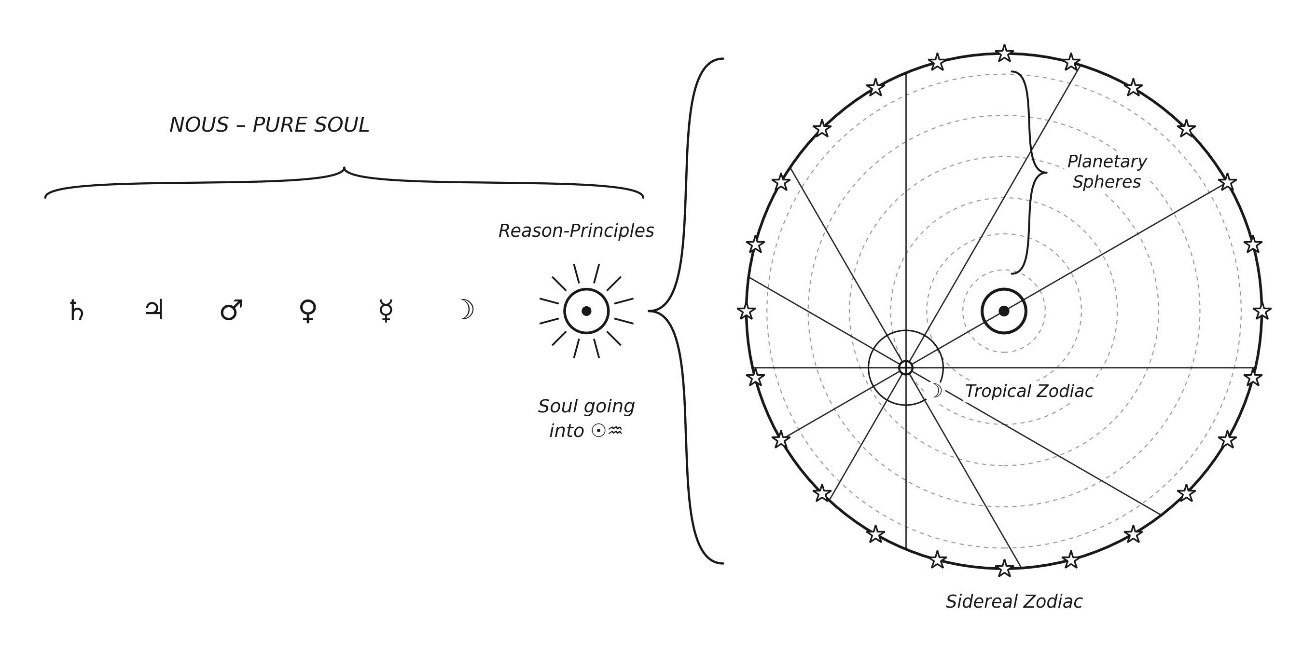
The Reason Principles combined with the medium of the Sun produce the whole 12th house system. The cosmocrators are both the agent (as fabricator of bodies) and the vehicles (for the higher Soul Powers).
In Vedanta and Madhyamika the Atman or Subject Wisdom Consciousness is in the Nous, but in terms of empirical knowledge they are bifurcated because of the identification with the vehicle. Therefore what is needed is a medium, the psyche through which the knowledge can be revealed to the Purusha or Soul.
* Sautrantika
According to Stcherbatsky (Buddhist Logic I, p. 147) the Buddhists split pure sensation and the generic mentality or the productive imagination. The tropical zodiac is equivalent to the generic mentality. The individual psyche is within that Earth psyche.
Pure sensation as defined by Stcherbatsky, and also point-instants as the differential of a planet's movement, are Reason Principles. Pure sensation is prior to the productive imagination.
The fixed stars Reason Principles, mediated by the planets, are the pure perception of the Earth. (And since the individual is part of the Earth, these are pure perceptions for him too). The "object in the ken", that first moment of perception, is the pure perception, in which the sidereal forces are impinging on the object.
Pure perception is -- Particular
-- Unique
-- The Thing-in-Itself.
Productive imagination or the generic mentality is the tropical zodiac.
We read from Chatterjee's Yogacara Idealism, pp. 5-8, on Sautrantika.
In Sautrantika there's a radical distinction, a real split between the subject and the object, though as in mentalism, the subject contributes to the knowledge.
What is the first contact that is called perception? According to the Logicians, there are 2 possibilities:
a) the given is objectively given (i.e., from the sidereal forces),
b) it is in terms of the imagery.
There is a shift in emphasis among the Sautrantikas between a) talking of the objective forces, and b) talking of the Reason Principles. The one view is the point-instant impinging on the psyche. The more idealistic Sautrantikas end up more like the Yogacarins. The first moment of perception is an intelligible perception, from the Soul. This way the Reason Principles are carried by the medium, and the body is not so important.
* Vaibhashika
The Vaibhashika view leaves out the generic mentality altogether, the reaction of the individual to its environment. The individual psyche is in terms of the images (emotional afflictions) which are taken as real. The psyche's reaction to its environment is taken as real within the lunar belt. (In contrast the Sautrantika accepts the validity of the 'X', the cosmocrators, the sidereal forces, and the generic mentality.)
* Yogacara
Chatterjee in Yogacara Idealism takes the view of the absoluteness of consciousness. If we admit that all that can be known is the generic mentality, this objective constituent is in a unique place, for the original pure perception is the pure perception of consciousness.
According to Chatterjee, with the Sautrantika, the subjective Soul is taken into account, and the empirical subject is unreal insofar as it is imaged. The Sautrantika is dealing with the split between the objective (cosmos) and the psyche. They admit the contribution of the psyche to knowledge.
In contrast, what is unreal for the Yogacara is the ground. Therefore one has to account for an object appearing as other than the subject. Everything that appears within experience is an appearance of a form of consciousness--it is objective or illusory. They have to explain the appearance of an object through seeds and the system of vijnanas.
The Yogacaras have 8 types of consciousness:
Alaya-Vijnana — (not objective)
Mano-Vijnana (active principle) — (not objective)
split ----------------------
Manas + 5 senses — (objective)
They can't understand the 'X' in itself, so it must be assimilated to consciousness.
The seeds of the Alaya ("seedreal zodiac") are differentiated by the mano-vijnana, i.e., the planetary spheres, which transmit them to the Earth object.
So the functioning (of the planetary spheres) produces both the empirical subject and the empirical object within the Earth. The traces of the functioning is retained within the scheme of the imagination.
Since there are different schools of Yogacara, Chatterjee takes the view that the Alaya is in the pure Soul. Perhaps the Yogacara-Madhyamika is involved in the Soul side of the diagram: the Moon in Capricorn is the memory of the subjective Soul, its images; in the Sun in Aquarius are the Reason Principles, differentiated by the mano-vijnana; then in the 12th House the Reason Principles are assimilated by the tropical zodiac.
Buddhist Logic, p. 149. What is meant when the Logicians say the productive imagination "constructs" an image? "Constructs" implies knowledge of how to do it. In astrology "constructing an image" or productive imagination means when a planet is on a part, the images suddenly become meaningful.
The Yogacarins say both the subject and the object (Thing-in-Itself) are a split off from the true subject. Here again is the problem of the images and the parts. When the images arise, the 440 cycles per second and the Tone A cannot be separated, to use that example.
The individual's reaction to the tropical zodiac is the level where the Nidana Chain arises. It is the way the individual is going to react to that animal tropism, the reaction of the individual psyche to the Earth psyche.
Gabriel suggested "contact" in the Nidana Chain is the principle of the Sautrantika system. The Yogacaras are further up in the Nidana Chain, the Vaibhashikas further down, after the feeling reaction.
* Madhyamika
H. V. Guenther, Buddhist Philosophy in Theory and Practice
Hopkins, "The Buddhist World" in Meditation on Emptiness.
"How do I see a tree?" Is the Madhyamikas' epistemology a denial or negation of epistemology?
Gabriel suggests only from the point of view of analysis is there emphasis placed on negation. He suggests the Madhyamikas would claim there's a subtle element in the eye organ called sight, and there's also consciousness. When the subtle element, the consciousness and the object come in contact there's an epistemology. The Madhyamikas enumerate all their factors and put them together to get an epistemology.
Guenther, p. 141 on Prasangika. In the next chapter Guenther goes right into ontology, into the presentation. P. 150. "The peak of epistemological courses is the Prasangikas..."
Gabriel: According to the Madhyamikas, everything in the 12th House is relation, is nothing in itself except as intelligible to the pure Soul.
Anthony: In the 12th House, given that conditions in the 12th House arise, there is the possibility of knowledge. There is the extrapolation of a meaning in the Nous. There is an individuality of the knowledge, empirically and in the Nous.
Gabriel: The non-analytic intellect's perception always conforms to the 12th House.
Michael W.: Their logic addresses the problems of the conditions of knowledge and the arisal of knowledge as the base (condition of knowledge) and the imputation on that base (knowledge).
Not "self-existent" means it exists through imputation by thought so imputation by thought means an immaterial knowledge in its concreteness. "Emptiness" is a type of entity included in this. That emptiness itself can be spoken of as an object of cognition.
The tree is an instantiation of emptiness. Its thingness cannot be found; its whatness can be found.
[File 1981 1213-05R16.PDF Ends]
1981 12/13 V10: CLASS: Buddhism; Epistemology. Copyright 2026 Wisdom's Goldenrod p. iii