DIAGRAMS AND CHART FOR 1981 1218
Class
Friday, December 18th, 1981
Verbatim, unedited transcriptClick the series name to view more
CLASS at Wisdom's Goldenrod, Hector NY
with Anthony Damiani (AD)
December 18, 1981
ASTROLOGY; THEORY
TOPIC: Astrology
SUBJECT: Theory
SUBSUBJECTS: 360 Degrees, Gnostic and Fabricative, Earth Soul, Aspects, Arabic Parts, Part of Fortune, Ascendant
CONTENTS:
Part One
AD's review of diagram(s)
1) Separative Intellect combines the twelve reason-principles to fabricate the bodies of the Gods (planetary spheres)
2) Degrees of the zodiac outermost; planets combine the degrees to produce entities on Earth; the individual chart as a participation in the Earth's chart
3) Four dignities as the four gnostic functions
4) First breath stamping the physiology with the energy-quality of the moment
How does the subjective soul enter via the house system? — not yet worked out; aspects, not just positions, portray the embodied soul
Two operations distinguished: fabricative (physiology, body of the Gods) vs. gnostic (knowing, tied to the Liberated Order)
The Gods fabricate only the physical body; the subtle body brings in the gnostic functions
Direct insight into reason-principles vs. reflective awareness in semantic garb; Archimedes example
Earth's chart = the current transits; alignment with one's chart in moments of true knowledge; one's chart as a combination of the Earth's tropisms/memory
360 degrees as a sensible representation of the Nous; Idea of Man equivalent to 360 degrees
Planets as individuals in their own right vs. the system as one World-Soul (the Egyptians' two sets of names); human knowledge limited to the Earth's sphere, the Sage's access beyond it
The twelve reason-principles of Nature plus the bhavas of buddhi combine to produce the laws of physics; Nature as the last of the Intelligibles (III.8)
Was Archimedes' insight into the eleventh-house reason-principles or the 360 degrees?
AD via the divided line: dianoia grasps reason-principles in combination; stay within the twelfth house — the eleventh is unfathomable (seven levels of existence)
If intuition contacts the Nous itself, how could it not know what is prior to the 360's sensible representation?
Every twelfth-house entity triune (elements, soul, intellect); stars as embodied Intellect; the Sage's silent communication
Nous present here and now; reading from Deck (p. 111): Plotinus has only one world, right here
Twelfth house as a special and unique version of the other Ideas
Cognitive-isness universally pervasive but operating only through vehicles; inquiry into the "who" needs no vehicle — there is no 'where' for cognitive-isness
Why isn't the Earth one of the planetary spheres?; the Moon is the Earth among the soul powers — the Moon as the Earth's aura/limit
Moon as brain consciousness/lower thinking; occult link of the Moon to the construction of physiology
"Earth" generically = the elements (Gaia as oldest of the Gods); "sublunary body" = a body of the five elements, on any planet
A native of Mars/Venus has its own "earth"/bhuta vehicle of that planet's substance; Earth as a transiting planet in their chart; "Martian astrology" banter
Digression on the order of knowledge: quantum → Newtonian as the logical order, reversed historically; the spirit of each age limiting knowledge; the seven Rishis/Pleiades
SC's question: geocentric aspects vs. the cosmic soul's view
AS's blackboard demo: aspects are viewpoint-dependent, with shifting star backgrounds
The Reason-Principle of the Universe as heterogeneous, containing all possible relations; transcending the Earth-view means contacting the degrees with no aspects at all
The reason-principle comes through the aspect, present only when that planetary combination occurs; all possibilities eternally present "in a greater mind" — the Nous as unity (circle) vs. heterogeneity (360 degrees)
DB's question: the fixity of the natal horoscope
Analogy: an overwhelming first hearing of a piece of music structures every later hearing
The first breath: the soul sucks in the atmosphere, whose energy-quality (charged by the planetary configuration) is stamped into the physiology; Mars-into-Capricorn example
Part Two — The Arabic Parts
AD's opening thesis: the parts, when hit by a transiting planet, release a certainty or piece of knowledge — is this the Nous operating within us?
VM: parts relate aspects to the ascendant — tying the subjective soul (house structure) to the twelfth-house environment
What does 'part' mean?; AD's refusal of the merely mechanical; asking "what is a part" turns out to require asking "what is the ascendant"
The formula (ascendant-to-part distance = planet-to-planet distance), direct and indirect parts, and the geometric ray-picture for reading off all parts
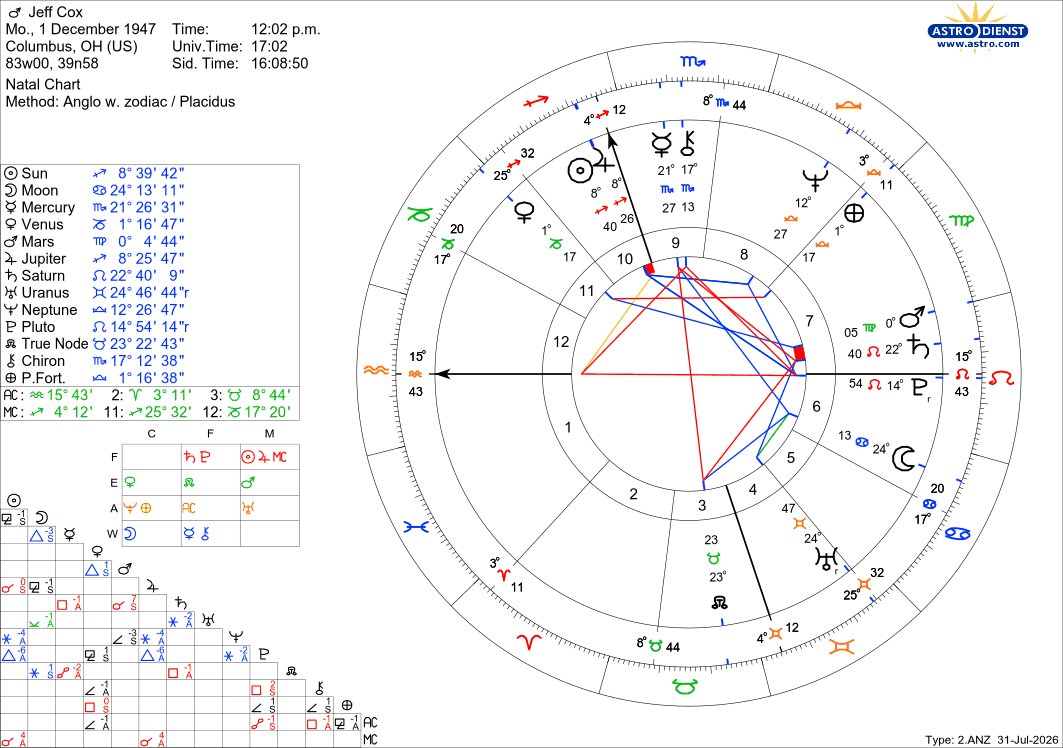
Jeff Cox example: Uranus transiting his Part of Fortune (2° Libra, 7th house) — the sudden decision to leave college for Europe — a break in continuity, new knowledge emerging
Pluto later on the same part: he moves to the Center; Uranus manifests in thought, Pluto puts the body where it counts
Part of Fortune = the purpose of your incarnation; North Node distinguished — coordination of Intelligibles with Ideas, how the soul unfolds, not its particular meaning
AS's blackboard-as-Nous imagery: a part as an unmanifest reason-principle, activated only when aspected
RG's debate: part quality vs. planet quality
A part requires a string of aspects to bring its peculiar destiny into manifestation
If ascendant : part :: planet 1 : planet 2, what does the ascendant mean — projection point or intake?
AD: best so far — the time factor of the soul's incarnation, the rest undecided
Every life guided by forces operating unawares; chart as indication of guidance through the parts
The problem of meaning in modern philosophy
BOOKS READ FROM OR REFERENCED:
Plotinus, The Enneads (MacKenna translation, 4th ed.)
Plato, Republic
John N. Deck, Nature, Contemplation, and the One: A Study in the Philosophy of Plotinus
Bertrand Russell, Human Knowledge: Its Scope and Limits
Marc Edmund Jones, The Astrology of Concepts
Marc Edmund Jones, The Sabian Symbols in Astrology
PLOTINUS QUOTES READ OR REFERENCED: I.1.7, III.2.16, III.4.6, III.8
SABIAN SYMBOLS: Gemini 25, Libra 2
DIAGRAMS and CHART appended to this transcript:
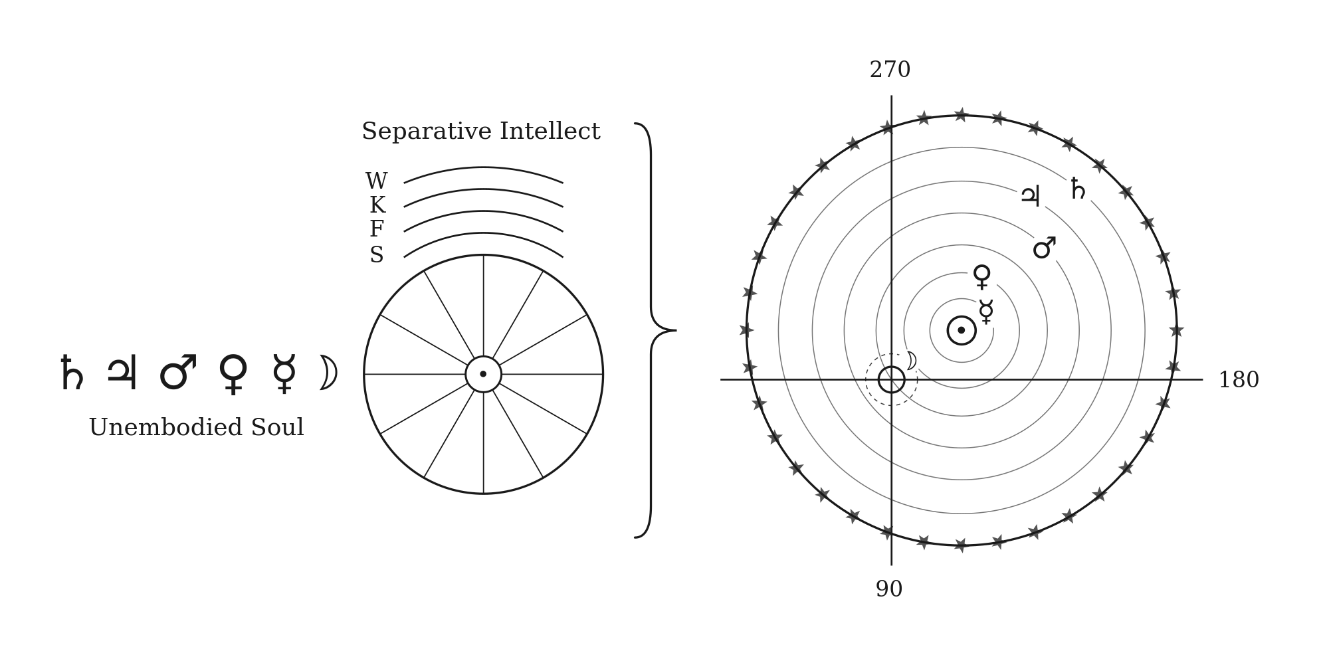
FIGURE 1981 1218-1. Unembodied Soul, Sun in Aquarius with Separative Intellect, and Three Levels of the Cosmos.
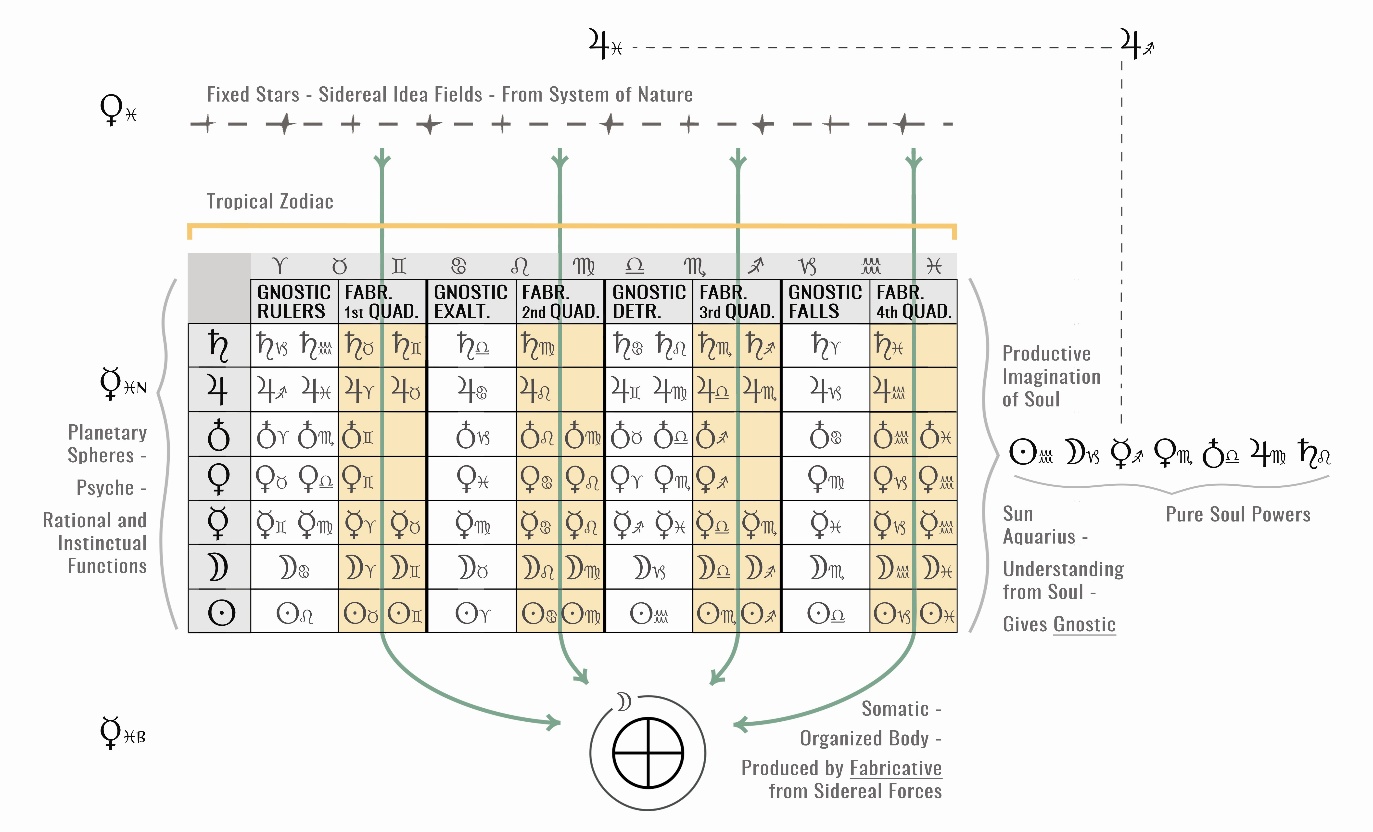
FIGURE Gnostic-Fabricative-1. "The Grid" – Gnostic and Fabricative.
FIGURE 1981 1218-3. Jeff Cox Natal Chart.
Other diagrams also referred to (not with this transcript version) [Transcriber note: [diagram] means the speaker is referencing a diagram as he or she is speaking. If someone is drawing or writing, with audible sounds of chalk on a blackboard, I indicate this by [drawing] or [writing].]
NOTES:
- For more on Arabic Parts, see WG Seminars 1981 1129 & 30, 1981 1214 to 30, 1981 1220 & 21, 1982 0107 & 08 and WG Classes 1981 0711, 1982 0102, and 1982 0109. See also Appendix to 1981 1214 to 30 for an introduction to the Parts.
TRANSCRIBED Verbatim by IT 2026. Archival verbatim transcript – V11a.
AUDIO FILES: 1981 1218a, 1981 1218b. [Note: "Tape" and "Side" refer to original audio cassette tapes that were later digitized into .MP3 Audio Files.]
1981 12/18 at Wisdom's Goldenrod
Astrology; Theory
[Audio File 1981 1218a Begins]
[few seconds of background student talking, noises]
VM: --any idea what to expect, except trouble.
S (faint): Um, what's the topic?
AD: Well, since we're going to be off for a couple weeks, right--
VM: We are.
AD: Yeah, closed next week.
VM: What does that mean, closed? Can you-- [few inaudible student words simultaneous with VM] No soup.
AD: No soup.
VM: Oh, oh. (AD laughs)
AD: And, Avery's very tired. [short pause] So we-- I thought tonight would be special. I'll let you people ask the questions. [S: Ok.] I'll just review quickly, ok?
VM: Yeah, go ahead.
S (faint): Oh no.
VM: (I'd assume we'd) hear that.
S (faint): (Ask him) questions [couple words inaudible]
AD: I won't review from the beginning, just from-- [17¾ pause while drawing] Now if you're bashful and you don't want to ask questions you could write them and hand it down. (laughter) (No one respond.) (RG laughs)
[short pause with faint background student talking]
VM: In fact maybe you should only accept written questions.
[short pause while AD draws]
AD: See Avery had a pad of examinations xeroxed and everything and he was going to give them out as you people came in but I told him yous wouldn't stand for it. (AD laughs)
S: Right, that's--
S: Oh that might be fun, we can't be giving [couple words inaudible]
S (simultaneously): You mind corrections?
S: Right.
AS: You could put them in the back of Linda's paper.
S (faint): Go ahead.
S (faint): [few words inaudible]
VM (faint): Right.
AS: It's in-- it's in the back of Linda's paper.
S (simultaneously): You seem to be resourceful.
S: Oh, it's in Linda's paper.
[short pause while AD draws]
AS: [one/two words inaudible] paper though. That's what he was (train--) in the three off weeks everybody's got to write a (term) [one/two words inaudible] paper.
S: It might be (lost). (bit of laughter)
AS: Actually--
RC: Not a great idea.
S (faint): It's not.
BB: Anthony, before you get started can I make an announcement? Deb and I would like to invite everybody to our place New Year's Eve and, maybe we can start any time after 8:30. And there'll be a sign-up list for goodies on the board and also a map on how to get to our place if you don't know how to get there. So, (anyway).
S (very faint): (Thanks Bob.)
S (very faint): (Thanks Bob.)
S: Thank you Bob.
S: Thank you.
VM: Is this for a party?
AS: [couple words inaudible] (laughter)
S: Not a seminar Vic, it's just--
S: No one's laughing. (student laughs)
S: It's not funny. (laughter)
VM(?) (faint): What can you [couple words inaudible]
S: We miss those.
AD: Vic, try not to get a ticket. (bit of laughter) At that-- at Lodi they bought a car which has a radar equipment, they paid, I don't know, [couple inaudible student words simultaneous with AD] fifteen thousand dollars for it so, you go through there they're-- they're trying to pay it off, they got payments to make. (laughter)
S: [few words inaudible]
S: Look at your aspects tomorrow so that you can [few words inaudible]
S: That's just parts of Lodi (either), this--
S (simultaneously): He got a ticket.
S: That's right.
S: Oh no.
S: So it's (hard)?
[background student talking followed by pause, 10 seconds]
[Note: See FIGURE 1981 1218-1 for the following.]
AD: I think what we did, [drawing] something like this, we said these are the reason-principles here [circle with twelve divisions]. [short pause while drawing] And, the bhadas-- bhuvas-- the--
VM (laughing): That's ok.
S: As long as you bought it.
VM: That's apparently subjective functioning. (bit of laughter)
AD: I can't speak English, I try Sanskrit. (AD laughing)
VM: Buddhis of bhava.
S: Intuition.
VM (faint, laughing): I-- I can't (stay/say it) anyway either.
[AD drawing]
AD: Alright, we said something like this, that the Separative Intellect combined the reason-principles to produce the bodies of the Gods. And, we have to keep in mind, I think the important thing that-- I think it's important but we're not sure, but, you have to keep in mind that these planets here [planetary spheres], the body of the Gods, which was fabricated by a combination of the Separative Intellect and the reason-principles, also represented simultaneously like the natal chart. The position of a planet-- First let me remind you that the-- the powers of the soul embodied, there the powers of the soul are embodied [planetary spheres]. [drawing] Over here they were unembodied [unembodied soul]. [short pause while drawing] Over here they-- the powers of the soul were unembodied, over here the powers of the soul are embodied. And what we said that-- was that the indications seem to be that the natal chart was an expression of the-- should say the maturity or immaturity that the individual soul was operating with, and that those were the powers of the soul.
If we do this here, if they-- [drawing] then 90, [one/two words inaudible] 270. If we say that the degrees of the zodiac on that side, this is-- there's two alternatives, I'm going to use one, it doesn't matter, (but anyway). Degrees of the zodiac are outside [outermost circle on right]. The planets combine these degrees and produce the entity here [on Earth]. Insofar that they produce (men) there or they are also the-- they also represent the functions or let's say the knowing that's taking place. In other words, [drawing] insofar that we think of this as the Earth's chart, our chart would be a participation in that. (What you need?) You could join. (bit of laughter) I don't mean morally, I mean vocally. Well what else can we say about it? You're going to ask questions? Maybe you might want to know what some of the things we said about it. Oh, the important thing is to remember that these here represented the four gnostics-- the four gnostic functions [FIGURE Gnostic-Fabricative-1, Nature Mercury level].
VM: Which represented, Anthony?
AD: The planets.
S (faint): Oh.
AD: In other words, if Saturn's in rulership, it's intuitive, alright, if it's in exaltation it's the intellect, if it's in [S: Oh.] its detriment it's--
VM: The gnostic and fabricative.
AD: Yeah.
VM: Yes.
AD: And that would apply to each planet. So you take Jupiter in rulership, Sagittarius and Pisces, that will be the intuitive Jupiter, ok, and going down the same way with each planet, alright. So that the Earth would be participating in the understanding or the knowledge that is being, let's say, distributed and is--
[short pause]
S: Can I have those keywords again?
AD: I don't have any keywords.
S: Just the words you gave are like keywords to me. If I could just have them again I'd appreciate it.
AD: Well, I don't know what you mean, (Vicky).
VM: Rulerships are intuitive.
S (simultaneously): Well, rulerships--
AD: Oh yeah. If you [drawing/writing] take the rulership of the planets, ok, exaltations, detriments, and falls, this would be equivalent to like the four gnostic functions that we speak about, whether in Platonism or elsewhere. This would be equivalent to sense [fall], sensing, this to belief [detriment], this to knowing [exaltation], and this to intuition [rulership]. I should have-- Knowing here I-- I guess we could say thinking or reason.
VM: Dianoia.
AD: Dianoia, ok. [writing] And you could do that with any of the planets, they-- they have that fourfold division, including the Sun and the Moon. So, even though you see only seven planets here, you can see that each one of them could be in any one-- you know, could operate with any one of those functions. So if Saturn's in Libra now, let's say there's a square between Saturn and Jupiter and that's the Earth's chart. You hook into that chart. You participate in the knowledge of-- of that. If you're born and Saturn let's say-- let's say you have a square going on or some sort of aspect, it would be an indication-- well, square, would be an indication for instance of a certain fixity or congealing, a past way of the soul's operating became fixed and congealed and has to be worked out. So, when-- when the soul comes into incarnation or let's say gets embodied, at the moment-- I think what we said was something like this, at the very moment when you suck in that first breath of air, the peculiar quality of the energy that pervades the world at that time stamps your physiological organism with that quality of the energy of that time and that is (a) relatively fixed personality structure that you'll operate with.
S: Anthony?
VM: Anthony, at one time, back in the-- I don't know, doesn't matter--
AD: Doesn't matter.
VM: --the historical past, it used to be that the subjective soul was seen to enter into the, say the natal chart through the house system. You know, that was one way we used to try and visualize how it is that the subjective soul actually, let's say, is, I don't know, invested in the-- in the body. Is there any way of kind of embodying that idea in this? There doesn't seem to be any peculiarity of the individual in here, you have the Earth's chart and the soul-- and the individual soul partake of that, yet not all persons born at the same time on Earth have the same chart because the house system is really different.
AD (simultaneously): Yeah, it's altered.
VM: But what-- maybe that's asking too much of one diagram (but--)
AD (simultaneously): I-- I can't-- we haven't been able to work that out. I-- I know what you're driving at. But, I think it's also not only a question of house structure, I think what's also very important is that a person who let's say has a Saturn Jupiter square, alright, this indicates something about his soul. I mean, you're actually talking about the soul of this person. But not the soul as unembodied but the soul as embodied, that Saturn Jupiter square represents that soul as embodied. And-- well, let's say he's the eternal discontent, you know? He always is discontented, always goes on all the time. Alright. That's-- that Saturn square Jupiter is an indication of that. That's the way his soul has been functioning. And it's in-- it's being indicated by those aspects. So it's not only a question of position of planets but the aspects, all that is I think pretty important. So if we put the degrees here, let's say we put the degrees here [outermost circle on right]. Now, there's two ways of doing this. We put the fire, earth, air, and water here [Earth] and the degrees here and the planets are in between, ok, circling around, one of the ways we can look at it is we say that these aspects that they're making, this degree with this planet, this degree with this planet, alright, is combined-- is combining, let's say, the fire and earth or the elements down here, you know, to bring about the physiology of the person. I know the house structure is going to come up sooner or later but we still haven't worked it out. Go ahead.
S (simultaneously): But wait, let me ask you.
VM: You know, you speak about the planets and the planetary sphere here as both being the body of the Gods, let's say, as well as the-- the agent of the soul or the embodiment of the soul. And, does that correlate with-- let's say the rulerships might be more predominantly an expression of the subject-- not rulerships but let's say the-- what's the word, the four dignities would be more an expression of the embodiment of the soul and the non-dignities would be more an expression of the body of the Gods or don't you want to make that distinction? That may not be legitimate now.
AD (simultaneously): No I-- I still-- there's still a lot of room for conflict there. I would be inclined to say that [VM: I mean if it's (not--)] the fabricative aspect of the planets do have something to do with the physiology of the person. And, that seems to be tied in with the body of the Gods. Whereas when we speak about the gnostic aspects, like the Saturn in Aqua-- Aquarius, alright, that seems to be concerned with the Liberated Order more than with the fabricative or-- It seems that we have two levels there operational. On the one hand, fabricates the bodies, and on the other hand the knowing that's concomitant with that fabrication. The knowing seems to be coming from here but this is conjecture, knowing seems to be coming from here, Liberated Order [circle with twelve divisions]. [short pause] Go ahead, Louis.
LDS: Last night I think it was brought up and I didn't really catch the point about what-- the Gods are fabricating the body, all the bodies let's say of this realm, whether it be of human, whatever. But what-- let's say for humans, what would be the limit of bodies for that-- for those Gods' fabrication, I mean what-- what level of body would that-- would that fabrication extend to for humans? We speak of the subtle body, the causal body, Augoeides.
AD: Well I think we're speaking about-- we're speaking about the physical body, so-called physiology, the physiology. If-- I think if we bring in the subtle body, then we're going to be bringing in the gnostic functions.
LDS: Well could you elaborate why?
AD: No. (bit of laughter) You know, the-- the suggestion was made, suggestion was made that we have an open questions, you know, ask any questions you want. But there was only one catch with that. We don't know anyone-- we were thinking of Richard but, we don't know anyone [VM simultaneously: Who could answer the questions.] who could answer all those questions.
S (bit of laughter): No. (bit of laughter)
S: What? (laughter)
AD: No I-- you have to remember, it's-- it hasn't been worked out, I mean there's so many odds and ends left open yet. And ver-- very often we think we worked something out, alright, and leave it go, we go on to the next thing and then we find out what we worked out was wrong. We gotta forget about it [couple words inaudible] and start all over again.
LDS: Ok let me ask you this then. What-- when Plotinus in I.1.7 speaks of the animate--
AD: I want to avoid epistemology. (laughter)
AS (amidst laughter): Next question. Any more questions?
S: Right, but--
VM: I thought that was the main thrust-- one of the main thrusts of this [one word inaudible]
AD (simultaneously): I know but, what happened last-- last night, what happened last night is after we went through a half a dozen quotations on epistemology, [Note: See WG Seminar 1981 1217.] I want to do the same thing that we did with the One and the Many to show how given a-- a certain premise how you draw-- you know, you follow quotation upon a quotation and elicit the meaning and the premises all the way. [student assents, faint] I thought I'd like to do that, and that's why I needed more time to do that, to work out those passages so that--
VM (simultaneously): Oh you mean pick a related set of quotes.
AD: Huh?
VM: Related set of quotes, is that what you mean?
AD (simultaneously): Yeah, yeah, have a series of quotes, you know, that show and lay out his epistemology. And, it's going to take a little time. So that's why I asked you to back away from that for now. I think I know his epistemology but it's another thing to correlate the quotes with-- with that. And then when I do I may find-- I may find out that I don't know his epistemology.
LDS: Well I don't think my question was going to be really explicitly epistemological.
AD: Ok. Alright.
LDS (simultaneously): I just wondered if what you meant by this body that the Gods fabricate, this physiological body, would be equivalent necessarily to what Plotinus speaks of as that body that the animate is compounded of.
AD: Yeah. Yeah--
LDS (simultaneously): And it wouldn't extend beyond physiology.
[Note: See FIGURE Gnostic-Fabricative-1 for the following paragraph and then also FIGURE 1981 1218-1 for what follows after.]
AD (simultaneously): If we say, if we say that this represented the light which is imparted [drawing] by the individual soul [diagram], alright, it-- it must make contact over here [Nature Mercury level], I mean, this is the realm-- it's in the psychic realm, alright, that the soul could tie in or get injected into a body, not down-- not down here as a body but in here [diagram]. [VM assents, faint] If that's true, if that's true, then the mental body of the individual will be equivalent to this whole sphere [Nature Mercury level]. And that would be equivalent to the subtle body of the entity or the Witness-I. Ok. And then this will be his body [Body Mercury level] and we would be-- we would be in a position (by) saying the body is within the mind. [short pause] Alright, I'll keep eliminating questions, go ahead.
HS: That picture you got up there, is it twelfth house-- It's twelfth house.
AD (simultaneously): Over here [FIGURE 1981 1218-1, right side; also FIGURE Gnostic-Fabricative-1, middle and left side], yeah. Yeah, the twelfth house.
HS: And describing that as a mental body prior to the [one/two words inaudible]
AD (simultaneously): The gnostic-- the gnostic part of the knowing that's taking place is what I call the-- or what Plotinus would refer to as the animate. One part of the animate is the body, another part is what he calls the sensitive faculty, the combination of two is the conjoint. Now, when he speaks about a light being given off by the soul, [HS, faint: Yeah.] I-- I think that's what he's talking about.
HS: It's the gnostic part now of that twelfth house system?
AD: Yeah. The knowing.
HS(?) (very faint): Yeah.
AD: Because, if-- if we say that down here where we exist, you know, where an individual body exists, you and I, and we have a chart, and the chart has seven planets and these seven planets portray in some way or another-- another these powers of the soul as embodied there and then also reflectively in the physiology that the person's operating.
HS: When-- when you say down here you mean there's like another-- there's-- our knowing is an image of this yet?
AD: Our--
HS: Our knowing is an image (yet) of this?
AD (simultaneously): It's ref-- a reflection of that.
HS (faint): Ok.
AD: So like, we would say if you have an aspect going on, alright, and there exists or there arises a moment of true knowledge which some people like to call yogic perception or direct, you know, insight into the reason-principles that make something to be what it is, still, we have to bring it into our reflective awareness and into the semantic, you know, garb and speak about it. That's in the reflective realm. But the original direct knowledge is independent of that. It's independent of all kind of imagery. So when a person has a flash, an insight into what constitutes the reason-principles, it's like he's brought together the reason-principles, alright, in his understanding. And then when he tries to explain it he would have to work through the reflective awareness, through the body as we understand it, you know, a conjoint of the-- in other words, the psychosomatic organism with the reflective processes of thinking.
HS: So, like that picture there isn't truly like a-- it isn't knowing there you got, there's isn't human knowing there on what you have up on the board there?
AD: Oh it's human knowing. It's knowing. You're speaking about this realm here [diagram].
HS (simultaneously): Yeah, yeah.
AD: Well, if we took the example of Archimedes, alright, the moment he had the insight, you remember, were there any images?
VM (faint): No. No, certainly not.
S (faint): [couple words inaudible]
AD: No.
S (very faint): No.
AD: So he was-- he was practicing dianoia or reasoning without images. But if you practice that kind of-- that kind of reasoning without imagery, alright, you're not even aware of your body. And he was known, he was known for being capable of that, a very intense concentration where he lost awareness of his body. As a matter of fact I think he got speared to death by the Romans because he didn't pay attention to their command. So I would say that that kind of knowing would take place here [planetary spheres/Nature Mercury level]. But then the kind of knowing like when I verbalize my thought, let's say that thought that he had and he put it into some kind of scientific jargon and dressed it up so that he can communicate it, he was working through the embodied-- you know, the physiological apparatus with the organs of speech, you know, all that [Earth-Moon/Body Mercury level]. That would be a reflective awareness. This [planetary spheres/Nature Mercury level] is not reflective.
HS (faint): Ok, and that's [one word inaudible]
AD: Yeah, not reflective.
BS: When you point there you're including the planets now.
AD: Yeah.
AS(?): Yeah.
AD: See, there's seven of them here.
BS: Including the Earth.
AD: Well, this would be the Earth.
BS: Yeah. So the direct insight would include the Earth but not localize that in any--
AD: Well-- We would say something like this, that at that moment-- or I would say something like this, I try to put it this way. At that moment, somehow or other, his chart which was, let's say, hooked into the-- into the cosmic chart or the chart of the world, of our Earth, ok, at that moment the aspects were favorable for him to get an insight into the reason-principles that, when they were combined in a certain way will produce a certain kind of knowledge.
VM: Can you develop that idea?
AD: All you have to do is take a look at the chart. Look at your own chart when you're working, when you're studying something, and you'll really get flashes and intuitions, take a look at your chart and you'll be surprised at-- at the correlations going on. I don't even bother working if I got oppositions and squares. I come here and eat chocolate. (laughter)
VM: I'd be-- that's dangerous knowledge you're giving us.
RG: Yeah, yeah. (laughter)
VM: Let's-- can we go back to-- maybe amplify [few inaudible student words simultaneous with VM] this idea about-- not about eating chocolate but about--
AD: Nothing wrong with that.
VM: No I'm sure. (laughter) We get airmail delivery from Mrs. London. Could-- could you amplify this idea of when true knowledge takes place that there is some sort of harmony or alignment between the individual's chart and the chart of the-- I guess I should say the Earth. I'm not sure exactly how you want to--
AD: Well, the chart of the Earth would simply be the transits that are going on.
VM: Ok, the transits that are going on.
AD (simultaneously): Alright? So that, let's say, I have Saturn at 10 degrees Libra, alright, and Jupiter is at 10 degree Sagittarius, alright. So I got a sextile going on. My chart integrated with the transits that are going around the world, alright, and that may be a moment an occurrence could come, you know, there could be-- In other words, the conditions for the arisal of knowledge are available. In that moment, if you're thinking about it, sometimes despite whether you're thinking about it, it just [VM simultaneously: It comes (from you).] comes right through.
VM: Sure, sure.
AD: And then you get-- you get a piece of knowledge which is worthwhile.
VM: But can-- can we build on that, like around here, around the Earth's chart you used to talk about the tropical zodiac.
AD: I'm leaving that out now. I'm leaving that out now, just not to complicate it. Yeah I--
VM: I just want--
AD (simultaneously): In a way I'm doing it this way.
VM: Yeah go ahead.
AD: If we put [drawing] the degrees around here, ok, and the planets are in between, and the fire, earth and air and water is over here, well, the degrees are going to have something to say about the way the fire, earth, air, and water [VM simultaneously: Orbits.] is combined, ok. [VM simultaneously: Yeah sure.] So that I can-- I can talk about this without bringing in the tropical zodiac.
VM: Ok.
AD: It's there. I'm going to have to deal with it. It can be, for instance, like we spoke about (of/as) the tropisms in the Earth's, [VM: Yeah.] you know, memory, and that this is included into the functioning of our physiology. But, to simplify it. Just keep it as simple as possible, I--
VM: I thought that's really what you were getting at in a way when you say that those tropisms might be, let's say, aligned appropriately so that the--
AD: I'm saying that.
VM: --more objective images may be a little [one word inaudible]
AD (simultaneously): Yeah but-- but I'm saying that when I say that when-- I'm saying that when I say that your chart, let's say, is aspecting the Earth's chart in a favorable way. In other words, the transits that are going on are very favorable to your chart, alright. I'm saying the same thing. Because your chart would be, so to speak, the combination, [VM simultaneously: Tropisms, yeah.] yeah, of those tropisms. Or vitality or the Earth's energy or the Earth's memory of all that has gone before. Go ahead, Lin.
LR: Is the-- is what you're speaking of as the knowledge contained in the Earth the memories--
AD (simultaneously): I'm sorry?
LR: What you're speaking of as the knowledge contained of the Earth-- contained in the Earth which is available to us when we have certain transits and stuff--
AD: No, I-- I wouldn't say it's contained in the Earth. I-- I would say it's owned or possessed by the Earth [LR: Ok.] as a deity in her own right.
LR: Right, that's-- that's was-- That knowledge you were saying is made up of all the-- the vasanas of the Earth's--
AD: Oh no, no. That knowledge will be constituted by the degrees. This would be--
LR (simultaneously): And what are those degrees?
AD: Well, [drawing] 360, you like that?
VM: That's good.
S (very faint): [couple words inaudible] general.
AD: Or possibly, it might be possible, [drawing/writing] this is a representation of the Nous.
LR: So if--
AD: Because if we go back to the [drawing] original chart, remember, and we put over here the Sun and the Saturn, [Note: Possible reference to Sun in Leo and Saturn in Leo based on discussion that follows.] and he speaks about the-- Avery, how does he speak about the forms are held in subordination to the Soul?
AS (simultaneously): Yeah, that's what he said, that the S-- the World-Soul produces an image of its powers, and also a subordination of the forms which are contained in its self-intelligence. [Note: See Plotinus, III.4.6, sixth to last para.]
AD: Ok. So then, [AS, faint: (He said that.)] we-- [drawing] we would say that--
AS: Those degrees are like an image [few words inaudible]
AD (simultaneously): This would be equivalent to the 360. Alright, so the Idea of Man or the Five Dhyan [sic; Dhyani] Buddhas or whatever we want to call that Fifth House Idea will be equivalent to the 360 degrees. So that's going to be like an indication or almost the presence of the Nous in the world.
S (faint): Right.
LR: Right there.
AD: Those degrees are not only informing us through the intermediary of the Earth's chart but also informing let's say the functioning of the Earth.
LR: Then I'm sorry but I don't any more see the distinction between the Earth's chart, what you're speaking of as these 360 degrees of the Earth, and the World-Soul.
AS: You think the 360 degrees of the Earth are the World-Soul?
LR (simultaneously): What you're speaking of as the knowledge contained by the Earth deity--
AS (simultaneously): Well the Earth is part of the World-Soul.
LR: Yeah but, it seems like you're u--
AS (simultaneously): It's just a peculiar part of the World-Soul. [LR simultaneously: But you--] But I don't-- there's not that-- that much [couple words inaudible]
AD: Well it's the same problem. It comes up again and again.
LR: It seems like everything you're saying [one word inaudible]
AD (simultaneously): You could think of the whole planetary system-- Now try to remember this, Linda. You can think of the whole planetary system and each planet in it as an individual in its own right, Jupiter in its own right, Saturn in its own right, each an individual in its own right, a soul in its own right. You can think of the planetary system also as chiefly and only the Sun and its powers--one World-Soul. Ok? And you could even include yourself in there if you want to bring in another. And in some traditions, if I remember, the Egyptians had a different set of names when they spoke about the planets as individuals in their own right, when they spoke about the planets as parts or members or, you know, included under the Sun. They had two sets of names if I remember.
LR: So the World-Soul would be so vast as to encompass all those or have charge of, over or [AD: Yeah.] somehow all those different--
AD: Uh-hm.
LR: And yet each one contains a representation of the Nous. And--
AD: Each one contains-- each one is--
LR: Is a representation of the Nous.
AD: Oh, that the Nous is guiding it. Yeah. Well just look at the-- look at what you're talking about, the inerratic sphere.
RC (simultaneously): Each one (has) [one word inaudible] to the whole of the Nous.
LR: Yeah.
AD: And everything included in the solar system, whether as individuals each in their own right or whether the solar system as a whole, alright.
LR: And-- and what you're speaking of as the Earth's knowledge once again, is that the li-- the limit of all possible knowledge for man?
AD (simultaneously): For us, for us.
LR: What do you mean by us, could you--
AD: You and me. [LR: What about S--] And maybe not even you. (some laughter)
LR: What about a Sage?
VM: Not very generous tonight. (VM laughing)
LR: It's alright. What about a Sage, does he have access to knowledge beyond the Earth sphere?
AD: Yeah. I would say yes. Definitely.
S (very faint): Yes.
LR: So, would you say that the Earth's sphere-- [short pause] Ok, I see what you're talking about. All on what you're calling the Earth-- [short pause] The Earth (purpose/surface)--
AD (simultaneously): See the diff-- the difficulty, Linda, is I'm trying to work with-- one of the ideas I'm working with is that in picking out, in picking out a few major ideas in this whole system that we've been working out with, I've tried not to lose awareness of the fact that there's a total environment that always is correlated with that and that, although I specialize and my concentration is on certain items within that total environment, I'm trying not to lose sight of that environment which, so to speak, must be kept always in the background. And that's why very often we'll have this confusion that this could represent the chart of an individual, of the-- of a-- an individual planet, or of the Sun as an individual, or of the World-Soul as including all of them.
[Note: See FIGURE 1981 1218-1 for the following.]
LR: The thing that's behind-- you have the Earth sphere represented there, and the spheres behind it are the planetary spheres?
AD: The spheres around it? Yeah.
LR (simultaneously): The circle be-- beyond the Earth there, it's a bottom one.
AD: I'm sorry, this here, (what--)
LR (simultaneously): The thing that you superimpose the Earth on, is that the planetary spheres?
S (faint): No.
AD: These here are the [drawing] planetary spheres [diagram].
S (faint): Yeah.
LR: And the Earth consciousness is superimposed on that [couple words inaudible]
AS (simultaneously): It's one of them.
AD (simultaneously with LR): No, it's one of them in-- it's one of them.
LR: Right. But in that-- ok.
S: I wish I could (go home).
LR: And all of those planetary spheres are represented in the Earth consciousness? The Earth would see that--
AD (simultaneously): The functioning that's going on here [AS simultaneously: Sure, it participates in all of them.] is assimilated by the Earth's consciousness, yeah. The Earth in other words, as there's [drawing] aspects going on between various planets, the Earth is assimilating something of the knowledge coming from the Nous. And it's guiding the Earth in its own evolution or development. Our-- our relationship is with the Earth.
LR: Our contact is immediately first with the (Earth.)
AD (simultaneously): With the Earth. What you know is going to be established through the transit that-- transits that the Earth has.
S: Uh-hm.
[short pause]
LR: Then what is the difference between your diagram on the left and-- what is the diagram on the left again?
AD: Well, these were the twelve reason-principles [circle with twelve divisions].
LR: Of Nature?
AD: Yeah. Each one a reason-principle.
LR (simultaneously): The Liberated Gods?
AD: The totality of that was Nature, ok. And the will, knowing, feeling, and sensing which we refer to as the bha-- bhavas of buddhi or better still the eight pure and impure bhavas of buddhi [Separative Intellect]. And that that determined how the combination of the reason-principles is going to take place so that these-- the-- the world would be manifested. The combination of reason-principles-- In other words, these reason-principles that combine in a certain way produce what we would call here the law of physics.
LR: But that's contai-- [VM simultaneously: I think that was--] that would all be contained within [AD: I'm sorry.] the planetary spheres?
AD: All this [diagram] will be contained in it? No the-- these [LR simultaneously: No?] will be pure principles in themselves, Nature is the last of the Intelligibles.
LR: Right, that-- those will-- those are pure principles, but when you shift over to that diagram on the right--
AD: Well if an apple falls that means that the laws here are embodied there. These are pure principles [left side and middle], these are not [right side]. Nature is the last of the last Intelligibles. Therefore it's immaterial. If you remember III.8.1 or what was it, essay on Nature? Nature, Contemplation, and the One? [Note: See Plotinus, III.8.] Alright. Now you can start with your questions. Go ahead, Avery.
S (faint whisper): Go ahead.
AS: I don't--
VM: Anthony before you run away, [AS: Anybody else?] [AD simultaneously: I won't run away.] I would like to try and understand the distinction between the-- the 360 degrees and the reason-principles that you diagram as the Liberated Gods or the twelve reason-principles in the eleventh house. I mean, on one hand, those are the-- the last of the Intelligibles, and yet-- and they somehow let's say would go together to form the structural laws of-- of the sense world let's say, the underlying sense world. Then what are these 360 degrees, would they be the subject-- more like the subjective meanings?
AD: (Yeah), he knows too.
VM: Alright, I mean, good. Would they be the more the subjective meanings that you superimpose on the events, I don't know.
S (faint): (Maybe.)
AS: No I don't-- that-- I wouldn't say they're subjective, I would say that those are the meanings which are available in the cosmos. In other words, that whole 360 would be an image of the Intelligible World within the sense-- In other words, that's the sensible zodiac, meanings--
VM (simultaneously): Ok. Well look, let's go back to Archimedes.
AS (simultaneously): The meanings that are available-- Oh, yeah, that they are available to-- to a subjective too but see, I think the objective-subjective thing gets very-- it gets really funny around here.
VM (simultaneously): Yeah I-- I don't want to hung up on that, I don't want to hang up on that.
AS: Because when he conte-- and he-- you know, I would say, when he suddenly sees the light say, you could say that some meaning is coming through or he's being informed by one of those degrees.
VM: Fine, fine, I-- the only thing is that one could make the argument that what Archimedes had was an insight-- when he understood specific gravity he had an insight into the laws of Nature. And if so, why wasn't it an insight into the eleventh house as opposed to the 360 degrees?
AS (simultaneously): But the degrees themselves may be channels for, I mean--
VM: Ok, well that's-- I--
AS: --the light-- you know, we had that other picture with-- this whole twelfth house is pervaded by the eleventh house. And if you say that the-- now this may be wrong but, if you say that those degrees are the intelligence in the cosmos and they image the Nous, they image the Intelligible World or they have there the embodiment of the Ideas or something, then it may not even-- it may be directly but it also may be through the agency of the eleventh house. In other words, the idea that these reason-principles in the eleventh are going to be further embodied, differentiated and embodied in the bhutas. So more directly it might be the reason-principles from the eleventh embodied in the twelfth. Or maybe that didn't answer your question.
VM: Well, I mean you--
AD: Try again, Vic.
AS: I'm sorry.
VM: I'm not sure. I assume that you really have a distinction here and you want to make it.
AS (faint): [couple/three words inaudible] (understand).
VM: That is, that there are twelve reason-principles in the eleventh house which can combine to form, you said the laws of physics. And then you talk about the 360 degrees that are, let's say, an image of the Nous in the twelfth house.
AD: No, an image of the Nous.
VM: Yeah, [AS simultaneously: That's what he just said.] image of the Nous [AD simultaneously: Yeah, which--] in the twelfth house.
AD: Yeah.
VM: Yeah. Ok. Now, how am I to distinguish between those two different types of reason-principles? Like when Archimedes gets his insight, was that an insight into the laws of Nature? That's usually the way I think of it. If so, would it be an insight into the eleventh house which you said structure or make the laws of Nature, or is it insight into the 360 degrees which are an image of the Nous in the twelfth house? Or is it both somehow? It's probably like the latter. Or maybe it's just too detailed a question. Throw it out.
S (faint): Yeah.
AD: Well, um-- Do you remember when he describes the ascent from the bottom of the divided line to the top?
VM: Yeah.
AD: He speaks about, in our experience we take and reason about, let's say, an object. We make an image for ourselves and then we reason about that and we get to the pure reason-principles. And then we have to even separate one reason-principle from another to get ultimately to the Idea that that reason-principle is expressing.
VM: Right.
AD: Now, if we-- if we imagine that, let's say two or three degrees were involved at the time that he had that insight, they would be degrees which have been combined, let's 190 and 180 were combined in such a way that he got an insight into-- They would be the reason-principles but as still combined. They wouldn't-- it wouldn't be the reason-principle per se, an individual reason-principle. [VM simultaneously: I see, so--] Like an Idea, [VM: So to really--] an Idea in itself because the law of density required the understanding of a few reason-principles [VM simultaneously: Yes.] in combination.
VM: Yes.
AD: Now I imagine if he had gone further he would have been able to separate one reason-principle from another and probab-- and possibly even declare this to be one field force, that to be another field force.
VM: And then would you say he would be working through the 360 degrees and actually getting an insight into the eleventh house reason-principles?
AD: Well, no, I-- [VM: I'm not sure--] I'd stay, I'd stay in the twelfth house because the complexity of the eleventh house is unfathomable in the sense that you got to remember that they exist on seven different levels.
VM: Yeah.
AD: So def-- seven different planes or seven degrees of existence is what we're talking about in the eleventh house. And if you were to revert back to the eleventh house, I mean it would also have to get back to the plane of existence which is appropriate, you know, and applies to the realm of existence where we're located at. So I want to stay in the twelfth house, I don't want to go beyond that. The intelligence in the inerratic sphere I imagine, as we said, I think it represents sensibly the Nous. And if it-- if it does that then it should be enough to guide manifestation here.
RG: But-- but in that-- but when you say it's a sensible manifestation of the Nous, I got to (know), does that mean that all gnostic facul-- faculties functioning are within that, or is there-- or can you function prior to that gnostically.
AD: Well, when you say gnostic functions you're speaking about gnostic functions of the soul, [RG assents] you're not speaking about gnostic functions of the Intellect, it doesn't have any gnostic functions.
RG: Right, I'm speaking about gnostic functions of--
AD (simultaneously): So, we're speaking about only the way the soul is being guided by that Nous.
RG: But one of the gnostic functions is intuition, right, [AD, faint: Yeah.] which supposedly contacts the Nous. Not knowing the representation of it but knowing It.
S (very faint whisper): Yeah.
S: Yeah.
AD: Yeah go ahead Richard, talk to me, I don't follow you (here).
RG (simultaneously): And I would think reason-- reason too would in some sense have to know the prior to the sensible representation of the Nous in the 360, otherwise it would be-- it-- how would it-- how would it get to know the principles that are prior to that manifestation?
[short pause]
AD: (Now/No), try again. I think I lost it. Start from the beginning.
RG: If you say that the s-- the 360 degrees are a sensible representation of the Nous.
AD: Uh-hm.
RG: And the implication seemed to be that all our knowing takes place within that. All knowing take-- most knowing takes place within that sphere.
AD: Within?
RG: Within that sensible representation.
AD: Well I would say our knowing, yes, would be like what we call the gnostic functions that we participate in which belongs to the Earth's knowledge [one/two words inaudible]
RG (simultaneously): Ok now when you say our knowing, what gnostic faculties are you including in knowing?
AD: Willing, fee-- willing, knowing, feeling, and sensing.
RG: But not the Platonic gnostic faculties. Or are they--
AD: Well those are the Platonic--
RG: Or the same-- the same ones.
AD (faint): Yeah.
RG: Ok.
AD: And then he said-- he said something like this, he says when the soul looks upward, it will be guided by the Nous, when it looks [RG simultaneously: Right.] downward, it gets lost in the sea of generation. [Note: See Plato, Republic, Book VI, 508d.]
RG: Right. So my question is about the two upper ones, reason and intuition. It seems for them to have as their object, as we seem to understand the reason-principles for the [AD, faint: Uh-hm.] dianoia and the Intellect or the Nous, then how could it not also know the prior principles of that sensible manifestation, not only through the sensible manifestation but it would seem prior to it also.
[short pause]
AD: How would it know--
RG: How could it not know.
AD: How could it not know what?
RG: That which is prior to--
AD (simultaneously): Tell (me this--) Tell me what is it first that [couple words inaudible]
RG: Oh the th-- the sensible manifestation of the Nous as the 360. How could it not know that which is prior to that?
AD: What's he saying, Avery? You gotta help me.
AS (simultaneously): Well, I-- [few words inaudible] I think he's trying to get at-- I think I know what he's saying, I think I know the answer but he--
AD: Well let's-- let's try.
AS: Well, he was trying to ask the question of these gnostic functions. You're an individual here, and normally we operate with sense and belief but then we have reason also, and under certain occasions we can have an intuition, you know, and function with that higher soul. Now the objects which go with those, for sensing, ok, the image. Right? For belief, that's fine. We obviously have those objects [one word inaudible]
RG (simultaneously): Right.
AS: Now for reason, Richard's saying, well, the object of reason should be--
(Side 1 of original cassette tape digitized as 1981 1218a Ends; Side 2 Begins)
AS: --is do we have a real function of intuition if it's only contacting an image of the Nous rather than the Nous itself. And I would say that it seems that just as those planets are the vehicles for the higher soul knowledge, for the higher powers of the soul, seems you could say also that the stars, the inerratic sphere, is a vehicle for the intelligence. In other words, the star, you're saying well there's a sensible representation of a star. That sensible star too is also an intelligence in the soul. [RG: Yeah.] I mean there's a star soul, a star intelligence. So it seems that-- that those degrees themselves are vehicles for [RG: So then wouldn't we say that the--] some kind of intelligence.
RG: Yeah, that the gnostic faculty though there, let's say it's intuition, contacts the-- the intelligible essence of that degree and not the manifestation of it.
AD: Well, again, let's go back, do you remember when we said-- or Plotinus said that the cosmic soul has a subordination of forms, etc., ok? [AS assents, faint] And he speaks also about each entity in the twelfth house, whether we speak of the elements, alright, that would represent the body. And the elements exist in the stars. Or the soul, which would represent the-- the motion or the movement, [AS simultaneously: The stars(') (one word inaudible)] or the intellect. So each one of these entities in the twelfth house would be [AS simultaneously: Is all three.] constituted in this triune way. It would have an elemental stuff, it would have soul stuff, and it would have intellectual. So when we're speaking about the Intellect which these stars embody, we're referring to the third aspect. We're referring to the stars as embodied Intellect. Intellect is embodied. And, I-- I would suspect that the-- the Sage functioning through intuition, it would be si-- there would be a silent communication as to what meaning is appropriate at this time, this place, etc.
S (faint): Yeah, this--
AS: Yeah, [RG simultaneously: Ok, but that--] see the-- the representation of invisible stars, not the intell--
RG: Yeah, of course, but that-- [AS simultaneously, faint: He's distinguishing (few words inaudible)] Ok, I could see that on the level of relating to Earth knowledge, knowledge on the Earth, that he would contact that-- that essence. But what about knowledge that isn't directly of-- of the events on-- on the Earth?
AD: Well, could you say more, I mean--
RG: I don't know what they-- [AS simultaneously: Well we're gaining--] I don't know-- I don't know anything other than that but--
AS: But--
AD: You have to keep in mind like we said before that there's a limit to human knowledge. It has a scope, it has a limit.
VM/S(?): I don't think that's right. Well--
RG It ha-- yes, it definitely has a limit.
AD: And then, that once you're operating from the intuitive realm, alright, let's say the soul realm here [diagram], the highest function of the soul, [RG: Yeah.] intuition, and it's communicating with that, I would say I don't know anymore. Because now you're speaking of the kind of knowledge that the Sage has, his communication with something extra-terrestrial.
S: But--
RG: Let's not look at it-- alright, let me try it another way. Let's not look at it objectively, the objective side, in terms of further development of knowledge of objects. But what about subjective knowledge? Let's say you're using intuition to-- to get to some level of the subject that's prior to the sensible manifestation. I mean you've spoken of it as contacting the fifth house cognitive-isness. And what organ-- what organ gets to that? It seems in the past we could've used the gnostic faculty of intuition to describe that kind of knowledge. But it seems here we're limiting the gnostic faculty to the twelfth house, or at best to the eleventh.
[short pause]
AD: Don't follow you. Keep trying. I don't follow you.
RG: Well, Avery-- Avery say it, he'll understand. (laughter)
AS: I-- I don't understand.
RG: You understand the question.
AS: Well I think so but I don't-- I mean I-- I would say it's the same answer as for the objective case. Your soul-- in other [RG simultaneously: Well first state the question.] words, if you traced back subjectively-- Well I think-- what is Richard-- Richard's saying that-- ok, instead of tracing knowledge objectively, if we try and ba-- trace back subjectively, to disidentify and so on and trace back say to cognitive-isness, if you take that-- that journey back, why-- would that still be staying within the twelfth house.
RG: Yeah, are you then knowing the image of the fifth house cognitive-isness in the 360 degrees or is there a direct intuition of the cognitive-isness in the fifth house?
S (faint): Right.
AS: Yeah, well it is interesting though that-- If we say that that Saturn for example, the Saturn sphere-- suppose you trace back and said well those planetary spheres are also the vehicle for the pure soul powers. [RG assents] And now if you took that journey through the planetary spheres that way, that might be exactly what you're doing tracing back those subjective powers to the cognitive-isness. And then look what would happen if you got to the Saturn, to that position of the Saturn, the next step would be the Nous.
S: Yeah.
AS: Or it would be-- [AD simultaneously: In other words, the Sun--] you'd be exactly equivalent to (it).
AD: If the inerratic sphere represented the Sun in Leo, alright, it was a sensible representation of the Sun in Leo, then you would be understanding the Nous in this sensible representation.
S (faint): Sure.
AD: But I think the point you have to try to-- I think this is the difficulty that you're having is that the Nous is-- there isn't two worlds.
RG: Yeah.
AD: There's not two realities, there's one. And it's all there. Now, I can under-- I think I can underst-- you can understand that in the beginning we spoke in a very abstract way about the three pure Hypostases, isolated them, spoke about them and got some feeling for them. And then after we understood the three Hypostases, then we have the job of bringing everything together ultimately into the eleventh house because the Nous has to be present here and now. So that means that a person can go inwardly into his own inner consciousness, reach the very limits of the gnostic functions of the soul, and intuit, so to speak, what the Nous-- Because, communication with the Nous on the part of the soul is a silent intuition. [student assents, faint] So I don't know what-- where you want to go from here. That's it. I mean that's your limit. That doesn't mean that we have in any way circumscribed the meaning of those 360 degrees. [student assents] We don't even understand, you know, what the intelligence is that we're speaking about here, it's so vast.
VM: Could you say something like this, that the intelligence that's embodied in those degrees is none other than the intelligence let's say of the Intelligible sphere or the-- if you want to say fifth house, doesn't matter. In other words, I'm trying to think of this passage, you know, I think it's page 95 from Deck, I'm not exactly sure but, that famous passage we've worked with so many times, the idea of what is the reality of a sensible tree. [Note: See John N. Deck, Nature, Contemplation, and the One (Toronto: University of Toronto Press, 1967), p. 85, not 95.] It's only the intelligible tree, that's the only reality there is and it's right here. And are you saying something similarly in these 360 degrees?
AD (simultaneously): No, more important turn to the conclusion.
AS (faint): Yeah.
VM: Unless you know as the Nous knows you don't know the tree?
AD: No the-- the-- the thing that we've been working towards, alright, is-- is to say that this world, alright-- Like we want to be materialists, alright. This world is the only world we know, alright, even if it does have seven levels or the seven degrees of existence. And within those seven levels or degrees of existence, and, I mean, we're talking about something that's so immense we can't--
VM: You mean this world or all seven is immense?
S: Well--
AD: This one alone is enough.
VM: Yeah, I agree.
AD: So, what we're-- what we're speaking about in a sense is like-- what we're trying to say is that the Intellectual-Principle is present here and now right with us, alright. And that there is no spatial difference. In other words, I'm not 28 light years [VM simultaneously: Yeah, I agree.] where the-- you know, light years, 28 hundred, 28 thousand, 28 million, alright. There is something faster than light. I don't care what Einstein says.
VM: Oh, sure.
AD: And that it-- it takes a person of extraordinary, you know, sagacity to reach the limit of the functioning of the soul, the gnostic realm, and be in communication with the Nous. So that, let's say a person meditates and he gets utterly still and reaches the soul, alright, now he can get intuitions from the soul. But he really has to know absolute stillness to get the Nous communicating with the soul which he finally will communicate, you know, verbalize to us out here. So I'm trying to restrict the whole panorama now to the twelfth house before we get any more complications. Maybe-- maybe Deck [one/two words inaudible VM words simultaneous with AD] here who's quite a good student of Plotinus, maybe you could pick out a few quotations here where he really shows the intimacy that exists between the Intelligible World and the sensible world, and that for Plotinus as well as for Plato, pace all the commentators, [VM: Yeah.] there isn't two words. There isn't an imitation copy of the Intelligible World. There's only one world.
AS (faint): So--
[Transcriber note: I am using John N. Deck, Nature, Contemplation, and the One: A Study in the Philosophy of Plotinus (Toronto: University of Toronto Press, 1967).]
John N. Deck [Nature, Contemplation, and the One, p. 111, AS reading]: "As we have seen, Plotinus has only one world. That world, its being, its entity, consists in the true beings, which are identical with the Nous, the veritable Knower. Only the Knower, of course, can know the world as it truly is. This means, if we may employ the spatial metaphor, that Plotinus' world of true being is right here. It is not a heaven of ideas. Taken in this way, the world is not caused by the Nous, except insofar as, within the Nous, intellect is sometimes said to cause the intelligibles. It is the Nous."
[short pause]
VM: Pages.
AD: You know, [AS simultaneously: That's page 111.] [couple words inaudible] stand to a world of Ideas, I'd like to imagine that Mr. Deck has turned around and told-- told Mr. Jung, the wor-- the crystal palace, you know, the pun he makes on Plato, the world of Ideas and celestial palace--
VM (simultaneously): Yes, yes, yes. Stored up in a celestial palace.
AD (simultaneously): Yeah. Yeah, he just-- I-- I like to imagine that he's telling Mr. Jung, if only you had taken the trouble to understand these men.
AS: Yeah.
S: Uh-hm.
RG: See, [S simultaneously: Yeah.] I don't-- I don't see--
AD: It's a common-- it's a common assumption among many commentators that Plato's world of Ideas is way out 28 billion light years away.
AS: Yeah.
RG: I'm sorry, but I don't-- [AD simultaneously: (Yeah), go ahead.] this-- this understanding doesn't seem to answer my question though I don't think because, if you wanted to say that there aren't two worlds and we wouldn't split them then why wouldn't we just say the whole chart is present here?
AD: Present?
RG: Present here. I mean it--
AD: I'm sorry, say that again?
RG (simultaneously): That there aren't two wor-- worlds and there aren't twelve worlds, the twelve principles--
AD: But that's what I've been working at, Richard.
RG: Right.
AD: What I've been working at is to show that everything is in your chart. All of it is right there. So we take-- we took some examples. I'm sorry we didn't get to work on this yet but maybe verification comes along later on. We were doing the parts and a planet hitting the parts. [RG: Yeah.] People were guided in various ways, precisely, accurately, and, in-- in the case of some people they didn't know that it was happening. But there I would say it was an indication of the Nous functioning without error. That person was going to do precisely what that image unfolded and guided him to do. Now I'm saying this is the presence of the Nous right in our little nous.
S: Little nous [one word inaudible]
AD: And that's in the chart, I sa-- I-- I'm almost willing to put my hand to that. That's got to be in the chart.
RG: I-- I agree with you but-- but in the way you just diagram it is that by saying this is the twelfth house, that you want to see it all in the twelfth house, I-- I don't know, I don't get it because you can see--
AD: I want to see the twelfth house as a special and unique version of all the other eleven Ideas.
RG: [couple words inaudible]
AD: So that in the twelfth house I could handle any problem that comes up, I've already laid out all my presuppositions before I got there. Everybody was anxious to get to Valois, you know. I said before we get there, we got to get acquainted with the total environment.
RG: So I still don't see that wh-- that if-- if you take that premise, that in the twelfth house you-- you do-- you don't have the cogni-- you do-- you should have the cognitive-isness right there, not an image of it through-- through the zodiac but-- but the Isness itself.
AS: If you think that Kuntuzangpo is somewhere else.
VM (simultaneously): Somewhere else.
RG: Yeah no but--
AD (simultaneously): Well in order for you, in order for you or I-- let's say in order for the cognitive-isness to have experience, it must have a vehicle.
RG: Granted.
AD: Ok, then you got to put it in the twelfth house.
AS: Well, that was your point.
AD: No experience [DB simultaneously: (It is, yes.)] is possible for it without the vehicle.
RG (simultaneously): Yeah, yeah.
AS: And that-- but a--
AD (simultaneously): Even if it goes into the inerratic sphere, [AS assents] even if your soul evolves [AS assents] in the inerratic sphere (and all that).
AS (simultaneously): But-- but I think-- but I think Richard was going the other way and saying well insofar as it is using this vehicle it is in a sense present.
AD: It is present.
AS: The soul is present.
AD: Yes.
AS: Because it's omni-- I mean in fact [couple words inaudible]
RG (simultaneously): But not the way-- but not through any imagery. It's directly present, also.
AD: Well-- um--
RG: See that's the point I'm hung up on.
AD (simultaneously): The cognitive-isness that let's say is the substratum of your subjectivity, alright, is universally pervasive. But it will not operate on the universe. It will only operate through the vehicles that it is functioning through.
RG: Yes.
S: Uh-hm.
AD: Now, I want you to find out something about, let's say, the inerratic spheres for me. Could you do it?
AS/RG(?): No?
AD: Huh?
RG: No.
S (simultaneously, faint): Sure (you can).
AD (simultaneously): No you can't because even though the cognitive-isness is universally pervasive, alright, you have no vehicle up there. But if you had a vehicle up there then you could communicate that knowledge to us. That's what I'm getting at. That's what I mean when I say that after we separated-- we isolated each of the Hypostases, then we have to bring them all together, alright, and show how they exist not only for Nature but for man. Once we've done that, in other words, once we got it into the twelfth house, now we can speak about the cognitive-isness acquiring not only knowledge of what, let's say, who it is, but what the universe is and what God is.
RG: Ok, now, when we inquire into who it is--
AD: The who, yeah. Then there's no need, there's no need of vehicles.
RG: But you're still in the twelfth house.
AD: You're not anywhere.
RG: Yeah, well-- Yes, you're not anywhere.
AD: You're not anywhere.
RG: But you do it-- I mean you're not anywhere else either. You're not anywhere and you're not [AD: You're not anywhere.] not anywhere either.
AD: There is no-- there is no "where" for cognitive-isness.
RG: Ok, fine.
AD: Go ahead. Go ahead.
LR: Just go.
AD (simultaneously): Where's Avery? He was a nice help. I want to smoke my cigarette. (bit of laughter)
LR: Yeah I better ask this to Avery 'cause I'd get a [couple words inaudible] (SD laughs) Avery?
AS: Yes Linda. (some laughter)
VM: This is really [few words inaudible] (laughter, student words)
LR: This conversation brings me to ask the question which--
AS: Enough of the preface, [LR: Alright.] get--
LR: Question is, since we are, so to speak, participating or using the Earth vehicle to gain any of this knowledge of the planetary spheres--
AS: Or-- or our vehicle is part of that Earth vehicle.
LR: Yeah, we're participating [AD: Yeah.] in the Earth vehicle. And the way we portray it in the diagram of the twelfth house is picturing us looking through that circle of the Earth's sphere to get at the planetary spheres which are underlying the Earth's knowledge, right?
AS: Yeah, it has those planetary spheres too, it has those soul powers. Just as any one of those planets in the Sun's solar system [LR: Therefore--] will also have the other ones.
LR: Right. Therefore the Earth is a valid vehicle for knowledge.
S (very faint): [couple words inaudible]
AS: Yeah.
LR: I mean that seems to be the assumption, that the Earth--
AS: That the Earth is a valid-- Or it's a useful ve-- I mean valid, you got--
LR (simultaneously): Yeah, it's what-- I mean every school will have a different-- [LR: Right.] but valid is a real-- don't use a technical--
LR: It's our ve-- it's--
AS: But it's a good vehicle, yeah, I mean you--
LR: Here's the question.
AS: Yeah.
LR: What--
AD (simultaneously): That's interesting, let's hear it.
S: (Look--) (bit of laughter)
LR: Why isn't the Earth one of those planetary spheres?
RG/S(?): It is.
AS: It is!
VM: If you're on Jupiter the Earth is considered a [one/two words inaudible]
AS (simultaneously): Wait. I'm not sure-- why is it not?
LR: Why isn't it a power of the soul?
S (faint): That was really--
S (faint): [couple words inaudible]
AS: But it's a power of the soul.
LR: Sun-- I mean Saturn, Jupiter, Mars, Venus--
AD: Well what you say would be-- [LR simultaneously: Or the Sun, why (couple words inaudible)] what would you say is the extent of the Earth's influence, what-- how far would you say that influence goes?
LR: Excuse me?
AD: How far would you say the limit of the Earth is?
LR: The limit of the Earth--
AD: Yeah.
LR: The Earth is (one of the) planetary spheres.
AD (simultaneously): In other words, like you have-- if you have an aura, you know like if I come within three feet within you I feel like arguing, ok, (laughter) that's your aura obviously, alright. I communicate with that aura before I even talk to you, alright. What would be the aura of the Earth? It would be that Moon [VM simultaneously: He speaks-- yeah.] going around it. [VM: It's all--] That would be the limit of the Earth's aura. That is what you're talking about when you're talking about the Moon.
LR: Oh. So you're saying the Moon listed as one of those soul powers [AS: Is the Earth.] is what-- is the Earth.
AD (simultaneously): Is the Earth, is the Earth, yeah.
AS: That's the power.
LR: Well that was easy.
AD (simultaneously): Now, there's another thing to remember too, remember we said this here. When you speak about earth, there's another way of speaking about earth. When you speak about the elements, fire, earth, air, and water, you're speaking about earth too, alright. And then when you speak about the orbiting or the motion of the planets you're speaking about the soul or the vitality or the life. And when you're speaking about the intelligence it embodies you're speaking about its intellect. Now, when the Greeks use the term Gaia is the oldest of the Gods, they're referring to the elements. They're not referring to this particular planet but the elements which are pervasive of everything let's say within that sphere, I don't want to go beyond that sphere. So that you would find fire, earth, air, and water composing all the other planets. That would be-- that would be, so to speak, the earth of Jupiter.
S: Yeah.
S: Uh-hm.
AD: The term-- the term 'earth' is generic, it also means the five elements. So all the planets are constituted of those elements. So if I speak about a sublunary body in Jupiter, it doesn't mean under the Moon. It simply means that that body is made up of those elements. When they speak about the sublunary body they speak about a body which is made up of the five elements. [short pause] All this is of course tentative. Anything might get scratched out tomorrow.
VM: Of course.
AD: But, we go back and forth until we begin to get some-- like some kind of principles begin to shine through the confusion.
LR (simultaneously): So are-- are you saying in answer to that that the Moo-- when we list the Moon as one of the soul powers that is the Earth vehicle?
AD (faint): Yeah.
LR: And that you could think of the Ear-- the power of soul as Earth as being the powers of memory, whatever?
AD (simultaneously): Well, in terms-- in terms of the-- you know, when we-- when we refer to the seven powers of the soul, the Moon is usually referred to as some sort of brain consciousness or lower thinking, alright. The body itself, the brain and the body. We're speaking about the Moon.
S: Yeah.
LR: Or Earth.
AD (simultaneously): And, even from an occult point of view, the Moon seems to have more to do with the construction of the physiology and the anatomy of the body than any of the other planets. [11 second pause] Did you--
BS: Well this may seem a little stupid I'm afraid but let's say we're located on another planet like Venus or Jupiter. Doesn't matter really. For a native of that planet, would that planet-- the lowest aspect of that planet would be its, so to speak, sublunary sphere or its physical body or that made up of the bhutas and it would be its own earth at that point?
AD: Sure.
S: Yeah.
AD: The vehicle which will be constructed on Venus, alright, would be what you would call the earthy vehicle there, or the bhuta vehicle.
BS: And of course observing--
AD: I mean, you're-- you-- you know, [few inaudible BS words simultaneous with AD] you read comic books, I mean there's people living on Mars. They got a body. That body has got to be made of the substance of that planet Mars. It's not made out of the planet Earth.
VM: But they would have aspects with Earth though.
AD (intensely): No, they would have aspects of their own.
VM: No I understand that.
RG (simultaneously): Yeah, or that the planet made an aspect (to the) Earth.
AD (simultaneously): If you-- if this was-- if this was Mars, [drawing] alright--
VM (simultaneously): They-- they would look up in their ephemeris "Where's Earth today? [RG: Yeah.] Oh, it's conjunct--"
AD (simultaneously): Oh yeah, then the Earth would be one of the planets influencing their evolution [students assent] just like Mars is one of the planets [students assent] influencing ours.
BS: But that was the question [S simultaneously: In what--] I thought [VM simultaneously: Sure.] all night long.
LR/S(?): That's [one word inaudible]
AD (simultaneously): Huh?
AS (simultaneously): No, it's not really because--
BS (simultaneously): I thought that was the question that was being asked.
AS: Wherever you are-- that's-- that's also another succinct point, wherever you are, that's the pow-- that's the one that-- the power that has the funny position, that's why you need the Moon there.
AD (simultaneously): That's-- that's really the beautiful thing about relativity.
LR: What would the Earth look [couple words inaudible] on Mars?
RG (simultaneously): What would the Earth principle be in that case?
AS: If you were on Mars.
S (simultaneously): [couple words inaudible]
RG: If you were on Jupiter or--
LR (simultaneously): If you were on Mars, what would it mean to have Earth conjunct your Jupiter or something.
VM (simultaneously): Oh, this is really speculative. (some laughter)
RG: This is a Taurus talking?
AS (simultaneously): She wants to know what would Mars--
RG (simultaneously): Mars talking?
AS: What is Martian [couple inaudible student words simultaneous with AS] astrology like, [VM simultaneously: Yeah, right.] what is-- what is Earth's (sphere) on Mars (like). (RG laughs)
AD (simultaneously): Well wait, I'll publish a book, they have Urange-- the Urange-- what is it, Uranus--
RG (simultaneously): Urantia.
AD: Uranian astrology, [RG: Yeah.] I'll publish one on Martian astrology.
VM (simultaneously): Martian astrology, what--
AS (simultaneously): She wants to know, what would Earth square Venus be if you were on Mars. (laughter)
LR: Very good.
VM: That's a good question.
S (simultaneously): No I [couple words inaudible]
AD (simultaneously): We could send you there and you could communicate. (laughter)
LR: I'm already in a black hole in Vic's class. (laughter)
RG: It's a short trip. (more laughter)
AS: Well you should be used to it then, Mars will be nothing after the black hole. (laughter)
BS: But-- but more basic than that (is the) question is--
AS (simultaneously): There's no aspects in a black hole.
VM/S(?): It's gonna void.
BS: --seems to come up is, [couple inaudible student words] from the Earth-consciousness point of view we really wonder what the other planets really are.
AD: Well, look, let's not be concerned about those problems, we have enough here. Just like I told the Dalai Lama, "Look, I got enough problems figuring out this one, don't bother me with the other solar systems."
BS: Well when you bring in the whole psychic--
AD (simultaneously): Binary Sun system. What do I care, I got-- I gotta get out of this place first! (AD laughing) Here, this is one planet, [drawing] alright, so we could do this here, and everything would be-- this will be the house structure let's say of this planet, and all the planets would be related here. Or we could imagine this planet here and this would be its house structure, this will be where you would be living, and so the planets will be relating to this one here [diagram]. That's all we're saying.
VM: That's fine, yeah.
AD: Perfectly legitimate I think.
LR (simultaneously): You can point out in that diagram too how the aspect-- that diagram shows how an aspect is really from the Earth point of view because where you have two x's there they [student assents] might be in conjunction from the larger circle point of view and may be in sextile from the Earth point of view.
AD: Well you see, the problem is, we really got a difficult problem because, you see like, what started in science was Newtonian science got the ball triggered off and then we had relativity and the more advanced sciences. But that may be only a historical temporal sequence. Chronologically the proper order from the point of view of knowledge may be to start out with quantum physics, get into general relativity, and end up with Newtonian physics. But because mankind has to work backward, I don't mean it in a-- an evaluative [VM: Sure (couple words inaudible)] sense, it has to work up that way, alright, he's got to go through these-- these kind of errors. But I-- I can imagine some extraordinary genius, you know, who can start out with the theories in quantum physics and work his way down to Newtonian physics. But he would have to have a really omnipresent mind.
VM: No but the Newtonian physics is derivable from quantum mechanics but not the other way around.
S: Yeah, like [one word inaudible]
S (simultaneously): But that's what Anthony's saying.
AD: I'm sorry?
VM: Newtonian physics is derivable from quantum mechanics but not the other way around.
AD: Yeah, very good. Yeah, very good.
VM: Ok.
AS: [few words inaudible]
AD (simultaneously): Just like we first have to have general relativity before we can speak about Newtonian physics.
AS: Right. Quantum mechanics is the--
VM (simultaneously): Yes, yes, the--
AD: It's a presupposition although Newton was never aware of it, yeah that--
VM (simultaneously): Yes, yes, that's good, ok.
AD: So, from my understanding of the way we work, which is always backward, [VM: Backward(s).] it's almost axiomatic, I could-- I could say something like this: what we have need [VM simultaneously: Oh, of course, of course.] to know of first we will know of last, [VM: Of course.] and what we have need to know of last, we'll know first.
VM: Sure.
AD: So if I work on that assumption I'm usually correct.
VM: Let me just use a slightly different metaphor to see if I understand you. You say the-- it's when you first get involved in this-- these sort of studies you may understand mundane astrology. You may start appreciating the significance of it and how efficacious this really works and so on and so forth. But in some ways what you really need to know first is you need to understand the metaphysical presuppositions of astrology, let's say how the-- the Intelligible sphere is invested in the 360 degrees and so on. But that's really what you come to at the end, or not [AD assents] the end but [AD: Yeah, it's--] far-- much farther on in your study.
AD (faint whisper): Yeah.
VM: Ok.
AD: It can't be helped, that's our nature, [VM simultaneously: Yeah, of course. Of course.] that's the way we're built and we have to acquire the experience and reach up to these things, perhaps-- I mean the greatest truths are not going to be thrown-- thrown at him.
VM: Yeah you're not ready.
AD: Yeah. And we wouldn't appreciate them even if they were thrown at us.
VM: (No/Oh) right.
AD: I mean, it still doesn't make any sense when we read for instance in some of the ancient texts that the seven Rishis, God, the com-- the limits of our-- our world-system, can permit only certain knowledge to come in which is appropriate to us. I mean, we'd say what are these people talking about, it sounds like some, you know, conspiracy (or/at) superstition.
VM: But you know the seven-- well-- But isn't that some ways just what we're saying here tonight, that our experience, no matter how exalted it is, as long as we're humans [AD simultaneously: Is within that, yeah.] is within this 360 degrees. Because those seven Rishis oftentimes are associated with the Pleiades, with the seven stars in the Pleiades, and they mark out the plane of the ecliptic. And so in a way that really is being im-- you know, discussed here.
AD: And we could see in our own experience with the short historical period behind us of four, five thousand years, that practically every age has its own spirit, a dominating spirit, [VM: Zeitgeist.] and which determines the contents of knowledge for that period. And most people can't jump out of that period. And if someone should perceive truths beyond that spirit, you know, of that age, they'll just ignore and then five hundred years go back and say "Gee wasn't he great?" But he wasn't when he was writing the stuff or let's say he saw the stuff so, there is limits to our knowledge. That's why I find Bertrand Russell so amusing. He wrote a book called The Scope and Limits of Human Knowledge. [Note: See Bertrand Russell, Human Knowledge: Its Scope and Limits (New York: Simon and Schuster, 1948).]
S: Oh yeah.
AD: Thank you. (laughter)
S (amidst laughter): Uh-oh, ghost.
VM: Ghost. (VM laughs) [few seconds of background student talking] The ghost of Bertrand Russell.
S: Right.
[few seconds of background student talking, laughter]
AD: Alright. Go ahead with your questions now because you're never going to get a chance again. (student laughs) Probably we'll just keep working, so (if you) [one/two words inaudible] questions, (go ahead) now.
S (simultaneously): [one word inaudible]
S (faint): Right.
SC: Could I go back to the--
AD (simultaneously): We-- we don't know if we can answer them. (bit of laughter)
S (faint): Fantastic.
SC: Do I--
AD (simultaneously): But you could always ask them.
SC: I got one. (bit of laughter)
VM: Don't let go of it.
SC: Can I go back to the original chart on-- on the right there where we're showing both the cosmic soul and the Earth sphere and the relationship between them. I can understand the cosmic soul having the planets in motion and certain relationships forming [FIGURE 1981 1218-1, right side]. But I'm having trouble seeing how the Earth sphere relates to those relationships.
AS: How the Earth sphere relates--
SC: Yeah. You know, you get-- [AS simultaneously: It's part of that total organism.] you got planets with the Sun at the center and they're in continual motion there.
AS (simultaneously): (Right.) And the Earth too is part of that total organism.
SC (simultaneously): And the Earth is part of that. And then when you draw the lines to show the Earth as the center so the-- all of a sudden that whole moving sphere is seen from the Earth--
AS: Uh-hm. But not all of a sudden, that-- all those particular [SC simultaneously: Ok.] views are included within--
SC: Well, yeah, right, I-- but what-- what is that view in relation to the entire view, how do you derive the aspects on the Earth as oppo--
AS (simultaneously): Oh that's easy, you just draw lines.
LR: No Avery, show-- show him that thing, [SC simultaneously: Show me (AS simultaneously: Yeah.) how it works.] it's very interesting, show him the thing about the aspects, how it changes depending on--
AS: Yeah, you just draw-- you draw the lines. We don't have the colored chalk.
SC (simultaneously): Good, draw some lines and--
AS: Well it's just there's a lot of lines there now so it's hard to--
AD: Erase it, Avery.
AS: Well it's just [AD: Yeah.] this-- you need the colored chalk or some-- I'm going to get rid of the Mars-- the Mars tropical zodiac. (bit of laughter) [drawing] Let's say here's-- I mean you just do an easy example, here's the Sun and here is Jupiter over here. [drawing] Right?
S: Makes sense, (clear).
AS: So as you-- if you draw these lines from the Earth to the Sun or from the Earth to Jupiter, you can see that Sun is square Jupiter.
SC: From the point of view--
AS: From the point of view [S simultaneously: (The) Earth.] of the Earth.
SC: Of the Earth.
AS: But if I'm [VM simultaneously: Jupiter.] say on [drawing] Mercury here, [S: (Or Jupiter.)] then I-- then I draw Mercury's thing, I see from Mercury the Sun is opposite Jupiter.
SC: Well ok, forget Mercury, if-- you've just shown it that the Sun is square Jupiter (from--)
AS (simultaneously): Sun is square Jupiter is only from the point of view of the Earth.
SC (simultaneously): Point of view of the Earth, and where is the Sun in relation to Jupiter when [LR simultaneously: Conjunct.] taken from the center?
LR: Conjunct.
AS (simultaneously): Oh, but, see--
VM (simultaneously): No, you don't take it from the center.
AS: Well, I mean, depends what (you--)
SC (simultaneously): Well, if you take it [few inaudible AD words simultaneous with SC] as a whole, if you take the chart as a whole, as the cosmic soul, [AS simultaneously: But look, [drawing] here, you've got this background.] what are you saying that relationship between Sun and--
LR: Conjunct Sam. Think they're conjunct (from/in) that point of view.
AS (simultaneously): No you won't-- you won't talk about the relation because if you talk about-- if you're at the center it's like saying what's the relation of the Earth just to Jupiter, in that example.
SC (simultaneously): Well use a different planet.
AS: That's what I mean, you got to use [SC simultaneously: Ok.] a different planet. But look, you just draw this line and you have-- from the point of view of any of these-- Ok, two things, first. From the point of view of any of the planets, the whole inerratic sphere doesn't change that much. I mean if you're at the Sun or you're at Earth, the inerratic sphere in relation to any one of those is mini-- minisculely different.
S (faint): Right.
SC: Yeah.
AS: Ok, in other words, they're far enough away in-- in astronomical terms but-- [drawing] So that if you draw this line out, it hits a certain point, using this example, and if you draw this line, it hits a certain point in the inerratic sphere.
SC: Right.
AS: Ok now, I'm-- I'm not sure what the-- [S: Yeah.] I mean you just look at it 'cause--
SC (simultaneously): Ok, so from the point [AD simultaneously: Now that's a--] of view of the Earth you're showing how you can fix certain aspects both [AS drawing] in terms of the relationship of the planets to each other and also where they're located in relation to the [AS simultaneously: Or star.] inerratic sphere.
AS: Right, right, [SC simultaneously, faint: Ok.] now if you're at the Sun, the Jupiter isn't sitting at that same point on the inerratic sphere, if you want to put it that way. If you would stay-- if you stand on the Sun and look at Jupiter, it's not sitting over here on this degree, it's sitting all the way over on some other degree. [SC: Ok now--] And no matter what planet you're on, the position of Jupiter is going to look different, as well as its relative position or angle to any of the other planets.
SC: Ok. So if you're taking the position of the center of the entire chart, you'll see Jupiter as being within a different point in the inerratic sphere.
AS: Yeah, ok, [SC simultaneously: But how?] different stars back here.
SC (simultaneously): Ok. If that's so--
AS: Here's a star here. [drawing] And from the Earth I look and I see this star back of Jupiter as it were and I look [SC simultaneously: Ok.] at on the Sun I see this one, and if I'm over here on Mars I might see-- I'll see [SC simultaneously: Yeah, ok, good.] a totally different one there.
SC (simultaneously): Now, when there's a-- a particular moment [AS simultaneously: I don't know what that means but--] that's seen from the planet Earth and you say Jupiter is here, and it's in aspect to the Sun over there, at that very same moment, as seen from the center you say Jupiter is at this other point, then what's the relationship between those two viewpoints, which would be the relationship [AS simultaneously: He makes a point.] between the Earth sphere and the entire sphere.
AS (simultaneously): Right. You know, he makes this point about the Reason-Principle of the Universe is very complicated. And he says it's not a homogeneous thing, it's heterogeneous. In fact he says it's so vast as to include all the different possible relations of all the entities within it. [Note: See Plotinus, III.2.16, last three paras.] So this-- this manifest-- this manifesting process here of these planetary circuit seems to be, I don't know, huge and--
AD (simultaneously): [one/two words inaudible] aspect theory. That's out.
AS (simultaneously): To in-- include every-- all possible different relations, almost-- I wouldn't want to say simultaneously but cert-- almost simul-- I mean if you could take a view outside of the whole thing it would seem like they're all going on almost simultaneously. Like, the Jupiter could be square Mars and trine Mars and opposite Mars all at once almost, depending on where you are in this system so, it kind of rules out any kind of total [couple words inaudible]
SC (simultaneously): Well, before I think it was said that it's possible to gain an intuition of the reason-principles that is not-- that transcends the-- the vision that's related to the Earth sphere.
AS: Yeah.
SC: Ok, so if you reach that vision, what aspects would you be seeing? You'd be seeing the-- you wouldn't be seeing the Earth's--
AD (simultaneously): You wouldn't have aspects.
AS: You don't have [VM simultaneously: Oh (one/two words inaudible)] aspects, yeah, that's the point.
SC: Ok, then you're just--
VM (simultaneously): Contacting the degrees.
AS (simultaneously): That's in fact how you would get at those without--
SC (simultaneously): But you were saying it's still within that sphere of the cosmic soul. There's no longer the individual or the Earth's viewpoint or the relation--
S: Well--
VM: If you contact [SC/S(?) simultaneously: But--] the degrees that's not the aspects.
SC: It's not the degrees though, isn't it still the planets?
VM: Well the planets are the vehicles for the degrees.
AS (simultaneously): But suppose you could contact the degrees.
SC: Ok well, planets or degrees but, let's say, it-- say you contacted those planets which are in relation from a cosmic viewpoint.
AS (simultaneously): Oh, oh, I see, I see but-- Look, even-- even though it's true that from our point of view [drawing] Jupiter's got this star background and from Mars it's got a different star background, it still seems you'd have to say when the-- when there is an aspect, that [drawing] [VM simultaneously, faint: That reason-principle (few words inaudible)] it is that reason-principle which is coming through the aspect, [VM assents, faint] not pure and un-- unalloyed, [S: Not--] through the-- through the medium of the planets [S simultaneously: Sure.] and then further to the Earth. [SC: Now--] But there is something of that, otherwise it would-- [SC: Ok.] you would [SC simultaneously: When you say--] have to say the Nous could not perva-- the reason-principle couldn't [SC simultaneously: Right.] be all pervasive as far as--
SC (simultaneously): When you say it is that reason-principle, that reason-principle, the one that you've seen from the Earth, are you also saying that reason-principle is a cosmic reason-principle, [AS simultaneously: Yeah, might be in its--] that it is [AS drawing] an aspect that's seen on the chart as a whole but the Earth only [AS assents] grabs it at that [AS simultaneously: Ok.] particular moment when it has that relation.
AS (simultaneously): It seems you might say [drawing] it's only this aspect that's making this meaning available to you on the Earth.
SC: But the meaning's there [AS simultaneously: But it-- sure.] prior to the Earth being in that position in relationship to the Earth/Sun.
AS (simultaneously): Well, in this view-- in fact it's pri-- not only is it there, it's primary in this position it seems. [drawing] This reason-principle here, this part of the Nou-- the imaged Nous is primary to any of the other stuff within this.
SC: So does that mean that what-- [AS simultaneously: It's even (undetermined).] what's really being said is that the Earth has a particular position at any given time, and when that Earth's in that position, it establishes a certain relationship to these principles, to these planets. And that gives you a particular aspect or particular--
AD: Certain input is taking place [SC simultaneously: Cer-- certain input but that--] which is different to the-- but from another time.
SC: But that that input is always present, or that function is always present within the entire chart within cosmic soul--
AD (simultaneously): No, that input is only present when that combination of [SC simultaneously: Only--] planets is there.
SC: Only present to the Earth at that particular moment.
AD: Yeah. Or when there's that combination of aspects.
SC: For-- for the viewer from the Earth, [RG: Yeah.] but that that possibility or all of those possibilities that the Earth will go through are always e-- eternally present or--
AD (simultaneously): In a greatem-- in a greater--
SC: Within the entire soul?
AD (simultaneously): In a greater mind, yeah.
SC/S(?): Within-- in the image.
RG: Yeah.
AS: That seems like--
SC (simultaneously): And that then-- and that then is the relationship.
AD: There you're speaking about the unity of the Nous. You're not speaking about the Nous as heterogeneous, as divided up into 360 degrees, now you're speaking about it as a circle.
S (very faint): Uh-hm, right.
RC: It would seem [SC simultaneously: Well--] it was very nice too in that-- what-- just exactly what you've been saying, you could see how if all 360 degrees are available to anybody within those spheres, but they're going to be rendered by different patterns in different places, [SC: Right.] you could see how for each moment each of those spheres, you have like a special form of those whole 360 degrees, [LR: He does.] [SC: Right.] the way it's spoken of as each, [LR simultaneously: Special version.] you know, Intellect, Being, [SC: Right.] the whole of the Intellectual-Principle in a special form.
SC: Yeah.
RC: You can see that each would be getting at one time or another the whole of the 360 degrees. But the time pattern and the qualitative pattern and the manner of the aspects would vary [one/two words inaudible]
AD (simultaneously): And-- and also we could say that-- one could also make one more assumption, that in the Intelligence itself, alright, all possible predeterminations, prefigurations, all possible aspects are already, [S simultaneously: It's within that.] so to speak, contained in a simultaneous intelli-- in an intelligence which can grasp them simultaneously. But then we wouldn't be speaking about reason-principles as heterogeneous.
S (very faint): Yeah.
SC: Well, what do you suppose--
AD: But why don't-- why don't we get involved in problems that are closer home now?
VM: But you don't want to do epistemology.
S (faint): No he does. (CDA laughs)
AD: Go ahead, David.
VM (simultaneously): (Better start with) that.
DB: What-- in [S simultaneously: Ok.] what does the fixity of the natal horoscope appear?
S (faint): [few words inaudible]
S (faint): Standard effect [couple words inaudible]
AS: (He/You) wanted to get stamped on at that moment of birth?
DB: Well-- I mean the-- the natal horoscope represents a sort of moment in the psyche of the Earth say, right? Certain reflection of the position of the cosmos at that time within the Earth.
AD: David, did you ever have the experience when you listen to a piece of music the first time and it was absolutely and utterly overwhelming.
DB: Yeah.
AD: Then anytime you heard it after that, even if it was played wrong, you always judged every other repetition of that according to that first one.
DB: Yeah sure.
AD: There was an emotional impact which organized and structured your perception of that piece from then on.
DB: Right.
AD: Alright. That's the only kind of analogy I can use to say that there's a moment, the moment when the child takes its first breath, the soul sucks in that breath, there's a peculiar quality, a peculiar quality of the energy of that moment which is ineluctably stamped into your physiology. And from then on you must perceive according to that. And that does not mean though that there isn't a gradual transformation and alteration taking place as your planets start progressing.
DB: Yes.
AD: That's the closest I can come to it.
DB: But it would-- it would be that-- that that-- the fixity that ends up being contained within the physiol-- physiological structure, that the actual body, the fact that it's-- that those aspects are fixed within that would be due to the soul's presence there at that (place).
AD (simultaneously): Yeah, but I said the soul sucking in that first breath.
DB (simultaneously): Right. Ok, I just-- I just wanted to--
AD: And there again the soul here will be this soul here [FIGURE 1981 1218-1, planetary spheres], it wouldn't be this one here [unembodied soul], this doesn't suck in any breath. [DB: Um--] It would have to be that one there.
DB: Uh, I guess that's-- That one there you mean--
AD: Yeah I mean the one that belongs to the planetary spheres, [couple inaudible AS words] the planets as embodying the age of the soul or the maturity of the soul. [short pause] Here.
DB (simultaneously): Well, I'm sorry, this [few words inaudible]
AD (simultaneously): At the moment-- at the moment [drawing] that you were born, David, ok-- [DB: Yeah well--] ok, you cried, you let out a big yowl, (laughter) you know, and like the soul is behind, you know, and it sucks in. And here's the Earth's atmosphere coming into you. And I'm saying that that has a peculiar quality of energy which imprints itself throughout the body.
DB: Yes.
AD: And from then on you must perceive the way the body was emotionally toned or let's say qualitatively toned by the energy which was pervasive of the Earth's atmosphere, which is due to-- to the respect-- you know, of the-- the aspects that the planets had.
DB: Right. But it would be-- I guess that was the part I didn't understand, it would be the-- the soul of the planets which is providing for that structure. But it would be the individual cognitive appearance within that--
AD (simultaneously): The individual body.
DB: What-- is it the-- and I guess this is a problem. The image gets stamped on the body, ok, [AD simultaneously: Which--] I mean on the physi-- physical body.
S: Uh-hm.
AD (simultaneously): The quality of the energy.
DB: Right.
AD: Yeah.
DB: But wouldn't it be the-- the instant of fusion or association [AD: Yeah.] between the-- the higher--
AD (simultaneously): Yeah between the way the Earth's atmosphere is charged at that moment by the configuration of the planets.
DB: Right, now-- yes, that's--
AD: Yeah.
DB: That's the structure, ok.
AD: Of the, [DB: Of the bo--] let's say, the electric potential, the field [DB: Right.] at that moment when you take in that breath.
DB: Ok. But it's the-- the "you" that's taking in the breath that fixes that imagery on the physical--
AD (simultaneously): No, no it's [DB simultaneously, faint: Oh.] fixed on the body.
DB: Right, yes.
AD (simultaneously): The body is the intermediate.
DB: Yes, but the fact that it gets fixed on that body, wouldn't that be due to the fact that here within the Earth's atmosphere is the appearance of the individual cognitive being.
AD: The appearance of the individual cognitive being.
LR: Ok, in other words, [DB simultaneously: Yeah.] what contribution does the soul which is sucking in the-- the-- what contribution does the soul actually have in that natal chart?
AD: But we just said that this all-- this-- this was the planet's aspects at the moment which charged the Earth's atmosphere with that peculiar quality of the energy. Like for instance, we take the example, tomorrow morning Mars goes into Capricorn and you know that you get up and you want to start doing something. Now, just imagine that tomorrow morning when Mars goes into Capricorn, alright, you're-- you take your first breath, alright, and you're going to start wiggling right away.
LR: You're Vic Mansfield.
AD: Yeah. Vic Mansfield's a good example.
S (faint): Right. (bit of laughter)
AD: That's about as far as I can go with any kind of perception into the correlation of these things.
DB: You see that's-- see, Anthony-- um--
AD: Go ahead, Dave.
DB: You see I guess the problem I'm having is that the-- the-- the planetary aspects and-- (are/or) the-- so forth, the constitution of the natal chart represents the state of maturity of the individual soul I think at [one/two words inaudible]
AD (simultaneously): And simultaneously at that--
[Audio File 1981 1218a Ends]
[Audio File 1981 1218b Begins]
AD: It seems as though some kind of understanding comes into us and it illuminates a certain course of action or a certain piece of knowledge, a-- some certainty arises within us. And it seemed that the parts, which are 144, and the variety of aspects would be immense, any time they get hit, alright, something comes up, we know this is what we should do. I imagine if it's an opposition or something then we will do the wrong thing. But let's assume, let's just assume that this is so, alright. Part could get hit by any planet and a certain course of action is undertaken or a certain kind of knowing comes into you or arises within you. Would this be the way the Nous is operating within us? You know, you take an example, you take one of these people and they embarked on a course of action which seemed to be precisely what they're supposed to do. Right? Now, the point is, is this the Nous' knowledge, so to speak, engrafted or injected into us? That would be naturally through the soul, 'cause we have to think of the soul, you know. First the soul would have to take over that knowledge and then it'd have to be transmitted by releasing from, let's say, a part a certain image within our consciousness and then we operate according to that presentation.
VM: Anthony, aren't the parts always relationship between the aspects as taken from the ascendant?
LR: Yeah.
RG: Uh-hm.
VM: And wouldn't that be that connection that I was asking about before, I was saying remember before we used to talk about the subjective soul coming through the house structure. And the most characteristic point if you like of the house structure is the ascendant, or at least you could argue that's one of the most important aspects of the-- of the house system is the particular degree at the time of birth on the horizon. And this would be, for example, one way of symbolizing that interplay between this twelfth house environment and the subjective soul, if you want to keep the subjective soul as, let's say, being symbolized by the house structure. Because the parts are made up by relating them to the house structure.
LR (very faint): That's nice.
VM: Well I'm-- I'm not say-- I'm not really asking a question, I was just sort of [S: Confused.] trying to tie-- tie the objective occurrence together with the-- the subjective soul's entrance.
[15¾ second pause]
AD: No, let me hear it again.
VM: Well, it wasn't terribly profound.
AD: No, but let me hear it again. (bit of laughter) Nothing is profound, it's just that we don't understand it. No one could [VM simultaneously: Ok, you talk--] see the-- you know, all the sides of a question or an answer at one time, or even [VM simultaneously: Just--] the emo-- important aspect of a question.
VM: Just before the man from Sayre, Pennsylvania was asking a question and you were answering him about that moment when you were born how you draw in the-- let's say the atmosphere of the planet at that time. But the atmosphere of the planet is in some sense the same for every place on the planet. But we know very well that if two people are born exactly the same moment, the one's in China and the other's in Brooklyn, they obviously have very different charts and they'll have a whole different series of experiences that they call their life. So what is the difference? Well it's the house structure. Now the person with-- born in China is going to have a different set of parts than the person born in Brooklyn even though they're born in exactly the same Earth atmosphere. What is the difference? Well, one of the differences would be the house structure and the parts work off that house structure so the Nous is organizing a particular individual's evolution. And how does it do this, well, you know, you-- you were trying to make the case that it's the parts that really answer that question and I was just adding a very small thing.
AD (simultaneously): Well, of course. Again let me remind you of my presupposition that, if I deal with one thing like the parts, or if I deal with aspects, I have not left behind [VM simultaneously: Yeah we know, yeah.] and I am not forgetting the total environment [VM: Yeah.] within which you operate. So I'm-- I'm going to work with the parts now but-- Like it may become necessary to recognize that the parts' distribution in the houses, alright, the way the parts are distributing in various houses, gives us more information about this individual soul.
VM: No but I was saying that what degree the part falls on is due to primarily two things, one, the aspects between the two planets, let's say between the Mars and the Sun you have a square at 90 degrees. But then you take that 90 degrees and move it from the ascendant or whichever way you do it.
AD (simultaneously): Yeah but, you-- The point is that the-- what you're saying, I don't know. I don't understand the nature of parts. I-- [VM simultaneously: I don't either but I know how to account for it, or at least (one word inaudible)] I have no i-- Well, Avery would you mind with the formula? [VM: At least--] I don't-- I don't think we know what we're talking about when we say parts.
AS: Well, I think-- I think what he's saying, Vic, he-- We went-- we went through the mechanical how you actually [VM assents] get them, and it's clear that the numerical distance between the two planets, you mark it off.
VM: Right, right.
AS: What does that mean?
AD: What does it [AS simultaneously: Yeah.] mean?
LR (simultaneously): Well--
AS: That's what he's saying he (wants to do).
VM (simultaneously): I don't know what it means [few words inaudible]
AD (simultaneously): Huh? What does it mean?
S: [one word inaudible] didn't [AS simultaneously: Wait a minute.] we used to have-- we were saying at one time that the aspect of the subjective soul in the individual chart would be the twelve kinds of circumstances under which you experience things, you know, depending on-- you-- everyone-- two people could have the same square but the planets would fall in different houses and they have very different experiences in terms of circumstances, what circumstances they would experience those two planets being square. And he's saying that if-- if these parts are taking those aspects from the ascendant, then it takes-- it [AD: Yeah but--] puts those two frames together.
AD: You see Pat, that's quite secondary. My primary-- my primary question is, what do you mean by a part? [someone drawing/writing] I mean if I could be so des-- you know, despicable, alright, [S simultaneously: Yeah, that's just what he's saying.] always, as soon as-- as soon as one says aspects, what do you mean, alright? [S: Right.] Like Herbie has a-- you know, after ten years he'll ask you, what's karma? (laughter)
AS (amidst laughter): What's a dharma?
AD: What's dharma? After ten years, you know.
AS (simultaneously): I was waiting for what's [one/two words inaudible] (laughter) You missed your cue, Herbie, [HS simultaneously: Well I--] you should've asked what's an ascendant. (laughter)
HS: I'm not allowed to tell jokes no more. (bit of laughter)
AD: If you could help me figure that out, (then) I'll-- [AS simultaneously: You could tell all the jokes you want.] I'll get you a good dinner.
VM: I wish I could rise to the challenge.
OG (simultaneously): You put it up looking at [couple words inaudible] You placed it not even the ascendant (there). (laughter)
S (amidst laughter): Oh no, no.
S: That Om.
S: Here's the man.
OG (simultaneously): You can expand mathematically.
AD: Get up there then. Get up there. If you can do it, get up there.
OG: I (can't) do, make me--
VM (simultaneously): Anybody can make the calculation, we don't know what it means.
AD (intensely): Look, don't you bel-- you ought to know by now that I despise mathematicians. (laughter) All they do is calculate and they don't know what the hell they're calculating!!!
OG: And I despise them in astrology!
AD (intensely): Oh no, Om. Here-- there's the formula, tell me, what does it mean.
AS: Om wants to bite the hand that fed him. (laughter)
AD (intensely): That's your formula, tell me what it means.
S: Still feeding him.
AS: And still--
OG (simultaneously): Worthless.
AD: I'm going to keep using the word "part" for the next three, six months. I want to know what the word "part" means.
S: Right.
AS: Right. I know that the whole is greater than the part.
AD: Avery, would you (see my notebook) (laughter) because this is the-- this is the basic formula that all astrologers use.
S (simultaneously): I think part is just place.
AD: Ok?
S: If you want to--
AD: Go ahead Avery, please explain this here.
LR: But when you [AS simultaneously: Ok, this is (couple words inaudible)] say what is a part, inherent in that question is what is the ascendant.
VM: Yeah, of course.
LR: I mean that's--
S (faint): (Is) it all [one word inaudible]
LR (simultaneously): Those aren't two questions, that's one question.
AD (simultaneously): What-- what is the meaning, let's be that primitive. [LR: When you say--] Because we're going to speak about the ascendant, yes.
RG: But we don't know.
LR (simultaneously): Sure. That's--
AD (simultaneously): But even if we knew what the ascendant meant.
LR: But when you say what is the meaning of a part, the question what is the meaning of ascendant comes in with that question because [couple words inaudible]
AD (simultaneously, intensely): But, yes, exactly, [LR simultaneously: It's the same question.] that's why I ask you, what is a part. We put the formula up and we find out we don't know what ascendant means!
RG: Right.
LR: They're both [S simultaneously: Yes.] the same thing, (look at) the other.
AD: No they're not the same question because they're two different (question).
RG: No.
S (faint): They're the same question.
RG: The question of what the part is also includes what the relation of an aspect is also.
VM (simultaneously): Sure, aspects and [LR simultaneously: Yeah I know.] [S: What about--] houses together.
LR (simultaneously): [few words inaudible]
AD: Alright let-- well, let Avery show you this.
S (simultaneously): Well (we gotta do) that again.
AS: [drawing] Make it very simple. I-- most-- most people know this.
S (faint): And we knew it till Friday night.
AS: You know how to get it.
S (faint): Yeah.
LR/S(?) (simultaneously): Sure.
AS: If you don't know how to get it then--
S: We've got a machine.
AS: Right. (laughter) Press the button. They know how to get the part, you press [S simultaneously: (Set) the button, right.] the button on the machine and--
S (simultaneously): You press the button that says "part." (laughter)
S: Press the button.
AS: But, all you have to do is take the angle and for any two planets [drawing] there are two parts to the ascendant. You take the angle from one planet to the other, in this case it's seven houses, and then you start from the ascendant and you go that same distance and you get to the-- in this case the Part of Fortune, which would be 1 degree Sagittarius here.
LR: Yeah.
S: Yeah.
AS: And that's absolutely wrong. (laughter)
S (amidst laughter): What-- yeah.
AS (amidst laughter): So what happened?
VM (amidst laughter): How could the Tail [couple words inaudible]
[few students at once, few words inaudible]
VM: Oh.
AS: Oh I see what's wrong. It's because if this is Sagittarius here this is in Taurus on the ascendant. (laughter) Maybe it is Capricorn.
VM: Wait a second, we got too many Sagittarius.
S: Yeah.
S: Oh yeah, call it.
S (simultaneously): But that's Cancer.
AS (simultaneously): Oh yeah.
S: The answer is the [couple words inaudible]
S: The answer is he's got it.
S (simultaneously): Wait a minute, wait a minute. (student laughs)
AS: You don't like that.
S: Pisces.
S: [few words inaudible]
AS (simultaneously): Pisces.
S: You know where it is.
AS (simultaneously): Aquarius, Pisces, [drawing] Virgo, Libra, that's part (of) [one/two words inaudible]
S: There you go, Avery.
AS: Ok. So this says that the ascendant-- distance from the ascendant is to the part is exactly the same distance as from one of the planets to the other. In this case it's the Sun and Moon. And you could do it the other way, you could go from [drawing] the Moon to the Sun and mark off the same distance the other direction from the ascendant and you'd get to the reverse part. Now which one's direct and indirect it doesn't really matter. And you notice the other thing that happens is that the Sun's distance to the ascendant, ok, will be the same as the Moon's distance to the part. That's the other way to put it. See, Sun's distance to the ascendant is the same as the Moon's distance to the part. Now I-- this-- well I don't know if this is [S, faint: What's the (data)?] relevant.
S: So?
AS: But-- you know, in that-- the other thing that I saw that-- this is just another picture, mathematical picture. [drawing] If you do that picture with the Earth centered here, another way to look at all the parts, if you wanted to get a picture of the whole set of the parts, of all the parts, the way we drew all those rays to where all the planets were from where the Earth is, if you draw all those rays like this, if you put the ascendant, if you move the ascendant pointing along any one of those rays, these are all the other planets, Sun, Moon, it doesn't matter, wherever their positions are. If you put the ray of the ascendant on any one of those lines, all the other lines give you all the other parts to that planet. Let's say you want all the parts to the Sun. All you have to do is put the ascendant, your ascendant degree right there where that Sun is and you can read off the positions of all the parts to the Sun. That's just a real quick way. If you want all the parts to the Moon, you just draw your ascendant line out that way and all the other planets will be the parts, the positions (or/of) the parts.
AD (simultaneously): Now please tell me what does that mean.
VM: I don't know what that means, Avery.
AD: Neither do I.
VM: But, all I was--
RG: What do you mean what is it-- what does it mean?
AD: Let's take-- let's take an example, I'll just briefly mention it.
AS: You want to do the actual example we have?
AD: Jeff isn't here but, I think he had the part in the seventh house, Uranus [AS assents] in the fourth house [FIGURE 1981 1218-3 (Jeff Cox Natal Chart)].
AS: Yeah, Uranus at 25 Gemini.
AD (simultaneously): [three words inaudible]
S: [couple words inaudible]
VM: Or the [one inaudible student word simultaneous with VM] Part of Fortune?
AD: Part of Fortune.
LR (simultaneously): Actually his part was [couple words inaudible]
AS (simultaneously): 2 degree Libras, yeah it was pretty close, I was trying to get accurate. Always do.
AD: See if-- I hope he doesn't mind, is he here?
S: No.
AD: Then he won't mind. (laughter)
S: Right.
AD: Try to recall Uranus.
AS: Well the Uranus is 25 Gemini, and the Part of Fortune was 2 degrees Libra.
AD: Libra, ok.
AS: And his Sun is in Sagittarius.
LR: 9, [AD: Yeah.] I think it's 9.
RG: Yeah.
AS: And it is [AD simultaneously: Yeah.] in the tenth house.
AD: Uh-hm.
AS: Yeah. And the Moon is in Cancer.
LR: 25?
AD: Now the only trouble [AS simultaneously: Look at--] with this is we have to have an astrological [AS simultaneously: Uranus was 25 Gemini.] (diary). You can't work without it. Unless you know specifically when something happens, you can't work it out.
AS (simultaneously): Uranus is 25 Gemini. Was the Moon also at 25?
AD (simultaneously): But the peculiar thing with Jeff was, when Uranus went onto his Part of Fortune, [AS: 25 Cancer, yeah.] alright, he was minding his own business, going to college, you know, living the routine life. And not until it hit that Part of Fortune did he decide that it was time for him to take a trip to Europe. [AS assents] Out of the clear blue sky, "I'm going to take a trip to Europe." So he went away for a couple months, studied in Europe, or whatever he did. Now--
LR: He left that part out.
AD: Hm?
S (faint): Yes. (bit of laughter)
AD: Anyway, the part, the 2 degree Libra, the symbol for that was-- what was it?
LR: Sixth root race. [Note: Libra 2, Jones short form: "The light of the sixth race transmuted to the seventh."]
AD: A new symphony or-- [Note: Libra 2, Jones long form: "A new symphony is played by the orchestra; the music dramatizes racial progress from aspiration to realization."]
LR: New symphony.
AS (simultaneously): Or the-- new symphony, sixth root race.
AD: And the Uranus?
AS: Uranus was hitting it [writing] from 25--
AD: (simultaneously) Yeah, do you remember the-- the symbol?
AS (simultaneously): 25 Gemini.
S: The gardener talking care of his-- [Note: Gemini 25, "A gardener, with all of a mother's care for her child, is trimming a magnificent row of tropical palms."]
S (faint): Garden--
S: Pruning the palm trees.
S: Pruning the trees.
LR: Pruning the palms?
AD: Hm?
LR: The gardener, it was a gardener.
S: Steven knows.
SD: A gardener is trimming the palm trees.
AD: Was that the degree?
LR: Yeah.
AS: I think [AD simultaneously: Alright.] 25 Gemini, right?
AD: Ok. So that-- that hit his Part of Fortune. Ok? Now, then an event occurred, he wanted to go away, ok. [someone writing] It seemed-- it seemed that what-- what was happening there was a real-- Like there was a break in his continuity and a change was going to come into operation, something was going to happen. Now if we look at the symbolism there, and the symbolism might help us--a new symphony for 2 degrees Libra and a gardener taking care of his garden or whatever--and Uranus hit that. Now why is it until that moment, alright, he went along with the everyday world the way it was presented, he just went nonchalantly, you know, going to college, going to class, doing whatever he had to do, until that struck, alright, and then something new. I call it like a new piece of knowledge was, you know, trying to come out. Could you see that there? Uranus fourth house, Uranus topsy-turvy planet, you know, it'll make everything upside down. [student assents, faint whisper] And the Pars Fortuna, a new symphony. Yeah, David?
LR (simultaneously): Well, so would-- when Pluto went on it he was here.
AD (simultaneously): No, no, no, no, first let's do this here. That would be confirmation. Go ahead, David, you read it?
DB: Well, yeah, the only clue I-- you mean from the-- from the symbols themselves?
AD: Well, [DB simultaneously: See I--] if you're an astrologer how would you interpret it?
DB: Well, I mean it seems to me that the-- that the-- that the-- the part represents a possibility that would be available only within his reflective consciousness.
AD: Well no, no, no, I don't want to go into that.
DB (simultaneously): Ok. Alright.
AD: The part [AS simultaneously: Yeah.] is the Part of Fortune. This is the purpose of your incarnation. This is what you're unashamedly, unabashedly interested in. Everything is secondary, ok? That's the Part of Fortune. Uranus hits it. What happens? Isn't that going to manifest? Number one, that would have to manifest.
S: Right.
DB: Yes.
AD: Ok.
VM (simultaneously): So what does going to Europe have to do with a [S simultaneously: Yes.] planet on there?
RG (faint): That's [couple words inaudible]
AD (simultaneously): No, Eur-- going to Europe may have nothing to do with it.
RG: Yeah, right.
S: Taking him out of his--
S: Just broke [S simultaneously: But--] up the--
AS: He just happened to be there, yeah.
S: (Well--)
AS: Took him out of--
S (simultaneously, faint): [few words inaudible]
AD (simultaneously): So the first thing that we know, alright, is that the Higher Self is really interested in taking care of what the purpose of his incarnation is, so soon as Uranus hits that the thinking of the Higher Self comes right through, manifests the meaning of that. The meaning of that would be that he has to really find out something about himself. He wants a new direction in life. So Uranus hits that, alright, and that comes into operation, there arises in him a kind of piece of knowledge, there's a kind of certainty that he wants a new direction. This was not obvious to him. But it certainly came into his consciousness and he started operating on that basis, he started-- he went to Europe. Continuity of the old life was broken off temporarily, alright, gave him a chance to think things over. A few years later Pluto hits that. What does he do? He comes to the Center to live here. Now, the Uranus hitting it and the-- and the Pluto hitting it. Could you see an expression of a kind of operation or a kind of knowledge that was coming out, that was beginning to manifest in him, that the Higher Self wanted him to take a sort of-- a new way, approach life in a different-- with a different set of values or meaning. Because, if this is what the purpose of his incarnation was, then Uranus is going to bring it out in the open. Pluto is going to put his body right where it i-- where it counts.
S (faint): Sure.
S: Could you [RG simultaneously: Sure well--] explain again what-- why you think that that's a-- the purpose of the reincarnation is (sighted) in within that Part of Fortune?
AD: I didn't say. I didn't say why. I just said that that's what the Part of Fortune means to me.
S: Well, can you tell me why?
AD: The purpose of your incarnation.
S: Can you tell me why?
AD: The words say it, Part of Fortune.
S: But how--
S: Doesn't say it to me.
S (simultaneously): [few words inaudible]
RG (simultaneously): I mean it's the relationship of the Sun to the Moon, right?
S (simultaneously): Sun to the Moon [couple words inaudible]
AD (simultaneously): Yeah, what is that?
S (simultaneously): [couple/three words inaudible] (laughter)
S (amidst laughter): So is the Part of Water [sic; Part of Spirit].
VM (amidst laughter): Part of Fortune [couple words inaudible]
S: But is the (North Node--)
S (laughing): Oh ok.
VM (simultaneously): --Pars Fortuna.
RG: It says the relation of the Sun--
S: But Sun--
RG: Sun to the [S simultaneously: But wait!] Moon translated through the ascendant. Right? Your--
S: Yes sir.
RG: So in some sense it--
AS (simultaneously): Well, tell us what each of those parts means and explain--
RG (simultaneously): Right. Well, we have to come to the [S simultaneously: Who?] understanding what each of those mean and what (happened).
S (simultaneously): We just-- we just said that the astral body of the [RG simultaneously: But--] Earth extends as far as the Moon. [RG simultaneously: But you know--] I want to know. And find out.
AD: I don't see what that has to do with it, Pat.
S (simultaneously): [one word inaudible] you would have to take the Sun--
AD (simultaneously): I don't see what it has to do. [RG: But--] Your soul incarnates on Earth, alright? And the purpose of your soul, let's say, is to become a painter. You're going to acquire a technique, you're going to learn to be painter and you're going to make great paintings even though you die in poverty, alright. That's the purpose of the soul's incarnation, that's what it wants above all else. That's what the Part of Fortune means to me.
S: Is it directly corporealized in the-- in the-- in the symbology of--
AD: Yes! Yes, it should be, it should be in that degree what that-- what that meaning is that you're searching out.
S: What about the North Node then?
S (simultaneously): How about the-- well there's not going to be several systems of symbologies then.
AD: Uh--
AS: Oh, oh, that's another--
AD (simultaneously): I happen to have, I happen to have the kind of brain like a centipede has. [S, faint: That's for sure.] If you tell me how come I can walk, I stop. (laughter)
S: Yeah but I mean, how-- I'm not interested--
AD (simultaneously): If you ask me another question while I'm working on this question I can't. I get paralyzed. [S simultaneously: Isn't that the same thing?] I got a little tiny brain, I can only [VM simultaneously, faint: Oh.] see one thing at a time.
S: [couple words inaudible]
VM (simultaneously): No, the question's very reasonable because it's the same words we use-- we use to describe North Node.
S: Yes.
AD: Well--
S: And you--
AD: I beg to disagree with that and besides from what you've learned in the meaning of what the One is, you would automatically would know what the North Node means. If you remember that the North Node represented the coordination of the Intelligibles with the Ideas.
S (simultaneously): Yeah.
S: Yeah.
AS: The North Node is more like how that soul going to be unfolded but not the--
RG: Not the particular meaning of--
AS: Particular meaning, yeah.
AD: But, [AS simultaneously: But (one/two words inaudible) coordinate all the parts.] you have to forgive me, I can only work with one thing at a time.
VM (simultaneously): Yes, yes, of course.
AD: I don't want to get into the meaning of Pars Fortun-- I-- the thing I really wanted to show here was, when the planet hit that symbol, that degree, alright, there arose within him a direction, a certain kind of knowledge in the presentation. And by presentation here I mean the epistemological world you are living in. The whole of the picture with you included in it.
AS: And symbolically once you did something with-- prior to putting all of these planets and everything you had like the background of this whole thing was like the Nous. If you imagine the blackboard like the background. You say this part is sitting at a certain degree which represents a certain unmanifest reason-principle or a certain potentially manifest reason-principle but unmanifest until it has a proper vehicle to manifest, though it may not manifest, and you're saying that that Nous, that Idea in the Nous, or let's say a reason-principle here, not a real Idea.
S: Right.
LR: Avery?
RG: But in the--
AS: Yeah.
LR: Talk--
AS: Wait, wait, let me-- let me-- (it) is helpful. (laughter)
AD: You can't have a conversation here.
LR: Can't have--
AS: Oh yeah I'm sorry. (bit of laughter) We once had this-- you know, this imagery, this way of saying that the whole-- imagining the blackboard as the Nous. And, you know, you have the Nous as the background or the way we were speaking about the 360 degrees let's say it's these Nous, the image of the Nous in the world. And-- but that's only potentially manifested. That part would be sitting there and saying that it needs something to-- to be manifest, it would be like the Uranus coming over and hitting it. And now this image was potentially there, it's kind of all-pervasive, the reason-principle, but it's only manifested specifically when there's an aspect to it.
AD: Alright, [AS simultaneously: That's very general (few words inaudible)] but in the case-- in the case of-- yeah, but in the case of Uranus we could say specifically some thinking came into his mind. When Pluto hit that, his body was at the Center.
AS (simultaneously): He-- his body was there, he did something. I mean he was actually--
AD: So on the one hand it was like the Uranus was manifesting through thought, alright, the meaning of that symbol. But Pluto wasn't interested in his thought. It was interested in having (its/his) body at that place where this-- let's say this direction (would/will) be followed through.
AS (simultaneously): Could fulfill itself. But both were expressing that reason-principle, whatever it was.
AD: Ok.
RG: But you know, in the example-- I mean I get the quality of Uranus and Pluto and I get the quality of--
AD: And don't forget, it was in the fourth house.
RG: --of the deg--
AD: It's almost like taking him out of the psychological womb and putting him in-- into a one-to-one relationship with that meaning.
RG: Ok but-- and I get the quality of the degree but I-- I mean I-- I mean it seems if-- a lot of planets could've been on that degree [AD simultaneously: Yes, but they--] and aspected by Uranus and--
AD: Oh. Look, I-- I'm--
RG: No, no, but I'm-- I don't get the part quality to it. You-- you used this example to try to get to the nature of the part.
AD: Well what do you think he was like before Uranus hit that? He was studying rocks!!
RG: Ok but I'm saying Uranus could've-- (laughter)
AD (laughing, amidst laughter): The hell do you want?
S (amidst laughter): Fossils.
RG (amidst laughter): No.
AD: I mean do you want any clearer example!? (AD laughing, laughter)
VM: It's where he went wrong.
AD: He was studying geology, imagine!! [S simultaneously: (But anyway--)] Looking at rocks!?!? (AD laughing, laughter)
RG: But, it could've been the Sun there or the Moon or Saturn [AD simultaneously: Yes. But that di-- yes--] and the same experience would have happened.
AD (simultaneously): No, no!!
RG: A similar experience.
AD (intensely): No!!!
RG: What do you mean?
AD (intensely): No!!! That's the whole point, over here it arose--
RG (simultaneously): So what is the quality of the part?
AD (intensely): Over here it arose in his thinking. Uranus hits that it's the thinking of the Higher Self that's they're talking about.
RG (simultaneously, intensely): But that's the Uranus quality, not the part quality.
AD (simultaneously, intensely): Yeah. Now what about Pluto?
RG (intensely): That's the Pluto quality.
AD: Alright, what does Pluto do?
RG: Pluto incarnates, it manifests it.
AD: Right?
RG: Materializes it.
AD (simultaneously): It puts the body there, ok.
RG (simultaneously): That's the Pluto part.
AD (simultaneously): So each planet will do something [RG simultaneously: No, no.] differently.
LR: No, no, but--
RG (simultaneously, intensely): You still haven't told me about the Part of Fortune quality!
LR: Dickie's saying the Sun could've been at 2 Libra and Uranus could've hit [AD simultaneously: Now--] the Sun and it could've [one/two words inaudible]
AD (simultaneously): Quiet, quiet. Now-- (laughter) You take, you take-- you take the meaning-- you take the meanings that ten planets are going to manifest and you-- you think that I'll be able to ripple out what the meaning of that archetypal degree is?
VM: No, no, he wasn't asking about the degree.
RG: No, no, wait.
AD: What is he asking?
AS: He wants to know what the Part of Fortune is.
S (faint): Which part?
RG: I mean, you went through this elaborate [LR/S(?) simultaneously: That was his question.] example to unfold the meaning of the Part of Fortune. But I think--
AD: No, to unfold a part.
RG: A part, the meaning of a part.
AD (simultaneously): Right, meaning.
RG (simultaneously): As oppose-- as opposed to a planet. Now I don't-- I don't see in the description of the events that much difference between the fact that it was a part or it could've been a planet, I mean-- Uranus on the Sun would bring about a--
AD: This reminded me of an old con-- discussion we had, didn't we?
AS: Lots of them, which one are (we--)
RG (simultaneously): You and (Avery) [one/two words inaudible]
AD (simultaneously): (You had) us too, no?
BS: Is it possible that--
AD: The-- what does the Intelligible do? When it manifests an Idea, doesn't it manifest something of itself also? You remember that argument?
VM: Yeah.
RG: Yes.
VM: Yeah I remember [student assents] that argument.
RG: Yeah. And what?
AD: You still at it!
RG: No! [VM simultaneously: No, no, I don't think so.] What does this have to do with this very--
S: No!
S (faint): Right.
VM (faint): [one word inaudible]
LR: Come on.
RG (simultaneously): --this practical [S: Wait.] information?
AD: When Saturn manifests Libra, what is being manifested, Saturn or Libra?
RG: Both.
AD: Alright.
RG: What is that for?
LR (simultaneously): No, Anthony, if Jeff said to you he had Uranus [RG simultaneously: Uranus.] on his Sun and he went to Europe and then he had Pluto on his Sun (and he came) here.
RG (simultaneously, intensely): And then he came to the Center, you'd say yeah, we have Uranus and we have Pluto and 2 degrees Libra manifests and his-- there was a change of his life and-- and it-- and the Higher Self brought something into him.
AD: Don't expect help from her by the way. She only confuses me. Go ahead.
RG: Right?
AD: Yes, and your point?
RG (simultaneously): I mean you could-- you could come to the similar analysis through Uranus and Pluto on the Sun or on the Moon or on Saturn as opposed to the part. I don't see in the example the [AD simultaneously: Well, well--] peculiar nature of a part.
AS: Sun and Moon is a bad example because they're related to the parts [couple words inaudible]
RG (simultaneously): Even Saturn, Uranus on Saturn could have a very similar experience.
DB: Well isn't the-- isn't the distinction--
AD: Uranus on Saturn will be similar like the manifestation of a part?
RG: No! I'm saying it isn't but I don't see the difference yet.
AD: You don't!?
RG: The events you describe--
AD: Go look at anyone who had Uranus on Saturn!
RG: Yeah?
VM: Look how upright and straight we are.
LR (simultaneously): Yeah, look at them. (bit of laughter)
AD: What would happen? It'd be a manifestation of a part?
RG: No! But to simplify that experience, he could've (caused--)
AD (simultaneously): No? What would-- [S simultaneously: Now you know.] what would-- what would-- what would be manifested?
S: Breaking up of old-- old ways.
RG: A new vis-- a new idea would come into the person.
AD: Oh, you're very [S simultaneously: Sure.] generous and kind with yourself. I would say the shadow comes out. [S: Nah.] Full-fledged.
S: No, not necessarily.
AD: No, of course not. (laughter)
RG: Oh, come on. A lot of people with this [one word inaudible]
AD: Would that be a degree meaning?
RG: No, no, you'd have the same degree meaning with whatever planets are on there.
AD (simultaneously): No, I'm saying Uranus is on Saturn, [RG: Right.] regardless of what degree.
S: [one/two words inaudible]
RG: Right.
AD: Alright? Uranus on-- is on Saturn. You're s-- I'm saying that what comes out is the shadow, you say that the degree meaning is going to come out?
RG: No, no.
LR: No.
RG: Say whatever psychological meaning you want for this-- for the Uranus on the Saturn part but it could manifest in the person's life in a similar way as going to Europe and then-- and then-- the same events could-- could happen under the same transit.
AD (simultaneously): No, no. No, what I would say would be something different, that the peculiar destiny that he was-- that was being evoked within him to follow, and that it would take a string of, let's say, like aspects to that part to bring that into full manifestation [RG assents] step-by-step one at a time.
RG: But isn't that true in [AS simultaneously: Oh no, I see.] the description of any planet, that it takes a string often [AS simultaneously: Yeah but--] of transits to do the same thing.
AS (simultaneously): But wait. But Richard I think [RG simultaneously: I-- and I--] his point before was relevant about the argument before. It was relevant, the difference between seeing a soul power being worked over, [RG: Yeah.] a function being worked over, and the part seems much more directly related, I-- if I understand, [RG simultaneously: But--] to the meaning of the-- that's coming through the Nous. Whereas in the case of a planet, it's on a degree, it's true, and something of the degree will color the planet but it seems to be much more concerned with the planet functioning whereas a part seems much more concerned with the meaning of that degree even.
VM: No, wait a minute though. A part is constructed [AD simultaneously: Oh--] by two planets and an ascendant. Like the part [few words inaudible]
AD (simultaneously): Yeah, but [couple words inaudible]
S (simultaneously): [couple words inaudible] essential [one/two words inaudible]
VM: But the part let's say--
AS (simultaneously): But-- but all I'm saying is that--
S (simultaneously): Yeah he's not saying that.
AS: --there's no-- there's no particular planetary function being worked over [RG simultaneously: I agree-- I agree with that.] with a part, unle-- you could relate it back to the Sun and Moon it's true. But it seems much more--
VM (simultaneously): Oh, alright, but the meaning of the part would come from meanings of planets though?
AS: No, no, the meaning comes from the degree more.
AD (simultaneously): It comes from the meaning of planets?
VM (simultaneously with AS): No, no, are-- no.
AS: It's-- it's more the degree.
AD (simultaneously): I mean the relationship between two planets [couple words inaudible]
AS (simultaneously): The angle in fact is what's critical, you said that.
VM (simultaneously): But if you use the angle between-- yes, if you take the angle between the Sun and the Moon, [AD, faint: Yeah.] you get the Part of Fortune. Or the Part of Spirit, I don't care.
AD (simultaneously): Yeah, yeah, what you though-- yeah what you're telling me [VM simultaneously: If you take the angle--] is the angle here and the angle here [diagram].
VM: Yeah [one word inaudible]
AD (simultaneously): Good, now what else does that mean?
VM (simultaneously): No, no. But you take the angle between Mars and Venus and you get something else, a [AD simultaneously: Yes.] different part, I don't know what part it is.
AD (simultaneously): Now, first of all, [couple inaudible student words simultaneous with AD] what does that angle mean? What does it mean to say that this angle here and that angle there?
S: [couple words inaudible]
S (faint): Uh-hm.
VM: Well I was coun-- I was-- I was reacting to--
AD (simultaneously): Secondly--
VM: (Oh/Well), I'm sorry.
AD: Yeah, what-- No, what we [VM simultaneously: It's easier to ask questions.] want to do is get into the parts and we won't have time.
VM: No, we will [AD simultaneously: But--] get some energy aroused.
AD: Then we would have to ask, if the ascendant is to the part as planet one is to planet two, what do you mean by the ascendant? What is ascendant?
RG: Well that's what we have to understand.
VM (simultaneously): I agree, what the ascendant means, what the planets mean, other aspects [one/two words inaudible]
AD (simultaneously): Is that-- is that where the world gets projected or is that where the world is taken in?
VM: Probably both. (laughter)
AD (amidst laughter): You've just solved my problem!
S: All three.
VM: See I-- I'm getting into the idea-- why-- why take one or the other, that's science, let's do them both.
AS (simultaneously): See-- (laughter) Mars just went into Libra, that was it [couple words inaudible]
VM (simultaneously): Oh is that it?
AS: Yeah we found out that was why all these-- all these--
BS: It's in Libra it's both.
S: Look--
AD: No, no, you-- It's a good-- it's a good basic assumption, start by working each one out. It may be both, it may be neither, it may be one. But, the point I'm getting here is, like all mathematicians you present me with a formula and I'm asking you for the meanings involved in that relationship and you keep telling me the relationship.
AS: It works.
AD: It works you keep telling me and I'm telling you why does it work. What does it mean to say that the angle from here to here and the angle from here to here, alright, is going to give us this part? If we said something like this, just [one/two words inaudible] If we said this [ascendant] is perception, ok? [student assents] We say the Sun, this is the central purpose in life. The Moon, this is the body, alright? Then this here would be what? This would have to be to this as this is to this, right? The central purpose in life, alright, is to the body as perception is to the main purpose in life? But that's what I'm asking for, that's what I want to find out, what-- what do we mean when we say a part!? Alright? So instead of finding out that I got to find out what a part means I find out that I first gotta find out what the ascendant means.
VM: Yeah [couple words inaudible]
AD: And now people are going to come around and give me all their mathematical, you know, BS. Well this is the way you make the ascendant and the descendent and the zenith and the nadir. Good, now tell me, what does the ascendant mean? (bit of laughter)
DB: Doesn't-- doesn't the ascendant serve the same function in regard to the parts that the-- that the body serves in relation to the rest of the-- the chart itself?
S: Yeah.
AS: I don't know.
DB: Well I mean-- [VM simultaneously: So you can say that's a body point of view.] I mean, from the-- from the standpoint-- [AS simultaneously: I don't know, it's--] from the standpoint of what's being incarnated, alright, the parts don't participate in the structure of the-- the-- the Earth's relationship to the other planets. Ok?
AS: What do you mean they don't participate in it?
DB: The parts are com--
AS: Sure they do.
DB: They're after the fact.
BS (faint): Part of this.
AD: They're always there.
AS (simultaneously): They do participate.
AD: The parts are always there.
DB: The-- but-- but the parts-- the parts are in relationship to the individual's ascendant, not to--
AS (simultaneously): But they're based on the angle of the planets to the Earth.
DB (simultaneously): Yeah. I know that, I know that.
AS: But then why [S simultaneously: Yeah but--] did you say there's no relation, I don't unders-- [AD: Well--] You meant something else, [LR: Let him--] ok.
DB (simultaneously): I'm-- let-- let me try and state it better. You have the individual that's incarnating, ok? Now, the image of the cosmos is at that moment implanted, that's his natal chart, ok.
AS: With all his parts.
DB: No, because the locus [AS: Oh.] for the natal chart, alright, is the Earth, or more specifically the body of the Earth at the-- at the time the individual was born. Ok, I mean, such and such a place, such and such a time, this configuration of planets and aspects and so forth. Now, within that, alright, the ascendant is established, and because of that establishment then the parts are brought up. They're established in relation to the ascendant, not in relationship to (the) [one word inaudible]
AD (simultaneously): Alright, so you're saying, you're saying the ascendant is a reference point, good.
DB: Yeah, I mean--
AD: Now what does that mean, a reference point?
DB: Ok, well, I would theorize or speculate [AD: Uh-hm.] that-- that what it refers to is the capacity within the organic functioning of, you know, the psychosomatic organism of actual reflected intelligible content within (it).
AD: Could-- can't you say it easier?
DB: Yeah you-- you really know something, I mean, with these planets, you have the capacity of really-- I mean with the parts, you really have the capacity of [one word inaudible]
AD (simultaneously): Yeah, the parts are bits of knowledge that will arise in you, yeah.
DB: Yeah. But they're specifically related to-- it's not so much-- well-- I would say that it has more to do your individual soul with reflective consciousness.
AD (simultaneously): In what way?
DB: In what way?
AD: In what way does it have to do with the individual soul? I know it has to do with the individual soul.
DB: (It's sort of--)
AD: The best-- the best that-- the best that we've come up with is that it represents the time factor that the soul incarnated.
DB: Right. But the [one word inaudible]
AD (simultaneously): Outside of that, alright, I haven't been able to understand whether it represents perception, introjection, projection, I don't know what it represents.
VM: How about something like--
BS: What are you talking about now, the part or the ascendant?
DB (simultaneously): But why not-- why not just the distinction between [AS: Ascendant.] or-- organic functioning, alright, that goes on in the body based on planetary functioning, and-- and a real, almost an independence from that, a reflective consciousness which is capable of acting in an inde-- independent fashion from that organic activity. I mean, here's Jeff going about his business [couple words inaudible]
AD (simultaneously): Alright, so you're saying-- you're saying it's a consciousness, ok.
DB: Yeah.
AD: Now tell me how does that help here? Consciousness is to the Part of Fortune as the central purpose of life is to the brain consciousness or the body of the person? Would that help?
S (faint): (Yes.)
AD: Alright. We're going to continue some seminars soon as we get rid of classes.
S (faint): Yeah.
AS: Oh the assignments [few words inaudible]
VM (simultaneously): [couple words inaudible]
AD (simultaneously with AS): But you see, you see what's coming up.
VM: Good, good.
S (simultaneously, faint): Is this--
AD: We're speaking about how each and every individual life is guided by these forces that he's unaware of that are just operating in us all the time. The attempt whether of David or anyone else to try to understand that ascendant is, you know, we really need the-- you need the seminar for that to iron out and bang up each one of these possible approaches. But, I think you'll find out what I did. Astrologers use words and we don't know what they mean. They don't know what they mean.
S (faint): Is this knowledge that isn't gained through the animate?
AD: Huh?
S: Is this knowledge that he doesn't gain through the use of the animate?
AS: That's a planet, [VM(?): (That's--)] that's-- [RG: Well--] that's [VM simultaneously: Why do you say that?] a big question though. What part does the animate play in that knowledge? And again is that knowledge, even if it's concerned with the animate, is it coming--
AD: Through the animate.
AS: Or is it coming out.
AD: We don't know.
S: It's probably coming out, it's going through the--
AS: Well--
AD: But if we looked at the goal of this here, alright, I would say something like this. Then it is possible to get an indication from the chart of the sort of guidance that is being offered to us.
S (faint): But this is-- this comes to [few words inaudible]
AD (simultaneously): Coming through those parts.
S: Yeah, because-- because there isn't an actual planet there to (cover) it.
AD: There isn't a what?
S: Since there isn't an actual reflective soul power, there isn't a planet there. It's [AD simultaneously: No.] more like-- it's like [AD simultaneously: No.] it's coming directly through the Nous.
AD: No look. Like we said before, the reflective consciousness is something which operates after these planetary cycles [FIGURE 1981 1218-1, planetary spheres] have produced a body and operates through the body, in other words, the body becomes like a mirror in which the reason-principles which are being combined. But now when they're-- when the body reflects them it's no longer a combination of reason-principles, it's-- [student assents, faint] it's the-- the appearance of the sensible object which is concomitant with that, so it's too late. But still somehow in the sensible appearance, in the reflective awareness there must-- in those very images that are appearing in our reflective awareness we should be able to get back to the genesis or the roots of those reason-principles that are presenting us with that image, and it is with that image that we're being guided. Just like for instance when a little turtle comes out of the egg and sees a hawk flying it runs to the ocean, it doesn't-- it's that image that's guiding its behavior. How often has an image guided your behavior? You think about it for a minute and you begin to see how pervasive the notion of image is. And I'm speaking here about-- about images--
S: Numinous symbol.
AD: It's too big a field. In the past fifty years philosophy's been preoccupied with nothing but semantics, symbolism, sign, language, construct. Carnap, Reichenbach, Cassirer, Sapir, Susanne Langer, all these people, that's all they're preoccupied with, trying to understand what is the meaning of meaning. So, we're getting-- we get into a field that is going to decimate us.
VM: Oh, how delightful. (bit of laughter)
S: Better start tomorrow.
S (faint): Yeah.
AD: Alright, then-- You ready for tomorrow?
VM: As ready as I could be [AD simultaneously: Ok.] I guess, yeah.
AD: Linda got something (left/to look) over.
S (simultaneously, faint): Ok, let me-- let me ask you about some--
[Audio File 1981 1218b Ends]
1981 12/18 V11a: CLASS: Astrology; Theory. Copyright 2026 Wisdom's Goldenrod p. iv