DIAGRAMS FOR 1982 0109
Class
Saturday, January 9th, 1982
Verbatim, unedited transcriptClick the series name to view more
CLASS at Wisdom's Goldenrod, Hector, NY
with Anthony Damiani (AD)
January 9, 1982
ASTROLOGY; THEORY; SYMBOLISM
TOPIC: Astrology
SUBJECT: Theory
SUBSUBJECTS: Symbolism, Imagination (Productive and Reproductive), Parts (Arabic Parts), Skandhas, Gnostic and Fabricative, Jung, Epistemology, Alchemy
CONTENTS:
Symbolism as a means to get grounded in Nous
Reading from Jung's definition of symbol in Psychological Types
Distinction between symbols and signs; symbol characteristics; symbolic attitude
Reading from Psychology and Alchemy on Jung's concept of imaginatio
Imaginatio correlated with Sun in Aquarius/productive imagination; alchemical opus begins only when this level is reached
Kant's great contribution was imagined; these things known before; operated with a certain level of intellectual dishonesty; Cassirer also
Purpose of meditation is to break out of reflective consciousness to get to the symbolic functioning of the productive imagination
Paracelsus: your imagination = cornerstone of madness
Reading from Corbin, Creative Imagination in the Sufism of Ibn 'Arabi; imagination as the magical intermediary between thought and sensible being
Reading from Jung, Symbols of Transformation; symbol as transformer of libido
Three levels of Idea/archetype
Reading from Schwaller de Lubicz, Symbol and the Symbolic
Difference between alphabetic and hieroglyphic writing; centripetal vs. centrifugal understanding; symbolic method of identification with object
System of parts as innate knowledge; by concentrating without objectifying, a symbol is evoked that gives you access to those meanings
In exoteric knowledge, a science is formulated based on experimentation; in esoteric knowledge, philosophic thought directs the experimentation
Beginner's mind
AD's diagrams as examples of symbols used to evoke innate knowledge
Plotinus's writings as symbol; his savikalpa samadhi ability
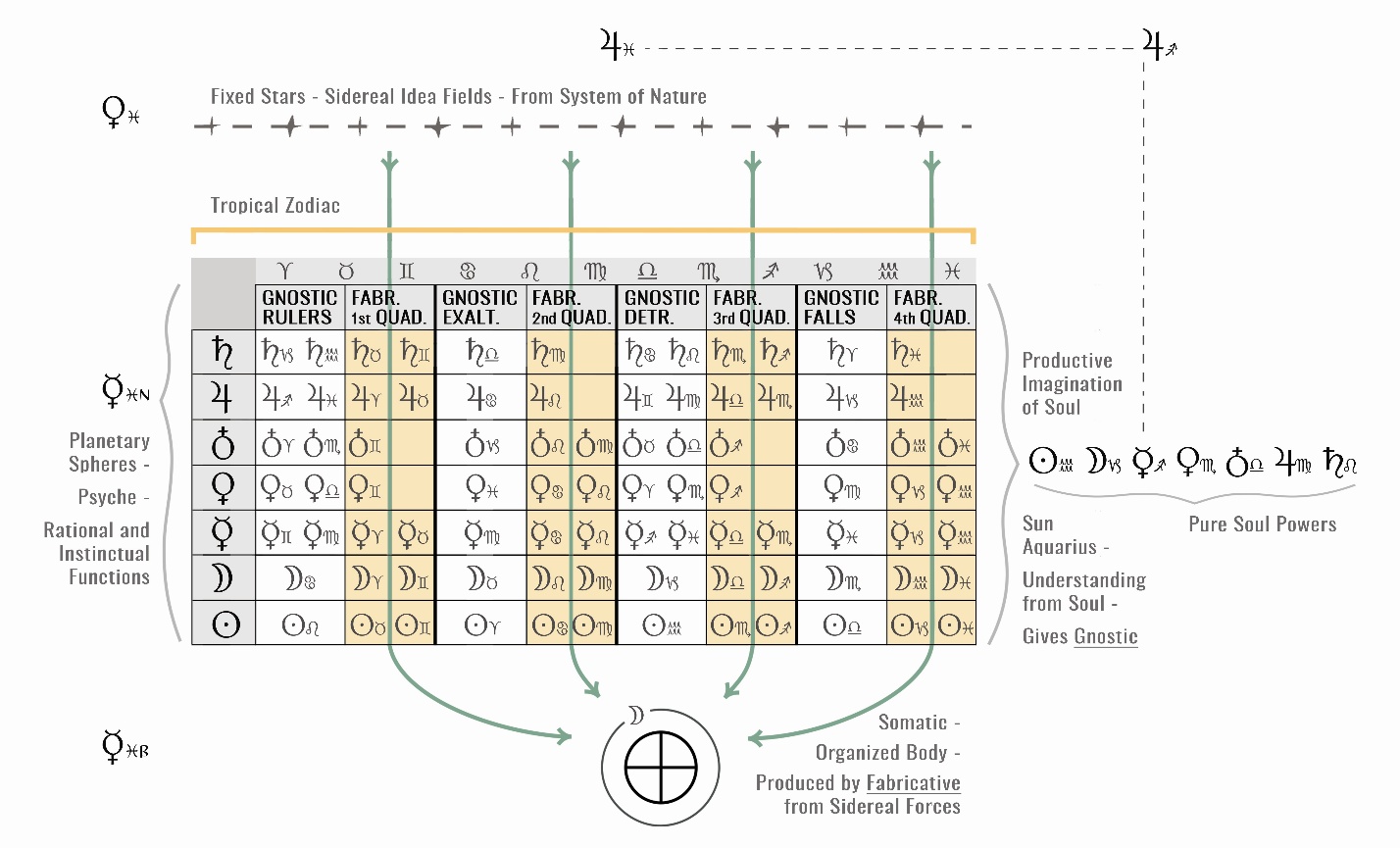
Review of diagram with Soul ring planets and twelfth house levels; soul powers as embodied (in grid) and unembodied (in Soul ring)
Angular relationship between planets at moment of birth includes all the parts/meanings an individual is endowed with; temporal working out of meanings over a lifetime; past meanings used to assimilate the new/unknown
Is the house system the body?
Sage is sensitive to all the parts/reason-principles; karma permitting, he can determine the why of a thing and the way of treating it; his omniscience restricted to this functioning
Human intellect capable of universalization
Four skandhas equated with dignities of transiting Chaldeans; fifth skandha (rupa) as instantiation of the functioning of the four; conception and perception
Body as reflecting apparatus for gnostic planetary functioning; body includes vital planetary impulse which extends from physiology to understanding; referred to as precious jewel
Natal planet structured by natal degree; question of planet manifesting meaning of natal degree vs. parts; parts unfolding faculty vs. idea
Direct and indirect parts as conception and perception getting built into faculty; getting some idea of what schemata is
Main idea of mentalism may be true but working out of details extraordinarily complex
Review of four skandhas getting instantiated in fifth (body); example of thinking hardness into existence; body revealed in our reflective understanding as something other than what thought it into being
Dependent arising as invariable concomitance which is law, not illusion
True concept of causality brings in Intellectual-Principle
Symbol (parts) can give us a feeling for the reason-principles that constitute us; an indication of something about our karma
Positive and negative, efficient and inefficient; correlated with ability/inability to bring unconscious aspect of symbol more and more into consciousness
Unfolding a unity vs. Bodhicitta through twelve houses
Twelve alchemical stages as means to reduce fantasy life and bring it into conformity with productive imagination (prime matter)
Analogy to Chinese alchemy and directing innate knowledge; directing energy before it manifests habitually
Body imprinted with quality/condition of World Soul at first breath; relative fixity, alters over time
Comprehensive nature of true philosophy; not reducible to pranayama, drugs
BOOKS READ FROM OR REFERENCED:
C.G. Jung, CW 5, Symbols of Transformation
C.G. Jung, CW 6, Psychological Types
C.G. Jung, CW 12, Psychology and Alchemy
Henry Corbin, Creative Imagination in the Sufism of Ibn 'Arabi
R.A. Schwaller de Lubicz, Symbol and the Symbolic: Ancient Egypt, Science, and the Evolution of Consciousness
R.A. Schwaller de Lubicz, "The Intelligence of the Heart" (in Parabola, 1977)
Bika Reed, Rebel in the Soul: An Ancient Egyptian Dialogue Between a Man and His Destiny
John Anthony West, Jan Gerhard Toonder, The Case for Astrology
Plotinus, The Enneads (MacKenna translation, 4th ed.)
Paul Brunton, The Hidden Teaching Beyond Yoga
Manly P. Hall, The Secret Teachings of All Ages
Leo Tolstoy, War and Peace
Leo Tolstoy, Anna Karenina
Krishnachandra Bhattacharyya, Studies in Philosophy, Vol. 2, "The Concept of Philosophy", "The Concept of the Absolute and Its Alternative Forms"
Books on the Arabic Parts implicitly referred to, used by Anthony and others in this time period:
Marc Edmund Jones, Lecture Notes, Arabian Astrology, Lessons 1070-1076 (1933), pp. 39-52
Robert Zoller, The Lost Key to Prediction: The Arabic Parts in Astrology (Inner Traditions, 1980)
PLOTINUS QUOTES READ OR REFERENCED: IV.8.2
DIAGRAMS appended to this transcript:
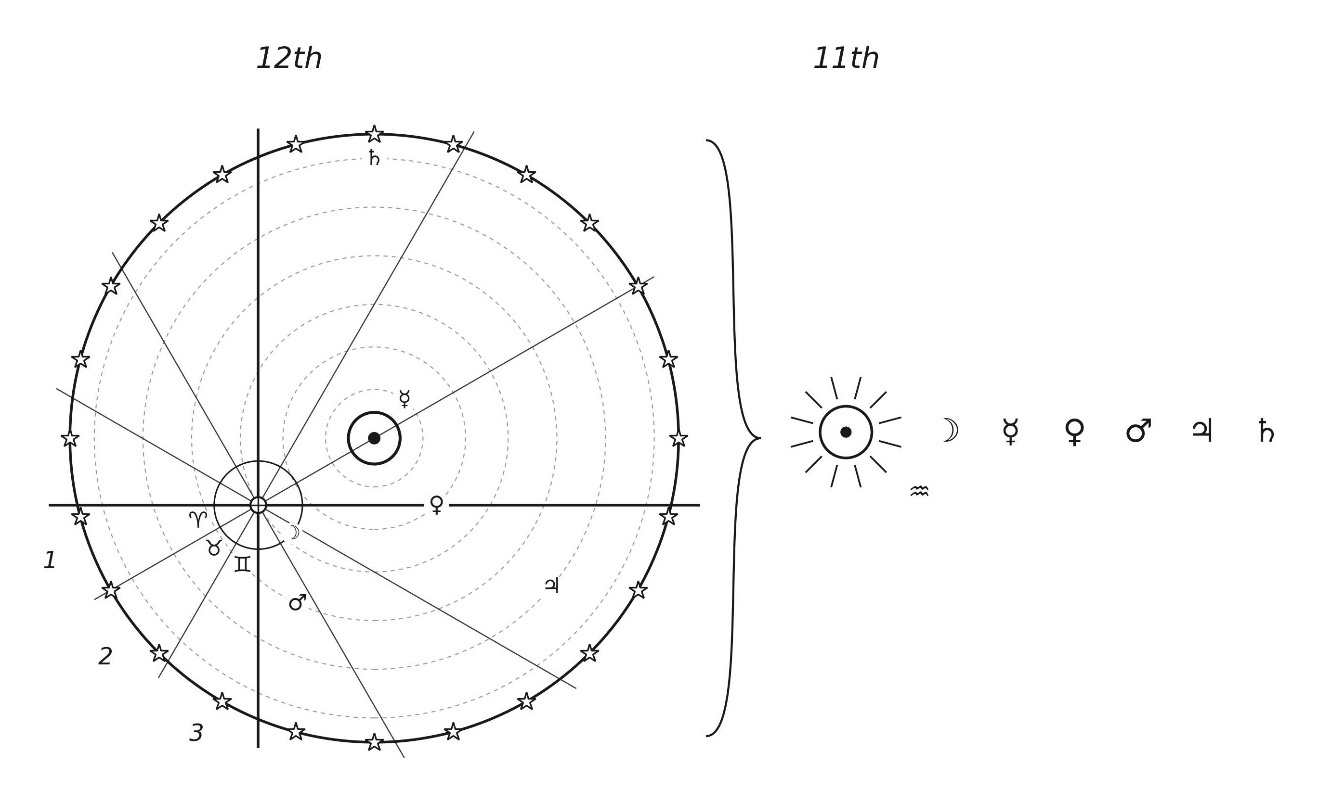
FIGURE 1982 0109-1. Unembodied Soul, Sun in Aquarius, and Three Levels of the Cosmos.
FIGURE Gnostic-Fabricative-1. "The Grid" – Gnostic and Fabricative.
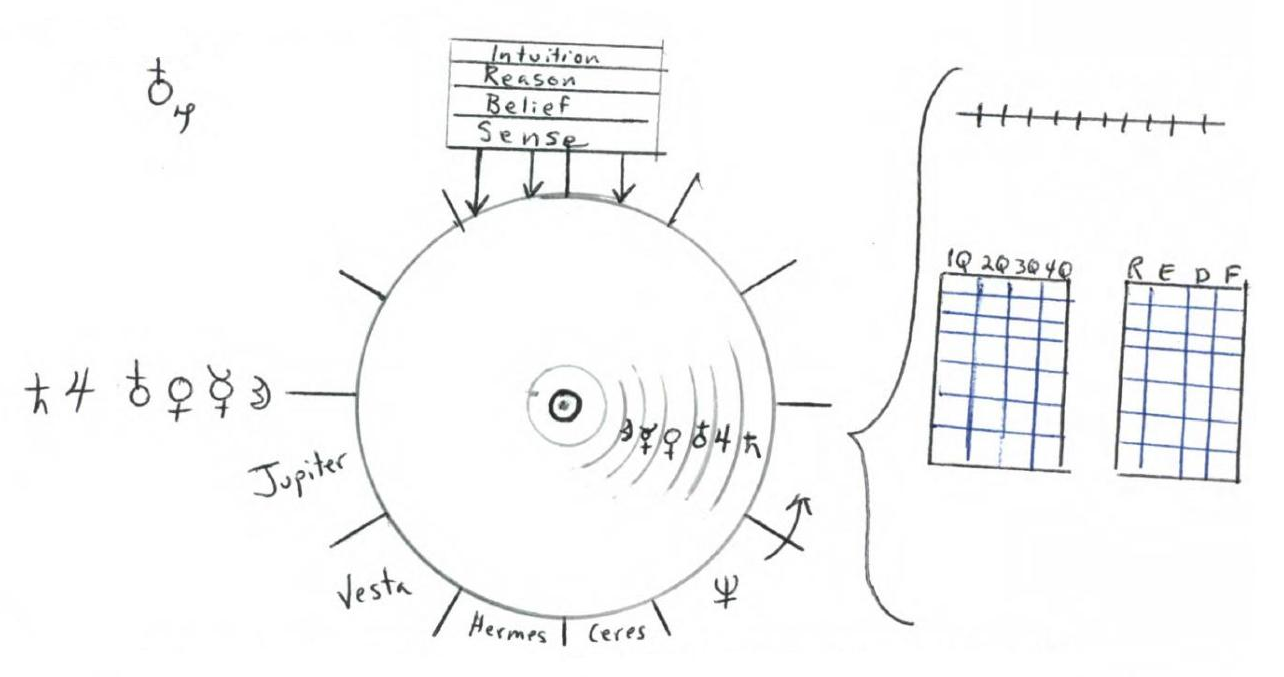
FIGURE 1982 0109-3. Nature: Capricorn, Aquarius, and Pisces with Grid.
[Transcriber note: [diagram] means the speaker is referencing a diagram as he or she is speaking. If someone is drawing or writing, with audible sounds of chalk on a blackboard, I indicate this by [drawing] or [writing].]
NOTES:
We have a partial transcript for this class with no AD edits and no diagrams. File name 1982 0109-10R06.PDF. Originally typed by CdA.
This was the regular Saturday AM class.
Short Definition of Direct and Indirect Parts. Direct parts are calculated from the faster-moving planet to the slower-moving; Indirect parts from the slower-moving to the faster-moving.
For more on Arabic Parts, see WG Seminars 1981 1129 & 30, 1981 1214 to 30, 1981 1220 & 21, 1982 0107 & 08 and WG Classes 1981 0711, 1981 1218, and 1982 0102. See also Appendix to 1981 1214 to 30 for an introduction to the Parts.
TRANSCRIBED Verbatim by IT 2021. In 2025, IT completes TOC, adds Plotinus quotes section, adds new notes within transcript, adds two diagrams and references within transcript to these diagrams. Archival verbatim transcript – V12a.
AUDIO FILES: 1982 0109a, 1982 0109b. [Note: "Tape" and "Side" refer to original audio cassette tapes that were later digitized into .MP3 Audio Files.]
1982 01/09 at Wisdom's Goldenrod
Astrology; Theory; Symbolism
[Audio File 1982 0109a Begins]
AD: --there's [one word inaudible] And that until we understand what are the tools that we're using in order to communicate with each other, it's like everyone lives in his own world. And, consequence of that is that we say words, you know, and we think we're communicating but all we're getting are responses. They're not communication. [short pause] And symbolism is going to be quite a preoccupation for a while because I think it's the only way that we get in touch or get grounded in the Nous, with symbols that we eventually hope to transcend. Well if you got something on symbolism want to start it off?
AS (mostly faint): No, not really. I-- I was just going-- if-- The guy's got a couple more on [couple words inaudible]
AD (faint): Go ahead.
S (simultaneously, very faint): What volume is that?
AS (faint): Volume 5 in the Symbols book on page 232.
AD: Alright. Go ahead. I got Volume 6 here.
AS: Oh, I don't have the volume.
AD: Well do you have it written down?
S (very faint): No.
S: So it's early.
[13¼ second pause, flipping of pages]
AD: Well this is from Psychological Types. [9¼ second pause] Obviously, you know, a symbol is multivalent. It has so many sides to it and so many aspects. I think we become aware that those who choose one meaning of a symbol will be falsifying the meaning. And I think you'll find in the history of rel-- religion and philosophy that's been going on continuously. You take a symbol like the Trinity and if you trace the arguments about it, you'll see that each side is taking one interpretation of the symbol and the consequence always is a disaster. It ends up in witch hunting and--
AS (faint): Yeah.
AD: I think Jung is a good starting off place, those of you who have Psychological Types could read it for yourself because I'm only going to read some extracts from it. It's under the chapter in Definitions, page 473.
C.G. Jung [CW 6, Psychological Types, Definitions, pp. 473, 474, paragraphs 814, 815, AD reading]: "[51. symbol.] The concept of a symbol should in my view be strictly distinguished from that of a sign. Symbolic and semiotic meanings are entirely different things. … A symbol always presupposes that the chosen expression is the best possible description or formulation of a relatively unknown fact, which is none the less known to exist or is postulated as existing. [Thus], when the badge of a railway official is explained as a symbol, it amounts to saying that this man has something to do with an unknown system that cannot be differently or better expressed than by a winged wheel.
"Every view which interprets the symbolic expression as an analogue or an abbreviated designation for a known thing is semiotic. A view which interprets the symbolic expression as the best [possible] formulation of a relatively unknown thing, which for that reason cannot be more clearly or characteristically represented, is symbolic. A view which interprets the symbolic expression as an intentional paraphrase or trans-mogrification of a known thing is allegoric. The interpretation of the cross as a symbol of divine love is semiotic, because"divine love" describes the fact to be expressed better and more aptly than a cross, which can have many other meanings. On the other hand, an interpretation of the cross is symbolic when it puts the cross beyond all conceivable explanations, regarding it as expressing [an] as yet unknown and incomprehensible fact of a mystical or transcendent, i.e., psychological, nature…"
S: Huh. [S: (Mm.)] Uh-huh.
S: Mm.
S: Really?
S (faint): Very good. (bit of laughter)
VM (faint): [few words inaudible]
C.G. Jung [CW 6, Psychological Types, Definitions, pp. 474, 475, paragraphs 815, 816, 817, AD reading (simultaneously with VM above)]: "…which simply finds itself most appropriately represented in the cross.
"So long as a symbol is a living thing, it is an expression for something that cannot be characterized in any other or better way. The symbol is alive only so long as it is pregnant with meaning. But once its meaning has been born out of it, once that expression is found which formulates the thing sought, expected, or divined even better than the hitherto accepted symbol, then the symbol is dead, [i.e.], it possesses only an [AD reads: a] historical significance. …
"An expression that stands for a known thing remains a mere sign and is never a symbol."
AD: Ok? So a dog cannot understand symbols. When I say "Here's your master, Jack," alright, that's a sign to a dog, it's not a symbol.
C.G. Jung [CW 6, Psychological Types, Definitions, pp. 475, 476, paragraphs 817, 818, 819, AD reading]: "It is, therefore, quite impossible to create a living symbol, [i.e.], one that is pregnant with meaning, from known associations. For what is thus produced never contains more than [AD adds: what] was put into it. Every psychic product, if it is the best possible expression at the moment for a fact as yet unknown or [only] relatively known, may be regarded as a symbol, provided that we accept the expression as standing for something that is only divined and not yet clearly conscious. Since every scientific theory contains an [AD reads: a] hypothesis, and is therefore an anticipatory description of something still essentially unknown, it is a symbol. [Furthermore], every psychological expression is a symbol if we assume that it states or signifies something more and other than itself which eludes our present knowledge. This assumption is absolutely tenable wherever [AD reads: whenever] a consciousness exists which is attuned to the deeper meaning of things. …
"Whether a thing is a symbol or not depends chiefly on the attitude [(q.v.)] of the observing consciousness; for instance, on whether it regards a given fact not merely as such but also as an expression for something unknown. Hence it is quite possible for a man to establish a fact which does not appear in the least symbolic to himself, but is profoundly so to another consciousness. The converse is [also] true. … [short pause]
"… The attitude that takes a given phenomenon as symbolic may be called, for [AD reads: in] short, the symbolic attitude. It is only partially justified by the actual behaviour of things; for the rest, it is the outcome of a definite view of the world which assigns meaning to events, whether great or small, and attaches to this meaning a greater value than to bare facts. This view of things stands opposed to another view which lays the accent on sheer facts and subordinates meaning to them [AD reads: the facts]. For the [AD reads: This] latter attitude there can be no symbols whatever when the symbolism depends exclusively on the mode of observation. [AD rereads: For the latter attitude there can be no symbols whatever when the symbolism depends exclusively on the mode of observation.] But even for such an attitude symbols do exist--those, namely, [that] prompt the observer to conjecture a hidden meaning. A bull-headed god can certainly be explained as a man's body with a bull's head on it. But this explanation can hardly hold its own against the symbolic explanation, because the symbolism is too arresting to be overlooked. A symbol that forcibly obtrudes its symbolic nature on us need not be a living symbol. It may have a merely historical or philosophical significance, and simply arouses intellectual [or aesthetic] interest. A symbol really lives only when it is the best and highest expression for something divined but not yet known to the observer. It then compels his unconscious participation and has a life-giving and life-enhancing effect."
AD: "It then compels his unconscious participation…" Remember, I don't buy the word 'unconscious'. To me that's the Nous. So read it that way.
C.G. Jung [CW 6, Psychological Types, Definitions, pp. 476, 477, 478, paragraphs 819, 820, 821, 823, AD reading]: "It then compels his unconscious participation and has a life-giving and life-enhancing effect. …
"The living symbol formulates an essential unconscious factor, and the more widespread this factor is, the more general is the effect of the symbol, for it touches a corresponding chord in every psyche. Since, for a given epoch, it is the best possible expression for what is still unknown, it must be the product of the most complex and differentiated minds of that age. But in order to have such an effect at all, it must embrace what is common to a large group of men. This can never be what is most differentiated, the highest attainable, for only a very few attain to that or understand it. The common factor must be something that is still so primitive that its ubiquity cannot be doubted. Only when the symbol embraces that and expresses it in the highest possible form is it of general efficacy. … [13 second pause]
"… Purely unconscious products are no more convincingly symbolic per se than purely conscious ones; it is the symbolic attitude of the observing consciousness that endows them both with the character of a symbol. But they can be conceived equally well as causally determined facts, in much the same way as one might regard the red exanthema of scarlet fever as a"symbol" of the disease. In that case it is perfectly correct to speak of a "symptom" and not of a "symbol." …
"The symbol is always a product of an extremely complex nature, since data from every psychic function have gone into [its] making. It is, therefore, neither rational nor irrational [(qq.v.)]. It certainly has a side that accords with reason, but it has another side that does not: for it is composed not only of rational but also of irrational data supplied by pure inner and outer perception. The profundity and pregnant significance of the symbol appeal just as strongly to thinking as to feeling [(qq.v.)], while its peculiar plastic imagery, when shaped into sensuous [AD reads: a serious] form, stimulates sensation as much as intuition [(qq.v.)]. The living symbol cannot come to birth in a dull or poorly developed mind, for such a mind will be content with the already existing symbols offered by [AD adds: an] established tradition. Only the passionate yearning of a highly developed mind, for which the traditional symbol is no longer the unified expression of the rational and [the] irrational, of the highest and the lowest, can create a new symbol."
[short pause]
AD: Alright we'll stop there. It's a long definition, it runs for about six pages. I recommend a serious study of it if you have the text. Did you find--
AS: Yeah, just marked a little addition. [AD simultaneously: Please.] There's not-- there's not really anything [AD simultaneously: Please.] more than the-- in the definition he gives here.
AD: Fine. But that's all you're going to get is a (serving).
CDA (simultaneously): Do you-- do you agree with him? (AS laughs)
S (very faint): Why don't you introduce him?
AS: Uh-- Oh you [couple words inaudible]
S (faint): [couple/few words inaudible]
S (very faint): Yeah.
AS: This is from Volume 12, volume-- in "The Psychic Nature of Alchemical Work" on 283, 282. Says--
C.G. Jung [CW 12, Psychology and Alchemy, pp. 282-283, paragraph 400, AS reading]: "The imaginatio [AS reads: The imagination or imaginatio], as the alchemists understand [AS reads: understood] it, is in truth a key that opens the door to the secret of the opus [AS reads: work] [(fig. 140)]. We now know that it was a question of representing and realizing those"greater" things which the soul, on God's behalf, imagines creatively and extra naturam…"
AS: Outsi--
S: Outside.
AS: Outside of Nature.
C.G. Jung [CW 12, Psychology and Alchemy, p. 283, paragraph 400, AS reading]: "…or, to put it in modern language, a question of actualizing those contents of the unconscious [AS: Let's say Nous.] which are outside nature, i.e., not a datum of our empirical world, and therefore an a priori of archetypal character [AS adds: characteristic]."
S (very faint): Just start again, yeah.
C.G. Jung [CW 12, Psychology and Alchemy, p. 283, paragraph 400, AS reading]: "…question of actualizing those contents of the unconscious which are outside nature, i.e., not a datum of our empirical world, [and] therefore an a priori of archetypal character. The place or the medium of realization is neither [AS adds: the] mind nor matter, but that [AS reads: an] intermediate realm of subtle reality which can be adequately expressed only [AS reads: only expressed] by the symbol. The symbol is neither abstract nor concrete, neither rational nor irrational, neither real nor unreal. It is always both: it is non vulgi [AS reads: not vulgar], the aristocratic preoccupation of one who is set apart…chosen and predestined by God from the very beginning."
AD: Would you read that definition?
AS (faint): Read that thing?
AD: Yeah, the whole thing that you just read.
S (faint): Oh.
C.G. Jung [CW 12, Psychology and Alchemy, pp. 282-283, paragraph 400, AS reading]: "The imaginatio [AS reads: The imaginatio or imagination], as the alchemists understand [AS reads: understood] it, is in truth a key that opens the door to the secret of the opus [AS reads: work] [(fig. 140)]. We now know that it was a question of representing and realizing those"greater" things which the soul, on God's behalf, imagines creatively and extra naturam [AS reads: outside of nature]--or, to put it in modern language, [AS adds: it is] a question of actualizing those contents of the unconscious which are outside nature, i.e., [AS adds: which are] not a datum of our empirical world, and therefore [an] a priori of archetypal character. The place or the medium of realization is neither [AS adds: the] mind nor matter, but that intermediate realm of subtle reality which can be adequately expressed only [AS reads: only expressed] by the symbol. The symbol is neither abstract nor concrete, [AS adds: it is] neither rational nor irrational, neither real nor unreal. It is always both…the aristocratic preoccupation of one who is set apart…chosen and predestined by God from the [very] beginning."
AD: This-- (anyone) want to discuss that for a minute? Read it again, it's worth it. [short pause] Read it again, it's too early in the morning.
S (faint): It sounds just like what (Victor) did [couple/three words inaudible] but I don't remember.
AD: I-- [S: Uh-hm.] what did he say last night, I forgot last night.
S: Sensitive. But--
AS: Um-- yeah? Maybe I should read the-- there's a previous little bit, it's not directly on the symbol but is on that--
AD: No. [AS simultaneously: Just do that.] Just with what you read there. [AS, faint: Ok.] That's a goldmine.
AS/S(?): Ok.
BB/S(?) (faint): Yeah, ok.
C.G. Jung [CW 12, Psychology and Alchemy, pp. 282-283, paragraph 400, AS reading]: "The imaginatio [AS reads: The imagination-- see-- The imaginatio or imagination], as the alchemists understand it, is in truth a key that opens the door to the secret of the opus [AS adds: or work] [(fig. 140)]."
AS (faint): [flips page] See figure page (140).
AD: That's just about where we're at.
RC: Where is it you're reading from, Avery?
AS: Oh I'm sorry, this is Volume 12, Psychology and Alchemy, page 282.
C.G. Jung [CW 12, Psychology and Alchemy, pp. 282-283, paragraph 400, AS reading]: "The imaginatio [AS reads: The imaginatio, the imagination]…is in truth a key that opens the door to the secret of the opus [(fig. 140)]. We now know that it was a question of representing…"
AS: This key, the imagination, the key was inter--
C.G. Jung [CW 12, Psychology and Alchemy, p. 283, paragraph 400, AS reading]: "…question of representing and realizing those"greater" things which the soul, on God's behalf, imagines creatively and extra naturam [AS reads: outside of nature]…"
AD: The soul imagines creatively those things which are outside of Nature. This would put us in a situation where we would say that the Sun in Aquarius as we refer to it [AS: Is imagining--] is the very means that-- or the-- the basis that projects forth the world [FIGURE 1982 0109-1].
AS (simultaneously): Right. In fact--
AD (simultaneously): And the reason-principles which are outside of Nature are included in that projection.
AS: In fact he's just been talking just before this of how when God or the World-Soul creates, its creations are actualities.
AD (faint): Uh-hm.
AS: Whereas in our case they're not, for the most part. It seems that we almost have to get to that level of imagination where we participate in an actual creation, that the imagination becomes an actual crea-- able to produce, productive.
AD (simultaneously): So we know-- we know now [AS simultaneously: Like the Sun's.] that we have to reach that imagination, not reflective imagination, [AS simultaneously: No but, productive.] that imagination, in order to start what they call the opus.
AS (simultaneously): The work. Yeah, the [AD simultaneously: The work.] productive imagination rather than (refer--)
AD: Alright.
S: Is-- is that-- is that the same thing that Vic was speaking of last night or is it on a different level?
AS (simultaneously): But, [few inaudible student words simultaneous with AS] I-- I-- I would-- I think it's different.
S (simultaneously): Seems like it's on a different level.
AD (simultaneously): Don't bring in last night. Don't bring in last night.
AS (simultaneously): Do it separately, I mean-- I think-- you know, we've discussed the distinction a lot between productive imagination--
AD (simultaneously): If you want to bring in last night you can [AS simultaneously: --and reproductive.] see that Kant's great contribution was really an-- imagined [AS simultaneously: Yeah.] on his part. (bit of laughter) If he thinks that this has been something that he, you know, invented or discovered, he is absolutely absurd.
S (simultaneously): Uh-hm, (yeah/right).
AD: He just doesn't know the two thousand years of philosophic history that went before him, or should I say five thousand years. And don't ask me to be lenient with someone that claims to be a Master and isn't. [S, faint: And is--] The man was fibbing.
AS: You know, all those things, the transcendental-- (laughter)
AD: I call it intellectual dishonesty.
S: I'm just trying to understand it.
AS (simultaneously): But-- but you know like when he speaks of transcendental unity and so on and that which synthesizes, well, they-- they knew about that, that's-- that's their productive-- that productive imagination includes everything which is both a subject-- the empirical subject and object. It's productive of your whole situation.
S: But--
AS: But I didn't-- Well we should just stick to this.
AD (simultaneously): I'm going to show it to you from another tradition. June, are you around?
JF: Yes.
AD: Would you get my copy of the Creative Imagination by Arabi? [Note: Henry Corbin, Creative Imagination in the Sufism of Ibn 'Arabi.]
AS (simultaneously): Oh yeah. Yeah, that's right, that's right along this--
S: But the-- I-- what I was [AS: Yeah.] trying to s-- ask was, when-- when you were speaking of those a priori forms last night, when Vic was--
AS: Sure, they would be [S simultaneously: Is that--] in the Sun in Aquarius, wouldn't-- I mean you'd say all the a priori forms of your whole experience that structure both the empirical subject and object are part of this creative imagination.
S: Right.
AS: And you'd have to get beyond-- And that in fact is why he says it's neither abstract nor concrete, neither concept nor percept. Exactly what he's saying. The symbol [S simultaneously: Yeah.] is beyond that duality there and has to be a synthesis of both.
C.G. Jung [CW 12, Psychology and Alchemy, p. 283, paragraph 400, AS reading]: "…neither [AS reads: not] abstract nor concrete, neither rational nor irrational, [AS: and he says] neither real nor unreal."
AS: Well, ignore him, I guess-- (nor) real or unreal. [couple inaudible student words simultaneous with AS] This-- this--
C.G. Jung [CW 12, Psychology and Alchemy, p. 283, paragraph 400, AS reading]: "…it [S simultaneously: Wait.] was a question of representing and realizing those"greater" things which the soul, on God's behalf, imagines creatively…"
DB: Good.
S (simultaneously): But-- but that's--
PD (simultaneously): In a sense, Avery, you know this distinction between reproductive and productive imagination is-- the reproductive imagination is the ossified functioning that an ego consciousness acquires. And, to the extent that there is such an ossified functioning, there is a-- the division between the two imaginations. But in the [AS simultaneously: Right.] transformation and developmental process through symbolic activity, that's I think the prime thing where that fixed imaginative function of the reproductive imagination is what has to get broken down and get more in accord [student assents] with the primary imagination.
AS: Yeah. But you know--
AD (simultaneously): That's the purpose of meditation.
AS: Yeah. Exactly.
AD (simultaneously): All meditation takes place in your reflective consciousness, and the idea is to break out of it [student assents] so that you can get to the symbolic functioning.
PD: So it's like the ossified imagination that they make this existential distinction between these two imaginations is really false.
AD: Well--
AS: Well, false--
AD (simultaneously): It's empirically workable because [AS simultaneously: Empirically.] we tend to think of the subjective psyche as distinguished from the objective psyche which in its totality includes the subjective psyche.
AS: Also insofar as you have an ossified ego structure as you say, or reproductive imagination, the object must necessarily be other than it. So the duality is [PD simultaneously: Right.] there too as soon as that's set up in distinction to everything else which is now object. [PD simultaneously: But when the alchemists (take--)] But both of those are both included with or products of that productive imagination.
PD: But like when the alchemists are speaking there of this imagination as part of the opus and the primary vehicle, it seems to indicate that's at the point where the two imaginations are working with each other or are in sync.
AS (simultaneously): Oh yeah, I-- I think when they-- when the alchemists speaks about imaginatio as the key I think they mean getting to the-- the higher one.
PD (simultaneously): They've developed back to that part.
AS (simultaneously): Oh. Yeah, not the lower one.
AD: And Paracelsus points out that he's not speaking about the cornerstone of madness, [VM: That's right.] your imagination. (VM laughs)
VM/S(?) (amidst laughter, faint): Right, yeah. That's right.
S: Uh-hm.
S (faint): That's right.
S (simultaneously, very faint): Ok.
AD: Alright. Back again, back again.
AS: Yeah.
AD: Read it again.
C.G. Jung [CW 12, Psychology and Alchemy, pp. 282-283, paragraph 400, AS reading]: "The imaginatio…"
AS: Oh yeah, that-- We'll call that imaginatio as distinct from the lower one.
C.G. Jung [CW 12, Psychology and Alchemy, pp. 282-283, paragraph 400, AS reading]: "…as the alchemists understand [AS reads: understood] it, is in truth a key that opens the door to the secret of the opus [(fig. 140)]. [AS, very faint: Nice picture.] We now know that it was a question of representing and realizing those"greater" things which the soul, on God's behalf, imagines creatively and extra naturam [AS reads: outside of nature]--or, to put it in modern language, a question of actualizing those contents of the unconscious…"
AD: Or actualizing what we would call those Ideas which are in the Nous. [VM: Embodied Nous.] And the way that we're going to try to understand that is to see if we can reach the meaning of the Nous through the parts and the planets and all that, uh--
AS (faint): [couple words inaudible]
AD: What would you call it, combust? Go ahead David.
DB: It seems that-- that-- that the-- the whole function of this second level of imagination is something entirely different from the-- the way we've spoken of imagination previously where it grasps the reason-principles in the Nous and-- and images for us the-- the apparent world. And-- I mean that the whole function of [one/two words inaudible]
AD (simultaneously): No, I've always used it that way.
DB: You-- you have used it that way.
AD (simultaneously): I've always used it that way, I don't know what-- When you speak about your imagination, there's always a reservation in my mind, if I can speak bluntly.
DB: No I'm not re-- I'm not referring to--
AD: I've always used imagination that way.
DB: Ok, no.
AD: I've made a distinction when I referred to your reflective imagination [DB simultaneously: Yes.] or your reflective unders--
DB: Right. Now I'm not-- I'm not considering the-- the reflective understanding, ok. I'm trying to leave that out of the discussion right now. What I'm concerned with is that-- that from the way Avery was speaking, the way this quote from Jung was going, it's presupposing that-- that higher understanding of imagination as the world being presented as the imaging forth of the reason-principles, ok. I mean that's presupposed in his discussion. Seems that he's talking about given that, then how-- how to grasp the-- the meaning which these images are a reflection of. Ok, that's it. It seems to be something that's taking place within this greater imagination which is at the same time not the level of reflective imagination that we're all-- be familiar with. I mean insofar as it's the key to an understanding of these-- these symbolic forms rather than just the imaging forth of them it seems to be a different-- [short pause] it's a slightly different meaning than-- than a-- than the primary meaning of imagination. And perhaps I don't understand.
AD: Yes, that's it, you stated it correct.
AH: May I ask a question concerning the way we're going to speak of the imagination? They say-- obviously you can't restrict the definition to our imagination, but doesn't it-- does not the work begin from the perspective of the reflective consciousness?
AD: Well how long do you want to go on with that, another ten years?
AH: I think-- the things that hits me concerning this alchemical view, it's the way that reflective imagination is refined or purified in order for this work to actually begin.
AD: Yeah that's the purpose of meditation, study, prayer, whatever philosophic disciplines you impose on yourself. That's where it begins. Like the Chinese say, journey starts out right from where you are. Sure. And there's no-- you know, there's no getting away from that because that's where we're located, in the madness of our own ego subjectivity. Let me read you now from-- show you from an entirely different position, alright, this is the Sufi.
AS (faint): Well--
AD: I'm sorry?
AS (faint): There's a line in here that [AD simultaneously: Go ahead.] really brings it out, it says--
C.G. Jung [CW 12, Psychology and Alchemy, p. 278, paragraph 394, AS reading]: "Imagination [AS: And I think he means the lower one but I--] is therefore a concentrated extract of the life forces, both physical and psychic."
AD: Read it again. Out loud so they can hear. [AS simultaneously: "Imagination…"] You gotta remember, it's 10 o'clock, they're not functioning. (some laughter)
C.G. Jung [CW 12, Psychology and Alchemy, p. 278, paragraph 394, AS reading]: "Imagination is [therefore] a concentrated extract of the life forces, both physical and psychic. So the demand that the artifex must have a sound physical constitution…"
AD: I don't want you to misunderstand what I'm doing, Vic, and you should know my method from now. I thoroughly appreciate Cassirer and Kant. And I think I spent enough time with these people. I enjoy them tremendously. But, the fact that I claim a certain amount of intellectual dishonesty is no reason for you to say well I'm not going to read it or study it.
VM: I know (that/they're) [one word inaudible]
AD: You know me by now. They're exactly the ones you want to study. And the point I'm making is that, despite of the fact that Cassirer refers to these rich sources of "inspiration", quote unquote, they were only and very selectively chosen. Because if he acquainted himself with any other part of the philosophy, history of philosophy, he would have found out about these things. And he wouldn't have thought that it was such a modern and daring innovation. So what I'm claiming is that in spite of his tremendous insightful nature, he had blinkers on. He only saw what he wanted to see. Let me give you this quotation. Ibn 'Arabi, and this is done by Corbin, again a person who works a great deal in traditional.
[Transcriber note: I am using Creative Imagination in the Sufism of Ibn 'Arabi by Henry Corbin, Bollingen Series XCI, Princeton University Press, Princeton, NJ, 1969.]
Henry Corbin [Creative Imagination in the Sufism of Ibn 'Arabi, p. 179, AD reading]: ""The notion of the imagination, [AD adds: the] magical intermediary between thought and being, [AD adds: the] incarnation of thought in image and presence of the image in being, is a conception of the utmost importance…" … We wish to stress on the one hand the notion of the Imagination as the magical production of an image, the very type and model of magical action, or of all action as such, but especially of creative action; and, on the other hand, the notion of the image as [a] body…"
DB/S(?) (faint): It's the body vehicle.
AD: No. That the body is an application--
VM (simultaneously): Oh, that the body is a (regeneration) of the imagination. Yes, yes.
AD (simultaneously): Yeah, what I call the instantiation of the four prior skandhas.
VM (simultaneously): Right. Alright.
Henry Corbin [Creative Imagination in the Sufism of Ibn 'Arabi, p. 179, AD reading]: "…in which are incarnated the thought and will of the soul. The Imagination [AD: And he capitalizes it all the time.] AD adds: is] as a creative magical potency which, giving birth to the sensible world, produces the Spirit in forms and colors; [AD adds: that] the world as Magia divina [AD adds: that is]"imagined" by the Godhead, that is the ancient doctrine, typified in the juxtaposition of the words Imago and Magia [AD reads: Imago and-- Image and Magic], which Novalis rediscovered through Fichte."
AD: But you see these people are rediscovering what the ancients have passed on. Do not think, and I am almost quite sure from what I understand of Fichte, that he ever got to the productive imagination. I think he got to an enlarged version of his ego, the reflective imagination. Just a little more to show you that you'll find this in every tradition. (And) these are my rich sources of inspiration. Even though I can't read Greek, Latin, Hebrew and all the others. Today I have others doing it for me, translating it into English so I don't have to learn all these other languages.
Henry Corbin [Creative Imagination in the Sufism of Ibn 'Arabi, p. 180, AD reading]: "The notion that the Imagination has a noetic value, that it is an organ of knowledge because it"creates" being…"
AD: Here 'being' is used as sensible being. Being could be used in a variety of senses. [student assents, faint] If I say 'being', don't automatically jump, you know, into the Intellectual-Principle. Wait till I finish the sentence and see what being I'm referring to.
Henry Corbin [Creative Imagination in the Sufism of Ibn 'Arabi, p. 180, AD reading]: "The notion that [AD reads: of] the Imagination has [AD reads: as] a noetic value, that it is an organ of knowledge because it"creates" being, is not readily compatible with our habits." (bit of laughter)
[short pause]
AD: Anyway, if you want to read it it's the second part of the book, this book Creative Imagination in Ibn 'Arabi. Here's one other--
Henry Corbin [Creative Imagination in the Sufism of Ibn 'Arabi, pp. 180-181, AD reading]: "As to the imagined [AD reads: imaged] universe, the reply will perhaps take the form of a wish or challenge, because there has ceased to be a schema of reality admitting of an intermediate universe between, on the one hand, the universe of sensory data and the concepts that express their empirically verifiable laws, and, on the other hand, a spiritual universe, a kingdom of Spirits, to which only faith still has access."
AD: Faith here you can see is the soul's faith in the higher.
Henry Corbin [Creative Imagination in the Sufism of Ibn 'Arabi, p. 181, AD reading]: "The degradation of the Imagination into fantasy is complete. An opposition is seen between the fragility [AD reads: fragile] and gratuitousness of artistic creations [AD reads: creation] and the solidity of"social" achievements, which are viewed as the justification and explanation of developments in the artistic world. In short, there has ceased to be an intermediate level between empirically verifiable reality and unreality pure and simple. All indemonstrable, invisible, inaudible things are classified as creations of the Imagination, that is, of the faculty whose function it is to secrete the imaginary, the unreal."
AD: This is what he means when he says [S simultaneously: (Pleasure.)] we've reached that level of degradation as to what we think the imagination is. Alright, you could read (this). [few very faint inaudible student words] So, if we can put ourselves at this position because this is the position we have to-- the-- the stance that we have to take in order to understand something about what we're trying to do when we want to understand the working of the parts. It's almost like saying that where those parts are sitting, alright, we know that there's some reason-principle, invisible, intangible, some kind of meaning which is-- which is contained in the Nous or Jung's terminology the unconscious. And that the-- the meaning or the reason-principle somehow has to be brought into our consciousness and we have to be made aware. Supposedly this is for the development of our own personality, the need to differentiate the personality. [12½ second pause] [one word inaudible] I just finished reading this fellow here and--
[22 second pause, flipping of pages]
PD: While you're looking, there's another point about the symbol in Jung which I don't think I heard come out. It's-- he speaks of the symbol as the basic vehicle for any type of transformation or developmental psychological process.
AS: Yeah I got a quote on that.
PD: The section "On Psychic Energy" where he says that--
AS (simultaneously): On 5. Well, it's in 5. The (Symbols).
PD (simultaneously): He speaks of it as like a-- it's-- it's an analogue to our instinctual nature that could transform the-- the vital energies [AS: Yeah.] to higher mental forms of activity.
AS: Yeah, you want to-- do you want to read (more like--)
AD: Please, please.
AS: Now this is in volume 5, page 232. I think this a-- he talks about there as a transformer, the symbol. Um-- He says-- Well-- (AS laughs a bit) There's part of this paragraph where he says that you can only know psychology and not metaphysics. Says--
C.G. Jung [CW 5, Symbols of Transformation, pp. 231-232, paragraph 344, AS reading]: "Though we do not possess a physics of the soul, and are not even able to observe it and judge it [AS reads: soul, and we cannot judge it] from some Archimedean point"outside" ourselves, [and] can therefore know nothing objective about it since all knowledge of the psyche is itself psychic, in spite of all this the soul is the only experient of life and existence. It is, in fact, the only immediate experience we can have and the sine qua non of the subjective reality of the world. The symbols it creates are always grounded in the unconscious archetype, but their manifest forms are moulded by the ideas acquired by the conscious mind. The archetypes are the numinous, structural elements of the psyche and [AS adds: they] possess a certain autonomy and specific energy which enables them to attract, out of the conscious mind, those contents which are best suited to themselves."
AS: I think we said reason-principle instead of archetype.
AS/S(?): Go on.
C.G. Jung [CW 5, Symbols of Transformation, p. 232, paragraph 344, AS reading]: "The symbols act as transformers, their function being to convert libido from a"lower" into a "higher" form. This function is so important that feeling accords it the highest values. The symbol works by suggestion: that is to say, it carries conviction and at the same time expresses the content of that conviction. It is able to do this [AS reads: so] because of the numen, the specific energy stored up in the archetype."
[short pause]
CDA: Is it that here Jung is just confusing or just never made the distinction between archetype the way we have used it in terms of the tropical zodiac and the reason-principles beyond that? Or could we-- or could we see a symbolic function going on in both those realms?
[9¾ second pause]
S (very faint): What was the question?
S (very faint): I don't know.
AD: What was the question? I'm sorry. [few words inaudible] what was the question?
CDA: Is it that Jung confuses or has never di-- never did differentiate the archetypes as we have spoken of them in the tropical zodiac and the reason-principles beyond that? Or, can we s-- wait.
AD (simultaneously): He will not speak about reason-principles beyond that.
CDA: No I know he doesn't. But, [AS simultaneously: Well--] in this particular instance he's using the word 'archetype' to-- to be the-- the unconscious, the unknown that the symbol is pointing to. So I'm asking, sh-- can we think of these two levels of symbo-- symbolic function or not, or just to limit symbolic functioning in the productive imagination. Or is there another-- another level of symbolic functioning happening in the-- what we call the tropical zodiac.
PD: I-- I thought the point of the paragraph was that symbol, because of its contact with an archetypal content was a-- a magnet that was energy transformer. [AS, faint: Right.] What the nature of the noumena that's guiding the symbol is beside the point in terms of the paragraph that we read.
CDA (simultaneously): Yeah, I-- I realize that. But it just brought up the question-- this question that, um, well--
AD: Try again, Carol. It brought up--
VM: Yeah I see the question.
CDA: Are there two levels of-- are there m-- is there more than one level of symbolic activity that-- that-- (and) we speak about the productive imagination as the Sun in Aquarius, and we also speak about the archetypes in the tropical zodiac, and I-- I'm asking, are these to be distinguished in-- are these two levels of symbolific activity in our experience or in our potential experience?
AD: Well aren't you forced into distinguishing these different levels of archetypes when you refer-- when you refer to the Ideas or the reason-principles which the empowered faculty of the soul, that is the imagination, projects forth as the universe [S: Yeah.] and the embodied creature within the universe who through the reflective awareness becomes aware of the symbol but here the symbol will be identical with the actuality-- the sensible actuality that was produced. So that you're-- you're forced to distinguish between the Ideas as they exist in the unembodied soul and the Ideas as they exist in the embodied soul. And, even a further distinction that I'm-- I'm working with is the distinction between the Ideas in the inerratic sphere and the Ideas as they are manifested in the creature who is working with-- split off, an alienation from that productive imagination. So that there's three levels or-- three levels that I'm distinguishing in the understanding we're working with.
CDA: Ok, can you just go through that, the three levels again?
AD: But that's the diagram over and over again [FIGURE 1982 0109-1], [CDA simultaneously: Ok.] the Ideas [CDA: Ok.] that are in the unembodied soul, like the unembodied soul which is--
CDA (simultaneously): The inerratic sphere.
AD: The reason-principles that the cosmic soul works with [FIGURE 1982 0109-3, Jupiter, Vesta, Hermes, etc.] combine the cos-- the faculty of the soul which we call the imagination [Sun in Aquarius] and which produces the universe, that's another set of reason-principles. And then the reason-principles as we see them displayed as a manifested universe. And then within that manifested universe you as a creature on the Earth through your reflective awareness becomes aware of these images, let's say, no longer as natural but as artificial, uh--
(Side 1 of original cassette tape digitized as 1982 0109a Ends; Side 2 Begins)
AS: Yeah in Jung he does it.
AD (simultaneously): He's Egyptian, uh-- He's doing it-- he has done extraordinary amount of work and I'm trying to get some of his writings in English when they just started translating him.
S (very faint whisper): What's the name of this?
AS (faint): Symbol and the Symbolic.
[Transcriber note: I am using Symbol and the Symbolic: Ancient Egypt, Science, and the Evolution of Consciousness by R.A. Schwaller de Lubicz, translated by Robert and Deborah Lawlor, New York: Inner Traditions International, 1981.]
R.A. Schwaller de Lubicz [Symbol and the Symbolic, p. 10, AD reading]: "We are trained to think and communicate through these alphabetical letters--placed in certain (again, memorized) groupings, or words--by reducing these abstract conventions into objective images in our minds. Simply stated, this means that when we read cat [AD reads: c-a-t, cat], we immediately register the formed image."
AD: It's got a picture of a cat.
AS: Yeah.
S (faint): (Uh-hm/Hm).
R.A. Schwaller de Lubicz [Symbol and the Symbolic, pp. 10-11, AD reading]: "This habitual reduction from a nonobjective mental abstraction to a delimited image can be seen as an initially centripetal action, which, subsequently, disperses perception and knowledge into a classification of disconnected facts. [AD adds: And] We use numbers in a similar way, moving from abstract symbols to quantitative evaluations. But hieroglyphic writing works in the opposite or centrifugal direction. The image, the form, is there concretely before us, and it can thus expand, evoking within the prepared viewer a whole complex of abstract, intuitive notions or states of being--qualities, associations and relationships which cannot be described or defined but only experienced. A centering sense of unification later results from this inwardly expansive movement of mind. A method of viewing [AD adds: of seeing] is required comparable to our hearing faculty: one must learn to listen to the symbolic image, allowing it to enter into and pervade one's consciousness, as would a musical tone which directly resonates with the inner being, unimpeded by the surface mentality. In this moment of inner identity between the intellect and the aspect of the tangible world evoked by the symbol, we have the opportunity to live [AD adds: in] this knowledge."By the hieratic symbolic method [AD reads: hieratic symbol method, symbolic method] the aim is no longer to translate things into sensory terms, but to put ourselves into the state 'magically' identical with the symbol-object [AD reads: symbolic object], so as to become heavy with the quality of weight, to become red with the quality of redness, to burn with the quality of fire.""
AD: I found this book and I found an article he wrote in Parabola called "The Intelligence of the Heart", but I haven't worked them out so that I can present them (here). [Note: "The Intelligence of the Heart," translated by Nancy Pearson, published in Parabola, vol. 2, issue 3, 1977.] We'll work on them next time.
LR: (simultaneously): What's his name please? What's his name, Tony?
AD: Schwaller de Lubicz. The last name is spelled L-u-b-i-c-z. He's written-- he's written-- And here in the Parabola he has "The Intelligence of the Heart," a long article. And here in the Symbol and Symbolic I-- he goes through his explanation of what he means by symbol.
RC: That book by Toonder--
AD (simultaneously): Rebel of the Soul, he's got a few coming out. [Note: Rebel in the Soul: An Ancient Egyptian Dialogue Between a Man and His Destiny by Bika Reed, Inner Traditions International, Rochester, VT, 1978. Bika Reed was among Schwaller de Lubicz's Egyptology students; a number of books by R.A. Schwaller de Lubicz, Lucie Lamy, Isha Schwaller de Lubicz, and Bika Reed were published by Inner Traditions in the late 1970s and early 1980s. It appears Anthony may be conflating books by R.A. Schwaller de Lubicz himself with those by his students.]
RC: There's a book by Toonder and somebody else called The Case for Astrology. [Note: The Case for Astrology by John Anthony West and Jan Gerhard Toonder, Coward-McCann, New York, 1970, first American edition.] They have a lot of his stuff about astrology (quoted).
AD: Well, I wouldn't be surprised because he was quite controversial figure and his whole interpretation of, you know, hieroglyphics has really forced the academic world to ignore him. (laughter) Their way of working is so obvious nowadays, you know, that it's become almost stereotyped. Alright. I think that's [S simultaneously: (Serious) material.] just-- that's just to place us in the context where we want to try to understand what-- what we're doing and what we're working with. And we're working basically with symbols. So we're really going to have a difficult time trying to understand. The reactions that will be kicked off are going to be quite difficult to understand. First of all, the contra-- the contradiction is something like this, we have to think without objectifying. Secondly when we finally succeed in objectifying what we're not thinking, (laughter) it's going to be like-- same way that we can imagine Euclidean space. Now if you added to that the fourth dimension, you know, you're going to have to objectify that kind of thinking.
S: And then curve it.
AD: Yeah because-- (bit of laughter) So, [one/two inaudible student words] anyway, uh--
CDA (simultaneously): I'm not sure I understand what you just said. (laughter) In fact I know I don't understand what you just said.
S (very faint): (Why?)
AD: Then that shows you do understand. (bit of laughter)
VM: Just, it's going to be hard. That's all.
AD: The-- If we-- if we conceive of the parts or the meanings that are-- we're endowed with, you know, that are our inheritance, I don't know if they're legal but they're certainly karmic inheritances.
VM: They'll tax them again. (bit of laughter)
AD: They probably will. (bit of laughter) The-- Yeah that's true, you know, probably the tax men will probably say look, you inherited all these meanings, alright, they're taxable.
VM (laughing): Right.
AD: What we're saying is that these meanings, alright, the whole system of parts that are organized in a certain way in your chart is a kind of innate knowledge that you have. And that by concentrating without objectifying what you're concentrating on, you're going to eventually create a symbol for that. And in that symbol there'll be access to those meanings. The other alternative is just to let things happen and then find out.
CDA: So this--
AD: In other words, the remark I was making to Vic last night is that prior to nineteen so and so, whatever it was, the scientists were of the opinion that we should formulate a science based on and following upon experimentation. What these people are saying is, that's for children. We have a philosophy, and the philosophic thought will direct our experimentation. This is a whole different ballgame. This is between-- the difference between exoteric knowledge and esoteric knowledge. The man who knows that is a man of power, he can direct the experimentation towards the ends that he wants. A man who doesn't know that is going to be led by the results of his experimentation, which he thinks are going to be true-- truthfully correlated to his experiments. In other words, his experiments are leading him to certain conclusions. But he doesn't know that unconsciously he already made the assumptions which are going to lead him to the conclusions. So that there's going to be required a philosophical maturity here, whether they like it or not. Like I was telling Vic, I don't believe their crocodile tears. They're a bunch of phonies. They know that now they're in a big mess and they can't find a way out. But jokingly when I was asking you how could there be an answer-- a double answer to a question, a square root for instance, which gives you plus or minus 1. Now mathematics has already foreseen that this possibility exists. There's no getting away from it.
VM: Yes they have meaningful--
AD: Yeah.
VM: I mean in-- yeah.
AD: Well then, you think about it. How could you have two answers? Alright, now we get-- we get a little bit involved and try to understand some of the different parts. We'll try to see what we're doing first.
CDA: Can I just ask one questions, um-- You said that there was-- that what-- I think the third step in the process you just said was there was an objectification of something you weren't thinking, which seemed that what this objectification was a symbol. Is that what you meant?
AD: Yes because the way Jung pointed out the symbol seems to be the only means at our disposal by which we can, so to speak, allow the unconscious and the conscious to get combined. In other words, it's the only way that apperception can take place. There's something unknown in us and there's something in our conscious mind that we do know, we've developed certain skills, alright. Now the combination of these two is going to produce a symbol, and it is off of the symbol that we're going to try to understand [CDA simultaneously, faint: Ok.] what those meanings are.
CDA: If I could just say, I got the step and I don't know if you want to talk about this but how-- how could you concentrate on something that didn't have a form to begin with to evoke the symbol, I-- that part was not clear at all. So that this--
AD (simultaneously): What form does concentration have when you're listening very intensely to a piece of music or you're looking at a work of art or you're reading a novel.
CDA: Oh, but there's-- there would be some objective content to the concentration.
AD (simultaneously): Well, in those particular cases, alright, each one we mentioned, [CDA simultaneously: Yeah.] there seems to be an objective content, alright. Now, assuming that you've developed some concentration, then why shouldn't you be able to keep a concentrated state of mind without an object to it?
S (very faint): [few words inaudible]
CDA (simultaneously): Oh and then-- and you're saying that at that point the symbol from the productive imagination would be totally available.
AD (simultaneously): The symbol will come as a response or a reaction.
CDA (simultaneously): To that concentration, uh-hm.
AD (simultaneously): Alright. And if it is a reaction, the reaction could be mental, emotional and vital, could be any one of these reactions and it will bring about a symbol. Alright, and then of course in that symbol, you will see that there's contents of both, things that you understand, things that you don't understand. And it is off of that, the point that was made is that it's that which is a transformer of the energy which is inherent in an archetype or in an Idea. Let's use the word Idea too because the interpolations that are going on by these people of an ancient teaching after a while becomes pretty ludicrous. Anybody who thinks he's invented archetypes is just-- is really (superbly) [one/two words inaudible]
PD: Wouldn't the-- like the-- the art examples you gave, wouldn't the creative artist be a-- an even clearer example. The creative artist doesn't know the form the piece-- the piece is going to take until-- until it's there, like the [CDA simultaneously: That's true, yeah.] Mona Lisa with da Vinci. [CDA: Yeah.] And it contained symbolic significance for him for the rest of his life.
S: Yeah.
RC (faint): And at the same time if the form he produces wanders from that in any way it goes [one/two words inaudible]
CDA: Yeah.
PD: In the process of developing [RC assents, faint] or unfolding it.
AD: So then what you have to take for granted or on faith for a while is that this storehouse of knowledge, this innate knowledge, is within you. And if you take that for granted or on faith, you'll stop asking me questions. (bit of laughter) You'll ask yourself the question.
S (very faint): Right.
AH: I think one of the difficulties of trying to understand this process according to Jung's [one word inaudible] other places, there has to be a kind of relinquishing of the habitual conscious willful attitude in order that these contents can get to emerge into the consciousness. He makes a-- an issue about how the Western intellect is in a kind of state of kind of cramp where there's a tendency to translate this spiritual reality into intellectual pablum.
AD: Yeah you remember what we spoke about, Andrew? We spoke about having a beginner's mind without being ashamed or embarrassed. And a beginner's mind is a mind that's wide open. It doesn't have any fixed ideas. It's a beginner's mind.
AH: That's very-- that's very difficult for a Western intellect to have a beginner's mind.
AD: Anyone-- anyone in the West who has done any studying and looks upon the knowledge explosion that is taking place, if he doesn't get a beginner's mind, then there's no cure. And then we have to leave it to the world to straighten him out on it.
MS: Clear example of, say, the breakthrough of symbolic imagination?
AD: I'm sorry, uh, Mark, that--
MS (simultaneously): Do we have a clear example that we can refer to, you know, to some person or some event?
RC (faint): Well one of the things that Jung bemoans [couple words inaudible]
MS (simultaneously): That show the breakthrough.
RC (faint): Yes. One of the [couple inaudible MS words simultaneous with RC] things that Jung bemoans is the fact that we're in a period where there don't seem to be specific symbols which carry that power. And, he says he thinks it's a lot better that we should admit the present state of poverty of our symbolic life rather than to try to (recoil). (laughter)
AD: Do you really mean that? Do you really mean that!? (more laughter, student words)
BS (faint): What did Randy say?
AS: Wait, (start again). (laughter)
AD (with some intensity): You mean after all the diagrams we've been putting up, trying to elicit, force out of you reactions of what you understand? Isn't that the best example you had so far of a symbol that is forcing you to bring together your unconscious innate knowledge and what you understand?
LR: It always beat the dead tree I guess. (laughter)
AD: It'll beat the dead tree any time!
MS: Well, like in Jung it's-- it's, you know, the breakthrough of this religious symbolism in the middle of a psychological conflict, you know. Or he-- what about somebody like Steiner [AD drawing] who's using symbolic imagination but in such an objective way.
AD (simultaneously): He calls it clairvoyance.
S (faint): Uh-hm.
AD: He calls it clairvoyance.
MS: But it's still objective, it's still different from Jung now.
S (faint): I thought he said he has to look into it.
AD: Well Mark, I thought it would be pretty obvious by now that we've been working this way, alright, without designating it as such. I mean when we take these symbols, and they are basically symbols, we know something about Jupiter, which might be very small, and we know we don't know a great deal about Jupiter. And we're combining these two things and trying to, let's say, to work out or use it as a key [MS simultaneously: To evoke this--] through which to get into philosophy and metaphysics and any of-- anything they want to. So this is a symbolic concept we're working with and that we've been evolving and developing. And a symbolic concept can take a long time, I think Nicolas (de Cusa) took about twenty years to figure out what that symbolic concept was that he was working with. I'm not going to agree or disagree with it. But most people have this problem. They get, let's say a-- a vision which is almost cosmic in its implications and then they try to assimilate that vision. That means that they're working with unknown contents and with known contents and they're trying to make explicit, alright. And in that very process you're developing a symbolic mode of understanding.
That's why for a while many people were very interested in these things, you know, what we were doing, they know that there's something going on, they haven't been able to label it. But now we're getting up to a place where a certain amount of reflective awareness should show you that these things that we just read is what we've been doing. And it's not so mysterious. It really isn't. We've been doing it for a long time. And I prefer to do it and then go back and define it, rather than define it and then go try do it. [9¾ second pause] Alright. Did I answer your question Mark, I mean the [MS simultaneously: Yeah.] jerking? (some laughter)
Alright, we get back-- These are probably the most difficult passages in Plotinus. And although we're not using (him) or we're not reading from the text, we are being guided by so far what we've done in Plotinus, we've been-- Like, here's an example again. Plotinus is a symbol. His writings are a symbol. Anyone thinks otherwise, he is absolutely deluded. Because it requires the development of an inward faculty. And I think even PB mentioned that he had that special gift, that he was capable of inwardly concentrating and holding on to an idea, and even though he would be interrupted for hours he would go back and just left-- pick up where he left off. That's almost like-- Let me put it this way, that's almost like taking savikalpa samadhi and having it so trained that you're concentrating on an idea, the samadhi is so trained in you, the faculty is so disciplined, that you can stop, alright, you're thinking about an apple seed, go over to that man and talk to him for three days why he shouldn't commit suicide, [AS simultaneously: Then come inside. (AS laughs a bit)] and then come back and continue on the apple seed just where he left off. So that shows you the kind of disciplined samadhi that he had at his disposal. So naturally when he would write, alright, there would be on the one hand the language, the associations of language, all-- all that we understand in terms of our mentality and rationality, and then there would be included in it this tremendous and treacherous depth, his understanding, let's say, of the One, the Intellectual-Principle, and he would combine the two of them together and the production is a symbol. Now you want to call it a philosophic text, go right ahead. [student assents, faint] I call it a symbol. And in the process of working with that symbol I'm extricating or making available for myself those depths of meanings, alright, which are not available to the conscious mind. They will be assimilated by the conscious mind and then, so to speak, the conscious mind will have brought that into its-- by assimilating would have brought it to its own, let's say, disposal, or it would be-- become part of its development.
All of this of course is a preamble and hopefully we can continue tonight, if you do want to continue with more quotations and attempts to understand what symbolism is about. Why don't we continue now. Let's get back to what-- or at least-- at least put up the-- [Note: See FIGURE 1982 0109-1 for the following.] Remember, [drawing] we suggested that the Sun here, in Aquarius, with all the-- with all that precedes it [planets to the right of Sun in Aquarius], this represented soul number one, unembodied soul. [S, faint: That looks blank.] And that somewhere over here we're located [Earth]. [drawing] And, we speak about the cosmic circuit [planetary spheres]. [short pause while drawing] Well you know what I'm doing, right, there's a lot of planets floating around.
S: (Yeah.)
S (simultaneously, faint): (Actually) he put-- (bit of laughter)
AD: [drawing] We say that the second soul is here [planetary spheres]. Again this is-- [short pause while drawing] We're-- we're still in the realm of speculation with a lot of these things. So-- [short pause while drawing] The point that I think we got to which was very important, if we put the planets, we distribute them around. [11½ second pause while drawing] Um-- See on the one hand, oh-- on the one hand we pointed out that the-- the planets represent and are symbolic of the powers of the soul. [drawing] These are powers of the soul now, soul unembodied [planets to the right of Sun in Aquarius], but over here they are embodied [planetary spheres]. So that these powers of the soul, at the instant [AD snaps fingers] that a person is born have a certain angular relationship. Now, now, you catch me if (I'm) off. And, that angular relationship automatically presupposes the relationship of all the reason-principles that are there. In other words, if we say that because of the relationship between these two [diagram] you will have, I don't know, is it nine parts? I don't know (about/but) it's nine, twelve.
AS: Twelve.
VM (faint): Please don't count [couple words inaudible]
AD (simultaneously): We'll have twelve parts. Now that means that at that instant that a person is born, these twelve parts are already included in that angular relationship. These twelve parts would be the twelve reason-principles included in the-- in the meaning of that angular relationship. So, when I s-- when we speak about the meanings that you're born with, the ideas that you're endowed with, you know, that-- they're right there, they're already indicated in that angular relationship. Now, those ideas would be I think what they refer to, or what was referred to, as the ideas, alright, in themselves but not embodied. We would have to-- we would have to, so to speak, try to see them as they are getting embodied in a symbol. Alright, so then the result of this would be that as soon as you draw up a natal chart, as soon as you draw up a natal chart, at that moment, right then and there, you've already indicated all the parts. All the ideas that you're endow-- you're endowed with. So, if you look at-- if you look at a-- the way you people are making out the charts now, you know, you look at it-- See, I got one too.
S: Yeah.
S: Yeah.
AS: But--
AD: You look at something like this, alright-- (bit of laughter)
S: Yeah.
S: But why? (bit of laughter)
BS (very faint): (Why don't I) get it.
AD: (Right.) That's all the parts that you're working with. If we say that those are all the meanings that you're working with, alright. Not necessarily all at once. I mean, let's say a person lives till about he's thirty years old and [AD snaps fingers] then all of a sudden there comes in the meaning or the quest, alright, and then that continues, you could see that prior to that time he was working with meanings that were quite different than after that time. So that, you're not working with the totality of all the meanings all at once but you're temporally working with them as you go along. Now, what's in the past, or the meanings that you've worked out in the past certainly are going to be used because they've become assimilated and they're part of-- part of the baggage that we're carrying around. And they're going to be used in the very process of apperception. In other words, you have to work-- in order to understand the unknown, you have to work with what you have in order to assimilate something of the unknown and more and more. So, that process is going on in-- in the-- in the progressions and transits that are constantly occurring.
Alright, so then if we have all these reason-principles indicated in a chart, and perhaps-- perhaps the natal chart is a shorthand or an abbreviated version or way of indicating all this, and that what we have done is make explicit what was implicit when we were looking at the chart. Now, you see what I mean when I say this is a symbol. I mean when you look at your natal chart, it's a symbol. You understand parts of it, let's say one tenth, two tenths, three tenths, but more of it is underneath than is on the surface, and that's why there's this continual grabbing of trying to understand deeper implications that are in your chart. Go ahead now.
LR: In saying that the natal chart, the angularity of the natal chart implies or has a principle that-- all the meanings that the soul is coming in with, and that the parts ex-- explicate that, draw out all the meanings which will-- the person will evolve through his life, it seems that what-- one of the things you're saying, alright, one of the implications of that is that that house system starting at the ascendant refers to the actual body now. [short pause] Is that the way you're seeing the house system Anthony?
AD (simultaneously): Yeah, we've been working with that, you know, but as I said, pragmatically because I haven't been satisfied with a reason yet.
LR: No but, if you as-- I mean we've had different ways of seeing the planets that--
AD (simultaneously): No, you should've disagreed with me Linda.
S (very faint): Yeah.
LR (very faint): I can't hear you.
S (simultaneously, faint): (Uh-hm.)
AD: Go ahead.
LR (faint): I didn't hear you.
S (very faint): He said you should disagree.
LR: I should disagree? I should disagree?
AD: Go ahead. (AD laughing)
LR: We had-- we had various ways of starting out, we take the planets as the cosmic soul powers or take this, you know-- If in-- you're pinning it down to one specific way right now, you're saying these-- this planetary structure, this angularity is the individual soul stru-- power of stru-- structure of power.
AD: It's almost like you're seeing, if that's your chart at the moment you're born, it's almost like you're seeing the level that your soul is functioning.
LR: And if you attribute that to the on-- to the first soul--
AD: Yeah.
LR: Then the house system, the ascendant, the house system, has to represent the embodiment, because that's where this evolution is being played out. I mean, we did it the other way around when we started out saying that the planets were really the cosmic vehicle, and that the hou-- then the house system was your innate knowledge that combined but that was the other version. I think what you're saying now is the house system is the embodiment.
AD: Well I haven't said that, I-- I don't think I-- I'm ready for that. You may be right but I--
LR (simultaneously): Well I think it's implicit in assuming that this-- that's just all I'm asking. I'm asking isn't it implicit in saying that-- that the parts are the embodiment or the evolution of the meaning which is implicit in the angularity of the planets.
AS: Yeah but, [S, faint: Yeah.] by saying that these planets are the soul functions, I mean, still they're si-- they're the-- just like--
LR: I know, they're not not the cosmic.
AS (simultaneously): They're not-- no, no. Is what I was going to say.
LR (simultaneously): Oh I'm sorry.
AS: Don't matter. (AS laughs a bit) The-- That the planets are-- in your chart, if you take that whole angle pattern of the planets, that would be the image of those soul pow-- of the pure soul powers. They would be revealing something of the pure soul powers but they were the-- they are-- seem to be the embodied soul powers. They're the embodied soul powers. Just as in the cosmos, you take the Earth Soul, those planetary positions there symbolize the Earth Soul. And they're an image of the pure soul powers, the World-Soul.
LR: Yeah but what does it mean when you say the parts explicate all the meanings of that under there?
AS: Well I think we were saying that-- before that these represent the soul functions, ok, but to talk about the meanings [LR simultaneously: The meanings, yeah.] which they're going to-- or the i-- back-- what they're imaging is that the soul powers are knowing the Ideas. And here you're saying these are the soul powers. But the ideas or meanings that they're bringing out are represented by the parts. It's like any given soul function could be concerned with a certain-- with certain meanings. Those meanings are the image of reason-principles which themselves are the expression of the Ideas per se. So it's a fur-- like a further breakdown, the reason-principles aren't homogeneous anymore, they're really heterogeneous, and all of these parts are various facets of those reason-principles. And those are the meanings which say the soul is either going to acquire or bring-- either acquire or bring out from itself, crystallize out from itself.
AD: I think we could add to that that a truly very sensitive person, you know, a person whose mind or (whose/his) inner being is in absolute concordance with the heavens would be sensitive to all the parts, to all the reason-principles. So that, in the case of a Sage or very highly evolved spiritual man, those ideas are available to him, regardless of whether he has, let's say, parts. On the other hand, for the-- the others, it would seem that in a given lifetime, there's a selection among those parts being made. And it is with those parts that that individual is going to be mainly concerned with. So that the selection of the various reason-principles in a given lifetime is like the-- where the accent of your understanding is going to be. I think many of you have the experience that when you're reading the symbols, even though as far as you knew they're not yours, there seems to be a certain familiarity with it, I mean it isn't something foreign. And very often you say "Gee, maybe that's my symbol, no maybe that's my symbol." The fact of the matter is that the sensitivity to the meanings of very things-- of these various items, shows that the soul is sensitive to all of these meanings even though you may not have a planet sitting on it or even a part.
S (very faint): Yeah.
AS: Yes in-- in fact it leads to the view that the whole thing is one-- as Plotinus says is one psychic animated organism. [student assents, very faint] And really the concordance is-- is available, if you were sensitive enough, at any one of those points, any one of those parts, the reason-principle, they're not distinct parts in that sense only, they're also part of a unified psychic, almost like that whole thing is a World Psyche. Just like, you know, any parts of your psyche would also be the whole. It's like that also is a whole psychic organism.
AD: So-- so we would-- we would be able to assume or at least draw out the implications by the remarks of these men that a Sage, a person of that caliber, if you went to him and asked for advice or something, and let's say that the karma permitted, he would seem to be able to focus in precisely on the reasons and, you know, what's going on, the why of a thing and also the way of treating it, assuming that these things-- it's possible that karma permits it. So that the Sage would be that sort of a person. And if you notice, we're restricting-- we're restricting the so-called omniscience of a Sage to this functioning. He doesn't know everything about the universe. He doesn't know what's going on necessarily in Andromeda.
AS: Could you say that it-- the way you were explaining that a Saint, ok-- that his soul powers are in conformity or union with the World-Soul, this Wor-- the [AD simultaneously: This World-Soul, yeah.] Soul of this world. Like whatever the Venus function could know, whatever that Venus power could know, (if) the actual Venus power of the Earth, he also would have access to that, [AD simultaneously: Alright, so that--] and that Venus is a whole sphere [one/two words inaudible] (would want it) too.
AD (simultaneously): So then he would-- he would have access, let's say it's permitted, he would have access to those meanings which, let's say, surround our globe, our world.
VM: Not just the meanings of his chart.
AD: Not just the meanings [VM simultaneously: Alright.] of his chart, the ideas, [VM simultaneously, faint: (Fine.)] let's say-- In other words, if we say that-- if we say that this is the Earth here [FIGURE 1982 0109-1, on left], alright, [drawing] and that it has its twelve houses and that the Earth is a unity, alright, and as a unity, as one of the-- it would-- it would be within range of the Sage to understand [AD knocks on board] the, alright-- [AS: Or--] But, what would be the consequences of that, Vic? [S, faint: Yeah.] Do you see why I'm so skeptical about knowing anything beyond this?
S (very faint): Yeah.
VM: Yeah, I know, we always-- well you always beat me with that argument.
AS: But on the other hand, you know, when they mention that thing about the Kalachakra with 360 Gods, it's almost like you're saying that in that Sage's soul, the three hundred and s-- all 360 are available.
VM: Alive and well.
S (simultaneously, whisper): Yeah, oh yeah.
AS: I mean not the entire universe but at least that 360 degrees. [AD or student assents, faint] They're like actualized. It's like he's gone through so mu-- I mean maybe (it's not) necessarily a good way to put it but, he's gone through say so many lifetimes that all of those degrees, all of those meanings have become available to him.
LR: Well not only that but you know what we were saying yesterday about how a set of any two parts will take into consider-- because of the two angles, exterior and interior angle, will have to include within it all 360 or added up equal 360. [Note: See WG Seminar 1982 0107 (which also includes 0108).] In order to get the angularity at all you've already taken in--
S (faint): Yeah. (Last week.)
LR: Each time you figure an angularity--
AS: Yeah, I know, you take in both but, that would say that everybody's omniscient, that that was--
LR: No, no. No, it's not that--
AD (simultaneously): Potentially.
VM: She's saying potentially they're all there.
LR: They're all-- yeah.
AS (simultaneously): Oh yeah.
VM: So--
AD: And as a matter of fact I think Plato-- Plotinus makes the remark that the human intellect is capable of universalization. [Note: See Plotinus, IV.8.2, fourth para.] One more-- one more item and-- I think which brought out, I don't know, Thursday night, which I thought was worthwhile, and that-- and that was if we took the Buddhist theory [VM simultaneously, faint: Skandhas?] of the five [S simultaneously, faint: Yeah, yeah.] skandhas. And I think this-- this item is really worthwhile because now all of a sudden you seized I think the meaning that they're working with. And that was, they speak about the five skandhas, you remember they speak about sensation, feelings, volitions, and ideation, and rupa. And these are the five skandhas that they-- they claim that we have to deal with. Now, if we equate the dignities of the planets with four of the skandhas [FIGURE Gnostic-Fabricative-1, Nature Mercury in Pisces level], that is, the sensation [falls], volitions [rulerships], feelings [detriments], and ideation [exaltations], if we relate those four skandhas with the dignities of the planets, then we could say something like this. Let me translate the terminology so that you have two of them to work with. If we took the Platonic notion that you have sensation, belief, reasoning and intuition, if we take those four, and we say that in the process, by operating through those four, that is, through willing, knowing, feeling, and sensing, there is an instantiation of the Ideas, at that moment, concomitant with that functioning that we have the fifth one, the rupa. [Note: Rupa is a reference to Body Mercury in Pisces level but later in the transcript a student also equates it with the fabricative functions at Nature Mercury in Pisces level. See first diagram in WG Class 1982 0110 for an example of rupa at level of Body Mercury/sublunar.] So that the five skandhas that they're speaking about, we do not have to go beyond this diagram to understand their five skandhas. They are speaking in their empirical way of the instantiation of the Ideas.
We're using this diagram to say that insofar that we speak about all the planets, like Saturn, you know, has these four levels of functioning, gnostic functioning, Jupiter, all the way down, and we say suppose these planets are all functioning together. They're all willing, feeling, thinking, and sensing. The result of that, the result of that would be form or matter, the actual object that we see, the shape, color, alright, and that's concomitant with their functioning. So that the five skandhas are included right in that diagram. The nice thing we get is that we see at the same time the instantiation of their thinking, and I'm using thinking here in a general way to include all four gnostic functions, the instantiation that is going on results-- results in the form, or we could say the body. So the ins-- the thinking of the planets would be, let's say, the conceptual part. The consequence of that thinking would be the perceptual. And you would have both of them simultaneously present. Now, I think you'll understand what I mean-- what I was trying to say last night when I said what plagued and what bothers Kant and all the others, they were trying to understand how there could be sense in the sensuous.
VM: Sense in the sensuous, that's right.
CDA: The thinking that you--
VM: That's what they're after. The whole [student assents, faint] schema is an attempt, it is a rather vague attempt at discussing precisely this process of the incarnation of meanings let's say through the functioning of these four skandhas or four gnostic function or the planets in dignity, these very symbolizations of this process. And it's very tough. I mean that's it.
AD: Yeah, it is a difficult problem.
VM (simultaneously): And when you read those guys, I'm sure I haven't read enough of them to know but I'm certain there'll be only certain level of detail and they have to stop. That's a pity because the occult side is [couple/three words inaudible]
AD (simultaneously): And you could also see as they're going on they're becoming so vague that even they do not understand what they're saying anymore. But it's the same problem, isn't it. You go--
VM (simultaneously): They're trying to symbolize or objectify their own understanding.
AD (simultaneously): Yeah, exactly. They're trying to symbolize and then when [VM simultaneously: Of course.] they do succeed in, let's say, symbolizing what they're thinking, and Kant was a great thinker, alright, they haven't made explicit what was implicit in the symbolization. [VM: Yeah.] Yeah. If you understand that then you begin to see a marvelous manifestation of the World-Mind's Idea which is constantly taking place throughout the history of philosophy, how it's constantly bringing out and trying to bring out that its presence is right there. And uh-- uh-- Well, alright.
AH: Anthony? The description you've just given of the skandhas, four resulting in five--
AD: By the way, isn't the word 'skandha' here a symbol for you?
VM: Of course, uh--
S (simultaneously, faint): Yeah.
AS (faint): Go ahead.
AD: Now to the extent that we exteriorize the meaning of the term 'skandha', it's going to lose its symbolic significance for you.
VM: Then you have to get another one.
AH (faint): Actually that's--
AD: But, (they'll) happen, don't worry, the deeper you get into any knowledge, the deeper-- the more pervasive kind of symbol will arise.
AH (faint): Actually that was the-- I think the point I was trying to get to. See, if we can translate the notion of 'skandhas' into the diagram (and/you) get two souls. Then you spoke of that meaning in the first soul, s-- the meaning was translated into the natal chart. [short pause] How-- how shall we speak of that meaning from the point of view of the natal or the individual? Like, those first four functions are somehow conveying meaning to the fifth, to the le-- to the level of form.
AD: Yeah, in other words, I think-- I think what you're saying is something like this, Andrew. We're saying insofar that this thinking is going on, the entirety of the gnostic activity of the planets, [student assents, faint] alright, and they produce let's say this entity, this body, alright, then in that very body is included the very means by which the functioning, their functioning--willing, knowing, feeling, sensing--has a means of reflecting back, of reflecting itself back.
AH: I don't know what that-- I don't know what that means is. Isn't that-- isn't that a first--
AD: That means is your body.
AH: It's your life.
AD: Well, I--
AS: No, your body.
AD (simultaneously): I wouldn't call it my body if I wasn't alive.
AH: I would-- can-- does this notion of meaning slide conveniently from soul one to soul two?
AD: No, that would-- that--
AS (faint): There'll only be soul two in this sense.
AD: We're talking about soul [AS simultaneously, faint: Just the second (soul).] two and that's all-- we're restricting ourselves to soul two [FIGURE 1982 0109-1, planetary spheres].
AH: Why do you have "one" on the board?
AS: That's just--
AD (simultaneously): Just-- just for the purposes of refreshing your mind as to what we've done.
VM: Oh you're cut off from our [one word inaudible]
AS: But actually-- but in--
AH (simultaneously): Those meanings are in the first soul.
AS: No, meanings are really in--
AH (simultaneously): Those principles, those degrees and parts.
AH/S(?): Well wasn't--
S (simultaneously, faint): Well--
AD: In the first soul those meanings are pure Intellectual meanings. [AH assents, faint] They're the eternal Ideas as reflected in the soul. The eternal Ideas of the Intellect as reflected in the soul because the Ideas in the Intellect are eternal paradigms. They always remain what they are. As they are in the soul, then they're imaged in the soul. And then the soul works with those images to produce this here [diagram].
AS: Um-- you know, Andrew, I-- I don't know, I was just thinking about this, I thought about this a long time. The-- they have this transformation process in Buddhism. You know that thing where they have the impure feelings get transformed ultimately into the wisdom of equality. You know, they have those wisdoms, [S simultaneously: Sure.] the wisdom of equality, the mirror-like [S simultaneously: Oh.] wisdom and so on. And we're really leaving those out. Those seem to really be the-- the mirror-like wisdom and so on seem to be the relation of that first soul to the Intellectual-Principle. But, the lower meanings of those skandhas would be like the second soul where they talk about now first, you know-- impure feelings, volition and so on. Those would be what you're-- the ones that are mainly concerned with manifesting the meanings that we're speaking of, the second ones. [AH: You--] And only-- well, it'd almost be like only when the whole of that gets built up to a certain level where it can now that-- let's say they say the Bodhicitta's active-- activated or now it's really a unified image, that you could at all speak about the first soul (coming in).
AH: Are those meanings that--
AS: (Coming) back to the--
AH: For those impure meanings or contaminated meanings, whatever, to find a way back to-- Is that what you mean?
AS (simultaneously): Say the body-- yeah, body.
AH: That-- that would be the development that [AS simultaneously: That would be the (board).] [couple words inaudible] they speak of the diamond body and the Bodhicitta.
AS: Ok, well yeah, the whole purpose of this development in--
[Audio File 1982 0109a ends]
[Audio File 1982 0109b Begins]
AS: --second soul, if you look at your natal chart, see the positions of the planets, that would be the second soul. If you looked at all of the meanings, all of the parts, those would be just-- those would be the images [AH, faint: What would you--] of the actual--
AD: But, I'd like to also bring in, you know, what Andrew was talking about, that he finds difficulty in realizing that the body is the reflecting [AS simultaneously: Oh (right).] apparatus through which this gnostic functioning takes place. And I would simply tell you, go study some biology and physiology. And you would see that the act, the act of that gnostic functioning, in other words, the willing, feeling thinking and knowing of those planetary spheres, insofar that they fabricate an entity, in that very entity is included an act which could start off as a physio-- what we would call a vital impulse into the physiology and which could extend and-- and manifest itself as your mental functioning.
S (faint, possibly part of background): Sorry Linda.
AD: Now, why do you think the Buddhists call this the precious jewel?
AH/S(?) (faint): Awesome.
AS: So you're saying accompanying the rupa is all of-- all these other four. In other words, accompanying the body-- accompanying the fabricative is all the other gnos-- the four other gnostic ones which are accompanying it, they're never-- they're not really apart from each other. If the-- if the gnostic of those first four gnostic functions are producing the rupa or are concomitant with the rupa or form, then when that body is produced, it-- accompanying it are these reasons, are these meanings.
AD (simultaneously): And exude in an act.
AS: Yeah. Whenever there's any kind of modi--
AD (simultaneously): If you think of a meaning of an act, alright, whether it's thinking or walking or whatever, alright, involved in that very act, and I'm speaking about a completed act, alright, is that gnostic functioning, which I'm saying is a reflection, which will be a reflection to your-- to you and will be what you call your understanding.
AS: And can you-- could you say then that in that combined functioning, like you have this whole presentation with your body there, the combined functioning of the planets which we're calling the functioning of the skandhas, concomitance of that is producing your body, including the whole-- the whole perceptual s-- the whole presentation as it were. And then within that, you're going to extract or-- then therefore from that-- or it already has included in it all the functioning of these planets, all this gnostic functioning with the meanings, and there's some-- then some possibility for you to extract from that certain meanings.
AD (simultaneously): So then, so then when we (are/were) speaking about the modification of the body which can refer only to the five senses, which are only the exteriors-- let's say the exteriorization of that gnostic functioning, but everything that's in the body, all the functions that are in the body, can be exteriorized, alright, as some kind of understanding. [student assents, faint] This is reflected, so to speak, back to you, this is what you call "my understanding".
AS: Well--
AD: Now I don't say that you get limited there, you can go beyond that. I would say you get limited there up to the middle of the divided line. [student assents] But then after that you got to go beyond that.
AS: That would be the soul being guided by the outer impressions.
AD: Yeah.
AS: Its concern with the outer impressions and it is guided by them.
BB: Think I--
S: As opposed to?
BB: Is there-- is there any possibility that-- you know, it seems like we're looking at the parts in kind of a flat relationship, in other words, the aspect itself. I'm wondering, like for example in the Part of Fortune you have the Sun and the Moon aspect there and-- and in the Part of Spirit you have the Moon and Sun. And I'm wondering if there's any possibility that the one planet for example might represent a higher aspect and the other (represent/representing) a lower aspect, and that this-- and in-- I don't know, that somehow or another that they-- that they present the composite in that part but always have the higher available or the lower available, in other words, depending on how it's represented, I don't know. For example, like the Part of Fortune might be more relative to a interpretation of where we are here whereas maybe the Part of Spirit might be-- more represent the (tip) of something higher.
[19¼ second pause]
AD: I don't think we have enough or sufficient background to tackle the specificity of this question. I don't think we're ready for it Bob.
BB: I've got another question. Uh-- (some laughter, student words) Some parts have perhaps the same degree as another part. And, I wondered what that might--
AD: Again, again, this is a question [S, very faint: It's too hard.] of tremendous detail and specificity, which until we first find the principle of what, you know, the nature of parts are, we will be working in the dark and you'd be working with just objective meanings. I'm sorry that I'm ordering your thinking right now. But, I've-- I've learned that sometimes you try to tackle a problem and you don't have a sufficient background you're just gonna be hitting your head against a wall. I don't care how good the writings may be, we're not ready for it. So, one of the things about symbolic functioning is you get a feeling "Not yet." And you-- it's like objectified that inside something is saying you don't have enough material yet to work with this, go on to the problems you got to work and figure out. Go ahead, Dave.
DB: Anthony, when you make the correlation of the four skandhas and the rupa, and the four skandhas refer to the dignities of the planets, and the meanings that the dignities and gnostic capacities would have, does that-- would then you say that the meanings that the-- that the parts would have would refer to the rupa skandha specifically, in terms of distinguishing the difference between a-- a soul-- the meaning a soul faculty is going to work with and the-- the effect of that?
[short pause]
AD: Well I think the question that is really implicit here is something like this. We do have to go back and even if just for a refreshment and try to understand what we mean when we say a planet and what we mean like well-- when we say a degree. So that we have to make clear in our mind the distinctions or the premises before we start working on the problem. In other words if you have-- if a planet goes on a certain part, alright, and we interpret it in our-- I think what we really have to understand is what is it that is included in our understanding? In other words, is there something happening to that aspect of our personality which we call Saturn, and is there something else happening to the to-- totality of the personality which we say is a combination of all this that a further aggrandizement of meaning or understanding is available? I think we first have to settle that question, and I think (that's all he--) [one word inaudible] was saying. Go ahead Avery.
AS: I don't know, with reference to that would a good paradigm for that be the way we spoke about the relation of the Intelligibles and the Ideas. Said the one-- the relation of say function with the substance or the relation of the soul powers with the meaning-- the Ideas they were manifesting. On the one hand you have that that soul power is manifesting a certain Idea. On the lower level here you're saying a soul function, or a psychic function, is manifesting a certain meaning. On the other hand in doing so, that planetary function or that soul power is being used, it's being actualized. Now I mean is that a good--
AD: Yeah. So, why don't we [AS simultaneously: --analogy.] continue the conversation a little bit. We're saying like for instance Saturn is in a certain sign, a certain house, and on a certain degree. Now, are we speaking about the way, let's say, your materiality is constituted, shaped and organized according to that degree meaning? [AS simultaneously: On the one hand.] Or are we saying that it's a principle within us which is going to trans-- translate that degree meaning into understanding?
AS: Both. I would say on the one hand the Saturn principle of materiality is being structured by that degree meaning. [student assents, very faint] Well--
AD (simultaneously): Ultimately let's say that that Saturn is going to be-- is going to accomplish the meaning which is inherent in that degree and that's why that planet is sitting on that.
AS: Yeah. But on the other hand, that Saturn in doing that is going to manifest that degree, is going to express the meaning in that degree so--
AD (simultaneously): But what do we mean when we say manifest that degree, that's (too--)
AS (simultaneously): Embody it. Actually embody-- actually get structured according to it. Just the-- well--
DB: But it also provides the possibility of the planet's appearance too.
AD: I-- I don't follow you. I-- the planet's appearance?
DB: Right, I mean, the planet will-- this-- this soul's functioning will appear say in the structure of the body or in the structure of the meaning, the structure of the psyche, alright, but it won't do so without the-- the-- insofar as it manifests the idea or the reason-principle, provides for its expression, it also manifests itself, it also actualizes its own capacity for functioning or its own faculty.
LR: I think what you're saying is that-- that idea is perfecting or accomplishing the form Saturn but at the same time--
AD: Saturn is manifesting [LR simultaneously: Saturn--] that idea.
LR: And in so doing it's bringing into the-- it's bringing the power of that idea-- it's crystallizing the power of that idea. So it's in (a s--)
AS (simultaneously): Crystallizing the meaning of the idea, right.
LR (simultaneously): --just like the Intelligible is essentializing the Idea (within the Nous).
AD (simultaneously): Well, it seems what we're saying is that there's a reciprocal re-- action going on here. On the one hand, your Saturn principle, alright, that aspect of your personality which we are going to refer to as your Saturn principle, is being structuralized. And on the other-- structuralized by the degree it is identified with. On the other hand, alright, there's a manifestation of the meaning of that idea?
AS: Yeah, that's what I'm saying.
BS: It's confused.
AD: So there's a reciprocal-- Saturn is being manifested or let's say Saturn is being organized as one of the principles that constitutes your personality and at the same time something about the meaning is going to be manifested. Now will the parts be the meaning that are going to get manifested and is the degree organizing the body, the Saturn aspect of the personality? Or is it vice versa?
S: Say that again slowly.
S (faint): Uh-hm, yeah.
AD: I can't remember it (now).
LR (very faint): [few words inaudible]
AD: What we're saying is something like this. Saturn is sitting on 1 degree Aries, alright? Now 1 degree Aries is structuralizing, organizing that aspect of your personality which we refer to as Saturn. On the other hand, you're saying that Saturn is manifesting something of that idea. Now when you say Saturn is manifesting something of that idea, are you referring to the parts?
LR: Through its parts, yes sir.
AD: Through its parts?
DB: No, I would-- I would-- I would say that--
S (faint): Go ahead.
DB: I mean, I could see that you-- you could have Saturn at 1 degrees Aries, that Saturn is going to be transformed and developed in accordance with that idea. But it would seem to me that-- it would seem to me that the parts wouldn't be so much an expression of that idea, you know, the other parts, the other twelve degrees wouldn't be so much an expression of that 1 degree Aries as an expression of this-- the Saturn itself.
AS: Except that they're meanings. Except that those parts aren't so much functions as they are meanings. I mean-- I mean I don't know but there's some (mea--)
DB (simultaneously): Yeah I know but they're not meanings--
S (simultaneously): Or intentional meanings.
DB (simultaneously): But are they meanings of a-- I mean, there's two levels of meanings here, on the one hand you've got 1 degree Aries which is going to be transforming Saturn, developing it, and Sa-- in-- insofar as Saturn is manifesting it, but at the same time you have--
AD (simultaneously): No the-- Saturn is not manifesting it. I think what I said was that the Saturn, which is an aspect of your personality, is being organized by that degree meaning.
DB: Ok.
AD: Now, I-- I mean if that's what you mean by manifest, fine, ok.
DB: Right, right, (continue).
AD (simultaneously): (What are the parts then?) And the other thing we said was that, if you say that this is a manifestation of the meaning of Saturn, then you've restricted the meaning just to that degree, and the parts would be irrelevant.
DB: No I was saying that the parts perhaps--
AD (simultaneously): Or would you say that all the parts are included in the manifestation of the Saturn complex in your personality, all those parts are needed for that. [DB: Right.] Or would you say the direct parts are needed or the indirect parts are needed. You're in a can of worms now, believe me. (bit of laughter)
DB: Right. But, I mean, doesn't it seem to make more-- I mean doesn't it seem more reasonable, well, well--
AS: Both make sense.
AD (simultaneously): You better not-- we better not use that [CDA simultaneously: Word. (CDA laughs)] [one word inaudible] yes. Because we don't know what seems anymore. (AD laughing)
VM: Ok, just more reasonable.
DB (simultaneously): But I mean-- I mean the-- [AS simultaneously, faint: It all makes sense.] it doesn't seem that you would req-- that you would require that-- the parts to-- to unfold the meaning of the 1 degree Aries, you know, if--
AS: Why not?
DB: Why not? Well, why? I mean it's already got Saturn on it.
AS: Well that-- if the Saturn-- I'm sorry-- but those are the parts of Saturn, and that those are the--
DB (simultaneously): Right. Now if they're parts of Saturn, they're not the parts of 1 degree Aries.
AS (simultaneously): But then if-- right, but if Sat--
DB (simultaneously): Don't have anything to do with 1 degree Aries.
AS: Well no, [one inaudible VM word simultaneous with AS] but in-- through the Saturn they do. Yeah because if you say-- even if you s--
DB (simultaneously): No.
AS: Well, just listen before you say no.
DB: Alright.
AS: And if-- if the Saturn is--
AD (simultaneously): And if there's anything now we should have learned is dogmatism just won't hold water. You've got to listen, both sides, [AS simultaneously, faint: I mean I don't really know.] three sides. If there's ten sides we gotta listen to ten sides. Let's try again. [AS simultaneously: Yeah.] Go ahead, continue.
AS: If Saturn is-- if Saturn is, as you say, getting structured by this degree, and all the different parts of that Saturn function are the other parts, then all of those parts have something to do with the embodiment of the idea. Or all those parts have to do with the way that Saturn's being structured.
DB: Yes but if you-- I mean-- If you look at the way [AS, faint: And once they're--] the parts are established, I mean, you get-- you get the degrees of the parts of Saturn not in virtue of the fact that Saturn is at 1 degree Aries but that Saturn and the Moon are 34 degrees apart, I mean you're not dealing-- See 'cause otherwise you end up with the-- the-- the parts unfolding an idea, [S, faint: But it is.] you know, rather than-- than--
AS (simultaneously): Well--
AD (simultaneously): (Then) what is the [DB simultaneously: (Then) you missed it.] idea they're unfolding, huh?
DB: Well-- but see--
AD (simultaneously): Would we would have to go back to the body, to the rupa?
DB: Well that was-- yes, you see, that would-- I mean it would-- and it would be from that point of view that it would seem to have more to do with the-- do with the faculties rather than the ideas. That the parts were unfolding that but in a very--
LR (simultaneously): But David?
DB: Yeah.
LR: Possibly if-- I mean, when you have a planet on a degree in the natal chart, [DB: Right.] let's say that no longer can you separate that idea from the planet. In other words, when you look at your Saturn, you look at your Saturn as so many degrees of Leo.
DB: Right.
LR: Ok. Now, if you can no-- that's the inference that's made, that's the intention that's made and it can't be taken apart anymore. [DB simultaneously, faint: Ok, yeah.] So that it's really just a-- so that when you speak about the parts of Saturn, you can't say whether the parts of the degree it was on (or/are) the parts of the power, but the power and that degree have really been in some way united at birth. So whether the parts are drawing out the power of Saturn as opposed to, it just seems-- you know, it just seems meaningless to speak about whether the parts are drawing out the power of Saturn as opposed to the idea that-- the degree that the Saturn is on. It's got-- it's got in some way to be both because it seems that those two have already been put together. That's just--
DB: Well--
SD: Also empirically when we started off and did that study of what happens when that Uranus hit the Part of Fortune, the degrees of-- of the Uranus and the Sun and the Moon were read and contributed to the understanding of the meaning that was evoked (then).
DB: Yeah but I'm-- See part of the reason I'm doing this is because if I don't have some clear indication of the distinction between these faculties and the meanings that these faculties are unfolding to begin with, I'm going to end up in the parts in such a hopeless jumble of-- of interrelationships that I'll never-- never make sense of it.
AS: But I mean, the original model here was that the planets, planetary positions represented the soul powers and that then to speak about the meanings you had to bring in something else; like for example the whole set of all the parts would be all the meanings which you were going to understand whereas the natal planets rep-- and the angles between them represented the soul powers primarily. [one/two inaudible student words simultaneous with AD] And I know that was what we s-- I mean that was the-- the general model that we started from. So there [VM simultaneously: Yes.] might be some validity in that in saying that the original natal positions of the planets refer to the structure of the soul powers whereas the parts refer to the structure of the soul's meanings. They're always going to be interconnected, [DB: Right.] because the structure of the soul powers will say something about the ordering of the meanings that are going to be unfolded by those powers. [student assents, faint] In other words, that's saying that the structure of the angle patterns of the natal planets determine where the parts are.
AD: And, is it possible that David might be meaning something like this, that through the exercise or the-- these soul powers insofar that they assimilate the meanings which the parts indicate(d) leads to the development of the soul power.
S (simultaneously): Yeah.
AS: Yeah. Exactly. And also-- It seems they both have-- when-- when the soul power gets developed or exercised through assimilating those meanings, at the same time those meanings are being actualized in that individual soul. And--
AD (simultaneously): So then we would have both.
AS: Well, yeah, and I think that those-- that's a possible distinction of the direct, indirect parts. You have two planets in each part, you have two different things. And one could re-- one re-- say represents the way that the soul's power is getting actualized and structuralized and the other one will-- other side of it would be the fact that this meaning is being crystallized or brought in to that individual soul.
AD (simultaneously): So then, so then you're saying, we're speaking about, we're speaking about the way conception and perception gets built into let's say that aspect of the personality which we're calling-- calling Saturn, Jupiter, Mars, alright, because it is only the conjunction of all seven, [AS assents] alright, which gives us perception.
S (very faint): Yeah.
AS: Good.
AD: Alright, and [AS assents] conception.
AS: Right, either way, all seven direct conception, uh-hm.
AD (simultaneously): So-- so when-- when we're saying Saturn we mean all seven of them are working, alright--
AS (simultaneously): Right, towards conception, and all seven are working on perception.
AD (simultaneously): Perception, so that--
AS (simultaneously): Those are (then) the two sides.
AD (simultaneously): Now--
BS/S(?) (faint): What are you doing?
AD: We're getting some idea of what a schemata is.
AS: Yeah and Kant-- in Kant's view a schemata united those two and-- I did-- it just seemed like a schemata, like this whole plan-- angle, the whole angular relation [VM simultaneously, faint: It is schemata.] was like a schemata [AD, faint: Alright.] for-- for conception and perception. [VM assents] Like we were working the other day something like, you know you have this whole-- the whole schema of those angle relations and from that you'd get two-- two grids, one representing conception and the other representing perception. [SC/S(?) simultaneously, faint: Oh yeah, I can see that.] And one would be like direct parts and the other would be all the indirect ones, [student assents, faint] or some-- you know, some way of just deriving (this).
AD (simultaneously): So the main idea of mentalism may be true but the working out of the details is really something extraordinarily complex.
AS (simultaneously, faint): Yeah, that's what he said.
CDA: Can I--
VM: [couple/few words inaudible] mutual agreement.
CDA: I'm a [couple inaudible AS words simultaneous with CDA] bit confused about--
AD: Oh, but don't start-- don't prelude your statements with [CDA simultaneously: Um--] you're a bit confused! We're-- [CDA simultaneously: But that--] I'm thoroughly confused! (bit of laughter)
VM: Start it out that way, "I'm (thoroughly con--)"
CDA (simultaneously): Well, I thought that went without saying. (CDA laughs)
AD (simultaneously): Make me feel like-- like an imbecile when you say you're a little confused. (laughter)
AS: How come you're so advanced? (laughter)
S (amidst laughter): Go ahead.
CDA: You didn't let me finish. (some laughter)
AD/S(?) (faint): Go ahead.
S: I think what she means is--
CDA: Things are relative in this world, you know.
AD: In this room they certainly are. (laughter)
S (faint): [one/two words inaudible]
AS: We're all relatives.
S (faint): No. (bit of laughter)
AS (faint): Soul relatives, soul brothers.
VM: Soul brothers.
CDA (simultaneously): In this-- in this-- the distinction you're making between conception and perception [MW, faint: That's true.] in [couple inaudible AS words simultaneous with CDA] indirect and direct parts, how--
VM (simultaneously): Well, fine with me. (bit of laughter)
AD: How?
CDA: Wait, wait, wait, wait, wait.
AD: No I--
CDA: Wait.
AD: Loud!!
CDA: Yeah ok. I'm not clear as to how the skandhas are involved in this and I wonder if I-- let me s-- tell you what I'm thinking so you could just say yes or no. Is it implied that these-- that the four gnostic faculties and the fifth, the rupa, are-- are in each-- each planet has these five-- these five powers, and that it is by these means, like we have put these in the eleventh house as coming down from the Separative Intellect [FIGURE 1982 0109-3]. And these are like the powers imposed on the soul powers so that they can differentiate and manifest the Ideas.
AD (simultaneously): Well you really backed up all the way, didn't you.
CDA: Yeah, I did. And that-- that--
AD: Could you get to your question?
CDA: Well is this-- is this the actual embodied power-- are these the embodied power of the soul that is going to differentiate the pure power? And is it through the means of the gnostic functions and the rupa that this whole process is taking place?
AD: Try again, Carol.
CDA: Ok, starting in the eleventh house.
AD: No, no, no, no, no, [CDA simultaneously: No?] just-- just the last (statement). (bit of laughter)
S (simultaneously, faint): Oh boy.
S (faint): That's right.
S (faint): Uh-hm.
CDA: Is it through-- is it through the-- Ok. [S, faint: Linda--] I perceived that in this explanation of the percept-concept, direct-indirect explanation, that the concept of the skandhas, the gnostic functions, was left out. It's-- I [AD simultaneously, very faint: I'm sorry, I--] believe it's implicitly still there.
AD: The concept of the skandhas was left out?
CDA: Well--
BS: The gnostic.
CDA: There was a jump, you know, anyway. Question--
AD (simultaneously): No, no, no, no, you must understand that first.
CDA: Yes.
AD: Uh--
CDA: Yeah.
AD: Let's repeat it for this-- It might clarify itself for me. We're saying that willing or intuition, reasoning or thinking, feeling or the detriments, and sensing, the falls, we think of this as one combined activity.
CDA: In each of the-- each of the planets.
AD: Yeah, each planet has these [CDA simultaneously, faint: Will have-- yeah.] four dignities. So we think of all seven of them working together, it's one combined activity. That brings about the instantiation of whatever that activity is towards, alright. We said that what the-- we can't use the word 'result' because that makes it sound like too much like a consequence, whereas I want to make it simultaneously. As I think hardness, I feel it. So the activity, the functioning activity of knowing in all its four modes, and the experience of hardness are like concomitant.
CDA: Uh-hm.
AD: Now just like in the analysis in the Hidden Teaching, alright, if you ex-- if you examine the notion of-- of hardness, you'll see that you have to trace it back to the fact that you think it into existence, ok, and that would be true of any of the qualities. So what we're saying is these four skandhas or these four gnostic functions in their operations have concomitant-- concomitant with their operation the instantiation of the body. A living body of course. Ok? So that the object, the body, and the thinking are like simultaneous. Now, I think, I think, in terms of last night, the understanding would be those four dignities, alright.
LR (faint): And it's synthetic. In other words, [AD simultaneously: It's-- yeah.] they-- they're already synthesized when you perceive it.
AD: Yeah, that's what I mean by they're combined in their functioning. And the-- the sensuous content or manifold is the body or the fifth skandha. But these are all, so to speak, horizontally equal. You can't have one without the other.
S (very faint): Uh-hm.
AS: So I wonder if that's like when we said the planets have a gnostic and fabricative function. The gnostic ones were the dignities. You're saying now that all those fabricative functions would be like the rupa skandha, and they're both together at the same time, they're concomitant.
AD (simultaneously): Yeah but the point-- the point is really quite direct and simple. And that is that the functioning of the gnostic or the functioning of knowing, alright, is the same as the instantiation of the object.
AS: Yeah. But that's what you call fabric-- I mean--
AD: Yeah that's what we call fabricative.
AS (simultaneously): That's what we call fabricative.
AD: And this is what they refer to as their five skandhas. And this is the-- you know, the kind of symbol that they present you when you read Tibetan Buddhism or Buddhism in general, and they keep repeating the words at you. Now like-- you remember like we were reading before, to some people in an objective mode of mind, they do not accept this as a symbol, it's a fact for them. For another attitude of mind, would be "Oh, this is a symbol. I don't know what this means." So you work at the symbolic level, you try to get to the meaning that this has. For one person it's a fact, for another person it's a symbol. Now I'm taking what they call facts in Buddhism and showing you that it's a symbol and then try to penetrate the meaning of the symbol. And this is the same like Platonism. The instantiation of any object, the instantiation of the Ideas, which we said the Ideas are one thing, alright. The instantiation of those Ideas are the knowing or the gnostic functions of the planets. The production is coordinate or simultaneous or correlative with that function of knowing. Now, the point again, we must stress, then this body is the embodiment of that gnostic functioning and will reveal itself in our reflective understanding as something other than what thought it into being.
BS (faint): Once more please [couple/three words inaudible]
AD: No.
BS: No just [couple inaudible student words simultaneous with BS] the last part, the last sentence.
AS (faint, possibly part of background): We didn't know where you went, it's ok.
AD: The functioning of the knowing, the planets knowing, is embodied in our body and reveals itself in our reflective understanding, which is really and truly not understanding. You have to understand this is a form-- I won't call it illusion. Too much went into the preparation to call it an illusion. I would never allow that kind of language. It's not illusion. It's actual for you until it's subla-- sublated or you go up to higher levels, but you-- it's part of your heritage, you carry it along with you. Just like this body has these three brains. And just because you're working with the cerebral cortex doesn't mean that the midbrain and the hindbrain are not working.
AH: Yeah but, your explanation is really-- it seems to me to provide explanation of what-- what these people mean by dependent arising.
S (faint): Yeah.
AH: Uh--
AD: No. What they mean by dependent arising is that they juxtapose a lot of words, alright, [VM simultaneously, faint: Uh-oh. (couple words inaudible)] and then somehow or another through a magical means you're going to understand dependent arising.
AH: You've just described this form as-- as some-- some sort of causal nexus in-- in the gnostic functioning. Now, it's not causal in the sense that, though logically it is prior, (priority), but they come together, appear together.
AD: Yeah. I call that invariable concomitance which is law and [AH simultaneously: How did--] which I cannot describe as illusion.
AH: I think that's a-- a way of understanding the whole-- the whole notion of causality in Buddhism.
AD: Huh?
AH: I think that's a-- a way of understanding the Buddhist notion of causality.
AD: No, no that's so trivial. Causality is immense. When you say causality you're bringing in the whole of the Intellectual-Principle.
AH: But I think that's the point of view-- they are operating from that point of view of five skandhas, that's the-- that's where they're standing in describing their epistemology. This seems to me-- it makes more sense to me to hear your explanation. You said it's the-- this--
AD (simultaneously): Well alright, if you find it useful, use it.
AH: This phenomenon is de-- is dependent upon the gnostic functions. It's not just the rup-- it's not inherently existent as rupa.
S (very faint): Yeah.
AD: Yeah. But, the only point I was making here was 'cause I want to get you ready for something later on, [S, faint: Yeah.] is if you call this causality, you got a very meager conception of causality like most people do. Causality is so immense that it has meanings on an ontological level, epistemological level, alright, and we're talking about causality just at the epistemological level and we think we're talking about cause.
AH: I think most of Buddhism does.
AD: Well--
VM (very faint): Physics drops it down even lower.
AD: We'll wait and find out.
TS: You know when you-- when you spoke of the-- this evolution of the fifth skandha of the body from the functioning, the simultaneous functioning of the four skandhas, of each planet and all of its dignities, seems to me that that speaks the same way as the medieval astrologers would speak about looking at the dignities-- the rulership of the planets on the house cusps. That in each hou-- in each chart, natal chart, the dignities of the planets and the signs remains and the crystallization of the planet as its own body is in a specific house, a specific sign. But, the fact that Saturn rules Aries whether it's in Virgo or Gemini is still true. Now it seems to me that that process of the embodiment of the planet and through the skandhas goes that way, down to the-- through the dignities to the specific position of the planets in the natal chart. And then it seems to me that the parts would be the way in which the individual's symbolic or imagination-- imaginative consciousness would attempt to apprehend that thinking and planning that's went into creating that embodiment of that soul power. Does that make any sense?
AD: The symbol-- the symbol was concerned--
TS: With the individual process of apprehending the thinking of the planetary powers which went into planning the-- that em-- that specific embodiment.
AD (simultaneously): So you're saying that the only approach-- the only approach that we have is through the symbol can we perhaps gain some knowledge. But this kind of knowledge would be not capable of being objectified. That's going to be a real acute problem. This symbol is indicating something about that knowledge which we just said cannot be objectified. It's trying to reveal the organization or the combination of reason-principles that is in-- that is operative. [student assents, faint] That's exactly-- that's exactly one of the most precise meanings of symbols that I've come up with. That's exactly what-- that's why we're trying to get back to the symbol. When we look at that symbol, we might be able to locate and-- or at least have a feeling for the reason-principles that go into constituting us the way we are. And then like it is an indication of something about what our karma is working out.
TS: So there you're saying if I follow you that the parts are that symbolic-- are the particular elements of the-- are-- are the symbols, specific symbols for that individual which symbolize-- which represent the reason-principles constituting him. It's not that the parts are the reason-principles, [AD: Exactly.] but they are the medium or the proximity--
AD (simultaneously): The media-- the means by which-- yeah.
RC: I think that could be tied in, I think, if I understand it, with that quote that Paul wanted to bring up from Jung where he talks about how the-- the symbol represents us the-- the thing that gets symbolized. There's like a certain intelligent functioning of which the individual is not yet conscious. And that functions as a magnet. It brings together certain contents which are of the conscious mind.
AD: Let's say it constellates certain contents [RC simultaneously: Right.] that are in the conscious mind, alright.
RC (simultaneously, faint): And those-- those contents become symbolic of that function, for that individual.
AD: Well let's say they're combined with that unknown idea [RC assents, faint] to make it more available to us [RC: Right.] so that we could start working with it. [RC: So like--] Then this becomes what in a sense could be called a transcendent function.
RC: So I would think that like, let's say Saturn (specifically) is Virgo. Then the actual experiences I-- when his Saturn parts get triggered off, that those events will become symbolic for me of what my ego is, or how I should be operating in terms of how my ego is being developed and learning to express itself.
AD: So then are you suggesting here that when they use the terms 'positive' and 'negative' or 'efficient' and 'inefficient', it's like the inefficient functioning is the inability to assimilate that unconscious part of the symbol and the efficient function is when that unknown aspect of the symbol is brought more and more into consciousness so that one now directly works with it.
S (faint): Yeah.
S (very faint): [few words inaudible]
S (very faint): Yes.
AD: See--
S (very faint): But I--
AS: Um-- I'll only mess up. You know, the way we had that the twelve reason-principles in the eleventh house [FIGURE 1982 0109-3, Jupiter, Vesta, Hermes, etc.] were constituting a unity and they were bringing the soul powers into-- into manifestation, or they were embodying them in the twelfth house. Said all twelve of those reason-principles are bringing in any power. But they only-- they stop-- that would stop at the level of the unity. Those twelve of the liberated order were building up the unities.
AD: Yeah.
AS: So they would constitute-- they would be the reason-principles that went into the constitution of any one of these mundane Gods, Saturn, Jupiter and so on. Now it seems like we're saying that for the individual, they have a pseudo unity. You want to understand his Saturn function. It too would be constituted of twelve reason-principles. You couldn't directly apprehend those that went into (his/this) constitution, but these twelve parts they would be the symbols of those reason-principles which say constituted that Saturn function or the Jupiter function. And maybe that the image-- the archetype of that would be the twelve-- the twelve reason-principles that went into the constitution-- that go into the constitution of a mundane God. For an individual you'd be talking about the twelve reason-principles or an image of the twelve, let's say-- symbolically twelve reason-principles that went into a constitution of his-- his peculiar function. Is that good?
AD: So you're suggesting then that [AS simultaneously: Well, the same thing like--] the model, the model that we have in terms of what we say like you have the twelve houses there, alright. Then should we say that if we take this individual and, you know, he's inserted in the world, and we would say that the first house, the first house would be his identity, are you saying that would correspond to the immortal essence that's given by the Demiurge? And then that combined with the dispositions which would be inherent in the possession of a body, the second poss-- you know, this-- the second [AS assents, faint] house would be the body, the combination of the possibilities contained in the body with the s-- let's say you have immortal essence, they'd want to call it the Bodhicitta, [AS assents, very faint] the combination of those two is going to produce an individual consciousness or vijnana if you go around the circle that way.
AS: Yeah, and following what David was suggesting, that those-- the twelve parts of a planet would show you that those twelve aspects of it for that planet, if you want to understand how the Saturn was constituted, the immortal essence analogous-- analogous to the immortal essence of that's-- of your Saturn.
AD: Then that would be the way for us to try to follow up this idea.
[short pause]
CDA: And some-- and somehow differentiate the indirect and direct and-- and now in terms of that paradigm?
AD (simultaneously): Well, [AS simultaneously, faint: (What else?) Uh-hm, yeah.] what I'm saying is, if-- usually when we work with a unity, alright, we put the idea of the being in the first house, alright. Then everything must come from within that being, [CDA simultaneously: Yes.] alright, so the inherent possibilities within that unity comes out of that unity. But in the case of a human being what we're doing is the reverse. We're saying here's the immortal essence, Bodhicitta, that's the first house. It combines with the possibilities inherent in a body. A body is an organization by Nature of these reason-principles and the knowledge which is inherent in that combined body. So this Bodhicitta combined with the reason-principles inherent in that body which are his possessions, these-- combination of these two gives us the third, individual consciousness for that one life. So what we're doing is the reverse. In other words, with a God, we would have to say everything [AS simultaneously: That it's already there.] comes out of the one, alright. With a human being we're going to say one plus two plus [AS assents] three and we're going to [AS simultaneously, faint: And that--] get the totality of this individual's life. But here, you see, the relationship of the Bodhicitta is with all the pri-- all the material that's being offered to it on the Earth.
S (faint): Ok.
AS: And here's it's not from within, it's almost like it's assimilating that in some way. I mean, as you say, it's-- you're adding on to it.
AD: Alright, so then it would be learning, that Bodhicitta would be evolving through the experiences that it has on Earth. And if we think of this as continuing experiences, you know, life after life, alright, then there is-- then-- then there is the development of this Bodhicitta or this thought of enlightenment to enlightenment, to reach enlightenment. [AS, faint: Yeah.] So we have to take a different road than the one we've been taking.
CDA: But doesn't [AS simultaneously, faint: Well that's good.] this tie in-- how--
AS: Well it would tie in with something like with what Randy said, that an efficient functioning was the Bodhicitta could assimilate this understanding and inefficient is when it can't. Something like this(./?)
S (very faint): Right.
CDA: It ties in with what you did last week about the alchemical process. Somehow I can't (grasp) but--
AD: Well, that's very involved because I think the alchemical processes are really a question that involve lifetimes, I don't think they're worked out in one life. But, if you remember that whole process that the alchemists set up and which Manly Hall has in the book. [Note: Manly P. Hall, The Secret Teachings of All Ages: An Encyclopedic Outline of Masonic, Hermetic, Qabbalistic and Rosicrucian Symbolical Philosophy, p. CLVI (156) in original.] He speaks about Aries is congealing and [AS, faint: Calcination.] calcination and then fixation. [Note: Aries is Calcination, Taurus is Congelation, Gemini is Fixation, etc.] See, how could I--
[10¼ second pause]
AS: You-- you know when were reading this, where he says that the reproductive has to become the productive imagination, [AD, very faint: Yeah.] he had two-- and that's the beginning of the work, I mean, are-- are these processes involved in that, the transformation of the imagination, or are they even after that?
AD: The transformation of the reflective imagination or--
AS (simultaneously): Yeah. Or are they after that?
AD (simultaneously): I think, I think that's what they're working towards. In other words, the alchemical processes, those twelve steps, are working towards reducing the reflective imagination or the fantasy life of the individual [AS simultaneously: To the-- to the productive.] to reach the conformity with the productive imagination. [students assent, faint] So that-- [AS simultaneously: They're (in use).] that-- in other words, this is-- they're working at it very consciously, they're saying, if we willing to go through this process, alright, we'll be able to bring our roving fantasies into conformity with the productive imagination. So that the need for a balanced natural life is imperative.
CDA: Does that-- I mean this might be really off the wall but, if-- if each one of these houses would represent the process, and that if the efficient functioning of-- of the-- of the imagination in apprehending the meaning in the-- in the symbol would actually affect a-- a change also in the reflective apparatus of the body-psyche, and that this would-- this would be differentiated also in terms of the alchemical process.
AD: I didn't follow [CDA simultaneously: Does that make sense?] the last part. Try again.
CDA: (Or I'll pick one.) That the-- the--
(Side 1 of original cassette tape digitized as 1982 0109b Ends; Side 2 Begins)
CDA: --(explanation/calcination).
AD (simultaneously): So I think the alchemical process is concerned with the prime matter. The prime matter would be what? [short pause] Wouldn't that be to bring the entire organism back into conformity with the productive imagination?
CDA: Yes, yes, yes.
DB: So that--
CDA: I was just trying to differentiate that.
AD (simultaneously): Like if you take some very low forms of life, it would be-- and this may sound absurd but, it would-- it would seem that there's hardly any ability on their part to distinguish between let's say the objective psyche and the subjective psyche. [CDA assents, faint] The line is so thin anyway that-- that you would think that simply responding to the total situation it finds itself in [CDA assents] and that the illusion of an individual separate or alienated from the environment it lives in just doesn't exist, let's imagine that, ok. Now, since then, let's say the incarnation of the human soul, alright, has reached a point where it has alienated itself so far from that environmental situation of the cosmos and this body, alright, that is has to bring it back to that. And that would mean the elimination of all this-- all this fluities that, you know, we've accumulated. And that-- that's what the alchemical process is is to get back [CDA assents] to that prime matter [CDA simultaneously, faint: Ok.] or that prime condition, pristine condition before the fantasies overwhelmed us.
S: Simple.
AH (faint): Anthony? This idea that you're just expressing I think is expressed quite clearly in some of the Chinese alchemy that I've been reading. They talk-- they make distinction between-- for an individual, between prenatal vitality and postnatal vitality, just-- They say the prenatal vitality is a condition in which the fetus is in before birth. It doesn't breath yet. But the moment of the first breath, that entity identifies with a postnatal vitality. Alchemical process transmute postnatal vitality--
VM: Those are words.
AS: Postnatal?
AD (simultaneously): No, no, what he's saying here, again, is what we're talking about. I said that the philosopher has to direct the experiment and not be directed by the experiment. And what the Chinese alchemists are saying is something to the effect that before this spiritual energy becomes congealed into a particular form, the philosopher has to direct the kind of form that he wants it to take. So the prenatal energy is something-- It's like you have to direct that innate knowledge in-- that innate knowledge that is within you, you have to direct its manifestation and not let it assume or manifest according to the old modes or old ways of your being, which are ways that have been the result or dependent upon [S, very faint: Yeah.] [couple inaudible student words simultaneous with AD] the habitual structure of your past. So this is what I think the Chinese alchemists are saying.
VM (simultaneously): And actually, we've said that before.
AH (simultaneously): One-- one further point, say a thing is postnatal vitality or that habitual way of operating that we find ourselves in, our-- our reflective imagination, all we've here described, [one inaudible AD or student word] like the purification of that becomes the alchemical agent.
VM/S(?) (very faint): Uh-hm.
AD: Yeah but again, we're getting back. Agent, by agent you mean the fact that in the concentration on this innate knowledge before it assumes a form, alright, you have to step in there and direct the-- direct where or what it's to do.
AH: Yes.
AD: So that means like you have a control. The energy is coming into you. If you're an ordinary unregenerate man, you'll simply dissipate it in the ordinary activities that we're all accustomed. You know, we'll sit in front of the television with a glass of beer, alright. But if you can grab that energy--
S (faint whisper): Well I do. (laughter)
PD (amidst laughter): Not a bad idea! (more laughter)
AD: Yeah we'll do it tonight. (more laughter) But if you get to that energy before it manifests in its habitual mode or structure that you operate with, you can't do anything anymore. It's a-- it's an effect. Now, all that they're simply saying is you are the agent. You have to direct that spiritual energy before it-- it spreads out in the mold, in the pre-- in the mold that you have given it previously. [student assents, very faint] So that the alchemical work, whether it's in China, India, and Europe, I think you'll find that there's a commonality of methods and procedures.
AH (faint): Thing I thought was very interesting was this notion of the first breath. A few days ago you were speaking of this inbreathing in terms of the zodiac. I wonder if there was a possible connection there with ascendant.
[short pause]
AD: Well, I think that's what the ascendant is based on, yeah, [AS simultaneously, faint: That-- yeah.] that first moment of breath. [S simultaneously, faint: Sure.] That declares your ascendant. So if you're born and it takes you five minutes to breath, the fact that you come out of the womb doesn't count, you know.
VM (simultaneously): That's right.
AD: It's [AD snaps fingers] when you take that first moment. But that first moment would be equivalent to your body being imprinted by the peculiar quality of the energy of the cosmos at that moment. In other words, the condition of the World-Soul at that moment. And that will be imprinted on your body, this is the way your body is going to function now according to that imprint. And the only analogy I think that we have is like, you know, the first time you listen to a great piece of music, overwhelming, alright. Like I'd never forget I was reading War and Peace and listening to Tchaikovsky's Fifth. Could you imagine a greater combina--
VM (simultaneously): What a great way to go.
AD: No it was A-- it was--
AS: Wasn't Tchaikovsky.
S: Uh-hm.
S (simultaneously, very faint): (Glad to know.)
AD: No it wasn't War and Peace, it was Anna Karenina.
VM: Right.
AD: That's why I can't listen to Tchaikovsky. (bit of laughter) But there's a-- there's an example where the-- your emotions are like, you know, plastic wax and there's a seal and that's it, [student assents] from then on your perception will always be accompanied by the-- you know, the railroad grinding over her body. (bit of laughter)
S: Oh boy.
AD: You're gonna regret it. (VM laughs)
AS: You get Tchaikovsky.
VM: Yeah, you hear the music and it manifests.
AD: No but, to get back to the point was that, if you're overwhelmed by a piece of music the first time, any time you hear it after that, you will always judge the later performances by that first performance.
VM (simultaneously, faint): Sure [three words inaudible]
AD: It's so overwhelming the-- [VM simultaneously, faint: Right.] It's like the emotion have been organized and structuralized, and this is the only way that they're going to operate. And I'm saying the body in the same way has been organized and imprinted with the quality of the energy of the cosmic soul at that moment and from now on this is the way you're going to perceive. But that gets altered as we go along. Because it only has a relative fixity, [student assents, faint] not an absolute fixity.
S (faint): Is-- is that it?
AS: You hear the Strauss the (fourteenth) [couple/three words inaudible]
AH (simultaneously, faint): Breath seems to play an important part in all these (transformations). Like later in the process they talk about suspension of the breathing in a pulmonary way, that you can breath in a different way according to the pre-- to the-- to a-- (to the) [couple/three inaudible student words simultaneous with AH] [couple/few words inaudible] Prenatal vitality was a--
AD: Yeah. That's why a lot of the yogis think that they can get liberated just from prana-- pranayama. Well, and philosophy wouldn't buy that. [AH simultaneously: So when you--] That's just like Gurdjieff's recommendation, you buy some drug and you'll get enlightened if you take it.
AS: Yeah.
S: Only if I tried it.
AD (simultaneously, faint): [couple/three words inaudible] (bit of laughter)
VM: I tried that [AD simultaneously: And the reason--] in school, it doesn't work.
TS (simultaneously): [three/few words inaudible] drug. (some laughter)
AS: Maybe you used the wrong drug.
AD (simultaneously): Well that's the reason-- that's one of the reasons why, in a little while, you know, like after we do the KCB article, "Concept of the Absolute" and the one we just did, "The Concept of Philosophy", we build more and more background, then I'd like to get into PB's-- some of the more advanced Hindus of what philosophy really means and how comprehensive it is and that these people who go around thinking that they're going to limit it, you know, to taking a button and getting enlightened or going into ecstasy and getting enlightened, I think you're going to find out it's quite-- quite peculiar.
S (faint): Yeah.
AD: Well, I-- I'm going to call it quits. [short pause] Go ahead. We'll try to continue next week. You have to be prepared, this is going to be a real mish mosh for-- But, we've done it before, we've gone through very difficult things before, we just going to have to be patient and work it out carefully, that's all.
VM: I'm surprised Anthony though, a lot of times we hit a problem like this and back away. [S: Why not?] But I've noticed that this one--
[Audio File 1982 0109b Ends]
1982 01/09 V12a: CLASS: Astrology; Theory; Symbolism. Copyright 2021 Wisdom's Goldenrod p. v