DIAGRAM FOR 1982 0123
Class
Saturday, January 23rd, 1982
Verbatim, unedited transcriptClick the series name to view more
CLASS at Wisdom's Goldenrod, Hector, NY
with Anthony Damiani (AD)
January 23, 1982
ALCHEMY; JUNG; MYSTERIUM CONIUNCTIONIS
TOPIC: Alchemy
SUBJECT: Jung
SUBSUBJECTS: Mysterium Coniunctionis, Mercurius, Quintessence, Light Body, Bodhicitta, Astrology, Mandala, Conjunction
CONTENTS:
Difficulty in concretizing the supersensory; understanding physiology of man of light almost impossible
Distinction between horizontal orientation (four directions on Earth) and vertical orientation in meditation (North Pole)
Disorientation when physical senses are transformed into senses of light; black light (material world) versus true light (supersensory realm)
Reading/discussing Jung, Mysterium Coniuntionis, "The Conjunction"
The conjunction as the central idea of alchemy; alchemy was primarily symbolic; alchemists were using experiments to symbolize internal processes
Meaning of degrees/archetypes buried in the body has to be extracted and synthesized; this is the production of the quintessence; becomes the means by which to build up body of light
Degree meanings in chart not available in the beginning; accrue to you in subtle form after you've done the living
Light/Life from Pole captured by darkness of matter here and has to work its way out; uroboric process; Sophia getting trapped in the world
Three lights
"Quadrangle will answer to quadrangle": second soul becomes mirror of first
Chaotic nature of initial situation; assimilation is of meaning in elements, not elements themselves
Self-knowledge accrues through experiences body provides; always building the double
Arrangement of chemical compound indicates form which presides over and manifests through that arrangement; we take into ourselves these forms/meanings
Mercurius as mediator of spirit and body; equated with grid/astral soul/individual mind; is transformer and transformed
Retort as metaphor for the mind as a self-enclosed system; Gödel
Alchemists would focus understanding on chemical processes to try to trigger off psychical correspondents; were working with a different chemistry than the moderns; had a knowledge we can't grasp
Mercurius as medium of all three conjunctions; spark/ego develops into double or vehicle of first soul but always remains distinct entity
Jung not a Sage; much confusion throughout book
Can get sick from a premature insight; example of Neumann
"Sea" as place of conjunction and the mitigating of opposites; opposites exist in the planetary grid/astral, not in the divine fragment
360 degrees/Ideas as unus mundus; contains everything that will manifest in potential state; underlies gnostic and fabricative functioning of soul
Jung uses "Mercurius" to refer to Ideas, grid, body; not able to differentiate; confession of ignorance on his part
Mutual contamination/interpenetration of unconscious contents/360 degrees
Mandala defined as that which protects the essence of man; natal chart as mandala which prevents chaos of transits from inundating you; can be used to help re-identify with essences which constitute you
Pole as point of contact in you with supersensory world; don't confuse geography with occult explanations; example of Ponce de Leon
Egocentrism of mind a reflection of self-centrism of Nous
Astralism as underground religion in 2nd-5th centuries; Jung's interest in Gnosticism; mention of his ring having Gnostic symbols
Synchronicity as para-psychological equivalent of mandala symbolism; always going on
Balsam as aetheric substance found in human body; both corporeal and spiritual; as Nous atom/light of soul which assimilates experience and becomes the double; not to be confused with three Mercurial aspects; as image of God
Purpose of evolution is not to be reabsorbed but to build double so soul can function in this world at highest level
Labelling both the "who" and the "what" Mercurius is contradictory, shows confusion/lack of differentiation on Jung's part
Importance of clear distinctions; debate about whether symbols should remain fluid or be precisely defined; "We distinguish in order to unite"
Complexity of world will never be reduced to unified field theory
Dorn's description of three stages of conjunction
First conjunction as fusion of aspiring mind with soul's love (Eros); recognition that one has a soul; tale of Cupid and Psyche as metaphor for this experience; varieties of this experience; aspiration/veneration necessary to achieve first conjunction
Arrangement of matter (e.g., H2O) already an embodiment of an Idea; alchemists could assimilate Ideas in matter through observing natural processes; this would include a moral differentiation; example of looking at blue sky
Brain as manifestation of metaphysical reason-principles
BOOKS READ FROM OR REFERENCED:
C.G. Jung, CW 14, Mysterium Coniunctionis, "The Conjunction"
C.G. Jung, CW 13, Alchemical Studies
Jolande Jacobi (ed.), Paracelsus, Selected Writings
C.G. Jung, CW 8, The Structure and Dynamics of the Psyche, "On the Nature of the Psyche"
Marie-Louise von Franz, Number and Time: Reflections Leading Toward a Unification of Depth Psychology and Physics
Rene Guenon, The Symbolism of the Cross
Plotinus, The Enneads (MacKenna translation, 4th ed.)
Giuseppe Tucci, The Theory and Practice of the Mandala
Thomas Taylor (tr.), The Republic: A Dialogue Concerning Justice (Volume 1), in The Works of Plato, viz. His Fifty-Five Dialogues, and Twelve Epistles
Paul Brunton, The Wisdom of the Overself
Paul Brunton, Notebooks
William Shakespeare, A Midsummer Night's Dream
Bible (King James Version), Psalms
Lucius Apuleius Madaurensis, Cupid and Psyche, from Metamorphoses (or The Golden Ass)
Strabo, Geographica
PLOTINUS QUOTES READ OR REFERENCED: II.3.9, III.2.16, IV.8.2
SABIAN SYMBOLS: Libra 6
DIAGRAM appended to this transcript:
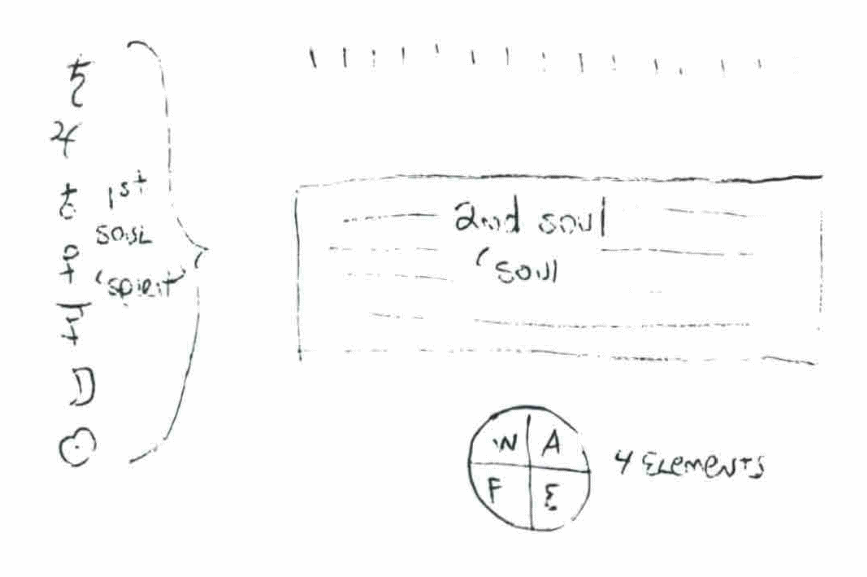
- FIGURE 1982 0123-1-AB. First and Second Soul and Twelfth House Levels.
[Transcriber note: [diagram] means the speaker is referencing a diagram as he or she is speaking. If someone is drawing or writing, with audible sounds of chalk on a blackboard, I indicate this by [drawing] or [writing].]
NOTES:
We have a partial transcript for this class, Scan File 1982 0123-07R17.PDF, with a few handwritten AD edits in it. These are noted in the present transcript. This partial was originally typed by CdA.
This was a Saturday AM Alchemy class.
This is the first class we have in the 1982 Alchemy series, which continues through early June 1982.
TRANSCRIBED Verbatim by IT 2021. In 2025, IT completes TOC, expands Book List and Plotinus quotes section, adds new notes and removes two notes within transcript, removes Gnostic/Fabricative class fragment, adds more diagram references within transcript, updates audio file markers to match new REP audio. Archival verbatim transcript – V12a.
AUDIO FILES: 1982 0123a, 1982 0123b. [Note 1: "Tape" and "Side" refer to original audio cassette tapes that were later digitized into .MP3 Audio Files. Note 2: In 2024, REP Studio moves first half minute of file a to end of file and separates off Gnostic/Fabricative class fragment from file b.]
1982 01/23 at Wisdom's Goldenrod
Alchemy; Jung; Mysterium Coniunctionis
[Audio File 1982 0123a Begins]
AD: For those of you who have the Mysterium Conjunction, now we read chapter six. [flipping of pages] The first section, Thursday night. [short pause] We started to review. (Didn't they?)
[22¼ second pause with flipping of pages, faint background talking]
AS (very faint): But, I think you should put up that diagram. [Note: See FIGURE 1982 0123-1-AB, First and Second Soul and Twelfth House Levels, appended to this transcript.]
AD (very faint whisper): Yeah, that's why you're doing it.
[someone drawing/writing]
AS (faint): He already said that.
AD: Concretize the supersensory, [S, very faint: That's hard.] so that we could have some understanding of what we're talking about. To understand the physiology of a man of light is almost impossible. They don't even attempt it, so--
S (faint): Instead of having appearance.
AD: Yeah. See that's because--
RC (simultaneously, faint): Did you say physiology of a man of light?
AD: Huh?
RC: Did you say physiology?
AD: Physiology of a man of light. So you try to put that in concrete terms it's almost impossible because you're dealing with the images which are prior to the images we work with and they-- they're the archetypal images, true, and they infuse the images we have whatever meaning they have. So it is extremely difficult try to concretize these things. For those of you who might have listened to Mrs. Ybor at times, she'll speak about that she's always being pulled up and she calls it the North, the North Pole. And you'll get awfully confused if you think of it the way a ge-- Geographica does. [S, very faint: As the pole star.] Let's see, how can we put it? [short pause]
Presence of the human being on the Earth is orientated by the four directions and it is this mode of being here that gives sense to the four directions. But they are on a horizontal level. In other words, you point to the horizon, you point to the four. But what we're speaking about is the vertical. When we-- when you meditate, that's-- you go inwardly, you start getting pulled up, they call that the magnetic pole, the North Pole. And if you start thinking that you're-- if you got-- if you think in geographical terms you're going to get all-- all confused. When they speak about the Aurora Borealis and you start thinking of winds coming down from that light and you think it's that that they're talking about again you're confused. They're talking about the rhythmetic life waves or the (animating) principle that comes into you and that's in the supersensory. I don't know that it can be made concrete. My Saturn symbol says I should be able to do it but-- (bit of laughter) [Note: AD Saturn at Libra 6, "A pilgrim sits on a rustic bench and one by one his ideals in a sort of trance-vision take form before him."] So, we'll give it a try.
But, it's very very difficult because the human person-- person has the awful disorientation. His senses, the physical senses, are transformed into light, they become made of light, so you have no orientation at all. And, instead of calling them the five physical senses then they're the five senses of light or li-- senses made up of light.
Over here we live in the world of matter which is black [FIGURE 1982 0123-1-AB, four elements]. Then there's this intermediate realm [second soul]. And then there's the world of darkness above. [Note: Transcriber thinks reference is to little lines at top of diagram representing inerratic.] The world of darkness above is the real light and the light here is the black light which is out here [diagram], and right away you see what accounts for all confusion. This light here [diagram] [VM, very faint: Black light?] is black light.
VM (faint): You mean in the sense that it's black compared to the supersensible light?
AD: Yeah. [few inaudible student words simultaneous with AD] So they call this the world-- the world of darkness [diagram] and they call this the world of light [diagram], above they call the world of light, but they very often reverse it and they call that the world of darkness and this the world of light.
VM: Especially if you use a term like 'unconscious' or--
AD: Yeah. That's another-- that's another thing, when you're, as a human being, located in this-- or having this mode of being in the world, [S, faint: Definitely.] you're operating with two dimensions only, or in our case it's three. And that is that you're dealing-- you're either a conscious or unconscious, you're a two-dimensional creature. Well-- well the whole thing's very confusing. I was hoping maybe we'd work through some of the-- some of these things that Jung says in "The Conjunction" and give me a chance to organize some of the thoughts here so that we could have a framework in-between metaphysics and the corporeal world. That in-between realm is really impossible but we might as well try. [short pause with flipping of pages] We did the first part, the first section. If you have it written up, ok, and we could just--
AS: If you want to just read quotes that [couple words inaudible] I don't (think--)
AD (simultaneously): We could read the [one word inaudible] as you go along but--
S (very faint): Uh-hm.
S (faint): Uh-hm.
S (very faint): Yeah.
AS: The important point was on 457, just where he says that this procedure is mainly symbolical. Get to the point. [student assents, very faint] He says--
C.G. Jung [CW 14, Mysterium Coniunctionis, "The Conjunction," p. 457, paragraph 654, AS reading]: "…the coniunctio [AS reads: conjunction] [AS adds: is] the"central idea" of the alchemical procedure. This [AS reads: And the] author correctly recognized that alchemy was, in the main, symbolical…"
[short pause]
AD: And then he said--
C.G. Jung [CW 14, Mysterium Coniunctionis, "The Conjunction," p. 457, paragraph 654, AD reading]: "The union of the"natures" [AD adds, quoting the end of the previous sentence: "was at the same time a love-affair"] which "embrace one another" was not physical and concrete, for they were "celestial natures" which multiplied "by the command of God.""
AD: So, when the alchemists were meditating on the processes which were going on in Nature, like for instance here, "[When]"red lead" was roasted with gold it produced a "spirit"", (Jung, ibid, p. 457, paragraph 654) the-- the outer processes were auxiliary supports and they were suggestive of the processes that were going within, were going on within. So it's very easy to think the alchemists were so naïve as-- that they were preoccupied-- preoccupied with understanding the physical chemistry whereas what they were doing was really using those experiments as a support to symbolize the processes that were going on internally. Not that they didn't experiment, they-- (there/it) was the other side to this. Then the next page--
[short pause]
S (very faint): I thought we could do a review.
AS: 459, where he-- he talks about, from the-- from these four elements, which are originally in a state of dissolution, in a state of separation, eventually there arises from their synthesis this fifth essence or quintessence, (this/says)--
C.G. Jung [CW 14, Mysterium Coniunctionis, "The Conjunction," p. 459, paragraph 656, AS reading]: "Thus the square at the beginning corresponds to the quaternio of [AS adds: the] elements [AS adds: which are] united in the quinta essentia at the end--[AS adds: the]"quadrangle will answer to quadrangle."
AS: And he seemed to speak about this-- out of our experience, there is some wisdom-- wisdom which is essentially extracted from all our experience in the body, [students assent, very faint] is built up into a double.
AD (faint): Avery, let's read that.
AS: Into the double which answers to or reflects the first soul.
AD: So could we-- [10¾ second pause] Well we-- I think we try to include in that that, well, in your natal chart you got the four elements. Planets are sitting on various degrees. And the-- the idea or the archetype which is buried in the matter, in the elements, [student assents, very faint] these ideas which are buried in the elements which together go to constitute your body, these archetypes which are buried in the body, the archetype or the meaning which is inherent has to be extracted. And in the process of living and the experiences that one goes through, these degree meanings are brought together into a harm-- harmonious whole. And in that very process, through living, of bringing these degree meanings into a harmonious whole, the opposites or, you know, the-- the i-- the archetypes which conflict with each other and which are derived from the quaternity of four elements, are brought into a synthesis. The ideas that become available to you are the very means by which eventually you build up what they refer to as the emerald vision, you know, the body of light.
[short pause]
AS (faint): This [one word inaudible] (or) this--
AD (simultaneously): This is the production of the quintessence. This is the quintessence.
FW: So, could I stop you already and say that I don't know what's going on?
S (faint): Yeah, I'm lost.
AS: Well, you know, we have this notion that originally the-- the light of the soul is conjoined with these vehicles and more or less unconscious situation, you're led by, you know, whatever modifications are going on in the body made up of the four elements. Through all this experience you're gradually extracting the wisdom that's embedded in those vehicles. Ok? Through that there begins to be a synthesis of meaning out of the original chaos which is the meanings are embedded in the elements and out of that is extracted these meanings which are synthesized into this-- into a unified state of the quint-- what he calls the quintessence. Seems similar to what we spoke about as the-- eventually, like this double. You build up this whole synthesis of meanings or archetypes which can more properly reflect the soul, become a real reflector for this-- for the soul, instead of just being immersed in the modifications, the passions, instinctual nature of the body. Originally it starts out from a state of being immersed in that instinctual nature and having to free itself from them or free those-- free the-- free the meanings that are embedded in that.
AD: You get a feeling for it?
FW: Yeah, that's not bad, just the terms are [possibly one word inaudible]
AD (simultaneously): It's a strange-- it's a strange notion that the archetypes are embedded in the elements, and when you're given a chart, you know, the moment you're born, the chart, everything there, you know, is really in a state of chaos because you have to live this chart out, and the degree meaning of your symbol is not something you start out with, it's something you end up with. It's only after all-- it's only after your living or after you've done the living that those meanings accrue to you in (a/the) very subtle form. The totality of these meanings that accrue to you in this very subtle form is going to be, let's say, the stuff of the double or of the body of light I mentioned.
VM (faint): Oh. That whole thing is a material process the way you're envision-- visioning it, right?
S (very faint): Say that [one word inaudible]
AD (simultaneously): If you know what matter is. (AD chuckles)
VM: No, no, but I'm saying that [AS simultaneously: Takes place within--] it's not-- you know, not in a coarse view of matter but to see the whole vehicle as a material substrate, let's say, with meanings embedded in it and the process of life is a continuous refinement in the sense that you bring out the meanings and leave behind let's say the lower instinctual levels of matter. And as this refinement continues it becomes a sufficiently, let's say, transparent medium where-- where the-- the higher intellectual soul can actually be mirrored in this meaning.
AD: You-- you have to remember the premises that they work with, and that is that the life, you know, which comes from the-- the Pole, you know, the supersensory sphere, when that light comes here, it is captured by darkness of matter here. That light which is captured within the darkness of matter here has to work its way out through that to gain release from that. So, you know, it's-- it's a very uroboric pro-- process in the sense that that light which comes from the Solar world or the beyond enters into our world, gets entr-- gets trapped into our world, and then through this pro-- the uroboric process gets released from the matter-- from the matter which captures it. So if you think of a black object, doesn't differentiate any light, all the light is permitted to come into it, goes within that object, and then it's captured, so to speak, and now it has to be released and the process of that light freeing itself from being captured is the process we're speaking about, and they spoke about that as Sophia or the lower soul or the Nous getting trapped in the world, and that had to work its way out.
S (very faint): Andy.
AH: Could I ask something about this light? I was just reading Paracelsus. He talks about the two lights as the light of nature, the light of revelation.
AD: There's three lights. Speaks about the light of nature, speaks about the sidereal light, and he speaks about the divine light.
AH: Well, in regard to what was just being said, he speaks of the light of-- he said--
C.G. Jung [CW 13, Alchemical Studies, "Paracelsus as a Spiritual Phenomenon," p. 114, paragraph 148, AH reading]: "The light of nature comes from the Astrum…"
AD: Uh-hm.
C.G. Jung [CW 13, Alchemical Studies, "Paracelsus as a Spiritual Phenomenon," pp. 114, 115, paragraph 148, AH reading]: "…"Nothing can be in man unless it has been given to him by the Light of Nature, and what is in the Light of Nature has been brought by the stars." … [The] light of nature is the quinta essentia, extracted by God himself from the four elements, and dwelling "in our hearts.""
AD: I can't hear you.
AH: (Says/It's)--
C.G. Jung [CW 13, Alchemical Studies, "Paracelsus as a Spiritual Phenomenon," p. 115, paragraph 148, AH reading]: "The light of nature is the quinta essentia, extracted by God himself from the four elements, and dwelling"in our hearts.""
AH: Now, when we talk about this light in the way that-- that Vic (had/has) just discussed it, as being captured by matter, we're now talking about the light of nature [AD, faint: Yes.] as opposed to the light of revelation or the sidereal light?
AD: Uh-hm.
AH (faint): Gotcha.
VM: Well it's the light of 1.1.7(./?)
AD (simultaneously): Well, sidereal light is also the light of nature, isn't it?
AH: I mean, sometimes they talk of two and sometimes they talk of three lights.
AS (very faint): They're usually three.
S (very faint): Yeah.
AD: He says here for instance--
[Transcriber note: I am using Paracelsus, Selected Writings, edited by Jolande Jacobi, Bollingen Series XXVIII, Princeton University Press, Princeton, 1995, c1951 by Bollingen Foundation Inc., New York, NY.]
Jolande Jacobi [Paracelsus, Selected Writings, p. 103, AD reading]: "Man should study in three schools. . . . He should send the elemental or material body to the elemental school, the sidereal or ethereal body to the sidereal school, and the eternal or luminous body to the school of eternity. For three lights burn in man, and accordingly three doctrines are prescribed to him. Only all three together make man perfect. Although the first two lights shine but dimly in comparison with the brilliant third light, they too are lights of the world, and man must walk his earthly path in their radiance."
AH: It (says/said) the same thing in here, he says--
C.G. Jung [CW 13, Alchemical Studies, "Paracelsus as a Spiritual Phenomenon," p. 115, paragraph 148, AH reading]: ""Therefore we should know that we have to interpret…""
AD: Well what are you reading from?
AH: "Paracelsus".
AD: Which one?
S: Yeah.
AH: (Delta.) He says--
C.G. Jung [CW 13, Alchemical Studies, "Paracelsus as a Spiritual Phenomenon," p. 115, paragraph 148, AH reading]: ""Therefore we should know that we have to interpret nature according to the spirit of nature, the Word of God according to the spirit of God, and the Devil according to his spirit also.""
AD: Well-- we better follow Jung here. Unless (she's/he's) got the [one inaudible AH word] "Paracelsus", the--
AH (simultaneously): His "Spiritual Phenomenon".
AD: Yeah. [S simultaneously, faint: (Would--)] Let's follow Jung here.
AH: I-- I can just repeat my question. At this point we're talking about the light of nature. [student assents, very faint] That so?
AD: Uh-hm.
AH: And that's the light that's going to create the double.
AD: And that eventually will create the double after it is lived out in experience and assimilated by the individual soul.
AH: Is that the black light?
AD: Well, again like I told you, what do you mean by black light, the one above or the one below? The light that comes from the supersensory world, alright, is the light that they, in Hermetism and philo-- Medievalism, refer to as the Nous in matter [AD handwritten addition from partial transcript: the reason principles embodied].
AH: From above to below.
AD: Yeah, coming here. It's manifested in this world and it gets captured by this world. (Now/Well) that's the middle light. That's the same as the light of the Nous, they call it Nous, actually I wouldn't call it the Nous. And that's the light that's captured by this world and has to work its release from this world. Now in that process, which is not instantaneously, you know, takes eons, that light working its way out, and we're the ones who are working it out, we liberate-- we liberate that light from its entombment, and by our understanding, alright, we assimilate also what it means. Those meanings eventually become the envisioned subtle body.
AH: Those meanings become the envisioned--
AD: Subtle body. Or all the experiences from which you gather some understanding and wisdom eventually becomes the stuff of the subtle body, [student assents, very faint] the body of light. [9½ second pause] Ok. Then he speaks of-- go ahead. 656.
AS (simultaneously): Ok so-- this trying-- we went-- we went through that. The synthesis of these four results in this quinta essentia. And what at the beginning is this chaos of the elements is eventually brought into some kind of order through all (his/this) experience and needing to extract it. And apparently the unity of all these meanings forms this quinta essentia, would seem to be that light which is originally immersed in the elements is freed through the process of living, is freed from the elements, this form that you say, this quinta essentia, this double, the-- this body of light. I thought it was interesting because "quadrangle then will answer to quadrangle." (Jung, CW 14, "The Conjunction," p. 459, paragraph 656) I was thinking of you-- we were saying that the-- the first-- the second soul becomes a very good replica or mirror of the first soul, and the quadrangle answering to quadrangle would be the-- now the second soul answers to the first soul and they-- they're [S, very faint: Say it, Avery.] of a like nature.
AD (simultaneously): They're a dialogical-- yeah, they're a dialogical unity.
AS: Yeah, and I think that's what he meant by the [CDA simultaneously, faint: What does 'dialogical' mean?] "quadrangle will then answer to quadrangle."
[short pause]
S: What does 'dialogical' mean?
S (faint): [one/two words inaudible]
AS (simultaneously): (And/A) dialogical.
S (very faint): What is?
AS: Dialogical.
AD: The "I" in the "me".
MW: By the way, are-- the references, are they paragraphs or pages?
AS: Paragraph, 656.
AD (faint): Go ahead.
AS (faint): Well--
AD: Well just--
AS: Well-- Then he starts speaking about the con-- the nature of the conjunction, top-- well-- He says that-- at the bottom of 657, says [AS paraphrasing] the conjunction takes place in a retort, "natural vessel" or matrix. (Jung, CW 14, "The Conjunction," p. 460, paragraph 657) [12 second pause, flipping of pages] Well, if we read before he says--
C.G. Jung [CW 14, Mysterium Coniunctionis, "The Conjunction," p. 460, paragraph 657, AS reading]: "The result of the synthesis was consequently conceived by the adept as self-knowledge…"
AS: It seems that that's what he's speaking of. Through the extraction of this quintessence what arises is self-knowledge, by that meaning a knowledge of the soul.
S (faint): Can we s-- could-- could we settle the va-- the retort or the vessel (or/of) the body of the Earth (in) a clean body?
AS (faint): I don't know, that wasn't in the quote, when he says the conjunction takes place in the ether.
[18 second pause]
AD: Well, let's [AS simultaneously: You want to read the bottom of 657?] read 6-- let's read 657, you--
C.G. Jung [CW 14, Mysterium Coniunctionis, "The Conjunction," pp. 459-460, paragraph 657, AD reading]: "The alchemical description of the beginning corresponds psychologically to a primitive consciousness which is constantly liable to break up into individual affective processes--to fall apart, as it were, in four directions. As the four elements represent the whole physical world, their falling apart means dissolution into the constituents of the world, that is, into a purely inorganic and hence unconscious state. Conversely, the combination of the elements and the final synthesis [of male and female] is an achievement of the art and a product of conscious endeavour. The result of the synthesis was consequently conceived by the adept as self-knowledge, which, like the knowledge of God, is needed for the preparation of the Philosophers' Stone."
S (faint): Yeah.
AD: Now, these are very subtle processes, if you don't try to-- You have no questions on them you're not going to understand these-- Assuming that you understand what I'm saying.
S (faint): Or this--
DB: For--
AD (simultaneously): What he's saying.
S (very faint): Sorry David, go ahead.
DB: The first stage that you spoke of, dissolution of the-- the-- the instinctual--
S (very faint): (Body.)
AD: No talking about instinctual here.
DB: Well, or the constituents of the personality.
AD: He says in the beginning it's very primitive, you take a look at a child and you see that. There's no organized center. That organized center only comes into being gradually as he experiences the world. If there should be some kind of illness you would see an immediate regression and a relapse and a going back. And, as he evolves out of that childhood situation you can see that the chaos which is originally constitutive of him is brought gradually into and under his control. And through these experiences he begins to assimilate the meanings that he finds within-- within his body and in-- and his environment. So these four elements do represent to each and every single individual the whole world. And then he goes on and he says--
C.G. Jung [CW 14, Mysterium Coniunctionis, "The Conjunction," p. 460, paragraph 657, AD reading (out of sentence order)]: "…final synthesis… Conversely, the combination of the elements…"
AD: Now over here I would say, if he-- if he leaves out what's-- what's inherent in the elements, there can't be no synthesis, there won't be no understanding. It's not the elements. If you assimilate fire, earth, and water, you're not going to understand anything. But if we say that the elements are organized in a certain way and that you assimilate the meanings, because it's the organization of the matter which provides us with the meanings, if you assimilate that then of course you start getting self-knowledge. But--
CDA: So the-- the meaning that you-- the meaning that you would get, would that depend upon the particular organization of the elements?
AD: Yeah, the way the [CDA simultaneously: So-- s--] el-- elements are organized [student assents, very faint] for you.
CDA: So for each individual, those all could-- it's going to be a di-- that is the-- that is the basis of why the-- the meanings that each individual will get would be different.
PD: Yeah. Is that what's possibly being indicated in the next sentence where he says the result of the synthesis is conceived by the adept as self-knowledge? [AD simultaneously: Yeah.] That seems to be one stage, the first stage which the knowledge as what we call the second soul occurs. And then-- and then would have to be added to that is knowledge of God in order to produce the Philosopher's Stone or maybe what we would [AD simultaneously: (No.)] call the double.
AD: Not-- not God, it's what we call the soul.
S: Yeah.
PD: The first soul.
VM: How about the first soul.
PD: And, it's those two ingredients, knowledge of the first soul and the--
AD: Knowledge which you will get from your experiences is going--
PD (simultaneously): Which then go to produce the Philosopher's Stone, [AD simultaneously, faint: Yeah, the lapis.] which might be the concept of the double.
AD: The double or the emerald vision.
S: When you say it ex--
MW (simultaneously): Anthony-- If-- if what's being assimilated is not actually the elements but what was organizing the elements, then that seems to mean that the chaos that's described in the beginning is not-- it's a chaos in the-- in the reflective consciousness which is still in its germinal state, but the actual-- let's say the person's body (if he stays) is where these meanings are, seem to already be organized.
AD (faint): Yeah, but it doesn't appear to you like that when you're born, does it.
MW: No, I'm saying [AD simultaneously: Um, when you're born, yeah.] in a-- in reflection it seems like chaos.
AD: When you're born there's an organized-- highly organized body with all these potentials in it, but if you remember like with-- I don't know if you remember when you're a little baby, looked like chaos over(--/.)
S: Yeah.
S: What you remember are the little moments with-- which weren't chaos.
AD: Another moment of chaos, another moment.
S (simultaneously, faint): That's true.
AD: But--
AS (simultaneously): But the other-- the other point you--
MW (simultaneously): (Because) how the sentence is.
AD (simultaneously): You see how subtle the point is here, that this self-knowledge accrues through the experiences that the body's going to provide.
S: And that's what they speak of when they talk about self-knowledge of-- Why would that-- what would that mean for-- are you talking about in ordinary-- in ordinary people? I mean before any kind of self-reflection comes up?
AD: Yeah, this is going on all the time regardless of whether a person is a philosopher or an ordinary man. He's always building this double. Doesn't matter if he, so to speak, is unaware, you know, philosophically, he's doing it anyway. It's only at a certain time, it's only at a certain time that he becomes aware of it and now he declares himself to be a Vedantist, a Buddhist, a Platonist, something like that. Process goes on and in Nature there are no such labels. But, you're always doing it.
S: But in-- you talked before in that [one word inaudible] in the quote about-- seemed like at a certain point the understanding of the meaning-- Would that be like just a separation of living it?
AD: Well usually it can come either with the living of it or after the living of it and sometimes I sus-- I suspect even before you live it. But, it is-- it is, for instance-- it is the process by which ultimately self-knowledge accrues. Because if you take a look at the-- even in the modern sciences they point out that you could have three chemicals but the way they are arranged is what-- that arrangement constitutes different composites or compounds. Of course the alchemists would have to-- would add that it's not only the arrangement but that arrangement indicates the form that is going to preside over and which will manifest through that arrangement. And that is of course exactly what we're taking into ourselves, these forms or meanings.
S: So the process of self-knowledge is your way-- your individual form?
AD: The process of self-knowledge is to learn the meanings of the forms that you've been assigned to or that have been assigned to you, and it is the assimilation of these forms and meanings of ideas which builds up that body. [short pause] Now you could understand why PB referred to himself as a good materialist, good (guy/kind). [short pause] Avery, you-- you want to say something?
[short pause]
CDA: Can I-- I-- I'm a little unclued still.
AD: Well [S simultaneously, faint: Yeah.] we-- we're only on the first page.
CDA: (Right/Yeah), but [S, very faint: Uh-hm.] [one/two inaudible student words simultaneous with CDA] the-- the elements are organized. Now, does the form preside over this organization of the elements or does the particular organization of the elements equal the form?
AD: Why-- what would it matter to you right now?
CDA: To-- it would matter in terms of the image that my--
AD (simultaneously): Well then we'll find out. We'll find out Carol, let's go on. [S, faint: Yeah.] It won't matter right now.
CDA (simultaneously): --mind is going to make of this. (CDA laughs a bit)
AD: It won't matter right now. Let's go on Avery.
AS: But he-- but he does seem to make one point is what you made, that the elements themselves are not what are assimilated in this process.
CDA: Right.
AS: There's something of the meaning, whether it was extracted from the elements or in whatever means evoked or whatever, the elements themselves may be the basis for all this experience. There may be something embedded in there. I mean is this--
S (very faint): That line.
CDA (faint): Uh-hm.
TS/S(?) (very faint): That line about the [one word inaudible]
AS: We'll go on. You want to go on Anthony? (bit of laughter)
S: You're gonna.
AD (simultaneously, faint): (Repeat) what you said.
S: Repeat what you read.
S (laughing): Yeah.
AS: Next point that he made was on paragraph 658, that--
C.G. Jung [CW 14, Mysterium Coniunctionis, "The Conjunction," p. 461, paragraph 658, AS reading]: "The coniunctio [AS reads: conjunction] does not always take the form of a direct union, [since] it needs--or occurs in--a medium:"Only through a medium can the transition take place"…"
AS: And the medium is what he calls Me-- Mercurius, the mediator of spirit and body. And we interpreted-- that's line two-- I-- one interpretation was that the mediator between the first soul, which we equate with spirit, and the elemental realm, the actual body, would be the astral realm, the second soul, or what we've called the grid, the planetary functioning [FIGURE 1982 0123-1-AB]. And that would be a mediator between the first and second. And he says--
C.G. Jung [CW 14, Mysterium Coniunctionis, "The Conjunction," p. 461, paragraph 658, AS reading]: "Mercurius is the soul (anima), which is the"mediator [between body and spirit]." [AS: The medium of the conjunction.] The same is true of [AS reads: for] the synonyms for Mercurius [AS reads: of Mercury], the green lion [and] the aqua permanens or spiritual water…"
AS: And so on.
DB: Avery, are you saying that this medium is-- works both ways? That it's necessary for the meanings to get instantiated in the elements, that the elements are formed through the medium of this Mercury and also that in order to assimilate the meanings that are there that-- that this Mercury is a necessary process or a condition for that? [AS simultaneously: Like the actions--] Doesn't seem one way.
AS: Yeah. No, he says later on that not only is the Mercury the medium but it's also that-- part of that which is being transformed or ignited. Mercury itself is going through the trans-- what he calls the Mercurius or the medium is itself doing the transforming and getting transformed. Spoke about that in similar way in another context, other--
AD: Do you follow that, Carol?
AS: That it's both.
AD: Better read it again, huh? You follow that?
CDA: No, I was backing up, I--
AD (simultaneously): You were backing up.
CDA (simultaneously): --was just backing up. (bit of laughter) I--
AD: Where are your eyes, in back of your head or in front of you?
CDA: They're sort of swirling around in a circle from all this [one word inaudible] (bit of laughter)
S (simultaneously, faint): Just like me.
AS: Well you know, it's like they say they'll-- if-- if we s-- just as an-- this may not be a right example but, say you'll have all these transits going on. So this functioning of the second soul is what's extracting the meaning but at the same time it itself is getting transformed through presenting you with this experience or through extracting these mediums-- these meanings. So at one and the same time, it's the medium for this transforming work, for the-- and also it itself is part of the process, it's not a-- an abs-- ex-- abstract agent, it itself is going through this process where the pl-- these functions, the psychic functions, are going through the process, at the same time they're extracting the meanings, they're getting transformed. I mean I--
AD (simultaneously): Do you follow that? [AS simultaneously: It's almost trying to--] Do you remember the quotation from the Volume 8?
AS: Yeah.
VM: It's from "Nature of the Psyche," isn't it?
AS (simultaneously): Consciousness itself the transformer [VM: Right.] and also tr-- what is transformed. That was the one I was thinking of, in that "Nature of the Psyche".
S: Well it was such a--
RC (faint): It seems that we could talk about the same thing the other night as, given the natal chart or the moment of birth that it goes through many types of transformation [few words inaudible] apparently persisting structure [couple/three words inaudible]
[short pause]
S: Is one unit-- one thing doing both though, doesn't one have to stay permanent, one portion of it have to stay permanent and be continually transforming?
AS: Fabricative and gnostic.
S: But-- yeah, ok. Well that [one word inaudible]
S (simultaneously): (Fates.)
AS: But that may be another way [student assents, faint] to put it. (bit of laughter) It's both fabricative and gnostic aspect.
S (faint): Yeah but you can't square--
VM: That's just a Moslem--
S: Would the [S simultaneously: Yeah.] gnostic [AS to VM simultaneously: Sure.] be the part that stays-- stays consistently-- is the transforming and the fabricative would be the part [AS simultaneously: Like--] that gets transformed?
AS: Well, you know, like I think he used an-- he had also the notion of the imagination, transforms itself into a certain image and at the same-- the same time it's presenting something to you, it itself has been transformed into what it's presenting. In the process of extracting meaning from this experiencing, [S simultaneously, faint: Yeah but you said (one word inaudible)] getting transformed, at the same time it itself--
AD (simultaneously): Now, that quotation there, you'd see you'd have to change the word 'consciousness'.
VM: Psyche.
AS (simultaneously): Yeah. Oh yeah.
AD: Remember I told you a long [S simultaneously: Right.] time ago, don't [VM simultaneously: Right.] take that word [RG simultaneously: No, no.] seriously as he uses it.
VM (simultaneously): I know. That's the one thing that doesn't change.
AS (simultaneously): So that's why I use like imagination or something like that, [student assents] something that the-- this--
AD (simultaneously): In that quotation-- as a matter of fact I think in that volume he also made the point that he doesn't know what consciousness is and [VM simultaneously: That's right.] then go ahead and speaks about it as though he does. [S, very faint: That's right.] But, if you try to keep of it-- if you try to keep it in terms of what (we review constantly)--mentality that you're working with.
AS: The mind. It'd be like the individual mind.
AD (very faint): Yeah.
AS: That's-- I mean that was the other example, the individual mind presents you with the experience and it itself is going through that experience that it's presenting itself with.
AD: And then assimilates that [AS simultaneously: And in the process--] experience that it presents itself with, alright, and the understanding of that experience is what we're referring to as the building up of the double.
PD: He also speaks of this Mercur-- Mercurius here as the life principle, and I think that's-- it doesn't come out as much when you speak of it as the mentality but I think that's equally important, it's like the system of living meanings that is continually actualizing itself as the person. And, in that sense it is very analogous to the-- the given, let's say, aspect pattern that a person has at any given point in time. That is the actualization of those meanings astrologically and it is the states of consciousness that you're experiencing.
CDA: So when understanding occurs, that seems to be a separation of that-- the light with the vehicles? Like the-- the ideas are being instantiated through the functioning of the planets, but then when there's understanding that's-- that's-- it seems it's no-- in order for the double to get built up, for the essences to be grasped, it seems that there's-- it's in a different category that understanding takes place. You know what I'm trying to say?
S (very faint): Sure.
DB: Carol, are you trying to say something like this, that the distinction--
CDA (simultaneously): The understanding is not-- is not the c-- the fabricative and gnostic aspect (of the mind). Thought I gave up.
[10 second pause, very faint background AD and student talking]
PD: If I can-- you know, the last--
AD: Well let me see what she's trying to say because she's-- she doesn't function in the morning.
VM (faint): It's probably coffee [one/two words inaudible]
AD (simultaneously): Try again.
S (faint): Ok.
S (faint): Ok.
S (very faint): Go ahead.
CDA: It seems that-- when Avery was saying that the-- that the vehicle is affecting the experience, is the agent and the-- what is the other one, the--
AS: The mind, the [CDA simultaneously, faint: Yeah.] mind is-- produces your experience--
AD (simultaneously): The mind is both agent and vehicle.
CDA: It's the agent and vehicle. Yes.
AD (simultaneously): Or the mind is both gnostic and fabricative.
CDA: Yes, and so--
AD (simultaneously): And the conjunction takes place within that medium.
CDA (simultaneously): Yes, and so that-- being gnostic and fabricative is the-- the mind as being-- is the second soul as being conjoined to the planetary function. Now when an understanding occurs--
AD (simultaneously): We're calling that the mind.
CDA: Yes, ok. But when understanding occurs, you talk about this building up of the double. When an understanding occurs--
AD: Where does it take place?
CDA: Where does the understanding [S simultaneously, faint: (one word inaudible) its own activity.] take place? Well it's takes place in the mind. But I'm saying it's the-- the-- it's-- there's this other thing that's happening and it's just that--
AD (simultaneously): Let me restrict-- let me restrict the scope of your questions, please be like a little grasshopper, take only one foot at a time. Alright look, if you have a dream, you're dreaming, you have experience, then you understand what the experience is and you say to yourself "I understand", all this is taking place in the mind.
CDA: Ok.
AD: Alright?
CDA: Then how--
AD: What is happening as that goes on, as you understand more and more?
CDA: You're saying that this double--
AD: The mind is beginning to understand more and more of itself.
CDA: Yes.
AD: What will be the net result of that?
CDA: Well I don't-- I mean, I--
AD (simultaneously, very intensely): What will be-- will you answer the question!? [CDA: Self-knowledge.] I gotta put you on a-- on a chair [CDA simultaneously: What--] like I'm in a court? "Yes or no?" (bit of laughter) What would be the result!?
CDA: S-- knowledge.
AD (intensely): Self-knowledge.
CDA (simultaneously): Self-knowledge.
AD: Ok, you got the point.
CDA: But, this self-knowledge you're saying is building up the double.
AD: Oh for heaven's sakes.
CDA: I'm sorry, I'm confused.
AS (simultaneously): That is the-- I mean, [CDA simultaneously: That is the double then, that is the double.] that is what's being built up is that self-knowledge.
AD: You're worse than I am when I drive. (bit of laughter) I thought I was disorientated. (bit of laughter) You follow the point she's making?
CDA (simultaneously): Then you should have compassion for me.
AH: I think-- I think she's [AD simultaneously: May--] talking about Mercurius as triple instead of dual.
AD: Yeah. (laughter, student words) [very intensely] Just answer the question, you follow the point that was made?
VM (very faint): Yes, yes.
AH (simultaneously): Yes sir, yes sir.
AD: That's all! (bit of laughter)
S: The-- so in other words just the clear mind or the transparent or the shiny--
AD (simultaneously, intensely): If you can understand that point, you go-- you got [S simultaneously: That's it.] a capital point, you can take a flag, raise it up!
S: That is the double?
AH (simultaneously): Well I-- I think I understand what you're saying, maybe-- could I try to-- can I see if I--
AD (simultaneously, intensely): If you alter it, I'll-- (bit of laughter) so help me I'll--
PD/S(?): You can help it. (some laughter)
AH: This mind--
VM: You want to encourage discussion with that.
AS: You got a whole box.
AD: We got a whole box of books here. (some laughter)
AH: The point is that the [AS simultaneously: I don't want it.] self-knowledge is occurring within the mind.
AD: Uh-huh.
AH: There's no place outside of the mind, or no perspective-- no third perspective apart from the fabricative-- fabricative and gnostic function of the mind to stand. [student assents, very faint] It's the mind itself that's being transform--
(Side 1 of original cassette tape digitized as 1982 0123a Ends; Side 2 Begins)
AD: That's usually not the case. [student assents, very faint] She usually just fi-- she usually finds that by following up certain, you know, explanations according to her frame, you know, her mode or framework, then she understands something. [AH simultaneously, faint: Ok.] So try not to read into her-- what she's doing. Let me worry about that.
S (very faint): Uh-hm. (bit of laughter)
PD: The previous paragraph where he speaks of the retort or natural vessel, a matrix, is that like saying that this system of meaning which is unfolding as the conscious understanding has to be confined to a locus and not dissipated into the elements or circumstances and so get lost back in the unconsciousness of existence, that that system of unfoldment that's coming about has to be nurtured, like let's say in the mind or in a s-- to confine and keep bringing out the meaning before it gets dissipated out?
S: Seemed like the elements are the ones that hold that together, that have some way of-- who knows.
AD (simultaneously): The retort [student assents, faint] very often [S simultaneously, faint: Oh yeah?] does stand-- does stand precisely for what we just spoke about as a self-enclosed system, the mind as a self-referent, and all the transformations that it goes through, these transformations are retained in that retort or that self-contained system. That's why I just pointed out and tried to make the point that if they follow what Gödel was doing they would see what he's getting at, that there's only a certain point that you can go and beyond which you cannot-- it cannot be self-validating from a point-- In other words, you're within the mind, there's [AS simultaneously: No Archimedean point.] no Archimedean point that you can get outside and pry it up. [AS: Yeah.] So all these meanings have to be absorbed by the individual [S, faint: As experience.] mind that's functioning with them.
Now I think-- I think you're getting carried away, if you just stick to the preciseness with which we just tried to point out. You have the experience, an experience-- your mind projects an image. You have an experience from that image and then you abstract from that experience the meaning that it has for you. This attenuates the mind and brings it closer and closer to a self-knowledge of what it potentially contains within itself. That is a retort. That's the symbol that they use for retort. And if you notice, the nice thing about the retort it-- it has that bent thing, you know, which is supposed to be able to distill all your experiences with. So the distillation of your experiences ultimately supposed to result in some wisdom. I doubt it, but-- I guess one go through it enough time then it does.
Now, we can call this like-- we can call this stuff that the mind is working with-- Let me-- let me try this way. We could say that the matter, and I'm using the word here metaphorically, because we said there is no matter in the way it is understood, but we can say something like this, is that there's a refinement of the matter. This refinement-- [short pause] it's like from a coarse matter to a subtle matter, from a coarse matter to an immaterial matter, or let me say better an ethereal matter which is the substance that is constitutive of what you would call the mind or the astral body or any of these terms that they want to use with it. So that there is that refinement process going on. In other words, it has a basis in which it is-- a locus in which it is placed, this matter. This meaning is placed in a certain matter, that refined matter or that ethereal matter is the astral body and this becomes more and more attenuated, more and more refined.
But basically the idea is very simple but very profound. The extraction of meaning from the experience which the image presents you with is taken back into you, the mind gets to know more and more about itself. This ultimately leads to some kind of self-knowledge. And this is encased or embodied in what they call the vision of your perfect nature. [Note from partial transcript: AD has handwritten in the left margin "find para #".] [short pause] Let's go on. [AS simultaneously, faint: Well (he just says)--] So the book says-- Oh, I'm sorry.
C.G. Jung [CW 14, Mysterium Coniunctionis, "The Conjunction," p. 460, paragraph 657, AD reading]: "…where it is said that a perfect knowledge of the soul enables the adept to understand the many different names which the Philosophers have given to the arcane substance. The ["Liber quartorum"] emphasizes [AD reads: emphasis] that there must be self-observation in the work as well as of events in due time."
AD: So you--
C.G. Jung [CW 14, Mysterium Coniunctionis, "The Conjunction," p. 460, paragraph 657, AD reading]: "It is evident from this that the chemical process of the coniunctio [AD reads: conjunction] was at the same time a psychic synthesis. Sometimes it seems as if self-knowledge brought about the union, sometimes as if the chemical process were [AD reads: was] the efficient cause."
AD: Now what he's--
AS (faint): Isn't that-- well [few words inaudible] "Sometimes it seems as if the self-knowledge brought about…"
AD: Go ahead.
AS: Is that what you were speaking of like-- seeing well you could have the meaning be during the experience or after or before the experience. In one-- in the case of the chemical process bringing it about, that would mean the actual modifications by transits and so on would be forcing you to this knowledge. In the other case it may be that the self-knowledge is brought about by the union. Seems in that case it would be more conscious effort to extract the meaning. I mean is that-- is that the distinction between say the chemical process itself representing an actual bodily transformation or nature-- a natural process and the-- [student assents] than say doing it in a way which was more, you know, consciously directed say?
S (very faint): Well no, no.
AD: Well no, no, I'm not-- let me try to understand.
C.G. Jung [CW 14, Mysterium Coniunctionis, "The Conjunction," p. 460, paragraph 657, AD reading]: "…the chemical process [AD reads: processes] of the coniunctio [AD reads: conjunction] was at the same time a psychic synthesis."
AD: And I think very often we've all had the experience that if we're trying to understand something abstractly, we may fail. And yet if some experiential situation arises, that very idea is triggered off in us and we know immediately what-- what it was about. Now what I think he's saying here is that very often the alchemists use-- would use chemical processes on which to focus understanding and try to trigger off the psychical correspondent to that external process. But-- I-- I don't know um--
VM: Is that what they mean by the process of self-knowledge you mean is the manipulation [AD: Yeah.] of these materials, or just like you manipulate symbols on the board and you say, "Well you see the Soul ring comes all the way from Intelligible all the way down into fourth quadrant," so on and so forth, and through these manipulations you draw out the meanings, let's say, embedded in experience. And they took the same approach but it's, let's say, with chemicals, sulfur, gold, mercury, this and that, and through the interaction of these things, observing how they interact, somehow extracting the-- the meanings from these actual manipulations.
AD (simultaneously): Well don't you get the same feeling like for instance if you-- about grapes which you pressed to ferment and a subtler essence comes out of that. Don't you get the feeling that that would be symbolical, if you watch that process that would be symbolical of what's going on within you.
S (faint): Yeah.
AS: The problem is, I think, that at that time [VM simultaneously, faint: He's very (strong).] the chemistry was so numinous still. Now it's been-- I mean not to deprecate modern science view but now it's like chemistry has been so abstracted and conceptualized that, you know, [student assents, faint] you have a table of elements and H2O and all these formulas. But I think then maybe the processes [VM simultaneously: Is closer to it.] were-- you-- at least they were closer to the actual, you know, meanings of these processes.
VM (simultaneously): Sense experience.
S: How do you take care not to?
AS: I don't know what I was getting (at).
[student assents, very faint]
AD (simultaneously): No, I don't buy that because the chemistry that they deal with has nothing in common with the chemistry that they talk about today, chemistry--
AS: That's exactly what I said.
AD: They-- they were watching an entirely different process, they were looking at chemistry in an entirely different way.
AS (simultaneously): That's what I'm saying, that they were closer to the actual numinosity of these natural processes.
AD: What do you mean numinosity now?
AS: Well just what you're saying, you look at the grapes fermenting and instead of saying, "Oh, well we can explain this by there's a certain formula and we know what happens when, you know, certain chemicals interact and you [AD simultaneously: Uh-hm, ok.] get…" but-- but they were-- they were actually looking at this as a real s-- it-- for them it could be a real symbol 'cause it hadn't been devaluated into a-- a formula. They could take it as a real symbol of what was going on in the psyche or those psychical process.
AD (simultaneously): So, when they-- when they advise you to see and observe very carefully, so if we took the example of the grapes getting fermented and producing a very subtle aspect, you know, something from within the grape itself, alright, from the coarse grapes a subtle liquid [VM simultaneously, faint: Yes, yes, subtle.] is produced, alright, [AS simultaneously: Well that's (couple words inaudible)] they're asking you to duplicate that in yourself and that would [AS assents] be the symbolical process that they're working with.
AS (simultaneously): Yeah, distillation, like in their alchemical [one/two words inaudible]
AD (simultaneously): But then, if they're asking you to see and observe, they're-- they're pushing aside the chemistry that these-- [AS simultaneously: Exactly.] the moderns talk about.
AS (simultaneously): That's exactly what I said, [AD simultaneously: Yeah. Ok.] that they're-- that they're-- that they would be-- once-- once this conc-- conceptual way of doing the-- the chemistry had taken root, then you couldn't-- it was-- it's hard to get back. It's just like the mythology, it's hard to get back to this mythological view.
S: Hey Tim--
AS: The [S simultaneously: Tim--] symbolic view of the process.
AD: You know, just in the same way like when they mentioned or when it was mentioned in class the Kant or [one word inaudible] theory of the nebulae, if you ever followed his theory out the only thing that that would ever produce would be a whole bunch of robots. Never produce any living man. And [one/two inaudible student words simultaneous with AD] you do have to produce a living man and that-- that's what the whole universe is working at, you know, producing gold, lead, you know, silver, and all these things. But anyway, we don't want to get into that because un-- until we understand something about-- of their so-called chemistry we won't be able to contrast it with the modern chemistry.
S: They had to have some experience underlying it though or else they could just impose any idea on these things.
AD (simultaneously): They had a knowledge we can't even grasp. And then we're going to keep it out.
TS: It seemed like if you were able to find in Nature the precise symbols for the structure of the soul and the perfection of the li-- body of light, then in contemplating those-- those elements of Nature one could rectify one's own internal processes to the way one sees the inherent order of the horoscope or the-- the movement of the planets would correct our thinking about the order of cosmology. So that there would be a-- you know, if one would undertake these inner processes, you'd want some objective reference to guide him.
S (very faint): Yeah.
S (faint): (Sort of/So the) saying why (do/the) grapes turn [one word inaudible]
TS: Yeah. That there's an order in Nature that could be [one/two words inaudible] by [few words inaudible]
S (very faint): Yeah.
AD: But anyway, he has an interesting conclusion, he says--
C.G. Jung [CW 14, Mysterium Coniunctionis, "The Conjunction," p. 460, paragraph 657, AD reading]: "…the coniunctio [AD reads: conjunction] takes place in the retort or, more indefinitely, in the"natural vessel" or matrix. The vessel (AD chuckling) is also called the grave, [student assents, faint] and the union a "shared death." This state is named the "eclipse of the sun.""
AD (faint, flipping pages): That would be good for you (Red). Alright, next one, 658.
C.G. Jung [CW 14, Mysterium Coniunctionis, "The Conjunction," p. 461, paragraph 658, AD reading]: "The coniunctio [AD reads: conjunction] does not always take the from of a direct union, since it needs-- or occurs in--a medium:"Only through a medium can the transition take place," and, "Mercurius is the medium of conjunction." Mercurius is the soul [(anima)], which is the "mediator between [AD adds: the] body and [AD adds: the] spirit." [The] same is true of [the] synonyms for Mercurius…"
[short pause]
CDA: So is the conjunction always in reference to the-- to the body and the spirit? [S, faint: Oh no.] Is that-- is that this whole thing, is that what--
AS: Yeah but didn't he have--
S (simultaneously, faint): But we just don't know [one/two words inaudible]
S (faint): Yeah.
TS (simultaneously): He had three conjunctions.
AS (simultaneously): But he had three conjunctions in that ch-- later on. Thought he [CDA assents, faint] talked of three stages in the-- Well that's in [student assents, very faint] [one/two words inaudible]
CDA (faint): Ok. But the stage that he spoke of in here?
PD: Speak up Carol.
CDA: I mean [AS simultaneously: Well it's not cl-- That's a good question.] it's not clear what this-- what-- what the conjunction is.
AS: I think he's saying this-- the Mer-- is [S simultaneously, faint: What (does he mean)?] Mercurius the medium for all thr-- do all three of those stages of conjunction need Mercurius as their medium would [CDA simultaneously: Well I would like to know.] be a good question but I don't-- [S, faint: Yeah.] he (hadn't/didn't) really said anything yet. He just says [AD simultaneously: No, as a matter of fact, as a matter of fact that--] here the conjunction does not always take the form of a direct union.
AD (simultaneously): As a matter of fact that reference is irrelevant here where he says, "It's the mediator between the body and spirit," it's irrelevant here.
S (very faint): Well it seems irrelevant.
AD: You're reading the text?
CDA: I don't have it. You took it out of the library. (laughter)
RG: I thought you're--
S: Yeah.
AD: You see [CDA simultaneously, faint: Last (week).] the name here?
S (faint): The Library of an American (Brahman). (some laughter)
S (very faint): Just nail him.
VM: Nail it down.
S (very faint): I think [few words inaudible] (laughter)
CDA: It's not there anyway.
AD: Besides, it's [VM simultaneously: This is his.] my library. (laughter)
AS: So the library [S simultaneously, faint: (It's true.)] was just-- (laughter)
AD: Huh?
VM: Sold your first one, you have to build up another one.
AD: Yeah. Another one is going to be better than the first one. Read that quote again, Avery, would you please, [AS simultaneously, reading: "The conjunction does…"] and you can see that-- you've got to watch, Jung is going to make mistakes all [student assents] along the way, he's going to make more than you can see. [AS assents, faint] So question everything he says very carefully.
AS: And he takes all these statements and then he-- he puts them all together there [VM simultaneously: It's a collage.] but they don't necessarily-- yeah, it's a collage, [S simultaneously, faint: Uh-hm, why--] they don't--
VM (simultaneously): His collage does not necessarily [S simultaneously, faint: True.] present (the truth).
AD (simultaneously): We just spoke about the conjunction. We spoke about consciousness, right, and that the-- the activity that takes place in the consciousness produces an image, experiences the image, understands the image, so all that is taking place within this mind of this individual. Now, what is the medium in which this is taking place?
S (incredibly faint): My mind.
S (faint): My mind.
AD: It's the mind itself!
S (very faint): Yeah.
AS: And that's just the (soul/sole) mediary.
AD (simultaneously): Why does he bring in that Mer-- Mercury is the-- is the intermediary between spirit and body?
PD: Because there's three stages of conjunction. And he'll get into that a little more with the-- [AS simultaneously: Yeah right but--] there's a [VM, faint: Yeah.] stage of mental conjunction [couple/few words inaudible]
AD (simultaneously): I know there's three stages in the conjunction [AS simultaneously: Yeah but Paul but--] but if you think that there's going to be a conjunction between the first spirit, you don't understand the alchemical processes at all.
S: Right.
PD: I'm sure of that.
AS: No but Paul, but that's-- I mean, that--
AD (simultaneously): There's not going to be any conjunction between the second soul [AD indicates on diagram] and the first soul [FIGURE 1982 0123-1-AB]. Never will be such a thing.
PD: Then how am I [AS simultaneously: Just a recognition of it.] alive if there's no contact at all between them? What's that-- that's an absurd statement.
S (very faint): That's (right/rough). (bit of laughter)
AD: Well, could you live with absurdity for a little while?
PD: I've been doing that for many years (already). (laughter, student words)
VM: Ah boy. Who let this guy get in here? (VM laughs, some laughter)
AD: You remember-- [S, faint: Paul--] you remember the definition of the Bodhicitta? Do you remember the def-- the-- the thing that we read from PB?
VM (faint): Yeah.
S: Emanation.
S (very faint): Oh yeah.
AS: It's an emanation.
AD (simultaneously): Emanation of that point.
S: Right.
JC: Fragment of life, yeah.
AS (simultaneously): Finite-- finites it out of the infinite Overself but the Overself itself doesn't go through any of its [one word inaudible] the-- the eternal-- supernal eternal nature. It's just this spark which--
PD: But that spark is what develops through the mental planetary spheres, [AS simultaneously: Into?] and that means there is a [AS simultaneously: What (S simultaneously: No.) does it develop into?] connection between the first and second.
S: No, some say there is no connection.
AS (simultaneously): But what does it develop into? But does the ego [PD/S(?) simultaneously: Into the soul.] ever develop into the Overself?
PD: No.
AS (simultaneously): But are you saying that the ego could develop into the Overself, that-- wouldn't that really--
PD (simultaneously): No, that sparks is what develops.
VM (faint): Yes that--
AD (simultaneously): Yes, that [AS simultaneously: Yes, but--] spark develops and ultimately becomes the-- [S simultaneously: Into what?] the double, or what we said, the vehicle of the first soul. But it never will become the first soul, it will always be that distinct entity. And then I think there was an interesting quotation as to what happens to the ego after there is that realization. Right, he said-- I think PB said that that's a mystery reserved. [S, faint: Yeah.] Didn't he?
BS: The spark is in the second soul?
AD (simultaneously): Anyway, the point that-- the point that we're making here is in that quote-- in that paragraph right there, sometimes you know you write and you write an extra sentence that doesn't need to be put in, [student assents] and when he puts in there [AS simultaneously: It's up to there.] Mercurius is the-- is the medium between the conjunctions or where the conjunctions take place like unio mentalis [AS simultaneously: That's ok up to there.] or like-- fine. And the [AS simultaneously: But then (couple words inaudible)] second conjunction takes place there and the third conjunction. Then why does he-- why does he bring in spirit? And you're going to see that this confusion is going to run throughout the whole book.
S (faint): (To quote.)
AD: He was not a Sage by the way, Paul. As a matter of fact it took him eighty years to get to Vedanta.
PD: Well, it wasn't the Vedanta, it was Buddhism.
AD: No, [S simultaneously, very faint: Ok.] it was-- [PD simultaneously: If-- on his deathbed he was studying Charles Luk.] he was very old before he started reading Vedantic texts.
PD: But on his deathbed he was studying Charles Luk. (bit of laughter)
AD: How did you know he was going to die [one/two words inaudible]
TS: Yeah right. (laughter)
AS (amidst laughter): Otherwise he was studying the Vedanta! (more laughter) He didn't know it was his deathbed Paul.
S: How do you know?
AS: If he did(--/,) because he was reading Charles Luk.
[few seconds of background student talking, laughter; continues as AH talks]
AH: Anthony, there's a-- there's a passage some place, if I-- where he explains-- where he explains what he means by the spirit or soul in reference to Mercurius. Would it be worth reading over it?
S: Yeah.
AD: Is it-- where is it now?
AH: It's-- it's from the Alchemical Studies.
AD: No, [AS simultaneously: "The Spirit Mercurius"?] no le-- let's continue with this. Because if you-- you have to understand, the way I work, I'm insisting that you follow the concentration, the points that I'm trying to work at. And I think if you deviate from that you're going to be dispersed.
AH: Well, you mentioned that this sentence was extraneous to the discussion, where Jung tries [AD simultaneously: Uh-huh.] to combine spirit with body. I think he's using 'spirit' in a different way than you're using it. Yeah. Well I-- I guess I would be curious about--
AD: 'Spirit' doesn't mean anything, it just means in the context that we use the word. And you're going to see that spirit in one context is going to mean what we refer to the astral grid; and you're going to see that spirit in another context can only refer to the original prototype, the divine essence, the soul itself.
AH (faint): Right.
AD: Jung doesn't make these distinctions, I make them as I go along. It's not only Jung I don't believe, I don't believe in Kant, I don't believe in a lot of people, but I read them and I make the distinctions for myself as I go along and then when I got the whole thing in front of my mind's eye I know what I'm doing. And then I try to give it to you. But if you keep pulling me away from these things you'll have the same result you had a couple of weeks ago, the class will just get dispersed. I'm trying to produce a concentrated point of view and you have to follow me. [short pause] You can pick up an insight now and then in the class that'll just give you neurasthenia.
S: (That's a big thing.) (bit of laughter)
AD: Or-- (laughter)
S (faint): Give you [couple words inaudible]
S: It can't be.
AD: I mean that very seriously. If you're not ready for a certain point of view, you're going to get sick.
AH: Well, my question is why--
AD (simultaneously): Neumann got sick. Why? Because he wasn't ready to recognize the import of what was told to him. [short pause] There was another interesting thing about Neumann that you forgot to point out.
VM: Yes, he died a Catholic.
AD: Huh?
VM (simultaneously): Yes, I think he died a Catholic.
AD (faint): Yeah.
VM: The nuns converted him on his deathbed in a moment of weakness, he went insane with the idea of dying, couldn't stand it.
S (very faint): Yeah.
S (faint): How come?
VM: Yeah, it's troublesome if all you believe in is mathematics and physics.
S (faint): Huh.
S (faint): No troubles (Vic).
AH: Well, my question was, I didn't understand why that last sentence was extraneous to the discussion or-- I missed that point.
AD (simultaneously): Now-- We were speaking before, we said that the mind produces the image; the mind through its intermediary experiences that image; the mind again through its intermediary assimilates the meaning of that image.
AH (faint): Right.
AD: Where does all this take place?
AH (very faint): My mind.
AD: Then why do you want to bring in the spirit?
[short pause]
AH (faint): I see, it-- spirit-body dilemma is not appropriate to this.
AD: The spirit is not appropriate. The conjunction does not take place in the divine fragment or the Overself.
AH (very faint): I see.
[students assent, very faint]
[short pause]
AD: Further on when he refers to this here, he says--
C.G. Jung [CW 14, Mysterium Coniunctionis, "The Conjunction," p. 461, paragraph 658, AD reading]: "A common synonym for the water is the"sea," as the place where the chymical marriage is celebrated."
AD: Here again is an emphasis that this conjunction takes place in the astral realm or in the grid. It does not take place in the divine essence, there is no conjunctions going on there.
C.G. Jung [CW 14, Mysterium Coniunctionis, "The Conjunction," p. 461, paragraph 658, AD reading]: "The"marvels" of this sea are that it mitigates and unites the opposites."
AD: In the divine fragment, there is no division in the opposites, there are no opposites. The opposites only exist when you draw a chart and you see that you have Saturn at 1 degree Libra and you got Mars at 1 degree Aries. And on your ascendant-descendant, so that you can really become psychotic. (bit of laughter, student words) Now you know that you have the opposites but where are these opposites? They're in here [AD taps on diagram], they're calling this the sea, the psychic realm [FIGURE 1982 0123-1-AB, second soul]. [short pause] I know I'm a nobody but please, don't think I don't understand these things a little bit my own way. I have no PhD and I'm not going to write twenty books and I'm not interested…[couple inaudible AS words] except in one thing, in understanding.
AS: Ev-- even in Plotinus he says that that reason-principle, the universe itself, is necessarily a-- not only just to differentiate it but it's actually o-- continually in opposition, the way we're speaking about this whole-- the whole grid. It must be of the nature of conflicting elements in order to be that reason-principle. [Note: See Plotinus, III.2.16, last two paras.]
AD: Now, the next paragraph, 659, and we'll-- we'll see how this goes on or how the point of view that we're es-- ex-- expounding here will be strengthened as we go along. Now, I think we'll forget about the review, just read-- would you read?
C.G. Jung [CW 14, Mysterium Coniunctionis, "The Conjunction," p. 462, paragraph 659, VM reading]: "Mercurius, however, is not just the medium of conjunction but also that which is to be united, since he is the essence or"seminal matter" of both man and woman. Mercurius masculinus and Mercurius foemineus [VM reads: feminine] are united in and through Mercurius menstrualis, which is the "aqua." Dorn gives the "philosophical" explanation of this in his "Physica Trismegisti [VM reads: Physica Trismegista]"…"
VM: Something like that. [couple words inaudible]
AD (simultaneously): It's either Sanskrit [S simultaneously: Thank you.] or [VM simultaneously: Yeah. (bit of laughter)] Pali or Latin, but it's never English.
VM: Right. Anyway-- "Trismegista" I guess was supposed to be an Egyptian but--
S (faint): Yeah.
C.G. Jung [CW 14, Mysterium Coniunctionis, "The Conjunction," p. 462, paragraph 659, VM reading]: "…In the beginning God created one world (unus mundus). This [VM reads: Thus] he divided into two--[VM: Sorry,"This he divided into two--] heaven and earth. "Beneath this spiritual and corporeal binarius lieth hid a third thing, which is the bond of holy matrimony. This same is the medium enduring until now in all things, partaking of both their extremes, without which it cannot be at all, nor they without this medium be what they are, one thing out of three." The division into two was necessary in order to bring the "one" world out of the state of potentiality into reality. Reality consists of a multiplicity of things. But one is not a number; the first number is two, and with it multiplicity and reality begin."
S (faint): Well-- well--
VM: First of all it's a very unique way to use the word 'reality'. Actually it's a pretty Kantian kind of way of using 'reality'. Reality is sort of substantial multiplicity.
AD: Well you remember, I spoke to you about in the history of philosophy the realist was the person who believed in the Platonic Ideas [VM simultaneously, faint: Yes, yes.] or the Logos of Philo, [VM, faint: Yes, (yes/years).] which was a pure presence. And through the years it degraded itself to being that the realist is now the person who believes in tables and chairs.
VM: Oh, this is real. (VM knocks on something)
AD: [AD knocks on something] This is real, (ok), not the Ideas, they're-- So, over two thousand years you'll see that happen and if-- if you-- if you insist on translating realist as a believer in the Ideas, you're not going to understand the passages.
VM: Right. But anyway, the Ideas, let's say, or the heavenly realm, would be one extreme, and the [VM knocks on something] concrete particulars would be the other extreme. It appears that this Mercurius is somehow the-- the third thing which gives them both a-- both a unity and some sort of (a) reality, in the limited sense of the word, for us. It what-- it sort of allows the instantiation of reason-principles and simultaneously provides us some content-- contact with sense particulars.
AD: Well we have to try to understand here, he says--
C.G. Jung [CW 14, Mysterium Coniunctionis, "The Conjunction," p. 462, paragraph 659, AD reading]: "The division into two was necessary in order to bring the"one" world out of the state of potentiality into reality."
AD: Let me start at the beginning.
C.G. Jung [CW 14, Mysterium Coniunctionis, "The Conjunction," p. 462, paragraph 659, AD reading]: ""Beneath this [AD read: the] spiritual and corporeal binarius lieth hid a third thing, which is the bond of holy matrimony. This same is the medium enduring until now in all things, partaking of both their extremes, without [which] it [AD adds: they] cannot be at all, nor they without this medium be what they are…""
AD: Now what could he possibly be referring to here? Sure, go ahead.
DB: Well, it seems that on the one hand you'd have the reason-principles of the world or the-- what he calls "heaven" there earlier, and the lower end of that division would seem to be the elements themselves, the-- the four elements. That the medium between the two would be that which, on the one hand, actualized the reason-principles, on the other hand, gave the elements the structure which was necessary for them to take on the appearance of things in this world.
AD: Do you want to elaborate more on that, anyone?
AB: Well like, this Mercurius or this link is like life-principle, the corporeal world would-- couldn't exist without it. So it somehow brings a relationship between the grid and the world we live in.
VM: Well, a relation between the grid and the world we live in? What world do I live in beside the grid?
S: Sublunar.
VM (faint): Well--
S (simultaneously, faint): [one/two words inaudible]
S (simultaneously, faint): Uh-hm.
AB: It's got three things here with one linking the two.
VM (simultaneously): Oh, ok, so you say the sublunary would be the Earth.
AB: Right, and the--
VM: Let's say the first soul would be heaven.
AB: I don't know [S simultaneously, faint: Oh no.] if it's the first or second.
S: No it's not the soul, is it?
AB (simultaneously): It's like the-- the World-Soul, and then the second soul relates the two. [short pause] Because I don't-- he says that division into two was necessary to bring the one world out of potentiality, I don't know if that would be part of the first. I mean that would need a qualification, the first soul.
[short pause]
AS (faint): I could see this whole thing unfold in a different way.
AD: Go ahead.
AS: But I don't know--
AD: Please.
AS: Although it's not quite what he's saying, I don't know. These-- when he says, well, what would be needed to bring the world out of potentiality into actuality would seem to be the subject-object relation. It's like you have a bifurcation within the mind, the min-- in order for the mind to produce the experience there has to be produced this apparent bifurcation. The mind which actually produces it is the medium because it underlies the apparent subject and the apparent object. And so to get a reconciliation of those two back again you'd have to get to a point of view of the mind which actually bifurcated that original unus mundus into a subject and object. And then the original unus mundus or the one world would be like the whole of the 360 degrees. The mind is breaking that up and producing your experience out of those reason-principles. That's producing the-- the subject-object, the empirical relation. And so of course underlying both of them will be the medium or the Mercurius.
AB (simultaneously): Avery, you're saying the medium-- the medium [AS: Is mind.] or the mind is the third term between the subject and object but als--
AS: (From) the concept and the percept or-- you know, the way we're-- we talked-- we've talked about it before, where the percept or the perceived object is like earth and heaven is like the, you know-- I'm not using "heaven" in normal sense we've used this (before) but say the-- the concept.
[student assents, faint]
AB (simultaneously): And another way to do it is that the mind is the medium between the subject-object relationship on the one hand and the unus mundus on the other which is being bifurcated.
AS: Yeah.
S (faint): There's no relation.
AD: So I-- I think if we state it we'd say something like this, if I follow you. You're saying that the prefiguration or the potential world is the unus mundus. That would mean that the totality of Ideas, alright, as a unity is the common substratum which, let's say, underlies the gnostic and fabricative functions of the soul.
[student assents, very faint]
AS: Ok or-- in-- and in the chart example like the 360 degrees [AD simultaneously: Yeah.] would be the-- totally underlie all the operations.
AD (simultaneously): Now, if you don't-- if you don't accept-- if we don't accept what he's saying, you're going to have a lot of trouble understanding how there could be a common element in matter, alright, in the mental processes, in the following paragraph. And just hold what he said in mind and see if-- if the paragraph that follows could be understood without taking that as the basis.
FW: Did you say the unity of Ideas?
AD: Yeah. [FW simultaneously: What do you mean by that?] In other words, if you think of the whole hundred three-- this is just an example, you think of the 360 degrees as a unity, alright, that's like the plan of the world to be, the plan of the world as one world, alright, and everything that's going to manifest is contained there in a potential state. Then when you have the planets functioning as fabricative and gnostic, alright, [couple/three inaudible AS words simultaneous with AD] there evolves the manifested world that you experience and understand. So that that which underlies-- underlies these two extremes will be that common world of Ideas. Now in the next paragraph he says--
C.G. Jung [CW 14, Mysterium Coniunctionis, "The Conjunction," p. 462, paragraph 660, AD reading]: "It is apparent from this explanation that the desperately evasive and universal Mercurius--that Proteus twinkling in a myriad shapes and colours--is none other than the"unus mundus," the original, non-differentiated unity of the world or of Being…of the Gnostics, the primordial unconsciousness."
AD: So the primordial unconsciousness are the Ideas in the Nous. I mean, this is a strange use of language, you know. I'm not working with words, I'm only working with what they mean, what he's trying to say. And, I'm not assuming that he knows what he's saying. I'll find out as I go along.
C.G. Jung [CW 14, Mysterium Coniunctionis, "The Conjunction," p. 462, paragraph 660, AD reading]: "The Mercurius of the alchemists is a personification and concretization of what we today would call the collective unconscious. While the concept of the unus mundus is a metaphysical speculation, the unconscious can be indirectly experienced via its manifestations."
AD: There goes the-- You see now, of course he's hinting (bit of laughter) here that the notion of the collective unconscious is superior to the metaphysical speculation of the Nous. We cannot have any direct knowledge of the Nous but we can have an indirect knowledge of the collective unconscious.
DB: Anthony?
AD: Yeah.
DB: Is-- isn't that saying that the-- this notion of the Merc-- Mercurius, insofar as he's identifying it with the unus mundus, that it's referring to the power of the unus mundus to actualize itself?
[short pause]
AD: I don't see the point here, try again.
DB: Well, he starts out with-- he starts out with the one world and that's divided into two, and then this Mercurius principle is established to connect the-- connect the-- the two halves of this division. Now he identifies the Mercurius with-- with the-- what he started out with, with the-- with the unus mundus. So, I mean in order for me to make sense of that, if I understand it, it seems that-- that what he's talking about as far as Mercurius is the power of the Ideas to instantiate themselves or the power of this one world to become an actual (world). And I'm just wondering is that so or is it-- is it something else.
[12 second pause]
AD: I don't think he was speaking about the power of the Ideas to instantiate themselves. Outside of that I would say yes.
S (faint whisper): What?
S (faint): (He would say/It was a) yes.
AD: To the rest.
DB: Ok, well then-- I'm a-- I'm afraid I don't understand the distinction between the Mercurius and the one world. I mean, he starts off with this one world. Right? I mean, the paragraph just previously read.
AD: Alright. The paragraph goes like this.
C.G. Jung [CW 14, Mysterium Coniunctionis, "The Conjunction," p. 462, paragraph 659, AD reading]: ""Beneath this spiritual and corporeal binarius lieth [AD read: lies] hid a third thing, which is the bond of holy matrimony. This same is the medium enduring until now in all things…""
AD: Etc, etc. Now what we're saying is this bond which underlies both things are the Ideas or the unity of the Ideas, the reason-principles, in their totality which constitute one thing, Nous. It is this Nous which is the substratum of the gnostic and the fabricative operations that are going to go on with it and this is what provides the bond. Now, the next thing he says is that this also is called Mercurius.
S (faint): Yeah.
DB: Right.
AD: Alright, and he refers to it as the--
C.G. Jung [CW 14, Mysterium Coniunctionis, "The Conjunction," p. 462, paragraph 660, AD reading]: "…Proteus twinkling in a myriad shapes and colours--[AD adds: and this] is none other than the"unus mundus," the original, non-differentiated unity of the world [or] of Being…"
DB: Yeah, so, [AS simultaneously: Yeah, I see his--] [S simultaneously: That's the whole problem.] and that's my problem.
AS: I s-- I see his [VM simultaneously: Yeah that's--] question. On the previous page we spoke about Mercurius as the medium in which this conjunction takes place, namely as the individual mind and so on, and now he seems to be saying Mercurius is also spoken of as, say, totality of the unus mundus which underlies that whole mind.
AD: Uh-hm.
AS: Now-- and that's not a contradiction but then you have to see the relation between the mind and the totality of all the [S simultaneously: (People.)] possible meanings which underlie it.
AD (simultaneously): (What/But) you have to see is the meaning of Mercurius, don't [AS simultaneously: Yeah.] you? They use Mercu-- Mercurius to refer to what? To the planetary grid.
AS: To the planetary grid.
AD (simultaneously): They use it to refer to the Ideas.
AS: The Ideas. And even to that substance which is inherent in the body.
AD: Body.
AS: But I think that's his point in fact that it lies-- beneath the spiritual and the corporeal binarius lies a thir-- it's in both, it's actually [couple words inaudible]
AD (simultaneously): Yeah, but don't you see-- now the whole point here is, don't [AS simultaneously: (Not really.)] you see the confusion that's going to result by calling Mercurius these three [AS simultaneously: All three. It's everything.] things and lacking-- lacking the precision of distinction [AS simultaneously, faint: I know.] that we're making.
AS: Right. But I think that was just David's question, to sort out, distinguish. Well before he called it the grid, the mind, and now he's calling it the unus mundus which is the Ideas, and later he's going to say it's extracted from the body besides, so you have to--
AD (simultaneously): So as you go along, right, and you study this thing, you have to make little notes for yourself, you know, and-- maybe in pen on your wrist, alright, (some laughter) Mercurius means one, two, three. [AS: Right.] Well, then there's three meanings to Mercurius. I'll never know what Mercurius means until I read in a sentence and the context tells me which Mercurius he's referring to. Isn't that so?
DB: Yeah.
AD: Ok then [one/two words inaudible]
AS (simultaneously): See, the other thing is, he very often gives these whole lists of synonyms, there's Mercurius as the balsam, the spiritual water, and he makes you think that all of these are really the same. [AD simultaneously: The same thing and he even--] And obviously they're not.
AD: He says that numinosity produces a collection of (bit of laughter) synonyms and [AS simultaneously: But they're not synonyms really.] I-- I'm-- and I'm s-- yeah, well what I'm saying is, well it's numinous for you because when these things are-- when you first study let's say a subject it has a certain numinosity, alright, and you're not capable of differentiating the contents within it. [student assents, faint] When you start studying the thing and you reach a point of saturation and nausea, alright, now the distinctions start coming and you could make a distinction between the two-- three Mercuriuses. Now, it's only because he can't make this distinction between the three Mercuriuses that he makes that remark about Mercurius, he doesn't know which one it is. [AS simultaneously: Right, one or the other.] But, that was-- that was a confession of ignorance on his part. You remember the quotation I'm referring to?
AS: Sure, the one or the other. [Note: See Marie-Louise von Franz, Number and Time, p. 92.]
AD: Yeah. Which is Mercurius? It's one and the other or is it either or both? He doesn't know. That doesn't mean I have to follow him into his confusion.
AS (faint): [few words inaudible]
AD: Let's-- let's read some more, you'll have a lot of fun with this Mysterium Conjunction. Those of you who spent twenty bucks for the book certainly deserve a little information.
AS (faint): I see (the--)
S (faint): [one word inaudible]
S: And that one was (good).
VM (simultaneously): That was a long time ago it was only [student assents, very faint] twenty dollars.
[student assents, faint]
S (very faint): (Fifteen.)
S: Fifteen.
AD (simultaneously): I don't know how much [AS simultaneously: Mine was--] it is now but--
S (faint): Fifteen I think.
AS: If you get a good buy you could sell it now for twenty-five.
S (faint): You'll be having [one/two words inaudible]
AD (simultaneously): Probably you cheat with a xerox.
[couple seconds of background student talking]
AS: Paperback.
S (faint): Yeah.
AB: Paper.
VM: Oh, it's going to be a best seller soon.
AD: Fred, do you follow the point?
AS: Twenty dollars in paper.
FW: Well the temptation is to say that there are three separate Mercuriuses.
AD: Good, ok. (laughter, student words) Exactly. It's not a temptation. I think you're wise. (laughter)
S (amidst laughter): Wow.
VM: First time succumbing to temptation was good, right. (laughter)
S (very faint): (Go ahead.)
AD: Let's continue Avery, next.
S (faint): Ok(./?)
AS: Well we were on 660?
S: Yes, uh--
S (simultaneously): [one word inaudible]
AB: (Is the/There's a) whole [S simultaneously: Karen--] thing psychological.
AS: The-- So--
C.G. Jung [CW 14, Mysterium Coniunctionis, "The Conjunction," p. 462, paragraph 660, AS reading]: "The Mercurius of the alchemists is a [AS reads: the] personification and concretization of what we today would call the collective unconscious. While…"
AD: The Ideas in the Nous.
AS: Oh that-- we read this.
C.G. Jung [CW 14, Mysterium Coniunctionis, "The Conjunction," p. 462, paragraph 660, AS reading]: "While the concept of [the] unus mundus is [a] metaphysical speculation, the unconscious can be indirectly [AS reads: directly] experienced…"
VM: Indirectly experienced.
AS (faint): Indirectly experienced.
VM (faint): Yeah.
S: Well--
AS: Maybe [VM simultaneously: No that's--] directly too. Or no, he says a direct [couple/three words inaudible]
VM (simultaneously): But then-- but according to Jung if it were directly experienced it would cease to be unconscious.
AS (simultaneously): It wouldn't be unconscious.
VM: Right.
AS (faint): I don't believe Jung. Um-- let's see.
C.G. Jung [CW 14, Mysterium Coniunctionis, "The Conjunction," pp. 462-463, paragraph 660, AS reading]: "It is clear from the empirical material [at our disposal today] that the contents of the unconscious, unlike [AS adds: the] conscious contents, are mutually contaminated to such a degree that they cannot be distinguished from one another and [can] therefore easily take one another's place, [as] seen most clearly in dreams."
AD (simultaneously): You know, that's like when you're trying to rectify your chart and you say, "Gee, what's my ascendant, 21, [AS simultaneously: This sounds right, this sounds right.] 22." It's contaminated, (bit of laughter) you can't zero in and say "That's my degree" because (they're/there)-- there's a familiarity with all of them, you know. On the one hand, if we think of the 360 degrees as one, as a unity, alright, you can see that when you split them into 360 degrees that there's going to be a little contamination from both sides of a degree. Then the truth of the matter is also that if you're extremely sensitive, you're aware that you're familiar with that psychic functioning, even if it isn't your degree. So he calls that contamination from the unconscious. It makes-- he makes it sound like it's some kind of disease.
VM: Actually it's the-- that pejorative sort of term [AD: Yeah.] is, let's say a psychological reflection of the idea that each principle or let's say each of the Ideas is unique and special version of all the others. I mean it sounds like that would be the psychological reflection.
AD (simultaneously): Well yes, brought down to this level, then if you interpret it that way you would-- you would say that that's not contamination.
VM: No, no.
AD: That's amplification.
MW: Mutual interpenetration.
AD: Yeah, each Idea is a special and unique version of all the other Ideas, that would apply to the 360 degrees too. And so therefore you would feel that there's something that they share in common and yet something-- that each one [VM simultaneously: Their distinctness.] of them is-- [VM: Yeah.] that makes them distinct from the others. [short pause] That's why a Sage's job is so difficult, to precisely pin down which one is operating. [short pause] Let's go on.
C.G. Jung [CW 14, Mysterium Coniunctionis, "The Conjunction," p. 463, paragraph 660, AS reading]: "The indistinguishableness of its contents gives one the impression that everything is connected with everything else and [AS reads: that] therefore, despite their multifarious modes of manifestation, that they are at bottom a unity."
AD: Their multifarious modes of manifestation, all you have to do is put ten planets on the same degree and you'll see how differently they're all manifested.
S (faint): Hm.
C.G. Jung [CW 14, Mysterium Coniunctionis, "The Conjunction," p. 463, paragraph 660, AS reading]: "The only comparatively clear contents consist of motifs or types round which the individual associations congregate."
AS: That would be a-- the particular ones you had planetary functions on would be particularly clear to you, or should be, whereas the others were less distinct, [student assents, very faint] the other degrees would be less distinctly recognized.
C.G. Jung [CW 14, Mysterium Coniunctionis, "The Conjunction," p. 463, paragraph 660, AS reading]: "As the history of the human mind shows, these archetypes are of great stability and so distinct that they allow themselves to be personified and named, even though their [AS reads: other] boundaries are blurred or cut across those of other archetypes, so that certain of their qualities can be interchanged. [AS adds: And] In particular, [AS adds: the] mandala symbolism shows a marked tendency to concentrate all the archetypes on a common centre, comparable to the relationship of all [AS adds: the] conscious contents to the ego."
AD: Read that last sentence again.
S (faint): Go ahead.
C.G. Jung [CW 14, Mysterium Coniunctionis, "The Conjunction," p. 463, paragraph 660, AS reading]: "[In particular], [AS adds: the] mandala symbolism shows a marked tendency to concentrate all the archetypes on a common centre, [AS adds: this is] comparable to the relationship of all conscious contents to the ego [AS adds: center]."
AD: You remember-- you remember the definition of the-- that Guenon worked with in The Symbolism of the Cross?
AS: Wh-- the definition of?
S (faint): --having that--
AS: Circumference is nowhere.
AD (simultaneously): You remember that.
VM: Right, but then--
AD: Now, if-- if you re-- if-- if those of you who-- you know, we've been talking about the mandala a little bit, trying to understand it. And, if you look at a chart, you can see that the organization of your chart, of the aspects and the angularity and all that, is basically a reproduction--
[Audio File 1982 0123a Ends]
[Audio File 1982 0123b Begins]
AD: --that is that ego-consciousness is organized in that particular way, it prevents chaos from inundating you because you can only receive certain things at a certain time, so that you can, so to speak, assimilate the experiences that go-- go on. Now mandala I think-- what was the meaning of the term?
VM: Protection.
AS: Yeah, protection [S simultaneously, faint: Protection.] of the--
VM: The essence.
AS: Well, also [CDA simultaneously: Those--] his world, you know, your [CDA assents, faint] particular world or the [one word inaudible] (your/a) world.
AD (simultaneously): Protection of the essence of a man.
AS (simultaneously): Protection of the essence [students assent, faint] of the individual.
AD (simultaneously): Now if you look at a chart, that's exactly what it kind of guarantees a person, [VM simultaneously: There's a certain (one/two words inaudible)] that [AS: In fact--] he's going to be protected, alright. The essence of the man which is in him is going to be protected from the chaos that [couple inaudible AS words simultaneous with AD] would ensue if you try to think of the infinite multiplicity [AS simultaneously: Totality.] of aspects and the motions that are going on which could produce chaos in your understanding. So the basic meaning of mandala I think you'll find in the-- the paradigm of the heavenly spheres themselves.
VM: So the relationship to certain kinds of rituals and so on, mandala, they were-- let's say they would get inside them as protection against, let's say, forces they couldn't assimilate .
AD: Yeah, there, there what they would be doing would-- would be to try to re-identify with the essences which constituted themself--
VM (simultaneously): Their structure, right.
AD: Yeah, their structure, to protect them from the-- an inundation. [VM assents, faint] Because anyone who experiences a mythological consciousness will be immediately aware of the slightest rippling effect of any aspect produces such a chaotic condition in your mind.
S: Anthony?
VM: There's also another nice point too in some of these-- I think this is also in Tucci, he speaks about the-- a central point is also identified with the pole axis or the polar axis, in the sense that this is supposedly the spin axis of the Earth, [AD simultaneously, faint: Uh-hm.] it points to the North Pole and so on. But, that's sort of geographic or material.
AD (simultaneously): Yeah but you see-- yeah. [couple/few words inaudible]
VM (simultaneously): Well, I don't-- That's the geographic or material kind of interpretation of that. But in light of what you were saying earlier in class, beginning of class, it seems much more apropos to speak of that as, let's say that's the point of contact with that-- you talked about it as a string the other night or let's say the-- the emanation of that divine spark.
AD (simultaneously): This point of contact.
VM: Bodhicitta if you like.
AD: No, the pole represents the point of contact in you with the supersensory world.
VM: Ok, well--
AD: And if you start looking at a star and say that's the North Pole and that's-- that-- you see, that's how they confuse geographical, you know, physical data with so-called, you know, metaphysical explanations or mystical or occult explanations, confuse the two, and then they be taking trips to the North Pole looking-- looking for their guide.
VM: Wasn't that the meaning of the warning Plato gave, if you want to understand astrology or [AD simultaneously: Yeah, yeah.] astronomy don't lie on your back looking (for/at the) stars? [Note: See Plato, Republic, Book VII, Thomas Taylor trans., V.1, pp. 373-374.]
AD: Yeah. (Yeah), wasn't Ponce de Leon, didn't he find Florida because he was looking for the [VM: For the elixir.] [S: Oh yeah.] elixir, the water?
VM (simultaneously): Should've stayed home and studied [student assents] alchemy. (VM laughs, bit of laughter)
AD: But you see what-- what absurdities result from misinterpreting the alchemists who went around writing in their special jargon and then people would read them and think that they could find the water of life somewhere on the surface of the Earth and so they took trips and found Florida. (laughter, student words)
RG: That's right, they're--
JC(?): They're still going.
S: They're still going for it, right? (laughter)
RG (amidst laughter): That's right.
S (very faint): They're still in business, right?
S: Right.
AH: An-- Anthony the--
AD (faint): When-- [S, faint: That's right.] What was it Puck said? "What fools ye mortals be." [Note: "Lord, what fools these mortals be!" A line spoken by the mischievous fairy Puck in A Midsummer Night's Dream by William Shakespeare.]
AH: Notion of this chart being a, what was it, sacred-- the protective circle [AD, faint: Uh-hm.] is-- the individual that is within that--
AD: Or let's say that that circle represents the individual so that we don't have to locate him for that. [AH: That--] That's why I said the definition that Guenon gave was much more appropriate. If you think that you're defining a circle from an unknown center, it's a kind of absurd definition even for geometry. Because if the center is unknown, how the hell could you define the circle?
VM (faint): [few words inaudible]
AH: So, circle is the protectance area as well as that which is protected.
AD: Uh-hm.
AH (very faint): Ok.
AD: When they used to build a city they used to employ, you know, either a square or a circle, and outside of that square or circle was chaos [AS: Chaos.] or barbarians, aliens, everything else, but inside that, alright, they structuralized it in unity, alright, and lived according to a certain ritual or myth which is found in let's say a peculiar milieu. And the whole point here being that when we reduce this-- we're taking some of the mumbo jumbo out of this notion of what a mandala is, you know, and you-- I think you'll begin to get closer to the understanding of a mandala and stop thinking of a-- of it in terms of visual forms, you know, circle. Because when you look at your chart, I mean, you study a chart, that's only a visual aid. Don't translate it into an actual thing. The alchemists weren't the fools that they were made out to be. Alright, so when he says here-- where were we at uh--
AS (faint): Middle of the page.
VM (faint): In other words, [AD simultaneously: 660?] 443.
AS (faint): Yeah. Middle of the page in his--
VM: "In particular, mandala symbolism…"
AS: He said "In particular, mandala symbolism shows…"
AD (simultaneously): Yeah, he says--
C.G. Jung [CW 14, Mysterium Coniunctionis, "The Conjunction," p. 463, paragraph 660, AD reading]: "One might perhaps regard the mandala as a reflection of the ego-centric nature of consciousness…"
AD: Again I say, the word 'consciousness' you have to watch for. He means mind.
C.G. Jung [CW 14, Mysterium Coniunctionis, "The Conjunction," p. 463, paragraph 660, AD reading]: "…though this view would be justified only if it could be proved [AD reads: if we could prove] that the unconscious is a secondary phenomenon. But the unconscious is undoubtedly older and more original than consciousness, and for this reason one could just as well call the egocentrism of consciousness a reflection or imitation of the"self"-centrism of the unconscious."
AD: Let's go back.
C.G. Jung [CW 14, Mysterium Coniunctionis, "The Conjunction," p. 463, paragraph 660, AD reading]: "But the unconscious is undoubtedly older and more original than consciousness…"
AD: If we say-- we said before that he means the Nous here, the Ideas in the Nous. And if he says that the unconscious or the Nous is older and more original than our consciousness, I would say this is a psychological statement, not metaphysical. You will never be able to prove to me that one came before the other. [student assents, very faint] Ok? But because he sees some people that are mature and some that are infantile and some that are actually atavistic, alright, he's going to assume that there's an age.
C.G. Jung [CW 14, Mysterium Coniunctionis, "The Conjunction," p. 463, paragraph 660, AD reading]: "[But] the unconscious [is undoubtedly older] and more original than consciousness, and for this reason one could just as well call [the] egocentrism of consciousness [AD reads: of the mind] a reflection or imitation of the"self"-centrism of the unconscious [AD reads: Nous]."
VM (faint): I don't know what self-centrism of the Nous means.
S: Well--
AB (simultaneously): It's a subject.
S (very faint): Yeah, exactly.
AD (simultaneously): Insofar, insofar that there is an original unity and--
VM (faint): Oh it has a certain center in that sense.
AD (simultaneously): Center. In other words, if we speak about the unity of Ideas as a monad, you know, then that would be a kind of cen-- centrism.
AS: Can you say that also-- in this relation you say, well, you might consider originally you have this unus mundus, a unity, total unity of these 360 degrees. Now, if an individual were to just participate in that, it would be chaos the way it is. So, in imitation of the unity of the Nous you have the unity of his chart, certain-- only certain planets, a certain aspect pattern, and that gets-- arises or gets defined within the total unity of the unus mundus. And so as kind of a reflection of that unity of the Nous you have the unity of this individual soul, [AD: Yeah.] the second soul.
S (simultaneously, very faint): Ok.
AD: So he goes on--
C.G. Jung [CW 14, Mysterium Coniunctionis, "The Conjunction," pp. 463-464, paragraph 662, AD reading]: "Dorn's explanation is illuminating in that it affords us a deep insight into the alchemical mysterium coniunctionis [AD reads: mysterious conjunction]. If this is nothing less than a restoration of the original state of the cosmos and the divine unconsciousness of the world, we can understand the extraordinary fascination emanating from this mystery."
AD: By the way, I don't know if any of you are familiar with the mystery religions that existed around the second, third, fourth, fifth century all the way through. Now one of the biggest and one of the largest factors in the mystery religions, and even with the popular religions of those time was what was known as astralism. In other words, they-- there was a kind of worship going on and devotion, the-- what you would call astrology. And if you read back those-- you have books in the library about that, alright, and you could go read them, but you would be really astounded at the devotion and the cosmic emotionalism that was aroused in people when they, you know, tried to understand these things and of course Jung would say that was very numinous and very fascinating idea. But I would say that there was a little more than a fascinating idea, especially when they watch a conjunction do something to them they begin to get a feeling that maybe there's a connection here, and since those people-- you know, what do they call them, cosmocrators, archons [AD pronounces: archeons], [AS simultaneously, faint: Archon.] rulers, since they have so much to say about our life and our fate, they turned to them and they started a-- a kind of re-- underground religion which I called astralism, which was of course wiped out by Christianity by the fifth, sixth century. But you see that in Proclus very clearly, you know, fifth century you see that very clear. So I'm-- I'm just bringing that reference to this here. [short pause] Oh by the way, and that was also the-- the height of what was known as Gnosticism, which was really quite rampant and of which I think Jung probably was very much into and very s-- very much in. The ring he wore had Gnostic symbols on it.
C.G. Jung [CW 14, Mysterium Coniunctionis, "The Conjunction," p. 463, paragraph 662, AD reading]: "If this is nothing less than a restoration…"
AD: I'm sorry. I forgot--
S: Oh.
AS: Next--
C.G. Jung [CW 14, Mysterium Coniunctionis, "The Conjunction," p. 464, paragraph 662, AD reading]: "[If] mandala symbolism is the psychological equivalent of the unus mundus, then synchronicity is its para-psychological equivalent."
AD: Now in going through this I didn't even want to bother because for anyone to want to prove synchronicity to me is absurd. (bit of laughter) It's going on every minute.
VM (very faint): I think so.
S (very faint): It's (ridiculous).
[11 second pause]
AD: Now, shall we do 663?
AS (faint): Uh-hm.
C.G. Jung [CW 14, Mysterium Coniunctionis, "The Conjunction," p. 465, paragraph 663, AS reading]: "Mercurius usually stands for the arcane substance, whose synonyms are the panacea and the"spagyric medicine." [VM, very faint: Panacea.] Dorn identifies the latter with the "balsam" of Paracelsus, which is a close analogy of the [AS reads Greek word here as "maron", should be "myron"] of the Basilidians. [S, faint: Gee. (some laughter)] [S: People.] In the De vita longa of Paracelsus, balsam as an elixir vitae [AS paraphrasing: And also Paracelsus speaks of balsam as a vital elixir, the elixir of life. It] is associated with the term "gamonymus," which might be rendered "having the name of matrimony." Dorn thinks that the balsam, which "stands higher than nature," is to be found in the human body and is a kind of aetheric substance. He says it is the best medicament not only for the body but also for the mind (mens). Though it is a corporeal substance, as a combination of [the] spirit and soul of the spagyric medicine it is essentially spiritual."
AS: And then he says--
S (very faint): That's good.
AS: What?
TS: Could we do this in Sanskrit? (laughter)
AS (laughing): Maybe this--
AD: Oh no, you're going to have to do it for yourself in English. I think PB told you that at one time that you're going to have to think things out for yourself sooner or later. (Try/Trouble). "Later" could be a long, long time. (laughter) Imagine coming back to Valois another four, five times.
S: Yes.
VM (faint): [one/two words inaudible]
AD (simultaneously): Go ahead, Avery. You want to try it?
S (faint): That doesn't mean that(--/.) (laughter)
AS: Well-- But there is-- there is some problems here really. (bit of laughter)
VM: [one/two words inaudible]
AS: Mercurius (AS laughing) stands for the arcane substance, ok, and gamonymus balsam.
C.G. Jung [CW 14, Mysterium Coniunctionis, "The Conjunction," p. 465, paragraph 663, AS reading]: "[AS adds: And] Dorn thinks that the [AS reads: this] balsam, which"stands higher than nature," is to be found in the human body and is a kind of aetheric substance."
AS: But at the same time he says it's also essentially spiritual. Now, on the one hand it seems related to what you spoke of as the quin-- quintessence or the distillation out of all the experi-- the bodily experience of certain-- certain wisdom, certain meaning. And, he says it's originally like this (light/life). I thought of like, you know, light is originally immersed-- light of the soul is originally immersed in the body and there's-- or the spark from the soul is immersed in the body and it has to work itself-- through all its experience is working its way out of this association. And so originally it is to be found in the human body, even though really it stands higher than nature. So in some way this spark of the soul has become immersed in this whole cycle of existence and is working its way out of it and it actually is to be found in the body as a kind of aetheric substance.
CDA: So what-- could you say that s-- but still that spark is what is making the-- the-- this experience of the opposites possible at the same time. Right? That it is-- that is the only way that there can be a subject-object relationship or a concept and percept is through this meeting of the mind. So it's joining-- it's joining the opposites at the same time that it is the way that it-- it is the means of-- the means of getting out.
AS (simultaneously): Well and he doesn't say how it-- yeah, he doesn't say how it does that though. On the one hand it's a corporeal substance, it's right in the body, but on the other hand it's spiritual, it's an emanation say from the soul. And how do they-- how does this get to-- can-- how do they get connected up?
CDA: So [S simultaneously: Right.] that saying how do they get connected up is saying what-- it's two-- that's bringing two different levels of Mercurius together say. Is that correct?
[14¾ second pause]
AD: Any ideas?
DB: Could I offer [S simultaneously: Go ahead.] a possible suggestion which has to do with the way PB speaks about in the Wisdom that the physical body is necessary for self-awareness in the sense that from the standpoint of waking consciousness there's a-- there's more of a self-awareness functioning than there is (as) the sleep and there's also more than there is in dream obviously. And is it possible that he's speaking about the fact that when there's a conjunction between the-- let's say the fragment that's coming from the first soul with the body itself, with the--with the organized body, that because of this interaction, this substance, I mean it's kind of-- it takes kind of a leap of faith to conceive of self-awareness as a substance but insofar as it seems to require both these terms to make itself possible that-- that this is what he's speaking about. The interaction of these two produces a substance, [S simultaneously: The interaction--] or on the other hand that the-- the substance could be conceived of as buried within the body and that the soul's presence there brings it forth.
AS: Yeah but-- well yeah, what is that substance though, I mean how is the light of the soul present in the body?
DB (simultaneously): No, see I'm speaking about something different, I mean-- I'm not saying that the soul's presence is the self-awareness. I'm saying that the self-awareness is something that's doing the interaction of the soul with the body.
S (faint): Yeah.
AS: By soul you mean second soul.
DB: Well, whatever part of-- no-- yeah, the second soul.
S (very faint): Uh-hm.
S (very faint): Uh-hm, right.
AB: Well we did say before that the meanings that need to be extracted are embedded in the-- in the elements and that the physical transformations are an analogue or a representation of the inner transformation so there would have to be a representation in the body of the quintessence or the second soul which was getting evolved, and as that evolution proceeded that substance in the body would become more predominant.
S (very faint): Go ahead.
AS: But--
S (very faint): (Go ahead.)
[short pause]
AS: Now, in the-- well yeah I think--
AB: That doesn't answer your question.
AS (simultaneously): In the example-- in the example we gave before, the mind is producing this experience and at the same time extracts a meaning from that experience. Now, is that balsam, is that what he's speaking of as the meaning that's extracted from this bodily experience by the mind? Does he mean it's the essence of the mind itself? Does he mean it's the intelligence which [AB simultaneously: But is--] the mind is using?
AB: Didn't then you just state the three Mercuries?
AS: Well maybe that's all here.
AB (simultaneously): Three Mercuriuses? On the physical level it's the actual essence which is being extracted; on the mental level it's the mind which is extracting it, and on the level of this-- the higher level it's the intelligence which is embodying that meaning.
S (very faint): Uh-hm.
AS: But see even here he's--
AD (simultaneously): Yeah but who's extracting it from these three Mercuriuses?
AS: Yeah.
S: Uh-hm.
S (faint): [couple words inaudible]
AB: Would have to be what we said before is the mind.
AD: The what?
S (simultaneously, very faint): [couple words inaudible]
AB: The middle one, the mind which is [one word inaudible]
AD (simultaneously): Wouldn't it be this thing here that he's speaking about, this aetheric substance?
AB: Which is extra-- doing the extraction?
AS: It's down in the-- See I tried to use the analogy of the cookie. You know the way we did the cookie? Maybe this is from--
AD (simultaneously): Wait, wait.
AS (faint): Ok.
AB: But you're saying that the (aether--)
AD (simultaneously): You have-- you have the elements, [AS, faint: Right.] you have the functioning going on in the planetary grid, and you have the Ideas of the Nous which is, so to speak, involved in building the body and also extracting the meaning from the body of the Ideas that it took to build a body with. Now in this process, who is extracting the meaning?
S (faint): Probably be the soul.
S (very faint): Yeah.
AB: I don't know what you would-- I would say the soul, I don't know what you would mean by saying that [couple words inaudible]
AD (simultaneously): Yeah but they're not calling it soul and we're not calling it soul.
AB: Ok, then the soul [VM/S(?) simultaneously: Mercurius.] is this incorporeal [AD simultaneously: Hm?] matter that is super-- we started out speaking of it as supersensible or astral.
AD: I'm sorry, I lost you.
AB: Well, we're trying to figure out what this aetheric substance is, [AD simultaneously: Yeah, yeah.] alright. (Now/How) you could say that the soul is composed of an aetheric-- of aetheric substance which is embodied, and that that's what's being extracted or developed.
AD: Soul is being-- I'm sorry. I don't follow you.
AB: Well I'm not sure I do either.
AH: It also speaks of that substance as being corporeal.
AD: Yeah, it's corporeal and spiritual.
AH (faint): Yes.
BS: Why speak of it as a "who"? Wouldn't it be a "who" extracted from the "what"?
[short pause]
AD: Well Bert, we spoke about it this way. We said that we have the Ideas of the Nous which organize a body, alright, and through the intermediary of the functioning of the astral or the grid, alright, and now I ask you, now that you have all the constituents necessary for experience, who is it that experiences it? [BS simultaneously: They're (off).] He says there's an ethereal substance, alright, which inhabits and which is to be found in the body. Now is it possible that this is what they call the Bodhicitta in one tradition? In another tradition they might call it the Nous atom. Someone else might call it the Heart atom, it doesn't matter. The point is, who is it that's going to unfold and evolve this refined body, this resurrection body?
AS: That's-- that's what I was saying with this-- when you talk about a spark, original spark [AD simultaneously: Yeah, right, ok.] from the soul. It's evolving through this whole process, and that's the one that's really extracting the meanings that are going to-- that are found in the body, it's going to actually go through or develop through extracting-- through the extraction of all these meanings. In fact, if you equate it with that an-- the original angle pattern and you say-- almost like if you look at that, you impose that on this-- on the 360 degrees and that's kind of extracting which meanings potenti-- that's showing you which meanings can potentially be extracted in this life. You say that's immersed-- that's actually immersed or enstamped on this vehicle and it's-- that pattern is almost embedded in this body. I mean if you look at the body, that-- that angle pattern almost-- that's it-- that's this pattern embedded in your actual vehicle.
CDA: So how--
VM: It says here-- excuse me, just (did) that. Earlier on in the book, I just looked up 'balsam' in the back, there were several actual references to it. It says--
C.G. Jung [CW 14, Mysterium Coniunctionis, "The Conjunction," p. 47, paragraph 41, VM reading]: "The light of nature is the"radical moisture" [(humidum radicale)] which, as "balsam," works from the heart, like the sun from the macrocosm and, we must conclude, like God in the "supracelestial world.""
VM: Now that maybe just adds mystery to it but, [AH simultaneously: It seems analogous.] it seems to co-- it seems to confirm the balsam as living water and so on as that-- that center of meaning that's been built up and that does the-- [AS simultaneously: Extract it.] that does extract continuous meaning and it is the thing which becomes transformed in the transformation process and so forth.
AS: Right but-- I'm s-- there's still one confusion and he has this-- [VM simultaneously, faint: Go on.] and I had this problem with later on. He spoke-- speaks about the u-- the mental unity, ok, and we spoke about the mind as transforming and getting transformed. And now he's speaking about the balsam which is extracted and he says this is the best medicine for the mind and so on. And he seems to distinguish again between this balsam or he's saying the light, the Bodhicitta, and the mind itself which is presenting the experience and getting [CDA simultaneously: Well--] transformed. [CDA simultaneously: Yeah.] Now I think there's a distinction [CDA simultaneously: I think that was al--] between the-- between what you want to call the spark or this elixir or the balsam and what he before called Mercurius using it as the mind which is presenting the experience and getting transformed.
CDA (faint): That's the question I was asking.
AS: I mean Anthony do-- do you see a distinction between those two, or e-- or an equation?
AD: Well, um-- there's a distinction.
S (very faint): Uh-hm.
TS: No I thought he was saying here that the experiences or ordering of the mind-- that the extraction of meaning by the mind was unified and given a specific order by this balsam. In other words, that there's a purpose from that light or the Bodhicitta which would give a unity to the-- this process of extracting meaning the mind would be always performing. Now left to itself it might not always point in that direction. But this-- that's why this would be its best medicine.
S (faint): Uh-hm.
S (very faint): Ok.
AH: The aspect of its being corporeal is-- is very-- very hard to grasp in terms of what-- what we're saying about substance [one/two words inaudible]
CDA: Well now--
S: I don't know if we're all--
AH: If you-- if you look at it as the vehicle of meaning or possibility of meaning, he does speak of as being corporeal, actual physical substance.
AS: Yeah but that--
S (faint whisper): That to me is very simple.
PD: Well the meaning of any given experience isn't apart from that experience. It's present right in the circumstances of that experience. And maybe that's in light of what he means by corporeality.
AH: That gives a physical quality, corporeal quality.
VM (faint whisper): I think it's a mystery [one/two words inaudible]
AD: So if we-- if we try to precisely understand now, we're saying that this balsam is distinct from the three Mercuries.
AS: Remember the way we just spoke about it. Even though he says Mercurius stands for this balsam, I think the balsam is something other now than what he before spoke of as those three levels.
AD (simultaneously): In other word, in other words, we're saying the balsam is not the first Mercury, the Nous, the Ideas, right? It's not the functioning which we find in the grid. And it's not the body or [AS, faint: Not the body.] an aggregation of the elements. [AS simultaneously, faint: Or the elements.] (Now/And) what is it?
DB: Excuse me but isn't it-- isn't the very possibility that there-- that-- that the meanings that would go to constitute an individual life or an individual body could be brought into some centered concentrated coherent functioning or presentation and that that-- and that the fact of that possibility is inherent within the body itself? I mean there's no sense having a body composed of plurality of meanings if-- if even when they're actualized or assimilated they're not capable of being focused in a-- in a manner which is productive of anything. Seems like this balsam would be the-- the feature of life which would make that possible.
[short pause]
AD: I don't think I quite got you.
DB: Well--
AD: These meanings get centered in a body?
DB: Well, you see I keep-- [short pause] Let's say insofar as it has to do with-- with the body itself, it has to do with the specific character of waking consciousness, alright, that-- that there's something about the consciousness which we have when we're awake which makes possible the organized assimilation of these meanings into a-- hopefully a more productive form of life. They're assimilated and they're brought together and interrelated and made-- made useful in a sense. That requires some agent or some position where they can all be brought together and understood. That's why I was thinking of it more in terms of self-awareness but leaving that aside, see--
AD (simultaneously): No, I don't want to use the word 'self-awareness', he's calling it a corporeal and spiritual substance [DB simultaneously: Yes.] and I want you to forget the word 'awareness' which has no such connotations.
DB: Ok. (Well--)
AD (simultaneously): Well, what is it?
AB: You're saying it's not any of these signature--
AD: We're-- when-- we made this clear, that there's three kinds of Mercury, they refer to three different things. You could confuse it by calling it one Mercury with three aspects, I don't care, but you have these three distinct kind of Mercuries, alright. Now, that would mean the Ideas, the body, and the thoughts that you have or let's say whatever understanding reflectively that you-- you get out of that-- that these-- the combination of these three. Now, is the Mercurius, is the Mercury the same as this balsam?
S (faint): Yes.
AD: Don't-- don't say "yeah".
AS (simultaneously): [one word inaudible] yeah.
AD: I want-- I want your reasons.
CDA: Can I try a long shot? That--
AD: Is it the same? Yes or no first.
CDA: No, it's not.
AD: It's not the same, you think they're different, the balsam and these three Mercuriuses.
CDA: Um--
AD: I'm not afraid of the fact that we're going to have difficulty when he speaks about the consciousness transforming itself and being the agent of transformation. Are you?
CDA: Afraid of it? Is that what you said?
AD (simultaneously): I mean it's not going to interfere with your explanation. (bit of laughter, student words)
MW: I'd like to know why one would hold the position it would be different. On what--
AD: What-- what's the--
MW (simultaneously): What is the reason for saying that there could be a difference?
AD: A difference--
MW: Between [S simultaneously: Between--] [S: Yeah.] the per-- the being, the whatever it is that is experiencing and gaining the-- the lessons, and the functioning of the mind that is presenting the experience, aren't they all--
AD (simultaneously): You want to make them the same. In other words, the three Mercuriuses are the same as Bodhicitta.
MW: Yes.
AD: What would distinguish you from me? [MW simultaneously: The particular person.] I mean I'll insist on that. (bit of laughter)
MW: The particular structure, the particular structuring of that grid let's say for you and me.
AD: There isn't any. [AS simultaneously: It will have to be (one word inaudible)] You just obliterated it. Hm?
AS: But aren't-- I think what you're saying is that the Mercuriuses are of the na-- those three are all of the nature of the cosmos as it were, [AD: Uh-hm.] and what's missing from this whole thing is the light of this individual [S simultaneously: Soul.] soul coming in. I mean without that the whole thing can go on and--
AD (simultaneously): So instead of saying the light of the individual soul, say a certain material [AS simultaneously: The spark.] spiritual particle [AS simultaneously: Yeah (one/two words inaudible) (that/it) can have-- right.] which is emanated by the soul and inserted in the body.
AS (simultaneously): In fact, exactly what the quote from PB says.
AD (simultaneously): Now it can-- now it can have [AS simultaneously: The be--] the experience of the three Mercuriuses.
AS: In fact exactly the quote in PB [Note: PB Notebooks, Volume 16, 26:4.257 and Persp., Chapter 26, #49.] where he says out of the infinite Overself is finited this part-- this thing that's going to become the individual, and the Mercuriuses are going to help this atom, this Heart atom or whatever, become eventually a mirror for the soul. But these Mercuriuses are not that. They're doing the process but they are not what's going through that whole evolution, [S simultaneously: Yeah but--] they're not that atom, that elixir.
MW: Well then how is it that they are-- how is this light having this experience if you've made them distinct? If you've made--
AD (simultaneously): Start again.
MW: If you've made this light or this-- this [AD simultaneously: Uh-hm.] emanation distinct from the process of the mind's presentation, ok, how is this light going to benefit by-- by being present to it?
AS: 'Cause it's conjoined with it.
AD (simultaneously): By having the experiences that it's providing for it.
AS (simultaneously): It's conjoined with it. That's it, it's conjoined with it.
MW (simultaneously): But what does that mean, "having the experiences"?
AD: The Nous atom in you is what experiences the changes that are going on in the elemental body, in the sidereal body.
MW (simultaneously): It has these-- it has the experience without [AS simultaneously: It has the awareness.] undergoing the process and being that process?
AD: It's undergoing the process. But it itself [AS simultaneously, faint: Awareness.] is not being transformed.
MW: Well that-- see in the begin-- I mean I-- I'm aware of the both ways of saying but--
AD (simultaneously): Look, if we say-- if we say that the-- if we make an advance on what we said before to her. [S, faint: Right.] The mind produces an image. That from the image certain experiences arise. From these experiences that arise, certain understanding. Ok? Now who benefits from this whole thing? Or who's going through this whole process?
MW: Well--
AS: If it's just the mind having the experience, the mind itself isn't going to be bene-- is part of the whole process. It's not the one who's really getting the benefit. The mind wouldn't do this [MW assents] all for itself, [MW simultaneously: The only catch that I-- that I have with that--] the mind itself being a part of the whole (thing).
AD (simultaneously): Well this-- of course, but this is-- this is where the subtlety of the whole teaching is coming out. Otherwise the quotation that we read from PB and the meaning of Bodhicitta or balsam or anything you want to call it becomes absolutely irrelevant, what are we talking about?
MW: Ok let-- ok let's say that there is this entity because we [student assents, faint] do want to say that there is--
AD: Yeah you can call it anything, Nous atom, light from the soul, [MW: Ok.] Bodhicitta, I don't care what you call it.
MW: But now-- the key (here) is--
AD (simultaneously): How will it be able to unfold the potential that it has within it?
MW: Right, how does it if it in fact is not actually being transformed in the experience?
AD: Well what do you mean "transformed"?
MW: Well, I'm going to back to our--
AD (simultaneously): Unfolded?
MW: I'm going back to our first presentation when we say if the mind didn't actually produce the experience with the meanings in it, you'd never be able to get the meanings out. Now we're saying but in fact your-- the one getting the meanings out is not the one that put them in.
AS: No, the one who gets them out [MW/S(?) simultaneously: Exactly.] and the one who puts them in is the mind but who experiences the meanings that the mind is extracting for it? It's like this light-- like the mind is doing all this for who? I mean it sounds very Samkhyan. The mental body is going through all these transformations and extracting all this meaning for the sake of this Purusha who's looking-- who's experiencing that, not for the sake of itself.
MW: Well then you might as well-- for example, why-- why [AS simultaneously: See it couldn't do it for itself.] then is it important to maintain that the mind that's producing the experience is the same one that's abstracting--
AS: Well that's just the way it go, that's that closed nature of that [one word inaudible]
MW (simultaneously): I mean you might say it's one mind that's producing the experience and another mind that's subtracting it, there's no necessity to maintain the unity of the mind.
AS: No.
AD: I'm sorry.
MW: Well, [AS simultaneously: Mr. Lee drinks wine and Mr. Chao gets drunk.] I mean it may just be that I misunderstood the first part. I thought the-- the significance of saying that it-- that the mind that's producing the experience is the very same one that is going to later abstract from it is that you couldn't abstract from it if you didn't-- if you didn't maintain that unity of the mind, [AD, faint: Yeah.] and that--
AD (simultaneously): In other words, the Nous atom within it would be-- would not be able to gather any meaning if we didn't retain the unity of the mind.
AS: Mr. Lee drinks the [MW simultaneously: Yeah but--] wine but Mr. Chao gets drunk. (AS laughing a bit)
MW (simultaneously): Yeah. But now it seems by making the distinction between the-- the atom and the functioning of the mind, somehow it doesn't-- I don't understand how the atom gets the experience. Seems like--
AD (faint): Well--
S (very faint): He thinks it's the alter ego.
AS (faint): I don't see your point.
AB: (Anthony/Andrew)?
S: [couple/three words inaudible]
MW (simultaneously): It seems like you could just as easily say there is one mind that presents the experience and then-- then you just have this atom that we're talking about and then it-- it penetrates into what's being presented and understands something, even though it itself didn't at first produce it.
AD (faint): I'm sorry, I do not follow you here.
MW: I'm (gonna) go back to the beginning part of the class. It seemed that we were stressing that you had to maintain that it was one mind that produced the experience and had the experience and extracted [AD simultaneously: Yeah, ok.] the meaning from the experience.
AD: Yeah. Alright, we have the three minds, yeah, go ahead.
MW: And if we didn't have that it was this one mind doing this somehow you couldn't have all three of those things happening. If it was one mind that produced it but another mind that experienced it, it would never be able to get out what was put in, to speak very loosely.
AD (simultaneously): Yeah.
MW: But now it seems we are saying that there is something different from this mind that is actually the one that is [AD: Uh-hm, yeah.] getting the experience.
AD (simultaneously): Yeah, you're repeating, yeah, go ahead.
MW: Right. But it seems to contradict the first formulation of it.
AD: The first formulation that is contradicted--
MW (simultaneously): Being that it's one mind that produces experiences and abstracts. Now we're saying yeah, there's this mind that does all this but the one who's really having the experience of the mind doing all this is something different.
VM (faint): Is-- is that the way, that's--
AS (simultaneously): Isn't that so? I mean I--
S: Like that.
AS: Yeah, I like that formulation [S simultaneously: That's good Mike.] because, in a sense, I mean that--
S: I've got the same problem he does with it, that all of a sudden it seems like there's this-- this unit of-- spiritual unit itself that-- All this activity of the mind is like a picture show, how can you speak of it as evolving, it's-- there's nothing in it to be transformed. [RC, very faint: (Oh/No) definitely.] Like the-- these three different parts of-- of mind are something that this soul unit or this-- this individual unit of life is-- is watching with no possibility of-- [S, very faint, possibly part of background: And what did you do?] I mean how can you speak of that as experience if it's-- if there's not an evolving point of view. [student assents, very faint] And how can there be that evolving if-- if he's-- if it's separate from that?
AD (simultaneously): Oh you mean this fragment of the Divine which is in the body and participating insofar that it's in that body. And that body has a mind which is a participation in the Mind of the World, that it cannot gain the experiences through that?
MW: Well, I don't [AD simultaneously: Or would you say--] want to say it can't, I'm trying to understand in what way it does.
AD: Well, if we could really elucidate, you know, illustrate what we're saying, we may not even have to try to understand it.
MW: Universal language.
AD: Hm?
MW: Universal language. Yeah, go on.
AD: Well, we spoke about the world and the bodies that the world creates, and that inherent in these-- in the body are certain meanings, and that this-- this body is associated with a mind or let's say the psychosomatic, the psycho aspect of that body functioning. And all this is a product of the World-Soul. So that the division of the World-Soul is the Nous or the Ideas in the World-Soul, planetary functioning which produces the bodies or which implants these Ideas. In other words, insofar that it organized the body in a certain way that very organization is these Ideas embodied. Hm? Now, in that, do you have a subject? Or are you going to say, are you going to say that the extract of a body from the elemental body of the world and an extract from the-- an extract of the astral body-- soul of the world which will be the individual mind, would you say that that's the subject?
S (faint): No.
S (very faint): Well--
MW: Well I [S simultaneously: Do you see (it yet)?] guess I--
AD (simultaneously): You got the point?!?
AH: Yes.
MW: Right.
AD (simultaneously): Then what's the subject?
MW: Ok, I want to have a soul also.
AD: No, what's the-- what's the point now?
MW: The point is that-- that there (cannot) be--
AD (simultaneously): That you first have to understand what? That you participate in the World-Soul, right, and that the World-Soul insofar that it is what it-- it has three Mercurial aspects, and that if you take a section of the vast body of the world and say "This is my body," [MW: Uh-hm.] if you take a section of the vast mind of this world and say "This is my mind," alright, and etc. Now these sections or excerpts from it, is that the individual subject?
MW: Right, I wouldn't want to say yes.
AD: Then you have to find an individual subject.
MW (faint): Ok.
AD: Where is this individual subject?
(Side 1 of original cassette tape digitized as 1982 0123b Ends; Side 2 Begins)
MW: --and the light from-- let's say from the first soul, that is, then (is) a degree I think of that.
AD (simultaneously): That goes and is (in), alright, then that's what they're referring to the Bodhicitta. And then they refer-- I think the reference was that this goes through a-- a process of unfolding. The unfoldment is both ways. It takes in from the world certain experiences, alright, learns. That becomes its inner being. Very often it also-- that very content of its inner being is projected out into the world and let's say refines so that you have this involution and devolution taking place. This is the Nous atom. This is the Bodhicitta. This is what's evolving in the world. And by world here we're thinking of three aspects of Mercurius. And he says [MW simultaneously, faint: Ok.] this is a corporeal spiritual substance. Don't think of corporeal necessarily as physical. But it's some kind of substance which has two aspects to it. It can participate in the World-Soul's production, alright, and it can also, so to speak, the spiritual part would be the understanding of that experience and also the projection of its understanding so that it can get refined. And he's saying that this is a real thing in the body. Balsam you want to call it, Bodhicitta, doesn't matter. Other traditions call it the Nous atom.
S (faint): That's (good).
S (faint): Does PB call it the Heart atom or [one word inaudible]
AD (simultaneously): Heart atom. It's that-- [S simultaneously, faint: Overself atom.] it's that atom which assimilates all the experiences that you've ever had or ever will have. It is that which unfolds and becomes the ka or the double.
MW: Ok.
S: Jeff--
MW: Um--
S (very faint): (Go ahead.)
MW/S(?): But--
AD: Review me eye. Go ahead.
MW: Is-- is that-- is that Bodhicitta active, does it have an active functioning apart from the abstract--
AD: What do you mean by functioning?
AS: The Overself atom.
AD: It's going to be doing something, right, [MW: Yeah.] or getting [couple inaudible AS words simultaneous with AD] something, doing something, yeah. It is-- it isn't a piece of stone located in the back, in my kidney somewhere.
MW: Right, [AS simultaneously, faint: The Overself has (this--)] and it's not-- and it's not just an onlooker or is any kind of a--
AD (simultaneously): No, not an onlooker. Because if that's going to evolve ultimately as the double of your soul, of that one there [FIGURE 1982 0123-1-AB, first soul]-- in other words, that becomes the emerald vision, [S, faint: Ok.] the-- the body of resurrection, it has to have both qualities.
MW: So, could you also then say--
AD (simultaneously): Yes? Does it have to have both qualities, if it's a body of resurrection? You remember Paul speaking about it. Although they got a hold of that Gnostic and turned him into a stupid Christian too (bit of laughter) who didn't know what he was talking about. But read Paul carefully and he'll speak about that body of the resurrection, a glorious body. You plant a body of death and it comes out the body of spirit. How do you people understand your body?
S (very faint): I don't know.
S (very faint): [few words inaudible]
S (very faint): [couple/few words inaudible]
S (faint): (How many people in red?)
AD: Let's reread that passage. I'm sorry we have to spend so much time on it but if-- if you don't understand it there's no sense going on. You won't understand Jung and you won't understand Jung or-- who doesn't understand the alchemists. [AS: Anthony, the--] And then you're going to say that I'm just being tyrannical, dictatorial, dogmatic, etc, etc.
AS: There's-- there's only-- I don't know, this may be a-- there's a little bit in a slightly later paragraph where he-- I think he's very explicit, much more explicit.
S (faint): Ok.
S: 477?
AS: No. Yeah, page-- bottom of 477, paragraph 681. But, I don't know.
S (faint): We haven't done it.
AD: You have no ideas of the immense difficulty of translating this into words, processes. The words most-- the words are-- the most the words can do is just give a suggestion.
AS: I don't (even have it). Yeah, he says there--
C.G. Jung [CW 14, Mysterium Coniunctionis, "The Conjunction," pp. 477-478, paragraph 681, AS reading]: "[Thus], he [AS reads: Dorn] knew that even the wise man could not reconcile the opposites unless"a certain heavenly substance hidden in the human body" came to his help, namely the "balsam," the quintessence, [the] "philosophic wine," a "virtue and heavenly vigour"--in short…"
AD (simultaneously): In other words, unless the soul came into you, you're not going to [AS assents] be able to reconcile any of this chaos, bring it together into a unified picture.
C.G. Jung [CW 14, Mysterium Coniunctionis, "The Conjunction," p. 478, paragraph 681, AS reading]: "…in short, the"truth.""
[short pause]
S: Read the next few sentences, Avery.
S (simultaneously): Yeah, keep going.
C.G. Jung [CW 14, Mysterium Coniunctionis, "The Conjunction," p. 478, paragraph 681, AS reading]: "This truth was the panacea. It is only indirectly hidden in the body, [since] in reality it consists in the imago Dei imprinted in man."
AD: I'm sorry, would you read that again? That last sentence?
C.G. Jung [CW 14, Mysterium Coniunctionis, "The Conjunction," p. 478, paragraph 681, AS reading]: "It is only indirectly hidden in the body, since in reality it consists in the imago Dei…"
AD: The image of God.
AS: Image of God.
C.G. Jung [CW 14, Mysterium Coniunctionis, "The Conjunction," p. 478, paragraph 681, AS reading]: "This imago [AS reads: image] is the true quintessence and [the]"virtue" of the philosophic wine."
AD: Yeah, the image of God here is not-- it's the image of your soul.
AS: Of your Overself.
AD: Yeah, that's your God.
AS: Yeah. Also in Plotinus he speaks about "In the midst of all this God has given us virtue the unconquerable," (Plotinus, II.3.9, fourth para) he has that line, the spark from-- from the--
AD: Spark from the soul.
AS: From the soul.
AD: When you read the 24th Psalm, the Lord that is referred to there is your God, your soul.
AS: He says--
C.G. Jung [CW 14, Mysterium Coniunctionis, "The Conjunction," p. 478, paragraph 681, AS reading]: "This, although divided up among individuals, is universal; it is one, [and] when"freed from its fetters in the things of sense" it returns to its original state of unity."
AD: No, he doesn't know there what he's talking about.
S (very faint): He's talking--
AS: Did you want to read the-- the one we did before?
AD: Yeah read it, read it, read it again. Read it again what you just read and see if you can understand why I regard that as nonsense.
AS: Oh that thing, oh.
C.G. Jung [CW 14, Mysterium Coniunctionis, "The Conjunction," p. 478, paragraph 681, AS reading]: "[This], although divided up among individuals, [AS adds: it] is universal…"
AD: Yeah.
AS: Yeah I mean that's the--
S (simultaneously, faint): [couple words inaudible] (because) first thing is soul.
MW (simultaneously): Well that's the whole point.
AS: That's a crazy--
MW: [three words inaudible]
AD (simultaneously): That's the whole point. The whole point is that you're going through-- you remember the way PB put it? You're going through this tremendous evolution for eons of time and then when you finally reach the goal you get [AS simultaneously: It gets reunited.] reabsorbed back. [Note: PB Notebooks, Volume 16, 26:4.257 and Persp., Chapter 26, #49.] [AS: Yeah.] What kind of meaning is all this about!? But you see that's supposed to be dogma.
C.G. Jung [CW 14, Mysterium Coniunctionis, "The Conjunction," p. 478, paragraph 681, AS reading]: "…it returns to its original state of unity."
AD: And that was the very thing in that quotation of PB. He says the Buddhist annihilation and the Vedantic absorption, either of them make a-- a caricature, a mockery of all the-- all the sweat that you've gone through. No, the whole purpose, the whole purpose in that is to build a double, a vehicle of the soul, so that that soul can function in this world at the highest level. So imagine a Buddha functioning in this world. What would he be doing? I know, a lot of people are going to say [couple words inaudible] [short pause] But Plotinus pointed out, he says that when you reach that level then you rejoin the World-Soul in the administration of the universe. [Note: See Plotinus, IV.8.2, fourth para.]
S (faint whisper): Yeah.
AS: But not as the World-Soul, as an individual soul.
AD (simultaneously): Not as the World-Soul, as the individual soul.
AS: Did you want to read that other one again, the 663?
AD (simultaneously): Yeah, let's go back to the, what was it [one/two words inaudible]
C.G. Jung [CW 14, Mysterium Coniunctionis, "The Conjunction," p. 465, paragraph 663, AS reading]: "Mercurius usually stands for the arcane substance, whose synonyms are the panacea and the"spagyric medicine.""
AD: Now you see, you got a fourth meaning to Mercurius?
AS (simultaneously): A fourth (read).
S (very faint): Fourth (read/meaning)?
AD (simultaneously): Now who do you think is mixed up, me or Mr. Jung?
AS: But it's the axiom of Maria, the one becomes two becomes a three which becomes the fourth. (AS laughs a bit) Complete.
AD: Everything is going to be Mercurius for Mr. Jung.
PD: I think Mercurius is very analogous to the notion of soul. Just as you have soul all over your chart, (laughter, student words) Mercurius-- [AD simultaneously: Yeah but the point--] Mercurius as the [S simultaneously, faint: Yeah Paul.] principle of soul [S, faint: No but the--] [AS simultaneously with S: No but--] has a-- is and has those multitude of levels of existence and will be found in a multitude of situations.
AD: Yes, but I'm only a-- I'm only applying to Mr. Jung the very criteria he applies to the so-called differentiated personality.
PD: And-- and that is?
AD: That is to make your concepts distinct so that you know what you're talking about and that was-- that would make me assume that you are a differentiated personality.
PD: Well this is-- there's something of a-- a symbolic approach here, it's not going to be completely a conceptual distinction.
AD: Yes, but a symbolic approach doesn't mean that I don't-- I shouldn't know what's going on and that I cannot make the analysis of the symbols (that are) ultimately-- Symbols do open up into the unknown and if you follow them they will-- they do have content within themselves that can dis-- be distinguished at this-- on this side, not on that side but on this side they can be distinguished. So to call Mercurius the Nous, the Ideas of the Nous, the functioning of the planetary grid, the combination of the elements into a body, and also the balsam, to call all this Merc-- Mercurius is to confound the alchemists more than they ever could do themselves.
PD: Well I still disagree, I think it's very analogous to this concept of soul and is in fact the principle of soul as the alchemists speak of it where it does have multitude of levels here. Soul in one sense is in the Nous, soul in another sense is right in the body, in the materia of the body. And it's going to have a multitude of applications. And it is-- the World-Soul is in one sense the balsam, the fiery spark, that Jupiter in [AS simultaneously: Wait a minute.] (parts), [AS simultaneously: But Paul, but where--] to the individual.
AS: That may be so, and it's ok on one hand to speak in this symbolic way but where in here does he ever make clear that yet he is doing that, that he is distinguishing? He runs on lines of synonyms, Mercurius this, Mercury is that, but he never says ok, in a different context though, or he never makes clear.
PD: You mean in our context.
AS: No, no, in-- even in his con-- in any context does he make clear that there really are different things that he's speaking of. He says well it's all Mercurius, without adding that Mercurius means different things.
AH: Do you want to hear a summary of Mercurius by Jung? Maybe it would--
AS (simultaneously): No I think the-- [couple/three inaudible student words simultaneous with AS] I think we ought to find-- I [S simultaneously, faint: No.] think we ought to just go on.
PD (simultaneously): No, I think we should keep with this because I--
AS (simultaneously): I think we should just go with the paragraph.
PD (simultaneously): --it just appears to me, and this is just a comment, no need for a discussion on it, that the notion of Mercurius--
AD (simultaneously): Oh yes, you will get discussion. (bit of laughter)
PD: Well, I don't want polemics though, if you're going to discuss, (fine/alright).
AD (simultaneously): It's alright, we're discussing. We're discussing. I'm saying that I'm making the distinctions very clear as what Mercurius means and each one is very distinct to me. To him they are not, and he will not know what the alchemists are saying. He hasn't produced gold by the way, you know that.
PD: Well, I prefer to keep the symbols so there's a little fluidity in their conceptual [one word inaudible] you know.
AD (simultaneously): Ok. Uh-uh, uh-uh, uh-uh.
PD: Well--
AD: Can't do that, can't do that.
PD: Then I close the book.
AD: No, no, you can't do that.
PD: This isn't academia. (bit of laughter)
AD: It never was, believe me.
PD (simultaneously): Ok.
AD: We're saying here you can keep the words fluid, yes.
PD: The symbols fluid.
AD (simultaneously): Alright? Yeah the symbol can be kept fluid and it has to be kept fluid. Because if it's not fluid, then the variety of interpretations that apply to it can't-- cannot be done so we have to keep it sim-- we have to-- we have to keep it fluid, sure, so it could mean the grid, it could mean the Nous, could mean the aggregation of the compounds that make the body, alright. I'm keeping-- I'm keeping it fluid, alright. But then when you bring in something like it's the same as soul, alright, now it's no longer fluid. Now it's contradictory.
PD: Soul is contradictory.
AD: No, the meaning of the symbol. The symbol is contradictory now. When it's-- when it is all these things, then it isn't any thing. Does that make sense to you?
PD: Well that's why the Buddhists did away with soul. (bit of laughter)
AD: That's-- that's why they did away with logic.
PD: No, they did away with soul.
AD (simultaneously): No, they did away with logic sir. The never did away with soul. No Buddhist believes that.
S (very faint): They got rid of [few words inaudible] (some laughter)
AH: They did away with logic and decided the analytical--
S (faint): Wait a second now. (some laughter)
S: Right.
S: Buddhists are wrong.
S: Do it tomorrow.
VM: I'd like to (continue) more of this alchemy.
AD: Yeah let's do this alchemy because you will get insights from this work here that you will never get except if you have the personal experiences yourself.
S (very faint): I hear that [couple words inaudible] (student laughs)
AD: Come on, let's go on.
AH: So Jung is being criticized basically because--
AD: I'm not criticizing, I'm just making distinctions in his terminology!
AH: We're making distinctions within Jung to the extent that he defines and limits his scope to psychology. He's not willing to or interested in, in these quotes anyway, namely metaphysical presuppositions that are necessary to understand soul. I don't understand--
S (very faint): [couple/three words inaudible]
AS (simultaneously): Now he has all the suppositions, he's got them all thrown in there, [AD simultaneously: No that's--] he's got everything in there.
AH: No but we criticize him--
AD (simultaneously): No. Let's get back to the point that we made. We just-- we just thought this out, and I stood by for ten minutes to-- to hear you wrangling about it, ok, and you finally come to the conclusion, I think Michael and I did anyway, that the balsam, alright, or the panacea for all illness or the fragment of the Divine which gets incarnated into the world and is in the world, is not to be confounded with, identified with the three aspects of the World-Soul's functioning. Your body which is part of the body of the universe, your participation in the soul of the world, which when you die you return, it's not you, alright. And the other one wh-- whichever it was, the--
S (very faint): Ideas that are--
S (simultaneously, faint): The Ideas.
AD: Ok. Now, these three aspects he's calling Mercurius. Now, if you understand even elementary definition in logic, alright, the most elementary thing about logic that you have to understand is when you give a definition to a thing, that definition fits that thing and only that thing and nothing else. If it includes anything else, then you haven't defined it. Now he claims he's going to define and make clear to us the alchemical processes that are being used by the alchemists, and the most elementary thing he doesn't do is to make the distinctions necessary. You have no doubt in your mind when you say number that you mean one through-- one through infinity. When you say one and two you have no-- again no doubt in your mind that one is not two. And when you make a distinction between numbers and prime numbers again you have no doubt. This is what you talk about as definitions in logic, if you want to carry on a conversation.
PD: But if logic is a product of soul, it is not going to encompass the soul, and so the soul cannot be included in any logical box. Let's be reasonable here, Jesus.
AD: I'm very reasonable. (some laughter)
PD: Since when? (laughter)
AD (amidst laughter): I am reason personified. (AD laughing, laughter, student words)
PD: Everything's got to go in a Virgo box. (bit of laughter)
S: Yeah.
AD: Yeah.
AH: So you're going to make a distinction between Mercurius--
AD (simultaneously): Everything has got to be made clear and distinct so that unity can happen. You cannot have unity without distinguishing. And my motto has been, and I haven't had any reason to change it. You remember my motto?
VM: You take apart to put back together, yeah right.
AD (simultaneously): Distinguish-- we distinguish in order to unite.
PD: Hopefully some--
VM: Some people are worried about the Humpty Dumpty phenomena though. (laughter)
AD: Who is?
VM: I'm sorry, I-- I couldn't resist, I kicked you when you were vulnerable [one word inaudible] (laughter) You know it's-- every time you get one more wheel in there my head spins like "Oh, God." (bit of laughter)
S (very faint): Well--
AD: Look, [DB simultaneously: I think the good thing--] I think, [VM simultaneously: But I see your point, I-- I see your point.] I think you also recognize, I think you recognize that the complexity of the world is not going to be reduced to a unified field theory, I don't care what anyone says. Never in a million years will mankind ever reach such a status.
VM: I guess this was part of the--
AD: You see, I'm trying to combat a certain amount of inflation that can go on in the study of metaphysics.
VM: Physics.
DB: Yes.
VM: It's the same disturbing aspect that comes out of Gödel's theorem, that--
AD: He knows the reach--
VM (simultaneously): The mind can comprehend in a meaningful way all the propositions that it can generate. And what you're saying is that, well maybe the world is a little too complex and you're not going to be able to do that.
AD: Do you remember, who was it, Laplace, he says if you give me all the--
VM: Yeah, right, give me all--
AD: Now--
VM: --positions and velocity--
AD: I mean, if someone said that I would say well, it's very possible that if I give you all the facts that go into the making of the world you may very well decide that you can't predict anything! (AD laughs, bit of laughter) I like that quotation from Santayana. Here we have two senses, and they're not too good, and three others which hardly are worth anything, (laughter) and here we're writing up a metaphysics. (AD laughing, bit of laughter) Alright, let's read on, let's read on.
AH: Anthony, did I understand you correctly when you said you and Michael had agreed that (some laughter) the three aspects of Mercurius and the balsam are distinct?
S (very faint): Right.
VM: Yeah, in fact I don't--
AD (simultaneously): Three aspects of Mercurius and balsam are distinct.
S: We-- [AH, faint: Right.] we (did of it).
S: Yeah.
VM (simultaneously): If anything, the primary distinction is between object and subject there. I mean they-- the three aspects of Mercurius are really produced by objective process, if you like to call them the Demiurge or the cosmic soul or whatever. The only place we have a re-- real individual subject is this point of identification known as the heart atom or balsam, whatever you want to call it. So in some ways not to make that distinction really does seem a rather fundamental--
AD (simultaneously): I'll carry that distinction all the way through later-- as we go-- as we get a little deeper into mysticism.
AH: But I thought-- I thought the implication of what was being said is if we look at it from the point of view of this balsam being the Heart atom from which the world unfolds, like there's a-- there's a-- a world that unfolds.
AD: Not from which the world unfolds but through which the world unfolds.
[short pause]
S: Isn't that distinction always going to leave you with the problem of then how can you speak of that spiritual atom as evolving or assimilating?
AD: I'm sorry, [S simultaneously: So, (in some sense--)] how is it going to leave you with what?
S: Just making that distinction between this material, this mind, the three stages of mind, and the spiritual atom, to separate them.
AD (faint): Yes.
S: How can you speak of that spiritual atom as evolving or assimilating. [AD/S(?) simultaneously, faint: Ok.] Immediately that brings to mind to me--
AD: Well, can we wait for that (then)?
S (simultaneously): --that you have to have some matter or some--
AD: Can you wait for that? You're asking now for an exposition of how the double or the ka is, you know, built up, ultimately how you become a Buddha.
S (faint): It implies that, yeah.
AD: Yeah, that's the implications of your question. [short pause] In other words, if the soul sends forth an emanation from itself which we refer to as a light or Bodhicitta or whatever, this ultimately has to become the vehicle by which the prime soul, the higher soul, gets reflected in. This vehicle is what reflects the Dharma, the Law, in this world. So that means that we got a lot-- a long way to go before we reach that, before we become a Buddha.
S: Yeah, when [AD simultaneously: Yeah.] you speak of it.
AD: Now how does that take place. Ok? [S simultaneously: Well (few words inaudible)] Now this is what-- this is what I mean by grasshopper minds. We got a paragraph in front of us that we got to work and we're out somewhere in left field, in a different stadium. (bit of laughter)
S: Yes.
[short pause with faint background student talking]
S: David?
AD: You follow?
S: I thought my question is more elementary. We keep speaking of it in two-- transforma--
AD (simultaneously): Your question is elementary. You asking the question how does this Heart atom, alright, unfold.
S: Or-- no, even how can you even-- if you're making a distinction between this matter that's being transformed and the Heart atom, what's left there to-- to speak of anything being transformed, of assimilating any kind of-- of reflecting anything? All those words to me bring to mind that there has to be some kind of substance. And that's where I'm getting stuck with-- you got all that substance on the side of mind.
AD (simultaneously): That the Heart atom has to be some kind of spiritual substance. Hm? That's what you're saying, that the Heart atom has to be some kind of spiritual substance [S: Yes.] which is assimilating its experiences in the world [S, faint: Yeah.] for the purposes [S simultaneously: That's right.] of eventually becoming a vehicle for the soul.
S: Yes.
AD: Yeah.
S (faint): [one word inaudible]
S (faint): [couple/three words inaudible]
S (simultaneously): And I thought he put all the substance on the other side.
AD (simultaneously): No, you--
AS: That's it, that's what he said.
AD (simultaneously): Yeah. But you see now I want to go on to the next chapter-- to the next paragraph, [AS: Yeah.] and I don't want to stop here and [AS simultaneously: Yeah, and see how it does it.] go an entirely different way. [AS simultaneously, faint: He does say that, I mean, said it's an ethereal substance.] Because, we'll get to that.
S (faint): I have--
AD: We'll get to that.
S (very faint): Oh.
AS: But right in the pa-- right in the paragraph it says it's an ethereal substance. The question of how it actually does assimilate that he's just-- he's not going to talk about now but he does say (how could an) ethereal--
AD (simultaneously): This heavenly [one word inaudible] which is a one is something we'll get to.
AS (simultaneously): --ethereal substance. What was the next [couple/three words inaudible] the three levels [couple words inaudible]
AD: Alright, let's read the quotation from Dorn please.
S: Alright.
C.G. Jung [CW 14, Mysterium Coniunctionis, "The Conjunction," p. 465, paragraph 663, AS reading, quoting Dorn, brackets part of text unless otherwise indicated]: "We conclude that meditative philosophy consists in the overcoming of the body by [AS adds: a] mental union [unio mentalis]. This first union does not as yet make the wise man, but only the mental disciple of wisdom. The second union of the mind with the body shows forth the wise man, hoping for and expecting that blessed third union with the first unity [i.e., the unus mundus, the latent unity of the world]."
AD: You want to try discussing that, that's an actual quotation.
[short pause]
S: We haven't read it today.
AS (very faint): Well maybe [couple words inaudible]
S: (Great.)
C.G. Jung [CW 14, Mysterium Coniunctionis, "The Conjunction," p. 465, paragraph 663, AD reading, quoting Dorn, brackets part of text]: "…overcoming of the body by mental union [unio mentalis]. This first union does not as yet make the wise man…"
AD: The wise man is a result of the second union which is when the uni-- no union.
AS: When the unio mentalis unites with the body, that's the second union. And the third union is when that conjunction of the mind with the body unites with the unio-- the unus mundus or the first union.
AD: Now of course we could try to rephrase this here because this is a translation by Jung of a passage from Dorn.
RC: Could you take it as being that the first-- the first part is the-- the real recognition of the fact that this individual is in time an individual that is an instantiation of a certain eternal principle which is unique. That in itself doesn't deliver any differentiated knowledge about anything. But it does convince him that he is capable of knowing, there is such a thing as knowledge which can be had. In the second he begins to understand about how to apply that clear mind, clear knowing principle, to understanding the functioning of his own mind to see how it works. And perhaps if he does come to understand how his own body works, he'll find that it is an adequate image for how the body of the universe as a whole.
AD: I like that very much, because you left out the word 'unify'. [short pause] Let's-- let's try again. The first stage is the unio mentalis.
C.G. Jung [CW 14, Mysterium Coniunctionis, "The Conjunction," pp. 465-466, paragraph 664, AD reading]: "It is significant for the whole of alchemy that in Dorn's view a mental union was not the culminating point but merely the first stage of the procedure. The second stage is reached when the mental union, that is, the unity of spirit and soul, is conjoined with the body. But a consummation of the mysterium coniunctionis [AD reads: conjunction] can be expected only when the unity of spirit, soul, and body is made one with the original unus mundus [AD reads: mundus, unus mundus]. This third stage of the coniunctio [AD reads: conjunction] was depicted after the manner of the Assumption and Coronation of Mary, in which the Mother of God represents the body. … [short pause] This may begin with a purely intra-psychic unio mentalis of intellect or reason with Eros, representing feeling. Such an interior operation means a great deal, since it brings a considerable increase of self-knowledge as well as [of] personal maturity, [but] its reality is merely potential and is validated only by a union with the physical world of the body. The alchemists therefore pictured the unio mentalis as Father and Son and their union as the dove ([the]"spiration" common to (AD adds: the) both), but the world of the body they represented by the feminine or passive principle, namely Mary."
AD: Alright, let's-- let's see if we understand what the first conjunction is. Go ahead, speak about it, go ahead.
PD: Well Thursday we spoke about it as the-- let's say the rational Logos conjoining to the principle of Eros or life. Some type of conjunction occurring between the Logos' functioning and the life in the person. And, after that takes place in deep meditation or trance, and then that has to be brought back to the world in which one is living, physical world or the world of experience.
[short pause]
MW (faint): I don't know what that Eros and Logos is. I don't know what he means by that. [one/two words inaudible] he says a conjunction of the rational principle and the life?
PD: And the life. He calls it reason there, conjunction of intellect or reason.
AB: Couldn't that just be the rational soul, meaning, you know, organization over the irrational so he no longer is ruled by the affectations of the body or the passions or whatever and then you can embark on this--
S: Right, without--
PD (simultaneously): But he speaks of the conjunction occurring in a state of separation, a little later on, from the body. And-- and then you have to conjoin the conjunct body with that first unio mentalis conjunction.
AH: Could that experience also be spoken of as recognition of-- of the reality of the psyche? Or lowest sphere of (the) [one word inaudible]
AD: Yes, you could-- you could speak there of a recognition of psyche as a reality. But look at what he's saying here, he's saying Eros and reason, alright? Now--
AS: (Take it.)
AD: If I said to you Eros capitalized, what comes to your mind?
VM: Love, sex.
S (simultaneously, faint): Love.
AD: Love. Where does that come from?
AS: From the soul, first soul.
AD (simultaneously): From the soul. Huh?
AS: Let's say it's the first [AD simultaneously: So if the love--] soul (as/is) permeating the mind in that experience. The mind-- once the mind has been somewhat freed from the four elements, from the body, then that mind can be permeated with the love of the soul. But while it's c-- while it's caught up with the body and the affects, it can't be really permeated with that love of the soul.
AD: You follow that?
AS: If you love the body-- I mean if you love the physical existence, you can't have love for [MW simultaneously: You're (few words inaudible)] your Divine origin.
AD (simultaneously): Alright, so you-- you become a hermit, alright, you go to the desert and you say, "I'm going to pray and pray," alright, so that means that there's an aspiration in you to reach the higher soul. So you keep praying and you keep meditating, you keep trying to do everything that you think is proper to get you there. Then there's a response on your higher part, on the part of the higher soul, and that response is experienced as Eros. At that moment, there would be a fusion, a blending, of the whole of your mind, which let's say is disengaged from the body, and the Eros, and that's experienced as the first conjunction. In other words, the first recognition, "I have a soul". [students assent, very faint]
You ever read the tale of Cupid and Psyche? Remember Psyche was being, what was it, made love to by this invisible lover, she [VM simultaneously, very faint: Yes (one word inaudible)] could never see him? [student assents, very faint] You remember? Anyone who's had an experience of the full-- soul sometimes-- some-- it's differently experienced but there's for instance a warmth around your face or a heavy kind of ambrosia around your lips or you feel someone kissing you on the forehead. You think it's an angel or something, you go into bliss. There are many ways but you'll know it's there, you'll feel that fusion with this tre-- this aspiration, this higher love. They call it Eros and Plato very beautifully pointed out, it's a mighty God. That's the first conjunction. Usually it'll happen in s-- in-- Randy brought my attention to the fact that it could also happen in dream because in dream you're disassociated with a bo-- from the body to some extent and you could have a-- a numinous dream, you know, where the experience of a blissful condition arises in your mind and there is a union of these two things so it doesn't always have to be in this very academic way that you have to be sitting at the Center or somewhere up in Kalamazoo and it's going to happen because it could happen anytime, anywhere, any place. When it's going to happen, it's going to happen, and the only thing you could do is interfere. (bit of laughter)
AS: And you probably will.
AD: Yeah, and they probably would. Tell someone a good conjunction's coming up--"Lay-- lay still, don't do anything, don't--" they go out and do everything to spoil it. Alright, so that was the first, representing feeling.
C.G. Jung [CW 14, Mysterium Coniunctionis, "The Conjunction," p. 466, paragraph 664, AD reading]: "Such an interior operation means a great deal, since it brings a considerable increase of self-knowledge as well as of personal [AD reads: as well of a person]…"
AD: Oh by the way, you remember, those of you who heard Mrs. Ybor, she spoke about having the act of copulation with Eros. But that's the way the mind, the ego which has insinuated itself in that experience, is going to translate it. If the ego is kept out, the purity of the experience will be quite different. The vasanas just jump in and say, "Oh, look at what's happening! I'm having an interior copulation. I've got an orgasm." It's got nothing to do with that but that's the only way the mind can understand these things, it can only draw on its past material, its memory, apply it and superimpose it on the purity of that experience. But it's not those pictures.
VM: Are we to assume that the-- these kind of conjunctions are something that can continue to occur at higher and higher levels or does he mean to say that this is really a-- a ladder in some sense. You can go back down into the lower realms--
AD (simultaneously): Well it is a ladder, it is a ladder, look--
VM: --or do you actually-- is it like a spiral sort of phenomena where, you know, you continue to experience these three levels of conjunctions at higher and higher stages? [AD: Well--] Or maybe that's a silly academic way of saying that.
AD (simultaneously): No because it's a s-- it's the silly way that he's writing out these things, and I'm going to have to work with it, but there's many subsets, many steps in between that are left out. It's a procedure-- How could I put it? There isn't one way. But, this is one of the most important steps on the way because there's a definite actual recognition that you have a soul. And that's why for instance PB pointed out that aspiration, or I think he said veneration is more important than erudition because without the aspiration to achieve or reach the soul, alright, you cannot have this first experience and that's-- [AD tapping on something] this is the first thing that's got to happen, and then-- and then we talk about other things, but unless this happens you're-- the process isn't kicked off, the mystical steps that follow isn't kicked off. This has got to happen.
C.G. Jung [CW 14, Mysterium Coniunctionis, "The Conjunction," p. 466, paragraph 664, AD reading]: "The alchemists therefore pictured the unio mentalis as Father and Son…"
AD: Etc, alright. Where-- where was the next thing?
AS: Uh--
AD: By the way, it's 12:30, people should go home.
[short pause]
AS: Next two pages are really not--
AD (simultaneously): Yeah, let's finish this first section.
AS: And it's kind of (deep). He just [few words inaudible]
AD (simultaneously): I'm going to go through this whole chapter, paragraph by paragraph, the whole para-- except maybe the seventh section where he goes into an explanation [AS simultaneously: The psychological explanation.] of Dorn. I wanted to tear the pages out of the book they were so stupid.
AS: Oh his-- that's where he says, "Now I'm afraid I have to give my psychological explanation. You'll pardon me [three/few words inaudible] (do) that."
S (simultaneously): Straighten Dorn-- Dorn out, huh?
S (faint): Oh yeah.
AD (simultaneously): He's going to straighten Dorn out. Alright--
C.G. Jung [CW 14, Mysterium Coniunctionis, "The Conjunction," p. 467, paragraph 665, AD reading]: "The adepts strove [AD reads: came] to realize their speculative ideas in the form of a chemical substance which they thought was endowed with all kinds of magical powers. This is the literal meaning of their uniting the unio mentalis with the body. For [us] it is certainly not easy to include moral and philosophical reflections in this amalgamation…"
AD: You see--
VM: Oh, this is terrible.
AD: Now [AS: Yeah.] if you understood what we-- what he just said prior, that the Nous or the Ideas are in matter, if you understood that, then you would say this is a direct contradiction of what he himself just deferred previously. Listen.
C.G. Jung [CW 14, Mysterium Coniunctionis, "The Conjunction," p. 467, paragraph 665, AD reading]: "For us it is certainly not easy to include moral and philosophical reflections in this amalgamation, as the alchemists obviously did. For one thing we know too much about the real nature of chemical combination…"
AD: Now you remember we said, we said that the way the matter is combined to produce a body, this combination or arrangement of the matter, this very arrangement is the Ideas being embodied. Just like when you say H2O, alright, that formula means this is the way these things are being combined to manifest the form of water, not that these two things produce water. Don't get excited and don't [VM simultaneously: I-- I--] get schizoid. (AD and VM laugh) [VM simultaneously: I'm feeling (one word inaudible)] You follow the point? [S: Right.] There-- you can never convince me that hydrogen and oxygen make water. I know you got this shoved down your throat from the time you were in high school, they had a big funnel and they put all these words in--H2O, alright, combine hydrogen and oxygen you get water. And I used to say, "Mirabile dictu."
S: You [one word inaudible] (bit of laughter)
VM (faint): It's miraculous to say.
AD: Think about it just for a minute, huh? How is that possible? How can-- how can those two substances produce water? First of all you need the spark which means you need the argent vive [AD pronounces: vivar], the Vulcan fire, and then you need the form of water, alright. And you can see that a formula like H2O is what I call one of those formulas which are in the fourth dimension, because there's no notion of space and time involved in formula H2O. (bit of laughter) You [possibly one word inaudible]
VM (simultaneously): I don't rise to debate as easily as I used to. (laughter) But I'm going inside. (bit more laughter)
AD: Well anyway, the point that we're trying to make here is, again, if these-- if this arrangement of matter is already an embodiment of an Idea and we say that the alchemist in introspecting into the nature of substance and the chemical processes that are going on in substance, that means that they're assimilating the Ideas that are in matter. Just like you are assimilating the Ideas that went into making of your body, these Ideas become-- as we said, the Nous Ideas get manifested in your understanding, so from the very matter of your body the understanding is arising, alright. Now I'm saying, why can't they do that externally? Why can't they look at a natural process and say-- and in that natural process assimilate the Ideas that are being, so to speak, manifested?
VM: Why can't you say that the Idea of water is in the oxygen and in the hydrogen and that the appropriate circumstances of their bringing them together that allows this Idea to unfold itself. Like you could also say the Idea of elementary particles [AD simultaneously: But--] or the Idea of ice is also in oxygen and hydrogen and bringing them together under the right circumstance will reveal that form. I don't understand why you have to bring it in from seemingly the outside. That seems in some ways to contradict [AD simultaneously: Well no, I don't think--] the idea [couple inaudible student words simultaneous with VM] that the Ideas are in the matter.
MW: Particularly the outside or inside part. I think it's the idea that--
VM (simultaneously): Oh I use those words to dramatize it.
MW (simultaneously): --that H2O is a particular form and you can't bring together two-- two different forms and produce-- a form is not produced.
VM: But if each Idea is in every other in some sense, I don't see why you can't say, you bring together this piece over here-- alright, we got more to do, I-- (laughter)
PD: Irrelevant right now. If you got--
VM (simultaneously): We bring together--
AD (simultaneously): (Did you) get ideas backward? (laughter)
S (simultaneously): Big-- big big Vic.
VM: You bring salt [AD simultaneously: Come on. Let's--] together, (student laughing) sodium together, [S simultaneously, laughing: Oh yeah.] chlorine together, [S simultaneously: Ok, (I get) image.] you get salt. (some laughter)
S: You (better). (laughter)
AD: Alright, that was-- that was the point we wanted to make here [VM simultaneously, laughing: Hold on to the water.] but I don't think we know too much about-- and I'm-- all I'm saying is that the alchemists in their speculations and in their observance of natural processes were capable of assimilating the Ideas that were in that. Now, why-- why would that exclude a moral differentiation?
S (faint): What?
AD: Yeah, when he says here--
C.G. Jung [CW 14, Mysterium Coniunctionis, "The Conjunction," p. 467, paragraph 665, AD reading]: "For us it is certainly not easy to include moral and philosophical reflections in this amalgamation, [S simultaneously: From chemical (one word inaudible)] as the alchemists obviously did."
AD: In other words, [MW simultaneously, faint: Right, yeah.] from the very processes in Nature itself, you absorb, alright, certain moral considerations. Now I would say "Mr. Jung, all you have to do is lay down on the grass and look at that blue sky, concentrate intensely on it, and if that doesn't produce a moral feeling in you, alright, then I'll become a disciple of yours."
VM: Well this is precisely why in modern physics, technology, science and so on has run amok in the sense of what it's doing to the planet and so forth, because of this rift between, let's say, moral principle and forms.
MW (simultaneously): Actually you know, I'm surprised he makes that statement.
AD: It is contradictory to what he says before! That's the whole point.
MW: I was also thinking of the fact that-- that Jung often follows Kant and I think Kant would disagree--
AD (simultaneously): Oh no, no.
MW: --would disagree with (it/him).
AD: No, he just followed Kant up to a convenient point.
MW: Yeah. He left out some things.
AD: Now try to remember, if I go back to what I said at the very beginning, we're trying to get a concretization of the supersensory realm. We're trying to produce it, reproduce it in our understanding. Now the supersensory realm cannot be concretized and yet every word that we use we'll be doing that. Yet the supersensory realm is the realm of the active imagination, the realm of the archetypal ideas, which are prior to the meanings that we're trying to understand. So, this is the difficulty we have as we're going along in this. But if you follow, it's just like you've meditated too. If you follow what we're doing, it's just like meditation. Your mind either zeroes in, follows, or it refuses and runs back there and have another cup of coffee, which is alright too. Anytime you feel weak, go back, have coffee, come back. Ok? Paragraph 667?
C.G. Jung [CW 14, Mysterium Coniunctionis, "The Conjunction," p. 468, paragraph 667, AD reading]: "If symbols mean anything at all, they are tendencies which pursue a definite but not yet recognizable goal and consequently can express themselves only in analogies. In this uncertain situation one must be content to leave things as they are, and give up trying to know anything beyond the symbol." (VM laughs a bit)
VM: I-- you don't take that last sentence too seriously, do you?
AD: No, that's why I'm going to ignore it.
C.G. Jung [CW 14, Mysterium Coniunctionis, "The Conjunction," p. 468, paragraph 667, AD reading]: "The psychic [AD reads: psyche] is a phenomenal world in itself, which can be reduced neither to the brain nor to metaphysics."
AD: Well, later on I think I'll be able to show you that the brain is the manifestation of the reason-principles that metaphysics postulates. Well was there anything else we said?
AS: Well, not on this [one word inaudible]
AD (simultaneously): That's (alright). If you have this book, try to read section two--
[Audio File 1982 0123b Ends]
1982 01/23 V12a: CLASS: Alchemy; Jung; Mysterium Coniunctionis. Copyright 2025 Wisdom's Goldenrod p. iv